
Impact Report 2025

Page 1


IMPACT REPORT 2025

ABC’s Mission

American Bird Conservancy (ABC) is dedicated to conserving wild birds and their habitats throughout the Americas.

Preventing Extinctions

Reversing Population Declines

Reducing Threats to All Birds

Building the Bird Conservation Movement

ABC’s Strategic Bird Conservation Framework

ABC prioritizes four key outcomes — shown in the graphic above — to move our mission forward and achieve measurable results for birds, year after year. Our Impact Report is structured to show how we’re advancing toward each of these outcomes.

Bold Action for Birds Across the Americas

American Bird Conservancy takes bold action to conserve wild birds and their habitats throughout the Americas. Inspired by the wonder of birds, we achieve lasting results for the bird species most in need while also benefiting human communities, biodiversity, and the planet’s fragile climate. Our every action is underpinned by science, strengthened by partnerships, and rooted in the belief that diverse perspectives yield stronger results. Founded as a nonprofit organization in 1994, ABC remains committed to safeguarding birds for generations to come. Join us! Together, we can do more to ensure birds thrive. abcbirds.org

Maribel Guevara, Chair

Michael J. Parr, President

Lauren Robinson, Secretary (non-Board member)

Meg Caldwell

Mike Doss

Jonathan Franzen

Annie Novak

Jeff Peters

Ravi Potharlanka

Carl Safina

Amy Tan

Stephen Tan

Shoaib Tareen

Walter Vergara

Jessica Wilson

Board of Directors Management Team

President Michael J. Parr

Vice President of Advocacy and Threats Programs

Brian Brooks

Vice President of Communications and Marketing

Clare Nielsen

Vice President of Development Erin Chen

Vice President of Finance Angela Modrick

Vice President of Operations Kacy Ray

Vice President of Policy Steve Holmer

Vice President of Threatened Species Daniel Lebbin

Vice President of Together for Birds Naamal De Silva

Vice President of U.S. and Canada Shawn Graff

Vice President and General Counsel

William Sheehan

Senior Conservation Scientist David Wiedenfeld

Director of International Programs Amy Upgren

Director of Migratory Bird Habitats in Latin America and the Caribbean Andrés Anchondo

Oceans and Islands Director Brad Keitt

Central Regional Director Jim Giocomo

Southeast Regional Director Jeff Raasch

Western Regional Director María Dolores Wesson

For a full staff list, see ABC’s website at abcbirds.org/staff.

ABC is proud to receive top ratings from CharityWatch, GreatNonprofits, Charity Navigator, Candid, and more.

American Bird Conservancy | P.O. Box 249 | The Plains, VA 20198 540-253-5780 | info@abcbirds.org

Cover

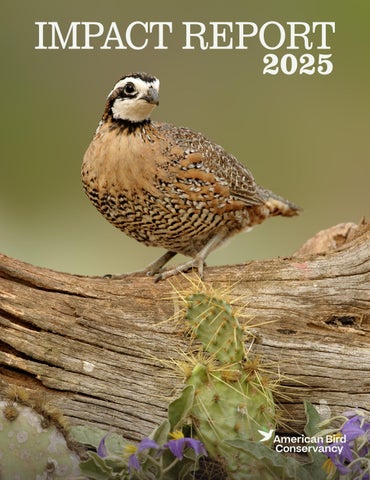
The Northern Bobwhite, one of the birds benefiting from a $21 million grant for pine forest conservation in Arkansas and Louisiana. Photo by Alan Murphy abcbirds.org/CoverBird

Presidentʼs Message

Dear Partners and Supporters:

I’m proud to say that American Bird Conservancy (ABC) accomplished more for birds in 2025 than in any other year on record. We overcame challenges, such as pauses in some of our federal funding, and stayed focused on our mission to conserve birds and their habitats throughout the Americas — ultimately conserving more than 379,000 acres of vital bird habitat for birds ranging from the Golden-winged Warbler to the Lilacine Amazon.

Working with landowners, governments, partner nonprofits, and others, we added significantly to our cumulative total of 10 million acres conserved. This work aided more than 3,000 bird species. One of them, the Northern Bobwhite (seen on this report’s cover), is among the beneficiaries of a $21 million investment that will result in more than 70,000 acres of improved bird habitat in Arkansas and Louisiana. Across the hemisphere, we extended a lifeline to endangered birds like Brazil’s Cherrythroated Tanager — a species numbering fewer than 20 — by creating and expanding more bird reserves. We successfully advocated for bird-friendly legislation and actions in states from New York to Hawai‘i. In addition, we planted tens of thousands of trees to restore bird habitats, published cutting-edge scientific studies that guide conservation, and inspired communities and individuals across the hemisphere to make a positive difference for birds.

This work — and your support — has never been more important. In spite of the challenges, I’m optimistic. Thanks to you, ABC’s impact continues to grow, year after year. Our plans for 2026 are more ambitious than ever, and with your support, I’ll be reporting at this time next year that we accomplished more for birds — with more species safeguarded from extinction, more land restored to help bird populations recover, more threats to birds reduced — than ever before. And thanks to that, our planet and people across the hemisphere will benefit, too.

I hope ABC’s results for birds give you hope — because we’re making progress for birds in all sorts of ways. On behalf of ABC’s dedicated staff and Board of Directors, thank you for sharing in the wonder of birds with us. Thank you for believing in our mission and in ABC.

You make our results possible!

Sincerely,

The Andean Condor finds refuge in the ABC-supported Rimay Cóndor conservation area, Peru. Photo by Ammit Jack/Shutterstock

2025 by the Numbers

Preventing Bird Extinctions

4 “lost” species rediscovered

4,073 Lilacine Amazons counted in Ecuador, a nearly 4x increase in less than a decade Active nests of ‘Ua‘u kani (Wedge-tailed Shearwater) at the Mokio Preserve on Moloka‘i

171,000+ acres in new or expanded reserves in Latin America and the Caribbean

Cherry-throated Tanager.

For the most endangered birds, every acre we protect makes a difference. In 2025, ABC supported the protection of more than 171,000 acres of habitat in new and expanded protected areas, working with partners across the Western Hemisphere. Cumulatively, we’ve protected more than 1.3 million acres and planted more than 8.1 million trees and shrubs to restore vital habitats. Beyond land protection, we worked with partners to bolster bird populations, locate “lost” birds, and much more.

Highlights:

• In Brazil, ABC supported the establishment of a new state park to benefit the Critically Endangered Cherry-throated Tanager, which numbers at most 20 individuals. The Cherrythroated Tanager State Park protects a vital fragment of remaining Atlantic Forest and connects multiple protected areas in the Mata de Caetés Corridor into a landscape of nearly 2,000 acres. Instituto Marcos Daniel, an ABC partner, is managing the roughly 580-acre property with local authorities.

• In Peru, the San Pedro de Chonta Regional Conservation Area was designated in 2025, protecting 128,220 acres of habitat for the Endangered Golden-backed Mountain Tanager and many other animals and plants. ABC supported this project, led by partner Nature & Culture International and the regional government of Huánuco, with additional support from Rainforest Trust and the Andes Amazon Fund. In central Peru, the Rimay Cóndor Environmental Conservation Area was declared thanks to work led by ABC partner Asociación Ecosistemas Andinos (ECOAN) and the Aquia community. Rimay Cóndor protects 42,465 acres of habitat for more than 90 bird species, including the Vulnerable Ash-breasted Tit-Tyrant and Andean Condor. ABC supported both projects through the

Photo by Gustavo Magnago

Conserva Aves initiative, which ABC co-leads with National Audubon Society, BirdLife International, Birds Canada, and RedLAC.

• In Ecuador, a census counted 4,073 Critically Endangered Lilacine Amazons — roughly four times the number tallied about a decade ago. ABC and longtime partner Fundación Jocotoco support a 246-acre reserve that protects roosting sites where 91 percent of the population gathers.

• In the Dominican Republic, ABC helped our partner SOH Conservación purchase 108 acres to expand its Bosque de las Nubes reserve. The 772acre protected area offers important habitat for the Vulnerable and migratory Bicknell’s Thrush and endemic species such as the Endangered Whitefronted Quail-Dove and Hispaniolan Crossbill.

• In Chile, ABC, Red de Observadores de Aves y Vida Silvestre of Chile (ROC), and the International Hummingbird Society supported a new 38-acre reserve in the Chaca Valley for the Critically Endangered Chilean Woodstar. Numbering only about 200, the species is one of the world’s most range-restricted birds.

• ABC researchers completed a study of threatened bird species and their habitats in Latin America; it identified the 55 species most in need of protected habitat and mapped where conserving lands in new or expanded reserves would most benefit the species. The results will guide ABC’s efforts with partners as we work to close the “gaps” in protection for the most endangered birds, including Mexico’s Oaxaca Hummingbird and Ecuador’s Blue-throated Hillstar.

• The Birds, Not Mosquitoes partnership released 60 million mosquitoes on Maui and Kaua‘i — including by ABC staff using drones — in a bid to save endangered honeycreepers such as the ‘Akeke‘e from deadly avian malaria. The labreared non-biting male mosquitoes carry a strain of a common bacteria that prevents successful reproduction with wild female mosquitoes, ultimately reducing mosquito abundance and malaria transmission.

• The Search for Lost Birds, a partnership of ABC, Re:wild, and BirdLife International, recorded four rediscovered species in 2025: the Rufous-breasted Blue Flycatcher of the Philippines, Bismarck Kingfisher of Papua New Guinea, Biak Myzomela of Indonesia, and Broad-billed Fairywren of northern New Guinea. Finding these rare birds means that conservation plans can be put in place to prevent them from becoming “lost” once again.

• ABC is advancing several initiatives to increase the population of Critically Endangered Waved Albatross, including by encouraging more of them to nest on Isla de la Plata, 17 miles off the coast of Ecuador. The project is using social attraction — 20 painted albatross decoys and the broadcast of Waved Albatross calls — in hopes of luring birds to the island and preventing the local extinction of the La Plata colony. The Waved Albatross is also the focal species of ABC’s expanding work on seabird bycatch in Ecuador, including in the Galápagos; we now have a six-person team working with 2,000 fishers to reduce the incidence of seabirds being unintentionally caught on fishing lines.

• In Hawai‘i, ABC and our partner, the Moloka‘i Land Trust, celebrated a record-setting 222 active nests of ‘Ua‘u kani (Wedge-tailed Shearwater) on the island of Moloka‘i at the Mokio Preserve. The birds are nesting within a 5,600-foot-long predator-proof fence completed in 2024. Previously, the preserve hosted 54 active shearwater nests in 2024 and only 35 in 2023.

• A lawsuit about the threats streetlights pose to seabirds on Maui continues against Maui County. ABC hopes to have a court order or settlement that will require the replacement of all streetlights with substitutes less attractive to birds by the end of 2026. ABC and Hawaiian Electric worked together in 2024 to favorably settle a similar suit over Hawaiian Electric’s powerlines.

• And in the Pacific Northwest, our Crumb Clean Campaign to help protect the Endangered Marbled Murrelet expanded in Oregon; we expect to bring it to Washington in 2026.

Left Lucas Tonoli of ABC partner Instituto Marcos Daniel keeps watch over Brazil’s Kaetes Reserve, which, along with a new state park, protects vital habitat for the Cherry-throated Tanager. Photo by Instituto Marcos Daniel
Top Waved Albatross decoys and speakers that broadcast the bird's calls are in place to attract more of the birds to nest on Isla de la Plata, off Ecuador's coast. Photo by Enzo Reyes

2025 by the Numbers

208k

70k

$21 million to restore open pine habitats across more than 70,000 acres in Arkansas and Louisiana

Acres conserved in BirdScapes by ABC with Migratory Bird Joint Ventures and other partners

90 Motus stations installed, upgraded, or supported

10 Latin American countries where our BirdsPlus Program invested in conservation projects

Reversing Bird Population Declines

Migratory birds range over vast landscapes, and ABC’s approach to conservation is scaled to match those incredible journeys. Our BirdScapes framework helps to prioritize the conservation of the habitats birds need at every stage of their annual life cycles. Working with an expansive network of partners that includes Migratory Bird Joint Ventures (JVs), we’ve conserved 10 million acres of priority habitat in dozens of states and countries since 2007; in 2025, these efforts conserved no fewer than 208,000 acres.

Highlights:

• ABC and partners across the Northern Great Plains improved nearly 100,000 acres of vitally important grassland habitat in 2025, bringing our all-time total in the region to 600,000 acres. The work benefits the Long-billed Curlew, Chestnut-collared Longspur, Western Meadowlark, and other declining grassland

birds, and was conducted in partnership with the U.S. Department of Agriculture’s Natural Resources Conservation Service (NRCS).

• Farther south, ABC’s team within the Rio Grande Joint Venture (RGJV) delivered improved habitat for birds such as the Zone-tailed Hawk, Northern Bobwhite, and Cassin’s and Baird’s Sparrows through grassland enhancement, instream and riparian restoration, and brush management practices over 50,000 acres in south Texas through the Grasslands Restoration Incentive Program (GRIP) and in west Texas through the Chihuahuan Desert Conservation Partnership. The RGJV continues to play a lead role in conservation and water management along the U.S.-Mexico border; with the Texas Water Foundation, the RGJV hosted a unique forum in 2025 that brought together 150 binational stakeholders to create a common vision for the future of the Rio Grande.

• Our efforts to improve critically important oak forests for the declining Red-headed Woodpecker, Cerulean Warbler, and Wood Thrush in Illinois and Wisconsin grew in 2025; restoration activities took place on 450 acres,

Right ABC is improving grassland habitat for the Zone-tailed Hawk and other species in Texas. Photo by Greg Homel/Natural Elements Productions Opposite The American Woodcock is an ABC priority species in the Great Lakes region and elsewhere. Photo by John Turner

and forest management plans are underway on an additional 756 acres.

• Golden-winged Warblers, American Woodcocks, and other early successional habitat specialists in the Great Lakes region have more habitat after ABC and partners created or enhanced more than 6,000 acres in 2025, thanks to support from the Minnesota Outdoor Heritage Fund and the NRCS. We are encouraged by evidence that our habitat interventions are working: Comprehensive monitoring of 141 sites enrolled in NRCS programs revealed that 78 percent were occupied by American Woodcocks and 87 percent by Golden-winged Warblers.

• In Pennsylvania, ABC and partners are stewarding more than 23,500 acres within 40 dynamic forest restoration blocks (DFRBs) to improve forest health and structural complexity — creating the mosaic of habitats needed to support diverse forest bird communities that include Golden-winged and Cerulean Warblers, Wood Thrush, Canada Warbler, and Eastern Whip-poor-will. The program aims to improve the health and diversity of more than 379,000 acres for birds across all 40 restoration blocks. Our DFRB partners include the Pennsylvania Game Commission, the Pennsylvania Department of Conservation and Natural Resources, as well as private landowners.

• With the support of a $2.9 million award from

the California Wildlife Conservation Board, ABC is leading a new three-year project that will restore 975 acres of riparian and wetland habitat for threatened migratory birds in the Amargosa Basin, a vast watershed in the Mojave Desert. The landscape is essential for the survival of many birds, among them California’s Endangered Bell’s Vireo, the federally Endangered Southwestern Willow Flycatcher, and the federally Threatened Western Yellowbilled Cuckoo. Partners include the University of California-Davis, River Partners, the

The Golden-winged Warbler and other birds are being helped by recent conservation work in places like this woodland in central Pennsylvania. Photos by Agami Photo Agency/Shutterstock (warbler) and Jeff Larkin (forest)

Amargosa Conservancy, and Roux, Inc.

• Across more than 10 million acres, ABC is providing technical assistance to ranchers and private landowners throughout the eastern Sierra Nevada, western Mojave Desert, southern Central Valley, and the California Central Coast. Since June, ABC staff have worked with nearly 20 landowners to enhance their lands for declining riparian, grassland, and desert birds, including California Thrasher and Grasshopper Sparrow. This work is progressing thanks to a partnership with the NRCS California State Office.

• The Lower Mississippi Valley Joint Venture, which ABC supports and staffs, secured five years of funding totaling more than $21 million for its Open Pine Regional Conservation Partnership Program — through which we’ll work with landowners on at least 70,000 acres in Arkansas and Louisiana to benefit species from the Northern Bobwhite to the federally Threatened Red-cockaded Woodpecker. This work builds on the 30,500 acres of pine forest and savanna improved to date through the program.

• Many other birds of the U.S. Southeast, from the Chuck-will’s-widow to Prairie Warbler, stand to gain from a partnership between ABC and Resource Management Service (RMS), one of the world’s largest timber management and investment firms. In 2025, ABC contributed to the company’s ongoing efforts to deliver results for both investors and nature on the roughly 2 million

acres it manages across eight southeastern states. Conducting 830 bird survey point counts on RMS-managed lands, ABC observers recorded 100 species, indicating a diverse bird community relying on RMS forests during the breeding season. The data provides a baseline against which the company can track the impacts of its management practices on birds.

• To help migratory birds like the Rubythroated Hummingbird where they spend the nonbreeding season, ABC’s BirdsPlus Program

A Motus station tracks tagged wildlife at an Oregon refuge. The Semipalmated Sandpiper is the bird species with the most tagged individuals. Photos by William Blake (tower) and RT Images/Shutterstock (sandpiper)
Pine forest restoration in Arkansas and Louisiana is aiding the Redcockaded Woodpecker.
Photo by Renee Bodine/U.S. Fish and Wildlife Service

continues to expand its reach and its returns, working in 10 countries across 11 BirdScapes with 14 partners, including nongovernmental organizations and private-sector companies. For example, in Honduras, our partner Cacao Moskito used a recoverable ABC grant to purchase and process 5 metric tons of cacao from nearly 100 farmers and then sold the product on the market. The grant, which was paid back to ABC to reinvest in more conservation work, made it possible for bird-friendly habitat (shade cacao) to remain in the Lost City BirdScape and avoid conversion to cattle pasture.

• We’re thrilled to be partnering with Costa Rica’s Coffee Institute (ICAFE), a public institution representing 27,000 farmers, to enhance birdfriendliness across the country’s coffee “value chain,” from growing to distribution. And, to encourage cacao growers in the region to increase the value of their land for birds, we produced the first in a series of short “how-to” videos that encourage adoption of ABC conservation practices. Our efforts to advance bird-friendly practices in coffee, cacao, and other crops have the potential to significantly scale up conservation results — and benefit people as well.

ABC researchers are advancing the BirdsPlus Index, an innovative tool that uses bird sounds as an indicator of biodiversity. The team produced two important papers in 2025, one that set BirdsPlus species scores for all the world’s bird species based on species-specific attributes and another that demonstrates how acoustic data collected through autonomous recording units (ARUs) can be used to produce checklists of

bird species. When overlaid with BirdsPlus species scores, this data can be used to estimate BirdsPlus site scores — which in turn can be compared to determine sites with the most conservation value and ecological integrity. The papers are currently under peer review.

In addition, ABC is starting to provide acoustic monitoring services to partners, using BirdsPlus Index tools to measure the conservation benefits of restoration work. These include restoration of tidal creeks in New York by Billion Oyster Project and NYC Bird Alliance, as well as rubber tree plantings on degraded pastures in Costa Rica with the rubber company Hevea.

• ABC continued to expand the Motus Wildlife Tracking System in the U.S. in 2025, with 41 new stations installed, 37 upgraded, and assistance provided on an additional 12. Collecting signals from digitally coded tags attached to birds, the network is providing a better understanding of birds’ travels and their conservation needs. Motus stations supported by ABC have provided data on more than 1,500 individuals of more than 100 species since 2024.

ABC researchers install an autonomous recording unit at a cacao farm in Ecuador. The device records bird calls, helping conservationists track birds on the property.
Photo by Kualicomunicación
The California Thrasher is benefiting from efforts to enhance chaparral habitat in its namesake state. Photo by Agami Photo Agency/Shutterstock

Reducing Threats to All Birds

Threats to birds can be as widespread as the invasion of non-native species, or as localized as habitat loss on a 1-square-mile atoll in the Pacific Ocean. Throughout 2025, ABC built on its strong record of taking on some of the biggest threats to birds, working with a range of partners and supporters to minimize the impacts of glass collisions, outdoor domestic cats, and harmful pesticides, to name just a few.

Highlights:

• In November, ABC celebrated a victory for the federally Threatened Red Knot when the federal government advanced a directive that encourages the Food and Drug Administration to update medical safety testing guidance. Once updated, the guidance will allow biomedical companies to use synthetic testing methods that do not require the use of horseshoe crab blood. Horseshoe crabs lay eggs that fuel epic shorebird migrations. Less commercial harvest of them means more eggs on beaches for shorebirds. Another victory came in December, when New York state announced that it will phase out horseshoe crab harvest by 2029.

• ABC worked hard in 2025 to ensure federal agencies and programs continued to support bird conservation, opposing a proposal to weaken the Endangered Species Act and joining a lawsuit to protect the imperiled Florida Scrub-Jay, the outcome of which could have grave implications for the Act. We also advocated for adequate funds for bird conservation in the 2026 federal budget; funding levels for bird conservation held steady and even increased for some programs.

• Our advocacy also helped achieve wins in states from Hawai‘i to Vermont this year. For example, Lake County, Illinois, became the first municipality in the country to adopt rules for the use of collision deterrents on windows on new single-family homes. ABC continues to lead the movement to prevent glass collisions; to date, ABC has helped to establish bird-friendly building ordinances in nearly 30 municipalities. And, to help get more bird-friendly products on the market, in 2025, ABC’s Glass Collisions team tested 55 glass collision deterrent products in two fully booked seasons of our glass-testing tunnels.

• Encouraged by ABC and other groups, the Hawai‘i County Council passed an ordinance that prohibits the feeding of feral and stray animals on County-owned properties. This is a meaningful step toward reducing the threats birds face from cats and other non-native species on the Hawaiian Islands — home to more endangered birds than any other U.S. state, including the ‘Alawī (Hawai‘i Creeper) and the Palila. In addition, ABC continues to partner with land managers in Hawai‘i to monitor, trap, and remove cats and

from the federal government
New York state will help horseshoe crab populations recover, which in turn will benefit the Red Knot. Photos by Joshua Galicki (Red Knot), Ray Hennessy (horseshoe crab), and Gavin Shire (beach scene)

2025 by the Numbers 19,230 pounds

Trash cleared by SPLASh from 694 acres in the Houston-Galveston region

other invasive predators, such as mongooses, from habitats where highly endangered birds are vulnerable to predation.

• Vermont and Connecticut placed restrictions on the use of neonicotinoids — which are commonly used as seed coatings and are deadly to birds — in 2025. ABC played a lead advocacy role on both actions. Neonics can no longer be used on outdoor plants like shrubs and landscaped areas in Vermont, and by 2029, the state will ban their use on soy, corn, and wheat seeds. Connecticut banned neonic use on 300,000 acres across the state beginning in 2027. The state also voted to remove highly toxic rodenticides from store shelves, reducing the risk of secondary poisoning to raptors such as the Short-eared Owl and Red-shouldered Hawk. Other states, including New Mexico, Massachusetts, and Colorado, have also taken up the issue of pesticides, with legislation supported by ABC in the works.

• In further efforts to reduce pesticide use, ABC enrolled more than 5,600 acres of cropland in our Untreated Seed Pilot Program, in 12 states from Montana to Pennsylvania. This new effort seeks to support American growers and producers interested in using seeds free from neonicotinoid pesticides. Participants are helping ABC to better understand and respond to the challenges producers face when trying to reduce and eliminate neonic seed coatings from their farming operations.

• In Texas, shorebirds continued to benefit from ABC’s efforts in 2025. We monitored Least Tern and Snowy and Wilson’s Plover nests along 395 acres of the Texas coast and protected an additional 1,275 acres as part of our ongoing work to ensure these sensitive beach-nesters can raise young safely. And, Stopping Plastics and Litter Along Shorelines (SPLASh), a partnership of ABC, Gulf Coast Bird Observatory, and Black Cat GIS, cleared more than 19,230 pounds of trash from 694 acres in the Houston-Galveston region’s bayous and coastlines. Since the project began in 2020, SPLASh has collected more than 70,000 pounds of trash in the region.

• Regional fishery managers around the Chesapeake Bay voted in favor of a 20 percent reduction in the catch quota

for menhaden, a preferred food source for Osprey. While more progress is urgently needed, ABC and partners have been increasing awareness that unsustainable menhaden harvests are driving Osprey declines in the region.

• Following concerns raised by ABC and others, the U.S. Department of the Air Force suspended its plans with SpaceX to construct two rocket test landing pads on Johnston Atoll National Wildlife Refuge in the Pacific Ocean. The site, 1,400 kilometers southwest of Hawai‘i, is critical nesting habitat for more than a million seabirds. The suspension followed an ABC meeting with SpaceX, during which we offered to collaborate on finding an alternative location and requested further study of the project’s potential hazards.

• Our legal action to protect the Great Salt Lake survived a preliminary challenge in the courts, enabling ABC and partners to continue to pursue protections for this threatened oasis for shorebirds such as the Wilson’s and Red-necked Phalaropes and Black-necked Stilt

• Finally, ABC published our State Legislative Guide in 2025 — a free resource to help bird advocates pursue legislative solutions to building collisions, plastic pollution, and other threats to birds. Download here: abcbirds.org/stateguide.

A Least Tern watches over its chick on a southern beach. ABC monitors tern nests in Texas and protects coastal areas along the Gulf. Photo by Gary Flanagan
7 states where ABC and partners won state and local victories for birds
5,600 acres of cropland enrolled in ABC’s Untreated Seed Pilot Program
0 rocket landing test pads to be built on bird-rich Johnston Atoll after ABC advocacy

Building the Bird Conservation Movement

Partnership has been the cornerstone of ABC’s work from the start — we know that our mission to conserve birds and their habitats relies on relationships built on trust and a shared vision of an expansive, inclusive bird conservation movement. The ever-growing flock of people who work with us to care for birds is foundational to all that we do, and building that movement is essential as we take on the toughest challenges facing birds, together.

Highlights:

• The Bird City Network, an initiative of ABC and Environment for the Americas, guided the design and 2025 launch of new programs in Georgia, Michigan, Missouri, and Oregon, as well as 12 municipalities in Colombia newly designated as Bird Cities. These actions boosted the number of Bird City programs to 16 and Bird City communities to 277. In 2025, Bird City communities took more than 3,000 conservation actions, such as a nature-themed window painting contest in Galveston, Texas, to reduce bird collisions with glass, and replacing invasive buckthorn in a Mequon, Wisconsin, park with native trees.

• The Latin American Reserve Stewardship Initiative (LARSI), an ABC collaboration with March Conservation Fund, celebrated its 10th anniversary with a partner summit in Bogotá, Colombia. LARSI has provided 29 of ABC’s Latin American and Caribbean partners with more than $3.8 million in grants for organizational and reserve management, financial sustainability, and more, supporting their ability to prevent bird extinctions in over 70 reserves across 13 countries. This year, 14 LARSI partners received a total of $425,000 for projects that benefited

endangered birds, including the Blue-billed Curassow, Antioquia Brushfinch, Blackbreasted Puffleg, Gray-breasted Parakeet, and Indigo (Lear’s) Macaw.

• Along with NatureServe and the authors of Habitats of North America, ABC developed the Habitats WatchList, a new way to categorize, map, and assess risk for bird habitats. The Habitats WatchList (abcbirds.org/habitatswatchlist) is the first of its kind, pairing bird communities with vegetation-based habitat maps to identify conservation needs and challenges in birds’ terrestrial, freshwater, and coastal environments.

• Our Together for Birds Program enables us to expand how we care for birds and to better articulate why it matters, using art, education, research, and community engagement to highlight essential components of effective conservation. In 2025, our biannual

The Endangered Black-breasted Puffleg is endemic to northwestern Ecuador. Photo by Murray Cooper

cohort of Together for Birds Conservation and Justice Fellows advocated for more ethical and expansive approaches to conservation. For example, one of the fellows improved connections across borders by helping the Partners in Flight Network create bilingual stories and technical materials, while another boosted Kirtland’s Warbler conservation through community engagement in The Bahamas.

• Our Together for Birds Resident Artists created original works of art featuring highly threatened birds, created multisensory materials to engage birders with disabilities, and participated in “Draw and Learn” webinars focused on native Hawaiian honeycreepers and Brazil’s stunning Araripe Manakin. Fellows with the Lost Birds initiative expanded our understanding of the Turquoise-throated Puffleg and Jerdon’s Courser. Meanwhile, other fellows created materials and guidelines for a “pop-up trail” to engage neurodiverse individuals and extended the reach of our work on seabirds and multispecies kinship.

2025 by the Numbers

$425,000 granted to partners through the Latin American Reserve Stewardship Initiative

States with new programs in the Bird City Network (Georgia, Michigan, Missouri, and Oregon)

200,000 messages sent to legislators by 25,000 people through our Action Alerts aimed at improving regulations for birds

1 million+ followers across ABC’s social media channels with 50 million impressions

• Our Together for Birds Seed Grant recipients are working to expand and enrich approaches to ethical conservation and inclusive birding by using social sciences research, education, fine art, and community engagement. And the Afrofuturism Collective, supported by ABC and Re:wild, is bringing together members of the African diaspora to explore, share experiences, and create new visions for the future of biodiversity conservation.

• In Hawai‘i, ABC is working with teachers to develop a native bird-focused curriculum to help raise the next generation of conservationists. Project successes include a youth advocacy cohort called Nā Leo Nahele, which brought energy and enthusiasm about Hawaiian honeycreepers to five major outreach events in 2025 while developing participants’ capacity as conservation leaders.

• ABC reached several milestones in our efforts to inspire conservation action and support this year. Through our Action Alert system, more than 25,000 people sent nearly 200,000 messages to legislators aimed at improving regulations for birds. Circulation of ABC’s redesigned Bird Conservation magazine reached 30,000, and on social media, our channels surpassed 1 million in combined followers. ABC’s website (abcbirds.org) saw well more than 2 million page views; we expect the recently redesigned site to attract still more. We also hosted 14 webinars on topics such as warblers, seabirds, and endangered Latin American species, attracting 39,700 registrants and nearly 9,000 live attendees. And, ABC earned more than 4,300 mentions by media outlets, ranging from The New York Times to National Public Radio to regional and local outlets.

Ben Catcho, ABC's Indigenous Communications and Outreach Specialist (left), points out birds to students from Kanu ‘o ka ‘āina Charter School during a spring 2025 program in Hawai‘i Volcano National Park. Photo by Marlie Kaho‘opi‘i
ABC's Eliana Fierro-Calderón (green cap) joins partners at Colombia's Refugio del Tororoi, which benefits from the Latin American Reserve Stewardship Initiative and the Conserva Aves partnership. Photo by Erica Sánchez Vázquez

Thank YOU!

The challenges facing birds, their habitats, and nature at large are many, but as this report shows, American Bird Conservancy’s work can and does make a difference — every day. Your generous support of ABC helps us do more: to protect more land for endangered birds, to conserve more vast and varied landscapes needed by declining migratory species, to lead the way toward safer habitats that pose fewer risks to birds, and to welcome everyone who cares about birds into our community. From all of us at ABC, thank you. Here’s to even more great results that benefit birds — as well as people and the planet — in 2026!

Black-necked Stilts will benefit from ABC's work to protect the Great Salt Lake. Photo by Wildpix 645/Shutterstock

ABCʼs work in 2025 took us around the Americas, including to (clockwise from top right): (1) a World Migratory Bird Day celebration at Santander de Quilichao, the first Bird City in Colombia | (2) a panel discussion at George Washington University featuring (left to right) Planet Forwardʼs Devin Santikarma, Naamal De Silva, ABC’s Vice President of Together for Birds, and John Mittermeier, Director of the Search for Lost Birds | (3) a summit of the Latin American Reserve Stewardship Initiative where Together for Birds Resident Artist Omar Custodio (left) presented a commissioned painting to Ivan Samuels, of the March Conservation Fund | (4) the Birding Con Orgullo outing in Washington, D.C., sponsored by ABC, Latino Outdoors, Out for Sustainability, and the Feminist Bird Club | (5) and a workshop in the Galápagos where Giovanny Suárez Espin (left), our Ecuador Seabird Bycatch Coordinator, used an albatross puppet to show participating fishers how to safely handle birds and remove hooks.

Photos by Joanna Eckles (1), Erica Sánchez Vázquez (2), Emily Williams (3), Viv Aranzazu (4), and Sebastian Cruz (5)

In 2025, supporters like you empowered us to advance our mission like never before. Together, we made a measurable difference for wild birds and their habitats throughout the Americas. Please enjoy a video about the results you helped us achieve in 2025 and meet a few of the people who made it possible. abcbirds.org/ThankYou

A female Blue-billed Curassow in Colombia.
Photo by David Fisher/Neotropical Birding

Turn static files into dynamic content formats.
Create a flipbook
Impact Report 2025 by American Bird Conservancy - Issuu