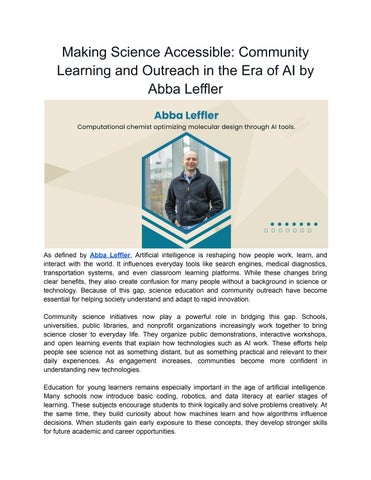
Making Science Accessible: Community Learning and Outreach in the Era of AI by Abba Leffler
As defined by Abba Leffler, Artificial intelligence is reshaping how people work, learn, and interact with the world. It influences everyday tools like search engines, medical diagnostics, transportation systems, and even classroom learning platforms. While these changes bring clear benefits, they also create confusion for many people without a background in science or technology. Because of this gap, science education and community outreach have become essential for helping society understand and adapt to rapid innovation. Community science initiatives now play a powerful role in bridging this gap. Schools, universities, public libraries, and nonprofit organizations increasingly work together to bring science closer to everyday life. They organize public demonstrations, interactive workshops, and open learning events that explain how technologies such as AI work. These efforts help people see science not as something distant, but as something practical and relevant to their daily experiences. As engagement increases, communities become more confident in understanding new technologies. Education for young learners remains especially important in the age of artificial intelligence. Many schools now introduce basic coding, robotics, and data literacy at earlier stages of learning. These subjects encourage students to think logically and solve problems creatively. At the same time, they build curiosity about how machines learn and how algorithms influence decisions. When students gain early exposure to these concepts, they develop stronger skills for future academic and career opportunities.