What Makes AASA a Great Choice for Overseas Manufacturing?
A factory quote is easy to get. Getting that factory to actually deliver the right product, on time, at the quality you agreed to, is a different problem entirely. Businesses moving production overseas run into the same hurdles again and again: finding capable factories, verifying suppliers, communicating technical requirements clearly, managing production remotely, maintaining quality, tracking timelines, handling inspections, and coordinating shipping across borders.
This article looks at how Asian American Sourcing Alliance (AASA), an overseas manufacturing company working across several Asian markets, actually approaches these problems. The goal isn't just to find a factory. It's to get the right factory, clear product requirements, quality expectations, production management, and logistics all working together.
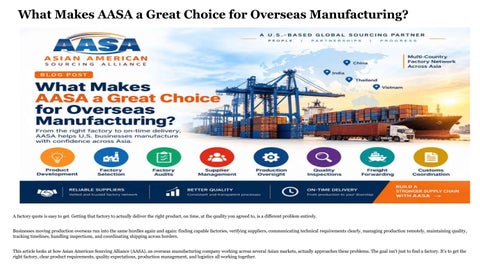
What Does AASA Actually Do? AASA supports U.S. businesses across multiple stages of overseas manufacturing, not just the initial supplier introduction. That support spans: •Product development •Factory selection •Factory audits •Supplier management •Overseas project management •Production oversight •Quality inspections Handling these pieces as one connected process means a business isn't left coordinating a supplier, an inspector, a freight forwarder, and a customs broker separately, hoping the information passes between them accurately.
AASA Is More Than a Traditional Sourcing Agent This distinction matters, because "sourcing agent" means very different things depending on who's using the term.
Traditional Sourcing Agent A basic sourcing agent typically focuses on: •Finding suppliers •Requesting quotations •Connecting buyer and factory •Negotiating pricing That's useful for a straightforward, low-risk order. It's less useful once a product has real engineering complexity, tight tolerances, or a quality bar that can't afford surprises.
AASA's Broader Role AASA's model extends into: •Product development •Factory evaluation •Factory audits •Production management •Quality control •Inspections In practice, this means AASA stays involved after the purchase order is placed, not just up to the point of introduction.
U.S.-Based Support With Boots-on-the-Ground Presence AASA operates as a U.S.-based overseas sourcing company with staff on the ground across its Asian manufacturing markets. Having people on both sides of the relationship changes how issues get handled day to day: •Easier communication for U.S. teams during their own business hours •A better understanding of what U.S. buyers expect from a supplier •Local factory oversight instead of relying on remote updates •Faster response when a production issue comes up •Clearer communication between buyer and supplier •On-site inspection and supervision •Reduced cultural and language friction None of this eliminates every communication or cultural challenge that comes with overseas manufacturing. It does mean issues are more likely to be caught and addressed locally, before they turn into a bigger problem for the buyer.
Access to a Multi-Country Asian Factory Network AASA doesn't approach sourcing with a one-country-fits-all mindset. AASA currently works across factory networks in: China, India, Vietnam, and Thailand Which market makes sense for a given product depends on several factors, evaluated together rather than in isolation: •Product type •Raw materials •Manufacturing processes •Factory capabilities •Production volume •Quality requirements •Logistics •Cost considerations •Lead times •Supply-chain strategy No single country is universally cheaper, better, or safer for every product. As a global sourcing company working across multiple markets, AASA can evaluate a project against more than one location instead of defaulting to whichever country it happens to know best.
Factory Selection Based on More Than Price The lowest factory quote is not automatically the best manufacturing option. Factory selection should weigh several factors together: •Price •Factory capabilities •Factory audit results •Production capacity •Communication •Reputation •Logistics considerations Choosing a factory on price alone tends to surface problems later, in the form of: •Quality issues •Production delays •Capacity limitations •Communication problems •Unexpected costs •Shipping complications A good overseas manufacturing partner evaluates total suitability for the product, not just the number on the quote.
Factory Audits Help Businesses Understand Their Suppliers A factory audit is a structured, on-site review of a supplier before production begins. It typically looks at: •Factory history •Management •Quality-control systems •Existing products •Equipment •Manufacturing technology •Production capacity •Facility conditions •Working environment An audit gives a business real information to base a supplier decision on, instead of relying on photos, a sales pitch, or a factory's own description of itself. It doesn't guarantee flawless performance going forward, but it substantially lowers the odds of an unpleasant surprise.
Product Development Before Mass Production Product development work happens before a factory ever starts mass production, and it has a direct effect on how smoothly that production goes. AASA's support in this area includes: •3D CAD •2D part and assembly drawings •Raw-material identification •Manufacturing processes •Tooling considerations •Prototyping •Product testing Clear technical documentation reduces the room for misunderstanding between a U.S. buyer and an overseas manufacturer. That includes agreement on: •Specifications •Drawings •Materials •Tolerances •Prototype approval •First-article evaluation
Dedicated Overseas Project Management A dedicated overseas project manager gives a U.S. business a single point of coordination instead of juggling factory contacts directly. Project management on the ground helps coordinate: •Factory communication •Production timelines •Product requirements •Milestones •Changes •Quality concerns •Updates & Supplier coordination This matters most for U.S. businesses that don't have their own staff based near their Asian suppliers. It's worth noting this doesn't come with a promise of a fixed response time or a guaranteed production schedule; it's oversight, not a guarantee.
The AASA Manufacturing Process At a high level, a project moves through the following stages: 1. Understand the Product & Business Requirements Define what's being made, the specifications, the volume, and the quality bar before looking at any factories. 2. Identify Suitable Manufacturing Country & Factories Match the product and requirements against the right market and a shortlist of capable factories. 3. Evaluate & Audit Potential Factories Verify capabilities, equipment, and quality systems on-site rather than on paper alone. 4. Compare Capabilities, Pricing & Logistics Weigh cost against capability, capacity, and shipping considerations, not price in isolation.
5. Develop Samples / First Article Confirm the product matches specifications and approved samples before committing to full production. 6. Begin Production Move into full production once specifications, pricing, and terms are confirmed. 7. Monitor Production & Quality Track progress and catch issues while they're still cheap and easy to fix. 8. Conduct Inspections Check specifications, workmanship, function, quantity, and packaging before goods are released. 9. Coordinate Freight & Logistics Manage freight forwarding, export documentation, and customs coordination. 10. Deliver the Finished Product Get the finished, inspected goods to their final U.S. destination.
Final Takeaway Choosing an overseas manufacturing partner shouldn't come down to whichever factory sent back the lowest quote. The right partner helps manage factory selection, product development, production, quality, communication, and logistics as one connected process. AASA's combination of U.S.-based support, overseas personnel, factory relationships, project management, inspection capabilities, and logistics support is built to make overseas manufacturing more manageable for U.S. businesses, without pretending every risk disappears along the way.
If you're evaluating an overseas manufacturing company for an upcoming product, AASA can walk through your specific requirements and where its support fits into your process.