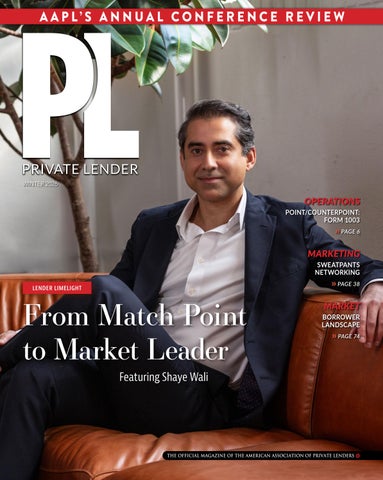
AAPL’S ANNUAL CONFERENCE REVIEW
WINTER 2026
OPERATIONS POINT/COUNTERPOINT: FORM 1003
» PAGE 6
MARKETING SWEATPANTS NETWORKING
» PAGE 38
LENDER LIMELIGHT
From Match Point to Market Leader
MARKET BORROWER LANDSCAPE
» PAGE 74
Featuring Shaye Wali
THE OFFICIAL MAGAZINE OF THE AMERICAN ASSOCIATION OF PRIVATE LENDERS
CONTENTS CORNER OFFICE 5
Advance Our Industry Together
OPERATIONS 6
Private Lender Exchange: Form 1003 Jesse Goldberg, ParkPlace Finance, and John V. Santilli, Unitas Funding
10 Build Scale with the Right Debt Instruments
Mark Jury, Enterprise Bank & Trust
16 Shield Your Portfolio
Against Bad Valuations Michael Tedesco, Class Valuation
CASE STUDY 20
16 30 Private Lending Demands Crisis-Level Leadership
Scott Ward, Think Realty
FUNDAMENTALS 34 Who Owes the Debt?
George Caballero, Caballero Lender Services, and Daniel A. Cox, Wood + Lamping
MARKETING & SALES Shaylee Henning, 1 Shay Studios
42 Lend Where Value Wins
Tim Landwehr, Anchor Loans
Jerry Feinstein, Spreo Capital
46 Private Lending Scaling Faster
22 Two Days at AAPL, One
Year Ahead of the Market Jeremy Altervain, Vault Financial Services LLC
LEADERSHIP 26 Committed Leadership
Turns Strategy into Value
Chuck Reeves, Asset Acquisitions Inc.
68 The Borrower Divide
Shaping Lending Today
Michael Fogliano and Sean Morgan, Forecasa
76 DSCR Tightens Its Grip Nema Daghbandan, Esq., Lightning Docs
88 Rebounding Sentiment Signals an End to Buyer Gridlock
Daren Blomquist, Auction.com
STRATEGY 94 Ground Up Construction: The Only Real Solution to Housing Shortages
HUMAN RESOURCES
BROKERS
MARKET
38 Network ... in Your Sweatpants
From Timeworn Tudor
to Timeless Luxury
68
Than Leadership Bench
Philip Feigenbaum, Huffman Associates LLC
COMPLIANCE 52 Same Rules, New Enforcement Jennifer Young, Esq., Fortra Law
LENDER LIMELIGHT 59 From Match Point to
Shaye Wali, Baseline
CONFERENCE REVIEW 98 16th Annual Conference
VENDOR GUIDE 112 Winter Guide
LAST CALL 114 Flipping It Forward
Fred Rea, Rain City Capital
Market Leader with Shaye Wali
WINTER 2026
3
Nationwide Provider of Stable Capital for Business Purpose Loans
MORTGAGE BROKERS, YOU HAVE AN ADVOCATE Fix & Flip Capital
Ground Up Construction Line of Credit DSCR Rental Capital Blanket Mortgage Portfolio Loans
LET’S CONNECT 833-208-1442 www.ConstructiveLoans.com
All terms subject to credit approval. All loans must be solely for a business or commercial purpose and secured by a non-owner-occupied property. In AZ, CA, ID, MN, OR, UT, and VT, products are offered by BPL Mortgage, LLC NMLS ID #2574042. Products not available in ND, NV, or SD. In all other states not previously listed, products are offered by Constructive Loans, LLC d/b/a Constructive Capital. Please visit www.nmlsconsumeraccess.org for additional licensing/registration information. All loans made and arranged in California pursuant to a California Financing Law License #60DB0-192818. Rates, terms, and conditions are subject to change from time to time without notice. This advertisement is intended for mortgage professionals only.
Corner Office
Advance Our Industry Together LINDA HYDE
President, AAPL
As we conclude another incredible annual conference, I’ve been reflecting not only on what we achieved this past year but also on the tremendous
KAT HUNGERFORD
opportunities ahead. Our industry continues to expand, innovate, and
CONTRIBUTORS
Last year’s conference was one of our strongest yet, a powerful reminder
Executive Editor
Jeremy Altervain Daren Blomquist George Caballero, Esq. Dan Cox Nema Daghbandan, Esq. Phil Feigenbaum Jerry Feinstein Michael Fogliano Jesse Goldberg Shaylee Henning Mark Jury Tim Landwehr Sean Morgan Fred Rea Chuck Reeves John V. Santilli Michael Tedesco Shaye Wali Scott Ward Jennifer Young, Esq.
COVER PHOTOGRAPHY Dan Abramovici
PRIVATE LENDER
Private Lender is published quarterly by the American Association of Private Lenders (AAPL). AAPL is not responsible for opinions or information presented as fact by authors or advertisers.
SUBSCRIPTIONS
Visit aaplonline.com/subscribe.
BACK ISSUES
Visit aaplonline.com/magazine-archive, email PrivateLender@aaplonline.com, or call 913-888-1250. Use of Private Lender content without the express permission of the American Association of Private Lenders is prohibited. www.aaplonline.com Copyright © 2026 American Association of Private Lenders. All rights reserved.
mature—and it’s our shared commitment to excellence that drives us forward. of the importance of connection and collaboration. With recordsetting attendance, diverse speakers, and a wide range of educational sessions, we saw firsthand how the private lending community continues to evolve. Whether you participated as an experienced lender, a service provider, or a newcomer exploring this dynamic field, your presence reaffirmed our mission: elevating private lending through education, advocacy, and ethical standards. One of the most inspiring aspects for me was the level of engagement throughout the event. From early-morning sessions to the lively discussions on the expo floor, the enthusiasm was unmistakable. Our members showed up ready to share insights, ask thoughtful questions, and invest in their professional growth. It’s in these interactions—both large and small—that the true strength of our association shines. As we close the chapter on the 2025 conference, we look ahead to a year filled with both challenges and exceptional promise. Economic shifts, evolving regulatory conversations, and emerging market opportunities continue to reshape the private lending landscape. Times like this call for strong leadership, clear standards, and a unified voice. In the coming year, my focus as AAPL’s president is threefold: First, we will continue strengthening the educational resources available to our members. In a fast-
moving industry, staying informed is essential. Through enhanced certifications, updated coursework, and expanded online tools, we will equip our members with the knowledge needed to excel. Second, advocacy remains central to our mission. Our association plays a vital role in
representing private lenders at both state and federal levels. This year, we will deepen our efforts to ensure policymakers understand who we are, how we operate, and why responsible private lending is essential to healthy real estate markets. Finally, community will remain a cornerstone of our work. The relationships formed here are among our greatest strengths, and we will continue cultivating opportunities for
networking, mentorship, and collaboration. Stayed tuned for more information about regional events, strategic partnerships, and our evolving digital platforms. I am truly excited for what we will accomplish together. The future of private lending is bright. With your continued involvement, we will elevate our industry, uphold our standards, and drive meaningful progress. I am deeply grateful to our staff, volunteers, and members. Each of you plays a vital role in making AAPL not just an association but a community.
LINDA HYDE President, American Association of Private Lenders
WINTER 2026
5
Operations
Private Lender Exchange: Form 1003 Is it time for a universal private-lending application?
JESSE GOLDBERG, PARKPLACE FINANCE, AND JOHN V. SANTILLI, UNITAS FUNDING
This new series explores the
navigate today’s evolving real estate
perspectives, counter perspectives, and
finance landscape.
middle ground behind key issues in the private lending industry. Through candid dialogues, we aim to challenge entrenched assumptions, surface subtle trade-offs, and create a forum for innovation and success. Our hope is we’ll equip private lenders, underwriters, and industry stakeholders with a richer, more nuanced lens to
6
PRIVATE LENDER BY AAPL
In each installment, we will present a core thesis from one side of the issue, followed by a robust counter thesis (or theses), before covering actionable insights that reconcile the tension. We invite readers to submit your ideas for additional topics we can debate in this series. Please send your ideas to privatelender@aaplonline.com.
I
n our first article, Jesse Goldberg and John V. Santilli explore the standardization of applications across private-money loans as an answer to a 1003 Uniform Residential Loan Application.
EFFICIENCY Jesse: Our industry has long relied on a patchwork of systems: conventional loan origination software (LOS) platforms that require extensive customization, fully proprietary systems built from scratch, and niche private-lending software that
By creating a uniform application built around global minimum standards, we can reduce borrower friction, eliminate redundant effort, and meaningfully minimize borrower fatigue.
varies widely in implementation and datapoints. A major cost advantage of a standardized application is the reduction, or potential elimination, of expensive enhancements and custom development each company must undertake. Beyond technology costs, there are hidden staffing costs and delays. Because each company’s programs differ from both one another and the conventional mortgage industry, training new hires quickly can be difficult and expensive. A standardized application, aligned across companies, would strengthen the broader ecosystem and improve career mobility for current and future employees in private-money lending. John: Private lending at its core is just that—private! The industry emerged from entrepreneurial individuals or companies that recognized they could unlock lending opportunities by stepping in where banks and other traditional lenders wouldn’t. You could argue the first application was defined by Uncle Louie or Uncle Morty—the days of a
knock on the door, a look in the eye, a handshake, and a man or woman’s word. Talk about speed and efficiency! Though most private lenders are looking for the same seven to 10 variables to construct standardized loan terms, the real estate investment community still enjoys many who keep the true spirit of independent lending terms. The evidence appears often during conversations in AAPL’s Certification Program (CPLA). Uncle Louie and Uncle Morty often seek instruction on how to scale, but while keeping their own disciplines and success in mind.
BORROWER EXPERIENCE Jesse: Some may view proprietary applications as a retention tool, but the reality may be that they increase the stress of our borrowers. Due to concentration limits and market niches, investors routinely rely on multiple private-money lenders. When borrowers must submit different information, formatted in different ways, to each lender, many express fatigue at answering the same questions in slightly different forms.
John: Stick to the basics. Borrowers want speed, reliability, competitive programs and costs along with an easy process to access renovation dollars. The 1003 application is an example of an all-encapsulating document across any/all governmentregulated products that evolved into nine pages of mandatory and unnecessary fields. The first sign of borrower stress comes when they feel like they are getting a financial colonoscopy with a request for information they feel is too personal or not relevant to the transaction. Many private-lending brokers have tried to create a universal intake form or mini application they can use across multiple lenders. While these applications can be helpful, they are often incomplete, contain clerical errors, or don’t align with lender- or product-specific requirements. When a borrower or broker needs to shop a nonstandard deal, each lender may request its own variation of the form based on the specific scenario. This is why many loan origination systems in private lending rely on dynamic fields that adjust to the requirements of different RTL or DSCR products.
UNDERWRITING Jesse: Operationally, underwriters spend significant time deciphering the “code” of a loan application once it lands on their desk. The core questions are often the same, but every company asks them differently. For example: WHAT IS THE BORROWER’S INTENTION?
The phrasing varies widely, though WINTER 2026
7
Operations
we’re all aiming to understand the exit strategy and business purpose. HOW DOES THE BORROWER’S PAST EXPERIENCE APPLY TO THE SUBJECT LOAN?
Even the definition of “experience” can differ between balance-sheet lenders and those relying on the secondary market. In addition, the timeline of acceptable and applicable experience may result in many REO schedules needing to be prepared. WHAT IS THE BORROWER’S COST TO DATE ON CONSTRUCTION? Allowable or recognized costs vary meaningfully from lender to lender.
These variations lead to confusion, repetitive back-and-forth interactions,
and ultimately delays for borrowers. In an industry built on delivering fast, reliable capital to investors, a single uniform application could materially reduce bottlenecks and accelerate decision-making. John: At its root, an underwriter’s role and responsibility is to evaluate risk by reviewing all the collected information in accordance with the lender’s credit parameters and then make a credit decision. This is about not only efficiency but also speed. What if the smaller lender does not have a set of written guidelines but sometimes tries to sell loans to larger shops? Do
they need a universal application? How much information in a universal application is even applicable? What if the larger lender carries a universal application? Is that applicable for DSCR and RTL products? Is it efficient for them to be hunting through the universal application searching for the data points? Or is time better spent looking at applications built for ground-up versus a fix-and-flip versus a DSCR-specific application? The net effect of a 1003-style application is that an underwriter managing information gaps slows down the review process and forces more touches.
IN PRIVATE LENDING, CREDIBILITY IS CURRENCY PRIVATE LENDER MAGAZINE IS WHERE IT’S EARNED! WRITE WHERE THE INDUSTRY’S SMARTEST MINDS ARE READ
VISIT AAPLONLINE.COM/PRIVATELENDER/WRITE
8
PRIVATE LENDER BY AAPL
SECONDARY MARKET Jesse: Lenders who sell to aggregators or directly into the secondary market have had to adapt their data tapes to each investor, often squeezing private-money products into conventional or non-QM frameworks. With the growing success of RTL and DSCR securitizations, the spotlight on our industry has only intensified. A cohesive and uniform loan package would streamline conversations with capital partners, improve data comparability, and enhance the scalability of securitizations. Standardization helps counterparties speak the same language, which is something our market is increasingly demanding. John: The secondary market is one of the only areas where a universal process in the private-lending space almost makes sense—until you start thinking about how each buyer and capital partner uniquely evaluates their assets differently. There is simply no standard. Each institution and capital source monitors and manages many things alike and differently. Some are controlled by unique internal disciplines and guidelines. Others are held to standard requirements for securitization options.
OPEN QUESTIONS Although a unified application may address several long-standing challenges in our industry, building one will require true collaboration and, as John notes, a willingness to allow for flexibility. Guidelines, capital structures, and required data points vary meaningfully across lenders. Any attempt at standardization must account for these differences rather than force every company into a rigid mold. Otherwise, the solution meant to streamline our processes may end up creating new inefficiencies for the very operators it’s designed to support.
Where John and I strongly agree is that the existing Form 1003 is not an appropriate foundation for private lending. It simply cannot capture the business-purpose information our RTL and DSCR products rely on. Its structure is too long, too conventional-mortgage-driven, and too borrower-intensive to meet the speed and clarity investors expect. If our industry wants to evolve, we need to rethink our application frameworks from the ground up and decide whether a modern, right-sized alternative to the 1003 is worth pursuing— and if so, what it should accomplish. If we do strive to create a universal application, the process should be guided by four core pillars:
JESSE GOLDBERG
Jesse Goldberg brings more than a decade of expertise in private lending to his role as chief operating officer at Park Place Finance. His background spans sales, leadership, process improvement, and business scaling. He specializes in ground-up construction lending and building high-efficiency operational
BORROWER EXPERIENCE. How do we create
systems. Goldberg is known for his
a streamlined, minimally redundant set of questions that still produces accurate and meaningful information across RTL and DSCR loans?
innovation and execution, consistently
EFFICIENCY. How do we design an application
JOHN V. SANTILLI
enhancing client service and driving growth through process optimization.
that reduces operational friction, improves data quality, and alleviates bottlenecks for both smaller shops and scaled lenders? UNDERWRITING. How can lenders limit borrower questions to only what’s essential while maintaining enough flexibility to obtain product-specific details and avoid over-conditioning? SECONDARY MARKET. How do we develop
common fields and definitions that align with capital-market expectations, enhance comparability, and support loan sales and future securitizations? Any universal application must enhance, not hinder, decision-making, strengthen data consistency, and preserve speed and reliability. Continuing this dialogue will help determine whether a new standard is the evolution our space needs, or a solution searching for a problem.
John V. Santilli has over 30 years of experience building lending organizations. As chief production officer at Unitas Funding, he leads go-to-market strategy, broker/ investor partnerships, and scalable operations for their hard-money lending platform. As chief revenue officer at Rehab Financial Group, he drove growth of the company’s unique 100% financing product, overseeing a 30-person team across marketing, sales, operations, and technology..
WINTER 2026
9
Operations
Build Scale with the Right Debt Instruments Leverage is common across finance, but only a few instruments truly serve private mortgage lenders—and access is far from universal.
MARK JURY, ENTERPRISE BANK & TRUST
L
everage instruments, also known as debt instruments, are numerous in the financial services industry, even for nondepository financial institutions (NDFIs). But there are only a few options available in the private business-purpose mortgage origination sector. This is because private mortgage lending is still a tiny fraction of the overall mortgage origination industry and only a small number of banks (fewer than 10 consistent providers) regularly provide debt facilities to private mortgage lenders. These instruments are not available to every private lender. Which lenders may qualify can vary depending on the type of instrument, the characteristics of the private lender, and who is providing the leverage. Although there may be some exceptions, the four most common leverage instruments in our industry are (1) balance sheet revolving lines of credit (RLOC), (2) working capital/cash management RLOCs, (3) warehouse facilities, often structured as repurchase lines, and (4) securitizations. Please note that debt relationships not collateralized by mortgage loans (e.g., unsecured lines of credit, debt facilities secured by other assets of the owners, etc.)
10
PRIVATE LENDER BY AAPL
are excluded from this list; they are not core products broadly available to private lenders. Similarly, selling senior tranches or participations in loans are excluded. Even though they function similarly to leverage economically, they are not considered true leverage instruments. To put these four options into practical context, let’s look at how each works in real-world lending operations.
BALANCE SHEET RLOCS Balance Sheet RLOCs are by far the most popular leverage instrument available to private mortgage lenders. RLOCs are typically limited to bridge loans and not used with longer-term or debt service coverage ratio loans. These lines are designed to provide the originator with additional balance sheet capacity. Functionally, the private lender originates the loan with their own capital (or a warehouse Line), pledges or back-levers the loan to the RLOC provider’s balance sheet, and holds it there until the loan pays off. The line is revolving because as loans pay off, the private lender may pledge new loans to replace or create new availability
on the RLOC. Advance rates usually range from 50-80% of the outstanding principal balance of the loan (subject to LTV maximums). Both banks and nonbank credit providers can offer RLOCs. PROS. RLOCs offer several advantages
to private lenders. They can provide larger and faster balance sheet capacity increases than raising private capital. In most rate environments, the cost of capital is significantly lower than what private investors typically require. Just as important, they provide flexibility and optionality, allowing lenders to draw funds as needed and pay them down as cash flow allows. CONS. RLOCs do come with some constraints, however. They generally require a minimum private capital base of at least $10 million to $20 million, along with formalized policies and procedures. Not every loan a lender originates will be eligible. In addition, lenders must be prepared for a substantial due diligence process, extended closing timeline, setup costs, and personal or corporate guarantees. BEST PRACTICES AND INDICATORS OF SUCCESS OR FAILURE. Many private lenders focus on term sheets and who can provide the cheapest RLOC. Economics are certainly important, but if a lender cannot use a line efficiently, lowering the interest rate becomes less important. When evaluating potential RLOC providers, it is important to have a detailed discussion about the mechanics of using the line and speak to an existing client or two to understand how their process works once up and running.
A healthy RLOC relationship is reflected in how reliably and efficiently you can pledge loans, create availability, and draw on the line. Line usage should meet your business needs, with loan eligibility aligning closely with the terms of the WINTER 2026
11
Operations
agreements. The ability to speak directly to a decision maker and the ability to adjust the line as your business evolves is also important. Finally, having the opportunity to meet voting members of the credit committee adds transparency, trust, and long-term stability to the relationship.
WORKING CAPITAL/CASH MANAGEMENT RLOCS For larger balance sheet private lenders who do not use a leveraged strategy but still want to reduce the amount of idle investor capital, working capital RLOCs are popular. These facilities offer 10-25% advance rates in exchange for significantly less assignment documentation and reporting. They are designed to be used as needed to bridge funding gaps and eliminate investor cash drag, not as a source of consistent outstanding leverage. They are offered regularly by only one or two debt providers. PROS. Working capital RLOCs can be an
optimal tool for reducing investor cash drag while providing liquidity when it’s needed. Compared to a traditional balance sheet RLOC, these facilities generally come with fewer requirements. They also typically allow for a blanket pledge of your entire portfolio, which avoids the need to create and execute assignments and allonges on individual loans, provided no other debt facilities are in place. CONS. The advantages come with some meaningful limitations. You will generally need a minimum private capital base of at least $50 million to $100 million to qualify. These facilities offer the lowest advance rates among available leverage instruments and are supported by only a very few providers. BEST PRACTICES AND INDICATORS OF SUCCESS OR FAILURE. Like balance sheet RLOCs,
understanding how the line functions in 12
PRIVATE LENDER BY AAPL
practice is important. Because these are low-leverage, low-utilization structures, the economics are often less important than ease of use, alignment between eligible loan criteria align and your lending mandate, and confidence that sufficient availability will be there when you need it. Perhaps the best indicator of a successful cash management LOC relationship is that you rarely need to think about your provider at all because the line simply works when needed.
WAREHOUSE FACILITIES Warehouse facilities provide short-term financing, typically beginning at table funding or shortly after loan origination. Warehouse lines help lenders fund loans and then transition them to their permanent funding source—selling the loan, placing them on a balance sheet RLOC, moving them into a fund or separate managed account, or securitizing. Typically, holding loans on a warehouse line for more than 30 or 60 days triggers penalties, often in the form of forced principal curtailments, higher interest rates, and other fees. Given the operational intensity of warehouse lines and their typical use as a bridge-to-sell tool, institutional loan buyers/aggregators are more likely to offer these leverage instruments, along with a couple of nonbanks; banks generally do not provide these lines on a consistent basis. PROS. Warehouse facilities can be a
powerful tool for private lenders with smaller balance sheets who want to originate and sell more volume. When the warehouse provider is also the loan buyer, these facilities can deliver a consistent and reliable takeout. They also offer the highest advance rates among leverage options, meaning you can fund loans with the least amount of your own capital.
CONS. The benefits come with tradeoffs. You
are often subject to a right-of-first refusal (ROFR) in favor of the provider. If the loan buyer’s acquisition criteria change or their ability to purchase changes, you may be forced to repurchase the loan. In addition, warehouse facilities are not ideal for private lending. Residential transition loans (RTLs), given their short maturities, do not naturally align with traditional warehouse structures, and rental loan acquisition criteria can change frequently, adding uncertainty. BEST PRACTICES AND INDICATORS OF SUCCESS OR FAILURE. Warehouse facilities are very common in the agency and conforming mortgage industry, where larger banks provide them to bridge the gap between mortgage origination and the sale to government agencies (Freddie Mac, Fannie Mae, etc.). In those markets, buyers offer preclosing purchasing commitments, representing reliable buyers. In contrast, buyers of private mortgages each have their own criteria, are much smaller than the agencies, and are often hesitant to issue purchase guarantees. That uncertainty makes it much more difficult for an intermediary credit provider to gain confidence in the reliability of the takeout.
The term “warehouse line” is often mistakenly used to describe balance sheet RLOC, so it’s important to be accurate when speaking to potential leverage providers. A strong warehouse relationship provides funds in a timely manner, doesn’t delay loan closings, has consistent criteria, and in cases where the provider also buys the loans, purchases nearly all the loans intended to be sold.
SECURITIZATIONS Securitizations act similarly to a balance sheet RLOC, but on a larger scale. Deal sizes range from $150 million to several billion. WINTER 2026
13
Operations
Availability and terms of securitization can vary based on many factors, including prevailing interest rates, credit quality and historical performance of the originator, and investor demand for private credit bonds.
Mechanically, loans are sold into the securitization, and the cash flows from loan payments and payoffs are prioritized/ underwritten in tranches or bonds that can be purchased by securities investors. Most mortgage securitizations are fixed pools, given the longer duration of traditional mortgages, but RTL securitizations typically revolve, allowing the private lender to sell more loans into the securitization as loans pay off, provided the overall pool characteristics remain materially the same. Securitizations offer similar or higher advance rates to balance sheet RLOCs and have the lowest ongoing interest rates, but they also have the most rigorous requirements and highest set-up costs.
PROS. For lenders who can access this
market, securitization provides tremendous scalability and growth opportunities. It typically offers the cheapest cost of capital and flexibility on advance rates based on how many bonds are created and sold. Over time, allowing private lenders to establish a brand as a bond issuer, combined with strong credit performance, can lead to better pricing on future securitizations.
CONS. The advantages come with substantial
barriers to entry, however. Securitization is available directly only to very large originators and indirectly to mid-sized lenders, and it requires institutional grade third-party vendors, formal policies and procedures, and track records. Upfront costs can be significant, particularly for rated (by rating agency) deals. In addition, bond market fluctuations (which can impact pricing and the ability to sell new issuance securities) are often very different economic factors than those that impact originating private mortgage loans. BEST PRACTICES AND INDICATORS OF SUCCESS OR FAILURE. Securitizations have become
Experienced legal representation for private lenders GET YOUR PARTNER IN LENDING WWW.HDRBB.COM/PLG
50,000+ LOANS CLOSED
Round-The-Clock Accessibility
$7.5B+
Multi-State Practice
PRIVATE LENDER BY AAPL
PRIVATE LENDERS SERVED
Dedicated Specialists
Hartmann Doherty Rosa Berman & Bulbulia LLP
14
100+
IN LOANS CLOSED
www.hdrbb.com
Connect with our Private Lending Group
more popular since 2020 given the efforts of some of the larger private lenders and loan buyers and the relatively high interest rates on private loans. Due to the high fixed costs associated with securitizations and the suggested minimum deal size of $150 million-plus, this option is not readily available to most private lenders. Smaller private lenders have been able to access the securitization market indirectly through multiseller deals via a loan buyer/aggregator, but only the highest volume private lenders can access this instrument directly. Securitizations are effectively a more scalable and cheaper (for large deals) alternative to a balance sheet RLOC, so when considering this option, it’s important to weigh the costs associated with becoming an institutional grade private lender, the high fixed costs of each deal, and whether your origination business can consistently generate the volume to take advantage of this structure. If you can reliably achieve higher advance rates and cheaper cost of capital than a balance sheet RLOC and weather the ebbs and flows of the bond market, accessing the securitization market is the optimal leverage instrument for large private lenders.
WHICH LEVERAGE INSTRUMENT IS RIGHT FOR YOU? It’s important to understand the options available and ensure that the instrument you are pursuing can advance the goals for your lending business. A quick recap of the balance sheet or annual origination volume minimum requirements by structure: BALANCE SHEET RLOC. A minimum of $10 million to $20 million in investor capital (equity, unsecured, or subordinated debt) must be maintained on your balance sheet. Other debt facilities are permitted provided the investor
capital is greater than or equal to the total debt capacity you’re seeking. WORKING CAPITAL RLOC. A minimum
of $50 million in investor capital must be on balance sheet. No other debt facilities are allowed. WAREHOUSE FACILITY. A minimum of $50
million in annual origination volume is typically required, with higher volumes providing more options. There is no formal balance sheet minimum beyond funding the portion of the loan not advanced by the warehouse provider. SECURITIZATION. A minimum of $50 million in investor capital and $500 million origination volume per year is typically required.
Unfortunately, for private lenders with balance sheets under $10 to $20 million and $50 million in annual origination volume, there are not many leverage instruments available, beyond perhaps relationships with a local community bank. The best strategy for these originators is to focus on raising private capital and brokering or white labeling excess volume, although it is never too early to start conversations with possible leverage providers to ensure you are setting up your business and processes correctly.
and facilitate clear understanding of the requirements, restrictions, and process for using the line. A relationship with the wrong partner will lead to unforeseen delays and restrictions, unclear communications, low usage, and a lot of wasted time and costs. These are the intangibles that do not appear on a term sheet and are often very difficult to determine until it is too late. It is imperative to have in-depth conversations with potential providers about their process, spend time with them face-to-face, talk to their clients, gather intel from the market and other relationships, and speak with other decision makers. Leverage instruments are not a fit for every private lender, either because the private lender may not (or may not want to) meet the minimum requirements needed to qualify or because utilizing leverage may be too costly or restrictive for the goals of the lending business. If you are seeking to use debt as a capital source for your lending business, it is critical to understand the options available, the requirements of each type, the process and costs of closing, and perhaps most important, how easy it will be to use and modify once you’re accustomed to the process.
Beyond the minimum requirements, the use cases are straightforward. If a lending business desires to increase volume by holding more loans on balance sheet, a balance sheet RLOC or securitization is appropriate. If the goal is to sell loans, consider a warehouse facility. And if you are simply looking to manage cashflow and reduce cash drag, a working capital RLOC may be the best fit.
MARK JURY
The more difficult choice is choosing a leverage provider. Selecting the right partner should lead to a multiyear relationship, make increases available as your company grows,
private lender finance in Enterprise
Mark Jury is senior vice president, Bank & Trust’s Los Angeles region, servicing clients and providing lines of credit to private lenders nationwide.
WINTER 2026
15
Operations
Shield Your Portfolio Against Bad Valuations In a fast-moving lending environment, rigorous appraisal vetting is one of the strongest protections against fraud and loss.
MICHAEL TEDESCO, CLASS VALUATION
V
aluations are all about managing risk and protecting portfolio integrity. In other words, every loan decision depends on a credible appraisal. Yet as the industry becomes faster and more digitalized, the potential for valuation fraud and error grows. You cannot assume every appraisal reflects a truly independent, marketvalue assessment. When valuations are manipulated, the consequences ripple across lenders, investors, servicers, and borrowers. Evaluating who performs the
16
PRIVATE LENDER BY AAPL
appraisal and how you have vetted them remains one of the most effective defenses you can take against valuation fraud.
YOUR FIRST LINE OF DEFENSE Choosing appraisers who are both qualified and independent requires taking deliberate steps, including verifying credentials, confirming experience, and ensuring independence from the transaction. The most fundamental question is also the simplest: Is the appraiser licensed, and what type of license do they hold?
Appraisers typically progress through three stages of credentialing: trainee, licensed, and certified. A licensed appraiser can complete many types of assignments; however, for most private lending products, particularly investor or DSCR loans, a certified appraiser is the standard. Certification indicates the appraiser has completed years of education, passed additional examinations, and accumulated thousands of verified hours in the field. The process can take up to eight years, depending on state requirements. For high-
complexity properties such as mixed-use, multifamily assets with more than four units, or commercial real estate, you should engage a certified general appraiser. This is the highest credential available, authorizing the appraiser to work on all property types. Additionally, the Member, Appraisal Institute (MAI) designation granted by the Appraisal Institute is one of the most respected credentials in the field. An MAI appraiser has completed extensive coursework, submitted a professional thesis, and demonstrated proven expertise in complex valuation scenarios. If you are vetting appraisers for repeat assignments, it is worth asking how many MAI-designated appraisers are within their panel or network. While not every job requires one, knowing that your partner values this level of expertise provides peace of mind.
VERIFY BACKGROUNDS AND DISCIPLINARY HISTORY Due diligence does not stop at license verification. You should confirm the
appraiser’s record is clear of disciplinary action or enforcement history. Each state appraisal board maintains searchable databases of license holders and disciplinary actions. Even when appraisers self-disclose their records, you should cross-check those statements directly with the state board. Doing so adds an extra layer of protection and ensures you are not relying solely on self-reported information. It is also best practice to request proof of errors and omissions (E&O) insurance and confirm coverage limits. Your company should establish a minimum coverage threshold to protect all parties in the event of a claim. For example, you might require a minimum of $500,000 per claim and $1 million aggregate coverage, depending on your loan size and risk tolerance. When reviewing E&O documentation, confirm the policy is active and the appraiser’s name or firm appears on the certificate. Lapsed or incomplete insurance coverage is a red flag that should prompt follow-up before assigning the order.
MAINTAINING ARM’S-LENGTH INDEPENDENCE No matter how qualified the appraiser is, independence is nonnegotiable. Appraisers are bound by law and professional ethics to maintain an arm’slength relationship with every transaction. They cannot have a financial interest in the property, the borrower, or the loan. Violating that separation carries serious consequences, including fines, loss of license, and even criminal penalties. Because of those stakes, most appraisers take their independence obligations extremely seriously, and you must verify compliance. Perform basic checks such as confirming the appraiser’s last name, business entity, or email domain does not match any party to the transaction. If there is doubt, you are better off reassigning the order than risking a potential conflict of interest. Independence also extends to internal staff. If your firm uses in-house appraisers or an affiliated AMC, establish
WINTER 2026
17
Operations
written policies and periodic audits to ensure valuation independence. Regulators pay close attention to this, and documenting your procedures can help mitigate future scrutiny.
INTERNAL CONTROLS LAYER PROTECTION Beyond individual appraiser checks, you can add layers of defense through internal review systems and external safeguards. Some appraisal management firms now offer collateral review and quality assurance programs that detect valuation anomalies or support post-closing analysis. A growing number of firms also offer reimbursement coverage for specific
18
PRIVATE LENDER BY AAPL
collateral-related losses, which can reinforce your confidence in the process. However, such programs should complement, not replace, your internal risk controls. Your responsibility begins with asking the right questions and partnering with appraisal firms that share your commitment to transparency, precision, and professional ethics. When you do, you create a culture where valuation quality becomes a shared priority, not a compliance afterthought.
RECOGNIZE RED FLAGS A legitimate appraiser’s work demonstrates consistency, transparency, and documentation. You should expect
clear explanations of comparable sales, adjustments, and methodologies, along with supporting photos, maps, and commentary that align with the property type and location. Red flags can appear subtle at first but reveal patterns over time. Watch for repeated use of identical photos across reports, boilerplate language in narratives, or inconsistencies between reported property condition and recent comparable sales. For example, if every report reads exactly the same or uses outdated comparables, it may signal the appraiser is cutting corners. Likewise, missing photos, incomplete
sketches, or mismatched parcel data should always trigger additional scrutiny. Consider building a small checklist for your reviewers—simple, visual cues that make it easy to spot anomalies without slowing your process. Over time, this practice can save you thousands of dollars in potential repurchases or write-downs.
BALANCE TECH AND JUDGMENT Artificial intelligence and automation have transformed the appraisal process, enabling the detection of inconsistencies and facilitating data cross-referencing. You can leverage these tools to flag issues before they become costly (e.g., identifying duplicate photos or mismatched property data). However, technology alone cannot replace professional judgment. Algorithms accelerate workflows but lack intuition. A quick phone call to confirm details, forming trusted relationships with experienced appraisers, and the willingness to question something that feels off can prevent costly mistakes. An experienced appraiser may notice what data cannot (e.g., a foundation crack, a shifting neighborhood boundary, or an emerging market trend invisible in spreadsheets). Combining human expertise with digital validation provides the most reliable results. To strike the right balance, establish a process that integrates virtual inspection tools with in-person verification, when needed. That flexibility ensures your valuations remain both efficient and defensible.
BEYOND BASIC VETTING Private lending encompasses fixand-flip, bridge, DSCR, construction,
and other niche loan types, each with unique valuation challenges. A one-size-fits-all appraisal approach will not capture those nuances. Instead, partner with appraisers or management firms that understand investor-focused and private lending products. Ask questions about how they handle atypical property types, investor-owned portfolios, or limited-market properties. These professionals know how to balance speed with scrutiny, producing valuations that are both fast enough to stay competitive and sufficient to withstand post-closing reviews and secondary market audits. For example, a bridge loan may require a more aggressive timeline, but that does not mean skipping a property inspection. Instead, you can establish a two-tiered review: a rapid desktop assessment followed by a full appraisal within days. Finding that balance allows deals to move forward without increasing exposure.
STAY VIGILANT
AT-A-GLANCE APPRAISER-VETTING
» VERIFY LICENSE TYPE AND STATUS WITH THE STATE BOARD.
» CONFIRM CERTIFICATION LEVEL APPROPRIATE TO THE PROPERTY TYPE.
» REVIEW DISCIPLINARY HISTORY AND LICENSE EXPIRATION DATES.
» VERIFY E&O INSURANCE COVERAGE AND POLICY LIMITS.
» EVALUATE GEOGRAPHIC COMPETENCE AND EXPERIENCE WITH SIMILAR PROPERTIES.
» REVIEW SAMPLE REPORTS FOR QUALITY AND COMPLIANCE.
» CONFIRM INDEPENDENCE FROM ALL PARTIES TO THE TRANSACTION.
MICHAEL TEDESCO
The private lending industry continues to evolve rapidly, with innovation creating both opportunity and exposure. As valuations become more data-driven, your human expertise remains the element that transforms information into insight. Protecting against valuation fraud is not just about identifying bad actors. It is about preserving the integrity of the lending ecosystem. When you invest time in vetting your appraisers, you invest in the long-term stability of your portfolio, your investors, and your borrowers. Establishing clear procedures enables your firm to scale confidently, knowing your valuations withstand both regulatory and market scrutiny.
Michael Tedesco is the executive vice president of private lending at Class Valuation. With more than two decades of experience in real estate finance and private lending, he has built and led teams focused on valuation, fraud prevention, and investor-focused loan products. Tedesco was the founder of Appraisal Nation, the leading AMC in private lending, before being acquired by Class Valuation.
WINTER 2026
19
Case Study
From Timeworn Tudor to Timeless Luxury A clear vision and an 85% leveraged financing
LOAN DETAILS Lender // Spreo Capital Architecture // Tudor-style Loan Amount // $1,830,000
strategy turned distress into outsized returns.
Purchase Financing // $1,530,000 (85% of purchase price)
JERRY FEINSTEIN, SPREO CAPITAL
Rehab Amount // 300,000 Loan Term // 12 months
I
n Los Angeles’s Miracle Mile, a distressed 1929 Tudor-style home sat waiting for the right investor to see beyond peeling paint and dated interiors. Others had walked away from the 3,000-square-foot property, but our client saw an opportunity to create a French country-style luxury home that would elevate the neighborhood’s aesthetic and deliver substantial returns.
20
PRIVATE LENDER BY AAPL
Sale Price // nearly $3,000,000
THE OPPORTUNITY The borrower’s plan was to acquire the distressed property for $1,800,000 and undertake a comprehensive renovation to align it with other high-end properties in the area. The location offered strong market fundamentals, and the borrower recognized the potential to add significant value.
ARV // 62%
Spreo Capital structured a loan that provided the necessary capital for both acquisition and construction. The total loan covered 85% of the purchase price, with the remaining funds allocated as
STRUCTURE ENABLES EXECUTION.
By financing both acquisition and construction at 85%, the loan structure gave the borrower the confidence to execute without financial uncertainty. MARKET KNOWLEDGE PAYS OFF.
Understanding the Miracle Mile market allowed both the borrower and the lender to recognize the value-add opportunity and price the final product appropriately. QUALITY DRIVES RESULTS. The premium
The project moved forward smoothly, with the construction holdback providing the financial certainty needed to complete the renovation without delays or compromises.
EXIT STRATEGY AND OUTCOME a construction holdback representing 85% of the total renovation budget.
STRATEGIC FINANCING STRUCTURE The loan structure gave the borrower exactly what was needed to execute with confidence. By financing both the acquisition and most of the construction costs, Spreo Capital eliminated the uncertainty that often derails renovation projects. The borrower could focus on execution rather than scrambling for additional capital mid-project. The renovation transformed the property from a distressed asset into a stunning French country-style home. Every detail was carefully considered to create a luxury product that would resonate with the Miracle Mile market. The work was extensive, touching every aspect of the property to bring it up to the neighborhood’s luxury standards.
Just a few months after the renovation was completed, the property sold for almost $3,000,000. This sale price represented a final After-Repair-Value (ARV) of 62% and exceeded the appraised ARV of $2,800,000. For Spreo Capital, this deal demonstrated the power of strategic financing combined with a borrower’s focused vision. The 85% LTV structure provided substantial leverage while maintaining appropriate risk parameters. The construction holdback ensured the project had the capital needed to execute at a high level.
LESSONS FOR PRIVATE LENDERS This Miracle Mile renovation offers several takeaways for private lenders who are evaluating similar opportunities:
over the ARV appraisal reflected the quality of the renovation and the accuracy of the initial vision. For private lenders, the lesson is clear: When you identify borrowers with a clear idea and the capability to execute, providing the right capital structure creates wins for everyone involved. The key is knowing the numbers, the market opportunity, and the borrower’s ability to deliver a product that commands premium pricing.
JERRY FEINSTEIN
Jerry Feinstein, principal and cofounder of Spreo Capital, has more than 40 years of experience in real estate lending. He was previously the senior vice president of CRE Lending at Arixa Capital, where he launched the
VISION MATTERS. The borrower didn’t
multifamily and commercial lending
just see a distressed property; they saw a specific end product that would command premium pricing in the market with the right design choices.
programs. His experience also includes senior-level roles with Fannie Mae, Freddie Mac, Bank of New York, and Silver Hill Financial.
WINTER 2026
21
Brokers
Two Days at AAPL, One Year Ahead of the Market The 2025 AAPL Conference offered clarity where the market hasn’t and tools brokers could use immediately.
JEREMY ALTERVAIN, VAULT FINANCIAL SERVICES LLC
Y
ou walked into Caesars Palace in Las Vegas and felt it immediately: This wasn’t just another industry event. As a private lender or a broker building your lending desk, you entered the 16th Annual AAPL Conference expecting deal flow, signal on the market, and tactical know-how you could deploy the following week. You got all three. In two packed days you condensed months of relationship-building and absorbed practical frameworks that shorten the time to term sheet, reduce servicing friction, and protect performance when the tape turns volatile. From the opening sessions, you were reminded why this conference remains your highest-ROI gathering. The program balanced macro context with operational tactics. You heard where credit is heading, how leading shops are funding and servicing at scale, and which structures are actually clearing. The pace of activities made it easy to toggle between note-taking and networking. You could zoom out to rate paths, spreads, and inventory dynamics, then dive straight into underwriting guardrails, draw management, fraud controls, and postclose workflows that keep loans performing.
22
PRIVATE LENDER BY AAPL
WHY AAPL MATTERS Networking wasn’t left to chance. With a packed exhibit hall and structured meetups, you mapped a year’s worth of strategic relationships. You met principals still buying paper, secondary capital that matches your box instead of forcing it wider, and vendors that improve your stack without wrecking margins. More importantly, you left with warm intros and concrete next steps: signed broker agreements in motion, buyer calls on the calendar, access to warehouses and forward purchasers, and co-branded offerings that make your origination team faster and more credible.
BROADENING THE LENDING PLAYBOOK Coming out of those sessions, one shift stood out for me: Expand the lending universe and align my licensing so I could responsibly deliver more options, faster. Before attending the AAPL conference, I was essentially working with just a couple of lenders and hadn’t expanded beyond my initial licensing footprint.
It felt like a big leap to invest the time and money into additional states and get all the necessary approvals. But after talking with Fortra Law and meeting a wide range of lenders at AAPL, I saw how important it was to scale up properly. The conference introduced me to a variety of lenders with different programs and niches. That motivated me to expand my licensing and get fully compliant in more states. Now I have all the proper licensing, insurance, and bonds in place, which not only boosts my credibility but also gives me a quick-reference matrix of lenders I can confidently match to each client. Instead of being limited to a couple of options, I now have an array of possibilities that make me a stronger partner for both clients and lenders.
WHAT VOLATILITY ACTUALLY CHANGED As a conference attendee, you also placed this year’s learning in the wider corporate-credit context. It has been a rollercoaster. April’s tariff headlines pushed spreads wider and froze pieces of the bid. Then the fall unleashed a refi wave that soaked up capacity, punctuated by a handful of attention-grabbing defaults. Instead of treating that volatility as noise, you translated it into private-lending choices. You stress-tested DSCR and interest-reserve needs, sharpened covenants, and tightened advance-rate discipline on projects that rely on sale or refi exits. Market perspective helped you separate cyclical spread moves from structural impairment, which is the difference between pausing a file and repricing it with confidence. In practical terms, you left with a living watchlist of sectors and buyers tied to your borrowers’ exit paths, and a conviction that certainty of execution is worth more to your clients than a few basis points of headline rate. WINTER 2026
23
Brokers
Your applied toolkit (legal, workouts, servicing, and community) came together in one continuous thread. The capstone was community. You compared notes with peers facing similar loan sizes and asset types and met operators two steps ahead. Those conversations clarified your next hires, a realistic product roadmap, and a capital plan that doesn’t let any single counterparty dictate your cost of funds.
GROWTH WITH GUARDRAILS Looking ahead to 2026, you walked into Fortra Law’s session and left with a blueprint. Speakers distilled a year’s worth of field observations into moves you can implement now. You tightened disclosures and engagement letters so fee language, affiliate relationships, and marketing representations are unambiguous. The throughline was simple. Compliance and clarity are not brakes on growth. They are the guardrails that let you move faster without blowing a tire. Capital strategy was every bit as practical. The speakers walked you through a capital stack that can flex with conditions. You mapped origination funding across warehouses, forward sales, and when volume and tape quality warrant it (securitizations). You pressure-tested covenants around eligibility, tap-out limits, haircuts, and year-end constraints so a sector hiccup or a balance-sheet squeeze doesn’t stall your engine. Diversification stopped being a buzzword and became a checklist: No single buyer or facility should define your cost of capital, and relief valves should be negotiated before you need them. You left committed to standardizing loan tapes, publishing investor-friendly exports, and staging smaller, more frequent sales to keep liquidity warm even when spreads wobble. 24
PRIVATE LENDER BY AAPL
From the opening sessions, you were reminded why this conference remains your highestROI gathering. The program balanced macro context with operational tactics.” You also got a pragmatic view of AI that lives inside your day-to-day pipelines rather than in slideware. The panel showed how modern tools can help you and your brokers verify documents faster, surface entity-authority gaps, and flag fraud tells embedded in bank PDFs or identity docs. Just as important, the panel drew lines you should keep. Humans still make decisions. Vendors should provide audit trails and transparent model behavior. ROI should be measured in fewer touches per file and shorter cycle times, not in abstract scores. Done well, AI becomes the quiet multiplier that lets you scale without diluting credit quality or compliance tone.
MONDAY MORNING IMPACT If you missed a breakout, the session replays ensure the insights do not live only in your notebook. You can run internal lunch-and-learns, assign modules to producers and analysts, and convert conference momentum into repeatable training. As your team absorbs the content, the compounding shows up in clean intake, faster packaging, fewer backand-forths with underwriters, stronger servicing handoffs, and more predictable exits for your borrowers. None of this depends on the market being easy. It depends on you building habits that hold up when the market is choppy.
Bottom line, you did not just attend a conference—you leveled up your platform. You left with a broader buyer list, a clearer operations playbook, a sturdier legal and workouts framework, a durable capital plan, and an upgraded servicing cadence. You also left with renewed conviction that everyone thrives when practitioners share what actually works. That is the value of a guild like AAPL. For 48 hours, competitors show up as peers, compare scars and successes, and raise the waterline. You arrived for deals, education, and clarity. You left with all three—plus momentum you can measure.
JEREMY ALTERVAIN, VAULT
At AAPL, Altervain speaks from a broker’s perspective: where deals actually stall, what terms borrowers truly value, how to translate investor risk into borrower-friendly structures, and practical ways brokers and capital providers can work together to deliver certainty without unnecessary red tape.
Pay Only for What You Use. Say goodbye to monthly fees for features you don’t use. With Sekady, you can now pay a low, per-draw and inspection fee and keep it simple.
• • • •
Draw Management Nation’s Largest Inspection Network Title Reports Full risk management
See what stress-free risk management is like →
merchantsmtg.com NMLS# 148519
Reliable Capital To Power Your Growth.
Expert Construction Risk Mitigation Services
Speed Guaranteed 24-hour disbursements
Technology Effortless API integration
Expertise More than 17 years of hands-on industry experience
300+
LENDING PARTNERS Let’s Chat
Fix & Flip DSCR
Multifamily Ground-Up Construction
15B
The trusted partner that keeps your construction projects moving with fast disbursements, seamless technology at a competitive price.
IN COMPLETED PROJECTS
Scan for more information
www.lmfce.com
125+ Years OF EXPERIENCE (619) 644-8500 getstarted@lmfce.com
WINTER 2026
25
Leadership
Committed Leadership Turns Strategy into Value Learn why your lending business won’t scale until you stop doing everything yourself and start leading for long-term value.
CHUCK REEVES, ASSET ACQUISITIONS INC.
CONTRIBUTOR NOTE In the Fall 2025 issue of Private Lender, I outlined a value creation strategy for transforming a transactional lending operation into an investable lending platform that can be sold or leveraged. The central idea was clear: Your stock value is not in your originations, but in the systems, data, and predictability you build around them. This article is about the leadership required to accomplish the value creation strategy.
F
or most private lenders, leadership doesn’t come from a boardroom of VPs and strategists but from an
owner who wears multiple hats. Building the systems and operations that create stock value doesn’t require a large team, but it does require focused, committed leadership that supports team growth, systems development, and long-term scale. This kind of leadership demands that you step back from the day-to-day grind. You must own the bigger picture and become the architect of strategy, not just its executor.
26
PRIVATE LENDER BY AAPL
In many small lending companies, the founder serves as rainmaker, underwriter, and analytical person. That may work early on, but it stalls long-term value creation. Stock value is built on systems, not heroics. If you want to build a lending company that attracts capital, scales profitably, or can eventually be sold, you must stop doing everything yourself and start building a business that can operate without you. Think of it as building a lending factory with a repeatable, scalable system that originates, underwrites, funds,
and services loans with consistent results. Factories don’t run on gut feel or impulse; they run on process. Leadership at this stage means defining the standard, building the system, and letting the team learn to own it. It’s not walking away— it’s walking ahead to focus more on the why and how instead of the what and when.
FROM FOUNDER-CENTRIC TO PLATFORM-CENTRIC Most owner-led businesses are, by default, personality-driven. In the beginning, your
personality was a strength, perhaps the key strength for building a business people could trust. Remember, however, the more your business relies on your energy, your decision-making, or your gut feel, the less stock value it has. To say it another way, the very thing that helped you get your business off the ground may be the very thing that prevents it from having intrinsic value. Leadership in a value-driven context means you invest time in things like:
» DOCUMENTING YOUR DECISIONS SO OTHERS CAN REPEAT THEM.
» EXPLAINING YOUR “WHY” SO OTHERS CAN ALIGN WITH IT.
» TRAINING FOR INDEPENDENCE SO OTHERS CAN ACT WITHOUT YOU.
The goal isn’t delegation but multiplication. Multiplication doesn’t mean cloning yourself. It means building people who can think, decide, and act in alignment with the values, standards, and systems you’ve put in place, even if they do it differently than you would. It’s about creating a business that doesn’t rely on your presence, because it runs on
shared clarity, operational discipline, and empowered execution. When done well, multiplication turns your leadership into a culture and your business into an asset that grows beyond your capacity. A strategic leader gives the team clarity, guidance, and room to fail, allowing team members to find their own approach within the systems and values you have established. It can be uncomfortable to watch someone do things differently than you would. This discomfort is part of the cost of growth. It’s a sign that you no longer are the business and are instead WINTER 2026
27
Leadership
building the business. You don’t need a business built on you but one built by you.
LEADERSHIP MINDSETS THAT BUILD VALUE Consistent revenue, scalable systems, and risk mitigation set the stage for compounding value. Now let’s look at the leadership behaviors that activate those strategies. LEAD WITH A VALUE CREATION STRATEGY. You must know and regularly communicate how your business becomes more valuable over time; in other words, communicate your value creation strategy. Here’s a simple test: Would your business continue to grow if your best salesperson stopped originating loans? Your team must understand the difference between compounding longterm value versus just generating revenue. The value comes from developing repeat borrowers, maintaining a clean portfolio, using capital with discipline, and building systems that scale. INVEST IN CLARITY. High-value businesses are not built on chaos. As the leader, your job is to create and sustain clarity around your lending box, your target borrower profile, your underwriting standards, and your brand promise. You can’t expect your team to follow standards that haven’t been clearly and consistently communicated across multiple scenarios. Ambiguity breeds inconsistency, and inconsistency erodes value.
The unspoken exception is a great threat to clarity. When you make an exception, especially without explanation, it becomes a rule in someone’s mind. To protect against this, your standards must rest on principles, not rigid scripts. Principles are adaptable. They provide your team with the reasoning behind the 28
PRIVATE LENDER BY AAPL
rules, giving them the confidence to apply your approach even when the details vary. Your team shouldn’t have to guess what you’d do. They should know, because you’ve shown them through repetition, consistency, and coaching. Leadership means being intentional about how you communicate and reinforce those standards, not just in meetings, but in the messy moments when the pressure is on and compromise is tempting.
your business will always depend on you, and you will always be the bottleneck that prevents you from achieving your own goals. Leadership at this stage means coaching your team to think like owners. When they bring you an issue, don’t just give the answer. Ask questions. Clarify the value thesis. Help them develop their decisionmaking muscle. This will help you scale your business in a controlled way.
MODEL OPERATIONAL DISCIPLINE. If you
DAILY DECISIONS, LONG-TERM IMPACT
don’t use your systems, your team won’t either. If you skip steps, they’ll skip steps or make up their own. The fastest way to sabotage your platform and to undermine your strategy is to be inconsistent.
You don’t need a C-suite to build enterprise value. You need conviction. You need clarity. And you need the courage to lead today in a way that makes the business worth more tomorrow.
Discipline isn’t a bureaucracy nor is it situational; it’s brand protection. It’s easy to get back on the transactional treadmill where the less-than-ideal deal in front of you or the shortcut that is necessary to get the deal becomes more important than the brand value you’re trying to build. Remember, the problem with the treadmill is that it gets you nowhere. Leadership means protecting the brand even when it costs you in the short term.
The decisions you make this week—the deals you reject, the systems you reinforce, the conversations you have with your team—either push your business toward being a more valuable asset or keep it on the transactional treadmill.
Say no to deals that don’t fit your box. Say no to borrowers who don’t respect your process. Say no to capital sources that don’t align with your value thesis. Every “no” strengthens the long-term “yes.” When you enforce discipline, even when it slows you down, you’re telling your team, your capital partners, and your future acquirers that you know what you’re doing.
CHUCK REEVES
Chuck Reeves is the general manager of Asset Acquisitions, Inc., where he leads the daily operations of three synergistic
COACH INSTEAD OF SOLVE. When your team
real estate businesses: Cityscape
brings you a problem, resist the urge to fix it. Ask questions. Clarify principles. Help them develop the muscle to make decisions that align with the business’s value creation strategy. If you always jump in,
Properties, a high-volume houseflipping firm; Destination Properties, a property management firm; and Crossroads Investment Lending, a private lending firm.
Why Should You Become An Approved Partner With Deephaven? • Robust non-QM product offerings • Best in class scenario desk • Bank statement resource desk • Quick pricing tools and calculators
Close More Loans By Partnering With Deephaven!
WIN WITH NON-QM
Maximize value The advisory, assurance, and tax professionals at CohnReznick work to understand your strategic objectives, helping you optimize fund performance and manage risk. Visit us at: cohnreznick.com/finance
CohnReznick helps organizations optimize performance, manage risk, and maximize value through associated firms operating under the CohnReznick brand: CohnReznick LLP, a licensed CPA firm providing assurance services; and CohnReznick Advisory LLC (not alicensed firm) providing advisory and tax services.
WINTER 2026
29
Leadership
Private Lending Demands CrisisLevel Leadership A former paramedic explains how disciplined triage, preparation, and leadership stop investor fear from turning into financial catastrophe.
SCOTT WARD, THINK REALTY
I
n my former life as a paramedic firefighter, one saying always guided us in the emergency room and on the road: Treat for the worst and hope for the best. That mantra didn’t come from a place of pessimism but from a place of preparation. For example, if you arrived on scene and encountered someone with radiating chest pain, you did not assume it was just indigestion from someone’s bad cooking. You would follow cardiac arrest protocol and treat for the most serious of the base-line symptoms. On a fire call, smoke in the hallway wasn’t burnt toast; you got ready for a flashover (cue all “Backdraft” movie analogies). The mindset was about starting from a place of situational awareness and one of constant readiness. Preparation is what allows you to stay calm. You play to the level of your training. What surprises many people is how directly that mindset transfers into private money investing and real estate. Today, instead of medical and trauma emergencies, I navigate financial and educational ones
30
PRIVATE LENDER BY AAPL
as businesses scale. Instead of holding someone’s life in my hands, I hold their financial futures in my hands. And here’s the simple truth that every experienced lender knows deep down: Everything is an emergency when someone’s hard-earned money is on the line. But the essence of the paramedic mantra still holds true: “With preparation, transparency, and the correct systems, nothing has to be an emergency.” Above all else, trust cures all panic.
INVESTOR EMERGENCY MINDSETS If you’ve ever stood on the front lawn of a house fire and watched a family’s devastated stares as everything they thought was their whole world goes up in flames, you can understand the fear, heartbreak, and anger in that moment. The same emotions surface when someone realizes their life savings are tied up in a real estate deal that is about to unravel. I have found it easier, at times, to tell an accident victim they will lose a hand from a catastrophic injury than to break the news to an investor that a $27,000 hard
deposit is gone because a lender or valuation failed at closing. The circumstances are different, but the impact is relative—intense and life-changing in their own ways. To a lender or capital manager who handles these situations daily, the process can begin to feel routine. To the investor, however, it often becomes one of the defining emergencies or traumatic events of their life. Does 2008 ring a bell? What emerges from these moments is panic. And as I often say, panic is not about the problem itself; it’s about the uncertainty. This rings true for so many facets of our often-fragile human condition. Panic sets in when there is no communication, no plan, and no explanation. In most cases, panic is the result of a severe breakdown in communication. Much like a 911 call, the solution isn’t to minimize fear, but to provide clarity, competence, and leadership. A clear plan requires clear communication.
A PARAMEDIC’S BLUEPRINT FOR LENDING In emergency medical services, every alarm starts with the same basic assessment: Is death imminent? What is the worstcase scenario? What does the scene look like, including any immediate threats? And what is required immediately to keep the situation from getting worse? This is most basic form of triage and the standard operating procedure the best teams in emergency-response follow. In private lending, the same framework applies. First, what can kill this deal immediately? Is it a title issue, a valuation problem, a borrower with no capital or experience, or an unrealistic timeline? Second, what is the worst-case scenario: a notice of default, tax or contractor liens, severe payment delinquency, or no viable exit? Third, what threats are present on the ground now? Is the project over budget,
tied up in litigation, missing materials, abandoned by the borrower, or occupied by squatters? Finally, what does this borrower or project need immediately? Is it money, a full restructure, a bailout, an exit strategy to pay off a loan? When viewed closely, the parallels between investing decisions and lifethreating situations are clear. In both, success depends on disciplined triage, clear-eyed risk assessment, and decisive action at the moment it matters most. As with many lending or medical emergencies, most situations do not fail all at once. They are simply headed in that direction. In EMS, we use to call this DTD (“down the drain”) or “headed for the cliff.” A patient or an investment deal may appear stable, limping along but trending toward a bad outcome without immediate intervention. Everything may look fine right up to the moment it doesn’t. And once conditions begin to deteriorate, they often do so quickly. Investment properties behave the same way. Problems get bad in a hurry if they are not addressed early. Investors don’t expect you to prevent every little hiccup, but they do expect you to see the smoke before they feel the fire. Hope is not a business strategy, but it is a solid mental weapon. It keeps people focused on solutions, maintains momentum, and keeps their heads in the game. That hope, however, must be paired with preparation. Together, they create emotional steadiness—and that is worth its weight in gold, platinum, or a signed Babe Ruth rookie card. Investors aren’t investing solely in assets; they are investing in the person and the firm guiding the process. I have had countless honest, difficult conversations in the back of an ambulance, and it was that combination of honesty, optimism, and a WINTER 2026
31
Leadership
clear plan that pulled many patients and family through some very rough rides. It bears repeating: Trust is the antidote to panic. Once we arrived on scene, I often watched total panic and loss of control shift into something more manageable with just a few words: “It’s okay. We have a plan, and here’s what we’re going to do.” For patients and families, it was reassuring to know that someone with a clear head, solid training, and a proven process was there to move things in a better direction. Lending is no different. As we’ve discussed, the level of panic or fear can be just as intense. Leading with a calm, solution-based discussion and confidence can change the outlook. When an investor trusts you, panic evaporates. Effective panic management starts with honesty and transparency about the situation and the risks involved. Next, explain how and why the situation reached its current state. From there, shift the conversation toward solutions rather blame or fear. Finally, demonstrate your expertise through preparation and a clear plan—not through predictions.
REAL ESTATE FIRES TYPICALLY SMOLDER Just like a structure fire, catastrophic real estate failures aren’t common. What’s far more common are smoldering fires— problems that build over time. Most investment deals don’t suddenly turn into a four-alarm blaze where the only option is to “surround and drown.” In most cases, a deal that goes sideways has been sparking and smoking for some time. These warning signs often show up as a series of small oversights: a borrower running low on cash and shifting funds from one obligation to another, a contractor drifting from their original bid and responsibilities, 32
PRIVATE LENDER BY AAPL
Remember, calm is contagious. Panic is too.” or a lending partner who slows funding or runs out of money. The list goes on, and anyone who has been in this business long enough has seen how minor issues create massive problems down the road. In firefighting, the job is discovering the source of heat or smoke before flashover. In lending and real estate investing, the job is the same: Identify major and minor risks before they become emergencies. As fire medics, we didn’t panic in the back of the ambulance or on scene because we were trained relentlessly on our protocols. We knew our SOPs cold. Preparation removed uncertainty. Lending and real estate investing should be approached the same way. Protocols and processes create confidence. They convey competence, demonstrate experience, and reassure everyone involved that there is a path forward. Standardizing your SOPs starts with clear, repeatable underwriting guidelines and approval criteria. It includes universal templates that are easy to complete and reuse. It requires a reliable draw process and dependable funding partners who understand the project. Strong title and insurance partnerships matter more than many may realize. Above all, consistent communication, follow-through, and follow-up reduce stress, prevent panic, and eliminate unnecessary questions. Remember, calm is contagious. Panic is too. I may no longer ride in a rig or respond to a rescue, but that organizational mindset never leaves you. Today, instead
of stabilizing patients, I stabilize real estate investments, education, and standardized processes. I now extinguish financial fear and confusion. I will always embrace the old training, the old processes, and the same disciplined approach to communication. Not every situation is an emergency, but when money is on the line, it can feel that way. With the right systems and mindset, even the most stressful situations become manageable. Because in private lending, just like emergency services, calm is not the absence of problems. Calm is the presence of trust.
SCOTT WARD
As a 27-year veteran of the private lending space and with more than a billion dollars in funded loans, Scott Ward is a published author and winner of the 2024 AAPL Community Impact Award. He is also a network television producer, content creator, and educator. As the new owner and CEO of Think Realty, Ward is creating an ecosystem that blends skilled trades and private money brokers into a powerful marketplace to help entrepreneurs scale.
Self-Paced Course
Skip shortcuts. Gain understanding. Bridge the gap.
CERTIFIED PRIVATE LENDER BROKER COURSE AVAILABLE ONLINE 24/7
$349
/For Members
AAPL’s Certified Private Lender Broker designation delivers a complete, insider’s view of private lending, built specifically for established brokers. Seven hours of selfpaced instruction. A careerlevel credential.
Fraud Prevention
Private Lending Fundamentals
Loan Servicing
File Documentation
Exits and Workouts
Underwriting
Ethics & Standards of Conduct
Sign Up Now www.aaplonline.com
Contact Us
913-888-1250 WINTER 2026
33
Fundamentals
Who Owes the Debt? Understanding the legal line between borrower and guarantor is critical to enforceability, underwriting, and recovery.
GEORGE CABALLERO, CABALLERO LENDER SERVICES, AND DANIEL A. COX, WOOD + LAMPING
B
usiness-purpose lenders must understand the legal distinction between a borrower on a promissory note and a guarantor on a guaranty. Accurately defining and documenting these roles is foundational to structuring enforceable, high-quality business-purpose loans. Lenders need clarity about who owes the debt versus who backs it, as this distinction drives both underwriting decisions and recovery strategies.
A
lthough many states have similar or related laws, the analysis here focuses specifically on Ohio law. In other states, lenders should consult local counsel because enforcement mechanisms vary according to whether a state is judicial or non-judicial, counts included in the foreclosure complaint, timing, advertising requirements, and valuation rules. The Ohio framework examined here highlights the nature of each party’s obligations, the legal standards governing each, and the implications of those differences. The authors practice default law in numerous states and have focused this article on Ohio because many lenders choose to pursue the guarantor. Business-purpose loans are typically extended to entities such as corporations or LLCs for commercial or investment purposes. They often require a personal guaranty from the shareholders, officers, members, and managers of the entities.
34
PRIVATE LENDER BY AAPL
These loans are not subject to the same consumer protection laws and constraints as residential loans, but they must still comply with Ohio’s usury limits for commercial loans. Usury limits laws are set at the state level and are put in place to cap the maximum interest rate a lender can charge on certain loans. Lenders often include default interest rate provisions in business loan agreements, which must be carefully reviewed to ensure compliance with applicable laws and regulations. Again, focusing on Ohio, let’s review the definitions of these loan instruments. A promissory note is a negotiable instrument that evidences an agreement to pay a monetary obligation. It is a written, signed, and unconditional promise to pay a fixed sum of money to order or to bearer. A borrower on a promissory note is directly obligated to make payments under the terms of the note. Failure to make payments constitutes a breach of the agreement. A personal guaranty is a contract through which one party guarantees payment for debts incurred by another person or entity. The liability of a guarantor is secondary to that of the principal debtor and arises only upon the debtor’s default. A guarantor may guarantee either payment or collection. A guarantor of payment is obligated to pay the debt if the principal borrower defaults, without requiring the lender to
exhaust remedies against the borrower. A guarantor of collection, however, is only obligated to pay after the lender has pursued remedies against the borrower and failed to collect. For the most part, a lender will want a guaranty of payment. In summary, the distinctions between a promissory note and guaranty are that a promissory note is a separate and enforceable contract, while a guaranty is a distinct agreement that supports the primary obligation of the borrower. Ohio law views guaranties as contracts interpreted in the same manner as other contracts, emphasizing their distinct nature from the promissory note itself.
UNDERSTANDING BORROWERS AND GUARANTORS The primary distinction between a borrower on a promissory note and a guarantor lies in the nature of their obligations and the conditions under which liability arises. A borrower on a promissory note is the principal obligor; this is typically the entity or LLC. The promissory note creates a direct and primary obligation to pay the debt as specified in the terms of the note. The lender can enforce the note directly against the borrower without any preconditions, except those set forth specifically in the note or possibly other loan documents such as a loan agreement. Failure to make payments constitutes a breach of the agreement, and the lender may seek remedies for this breach. A guarantor, in contrast, is not the principal obligor but rather a secondary party who guaranty’s the debt of the borrower. The guarantor’s liability is contingent upon the default of the borrower. If the guaranty is one of payment, the guarantor is obligated to pay immediately upon the borrower’s default. If the guaranty is WINTER 2026
35
Fundamentals
one of collection, the guarantor’s liability arises only after the lender has exhausted remedies against the borrower—and most likely the loan collateral—and has failed to fully collect the amount owed. Accordingly, it is imperative that lenders maintain a complete due diligence package that includes the guarantor’s personal information, such as residential address, Social Security number, and date of birth. In summary, the key differences between borrowers and guarantor rest in the areas of liability, contractual obligation, and enforcement. The borrower on a promissory note is primarily liable, and the guarantor’s liability is secondary and contingent. A promissory note is a standalone contract, whereas a guaranty is a separate agreement that supports the primary obligation of the borrower. The lender can enforce a promissory note directly against the borrower. In contrast, enforcement of a guaranty depends on the type of guaranty (payment or collection) and may require the lender to exhaust remedies against the borrower first.
USURY AND INTEREST RATES Most loan instruments have both a current interest rate and a default interest rate. Ohio law governs the permissible interest rates that lenders may charge on loans, with specific provisions for different types of loans and borrowers. In general regarding usury limits, Ohio law permits banks and other lenders to charge interest rates up to 25% per annum on loan contracts, provided the rate is agreed upon in writing. Certain exceptions apply, such as for loans payable on demand or in one installment, and for business loans. Many loan agreements include provisions for higher interest rates while a loan is in default. 36
PRIVATE LENDER BY AAPL
These default rates must comply with Ohio’s usury laws and cannot exceed the maximum allowable rate under the agreement or applicable law. It is important to review the loan documents to ensure default interest rates are clearly defined and enforceable. Under Ohio law, the distinction between a borrower on a promissory note and a guarantor on a personal guaranty is evidenced in the nature of their obligations and the conditions for enforcement. A borrower on a promissory note is directly and primarily liable for the debt, while a guarantor’s liability is secondary and contingent upon the borrower’s default. In addition, a promissory note and a guaranty are separate and distinct agreements, each governed by its own terms and conditions. Understanding and complying with Ohio’s usury laws and interest rate limits is essential for ensuring the enforceability of loan agreements, including promissory notes and guaranties.
LENDER TAKEAWAYS Although borrowers and guarantors may appear similar at face value, the legal implications are different. Borrowers are directly liable under the original contract, whereas guarantors provide secondary liability only upon borrower default. Lenders understanding the distinction between loan documents, parties, standard interest rate laws, etc., can structure agreements to ensure the successful enforcement of documents and avoid lengthy litigation in the future. Early communication with your law firm, once a default is imminent, is vital to ensuring the rights against the guaranty are properly preserved. If lenders have specific loan documents or scenarios they would like reviewed, reach out to legal counsel for advice.
GEORGE CABALLERO
George G. Caballero, Esq., is the founder of Caballero Lender Services, a firm that helps private lenders, their asset managers, and servicers minimize the impact of defaulted loans. Drawing on extensive experience in law, finance, and servicing, Caballero provides strategic legal representation and vendor management solutions for defaultrelated matters. Through his network of attorneys in more than 36 states, clients receive coordinated, statespecific support.
DANIEL A. COX
Daniel A. Cox, partner with Wood + Lamping LLP, is the managing attorney for the firm’s default litigation practice group, guiding clients through complex commercial and residential default-related issues. His practice focuses on default litigation, foreclosure, bankruptcy, forfeiture, receiverships, evictions, appeals, code violations, lendmer liability litigation, and loss mitigation.
WINTER 2026
37
Marketing & Sales
Network ... in Your Sweatpants The lender who shows up consistently online is the one brokers and borrowers call first, especially in those late-night decision moments.
SHAYLEE HENNING, 1 SHAY STUDIOS
I
t’s 11:47 p.m. on a Tuesday. Your kid’s asleep. You’re doom-scrolling LinkedIn. And a broker you’ve never met is deciding whether to call you tomorrow. That broker just finished talking to a borrower who needs a bridge loan closed in two weeks. The deal is solid, the numbers check out, and their usual lender? Completely tapped. So, the broker, still half in work-mode and half in “I should already be asleep,” opens
38
PRIVATE LENDER BY AAPL
LinkedIn, scrolls through their feed, and mentally runs through their contacts: Who’s active? Who’s reliable? Who posted something smart this week? Whose name feels familiar enough to call tomorrow?
AN UNCOMFORTABLE TRUTH Here’s the uncomfortable-but-veryreal truth about private lending: If you’re not part of that late-night scroll, you’re not part of the next-day call.
Deals don’t respect business hours. They don’t care about your vacation or your out-of-office message. They show up in parking lot conversations, random texts, and even during doomscrolling at midnight. The lenders who consistently win in those moments aren’t just the ones with the lowest rates or ninja-level underwriting speed. They’re the ones brokers feel like they know. And in 2026, that familiarity almost always starts digitally.
they post 15 times a week or boast awardwinning graphics. They dominate because they show up often enough that everyone feels like they know them. They get invited to be podcast guests, asked to speak at events, and pulled into deals simply because their name surfaces first in people’s minds. It’s not follower count. It’s not fancy graphics. It’s frequency + familiarity. A broker who needs a Texas construction lender remembers the person whose posts they saw three times that week. A broker who needs to refer a client to someone they trust contacts the lender they feel like they already know, because they’ve been following their insights and personality for months.
RELATIONSHIPS START WITH A SCROLL YOUR 24/7 NETWORKING EVENT Think about how many conferences, lunches, and industry meetups you attend every year. Now think about how many deals happen during those events. The math doesn’t add up, does it? You simply cannot be physically present for every introduction, every conversation, every “Hey, I know a lender…” moment. But social media can be at every single one of those moments, while you’re in sweatpants eating leftover pizza. I’m not talking about being an influencer with a ring light. That’s not what’s required. You don’t need to go viral, you don’t need cinematic video quality, and you don’t need to post daily life-changing insights. You just need to be present. Consistently. There are people in private lending who dominate their niche online, not because
Private lending has always been a relationship business. But the first interaction with someone now rarely starts at a conference reception or during an in-person meeting. It starts on a screen. Someone sees your posts, your comments, your videos, even if they were filmed in your car during a lunch break. They absorb your tone, your vibe, your perspective on the market. Without you even realizing it, you’re building trust in the background. A broker who’s seen your content for a few months thinks, “This person seems smart. Level-headed. Knows their stuff. Probably someone I could send a borrower to.” That’s the digital version of the “know, like, trust” framework. And here’s the funny part: You don’t need perfect branding. You don’t need cinematic-quality video. You don’t need
to sound like a TED Talk. None of that matters as much as your actual presence. You might rewrite captions 19 times, agonize over whether your logo is the right shade of blue or your graphics match some impossible standard of perfection, while completely missing the point. The reality is simple: Show up as an actual human! Share your perspective on market conditions, talk about what you’re seeing in your pipeline, maybe even admit when something didn’t go as planned. Familiarity builds relationships. Honesty builds relationships. Consistent presence builds relationships. And the most powerful tool for building that connection? Video. Not polished commercials. Not AIsounding scripts. Just simple, authentic videos where people can see your face and hear your voice. Even a voiceover on a graphic or market update creates significantly more connection than text alone. When someone hears you explain a trend or share an insight in your own words, they start to feel like they know you. And once they feel like they know you? They trust you with deals. Being seen is step one. But if you want to be remembered and trusted, your content must earn engagement.
CONTENT THAT DESERVES THE THUMB PAUSE Let’s be real for a minute: Most financial content is ... not great. You’ve seen the posts: stock-photo handshakes, motivational quotes in questionable fonts, “Happy Friday!” updates with no meaningful information. Brokers scroll past all of that. We all do. WINTER 2026
39
Marketing & Sales
If you want brokers to stop and read your posts, here’s what works: 1
REAL MARKET INSIGHTS WITH YOUR PERSPECTIVE. Not headlines regurgitated from Bloomberg. Not vague “the market is changing” commentary. (Thank you, Captain Obvious.) Tell people what you’re seeing, what’s shifting in your deals, what you’re advising borrowers right now.
2 BEHIND-THE-SCENES HUMANITY. Not
oversharing. Not family-vacation content. Just showing the human side of what you do, your thought process, your challenges, your wins. Humans remember humans, not a logo using corporate jargon. 3 CONSISTENCY OVER PERFECTION. You
think you need to post perfectly crafted content every day, so you get overwhelmed and post nothing at all. But consistency doesn’t mean daily; it means showing up regularly enough that people don’t forget you exist. Don’t be someone who stresses over “perfect” posts that never see the light of day while your competitors are posting “good enough” content and winning deals.
ENGAGEMENT: THE SECRET WEAPON Most people treat social media like a billboard. Post something. Walk away. Hope for the best. But the real magic happens in the engagement—the comments, the conversations, the active participation in your industry’s digital community. Comment thoughtfully on a broker’s post. Go beyond, “Great insight!” Actually add to the conversation. When someone shares a challenging deal scenario, offer a perspective. When a broker celebrates a closing, acknowledge the specific win, not just a generic congrats. 40
PRIVATE LENDER BY AAPL
That’s when people notice you. That’s when your name becomes familiar. That’s when you shift from background noise to trusted voice in their feed. Engaging on social is networking without the sweaty handshakes, the forced small talk, or the $19 watered down cocktails no one really enjoys.
SUCCESS TAKES TIME Now for the part no one loves hearing: Social media doesn’t pay off immediately. Year one feels awkward. You’re finding your voice. You’re posting even though you’re convinced only your mom is reading. (Thanks, Mom.) Year two brings momentum. You get more connections. People engage. They reference posts you forgot existed. You start getting inbound messages.
It keeps you in rooms you’re not physically in. It keeps you top of mind when a broker needs someone fast. It puts you in the path of opportunity without you needing to chase everything manually. That broker who’s scrolling at midnight? They’re calling someone tomorrow morning. Will it be you? Only if you’ve done the work to show up regularly. Authentically. Strategically. Because in private lending, relationships now start with a scroll before they ever get to a handshake. And the biggest opportunities? They’re often hiding in someone’s midnight feed.
SHAYLEE HENNING
Year three brings the illusion that you’re “suddenly everywhere.” People assume you’ve always been active. But really, you just kept showing up when others didn’t. But it’s not sudden. It’s the result of hundreds of strategic decisions and consistent presence over time. (And, yes, probably a few posts you wish you could take back. We’ve all been there.)
VISIBILITY EQUALS OPPORTUNITY The reality is that lenders with deep expertise and incredible track records are losing deals—not because someone else is better, but because someone else is more visible. Brokers are forming relationships with the lenders they see regularly online, not the one they met once at a conference in 2022 who disappeared afterward. Social media isn’t replacing relationshipbuilding in private lending. It’s multiplying it.
Shaylee Henning is the founder and creative strategist at 1 Shay Studios, specializing in social media strategy and content creation for the private lending industry. With nearly three years as marketing and social media manager for the American Association of Private Lenders, Henning brings an insider’s understanding of what resonates in this space. She helps businesses build authentic digital presence through strategic content, community engagement, and brand storytelling, while also offering voiceover and creative services for clients across industries.
WINTER 2026
41
Marketing & Sales
Lend Where Value Wins In a high-rate, high-payment environment, the projects and lenders who succeed are precisely aligned with local buyer demand.
TIM LANDWEHR, ANCHOR LOANS
T
across the country, there is a clear pattern: The projects succeeding today fit their local market with precision.
he housing market during the past two years has been reshaped less by dramatic price swings than by subtle shifts in buyer behavior, local supply constraints, and the psychology of affordability. Although consumer mortgage rates have hovered near 6-7%, private-money rates for real estate investors have also stabilized at elevated levels, creating a financing environment where both retail and investor borrowers are making more deliberate decisions.
What’s changed most is not demand itself, but the way buyers evaluate value. With monthly payments substantially higher than in 2021, buyers are more thoughtful, more discerning, and more focused on how a home aligns with their daily life. This is reaffirmed in Anchor Loans’ U.S. Housing Monitor data, which shows stabilization rather than appreciation in many metros—yet a striking disconnect between properties that “fit” their neighborhood and those that don’t. The spread in absorption times has widened. Homes aligned with local expectations are moving quickly; others are sitting
These higher carrying costs haven’t reduced demand so much as redirected it—toward projects that demonstrate clear value and strong alignment with local buyer expectations. In conversations with builders, brokers, and investors
FIGURE 1. AFFORDABILITY AND MORTGAGE PAYMENT TRENDS YEAR
MED. PAYMENT
YOY CHANGE
2021
$1,050
—
2023
$1,950
+85%
Rate surge & low inventory
2025
$2,200
+13%
Affordability near record lows
(Source: Anchor Loans Housing Monitor, Oct 2025)
42
PRIVATE LENDER BY AAPL
NOTES Pre-rate-hike baseline
We’re back to a market where location matters again.” noticeably longer. Instead of stretching for square footage, prospective homebuyers are prioritizing homes that function well for the way they actually live. The affordability pressure shown in Figure 1 is the clearest driver of that shift. This bifurcation is something our originators feel every day. Kristin Young, vice president of originations who covers D.C. and Maryland, recently told me: “Condos and entry-level units are sitting, but well-located single-family homes are moving in days—often all-cash and full price. We’re back to a market where location matters again.” She’s right. But what she’s describing is more than geography. It’s the return of livability as the core driver of value. Buyers aren’t compensating for a lack of function with low rates anymore. They expect homes that make daily life easier. When that expectation is met, even in higherrate environments, demand is resilient. This is where lending intersects directly with product-market fit. For lenders, these nuances aren’t just interesting.
They influence loan performance, construction timelines, and investor outcomes. Understanding how a product will resonate with the neighborhood is now a fundamental part of evaluating risk. The conversations we’re having earlier in the lifecycle—before a term sheet is issued—often make the difference between a smooth project and one that struggles. The data underscore what our teams are seeing in the field: Supply constraints are still defining the market. With active listings and vacancies at nearly half of historical norms, even small submarket differences can create outsized swings in demand (see Fig. 2). Across many regions, particularly the Midwest and Northeast, inventory remains tight enough to support steady price performance. Yet broad regional data often masks major differences at the neighborhood level. In one ZIP code, demand can surge; one mile away it can soften. What consistently separates faster-moving projects from slower ones is how well the investor reads the micro market and matches their scope and
FIGURE 2. INVENTORY AND VACANCY SNAPSHOT CURRENT
HISTORICAL
PERCENT
(2025)
MEDIAN
DIFFERENCE
Listed Homes (M)
1.3 M
2.5 M
–48%
Homeowner Vacancy
0.8 %
1.6 %
–50%
METRIC
WINTER 2026
43
Marketing & Sales
design decisions to the buyers who are active in that specific area (see Fig. 3). Blake Rivers, Anchor Loans’ vice president of originations handling South Florida, put it plainly: “There are great deals in every region, but the investors who consistently succeed are the ones who really understand their local market. A design that works in Phoenix won’t automatically sell in Seattle. When builders match product to buyer expectations in their local market, that’s when projects fly.” Rivers’ insight matters because it applies equally to lenders. A lender who treats two projects as equal because they share an ARV or LTV target is missing the deeper evaluation. Product-market fit is not a luxury consideration. It’s a risk indicator. Through conversations with our sales team, a theme continues to emerge: Livability has become a form of insulation in a high-payment environment. Buyers reward homes that reduce friction in daily routines: functional storage, thoughtful floor plans, spaces that accommodate hybrid work, and layouts aligned to how families actually live. These aren’t cosmetic distinctions. They materially shape both time-to-sell and pricing power. As Rivers noted: “Every feature that makes someone’s life easier shows up in resale velocity. That’s not cosmetic. It’s profitability.” For lenders, this is a critical insight. When a home is designed around practical utility, the investor’s margin becomes more durable, and the lender’s exposure becomes clearer. When a home is misaligned with its buyer pool, small cost overruns or slight pricing adjustments can erode the entire project. In today’s environment, understanding this distinction is essential. 44
PRIVATE LENDER BY AAPL
If there’s a unifying takeaway from our teams on the ground, it’s that consultative lending is no longer optional. Investors are not just looking for capital; they’re looking for clarity. They want lenders who can read a market, spot execution risk early, and help validate whether a project is aligned with the right buyer. This doesn’t mean telling developers how to build; it means helping them see the market with sharper resolution. The most effective originators now ground their conversations in real, local data: cost-per-square-foot trends, days on market by product type, absorption shifts within neighboring ZIP codes, and how similar renovation scopes have actually performed. In practice, this turns market intelligence into execution insight, giving investors a meaningful edge before the first dollar is deployed. The strongest originators have evolved from being facilitators of capital to being interpreters of the market. They ask different questions now: Who is the buyer? What are they responding to in this neighborhood? Does the scope align with what moves here? How confident are we in the investor’s execution in this specific submarket? These discussions don’t slow deals down; they de-risk them. For lenders, the question is no longer just “How do we price this loan?” It’s “How do we deepen our confidence in this borrower, in this product, in this micromarket?” And that requires a more layered understanding of demand patterns, investor expertise, and execution risk. Lenders who succeed in 2026 will evaluate projects through both a financial and functional lens, supporting borrowers not just with capital but with perspective. Investors who value this naturally seek out lenders who can anticipate risks early
and help them navigate what the market is signaling next. In a market where outcomes are won or lost on details, that partnership becomes a true competitive advantage. In a year defined less by volatility and more by discernment, the ability to read the nuances of local demand and help borrowers turn those nuances into strategy is what will set the best lenders apart.
FIGURE 3. REGIONAL HOME PRICE APPRECIATION (3-MONTH ANNUALIZED) REGION
% CHANGE
TREND
Midwest
+3.2%
Rising
Northeast
+2.8%
Rising
South
–1.9%
Soft
West
–2.6%
Soft
TIM LANDWEHR
Tim Landwehr is the chief revenue officer at Anchor Loans, where he oversees national revenue and sales engagement strategies for one of the country’s leading private lenders. With more than 30 years of experience across mortgage banking, private lending, and real estate asset management, Landwehr has led sales, lending, and credit teams through multiple market cycles. His background spans bridge and DSCR lending, REO operations, and strategic client partnerships.
ARE YOU TRYING TO REACH
PRIVATE LENDERS? Try advertising with us.
Digital • Print • Newsletter • Social • Webinar CALL, TEXT, EMAIL TODAY. 913-888-1250 • sales@aaplonline.com
Your Partner for Small Balance Commercial Real Estate Lending New Silver partners with private lenders on small balance CRE loans by providing dependable capital, efficient technology, and transparent underwriting. Lending Highlights: Loans up to $15M
FREE YOURSELF FROM THE BURDEN OF LICENSING
Up to 80% LTC Terms from 12–24 months Designed for mixed-use, multifamily, and other property types
LICENSING | BONDS | INSURANCE
Quick funding and seamless borrower experience
GET STARTED
With over 27 years of experience and over 500k filings under our belt, you can trust Cornerstone to handle all of your state licensing needs.
Learn about our CRE loans here:
newsilver.com/commercial-real-estate-loans/
rebrand.ly/c0353b
cornerstonelicensing.com (866) 321-4192
WINTER 2026
45
Human Resources
Private Lending Scaling Faster Than Leadership Bench Capital, pricing, and technology won’t matter if your leadership pipeline can’t carry the weight of growth. Most lenders are already behind.
PHILIP FEIGENBAUM, HUFFMAN ASSOCIATES LLC
E
very year, more lenders enter the space, more private equity firms deploy capital, and more platforms attempt to expand nationally. Yet the number of executives who have built, scaled, and stabilized a private lending operation remains extremely small. That gap is widening, and it is creating a challenge the industry can no longer ignore: There are far more companies that need leaders than there are leaders who have done the job before.
46
PRIVATE LENDER BY AAPL
In other words, you are competing for talent that barely exists. Unlike the agency or non-QM markets, private lending has not had decades of large institutions producing consistent classes of senior leaders, operations directors, capital markets architects, chief credit officers, and middle managers who go on to lead the next generation of firms. This industry is younger, more fragmented, and defined by rapid growth cycles rather than long-term institutional maturity.
As a result, most lenders today are attempting to scale companies without the leadership bench required to support that growth. Unless you fundamentally rethink how you source, develop, and retain leaders, you will hit a ceiling long before your competitors do.
THE HARD TRUTH When you look across private lending, a pattern becomes obvious: Very few organizations have ever grown large enough to create a surplus of leadership talent.
A handful of platforms have built robust org structures, with full executive teams and strong number twos in every department. But those companies represent a tiny fraction of the overall market. For most of the industry’s history, lenders have been lean, opportunistic, and volume-driven. That helped them move quickly. It did not allow them to produce consistent leadership. So today, you face a talent market with several structural shortages that make hiring exceptionally challenging. You need credit leaders, yet there are very few private lending executives who have run large credit teams through multiple market cycles. Capital markets expertise is just as limited, with only a handful of professionals who’ve ever built a true secondary strategy for RTL and DSCR at scale. National sales leadership is also in short supply, especially among executives who have managed multiple channels at once (e.g., retail, wholesale, and consumer direct) under one coordinated strategy. On the operations side, leaders who can build systems and scale efficiently are rare; most ops teams in this industry have
only managed incremental growth, not full institutional build-outs. And, finally, the bench of mid-level managers ready to step into executive seats is thin, largely because many have never received the formal development, mentorship, or exposure to the strategic decision-making required at the top. This is not an individual company issue. It is an industry-wide structural problem. It is one of the most significant constraints on the private lending industry’s growth over the next decade.
WHY THE LEADERSHIP GAP EXISTS You cannot solve a problem you do not fully understand. There are five primary reasons for the leadership shortage, and each one affects how you must think about recruiting, developing, and keeping talent. 1
THE INDUSTRY IS YOUNG AND HISTORICALLY FRAGMENTED. Private
lending has not enjoyed the same institutional development curve as conforming or non-QM lending. Companies have grown quickly, but
often without the infrastructure to train or develop future leaders. You cannot produce a leadership
bench without consistent structure, role clarity, accountability, and stable departments that allow number twos to grow. Most private lenders have not had that until very recently. 2 THE LAST DECADE CREATED VOLUME LEADERS, NOT ENTERPRISE LEADERS.
The period between 2018 and 2022 rewarded production, speed, and responsiveness. Many companies promoted people who could push volume, not necessarily those who could run large teams, design systems, or manage cross-functional execution. Volume leadership and enterprise leadership are not the same skill set. The market is now demanding the latter, but most organizations spent years promoting the former. 3 THERE HAS BEEN LIMITED CROSSPOLLINATION WITH OTHER INDUSTRIES.
In conforming and non-QM markets, WINTER 2026
47
Human Resources
leaders often move between companies, bringing institutional knowledge with them. The same happens in banking, fintech, and servicing. Private lending has been more insular. Companies tend to “grow their own,” often unintentionally reinforcing the same gaps instead of building a broader leadership mix. 4 THERE IS A SHORTAGE OF EXPERIENCED MIDDLE MANAGEMENT. To build a chief
credit officer, you first need senior underwriters and supervisors who have been coached into management. To build a future COO, you need processing, funding, and post-close leaders who have
run teams with meaningful accountability. Without that middle layer, you cannot develop the top layer. This is one of the industry’s biggest blind spots today. 5 MOST TRAINING AND LEADERSHIP DEVELOPMENT HAS BEEN INFORMAL.
SHRM, Pew Research Center, and the American Management Association have all reported a growing national leadership and skills gap. Those concerns are even more pronounced in mortgage finance. Training and development have not kept pace with business needs. An October 27, 2025, article published by HR Dive on AI training shortages highlighted a similar problem in technical
upskilling: Only half of employees report receiving any training, and just 12 percent received AI-specific training. That same structural underinvestment applies to leadership development in private lending. Leaders are not being built. They are being “hoped” into existence. You cannot rely on hope to build tomorrow’s executive team.
TALENT SHORTAGE EQUALS BUSINESS RISK Many lenders treat talent shortages as a recruiting inconvenience. The consequences are more serious. Teams end up overpromoting people who are not ready. Scaling becomes difficult because your systems will not keep pace without experienced leadership
GO BEYOND FAST. GO VELOCITY. LENDING TO REAL ESTATE INVESTORS FOR 21 YEARS
BUSINESS PURPOSE LOANS FOR •1-4 Residential Properties and Commercial Properties •Long-Term Financing •Short-Term Bridge Financing •Fix and Flip Rehab Financing •Small-Balance Commercial Financing (866) 958-3562 • info@velocitymortgage.com • www.velocitymortgage.com ©2025 VELOCITY COMMERCIAL CAPITAL, LLC, DBA VELOCITY MORTGAGE CAPITAL. ALL RIGHTS RESERVED. CALIFORNIA FINANCE LENDER’S LICENSE #603A336. FOR MORTGAGE PROFESSIONALS ONLY. THIS INFORMATION IS INTENDED FOR THE EXCLUSIVE USE OF LICENSED REAL ESTATE AND MORTGAGE LENDING PROFESSIONALS IN ACCORDANCE WITH LOCAL LAWS AND REGULATIONS. DISTRIBUTION TO THE GENERAL PUBLIC IS PROHIBITED. RATES AND PROGRAMS ARE SUBJECT TO CHANGE WITHOUT NOTICE. EQUAL HOUSING LENDER.
48
PRIVATE LENDER BY AAPL
guiding their development. Investor confidence erodes when your execution appears inconsistent. Existing leadership begins to burn out because they are forced to carry too much responsibility. And, in the rush to fill critical roles, you will hire the wrong leaders simply because they are available. This is not theoretical. We have seen it repeatedly: Lenders with strong capital backing and strong loan production still fail to grow because their leadership infrastructure cannot carry the weight.
pricing, and no matter how compelling your technology is, you will never scale beyond the capabilities of your leadership team. In short, your leaders determine how:
» STRONG YOUR OPERATIONS RUN. » QUICKLY YOU CAN BRING ON NEW CAPITAL PARTNERS.
» EFFECTIVELY YOUR SALES FORCE GROWS. » STABLE YOUR CREDIT EXECUTION IS. » CONFIDENT INVESTORS FEEL ABOUT YOUR PLATFORM.
YOUR LEADERSHIP BENCH IS YOUR CEILING No matter how strong your capital markets execution, no matter how competitive your
Companies do not fall behind because of pricing. They fall behind because their leadership plateaus.
LOOK OUTSIDE PRIVATE LENDING The idea that “we only want someone from our space” is one of the biggest obstacles holding companies back today. You cannot hire leaders who do not exist in sufficient numbers. You must look, therefore, at adjacent industries that have already developed the scale, discipline, and institutional leadership private lending now requires. Some of the best leadership pipelines include: NON-QM MORTGAGE LENDING. Non-QM leaders understand complexity, risk layering, income variability, and investor
WINTER 2026
49
Human Resources
reporting. Many top non-QM leaders started in agency lending and then scaled multiproduct, multichannel platforms. This mirrors the complexity of RTL, DSCR, and construction lending better than most private lenders realize. CONFORMING MORTGAGE BANKING.
You get leaders who understand scale, systems design, process engineering, production oversight, and quality control. These leaders bring structure, discipline, and consistency to environments that have historically been reactive. COMMERCIAL REAL ESTATE FINANCE. For capital markets and credit strategy, this talent pool is deeper, more analytical, and more accustomed to structured risk. SERVICING AND ASSET MANAGEMENT. DSCR portfolios behave more like long-term credit assets than short-term fix-and-flip loans. Leaders from servicing bring an understanding of long-term portfolio performance and loss mitigation.
As you can see, when you expand your view beyond private lending, your leadership pipeline expands dramatically.
2 CREATE A REAL MANAGEMENT LAYER.
Your executives cannot build the business while also managing the entire pipeline. If you want leaders who think strategically, you need middle management that handles the day-to-day. 3 EXPOSE YOUR FUTURE LEADERS TO CROSS-FUNCTIONAL EXPERIENCE. Rotation
through credit, capital markets, ops, and sales builds better future executives. Most of the industry’s top leaders only grew because they had unusual exposure early in their careers. 4 INVEST IN TRAINING THE WAY OTHER INDUSTRIES DO. According to the
American Management Association, only half of employees receive any training. Mortgage leadership development mirrors this. Companies that invest in structured development will have scalable talent. 5 RECRUIT PROACTIVELY, NOT REACTIVELY.
QM leaders did a decade ago and the way conforming leaders did decades before that. Those leaders will not magically appear. You have to recruit them. You have to develop them. You have to look beyond the industry to find them. And you have to build a bench before you need it. If you wait for the perfect moment, you will always be behind. The lenders who dominate the next decade will be the ones who recognize the leadership gap now, confront it honestly, and build intentionally. Because in private lending, your growth potential is not determined by your pricing, capital, or technology. It is determined by the people you entrust to lead.
PHILIP FEIGENBAUM
You must hire before the gap appears. The right leader is a capacity builder, not a capacity plug. 6 TELL THE TRUTH ABOUT YOUR GAPS.
BUILDING NEXT GEN LEADERS If the industry is not producing enough leaders organically, you must become the kind of company that intentionally develops leaders. That is the new competitive advantage. Here is where you start: 1
HIRE NUMBER TWOS, NOT JUST NUMBER ONES. Stop looking only for the fully
formed chief credit officer or COO. Look for senior managers with the horsepower to grow into the next seat. Give them the mentorship and visibility they need. 50
PRIVATE LENDER BY AAPL
Leaders do not join companies that pretend everything is fine. They join companies with a compelling build story and honest leadership.
YOUR FUTURE DEPENDS ON IT
Phil Feigenbaum, senior vice president at Huffman Associates LLC, specializes in executive search for the banking and private lending sectors. With over
You are operating in a market where capital is becoming more sophisticated, investors expect institutional execution, technology is reshaping operations, and competitors are scaling faster than ever. In that environment, you cannot win with a thin leadership team.
21 years at Huffman, Feigenbaum has
Private lending needs a new wave of leaders who can scale companies the way non-
banking, consumer lending, private
excelled in leading high-level search projects, particularly in director, managing director, and C-suite placements. He has expertly managed teams executing comprehensive search assignments across mortgage lending, and traditional banking.
Digital Solutions
YOU KNOW YOUR AUDIENCE IS ONLINE
WE KNOW EXACTLY WHERE!
AAPL Digital Solutions delivers precision digital marketing, addressa le targeting, !e site retargeting, S
, social media
management, streaming audio, and CTV so your message reaches the right people, not everyone.
Less noise. More impact.
E-MAIL US AT CONTACT@AAPLONLINE.COM WINTER 2026
51
Compliance
Same Rules, New Enforcement As scrutiny intensifies, private lending funds must verify investors diligently, document everything, and stay firmly aligned with their offering documents.
JENNIFER YOUNG, ESQ., FORTRA LAW
A
s the regulatory landscape for private lending funds grows more complex, 2026 will demand a higher level of operational discipline than in previous years. Regulators continue to increase scrutiny of filings, investor verification practices, and operational controls. Investors expect transparency, and enforcement agencies are more likely than ever to challenge funds that deviate from disclosed strategies or fail to meet long-standing regulatory standards. To protect both your fund’s operations and investor confidence, you must treat compliance as a continuous, integrated process. Let’s delve into the core requirements, operational best practices, and REIT obligations that should guide your fund.
REGULATION D FILINGS COMPLIANCE Most private lending funds continue to rely on exemptions under Rule 506(b) or Rule 506(c) of Regulation D under the Securities Act of 1933. Although these exemptions have not materially changed, the expectations around how to comply with them have. Regulators 52
PRIVATE LENDER BY AAPL
now apply greater scrutiny not only to what you file but also to whether your internal processes demonstrate a consistent commitment to compliance. FORM D FILING REQUIREMENTS. You must
file a Form D with the Securities and Exchange Commission (SEC) within 15 days after the first sale of securities. This filing, although brief, is not merely administrative. In recent years, the SEC has increasingly issued deficiency notices for late filings or failures to amend filings for material changes. You must also renew Form D annually for as long as your offering remains open. If your fund and REIT both raise capital, each is considered a separate issuer and each must file its own Form D. STATE BLUE SKY NOTICE FILINGS. Each state
where your investors reside has its own expectations, many of which require initial notice filings, annual renewals, and amendments upon material changes. Some even require copies of your offering documents. Civil penalties for late filings or noncompliance can be significant. Accurate records of investor residency, proactive calendaring of deadlines, and meticulous documentation are essential.
ACCREDITED INVESTOR VERIFICATION Accredited investor status remains a central element of Regulation D, and the distinction between Rule 506(b) and Rule 506(c) is critical for operational and legal risk management. Under Rule 506(b), investors may self-certify their accredited status, but you must have a pre-existing, substantive relationship with each investor. Evidence of communication, evaluation of financial sophistication, and substantive dialogue beyond marketing materials is critical. Non-accredited investors are limited to 35, and this number is for the life of the fund. As a result, if a non-accredited investor redeems out of your fund, their slot cannot be reused for another non-accredited investor. Rule 506(c) permits general solicitation only if you take reasonable steps to verify accredited investor status, and investor verification can be satisfied through thirdparty reviews, such as tax returns, CPA letters, or online verification platforms. In June 2025, the SEC staff issued a noaction letter stating that if the following conditions are met, a fund manager may be deemed to have fulfilled the requirement of taking “reasonable steps” to verify that a prospective investor qualifies as an accredited investor under Rule 506(c): MINIMUM INVESTMENT THRESHOLDS. Fund managers may now treat certain minimum investment amounts as a reasonable method of verification. This means an investment into the fund of at least $200,000 for natural persons or $1,000,000 for legal entities. WRITTEN REPRESENTATIONS. Investors must represent in writing that (1) they are accredited and (2) they did not finance their investment through a third party. NO ACTUAL KNOWLEDGE. The fund
manager must have no actual knowledge WINTER 2026
53
Compliance
suggesting that an investor is unaccredited or financed the investment improperly.
OPERATING INSIDE YOUR OFFERING DOCUMENTS A common compliance pitfall for fund managers is operating outside the four corners of their offering documents. Your private placement memorandum (PPM) sets the parameters for how investor capital may be used. If you start funding loans, acquiring assets, or pursuing strategies that fall outside of what the PPM contemplates, regulators may view this as securities fraud under Rule 10b-5 (17 C.F.R. § 240.10b-5).
54
PRIVATE LENDER BY AAPL
This is more than a technicality. Offering documents are the foundation of your relationship with investors, and deviating from them undermines both compliance and trust. If your investment strategy evolves, as it often does in dynamic markets or as funds scale, the appropriate steps are to amend your offering documents, provide updated disclosures, and communicate changes clearly to your investors.
BROKER-DEALER REGULATIONS, FUNDRAISING COMPENSATION One area that private lending managers frequently overlook is the application of broker-dealer regulations. Several
common capital raising scenarios can inadvertently trigger securities licensing requirements under federal and state securities laws. Examples include paying finder’s or referral fees, operating multiple funds simultaneously, or allowing third parties to negotiate with investors on your behalf. Each of these activities has the potential to require a licensed brokerdealer under Section 15(a) of the Securities Exchange Act of 1934 and related rules. Regulations governing compensation for fundraising are particularly strict. Only licensed individuals may receive transaction-based fees tied to securities sales. Flat fees for referrals or finders
are narrowly permitted under limited conditions, typically when the fee is paid irrespective of whether the introduced investor ultimately invests in the fund. Paying an unlicensed individual to solicit investors, negotiate terms, or otherwise facilitate investments exposes your fund to significant legal risk. Potential consequences include SEC or state enforcement actions, civil penalties, investor rescission claims, and even the return of invested capital. Both federal and state regulators maintain a zero-tolerance approach to unlicensed broker-dealer activity, and enforcement has intensified in recent years, particularly in connection with exempt securities offerings.
For these reasons, it is essential to consult with a securities attorney before paying any form of commission, referral fee, or finder’s fee related to investor introductions. Establishing clear, compliant procedures not only mitigates regulatory risk but also protects your fund and your investors from legal exposure.
MARKETING, ADVERTISING, AND COMMUNICATIONS Even a structurally sound fund can face regulatory risk if marketing and investor communications are mishandled. Fund managers must ensure that all materials comply with federal and state securities
laws and adhere to investor protection standards. Keep in mind that funds relying on Rule 506(b) are prohibited from engaging in general solicitation or public marketing. Only funds structured under Rule 506(c) are permitted to advertise publicly and solicit investors broadly. Essential compliance requirements include: SECURITIES DISCLOSURES AND DISCLAIMERS.
Marketing materials must provide investors with accurate, complete, and transparent information about the fund’s objectives, strategies, and risks. Appropriate disclosures and disclaimers are essential to inform investors of potential losses, liquidity constraints, and other material considerations.
ADVISORY. AUDIT. TAX.
delivering expert strategies and industry insights with a client-centric approach.
S C A N T O CO N N E C T.
C AT H E D R A L C PA S . CO M WINTER 2026
55
Compliance
ACCURACY AND HONESTY. All materials
should avoid misleading statements, exaggerated claims, or guarantees of returns. Representations of investment strategies, terms, and potential outcomes must be truthful and supported by data. Avoid using terms such as “guarantee,” “guaranteed returns,” or “risk-free.” When citing metrics or performance from third-party sources, proper attribution and verification are required to ensure accuracy and credibility.
2 75% INCOME TEST. At least 75% of
gross income must come from rents, mortgage interest, or other real estate-related sources. 3 95% INCOME TEST. At least 95% of
gross income must come from passive sources, including the 75% real estate income plus dividends and interest. 4 90% DISTRIBUTION REQUIREMENT.
At least 90% of taxable income (excluding net capital gains) must be distributed to shareholders each year.
OFFERING INVESTMENT ADVICE. Unless you
hold the appropriate SEC registration or FINRA licensing, your marketing materials must not suggest that you are providing general investment advice. Misrepresenting your credentials or authority can expose you to civil liability, regulatory enforcement actions, and investor litigation. Non-compliant marketing can result in state enforcement actions, SEC investigations, civil liability, investor rescission claims, and reputational damage. As a best practice, all communications (whether marketing brochures, emails, presentations, or websites) should be reviewed by legal counsel and updated regularly to ensure ongoing compliance.
REIT COMPLIANCE IN 2026 REIT dividends still qualify for the 20% deduction under IRC §199A(b)(1)(B). REIT structures remain a compelling option for high-income investors seeking tax efficiency. That benefit, however, is contingent upon strict compliance with REIT qualification tests. To maintain REIT status, you must satisfy these four core REIT tests: 1
75% ASSET TEST. At least 75% of total
assets must consist of real estate, mortgages, or cash and cash equivalents. 56
PRIVATE LENDER BY AAPL
Failure to meet these requirements is serious. In some cases, the IRS may allow a REIT to cure an inadvertent failure by paying a penalty tax, provided the lapse was not due to willful neglect. But intentional or significant violations can cause the REIT to lose its status altogether, exposing it to corporate-level taxation, potentially retroactive to the start of the year in which the failure occurred.
COMPLIANCE: A CORE STRATEGIC FUNCTION In 2026, compliance is inseparable from business success. By verifying investors diligently, maintaining accurate filings, updating offering documents, monitoring REIT activity, and controlling marketing practices, you not only reduce regulatory risk but also strengthen investor trust and position your fund for sustainable growth. Done correctly, compliance becomes a competitive advantage, enabling your fund to raise capital efficiently, preserve REIT benefits, and deliver reliable after-tax returns to investors. In an increasingly scrutinized environment, proactive compliance is no longer optional; it is essential.
JENNIFER YOUNG, ESQ.
REIT qualification depends not only on income and asset tests but also on strict ownership and governance requirements: 1
100-SHAREHOLDER TEST. A REIT must be owned by at least 100 shareholders for at least 335 days of the taxable year.
2 5/50 RULE. No more than 50% of
the REIT’s shares may be owned, directly or constructively, by five or fewer individuals during the last half of the taxable year. Meeting these thresholds can be challenging for smaller or closely held REITs. Many REITs address this by bringing in so-called “penguin investors,” or smalldollar, passive shareholders recruited specifically to satisfy the shareholder count and diversification tests. These investors generally do not dilute fund control or materially affect economics.
Jennifer Young is a partner on the corporate and securities team at Fortra Law, which specializes in real-estatefocused private placements and other alternative investments for private lenders, real estate developers, and real estate entrepreneurs. They also establish mortgage funds, real estate acquisition funds and syndications, REITs, and Qualified Opportunity Funds; prepare complex private and public securities offerings for alternative investment platforms in the U.S. and abroad; and help clients structure strategic partnerships and create innovative solutions.
Connect with verified private lenders who finance DSCR, Fix & Flip, Bridge Loans and more.
Find a lender
WINTER 2026
57
LENDER LIMELIGHT
58
WITH SHAYE WALI
PRIVATE LENDER BY AAPL
From Match Point to Market Leader Pressure found Shaye Wali early—and never left. Long before boardrooms and balance sheets, it was waiting for him on the tennis court. That same discipline now guides how he builds Baseline Software, turning every pivot into part of a continuous rally he has no intention of losing.
l
f you want to know who someone really is, listen to how they talk about the first thing that ever pushed them to aim
Tennis isn’t his “story” anymore, but he acknowledges his life has been an “everlasting rally.” One that “I’m not going
higher. With Shaye Wali, that thing was
to lose,” he adds with the confidence
tennis. It wasn’t the country-club version
of someone who has lived enough
or the early-morning summer rally you
pressure to know his own resilience.
occasionally sneak in before the sun bakes the
He’s learned you can’t just keep
courts. Wali’s pursuit was serious business.
returning shots from the same position
The kind demanding competitive training
if the angle is wrong—you have to
that moved him and his family to another
move, to find the right seat on the
continent halfway around the world. It
court, in a boardroom, in your life.
defined his approach to pressure, discipline,
His refusal to settle in the wrong place,
and self-worth. And it has shaped the way he
the wrong role, or even the wrong state
moves through everything that came after.
of mind is what makes Wali’s story
WINTER 2026
59
LENDER LIMELIGHT
WITH SHAYE WALI
What you notice when you first meet Wali isn’t a nostalgia that clings to living in long-ago past glory or the usual athlete-turned-founder bravado. It’s the steadiness of someone who learned early how to live with pressure and use it to his advantage.
compelling. The lessons he learned on
turned-founder bravado. It’s the steadiness
One coach gave Wali advice that still
the court worked their way into his being
of someone who learned early how to live
resonates with him. The essence is
and remained there. The instincts, the
with pressure and use it to his advantage.
this: Gym workouts stress muscles
resilience, the way he learned to steady
He rises early, harnessing the quiet to
and make them stronger. Mental
himself when nerves and focus collided are still there, woven into how he weighs his decisions, runs his company Baseline, and even organizes his morning routine.
60
get a jump on the day, tackling tasks that require him to be at his freshest even before
stress strengthens the mind.
downing a cup of coffee. He moves through
“I share it with everyone,” Wali said. “When
this sunrise routine with the same ease
you’re competing, your mind is under
he built practicing alone on the court.
such stress. The way this coach put it for me was beautiful. You can’t recreate that
P ressure, Reframed
The pressure started when Wali was young. He remembers walking toward
feeling. The only time you can work on it
What you notice when you first meet Wali
courts with his stomach tight and his
is when you’re naturally under that sort
isn’t a nostalgia that clings to living in
hands shaking, and the moments before
of stress. You just learn to embrace it. And
long-ago past glory or the usual athlete-
matches when he would want to vomit.
that mindset shift …it’s changed my life.”
PRIVATE LENDER BY AAPL
He doesn’t describe any of this with
thing in life to another, I have this belief
embarrassment or hesitation. He knows
that I can figure it out. And then there’s
that when he is nervous about a decision or
also this level of perseverance that I’ve
event (such as speaking at the recent AAPL
developed over time … I feel like I can
conference), it means it is important and
always just outlast anyone or any feeling.”
that he “cares.” Now, instead of resisting pressure when it surfaces, he harnesses it.
Favorites Color? Green
After college, he entered an entirely
Musical genre?
different arena—Morgan Stanley
70s
When Identity Changes
on Sand Hill Road. The work was the stakes high. He handled it all with
Vacation getaway?
When Wali stopped playing tennis in
the steadiness of someone who’d been
college—a sport he took up when he
dealing with pressure since he was a kid.
Mexico
was four but had become “a job” by the time he was nine—his departure wasn’t dramatic. His interests simply changed.
demanding, the hours unforgiving, and
But the longer he stayed, the clearer it
Season?
became that the job wasn’t aligned with the
Spring
life he wanted. It wasn’t about ability—he
But the ending carried its own kind of
excelled at the work. It was a question of
weight: There is a particular kind of pain
fit. The moment that recognition settled
in losing an identity before a new one
Leadership book?
in, he didn’t resist it. He acted on it. He
Shoe Dog
has taken shape. It is a hollow period,
left quietly, again without spectacle,
a disorienting one—the moment after
knowing he would “figure it out.”
Sport?
What followed wasn’t glamorous.
Tennis and boxing
you’ve let go of something that defined you but before you’ve discovered what your next identity is. The isolation gives way to a new kind of pressure,
It was, however, transformative.
Weekend activity?
through such periods to his mindset.
An Unlikely Beginning
“I feel very lucky to have this mindset
While still at Morgan Stanley, Wali moved
where every time I’ve been in a tough
into an apartment that was cheaper
Guilty pleasure?
situation … transitioning from doing one
than the one he was living in. It could
Chocolate
he says, attributing his ability to work
Sauna & cold plunge
WINTER 2026
61
LENDER LIMELIGHT
WITH SHAYE WALI
This or That City skyline or open spaces Tablet or physical book Appetizer or dessert Coffee or tea Text or email Home-cooked or takeout Night owl or early bird (Unfortunately.)
62
generously be described as sparse. He he didn’t enjoy being in the space; it was saving him money, but it didn’t inspire him. What it did do was lead him to scratch an entrepreneurial itch—it forced him off the couch in search of something else.
Read or play a game
He left the apartment often in search of more inviting places that would feed his vision. The very ugliness of his living quarters helped his initial direction.
Dog or cat
“I started developing this interest in living spaces and how they make us feel
PRIVATE LENDER BY AAPL
and how they inspire us,” he explained. “Ironically, that’s the same place where I started the idea of Baseline.”
Next Match After leaving Morgan Stanley, he pooled some money he had saved with capital from friends and family to invest in Florida real estate. His vision was two-fold. “One was to buy houses to make them better,” he said. “So, I was buying distressed properties and improving them.
“I wanted something that myself, my team would use that was enjoyable to use … that ultimately improved the spaces where we live and where we spend our time ...”
we live and where we spend our time to inspire us, motivate us, and help us be more productive as a society,” he said.
Formally launched in 2022, Baseline
States. It organizes the life cycle of
He noticed the software they were using wasn’t inspiring. He observed these weaknesses everywhere and realized they weren’t exceptions; they were patterns.
Piece by piece, the tools grew into a coherent system. And at a certain point, he realized he had built something that no one else seemed to have—a platform aligned with the reality of lending work because it was born from the reality of lending work.
“I wanted something that myself, my team would use that was enjoyable to use … that ultimately improved the spaces where
“It was some of the challenges that I experienced myself as a lender that prompted me to start Baseline,” he said.
the platform’s value immediately. Several
And the other was to provide loans for other people who were doing the same thing. In the back of my mind, it was my desire to improve living spaces.” And then, another pivot.
is precise by design, focusing on real estate private lenders in the United loans—origination, communication, servicing, workflow—in a way that reflects how lenders actually operate. Because it grew from real work rather than theoretical design, lenders recognized private lenders launched their entire businesses through Baseline, issuing
WINTER 2026
63
LENDER LIMELIGHT
WITH SHAYE WALI
“I can’t imagine building anything without a burning desire to make it great.”
their first loans inside the platform and eventually using it for more than a hundred loans in their portfolios. Others credit conversations with Wali for helping them understand how to evaluate opportunities, assess risk, or think like lenders long before they issued a single loan. Wali finds genuine meaning in that. “Knowing that Baseline has played a part in their growth is very rewarding,” he said. For him, the accomplishment isn’t just that the software works—it’s that the work behind it has allowed other people to build careers of their own. Several of the lenders working with Baseline are at the national level, said Wali. “I think having them as customers … was that really big milestone that helped us realize we had done some things right.” The team reflects the same quiet confidence Wali mirrors. “It’s not about being loud or flashy, but having confidence in what we’re doing and how we’re doing it. I find that the team
64
PRIVATE LENDER BY AAPL
is very, very passionate about the work that we’re doing. The people who end up working here show the passion for not just what we’re doing but the industry we serve.”
great,” he said, a simple acknowledgment that the commitment required to build something meaningful can’t be borrowed. It must come from within.
Wali is proud that his vision of creating inspiring spaces is reflected in Baseline’s own offices in New York and Toronto. “We made a point to have a beautiful office space. And it’s a brick and beam building that is very aesthetically pleasing, very spacious, filled with light. … And I don’t even have to have to have a policy around coming in. People just come in anyway. We’ll be here on a Friday at 7 p.m.”
One of the most telling things about Wali’s character is the way he handles uncertainty. He doesn’t rush to escape it. He gives it room, knowing clarity usually arrives at the right moment.
Baseline keeps gaining ground. Two more teammates signed on at the end of 2025.
The Mindset Behind It All When the noise around him fades, the thing that matters most to Wali— in his own words—is passion. “I can’t imagine building anything without a burning desire to make it
He knows this from his years on the court, reading subtle shifts, staying patient, and trusting his position even before he knew where the ball would land. He still trusts that discipline, honed further through years of workplace pressure, identity shifts, and reinvention. Entrepreneurial stories sometimes overemphasize reinvention, suggesting that each chapter starts only when the previous one closes. Wali’s story doesn’t follow that pattern. Tennis didn’t disappear when he left it. Finance didn’t evaporate when he walked away. Lending didn’t fade when software took over. Each identity
remained, reshaped into a new purpose. He doesn’t reject former versions of himself; he integrates them—creating his future by carrying forward what still matters. “Reflective” is the word he uses to describe himself—and it fits. Not because he retreats inward, but because reflection is simply part of who he is. He uses his phone app to write notes, track thoughts, and highlight things he wants to come back to. It’s one way he stays grounded when everything else around him is in motion. When a shift does occur, he’s already been thinking about it— the change doesn’t knock him off his feet. And in the end, that may be the most compelling part of Wali’s story—not the pivots, not the accomplishments, not even the company he built from a sparse apartment and a sharp instinct for lending processes. What stands out is the way he moves through the world with a sense of internal certainty, trusting the same instincts that once guided his shots across a court to guide him now through whatever comes next.
WINTER 2026
65
Lender Limelight
THE NATION’S LARGEST
Private Lending Law Firm 66
PRIVATE LENDER BY AAPL
Fortra Law is a full-service law firm and conference line specializing in the private lending industry. CORPORATE & SECURITIES • Securities Offerings and Compliance • Entity Formation and Governance • Corporate Transactions and Combinations • Mortgage Licensing for Private Lenders • Experts in Fund Formation, Including Syndications, Crowdfunding, Real Estate Funds, and Debt Funds BANKING & FINANCE • Nationwide Loan Document Preparation • Foreclosure and Loss Mitigation • Nationwide Lending Compliance • Capital Markets Agreements and Negotiation LITIGATION & BANKRUPTCY • Defense of Claims from Borrowers • Foreclosure Related Litigation • General Business Litigation (Partnership, Investor, and Vendor Disputes) • Creditor Representation in Bankruptcy • Mortgage Loan Litigation • Collection Actions • Replevin • Receivership • 1079 Litigation FORTRA CONFERENCES: PREMIER EVENTS • Insights Into Private Lending and Market Trends • Networking, Education, and Deal-Making Opportunities LENDER LOUNGE: INDUSTRY PODCAST • Insights Into Private Lending and Industry Leaders • Expert Interviews with Industry Leaders • Explore What Drives Successful Companies • Inspiring Stories and Insights WESTERN LAWMAN: LEGAL SERIES • Legal Insights on Media and Culture • Analyzing Law in Current Events and Entertainment • Informative Discussions and Expert Commentary
WINTER 2026
67
Market
The Borrower Divide Shaping Lending Today A long tail of one-time users and a small, high-velocity segment drive nearly half of private lending transactions.
MICHAEL FOGLIANO AND SEAN MORGAN, FORECASA
68
PRIVATE LENDER BY AAPL
FIGURE 1. BORROWERS BY YEAR (PRIVATE LENDING)
W
e are constantly asked about how the size of the private lending industry and the number
of active investors, so we decided to put together an analysis of the private lending borrower universe, relying on data from January 2022 through third-quarter 2025. During this time, the private lending market has experienced shifts in the borrower landscape, characterized by evolving relationship dynamics between borrowers and capital providers.
YEAR
TOTAL
ACTIVE
CASUAL
(4+ LOANS)
(<4 LOANS)
2022
94,404
9,909
84,495
2023
85,300
8,419
76,881
2024
102,624
9,969
92,655
2025
89,611
7,689
81,922
BORROWERS AT A HIGH LEVEL Figure 1 reflects a unique, normalized count of private-lending borrowers. Many real estate investors operate through multiple LLCs or single-asset entities, but for analytical accuracy, our process consolidates those entities into a single borrower record when they represent the same underlying borrower. From the highest view, the data reveals that borrowers in the private lending market frequently enter and exit, creating continual
churn, with a long tail of small, localized borrowers. In general, the market is highly disaggregated. Some of these borrowers may still be investing using conventional financing or personal capital, but their low annual volume makes it difficult to confirm whether they paused activity or are simply operating at the usual pace. Most borrowers do not borrow often, and only about 26% remain active from one year to the next. Yet within this broad mix is clear bifurcation. The cumulative 2022-2025 data shows that 16.5% of lenders WINTER 2026
69
Market
Most borrowers do not borrow often, and only about 26% remain active from one year to the next. Yet within this broad mix is clear bifurcation.”
served 10 or more unique borrowers, indicating the coexistence of both highly specialized and more diversified lenders . Although most borrowers complete a small volume of loans, a small but strong segment drives a big chunk of the market. Nearly 88% of all private lending borrowers work with a single lender annually, but a small cohort of professional operators tells a different story. Borrowers that close four or more loans a year, representing just 9-11% of the total borrower population, account for 29-39% of total market volume and 38-44% of all transactions. In 2022, only 9,909 borrowers (10.5% of the market) generated $45.5 billion
in mortgage originations, with an average annual volume of $4.6 million per borrower. These professional
operators, likely comprised of active fix-and-flip investors, developers, and small institutional players, demonstrate
TM
The Most Trusted Advocate of the Mortgage Industry
On Demand Loan Docs Built Smarter
Protecting lenders for over 47 years.
Generate attorney-quality, 50-state compliant loan documents in minutes.
and
experience DOSSLAW.COM 70
PRIVATE LENDER BY AAPL
rethink loan doc automation DOSSDOCS.COM
fundamentally different behavior than their casual counterparts.
A small fraction even maintains relationships with more than 10 lenders.
ACTIVE BORROWERS SHOP THE MARKET
This diversification of borrowers adding lending partners to their repertoire has accelerated. In 2022, 23% of active borrowers used three to five lenders; by 2025, that figure had climbed to 27%. Simultaneously, single-lender relationships among this cohort declined from 44% to 39%.
The lender relationship patterns among active borrowers stand in sharp contrast to the overall market. Although 88% of all borrowers use just one lender annually, only 39-45% of active borrowers stick with a single capital provider. Instead, the majority of active borrowers diversify across multiple lenders:
» 31-32% WORK WITH TWO LENDERS » 23-27% WORK WITH THREE TO FIVE LENDERS
» 1-2% WORK WITH SIX TO10 LENDERS
This behavior suggests active borrowers could be rate shopping, managing relationship capacity to avoid overconcentration with any single lender, or accessing different capital sources based on property type and deal structure.
The 55-61% of active borrowers who maintain multiple lender relationships help drive competition in the market. The count of active borrowers (those doing more than four loans annually) remained essentially flat, at 9,909 in 2022 and 9,969 in 2024, despite overall market growth. However, their share of total volume has slightly changed:
» 2022: 39.31% » 2023: 36.11% » 2024: 34.62% In two years, active borrowers’ share of total market volume declined by nearly 5 percentage points. This change from
BUILD YOUR BUSINESS. FIND YOUR TEAM. Whether you’re looking to hire or find your next professional home, our newly-launched AAPL Jobs Board can help your search. AAPL Members may post unlimited jobs at no cost. Use our portal to take applications, or link your job to anywhere on the internet. (There’s no AAPL account required to search or apply for jobs.) Get started today!
aaplonline.com/jobs WINTER 2026
71
Market
2022’s peak is understandable given that year’s historically low interest rates and record origination volumes. The market composition has evolved as conditions normalized through 2024. The data show a gradual evolution in market composition, with the private lending market adjusting from 2022’s exceptional conditions toward a new equilibrium. Single-family residential properties remain the dominant asset class in private lending. In 2022, this category made up 55% of private lending mortgage transactions, increasing to 63% in 2025. But we’ve also observed a notable shift toward vacant land transactions. Vacant
72
PRIVATE LENDER BY AAPL
land deals have more than doubled as a percentage of total transactions, from under 4% in 2022 to 9.4% in 2025. Vacant land deals typically signal groundup construction or land banking strategies, which involve longer hold periods and more complex execution than traditional fix-and-flip projects. Development activity also carries implications for risk profiles and capital requirements, as vacant land loans typically require lower loan-to-value ratios, longer maturity dates, and more sophisticated underwriting than other deals. Pursuing larger, more capital-intensive development projects rather than
high-velocity rehab deals could impact transaction velocity for borrowers, but we have not seen this happen yet. Active borrowers have consistently averaged eight to nine deals per year since 2022.
MARKET GROWTH After a challenging 2023 that saw total mortgage volume decline 18% to $93.1 billion, the market rebounded strongly in 2024 with $109.8 billion in originations, an 18% year-over-year increase. The number of active borrowers surged 20%, from 85,300 to 102,624. The momentum appears to be continuing into 2025. Through the third quarter,
The data show a gradual evolution in market composition, with the private lending market adjusting from 2022’s exceptional conditions toward a new equilibrium.”
the market recorded $90.5 billion in volume across 89,611 borrowers. If the fourth quarter maintains typical seasonal patterns, 2025 could potentially surpass 2024’s total volume.
LENDER EXPANSION Although borrower counts have fluctuated, the number of active private lenders has grown steadily, rising from 8,294 in 2022 to 11,868 through third quarter 2025, a 43% increase. This expansion in lender supply, combined with relatively stable borrower demand, has intensified competition. With more lenders competing for a similar pool of borrowers, many are
forced into more specialized niches or single-borrower relationships. The average number of borrowers per lender
has declined from approximately 11 in 2022 to about eight in 2025. Each quarter, Forecasa identifies more than 400 brand-
WHERE UNITY IN LENDING CREATES OPPORTUNITY Institutional Expertise. Entrepreneurial Speed.
Larger credit box and flexible underwriting, powered by streamlined processes that deliver fast approvals and draw processing. Give your investors the certainty and momentum to close deals.
Direct Lending Where "Yes" Means "Yes"
No intermediaries. No surprises. Just friction-reducing tools like instant deal calculators and rapid draw processing that keep projects moving forward.
Built for the Deals That Matter
Whether it's ground-up construction, complex bridge financing, or value-add repositioning, we bring capital decisiveness and structural creativity to opportunities others pass on.
We're more than just hard money lenders — we’re also partners in your growth Try our Deal Analyzer Calculator Institutional-grade analysis. Instant clarity.
UnitasFunding.com
WINTER 2026
73
Market
new lenders entering the industry. Some
remarkably stable. The top 10 lenders
landscape suggests opportunities for
may only be lending to friends and
have maintained consistent market share
lenders who can build lasting
family and some may be brokers now
throughout the period (see Fig. 2).
relationships with the small cohort of
funding deals directly, but others grow quickly into significant players. A few examples of these would be Maverick Lending Solutions LLC (Q4-24), Little Guy Loans LLC (Q1-25), Cedarline Lending
This stability shows that although new entrants and smaller lenders enter the
the large population of one-time users.
tail of the market, the largest private lenders have maintained their competitive
(Q2-25), Tier One Funding (Q3-25),
positions. Scale and experience continue
and Velocap Solutions LLC (Q4-25).
to provide competitive advantages even
Despite 43% growth in the total lender
repeat borrowers while efficiently serving
MICHAEL FOGLIANO
as the long tail remains fragmented.
count and increasing fragmentation
With 43% growth in active lenders while
at the long tail, market concentration
borrower counts remain relatively stable,
among leading players has remained
competition has increased. Overall, this Michael Fogliano is a product manager
FIGURE 2. MARKET SHARE OF TOP 10 LENDERS
at Forecasa, responsible for product development and data analysis.
YEAR
TOP 10
THE REST OF THE MARKET
2022
22%
78%
2023
22%
78%
2024
23%
77%
2025
24%
76%
After studying mathematics, Fogliano gained experience in several different industries but always worked with complex data.
SEAN MORGAN
Sean Morgan is the founder and CEO of Forecasa, where his primary focus is product and business development. With a background in oil and gas intelligence, Morgan and his team achieved a successful exit several years ago before entering the lending analytics space. Morgan began his career as a CPA for PwC, cultivating a strong foundation in data interpretation and strategic insights.
74
PRIVATE LENDER BY AAPL
AAPL MEMBER SPOTLIGHT YOUR NAME HERE. >> ALSO YOUR COMPANY! Each month, we feature an AAPL member on our homepage, bi-weekly newsletter, and social media. The AAPL Member Spotlight offers the opportunity for our network to get to know you, your experiences, and how you have benefited from your AAPL membership. Check out past Spotlights at aaplonline.com/spotlight, then complete the form at aaplonline. com/spotlight-form to step into the spotlight yourself!* *Members are added to the Spotlight queue in the order in which they are received. You must have Named Member status at publish time, and not have previously been featured.
WINTER 2026
75
Market
DSCR Tightens Its Grip One year after overtaking bridge, DSCR lending continues to pull ahead.
NEMA DAGHBANDAN, ESQ., LIGHTNING DOCS
L
ightning Docs is a fully automated, cloud-based loan document solution developed by the partners of Fortra
Law. In addition to providing automated loan documents for private lenders, the
76
PRIVATE LENDER BY AAPL
platform serves as a source of aggregated market data. More than 51,000 loans have run through Lightning Docs so far this year, including 23,745 bridge loans and 27,268 DSCR loans, giving us one of
the clearest real-time views into private lending activity nationwide. This report highlights the trends emerging from that data and offers insights lenders can use as they plan for the coming year.
FIGURE 1. BRIDGE LOAN VOLUMES BY SAME 169 USERS
BRIDGE LOAN VOLUMES 2025 has been an up and down year for bridge loans. Early in the year, bridge loan volume continued the year-over-year growth pattern many lenders had come to expect. As the industry moved into second quarter, however, activity began to cool, with several months of gradual declines. More recent data shows signs of stabilization. In October, bridge loan volume reached its highest point in five months, hinting at a possible resurgence. Whether this becomes the start of a new upward trend or a temporary pause in a longer cooling period will depend largely on how borrowers and investors respond to shifting interest rate expectations and the continued rise of DSCR lending (see Fig. 1).
DSCR LOAN VOLUMES If one theme has defined the year, it is the rapid acceleration of DSCR lending. In late 2024, Lightning Docs
DEFINITIONS A bridge loan is any loan with a
DSCR loans are 30-year term loans
duration of 36 months or less utilizing
secured by rental properties. The primary
interest-only payments for the duration
underwriting for these loans divides the
of the term and containing a balloon
monthly net operating income of the
payment at the end of the loan. Bridge
property by the monthly debt service.
loans are commonly referred to as residential transition loans, fix-and-flip, nonowner-occupied, hard money, or in other terms that describe a short-term loan generally secured by a residential property for investment purposes.
A user refers to a unique company using the Lightning Docs platform. If multiple individuals within the same company access the platform, they are collectively counted as a single user.
METHODOLOGY
» Loans below $50,000 and above $5,000,000 have been removed from the data set. » Loans with interest rates below 4% and above 20% have been removed. » For loan volumes, the user must have signed up with Lightning Docs prior to 2024.
WINTER 2026
77
Market
users produced more DSCR loans than bridge loans for the first time ever. That gap has widened dramatically since. Recent data shows 3,357 DSCR loans among that same cohort, representing 97% yearover-year growth (see Fig. 2). What was once viewed as an emerging product type has now become a central pillar of the private lending market. Lenders who have leaned into DSCR as a core offering are outpacing those who have not, capturing both volume growth and increased borrower demand.
BRIDGE LOAN RATES AND AMOUNTS Bridge loan rates have been consistently inching downward for over a year now.
78
PRIVATE LENDER BY AAPL
Lenders who have leaned into DSCR as a core offering are outpacing those who have not, capturing both volume growth and increased borrower demand.” Average loan amounts hit a low point of $634,000 in January 2025, then climbed to a high of $732,000 in June. As of the most recent data in October, average loan amounts sit right in the middle at around $688,000 (see Fig. 3).
DSCR AVERAGE RATES AND AMOUNTS Although DSCR rates haven’t been shifting downward for as long as bridge rates, the recent trend is similar. Rates have increased only once since January 2025; as of October, they’ve averaged about 7.17%. Notably,
FIGURE 2. DSCR LOAN VOLUMES BY SAME 41 USERS
FIGURE 3. BRIDGE LOAN RATES AND AVERAGE LOAN AMOUNTS
WINTER 2026
79
Market
DSCR rates have gone down almost 50 basis points over four months, which correlates to a rise in volumes. Assuming interest rates continue to trend down, DSCR loans should continue to overperform as real refinance opportunities will begin to exist. Average DSCR loan amounts have remained remarkably consistent. Throughout the past 12 months, loan amounts have generally hovered within $20,000 of the $300,000 mark (see Fig. 4).
BRIDGE AND DSCR VS. INDEXES The Federal Reserve’s back-to-back rate cuts in Fall 2025 added momentum to trends that were already underway. Private lending
Assuming interest rates continue to trend down, DSCR loans should continue to overperform as real refinance opportunities will begin to exist.” rates and benchmark indices, including the 10-year Treasury and consumer mortgage rates, were trending downward before the cuts and continued to fall after them. Current readings show the 10-year Treasury, consumer mortgages, and bridge loan
rates at their lowest points in over a year. DSCR rates are not far behind. Even more telling, the spread between DSCR rates and the 10-year Treasury remains tight at 3.11% (see Fig. 5). That narrow gap reflects sustained investor demand
Click. Fund. Flip
Short-Term Real Estate Loans. Made Simple. Fast, transparent funding built for investors. Close in 5 days or less. Backed by $500M in lending power from Barings. 972.525.4777 sales@crebrid.com crebrid.com
80
PRIVATE LENDER BY AAPL
FIGURE 4. DSCR LOAN RATES AND AVERAGE LOAN AMOUNTS
FIGURE 5. BRIDGE AND DSCR VS. INDEXES
WINTER 2026
81
Market
and suggests DSCR will remain a highly competitive loan product moving into 2026.
FIGURE 6. TOP BRIDGE STATES BY VOLUME 2024
2025 (TO OCTOBER)
California
California
California, Florida, and Texas remain the powerhouses in bridge lending, each producing more than double the volume of fourth-place North Carolina.
Florida
Florida
Texas
Texas
Illinois
North Carolina
↑2
But 2025 has also brought new contenders to the lineup. Washington has broken into the top 10, while New York, South Carolina, Tennessee, and Arizona are hovering just outside the rankings— primed to overtake (see Fig. 6). These markets are worth watching, as their year-to-date growth suggests growing
Georgia
New Jersey
↑2
North Carolina
Illinois
↓2
New Jersey
Georgia
↓2
Massachusetts
Massachusetts
Ohio
Pennsylvania
↑1
Pennsylvania
Washington
↑1
TOP STATES FOR BRIDGE LOANS
MORE THAN LENDERS. PARTNERS
$1.62B
FUNDED LOANS
750+
LOANS FUNDED
280+
ACTIVELY MANAGED PROJECTS LENDING@CCGLOANS.COM | (617) 271-2326 | CCGLOANS.COM
82
PRIVATE LENDER BY AAPL
Cook, Illinois, yet in September carried an average interest rate 2% lower. Philadelphia, Pennsylvania has seen average loan amounts fall more than 20% from August to October, while Lee County, Florida,
borrower activity and potentially untapped opportunity for lenders.
HIGHEST BRIDGE LOAN AMOUNTS: THE MILLION-DOLLAR MARKETS Three states—California, Washington, and Massachusetts—continue to lead the country with average bridge loan amounts above $1 million (see Fig. 7). These markets are notable not just for high deal sizes but also for their dual presence on the list of top 10 states by transaction volume. That overlap reflects both strong demand and high property valuations in these areas.
surged 31% during the same timeframe. Orange County, California, continues to produce a consistent 36 to 38 loans per month, whereas Miami-Dade remains significantly more volatile (see Fig. 8). For
FIGURE 7. TOP AVERAGE LOAN AMOUNT STATES STATE
A DEEPER LOOK INTO THE TOP 10 BRIDGE MARKETS National trends are important to follow, but private lending remains a very localized industry. The top bridge counties illustrate just how differently markets can behave. Santa Clara, California, averages loan amounts nearly three times those of
AVG. LOAN AMOUNT (2024 - OCT. 2025)
California
$1,045,372
Washington
$1,030,945
Massachusetts
$1,024,887
New York
$993,964
Arizona
$937,684
Colorado
$918,337
Wyoming
$864,779
Utah
$827,774
Hawaii
$772,180
Rhode Island
$766,067
FIGURE 8. TOP BRIDGE MARKET ACTIVITY REPORT AUGUST
SEPTEMBER
OCTOBER
COUNTY
RATE
AMOUNT
LOANS
RATE
AMOUNT
LOANS
RATE
AMOUNT
LOANS
Los Angeles, CA
10.39%
$1,220,072
147
10.30%
$1,193,792
154
10.46%
$1,069,182
165
San Diego, CA
10.09%
$1,230,996
140
10.07%
$1,369,277
102
9.90%
$1,177,490
127
Cook, IL
10.84%
$604,529
67
10.88%
$460,211
65
10.55%
$420,292
77
Miami-Dade, FL
9.97%
$1,233,335
30
10.22%
$1,243,103
51
9.69%
$1,190,241
42
Dallas, TX
11.00%
$635,009
55
10.78%
$700,327
58
10.68%
$538,227
52
Orange, CA
10.40%
$1,010,937
38
10.17%
$1,253,376
36
10.35%
$1,039,492
38
Lee, FL
10.13%
$252,220
28
10.32%
$261,932
42
10.15%
$329,189
35
Santa Clara, CA
9.59%
$1,445,818
45
8.88%
$1,341,984
32
9.25%
$1,390,458
27
Pinellas, FL
10.25%
$559,082
30
10.17%
$526,882
31
9.96%
$580,377
38
Philadelphia, PA
10.77%
$259,773
28
10.72%
$241,772
33
10.65%
$208,749
28
WINTER 2026
83
Market
lenders, this local divergence underscores the value of county-level data when identifying expansion opportunities. Lenders who prioritize hyperlocal analysis may find themselves a step ahead of their generalist counterparts for all three metrics of rate setting, loan amount, and deal flow volume.
TOP DSCR STATES Florida has emerged as the clear leader in DSCR lending, producing more than 500 additional transactions compared with any other state. Behind it, Texas, Ohio, and Pennsylvania form a tightly grouped second tier. Just outside the
84
PRIVATE LENDER BY AAPL
These markets are notable not just for high deal sizes but also for their dual presence on the list of top 10 states by transaction volume. That overlap reflects both strong demand and high property valuations...” top 10, states like Michigan, Maryland, and Missouri are showing steady growth and may play a larger role in the months ahead (see Fig. 9).
HIGHEST DSCR LOAN AMOUNTS The top DSCR markets mirror bridge trends in one key way: High loan amounts
Hawaii stands out at the top of the list with an average DSCR loan amount of $683,431, making it the only state with an average higher than California for either loan product (see Fig. 10).
tend to cluster in already-competitive states. California and New York both rank in the top 10 for DSCR volume and also hold the second and third spots for average DSCR loan amounts.
FIGURE 9. TOP DSCR STATES BY VOLUME 2024
2025 (TO OCTOBER)
Pennsylvania
Florida
↑1
Florida
Texas
↑2
Ohio
Ohio
Texas
Pennsylvania
New Jersey
New Jersey
Illinois
New York
California
California
New York
Georgia
↑2
North Carolina
Illinois
↓3
Georgia
North Carolina
↓1
↓3
↑2
FIGURE 10. HIGHEST AVERAGE LOAN AMOUNTS STATE
AVG. LOAN AMOUNT (2024 - OCT. 2025)
Hawaii
$683,431
California
$632,669
New York
$579,954
Massachusetts
$568,610
Alaska
$538,216
Rhode Island
$530,581
Colorado
$514,107
District of Colum
$499,740
Washington
$486,792
Utah
$466,921
WINTER 2026
85
Market
FIGURE 11. TOP DSCR MARKET ACTIVITY REPORT AUGUST
SEPTEMBER
OCTOBER
COUNTY
RATE
AMOUNT
LOANS
RATE
AMOUNT
LOANS
RATE
AMOUNT
LOANS
Cuyahoga, OH
7.59%
$117,327
96
7.39%
$178,013
124
7.46%
$128,790
119
Philadelphia, PA
7.39%
$248,025
84
7.18%
$220,920
75
7.07%
$356,495
94
Cook, IL
7.49%
$259,616
50
7.42%
$358,680
62
7.53%
$276,239
76
Wayne, Ml
7.64%
$137,931
48
7.45%
$111,867
55
7.44%
$131,364
84
Harris, TX
7.25%
$362,997
75
7.31%
$319,007
63
7.19%
$277,633
65
Miami-Dade, FL
7.40%
$478,950
44
7.11%
$438,192
70
6.92%
$449,649
53
St. Louis, MO
7.33%
$198,133
40
7.35%
$161,796
35
7.15%
$164,333
57
Essex. NJ
6.91%
$595,615
42
7.06%
$611,063
42
7.06%
$550,733
32
Allegheny, PA
7.23%
$195,779
39
7.16%
$268,842
34
7.41%
$275,757
34
Dallas, TX
7.46%
$368,744
33
7.21%
$295,407
36
6.93%
$285,112
86
Rates are declining across all major categories, and loan amounts ... have stabilized into predictable ranges.” TOP DSCR COUNTIES DSCR activity is expanding at an impressive rate across multiple major counties (see Fig. 11). Cuyahoga, Ohio, grew 24% within a recent three-month period. Cook County, Illinois, increased 52% over the same time frame. Wayne County, Michigan, rose 75%, and Dallas County, Texas, surged 160%. The widespread nature of this growth shows that DSCR demand is broad, and opportunities are available for lenders across the country.
KEY TAKEAWAYS With most of 2025’s data now available, several themes are clear. The market is 86
PRIVATE LENDER BY AAPL
experiencing a continued shift from bridge loans to DSCR, and new markets are emerging every month, creating more entry points for lenders nationwide. Early adopters of DSCR have already realized significant business growth. Rates are declining across all major categories, and loan amounts—after early-year increases—have stabilized into predictable ranges. As lenders look ahead, the ability to identify and respond to these trends, especially at the county level, will be a major advantage in navigating an increasingly competitive private lending market.
NEMA DAGHBANDAN, ESQ
Nema Daghbandan, Esq., is the founder and CEO of Lightning Docs, a proprietary cloud-based software that produces business-purpose mortgage loan documents nationally. The software produces attorney-grade short-term bridge, construction, and other temporary financing, and term financing typically associated with DSCR rental loans. As a real estate finance attorney and partner at Fortra Law, Daghbandan understands the needs of private mortgage lenders. For more information, visit https://www.lightningdocs.ai/.
MEMBERSHIP ISN’T EXTRA. IT’S THE FOUNDATION OF EVERYTHING. AAPL membership is the standard among private lending professionals and the foundation supporting the industry’s viability and growth. We drive education and vision via a multitude of resources, shield reputation by enforcing standards of practice, and safeguard interests in Congress and state legislatures. Join the oldest and largest association providing for private lender education, ethics, and advocacy at aaplonline.com/join.
WINTER 2026
87
Market
Rebounding Sentiment Signals an End to Buyer Gridlock A modest sentiment lift among distressed buyers at year-end suggests movement in the housing market in early 2026.
DAREN BLOMQUIST, AUCTION.COM
T
he sentiment and bidding behavior of local community developers buying distressed properties at auction increased slightly in late 2025 as available inventory picked up and pricing drifted lower, indicating a possible rebound in the retail housing market in early 2026.
88
PRIVATE LENDER BY AAPL
“Higher foreclosures and lower prices motivate me to buy,” wrote one buyer from Arizona in response to a fourthquarter Auction.com 2025 buyer survey. This buyer’s perspective reflected gradually rebounding sentiment in the fourth quarter among the local
community developers buying distressed properties at foreclosure and bankowned (REO) auctions. These local community developers collectively are a good barometer of housing market health, given their success depends on accurately anticipating what the local
real estate market will look like in the next three to six months—the time it typically takes to renovate distressed properties and return them to the retail market as resales or rentals. “How long a house bought at auction stays on the market after it is ready to sell,” wrote Oregon-based survey respondent Christine, explaining how retail housing market conditions impact her willingness to buy at auction. “The longer on market the fewer houses can be purchased (at auction).”
highest index reading since the first quarter of 2025, when buyer sentiment surged on the heels of the presidential
election before dipping again in the second and third quarters as tariffs were announced and took effect (see Fig. 1).
FIGURE 1. UPTICK IN AUCTION BUYER SENTIMENT
The Auction.com buyer sentiment index, calculated based on a series of the same five questions asked of active buyers each quarter, increased to 49.94 in fourth-quarter 2025, up from 49.92 in the previous quarter and unchanged from a year ago. It was the
WINTER 2026
89
Market
WILLINGNESS TO BUY Although at a three-quarter high, the buyer sentiment index below 50 indicates buyers who are still more cautious than they are aggressive when it comes to distressed property purchases. Thirty-six percent of survey respondents said they were less willing to buy due to current market conditions, well above the 19% who said they were more willing to buy but still down from 38% in the previous quarter. The 19% more willing to buy was unchanged from the previous quarter. Meanwhile, 45% of survey respondents said current market conditions are not impacting their willingness to buy, up from 42% in the previous quarter and unchanged from a year ago. “I make decisions based on the activity within the specific area that I’m looking to purchase,” wrote Stacey, an Illinoisbased survey respondent. “There are some areas that are still thriving regardless of what is happening at the federal level.”
PRICE A PRIMARY DRIVER Higher property acquisition and rehab costs were far and away the primary reasons buyers gave for being less willing to buy, with 56% selecting higher acquisition costs and 51% selecting higher rehab costs (labor and material). The next highest reason was a weak fix-and-flip market, selected by 26% of buyers surveyed. “I am buying more to hold and rent than I was before (when) I was buying to flip and sell,” write Lane, an Auction.com buyer in Minnesota. Conversely, 45% of buyers surveyed said lower property acquisition costs were making them more willing to buy, by far the highest reason given for being more willing to buy. The high share of buyers both more willing and less 90
PRIVATE LENDER BY AAPL
willing to buy due to either falling or rising acquisition costs reflects the varying local housing market conditions across the country.
DIVERGENT HOME PRICE TRENDS Data from ICE shows that about onethird of local markets have experienced a home price correction of at least 1% since 2022, most of those in the Southeast and West. Notable markets include Austin, Texas (22% correction); Cape Coral-Fort Myers, Florida (15% correction); San Francisco, California (9% correction); Phoenix, Arizona (7% correction); and Denver, Colorado (6% correction). “The primary concern is the growing number of houses for sale,” wrote survey respondent Kevin from Arkansas. “This creates a buyers’ market; therefore, you can expect to sell a property for less than you would have a year ago.” By comparison, many markets in the Midwest and Northeast have not experienced a home price correction and continued to report relatively strong home price growth into late 2025. Notable markets with strong price growth in September 2025 included Rochester, New York (up 8% annually); Philadelphia (up 8%); Milwaukee (up 6%); Chicago (up 6%); and Cleveland (up 5%). “Local market supply versus demand,” wrote Connecticut-based survey respondent Mark, who said he planned to buy more properties at auction in the next three months than he did during the previous three months. “My decisions are based upon competing inventory.”
PROPERTY PURCHASE PLANS Both the still-strong housing markets in the Midwest and Northeast, as well as the growing number of price-corrected housing markets in the Southeast and West, may
be giving auction buyers some comfort that the housing market is not teetering on the precipice of a cliff, about to crash. That was evident in the lower percentage saying the market was making them less willing to buy and also in a growing share who said they planned to buy the same amount or more properties at auction in the next three months compared to what they purchased in the previous three months. Eighty-three percent of Auction.com buyers surveyed in fourth-quarter 2025 said they planned to buy the same amount or more properties in the next three months, up from 79.8% in the previous quarter and 79.5% a year ago. By comparison, 17% said they planned to buy fewer properties in the next three months, down from 20% in both the previous quarter and a year ago (see Fig. 2).
BUYER AND SELLER PRICING Still, buyers indicated they are still being relatively cautious about what they are willing to pay for distressed properties purchased at auction, with 23% surveyed saying they are bidding lower due to market conditions over the last 90 days — unchanged from the percentage who said that in the previous quarter and a year ago. Meanwhile, only 1% said they are bidding higher, down from 3% in the previous quarter, although unchanged from a year ago. “Bidding lower prices to hedge for declining prices and climbing inventories,” wrote survey respondent Scott from Texas. The good news for buyers bidding lower at auction: The banks and mortgage servicers selling at auction are also lowering pricing. The average credit bid-to-after repair value ratio for properties brought to foreclosure auction in third-quarter 2025 was 61.5%, down from 62.5% in the previous quarter and down from 62.3% a year ago, according
to proprietary Auction.com data (see Fig. 3). The credit bid at foreclosure auction functions as the reserve—the minimum price the seller is able or willing to take. The
after-repair value is the estimated value of the property in fully renovated condition.
reserve-to-after repair value ratio at REO
REO auction sellers also lowered pricing in the third quarter of 2025. The average
down from 67% in the previous quarter and
FIGURE 2. RISING PLANS TO PURCHASE AT AUCTION IN NEXT THREE MONTHS
auction was 65.9% in third-quarter 2025, down from 68.2% a year ago.
DAREN BLOMQUIST
Daren Blomquist is vice president of market economics at Auction.com. In this role, Blomquist analyzes and forecasts complex macro and microeconomic data trends within the marketplace and greater industry to provide value to both buyers and sellers using the Auction.com platform.
FIGURE 2. RISING PLANS TO PURCHASE AT AUCTION IN NEXT THREE MONTHS
WINTER 2026
91
THIS MAN ISN’T CHEERING FOR YOU. Market
But he is rooting for his team with what the pros call “high-attentive engagement” when viewers have stronger brand recall. Get this man’s attention (and more like him) with AAPL’s CTV live sports streaming package.
THE GAMEPLAN.
1 Get started: Email sales@aaplonline.com. team builds your ad to spec with 2 Our no long-term contracts. your ideal viewer based on interest, 3 Target demographics, viewing habits, and zip code. during premium streaming, 4 Advertise brand-safe live sports. 5 Retarget seamlessly across devices. 6 Track performance: site visits, conversion rates, ROAs, and more.
SAMPLE SPORTS CONTENT PARTNERS (VIA JAMLOOP)
92
PRIVATE LENDER BY AAPL
WINTER 2026
93
Strategy
Ground Up Construction: The Only Real Solution to Housing Shortages The country’s long-term housing deficit is pushing investors toward ground-up construction, and private lenders are providing the fast, flexible capital powering it.
SHAYE WALI, BASELINE
B
orrowers who once came to private lenders for fix-and-flip loans are now asking about a slightly different type of financing meant for more sophisticated real estate investors. These investors are eyeing ground-up construction ventures like infill projects, small subdivisions, even build-to-rent communities. What’s driving this surge isn’t just investor ambition but the mismatch in America’s housing market, where headlines about rising inventory coexist with warnings of a record shortage.
RISING INVENTORY, PERSISTENT SHORTAGE At first glance, it might seem like the supply problem is easing. In August 2025, active home listings were up about 21% year-over-year, the 22nd straight month of inventory growth. The August 2025 Monthly House Market Trends Report 94
PRIVATE LENDER BY AAPL
from Realtor.com showed more than 1 million homes for sale nationwide for the fourth month in a row. But context matters. The same report shows that even with those gains, total inventory remains roughly 13-14% below pre-pandemic averages, with 1.1 million active listings versus about 1.3 million typical before 2020. And the structural shortage hasn’t gone anywhere. Zillow estimates the U.S. is still short 4.7 million homes nationwide. Harvard’s Joint Center for Housing Studies adds that affordability has worsened, with home prices rising 60% since 2019, despite incremental improvements in listings. “Inventory” measures what’s available today, while “shortage” reflects the cumulative gap between how many homes exist and how many households need them. We’re seeing more listings, but after years of underbuilding, the long-term deficit remains.
BUILDERS TURN TO PRIVATE LENDERS That shortage is pushing more builders into new developments and into private financing options. Traditional banks have become cautious. They’ve tightened underwriting, slowed approvals, and capped leverage. A bank may finance 60% of a project’s cost, but rarely more. They also require months of review, thick documentation, and rigid draw schedules. For builders holding lots, those delays kill deals. Private lenders are filling the gap. They provide speed, flexibility, and higher leverage, often funding 75–100% of construction costs. Developers gladly pay a higher rate in exchange for certainty of closing in two weeks instead of three months. Speed, in this market, has real value.
THE EVOLUTION OF INVESTOR STRATEGIES Borrowers are evolving too. Many started with flips. But more are now tearing down older homes to build new ones or targeting vacant lots in growing metros. Some are experimenting with accessory dwelling units (ADUs) in California, Florida, and Texas, where local regulations encourage them. Others are building-to-rent, holding homes as income properties rather than selling. For private lenders, this means structuring loans with flexible exits. Some borrowers will sell immediately, while others will refinance into DSCR loans. Private lenders’ ability to adapt loan products to these strategies makes them indispensable.
TECHNOLOGY SHIFTS THE EQUATION Not long ago, private lenders avoided construction loans because they were
difficult to manage and require much more in the way of checks and balances to ensure progress stays on track. But technology has shifted the equation. Digital draw management allows borrowers to submit requests online and track disbursements in real time. Inspection platforms deliver reports in hours instead of days. And machine learning is now underwriting projects, scanning construction budgets, and analyzing comparable sales at a speed no human analyst can match. Lenders that embrace this technology gain an edge. Kiavi, one of the largest investment-property lenders, launched a construction financing product in 2024 and later appointed two executives to expand it in 2025. Their CEO highlighted the role of technology in enabling them to scale quickly and help developers “create much-needed housing inventory.”
NAVIGATING THE RISKS Of course, ground-up construction carries risks. Budgets overrun. Permits stall. Contractors walk away. And market conditions can change. Harvard’s 2025 housing report warns that affordability is deteriorating: Nearly half of households are priced out of median new homes. Builder confidence reflects the challenge. The NAHB/ Wells Fargo Housing Market Index sits at 32, a reading well below neutral. But risk can be managed. The strongest lenders evaluate not just credit but track records and stress-test budgets; they require reserves. Confirming permits and insurance before funding is best practice, if not outright critical. Done right, construction loans can become some of the most profitable, repeatable deals. WINTER 2026
95
Strategy
THE BIGGER PICTURE
STEPS PRIVATE LENDERS CAN TAKE
The opportunity is enormous. The U.S. needs millions of new homes. Builders are willing. Banks are pulling back. Private lenders are stepping in. Every loan helps narrow the housing gap, however incrementally. And the economics are favorable. Construction loans are larger than flips. They attract repeat borrowers and allow lenders to earn additional income through inspection and draw fees.
So, what can a private lender do to start or improve a ground-up construction loan program? First, deepen their team’s expertise in construction budgets, timelines, and permitting. Second, embrace technology that makes lending faster and more transparent. Third, prioritize speed and certainty, because that’s what builders value most.
Rising inventory may dominate the headlines, but the shortage is still part of the story. That shortage ensures the demand for new housing, and the financing for it, remains strong.
96
PRIVATE LENDER BY AAPL
Ground-up construction is a response to one of the most pressing economic challenges in the U.S. today. By leaning into this sector, lenders can grow their business and offer a much-needed solution to address a systemic housing and economic challenge.
SHAYE WALI
Shaye Wali is the CEO of Baseline, a cutting-edge software platform revolutionizing the private lending industry. Since its inception, Baseline has emerged as a trusted partner for private lenders across the United States and Canada, ranging from local lenders to national powerhouses. Prior to Baseline, Wali was an analyst Morgan Stanley.
DEALS ARE MADE EVERYWHERE. RELATIONSHIPS ARE BUILT HERE.
Sponsorships Now Available!
An A A PL A nnua l C o nf e r e nc e sp o nso r sh ip pu t s y o u r br an d in f r o n t o f t h o u s an ds o f pr iv a te le n d in g decision-ma k e r s , c re a t ing l a s t ing v is ibil it y an d r eal bu s in es s im pact bey o n d t h e e v e n t.
C aesars P al ac e - L as V e g as
NOV 9-10 2 0 2 6 AAPLCONFERENCE.COM WINTER 2026
97
Conference Review
T
his year’s conference didn’t just raise the bar—it reset it.
This is intentional networking.
ethics, and advocacy year round.
Meaningful connection. A space
We run lean. We think big.
From record-breaking attendance
where lenders of every size have
Take another look at
to high-impact education and an
a seat at the table and diverse
#AAPLANNUAL16 through photos,
unmistakable buzz, the energy said
perspectives make us stronger.
it all. This is what happens when
We believe in making it count with
then look ahead. What’s next for
private lending professionals—
a can’t-miss event that brings out
your business? How can AAPL
yes, even competitors—come
the best in our speakers, sponsors,
help you get there? Tell us so we
together to share knowledge,
and attendees—while giving
can carry them forward into the
build real relationships, and
our small but mighty team the
resources we’re building for 2026—
push the industry forward.
bandwidth to deliver education,
and our next annual conference.
videos, testimonials, and stats—
For multimedia content, scan the accompanying QR code!
98
PRIVATE LENDER BY AAPL
EVENT 1 Event 2 Days 20+ Sessions 80+ Sponsors 970+ Attendees
WINTER 2026
99
Conference Review
Above and left: A change of venue brought VIPs to Soleia (formerly Drais). And surprise! An on-brand Splash Mob brought extra entertainment to the new experience. Below: VIP Reception attendees mug for the camera.
100
PRIVATE LENDER BY AAPL
“This is my first time at AAPL...but our team has been here before and has learned a lot and made great connections.” Tony Colvin - Stallion Funding
Bill Tessar, CV3 Financial Services CEO and president, discusses capital strategy during his stage “fireside chat” session with Eddie Wilson, AAPL’s Chairman.
WINTER 2026
101
Conference Review
AAPL KPIs Education 3K+ webinar views 20K+ magazine reads 150K+ newsletter reads 320K+ pageviews Launched new Certified Private Lender Broker Course Published a book Launching a podcast in 2026
Advocacy 100% success rate continues John Bringardner, executive editor of Debtwire, during his keynote “Corporate Credit Outlook” speech.
20% QBI made permanent FL Default Interest withdrawn
Membership No change in member rates for 12th year
880+ members (YOY growth continues)
90+ members CPLA or CFM credentialed in 2024 (670+ all-time)
Want in? Reach out to contact@aaplonline.com to contribute to the community.
102
PRIVATE LENDER BY AAPL
Code of Ethics
COMPLAINTS AGAINST MEMBERS
4 complaints 2 found in members’ favor 1 temporary expulsion 1 permanent expulsion
Fraud Protection 32K+ directory searches 80+ email verifications 140+ phone verifications >50% requests flagged as non-member scams
Nema Daghbandan and Kevin Kim, partners at Fortra Law, discuss changing business models and data shaping the market.
WINTER 2026
103
Conference Review
“AAPL is just a great organization. They’ve been able to turn around and help me—personally— grow myself and the business...” John Santilli - Unitas Funding
Our annual conference is one of the most visible ways we showcase our dedication to the industry and our peers. But this isn’t who we are just two days a year. Day in and out, we serve up education, resources, and initiatives that create lasting impact for the private lending community. If you’re looking for something, chances are we’ve got it—or can point you in the right direction.
104
PRIVATE LENDER BY AAPL
Our Community Impact Award showcased Bill Tessar and the CV3 team for spearheading a relief fund to benefit organizations on the front lines of the 2025 California wildfires. Not pictured: Benn Jackson, Constructive Capital, recipient of the Rising Star Award; and Nick Wilson, Legacy Capital Group, Member of the Year.
Check out Excellence Awards recipients at aaplonline.com/awards and get a head start on 2026 nominations!
Tim Landwehr, Anchor Loans, speaks during aftenoon breakouts while artist Anne McColl transcribes his insights visually. Check out the replay for the detailed results!
WINTER 2026
105
Conference Review
Ben Fertig, Constructive Capital, led a panel with top tech leaders to talk what AI really means for private lenders today.
Shaye Wali, Baseline, takes a direct approach to discussing which emerging tech, like blockchain and tokenization, are worth paying attention to.
900+ of our industry peers come back again, and again, and again—making this not only the largest event for the industry but also one that annually breaks its own record. That speaks clearer than we ever could about why this is the one event you shouldn’t miss.
106
PRIVATE LENDER BY AAPL
“It is the one conference in the industry that is annually comprehensive and informative. We don’t come just to do business. We come to get educated ourselves, get insights on industry trends, and make sure we’re in alignment.” Sam Kaddah, Liquid Logics Our ninth private lender roundtables capped the educational portion of the conference, inviting partipants to pick the breakout that best fit their needs— and then use the free-flow time to have direct, peer-to-peer conversations..
WINTER 2026
107
Conference Review
108
PRIVATE LENDER BY AAPL
WINTER 2026
109
Conference Review
110
PRIVATE LENDER BY AAPL
WINTER 2026
111
Vendor Guide
WINTER GUIDE If you’re looking for a service provider with real experience working with private lenders, this guide is your starting point. In each issue, we publish a cross section of specialties. These providers do not pay for inclusion. Instead, we vet them by reviewing their product offerings and talking to private lender references. AAPL members can access all vendors online at aaplonline.com/vendors.
WINTER // THIS ISSUE!
SPRING
SUMMER
FALL
» ACCOUNTING » BUSINESS CONSULTANTS » DEFAULT & LOSS MITIGATION » LEGAL SERVICES » WAREHOUSE LENDERS
» APPRAISERS & VALUATIONS » CAPITAL PROVIDERS » DATA » ENVIRONMENTAL SERVICES » LEAD GENERATION » NOTE BUYING/SELLING
» BROKERS » FUNDS CONTROL » LOAN ORIGINATION SERVICES » LOAN SERVICING
» DEVELOPMENT COST ESTIMATES » EDUCATION » FUND ADMINISTRATION » INSURANCE » MARKETING » RECRUITMENT & HEADHUNTING
ACCOUNTING
ACCOUNTING
Cathedral CPAs and Advisors
Acquavella, Chiarelli, Shuster LLP
Total Lender Solutions
cathedralcpas.com
acsaccounting.com
TotalLenderSolutions.com
(925) 949-5687
(732) 713-6305
(866) 535-3736
» Accounting and Tax » Fund Administration » Consulting Services
ATM Professional Services, CPA P.C. atmcpas.com (301) 947-2860
CohnReznick cohnreznick.com
BUSINESS CONSULTANTS
» Non-Judicial
Foreclosures
» UCC Sales » Reconveyances » Education
(818) 205-2622
Lending Luminary LLC
Auction.com
» Advisory » Accounting and Tax services
lendingluminary.com
auction.com
(704) 807-0159
(949) 672-3668
DEFAULT & LOSS MITIGATION
Richey May richeymay.com (720) 464-9072
» Audit, Tax,
Accounting, and Advisory Services
» SOC Readiness And Examination Services » Cybersecurity and IT Advisory Services » Internal Audit and Risk Assessments 112
DEFAULT & LOSS MITIGATION
PRIVATE LENDER BY AAPL
S.B.S. Trust Deed Network sbstrustdeed.com (818) 991-4600
» Non-Judicial Foreclosures » Bankruptcy » Post Foreclosure »
Axylyum Charter LLC axylyum.com (212) 983-0262
DSI Inc. defaultservicesinc.com (512) 382-0366
iServe
Options for Lenders
iserverealestate.com
Deed in Lieu of Foreclosure
(858) 486-4213
DEFAULT & LOSS MITIGATION Noble Capital
LEGAL SERVICES
LEGAL SERVICES
Hartmann Doherty Rosa Berman Bulbulia LLC
Nemovi Law Group APC
noblecapital.com (512) 492-3818
hdrbb.com
(760) 585-7077
nemovilawgroup.com
(917) 902-9617
Service Link svclnk.com
» Legal Representation in Multiple States
Scheer Law Group, LLP
(800) 777-8759
Law Offices of Lawrence Andelsman PC
scheerlawgroup.com
andelsmanlaw.com
LEGAL SERVICES Caballero Lender Services
(516) 625-9200
» Real
caballerolenderservices.com
Estate Transactions for Lenders,
(225) 328-1071
Developers and Individuals
» Legal Services in 36 States
» Judicial & Non-Judicial Foreclosures » Bankruptcies » Deed in Lieu » Default Asset Management » Nationwide Mortgage & UCC Release » Nationwide Foreclosure & Litigation Oversight
Eric Feldman & Associates, P.C. EFALAW.com (312) 344-3529
» Commercial/Residential Real
Estate and Note Transactions
» Closing/Escrow/Title Services » Initiate Foreclosures and Evictions » Protect Creditor Rights in Bankruptcy » Litigation Oversight Nationwide » Property Violations, Property Tax Appeal » Due Diligence, Clerking, Recording, Document Preparation
Fortra Law fortralaw.com (949) 379-2600
» Foreclosures » Real Estate » Corporate » Securities » Litigation » Banking & Finance » Bankruptcy » Consulting » Asset Protection
(949) 263-8757
Syndication Attorneys, PLLC SyndicationAttorneys.com (904) 504-4055
WAREHOUSE LENDERS MSM Mortgage Services
Time Bank
mortgagelicensing.net
time.bank
(602) 330-1126
(847) 384-9200
» Satisfy Statute
» Note-on-Note Financing » Private Lender Lines of Credit » Other Debt Financing
Requirements for Arizona Mortgage Licensing
» Service Residential and Commercial Wholesale, Retail and Private Lenders
Stanley & Associates stanley-law.com/alabamaclosings (205) 451-4196
» Legal Services and Closings for Alabama Activist Legal activistlegal.com (202) 869-0804
Western Alliance Bank westernalliancebank.com (602) 952-5462
» Revolving Lines of Credit for Residential Fix-and-Flip, Commercial Bridge, or NPL/RPL Note Purchases.
» Loan Size Range: $10 Million to $100 Million
Cohn & Dussi, LLC
City National Bank (FL)
cohnanddussi.com
citynational.com
(781) 494-0200
(786) 747-9187
Enterprise Notary Group LLC enterprisenotarygroup.com (314) 565-2805
Hajjar Peters LLP legalstrategy.com (512) 637-4956
Law Office of Marc Weitz weitzlegal.com
Are you a vendor? Nominate here!
(323) 600-4805
aaplonline.com/nominate
WINTER 2026
113
Last Call
Flipping It Forward FRED REA, RAIN CITY CAPITAL
I
never imagined one of the most meaningful projects of my career would come from a tragedy that hit so close to home. In August 2023, wildfires tore through Lahaina, Hawaii, a place I once called home. Overnight, an entire town was erased. Friends lost everything. I was fortunate. My home still stands, but many people I care about weren’t so lucky. In those first chaotic days, my wife and I scrambled to help in whatever way we could, raising funds and sending solar generators to Maui so families could power fans and lights. Some still use them today because stable housing remains out of reach.
the project itself. She turned her own potential profit into a gift and poured her heart into the renovation. There were moments when the project felt endless. I remember standing in the gutted shell of the property, wondering what we’d gotten ourselves into.
That experience planted the seed for Flip It Forward.
Today, I get to stand in front of a beautiful, finished home knowing every dollar of profit went to survivors in Lahaina. We donated the funds to employees of a local business that stepped up after the fires to distribute supplies that held the community together.
I’ve spent years building Rain City Capital around a mission of real and lasting mutual success, believing business should be a win-win. After Lahaina, I wanted our success, and our clients’, to tangibly help those who needed it most. The idea was simple: Buy a house, renovate it, sell it, and donate the proceeds to charity. Of course, the reality was anything but. It took 14 months, countless hours of labor, and the generosity of incredible people such as longtime client Dona, who donated 114
PRIVATE LENDER BY AAPL
What I’ve learned through this project is that generosity compounds. Giving isn’t just about the dollars: It’s about the relationships. I’m proud not only of the finished house itself but also of the people who showed up with sweat and heart to make the vision real.
My hope is that Flip It Forward is only the beginning. I do intend to continue Fip It Forward. We are currently looking for our next project and the partners to help us complete it. My hope is other investors, builders, or lenders will take the idea and make it their own, fueling exponential change. If we can be the tip of the spear, sparking others to give back through the work they already do, then the ripple effect could stretch far beyond this one flip in Portland. Anyone who is interested in exploring this possibility can visit www.raincitycapital.com/flipitforward. Real success isn’t what we build for ourselves—it’s what we give forward. At the end of the day, I didn’t do this for Rain City. I did it because I could. Because making a difference where it matters most means more than anything else. If we can keep flipping it forward, one house at a time, that’s success worth chasing.
Your operating system for private real estate lending
www.baselinesoftware.com WINTER 2026
115
NOV. 8-9 2026 | LAS VEGAS
2 DAYS
50+ SPEAKERS
70+ VENDORS
900+ ATTENDEES
Join us for the 17th year as we bring together owneroperators, executives, and decision-makers for the industry’s premier education and networking conference. AAPL Certification Courses | VIP Nightclub Reception Networking Breakfasts | 15+ Sessions & Panels Private Lender Roundtables | Packed Vendor Hall Networking Reception | After Party
Save the Date!
AAPLCONFERENCE.COM