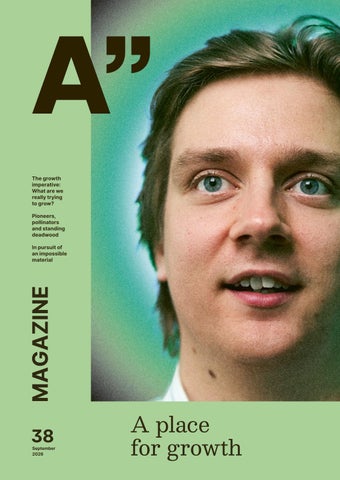
A place for growth
12 Theme
Growth is expected and demanded everywhere these days – in the economy, technology, society, and human capital alike. But what is it that we should actually be growing?
Cover photos Photographic artist Johannes Romppanen and retoucher Astrid Lindroos created the photos of Student Union AYY Chair Joona Lipponen and Professor of Sustainable Design İdil Gaziulusoy for this issue’s cover. Both were interviewed for the feature story on growth, which also includes perspectives from Professor of Economics Otto Toivanen. Read more from page 12 onwards.
Esa Kapila
Contents 5 6 8
Openings Ilkka Niemelä on the foundations of sustainable growth: education, research and innovation. Now Small news, big developments. Now Designs for a Cooler Planet and other exhibitions.
Theme / A place for growth 12 Theme What do we mean when we talk about growth? 19 On science briefly Investing has become part of everyday life in Finland; E-scooters have become an established part of urban transport. 20 On the go Aalto’s campus is home to thousands of species. 28 Who Pietu Korhonen designs sound for films. 32 Entrepreneurship – The Aalto Inventors programme nurtures future pioneers in technology. 35 On science briefly Mapping the habitats of furry friends; A photonics breakthrough traps light on a chip for millions of cycles. 36 Meet-up Heya Kwon brought karaoke to campus.
8 Now
Designs for a Cooler Planet and other exhibitions.
Image from the SuperC project, featured in the exhibition. Researchers are aiming to develop a room-temperature superconductor. In their modeling, they draw inspiration from, among other things, the weaving pattern of the traditional Japanese Kagome basket. Read more about the SuperC project starting on page 40.
38 Partnership Collaboration between Saab and Aalto University combines cutting-edge research with practical needs. 40 On science Scientists aim to discover a room-temperature superconductor. 44 Visiting Bernhard Schölkopf has a front-row seat as AI transforms science and society. 45 In celebration Seventeen new honorary doctors were conferred. 46 Doctoral theses Arsi Ikäheimonen and smartphones in the treatment of depression; Kata Fodor and sustainable diets; Manila Kodali and detecting disease from everyday speech recordings. 48 Everyday choices Ghassem Gozaliasl, how do galaxy groups reflect the need for human connection? 50 Key figures University results and rankings.
Jaakko Kahilaniemi
20 On the go
Aalto’s campus is home to thousands of species.
In May, old apple trees bloom on the campus, dating back to the days of Otaniemi Manor.
38
Photos: Johannes Romppanen
On the job
4 4
Touko Miikkulainen
Touko Miikkulainen is an illustrator and graphic designer completing their master’s degree at Aalto University. They are particularly interested in the political potential of illustration as a means of communicating ideas and opening up new perspectives. Miikkulainen illustrated the feature What do we mean when we talk about growth? in this issue and has previously explored the visualisation of the climate crisis in their bachelor’s thesis, among other contexts. ‘Recently, the most notable growth in my life has been our dog’s coat, which, much to their horror, had to be trimmed after winter. Hope for a better world is also something I try my best to nurture amid an increasingly troubled global situation. As for economic growth, I regard its presumed necessity with at least some scepticism.’
Tiina Forsberg
Tiina Forsberg wrote the lead article, What do we mean when we talk about growth? She works as a science editor in Aalto University Communications. As a mother of three and an unapologetically lazy home gardener, growth takes many forms in her everyday life. What she enjoys most is simply watching things grow: instead of weeding, tomatoes, flowers and other plants are left to run wild and untamed. ‘Growth doesn’t always require effort; sometimes it just needs space.’
Publisher Aalto University, Communications Editor-in-chief Communications Manager Anitta Pirnes Managing editor Paula Haikarainen Layout/photo editor Dog Design Cover Johannes Romppanen Contributors in this issue Matti Ahlgren, Amanda Alvarez, Tiina Aulanko-Jokirinne, Ahti Brummer, Aava Eronen, Tiina Forsberg, Riikka Haikarainen, Terhi Hautamäki, Sarah Hudson, Minna Hölttä, Susanna Jaarmo, Katrina Jurva, Jaakko Kahilaniemi, Esa Kapila, Kalle Kataila, Anna Kerttula-Fonseca, Anne Kosola, Tuomas Kärkkäinen, Katja Lahti, Joonas Lehtovaara, Andreas Liapis, Astrid Lindroos, Pinja-Emilia Lämsä, Juuli Miettilä, Touko Miikkulainen, Liivia Pallas, Tiiu Pohjolainen, Kristian Presnal, Gavin Pugh, Marjukka Puolakka, Mikko Raskinen, Johannes Romppanen, Katja Rönkkö, Sedeer el-Showk, Outi Törmälä, Akseli Valmunen, Nita Vera, Enni Äijälä Address PO Box 11 000, FI-00076 Aalto Telephone +358 9 470 01 / +358 50 314 1545 Online aalto.fi/magazine Email magazine@aalto.fi Change of address crm-support@aalto.fi Printing PunaMusta Oy, 2026 Print run 6,000 (English edition) & 6,000 (Finnish edition) Source of addresses Aalto University CRM Partnership and alumni data management Privacy notices aalto.fi/services/ privacy-notices ISSN 1799-9324 print ISSN 2323-4571 online
PEFC/02-31-151 PEFC Certified This product is from sustainably managed forests www.pefc.org
Kalle Kataila
New growth requires pioneering research
We are already seeing what can happen in Finland when investments in creative frontier research truly bear fruit.
In this issue, Professor of Economics Otto Toivanen reflects on what sustainable growth really means. He argues that such growth is possible only if we do things smarter – and that is precisely why education, as well as research and innovation, are prerequisites for any growth. Something exceptional is currently happening in Finland: the government is seeking to raise research and development expenditure to four percent of GDP by 2030. It is a historic choice – and a test at the same time. Does Finland have the courage to target investments in ways that truly boost productivity, prosperity, and well-being? In Finland, R&D funding has tended to emphasise incremental development of existing solutions. That alone is not enough. Productivity growth springs from new ideas, technologies, and expertise, all of which require investment in research. Without new creative research and education, the productivity leap will fall far short. The parliamentary working group that prepared Finland’s R&D funding legislation estimated that reaching the four-percent target will require 9,000 new experts every year, including around 2,000 doctoral graduates. Without highly educated talent, the virtuous cycle of growth facilitated by public investment will not materialise. Universities need predictable core funding at a level comparable to our Nordic peers so we can maintain the quality of education and Finland’s ability to educate the next generation of experts. There are encouraging signs of growth. We are already seeing what can happen in Finland when investments in creative frontier research truly bear fruit. The Helsinki metropolitan area has become one of the world’s leading quantum clusters. This entirely new industry would not have emerged without investments in research on fundamental physics that began at the Helsinki University of Technology in the late 1960s and that have continued at Aalto University. The quantum technology story demonstrates that deep-tech innovation requires time, long-term funding, and close collaboration between researchers and industry. Commercial success rarely comes quickly, but when it does, its impact can be transformative. Strong research enables radical innovation, but growth ultimately comes from practical applications and successful market entry. These are precisely the bridges we aim to build at Aalto. In recent years, we have invested in innovation training for researchers and in making the commercialisation process as smooth as possible, so that no seed of growth goes unrealised. Companies that have emerged from Aalto – such as RELEX Solutions, ICEYE, and IQM Quantum Computers – demonstrate how a strong scientific foundation, the courage to experiment, and entrepreneurial skills can create a powerful chain of rapid growth.
Ilkka Niemelä President, Aalto University
Openings
5
Mikko Raskinen
University acquires its own quantum computer
Matti Ahlgren
The AaltoQ20 quantum computer has been launched as a platform for education, research, and the development of new technologies. It is the only university-owned high-performance quantum computer of its kind in Finland and is rare even by international standards. Finland’s quantum technology sector is projected to need nearly 3,000 new experts by 2035. Quantum technology is expected to revolutionise domains such as telecommunications, energy efficiency, and scientific research. AaltoQ20 will be used to train future quantum professionals and enable research that is not possible on most commercial quantum computers. Students will also gain hands-on access to the system as part of their studies – something that remains rare worldwide. ‘Q20 represents the very latest technology and was built specifically for quantum computing,’ says Professor Tapio Ala-Nissilä, who led the project. The quantum computer contains 20 qubits, or quantum bits. Researchers have already used it in studies on quantum computing algorithms and quantum machine learning, among other topics. The system was built with funding from the Research Council of Finland. Components were supplied by IQM, a quantum computing company founded at Aalto University, and Bluefors, which manufactures ultra-low temperature measurement systems. Q20 is part of Finland’s national quantum computing infrastructure, FiQCI, managed by Aalto University, VTT Technical Research Centre of Finland, and CSC – IT Center for Science.
Aalto launches new House of Energy Transition Aalto University has received donations totalling €9 million from ABB, Fortum, St1, and the Walter Ahlström Foundation to strengthen research and education supporting the energy transition. The donations will fund four new professorships and support the launch of the House of Energy Transition. Aalto is already home to more than 40 professors working on energy-related topics with their research groups, making it the largest concentration of energy researchers in Finland. The new centre will further strengthen interdisciplinary collaboration and accelerate the development of solutions for transforming the energy system. ‘The transition to clean energy is as significant a societal transformation as digitalisation. No single innovation will be enough – the entire energy system must be reimagined,’ says Professor Annukka Santasalo-Aarnio, who will lead the centre. ABB’s €1.5 million donation will support a professorship in power electronics. Fortum’s €1.5 million donation will fund a professorship in energy strategy, focusing on identifying bottlenecks in the energy transition and supporting efforts to overcome them. St1 is donating €3 million to establish professorships in energy strategy and emerging energy technologies. The Walter Ahlström Foundation’s €3 million donation will fund a professorship in sustainable industry. The shared goal of the donors is to accelerate the energy transition and strengthen Finland’s competitiveness. Aalto University will begin recruiting the new professors and launch the House of Energy Transition this year.
7
Juuli Miettilä
€42
BRILLIANT NEWS
million
provided to education and research by the Aalto University Endowment in 2025
Rethinking colour in textiles Aalto University is leading MELANGE, a €4 million, Horizon Europe project that aims to transform colouration practices in the textile industry. Bringing together expertise in design, technology, and business, the project seeks to reduce the environmental impact of textile production by moving key colour decisions to the very beginning of the supply chain – the fibre stage. Instead of relying on conventional dyeing processes applied to finished fabrics, MELANGE explores fibre-stage colouration inspired by traditional wool recycling practices in Italy’s Prato region. The approach could cut water and chemical use by up to 50 percent while supporting more circular production systems. The project also challenges the industry’s long-standing pursuit of perfectly uniform colours. Researchers and industry partners will investigate how controlled colour variation can be embraced as a desirable design feature rather than a flaw. By working across the entire value chain – from fibre producers and textile manufacturers to designers and buyers – the consortium aims to identify practical pathways for scaling sustainable solutions throughout the European textile sector. With partners from six countries, MELANGE is the largest externally funded research initiative to combine Aalto University’s strengths in arts and design, technology, and business. The project will produce guidelines for designers, companies and policymakers to accelerate the transition towards more circular and environmentally responsible textile systems.
The Centre for Radical Creativity drives renewal Aalto University has established the Centre for Radical Creativity to support the renewal of society and businesses. The five-year initiative brings together researchers, students, artists, and companies to develop new solutions to major contemporary challenges, such as the climate crisis, inequality, and transformations in working life. The centre integrates research, education, and practical experimentation. It offers partners the opportunity to test new ideas and ways of working without immediate commercial pressure. Coordinated by the School of Arts, Design and Architecture, the centre is supported by the Amer Cultural Foundation. In autumn 2026, Aalto University’s campus will also open TiLA!, a new collaborative workspace that brings together freelancers, entrepreneurs, artists, students, and researchers from creative fields.
TexFoam is a bio-based insulation foam made from recycled textile fibres.
Esa Kapila
Esa Kapila
Designs for a Cooler Planet 2026 Aalto University’s largest exhibition of the year points the way to the future. On display are more than 20 practical solutions, experiments, and ideas from researchers and students. In addition to the main exhibition, the programme includes numerous events and satellite exhibitions. • Doors are open from 1 September to 30 October at the Marsio building on Aalto’s campus, Otakaari 2, Espoo. Mon-Thu 7.45–21.00 | Fri 7.45–20.00 | Sat-Sun closed. Free entry – welcome! • Part of Helsinki Design Week and the European Comission’s New European Bauhaus initiative. helsinkidesignweek.com | new-european-bauhaus.europa.eu/index_en Read more
‘Shipwreck Dress’. The material originates from a ship that sank in the 17th century. Pieces of wood left over from the conservation project of the wreck – discovered off the coast of Oulu – were processed into textile fibre by researchers at Aalto University using the Ioncell® method. The yarn has not been bleached or dyed; its colour comes directly from the shipwreck. At Aalto’s knitting studio, Lecturer Anna-Mari Leppisaari designed and knitted two identical dresses from the yarn. One of them is on display at the Designs for a Cooler Planet in Marsio, and the other one in the Tomorrow’s Wardrope exhibition of the Oulu Art Museum.
9
Anne Kinnunen
Aalto ARTS Grad Show 2026 is an exhibition by the School of Arts, Design and Architecture showcasing the graduation projects of students from the fields of architecture, design, film, art, and media. The exhibition runs from 3 September to 7 October 2026 in the Väre building, Otaniementie 14, Espoo. Hanna Klie: Frames.
Image from Konsta Klemetti’s photo series Finnish Royalty: The kings and queens of Finland’s drag scene.
10
Näytös26 took place at Lasipalatsi Square in the heart of Helsinki. The fashion show featured new collections by emerging designers from Aalto University.
Jesper Dolgov
Mikko Raskinen
Sasu Takko: The Ihokas collection
The works in the image (clockwise) are by Kirsikka Heiskari, Carla Rotenberg, Chien-Chi Kuo, Robert Hedengren, Sesilia Pirttimaa.
Artefakti is the annual graduation exhibition of Aalto University’s MA Programme in Contemporary Design. It showcases art works ranging from material experiments and craftsmanship to sustainable and critical design. Helsinki Design Week, Cable Factory, Puristamo (Kaapeliaukio 3, Helsinki) 3–9 September 2026
Material Flow showcased works by Aalto University Interior Architecture students in connection with the Fiskars Biennale, including furniture, lighting, and other design objects. The exhibition explored the potential of materials through experimental design, material research, and craftsmanship. The works blur the boundary between the natural world and the built environment. ‘Maa’ (Earth) side tables of terracotta by Klara Sjelvgren.
11
Growth is expected everywhere – in economies, technologies, knowledge, and societies. But what should actually grow? This issue explores growth through the lenses of well-being, sustainability, and the future, from biodiversity on campus to new ways of imagining life within our planet’s limits.
12 Theme – What do we mean when we talk about growth? 19 On science briefly – Investing has become part of everyday life in Finland; E-scooters have become an established part of urban transport. 20 On the go – Aalto’s campus is home to thousands of species. 28 Who – Pietu Korhonen designs sound for films. 32 Entrepreneurship – The Aalto Inventors programme nurtures future pioneers in technology. 35 On science briefly Mapping the habitats of furry friends; A photonics breakthrough traps light on a chip for millions of cycles. 36 Meet-up – Heya Kwon brought karaoke to campus.
THEME
A place for growth
A place for growth
12
What do we mean when we talk about growth? Governments demand it, companies promise it, and universities are expected to deliver it. Growth is widely seen as the answer to debt, competitiveness, and the future of the welfare state itself. But what do we actually mean by growth – and what kind of growth are we aiming for?
Text Tiina Forsberg Illustration Touko Miikkulainen
A place for growth
14 To an economist, growth means produc-
tivity, innovation, and society’s ability to sustain well-being in the future. To a sustainability scholar, the idea of endless growth on a finite planet is problematic. And to many young people, the entire conversation can feel distant at a time when uncertainty and anxiety about the future are also growing. Perhaps the central question is no longer simply how to generate more growth, but what exactly we are trying to grow in the first place.
Growth is not an end in itself
Professor Otto Toivanen no longer eats liquorice. He had enough of it while working in a liquorice factory in Turku after high school, trying to figure out what to do with his life. By a series of fortunate turns, he eventually became an economist – largely because economics was the only entrance exam subject that did not put him to sleep. He got into university, and that was the end of liquorice for him. His career eventually took him abroad as a researcher and later, around ten years ago, back to Finland. The rest is history: in 2018, he helped establish the Helsinki Graduate School of Economics, and in 2025 he was appointed Aalto Distinguished Professor. In hindsight, the plan honed at the liquorice factory worked out just fine. Today, he views growth – and its absence – through the lens of a subdued national mood. People are cautious, pessimistic about the future, and more inclined to save than spend. Many feel the country is drifting towards worse, not better. ‘Our current economic resources don’t match our aspirations for the life we want to live, the life we want to offer older generations and our children, or the way we want to participate in the world,’ he says. And that’s why we need growth. But growth isn’t an end in itself, he argues.
‘The question is what growth enables. If it enables better well-being – and I mean well-being, not just standard of living – it’s hard to see many things that would be more worth striving for.’ Joona Lipponen, Chair of the Aalto University Student Union (AYY), believes public debate often conflates economic growth with the growth of well-being. Many young people question the idea of endless material growth at a time when the planet’s ecological limits are already under strain. ‘When we talk about growth, what exactly are we talking about? Growth in well-being or growth in material wealth? Many people assume these are synonymous, and that economic growth automatically improves well-being – but is that really true?’ Lipponen also didn’t have a straight path after high school. An interest in geography and civics, plus struggling through advanced maths, led him to study the built environment at Aalto. He graduated with his Bachelor’s last spring, and the demand on his time has only grown. In his view, when young people are entrusted with responsibility, everyone benefits if they use it to engage; studies can wait, impact cannot.
A finite planet
When sustainability design professor İdil Gaziulusoy hears the word growth, she thinks of plants. Her home is so much more than a human home; with two cats and full of greenery, it’s ‘a veritable jungle.’ What fascinates her most is plants’ capacity to keep growing. ‘We humans simply stop growing at some point. Trees, of course, also have life cycles, but like all plants, they continue growing for as long as they are alive,’ she reflects.
15
Professor of Economics Otto Toivanen
‘ The question is what growth enables. If it enables better well-being – and I mean well-being, not just standard of living – it’s hard to see many things that would be more worth striving for.’
A place for growth
16 Unlike Toivanen, Gaziulusoy knew at the age of six that she would become a professor someday. But it was a chance that brought her to Aalto. A decade ago, while working in Melbourne, the Turkish-born scholar felt the pull back to this part of the world. It seemed like a stroke of fate when a professorship opened at the School of Arts, Design and Architecture – exactly in her field and at a place she already respected. Growth also has a positive, personal meaning for her – humans can grow emotionally and intellectually. But she quickly points out that there are many things people do not want to grow: grief, grudges, or cancer, for example. And the hardest part is limitless economic growth. As a sustainability scholar, she recognises that we cannot keep growing indefinitely on a finite planet. Toivanen understands this critique of growth, with environmental impacts being chief among the concerns. But he also reminds us that the absence of growth leads to the kind of problems Finland is already facing and, if prolonged, could erode the welfare state. In economics, growth often means productivity growth: doing more or better with the same resources or achieving the same outcomes with fewer. Toivanen links this to the possibility of green growth: a more service-based economy, renewable energy and a circular economy could shrink the footprint, even if not everything can be decoupled from materiality. Gaziulusoy challenges the assumption that efficiency alone is enough. Even if technology reduces environmental impacts, “doing more of the same more efficiently” cannot solve everything if material consumption continues to grow, she argues. Global inequality complicates the debate. While some parts of the world are questioning the limits to growth, in many countries economic growth remains essential to meet basic needs.
‘We are limited by the logic of nation states, as it forces nation states to think about their own interests. And the interests of the disadvantaged do not make it to the shared table,’ Gaziulusoy says. Lipponen, too, believes current societies rely too heavily on the assumption of endless economic growth. And a lot of young people are starting to feel that we simply cannot continue in the current direction indefinitely. Some seek to reform the system from within by making growth more sustainable. Others want more fundamental structural change. ‘Many young people want to fundamentally change the system instead of merely making existing growth models more sustainable. These approaches are not necessarily mutually exclusive, but in some sense the choice is this: do we reshape economic growth to support sustainability, or do we change the entire system?’ According to Gaziulusoy, alternative economic models such as steady-state or post-growth economies are still discussed cautiously because no politically credible pathway toward them has yet emerged. Sustainable growth, she argues, cannot be achieved through technology or individual policy decisions alone – it also requires an entirely new shared understanding of what kind of development we actually consider desirable.
17
Chair of the Aalto University Student Union (AYY) Joona Lipponen
‘When we talk about growth, what exactly are we talking about? Growth in well-being or growth in material wealth? Many people assume these are synonymous, and that economic growth automatically improves well-being – but is that really true?’
Whose growth do we pursue?
Before debating how to grow, perhaps we should ask what exactly should grow: wealth, services, capabilities, trust – or well-being? Toivanen notes that discussion about growth collides quickly with values. The moment someone labels a form of consumption “unnecessary,” they are inevitably imposing their own values on others. What looks unnecessary to one person may be deeply meaningful to another. For Toivanen, the hardest part in pursuing growth isn’t the discussion of using resources more efficiently. It’s deciding what society considers important. ‘The economist’s task is to assess the con sequences of different choices and make the trade-offs visible. Politics then decides how common resources are ultimately allocated,’ he says. Gaziulusoy agrees there is no single ‘desirable’ future that would fit everyone, because people value different things. Rather than impose a top-down blueprint, we need collective imagination and negotiation about the kinds of worlds we want to inhabit. And while science makes visible what is happening, it rarely turns into action on its own. ‘Science can tell us how screwed up the world is, but it does not automatically create change or a willingness to act. It’s not a tool for change. That is why we also need creative practices.’ Joona Lipponen entered student union work to serve his community. His interest in broader public conversation has since grown as he has realised how rarely young people are invited to decision-making tables.
A place for growth
18 ‘This is not about a lack of interest among young people. It is a structural issue. Young people are often treated dismissively, and they themselves learn to think they are not yet supposed to take space or use their voice. But I have realised that we belong at that table regardless of who else is sitting there.’ He stresses that leaving out younger generations’ perspectives on growth is a missed opportunity. The choices made now will shape the lives of those who live with their consequences the longest. They deserve a voice in the debate. There is no silver bullet, Toivanen says, to ensure young people will get their share in the fruits of growth. But the basics matter: keep the education system working as well as scarce resources allow – quality, yes, but also guidance so students find the paths that fit them. Equally important are decisions that do not pass on today’s costs to future adults, whether in terms of natural resources, the pension system, or structures of society.
‘The key question behind innovation is always for whom and for what purpose? Innovation should not be reduced to endless technological development, “technology for technology’s sake”.’
What kind of growth should we pursue?
and institutions. Finland’s welfare state is part of that lineage. If growth means better education, more sustainable solutions, and innovations that help us imagine different futures, few would oppose it. The debate becomes more difficult when growth means more consumption, more hurry, and more pressure to do ever more with ever less. Ultimately, the debate about growth is about far more than economics. It is about values and about what kind of life we consider worth striving for, not only for ourselves but also for the generations who will inherit the outcomes of our choices.
When talking about growth, the question isn’t whether to have more but under what conditions growth is sustainable and what we choose to grow: the economy, consumption, or well-being. For Lipponen, the most desirable growth is growth in well-being, ideally defined by people themselves. But if everyone consumed like Finns, the planet would buckle, he says. In practice, that means decoupling well-being from consumption and steering capabilities toward solutions that restore biodiversity and strengthen justice, which is work many Aalto startups already pursue. He’d also like to see the innovation ecosystem open up to a broader range of fields, including the arts. Toivanen, on the other hand, views green growth as a real opportunity to enhance well-being globally. ‘I believe we can build a world where more people, including those in more vulnerable positions, live better lives and their well-being increases, while at the same time placing less strain on the planet. But that is only possible if we learn to do things smarter than before. That’s why education and innovation are essential prerequisites for growth,’ he says. For Gaziulusoy, the key question behind innovation is always for whom and for what purpose? Innovation, she argues, should not be reduced to endless technological development, ‘technology for technology’s sake.’ Societies also need social innovation – the creative recombination of existing resources – that lead to new practices
Professor of Sustainable Design İdil Gaziulusoy
Joonas Lehtovaara
Light trapped for millions of cycles
E-scooters have become a permanent part of urban transport
Dr. Andreas Liapis / Aalto University
A large study by Aalto University and the University of Antwerp shows that shared e-scooters, city bikes, and other micromobility services have become an established part of urban transport systems around the world. According to the researchers, cities and governments should actively guide their development instead of treating micromobility as a temporary trend. The study mapped shared micromobility services in 52 countries across Europe and North and South America, as well as several other countries, including Japan, Saudi Arabia and New Zealand. The sector is rapidly diversifying both technologically and commercially. Alongside e-scooters and bike-sharing systems, cargo bikes and electric mopeds are becoming more common. ‘Micromobility has become an integral part of urban transport worldwide,’ says Aalto’s Miloš N. Mladenović, professor of transport engineering. The study found that e-scooters are especially common in Finland, Sweden and Norway, while Denmark relies more heavily on city bikes. The researchers argue that Finnish cities should use upcoming street renovations as an opportunity to improve conditions for walking, cycling, and public transport. Parking remains one of the biggest challenges in micromobility. Although free-floating parking is still the most common model globally, GPS-based virtual stations, or ‘drop zones,’ are becoming increasingly popular. According to the researchers, these designated parking areas are much more effective at preventing scooters from blocking pavements and entrances. In 2025, Finland introduced legislation allowing municipalities to issue permits for micromobility operators. The researchers welcome the reform but stress that clearer rules and better evaluation are still needed, especially regarding parking, speed limits, and traffic safety impacts.
An international research team including scientists from Aalto University has developed a new way to use atomically thin van der Waals (vdW) materials in photonic and quantum devices. The work could pave the way for faster and more energy-efficient optical chips. Van der Waals materials consist of layers only one or a few atoms thick. They are known for their exceptional optical and electronic properties, but their extreme fragility makes them difficult to process using conventional nanofabrication techniques, which can easily damage the crystal structure. The researchers overcame this challenge by coating the material with a thin aluminium layer before fabrication. Acting as a microscopic ‘armour,’ the coating shields the delicate material during processing and enables the creation of highly precise nanostructures without major damage. The team used this method to fabricate tiny disk-shaped resonators capable of trapping light with record-low losses. Inside these microscopic structures, light can circulate millions of times while losing only about one millionth of its energy per cycle. According to the researchers, the performance is around one thousand times better than previous vdW resonator systems. The exceptionally strong confinement of light also greatly enhances nonlinear optical effects, in which light changes frequency. In experiments generating harmonic frequencies, the team observed efficiencies up to 10,000 times higher than earlier records. The breakthrough could accelerate the development of reconfigurable photonic circuits, quantum light sources and highly sensitive optical sensors integrated directly onto chips. More broadly, the work shows how materials once considered too fragile for practical use can now serve as powerful building blocks for next-generation photonics.
The world’s thinnest Aalto University logo, precisely patterned from atomically thin van der Waals materials.
On science briefly
19
On the go
20
Pioneers, pollinators and standing deadwood
21
Aalto University’s campus is home to thousands of species. Nature recovers and flourishes through gentle care and room to grow. Text Minna Hölttä Photos Jaakko Kahilaniemi
On the go
22
Few places bring together as many layers of landscape history as Otaniemi in Espoo. The campus includes archaeological sites from the Bronze and Iron Ages, as well as a centuries-old alley of linden trees recalling the area’s history as a manor. There are iconic buildings set in a town plan designed by Alvar Aalto and Aino Aalto, and the area has been recognised as a nationally significant built cultural environment. ‘A smart designer works with nature, not against it,’ says Minttu Somervuori, landscape construction specialist at Aalto University Campus and Real Estate (ACRE). Careful nudging in the right direction with plenty of room for natural growth and structured maintenance can achieve remarkable results. Even amid new buildings, there are light rail tracks and streams of people.
In Otaniemi, meadow planting helps combat biodiversity loss while supporting the campus strategy of maintaining open habitats alongside lawns and managed green areas.
Sand and sunlight
In the dry, barren-looking sandy soil, dark green shoots snake across the ground. Wild thyme is doing pioneering work in the sun- exposed meadow established last autumn between the new Marsio building and Otakaari 1, the campus’s former main building. Meadows are among Finland’s richest habitats but also its most endangered. Their decline hits pollinators especially hard, and nearly all wild plants and most crops depend on pollinators. In Otaniemi, meadow planting helps combat biodiversity loss while supporting the campus strategy of maintaining open habitats alongside lawns and managed green areas. Flowering seed mixes are also used whenever lawns are reseeded. Beneath large trees, flowering lawn plants brighten the landscape and attract butterflies. In nutrient-rich soil, wild thyme and other meadow species would quickly lose out to faster-growing competitors. That’s why sand, including organic material from a local data centre construction site in Espoo, was mixed into the growing medium at the Marsio meadow. The May sun shines high overhead. At night, the sun-warmed hollows in the sand create their own microclimate where insects like to rest. Seeds for the Marsio meadow were collected from nearby rocky outcrops and coastal areas, bringing in locally adapted meadow and shoreline species. Using local plants helps species adapt and ensures declining species can survive in
urban environments. Wild thyme was the meadow’s most distant arrival, brought from the Porkkala peninsula in Kirkkonummi. Wild thyme is essential for several butterfly species, whose caterpillars feed exclusively on it. The pink and violet flowers that appear in July and August attract butterflies, bumblebees, and other kinds of bees. But pollinators and other residents of Otaniemi need more than just food. They also need places to nest – and suitable habitats can often be found within a very short flight.
Life from decay
Behind the red-brick buildings, at the edge of a small forest, stands a spruce trunk cut a few metres above the ground. A fallen neighbouring tree partly tore up its roots in an autumn storm, and the spruce was left in place as a gradually decaying standing deadwood trunk. The first species to colonise deadwood are usually longhorn beetles and other insects dependent on decaying trees. Solitary bees and predatory wasps later nest in the tunnels they leave behind. Standing deadwood also attracts many bird species, including endangered willow tits. Around a quarter of Finland’s forest species – some 5,000 species – depend on deadwood. In natural forests, about a quarter of the wood
23
European dwarf birches have been planted by the Ossinlampi pond. The saplings do not require separate watering, and the trees remain under three metres tall even when fully grown.
The growing medium of the meadow next to the Marsio building is intentionally poor and sandy, so that wild thyme and other native meadow plants can hold their own against fastergrowing competitors.
On the go
24
Two linden trees in poor condition ended up in a decaying-wood art installation built in the centre of campus – an installation whose lush appearance changes with the seasons.
25
In Otaniemi, this continuity of deadwood is actively maintained: roughly one-third is recently dead, one-third moderately decayed and one-third heavily decomposed. All fallen trees are left in the landscape and integrated into the environment.
is dead; in commercially managed forests, only a small fraction remains. It’s no surprise that hundreds of Finnish forest species are now endangered. As decomposition progresses, the fungi and insect species living in deadwood also change. That’s why forests need trunks from different tree species at different stages of decay. In Otaniemi, this continuity of deadwood is actively maintained: roughly one-third of the deadwood is recently dead, one-third moderately decayed and one-third heavily decomposed. All fallen trees are left in the landscape and integrated into the environment. The cut spruce snag represents the very beginning of this continuum. A thoughtful forestry worker has carved a bat roost into the top of the trunk, creating a daytime
shelter and resting place for the bats living in Otaniemi. The area is also crossed by Siberian flying squirrels, which nest at the nearby Laajalahti nature reserve. Finland is the westernmost habitat of this endangered species. Within the EU, the Siberian flying squirrel is found only in Finland and Estonia. The shy nocturnal animal is rarely spotted, but the small yellow droppings found at the base of trees reveal its presence. At the other end of the decay cycle, deadwood becomes humus with the help of fungi and bracket fungi. That’s how nutrients and carbon return to circulation for new generations of life.
From grove to pond
In the shade of the trees, the grass grows lush and tall, and the leaves of herb-paris peek through the stems. They reveal that this is one of Otaniemi’s herb-rich forests. The key difference between heath forests and lush groves is in the topsoil. In heath forests, soil layers remain clearly separated; in groves, organic matter and mineral soil have mixed into nutrient-rich humus. This fertile, mildly acidic soil makes groves some of the most biodiverse habitats in Finland, with the greatest numbers of both species and individual organisms among forest types. In many places across Otaniemi, rare hazel shrubs grow, enriching the soil further as their leaves decompose. Caring for trees was already an important part of Alvar Aalto’s design philosophy. He emphasised harmony and coexistence between nature and the built environment. Otaniemi’s current tree strategy respects Aalto’s legacy while also responding to major contemporary challenges. The most significant of these are caused by climate change: rising temperatures, drought, winds, and destructive insects. Pines and spruces suffer the most. Increasing the amount of deadwood can help control pests, because predatory insects that feed on bark beetles – especially the European spruce bark beetle – thrive in decaying wood. New plantings, however, favour species that can better tolerate changing conditions. One example is the European dwarf birch (Betula nana) growing near Ossinlampi pond, a remnant species from Europe’s last Ice Age.
On the go
26
The current philosophy behind landscape management on Aalto’s campus: adaptation, resource wisdom, and respect for nature’s processes.
Decaying wood eventually turns into humus with the help of fungi and bracket fungi, whereby nutrients and carbon return to the cycle for new generations of organisms.
27
Tiny Ossinlampi pond is located in the northern part of the campus and is important for both the area’s biodiversity and student culture.
The 20-centimetre saplings came from Arboretum Mustila, whose mission is to test and study the trees and plants of the future. The birches were planted in small groups around the pond in 2024. Experts selected the site so carefully that the saplings require no separate irrigation. Nutrients come from decaying birch trunks left nearby. Even at full size, the European dwarf birch remains under three metres tall, making it well suited for areas close to buildings. It represents the current philosophy behind landscape management on Aalto’s campus: adaptation, resource wisdom, and respect for nature’s own processes. That, above all, is what Minttu Somervuori hopes people will understand. ‘Gardening can maintain a static state, but nature is constantly changing and always in motion.’
Principles of campus nature management • Strengthening soil vitality • Renewing forests through natural succession along with planting • Safeguarding the well-being of urban trees, large landscape trees, and future generations of trees • Favouring local species in lawns and meadow plantings • Minimising invasive-species risks through the use of local plant material • Reducing the maintenance backlog and replacing intensive upkeep with gentle guidance • Encouraging close collaboration and professional pride among specialists • Challenging old practices through researchbased knowledge and bold experimentation • Building a culture of collective learning, curiosity, and active engagement in nature work
28
29
Pietu Korhonen crafts film sets with sound When sound designer Pietu Korhonen walked the red carpet at the Cannes Film Festival in May, it was far from his first time. Once again, cameras flashed, champagne flowed – and this time, he returned home with the Palme d’Or for Fjord.
Text Tiiu Pohjolainen Photos Akseli Valmunen
Sitting in his studio on a gritty industrial estate in Helsinki, Pietu Korhonen tells us that this year’s festival was at least his fifth trip to Cannes. ‘It’s completely over the top. The festival world is so different from everyday life in the film industry,’ he laughs. ‘The film gets a ten-minute standing ovation, you’re escorted through the Palais to a rooftop terrace, and on the way Mel Gibson comes over to shake your hand and congratulate you.’ He remembers feeling overwhelmed during his first visits to Cannes. ‘I kept wondering what on earth I was even doing there. I almost felt embarrassed.’ Korhonen’s first trip to Cannes was when he was studying at the former University of Art and Design Helsinki, now part of Aalto University. Those years – and much of his career as a sound designer – were shaped by another student who started film studies at the same time: director Juho Kuosmanen.
Follow the music
The daily life of a film professional is anything but glamorous, says sound designer Pietu Korhonen.
Before studying sound design, Korhonen completed a one-year vocational programme in radio and television production in Tuusula, in southern Finland. As a young man in his twenties, he found his way there through a combined passion for music and cinema. ‘I think almost everyone working with sound in film has some kind of musical background,’ he says. During that year, he realised he had found a kind of work that came naturally to him. ‘I felt I really understood this work – and, more importantly, I genuinely enjoyed it.’ It was also in Tuusula that he discovered that film sound design could be studied at the university level in Finland. A fellow student encouraged him to apply.
W
H O
‘I gave it a try and got in. I didn’t really know anything about the industry, and I didn’t have any contacts.’ Studying at the University of Art and Design quickly led to working on film productions. ‘I was lucky and found work straight away. I started as a trainee and assistant, met new people, and one job led to another.’ His first role on set was operating the boom microphone. He later progressed to production sound recording, taking responsibility for location sound. ‘Then the sound design work started coming in. First short films, and eventually feature films,’ he says.
Almost like a permanent ensemble
At university, Korhonen created the sound for Kuosmanen’s short film Roadmarkers (2007), which won third prize in the Cinéfondation student competition at Cannes in 2008. A few years later, Kuosmanen’s graduation film The Painting Sellers (2010) won the competition’s top prize. Many familiar names appear alongside Korhonen and Kuosmanen in the credits of The Painting Sellers: editor Jussi Rautaniemi, producer Jussi Rantamäki, and cinematographer J-P Passi. The same creative team also worked on The Happiest Day in the Life of Olli Mäki and Compartment No. 6. Working with the same collaborators creates a shared understanding. ‘When you’ve made several films together, you know how the other person thinks. You know what they like and how they work best. Making films with Juho feels like an adventure. Every project explores something new and pushes the boundaries of what’s possible.’ Kuosmanen’s The Happiest Day in the Life of Olli Mäki (2016) and Compartment No. 6 (2021) received awards both in Finland and
Who
30 internationally, taking Korhonen to Cannes once again. The same happened with Aki Kaurismäki’s Fallen Leaves, which Korhonen also designed the sound for.
Every sound is created
A sound designer is responsible for the entire sonic world of a film. Audiences often think of film sound simply as dialogue and music, but for Korhonen, music rarely takes centre stage. ‘I’m fascinated by how sound can subtly communicate the emotions of a scene or of its main character.’ He reminds us that every sound in a film has been deliberately created. ‘Everything you hear is there for a reason. Even the smallest sound can completely change a scene and bring the audience closer to the main character.’ His favourite part of the work is creating atmospheres. ‘I enjoy making a film’s world – or a particular location – feel believable through sound. To me, that’s no different from set design. I simply build the set with sound.’ A simple office scene, for example, may have captured only the actors’ dialogue during filming. ‘The footsteps, the rustle of clothing, an object placed on a desk – they’re all recreated afterwards by the sound team. The distant rumble of city traffic or a quiet conversation around the corner is also carefully constructed. Film sound is so much more than music.’
Learning from a master
After his studies, Korhonen joined the renowned Foley artist Heikki Kossi at H5 Film Sound, where he spent almost a decade as a sound editor and sound designer. ‘Working with Heikki, I contributed to a huge number of productions, mostly international films but also Finnish ones. I created sound effects for major productions, including Ad Astra, starring Brad Pitt. My professional skills developed enormously working with Heikki in the same studio.’ When Kossi moved to the United States, Korhonen bought the studio and established his own company, Usva Sound. Its first major sound design project was Aki Kaurismäki’s award-winning Fallen Leaves.
Fjord
Two years ago, Korhonen received a phone call from producer Jussi Rantamäki of Aamu Film Company. An international co-production was about to begin. Romanian director Cristian Mungiu would direct Fjord. Was he interested? He quickly answered yes. Mungiu’s films had profoundly influenced Korhonen’s own thinking about cinema ever since he first saw 4 Months, 3 Weeks and 2 Days almost twenty years earlier. ‘The sound
design in that film completely blew me away. We watched and analysed it repeatedly with fellow students. Those of us specialising in sound especially admired how rich the soundtrack was while still feeling completely realistic.’ Being selected as Mungiu’s sound designer felt like a victory itself. The Romanian director proved highly demanding. The finished film was half an hour longer than originally planned, and the workload was immense. ‘Cristian’s sense of humour and genuine kindness made the whole process much easier.’ According to Korhonen, Fjord was also the first international co-production of this scale for many of the Romanian crew. International collaboration is not always as straightforward as online meetings might suggest. Romanian and Nordic filmmaking traditions differ in many ways. The team’s shared way of working finally emerged after filming had wrapped, when Korhonen travelled to Bucharest. There, he and the director rented a studio and spent weeks shaping the film’s soundtrack together. The result is a drama set in Norway about a Romanian-Norwegian immigrant family whose life comes under the scrutiny of the country’s child welfare authorities. The film stars Renate Reinsve and Sebastian Stan, with costume design by Kirsi Gum. Fjord won the Palme d’Or at the Cannes Film Festival in May 2026. By the time Finnish audiences see the film in cinemas, Korhonen will already be immersed in his next international co-production. The working title is Dream Come True, and many familiar collaborators have reunited: director Juho Kuosmanen, producer Jussi Rantamäki, cinematographer J-P Passi, costume designer Kirsi Gum, and editor Jussi Rautaniemi.
31
Pietu Korhonen
Also
/ Studied radio and television production at Adulta Adult Education Centre in Tuusula, Southern Finland. / Studied sound design at the Department of Film and Television at the University of Art and Design Helsinki (now Aalto University), 2004–2011. / Worked for almost ten years as a sound editor and sound designer at H5 Film Sound. / Founded Usva Sound in 2022. / Sound designer for Juho Kuosmanen’s films Roadmarkers (2007), Citizens (2008), The Painting Sellers (2010), The Happiest Day in the Life of Olli Mäki (2016) and Compartment No. 6 (2021). / Also designed sound for international productions including The Swedish Torpedo (dir. Frida Kempff, 2024) and Olivia (dir. Sofía Petersen, Argentina, 2025). / Sound designer for the documentary Karaoke Paradise (dir. Einari Paakkanen, 2022). / Sound designer for Aleksi Salmenperä’s feature Isänpäivä (‘Father’s Day’, 2026) and the television series L/Over (2026).
/ A former guitarist. As a teenager he became fascinated by electronic music. ‘It was so exciting when we got our first computer at home and I could spend hours making music on my own.’ He continued playing guitar into his twenties, but these days work leaves little time for the hobby. / A bit of a geek. ‘I can’t programme, but I’m comfortable with all kinds of technology. You don’t have to be a geek to work in a sound studio, but it definitely helps.’ / A supporter of Dutch football. It all began in 1989, when Finland played the Netherlands in a World Cup qualifier. ‘My dad took me to the Olympic Stadium. Since then, the Netherlands has been my favourite team alongside Finland.’ / Happiest in silence. ‘When I’m at home, I hardly ever play music. Walking in nature is wonderfully calming because I can simply let my ears rest.’
Entrepreneurship
32
Planting seeds in deep-tech The Aalto Inventors programme cultivates thought leaders of tomorrow’s disruptive industries.
Text Gavin Pugh Photos Ahti Brummer
The quantum cohort gathered in April 2026 at A Grid on the Otaniemi campus to present their final projects. The final showcase saw each group presenting their business model, revenue projections, and target markets, followed by feedback from industry experts.
33
A late-2025 report by the European Centre for International Political Economy sent ripples throughout Finland’s scientific community when it named Greater Helsinki one of the top two quantum innovation hubs in the world. Otaniemi has long been the throbbing heart from which much of that innovation has proliferated. Decades of commitment to fundamental research, dating back to the founding of Professor Olli V. Lounasmaa’s pioneering Low- Temperature Laboratory in the 1960s, have created fertile ground from which some of the world’s highest-profile quantum technology companies have sprung. This very environment of curios ity, or to put it another way, inven tiveness, has inspired a recent coordinated effort at Aalto to tease
budding ideas out of the minds of researchers. One of the latest approaches is Aalto Inventors. Myungji Suh, an Aalto alum who became a research entrepreneur facilitator, launched this programme in 2025 to help doctoral students in deep-tech fields realise the business potential of their work. ‘I’m so proud to be in contact with these researchers, and if we can put a little seed into their heads so they can later go back and realise, “Actually, maybe I could start something,” then it’s really great,’ Suh says.
What quantum cohort?
The Aalto Inventors programme is now in its second year running, with the final presentations of a quantum-focused cohort having wrapped up in April 2026.
This quantum cohort included doctoral students from universities throughout Finland, many of whom are part of the Quantum Doctoral Education Pilot Programme (QDOC), which is coordinated by Aalto University. The content of quantum Inventors cohort was developed jointly by Suh, Aalto Corporate Relations Manager Juho Pirinen, and Aalto Inventors Specialist Elettra Virtanen. The structure of the course can vary slightly for each new cohort but it roughly follows the same 8-session structure. This includes valuable expert advice from top industry leaders, a venture capital funding crash-course, intellectual property rights training, customer discovery know-how, and roundtable discussions with industry and researcher-entrepreneurs –
34
Entrepreneurship
Students receiving their certificates of completion from InstituteQ Acting Director Jukka Pekola, a professor of physics at Aalto University.
the types of lessons not typically covered in doctoral education.
‘Your research deserves more’
Even though not all the student projects are destined to become a unicorn, that’s not exactly the point of the Inventors programme. From ideation to end product, course participants are tasked to confront market considerations that are often absent in the lab. They learn that it doesn’t do to just have a good idea. You also have to find a first customer, come up with a financial model and revenue projections, learn how to communicate the idea effectively, and actually name the problem that exists and the solutions that you provide. ‘Your research deserves more than a paper,’ Suh says, echoing a phrase that’s become something of a motto for Aalto Inventors. ‘It really deserves to change the world, create jobs, and help someone – save someone’s life or make the planet greener.’ Rather than diminishing the immense effort that goes into writing a scientific paper, this motto is meant to challenge students to conceptualise their research in a non-academic setting. Where a paper identifies a breakthrough, a well-executed business proposition can take it out of the lab and into everyday use. ‘I definitely don’t think it’s a bad idea to get academics more involved on the industry side. Because, in the end, hopefully academics are the ones who know what the future is going to be like in their space, and I see no reason why they shouldn’t profit from it,’ says University of
Jyväskylä doctoral researcher Clemens Lindner. Several of the quantum cohort participants had never really considered that building their own business was a possibility. ‘There are a lot of problems out there that we’re not even aware of, and they’re possible markets for startups,’ says Alina Helena Sánchez Gallardo, a doctoral researcher at the University of Oulu. ‘You actually build the connections in this cohort, because otherwise we’re kind of thinly spread out,’ added Aalto University doctoral researcher Christa Schauman.
The business pitches of the quantum cohort included • A matchmaking platform for companies seeking to use quantum hardware and doctoral researchers who know how to use it • Quantum simulation of nature as a service, leveraging advanced quantum algorithms to model complex physical systems on quantum computers • End-node security authentication via quantum mechanical principles for the quantum information age • Quantum error correction consultation to provide clients with the appropriate algorithms in their preferred computing environments • A quantum upskilling platform delivered to users with courses developed in-house to help them find work in their relevant fields
‘This is a great way to actually try out business partners – you need to work with them a little.’
The quantum boom needs doers
The quantum scene is currently experiencing a massive boom in Finland. In the last three years alone, a number of Finnish startups have entered the global arena as serious players in various domains. From algorithms and hardware to AI-integration and photonics, Finland is absolutely punching above its weight in an industry traditionally dominated by the likes of the US and China. ‘What left the strongest impression on me was the level of interest in entrepreneurship among students and scientists in quantum technologies. It feels very different from when I was a student 25 years ago, and very encouraging to see,’ says Juha Vartiainen, Co-Founder and Chief Global Affairs Officer at IQM Quantum Computers and one of the industry representatives providing feedback at the quantum cohort’s final showcase. ‘I have come to believe that strong ecosystems are built step by step, through people sharing what they’ve learned, supporting one another, and helping the next generation find their way.’
QDOC & InstituteQ The Quantum Doctoral Education Pilot Programme (QDOC) is an offshoot of the Finnish Quantum Flagship (funded by the Research Council of Finland), both of which are coordinated by Aalto University and sit within InstituteQ. InstituteQ is Finland’s National Quantum Institute, and it serves as an umbrella organisation coordinating quantum research, education, business development, and innovation activities throughout the country. InstituteQ member organisations include: Aalto University, CSC – IT Center for Science, Tampere University, The University of Eastern Finland, The University of Helsinki, The University of Jyväskylä, The University of Oulu, The University of Turku, and VTT Technical Research Centre of Finland.
Where furry friends thrive A joint study by Aalto University and the Natural Resources Institute Finland (Luke) has mapped the habitats of the pine marten, stoat, and least weasel across the whole of Finland for the first time. Using airborne laser scanning data and a decade of snow track observations, the study provides new insights into how forest structure and terrain shape the distribution of these small animals. The results show clear ecological differences between the species. The pine marten prefers dense, structurally diverse and mature forests. The stoat uses a mix of forested and more open habitats, while the least weasel is mainly in areas with ground-level vegetation and available prey. As a species that hunts almost exclusively voles close to the ground, food resources may matter more for the least weasel than forest structure itself. The study is set against a backdrop of marked population declines. According to Luke, stoat populations in Finland have declined by around 84% and least weasel populations by around 70% over recent decades, while pine marten numbers have also fallen in southern Finland despite increases in the north. These changes may have broad ecological consequences, including effects on vole populations and subsequent impacts on forestry through increased seedling damage. By combining national-scale laser scanning data with long-term wildlife tracking data, the researchers demonstrated a powerful new way to study species habitats. They argue that future work should integrate habitat data with information on vole cycles, climate, and understorey vegetation to better understand the causes of decline and improve conservation efforts.
Finland has become a nation of investors, according to a study by Aalto University and the Pörssisäätiö. In 2023, 47% of Finnish households invested in shares or mutual funds, compared with less than a quarter in 2009. During the same period, the value of Finns’ share and fund holdings grew from €41 billion to €101 billion. The study is based on nationwide register data covering the entire population, enabling researchers to examine investing behaviour in unprecedented detail. The findings place Finland among Europe’s leading investing nations, second only to Sweden. According to Samuli Knüpfer, professor of ownership at the School of Business, the results challenge the long-standing image of Finns as cautious savers who keep their money in bank accounts. Investing has become part of everyday life even without major government policy measures. Contributing factors may include the growing visibility of investment- related content in media, competition among banks for investor customers, the introduction of equity savings accounts, and stronger financial literacy education in schools. Although investing has become far more common, wealth remains unevenly distributed. In 2023, the median value of Finnish households’ investment portfolios was just over €8,700, while nearly 10,000 Finns had investment assets worth at least €1 million. The study also shows that the average investor is older than the general population and more likely to be male and highly educated, although the share of women investors continues to grow.
Pinja-Emilia Lämsä
Finland joins Europe’s top investor nations
Mustelids can be found all around Finland, but research shows there are clear differences in their habitats.
On science briefly
Tuomas Kärkkäinen
35
Meet-up 36
37
Nice to meet you, Heya Kwon! This MA student wants to bring more singing to campus. At the karaoke booth, anyone can sing without feeling self-conscious.
How did the idea of building a karaoke booth on campus come about?
I was really surprised when I realised, after moving to Finland a couple of years ago, that karaoke is such a big thing here. I had thought it was only popular in Asia. A few Korean friends and I started planning a noraebang (norae 노래 means song, bang 방 means room) karaoke booth for campus, and at the end of last year we received the university’s Sustainability Action Booster grant for the project. We also got other Aalto people involved: for example, the booth’s soundproofing is being built from mycelium panels and wood-fibre foam was developed at Aalto by Circular Foams. The mycelium panels were made together in participatory design workshops. We borrowed the karaoke equipment from Singa, a company founded by former Aalto students. What’s also really fun is that we were able to build this inside the structure of a sauna cabin. Thank you to my teammates Jin, Shawn, Harvey, Dain, and Harim!
Text Katja Rönkkö Photo Nita Vera
associated with alcohol, and there are many alcohol-free noraebangs for children to hang out with other kids. Our goal is to bring a kind of karaoke to campus where there is no pressure either to drink alcohol or to perform, so people can sing alone or with friends without the pressure of an audience. Any member of the Aalto community can book the booth for their own use. As far as we know, this is also the only noraebang-style karaoke booth in Finland.
What do you most like to sing yourself?
I like to rap! When I had to immigrate from Korea to the US as a child, it was noraebang that always connected me to Korean culture and reminded me of my roots. I’m also trying to improve my Finnish so that I can sing songs in Finnish. People have recommended songs by Juice Leskinen to me, at least, but I have no idea what the lyrics mean, so I still have to look up the lyrics!
What would you like to bring from Korean karaoke culture to Finland?
In Finland, people usually sing in bars, whereas in Korea karaoke tends to happen in private rooms, alone, with family, or with a couple of friends. In Finland, karaoke is often a public performance for others, and it takes courage to sing in front of an audience. In Korea, karaoke is less
Heya Kwon (left) and friends Harvey and Yejin came up with the idea of turning the frame of a sauna into a karaoke booth for the campus.
The Noraebang karaoke booth is located on campus in the A Bloc shopping centre, opposite the K-Market. The karaoke booth is part of the Designs for a Cooler Planet exhibition. Read more about the exhibition on page 8.
Partnership
38
Building expertise that lasts The partnership between Saab and Aalto University combines cutting-edge research with real-world needs while training the next generation of experts. Text Susanna Jaarmo, Anne Kosola Illustration Juuli Miettilä
This year marks the 10th anniversary of the Saab–Aalto partnership, and a newly signed agreement will extend the collaboration through 2036. Across these two agreement periods, Saab’s total investment in the partnership will exceed €30 million. This reflects a long-term commitment from a company that carefully selects its strategic university partners.
The value of long-term commitment
The collaboration is built on a shared understanding: meaningful innovation takes time. ‘At Saab, we aim for a deep understanding of the key techno logies that matter to us. Rapid renewal is essential, but true innovation is built on strong expertise, and that expertise cannot be rushed,’ says Petteri Alinikula, CTO and Head of Research at Saab Finland. ‘Saab is known for its investments in research and development, and for Aalto, the partnership provides an opportunity to contribute to the development of world-class technologies. Our researchers also benefit from access to the company’s extensive international networks,’ says Professor Jussi Ryynänen, dean of the Aalto University School of Electrical Engineering. Research topics include quantum technology, antennas, radars and satellites, acoustics, sensors, and machine learning. The collaboration has produced new technologies for industrial applications, dozens of joint scientific publications, and multiple patents. Graduates of the programme have also gone on to successful careers at Saab in research and leadership positions.
39
Doctoral-level research collaboration
Doctoral education lies at the heart of the partnership. An industrial partner brings unique technological and business challenges to the university, while students gain direct exposure to real-world industry needs. At any given time, the Saab–Aalto partnership includes six to eight doctoral research projects involving around 30 professors, researchers and students. The company and the university also organise an annual joint research day. Most doctoral candidates are employed by Saab and typically spend one day per week on company projects. Around 80 per cent of their working time is devoted to research at Aalto University. This model successfully combines academic excellence with business relevance, and it enables new expertise to be applied directly in industry.
Ten years of collaboration in numbers 10 doctoral degrees completed 16 master’s degrees completed 10 patent applications Approximately 70 scientific articles 8 ongoing doctoral research projects 5 WASP projects involving postdoctoral researchers (Wallenberg AI, Autonomous Systems and Software Program) Approximately 40 alumni currently working at Saab 2 sponsored lecture halls at Aalto University
80 years in Finland / / /
Saab has operated in Finland since 1946. Part of a Swedish global technology company. Focuses on solutions for defence, security and the protection of society.
/
In Finland, particular emphasis is placed on research, systems development, and collaboration with universities and industry. Employs 290 people in Finland across four locations.
/
On science
40
‘Humanity has no choice but to try’ The SuperC consortium aims to develop a room-temperature superconductor, a discovery which would deliver enormous energy savings. What’s it like to try to create a material that doesn’t exist? Text Terhi Hautamäki Illustration Tuomas Kärkkäinen
Päivi Törmä, a professor of quantum physics at Aalto University, describes her work by saying that it’s better to study something whose significance is absolutely clear, even if success is uncertain, than something less important where success is guaranteed. Törma leads an international consortium trying to realise one of physics’ great ambitions by 2033: finding a superconductor that works at room temperature. ‘At this stage of my career and life, I wanted to do something truly meaningful. I thought about where I have deep expertise and a strong track record, and what would also be extremely important for the world.’ Superconductivity is a quantum phenomenon in which electrical resistance and energy loss disappear when a material is cooled to extremely low temperatures. It’s already used in applications such as large magnets, medical imaging, and quantum devices. Superconductivity was first discovered more than a century ago in mercury. Yet achieving it still requires large amounts of energy, expensive equipment, and non-renewable natural resources such as helium, which is used to cool electrons near absolute zero. The most commonly used superconducting material is niobium and its alloys. A breakthrough would have enormous significance for information and communication technology, potentially reducing its global energy consumption by as much as 25 percent. The need is becoming increasingly urgent in the age of data centres and artificial
intelligence. New superconductors could also be used in medical imaging devices, maglev trains, and the development of quantum technologies and fusion energy.
Now is the right time to try
SuperC is built on the power of collaboration. The goal is so ambitious that no single research group can solve it alone. Although previous attempts have not succeeded, the conditions now are far more promising, thanks in particular to machine learning methods and new theoretical approaches such as quantum geometry, the field connected to Törmä’s own research. In 2015, Törmä applied quantum geometry to superconductors based on so-called flat energy bands. A flat band is a quantum state in which electrons do not move at all, making superconductivity possible at higher temperatures. Materials containing such flat bands offer one promising route forward. Törmä finds it fascinating and exciting to search for something that doesn’t yet exist. The work isn’t just aiming at a distant goal. It’s also normal scientific research, progressing through intermediate milestones, generating new findings, and publishing papers along the way. Törmä praises the broad-mindedness of Finnish foundations for being the first to fund the project. ‘In science, progress has repeatedly come from trying risky and difficult things. Even if this does not succeed, humanity absolutely has to try.’
41
On science
42 Experiments in the Low Temperature Laboratory
Although the ultimate aim is to find a material that superconducts at room temperature, experimental research still requires ultra-low temperatures. At Aalto University’s Low Temperature Laboratory, samples can be cooled to near absolute zero in order to study quantum phenomena and better understand the mechanisms behind superconductivity. Professor Pertti Hakonen is the scientific director of the Low Temperature Laboratory and leads SuperC’s experimental research at Aalto. His group focuses on the superconducting properties of two forms of carbon, graphene and graphite. ‘Graphite contains lattice defects, and our understanding is that some of these could enable superconductivity. We’re trying to determine under what conditions graphite becomes superconducting and at what temperatures the phenomenon appears,’ he explains. Lattice defects are deviations from graphite’s normal crystal structure, and they have a significant impact on its physical properties. Graphene, discovered in 2004, is an exceptionally durable form of carbon consisting of a one-atom thick lattice of carbon atoms. That’s unimaginably thin and almost trans parent – in fact, it’s invisible without a microscope. Its production can be surprisingly tangible: one method involves using regular adhesive tape to peel layers from graphite. One of the wonders of the quantum world is that when two sheets of graphene are placed on top of each other with the upper layer
rotated by one degree relative to the lower one, a superconductor emerges. This was discovered in 2018 by MIT professor Pablo Jarillo-Herrero. In 2020, the research groups of Törmä and Professor Tero Heikkilä from the University of Jyväskylä showed that quantum geometry could partly explain the phenomenon. ‘We’re also interested in graphene samples a few layers thick with a special stacking order,’ Hakonen says. It’s impossible to know where the next superconductor will be found. In the 1980s, ceramic superconductors operating at liquid nitrogen temperatures (–196°C) were developed, but technical and economic challenges have slowed their adoption. More recently, very high temperature superconductors have been created using pressure, but this too is impractical for real-world applications. Even though the search is sometimes described as physics’ Holy Grail, for Hakonen it’s one research project among many. ‘Scientific work is always motivating, but here the motivation also comes from having to combine many kinds of expertise: mastering theory and materials science, material tailoring and measuring them at low temperatures. There are many challenging aspects, but after working in the field for a long time, you learn to manage them.’
Machines discover materials
Research into new superconductors is like searching for a needle in a haystack. Nature contains around one hundred chemical elements, but they can be brought together
43
‘In science, progress has repeatedly come from trying risky and difficult things. Even if this does not succeed, humanity absolutely has to try.’ Professor of Quantum Physics Päivi Törmä
in billions of different combinations. That’s where machine learning comes in. Once trained on computational databases of superconductors, an algorithm can analyse the structures of hundreds of millions of compounds and predict which materials may be superconducting. Thousands of candidates have already been proposed, and two have been synthesised in the laboratory. YRu3B2 and LuRu3B2 are new metallic materials. They function as superconductors at a temperature of one degree kelvin – far from room temperature, but the result is groundbreaking proof of machine learning’s potential. Doctoral researcher Kaja Hiorth works in Törmä’s research group, developing machine learning methods for calculating properties relevant to superconductivity, such as super fluid weight. ‘Before starting my doctoral studies, I was an exchange student at Aalto, so Finland and the research group were already familiar to me. I really liked this place and the university, which ultimately made me decide to stay. An added bonus was that Päivi had a very interesting project,’ Hiorth says. At the moment, machine learning is mainly being used to identify conventional superconductors, materials whose superconductivity is already understood. The real breakthrough, however, would be understanding unconventional superconductors. There is still no established theory for them, although there are some promising research ideas. ‘To begin with, we use experimental data from materials that are superconducting but cannot be explained by conventional theory. That means there must be something unconventional going on,’ Hiorth says. The goal is enormous, but she also enjoys the tasks along
the way, the daily work of programming and problem-solving. ‘Superconductors could revolutionise technology and have a major impact on climate change. But you can’t just go home disappointed every day just because you haven’t yet solved global warming. Every step forward matters, and I try to focus on that.’
SuperC The goal is to discover a superconductor that functions at room temperature and normal pressure by 2033. The consortium includes 14 research group leaders and more than 80 researchers from four countries. Aalto University coordinates the project. Funding comes from organisations including Jane and Aatos Erkko Foundation, Kavli Foundation, Keele Foundation, Magnus Ehrnrooth Foundation, Klaus Tschira Stiftung, Kevin Wells, Fortum and Neste Foundation, InstituteQ, The Finnish Society of Sciences and Letters, Aalto Science Institute, and Aalto University. Some SuperC researchers are also involved in the superconductivity initiative of The Simons Foundation, where Päivi Törmä serves as deputy director.
tulisi o i s o Tämä aktalaaf taittaa i tikoks
The SuperC project is featured in the Designs for a Cooler Planet exhibition from 1 September to 30 October 2026 at the Marsio building on Aalto’s campus, Otakaari 2, Espoo.
Ahti Brummer
Visiting
44
Heli Sorjonen
Bernhard Schölkopf receives honorary doctorate The machine learning pioneer and co-founder of ELLIS believes in human expertise for a competitive Europe. He was awarded an honorary doctorate in the field of technology. Text Amanda Alvarez
Bernhard Schölkopf has a front-row seat to the disruption that artificial intelligence (AI) technologies are causing in both science and society. He knows that the stakes are high, not just in terms of energy consumption and computing resources, but also potential job losses. Recognising what AI can do and how it does it, as well as its limitations, are important skills for navigating an AI-saturated future, he says. ‘I use AI tools myself; however, I do so with caution,’ says Schölkopf. ‘There are impressive possibilities that come with these tools, and we are only beginning to understand them, and understanding is crucial.’ Schölkopf’s long history in machine learning research has ranged from the mathematical underpinnings of kernel methods that are used for pattern analysis to the problems that causality creates for machines trying to understand what is behind correlations observed
in the world. He has also been involved in notable scientific discoveries. ‘We built a causal model for exoplanet light curves and discovered a range of exoplanets, one of which subsequently became the first habitablezone exoplanet where water was detected.’
Top talent is the key to competitiveness
Throughout, Schölkopf believes high-quality teams have contributed to research success. ‘Ultimately, the single most important factor is top talent at all levels: undergraduates, PhD students, postdocs, and faculty,’ he says. Bringing these experts to Europe is one of the purposes of ELLIS. ‘Making Europe competitive in AI happens by creating jobs that will attract leading researchers, which is exactly what ELLIS Institute Finland is successfully doing.’
‘Aalto and the broader research community in Finland have impressive strength in AI, and I have long cherished the interaction with Finnish colleagues,’ Schölkopf says. As for the next AI breakthrough, Schölkopf thinks it will be combining the huge sets of passive observations that current models are trained on with real-world interaction and insight into causality. AI that understands the rules of cause and effect in the world could, he thinks, help us humans understand something about ourselves in the process.
Bernhard Schölkopf is one of Europe’s leading AI researchers and a professor of computer science at ETH Zürich. Schölkopf is the scientific director of the ELLIS Institute and Max Planck Institute in Tübingen, Germany, and is among the founding members of the ELLIS (European Laboratory for Learning and Intelligent Systems) network. Schölkopf has helped strengthen Aalto University’s position within both the European and Finnish AI research ecosystems through his support of the establishment of ELLIS Institute Finland.
In celebration
45
Seven new honorary doctors of technology
Ten new honorary doctors for the School of Business
Aalto University’s schools of technology awarded honorary doctorates to seven distinguished contributors to science and technology. The honorary doctorates were conferred at the Doctoral Conferment Ceremony in Technology in June 2026. An honorary doctorate is the highest recognition a university can bestow, and the conferment ceremony is the most prestigious academic celebration in the university tradition.
The Aalto University School of Business celebrated its 17th Conferment Ceremony in May 2026. In addition to masters and doctors, the School of Business conferred honorary doctorates to ten distinguished individuals. The ceremony also honoured several Jubilee Masters and a Jubilee Doctor, who had originally received their master’s and doctoral degrees fifty years earlier, in 1976.
Honorary doctors of technology 2026
School of Business honorary doctors 2026
• Professor Frede Blaabjerg, Aalborg University, Denmark • Professor Emerita Synnöve Carlson • Director of Vitality Mervi Heinaro, City of Espoo • Executive Director Jari Jokinen, Academic Engineers and Architects in Finland (TEK) • Professor Alan Organschi, Yale University, United States • Professor Thomas Rosenau, BOKU University Vienna, Austria • Professor and Research Director Bernhard Schölkopf, Max Planck Institute, ELLIS Institute Tübingen and ETH Zurich, Switzerland
• Professor W. Robert Knechel, University of Florida, United States • Professor Xueming Luo, Temple University, United States • Professor George Mailath, University of Pennsylvania, United States • Professor Claus Munk, Copenhagen Business School, Denmark • MSc (Economics and Business Administration), Senior Adviser Arto Mäenmaa • Alexander Stubb, President of the Republic of Finland • Board Professional Sanna Suvanto-Harsaae • Board Professional Salla Vainio • Professor Emeritus Gyula Vastag, Ludovika University of Public Service, Budapest, Hungary • Professor Emerita Eleanor Westney, MIT Sloan School of Management, United States; Schulich School of Business, Canada
46
Doctoral theses Approximately 260 doctors of technology, business, arts and philosophy graduate from Aalto University each year. The largest number of doctorates is completed in the tech fields.
Aalto University doctoral programmes are designed to be completed in four years when studying full-time or in eight years if studying part-time.
Doctoral theses can be interdisci plinary: they can include parts from other fields of research, for example, on art in a technology thesis or vice versa.
Text Marjukka Puolakka
There are 3,600 doctoral students representing over 90 different nationalities. Approximately 1/3 are doctoral researchers working at Aalto.
Theses online: aaltodoc.aalto.fi shop.aalto.fi
Sustainable diets: between the plate and the planet
Speech reveals Parkinson’s disease
Feeding affluent Western cities is a huge achievement, yet it has major negative consequences, including environmental harm, inadequate health outcomes, unfair trade practices, and unethical farming methods. In her doctoral thesis, Kata Fodor examines how more sustainable diets can be promoted through the design of environments, spaces, infrastructures and cities. Fodor approaches the topic from a design perspective and shows that food-related spaces are undergoing significant change. For example, supermarkets now feature salad bars, cooking classes, and cafés, while traditional checkout counters are being replaced by digital payment systems. According to Fodor, this transformation could be steered more deliberately toward the common good, for instance, by shortening food supply chains and reducing the use of single-use packaging. The research also highlights how the design of food-related spaces is still partly guided by outdated models. The spatial design of kitchens continues to rely largely on the hundred-year-old model known as the Frankfurt kitchen. It was originally designed for large family households that shared meals prepared by a stay-at-home mother. Today, however, the majority of residents in cities like Helsinki live alone. Design should take societal changes better into account, whether related to housing, food supply chains, or waste management. The thesis introduces a set of design principles and conceptual tools, making matters of urban food environments more tangible between the plate and the planet for policymakers and creative professionals alike.
Speech doesn’t just convey meaning but can also provide information about a person’s health. In Parkinson’s disease, vocal intensity often decreases and sound pressure levels are typically around 2–4 decibels lower than in healthy individuals. In her doctoral thesis, Manila Kodali investigated how machine learning can be used to assess health conditions based on the acoustic features of speech. She developed a system that detects vocal intensity and sound pressure levels from data recorded in everyday environments, such as phone conversations. Everyday speech recordings are challenging for research because they are uncalibrated. They lack essential acoustic information, namely the original signal amplitude. Despite this, the machine learning model achieved promising results. It identified vocal intensity classes with up to 86% accuracy and estimated sound pressure levels with an accuracy of approximately two decibels. This is the first time that sound pressure levels have been estimated using machine learning in a health-related context. Previous speech-based Parkinson’s research has focused mainly on binary classification (healthy vs. PD), but Kodali’s goal was also to identify different levels of disease severity. The results showed that monologue and reading tasks are better suited for this purpose than repeating individual vowels or sentences. The research provides a strong foundation for mobile applications that detect early signs of health changes from everyday speech. In particular, the ability to recognise sound pressure level from speech recordings represents a significant step towards smartphone-based health monitoring tools.
Kata Fodor 27.3.2026: Kitchen think-over: Framing food system challenges through design in affluent Western cities
Manila Kodali 6.2.2026: Speech-based classification and regression studies on vocal intensity and severity level of Parkinson’s disease
47
Doctoral theses
Smartphones support depression care
Nita Vera
A phone in your pocket, a smart ring on your finger, and an activity tracker on your wrist: everyday devices collect information about their users almost continuously. This data can help monitor and predict symptoms of depression.
Smart devices collect information about your movement, sleep, messaging, and even social media use. These digital traces can help reveal changes in mental health. ‘If there are changes in daily mobility or sleep patterns, they may indicate changes in health. The same applies to things like social media activity or nighttime phone use,’ says Arsi Ikäheimonen, who examined the use of digital phenotyping in depression care in his doctoral thesis. Digital phenotyping combines data science, behavioural science, and medicine. It uses data collected by smart devices in everyday settings to study human behaviour, social interaction and health.
Insight into patient’s daily life
Mental health disorders are a major global challenge, causing significant human suffering and economic burdens. Assessing mental health relies largely on clinical interviews and questionnaires. ‘Several weeks or even months may pass between appointments, and healthcare professionals have limited insight into what happens in a patient’s daily life between visits. Digital phenotyping offers a new tool: smart devices collect continuous data in real-world settings.’ The field is still emerging, and progress has been slowed by a lack of shared research practices. Ikäheimonen’s thesis addresses this gap by introducing a standardised software solution and a data-driven workflow for analysing behavioural data.
‘This improves the reproducibility and comparability of studies. Openly available software and concrete guidelines make behavioural analysis clearer, more transparent, and more accessible to new researchers as well.’
Machine learning detects changes
The thesis explored how smartphone data can be used to monitor and predict changes in depressive symptoms. The study was conducted in collaboration with the HUS Psychiatry Center and involved 164 volunteer participants, both outpatients and healthy controls. ‘The results show that machine learning models trained on smartphone data can predict changes in depressive symptoms. We also found that changes within an individual’s behaviour were more informative than differences between individuals. This highlights the importance of personalised models and longitudinal monitoring,’ says Ikäheimonen. He emphasises that digital phenotyping is not meant to replace traditional mental health assessments but to complement them. ‘At its best, it can detect early warning signs of conditions such as depression, allowing for timely intervention.’
Arsi Ikäheimonen 13.2.2026: Advancing research methodologies in digital phenotyping for mental health
48
Everyday choices
Ghassem Gozaliasl, how do galaxy groups reflect the need for human connection? An astrophysicist with the Aalto HighPerformance Computing Lab (HPCLab), Gozaliasl uses the James Webb Telescope to study how galaxies have formed over the last 12 billion years. Text Sarah Hudson Photo Outi Törmälä
You’ve fallen in love with the sky a few times. Will you kiss and tell?
The first time I fell in love with the sky, I was very small. Something inside me felt the stars were not random; they were a map, a hidden language, a geometry waiting to be read. The second time I was nine – a dangerous time in Iran, when owning certain books could cost you your life. But my curiosity was stronger than my fear, and I hid banned books in an old clay oven, covered with dirt. It was always at night that I’d sneak back and read. Later, I became a physics teacher in remote villages near Mount Savalan, and I would often lie on the mountainside and gaze up at the night sky, where the Milky Way stretched endlessly overhead. Lying there, I felt as if I could almost touch the stars.
Now, after years of studying the sky, are you still in love?
Back in high school, my physics teacher once asked what I wanted to study in university. I said, “I want to study something without limits – something where I will never be full, no matter how much I learn.” Even now, with two doctorates in physics and astronomy, I am still not full.
You study galaxy groups with the James Webb telescope. What should we know?
When we imagine galaxies, we often picture lonely islands floating in the dark. But the universe is much more connected, much more alive. Most galaxies don’t exist in isolation; they belong to groups. Small families gather into larger neighbourhoods, called superclusters, all woven together by invisible threads of gravity. If you trace the architecture of the universe, one astonishing truth emerges: these patterns of formation and evolution repeat, across radically different scales, through radically different forces. Gas, dark matter, and galaxies flow along the filaments of the cosmic web, merging into larger, more complex structures. Over time, these systems evolve – colliding, merging, transforming – to become the cosmic giants we observe today. At the atomic and molecular scale, particles bind not through gravity but through fundamental forces: strong and weak nuclear interactions, electromagnetic pull, and chemical bonds. Yet here, too, simple units connect, forming atoms, then molecules, then cells – structures that, through interaction and evolution, gave rise to life.
What can galaxy formation teach us about ourselves?
Ancient symbolic traditions across many cultures echo the idea that all things are secretly connected, that energy and matter do not exist in isolation but in relationship. At the human scale, individuals gather into families, communities, societies and civilisations. The glue here is not gravity or electromagnetism, but emotional, social, and cultural bonds: love, trust, purpose, shared meaning. What emerges is a universal architecture of connection. In this sense, the study of galaxy groups is not just an astrophysical pursuit. It is a glimpse into a cosmic blueprint, one that whispers a profound truth: that the urge to connect, to bind, to transform into something greater than the sum of parts, is not just human. It is written into the fabric of reality itself.
49
50
Key figures from Aalto
Aalto University is where science and art meet technology and business. We shape a sustainable future by making research breakthroughs in and across our disciplines, sparking the game changers of tomorrow and creating novel solutions to major global challenges. Our campus is located in Espoo, Greater Helsinki, Finland.
Our community is made up of
16,000 5,200 446
In 2025 our students earned
266 2,797 1,938 doctoral degrees,
employees, including
master’s degrees,
bachelor’s degrees.
students and
professors.
Ranked
#5
in patent applications in Finland and the only university on the list. (PRH 2025)
In 2025, we offered more than
750 21,413
courses, attracting
lifewide learners (+25% compared to 2024).
Aalto University’s lifewide learning offerings include professional development and MBA programmes provided by Aalto University Executive Education, Aalto Open University, Aalto University Summer School, and FiTech Network University.
51%
of Aalto’s international graduates find employment in Finland.
We offer
53,000 m2 170 of space for businesses, and
companies operate on campus.
The companies founded by alumni have a total value of over
€30 billion
,
combined annual turnover of over
€3 billion
More than
Almost
supporters have already participated in the A! Sign of Change fundraising campaign.
of our scientific publications are among the top
1,500
,
people in Finland.
10%
of most cited in their field worldwide.
and employ around
15,000
16%
55,000 people from all over Finland participated in Aalto University Junior’s activities in 2025.
We are among the most international universities in Europe with over
120 nationalities in our community.
Sign of Change
It’s time to act. Invest in a future to be proud of. Donate and join Aalto in becoming a global leader in sustainable innovation. aalto.fi/asignofchange