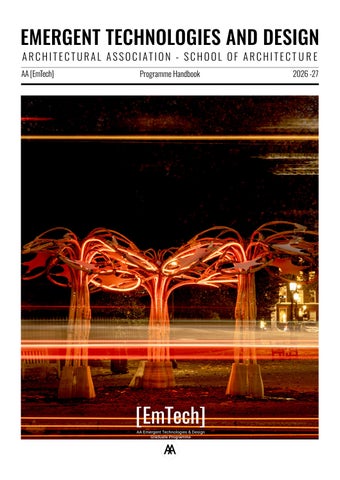
EMERGENT TECHNOLOGIES AND DESIGN A R C H I T E C T U R A L A S S O C I AT I O N - S C H O O L O F A R C H I T E C T U R E
AA [EmTech]
Programme Handbook
2026 -27
AA Emergent Technologies & Design Postgraduate Programme http://emtech.aaschool.ac.uk/
Course Director
Dr. Milad Showkatbakhsh
Founding Director
Dr. Michael Weinstock
Studio Master
Dr. Anna Font
Studio Tutors
Krishna Bhat Abhinav Chaudhary Paris Nikitidis Weiting Kong Dr. Alvaro Velasco Perez
CONTENTS 4
Introduction & Overview
14
Teaching Staff
28
External Relations
32
Teaching & Learning Methods
38
Course Descriptions
108 The Workshops 114 Programme Resources
1. Introduction & Overview
Programme Handbook 2024-25
-4-
E
mergent Technologies and Design PostGraduate Programme (inaugurated in 2001) offers two degrees of Master of Science (12 months) and Master of Architecture (16 months) and is open to graduates in architecture and engineering who wish to develop skills and pursue knowledge in architectural design science that is located in new production paradigms. The programme continues to investigate new synergies of architecture and ecology through the critical intersection of computational design and advanced fabrication. Its focus is on exploring the experiential, social, and cultural potentials of new material and spatial configurations for architectural, urban, and ecological design solutions situated in the dynamic contexts of emerging biomes. The programme is designed to stimulate critical thinking through experience of research-driven design projects that are developed in an intellectually rigorous and creative studio environment. EmTech projects are pursued by multiple iterations through hypothesis, material and computational experimentation, advanced fabrication including robotics, and evaluation, reflected upon in verbal presentations and group discussions and documented in analytical and scientifically structured papers.
insights from sustainability, urbanism, evolutionary and complexity theory.
ecology,
Key to EmTech’s approach is its workshops and seminars that emphasize computational design and physical fabrication, allowing students to engage directly with both digital and hands-on production techniques. This integration enables the exploration of sustainable design solutions inspired by biological systems through biomimetics, enhancing the ecological responsiveness of architectural projects. Moreover, the program challenges traditional boundaries by incorporating complex system theories and advanced digital fabrication, including robotics, into the core of its academic exploration. This fosters a learning environment where theoretical knowledge meets practical implementation, equipping students with the necessary skills to innovate within the rapidly evolving field of architecture. EmTech’s dissertations reflect this interdisciplinary ethos, with projects that not only address theoretical material and computational innovation but also tackle pressing global issues such as urban sustainability and ecological resilience. Through this comprehensive educational approach, EmTech prepares its graduates to lead and innovate in addressing the multifaceted challenges of contemporary architecture and urban design.
Emergent Technologies and Design [EmTech] program showcases an interdisciplinary approach, weaving together diverse disciplines to redefine the role of architectural education and the architect, in particular. The curriculum integrates advanced principles from engineering, computer science, biomimetics, and material sciences with critical
EmTech offers both MSc and MArch degrees. The MSc focuses more on developing skills and pursuing knowledge in architectural design science within new production paradigms, emphasizing computational
-5-
Emergent Technologies and Design
design and fabrication methodologies to address real-world design problems and contexts. The MArch, while sharing a common emphasis on innovation and technology integration, allows for a deeper engagement in architectural design processes, considering the practical application and execution of design projects across a range of scales, including material experimentation, architectural configurations, as well as urban and ecological solutions. Both degrees involve rigorous experimentation and research but engage with different scales of implementation in their application strategies.
role in designing structures and settlements that can withstand extreme weather conditions and adapt to variable biomes. We will need to incorporate resilience into our designs and consider their environmental impact, ensuring that our design solutions can endure extreme weather events such as hurricanes, floods, and extreme heat or cold. Furthermore, we need to consider the local ecosystems we are proposing solutions for and aim to create designs that integrate with and support the surrounding environment, rather than disrupt it. As extreme weather events and climate change become the new norm, we will need to create designs to help mitigate their effects, while also preparing for their impacts. In EmTech, we aspire to equip ourselves for what lies ahead.
Our PG MSc and MArch programmes has two distinct phases - the Studio and the Dissertation. Both Studio and the Dissertation are aligned with and supported by the research of the programme team and the advanced expertise our alumni and research colleagues in practice and industry. • • • •
The Studio (Core Modules 1/2A/2B/3A/3B/4 and Elective) comprises workshops, seminars, electives, and design projects that are led by EmTech staff and our associated researchers and offers a creative and intellectually rigorous sequence of study that builds knowledge and skill. It provides an intensive engagement in Design Science and introduces our students to the wider community of design researchers in global practices. It concludes with guiding students through the formation of a detailed proposal for an original architectural inquiry that is to be pursued in the Dissertation.
The Studio commences 21 September 2026. Completes on 19 March 2027, The Dissertation commences 19 April 2027. MSc. Final Presentation 06 September 2027, Final Submission 17 September 2027. M.Arch. Final Presentation 05 January 2028, Final Submission 07 January 2028.
The programme is designed to build skills, knowledge and to stimulate critical thinking through the experience of research driven design projects that are developed in an intellectually rigorous and creative studio environment. Our projects are pursued by multiple iterations through hypothesis, material and computational experimentation, robotic fabrication, and evaluation; reflected upon in verbal presentations and group discussions and documented in analytical and scientifically structured papers.
The Dissertation Research Studio (Core Studio / Thesis) extends the acquisition of research competencies through extensive collaborative dialogue with EmTech’s research community of active Post Doc researchers and PhD candidates. The dissertation at AA [EmTech] is structured around two parallel yet deeply integrated streams of research that drive the contemporary discourse on emerging technologies. The first stream focuses on fabrication technologies and material sciences, investigating the physical realities of production, advanced robotic construction, and the ecological potential of biointelligent and adaptive material systems. Running parallel to this is the second stream, dedicated to design technologies, software innovation, and complex computational pipelines, which explores the generative power of algorithmic systems, toolagnostic design methodologies, and the integration of AI and machine learning workflows. Together, these parallel research tracks ensure that every dissertation moves seamlessly between material intelligence and computational sophistication, equipping students to prototype and evaluate systemic solutions to complex architectural and ecological challenges.
Design Research is central to the agendas of Emergent Technologies and Design, and the programme proceeds from the fundamental premise of a shared understanding between staff, students, researchers, and collaborators across the world that nature and artifice are strongly coupled, that the cultural production of artefacts and systems exist as part of the environment of other active systems, and that they are subject to change. They also share an understanding that causality of change is complex and multi-scalar, that the dynamics of change are perturbed and accelerated by human activities, and they share a concern for the consequences of those changes to society and the natural world. Design processes in this domain are developed through iterative computational processes of serial experimentation and analysis, generative propositions, and simulations. The programme is structured to provide skills and knowledge of a coherent set of linked and convergent discourses, methodologies, and concerns that cross multiple disciplines in the Studio, and the opportunity to further develop those skills and deepen knowledge in the Dissertation.
Students integrate explorations of the theoretical discourses, relevant sciences and case studies of ‘state of the art’ projects in the domain of their chosen topic and set out the methods and protocols for the development of their Design Proposal. The development and conclusion of the final proposal is pursued through the iterative design cycles in which students have acquired knowledge and skills during the early phases of the programme.
While climate change continues to intensify, as designers, architects, and engineers we have a crucial
Programme Handbook 2026-27
-6-
Design and Build is our ‘extracurricular’ collaborative student project and is an essential part of the pedagogy and culture of EmTech. It runs right through the year, alongside both Studio and the Dissertation, and provides opportunities to design and deliver a built project with real material, structural, fabrication and assembly constraints. The experience gained enhances the design, computational and analytical skills students have acquired in Studio, and it develops crucial transferrable skills that are applicable to professional practice. Our Design and Build projects have been published internationally in the architectural press since 2001 and have received industry awards. Staff Dr. Milad Showkatbakhsh, , Director is an architect , software developer and researcher. He holds a PhD in Design from the Architectural Association. After obtaining his BSc. in Architectural Engineering from Shahid Beheshti University, he completed his M.Arch. from Pratt Institute where he graduated with Sidney Katz award for design excellence in 2015. Milad has worked for several architecture and design firms in Asia, U.S.A and Europe as design technology director such as Contemporary Architecture Practice (CAP) amongst others. His research has been published in peer-reviewed journals and conferences. Milad is also the director of the AA DLAB and AA Istanbul visiting school with the research focus on integration of algorithmic design methods with large-scale digital fabrication tools. He is the co-founder of ‘Wallacei’, an evolutionary and analytic engine with embedded machine learning algorithms that gives users full control over their evolutionary simulations in Grasshopper 3D. His practice, Morphogenetic Integration of Spaces and Habitats: [MI:SH] integrates design, architecture, and AI-driven technology to deliver sustainable, data-informed solutions that enhance innovation, precision, and environmental responsibility in the built environment. Dr.Michael Weinstock, Founding Director is an Architect and Researcher who studied at the AA and has taught at the AA since 1989. His research interest lies in exploring the convergence of the natural sciences with architecture. He received the Acadia Award for Excellence 2008, and is a Fellow of the Royal Society of the Arts. He has an extensive body of published work, including “The Architecture of Emergence: the Evolution of Form in Nature and Civilisation” and “Emergent Technologies and Design Towards a Biological Paradigm for Architecture”. Dr.Anna Font, Studio Master is an architect, PhD in Design from the AA (London), she holds a Master in Architecture II degree from the Harvard University GSD (Cambridge, MA), and a bachelor degree in architecture from ETSALS (Barcelona). Anna is Head of Learning at the AA, where she teaches in the Diploma and graduate school. Anna has been Across RCA Unit Tutor and has taught at the University of Sheffield. From 2011 to 2021 she was visiting professor at the Escuela de Arquitectura y Estudios Urbanos of
-7-
Emergent Technologies and Design
Universidad Torcuato Di Tella (Buenos Aires), where she taught Design Studios and Research Seminars, including the coordination of the Undergraduate Design Thesis. Parallel to her teaching activities she founded and coordinated the EAEU Archive of Architecture, producing the series of publications Archivos de Arquitectura, up to its twelfth issue. Her publications include essays and projects in AAFiles, Archivos, Plot and Notas magazines, and she has also collaborated in the edition and production of the books Suprarural (Ciro Najle and Lluís Ortega, Actar Publishers, 2017) and The Generic Sublime (Ciro Najle, Harvard GSD/Actar Publishers, 2016). Anna runs her own practice (afo) after having worked in architectural offices in Barcelona, Buenos Aires, Boston, and Tokyo. Her projects, research, and academic work seek to expand the potentials that result from the convergence of computation and critical thinking, developing design methodologies and discursive frameworks that can contribute to speculate and theorize the transformation currently under way for architecture as material practice.
link computational processes to material behavior, structural logic, and sustainable construction methodologies. In parallel with practice, Krishna is actively involved in design education. He has taught and assisted in computational design modules at institutions such as IAAC’s MaCAD programme in Barcelona and has delivered advanced parametric design workshops through platforms including Simply Rhino UK and Foster + Partners. He is particularly interested in how emergent technologies can reshape design pedagogy and construction paradigms through interdisciplinary collaboration, data-driven design, and iterative making. Dr Alvaro Velasco Perez, Studio Tutor, is an architect and PhD via the Architectural Association where he previously studied a master’s in History and Critical Thinking in Architecture. He has collaborated in teaching positions at the AA, UHerts, AA Summer School, Leeds Beckett and the University of Navarra, as well as participated in crits throughout the schools. His work has been presented in educational institutions in London, Paris, Berlin, Seville, Lagos and Algiers.
Abhinav Chaudhary, Studio Tutor, is an Associate Partner and Computational Design Lead at PLP Architecture with a focus on parametric modelling, complex geometries, computational design, and material research. At PLP, Abhinav has been involved in various stages of office, retail, mixed use and residential projects across Europe and Asia. He is currently working on projects in Japan, bio-material research and AI based workflows for design. Abhinav is a key member of PLP Labs’ Computational Research group having worked on IUMO, Unfolding Pavilion, Genetic Form Miner and AR/VR tools. His interests include bio-materials, environmental optimisation and agent-based modelling.
Weiting Kong, Studio Tutor, is an associate structural engineer at Thornton Tomasetti in London. where she leads the Parametric Engineering team, developing computational workflows that bring structural logic into the earliest stages of design and keep it present throughout the design process. Over nine years of practice across four firms in three cities, she has worked on projects including public transportation hubs, sports venues, commercial and residential buildings, and art installations. She holds an MEng in Civil Engineering from UCL and an MSc in Emergent Technologies and Design from the Architectural Association, and is a chartered member of IStructE. Her work bridges engineering and computational design, with particular interests in lightweight and special structures, complex geometry, innovative material systems, interoperability between geometric and analytical models, and the automation of structural workflows through custom computational tooling. Her research and built work reflect a conviction that structural feedback, made fast and legible, is a generative design tool rather than a verification step , and that computational thinking is key to enabling forward exploration and closer collaboration across disciplines.
Paris Nikitidis, Studio Tutor is Developer, Computational, Gameplay and Interaction designer, XR specialist with a degree from UCL Bartlett School of Architecture, MSc Architectural Computation (2019), and a Diploma degree from Aristotle University of Thessaloniki, Greece (2017). Currently employed by Grimshaw Architects. His current interests are in exploring the possibilities of game engines in AEC, developing bespoke applications, and computational design tools for digital form-finding, topology and structural optimization, digital/robotic fabrication, and machine learning. Krishna Bhat, Studio Tutor is an architect and computational designer whose work investigates the integration of generative design, digital fabrication, and environmental performance. He holds a Master’s degree in Emergent Technologies and Design (EmTech) from the Architectural Association and is a qualified architect with a background in architecture and material systems. He is currently a Senior Associate at Mamou-Mani Architects in London. His research interests lie in the development of algorithmic design strategies informed by ecological principles, performance simulation, and fabricationaware modelling. With a focus on bridging digital design and built form, Krishna explores workflows that
Programme Handbook 2026-27
-8-
-9-
Emergent Technologies and Design
Programme Handbook 2026-27
- 10 -
- 11 -
Emergent Technologies and Design
Programme Handbook 2026-27
- 12 -
- 13 -
Emergent Technologies and Design
2. Teaching Staff
Programme Handbook 2026-27
- 14 -
MILAD SHOWKATBAKHSH,PHD, M.ARCH, B.ARCH. ENG. • • • • • •
Conference of the Association for Computer-Aided Architectural Design Research in Asia (CAADRIA) , Hsinchu (Taiwan), April 26 - May 2 2026, Volume 3, pp. 645-654.
Director- Emergent Technologies and Design, AA Graduate School Director of Studies, AA PhD Programme, AA Graduate School Programme Head, AA DLAB Visiting School Programme Head, AA Istanbul Visiting School Co- Founder, Wallacei (AI-Powered MOO Engine). Founding Director, Morphogenetic Integration of Spaces and Habitats [MI:SH]
2026, Wong, J., Bhagat, P., Showkatbakhsh, M., “A CoEvolutionary Approach to Multi-Objective Optimization in Architecture“, HUMANISTIC COMPUTATION AND INTELLIGENCE - Proceedings of the 31st International Conference of the Association for Computer-Aided Architectural Design Research in Asia (CAADRIA) , Hsinchu (Taiwan), April 26 - May 2 2026, Volume 3, pp. 409-413.
Professional qualification: Registered architect in Iran
2026, Rode, R., Rane, S., Manjunath, A., Showkatbakhsh, M., “Regenerative Cities: A Data-Driven Generative Framework for Adaptive Interventions within Heritage Urban Contexts“, HUMANISTIC COMPUTATION AND INTELLIGENCE - Proceedings of the 31st International Conference of the Association for Computer-Aided Architectural Design Research in Asia (CAADRIA) , Hsinchu (Taiwan), April 26 - May 2 2026, Volume 3, pp. 377-386.
Bio: Milad is an architect, software developer and researcher. He holds BSc. in Architectural Engineering from Shahid Beheshti University and M.Arch. from Pratt Institute where he graduated with Sidney Katz award for design excellence in 2015. From 2017 to 2020 Milad pursued his PhD in Design ar the AA titled “Homeostatic Urban Morphologies: An Evolutionary Model to Generate Urban Morphologies With Embedded Homeostatic Behaviours”. Milad has worked for several architecture and design firms in Asia, U.S.A and Europe as a design technology director such as Contemporary Architecture Practice (CAP) amongst others. His research has been published in peer-reviewed journals and conferences. Milad is the director of the AA Istanbul visiting school and AA DLAB with a research focus on the integration of algorithmic design methods with large-scale digital fabrication tools. He is the co-founder of ‘Wallacei’, an evolutionary and analytic engine with embedded machine learning algorithms that gives users full control over their evolutionary simulations in Grasshopper 3D. Milad’s research interest is the application of biological principles of intelligence in architecture and urban design through rigorous computational processes. His practice, Morphogenetic Integration of Spaces and Habitats: [MI:SH] integrates design, architecture, and AI-driven technology to deliver sustainable, data-informed solutions that enhance innovation, precision, and environmental responsibility in the built environment.
2026, Meraki, E., Aydin, B., Patel, R., Showkatbakhsh, M., Patle, P., “Can My Data Feed Me?: Waste-Heat Reuse with PCM-Infilled, TPMS-Based Material Systems“, HUMANISTIC COMPUTATION AND INTELLIGENCE - Proceedings of the 31st International Conference of the Association for Computer-Aided Architectural Design Research in Asia (CAADRIA) , Hsinchu (Taiwan), April 26 - May 2 2026, Volume 2, pp. 153-162. 2026, Manjunath, A., Rane, S., Rode, R., Showkatbakhsh, M., “Varanasi Heritage Infill: Specification of a Loam-Based Modular Kit-of-Parts“, HUMANISTIC COMPUTATION AND INTELLIGENCE - Proceedings of the 31st International Conference of the Association for Computer-Aided Architectural Design Research in Asia (CAADRIA) , Hsinchu (Taiwan), April 26 - May 2 2026, Volume 3, pp. 531-540. 2026, Cjeung, L., Makki, M., Showkatbakhsh, M., “A Space Habitat: Generative Urban Systems“, HUMANISTIC COMPUTATION AND INTELLIGENCE - Proceedings of the 31st International Conference of the Association for Computer-Aided Architectural Design Research in Asia (CAADRIA) , Hsinchu (Taiwan), April 26 - May 2 2026, Volume 3, pp. 419-428.
Research Interests: Milad Showkatbakhsh’s research interest lies at the intersection of biology, computation and architecture. His doctoral thesis focused on the application of homeostatic principles in biology within architectural design processes and the correlation of such principles with evolutionary development and morphogenesis of species. Milad is working towards the application of biological principles of intelligence in architecture and urban design through computational processes. His wider research interests include machine intelligence, robotic fabrication and complex systems.
2026, Showkatbakhsh, M., Weinstock, M., “From Genome to G-Code: Bio Intelligence in Emergent Architecture“, AD Bio Design in Architecture, Vol96.1. 2025, Hosseini, M., Showkatbakhsh, M., Mahdavinejad, M., Rahmanian, F., “An Integrated Generative-Analytic Framework for the Performance Driven Design of Kinetic Façades”, Journal of Smart and Sustainable Built Environment.
Publications: 2026, Bhagat, P., Wong, J., Showkatbakhsh, M., “A Case for Socially-Driven Pedestrian Simulations in Urban Environments“, HUMANISTIC COMPUTATION AND INTELLIGENCE - Proceedings of the 31st International
2024, Erdine, E., Showkatbakhsh, M., Lara Moreira, A., Krolak, A., “Advances in Biomaterial Design: Employing Rattan Canes for Modular Lightweight Structures”, Design Modelling Symposiu, Kassel, Germany. 2023, Bhagat, P., Bhoite, G., Shethiya, M., Erdine,
- 15 -
Emergent Technologies and Design
E., Showkatbakhsh, M., “Rapid Deployable Shell Structures: Bi-layer Bending Systems for Pop-Up Architectural Morphologies”, Proceedings of the XXVII International Conference of the Ibero-American Society of Digital Graphics (SIGraDi 2023), 1241–1252.
Morphological Variation Through Population Based Fitness Criteria”, Learning, Adapting and Prototyping, Proceedings of the 23rd CAADRIA Conference 2018, Beijing. vol.1, pp. 153–162. 2015, Showkatbakhsh, M., “Psychedeliar”, InProcess 20, Pratt Institute, NY, US
2023, Blewett, L., Nguyen, N., Makki, M., Showkatbakhsh, M., “The development of habitable urban skyways: claiming interstitial territories through evolutionary processes”, City, Territory and Architecture, Bol 10 (1), pp 23.
2014, Showkatbakhsh, M., “Pudong Mixed Used Tower”, InProcess 20, Pratt Institute, NY, US 2013, Showkatbakhsh, M., “Algae Production Facility”, InProcess 20, Pratt Institute, NY, US.
2022. Showkatbakhsh,. M., Makki, M., “Multi-Objective Optimisation of Urban Form: A Framework for Selecting the Optimal Solution”, Buildings, vol 12 (9) pp. 1-22
2013, Showkatbakhsh, M., “Parametric Sysmtes and Forms”, InProcess 20, Pratt Institute, NY, US.
2022. Makki, M., Navarro-Mateu, D., Showkatbakhsh, M., “Decoding the Architectural Genome: MultiObjective Evolutionary Algorithms in Design”, Technology | Architecture + Design Journal, vol 6 (1) pp.68 - 79.
2013, Showkatbakhsh, M., “Responsive Pattern”, InProcess 20, Pratt Institute, NY, US.
2021. Showkatbakhsh, M., Kaviani, S., Weinstock, M. “Evolutionary Design Processes with Embedded Homeostatic Principles: Adaptation of Architectural Form and Skin to Excessive Solar Radiation”, Journal of Computer-Aided Design and Applications, vol 18 (5) pp. 914 – 953.
2013, Showkatbakhsh, M., “Robotic InProcess 19, Pratt Institute, NY, US.
2013, Showkatbakhsh, M., “Harmonic Movements”, InProcess 19, Pratt Institute, NY, US.
2013, Showkatbakhsh, M., “Fabrication of Human Body Spine”, InProcess 19, Pratt Institute, NY, US. 2012, Showkatbakhsh, M., “Parametric Skin”, InProcess 19, Pratt Institute, NY, US.
2020. Showkatbakhsh, M. and Makki, M. “Application of Homeostatic Principles within Evolutionary Design Processes: Adaptive Urban Tissues”, Journal of Computational Design and Engineering, Oxford, vol. 7, no. 1, pp. 1-17.
2012, Showkatbakhsh, M., “Public Plaza Network”, InProcess 19, Pratt Institute, NY, US. Symposia &Lectures: 2025. “New Iranian Hybridities” – DigitalFUTURES. Farsi,. Invited Speaker.
2020. Showkatbakhsh, M., Erdine, E., Lopez Rodriguez, A. “Multi-Objective Optimization of Robotically Bent In-Situ Reinforcement System.” In Angelos Chronis, Gabriel Wurzer, Wolfgang E. Lorenz, Christiane M. Herr, Ulrich Pont, Dana Cupkova, and Gabriel Wainer (eds.) 2020 Proceedings of the Symposium on Simulation for Architecture and Urban Design, 177 – 184.
2025, “Architecture in Duality: Navigating the DigitalPhysical Continuum”, University of Tehran, Iran. 2025, “Emerging Technologies for Emerging Problems”, Texas Tech University, Huckabee college of Architecture, Invited Speaker.
2020. Showkatbakhsh, M. and Kaviani, S. “Homeostatic Generative Design Process: Emergence of the Adaptive Architectural Form and Skin to Excessive Solar Radiation”, International Journal of Architectural Computing, SAGE Publications Sage UK: London, England, pp. 1-16.
2025, “Evolution as a Design Method”, University of Tehran, Invited Speaker. 2024, “Grasshopper User Meeting” held hosted by EmTech and SimplyRhino at the AA, invited Speaker.
2019. Erdine, E., Showkatbakhsh, M., Gunduz, G., Aydin, A., Bingol, C.K., Lopez Rodriguez, A. “RobotAided Fabrication of Materially Efficient Complex Concrete Assemblies” in Ji-Hyun Lee (ed.) ComputerAided Architectural Design. “Hello Culture”, 18th International Conference, CAAD Futures 2019, Daejeon, June 26-28, 2019, Proceedings. 828-847. 2018. Makki, M., Showkatbakhsh, M., Tabony, A. and Weinstock, M. “Evolutionary Algorithms for Generating Urban Morphology: Variations and Multiple Objectives”, International Journal of Architectural Computing, vol. 0, pp. 1–31. 2018. Makki, M. and Showkatbakhsh, M., “Control of
Programme Handbook 2026-27
Platform”,
2024, “Emerging Technologies for Emerging Problems”, Tehran University, Invited Speaker. 2022, “Evolution as a Design Model”, Expert Dialogues Shahid Beheshti University, Invited Speaker. 2022. “Builder, Architect, Developer, What Comes Next?” – DigitalFUTURES.Farsi, Invited Speaker. 2021. “Computational Urban Design |||“,Master in City and Technology, Iaac, Invited Lecturer. 2019 - 2021. “Multi-objective Evolutionary Algorithms
- 16 -
in Design Using WALLACEI “, Bartlett BPro UCL, Invited Lecturer.
2018. “PhD Table of Content” Symposium, Architectural Association, London. Organiser.
2019-2020. “Evolutionary Design Workshop at McNeel Europe“, McNeel Barcelona, Invited Lecturer.
Installations and Constructions: 2026, DLAB Research Pavilion, The Mobius, AA DLAB Workshop 2026, Architectural Association Model Courtyard, London, UK.
2020. “Evolution as a Design Model“, Kent School of Architecture, Digital Architecture Research Center, Invited Speaker.
2026. Hyper Hyphael Hybrid – A Collaboration between EmTech and Life Fab Institute. AA Bedford Square, London, UK
2019. “Applications of Multi-objective Evolutionary Algorithms in Urban Design“, Pratt Institute GAUD, Invited Lecturer.
2025, DLAB Research Pavilion, Morpho-Lock, AA DLAB Workshop 2025, Architectural Association Model Courtyard, London, UK.
2019. “Application of Wallacei in Practice“, Bryden Wood, Invited Speaker.
2024. DensiFlora Pavilion – A Collaboration between EmTech and Populous. . Bedford Square, London, UK.
2019. “5th Annual Design Research Exhibition and Symposium, Sentient Space”, Centre for Architecture and the Built Environment Research, UWE Bristol, Invited Speaker.
2024, DLAB Research Pavilion, Bloom, AA DLAB workshop 2024, Architectural Association Model Courtyard, London, UK.
2019. “the Applications of Multi-objective Evolutionary Algorithms in Design Using WALLACEI“, UHA, Invited Speaker.
2023, FLEX, UK Construction Week, Birmingham, UK. 2023, DLAB Research Pavilion, FLEX, AA DLAB workshop 2023, Architectural Association Model Courtyard, London, UK. 2022, DLAB Research Pavilion, AA DLAB workshop 2022, Architectural Association Model Courtyard, London, UK.
2019. “the Applications of Multi-objective Evolutionary Algorithms in Design Using WALLACEI“, WilkinsonEyre, Invited Speaker. 2019. “the Applications of Multi-objective Evolutionary Algorithms in Design Using WALLACEI“, Prior and Partners, Invited Speaker.
2021. Re-Emerge Pavilion – A Collaboration between EmTech and Hassell Studio. - Architizer A+Award Popular Choice Winner in the Architecture + Collaboration Category. Bedford Square, London, UK.
2019. “the Applications of Multi-objective Evolutionary Algorithms in Design Using WALLACEI“, Heatherwick Studio, Invited Speaker. 2019. “the Applications of Multi-objective Evolutionary Algorithms in Design Using WALLACEI“, AECOM, Invited Speaker.
2019. Urban Furniture (Robotic Rod Bending integrated with On-Site Concrete Spraying). Architectural Association (AA) Istanbul Visiting School, Istanbul, Turkey.
2019. “the Applications of Multi-objective Evolutionary Algorithms in Design Using WALLACEI“, Grimshaw Architects, Invited Speaker.
2018. Vault (Robotic HWC integrated with On-Site Concrete Spraying). Architectural Association (AA) Istanbul Visiting School, Istanbul, Turkey.
2019, “the Applications of Multi-objective Evolutionary Algorithms in Design Using WALLACEI“, Eckersley O’Callaghan Engineers, Invited Speaker.
2016. NJCTTQ HEADQUARTERS, Contemporary Architecture Practice, Shanghai, China. 2015. GAUD Installation, Pratt Institute, New York, USA.
2019. “the Applications of Multi-objective Evolutionary Algorithms in Design Using WALLACEI“, Populous, Invited Speaker.
2015, GAUD Research Pavilion, Pratt Insititute GAUD, New York, USA.
2019. “the Applications of Multi-objective Evolutionary Algorithms in Design Using WALLACEI“, ARUP, Invited Speaker.
2013. GC Parametric Installation (Generative Design using GC from Bentely). Pratt Insititute GAUD, New York, USA.
2019. “Challenging the Utopian Ideologies. Evolutionary Design Principles at the Digital Age “, Northumbria Architecture Society, Invited Speaker.
2012. Seashell (Using Parametric and Complex Geometries of Seashells to Realize and Construct an Organic Architectural Space), Art of Engineering Workshop, Tehran. Iran.
2018. “What is PhD by Design?” Symposium, Architectural Association, London. Organiser.
- 17 -
Emergent Technologies and Design
MICHAEL WEINSTOCK, PHD, RIBA, FRSA • Head of Research, AA • Director of Studies, AA PhD Programme, AA Graduate School • Founding Director, Emergent Technologies and Design Masters programme, AA Graduate School
2018, Makki,M., Showkatbakhsh,M., Tabony,A., Weinstock,M.,’ Evolutionary Algorithms for generating urban morphology: Variations and multiple objectives’, International Journal of Architectural Computing. 2018, Shilova, E., Murugesh, M., Weinstock, M., “Robotic fabrication of segmented shells: integrated data-driven design”, Proceedings of the Symposium on Simulation for Architecture and Urban Design, pp. 1-8.
Professional qualification: RIBA Chartered Architect Bio: Michael Weinstock studied Architecture at the Architectural Association and has taught at the AA School of Architecture since 1989 in a range of positions from workshop to through Academic Head. He received the Acadia Award for Excellence 2008. Whilst his principal research and teaching has been conducted at the Architectural Association, he has published and lectured widely, and taught seminar courses, studios and workshops on Emergence and associated topics at many other schools of Architecture, in Europe including Delft, Rome, Barcelona, Vienna and in Stuttgart; and in the US at Yale and Rice. He has been Honorary Chief Academic Adviser to the International Research Centre of Computational Design,Tsinghua University Beijing/ The University of Hong Kong.
2016, Barakat,M., Weinstock,M. ‘Emerging Urban Aural Patterns: Finding Connections between Emergence in Architecture and Soundscape Ecology’, in Interference: A Journal of Audio Culture 5,Writing About and Through Sound, Trinity College Dublin and The University of Ulster’s Arts and Humanities Research Institute. 2015, Weinstock,M. ‘The Architecture of Emergence’, Doctoral Thesis, Architectural Association, London 2015, Chandra, S., Körner, A., Koronaki, A., Spiteri, R., Amin, R., Kowli, S. and Weinstock, M, ‘Computing curved-folded tessellations through straight-folding approximation’ in Proceedings of the Symposium on Simulation for Architecture & Urban Design, Society for Computer Simulation International, pp. 152-159.
Research Interests: Michael’s published research has been in the dynamics, forms and energy transactions of natural systems, and the abstraction and systematisation of knowledge of biological morphogenesis and evolution to contribute to innovative computational processes of architectural design and materialisation that are necessary to sustain human societies through the impending changes. His current focus is on defining new models of ecological intelligence for future cities in a changed world with a special focus on developing new paradigms for sentient cities in extreme climates and ecological contexts. The ambition is to develop new paradigms for intelligent cities and settlements in the emergent climates, cultures and ecological contexts of the future, concentrating on deserts, salt marshes and wetlands, and on the tundra.
2013, Weinstock, M. (Editor) ‘System City’, Architectural Design, Wiley, London 2013, Weinstock, M., ‘System City: Infrastructure and the space of flows’ in ‘System City’, Architectural Design, 83(4), Wiley, London, pp.14-23 2013, Weinstock, M., Gharleghi, M., ‘Intelligent cities and the taxonomy of cognitive scales’ in ‘System City’, Architectural Design, 83(4), Wiley, London, pp.56-65. 2013, Weinstock, M. ‘The evolutionary dynamics of sentience in cities’ in (Ed. Ednie-Brown,P.,Burry,M. Burrow,M.)‘The Innovation Imperative: Architectures of Vitality’, Architectural Design, 83(1), Wiley, London, pp.92-97. 2012, Weinstock,M.,’Ecology and Material Culture’ in Poletto,M., Systemic Architecture, Routledge, UK
Publications: 2026, Showkatbakhsh, M., Weinstock, M., “From Genome to G-Code: Bio Intelligence in Emergent Architecture“, AD Bio Design in Architecture, Vol96.1.
2012, Hensel,M., Menges,A.,Weinstock,M., ‘Morphogenesis and Emergence (2004-2006)’ in (Ed. Carpo,M.) The Digital Turn in Architecture 1992-2012, Wiley, London, pp.158 -181
2021, Showkatbakhsh, M., Kaviani, S., Weinstock, M. “Evolutionary Design Processes with Embedded Homeostatic Principles: Adaptation of Architectural Form and Skin to Excessive Solar Radiation”, Journal of Computer-Aided Design and Applications, vol 18 (5) pp. 914 – 953.
2012, Kotnik, T.,Weinstock, M. ‘Material, Form and Force’, (Ed.Menges,A.) Material Computation: Higher Integration in Morphogenetic Design, Architectural design, 82(2), Wiley, London, pp.104-111.
2019, Farzaneh, A., Weinstock, M., “Mathematical Modeling of Cities as Complex Systems”, ACADIA 19: UBIQUITY AND AUTONOMY [Proceedings of the 39th Annual Conference of the Association for Computer Aided Design in Architecture (ACADIA) ISBN 9780-578-59179-7] (The University of Texas at Austin School of Architecture, Austin, Texas 21-26 October 2019) pp. 554-563
Programme Handbook 2026-27
2011, Weinstock, M. ‘The Metabolism of the City: The Mathematics of Networks and Urban Surfaces’ in (Ed. Legendre,G.L.) Mathematics of Space, Architectural Design, 81(4),Wiley, London, pp.102-107. 2011, Weinstock,M. ‘The Architecture of Flows: Integrated Infrastructures and the ‘Metasystem’ of
- 18 -
ANNA FONT, M.ARCH. PHD • Head of Learning, AA • Director of Studies, AA PhD Programme, AA Graduate School • Studio Master, Emergent Technologies and Design, AA Graduate School • Founder of afo
Urban Metabolism’, Proceedings of the 31st Annual Conference of the Association for Computer Aided Design in Architecture (ACADIA), Cumincad, pp.40-43 2010, Weinstock, M. The EmTech Wave Canopy of 2009. In (Ed. Ertas,H.,Hensel,M., Hensel,D.) Turkey: At the Threshold, Architectural Design,80(1), Wiley, London, pp.124-127.
Bio: Anna Font is an architect, PhD in Architectural Design for the Architectural Association (London), she studied architecture at Universitat Ramon Llull ETSALS (Barcelona), and holds a Master in Architecture II for the Harvard University Graduate School of Design (Cambridge, MA). Anna is Head of Learning at the Architectural Association, where she teaches at the Emergent Technologies and Design Postgraduate Programme (EmTech), after having been Course Master at the Projective Cities MPhil Postgraduate Programme (2023-2025), and Environmental Technical Studies Tutor in the Diploma School (20202025). Anna has been Unit Tutor at AcrossRCA (20222024), a transdisciplinary graduate programme at the Royal College of Art (London), and at the University of Sheffield (2022-2023), where her student’s work has been awarded the RIBA Yorkshire Student Awards 2023. She has taught yearly design workshops at the Master in Integrated Architectural Design at ETSALS (Barcelona) since 2015. Previous to moving to London, Anna was visiting professor at the Escuela de Arquitectura y Estudios Urbanos of Universidad Torcuato Di Tella UTDT EAEU (Buenos Aires) from 2011 to 2021, where she taught Design Studios and Research Seminars, while coordinating and being a tutor of Undergraduate Design Thesis. Parallel to her teaching activities she founded and coordinated the EAEU Archive of Architecture from 2012 to 2021, that registered, compiled, and edited content from the extracurricular activities at the School, producing the series of publications Archivos de Arquitectura, up to its twelfth issue. Her publications include essays and projects in AAFiles, Archivos, Plot and Notas magazines. She has also collaborated in the edition and production of the books Suprarural (Ciro Najle and Lluís Ortega, Actar Publishers, 2017) and The Generic Sublime (Ciro Najle, Harvard GSD/Actar Publishers, 2016). Anna runs her own practice (afo / www. annafont.org) after having worked in architectural offices in Barcelona, Buenos Aires, Boston, and Tokyo. In her collaboration with Ciro Najle (General Design Bureau), projects range different scales and lines of research: from explorations on material behaviour and structural redundance in Cummulus 1664 (Energy Effects, MCA Denver 2010), to the design and prototyping of differentiated support structures for public spaces in Pastizal (Rukan prize 2010), and Waiting Sea (Fleni Foundation commission 2018), or the construction of the Aula Magna lecture hall at Universidad Torcuato Di Tella (2017). She is currently working on the planning and design for a new house compound and the refurbishment of a protected building in Barcelona.
2010, Weinstock, M. ‘Emergence and the Forms of Cities’ in (Ed.Gissen,D.) Territory: Architecture Beyond Environment, Architectural Design, 80(3), Wiley, London, pp.118-121. 2010, Weinstock, M. ‘Emergence and the Forms of Metabolism’ in (Ed. Colletti,M.) Exuberance: New Virtuosity in Contemporary Architecture, Architectural Design, 80(2), Wiley, London, pp.126-129. 2010, Weinstock, M. ‘The Architecture of Emergence: the Evolution of Form in Nature and Civilisation, Wiley, London 2010, Hensel,M., Menges,A.,Weinstock,M. ‘Emergent Technologies and Design: towards a Biological Paradigm for Architecture, Routledge. 2010, Weinstock, M. ‘Evolution and Computation’ in (Ed.Hensel,M.,Menges,A.,Weinstock,M) ‘Emergent Technologies and Design: towards a Biological Paradigm for Architecture, Routledge. London. Symposia: 2015, RIBA Commission ‘Design through Production’ RIBA partnered with the Institute of Materials, Minerals and Mining (IOM3) to deliver a series of conferences on the topic of Design through Production in UK Schools of Architecture. Each conference comprised lectures and debates, with lectures by Michael Weinstock, Wolf Mangelsdorf –Director and Partner of Buro Happold, Manja Van de Worp of Nous Engineering and invited guest speakers from the host Institutions:University of Bath, Westminster University, South Bank University, Cardiff University, University of Huddersfield, Northumbria University, University of Dundee Installations and Constructions: 2015, Twist Pavilion, Directed collaboration with Hanson Plywood and TRADA. Pavilion fabricated,constructed and exhibited at Timber Expo, Birmingham, U.K. 2013-2014, Fingers Crossed Pavillion. Directed collaboration with Arup and TRADA. Pavilion fabricated,constructed and exhibited at London Design Festival and Timber Expo, Birmingham, U.K. 2012, AA/ ETH Pavilion, Directed collaboration with the Chair of Structural Design at the Swiss Federal Institute of Technology (ETH), Zurich. Pavilion fabricated, constructed and exhibited at ETH, Zurich.
- 19 -
Emergent Technologies and Design
Research Interests: Anna’s projects, research, and academic work seek to expand the potentials that result from the convergence of computation and critical thinking, developing design methodologies and discursive frameworks that can contribute to speculate and theorize the transformation currently under way for architecture as material practice. Across formats (studios, seminars, workshops, research, thesis supervisions, built work) and in time, different lines of investigation have been evolving and nurturing each other, cross pollinating her work. Grounded on an interest in design as research, Anna’s academic work is characterised by the unfolding of a constructive and critical outlook that involves the spatial description of systems of relationships. Considering the attributes of a material organisation to be the assemblage of different forces—be those legislative, historical, or governmental, territorial or environmental—the complexity inherent in the architectural project is formulated in an organisational model as a (syn)thesis, hence as a piece of architectural intelligence capable to launch new positionings in contemporary culture.
940291-54-3. 2017, (Assisted Edittor) Suprarural. Architectural Atlas of Rural Protocols of the American Midwest and the Argentine Pampas. Ciro Najle, Lluís Ortega. Actar Publishers, Barcelona: . ISBN 978-1-940291-77-2, ISBN 978-1-940291-54-3. 2017, Font, A., Mensa, M., Najle, C., Telo, C., Torres Agüero, L., ‘Proposition,’ in Singular 00. UTDT EAEU, Buenos Aires. 2016, (Assisted Edittor) The Generic Sublime. Organizational Models for Global Architecture. Ciro Najle. Actar Publishers, Harvard University Graduate School of Design, Cambridge, MA. ISBN 9781940291758. 2016, Font, A., ‘Inside,’ in The Generic Sublime. Organizational Models for Global Architecture. Actar Publishers, Harvard University Graduate School of Design, Cambridge, MA: . 383. ISBN 9781940291758. 2016, Ciro Najle interview to Anna Font. ‘Out of Time 32’. Plot 33. Buenos Aires. 160. ISSN 1853-1997.
Publications: 2025, Font, A., “Difference and Nuance”. AAFiles 81. Architectural Association. London, . ISSN 02616823, ISBN 9781738416028.
2014, Font, A., and Najle, C., ‘The Function of Canon’. 720 Pamphlet N.06 Function Lab, Farshid Moussavi. 2014, Font, A. ‘Barcelonidades y Barcelonizaciones,’ in Archivos de Arquitectura 04 Bitácora Barcelona, ed. Josep Ferrando and Jaume Prat. UTDT EAEU, Buenos Aires. 60. ISSN 2314-3029. 2014, Font, A., ‘Versiones,’ in Archivos de Arquitectura 03 La Máquina Versalles, ed. Ramon Faura. UTDT EAEU, Buenos Aires. 92. ISSN 2314-3029.
2023, Font, A.,. ‘Rumouring: A Speculative Practice,’ in AArchitecture 45. Architectural Association, London. 2022., Font, A.,. ‘The Anti-Element’. Work samples and Interview by Marta Bugés, Butlletí del Master in Integrated Architectural Design. ETSALS, Barcelona. 2021., Font, A., ‘Nomadología,’ in Archivos de Arquitectura 12 Atlas de Arquitectura Genérico Sublime, ed. Ciro Najle. UTDT EAEU, Buenos Aires. 258. ISSN 2314-3029.
2014, Font, A., ‘Versiones,’ in Archivos de Arquitectura 03 La Máquina Versalles, ed. Ramon Faura. UTDT EAEU, Buenos Aires. 92. ISSN 2314-3029. 2013, Font, A., ‘Tipos y Dispositivos, Building 111’. Plot 11. Buenos Aires, . 98. ISSN 1853-1997.
2021,. Font, A., ‘Sistemática de la Extrañeza,’ in Archivos de Arquitectura 11 Archivo de Arquitectura, ed. Anna Font. UTDT EAEU, Buenos Aires. 12. ISSN 2314-3029.
2013, Font, A., and Najle, C., ‘Edición de la Edición,’ in Archivos de Arquitectura 01 Modos de Práctica, ed. Ciro Najle and Anna Font. UTDT EAEU, Buenos Aires. 108. ISSN 2314-3029.
2021, Font, A., and Mensa, M., ‘Redux,’ in Archivos de Arquitectura 10 Singularidades, ed. Anna Font. UTDT EAEU, Buenos Aires. 86. ISSN 2314-3029. 2019, Font, A., ‘Matricialismo,’ in Superdigitalismos, Notas 42, ed. Ciro Najle. Consejo Profesional de Arquitectura y Urbanismo, Buenos Aires: . 35. ISSN 1852-9135.
2012., Font, A., and Najle, C., ‘Salvajes y Domesticados’. Plot 7. Buenos Aires. 57. ISSN 1853-1997. 2011, Font, A., and Najle, C., ‘Como Diagramar un Croissant,’ in Representación Arquitectónica, Notas 13. Consejo Profesional de Arquitectura y Urbanismo. Buenos Aires. 20. ISSN 1852-9135.
2021, Font, A., ‘Manual Proyectual,’ in Archivos de Arquitectura 09 Incontinente, ed. Andrew Pringle. UTDT EAEU, Buenos Aires. 88. ISSN 2314-3029.
2011, Suzanne Ernst interview to Anna Font. ‘What is Identity?’. On Site Review Magazine. Toronto, Canada: .
2018, Font, A., ‘Villa Stein Stein Stein,’ in Archivos de Arquitectura 08 Symmetry, ed. David Salomon. UTDT EAEU, Buenos Aires. 10. ISSN 2314-3029.
2009, Font, A., ‘Whale Chair,’ a A View on Harvard GSD, Volume 2, Tank Magazine. London, UK.
2017, Font, A., ‘Manifesto de Bolsillo,’ in Suprarural. Architectural Atlas of Rural Protocols of the American Midwest and the Argentine Pampas. Actar Publishers, Barcelona: . 37. ISBN 978-1-940291-77-2, ISBN 978-1-
Programme Handbook 2026-27
2008, Font, A. ‘OS Polybar,’ a A View on Harvard GSD, Volume 1, Tank Magazine. London, UK.
- 20 -
Symposia &Lectures: 2025 The Architectural Trait, Lecture. Bezalel Academy of Arts, School of Architecture, Jerusalem, Israel. Studio 7, Emergent Ecologies
2017-2018 Singularidades, Faculty-Student Forums, with Manuel Mensa, Carolina Telo, Lucas Torres Agüero. Universidad Torcuato Di Tella, Escuela de Arquitectura y Estudios Urbanos
2025 The Architectural Trait, Lecture. Royal College of Art, London, United Kingdom. MArch in Design Practice
2018 Program as Process, Round Table. Panelist, with Lucas Torres Agüero, Pedro Magnasco, Teresa Zweifel. Universidad Torcuato Di Tella, Escuela de Arquitectura y Estudios Urbanos
2024 Invisible Actants, AHRA Symposium organised by the AA PhD Programme. Chair of Session 1 with Arzu Kusaslan and speakers Sarah Akigbogun, Rebecca Crabtree, Sadaf Tabatabaei. Architectural Association
2018 Technic as Medium, Round Table. Moderator, with Francisco Cadau, Manuel Mensa, Juan Fontana, Roxana Scorcelli. Universidad Torcuato Di Tella, Escuela de Arquitectura y Estudios Urbanos
2024 Half-Half Pool, presentation in Panel 1 of Swimming Pool Stories, Symposium organised by Naina Gupta. Architectural Association
2018 The Generic Sublime, Book Launch Conference and Remarks. COAC Col·legi d’Arquitectes de Catalunya, Barcelona, Spain.
2022 About Spatial Infrastructure, Book Launch presentation by José Aragüez. Respondent and discussion with James Khamsi, Sophia Psarra. Architectural Association
2017 The Generic Sublime, Book Launch. Round Table Panelist with Julián Varas. Moderator Andrew Pringle. Universidad Torcuato Di Tella, Escuela de Arquitectura y Estudios Urbanos
2022 Material Modalities, Lecture. Architectural Association, Visiting School Seoul, Korea
2017 Suprarural, Book Launch Round Table. Panelist with Ciro Najle, Lluís Ortega, Francisco Cadau, Julián Varas. Universidad Torcuato Di Tella, Escuela de Arquitectura y Estudios Urbanos
2022 Digital Double, Research Seminar organized by the Digital Visual Studies Group at the University of Zürich, Zürich, Switzerland. Lineages of the Oblique, Presentation. Round table discussion with Darío Negueruela, Lucía García de Jalón Oyarzún, Iacopo Neri, Trevor Patt
2017 Materia y Escala, Lecture. Universidad Católica Nuestra Señora de la Asunción, Paraguay 2015 Architecture Schools, Round Table Panelist. BIENAL/BA15 Bienal Internacional de Arquitectura, Buenos Aires, Argentina. Consejo Profesional de Arquitectura y Urbanismo, Buenos Aires, Argentina.
2022 So Far, Practice in Times of Climate Crisis. Symposium organized by Environmental and Technical Studies at the Architectural Association. Moderator of the second panel: On Carbon, with Ciaran Malik, Pablo Gugel, Antonio Moll
2015 Mater, Material, Materiality, Round Table organized by the Graduate Programme in Architecture and Technology at Universidad Torcuato Di Tella, Escuela de Arquitectura y Estudios Urbanos. Panelist, with Mariano Clusellas and Josep Ferrando
2021 Towards a Genealogic Architecture, Lecture. Architectural Association 2021 AISENSON ASNNoise, Buenos Aires, Argentina. SOM by Kim van Holsbeke, Round Table. Panelist with Rodrigo Grassi and Pablo Ludmer
2014 Processes of Interior Differentiation, Lecture. Istituto Europeo di Design, Master in Interior Design, Barcelona, Spain
2021 Conversations Series: Pier Vittorio Aureli. Introduction and Conversation. Universidad Torcuato Di Tella, Escuela de Arquitectura y Estudios Urbanos
2010 Adaptive Feedback. Cities in Growth, Lecture with Marc Puig Mengual. Real Colegio Complutense, Harvard University, Cambridge, US.
2021 Editorial Clinique Series: Flat Out Criticism, with Penelope Dean. Introduction and Conversation. Universidad Torcuato Di Tella, Escuela de Arquitectura y Estudios Urbanos
Installations and Constructions: 2024 Architecture as an Instruction-Based Art. Harvard University Graduate School of Design. Curator: Farshid Moussavi. Exhibited: Construction Drawing of the Universidad Torcuato Di Tella Lecture Hall. The drawing was previously exhibited at the Royal Academy of Arts, London, in 2017
2020 The Future of Tall Buildings. Lecture with Ricardo Baptista and Adiam Sertzu (AKTII). Architectural Foundation, London, United Kingdom 2019 Superdigitalismos, Launch of Notas 42, edited by Ciro Najle. Presentation of essay, alongside Francisco Cadau, Juan Pablo Porta, Julián Varas, Andrew Pringle. Consejo Profesional de Arquitectura y Urbanismo, Buenos Aires, Argentina
2014-2021 Studio Furniture and Exhibition System for the School of Architecture and Urban Studies at Universidad Torcuato Di Tella. Project and Construction, with Ciro Najle 2016-2017 Aula Magna Lecture Hall. Universidad
- 21 -
Emergent Technologies and Design
Torcuato Di Tella. Project and site supervision, with Ciro Najle 2010 Cummulus. Energy Effects, MCA Denver, US. Artwork, Material Research on Crochet Knitting and Programming. Project and Installation, with Ciro Najle. The project was also installed at Le Laboratoire in Paris, France, in 2011
Computational design, GH Scrpiting, Digital fabrication 2019. Tutor, Summer DLab, The AA, London, United Kingdom. Computational design, GH Scrpiting, Digital fabrication. 2019. Co-Author, Infrasonic: A mycelium-based, earthquake resistant building proposal, ACADIA 2019. Computational design, GH Scrpiting, Digital fabrication, Bio-material prototyping.
2018 Archivo Bustillo, Exhibition. Inventory of Archive material and Drawings of Plans of the Rental Housing Projects in Buenos Aires by Architect Alejandro Bustillo. Universidad Torcuato Di Tella, Escuela de Arquitectura y Estudios Urbanos
PARIS NIKITIDIS, M.Sc. • Studio Tutor, Emergent Technologies and Design, AA Graduate School • Software Developer, ARD Foster and Partners
.ABHINAV CHAUDHARY, M.ARCH. • Studio Tutor, Emergent Technologies and Design, AA Graduate School • Associate Partner and Computational Design Lead at PLP
Bio: Paris Nikitidis is Developer, Computational, Gameplay and Interaction designer, XR specialist with a degree from UCL Bartlett School of Architecture, MSc Architectural Computation (2019), and a Diploma degree from Aristotle University of Thessaloniki, Greece (2017). Currently employed by Grimshaw Architects Current interests are in exploring the possibilities of game engines in AEC, developing bespoke applications, and computational design tools for digital form-finding, topology and structural optimization, digital/robotic fabrication, and machine learning.
Bio: Abhinav Chaudhary is an Associate Partner and Computational Design Lead at PLP Architecture with a focus on parametric modelling, complex geometries, computational design, and material research. At PLP, Abhinav has been involved in various stages of office, retail, mixed use and residential projects across Europe and Asia. He is currently working on projects in Japan, bio-material research and AI based workflows for design. Abhinav is a key member of PLP Labs’ Computational Research group having worked on IUMO, Unfolding Pavilion, Genetic Form Miner and AR/VR tools. His interests include biomaterials, environmental optimisation and agentbased modelling. Prior to joining PLP, Abhinav worked at Orproject (Delhi/London/Beijing) on a number of award-winning installations, dealing with fabricating complex geometries in timber, metal, and plastic. Abhinav received a bachelor’s degree in architecture from SSAA(GGSIPU), Delhi and a master’s degree with distinction from the Architectural Association School of Architecture, London. His graduate thesis on earthquake resistant mycelium composite structures was presented and published at the ACADIA 2019: Ubiquity and Autonomy conference.
Research Interests: Paris’s interests are in developing computational design tools for digital form-finding, robotic and digital fabrication, topology and structural optimization and machine learning, all empowered with the benefits and capabilities of game engines. KRISHNA BHAT, M.Sc, B.Arch • Studio Tutor, Emergent Technologies and Design, AA Graduate School • Senior Associate, Mamou-Mani Architects Bio: Krishna Bhat is an architect and computational designer whose work investigates the integration of generative design, digital fabrication, and environmental performance. He holds a Master’s degree in Emergent Technologies and Design (EmTech) from the Architectural Association and is a qualified architect with a background in architecture and material systems. He is currently a Senior Associate at Mamou-Mani Architects in London. His research interests lie in the development of algorithmic design strategies informed by ecological principles, performance simulation, and fabricationaware modelling. With a focus on bridging digital design and built form, Krishna explores workflows that link computational processes to material behavior, structural logic, and sustainable construction methodologies. In parallel with practice, Krishna is actively involved in design education. He has taught and assisted in computational design modules at institutions such as IAAC’s MaCAD programme in Barcelona and has delivered advanced parametric design workshops through platforms including Simply
Conferences and Publications: 2025 Chaudhary, A., Willits, S., Polisano, M., Andersson, J., Sembi, H., Bakker, R., Shah, D.U., “Symbiocene demonstrator: Mycelium bio-composites in architectural design“, Structures and Architectures. REstructure, REmaterialize, REthink REuse, pp 1-8. 2023. Presenter, Developing the Architectural Symbiocene: at the intersection of natural, physical, and digital, Shape to Fabrication 2023. Computational design, Physical prototyping, Material research. 2022. Co-Author, Unfolding Timber: A future of design, eCAADe 2022. Computational design, GH Scrpiting, Digital fabrication. 2021. Tutor, Digital Futures Fabricating Complexity (EmTech Workshop), The AA, London, United Kingdom.
Programme Handbook 2026-27
- 22 -
Rhino UK and Foster + Partners. He is particularly interested in how emergent technologies can reshape design pedagogy and construction paradigms through interdisciplinary collaboration, data-driven design, and iterative making. Research Interests: Krishna’s research is focused on Design for Manufacture (DfM) of complex forms, particularly in the context of translating computational geometry into buildable systems. He explores a range of fabrication techniques including modular, CNC, and robotic processes while incorporating performance analysis and material behaviour as key drivers in design decision-making. His work investigates the potential of artificial intelligence and machine learning in early-stage design workflows, aiming to enhance form-finding, structural optimization, and environmental responsiveness. Through both academic and professional practice, Krishna seeks to bridge speculative design with real-world construction, advancing fabrication-aware methodologies that integrate sustainability, efficiency, and architectural expression. ALVARO VELASCO PEREZ, PHD • Studio Tutor,Emergent Technologies and Design, AA Graduate School • Foundation, Course Tutor • History and Theory, Course Tutor • Writing Centre, Tutor Bio: Alvaro Velasco Perez is an architect and PhD via the Architectural Association where he previously studied a master’s in History and Critical Thinking in Architecture. He has collaborated in teaching positions at the AA, UHerts, AA Summer School, Leeds Beckett and the University of Navarra, as well as participated in crits throughout the schools. His work has been presented in educational institutions in London, Paris, Berlin, Seville, Lagos and Algiers. Research Interests: Alvaro’s research deals with modes of life that modernity defined itself in opposition to and, at the same time, develops projects to incorporate. This investigation evolves in two complementary fields of research: one historical and theoretical; the other design-based. Publications: 2026, Velasco, A., “The light-hearted spirit of Jean Rouch”, Film & Urbanism (London: Routledge) 2025, Velasco, A. & Tabera, A., “An ongoing party at the Architecture School”, RA Revista de Arquitectura, Vol. 27, 40-47 2025, Cherkaoui, R. & Velasco Perez, A., “[without traces], AArchitecture (AA Publications), Vol. 48, 15-16 2024, Nwoko, D., Brume, J., Velasco Perez, A., “The Soil Of New Culture Studios: Architecture and the Production of Culture”, Design for Rethinking
- 23 -
Emergent Technologies and Design
Resources, The Proceedings of the UIA World Congress of Architects, 95-103
spans stadia, art installations, and residential and commercial buildings — always at the intersection of rigorous engineering and architectural ambition. Weiting holds an MEng in Civil Engineering from UCL and an MSc in Emergent Technologies and Design from the Architectural Association, where she is now a course tutor. Her practice is defined by close, early collaboration with architects and artists — from Populous and Gerber Architects on stadium roofs and enclosures, to sculptors and stone masons on installations for Ai Weiwei and the COVID Memorial Sculpture — using computational tools not as a delivery mechanic but as a design language shared from the first sketch. She is a Chartered Engineer (CEng MIStructE) and works fluently across Rhino/ Grasshopper, Karamba3D, and custom Python and C# tools she develops for structural teams.
2023, Velasco, A., “Displacements of Mohammed Aboutabl”, Journal of Architectural Education, Vol. 77:2, 437-457 2023, Brume, J., “Demas Nwoko”, Afríka sunnan Sahara í brennidepli II (Africa South of the Sahara II), ed. Pétursson, J. G., 145-158 2022, “Ex Africa Aliquid Novum” [There is something new coming from Africa]. Herman Haan’s journeys in pseudo-ethnographic vein. , Intellect Ltd, International Journal of Islamic Architecture, Volume 11: Hinterland Forces-Architectural Responses at the Margins, 2 2022, “The Algerian Sphinx”. Le Corbusier’s other colonialism in the M’Zab , Taylor & Francis, The Journal of Architecture, 27, 2-3
Research Interests: Weiting’s research interests centre on computational form-finding and structural rationalisation for longspan and lightweight structures, particularly cable, portal and shell roof geometries where geometry and structural logic must be resolved together from the earliest design stages. She is especially interested in parametric workflows as a shared design language between architects and engineers, embedding structural thinking into design intent from the first sketch through to construction documentation. A recurring thread in her work is the feedback loop between the digital and the physical: how materialsystem testing and digital fabrication should inform computational models, and how those models must remain responsive to the realities of making and building. She is also interested in embedding embodied carbon visualisation into early-stage parametric design, and more broadly in developing computational tools built by engineers, for engineers. Her collaborations with artists and sculptors further drive an interest in structural engineering in service of expressive, non-standard geometry, where efficiency and artistic intent are treated as inseparable design constraints.
2020, “Blowing dust off the trails”, An itinerary through trans-Saharan lines , AR Architecture, Research, The Line: Notes on Politics Symposia &Lectures: 2021, Ceramics into New Culture- The Influence of Vernacular Terracotta Craftsmanship in the Early Work of Demas Nwoko. 2021, Punto de encuentro interdisciplinar. El Museo de la Universidad de Navarra. [Interdisciplinary meeting point. The Museum of the University of Navarra] 2020, Post-pandemic teaching spaces. 2019, The (New) Monument. 2018, The Algerian Sphinx. Le Corbusier and the North African Riddle. 2017, ‘The Quest for Atlantis and other vernacular myths. Reyner Banham’s understanding of history through the vernacular’ Exhibitions: 2017, Towards Ithaca. An Architecture of Exile. WEITING KONG, MEng, MSc, CEng MIStructE • Studio Tutor, Emergent Technologies and Design, AA Graduate School • Associate, Thornton Tomasseti • Head of Parametric Engineering Team, Thornton Tomasetti Bio: Weiting Kong is a structural engineer and Associate at Thornton Tomasetti in London, where she leads the structural design of major sports venues and heads the practice’s Parametric Engineering Team, setting strategy for computational workflows across the London office. With nine years of experience delivering complex, long-span and special structures across the UK, Europe and the Middle East, her work
Programme Handbook 2026-27
- 24 -
- 25 -
Emergent Technologies and Design
Programme Handbook 2026-27
- 26 -
- 27 -
Emergent Technologies and Design
3. External Relations
Programme Handbook 2026-27
- 28 -
w
e have a solid foundation in the external relations developed by the EmTech faculty and the almuni of the Emergent Technologies and Design Programme since 2000, and from the two decadelong association of the Undergraduate School Technical Studies with leading engineering practices.
• • • • • • • • • •
1. Past and Present Relations Relationships have been established between the Emergent Technologies and Design programme and: • • • • • • • • • • • • • • • •
Arup, London, UK Buro Happold, London, UK Hassell Studio, London, UK Populous, London, UK Grimshaw Architects, London, UK Heatherwick Studio, London, UK Zaha Hadid Architects, London, UK Foster + Partners, London, UK Centre for Biomimetics, Reading University, Reading, UK Institute for Computational Design, University of Stuttgart, Stuttgart, Germany Chair of Structural Design, Swiss Institute of Technology (ETH), Zurich, Switzerland Faculty of Environmental Design, University of Calgary, Canada Institute of Building Structures and Structural Design, Stuttgart University, Stuttgart, Germany Timber Research and Development Association, High Wycombe, UK Hanson Plywood, Halifax, UK Manchester School of Architecture, University of
• • • • •
Manchester, Manchester, UK California College of the Arts, San Francisco, USA ELISAVA, Barcelona, Spain Institute of Advanced Architecture of Catalunya, Barcelona, Spain Automata Technologies, London, UK ITECH, University of Stuttgart, Stuttgart, Germany RWTH Aachen University, Aachen, Germany AKT II, London, UK EZCT, Paris, France ETH Zurich, Switzerland Manchester School of Architecture, Manchester, UK Knippers Helbig Advanced Engineering, Stuttgart, Germany The Living, New York, USA SOM, USA Hoberman Associates, USA Harvard University City Form Lab, USA
2. Alumni Employment EmTech graduates take on various opportunities after finishing the course. Some graduates go on to teach at the AA and other schools internationally. Others go on to work at many exciting offices in London and around the world. Recent employers include: Foster + Partners (London), KPF (London), Heatherwick Studio (London), Grimshaw Architects (London), Robofold (London), Zaha Hadid Architects (London), Buro Happold (London), AKT II (London), OMA (Rotterdam), UN Studio (Amsterdam), Wilkinson Eyre Architects (London), Ron Arad Associates (London), AHMM (London), Arup (London), PLP Architecture (London), Coop Himmelblau (Vienna), AECOM (London),
- 29 -
Emergent Technologies and Design
Populous (London), Pattern Architects (London), SOM (London), SHoP Architects (New York) amongst others.
•
3. Master Class Lectures and Guest Critics Each year EmTech organizes Master Class Lectures delivered by experts from academia and practice. Previous years; our guests included:
•
• • • • • • • • • • • • • • • • • • • • • • • • • • • • • • • • • • • • • •
• • • • • • • • • • • • • •
Brian Ringley – Boston Dynamics Dr. Mohammed Makki – University of Technology Sydney Weiting Kong & Giulio Gianni – Price & Myers Stephanie Chaltiel – Mudd Architects Craig Buchanan – Imperial College London Elena Shilova – Grimshaw Architects Kostas Grigoriadis – UCL Bartlett Evan Greenberg – Mode Lab Lucia Tahan - Meta Ciro Najle - Rensselaer Polytechnic Institue Weiting Kong - Thornton Tomasetti Verena Vogler - McNeel EU Emmanuel Vercruysse and Kate Davies - Design and Make AA Oliver Thomas - FacitHomes Gili Ron - ICD Stuttgart Alvaro Lopez Rodriguez - Bartlett UCL Jens Pedersen (Aalborg University) Suryansh Chandra (Automata Technologies) Henrik Jeldtoft Jensen (Centre for Complexity Science, Imperial College London) Murat Erkurt (Centre for Complexity Science, Imperial College London) Anand Sahasranaman (Centre for Complexity Science, Imperial College London) Sina Mostafavi (DARS.Hub, SETUParchitecture), James Solly & Stephen Melville (Format Engineering) Jose Luis Garcia del Castillo Lopez (Harvard GSD), Andrew Heumann (Hypar) Julia Koerner (Jk Design GmbH) Zeynep Aksoz (TU Vienna, Karamba3d Team), Enriqueta Llabres Valls (UCL Bartlett) Brodie Neill (Designer) Philip Hoelzenbein (Raven Ai) Moritz Rietschel (Raven Ai) Renee Dobre (NBBJ Design) Richard Beckett (UCL Bartlett) Sanne Van Der Burgh (MVRDV) Bostjan Vuga (SADAR+VUGA) Yasha J. Grobman (Technion University) Arthur Mamou-Mani (Mamou-Mani Architects), Katya Bryskina (IM-A Studio)
Our guest critics for the previous year have included: • • • • •
Andy Watts – Director of Design Technology, Grimshaw Architects Xavier de Kestelier - Head of Design Technology and Innovation, Hassell Studio Enriqueta Llabres Valls – Bartlett UCL, Relational Urbanism Lab Irene Gallou – Partner - Head of Specialist Modelling Group, Foster + Partners Andrei Martin – Partner, PLP Architecture | Senior Lecturer, University of Westminister
Programme Handbook 2026-27
- 30 -
Axel Körner – Research Associate at the Institute of Building Structures and Structural Design (ITKE), University of Stuttgart Andy Watts – Global Head of Computational Design, Grimshaw Nicolo Bencini – Senior Engineer, BuroHappold Engineering Al Fisher - BuroHappold Mike Cook - Buro Happold Engineering Eduardo Rico - Architectural Association Joana Goncalves, Bartlett UCL Ignacio Marti, AA PAblo Zamorano Mosnaim - Heatherwick Studio Mattia Santi - Sasi Studio Marco Vanucci - Opensystems Architecture Laura Narvaez Zertuche, Foster and Partners Barbara Vasilatou - Populous. Miriam Dall’lgna - Eckersley O’Callaghan Sherif Eltarabishy - Foster and Partner Edoardo Tibuzzi - AKT II
- 31 -
Emergent Technologies and Design
4.Teaching & Learning Methods
Programme Handbook 2026-27
- 32 -
A
distinguishing characteristic of the programme is the emphasis on the team, and the skills and knowledge developed in collaborative learning, research, and design. Students work in small teams in studios, workshops, and seminar courses, and for their Dissertation choose their own team and topic. This is a reflection of the way in which architects work in the professional world, and in academic research in the Design Sciences. Both in the Studio and Dissertation phase, emphasis is placed on the balance between individual and group work, and the importance of critical reflection. Individual intellectual and critical development is reflected in the personal essays that each student undertakes and submits during The Studio, and in the individual Critical Reflection that each student develops and submits with their Dissertation.
delivery of each module and workshop, and to the programme as a whole. One or two members of the teaching team lead modules and workshops, but all teaching staff collectively attend key interim and other internal presentations to offer critical commentary and advice to clarify and develop the student work. Student life in the programme provides additional opportunities for learning as all tutorials and instructions take place in open studio, and students attend and participate in all presentations by their colleagues in the programme. The programme facilitates the self-organisation of study groups and workshops for additional software skills in the evenings and weekends. For these reasons attendance in studio is mandatory Monday to Friday and is monitored. 1. Course Participation Participation in seminars, workshops, and modules, and in studio generally is constantly monitored in studio discussions, design tutorials, and at presentations. If teaching staff have observed a lack of adequate participation, the student will receive a formal written warning from the Programme Director and is required to attend a mandatory meeting with teaching staff tutors to review participation and learning progress. Failure to improve participation to suitable levels results in the student being asked to repeat Phase I studies in the programme in the following year, or in extreme cases, leave the programme permanently. Students of this programme and others in the AA School receive an intense, highly supervised and closely monitored learning experience. It is the responsibility of all students to ensure that
Design processes in this domain are distributed and collaborative, and are explored, developed, and refined through iterative computational processes of serial experimentation and analysis, generative simulations, and material fabrication. The programme is structured to provide skills and knowledge of a coherent set of linked and convergent discourses, methodologies and concerns that cross many different disciplines in The Studio stage, and those skills are further developed, and knowledge deepened in The Dissertation stage. Teaching strategies reflect this modality of research and design. Each member of the teaching team has their own speciality and active personal research, but also contributes to coordination of the agendas and
- 33 -
Emergent Technologies and Design
the arrangements of their personal circumstances (including payment of tuition fees) enable them to participate in all aspects of their course/programme of study. Details of the processes and requirements outlined above are set out in Section , Attendance and Attendance Management Procedures of the Academic Regulations. Appeal procedures regarding these decisions are also summarised in the AA School Academic Regulations.
Thesis Formation takes place in studio in an intensive and highly structured week in the beginning of Term 3. Morning sessions are focused on topic discussions, exchanges and negotiations, and the afternoon sessions in writing proposals that are in turn presented and discussed the following morning. Dissertation Proposals are submitted at the end of the week, with sharply defined Abstracts, Ambitions, Methods and Domain statements. The proposals are reviewed by the teaching team, discussed with the students, reworked if necessary, and formally accepted.
2. The Studio (Core Modules) The Studio workshops, seminars and design projects are led by EmTech staff and our associated researchers and offer a creative and intellectually rigorous sequence that builds knowledge and skill. It provides an intensive engagement in Design Science and introduces our students to the wider community of design researchers in London practices. It concludes with guiding students through the formation of a detailed proposal for an original architectural inquiry that is to be pursued in the Dissertation.
At the conclusion of The Studio, all assessments of work submitted for the modules of the Studio are reviewed together with the Dissertation Proposal and students are then notified of progression to The Dissertation stage. 3. The Dissertation (Core Studio/Thesis) MSc students produce their 10,000 – 15,000-word Dissertation, and a large-scale working prototype of their partial/ entire architectural system, for submission at the end of the 12-month programme.
The teaching team and invited guests give tuition in studio, and students develop their skills and knowledge through research and design experiments. The Studio introduces a range of concepts and methodologies, and students document their work and make regular presentations. These are brought together and presented at the end of each course in a final presentation for critical advice, and in the compiled final documents submitted for assessment. The documents describe the work undertaken by the student team, the rationale for the decisions made, analyses and critically reflects upon the output, and situates the work in its theoretical, research and professional domains. Tutorials aid students in focusing and developing their submissions.
MArch students produce their 15,000 – 20,000word Dissertation for submission at the end of the 16-month programme. The third and fourth term are entirely dedicated to the production of the Dissertation, with continuous review and supervision in Studio by the teaching team. Tutorials are scheduled each week in advance. Students review and synthesize the analyses, research, and case studies of the practices of design and production particular to the research topic. In the Research and Design Studio - Term 3 students develop two chapters of their Dissertation from the Dissertation proposal, The Domain and the Methods, and pursue design experimentation appropriate to the central arguments and technical propositions. Supporting documentation of analysis, research conclusions, and strategic design decisions and argumentation in support of the Dissertation is written and refined. In addition to the scheduled weekly tutorials, regular presentations are made, and critical advice offered by the entire teaching team and invited guests.
The Seminar courses embedded in The Studio have a common structure and method, with appropriate variation in delivery. Students are asked to read preparatory or follow up material, and make short group or individual presentations of work set at the end of each session. Each course has a written submission by the student team that documents the work undertaken, and an individual essay that critically reflects upon the work undertaken by their team, and situates in its theoretical, research and professional domains. Tutorials aid students in focusing and developing their submissions.
Term 4 is focused on the design development and testing, and the final design proposal is produced, analysed, critiqued and refined. Tutorial arrangements, regular presentations and critical advice are similar to those in Term 3. The final presentations are to a panel of invited guests from practice and academia, and their critical advice is focused on the necessary steps to complete the Dissertation, and the finished document of the Dissertation is compiled and submitted.
The Seminar courses are supported by a series of lectures and workshops that run throughout the Studio. More information on the seminar courses and workshops can be found in the Programme Handbook. In Term 1, the programme offers 1 open module as part of the school-wide Electives programme: Climate and Ecological Systems in Design Science. For EmTech students, this elective is mandatory, and they may audit another suitable module offered by other programmes at the AA.
Programme Handbook 2026-27
- 34 -
- 35 -
Emergent Technologies and Design
4.COURSE DESCRIPTIONS
Programme Handbook 2026-27
- 36 -
T
HE STUDIO
WORKSHOPS, SEMINARS, AND ELECTIVES
The Studio is structured by Workshops, Seminar courses with experimentation, and Design projects that are led by Emtech staff and our associated researchers, and together offer a creative and intellectually rigorous sequence of study that builds knowledge and skill. It provides an intensive engagement in Design Science and introduces our students to the wider community of design researchers in global practices. It concludes with guiding students through the formation of a detailed proposal for an original architectural inquiry that is to be pursued in the Dissertation.
• • • • • • • •
Core Module 1: Design & Technology Core Module 2A: Natural Systems & Biomimetics Core Module 2B: Design I Core Module 3A: Emergence & Evolutionary Computation Core Module 3B: Design II Core Module 4: Critical Discourses Elective: Climate and Ecological Systems in Design Science Design & Build
Design Research is a unique class of inquiry that may include some combination from the larger set of principles of form and behaviour, integrated knowledge from the natural or cultural sciences, a specified degree of mutability such as a relational model capable of adaptation to differing circumstances or environments, testable propositions and principles of implementation, and an expository design (conceptual, physical or computationally simulated) to be used for testing and evaluation.
- 37 -
Emergent Technologies and Design
build associative logics where a digital parametric model will compute a series of inputs producing various organisations, where parameters are closely linked to form, orientation, and geometry. Stage 1 will be supplemented by a series of seminars and will conclude with self-standing fabricated assemblies in paper / thin cardboard generated from digital models.
Design and Technology
21 September – 16 October 2026 This Seminar presents a comprehensive introduction to the core skills and techniques in algorithmic thinking, geometry, digital design, and fabrication. It will be centred on the development of associative geometric models in Grasshopper, and the relations between digital morphogenesis and material realization. You will become familiar with the necessary exchange of data between the digital and physical realm through the formalization of the inherent geometric relationships in all different elements and hierarchies of the developed designs. The course will be supplemented with seminars and tutorials on parametric logic, geometry, material systems, and structural engineering, as well as the appropriate techniques for recording, describing, and documenting digital and physical experiments. The Seminar will conclude with fabricated and digitally modelled material systems that resolve problems of parametric control, material behaviour, structural integrity, tessellations of three-dimensional components, precise dimensional control, and spatial organisation.
Stage 1 Pin-Up Requirements: Monday, 28 September, 10:00) • Physical models in thick paper (thin cardboard) of self-standing global assembly (approximately 500mm x 500mm x 500mm), demonstrating component geometry and the aggregation of various components on a regional scale. • Pseudo-code diagram of associative model. • Process diagrams illustrating the associations between local (component), regional, and global (full assembly) scales. Stage 2: Material Intelligence Stage 2 begins with a new material assigned to each student. You will interrogate your material systems through simple experiments and then analyse and evaluate their performance through measuring, photographing, diagramming and other documentation methods. Information gained through this process will be incorporated within the computational model, focusing specifically on material behaviour and assembly techniques. Stage 2 will be supplemented by a series of seminars and will end with fabricated assemblies in specified materials created from digital models.
Stage 1 and Stage 2 of the Seminar will be carried out individually. In Stage 3, you are going to work in teams. Stage 1: Generative Geometries You will become acquainted with basic principles of algorithmic thinking and an iterative design process through the development of geometric models in Grasshopper for Rhino. Each one of you is going to
Programme Handbook 2026-27
- 38 -
Material Specification • Thin plywood • Wood veneer • Thin MDF Model shops • AA DPL and Print Centre • London Graphic Centre • 4D Model Shop Stage 2 Pin-Up Requirements: Monday, 05 October, 10:00 • Process diagrams, system logic diagram, models, experiments, etc. • Laser cut physical model in specified material of Stage 2 surface (approximately 500mm x 500mm x 500mm). • Amended pseudo-code diagram of associative model. Stage 3: Synthesis In Stage 3, a range of computational form-finding and analysis methods are going to be introduced. Associations between the digital process of design and the physical world of fabrication and materiality are going to drive the experimentation and analysis stages. Initial experiments conducted by each design team will conclude with a working prototype of their design proposal. A combination of structural, morphological, and performance-related parameters is going to be incorporated in the final prototypes through material and geometrical differentiation. This Seminar is going to focus on the development of your individual Design & Technology proposals by means of incorporating geometrical and structural analyses within the design process. Your investigations will be directed at methods of creating feedback loops between form-finding and analysis, with an understanding that analytical methods can be a fundamental component of early design stages. The relation of fabrication and analysis techniques to material effects and performance is going to further calibrate your computational models, thereby creating opportunities for extensive and informed design decisions. In teams, you are going to choose which surface type to develop moving on from your individual models. You are going to design, fabricate, and assemble a self-standing global assembly (approximately 500mm x 500mm x 500mm). Geometrical and structural analyses are going to be directly implemented for your Design & Technology proposals. Each team is going to select one of the material types listed below: • Plywood • MDF • Veneer Stage 3 Final Jury Requirements: Friday, 16 October, 14:00 • Fabricates Physical Model: A self-standing global assembly (approximately 500mm x 500mm x
- 39 -
Emergent Technologies and Design
The folder should contain the following information: 1. The final document. 2. The final jury PPT/PDF presentation. 3. 200 word abstract in RTF format. 4. Select up to 15 of your best drawings / diagrams and short videos and upload them in 3 folders according to the following format:
500mm) created using one of the specified materials (Plywood, MDF, or Veneer) from Stage 2, representing the synthesis of the team’s design proposal. The model should demonstrate the material’s structural integrity and geometric assembly. It should perform as a working prototype that incorporates geometric, structural, and performance-related parameters. • System Logic Diagram: Present a system logic diagram to illustrate how computational formfinding and material behaviour analysis influenced the final design. Articulate on the feedback loop between form-finding, analysis, and materiality. • Process Diagrams: Include process diagrams that document the entire development, focusing on the associations between the local (component) scale, regional (sub-assemblies), and global (overall assembly) scale. • Pseudo-code Diagram: Amend and present the pseudo-code from previous stages, showing the evolution of the associative logics and how they relate to the design.
Images • High-resolution: TIFF for raster and EPS for vector files (no JPEG or PNG for raster), 300 dpi, RGB, minimum 150 mm. • Web: 1920 px by 1080 px, 72 dpi (JPEG) • IG: 1080 px by 1080 px (JPEG) Videos / short clips • Videos should document the design process and the evolution of physical models. 1920 px by 1080 px, MP4 Images and videos should be named with the following format: • 2026-27_D&T_TeamNo_ImageNo
Preparatory Reading • Ball, Philip. Natures Patterns: A Tapestry in Three Parts [Pt. 2, Flow]. Oxford: Oxford University Press, 2011. • • Engel, Heino. Tragsysteme = Structure systems. Ostfildern: Hatje Cantz, 2013. • • Gordon, J. E. Structures: Or Why Things Don’t Fall Down. London: The Folio Society, 2013.
Note: Images and videos are both compulsory. Submission Guidelines: White background, font size 10 is the minimum for body text, and 9 for figure captions. Include a reference list at the end of the document, sorted according to Chicago referencing style, using proper citation manager software, such as Zotero and EndNote.
Documentation Submission: Monday, 26 October 2026, 10:00 Document Submission (Team): The document presents the aims of the design experiments, the logics and processes developed and the analysis of their properties and performance in relation to Design & Technology. The relationships between mathematical models and physical prototyping are interrogated, and computational models are used to discover material-driven and geometrical interdependencies. The developed computational workflows are used to explore a family of possible outcomes that are analysed and evaluated based on chosen criteria. Correlations between initial physical experiments and computational models are formulated to provide feedback between digital and physical domains. The team dossier includes a critical account of the experiments, their rationale, computational and analytical models, and the physical prototype. The documentation submission should be an A4 portrait-format document that describes in full the extent of the group work done throughout Design & Technology (physical, digital, and intellectual) as a design dossier (rather than a presentation document). The digital version of the document should be submitted to the Submission folder on OneDrive with a dedicated folder for each team. The address of the Submission folder can be found here. The Document should also be submitted to the AA School Submission Portal.
Programme Handbook 2026-27
- 40 -
- 41 -
Emergent Technologies and Design
Programme Handbook 2026-27
- 42 -
- 43 -
Emergent Technologies and Design
Programme Handbook 2026-27
- 44 -
- 45 -
Emergent Technologies and Design
Programme Handbook 2026-27
- 46 -
- 47 -
Emergent Technologies and Design
represent characteristics of natural systems or their analogues” (Vincent, 2001). In 1966, R.G. Busnel, from the animal acoustics laboratory in Jouy-en-Josas in France, organized a meeting centred on the title “Biological Models of Animal Sonar Systems”, which hosted biologists, engineers, and mathematicians in a joint discussion. The word biomimetics was first used in the title of a paper by Schmitt in 1969, and in 1974 it had entered the Webster’s Dictionary (Vincent et.al., 2006).
Natural Systems and Biomimetics 19 October – 13 November 2026
Natural Systems & Biomimetics aims to develop an understanding of how biology can be a model for material, spatial and computational systems. An introduction to the ways in which organisms have evolved through form, materials, and structures in response to varied functions and environments is followed by an account of engineering, logical and organisational design principles that have been abstracted from nature in current research projects for industry and material science. A study is made of a natural system (general form, anatomy, energy flows, geometry, organisation, hierarchies, and behaviour), along with an exploration of interrelations and an abstraction of design principles. In teams, you will explore natural systems to investigate mathematic, geometric, material, and hierarchical logics through a series of in-depth analysis techniques in order to develop a critical view on the relationships between systems design and performance. Original hints of biomimetics in human history can be traced back to 3000 years ago when Chinese attempted to replicate silk. In the modern era, biomimetics as a scientific field was coined by Otto Schmidt during the 1950’s, as he was working on his doctoral research aiming to replicate nerve triggering mechanisms. The term bionics was first mentioned by Jack Steele of the US Air Force in 1960 during a meeting at Wright-Patterson Air Force Base in Dayton, Ohio. He described it as “the science of systems which have some functions copied from nature, or which
Programme Handbook 2026-27
- 48 -
The implementation of biological principles in design and engineering related fields can be fulfilled in several ways. The simplest method in the interpretation of the biological paradigm would be the direct copying of biological forms, in other words a biomorphic approach (Vincent, 2009). As much as nature serves as an immense resource of ideas for morphological patterns (such as various formations in inanimate and animate nature), this kind of approach does not reveal the underlying patterns nature exploits to solve problems. Since nature’s structures have spent millions of years to survive and adapt to their environment for successful evolution, it is only reasonable for designers to extract and abstract information from nature on systems, materials, and structures. In this regard, it would be more beneficial if biological rules are abstracted and treated with a systematic approach rather than a formal replication. Abstraction reveals the essence and main principles behind mechanisms by isolating them from their immediate context, thereby making the adaptation into design related practices smoother and stronger. Adaptation does not necessarily point at direct imitation of nature. The self-cleaning property of lotus flower was used as the biological inspiration to develop self-cleaning surfaces, leading to the invention of a paint containing special particles, where the outcome ended up not being related to its inspiration (Vincent et.al., 2006). A biomimetic map developed by Julian Vincent demonstrates that as the abstraction level of the biological mechanism increases, the transfer and adaptation of the idea to another discipline becomes more successful (Vincent, 2001).
With regards to approaches in the transfer of biological patterns to architecture, it is essential to indicate the types of similarities that are formulated between biological entities in order to pertain to a correct relationship between architecture and biology as well. In biology, two types of similarities are distinguished. Analogous traits are those which have a common function but have come into being from different lineages of the evolutionary tree, thereby not sharing a common ancestor. A basic example to analogous traits can be the wings of birds and wings of bees. Both appendages are used for flight and therefore they do have similarities in the way they are built; however, they have arisen independently in the history of evolution. The fact that important and valuable functions such as flight have appeared autonomously in unrelated lineages is described as convergent evolution in biology. On the contrary, homologous traits may or may not have the same function, but they have developed from a common ancestor. Consequently, homologous traits designate similar structures indicating their heredity from the same organ. As an example, the wing of a bat, the front leg of a horse, the flipper of a seal, the claw of a mole, and the hand of a human all have different functions, but they all differentiate from the forelimb of a common mammal ancestor. Even though they do not share functional characteristics, they do share structural traits, such as the number of bones and their connections (Scheibel and Schopf, 1997).
Evolution in its purest form can be described as the alteration of morphological and behavioural characteristics of a population over consecutive generations to increase the fitness of individuals within their environmental context (Strickberger et al., 2008). The morphological and behavioural characteristics of species are the result of the expression of the genes (that form their genotype) and descend from the former generations. Mutation and genetic recombination amongst other sources of genetic variations are the sources of these phenotypic variations (Futuyma and Kirkpatrick, 2018), from which specific phenotypic characteristics in a population become more dominant because they are well suited to their environmental context while other morphological attributes stay rare (Scott-Phillips et al., 2014).
The nuances between analogy and homology serve as a crucial starting point in biomimetics. Architecture and biology can be considered as unrelated ancestors; therefore, research on similar functions in biology and architecture can only be possible by analogy research. In the context of biomimetics, the term analogy was first used by Helmcke during 1960’s. The purpose of analogies is to discover converging features of function and structure between natural and technological constructs, serving as a precondition for scientific investigation. Similar functions executed
- 49 -
Emergent Technologies and Design
by analogous systems point out to the existence of similar structures. Natural and technological entities which share analogous properties in terms of function and structure might have gained this property through identical, similar, or different developmental processes. Hence, development processes have a significant role in analogy research (Gruber, 2011).
organization processes explored in these experiments acted as form-finding methods in order to optimize the load bearing capacity of structures through a process where the amount of material of the system was decreased as its strength was increased. As such, form-finding was investigated as a single objective optimization (Hensel and Menges, 2009). Natural System Options Select one natural system from the below categories: • • • •
In recent architectural practices the most relevant work conducted in this research area belongs to Frei Otto and his team’s investigation on form-generating processes by the ‘Biology and Building’ Working Group at the Institute for Lightweight Structures, Stuttgart University during the end of 1980’s. In his research, Frei Otto differentiated between analytic and synthetic approaches to analogy research. “The analytic approach evaluates similarities and development processes; the synthetic approach initiates experimental self-organization processes in order to compare the outcome with the role models from nature.” (Gruber, 2011) The main goal of Frei Otto and his researchers was to re-emphasize the relationship between biology and building by working with analogous physical models (analog machines) whereby the outcomes of these experiments were at once natural and artificial. Synthetic analogy research conducted as material experiments investigated the physical laws responsible for the generation of natural constructs. Besides minimal surfaces, soap bubbles, pneumatic and tensile structures which have been studied with this methodology, another area that holds importance in the context of this research has been the optimized path systems and branched constructions which could be utilized for the branching of columns or road networks. The self-
Programme Handbook 2026-27
Shells: Lobster shell, tortoise shell, durian. Active Folding: Hornbeam, Mimosa Pudica, Venus flytrap. Bending / Twisting: Coiling Tendrils, Horsetail, Banksia, Wheat Awns, Pinecone. Membranes: Dragonfly Wing, Bat Wing.
Stage I: Research Through the understanding of science and biology articles and previous research in the field, effective principles and logics will be identified and extracted through writing and diagramming. Major principles of interest should be documented, and one line of inquiry defined to be investigated further. Initial ideas of the types of experiments to be designed and analysis methods to be used should be outlined. References files will continue to be added to the relevant Teams folder. Stage I: Research Jury will take place on Friday, 23 October at 14:00 - 10 minutes / team. The points outlined below should be addressed for the presentation: •
- 50 -
Identify principles of interest in the selected
• • • • • •
natural system and determine one line of research inquiry for experimentation. Extract systematic principles: These should be associated with the strong integration of form, material, and structure that is found in nature, leading to certain behaviours. Represent the principles as a network of information and interrelations and identify any hierarchies involved. Abstract the extracted information from the natural system, leading to the identification of design principles. Define research methods: Formulate hypothesis, explain solution-based biomimetics, and outline research methodology in terms of strategies, tools, and materials.
• • • • • •
Stage III: Final Synthesis Upon developing an understanding of the constraints of the explored systems, each group will propose an architectural system with behaviours designed from the knowledge gained during the previous two phases of work. The potential of the system in relation to specific performance criteria should be outlined and demonstrated through physical and digital computational models.
Stage II: Analysis and Initial Synthesis Chosen principles found in the natural system will be explored through digital computational processes. Teams can conduct their experiments either in Grasshopper and its add-ons, or in C#. Pseudo-codes will be written and presented to communicate the algorithmic relationships and computational design process of the systems. The relationships between morphological models and mathematical models will be interrogated, and computational models will be used to discover material, geometrical, and scaling limits of the developed systems. The developed computational models will be used to explore a family of possible outcomes and each individual will be analysed and evaluated based on chosen criteria.
Architectural applications can be proposed with the following systems: • Shells • Active Folding • Bending / Twisting • Membranes You will focus on the integration of the research areas, applied strategies including computational experiments and analyses methods, results, and evaluations towards the proposal of a structure that fits in a bounding box of 3m. x 3m. x 3m. Proposals can focus on the below lines of enquiry:
Stage II: Analysis & Initial Synthesis Jury will take place on Friday, 06 November, at 14:00 - 10 minutes / team. The points outlined below should be addressed for the presentation:
• • •
•
•
• •
models and mathematical models. Describe the formulation of computational models based on the mathematical models. Diagrams and digital experiments testing morphological and computational models. Reflect on potential applications and outline next development steps: New algorithms informing material configurations that might apply to improved performance. Define performance criteria for analysis. Identify how various analytical models will be integrated to the design workflows.
Pseudo-codes for the proposed experiment setup. Describe the rules/laws behind the behavioural emergence of the system. Illustrate the relationships between biomimetic
Structural stability Porosity, shading, etc. Analysis (curvature, shading, self-shading, FEA, etc.) Proposed material system and fabrication strategies (milling, 3d-printing, component-based aggregation, etc.)
Stage III: Final Jury will take place on Friday, 13 November, at 14:00 - 10 minutes / team. The
- 51 -
Emergent Technologies and Design
points outlined below should be addressed for the presentation: • • • • • •
explores aspects covered in the seminar course. This essay should reflect on the theoretical and conceptual framework of biology as a model for architectural design and relate the work undertaken throughout the seminar to relevant references. Course material including compiled abstracts, readers and reading lists provide a starting point, but it should be noted that the submission is intended to extend beyond the limit of public domain information. Students are expected to research across several different disciplines. The document reflects upon the personal skills and knowledge gained and how they can be further developed in the future, together with a commentary on their participation and contribution to the team and the results.
Process diagrams, models, experiments, etc. Diagrams describing the system logic and the final design conceptually, environmentally, materially, socially, structurally, etc. Psuedo-code of the system clearly mapped and diagrammed. Computational model describing the associative logics of the design. Renderings describing the design. Descriptive, analytical, and critical texts with correctly cited references of the research.
Documentation Submission: November 2026, 10:00
Monday,
The documentation submission should be an A4 portrait-format document that describes in full the extent of the group work done throughout Natural Systems & Biomimetics (intellectual, digital, and analytical) as a design dossier (rather than a presentation document). The digital version of the document should be submitted to the Submission folder on Teams with a dedicated folder for each team. The address of the Submission folder can be found here. The document should also be uploaded in the AA Submission Portal.
23
Document Submission (Team): The document presents the aims of the design experiments, the logics and processes developed and the analysis of their properties and performance in relation to Biomimetics. The relationships between morphological models and mathematical models are interrogated, and parametric models will be used to discover material, geometrical, logical, computational, and scaling limits of the abstracted systems. The developed parametric models are used to explore a family of possible outcomes and each individual will be analysed and evaluated based on chosen criteria. The team dossier includes a critical account of the experiments, their rationale and context, and a set of physical, computational, and analytical models. It is expected that the document clearly presents observations and critical reflection of the experiments.
The folder should contain the following information: • The final PDF booklet. • 200 word abstract in RTF format. • A dedicated sub-folder with individual essay submissions in PDF format. • .Gha component. • Select up to 15 of your best drawings / diagrams and short videos and upload them in 3 folders according to the format listed below. • Optional (Highly recommended): 300-500 words abstract of a paper to be published in the selected Conference/Scientific Journal.
Grasshopper component submission: A custommade Grasshopper component (.gha) that performs specific computational tasks, mathematical operations, or geometric transformations that are specific to the computational system explored in the seminar course
Images • High-resolution: TIFF for raster and EPS for vector files (no JPEG or PNG for raster), 300 dpi, RGB, minimum 150 mm.
Document Submission (Individual): An individual 1,000-word critical essay is to be submitted that
Programme Handbook 2026-27
- 52 -
• •
Web: 1920 px by 1080 px, 72 dpi (JPEG) IG: 1080 px by 1080 px (JPEG)
natural selection) in response to environmental changes.
Videos / short clips • Videos should document the design process and the evolution of physical models. • 1920 px by 1080 px, MP4
Complexity characteristics – (the original Latin word complexus, which signifies “entwined”, “twisted together”). • A complex phenomenon consists of many parts. • There are many relationships/interactions among the parts. • The parts produce combined effects that are not easily predicted and may often be novel.
Images and videos should be named with the following format: • 2026-27_NSB_GroupNo_ImageNo Note: Images and videos are both compulsory. Submission Guidelines: White background, font size 10 is the minimum for body text, and 9 for figure captions. Include a reference list at the end of the document, sorted according to Chicago referencing style, using proper citation manager software, such as Zotero and EndNote.
Forms are persistent 3-dimensional patterns that emerge from the processes of complex systems. Complexity increases when the variety (distinction), and dependency (connection) of parts or aspects increase, in several dimensions. These include at least the ordinary 3 dimensions of spatial scale, the geometry of the structure, and the dimension of temporal or dynamical scale.
Notes Every living form emerges from two strongly coupled processes, operating over maximally differentiated time spans, the rapid process of embryological development from a single cell to an adult form, and the long slow process of the evolution of diverse species of forms over extended time.
The process of increase of variety is called Differentiation, the process of increase in the number or strength of connections is called Integration. Differentiation leads in the limit to disorder, chaos or entropy, like in a gas, where the position of any gas molecule is completely independent of the position of the other molecules.
Once distinct disciplines, Developmental Biology and Evolutionary studies have recently merged. The official union occurred in 1999 when evolutionary developmental biology, or “evodevo,” was granted its own division in the Society for Integrative and Comparative Biology.
Connection leads to order or negentropy, like in a perfect crystal, where the position of a molecule is completely determined by the positions of the neighbouring molecules to which it is bound. Neither perfect disorder nor perfect order are complex. Complexity is situated in between order and disorder, on the edge of chaos.
Biodiversity: The term “biodiversity” is a contraction of “biological diversity” or “biotic diversity”. These terms all refer to the idea of living variation, from genes and traits, to species, and to ecosystems.
Morphogenesis characteristics • Development over time (many generations) of the form of an organism. • A process of complex system-environment exchanges that tends to elaborate a system’s given form or structure. • Adaptive, creating new organisational forms (by mutation during embryological development and
Biomass: In ecology, biomass refers to the cumulation of living matter. That is, it is the total living biological material in a given area or ecosystem.
- 53 -
Emergent Technologies and Design
Bioinspiration: Bioinspiration is an ambiguous term that applies to everything with a design related to life.
Suggested Readings and Resources Please refer to the Online Resources located here in addition to the following recommendations:
Form / shape biomimetics (Biomorphism): This term applies to elements of bioinspired design that are non-functional, and in many cases aesthetically pleasing elements in arts and design
•
Functional Biomimetics: This term refers to the process of capturing the functional attributes of living organisms and translating them into innovative solutions.
• •
Biotechnology / Bioengineering: These two terms are closely related to bionics and the disciples overlap. The term Biotechnology was coined by Karl Ereky in 1919. It refers to the use of living organisms or their derivatives to make or modify products such as bread, wine, or pharmaceuticals.
• •
Genotype: the inheritable information encoded in genes.
•
Phenotype: the physical manifestation of an organism - structure, function and behaviour (performance) – in a given environment.
•
Ecology and Environmental adaptation: Living organisms and their environments are interrelated. They have developed through evolution adaptation strategies for different environmental conditions. Ecology is the study of the interactions between organisms and environment. It includes all the physical and biological materials and their connected processes and actions. Environmental adaptation is the ability to maintain stable internal conditions (e.g. concentrations of nutrients and oxygen, stable core body temperature) while tolerating changing external conditions (e.g. solar irradiation, temperature, humidity, pressure). These strategies can be morphological – form and structure; physiological – biochemical and molecular processes; and behavioural – actions by organisms.
• • •
•
•
Morphogenesis: Morphogenesis is the process of evolutionary development and growth, generating polymorphic systems that obtain their complex organisation and shape from the interaction of system-intrinsic material capacities and external environmental influences and forces.
• • •
Self-organisation: Ants, bees, and wasps, exhibit coordinated social behaviour, where local rules of interaction (at the lower level) cause a global pattern in systems (global level). Natural systems are in a dynamic equilibrium, maintained by a continuous flow of matter, energy, and information. The selforganisation of complex systems with nonlinear dynamics, are characterized by feedback, stability, flexibility, modularity, and hierarchy. The development of self-organising systems can enhance sustainability, reliability, flexibility, and the ability to adapt and evolve (Isaeva, 2017).
Programme Handbook 2026-27
• •
•
- 54 -
Bar-Cohen, Yoseph, ed, “Biomimetics Products”, In Biomimetics: Nature-Based Innovation, CRC Press: Boca Raton, 2012., Masselter, Bauer, et al, pp 377-429. Caldarelli, Guido, and Michele Catanzaro. Networks: A Very Short Introduction. Oxford University Press, 2012. Darwin, Charles. On the Origin of Species: By Means of Natural Selection or the Preservation of Favoured Races in the Struggle for Life. Edited by Natalie Ramm. Penguin Classics: 2009. Frazer, John. An Evolutionary Architecture. London: Architectural Association, 1995. Gruber, Petra. Biomimetics In Architecture: Architecture of Life And Buildings. Wien: Springer, 2011. Hensel, Michael, Achim Menges, and Michael Weinstock. Emergent Technologies and Design: Towards a Biological Paradigm for Architecture. Oxon, UK: Routledge, 2010. Hensel, Michael, Achim Menges, and Michael Weinstock. Emergence: Morphogenetic Design Strategies. Vol. 74, No. 3 (May/June 2004) Chichester: Wiley, 2006. Holland, John H. Complexity: A Very Short Introduction. Oxford University Press, 2014. Hoyle, Rebecca. Pattern Formation. Cambridge University Press, 2006. Knippers, Jan, Klaus G. Nickel and Thomas Speck, Biomimetic Research for Architecture and Building Construction: Biological Design and Integrative Structures, Springer, 2016. Mazzoleni, Ilaria, and Shauna Price. Architecture Follows Nature: Biomimetic Principles For Innovative Design. Boca Raton, FL: CRC Press, 2013. Meyers, Marc André., and Po-Yu Chen. Biological Materials Science: Biological Materials, Bioinspired Materials, And Biomaterials. Cambridge: Cambridge University Press, 2014. McMahon, Thomas, and John Tyler Bonner. On Size and Life. New York: Scientific American Library, 1983. Otto, Frei. Finding Form: Towards an Architecture of The Minimal. Edition Axel Menges, 1996. Otto, Frei, Berthold Burkhardt, Uta Pankoke, Johann-Gerhard Helmcke, and Jörg Wagner. IL 3, Biology and Building Part 1. Stuttgart: Institute for Lightweight Structures, University of Stuttgart, 1971. Pawlyn, Michael. Biomimicry in Architecture, RIBA Publishing: London, 2011. Speck, T., Jan Knippers, and Olga Speck. “Self-X Materials and Structures in Nature and Technology: Bio-inspiration as a Driving Force for Technical Innovation” In AD Special Issue: Material Synthesis: Fusing the Physical and the Computational, Achim Menges (ed.), John Wiley and Sons: London, 2015, pp 34-39. Thompson, D’Arcy Wentworth. On Growth and
• • • •
•
Form. Edited by John Tyler Bonner. Cambridge, United Kingdom: Cambridge University Press, 2007. Tributsch, Helmut. How Life Learned to Live: Adaptation in Nature. Cambridge, MA, USA: MIT PRESS, 1982. Vogel, Steven. Life in Moving Fluids: The Physical Biology of Flow. Princeton University Press, 1994. Weinstock, Michael. “Emergence and the Forms of Metabolism,” In Architectural Design, 80: 126– 129. 2010. doi:10.1002/ad.1056. Weinstock. Michael, Michael Hensel, and Achim Menges. AD Special Issue: Emergence: Morphogenetic Design Strategies, John Wiley and Sons: London, 2004. Whitehead, Alfred North. The Concept of Nature. Cosimo Classics, 2007.
- 55 -
Emergent Technologies and Design
Programme Handbook 2026-27
- 56 -
- 57 -
Emergent Technologies and Design
Design 1 Digital and Material Fabrication
that constitute the regional scale of the proposal in full scale. Various fabrication techniques, including robotic fabrication, will be employed for the fullscale prototypes. Material properties as well as fabrication opportunities and limitations will drive the geometrical principles of your components, and this interdependency in return will further enable you to refine your component design. Furthermore, physical models employing various techniques (laser cutting, CNC milling, 3d-printing) will be constructed for the entire design at 1:10 scale.
16 November – 11 December 2026
Design 1 seminar builds on the techniques and methods explored in Natural Systems & Biomimetics to develop proposals with advanced computational design, analysis, and fabrication strategies. The purpose of Design 1 is to design and develop a one-to-one scale architectural application that fits in a bounding box of 4m. x 2m. x 3m. Each team is going to decide on which architectural solutions they will develop further, building upon the conclusions and observations from Natural Systems & Biomimetics seminar course.
The integration of advanced digital fabrication techniques, including robotics, and material systems is increasingly yielding innovative architectural and engineering solutions, from bespoke façade systems to buildings made entirely out of local materials. The Seminar aims to expand on formulating interdependencies between generative form-finding, geometrical rationalisation, material constraints, fabrication techniques, and assembly planning to formulate real-world innovative architectural applications.
The design process will commence with the articulation and improvement of the computational models you developed in Natural Systems & Biomimetics. You are going to develop your computational models through various rationalisation methods, while simultaneously analysing structural performance and environmental regulation (wind, solar radiation) through iterative computational experimentation. You are going to select an appropriate material system for physical experimentation, and material prototyping will commence in the second stage. The observations from physical testing will be calibrated to your computational models. This phase will conclude with the designation of global, regional, and component level hierarchies and the interrelations between them. In the final stage, you are going to develop and fabricate an aggregation of components
Programme Handbook 2026-27
- 58 -
You are going to develop your computational models through various methods of rationalisation processes. Rationalisation is a crucial stage of design development that needs to adhere to fabrication limitations and assembly logic. Consider processes such as panelisation, coplanar panelisation, primary and secondary structures, and material optimisation. Develop a hierarchical system for structural performance and environmental regulation. Expand on how the spatial layout can be organised in relation to programmatic context, daylighting, solar radiation, and wind performance. Generate computational models to designate the rationalisation processes, structural properties, environmental performance, and the amount of variation within the entire system. Consider that in the final stage of the seminar you are going to fabricate the regional scale system as a fully developed prototype with various fabrication strategies, including robotic fabrication. Run FEA at different scales and with computational models of varying degrees of detail to gain a deeper understanding of your system performance. Establishing efficiency limitations at different scales will allow you to explore your material system’s design domain and introduce variations to achieve specific performances.
Stage I: Global Sytem Design The primary focus of this stage is to develop further your computational models that you have proposed in Natural Systems and Biomimetics seminar, and to start to develop more advanced computational systems by considering the material that will be employed for prototyping purposes. Your computational models can be informed by local interaction and feedback to develop higher order structure, architectural form, and behaviour. Generate a population of candidate solutions by focusing on the structural, environmental, and architectural criteria you have established for your architectural applications.
Start to conduct your physical experimentation and investigate fabrication strategies through various processes (laser cutting, CNC milling, 3D printing, robotic fabrication, etc.). Begin to design joinery solutions for actuated material systems. Focus on leveraging the fabrication process for intelligent design discoveries for architectural characteristics such as material tolerance, locking mechanisms, and variable stable states.
Architectural applications can be proposed with the following systems: • • • •
Shells Active Folding Bending / Twisting Membranes
Stage 1 Jury will take place on Friday, 20 November at 14:00 - 10 minutes / team. The points outlined below should be addressed for the presentation: • • • •
The governing logic for the morphological and spatial organisation of the architectural application. Computational experiments and methods of analysis that you anticipate being appropriate for your design explorations in Stage 2. Selected material system and proposed fabrication strategies. Drawings in section and sectional perspective.
Stage II: System Design (Regional Scale) The focus of this stage is to develop an analytical relationship between initial form-finding, geometrical optimization, material opportunities and limitations, and subsequent fabrication processes by focusing on the regional scale of your proposed architectural application.
Stage 2: System Design Jury will take place on Monday, 30 November at 14:00 - 10 minutes / team. The points outlined below should be addressed for the presentation:
- 59 -
Emergent Technologies and Design
• • • • • • • •
material deployment, and joinery systems. Investigate the associations between the proposed fabrication process and assembly sequencing, while ensuring the structural integrity of your model.
Diagrams describing the system parameters and hierarchical organization of the proposed architectural system. Diagrams describing structural performance strategies. Diagrams describing environmental performance (solar radiation and wind) strategies. Pseudo-code and computational model illustrating the associative logics of the rationalisation process and structural hierarchy. Computational model exploring various strategies for component aggregation and component – structure interaction. Analysis models (structural and environmental (wind)). Diagrams describing the stages of physical prototyping and observations from physical testing. Diagrams describing proposed fabrication strategies and assembly logics.
Experiment with processes of making that are coupled to computational modelling techniques to design a family of artefacts whose individuals achieve sufficient and explicit performance criteria. By understanding the possibilities of a fully constructed system, you can begin to simulate its behaviour within a specific climatic context, tuning the material system toward a desired environmental performance. Consider the implications of environmental performance (solar radiation and wind) through geometrical variations across the system. Organise the developed variations for fabrication stage. Document the future potentials / limitations of the system. Develop full-scale prototypes of your designated material artefacts through physical performative models and digital analyses.. Final Jury will take place on Friday, 11 December at 14:00 - 10 minutes / team. The points outlined below should be addressed for the presentation: • • • •
Stage III: Physical Prototyping The digital era in architecture has witnessed the production of a vast array of geometrical assemblies through computational form-finding methods in previous decades. Computational tools enable a synthesized approach to design, enabling direct feedback between generative design, materialisation, and production processes. With the developments in digital fabrication, including robotics, the production and assembly of complex forms has been compromised by the constraints of selected fabrication techniques.
• • •
•
You are going to develop an articulated section of your building system design through a range of proposed fabrication techniques. The section should be a relatively self-supporting aggregation of components. Investigate methods of increasing structural performance by controlling geometry,
Programme Handbook 2026-27
- 60 -
Process diagrams, models, experiments, etc. Diagrams describing the system logic and the final design conceptually, environmentally, materially, structurally, etc. Computational model describing the associative logics of the design. Computational model exploring multiple states of performance within a specific climatic context. Analysis models. 1:10 scaled model of the architectural application. 1:1 physical prototype of an aggregation of components that constitute the regional scale of the proposal, demonstrating the performative capacity of the selected section. Life Cycle Assessment (LCA) of the design proposal, including life-cycle stages, environmental impact assessment, and measurement of GHG emissions and indicators.
The documentation submission should be an A4 portrait-format document that describes in full the extent of the group work done throughout Design I (intellectual, digital, and analytical) as a design dossier (rather than a presentation document). The digital version of the document should be submitted to the Submission folder on Teams with a dedicated folder for each team. The address of the Submission folder can be found here. The document should also be uploaded in the AA Submission Portal The folder should contain the following information: • The final PDF booklet. • 200 word abstract in RTF format. • .Gha component. • Select up to 15 of your best drawings / diagrams and short videos and upload them in 3 folders according to the following format: Images • High-resolution: TIFF for raster and EPS for vector files (no JPEG or PNG for raster), 300 dpi, RGB, minimum 150 mm. • Web: 1920 px by 1080 px, 72 dpi (JPEG) • IG: 1080 px by 1080 px (JPEG) Videos / short clips • Videos should document the design process and the evolution of physical models. 1920 px by 1080 px, MP4 Images and videos should be named with the following format: • 2026-27_DesignI_GroupNo_ImageNo Note: Images and videos are both compulsory.
Documentation Submission: 04 January 2027, 10:00
Submission Guidelines: White background, font size 10 is the minimum for body text, and 9 for figure captions. Include a reference list at the end of the document, sorted according to Chicago referencing style, using proper citation manager software, such as Zotero and EndNote.
Document Submission (Team): The document presents the aims of the Design Studio, the logics and processes developed and the analysis of their properties and performance in relation to goals of the design project. The relationships between morphological models and physical prototyping with embedded material properties will be interrogated. Computational models will be used to discover geometrical, material, and morphological interrelationships to create a hierarchical system of design. Material experimentation coupled with digital prototyping will be used to generate a series of prototypes to analyse and document the relations between computational and physical paradigms. The team dossier includes a critical account of the experiments, its rationale, and context and a set of physical, computational and analytical models. It is expected that the document clearly presents observations and critical reflection of the experiments. Grasshopper component submission: A custommade Grasshopper component (.gha) that performs specific computational tasks, mathematical operations, or geometric transformations that are specific to the computational system explored in the seminar course.
- 61 -
Emergent Technologies and Design
Suggested Readings and Resources Please refer to the EmTech Reading List here in addition to the following recommendations. •
Resources on Material Systems & Fabrication Online Resources: • • • • • • • • • •
• • •
• • •
• •
•
• •
•
https://www.arup.com/perspectives/ publications/research/section/rethinking-timberbuildings Bandyopadhyay, A., Susmita Bose. Characterization of Biomaterials. Amsterdam: Elsevier, 2013. Beorkrem, C. Material Strategies in Digital Fabrication. New York: Routledge, 2017. (Available online as e-book) Bianconi, F. and Marco Filippucci (eds.). Digital wood design: Innovative Techniques of Representation In Architectural Design. Springer, 2019. (Available online as e-book) Brell-Çokcan, Sigrid, and Johannes Braumann. Rob / Arch 2012 Robotic Fabrication in Architecture, Art, and Design. Vienna: Springer Vienna, 2013. (Available online as ebook) https://www.cost.eu/uploads/2018/11/Basis-ofDesign-Principles-for-Timber-Structures.pdf Engel, H. Tragsysteme = Structure systems. Ostfildern: Hatje Cantz, 2013. Erell, E., David Pearlmutter, Terry Williamson. Urban microclimate: Designing the Spaces Between Buildings. London : Earthscan, 2010. (Available online as e-book) Gordon, J. E. The New Science of Structures and Materials. New York: Scientific American Library: Distributed by Freeman, c1988. Gruber, P. Biomimetics in Architecture: Architecture of Life and Buildings. New York: Springer, 2011. (Available online as e-book) Hensel, M., Achim Menges and Michael Weinstock. Emergent Technologies and Design: Towards a Biological Paradigm for Architecture. Abingdon : Routledge, 2010. (Available online as e-book) Hudert, M. and Sven Pfeiffer. Rethinking Wood: Future Dimensions of Timber Assembly. Birkhauser, 2019. (Available online as e-book) Kolarevic, B., and Vera Parlac. Building Dynamics: Exploring Architecture of Change. Abingdon, Oxon: Routledge, 2016. (Available online as e-book) Marble, S. Digital Workflows in Architecture: Design - Assembly – Industry. Birkhauser Verlag AG, Basel, 2012. (Available online as e-book) McGee, Wes, Ponce de Leon, Monica (Eds.) Rob|Arch 2014: Robotic Fabrication in Architecture, Art and Design. Springer, Vienna, 2014. (Available online as e-book) Menges, Achim. Material Computation: Higher Integration in Morphogenetic Design. London: John Wiley & Sons, 2012. (Available online as e-book) Menges, A. Material Synthesis: Fusing the Physical and The Computational. London: John Wiley & Sons, 2015. (Available online as e-book) Reinhardt, D., Rob Saunders, Jane Burry, Sigrid Brell-Çokcan, Johannes Braumann, and Marjo
Programme Handbook 2026-27
• • • •
- 62 -
Niemelä. Robotic Fabrication in Architecture, Art and Design 2016. Cham: Springer, 2016. (Available online as e-book) https://www.sciencedirect.com/science/article/ pii/S1364032116306050 Sheil, B. Manufacturing the Bespoke: Making and Prototyping Architecture. Chichester, United Kingdom: John Wiley and Sons Ltd., 2012. (Available online as e-book) https://www.trada.co.uk/media/13455/timberengineering_preview-final-14092020.pdf Vincent, J. Structural Biomaterials. Princeton University Press, 2012. Watson, J. Lo-TEK : Design by Radical Indigenism. Cologne: Taschen, 2019. Weinand, Y. Advanced Timber Structures: Architectural Designs and Digital Dimensioning. Walter de Gruyter GmbH, 2016. (Available online as e-book)
- 63 -
Emergent Technologies and Design
Programme Handbook 2026-27
- 64 -
- 65 -
Emergent Technologies and Design
limitations. In single objective optimisation, where the problem is comprised from only one objective, finding the ‘optimal’ solution is a relatively straight forward process (this of course is contingent on the difficulty of the problem at hand). However, when a problem consists of two or more conflicting objectives (multiple objectives), finding the ‘optimal’ solution becomes significantly more challenging; as a solution increases in fitness to one objective, it necessitates a decrease in fitness for the opposing objective, therefore no single ‘best’ solution that is optimal for both objectives is possible. As such, by employing an evolutionary approach to generate a set of optimal solutions, one can incrementally evolve a population of individuals that respond to the multiple conflicting objectives over multiple generations thus limiting any user-influenced preferences throughout the simulation.
Emergence and Evolutionary Computation Multi-Objective Evolutionary Algorithms 04 – 29 January 2027
Multi Objective Evolutionary Algorithms Evolutionary Algorithms have been used extensively in recent years to mimic the principles of evolutionary science to solve common real-world problems through search and optimization procedures of single or multiple objectives. Ranging from the fields of economics to politics and music to architecture, evolutionary algorithms have proven to be an efficient problem- solving technique to find multiple trade-off solutions for problems that possess multiple ‘fitness criteria’ (objectives) that are in conflict with one another. The aim of the seminar is to continue to dive deep into the principles of multi objective optimisation as well as to develop an understanding of their application in design primarily through the development of towers and their façade systems. The two stages that comprise the seminar will provide the necessary knowledge for the utilisation of multi objective evolutionary algorithms across a range of scales as well as varying degrees of complexity. Although challenging, once mastered, their application becomes a robust tool in addressing design problems that are comprised from multiple conflicting objectives that hold no clear single design solution. The term ‘Optimisation’ in evolutionary computation refers to finding the fittest solution (or best solution) to a problem that is constrained by a set of predefined
Programme Handbook 2026-27
- 66 -
Although evolutionary algorithms are derived from evolutionary principles, the algorithmic process by which a population of individuals ‘evolve’ towards a local or global optimum may be viewed as a teleological process that is driven towards an end goal. There is yet to be a consensus to justify this fundamental difference between the algorithm and its biological counterpart; some authors in the field attribute it as a “change in semantics” (p.48, Weise, 2008), while others outline the process of evolutionary algorithms as one that is similar to the “selective breeding programs of animals and plants” (p.5, Paterson, 2002), rather than one that attempts to evolve new species or employ natural selection (Paterson, 2002). However, De Jong (2006) argues that if an evolutionary system is viewed as a “complex, adaptive system that changes its makeup and its responses over time as it interacts with a dynamically changing landscape,” then an evolutionary algorithm is represented as a “feedback control mechanism responsible for maintaining some sort of system stasis in the face of change” (p.23, De Jong, 2006). Therefore, when comparing the local optimum in an evolutionary algorithm to a biological evolutionary process, Weise (2008) argues that achieving the local optimum in an evolutionary algorithm corresponds to a “well-adapted species that dominates all other animals in its surroundings” (p.3, Weise, 2008). However, the foundations of evolutionary algorithms have been significantly contingent on the principles of evolution established in the modern synthesis in the 1940’s. Although evolutionary algorithms apply key principles of an evolutionary model to computational problem solving, these principles reflect phenotypic variations through statistical gene frequencies in populations. However, the mutation of gene regulation and regulatory sequences in developmental biology and their effect on the evolutionary process of organisms is severely lacking within evolutionary computation. Although the discoveries in developmental biology have greatly challenged the principles established in the modern synthesis, these discoveries are yet to manifest themselves in evolutionary algorithms, thus resulting in an incomplete translation of how evolution functions on the genetic level and consequently an incomplete portrayal of a biological evolutionary model through evolutionary computation. As such, one of the seminar’s objectives is to further investigate the incorporation of evolutionary developmental principles within the application of multi objective optimisation in design; primarily through the expression and suppression of single or multiple genes that are employed within the algorithmic setup.
The Experiment – Stage I, II: The seminar is divided into two stages that builds up on the introductory session on evolutionary computation in Natural Systems and Biomimetics seminar. Two stages vary in both complexity as well as scale. However, they both share the common objective of utilising multi objective evolutionary algorithms to generate solutions that are optimised for a set of limiting constraints. Stage 1 will build up on the principles of evolutionary computation that were explored in Natural Systems and Biomimetics Seminar to develop and run an evolutionary algorithm with focus on the experiment set up of simulation and calculation of fitness objectives through a generative
- 67 -
Emergent Technologies and Design
engine in Grasshopper3D called Wallacei. Stage 1 will emphasis on integrating evolutionary developmental principles and environmental conditions within the algorithmic setup as well as investigate their potential for generating phenotypic variation throughout the simulation. Stage 2 will continue on top of the Stage 1 results to develop a sequential generative simulation workflow that gears toward a new design problem while utilising the stage 1 simulation as its foundation. This stage introduces the idea of sequential simulations in order to solve multi-faceted and complex design problems. Stage 2 highlights the comparative analysis between the generated results to the phenotypes generated in Stage 1. The table below outlines key definitions for the terminology that will be used throughout the seminar. It is imperative that each student adopts the correct use of the terminology below; this ensures a comprehensive and clear translation of the concepts to be investigated.
Fitness Criteria
The criteria by which the phenotype will be evaluated.
Mutation
Random modifications to the genes.
Mutation Prob.
The probability of a gene to be mutated.
Mutation/ Crossover Distribution index
Crossover
Crossover Prob.
Pareto Front
How similar the solutions’ genes are to the parents’ genes
The exchange of genes from different phenotypes when breeding to make a descendant. The probability of a gene to be selected for crossover. Pareto optimal set is when none of the fitness criteria can be improved in value without loss in some of the others. In a population it is when it is impossible to improve any single individual without degrading another individual.
Stage I: Evolution of Towers This stage will build on the knowledge gained from the introductory session on evolutionary computation in Natural Systems and Biomimetics seminar by incorporating an architectural design problem within your simulation in the form of a tower. Each group will be assigned one tower morphology. Each group must perform an analysis of the morphological properties, spatial relationships, and environmental context to better understand the case study (It should not take more than one day!) and to evolve a family of towers to enhance their design goals and address a set of objectives. The aim is to evolve a family of new towers that are adapted to the region’s environmental conditions and enhance the architectural performance of the original deign. The morphological configuration of the newly evolved towers might differ from the previously designed towers in order to address the objectives more efficiently.
Term
Description
Generation Size
The number of individuals per each iteration.
Generation Count
The number of iterations in any single run of the simulation.
Population Size
The number of individuals in the entire simulation.
Phenotype
The geometry of the forms that the simulation will produce.
Gene
• • • •
Note: There is no association between the coordinates and any buildings in the selected city. In this sequence, each group member must build their own definition and run their own experiment. The experiments of each member in the team do not have to be drastically different as they can test a variation of a similar design problem, however, this must be carried out individually by each team member.
A single parameter that controls the type and intensity of modification to the phenotype.
Programme Handbook 2026-27
Humid - Continental - Chicago USA Oceanic - London, UK Tropical Rainforest - Kuala Lumpur, Malaysia Arid hot - Kuwait City, Kuwait
- 68 -
Experiment Setup: • Review your previous works in introduction on evolutionary computation and make a critical assessment of the body plan and growth strategies, and of the evolutionary processes. Review the effectiveness of your chosen methods of addressing environmental pressures and the problems that arose. Remember that all negative results are also important and that they offer you critical insights into the development of your work in this field. • Prepare the logic diagram for Stage 1, Define a minimum of 3 and a maximum of 5 fitness criteria (How about 6 or even 7?). However, keep your strategy simple, utilizing Wallacei introduces a degree of complexity you are not yet accustomed to.
•
•
•
•
•
•
Define your goals and objectives in a table and brainstorm how to create the phenotype in order to address your fitness criteria. This is an important step in a successful implementation of a generative workflow in a design problem. Although it is a textual description, it helps to clarify the problem drastically, especially at the beginning of the design problem. The primitive in this stage is to be comprised from a tower. Ensure you consider the relationship between the elements in the tower and their spatial relationships that make up each individual and the possible impact they have on one another.
be easily modified and applied to another tower?) Define your Evolutionary Matrix. This matrix is essential to understand your design problem thoroughly and to solve your design problem methodically. Evolutionary matrix portrays the relationship between the chromosomes of the design problem and the fitness objectives of the simulation. By clarifying this you will have a full control over your evolutionary simulation. Evolutionary matrix can be updated as the project progresses. Define your regulation strategy within your definition. Now that you are working within the platform of grasshopper and Wallacei, how can you implement the expression and suppression of genes within your simulation? What is the regulatory relationship between your genes and your body plan? Which chromosomes are Allometric, and which ones are Homeotic? The purpose of this part of the Stage is to explore the potential of Wallacei/GH plugin within Rhino to simulate a genetic experiment for the evolution of Towers. As this will enable you to run many generations very rapidly, you will limit your simulation run to 100 generations each with a population of 50 individuals. However, rather than analysing each generation, you analyse the simulation at generations 20, 60 and 99 for investigations and review. Analyse your results based on the standard deviation values, PCP and the pareto front of the selected generations. Take advantage of Wallacei Analytics and Wallacei Selection strategies.
Prepare a short presentation – Run the simulation, analyse, and rank generations 20, 60 and 99 according to your fitness criteria. Review the selected generations and observe/comment on emergent forms, taking into account other parameters outside of your chosen fitness criteria. How can you emphasise on an objective? Ensure your presentation is concise and to the point; you must develop the skills necessary for presenting a complex topic in a specified amount of time.
Define the body plan of the tower. Be methodical in its implementation; based on what did you define this body plan? To what extent is the body plan you defined unique to your tower (is it applicable to only your tower in specific or can it
- 69 -
Emergent Technologies and Design
Stage Il – Sequential Simulation of Towers and Façade System In the second stage, you will apply all of the skills (both theoretical and practical) gained over the previous stage in developing sequential simulations to evolve a façade system over your chosen tower morphology from stage 1. The façade system you chose to evolve can be aligned with your experiments conducted in Design 1. In this stage you are going to further develop your tower design problem to encompass its façade system, however the chromosomes that control the tower morphology should be adjusted based on the stage 1 evolutionary simulation. This is an effective way to create a series of sequential evolutionary simulations to tackle complex problems comprise several stages. By decoding the genome of your pareto front candidates of the tower simulation you will understand the desired range of your chromosomes. This stage requires its own goal chart and evolutionary matrix however this should have a meaningful connection to the previous evolutionary matrix. You will have the freedom to make these decisions according to the logic that you believe is best fitting for generating morphological variation that is optimised to your fitness criteria of your facade system. In this stage you are going to disengage the fitness criteria of your tower simulation from the generative workflow and utilise them as a data input. This will further assist you in your selection strategies at the end. You will run your second simulation which is primarily geared toward evolving a façade system for your tower morphology however in this simulation, the tower morphology will also be adjusted based on the constrained and updated set of chromosomes.
Programme Handbook 2026-27
Experiment Setup: • Review stage 1, and include the strategies, parameters, and fitness criteria for evolving your tower façade system. The chromosomes controlling the tower morphology will be constrained based on the information from the first simulation. The pareto front of the entire population from stage 1 simulation will define the limitations that are going to be applied over the stage 1 chromosomes. • Pay attention to the impact of the changes over your simulation while adding a new set of homeotic chromosomes (responsible for emergence of your facade). However, ensure you respect the limitations imposed by your computational platform. How does this affect your strategies? What is the possible benefit of inheriting information from the previous simulation? Prepare the logic diagram for stage 2. How does the architecture of the tower allow the emergence of the facade? • Study the geographical and urban context of your site and design the spatial distribution of your tower accordingly. This can be an important
- 70 -
•
•
•
•
•
information while design your problem for evolving the tower’s façade system. Although there will be no limit to the population and generation size in stage 2, be careful of the computational load the simulation will exert on your selected computational platform (considering that your primitive is comprised from a large tower). What population size and generation count can your platform accommodate without crashing? Your fitness criteria for this stage are primarily addressing your façade system. They should clearly define a relationship between inside and outside the tower. How does the facade increase or decrease the interaction of the tower to its context? What is the impact of such change to the neighboring context? How can you introduce material and fabrication related objectives into your second simulation?
You may choose to take these from any of the generations of stage 2. Prepare your final presentation – Present your experiment setup, selected strategies, and results. Address the challenges you faced and the changes you made in response to them. The presentation must be clear and concise, by now you should have the skills to present clearly and efficiently. Remember, the use of the correct terminology is key for a coherent presentation.
Run the generations, analyse, and rank according to your fitness criteria and adjust your strategies accordingly after some generations. Review the tower and its façade system you have generated and observe/comment on emergent forms, taking into account other parameters outside of your chosen fitness criteria. Use Data input in WallaceiX for monitoring changes. These parameters can be derived from the material system you would like to employ for your façade system. Analyse and visualize the data and phenotypes generated by WallaceiX in an appropriate way to show the development throughout the generations. Take advantage of Wallacei Analytics and Wallacei selection strategies. Prepare a catalogue of 10 tower with their façade system (how about 20?), design appropriate data structures for associated data/fitness criteria ranking/other parameters. Study your simulation thoroughly and explain any emerging patterns.
Documentation Submission: Monday, 08 February 2027, 10:00 The submission of the work conducted in the seminar is divided into two parts, a team submission, and an individual submission. Both submissions will present the 2 stages; however, the individual submission will give greater attention to the individual experiments conducted in stage 1 and it will also include the individual essay.
- 71 -
Emergent Technologies and Design
space exploration through data visualization. The data generated by the evolutionary simulation in Grasshopper will serve as an input for this custom tool. This application intends to provide a platform for clear communication of the output results from evolutionary simulation, leaving the implementation medium open for future determination. Document Submission (Individual): Each team member will submit a 1000-word paper (no more than 1200 words) that presents a personal critical review of the 2 stages, alongside a detailed account of the approach undertaken and results achieved in the individual experiments conducted in stage 1. The purpose of this submission is to ensure that each student has a comprehensive understanding of the theoretical and technical knowledge gained throughout the seminar; therefore, situating your work within the field of research is essential in displaying a clear understanding of the significance of the work presented. More importantly, a considerable part of conducting such experiments is acquiring the necessary skills to present your findings to your peers in a concise yet clear manner. This is an essential skill to be gained for publishing your work in peer reviewed journals and conferences. As such, each paper must be structured to include an Introduction, Background and Context, Methods, Experiment Setup, Results and Conclusions. The documentation submission should be an A4 portrait-format document that describes in full the extent of the group work done throughout Emergence and Evolutionary Computation (intellectual, digital, and analytical) as a design dossier (rather than a presentation document). The digital version of the document should be submitted to the Submission folder on Teams with a dedicated folder for each team. The address of the Submission folder can be found here. The document should also be submitted to the AA submission Portal.
Document Submission (Team): The document presents the aims and context of your design experiments together with the process, products, and the analysis of the results. It will describe stages 1 and 2 of your experiments in Evolutionary Computation, and your critical review of those experiments. The submission should describe the logics and processes that you have been experimenting with, and how they stand in relation to the field. The critical review will also place your work in relation to the literature of evolution and embryology – and you are required to demonstrate a clear understanding of ‘evo-devo’ as well as the Darwinian account of evolution, and later revisions/additions concerning populations and coevolution. This is the intellectual context from within which you make your computational decisions - and these should be explicitly related back to the biological processes. Tool Development: A custom application that effectively communicates the details and purpose of your project through data-driven processes and clever visualizations. The software should make use of custom and user-enabled animations, time-based simulations, and intuitive UI to enhance the overall user experience and better convey the functionality and design of your project. The primary objective of the application is to serve as a platform for design
Programme Handbook 2026-27
The folder should contain the following information: • The final PDF booklet. • 200 word abstract in RTF format. • A dedicated sub-folder with individual essay
- 72 -
• •
submissions in PDF format. Select up to 15 of your best drawings / diagrams and short videos and upload them in 3 folders according to the format listed below. Optional (Highly recommended): 300-500 words abstract of a paper to be published in the selected Conference/Scientific Journal.
•
The parts produce combined effects that are not easily predicted and may often be novel. Forms are persistent 3-dimensional patterns that emerge from the processes of complex systems. Complexity increases when the variety (distinction), and dependency (connection) of parts or aspects increase, in several dimensions. These include at least the ordinary 3 dimensions of spatial scale, the geometry of the structure, and the dimension of temporal or dynamical scale.
Images • High-resolution: TIFF for raster and EPS for vector files (no JPEG or PNG for raster), 300 dpi, RGB, minimum 150 mm. • Web: 1920 px by 1080 px, 72 dpi (JPEG) IG: 1080 px by 1080 px (JPEG)
The process of increase of variety is called Differentiation, the process of increase in the number or strength of connections is called Integration. Differentiation leads in the limit to disorder, chaos or entropy, like in a gas, where the position of any gas molecule is completely independent of the position of the other molecules.
Videos / short clips • Videos should document the design process and the evolution of phenotype. 1920 px by 1080 px, MP4
Connection leads to order or negentropy, like in a perfect crystal, where the position of a molecule is completely determined by the positions of the neighbouring molecules to which it is bound. Neither perfect disorder nor perfect order are complex. Complexity is situated in between order and disorder, on the edge of chaos.
Images and videos should be named with the following format: • 2026-27_EEC_GroupNo_ImageNo Note: Images and videos are both compulsory. Submission Guidelines: White background, font size 10 is the minimum for body text, and 9 for figure captions. Include a reference list at the end of the document, sorted according to Chicago referencing style, using a proper citation manager software, such as Zotero and EndNote.
Evolutionary Computation • Genetic algorithms - the Darwinian engine • simulation of sexual reproduction. • crossover and mutation operate on the genome. • selection operates on the phenome, by ‘fitness’ in the environment.
Notes Every living form emerges from two strongly coupled processes, operating over maximally differentiated time spans, the rapid process of embryological development from a single cell to an adult form, and the long slow process of the evolution of diverse species of forms over extended time. Once distinct disciplines, Developmental Biology and Evolutionary studies have recently merged. The official union occurred in 1999 when evolutionary developmental biology, or “evodevo,” was granted its own division in the Society for Integrative and Comparative Biology.
Natural Selection - different individuals competing for resources in the environment. Some are better equipped than others. Those that are ‘fitter’ are more likely to survive and propagate their genetic material. Genotype - the inheritable information encoded in genes. Phenotype - the physical manifestation of an organism: structure, function and behaviour (performance).
Morphogenesis characteristics • Development over time (many generations) of the form of an organism. • A process of complex system-environment exchanges that tends to elaborate a system’s given form or structure. • Adaptive, creating new organisational forms (by mutation during embryological development and natural selection) in response to environmental changes.
Cells are the fundamental working units of every living system. All the instructions needed to direct their activities are contained within the DNA (deoxyribonucleic acid). A genome is the total DNA (information) of an organism including genes. DNA is assembled from four chemicals, so that all four occur millions or billions of times in the entire genome. The DNA sequence is the particular arrangement of pairs of chemicals (bases) along the double helix of the DNA strand. Adenine (A) forms a base pair with thymine (T), guanine (G) with cytosine (C)
Complexity characteristics – (the original Latin word complexus, which signifies “entwined”, “twisted together”). • A complex phenomenon consists of many parts. • There are many relationships/interactions among the parts.
Allometric Chromosome: it can be translated to biological scaling. Allometry in its general term describes how the morphological characteristics of organisms change with size. Allometric chromosome is a chromosome that transforms the proportions of different phenotypic characteristics within the body
- 73 -
Emergent Technologies and Design
•
plan. Homeotic Chromosome: Homeotic chromosomes are chromosomes that define the emergence of a feature within a specific body part.
Translocation – part of a chromosome is swapped with another part on a different chromosome
The Sequence Sequences are conventionally written in pairs: ATCGATTAGCTA. Genomes vary widely in size: the smallest known genome for a free-living organism (a bacterium) contains about 600,000 DNA base pairs, while human and mouse genomes have 3164.7 million bases. The relationship between genome size and phenome size is not clear. One of the largest genomes belongs to a very small creature, Amoeba Dubia. This protozoan genome has 670 billion base pairs. The genome of a cousin, Amoeba Proteus, has a mere 290 billion base pairs, making it 100 times larger than the human genome.
Populations The principal forces affecting the population are mutation, migration and selection. These lead to changes in gene frequencies, and the population evolves by natural selection. 171817A species evolves when gene frequencies changes and the species increase its adaptation for a specific ecological niche.
DNA in the human genome is arranged into 46 distinct chromosomes, organised into 23 pairs of chromosomes, each containing many genes. 22 of the pairs of chromosomes are similar in males and females. Each pair contains all the genes required to make a human. The 23rd pair is different (female 2x X and male X +Y)
Allele - one of the variant forms of a gene at a particular locus, or location, on a chromosome - (from the Greek αλληλος allelos, meaning each other) one member of a pair or series of different forms of a gene. Each human cell has two copies of each gene. Those two copies are often different from each other because they have slightly different orders of genetic letters. Each copy is an allele.
The Y chromosome triggers the development of male characteristics. It has almost no information beyond what is required to make maleness. The rest of the Y chromosome is blank. The X chromosome has genes with information for all sorts of characteristics need by both males and females, including brains. (is that why women are smarter?) about 20,000- 25,000 genes in the human genome.
Mutation of alleles and migration of individuals with those new alleles will create variation in the population. Selection will then choose the better adapted individuals and the population will have evolved.
It would take about 9.5 years to read out loud (without stopping) the 3 billion bases in a person’s genome sequence. This is calculated on a reading rate of 10 bases per second, equalling 600 bases/minute, 36,000 bases/hour, 864,000 bases/day, 315,360,000 bases/ year. 3 gigabytes of computer data storage space are needed to store the entire genome.
Example: peppered moth in England. The moth can be either dark or light coloured. Prior to the industrialization of central England, the light-coloured allele was most prevalent. The light- coloured moths would hide on the white-barked trees and avoid bird predation. But the pollution generated by the new industries stained the light-coloured trees dark. Gradually the light-coloured moth was attacked, and that allele became much less prevalent. In its place, the dark-coloured allele became the most predominant allele because moths that carried that allele could camouflage themselves on the stained trees and avoid being eaten by their bird predators. The population had evolved to a higher adaptive condition.
Mutation A mutation is a change in a DNA sequence. Mutations can result from DNA copying mistakes made during cell division, exposure to ionizing radiation, exposure to chemicals called mutagens, or infection by viruses. Genetic mutations occur in the eggs and sperm and can be passed on to offspring, while somatic mutations occur in body cells and are not passed on. Types of Gene Mutation: • Deletion – one or more base pairs deleted in the cross over. • Duplication – one or more base pairs are copied twice so that into the new sequence (in the right place but doubled). • Inversion – part of a sequence is copied in reverse order.
Programme Handbook 2026-27
Mutations may beneficial, harmful or neutral - Most mutations are detrimental. Harmful mutations are lost if they reduce fitness as breeding will more rarely occur. If fitness is improved by a mutation, then the frequency of that allele will increase from generation to generation. The mutation could be a change in one
- 74 -
allele to resemble one currently in the population, for example from a dominant to a recessive allele or could be an entirely new allele. If the environment changes, the new mutant allele may be favoured and eventually become the dominant allele in that population. If the mutation is beneficial to the species as a whole, migration must occur for it to spread to other populations of the species. Gene duplication favours mutational events. The duplicated gene can undergo new mutations to generate a new gene that has a similar, but a slightly modified function for the organism. This type of evolution generates multigene families. (Examples: haemoglobin and muscle genes in humans, and seed storage and photosynthetic genes in plants) In a genetic context, evolution requires the introduction of new alleles into the population. This will only occur after the mutant migrant has successfully mated with an individual in the population. The term that is used to describe new alleles in populations is ‘gene flow’. Suggested Readings and Resources Please refer to the extended reading list of EmTech in addition to the following recommendations: Evolutionary Theory • Booy, G., Hendriks, R.J.J., Smulders, M.J.M., Van Groenendael, J.M., Vosman, B., 2000. Genetic Diversity and the Survival of Populations. Plant Biol. 2, 379–395. • Carroll, S.B., 2007. The Making of the Fittest: DNA and the Ultimate Forensic Record of Evolution, Reprint edition. ed. W. W. Norton & Company, New York, N.Y. • Darwin, C., 1859. On the Origin of Species by Means of Natural Selection. London : John Murray, 1859. Larson, A., 2016. Adaptation, History of, in: Kliman, R.M. (Ed.), Encyclopedia of Evolutionary Biology. • Academic Press, Oxford, pp. 1–8. https://doi. org/10.1016/B978-0-12-800049-6.00017-2 • Leroi, A.M., 2005. Mutants: On the Form, Varieties and Errors of the Human Body, New Ed edition. ed.HarperPerennial, London. • Mayr, E., 2002. What Evolution Is: From Theory to Fact, New Ed edition. ed. W&N, London. • Olsson, L., Hoßfeld, U., Breidbach, O., 2006. Preface: From Evolutionary Morphology to the Modern Synthesis and “Evo-Devo”: Historical and Contemporary Perspectives. Theory Biosci. 124, 259– 263. • Smocovitis, V.B., 2016. Evolutionary Biology, History of, in: Kliman, R.M. (Ed.), Encyclopedia of Evolutionary Biology. Academic Press, Oxford, pp. 32–39. https://doi.org/10.1016/B978-0-12800049-6.00001-9 • Thompson, D.W., 2014. On Growth and Form, Abridged edition. ed. Cambridge University Press, Cambridge. • van Wyhe, J., 2016. Darwin–Wallace Theory of Evolution, in: Kliman, R.M. (Ed.), Encyclopedia of Evolutionary Biology. Academic Press, Oxford, pp. 394–398. https://doi.org/10.1016/B978-0- 12800049-6.00003-2
Evolutionary Development • Carroll, S.B., 2008. Evo-Devo and an Expanding Evolutionary Synthesis: A Genetic Theory of Morphological Evolution. Cell 134, 25–36. https:// doi.org/10.1016/j.cell.2008.06.030 • Carroll, S.B., Carroll, J.W., Klaiss, J.P., Olds, L.M., 2011. Endless forms most beautiful: the new science of evo devo : and the making of the animal kingdom. Quercus, London. • Carroll, S.B., Grenier, J.K., Weatherbee, S.D., 2005. From DNA to diversity: molecular genetics and the
- 75 -
Emergent Technologies and Design
• •
•
• • • • •
•
•
evolution of animal design, 2nd ed. ed. Blackwell Pub, Malden, MA. Hall, B.K., 2012. Evolutionary Developmental Biology (Evo-Devo): Past, Present, and Future. Evol. Educ. Outreach 5, 184–193. Hoekstra, H.E., Coyne, J.A., 2007. The Locus of Evolution: Evo Devo and The Genetics of Adaptation: The Locus of Evolution. Evolution 61, 995–1016. https://doi.org/10.1111/j.15585646.2007.00105.x Love, A.C., Urban, D.J., 2016. Novel Structures in Animals, Developmental Evolution of, in: Kliman, R.M. (Ed.), Encyclopedia of Evolutionary Biology. Academic Press, Oxford, pp. 136–145. https://doi. org/10.1016/B978-0-12-800049-6.00314-0 Minelli, A., Fusco, G., 2004. Evo-Devo Perspectives on Segmentation: Model Organisms, and Beyond. Trends Ecol. Evol. 19, 423–429. Morange, M., 2011. Evolutionary Developmental Biology its Roots and Characteristics. Dev. Biol. 357, 13–16. Müller, G.B., 2007. Evo-devo: extending the evolutionary synthesis. Nat. Rev. Genet. 8, 943– 949. https://doi.org/10.1038/nrg2219 Robert, J.S., 2009. Evo-Devo, in: The Oxford Handbook of Philosophy of Biology. Oxford University Press. Ronshaugen, M., McGinnis, N., McGinnis, W., 2002. Hox Protein Mutation and Macroevolution of the Insect Body Plan. Nature 415, 914–917. Schwartz, J.H., 1999. Homeobox genes, fossils, and the origin of species. Anat. Rec. 257, 15–31. https://doi.org/10.1002/(SICI)10970185(19990215)257:1<15::AID-AR5>3.0.CO;2-8 Willmore, K.E., 2012. The Body Plan Concept and Its Centrality in Evo-Devo. Evol. Educ. Outreach 5, 219– 230. https://doi.org/10.1007/s12052-0120424-z
• • •
•
•
•
•
•
•
•
• Evolutionary Computation • Beasley, D., 1997. Possible Applications of Evolutionary Computation, in: Handbook of Evolutionary Computation, 1. p. A1.2:1-A1.2:10. • Beasley, D., Bull, D.R., Martin, R.R., 1993. An Overview of Genetic Algorithms : Part 1, Fundamentals. Univ.Comput. 15. • Coello, C.C., 2006. Evolutionary Multi-Objective Optimization: A Historical View of the Field. IEEE Comput. Intell. Mag. 1, 28–36. • De Jong, K.A., Fogel, D.B., Schwefel, H.-P., 1997.
Programme Handbook 2026-27
•
- 76 -
A History of Evolutionary Computation, in: Handbook of Evolutionary Computation, 1. p. A2.3:1-A2.3:12. Fogel, D.B., 1997. Principles of Evolutionary Processes, in: Handbook of Evolutionary Computation, 1. p. A2.1:1-A2.1:3. Fogel, D.B., 2006. Foundations of evolutionary computation, in: Proceedings of the SPIE Modeling and Simulation for Military Applications. Jong, K.A.D., 2016. Evolutionary Computation: A Unified Approach, Reprint edition. ed. A Bradford Book. Luke, S., 2013. Essentials of metaheuristics: a set of undergraduate lecture notes. Makki, M., 2015. An Evolutionary Model for Urban Development, in: City as Organism: New Visions for Urban Life - Proceedings for the 22nd ISUF International Conference. Presented at the ISUF, Rome, pp. 1099–1108. Makki, M., Showkatbakhsh, M., Tabony, A., and Weinstock, M., Evolutionary Algorithms for Generating Urban Morphology: Variations and Multiple Objectives, International Journal of Architectural Computing (2018) 1-31 Makki, M., Showkatbakhsh, M., Control of Morphological Variation Through Population Based Fitness Criteria. Proceedings of the 23rd CAADRIA Conference - Volume 1, Tsinghua University, Beijing, China, 17-19 May 2018, pp. 153-162 Showkatbakhsh, M., Kaviani, S., Weinstock, M. “Evolutionary Design Processes with Embedded Homeostatic Principles: Adaptation of Architectural Form and Skin to Excessive Solar Radiation”, Journal of Computer-Aided Design and Applications (2021), vol 18 (5) pp. 914 - 953. Showkatbakhsh, M. and Makki, M. “Application of Homeostatic Principles within Evolutionary Design Processes: Adaptive Urban Tissues”, Journal of Computational Design and Engineering, 2020, Oxford, vol. 7, no. 1, pp. 1-17. Makki, M., Navarro, D., Farzaneh, A., 2015. The Evolutionary Adaptation of Urban Tissues through Computational Analysis, in: Real Time Proceedings of the 33rd ECAADe Conference. Presented at the eCAADe, Vienna University of Technology, Vienna, pp. 563–571. Paton, R., 1997. Principles of Genetics, in: Handbook of Evolutionary Computation, 1. p. A2.2:1-A2.2:9. Schwefel, H.-P., 1997. Advantages (and disadvantages) of Evolutionary Computation Over Other Approaches, in: Handbook of Evolutionary Computation, 1. p. A1.3:1-A1.3:2. Weise, T., 2009. Global Optimization Algorithms - Theory and Applications, Second. ed. SelfPublished. Zitzler, E., Laumanns, M., Thiele, L., 2001. SPEA2: Improving the Strength Pareto Evolutionary Algorithm. Zitzler, E., Thiele, L., 1998. An Evolutionary Algorithm for Multiobjective Optimization: The Strength Pareto Approach. Citeseer.
- 77 -
Emergent Technologies and Design
Programme Handbook 2026-27
- 78 -
- 79 -
Emergent Technologies and Design
Design II Ecological Settlement Design in the Desert
• Oases as fertile nodes of habitation, sustained by careful water management through qanats, aflaj, and other subterranean irrigation systems. • Subterranean and semi-subterranean architecture, such as the troglodytic dwellings of Matmata in Tunisia or the desert pit houses of Yazd in Iran, which use earth not simply as ground to build on, but as a medium to buffer heat, store coolness, and mediate human-environment relations. • Earthen construction, with thick walls, courtyards, and wind towers, creating passive cooling and stable microclimates in harsh conditions. • Nomadic tent structures, highly adaptive and portable, responding to shifting ecologies rather than imposing permanence.
1 February – 5 March 2027
TThe desert represents one of the most critical ecological frontiers of the 21st century. While often perceived as “empty” or hostile, deserts are in fact dynamic environments undergoing rapid transformations, both ecological and political. The Rub’ al Khali (Empty Quarter) of the Arabian Peninsula, the largest continuous sand desert on Earth, epitomises this condition: hyper-arid, with temperatures soaring above 50°C, sandscapes in constant motion, and scarce water resources under increasing pressure. Once traversed by nomadic tribes and caravan routes, the region today faces the dual forces of climate change and human intervention on an unprecedented scale.
These settlement logics provide counterpoints to the contemporary spectacle urbanism of projects like NEOM, which pursue technologically intensive models of inhabitation that often ignore ecological realities. In contrast, this design studio asks: how can future settlements learn from the resilience of vernacular systems, while harnessing computational design, material innovation, and ecological intelligence to propose models that are both autonomous and adaptive? The Rub’ al Khali, as a testbed, is therefore more than a desert: it is a critical ecological mirror of the challenges humanity will increasingly face worldwide— scarcity of water, intensifying climate extremes, fragile ecosystems under stress, and political economies driven by resource extraction and speculative futures. Designing for a self-sustaining settlement of 1,000 people in this context requires rethinking the very act
Globally, deserts are among the environments most vulnerable to climate change. Heatwaves are intensifying, groundwater aquifers are collapsing, and desertification is expanding into once arable land at alarming rates. Learning how to design sustainable settlements in such extreme ecologies is not only relevant for the Arabian Peninsula but for the future of planetary habitation as a whole. As large parts of the world experience rising temperatures and water scarcity, the desert becomes a critical laboratory for designing with extremes rather than against them. Historically, human settlement in deserts has relied on ingenious ecological strategies that evolved over centuries:
Programme Handbook 2026-27
- 80 -
of settlement: not as an imposition on the landscape, but as a coexistence with sand, heat, wind, and time.
•
•
•
Settlement Patterns Vernacular desert settlements (Yazd, Siwa Oasis, Bedouin encampments) with strategies like courtyards, subterranean dwellings, wind catchers, and earthen thick walls. • Nomadic vs. sedentary settlement models: flexibility, temporality, and resource mobility. • Contemporary desert projects (Masdar City, NEOM) as case studies to critique technoutopian models of inhabitation. Ecological Systems • Mapping desert flora and fauna and their adaptive strategies (xerophytes, fog-basking beetles, burrowing species). • Productive ecologies: agriculture under controlled environments, salt-tolerant crops, regenerative land practices. • Migration patterns of wildlife and their interaction with settlement territories. Socio-Economic & Infrastructural Dynamics • Resource extraction economies (oil, gas, mining) and their ecological consequences. • Energy infrastructures (desalination, solar fields, pipelines, logistics routes). • Emerging giga-projects (e.g., NEOM, The Line, Qiddiya) and their implications for settlement in the desert. •
Stage I: Design Strategy The first stage of the studio requires each team to establish a design strategy rooted in a deep understanding of the ecological, cultural, and infrastructural realities of the Rub’ al Khali. The desert is not an empty void but a dynamic system of gradients, flows, and rhythms — heat, wind, sand, and scarcity — each of which conditions the possibilities of settlement. This stage challenges students to study and map these forces as vectorial fields and to articulate how they will operate on them as the foundation for their design proposals. Key Parameters of Study Students will collect, analyse, and diagram information across several domains: •
•
Diagramming Gradients and Flows Students should diagram the desert environment as a series of gradients — hot to cool, shaded to exposed, moist to arid, stable to shifting — and map them across temporal scales: daily (diurnal temperature swings), seasonal (summer/winter extremes), and long-term (climate change projections). These gradients are not static backgrounds but active design parameters that settlements must negotiate. For example: • Mapping airflow across dune formations to identify potential settlement morphologies that harness wind for cooling. • Studying sand migration to locate “mobile” vs. “stable” settlement zones. • Plotting microclimatic oases as infrastructural nodes.
Climate & Environmental Cycles Daily and seasonal fluctuations of temperature, humidity, and solar radiation. • Wind dynamics, sandstorm trajectories, and dune migration patterns. • Heat islands and microclimatic variations in shaded vs. exposed conditions. Water Systems • Existing aquifers and groundwater depletion rates. • Techniques of water acquisition: dew harvesting, fog collection, condensation, desalination. • Vernacular and ancient systems such as qanats (Iran), aflaj (Oman), or falaj irrigation in oases. •
- 81 -
Emergent Technologies and Design
Expected Outputs for Stage I • Site Analysis • Drawings and diagrams of environmental parameters: heat, wind, sand, water cycles. • Mapping of transportation, communication, and infrastructural networks. • Documentation of settlement precedents (vernacular and contemporary). • Critical Reflections from Case Studies • Lessons drawn from vernacular models (oases, subterranean, nomadic). • Observations on limitations of current desert mega-projects (Masdar, NEOM). • Diagrams & Models of Gradients • Environmental flows (wind, sand, solar radiation). • Ecological resources (water, vegetation, productive zones). •
Strategic Proposal Early diagrams for desert infrastructures (transport, water, energy). • Maps of potential settlement zones, with density, scale, and connectivity indicated. • A conceptual statement on how their design strategy will negotiate desert extremes. •
Pedagogical Aims of Stage I This stage is not about designing form, but about learning to read the desert as a living system. Students should move beyond seeing sand and heat as obstacles, and instead treat them as active media for design. Equally, they must situate their strategies within a critical discourse: drawing inspiration from centuries of resilient vernacular practices, while interrogating the failures and promises of contemporary spectacle-urbanism. Stage 1 jury will take place on Friday, 05 February at 14:00. - 10 minutes / team. The points outlined below should be addressed in the presentation: • • • •
•
Site analysis based on selected key environmental parameters. Observations and critical reflections gained from case studies. Diagrams, maps and models of the dynamic flows and gradients you have selected to operate on. Strategic proposal in diagrams of the landscape infrastructure of transportation networks (air, land, and water) and associated nodes for public facilities Maps/drawings of strategic locations of settlement areas with numerical and/or graphical indication of scale and density, the connective infrastructure between them, and the broader infrastructural / nautical network connecting the site to its surroundings.
Stage II: Design Experiments Stage II focuses on translating the strategic insights from Stage I into computational and physical design experiments. This stage emphasises iteration, testing, and comparative evaluation of settlement logics. Students will develop generative frameworks for infrastructures, settlement morphologies, and architectural systems, while simultaneously interrogating their environmental, cultural, and material performance in relation to the Rub’ al Khali context. Generative Frameworks for Desert Infrastructures Students will employ generative algorithms to explore network patterns and their capacity to support selfsustaining settlements in arid ecologies. Experiments should address:
Programme Handbook 2026-27
- 82 -
•
• • •
Water Networks: harvesting, storing, and distributing water across the settlement (fog/dew nets, condensation fields, subterranean cisterns, aquifer recharge). Energy Networks: distributed solar and wind infrastructures, localised micro-grids, passive cooling strategies. Transport & Communication Networks: air, land, and digital connectivity resilient to sand movement and extreme temperatures. Sand & Wind Management: infrastructural morphologies that redirect, filter, or stabilise sand flows, incorporating aerodynamic and dune-inspired strategies.
dune dynamics (arched, vaulted, or topologically interlocked systems), exploring how geometry can resist or integrate sand loads. Performance Integration: using environmental analyses (CFD, thermal simulations, solar radiation studies) to evaluate morphological strategies.
•
Settlement Morphology Experiments Students will test multiple scales and organisational models of settlement tissue: • Clustered vs. Dispersed Systems: evaluating compact clusters that create shaded courtyards vs. distributed networks that follow resource flows. • Nomadic vs. Fixed Typologies: considering mobile, modular, or reconfigurable settlements inspired by nomadic practices. • Subterranean and Semi-Subterranean Strategies: exploring earth-integration as a climatic buffer, producing cooler microclimates while stabilising structures against sandstorms. • Vernacular + Computational Hybrids: reinterpreting wind towers, courtyards, and qanat logics through computational workflows.
Computational & Analytical Tools Students will combine generative design methods with analytical feedback loops: • Generative Algorithms: network growth, agentbased modelling, evolutionary optimisation, and differential growth strategies for settlement patterns. • Environmental Analyses: CFD for airflow and sand movement, thermal comfort analysis, solar gain/ shading simulations. • Syntactical & Spatial Analysis: evaluating accessibility, clustering efficiency, and social organisation. • Workflow Integration: feedback loops where analysis modifies generative logics, producing iterative refinement. Case Study Critiques as Experiments Students are encouraged to treat case studies as experimental frameworks: • Vernacular Settlements (Siwa Oasis, Yazd, Al Ain Oasis, Bedouin encampments): experiment with how their strategies scale to a 1,000-person community. • Contemporary Desert Projects (Masdar, NEOM): model their systems and expose their limitations; then propose alternative generative logics that resolve ecological fragility. Expected Outputs for Stage II By the Stage II Jury 19 February, each team should present:
Architectural Morphologies At the architectural scale, experiments will focus on adaptive building forms capable of negotiating extreme heat and sand: • Envelope Strategies: porous skins, shading devices, bio-inspired geometries that regulate airflow and solar exposure. • Material Systems: earthen construction (rammed earth, mud brick), lightweight tensile structures, and emerging composites adapted to high temperatures and shifting sands. • Structural Experiments: forms that respond to
•
•
- 83 -
Generative Network Experiments At least three distinct network experiments addressing water, energy, transport, and sand dynamics. • Analytical evaluation of capacities and performance. Settlement Morphology Experiments • Multiple scales of clustering and dispersion tested. • Analysis of capacity, density, and adaptability •
Emergent Technologies and Design
•
•
•
to environmental gradients. Architectural Morphology Experiments • Design and testing of building typologies (research station, clusters, public facilities). • Evaluation of form, material, and environmental performance. Integration Strategies • Diagrams and models showing integration of building, infrastructure, and ecological systems. • Computational workflow diagrams that link generative, analytical, and iterative processes. Critical Reflections • Explicit comparisons between vernacular logics, speculative mega-projects, and the experimental outcomes. • Positioning of the experiments within the broader discourse of desert urbanism.
Pedagogical Aim of Stage II This stage encourages students to view the desert not as a static backdrop but as an active collaborator. Sand, heat, and scarcity are not problems to overcome but parameters to design with. By setting up rigorous computational experiments and integrating vernacular intelligence with advanced simulation and analysis, students will generate a catalogue of possible futures from which their final proposal in Stage III can evolve. Stage 2 jury will take place on Friday, 19 February, at 14:00. - 10 minutes / team. The points outlined below should be addressed in the presentation: • Summary of principal strategies derived from Stage 1. • Presentation of generative network experiments and their analyses. • Presentation of settlement morphology experiments and their analyses • Integration strategies between settlement, infrastructure, airscape, landscape, and waterscape. • Programmatic strategies. • Experiment set-up. There can be several experiments generated for different scales / building typologies. • Elaborate on the correlations between various experiments. Draw a computational workflow diagram elaborating on how individual experiments will be integrated. • Elaborate on the analysis methods of the experiments conducted. • Observations and critical reflections on the first set of combined experiments. • Decisions on further development of the design strategies.
Adaptation to Environmental Extremes Proposals must demonstrate resilience against the most pressing challenges of the desert: • Heat and Solar Exposure: settlements should generate and maintain habitable microclimates through passive cooling, shading morphologies, subterranean strategies, or bio-inspired surface conditions. • Sand Dynamics: architectural and infrastructural systems must adapt to shifting dunes and sandstorms — by deflecting, filtering, absorbing, or moving with them rather than resisting them. • Water Scarcity: proposals should integrate closedloop water cycles, including fog/dew harvesting, condensation systems, greywater recycling, or subterranean aquifer strategies. • Extreme Variability: settlements must anticipate diurnal swings, seasonal variation, and long-term climate intensification, embedding adaptation as a continuous process rather than a fixed solution.
Stage III: Design Proposal The final stage of the studio requires the development of a comprehensive settlement proposal situated within the Rub’ al Khali, designed for a population of 1,000 people. Building on the research from Stage I and the generative experiments of Stage II, students will now articulate a cohesive architectural and infrastructural vision that is both self-sustaining and capable of long-term adaptation to desert extremes.
Programme Handbook 2026-27
Settlement Morphology and Organisation The design of the settlement should be conceived as an ecological tissue, where built, infrastructural, and environmental systems operate as interdependent layers. Each proposal should:
- 84 -
• •
•
•
Integrate diverse settlement morphologies — clustered, linear, or dispersed — based on sitespecific gradients of wind, shade, and topography. Include public and productive facilities such as schools, medical centres, cultural hubs, food and energy infrastructures, positioned within connective tissue of transport and communication networks. Explore multi-scalar integration: from the scale of a dwelling to the collective cluster, to the infrastructural network, to the desert landscape as a whole. Engage the earth as a medium, not a backdrop — through subterranean, semi-subterranean, or earth-integrated systems that buffer temperature, stabilise structures, and extend habitable environments below ground.
Cultural, Political, and Vernacular Engagement While proposals will be computationally and environmentally driven, they should also be culturally situated and critically reflective. Students are expected to: • Reference vernacular precedents (oases, qanats, wind towers, earthen courtyard houses, nomadic tents) as generative logics, not as forms to be replicated. • Address the political dimension of inhabitation in the desert, engaging critically with ongoing mega-projects (e.g., NEOM) by offering alternative visions of autonomy, resilience, and ecological intelligence. • Consider social organisation within the settlement — how collective facilities, spatial hierarchies, and gradients of public/private life reflect and support cultural resilience in extreme environments.
Expected Outputs For the Final Jury (06 March), each team must present: • Principal Environmental Strategies — heat, water, sand, energy, and ecological integration. • Settlement Morphology — including spatial organisation of clusters, infrastructures, and public facilities. • Detailed Architectural Proposals — of at least one settlement cluster, one public facility, and the integrated research station, specifying material systems, structural logics, and environmental performance. • Temporal Projections — diagrams and simulations showing adaptation across daily, seasonal, and long-term timescales. • Plans, Sections, and Renderings — capturing qualities of microclimates, collective spaces, and integration with desert morphologies. • Critical Reflection — positioning the proposal within the wider discourse of desert urbanism, referencing both vernacular intelligence and critiques of contemporary mega-projects. Pedagogical Aim of Stage III This stage challenges students to synthesise ecological knowledge, computational experimentation, and cultural critique into a singular design vision. The settlement proposal must not be an imported model imposed on the desert, but a co-produced ecology that learns from vernacular resilience, engages critically with political realities, and proposes new paradigms of living with extremes.
Long-Term Temporal Adaptation The settlement must not be a static object but an evolving system. Proposals should model and project how the settlement adapts over time: • Daily cycles: thermal shifts and use patterns across day and night. • Seasonal cycles: adaptation to summer heat waves vs. cooler winters. • Generational change: resilience against intensifying climate change over decades, including water depletion, sand encroachment, and energy transition. • Extreme events: capacity to withstand and recover from sandstorms, prolonged droughts, or infrastructure breakdowns.
Final jury will take place on Friday, 05 March, at 14:00. - 10 minutes / team. The points outlined below should be addressed in the presentation: • Principal decisions on environmental and landscape strategies. • Summary of design principles, including settlement cluster morphology, infrastructure morphology, and airscape / landscape / waterscape strategies.
- 85 -
Emergent Technologies and Design
• • • • •
•
The folder should contain the following information: • The final PDF booklet. • 200 word abstract in RTF format. • Unity app. • Select up to 15 of your best drawings / diagrams and short videos and upload them in 3 folders according to the format listed below. • Optional (Highly recommended): 300-500 words abstract of a paper to be published in a selected Conference/Scientific Journal. Images • High-resolution: TIFF for raster and EPS for vector files (no JPEG or PNG for raster), 300 dpi, RGB, minimum 150 mm. • Web: 1920 px by 1080 px, 72 dpi (JPEG) • IG: 1080 px by 1080 px (JPEG)
Revised experiments. Analysis on experiments. Design proposal addressing how it can adapt over time to the effects of global warming and extreme weather events. Plans, elevations, and sectional drawings of design proposal, depicting how the design can adapt to climate change over time. Detailed architectural proposal of the UK Arctic Research Station, settlement unit / cluster, and a selected public facility, with spatial organisational logic, material system, structural system, and relevant sets of analyses. Visualisations of design proposal in context.
Documentation Submission: Monday, 19 April 2027, 10:00 Document Submission (Team): The document presents the aims of the Design Studio, the logics and processes developed and the analysis of their properties and performance in relation to goals of the design project. The relationships between the environmental context, settlement scale, and morphological models with embedded material properties will be interrogated. Computational models will be used to discover environmental, geometrical, material, and morphological interrelationships to create a hierarchical system of design. The team dossier includes a critical account of the experiments, its rationale, and context and a set of computational and analytical models. It is expected that the document clearly presents observations and critical reflection of the experiments.
Videos / short clips • Videos should document the design process and the evolution of physical models. 1920 px by 1080 px, MP4 Images and videos should be named with the following format: • 2026-27_DesignII_GroupNo_ImageNo Note: Images and videos are both compulsory. Submission Guidelines: White background, font size 10 is the minimum for body text, and 9 for figure captions. Include a reference list at the end of the document, sorted according to Chicago referencing style, using proper citation manager software, such as Zotero and EndNote. Suggested Readings Please refer to the extended reading list of EmTech in addition to the following resources: Resources on Teams can be reached here. Book Publications • Ian Simmons, Arid Lands: A Geographical Appraisal • Victor Olgyay, Design with Climate: Bioclimatic Approach to Architectural Regionalism • Bernard Rudofsky, Architecture Without Architects • John Yarwood, The Architecture of the Arabian Peninsula • Hassan Fathy et al, Desert Architecture • Ecological Urbanism, Mohsen Mostafavi, Gareth Doherty (eds) Online Resources • United Nations Convention to Combat Desertification (UNCCD) https://www.unccd.int/ • NASA Earth Observatory – Deserts & Drought https://earthobservatory.nasa.gov/ • World Resources Institute – Aqueduct Water Risk Atlas https://www.wri.org/data • IPCC Sixth Assessment Report – Chapter on Drylands https://www.ipcc.ch/
Tool Development: A custom application that effectively communicates the details and purpose of your project through data-driven processes and clever visualizations. The software should make use of custom and user-enabled animations, time-based simulations, and intuitive UI to enhance the overall user experience and better convey the functionality and design of your project. The primary objective of the application is to serve as a platform for design space exploration through data visualization. The data generated by the evolutionary simulation in Grasshopper will serve as an input for this custom tool. This application intends to provide a platform for clear communication of the output results from evolutionary simulation, leaving the implementation medium open for future determination. The documentation submission should be an A4 portrait-format document that describes in full the extent of the group work done throughout Design I (intellectual, digital, and analytical) as a design dossier (rather than a presentation document). The digital version of the document should be submitted to the Submission folder on Teams with a dedicated folder for each team. The address of the Submission folder can be found here. The document should also be submitted in the AA Submission Portal.
Programme Handbook 2026-27
Notes Desert and Arid Environments • Desert: A biome defined by aridity rather than temperature. Deserts receive less than 250 mm of rainfall annually and are characterised by high
- 86 -
evaporation rates. They can be hot (Sahara, Rub’ al Khali) or cold (Gobi, Atacama). • Arid vs. Semi-Arid: Arid zones have extremely low precipitation and sparse vegetation; semiarid zones receive slightly more rainfall and often serve as transitional ecologies (e.g., the Sahel). • Hyper-Arid: The most extreme deserts (including the Empty Quarter) where annual rainfall is <25 mm and permanent vegetation is almost absent. Climatic Conditions • Diurnal Temperature Variation: The significant difference between daytime and nighttime temperatures in deserts, often exceeding 30°C within a single day. • Solar Radiation: The desert receives some of the highest levels of solar insolation on Earth, making it both a hazard (heat stress) and a resource (solar energy). • Sandstorms (Haboob/Shamal): High-intensity dust and sandstorms caused by sudden downdrafts or prevailing winds, shaping dune formations and impacting human health and infrastructure. • Albedo Effect (Desert Surfaces): Sand reflects a significant portion of solar radiation compared to dark surfaces. However, dust storms can transport particles that alter atmospheric albedo on a regional scale. Soil, Sand, and Dune Dynamics • Erg: Vast areas of shifting sand dunes (like Rub’ al Khali). • Reg: Desert surfaces covered with gravel or pebbles. • Hamada: Bare, rocky desert plateaus with little or no sand. • Dune Migration: Sand dunes are mobile landforms that shift under prevailing winds. Rates of dune migration can destabilise built structures unless accounted for in design. • Salt Flats (Sabkha): Desert flats formed by high evaporation and salt deposition, often unstable and corrosive to construction. Water Systems • Aquifer: Underground water-bearing rock layers. In the Arabian Peninsula, many aquifers are “fossil water” — non-renewable reserves formed thousands of years ago. • Qanat / Falaj: Ancient subterranean irrigation systems that tap underground aquifers and channel water to settlements and agriculture. • Fog & Dew Harvesting: Passive systems that capture atmospheric moisture, increasingly explored in hyper-arid regions. • Desalination: Industrial process of converting seawater into freshwater, widely used in the Persian Gulf region but highly energy-intensive and environmentally problematic. Vegetation and Ecology • Xerophytes: Plants adapted to dry environments through water storage, deep roots, or reduced leaf surfaces (e.g., date palms, acacias). • Halophytes: Salt-tolerant plants that thrive in saline soils common in desert environments. • Oasis: Fertile desert zone sustained by underground water, historically serving as hubs of settlement, trade, and agriculture.
•
Ephemeral Flora: Plants that germinate and flower rapidly after rare rainfall events, then remain dormant as seeds until the next cycle. Settlement Strategies • Subterranean Architecture: Structures partially or fully built into the ground, using earth as insulation against heat (e.g., Matmata dwellings in Tunisia, pit houses in Yazd, Iran). • Wind Catchers (Badgir): Traditional Persian architectural elements that capture and direct wind into buildings for passive cooling. • Courtyard Houses: Compact urban dwelling typology with internal courtyards that provide shade, privacy, and microclimate regulation. • Nomadism: Mobile settlements such as Bedouin tents (black goat-hair fabric) designed for flexibility and seasonal migration. • Vernacular Material Systems: Use of adobe, rammed earth, and stone for thick-walled construction that regulates thermal performance. Contemporary Challenges • Desertification: The process of fertile land becoming desert due to climate change, deforestation, and unsustainable land use. • Water Scarcity: A defining crisis of arid regions, exacerbated by population growth, groundwater depletion, and dependence on desalination. • Heat Stress: Physiological impact of high temperatures on human health; critical in settlement design to ensure thermal comfort. • Resource Extraction Economies: Oil, gas, and mining industries dominate desert economies, creating fragile socio-ecological conditions. • Spectacle Urbanism: Mega-projects like NEOM and Masdar City that impose technologically intensive urbanism in deserts, often critiqued for ecological unsustainability and social displacement. Energy and Resource Systems • Solar Fields: Utility-scale solar farms leveraging desert insolation but creating new ecological footprints and heat-island effects. • Microgrids: Decentralised energy systems that can provide resilient power for small settlements independent of national grids. • Closed-Loop Systems: Circular resource cycles (water, energy, waste) that are essential for selfsustaining desert settlements. Key Terminology • Aridity Index (AI): Ratio of mean annual precipitation to potential evapotranspiration. Deserts typically have AI < 0.2. • Orographic Effect: Influence of mountains on precipitation; deserts often lie in rain shadows where moist air is blocked. • Thermal Mass: Material property (e.g., of earth or stone) that allows structures to absorb heat during the day and release it slowly at night, stabilising indoor climates. • Resilience: The capacity of a settlement to withstand, adapt to, and recover from extreme environmental conditions. • Ecological Tissue: A framework where settlement, infrastructure, and environment form interdependent layers rather than isolated systems.
- 87 -
Emergent Technologies and Design
Programme Handbook 2026-27
- 88 -
- 89 -
Emergent Technologies and Design
Content • Term 1: intersecting past trajectories (emergence of the digital, the environmental crisis, ecologies, techno-utopias). • Term 2: contemporary bifurcations (culture of research, digital craftmanship). • Term 3: preparation of the dissertation.
Critical Discourses November 2026 - May 2027
Gathering knowledge from architecture, social and natural sciences, computation and evolutionary theories, the design method of EmTech lies at the crossroads of various disciplines, each of which has its own historical trajectories and canons - written and built. Yet, at moments these trajectories intersect, overlap and concur. Intersections of Historical Trajectories provides a space of discussion where students will critically engage with historical narratives, empowering them to situate their work within existing fields of knowledge. The aim is to enable the student understanding his or her own personal within an extended field of knowledge in which to discuss ideas with other authors’.
Session breakdown Session 1 Scientific Culture vs. the Humanities The session will introduce the course: its premises, its methodologies and the expected outcomes. It will depart from a simplistic dichotomy in modern culture —the scientific vs the humanities— in order to map a general genealogy of where the methodologies of EmTech are framed. This will depart from a debate on the topic based on the two readings for the session.
Aims The aim of the seminars is three-fold. First, the course will equip the students with the skills of self-reflection and critical perspective on the history of the discipline. Second, a set of research tools will be explained and put into practice that will provide the students with multiplicity of research methodologies. These different research strategies will be developed in consonance with other seminars in which research and writing are involved. Third, it provides a space for students to develop their writing and research skills that will feed into their final dissertation, making emphasis on reading and academic writing standards.
Programme Handbook 2026-27
Readings for the session: • Sontag, Susan. ‘One Culture and the New Sensibility’ in Notes on Camp. London: Penguin Books, 2018. (the essay can also be found in Sontag, Susan. Against Interpretation. London: Vintage, 1994. • Banham, Reyner. ‘Stocktaking’. The Architectural Review, March 1960. Extended bibliography: • Alexander, Christopher. Notes on the Synthesis of Form. Cambridge [Mass.]: Harvard University Press, 1964. • Carroll, Sean B., Jamie W. Carroll, Josh P. Klaiss, and Leanne M. Olds. Endless Forms Most Beautiful:
- 90 -
Readings for the session: • Carpo, Mario, and Cynthia Davidson. ‘Introduction’ in The Second Digital Turn: Design beyond Intelligence. Cambridge, Massachusetts ; London, England: The MIT Press, 2017. pp. 1-8. • Blackwood, Michael (director) Greg Lynn: Archaeologist of the Digital. 2014 (documentaryAccess to Kanopy through AA Library catalogue).
The New Science of Evo Devo : And the Making of the Animal Kingdom. London: Quercus, 2012. • Darwin, Charles. On the Origin of Species by Means of Natural Selection. New ed. rev. and Augm. New York: D. Appleton and company, 1860. • Thompson, D’Arcy Wentworth. ‘On Growth and Form’. Project Gutenberg, 2017. https://hud.alma. exlibrisgroup.com/openurl/44HUD_INST/44HUD_ INST:Services?u.ignore_date_coverage=true&rft. mms_id=991002384290504221. • Weaver, Thomas. Against Research. Ediciones ARQ, Escuela de Arquitectura Pontificia Universidad Católica de Chile, 2018.
Extended bibliography: • Frazer, John. An Evolutionary Architecture. VII. London: Architectural Association, 1995. • Lynn, Greg, Mirko Zardini, Peter Eisenman, Frank O. Gehry, Chuck Hoberman, Shoei Yoh, and Centre canadien d’architecture. Archaeology of the Digital: Peter Eisenman, Frank Gehry, Chuck Hoberman, Shoei Yoh. Montréal: Canadian Centre for Architecture, 2013.
Session 2 Ecological thinking The session will depart from the incorporation of ‘ecologies’ in the architectural discourses of the 1960s. Borrowing from the scientific realm, the term was at times instrumental to understand the built environment, sometimes abused, often overrated and, quite frequently, misunderstood. Looking in parallel its historical use and the contemporary reflections on the Anthropocene, the session will try to reflect on how the scientific was incorporated into the humanities in order to understand better the contemporary discussion.
Session 4 Guest Lecture - TBC Session 5 Troubles in Techno-Utopia The sessions will deal with a series of architectural practices in the late 1960s and early 1970s that engaged with technology and the possibility of rethinking modernity. Departing from the ‘outlaw practices’ in the USA and the so-called ‘radical architecture’ in Italy, we will debate the influence these movements in some contemporary thinking of the relationship between architecture, technology, the environment and society.
Readings for the session: • Banham, Reyner, and Joe Day. Los Angeles: The Architecture of Four Ecologies. Berkeley, Calif. ; London: University of California Press, 2009. • Baudrillard, Jean. ‘The Environmental WitchHaunt. Statement by the French Group’(1970) in The Aspen Papers: Twenty Years of Design Theory. Banham, Reyner(editor), London: Pall Mall Press, 1974. • Chan, Carson and Matthew Wagstaffe, ‘Introduction’ in Emerging Ecologies: Architecture and the Rise of Environmentalism. New York: The Museum of Modern Art, 2023.
Readings for the session: • Scott, Felicity Dale Elliston. ‘Introduction: “Apocalypse Juggernaut, Hello” in Outlaw Territories: Environments of Insecurity/Architectures of Counterinsurgency. New York: Zone Books, 2016. • Lazzarato, Maurizio. ‘The Conditions of a Radical Project: Refusal of Work as a Refusal of Culture” in Borgonuovo, Valerio and Silvia Franceschini. Global Tools, 1973-75. Istanbul: SALT, 2015. pp. 153-166. http://saltonline.org/media/files/globaltools_scrd.pdf
Extended bibliography: • Gadanho, Pedro(ed.), Eco-visionaries : art, architecture, and new media after the Anthropocene. Berlin : Hatje Cantz, 2018. • Mostafavi, Mohsen and Gareth Doherty(eds.), Ecological urbanism. Baden : Lars Muller, 2010 • Puig de la Bellacasa, Maria. “Re-Animating Soils: Transforming Human–Soil Affections through Science, Culture and Community.” The Sociological Review, vol. 67, no. 2, Mar. 2019, pp. 391–407, doi:10.1177/0038026119830601. • Puig de la Bellacasa, Maria. Matters of Care. Minneapolis: University of Minnesota Press, 2017.
Extended bibliography: • Archizoom. ‘City, Assembly Line of Social Issues’. Casabella, no. 350–351 (1970). • Deleuze, Gilles, and Félix Guattari. A Thousand Plateaus: Capitalism and Schizophrenia : Gilles Deleuze and Félix Guattari. [New ed.]. London: Continuum, 2004. • Jacobs, Jane. The Death and Life of Great American Cities. Vintage Books edition. New York: Vintage Books, 2016.
Session 3 Archaeology of the Digital The introduction of the digital in architecture has supposed one of the most radical shifts in the recent decades. Following Greg Lynn’s Archaeology of the Digital we will move our discussion between its recent past and the implications in the current production of architecture.
Session 6 Post-colonial Vernacular Following the previous session that delved into responses to Modern architecture after WWII in a Western perspective, this session will introduce this phenomenon in the context of decolonisation. Paying particular attention to the idea of ‘vernacular’ architecture, the session will particularly discuss some experiments in West Africa, and conclude with
- 91 -
Emergent Technologies and Design
some reflections on the contemporary post-colonial debates.
Session 8 Guest Lecture - TBC
Readings for the session: • Rudofsky, Bernard. ‘Preface’ in Architecture without Architects: A Short Introduction to NonPedigreed Architecture : Catalogue of an Exhibition Shown at the Musuem of Modern Art 1964-5. London: Academy Editions, 1974. • Van Eyck, Aldo. ‘A Miracle of Moderation’ in Jencks, Charles, and George Baird. Meaning in Architecture; Edited by Charles Jencks & George Baird. London: Barrie & Rockliff the Cresset Press, 1969.
Session 9-10 Domain Chapter Writing Workshop The last two sessions will be dedicated to a writing workshop on the ‘Domain Chapter’ of the thesis. The workshop will go through the articulation of an argument through the structure, the writing of a line, a paragraph and a section of the thesis. Documentation Submission Individual Submission (Friday, 19st March 2027): 1,000-word essay defining a topic of interest that potentially could guide the dissertation integrating the use of research tools developed during the seminars. Informal verbal feedback, not formal written assessment, will be provided.
Extended bibliography: • Haan, Herman. ‘Life in the Desert’ in Newman, Oscar. CIAM ’59 in Otterlo. 1961. London. Alec Tiranti.. p. 151-156. • Jaschke, Karen. ‘Architects in the Field: the African Journeys of Aldo van Eyck and Herman Haan’ in Thesis, Wissenschaftliche Zeitschrift der BauhausUniversität Weimar. January 2003. Vol. 49. No. 1. • Teyssot, George. ‘Aldo van Eyck’s Threshold: The Story of an Idea’ in Log. Winter 2008. No. 11. pp. 33-48. • Velasco Perez, Alvaro. ‘Ex Africa Aliquid Novum [There is something new coming from Africa]: Herman Haan and Aldo van Eyck’s Journeys in a Pseudo-Ethnographic Vein’ in International Journal of Islamic Architecture. 2022. Vol. 11 Number 2. pp. 381407.
Team Submission (Friday, 18th June 2027): 3,000-word essay. The team of students will carry out research on a particular topic of their interest, connected to their dissertation. This should gather multiple historical trajectories that intersect in specific cases of study. The text will develop their own personal thread that puts in relationship that variety of cases under one argument. After submission of the essay, this research will help informing the literature review and the cases of study for the ‘domain chapter’ of the dissertation.
Session 7 The environment in crisis One of the most complex phenomena of our times, the ‘environmental crisis’ is impossible to exhaust in one course —even more so in one session. Yet, this session will try to touch upon it from two perspectives that come together in the methodologies of EmTech: the scientific take and the social implications. Situating one’s own project within the complexity of the crisis involves having a specialist’s perspective —gained through deep research on a specific topic—, but also a generalist’s understanding of where that specificity sits within the larger discussion. Readings for the session: • Latour, Bruno. Down to Earth [Electronic Resource] : Politics in the New Climatic Regime / Bruno Latour. English edition., 2018. pp. 1-33. • Weinstock, Samuel Michael James. ‘Emergence’ in The Architecture of Emergence: The Evolution of Form in Nature and Civilisation. s.l, 2015. pp. 245-271. Extended bibliography: • Gruber, Petra. Biomimetics in Architecture Architecture of Life and Buildings. New York: Springer, 2011. • Latour, Bruno. Facing Gaia [Electronic Resource] : Eight Lectures on the New Climatic Regime / Bruno Latour., 2017. • Prigogine, I. (Ilya), and Isabelle Stengers. Order out of Chaos: Man’s New Dialogue with Nature. London: Verso, 2017.
Programme Handbook 2026-27
- 92 -
- 93 -
Emergent Technologies and Design
' (0 %
Search
OME
MAPS
BLOG
ABOUT
CONTACT
FAQ
$
!
"
#
$
! ENVIRONMENT — " RESOURCES — ECOLOGICAL FOOTPRINT OF CONSUMPTION 2019
Ecological Footprint of Consumption 2019 &
MAP NO.
1093 TOPIC(S)
" Resources - General ! Environment - Sustainability SHARE
! " # RELATED
cologicalFootprint
! CO₂ Emissions per capita 2016 ! Population Year 2020 ! Ecological Footprint per Capita 2019
obahectaresperperson) 4163
8$1.63-3.26 3.26-6.52 Ecologica >6.52 lFootprintnodato (dobahectaresperperson)
TECHNICAL NOTES
4163
8$1.63-3.26 3.26-6.52 >6.52
total ecological footprint in each area interpolated from a population grid and national-level data for
WWAbBER= Session 1 transformed grid cell in the map is proportional to Introduction to Ecological systems and their Climates the total number of people living in that area each country’s ecological footprint. Each
Climate and Ecological Systems in Design Science Term 01 and Term 02
"
multiplied by their respective national ecological
We can payThe theaim ecological debt by economic of the course is changing to introduce scientific inquiry models, and by giving up luxury consumption, setting aside into and ecological system thinking and modelling Science andand Design Research. selfishness Design and individualism, thinking about the people and the planet earth. Core Learning: Ability to develop a structured paper (based on Evo Morales (2008)• the scientific model) that includes an abstract, introduction, methods, results, discussion, and conclusion. The paper will address, in a scientific The Ecological Footprint of Consumption shown in this map gives a picture of each way, the ambitions of an imaginary design country’s and each person’s total ecological ecologicalclimatic footprintand has project set in a footprint. specific The ecological, been established as a measure quantify of humanity’s on the your naturalhome social tocontext choice impact – perhaps country or the the location a design project environment. It is calculated by estimating carryingofcapacity of the naturalyou are undertaking (in a different way) in your own environment and comparing this to the levels of consumption and waste. It is programme of studies. measured in global hectares (gha) for the average biological productivity in a given • Formulation of research hypotheses and primary year. The ecological footprint then allows to put the actual global that are / secondary research questions thathectares are pertinent Science consumed (and wasted) to intoDesign the context of theknowledge. existing biocapacity. A sustainable • Ability to formulate a set of methodical critical world would need an average ecological footprint of currently 1.63 gha. With changing reflections, limitations, and opportunities for consumption patterns and population developments, the gap between these two has further research. growing constantly and This map • exceeds Ability the tobiosphere’s conduct regenerative precedentcapacity. research and literature review the based data, long proofs, shows the extent to which countries overuse world’son natural resources, colour orcapacity other “methods” coded by multiples of thecode carrying of the planet.information, and any supplementary material.
Explore More
WWAbBER=
This map shows the land surface resized by its nodato
Technical Requirements: A concern for the world.
2026-27 Portuguese LanguageProgramme Handbook Bulgaria Gridded Population
footprint measured in global hectares Session 2 consumption per capita. The Scientific Method and the History of Design Science
Data sources This map uses data from Global Footprint Session 3 Network, National Footprint and Biocapacity Accounts Edition (last accessed: July 2019). Scientific understanding and the use of 2019 Hypothesis, estimates for the year 2020 are based Theory, Law, Model, EvidencePopulation (experi-mental/ on data from the Gridded Population of the World empirical), Quantitative and Qualitative and Mixed (GPW), v4 at 0.25 degree resolution, released by methods, Reasoning (logic and styles of(Socioeconomic arguments) SEDAC Data- and Applications Inductive, Deductive and AdductiveCenter).
! Download data Zle Session 4 Metabolism and Energy Flow in Ecological Systems in Nature and Civilisation
Open Week
PURCHASE LICENSE Purchase map use license. Includes high-
Session 5 resolution map. Anatomy of a Literary Review for a Paper, Dissertation This work is licensed under a Creative Commons and Thesis in the Sciences Attribution - Non Commercial - ShareAlike 4.0
International License. For any commercial use
Session 6 (including in publishing) a map use license needs Ecological Modelling Approaches and Computational to be obtained. Tools for Ecological Modelling Session 7 Seminar discussion and critical reflection of student‘s initial outline proposals
- 94 Droughts 2000-2017
Migration to Indonesia 1990-2017
%
Documentation Submission An individual 2,000-word detailed Research Proposal on a research topic selected by the student is to be submitted that explores aspects covered in the seminar course. The detailed research proposal contains domain study and literature review, method statements, and design of experiments for the submission. The document situates the work in relation to the Scientific Method and Design Research en-quiries. It comprises hypotheses, predictions from hypotheses that are tested by experiment, and sub-sequent modification of hypotheses and further experiments until the hypothesis, predictions, and observed results from the experiment are aligned with each other. References • •
• • • • •
Cross, Nigel. Designerly Ways Of Knowing. Basel: Birkhäuser, 2007. Ellis, G. and Silk, J., Scientific Method: Defend the Integrity of Physics. Nature, 2014. http://www. nature.com/news/scientific-method-defend-theintegrity-of-physics-1.16535 Francisco J. Ayala. Darwin And The Scientific Method. PNAS, June 16, 2009 vol. 106 suppl. 1 10033–10039. Jørgensen, S.E., 2009. Ecosystem ecology. Academic press. Molles, M., 2015. Ecology: concepts and applications. McGraw-Hill Education. Simon, Herbert Alexander. Chapter 5 -The Sciences of The Artificial. Cambridge, Mass.: MIT Press, 2008. Salomon, A.K.,2009. Ecosystem, in: Ecosystem Ecology. Academic press.
All reference materials will be included in summary diagrams and text will be supplied digitally at the end of each session
- 95 -
Emergent Technologies and Design
Programme Handbook 2026-27
- 96 -
- 97 -
Emergent Technologies and Design
Design and Build
• •
October 2026- August 2027 Design & Build is our ‘extracurricular’ collaborative student project, and is an essential part of the pedagogy and culture of EmTech. It runs right through the year, alongside both Studio and the Dissertation, and provides opportunities to design and deliver a built project with real material, structural, fabrication and assembly constraints. The experience gained enhances the design, computational and analytical skills students have acquired in Studio, and it develops crucial transferrable skills that are applicable to professional practice. Our Design & Build projects have been published internationally in the architectural press since 2001, and have received industry awards.
• •
Building on the programme’s knowledge and research of composite and bio material systems, each year Emtech cohort takes part in the design, detailing and construction of a pavilion or canopy. The first stage comprises of several groups of students organising and entering into an intense design competition for a proposal to be designed, fabricated and built as a composite structure, employing a single material system or integrating multiple material systems. The material system should be designed and fabricated using a combination of digital and robotic fabrication strategies. The winning design is developed throughout Terms 2 and 3, including comprehensive drawings, construction detailing, and assembly sequences. Each year the final one-to-one scale prototype is installed at the AA Projects Review and/or elsewhere.
Programme Handbook 2026-27
- 98 -
Stage 1: Design Competition among teams Stage 2: Formation of new teams, and research development in: Computational experimentation Material experimentation Assembly planning Construction detailing Material and cost planning Stage 3: Assembly of prototype Stage 4: Design and fabrication of the pavilion
- 99 -
Emergent Technologies and Design
Programme Handbook 2026-27
- 100 -
- 101 -
Emergent Technologies and Design
T
HE DISSERTATION
The dissertation documents an original inquiry in architectural research, operationalized through systematic design exploration aimed at generating novel spatial syntheses or reorganizing existing paradigms. Within this framing, the act of designing functions as a distinct mode of rigorous investigation situated within the studio environment. Valid contributions to architectural knowledge manifest through the production of novel material processes, advanced structural and urban systems, and conceptual constructs that expand the operational limits and qualitative standards of the built environment. Within the scope of Emergent Technologies and Design, this inquiry is driven by the integration of empirical scientific methodologies with corresponding cultural frameworks. Research trajectories leverage quantitative models of study to systematically evaluate material performance, computational morphogenesis, and systemic complexity, ensuring that architectural production directly advances contemporary disciplinary discourse and technical capacity.
MSc students produce their 10,000 – 15,000 word Dissertation, and a large-scale working prototype of their partial/ entire architectural system, for submission at the end of the 12-month programme. MArch students produce their 15,000 – 20,000 word Dissertation for submission at the end of the 16-month programme. Aims The Dissertation Research Studio is focused on extending the acquisition of research competencies and their application to advanced production in architecture, urbanism and ecological engineering. Students further develop their abilities to analyse complex issues and to engage in independent research, integrating insights gained from case studies with insights gained from Digital and material experiments. Students integrate explorations of the theoretical discourses, relevant sciences and case studies of ‘state of the art’ projects in the domain of their chosen topic, and set out the methods and protocols for the development of their Design Proposal. The development and conclusion of the final proposal is pursued through the iterative design cycles that students have acquired knowledge and skills in during the early phases of the programme. The form in which the Dissertation is to be presented includes text, illustration and original unique threedimensional designs and novel computational and fabrication technologies. Design research will necessarily be supplemented and substantiated by various scientific methods of analysis and evaluation.
Programme Handbook 2026-27
- 102 -
The design will be expressed and evaluated with respect to these scientific methods, and accompanied by textual exegesis that situates, frames and communicates the contribution to the field of architectural design.
•
• • • •
The dissertation at AA [EmTech] is structured around two parallel yet deeply integrated streams of research that drive the contemporary discourse on emerging technologies. The first stream focuses on fabrication technologies and material sciences, investigating the physical realities of production, advanced robotic construction, and the ecological potential of biointelligent and adaptive material systems. Running parallel to this is the second stream, dedicated to design technologies, software innovation, and complex computational pipelines, which explores the generative power of algorithmic systems, toolagnostic design methodologies, and the integration of AI and machine learning workflows. Together, these parallel research tracks ensure that every dissertation moves seamlessly between material intelligence and computational sophistication, equipping students to prototype and evaluate systemic solutions to complex architectural and ecological challenges. Content • Abstract: The original proposal, which will be revisited several times as the work progresses. • Introduction: Written last. • Map of Individual Contributions to the Dissertation and short commentary. • Chapter 1 - The Domain: the topic or area to be investigated, including precedents and the physics of the topic. This concludes with the precise design problem or question that is to be tested and developed. This must be a sharply defined question - not a general discussion, for example, on metabolism or network topology. Precision requires definitive statements of the parameters that control or limit the work, its contribution to the field and the means by which it will be measured. • Chapter 2 - Methods: the methods and techniques that are the current state of the art in the profession and in research, the digital and physical techniques you intend to use in your investigation, their relation to the ‘state of the art’, and how you have tested their effectiveness and calibrated them.
- 103 -
Chapter 3 - Research Development: the first experiments, digital and physical, and their evaluation, and how they give an insight to the concluding statements of the Domain Chapter - and have contributed to the refinement of the research question. Chapter 4 - Design Development: more complex design experiments at higher systems level. Chapter 5 - The Design Proposal: the final proposal in all its detail. Chapter 6 - Evaluations and Revisions/Future Development. Critical Reflection (individual).
Learning Outcomes Knowledge and Understanding • (A1) Assimilation of the programme material and familiarity with concepts, techniques, and strategies in the field of Emergence. • (A2) Assimilation and familiarity with material processes and advanced manufacturing techniques. • (A3) Assimilation and familiarity with advanced digital and mathematical design techniques. • (A4) Assimilation and familiarity with advanced digital structural and environmental analysis.
Emergent Technologies and Design
Specific Skills and Attributes • (B1) Demonstration of clear and appropriate formulation of hypotheses and arguments, and the ability to deploy these for the planning and pursuit of a research agenda. • (B2) The ability to conduct comparative analysis and produce meaningful generalization. • (B3) Demonstration of clear structure, precise writing and presentation of work; referencing of sources, information using agreed conventions. • (B4) The development of critical faculties and advanced design skills. • (B5) Demonstration of judgment and appropriate application of research material and technical knowledge to design and material experiments. • (B6) Demonstration of capacity to apply acquired knowledge and techniques in a creative and innovative way to a comprehensive architectural design and to its material construction. • (B7) Demonstration of capacity to apply the acquired knowledge and techniques in a creative and innovative way to a general architectural construction type and material system, or to a developed and tested generative strategy of architectural design. Transferrable Attributes • (C1) A thorough knowledge of the specific concepts, techniques and practices in the field of Emergent Technologies and their effect on the production of built architectures and artefacts. • (C2) Capacity for critical and technical analysis. • (C3) The ability to construct Case Studies by applying critical and technical analysis to historical modes of construction. • (C4) The ability to connect analysis to design philosophies and material strategies and relate them to industrial processes and production. • (C5) Skills in developing and pursuing architectural and technical research in the field of Emergent Technologies, and in presenting research findings individually and as part of a group. • (C6) The ability to contribute to interdisciplinary professional teams. Assessment Method The final MSc / MArch Dissertation will be submitted by the end of the fourth term. All submissions are assessed and marked by two members of the programme’s teaching staff. The External Examiners will have access to all Dissertations and a representative sample of Design Studio projects, seminar course essays and documents prior to the formal meeting of the Examination Board. The Examination Board will be composed of the Programme Director, staff and the External Examiners, assisted by the Graduate School’s Administrative Coordinator.
To qualify for the MSc / MArch degree the students must achieve 50% or higher mark on overall average of the Studio and Dissertation. The overall final mark is calculated as the average of course work and Dissertation. Students who fail to attain a pass mark on one item of work (project or essay) within the Studio may resubmit once only, and must achieve a pass before being allowed to proceed with the Dissertation. All resubmissions will be subjected to grade capping at 50%. Students who fail to achieve a pass mark in the Dissertation may resubmit once for the Examination Board of the following academic year. The Degree Certificate will be awarded “with Distinction” when the overall final mark is 70% or higher. All grades achieved by students will be kept on record in the AA Graduate School’s database, and are available for transcripts, but will not appear on the certificates. Assessment Criteria Criteria for Final assessments of the MSc / M.Arch. degrees: • The demonstration of clear and appropriate formulations of hypotheses and arguments, and the ability to deploy these in the planning and pursuit of an original and creative research agenda in the field of Emergent Technologies. • The demonstration of the ability to conduct critical and technical analysis and produce meaningful results. • The demonstration of judgment in the application of research knowledge in a creative and innovative manner to comprehensive digital and physical design experiments and design development. • The demonstration of the development of critical faculties and advanced skills in the development and evaluation of detailed and complex design proposals. • The demonstration of the capacity to deal with complex research and design issues systematically and creatively, individually and as part of a group. • The demonstration of the capacity for precise and clearly structured writing and diagramming with referencing using established and appropriate conventions, and the ability to communicate clearly.
The Examination Board has the responsibility for the final marking of all submitted work, and makes decisions on distinctions and resubmission. The Board and its External Examiner report to the AA Graduate Management Committee. Notification of results is given to students by the Registrar’s Office through the Graduate School Coordinator.
Programme Handbook 2026-27
- 104 -
The M.Sc. Dissertation is required to demonstrate the capacity to apply the acquired knowledge and techniques in a creative and innovative way to a material prototype, to the system in which it is embedded, to its fabrications and assembly, and that is developed and evaluated within the context of a climatic or ecological set of parameters. The M.Arch. Dissertation is required to demonstrate the capacity to apply the acquired knowledge and techniques in a creative and innovative way to a set of architectural or urban forms that are developed within an ecological system, to a resolution sufficient to evaluate and refine the system level processes and performances central to the research questions. Submission Dates • MSc. Final Presentation 06 September 2027, Final Submission 17 September 2027. • M.Arch. Final Presentation 05 January 2028, Final Submission 07 January 2028.
- 105 -
Emergent Technologies and Design
Programme Handbook 2026-27
- 106 -
- 107 -
Emergent Technologies and Design
5. The Wokrshops
Programme Handbook 2026-27
- 108 -
W
orkshops
Throughout the year, EmTech provides workshops that complement our seminar courses. These sessions are designed for enhanced skill development and are strategically scheduled alongside courses where their integration is most beneficial. The workshops are conducted by EmTeh faculty as well as industry experts in the relevant fields. Advanced Computation Advanced Computation is a series of sessions conducted to support seminar courses throughout the year. Focusing primarily on C# programming and custom software engineering, the key objectives are to develop the skills to create bespoke applications and digital tools tailored for AEC workflows. Through hands-on exercises and guided tutorials, participants delve into the fundamentals of C# programming, ranging from basic constructs to more complex topics and object-oriented programming. Versatile application development frameworks are leveraged to construct immersive design environments, analytical dashboards, and interactive simulations for AEC challenges. Starting with foundational concepts of digital tool design, participants explore spatial UI construction, data asset management, dynamic animation, environmental lighting, and physics engines. The course also integrates advanced C# scripting within these development environments, enabling the customization of computational design
- 109 -
logic, parametric user interfaces, and real-time AEC interactivity. Introduction to Graphical Representation The act of expressing concepts via visual elements is fundamental to the methodology of design. Diagrams and charts, despite their worth for dissecting and structuring data, are often neglected until the final stages of the design process. This workshop, centered on graphical representation, is designed to equip you with tools and techniques for visually conveying complex ideas. To enhance the efficiency of the design process, this workshop will delve into techniques and strategies for simultaneous diagram creation during the design stages, as well as the post-production of the proposed design solutions.
Emergent Technologies and Design
Introduction to CFD This workshop on Computational Fluid Dynamics (CFD) will commence with an introduction to key principles governing atmospheric systems and the critical role of CFD in environmental analysis. You will gain an understanding of how CFD can improve various aspects of architectural and urban design, such natural ventilation, thermal comfort, and structural stability. Autodesk CFD, as well as various add-ons for Grasshopper, are going to be taught during the workshop. The integration of CFD into the design processes and computational workflows will enable continuous feedback between computational form-finding and environmental analysis, enabling the formulation of data-driven design methodologies.
Introduction to Syntactical Analysis This workshop will focus on Syntactical Analysis in architecture and urban design, a methodology that is implemented to analyse the spatial, topological, or social properties of architectural configurations and is widely used in the fields of architecture, urban design, planning, transportation, and interior design. The workshop will be run in parallel with the projects developed as part of the Design II seminar course. We are going to utilise Decoding Spaces Toolbox during the workshop, which is a collection of analytical and generative components for algorithmic architectural and urban planning.
Programme Handbook 2026-27
Introduction to Environmental Analysis (Ladybug Tools) This workshop will focus on developing design methodologies that integrate generative design and environmental analysis. You will explore how architectural and urban design interacts with its environmental context, focusing on elements like solar radiation, energy use, and microclimate conditions. Ladybug Tools, a collection of algorithms that support environmental design, are going to be implemented. By gaining real-time feedback on environmental performance, we can generate design processes that are collaborative and iterative, enabling to make informed decisions early in the design phase. Introduction to LCA The purpose of this workshop is to help equip the next generation of architects and designers with the skills and knowledge to conduct Life Cycle Assessments in their day-to-day design practice. The workshop will be run in tandem with the projects developed as part of the Design I seminar course, forming an additional evaluation criterion (Impact – measured in GHG Emissions + Indicators) for the overall development and rigour of the proposals. Students will obtain hands on experience in performing building LCA and Carbon Assessments by using the OneClickLCA suite and integrations with existing design tools, primarily with Rhinoceros3D and Grasshopper. Introduction to AI and Machine Learning (ML) This workshop will commence with an introduction into the fields of Artificial Intelligence (AI) and Machine Learning (ML), focusing on their theoretical and historical foundations. Various types of ML models will be explored for different architectural design problems. Hands-on exercises and real-world examples will offer a practical understanding of how these advanced tools can be utilised for performative architectural design. We will be exploring Lunchbox ML tools and ML.NET library during this workshop. You will discover how ML, when coupled with MultiObjective Optimisation (MOO) through Wallacei, provides a powerful tool for developing sophisticated design solutions.
- 110 -
Introduction to Robotic Fabrication in Architecture This workshop will provide an introduction to robotic fabrication, with a particular emphasis on its application within the Architecture, Engineering, and Construction (AEC) industry. You will explore stateof-the-art examples of robotic fabrication, gaining an understanding of its implementation in research institutions and practice. The workshop will progress into hands-on experimentation on robotic fabrication techniques in the Digital Prototyping Lab (DPL), employing a range of materials.
Introduction to Zotero This workshop offers a comprehensive introduction to Zotero, a tool for managing bibliographic data and research materials. You will learn how to effectively use Zotero for storing, organizing, and citing references, enhancing their research process significantly. This skill is crucial for students, academics, and professionals who regularly engage with research literature. Introduction to Generative Ai Representation This workshop introduces the application of generative AI tools as a means to facilitate rapid and precise representation of design concepts throughout all stages of the design process. At EmTech, particular emphasis is placed on exploring emerging technologies and integrating them into established computational workflows. Accordingly, the workshop is designed to equip students with the skills to employ generative AI techniques to enhance the visual communication of design ideas. Students will engage with node-based interfaces and experiment with various diffusion-based generative AI models, developing computational pipelines for design representation through still imagery, video, and animation.
Introduction to Structures This workshop builds upon the understanding of structural behaviour through the exploration of integrated design principles. The correlation of structure, form and materiality will be explored with a series of case studies, in order to obtain a holistic understanding of the design and technical systems. Following short group exercises, focus will be placed on computational structural analysis with the use of the Finite Elements Method. You will learn how to set up a computational workflow for the analysis of complex parametric structural systems, through a set of example exercises. Different methods will be outlined for the presentation and evaluation of the analysis outputs according to established performance criteria. Finally, the workshop will conclude with a critical evaluation of the possibilities and limitations of different analysis methods, their validity and potential application fields.
- 111 -
Emergent Technologies and Design
Programme Guide 2021-22
- 112 -
- 113 -
Emergent Technologies and Design
6. PROGRAMME RESOURCES
Programme Guide 2021-22
- 114 -
P
lease see the AA Student Handbook for resources available to all students.
1. Additional Information Resources Specialised books and documents are available within the programme, from the Programme Director or located in the studio hand library. A dedicated website makes available abstracts and technical research papers, software manuals and instructions, case studies of exemplary projects and links to external research institutions and information resources. Outside the AA School the British Library, Imperial College of Engineering and the RIBA Library have collections of relevant publications. Students are assisted to join these libraries. 2. Workspace Students in the Emergent Technologies and Design programme each have an individual workspace within the Studio. 3. Dissertation Archive Completed EmTech dissertations from previous years are available for students to view in EmTech studio and in an online research repository. 4. Learning Resources Our tools in EmTech are computational. Throughout the course we will help you in the application of these tools, and have listed below a core group of those with which we encourage you to become familiar prior to your arrival in EmTech.
- 115 -
Software Downloads (all Windows-based): The following is an initial list of tools that we will work with together in the first few weeks of EmTech. Expertise within EmTech Studio staff - which you can acquire during your time in the programme • • • • • • • • • • •
Computational design and fabrication – Rhinoceros 3D, Grasshopper Environmental analysis – Ladybug Tools Structural analysis - Karamba Syntactical analysis – DeCodingSpaces Evolutionary computation - Wallacei Machine Learning and Artificial Intelligence Large scale fabrication and Robotics – Robots Simulation & Programming – Kangaroo, and C # Virtual Reality – Augmented Reality (VR – AR) – Unity Claude Co-Work and Claude Code VS Code
Software Downloads (all Windows-based) It is expected that you have Rhinoceros 3D and Grasshopper3D installed in your laptops before the Programme begins. •
Rhinoceros3D (Version included in Rhino 8.
8)
(Grasshopper
is
https://www.rhino3d.com/download/ • Grasshopper Add-Ons (You will need to create an account on Food4Rhino to download any plug-ins from this site) • Ladybug
Emergent Technologies and Design
https://www.ladybug.tools/ • Karamba https://www.karamba3d.com/download/ • Syntactical Analysis – DeCodingSpaces https://toolbox.decodingspaces.net/ • Wallacei https://www.wallacei.com/ • Robots https://github.com/visose/Robots • Unity https://unity3d.com/ • Autodesk CFD https://www.autodesk.co.uk/products/cfd/overview • Visual Studio https://visualstudio.microsoft.com/ • Claude https://claude.ai/ • VS Code https://code.visualstudio.com/
• Robots https://github.com/visose/Robots • C# http://designalyze.com/course/intro-c-scriptinggrasshopper https://learn.microsoft.com/en-us/dotnet/csharp/tour-ofcsharp/tutorials/ • Unity https://unity3d.com/learn • Autodesk CFD https://knowledge.autodesk.com/support/cfd/ getting-started?sort=score • Visual Studio https://docs.microsoft.com/en-us/ visualstudio/?view=vs-2022
Learning Resources • Rhinoceros3D https://www.rhino3d.com/tutorials https://developer.rhino3d.com/guides/general/essentialmathematics/ https://www.food4rhino.com/en/resource/essentialalgorithms-and-data-structures-grasshopper-2ndedition Please note that we will not be running tutorials on Rhino; you are expected to be familiar with advanced modelling skills prior to your arrival in EmTech. The best way to do this is for you to practice constructing 3 dimensional forms with precise geometry. • Grasshopper3D http://grasshopper3d.com https://www.rhino3d.com/tutorials https://grasshopperdocs.com/ •
Introduction to programming:
https://www.food4rhino.com/en/resource/essentialguide-c-scripting-grasshopper • Kangaroo https://discourse.mcneel.com/c/grasshopper/ kangaroo/76 • Ladybug https://docs.ladybug.tools/ladybug-tools-academy/ • Karamba http://www.karamba3d.com/category/tutorials/ http://www.karamba3d.com/category/examples/ • DeCodingSpaces https://toolbox.decodingspaces.net/ • Wallacei https://www.wallacei.com/
Programme Handbook 2026-27
- 116 -
- 117 -
Emergent Technologies and Design
Guidance on the Use of Generative Artificial Intelligence (AI) in Student Work at the AA School of Architecture The Architectural Association (AA) recognises that generative Artificial Intelligence (AI) is increasingly employed in the production of student work across the school, encompassing—though not limited to— the creation of texts, images, code, and prompts. While AI technologies are often characterised as disruptive, they simultaneously present unprecedented opportunities for critical inquiry, analytical exploration, and redefinitions of authorship. These are conversations that the AA actively welcomes and is committed to advancing as part of its pedagogical and intellectual community. Accordingly, the AA embraces—rather than restricts—the integration of generative AI into student work, provided it is applied with ethical responsibility, intellectual integrity, transparency, and in the spirit of invention and creativity. Staff are expected to remain open to and prepared for engaging with students who wish to integrate AI into their design and research processes.
Within EmTech, the integration of AI precedes the emergence of contemporary generative AI tools. For over a decade, the programme has actively incorporated Artificial Neural Networks, machine learning models, and evolutionary computation within design workflows as a means to interrogate performance, optimise design systems, and expand the boundaries of architectural intelligence. With the advent of generative AI, EmTech has extended this engagement by encouraging students to leverage these tools for computational tasks such as coding and programming, as well as for advanced representational strategies. A dedicated workshop introduces students to the meaningful integration of diffusion models into the design process, emphasising their potential not only as representational instruments but as powerful means of interrogating design space. In this way, EmTech continues to position itself at the forefront of architectural experimentation with AI, cultivating a culture where computation and generative intelligence are not merely auxiliary tools, but integral agents in reimagining design methodologies and future modes of practice.
Students must, however, remain critically aware of the limitations and risks associated with generative AI. These include inaccuracies, biases, and the opaque nature of the databases and algorithms on which such tools are built. Many of these datasets are unverified aggregations, which may contain plagiarised, misattributed, or misleading content. Furthermore, algorithmically generated texts may produce stylistically convincing yet factually inaccurate statements. Responsibility for the critical evaluation, accurate attribution, and proper citation of all AIgenerated content therefore lies with the student. Failure to declare the use of AI will be considered plagiarism and subject to the Plagiarism and Student Work Substitution Procedure set out in the AA Academic Regulations. In addition, students and staff are strongly advised against inputting personal or third-party data into generative AI platforms, given the potential risks of data retention and misuse by such services.
Programme Handbook 2026-27
- 118 -
- 119 -
Emergent Technologies and Design
Programme Handbook 2026-27
- 120 -
- 121 -
Emergent Technologies and Design
Programme Handbook 2026-27
- 122 -
- 123 -
Emergent Technologies and Design
Programme Guide 2022-23
- 124 -
- 125 -
Emergent Technologies and Design
Programme Handbook 2026-27
- 126 -