Yash Chavda, DO MBA FPD-AEMUS FAAEM, Assistant Editor
Mel Ebeling, MD, Resident Editor
Stephanie Burmeister, MLIS, Managing Editor
Articles appearing in Common Sense are intended for the individual use of AAEM members. Opinions expressed are those of the authors and do not necessarily represent the official views of AAEM or AAEM/RSA. Articles may not be duplicated or distributed without the explicit permission of AAEM. Permission is granted in some instances in the interest of public education. Requests for reprints should be directed to AAEM, 555 East Wells Street, Suite 1100, Milwaukee, WI 53202, Tel: (800) 884-2236, Fax: (414) 276-3349, Email: info@aaem.org
AAEM is a non-profit, professional organization. Our mailing list is private.
AAEM ANTITRUST COMPLIANCE PLAN:
As part of AAEM's antitrust compliance plan, we invite all readers of Common Sense to report any AAEM publication or activity which may restrain trade or limit competition. You may confidentially file a report at info@aaem.org or by calling 800-884-AAEM.
Mission
Vision Statement
We aspire to and champion a future in which:
1. The integrity of the doctor-patient relationship is upheld by emergency physicians with full control over their own practices, free of outside interference.
2. Every individual, regardless of race, ethnicity, sexual identity or orientation, religion, age, socioeconomic or immigration status, or physical or mental disability has unencumbered access to high-quality emergency care.
3. Emergency medicine is solely practiced by physicians who are board-certified or board-eligible through either the American Board of Emergency Medicine (ABEM) or the American Osteopathic Board of Emergency Medicine (AOBEM).
4. Every emergency physician’s personal and professional well-being is supported through fair and equitable practice environments and due process.
5. Residency programs and graduate medical education are free from harassment and discrimination.
6. The Academy continues to provide its members with high-quality, cutting-edge emergency medicine education.
7. The Academy supports the establishment and recognition of emergency medicine globally as an independent specialty.
Membership Information
Fellow and Full Voting Member (FAAEM): $595* (Must be ABEM or AOBEM certified, or have recertified for 25 years or more in EM or Pediatric EM)
Associate: $195 (Limited to graduates of an ACGME or AOA approved emergency medicine program within their first year out of residency) or $295 (Limited to graduates of an ACGME or AOA approved emergency medicine program more than one year out of residency)
Fellow-in-Training Member: $95 (Must be graduates of an ACGME or AOA approved emergency medicine program and be enrolled in a fellowship)
Emeritus Member: $295 (Please visit www.aaem.org for special eligibility criteria)
International Member: $195 (Non-voting status)
Resident Member: $80 (voting in AAEM/RSA elections only)
Transitional Member: $60 (voting in AAEM/RSA elections only)
International Resident Member: $80 (voting in AAEM/RSA elections only)
Student Member: $40 (voting in AAEM/RSA elections only)
International Student Member: $30 (voting in AAEM/RSA elections only)
Pay dues online at www.aaem.org or send check or money order to: AAEM, 555 East Wells Street, Suite 1100, Milwaukee, WI 53202 Tel: (800) 884-2236, Fax: (414) 276-3349, Email: info@aaem.org
COMMONSENSE
Featured Articles
2
President’s Message: Due Process
AAEM has advocated for due process for physicians for years now, but you might be wondering what is due process and why is this so important to the Academy? In his President’s Message, Dr. Frolichstein explains why due process is important to every emergency medicine physician and how the Physician and Patient Safety Act will support due process.
4
Editor’s Message: Age Is Just a Number
A friend’s recent birthday prompted Dr. Chavda to reflect on how strange age is and how our work in emergency medicine ages us in ways birthdays never can. He concludes that age truly is just a number and what defines us is what we do with the years we’re given, the stories we collect, and the impact we make on each other’s world.
7
Master
of
AAEM: Life After Emergency Medicine: New Passions, Unexpected Paths
After retiring in 2016 after 45 years of teaching, Dr. Lex discovered he didn’t miss patient care, but he did miss the research and teaching. Two unexpected opportunities set him on a fulfilling new journey in his retirement.
12
The Whole Physician: When the Spark Fades: Rediscovering Yourself in Medicine
After working for years, decades, in emergency medicine, is the question “Who is this person I’ve become?” a familiar one? If so, you are not alone say the Whole Physician doctors. Many of us have felt the gradual hardening, not just burnout, but a creeping loss of connection with what once fulfilled us. Medicine asks us to pour out endlessly, but who pours back in? It might take some time, some tiny sparks, but eventually, the sparks will ignite so you can feel like you again.
17
Young Physicians Section: The Medical Drama: An Avenue for Self-Reflection or Just Entertainment?
We have all seen a medical drama or two and most of them are heavy on the drama and light as a feather on the medical realities. So when Dr. Leke-Tambo sat down to watch HBO’s “The Pitt,” her expectations were at an absolute minimum. But, she was wrong and reflects on “The Pitt” and how it deals with the challenges and dynamics emergency medicine physicians encounter.
Due Process
Robert Frolichstein, MD FAAEM
The American Academy of Emergency Medicine (AAEM) has advocated for due process for all emergency physicians for many years. In fact, beginning in the last Congress our work extended to all hospital-based physicians. We have led the charge in support of the Physician and Patient Safety Act (H.R. 3413 in the House and S. 1767 in the Senate) during the 119th Congress. The bill leads, Representatives Raul Ruiz (D-CA) and John Joyce (R-PA) in the House, and Senators Roger Marshall (R-KA) and Elizabeth Warren (D-MA) in the Senate, in troduced the bill on May 14, 2025.
As a member of AAEM you may be wondering— what is due process and why is this so important to the Academy?
Due process is the set of procedural safeguards designed to ensure fairness during peer review and disciplinary actions affecting a physician’s clinical privileges. Stated more simply, a physician cannot have their privileges or ability to practice medicine at a hospital altered without a formal review process performed by their peers—other physicians on the medical staff.
Emergency department physicians have suffered when not protected by dure process. When Dr. Ming Lin spoke out against the lack of protection for clinicians during COVID he was relieved of his duties without a peer review process. When Dr. Wanda Cruz spoke out against what she believed to be unsafe staffing conditions that led to overcrowding and patient harm, she was dismissed.
How and why does this happen? We need to examine the medical staff process to answer this question.
As a member of AAEM you may be wondering—what is due process and why is this so important to the Academy?”
The framework of this process was established in 1986 with the passage of the Health Care Quality Improvement Act (HCQIA). CMS implemented the process through its Condition of Participation (42 CFR § 482.22) or the CoPs. The CoPs requires that hospital bylaws delineate criteria for privileges and procedures for applying those criteria, incorporating fair hearing and appellate review to protect physicians from arbitrary adverse decisions. Hospitals must enforce these bylaws, and failure to provide due process can jeopardize Medicare certification.
These regulations should be adequate to prevent physicians from having their practice restricted by a hospital CEO or other administrator without the support of a peer review process. However, history tells us it is not.
It is first important to understand the usual medical staff process for reviewing an alleged problem with a physician on the medical staff, be it clinical or non-clinical. There are likely variations between hospitals but typically an event occurs that is brought to the attention of hospital and/or medical staff leadership. An initial quick investigation occurs and if it is a very serious situation when continued practice of the physician puts patients at risk the CEO, CMO, and Chief of Staff have the ability to suspend privileges for a reasonable period pending investigation. At that point, a pre-established committee of physicians is assigned the case. After all information, including talking to the physician involved, is obtained, the committee will deliberate and decide if this should result in a restriction in privileges or, in most cases, education and monitoring of the physician’s practice. If the alleged violation is not deemed a serious and immediate threat to patient safety the physician is allowed to continue to practice while the investigation is ongoing. It is very uncommon for this process to result in a physician being removed from the medical staff, but it does happen.
This whole process can be bypassed if the physician waves their right to due process. Why would a physician do this? We believe physicians
The Academy believes that all physicians on the hospital medical staff should be able to point out process or deficiencies within the hospital that they feel put patients at risk without fear of dismissal from the medical staff, and thus a job.”
would not waive their rights if they knew they had a choice. In my experience, waiving due process rights occurs in two scenarios. One is that a physician group will waive due process in their employment contract with the physician. If the physician wants that job they must sign and, likely, they feel it is a low risk of them ever needing due process protections. The second scenario is that when a group contracts with the hospital, they embed in that contract a paragraph that says that all of the companies’ physicians waive due process. Typically, another paragraph might say that the physician group can immediately pull a physician from the schedule and replace them at the request of a hospital executive without finding cause. Hospitals have all the leverage and likely insists on these provisions, and the group wants the contract signed.
Physicians that contract with the hospital to provide a service such as emergency physicians, radiologists, anesthesia, and hospital medicine are particularly susceptible to this situation. Many physicians on staff have no contract with the hospital; they simply apply for privileges and practice by their choice at that hospital. There is no way for a hospital administrator to remove those physicians without the usual and proper process through the medical staff peer review.
The Academy believes that all physicians on the hospital medical staff should be able to point out process or deficiencies within the hospital that they feel put patients at risk without fear of dismissal from the medical staff, and thus a job. Most physicians are not going to risk losing their job by pointing out a concern when they have a family to support. We believe this bill is not about protecting bad doctors. Unfortunately, there are inferior doctors and the system in place with a fair peer review process effectively manages those situations. This issue and bill is about protecting patients. Physicians are frequently best situated to identify flawed process or situations that can result in patient harm. If physicians fear losing their job if they point out those situations, and it does happen as evidenced by the case of Dr. Ming Lin and Dr. Wanda Cruz, it is likely that those unsafe conditions will persist and patients will be harmed.
The Physician and Patient Safety Act is a very simple bill with language that will allow our physicians to advocate for the protection of their patients without fear of reprisal..
Age Is Just a Number
Yash Chavda, DO MBA FPD-AEMUS FAAEM
One of my closest friends recently celebrated a milestone birthday. A few of us went to Nashville—live music, good food, and the kind of laughter that only long friendships produce. I think I was the youngest one there…
At one point that night, between reliving ridiculous stories (medical and non-medical) and complaining about how we can’t recover from nights out like we used to, I found myself struck by how strange age is, both meaningful and completely meaningless.
Despite being years older than I am, my friend and I are peers: in medicine, in friendship, and in life. What connects us isn’t our ages, but our shared experiences—the training we survived, the brutal nights in the ED, the patients who changed us, and the conversations that reshape what we think matters. Those moments, I realized, age us far more than any birthday ever could.
The Ageless Art of Emergency Medicine
That reflection stayed with me long after I got home. In emergency medicine, age really is just a number. We’re expected to connect with patients along the entire spectrum of life. In a single shift, you might comfort a grieving spouse who just lost their partner of fifty years, reassure a confused toddler, calm a terrified parent with a feverish baby, and talk to a teenager about an STI.
You might call a consultant who’s been practicing longer than you’ve been alive, or teach a resident still learning to find their voice. You might get asked for advice by a colleague twice your age, or ask a younger attending for theirs. No matter who stands in front of us, we have to communicate—clearly, compassionately, and under pressure.
That’s one of the most unique things about our specialty: we speak to and treat all ages, day
Emergency medicine ages us in ways birthdays never could.
We often
see
people on the worst days of their lives, and we have to stay steady through it all. That perspective changes you.”
or night, rain or shine. And if we do it well, we learn from all of them.
The Weight of Our Work
Emergency medicine ages us in ways birthdays never could. We often see people on the worst days of their lives, and we have to stay steady through it all.
That perspective changes you. My residents often come in young, excited, and a little nervous. By the time they leave, they’ve gained far more than medical knowledge. They’ve hopefully learned how to talk to people, how to meet them where they are—not where we wish they were. They walk away with emotional scars and turbulent memories, but also with moments that remind them why the work matters in the first place.
It’s something all of us should remember: communication, connection, and empathy don’t belong to any particular generation. They’re ageless skills.
Be Curious
Curiosity keeps us from slipping into assumptions. Every patient has a story, but we won’t hear it if we don’t ask the right questions.
The 25-year-old with chest pain might not need reassurance about his heart—he might need help navigating anxiety or burnout. And sometimes the story is even more complex. I remember one of our frequent fliers, an older woman who came to the ED repeatedly for
“chest pain.” Most of the time, nothing was medically wrong. She was lonely. She wanted company—people who would talk to her, listen to her, make her feel seen.
Then one night, something was different. She wasn’t herself. Because we had stayed curious—because we knew her beyond her chief complaint—we caught what was truly going on. That was the visit when she had an NSTEMI.
When we stay curious, we stay human. Curiosity opens the door to empathy.
Match Their Energy
One of the most important things I try to teach trainees is emotional awareness. Patients and families mirror your tone whether you realize it or not.
A frantic parent doesn’t need you to rush; they benefit from your calm. A stoic trauma patient might not need medical jargon; they might need quiet reassurance. I tell trainees: when everyone else is shaking, you should be steady.
We set the temperature of the room. Even in chaos, steadiness communicates safety. That takes practice—not age.
Speak to Be Understood
We often forget how foreign medical language sounds. Words like “your troponin is elevated” or “the CT was unremarkable” are normal to us, but they can sound like another language to a patient.
In medicine, we talk a lot about burnout, turnover, and how the profession has changed. One thing that hasn’t changed, and I hope never will—is the power of human connection. Whether it’s your first day in the ED or your last, the ability to connect with people through compassion and understanding is what makes this job worth doing.”
Speak simply. Explain clearly. Make sure they understand not just what is happening, but what it means for them. A few extra minutes of explanation can prevent hours of fear and confusion later.
I sometimes tell my trainees to practice explaining things to a five-year-old (ELI5). If you can make it make sense to them, you can make it make sense to anyone.
Practice Empathy
Empathy is a skill—one we have to keep choosing. It’s easy, and sometimes necessary, to develop emotional distance in this work. But small acts of care matter more than we realize.
Recently, during a cardiac arrest, everyone was focused on procedures, crash lines, and resuscitation. Once the patient was stabilized and the plan established, she was still completely uncovered. I grabbed a blanket and covered her. It wasn’t medical, but it felt necessary—and it was what I would want for someone I love.
Empathy doesn’t have to be dramatic. It’s often a quiet presence, a small gesture, or a moment of humanity in a place that desperately needs it.
The Timelessness of Connection
In medicine, we talk a lot about burnout, turnover, and how the profession has changed. One thing that hasn’t changed, and I hope never will—is the power of human connection.
Whether it’s your first day in the ED or your last, the ability to connect with people through compassion and understanding is what makes this job worth doing.
That brings me back to my friend. Our friendship has outlasted night shifts, career changes, and the constant chaos of emergency medicine. We don’t talk every day, but when we do, it’s effortless. He reminds me that friendship, like medicine, is defined by depth, not time.
Age doesn’t matter. What matters is that we keep showing up for each other—in our
friendships, our teams, and for our patients.
So, to Neil Dasgupta: happy birthday. Thank you for being my friend and confidant. In a world where close friendships seem to be fading, you’re someone I hope stays close. You remind me that while we can’t stop getting older, we can keep growing—wiser, kinder, and hopefully a little more understanding.
I also have to wish my dad a happy birthday. It wasn’t a milestone year for him, but he’s been one of the most important influences in my life. He’s retired from emergency medicine, but we still talk about old ED stories as if he never left. It never really leaves you.
At the end of the day, age truly is just a number. What defines us—in medicine and in life—is what we do with the years we’re given, the stories we collect, and the impact we make on each other’s world. May we all enter the new year a little wiser, a little kinder, and always curious.
So, to Neil Dasgupta: happy birthday. Thank you for being my friend and confidant…I also have to wish my dad a happy birthday…He’s retired from emergency medicine, but we still talk about old ED stories as if he never left. It never really leaves you.”
Dear AAEM Common Sense Editor,
Ienjoyed the well-done article on ECMO in the ED by Drs. Carvey and Hynes and would like to add some comments based on experience initiating emergent ECMO in the ED and managing it in the ICU.
First, it must be recognized that ECMO in any form VV, VA, VPA, or any or the hybrid forms such as VAV or modified less-intensive forms such as ECCO2R do not fix anything but simply support the patient providing heart and/or lung function assistance allowing for the time to potentially diagnose and treat the actual disorder, much like CPR does not fix anything either but allows the time to figure out what caused the arrest and apply the actual treatment. ECMO has been referred to as “time at a cost” with the cost not referring to monetary expense but the inherent risks of cannulation and ongoing treatment.
Second, for VA ECMO to prevent LV distension and thrombus formation the authors appropriately state that LV Venting may be needed. The most effective way currently to decompress the LV is with a transaortic valve axial pump (Impella device) typically placed via the common femoral artery under fluoroscopy and TEE. Since this placement can’t be accomplished readily at the bedside, if there are concerns for LV distension such as non-opening of the aortic valve on bedside echo (at least every other heart beat) or there is less than 12-15mmHg of pulse-pressure then the following can be considered to improve LV emptying: 1) Reduction of LV afterload by administration of arterial vasodilators if MAP is elevated, or reduction in ECMO flow since in all peripheral VA ECMO the flow is retrograde and actually increases LV afterload potentially impairing its emptying; 2) Adding an inotropic infusion such as epinephrine if afterload is low or dobutamine if afterload is high.
Lastly, chatter is often caused by low circulating volume as the vessel wall collapses onto the cannula but it may also with large swings in intraabdominal or intrathoracic pressure (for common femoral vein cannulation with tip in IVC or right internal jugular cannulation with tip in SVC, respectively) occur due to vigorous coughing, retching, or straining (such as attempting to sit up in bed when agitated). Coughing paroxysms are very common with influenza and COVID patients on VV ECMO and chatter may occur despite normal volume status. Under these circumstances, it is not necessary to give intravenous volume or reduce ECMO pump speed/flow but instead addressing the underlying issues such as nebulized lidocaine to inhibit irritative coughing, antiemetics for retching/ vomiting, or dexmedetomidine or haloperidol for agitated delirium. It should also be noted that if chatter doesn’t impact flow, or even if reduction in flow occurs but it has no apparent clinical impact such as drop in SaO2, increase in respiratory rate or change in hemodynamic status then there is no imperative to address it immediately; the chatter should be identified and investigated but not necessarily treated since there may be higher risk than benefit for treatments such as IVF bolus, deeper sedation, or paralytics.
Thank you,
Joseph Shiber, MD FAAEM FNCS FCCM Professor of Emergency Medicine, Neurology, and Surgery UF COM
– Jacksonville
To read the original “So, You’ve Cannulated for ECMO in the ED... Now What?” article, please scan the QR code or access the July/ August 2025 issue of Common Sense at aaem. org/publications/common-sense
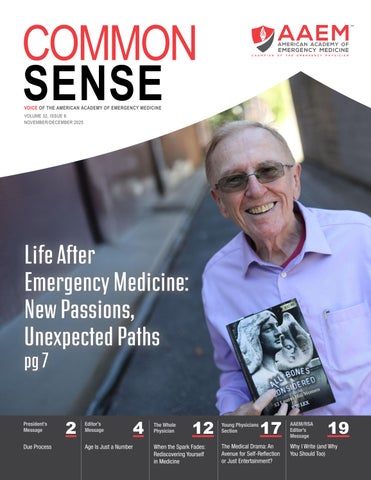
Life After Emergency Medicine: New Passions, Unexpected Paths
Joe Lex, MD MAAEM FIFEM
Transition into Retirement
When I stepped away from teaching emergency medicine in 2016, it took a year or two to fully discover my new pursuits. After over 45 years of practice, I left the field behind. I relinquished my stethoscope, acquired in 1979, and allowed my medical licenses to lapse, feeling content with what that chapter had given me.
I discovered what I missed most from my previous career was not patient care, but the research and teaching. Two unexpected opportunities soon set me on a fulfilling new journey. As is true with much of my life, serendipity is a wonderful thing.
Finding Community and Connection
The first opportunity came from a Philadelphia Inquirer article mentioning the launch of a new community radio station, “People Powered Media.” Having dabbled in community radio before—my wife and I helped start a community station back in the mid-1970s—I auditioned and landed my own show, “Dr. Joe’s Groove,” airing live every Tuesday afternoon from 2 to 4pm. I continued hosting live until the pandemic, then prerecorded the show until other commitments made it too time-consuming. It continues to air in reruns from WPPM-LP on Tuesdays at 2pm and Sundays at 8am (ET).
The second turning point happened during a tour at Laurel Hill Cemetery in Philadelphia. Captivated by the experience, I inquired about volunteering and soon became a tour guide, presenting the stories of this Victorian-era cemetery founded in 1836. Later, when Laurel Hill West began tours across the river, I joined as a docent there as well.
From Biographies to Podcasts and Playwriting
As a guide, I began to research and write short biographies about cemetery residents, eventually using these stories as material for my monthly podcast, “All Bones Considered: Laurel Hill Stories.” Not long after, I created a second podcast, “Biographical Bytes from Bala: Laurel Hill West Stories,” to continue sharing these unique tales. They have been
I discovered what I missed most from my previous career was not patient care, but the research and teaching. Two unexpected opportunities soon set me on a fulfilling new journey. As is true with much of my life, serendipity is a wonderful thing.”
downloaded more than 75,000 times and rank among the top quarter of all podcasts in the country.
One particularly fascinating figure I uncovered was a cross-dressing, heavily perfumed, 300 pound near-albino Catholic priest—a mentor to F. Scott Fitzgerald, friend to Henry Adams, Pope Gregory XV, and Cardinal Gibbons. His obscurity inspired me to write a one-person play, “Six Conversations About Father Fay,” which has already had one production and is slated for the Philly Fringe Festival next season.
Writing and Recognition
Seven years into producing podcasts, I had amassed more than 400 scripts. The next logical project was a book, “All Bones Considered: 52 Laurel Hill Women,” which is now self-published and available online. The book received a positive Kirkus review, and I have eight upcoming author events: two at historical societies and the rest at local libraries. All proceeds from the book go to cemetery upkeep.
Involvement in Theater
I also became involved in the Philadelphia theater community, initially as an adjudicator for the Barrymore Awards, local equivalent to the Tony Awards, and served the maximum four years. Now, for the past six years, I have been a judge for the Philadelphia Independence Awards, viewing 20 to 30 high school musicals annually. Sometimes these are standard school productions; other times, I witness the early promise of future stars.
To my emergency medicine colleagues, I am grateful for a magical career that began as a three-time college dropout with an associate degree in nursing and culminated in a professorship. And now, as busy as retirement keeps me, I wake up nearly every day with the freedom to do absolutely nothing—should I so choose.”
New Ventures and Health Challenges
I also explored voiceover work, recording a demo that quickly led to a narration role for a medical education company. My voice is now featured in training slides for investigators working in non-English-speaking countries.
It’s not all smooth sailing: since retiring, I’ve experienced a second major pulmonary embolism, which requires lifelong anticoagulation, as well as the placement of coronary stents, radiation therapy for prostate cancer, and a fall resulting in a flail chest—fortunately, managed without hospitalization.
At age 78, with the help of a GLP-1, I maintain a weight between 180 and 185 pounds—the lightest I’ve been since high school and more than 100 pounds off my maximum weight. I’ve been seeing a trainer three times weekly for more than ten years, so muscle mass loss is not much of an issue.
Looking Forward
Though I once loved my work in emergency medicine, I now find deep satisfaction as a cemetery docent, podcaster, and author. I have plans for four more books—another on the women of Laurel Hill, two on its men, and a personal project: publishing 180 letters I wrote home from Vietnam over fifty-five years ago, preserved by my mother.
I also aspire to a full production of my play about Father Fay and hope to collaborate with a small theater group on a musical about The Red Rose Girls, a local artist collective from the early twentieth century.
Gratitude and Perspective
To my emergency medicine colleagues, I am grateful for a magical career that began as a three-time college dropout with an associate degree in nursing and culminated in a professorship. And now, as busy as retirement keeps me, I wake up nearly every day with the freedom to do absolutely nothing—should I so choose.
AAEM Foundation Contributors – Thank You!
AAEM established its Foundation for the purposes of (1) studying and providing education relating to the access and availability of emergency medical care and (2) defending the rights of patients to receive such care and emergency physicians to provide such care. The latter purpose may include providing financial support for litigation to further these objectives. The Foundation will limit financial support to cases involving physician practice rights and cases involving a broad public interest. Contributions to the Foundation are tax deductible. Levels of recognition to those who donate to the AAEM Foundation have been established. The information below includes a list of the different levels of contributions. The Foundation would like to thank the individuals below who contributed from 11/1/24 to 11/1/25.
Contributions $1000 and above
Eric W. Brader, MD FAAEM
Frank L. Christopher, MD FAAEM
Fred Earl Kency, Jr., MD FAAEM FACEP
Peter G. Anderson, MD FAAEM
Robert A. Frolichstein, MD FAAEM
Robert P. Lam, MD FAAEM
Contributions $500-$999
David W. Lawhorn, MD MAAEM
Eric D. Lucas, Sr., MD FAAEM
Glenn I. Goodwin, DO FAAEM
Julianne Wysocki Broadwater, DO FAAEM
Leonard A. Yontz, MD FAAEM
Travis J. Maiers, MD FAAEM
Contributions $250-$499
Alex Alers Fuentes, MD FAAEM
Andrew P. Mayer, MD FAAEM
Brian Phillip Doyle, MD FAAEM
Charles Chris Mickelson, MD FAAEM
David C. Crutchfield, MD FAAEM
Deborah D. Fletcher, MD FAAEM
Douglas M. Char, MD FAAEM
Eric M. Sergienko, MD FAAEM
Garrett Clanton II, MD FAAEM
Heath Spencer, DO
James J. Schlesinger, DDS MD
Jamie J. Adamski, DO FAAEM
Jeffery M. Pinnow, MD FAAEM FACEP
Jeffrey A. Rey MD, MD FAAEM
John H. Kelsey, MD FAAEM
Jonathan D. Apfelbaum, MD FAAEM
Jonathan W. Riddle, DO
Joseph T. Bleier, MD FAAEM
Joshua J. Faucher, MD FAAEM
Karl A. Nibbelink, MD FAAEM
Kathleen P. Kelly, MD FAAEM
Kevin Allen, MD FAAEM
Kian J. Azimian, MD FAAEM
Laura J. Bontempo, MD MEd FAAEM
Lauren LaRoche, MD FAAEM
Mark A. Foppe, DO FAAEM FACOEP
Mark D. Thompson, MD FAAEM
Mark I. Langdorf, MD MAAEM FAAEM
MHPE
Mary Ann H. Trephan, MD FAAEM
Nate T. Rudman, MD FAAEM
Oscar A. Marcilla, MD FAAEM
Patrick A. Aguilera, MD FAAEM
Phillip L. Rice Jr., MD FAAEM
Robert J. Feldman, MD FAAEM
Rosa K. Gigliotti, MD FAAEM
Salvador Villanueva, MD FAAEM
Steven Schmidt
Taylor G. Fletcher, MD FAAEM
Contributions $100-$249
Adam Hill, MD FAAEM
Alexander Tsukerman, MD FAAEM
Alexandra Terskiy, MD PhD
Amanda Dinsmore, FAAEM
Ameer Sharifzadeh, MD FAAEM
Andrew Wilson, FAAEM
Andy Walker, MD MAAEM
Ari Davis, FAAEM
Azalea Saemi, MD FAAEM
Benjamin Kober, DO FAAEM
Benjamin Rhoades, DO FAAEM
Brendan P. Sheridan, MD FAAEM
Brian R. Potts, MD MBA FAAEM
Brian Zimmer, DO FAAEM
Bruce E. Lohman, MD FAAEM
Carlos F. Garcia-Gubern, MD FAAEM
Chad J. Hansen, MD FAAEM
Daniel P. Shand, MD FAAEM
Daniel T. McDermott, DO FAAEM
David L. Justis, MD PhD
David R. Hoyer Jr., MD FAAEM
Don L. Snyder, MD FAAEM
Douglas P. Slabaugh, DO FAAEM
H. Edward Seibert, MD FAAEM
Ilan Kaye, FAAEM
Jada Lane Roe, MD FAAEM
Jalil A. Thurber, MD FAAEM
Jeffrey B. Thompson, MD MBA FAAEM
John C. Kaufman, MD FAAEM
John R. Matjucha, MD FAAEM
John Tobias Nagurney, MD MPH FAAEM
Jorge L. Infante, MD FAAEM
Julian G. Mapp, MD MBA MPH FAAEM
Justin P. Anderson, MD FAAEM
Kathleen Hayward, MD FAAEM
Kathryn Getzewich, MD FAAEM
Katrina Kissman, MD FAAEM
Keith D. Stamler, MD FAAEM
Kesah DeLisio, MD FAAEM
Kevin C. Reed, MD, FACHE, FAAEM
Kevin S. Barlotta, MD FAAEM
LaShell K. LaBounty, DO
Laura Cazier, MD FAAEM
Lawrence A. Melniker, MD MS MBA FAAEM
Marianne Haughey, MD MAAEM FAAEM
Mark A. Antonacci, MD FAAEM
Mark A. Newberry, DO FAAEM FPD-AEMUS
Mary Jane Brown, MD FAAEM
Matthew B. Underwood, MD FAAEM
Matthew W. Porter, MD FAAEM
Matthew William Carman, MD FAAEM
Michael L. Martino, MD FAAEM
Michael Timothy Schultz, MD FAAEM
Nicholas Boyko, DO, FAAEM
Paul W. Gabriel, MD FAAEM
R. Lee Chilton III, MD FAAEM
Ramon H. Nunez, MD FAAEM
Rebecca K. Carney-Calisch, MD FAAEM
Regan Wylie, MD FAAEM
Robert Bruce Genzel, MD FAAEM
Robert E. Gruner, MD
Saba A. Rizvi, MD FAAEM
Sarah B. Dubbs, MD FAAEM
Scott D. Reiter, MD FAAEM
Scott P. Marquis, MD FAAEM
Sean Wilkie, MD
Stephanie Eden, MD FAAEM
Stuart M. Gaynes, MD FAAEM
Thomas W. Lukens, MD PhD FAAEM FACEP
Vinicius Knabben, MD
Vishal Patel, FAAEM
William E. Swigart, MD FAAEM
William K. Clegg, MD FAAEM
William Peter Kehr, MD
William T. Freeman, MD FAAEM
Contributions up to $99
Alexander Guendel, MD FAAEM
Alexandra C. Doan, MD
Andy Doan
Anthony Catapano, DO FACOEP FAAEM
Brian Gacioch, FAAEM
Brian Knight
Caitlin E. Sandman, DO FAAEM
Chaiya Laoteppitaks, MD FAAEM
Christopher B. Parks, MD FAAEM
David I. Arbona-Calderon, MD FAAEM FACEP FAEMS
Donald L. Slack, MD FAAEM
Eric J. Schwiger, DO FAAEM
Florence M. Nju Epse Fongang, MD
Gabriel Ochoa, MD FAAEM
Jennifer A. Martin, MD FAAEM
Jonathan S. Cagle, FAAEM
Justin L. Berkowitz, DO FAAEM
Katherine Laura Poma Ramos, Jr., MD
Laura Harvey, DO FAAEM
Lawrence Mendiola, DO FAAEM
Marc D. Squillante, DO FAAEM
Marc J. Dumas, MD FAAEM
Michael O’Neil, MD FAAEM
Michael Slater, MD FAAEM
Morgan E. Hanlon
Nancy Conroy, MD FAAEM
Rian Pillitteri, MD FAAEM
Ryan Horton, MD FAAEM
Sachin J. Shah, MD FAAEM
Sarat Chandra Uppaluri
Scott Beaudoin, MD FAAEM
Shelly Birch, FAAEM
Stephen Shaheen, MD FAAEM
Tatiana Nunez, MD
Vanessa C. Hannick, MD FAAEM
Vincent K. Huynh, DO
Virgle O. Herrin Jr., MD FAAEM
Yeshvant Talati, MD
AAEM PAC Contributors – Thank You!
AAEM PAC is the political action committee of the American Academy of Emergency Medicine. Through AAEM PAC, the Academy is able to support legislation and effect change on behalf of its members and with consideration to their unique concerns. Our dedicated efforts will help to improve the overall quality of health care in our country and to improve the lot of all emergency physicians.
All contributions are voluntary and the suggested amount of contribution is only a suggestion. The amount given by the contributor, or the refusal to give, will not benefit or disadvantage the person being solicited.
Levels of recognition to those who donate to the AAEM PAC have been established. The information below includes a list of the different levels of contributions. The PAC would like to thank the individuals below who contributed from 11/1/24 to 11/1/25.
Contributions $1000 and above
Mark S. Penner, DO FAAEM
Contributions $500-$999
Fred Earl Kency, Jr., MD FAAEM FACEP
Jeffery M. Pinnow, MD FAAEM FACEP
Julianne Wysocki Broadwater, DO FAAEM
Contributions $250-$499
Eric W. Brader, MD FAAEM
Heath Spencer, DO
Mark A. Foppe, DO FAAEM FACOEP
Mark D. Thompson, MD FAAEM
Mark E. Zeitzer, MD FAAEM
Robert A. Frolichstein, MD FAAEM
Steven Schmidt
Teresa Camp-Rogers, MD MS FAAEM
Contributions $100-$249
Andrew M. Bazakis, MD FAAEM
Andy Walker, MD MAAEM
Brendan P. Sheridan, MD FAAEM
Brian Phillip Doyle, MD FAAEM
Brian R. Potts, MD MBA FAAEM
Bruce E. Lohman, MD FAAEM
Chaiya Laoteppitaks, MD FAAEM
Cynthia Martinez-Capolino, MD FAAEM
David R. Hoyer Jr., MD FAAEM
Eric M. Ketcham, MD MBA FAAEM FASAM
Garrett Clanton II, MD FAAEM
Ilan Kaye, FAAEM
Jada Lane Roe, MD FAAEM
Jalil A. Thurber, MD FAAEM
James J. Schlesinger, DDS MD
Jeffrey A. Rey MD, MD FAAEM
Jeffrey B. Thompson, MD MBA FAAEM
Jorge L. Infante, MD FAAEM
Joseph T. Bleier, MD FAAEM
Julian G. Mapp, MD MBA MPH FAAEM
Justin P. Anderson, MD FAAEM
Kathleen Hayward, MD FAAEM
Kathryn Getzewich, MD FAAEM
Katrina Kissman, MD FAAEM
Mark A. Antonacci, MD FAAEM
Matthew B. Underwood, MD FAAEM
Matthew W. Porter, MD FAAEM
Nate T. Rudman, MD FAAEM
Paul W. Gabriel, MD FAAEM
Peter G. Anderson, MD FAAEM
Ramon H. Nunez, MD FAAEM
Rebecca K. Carney-Calisch, MD FAAEM
Robert Bruce Genzel, MD FAAEM
Rosa K. Gigliotti, MD FAAEM
Sachin J. Shah, MD FAAEM
Sean Wilkie, MD
Shane R. Sergent, DO FAAEM
Stephanie Eden, MD FAAEM
LEAD-EM Contributors – Thank You!
Vinicius Knabben, MD
William T. Freeman, MD FAAEM
Contributions up to $99
Ameer Sharifzadeh, MD FAAEM
Anthony Catapano, DO FACOEP FAAEM
Brian Gacioch, FAAEM
Christopher B. Parks, MD FAAEM
Jennifer A. Martin, MD FAAEM
John Havlick, FAAEM
Jonathan S. Cagle, FAAEM
Justin L. Berkowitz, DO FAAEM
Laura Harvey, DO FAAEM
Lawrence Mendiola, DO FAAEM
Marc D. Squillante, DO FAAEM
Michael Slater, MD FAAEM
Stuart M. Gaynes, MD FAAEM
Virgle O. Herrin Jr., MD FAAEM
Contributions $1000 and above
Fred Earl Kency, Jr., MD FAAEM FACEP
Contributions $500-$999
David W. Lawhorn, MD MAAEM
Frank L. Christopher, MD FAAEM
Contributions $250-$499
Alex Alers Fuentes, MD FAAEM
Dale S. Birenbaum, MD FAAEM
Eric W. Brader, MD FAAEM
Jeffery M. Pinnow, MD FAAEM FACEP
Joseph T. Bleier, MD FAAEM
The AAEM Institute for Leadership, Education & Advancement in the Development of Emergency Medicine, Inc. (LEAD-EM) was established after the tragic and unexpected death of AAEM president, Dr. Kevin G. Rodgers.
The Kevin G. Rodgers Fund and the Institute will LEAD-EM just like Dr. Rodgers did. The funds will support important projects such as development of leadership qualities, and clinical and operational knowledge of emergency physicians with a view toward improving and advancing the quality of medical care in emergency medicine, and public health, safety and well-being overall. LEAD-EM would like to thank the individuals below who contributed from 11/1/24 to 11/1/25.
Kian J. Azimian, MD FAAEM
Mark A. Foppe, DO FAAEM FACOEP
Oscar A. Marcilla, MD FAAEM
Robert A. Frolichstein, MD FAAEM
Contributions $100-$249
Ari Davis, FAAEM
Brian R. Potts, MD MBA FAAEM
Daniel P. Shand, MD FAAEM
James J. Schlesinger, DDS MD
John R. Matjucha, MD FAAEM
Julian G. Mapp, MD MBA MPH FAAEM
Julianne Wysocki Broadwater, DO FAAEM
Kailyn Kahre-Sights, MD FAAEM
Kathleen Hayward, MD FAAEM
Kevin C. Reed, MD, FACHE, FAAEM
Mark A. Antonacci, MD FAAEM
Matthew B. Underwood, MD FAAEM
R. Lee Chilton III, MD FAAEM
Rebecca K. Carney-Calisch, MD FAAEM
Scott P. Marquis, MD FAAEM
William T. Freeman, MD FAAEM
Contributions up to $99
Brandon H. Richardson
Florence M. Nju Epse Fongang, MD
Gerald E. Maloney, Jr., DO FAAEM
Ivan C. Rokos, FAAEM
Justin L. Berkowitz, DO FAAEM
Mary Jane Brown, MD FAAEM
Michael Slater, MD FAAEM
Nicholas Boyko, DO, FAAEM
Robert E. Gruner, MD
Sarat Chandra Uppaluri
Stuart M. Gaynes, MD FAAEM
Tatiana Nunez, MD
Thomas G. Derenne
Virgle O. Herrin Jr., MD FAAEM
UPCOMING EVENTS:
AAEM Events & Recommended Education
Introducing the AAEM and AAEM/RSA Events Calendar — your go-to source for conferences, webinars, workshops, and more. Explore the latest opportunities to connect, learn, and grow in emergency medicine by scanning the QR code.
AAEM Events
2026 In-Person Certifying Exam
Review Courses
Chicago, IL - February 28th & March 1staaem.org/education/oral-boards
Four Corners+ Regional Educational Day
January 7, 2026 (Virtual)
32nd Annual Scientific Assembly
April 11-15, 2026 (Seattle, Washington)
Recommended Education
Online CME
Rapid Response to Adverse Events of Bispecific Antibodies: Follicular Lymphoma and Diffuse Large B-Cell Lymphoma Emergency Medicine Strategies - https://www. staging.medscape.org/viewarticle/1001569
Online CME
Recognizing Life-Threatening Emergencies in People with VEDS thesullivangroup.com/TSG_UG/VEDSAAEM/
The Difficult Airway Course: EmergencyTM
March 6-8 2026 San Diego May 1-3, 2025 Boston Sept 25-27, Atlanta - www.theairwaysite.com
AAEM CME Online
Explore AAEM CME Online, where we understand the fast-paced nature of emergency medicine (EM) and the need for concise, accessible education. This platform is designed to provide members of the American Academy of Emergency Medicine (AAEM) and AAEM Resident and Student Association (AAEM/ RSA) with top-tier continuing medical education (CME) resources right at their fingertips. Access today!
When the Spark Fades: Rediscovering Yourself in Medicine
Amanda Dinsmore, MD, Kendra Morrison, DO, and Laura Cazier, MD
Istill remember being an MS-1, full of hope and wonder. At orientation, a professor announced, “There are three things that change a person: war, therapy, and medical school.” In those early days, I imagined unbridled potential in that statement—the promise of growth, knowledge, and transformation. Now, more than two decades into EM practice, those words carry weight and a resonance that I’ve come to understand.
Because medical training and practice do alter us.
At some point, I no longer recognized the person I used to be. In the ED, I encountered extremes of suffering, delight, and dysfunction. After yet another night shift bled into morning, I realized I was seeing patients as problems rather than humans. Balancing physician, parent, partner, and self felt like a losing battle. I shed bits of vulnerability, curiosity, and softness. Before long, I wondered, “Who is this person I’ve become?”
If this resonates, you are not alone. Many of us have felt the gradual hardening. Not just burnout, but a creeping loss of connection with what once fulfilled us. Medicine asks us to pour out endlessly. But who pours back in?
The Science Behind the Fade
Burnout—maybe more appropriately termed moral injury—is typically framed in terms of three variables: emotional exhaustion, depersonalization, and a sense of reduced personal accomplishment. As these take hold, physicians don’t just lose energy; they often lose meaning, engagement, and intimacy with their work and themselves.¹,²
Many of us have felt the gradual hardening. Not just burnout, but a creeping loss of connection with what once fulfilled us. Medicine asks us to pour out endlessly. But who pours back in?”
Positive psychology offers a constructive lens, not only identifying distress but also focusing on the possibility of flourishing. This isn’t just forced optimism or toxic positivity; it’s about identifying evidence-based ways to recover meaning and engagement. Models like PERMA (Positive emotion, Engagement, Relationships, Meaning, Achievement) suggest that fostering what sustains us is as important as mitigating what harms us.³
As author/speaker Alexander den Heijer put it, “You often feel tired, not because you’ve done too much, but you’ve done too little of what sparks a light in you.” Indeed, interventions aligned with the concept of rediscovering that spark show promise for reducing burnout and improving physicians’ well-being.4
A particularly relevant concept is flow, that deep absorption in a task in which time seems to fall away, and self-consciousness recedes.5 Empirical studies show that frequent flow experiences negatively correlate with burnout. Said another way, those who often “lose themselves” in meaningful work or activities report lower levels of cynicism and fatigue.6 In emergency medicine, researchers studying “physician flow” (P-Flow) found that it’s frequently disrupted by what they call “flow thieves”—constant interruptions and task-switching inherent in the ED. Reducing non-urgent interruptions and low-yield tasks may therefore protect engagement and focus.7
The loss of spark, then, is understandable given our work. Yet the path back is lit by whatever leads you home to yourself again, inside or outside of medicine.
Rekindling the light in you is not about sweeping changes but a small, consistent turning toward what matters.”
Gentle Invitations Back to Yourself
Rekindling the light in you is not about sweeping changes but a small, consistent turning toward what matters. You could try these practices to begin to reconnect with your core.
Return to what used to delight you. What did you do before medicine dominated your life? Paint, tinker, sing, write, hike, bake, jog? Even a five- or ten-minute reengagement per week matters.
Practice micro-presence. You don’t need long meditations. Pause in your car before entering the department. Feel the warmth of your hands. Inhale the steam from your coffee or tea. Notice the sky’s gradient on your walk to your car. Listen closely to one voice in the cacophony. These little moments anchor you in your body. As Scott O’Neil wrote, “Be where your feet are.” The present moment is what’s real, not future anxieties or past regrets.
Ask and honor: “What do I need?” Maybe you need to stretch, sing a song, text a friend, or take a minute of silence. The act of listening to yourself reminds you that you deserve care. Even small tokens of kindness to yourself are vital.
Seek flow inside and outside medicine. Look for tasks—in work or beyond—that offer clear goals, feedback, and a challenge that matches your skill. Within EM, this might mean teaching a resident one-on-one, doing a deep-dive into a fascinating case, or savoring the time performing your favorite procedure. Outside, it might
be something creative, gardening, competing, dancing, or trying something new.
Cultivate psychological safety and feeling heard Burnout is not only internal. In many systems, repeated attempts to speak up (in committees, during policy changes, in quality initiatives) often feel ignored. But research indicates that feeling heard (beyond mere psychological safety) inversely associates with burnout and improves adaptation in teams.8 Advocate for structures where frontline voices are acknowledged, experiments tested, and small change encouraged. But even when systems are slow to change, begin to (tactfully) say what you need to say. When you live authentically, you re-anchor to your dignity and agency.
A Metaphor, and Hope
In winter, trees look barren. But, under frozen soil, the roots are quietly preparing for spring. When the time is right, new growth emerges. Your truest self beneath cynicism and fatigue waits, too, ready when you are.
You have not irrevocably faded. Under layers of roles, stress, and armor, you remain: curious, capable, deserving of the care you give to others. Return begins with noticing: what captivates you now? What helps you breathe? What can you do today that matters to you?
Start small. Reconnect with what captivates you. Pause to listen to your breath. Share a moment with someone you love. Seek a moment of flow, even in small doses. Speak your truth, even in whispers. Say yes to
one thing on your bucket list. Have a laugh when you can. Over time, these tiny sparks can ignite.
Here’s to feeling like you again.
References
1. West CP, Dyrbye LN, Shanafelt TD. Physician burnout: contributors, consequences, and solutions. J Intern Med.2018;283(6):516–529.
2. Maslach C, Jackson SE, Leiter MP, eds. Maslach Burnout Inventory Manual. 4th ed. 2018.
3. Seligman ME, Csikszentmihalyi M. Positive psychology: an introduction. Am Psychol. 2000;55:5–14.
4. Bazargan-Hejazi S, Shirazi A, Wang A, et al. A positive psychology–based conceptual framework in reducing physician burnout: a systematic review. BMC Med Educ. 2021;21:593.
5. Csikszentmihalyi M. Flow: The Psychology of Optimal Experience. Harper & Row; 1990.
6. Aust F, Baldauf A, Elsner B, et al. The relationship between flow experience and burnout. Int J Environ Res Public Health. 2022;19(7):3865.
7. Shreffler J, Huecker M. Physician Flow at Work: Examining Work Absorption, Clinical Flow, Work Fulfillment, and Flow Thieves. Workplace Health & Safety. 2022;70(11):484491.
8. Kerrissey MJ, Hayirli TC, Bhanja A, Stark N, Hardy J, Peabody CR. How psychological safety and feeling heard relate to burnout and adaptation amid uncertainty. Health Care Manage Rev. 2022 Oct-Dec 01;47(4):308-316.
Physician Liability for NPP Charts
Algis Baliunas, MD and Melanie Heniff, MD JD
You just got home from your busy shift at the hospital and noticed a police car in front of your house. The deputy gets out of the car, knocks on your door, verifies your identity, and hands you a thick envelope and says “sorry Doc” as he leaves. On the top of the first page of the packet are the words “Notice! You are being sued.” After the shock is over, you contact your malpractice company and after several weeks, you finally receive the medical records. You find out the patient was treated by the PA (physician assistant) and you didn’t even see the patient. Your signature on the chart was the only thing linking you to the patient.
How do you defend your care in a case where you never saw the patient? Did the PA even discuss the case with you? Nothing regarding your involvement is charted by you, nursing, or the PA and you don’t remember the patient. Soon, a notice of deposition arrives. How will you answer questions regarding your care of this patient? The hospital has a policy that all NPP (non-physician practitioner) charts are required to be signed by a physician. Your group has never questioned this policy as it’s been in place forever and they are afraid of losing the contract. You wonder if you could be found liable for a patient you did not see but this question is soon answered quickly by an internet search showing multiple multi-million dollar verdicts against physicians who never saw the patient. This article will address several common questions.
Are physicians legally required to sign NPP (non-physician practitioner) charts regardless of whether or not they had an opportunity to evaluate the patient?
This is highly state dependent. States laws vary widely on the percentage of PA/NP charts that need to be cosigned. They also vary on policies regarding co-signature. For example, many states require co-signature on PA charts but not on NP (nurse practitioner) charts. In addition, the requirement may vary with your specific collaborative practice agreement with the NPP. You have read your collaborative practice agreement, right? Aside from state law, hospital policies frequently spell out requirements for physicians to cosign NPP charts and ED physician groups may also have separate policies regarding co-signature. Given that many hospital systems and groups operate in multiple states using multiple practitioners, the path of least resistance is frequently to require physicians to sign all NPP charts.
My group said that co-signature is a billing issue and they won’t get paid if I don’t sign. Is this true?
In general, NPP care is billed at 85% of the physician rate by Medicare, with most insurance companies following Medicare policy. With physician involvement, the chart can be billed at 100%, but a signature is not enough. The physician must document substantial involvement in the patient’s care. Policies requiring physician signature should be re-evaluated with specific questions directed to the group’s billing company.
Continued on page 16 >>
Ultimately, signing NPP charts presents substantial medico-legal risk to the physician.”
Professional Fulfillment and Wellness in Emergency Medicine
Sawali Sudarshan, MD PhD
Studies on EM physician wellness have found that physicians satisfied with their lives and their jobs tended to be personally resilient, socially connected, and additionally held outside interests.1 While EM physicians often teach, do research, take on administrative work, and/ or have multiple side-gigs to help them achieve fulfillment, it is also important that they find meaning and enrichment in their actual clinical work. Fulfillment in clinical EM can be conceptualized in three dimensions: intellectual, emotional, and professional satisfaction.
Intellectual satisfaction is often derived from life-or-death decision-making, critical interventions, and solving complex diagnostic puzzles. However, while these “saves” are rewarding, they are relatively rare; only 13-17.7% of ED cases involve “high-intensity” care.2,3 Systematic reviews estimate that 37% (range 8-62%) of ED visits are retrospectively classified as non-urgent.4
This underscores that intellectual fulfillment must be complemented by other forms of professional fulfillment, especially for those who have been in the profession long enough to encounter fewer diagnostically stimulating cases. Emotional satisfaction arises from connection, empathy, and meaningful interactions with patients. Literature indicates that strong doctor-patient relationships can counter burnout.5
This is distinct from professional satisfaction, which comes from respect, recognition, and being valued for expertise. Studies have highlighted the distinction between respect or recognition and hierarchical status, and that it is the lack of respect that bothers physicians more than the loss of power.6 Recognition from patients comes in the form of trust and belief in diagnosis and interventions. Recognition from colleagues comes from respectful interactions
Relying
on administration, other healthcare professionals, or patients to improve physician well-being
is not practical. So what can we do to support and advocate for ourselves?”
with other specialties, autonomy in decision-making, and appreciation of one’s extensive training as an EM specialist.
The lack of respect contributes to moral injury and can lead to burnout. Survey research of US physicians investigating mistreatment and discrimination by patients and families found that such experiences were common, especially among female and racial and ethnic minority physicians, and were associated with higher burnout rates.7 Further, physicians and patients have increasingly expressed concern about declining respect for physicians within society and within healthcare teams.8,9
Work environment studies highlight that recognition of the physician’s efforts and achievements is correlated with physician well-being and suggest that robust organizational solutions need to be implemented to address specific stressors contributing to physician burnout, such as dedicated time for non-clinical tasks.10
Relying on administration, other healthcare professionals, or patients to improve physician well-being is not practical. So what can we do to support and advocate for ourselves?
Physicians can and must advocate for structural and systemic changes that reinforce respect and professional fulfillment. Unfortunately, many emergency physicians describe unsupportive hospital administrations as a common barrier to thriving: “There are certain things you do as an ER doctor that just degrade you—when it feels like the management above
you is just using you to make money.”1 Equally important is advocating against the intrusion of non-clinicians into the practice of medicine. Under a system where third parties dictate clinical decisions, patients inevitably view physicians as agents of profit—despite the reality that financial gains flow less to clinicians, and more to corporate executives. As Watts observes, “a system of health care that permits the payor to intrude into the physician-patient relationship is not helpful to that relationship.”11
It is imperative to ensure that administrative or systemic pressures do not compromise meaningful patient interactions. Supporting EM democratic groups can help address these challenges. Creating strong internal leaders is crucial for success with this, yet studies show that many doctors are not exposed to formal leadership training during medical school or residency.12 Implementing structured leadership training is an essential step to improve physician satisfaction and team effectiveness.
We also need to broaden how the value of our work is recognized. Beyond metrics, teaching residents and medical students, mentoring, and engaging in patient education foster trust and reinforce professional identity. Peer support and narrative sharing can further normalize discussions about respect and fulfillment.
Finally, physicians must also take an active role in public relations—advocating for our profession in the public sphere and producing the evidence needed to demonstrate the benefits
of a physician-led team. Messaging matters: slogans such as “heart of a nurse, brain of a doctor” may appear benign, but they subtly imply that physicians lack compassion in comparison. Where such narratives arise, we must challenge and correct them.
References
1. Kase J, Doolittle B. Job and life satisfaction among emergency physicians. PLoS One 2023;18(6):e0279425. doi:10.1371/journal. pone.0279425.
2. Herring AA, Johnson B, Ginde AA, Camargo CA, Feng L, Alter HJ, Hsia R. High-intensity emergency department visits increased in California, 2002-09. Health Aff (Millwood). 2013 Oct;32(10):1811-9. doi: 10.1377/ hlthaff.2013.0397. PMID: 24101073; PMCID: PMC4109394.
3. Janke A, Venkatesh A. Trends in highintensity billing and visit complexity of treat-and-release emergency department visits in the US, 2006-2018. Ann Emerg Med. 2021;78(4)(suppl):S47-S48. doi:10.1016/j. annemergmed.2021.07.133.
4. Uscher-Pines L, Pines J, Kellermann A, Gillen E, Mehrotra A. Emergency department visits for nonurgent conditions: systematic literature review. Am J Manage Care. 2013;19(1):47-59. PMID: 23379744.
5. Liang, W., Wang, J., Wang, X. et al. Perceived doctor-patient relationship, authentic leadership and organizational climate on physician burnout: job satisfaction as a mediator. BMC Health Serv Res 24, 1652 (2024). https://doi.org/10.1186/s12913-02412150-1
6. Lipworth W, Little M, Markham P, Gordon J, Kerridge I. Doctors on status and respect: a qualitative study. J Bioeth Inq. 2013 Jun;10(2):205-17. doi: 10.1007/s11673-0139430-2. Epub 2013 Mar 21. PMID: 23515959.
7. Dyrbye LN, West CP, Sinsky CA, Trockel M, Tutty M, Satele D, Carlasare L, Shanafelt T. Physicians’ Experiences With Mistreatment and Discrimination by Patients, Families, and Visitors and Association With Burnout. JAMA Netw Open. 2022 May 2;5(5):e2213080. doi: 10.1001/jamanetworkopen.2022.13080. PMID: 35587344; PMCID: PMC9121189.
8. Blanco Lopez, Victor Jose Ramon. (2024). The Decline of Respect for Physicians. Hospital and Clinical Management. 3(1); DOI: 10.58489/2836-2292/010
9. Perlis RH, Czeisler MÉ, et al. Trust in physicians and hospitals during the COVID-19 pandemic. JAMA Netw Open. 2024;7(1):e241250. doi:10.1001/ jamanetworkopen.2024.1250.
10. Belkić K, et al. Toward better prevention of physician burnout: insights from individual participant data using the MDspecific Occupational Stressor Index and organizational interventions. Front Public Health. 2025;13:1514706. doi:10.3389/ fpubh.2025.1514706. PMCID: PMC11961930.
11. Watts C. Erosion of physician autonomy and public respect for the profession. Surg Neurol. 2009 Mar;71(3):269-73. doi: 10.1016/j. surneu.2008.05.005. Epub 2008 Jul 9. PMID: 18617234; PMCID: PMC7133191.
12. MGMA. Building a framework to develop a new generation of physician leaders. MGMA Stat. June 5, 2024. Accessed Oct 1, 2025. https://www.mgma.com/mgma-stat/buildinga-framework-to-develop-a-new-generation-ofphysician-leaders
LEGAL COMMITTEE — Continued from page 14
What is the medicolegal risk to the physician who signs an NPP’s chart when they have not personally evaluated the patient?
Anytime the physician’s name and/or signature lands on the patient’s chart, there is a risk of being named in the event of a lawsuit. Most EMRs automatically insert the name of an on duty physician regardless of whether or not that physician was actually seeing the patient primarily. In addition, physicians can be associated with the patient through co-signing orders or on nursing notes. Attorneys frequently name everyone associated with the patient because they have a limited time to name defendants due to the statute of limitations and it may take months to determine who was actually involved in the patient’s care. They may be accused of legal malpractice if the jury ultimately perceives that a physician not named in the lawsuit was ultimately culpable. Physicians who are named in a lawsuit even though they just signed the chart and did not actually see the patient are sometimes (but not always) dropped from the lawsuit if a defense attorney can successfully argue that the physician did not have a duty to the patient. Unfortunately, even if the physician is eventually dropped, it may take years for that to occur.
If my group or employer requires me to sign an NPP’s chart for a patient I did not see, should I include a disclaimer with the signature?
A frequently asked question is if a physician should put a statement such as “I’m signing the chart per hospital policy. I did not see or evaluate the patient” in the chart at the time they signed it. Disclaimer statements have the potential to clarify why your signature is on the chart, potentially avoiding being named in the lawsuit. They also have the potential to be perceived negatively by a jury, implying that you should have seen the patient, that you were not supervising the NPP as required by the hospital or your employer or that you are making excuses for why you are not responsible for the patient’s bad outcome. If you use such a statement, consider documenting your level of involvement. Statements such as “I was available for consultation on the patient,” “The patient was discussed with the NPP” or “I saw and evaluated the patient” are better than referring to hospital policies. An alternative to a disclaimer statement is working with your attorney after the lawsuit is filed to properly message your involvement. Strongly consider seeing the patient and documenting key history and exam findings on any patient discussed with you.
Ultimately, signing NPP charts presents substantial medico-legal risk to the physician. Very little information is available regarding best practices in this area. ED physicians should push back on hospital and employer policies requiring their signature on NPP charts and ED groups should work to standardize their approach to this potential liability.
The Medical Drama: An Avenue for Self-Reflection or Just Entertainment?
N.Sandra Leke-Tambo, MD
Hollywood loves a medical drama. Every few years, a slew of medical dramas offering us images of blood, tears, and dramatic music by The Fray make their debuts. Few make it past the first season, and even fewer seem to operate within any realm of reality.
When I first saw a trailer for a new medical drama on HBO Max called “The Pitt,” I did not have high hopes. We have all seen them: “Grey’s Anatomy” (still going strong after all these years), “The Resident,” “Chicago Med,” and “Brilliant Minds,” among others. Most of them are heavy on the drama and light as a feather on the medical realities. Some of these inaccuracies are more glaring than others. A scene from “The Resident” springs to mind: a direct intubation with a physician intubating, not proximal, but standing distal to the patient at the chin. For God’s sake, how are you supposed to see his vocal cords or any other landmarks, for that matter? I had to stop watching immediately.
So when I sat down to watch “The Pitt,” my expectations were at an absolute minimum. Another show that would be light on the medical facts and ethical dilemmas but heavy on love triangles and unprofessional behavior.
I was wrong.
In summary, “The Pitt” is set in a fictional Level I Trauma center in Pittsburgh and follows Dr. Robinavitch (Noah Wyle) and his gang of residents, nurses, and other staff over the course of a twelve-hour shift. It is clear that Dr. Robinavitch holds a leadership position within the depart ment, but it is unclear whether he serves as the medical director or the
residency program director. I will not reveal the entire plot, but a few key scenes and storylines highlighted the challenges and dynamics of our practice environment. A few of which I will reflect on here.
Death and Dying in the ED
We often deliver bad news to people in the emergency department. Some of us are better at it than others. There are various scenarios that unfold in the show. In one of them, a young college-aged male is brought in after a drug overdose. On arrival, he is already intubated. On examination, his pupils are dilated and unreactive. At this point, the attending and residents know the prognosis is not good. His parents, however, who only the day before had a young, healthy, and promising son, are understandably in denial (both about his drug use and his prognosis). In this scenario, a family needs time to move on to acceptance. While the patient undergoes testing and further imaging (CT, MRI), his parents are guided through every step by both the attending physician and a social worker.
The most commonly used method for breaking bad news is the SPIKES protocol. This mnemonic was developed by oncologists at MD Anderson and used mainly with oncology patients. It stands for Setting, Perception, Invitation, Knowledge, Emotion, Strategy and Summary. The other is the GRIEV_ING protocol, which was explicitly developed for the emergency department.1 The protocol, as published in “Academic Emergency Medicine,” is as follows:
G – Gather. Gather the family;
So when I sat down to watch ‘The Pitt,’ my expectations were at an absolute minimum. Another show that would be light on the medical facts and ethical dilemmas but heavy on love triangles and unprofessional behavior. I was wrong.”
I – Identify. Identify yourself, identify the deceased or injured patient by name, and identify the state of knowledge of the family relative to the events of the day.
E – Educate. Briefly educate the family as to the events that have occurred in the emergency department, and educate them about the current state of their loved one.
V – Verify. Verify that their family member has died. Be clear! Use the words ‘‘dead’’ or ‘‘died.’’
__ – space. Give the family personal space and time for an emotional moment; allow the family time to absorb the information.
I – Inquire. Ask if there are any questions, and answer them all.
N – Nuts and bolts. Inquire about organ donation, funeral services, and personal belongings. Offer the family the opportunity to view the body.
G – Give. Give them your card and access information. Offer to answer any questions that may arise later. Always return their call.
Hierarchies in Medical Training
Medical training operates in a hierarchical system. The attendings are at the top of the pyramid, and the medical students are at the bottom. This ensures that residents are given a level of responsibility that corresponds to their level of training and knowledge. It also keeps patients safe. Several dynamics are at play here. The first is between Dr. Robinavitch and his residents. The ultimate goal of residency is to train emergency physicians who can practice independently. To accomplish this goal, attending physicians not only teach clinical skills but also model the soft skills required to do the job. There is a delicate dance Dr. Robinavitch has to perform when balancing residents’ autonomy and intervening to address high-risk skills or interventions. His teaching style is an example of when this hierarchy works well. That is, keeping patients safe and giving residents opportunities to grow. This also occurs further down the chain. Senior residents supervise and teach the younger residents, and this supervision extends all the way down to medical students. This presents some interesting situations.
How does a senior resident deal with an intern who is enthusiastic but has not yet learned their limits and as result, endangers patients? The second dynamic at play, is between a senior resident, Dr. Langdon, and an intern, Dr. Santos. The latter is very eager to learn new procedures and assume autonomy over her patients and will often act before presenting the case to Dr. Langdon. In one incident, she places a patient with a small pneumothorax on BIPAP for his shortness of breath. He subsequently develops a tension pneumothorax, requiring a pigtail catheter. Dr. Santos is of course contrite but it is clear that Dr. Langdon begins to let his annoyance with Dr. Santos creep into his teaching style and begins to deprive her of valuable learning opportunities. The friction between them eventually escalates and is an example of when this training system becomes dysfunctional. Dr. Santos deals with this by actively trying to avoid Dr. Langdon thereafter and Dr. Langdon shows his
disapproval by making harsh comments and other snide remarks in front of other team members.
Violence in the ED
Another issue that is accurately portrayed is the increase in physical violence experienced by ED staff at the hands of patients. In one scene, the charge nurse Dana (Katherine LaNasa) is outside in the ambulance bay, taking a break. While smoking her cigarette, she is punched in the face by a patient. The latter is upset because he has been in the waiting room for hours. All necessary triage protocols were followed, i.e., he had an EKG done and labs drawn. In a survey of ED staff at 18 midwestern EDs, out of 814 who took the survey, 71.5% (582) had experienced verbal abuse, and 30.8% (251) physical abuse.2 The experience of this type of abuse has apparent downstream effects. In the same study 135 participants stated their experience had affected their ability to do their jobs and a further 18.5% were thinking of quitting as a result.
Factors found to play a major role in the increase in violence include long wait times, staffing shortages, insufficient security, and lack of organizational support.
Post-Covid Burnout
The show is set in a post-pandemic world; however, during the course of the shift, Dr. Robinavitch has frequent flashbacks about treating a sick colleague during the pandemic. The rest of the staff also show a sense of disillusion and occasional cynicism that the pandemic has exacerbated.
For many of us, the COVID-19 pandemic was a life and career-defining event. Emergency physicians (EPs), both attendings and residents, experienced higher levels of depression and burnout. Unfortunately, some studies show that these have persisted post-pandemic. A longitudinal survey was carried out in Canada, looking at burnout rates among attending and resident EPs.3 Participants were initially surveyed in April 2020 with 615 respondents. Follow-up surveys were conducted in 2022 with 383 of the initial 2020 cohort responding. Two hundred and twenty-five reported high emotional exhaustion, and 245 had high depersonalization scores. In another survey conducted in the US during the course of the pandemic, burnout rates worsened as the pandemic progressed.4
In terms of solutions, another survey found that individual resiliency tools, such as meditation, were inadequate if not paired with system-level measures. Some of these measures such as addressing staffing shortages and adequate compensation, were frequently mentioned by responders as solutions to the problem.5
There are a host of other issues “The Pitt” deals with, which would require a longer article. If you are looking for a show that will not make you want to gouge out your own eyes, this is the show for you. On the other hand, if you are deeply scarred by the pandemic, have responded to a mass casualty incident, and have no desire to self-flagellate, avoid at all costs.
Why I Write (and Why You Should Too)
Mel Ebeling, MD
What defines a writer? One whose occupation it is to write? Whose works are well-regarded by some professional standard or award? One who has received formal education in literature, journalism, or writing?
It has been three years since I first started writing for Common Sense, over two years now as Resident Editor. Through this role and others, I am approaching 40 publications under my belt. The first time someone referred to me as a “writer,” I felt a strong sense of internal resistance. I always considered a writer to be one who experienced a great deal of catharsis in the drafting of each work, each piece an end in itself. As I slowly and painstakingly crafted each word and phrase into a coherent sentence—line by line, paragraph by paragraph—I could not help but put on the dunce cap of mediocrity and feel the weight of being an imposter each time I sat down to write. Writing was hard. There existed immense friction between my compulsion to write and the time and energy it took to transform thought into something tangible.
It was not until I was challenged to accept the “writer” label that I began to question this compulsion to write. Why was I even writing? How did I get myself into this responsibility of regular composition? Was this a personal means to an end or an end in itself?
I write out of necessity. I write because of the high school lunch table.
I write because I never had the loudest voice. Or personality. I write because I was always spoken over. I write because I was shy and stuttered. I write from the experience of being ignored.
As I slowly and painstakingly crafted each word and phrase into a coherent sentence —line by line, paragraph by paragraph—I could not help but put on the dunce cap of mediocrity and feel the weight of being an imposter each time I sat down to write. Writing was hard.”
I write because there is an uninterrupted place for my thoughts here between the margins, a place where my voice is heard.
Physicianhood in contemporary society can be a profoundly isolating experience. Uniquely, we are guardians of health with the perception of invincibility against insults to our own. As emergency physicians, we negotiate the horrors of the disease and the burdens created by them. And we do it with great stoicism because that is the job, right? There are 34 waiting in the lobby.
Whether it be due to antiquated standards of professionalism, traditional hierarchy, or societal expectations, it is an arduous and formidable journey to write about our experiences, struggles, needs, and hopes for ourselves, our profession, and our patients. Writing is hard. But it is here that we advocate for our patients, champion our specialty through statements and policy, mentor those junior to us through thoughtful advice, educate each other through cases and lessons learned, and make the case for our humanity to society. It is our great responsibility.
I write out of necessity. And you should too.
Surgical Critical Care: A Path Less Traveled by Emergency Physicians
Frederick L. Gmora, DO FAAEM, Shyam Murali, MD, Allyson M. Hynes, MD FAAEM FACEP, and Zaffer A. Qasim, MBBS FRCEM FRCPC(EM) EDIC
IntroductionEmergency medicine critical care (EMCC) is a rapidly evolving field as diverse as emergency medicine (EM) itself. EM candidates have several pathways available for board-certification in critical care, namely through internal medicine (IM), anesthesia, neurology, and surgery (SCC).
As these multiple pathways have opened, EM residents interested in critical care have primarily pursued the IM route. This was not always the case—in the pre-board-certification era, very few programs would accept EM residency graduates, and those programs were primarily SCC fellowships.
What is Surgical Critical Care?
SCC is a subspeciality of critical care focusing on the critically ill and/ or injured surgical patient, regardless of whether surgery is required. Similar to other pathways, SCC employs a multifaceted approach with a multidisciplinary team caring for patients that frequently develop hemodynamic compromise, sepsis, and multiorgan failure.1 In addition to understanding nonoperative techniques for the treatment of surgical illness, surgical intensivists must be knowledgeable in the principles of operative techniques, the physiologic effects of surgery, and optimal perioperative resuscitation.
In most facilities, the surgical intensivist and operating surgeon collaborate closely.2 SCC patients come from a wide range of surgical specialties including general surgery, trauma, vascular, urology, obstetrics and gynecology, transplant, neurosurgery, and cardiothoracic. This variety allows for a diversity of patients spanning the gamut of age and comorbid/
functional status. The surgical intensivist will be competent in advanced vascular access, cardiac output monitoring techniques, renal replacement therapy, airway management, bedside ultrasound, and either directly performing or assisting in emergent thoracotomy.
Why Choose Surgical Critical Care as an EM Physician?
EM physicians already possess many of the innate qualities and skills to succeed as an SCC intensivist. The initial triage, diagnosis, and stabilization for surgical ICU patients often begins in the emergency department (ED), thus EM residents and physicians gain a key understanding of this patient population that can extend to care provision in the SICU.
The SICU patient population, while often requiring typical critical care procedures and management, benefits from the unique ability of surgical correction of their pathophysiology. This often allows the SCC team a rapid recovery of critical illness which other subspecialty critical care units may not have.
The EM to Surgical Critical Care Pathway
EM applicants enrolled in or who have completed an ACGME EM residency and are eligible to become diplomates of the American Board of Emergency Medicine (ABEM)3 may apply for subspeciality certification in SCC. Successful candidates will be required to maintain active ABEM certification and will obtain SCC board certification through the American Board of Surgery (ABS).4 After the initial certifying exam, candidates take the ABS continuous certification program to maintain their certification.
EM physicians already possess many of the innate qualities and skills to succeed as an SCC intensivist. The initial triage, diagnosis, and stabilization for surgical ICU patients often begins in the ED, thus EM residents and physicians gain a key understanding of this patient population that can extend to care provision in the SICU.”
EM applicants are required to complete a two-year fellowship cycle, similar to the other available critical care pathways. The first year is considered a “preliminary year,” with the goal of developing foundational knowledge in the management principles of surgical conditions. The first year must contain no more than three SICU rotations and provide a broad exposure to surgical specialties, with each program having some leeway in how this is delivered. Those who have completed two or more years of surgical residency before emergency medicine are exempt from the preliminary year. This year is aimed at providing the EM-SCC fellow with a valuable opportunity to understand surgical decision-making, surgical anatomy, and the general principles and approaches to surgical interventions as opposed to being an “intern” year.
The second year is a dedicated critical care year with rotations across the various specialties including surgical, trauma, cardiac, neurology, and medicine. One or two elective months allow programs to be tailored to the fellow’s needs.
Finding and Applying for Fellowships
At the time of writing, there are 14 EM-SCC approved fellowship programs.5 We recommended contacting each program regarding their current availability, as it varies from year to year, and the specific curriculum for EM applicants.
Applications are accepted through the Surgical critical care and Acute care surgery Fellowship Application Service (SAFAS). SAFAS opens for the following academic year in March of the preceding year. Fellowship applications are accepted through July 31. Interviews are usually conducted in late spring to early summer.
SCC participates in the National Resident Matching Program. Rankorder lists are due by mid-August, and Match Day occurs at the end of August.6
Applicants should be prepared to submit completed applications as early as possible with letters of recommendation from intensivists with a SCC background.
Career Opportunities
Although the EM-SCC specialty is in its infancy, completing SCC fellowship opens the doors to diverse and rewarding career paths for EM
References
1. Michetti CP, Fakhry SM, Brasel K, et al. Trauma ICU Prevalence Project: the diversity of surgical critical care. Trauma Surg Acute Care Open. 2019;4(1):e000288. doi:10.1136/tsaco-2018-000288
2. Stawicki SP, Gracias VH, Lorenzo M. Surgical Critical Care: From Old Boundaries to New Frontiers. Scand J Surg. 2007;96(1):17-25. doi:10.1177/145749690709600104
3. Certification process. American Board if Emergency Medicine. (2025, June 17). https://www.abem.org/get-certified/certification-process
physicians, with both academic and private practice career opportunities.
EM-SCC fellowship graduates work in a broad range of positions. They may gravitate to either primarily emergency medicine or critical care practices, working exclusively in that specialty. However, others divide their time in split positions.
Depending on the individual practice type and institution, those that choose to work in an ICU can and have worked in the whole gamut of units (surgical, medical, neurological, trauma, or cardiothoracic). Some hospitals have a mixed medical-surgical ICU that allows a more diverse census. The specific type of unit worked will depend on the graduate’s interests, training, and the needs of the hospital or healthcare system where they are employed. SCC fellowship does, however, prepare graduates to work in any type of ICU. This broad variability of work environments can allow the EM-SCC to have increased expertise, career opportunities, and ultimately job satisfaction.
Overall, SCC offers EM physicians a rewarding career path with significant potential for growth and a diversity of practice patterns.
Conclusion
SCC is a subspeciality of critical care that focuses on the comprehensive care of critically ill and/or injured surgical patients. It has evolved from its foundation of being one of the only opportunities for US EM-residency graduates to train in critical care, into a field with a unique patient population, broad practice opportunities, and multiple avenues for growth. The training benefits not only the patients but can be an incredible opportunity to improve the education and the quality of care delivered in the ED as well. The combination of broad clinical opportunities, high demand, and leadership potential makes it an attractive option for those interested in working with critically ill surgical patients.
4. Surgical critical care certification for abem: ABS. American Board of Surgery. (2024, November 26). https://www.absurgery.org/get-certified/ surgical-critical-care/abem/
5. EM-SCC Approved Fellowship Programs. Approved Programs - Surgical Critical Care Information Center. (n.d.). https://www.sccpds.org/futurefellows/approved-programs
6. Surgical critical care. NRMP. (2025, January 6). https://www.nrmp.org/ fellowship/surgical-critical-care/
An Ode to Yellow Zone
Michael Nelems, DO*
And so, my friend, we baptize you in waters that run yellow—
You’II leave in fourteen hours a much angrier fellow.
It’s no temple of miracles, no shrine of noble aid—
It’s here where hope comes limping in and paperwork gets made.
Behold the bleeding world, my friend, and every gripe it bears:
“My rash is worse when I get mad,”
“My doctor never cares.”
We’re asked to heal what time could fix if only folks would wait—
Instead they bring us bruised egos, not infarcts, but their fates.
It’s pelvics and the rectals, a lac repair parade.
It’s abscesses that squirt like guilt when incised with a blade.
Vomiting drunks call you “bro,” then puke upon your shoe, and snore their sins off comfortably while you chart what they can’t do.
It’s jail clearances, cuffed and scowling, whose pressure’s slightly high— because wouldn’t yours be too, my friend, with bars across your sky?
And when those cuffs come off, beware: They’ll eat their gauze and pens, or wedge a paperclip just deep enough to try their guts again.
The nurses call with pleading eyes, “This line just will not go—
We’ve tried three times, he’s dry as dust, Can you ultrasound it though?”
You’re twenty notes behind the count, your brain a charting zoo—
But fine, you scan, you thread, you flush—
Oh, and Catrine’s here too.
It’s where the system brings its trash and sets it at your feet—
Says, “Make it better. Make it fast. We’ll need that room by three.”
And still, you run. You write. You type. You beg the clock to end.
You skip your lunch, forget to pee, you’re gasping by the bend.
You send the discharge. Place the line. You fix what isn’t broke.
You answer forty calls from rooms where someone wants a Coke.
The patients train you, day by day, to bite your tongue and nod—
But deep inside, you feel it grow— the hatred, raw and odd.
You sign them out, no charting done, your soul already through—
“These.f’**ing people,” Attendings sigh, “I’ II click the button too.”
Though in this wasteland of absurdity, triage gods will misfire.
You’ll find a soul too sick to wait— whose life hangs on a wire.
The rupture, missed. The heart that slows.
The one no one suspected-— until you catch the thready pulse, by instinct well-detected.
You’ll drain a pericardium as chaos screams around, and keep a breathless man alive while no one hears a sound.
It’s where the wreckage teaches you what textbooks never could: To spot the sick, eject the noise, and do what doctors should.
So here’s to Yellow Zone, my friend— may coffee fuel your fight.
Where dignity gets chewed and spat, but we still do what’s right.
You’ll learn to sift through shadowed rooms and stand your post alone—
A medic, monk, and janitor—
All hail the Yellow Zone.
*PG3 resident, Prisma Richland, Columbia, SC
AAEM Job Bank
Promote Your Open Position
To place an ad in the Job Bank: Equitable positions consistent with the Mission Statement of the American Academy of Emergency Medicine and absent of restrictive covenants, will be published (upon approval). All ads run for a six month period or until canceled and will appear in the AAEM member magazine Common Sense and online. For pricing and more information visit www.aaem.org/membership/benefits/ job-bank.
Complete a Job Bank registration form, along with the Criteria for Advertising Section, and submit payment. If you are an outside recruiting agent, the Job Bank Criteria for Advertising must be downloaded and completed by a representative from the recruiting hospital/group.
Direct all inquiries to: www.aaem.org/membership/benefits/job-bank or email info@aaem.org.
Positions Available
For further information on a particular listing, please use the contact information listed.
Section I: Positions listed in Section I are in compliance with elements AAEM deems essential to advertising in our job bank. Fairness practices include democratic and equitable work environments, due process, no post contractual restrictions, no lay ownership, and no restrictions on residency training and have been given the AAEM Certificate of Workplace Fairness.
Section II: Positions listed in Section II are in compliance with elements AAEM deems essential to advertising in our job bank. Fairness practices include democratic and equitable work environments, due process, no post contractual restrictions, no lay ownership, and no restrictions on residency training but have not been given the AAEM Certificate of Workplace Fairness.
Section III: Positions listed in Section III are hospital, non-profit or medical school employed positions, military/government employed positions, or an independent contractor position and therefore cannot be in complete compliance with AAEM workplace fairness practices.
SECTION I: POSITIONS RECOGNIZED AS BEING IN FULL COMPLIANCE WITH AAEM’S JOB BANK CRITERIA AND GIVEN THE AAEM CERTIFICATE OF WORKPLACE FAIRNESS
COLORADO
Southern Colorado Emergency Medical Associates (SCEMA) is hiring full and part time emergency physicians. SCEMA is a democratic group that began in 1979 based in Southern Colorado staffing UCHealth Parkview Medical Center in Pueblo, CO and UCHealth Parkview Pueblo West Hospital in Pueblo West, CO. SCEMA holds an AAEM Certificate of Workplace Fairness and is an AAEM Physician Group member. Come live and work in the beautiful Front Range of Colorado. We offer a superior financial package with a 2-year partnership track and subsequent income as a partner based upon productivity. Receive a competitive hourly pre-partnership rate of $200/ hour. Part time positions also available with time spent eligible to count towards partnership. Partners average annual total compensation is $491k per year including profit sharing, 401k plan, and a SCEMA funded cash balance plan. Benefits include health insurance, CME, malpractice insurance, compensation for licensing examinations and travel, medical and DEA licensing fees, as well as relocation expenses coverage. Full time status is approximately 13-14 shifts per month with 8-10 hour shifts. Must be BE/BC in emergency medicine. Learn more about our group online at www.scema.info. Please email our VP of Recruiting Dr. Mary Russo at mary.russo@uchealth.org if interested in joining us. Also feel free to reach out to our Medical Director Dr. Tyler Keller at tyler.keller@uchealth.org with any further questions. (PA 2160)
Email: mary.russo@uchealth.org
FLORIDA
Join Our Democratic Group in St. Petersburg, Florida: A Unique Opportunity for Emergency Physicians We are seeking dedicated Board Eligible/Board Certified Emergency Physicians to join our democratic group in beautiful St. Petersburg, Florida. This is an extraordinary opportunity to be part of a transparent, accountable organization that prioritizes collaboration and excellence. As a member of the American Academy of Emergency Medicine (AAEM), we adhere to the highest standards of accountability and transparency of a Democratic Group, ensuring that our physicians are empowered and supported in their roles. Why Join Us? This is not just another job; it’s a chance to help shape the future of emergency medicine in our community. You will have the unique opportunity to open a brand new 24-bed community hospital and two freestanding emergency departments in Wesley Chapel, anticipated to begin operations in Spring/Summer 2026. The physicians we hire will form the foundation for the development and growth of the Emergency Department, setting the culture and expectations from day one.
Key Highlights of Our Group: - Democratic Structure: Our group operates on democratic principles, fostering an environment where every physician has a voice and is held accountable for our commitment to transparency. Partnership track available after 3 years of employment, working a minimum of 140hrs/ month during those 3 years - New Facilities: Be part of a stateof-the-art 24-bed facility with an expected volume of 40-45K visits annually, including approximately 10% pediatric cases. - Anticipated to be an accredited Stroke and STEMI centerWork-Life Balance: We emphasize a lifestyle-focused approach,
allowing for balanced schedules to ensure you have ample time to enjoy the stunning world-renowned beaches, beautiful weather, and numerous outdoor activities that Tampa/St. Pete has to offer. - Flexible Scheduling: Prior to partnership, full-time hours average 140 hours per month. Once partnered, full-time is approximately 110 hours per month or more if you choose. - Compensation: $230-240/hr with the following breakdown: $200/hour as a W-2 employee along with a comprehensive benefits package that includes health and 401(k) plan with employer match, profit sharing, holiday bonuses, and a CME budget. Partnership includes RVU pay structure, a more robust CME allowance as well as quarterly dividends and meeting compensation. - Supportive Environment: APP coverage will be provided as volume demands. We are a physician heavy group and utilize our APPs primarily in low acuity/fast track. - EMR: Our facilities utilize Epic for EMR, Dragon for dictation, and Shiftadmin.com for scheduling to ensure streamlined operations.
- Hospital Partnership: Our hospital system is a unique partnership with Orlando Health and Florida Medical Clinic, providing robust support and resources. If you are a passionate Emergency Physician looking to join a democratic group that values transparency, accountability, and work-life balance, we invite you to consider this exceptional opportunity. Help us shape the future of emergency care in our community and be a part of something truly special. Please see our website which offers a link to apply: https://www.epspbayfront.com (PA 2155)
Job Title: Emergency Medicine Physician – Ultrasound Director/ Core Faculty Position Overview: Washington Regional Medical System is seeking a passionate, dedicated, and experienced individual to join our team as an Ultrasound Director and Core Faculty for a newly accredited Emergency Medicine Residency welcoming residents in June 2026. This is an exciting opportunity to make an impact in a community-focused setting while contributing to both patient care and medical education. We invite you to come build the Ultrasound program you have always wanted! The EM Ultrasound Director will play a critical role in the education and training of residents, in the use of point-of-care ultrasound (POCUS) across a variety of specialties and clinical settings. This individual will be responsible for developing, leading, and delivering ultrasound curriculum, advancing ultrasound education, and actively participating in clinical care. Key Responsibilities • Responsibilities include the practice of emergency medicine, and the provision of care to critically ill and injured patients. • Education and mentorship of residents in emergency ultrasound techniques, enhancing overall training • Create effective curricula and provide handson training for students, residents, and attending physicians in POCUS. • Guide residents through clinical cases involving ultrasound, ensuring competence in both technical skills and clinical decision-making. • Participate in the clinical practice of emergency medicine, utilizing ultrasound as a diagnostic and procedural tool. • Provide quality assurance feedback on both patient care and educational POCUS exams. • Participate in ultrasound-related quality improvement projects within the clinical setting to enhance patient care outcomes. • Maintain upto-date knowledge on advancements in ultrasound technology and best practices in education and clinical care. Required Experience and Competencies • MD or DO degree with board certification in Emergency Medicine • Fellowship training in an
HAWAII
Hawai’i Pacific Health is a not-for-profit health care network with over 70 locations statewide including medical centers, clinics, physicians and other caregivers serving Hawai’i and the Pacific Region with high quality, compassionate care. Its four medical centers - Kapi’olani, Pali Momi, Straub and Wilcox - specialize in innovative programs in women’s health, pediatric care, cardiovascular services, cancer care, bone and joint services and more. Hawai’i Pacific Health is recognized nationally for its excellence in patient care and the use of electronic health records to improve quality and patient safety. Wilcox Medical Center is looking for a dedicated and detail-oriented Emergency Medicine Physician to join our team in a full-time capacity. As a board-certified/board-eligible physician, you’ll play a vital role in our community-based facility, which serves as a Level III trauma center and manages approximately 23,000 emergency visits annually. We seek a compassionate team player committed to providing the highest quality care to the people of Hawai‘i, ensuring exceptional patient satisfaction. Founded in 1938, Wilcox Medical Center is a not-for-profit medical center dedicated to providing the Kaua‘i community with accessible quality health care. The largest medical center on Kaua‘i, it is a state-of-theart acute care facility with a full suite of services offering 30 specialties and programs, including cardiology, emergency, family practice, gastroenterology, health management, internal medicine, neurology, OB-GYN, oncology, orthopedics, pediatrics and urology. Its 18-bed emergency department serves as the island’s Primary Stroke Center. The medical center also has four birthing suites, seven intensive care beds and 20 same-day surgery beds. Wilcox is the first American College of Surgeonsverified Level III Trauma Center in the state of Hawai‘i. Wilcox is part of Hawai‘i Pacific Health, one of the state’s leading health care systems and a not-for-profit health care organization with medical centers, clinics, physicians and other caregivers working together to create a healthier Hawai‘i. (PA 2161)
Email: melisa.garcia@hphmg.org
Website: http://www.hawaiipacifichealth.org
EUFAC-accredited fellowship program or Advanced Emergency Medicine with Ultrasonography (AEMUS) Focused Practice Designation or Eligibility • Experience in implementation of ED Ultrasound Billing • Strong commitment to education with proven experience teaching medical students, residents, and/or fellows. • Evidence of scholarly activity, including publications and presentations, in the field of ultrasound is highly desirable. • Proficient in ultrasound-guided procedures, diagnostic applications, and advanced imaging techniques. • Strong clinical skills and the ability to perform in a high-pressure emergency setting. • Excellent communication, leadership, and organizational skills. • Experience with curriculum development, ultrasound administration, and education research preferred. • Licensed or eligible for licensure to practice medicine in Arkansas. Washington Regional Medical Center – Fayetteville, Arkansas • A community and teaching hospital with a 3-year EM Residency Program affiliated with the University of Arkansas Medical Sciences (UAMS) • Our mission has always been to improve the health of people in the communities we serve. In recent years, we’ve worked to fulfill that mission by: • Being the area’s only Level II Trauma Center • Starting three new residencies to ensure care for the future • Maintaining the area’s only Comprehensive Stroke Center • TJC’s Gold Seal of Approval for Advance Certification in Spine Surgery • TJC’s Gold Seal of Approval for Hip and Knee Replacement • US News & World Report – Named as the state’s only High Performing Hospital for Maternity Care (PA 2154)
Email: jfarmer@wregional.com
Website: https://www.wregional.com
CALIFORNIA
The Department of Emergency Medicine at UCSF Fresno, in conjunction with Inspire Health Medical Group, is seeking qualified candidates in Emergency Medicine with subspecialty expertise. Candidates should be board-certified or board-eligible
HAWAII
Hawai’i Pacific Health is a not-for-profit health care network with over 70 locations statewide including medical centers, clinics, physicians and other caregivers serving Hawai’i and the Pacific Region with high quality, compassionate care. Its four medical centers - Kapi’olani, Pali Momi, Straub and Wilcox - specialize in innovative programs in women’s health, pediatric care, cardiovascular services, cancer care, bone and joint services and more. Hawai’i Pacific Health is recognized nationally for its excellence in patient care and the use of electronic health records to improve quality and patient safety. Wilcox Memorial Hospital is currently seeking a full-time board certified/board eligible Emergency Medicine Physician to work in its small, stable EM physician group. If you like working in a close-knit community-based facility with 24K annual census, you will love working with our patients! We are looking for a team player with strong attention to detail with a commitment to delivering the highest quality health care to Hawai‘i’s people with excellent patient satisfaction. Founded in 1938, Wilcox Medical Center is a not-for-profit medical center dedicated to providing the Kaua‘i community with accessible quality health care. The largest medical center on Kaua‘i, it is a state-of-theart acute care facility with a full suite of services offering 30 specialties and programs, including cardiology, emergency, family practice, gastroenterology, health management, internal medicine, neurology, OB-GYN, oncology, orthopedics, pediatrics and urology. Its 18-bed emergency department serves as the island’s Primary Stroke Center. The medical center also has four birthing suites, seven intensive care beds and 20 same-day surgery beds. Wilcox is the first American College of Surgeonsverified Level III Trauma Center in the state of Hawai‘i. Wilcox is part of Hawai‘i Pacific Health, one of the state’s leading health care systems and a not-for-profit health care organization with medical centers, clinics, physicians and other caregivers working together to create a healthier Hawai‘i. (PA 2168)
Email: melisa.garcia@wilcoxhealth.org
Website: http://www.hawaiipacifichealth.org
in the process of obtaining board certification and must have an active California Medical License or be eligible to apply for one. The applicant must have met all requirements by time of hire. Depending on qualifications, leadership positions exist within the spheres of Ultrasound, Pediatrics, EMS, and Research. The UCSF Fresno Emergency Medicine residency program was founded in 1974 and includes 46 EM residents in a PGY14 format, supported by the UCSF and Community Regional Medical Center (CRMC) in Fresno, California. The faculty group consists of 45 full-time residency trained and board-certified emergency physicians, many with additional fellowship training. CRMC has 630 beds and exceeded 120,000 ED visits last year while being amongst the busiest Level One Trauma Centers in California. CRMC serves as the Base Hospital for a four-county comprehensive EMS System and provides medical direction to the National Park Service. Fresno is the fifth largest city in California and is nestled below the foothills of the Sierra Nevada mountains. Fresno is ideally located for convenient getaways to not only the majestic Sierra but also the scenic Central Coast. Fresno is also the only major city in the country with proximity to three national parks: Sequoia, Kings Canyon and Yosemite. In the heart of California’s agricultural region, Fresno is a dynamic, multi-cultural city with a vibrant community and ever-expanding food scene. Locals can enjoy farmer’s markets, festivals and numerous parks around the city. Many sporting opportunities are available for outdoor enthusiasts including great hiking, mountain biking, fishing, kayaking, trail running and cycling. Contact Stephanie Harrison, Director – Physician Recruitment, stephanie.harrison@inspirehealth.org for more information and to apply. (PA 2163)
Email: stephanie.harrison@inspirehealth.org
Website: http://inspirehealth.org
HAWAII
About the Opportunity Hawai‘i Pacific Health is seeking a fulltime Emergency Medicine Physician to join our team on the island of Kaua‘i at Wilcox Medical Center. We are looking for a team player with strong attention to detail with a commitment to delivering the highest quality health care to Hawai‘i’s people with excellent patient satisfaction. 10 FT ER MDS on staff. Enjoy the feel of a tight-knit, rural community practice with an impressive array of specialty backup. Wilcox ED has an annual census of around 24K, and 35 hours of daily physician coverage. With a Level III trauma designation, we function as the island’s primary trauma center. Interpersonal violence and penetrating trauma are extremely rare. Trauma is typically MVC’s and accidental in 9 hour shifts. Very few nights (currently covered) 2.0-2.5 patients per hour on average with a wide range of acuity, including pediatrics. What You’ll Enjoy: • A balanced schedule that supports work-life harmony • A collaborative environment with experienced clinical and office support staff • Competitive compensation and comprehensive benefits that include relocation, malpractice, CME, and retirement savings programs. •• Living and working in Kaua‘i, with a close-knit community where natural beauty and community spirit thrive Qualifications: • MD or DO degree • Board Certified or Board Eligible (PA 2176) Email: melisa.garcia@hphmg.org Website: https://www.hawaiipacifichealth.org
ONTARIO, CANADA
Located in beautiful Windsor, Ontario, Canada, our client, Windsor Regional Hospital (WRH), is situated directly across the border from Detroit, Michigan. WRH is the regional provider of advanced care in complex trauma, renal dialysis, cardiac care, stroke and neurosurgery, and intensive care. WRH is seeking full-time or part-time Emergency Medicine Physicians to contribute to the top tier care provided in the Department of Emergency Medicine. Pathway licensure is easily available for US Board Certified Physicians through WRH and the College of Physicians of Ontario without requirement for supervision. Please forward a CV in confidence to: Robb Callaghan, E-mail: rcallaghan@medfall.com (PA 2159)
Email: rcallaghan@medfall.com
Website: https://www.medfall.com/
VIRGINIA
The Department of Emergency Medicine at University of Virginia (UVA) School of Medicine invites candidates to apply for Assistant, Associate, or Professor of Emergency Medicine in tenure-eligible or tenure-ineligible positions. Led by Dr. Andrew E. Muck, MD, MBA, the department is a dynamic clinical and academic team providing adult and pediatric emergency care and operating air and ground transport programs as well as highly regarded residency and fellowship programs. UVA Health System is a 700-bed tertiary care and Level 1 trauma center, with an annual emergency department census of 75,000, that offers exceptional opportunities for patient care, teaching, and scholarship. Successful candidates will receive protected scholarly time and collaborate with departmental leadership to advance research, clinical excellence, and education. Located in Charlottesville, Virginia, at the foothills of the Blue Ridge Mountains, our community offers an outstanding quality of life. (PA 2174)
Email: sd2cv@uvahealth.org
Website: https://apply.interfolio.com/136414
VIRGINIA
Join University of Virginia’s Department of Emergency Medicine as Vice Chair of Education and lead one of the nation’s most forward-thinking academic programs. This is an exceptional opportunity to shape the future of emergency medicine training through visionary leadership, innovation, and collaboration. As Vice Chair, you will oversee all educational initiatives, while serving as Program Director for our Emergency Medicine Residency, including undergraduate and graduate medical education, fellowships, and faculty development. You’ll guide curriculum innovation, champion wellness, and integrate tools like simulation and AI-driven assessment into teaching and learning. Working closely with departmental and institutional leaders, you will align our education programs with UVA’s clinical and research missions, ensure accreditation excellence, and inspire scholarship in medical education. The role offers strong institutional support, access to resources such as UVA’s Link Lab for data science and the Center for Advanced Medical Analytics, and the chance to mentor the next generation. Located in scenic Charlottesville, VA, where a vibrant academic hospital meets the
beauty of the Blue Ridge Mountains, UVA Health ranks #1 in the state and offers a Level 1 trauma center with an annual ED patient census of 75,000. It is a collaborative environment that values innovation, excellence, and well-being. (PA 2175)
Email: sd2cv@uvahealth.org
Website: https://apply.interfolio.com/176494
PHYSICIANS SECTION— Continued from page 18
References
1. Hobgood, C., Harward, D., Newton, K., & Davis, W. (2005). The educational intervention “GRIEV_ING” improves the death notification skills of residents. Academic emergency medicine: official journal of the Society for Academic Emergency Medicine, 12(4), 296–301. https://doi. org/10.1197/j.aem.2004.12.008
2. McGuire, S. S., Finley, J. L., Gazley, B. F., Mullan, A. F., & Clements, C. M. (2023). The Team Is Not Okay: Violence in Emergency Departments Across Disciplines in a Health System. The Western Journal of Emergency Medicine, 24(2), 169–177. https://doi.org/10.5811/ westjem.2022.9.57497
3. De Wit, K., Tran, A., Clayton, N., Seeburruth, D., Lim, R. K., Archambault, P. M., Chan, T. M., Rang, L. C. F., Gray, S., Ritchie, K., Gérin-Lajoie, C., Mercuri, M., & Network of Canadian Emergency Researchers (2024). A Longitudinal Survey on Canadian Emergency Physician Burnout. Annals of emergency medicine, 83(6), 576–584. https://doi.org/10.1016/j. annemergmed.2024.01.009
4. Melnikow, J., Padovani, A., & Miller, M. (2022). Frontline physician burnout during the COVID-19 pandemic: national survey findings. BMC Health Services Research, 22(1), 365. https://doi.org/10.1186/s12913-02207728-6
5. Melnikow, J., Xing, G., Miller, M. E., Loureiro, S., Padovani, A. J., Whitney, R., & Kravitz, R. L. (2024). Workplace support for physicians during the COVID-19 Pandemic: Did it affect burnout?. BMC hHealth Services Research 24(1), 888. https://doi.org/10.1186/s12913-024-11366-5
6. O’Brien, C. J., van Zundert, A. A. J., & Barach, P. R. (2024). The growing burden of workplace violence against healthcare workers: Trends in prevalence, risk factors, consequences, and prevention – A narrative review. eClinicalMedicine, 72, 102641. https://doi.org/10.1016/j. eclinm.2023.102641