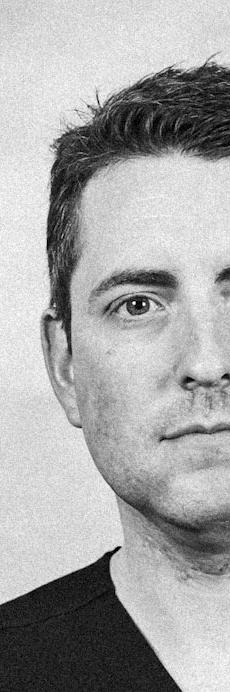
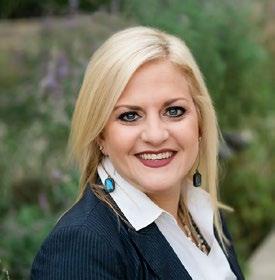
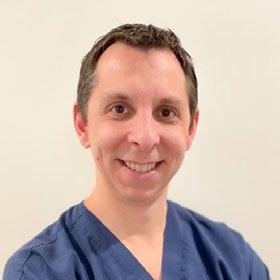
Yash Chavda, DO MBA FPD-AEMUS FAAEM, Assistant Editor
Mel Ebeling, MD, Resident Editor
Stephanie Burmeister, MLIS, Managing Editor
Articles appearing in Common Sense are intended for the individual use of AAEM members. Opinions expressed are those of the authors and do not necessarily represent the official views of AAEM or AAEM/RSA. Articles may not be duplicated or distributed without the explicit permission of AAEM. Permission is granted in some instances in the interest of public education. Requests for reprints should be directed to AAEM, 555 East Wells Street, Suite 1100, Milwaukee, WI 53202, Tel: (800) 884-2236, Fax: (414) 276-3349, Email: info@aaem.org
AAEM is a non-profit, professional organization. Our mailing list is private.
Table of Contents
Correction: The article “Physician Liability for NPP Charts” from the November/December 2025 issue was originally attributed to the Legal Committee. This article was a joint submission from the Legal Committee and the Operations Management Section. We apologize for this error.
As part of AAEM's antitrust compliance plan, we invite all readers of Common Sense to report any AAEM publication or activity which may restrain trade or limit competition. You may confidentially file a report at info@aaem.org or by calling 800-884-AAEM.
Mission Statement
AAEM fights for high-quality patient care delivered by board-certified emergency physicians and champions a fair and equitable workplace for emergency physicians through advocacy and education.
Vision Statement
We aspire to and champion a future in which:
1. The integrity of the doctor-patient relationship is upheld by emergency physicians with full control over their own practices, free of outside interference.
2. Every individual, regardless of race, ethnicity, sexual identity or orientation, religion, age, socioeconomic or immigration status, or physical or mental disability has unencumbered access to high-quality emergency care.
3. Emergency medicine is solely practiced by physicians who are board-certified or board-eligible through either the American Board of Emergency Medicine (ABEM) or the American Osteopathic Board of Emergency Medicine (AOBEM).
4. Every emergency physician’s personal and professional well-being is supported through fair and equitable practice environments and due process.
5. Residency programs and graduate medical education are free from harassment and discrimination.
6. The Academy continues to provide its members with high-quality, cutting-edge emergency medicine education.
7. The Academy supports the establishment and recognition of emergency medicine globally as an independent specialty.
Membership Information
Fellow and Full Voting Member (FAAEM): $595* (Must be ABEM or AOBEM certified, or have recertified for 25 years or more in EM or Pediatric EM)
Associate: $195 (Limited to graduates of an ACGME or AOA approved emergency medicine program within their first year out of residency) or $295 (Limited to graduates of an ACGME or AOA approved emergency medicine program more than one year out of residency)
Fellow-in-Training Member: $95 (Must be graduates of an ACGME or AOA approved emergency medicine program and be enrolled in a fellowship)
Emeritus Member: $295 (Please visit www.aaem.org for special eligibility criteria)
International Member: $195 (Non-voting status)
Resident Member: $80 (voting in AAEM/RSA elections only)
Transitional Member: $60 (voting in AAEM/RSA elections only)
International Resident Member: $80 (voting in AAEM/RSA elections only)
Student Member: $40 (voting in AAEM/RSA elections only)
International Student Member: $30 (voting in AAEM/RSA elections only) Pay dues online at www.aaem.org or send check or money order to: AAEM, 555 East Wells Street, Suite 1100, Milwaukee, WI 53202 Tel: (800) 884-2236, Fax: (414) 276-3349, Email: info@aaem.org
COMMONSENSE
Featured Articles
2
President’s Message: You Gotta Serve Somebody
In his final President’s Message, Dr. Frolichstein reflects on the ongoing corporatization of medicine and how the “Suck It Up Buttercup” documentary names the real conflict: a clash between two different raisons d’être (reason for being). One is centered on patients and the people who care for them. The other is centered on financial return. Both cannot be at the center at the same time. He concludes that professions survive not because they are profitable, but because they are rooted in something worth protecting—our patients.
4
Editor’s Message: The Cognitive Load of Emergency Medicine
In his Editor’s Message, Dr. Chavda discusses cognitive load and how emergency medicine is uniquely vulnerable to this phenomenon because physicians must manage multiple undifferentiated patients, incomplete information, competing priorities, and frequent reassessment in real time. He concludes that recognizing the limits of cognitive bandwidth may be one step toward making emergency medicine more sustainable.
12
AAEM26: Scientific Assembly Preview
22
Report from the Interim Meeting of the AMA House of Delegates: November, 2025
In this article, one of AAEM’s AMA delegates, Dr. Gary Gaddis, provides a high level overview of the American Medical Association 2025 Interim Meeting of its House of Delegates, and highlights some issues which may be of interest to AAEM members including the unionization of physicians, the corporate practice of medicine, and a resolution to define when a facility can call itself an “emergency department.”
31
AAEM/RSA Editor’s Message: (Another) Five Must-Have Apps for Your Next ED Shift
In the AAEM/RSA Editor’s Message, Dr. Ebeling presents (another) five must-have apps to boost your efficiency and ease cognitive burden during your next ED shift. In case you missed the first group of apps, you can check out the article from our May/June 2024 issue by clicking here.
You Gotta Serve Somebody
Robert Frolichstein, MD FAAEM
Our pastor recently referenced a song by Bob Dylan in a sermon that he presented. The song was “You Gotta Serve Somebody” and he used it to point out that we are all servants in one way or another. Thinking about this and reading a bit about Dylan’s song I believe it highlights that all of human perception, judgment, and action are always organized around something we value, fear, or serve. Many philosophers, besides Dylan, including Jean Paul Sarte, William James, and Friedrich Nietzsche assert this in their writings.
I think the French phase—raison d’être—literally translated as reason for being, is exactly what Dylan is saying in his song. We all have something that makes everything else makes sense.
It is not what you do. Not what you like. But what makes your life feel coherent. It defines your sacrifices, fears, ambitions, moral limits, and sense of worth.
Why am I being philosophical? Perhaps it is because this is my last President’s Message. I think, however, it is because the screening of “Suck it Up Buttercup” is coming soon and AAEM continues to fight against the corporatization of medicine. This documentary is powerful and timely. It highlights how our noble profession has been corrupted and is flailing because of external forces. While the message of the documentary is wide, I believe at its core it shows that the corporatization of the delivery of healthcare is destroying the delivery of healthcare. Corporatization of healthcare is the transformation of medical care from a locally guided, patient- and physician-centered profession into a system dominated by large, consolidated, profit-seeking corporations whose primary legal and operational duty is to maximize returns for shareholders. There it is, corporations raison d’être, their
purpose is to serve the shareholders. That fact defines their sacrifices, fears, ambitions, sense of self-worth, and even moral limits.
I am not suggesting that all individuals within these organizations are evil, greedy, or solely serve the shareholders. In fact, many, if not most, do not. This is likely the only reason we are not in a worse situation and why there is hope. I understand that individuals within these organizations often face conflicts and must frequently choose between their personal purpose and the organization’s purpose. The tragedy lies in having a purpose that you did not choose but must adopt due to your employment. Consequently, your purpose becomes avoiding getting fired, securing a promotion, or not being excluded. Many individuals at these organizations are victims of the corporation’s ultimate concern, just as patients and physicians are. However, someone within that organization determines that ultimate concern. Decisions are made by the leader, the board, or by the culture. An entity cannot have a moral compass; it is the individuals within that organization who define the purpose.
Physicians have been fortunate. We have traditionally had the ability put our purpose—the care of our patients—at the forefront. While it’s true that some physicians may exploit their patients for personal gain, I am confident it is a very small percentage. Even those who seek financial gain, a better CV, or personal projects have discovered that prioritizing patient well-being leads to beneficial secondary benefits. When a physician’s primary motivation conflicts with an organization’s, the result is moral injury. A challenging, yet rewarding, job can be miserable and even unhealthy.
So what should the ultimate concern for healthcare organizations be? It depends a bit on the focus of the company but it should not be profit. Profit is okay, desirable, if and only if it is a byproduct of their primary purpose. For hospitals, it should be to care for the people who care for
That is why this moment matters. We are being asked, implicitly and sometimes explicitly, to accept a version of healthcare in which physicians and other clinicians are treated as production units inside a financial machine.”
the patients. Their whole existence should be to serve the people at the bedside. For insurance companies it should be to the policy holders— period. For physician employment companies, whether that be a small, independent, democratic group or a large national group, it should be to serve the physicians and non-physician practitioners.
If the purpose of an organization is to serve those who care for patients, then the way we judge that organization must change. We should not ask first whether it is growing, or profitable, or innovative. We should ask whether the people at the bedside are supported, respected, listened to, and able to practice the kind of medicine they were trained to provide. If clinicians are burning out, leaving, or being forced to practice in ways that violate their professional judgment, then something is wrong at the center—no matter how good the spreadsheets look.
individual physician can stand against them by themselves. That is why this cannot remain a conversation only among the already engaged. We must enlist our uninvolved colleagues, our legislators, and the largely unaware and victimized patients, to understand what is at stake. If enough people come to see that the center of healthcare has been pulled away from patients and those who care for them, then it can be pulled back and we will no longer need to “Suck it up Buttercup.”
Professions survive not because they are profitable, but because they are rooted in something worth protecting.”
This is where governance matters. Boards of directors, executives, and management structures are not neutral. They, too, have an ultimate concern. They will organize their decisions around whatever sits at their center. If they are oriented toward growth, market share, or investor returns, then everything else— staffing, equipment, metrics, documentation burden—will be bent in that direction. If they are oriented toward supporting clinicians in caring for patients, then the system begins to feel very different from the inside.
That is why this moment matters. We are being asked, implicitly and sometimes explicitly, to accept a version of healthcare in which physicians and other clinicians are treated as production units inside a financial machine. Many of us have felt what that does to our work, our relationships with patients, and our sense of professionalism. We feel it as moral injury because it is moral injury: the pain of being forced to betray what we know to be right in order to survive in a system that no longer shares our values.
The screening of “Suck It Up Buttercup” comes at exactly the right time because it refuses to pretend that this is just about efficiency or integration. It names the real conflict: a clash between two different raisons d’être. One is centered on patients and the people who care for them. The other is centered on financial return. Both cannot be at the center at the same time.
We still have a choice, even if we feel powerless. The forces that have reshaped healthcare are large, well-funded, and organized, and no
As this is my last President’s Message, I will end with this. Professions survive not because they are profitable, but because they are rooted in something worth protecting. Medicine has endured for centuries because its center has been the patient. When that center shifts, everything else eventually follows—and not in a good way.
In my own life and profession, my purpose, my ethics are driven by my Christian faith; imperfect as I am. My hope is that all of those involved in the ongoing corporatization of healthcare can find a true north in which their own moral compass directs them to do the best for the patients, and professionals, impacted by their decisions. May we all have a raison d’etre which makes life better for those we lead and those we treat.
Chat GPT and I rewrote one stanza of Dylan’s song.
With apologies to Mr. Dylan
You may be an emergency physician in New York or L.A.
You may like to golf, you might like to play
You may run a hospital chain, pockets lined with gold
Or be a big pharma exec, with drugs that you’ve sold
But you’re gonna have to serve somebody, yes indeed
You’re gonna have to serve somebody
Well, it may be the dollar or it may be the patient
But you’re gonna have to serve somebody
You might be a surgeon with a scalpel so fine
You might cut for the cash, leave the ethics behind
You might run an insurance desk, denying every claim
Or be a billing coder playing profit’s old game
But you’re gonna have to serve somebody, yes indeed
You’re gonna have to serve somebody
Well, it may be the dollar or it may be the patient
But you’re gonna have to serve somebody
The Cognitive Load of Emergency Medicine
Yash Chavda, DO MBA FPD-AEMUS FAAEM
You turn around and the EKG tech hands you five ECGs to sign for 10-minute ECGs. None of the patients are yours.
“Can you sign these?”
Before you can respond, the phone rings.
Radiology.
“Hey, it looks like Jane Doe has what appears to be metastatic pancreatic cancer…”
While you’re still on the phone, five Epic chats appear.
“The patient in 21 is asking if they can eat.”
“Hey, the family is getting upset that the patient’s lac isn’t getting fixed.”
“Can Mr. Dorian get more fentanyl?”
“The patient in 22 is trying to elope.”
“There’s pizza in the back!”
Across the department, the overhead speaker announces an incoming cardiac arrest.
It’s on your team.
You glance back at the chart you were reviewing.
For a moment you pause.
Where was I?
Emergency physicians recognize this moment immediately—the brief loss of mental context after a cascade of interruptions. It isn’t true memory loss, of course. But after enough task switching, the experience can feel strangely similar: a brain forced to hold, drop, and reload dozens of clinical problems every hour.
I sometimes joke and call it “ED delirium.”
Emergency medicine isn’t practiced one patient at a time. It’s practiced in parallel.
The Cognitive Work of Emergency Medicine
Cognitive load refers to the total mental effort required to process information, make decisions, and manage tasks. When the demands placed on working memory exceed what the brain can comfortably handle, performance can begin to decline. Emergency medicine is uniquely vulnerable to this phenomenon because physicians must manage multiple undifferentiated patients, incomplete information, competing priorities, and frequent reassessment in real time.
Each patient represents a sequence of clinical judgments: What could this be? What must not be missed? What testing is necessary? Who can safely go home? Multiply that process across a full emergency department and the cognitive burden becomes substantial.
The challenge is not simply patient volume. It is decision density
During a typical shift, emergency physicians make hundreds of clinical decisions—diagnostic testing, imaging selection, medication choices, procedural timing, consultant involvement, and patient disposition. Most of these decisions occur rapidly and under uncertainty.
The risk is rarely a single difficult decision. It is the accumulation of hundreds of smaller ones.
The Silent Curriculum of Emergency Medicine
Part of emergency medicine training is learning to function within this cognitive environment. Residents are not only learning how to diagnose and treat disease. They are also learning how to manage competing priorities, recover from interruptions, and keep track of multiple evolving clinical problems at once.
Emergency medicine isn’t practiced one patient at a time. It’s practiced in parallel.”
Cognitive overload is not simply a physician wellness issue. It is also a patient safety consideration.”
Early in training, the environment can feel overwhelming. Charts pile up, interruptions multiply, and the cognitive juggling act can feel nearly impossible. Over time, however, residents begin to develop strategies. They learn how to prioritize tasks, how to quickly reorient after interruptions, and how to maintain a mental map of the department.
This “silent curriculum” of emergency medicine—learning how to manage cognitive load—is rarely taught explicitly. Yet it may be one of the most important skills emergency physicians develop.
The Interrupt-Driven Environment
Layered on top of this decision density is another defining feature of emergency medicine: interruptions.
Emergency departments are among the most interruption-heavy clinical environments in medicine. Observational studies of physician workflow have documented frequent interruptions during clinical work, sometimes occurring every few minutes.
The sources are familiar to anyone who works in the ED:
• Nurses asking for medication orders
• Consultants returning pages
• Radiology clarifying imaging requests or communicating critical findings
• EMS arrivals
• Patient and family questions
• ECGs requiring immediate interpretation
• Staff assists and unanticipated events
Many of these interruptions are necessary and important. Emergency care depends on constant communication. But every interruption carries a cognitive cost. An interruption requires the physician to suspend one task, shift attention to another, and then reconstruct the original train of thought afterward. In cognitive science, this is known as task switching, and it consumes working memory each time it occurs.
Cognitive psychologists also describe a related phenomenon called prospective memory failure—the tendency to forget to return to an intended task after an interruption. In the emergency department, this is the moment when you reopen a chart and wonder, “Why did I open this patient again?”
Similar cognitive challenges have long been recognized in aviation and other high-risk industries, where human factors research has emphasized situational awareness, workload management, and standardized team responses to error-prone situations. Not every task is perfectly
resumed. Some studies suggest clinicians may not immediately return to the original task after an interruption. Those lost threads matter in a specialty built on continuous decision-making.
When Interruptions Become Errors
The relationship between interruptions and clinical task performance has been studied directly. In observational research of emergency physicians performing prescribing tasks, interruptions and multitasking were associated with increased rates of prescribing errors.
These findings should not be surprising. Human working memory is limited. When cognitive load exceeds capacity, clinicians rely more heavily on mental shortcuts and heuristics—trained pathways and instinct taking over. Those heuristics are essential tools for experienced emergency physicians. But under conditions of extreme cognitive demand, even strong pattern recognition can be strained. In other words, the brain is forced to prioritize its workload.
The Aging Emergency Physician
As I get older each year, I sometimes wonder how sustainable this work is across an entire career. How long, realistically, can any of us maintain this level of cognitive load?
Research on aging physicians is nuanced. Many older physicians remain highly competent and may compensate for some age-related changes through experience, refined mental models, and pattern recognition. At the same time, cognitive research consistently notes that processing speed and working memory tend to decline gradually with age, even when expertise remains strong.
Among emergency physicians specifically, a survey of clinicians over age 55 identified concerns related to the demands of the specialty, including:
• Less ability to recover from night shifts (74%)
• Greater emotional exhaustion after shifts (44%)
• Reduced ability to manage heavy patient volumes (40%)
• More difficulty handling the stress of emergency medicine (36%)
• Subjective decline in memory (28%)
None of this suggests older physicians cannot practice safely. In fact, experience and pattern recognition remain powerful advantages. But it highlights an uncomfortable reality: the cognitive environment of emergency medicine is demanding even for highly experienced clinicians. As the workforce ages, the specialty will increasingly need to think about how to support career longevity without sacrificing safety.
Continued on pg 11>>
AAEM Foundation Contributors – Thank You!
AAEM established its Foundation for the purposes of (1) studying and providing education relating to the access and availability of emergency medical care and (2) defending the rights of patients to receive such care and emergency physicians to provide such care. The latter purpose may include providing financial support for litigation to further these objectives. The Foundation will limit financial support to cases involving physician practice rights and cases involving a broad public interest. Contributions to the Foundation are tax deductible. Levels of recognition to those who donate to the AAEM Foundation have been established. The information below includes a list of the different levels of contributions. The Foundation would like to thank the individuals below who contributed from 3/1/2025 to 3/1/2026.
Contributions $1000 and above
Eric W. Brader, MD FAAEM
Frank L. Christopher, MD FAAEM
Vicki Norton, MD FAAEM
Robert E. Suter, DO MHA FAAEM
Contributions $500-$999
Eric D. Lucas, Sr., MD FAAEM
Mark S. Penner, DO FAAEM
Michael Luszczak, DO FAAEM
Contributions $250-$499
Alex Alers Fuentes, MD FAAEM
Andrew P. Mayer, MD MAAEM FAAEM
Antonios D. Katsetos, DO FAAEM
Carlos F. Garcia-Gubern, MD FAAEM
Daniel P. Shand, MD FAAEM
David Oves Andonian, MD MPH FAAEM FACEP
Don L. Snyder, MD FAAEM
Douglas M. Char, MD FAAEM
Heath Spencer, DO
Jalil A. Thurber, MD FAAEM
Jonathan W. Riddle, DO
Joshua J. Stein, MD FAAEM
Karl A. Nibbelink, MD FAAEM
Kathryn Getzewich, MD FAAEM
Kevin Allen, MD FAAEM
Kian J. Azimian, MD FAAEM
Mark I. Langdorf, MD MAAEM FAAEM MHPE
Mary Ann H. Trephan, MD FAAEM
Nate T. Rudman, MD FAAEM
Robert B. Simonson, DO FAAEM
Robert J. Feldman, MD FAAEM
Rosa K. Gigliotti, MD FAAEM
Contributions $100-$249
Ada Cuellar, MD FAAEM
Adam Hill, MD FAAEM
Alexander Tsukerman, MD FAAEM
Andy Walker, MD MAAEM
Ann Loudermilk, MD FAAEM
Anthony Catapano, DO FACOEP FAAEM
Benjamin Rhoades, DO FAAEM
Bradley E. Barth, MD FAAEM
Bradley K. Gerberich, MD FAAEM
Brian Acunto, DO EJD FACOEP
Brian R. Potts, MD MBA FAAEM
Brian T. Hall, MD FAAEM
Brian Zimmer, DO FAAEM
Chaiya Laoteppitaks, MD FAAEM
Dan M. Mayer, MD FAAEM FACEP
Daniel D’Souza, DO FAAEM
David C. Crutchfield, MD FAAEM
David R. Hoyer Jr., MD FAAEM
Douglas P. Slabaugh, DO FAAEM
Douglas Stewart, MD FAAEM
Garrett Clanton II, MD FAAEM
Glenn I. Goodwin, DO FAAEM
Ilan Kaye, FAAEM
James J. Schlesinger, DDS MD
Jeffrey A. Rey, MD FAAEM
John C. Kaufman, MD FAAEM
John H. Kelsey, MD FAAEM
John Robert Dayton, MD MBA FAAEM FACEP
John V. Murray, MD FAAEM
Julianne Wysocki Broadwater, DO FAAEM
Justin P. Anderson, MD FAAEM
Kathleen Hayward, MD FAAEM
Kay A. Buchheit, MD FAAEM
Kesah DeLisio, MD FAAEM
Kevin C. Reed, MD, FACHE, FAAEM
Laura Cazier, MD FAAEM
Leonard A. Yontz, MD FAAEM
Linda Sanders, MD FAAEM
Marco Anshien, MD FAAEM
Mark A. Antonacci, MD FAAEM
Mary Jane Brown, MD FAAEM
Matthew W. Porter, MD FAAEM
Matthew William Carman, MD FAAEM
Michael Langowski, DO FAAEM
Michael T. Cudnik, MD FAAEM
Milan Fratrik, III, MD FAAEM
Moath Amro, MD
Nancy L. Kragt, DO FAAEM
Nicholas Boyko, DO, FAAEM
Paul C. Giasi, MD MBA FACEP FAAEM
R. Lee Chilton III, MD FAAEM
Rebecca K. Carney-Calisch, MD FAAEM
Rian Pillitteri, MD FAAEM
Robert Bruce Genzel, MD FAAEM
Robert E. Gruner, MD
Roland S. Waguespack, III, MD MBA
MHCDS FAAEM
Sarah B. Dubbs, MD FAAEM
Scott D. Reiter, MD FAAEM
Stephanie Eden, MD FAAEM
Stephen A. Harper, MD FAAEM
Steven E. Holt, MD FAAEM
Steven R. Hernandez, MD
Stuart M. Gaynes, MD FAAEM
Tamara Wagester
Thomas W. Lukens, MD PhD FAAEM FACEP
Timothy J. Huschke, DO FAAEM
Vinicius Knabben, MD
Westin G. Horne, DO FAAEM
William K. Clegg, MD FAAEM
William T. Freeman, MD FAAEM
Yeshvant Talati, MD
Contributions up to $99
Alexandra C. Doan, MD
Ameer Sharifzadeh, MD FAAEM
Andrew Wilson, FAAEM
Andy Doan
Christopher B. Parks, MD FAAEM
David L. Justis, MD PhD
Ernest H. Leber Jr., MD FAAEM
Francisco Jose Cordero-Rodriguez, MD
Ivan C. Rokos, MD
Jacob M. Altholz, MD
Jamie Kuo, MD
Jonathan D. Apfelbaum, MD FAAEM
Jonathan S. Cagle, FAAEM
Jordan R. Chanler-Berat, MD FAAEM FAEMUS
Julia D. Whiting, MD FAAEM
Katherine Laura Poma Ramos, Jr., MD
Kevin Robert Brown, MD FAAEM
Leonardo L. Alonso, DO FAAEM
Michael Slater, MD FAAEM
Morgan E. Hanlon
Nancy Conroy, MD FAAEM
Neal Andrew Jens Nettesheim, MD FAAEM
Patrick W. Daly, MD FAAEM
Paul W. Gabriel, MD FAAEM
Robert A. Hoogstra, MD FACP FAAEM
Sachin J. Shah, MD FAAEM
Sharon A. Malone, MD FAAEM
Shelly Birch, FAAEM
Stephen Shaheen, MD FAAEM
Tatiana Nunez, MD
AAEM PAC Contributors – Thank You!
AAEM PAC is the political action committee of the American Academy of Emergency Medicine. Through AAEM PAC, the Academy is able to support legislation and effect change on behalf of its members and with consideration to their unique concerns. Our dedicated efforts will help to improve the overall quality of health care in our country and to improve the lot of all emergency physicians.
All contributions are voluntary and the suggested amount of contribution is only a suggestion. The amount given by the contributor, or the refusal to give, will not benefit or disadvantage the person being solicited.
Levels of recognition to those who donate to the AAEM PAC have been established. The information below includes a list of the different levels of contributions. The PAC would like to thank the individuals below who contributed from 3/1/2025 to 3/1/2026.
Contributions $1000 and above
Vicki Norton, MD FAAEM
Mark S. Penner, DO FAAEM
Robert E. Suter, DO MHA FAAEM
Contributions $500-$999
Eric W. Brader, MD FAAEM
Contributions $250-$499
Heath Spencer, DO
Kevin Allen, MD FAAEM
Contributions $100-$249
Ada Cuellar, MD FAAEM
Alex Alers Fuentes, MD FAAEM
Alexander Tsukerman, MD FAAEM
Andy Walker, MD MAAEM
Brian R. Potts, MD MBA FAAEM
Chaiya Laoteppitaks, MD FAAEM
Cynthia Martinez-Capolino, MD FAAEM
Daniel D’Souza, DO FAAEM
David R. Hoyer Jr., MD FAAEM
David R. Steinbruner, MD FAAEM
Garrett Clanton II, MD FAAEM
Glenn I. Goodwin, DO FAAEM
Ilan Kaye, FAAEM
Jalil A. Thurber, MD FAAEM
James J. Schlesinger, DDS MD
Jeffrey A. Rey, MD FAAEM
Joseph T. Bleier, MD FAAEM
Josh E. Kravetz, DO FAAEM
Julianne Wysocki Broadwater, DO FAAEM
Justin P. Anderson, MD FAAEM
Karl A. Nibbelink, MD FAAEM
Kathleen Hayward, MD FAAEM
Kian J. Azimian, MD FAAEM
Mark A. Antonacci, MD FAAEM
Matthew W. Porter, MD FAAEM
Michael Langowski, DO FAAEM
Michael T. Cudnik, MD FAAEM
Rebecca K. Carney-Calisch, MD FAAEM
Robert Bruce Genzel, MD FAAEM
Roland S. Waguespack, III, MD MBA
MHCDS FAAEM
Sachin J. Shah, MD FAAEM
Shane R. Sergent, DO FAAEM
Steven R. Hernandez, MD
Vinicius Knabben, MD
William T. Freeman, MD FAAEM
LEAD-EM Contributors – Thank You!
Contributions up to $99
Ameer Sharifzadeh, MD FAAEM
Andrew Wilson, FAAEM
Christopher B. Parks, MD FAAEM
Ernest H. Leber Jr., MD FAAEM
Jonathan D. Apfelbaum, MD FAAEM
Jonathan S. Cagle, FAAEM
Jordan R. Chanler-Berat, MD FAAEM FAEMUS
Kathryn Getzewich, MD FAAEM
Marc D. Squillante, DO FAAEM
Michael Slater, MD FAAEM
Nate T. Rudman, MD FAAEM
Ron Koury, DO, FAAEM, FACEP
Stuart M. Gaynes, MD FAAEM
Contributions $1000 and above
Eric W. Brader, MD FAAEM
Contributions $500-$999
David W. Lawhorn, MD MAAEM
Frank L. Christopher, MD FAAEM
Contributions $250-$499
Carlos F. Garcia-Gubern, MD FAAEM
Eric M. Sergienko, MD FAAEM
The AAEM Institute for Leadership, Education & Advancement in the Development of Emergency Medicine, Inc. (LEAD-EM) was established after the tragic and unexpected death of AAEM president, Dr. Kevin G. Rodgers.
The Kevin G. Rodgers Fund and the Institute will LEAD-EM just like Dr. Rodgers did. The funds will support important projects such as development of leadership qualities, and clinical and operational knowledge of emergency physicians with a view toward improving and advancing the quality of medical care in emergency medicine, and public health, safety and well-being overall. LEAD-EM would like to thank the individuals below who contributed from 1/1/2025 to 1/1/2026.
Contributions $100-$249
Ada Cuellar, MD FAAEM
Ann Loudermilk, MD FAAEM
Brian R. Potts, MD MBA FAAEM
Chaiya Laoteppitaks, MD FAAEM
Dale S. Birenbaum, MD FAAEM
Daniel P. Shand, MD FAAEM
Edward T. Grove, MD FAAEM MSPH
James J. Schlesinger, DDS MD
Justin P. Anderson, MD FAAEM
Kailyn Kahre-Sights, MD FAAEM
Kathleen Hayward, MD FAAEM
Leonard A. Yontz, MD FAAEM
Mark A. Antonacci, MD FAAEM
Mary Jane Brown, MD FAAEM
Moath Amro, MD
R. Lee Chilton III, MD FAAEM
Rebecca K. Carney-Calisch, MD FAAEM
Robert E. Gruner, MD
Roland S. Waguespack, III, MD MBA
MHCDS FAAEM
Stephen A. Harper, MD FAAEM
William T. Freeman, MD FAAEM
Contributions up to $99
Alex Alers Fuentes, MD FAAEM
Jordan R. Chanler-Berat, MD FAAEM FAEMUS
Kevin C. Reed, MD, FACHE, FAAEM
Michael Slater, MD FAAEM
Nicholas Boyko, DO, FAAEM
Steven R. Hernandez, MD
Stuart M. Gaynes, MD FAAEM
Tatiana Nunez, MD
Thomas G. Derenne
UPCOMING EVENTS:
AAEM Events & Recommended Education
Introducing the AAEM and AAEM/RSA Events Calendar — your go-to source for conferences, webinars, workshops, and more. Explore the latest opportunities to connect, learn, and grow in emergency medicine by scanning the QR code.
AAEM Events
2026 In-Person Certifying Exam Review Courses
May 16-17, 2026 (Los Angeles, CA) - June 13-14, 2026 (Baltimore, MD) - June 20-21, 2026 (Minneapolis, MN) - https://www.aaem. org/certifying-exam-review-course/
32nd Annual Scientific Assembly
April 11-15, 2026 (Seattle, Washington)https://www.aaem.org/aaem26/
21st Annual Emergency Medicine Update: Hot Topics 2026
October 20-24, 2026 (Kauai, HI) - https:// health.ucdavis.edu/emergency/education/ Continuing%20Med%20ED/CME-index.html
Recommended Education
Online CME
Rapid Response to Adverse Events of Bispecific Antibodies: Follicular Lymphoma and Diffuse Large B-Cell Lymphoma Emergency Medicine Strategies - https://www. staging.medscape.org/viewarticle/1001569
Online CME
Recognizing Life-Threatening Emergencies in People with VEDS thesullivangroup.com/TSG_UG/VEDSAAEM/
The Difficult Airway Course: EmergencyTM
March 6-8 2026 San Diego May 1-3, 2025 Boston Sept 25-27, Atlanta - www.theairwaysite.com
AAEM CME Online
Explore AAEM CME Online, where we understand the fast-paced nature of emergency medicine (EM) and the need for concise, accessible education. This platform is designed to provide members of the American Academy of Emergency Medicine (AAEM) and AAEM Resident and Student Association (AAEM/ RSA) with top-tier continuing medical education (CME) resources right at their fingertips. Access today!
Regret Versus Rumination: Reframing Relentless Thought Loops
Amanda Dinsmore, MD, Kendra Morrison, DO, and Laura Cazier, MD
It was one of those shifts. Nothing was straightforward. Labs and imaging were painfully slow. Triage rolled a patient back, and he looked bad enough that you saw him first. You expected tearing back pain or crushing chest pain, but no. Just nausea and vomiting for several days and aching. Vital signs showed mild tachycardia but were otherwise stable. Nothing stood out on exam. Maybe there was time for labs before scan after all.
Following fluids and antiemetics, the nurse found you and said the patient wanted to leave because he felt much better. Surprised, you confirmed he both looked much better and declined further workup. Labs were nonspecific. You reached an agreement that if he kept down POs, he could go. The nurse reported he did.
You found out later from a distant family member that he died at home. You replay it over and over. Are you certain about your exam? Did you miss something on the EKG? Why didn’t you order imaging from the start? You should’ve known.
The voice in your head is relentless. Critical. Judging. Obsessed. You tell yourself you’re being thorough when you keep rehashing it. The voice convinces you this is necessary, but what you’re doing may not at all be useful.
It may be rumination.
Regret: A Necessary Signal
Regret is rooted in counterfactual thinking, that is, the mental simulation of alternative outcomes (“If only I had…”). Psychologically, it serves a purpose. Regret highlights discrepancies between intention and outcome to help refine future decisions.1 It serves to learn the lesson.
In emergency medicine, regret is common. We routinely face uncertain diagnoses, evolving physiology, and system constraints. Research confirms we frequently experience intense regret related to clinical decisions, even when care was imperfect but appropriate and within the standard of practice.2
Regret simply means there was an undesired outcome. When useful, regret asks:
• What can I learn?
• Is there anything to repair?
• Can I do anything different next time? Once those questions are answered, regret has done its job.
Regret and rumination are different processes. Regret may initiate reflection. Rumination sustains suffering.”
Rumination: When the Loop Doesn’t Close Rumination is different.
Psychological literature defines rumination as repetitive, intrusive thinking about distressing experiences that does not lead to problem-solving.3 Rather than generating insight, it prolongs emotional activation and amplifies distress.
Extensive research links rumination to depression, anxiety, and impaired emotional recovery.4 Individuals who ruminate tend to experience persistent negative mood and greater difficulty disengaging from adverse events.5
Regret and rumination are different processes.6 Regret may initiate reflection. Rumination sustains suffering.
In emergency medicine, rumination often sounds like:
• “How could I have missed that?”
• “I should have known.”
• “This proves I’m not cut out for this.”
Notice the shift. The focus moves from behavior to identity.
This distinction matters. One centers on behavior, is associated with reparative action. The other centers on self-condemnation, predicts avoidance and psychological distress.7 Rumination frequently turns regret into shame. Rumination is less interested in being better for next time.
Why Physicians Are Particularly Vulnerable
Case-related regret has measurable consequences for healthcare professionals. Studies demonstrate associations between unresolved regret and burnout, emotional exhaustion, and even intent to leave practice.8
In high-acuity specialties like emergency medicine, clinicians may experience the second victim phenomenon, the emotional distress after adverse events that can include insomnia, diminished confidence, and intrusive thoughts.2 Unresolved regret can contribute to defensive medicine, ordering additional tests or avoiding certain decisions primarily to prevent emotional recurrence rather than to improve patient outcomes.9
In other words, when regret bleeds into rumination, it can distort both well-being and clinical judgment. Nobody wins.
Stop
Beating a Dead Horse
The goal isn’t to avoid regret. The goal is to keep it useful.
What Happened Is Not Your Identity
How you talk to yourself matters. “I made a decision that resulted in a bad outcome” is categorically different from “I’m a bad doctor” or “I’m a failure.”
Research on morality emotions show regret can promote beneficial relationship repair and future-focused learning, while shame-based rumination often leads to withdrawal and other negative consequences.7 When you notice identity-based self-criticism, pause and refocus on the behavior rather than you as a doctor or person.
Practice Cognitive Reappraisal
When the timer goes off, let the thought loop end as well. Move on. You can revisit it in another timed session tomorrow if it feels necessary.
Debrief with Others
Physicians often process regret in isolation. Yet peer discussion (with someone trustworthy and supportive) and structured debriefing are associated with healthier emotional recovery after adverse events.2
Isolation magnifies rumination. It can lead to shame spirals.11 Connection reframes it.
Repair When Possible, Then Release
By all means, if an apology or system correction is needed, this is your opportunity. Doing something (rather than ruminating alone) can restore your sense of agency and can reduce lingering guilt. But once what can be done is done, continued self-flagellation serves no purpose.
“You have ideas to do things differently next time. And you’re a better doctor now because of this painful experience. Then you close the chart. Not because it doesn’t matter, but because it has already taught you what it can.”
Returning to the Case
You audit the scenario one more time. But this time you vow to be intentional.
You remember how the vital signs corrected, the nonspecific labs, that shared-decision making discussion, the patient’s right to autonomy. You have ideas to do things differently next time. And you’re a better doctor now because of this painful experience.
Then you close the chart.
Not because it doesn’t matter, but because it has already taught you what it can.
Cognitive reappraisal, or reframing an event within its broader context, is strongly associated with improved emotional regulation.10
Ask:
• What information did I have at the time?
• What system limitations were present?
• If this happened to my partner, what would I say to them? Reframing what happened isn’t making excuses. It’s gaining overall perspective.
Timed Reflection
Rumination can take over without limits. Structured reflection helps contain it.3
Set a timer for 10 minutes with the goal of a beneficial review. What would you like to do differently next time? Is there anything that can be done to make it better now, like an apology, etc? Want to learn more about a particular topic for the future?
Regret is inevitable in medicine. It reflects your investment and care. Rumination is detrimental, and thankfully, optional.
Regrets says: Pay attention and learn.
Rumination says: Keep paying.
Physicians don’t need to become indifferent to avoid suffering. We need to become skilled at distinguishing learning from harmful self-condemnation.
You did the best with what you knew. Of course, if you could predict the future, you might’ve done it differently. Forgive yourself for not knowing what only time could teach.
You deserve mercy now.
References
1. Zeelenberg M, Pieters R. A theory of regret regulation 1.0. J Consum Psychol. 2007;17(1):3-18.
2. Wu AW. Medical error: the second victim. BMJ. 2000;320(7237):726-727.
3. Nolen-Hoeksema S, Wisco BE, Lyubomirsky S. Rethinking rumination. Perspect Psychol Sci. 2008;3(5):400-424.
4. Spasojević J, Alloy LB. Rumination as a common mechanismadverseadverse relating depressive risk factors to depression. Emotion. 2001;1(1):25-37.
5. Aldao A, Nolen-Hoeksema S, Schweizer S. Emotion-regulation strategies across psychopathology: A meta-analytic review. Clin Psychol Rev. 2010;30(2):217-237.
6. Brassen S, Gamer M, Peters J, Gluth S, Büchel C. Don’t look back in anger! Responsiveness to missed chances in successful and nonsuccessful aging. Science. 2012;336(6081):612-614.
EDITOR’S MESSAGE
The System Assumes Unlimited Cognition
Despite the cognitive demands of emergency medicine, many system metrics focus on factors that increase demand without measuring cognitive capacity:
• Patients per hour
• Door-to-doctor time
• RVUs
• Length of stay
• Patient experience scores
These metrics implicitly assume physician decision-making capacity is essentially unlimited—that more patients can simply be processed faster. But cognitive bandwidth is finite. Every additional patient adds more clinical information to track, more risk assessments to perform, and more interruptions to manage.
Boarding further compounds the problem. When admitted patients remain in the emergency department for prolonged periods, emergency physicians often continue managing inpatient-level care while simultaneously evaluating new arrivals. The result is an expanding list of cognitive responsibilities competing for attention. In many ways, an often unmentioned bottleneck in emergency medicine is the working memory of the physician, not beds or CT scanners.
Why This Matters
When emergency physicians say they feel mentally “fried” after a shift, they are describing something real. A brain that has spent hours juggling incomplete clinical pictures, switching tasks, answering interruptions, and making rapid risk assessments.
7. Tangney JP, Stuewig J, Mashek DJ. Moral emotions and moadversediminishedraldiminishedadverse behavior. Annu Rev Psychol. 2007;58:345-372.
8. Courvoisier DS, Cullati S, Haller CS, et al. Validation of a care-related regret intensity scale. BMJ Open.2013;3:e002623.
9. AMA Journal of Ethics. Experiencing and coping with regret after a patient’s poor outcome. AMA J Ethics.2018;20(8):E783-E790.
10. Gross JJ. Emotion regulation: Current status and future probehavioralspects. Psychol Inq. 2015;26(1):1-26.
Cognitive overload is not simply a physician wellness issue.
It is also a patient safety consideration.
Emergency physicians routinely manage large volumes of information, multiple evolving clinical problems, and frequent interruptions. In such complex environments, maintaining situational awareness across many patients requires significant cognitive effort. Fortunately, emergency medicine operates with multiple safety layers—including nursing vigilance, pharmacy review, team communication, and standardized processes—that help maintain safe patient care. Recognizing the cognitive demands of emergency medicine allows health systems to design environments that better support clinicians and the patients they serve.
It’s Not “ED Delirium”—Cognitive Load Is Real
Emergency medicine is often described as fast-paced. But speed alone does not define the specialty.
The defining feature of emergency medicine is cognitive load—the constant balancing of risk, uncertainty, and competing priorities across many patients at once. Every shift requires emergency physicians to assemble incomplete information, make rapid decisions, and then abandon those decisions mid-thought to address the next interruption. Somewhere between ECG signatures, radiology calls, and requests for food trays, the brain must keep track of it all. We train for it, and we do. But sometimes that work becomes more difficult.
Recognizing the limits of cognitive bandwidth may be one step toward making emergency medicine more sustainable
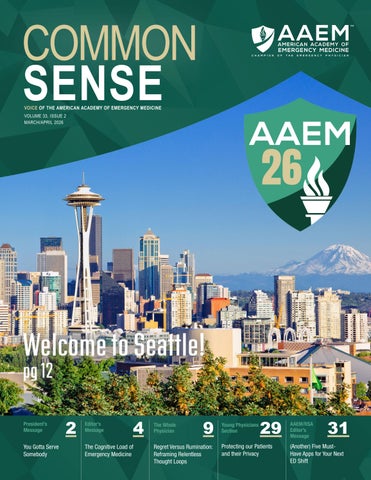
Welcome to Seattle!
On behalf of the Scientific Assembly Program Planning Committee of the American Academy of Emergency Medicine Education Council, we are looking forward to welcoming you to AAEM26 Scientific Assembly and to Seattle, WA. This event is one of the most anticipated conferences of the year, with a focus on cutting edge clinical medicine and practical application to patient care. Whether you’re looking for critical care, advocacy, tox, or ultrasound, emergency physicians from every state and practice setting will come away with new knowledge and skills that will change your practice of emergency medicine.
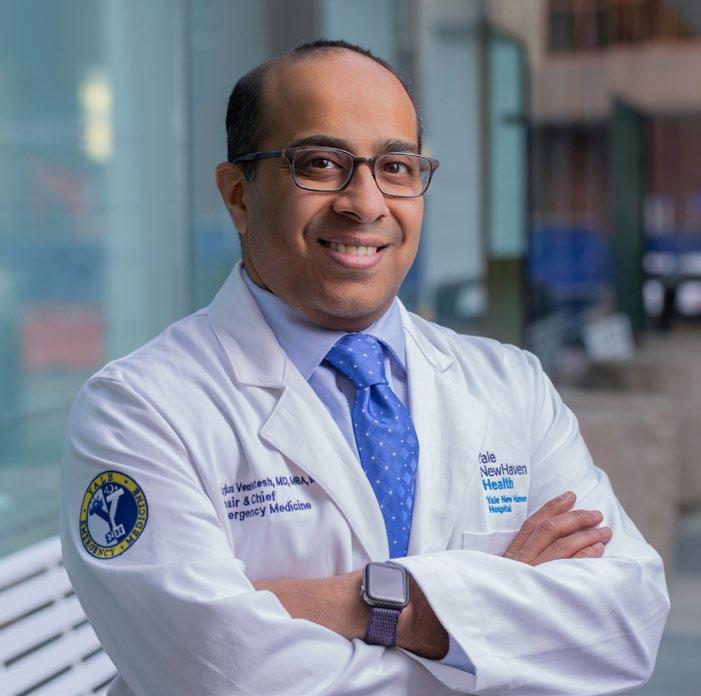
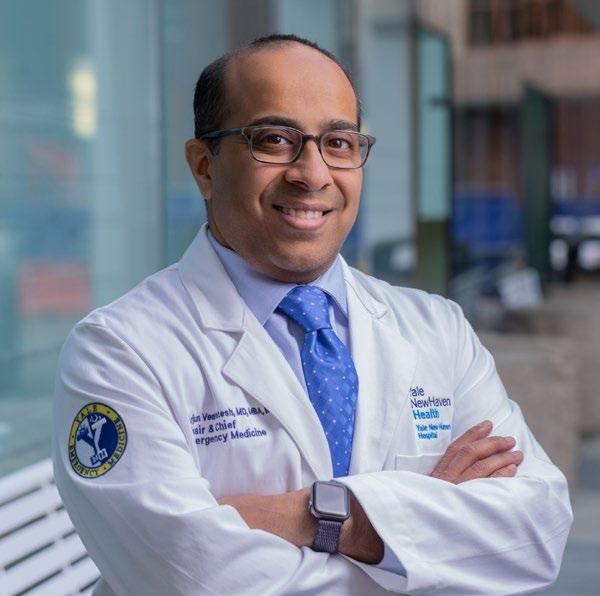
AAEM26 will feature popular sessions like the seven-minute “short and sweet” Breve Dulce lectures, hands-on Small Group Clinic workshops, Open Mic Competition, storytelling event, and the many networking events. You will see talented new speakers take the plenary stage, as well as returning favorites. We are especially looking forward to our keynote speaker, Dr. Arjun Venkatesh, who will explore emergency medicine’s fourth generational transformation and what it will take for the specialty to adapt and thrive amid rapid changes in technology, training, and workforce dynamics.
Many AAEM groups are hosting educational and social events with opportunities to meet new colleagues and catch up with friends. All attendees are invited to attend any committee, section, or interest group meetings and learn more about what AAEM has to offer.
The Scientific Assembly Program Planning Committee has invested significant time and thought to ensure that every participant has an educational, enjoyable, and safe experience in Seattle. We look forward to sharing these amazing topics and engaging presenters with you.
See you in Seattle!
Co-Chair
Zachary Repanshek, MD FAAEM Co-Chair
Julie Vieth, MD FAAEM Co-Vice Chair
Harman S. Gill, MD FAAEM Co-Vice Chair
Kathleen M. Stephanos, MD FAAEM
Boost your CME by signing up for an add-on course (formerly known as a pre-conference course) before AAEM26.
Keynote Speaker
Explore the generational transformation of emergency medicine at the keynote address, 4th Generation Emergency Medicine: Holding the Past, Leading the Present, Shaping the Future, presented by Dr. Arjun Venkatesh.
Small Group Clinics
These ever-popular “short and sweet” sessions are seven-minute overviews and 25 slides packed full of information!
Plan to catch a variety of Breve Dulce topics at AAEM26 to round out your educational experience.
These sessions provide personal and hands-on education on procedures, ultrasound skills, communication skills, and more! All workshops will be filled on a first-come, first-served basis. Sign up is available at 7:00am beginning the day before the workshop.
Browse the complete 2026 AAEM Scientific Assembly Program by clicking here.
Learn more about Small Group Clinics by clicking here
Breve Dulce
32nd Annual Scientific Assembly
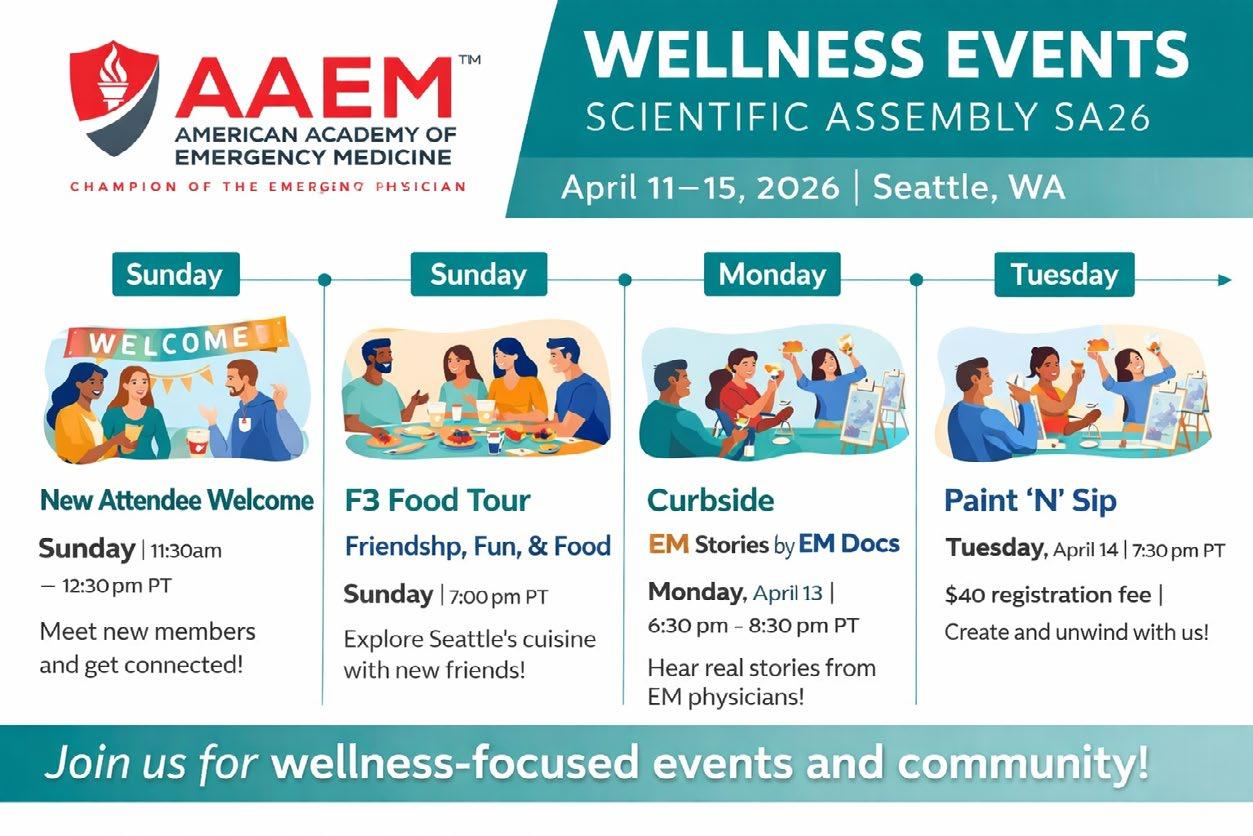
Not only does AAEM26 offer enriching education, it is also a motivational retreat where you leave feeling a renewed passion for emergency medicine. Throughout the Assembly, stop by the Wellness Room (sponsored by Aistellor) for a sanctuary from the conference bustle. The AAEM Wellness Committee has also planned the following events to participate in: New Attendee Reception, Food, Fun, & Fellowship (F3) Food Tour, Curbside: EM Stories from EM Docs, and Paint’N’Sip. Some events require pre-registration.
Learn more about Wellness events at AAEM26 by clicking here.
Competitions
The spirit of competition is alive at AAEM26.
• AAEM Games - the ultimate platform for emergency medicine residency programs to showcase their mastery!
• EUS-AAEM Sono Sleuth Case Competition
• Open Mic Competition – Onsite sign-ups available!
• CCMS-AAEM Breviloquent Competition
Learn more about Competitions by clicking here.
Abstracts
Browse the poster displays or attend abstract presentations at AAEM26.
• Photo Competition – The Guided Top Poster Tour is back! Embark on a journey with an expert tour guide to hear presentations on the 24 top-rated case reports.
• AAEM and Journal of Emergency Medicine Resident and Student Research Abstracts
• AAEM/RSA & Western Journal of Emergency Medicine Population Health Research Abstracts
• AAEM Young Physicians Section (YPS) Research Abstracts
Learn more about Abstract Competitions at AAEM26 by clicking here.
Take time to celebrate and recharge at socials hosted by AAEM groups throughout AAEM26.
AAEM/RSA Track at AAEM26
April 14, 2026 | 8:00am – 5:25pm
The AAEM/RSA Track programming is selected by residents, for residents. The sessions are designed to equip emergency medicine residents with essential knowledge and skills as they transition from residency to the next phase of their careers. Through a series of expert-led presentations, participants will explore key topics that range from communication skills and professional development, to ED violence and medical malpractice litigation.
See all Resident and Student Highlights at AAEM26 by clicking here.
Network at Social Events
Join AAEM for networking and other fun activities throughout the Assembly. Kick off AAEM26 at our Opening Reception. Enjoy light hors d’oeurves and drinks while networking with colleagues and exhibitors. Spend time with the Women in EM Section at their Networking Lunch. Attend Curbside: EM Stories by EM Docs for an evening which promises to showcase the great range of human experience—to enlighten minds, expose vulnerabilities, and quietly suggest ways to overcome the challenges we all face each day.
Learn more about Networking Opportunities and Social Events by clicking here.
Collaborate and network with colleagues from around the world.
Visit the AAEM26 website for full educational details including the scientific program, hotel and travel information, and more! aaem.org/AAEM26
Keynote Speaker
Keynote Address: 4th Generation Emergency Medicine: Holding the Past, Leading the Present, Shaping the Future
Monday, April 13, 2026
9:10 AM – 9:55 AM
Arjun Venkatesh, MD MBA MHS
Plenary Speakers
Plenary I— Overcoming ATLS
Sunday, April 12, 2026
1:50 PM - 2:35 PM
Reuben J. Strayer, MD FRCP FAAEM FACEP
Plenary II—Recent Critical Care and Resuscitation Articles You’ve Got to Know!
Sunday, April 12, 2026
2:45 PM - 3:30 PM
Mike Winters, MD MBA FAAEM
Plenary V—Bridging the Maternity Desert: Emergency Management of High-Risk OB Cases
Tuesday, April 14, 2026
2:25 PM – 3:10 PM
Julie Vieth, MD FAAEM FACEP
Skyler Lentz, MD FAAEM
Plenary III—Pediatric Emergency Medicine: Cutting-edge Updates and Essential Insights
Monday, April 13, 2026
8:15 AM – 9:00 AM
Mimi Lu, MD FAAEM
Andrea Shields, MD MS FACOG
Plenary VI—Mastering Consultant Dialogues and Common Mistakes
Wednesday, April 15, 2026
8:50 AM - 9:35 AM
Brian Acunto, DO EJD FACOEP
Ilene Claudius, MD FAAEM
Plenary VII—The Bias is in the Code: How AI and Algorithms Shape Emergency Care – for Better or Worse
Wednesday, April 15, 2026
9:45 AM – 10:30 AM
Cortlyn Brown, MD FAAEM
Plenary IV—Cardiology Literature Update: A Quarter-Century of Classics
Tuesday, April 14, 2026
9:00 AM - 9:45 AM
Amal Mattu, MD FAAEM
Italo M. Brown, MD MPH FAAEM
Kristyn J. Smith, DO
AAEM26 Speakers
Michael K. Abraham, MD FAAEM
Brian Acunto, DO EJD FACOEP
Jason Adler, MD CEDC
Maureen Aiad, DO FAAEM
Leen Alblaihed, MD MBBS MHA FAAEM
Al’ai Alvarez, MD FAAEM
Chelsea Ausman, MD FAAEM RDMS
Amil Badoolah, DO FAAEM
Jerome Balbin, MD FAAEM
Kimberly T. Baldino, MD FAAEM
Kyle Barbour, MD FAAEM
Stacey Barnes, DO FAAEM
John Bedolla, MD FAAEM
Matthew S. Berniard, MD FAAEM FAWM RDMS
Adam Bloom, DO FAAEM
Laura J. Bontempo, MD MEd FAAEM
Matthew P. Borloz, MD FAAEM
Joseph J. Bove, DO FAAEM
William J. Brady, MD FAAEM
Cortlyn Brown, MD FAAEM
Italo M. Brown, MD MPH FAAEM
Katharine Burns, MD FAAEM
Christine J. Butts, MD FAAEM
Elisabeth Calhoun, MD MPH FAAEM
Michele Callahan, MD FAAEM
David J. Carlberg, MD FAAEM
Jessica Carlo, DO
Jennifer Carnell, MD FAAEM
Matthew Carvey, MD EMT-P
Wan-Tsu W. Chang, MD FAAEM
Yash Chavda, DO MBA FPD-AEMUS
Eileen Chu, MD FAAEM
Kene A. Chukwuanu, MD FAAEM
Ilene Claudius, MD FAAEM FAAP FACEP
Neil K. Dasgupta, MD FAAEM
Suchismita Datta, MD FAAEM
Esteban Davila
Joshua J. Davis, MD FAAEM
Whitney A. Deal, MD FAAEM
Christine DeSanno-Caridi, DO FAAEM
Pierre G. Detiege, MD FAAEM
Christopher I. Doty, MD MAAEM FAAEM
Devin P. Dromgoole, DO
Luke Duncan, MD FAAEM
Mel Ebeling
Molly K. Estes, MD FAAEM FACEP
Justine Fernandez
Kim M. Feldhaus
Emma Furlano, MD FAAEM
Sean P. Geary, MD FAAEM
Harman S. Gill, MD FAAEM
Alexander Giuliano, MD FAAEM
Alexandra June Gordon, MD FAAEM
David H. Gordon, MD FAAEM
Diane L. Gorgas, MD FAAEM
Matthew N. Graber, MD PhD FAAEM
Gretchen Gunn, MD
Joshua Guttman, MD FRCPC FAAEM
Mohamed Hagahmed, MD MPH FAAEM
Callum Hamilton, MD
Joshua Hamm
Arya Hawkins-Zafarnia, MD MA
Megan Healy, MD FAAEM
Steven M. Hochman, MD FAAEM
Beatrice Hoffmann, MD PhD FAAEM
Keahi Horowitz, MD
Allyson Hynes, MD FAAEM FACEP
Doris Ilic, DO
Ashika Jain, MD FAAEM FACEP RDMS
Matthew Johnson, MD FAAEM
Christine Jung, MD
Jennifer Kanapicki Comer, MD FAAEM
Neena Kashyap, MD FAAEM
Jeremy Kaswer, MD FAAEM
Ryan Kelly, MD
Joseph M. Kennedy, MD FAAEM FAACT
Patrick G. Kishi, MD FAAEM
Brianna Klucher, MD
Rebecca Kreston, MD FAAEM
Amy Kule, MD FAAEM
Robert P. Lam, MD FAAEM
Jennifer A. Lammers, DO FAAEM
Lauren E. Lamparter, MD
Maria M. Lawrynowicz, MD FAAEM
Kerri L. Layman, MD FAAEM
Cory H. Lee
Natalie Lemon, MD
Skyler A. Lentz, MD FAAEM
Kristin Lewis, MD FAAEM
Bruce M. Lo, MD MBA RDMS FAAEM
Spencer Lord, MD
Bobbi-Jo Lowie, MD FAAEM
Mimi Lu, MD FAAEM
Phillip D. Magidson, MD MPH FAAEM
Lucille Martin, MD
Amal Mattu, MD FAAEM
Lisa J. Maurer, MD FAAEM
Ilana Mayer-Hirshfeld, MD MPH FAAEM
Robert G. McHugh, DO FAAEM
Ashley M. McLenithan, DO
Rohit Menon, MD FAAEM
Parker Miller
Gabriella Miller, MD FAAEM
Allie Min, MD FAAEM
Laura Minor
Siamak Moayedi, MD FAAEM
Malia J. Moore, MD FAAEM
Jessica Moore, MD FAAEM FASAM
Jake Moore
Kendra Morrison, DO FAAEM
Landon Mueller, MD CAQ-SM FAAEM
Molly Mulflur, MD FAAEM
Melissa Myers, MD FAAEM
Babette Newman
Ava Omidvar, MD
Alexandra Ortego, MD FAAEM
Brian Parker, MD MS FAAEM
Kaitlin Parks, DO
Andrew Pellet, MD FAAEM
Jack C. Perkins, Jr., MD FAAEM
Andrew W. Phillips, MD MEd FAAEM
Valerie A. Pierre, MD FAAEM FACEP
Monika Pitzele, MD PhD FAAEM
Heather Posillico, DO FAAEM
Emelia Potter, DO
Marco Propersi, DO FAAEM
Katherine Raczek, MD FAAEM FACEP FAEMS
Mark Ramzy, DO FAAEM
Rebecca Raven, MD FAAEM
Zachary Repanshek, MD FAAEM
Mark Riddle, DO FAAEM
Lauren S. Rosenblatt, MD FAAEM
Shana EN Ross, DO MHPE MS
Dylan Rupska, MD FAAEM
Evelyn Schraft, MD FAAEM
Kraftin E. Schreyer, MD MBA FAAEM
Olivia Serigano, MD FAAEM
Andrew W. Shannon, MD MPH FAAEM
Joseph R. Shiber, MD FACP FCCM FNCS
Andrea Shields, MD MS FACOG
Ninad Shroff, MD FAAEM
Tiffany W. Sigal, MD FAAEM
Kristyn J. Smith, DO
Ryan Spangler, MD FAAEM
Sophia Spann, DO
Laura D. Sprunt, MD
Kayla Stammer, MD
Eric M. Steinberg, DO MEHP FAAEM
Kathleen M. Stephanos, MD FAAEM
Reuben J. Strayer, MD FRCP FAAEM FACEP
Sawali Sudarshan, MD FAAEM
Shivani Talwar
Christopher M. Tanner, MD FAAEM
Anthony V. Thomas
Virginia Thomas
Joseph R. Twanmoh, MD MBA FAAEM
Jordan Vaughn, MD FAAEM
Arjun K. Venkatesh, MD MBA
Julie Vieth, MD FAAEM FACEP
Katherine Vlasica, DO FAAEM
Maura Walsh, MD FAAEM
Elias E. Wan, MD FAAEM
Lulu Wang, MD FAAEM
Jennifer Y. Wang, MD
Dillon J. Warr, MD FAAEM
TaReva Warrick-Stone, DO FAAEM
Benjamin White, MD FAAEM
Anne Whitehead, MD FAAEM
Joanne Williams, MD MAAEM FAAEM
George C. Willis, MD FAAEM
Rachel Wiltjer, DO FAAEM
Michael E. Winters, MD MBA FAAEM
Christopher R. Woodard, MB BCh BAO
Gregory P. Wu, MD FAAEM
Katy Wyszynski, DO
Samantha Yarmis, MD FAAEM
Nicole Yuzuk, DO FAAEM
Bassam Zahid, MD FAAEM
Mitchell Zekhtser, DO FAAEM
Eli Zeserson, MD FAAEM
Mohammad M. Zulfiqar
Jaryd K. Zummer, MD FAAEM
Leslie S. Zun, MD MBA MAAEM FAAEM
Thanks to our 2026 Industry Partners
AAEM extends its thanks and appreciation to the following industry partners who have funded activities at the 2026 AAEM Scientific Assembly.
GOLD SPONSOR
$20,000-$49,999 SUPPORT LEVEL
Abbott
SILVER SPONSOR
$5,000-$19,000 SUPPORT LEVEL
LogixHealth
Army Medicine
BRONZE SPONSOR
Up to $4,999 SUPPORT LEVEL
Aistellor
Click here to view the up-todate sponsor and exhibitor list.
AAEM26 Exhibitors – Thank You
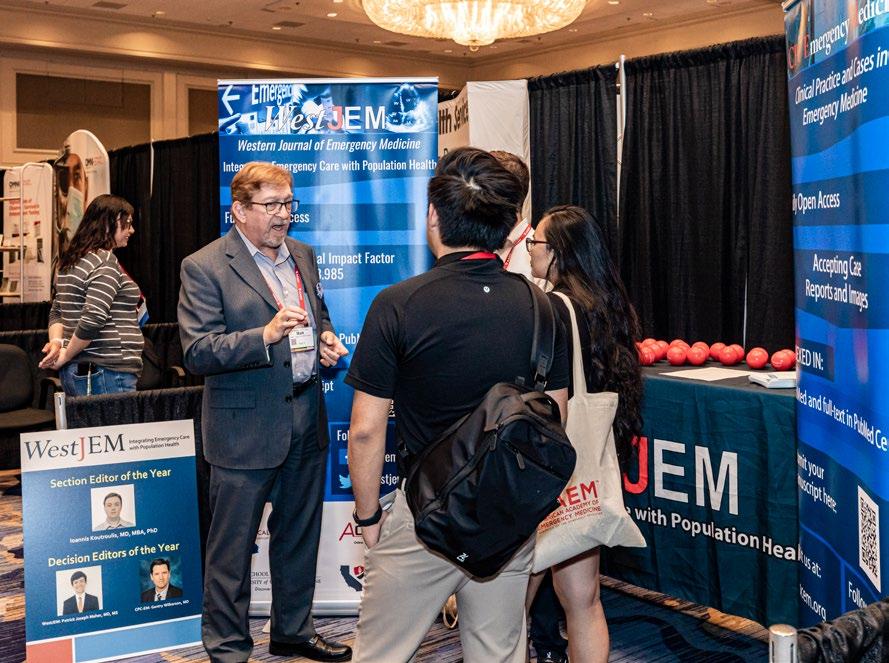
Plan your visit to the exhibit hall in Seattle to network with these exhibitors:
AAEM-PG
Abbott
Aistellor, LLC
American Board of Emergency Medicine (ABEM)
Arbutus Medical
ARMY Medicine
ARS Pharmaceuticals Operations, Inc.
B. Braun Medical Inc.
Brault
BRC
CIVCO Medical Solutions
CombineHealth
Conway Medical Center
Diasorin
DocAssistant
EchoNous, Inc
Emergency Care Partners
EMPros
Emrecruits
GE Healthcare
ICARE USA
Inflammatix
International Medical Relief
Kaiser Permanente/The Permanente Medical Group
Locums United, Inc.
LogixHealth
Medical Expo Supplies
Medlytix
Money Script Wealth Management PLLC
National Association of EMS Physicians
Northern Health Authority
Northwest Seminars, Inc.
NZDr
Pacific Redwood Medical Group
PEPID, LLC
Physician Wealth Advisors
POCUS CERTIFICATION ACADEMY
Praxi Physician Management, LLC
Purdue Pharma LP
QMACS, Inc
QuidelOrtho
R1
Resolv Healthcare
Sayvant
Southern Colorado Emergency Medical Associates
Syncra
The Whole Physician
Urgo Medical North America
Vituity
WestJEM
Zotec Partners
Sponsorship opportunities and exhibitor spaces are still available! Click here to learn more.
Wellness Committee’s Know Before You Go: Can’t Miss Events for AAEM SA26 in Seattle, WA
Jennifer Kanapicki Comer, MD *, Neha Bhatnagar, MD † , and Sawali Sudarshan, MD ‡
The Wellness Committee is excited to share our lineup of wellness-focused events at the upcoming AAEM Scientific Assembly, taking place April 11-15, 2026, in Seattle, Washington. Whether you are attending AAEM for the first time or you are a longtime member, these events are designed to help you connect, recharge, and enjoy meaningful moments together while prioritizing wellness.
New Attendee Welcome Sunday | 11:30am-12:30pm
We will kick things off on Sunday with our New Attendee Welcome. This free event is a great opportunity to meet fellow newcomers, AAEM leaders, and members from our committees and sections. It is the perfect way to find your people, ask questions, and start the conference feeling connected and supported.
F3 Food Tour: Friendship, Fun, and Food Sunday | 7:00pm
Join us Sunday evening for one of our signature connection events, reimagined this year as an F3 Food Tour. This guided experience will highlight some of Seattle’s local culinary favorites while fostering meaningful conversation with fellow attendees. This food tour will require individual registration, and we are exploring group options with local food tour vendors. Registrants will receive details ahead of time to help
with timing and transportation. It is a relaxed and fun way to explore the city and build community right from the start.
Curbside: EM Stories by EM Docs
Monday, April 13 | 6:30-8:30pm
Our most popular event returns Monday evening. Join us for a free night filled with laughter, reflection, camaraderie, and commiseration as emergency physicians share real stories from real lives in emergency medicine. There are no slides, no projectors, and no CME. Just authentic storytelling and genuine connection. Bring a friend, grab a drink if you would like, and settle in for an evening that consistently leaves a lasting impression.
Paint ’N’ Sip
Tuesday, April 14 | 5:30-7:30pm
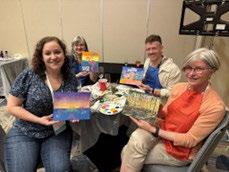
Unwind with us at our always popular Paint ’N’ Sip event. Enjoy painting, drawing, music, and self-expression alongside great conversation and good drinks. No prior art experience is needed. The $40 registration fee covers all art supplies and includes a drink ticket.
We are proud to sponsor these events and truly look forward to connecting with you in Seattle.
References
* Chair AAEM Wellness Committee; Associate Professor, Stanford Department of Emergency Medicine
† Past-President AAEM Wellness Committee; Guthrie Medical Group, Corning, NY
‡ Vice-Chair AAEM Wellness Committee; Assistant Professor, The George Washington University
Report from the Interim Meeting of the AMA House of Delegates: November, 2025
Gary M. Gaddis, MD PhD FIFEM MAAEM
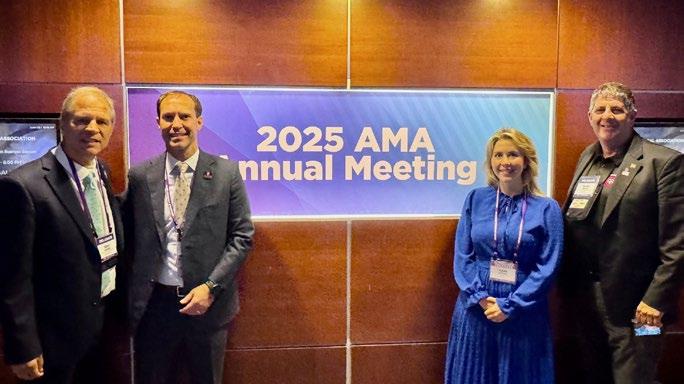
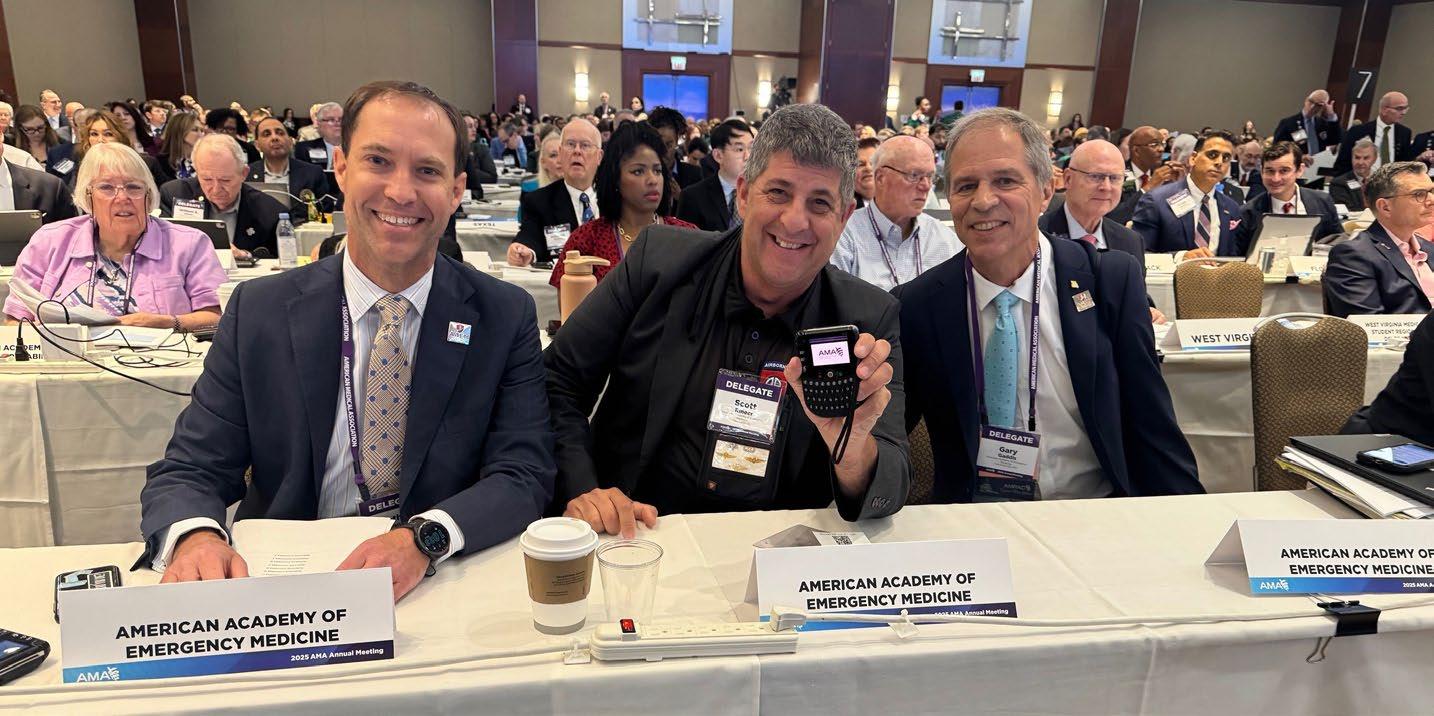
The American Medical Association (AMA) 2025 Interim Meeting of its House of Delegates (HOD) convened at National Harbor, Maryland, November 14-18, 2025. You may recall that AAEM has held three AMA delegate seats since the June Annual Meeting. Delegates Jonathan Jones, MD FAAEM, Robert McNamara, MD MAAEM FAAEM, and Gary Gaddis MD PhD MAAEM FAAEM FIFEM, and Alternate Delegates Debbie Fletcher, MD FAAEM, Scott Rineer, MD MPH FAAEM, and Leah Colucci, MD MS, represented AAEM, from among the nearly 700 credentialed delegates in attendance. Indispensable support and guidance was added by Florida Delegate and AAEM President-Elect Vicki Norton, MD FAAEM, who led our delegation’s planning for its testimony at the various AMA reference committees, and then at the full HOD.
This extremely truncated report (compared to the length of the full agenda of the meeting) conveys selected highlights likely to be of interest to our membership. A general overview of processes of the HOD are outlined in a separate article, for anyone interested in those details.1
Our delegation began its participation in the pre-meeting online testimony regarding the matters to be considered by the HOD, after we met virtually to consider our collective priorities
and positions. We met virtually again before gathering in person, to consider our views of the reference committees’ positions on the reports and resolutions.
Delegates and alternate delegates affiliated with AAEM then convened as part of the Emergency Medicine Section Council, at which those with an ACEP affiliation are more numerous. Our participation in section council gave us the opportunity to attempt to impact the testimony from the AMA’s emergency medicine community. Council and individual views were then carried forward to the on-site meetings of the various reference committees,
and to floor debates at the HOD, with in person testimony, to augment the online testimony provided before we convened together. As one might expect, AAEM and ACEP members of the Emergency Medicine Section Council often agreed, but occasionally disagreed, regarding the matters at hand. However, when disagreements arose, discussion generally proceeded in a respectful fashion.
The opening of the HOD for consideration of reference committee recommendations was preceded by a special address by Dr. Mehmet Oz, who leads the Centers for Medicare and Medicaid Services (CMS). He discussed the priorities he and his team have set to address many of the problems with Medicare and Medicaid, and in the health system in general.2 That address has been covered elsewhere.
Next, the HOD turned to consideration of the various council reports and resolutions, as recommended by each of the reference committees. Several of the issues considered at Interim 2025 are probably of interest to AAEM members.
One is unionization of physicians. The Ethics and Bylaws Reference Committee considered “CEJA Report 2,” regarding “Supporting Efforts to Strengthen Medical Staffs Through Collective
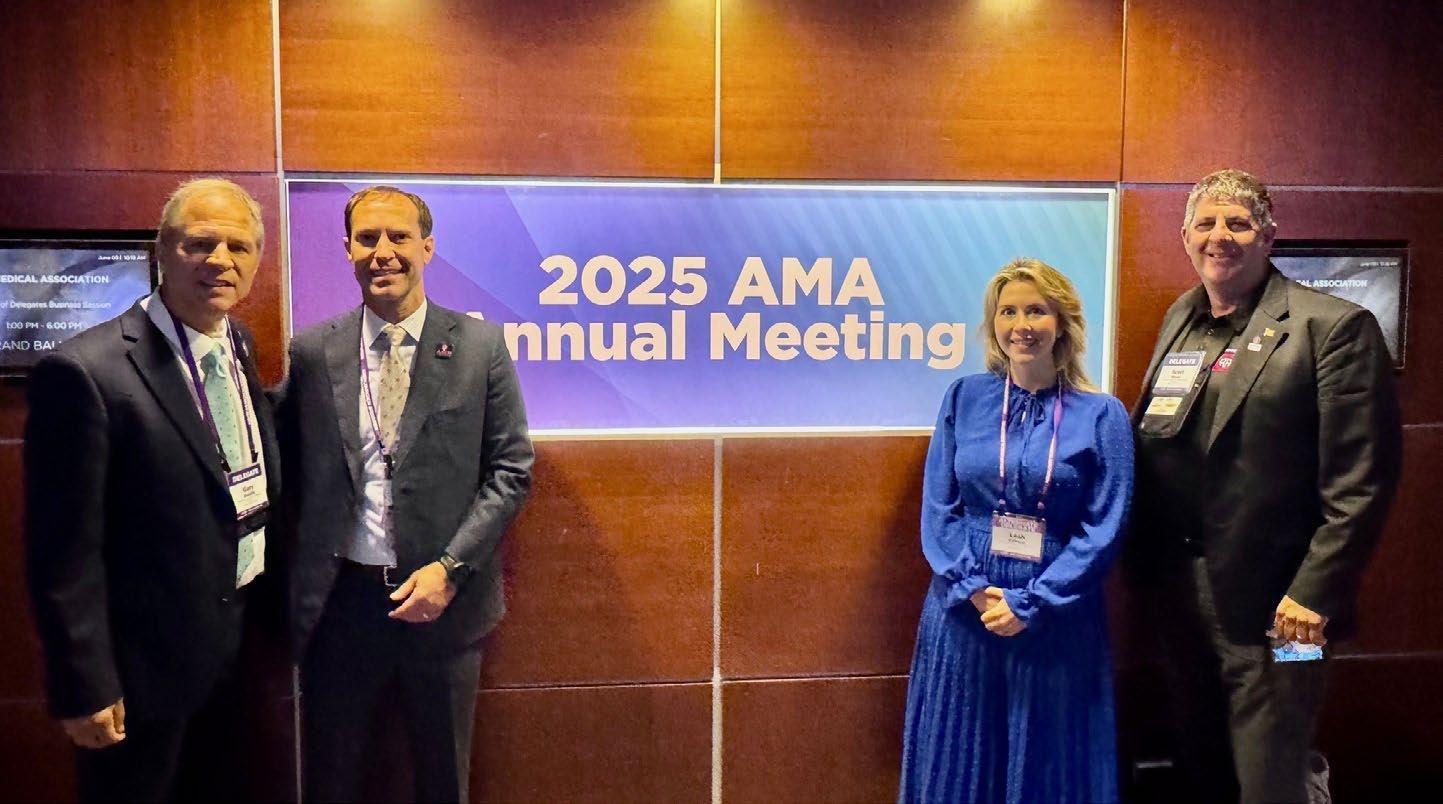
AAEM’s AMA Delegates (l-r): Gary Gaddis, MD PhD MAAEM FAAEM FIFEM, Jonathan Jones, MD FAAEM, Leah Colucci, MD MS, and Scott Rineer, MD MPH FAAEM
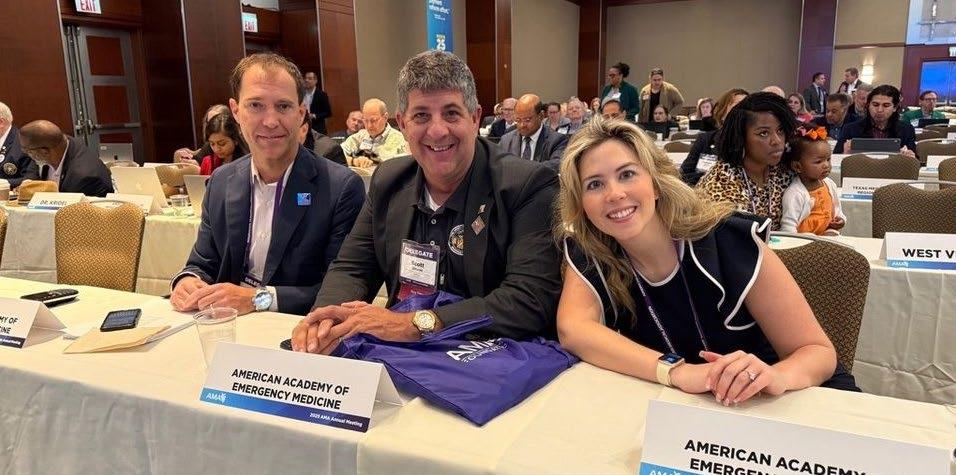
AAEM’s AMA Delegates (l-r): Jonathan Jones, MD FAAEM, Scott Rineer, MD MPH FAAEM, and Leah Colucci, MD MS
Your AAEM delegates and alternate delegates are happy to have had the opportunity for service and look forward to the Annual Meeting of the AMA House of Delegates this coming June.”
Actions and/or Unionization.” The AMA has been attempting in various lanes to support physicians when they believe they need to act collectively, when advocating for physicians or the patients whom they serve. During HOD debate, there were deep disagreements on the wording but not the intent of this specific resolution. Eventually, the resolution was referred back to the Council on Ethical and Judicial Affairs (CEJA) or further study and revision. This issue will be reconsidered at the HOD at Annual 2026. The wishes of our delegation were not met by the conclusion reached; we believed the resolution was appropriate for adoption, as written. However, the mere fact that the AMA is favorable toward unionization of physicians and the appropriateness of collective bargaining and collective actions shows that the AMA of today is not the AMA you may remember from prior decades.
Resolution 225 supported “Federal Legislation to Prohibit the Corporate Practice of Medicine (CPOM).” Of course, this is a core issue to AAEM. The resolution had two resolved clauses. One was not controversial. It asked that
the AMA advocate for legislation to prohibit CPOM, and to preclude entities participating in CPOM from participation in federal healthcare payment programs. Controversy ensued regarding whether a new federal statute might be efficacious, or whether such a statute would or would not preempt more stringent state prohibitions. (Currently, only 33 states prohibit CPOM, and our group strongly advocated for a federal statute on the matter to help remediate this gap.) The vote of the HOD reflected a fear that a well-intentioned federal statute might preempt better state regulations. By voting to refer this matter for further study, this matter will again be before the HOD at Annual 2026. We believe that the fears of the HOD were not well-grounded. We will offer our suggestions again when the HOD reconvenes.
Resolution 226, spearheaded by Dr. Debbie Fletcher and formally proposed by AAEM, will also interest many AAEM members. It would advocate AMA support for laws or regulations to require that if a facility does not have the presence of an on-duty physician, that facility should not be allowed to call itself an
“emergency department” or “emergency room.” A facility without a doctor on duty could remain open, but not with a misleading name that includes the word “emergency.” We believe most citizens would expect the word “emergency” to affirm the presence of an actual physician onsite. The reference committee recommended adoption of this resolution after in person testimony. However, this resolution was extracted from the consent agenda for HOD floor debate. Then, delegates raised various concerns, which our fact-finding leads us to believe are unfounded, regarding alleged unintended consequences of this resolution. Some in the HOD feared that without being called an “emergency department” or “emergency room,” a facility would not be entitled to bill as if it were functioning as emergency department. If that were true, such would harm the financial viability of rural hospitals. However, our reading of the regulations concludes that any facility that complies with the EMTALA law, is open 24 hours every day, and does not require an appointment can bill using emergency department facility codes. The HOD voted to refer this matter for further consideration. Our delegation will have the chance to again advocate for more transparent and truthful nomenclature of non-physician-staffed stabilization facilities at Annual 2026. We have been invited to provide fact-finding to the council to which this resolution has been referred. We strongly believe the HOD got it wrong as regards Resolution 226, and we will try to help the HOD get it right.
AAEM members will agree with the adopted Resolution 810, “Opposing Unilateral Downcoding of Physician Services by Insurance Companies.” Here’s why: Many practices have had ongoing exasperations with insurers’ unilateral downcoding of our billed services, by processes that are cryptic, arcane, or otherwise
AAEM’s AMA Delegates (l-r): Jonathan Jones, MD FAAEM, Scott Rineer, MD MPH, and Gary Gaddis, MD PhD MAAEM FAAEM FIFEM
A Cautionary Perspective on the Narrowand Wide-Complex Rhythm Approach in Cardiac Arrest Management
Oluwafemi P. Owodunni, MD MPH * and David H. Gordon, MD †
Cardiac arrest is a major public health concern, with global emergency medical service interventions ranging from 30 to 100 per 100,000 persons annually.1 Approximately 700,000 cardiac arrest occurs in the U.S. each year.2 Despite advances in resuscitation guidelines and widespread basic life support training, mortality rates remain substantially high. Outof-hospital arrest (OHCA) more often present in shockable ventricular tachycardia (VT) and ventricular fibrillation (VF), whereas in-hospital arrests skew toward non-shockable pulseless electrical activity (PEA) and asystole. Survival to hospital discharge is seen in approximately 35% of in-hospital cardiac arrest cases, while the prognosis for OHCA remains notably poor, with only 14.6% of patients surviving to discharge.3–5 These data highlight a disparity in overall survival outcomes, and opportunities to translate research into practice.
With the adoption of preventative health policies and treatment algorithms to maximize
survival and neurological outcomes, mortality rates from VF and VT have markedly declined. However, PEA and asystole have become more prevalent.2,6–9 Unlike the rhythm-focused management for VF and VT, PEA and asystole require intervention targeting the underlying etiology.2,6–9 The management of PEA has struggled to evolve beyond the traditional “Hs and Ts” approach. Some clinicians, however, favor the use of narrow- and wide-complex rhythm analysis on telemetry or electrocardiogram.6 This approach, offers specific treatment recommendations based on initial QRS morphology may appear advantageous, particularly due to the reduced cognitive load, however, the reliance on schema in this context may mislead the clinician regarding the etiology and therefore management of cardiac arrest.6
The broad, one-size-fits-all strategy inherent in the rhythm analysis approach fails to account for patient-specific factors that demand a more individualized management plan, which may be contributing to ongoing disparities in outcomes. Furthermore, the rhythm analysis approach lacks validation for its effectiveness in resuscitation outcomes.6 For instance, based on the rhythm analysis approach narrow-complex PEA typically suggests a mechanical
etiology. Nonetheless in real-world settings wide-complex PEA may also indicate mechanical etiologies, such as in patients with pre-existing bundle branch blocks (BBB), acute myocardial infarction causing new left BBB, or massive pulmonary embolism leading to right heart strain and BBB.6 In the context of medication administration, the rhythm analysis approach recommends calcium administration in wide-complex PEA with hyperkalemia.6 Although, calcium has historically been included in resuscitation efforts,2,7 emerging evidence suggests that a more selective approach to calcium administration may be both necessary and prudent, as routine administration may be potentially harmful.2,10–14
Calcium has long been believed to stabilize the cardiac membrane by restoring its resting membrane potential.15 However, Piktel and colleagues suggest that calcium’s primary role is in reestablishing conduction through calcium-dependent propagation, rather than directly stabilizing the cardiac membrane.16 Furthermore, Wang and colleagues expand on the utility of calcium in cases of severe hyperkalemia during resuscitation, emphasizing that while calcium may initially seem beneficial, its efficacy declines once certain physiological
As our understanding of cardiac arrest deepens, it is important that our practice and institutional protocols match available guidelines, ensuring that resuscitation practices are guided by the most up-to-date scientific evidence.”
thresholds are exceeded compared to non-cardiac arrest patients.17 While earlier guidelines support calcium use in undifferentiated cardiac arrest, particularly when hyperkalemia, hypocalcemia, or calcium channel blocker overdose is suspected,7 an earlier systematic review found little evidence to support its routine administration, citing the lack of robust clinical trials and the tendency to reserve calcium as a last-resort intervention in refractory cases.18
The most recent data have further challenged the routine use of calcium. The COCA trial, a randomized, double-blind, placebo-controlled study, specifically evaluated the impact of intravenous or intraosseous calcium administration on return of spontaneous circulation (ROSC) in 391 adults with OHCA. The trial demonstrated no significant difference in outcomes between the calcium and placebo groups, with the calcium-treated patients
References
* Department of Emergency Medicine, University of New Mexico Hospital, Albuquerque, NM
† Department of Critical Care Medicine, MedStar Washington Hospital Center, Washington, DC
1. Perkins GD, Neumar R, Hsu CH, et al. Improving Outcomes After Post–Cardiac Arrest Brain Injury: A Scientific Statement From the International Liaison Committee on Resuscitation. Circulation 2024;150(7):e158-e180. doi:10.1161/ CIR.0000000000001219
2. Perman SM, Elmer J, Maciel CB, et al. 2023 American Heart Association Focused Update on Adult Advanced Cardiovascular Life Support: An Update to the American Heart Association Guidelines for Cardiopulmonary Resuscitation and Emergency Cardiovascular Care. Circulation. 2024;149(5):e254-e273. doi:10.1161/CIR.0000000000001194
3. Andersson A, Arctaedius I, Cronberg T, et al. In-hospital versus out-of-hospital cardiac arrest: Characteristics and outcomes in patients admitted to intensive care after return of spontaneous circulation. Resuscitation. 2022;176:1-8. doi:10.1016/j. resuscitation.2022.04.023
4. Tsao CW, Aday AW, Almarzooq ZI, et al. Heart Disease and Stroke Statistics—2023 Update: A Report From the American Heart Association. Circulation. 2023;147(8):e93-e621. doi:10.1161/ CIR.0000000000001123
achieving a ROSC rate of 19%, compared to 27% in the placebo-treated group.11 Longterm outcomes reinforced these findings, with only 3.6% of patients in the calcium-treated group surviving with favorable neurological function at one year, compared to 8.6% in the placebo-treated group.13 In a pre-specified sub-study of the COCA trial focusing on 104 patients with PEA, the trend persisted, even in those with rhythm characteristics of hyperkalemia. The calcium-treated group exhibited a ROSC rate of 20%, compared to 39% in the placebo-treated group.12
The growing evidence advocating for a more judicious use of calcium during resuscitation is compelling, with opportunities for more nuanced investigations.2,10,19–21 This evolving practice, now reflected in the updated American Heart Association guidelines,
5. Schluep M, Hoeks SE, Blans M, et al. Long-term survival and health-related quality of life after in-hospital cardiac arrest. Resuscitation. 2021;167:297-306. doi:10.1016/j.resuscitation.2021.07.006
6. Littmann L, Bustin DJ, Haley MW. A Simplified and Structured Teaching Tool for the Evaluation and Management of Pulseless Electrical Activity. Med Princ Pract. 2013;23(1):1-6. doi:10.1159/000354195
7. Panchal AR, Bartos JA, Cabañas JG, et al. Part 3: Adult Basic and Advanced Life Support: 2020 American Heart Association Guidelines for Cardiopulmonary Resuscitation and Emergency Cardiovascular Care. Circulation 2020;142(16_suppl_2):S366-S468. doi:10.1161/CIR.0000000000000916
8. Abrams HC, McNally B, Ong M, Moyer PH, Dyer KS. A composite model of survival from out-of-hospital cardiac arrest using the Cardiac Arrest Registry to Enhance Survival (CARES). Resuscitation 2013;84(8):1093-1098. doi:10.1016/j. resuscitation.2013.03.030
9. Hernandez C, Shuler K, Hannan H, Sonyika C, Likourezos A, Marshall J. C.A.U.S.E.: Cardiac arrest ultra-sound exam—A better approach to managing patients in primary non-arrhythmogenic cardiac arrest. Resuscitation. 2008;76(2):198-206. doi:10.1016/j.resuscitation.2007.06.033
presents an opportunity for a deeper understanding of the heterogeneity of cardiac arrest etiologies.10 It encourages a shift away from reliance solely on the rhythm approach, advocating instead for more nuanced and individualized decision-making.6 We further emphasize the value of incorporating ultrasound (used by skilled operators to prevent delays) early on in resuscitation efforts, as it offers the potential for timely identification of the underlying etiologies of cardiac arrest, thereby streamlining the processes involved in “running a code,” and enabling targeted interventions.9 As our understanding of cardiac arrest deepens, it is important that our practice and institutional protocols match available guidelines, ensuring that resuscitation practices are guided by the most up-to-date scientific evidence.
10. Wigginton JG, Agarwal S, Bartos JA, et al. Part 9: Adult Advanced Life Support: 2025 American Heart Association Guidelines for Cardiopulmonary Resuscitation and Emergency Cardiovascular Care. Circulation. 2025;152(16_suppl_2):S538-S577. doi:10.1161/CIR.0000000000001376
11. Vallentin MF, Granfeldt A, Meilandt C, et al. Effect of Intravenous or Intraosseous Calcium vs Saline on Return of Spontaneous Circulation in Adults With Out-of-Hospital Cardiac Arrest: A Randomized Clinical Trial. JAMA. 2021;326(22):2268-2276. doi:10.1001/ jama.2021.20929
12. Vallentin MF, Povlsen AL, Granfeldt A, Terkelsen CJ, Andersen LW. Effect of calcium in patients with pulseless electrical activity and electrocardiographic characteristics potentially associated with hyperkalemia and ischemiasub-study of the Calcium for Out-of-hospital Cardiac Arrest (COCA) trial. Resuscitation 2022;181:150-157. doi:10.1016/j. resuscitation.2022.11.006
13. Vallentin MF, Granfeldt A, Meilandt C, et al. Effect of calcium vs. placebo on long-term outcomes in patients with out-of-hospital cardiac arrest. Resuscitation. 2022;179:21-24. doi:10.1016/j.resuscitation.2022.07.034
14. Stueven HA, Thompson B, Aprahamian C, Tonsfeldt DJ, Kastenson EH. The effectiveness of calcium chloride in refractory electromechanical dissociation. Ann Emerg
Using Point-of-Care Ultrasound to Guide Management in Undifferentiated Shock Patients
Nina Angeles, MD, Andrew G Theophanous (MD candidate), Denise Elizondo, MD, and Rebecca Theophanous, MD MHSc
Hypotension is often defined as a systolic blood pressure less than 90mmHg while shock is described as severely poor tissue perfusion leading to end organ damage with a risk of progressing to multiorgan failure and death.1 Patients who present to the emergency department (ED) with hypotension or shock require rapid diagnosis and treatment to prevent worsening of their condition.2-4 Patients in acute shock have high morbidity, with prehospital patients arriving in shock having a 33-52% in-hospital mortality rate per a recent systematic review.5 ED prevalence of hypotension was 4-13/1000 patients with a 12% mortality rate.5 The types of shock are defined as hypovolemic (e.g. from hemorrhage or dehydration), distributive (sepsis or anaphylaxis), cardiogenic (acute heart failure), and obstructive shock (e.g. acute pulmonary embolism, cardiac tamponade).2-3
Point-of-care ultrasound (POCUS) is a non-invasive bedside tool that can help guide early diagnosis and resuscitation in undifferentiated patients.2-4 The Rapid Ultrasound in Shock (RUSH) protocol is a standardized protocol that was created to guide POCUS users in systematically assessing for causes of hypotension in ED or hospitalized patients.2-4 A
systematic review by Keikha, et al, demonstrated that the RUSH protocol had a high pooled sensitivity (0.87, 95% Confidence Interval (CI): 0.800.92, I2 = 46.7%) and specificity (0.98, 95% CI: 0.96-0.99, I2 = 30.8%).4
The exam is broken down into three sections: the “pump,” the “tank,” and the “pipes,” each assessing for lethal yet reversible causes of hypotension.4 Each section has overlapping components to help confirm or exclude a diagnosis (Figure 1).
The “pump” refers to the evaluation of cardiac function through four standard views: parasternal long axis (PLAX), parasternal short axis (PSAX), apical four chamber (A4C), and subxiphoid (Figure 2). POCUS users should evaluate for cardiac tamponade physiology (e.g. pericardial effusion with right atrial early systolic collapse and right ventricular diastolic collapse); evidence of right heart strain (dilated right atrium/ventricle, TAPSE <17mm, D-sign is present on PSAX, or McConnell’s sign characterized by right ventricular immobility with hyperkinesis of the apical tip on A4C); and reduced ejection fraction (EPSS >7mm).3 Additional views, such as the inferior vena cava (IVC), should be used in cases of suspected tamponade for verification.3
Diagnostic flow diagram of point-of-care ultrasound evaluation of the tank
Diagnostic flow diagram of point-of-care ultrasound evaluation of the pump
Diagnostic flow diagram of point-of-care ultrasound evaluation of the pipes
The “tank” refers to the intravascular volume of the patient (Figure 2). This portion evaluates evidence for both a vascularly depleted and fluid overloaded state. Some causes of volume depletion include dehydration from reduced input (poor oral intake) or increased output (vomiting, diarrhea, hemorrhage, etc). Fluid overloaded states are often due to new/ worsening cardiac, hepatic, or renal failure, and complications of those failures. POCUS can be used to assess the tank through measurement of the IVC. Studies show that a dilated IVC >2cm with <50% respiratory variation is suggestive of a volume overload state, whereas a normal IVC is <2cm with >50% respiratory variation.2,3 The diameter should be measured about 2cm distal to the hepatic vein confluence away from the cavo-atrial junction. IVC assessment is not reliable in patients with positive pressure ventilation, right heart elevated pressures, pulmonary hypertension, tricuspid regurgitation, or increased abdominal pressure.2,6
POCUS can identify causes of hemorrhagic shock including from a ruptured abdominal aorta, blunt or penetrating trauma causing intra-abdominal or thoracic injuries, and a ruptured ectopic pregnancy. These are evaluated by searching for free fluid in the right upper quadrant (RUQ) view (scanning through Morrison’s pouch), the left upper quadrant (LUQ) view (scanning through the splenorenal interface), and the suprapubic view. The lungs are viewed at the highest point on the chest anteriorly and laterally to evaluate for absence of lung sliding, lung points, or effusions. M-mode can be used to further evaluate lung sliding by detecting lung movement plotted over a specific time point. These views are also used in the Extended Focused Assessment with Sonography in Trauma (E-FAST) protocol.
Table 1: Types of shock and RUSH protocol point-of-care ultrasound diagnostic findings
Tank Free fluid within the abdomen (blunt trauma, penetrating trauma, ruptured ectopic pregnancy, ruptured aortic aneurysm)
Collapsible IVC (poor PO intake, excessive losses, diarrhea, vomiting, etc)
Pipes Aorta diameter >3cm (Aortic aneurysm)
Flap visible within aorta (aortic dissection)
IVC <2cm with >50% respiratory variation (sepsis)
Dilated cardiac chambers with poor contractility (heart failure)
Dilated IVC with minimal respiratory variation (volume overload state)
Dilated right sided chambers compared to left, McConnell’s sign, TAPSE <17 mm (PE)
Effusion with paradoxical filling (tamponade)
Lack of lung sliding (tension pneumothorax)
N/A
N/A
Noncompressible leg veins (DVT/PE)
The “pipes” allude to intravascular catastrophes in the arterial or venous system (Figure 3). POCUS can expedite diagnosis in cases of a ruptured aortic aneurysm or aortic dissection, which can cause abrupt hypotension, are time dependent, and have high mortality rates. The user should visualize the abdominal aorta anterior to the vertebral body from the most proximal portion (near the celiac trunk) to the aortic bifurcation into the iliac vessels both in transverse and long views, looking for any discontinuity or unusual outpouchings. Measurements from outer wall to outer wall should be done periodically, with a measurement >3cm defined as aneurysmal, which requires vascular surgery referral, or size >5cm requiring immediate vascular surgery consultation and possible acute intervention. Additional views such as PLAX and the suprasternal notch view can further assess the aortic root and aortic arch, respectively, for a more complete assessment. Deep venous thrombosis (DVT) can cause obstruction of flow back to the heart and lungs, potentially leading to pulmonary infarcts and
References
1. Li Y, Chan CP, Sin K, et al. Validating a pragmatic definition of shock in adult patients presenting to the ED. The American Journal of Emergency Medicine. 2014;32(11):1345-1350. doi:https://doi.org/10.1016/j. ajem.2014.08.029
2. Nguyen C; Parfianowicz D; Bennett C. Point of care ultrasound and shock: The value in bedside diagnosis and hemodynamic assessment in undifferentiated shock patients. Journal of Translational Critical Care Medicine 6(3):e24-00010, September 2024. | DOI: 10.1097/ JTCCM-D-24-00010. https://journals.lww.com/jtccm/fulltext/2024/09000/ point_of_care_ultrasound_and_shock__the_value_in.5.aspx
3. Seif D, Perera P, Mailhot T, Riley D, Mandavia D. Bedside ultrasound in resuscitation and the rapid ultrasound in shock protocol. Crit Care Res Pract. 2012;2012:503254. doi:10.1155/2012/503254. https://pmc.ncbi. nlm.nih.gov/articles/PMC3485910/
15. Standards for Cardiopulmonary Resuscitation (CPR) and Emergency Cardiac Care (ECC). JAMA. 1974;227(7):833-868. doi:10.1001/ jama.227.7.833
16. Piktel JS, Wan X, Kouk S, Laurita KR, Wilson LD. Beneficial Effect of Calcium Treatment for Hyperkalemia Is Not Due to “Membrane Stabilization.” Crit Care Med.:10.1097/ CCM.0000000000006376. doi:10.1097/ CCM.0000000000006376
cardiac arrest. This exam is performed by compressing the lower extremity veins from the common femoral to the popliteal vein. Incompressibility is suggestive of a thrombus and may require anticoagulation plus more advanced imaging to assess for embolic events.
While beneficial in expediting care, POCUS has limitations of which clinicians should be aware. First, POCUS is user dependent. Image acquisition will vary between novices and experts, and even among experts interpretations can differ. Additionally, both the patient’s body habitus and ability to cooperate with the exam affects the image quality. Some areas like the retroperitoneal space or the thoracic aorta are not seen via POCUS and require more advanced imaging for a complete investigation. Thus, POCUS should be used as an adjunct to history, physical, labs, and other diagnostic imaging instead of in isolation. The RUSH protocol is a useful tool to expedite diagnosis, guide resuscitative efforts, and narrow the cause of hypotension.
4. Keikha M, Salehi-Marzijarani M, Soldoozi Nejat R, Sheikh Motahar Vahedi H, Mirrezaie SM. Diagnostic Accuracy of Rapid Ultrasound in Shock (RUSH) Exam; A Systematic Review and Meta-analysis. Bull Emerg Trauma. 2018;6(4):271-278. https://pmc.ncbi.nlm.nih.gov/articles/ PMC6215077/
5. Holler JG, Bech CN, Henriksen DP, et al. Nontraumatic Hypotension and Shock in the Emergency Department and the Prehospital setting, Prevalence, Etiology, and Mortality: A Systematic Review. PLoS One. 2015 Mar 19;10(3):e0119331. doi: 10.1371/journal.pone.0119331. https://pmc.ncbi.nlm.nih.gov/articles/PMC4366173/#:~:text=The%20 available%20studies%20suggest%20that,shock%20is%2033%2D52%25
6. Borroni VN, Antonini A, Cogliati CB, et al. A comprehensive review of venous excess ultrasound (VExUS) score: evidence from original research. Intern Emerg Med (2026). https://doi.org/10.1007/s11739-02504220-x
17. Wang CH, Huang CH, Chang WT, et al. The effects of calcium and sodium bicarbonate on severe hyperkalaemia during cardiopulmonary
resuscitation: A retrospective cohort study of adult in-hospital cardiac arrest. Resuscitation. 2016;98:105-111. doi:10.1016/j. resuscitation.2015.09.384
18. Kette F, Ghuman J, Parr M. Calcium administration during cardiac arrest: a systematic review. Eur J Emerg Med. 2013;20(2):72. doi:10.1097/ MEJ.0b013e328358e336
19. Crickmer M, Drennan IR, Turner L, Cheskes S. The association between end-tidal CO2 and return of spontaneous circulation after out-of-hospital cardiac arrest with pulseless electrical activity. Resuscitation. 2021;167:7681. doi:10.1016/j.resuscitation.2021.08.014
20. Wongtanasarasin W, Ungrungseesopon N, Namsongwong N, et al. Association between calcium administration and outcomes during adult cardiopulmonary resuscitation at the emergency department. Turk J Emerg Med. 2022;22(2):67. doi:10.4103/2452-2473.342805
21. Hsu CH, Couper K, Nix T, et al. Calcium during cardiac arrest: A systematic review. Resusc Plus. 2023;14:100379. doi:10.1016/j. resplu.2023.100379
Protecting our Patients and their Privacy
Michelle Romeo, MD FAAEM
Many people in the United States avoid the healthcare system. Whether it be for lack of health insurance, fear of diagnosis, mistrust of the medical system or recently, fear of putting themselves and their families at risk due to immigration status. These are problems affecting our communities and our ability to care for patients that we, as physicians, should be aware of and equipped to mitigate.
The ED has always had a pulse on the community. When our patients, our community and our country start to have basic needs and rights unmet, we encounter these issues in our work environment.”
With the second term of the current administration, anti-immigrant rhetoric and actions have drastically increased. Sensitive locations, where individuals used to be protected from search and seizure, such as the hospital, have fallen from safety. As we have all encountered in the news, Immigration Customs and Enforcement (ICE) agents have been aggressively mobilized throughout the country with tactics that have been debated as legal. It is important in this era to remember our ethical duties to our patients and the fundamental practice of privacy so we can continue to offer care in a setting that fosters and enables trust.
There are privacy checkpoints in place that are imperative we are aware of as physicians. At the highest level, there is the fourth amendment of the U.S. Constitution. Its basic tenet is to ensure that people are protected from unreasonable searches by the government and that the expectation is privacy, one where warrants should only be issued upon probable cause. Then there is the Health Insurance Portability and Accountability Act (HIPAA). The act, first established in 1996, protects our patients identifiable health information, including data as basic demographics to psychological and physical conditions to past and future treatment plans. Compliance with HIPAA is of utmost importance not only for our patient’s privacy and our code of ethics, but also for your hospital system at large, with violations leading to civil and criminal penalties.
The emergency department (ED) has frequent interactions with law enforcement agencies (LEAs) and many of us do not question their presence day to day. Their unique position in society leads to a belief that unfettered access is the norm but in reality they are visitors in the department. Hospital policies about interactions with these agencies should be clear and easily accessible so as to not undermine patient privacy. It is important to remind ourselves that there are many ED practices that casually expose protected health information (PHI), leaving paperwork
around, not signing out of computers, and not properly securing patient’s paperwork when leaving in custody to name a few. When LEAs are outside of rooms, or around common spaces, what they see or hear in plain view can be used in legal proceedings. A warrant would need to be shown to move anything within the department, access patient information, and legally search areas of the department. HIPPA prohibits disclosing PHI without a warrant or patient’s consent and as a physician you can refuse to provide information unless one of these conditions are met. If agents do arrive with a warrant, there are a few things to consider. Get your hospital system’s legal counsel involved early, whether they can come in person or join by phone, it is best to have expert assistance in these cases. The warrant should have a valid signature by a judge and should give specifics about the address or area requiring a search along with the appropriate time period it is to take place.
It is also imperative to provide a safe and secure environment for our patients if LEAs are around the department. Patient autonomy can be infringed upon when LEAs are in the room or patients perceive that we have a relationship with them. They may withhold important information or avoid certain parts of the physical exam if privacy is impacted. While many officers need a line of sight if they are accompanying a patient in custody, they should be out of ear shot of your interaction with your patient. Having them unshackled from the bed for a full physical exam is also within your scope to ask. Remember to reassure your patient that you are of service to them and no one else.
There are multiple sources online that provide education on interacting with LEAs in our departments and I implore you to be familiar with. This
Takeaways
• Ensure your hospital has a written policy for private vs public areas
• Know who and how to contact your hospital’s legal counsel, compliance officer or security department
• Always be aware of what is in public view
• Avoid collecting immigration status in the medical record
• Keep red ‘Know your Rights’ cards in waiting area (see references)
• Familiar with community law centers or clinics
• Support and reassure your patients
is an extremely brief primer to get your attention on what may be a situation we are to encounter or have already. The ED has always had a pulse on the community. When our patients, our community and our country
start to have basic needs and rights unmet, we encounter these issues in our work environment. We need to avoid potential liability, uphold our ethical responsibilities, ensure patient trust and promote them to seek care all while upholding our patient’s constitutional rights.
• https://www.law.georgetown.edu/health-justice-alliance/wp-content/ uploads/sites/16/2021/05/Police-in-the-ED-Medical-Provider-Toolkit. pdf
not in keeping with the contracts we have with insurers. The resolution mandates that AMA challenge such payer-initiated downcoding policies through regulatory, legislative, or when appropriate, legal channels. AMA now is committed to this set of physician-friendly actions.
Resolution 602 advocated for the creation of a nominating committee for AMA’s Boards and Councils, rather than by direct election by the HOD. This resolution was defeated, and your AAEM delegates noted in reference committee testimony that direct election of our leadership has served AAEM well in the 32 years since its founding. We also noted that the creation of a nominating committee would invite numerous conflict of interest issues that could be avoided by not having a nominating committee. The HOD reached a decision of do not adopt for this resolution.
The HOD also adopted “Board of Trustees Report 22,” regarding physician assistant and nurse practitioner movement between specialties. It is a concern that non-physician practitioners can move between specialties at will, without any specific training requirements. This is wholly different than the appropriate requirements for physicians’ training, to enable a career and specialty change. The adoption of this report will compel study of various impacts of this specialty switching, impacts that many of us believe harms patients’ care. We see the on the job training that is necessitated by such specialty switching as dangerous to patients and a form of apprenticeship that was abolished for medical training by the Flexner Report of 1910, which led to the establishment of the modern medical center with proper training of its trainees.
Many more matters were considered by the HOD, but they were of less direct relevance to our members than the matters described above.
Your AAEM delegates and alternate delegates are happy to have had the opportunity for service and look forward to the Annual Meeting of the AMA House of Delegates this coming June.
References
“Overview: Functioning of American Medical Association (AMA) House of Delegates” – Common Sense 31.2 March/April 2026, page ##
For those interested, a brief commentary is at: https://www.ama-assn.org/press-center/ ama-press-releases/ama-statement-cmsadministrator-oz-speech-house-delegates
More nuanced detail can be obtained at https://www.medpagetoday.com/ meetingcoverage/ama/118572
(Another) Five Must-Have Apps for Your Next ED Shift
Mel Ebeling, MD
In the almost two years since the publication of my article, “Five MustHave Apps for Your Next ED Shift,” in Common Sense, I have gradually collected even more tools that boost my efficiency and ease cognitive burden on shift. For residents developing their workflow and learning to manage volume, or for medical students learning the ropes and trying to shine on their emergency medicine rotations, one convenient resource can change the trajectory of a shift. So again, I present another five musthave, tried-and-true apps for your next ED shift! Reviews are unsponsored, and as always, you should ultimately rely on your clinical judgment and/or institutional protocols for all patient care decisions.
Pacemaker-ID
Cost: Free
It is 3:00am, your geriatric patient with palpitations needs their pacemaker interrogated, and, of course, they have no prior records in their chart. How would you proceed with finding out which brand pacemaker they have? Trial and error? Look no further! Pacemaker-ID changes the game. With this app, all you have to do is pull up the patient’s chest x-ray, snap a picture of the pacemaker or defibrillator, and it will tell you the brand of the device so you can interrogate it. Specifically, it identifies devices from the four most common brands—Boston Scientific, Biotronik, Medtronic, and St. Jude. If you are interested in reviewing how this app was developed, the developers’ research is published in the Journal of the American College of Cardiology (JACC).1
POCUS 101
Cost: Free* (*Additional paid courses available)
POCUS 101—your central hub for point-of-care ultrasound guidance on the go. Whether you are a medical student learning the four primary
ultrasound views of the heart or a seasoned emergency physician refreshing yourself on DVT ultrasound, POCUS 101 has you covered. With almost 20 free tutorials to choose from (with even more on their website), this app provides the most accessible, comprehensive tutorials for the highest yield POCUS exams performed in the emergency department, each one covering indications, patient and machine preparation, anatomy, the step-by-step imaging protocol, ultrasound findings, and pathology. If you are looking for an ultrasound resource that can serve as both a rapid review before walking into a patient room or as your all-in-one, offshift study guide, this is the resource you have been looking for.
AHA ACLS
Cost: $3.99/year
Are you a resident or student anxious about running your first code? Or maybe the stable patient you received at sign out is now flirting with a bradycardic arrest? Perhaps you are alone at night on an ICU rotation? Consider subscribing to the American Heart Association’s (AHA) ACLS app. Where this app truly shines is not in its provision of the ACLS algorithm for cardiac arrest, but that it allows you to keep time, track CPR cycles, and timestamp medication administrations and shocks delivered all on one screen. The app also provides immediate access to the ACLS algorithms for tachyarrhythmias, bradycardias, and post-cardiac arrest care, ensuring you have the evidence-based help you need during critical moments in a patient’s care.
ACEP Toxicology Section Antidote App
Cost: Free
It is like Poison Control in your pocket! With almost 50 antidotes for the most common toxicological emergencies, ACEP’s mobile antidote app is your one-stop shop for indications and contraindications to antidote therapy, adult and
pediatric dosing, and important considerations for administration. The last thing you want during a serotonin syndrome case is to be fumbling around trying to find the cyproheptadine dose. An app you hopefully won’t use often, this is the app you will be grateful you had downloaded in advance while managing your next toxic ingestion.
OpenEvidence
Cost: Free
If you have never used this app on shift, you are behind the eight ball. One of the most revolutionary tools developed since the advent of artificial intelligence (AI) to medicine, OpenEvidence has transformed how we as physicians consult research and guidelines to make clinical decisions. Its developers have partnered with numerous specialty organizations (including the American College of Emergency Physicians) in addition to some of the most trusted medical journals to ensure the most up-to-date, accurate information is utilized to form responses to your questions. Most people who use OpenEvidence know how to employ it to assist in answering clinical questions on shift. Other underrated applications include using OpenEvidence to write emergency department discharge instructions in easy-to-understand language, which can be implemented immediately or saved as a dot phrase within your electronic medical record. For medical students and interns, there is also a beta USMLE prep feature that allows you to generate practice questions to supplement your studying.
References
1. Weinreich M, Weinreich B, Chudow JJ, et al. Computer-aided detection and identification of implanted cardiac devices on chest radiography utilizing deep convolutional neural networks, a form of machine learning. Journal of the American College of Cardiology 2019;73(9):307. doi:https://doi.org/10.1016/ s0735-1097(19)30915-5
What the Wilderness Taught Me About Emergency Medicine
Tiffany Cagides, Medical Student
Before medical school, I took a road trip through North Carolina and spent time hiking in the Blue Ridge Mountains. There was no strict itinerary. Some days were planned, others unfolded as they came. Weather shifted, trails closed, and plans changed without much warning. I learned quickly that control was often an illusion, and flexibility mattered more than preparation alone.
One hike in particular stands out. The trail started clearly marked, but as elevation increased, visibility dropped. Clouds rolled in faster than expected, and the temperature shifted. Nothing about the moment felt dangerous, but it demanded attention. Progress slowed, and decisions became more deliberate. When to continue and when to turn back became a quiet, internal conversation rather than a checklist.
At the time, I did not think of these experiences as formative. They were simply days spent outside, moving forward without certainty about what was ahead. It was only later, during clinical training, that those moments began to feel familiar.
Emergency medicine lives in uncertainty. Patients rarely present with complete stories. Information arrives in fragments, and decisions are made in real time with incomplete data and competing priorities. Much like being outdoors, the environment is dynamic and unpredictable. The goal is not perfect control, but thoughtful navigation.
The wilderness teaches restraint. Not every challenge needs to be pushed through. Sometimes the most appropriate decision is to pause, reassess, or turn back. That lesson translates well to medicine, where doing less can be just as important as doing more. Learning when to intervene and when to observe requires judgment that cannot be taught solely through protocols.
Spending time outdoors also demands respect for limits, both personal and environmental. Fatigue becomes noticeable, and small missteps carry consequences. Preparation matters, but it does not guarantee outcomes. In clinical training, I have come to appreciate this same balance. Knowledge and preparation are essential, but humility is just as critical.
What struck me most was how comfortable discomfort became. Long hikes, changing weather, and unfamiliar terrain required a willingness to sit with unease without rushing to resolve it. That skill, staying present in uncertainty, has proven invaluable in clinical settings. Not every problem has an immediate answer, and not every outcome is within our control.
Emergency medicine often attracts people who are comfortable operating in imperfect conditions. There is a shared understanding that adaptability matters more than predictability. Looking back, it makes sense that the mindset I developed outdoors felt familiar once I entered the hospital environment. Both spaces require situational awareness, steady decision-making, and acceptance that uncertainty is not a failure, but a feature.
The mountains did not teach me how to be an emergency physician. They did not provide clinical skills or medical knowledge. What they offered was perspective, a way of thinking that values judgment over certainty and flexibility over rigid plans. Those lessons were subtle at the time, but they continue to shape how I approach learning, decision-making, and growth.
The wilderness teaches restraint. Not every challenge needs to be pushed through. Sometimes the most appropriate decision is to pause, reassess, or turn back. That lesson translates well to medicine, where doing less can be just as important as doing more.”
As I move forward in my training, I do not know exactly where emergency medicine will take me. I do know that the mindset I continue to return to was shaped long before I stepped into a hospital. It was shaped on quiet trails, in changing weather, and in moments where the path forward was not always clear, but moving thoughtfully mattered more than moving quickly.
Overview: Functioning of American Medical Association (AMA) House of Delegates
Gary M. Gaddis, MD PhD FIFEM MAAEM
As noted in an accompanying article, AAEM sent a delegation to the November Interim Meeting of the American Medical Association (AMA) House of Delegates (HOD). The Interim Meeting is always devoted chiefly to matters of “advocacy” on the part of the AMA.
In the July/August 2025 issue of Common Sense, the article “AAEM Joins the AMA House of Delegates (and Why it Matters)” reviewed why AAEM’s inclusion in the AMA HOD represents an important development. The AMA is the nation’s largest physician organization, and its “voice” is much larger than that of AAEM alone.
For those interested in how the AMA debates, proposes resolutions, and develops policy, or potentially writing a resolution for AMA’s consideration, below is a capsule summary of how the AMA HOD functions to influence these matters.
At both the Annual and Interim Meetings of the HOD, reports and proposed resolutions that eventually could impact AMA policies and/or advocacy are considered. Both meetings begin virtually to allow debate to begin on these matters of business that will be before the full HOD. The virtual forum offers the opportunity for any AMA member to offer online testimony regarding reports from the various AMA councils that were initiated by a prior resolution, and regarding the new resolutions that have been proposed to the membership. All resolutions and reports are routed through topic-centered reference committees for this testimony and consideration. This reference committee structure is highly analogous to how congressional committees hear testimony on proposed bills in a topic-oriented committee, before that bill is considered by the full House of Representatives or Senate.
Your AAEM representatives participated in the debates on these matters at all stages of the process…We did not always succeed in persuading the HOD to adopt our views, but we had the chance to influence the debate.”
The process of vetting the resolutions and reports then continues once the HOD gathers in person, beginning with each reference committee’s summary of recommended actions, as informed by the on-line virtual testimony that was received. The in person format of reference committee meetings offers another opportunity for testimony to support or adjust each reference committee’s recommendations. Thus, all AMA council reports and resolutions gain an opportunity for detailed hearings within one of the reference committees.
After the conclusion of the in person testimony, each reference committee considers the testimony it received, both online and in person, and recommends an action on each item on its agenda. The actions will be one of the following:
• Adopt the item, as submitted by its authors
• Adopt the item, after revision from the initial wording of the submitted resolution (online and floor debate shape the revision processes)
• Not adopt the item
• Refer (which means the matter will be considered by one of the AMA councils, which will report back on the matter at a future meeting of the HOD)
These recommendations for action are then offered and presented to the HOD as a whole, as a consent agenda from each reference committee. Once these consent agendas are before the HOD, any HOD member can extract any item for further debate by the full HOD, if they would advocate an action different than that recommended by the reference committee. Items not extracted for debate are then adjudicated as recommended by the reference committee at that point, when the remaining consent agenda becomes adopted.
Finally, on the floor of the HOD, final debate and voting occurs on the matters extracted for debate. In this manner, the entire HOD considers each individual report and resolution, whether by accepting the suggestions of the reference committees as presented in the consent agendas, or by voting after floor debate, for each of the extracted reports and resolutions.
In summary, the AMA has a very democratic process by which it considers reports (of its councils) and resolutions placed before it. Your AAEM representatives participated in the debates on these matters at all stages of the processes outlined above, weighing in when the topic being considered had perceived relevance to our organization and its members. We did not always succeed in persuading the HOD to adopt our views, but we had the chance to influence the debate. Where our advocacy fell short, we believe we learned valuable lessons to apply in future attempts to persuade.
AAEM Job Bank
Promote Your Open Position
To place an ad in the Job Bank: Equitable positions consistent with the Mission Statement of the American Academy of Emergency Medicine and absent of restrictive covenants, will be published (upon approval). All ads run for a six month period or until canceled and will appear in the AAEM member magazine Common Sense and online. For pricing and more information visit www.aaem.org/membership/benefits/ job-bank.
Complete a Job Bank registration form, along with the Criteria for Advertising Section, and submit payment. If you are an outside recruiting agent, the Job Bank Criteria for Advertising must be downloaded and completed by a representative from the recruiting hospital/group.
Direct all inquiries to: www.aaem.org/membership/benefits/job-bank or email info@aaem.org.
Positions Available
For further information on a particular listing, please use the contact information listed.
Section I: Positions listed in Section I are in compliance with elements AAEM deems essential to advertising in our job bank. Fairness practices include democratic and equitable work environments, due process, no post contractual restrictions, no lay ownership, and no restrictions on residency training and have been given the AAEM Certificate of Workplace Fairness.
Section II: Positions listed in Section II are in compliance with elements AAEM deems essential to advertising in our job bank. Fairness practices include democratic and equitable work environments, due process, no post contractual restrictions, no lay ownership, and no restrictions on residency training but have not been given the AAEM Certificate of Workplace Fairness.
Section III: Positions listed in Section III are hospital, non-profit or medical school employed positions, military/government employed positions, or an independent contractor position and therefore cannot be in complete compliance with AAEM workplace fairness practices.
SECTION I: POSITIONS RECOGNIZED AS BEING IN FULL COMPLIANCE WITH AAEM’S JOB BANK CRITERIA AND GIVEN THE AAEM CERTIFICATE OF WORKPLACE FAIRNESS
NEW YORK
CityMD is a network of urgent care centers dedicated to setting an unprecedented standard of care for our patients and an edifying, intuitive work environment for our employees. We are looking for board-certified Emergency and Family Practice trained physicians who thrive in an environment surrounded by highly trained and motivated individuals and operate on one of the most advanced administrative systems in healthcare today. Your responsibilities will include the diagnosis and treatment of patients of all ages and interpreting and archiving medical information. We are hiring board-certified physicians who are Emergency Medicine or Family Medicine trained to work in our state-of-the-art urgent care centers. Our facilities are staffed with highly trained and motivated individuals who operate one of the most advanced administrative systems in healthcare
today. Highlights: · Scribes on staff. This allows you to focus your time on direct patient care. · Advanced imaging available on a routine and STAT basis, including CT, US and MRI. · Specialist consultation allows for 48 hour turn around and same day results for urgent cases. · State-of-the-art facilities, digital X-Ray, laboratory services with modern, clean and aesthetically designed work environments. · Dedicated physician led Aftercare team following up on all aspects of patient care. · Integrated Electronic Medical Records across all CityMD locations. Current NY/NJ State Medical License required and at least 2 years post residency preferred. Our Compensation package is broken down as follows: · Competitive hourly rate plus performancebased bonus · 4 weeks of paid time off · $3000 annually in CME · Full medical, dental and vision benefits, as well as short term and long-term disability benefits and company paid life
FLORIDA
Emergency Medicine Residency Program Director Live where others vacation and work where innovation thrives! Join us on Florida’s Space Coast Seeking an experienced, passionate physician-educator to lead the Emergency Medicine Residency Program, ensuring excellence in education, clinical training, and compliance with ACGME standards. General Requirements: • BC in Emergency Medicine by the ABEM or AOBEM • Minimum of three years of documented educational and/or administrative experience in graduate medical education. • Active Florida Medical License. • Familiarity with GME online and reporting systems including NRMP or SF Match, ERAS, AMA, Freida, GMETrack, ABOS, etc. To apply, please send CV to shannon. royer@hf.org. (PA 2179)
About the Opportunity Hawai‘i Pacific Health is seeking a fulltime Emergency Medicine Physician to join our team on the island of Kaua‘i at Wilcox Medical Center. We are looking for a team player with strong attention to detail with a commitment to delivering the highest quality health care to Hawai‘i’s people with excellent patient satisfaction. 10 FT ER MDS on staff. Enjoy the feel of a tight-knit, rural community practice with an impressive array of specialty backup. Wilcox ED has an annual census of around 24K, and 35 hours of daily physician coverage. With a Level III trauma designation, we function as the island’s
Location:
person (PA 2185)
Email: slameira@summithealth.com
Website: https://www.citymd.com/
primary trauma center. Interpersonal violence and penetrating trauma are extremely rare. Trauma is typically MVC’s and accidental in 9 hour shifts. Very few nights (currently covered) 2.0-2.5 patients per hour on average with a wide range of acuity, including pediatrics. What You’ll Enjoy: • A balanced schedule that supports work-life harmony • A collaborative environment with experienced clinical and office support staff • Competitive compensation and comprehensive benefits that include relocation, malpractice, CME, and retirement savings programs. •• Living and working in Kaua‘i, with a close-knit community where natural beauty and community spirit thrive Qualifications: • MD or DO degree • Board Certified or Board Eligible (PA 2176)
Email: melisa.garcia@hphmg.org
Website: https://www.hawaiipacifichealth.org
SECTION II: POSITIONS RECOGNIZED AS BEING IN FULL COMPLIANCE WITH AAEM’S JOB BANK CRITERIA
MASSACHUSETTS
Salem Hospital, a proud member of Mass General Brigham (MGB), is seeking an accomplished, Board-Certified Emergency Medicine physician to serve as Chair of the Department of Emergency Medicine. This is a unique leadership opportunity for a visionary clinical leader to guide a high-volume, communitybased emergency department while leveraging the resources, stability, and academic connections of one of the nation’s leading integrated healthcare systems. About Salem Hospital Salem Hospital is a 371-bed community hospital located north of Boston and is the largest healthcare provider on the Massachusetts North Shore. The hospital is a Level III Trauma Center, an American Heart Association Stroke Gold Plus hospital, and a recognized leader in community-based care and innovation. Through its integration with Mass General Brigham—founded by Massachusetts General Hospital and Brigham and Women’s Hospital—Salem Hospital delivers worldclass care while remaining deeply rooted in its local mission. Position Overview The Chair of Emergency Medicine provides clinical, operational, strategic, and administrative leadership for all Emergency Medicine services at Salem Hospital. The Chair reports to the President & Chief Operating Officer of Salem Hospital, the Salem Hospital Board of Trustees, and the Chief of Mass General Brigham Enterprise Emergency Medicine. Department Highlights • State-of-the-art Emergency Department fully renovated in 2019 • More than 75,000 annual emergency visits serving adult and pediatric patients • 65 private patient bays • Dedicated behavioral health treatment area with on-site psychiatry consultation • 9-bay Pediatric Emergency Department pod staffed 24/7 • Newly opened 16bed Observation Unit (January 2025) Key Responsibilities • Provide leadership and direction for Emergency Department physicians, Advanced Practice Providers, and staff • Ensure the highest standards of clinical quality, patient safety, and patient experience • Lead initiatives to optimize patient flow, throughput, and access to emergency services • Develop and execute a strategic vision aligned with Salem Hospital and Mass General Brigham priorities • Represent Salem Hospital within the Mass General Brigham Emergency Medicine Enterprise Service Group • Recruit, retain, mentor, and develop a high-performing clinical team • Advance quality, safety, health equity, and evidence-based care initiatives • Support medical education, continuing education, and scholarly activity Qualifications • MD or DO from an accredited medical school • Board Certification in Emergency Medicine • Eligibility for unrestricted Massachusetts medical licensure • Minimum of 8–10 years of progressive clinical leadership experience strongly preferred • Demonstrated success in quality improvement, operations, and physician leadership Interested candidates should submit a CV and letter of interest to Jeff Maloney at JMaloney9@mgb.org. Applications will be reviewed on a rolling basis through March 30, 2026. (PA 2194)
The Department of Emergency Medicine at Cleveland Clinic Main Campus seeks an Assistant Program Director to support the development, launch, and ACGME application process of a proposed new Emergency Medicine residency training program at the Cleveland Clinic. This is a unique leadership opportunity to help design and implement a high-quality, academically rigorous residency program at one of the nation’s premier academic medical centers. The Cleveland Clinic Main Campus ED is a high-acuity, state-of-the-art facility, 24/7 adult and pediatric ED treating over 61,000 patients annually. Care is provided to a diverse patient population with complex medical and surgical presentations, making it an excellent environment for resident education. Key Responsibilities: · Support program design, curriculum development, and preparation of ACGME accreditation materials · Assist in establishing educational systems, and resident assessment frameworks · Help recruit qualified faculty and future residents · Participate in resident teaching, mentorship, and evaluation Required: · MD or DO degree · Board-certified or board-eligible in Emergency Medicine · Eligible for medical licensure in Ohio · Demonstrated
interest in GME and academic medicine · Strong organizational, communication, and leadership skills Interested candidates should submit their cover letter and CV online. https://www. practicematch.com/physicians/job-details.cfm/1111070
Applications accepted until Friday, February 6th, 2026 (PA 2192)
Located in beautiful Windsor, Ontario, Canada, our client, Windsor Regional Hospital (WRH), is situated directly across the border from Detroit, Michigan. WRH is the regional provider of advanced care in complex trauma, renal dialysis, cardiac care, stroke and neurosurgery, and intensive care. WRH is seeking full-time or part-time Emergency Medicine Physicians to contribute to the top tier care provided in the Department of Emergency Medicine. Pathway licensure is easily available for US Board Certified Physicians through WRH and the College of Physicians of Ontario without requirement for supervision. Please forward a CV in confidence to: Robb Callaghan, E-mail: rcallaghan@medfall.com (PA 2189)
Email: rcallaghan@medfall.com
Website: https://www.wrh.on.ca/
SOUTH DAKOTA
The University of South Dakota Sanford School of Medicine in Sioux Falls seeks an accomplished, board-certified academic emergency medicine physician to serve as the Inaugural Chair, Department of Emergency Medicine. Candidates must demonstrate proven leadership experience in a medical school or comparable setting, along with excellence as a clinician, educator, and scholar. The position is based in Sioux Falls, SD. The Leadership Profile, which includes additional information about USD and SSOM, along with the application procedures, can be found here: https://www.agbsearch.com/searches/ inaugural-chair-department-of-emergency-medicine-universityof-south-dakota. For full consideration, application materials should be submitted by January 7, 2026. (PA 2181)
Email: USD-ChairEM@agbsearch.com
Website: https://www.usd.edu/
VIRGINIA
The Department of Emergency Medicine at University of Virginia (UVA) School of Medicine invites candidates to apply for Assistant, Associate, or Professor of Emergency Medicine in tenure-eligible or tenure-ineligible positions. Led by Dr. Andrew E. Muck, MD, MBA, the department is a dynamic clinical and academic team providing adult and pediatric emergency care and operating air and ground transport programs as well as highly regarded residency and fellowship programs. UVA Health System is a 700-bed tertiary care and Level 1 trauma center, with an annual emergency department census of 75,000, that offers exceptional opportunities for patient care, teaching, and scholarship. Successful candidates will receive protected scholarly time and collaborate with departmental leadership to advance research, clinical excellence, and education. Located in Charlottesville, Virginia, at the foothills of the Blue Ridge Mountains, our community offers an outstanding quality of life. (PA 2174)
Email: sd2cv@uvahealth.org
Website: https://apply.interfolio.com/136414
VIRGINIA
Join University of Virginia’s Department of Emergency Medicine as Vice Chair of Education and lead one of the nation’s most forward-thinking academic programs. This is an exceptional opportunity to shape the future of emergency medicine training through visionary leadership, innovation, and collaboration. As Vice Chair, you will oversee all educational initiatives, while serving as Program Director for our Emergency Medicine Residency, including undergraduate and graduate medical education, fellowships, and faculty development. You’ll guide curriculum innovation, champion wellness, and integrate tools like simulation and AI-driven assessment into teaching and learning. Working closely with departmental and institutional leaders, you will align our education programs with UVA’s clinical and research missions, ensure accreditation excellence, and
inspire scholarship in medical education. The role offers strong institutional support, access to resources such as UVA’s Link Lab for data science and the Center for Advanced Medical Analytics, and the chance to mentor the next generation. Located in scenic Charlottesville, VA, where a vibrant academic hospital meets the beauty of the Blue Ridge Mountains, UVA Health ranks #1 in the state and offers a Level 1 trauma center with an annual ED patient census of 75,000. It is a collaborative environment that values innovation, excellence, and well-being. (PA 2175)
Email: sd2cv@uvahealth.org
Website: https://apply.interfolio.com/176494
VIRGINIA
The University of Virginia’s Department of Emergency Medicine is seeking a Vice Chair of Faculty Affairs to provide strategic leadership for faculty development, engagement, and advancement. This vital role involves close collaboration with the Department Chair, Andrew Muck, MD, MBA, fellow Vice Chairs (Education, Research & Innovation), and UVA Health leadership. The goal is to cultivate an equitable, collaborative, and thriving environment that supports faculty success across all career stages. Key responsibilities include advising on faculty policies, overseeing appointments and promotions, championing well-being and recognition initiatives, and ensuring alignment with UVA Health priorities. UVA Emergency Medicine is a nationally recognized leader in care, education, and research, treating over 75,000 patients annually. The department features a top-tier residency, fellowships, and a culture of innovation in AI, simulation, and physician well-being, supported by strong institutional partnerships. This is an exceptional opportunity to shape academic emergency medicine. (PA 2182)
Email: sd2cv@uvahealth.org
Website: https://apply.interfolio.com/176495
VIRGINIA
The Department of Emergency Medicine at the University of Virginia (UVA) School of Medicine seeks an experienced and visionary leader to serve as Division Chief of EMS. This is an exceptional opportunity to guide a well-established division within a nationally recognized academic health system. The Chief will advance EMS research and education and help shape innovative prehospital and critical incident care for the Commonwealth of Virginia. The Division Chief will provide strategic, academic, and operational leadership for all EMS-related activities, including prehospital care, special event coverage, mass casualty preparedness, research, and education. The successful candidate will be an accomplished physician-leader committed to clinical excellence, innovation in EMS delivery, and UVA’s academic mission. Reporting directly to the Department Chair, the Chief will collaborate with departmental and institutional leaders, regional EMS agencies, and community partners to advance UVA Health’s critical role in prehospital care, regional disaster preparedness, and community health. (PA 2183)
Email: sd2cv@uvahealth.org
Website: https://apply.interfolio.com/176493
VIRGINIA
University of Virginia School of Medicine is seeking an Emergency Medical Services (EMS) faculty member within the Department of Emergency Medicine to contribute to a wellestablished and nationally recognized academic EMS program. This role focuses on providing high-quality clinical care in both UVA Health’s Emergency Department and its prehospital settings while supporting UVA’s mission in education, research, and community engagement. The EMS faculty member will work collaboratively with departmental colleagues, regional EMS agencies, and community partners to advance prehospital care, disaster preparedness, and patient outcomes across the Commonwealth of Virginia. Responsibilities include serving as an attending physician within the Emergency Department, teaching and mentoring learners at multiple levels, participating in EMS-related research and innovation, and contributing to the development of evidence-based, data-informed approaches to prehospital and emergency care. (PA 2188)