



HOLDEN COLORADO
Stubborn SRS light
TOYOTA CAMRY A burning
VOLKSWAGEN AMAROK Dead-battery blues
MITSUBISHI TRITON Sensor goes AWOL
Economic
CYB
Your
Sharpen
Shaping the next generation of automotive experts
Auto-industry training for the real world






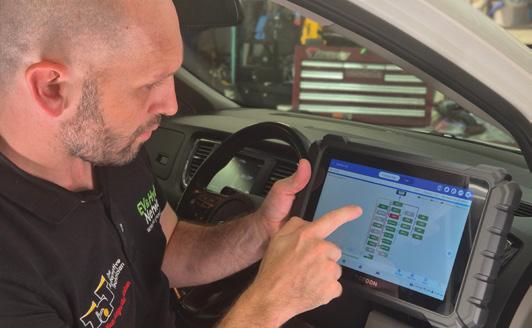
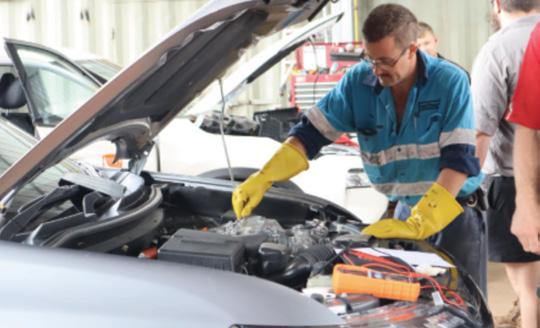
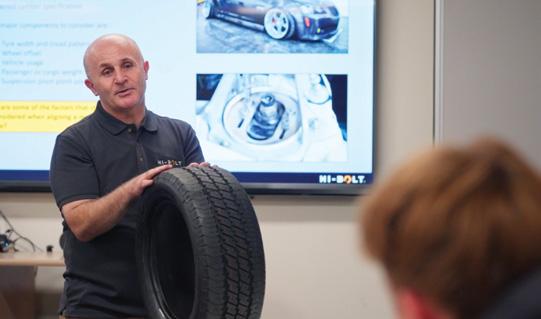


Editorial Board
Geoff Mutton
Jeff Smit
Technical Editor
Jeff Smit
Sub-Editor
Cameron McGavin
Scan Data Director
Rod Maher
Technical Research
Brendan Sorensen
Technical Assistance Moderator
Scott Thomas
Technical Contributors
Brendan Sorensen
Mark Rabone
Frank Massey (UK)
Jack Stepanian
Sam Nazarian
Jason Smith
Clinton Brett (Diesel Help)
Technical Assistance Team
Deyan Barrie Andrew Kollosche
Sideth Chiv Maurice Donovan
Gil Sher Anthony Tydd
Wayne Broady Jason Smith
Marty Hosie Jack Stepanian
Mark Rabone Rob Romano
Daniel Armer Jack Mackay
Gary O’Riain
Associate Team Members
Gary Homan Peter Hinds
Columnists
Geoff Mutton (TaT Biz)
Advertising Enquiries
Paul Woods,
National Advertising Manager
E: pwoods@tat.net.au
Ph: 0494 044 958
Graphic Design
Brigid Fraser
E: production@tat.net.au
PH: 0413 009 122
Affiliated Associations
AAAA – info@aaaa.com.au
Capricorn Society Alliance Supplier
VASA – secretary@vasa.org.au



• TaT’s a fact • TaTassist • TaT Share
• TaT train • Tat Biz • TaT SD (Scan Data) • TaT programs • TaT reviews
• TaT check • TaT find are all trade names of The Automotive Technician Pty Ltd
Automotive Technician


Jeff Smit
Ithought
2026 was going to be a busy year but I think I well and truly underestimated just how busy it was going to be. When I look at my calendar, there’s barely a week when something isn’t happening. It’s certainly a sign our industry is busy.
At the time of writing this, we are seeing record prices for fuel, both unleaded and diesel, which will affect our industry in many ways, both short term and long term. As we’re all aware, everything we use and touch relies of fuel to get to us – it touches every part of the supply train – so these record prices are going to have multiple effects on supply and prices. This will all directly affect inflation, so interest rates are likely to increase over the remainder of the year. I really don’t understand why families with a mortgage and businesses with loans have to wear the brunt of the result of rising inflation while banks, supermarkets and airlines achieve record turnover and profits. The likely result of these record prices will be our customers holding onto their cars instead of buying new one. That’s good for our industry. Another likely result will be the percentage of battery electric vehicles (BEVs) and hybrid electric vehicles (HEVs) sales rising as new-car buyers look for more fuel-efficient vehicles to save on the cost of fuel.
New-vehicle sales data for the final quarter of 2025 has recently been released and the gradual rise of BEVs and HEVs continues, especially hybrid sales. Just over 30 per cent of all new-car sales are electric, with BEVs accounting for just under 10 per cent and HEVs just over 20 per cent.
I’ve said many times the Australian consumer’s preference for an HEV is like our industry winning the lottery. HEVs have a traditional internal combustion engine (ICE) which has oil and filters and requires traditional servicing. They also have a high-voltage (HV) battery, inverter/converter and one or more electric motors which will ultimately require repairs or

replacement. That’s a win/win for us within the automotive aftermarket industry.
In any case, I hope the issues causing these record oil prices get sorted out ASAP – for all of us in the automotive aftermarket and our fellow Australians.
Back to 2026. There are a record number of expos and training events happening this year, so get out and upskill while you can. From the TaT point of view, we are doing more webinars covering different and diverse content, as well as talking with different training groups to bring more quality training to our industry – keep your ears and eyes open for more information soon.
It makes me proud to see how TaT has grown over the past 19 years and as we enter our 20th year, we’re seeing record growth as technicians all over the world see the value in having the access to our extensive database of information.
That database includes more than 5000 Repair Solutions (growing by around 20 plus week) and more than 27,000 good scan-data files (growing by around five vehicles a week). Tech Tina – our AI-powered research assistant on the TaT website – can read and interpret this information for our members, helping them diagnose challenging or troublesome vehicles.
All of us at TaT are proud to assist our 4500 plus member workshops every week in these challenging times. We hope to see you out and about at 2026’s exciting and varied industry events.

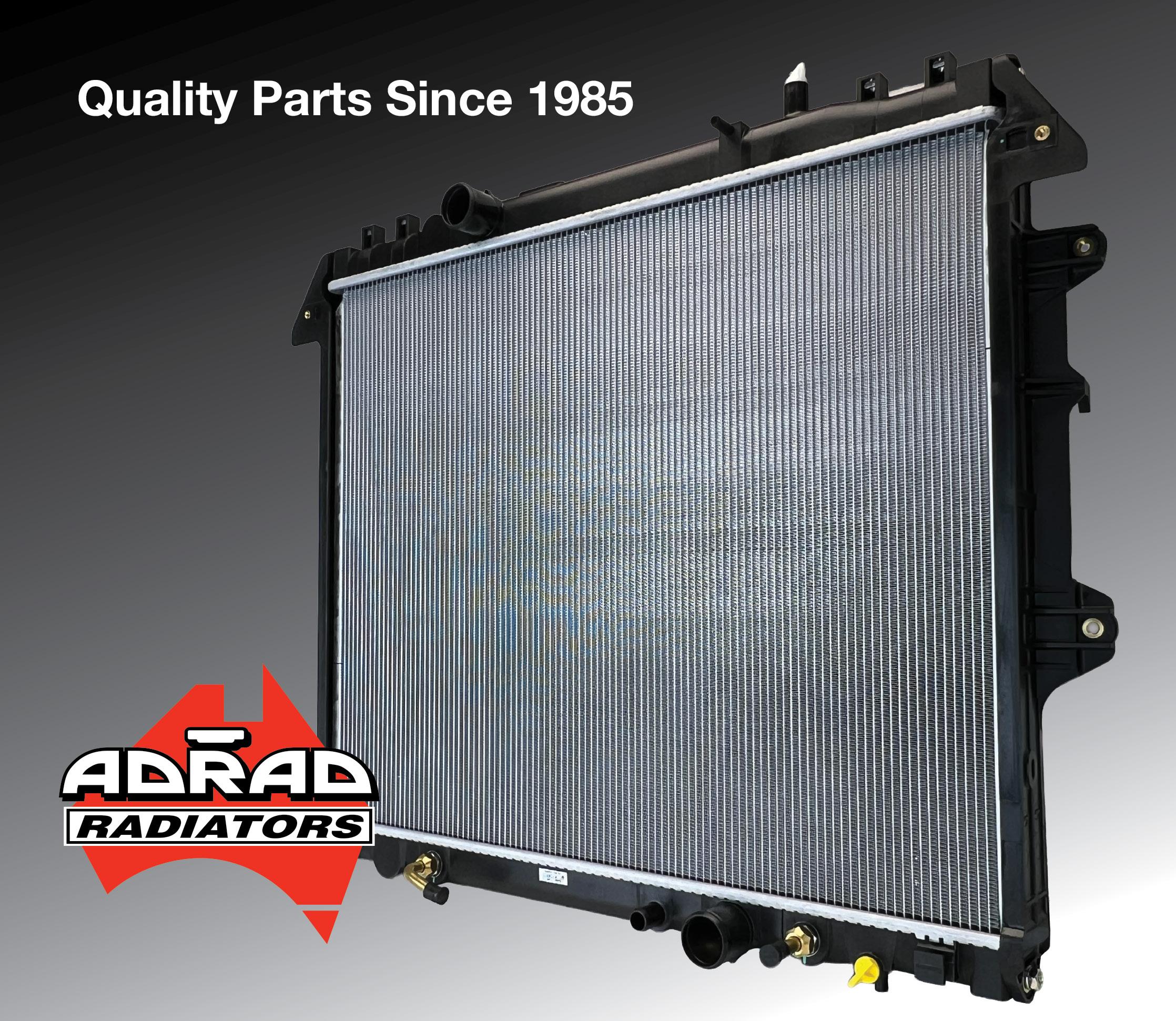
Beginning with humble roots in 1985, their radiator repair and manufacturing business expanded by importing additional heat exchange products from leading global suppliers. Years of steady growth, investment, and commitment to quality followed.
During this period, Adrad acquired and integrated competitors with rich and respected heritages, some dating back to 1922. This collective wealth of knowledge and experience makes Adrad a strong authority on the manufacturing and supply of heat exchange products.
With over 40 years of experience in manufacturing and supplying aftermarket radiators to repair and maintain Australian vehicles, the business stands out from typical auto parts suppliers in several ways. Unlike some competitors, they don’t just carry standard radiators – they offer more than 5,000 engine cooling parts, covering over 90% of the market.
That’s where choosing a supplier like Adrad offers benefits. For instance, the Koyorad brand of radiators is highly respected and available from Adrad as well as other parts suppliers in Australia.
Adrad states that, in certain applications, the Koyorad radiator they supply provides superior cooling performance compared to the Koyorad radiator from a competitor for the same fitment.
How is that possible? Well, since Adrad themselves are also manufacturers, they understand product design better than those who just distribute auto parts. Working closely with their suppliers, Adrad arranges some performance-enhancing design modifications to be included in the ones they purchase.
Adrad states that their Koyorad radiator designed for the Toyota Hilux KUN 3.0 litre turbo diesel features over 30% more tubes in the radiator core. More tubes allow for
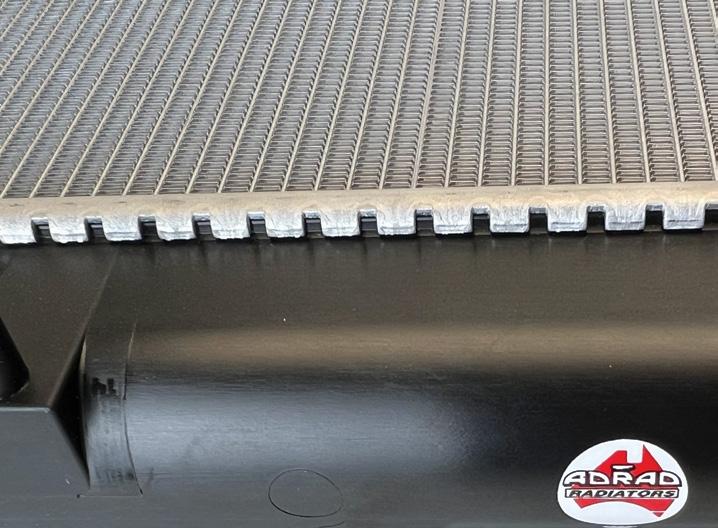
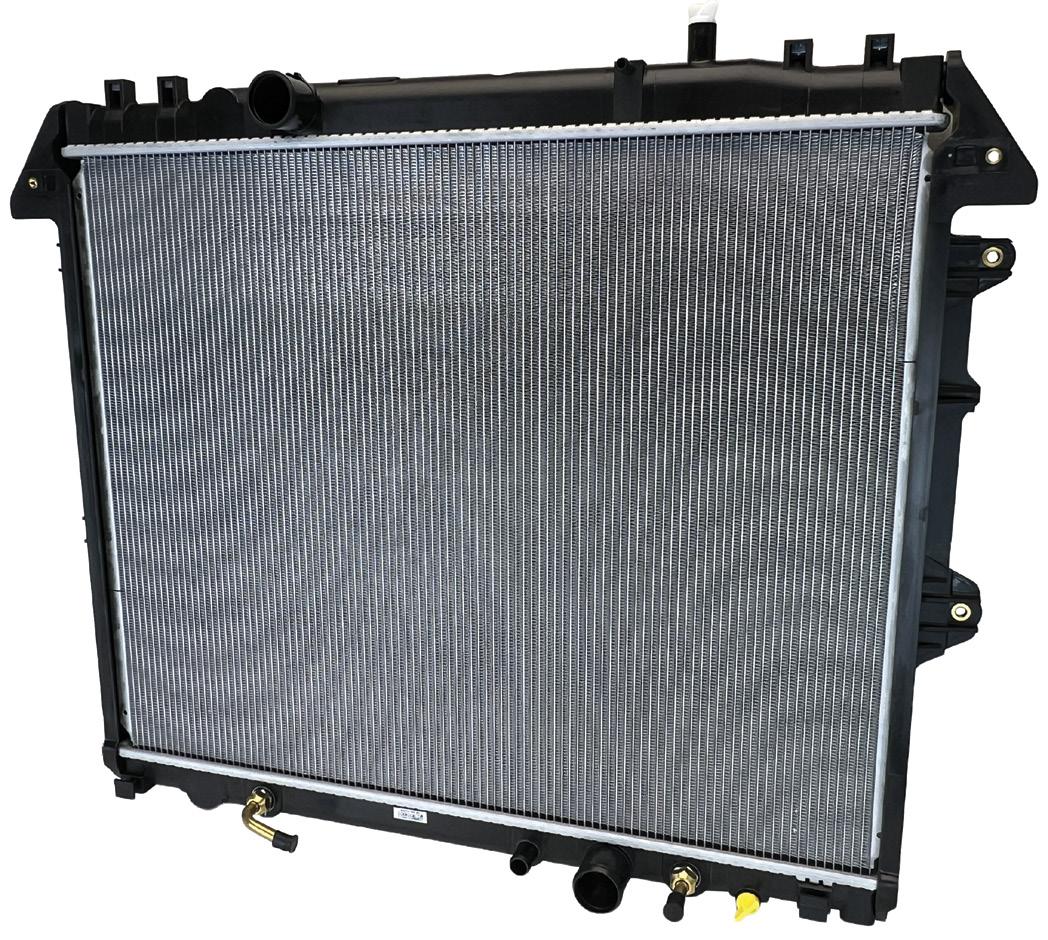
increased coolant flow, resulting in greater cooling capacity that significantly surpasses that of an original equipment radiator. The result for the vehicle is more effective cooling and greater protection against overheating. So, if you have a Hilux that’s always running hot, then this special Koyorad radiator from Adrad offers a simple, lasting solution. Across their parts range, Adrad says many examples of their enhanced-design aftermarket cooling products and other parts which are exclusive to Adrad can be found.
This applies to radiators and EGR coolers to suit Ford Ranger PJ/PK & Mazda BT-50 UN. The EGR cooler doesn’t have more tubes because this part suffers from failure caused over time by vibration. Adrad’s EGR cooler features a modified exhaust elbow pipe with bellows which allows the elbow to flex.
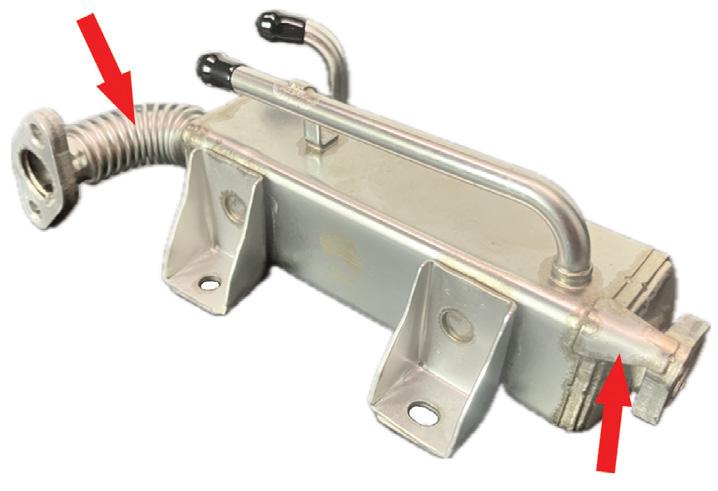
This is to absorb vibration and reduce metal fatigue which helps prevent against cracking and leaking. This EGR cooler also has extra gussets on the opposite fitting for added strength, as this was also identified as a failure point.
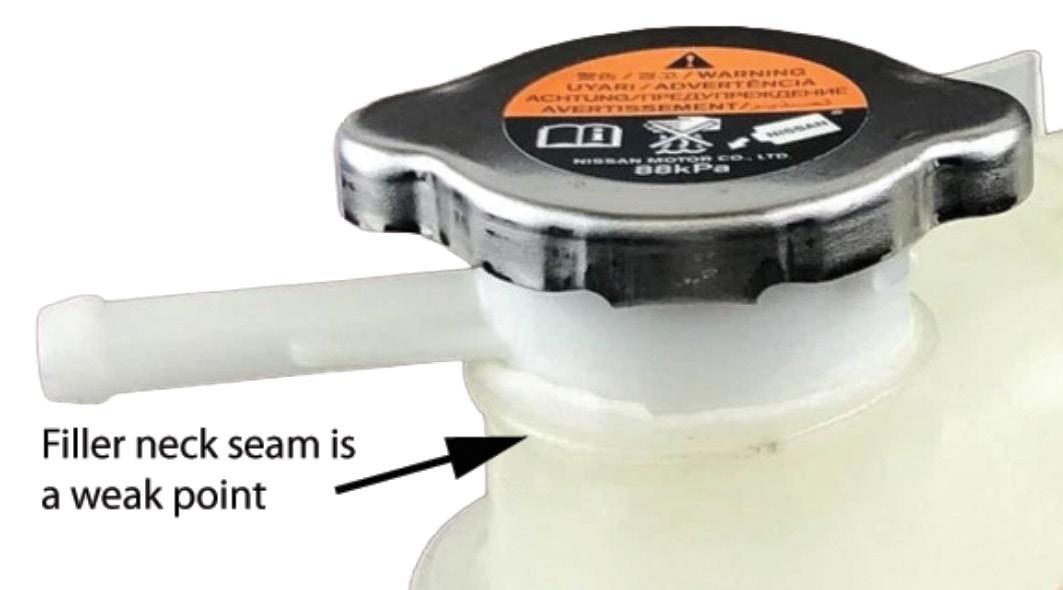
Speaking of failure points. The plastic coolant expansion bottle for Nissan Patrol Y61 is known to split – especially around the filler neck.
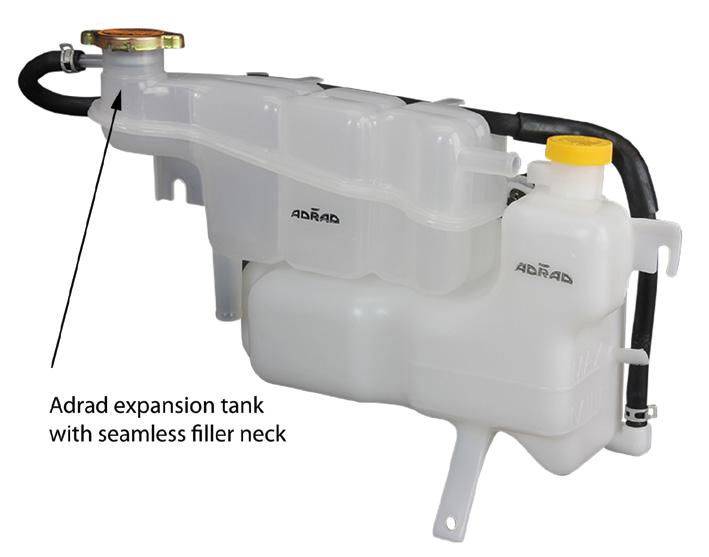
Adrad’s own brand aftermarket expansion bottle for this application has the filler neck moulded into the top of the bottle as a single piece to remove this weakness. The entire bottle is also made using a stronger
grade material to provide extended service life of the part. You don’t have to go to the expense of a fabricated alloy unit to get a stronger than OE expansion tank.
Sometimes Adrad’s expertise is applied to simply find the supplier who manufactures using higher quality materials, better production technology or more robust testing. This applies to radiators Adrad supplies to suit FG Falcon, RC Colorado, VE -VF Commodore, 80 series Landcruiser and many more.
These examples offer some insight into how Adrad applies their specialist manufacturing knowledge to ultimately put superior aftermarket parts into the hands of vehicle repairers.
• If your workshop appreciates quality parts, visit the Natrad Trade website or contact Adrad customer service on 1800 628 723.

Brendan Sorensen
It feels like I’m driving over rumble strips at about 80 km/h – the customer can be driving anything from a Ford Ranger, Holden Colorado or Commodore or a European vehicle but their stated concern is consistent.
Often there’s no malfunction indicator light (MIL) or obvious diagnostic trouble codes (DTCs) and the vehicle behaves on the short test drive with the owner.
Modern drivetrains can create the same sensation from very different causes – torqueconverter clutch (TCC) micro-slip, cylinderdeactivation transitions, a lazy coil under low RPM load, tyre or prop-shaft order, torque management. The aim is not to feel it and guess but proof-test it with evidence you can defend and attach to the job card.
Why TCC shudder isn’t just a top-gear problem
If you still picture converter lock-up as ‘top gear, then lock’, update that mental model. On modern five, six, eight, nine and 10speed transmissions the TCC is used earlier, across more gears, and often in a controlled slip window rather than just a hard lock. That improves efficiency but it also means shudder can appear at suburban speeds as the clutch enters slip regulation.
So yes, you can feel a TCC-related shudder at low road speeds, not just in overdrive. The question is not what gear it is in but what clutch state is it in.
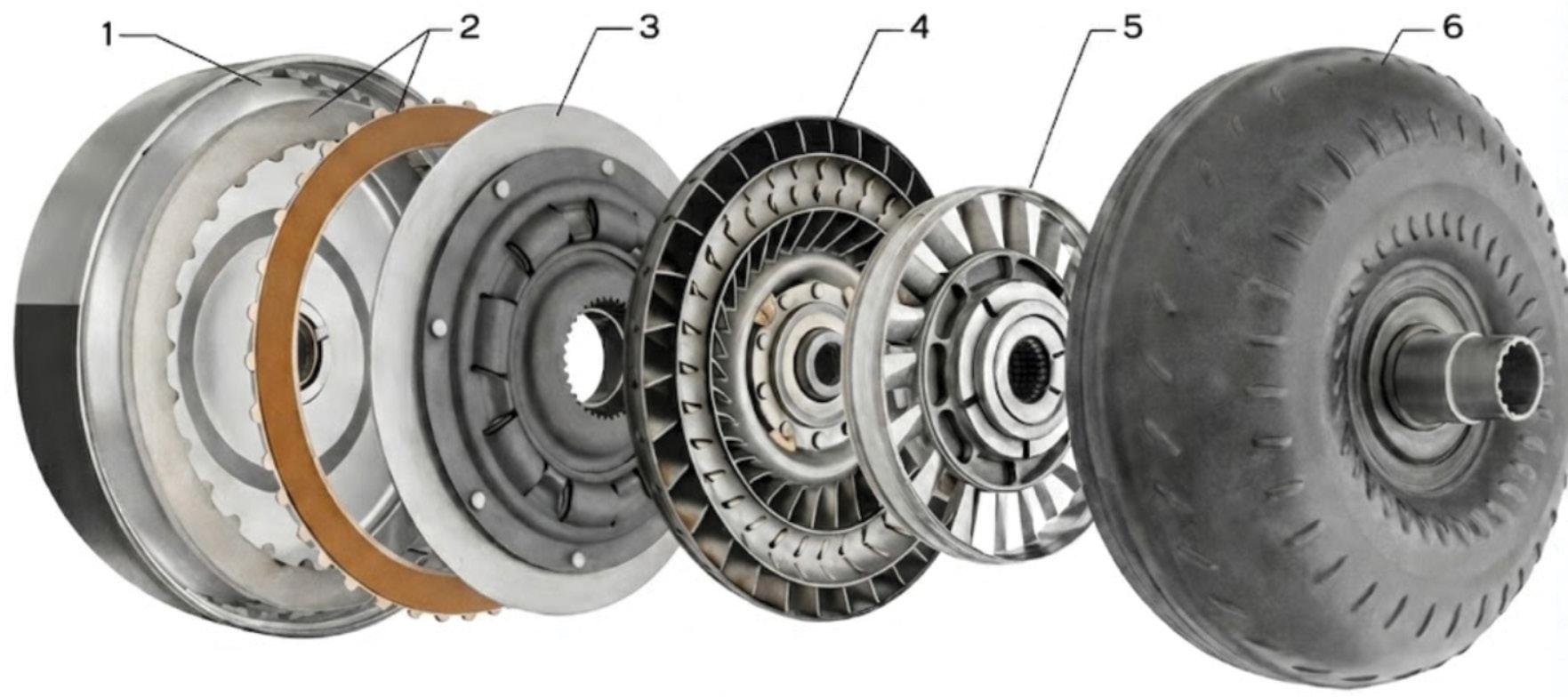
1 – Torque converter front cover, 2 – Clutch friction discs, 3 – Clutch pressure disc with torsional damper, 4 – Turbine, 5 – Stator, 6 – Impeller housing.
True TCC shudder is usually a fine-grain vibration through the seat base and floor, sometimes even into the steering column. It has that rumble-strip texture rather than a single knock or a coarse wheel shake. It tends to build a couple of seconds after the converter goes into slip regulation, right when everything is steady – light throttle, steady road speed, no active shifting. A small throttle change or a downshift often changes the TCC command duty and makes it disappear.
The trap is that other faults can feel similar, especially anything that creates a repeating torque disturbance once the driveline is tightly coupled. I’ve even felt intake carbon on a gasoline direct injection (GDI) vehicle give a similar feeling just as it
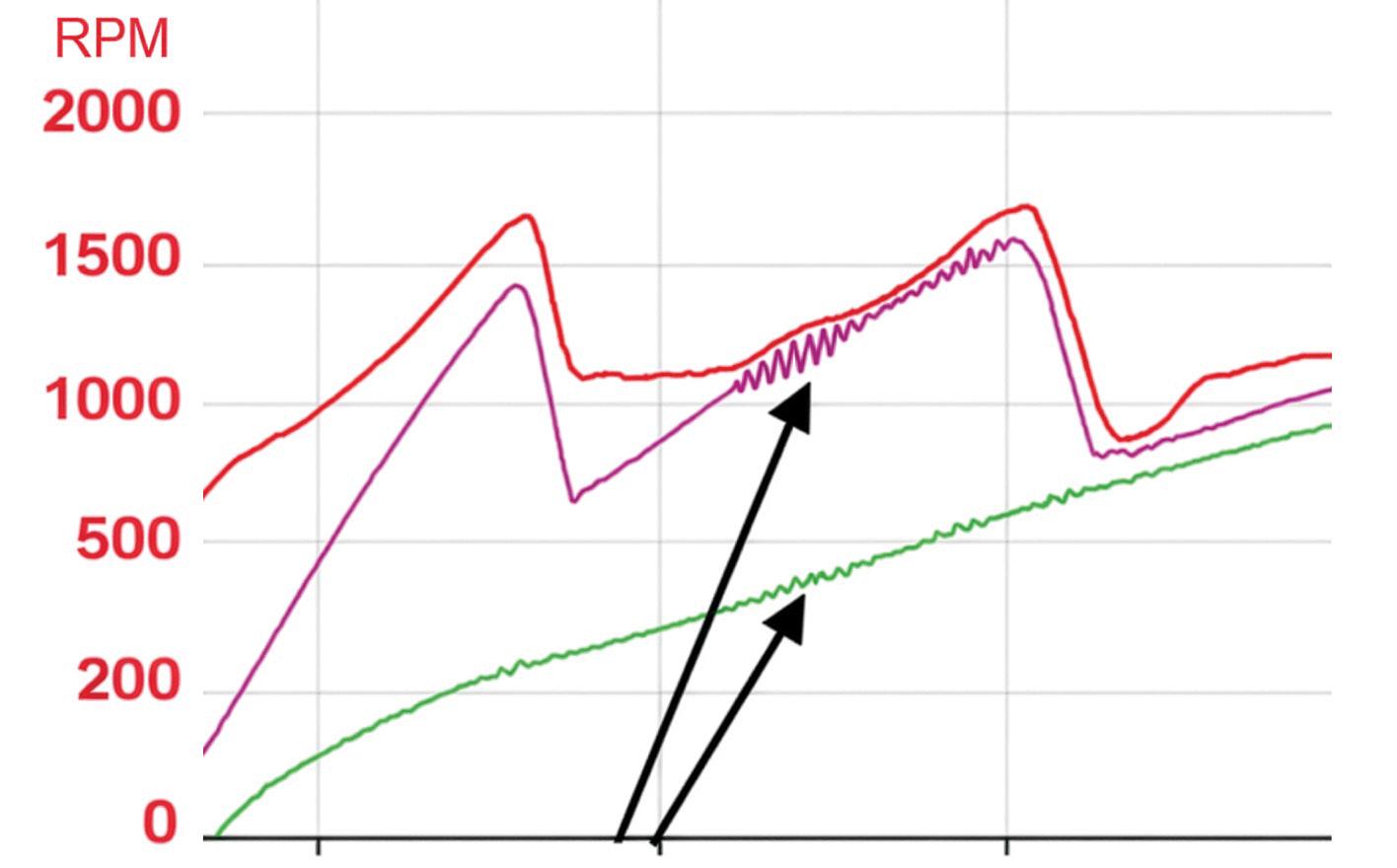
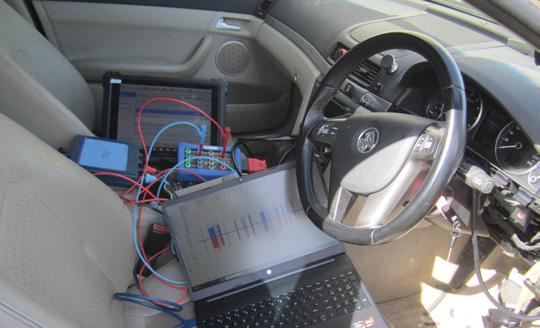
Red = Engine speed, Purple = Input-shaft speed, Green = Output-shaft speed. This is clear TCC shudder, giving that rumble-strip feeling.
came on mid-load boost and combustion abnormalities occurred.
The simplest separator is tracking. If the vibration follows engine speed or road speed, it is rarely pure TCC shudder. Converter shudder tends to switch on and off with TCC state and often sits at a relatively stationary frequency within a given gear.
If your scan tool can command the TCC, it is the cleanest isolation test you will ever do. Use a smooth road, warm the transmission, then hold a gear using whatever the vehicle offers (sport mode, etc). You want stable throttle and minimal shifting.
Mode A: Reproduce the vibration in normal operation and log TCC state and slip.
Mode B: Command the TCC open and confirm on data that slip jumps and stays high, then retest under the same conditions.
Mode C: Request full TCC lock and confirm actual slip is near-zero and stable, then retest.
If the vibration is present in mode A but disappears in B and C, you have strong proof the TCC event is the source.
If it persists in mode B with the TCC truly open, it is not TCC shudder. If it persists in mode C and you confirm you have nearzero slip, classic TCC stick-slip shudder is likely off the table and you are probably looking at an engine torque or driveline vibration that is simply more obvious with the converter locked.
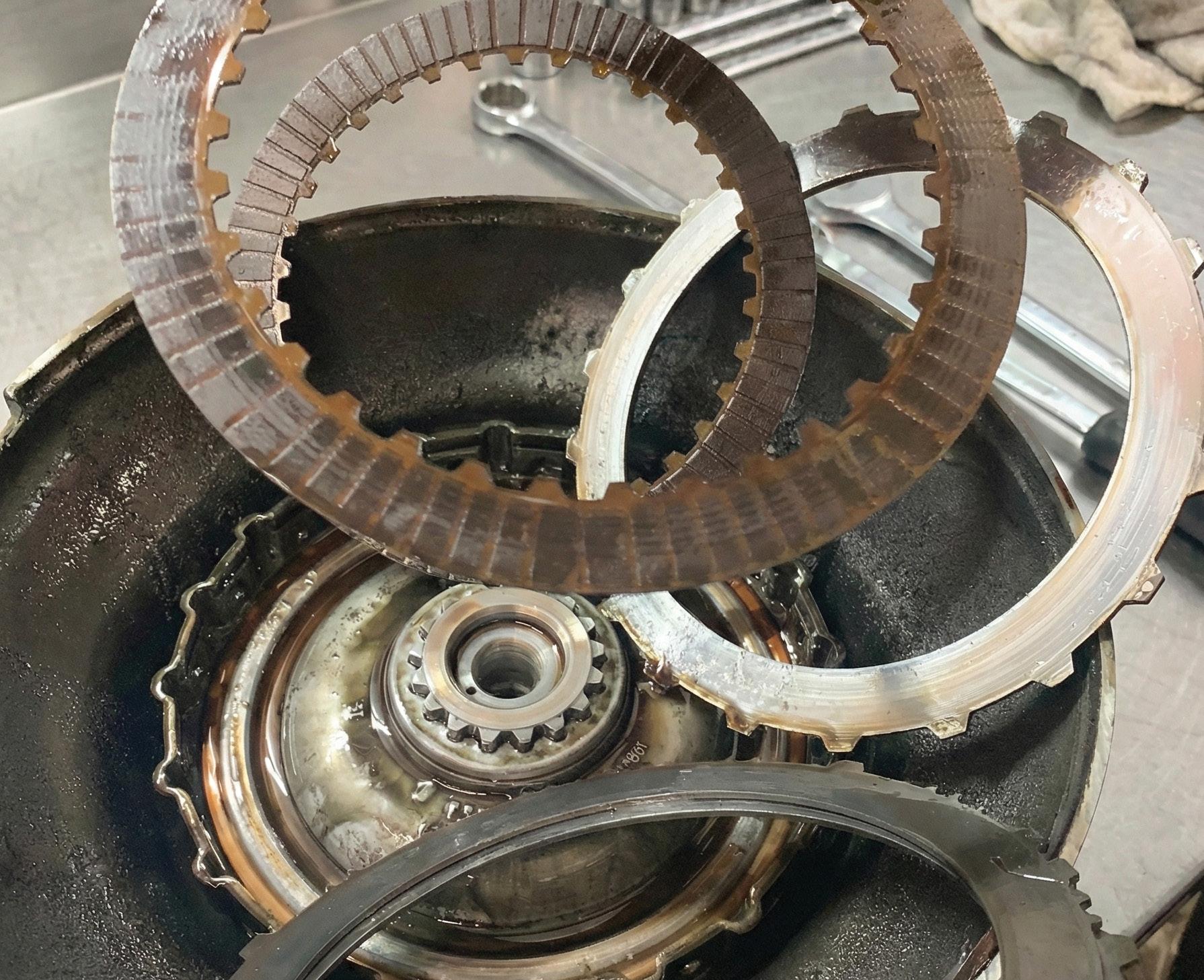
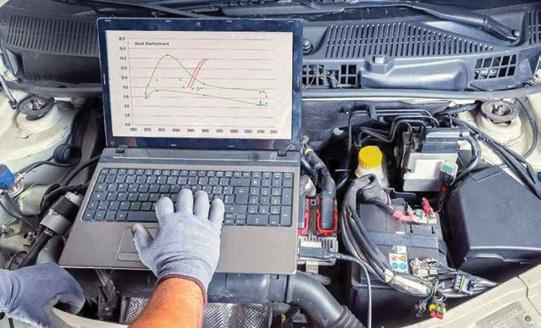
PID discipline, because shudder happens faster than scan tools log The biggest mistake is parameter ID (PID) greed. Graph fewer PIDs faster and if your tool supports a record function, use it. A practical set is – engine speed, turbine or input speed, gear, vehicle speed, automatic transmission fluid (ATF) temperature, TCC command, actual TCC slip (or plot this with engine vs turbine speed), plus misfire counters if possible. If your tool offers it, log any TCC pressure or line pressure PID as well because pressure stability is part of the story.
Two patterns matter. First is the slip trace. A healthy controlled-slip event is fairly flat with small movement as load changes. When the complaint is genuine, the slip trace usually turns jagged. Slow data rates mean you won’t catch every cycle but you will often see the slip envelope wobble or sawtooth under steady throttle.
Second is command versus reality. Overlay TCC command or solenoid duty or current with actual slip. If command is steady but slip goes jagged, the clutch system is losing stability in controlled slip. If command hunts in step with slip, think strategy, torque variation or pressure-control problems rather than jumping straight to ‘worn clutch’.
NVH: The tie-breaker when scan data cannot settle it
If TCC bidirectional control isn’t available on your vehicle and you have noise, vibration and harshness (NVH) equipment, this is the time to bring your initial findings to the customer and sell further diagnostic time rather than gambling on what will likely be a repair in the thousands.
Capture the event and identify the dominant frequency peak. If it tracks engine speed or road speed it is not going to be TCC
shudder. One order is one disturbance per revolution. Tyre order tracks wheel speed. Engine orders track engine RPM. A misfire can show up as 0.5 order because it is one disturbance every two crank revolutions. A peak that doesn’t track engine or road speed and appears only when the TCC is in slip control is hard to argue with.
Once you’ve confirmed TCC shudder, what should you actually do?
Confirmed TCC shudder does not automatically tell you whether the root cause is aged fluid, a damaged clutch surface or a control issue where the clutch simply cannot be held steadily.
Start by locking in your baseline evidence. Save the scan log and, if you have it, an NVH capture. Write down the trigger window –speed range, gear, throttle, engine RPM, ATF temp and slip amplitude. That baseline becomes your before proof so you’re not relying solely on your butt dyno.
Given how common TCC shudder has become, it’s worth checking for Technical Service Bulletins (TSBs) and any known OE guidance for that platform. Many transmissions, such as Honda’s in-service bulletin 17-043, have software updates for revised lock-up strategies or temperaturemanagement updates intended to prevent recurrence.
From there, triage it into one of three buckets.
1. If the slip behaviour is moderate (erratic slip peaks with amplitude under 100RPM) and the transmission fluid is not overly burnt-smelling, many OE TCC shudder bulletins (including GM 18-NA-355) will first call for a fluid replacement. The converter clutch is heavily dependent on the friction behaviour created by the
oil. The catch is using the correct-spec fluid and enough exchange volume to meaningfully change concentration, typically by using a dedicated flush machine or at least three standard drain and fills.
There are friction-modifier additives marketed specifically for TCC shudder. The one with the strongest technician and enthusiast anecdotal support is Lubegard’s Instant Shudder Fixx (formerly Dr Tranny). I’m on the fence with it but take the view that combined with a correct-spec fluid exchange it can’t hurt. Instant Shudder Fixx is essentially a concentrated frictionmodifier package (amine phosphate chemistry) that adsorbs onto the friction material surface, changing the effective coefficient of friction of the TCC.
Once done, repeat the same road test and prove whether the slip trace has improved. If it improves then slowly returns, treat that as a result too – it often means you have a clutch surface that is already glazed. At that point, stop selling exchanges and start planning for bucket 2.
2. If the slip trace shows large, fast, erratic slip peaks (amplitude in hundreds of RPM) or if you cannot achieve a true near-zero slip lock when requested, treat it as likely converter-clutch damage. Very dark fluid with a burnt odour or obvious clutch debris strengthens that conclusion.
In that scenario, an expensive fluid exchange can be poor value because you are trying to mask a surface or damper problem that is already past the point where fresh fluid will create a stable friction curve. Replace the torque converter, along with any replaceable transmission filter.
3. The third bucket is pressure-control integrity. If commanded duty or current is maxed out while slip continues, if pressure-related PIDs look unstable or the command itself behaves oddly under steady conditions, consider solenoid performance, valve-body wear and internal leakage affecting apply pressure stability. These faults can mimic shudder because the clutch is held on the edge, then released slightly, then reapplied.
If you suspect this, do not repeat fluid services. Pivot to confirming command versus actual behaviour and hydraulic checks or if your tooling is limited, refer to a transmission specialist for pressure testing and valve-body assessment.
Present these options as a staged plan. Stage one is the lowest-risk fix that matches the data, with a commitment to retest and assess improvement. Stage two and three are the escalation path if the evidence points to converter damage or pressure-control instability.
Jeff Smit
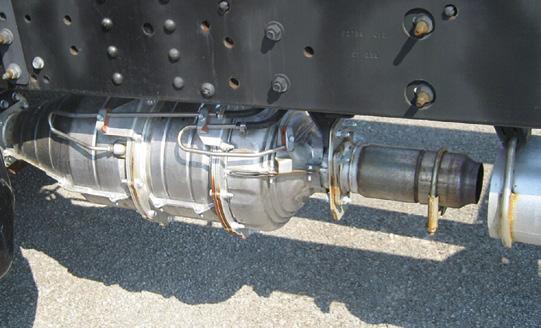
Amodern ‘exhaust’ is no longer just mufflers and pipes. On a late-model vehicle it’s a tightly managed aftertreatment system that uses temperature control, sensors and ECU logic to keep emissions in check across cold starts, short trips, towing and stop-start driving.
For Australian and New Zealand lightvehicle technicians, that shift is accelerating because the vehicles arriving in the bay are increasingly built to stricter Euro-aligned standards, with more hardware and more diagnostics to match.
Australia has now implemented more stringent Euro 6d-equivalent noxiousemissions standards for light vehicles (up to 3.5 tonnes gross vehicle mass [GVM]), with the new standards applying to new models from December 1, 2025. New Australian Design Rules (including ADR 79/05) formalise this move. New Zealand is also moving to keep standards aligned with Australia and has been consulting on Euro 6/VI settings.
What does that mean in your workshop?
More of the issues you will come across will be system problems, whether it’s a slight exhaust leak, a lazy temperature sensor or an oil-spec mistake, all of which can trigger diesel particulate filter (DPF) or gasoline particulate filter (GPF) loading, catalyst efficiency codes, repeat regens and customer complaints – without any single component being ‘dead’ on its own.
Catalytic converters: Still the workhorse, still easy to kill
Petrol vehicles still rely heavily on the threeway catalytic converter (TWC) to reduce nitrogen oxides (NOx) and oxidise carbon
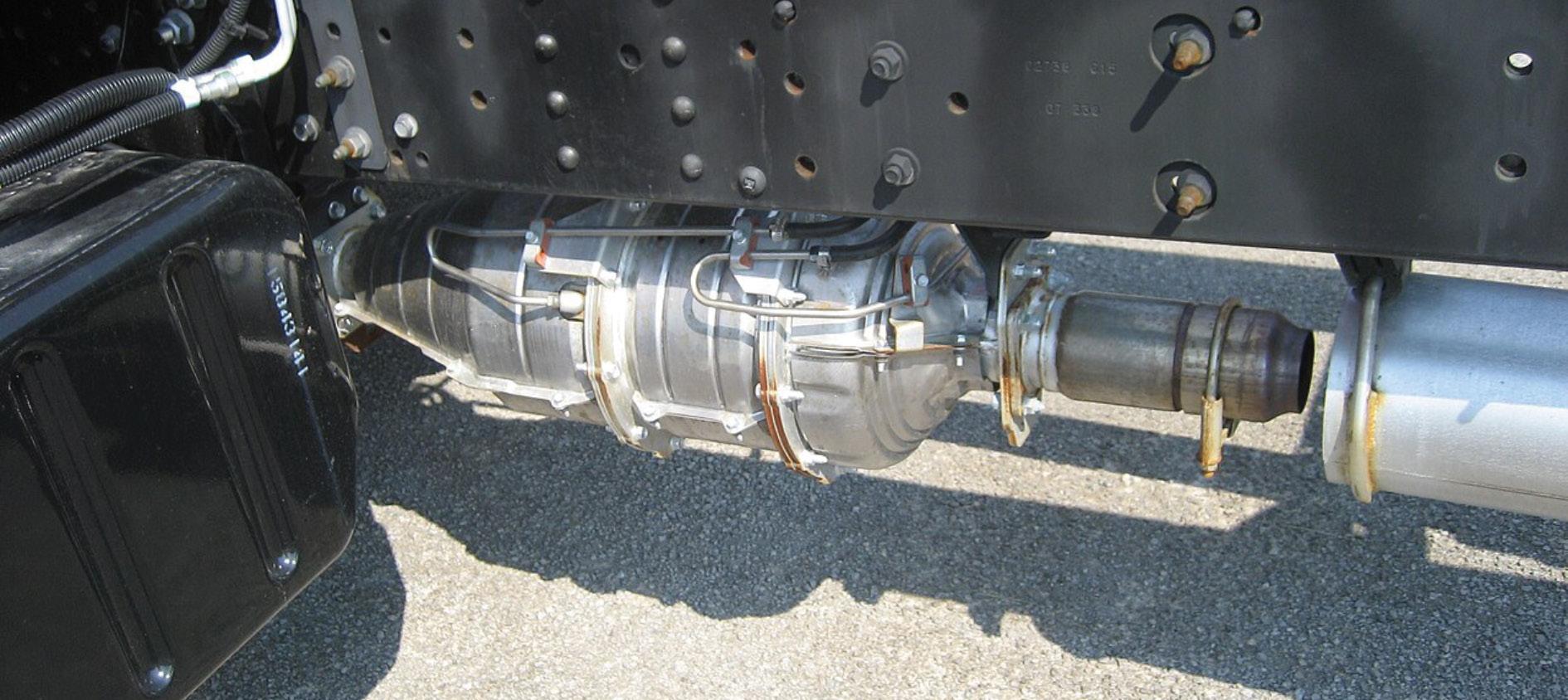
monoxide (CO) and hydrocarbons (HC). The common workshop traps haven’t changed but the consequences are more severe because OBD monitoring is tighter and customers notice fuel-economy drops more quickly.
The big three converter killers you’ll keep seeing:
• Misfires and rich-running cause thermal damage. Unburnt fuel ignites within the converter, overheating the substrate and ultimately triggering efficiency codes (e.g. P0420/P0430). These issues are well documented; the key takeaway is to fix the upstream cause before condemning the cat.
• Contamination (‘poisoning’). Oil consumption, incorrect oil and poorquality additives, as well as coolant ingestion and some sealants, can coat active sites within the converter and reduce conversion. Phosphorus-related deactivation from lubricant additives is a known outcome within the industry.
• False readings can be caused by leaks or sensor issues. A small leak ahead of the rear oxygen (O2) sensor can mimic poor catalyst O2 storage and trigger ‘efficiency’ codes. Always smoke-test
and verify O2 sensor response before recommending a converter.
Trend to watch: More aggressive warm-up and thermal management. Electrically assisted heating (including electrically heated catalysts) is being developed to reduce cold-start emissions and maintain catalyst light-off under harsher conditions. For technicians, this often means more temperature sensors, tighter plausibility checks and more ‘Why is it doing that?’ customer questions about idle speed, fan operation or post-start strategies
Filters aren’t just diesel anymore: GPF is now part of the story
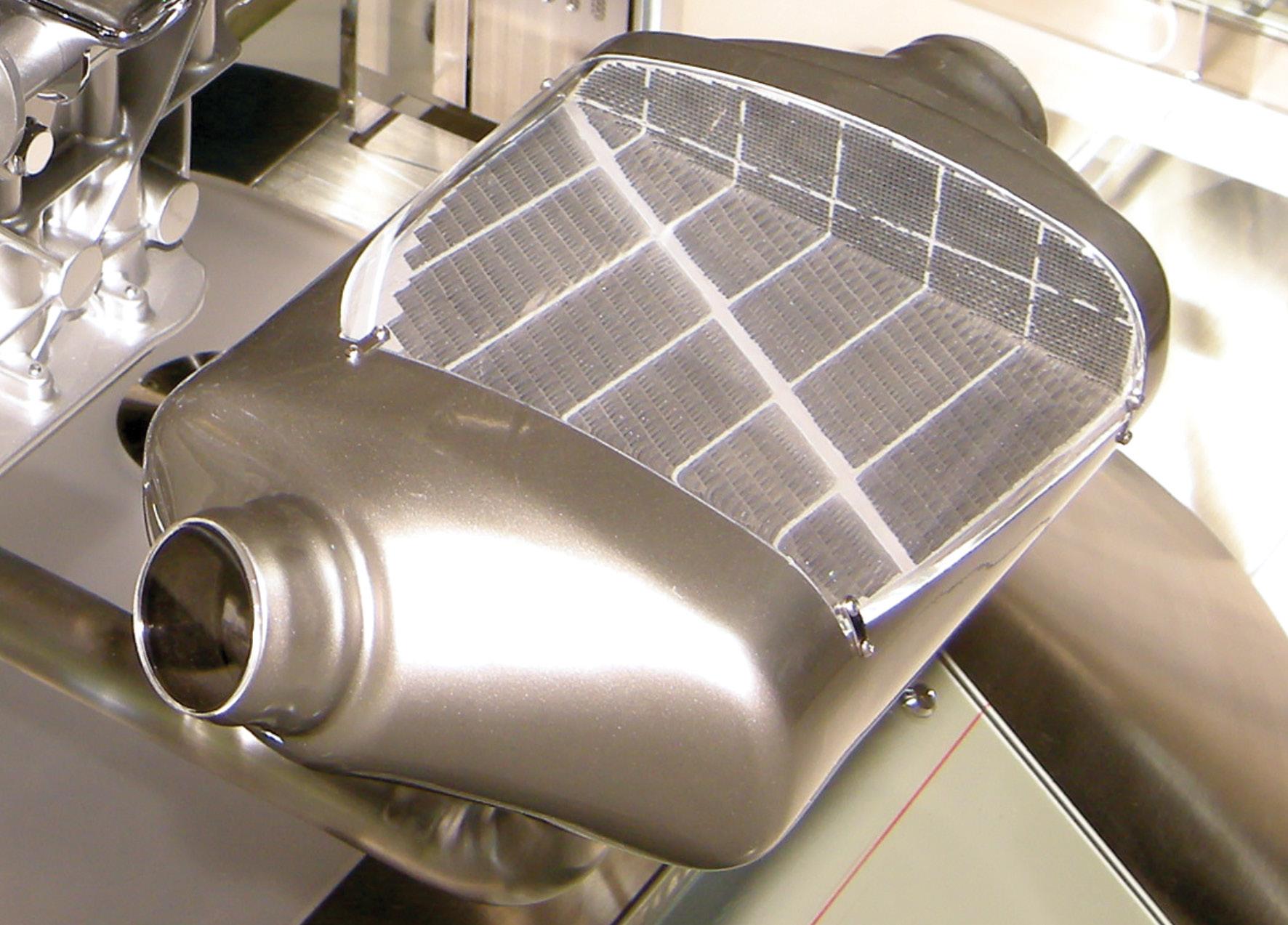
As direct-injection petrol engines became common, particulate-number limits pushed manufacturers towards the GPF (also called an otto particulate filter [OPF] or petrol particulate filter [PPF] in some markets).
Industry experts link GPF fitment directly to Euro 6c particulate-number requirements for petrol engines.
Why it matters in AU/NZ: Even if local regulations have lagged historically, the vehicle supply increasingly doesn’t – many cars sold here are globally engineered and arrive with GPF hardware.
GPF complaints you’ll see and what to check first:
• Short-trip duty cycles plus rich warm-up strategies can increase soot loading.
• Oil consumption (or an incorrect oil spec) can accelerate ash accumulation.
• Exhaust leaks or temperature-sensor drift can upset regeneration logic.
GPFs can also be ‘packaged’ with a catalyst function in coated/catalysed designs, which is one reason exhaust assemblies are becoming more integrated (and more expensive).
Diesel aftertreatment: DPF issues are rarely ‘a bad DPF’
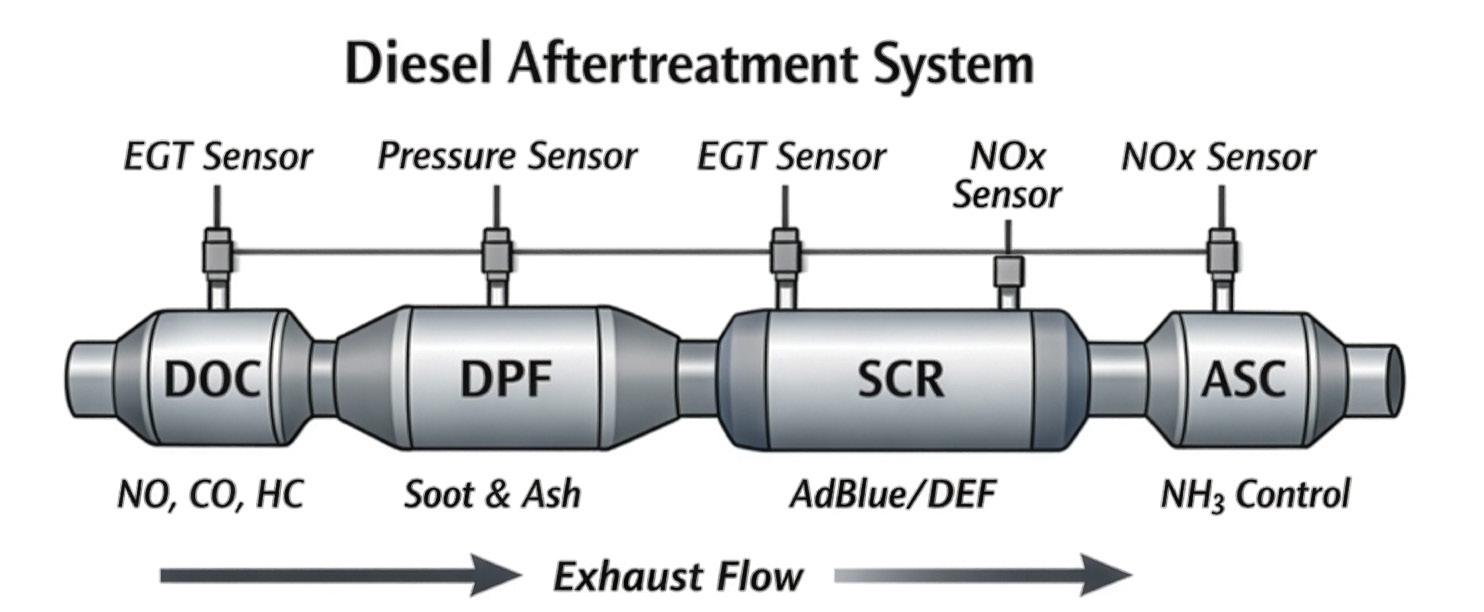
On light diesels, the usual chain is diesel oxidation catalyst (DOC) → DPF → selective catalytic reduction (SCR, AdBlue/diesel exhaust fluid [DEF]) → ammonia slip catalyst (ASC), with multiple exhaust-gas temperature (EGT) sensors and at least one differential-pressure sensor.
The DPF’s job is simple – trap soot, then burn it off. Problems arise when the inputs (temperature, soot-model accuracy, sensor plausibility) no longer match reality. The repeat offenders behind DPF complaints:
• Duty-cycle mismatch (short trips/low speed).
• Sensor and hose faults (especially differential pressure).
• Engine-out soot makers.
• Ash loading (not ‘cleanable’ by regen).
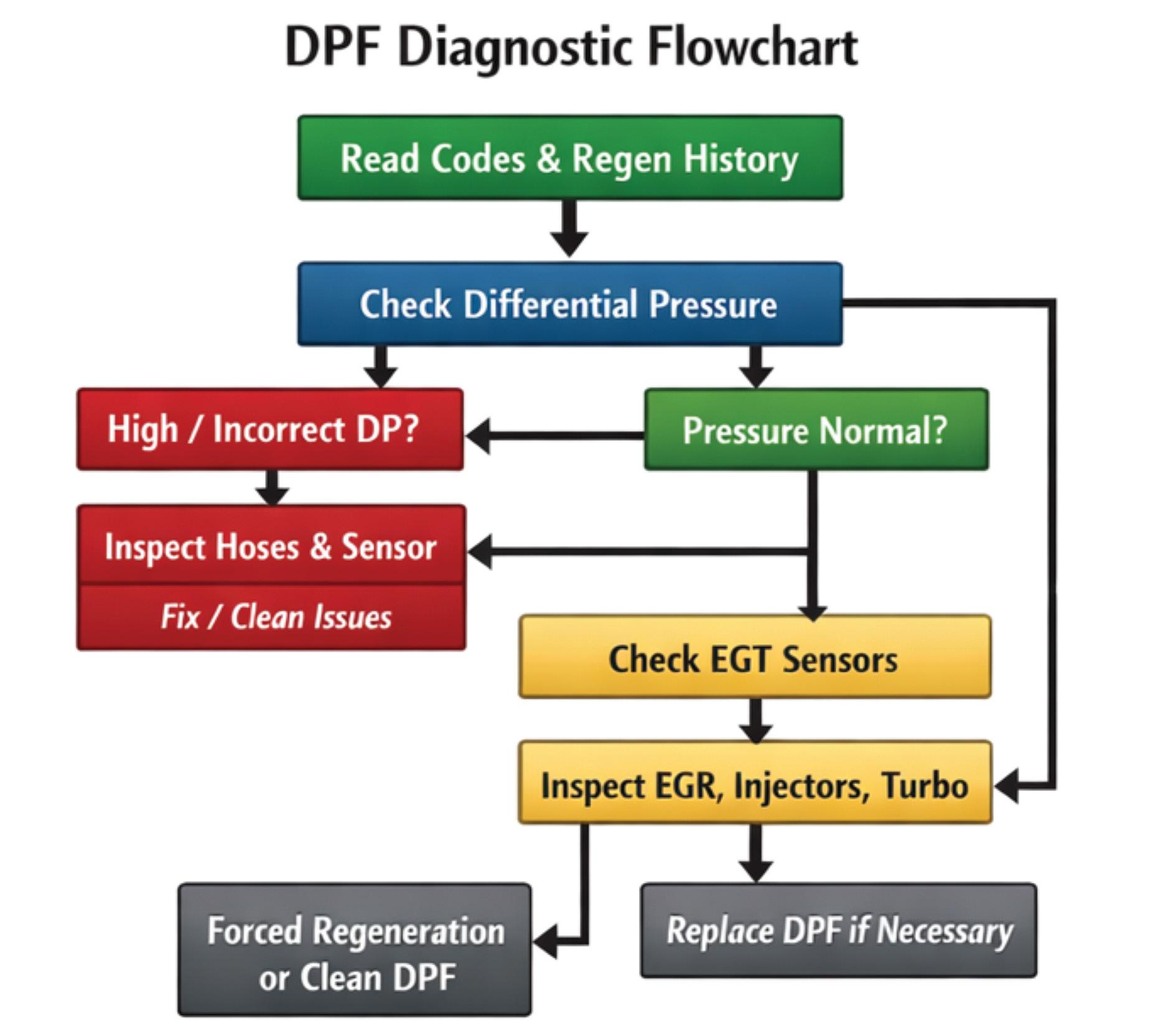
A practical diagnostic sequence to minimise comebacks
1. Pull codes plus freezeframe data plus regen history (distance since last regen, aborted regens, soot/ash estimates).
2. Validate differential-pressure readings at idle and a known RPM/load – and physically inspect pressure lines/ports before you price a filter.
3. Check EGT sensor plausibility (cold start vs warmed, response under load).
4. Chase engine-out causes (exhaust-gas recirculation [EGR] function, injector balance, boost leaks, oil level/condition).
5. Only then decide between forced regen (with safety process), off-car cleaning or replacement.
Many diagnostic guidelines for DPF systems strongly emphasise sensor validation and safe regen procedures to avoid costly mistakes.
Case study 1: Toyota HiLux/Prado/ Fortuner (2015-20) and the ‘usage vs system’ collision
One of the most significant Australian examples is the ongoing Toyota DPF class action involving certain HiLux, Prado and
Fortuner diesel models acquired between October 2015 and April 2020. Toyota’s own policy page and the class action materials outline the affected vehicles and timeframe. Workshop takeaways (practical, not legal):
• Expect heightened customer sensitivity to DPF warnings, limp modes, fuel use and repeat visits because this issue is widely publicised.
• Confirm the vehicle has received relevant manufacturer updates and rectification pathways where applicable (service history matters).
• Keep your process disciplined. Log regen counters, pressure readings and supporting evidence. On these vehicles, especially, ‘replace DPF first’ without data is a recipe for disputes.
Case study 2: Mazda SKYACTIV-D –oil spec isn’t ‘nice to have’ Mazda is unusually explicit in its owner documentation: SKYACTIV-D 2.2 requires specified oil and using other oil can shorten the DPF’s effective life or damage it. Combine that with low-speed/short-trip operation warnings in Mazda DPF guidance and you have a common pattern – vehicles used for school runs and low-speed commuting becoming DPF repeat offenders. Workshop angle:
When you see frequent regens, rising oil level or customer reports of ‘it keeps asking for a run’, treat oil spec, service interval and usage pattern as core diagnostic inputs –not afterthoughts.

Clinton Brett
This case study is from one of our highly experienced members, who I’ll call AE because of his auto-electrics expertise and auto-electrical business.
Like many, AE prefers to persevere on diagnostic cases, investing time digging, testing and researching before logging into the Diesel Help diagnostic jobrequest portal. I know from my experience spent with him and how he goes about his business, he is among the greatest technicians in our industry.
Being one of the greatest doesn’t mean he’s a know-all or has access to all the information required such as wiring diagrams. You need to delegate the task. Or better still, source the correct information from others with expertise in certain areas. I’m not saying to be the best you must be a Diesel Help member but we certainly work with some of the best in the business. Most of our 300 members are signed up to The Automotive Technician, Haynes Pro, Autodata, Repairify, The Garage Network, Diagnostic Dan, The DPF Doctor, FB forums and other groups.
This job was logged by AE, who was seeking further information as he required a more accurate and correct wiring diagram for this exact model sold in Australia.
The vehicle was logging P0460-13 – Fuel level sensor A circuit and P246C00 – DPF restriction forced limited power codes.
AE has a great understanding of diesel particulate filter (DPF) operation and was aware that the DPF fault was more likely related to the body control module (BCM) strategy. Having a fuel-level sender fault meant there was no guarantee of adequate diesel in the tank for DPF regeneration. I know from our experience and as a
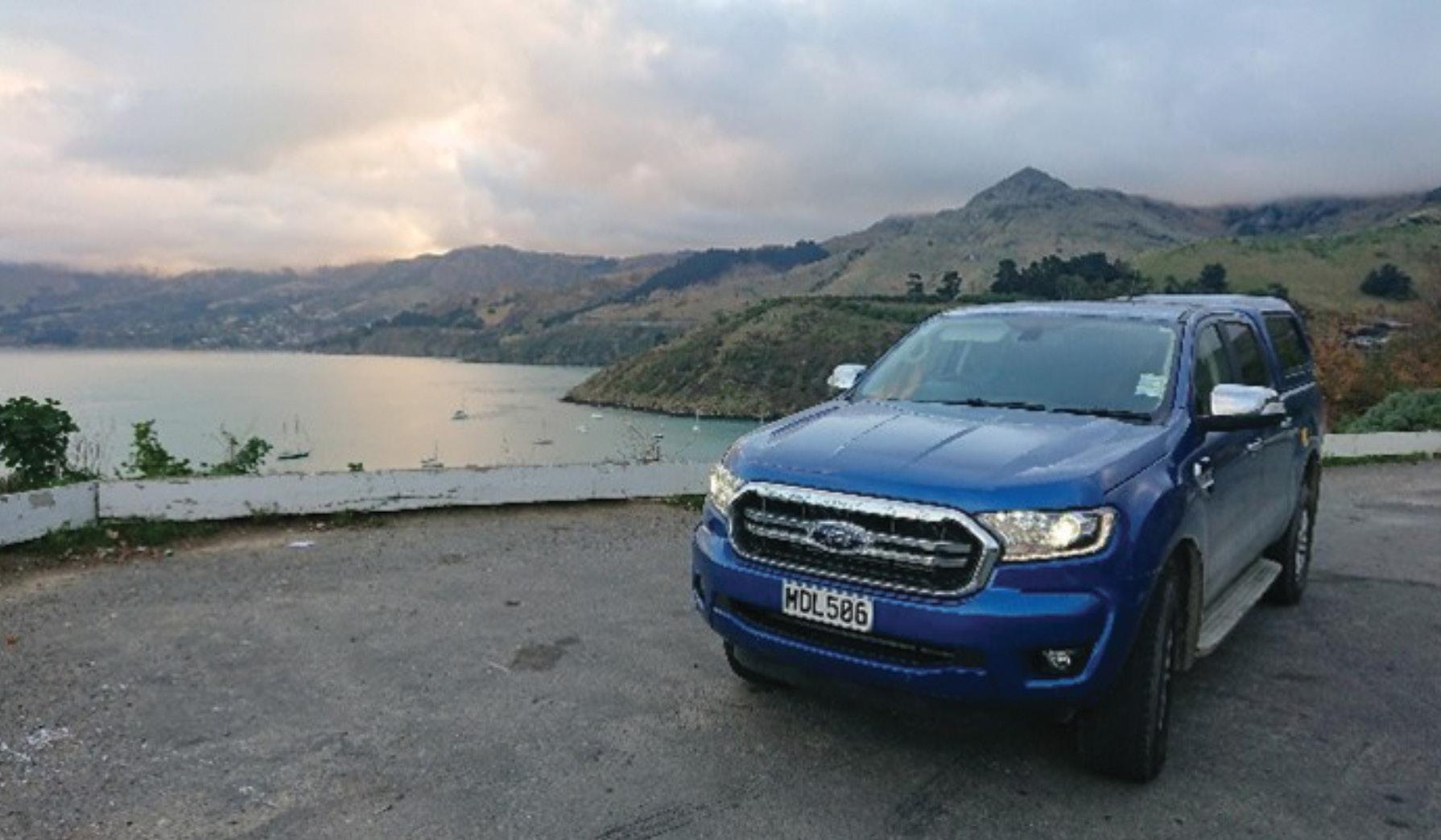
Haynes Pro workshop-data distributor that we can obtain good information but we’ve picked up on a couple of variances on some models. The Ranger is a popular vehicle around the world and Australia has one of many variations of this ute.
Having Diesel Help as a distributor goes beyond selling the data package. We are the only Haynes Pro distributor with a company dedicated to over-the-phone diesel diagnostics in Australia. I submit reports of these discrepancies and Haynes pursues and updates the content.
Unfortunately on this occasion we couldn’t wait for the next quarterly update. So how did we obtain the correct wiring information? The OEM, of course.
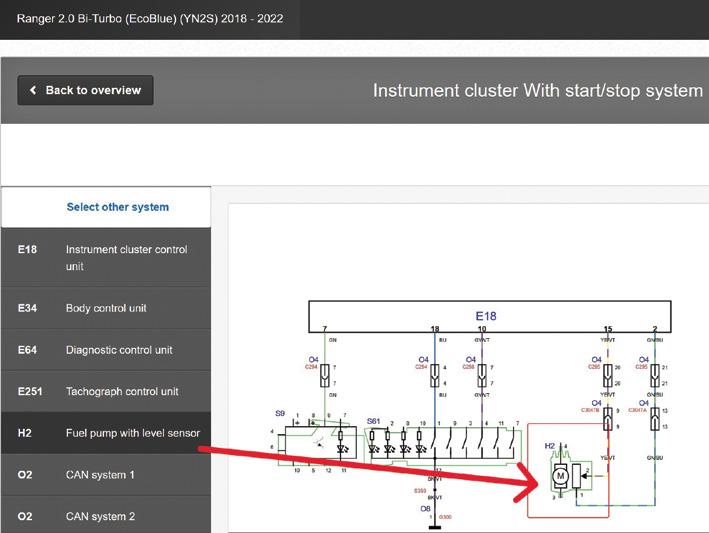
But there’s no point calling and harassing your local dealer as it’s illegal for a dealership to release workshop data outside the dealership. There is no better source than the OEM and thanks to the legislation which was pursued and introduced by the Australian Automotive Aftermarket Association (AAAA), we registered technicians all have access to specific data via our Australian Automotive Service and Repair Authority (AASRA) login (pic 2).
If you are serious about running an automotive workshop in the modern era, you need to get on board with this just like AE did, otherwise you are going to be left behind Googling incorrect wiring diagrams.
Accessing AASRA was a gamechanger for AE. When he called me back a few days later, he was ecstatic and couldn’t be happier about the information he was able to access.
He is not the only one who has been surprised by this. Knowing how helpful AASRA has been, I will happily give them a free plug and help raise awareness that Australian workshops can access correct OEM-level information.
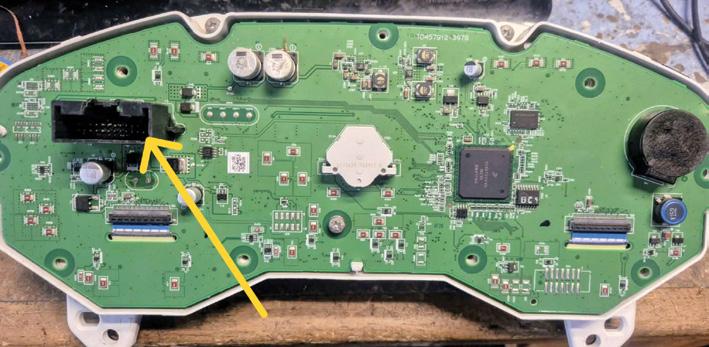
Failure/issue: Faulty connection plug at the instrument cluster (pic 3)
Republishing laws prevent us from publishing the OEM wiring diagram here but we can provide all of the other information used during the case, including data provided by Haynes Pro Workshop Data and cluster images are provided by our preferred ECU and electronics testing and repairer, Get Electronics (NZ).
In several cases the original diagnosis led to replacement of the cluster unit after it was confirmed the fuel-tank module was operating and the level sender had passed all tests.
The cluster has never been found to be an issue but it is important to test all possible connection issues to understand the diagnostics pathway with these types of symptoms and faults.
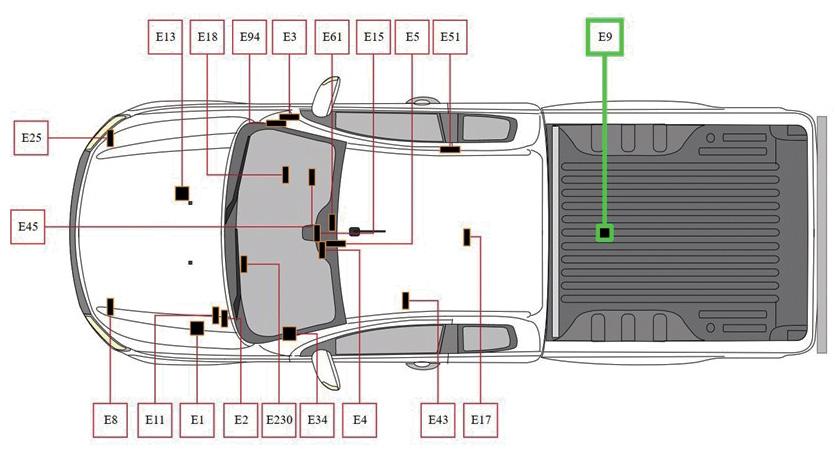
Check and test all fuses and relays before moving on to a continuity test of the wiring from sender to cluster. The fuel-pump control unit (E9) is located at the rear of the vehicle, within the vicinity of the fuel-tank pump module and sender unit (pic 4).
Note: For Haynes Pro subscribers, the link to the Haynes Pro Component Diagnosis is E9 – Fuel pump control unit.
Check resistance on fuel-level sensor is less than one ohm (Ω). Test the current draw of the fuel pump, which should not exceed 30A.
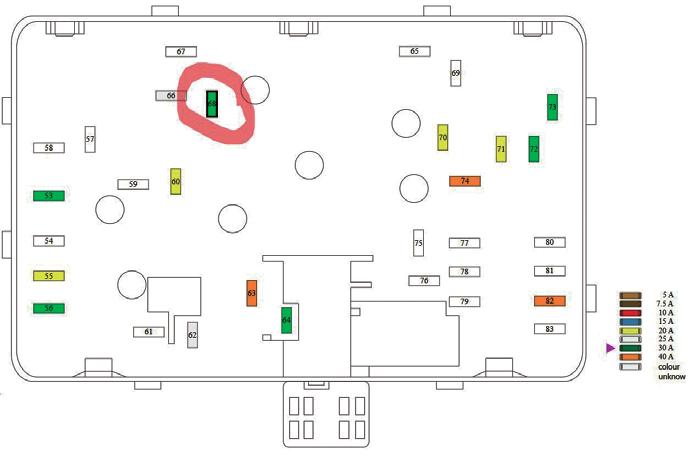
This system does not appear to use a fuelpump fuse. It uses a fuel 30A pump relay for the in-tank supply pump (pic 5).
Once these tests come back OK, proceed to remove the instrument cluster and then
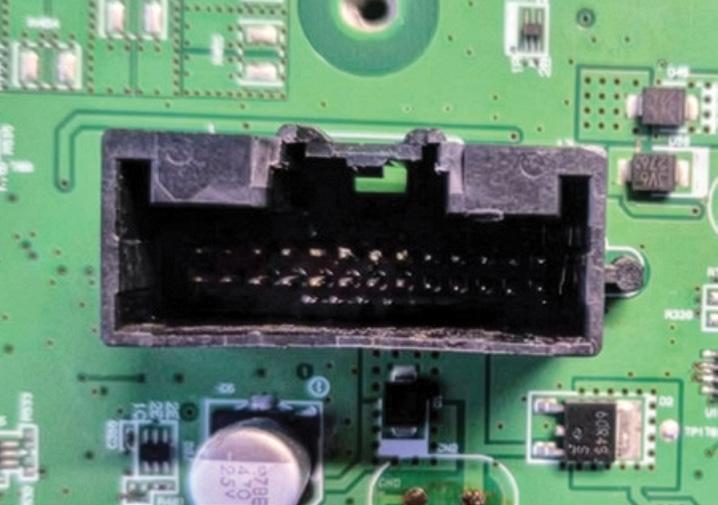
remove the harness plug for inspection of damage or looseness of the pins (pic 6 and 7). In most cases the harness pins have only required retention, not replacement. Secure fitment of the pins within the harness plug. Inspect the plug socket for any damage, corrosion or bent pins.
The DPF fault codes will often clear once the repair has been completed and all other fault codes have been cleared.
The vehicle should not require a passive regeneration. If the DPF code remains, carry out the necessary procedures as required in TB1087 – DPF Diagnosis & Testing
Cooling System Kits (CSKs) are engineered to be a straightforward solution for dependable cooling-system repairs.
Each kit is designed to replace all essential components together, helping workshops provide quick repair solutions to minimise vehicle on-hoist and downtime.
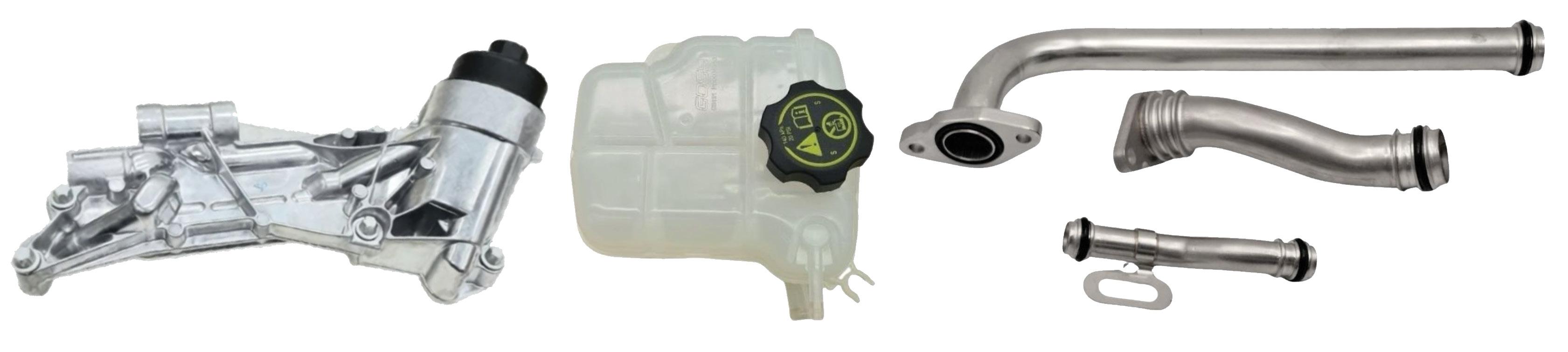
Every Goss CSK includes a Goss Engine Oil Cooler and Goss Coolant Bottle, ensuring these closely linked components are replaced together for optimum efficiency and durability.
Selected applications such as Holden Cruze/Trax 1.8-litre and Holden Barina 1.6-litre also include related coolant pipes and O-rings, offering a comprehensive repair solution that reduces guesswork and minimises vehicle downtime.
One of the main risks of replacing only the oil cooler or coolant bottle is crosscontamination. Even after a thorough system flush, residual contaminants trapped in an ageing or weakened coolant bottle can reintroduce sludge, causing costly repeat repairs.
Goss CSKs are designed to meet OE performance and specifications and provide perfect fitment and reliable performance, all in one box.
Each oil cooler comes with fitment gaskets where needed, while Goss Coolant Bottles
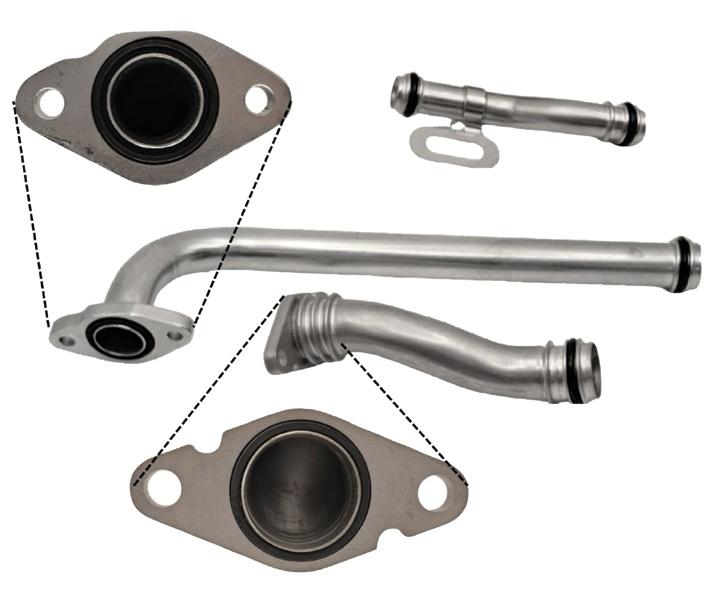
include a cap (and level sensor) where applicable – everything required for a firsttime-right repair.
• Find out more at goss.com.au
With the Motor Vehicle Information Sharing (MVIS) scheme well into its fourth year under the stewardship of the Australian Automotive Service and Repair Authority (AASRA), now is a good time to provide an update on this ground-breaking legislation.
What’s it all about?
At its core, this legislation ensures all repairers can access the OEM information required to complete a mechanical service or repair, or a collision repair, on any post-2002 passenger or light-commercial vehicle. This includes software updates such as those needed to connect a new part to the
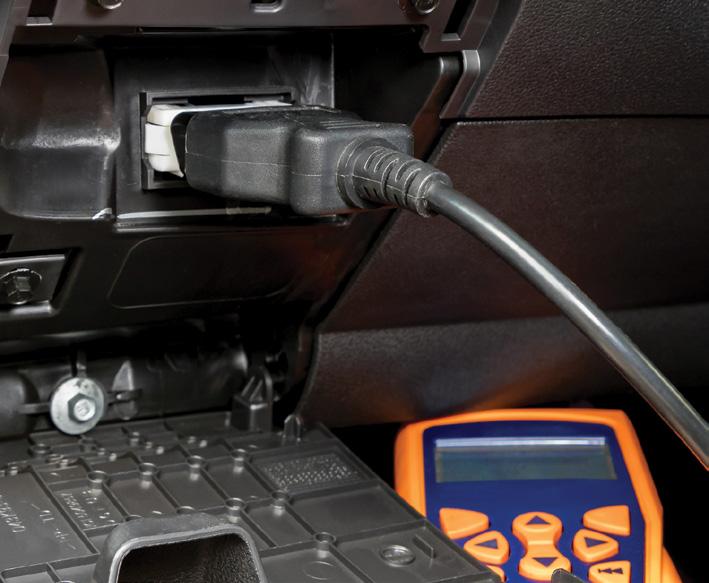
vehicle, full diagnostic scans and access to security codes for a vehicle’s computerised systems.
While manufacturers have their own systems and processes for accessing information, AASRA has developed all new navigation guides that streamlines access for the many ‘all-makes, all-models’ repair businesses across the country.
The Right to Repair legislation allows independent repairers to compete with dealer networks on a level playing field.
According to the Australian Automotive Aftermarket Association (AAAA), workshops were turning away an average of 20 vehicles per month before MVIS was introduced due to poor access to information.
Since the introduction of the scheme, this figure has dropped to 12 vehicles a month, a reduction of 40 per cent.
Workshops have also reported significant improvements in customer relationships, with 68 per cent reporting that increased access to detailed vehicle information has improved customer satisfaction and 66 per cent reporting enhanced customer convenience.
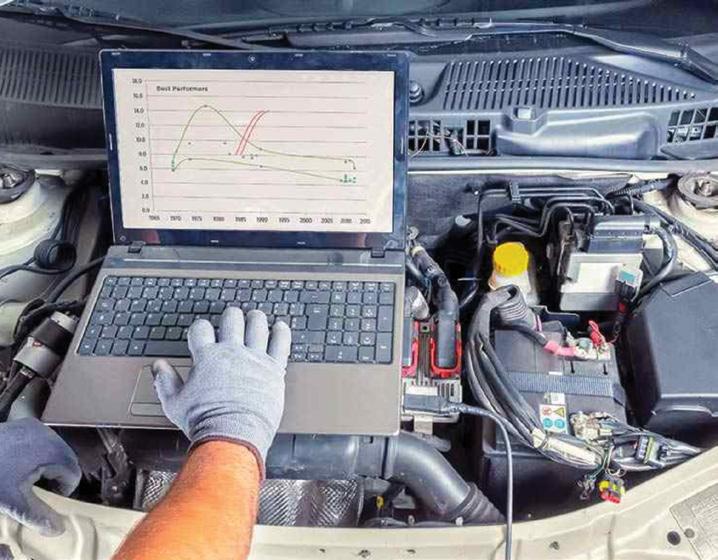
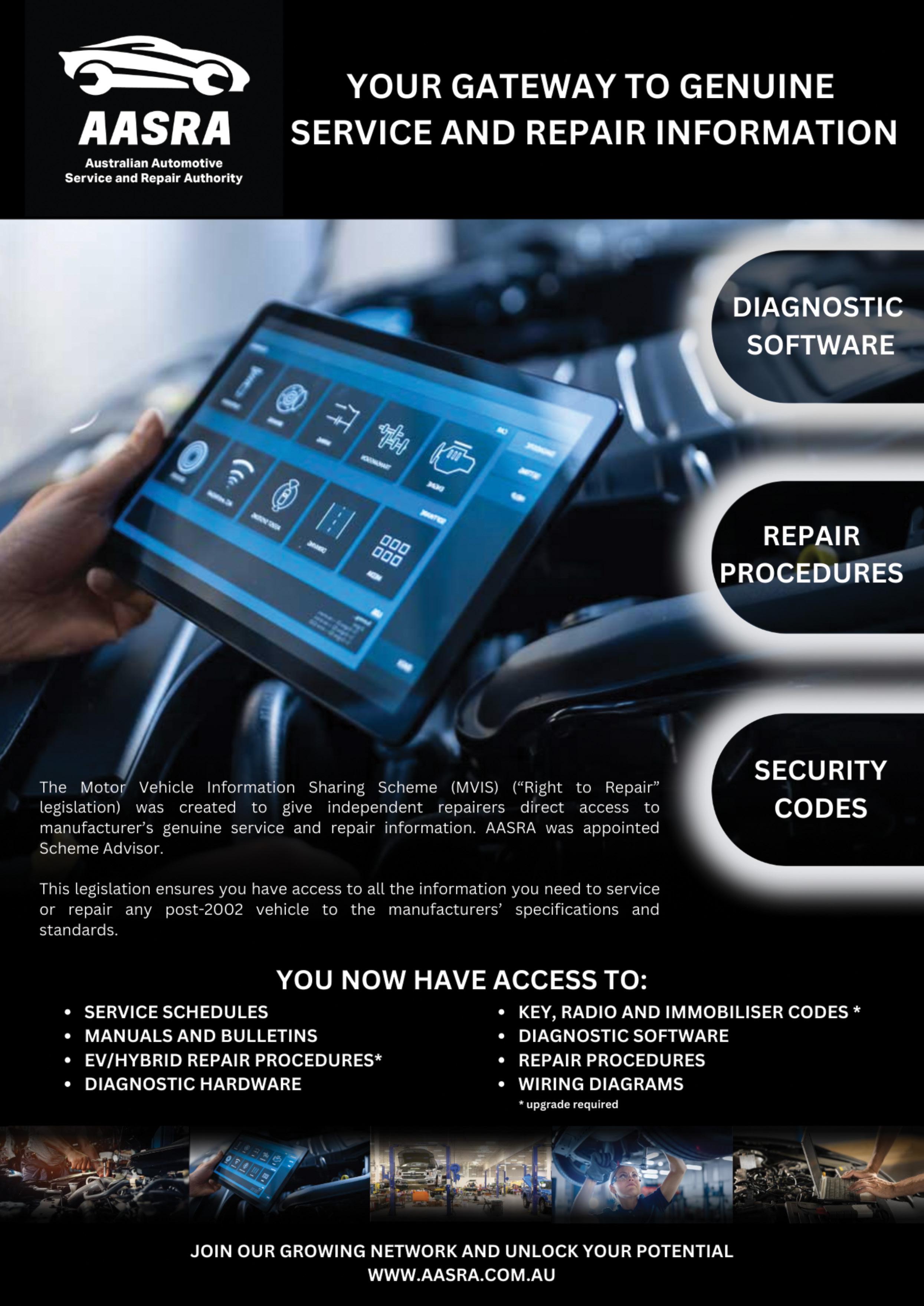
Quite simply, all the information available through the AASRA portal comes directly from each manufacturer’s own database and is therefore live, genuine and complete every time.
This ensures you can return a vehicle to its owner with the confidence the repair has been carried out in line with the manufacturer’s authorised procedures. Come and see AASRA at stand L05 at the upcoming Automotive Aftermarket Association Expo from May 14 to 16 in Melbourne, where the organisation will illustrate what it does, how it does it and the benefits of an AASRA subscription.
• To find out more contact AASRA on 1300 222 772 or go to aasra.com.au


Frank Massey
I’d like to share an interesting personal diagnostic experience that happened to me over Christmas that challenges many of the foundations I advocate for essential and successful diagnostic practice – from system knowledge, wiring schematics and measurement values to service updates and specialist tools.
My personal motorcycle, a BMW S1000R stored in a dry garage with battery support, failed to crank and start. I run it up every two to three months during winter.
Using the main beam as a voltmeter, I noticed no reduction in illumination. Not fully accepting this, I removed the seat and checked the battery with a digital multimeter (DMM) static while depressing the start button. No drop in voltage was observed, so there was no request to engage the starter motor.
I noticed the instrument display showed a powertrain control module (PCM) malfunction indicator light (MIL) light and was missing gear-selection data.
The fuse panel is adjacent to the battery. I thought it sensible to at least check them all without knowledge of the protected circuits. All the fuses were correct.
Just forward of the seat under a cosmetic carbon cover is the Bosch PCM. I removed
the two sockets, inspecting for any corrosion and then reassembling with a spray of contact grease.
Next, I checked the clutch switch. I know from experience the two-way micro switch can affect cranking while in gear. This also applies to the side-stand switch. Both were operating normally.
I started to suspect a problem between the instrument cluster and PCM. My reason was based on the faulty feedback from the selected gear position; it would only report partial gear selection. Despite not showing neutral with the clutch disengaged and side stand up, it should have cranked and started. The gear-select sensor socket is in a vulnerable position, so I thought it wise to inspect and check the three pins for water ingress. It is a sequential box, so I suspect it is a potentiometer.
The rear wheel was off the ground so I was able to move the gear lever through
its selection range, noting several missing positions. With a static primary gearbox input shaft, I decided to rotate the rear wheel while operating the gear-select foot pedal.
The rear wheel was initially locked like the internal selection mechanism was faulty, then suddenly released, allowing all gears and neutral reporting back to the cluster. And guess what? It cranked and started normally. I am hoping you can see a successful logical approach based on knowledge of component responsibility rather than any of the aforesaid diagnostic assets.
Now my thoughts and advice on turbo systems testing. It may seem obvious to state that we are faced with both mechanical and electronic control systems. As always, start by extracting as much serial data as possible. Now a little advice on essential tools.
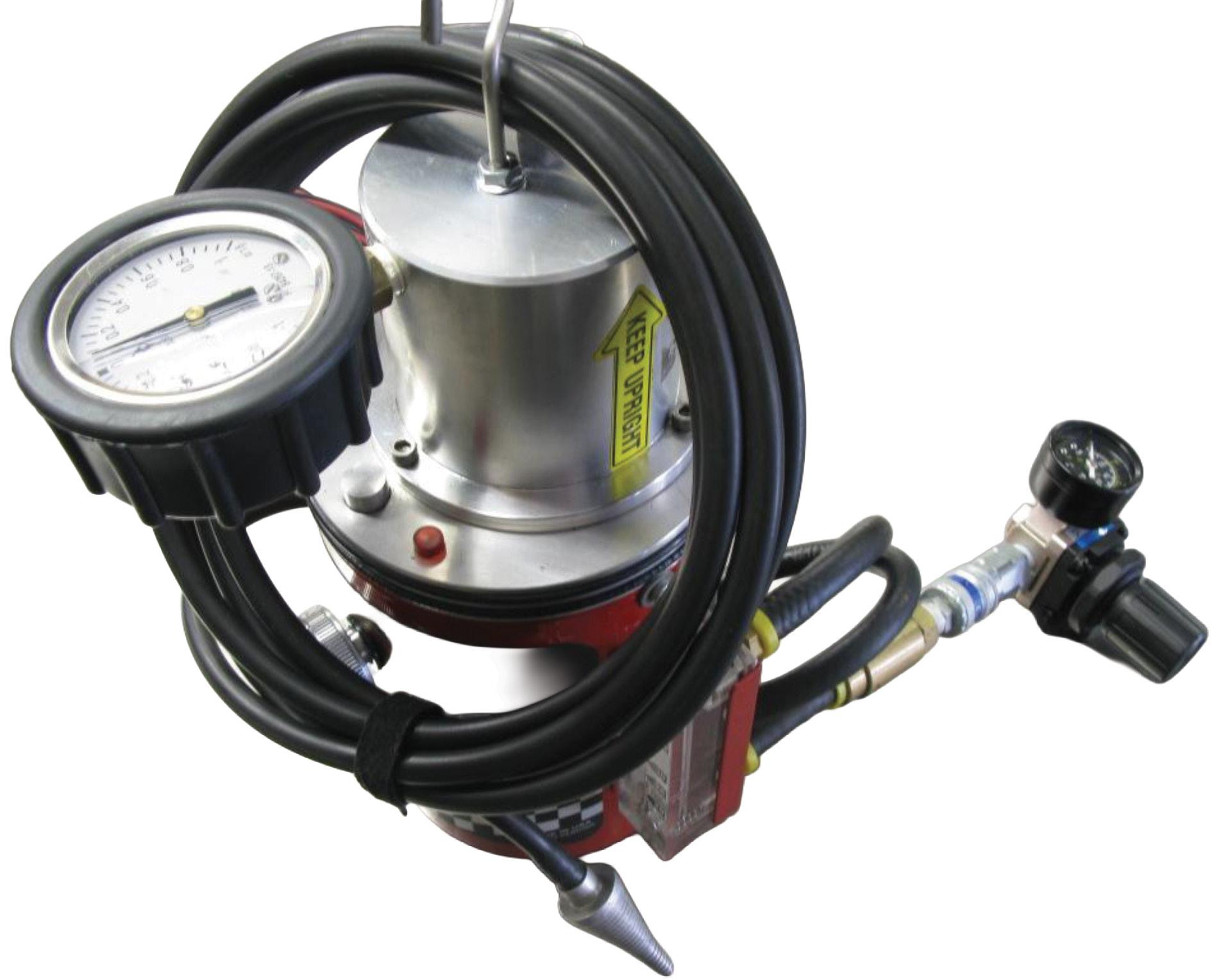
First, a smoke-generation tool. We modified ours with an external pressure regulator, allowing a test-pressure range like actual onvehicle values.
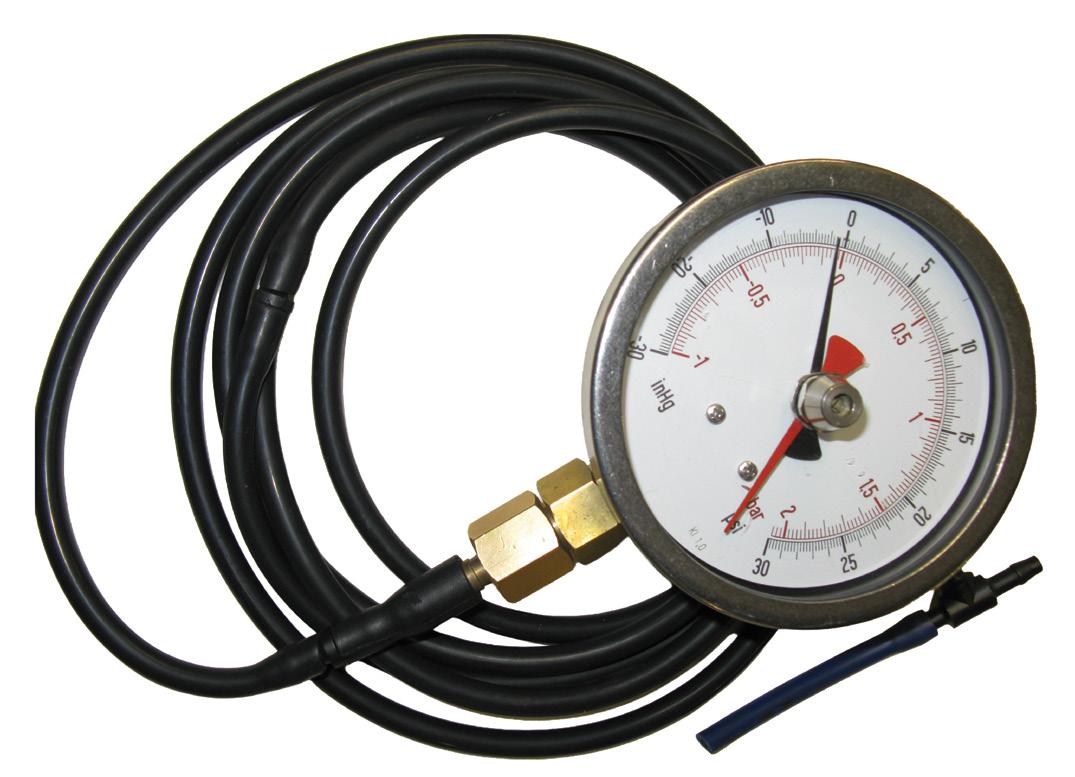
Second, an undamped pressure gauge with a range of atmosphere from minus one bar to plus two bar. This enables charge-pressure circuit testing and pressure-differential wastegate-control systems testing.
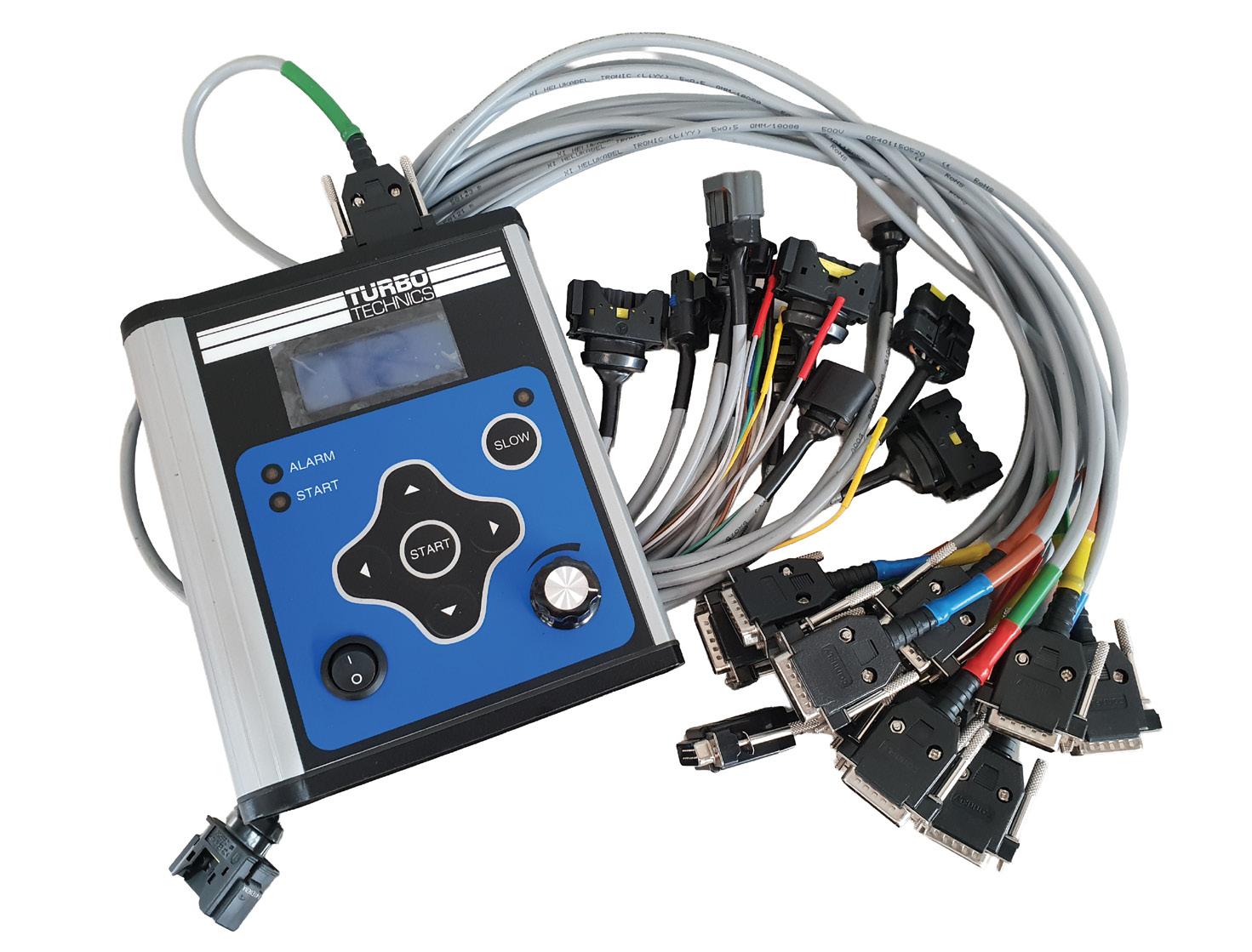
Finally, an actuator test tool allowing the independent driving of pulse width modulated (PWM) wastegate-control systems. This can also be of use on intakeflap actuator testing. It provides control of wastegate position with current monitoring, allowing accurate confirmation of a partial mechanical seizure or actuator failure.
Disconnect the control linkage and test independently; this will confirm if it is the turbo or actuator at fault.
I’m going to suggest five possible problems: boost above specified values, boost below specified values, intermittent chargepressure control, sensor-range error and faulty remapping.
Your approach will depend upon the nature of the fault. With a loss of pressure, I would always begin with a smoke test. Do not get
repair. It is quite common for several system leaks which do not show up until the major leaks are resolved.
If no leaks are found, you must check the serial data to confirm if the PCM is commanding a positive pressure correction. You will need to clear the fault code with each test drive, allowing the PCM to restore correction control.
exhaust-gas recirculation (EGR) valve (internal pressure loss). An undervalue mass air flow sensor (MAF) will guarantee a low boost value as will a low accelerator pedal position (APP) input value.
If the turbo cannot reach the specified values, it may be a worn turbo or a turbo that cannot achieve the value of a remapped PCM; this normally ends in turbo failure.
Over pressure is usually caused by a partially or fully seized wastegate actuator. This can be confirmed by checking the PCM-control deviation. Check the specified values to see if they are elevated with modified software. In both cases you must use an independent pressure gauge; this will ensure a faulty boost-pressure sensor value is not responsible for the error.
The other critical component affecting turboboost values is the air mass meter (AMM); a fault here will screw up the request and actual load tables. I had a case some years ago where an OEM turbo failed within two miles of a road test due to a faulty MAF where the airmass value was greater than the actual value.
I am not against modifying software to increase power output but the important factors are the turbine (hot side) and compressor (cold side) compression ratios. This is why hybrid turbos and intercoolers are essential for substantial sustained boost pressure.
I have stated in previous articles the problems with long-life servicing, substandard lubrication choice and diesel particulate filter (DPF) systems engaging excessive active-regeneration cycles, directly causing oil dilution.

OverJason Smith
the summer I was travelling by train to the cricket at the MCG when I heard a group of people discussing a problem one of them was having with a car.
From what I heard, the problem vehicle had been to multiple workshops and landed at one workshop with multiple visits, with the problem still ongoing. During the discussion I heard three alarming comments;
1. The group was calling the problem or fault a service.
2. I heard the statement, ‘I reckon if the car goes back for service, the third time it should be free.’
3. And my personal favourite, ‘Don’t they just have a computer they plug into the car and it tells them what’s wrong.’
Unfortunately, this has been the general public’s thinking of our trade for a long time and it still seems to be the thinking
of many vehicle owners today. So like it or not, it’s up to us as professional technicians to explain to customers right from the beginning with faults in complex systems the truth about what goes on in front of and behind the scenes to diagnose a fault or multiple faults in a modern vehicle.
I’ve found keeping the customer updated and informed about procedures, special tools used, timelines and possible costs involved in the diagnostic process is a good start. Vet the customer – if you get a bad feeling that they may be only price or timedriven, it may be a good idea to say no to the job – and by that I mean just no, not followed by (no) problem or (no) worries, just no!
The following case study follows a complex problem with an outcome that surprised me and demonstrates the fact that a scan tool doesn’t tell a mechanic or technician what’s wrong with a vehicle. It also highlights the need to keep a customer updated on
progress and where possible cost as you make your way through a long diagnostic job. Knowledge, experience, some special tools and wiring diagrams are also required for a good outcome to be the result.
The car Holden, VE Calais Sportwagon, 08/2008, 6.0-litre L98 V8, 150,000km on the clock.
I was originally called by the owner and asked if I could plug in a diagnostic tool to look for and clear fault codes. The customer thought this would probably fix the problem. Of course, those who know me know this is not my normal business practice, so I quizzed the customer some more and set some ground rules before I’d even consider looking at the vehicle.
The first thing I noticed when I saw the car was that it was in very poor condition. There was water and mould in the floorpan on the left hand side front and rear, the roof lining was damaged and hanging down in some places and the two batteries in the vehicle were flat or nearly flat.
The vehicle was experiencing a range of symptoms. Sometimes it wouldn’t crank or start. Two warnings would also appear on the instrument cluster’s multi-function display (MFD) when driving – one for the supplemental restraint system/airbags (SRS) and another for the anti-lock braking system (ABS) – and the indicators would stop flashing. All of these issues were intermittent.
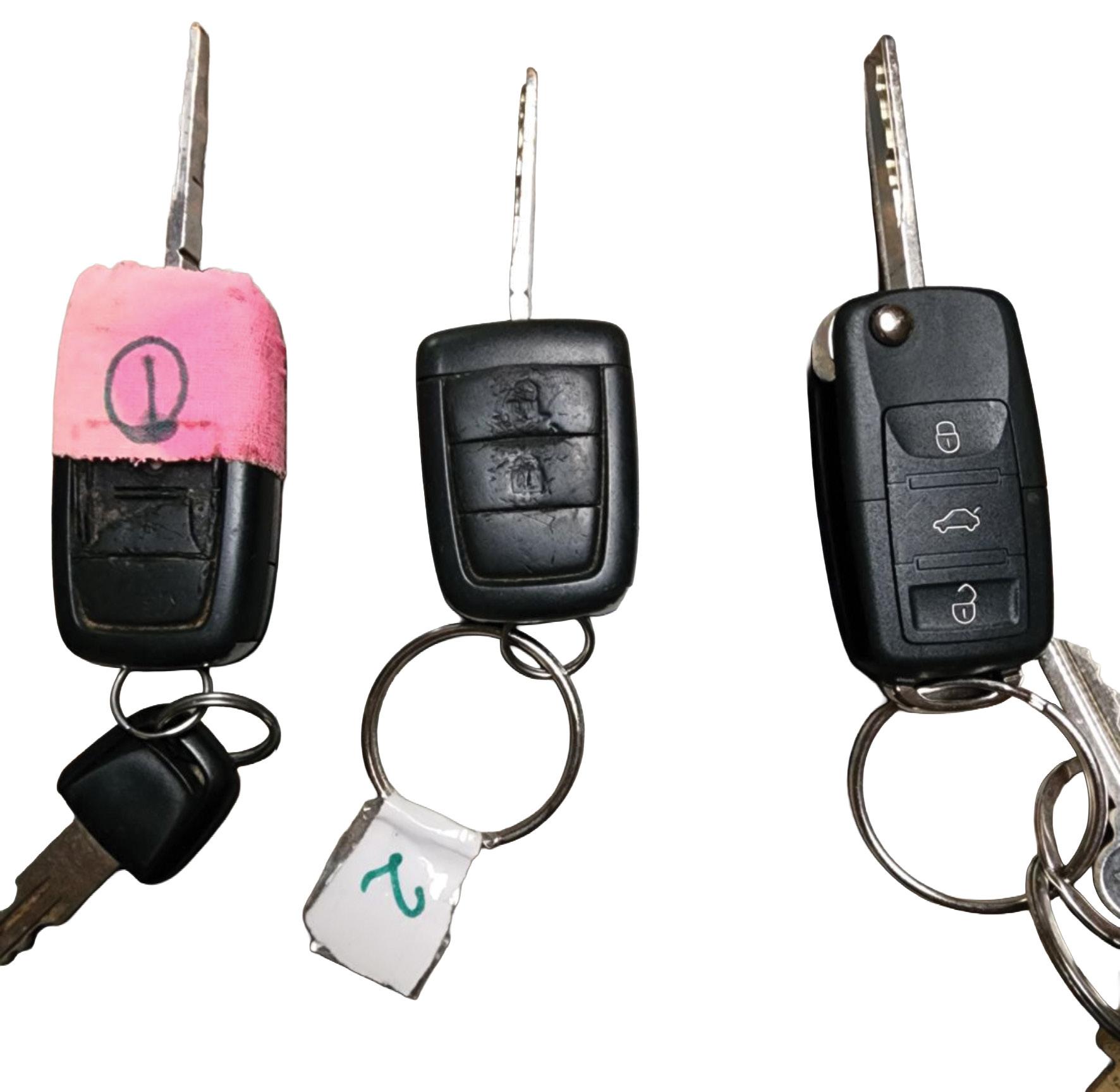
The customer also mentioned she thought the problem was the key, so she had purchased a new and programmed flip-style key from a shopping-mall supplier but the problem still existed (more on that later).
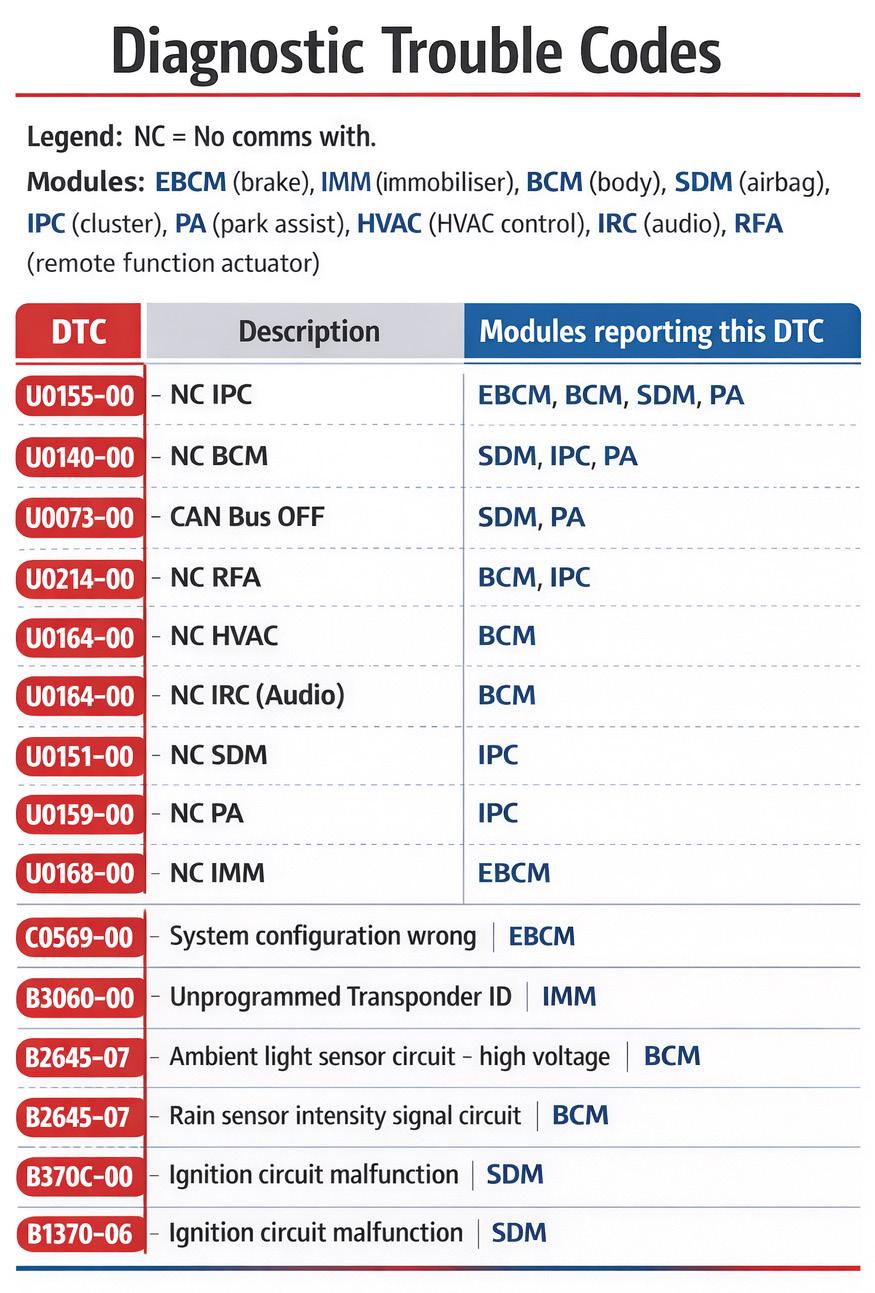
As requested by the owner, I plugged in the scan tool and performed a full scan of all the systems. A multitude of diagnostic trouble codes (DTCs) were present, mostly relating to communication errors. A full report of the DTCs was studied, then captured and stored (pic 1).
Next, I made an attempt to clear the DTCs but the scan tool was sometimes unable to communicate with some of the systems or modules in the vehicle. Eventually most of the DTCs were able to be cleared, so the next step was starting the vehicle and road-testing it.
During the road test I noticed the SRS and ABS warnings would audibly and visually appear and eventually the indicators would stop flashing. During this event, the tachometer would also freeze and the fuel gauge would drop. This issue with the gauges dropping out would happen for about 30 seconds, then they’d come back to life, then maybe fail again and come back. By the end of the road test some of the DTCs had reappeared.
I informed the owner there were deeper issues with the vehicle and possible ECM issues considering the amount of water present in the vehicle. I said it could potentially be causing problems with systems such as the body-control module (BCM), instrument cluster or sensing diagnostic module (SDM, otherwise known as the airbag module), so further testing would be required.
The customer, however, didn’t want me
to take any further action, so I charged an initial diagnostic fee and returned the car.
After two weeks later, the owner was back in touch requesting further diagnostics to identify the cause of the ongoing problems with the vehicle. A road test confirmed the same symptoms listed above.
Before going too far on this vehicle, I checked the operation of all functions, lights and accessories and noted the a/c worked but wasn’t cold, the roof lining was falling from roof and some interior trims were broken. I was told the factory DVD player in the roof hadn’t worked for a long time and the rear seat mechanisms were broken and didn’t fold down.
More significantly, the floor had a lot of water in it and there were towels to soak up the water and a mouldy smell – I’m not painting a good picture am I? I noted all this before moving on.
First came some proper basic tests, starting with a battery smart test and smart charge. I then correctly installed the correct, fully charged battery to the car – it had had arrived with two batteries, with the one fitted to the vehicle the wrong size a correct, near-new unit sitting in the vehicle but flat.
Checked the three keys supplied by the owner (pic 2). Keys one and two were the OE units and working, while key three was the aftermarket shopping-mall key mentioned earlier. Keys one and two started the car (when the intermittent fault wasn’t present) but the keyless-entry
buttons on both keys didn’t work as they were well worn. Key three sometimes wouldn’t start the car and the keyless-entry buttons didn’t work either.
I decided to just use key one from this point and concentrate on the other keys later because key one was known to be reliable all the time.
Next, some more basic testing. To some, checking lights may seem a pretty useless task while starting a complicated diagnostic job but they couldn’t be more wrong. The simple observation of a light not working or a light with different brightness could indeed lead to the quick identification of a fault.
This is clear in a few early TaT Repair Solutions, one of which focused on an early Ford Laser with a transmission fault caused by a faulty globe in one of the rear lamps. I’ve seen this at least twice, once in a E120 Toyota E120 Corolla with unusual electrical problems (the cause being a faulty globe shorting in a rear lamp) and the second a Toyota LandCruiser 100 Series with items in the instrument cluster not working due to a blown fuse (in this case the clue was the reverse lights not working).
A simple light check can tell you which circuit or area to start looking in early in the diagnostic sequence. This simple but important step was a notable inclusion in well-known technical trainer Sean Tipping’s webinar presentation for TaT in 2025. In one of his case studies, he was working on a pick-up truck with network issues and made very clear during his initial observation and testing that he noticed one of the rear lamps had a difference in brightness. In the end, the cause of the lamp fault was indeed the cause of the network fault.
The takeaway from this is don’t discount or overlook the basics because they may lead you to the promised land, saving you a heap of time in your diagnostic process. Back to the case study. When I performed my light check, I found the indicators would stop flashing and clicking on the dash but they were working and flashing normally outside the car.
I also found the intermittent indicator fault and cluster problem were very reliably repeatable, which is important with intermittent faults – if they aren’t reliably repeatable, consider stopping until the fault can be replicated reliably or you’ll end up chasing your tail.
Next, I scanned all modules and carefully analysed the DTCs and live data, all of
which was similar to previous scan a few weeks earlier.
Considering the communication faults, the next step in the basic diagnostic process would be checking the powers and grounds, which shouldn’t be limited to testing all fuses in all fuse boxes. Even those hidden fuse boxes inside kick panels, etc should be put on the list.
The best practice for this kind of diagnostic job is to obtain and refer to a reliable wiring diagram (i.e. Haynes Pro or Haynes All Access). You should check the ground points in the engine compartment and dash area. You may also need to perform some voltage-drop tests.
Because of this car’s communication faults, further testing was required, so I decided to
concentrate on the controller area network (CAN) high and low operation and then the local interconnect network (LIN, which I believe is called LAN in GM speak).
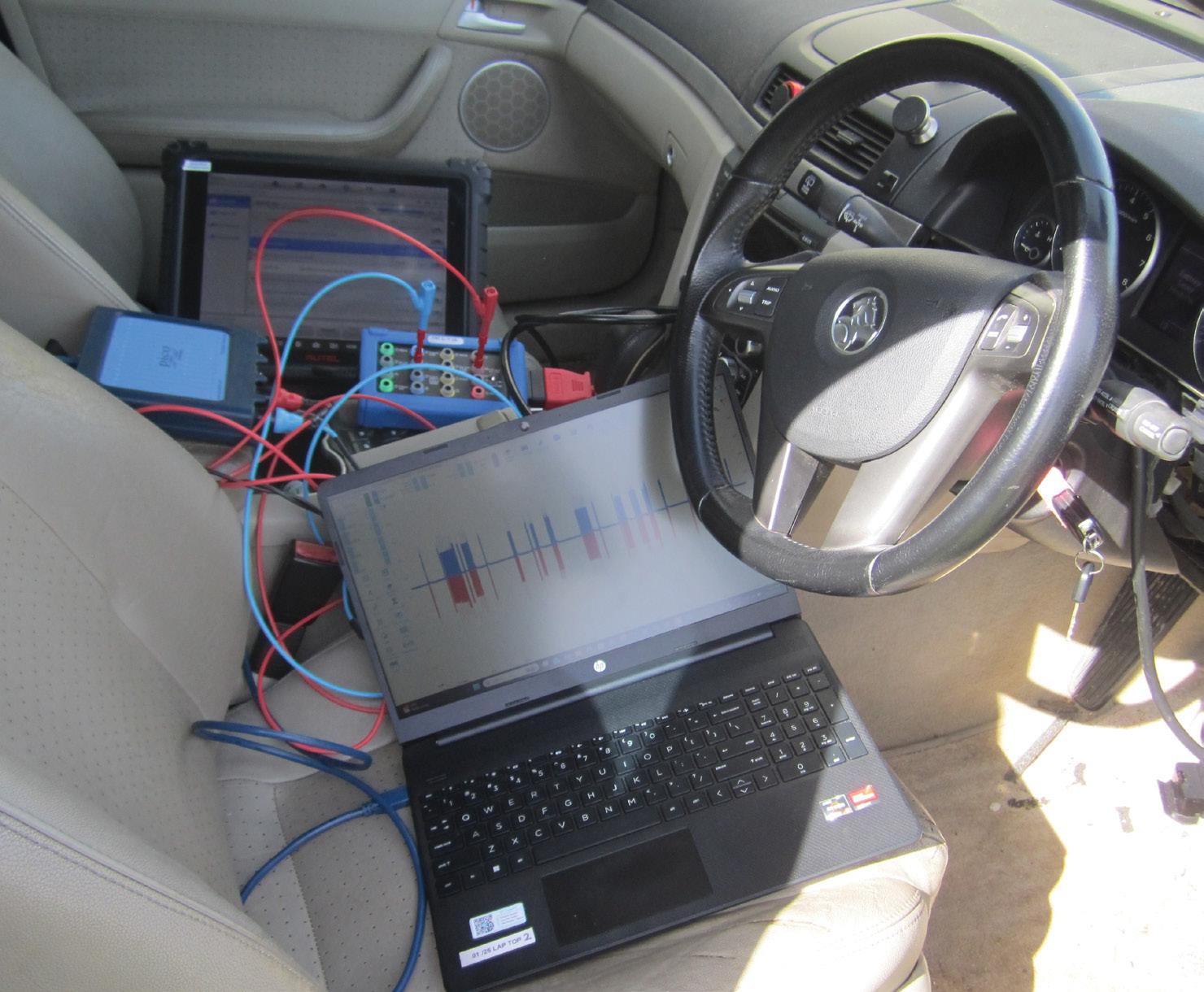
I connected a break-out test box to the on-board diagnostics (OBD2) port and observed the flashing LEDs – they appeared OK.
With the CAN test box still connected to the OBD2 port, I used a PicoScope to obtain a waveform of the CAN network, looking for any abnormalities when the fault occurred with the indicators. No problems were observed (pic 3).
Next, with the vehicle depowered, I checked pins 6 and 14 on the OBD2 port for 60 ohms (Ω) – they were OK.
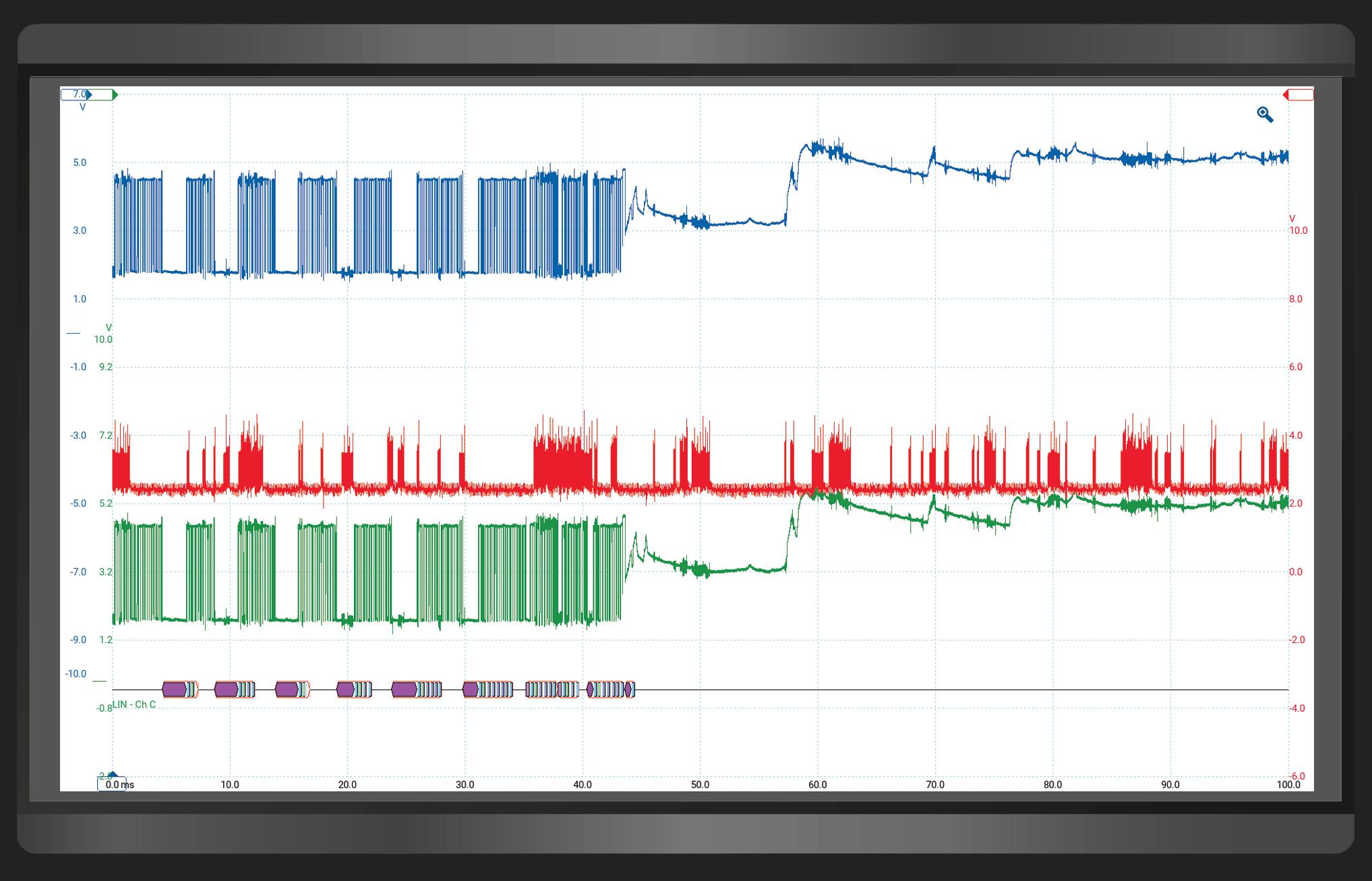
I then removed the steering-column shroud and surrounds to gain access to and drop down the BCM before connecting the PicoScope to the LIN network at pin C10 of the BCM.
Bingo! When the indicators stopped flashing, the waveform would go haywire (pic 4, green and blue traces).
Why? Stay tuned for part two of this article in next issue of TaT.

Heating, ventilation and a/c (HVAC) systems in modern electric vehicles (EVs) present one of the most interesting engineering challenges in the automotive industry.
In an internal combustion engine (ICE) vehicle, cabin heating is relatively straightforward because waste heat from the engine is readily available. Cooling, while requiring energy, is supported by an engine-driven compressor system that can deliver high output with little concern for electrical consumption. EVs operate under completely different constraints.
Unlike ICE vehicles, EVs produce minimal waste heat during normal driving conditions, meaning cabin heating and cooling must be generated almost entirely from stored electrical energy. This has a direct impact on battery state of charge (SoC) and therefore vehicle driving range.
As a result, EV HVAC design must achieve an unusual combination of goals – rapid cabin comfort, compact packaging, low electrical load and maximum efficiency.
This raises an important question. If you were asked to design an HVAC system for an EV, where would you begin?
To answer that, we must first consider the heating and cooling loads involved and why some simple solutions are not as practical as they may initially appear.
Peltier dielectric substrate wafers are sometimes proposed as a heating and cooling method for EVs because they can switch instantly from heating to cooling by simply reversing polarity across their terminals (TaT issue 109, page 24-43).
However, despite their convenience, Peltier devices suffer from very poor efficiency. Their coefficient of performance (COP) is typically between 0.3 and 0.7, which makes them unsuitable for EV HVAC systems where stored electrical energy is limited. Clearly, a more efficient HVAC solution is required.
1. Understanding EV cabin-heating and cooling loads
The average EV cabin volume is approximately 2.5-3.5 cubic metres. Although this is relatively small compared with a typical household environment, the cabin is exposed to extreme temperature fluctuations due to high glass area, solar radiation and rapid ambient temperature changes (ref 1).
In practical terms, an EV HVAC system must not only maintain cabin comfort but deliver rapid cooling or heating under peak load conditions.
a) Cooling loads
On a hot summer day, a vehicle parked in direct sunlight can reach internal cabin temperatures of 60°C or higher. In contrast, a comfortable cabin temperature is typically around 22°C. This requires the HVAC system to remove a significant amount of heat within a short period of time.
Typical EV cooling demands are:
• Peak cooling demand: 2-5kW
• Normal cruise cooling demand: 0.8-2kW System efficiency is commonly expressed using COP (TaT issue 109, page 24-43).
Modern EV cabin heat pumps and a/c systems often achieve a COP of approximately 2.5-3.5. This means 1kW of electrical input can move 2.5-3.5kW of thermal energy, providing a highly efficient method of cabin cooling (ref 2).

1
b) Heating
Heating is often more challenging in EVs because they lack the readily available waste heat produced by combustion engines. Modern EVs commonly use reversible heatpump systems, which can provide both heating and cooling. These systems are significantly more efficient than resistive heating elements. Typical heating loads include:
• Heat-pump heating draw: 1-3kW
• Resistive-heating draw: 3-7kW
This explains why most manufacturers prefer heat pump-based HVAC systems, particularly for vehicles operating in colder climates (TaT issue 109, page 24-43).
2. EV HVAC systems compared with domestic HVAC systems
To place EV HVAC requirements into perspective, consider a typical household installation such as electrical energy consumed (TaT issue 102, page 11):
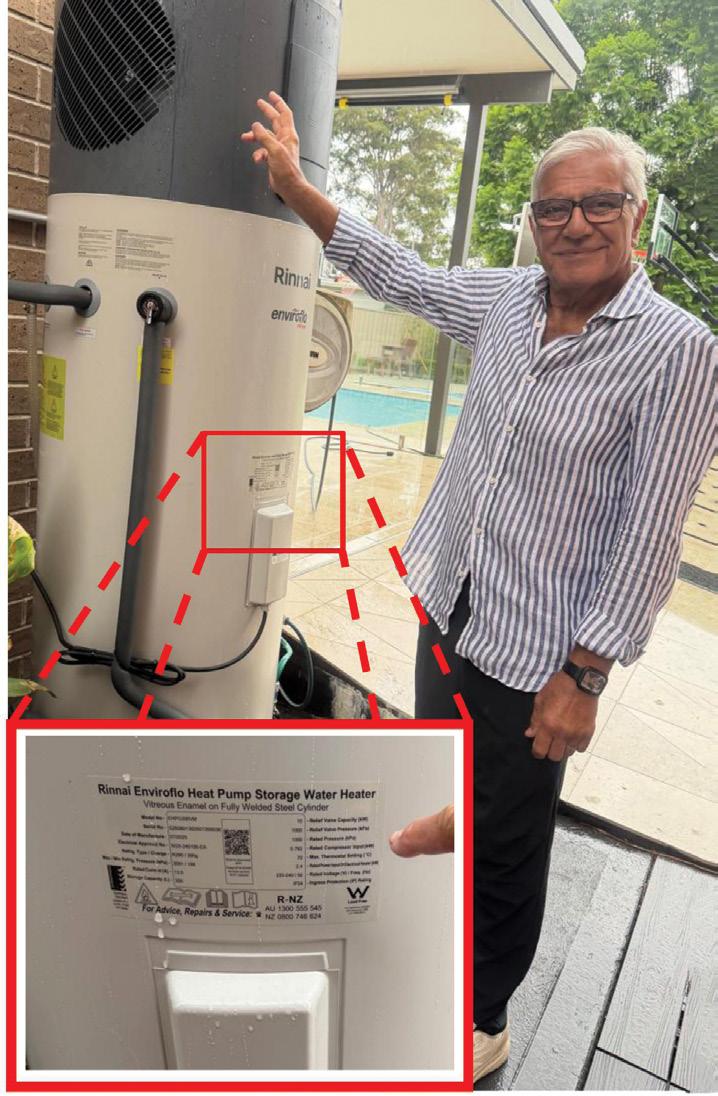
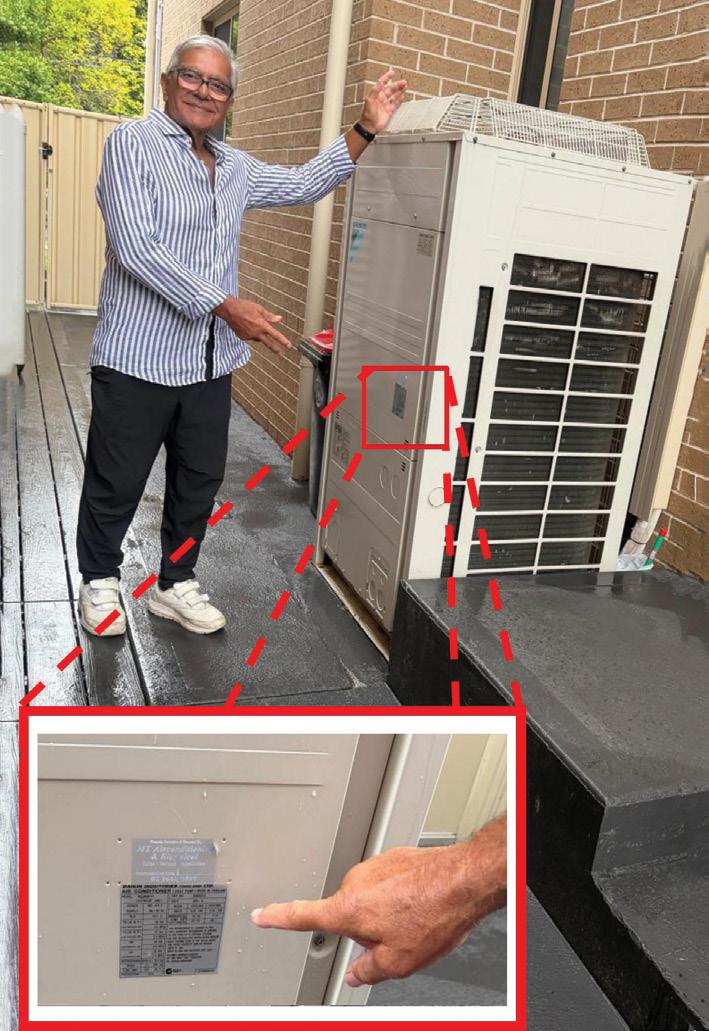
• A 5.6kW of electrical energy consumed (415V three-phase) reverse-cycle ducted home air-conditioning system (pic 1).
• A 2.4kW of electrical energy consumed (240V single-phase) heat-pump hot-water system (pic 2).
While domestic systems operate over far larger volumes and higher thermal-mass environments, EV HVAC systems are designed for rapid response and compact packaging. In addition, EV manufacturers often reduce the cabin-heating load by using targeted heating strategies such as seat heaters and steering-wheel heaters (ref 3).
These design priorities allow EV HVAC systems to remain relatively small yet still deliver rapid cabin comfort.
3. Electrical-system considerations
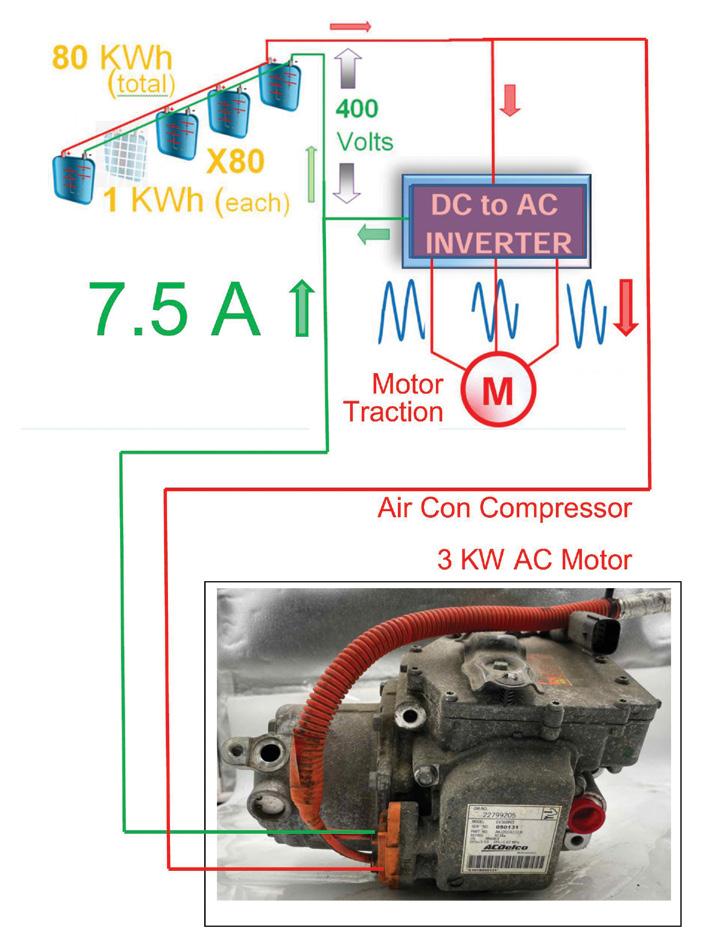
Modern EVs typically operate with batterypack voltages of approximately 400V, with some newer vehicle platforms operating at up to 800V.
While this is an extremely simplified explanation, the high-voltage circuit diagram illustrates major advantages when supplying power to HVAC compressors as high power demand can be achieved with relatively low current draw (pic 3).
For example, a 3kW cabin cooling load draws:
• P (watts) = applied voltage (V) x current consumed by the load (I)
• I = 3000W/400V = approximately 7.5A (pic 3)
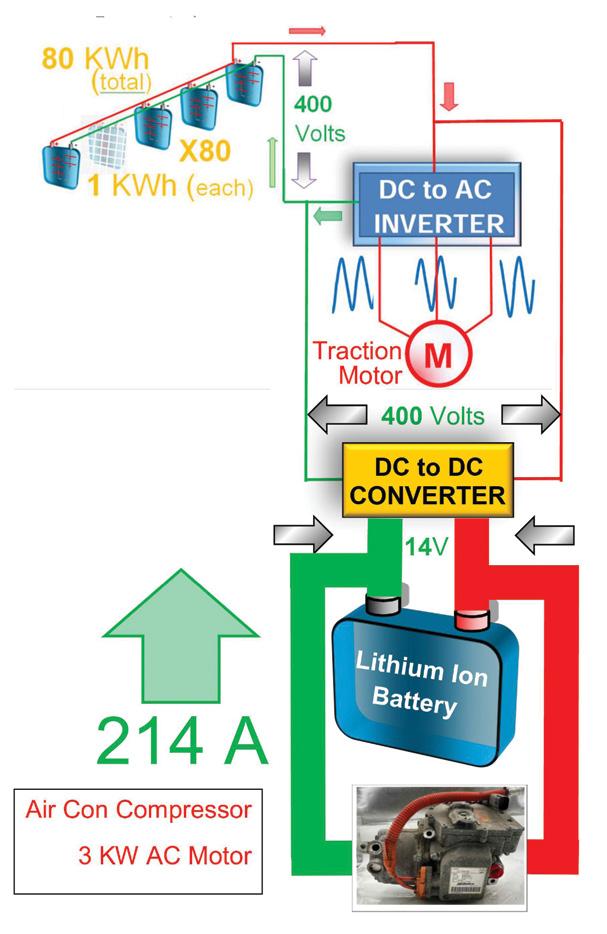
If the same load were applied to a 14V auxiliary system, it would require:
• I = 3000W/14V = approximately 214A (pic 4)
This comparison clearly demonstrates why EV HVAC compressors are driven by highvoltage systems rather than traditional lowvoltage DC motors. High current demand would require excessively large wiring, heavy connectors, increased electrical losses and significant heat generation.
In short, high-voltage systems reduce current, reduce losses and allow compact packaging. An ‘in-built’ inverter and three-phase motor is then used to drive the compressor – all housed in the same compact assembly (pic 4, more on that in our next article).
4. Why EV HVAC systems can be so compact
Several factors allow EV HVAC systems to be much smaller than domestic heating and cooling systems:
1. Vehicle cabins contain relatively small air volume compared to a house.
2. Cabin materials have low thermal mass and change temperature quickly.
3. Passenger comfort can be achieved through targeted heating methods.
4. Cabin interiors are generally well sealed compared with many buildings.
These design conditions allow EV HVAC systems to be packaged efficiently under the bonnet or within compact enclosures.
5. Energy impact on driving range
One of the most common concerns among EV owners is the effect HVAC systems have on driving range.
Typical real-world HVAC energy consumption values include:
• Highway cooling: +10-20 watt-hours (Wh)/km
• Heat-pump heating: +15-30Wh/km
• Resistive heating: +30-60Wh/km
For an EV consuming approximately 160Wh/ km, this means a/c may reduce range by around 10 per cent, while heat-pump heating may reduce range by 10-20 per cent. Resistive heating, however, can approach a 40 per cent increase in energy consumption under cold conditions (ref 5).
6. Realistic cooling scenario
Consider a practical Sydney summer scenario:
• Ambient temperature: 35°C
• Cabin temperature after sun exposure: 60°C
• Target cabin temperature: 22°C
Under these conditions:
• Initial cooling demand may require 4-5kW electrical input, with the compressor operating at high speed.
• After 10-15 minutes, cooling demand may reduce to approximately 1.2-1.5kW to maintain temperature.
This demonstrates that peak HVAC demand is typically short-lived and most driving involves moderate energy draw to maintain cabin comfort.
EV HVAC systems are compact, efficient and highly integrated. Unlike ICE vehicles, EVs cannot rely on waste engine heat, meaning all heating and cooling must be generated using stored electrical energy.
This makes HVAC efficiency a key factor in preserving battery SoC and driving range (see TaT issue 105, page 31).
Although Peltier devices offer instant heating and cooling reversal, their poor COP makes
References
them unsuitable for practical EV HVAC systems. Instead, modern EV manufacturers rely on high-efficiency heat pumps and highvoltage electrically driven a/c compressors.
Comparisons with domestic HVAC systems, such as a 5.6kW ducted reverse-cycle unit or a 2.4kW heat-pump hot-water system, highlight how EV HVAC systems achieve high performance in a much smaller physical package.
High-voltage architecture also demonstrates why EV HVAC compressors use an in-built inverter and three-phase motor to drive the compressor as it significantly reduces current draw and improves efficiency.
In this article, EV a/c and heating systems have been examined from a design perspective, highlighting the electrical, thermal and practical service considerations that are essential for automotive technicians. In future articles, we will expand further into HVAC engineering, thermodynamics and energy flow, continuing to examine EV systems in greater depth from the mechanic’s point of view (MPOV).
These articles aim to build technician understanding of EV systems. Contact with high-voltage (HV) systems is lethal. When working on or near HV systems:
• Always use CAT IV-rated meters.
• Wear insulated gloves and full personal protective equipment (PPE).
• Follow OEM depowering protocols.
• Only perform work after completing certified HV training.
For more, see TaT’s EV Training resources.
1. Air Conditioning System Sizing for Pure Electric Vehicle – ResearchGate
2. An Integrated Cooling System for Hybrid Electric Vehicle Motors: Design and Simulation – ResearchGate
3. Design and Drafting of an Air Conditioning System for a Residential Building Using Air-Cooled Chillers –ResearchGate
4. Mahle Aftermarket: Thermal Management for E-Mobility (PDF)
5. Effects of Ambient Temperature on Electric Vehicle Range Considering Battery Performance, Powertrain Efficiency, and HVAC Load – ScienceDirect
Customer complaint
The warning light for the airbag/ supplemental restraint system (SRS) was illuminated.
The issue had been diagnosed elsewhere as an SRS sensing-and-diagnostic module (SDM) internal fault – I was contacted to program a used SDM supplied by that workshop.
Problem summary
Inspected the vehicle and the SRS warning light was on.
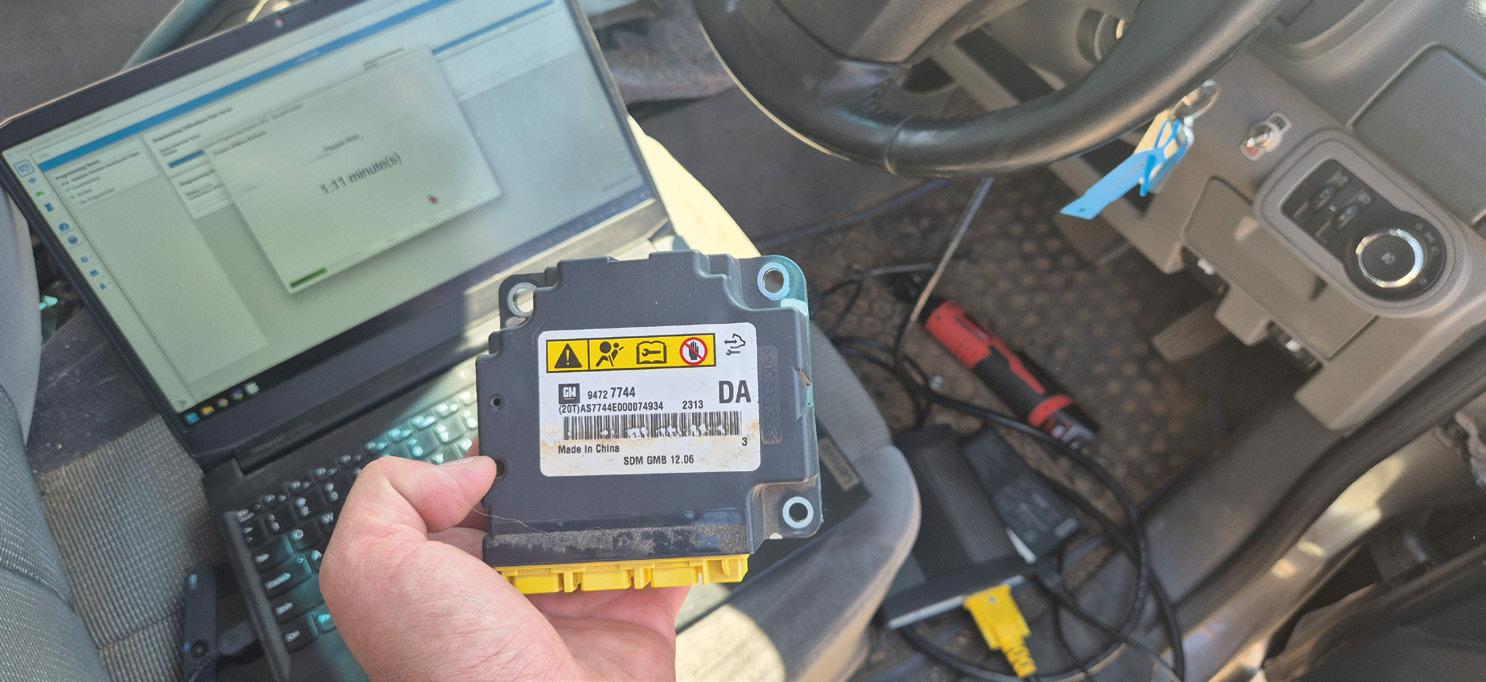
Checked the supplied SDM and it had the same part number/s (pic 1).
Diagnostic sequence
Carried out the programming procedure, which required purchasing two VIN slots through TLC/SPS2 (one for the faulting car and one for the car the used SDM had been removed from).
Carried out Prepare Control Module for Removal on original SDM.
Carried out Prepare Control Module for Removal on replacement SDM.
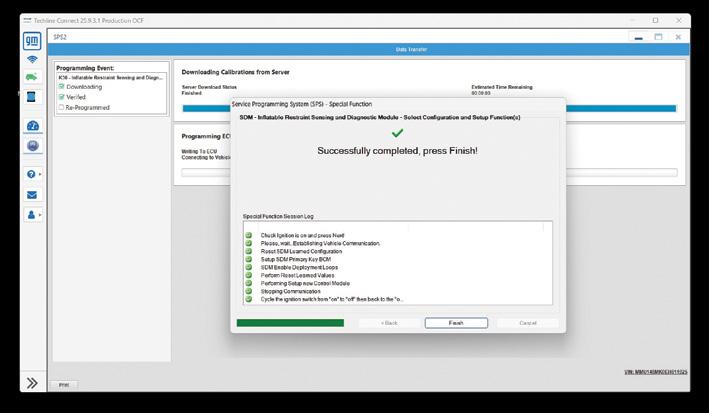
Carried out the programming of the replacement SDM – it was now OK – but was unable to complete the configuration and set-up of the replacement SDM due to
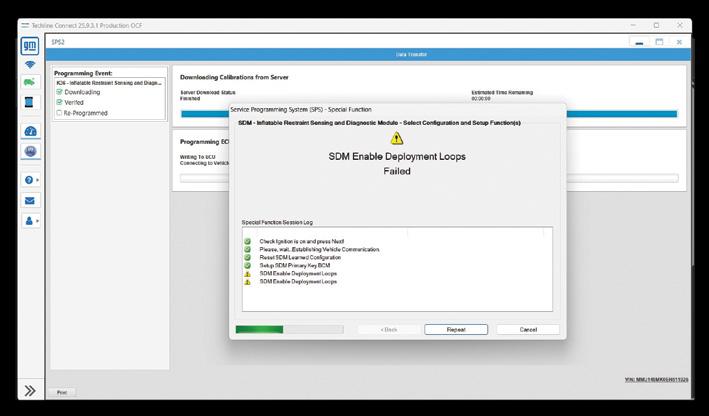

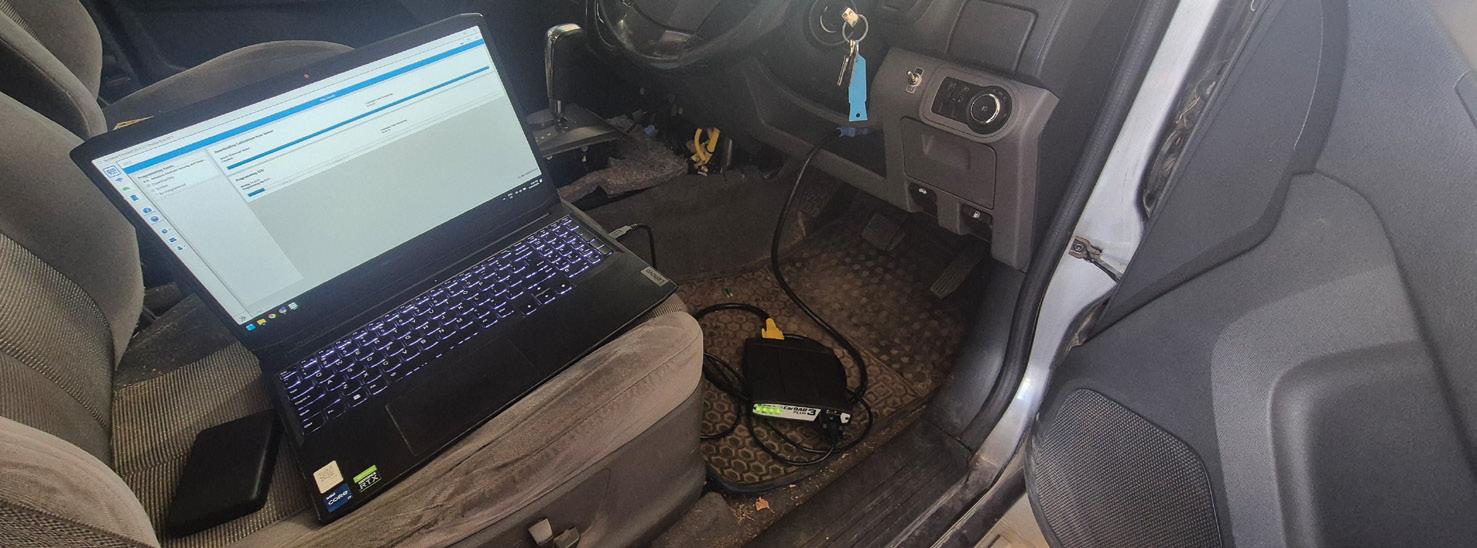
an Enable Deployment Loop configuration error (pic 2).
Attempted to reconfigure the original SDM but the same error was present. Found this error was associated with configuring the number of impact sensors that were fitted to the car.
The SDM was expecting to configure X number of impact sensors but was only seeing Y.
Suspected the initial fault was still present, so checked the battery voltage – it was OK, 12.6V.
Checked the charging voltage – it was OK, 14.1V.
Checked the vehicle for diagnostic trouble codes (DTCs) and found:
• B0086 – RH deployment sensor open circuit (impact sensor)
Removed the right-front door trim and visually inspected the impact sensor – it looked OK.
Disconnected the impact sensor and checked the circuit – a ground reference was present but there was no signal from the SDM.
Disconnected the SDM X1 connector, then measured continuity from X1-15 to the impact sensor – it was open circuit/no continuity.
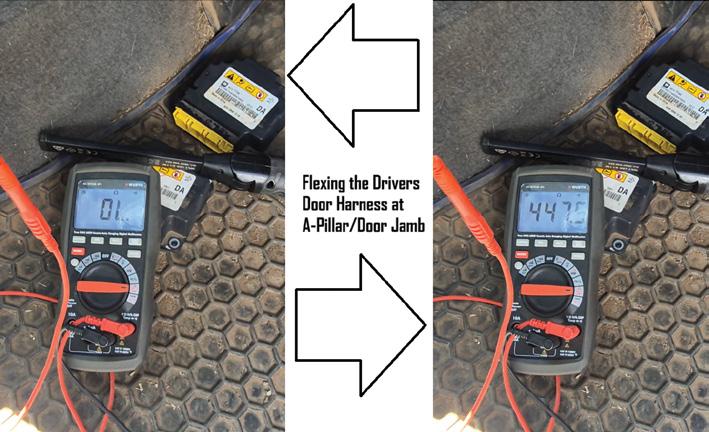
Inspected the driver’s-door harness/circuit for contact/rubbing points and found the driver’s-door wiring harness runs through the driver’s A-pillar/door jamb (pic 3).
There was a broken wire for the right-front impact sensor signal circuit in the A-pillar/ door jamb where the harness went from the body to the door. The resistance of circuit was changing when the door was opened/closed.
Recommended replacing the driver’s-door harness as an assembly as GM/Holden recommends against repairing airbagrelated circuits – there is also a Technical Service Bulletin (TSB) for the door-harness fault (2017060-ZSPP).
The circuit was repaired elsewhere but the SDM still required programming after that repair.
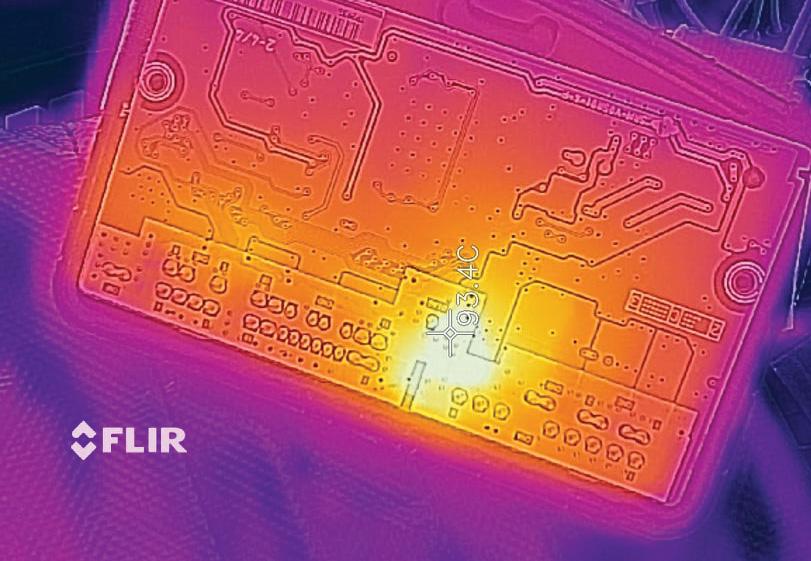
Carried out the programming of the original SDM – it was now OK (pic 4 and 5) – before configuring it and setting it up.
Cleared all DTCs and the vehicle tested OK – there were no warning lights and no DTCs were present.
Diagnostic time was two hours, taking into account preparation and research. Repair time was 40 minutes, taking into account the location of parts and carrying out the repair to a tested outcome.
Repair Solution by TaT Tech Team member Gary O’Riain.
Customer complaint
There was a burning smell from the engine area.
The high beams, rear demister and fog lights were also all inoperative and the enginecooling fans (thermofans) were running continuously.
Problem summary
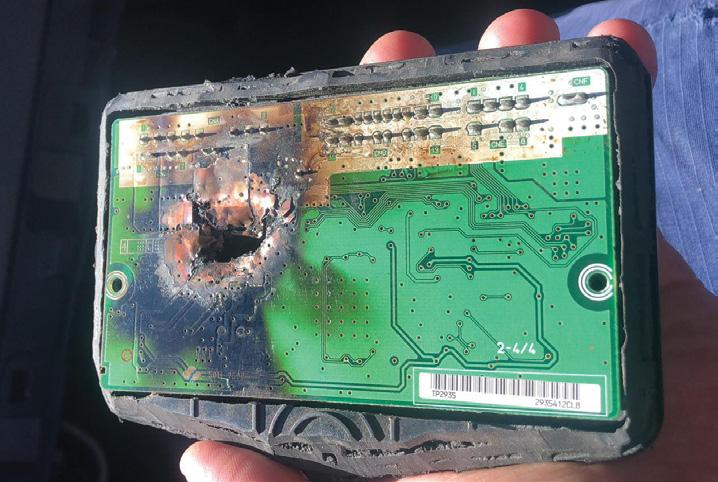
Multiple body-electrical loads were being commanded on with the ignition off and the integration relay/module in the engine-bay fuse box had suffered thermal damage (i.e. a hole burnt in the casing).
A replacement second-hand module had also overheated as soon as affected loads were connected.
Individual loads (demister, high beams, fog lights) tested with normal resistance/current and control inputs from the a/c module and body-control module (BCM) operated correctly.
Diagnostic sequence
Came into the job after the workshop had identified the integration module (8272033190) as suspect. The original unit had a burn-through about the size of a 20-cent piece and a nearby module ground lead on the right-hand side with the insulation had melted (pic 1).
That ground comprises two wires from separate module connectors spliced together and star-grounded on the right-hand side; repaired the insulation and inspected the earth points.
Confirmed the integration module supplied/ controlled the rear demister, high beam, fog lamps and thermofans per available diagrams. With the module connected but the loads unplugged, there was no abnormal current draw or heating.
Connected the loads one at a time while monitoring the opened module with a thermal imager:
• Rear demister connected: Module hotspot climbed rapidly to ~70-90°C at the same internal location as the original burn; demister current draw measured ~14A at ~12.6V with ~0.9 ohms (Ω) grid resistance, which is within expected range, and the grid heated uniformly (pic 2).

• High beams connected: Module heated to ~60–70°C at a different internal location; each high beam drew ~5A (60W/12V), also normal, yet the high beams remained on with key off. The cooling fans behaved normally; the fog lamps were left disconnected initially. Voltage-drop testing during a 14A demister load showed ~0.016V from the battery negative to the chassis earths and to the integration module ground pin, and ~0.015V from the battery positive to the module’s main feed – good supply/earth integrity at that moment.
However, I did measure a ~1.2V drop from the battery positive to the module’s demister output while loaded, indicating internal resistance/heating within the module rather than in the vehicle harness or load.
Control wires F4 (a/c module demister request) and F5/F13 (BCM requests) functioned correctly – 12V at rest, pulled to ground on command.
Substituted external relays to emulate the module for rear demister, high beams and fog lights. Each circuit operated normally (correct on/off logic and demister timeout), proving vehicle loads and control logic were sound and the integration module was the failure point.
Fitted a brand-new genuine integration module and repeated checks. No components latched on with ignition off, there were no hotspots (module surface <~30°C) and all functions behaved correctly. With the new module in place, performed a full charging-system evaluation that had previously been unsafe due to the module overheating.
With all major consumers on, the alternator produced ~65A at ~13.2V (low) and when an additional ~30A carbon-pile load was added, the system voltage sagged progressively below battery voltage despite ~80A output. The duty-cycle response was abnormal under load.
After alternator replacement, charging stabilised at ~14.1V with all consumers on, and ~13.8V maintained with an added ~35A load. The integration module remained cool and stable through extended operation. Note: the customer reported the original failure followed a flat battery and jump-start event, which may have exposed the already weak module to voltage transients.
An internal failure of the engine-bay integration relay/module (82720-33190). The module’s solid-state/printed current paths for the rear demister and high-beam outputs had developed high resistance/
TOYAS141456
Toyota Camry (ASV50R) 2014, 77,772km
Four-cylinder
partial short, causing self-heating and latching the outputs on with the ignition off.
Contributing factors were a defective alternator/regulator (i.e. low and unstable charging with likely ripple/spiking) and contaminated/painted chassis earth points at the left-hand/right-hand guard brackets that had previously increased return-path resistance and overheated the ground harness.
Vehicle loads themselves (rear demister ~14A, high beams ~5A each, thermofans) and control inputs from the a/c module/ BCM tested within normal parameters. No downstream shorts were found.
Restored chassis ground integrity by cleaning left-hand/right-hand guard-bracket earth pads back to bare metal and servicing the affected ground eyelets.
Replaced the integration relay/module with a new genuine unit and tested the system operation; no unintended loads remained on and module temperature stayed below ~30°C during extended checks.
Performed a charging-system diagnosis, confirmed the alternator/regulator performance was faulty under load and replaced the alternator. Verified stable charge voltage (~14.1V with all consumers on; ~13.8V maintained with an added ~35A load), no abnormal ripple/sag and no module hotspots.
Confirmed the correct operation and timeout of the rear demister, proper high/low beam and fog-lamp control and normal thermofan behaviour. No DTCs were present post-repair.
Advised the workshop on the correct jumpstart procedure due to the reported flatbattery event that had preceded the failure.
Diagnostic time was five hours, taking into account preparation and research. Repair time was one and a half hours, taking into account the location of parts and carrying out the repair to a tested outcome.
Repair Solution by TaT Tech Team member Gary O’Riain
complaint
The diesel particulate filter (DPF) and engine warning lights were showing on the dash
Problem summary
Confirmed the warning lights on an initial road test.
sequence
Started with the usual diagnostic tests first – a battery test, charging-system test and loaded-lights test.

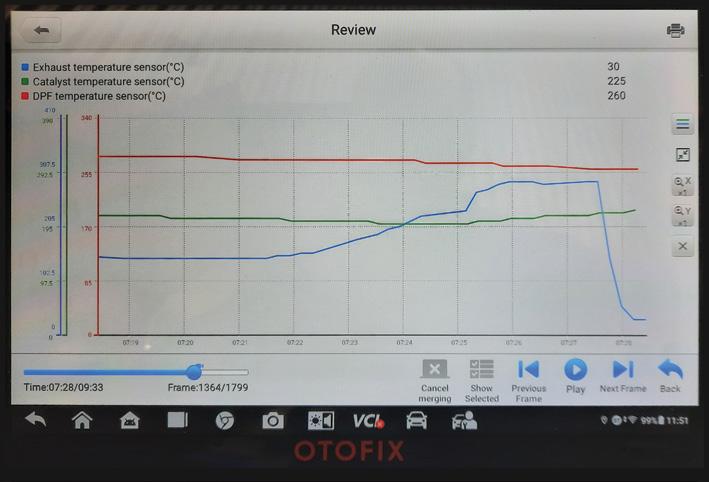
Performed a full vehicle electronic scan and found the powertrain control module (PCM) fault code, P0546 – Exhaust gas temperature sensor high.
When initially observing the live data of all three exhaust-temperature sensors, they were reading correctly and no fault was observed. After road testing, we were able to capture the live data of the exhaust-temperature sensor dropping out under heavy load/ acceleration.
Fault description
Faulty exhaust-temperature sensor.
Fault solution
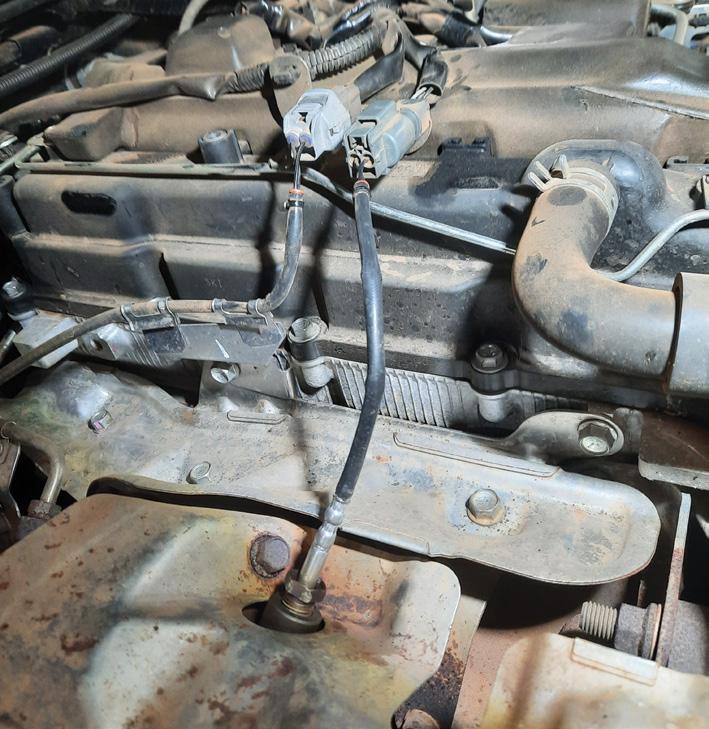
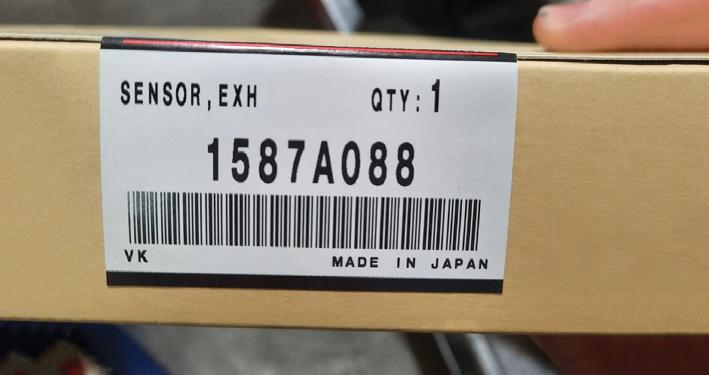
Removed and replaced exhaust-temperature sensor (part number 1587A088).
This was located closest to the turbo, so many would call this sensor #1.
Erased the fault codes, reperformed the road test under same conditions with no dropouts or faults found (pic 1, 2 and 3).
Recommended time
Diagnostic time was one hour, taking into account preparation and research. Repair time was one hour, taking into account the location of parts and carrying out the repair to a tested outcome.
Repair Solution by TaT Tech Team member Marty Hosie.
Join TaT for searchable access to thousands of Repair Solutions

The battery was running down over a few days and the vehicle owner was having to jump start and recharge the battery at home.
Noticed the engine cranked a little sluggish when driving into the workshop.
Started with the usual diagnostic checks. Load-tested battery and it passed in good condition.
Tested the charging-system operation and although the battery light on the dash went out when engine was started, there was no output from the alternator.
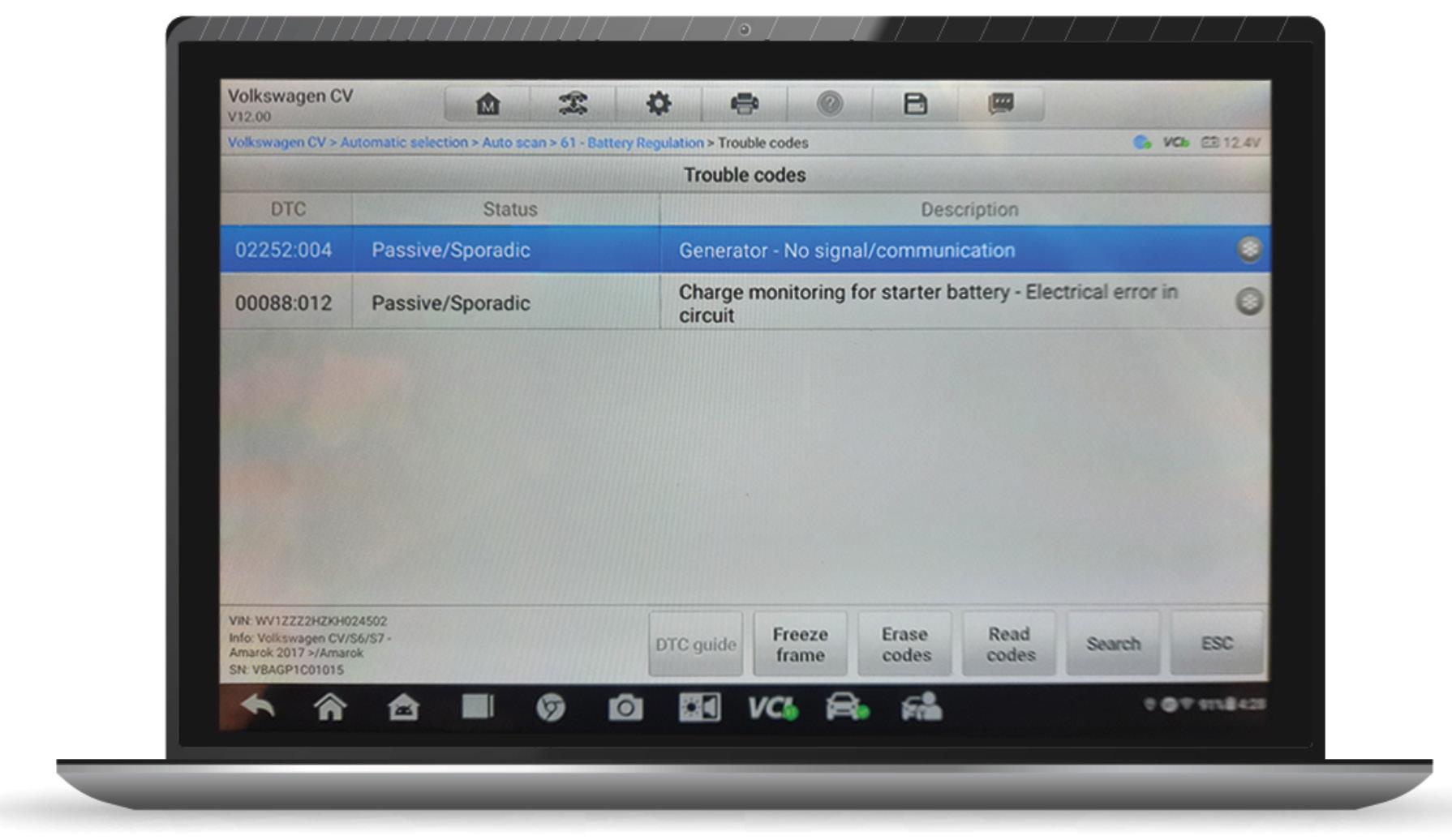
A full vehicle scan (pic 1) brought up the following fault codes:
• 02252:004 – Generator – No signal/ communication.
• 00088:012 – Charge monitoring for starter battery (an electrical error in the circuit was found in ‘battery regulation’). Was able to monitor the battery voltage and current in live data – it was reading approximately 20A, leaving the battery to run the car.
Load-tested the main power cable at the alternator – it was good.
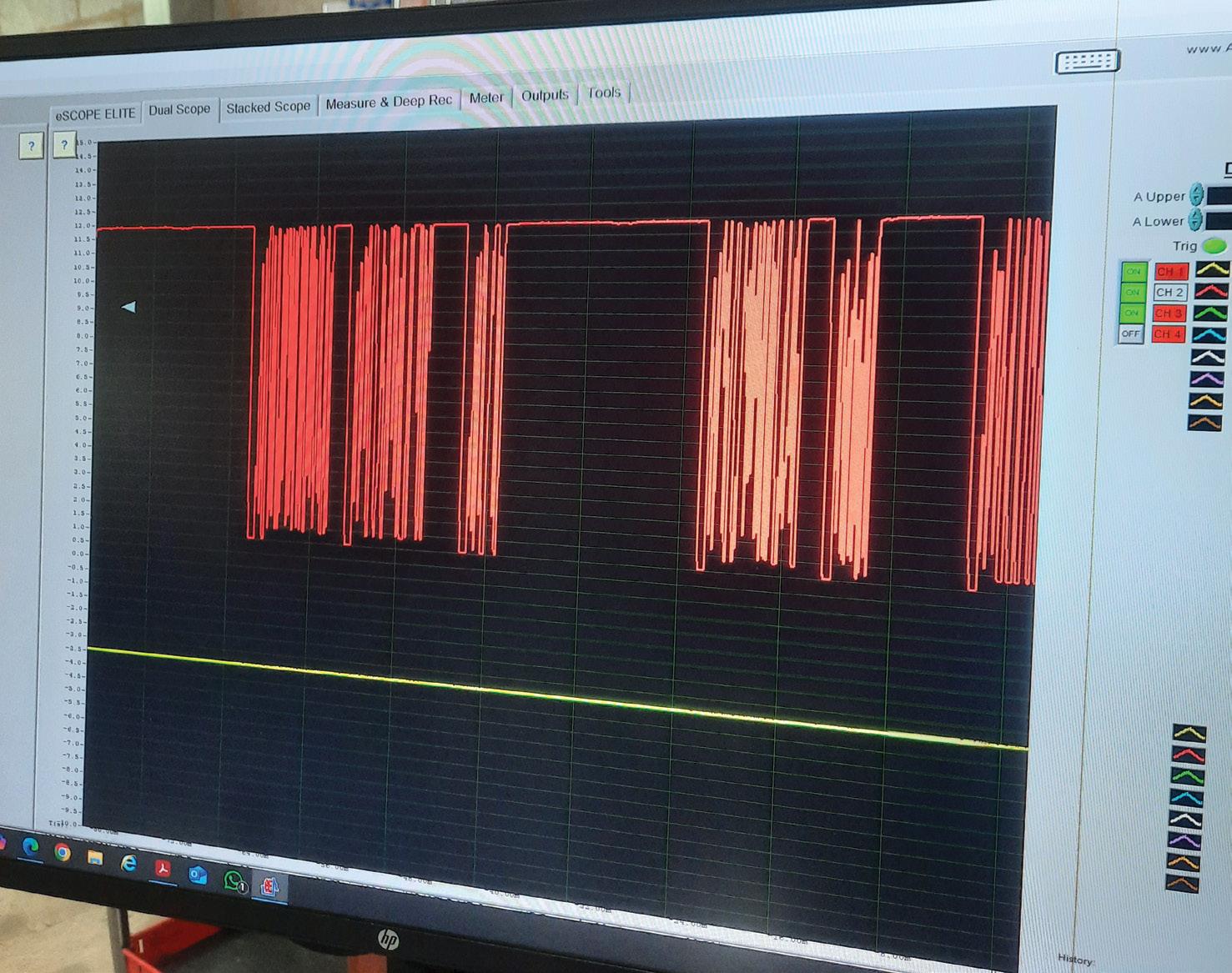
Connected the scope to the one wire at the alternator plug, which uses a local interconnect network (LIN) communication circuit – found no LIN activity. After looking at a wiring diagram,

discovered that the same LIN circuit goes to the battery-current sensor on the negative terminal. Connected the scope there and found good LIN data packets (pic 2).
Verified we had an open in the LIN wire to the alternator and temporarily connected a jumper wire between the two points, confirming the issue because the alternator began to charge correctly.
Traced and located the broken LIN wire in the wiring harness near the battery. The harness had been tightly cable-tied with aftermarket wiring, causing the break (pic 3).
A broken wire in the main engine harness had caused an open-circuit LIN communication line to the alternator.
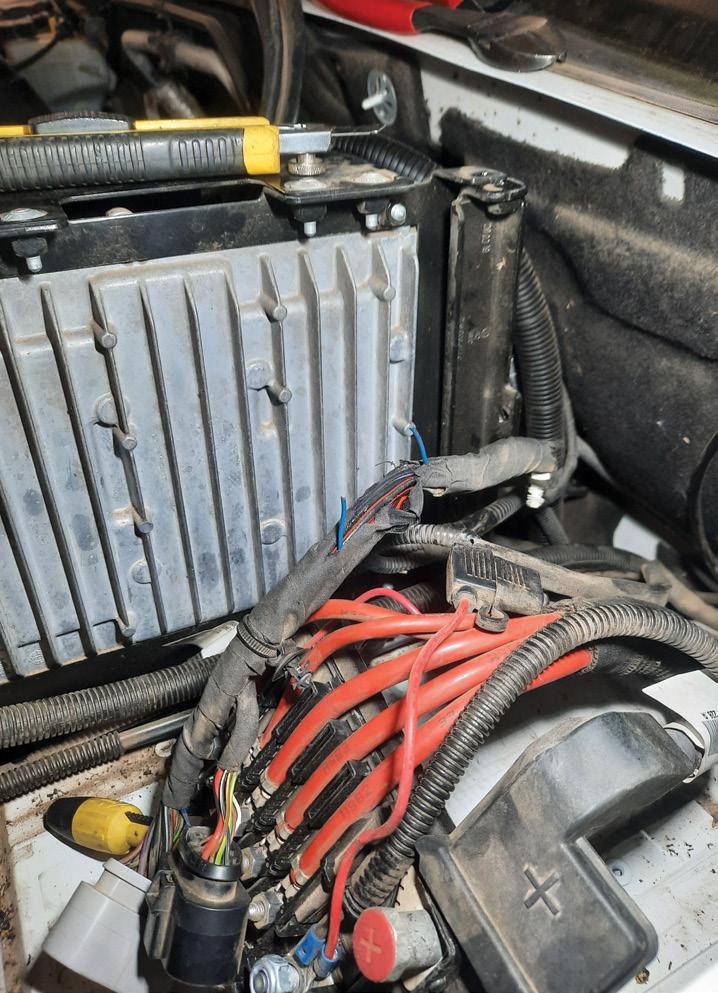
Repaired the harness and secured it correctly. Erased the fault codes and verified correct alternator and chargingsystem operation.
Diagnostic time was two and a half hours, taking into account preparation and research.
Repair time was two hours, taking into account the location of parts and carrying out the repair to a tested outcome.
Repair Solution by TaT Tech Team member Marty Hosie.

Geoff Mutton Business Resources
As I write this, the economic conversation is once again centred on rising interest rates and inflation. The Reserve Bank of Australia lifted rates for the second time this year on March 17 and further increases are expected. At the same time, escalating conflict in the Middle East is beginning to place upward pressure on global oil markets, with the flow-on effect likely to be higher fuel prices in the months ahead.
That combination means higher mortgage repayments, rising transport costs and tighter household budgets overall. For many industries, that creates genuine uncertainty. But for those of us in the workshop environment, the outlook may not be as severe as the headlines suggest. The automotive aftermarket has historically shown a level of resilience when conditions tighten.
History consistently shows that when economic conditions soften, the aftermarket does not shrink in proportion. In many cases, it strengthens.
The reason is simple. Vehicle ownership does not disappear during tougher times. In fact, it often becomes more important. Australians still need to get to work, transport their families and keep daily life moving. When budgets tighten, maintaining an existing vehicle becomes the practical and financially responsible option.
One of the most significant tailwinds for the aftermarket during periods of higher interest rates is the slowdown in new-vehicle purchases. When finance becomes more expensive and economic confidence dips, consumers delay buying new cars. Instead of upgrading, they choose to maintain what they already own. That decision directly supports workshop activity.
An ageing vehicle fleet creates consistent demand for maintenance and repair. Older cars require more frequent servicing, more component replacements and greater mechanical attention. Items such as suspension components, cooling systems, braking systems, tyres, batteries and driveline parts do not pause simply because the economy tightens. If anything, wear and tear accelerates as vehicles stay on the road longer.
Importantly, much of what independent workshops provide falls into the essential category. Brake repairs are not discretionary. Tyres cannot be postponed indefinitely. Cooling-system failures do not wait for better economic conditions.
While discretionary upgrades or cosmetic
enhancements may slow, core mechanical and safety related services remain strong. For workshops that focus on diagnostics, preventative maintenance and essential repairs, demand should remain steady and in many cases grow.
There is also a behavioural shift that works in favour of the aftermarket. During economic pressure, consumers become more value-conscious. Independent workshops that communicate clearly, provide transparent pricing and build trust are often the preferred choice over more expensive dealership alternatives. Customers seek quality at a fair price. The independent sector is well positioned to deliver exactly that.
However, resilience does not mean complacency. Workshops face the same inflationary pressures as their customers. Parts costs have risen. Wages are increasing. Energy, rent, insurance and software subscriptions are all becoming more expensive. Absorbing those costs without adjusting pricing is not sustainable. One of the most important actions workshops should consider in the current climate is reviewing and adjusting their pricing structure. Many operators are reluctant to raise labour rates, fearing customer pushback. Yet failing to reflect rising operating costs in pricing ultimately erodes margins, reduces reinvestment capacity and places long-term viability at risk.
Beyond pricing, workshops should focus on operational discipline. Reviewing productivity, measuring technician efficiency, managing parts gross profit and tightening inventory control can significantly strengthen profitability. Small percentage improvements in labour utilisation or parts margins can make a substantial difference over a year.
Investing in staff development is another area that should not be overlooked. Even during tighter cycles, training and upskilling create competitive advantage. As vehicles become more technologically advanced,
workshops that can confidently handle diagnostics, hybrid systems, advanced driver-assist system (ADAS) calibrations and complex electronic faults will attract higher value work.
Customer communication also becomes even more critical. Proactive service reminders, digital vehicle-health reports and clear explanations of preventative maintenance help customers understand the importance of addressing issues early. In a tighter economy, helping customers avoid larger future repairs by acting now builds trust and long-term loyalty.
There may also be opportunities for strategic growth. Some operators will struggle if they fail to adapt. Well-run businesses with strong cashflow and sound management may find acquisition or expansion opportunities that were not available in stronger economic times. Cycles often create consolidation and prepared businesses can benefit.
It’s also worth remembering the Australian vehicle fleet continues to grow overall. Population growth, geographic spread and reliance on personal transport ensure that cars remain central to daily life. The structural demand for maintenance does not disappear because of a few interest-rate movements. The fundamentals of the industry remain solid.
In many ways, the aftermarket repair sector is counter-cyclical. When consumers feel financially comfortable, they upgrade vehicles. When they feel cautious, they maintain them. In both scenarios, the aftermarket plays a role. That built-in adaptability is a powerful advantage. The road ahead may have economic bumps and consumer sentiment may fluctuate. Yet the core drivers of aftermarket demand remain intact. The aftermarket has proven time and again that steady hands and strong fundamentals keep the wheels turning when conditions tighten.
A 2017 Ford Ranger (PX2) with 141,283km on the clock had an intermittent battery light and charging-system warning while driving.
The battery light was not on at idle when I first jumped in the vehicle but after driving it around the block it came on and flickered on and off with no clear pattern.
Used a scan tool to retrieve any fault codes and monitor live data before verifying the alternator was charging.
To do this, used an oscilloscope and
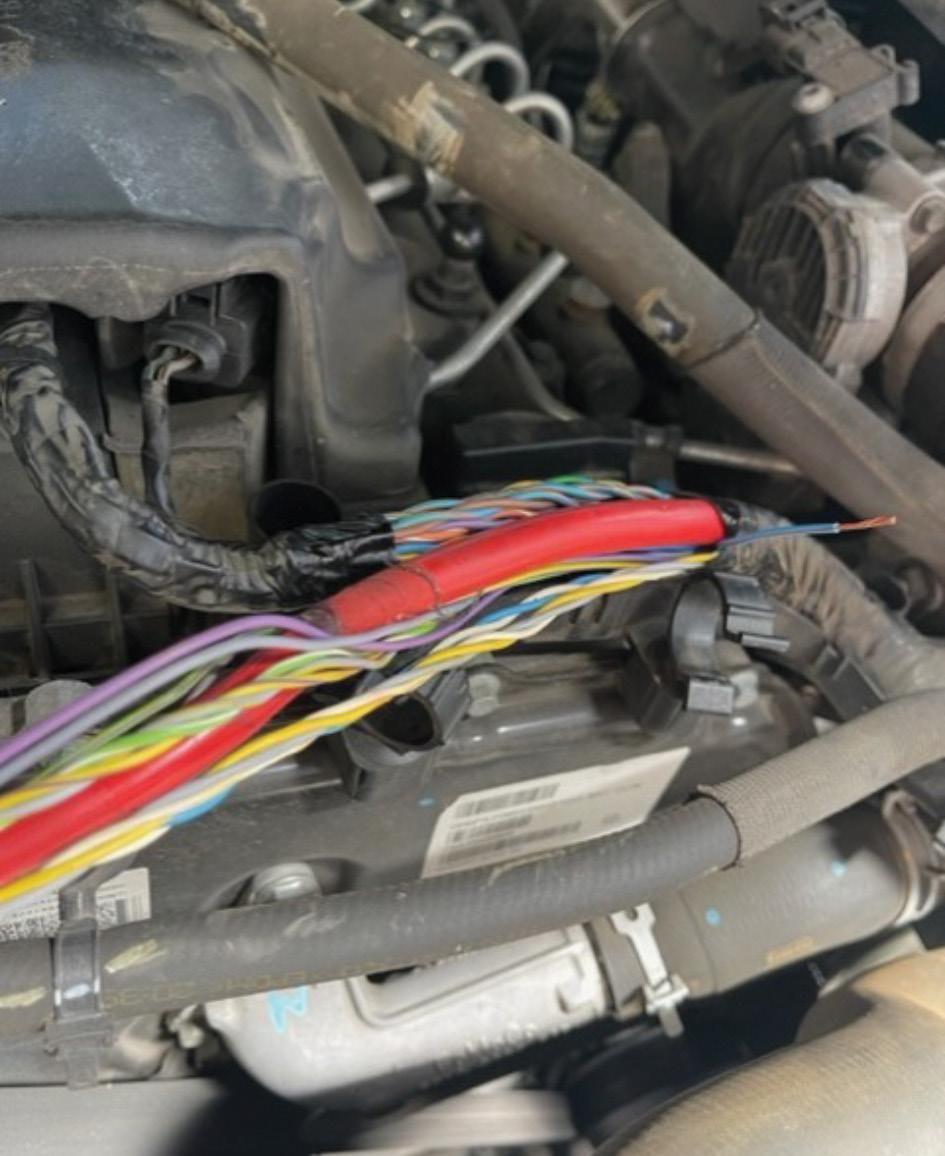
scoped the alternator-control (smart charge) wire to see the control duty-cycle pattern. What I found was an unhealthy pattern and low charge output.
Was able to use live data to identify when the light was active and the system had detected a fault. Also performed a wiggle test on the alternator harness and related loom.
With the live data and the scope hooked up, I found that when I pinched the harness I was able to get a healthy-looking control duty cycle and the charge voltage came up past 13V with a good charging ripple. Was able to induce and clear the fault consistently.
Further inspection revealed the alternatorcontrol wire had chafed through on the engine, shorting to earth.
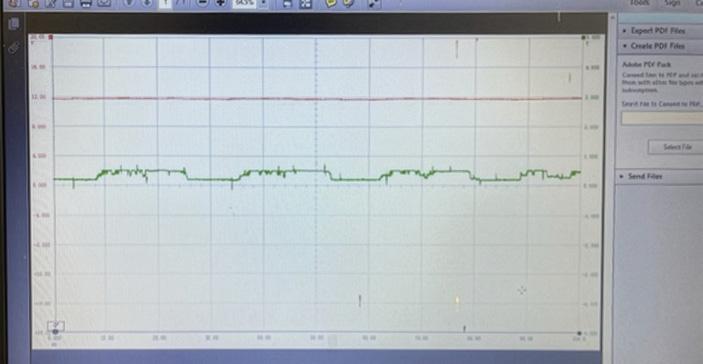
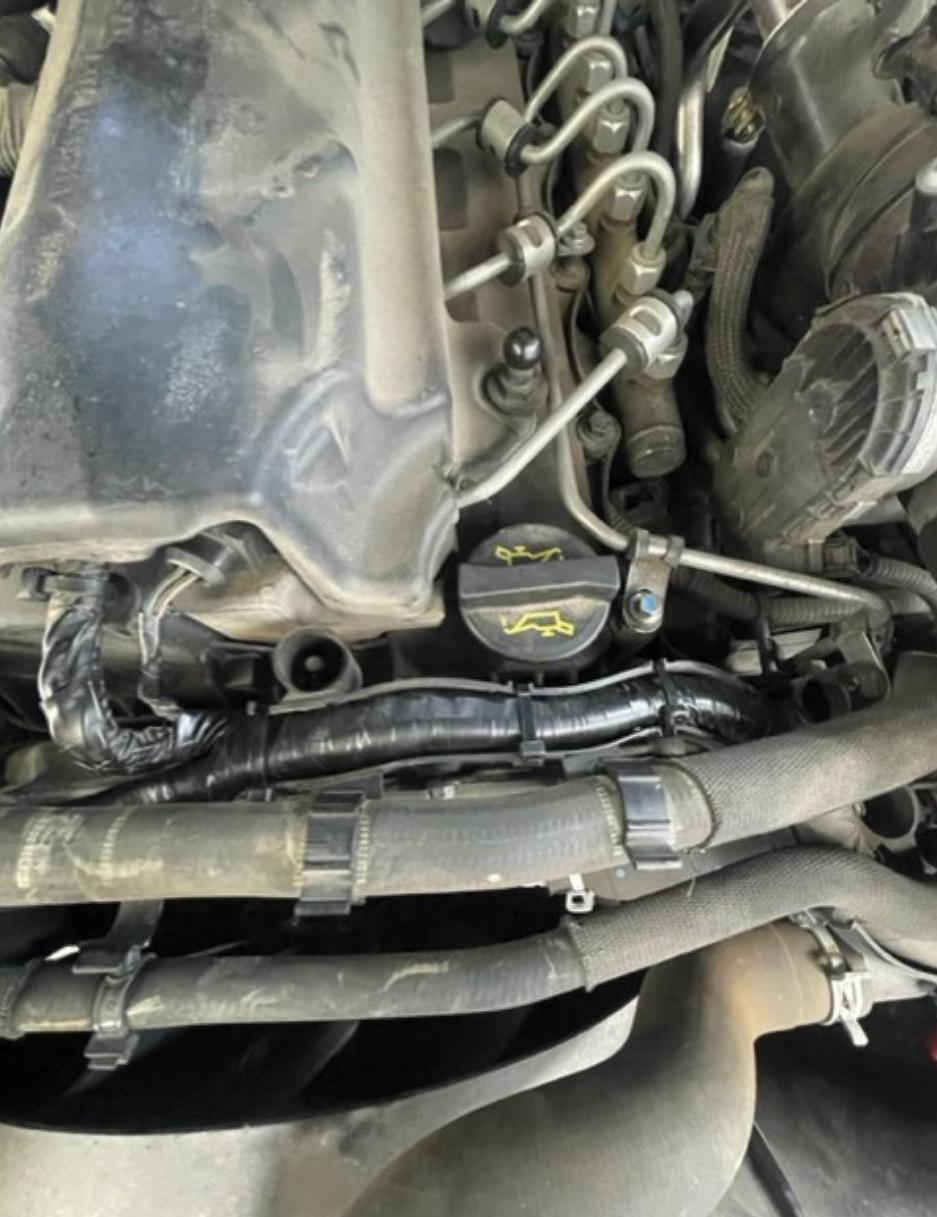
Repaired the wire, then reinsulated and resecured the harness.
Diagnostic time for this job was 90 minutes and repair time one hour.
Tony Goodhue Automotive HAMILTON,
NZ

Century Yuasa Batteries (CYB) has announced a major enhancement to its industry-leading Battery Lookup System, partnering with Haynes Pro to deliver an advanced level of batteryfitment intelligence that better supports technicians, fitment specialists and parts professionals.
For decades, accurate battery fitment has been a cornerstone of workshop efficiency and customer satisfaction. Yet as vehicles become more complex – particularly with the rise of hybrid, plug-in hybrid and electric vehicles (EVs) – the need for precision guidance and up-to-date data has never been greater.
Haynes Pro, part of the Infopro Digital Automotive Group, is widely respected for its OE-sourced technical data used by thousands of workshops worldwide. Its catalogues span internal combustion engine (ICE), hybrid and EV segments – including newer European models – offering an ideal fit for CYB’s goal to future-proof its Battery Lookup System.
‘This isn’t just a back-end upgrade,’ said Century Yuasa Batteries Marketing Manager Andrew Bottoms. ‘Users will immediately notice the difference in both speed and usability.
‘The previous reliance on PDF downloads is gone – replaced with dynamic, browser-
based instructions that load instantly on desktop and mobile devices.’
Bottoms said the interface had been refreshed with step-by-step guidance and procedure-specific reference images, making the process more intuitive for users of all experience levels.
‘Whether fitting a battery in a family sedan or navigating reinitialisation procedures of electrical components after battery reconnection in a Euro hybrid, the instructions are clearer and more actionable,’ said Bottoms. ‘By partnering with Haynes Pro, CYB can provide a more intelligent user experience with greater vehicle coverage.’
Unlike some web-based battery-finder platforms, Century Yuasa’s Battery Lookup System is designed to be a complete fitment solution that allows users to quickly and accurately identify vehicles using rego, vehicle identification number (VIN) or make and model search.
Once selected, it presents all compatible
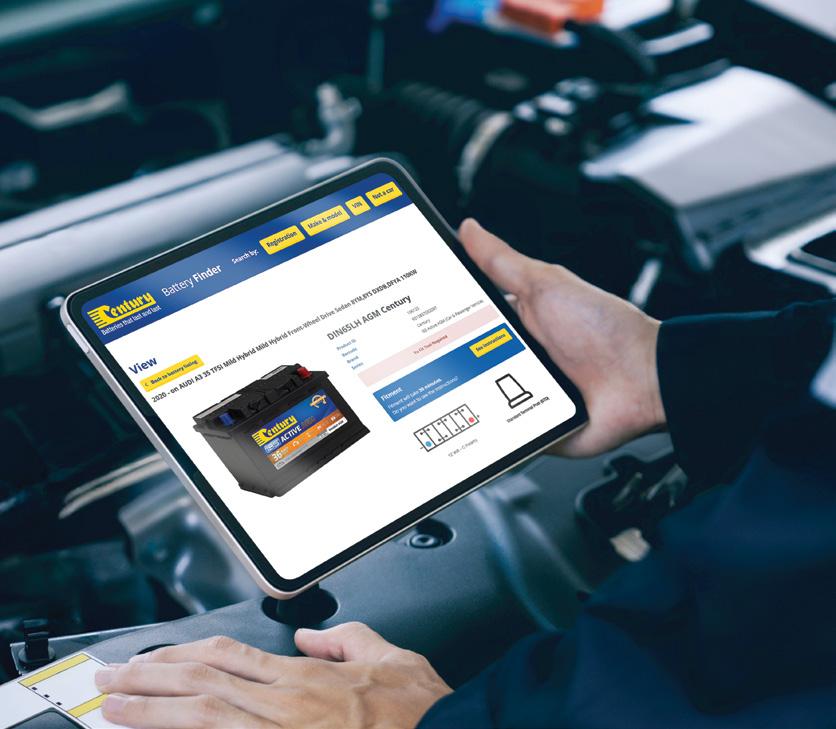
battery replacement options along with an estimated fitment time, helping technicians plan and manage jobs more efficiently.
More importantly, it also provides the necessary detailed fitment instructions, including steps for reinitialising electrical systems and programming the batterymanagement system to ensure every installation is completed to a professional standard.
Century’s Battery Lookup System is just one example of how the brand is making it easier for workshops to deliver quality service with confidence. From intelligent data integration to real-time support, Century Yuasa remains committed to empowering their trade partners with practical tools that streamline everyday operations.
• To find out more contact Century Yuasa on 1300 362 287 or go to cyb.com.au
The blower fan in this 2013 Volkswagen Amarok (2H) with 164,000km on the clock was not working.
Scanned the vehicle for codes but none were present. Tested for power supply at the blower fan and a/c control panel – there was no power at the blower or at terminal five on the rear of the a/c panel.

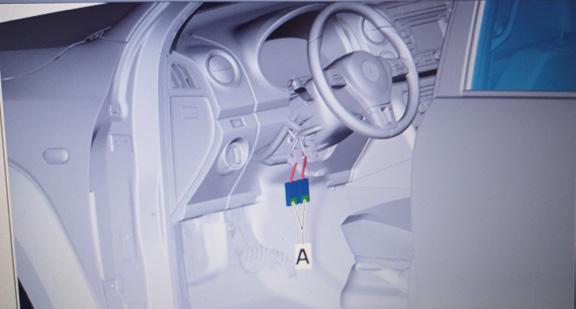
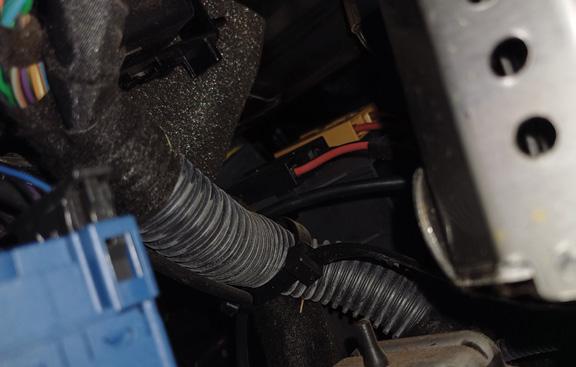
This 2019 Kia Carnival (YP) with 48,010km on the clock came in with its forward emergency brake (FEB), anti-lock braking system (ABS) and traction-control system (TCS) warning lights all showing on the dash.
The customer had already replaced a worn blower fan but it had never worked after fitting. Research pointed towards a fuse in the circuit but finding it was the challenge – both aftermarket and OEM information lacked clear location detail.
Eventually located a 40A maxi fuse above the steering column, towards the centre of the dash, just visible when looking up from the driver’s footwell. Replacing the blown fuse brought the blower back to normal operation.
Diagnostic time for this job was 30 minutes and repair time three hours.
David Maughan
Granite Auto Electrical STANTHORPE, QLD
A scan of the vehicle revealed the ABS code, C1209 – Wheel speed sensor RHR open/short. Working through the fault-flow, a back-probe of the wheelspeed sensor (WSS) power showed zero volts where B+ was expected. Performed continuity check between the ABS module and WSS power wire and it was open circuit.
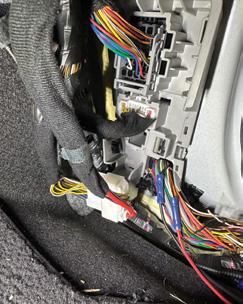
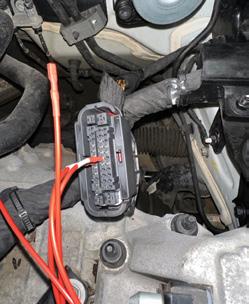
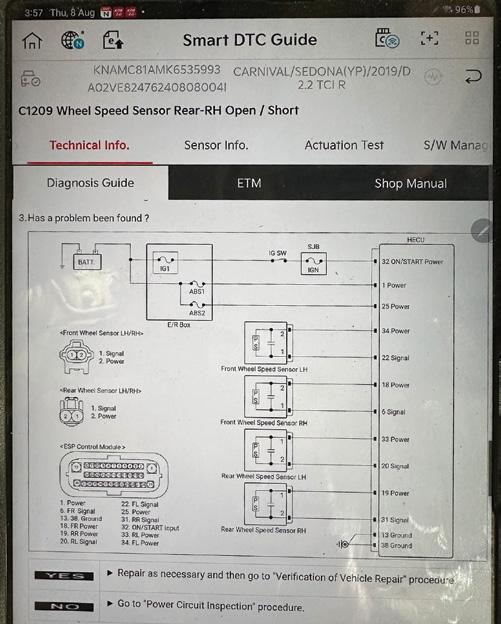
Located a harness-joiner plug in the right-side A-pillar and traced the fault to poor pin tension.
De-pinned the plug and retensioned the female terminal, cleared the codes and roadtested the vehicle – lights out.
Diagnostic time for this job was 90 minutes and repair time one hour.
Graham Hamilton Hamilton Automotive Services GOODELLABAH, NSW
ZF supplies workshops across Oceania with all the components required for passenger-vehicle oil changes, including OE-quality ZF LifeguardFluid and oil-change kits for a wide range of ZF transmissions.
As modern vehicles continue to adopt higher torque outputs, additional gear ratios and electrified drivetrains, lubrication plays a critical role in maintaining transmission reliability and shift quality.
ZF LifeguardFluid and oil-change kits
ZF LifeguardFluid is formulated to match the specific requirements of individual transmissions.
Developed alongside the hardware, this range of fluids is engineered to support long service life, consistent shifting behaviour and stable friction characteristics.
These fluids use high-grade base oils combined with specialised additive packages designed for six, seven, eight and nine-speed applications.
Although many ZF automatic transmissions are factory-filled for standard vehicle service life conditions using partially synthetic automatic transmission fluid (ATF) oils, operating conditions vary considerably in real-world use.
Factors such as frequent short trips, sustained high-speed driving or towing can influence oil age and subsequent performance.
For this reason, ZF recommends an oilchange interval between 80,000 and 100,000km, depending on vehicle usage.
Regular oil changes help reduce wear, minimise the accumulation of abraded
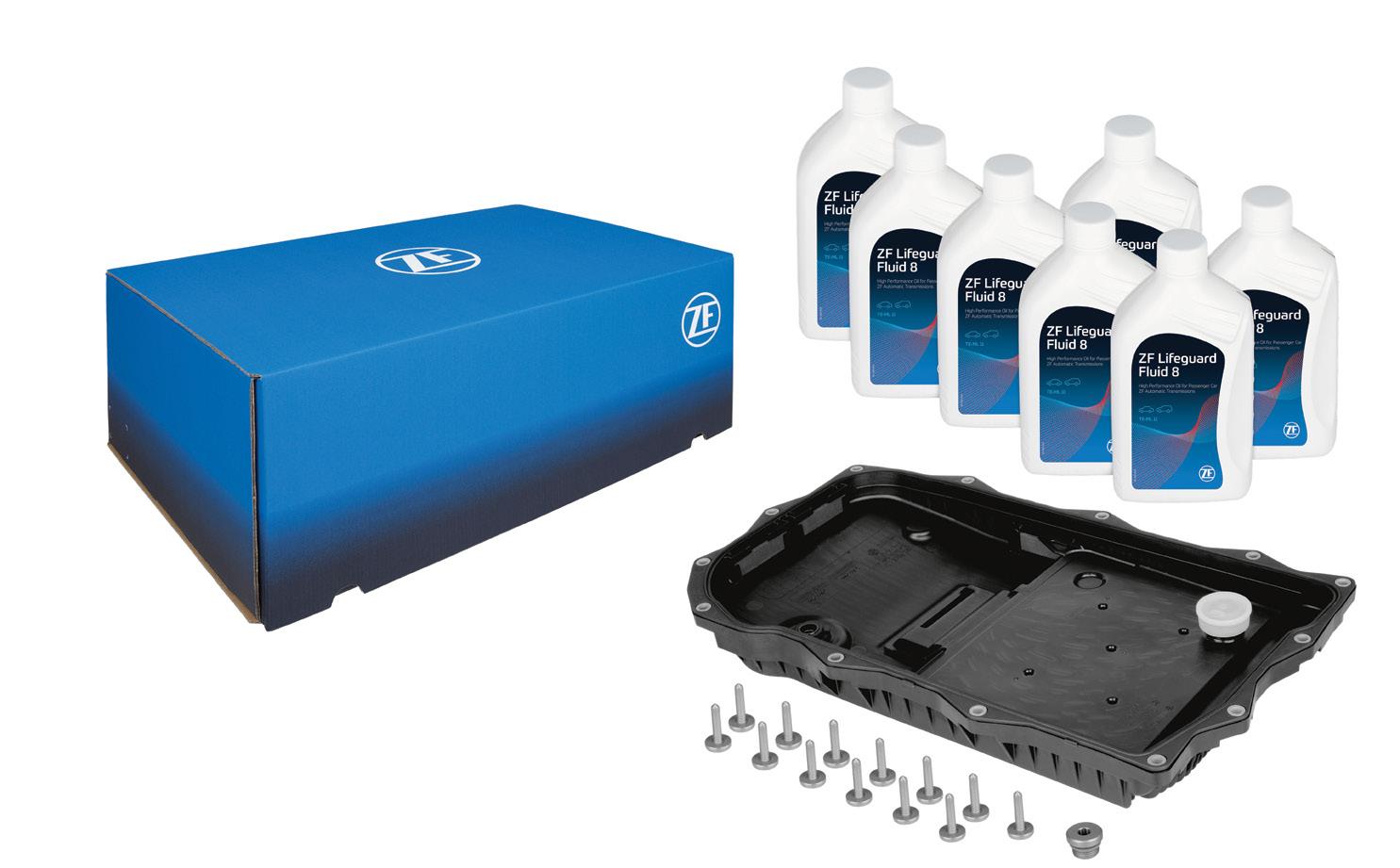
oil-change kits containing OE-quality components to ensure compatibility and professional servicing.
Sealing components such as gaskets and O-rings play an important role in maintaining hydraulic integrity.
ZF oil-pan kits use ethylene acrylic elastomer (AEM) rubber sealing materials selected for reliable low-temperature performance and consistent sealing properties.
ZF’s oil pans are manufactured using original tooling to ensure correct mounting geometry, while precision interference-fit metal bushings contribute to dimensional accuracy during installation.
ZF oil pans also incorporate integrated filtration systems. Their compact structure and integrated covers support stable installation, while internal magnets assist in capturing metallic particles, helping to protect transmission components from abrasive wear.
ZF Aftermarket has provided a step-by-step guide on how to perform an oil change and what to look out for when doing so.
Before starting an oil change, always follow
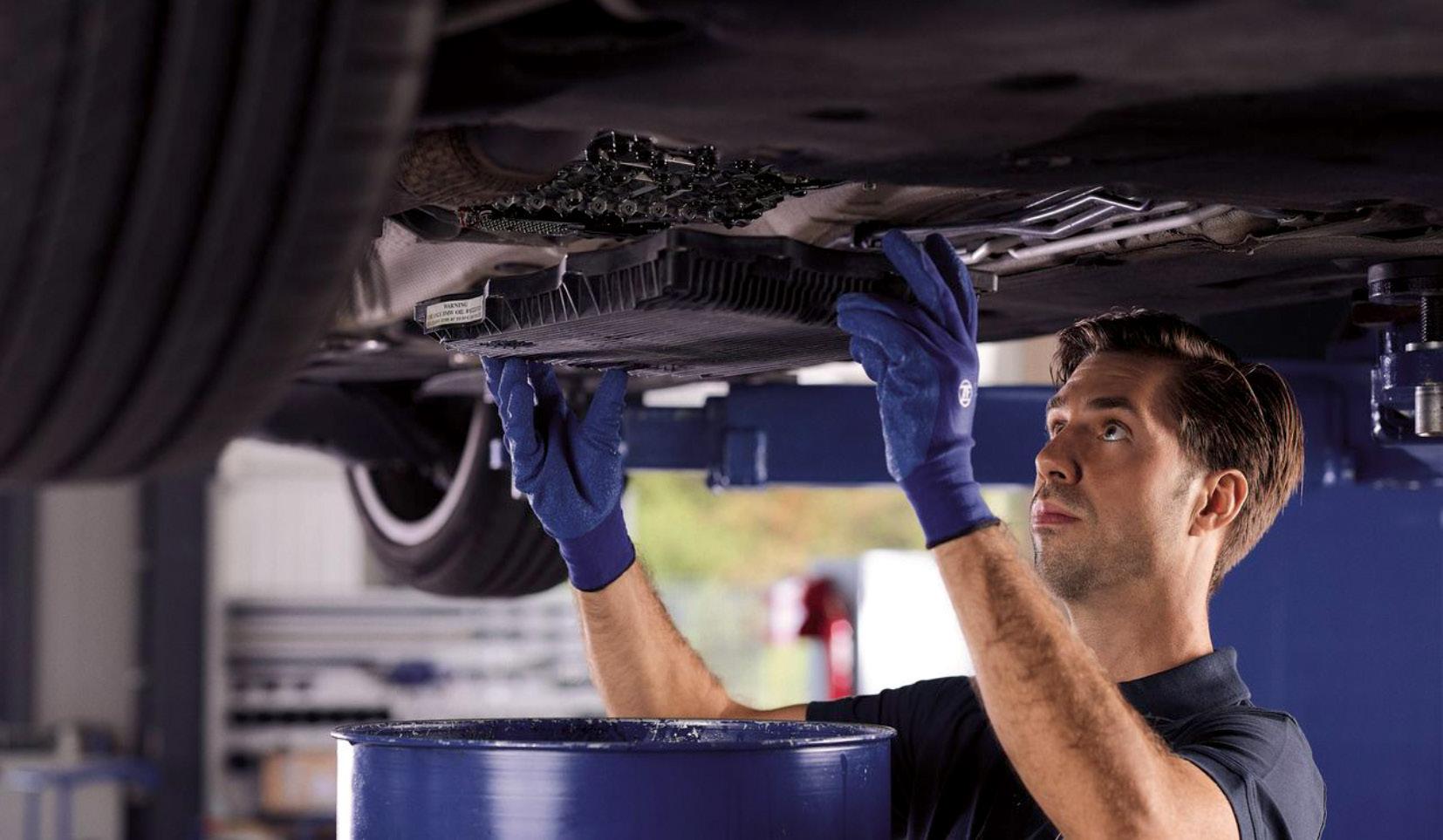
the vehicle manufacturer’s instructions. The engine must never be run, nor the vehicle towed, without transmission oil as this can cause immediate damage.
Begin by removing any necessary underbody trims. Drain the old oil through the drain plug at the bottom of the oil pan and collect it in a suitable container.
During draining, inspect the oil condition. A burnt smell, metal chips or fragments may indicate internal transmission damage. When removing the oil pan, procedures differ depending on design.
For metal oil pans, replace only the oil filter and sealing ring. Loosen and tighten screws in the sequence specified by the manufacturer to prevent distortion. Clean residual oil and the permanent magnet before installing the new filter and seal, observing the specified torque.
Plastic oil pans typically integrate the filter and seal, requiring full replacement as a unit.
Reinstall the oil pan using new screws and tighten according to the prescribed sequence and torque. Fit a new drain plug with a new seal.
Be careful when filling oil as overfilling or underfilling or using oil at the wrong temperature can damage the transmission. When refilling, use only the specified ZF LifeguardFluid. Do not use supplementary additives. Fill until oil runs from the filler opening.
Start the engine at idle, shift through R and D back to P, then run the engine for 30 seconds at 2000RPM, then engage each gear for 10 seconds.
Check oil temperature before setting the final oil level. For example, 6HP units require 3035°C and 8HP units up to 40°C.
At the specified temperature, adjust the fill until only a slight overflow occurs, then close and torque the filler plug.
The engine can then be switched off, completing the service.
• Find out more at zf.com/au
Brendan Sorensen
Modern diagnostics is about how quickly a tool points you in the right direction, how much usable knowledge it gives you once the car is in the bay and how many higher level jobs it helps you keep in house instead of sending elsewhere.
This is why the TOPDON ONE Plus stands out. The basics are covered, as they should be, but that’s not the story here and I’m not going to waste space on generic functions every serious platform should already provide.
What matters is this tool’s mix of OE-level topology, a genuinely useful AI knowledge layer, strong coding and immobiliser depth, highly configurable live data and an expansion path through J2534 and securegateway access that makes the platform feel built for where the trade is heading. It also hits a nice size and weight sweet spot for workshop use, with a 10-inch display, 8-core processor, 4GB of RAM and 128GB of internal storage giving it the screen space and responsiveness you want when you are deep into a job.
The first standout is TopFix. I’ve seen a few scan-tool brands now pushing AI but too often it feels bolted on because marketing said it had to be there. This is the first I’ve seen that is starting to feel properly tied into the diagnostic process.
After a fault scan, the TopFix button appears beside any retrieved codes. Pressing it builds the prompt, with the vehicle details and fault pre-filled, and then lets you steer the response toward code interpretation,
recall information, likely repair direction, parts replacement or your own custom prompt. That matters because good diagnostics is not just about having information somewhere in the background. It’s about getting to the right information fast enough for it to actually help steer the job.
The ONE Plus has a genuinely useful OE TSB library, like the Mazda P2096 fault where the correct repair path is a software update rather than throwing parts at it. The AI functionality is the difference between a bulletin database that gets forgotten about in the submenus and a knowledge layer that becomes usable in the middle of a real faultfinding process.
Of the AI helpers I have used inside scan tools so far, this is the first one that felt genuinely useful rather than just there to do tool-navigation tasks.
I love seeing a good topology layout during a code scan. Of course, this is mandatory when deciding where to go next on a network fault but it’s also great education to see, day in day out, the different ways manufacturers lay networks out.
The ONE Plus gives OE-style network visibility across a wide range of vehicles, with network branches labelled correctly
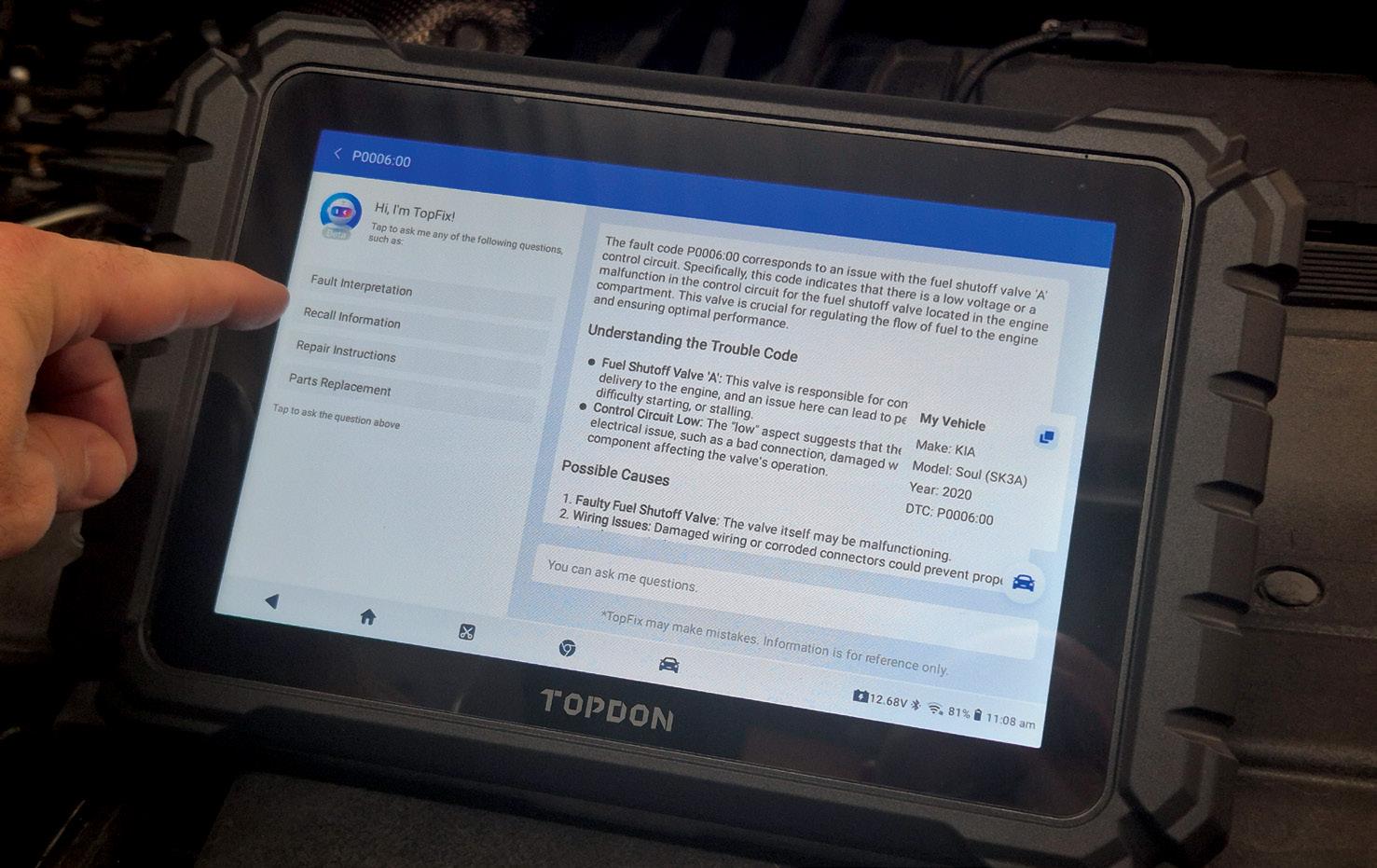
so you can quickly see who is talking over controller area network (CAN bus), who is on local interconnect network (LIN) and which modules are having to communicate through a gateway.
Live data is another area where the ONE Plus makes a strong daily-use case for itself. Having the ability to display up to 12 data graphs on screen is useful and surprisingly it still views well rather than feeling cluttered. Speed is excellent in workshop use, with the VCI ONE wireless OBD dongle communicating over Wi-Fi, allowing communication orders of magnitude faster than Bluetooth.
Control over how the information is presented has some tricks too – you can change parameter identification (PID) units (i.e. psi to megapascals [MPa]), reorder the list so related values sit together, strip the stream back to only the PIDs you need, record and review captures, overlay four PID graphs on one chart and even pinch-zoom the graph to zoom in and out.
These are exactly the sort of things that decide whether a tool becomes your first grab or stays in the case.
The ONE Plus starts to look like a serious workshop tool rather than just another scan platform when you start exploring the higher functions.
The Hot Functions and Maintenance menus allow you to quickly jump to a deep function such as relearning sunroof points, even if you had no idea what module would be responsible for that, on a day-to-day basis. Getting into more advanced features, TOPDON lists broad driver preference and coding coverage across groups including
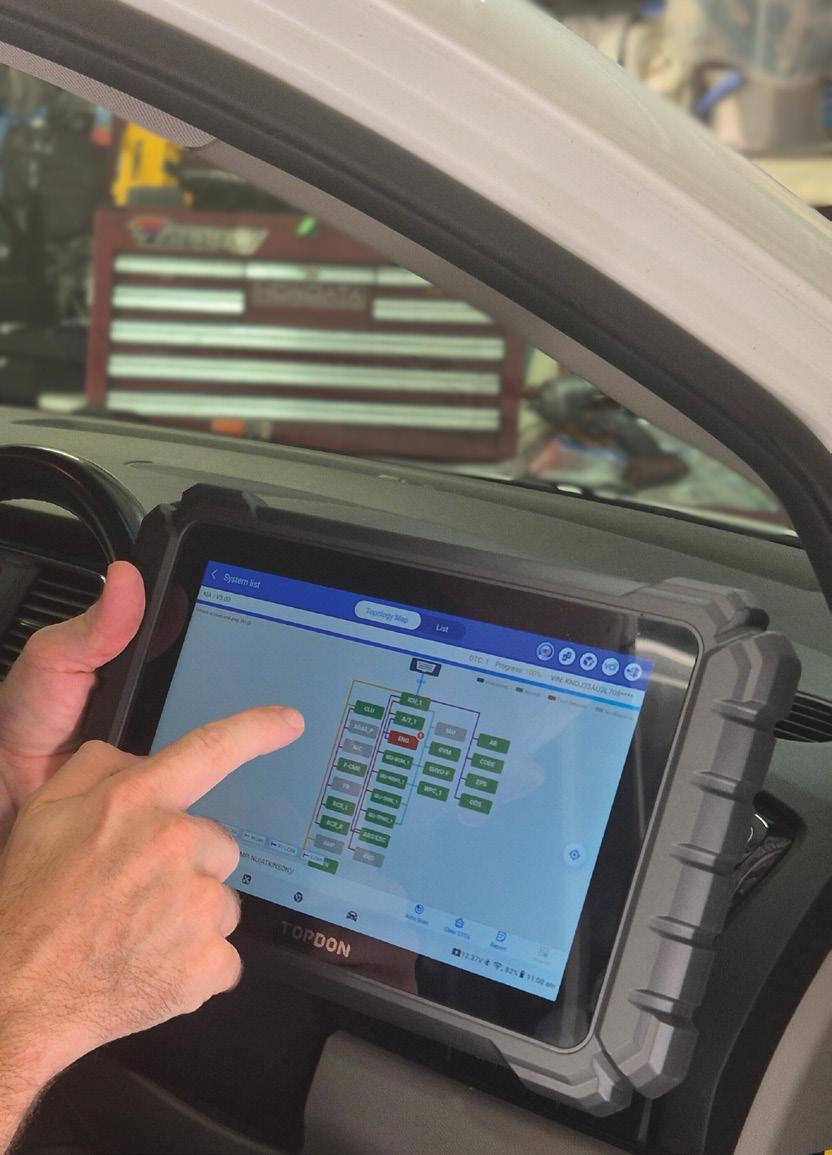
BMW, Volkswagen Group (VAG), MercedesBenz, Porsche, Nissan, Jaguar Land Rover (JLR), PSA Group (Peugeot, Citroen, DS, Opel), Ford, Volvo, Toyota and Lexus.
The immobiliser (IMMO) side is also impressive, with the tool showing the ability to retrieve PIN codes from certain modules and carry out key work on modern brands such as BYD.
Advanced driver-assist system (ADAS) technology is another example of where the ONE Plus shows it is aligned with the direction the trade is moving. I confirmed dynamic aiming functions for the forwardsensing camera and the front, rear and side radars on a 2022 Mazda CX-30 – this matters because the trade is clearly moving further toward dynamic calibrations and away from a world where every ADAS conversation centres on static boards alone.
Then there are the workflow details that sound small until you use them every day. I like that items such as a code scan, screenshot or battery test (from the BTMobile ProS battery tester included in the package) can be emailed directly from the tool in around 10 seconds.
That immediately gives the front counter something usable for record keeping, customer explanation and building a clean evidence trail from the start of the job to invoice. Used properly, that is usable workflow that allows you to justify there is good value in what you charge.
The VCI ONE can act as a J2534 passthrough device and connect to a PC by USB for OE subscription portals and aftermarket software such as Forscan and AlfaOBD. The important distinction is that some programming jobs, such as certain BMW and VW functions, can be completed directly through TOPDON’s cloud file database without having to go through the manufacturer portal.
For other brands, the J2534 pass-through function gives you a proper route into the manufacturer’s OE programming pathway using the relevant portal, software and subscription.
Secure-gateway access also deserves mention because it is now part of the realworld diagnostic landscape whether we like it or not. TOPDON offers access as a separate purchase, either as a broader multimanufacturer bundle or through individual manufacturer groups such as VAG, Fiat Chrysler Automobiles (FCA), Nissan and Renault.
TOPDON also lists support in this upper-end space for functions such as Ford and Mazda
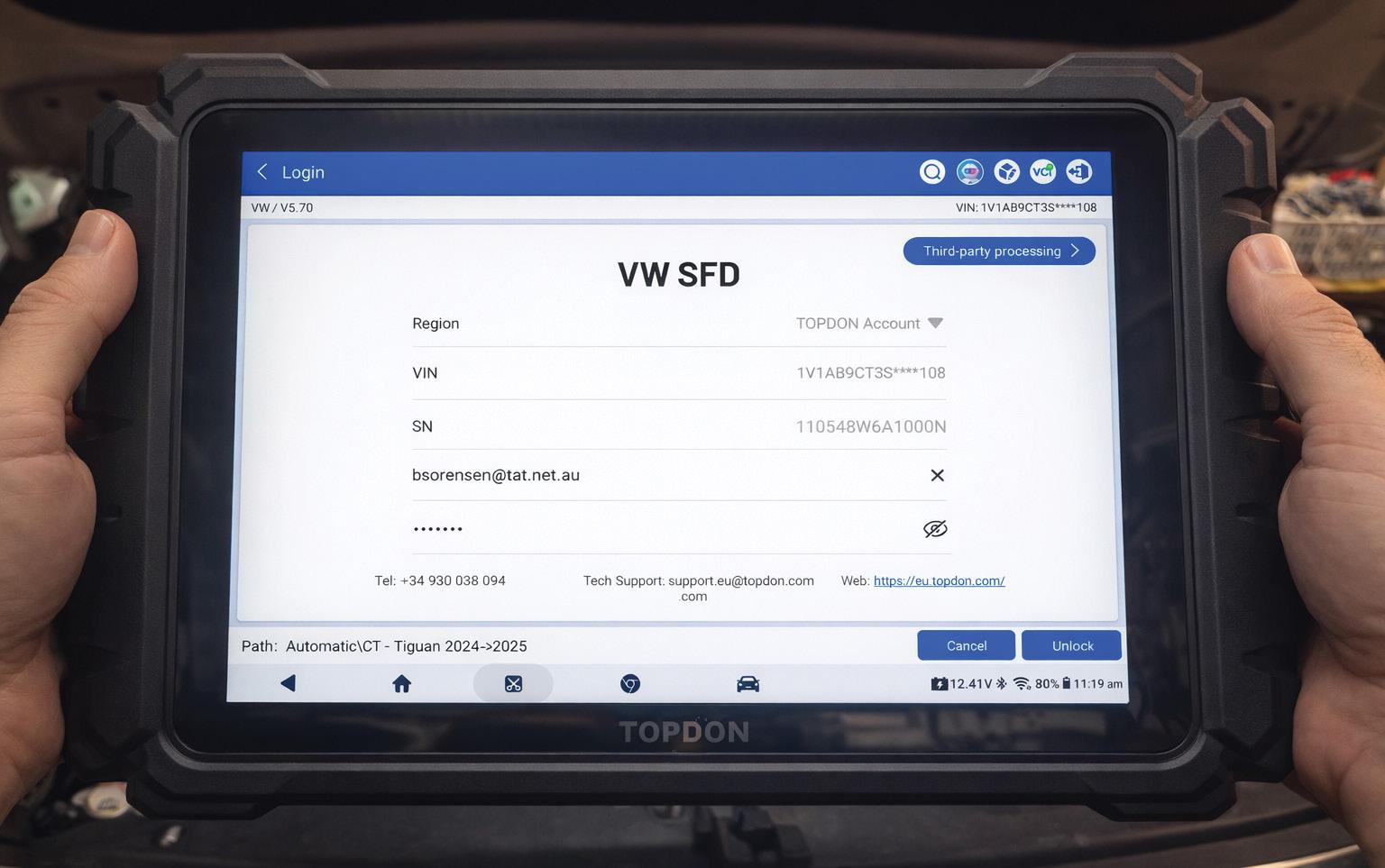
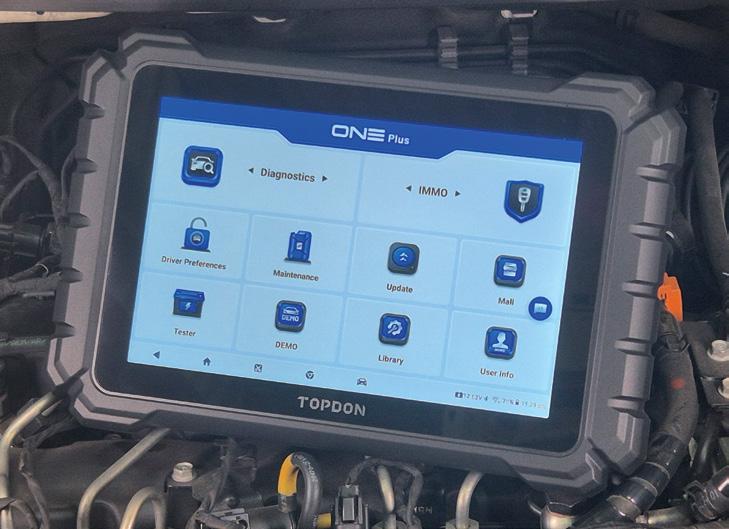
Programmable Module Installation (PMI), which allows you to copy what would be called coding data on other manufacturers from an old module to the replacement module.
The only caution I would raise is there is a lot packed into this tool. Because the ONE Plus reaches into so many areas, some of the less common functions can be easy to overlook if you only need them once in a blue moon. That is simply the nature of a deep platform.
To TOPDON’s credit, the Hot Functions menu does a good job of showing what is available on that specific vehicle, even when you’re not completely sure if there’s a relearn or function you are supposed to do for that job.
There’s also a growing library of TOPDON ambassador online content showing the tool in real workshop use, which helps shorten the learning curve.
For frontline diagnostic technicians, progressive repairers and workshops wanting stronger topology, better live-data control, integrated knowledge support, meaningful coding and IMMO depth, and a credible future path through J2534 and gateway access, the TOPDON ONE Plus makes a very strong case for itself.
The first year of subscription is included and in Australia the current buy-one-get-three package adds the BTMobile ProS for battery and electrical testing support plus a TopScan Master device which turns your smartphone into a capable scan tool, even supporting diagnostics over internet protocol (DoIP).
The real story, though, is the ONE Plus itself. I’ve had a TOPDON as part of my scan-tool stable for years and if I had to sum it up, it’s the one that got the job done when my daily couldn’t.
With the progress made to this ONE Plus, built around speed, direction and job-finishing depth, it has shifted TOPDON from something that was interesting to a tool that is truly valuable and hard to go past.
• Scan the QR code to watch my detailed video review

This 2013 Nissan Dualis (J10) with 120,591km on the clock came into the workshop with a noisy radiator fan.
An inspection of the vehicle showed only the high-speed fan was operational. There were no diagnostic trouble codes (DTCs).
Used the scan tool to activate and test the operation of both high and low-speed radiator fans and found no low-speed fan operation. Removed the low-speed fan resistor and tested resistance – it was open circuit when it should have been approximately 0.9 ohms. Bypassed the resistor and activated the low-speed fan using the scan tool to verify wiring integrity and confirm the fan would operate.
Discovered the thermal fuse in the lowspeed resistor assembly was open circuit. Was able to identify the number on the thermal fuse and a quick search confirmed it was a thermal fuse rated at 220°C @ 10A.
The thermal fuse can be purchased from Jaycar (CAT# 3814 228°C). Nissan only sells the complete fan/resistor/shroud assembly at $734.
Replaced the thermal fuse with the Jaycar unit and both high and low-speed fans were now operating correctly.
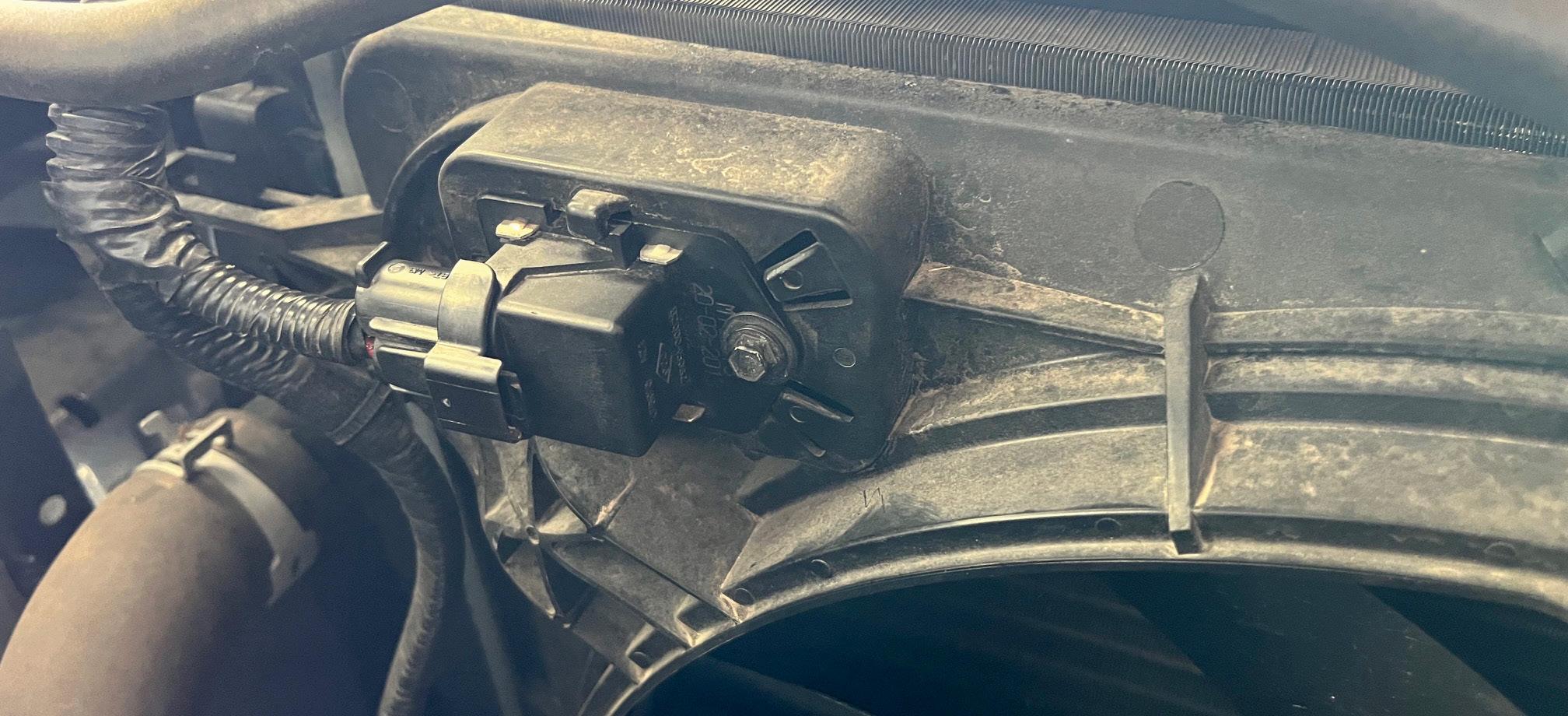
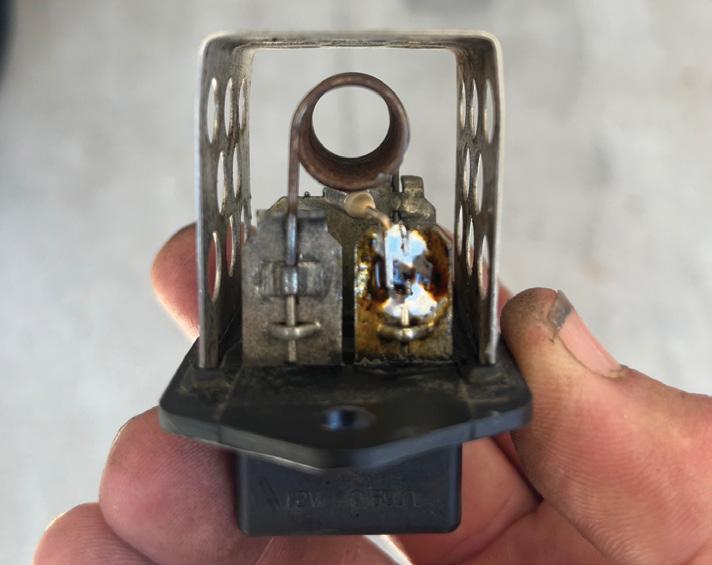
Diagnostic time for this job was one hour and repair time 30 minutes.
Robert Ramsay
Excel Diagnostic – Mobile Mechanic BRIGHTON, QLD
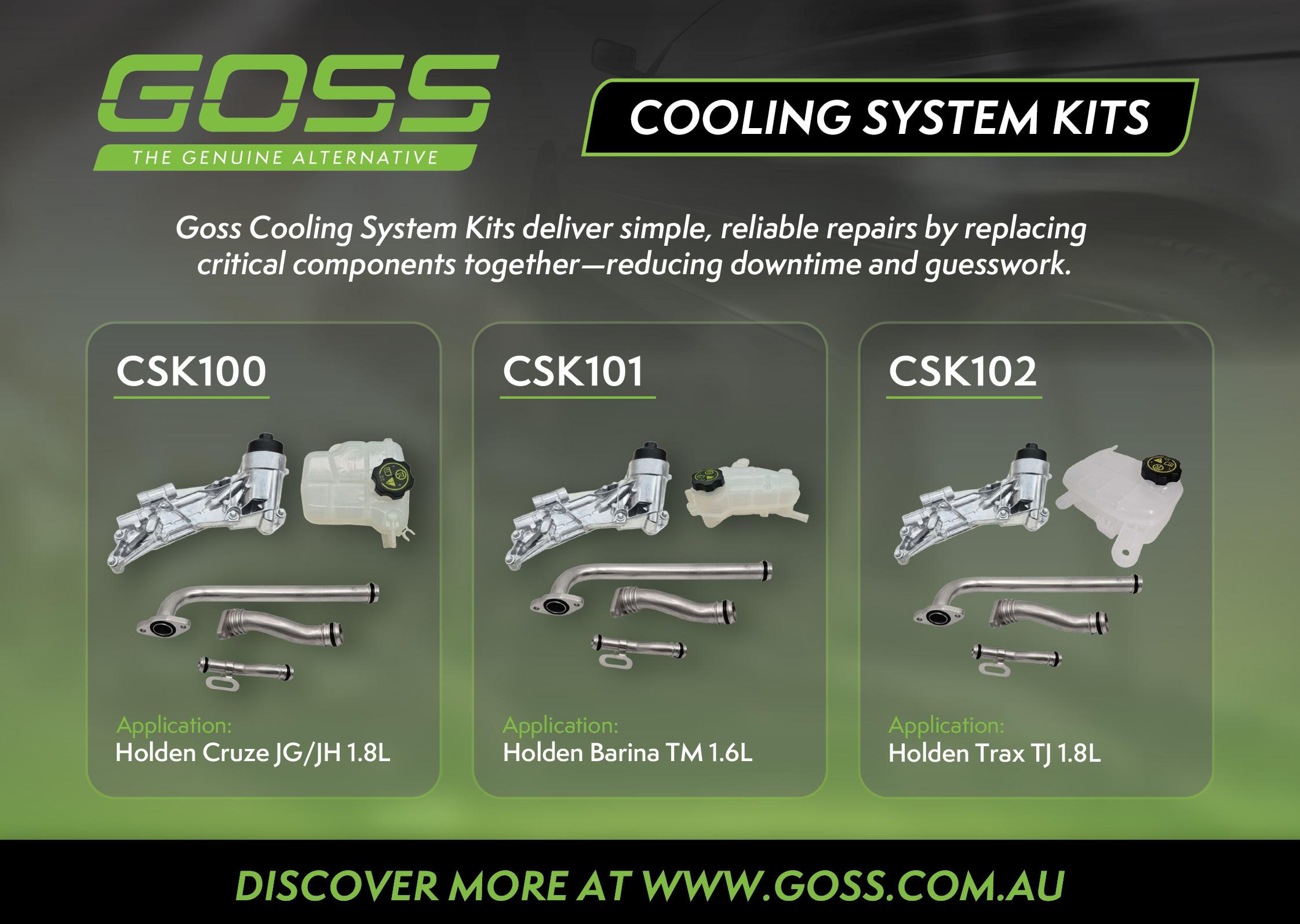
Arobust technical training program at the 2026 Australian Auto Aftermarket Expo will help technicians sharpen their diagnostic skills and stay up to date with today’s increasingly complex vehicles.
The Australian Auto Aftermarket Expo –held in league with the Collision Repair Expo – will be held from May 14 to 16, 2026 at the Melbourne Convention & Exhibition Centre, with free technical training sessions available to all automotive-trade professionals.
As modern vehicles incorporate increasingly advanced electronics, networked systems and electric and hybrid platforms, workshops need a deeper technical understanding to diagnose faults accurately, reduce guesswork and maintain productivity and profitability.
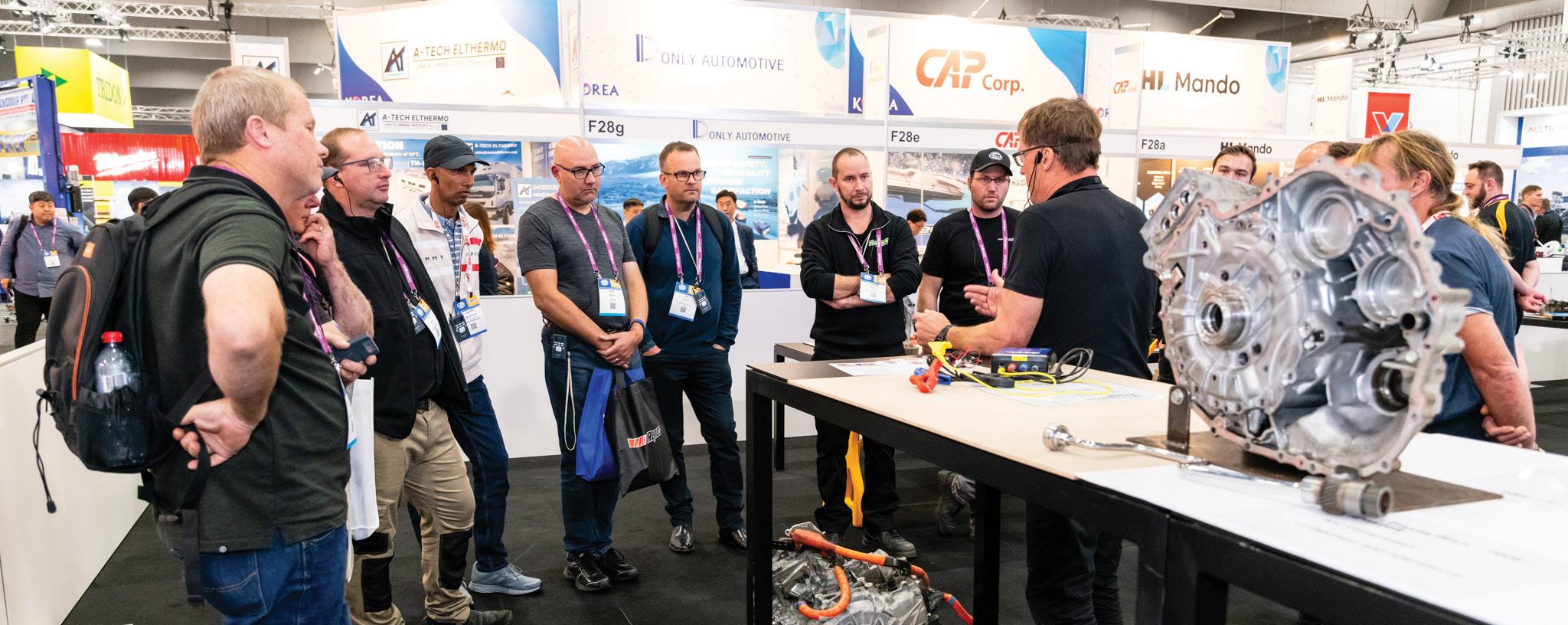
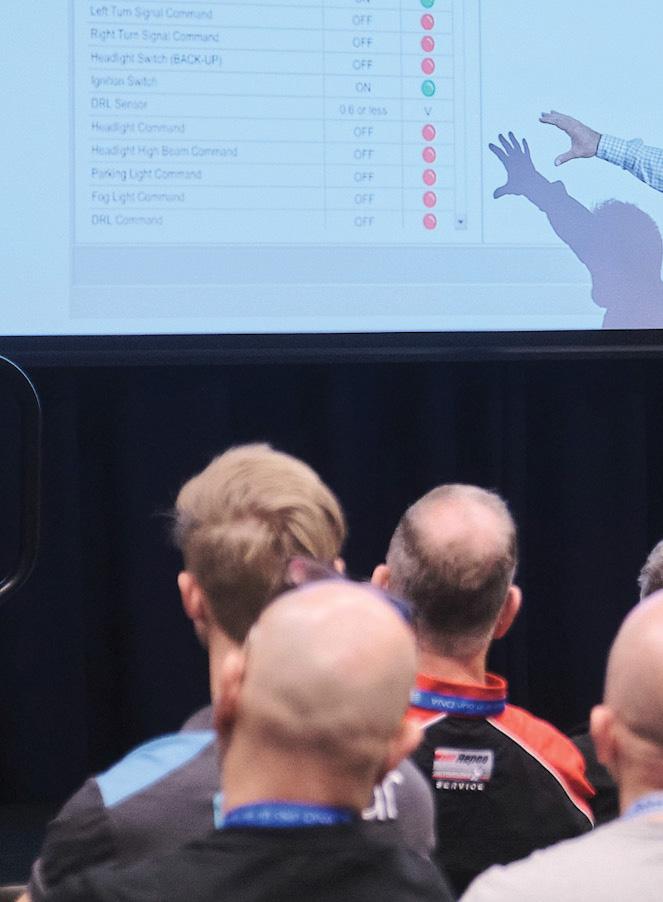
Training sessions will cover key diagnostic topics such as NVH Introduction, Using Maths Channels to Monitor Intermittent Faults, Diagnosing Modern Energy Systems – From ICE to Electrification, Engine Oil Additives Uncovered, Thermal Imaging – Comparison, Use Cases and Basic Navigation and Old School Ignition Systems
These sessions will be delivered by respected international trainers Steve Smith from Pico Technology (UK) and
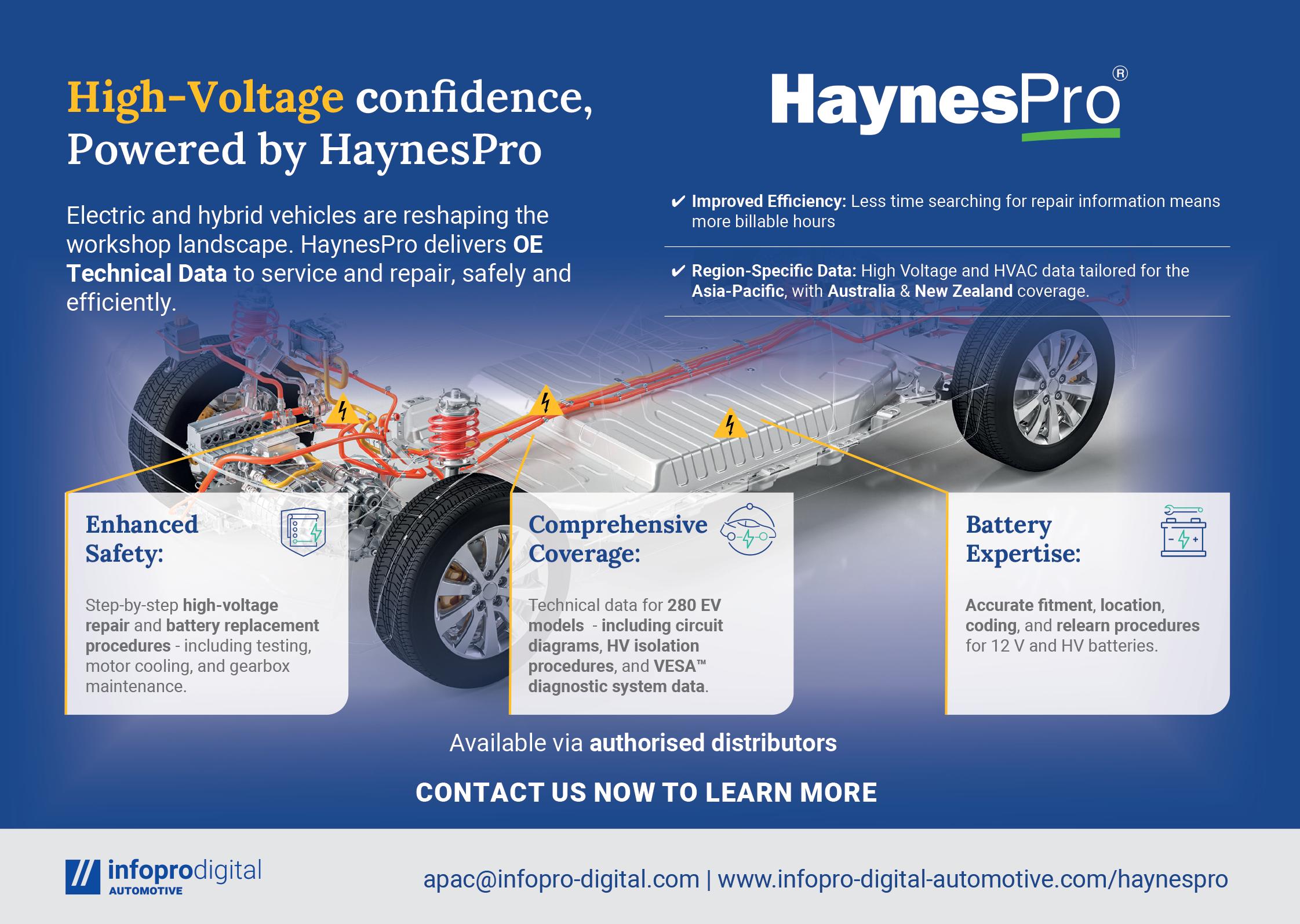
Technical Masterclasses held on May 13, the day before the expo opens.
extends onto the trade show floor. The Diagnostic Discovery Zone will showcase practical diagnostic workflows, tools and techniques in action. The ADAS Technology Zone will feature calibration insights, equipment demonstrations and emerging technologies supporting modern advanced driver-assistance system (ADAS) technology and a standalone ADAS Code of Conduct session will turn the code into a practical workflow that can be applied in a workshop immediately.
Drawing on decades of industry experience, the trainers will share practical insights into diagnostic workflows, measurement techniques and troubleshooting strategies that help technicians diagnose faults faster and repair vehicles with confidence.
For technicians seeking deeper learning, the expo will also feature Advanced
These paid, limited-capacity sessions provide extended training with global experts for technicians wanting to build advanced diagnostic capability. Masterclass topics include Programming for Popular Makes, Network Communication Protocols and Developing Better Diagnostic Judgement and Critical Thinking
The technical learning experience also
‘Whether you’re a qualified technician, an apprentice starting out or a workshop manager wanting to keep technical skills up to date, the Auto Aftermarket Expo is the one industry event worth investing time in attending,’ said Australian Automotive Aftermarket Association (AAAA) CEO Stuart Charity.
The expo will bring together more than 13,000 industry professionals and more than 400 exhibitors, offering extensive networking opportunities across the threeday event.
• To find out more and register for free, go to autoaftermarketexpo.com.au
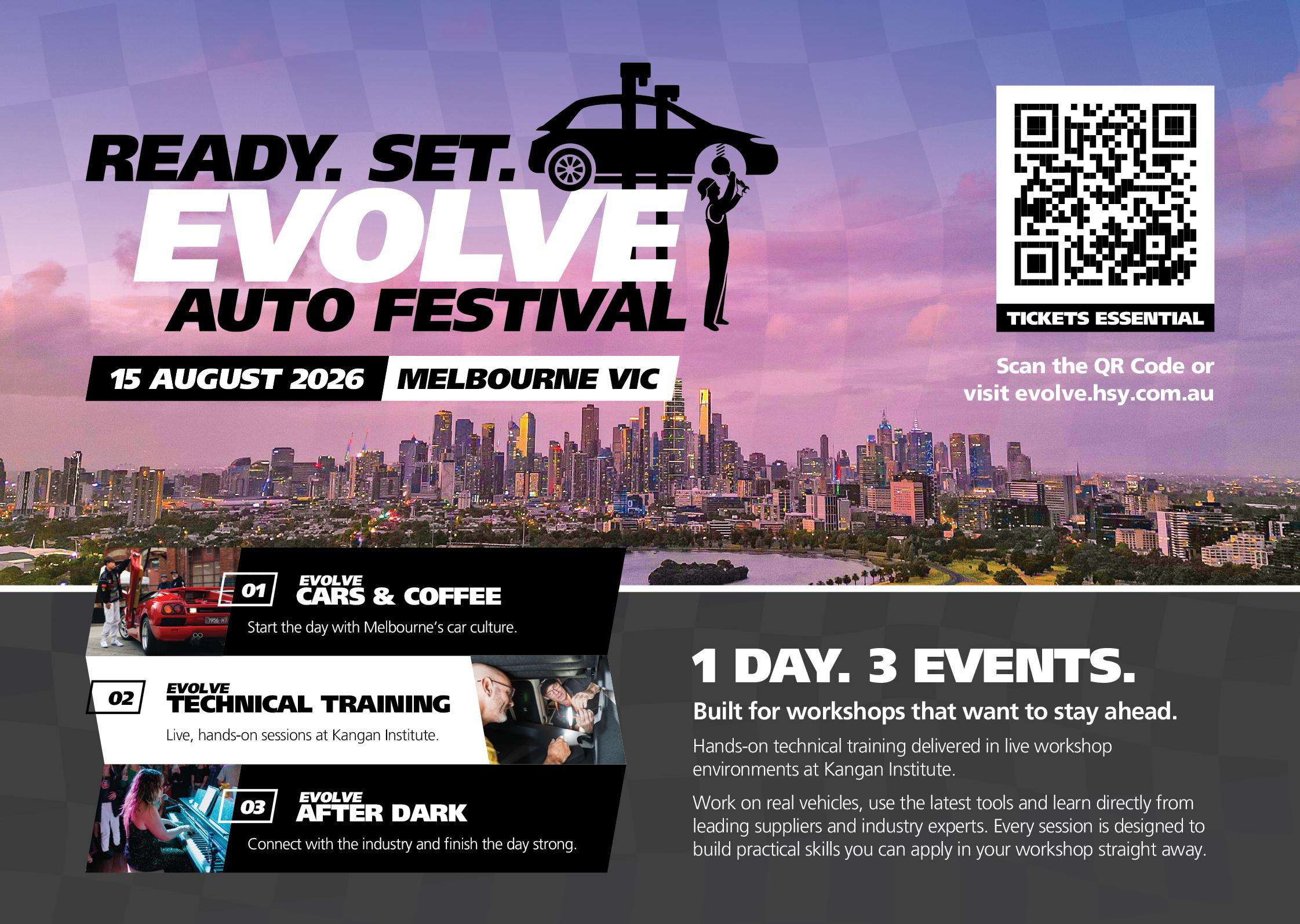
MTA Institute (Registered Training Organisation 31529) is Queensland’s leading industry-owned provider of automotive training and plays a critical role in developing the skilled workforce that underpins Australia’s automotive sector.
The organisation has a strong focus on practical, real-world learning and delivers nationally recognised training across the technical, retail and aftermarket sectors, ensuring students and employers benefit from high-quality, industry-relevant education.
MTA Institute’s training model is built on flexibility, accessibility and direct industry engagement, supporting learners at every stage of their career – from entry-level exposure through to advanced, specialised skills development.
For those entering the industry, MTA Institute offers accredited introductory programs tailored to high-school students and job seekers.
These courses are designed to provide a valuable first step into automotive careers, equipping participants with foundational knowledge, practical skills and clear pathways into further training or employment.
By engaging students early, MTA Institute helps build awareness of the diverse opportunities available across the automotive sector.
At the core of the organisation’s offerings are its apprenticeships and traineeships, delivered one-on-one in the workplace. This model is designed to ensure learning
is directly aligned with realworld industry practices, allowing students to develop skills in real time under the guidance of experienced professionals.
For employers, it provides the opportunity to train staff in line with specific business needs, improving both productivity and retention.
Beyond entry-level training, MTA Institute delivers a range of specialised post-trade programs, including training in battery/hybrid electric vehicles (BEVs/HEVs), automotive a/c and advanced driver-assist system (ADAS) technology.
As the automotive industry continues to evolve, MTA Institute is leading the way in emerging technologies, particularly in BEV and HEV training.
With demand for EV skills only increasing, the organisation aims to equip technicians with the knowledge and expertise required to safely service modern vehicles and adapt to ongoing industry change.
One of MTA Institute’s most in-demand courses is the AUR20220 Certificate II in Automotive Air Conditioning Technology. This short course provides technicians with the skills and knowledge required to service
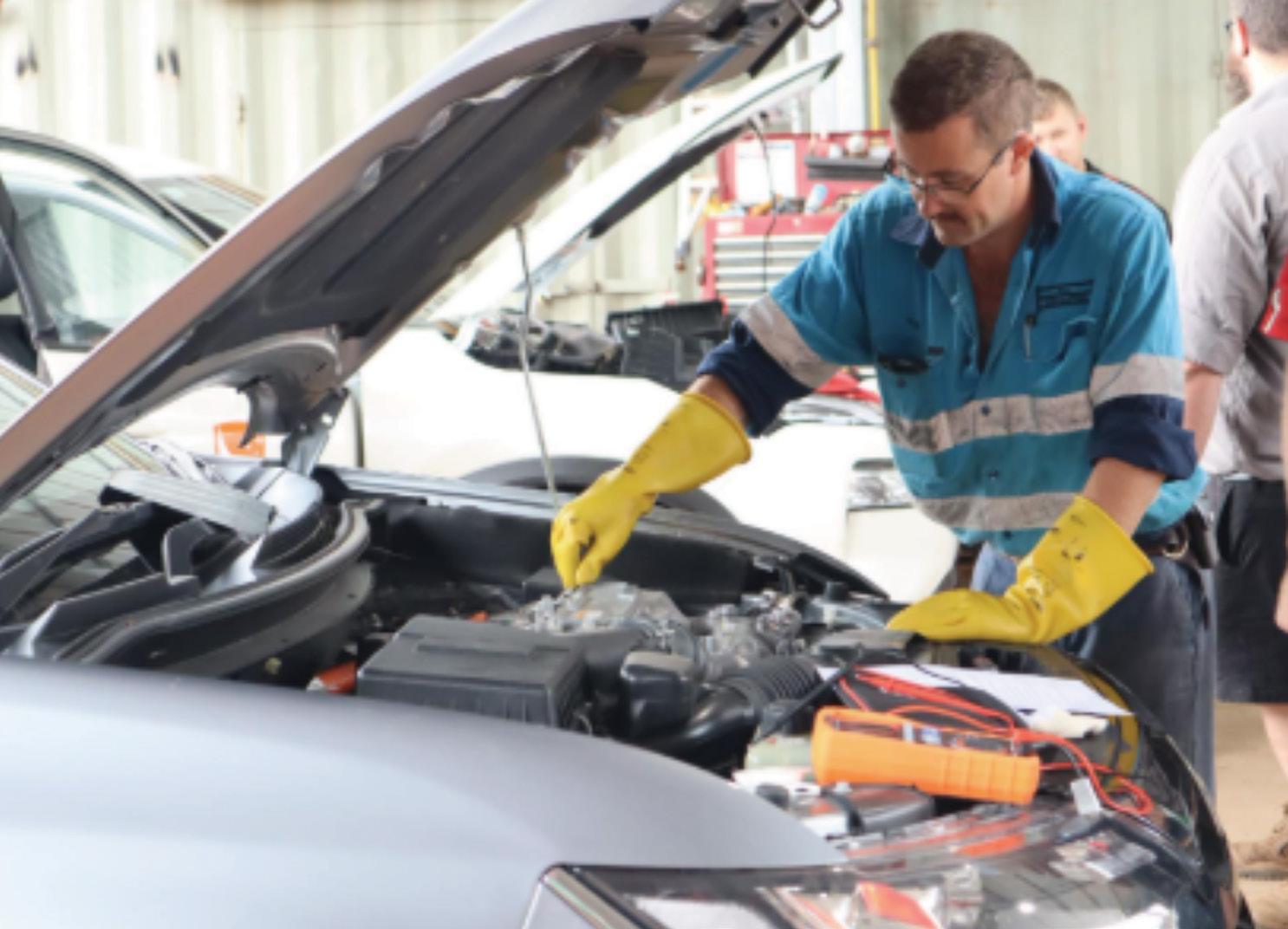
and repair automotive a/c systems while meeting national regulatory requirements. It also allows businesses to expand their service offering and respond to growing customer demand.
Complementing these pathways, MTA Queensland delivers specialised training in ADAS technology.
This training is designed to equip technicians with the skills to understand, diagnose, and work with systems such as lane assist, adaptive cruise control and collisionavoidance systems, reflecting vehicles’ increasing reliance on sophisticated safety technologies.
These programs are delivered at MTA Institute’s state-of-the-art facility at Eight Mile Plains and designed to enable qualified technicians to upskill, remain competitive and confidently adapt to rapidly advancing vehicle technologies.
For businesses, investing in ongoing training ensures teams are equipped to service modern vehicles and meet evolving customer expectations.
The benefits of workplace training extend well beyond technical skill development. For learners, it provides the opportunity to earn while they learn, gain practical experience and build confidence in a realworld environment.
For employers, it supports the development of a capable, engaged and loyal workforce while ensuring training is directly aligned with industry needs.
MTA Institute’s commitment to industry-led training and its diverse program offerings position it as a trusted partner in workforce development.
By delivering practical, relevant and forwardthinking training solutions, it continues to support the growth and sustainability of Queensland’s automotive industry – now and into the future.
• Find out more at mtai.edu.au
IAME delivers training that is hands-on and workshop-based, led by seasoned professionals and focused on real-word readiness – rather than textbook theory, it’s practical learning designed to stay for life.
In an industry defined by rapid innovation, IAME said one thing remained timeless – the need for skilled, adaptable and passionate automotive professionals (pic 1).
It said the organisation wasn’t about just keeping pace – its goal was to set the standard.
IAME said Australian workshops were changing with smarter technology, more complex vehicles and rising customer expectations – all demanding a new kind of technician.
IAME offers nationally recognised qualifications in light-vehicle mechanical technology, automotive-underbody technology, automotive-electrical technology, body-repair technology, automotive-refinishing technology and automotive sales.
These qualifications are offered with flexible start dates, personalised support and wellbeing services, with IAME seeking to remove barriers so learners and employers can focus on results.
When it comes to Recognition of Prior Learning (RPL), IAME’s RPL pathways can help seasoned professionals gain formal qualifications based on real-world expertise with fair, consistent and industry-aligned assessments.
IAME said it was also dedicated to

inclusivity, safety and fairness and that every learner deserved a seat at the workbench.
It said whether someone was a First Nations apprentice, a woman entering the trades or just seeking a fresh start, the organisation welcomed them.
IAME invites those in the industry to stay ahead of seasonal demand with its Certificate II in Automotive Air Conditioning Technology encouraging them to gain the skills, knowledge and licence to keep customers cool and businesses thriving (pic 2).
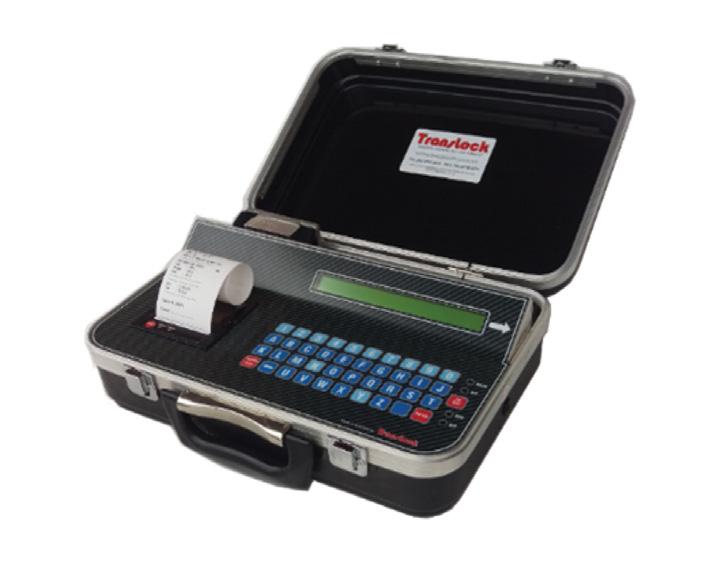
‘We don’t just train technicians – we shape futures,’ said an IAME spokesperson.
‘Whether you’re starting out or stepping up, we’re here to help.’
To find out more call 02 9782 1100 or go to iame.com.au/training-education
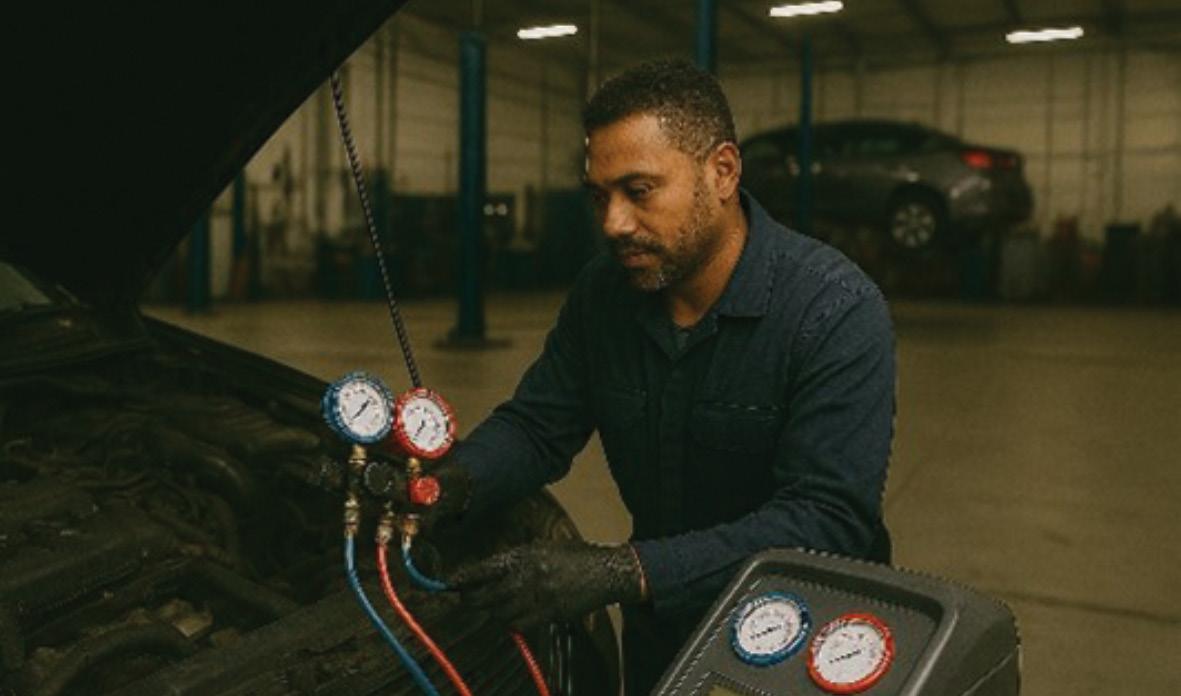
From July 1, 2026, new requirements will apply to portable brake-test equipment used during Authorised Inspection Scheme (AIS) inspections (pic 3).
Under the updated rules, all portable brake decelerometers must be capable of printing the brake-test speed on the inspection record. Transport for NSW has provided a transition period to allow inspection stations sufficient time to review and update their equipment before the changes come into effect.
What this means for AIS participants:
• From July 1, 2026, portable brake decelerometers used for AIS inspections must print the brake test speed.
• Non-compliant devices must be upgraded or replaced before this date.
• The printed test speed does not need to be GPS-derived.
• GPS-enabled devices will continue to be required for mobile examiners only.
AIS participants are encouraged to review their current equipment and plan any necessary upgrades well in advance to avoid disruption to inspection services.
• Find out more at iame.com.au
The Australian automotive industry is a special one, full of great people, hard work and constant evolution.
It’s in this spirit that Hi-Bolt was born. A training partner for large and small automotive business alike, the organisation focuses on delivering solution-based training for modern workshops because technicians cannot rely on biased training provided by manufacturers and part suppliers.
Hi-Bolt doesn’t exist to sell products, recommend brands or to teach participants componentry. It exists to upskill individuals and their teams with real-world sessions designed to help them solve problems faster, become more efficient and increase the flow of communication between the workshop and front office – and customers. Hi-Bolt was born from this industry. Its
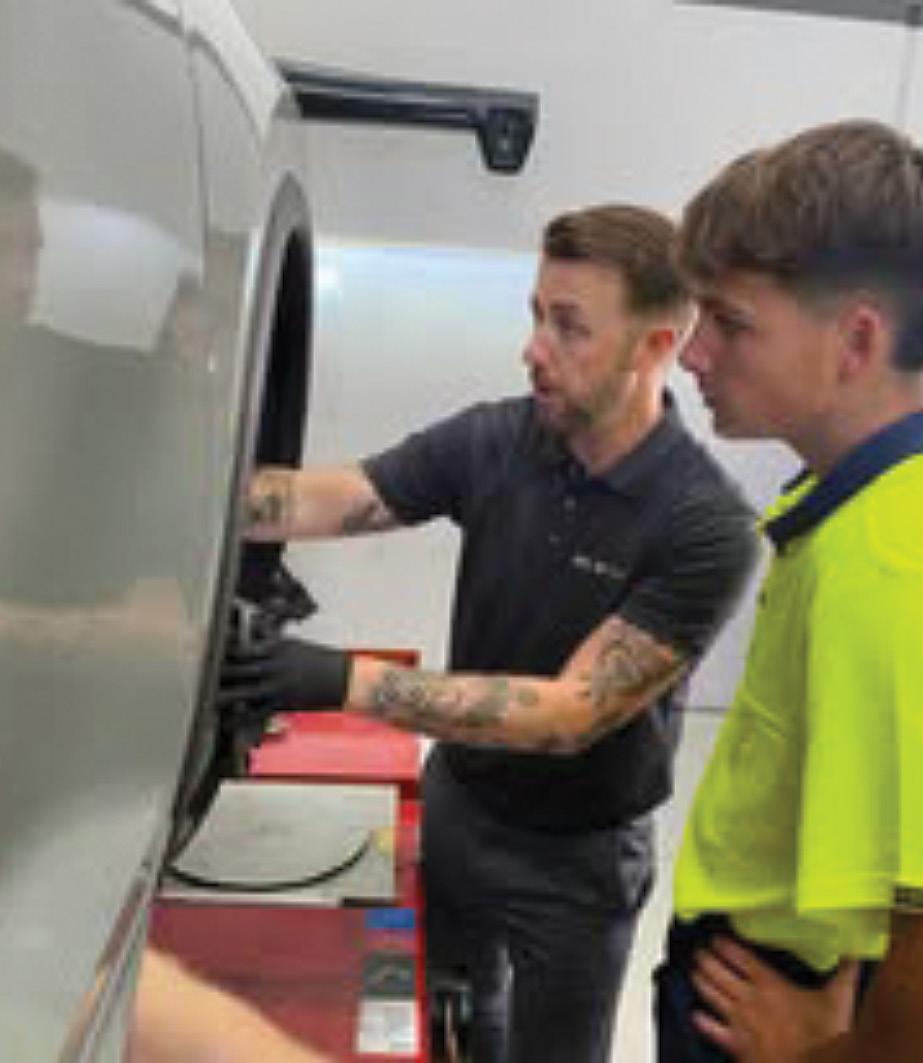
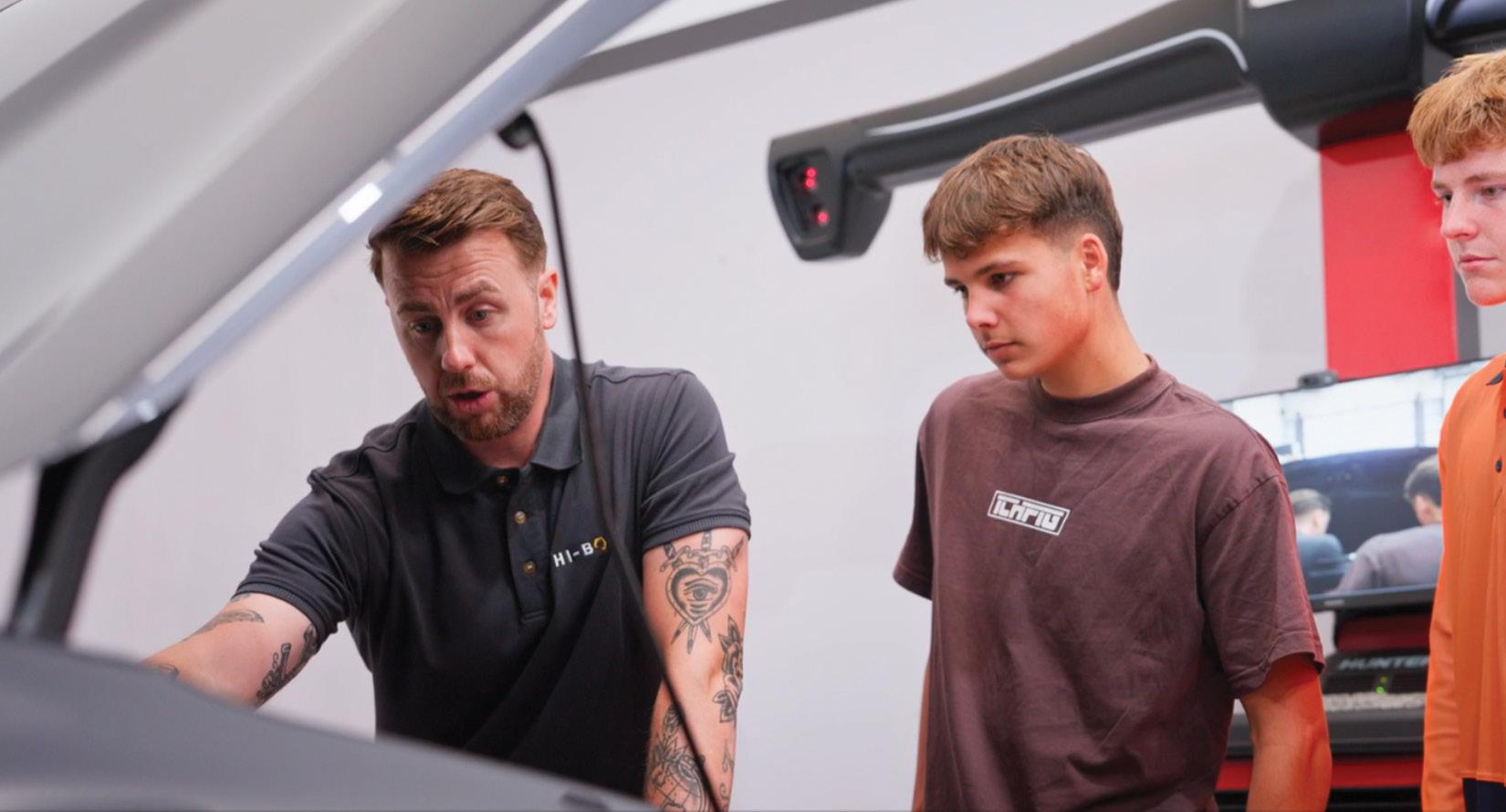
qualified trainers are experts in their fields and build the curriculum to accommodate all learning styles.
For small businesses, the organisation offers a wide range of technical and business training designed to assist with the everchanging landscape and help participants understand the needs of modern customers.
For larger businesses, Hi-Bolt can tailor upskilling solutions for teams and larger networks. This allows for fully customisable training that fits the priorities of a business and helps align business goals.
Hi-Bolt technical training covers everything from advanced driver-assist system (ADAS) technology and wheel alignments to diesel diagnostics and tyre-pressure monitoring system (TPMS) technology –plus everything in between. Through its training partners, it offers fully accredited hybrid electric vehicle (HEV) training and a/c-service training.
Hi-Bolt also facilitates soft-skills training such as sales fundamentals, customer experience, handling difficult conversations and workshop efficiency. These sessions are run specifically for the industry and use real, workshop-proven strategies for modern customers.
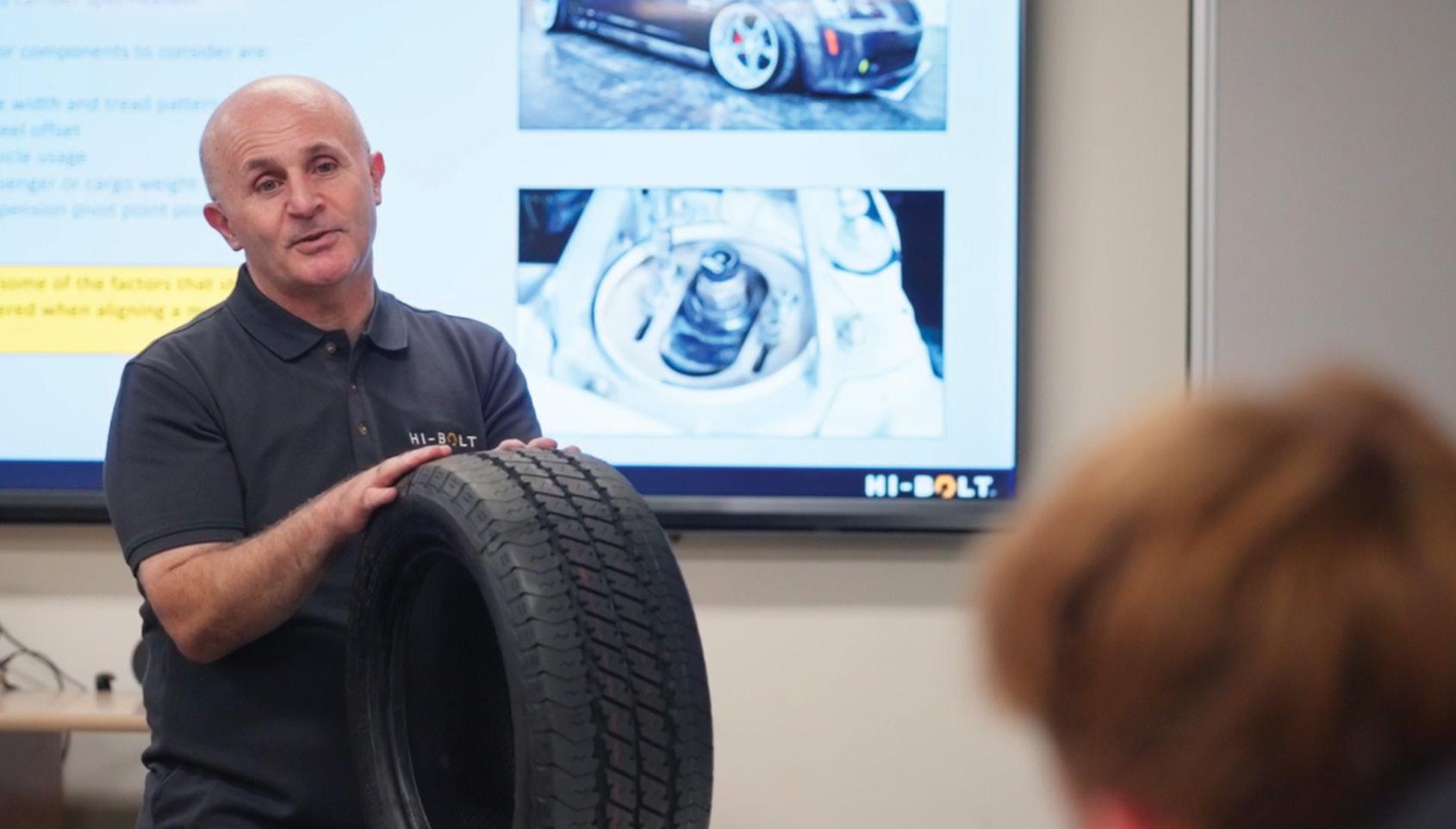
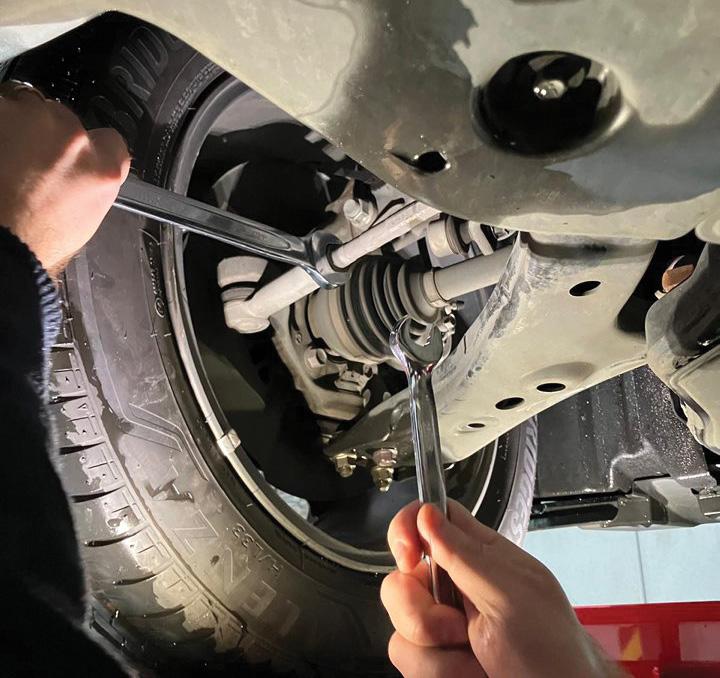
Based in Melbourne, Hi-Bolt builds its curriculum from scratch. It engages with industry leaders of presentation styles, technical animations and repair videos and hosts training session all around Australia in both metro and regional areas.
‘The future of our industry rests on those willing to learn new skills and techniques,’ said Hi-Bolt National Sales & Operations Manager Aaron Penney. ‘Our training team are constantly learning to stay ahead of the game, so we appreciate how hard it can be for workshops to stay updated.
‘The greatest challenge that exists, is actually getting workshops to give staff the opportunity to develop their skills.
‘We hear all the time – we need training but I can’t give the tech time off. However, training will make techs more efficient, safer and build loyalty and staff retention.
‘So it isn’t time off, it’s an investment in the future of your business.’
Hi-Bolt is about to launch a range of new sessions and dates all around Australia and seats are expected to be in high demand.
‘If you are willing to learn, nothing can stop you, but if you aren’t willing to learn, no one can help you,’ said Penney. ‘That’s one of my favourite quotes and I think it still rings true for our industry today.’
• To find out more or register for a session go to hi-bolt.com