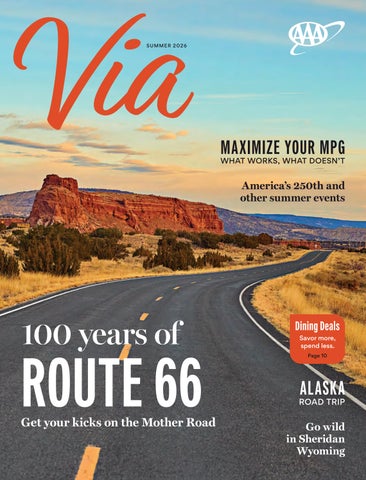
SUMMER 2026
MAXIMIZE YOUR MPG
WHAT WORKS, WHAT DOESN’T
America’s 250th and other summer events
100 years of
ROUTE 66
Get your kicks on the Mother Road
Dining Deals Savor more, spend less. Page 10
ALASKA
ROAD TRIP
Go wild in Sheridan Wyoming
See how much you can save by switching. Drivers who switched and saved with AAA Auto Insurance saved up to $534.1 Plus, AAA Members benefit from: •
24/7 support to handle your claim with care and speed
•
Insurance as dependable as our roadside assistance
Scan or visit AAA.com/ Insurance to learn more.
• Up to 5% exclusive savings on auto insurance, and other additional discounts2
AAA Auto Insurance 1 12-month savings based on November 2024 survey of new customers in CA, NV, UT, AZ, WY, and MT who reported savings when switching to AAA for auto within the past year. 2 Discounts vary based on eligibility and may not be cumulative. Coverage varies by state and depends upon policy provisions.Insurance products in California offered through AAA Northern California Insurance Agency, License #0175868, in Nevada by AAA Nevada, in Utah by AAA Utah, in Arizona through AAA Arizona, Inc., License #8301727 and Sunstate Insurance Agency, LLC, License #17203444, in Montana through AAA Montana, Inc., License #9756, and in Wyoming through AAA Mountain West Inc., License No. 172603. The provider of AAA Auto and Home Insurance is CSAA Insurance Group, a AAA Insurer. Products and their features may not be available in all states. All policies are subject to policy terms, underwriting guidelines and applicable laws. ©2026 AAA Mountain West Group; all rights reserved.
Hit the road for less with Hertz & AAA Summer destinations are waiting—get there with a new ride and member savings. Book with Hertz as a AAA Member for up to 20% off rental base rates and an extra $30 off weekly rentals—just include AAA Club Discount Code 5 and PC 211950 during booking.* Want even more perks? Join our free Hertz Gold+ program for instant perks and 1 free day after your first rental as a member.1 Join now: www.AAA.com/HertzGold Call: 800-654-3080 | Click: AAA.com/Hertz Visit: Your local AAA branch or your nearest Hertz neighborhood location *Offer ends 12/31/2026. Up to 20% discount will vary depending on location, date, length of rental, car class, & other factors. $30 on a weekly rental base rate, minimum 5 days. Discounts apply to Pay Later base rate. Taxes, fees, & options excluded. Promotion Code 211950 and AAA CDP# 5 must be provided at time of reservation for full offer discounts. This offer is available at participating Hertz locations in the US, Canada, & Puerto Rico. Age, driver, credit, & qualifying rate restrictions for the renting location apply. Advance reservation required. Offer not valid and rate change or additional fees may apply in the event of reservation modification, early / late vehicle return or if not returning vehicle to renting location. Valid on all car classes except large SUVs, minivans, & Dream. Offer has no cash value, & may not be used with other discounts, promotions, or special rates. Valid for vehicle pickups through 12/31/2026. Subject to availability, blackout periods, & additional restrictions. At the time of rental, present your AAA membership card for identification. 1The 1 free day rental offer is an exclusive offer fo r AA A me mbers wh o en roll at AA A.com/hertzgold. Va lid fo r ne w He rtz Go ld+ me mbers on ly. Fr ee re ntal da y wi ll be awarded in the form of 950 Gold+ points after the member’s first paid Gold+ rental. Free day excludes taxes, fees, & options. Skip the counter available at select locations. © 2026 Hertz System, Inc. All rights reserved. CS 1225077
CONTENTS Summer 2026 | Vol. 148 | No. 2
DEPARTMENTS
6 President’s Letter
34
For 100 years of Route 66 and half of the United States’ 250, AAA has been along for the ride.
9 Member News
’Tis the season for fresh produce: AAA Members recommend their favorite farmers markets.
50 years of Approved Auto Repair; the new Dining Deals program; AAA TravelFest details.
13 Behind the Wheel
How to replace air filters, fuelefficiency myths, helping teen drivers stay safe this summer, and more.
27 On the Road
Last chance to see a colorful sculpture in the desert; your favorite farmers markets; birdwatching in Arizona’s Madera Canyon; on the road from Anchorage to Fairbanks, Alaska; a weekend in Wyoming.
62 Events Calendar
Wherever you are in the West, there’s some fun to be found.
FEATURES
38
C OV E R STORY
The Most American Highway Iconic Route 66 turns 100 this year. Here’s why that’s worth celebrating. Plus, a calendar of commemorations and Members’ road-trip memories.
TOP: PAIGE GREEN PHOTOGRAPHY; BOTTOM: JODY O. PHOTOS
BY W I L L G R A N T
52
64 Where in the West
The Land of Oz Find summer travel inspiration in four Australia destinations that offer unbridled nature: the Great Barrier Reef, Red Centre, Tasmania, and South Australia. BY K E R I D W E N C O R N E L I U S , W H I T N E Y P H A N E U F,
Detour from the scenic drive for a lake loop hike with a view.
O N THE COVER Sunrise over
Route 66 where it winds around sandstone between Laguna Pueblo and Mesita, N.M. Page 38.
C O V E R P H O TO G R A P H
A N D H I L L A RY R I C H A R D
BY J A M E S B U E T I
DIGITAL EXTRAS Find these stories and more at AAA.com/via ← 6 Easy Summer Day Trips in the West
How to Prevent Heat Damage to Your Car Battery
Are TSA PreCheck and Global Entry Still Worth It?
These brief getaways from metro areas deliver big adventure, like hiking near Alaska’s Turnagain Arm.
Learn routine maintenance tasks and simple driver tricks (parking in the shade) that help preserve your battery.
Determine what’s best for you based on where you travel, how often you fly, and your personal needs.
Scan to enjoy these online-only stories and more.
A A A | VIA
3
STAFF EDITORIAL DIRECTOR Whitney Phaneuf DESIGN DIRECTOR Monica Ewing Jensen EXECUTIVE EDITOR Dan Miller MANAGING EDITOR LeeAnne Jones PHOTO EDITOR Maggie Perkins CONTRIBUTING EDITORS
Mandy Ferreira, April Kilcrease, Emma Silvers EDITORIAL ASSISTANT Nai Saeyang ADVERTISING & PRODUCTION MANAGER
Natasha Alcalá SOCIAL MEDIA STRATEGIST Amy Mackey
CONTACT Via Editorial Address all mail to Via, AAA, P.O. Box 24502, Oakland, CA 94623, or viamail@viamagazine.com. Your input may be edited and published in print or online. Via Advertising Address all mail to Via Advertising, AAA, P.O. Box 24502, Oakland, CA 94623. Fax (510) 899-0525. Change of address Allow four weeks’ advance notice. Contact AAA at (800) 922-8228. Manuscripts and photos Query first; Via assumes no responsibility for return of unsolicited material. Reprints from Via Contents copyrighted 2026 AAA Mountain West Group. No part of Via may be reprinted without written permission.
Answer to Where in the West →
(page 64): Swiftcurrent Lake, located at Glacier National Park in Montana.
Ple a COVER AND BODY PRINTED ON SFI-CERTIFIED PAPER.
e zin
ycle This Ma Rec ga se
Meet the Beauty in the Beast Discover this spectacular 6½-carat green treasure from Mount St. Helens!
F
or almost a hundred years it lay dormant. Silently building strength. At 10,000 feet high, it was truly a sleeping giant. Until May 18, 1980, when the beast awoke with violent force and revealed its greatest secret. Mount St. Helens erupted, sending up an 80,000-foot column of ash and smoke. From that chaos, something beautiful emerged… our spectacular Helenite Necklace.
EXCLUSIVE
FREE
Helenite Earrings -a $99 valuewith purchase of Helenite Necklace
Helenite is produced from the heated volcanic rock of Mount St. Helens and the brilliant green creation has captured the eye of jewelry designers worldwide. Today you can wear this massive 6½-carat stunner for only $99!
Impo Was ssible Pric $299 , Nowe
$99
Make your emeralds jealous. Our Helenite Necklace puts the green stone center stage, with a faceted pear-cut in a luxurious gold-finished setting. The explosive origins of the stone are echoed in the flashes of light that radiate as the piece swings gracefully from its 18" luxurious gold-finished chain. Today the volcano sits quiet, but this unique piece of American natural history continues to erupt with gorgeous green fire.
Your satisfaction is guaranteed. Bring home the Helenite Necklace and see for yourself. If you are not completely blown away by the rare beauty of this exceptional stone, simply return the necklace within 30 days for a full refund of your purchase price.
JEWELRY SPECS: - 6 ½ ctw Helenite in gold-finished setting - 18" gold-finished chain
Limited to the first 600 orders from this ad only Helenite Necklace (6 ½ ctw) . . . . . . . . . . . . . Only $99 +S&P Helenite Stud Earrings (1 ctw) . . . . . . . . . . . . . . . . $99 +S&P Helenite Set $198 . . . . . . . . . . . Call-in price only $99 +S&P (Set includes necklace and earrings)
Call now to take advantage of this extremely limited offer .
Necklace enlarged to show luxurious color.
1-800-333-2045 Promotional Code HNN243-07
Please mention this code when you call.
Rating of A+
14091 Southcross Drive W., Dept. HNN243-07 Burnsville, Minnesota 55337 www.stauer.com
Stauer… Afford the Extraordinary.®
“My wife received more compliments on this stone on the first day she wore it than any other piece of jewelry I’ve ever given her.” - J. from Orlando, FL Stauer Client
PRESIDENT’S LETTER
The great American road trip: A century in the making
T
here is a unique feeling that comes with the arrival of summer, a time when our Members typically hit the open road for the classic American road trip. This year, that feeling carries a special weight as we find ourselves at the intersection of two historic milestones. In 2026, we celebrate the 250th birthday of the United States. It is a moment to reflect on our nation’s unfolding journey, from a bold experiment in liberty to the vibrant, diverse land we call home today. For us at AAA, it puts our own story into perspective. Last year, we celebrated 125 years of service. While we are proud of our deep roots, we are humbled to realize we’ve only been along for half of the ride. We have spent our century-and-a-quarter growing alongside a country that has long been filled with people eager to explore. Perhaps nothing symbolizes that pioneering spirit better than Route 66. The Mother Road marks its 100th anniversary this year. Established in 1926, this iconic highway transformed the way we travel, connecting the main streets of our heartland and fueling the dreams of generations of road-trippers. If you are looking to rediscover the magic of the open road this summer, there is no better place to start. A personal favorite section of mine winds through Seligman, Ariz. Walking the streets there feels like stepping into a storybook—fitting, as it served as a real-world inspiration for Radiator Springs in the Cars movie franchise. It is a place where time slows down, and the neon signs remind us that the American
Serving AAA Members in: 6
V I A | S U M M E R 2 0 26
journey has always been about more than just the destination; it’s about the freedom found between the mile markers. At AAA, our mission hasn’t changed since the first gravel was laid on Route 66. We are here to ensure that your summer road trips are safe, seamless, and unforgettable. Whether you are driving an electric vehicle toward the future or a vintage cruiser down the Mother Road, we are proud to protect the freedom of movement that defines our way of life. As we celebrate 250 years of this great republic and 100 years of its most famous highway, I encourage you to get out and explore our nation and the people who call it home. After all, we share more than borders on a map; we share the wisdom and experience of the countless miles of history we’ve traveled together. This summer, I hope you drive safely while you get your kicks on Route 66—or whatever road you choose. P.S. There are plenty of AAA-approved hotels along the route; many provide AAA Member Discounts. Visit AAA.com to learn more.
MARSHALL L. DONEY, PRESIDENT AND CEO
HIT THE ROAD Follow us to catch our Route 66 road trip.
→ AAA.com/ instagram
Dining Deals from AAA Savor more and spend less, no matter the craving or destination. Save up to 40% at more than 55,000 restaurant locations nationwide with Dining Deals from AAA. From local favorites to national chains, this Member-exclusive program uses discounted eGift cards to bring you delicious savings—perfect for everyday dining or road trip adventures. Get started in 3 easy steps: 1. Visit AAA.com/DiningDeals to browse the wide array of restaurants and purchase discounted eGift cards. 2. Check your email inbox for a link to access and manage your eGift cards. 3. Dine and save at the restaurant of your choice by showing the eGift card on your phone or presenting a printed copy.
*Merchants shown are not a sponsor or co-sponsor of this program. ©2026 AAA Mountain West Group; all rights reserved.
Scan or visit AAA.com/ DiningDeals to learn more.
A A A | VIA
7
#1 for Rivers #1 for Oceans Five years in a row
E X PLOR E THE WOR LD IN COMFORT Consider booking one of these popular itineraries F E AT U R E D S A I L I N G S
GRAND EUROPEAN TOUR
ICONIC WESTERN MEDITERRANEAN
Indulge your senses on this 15-day journey spanning the best of Europe, tracing the Rhine, Main and Danube Rivers.
Trace the shores of the Mediterranean coast with calls to Spain, Italy and France’s famed Riviera.
Budapest to Amsterdam • 15 days
Barcelona to Rome • 8 days
AAA MEMBERS RECEIVE EXCLUSIVES ONLY AVAILABLE FROM VIKING Receive up to $200 shipboard credit per person*
Contact your AAA Travel Advisor or visit AAA.com/Viking * AAA Member Benefit: $100 per person shipboard credit for all Viking voyages 8-11 days. $200 per person shipboard credit for all Viking voyages 12 days or longer. Shipboard credits can only be applied when booked directly by AAA Travel Agent. This offer is combinable with group rates, early booking discounts, past passenger discounts, refer a friend credits and future cruise vouchers. Offer is not combinable with interline and wholesale bookings or valid on other Viking products. Onboard credit has no cash value. Viking reserves the right to correct errors and to change any and all fares, fees and surcharges at any time. CST# 2052644-40 *Ocean ship size category: 500-2,500 guests.
Member News
• A A A M I L E S TO N E S • E XC L U S I V E O FFE R S • M E M B E R B E N E FI T S • B R A N C H U P DAT E S
ASA GILMORE
Celebrating 50 years
Brad Harriff and Mike Rivera of Roy Foster’s Automotive in Reno, an Approved Auto Repair shop.
AAA proudly celebrates the 50th anniversary of the Approved Auto Repair (AAR) program, a network of trusted and inspected repair facilities across North America. Since its inception, the AAR program has connected drivers with auto repair services that uphold the highest standards of quality, satisfaction, and affordability. With more than 400 shops in the AAA Mountain West Group footprint, AAA has made it easier than ever for Members to find a trustworthy auto repair shop. Find your local shop at AAA.com/autorepair.
MEMBER NEWS
Dine out for less
New ProtectMyID® feature
Don’t let rising costs keep you from sharing a meal with loved ones. With the new Dining Deals program from AAA, you can purchase digital gift cards up to 40% off for restaurants across the country, from favorite chains such as Olive Garden and Panera Bread to local gems. Visit AAA.com/diningdeals.
From data leaks to public Wi-Fi, your personal info may be exposed, making it easier for identity thieves, hackers, and spammers to target you. Take control with the free Member benefit
The grand opening of the AAA West Lake Mead branch in Las Vegas.
ProtectMyID® Essential and its newest feature, the Online Exposure Scan, which uncovers where your data may be at risk. Enroll today at AAA.com/idtheft.
Stay tuned for AAA TravelFest Branch relocations and remodels At AAA Mountain West Group, we’re always looking for opportunities to better serve our Members, including where our branches are located and how they’re designed. We’re excited to announce relocations in Chico and Menlo Park, Calif., and Las Vegas, Nev., as well as a remodeled location in Citrus Heights, Calif. All proudly serve their communities with the service you’ve come to expect. That includes
Share your thoughts
Send comments or questions to viamail@viamagazine.com or Via, AAA, P.O. Box 24502, Oakland, CA 94623. Your input may be edited and published in print or online.
10
V I A | S U M M E R 2 0 26
management of car, home, and life insurance, plus travel planning, free passport photos, and notary services. Stop by and say hi at these locations: ● 2009 Forest Ave., Ste. 10, Chico, CA ● 5 15 El Camino Real, Ste. 120,
Menlo Park, CA ● 7 550 West Lake Mead Blvd.,
Ste. 1, Las Vegas, NV ● 6109 Sunrise Blvd., Citrus Heights, CA
JOIN THE COMMUNITY
AAA.com/ facebook
AAA.com/ instagram
AAA.com/ pinterest
AAA.com/ youtube
TOP: DEB SUMON / SHUTTERSTOCK; BOTTOM: AAA STAFF
Coming to Sheraton Phoenix Downtown on Sept. 12, the fall edition of AAA TravelFest will bring together top partners and trusted AAA Travel Advisors—all ready to help you explore new destinations and unlock exclusive travel opportunities. Stay tuned for upcoming announcements, and be sure to RSVP for a first look at the special offers and travel deals you won’t want to miss. Get the details at AAA.com/travelfest.
B.
ABALONE HUMMINGBIRD PENDANT & EARRINGS COLLECTION Graceful Hummingbird Design
A.
Solid 925 Sterling Silver Abalone Mother of Pearl
Matching Abalone Hummingbird Earrings
FREE 18” + 4” Sterling Silver Chain 1.57” Length
Natural Abalone Shell
TAKE FLIGHT WITH THIS DAZZLING DELIGHT The hummingbird is a traditional symbol of love and beauty. Suspended in mid-flight, with a rainbow of iridescence in wave-like patterns, outstanding shimmering Abalone decorates her body and wing. Each unique, one-of-a-kind piece of Abalone shell has been molded into a sterling silver pendant. Traditionally, Abalone shell is believed to induce feelings of calm, compassion and love. It has a tranquil, warm and gentle cosmic vibration. Spiritually uplifting, Abalone is said to soothe the nerves, encourage serenity and bestow a feeling of inner peace. With an original retail value of $249, this stunning combination of color and craftsmanship can be yours today for the
special offer price of just $99 using the special insider code VA6MHB at checkout. With only 980 pieces created worldwide, this limited edition is expected to sell quickly secure yours today while availability remains. A. Abalone Hummingbird Pendant & FREE Silver Chain $149 - $99 plus S&H B. Matching Abalone Hummingbird Earrings $149 - $99 plus S&H C. Abalone Hummingbird Complete Collection $299 - Now Only $159 (EXTRA $40 SAVING)
ORDER NOW TOLL FREE 24/7 ON: 1-800 733 8463 OR ORDER ONLINE AT: timepiecesusa.com/va6mhb AND ENTER PROMO CODE: VA6MHB PAY BY CHECK: Timepieces International Inc. 10701 NW 140th Street, Suite 1, Hialeah Gardens, FL 33018
Financial Services
Get your cash back. Earn cash back wherever you go when you use your AAA Travel Advantage Visa Signature® Credit Card—including on purchases made through AAA, like travel and insurance.1 • 5% cash back on gas and EV charging purchases1 • 3% cash back on travel, restaurants, grocery stores, and AAA purchases1 • No annual fee and no foreign transaction fees2 • $100 statement credit just by spending $1,000 within 90 days of account opening3
AAA Credit Cards
Scan or visit AAA.com/ TravelCard to learn more.
1 Offer is exclusive to AAA Travel Advantage Visa Signature® Credit Card holders enrolled in the AAA Travel Advantage program. For offers associated with a specific category, earnings will only be awarded if the merchant code for the purchase matches a category eligible for the offer. Each merchant is assigned a code by a third party that indicates the merchant’s area of business. Comenity Capital Bank does not have the ability to control assignment of merchant codes. Maximum of $350 USD in cash back in a calendar year on the 5% category, and earn 1% cash back on all net eligible purchases thereafter. Excludes third-party insurance and offers, automobile extended warranties, and trip insurance. Cash back can be redeemed as statement credits, direct deposit, rewards and qualifying purchases at participating AAA locations. This rewards program is provided by Comenity Capital Bank and its terms may change at any time. For full Rewards Terms and Conditions, please see AAA.com/ AdvantageTravelTerms. 2 For new accounts, as of February 2026: Variable Purchase and Balance Transfer APRs of 17.49% – 31.49% based on your credit worthiness at the time of account opening and the Prime Rate. Variable Cash Advance APR of 32.49%, based on Prime Rate. Minimum Interest Charge is $3. Balance Transfer Fee of the greater of $10 or 5% of the transfer. Cash Advance Fee of the greater of $10 or 5% of the advance. 3 Valid one time only. Offer will be received within 1-2 billing cycles after qualifying spend. Credit card offers are subject to credit approval. AAA Travel Advantage Visa Signature® Credit Card are issued by Comenity Capital Bank pursuant to a license from Visa U.S.A. Inc. Visa is a registered trademark of Visa International Service Association and used under license. ©2026 AAA Mountain West Group; all rights reserved. 12
V I A | S U M M E R 2 0 26
Behind the Wheel
• C A R B U YI N G • DRIVING TIPS • D R I V E R E D U C AT I O N • MEMBER QUESTIONS
CAR BU YI NG
Road-trip warrior Back in the day, the phrase “family summer road trip” might have conjured up images of a wood-paneled station wagon, crammed with parents and kids, swaying under a load of luggage up top. These days, the old family wagon has been replaced by an SUV—preferably one with good gas mileage for those long “are-we-there-yet” drives. Of all the many SUVs on the market today, the Honda CR-V is hard to beat as a road-trip machine. It has tons of space (39.3 cubic feet with rear seats up, 76.5 with them down,
and 41 inches of legroom in back— perfect for car seats). It’s an IIHS Top Safety Pick, with collision-mitigation braking, road-departure warning, lane-keeping assist, and other driver-assistance technology standard on all trims. And it gets great mileage: 33 mpg on the highway for the standard model and 36 mpg for the hybrid. That all could explain why it’s a perennial bestseller on auto-buying site TrueCar. If you’re hitting the road this summer, the CR-V could be your perfect ride— even without the wood paneling.
aaa member benefit
TrueCar Auto Buying COURTESY HONDA
Let us help you find your next new or used car.
→ AAA.com/ autobuying
2026 Honda CR-V TrailSport Hybrid.
BEHIND THE WHEEL
CA R B U Y IN G
Depreciation: What car buyers need to know
That shiny new ride starts losing value as soon as you drive it off the lot. by k at h l e e n p e n d e r
L
Depreciation—the rate at which cars lose value—accounts for about 38% of the cost of ownership, according to AAA. But you might not notice the impact that depreciation can have on resale value until you trade in or sell your car. Depreciation rates, which typically range from 40% to 60% within the first five years, depend on a variety of factors. Some of them are out of your control, but many are not. Here’s how to minimize your losses.
Depreciation by vehicle type
Auto research and buying site iSeeCars conducted a study of more than 800,000 5-year-old cars sold between March 2024 and February 2025. Electric vehicles (EVs) depreciated the fastest, losing about 59% of value in their first five years. They were followed by SUVs, which lost almost 49% in value. Trucks and hybrids fared the best, losing around 40% each. Sedans were in the middle, with an average depreciation of about 43%.
ALTHOM / ISTOCK
ove that new-car smell? Enjoy it while you can: After a few weeks or months, the aroma inevitably fades. Unfortunately, and more significantly, so does the value of your not-so-new vehicle. In those first weeks after you initially take ownership, your new ride will probably lose more than 10% of its resale value. After its first year, it will have shed 20%. After five years, it will be worth, on average, about half its original price.
14
V I A | S U M M E R 2 0 26
Within those categories, luxury models generally depreciated faster than others. For example, luxury SUVs lost nearly 56% of value, while mainstream SUVs lost 49%. Among sedans, luxury versions lost almost 55% and regular versions lost 43%. “Used buyers are much more bottom-line practical,” says Karl Brauer, executive analyst at iSeeCars. “They don’t have the means or mentality to waste that kind of money.” TRIM LEVEL
You might think that top-of-the-line models, loaded with all the options, would depreciate faster than a base models. Not necessarily, says Kelsey Mays, customer success director with JD Power. It depends a lot on the kinds of features an automaker adds at each trim level. For example, Mays says, “electronics have a lot of depreciation.” But if a trim has power seats, a sunroof, and a seat heater, and it costs only $2,000 or $3,000 more than the standard model, it could retain its resale value well. Used-car buyers are much more priceconscious, says Mays. Many of them just want to be sure they’re maximizing the bang they get for their bucks.
ANDRESWD / ISTOCK
MAKE AND MODEL
Among individual makes and models, the most important depreciation factors are popularity and reliability, which often (but don’t always) go hand in hand. “Popular models with long-established reputations for reliability have the best resale value,” says Sean Tucker, managing editor of Cox Automotive. Many news and auto publications rank manufacturers and models by reliability. Although those rankings are based on different methodologies and don’t necessarily evaluate the same brands, some patterns emerge. Lexus, Subaru, and Toyota topped Consumer Reports’ 2025 brand
reliability rankings, followed by Honda and BMW. The least reliable were Rivian, Ram, Jeep, GMC, and Chrysler, according to data from Consumer Reports members who own vehicles from those brands. JD Power’s 2025 brand dependability report, based on consumer surveys after three years of ownership, puts Lexus, Porsche, Cadillac, Buick, Mazda, and Toyota at the top of its lists (for luxury, premium, and massmarket brands); Volkswagen, Chrysler, Jeep, Audi, and Land Rover rank at the bottom. ISeeCars analyzed which makes and models have the greatest chance of still being on the road at 250,000 miles. In the survey, Toyota, Lexus, Honda, and Acura were the most reliable, while Ram, Mazda, Cadillac, and Chevrolet were below average. UNFO RES EEN EVENTS
Other factors that impact depreciation are almost impossible to predict. For example, depreciation rates slowed during the pandemic, when supplychain disruptions throttled new-car production and caused used-car prices to soar. Since then, used-car prices have come down, and depreciation rates have gone up again—but not to prepandemic levels.
In 2019, the average 5-year-old vehicle lost about 50% of its value, according to iSeeCars. In 2023, that number dropped to 39%. By January 2026, it had risen to 42%. Electric vehicles—which typically lose value more quickly than gas-powered cars because the technology changes so rapidly—began to depreciate even faster when the federal government discontinued EV tax credits after September 2025, Mays says. Used car buyers have taken note. “EVs, despite cooling momentum on the new-car side, are being scooped up faster than any other powertrain in the used market,” Edmunds reported in November.
Who should worry about depreciation?
If you plan to buy a new car and sell it within five years, depreciation should be top of mind, particularly if you need a loan. “If you’re financing a car, you need to pay attention so you don’t end up owing more than it’s worth,” says Keith Barry, senior autos reporter at Consumer Reports. If the car is stolen or totaled in a crash, you would have to come up with the difference between what you owe and what it’s worth, unless you have purchased gap A A A | VIA
15
BEHIND THE WHEEL
already have taken the biggest depreciation hit, but should still have lots of life left and perhaps time remaining on a transferable warranty. If you must buy new, there are ways you can minimize depreciation:
How to minimize depreciation
the total cost of ownership—including depreciation—of cars you’re considering. You can find them at AAA, Edmunds, and Kelley Blue Book.
“The single best way to protect against depreciation is to buy a relatively recent used car,” Tucker says. It will
1. Shop for cars that hold their value. If you are deciding between two possibilities, see what their 2020–21 models are selling for now and apply that rate of depreciation to the ones you’re considering. 2. Use online calculators to estimate
3. Once you’ve driven your new car off
the lot, treat it gently.
“Depreciation is often tied to the market’s perception of a car’s value, desirability, reliability, and cost of ownership. So, a car that holds its value is often a good car” to own, Barry says. ●
One Membership.
17,000+ On-Demand Videos
Enroll Your Spouse2
1 : 1 Well-Being Coaching NESS M
28
EM 1
/mo
.
1
HIP
$
FIT
RS
Get Started: AAA.com/AFD
RD
BE
AAA members and their enrolled spouses can receive 10% of their Active&Fit Direct™ membership fees back after 12 months with the program.
STAN
12,800+ Gyms
DA
Thousands of Ways to Stay Active and Save Money.
12,800+ FITNESS CENTERS 17,000+ WORKOUT VIDEOS
1 Monthly fees are subject to applicable taxes. 2 Add a spouse/domestic partner to a primary membership for additional monthly fees. Spouses/domestic partners must be 18 years or older. Fees may vary based on fitness center selection. M966-774A-AAANCNU 10/23 © 2023 American Specialty Health Incorporated (ASH). All rights reserved. The Active&Fit Direct program is provided by American Specialty Health Fitness, Inc., a subsidiary of ASH. Active&Fit Direct and the Active&Fit Direct logos are trademarks of ASH. Other names or logos may be trademarks of their respective owners. Standard gym and premium studio participation varies by location and is subject to change. On-demand workout videos are subject to change. ASH reserves the right to modify any aspect of the Program (including, without limitation, the Enrollment Fee(s), the Monthly Fee(s), any future Annual Maintenance Fees, and/or the Introductory Period) at any time per the terms and conditions. If we modify a fee or make a material change to the Program, we will provide you with no less than 30 days’ notice prior to the effective date of the change. We may discontinue the Program at any time upon advance written notice.
DRAGANA GORDIC / SHUTTERSTOCK
insurance to cover the shortfall. “If you buy a car with a low predicted resale value, take out a shorter-term loan and put down as much as you can,” he says. However, he says, “if you plan to hold on to your car for 10 to 20 years, resale value can drop to the point where repair and maintenance costs can outstrip depreciation.” If you plan to lease, you don’t need to focus on depreciation because it will be factored into, and largely determine, your monthly payment. In general, your payment will cover the car’s expected depreciation and a few minor costs. The residual value—what you could buy it for at the end of the lease— is the expected depreciated value.
Stay road ready. Keep your car running smoothly at local shops hand-picked by AAA Approved Auto Repair, where there is commitment to high customer satisfaction and fair pricing. AAA Members enjoy these benefits: •
10% off labor (up to $75)*
•
Extended warranty on parts and labor (24 months/24,000 miles)*
Scan or visit AAA.com/ AutoRepair to learn more.
See reverse for more information.
Complete car care and Member savings await. From routine maintenance to major repairs, AAA Approved Auto Repair shops in your neighborhood help keep your car road-ready.
AAA Members unlock these exclusive benefits:
on labor costs*
24 month/ 24,000 mile warranty
FREE multi-point vehicle inspection report
Shops are annually inspected and AAA-certified
10% off, up to $75
with any paid service
on parts and labor*
to ensure quality repairs
*Valid AAA Membership Card required. Extended warranty is 24 months or 24,000 miles (whichever comes first). Membership benefits of extended warranty and labor discount may be combined with one other offer. ©2026 AAA Mountain West Group; all rights reserved.
BEHIND THE WHEEL
D R I V IN G T IP S
The truth behind 5 fuel-efficiency myths A lot of the conventional wisdom about maximizing your car’s miles per gallon simply isn’t correct.
HISPANOLISTIC / ISTOCK
by m e l a n i e h a i k e n
I
f you find yourself sighing whenever your gas gauge approaches “E,” you’re not alone. Surveys confirm that fuel economy continues to be one of the most critical factors for buyers shopping for new cars. Accord ing to AAA data, high gas prices are increasingly pushing drivers to com bine errands, join carpools, and even postpone vacations.
You’ll see lots of suggestions out there for ways to improve your car’s gas mileage. These range from the legitimate to the questionable. Here’s where five commonly recommended strategies land on that spectrum. MYTH 1 Using cruise control
Turning on your car’s cruise control can indeed help it burn less gas under
certain conditions: Maintaining a steady speed means less acceleration, which in turn means less fuel burned. But the speed you select when initiat ing cruise control is critical. “The most important variable for efficiency is speed,” says Roger Clark, an auto industry consultant and for mer senior manager of energy effi ciency at General Motors. “As you go at higher and higher speeds, you increase the aerodynamic drag or wind force.” As drag increases, the engine has to exert more power to compensate. So if you set your cruise control to 55 mph, that’s fine, says Clark. But over that, you’ll reduce your miles per gallon in most gas vehicles. In some cases, that reduction can be really significant, according to recent tests by Consumer Reports. Comparing gas mileage at 55 mph and 65 mph in a Nissan Altima and a Toyota RAV4, testers found that the A A A | VIA
19
BEHIND THE WHEEL
down somehow, and open windows create enough wind drag to offset the gains from forgoing the AC. “If you open the windows above 40 miles an hour, you’re losing more efficiency than if you just run your AC,” Clark says. That said, if the weather is temperate enough to keep the windows closed without AC, your gas budget will thank you. “If you live in a beautiful place like California, with moderate temps most of the year, not using your air conditioner can have a fairly significant impact on the economy of the vehicle,” says Brannon. One option he suggests when it gets warm but not hot: “Use the fresh air vent on your car, which has a much lower aerodynamic impact than opening the window.”
aaa member benefit
Save 5¢ a gallon on every fill-up at Shell.
→ AAA.com/ shell
plus
Earn 5% cash back on gas purchases with your AAA Travel Advantage Visa Signature® Credit Card.1
→ AAA.com/ travelcard
1 See page 12 for disclosures and more information. 20
V I A | S U M M E R 2 0 26
MYTH 2 Choosing manual transmissions
Thirty years ago, it was true: Manual transmissions were typically 5% more efficient than automatics. That was due to their mechanical efficiency. Manuals transferred power more directly from the engine to the wheels than automatics. But technology doesn’t stand still, and automatic transmissions have improved. Among other things, they gained gears. (Automatic transmissions now typically have eight or 10 forward gears, compared with five or six in a manual.) By the 2010s, automatics were actually more efficient than manuals. “They don’t have the same losses that they used to,” says Greg Brannon, director of automotive research for AAA. MYTH 3 Turning off air conditioning
Using the air conditioning unquestionably cuts into gas mileage. Trouble is, you’ve got to cool
MYTH 4 Turning off the engine, shifting to neutral
Idling is the enemy of gas efficiency, for an obvious reason: The engine is burning gas without moving the car. Thus, putting the car in neutral has no impact on efficiency, because the engine is still running. Turning the car off, however, can indeed save gas compared with idling—but the gains are minimal if you’d be idling for just a short time. Many modern cars feature an auto stop/start setting that turns the engine off when stopped, then restarts it as soon as your foot touches the gas. That feature, the experts say, is a definite gas saver, especially when you’re stopped at lights or fully stopped in bad traffic. Speaking of idling, you’ll also save gas if you hit the road as soon as you start the car: Unless it’s really cold, there’s no need to warm up the engine in a modern vehicle before driving. MYTH 5 Keeping the tank full
By itself, having more gas in your tank doesn’t help fuel economy: If anything, it adds some extra weight, which can take more gas to move. But you don’t want to go to the other extreme, either. Regularly driving your car with the needle close to empty is hard on your fuel pump, says Brannon. If you consistently drive with lower fuel levels, any savings you might realize by driving a slightly lighter car will be offset by the hundreds of dollars you’ll eventually need to drop for a new pump. For optimal efficiency, experts say you should keep your
KCKATE16 / ISTOCK
Double the savings on gas
increase in speed cut fuel economy by 8 mpg in the RAV4 and 6 mpg in the Altima. Traffic and terrain also matter. “Cruise control can be a killer in the wrong conditions,” says Bruce Shields, president of Knoxville, Tennessee-based American Transportation Co., a fleet management service. “You actually burn more fuel as the car aggressively compensates for hills instead of allowing small speed variances.”
tank half to a quarter full, assuming you don’t mind the extra fuel stops. While you’re at the gas station, higher-octane fuel won’t help improve efficiency. “If your vehicle doesn’t recommend or require premium fuel, then using it offers no benefit,” says Brannon. What can help is being sure the fuel you’re using is certified Top Tier—which means it contains additives that help your engine operate more efficiently.
What does improve mileage
Here are some effective strategies you can use to get better mileage. WATCH YOUR DRIVING HABITS
Because gas mileage is all about speed and wind resistance, the slower you go (to a point), the better your miles per gallon. The sweet spot, the
experts say, is 35 mph to 55 mph. (Below that, you’re likely either in town or in traffic.) Keeping your speed steady, accelerating smoothly, and leaving plenty of room in front of your car, can minimize fuel consumption. Think of it this way: Every time you brake unnecessarily, you’re wasting the gas it takes to get you back up to speed. AVOID EXTRA LOADS
The heavier your car, the more pressure on the tires, which increases friction (or, in auto-expert speak, “rolling resistance”) and reduces efficiency. Paring down the supplies you keep in your car can help. So can removing gear from the outside of the vehicle when you’re not using it. “Anything like a roof rack, with skis or bikes on it, disturbs the airflow
around the vehicle, making it less aerodynamic,” says Clark. The difference can be surprisingly significant: Consumer Reports tests showed that carrying bikes on a rooftop cut fuel efficiency by 19% to 28%. MAINTAIN YOUR VEHICLE
You might not notice a direct improvement in fuel efficiency from regular tuneups. But failing to swap out oil and air filters will affect your car’s engine performance over time. “Maintenance is incredibly important because it helps the vehicle operate as the manufacturer designed it to,” Clark says. You should also check tires regularly, as low tire pressure increases rolling resistance, and rotate them to prevent uneven wear. Good wheel alignment is also key to keeping a car moving smoothly along the road. ●
BEHIND THE WHEEL
D R I V ER ED U CAT ION
Gearing up for summer driving How to help teen drivers stay safe during the ‘100 Deadliest Days.’ by m e l a n i e lo c k e rt
What parents and teens need to know
A variety of factors put teen drivers at greater risk during the summer months. Knowing what those factors are can help families help their kids reduce that danger. DRIVER INEXPERIENCE
Driving is one of those things that takes practice: The more you do it, the better—meaning the safer—you are. Because teens are new to the driver’s seat, their risk of being in a collision is higher. In general, teens are less adept at recognizing potential risks on the road and have a higher likelihood of making the kinds of mistakes that can lead to a severe crash. 22
V I A | S U M M E R 2 0 26
MORE FREQUENT DRIVING
William Van Tassel, manager of driver training programs at AAA, notes that teens’ driving environments can change during the 100 Deadliest Days. They’re no longer just shuttling to and from school or sports practice. They might now be going to the beach, meeting up with friends, or heading to the mall. They could also be driving more at night. “The risk is going to go up for every minute they’re on the road,” says Van Tassel. “More minutes on the road means more risk. And we know that teens tend to crash more at night.”
that teens are more likely than older drivers to exceed the speed limit. About 35% of male drivers 15 to 20 years old who were involved in fatal collisions in 2020 were speeding at the time of the crash; for female teens, it was 18%. Going over the speed limit isn’t the only issue. “Even the speed limit might be too fast for certain conditions, whether it’s driving on curves or on rainy roads,” says Van Tassel. Teens should be aware of how speed limits vary in different areas and exercise good judgment when conditions change. When it rains or after the sun sets, teens should learn to slow down.
SPEEDING
It’s not just how much a teen drives that increases the risks: It’s also how they drive. Van Tassel says that speed is a major issue. Studies have found
DISTRACTED DRIVING
Distractions also put teens at risk, especially when they use their phones. According to the NHTSA, among
ANTONIODIAZ / SHUTTERSTOCK
A
s summer approaches, it’s a good time to check in with any teen drivers in your life. That’s because many of them will be out of school, with more time on their hands to hit the open road. Unfortunately, that freedom can have unintended consequences—including a seasonal spike in traffic incidents. Traffic experts dub the period from Memorial Day to Labor Day the “100 Deadliest Days” because they consistently see an increase then in drivingrelated deaths among teens. Traffic crashes are a top cause of death among teens year-round, but they spike in the summer; according to an analysis of National Highway Traffic Safety Administration (NHTSA) data, fatal crashes involving teen drivers rise by 30% in those three months.
distracted drivers between the ages of 15 and 20 involved in fatal car crashes in 2023, 16% were using cellphones. Encourage teen drivers to set their phones to Do Not Disturb mode whenever they drive. Parents can also help by not texting or calling when they know their kids are driving.
that parents go on a drive with their teen on Memorial Day weekend. For teens, it reminds them to stay focused on the task at hand and that driving entails responsibility. For parents, it’s a way to check in on their teen’s driving and to set expectations. REVIEW THE VEHICLE’S
How to prepare for the 100 Deadliest Days
SAFETY FEATURES
● Drive the appropriate speed based
Go over the safety features built into the vehicle that the teen will be driving. Many newer cars come with driver assistance systems that can help prevent collisions. These can include blind-spot monitoring, forward collision warnings, and lanekeeping assistance. Van Tassel notes that many teens get hand-me-down vehicles that may be older or less advanced and have fewer safety technologies. While that’s often the most economical route, parents should consider the potential benefits of a newer vehicle with more robust features to help keep their teens safe.
● Don’t eat or multitask while driving.
SHARE YOUR EXPERIENCES
While the teen driver is ultimately in control, parents can take an active role in preparing them to stay safe. TALK WITH YOUR TEEN
Before Memorial Day, sit down as a family to go over the additional risks that come with driving during the summer. Acknowledge the ways their driving might change and reinforce best practices: ● Always wear a seatbelt.
● Don’t talk on the phone or text
while driving.
on existing limits and conditions.
● Don’t drive under the influence of
You’ve been driving for a lot longer than your teen and can impart your hard-earned experience to them. “Our research has shown us that it’s really valuable for parents to share their wisdom and driving experiences with their teens,” says Van Tassel. This can be an aaa member opportunity to share benefit stories about how you navigated your early driving days and how you learned to be a safe driver. If appropriate, you might share some From teen programs of the mistakes you to RoadWise Driver™ made, to reinforce that courses for mature drivers, AAA has you don’t want them resources for every to make the same ones stage of life. and to let them know → AAA.com/ what you learned. ●
any substances. ● Don’t get in the car as a passenger with a driver who is under the influence. ● Follow state laws about driving other teens as passengers. PUT IT IN WRITING
You can codify that talk in a parent-teen driving agreement. Driving is an earned privilege, not a given right. That agreement can be based on all of the points above and any others that make you feel better as a parent. GO FOR A DRIVE
If you want to take it a step further, Van Tassel suggests
SNOOPY SMILES
Driver training & safety
drivered
START HERE! Explore the world of Charles M. Schulz and relive the joy of PEANUTS.
$2 OFF ADULT ADMISSION Valid for up to 4 people. #300885
Charles M. Schulz Museum Santa Rosa, CA (707) 579-4452 schulzmuseum.org Follow online @schulzmuseum
Located in Sonoma County’s Wine Country ©PNTS
A A A | VIA
23
BEHIND THE WHEEL
Maintaining your car’s air filter
When and how to replace or clean this critical component. by d a n m i l l e r
Q
Can air filters be changed by an amateur? — K A R E N H .
Why don’t they clean air filters rather than replace them? (I often drive on dusty roads.) — D E N N I S B .
A
Back in the day, replacing your car’s air filter was a classic do-ityourself chore: You would open the hood, spin a wing nut to unlock a big, round, metal enclosure atop the engine, and remove the doughnutshaped air filter. While air filters have evolved considerably, you can indeed still remove
24
V I A | S U M M E R 2 0 26
or replace yours yourself. (So, yes, Karen, they can be changed by amateurs.) The question is, should you? We asked Richard Martinez, a AAA Auto Repair service manager and mechanic with more than two decades of experience, for his advice.
The evolution of the air filter
The air filter’s basic function is the same as it’s always been, Martinez says: to prevent debris from being ingested into the engine. In modern vehicles, that job is more important than ever. The engine’s onboard computer has to assume that incoming air
Cleaning vs. replacement
As for whether you can clean a filter instead of replacing it, Martinez says replacement is the only option for most original equipment and aftermarket filters. Attempting to clean a standard filter will likely damage its structure and compromise its ability to protect the engine. High-performance air filters, used primarily in cold-air intake systems, are the exceptions. These specialty filters can be serviced, though it’s a complex process: You have to apply a special cleaner, rinse it off, let it dry completely, and then re-oil the filter.
OHMS1999 / SHUTTERSTOCK
M E MB ER Q U EST ION S
is clean when calculating the optimal air-fuel ratio for complete combustion. That mix, in turn, helps optimize fuel economy and engine performance. What has changed over time is the filter’s form and placement. Instead of that old round air cleaner wing nutted to the top of the carburetor, modern filters come in many shapes and sizes. Hidden beneath engine covers and secured by a wide variety of clips, clamps, or screws, they can also be harder to find and remove. Still, Martinez says, on most cars, the filter is accessible to determined DIYers. How you do so depends entirely on the make, model, trim, and year of the vehicle you’re working on. If you want to tackle the job yourself, the internet is your best resource. There, you can look up the instructions, correct parts, and necessary tools for your exact vehicle. Your local auto parts store or repair shop might also help. The tool part can be surprisingly tricky, Martinez says. For example, the screws on many Honda models require a Japanese Industrial Standard (JIS) screwdriver to remove. Using a standard Phillips screwdriver (which looks like it should work) will strip the screw, turning a simple DIY job into a costly professional extraction. So do your research carefully.
more frequently could Fortunately, such filters are aaa member indicate a clogged the exception; replaceables benefit filter—but you don’t are the general rule. want to wait that long. Manufacturers typically Ultimately, in a time suggest replacing the filter when even basic chores every 15,000 to 30,000 like checking transmismiles. However, Martinez sion fluid can require a says that those numbers Get quality auto repair and exclusive professional, the payoff fail to account for environMember savings for DIY air filter replacemental variables. Driving to keep your car ment is shrinking. Given in dusty conditions can road-ready. that many repair centers indeed (as Dennis intuits) → AAA.com/ charge no labor fee for clog a filter much faster. autorepair servicing filters, taking The best approach? your vehicle to a profesHave your air filter sional from the start remains the siminspected at every oil change. Those plest and safest option. ● typically occur every 5,000 to 7,500 miles, which should mean one or two inspection opportunities per year. That proactive approach is better than waiting for a drop in performance. Symptoms like the engine Got a question about maintaining your running or idling rough or stalling car? Email us at viamail@viamail.com.
Find an Auto Repair Center
HAVE A CAR QUESTION?
Discover by ance. Return by ƣce.
Journey rough e C rid discovercoppercorridor.org
Authentic
Arizona
EXCLUSIVE EXCLUSIVE
Hot Deals HotTahiti Deals Tahiti
$200 OFF $200 OFF per booking 1 1
per booking
Book by 06/21/2026 Book through by 06/21/2026 For travel 01/31/2027 For travel through 01/31/2027 AAA Member Benefit: AAA Member Benefit: Members receive $50 per Members receive $502per booking discount. booking discount.2
Fly non-stop to Papeete on Air Tahiti Nui from LAX. Fly non-stop Papeete on Air Tahiti Nui from LAX. Offer applies to all 28to hotels in Tahiti in the Member First portfolio. Offer applies to all 28 hotels in Tahiti in the Member First portfolio.
BOOK NOW! BOOK NOW! CALL YOUR AAA TRAVEL ADVISOR TODAY CALL YOUR AAA TRAVEL ADVISOR TODAY 866-446-4522
1 Exclusive Tahiti Hot Deals $200 OFF per Booking Offer: Valid on new bookings made by 06/21/2026 for travel through 01/31/2027. Minimum hotel accommodations participating Savings per booking taken at 1 Exclusive 5-night Tahiti Hot Deals $200 OFF peratBooking Offer:property Valid onand newround-trip bookingsairfare made required. by 06/21/2026 foristravel throughand 01/31/2027. time of booking. valid for contracted groups. This entire offer isand based on availability can beSavings modified or closed outand at any time. Minimum 5-nightNot hotel accommodations at participating property round-trip airfare and required. is per booking taken at 2 AAAofMember Benefit: $50fordiscount is per booking taken at time of booking. Discount notmodified apply toorair/car time booking. Not valid contracted groups. Thisand entire offer is based on availability anddoes can be closedonly outbookings. at any time. Advance reservations AAA Travel required and to obtain savings which mayapply vary tobased departure date. 2 AAA Member Benefit: through $50 discount is per booking taken Member at time ofBenefits booking.& Discount does not air/carononly bookings. For complete Terms andthrough Conditions, pleaserequired visit https://www.memberfirsttravel.com/terms-and-conditions/. Not responsible for errors Advance reservations AAA Travel to obtain Member Benefits & savings which may vary based on departure date. or Member acts onlyplease as anvisit agent for cruise & tour providers listed. CST# 1007939-10. Member First is registered Foromissions. complete Terms andFirst Conditions, https://www.memberfirsttravel.com/terms-and-conditions/. Not responsible for errors with the State of Florida as a Seller Of Travel ST#37983. To learn how we collect and use your information, visit the privacy link at or omissions. Member First acts only as an agent for cruise & tour providers listed. CST# 1007939-10. Member First is registered memberfirsttravel.com. Pleasant Holidays, Rights with the State of FloridaCopyright©2026 as a Seller Of Travel ST#37983. To LLC. learnAllhow we Reserved. collect and use your information, visit the privacy link at
memberfirsttravel.com. Copyright©2026 Pleasant Holidays, LLC. All Rights Reserved.
Maximize your AAA Membership.
24/7 Roadside Assistance
Mobile Battery Service
Identity Theft Protection
Coverage follows you in any car—as the driver or passenger.
On-the-spot help to test, jump, or install a replacement.1
ProtectMyID® Essential helps secure your data— activate free enrollment.
Travel Preparation
DMV/MVD Services
Exclusive Benefits
In-branch pre-trip essentials include travel planning, free passport photos, and more.
In-branch support to conveniently handle select tasks with no appointment required.2
Members save on auto repair, bundling insurance, home security, plus get perks on cruises and tours.
Scan or visit a branch to discover full benefits! 1 Members save at least $32 on AAA Batteries. Batteries may not be available for all vehicles. Additional cost may apply for certain vehicles. Service may not be available in all areas. 2 Motor vehicle services are not available in WY at this time. DMV/MVD available over-the-counter and/or kiosk services vary by location; please contact your local branch for details. © 2026 AAA Mountain West Group; all rights reserved.
On the Road
• V I E W FI N D E R • WEEKENDER • S W E E T S TO P S • M E M B E R S ’ FAVO R I T E • DAY I N T H E PA R K
VIEWFINDER
Boulder hues About 20 miles south of the Las Vegas Strip, Swiss artist Ugo Rondinone’s Seven Magic Mountains rise out of the Mojave Desert like colossal cairns stacked by a fabulous giant. Inspired by Southwestern hoodoos and the city’s neon lights, Rondinone painted limestone boulders (the largest weighing over 25 tons) in riotous colors and piled them into gravity-defying pillars. He designed the artwork to be a meditation on the connections between natural phenomena and human culture. For better or worse, it’s also an irresistible, eye-popping photo op. Each year, the towers lure 325,000 travelers off nearby Interstate 15. “They bring out the silly in us,” says AAA Member Shauna W. “When we visited, we offered to take photos of a group of women in their 70s, and they giggled and posed like teens.” The decade-old sculpture’s lease is set to expire in December, so your chances to snap a pic may be numbered. To avoid the selfie frenzy, stop by midweek at sunrise and capture the rainbow-bright columns against a pink sky. Look out for desert tortoises, too. You might see one shuffling across the
COURTESY TRAVEL NEVADA
dusty gravel before the temperatures soar.
ON THE ROAD
Fish for rainbow trout in Bighorn Mountain lakes. right: You can enjoy sunset views with your steak at McGregor’s.
Sheridan, Wyo.
Hit the trail
by c h r i s w o o ls to n
● With 17 miles of trails, the Red
This low-key cow town delivers mountain trails, rodeo thrills, and genuine Western charm.
H
alfway between Yellowstone National Park and Mount Rushmore, Sheridan, Wyo., offers a different sort of Western destination: accessible mountains, an artsy downtown, open spaces, and no crowds or entrance fees. Flanked by ranches and home to hard-working people, the town isn’t a tourist hot spot—and that’s exactly why you should visit.
28
V I A | S U M M E R 2 0 26
● Sheridan sits at the base of the
Bighorn Mountains, a range of mead-
ows, tumbling creeks, and rocky peaks. Unlike some of the state’s other mountainous areas, the Bighorns are easily reached through public roads and trails, and you don’t need to be a hardcore hiker to experience the high altitude sights in spring and summer. If you stay in the lower elevations near town, you can still take in mountain views as you walk, fish, or just hang out under the big sky.
Grade Trail System is a not-too strenuous introduction to the beauty of the Bighorns: purple bell-shaped blooms, forests of pine and aspens, and the occasional moose. Or try the Soldier Ridge Trail, another gentle option, just five minutes from downtown. As you meander through the grassy, wide-open foothills, you’ll feel surrounded by warbling Western meadowlarks and vibrant wildflowers.
● A 35-minute drive from Sheridan takes you to Tongue River Canyon, where a trail follows a clear mountain stream flowing between limestone cliffs. With a fly rod and a Wyoming fishing license, you can search for rainbow and brown trout in the pools and riffles. ● But you don’t need to leave town to enjoy the great outdoors. At Kendrick Park—part arboretum, part community gathering place—amble through shady trees along Big Goose Creek. In summer, kids splash in the water and people of all ages line up for cones and shakes at Scoops.
Grab a bite
● The Cowboy Cafe downtown is the
place to go for a big meal that hits all the spots. Start the day strong with bison and elk sausages with eggs or peach-and-rhubarb French toast.
● With a golf simulator, billiards, cornhole, shuffleboard, bocce ball, and an enclosed patio with firepits,
COURTESY SHERIDAN COUNTY TRAVEL & TOURISM (2)
WE EK EN D ER
clockwise from top left: Kendrick Park’s cool creek; a steer stares back at Ballard’s Fine Art Gallery; taxidermy at the Don King Western Museum; bronze sculptures decorate downtown; a wall curves through The Brinton Museum.
The Warehouse Gastropub has plenty to keep you entertained before, during, or after your truffle burger, bison nachos, or ahi bowl. For a quiet evening, the patio at McGregor’s steakhouse offers sunset mountain vistas to go with your sirloin or linguine.
COURTESY SHERIDAN COUNTY TRAVEL & TOURISM (5)
View Western art
51-foot-tall rammed-earth wall, curves dramatically through the center of the museum’s three floors. ● Downtown Sheridan itself is an open-air gallery of sorts, with over 150 statues and sculptures on display. A short stroll will take you past a bronze horned toad, a pouncing fox, a somber Sacagawea (Bird Woman), and several abstract works of modern art. Along the way, stop into Ballard’s Fine Art Gallery, where bison, bears, and mountain landscapes shine in oils, pastels, and bronze.
● Thanks to community visionaries with an eye for history, the area has become a bastion of Western art and culture. About 13 miles south of Sheridan, near the tiny town of Big Horn, The Brinton Museum displays art from the 1800s to today. The ● Nearby, the smell of leather wafts collection ranges from Old West paintings by Frederic through the Don King Remington and C.M. Western Museum, home aaa member Russell to contemporary to enough artisan saddles benefit pieces by Wendy Red Star to outfit a crowd of cowand Rhonda Holy Bear boys. Visitors can buy that challenge the romanhandcrafted rope, peer in ticized vision of westward preserved wagons, and Save up to 10% expansion. Built into a peruse memorabilia honon local hotels hillside, the building is a oring gauchos, vaqueros, in Sheridan. marvel on its own. The and other wranglers from → AAA.com/ most notable feature, a all over the world.
Hotel stay deals hotels
Stirrup some fun
● In many ways, Sheridan and its environs still run on horses. Every Sunday in the summer, spectators spread out picnics on the grass at the Big Horn Polo Club and watch horses and riders work together to score goals in fast-paced matches. ● For an even greater display of horsepower, visit the Sheridan WYO Rodeo, July 8–11. One highlight: the
World Championship Indian Relay Races, where Native American com-
petitors in regalia ride bareback around the track three times, switching between three steeds on the fly.
● After the rodeo, boot scoot your way over to the unofficial after-party, the Shots and Spurs Street Dance. Each year, folks fill the block in front of The Mint Bar to two-step to live music under the neon glow of the saloon’s giant bronco-busting cowboy. The fest roars into the wee hours on Friday and Saturday, so come prepared to boogie down in this cow town. ●
A A A | VIA
29
ON THE ROAD
SWEET STOPS
Anchorage to Fairbanks From gargantuan cabbage to reindeer yoga, this road trip serves up Alaska’s wildest—and most unexpected—summer delights. by a p r i l k i lc r e as e
clockwise from top: Explore the Alaska State Fair in the agricultural hub of Palmer; one of the fair’s colossal cabbages; chilling in the pasture at the Musk Ox Farm; the Alaska Native Heritage Center holds daily dance performances; pesto bianca pizza at Spenard Roadhouse (you can also add reindeer sausage).
Anchorage to Palmer
● Anchorage spreads out from Alaska’s south central coast, where the Dena’ina Athabascan people have lived for over a millennium. Explore Native culture, past and present, at the Alaska Native Heritage Center. During the daily demonstrations of Alaska Native games, see the jumps hunters once used to sig nal to their village if they were returning home with a whale or caribou. The mind-boggling feats of strength include the two-foot high kick, where athletes jackknife both legs into the air to try to kick a suspended sealskin ball. Outside, stand next to the massive jawbones of a bowhead whale to get a sense of just how much a successful hunt could yield.
30
V I A | S U M M E R 2 0 26
CLOCKWISE FROM TOP: TOM BOL / MAT-SU CVB (3); KERRY TASKER / VISIT ANCHORAGE; WAYDE CARROLL / VISIT ANCHORAGE
A
laska’s vast, untamed wilderness shines especially bright in the summer. Days stretch long into the night, with some places basking in months of endless sunlight. Green aspens glimmer past the horizon. Fields flush violet with lupines and bellflowers, and exceptionally sweet berries ripen for picking. Strike out from Anchorage toward Fairbanks to discover the season’s wild bounty. Between the state’s two most populous cities lies Denali National Park and Preserve, with its promise of a combined 6 million rugged acres. Along the way, keep an eye out for burly bears foraging in the bushes, gawky moose munching on pondweed, and caribou herds grazing on willows.
● Score your own sustenance at one of several restaurants putting local ingredients to delicious use. Start your day with a red king crab omelette or Benedict at Snow City Cafe, a cheery downtown favorite. For lunch, settle into a booth or outdoor table at the cozy-cute Spenard Roadhouse, where the local spin on jambalaya includes Alaska salmon, reindeer sausage, and wild-caught shrimp. On the rooftop patio at 49th State Brewing, soak up the late summer light and shimmering Cook Inlet views while sipping a seasonal IPA featuring Sitka spruce tips.
through the pasture on a guided tour, you’ll meet Fenugreek, Wasabi, Cayenne, and other spicily named herd members and learn about how the warming climate is impacting these shaggy-haired survivors of the last ice age. ● Pop into Poppy Lane downtown to gear up for cooler mountain temperatures ahead. Pick up cashmere-blend beanies, hoodies printed with alpine forget-me-nots, and sun shirts in vibrant patterns inspired by Alaska’s colorful wilderness—from rainbow trout to the aurora borealis.
● Head north on Glenn Highway for ● On your way out of town, grab a about 43 miles to the agricultural hub tasty treat at Lekker Coffee and of Palmer in the Matanuska-Susitna Baking Co. Favorites include sweet Valley (or the Mat-Su). The midnight bao buns stuffed with local raspbersun has helped grow some garganries and lattes with house-made cartuan vegetables here, including a damom vanilla syrup. The whimsical 63-pound celery, a 97-pound kohlmountain mural inside is worth a rabi, and a world record–setting 138visit on its own. pound cabbage. Gawk at this year’s colossal crop at the Alaska State Fair Palmer to Denali National Park ● The 3.5-hour drive north on Parks (Aug. 21–Sept. 7), and look out for the cabbage fairies, a group of women Highway to Denali National Park and dressed in leafy layers of lace and Preserve meanders past black spruce tulle who preside over the weigh-offs. forests, ponds populated by trumThe extra sunshine also helps plants peter swans, and meadows ablaze pack on the sugar: Visit the Bushes with magenta fireweed. As you approach the park, the Bunches’ booth to Talkeetna Mountains give chomp on remarkably a a a m e m b e r way to the Alaska Range sweet carrots. benefit and its celebrated sum● For some outsize cutemit, Mount McKinley. ness, nuzzle baby goats, With a greater base-tobunnies, and mini peak rise than Mount Book tours, train Highland cows at the Everest, the mountain trips, and more with fair’s petting zoo. Then, is massive and moody— AAA Travel. motor over to the Musk only sporadically emerging from its own Ox Farm (about 5 miles tempestuous weather. away) to stroke sumptuous hats and scarves ● Denali Park Road offers woven from the herd’s downy underwool, or multiple chances to catch qiviut—one of the warma glimpse of the elusive → AAA.com/ est and finest natural giant. Drive to Savage viaalaska fibers. As you tromp River to sample both the
Explore Alaska
Enter to win NOW!
ON THE ROAD
stunning scenery and the wild blueberries that thrive in the late-summer tundra. Or follow the road deeper into the wilderness on a bus tour. Your chances of spotting the park’s big five—grizzly bears, moose, caribou, Dall sheep, and wolves— increase the farther you go. ● Near the museum-like visitor center, get out and hike through the boreal forest on the 2-mile Horseshoe Lake Trail. You might see moose wading in the water and beavers working on their dams. For a guaranteed animal encounter, visit the sled dog kennels to meet the Alaskan huskies that rangers rely on to guide them through winter whiteouts. ● About 8 miles outside the park at
Husky Homestead, cuddle pups that may grow up to be Iditarod winners: Owner Jeff King has won the famous sled dog race four times.
clockwise from top: Spruce trees fringe Horseshoe Lake; Tanana Valley Farmers Market opened in 1973; meet pups and Iditarod veterans at Husky Homestead; grasp Denali’s scale at the visitor center; Running Reindeer Ranch began as a 4-H project.
● Continue on Parks Highway for 2.5 hours northeast to Fairbanks, and the Alaska Range slowly recedes in the rearview as the road flattens into the forested Tanana Valley. The former trading post, gold-rush site, and oil boom town is also where the state’s now-flourishing peony export business first bloomed. (Turns out, Alaska’s summers foster bigger, brighter flowers too.) At the Tanana Valley Farmers Market, peruse blossoms in hues ranging from blush to raspberry red, and pick up a jar of peony jelly to bring their sweet floral notes home. ● About 12 miles northwest of town, wind down your journey with a walk through a birch forest with Buttercup, Margarita, and the rest of the herd at Running Reindeer Ranch. During the ranch’s yoga classes, you can flow through your asanas while adult and baby reindeer wander between the mats. If you get lucky, you might get to rest in Savasana while one snores next to you. ●
32
V I A | S U M M E R 2 0 26
CLOCKWISE FROM TOP: TRAVELWITHCUROSITY / SHUTTERSTOCK; BILL WRIGHT / EXPLORE FAIRBANKS; COURTESY HUSKY HOMESTEAD; NPS PHOTO / MARY LEWANDOWSKI; COURTESY RUNNING REINDEER RANCH
Denali National Park to Fairbanks
ADV ERTI S EM ENT
Urgent: Special Summer Driving Notice
To some, sunglasses are a fashion accessory…
But When Driving, These Sunglasses May Save Your Life!
Studies by the National Highway Traffic Safety Administration (NHTSA) show that most (74%) of the crashes occurred on clear, sunny days
Drivers’ Alert: Driving can expose you to more dangerous glare than any sunny day at the beach can… do you know how to protect yourself?
T
he sun rises and sets at peak travel periods, during the early morning and afternoon rush hours and many drivers find themselves temporarily blinded while driving directly into the glare of the sun. Deadly accidents are regularly caused by such blinding glare with danger arising from reflected light off another vehicle, the pavement, or even from waxed and oily windshields that can make matters worse. Yet, motorists struggle on despite being blinded by the sun’s glare that can cause countless accidents every year. Not all sunglasses are created equal. Protecting your eyes is serious business. With all the fancy fashion frames out there it can be easy to overlook what really matters––the lenses. So we did our research and looked to the very best in optic innovation and technology. Sometimes it does take a rocket scientist. A NASA rocket scientist. Some ordinary sunglasses can obscure your vision by exposing your eyes to harmful UV rays, blue light, and reflective glare. They can also darken useful vision-enhancing light. But now, independent research conducted by scientists from NASA’s Jet Propulsion Laboratory has brought forth ground-
Eagle Eyes® Lens
breaking technology to help protect human eyesight from the harmful effects of solar radiation light. This superior lens technology was first discovered when NASA scientists looked to nature for a means to superior eye protection—specifically, by studying the eyes of eagles, known for their extreme visual acuity. This discovery resulted in what is now known as Eagle Eyes®. The Only Sunglass Technology Certified by the Space Foundation for UV and BlueLight Eye Protection. Eagle Eyes® features the most advanced eye protection technology ever created. The TriLenium® Lens Technology offers triplefilter polarization to block 99.9% UVA and UVB—plus the added benefit of blue-light eye protection. Eagle Eyes® is the only optic technology that has earned official recognition from the Space Certification Program for this remarkable technology.
The finest optics: And buy one, get one FREE! Eagle Eyes® has the highest customer satisfaction of any item in our 20 year history. We are so excited for you to try the Eagle Eyes® breakthrough technology that we will give you a second pair of Eagle Eyes® Navigator™ Sunglasses FREE–– a $59.95 value!
That’s two pairs to protect your eyes with the best technology available for less than the price of one pair of traditional sunglasses. You get a pair of Navigators with stainless steel black frames and the other with stainless steel gold, plus one hard zipper case and one micro-fiber drawstring cleaning pouch are included.
simulation
Slip on a pair of Eagle Eyes® and everything instantly appears more vivid and sharp. You’ll immediately notice that your eyes are more comfortable and relaxed and you’ll feel no need to squint. The scientifically designed sunglasses are not just fashion accessories—they are necessary to protect your eyes from those harmful rays produced by the sun during peak driving times.
Your satisfaction is 100% guaranteed.If you are not astounded with the Eagle Eyes® technology, enjoying clearer, sharper and more glare-free vision, simply return one pair within 30 days for a full refund of the purchase price. The other pair is yours to keep. Don’t leave your eyes in the hands of fashion designers, entrust them to the best
Navigator™ Black Stainless Steel Sunglasses
Receive the Navigator™ Gold Sunglasses (a $59.95 value) FREE! just for trying the Navigator™ Black
Navigator™ Gold Stainless Steel Sunglasses
Certified EAGLE EYES® was developed from original NASA Optic technology and was recently inducted into the Space Foundation Technology Hall of Fame.
Fit-ons available for $39 +S&H Black or Tortoise-Shell design
scientific minds on earth. Wear your Eagle Eyes® Navigators with absolute confidence, knowing your eyes are protected with technology that was born in space.
Two Pairs of Eagle Eyes® Navigator™ Sunglasses $119.90†
Offer Code Price $49 + S&P Save $70.90 Offer includes one pair each Navigator™ Black and Navigator™ Gold Sunglasses
1-800-333-2045
Your Insider Offer Code: ENS282-01 You must use this insider offer code to get our special price. 14091 Southcross Drive W., Dept. ENS282-01 Burnsville, Minnesota 55337
www.stauer.com Rating of A+
† Special price only for customers using the offer code versus the price on Stauer.com without your offer code.
Smart Luxuries—Surprising Prices ™
ON THE ROAD
MEMBERS’ FAVORITE
Farmers markets
Where to buy farm-fresh produce and so much more. “The scale and variety are unparalleled at the Granville Island Public Market in Vancouver, B.C. It runs all year, but it’s best to visit in early- to mid-September when the berries are oversized and extra ripe. I feel like a grizzly bear chomping them down. Once, my wife and I pulled together a charcuterie plate of Parma ham, brie, plump ripe figs and berries, a baguette, and a bottle of prosecco, and snacked on it with a few tourists from Germany while watching the boats go by with Vancouver’s glistening skyline as a backdrop. Sigh…” —MARK NOTHAFT
“The year-round Central Sacramento Sunday Certified Farmers Market at
34
V I A | S U M M E R 2 0 26
8th and W Streets is located under the highway, so you are shielded from the rain in the winter and the sun in the summer. It’s one of the last to stay true to having farm-fresh food. My favorite citrus vendor got me hooked on pineapple guavas, the SweeTarts of the fruit world! And I can’t buy enough figs during fig season. The only thing missing is milk!” — K E L LY S C H R E I H O F E R
“The fresh fruit and vegetables are amazing at the twice-weekly Vineyard Farmers Market in Fresno, Calif. It also has knife sharpening, fresh meats, a coffee stand, a bakery, homemade foods and items, and cooking demonstrations. I especially like Eddie and
PAIGE GREEN PHOTOGRAPHY
“Although there are two markets at the Frank Lloyd Wright–designed Marin County Civic Center in San Rafael, Calif., I prefer the smaller Thursday Marin Farmers Market. It’s less crowded and easier to find a close parking spot. There’s an abundance of produce, seafood, meats, and prepared foods. I recently purchased mozzarella di bufala (“from water buffalo”) from Ramini Mozzarella. It was the first time I’d tried it, and it was fantastic!” —KEITH BANCROFT
“We have two different summer markets in downtown Missoula, Mont.: the Missoula Farmers Market and the Clark Fork River Market. People come from all over to sell their produce, which includes wild huckleberries, the best Honeycrisp apples I’ve had anywhere, and delicious treeripened Montana peaches. I sometimes walk or bike, but I most often drive, as I buy enough it’s difficult to haul!” —JEFF PADGETT
Tracy Garcia’s stand. They drive 30 miles each way twice a week to sell their home-grown produce. I have learned about many different types of spinach, such as arrowhead and tatsoi, which is similar to bok choy, as well as a lettuce that I forgot the name of— but it’s so different from the regular ones.” — L I S A B A R T E L S “Everything is fresh at the Old Town Scottsdale Farmers Market in Arizona [closed July–September], and just about everything can be sampled before buying. There’s the perfect bloody mary mix and the biggest pastries I’ve ever seen.”
ATHENA PHOTOGRAPHY
—A L L A N J. F R I E D B A U E R
“On summer Saturdays in Salt Lake City, the Downtown Farmers Market vendors set up tents on the perimeter of Pioneer Park. It’s a lovely way to see everything, walking around the square and then eating on the grass in the middle. I love the fresh lettuce, dried cherries, raw milk and cheeses, peaches (OMG!), pluots, tomatoes,
three-ingredient sourdough bread, beef empanadas, fresh pastas, yummy teas, hot sauces, beautiful artisan wood products, great cinnamon rolls, and amazing flowers—just to name a few of my favorites.” —S T E P H A N I E H O U G E
of fruits and vegetables, but it also has a great selection of meat, cheese, fish, flowers, baked goods, and premade meals. Recently, I found makrut limes. And there is a fish vendor that gets fresh oysters.” — R I K K I M I L L E R
“The Jackson Hole Farmers Market runs through summer in Jackson Town Square. It features locally raised beef, pork, and lamb. Some of the beef is sold by ranchers who are in the fourth, fifth, and sixth generations of naturally raising cattle in Jackson Hole, Wyo. There are also vegetables and fruits, home-based bakeries, and cheeses. It not only provides fresh food for locals, but also a chance for visitors to experience a different aspect of Wyoming.”
“I love our Watsonville Farmers Market in Watsonville, Calif. It skirts the City Plaza, where everyone eventually meets up on Fridays. It is small, and the vendors know a lot of their customers by name. Sometimes they will have cactus leaves cleaned of the thorns, whole or cut up. My best find is always the tomatoes! They will often have ‘seconds’ that you can purchase very reasonably for canning, too. There is sometimes live music. It’s the Friday night place to be.” —S A R A J. C A N D E L A R I A
— PAT R I C K W. H AT TAWAY
“I’ve been going to the year-round Pleasanton Farmers Market for decades, ever since my parents moved down the street from it in Pleasanton, Calif. Nowadays, I drive 20 minutes each way from our home every Saturday. It has a marvelous array
NEXT QUESTION Which are your favorite historic small towns in the West, and why? Email us at otr@viamagazine.com. You may be quoted in a future issue.
A A A | VIA
35
ON THE ROAD
Madera Canyon’s cooler climes provide refuge for birds in the desert. right: The Super Trail winds its way up to Mount Wrightson’s 9,453-foot peak.
D AY IN T H E PA R K
Madera Canyon, Ariz.
This ‘sky island’ retreat south of Tucson is one of North America’s top birding hot spots—and a shaded escape from the desert heat. by n o a h s t ryc k e r
36
V I A | S U M M E R 2 0 26
Winding road
A quiet, paved road threads through the valley’s diverse habitats—starting with desert grasslands, then winding past mesquite thickets, dappled groves of alligator juniper, and thicker pine woodlands—all in a few short miles. Take it slow, stopping at trailheads, picnic areas, campgrounds, and lodges to look and listen for birds. Hikers can choose from over 70 miles of trails, including the grueling switchbacks up 9,453-foot Mount Wrightson, but birdlife flourishes all along the canyon’s midsection where the road follows Madera Creek.
Colorful ‘celebirdy’
As the canyon gently rises, feathered stunners materialize around every bend. Coveys of Montezuma quail masquerade as harlequin fluff balls while playing peekaboo on the brushy lower slopes, and nattily attired painted redstarts flash black, white, and scarlet in the ravine’s shadowy upper reaches. But the superstar of Madera Canyon is a flamboyant, pot-bellied oddity called the coppery-tailed trogon (formerly known as the elegant trogon). Despite its foot-long body and bright red-and-green plumage, this
LEFT: DENISTANGNEYJR / ISTOCK; RIGHT: WITOLD SKRYPCZAK / ALAMY
W
hen Tucson starts to sizzle, head 40 miles south to Madera Canyon in the Santa Rita Mountains to stroll under shady sycamores trilling with birdsong. Tucked in one of Arizona’s isolated “sky island” ranges (verdant peaks that rise up from a vast sea of arid land), the tree-shrouded canyon provides a reinvigorating layover for thousands of migratory birds on their annual passage through the wide Sonoran Desert. More than 250 bird species have been tallied here, placing it among North America’s most venerated birding destinations.
C O E U R D ’A L E N E , IDAHO
CLOCKWISE FROM LEFT: PHILIP O. LOWE / SHUTTERSTOCK; NOAH STRYCKER; DANITA DELIMONT / SHUTTERSTOCK
clockwise from left: A coppery-tailed trogon in a sycamore tree; broad-billed hummingbirds are abundant in the canyon; the five-inch elf owl is the tiniest owl species.
creature can be maddeningly elusive. Stillness is its camouflage, and it often perches motionless in the upper canopy as if lost in deep contemplation. However, during the breeding season from April through August, males reveal themselves with curious barking calls that echo through the oak and sycamore forests. From the Mount Wrightson picnic area, head to the first mile of the Super Trail or the Carrie Nation Trail for your best chances to spy this brilliant bird.
Hummer holiday
For a special thrill, sit a spell on Santa Rita Lodge’s free viewing patio, festooned with nectar feeders that attract up to 15 species of hummingbirds. Watch as green-and-violet
Go on a birding adventure with the Via Podcast. AAA.com/birding
Rivoli’s hummingbirds spar with iridescent blue broad-billed hummingbirds. Rarer visitors—like violet-crowned and blue-throated mountain-gem hummingbirds—may put in cameos, too, zooming and hovering practically within arm’s reach.
Night moves
After sunset, use your ears to locate a new cast of characters. Elf owls— the world’s smallest owl species, at a mere five inches long—leave their roosts to dine on insects. Mexican whip-poor-wills belt out their namesake song, and pairs of whiskered screech-owls murmur soft, trilled duets. As you drive along the canyon road, great horned owls may sweep through your headlight beams. Give critters the right of way, use bright lights sparingly, and be sure to look up at the stars before you exit. The canyon’s dark skies stage a stellar show. ●
Time to play a floating golf green. Explore a massive theme park. Stay in amazing accommodations.Visit luxurious spas. Take a lake cruise. Shop the downtown. Relax in a park. Ski epic powder. Play in a casino. Eat like a king. Zipline. Wake surf. Sail. Hike. Ice skate. Fish. Dance. Visit. It’s time to book your dream getaway! Plan your summer escape today at coeurdalene.org
38
VIA | SUMMER 2026
AKELA FROM ALP TO ALP / STOCKSY UNITED
Route 66 turns 100 this year. Here’s why that’s worth celebrating. by will grant photography by james bueti map by tanya cooper A A A | VIA
39
A donkey outside the New Diggins Gift Shop in Oatman. below: Jim Hinckley at White Cliffs Trailhead, overlooking the town of Kingman. opposite: The welcoming com mittee on the outskirts of Oatman.
O
Oatman, Arizona, is probably the only place in the world where you’ll encounter a baby donkey with a sticker on its forehead
advising you not to feed it treats. The residents of Oatman (population 98) look after the donkeys, and they don’t want people feeding the babies carrots or anything else that might present a choking hazard. For the adult donkeys, however, treats are widely available for purchase. The burros have the run of the place: shamelessly nuzzling bystanders, staring into the shops, standing—or sometimes sleeping—right in the middle of the road. A donkey is, in fact, most likely the very first thing you’ll see as you drive into town. Perched in a fold of the Black Mountains some 2,000 feet above the Colorado River at the far western edge of Arizona, Oatman seems an unlikely destination for tourists or anyone else who might pose a threat to baby burros. Except that the road those animals are blocking is the most famous highway in America: Route 66. Despite being decommissioned as an official U.S. highway in 1985, historic Route 66 lives on. People from around the country and the world drive its length and visit towns like Oatman to connect with the land, the people, and the very American idea of a two-lane highway that reaches majestically for the horizon.
“
The entire American story is wrapped up in this highway. —JIM HINCKLEY
40
V I A | S U M M E R 2 0 26
”
Vintage diners, neon-lit motels, and western Americana hark back to an age of tail-finned cars and colorful motor courts. Rusting bridges and crumbled asphalt testify to the first phases of intracontinental roadbuilding. Songs have been written about Route 66, movies made about it. And surrounding all of this—the legends, the lore, the landscapes, and the kitschy gift shops—a community of the road still exists. Even now, on its 100th birthday, the Mother Road’s hold on the nation’s imagination remains strong. From the waves of Illinois grain to the coast of California, Route 66 has matured into a historical franchise. Today, it prevails as an expression of an American century, a 2,400-mile stretch of highway between Los Angeles and Chicago by which we can date the progress of a nation and the building of its character. “The entire American story is wrapped up in this highway,” Jim Hinckley says. Hinckley guides tours and delivers lectures on Route 66, has written 10 books about it, and lives right by it. Driving the road, he says, is “the quintessential American experience.” I recently set out to experience some of it myself. Smalltown charms aside, what I wanted was to see the original Route 66, the last vestiges of the “original alignment,” as it’s known by aficionados. By standing atop the same weathered surface that had carried dust bowlers to new lives and felt the footsteps of troops mobilized for World War II, I thought I might understand what Route 66 has come to signify. So I drove east, from the California state line to the New Mexico-Texas line, to see it firsthand.
Rattlesnakes and donkeys
CREDIT HERE
Route 66 leaves California for Arizona over the Colorado River. The blue-green water of the river, some 500 feet wide, stands out in the searing Mojave Desert—good country for geologists and rattlesnakes. The elevation of the river here is 480 feet above sea level. From the border, Route 66 climbs toward the Intermountain West over a broken country of rock and cactus. As I drive toward Oatman that first day, dark, waterless mountains loom in every direction. Oatman feels more like the Old West than any other town on Route 66. Boardwalks line the dusty street. Old saddles sit atop handrails like props for a western film. The donkeys add an agrarian vibe. At a quaint shop called Rock N Art, I buy two postcards of donkeys illustrated by local artists. The woman at the cash register tells me that the tourist season begins in October and that tourists are
more important than rain. I ask how long she’s been living in Oatman, and she says, “Since before you were born.” She points me to the Oatman Hotel for a bite to eat. Established in 1902, the Oatman is one of Arizona’s oldest hotels, and a warm, friendly place. The walls are papered with dollar bills, the tables covered in red-check cloth. Country music plays faintly behind the din of voices. I sit at a corner table and order a pulled-pork sandwich with homemade chips. A dozen men walk through the door speaking German. They have red faces, and they wear the heavy boots and creaking leather garb of motorcyclists. They sit at a long table and look around, smiling and taking photos, as though they’re in a museum. Out in front of the hotel, lined up like a dozen horses tied to a hitching post, 12 matching HarleyDavidson touring bikes stand propped on kickstands. After Oatman, I follow Route 66 as it drops down to Kingman, home of the Arizona Route 66 Museum, the
A A A | VIA
41
42
V I A | S U M M E R 2 0 26
biggest attraction in town. The museum stands in an old building by the Burlington Northern Santa Fe railroad. It provides a thorough account of the highway’s history, particularly in Arizona, and offers a wide range of maps and guidebooks in the gift shop. When I hand my ticket to the man in the museum ticket window, he asks where I’m from. I tell him and ask where the other visitors are from. “Let’s see,” he says, holding up his hands to count his fingers. “Singapore, Colombia, Israel, New Zealand, Poland, France, England, and Hungary. And that’s just this morning.” I must look surprised, because he adds, “It’s all your Route 66 clubs, from all over the world.” I tell him that I passed a convoy of very old-looking cars, maybe 20 of them, west of town. “Oh yeah, they were just in here. They’re driving old Model T’s and Model A’s along the whole route—left Chicago two weeks ago,” he says.
PALM: POPROCK3D / ADOBE STOCK; JOSHUA: JAMES KIRKIKIS / SHUTTERSTOCK; SADDLE: SAPNOCTE / ADOBE STOCK; EAGLE: DENNIS JACOBSEN / SHUTTERSTOCK; HEADDRESS: MATTEO / ADOBE STOCK
A vintage Studebaker, road signs, and neon at the Route 66 Museum in Kingman.
SODA: AKULAMATIAU / ADOBE STOCK; BUTTE: JFL PHOTOGRAPHY / ADOBE STOCK; TRUCK: RAWF8 / SHUTTERSTOCK; GAS: DANIEL VINE PHOTOGRAPHY / SHUTTERSTOCK; CACTUS: HSEENA / SHUTTERSTOCK
Bypassed by the interstate The longest section of Route 66 that isn’t overlain by an interstate is the 158-mile stretch from Topock to Seligman, Arizona. After passing through Kingman, at the eastern extreme of the Mojave Desert, it ramps up to the Colorado Plateau, a high desert landscape of golden eagles, slickrock canyons, and long vistas. Forty miles from Kingman, the old road enters the Hualapai Indian Reservation and soon reaches the town of Peach Springs. Interstate 40 began overlaying portions of Route 66 in the 1960s. That was the end of the highway’s heyday, and the beginning of yet another evolution in U.S. automobile travel. The interstate hurt a lot of businesses and towns along Route 66. The designated exits limited access and concentrated traffic. Peach Springs is one of the towns it bypassed.
The Walapai Market is the center of town, and its coffee shop is a hub for the community. “Verizon is the only service that works out here, so a lot of people come to use the Wi-Fi,” says the young cashier as she stacks cases of a grape soda called Navajo Fizz. She hands me a copy of the tribal publication, the Gam’Yu Newsletter. “‘Gam’Yu’ means ‘hello,’” she explains. I ask her if there is anyone around who remembers Peach Springs before the interstate was built. She leads me to the back of the grocery store and through a swinging door to where an older woman with gray hair is putting price tags on packaged meat. She’s wearing an apron and plastic gloves. The cashier tells her what I’d asked. “That’s a sad subject,” she says. “From the hill above town, where I grew up playing as a little girl, I could look down and see three motels and five gas stations. People always coming and going.” A A A | VIA
43
Xavier and Gabrielle Canale at Addicted to Route 66 in Williams. below: Grilled steak served with a loaded potato and asparagus at Rod’s Steak House.
—X AVIER CANALE
”
She tells me that if I want to hear about the good old days, I should show up at the tribal headquarters on Tuesday for elders’ night; they’d tell me all I could stand to hear. She says a lot of people miss the passerby hustle. “The only time it’s like that now is when they shut down the interstate because of an accident or whatever, and everybody has to come through here,” she says. The last portion of I-40 completed along Route 66 was near Williams, Arizona, 80 miles east of Peach Springs, in October 1984. The following year, Route 66 was officially decommissioned. The town of Williams, though, has retained its historic character. “If you look at photographs from the 1970s, it looks like a miniature Las Vegas, with all the neon signs,” says Lea Bowdon. She’s the third generation of the family to run a shop that’s a trading post, antique shop, and Native American artist outlet called the Turquoise Tepee. (“We’re not a souvenir store,” she adds.) It was famous for the brilliant red-and-blue neon sign that once glowed above the entrance, but it has since been taken down. Next door to the Turquoise Tepee, I find the curio shop Addicted to Route 66, where the owner, Xavier Canale, is speaking French to three young men. It occurs to me that I hadn’t heard so many foreign languages since I was in Africa. After they left, Xavier tells me, “It’s been all French today.” 44
V I A | S U M M E R 2 0 26
Puzzle on the landscape Route 66 tops out at its highest point near Flagstaff at 7,335 feet above sea level. More than a vertical mile higher than where I started, it’s a completely different ecosystem. The San Francisco Peaks reach nearly 13,000 feet north of the highway and hold snow until June. Aspen groves and pine forests hem the highway as it runs through Flagstaff and downhill onto the arid plains of the Colorado Plateau. Of all the historic sites along Route 66, none is as perplexing as a place called Two Guns—exit 230 off I-40, about 34 miles east of Flagstaff. Today, it’s a ghost town, a collection of enigmatic ruins left over from its chaotic roadside career before the interstate. Over the years, Two Guns was a motor lodge, tourist trap, saloon, fueling
TOP: V. RONNIE TIERNEY / FRESH FOCUSES PHOTOGRAPHY
“
Some Europeans know more about Route 66 than most Americans.
Xavier, who emigrated from France in the 1980s, says business is tenuously good these days. He shows me a photo of the shop from 1947; it was a curio shop back then, too. Same checkered floor after all these years, he points out. I ask him what he thinks the international tourists are looking for along Route 66. “The American dream,” he says. “The open road, the small towns—some Europeans know more about Route 66 than most Americans.” In Williams, I stay at the Lodge on Route 66 and walk the length of town at sunset. I eat a New York strip at Rod’s Steak House and have apple cobbler with vanilla ice cream for dessert. Route 66, I think, is like a theme park stretched out across half the continent.
station, campground, home to a zoo, and even the site of a murder. The remnants of the zoo—enclosure gates hanging on twisted hinges, crude ceramic water bowls still in the corners, nowhere near enough fencing to contain the mountain lions or Gila monsters that Harry “Indian” Miller once kept there—look like the zookeeper simply walked away from it all a hundred years ago. Fake Native American ruins line cliffs within easy view of what was once a functioning motel. Two Guns is a puzzle on the landscape. You can walk among the ruins and stand in the gaping stone doorway of the old trading post where Miller shot his neighbor in cold blood. There’s no signage, no interpretive kiosk, and no shade trees. What’s left of Two Guns stretches the imagination. While the level of hospitality at Two Guns is left to speculation, 24 miles down the road, La Posada Hotel in Winslow leaves nothing for want. It’s one of the classic hotels of the Southwest, one of the last remaining Harvey Houses in operation. Harvey Houses were roadside hotels that emerged in the late 1800s and achieved a famously high standard of comfort. La Posada fully answers to its reputation. Lush gardens complement the Spanish colonial revival architecture. The curated selection of books for sale in the gift shop keeps me
Walls left over from the heyday of Two Guns, Arizona, still loom over Anderson Canyon. above: The lounge outside the Turquoise Room at La Posada Hotel.
A A A | VIA
45
Where to get your kicks this summer Centennial celebrations are taking place all along legendary Route 66 this year. Here are a few of the standout events in the West. 46
V I A | S U M M E R 2 0 26
ARIZONA
Williams Historic Route 66 Car Show JUNE 5–6
Hot rod fans, vintage car collectors, and other auto enthusiasts descend on Williams each summer for a weekend of cruising the Mother Road. This year it promises to be bigger than ever, with a cookout, awards ceremony, and live music. williams historicroute66carshow.com
NEW MEXICO
Spokes on 66 Car Show JUNE 5–6
A weekend celebration in Grants, west of Albuquerque, will see the downtown transformed by live music, a classic car show, and a kids zone with a bounce house. After dark, be sure to cruise through the Route 66 Neon Drive-Thru Arch. route66grants.com
TOP: COURTESY ROUTE 66 CASINO HOTEL
Colorful blankets and other goods for sale at Yellowhorse Trading Post. above: The bright lights of Route 66 Casino Hotel in Albuquerque.
there a half hour after a restorative lunch of carnitas and lemonade. Where Route 66 crosses the New Mexico state line, trading posts—some shuttered, some open—sit below a natural sandstone amphitheater that looms over the highway. At the Yellowhorse Trading Post, I buy a pair of baby moccasins—handstitched elk hide, dyed gray, and fringed in white. Devin, the young Diné man who sells them to me, grew up at the trading post and knew it in the 1990s when Frank Yellowhorse, whose portrait hangs on the south wall, ran the place. Business then was robust. Mexican pottery came in by the truckload from the south, Diné artistry came from the north, and tourists came for what they couldn’t find back home. It’s slower these days, Devin says—not as much because of the interstate as online shopping. “People would just rather buy stuff from Amazon,” he says. “Or they say, ‘I can just eBay it.’” The highway crosses the Continental Divide east of Gallup, at an elevation of 7,295 feet, about 50 miles inside the state line. It passes under the shadow of Mount Taylor, which historically marked the southeast corner of Diné land, and into the Puebloan cultures of the Rio Grande Valley. Just 15 miles south of Route 66, Acoma Pueblo is one of the oldest continually inhabited places in the United States. It sits atop a sandstone mesa that rises boltupright 357 feet from the valley floor. People first lived on the mesa more than 1,000 years ago. The Spanish conquistadores, in the 16th century, could initially neither find a way up the mesa nor bring their firepower to bear on it. But after a series of strained encounters, the Pueblo was eventually taken by siege. The Sky City Cultural Center and Haak’u Museum is open to the public, and tours of the mesa-top pueblo are offered Friday through Monday, weather and residents permitting. (“Because people still live there,” explains
the man who sells me my ticket.) A woman selling pottery outside the cultural center tells me that the best times to visit are feast days (open to the public) and the annual art show and sale on Thanksgiving weekend. I come away feeling like it was one of the most organic sites of habitation on the continent.
The magic hour: Sunrise in the Mojave Desert between Oatman and Kingman, Arizona.
Straight for 50 miles A few miles west of the Albuquerque metropolitan fringe, Route 66 Casino Hotel lights up the surrounding desert like an international airport. Just east of the casino and on the opposite side of the interstate is the old Route 66 bridge over the Rio Puerco. Originally fabricated in Kansas City in 1933, the bridge is a Parker through truss design, not often seen in New Mexico. It’s an impressive steel structure, a work of industrial art. As I pull up, I see two matching Harley-Davidson motorcycles parked there. I say good morning to a man leaning on the bridge guardrail. His name is Thomas, and he’s from Bath, England. He and his friend rented their bikes and left Chicago seven days prior. They are averaging about 250 miles per day and have only had to use their rain gear once, in Oklahoma. For most of Thomas’ adult life, riding a motorcycle across the U.S. had been a goal for his retirement, to see “America proper,” he says. His wife recently told him that if he waited until retirement, he might be too old to make the ride and that it was time to “crack on.” So far, the trip has been everything he’d hoped for. “I spoke to me mum and dad this morning, and I told them, ‘You wouldn’t believe it: a road that’s straight for 50 miles, no turns, no trees, barren land on either side as far as the eye can see,’” he says.
ARIZONA
Flagstaff Route 66 Centennial Celebration JUNE 6
This family-friendly event includes street art, spacethemed buttons (courtesy of the Lowell Observatory), and, of course, a car show. After 5 p.m., head to Heritage Square for a screening of the Pixar classic Cars. flagstaffarizona.org/ route-66
VARIOUS LOCATIONS
Route 66 Caravan JUNE 6–25
A caravan will cruise from Santa Monica, California, to Chicago over 20 days to raise awareness about historic preservation efforts. Anyone is welcome to join, with eventfilled stopovers in California (Pasadena and Barstow) and Arizona (Kingman and Flagstaff). route66caravan.com
NEW MEXICO
CALIFORNIA
SUMMERFEST: JULY 18 |
SEPTEMBER 12
Route 66 Summerfest & Route 66 Remixed ROUTE 66 REMIXED: ALL 2026
Albuquerque’s summer music festival will feature multiple stages with local bands, a car show, and food trucks. Route 66 Remixed explores the city’s Route 66 history through murals, sculptures, and augmented reality. visitalbuquerque.org/route-66
Route 66 Car Show & Block Party Victorville is home to the California Route 66 Museum and has a Route 66 archway over its main street. A 100th anniversary party will take over Old Town with live music, a car show, a historic art display, kids activities, and food vendors. route66road trip.com
Will Grant explains where you can find the authentic American West today. AAA.com/cowboy-podcast
Dead Man’s Curve, between Laguna Pueblo and Mesita, New Mexico. below: Serving up cheese enchiladas with a side of sopapillas at Garcia’s Kitchen.
48
V I A | S U M M E R 2 0 26
With all the traffic that’s still on the original highway, I think it won’t be long before a visitor from Europe comes skidding to a stop on a motorcycle, trying to avoid the turtle in the road, and rolls the bike into the ditch. So I pick up the creature and set it on the grass on the side of the road. Then I walk back to my car and continue on my way. ●
CREDIT HERE
Ro u te 6 6 r u ns s t ra i g h t t h r ou g h t h e ce n t e r of Albuquerque. I stop at Garcia’s Kitchen for a classic New Mexican lunch of cheese enchiladas with a fried egg and posole. East of the city, the road cuts through the Rocky Mountains and spills out onto the Great Plains, where the horizon to the east is as flat as the sea. Remnants of Route 66 reappear between jogs in the interstate and as main streets for the wayside towns—Moriarty, Santa Rosa, and Tucumcari. Cornfields appear. The last rimrock topography—a red mesa south of the highway—drops out of sight as the Texas state line comes into focus. Just before Route 66 leaves New Mexico, a stretch of the original alignment emerges in the prairie. Old bridges made of rusted cable and creosote-coated timbers span washouts in the scrub brush. Those bridges look dated, but the roadway is coated with modern gravel. As I stand at the end of one of the bridges, looking toward Texas, I see something crossing the road. It’s a box turtle, maybe 5 inches from head to tail, its shell patterned like a leopard’s. Two parallel sets of tracks mark its slow progress, south to north; it has finished a quarter of the crossing so far.
AAA Members reflect on cruising Route 66 “I’m a nostalgia buff, so Route 66 was a natural choice! The most interesting parts were: Oatman for wild burros, Sitgreaves Pass for the view, Hackberry for the old store, Williams for souvenirs, Holbrook to see the Wigwam Motel, Seligman for an ice cream at Delgadillo’s Snow Cap, and of course, Winslow, Arizona, to ‘stand on a corner.’ Advice: Get off I-40, take in the scenery, and think of a more relaxing time.” — M I C H A E L C A LC AG N O , A R I Z O N A
“Seligman, Arizona, is such a cool town—the road signs leading in and out are entertaining. I also enjoyed Westside Lilo’s Cafe there, for their friendly service and house-made carrot cake. I love the slower pace of the two-lane roads. It’s so much more interesting than flying by at 70-plus mph on the interstate!” — D E N N I S M A LO N E Y, C A L I F O R N I A
LAKE COMO AND THE SWISS ALPS Milan > Lake Como > Milan > St. Moritz > Grindelwald > Jungfraujoch > Zurich
The famous corner (for standing on) in Winslow, Arizona.
“We planned a road trip that started in Flagstaff, Arizona, and went all the way to the California state line. We stopped at every little town and tourist trap we could find. We particularly enjoyed the Route 66 museum, old railroad cars, and—our very favorite—the wild donkeys in Oatman!” — C I N D Y L E W I S , A R I ZO N A
“Went from Chicago to Lake Mead on Route 66 in 1967, then flew to the Grand Canyon and went river rafting, then back on 66 back to Chicago. Did the trip again in 2018, and it was completely different. Lots of places no longer exist. I liked the '67 trip better. My advice: Take your time and enjoy. Get off the interstate whenever possible and explore the old highway. Eat at any cafe that has pickups parked in front.” — R I C H A R D W E R T Z , A R I ZO N A
“My partner and I drove Route 66 from Santa Monica, California, to Chicago this past summer. We packed our film cameras and photographed neon signs, abandoned places, and kind people. If you’ve been dreaming of it, you should do it! So much of the history is lost, and it’s a memorable trip to experience while businesses are still around. Keep your expectations open and enjoy the open road!” —MARISSA MCPEAK, CALIFORNIA
THE SWISS MOUNTAINS AND ITALIAN TREASURES Lucerne > Interlaken > Venice > Florence > Rome
aaa member benefit
Road trip for less Members save up to 20% off base rates at Hertz.
→ AAA.com/ hertz
TREASURES OF SWITZERLAND AND ITALY Lucerne > Lugano > Milan > Venice > Rome
EXPERIENCE ITALY AND SWITZERLAND BY RAIL Two unforgettable regions. One seamless journey.
Discover the best of Switzerland and Italy by rail, from the snow-capped Swiss Alps to the iconic cities of Venice, Florence, and Rome. With handpicked hotels and expert planning from Railbookers, exploring two of Europe’s most stunning regions is effortless.
AAA.com/ViaRailbookers
Your Summer Discounts Guide Pay less for summer fun. Save on travel, dining, and more with your AAA Membership.
Travel
Automotive
Maximize your travel budget with your AAA benefits.
Enjoy AAA savings on your vehicle essentials.
✪
Save 10% on select auto parts and accessories at NAPA Auto Parts.
Save 30¢/gal on your first fill at Shell when you join Fuel Rewards, then save 5¢/gal on every fill.4
P R E F E R R E D H OT E L S
✪ Save 5-10% off base room rates
at AAA preferred hotels, which include Choice Hotels, Hilton, Hyatt, and Marriott.
Save up to 20% on pay later base rate on Hertz rentals, and enjoy:
Save on fuel and earn rewards Save 13¢/gal and earn free drinks with the Love’s app.
➤F ree additional driver (save $15/day). ➤F ree use of child safety seat (save $13.99/day). ➤Y oung Renter fee waived (save $25/day). ➤ 10% off prepaid fuel.
Save up to 20% on airport parking and get 2 free days with Spot Club.
Get 12% off and unlimited one-way mileage on Penske truck rentals.
➤ 1 free day when you join Hertz’s loyalty program.
Members who use AAA Discounts & Rewards, an included benefit of Membership, save an average of $220 per year.1 Scan to redeem discounts featured on these pages.
50
➤ AAA.com/ V I A | S U M M Ediscountsguide R 2 0 26
✪
Most offers redeemable online. indicates in-store discount. Discounts vary; are subj. to change without notice; savings applicable only to eligible charges; add’l fees & taxes may apply; for full offer terms, including conditions and restrictions, see: AAA.com/restrictions.
Attractions
Dining
Get robust savings at theme parks nationwide.
Save up to 40% on restaurant eGift cards with Dining Deals.3
LEFT: COURTESY ADOBE STOCK; OPPOSITE LEFT: COURTESY DISNEY
Conveniently purchase your attraction park tickets online, or for Disney parks only, at your local AAA Branch.
✪ Save on prescription lenses and
designer sunglasses from LensCrafters.
✪
Get up to $200 back when you switch to T-Mobile. 2
1 Source: 2024 AAA U.S. Market Track national surveys. 2 After rebate via virtual prepaid Mastercard when you port-in up to 2 voice lines on a new T-Mobile account. $50/line max 2 lines. Requires registration and validation. 3 Merchants shown are not a sponsor or co-sponsor of this program. 4 Restrictions apply. See AAA.com/Shell for full terms. At participating Shell stations only. Limit 20 gal.
A A A | VIA
51
CREDIT HERE
Soak up 360-degree views of the Whitsunday Islands from Passage Peak.
52
VIA | SUMMER 2026
Land of the
Oz
Discover Australia’s true nature with these four destinations.
COURTESY TOURISM AUSTRALIA
by keridwen cornelius, whitney phaneuf, and hillary richard
I
n Australia, cars yield to kangaroos. The large mammals— depicted on yellow, diamond-shaped road signs throughout the country—far outnumber the human inhabitants. Australia’s natural world is one of a kind. Vast in size, it contains ecosystems that feel like different planets, each with a fascinating evolutionary history. When Australia broke from the supercontinent Gondwana around 80 million years ago, ancient marsupials settled on the new landmass, evolving into kangaroos, koalas, wallabies, and more. Above them shines an alternative night sky where you’ll find a brighter Milky Way, multicolored stars called Jewel Box, and Southern Cross, the primary navigational constellation (their North Star). Four destinations offer an opportunity to experience everything that makes Oz so unique: the Great Barrier Reef, the world’s largest living structure; Tasmania, with its prehistoric wilderness and rainforests; the Red Centre, known for its fiery sands and some of the clearest, darkest skies; and South Australia, to swim with sea lions and hike to fossils. A A A | VIA
53
The Great Barrier Reef
I N TO T HE W IL D
Spanning 1,429 miles, the Great Barrier Reef is composed of architectural animals called coral that form cays and colonies harboring around 9,000 species. For snorkelers and scuba divers, this biodiverse wonderland inspires amazement and serenity. Science enthusiasts will feel like they’ve been teleported into a nature documentary on day trips led by experts in reef ecology and biology. Boaters and beach lovers are spoiled for choice with dozens of sailing voyages to islands encircled by sugary sand. Culture vultures can join Indigenous guides to dive into Aboriginal Australians’ vast knowledge of tropical foods and medicines, and their deep connection to the natural world. Like many coral seascapes, the health of the Great Barrier Reef is threatened by bleaching events, mainly due to climate change. Both UNESCO and the Great Barrier Reef Foundation say sustainable tourism can actually benefit this ecosystem. Experts recommend choosing tour operators who engage in conservation work while minimizing their environmental impacts.
NAT U R E’S F RON T ROW
For rainforest-meets-reef adventures, focus on the area from Cairns to Cape Tribulation in tropical north Queensland. From Cairns, beeline on a pontoon boat to the outer Great Barrier Reef for a day trip that could include glass-bottom boat–gazing, snorkeling, scuba diving (for newbies to certified divers), and
54
V I A | S U M M E R 2 0 26
Getting there occasional hands-on reef recovery experiences led by marine biologists. After driving north from Cairns, spot saltwater crocodiles on a Daintree River cruise and ascend aerial walkways through the lush canopy at the Daintree Discovery Centre. At Cape Tribulation, saddle up with Cape Trib Horse Rides to mosey among mango trees and splash along the beach atop your steed. Book a tour to snorkel with sea turtles around sandy cays or take a marine biologist–guided snorkeling and citizen science tour of the reef and mangrove system. If sailing, beach-lounging, and humpback whale watching (roughly June to September) are your style, retreat to the Whitsunday Islands between Cairns and Brisbane. Base yourself in Airlie Beach or Hamilton Island, the jumping-off points for an array of adventures, from seaside mountain biking to yachting. A number of ecotourism operators host activities in both the sky and the sea: Soar in a plane over white sand that swirls through sapphire waters like patterns in van Gogh’s skies. Snorkel with clown fish in otherworldly coral gardens, reel in black marlin and coral trout, or collect data while swimming with marine biologists. You can even charter sailing and whale-watching excursions among the constellation of 74 islands. Check Australia’s Green Travel Guide to choose from one-day to one-week sailings.
CA N ’ T-MIS S CU LT U R E
Known as the Traditional Owners of the Great Barrier Reef area, Indigenous Australians still play a leading role in its preservation. At Mossman Gorge Cultural Centre in the Daintree Rainforest, take a Dreamtime Walk led by an Indigenous guide to learn about bush food, ochre body painting, and the local Kuku Yalanji culture. In the Whitsundays, delve into First Nations seafaring and foraging lifeways on a Ngaro Indigenous Cultural Tour with Whitsunday Paradise Explorer, or on a Cultural Island Discovery trip with Ngaro guide Robbie Congoo. — K E R I D W E N C O R N E L I U S
If your destination is the Cape Tribulation area, fly into Cairns from Sydney or other major Aussie airports on Qantas, Virgin Australia, or Jetstar, or via Fiji on Fiji Airways (see International Flights sidebar) and rent a car. For the Whitsunday Islands, Jetstar flies nonstop from Sydney to the Proserpine (Whitsunday Coast) Airport near Airlie Beach, while Qantas and Virgin Australia offer nonstops from Brisbane to the Proserpine Airport. Qantas and Virgin Australia fly nonstop from Sydney to Hamilton Island. It’s not necessary to rent a car, since the Whitsunday Islands are car-free, and you can get around Airlie Beach and Hamilton Island on foot, by golf cart, ferry, and more. — K .C.
COURTESY TOURISM AUSTRALIA (5)
Your boat jets off from a shore where mangrove trees bury their leggy roots in the sand, and the world’s oldest tropical rainforest— the Daintree—nudges up to a mass of kaleidoscopic coral: the Great Barrier Reef. You anchor in balmy, swimming pool–blue water and snorkel with countless Technicolor fishes.
CREDIT HERE
top: Snorkel in the pristine waters of Mackay Coral Cay, an island in the outer Great Barrier Reef. middle, left to right: Take a stroll along the palm tree– lined Airlie Beach; an Indigenous guide shares his knowledge of the Daintree Rainforest. bottom, left to right: Trot through beach and brush with Cape Trib Horse Rides; scuba divers swim by vivid coral at Agincourt Reef.
A A A | VIA
55
CREDIT HERE
top: Catch a boat tour from Hobart’s Constitution Dock. middle, left to right: Paddle across Dove Lake’s glass-like waters; a wombat grazes in the grass on the Ronny Creek trail. bottom, left to right: Marvel at majestic views of the Bay of Fires from the Eddystone Point Light house; at Freycinet Marine Farm, strap on waders for a tour, then shuck and slurp oysters on the scenic shoreline.
56
VIA | SUMMER 2026
aaa member benefit
Escape to Oz Plan your dream trip with the pros at AAA Travel.
Tasmania
As you glide across a glacier-carved lake, the slate-gray spires of Cradle Mountain are reflected in the aquamarine waters. Your kayak was handcrafted from trees that formed when this island was part of Gondwana. Like much of Tasmania, this primeval playground still feels untouched by time and the outside world.
I N TO T HE W IL D
→ AAA.com/
COURTESY TOURISM AUSTRALIA (5)
viaaustralia
Getting there Qantas, Virgin Australia, and Jetstar offer frequent one- to two-hour flights from Sydney, Melbourne, and Brisbane to Tasmania’s main airports in Hobart and Launceston. Rent a car to get around the island. — K .C .
Outdoor enthusiasts and foodies are increasingly escaping to Tasmania for pristine wilderness, adorable antipodean animals, authentic slow-food pleasures, and enlightening Indigenous experiences. Around half of this West Virginia–sized Australian state is protected from development through a network of preserves, UNESCO World Heritage areas, and 19 national parks, where travelers can wander untrammeled trails in the company of wallabies and wombats. Another quarter is largely blanketed by boutique farms and wineries cultivating sublime products, thanks to the island’s cool climate, clean air, diverse patchwork of fertile soils, and culture of connection to the land. It’s no wonder that Tasmania tour guide Junaidi Susantio says, “We have a saying here: Food tastes better in Tassie.”
NAT U R E’S F RON T ROW
Rinse away jet lag and stress on the Kuuma Nature Sauna boat, which departs from just outside Tasmania’s capital, Hobart. While you cruise in a pontoon across a mountain-fringed bay, you’ll steam in a glass-walled, Finnishstyle hot box, then plunge into the bracing sea. Next, driving northeast from Hobart, foray into the Freycinet Peninsula. At Freycinet Marine Farm, strap on waders, splash into an estuary, get schooled on sustainable agriculture, then shuck and slurp oysters on the scenic shoreline. On Freycinet National Park’s 1.6-mile Wineglass Bay Lookout trail, climb through a eucalyptus forest to panoramas of the turquoise Tasman Sea washing against a crescent of ivory sand.
Continue up the coast to the Bay of Fires to clamber over boulders splattered with flaming orange lichen and dip your toes in teal tide pools. Crossing inland, experience the health benefits of sweat-and-cold-plunge therapy at Floating Sauna Lake Derby, the venture that started this wellness trend in Tassie. On the north coast, watch fairy penguins waddle across the beach on a flashlight night walk with Low Head Penguin Tours. In Cradle Mountain–Lake St. Clair National Park, tread the boardwalks at Ronny Creek to glimpse wombats grazing in the grass. Then, traipse through rainforest while circumambulating glacial Dove Lake, or paddle a kayak carved from native King Billy pine.
CA N ’ T-MIS S CU LT U R E
To gain insight into the perspectives of Tasmania’s Indigenous Palawa people, walk through Hobart with Blak Led Tours. Your Palawa guide will retrace the route the Aboriginal resistance took to negotiate the end of the Black War with European colonizers in 1832. The company also leads hikers up Kunanyi (Mount Wellington) to drink in views of Hobart and learn about the Palawa people’s connection with nature. At Hobart’s buzzing Salamanca Market or intimate Farm Gate Market, sample delicacies made from endemic ingredients, including floral leatherwood honey and pulled possum with pepperberry relish. At Restaurant Maria, savor Tas-Med fare like wallaby with macadamia hummus while gazing across Hobart’s harbor. In the north, tuck into paddock-to-picnic heritage charcuterie on Fork It Farm and hunt for black gold with keen-nosed dogs at the Truffle Farm. Visit Bellebonne and House of Arras wineries to taste why gastronomic guide Susantio says, “Even the French Champagne houses regard Tasmania’s cool-climate sparkling wine to be some of the best in the world.” —KERIDWEN CORNELIUS
A A A | VIA
57
Red Centre
You know you’re walking in the footsteps of something sacred as you explore Uluru, a massive slab of red sandstone that glows bright against the azure sky. There, you see an Aboriginal woman in a sundress leaning into the rock with her hands outstretched, her bare feet pinching the rust-colored earth between her toes. She traveled over 1,000 miles to be here. This is her dream and you get to witness it.
I N TO T HE W IL D
Fly into Alice Springs with nonstop daily service from Sydney, Melbourne, or Adelaide. Ayers Rock Airport gets you closest to Uluru with direct flights available from Sydney, Melbourne, and Brisbane. Rent a car to road-trip, but if you stick to Uluru and Kata Tjuta, you can coordinate transportation through your hotel or a guided tour. —W. P.
T h e sun rise s sl owl y ov e r C e n tral Australia’s red desert, points of light peeking through the horizon as it reveals shades of maroon, crimson, and copper. This mythical landscape changes constantly in sun and shadow. A quiet, primordial energy permeates the region, and it’s not unusual for yours to be the only car on its long, two-lane roads for hours at a time.
NAT U R E’S F RON T ROW
To make the most of Uluru, you must connect with its history. The Anangu people have been stewards of this land for at least 30,000 years, making them one of the oldest living continuous cultures on the planet. Follow the Mala Walk— self-guided or with a ranger—along the base of Uluru to pass caves where people lived and painted ancestral stories. At nearby Kata Tjuta, the earth curves like a modernist sculpture, forming towering, textured rock domes that you can explore on two hikes—the quick and easy Walpa Gorge (1.6 miles) or the more steep and strenuous Valley of the Winds (4.5 miles). Keep an eye out for wallaroos, wedge-tailed eagles, and microbats roosting in the rock’s crevices. Halfway between Uluru and Alice Springs—the largest town in the region—Kings Canyon offers awe-inspiring sandstone cliffs, which you can traverse on the Rim Walk. On the trail, you’ll spot the narrow chasm pictured in the final scene of the movie The Adventures of Priscilla, Queen of the Desert, aptly named Priscilla’s Crack.
CA N ’ T-MIS S CU LT U R E
Experience some of the best stargazing in the country at Earth Sanctuary, where astronomers use a laser pointer and telescope to show off the planets and constellations above. With Uluru as a backdrop, the Wintjiri Wiru dinner brings Anangu storytelling to life through drones, sound, and lasers. At the Australian Native High Tea at Ilkari Restaurant, sample organic infusions and petits fours that incorporate Indigenous ingredients. —W H I T N E Y P H A N E U F
TOP: DAVIDF / ISTOCK; BOTTOM: COURTESY TOURISM AUSTRALIA (2)
top to bottom: Uluru, an “inselberg” (“island mountain” in German), glows bright at sunset; a walk through the heart of the Red Centre with a view of Kata Tjuta’s iconic domes; connect with the local Indigenous culture at the Wintjiri Wiru drone show.
Getting there
South Australia
South Australia’s Baird Bay feels like your own private beach as you explore its calm, shallow surf. But, suddenly, you realize you’re not alone in the water—a pair of large dark eyes are locking with yours, whiskers twitching and front flippers spread humbly across a sleek, bulbous body. A colony of friendly sea lions has come to greet you.
I N TO T HE W IL D
South Australia shares a border with every mainland state in the country, providing a diverse geographic area full of striking contrasts. The landscapes here shift dramatically within a short road trip, from beachy seaside to vineyard valley to ochre desert. Much of the state is a rugged outback easily accessible from its capital, Adelaide, a city framed by parklands. Within a few hours, visitors can stargaze in the outback, hike the ancient Flinders Ranges, examine fossils at Nilpena Ediacara National Park, spot iconic wildlife, or go winetasting.
NAT U R E’S F RON T ROW
COURTESY TOURISM AUSTRALIA (4)
The winding slopes of the Adelaide Hills are home to Cleland Wildlife Park, where native animals—including koalas, wombats, echidnas, and dingoes—roam freely or in sprawling habitats. Here you can feed wallabies, emus, and kangaroos, or book a personal koala visit. Further afield, in the Eyre Peninsula, Mikkira Station provides a chance to observe koalas in the wild thanks to the short manna gum trees throughout the sanctuary. The Baird Bay Experience brings wet suit–clad visitors into open water, where endangered Australian sea lions approach on one side of the bay and pods of curious, darting dolphins on the other. Keep an eye out for kangaroos along the outback’s long roads that wind through mountain ranges and sandy-colored plains. Even Adelaide has Getting its own wildlife, as thousands of there grey-headed flying foxes (large bats) inhabit the trees around the Adelaide is wellconnected by Botanic Garden.
plane via Sydney, Melbourne, or Auckland, but a new nonstop route from San Francisco now connects the West with South Australia directly. The city is walkable, with good public transit. The outback begins roughly four to five hours away by car. The Eyre Peninsula is a 50-minute flight or a sevenhour drive. — H . R .
top to bottom: Sea lions relax underwater at Baird Bay; a hike through the ancient Flinders Ranges, which began forming about 800 million years ago; observe koalas up close in the wild at the sanctuary Mikkira Station; stroll around Adelaide’s Botanic Garden, where grey-headed flying foxes inhabit the trees.
CA N ’ T-MIS S CU LT U R E
At the 1869 Adelaide Central Market, feast on local favorites such as dragon fruit, lychees, and durian. Visit the new Aboriginal cultural center, Yitpi Yartapuultiku, to learn more about Adelaide’s original inhabitants, the Kaurna. Aboriginal and familyowned Bookabee Tours offers an insightful Indigenous-led walk through the Adelaide Botanic Garden and the South Australian Museum, both must-see attractions. — H I L L A RY R I C H A R D A A A | VIA
59
Oz
Land Arrive by air...
...or by sea
Nonstop flights from the western United States to Australia depart from San Francisco and Los Angeles international airports. So wherever you are in the West, you’ll likely transit via one of these cities.
If you would like to arrive by sea, several cruise lines voyage to the coastal destinations spotlighted in this article.
● T ravelers based in the north can also consider
Brisbane to three main hubs for the Great Barrier Reef: Willis Island, Cairns, and Airlie Beach. Some itineraries also anchor at Port Douglas, near Cairns, and Tangalooma, near Brisbane.
taking Qantas or Air Canada nonstop from Vancouver, British Columbia, to Sydney.
● F rom
San Francisco, United flies daily to Sydney and Melbourne, and four times a week to Brisbane (Monday, Wednesday, Friday, and Sunday). Qantas flies nonstop to Sydney on Tuesday, Friday, and Sunday.
● F rom Los Angeles, Qantas , American , United ,
and Delta offer daily nonstops to Sydney. Qantas flies nonstop daily to Melbourne, while United flies nonstop to Melbourne on Monday, Wednesday, and Friday. Qantas goes nonstop daily to Brisbane.
● I f you’re traveling to Cairns, rather than changing
planes in Sydney, another option is to journey with Fiji Airways from Los Angeles to Cairns via Nadi, Fiji (on Tuesday, Thursday, and Saturday), with a possible stopover in Fiji. The airline also flies nonstop from San Francisco to Fiji. But that flight doesn’t connect with the Nadi–Cairns segment, so you would need to stay a few days in Fiji or connect through another city.
60
of
V I A | S U M M E R 2 0 26
● C arnival and Royal Caribbean journey from
● P rincess Cruises voyages from Brisbane to the
Great Barrier Reef, stopping at Townsville, Cairns, Willis Island, and Airlie Beach. Princess also cruises from Sydney to four ports in Tasmania: Great Oyster Bay, the Freycinet Peninsula, Hobart, and Port Arthur. aaa member Various itineraries stop benefit in, depart from, or end in Adelaide.
● C elebrity Cruises and
Royal Caribbean sail
from Sydney to Hobart.
● C arnival voyages from
Sydney or Brisbane to Hobart and Port Arthur.
—KERIDWEN CORNELIUS
Find your way with AAA Travel
Leave your vacation vision to our skilled Travel Advisors.
→ AAA.com/ viaaustralia
LEFT: OZGURCANKAYA / ISTOCK; RIGHT: COURTESY PRINCESS CRUISES
Getting to the
Bring security home. Whether you're home or away, the smart choice for home security built around your lifestyle is AAA. With AAA Smart Home Security, you'll benefit from: •
Expert installation of advanced, customized security solutions
•
24/7 professional monitoring with fast emergency dispatch
•
Real-time alerts to keep you connected to your home from anywhere
*
Visit AAA.com/ SmartHome, or call 888-392-0366 to learn more.
AAA Smart Home Security *Subscription required. ©2026 AAA Mountain West Group; all rights reserved. Benefitting Members throughout Alaska, Arizona, Montana, Nevada, Northern California, Utah, and Wyoming with insurance,home security, travel, automotive, financial, and other valued services. A3 Smart Home LP, 1277 Treat Blvd. #1000, Walnut Creek, CA 94597; Alarm license: (AK) 2116001, (AZ) ROC329144 CR-16, (AZ) ROC CR 67, (AZ) 18658-0, (AZ) Electrical ROC 329166, (CA) ACO7976, (CA) 1088234, (UT) 10685724- 6501, (MT) FPL-BELLIC-001390.
Events Calendar
America’s 250th, plus other can’t-miss events throughout the West. by e m m a s i lv e r s
↑ ALASKA Alyeska Resort Blueberry Festival f r e e Among the features for which Girdwood, Alaska, is famous—glacier views, great hiking and skiing—blueberries might not seem like a big deal. Allow this festival, which attracts 4,000-plus people, to change your mind: think pieeating contests, live music, a kids zone, and all the plump, juicy Alaskan blueberries you can pick. alyeskaresort.com
↑ ARIZONA Gilbert Fourth of July Celebration July 4 Go big for America’s 250th birthday at this Independence Day party, which takes over family-favorite Gilbert Regional Park with live music, games, a drone show, food and dessert trucks, and a grand fireworks finale. Bring a lawn chair to soak up the sights. gilbertaz.gov free
THE BIG 250 Celebrations for the United States Semiquincentennial will take place all across the country this summer. To find one near you, visit america250.org.
62
V I A | S U M M E R 2 0 26
→ UTAH Utah Arts Festival June 18–21 Celebrating its 50th anniversary in 2026, this multidisciplinary festival transforms downtown Salt Lake City into a creative hub with four days of live music, dance, film, literary readings, a hands-on “art yard” for kids, and a marketplace full of treasures from more than 170 artisans. uaf.org
CALIFORNIA
Frameline50 June 17–27 As the world’s longest-running LGBTQ film festival, Frameline sees over 60,000 attendees pour into San Francisco for a celebration of queer films and filmmakers. For its 50th year, the fest returns to the beautifully remodeled and reopened Castro Theatre, a movie palace that’s been a hub for the gay community since the 1970s. frameline.org
MONTANA
Missoula Symphony in the Park Aug. 16 f r e e This evening of classical music at Caras Park squeezes the last drop out of summer with food trucks, a beer garden, and a popular instrument petting zoo for kids. Pack your blanket or lawn chair, and take in world-class symphonic music under a big Montana sky. missoulasymphony.org
CLOCKWISE FROM TOP LEFT: COURTESY DISCOVER GILBERT; RADOVAN / ADOBE STOCK; DAN CAMPBELL / UTAH ARTS FESTIVAL; KLIKK / ADOBE STOCK
Aug. 15–16
↓ CALIFORNIA Monterey Car Week
↓ WYOMING Cheyenne Frontier Days July 17–26
CLOCKWISE FROM TOP: LITTLESTOCKER / ADOBE STOCK; JOSHBRYAN / SHUTTERSTOCK; JEN SCHMIDT / LAKE TAHOE SHAKESPEARE FESTIVAL; DOOMU / ADOBE STOCK; COURTESY CHEYENNE FRONTIER DAYS
This massive, nearly 130year-old rodeo celebration brings 100,000-plus fans to Cheyenne for 10 days of Southern rock and country music (the 2026 bill features Blake Shelton and Treaty Oak Revival), a parade, a historic chuckwagon culinary experience, and, of course, rodeo. This year’s theme is “Year of the American Indian.” cfdrodeo.com
CALIFORNIA
Cobra Day Car Show
Aug. 7–16
June 6
An internationally renowned gathering of auto aficionados cruises into California’s Central Coast for 10 days, with special showcases for Italian cars, Porsches, exotic automobiles, and more, all culminating in the famous Pebble Beach Concours d’Elegance. While some events are ticketed or invite-only, others are free and many are kid-friendly. seemonterey.com
f r e e This party in the San Francisco Bay Area city of Martinez celebrates the Shelby Cobra, with a large display of the iconic American sports cars plus other classic Fords. Music and food round out the annual event, which benefits the nonprofit Cobra Experience museum, while youth ages 8 to 14 can participate as judges. cobraday.org
↑ OREGON Balloons Over Bend July 24–26 f r e e For three days, this event fills the Oregon skies with colorful, wonder-inspiring hot air balloons following a dramatic launch each morning at sunrise. Kids ages 3 to 10 can participate in the Balloon Blast obstacle course, while the ticketed Night Glow includes live music, glow-inthe-dark balloons, food trucks, and local vendors. balloons overbend.com
← ARIZONA Grand Canyon Star Party June 6–13 f r e e Think the Grand Canyon is photogenic by day? Wait until you see it under a blanket of shimmering stars. Nightly programming outside the South Rim visitor center includes guided telescope viewing, talks with experts and astronomers, and a traditional Star Dance from the Cellicion Zuni Dancers. grandcanyon.org
↓ NEVADA Lake Tahoe Shakespeare Festival July 3–Aug. 23 Calling all bard buffs: Pack a picnic and a bottle of wine, then head to Sand Harbor in Lake Tahoe Nevada State Park at sunset for some dreamy beachside theater. This season’s productions are The Heart of Robin Hood and Macbeth. Check the calendar for special family nights with kids activities. laketahoe shakespeare.com
CALIFORNIA
Stern Grove Festival June 14–Aug. 16 f r e e Since 1938, more than 5 million music fans have flocked to this free, familyfriendly Sunday afternoon concert series, which takes place in a lush San Francisco eucalyptus grove. This year’s lineup includes the Violent Femmes (Aug. 2), Patti LaBelle (Aug. 9), and a grand finale from “the Reverend” himself, Al Green (Aug. 16). sterngrove.org
WHERE IN THE WEST
Where in the West do peaks rise prominently over a glacier-fed lake nearly 4,900 feet above sea level? Hint: At this park, a scenic mountain road gets all the attention, but visitors to a valley just north of it are rewarded with several beautiful hikes, including a peaceful 2.6-mile loop around the water. Choose your adventure from the historic Swiss chalet–style hotel on the lake’s east side (opened in 1915 to promote the area as the “America’s Alps”), where there is a trailhead and a tour boat launch.
← F IN D THE A N SW E R O N PAGE 4 . 64
V I A | S U M M E R 2 0 26
TEST YOUR TRAVEL KNOWLEDGE Every Wednesday on Facebook and Instagram, our Where in the West series asks AAA Members to tell us the location of a breathtaking image. You can join the fun at AAA.com/facebook and AAA.com/instagram.
CHRISTOPHER M HALL / SHUTTERSTOCK
Alpine state of mind
BIG SAVINGS
FOR ONLY
TINY HEARING AID
$297
A PAIR!
GET A ONE-ON-ONE SET-UP APPOINTMENT WITH A LICENSED HEARING SPECIALIST ™
Designed by US Audiologists Customized to Your Hearing Needs Licensed US Support Team FREE 24/7 Lifetime Support 20-Hour Battery Life The Customer Service Is Outstanding!
Sandra Porps, AuD Head of Audiology
These are better and “smaller than my $8,000 hearing aids. I called Sandy and the set-up couldn’t have been easier!
60-Day Risk-Free Trial Over 2 Million Sold
— Joe Namath
Super Bowl III MVP MDHearing Aid User
100% Money-Back Guarantee RECHARGEABLE 50% R SMALLE E H T N A TH TITION COMPE
”
IN-YOUR-EAR
FDA REGISTERED
Call or Go Online Today!
1-800-804-4392
JoeLovesMD.com Enter Offer Code RP34 for a 60-DAY RISK-FREE TRIAL!
Travel
Book your perfectly planned getaway. Build your dream trip with the expert help of AAA Travel. Whether it’s a European river cruise or a remarkable guided vacation, your AAA Travel Advisor is ready to get you there. As a AAA Member, you’ll benefit from: • Our best price guarantee* on cruises and guided vacations • Savings on hotels, rental cars, and experiences • Exclusive rates on travel insurance
*Restrictions apply. See complete Best Price Guarantee Terms and Conditions at AAA.com/BestPriceGuarantee. ©2026 AAA Mountain West Group; all rights reserved.
Scan, visit AAA.com/Travel, or call 888-589-4222 to learn more.
ADVERTISING SECTION
DISCOVER MATT / ADOBE STOCK
summer
Sunset at Mermaid Rock in Sedona, Ariz.
AD V ERT I SI N G SECT I O N
AD V ERT I SI N G SECT I O N
Life in space: Let’s get real
→E xclusive ticket savings available at AAA.com/exploratorium
SEPT 13
D
eadly rays, harsh temperatures, no pizza delivery… will you survive living in space? In this brand-new exhibition of hands-on experiences and thoughtprovoking artworks, detect livable planets, size up a few space suits, and peruse a menu of space food. Solve a puzzle in simulated zero gravity, find out if you’ve got the “right stuff” to be an astronaut, check out model lunar homes, hear how Beethoven sounds on Mars, take a tour of the galaxy, and more. Boldly go beyond the hype with the Exploratorium to discover what it will really take to live in space.
LIFE IN SPACE Let’s get real.
JUNE 11
EXPLORATORIUM
Will you survive living in space? Explore the science of how life—human or extraterrestrial—might eat, breathe, and, just maybe, stay alive in the extreme conditions beyond Earth. PLAN YOUR VISIT EXPLORATORIUM.EDU/SPACE PIER 15, SAN FRANCISCO
Expand
your
Exclusive ticket savings available at AAA.com/Exploratorium
In Superior big landscapes meet small-town soul. Home to Boyce Thompson Arboretum—Arizona’s
wonder.
largest botanical garden—Superior invites exploration, from scenic desert trails and canyon views to historic streets and local art. Whether you’re here for a few hours or a full day, Superior offers space to wander, reflect, and rediscover
SuperiorArizona.com Connect on social
@visitsuperior
the joy of the journey—at your own pace..
Plan your visit at ExperienceClarkdale.com
Where culture flows with the river. Explore ancient ruins at Tuzigoot National Monument, tour the renowned Copper Art Museum, and wander a vibrant historic district. Ride the scenic Verde Canyon Railroad into red rock country, and savor artisan wines and local brews while discovering the culture and character of Arizona’s hidden gem.
VisitCottonwood.com
AD V ERT I SI N G SECT I O N ANCHORAGE
See Alaska from every angle in Anchorage
A
nchorage makes it easy to immerse yourself in the best of Alaska. City trails, coastal views, and towering glaciers meet rich culture, exciting festivals, and unforgettable adventures. The ways to experience this state are endless. Follow Athabascan roots across the city through the Indigenous Place Names project, honoring traditional Dena’ina names from Nuch’ishtunt (“place protected from the wind”) to Idlu Bena (“plural objects lake”). Learn about past and present Indigenous lifestyles at the Alaska Native Heritage Center while exploring regional exhibits and walking along Lake Tiulana. Take in Alaska from every direction.
F d
VISITANCHORAGE.NET
Soar above glaciers, peaks, and park lands on a flightseeing tour, then discover that same vast landscape aboard the Alaska Railroad. As the train winds through mountains, along fjords, and beside rushing rivers, the journey becomes part of the adventure. Celebration fills the community year-round. During summer, don’t miss Juneteenth, Pride Parade, and Summer Solstice’s 22 hours of daylight. Festivities continue with the Fourth of July, Girdwood Forest Fair, and Bear Paw Festival. The trail system keeps Anchorage connected. The Tony Knowles Coastal
Trail stretches 11 miles along Cook Inlet from downtown to Kincaid Park. It passes Westchester Lagoon, perfect for bird-watching, and links to Chester Creek Trail, routing towards the mountains. Revel in good food and city comforts at the end of the day’s adventures. Anchorage is where Alaska comes together.
→S tart planning your ultimate
adventure at visitanchorage.net
AD V ERT I SI N G SECT I O N VENTURA
Affordable beach escapes start here
N
ostalgic California vibes. A SoCal beach vacation that won’t break the bank. Remember when you didn’t need a restaurant reservation, you could find free parking, and there wasn’t a cover charge for great live music? It all exists in Ventura, California—plus, a few extra surprises along the way. Just north of Los Angeles, be one of the first to discover our small beach-town charm. Ventura’s the kind of place where adventure and spontaneity unravel before you. Tap into childlike wonder, your eyes wide with amazement as you watch dolphins dance alongside your boat to Channel Islands National Park. Hike to new
Have you checked us out yet?
Scan for a FREE guide!
heights or dare to be brave and kayak through cavernous sea caves. Back on the mainland, feel the ocean breeze through your hair as you stroll downtown just blocks from the beach, and look left and right down the street to find your lunch spot or thrifted treasure. Book your stay in quirky boutique hotels with ocean views. Enjoy that first sip of your drink sitting out on the patio at a new cocktail bar that will
make you close your eyes and think, “Mmm, this is what a California beach vacation is all about.” Whether you need a little “me time” or you’re planning a family vacay, Ventura is the affordable beach vacation you’ve been dreaming of— and the one you deserve.
→G et your free Ventura beach
vacation guide at vta.cool/guide
AD V ERT I SI N G SECT I O N
CATALINA EXPRESS Set Sail to Catalina Island
Catalina Island is welcoming you for a getaway of adventure, relaxation and fun. Your voyage to paradise is now boarding.
San Pedro - Long Beach - Dana Point C AT A L I N A E X P R E S S . C O M | 800.742.8752
AD V ERT I SI N G SECT I O N
Driving the Rim Country Payson’s Scenic Highways
There are few stretches of pavement in the Southwest that reward travelers the way State Route 87 and Highway 260 do in and around Payson, Arizona. Climbing out of the Sonoran Desert on the 87, drivers watch the landscape transform from saguaro-lined horizons to cool stands of juniper and towering ponderosa pines along the Mogollon Rim. Long, sweeping curves reveal expansive vistas where distant mesas glow in the afternoon light, and summer storms build across an endless sky. On the 260, elevated forest corridors and layered canyon views create a drive that feels both cinematic and unhurried, perfectly suited for rolling the windows down and taking in the scenery.
What makes Payson especially inviting for those driving through Arizona is how easily those grand highway views transition into intimate scenic moments just steps from the road. A short walk from roadside pullouts reveals overlooks perched above the Rim, quiet forest clearings, and hidden creeks where water moves steadily over stone. Travelers can park, stretch their legs, and within minutes find themselves standing at the edge of a panoramic viewpoint or beside a shaded stream, the hum of the highway replaced by the wind in the pines. It is this seamless blend of accessible adventure and cinematic scenery that makes the Payson area more than just a stop along the way. It is a destination that rewards anyone who chooses to experience Arizona from behind the wheel.
Learn more about Payson, AZ @ www.adventurepayson.com