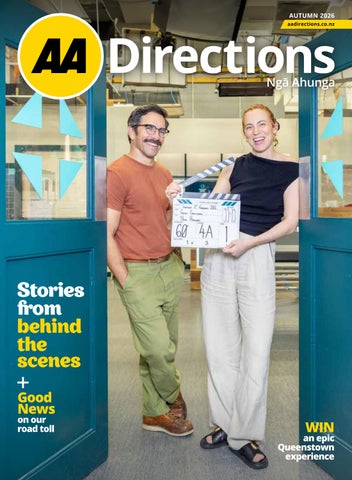
AA Directions Autumn 2026

Page 1


What does it take to create a show or an event? Who is involved in the build-up? We take you behind the scenes for a look at the inner workings of iconic shows, festivals, galleries and labs, revealing what goes into making magic happen.

Grief expert Dr Lucy Hone shares advice on navigating loss; Auckland Theatre Company Chief Executive Jonathan Bielski discusses this season’s shows; we provide tips on navigating flush medians and give you the chance to win great prizes, including trips to Wellington and Queenstown.

We investigate the fate of EV batteries at the end of their lives or when they’ve been compromised in accidents.

Our road toll has dropped for two consecutive years. The AA considers the contributing factors.

City to sea

A family road trip from Auckland to Coromandel in a buzzy electric van turns heads.

Lush land

Venturing south from Perth, we uncover the delights of Western Australia’s Margaret River region.

Out of the box

It’s a first for New Zealand. We step inside a concrete house made by a single, continuous pass of a 3D printer.

We join Whanganuibased glass artist Katie Brown in the pit to learn about her colourful craft.

An AA Roadservice Dispatch Team Manager takes us behind the scenes of her critical role, we reveal a new AA Member Benefit, get an update on some favourite Member Benefits, and hear a fishy tale from a grateful AA Member.

Protecting your eyes from glare

Have you ever found yourself squinting as soon as you step outside, or holding your phone at an angle just to avoid glare? You are not alone, and many New Zealanders may be underestimating just how damaging our high UV levels can be for their eye health.

According to Specsavers Optometrist Dr Joe Paul, sun safety habits usually focus on the skin, while the eyes are often forgotten. “People remember sunscreen, hats and clothing, but eye protection is frequently overlooked. Like skin, UV can cause both short term and long-term damage to the eyes.” He adds that sunglasses are essential “not only on bright, sunny days, but on overcast days too.”

New Zealand’s strong UV levels can place significant stress on the eyes, and over time this can contribute to a range of conditions. Dr Joe explains that UV radiation can even cause sunburn to the eyes, known as photokeratitis, which is a painful eye condition. Prolonged exposure can also increase the risk of cataracts and may lead to growths on the eye’s surface, such as pterygium, which can cause irritation or affect vision.

What are the signs your eyes may not be getting enough protection?

• Squinting or struggling to see comfortably outdoors

• Dry or irritated after exposure to bright light or glare

• Needing to look away from reflective surfaces such as water or roads

Many people develop their own workarounds, such as shading their eyes with a hand or avoiding looking directly into bright areas, but Dr Joe notes these can mask the underlying issue. “It is critical to protect our eyes. Wearing sunglasses screens out the sun’s harmful rays and gives you full UV protection.”

When choosing sunglasses, Dr Joe recommends looking for proper UV filtering lenses that meet recognised standards. “Check the label for UV protection, and for the best level of comfort choose polarised lenses to help reduce glare.”

The good news? Specsavers provides a selection of stylish prescription frames and sunglasses that deliver everyday comfort and complete UV protection for life outdoors. Plus, AA members can enjoy a free eye test every two years.*

A regular eye test at Specsavers includes an advanced 3D scan (OCT) to help optometrists detect and diagnose eye conditions early. If you have concerns about your eyes or want advice on maintaining healthy vision in the sun, visit www.specsavers.co.nz to learn more or book an eye test.

*Excludes contact lens examination, DL12 Eyesight Certificate and visual field checks. Limited to one per AA member every two years. Present your AA membership card in store to redeem.

Learning for life

It hasn’t been an easy start to the year, with tragic slips, floods and bad weather challenging the nation. But the resilience and sense of community we experience in times like these shines through and makes me proud to be a Kiwi.

A common sight over summer – and this year was no different – is young people getting behind the wheel for the first time. You may have spotted a car manoeuvering slowly through an empty carpark and recognised what was happening, or maybe you were a parent in the passenger seat trying hard to hide your nervousness.

Learning to drive is an important time in a young person’s life. It’s critical because the consequences of a crash can be devastating, especially if it’s a serious accident. Sadly, it’s a familiar scenario for many Kiwi families. That is

why the AA responded strongly when the Government proposed some big changes to our driver licensing system last year.

We came up with several changes designed to better prepare young drivers, based on solid findings by the AA Research Foundation. It was driven by a sincere desire to see fewer young people involved in crashes on our roads.

The Government confirmed major changes at the beginning of February, including a longer learner period, removal of the full licence test, tougher consequences for driving offences while on a restricted licence and a zero-alcohol limit unless a full licence is held.

We were pleased the Government recognised the need for learner drivers to have more time behind the wheel practicing and preparing before driving solo, as well as stronger penalties for restricted drivers committing offences.

We pushed for the Government to make all learner drivers do a minimum number of practice hours and receive more incentives to undertake professional training. The Government didn’t go as far as we would have liked in these areas but regardless, we hope young drivers and their families will be inspired to spend more time practising under the new system’s longer learner phase.

Young drivers have the highest crash rates on our roads – much higher than in Australia. But we can change that. If the upcoming changes can have similar effects to other countries, there will be 10-20 fewer young people losing their lives in crashes every year in the near future. That is our hope.

It would be an incredible step forward in New Zealand’s road safety that we could all be proud of. Thanks for your continued support as an AA Member.

PHOTOGRAPH
BY KERI LITTLE

EDITORIAL TEAM

Kathryn Webster

Monica Tischler

Jo Percival

DESIGN & ART DIRECTION BY SCG

Julian Pettitt

LauraGrace McFarland

HOW TO REACH US

EDITORIAL

AA Directions

He Ngākau, Level 5, 20 Viaduct Harbour Avenue, Auckland 1010

PO Box 5, Auckland, 1140 Ph: 09 966 8800

Email: editor@aa.co.nz

ADVERTISING

Moira Penman 021 228 5854 moira@gsjadvisory.com.au

SUBSCRIPTIONS AND MEMBERSHIP ENQUIRIES

Ph: 0800 500 444

ISSN 1171-0179

Published in print twice a year

Circulation 665,731

Readership AC Nielsen 779,000

PRODUCTION BY: SCG, Auckland

PRINTED BY: Webstar, Auckland

Contributors

JAMES FOSTER

NOTE:

Kia ora

When things run smoothly we don't give a second thought to what goes on behind the scenes. It's only when something upsets the flow that we think about the logistics involved in putting on an event, hosting a festival or presenting a creative project. The common thread we reveal in this issue's feature is how critical preparation is. All the planning, all the details, the listing and checking is the job of passionate, meticulous people who are happy to be in the background. They're an inspiration and ought to be acknowledged –and so we have! Enjoy the read.

James is a web and app developer in the automotive sector. He’s interested in vehicle-buying psychology, especially our evolving relationship with electrification, and is on to his third EV. Originally from Wellington, James is now well-ensconced in Tauranga, the perfect location for enjoying cafés, bike riding and cooking on the barbecue, an art he is obsessed with mastering. See p.40 for James’ story on Chinese car brands.

Alanah moved from Auckland to Whanganui five years ago. She and her husband were keen for their three children to experience a slower, more considered life within a genuine community. She says the decision shaped their lives for the better and positively influenced her work as a commercial and lifestyle photographer. AA Directions commissioned Alanah to photograph glass artist Katie Brown for this issue; see p.62.

AA to the rescue! Has the AA helped you out of a pickle, saved the day, surprised or delighted you? Do you have a story to share with other Members? Send it to AA Directions, PO Box 5, Shortland Street, Auckland 1140 or email editor@aa.co.nz

Nicola is a Wellington-based freelance photographer, writer and occasional web designer. From photographing grinning dogs and a talented ballet dancer (see p.28 & p.60 of this issue), to a special performance of nose-whistling in Transylvania, variety is what Nicola loves most about her work. A favourite pastime is riding her horse, Peri; they can often be spotted, albeit fleetingly, at full gallop on Kāpiti Coast.

ALANAH BROWN
NICOLA EDMONDS
Photograph by Jessie Casson
Design by Julian Pettitt

LETTERS

EV irritation

Where are all these hundreds of EV charging facilities that were being rolled out? I got a special email the other day boasting about new ones. It listed three in the whole of Auckland, none in my northwest Auckland area.

Imagine having a car where gas stations are either full up or charge prices which vary by factors as high as three to one and you get the case we find ourselves in.

The AA was encouraging EV uptake; how about backing us?

EV etiquette

I understand there is an etiquette in EV charging that if people are waiting for the charger you are using, you only charge to 80%. This, I understand, is because it slows down when charging from 80–100%.

Is there such an etiquette around EV charging or is this something I have imagined?

Line of sight

Your article in the Spring issue of AA Directions about roundabouts doesn’t relate to the real world. In my local area of Arrowtown and Queenstown the advice on how to use indicators is almost pointless.

The local council has recently upgraded several sections of road and as part of the upgrades has installed some lovely roundabouts. It landscaped the approaches and centre islands with tussock and other greenery which hide the indicators of most vehicles to the point that only drivers of high trucks or buses can see them over the planting.

I am sure this isn’t the only region with this problem.

B Farrell ARROWTOWN

Get real

The consensus is bigger fines for those who break the rules. Fines create their own problems, such as collecting the money. More significantly, a fine does not connect the driver to the actual risk created by the conduct in question. I would forget fines and require, instead, compulsory attendance at a road safety presentation. This should provide not merely facts and figures, but actual footage of road carnage – the sort of thing police are required to confront every day. And perhaps also a refresher course on good driving behaviour. Drivers need to be aware that they risk the lives of other road users, not merely their own.

Inequitable system

The current system of imposing fixed-value traffic fines is inequitable and should be dumped.

For a person on a six-figure income, a fixed $150 fine (for example) is of no consequence. For a person on a median income, it would be annoying and, for most people, a deterrent. For a person on the minimum wage, struggling to feed a family and pay the rent, it would be a disaster. In some countries, traffic fines are linked to income, ensuring that the fine has a similar impact across all income levels. Finland – with whom we often like to compare ourselves – has been doing this for over 100 years.

Linking traffic fines to income would ensure an equal deterrent to all offenders, no matter what their income, and I see no reason why it can’t be implemented in New Zealand.

A DuFresne PORT WAIKATO

Bright lights

As someone who often drives at night on roads other than motorways, it is apparent that many drivers have no knowledge of how or when to dip their lights.

Could this be part of education when issuing licences? Having lights on full beam when approaching and driving behind another vehicle creates dangerous issues as rear-view mirrors cannot be used.

D Middleton AUCKLAND

37 AA Centres around New Zealand

2,000

Children’s bike lights donated by AA last year*

45+ Exclusive AA Member Benefits

474,000 AA Roadservice jobs last year*

110,000+ Driving lessons last year*

*2024-2025 Financial Year

PHOTOGRAPH BY JIM HUANG

DR LUCY HONE

Resilience researcher, grief expert and TED speaker

Dr Lucy Hone has recently published a book offering practical advice for those dealing with loss.

Tell us a bit about your background. How did you end up working in this field?

I began my career as a writer and researcher, specialising in resilience psychology and wellbeing. I’ve always been fascinated by why some people adapt better than others when faced with challenge, change and loss.

Then, in 2014, when I was nearing the end of my PhD, my world was turned upside down when our 12-year-old daughter Abi and her friends were killed in a car accident. I had already applied my research in disaster recovery work after the Canterbury earthquakes, but their deaths tested my understanding of resilience at a far deeper level.

I’ve spent the years since translating the scientific findings of resilience psychology and bereavement into tools to support others navigating loss and change. Sharing my knowledge to help people through their darkest days also helps me live with my own loss. And it means Abi’s short life leaves a longer, more enduring legacy.

What is something that a lot of people don’t understand about grief?

That grief is not just about death. We grieve any significant loss: relationships, health, identity, careers, fertility, financial security, community, certainty, and the future we thought we were going to have. These ‘living losses’ can be just as painful and destabilising, yet they often go unrecognised, even by ourselves.

Many of my research participants who have experienced both death loss and living loss tell me these non-death losses can be harder to handle. Death usually brings rituals and collective support, whereas living losses are often invisible and unsupported. Psychologists refer to this as ‘disenfranchised grief’ because people rarely recognise the pain associated with estrangement, infertility, redundancy, ageing, empty nesting, bankruptcy or divorce.

Did you have any personal misconceptions about grief and resilience after studying it and then experiencing it first hand?

Absolutely. Like many people, I expected grief to follow set stages, but I soon discovered that wasn’t my experience. Immersing myself in the scientific literature, I found decades of research showing that everyone grieves differently. There are no five stages of grief; instead, it’s as individual as your fingerprint. When I share this with clients, they often breathe a huge sigh of relief.

Over the years, living through events including the Canterbury and Kaikōura earthquakes, the mosque attacks, Covid, and personal family challenges, I’ve learned that resilience is not about staying strong, positive or composed. It’s about learning how to keep going, imperfectly, while carrying deep pain. We can live and grieve at the same time.

I also discovered just how exhausting grief is – cognitively, emotionally and physically. You can know the theory and still be flattened by the reality. That experience reshaped how I teach, write and speak about resilience.

What do you do to stay positive when a lot of your professional focus is on grief and loss?

I stay connected to ordinary life: family, friends, exercise, nature and creativity, and deliberately tune into what’s good. I also give myself permission to step back when I need to. This work is meaningful, but it requires replenishment, and I have an amazing team who help protect my time.

What would you say to someone who was struggling with not being able to grieve ‘properly’?

There is no such thing as grieving properly. If you are feeling stuck, numb, angry, proud, sad, distracted, hopeful, grateful, relieved or overwhelmed, those are all part of grief. Grief is messy. The idea that grief should follow predictable stages or timelines is one of the most damaging myths I see in my work. Your grief is valid exactly as it is. You do you.

What are your top tips to help if you find yourself spiralling?

Whether you’re facing living loss or bereavement, sudden waves of emotion can overwhelm you, often at the most

inconvenient times. When we have these ‘grief ambushes’, pause and focus on your breath. Breathe in to the count of four, hold for four, exhale for four, then hold again for four. A few rounds of this ‘box breathing’ helps regulate the nervous system and brings us back into our bodies.

What advice would you give to someone who is supporting a grieving person?

Show up. Stay present. Ask, don’t tell, and listen more than you speak. One of the hardest things for those in support roles is resisting the urge to fix. In many situations, resolution isn’t possible, so the task becomes learning how to sit with discomfort. Many people tell me how much it matters when someone is willing to walk alongside them in their pain. Tell us about your new book. How Will I Ever Get Through This? explores the hidden grief that accompanies life’s many living losses, because my work has shown how rarely this grief is recognised, both by those experiencing it and by the people around them. I describe grief as the gap between where we are and where we thought life would be, which helps people understand why any transition or diversion can feel so destabilising.

Understanding grief matters; without that insight people often feel overwhelmed, helpless and powerless, wondering what on earth is going on. Early readers tell me they find it hugely comforting to understand what’s happening and to learn practical tools to empower them. My words won’t remove all the pain, but they can help ease it and support people to process their loss. What I love most about the book is that it is organised around the real questions people ask themselves during major life upheaval: Why do I feel so isolated and lonely? What’s wrong with me? Why do I feel physically exhausted? Who am I now? Will I ever be happy again? Each chapter responds to one of these questions, combining contemporary resilience and bereavement science with practical tools readers can use straight away.

Dr Lucy Hone is an Adjunct Senior Fellow at the University of Canterbury. For practical tips on resilience and loss, follow her on socials at @drlucyhone or visit drlucyhone.com

DRIVE 4 LIFE

HELPING PORIRUA’S YOUNG PEOPLE be work-ready is the focus of not-for-profit Partners Porirua. Last year, as part of its 25-year anniversary, the group revisited an early success story involving helping a young man get his driver licence.

In 2011, Carlos Rewita was attending Te Kura Māori o Porirua in Waitangirua when he met Henry Samia from Partners Porirua. Henry visited the school with two opportunities for students to work with him to obtain their learner licences. Carlos spent some intensive time with Henry going through all the learner licence questions and passed first go.

“A couple of years later in my last year of school, Henry came back to say they were trialling a new Drive 4 Life programme and asked if I wanted to be a guinea pig to get my restricted licence.”

He and volunteer driver mentor Denys Latham began a series of

weekly driving sessions; Carlos was the first person at school to get a licence.

“A lot of people were kind of jealous – but my family really needed it as my mother couldn’t drive back then.

“Later, as soon as I turned 18, I got my full licence – everything Denys taught me was still very fresh in my mind.”

Qualifying as a builder was made possible by having his driver licence. Now, at 29 years of age, Carlos is settled in Auckland with a young family and a career as a gib fixer.

Denys recalls Carlos as a motivated learner. “He was a delight to mentor over the many sessions we drove together. His enthusiasm and discussions we had on different driving scenarios and situations helped me become a better driver also. I’m delighted that Carlos has delivered with the potential he showed as a sensible, level-headed student all those years ago.”

Student Carlos Rewita (left) and volunteer driver mentor Denys Latham, in 2011.

and distributed to schools in Canterbury, Otago, Southern Lakes, and Southland through fundraising and sponsorship, with expansion to new regions expected in the future.

CONCERNED THAT CHILDREN are not clearly visible while cycling to and from school, the AA has taken on the mission of donating bike lights.

AA District Councils are working with police, local councils, and businesses on the donated bike lights initiative, which has already helped thousands of South Island school children become more visible when cycling.

AA Canterbury/West Coast District Council Chairman John Skevington

says adding a light to a child’s bike can significantly impact visibility, especially as daylight hours shorten over the coming months.

“Cyclists can see cars, but cars don’t always see cyclists, especially school kids on their smaller bikes.

“Encouraging kids to use bike lights now will hopefully see them continue these safety habits well into the future,” he says.

Rechargeable bike lights and hi-vis straps for added visibility were purchased

Laura Dowling from Active Southland, which supported the latest distribution to schools in its area, expressed her gratitude for keeping kids visible: “We’re looking forward to continuing to work with the AA to share more free bike lights in the future, keeping our kids safe and brightening our community even more.”

Keen to help kids in your community with free bike lights? AA District Councils rely on the sponsorship of local businesses and community groups to support funding and distribution. If you’re interested in getting behind this programme in your local area, contact editor@aa.co.nz

South Island school children are more visible on the road thanks to the AA's donated bike lights initiative.

with AA Directions

Be in to win an epic holiday in Queenstown with GO Rentals, a weekend in Wellington with the Royal New Zealand Ballet, and a voucher to spend at Whanganui gallery, Katie Brown & Co.

A Queenstown Getaway for Two with GO Rentals valued at over $5,000

We’ve teamed up with GO Rentals, Ramada Queenstown Central, AJ Hacket Bungy, Real NZ and Shotover Jet to create an unforgettable getaway for two. Fly into Queenstown and settle into four nights at the beautifully appointed Ramada by Wyndham Queenstown Central. Whether you’re chasing thrills, scenery, or just a well-earned break, this is the ultimate South Island escape, made easy with GO Rentals.

The prize includes:

Return airfares for two to Queenstown to the value of $1,500. Five days’ car hire with GO Rentals. Four nights at Ramada Queenstown Central in a Studio Lakeview Apartment. AJ Hacket Kawarau Thrillogy for two. A RealNZ experience. Shotover Jet ride for two.

Enter the draw

The prize must be redeemed before December 10, 2026. Flights, car rental and experiences are subject to availability. See aadirections.co.nz for all the details and T&Cs including blackout dates. Enter online at aadirections.co.nz by June 30, 2026.

The Ultimate Wellington Weekend Giveaway with the RNZB

The Royal New Zealand Ballet is giving AA Members the chance to win flights, accommodation and tickets to a Wellington performance of The Sleeping Beauty. The age-old story of the princess who falls into an enchanted sleep, only to be awakened by true love is brought to life by the Royal New Zealand Ballet to Tchaikovsky’s magical music. Wizardry from Wellington’s Wētā Workshop adds to the joy and wonder, making this the perfect pre-Christmas treat for audiences of all ages.

You and a friend will enjoy:

Two tickets to The Sleeping Beauty on October 30, 2026 at the St James Theatre, Wellington.

Accommodation at QT Wellington on Friday October 30 and Saturday October 31, in a Superior King room (two adults). Pre-show dinner at Logan Brown for two (drinks not included)

Return flights to/from Wellington.

Entries close October 8, 2026. See aa.co.nz/rnzb for competition T&Cs.

AA Members can get a 15% discount on selected Adult and Child tickets to Royal New Zealand Ballet performances. T&Cs apply. See aa.co.nz/rnzb for details.

Whanganui-based glass artist Katie Brown’s gallery features her work alongside that of other glass artists, ceramicists, jewellers, sculptors and painters. Read about her career and her craft on p.62.

To win a $300 voucher to spend at Katie Brown & Co, send your name and contact details to:

AA Directions, Katie Brown, PO Box 5, Shortland Street, Auckland 1140 Or enter online at aadirections.co.nz by June 30, 2026.

PHOTO BY ALANAH BROWN
Artists of Queensland Ballet in The Sleeping Beauty, 2021. PHOTOS BY DAVID KELLY.

CENTRE STAGE

Auckland Theatre Company has a vibrant range of local and international productions lined up for 2026 at its home base, the ASB Waterfront Theatre.

ARTISTIC DIRECTOR and Chief Executive Jonathan Bielski, the decision-maker behind the programme, says the carefully curated selection is based on many factors.

“It’s a bit like composing a concerto, where I try to put different notes into the programme,” he says. “I look for a note that showcases new New Zealand work, an international note and an entertainment note. That guides the decision making.”

With this winning formula the 2026 season features two world premieres: Helen Clark in Six Outfits by Fiona Samuel and Sons of Vao by Niuean writer Vela Manusaute.

The season also includes the classic Shakespearean tragedy Macbeth and a bold new production of one of the world’s most celebrated musicals, Cabaret, directed by Benjamin Kilby-Henson.

Direct from Sydney Theatre Company, the smash-hit RBG: Of Many, One by Suzie Miller comes to Auckland. Awardwinning Australian actress Heather Mitchell stars as the formidable Ruth Bader Ginsburg (and 33 other characters) in this enchanting solo performance.

Jonathan likens making theatre to performing in the circus: “It’s high

jeopardy. You’re never quite sure whether it’s going to work or not. When we go to the circus, we look for those feats of human skill, but there’s this underlying tension that they might fall from the high wire. “That sense of jeopardy is the same with making a play

for the stage. We put all the elements together and we have all the skills, but sometimes the magic just doesn’t arrive, and no one’s ever quite sure why.”

It takes years to put a programme together. Helen Clark in Six Outfits was commissioned for this season more than three years ago, while other shows have a much shorter lead time or are commissioned for a returning season based on previous popularity.

The 2026 programme features an array of actors, predominantly New Zealand talent. Over 100 creatives – including directors, choreographers, vocal coaches and set designers – work behind the scenes to bring the magic to life.

Helen Clark in Six Outfits runs April 7-26; RBG: Of Many, One May 20-June 7; Sons of Vao June 18-July 5; Macbeth July 28-August 22 and Cabaret September 22-October 18.

AA Members can get a 15% discount on tickets to Auckland Theatre Company shows. T&Cs apply. See aa.co.nz/benefits for details.

Helen Clark in Six Outfits by Fiona Samuel.
Sons of Vao by Niuean writer Vela Manusaute.
Auckland Theatre Company Artistic director and Chief Executive Jonathan Bielski. PHOTO BY NZ HERALD.
Cabaret directed by Benjamin Kilby-Henson

Travelling well

overseas travel is changing, with more people opting to stay longer in the countries they’re visiting and weaving events, concerts and festivals into their itineraries.

The trend, known as ‘live travel’, indicates travellers are more inclined to have wider, deeper experiences to warrant the expense – both financially and environmentally – of overseas travel. Rather than popping over the ditch for a weekend to attend a sports event or a concert, they’ll add a few days and build on the itinerary to take in some tourism, adventure or retail experiences.

And travel insurance has adapted to accommodate the trend. AA Travel Insurance Senior Product Manager, Barney Rothwell, explains:

“Travellers are increasingly building holidays around cultural or sporting events. This can increase the scope for disruption or unexpected situations

to arise. When you build on your itinerary to make the most of the travel, you’re exposed to things out of your control, changing and upsetting the whole plan. Sometimes travel plans are all lined up, then something significant changes – such as a concert being cancelled – and everything changes.

“To help, AA Travel Insurance now offers Cancellation+ which covers you for a broader set of scenarios. For example, this could be unexpected expenses, a change in your work situation, or even a change of mind!

“Cancellation insurance covers that situation,” he says. “With AA Travel Insurance Policies, you can confidently de-risk your travel and focus on what matters – such as planning, packing and getting excited about the trip.”

Various other positive provisions offered through a new-look AA Travel Insurance portfolio include the option to customise, so if you’re taking a cruise,

motorbike tour, skiing, or travelling for business, there is cover specifically for those experiences.

“Customisation is another really attractive feature we’re pleased to now provide,” Barney says.

“That and a provision to add dependents, such as grandchildren, to travel insurance policies for free are proving popular.”

Using Flush Medians

A FLUSH MEDIAN is the painted area with diagonal white lines located between opposing lanes of traffic. Its primary purpose is to provide a safe waiting area for vehicles turning right.

For example, when turning right from a main road into a driveway or side street, moving into the flush median allows following traffic to continue without being held up. Similarly, when turning right out of a side road onto a busy main road, you may enter the flush median and wait there until a safe gap appears. You must always give way to vehicles already travelling in the lane you intend to join.

Good timing and positioning make a significant difference. As you slow for your turn, signal early and move smoothly into the median at a shallow angle, ensuring no part of your vehicle

protrudes outside the painted area. This ensures you are not holding up traffic while moving into flush medians and allows following vehicles to continue safely and efficiently.

Check your mirrors and blind spots carefully – cyclists and motorcyclists may also use this space. Once in position, keep your wheels straight while waiting. This reduces the risk of being pushed into oncoming traffic if your vehicle is struck from behind.

When it is safe to merge, indicate left, check your blind spot again, and accelerate confidently to match the flow of traffic.

The Road Code, published by NZ Transport Agency Waka Kotahi, emphasises that flush medians are shared safety spaces rather than traffic lanes. A little patience, clear signalling and good judgement help ensure they function as intended.

Member Benefit

MOBILITY PARKING MATTERS

THE GOVERNMENT has increased the fine for mobility parking misuse on public land to $750.

Whaikaha – Ministry of Disabled People Chief Executive Paula Tesoriero says when mobility parks are misused, people lose access to vital services and the chance to stay connected to their community.

“A fine is a big reason to avoid misusing these spaces, but the real reason is simple: someone else needs them far more than you do,” she says.

THE NZ INTERNATIONAL COMEDY FESTIVAL returns this May for a month packed with laughter.

Since its beginnings in 1993, the festival has become an annual highlight in the Aotearoa arts calendar, showcasing the best of both local and international comedy talent.

Returning to Auckland, Wellington and Christchurch for 2026 are crowd-pleasers like the Best Foods Comedy Gala and Best Comedy Show On Earth, alongside new shows from stars such as David Correos, Heath Franklin’s Chopper, Felicity Ward, Tom Sainsbury, Abby Howells and many more.

Performances will run from May 1-24 in Auckland and Wellington. This year, Christchurch will also get a taste of the action, with the Comedy Gala heading to the city for the first time since 2017.

See comedyfestival.co.nz for more.

One in six New Zealanders – about 850,000 people – experience barriers that make everyday activities more difficult such as seeing, hearing, walking, remembering or communicating.

Numbers will grow as the population ages.

“Disabled people face barriers every day – physical, social and systemic. Transport is key to breaking those barriers. Without mobility parks, simple things like getting groceries, going to a community event, church or the doctor can become difficult,” Paula says.

If you see someone misusing a mobility park, she suggests you politely remind them to do the right thing – or report it to your local council.

Learn more at whaikaha.govt.nz

Benny Feldman, Butterfly Pavilion.

What goes into creating a festival, a performance or an exhibition? How do ballet dancers prepare? Who decides how a story is told, how a programme is put together, how a car’s safety rating is determined? Follow us behind the scenes to see what’s involved, to learn how the magic happens.

Monica Tischler visits Auckland’s South Pacific Pictures’ studios in between filming.

FOR MORE THAN THREE DECADES, Shortland Street has told the stories of New Zealanders to a captivated Kiwi audience. Often ahead of its time, the first episodes in 1992 covered abortion, a nurses ’ strike and made te reo Māori mainstream with the character Dr Ropata played by Temuera Morrison.

The fate of today’s characters is in the hands of Story Producer Shelley Waddams and a team of writers, including Jared Turner.

“These are stories being told by and for the people we live with and who we love,” Jared says. “For me, it’s not just about hitting story beats, it’s about hitting emotional beats. That’s why people love to watch the show, they get emotionally drawn into it.”

Jared and the show’s nine other writers work at different stages throughout a

five-week cycle, beginning with story lining and structuring to determine scene order, followed by scriptwriting.

“We work in pairs, so we’ve each got somebody to work the block with and understand what’s going on. Are we hitting the emotional beats? Are we telling the story that we set out to do in week one? Are we still aligned with the overall story arc of the show? Are we making sure the characters’ voices are present?”

These are the questions Story Producer Shelley and Producer Oliver Driver are looking for when Jared pitches his storylines.

“We’re looking to have a big medical event of course, and a little bit of romance,” Shelley explains. “We also try to have comedy, and we search for mystery, excitement and adrenaline.”

PHOTOGRAPHS BY JESSIE CASSON/SUPPLIED
Shortland Street writer Jared Turner (left) and Story Producer Shelley Waddams.

Shelley admits to often feeling surprised (and even shedding tears) when watching her team’s artistry come to life on the screen.

“My department is where the seeds of the story begin. It’s really fun to have ideas that turn into something else as they get to the script process and then change again once they’re shot. Sometimes they stay entirely the same, but it’s incredible to watch the process right up until it gets aired, which is often funnier than I thought it was going to be.

“And of course, the actor’s own interpretations. They know their character better than anyone, and so they’re bringing them to life in their own unique way.”

Among the cast who embody their on-screen personas is award-winning actor Stephen Lovatt, playing emergency room doctor Emmett Whitman.

“Emmett isn’t me; there’s no way I would be saying the things he says and behaving in the ways he does. But the sound of his voice, the way I move my face, I respond to that as the actor in my way,” he says between scenes.

To prepare for a scene, Stephen studies the emotional arc, where his character has come from before, and where he must reach to enter the next part of the story.

“Shortland Street is a very fast turnaround. Something must happen in every scene and as actors, part of our prep is knowing where we’re coming into, what’s changing in that scene and where we’re going to. Sometimes it’s not your character; sometimes you’re only there to serve another actor’s story. It’s like you’re sitting there with a spaghetti bowl of storylines, and you’ve got to somehow keep it all moving forward. It’s great fun, but it’s complex.”

The behind-the-scenes team includes more than just directors, producers, writers and editors. Qualified nurses are on set fulltime to ensure all medical terminology and procedures are accurate, while wardrobe curators manage the continuity of clothing and accessories worn on screen. The art department also has its own special recipe for the copious amounts of blood used on set.

For Stephen, it’s this collaboration and playfulness between the entire crew that makes his work fulfilling.

“Everything is really just crafted play, and that’s where the show succeeds,” he says. “The audience responds to it; they understand that this is just a soap, but they also get moved by it.”

What’s involved in getting an airshow off the ground? Vanessa Trethewey reports.

IT’S THE THUNDERCLAP MOMENTS that wow the crowds. The daring aerobatic stunts and dogfights, the high-speed passes and fearless formation flying. But that’s just the final act, the culmination of months of planning.

As New Zealand Warbirds Association President Frank Parker explains, the power that drives an electrifying airshow is built on the ground, long before the engines roar.

“Once a year we hold Warbirds on Parade at Ardmore Airport. Not only is this airshow our biggest fundraiser, but it’s an opportunity to promote ourselves as an organisation,” says the helicopter pilot, trainer and retired Air New Zealand captain.

Since taking the reins as Warbirds President in 2012, Frank has been the driving force behind countless airshows, both as an organiser and in the air, displaying P-40 Kittyhawks or flying alongside his wife Liz Needham as part of the Roaring Forties Display Team.

“We start planning our airshows four or five months in advance, with an inaugural meeting to start working on any long lead items, such as getting the permits for our pyrotechnics,” Frank explains.

“We like to make Warbirds on Parade a community event. We normally have a couple of car clubs come and display, we invite the military, the Westpac Rescue Helicopter and the Police helicopter, so there’s a lot to coordinate. We’ve been running

Award-winning actor Stephen Lovatt plays emergency room doctor Emmett Whitman.

these shows for over 15 years now, so we’ve developed a pretty good template and we’ve got a good bunch of people.”

This ‘bunch’ includes a core team of 12–15 Warbirds members and around 100 volunteers on the day.

“There are two parts to organising an airshow – the ground side and the air side. In many ways the ground side is the most difficult because we have to turn the airfield into a display ground without too much disruption to other Ardmore businesses, and we have to coordinate with the flying schools to shut down for the day. We contract a traffic management company to do the traffic planning, and do our ticketing through Ticketek, but we also need to erect fencing, set up portaloos, organise food trucks, and decide what aircrafts to display in the hangars (current options include a British Canberra, US Skyhawk and Italian Aermacchi).”

Organising the air side is similarly complex. The lineup gets locked in well in advance so the Warbirds operations manager can ensure all pilots have the correct approvals to display and are match-ready.

Fragile World War I aircraft like the Bristol Scout and the Fokker Triplane take to the skies first, when the winds are typically lighter, often followed by Tiger Moths.

“The second slot is usually the biggest part of the day – that’s where we do bigger planes, helicopters and maybe the Roaring Forties – and we always save something special for the last segment. The airfield attack, where the Harvards swoop in as bombers and the pyrotechnics come out, always proves popular!”

While spectators gasp in awe, those behind the scenes are firing on all cylinders to keep the show running smoothly.

“Our airshow director is responsible for safety, watching to ensure everything complies, and we have others looking after programming making sure the day is running to schedule, and filling gaps if an aircraft breaks down.”

Inclement weather can – and occasionally does – throw a curveball. As well as the huge amount of work involved, organising the airshow costs around $25,000, so forced cancellations sting. But on a good day, the event is gold.

New Zealand Warbirds Association President Frank Parker (left) and his wife Liz Needham.
Vanessa Trethewey learns what’s involved in planning a programme of art.

THE HUNDERTWASSER ART CENTRE

with Wairau Māori Art Gallery is the last authentic Hundertwasser building in the world and the first-ever public art gallery dedicated to contemporary Māori art.

Since opening its doors in Whangārei in 2022, the gallery’s inaugural Director Larissa McMillan and her team have worked to uplift Māori artists and showcase best Māori-led practice. They present three trailblazing exhibitions annually – put together by guest Māori curators – and deliver dynamic educational programmes across schools and communities.

Tikanga Māori is at the centre of their mahi, with manaaki (support and care) being the North Star that propels them forward.

“Our non-profit gallery operates in a kaupapa-led way, meaning we’re guided by manaaki at every level,” Larissa explains. “Our artists are taonga (highly prized) and sit at the heart of everything we do and we have an outstanding board of industry leaders who work collectively to realise our shared vision.”

A tuakana-teina (teacher/mentor) framework operates at every level of the business, including in the curation of exhibitions, where lead and emerging curators work alongside each other.

“Teina (younger) work with senior practitioners so that there’s succession and shared learning. A tuakana (elder) has the responsibility of fostering that younger person’s experience, however, it’s a duality – as is everything in Te Ao Māori (the Māori worldview). The learning is in tandem, never top down.”

Working with one foot in today and the other firmly in the future, programmes are planned well in advance.

“I was thinking about 2028 before we’d even finished 2025! Some of our board members hold the portfolio for discussing programming so we usually start with

a group hui to reach consensus around what’s practical and what’s best. We have to work within our financial means, so ambition needs to stay national and local rather than stretch to lofty international projects – though we’d love that to become a reality one day.”

There’s much to consider: who are the artists, who are their people, what do the exhibitions want to say, and how will they resonate with the community? Essentially, the team wants diversity and work that sparks reflection and curiosity – from solo exhibitions celebrating senior practitioners through to group shows with emerging artists. Talks, workshops, and online videos are also part of the lineup.

“The curator is our first point of

contact. They decide what the show is saying, and come to us with trusted networks. They usually have artists in mind that they want to work with and know whether those artists have work that would be appropriate or can develop work that aligns with the exhibition’s intention. Sometimes work is unavailable; we often loan from other collections so relationships are incredibly valuable. We have to be flexible and organised; things can change very quickly.”

The fortnight before each show opens is dedicated to changeover – one week for deinstallation of the outgoing exhibition, then a reset, followed by installation.

“Putting on an exhibition takes many people: curators, conservators, technicians,

kaiako, educators, writers, translators, designers, registrars, administrators, board members, volunteers, iwi, freight handlers, photographers, funders, friends and whānau… It’s truly the success of many.”

But what’s on the walls at Wairau is just the beginning. Working alongside Larissa is a part-time kaimanga mātauranga (educator) who facilitates a calendar of educational programmes.

“We’re really proud of our education and public programming outreach. When we talk about working in a manaaki-led way, that also means with our rangatahi (youth). We try to connect with whānau and community in ways that are relevant to their worlds.”

Wairau Māori Art Gallery Director Larissa McMillan with artwork by Nikau Hindin: Tai Timu, Tai Pari.

“It’s an important part of the research and development process from a safety perspective; when you look at the cost to society of serious injuries it really pales into insignificance,” Carla says.

Vanessa Trethewey discovers the secrets of a crash lab.

THE ANCAP (AUSTRALASIAN NEW CAR ASSESSMENT PROGRAM) dummy family, a group of technologically-sophisticated crash test dummies, play a starring role in keeping us safe.

“We have a whole family of dummies –adults and children, male and female – and they give us vital insights into what happens in a crash and what injuries drivers, passengers and other road users are likely to sustain,” says ANCAP CEO Carla Hoorweg.

The independent voice in vehicle safety for New Zealand and Australia, nonprofit organisation ANCAP SAFETY was established in 1992 and since then has published safety ratings and gradings for thousands of new vehicles. Its ongoing testing in passive crash protection and active crash avoidance has encouraged

vehicle manufacturers all over the world to design and deliver the safest new cars possible. ANCAP’s hard-working dummy family is just part of the picture.

“We’ve got five independent testing labs across Australia. Two of them are responsible for crash testing, two for crash avoidance, and one for pedestrian impact.”

Vehicles that go through ANCAP’s rigorous testing process must undergo all three, a process which takes a couple of months, and costs the car manufacturer on average $750k (AUD). Plus, they have to sacrifice four new cars and some additional bumpers and bonnets.

Achieving a 5-star ANCAP rating for safety (the highest score) is a huge selling point, and one that brands go to extremes to secure.

The crash test labs are where ANCAP’s dummy family is the busiest. They’re put through four different types of crash tests (full width frontal, frontal offset, side impact and a pole crash) providing critical data that informs ANCAP’s assessment and scores. THOR (the most advanced crash test dummy) is the driver used in the frontal offset test, which sees 50% of the vehicle on the driver’s side make contact at 50km/h with a trolley travelling towards it at the same speed. Next to THOR sits another adult passenger and, in the back, a ‘six-year-old’ and a ‘10-year-old’ child dummy, both in child restraints. The family of four is used to facilitate the scientific measurement of the various forces in the crash. Later –among other things – they’ll endure a 1,400kg trolley T-boning their vehicle at 60km/h and will be hurtled into a rigid steel pole at 32km/h.

Over at ANCAP’s pedestrian impact lab, tests are conducted to assess the injuries pedestrians sustain when the testing vehicle hits them, while at the

ANCAP is the independent voice in vehicle safety for New Zealand and Australia.

crash avoidance testing labs, vehicles are evaluated on how good their safety technology is at mitigating – or better still preventing – accidents before they happen (with features like Autonomous Emergency Braking, Lane Support Systems, and Driver Monitoring Systems under the spotlight).

Vehicles are put through their paces in hundreds of different scenarios – at different speeds, at different times of the day and night, and across the full family of crash test dummies. It’s certainly comprehensive, and this year ANCAP is further upping the ante with the introduction of a new vehicle rating criteria that better reflects the new frontiers in driver safety. From this year, all vehicles will be evaluated across the Stages of Safety: Safe Driving, Crash Avoidance, Crash Protection and PostCrash. Each of the four stages will be scored out of 100 points, determining the overall star rating and providing additional information to consumers using percentages.

“We’re putting the carrot out there for manufacturers to do better, and setting a clear bar that will continue to challenge industry beyond regulation, inform consumers and help reduce road trauma,” Carla says.

Jo Percival discovers what goes into creating a major heritage festival.

WHAT DOES IT TAKE to close off a whole city for a weekend? The Napier Art Deco Festival, which has been held in the heart of Hawke’s Bay for more than three decades, sees thousands of festivalgoers from around the region, the country and the world celebrate the style and spirit of the Jazz Age.

Glitzy 1930s glamour, free public entertainment, a soapbox derby, vintage cars, aerial displays and more than 145 events make up the festival programme in a cornucopia of classic culture.

“I call it ‘the beast’, because the festival is just huge,” says Jonathan Smith, MNZM, Event Manager for the Art Deco Trust.

With decades of experience in event planning, Jonathan has a proven system for a complex, multi-faceted, multi-day festival.

“The first thing to lock in is the infrastructure,” Jonathan says. “We have to determine how we’re going to close the city off and look at which venues are available to use. We do that part very quickly, because then we’ve created a platform that we can build the events on top of.

“Once we’ve planned the road closures, the portaloos, the water stations and all that infrastructure, we’ve organised the event programme, and then we have to execute everything that we’ve said we’ll do! The fun part is designing each event, making a creative brief and deciding on the entertainment. Traffic management plans and portaloos, a bit less so.”

There are no other arts festivals in New Zealand quite like the Art Deco Festival. Spread over a large area, from the heart of Napier to its outskirts, the festival is completely Deco-inspired.

“My goal as event manager is for people to have a full Deco immersion,” Jonathan says. “Arriving at one of the entry points to the Napier CBD you’re basically walking onto a Hollywood movie set, but you’re part of the cast. You can really feel like you’re part of the experience.”

Matthew Bonnett, the Art Deco Trust’s Marketing Manager agrees that the festival creates the perfect atmosphere for cultural escapism.

“That post-WWI, Jazz Age era of excess makes for a great party,” he

The Napier Art Deco Festival celebrates the style and spirit of the Jazz Age.
The ANCAP crash test dummies play a starring role in keeping us safe.

says. “But there’s also more to it than that. The festival is a wonderful celebration of our built heritage. It is also a commemoration: it’s an acknowledgement of all the people who rolled up their sleeves in the aftermath of that quake to rebuild their city.”

From the 1931 earthquake to more recent weather events, the city of Napier has faced many challenges.

“Cyclone Gabrielle hit Napier just days before the 2023 festival,” Matthew says. “We were obviously watching the weather very carefully. There was every indication that it would be clear for the festival period – and indeed it was – but the problem was the devastation in the wake of the cyclone. There was no way we could go ahead. We had no power; we couldn’t get comms out. The city almost became an island again with all the bridges washed out.

“There was a lot of paperwork in wrapping up that festival. We had to hand-write a letter about the festival cancellation and took it to the council where there were generators running. They got the letter out and it ended up going viral.”

Weather contingencies are just one of many considerations for the festival organisers. Another factor is visitor numbers. “On top of local and visiting attendees, this year we have two cruise ships arriving in Napier on the Sunday of the festival with 7,000 passengers,” Jonathan says. “It’s exciting because it creates a real buzz, but when these people get off the ship they don’t necessarily know it’s Art Deco weekend. The first thing they say is ‘is this how you normally live your life here?’ This year we’re trying to communicate with those cruise passengers before they arrive so they can also be more immersed in the experience.”

From the first event, the opening soirée on the Thursday night, through to the festival’s conclusion on Sunday evening, ‘the beast’ is about to be unleashed. “It’s like I turn on a switch, and I release the rollercoaster of the festival,” Jonathan says. “It just goes: up and down – I can’t stop it, all I can do is keep it on the rails.”

Edmonds talks to a ballet dancer about preparing for performance.

TUCKED AWAY BEHIND the St James Theatre in Wellington, the Royal New Zealand Ballet (RNZB) headquarters is a whirling empire of athletes, artists, support crew and business folk hard at work sustaining our world-class ballet company.

Callahan Laird is amongst the bright stream of dancers. He began dance lessons as a five-year-old in Christchurch, initially tagging along to his sisters’ lessons. “I think Mum just thought, ‘Why don’t we send him and see how he likes it?’ I did my first class, and I absolutely loved it.”

Callahan went on to be a New Zealand School of Dance Scholar and Associate for three years before joining the school as a Classical Major. He joined the RNZB as the Todd Scholar in 2020, before being promoted to Artist in 2021; he’s currently sponsored by the AA.

Nicola
Royal New Zealand Ballet dancer Callahan Laird.
The Napier Art Deco Festival is a celebration of our built heritage.

For Callahan a normal day starts with stretches before class begins at 10am. Following warm-up exercises at the bar, it’s on to the floor to practice the positions required for the afternoon and, towards the end of this class, there will be work on leaps and turns.

The emphasis of the morning’s work is to prepare the dancers’ bodies for the rigours of rehearsal work during the afternoon. Callahan explains that on average, they’re on the go for around seven hours in total.

“Some days, when we’re not needed in rehearsal, there’ll be some gym work or we go to the Pilates room. Guys tend to focus more on upper body work; strengthening and opening up, so that when it comes to the big lifts, we’re able to perform them effortlessly.”

He and his fellow company members are supported, both physically and mentally, by a team of health professionals. Besides on-call massage and a dedicated Pilates instructor, there are regular visits from a dietician, who will provide nutritional advice and recipe ideas depending on the particular requirements of the shows of that season. “For example, with Macbeth, because we’re all in suits and covered up, we can eat a bit more, bulk up and get really strong.”

There’s also a performance psychologist at hand with tools to help the dancers work through their nerves or just figure out how to get out of a slump. “As dancers, we’re not perfect. We may mess up and sometimes we’ll mess up on stage, but it’s about learning how to get out of bad mindsets. The biggest challenge for me is trying to make a very hard step look easy, and make other people believe that anyone can do it.”

Callahan works hard to maintain a balance with his nonballet life. He’s a self-professed homebody and describes living and working away from his friends and family in Christchurch for the last eight years as a sacrifice.

“It’s tough, but I’m doing what I love.”

Callahan is proud of his special connection with the AA. “I’m very thankful and it feels really special being a kind of ambassador. With this support, we can give the gift of our performances back to New Zealanders, which is amazing.”

Kathryn Webster learns how long a show at Te Papa takes to prepare.

AT THE END OF FEBRUARY an exhibition of photography, Slow Burn: Women and Photography / Ahi Tāmau: Māreikura Whakaahua, opened at Te Papa. It’s a major show of works from the museum collection; it takes up four galleries and will hang for a year.

What goes on behind the scenes to pull something like this together?

All up, around 25 people were involved, but the main player was Curator of Historical Photography, Lissa Mitchell. She began the project early last year, building on a decade of research and picking up from her 2023 publication on New Zealand women photographers from 1860-1960. The catalogue for Slow Burn, which focuses on photographers up to the present day, took her six months to write; she did this while curating the current exhibition.

Te Papa photography curator Lissa Mitchell at the installation of the exhibition Slow Burn: Women and Photography

ELEVATE YOUR DREAM RIVER CRUISE

WELCOME TO A NEW WAVE IN RIVER CRUISING

Discover a world where the widest views, award-winning suites, elevated dining offerings and authentic excursions redefine river cruising. You’ll never look back...

By September last year, the list of included photographs was finalised and designers, conservators and gallery technicians started preparing the exhibition. Framing was completed in consultation with artists, and display cabinets for albums and photo books were designed and built.

Conservation care was applied to some of the fragile photo albums and to works featuring additional elements, such as feathers on Fiona Pardington’s multimedia Descent into Flesh

Design work kicked in for lighting. Light levels must be carefully managed, especially for historic images and polaroids. Albums such as those of Alice Keith, a nurse who recorded her time in Egypt during WWI, can’t be left open under lights for too long; pages must be turned every few weeks. Which pages of My Snaps in Egypt would be revealed, and for how long, was decided by the curator in advance.

Partitions and temporary walls were built; so too were panels to project images onto, and a space to accommodate video. Gallery walls were painted, in different colours for different themes. Large, unframed works needed safe attachment systems. Hidden lights were installed under skirting panels. All these details, considered and designed in advance, came to life at the hands of specialist technicians.

In mid-January, the hanging of works began. Meanwhile, labels were produced, the catalogue was at the printers, publicists were drumming up interest and details of media and patron opening events were decided.

On February 28 the exhibition opened to the public. Today, people wander from room to room, from photograph to photograph, pausing to read labels, peer into the pages of an album – oblivious to the time and effort that’s gone into bringing Slow Burn to life.

Te Papa staff hang the artwork Lingua Geographica by Ruth Watson, for the exhibition Slow Burn: Women and Photography.
Te Papa staff hang the artwork Woman outside the house with flowers by Margaret Dawson, for the exhibition Slow Burn: Women and Photography.

In safe hands, every kilometre

Trusted local experts for all your vehicle servicing, WoFs and repairs

When it comes to your car, safety matters. At AA Auto Centre, our qualified technicians take care of everything from WoFs to servicing and repairs, so you can drive away with confidence. We’re here to keep you moving safely, kilometre after kilometre.

AA Members can also save $9 on a WoF and up to $40 on vehicle servicing.

Book online at a time that suits you and avoid waiting in line. Head to aa.co.nz/auto-centre, search AA

for your nearest

Wheel Love

Liesje Kirkbeck and her 1969 Peugeot 404.

FIFI IS A FRENCH CAR and her licence plate starts with ‘FE’, so the name ‘Fifi’ seemed to fit.

She’s very original and straight, which makes her quite special. I’ve had her for four years and I love that she’s a usable classic. I drive her regularly for work and weekend excursions.

I also have a sentimental family connection to Peugeots. One of my parents’ first dates in the 60s was picking up two new Peugeot 404s off the assembly line in Thames and driving back to Wellington. They stopped just outside of Taupō, and Dad stuck his head in the window to check on his then-girlfriend, later his

wife, to see if she was OK; that was when they had their first kiss!

Then, in 1971, when I was a baby, our family moved to Thames because Dad got a job at the Peugeot factory carrying out the final inspections.

Today, I’m the secretary of the Auckland Peugeot Car Club. There’s a wealth of information in that club. The ages range from young guys in their early 20s, right through to John, one of our founders, who’s just turned 90. What he doesn't know about Peugeots and 404s isn’t worth knowing.

I ended up buying Fifi because I was having a discussion with my son about spending money. He said, “well, Mum,

34

What happens next?

We investigate the fate of hybrid and EV batteries at the end of their lives.

38

Safety measures

The AA looks into the reasons behind our road toll dropping for two consecutive years.

40

Gaining momentum

What are the implications of more Chinese car brands in New Zealand?

it’s like if you went on Trade Me right now and there was a 404 for sale, you would have to buy it.” And I said, “ok, let’s have a look.” And there she was! In Fifi, every drive is an adventure. It’s not just about the destination; it really is about the journey.

Jo Percival investigates EV and hybrid battery risks, reuse and recycling.

What happens to hybrid and EV batteries at the end of their life? What about if a battery is compromised in an accident? Are there regulations for dealing with the potentially hazardous materials that make up these batteries?

While traditional lead acid car batteries can be 99% recycled in New Zealand, this is not the case for EV and hybrid batteries which are made from different materials. So, as the number of EVs and hybrids on New Zealand roads continues to increase, so too does the problem of safely and responsibly handling batteries.

What happens to old EV batteries in New Zealand?

While a battery’s lifespan is impacted by many variables, including how a vehicle is driven and how often, it has been commonly accepted that most EV batteries will last for around a decade.

In New Zealand, the average age of a car is nearly 15 years. In Japan, most drivers only keep their vehicles for five years, so at the end of those five years the car still has a significant lifespan. New Zealand is a key market for importing these used vehicles.

But because our vehicle fleet is comprised of many ageing Japanese imports, there’s a growing problem of what to do with depleted nickel-metal hydride batteries; currently there are

no official guidelines for what should happen to them at the end of their life.

Once an EV battery has lost about 30% of its capacity it is no longer suitable for powering a vehicle, but it could be used for other second-life applications, such as energy storage systems for solar power.

Phoenix Recycling in Auckland deals with many types of batteries, but as Jasmine Faulkner, Phoenix’s GM of Sustainability and Product Stewardship points out, when it comes to EV batteries, reuse is very ambiguous. “Until we can really connect with all OEMs (Original Equipment Manufacturers), we can’t understand their reuse position. Some OEMs don’t want their batteries re-used (for other things) because it’s their intellectual property. If the battery is not going to be used in its primary application, then they require it to be sent for destruction or recycling.”

New Zealand has a number of specialist facilities, like Phoenix, which process different battery compositions but most are not yet ready to handle large volumes of EV batteries.

The problem with lithium batteries

As technology evolves, the changing composition of batteries raises other issues.

“Nickel-metal hydride batteries were used in vehicles manufactured between 20002016,” explains Dominic Salmon, Project Manager, Battery Industry Group (ASNZ).

“But today, the standard BEV or hybrid battery has lithium-based chemistry.

“If you look at the transition from vinyl to tape to CDs to digital, we’re essentially doing the same thing with battery technology, but at pace,” he says.

Unlike the relatively benign components of nickel-metal hydride batteries, damaged lithium-ion batteries can pose significant safety risks. Even if the vehicle is new and the battery has plenty of lifespan left, if it is compromised in an accident the battery needs to be safely disposed of.

“When a lithium battery is compromised, it cannot be shipped overseas for recycling due to the safety risk,” Jasmine Faulkner says. “As a business, we cannot find any means to dispose of a battery that is larger than a 200-litre drum. Furthermore, if a vehicle is in an accident, we honestly don’t know what happens to those batteries. They sit in limbo, or they ‘disappear’.”

“There is a lot of rhetoric around the fire risk of lithium batteries,” Dominic Salmon adds. “Much of that pertains to smaller e-scooter or household appliance batteries. However, EV fires tend to attract

disproportionate media attention. An EV is approximately 20 times less likely to catch fire than an internal combustion engine vehicle, but the fact is that when lithium-ion burns, it really does burn.”

Tom Ronaldson, Community Education and Behaviour Change Manager for Fire and Emergency New Zealand concurs that in specific situations, compromised lithium-ion batteries can cause big problems.

“There was an incident when a hybrid vehicle ended up in the ocean,” Tom says. “Some good samaritans pulled it out with a tractor and then the battery went into thermal runaway, which is what happens when lithium-ion batteries catch fire. It’s like a merry-go-round of heat being produced; they can reach temperatures of more than 1,000°C. A volunteer brigade put the fire out about three or four times before they realised that it was going to keep reigniting. Eventually, because there were no exposure risks, they just let it burn. It took about six hours to burn out.

“We estimate that it takes about 10,000 litres of water to put out an EV fire. The average fire truck holds around 1,500 litres.”

While this situation may sound

alarming, Tom reiterates that instances of lithium-ion battery fires are extremely rare. However, when they are exposed to water, or the cells inside are damaged, that increases the risk of them going into thermal runaway.

How can large lithium batteries be dealt with in New Zealand?

“Right now, we have the opportunity, as a very small country, to get a solution in place for dealing with large batteries before it becomes a problem,” Dominic Salmon says.

The Battery Industry Group (B.I.G.) launched in 2020. “B.I.G. represents the whole lifecycle of the battery,” Dominic continues. “This includes the energy sector, research sector, VIA (Imported Motor Vehicle Industry Association), EECA (Energy Efficiency and Conservation Authority), the AA, manufacturers and recyclers, with the aim of designing a product stewardship scheme for large batteries over 5kg. For us, it’s a case of looking at what is working overseas and bringing that into a New Zealand context.”

Right now, we have the opportunity, as a very small country, to get a solution in place for dealing with large batteries before it becomes a problem.

“The ideal, from a recycling perspective, would be to get a large enough volume of lithium batteries to make it commercially viable to process them here,” Jasmine Faulkner says. “No entity in New Zealand has resource consent to process them, but we are working hard to get the level of feedstock to justify an onshore facility.

“Plus, lithium-ion batteries can cost anything from $3,000 to $8,000 per tonne to recycle,” Jasmine continues. “Consumers don’t know that. No-one is asking, ‘what is the end-of-life plan for my vehicle?’ when they purchase it. It’s not something that’s front of mind.

“In the absence of a mandated product stewardship scheme, we would like all

Toyota New Zealand’s battery recycling programme

Toyota is undoubtedly one of the most popular car brands in New Zealand. One in four vehicles on our roads is a Toyota, many of which have been imported second-hand from Japan by dealers or private buyers, and many of these are hybrid vehicles with nickel-metal hydride batteries that are now reaching the end of their life.

“Even though we (at Toyota New Zealand) didn’t import most of the older, second-hand EVs from Japan, we still have a corporate responsibility to ensure those batteries are recycled properly and not just buried in the ground,” says Paul Bowness, Toyota New Zealand Sales Manager.

In the absence of a comprehensive recycling programme in New Zealand, Toyota New Zealand has begun to send all its nickel-metal hydride battery packs to Phoenix Recycling. “We dismantle them, pulling them apart to cell level, then we aggregate the cells and when we’ve

got enough for a shipment, we export them to Toyota Tsusho in Japan,” Jasmine Faulkner says.

“It's very early in the piece, so we don’t quite know what the volumes are going to be, but we’ve already sent one container.”

Once the Toyota batteries get to Japan, they can be re-manufactured if they are in suitable condition. While this remanufacturing does also happen in New Zealand and Australia, it poses challenges and risks because of the lack of regulation or best practice guidelines.

“We really value Toyota New Zealand’s leadership in this space; it's setting a great example of what can be achieved with well-designed end-of-life plans,” Jasmine Faulkner says.

“It doesn’t matter who brought the vehicle in or where the battery is, we’ll take responsibility for ensuring it is recycled properly and goes back to Japan,” Paul Bowness adds.

importers to be able to prove they have a sound end-of-life plan. Batteries should not be allowed to enter New Zealand without one. Right now, they don’t have to do that, so it becomes the metal recyclers’ problem or the wreckers’ problem.”

But battery recycling should not become the consumer’s problem either. “The B.I.G. design would see a solution for all large batteries that doesn’t burden the consumer,” Dominic Salmon says. “Ultimately it must be an industryled solution that has a really good sustainable outcome.

“B.I.G. has submitted an application for accreditation for large batteries to the Ministry for the Environment and is currently working through the feedback that has been received on the scheme design.”

New Zealand has a choice between waiting for regulation or taking action.

“At B.I.G. we believe the time to act is now,” Dominic continues. “We can refer to what’s working overseas and adapt that for New Zealand. The wave of batteries is coming, but with a well-planned stewardship scheme we can a design a circular system to feed valuable secondlife markets and safely recover critical materials in a sustainable way.”

For more stories on the future of New Zealand motoring, head to aadirections.co.nz

Learning testinglonger,less

What are the big changes coming to driver licensing?

YOUNG DRIVERS will face a very different path to getting their drivers’ licence from January 2027. The Government has confirmed that from next year:

• The default learner period will become 12 months instead of six.

• There will be no test required to gain a full licence; restricted licence holders will automatically gain a full licence as long as they commit no driving offences.

• There will be extra penalties for driving offences while on a restricted licence.

• A zero-alcohol limit will apply for learner or restricted licence holders of any age.

It will be possible for learners to gain their restricted licence in less than 12 months by completing a certain number of supervised practice hours or a professional training course. The exact details of how this will work are still being developed.

While the removal of a full licence test will be a radical change for New Zealand,

almost all similar countries only have one driving test and it will reduce the costs of getting a full licence by $80.

Overall, the changes are likely to mean many learner drivers need to put in more time or effort before they can get their restricted licence. The AA hopes that this will result in better prepared new drivers and ultimately fewer crashes.

“We researched many similar countries’ licensing systems and they all only had one driving test but lower crash rates than New Zealand,” says AA road safety spokesperson Dylan Thomsen.

“But what they also had was a requirement for minimum hours of practice or professional training in the learner period, so these changes are a step in that direction.

“The crash rates for young drivers in New Zealand are much worse than most similar countries. One of the ways we can change that is by everyone taking learning to drive seriously and ensuring that young drivers develop more skills and experience when they are starting out.”

Are we winning?

For two years in a row our road toll has dropped. Dylan Thomsen asks why.

New Zealand’s roads have never been safer. That’s one way of looking at the big drop in road deaths in the last two years.

One of the common ways of comparing road safety between different places or periods of time is how many deaths there are for every 100,000 people in the population. With 272 people killed in crashes last year, that works out at 5.1 deaths per 100,000. You have to go back to 1923 to find a lower rate in New Zealand’s history. In that year the country had a population of 1.3 million and a road toll of 59 deaths but having a car was a novelty.

“The last two years have been historic milestones in terms of road deaths,” says the AA’s Chief Policy & Advocacy Officer Simon Douglas.

“Before then we had been struggling to make any progress for about a decade.

“To put it into more real terms, New Zealand had one of its highest rates of road deaths through the late 1980s and if last year had the same rate of road deaths as back then, there would have been about 1,200 deaths instead of 272.

“That shows how much progress has been made over the decades.”

What’s behind the drop? The AA asked a range of people connected to road safety – Transport Minister Chris Bishop, experienced road safety engineer Fergus Tate, motorsport icon Greg Murphy and Director of the road safety charity Brake, Caroline Perry – for their perspectives on the improvement.

No one felt able to give a 100% certain explanation and all agreed a combination of factors would be at play, but there was agreement on some likely causes.

The Police have stepped up their focus on the roads in the last two years, and it appears to be delivering results. Almost everyone spoken to for this story mentioned this factor.

“High levels of road policing, particularly focused on inappropriate speed on rural roads, drink-driving checkpoints and safety camera activity are contributing to fewer deaths and serious injuries. We are also seeing reductions in crashes involving excessive speed and failure to wear restraints,” Chris Bishop says.

The official Police figures show how much enforcement has surged since 2023. More than four million tests for alcohol are now being done a year, up 32%. Officers were also on track to issue about 32% more speeding tickets than two years ago.

Fergus Tate and Greg Murphy both felt that the high cost of living could be having an impact.

“International and local research shows that tougher economic times like the country has been in usually leads to fewer serious crashes,” Fergus Tate says.

The amount of driving doesn’t appear to have dropped – in fact there were more kilometres driven in New Zealand in 2024 than ever before – but one theory is that less ‘risky’ driving is taking place. As people struggle to pay for both driving and entertainment, the number of people driving drunk or going for a joyride drops off.

Another factor is better engineering of roads. While the progress may be slow and concentrated in certain parts of the country, there have been big safety gains on New Zealand’s state highways over the last 20 years.

“We may be seeing the results of engineering, such as changes to road designs and the installation of median and side barriers,” Caroline Perry says.

Recent analysis from the AA Research Foundation backs that up. It found there were about 20 fewer fatal crashes each year on what, in the early 2000s, had been New Zealand’s highest risk highways. Many of these highways have either been replaced by new, much safer roads or had significant safety upgrades. The research showed major work delivered 28% reductions in severe crashes compared to 4% reductions where only minor upgrades had been made.

Modern vehicles are also more protective. Is that having an impact on our statistics?

New Zealanders drive older cars than most similar countries, with the average vehicle age in our fleet being close to 15 years. But that still means that the average New Zealand car is now a 2011 model. Safety features like electronic stability control, side airbags, emergency brake assist and more impact-absorbing vehicle frames are becoming the norm, which can make a big difference to the consequences of a crash.

Because New Zealand has considerably older cars than many other developed countries, perhaps we are starting to see some of the harm reductions from crashes that other nations had years ago.

Greg Murphy pointed out that while there were fewer deaths in 2025, there were actually slightly more fatal crashes than in 2024; it will be months until data becomes available to show whether the numbers of serious injury crashes dropped, too. He felt it would take a deeper look into the data to really prove what was making a difference against things that could just have been good fortune.

But considering the substantial drop in road deaths, repeated for a second year, plus confirmation of more enforcement and the fact the number of highway crashes has reduced, it is surely more than luck. While a tough economy can have an impact, when Covid hit in 2020, there was a substantial drop in driving and major financial uncertainty – and the road toll that year was 319.

The AA is seeing the result as a sign we have turned a corner in road safety and that progress is being made.

Not that we can ever stop trying for more improvements. Caroline Perry points out that while New Zealand’s rate of road deaths has hit a record low, it is still higher than Australia and many European countries.

As Chris Bishop states: “Every road death is a tragedy and every life saved matters.”

Everyone featured in this story shared the view that it is possible for New Zealand to improve road safety even more, although views differed on what actions should be the next priorities.

“It wasn’t that long ago that many people thought New Zealand would never get its road toll below 300,” Simon Douglas says.

“But we have done it and it’s entirely possible that we could get below 250 deaths in the near future, and then less than 200 with more work from authorities plus better attitudes and behaviour from people on the roads.”

The AA’s wish list

To reduce harm on our roads further:

• Continue to upgrade our highest-risk roads.

• Provide better training and preparation of our young drivers.

• Impose more effective fines and penalties.

• Increase camera enforcement for phone and seatbelt offences.

SPOILED FOR CHOICE

James Foster looks at the impact of having multiple Chinese car brands for sale in New Zealand.

It was the 1980s – the days of big hair and big shoulder pads. My mum dropped me off at a friend’s house. His father was standing out front, arms crossed, glaring at our car. “Jap crap”, he muttered.

Fast forward to the 2000s, this time a car with a Korean badge. Again, I faced comments about a ‘strange new brand’ from a different country.

Today, Japanese and Korean car brands feel familiar and local. Could the same happen with Chinese brands?

Five years ago, the Chinese automotive market trailed the rest of the world. Today

it has surpassed the major manufacturers, exporting more cars than the USA, Germany, South Korea or Japan.

Chinese electric and hybrid technology has rapidly advanced. These vehicles (called New Energy Vehicles or NEVs in China) make up 35% of vehicle exports and half of sales within China. Last year, Chinese brand BYD overtook Tesla to become the biggest seller of EVs.

So, it’s no surprise we’re seeing a rise in Chinese vehicles on New Zealand roads. While some countries have placed tariffs on Chinese imports, we have no domestic

car manufacturing industry to protect and can benefit from the competition.

Anecdotally, some Chinese cars were seen to have a lower build quality, but improvements in their safety and drive characteristics have shifted this perception. Warren Willmot, General Manager of BYD in New Zealand, acknowledges that historically some brands weren’t ready for market. “Now we are seeing brands with mature, technologically advanced products, bringing greater acceptance among both fleet and individual buyers,” he says.

Recently, safety authority ANCAP listed the safest vehicles per segment for 2025. Six of the seven listed were manufactured in China, including two from Chinese-headquartered brands. All but one were electric.

Many of these vehicles include technology and features as standard that are typically reserved for higherpriced trims. This value-for-money offering has brought a new level of competition to the market.

While it might seem that there’s a huge shift underway, it’s not quite the case in New Zealand. Chinese vehicles are gaining market share, but slowly.

Last year 15% of new vehicles in New Zealand were manufactured in China, up from 9% in 2021. Chinese-owned brands now account for 13.5% of the market, with the biggest players being MG, GWM, BYD and Chery.

something relatively new? For some, this initial hesitancy gives way to compelling features and attractive pricing, regardless of country of origin.

No matter what brand, follow the same plan as for any car purchase: research, get information from the AA, talk to dealers, take test drives, check warranty details.

What does long-term support and repair look like? Ask about the parts

No matter what brand, follow the same plan as for any car purchase: research, get information from the AA, talk to dealers, take test drives, check warranty details.

How many different makes and models can our market realistically support? While new vehicle purchases rose 8% in 2025, volumes remain below earlier years. We now have many more brands competing for a share of a market that is barely growing.

What’s a car buyer to do? With so much choice, it’s easy for decision fatigue to set in. Do you buy a car from a familiar brand, or do you opt for

supply – is it reliable? How long for new parts to be delivered if the vehicle is damaged in an accident? Is the brand attached to a strong dealer network? In the event of a brand leaving New Zealand, the local distributor is responsible for fulfilling warranty requirements under the Consumer Guarantees Act.

who owns a brand, and its overseas track record. He notes that Leapmotor – a Chinese brand distributed by the company – is 20% owned by European carmaker Stellantis.

The future outlook for emerging brands in New Zealand is difficult to predict. However, if other markets are any indicator, many Chinese brands will grow in popularity. In Australia, sales of Chinese brands grew tenfold between 2019 and 2025, now accounting for 17% of the market. In Europe, sales of Chinese cars almost doubled last year, despite import tariffs.

For car buyers in New Zealand, this influx not only adds more buying options, it raises the stakes for every vehicle brand. We are entering a significant new chapter in our car market.

Brian Carr from Auto Distributors New Zealand recommends looking into

The AA Motoring team test drives new vehicles. Detailed, impartial reviews are available at aa.co.nz/cars

NEW CARS

HONDA e:N1

Essentially an all-electric counterpart to the HR-V, this five-door compact crossover ticks all the right boxes for Honda’s first BEV. It comes with leather sports seats, wireless Apple CarPlay, Android Auto and Honda’s latest safety and driver-assist tools. Its 15.1-inch display screen is divided into three sections, enabling multiple functions simultaneously. The e:N1 is powered by a 150kW/310Nm front-wheel drive motor coupled to a 68.8kWh high-voltage battery. Honda states it takes about 40 minutes to charge from 30% to 80% with DC fast charging and provides an estimated WLTP range of 412km. Weighing only 1,660kg, the e:N1 feels lightweight and is perfect for daily commuting. Priced at $52,000 + ORC.

AUDI Q5 TFSI

TOYOTA LAND CRUISER PRADO ADVENTURE

The iconic Toyota Prado returns with a new powertrain. The 2.8-litre turbo diesel features a 48V Li-ion mild-hybrid system that adds a 12kW/65Nm motor to boost acceleration and to power some accessories when the start-stop system activates in traffic. Overall, the Prado Adventure produces 150kW of power, an impressive 500Nm of torque and maintains its braked towing capacity of 3,500kg. With 205mm ground clearance, 700mm wade depth, full-time 4WD, a limited-slip differential and transfer case with high and low gears, it offers rugged off-road capability; Toyota claims the Prado achieves 8.7L/100km. Priced from $105,490, the Adventure sits around mid-range and comes in at $20,000 above the entry-level version.

The third-generation Audi Q5 is a mid-sized SUV that combines everyday practicality with luxury. Priced at $111,990 + ORC, it’s a refined and comfortable ride with impressive performance. It’s slightly wider and longer than the previous model, mostly due to the elongated bonnet. The interior has a premium feel; smart ambient lighting doubles as blind-spot indicators. Under the bonnet is a 2.0-litre mild-hybrid petrol engine, making 150kW of power and 340Nm of torque, giving the Q5 a claimed fuel consumption of 7.1L/100km. For those seeking more thrills, the SQ5 features a 3.0L V6 mild-hybrid powertrain that produces 270kW. Both models receive a seven-speed DSG and Audi’s famed Quattro AWD system.

KIA TASMAN

The long-awaited Kia Tasman has a 2.2-litre common-rail turbo diesel engine generating 154kW of power and 440Nm of torque, paired with an eight-speed automatic transmission. It features customisable extras (sourced in New Zealand and Australia) with choices impacting cost from $47,690 + ORC to $79,690 + ORC. All trims except the base model come with 4WD and allows choice between 2WD high, 4WD high, 4WD auto, and 4WD low for varying conditions. The Tasman is loaded with off-road features including electronic locking differential, terrain cameras and multiple terrain modes. The flagship X-Pro variant features ‘rock’ mode for tackling boulders and X-Trek, a system that functions as low-speed cruise control for tough off-road conditions.

BMW iX1 XDRIVE 30

CUPRA LEON SPORTSTOURER VZ

Who doesn’t love a sporty station wagon? The Cupra Leon Sportstourer VZ blends practicality and excitement; VZ stands for veloz, meaning ‘fast’ in Spanish. Sharing the same platform as the Golf R, the Cupra has 245kW of power and 420Nm of torque from a 2.0-litre turbocharged petrol engine, a sevenspeed DSG transmission and all-wheel drive. Inside, many components resemble those of a Volkswagen with unique touches such as start-stop and drive mode buttons on the steering wheel. Cupra claims a combined fuel economy of 8.3L/100km, although this varies with driving style. Starting at $84,900 + ORC, it can shift seamlessly from practical family wagon to high-performance track car.

The iX1 xDrive 30 is BMW’s fully electric compact SUV. Its 64.8kW battery offers a claimed range of 417–437km (WLTP) and powers dual electric motors – one on each axle – delivering 230kW of power and 494Nm of torque. Equipped with adaptive suspension and multiple drive modes, it offers a quiet, refined ride that instantly sharpens in Sport mode. The iX1’s design is distinctly BMW, with sleek lines and sharp angles. Inside, the cabin boasts luxurious materials, solid build quality, and intuitive controls. Charging is quick, with DC fastcharging taking the battery from 10% to 80% in just 30 minutes. Prices start at $96,900, making the iX1 a competitive all-electric option.

Scan the code to read more car reviews, or go to aa.co.nz/cars/car-reviews

Fuel economy ratings are available for these models. To compare fuel economy and safety ratings across other vehicles, go to rightcar.govt.nz

Note: Costs are current at time of print and exclude On Road Costs.

WHAT DOES THAT MEAN?

+ ORC – additional on-road costs when buying from a dealer, such as registration, Warrant of Fitness or Road User Charges.

BEV – battery-electric vehicle.

DSG – Direct Shift Gearbox, a type of transmission used by Audi and Volkswagen. Android Auto – connects an Android phone to the car through Bluetooth. Apple CarPlay does the same for Apple phones.

WLTP – Worldwide Harmonised Light Vehicles Test Procedure, the global standard used to measure an EV driving range.

EXPLORE THE HEART OF FIORDLAND

Set sail on an authentic adventure and experience nature on an unfathomable scale with Heritage Expeditions - New Zealand’s pioneering, family-owned and operated expedition cruise company. We’ve been exploring this treasured natural wonderland for more than 40 years and can’t wait to share its unique wildlife, conservation and early New Zealand history with you. Expedition cruise remote shores, coves, inlets and waterways accessible only by sea aboard our luxurious 18-guest expedition yacht Heritage Explorer. Experience an incredible scenic helicopter flight and explore by expedition yacht, Zodiac, kayak and on foot with our experienced expedition team - we look foward to welcoming you on board.

THIS ISSUE IN TRAVELLER

46 Quite the buzz

A road trip from Auckland to Coromandel in an electric van turns heads.

52 Capital cool

A fun few days in Wellington reveals plenty of surprises.

54 West is best

Australia's Margaret River region is rich in history and natural wonders.

Top Spot

Breakfast host Chris Chang gravitates to warmer climates.

IF I HAD TO PICK ONE SPOT as a favourite, it would be Waiheke Island. It is as close to paradise as anywhere could be, with the emerald waters and unbelievable vineyards. I went over on the ferry with friends once and we took bikes, ready for a picturesque cruise around the island. Clearly, I underestimated how massive and hilly Waiheke is; it’s fair to say it was an intense workout and made the end-of-day beverage all the more satisfying!

I know a Kiwi bach is a treasured holiday staple for many, but I’ve enjoyed exploring new parts of New Zealand with my family. We’ve made amazing memories with the kids in Coromandel, Mangawhai, Rotorua, Waihi... If there are enough activities, like playgrounds for the little ones and decent beaches, we’re all happy.

I spent a chunk of my childhood in Asia. We were very spoiled with tropical holidays and bath-warm seawater; maybe that’s why I’m soft and will only swim in the sea here if it’s legitimately warm.

Breakfast airs weekdays, TVNZ 1 and TVNZ+. See tvnz.co.nz

This is a road trip of epic proportions, from city to distant coast with two children and extended family, in a big, electric van: the seriously smooth seven-seater Volkswagen ID. Buzz GTX. Though it’s more like a spaceship than a van; the boys are quickly enthralled with the electric panoramic sunroof, delighted by how the smart glass dims and illuminates like the high-tech window shades in modern aeroplanes. The adults are absorbed by the massage function on the luxurious seats up front. Holiday mode: activated.

The ID. Buzz turns left onto State Highway 2, as do the heads of other motorists spotting what is basically the old-

school 1960s T2 Kombi van reimagined. Paddocks shimmer silver in the breeze. We pass country schools with displays about upcoming Ag Days and real estate signs asking townies like us if we’re ready to trade city lights for starry nights.

Driving through Thames, the recently upgraded Porritt Park playground catches bright eyes in the back seat. While the children recharge on swings and slides, the ID. Buzz gets an energy boost of its own.

Following the coast, we travel between rocky bays, home to clusters of classic weatherboard baches in Te Puru and Tapu. Seabirds perch in craggy pōhutukawa trees teetering over outcrops where watchful oystercatchers gather.

Detouring inland at Tapu Coroglen Road, we stretch our legs again, this

Monica Tischler turns heads on a family road trip from Auckland to Coromandel in an electric van.

time at Rapaura Watergardens. Little fingers grip brown paper bags as we meander through the park, until we come upon the resident ducks waiting to peck holes in the bottom of those tightly clutched bags. Seeds spill, children squeal, ducks gobble.

Recognised as a Garden of National Significance, Rapaura is filled with bush, wildlife, exotic flowers and garden art. A stream leads to a terraced waterfall where we dip our toes.

We venture further up the peninsula, known in te reo Māori as Te Tara-o-teIka-a-Māui, the barb of Māui's fish. Its English name comes from the British Royal Navy ship HMS Coromandel, which arrived in New Zealand’s Hauraki Gulf in 1820 to harvest kauri for ship masts.

Recognised as a Garden of National Significance, Rapaura is filled with bush, wildlife, exotic flowers and garden art.

We pull over at one of the many viewing bays to appreciate the sweeping green pastures hugging emerald coves. Auckland looks so close it’s as though we could reach out the window and touch it.

As we pass through Coromandel Town to Wyuna Bay, road signs ask motorists to be aware of native banded rail, signalling the special nature of this part of the world. Arriving at our accommodation, we discover another

me want this home. We lose the children in a small but well-stocked playroom.

Droplets of gentle rain splash as the rickety train snakes up the native bushclad hills of nearby Driving Creek.

gem: the aptly named Heavenly Escape, an expansive holiday home for families like ours. Bigger is better here, too.

Exploring the layout of the house, beautifully considered by Idle Pursuits Interiors, is like a lavish treasure hunt. We all gravitate to corners of interest: for the chef in the family it’s the kitchen, for others it’s the library or the generous wraparound deck boasting views which make me feel right at home – or rather make

Here we find a railway complete with bridges and tunnels, dreamt up and built by New Zealand’s first full-time potter, the late Barry Brickell, to transport clay. The artist purchased the land in 1973 and established a pottery co-operative for participants to learn and refine their craft under his tutelage and that of other influential potters. His ethos is upheld today through artist residencies and pottery classes.

Winding through the 24-hectare property on the train and passing his final resting place, we are impressed by the Kiwi ingenuity and also inspired by the story of Barry’s radical pivot to achieve his dream. The young potter had arrived in Coromandel from Auckland to work as a school teacher but left the classroom after only two terms because he didn’t like it. He built Driving Creek’s wood-fired kiln with bricks from the demolished Star and Garter Hotel’s chimney, the same historic hotel on Coromandel’s main street where we’d enjoyed dinner the previous night.

The unanimous decision for this evening’s meal is to use the kitchen at Heavenly Escape. After a fish and chip lunch at Coromandel Oyster Company, we bought dozens of the freshly shucked shellfish to add to our menu.

1. Beautiful vistas on the drive from Auckland to Coromandel. 2. Feeding the ducks at Rapaura Watergardens. 3. The aptly named Heavenly Escape. 4. Driving Creek Railway. 5. Hot Water Beach.

When we reach the entrance to Long Bay Kauri Walk the next morning, it’s our second attempt. On a visit the previous afternoon we couldn’t pull the children away from the playground at the nearby motor camp. Second time lucky, we skip along the boardwalk weaving through impressive kauri trees, including one that’s an astonishing 1,200 years old. After a dose of forest air, we travel east along State Highway 25 on a timeline governed by tides. We must complete the

75-odd-kilometre journey to Hot Water Beach within two hours either side of low tide to crack the geothermal hot spring under the sand and dig a spa pool with an ocean view.

Car sickness from the sharp bends is remedied by views across Whangapoua Harbour. Wooden roadside stalls sell fresh produce from the surrounding orchards, raw honey, $1 avocados, firewood.

We stop at Basker in Whitianga to enjoy local seafood from the kitchen overlooking

A word of thanks

The writer stayed at Heavenly Escape courtesy of MajorDomo and travelled in the Volkswagen ID. Buzz GTX thanks to Volkswagen New Zealand. Complete with 250kW of power, the almost 400km range is easy to maintain on the network of ChargeNet fast charges around the country.

Scan here to read the AA’s review of the

the water. We choose a table outside next to a playground and the children dart from the climbing frames and the sandy shore of the waterways between bites of lunch.

The ID. Buzz’s bright blue and white exterior matches the sky as we unpack spades, towels, hats and togs, and cross the estuary to join the crowds of other beachgoers. My expectation of a private hot pool is shattered when I see it’s more a case of all hands – or rather spades – on deck to collectively maintain one big public pool for everyone to enjoy.

Despite being much sandier on its return voyage, the ID. Buzz still manages to catch attention. We promise another stop at the playground in Thames but are met with unusual silence fom the back seats. Two sets of sleepy eyes have drifted shut after a fun few days.

Get discounts on your next road trip, from rental cars to accommodation, at aa.co.nz/travel

Use this QR code to access a full itinerary for this trip.

Volkswagen ID. Buzz GTX.
The Volkswagen ID. Buzz GTX.
AUCKLAND
Wyuna Bay
Tapu
Coromandel Town
Rapaura Watergardens
Te Puru Thames
Hot Water Beach
Whitianga

Jewels in the CROWN

Monica

Tischler enjoys Queenstown’s latest reinvention.

The ever-shifting Southern Lakes landscape never disappoints. Whether it’s the veil of low-slung cloud shrouding The Remarkables or rays of sunshine suddenly piercing the azure waters of Lake Wakatipu, Mother Nature’s display in this alpine region is mesmerising.

Just like its natural features, Queenstown itself is constantly reinventing. We sit transfixed by that striking landscape at what was once the casino, now the Wharf Bar. Eating woodfired pizza we watch as the TSS Earnslaw pulls close to Steamer Wharf, signalling her arrival with a toot of her horn, a juxtaposition of old and new.

At dinner we enjoy more spectacular views of the lake from The Terrace, a restaurant inside Roki, formerly a backpackers but now the region’s latest luxury hotel. At Eichardt’s Private Hotel, one of Queenstown’s oldest and most exclusive establishments, a recent addition to its facade catches the eye: a Michelin 2025 key, signifying its exceptional standard of hospitality.

The following morning, we leave our room at Sherwood and make our way north past Lake Hayes to Arrowtown. Before reaching the historic gold-mining settlement, we stop at Mora Wines for breakfast, enjoying excellent coffee and seasonal produce in the shade of lush horse chestnut trees. Fur throws and lap

blankets are draped over chairs, not that we need them on this warm morning.

We wander the quaint main street of Arrowtown, browsing designer clothing boutiques, home goods and giftware stores. The plaque on the Kathryn Wilson shop tells how the building was a butchery and bakery in the 1860s; it now showcases the New Zealand shoe brand. We unleash our inner children inside The Remarkable Sweet Shop, its window a bright, colourful spectacle like something out of a movie.

While queues outside the famous Fergburger in Queenstown are likely growing as lunchtime looms, its lesserknown Arrowtown sibling, Fergbutcher, serves similar food to smaller crowds.

The culinary chain took over its meat supplier when the original butchery team retired. Now part of the Ferg empire, it sells award-winning produce as well as burgers, freshly baked breads and pastries.

We find more film-like scenes when we arrive at Ayrburn, nestled in the folds of the Southern Alps between Arrowtown and Queenstown. The region’s newest hospitality precinct sprawls across almost 150 acres of an historic farm, now transformed into a collection of cafés, cellar doors and restaurants in heritage

buildings surrounded by blossoming dogwood trees and lavender bushes.

The farm’s former dairy is now an ice cream shop; a restored shed, now known as The Manure Room, serves shared plates beneath its sloped roof. We follow the creek – or Ayr, the precinct’s namesake and Scottish term for ‘strong river’ – on a short walk to a waterfall, before meandering along the lavenderlined laneway to Billy’s for dinner.

Here, the original Victorian-style homestead has been transformed into a

unique restaurant with family hospitality at its heart. The menu showcases the rich history of the area including Arrowtown's first Chinese settlers.

The next morning, we watch from our window as other Sherwood guests make their way to yoga classes or the sauna. We’re also tempted to partake in these services but instead opt to stretch our legs with a walk up Queenstown Hill.

We manage the steep incline by stopping frequently to breathe in the sweeping panorama. And there are many

moments along the way that warrant a pause. A display of fairy houses and stacked rock formations are scattered through pine forest; the ‘Basket of Dreams’ sculpture inspires reflection while soaking in views of Wakatipu Basin, Cecil Peak, Frankton and Queenstown Bay.

Relaxing in the magnesium-enriched waters of Bathe by Aluume is the perfect post-walk recovery. Tucked into Brecon Street, this collection of architecturally designed hot pools offers a pause from the city’s busy rhythm and is

Queenstown’s modern take on the onsen tradition. We’re each supplied with a tote bag to store our clothes and the choice of a non-alcoholic drink to sip in the warm pools under passing rain showers.

Queenstown’s only two-hat restaurant, located within Sherwood, draws inspiration from its natural surroundings. We savour options from a menu that reflects the changing seasons and interplay of natural elements that have long solidified Queenstown’s reputation as a destination of unmatched beauty.

A word of thanks

The writer stayed courtesy of Sherwood Queenstown. See sherwoodqueenstown.nz

Use this QR code to access a full itinerary for this trip.

Get AA Member discounts on all things holiday at aa.co.nz/travel

Need wheels? AA Members can save 15% off the daily rate with GO Rentals. See aa.co.nz/membership

See p.14 for details on how to win a holiday in Queenstown with GO Rentals.

1. Queenstown's vibrant lakefront precinct, Steamer Wharf. 2. Formally the casino, now Wharf Bar. 3. The playground at Ayrburn is a sculptural delight. 4. Colourful scenes at Ayrburn. 5. Panoramic views from Queenstown Hill. 6. The 'Basket of Dreams' sculpture on Queenstown Hill. 7. A private hot pool at Bathe by Aluume. 8. The century-old TSS Earnslaw. 9. The two-hat restaurant, Sherwood.

Wellington reveals a whole new layer to Kathryn Webster, in town for an intense few days.

What I’m looking for is a mix of lingering bass notes, complex midtones and evocative, light and quickly dispersed top notes. And then, as this is not music I am composing, I’m going to bottle it.

I’m at Wellington Apothecary in Cuba Mall at a workshop on oil-based perfume, creating a blend with the help of a talented herbalist. She helps me narrow my preferences to tones from the base, mid and light range – then two more from anywhere in the scale to find a balanced harmony of smells that is distinctly my own. I put drops of spearmint, mandarin, yuzu, patchouli on the ends of paper and waft them under my nose. My patient tutor fans the paper fingers, bending some closer and others further away to hone the impression I’m after. We take the frankincense away, consider more florals and a touch more osmanthus. All the while, I’m learning

1. The Wellington cable car takes you to Zealandia. 2. Zealandia, the first urban sanctuary in the world. 3. Wellington Apothecary in Cuba Mall. 4. Lunch at Mr Go’s.

about the various oils, how they’re made, what their qualities are.

It’s a delightful experience and a revelation that I can do this – make my own perfume! – but Wellington is full of surprises. Every time I wander from The Intrepid Hotel just off Cuba Mall, I am either surprised, delighted, or both at once.

Food, for example, which the ‘hood is famous for. A small sample: dinner at The Old Quarter, understandably popular for Vietnamese fusion; lunch at Mr Go’s involving incredible fried cauliflower, herb and peanut slaw and mushroom dumplings. The wholesome Oatery is renowned for mighty porridge or off-the-Richter-scale cheese scones; The Hangar for homemade granola with strawberry compote and coconut yoghurt. Floriditas’ scrambled eggs! And, everywhere, excellent coffee.

Poking around Wellington’s old Opera House reveals more surprises, including that I am allowed to be there in the first place, albeit on a guided tour. Nearby St James Theatre is also occasionally open for tours but today, Bob and Sally-Anne from WellingtonNZ stick to sharing the grand Opera House with its showy foyer, its elegant swooping staircase leading up to a double landing – the perfect setting for patrons glammed-up for opening nights since 1914. We step into the darkened theatre, look up into the gods, wander between the seats and admire the proscenium arch of beaten tin, designed to project voices from the stage. A high-flying star-studded dome is a recent addition, symbolising the night sky of opening night. We go backstage to the green room and to where the techs hang out, then up

to the paint frame, an intriguing studio high above the stage where backdrops were once painted before being dropped directly down to the stage through a long slit in the floor.

On the raked stage I hear more about the theatre’s history, its tragedies and dramas, fame-fuelled stories pouring from the guides testament to their passion for the place. I sense there are secrets here that will never be spoken of.

But hands-down the biggest surprise of my central Wellington sojourn is seeing the remnants of a pā site in the basement of a Taranaki Street apartment block.

This revelation comes on a Te Wharewaka o Pōneke Hidden Māori Treasures Tour with Paddy and Kauri who work from the urban marae on the waterfront. First, I spend time awestruck by the architecture of Te Raukura marae. Suggestive of a waka, its modern, confident angles thrust in the direction of Taranaki, from where the local iwi moved in the 1830s. After a warm and heartfelt welcoming ceremony, Paddy, Kauri and I walk to the City to Sea Bridge where the sculptures by Para Matchitt tell the story of that migration, shapes echoing Taranaki Maunga, the pou with symbols of stars and heart influenced by Te Kooti, speaking too of celestial navigation. I learn about the taniwha who once dwelt in the harbour, whose adventures left shapes in the landscape.

But then! Then, we walk up Taranaki Street to the entrance of a building that I had earlier walked past without noticing. Security codes punched in, the glass doors slide open and we step into another world. Here lie the

archaeological remains of Te Aro Pā, protected by a glass barrier but right there, for me to look down on, to see clear signs of a 200-year-old whareponga – a fern house. Images from 1855 show the pā alive with activity and settler houses encroaching on the prime real estate. The rediscovery of the pā, how it was managed, how the developer worked to preserve the site, is heart-warming. Wellington Central bristles with creative energy. I visit a café where you can make your own flower bouquets; I see ads for sewing courses, encounter a mobile CD and vinyl business in a brightly painted campervan. Between the vintage clothes and book shops and cool bars, barbers. So many barbers! And every walk is accompanied by the live music of buskers. For a break from city noises, I venture up the Cable Car to Zealandia. The first urban sanctuary in the world, Zealandia opened 27 years ago and boasts 8.6km of fencing built at a height that cats can’t jump. I see tūī and kererū, cormorants, grey warblers, saddlebacks and a family of quail. Benefits of this conservation effort go beyond to surrounding suburbs; it’s inspired a city-wide phenomenon.

Although I know about them and it shouldn’t be a surprise, I am taken aback to see so many tuatara, their weird spiky bodies half out of holes, staying super still in a bid to be invisible.

I jump on the shuttle back to the Cable Car but elect to walk through the botanic gardens and Bolton Street Cemetery because it is such a glorious day. The sun is shining, the wind is elsewhere, people picnic in pretty pools of dappled shade.

Picking up walking speed as I need to get to the airport for my flight back to Auckland, I feel in my coat pocket for the small glass flask of personalised perfume – bottled harmony to carry home as the perfect souvenir.

A 10% discount on travel insurance is available for AA Members online at aa.co.nz/insurance

Use the QR code to access an itinerary of this Wellington experience.

5. Wellington Botanic Gardens. 6. Te Wharewaka o Pōneke Hidden Māori Treasures Tour. 7. The Intrepid Hotel, just off Cuba Mall.

Jo Percival takes a road trip from Perth to Western Australia’s Margaret River region.

WEST

The Busselton Jetty extends into Geographe Bay like a beckoning finger. The longest wooden jetty in the Southern Hemisphere pushes another 1.8km further west from Australia’s furthest coast. I’m conscious of being a long way from New Zealand.

But the 5,346km journey to get here was made way more comfortable with an Air New Zealand SkyCouch. I ignored the side-eye from envious seatmates and snuggled into my lieflat nook, arriving in Perth feeling refreshed and raring to go.

The city is sparkling and balmy on a warm spring evening. I begin by wandering between beautiful sandstone heritage buildings to Karla, a restaurant showcasing indigenous culture and cuisine. Karla means ‘fire’ in local dialect. The crocodile is delicious. Skewered slices of dense white meat, with a flavour between game fish and chicken, is cooked, like most things here, over open flame.

The next day in Perth begins with a deep dive into the city’s history on a

walking tour. Daniel from Two Feet and a Heartbeat is a part-time guide and full-time university lecturer. We begin our chronological stroll from the first court building, Perth’s oldest, built in 1829, as Daniel explains how the city was founded by free settlers rather than convicts. Then, and now, Perth is considered the most isolated city in the world. This isolation also earned it the name ‘the city of light’, after US astronaut John Glenn was able to pick out its glow when orbiting the Earth in 1962.

From the hushed and historic interior of St George’s Cathedral to colourful, contemporary street art of Wolf Lane, the tour provides so much geographical and historical context I feel like a freshly minted expert.

To further dig into the state’s history – and for some actual minting – I take a tour of The Perth Mint, the original site of all Western Australia’s gold processing. While it no longer produces actual currency, The Perth Mint is still a purveyor of precious metals, and in

significant volumes: rotating on a plinth in the centre of a dim room I marvel at the largest gold coin ever made. Weighing a tonne, with a value of $1.8 million, it’s an astonishing lump of metal.

Leaving the city the following day, Australia’s vastness seeps in, filling my windscreen and peripheral vision with flat, eucalypt-dotted farmland on the drive to Busselton.

Here, I board a charming miniature train alongside frothing toddlers to trundle the 1.8km length of the famous wooden jetty.

Geographe Bay was named after one of the early colonial ships to visit this part of Western Australia. The bay is extremely shallow which is why the jetty needed to be so long to accommodate ships exporting wood. Originally built in 1865, the Busselton Jetty has faced cycles of disuse, damage and restoration over the years, but today it’s one of the region’s most famous attractions and includes a unique underwater observatory.

Between Busselton and Cape Naturaliste, the road winds through

rural red earth, vibrant spring green and sun-dappled eucalyptus. Through the branches I catch glimpses of the charcoal swathe of the Indian Ocean.

Here, on a rugged pointy bit of coastline I stand at the foot of Cape Naturaliste Lighthouse – the last mainland lighthouse in Australia to be automated, and home to real-life lighthouse keepers until 1996. I’m force-fed oxygen with a side of sweeping ocean views, returning to the car buffeted and tangled.

My accommodation for the night is at Edge Luxury Villas, a self-contained pocket of pure indulgence. I settle in with a grazing platter and glass of wine overlooking the mirror-like lake after an obligatory bubble bath, pinching myself because it’s all so lovely.

The next morning, I discover just how close I am to the coast. I turn down a road lined with low scrub and say ‘wow’ because right there is the wild windswept ocean, frilly with white surf. It would be spectacular here on a still day

PHOTOGRAPH BY ADOBE STOCK
1. Busselton Jetty, the longest wooden jetty in the Southern Hemisphere. 2. Street art in Wolf Lane, Perth.
St George's Cathedral, Perth.

Ngilgi Cave is an enormous and beautiful network of caverns where living rock has evolved over thousands of years like an organism forged out of water.

pristine powder-fine sandy beaches and, apparently, temperate ocean to swim in. But latitudinally, the Margaret River region sits in the Roaring Forties, and I feel the full brunt of them – pummelled by sea spray and stinging rain as I survey the coast. It’s a relief to retreat out of the wild weather and head underground.

Ngilgi Cave is an enormous and beautiful network of caverns where living rock has evolved over thousands of years like an organism forged out of water. I follow the narrow steps into the subterranean space where the sound is muted and I find myself breathless. Underground, the CO2 levels increase; I’m panting embarrassingly on the steep flights of stairs.

Above me, the cave roof bristles with stalactites like shiny crystal daggers. Stalagmites stretch to meet them with a sense of yearning, of fingers longing to touch. There’s nothing scary here – it’s a reverent space, commanding hush from visitors as they venture further into the humid depths.

When exploring a famous wine region, it’s best not to be the designated driver so I opt to join a group on a full-day Harvest Tour. From coffee to chocolate, with a

trifecta of winery visits in between, the tour is a sampling platter of the Margaret River region. I taste coffee brewed in various methods, cloudy sips of natural wine at the newly opened McHenry Hohnen wine bar, tart Sémillon from family-owned Brown Hill winery, and an unusual smoky Fumé Blanc from the aptly named country vineyard Woody Nook.

Venturing further south the next day I pull over by a bridge somewhere in the depths of Blackwood River National Park. I watch the glassy water slide past, grateful that this is not croc country. There is plenty of other wildlife in this part of rural Australia though. Just when I start to think that the landscapes look familiar and New Zealand-ish, I pass a paddock with a mob of muscular kangaroos, or a flock of black cockatoos swoops noisily over the road.

Beedelup Falls is pumping after the bout of rain. I take an easy stroll along boardwalks under more soaring eucalyptus trees, mocked by a cackling kookaburra perched in their heights.

As I reach Ampersand Estates, rain showers give way to a crisp spring afternoon and the vineyard glistens

in the sunshine. At the cellar door I'm guided through a comprehensive tasting of Ampersand wines, including pinot noir-based bubbles, toasty chardonnay and a Bordeaux blend that evokes firesides and dark chocolate.

It’s lucky that I don’t have to drive anywhere; my accommodation for the night is a sprawling five-bedroom villa nestled between vines and a burbling stream. I wander through my digs, mouth agape, marvelling at the luxury of it all and trying to decide which of the king-size beds I should sleep in.

In the fridge I find a grazing platter of local delicacies weighing about 3kg. I only make a small dent in it before climbing into a plush bed, replete and grateful for the time spent exploring this beautiful part of Australia.

trip.

itinerary

4. Inside Ngilgi Cave. 5. Luxurious accommodation at Ampersand Estates.

Sturdy, energy efficient and built with a machine. Kathryn Webster visits a house created with new technology.

WHAT MAKES THIS STYLISH but low-key four-bedroom, two-bathroom show home in a Waiuku cul-de-sac so special? It looks like many other simple, modern houses – but this one is unique, because of how it was built.

Is built even the right word?

In a first for New Zealand, this house was 3D printed. While building in concrete usually involves putting preconstructed slabs together, this method creates an entire house in one continuous pass of a massive printer.

Engineer and owner of Amcrete construction company Kirill Ilin imported the house printing machine two years ago and completed this show home late last year.

“I was watching what was happening around the world and seeing that 3D printed housing construction was commercially viable internationally, so I brought the machine in, from Europe, to apply it here.

“It’s a common way of building in Europe and other places. In Dubai, for example, the plan is to have 30% of construction completed this way by 2030.”

‘This way’ involves an on-site computer-driven gantry delivering concrete of a specially developed consistency into a footprint area of 17 x 11 metres, patiently forming walls layer by layer. It takes between 20 and 30 days (depending on the weather; the machine can’t operate in the rain), with two or three people working with it.

“It can be any shape, as long as it fits within the printer’s working parameters,” Kirill says. “Design freedom is a huge advantage of this technology.”

The machine can print up to seven metres high, so although this show home is single storey, a second floor can be added to the plans. The one-storey design is for a 180sqm house; double that for two storeys. Alternative designs on Amcrete’s website suggest neighbouring second and third structures connected by decks to create large homes.

Aesthetically, the difference between this prototype and a standard concrete house is subtle. From the letterbox, it looks ordinary. But step inside and a sense of tranquillity descends. It’s super quiet,

cocoon-like, due to its heavy walls. As well as softening the acoustics and steadying the indoor temperature, the 200mm-thick walls make for deep windowsills and softly rounded corners, contributing to a solid, vaguely art deco character.

Plaster on the walls has hidden evidence of the printer’s work – but there’s a clue in the kitchen’s island bench. Here, the texture of concrete shows the layering truth of the home’s bones. Each turn of the oozing concrete can be imagined, steady on its upward mission.

Electrical conduits and pipework are allowed for by the printer; such details are within the computer-driven pattern. Wooden doors, cabinetry and floor coverings soften the space, and any treatment can be applied to the plaster surface.

“This home has breathable paint over the plaster, but any surface can be applied – undulating, distressed; some people might like a Mediterranean feel.”

As well as being healthy, quiet and energy efficient – with the thermal mass of the house keeping temperatures even –there is no maintenance required, which impacts ongoing home ownership costs.

Build cost is relatively low, too, as fewer tradespeople and less waste is involved.

But the real advantages kick in when considering durability, Kirill says. “It will last 150-200 years – three to four times that of a wooden counterpart.”

Sort jobs around the house with AA Home Book a Job. Do you have a dripping tap, new flatpack purchases to assemble, a heat pump or air con unit that needs servicing or a hole in your fence? To find out if AA Home Book a Job is available in your area and to book an AA-trusted trade professional, visit aa.co.nz/home-services

AS THE MORNINGS get chillier and the days get shorter, home starts to take on a new importance. A little preparation now can make all the difference to enjoying the months ahead.

With a wide range of services – from servicing heat pumps and cleaning gutters, to pruning trees and draft-stopping – AA Home’s Book a Job is your one-click shop for a worry-free winter.

A Property Maintenance Check is a great first step, providing a detailed top-to-toe inspection of your home, outbuildings, fencing and garage. Foundations and exterior in good shape? Tick. Subfloor and wall linings? Tick. Electrics, sewer and hot water systems? Tick, tick, tick! Identify potential issues now so you can avoid costly headaches later and enjoy the peace of mind that comes from protecting your greatest asset.

Do your home a favour by booking in one of our technicians for a heat pump and air conditioning service. Regular servicing is vital for the peak performance, comfort and longevity of heat pump and air conditioning units.

As we all know, a healthy home is a warm, dry and draft-free one, so once you’ve nailed your heating, give your windows and doors some attention. Stop drafts and prevent leaks in just a few easy clicks with AA Home Book a Job.

To keep your home’s walls and foundations in tip-top shape, make gutter and spout cleaning another pre-winter priority. There’s no need to climb a ladder though; book a service with AA Home and leave it to the experts. They will remove debris from your gutters to prevent blockages, flush the downpipes and inspect the rainwater system to reduce the risk of flooding.

Now that we’ve winter-proofed your home, why not let us take care of your garden, too? From pruning trees and clearing fallen leaves, to cutting back perennials and tending to soil health, our garden team will ensure your garden is maintained and equipped to withstand whatever weather winter throws at us.

Don’t let winter catch you off guard. Tackle these essential jobs now and you’ll be rewarded with a home that’s warm, comfortable and ready for whatever the season brings.

What should you do with animals in an emergency?

Monica Tischler investigates.

DO YOU HAVE an action plan for your pets in the event of a disaster?

Founder and Chief Executive of HUHA – Helping You Help Animals – Carolyn Press-McKenzie has been involved in hundreds of animal rescues across New Zealand and Australia. She has witnessed how many New Zealanders are not prepared, relying instead on a ‘she’ll be right’ approach.

The comment she hears most frequently from communities in the aftermath of a serious event is: ‘we didn’t have time’.

Being prepared will help reduce the risk of pets being hurt or lost during an already challenging – possibly lifethreatening – situation.

Carolyn, a certified vet nurse, stresses the importance of having animals microchipped and having that chip regularly checked to ensure it’s working correctly and all details are up to date.

“You can microchip most pets including horses, pigs, cows, cats, dogs, guinea pigs and bunnies. When microchipped animals are brought to HUHA, we have

the information to reunite them with their family straight away.”

It’s also vital to have an evacuation plan.

“You have to be strategic and look after yourself and your animals,” Carolyn says. “By having a pet emergency kit, for example, you’re organised in advance.”

AA Grab & Go Pet Emergency Kit was launched recently. It contains an emergency blanket, bandages and dressings, scissors and tweezers, a slip lead and folding bowl, plus recommendations on personalising the

kit by adding things such as your pet’s microchip number, vet details, a copy of vaccine records and a photo of you and your pet together.

HUHA has also prepared a guide and checklist to help with emergency first aid and disaster preparedness, as well as YouTube tutorials explaining how to get the best from the kit.

“You’ll want to add food, extra water, medication if they need it, details on your pet’s behaviour and any specific needs. If you’re grabbing and going because of a weather event and handing your pet over to HUHA, you’ll likely be in a flap, so having something prewritten about your pet is handy,” Carolyn says.

If you have a dog or cat, keep a collapsible crate handy; if you own a horse, keep a halter in your home as well as in the feed shed.

“To have a plan that’s personalised for your family is important, because wrapped up in all the chaos, you can head for the people who you know can help you. Part of that is knowing that you have a vehicle and trailer that can transport your animals or stock, and that there are friends or family who have the capacity to take your family – pets included,” Carolyn says.

If there is no such support available, local councils can connect you with community hubs, vet clinics, transport services or HUHA.

Based in Wellington, HUHA leads advocacy, rescue, rehabilitation, rehoming and release work for thousands of animals of every kind each year. The charity also partners with animal welfare organisations and communities here and in nearby countries during crises.

Carolyn’s team extended a helping hand after the Christchurch earthquake, during the Covid-19 pandemic and after Cyclone Gabrielle. HUHA also assisted after the Australian bushfires, hanging fruit skewers in trees for the wild animals and travelling across New South Wales building veterinary triage centres in the garages and spare rooms of wildlife rehab clinics. After the Kaikōura earthquake, HUHA worked with inmates at Rimutaka Prison to sew stretch-cotton swaddles to help ease animal anxiety post quake.

“Every disaster is different, but the formula is the same,” Carolyn says. “We shelter animals and do community rescues every day; we have a vet team we use daily. So, when we hit a crisis, it’s the same thing we do every day, just more extreme.”

When microchipped animals are brought to HUHA, we have the information to reunite them with their family straight away.

HUHA receives no government funding and relies on community grants, donations, fundraisers, animal sponsorship initiatives at its shelters, and its network of op shops. A 10% cut of the retail value of every AA Grab & Go Pet Emergency Kit sold is donated to the cause.

AA Retail Manager Jordan Blake encourages all human Kiwis to have an AA Grab & Go Emergency Kit stocked with three days’ worth of supplies, in line with the Civil Defence recommendation for emergency preparedness. “And

now, every pet can have its own AA Pet Emergency Kit to go with it, so the whole family can be prepared for whatever comes their way.”

AA Grab & Go Pet Emergency Kit is available online at AA Shop shop.aa.co.nz

KATIE BROWN

GLASS BLOWING IS HOT, HARD WORK.

Molten glass is pulled with a pole from a bright-hot furnace launching a fast-paced effort of blowing, turning, gathering – constantly moving and twisting the hot, syrupy liquid. It’s a dance requiring strength, skills, experience and team effort.

Whanganui glass artist Katie Brown knows the steps well, having discovered glass blowing in the 1990s. Following a creative childhood, Katie enrolled in a three-year glass blowing production and design course at Whanganui Polytechnic.

“It was hands-on, which is what you need if you want to do glass blowing. You need to do repetitive work to really learn the skill; it’s a hard medium to learn.”

From there, she travelled to the United States to work with a renowned glass artist in Massachusetts. “That was an amazing opportunity, to live on the other side of the world and to work with glass makers. I learned a lot about how to run a business, skills about glass and lots of life skills.”

A stint in the UK followed, then Katie headed back to New Zealand to Whanganui, known then and now as a creative place which she attributes to the town’s arts-focused polytechnic and real estate opportunities. “People would buy old buildings and artists would get them for reasonable rents. A lot of landlords were supportive of artists.”

In 2005 Katie and two other artists set up Chronicle Glass. That was sold a little over a decade later to the local council and became New Zealand Glassworks, a facility that artists – including Katie –share. She hires it by the day for glassblowing missions.

Here, in what is known as the pit, a furnace to hold molten glass runs permanently at 1,100°C and a glowing heating chamber, called the glory hole, reheats glass during the blowing process.

“Glass cools very quickly,” Katie explains. “It’s a series of steps. You can only move the glass when it’s really hot, so you have to keep going back to the glory hole.”

Right from the start of her career, Katie has made things that sell well, such as jewel-coloured paperweights, vases and bottles. That’s enabled her to keep going while developing more ambitious, more artistic designs.

“Now, I have a lighting range and I have a more sculptural range that works for people who want something different for their walls. I still make love-heart paperweights, though. I cover a lot of markets.”

Lighting is her favourite. “It’s challenging, as I’m often trying to make three identical items on a large scale. But I really enjoy it. It’s very satisfying. I make the glass, then get the fittings right and put them in and the electricity goes on… and it comes alive!”

Katie tends to use clear glass for light shades, particularly enjoying a process that involves gathering canes of pale glass and rolling them into the molten blown glass, so they meld into the surface. Manipulating the lines created by the canes creates a lace effect.

“The cane work creates the movement within the shape. Cane work is a Venetian process but not many people use it in lighting. They’re beautiful, very elegant at night time.”

It takes about an hour to make one: “That’s with two of us – which isn’t too bad but it’s a full-on hour!”

Because they’re handmade, they have a slightly wonky quality. And while she’s often asked to make three the same, they can only be approximately the same.

“To have the same sizes, you have to gather up the same amount of glass each time but there’s no weight involved. Like putting a knife into golden syrup, you don’t know how much you’ve got… so the challenge is gathering the same amount for each piece. It really is like working with liquid honey.”

She listens to music to click into a creative head space and shift out of business mode. Because not only does she take chunks of coloured glass, melt

them and turn them by magic into unique works of art, she also runs a business.

Katie Brown & Co, launched five years ago, is a gallery selling glass – by her and by others – plus ceramics, paintings, sculptures and jewellery made by local artists who contribute to the creative vibe of Whanganui.

“There’s a great art scene here,” she confirms. “There’s something like 24 galleries in Whanganui.”

AA Directions has a $300 voucher to spend in store or online with Katie Brown & Co to give away. To enter, send your name and contact details to: AA Directions, Katie Brown, PO Box 5, Shortland Street, Auckland 1140. Or enter online at aadirections.co.nz before June 30, 2026.

Be in to WIN and help save lives

The Heart Foundation Home Lottery has seven chances every year for you to win a brand-new, fully furnished Jennian home in popular lifestyle destinations around the country.

Become an Auto-Buyer today and you’ll never miss a draw for one of these life-changing prizes.

“Heart disease is the single biggest killer of New Zealanders. Every Heart Foundation Home Lottery ticket purchased, and every dollar donated, is helping to fund vital research projects, world-class training for New Zealand cardiologists and hearthealth education programmes. This work is helping to reduce the devastating impact of heart disease on our families and communities.”

Dr Gerry Devlin, Medical Director, Heart Foundation

Wānaka
Hanmer Springs
Taupō

Staff profile

Jo Percival chats with Dispatch Team Manager, Emmerson Fletcher, about her role working behind the scenes for AA Roadservice.

How long have you been working at the AA? I first started here in 2016, although I left for a couple of years to work as the General Manager for a towing company, but came back. So, I have been with the AA for about eight years all up, always in dispatch.

Tell us about your role.

I’m the Dispatch Team Manager. The title probably doesn’t explain enough about the role. We have about 30 dispatchers and another team manager; we look after half each.

We work very closely with AA Battery Service, the Mobility and Roadservice teams and the AA Contact Centre teams because dispatch is the middleman in between all of them.

What does a typical day look like for you?

We do a lot of monitoring of the live roadside work across the whole of New Zealand. We make sure the jobs are progressing, that the guys are en route and getting to Members within the advised timeframes. We double-check the details coming from the Contact Centre to make sure everything is clear and there’s enough information for our providers to get to them quickly. We are also responsible for Member delay updates. With our monitoring, we’re able to see what’s going on, and if we’re getting close to the estimated arrival time, we’ll call the Member to

apologise if there’s a delay and give them an update. So, most calls that Members receive are from our dispatch team.

The main part is monitoring the workflow of the service.

If one area is getting particularly busy and there are limited Roadservice Officers nearby, we’ll bring on extra resources. The main thing is keeping those delays down for our Members.

What is a normal number of Roadservice jobs on the go at once? At any one time we could have anywhere from 100-200 Members waiting for help

to arrive, 200 being the higher volume. On a normal day we would have about 70-120 waiting at the same time. In a week we’d do roughly 10,000 jobs.

A lot of our system is auto-allocated, but about 50% of our work is manual calls and dispatching.

We have between eight and 10 dispatchers rostered on at any given time; they will all be managing multiple Roadservice jobs at once. They deal with inbound calls from the guys on the road, Members, and also make outbound calls to Members and providers like towing companies. It’s actually really complex.

How important is the dispatch team?

When new people start at the AA, a part of the journey is to sit with the dispatch team for an hour or two, to get a better idea of how everything works behind the scenes. The general response is, ‘Oh my goodness’ when they see everything that’s going on on our screens.

How do you prioritise jobs that might be more urgent?

Whether the job comes through via a human (at the Contact Centre) or automatically, we have a priority system. Number one would be an emergency like a child locked in a vehicle. When something like that happens the whole team stops what they’re doing to ensure someone goes to that job as soon as possible. Then there are other reasons for urgency – maybe the Member is running late for an appointment or they have to pick up their kids – we have a colour-coded system on our screens so we can rank priority.

Have you had any strange incidents in your role?

We’ve had animals stuck in engine bays. In those cases we’re not just mechanical Roadservice, we put our SPCA hats on to extract mice or kittens. We’ve had Roadservice Officers travel for two and a half hours to help elderly Members who weren’t pushing the right button.

We have such a good relationship with the Roadservice Officers, so when funny things happen they like sharing them with us. They’ll call us back to have a laugh.

It doesn’t take long for the team to build a rapport with the Roadservice Officers around New Zealand. They’re all on first-name basis and they have their quirky greetings and chat. Even if they’ve never met in person and have no idea what they look like.

What do you enjoy most about your role? It is different every day. Something funny might happen, or something drastic, which even though it’s not that positive, it’s exciting. It’s fastpaced. We call ourselves the engine room of AA Roadservice because we keep things moving.

SUPER FUN

AA Member Benefit Partner Thrifty Car Rental is supporting the Repco Supercars Championship again this year, as the Official Car Rental Partner.

THIS SUMMER’S SUPERCARS Championship series started in Australia in February and will tour New Zealand soon.

For two back-to-back weekends in April, Supercars fans will be treated to racing action in both islands. It kicks off at the ITM Taupō Super 440 from 10–12 April, as Supercars returns to Taupō for the third time before heading south for an historic debut at the ITM Christchurch Super 440 from 17-19 April.

Thrifty Australia (APAC) Vice President Damien Shaw is excited about the ongoing relationship with motorsport.

“This year marks our fifth year partnering with Supercars, and we’re incredibly proud to continue building on our relationship with Australasia’s premier touring car series,” Damien says.

“As the Official Car Rental Partner of Supercars, we’re able to offer motorsport enthusiasts exceptional service and great value, no matter if they’re heading to the track or on their next adventure.”

AA Members receive a 20% discount off rental cars with Thrifty Car Rental in New Zealand and a 15% discount in Australia. See aa.co.nz/benefits T&Cs apply.

More for Members

SHOPPING FOR A NEW washing machine, television or kitchen appliance is now even more rewarding with a new AA Member Benefit from 100% Home.

AA Members can save an extra 5% off purchases online and in store*. The discount applies on top of any existing promotions, meaning AA Members can enjoy more savings on items already on sale. This new partnership with 100% Home is the latest on a growing list

of more than 45 ways to save with your AA Membership. Visit 100percent.co.nz or any 100% Home store; present your AA Membership card and receive an extra 5% off purchases.

*T&Cs and some product limitations apply. Not available at 100% Herkt Appliances, Blenheim. See aa.co.nz/membership/benefits-and-discounts/ partners/100percent-home/ for details.

Battery driven

Flat car battery? It’s not a big problem for AA Members.

A FLAT BATTERY is one of the most common reasons cars won’t start, especially in the colder months. When this happens for AA Members, they can simply call the AA. The call centre team will assess the issue and send help – whether that’s an AA Battery Service van, an AA Roadservice vehicle, or a local contractor.

For AA Members, callouts are free as part of their AA Membership (T&Cs apply).

Motorists who are not AA Members can still call the AA and join roadside for $209, but there is a significant saving in becoming an AA Member before calling for

A FISHY MEMBER TALE

It all started with a goldfish bowl.

RETIRED INGLEWOOD RESIDENT Steve

Anker found a glass goldfish bowl while cleaning out his garage. Deciding it needed a new occupant, he buckled into his 30-year-old Ford Courier and set off for a pet shop in New Plymouth, 20km away.

Steve had no stress choosing a goldfish; the trouble started on the way home. His ute began to backfire ferociously and then came to a halt.

He called the AA for help and was connected to a dispatcher. First up, she asked the standard question: “Are there children or pets in the car?”

Steve explained he’d just bought a goldfish, and it was swimming around in a plastic bag, getting quite warm in the Taranaki sunshine.

The dispatcher said she would mark the job urgent. When an AA Roadservice Officer arrived half an hour later, his first concern was the health of the goldfish. Was it OK?

assistance, with standard annual pricing of $99 in Auckland and $89 elsewhere.

In the main centres where an AA Battery Service van comes to help with a battery problem:

AA Members: Callout is free (T&Cs apply)

Non-Members: Callout costs $100 (if an AA battery is purchased, the callout is free)

AA Members save $25 on a new AA battery, plus $10 when we take the old battery for recycling, making for a total saving of $35. Battery prices vary by vehicle; our technicians will recommend the best option for the vehicle.

Keen to avoid a flat battery in the first place? Short trips won’t always fully recharge modern car batteries. Keeping a home charger handy is an easy way to top up and prevent being stranded.

Check out the compact and convenient AA Battery Charger that will keep your battery charged up at aa.co.nz and by searching ‘AA Battery Service’

He went on to determine a fuel blockage had caused the breakdown and arranged for a tow truck to help. The towie, who had clocked mention of the goldfish on the booking docket, asked Steve if it had a name.

That’s when Steve noticed the tow truck was an IVECO.

“Yep, I’m going to call him Ivan, after your truck and our saviour,” he answered.

Ivan has taken to his new surroundings well and appears to have forgotten the drama of his trip to Inglewood.

Do you have a story about how the AA has helped you on your journey?

Email editor@aa.co.nz

DRIVING OVERSEAS

Get an IDP before kick-off.

HEADING OVERSEAS for the 2026 FIFA World Cup? While match tickets, accommodation and flights are top of mind, there’s one small but important travel document worth adding to your pre-departure checklist: an International Driving Permit (IDP).

In some places, a New Zealand driver licence alone may not be enough. Rental car companies or local authorities may ask for an IDP as an additional form of identification. It complements your full licence and helps ensure you’re prepared if you need to drive, whether it’s a longdistance road trip or a quick rental to reach an out-of-the-way venue.

An IDP is:

A translation of your licence into multiple languages that allows you to legally drive in many other countries. (Remember to check the driver licensing requirements in the country you are planning to visit). Useful for car rentals, police checks and roadside assistance situations overseas.

An IDP is not:

An online or PDF document; it is a physical paper document that you need to carry with you.

A replacement for your New Zealand driver licence. A guarantee that you can drive in every situation – you still need to follow local laws and meet any rental company requirements.

The AA is the only authorised issuer of IDPs in New Zealand. Applying is straightforward and can be done online (with courier delivery) or in person at an AA Centre or AA Agent. You’ll need to have a valid full New Zealand driver licence, complete the application form, and pay the applicable fee. Once issued, your IDP is valid for 12 months.

For full details or to apply, see aa.co.nz/drivers/driver-licences

Someone else didn’t choose your favourite TV show.

So why let them choose who you’re insured with?

If your broker has left you, make your own choice about a replacement. Get a competitive quote at aainsurance.co.nz or 0800 500 231.

Turn static files into dynamic content formats.

Create a flipbook