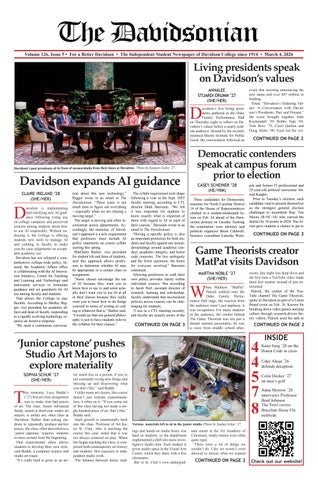
Volume 126, Issue 5 • For a Better Davidson • The Independent Student Newspaper of Davidson College since 1914 • March 4, 2026
Living presidents speak on Davidson’s values ANNALEE STUARDI-DRUMM ’27 (SHE/HER)
D
avidson’s five living presidents gathered in the Duke Family Performance Hall on Thursday night to reflect on Davidson’s values before a nearly soldout audience. Hosted by the recently renamed Martin Institute for Public Good, the conversation followed an
Davidson’s past presidents sit in front of memorabalia from their times at Davidson. Photo by Kaspars Golos ’27.
Davidson expands AI guidance CLAIRE IRELAND ’28 (SHE/HER)
D
avidson is implementing and clarifying new AI guidance following rising use on college campuses and perceived concern among students about how to use AI responsibly. Without endorsing it, the College is offering students new tools to manage AI and yielding to faculty to make case-by-case judgements on acceptable academic use. Davidson has not released a comprehensive college-wide policy. Instead, the Academic Affairs office is collaborating with the AI Innovation Initiative, Center for Teaching and Learning and Technology and Innovation services to formulate guidance and set guardrails for AI use among faculty and students. That allows the College to stay flexible. According to Shelley Rigger, vice president for academic affairs and dean of faculty, responding to a rapidly evolving technology requires an iterative response. “We need a continuous conversa-
tion about this new technology,” Rigger wrote in an email to The Davidsonian. “Three years is not much time to figure out everything – especially when we are chasing a moving target.” The target is moving and often inconsistent across departments. Accordingly, the mainstay of Davidson’s approach is a new requirement that professors must include AI policy statements on course syllabi starting this spring. MarQuita Barker, vice president for student life and dean of students, said this approach allows professors to determine whether AI may be appropriate in a certain class or assignment. “Some classes encourage the use of AI because they want you to know how to use it, and some actually don’t want you to use AI at all in their classes because they really want you to learn how to do things yourself in terms of writing or coding or whatever that is,” Barker said. “I would say that our general philosophy is just to have students refer to the syllabus for their classes.”
The syllabi requirement took shape following a vote at the Sept. 2025 faculty meeting, according to CTL director Mark Barsoum. “We felt it was important for students to know exactly what is expected of them with regard to AI in each of their courses,” Barsoum wrote in an email to The Davidsonian. “Having a specific policy is also an important protection for both students and faculty against any misunderstandings around academic conduct, academic integrity, and honor code concerns. The less ambiguity and the fewer questions, the better for everyone involved,” Barsoum continued. Allowing professors to craft their own policy provides clarity within individual courses. But according to Jacob Heil, assistant director of research, learning and scholarship, faculty understand that inconsistent policies across courses can be challenging for students. “I was in a CTL meeting recently, and faculty are acutely aware of the
CONTINUED ON PAGE 3
T
his semester, Lucy Budde’s (’27) first art class assignment was to make four bad pieces of art. The class, Junior Advanced Study, aimed at third-year studio art majors, is unlike any other class at Davidson. Rather than asking students to repeatedly produce perfect pieces, the class, often described as a ‘junior capstone,’ requires students to mess around from the beginning. That experimental ethos allows students to develop their own style, said Budde, a computer science and studio art major. “It’s really hard to grow as an art-
ist, much less as a person, if you’re not constantly trying new things and messing up and discovering what you don’t like,” said Budde. Unlike many art classes, this course doesn’t just tolerate experimentation; it relies on it. “If you come out of this class having not made a single finished piece of art, that’s fine,” Budde said. Such growth is intentionally built into the class. Professor of Art Katie St. Clair, who is teaching the course this year, noted that it was not always centered on play. When she began teaching the class, it comprised both contemporary art history and students’ first exposure to independent studio work. The balance between dense read-
CONTINUED ON PAGE 2
Democratic contenders speak at campus forum prior to election CASEY SCHEINER ’28 (HE/HIM)
Three candidates for Democratic nominee for North Carolina District 14 of the House of Representatives clashed in a student-moderated forum on Feb. 24 ahead of the Democratic primary on Tuesday. Seeking the nomination were attorney and political organizer Brent Caldwell, business consultant Lakesha Wom-
ack and former IT professional and 25-year-old political newcomer Ahmid Kargbo. Prior to Tuesday’s election, each candidate vied to present themselves as the strongest general election challenger to incumbent Rep. Tim Moore (R-NC-14) who carried the district by 16 points in 2024. The forum gave students a chance to get to
CONTINUED ON PAGE 3
Game Theorists creator MatPat visits Davidson MARTHA NOBLE ’27 (SHE/HER)
W
hen Matthew “MatPat” Patrick walked onto the Duke Family Performance Hall stage, the reaction from the audience wasn’t just applause, it was recognition. For many students in the audience, the creator behind The Game Theorists was not just a distant internet personality, he was a voice from middle school after-
‘Junior capstone’ pushes Studio Art Majors to explore materiality SOPHIA SCHUR ’27 (SHE/HER)
event that morning announcing the new name and over $47 million in funding. Titled, “Davidson’s Enduring Values: A Conversation with Davidson’s Presidents, Past and Present,” the event brought together John Kuykendall ’59, Bobby Vagt ’69, Tom Ross ’72, Carol Quillen and Doug Hicks ’90. Each led the col-
noons, late night lore deep dives and the first time a YouTube video made them feel smarter instead of just entertained. Patrick, the creator of the YouTube channel The Game Theorists, spoke at Davidson as part of a Union Board event on Feb. 24. Known for breaking down video games and pop culture through research-driven theory videos, Patrick used his talk to
CONTINUED ON PAGE 2
4 4 5 7 8
INSIDE Katie Jung ’28 on the Honor Code in crisis Uday Ahuja ’26 defends deception. Colin Decker ’27 on men’s golf Anna Morrow ’28 interviews Professor Brad Johnson The Yowl covers Brazilian Horse Flu outbreak
Various materials left to sit in the junior studio. Photo by Sophia Schur ’27.
ings and hands-on studio hours was hard on students, so the department implemented a shift into more investigative studio time. Each student is given studio space in the Visual Arts Center, which they share with a few classmates. But in St. Clair’s own undergrad-
uate career at the Art Academy of Cincinnati, studio classes were often quite rigid. “There were a lot of things we couldn’t do. Like we weren’t even allowed to choose what we wanted
CONTINUED ON PAGE 2
Check out our website!
News
Presidents reflect on role of trust at Davidson
CONTINUED FROM PAGE 1 lege under different eras and with distinct leadership styles. Chris Marsicano ’10, director of the Martin Institute, said that the discussion reflected both the college’s values and the Institute’s mission of bringing together diverse perspectives to find common ground. “When you talk about the [presidents’] values, the values of leadership, of service, the things that we believe are critical to a Davidson education, they have lived out those values in different ways,” Marsicano said. Anthony Foxx ’93, chair of the Board of Trustees, opened the evening by welcoming guests and thanking the presidential spouses and past board chairs for their service to the college. He then moved to the event’s main focus and welcomed the evening’s speakers to the stage. “A Davidson president needs no introduction,” he declared. The curtain rose to reveal the five presidents seated together onstage around a table, framed by bookshelves displaying Davidson memorabilia. A bridge between the past and present, Hicks moderated. He opened by asking Kuykendall,
president from 1984-97, how the College’s values have evolved over time. Kuykendall’s response reached back to Davidson’s Presbyterian roots and brought them to the College’s present need for change. “Davidson has got a very distinctive root, rooted in the Reform tradition and that part of our Reformed theology, which says that there is room for growth and development,” Kuykendall said. “One of the things I’ve always said about Davidson is that it needs to get better, which is a real positive in my mind for getting things done now.” The question framed a recurring theme of the five presidents’ remarks: trust, both within and beyond the Honor Code. They defined the Honor Code as a core value that sets Davidson apart, shaping not only leadership at the college but the character of the broader community. Quillen, who was president from 2011-2022, emphasized that the Honor Code underpins intellectual risk-taking. “The Honor Code is about building a community where people can genuinely expect to be able to trust each other,” Quillen said. “We’re asking students to take huge risks, ques-
tion their assumptions, present new ideas, speak when [they]’re not sure, find new avenues of inquiry. We’re asking people to take huge intellectual risks […] when I think about what makes Davidson different, I rely heavily on that.” The conversation also explored Davidson’s commitment to accessibility. Vagt, president from 19972007, spoke about the creation of the Davidson Trust, an initiative designed to meet 100% of students’ financial needs and eliminate debt so that students can attend regardless of their background. “[The Trust] was all about who we were as an institution,” Vagt said. “How can we sit here and not make it possible—perfectly possible—for any student who wants to go here to attend […] this is who we are and this is what we need to do.” “It really has been a key moment, just as the Honor Code is and just as our attentiveness to every student and their dignity is, this attention to access and affordability is vital to who we are,” Hicks added. Athletics were also highlighted in the discussion. Quillen noted that athletics are, not just extracurricular activities but opportunities for character development and an extension
of the college’s educational mission. “There are skills and opportunities and talents that get developed through playing sports at the highest level of competition […] and you need coaches who think of themselves as educators, you need students who are students first,” Quillen said. For the presidents, athletics exemplify teamwork, leadership, integrity and responsibility—all lessons that carry into the classroom and broader campus community. Hicks closed the conversation by expressing optimism about Davidson’s current momentum while emphasizing that the college’s work, and commitment to its values, continues. In a follow-up interview with The Davidsonian, Ross, president from 2007-2010, and Quillen shared what they hoped students would take away from the discussion and why revisiting the college’s values matters today. “We’re living in a chaotic time— lots of news coming at us, fast policy changes, deep political divisions—and for many people, things feel precarious, we don’t know what could happen next,” Quillen said. “At times like this, grounding values
MatPat inspires students CONTINUED FROM PAGE 1 offer students practical advice about structure, analysis and finishing what they start. Patrick founded The Game Theorists more than a decade ago, building a media brand centered on analyzing video game lore and internet culture. Rather than focusing on nostalgia, his visit emphasized the transferable skills behind his success: research discipline, narrative structure and intentional audience growth. Early in the talk, Patrick described what he called the channel’s “curriculum.” Using a Mario-themed episode as an example, he explained how each video introduces concepts at an accessible level before revisiting them with greater complexity in later installments. “As the audience kind of grows up, as they get exposed to these ideas, yes, you’re refreshing them, but each time you’re able to cover a different facet of it, or go a little bit deeper and across the whole spectrum,” Patrick said. What appeared to be episodic entertainment was, in reality, layered learning. Patrick said he was careful to balance depth with clarity, avoid-
ing overly technical explanations that could overwhelm viewers while still maintaining intellectual rigor. Even as his company expanded to nearly 50 team members producing multiple videos per week, Patrick said he remained deeply involved in shaping each episode. “You can have bad visuals. You can have rough audio recording, but you can’t sacrifice the core thesis of what it is and what people are tuning in for, which is the content, which is the story, which is the theory,” he said. One student questioned how to enter game design, prompting Patrick to expand on storytelling more broadly. He stressed that creators must understand their ending before asking an audience to invest in the journey. He emphasized that in the art of storytelling, what is most important is what people remember. The final note. “Whether you’re a storyteller, whether you are a college student [...] stick your landing,” he said. “If you have senioritis, push through, if you’re starting to feel checked out, check back in, because that’s the impression that you leave people with.” In an interview with The David-
MatPat high fives the crowd during his talk in the Duke Family Performance Hall on Thursday. Photo by Kaspars Golos ’27.
2
can be steadying, and talking about them can remind us of ideals that we can all share.” “That character, the integrity you build—that sense of honor that the Honor Code gives you—you have the responsibility to take that out into the world and use it,” Ross echoed. Cate Fitzgerald ’29 said that, for her, the discussion’s impacts extend beyond the stage. “It really inspired me to find ways to be a leader, not only in outwardly expressive ways, but in the smallest ways as well.” This sense of inspiration contributes to the Institute’s broader purpose of hosting the event: emphasizing Davidson exceptionalism. “If you feel special, it’s because you are. Davidson is special in the national landscape of higher education,” Mariscano said. “What makes us special is that constant reminder that we are here to have humane instincts and disciplined and creative minds for lives of leadership and service. That honor and integrity that we hold ourselves to—that makes us different.”
Students on art capstone
CONTINUED FROM PAGE 1
Jack Schwanewede ’26 (right) moderates a conversation with Matthew Patrick. Photo by Kaspars Golos ’27.
sonian, Patrick reflected on why he continues visiting college campuses. “You know, it’s been so flattering over the years to hear the stories of how our videos affected people’s lives,” he said. “I think the stuff that’s really been impactful is hearing people say, ‘hey, this episode helped me pass the test,’ or ‘these episodes helped me decide my major.’” He added that he has been surprised, but encouraged, to see how many of his viewers pursue academically rigorous fields. “I wouldn’t have expected theorists to be a lot of computer science majors or a lot of criminology majors, but here they are, and it makes sense,” he said. “Because it’s solving problems through evidence, through logic, through pursuing critical thought.” Students who attended said they appreciated both his analytical mindset and his personality. Junah Jeong ’27 said Patrick quickly adapted to campus culture. “He was able, really, to cater to our audience,” Jeong said. “Davidson’s a very nerdy school, and he was able to pick up on our little bits and jokes in ways. He was even mentioning stuff like Yik Yak.” Event coordinator David Anderson Montes-Lara ’28 said Patrick intentionally asked about campus traditions before the talk so he could
incorporate them into his remarks. “From the start of the day, he asked about specific things about the Davidson campus, just so that he could drop a joke in his speech later on,” Montes-Lara said. Belle Bunner ’28, who attended a smaller dinner before the event, described him as approachable and engaged in conversation about students’ academic interests. “He was asking us questions. He wanted to know what we were studying,” Bunner said. Jack Schwanewede ’26 said meeting Patrick felt natural despite his public profile. “He was super enjoyable to talk to,” Schwanewede said. “I didn’t even really feel nervous meeting him.” Schwanewede also noted the intellectual depth behind the entertainment. “In terms of how he makes things digestible for audiences, I thought that was really interesting,” Schwanewede said. “He’s a very smart dude.” Patrick closed the evening in his signature style. As he turned to face the audience, he invoked a phrase familiar to longtime viewers, ending the evening on a nostaligic note. “But hey, that’s just a theory,” he said.
to paint. For the first three or four classes, you were just painting whatever the professor thought was appropriate,” St. Clair said. With less prescribed direction, a studio class could instead push students to explore outside of their comfort zones. “I’ve really been interested in trying to figure out how to engage the students in a way where they’re pushing back against [...] fear,” St. Clair said. For Courtney Lassiter ’27, a Studio Art and Film, Media, and Digital studies double major, the Junior Advanced Study allowed time to experiment before the more production-focused capstone the following year. “The junior capstone acts as a really good stepping stone to allow you to experiment with a lot of new techniques ahead of your senior show and also develop an artistic practice that’s uniquely yours,” Lassiter said. By asking the students to experiment for the sake of growth, rather than in pursuit of a finished product, the class is individualized to students’ own creative desires. “In a creative practice, there’s no boundaries, right? And basically we start doing your capstone that way, like you can make anything,” St. Clair said. Lassiter agreed. “You sort of have this kind of unprecedented freedom here that has just allowed me to, I feel like, bloom into my own creative practice in ways that I don’t think that I could have while being so closely instructed,” she said. The lack of guardrails has led many students to experiment with materiality. Budde and Lassiter,
CONTINUED ON PAGE 6
Features
Davidson AI guidance includes required syllabi statements
CONTINUED FROM PAGE 1 fact that four different syllabi [with] four different AI policies can lead to confusion. It’s not an ideal situation,” Heil said. On the “flip side,” Heil noted transparent policies allow students to interrogate why certain policies are deployed in certain classes. The College has tried to mitigate that confusion. Over the past semester, Academic Affairs has sent two emails respectively titled “AI Guidance for Spring Semester” and “Your brain on AI: Navigating the “everywhere-ness” of Generative AI.” The emails feature advice on how to navigate an increasingly AI infused world, a video detailing the importance of thinking for oneself while leveraging AI and information about the College’s AI resources. Rigger said the guidance comes in response to student requests for clarification. “Students have expressed, in many different ways and to many different people, that they want guidance as to how and when
to use AI. They don’t want to get in trouble, and they don’t want to stunt their own intellectual growth. And at the same time, they know they can’t just ignore AI,” Rigger wrote. Davidson recognizes that growing numbers of students are experimenting with AI, and that there may be cases for its use academically. Accordingly, the College licensed generative AI platforms Amplify and Gemini in fall 2025. According to Rigger, the licensure is about security rather than endorsement. “Providing licensed resources is not about encouraging or discouraging use; it is about protecting data and privacy,” Rigger wrote. Due to licensing agreements, Amplify and Gemini do not store data for training or other uses when accessed through a Davidson email address. Even so, Chief Information Officer Kevin Davis said users must be cognizant of data security. “Every use of technology is risk mediated,” Davis said. “Once something is put out into the world, it is in the world. So part of why for our most sensitive levels of data, we don’t allow this to
Politics
be used, even in college-paid tools, is simply that the benefits don’t outweigh the risks.” Brandon Woods, director of academic and research services, often facilitates conversations with students about how to approach AI use. Speaking from his personal perspective, he acknowledged student concerns about how the data they put into college-licensed platforms may be accessed by the College. “A student told me that ‘oh yeah, we see that you had AI licenses available, but I felt that you guys were just going to police us.’ I could understand that being a concern, because there’s very little room for error and misinterpretation around AI, and I also know that that’s not something that we’re doing,” Woods said. Davis clarified that although student data is collected, the College is bound by a Data Security Policy which was amended this fall. “We have a pretty robust policy around college access to electronic communications. That’s an overarching policy that applies to all Davidson systems, and that outlines the situ-
ations under which the college will, through its operations, go in and look at data, and they’re very limited,” Davis said. “It’s really intended to note that the College is the legal owner of systems [...] I would say it’s a rare circumstance that something’s looked at.” Rare circumstances include if the College were to be subpoenaed. Davidson has also expanded resources across campus to help community members learn about AI through the CTL. AI Innovation Fellow Madeline Johnson is one of those resources. “A lot of my work is focused on educating others about how to engage with AI. I’d say, generally, on Davidson’s campus, we have a lot of beginner users [...] So me and a few of my T&I colleagues have been going around department to department and just doing very basic hands-on guided explorations of Gemini,” Johnson said. The CTL also supports faculty engagement with AI. “Faculty CAT [Conversations Around Teaching] is one series of pedagogy-oriented pro-
3
grams that the CTL plans and hosts, and many of the sessions over the last several years have focused on AI and teaching in some way,” Barsoum wrote. Other AI related programming has included book-clubs, workshops and forums. Outside of academics, AI is becoming more entrenched in professional fields. Faculty and staff are working to respond to this reality. “Student feedback, to me, has been that you guys are starting to believe that [AI skills] will be an expectation for when you apply for jobs, and we have to collaborate to make sure that your money spent, your time spent coming to Davidson [...] is in alignment with what you expect out of a college experience,” Woods said. Davidson’s commitment to academic integrity and critical engagement anchors the College’s AI Guidance. “The world is being pulled in a direction that is less human right now, and the best response that higher education can offer is to nurture humane students that can make critical judgments about AI-generated products,” Barsoum wrote.
Forum introduces students to Democratic candidates for NC-14
CONTINUED FROM PAGE 1 know the candidates as people, not just names on a ballot. Moderator and Davidson Democrats Co-President Julia Siqueira’s (’26) first question asked nominees, “What puts you in the best position to beat Tim Moore?” Each candidate took a different approach. Womack pointed to the community connections she made on the campaign trail. “Looking at the district and knowing that it was gerrymandered [...] how do you represent a district that is so diverse, from rural counties to suburban areas to urban areas? I really started thinking about what unites us from all the areas that I visited,” Womack said. “For me, it’s about going out into the community, talking to people, and helping people to see that we have more in common than we think.” Caldwell emphasized the infrastructure and competency of his campaign rather than particular policy concepts. “I’ve worked on three congressional races and I was a labor organizer. I have a strong sense of how to run a successful campaign and how to organize on the ground. Having good ideas is not going to win this election. You’re going to have to have resources and infrastructure in place to get that message out,” Caldwell said, pointing to endorsements from the AFL-CIO and the Charlotte Observer. “I’ve raised $70,000, which isn’t a tremendous amount for a congressional campaign, but is many times over what my opponents have raised.” In contrast, Kargbo placed specific legislative proposals at the center of his pitch. “Voters are desperately wanting for someone who is desperately going to fight for them with policies
that are economically possible like Medicare For All, universal health care, and abolishing ICE,” Kargbo said. “We have to run on a big plan, introducing things like high speed rail, connecting our infrastructure with rural areas, and nationalizing Duke Energy.” Separately, in court documents obtained by The Davidsonian, Kargbo was found guilty in 2023 on charges of reckless driving: wanton disregard for human life after a speeding incident. After his license was suspended, Kargbo continued to drive and was charged with driving without a license after being pulled over for an expired and rain-damaged temporary license plate later that year. “I’ve learned my lesson here, the law is the law, but I’m not too remorseful about it,” Kargbo said in an interview with The Davidsonian. “I wasn’t about to kill anybody. I wasn’t hurting anybody.” Kargbo emphasized his commitment to safe driving in the years after completing his license suspension period in 2024. “I’ve followed the rules ever since. I haven’t gotten a ticket since,” Kargbo said. “Most people won’t look at it as that big of a deal, especially if I keep a clean record for a few years.” Kargbo also used the story in multiple ways to highlight issues of justice. “The fastest people on the road are literally police officers. The people who enforce the law do not follow the rules a lot,” Kargbo said. “The highway I was driving on destroyed historically black neighborhoods so people in the white suburbs can commute to Charlotte.” While the three candidates refrained from direct shots at one another, Caldwell made reference to a
Brent Caldwell, Lakesha Womack and Ahmid Kargbo answer questions during a forum on Feb. 24. Photo by Josh Sun ’27.
snub from Kate Barr, a self-avowed progressive challenging Moore for the Republican nomination to protest North Carolina’s extreme gerrymandering. “I reached out last week to Kate Barr to see if she would sign onto a joint statement calling for the resignation of [Commerce Secretary] Howard Lutnick for lying about his relationship to [Jeffrey] Epstein. I was going to get Kate on board and then come to my other opponents so we could say that every person in this race besides Tim Moore, who surely would not go against President Trump, is trying to hold the Epstein class accountable,” Caldwell said. “Kate Barr declined to do that, so that did not get out of the gate.” During an event at Davidson later in the week, Barr justified her refusal to sign Caldwell’s proposition under the principle that her campaign makes its own statements rather than sign onto those of other candidates. “I’m happy to sign anything that I have written shaming anyone who has protected pedophiles, whether that’s in the Epstein files or otherwise,” Barr said. “But I write my
own words, and I don’t sign other people’s.” Caldwell, Womack and Kargbo also pitched signature policy proposals. Womack promoted preventing corporations from receiving tax breaks if they neglect to pay their workers a living wage. Caldwell endorsed campaign finance reform mandating that donors to a campaign be located in the jurisdiction where the candidate is running. Besides the many policy proposals he pointed to in his initial pitch, Kargbo also mentioned his desire to deal blows to the military industrial complex. Both Caldwell and Kargbo committed to refusing to take donations from the American Israel Public Affairs Committee (AIPAC), a pro-Israel lobbying group that has attracted criticism for its support for increased aid to Israel amid the country’s military actions in Gaza. The forum was made largely possible by Davidson Democrats Community Engagement Chair Dylan Swick ’28 who navigated competing campaign schedules to find a time that worked for all three to visit.
“After building rapport through continued interactions with the three, I was able to successfully pitch the idea of the panel,” Swick said. “It was incredibly difficult to get all three in the same room at the same time, but after a lot of communication I was able to find one day that worked.” At the forum the candidates projected an air of unity around both their distaste for Moore’s representation of their district and a modicum of faith in one another as potential stewards of the Democratic nomination. “I hope you all feel that no matter which one of us is elected, you feel that you have a representative that you can reach out to that you can share your concerns with,” Womack said. Editor’s note: This article was written prior to Tuesday’s primary election. It has been lightly altered from an article published on The Davidsonian’s website March 1 titled “Democratic House contenders appear at campus forum as court records surface for one candidate.”
Perspectives
4
The Honor Code is Dying; Here’s How We Should Fix It
W
KATIE JUNG ’28 (SHE/HER)
hen I first toured Davidson College my senior year of high school, I was appalled by the concept of the Honor Code. In fact, I distinctly remember my tour guide casually mentioning, “I haven’t taken an in-person exam in a year.” The idea felt absurd. No proctors? No surveillance? Just trust? Admittedly, the concept of Davidson’s current Honor Code system is perfect. In theory, it creates a community grounded in mutual trust – socially and academically – where integrity is assumed rather than constantly at stake. It represents an environment in which students act honestly not because they are monitored, but because they believe in a shared standard. But that perfection is precisely what makes it fragile. It requires universal buy in. It asks students and professors to hold one another accountable, even if it’s uncomfortable. It assumes that academic competition and pressure will not outweigh integrity. In short, it requires imperfect human beings to consistently uphold a passive, abstract, almost perfect ideal. The challenge then is not that the Honor Code is fundamentally flawed in and of itself; it is that translating a perfect principle into imperfect human behavior is extraordinarily difficult, especially when that ideal feels distant. As soon as I arrived on campus my freshman year, this tension became impossible to ignore
as I was faced with a harsh academic reality: rampant cheating and unapologetic use of AI. In response to the academic violations, instead of relying on the Honor Code, professors and academic departments resorted to creating testing centers, killing the idea of the take-home exam. However, what was meant to be a solution to prevent cheating and protect learning has created its own bleak reality: overcrowded Chambers classrooms, tiny quarter desks packed shoulder to shoulder, and a quiet but palpable sense of mistrust – students feeling as though their integrity is now constantly in question. We are thus met with a paradoxical problem – a prisoners dilemma, some might say. We need the Honor Code and a community built on trust, but we also need accountability. However, it feels naive to simply tell professors “just trust me bro,” because as much as we expect professors to believe in us, we as students owe them evidence that such belief is justified. In other words (and thought it may sound obvious), we need more students to believe in it. Our commitment cannot simply be assumed; it must be demonstrated. Right now, the Honor Code feels ceremonial. We sign it freshman year, we have a celebration of honor, and occasionally talk about how “great” it is, but we don’t interact with it. Therefore, Davidson needs to reimagine a collaborative Honor Code that is significantly more integrated in student life. Other schools, like Haverford College, regularly convene for a yearly conference to amend
and interpret the Honor Code. Davidson doesn’t necessarily need to replicate this model entirely, but the spirit is worth taking inspiration from: students must actively interact with the Honor Code, instead of merely inheriting it. Whether this takes shape as a student-faculty-led conference, incorporating it into student applications, workshops, or even simply emphasizing it more during orientation week, the goal is the same – to transform the Honor Code from a static document into a living conversation. The impact is two-fold: First, it would present an opportunity to actually codify the Honor Code. “But what do you mean? It’s already codified.” While you’ll find that the Honor Code is in fact written and formalized (if you make the time to comb through Davidson’s website), I would argue that it’s not quite fully defined. Its language remains broad, it hasn’t been updated to address current day shifts, and most students could not clearly articulate what it requires beyond the abstract principle of “upholding honor.” So what does this look like in practice? For starters, with the rise of AI, it would mean establishing clear, shared guidelines and definitions. It would also mean clarifying expectations not only for students, but for professors: consistent communication of norms, clearly defined boundaries, and practices that align with a culture of trust rather than assumption of misconduct. Second, it would make the Honor Code relevant again. The biggest threat to the Honor code is not defiance, but apathy – students not “believing” in abstractions like “the Honor Code”
erode its meaning and significance. Thus, when students are actively involved in the process of reforming and recreating the Honor Code, it becomes less of a distant ideal and more of a shared responsibility. And if you take issue with any part of this admittedly broad proposal, good. That’s precisely the point. The Honor Code should provoke conversation and encourage critical examination. If we don’t define it together, its meaning fades away. Thus, the goal of this proposal is not stricter enforcement; its shared ownership. Though it’s a lot, and certainly may sound unattainable, I want to emphasize the importance of prioritizing process over outcome. Davidson will never achieve a “perfect” Honor Code system, but perfection was never the objective. So long as we, as students, refuse to let it die, the Honor Code can remain what it was always meant to be: a living commitment rather than a fading tradition. Katie Jung is a PPE major from Charlotte, NC. She can be reached for comment at kajung@davidson.edu.
A guide for the discerning UDAY AHUJA ’26 (HE/HIM) Why is it that in an era of incessant lying— one suspects The New York Times will soon dedicate a permanent obituary to the truth— we are seeing a renewed decay of lying? We have, it is true enough, all manners of liars on this campus: my friend tells a girl at F that he is a good kisser; the arts review section of The Davidsonian is always positive; the Deliberative Citizens Initiative pushes itself as an intellectual exercise rather than a résumé padder; the College says that it wants us to follow the Honor Code. We have, it is also true, no shortage of fine thinkers on this campus: Mav Smith fashions poetry out of a wonderful natural force with considerable skill; Sören Potthoff brings to his work a dazzling earnestness in the best tradition of American letters; I always look forward to what Stella Mackler has to say in her immaculate prose. The problem is that there is little overlap between the thinkers and the liars. Perhaps some part of this resurgent decay is the frighteningly confessional culture we find ourselves in. The things that people—not even a half-century ago—would pay exorbitant amounts of money to conceal, they now jostle to show off on reality television. The book market is flooded with people’s dowdy sexual and/ or violent fantasies and even the pursuers of serious literature veer dangerously towards autofiction. What one gleans from these memoirs and dating competitions and Instagram stories is that the lurid competition for attention-seeking-truth-telling only reveals how boring most of our lives are. “Be yourself,” the old adage
goes, always omitting the second part, “but if you’re not interesting enough, please be somebody else.” Based on extensive experience, I provide some helpful examples of people who are not interesting enough: theists (mono- or otherwise); computer science majors; Swifties; study abroad returnees; people who believe psychology is a serious pursuit; most heterosexuals, bien entendu; most young poets; anybody who, under any circumstances, reads a self-help book. Perhaps the other part of the decay is an impoverished foundation for honesty. Children’s natural talent for lying is killed off with simple-minded dismissal on the basis of content, rather than nurtured for the wonderful form it is. This might be less deleterious if they were given a good replacement, but the truth is erroneously conflated with dialogic compromise, vide DCI above. Plagiarism is decried not because of an appeal to excellence, but instead due to the predication of originality on the laughable notion of intellectual property (which, less laughably, has killed millions this century alone). The person thus produced shows an extreme silliness which is organic to the middle-aged, but becomes a tragedy when it strikes so young. If one is taught (in order to suppress lying) that lies are for personal gain, told to cover up misdeeds, and replacements for the truth, then, when one lies, one will lie in this manner. If one is to be this uninspired, to attempt to explain their lie, to lie as politicians do, then one might as well say what really happened. To lie well, one has to aspire to an excellence that is not already reflected in one’s life, to be sharp and witty and particular and inaccessible; one
Crime Log Time Reported 02/28/26 0338 hrs 02/25/26 1651 hrs
Description/Location Alcohol Offenses: Consume Beer/ Unfortified Wine by Person Under 21 Belk, Inactive Disorderly Conduct Offenses: Disorderly Conduct Chambers, Inactive
has to, in short, apply judgement. What, then, constitutes a good lie? Fortunately for the aspiring liar, there are several different kinds. First, subreptive lying—lying at the level of facts in order to convey a more important truth. White lies often fall under this category, but they are its least interesting examples. Second, a lie conducted as conversation, a bit where everyone eventually knows what’s going on. I convince somebody that I am French, despite not speaking the language. My editor tells me that my piece will be funny and well-written, and that he is excited to read it. Third, the kind of lying that produces a style. This is self-explanatory. Fourth, those Wildean lies that constitute themselves for no purpose other than their existence. These are the rarest of all, because most lies that seem to belong to it at first glance are in fact motivated by something, be it something as minor as amusement, and so cease to be formal experiments. This is the essence of decadence, of degeneracy, of every vice that has added something new to the range of human experience. So go forth and falsify! Say things that bewilder people. Don’t bore people with your ac-
tual life at parties. Exercise your imagination, and if it is any good share the results with me (if it is not, please refrain; I’ve had enough of that). Invent pseudonyms, and use them. Create new opportunities for the thrills of guilt and self-flagellation without the drudgery and hard work of actually sinning. Give up on begging for grades and give your assignments the formal stylisation they deserve. Cut your hair into bangs (a most innovative and visual form of lying). And remember to only tell the truth when doing so would disadvantage you. Uday Ahuja is a Sociology major from Delhi, India. He can be reached for comment at udahuja@davidson.edu.
Sports
‘Golf like an A-10 champion’
5
Men’s golf on mental game behind A-10 success COLIN DECKER ’27 (HE/HIM)
O
n a gusty Wednesday afternoon at the River Run Country Club, head coach Tim Straub patrolled the range as players alternated between hitting long shots down range and practicing on the chipping green 50 yards away. Despite finishing dead last at the Hal Williams Collegiate tournament in Mobile, AL, that weekend, Straub’s sights were set on the future: preparing the young team to compete in pursuit of their sixth Atlantic 10 Championship since 2018. A persistent crosswind deterred Straub’s plans of doing wedge and driver drills. Instead, as the wind bent the flagsticks groundward, he let the team split up and prepare for their 4:30 p.m. tee times on their own. Players joked around between shots, but internally, they were all preparing for the upcoming qualifier—three-to-five day periods before each tournament where the team plays full 18-hole rounds to determine which five golfers will compete. Straub uses the qualifiers, and other team competitions, to simulate the pressure his players will feel during tournaments. For him, that is where the difference is: success “will come to guys that handle the pressure well.” Pressure, in this case, has made diamonds. Five A-10 Championship trophies adorn the common room wall inside the Graeme and Gloria Kieth Davidson Golf House, which sits to the right of the team’s private range section. The program took home its first title in 2018, then won three-ina-row between 2021-23. Their most
recent title came in 2025, after overcoming a nine-stroke deficit on the final day of the tournament. As for the feeling of sustained success, Straub summed it up plainly: “It’s been fun.” Aside from Davidson’s academic reputation, the conference titles attracted much of the current roster. “From the golf side, I saw [Davidson was] winning a lot of conference championships, and [I] definitely could tell they had great coaching from when I had talked to Coach Straub,” Nate Faulkner ’28 said. Before Jackson Bode ’26 committed to Davidson, the program had already claimed two conference titles; it seemed “like a great spot,” said Bode. Consistency at the collegiate level begins with recruiting. After 26 years as head coach, Straub knows what he prioritizes. The first trait Straub looks for is strong academics. Next is their ability to beat their high school and junior golf peers, “because those people [they] have to beat in college, too.” Straub also likes to see recruits demonstrate “the ability to keep improving”—a hallmark of his coaching philosophy. Rather than setting team objectives like winning a conference championship and returning to NCAA Regionals, Straub emphasizes to players that getting better in all facets of their game is the goal. “Hard work is the most important thing,” Straub said. “If you put the time in, you’re going to see results.” Mental performance coach and assistant golf coach, L.D. Simmons ’81 helps players sharpen their mental games as well as their physical ones. Former Division I golfer, Simmons draws on his competitive experienc-
Top: Nate Faulkner ’28 holds the finish after a shot. Bottom: The corner of the locker room whiteboard displays a scoreboard for the team’s newest competition and an unofficial mantra. Photos courtesy of Tim Cowie (Top) and by Colin Decker ’27 (Bottom).
Davidson’s five Atlantic 10 Championship trophies adorn the team common room. Photo by Colin Decker ’27.
es to teach course management—oncourse strategies golfers use to approach different shots and holes. On the strictly mental side, Simmons focuses on what he calls “the controlables.” He said the number one ranked golfer in the world could hit 100 shots from the same place, but couldn’t accurately predict whether one shot would land within five yards of the pin, and another would land twenty yards from the pin. “We literally don’t control our golf swing, but there are a lot of things that we can control,” Simmons said. He teaches his players to visualize a “clear intention:” picture in their minds the kind of shot they want to hit before they hit it. “You’ve got the best chance of hitting a quality golf shot if you’re able to really make a good decision about where you want that ball to finish, and create a picture in your mind of what that shot looks like,” Simmons said. Simmons also teaches his players to practice acceptance. “It’s the ability to be willing to accept [a shot] that goes two feet from the hole and at the same time, be willing to see it go out of bounds, and be equally prepared to hit the next shot. It’s pre-loaded, preset acceptance,” Simmons explained. Mental work extends beyond the course. Simmons encouraged players to start journaling their thoughts throughout the weeks. Faulkner uses his journal as a reference to maintain successful mental practices. “A lot of times you can play well, and you were thinking really well, but then [a] couple of weeks or months later, if you’re not playing well, then it’s helpful to have [a record of] exactly what you were doing well a while ago so that you can go back to it,” Faulkner said. For Simmons, Davidson golf is a family affair. All three of Simmons’ children attended Davidson; his two sons played under Straub. After practicing law for 35 years, Simmons opened his own private coaching practice and later began working with the team in 2020. Helping to bring success to his alma mater has been “a great joy.” “I get to help young people chase a dream,” Simmons said. Back at practice, most of the team peeled off the practice facilities and headed onto the course. A few players stayed behind to keep hitting at the range. Clayton Couey ’28 was one of them. This season, Couey is taking cues from the pros. He said he is trying to channel their focus on efficiency, diligence, and “getting everything out of every shot they’re hitting.” He admitted that he had been playing mechanically lately, focusing too
much on dialing in his swing rather than just “playing golf again.” Echoing Simmons’ teachings, Couey is leaning away from the mechanical and grounding himself in “the controllables.” “I’ve been so focused on how my swing is,” Couey said. “It’s gotten in the way of actually just hitting some shots, [and] focusing on just finding a target.” Simmons gave credit to the team holistically for battling out of this mechanical mentality in favor of a mentality focused on simplying playing golf. “I think across the board, they’ve done a good job of embracing the idea that we can play great golf without great mechanics,” Simmons said. Without great mechanics, a great mindset becomes all the more important. Written on the whiteboard in the Davidson Golf House is a scoreboard for the team’s new season-long game. “We have three teams of three: red, black and white,” Faulkner explained. “During practice, we’ll have competitions where we rotate from station to station and do a drill and keep a score, and the goal at the end of the season is to come out with the most points.” It’s another pressure simulator that focuses the players, pitting them against one another in a well-intentioned fashion. “I love playing against certain guys on the team,” Sayman said. “I want to go out and beat them and they want to beat the crap out of me. Same thing [with] qualifying: iron sharpens iron.” Bode credits the team competitions for focusing the golfers each practice, calling it a “winning every day kind of thing.” While the winners are promised an end-of-season reward, the real benefit for Bode and the others is the commitment it generates. “Whoever accumulates the most points throughout the semester will win some prize, whether it’s a pair of Footjoy shoes or maybe a club or something like that,” Bode said. “[The competition] keeps practice competitive and keeps guys in it, and forces them to really care each and every day.” As each player prepared for the qualifier, they tried to put their disappointing opener out of mind. “I don’t think anybody really addressed the team as a whole, but I think we all kind of talk about it within ourselves, kind of one-on-one, or in groups of three or four or something,” Bode said. Sayman attributes some of the growing pains to a younger team; Bode and Price Miller ’26 are the only seniors on the roster. As a junior, Seyman recognized he is poised to step into a leadership role.
“I would love to be that guy, and I’m trying to set a good role model for the younger guys,” Sayman said. “Some people may call me a leader, some may not. I just be myself [and] lead that way. Bode leads the team as a calming, friendly presence. He aspires to maintain a competitive edge in practice while cultivating “a space where we can all become as close of friends as we need to be.” “I try to lead by example in that way, and spark conversation whenever I can, and be there if teammates need someone to talk to in any space,” Bode said. Bode’s leadership philosophy draws on his experiences as an underclassman, where he observed how senior-led camaraderie can make all the difference. “When I was a freshman, the two seniors on the team were just super fun, hard workers, and definitely made practice an enjoyable time. And that’s what I kind of try to do for the team,” Bode said. “When golf can sometimes feel like a job and become a monotonous task, our practices should be a space where guys enjoy being there and enjoy the guys around them, and I think that’s probably the most important part.” Scribbled in the top left corner of the whiteboard above the team score tallies is an affirmation: “Golf like an A-10 champion TODAY!” For Faulker, it is a reminder not of the end goal, but of the work it takes to get there— of the standard the team strives to uphold each practice. “It definitely does give us confidence coming back [to the A-10 Tournament], because it’s never a question of, ‘are we good enough to do it?’” Faulkner said. Sayman sees the conference championship as a stepping-stone, a threshold they have to cross to get to the next level and compete on the national level. “We want to push past [the A-10 championship]. We’re not doing great this season by any means, but we all see the bigger fish in the sea past the A-10s,” Sayman said. “I think I’m speaking for a lot of the guys in the locker room: we want to go to the [NCAA] regional and compete there.” Davidson’s winning ways set a high standard. Bode feels confident the team will rise to the occasion. “It is the new standard at Davidson. We all really want to win an A-10 Championship every year,” Bode said. “It’s definitely some pressure, but I don’t think it’s too much pressure that anyone on our team can handle. We can definitely get that done.”
Arts & Entertainment
6
Left: Hannah Morgan ’27 sifts through her torn pieces. Center: Finny Roach ’27 experiements with materials. Right: Courtney Lassiter ’27 examines a piece in her studio. Photos by Sophia Schur ’27.
Professor Katie St. Claire advocates for creative exploration
CONTINUED FROM PAGE 2
for example, described using a new printer that works with a variety of materials. “That’s what I’ve been using for the most part,” Budde said, sitting in front of a piece where she printed images of purple shadows onto silk. Lassiter began printing on even less conventional surfaces. “I just kept wiping my hands on paper towels and really liking the way that the paint looked on them,” Lassiter said. After some initial nerves about whether this would break the printer, she was able to test the limit of refuse as art. “I really enjoy the transparency of them, and also the way that something which is supposed to be so disposable and used to clean up messes in art can become the art itself,” Lassiter said. Printing is not the only way that students worked with digital tools. Budde used her computer science expertise to elevate her work through coding. “You can sort of see how I’ve gone from drawings to paintings to printing on fabric, and then I’ve just recently started writing Python scripts to then go back and animate and project over top of the fabric,” she said. Lassiter, who spent the past two summers in Germany studying punk movements, played with digital images of the gritty subculture of Berlin to mimic her own memories of these nights. “Manipulating over them sort of allows me to change them based on
how I feel like I experienced them, and not actually how I captured them.” Material exploration has led experienced painter Finny Roach ’27 into the third dimension. “I started last semester working with clay tablets, which was weird. It was like a mixture of clay, plaster and concrete,” he said. Since then, Roach has been creating new surfaces to work atop and into. He often took a flat surface such as a wood panel, and then applied water putty or plaster to carve into. Hannah Morgan ’27 is a studio art and German studies major. She had experience with abstraction, but has recently leaned into ripping her own work into pieces. “[I] had a bunch of scraps in a pile, and was like, looking at the main piece, and [...] Katie came over and just picked up a scrap from the pile. I was like, dang it, she’s right,” Morgan said. Now Morgan’s practice is all about these scraps. “They make really chaotic, gestural, abstract pieces that used to feel really whole,” she said. To St. Clair, the focus on materiality allows students to build off a familiar starting point. This is especially important as they take unprecedented artistic risks. “I can allow them to hold on to materiality, a material that’s important to them, sometimes it’s just, I feel like a safety net in their studio that they can remember who they are,” St. Clair said. Morgan has been realizing that an
attraction to the familiar is part of the reasoning behind her mark-making style. “I really do this sort of back and forth, like, it’s almost like writing in really quick cursive, like signatures. Something about that feels really good,” Morgan said. In the last class, she realized how this might be connected to her appearance. “I see the world through my curly hair [...] so I’m pretty sure that’s why I find the mess of swirls so pleasant,” she explained. Though Lassiter is not from Berlin, missing it has motivated her artistic focus. “Its subcultures and its nightlife are things that have grown super close to my own heart, by thinking about the ways that we can preserve it for as long as possible,” Lassiter said. In this way, her pieces reproduce the familiar—even in a suburban North Carolina studio. Striking the balance between the familiar and the uncharted is a central tenet of the class, and often leads to (ultimately helpful) failures. For Roach, failures are often technical. “I’ve had lots of things that didn’t work. A lot of times, things break, things fall apart. Sometimes my experiments are wrong mixtures, and they fall apart easily. Sometimes I’m just trying to figure out how to use the material, and I produce a lot of failures in that process.” Lassiter had similar experiences in her material trials. “I tried to do collaging on aluminum sideboard, and the glue doesn’t really stick paper to [the] aluminum. It just kind of like, gets off after it dries, which is a little
bit annoying.” However, given the way St. Clair directs her class, this was never reason to worry. “She would rather us experiment and fail and then find our path [...] than create nothing,” Lassiter said. Beyond St. Clair, the class operates as a community. Weekly critiques allow students to show their work to others and suggest new pathways to explore. During one critique done after Budde started projecting images onto silk, the community started to shine. “The students were like, shouting out ideas and like, I mean, it was, it was raucous in the best way,” St. Clair said. “I don’t think I had ever seen such a vibrant critique where the students were so pumped.” Being around other artists allows those exploring new mediums to gain insight from others with experience. As Roach began to implement sculptural elements in his work, he recalled, “I talked to some of the sculpture people here, like Emma [McDonnell], and they called me out for choices that kind of just [...] went over my head.” Budde expressed a lot of gratitude for the unique community an undergraduate art education offers, which is often not available after graduation. “Going from having this community of artists that you can be with all the time to then just being by yourself and not really having the same support around you is tough,” Budde said. Roach noted that this year in partic-
ular, the juniors are especially grateful. “Thankfully, we had a donor who donated a lot of materials this year, so we’re sort of swimming in it. But typically this course is very, very underfunded, and that’s sort of been a big subject to come up in our courses a lot.” Each student received a stipend of $100, which is roughly a tenth of the cost of one student’s studio supplies. “Senior capstone has a donor, so they’re fully supported in whatever they need. Junior Capstone does not [always] have a donor, so we were almost on our own,” Budde said. As expensive as art-making is, the community in Advanced Junior Study had no shortage of feeling for its importance. “Art has always been a constant. It’s just been a matter of the other things I surround myself with,” Budde said. “It has such a way of connecting people [...] across language and culture and such.” Roach’s need to make marks feels innate. “It is a subject that I am actually, truly passionate about. So there’s this enjoyment that’s intuitive with my practice.” Students face many external pressures—career expectations, financial concerns and questions about what constitutes success. Art does not always rise to the top of those priorities. St. Clair believes it should. “When it does, we live happier, healthier, more well-rounded lives,” she said. “We also aren’t so afraid to do scary things.”
Left: Finny Roach’s (’27) 3-D creations hang on the wall. Center: A reminder hangs on Courtney Lassiter’s (’27) wall. Right: Lucy Budde’s (’27) prints of shadows on silk hang in her studio. Photos by Sophia Schur ’27.
Living Davidson Across 1 Like 1 and 3, but not 2 4 With 72-Across, “Freshman” tradition, 1930-present 8 “Don’t Cry For Me Argentina” musical 13 Campground letters 14 Geo/Chevrolet ___ (GM compact, 1988-2002) 16 Badlands formations 17 ___ Brenda Tapia (associate chaplain, 1985-2020; abbr.) 18 Recreational sports, familiarly 20 “Buyer beware” phrase 22 “___ the fifth” (remark from the witness box) 23 “For Pete’s ___” 24 One’s alma mater, often (hint, hint!) 26 Special ___ 28 Airline seat choice 30 Like a gem of a pitching performance 32 Dit-dit-dit dah-dah-dah dit-dit-dit 33 Pesky sort 35 Guttural sound? 37 Albacore or skipjack 38 “The first ___ ever taken in America were by [3-Down] students who snuck into a lab in 1896” (collegexpress.com) 40 Quite amazed 44 Private teacher 46 Really do well 48 “No more seats” letters 51 ___ up (puts into alignment) 53 Hangs around doing nothing 54 Height of a Belk Arena basket 56 Cornered, in a way 58 Res ___ loquitur (Latin legal phrase) 59 About one third the height of a Belk Arena basket, to a Brit 61 2008 ____ Men’s Basketball Tournament 64 Fall recreational sport, 1951-present 67 Free throw’s path 68 Summit Coffee Co. purchase 69 “Gymnopedies” composer Erik
70 Cause for overtime 71 “Keep your ___ the ball!” 72 See 4-Across 73 Utter Down 1 Fried side 2 ___ a number on 3 Chalmers Gaston ___ (history professor and archivist, 1938-1994) 4 Bureau of Labor Statistics no. 5 “L.A. Law” lawyer ___ Becker 6 Litter box newbie 7 Bible book before Nehemiah 8 “Down under” fowl 9 Chapter and ___ 10 “Long Time No See” author Susan 11 Visit with 12 Determine the value of 15 Seize an opportunity (especially “while the sun shines”) 19 Eager beaver’s selfish demand 21 Was purchased for the price of 25 Pos. opposite 27 Bouquet delivery co. 28 “A Bug’s Life” colonist 29 Debtor’s marker 31 Alternative to Midway 34 Really out there 36 Book ___ (Main Street sight between the Public Library and CVS) 39 Wi-Fi devices 41 Feral felines 42 “Killing ___” (Sandra Oh series) 43 ___ Moines, Iowa 45 Sport ___ (all-purpose vehicle) 47 Get a move on, quaintly 48 Suppress 49 Sportscast staple 50 Kind of inspection 52 Geological levels 55 De ___ (Latin legal phrase) 57 Antique item 60 One way up the slope 62 Operatic solo
Mostly on Campus Crossword by Victor Fleming ’73
Prof. Johnson’s offers stream restoration advice ANNA MORROW ’28 (SHE/HER) Professor Brad Johnson, PhD, is a geologist, geomorphologist, and soil scientist in Davidson’s Environmental Studies Department where he performs research on landscape evolution and response to climate change. I learned of Johnson’s work through a Political Science course co-taught by him and political science Professor O’Geen titled “Local Environmental Governance” where we study the politics and collaboration with local government necessary for interaction with streams and waterways. From personal experiences, Johnson is knowledgeable of the bureaucratic systems environmental restoration requires. However Johnson is a scientist, not a bureaucrat. He first became interested in geology during his undergraduate degree at Hope College. He especially loves narrative geology that provides the opportunity to piece stories of physical geography together. “You have to be comfortable with uncertainty, speculation and all these things that I think are the creative parts of the sciences, and I love this idea that we’re doing qualitative creative science,” Johnson said. Johnson first took interest in stormwater after being inspired by a student research proposal. “I had a student like my 2nd year here who was a field hockey player. And she was really interested in how the water rolled off the field hockey field. And she was like, ‘can I do a stormwater project?’ And I was like, ‘I don’t know anything about engi-
neering or storm water, but we can look at the streams around here and see how water works in them,’ Johnson explained. “And that started what ended up being like a five-year project. [...] And that turned into multiple projects on the streams around here.” However, Johnson voices his apprehension around the use of the word restoration because of its associations with environmental colonialism. “For years and years and years, I tried to stay out of this stream restoration business, because as someone at a liberal arts school, where we think that words matter, the word restoration is not accurate,” Johnson said. “We’re not restoring it [the stream] towards what it used to be. We’re creating some new paradigms for it. Before Euro-American settlement, we had some stream paradigm, and then post Euro-Americans settlement a different paradigm developed.” However, the Town of Davidson advocated for local stream restoration. After “avoiding” the matter for 15 years, eventually Johnson got involved. His passion brought a new perspective to the town’s projects, and at some points caused tension due to their differing viewpoints. “Finally they started wanting to do projects in Davidson, then we [environmental science experts] started pushing back against them [Mecklenburg County] a little bit [...] because [sic] if the first idea I have is that streams are unstable and the first idea they have is that streams should be stable, it’s going to be really hard to ever find common ground,” Johnson said.
7
Answers: Not a Bad Goal
“Tipping culture”
The stream at Abersham Park circa Feb. 2025. Photos by Savannah Soraghan ’27.
Despite the county and scientist’s conflating ideas, the need for restoration projects continues. Johnson has engaged with the work around stream restoration to improve both the process and outcome projects. “When I talk to the project manager, it’s clear to me that they don’t actually care that much about the project [...] When I talk to the engineers, they prioritize stability. [...] Each individual stakeholder has their own goals within each project,” Johnson said. My goal has to just be to encourage them to do a slightly better job.” Two areas close to Davidson’s campus and serve as important community greenspaces are impacted by improper stream restoration: Abersham Park and Fisher Farms. “People who use that area for recreation, see how much has been lost. [...] There were trees shading the trail. Now there are no trees shading the trail.That’s a real difference to people,” Johnson said.
Chris Paradise, Professor of Biology and Environmental Studies, works with Johnson providing counsel on stream restoration. Paradise emphasized the importance of community members in these projects. “If we’re thinking about this from stakeholders’ perspectives, users are disappointed in the project. [...] But people who’ve been willing to be part of the conversation, which includes citizens, [...] have been a part of the decisions,” Paradise said. Governmental agencies often have intentions that do not align with environmental goals, but as Johnson and O’Geen course teaches, individuals can influence the outcome of projects through speaking out and “pushing back” as Johnson has. In a recent field visit Johnspn completed with County restorationists he said, “I think they’re coming to us with a little bit more respect these days. [...] I don’t know that we really made a huge amount of progress. But I think we have influenced them.”
“Irwin”
Comics by Harris Huber ’27.
The
Yowl
Irreverent student journalism since the Siderian Era. Castigat Ridendo Mores.
inside
yowl.com/duo-push-notification
March 4, 2026
Does Anyone Remember Let’s Actually Bring More People to When it Snowed Campus So There Are Even Less Parking Spots Page 2: Weather Page 1: Traffic
It’s Complicated: Conservatives and Free Speech
L
ast semester’s campus-wide survey concluded with the data that conservative students were less likely to participate or voice their opinions in classroom settings. The Yowl took it upon themselves to investigate this terribly heartbreaking phenomenon.
We went to a prominent conservative student, Jeff Beijos, who works for his daddy’s firm during the summer. Beijos, surprisingly, is an Economics major with a Data Science minor (to get a promotion in his daddy’s company). Beijos was exasperated for being unable to voice out his opinion. He bravely told his International Economics class that corruption exists because “whole countries just don’t grind hard enough,” insisting that “if they had the mindset of a Fortune 500 CEO like my dad, their GDP would literally skyrocket.” Instead of being met with applause, his peers reprimanded him: “I just want to say whatever I think without consequences.” Beijos seemed very bummed out behind his high-value alpha-male appearance. “My mom, my role model, she is always voicing her opinion: yelling at customer-service employees, telling Hispanics to speak English, and, most importantly, defending free speech by interrupting everyone.” he continues “I just want to be her one day, once I get my daddy’s company.” We pressed Beijos a little more on why he feels he can’t voice out his opinions, he said “it’s like, whenever you say something, people tell you to back it up with facts. It’s basically censorship”. Notwithstanding, Beijos was one of the loudest students in the Union, perhaps to compensate for his lack of expression in class.
A
The Worst Issue
Opinion: Nummit Stops Serving Cider As Soon As I Enter the Door
Davidsonian Newsies Retaliate Against Lowered Wages with Flash Mob
UB Brings Another Niche Band of White Men to Winterfest
Page 3: Nummit
Page 4: Crime
Page 5: Events
Brazilian Horse Flu Shuts Down KSig
sudden cold snap in the greater Davidson region saw to the illness of over 200 Davidson students, says Campus Health Center. This new strain of illness appears to be similar to flu in symptoms, but is unresponsive to traditional vaccine methods. Curious students compared saliva samples with the decaying horse left to rot on SAE’s lawn; what they found was shocking. The strain had many genetic similarities to that of the Brazilian Horse Flu that the SAE horse had been afflicted with, which ultimately caused its demise. Disease experts previously believed that the equine influenza was only transmissible to horses, donkeys, and mules however, our recent findings suggest human transmission is possible with this new strain as well. KSig, on the forefront of biochemical manipulation, was aware of this fact, and illegally gathered for a super-spreader event, a fact only discovered after visiting the KSig Wildcat Sync page where they had posted the details of the events: “no masks, no disenfectant, and absolutely no antibiotics.” The chapter has faced a weeklong suspension as a result of their carelessness. KSig has made no further comment.
Complete The Maze!
Haiku: Seeing Your Athlete Ex-Situationship In The Halls: O! The red backpack. Oh wait no…it’s someone else I shuffle away.
The
Yowl
WRITERS
Incident of The Week
Quote of the Week
The Newsies Public forum Pubic lice Ophiuchus
Remains of freshman, allegedly torn apart by DUFF found on the XC trails from last year’s Frolics
“Dictate is like lactate but with dick”
Note: The Yowl is a satirical supplement to The Davidsonian. Hence, nothing in it should be taken as truth. Unless you really want to.