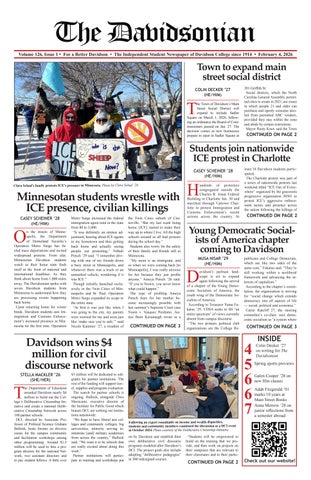
On the streets of Minneapolis, the Department of Homeland Security’s Operation Metro Surge has fueled mass deportations and incited widespread protests. From afar, Minnesotan Davidson students watch as their home state finds itself at the front of national and international headlines. As they think about home from 1,000 miles away, The Davidsonian spoke with seven Davidson students from Minnesota to understand how they are processing events happening back home.
Upon returning home for winter break, Davidson students saw Immigration and Customs Enforcement’s increased presence in Minnesota for the first time. Operation
Metro Surge increased the federal immigration agent total in the state from 80 to 3,000.
“It was definitely an intense adjustment, hearing about ICE agents in my hometown and then getting back home and actually seeing people out protesting,” Nithali Petsch ’29 said. “I remember driving with one of my friends down a busy street in Minneapolis, and whenever there was a truck or an unmarked vehicle, wondering if it was ICE.”
Though initially launched exclusively in the Twin Cities of Minneapolis and St. Paul, Operation Metro Surge expanded its scope to the entire state.
“At first it was just like when I was going to the city, my parents were worried for me and were just like ‘make sure you’re safe,’” said Nicole Kammer ’27, a resident of
the Twin Cities suburb of Centerville. “But my last week being home, [ICE] started to make their way up to where I live. All the high schools around us all had protests during the school day.”
Students also worry for the safety of their family and friends still in Minnesota.
“My mom is an immigrant, and so when we were coming back [to Minneapolis], I was really anxious for her because they just profile anyone,” Ameya Petsch ’26 said. “If you’re brown, you never know what could happen.”
The type of profiling Ameya Petsch fears for her mother became increasingly possible with last summer’s Supreme Court case Noem v. Vasquez Perdomo. Justice Brett Kavanaugh wrote in a
COLIN DECKER ’27 (HE/HIM)
The Town of Davidson’s Main Street Social District will expand to include Sadler Square on March 1, 2026, following an ordinance the Board of Commissioners passed on Jan. 27. The decision comes as new businesses prepare to open in Sadler Square at
201 Griffith St. Social districts, which the North Carolina General Assembly permitted cities to create in 2021, are zones in which people 21 and older can purchase and openly consume alcohol from permitted ABC vendors, provided they stay within the zone and abide by certain restrictions. Mayor Rusty Knox said the Town
Students join nationwide ICE protest in Charlotte
least 18 Davidson students participated.
Hundreds of protestors congregated outside the Charles R. Jonas Federal Building in Charlotte Jan. 30 and marched through Uptown Charlotte to protest Immigration and Customs Enforcement’s recent actions across the country. At
STELLA MACKLER ’26 (SHE/HER)
The Department of Education awarded Davidson nearly $4 million to build out the College’s Deliberative Citizenship Initiative and create a national Deliberative Citizenship Network across 100 partner schools.
DCI, directed by Associate Professor of Political Science Graham Bullock, hosts forums on divisive issues for the campus community and facilitation workshops among other programming. Around $1.5 million will be used to hire a program director for the national Network, two assistant directors and to pay student fellows. A little over
$1 million will be dedicated to subgrants for partner institutions. The rest of the funding will support travel, supplies and program evaluation.
The search for partner schools is ongoing. Bullock, alongside Chris Marsicano, executive director of the Institute for Public Good which houses DCI, are seeking out institutions nationwide.
“We hope to have liberal arts colleges and community colleges, big universities, minority serving institutions [and] military academies from across the country,” Bullock said. “We want it to be schools that are really excited about doing this work.”
Partner institutions will participate in training and workshops put
The Charlotte protest was part of a series of nationwide protests last weekend titled “ICE Out of Everywhere” organized by the grassroots progressive organization 50501 to protest ICE’s aggressive enforcement tactics and presence across the nation following the killings of
CONTINUED ON PAGE 2
Young Democratic Socialists of America chapter coming to Davidson
MUSA NISAR ’29 (HE/HIM)
Davidson’s partisan landscape is set to expand again following the arrival of a chapter of the Young Democratic Socialists of America, the youth wing of the Democratic Socialists of America.
According to Treasurer Yuma Fukatsu ’29, YDSA seeks to fill “an entire spectrum” of views currently absent from campus discourse.
“The two primary political club organizations are the College Re-
on by Davidson and establish their own deliberative civil discourse programs modeled after Davidson’s DCI. The project goals also include adopting “deliberative pedagogies” in 300 redesigned courses.
“Students will be empowered to build on the training that we provide, and then work on projects on their campuses that are relevant to their classmates and to their partic-
publicans and College Democrats, which are like two sides of the same coin,” Fukatsu said. “They’re still working within a neoliberal framework and advancing the interests of capitalism.”
According to the chapter’s constitution, the organization is striving for “social change which extends democracy into all aspects of life — social, political and economic.”
Carter Ratcliff 27, the steering committee’s co-chair, sees democratic socialism as “a system where
4 5 6 6 7
Colin Decker ’27 on writing for The Davidsonian Spring sports previews
Galen Cooper ’28 on new film classes
Adah Fitzgerald ’01 marks 10 years at Main Street Books
Anna Morrow ’28 on junior reflections from a semester abroad Check
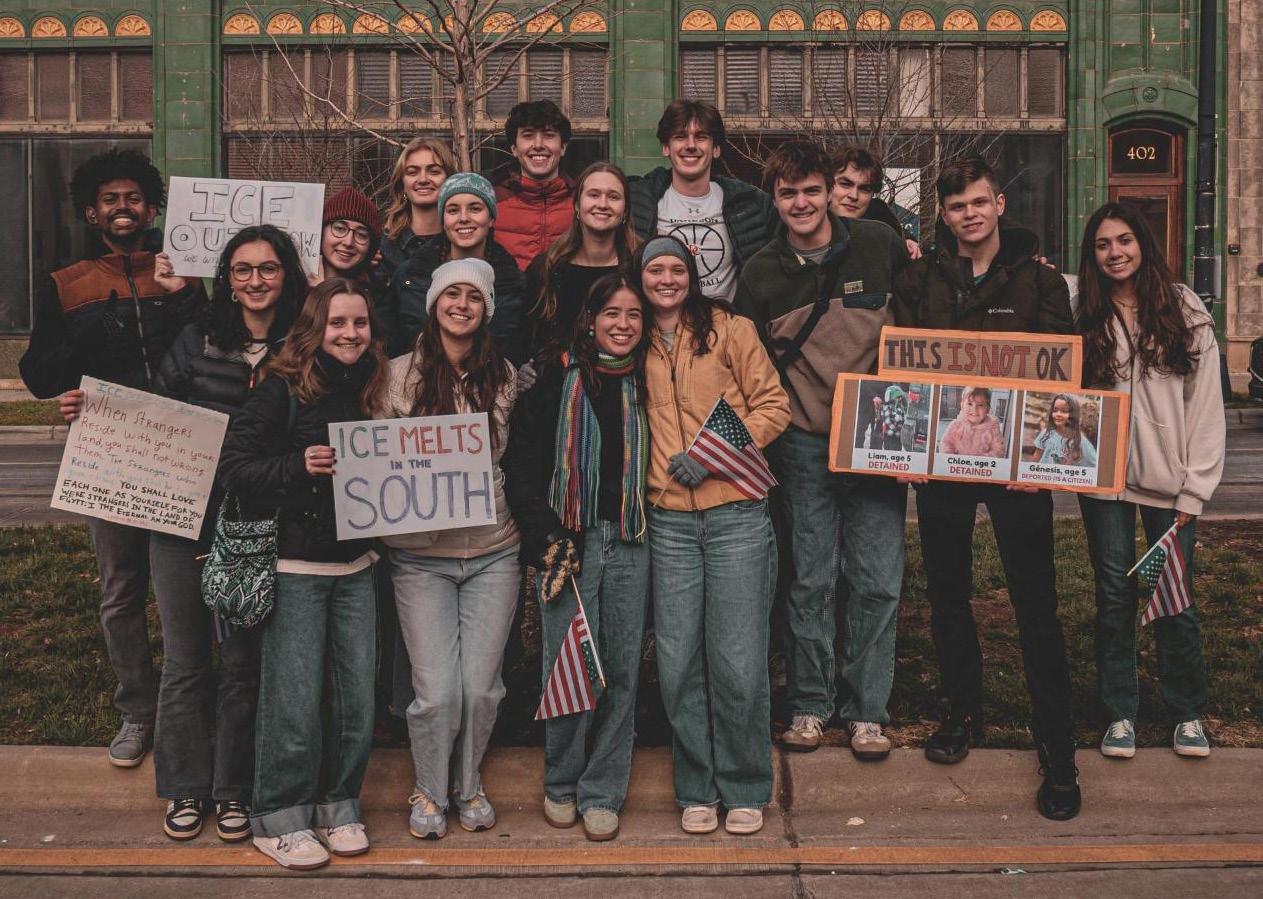
Clara Schad’s family protests ICE’s presence in Minnesota. Photo by Clara Schad ’28.
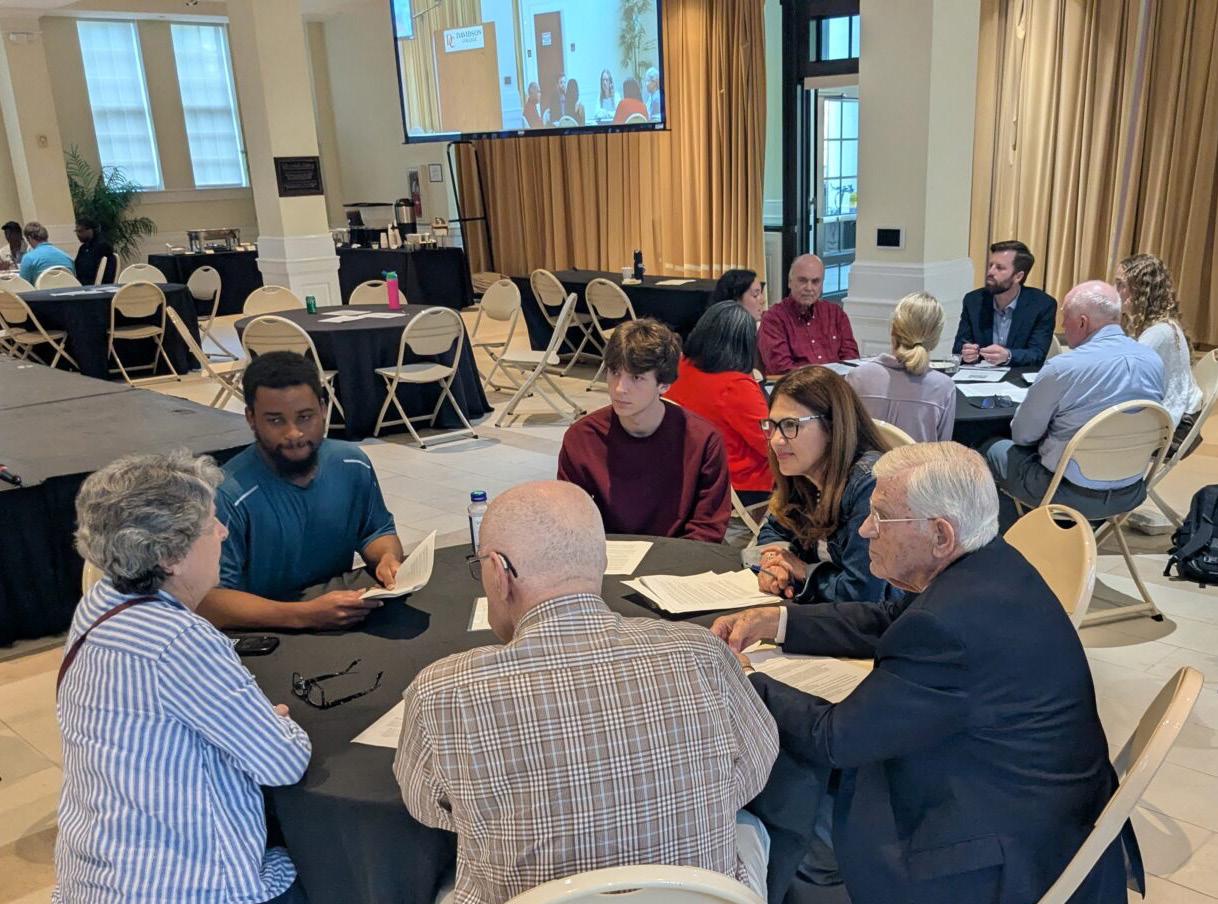
Following an expert roundtable on income and wealth disparities, students and community members continued the discussion at a DCI event in October 2024. Photo courtesy of the Deliberative Citizenship Initiative.
CASEY SCHEINER ’28 (HE/HIM)
Sadler Square to join Town social district
CONTINUED FROM PAGE 1
views social districts as an economic opportunity.
“We have viewed the social district as more of an economic development driver and something that folks that visit Davidson from other areas around the country that already have established social districts are comfortable with,” Knox said.
Davidson established its current social districts in 2023: the Davidson Main Street Social District and the Davidson Circles Social District. The Main Street district began at Depot Street and stretched down Main Street to Eugenia Street. Now, it reaches beyond Depot Street to Griffith Street and Watson Street.
The Circles district is confined to the plaza between Jetton Street and Grocery Lane.
The proposal to expand the district was presented to the board on Jan. 13 and 20. Mayor Rusty Knox said no one raised any issues when the board sought public feedback.
“We’ve literally had no objections since day one to starting the social district and expanding the social district,” Knox said.
Knox understands that residents may be skeptical of openly carrying alcohol around town.
“A lot of people think it’s free range drinking and it’s not,” Knox said.
“We’ve limited where those areas are, and so it’s not like you can just come to town and open a beer and walk all over the place. [There are] defined areas for that.”
The expansion comes just in time for new restaurants arriving in Sadler Square early this year. Harriet’s Hamburgers and Ilio’s Crafted Greek will be the first to open, followed by Seemingly Overzealous Ice Cream.
Jonathan Stewart, partner at Piedmont Capital, the company that owns Sadler Square, said the restaurants will begin settling into their storefronts in springtime.
Rooster’s Wood Fired Grill and Copain Bakery are expected to open between July and August. Minor renovations remain, like landscaping and preparing the interior for kitchen setups.
The new restaurants can waive social district participation regardless of whether or not they will have ABC permits.
Kim Fleming is the Town of Davidson’s economic development director. In an email to The Davidsonian, she explained that businesses can file for one of three types of permits.
“All businesses within the social district have the ability to participate in the social district by submitting one of the following permits: sold here, permitted here, or not permitted here. Each business applies for the permit that corresponds to their level of participation,” Fleming wrote.
“Sold here” businesses can sell and allow alcohol in the social district; “permitted here” businesses allow alcohol purchased in the social district on their premises; “not permitted here” businesses neither sell nor permit alcohol on their property. Decals outside each building in the district will indicate whether or not alcohol is welcome.
Protestors call for ‘ICE out of everywhere’
CONTINUED FROM PAGE 1
Renee Good and Alex Pretti in Minneapolis.
Other local political groups including the Party of Socialism and Liberation, Indivisible Charlotte, Charlotte-Metrolina Labor Council and Seek Justice Charlotte helped lead the event.
Students were drawn to the “ICE Out” protest by the opportunity to vocalize their political sentiments.
“Just sitting and watching the news, I feel guilty that I’m not able to take more action. Being informed is good, but it can only do so much. I was looking for an opportunity to get involved and take action,” Ben Council ’29 said. “I always leave a protest with a renewed sense of hope.”
The demonstrators were united by disapproval for ICE’s heightened presence across the nation, including in Charlotte, where Operation Charlotte’s Web resulted in over 400 arrests. However, the protestors did not all agree on what “ICE Out” truly means: abolition or reform?
“Not everybody at that protest wants ICE to be completely abolished. I can’t speak for everybody, but most everybody at the protest, I would imagine, wants common sense, right? Immigration practices that may be even strict but fair,”
Dylan Swick ’28 said. “The key word, though, is fair, and what we have is this institution that has been granted full immunity to just do whatever the hell they want.”
Professor of Religious Studies Greg Snyder, a local community activist and leader of the Dems of Davidson, also attended the protest. Snyder found himself moved by the performance of the civil rights era freedom song “Ain’t Gonna Let Nobody Turn Me ‘Round.”
“The thing that sticks in my mind was a woman who sang ‘Ain’t Gonna Let Nobody Turn Me Around.’” Snyder said. “I found it powerful. There was a range of speakers, but what stayed with me was that woman singing that song.”
Some Davidson students, while still enthusiastic to protest, were disappointed with the turnout, which paled in comparison to other Charlotte protests against the Trump administration like the “Hands Off” and “No Kings” rallies which drew several thousand.
“There was a crowd, but not as big as we were hoping and expecting,” Carolina Calvo ’29 said. “But when we were there, in the moment, it was really cool to feel the energy of people who were passionate about the issue.”
Swick viewed this limited turnout
as evidence in part of why participating in the “ICE Out” protest was so crucial to his political principles.
“While we were all marching, there were a couple of construction guys of Hispanic origin working on the roof of a building. They looked down at us, and started cheering for us,” Swick said. “These people have seen some of the worst of it firsthand, and yet they’re still out there working their tail off [...] It’s a reminder that for every person you see taking action, there’s a lot of people who really want to take action that can’t but will be so happy to see you doing it.”
Snyder hopes the event serves as a
catalyst for greater student participation in the greater community political scene.
“I was just psyched to see so many Davidson students there. There is a bit of a Davidson bubble, where students get so caught up in the Davidson echo sphere. As someone who’s politically active in the surrounding area, getting students off campus can be so difficult,” Snyder said. “The more Davidson students that are out demonstrating or canvassing or calling or doing political work, the better. That’s a huge win.”
Breaking down the civil discourse grant: where did it come from and where is it going
CONTINUED FROM PAGE 1
ular context,” Bullock said.
The grant comes from the Fund for the Improvement of Post-Secondary Education, which Congress created in 1972 to support student access and retention in higher education. The funds from this program have also historically supported programs related to student success.
In 2024, FIPSE funding was directed toward seven established programs: Postsecondary Student Success Grants, Basic Needs Grants, Veteran Student Success Programs, HBCU, TCU, and MSI Research and Development Infrastructure Grants, the Textbook Pilot program, the Rural Secondary and Economic Development Grant Program and the Transitioning Gang-Involved Youth to Higher Education program.
In 2025, when Congress passed a
continuing resolution to end the government shutdown, it only included top line numbers of how much the Department of Education could spend. Policy makers included information detailing funding for those same seven programs in a supplemental guidance document. However, this guidance was not written into the bill so it was not legally binding, and the Trump administration utilized their authority to repurpose FIPSE funds as they saw fit. The administration established four new priorities: accreditation reform, artificial intelligence and civil discourse.
With $3,999,985 in funding, Davidson received the third largest individual award, following Fisk University and UC Riverside at $4 million, out of 17 institutions awarded funding for civil discourse programming.
Antointette Flores is the director of higher education accountability and
quality at New America. She said it is typical for administrations to set priorities within Congressionally established grant competitions, but eschewing the basic focus of the grant is not.
“Broadly, I think civil discourse programming is important and worth encouraging, but it comes down to how you do it,” Flores said. “Congress didn’t create a grant program for funding civil discourse programs. They created a grant program to fund improving retention and completion and supporting students, and so it’s hard to see how this fits Congressional intent.”
The civil discourse priority comes from the same administration that, in the past year, has terminated or frozen more than 7,800 research grants and projects on topics it dislikes.
Grant applicants have been told to avoid lists of flagged words in their project proposals.
“There’s a tension here between what the administration has said they are not prioritizing versus what they are,” Flores said.
In a press release Education Under Secretary Nicholas Kent said that the new FIPSE priorities will “support initiatives that will continue to enhance the educational experience for all students.”
For colleges, evolving federal priorities are part of the regular grant process, and institutions routinely adjust proposals to reflect updated objectives.
“This administration’s approach has been more aggressive than other recent administrations, but we always have to adapt and pivot to the priorities that each new administration sets for research,” said Rachel Murdock, assistant director of Davidson’s Of-
fice of Sponsored Programs. “In effect, we’re really always doing that every four to eight years anyway, it’s just been a little more dramatic and abrupt this year.”
When pressed on specific words and topics avoided in the FIPSE grant application, Murdock did not provide any examples and said that the College does not tell faculty to “change their projects or change their science” and they work around “hurdles.”
In a similar vein, Marsicano and Bullock said that the government will not influence the Network’s programming or the topics up for deliberation. Students and community members at each school will decide the issues they want to deliberate and work on projects relevant to their specific campus community.
“There is no issue that is off limits simply because the federal government may not like it,” Marsicano said.
Bullock said that DCI’s engagement with controversial issues like gun rights, abortion and immigration contributed to them winning the grant in the first place.
“I think we received the grant partially because of our track record in doing this work, doing it well and doing it in a fair and balanced way,” Bullock said.
The funding will support programming consistent with the DCI’s current scope and activities.
“Davidson has a responsibility to be this sort of beacon in a time when politics have made it difficult for lots of different colleges and universities to stand up for civil discourse, to stand up for freedom of expression,” Marsicano said.
Students protest ICE in Charlotte on Friday. Photo courtesy of Ben Council ’29.
A map of Davidson’s expanded Main Street social district. Image courtesy of the Town of Davidson.
Minnesotans reflect on tragedy in home state
CONTINUED FROM PAGE 1
concurrence that race and ethnicity could be a “relevant factor” to help justify a stop.
One of the major pretexts for Operation Metro Surge was a fraud scandal that swept Minnesota’s welfare system. Because the majority of the charged defendants were Somali immigrants, the large Minnesota Somali-American community has borne a significant share of the blame for the fraud.
President Trump moved to end protected status for many Somali immigrants. Despite most Somali immigrants being in the US legally, Operation Metro Surge has scared many into staying in their homes.
“Almost all the people I knew who were Somali kind of stopped going out,” Will Fledderman ’28, a resident of the Twin Cities suburb of Chaska, said. “I knew a few kids who stopped going to school because of it. There’s a lot of fear right now.”
Far beyond the Twin Cities, Operation Metro Surge has made its reach felt. Clara Schad ’28 lives 90 minutes north of Minneapolis in Sauk Rapids, and spoke to ICE’s presence in her community.
“Every immigrant owned Mexican restaurant is locking their doors,” she said. “So when I was back, we had to knock on the door of the restaurant, and they came and looked at us to make sure we weren’t ICE.”
Unlike the national Republican Party, many Minnesota conservatives have come out against the perceived excesses of Operation Metro Surge, with Republican gubernatorial candidate Chris Madel dropping out of the race in protest of “the national Republicans’ stated retribution on the citizens of our state.”
“People at Davidson from outside of Minnesota who are Trump supporters, I’ve seen them defending ICE,” Schad said. “I’m from a more conservative area in Minnesota, but those people back home are not defending ICE as much.”
Concerned about ICE’s expansion into their neighborhoods, Minnesotans formed local group chats and community groups to protect their neighbors. In Minneapolis, Misha Sostek ’29 was a part of one of these efforts.
“There was an ICE sighting in my neighborhood where it seemed they were attempting to scope out a person’s house in which there were con-
tractors who may or may not have been documented,” Sostek said. “The neighborhood group chat on Signal coordinating to record any instances of ICE in the area all amassed on one street corner. I was part of that with my dad. Nothing really ended up happening. It seemed to be one trooper and one officer in his van, and he drove away afterwards.”
As neighborhood group chats evolved into mass protests against ICE in Minnesota, the killings of two civilian protestors, Renee Good and Alex Pretti, drove popular discontent against ICE, leading White House border czar Tom Homan to announce plans to reduce federal immigration officers’ presence in Minnesota. Still, Good and Pretti’s deaths continue to loom large for millions of Minnesotans.
“[Pretti’s killing] was just really upsetting. It’s scary, because that could be anyone. He was a US citizen. He had the right to bear arms, and he got shot and killed, and he was protecting a woman,” Nithali Petsch said. “It was in front of a donut shop that we loved, so it’s just hitting very close to home.”
For many students, the distance be-
tween Davidson and home has made it even more difficult for students to process such a tragedy in their local community.
“I feel disappointed that I can’t stand with my community right now,” Nolan Elder ’27 said. “If there’s ever been anything where I’ve wanted to go protest in Minneapolis about something, it would be this.”
Some students expressed dissatisfaction with Davidson for not putting out a statement in response to the killings of Good and Pretti.
“I find it disappointing that Davidson hasn’t made a statement about Minnesota yet,” Kammer said. “I think back to Charlie Kirk and his assassination, and there was an email about that. It feels very strange to not have any acknowledgement from the college about this.”
Davidson administrators opted against an institutional statement addressing Operation Metro Surge, instead favoring individualized responses for affected students.
“We understand the desire for the institution to issue statements during times of unrest. Generally, however, we find it more valuable to show how our community is responding
to the moment,” College Director of Media Relations Jay Pfeifer said. “Members of the Dean of Students tend to reach out to individual students who are directly affected; they will be contacting students from Minnesota if they haven’t already.”
On Feb. 3, Davidson students with a permanent address in Minnesota received an email from Vice President of Student Life and Dean of Students MarQuita Barker titled “Checking In.” The email reminded students of the College’s student support systems, the Dean of Students Office and counseling services. “I want to acknowledge the emotional weight these events may carryespecially for those of you who call Minnesota home,”Barker wrote. Many of Davidson’s Minnesotan students continue to express pride in their community and how people have rallied together.
“I’m very proud seeing, from afar, how Minnesotans have gathered around this together. There aren’t many party lines in these protests,” Elder said. “It’s everybody coming together and saying, ‘Hey, this is not okay. We want ICE out of here, and we can’t have things like this happen to our people.’”
Features Politics 3
YDSA to establish presence on campus
CONTINUED FROM PAGE 1
economic success is measured by human well-being instead of profit. Decisions that affect our communities are truly made by the community, not by individuals who have enough money and influence to make decisions that only benefit them.”
Davidson’s YDSA chapter came into fruition through the efforts of two unrelated groups of students seeking a political organization that represented their views. Ratcliff had been thinking about becoming politically engaged on campus since last year, a decision that he partly attributed to the election of President Donald Trump. Eventually, he landed on the idea of establishing a YDSA chapter, leading to the formation of an organizing committee.
Fukatsu’s journey to YDSA was entirely separate. Influenced by the heated and polarized political debates of October 2025 amidst events such as the government shutdown and the No Kings protests, he posted a poll on YikYak, the social media application where Davidson students can create discussion threads anonymously, to gauge interest in a DSA chapter on campus.
Henry Mygrant ’28, also a member of the steering committee, reached out to him to help out. When the two reached out to potential advisors, they learned about Ratcliff and his group and decided to combine forces.
“The fact that two separate groups were simultaneously in the works to create a chapter, not just join an
existing organization, speaks to the political climate as it is currently,”
Fukatsu said. “The youth in particular feel a need to go out there to enact change, having understood that the two party system just isn’t going to cut it.”
YDSA arrives at Davidson as socialism experiences a surge in popularity in the United States, particularly among younger Americans.
A 2025 YouGov-Cato Institute poll found that 62% of Americans aged 18-29 hold a positive view of socialism. Last month, Zohran Mamdani, a DSA member and YDSA alum, took office as New York City’s first ever Democratic Socialist mayor.
As the founders looked to capitalize on this momentum for socialism to form an officially recognized student organization, they encountered difficulties finding a faculty advisor.
“I had quite a few professors who said they really support the work we’re doing, but don’t feel comfortable putting their name on paper, which is fair given the political climate,” Ratcliff said.
The group decided to approach Director of the College Writing Program Katie Horowitz, who currently advises Davidson’s Planned Parenthood Generation Action chapter. Horowitz expressed enthusiasm about the organization’s goals. “I think the inception of this chapter is very timely, given the rising tide of global authoritarianism,” she said. “Many students are scared and confused and want to take action but aren’t sure how. YDSA will provide a platform for political education and action to those students.”
The Davidson chapter is officially chartered with the national organization. Each chapter is largely independent and sets its own priorities within the confines of the national institution’s core guidelines, which includes causes like anti-imperialism.
YDSA is registered with the Student Government Association. Since they chose not to be housed under the Center for Political Engagement, YDSA will not receive college funding. They plan to receive the majority of their funding from the national YDSA.
YDSA is eager to collaborate with other campus political organizations, but acknowledges that some may be hesitant to reciprocate. “I don’t know who we may work with as of yet, because a lot of that is going to depend on who’s comfortable working with us,” Ratcliff said. “We recognize, especially in the current political climate, tying yourself to a socialist organization is pretty risky. So a lot of it is going to come down to, is X organization comfortable co-hosting with us?”
One opportunity for collaboration may exist from the other side of the political spectrum. Oliver Genovese ’28, president of Davidson’s chapter of the conservative student group Turning Point USA, expressed interest in collaboration.
“[Socialism] has no benefit whatsoever. But regarding people who believe in that, I don’t judge people based on their ideologies,” Genovese said. “Finding compromise right now is really important, especially when you see how it’s non-ex-
istent in Washington DC currently.
But you need to have the ideas out there first to make a compromise.”
As YDSA begins to assert its campus presence, it aims to hold events under the banner of three pillars: community building, political education and service.
To kick off these efforts, it is hosting YDSA 101: An Introduction to Socialism and YDSA at Davidson on Thursday, Feb. 5. The invitation emphasizes the open nature of the meeting, whether attendees “already identify with left-wing ideas or are just interested in learning more.”
As the organization takes shape, YDSA leaders note both tangible campus goals and loftier ideological aims.
One of these is winning over socialism’s doubters. “I think it’s funda-
mental to strip down whatever negative connotations may be attached to socialism and try to understand what the core value of it is: eliminating wealth inequality,” Fukatsu said. “This is a system in which it benefits the 99.9% of people, while the current system that we live under benefits the top 1% and that’s not a sustainable system at all.”
YDSA’s steering committee also wants to leave a permanent mark with a firm foundation. “One of our fundamental goals right now is to make it sustainable. We—me and the rest of the organizing committee—don’t want to leave Davidson and have the organization kind of die,” Ratcliff said. “We want to create a system that people feel engaged in and want to keep going.”
A Davidson chapter of the Young Democratic Socialists of America seeks to make its presence known on campus this spring. Image courtesy of y.dsausa.org.
Perspectives
Wrestling With God and Evil in WRI 101
Most courses at Davidson end when students submit their final exams or papers. Still, most Davidson students have one class that sticks with them. For me, that class was my first-year writing course, taught by Dr. Swenson-Lengyel in the religion department, which explored the problem of evil. The class studied why there can be so much evil and suffering in the world if God exists. As a junior now, the theological problem the course confronted still troubles me.
We have all wrestled with evil and suffering. Even college students just beginning adulthood can think of many examples in their own lives: the death of a loved one, illness, or family struggles. For theists, evil takes on a deeper significance; it’s a direct challenge to the proposition that an omnibenevolent and omnipotent God exists. What frustrated me when learning about the problem was that it challenged my perspective on the world. As a student studying math and economics, I’m used to getting concrete answers about the world. However, after examining the discourse on the problem of evil spanning thousands of years across multiple theistic traditions, I’ve concluded that it remains unanswerable.
Opponents of theism have long argued that if God is all-powerful and all-good, he can prevent and would want to prevent evil and suffer-
ing. However, the world is filled with suffering. Therefore, we should conclude that God doesn’t exist. This is called the logical problem of evil. It suggests that the existence of God is logically impossible given the amount of suffering in our world, just as it’s logically impossible for square circles to exist.
Initially, this argument seemed strong to me. But once I started reading responses from theistic philosophers in my religion course and beyond, the flaws were clear. One only needs to give a morally sufficient reason why God would allow evil to demonstrate that evil and God can co-exist without there being a logical contradiction.
Two classic examples are the free will and natural law defenses. The free will defense claims that moral evil, which is the evil resulting from human actions, is a consequence of free will. God would choose to create a world among many possible worlds in which rational creatures could make their own decisions without being thoughtless robots, because it’s a better overall world. The natural law defense argues that the natural evils we observe in the world, such as illness, death, and natural disasters, result from the greater good of natural laws that are necessary for a stable universe, which were fine-tuned for life to emerge.
Yet, while reading about these common arguments made by religious believers, I discovered a problem. The arguments made in response to the logical problem of evil are deductively valid
and seem to be satisfactory if one believes in a deistic God who is nothing more than an engineer of the universe. Yet, these arguments are irrelevant if one believes in the God of the bible.
The arguments, like the free will and natural law defenses, portray God as a divine engineer who can only bring about greater goods by allowing some evil, rather than the ground of being who is goodness itself in classical theist theology. The bible declares that evil is not God’s way of bringing about greater good, but something that is contrary to God’s nature and should be overthrown. If one accepts the bible as holy scripture and uses these common arguments, they must hold to the idea that God can only bring about good by massive suffering.
Religious thinkers have offered numerous responses to this problem, yet I find many of them frustrating. St. Augustine provided one of the strongest arguments theists can offer. For Augustine, evil isn’t a substance that exists but a privation, which is a lack of good. God, who is the ground of being and goodness, created only what is good, but evil arises when rational creatures turn away from God. Additionally, the Fall in the Bible, which modern readers can interpret as the necessary estrangement of finite creation from the infinite source of being, entailed a universe that would contain disorder. Yet this places significant blame on humans, who are finite creatures in a universe where most things remain beyond their control. Others have argued that evil in the world can provide
As a biased news editor, I think YOU should write for the Davidsonian…
Ihave a proposition, Dear Reader. I think YOU should write for The Davidsonian. Before I get into the weeds, I suppose I should address the aforementioned bias: I am a News Editor, so of course I want more people to sign up and help us out. The week-toweek coverage of the goings-on at Davidson College would not be possible without the dedicated and intelligent staff of writers and editors, who work their [redacted]’s off every week for the sake of this glorious and devastating thing we call “the news.” But, that staff always has room for growth: diversity is a delicious recipe for a great newsroom. Now, to woo you. Ready for the clichés? The Davidsonian is an opportunity unlike any other: it’s a chance to put your fingers in different pies; to dip your toes into the water and see if it’s warm; to learn something new about yourself, and develop skills for the future. Ready for the kicker? It’s a once-in-a-lifetime chance you don’t want to pass up on.
There, I said it. I know, I know. I felt gross writing it. Still, trying to put it any other way would be an exercise in futility: it really is all those things.
If you’re a writer, or someone who has to write on a fairly-regular basis (cough, cough: literally everyone here!) it’s a chance to work on sharpening your prose. Ernest Hemingway
was a journalist, after all, and revolutionized English literature with his economic writing style. I am not promising that you will become the next Hemingway if you start writing for us. Maybe, but I doubt it. Through rounds and rounds of editing and talking shop with fellow writers and editors, you will learn habits to help you write with every Writing 101 professor’s two favorite words: clarity and concision.
I work as a Writing Center instructor, and the writing and revision techniques we learned align almost one-for-one with the fundamentals of good journalistic writing. The best compliment I ever received on an essay was that my work was “admirable for its clear position.”
That’s half the battle for a good grade!. As if the deal couldn’t get any better, once we help you write the best possible story, we’ll publish it to the masses for free. You can flaunt your new writing skills.
It doesn’t have to be strictly news writing, either. Our Features and In Living Davidson sections allow you to explore every aspect of life at Davidson. The Sports section gives you a chance to talk to your favorite local celebrity coaches and players; if you’re brave like I was, you can call a head coach’s zone defense “lackluster.” He laughed, fortunately. Want to get to know local government figures, or analyze how US policy affects students on campus? I think Politics might be for you. Want to write a cheesy open letter to your peers to encourage them to help with a publication you would do
anything for? Well, baby steps, first of all. Join the staff, then, you can go to the Perspectives section.
In all seriousness, stepping away from the formulaic ‘pretty please’ thing I’ve got going on, I think there’s one more bias I neglected to acknowledge: The Davidsonian gave my Davidson life purpose. Because of my work with this paper, I feel entrenched in both the town and college’s communities. I’ve been able to have incredible conversations about basketball, politics, life, etc. Anything you can imagine.
I’ve spoken with Doug Hicks ‘90 about winning amateur ping-pong championships and working as an on-call minister at a hospital; I watched Coach Bob McKillop shed a faint tear as we relived his 2008 Elite Eight run together; I listened to an international student describe how she fought for the better part of a
goods. For example, virtues like courage and charity can only arise in a world where some evil and suffering exist. However, can we truly believe that the amount of evil throughout history was worth the courage shown in times of crisis?
Ultimately, my first-year writing class not only taught me writing skills but also the ability to evaluate philosophical and theological problems, even when they appear unanswerable. Debates about the problem of evil will continue, just like they have for centuries. So, what is a religious believer, let alone a non-believer, supposed to do in the face of evil and finitude? Perhaps the only answer to the problem of evil, finitude, and a world of unanswered questions for religious believers and nonbelievers alike is to have courage. As the theologian Paul Tillich put it, one must have the “Courage to Be” and affirm oneself despite the threat of non-being.
Gabriel Russ-Nachamie is a junior from Lincolnton, North Carolina studying economics and math. He can be reached for comment at garussnachamie@davidson.edu.
year to come to school in the US, knowing she wouldn’t see her family again for four years. Each conversation, in its own way, is an intimate engagement with the human condition. After all those conversations, all the stories published, the drafts torn apart during revision, I’d be lying if I didn’t admit the best feeling: saving a pile of freshly-printed newspapers in your desk drawer to bring home, because your family and friends told you they were excited to read what you had written.
Colin Decker is a junior from Maggie Valley, North Carolina studying English. He can be reached for comment at codecker@davidson.edu.
COLIN DECKER ’27 (HE/HIM)
GABRIEL RUSS-NACHAMIE ’27 (HE/HIM)
Sports 5 Wrestling Lacrosse Baseball
ALEX THOLE ’28 (HE/HIM)
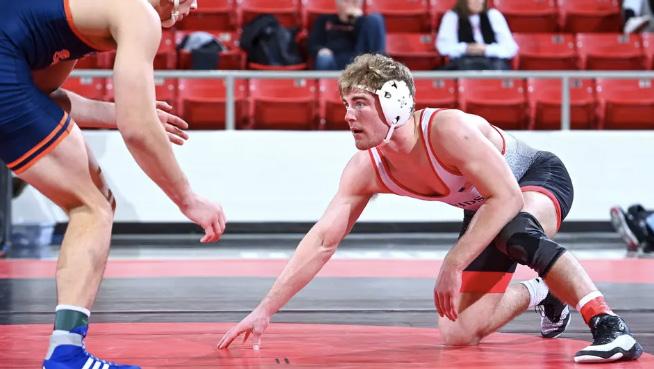
With five weeks until the postseason, Davidson wrestling is staying focused on “the little things,” Tyler-Xavier McKnight ’27 said.
The ’Cats currently stand at 2-2 in Southern Conference (SoCon) play, with wins against Presbyterian College and Gardner-Webb University. Davidson dropped their last match at home against Bellarmine University on Jan. 30. “This time of the season can be a lull,” McKnight admitted, “so the big thing is keeping that level of focus and being healthy.”
A difficult stretch of duals tested the ’Cats early. Consecutive losses against #21 University of North Carolina at Chapel Hill, #21 Purdue University and #13 Rutgers University gave Davidson valuable experience for the remainder of the season. “We have a lot of guys with ranked wins, so I think by conference time we’re going to do pretty well,” McKnight said.
Four conference meets remain on Davidson’s schedule before the SoCon Championships on Mar. 6-7 in Asheville, NC. Their final conference dual versus Campbell on Feb. 20 will serve as Senior Night for the ’26 class: Marc Koch, Luke Passarelli, Tanner Peake and Christian Rutherford.
Davidson will additionally host the third annual Wildcat Open on Feb. 22 as their final regular season contest. A year ago, McKnight earned his first career tournament win at the 2025 Wildcat Open, sweeping his opponents 4-0.
In 2025, Davidson finished eighth out of nine in the SoCon Championships. McKnight and the ’Cats will look to improve on that result this season.
M&W Track and Field
With the 2026 indoor season on the horizon, Davidson’s track and field team is excited about what the next few months will look like. “Everyone feels really good about [the season],” women’s team captain Hannah Casey ’26 said. “We have a young and talented team with lots of drive and passion.”
The team has already had an impressive first meet with many personal bests and school records. The men’s team is also showing promise this season, with several new recruits and returning athletes demonstrating early potential.
“We’re optimistic on this season and how it’s going to play out. We had a solid first meet at the Tyron Invitational on Friday, with some good performances across the board showing great potential for things to come. Some of our young guys displayed real passion for the sport, which is a great indicator for the program’s future,” men’s team captain Ryan Harris ’26 said.
Similarly, the women’s team combines experienced veterans with talented newcomers, giving the squad depth and optimism heading into the conference season. Key athletes to look out for this year include freshman sprinter Leila Haley ’29, jumper Stefania Williams ’28 and thrower Ashley Rangel ’28. Captains Molly Sullivan ’26 and Chris-Ann Nelson ’26 will help lead the ’Cats alongside Casey.
For the women’s team, the goal seems to be climbing the conference ranks. “We’re the smallest team in our conference, but mighty [...] placing in the top five is very feasible this year,” Casey said.
With so many new recruits, Casey makes it clear that the top focus is balancing hard work with enjoyment. “Trusting the process and having fun [...] it’s all a process, and the work you put in is going to show eventually.”
With so many new faces and a strong core of returning athletes, this season promises exciting performances and growth across both squads.
Davidson will compete next at JDL in Winston-Salem, NC on Feb. 6-7 before traveling to Boston for the David Hemery Valentine Invite on Feb. 13-14.
ANNA MORROW ’28 (SHE/HER)
Davidson Lacrosse finished their 2025 campaign in the Atlantic 10 (A-10) Playoff Quarterfinals to Virginia Commonwealth University. “I believe our team has some unfinished business,” Head Coach Kim Wayne said.
The ’Cats have had great success in the past two seasons, setting a program record of a third place conference finish in 2024 and tying that record in 2025. Though the team graduated one of its top scorers, Josie Lambert ’25, they look forward to two more seasons of top scorer Jenna Skibbe ’27 who broke the program record for single-season goals last year.
Skibbe echoed Wayne in her comment on the 2026 season. “I am looking forward to competing with my best friends and hoping to build on the progress we made last year.”
On the defensive end of the field, Kayla Joyce ’27 returns for her third season in the program after being named A-10 Goalkeeper of the Year last season with a save percentage of 49.2%.
Joyce is confident in the depth of her team and the success that will provide them late into the season. “We have a roster full of girls that are willing to work hard, push through anything, and all believe in one another,” Joyce said. Davidson will host the A-10 tournament from Apr. 30 to May 3, adding incentive for a deep playoff run. “Getting the chance to host the A-10 Championship makes it even more special. Our goal is to take advantage of that opportunity and finish the season by bringing home a championship,” attacker Shayna Broadman ’26 said. Davidson will open their season at home against Wofford College on Feb. 7.
M&W Tennis
Davidson Women’s Tennis began their spring 2026 season with a 7-0 victory over Queens University on Friday, Jan. 23. The ’Cats are getting back into action after playing for much of the fall. “[The] team had a good start to the season this fall. We had much success in several tournaments and had a doubles team break school history,” Head Coach Susanne Depka said.
This record was set by Savanna Kollock ’26 and Bryson Langford ’27, who defeated the University of North Carolina at Asheville in October to advance to the round of 16 in the ITA Regionals at UNC Chapel Hill for the first time in program history.
Both Depka and Associate Head Coach Kelly Larkin emphasized the importance of individual and collective growth throughout the season. “Our goal isn’t to have it all perfect right now, but rather to work towards creating the confidence we need to dominate at [the Atlantic-10 Championship],” Larkin said.
Men’s Assistant Coach Matthew Fung demonstrated similar optimism for the spring based on fall performance. “I would say we’re excited about this upcoming season because of the determination and competitiveness this group has shown since the fall,” Fung said.
With a full season of matches ahead, the men’s team looks forward to making an impact on the Atlantic 10 (A-10) this season. Goyo Hidalgo ’28 credited the hard work the team has put in on the court in preparation for the 2026 season. “I think everyone in the team is improving not just individually but as a whole. We’re working on the right things on the court and trying to bring the same attitude outside the court as well.”
Fung echoed the hard work the team has put in. “This team is eager and ready to put all that hard work to the test.”
The ’Cats ended the 2025 spring season fourth in the A-10 postseason rankings. The team is hopeful and prepared to finish above that this year. “I’m excited to see the guys fight and compete for one another as we continue our goal of improving each and every day and playing with passion and energy,” Fung said.
The men will host Lenoir-Rhyne University on Feb. 4 while the women next compete at home against North Carolina Central University on Feb. 7.
KATIE DEACON ’27 (SHE/HER)
Anew season brings new expectations for Davidson Baseball. The 2026 campaign will begin by battling the Bryant University Bulldogs at home on Feb. 13. The ’Cats also welcome new assistant coach John Lyons-Harrison to the staff, who previously served as assistant coach of Iona University Baseball for two seasons. Davidson Head Coach Rucker Taylor enters his eighth season leading the Wildcats, and his 14th overall season on the Davidson staff.
The team has only a few returning players this spring. Captain Wilson Perkins ’26 views this as advantageous rather than a pitfall for the group. “We’ve had pretty much every spot available coming into the season,” Perkins explained. “I feel like it’s kind of lit a fire inside everybody […] and that motivations can lead to something a lot bigger.”
Davidson is coming off of a strong 2025 campaign, but the ’Cats move forward with new goals and new perspectives. “From a pitching point of view,” Perkins said, “our main goal this year is to make [the other team] beat us. Don’t let the walks beat us.” Looking ahead, he finds the team’s strength to stem from the closeness of the group. “It sets us apart […] we do everything as a unit.”
The Wildcats will begin official Atlantic 10 conference play in mid March. The team is also scheduled to battle against historically highly ranked Wake Forest University at the end of the month on Feb. 27.
M&W Swim and Dive
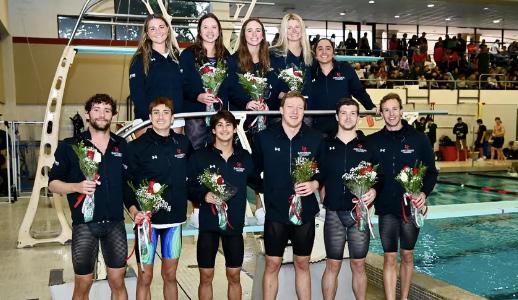
With most of the regular season behind them, Davidson Swim and Dive is shifting their focus toward the meet that matters most. As Atlantic 10 (A-10) Championships approach, the Wildcats are trusting their work and looking forward to performing on Feb. 18.
The women’s team captain, Olivia Quinn ’26, emphasizes energy and enthusiasm as the team dives into the final few meets of the season. “Nobody is shying away from the challenging practices,” Quinn explains. “We’ve really honed in on the competitive mindset and our confidence on the boards.”
Davidson has a Wildcat projected to place high in the upcoming A-10 Championships in both swim and dive. Ann Thompson ’27 is currently ranked fourth in the A-10 in the 200-meter backstroke and Elle Jacobsen ’27 is also ranked fourth in the 1-meter dive.
On the men’s side, captain Fletcher Smith ’26 echoes a similar spirit. “The team has had a tremendous amount of success so far this season […] with a great deal of coverage across all of the events, with our top performers Dylan Felt ’26 and Henry Shoemaker ’29 sitting at or near the top of the A-10 standings.” As the A-10 Conference record holder of the 200-meter and 500-meter freestyle, Felt will look to earn an NCAA qualifying spot. In a combined effort, Smith hopes to capture a win in the 800-meter freestyle relay, a victory the Wildcats have been chasing for the last few years.
The ’Cats have one last go before conference, swimming against Gardner-Webb University on Jan. 30 and diving at the Virginia Tech Invitational on Feb. 6. “Both [meets] will be great indicators in terms of where we stand competitively as well as where we need to make improvement over these next couple of weeks,” Quinn said. “I’m hyped to see the races and dives we’ll produce.”
ADRIAN FORSHAW ’29 (HE/HIM)
ANNA MORROW ’28 (SHE/HER)
KATIE DEACON ’27 (SHE/HER)
Courtesy of Tim Cowie/Davidson Athletics
Courtesy of Jack Fischer ’28
Courtesy of Tim Cowie/Davidson Athletics
Arts & Entertainment
Adah Fitzgerald ’01 celebrates ten years as Main Street Books owner
KRISTIE KANG ’28
(SHE/HER)
ZAINAB SAWANI ’28
(SHE/HER)
Walking down Davidson’s Main St, it is hard to miss Main Street Books.
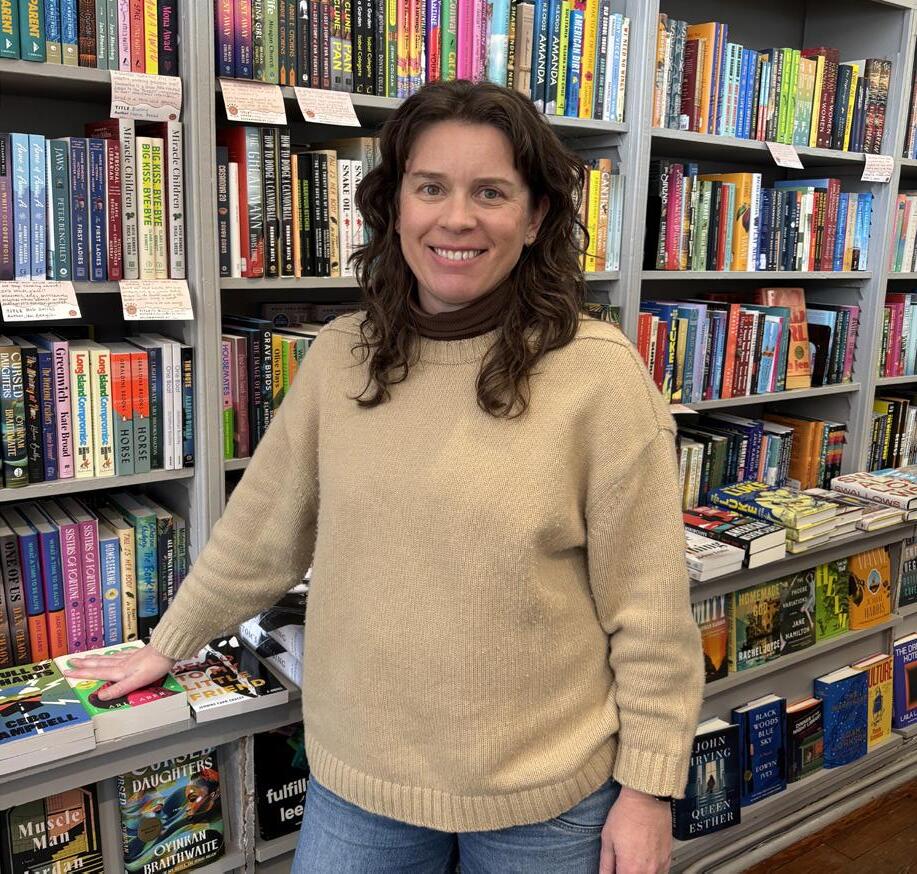
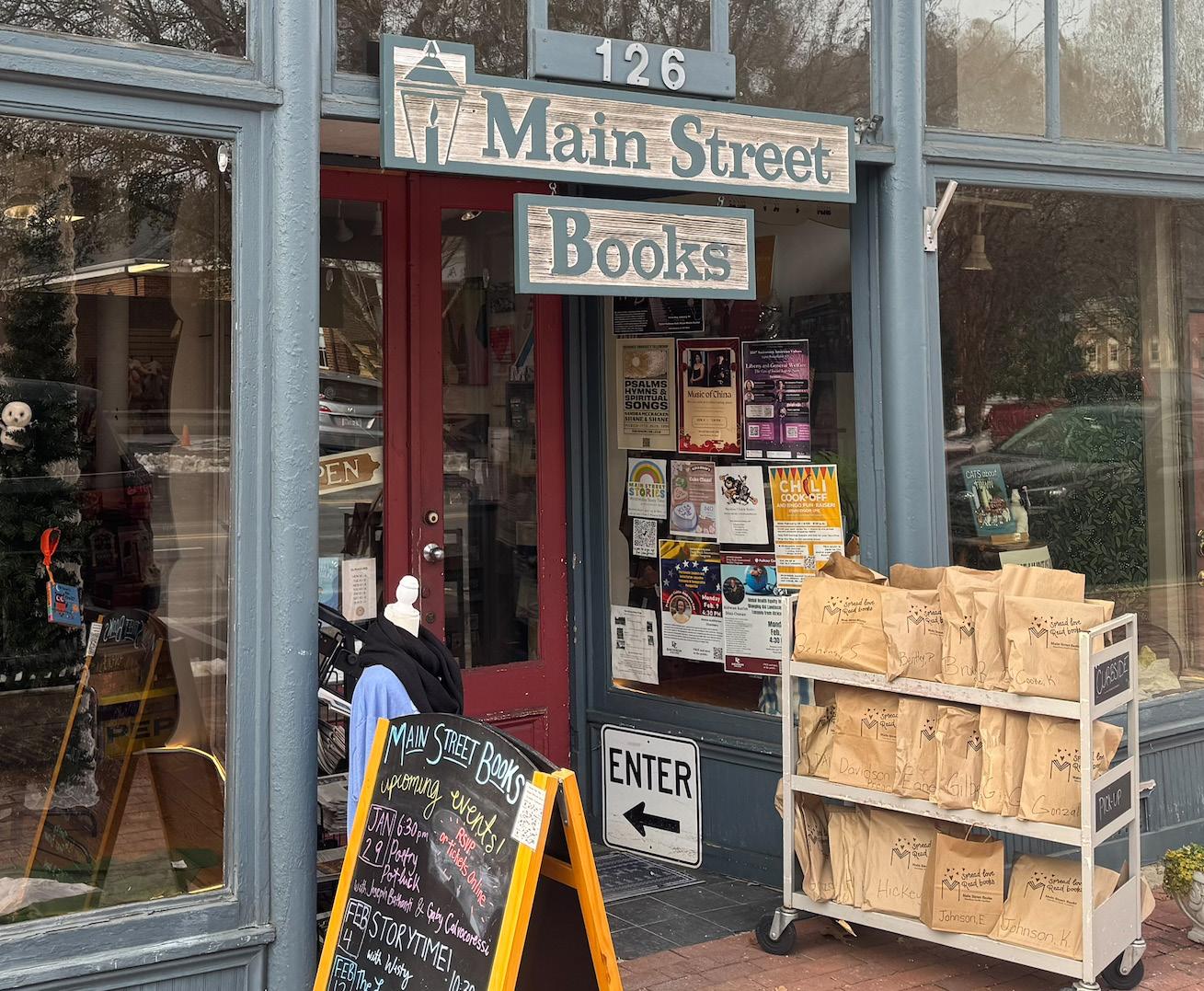
Newspapers sit outside, curated displays line the windows, and inside, you might run into the store’s owner, Adah Fitzgerald ’01. This year marks a special occasion for her, but you would not know it just from walking by.
This is Fitzgerald’s 10th year as the owner of Main Street Books, but the store has occupied the first floor of Brown’s building since 1987. When original owners Betty Reinke and Barbara Freund decided to retire in 2015, Fitzgerald and her mother, Mary Barone, bought the store.
“It’s funny because the bookstore itself is not having a milestone,” Fitzgerald said.
Nonetheless, this ten year anniversary remains a special achievement.
“It is pretty remarkable to think about that first couple of years and where we are now,” she said. “I feel like there are a lot of the nuts and bolts things about running this business that I have reached sort of [an] expert level,” Fitzgerald said.
As a Davidson College alumna, Fitzgerald pointed to the lasting impact of her liberal arts education. Although she studied biology, she emphasized
that Davidson taught her far more than a single discipline. It helped her learn how to be a critical thinker and flexibly learn new things. “[My time at Davidson] gave me the confidence to be like, ‘do I know how to run a bookstore? No, but can I figure it out?
Yes,’” Fitzgerald said.
After graduating, Fitzgerald remained in the Charlotte area, where she taught science for several years before purchasing Main Street Books. Fitzgerald remembered a sense of “automatic belonging” upon coming back to the Town of Davidson years later. She also acknowledged that “it took a couple of years to really get kind of warmed up.”
Today, Fitzgerald continues to strengthen the bond between the store and the college community. For example, the store hosted a literary potluck on Jan. 29, inviting authors and poets from Charlotte and Chapel Hill to exchange ideas with locals on literature and their work.
Watching a decade pass as an owner allowed Fitzgerald to reflect on how much can change behind the bookstore’s brick facade.
“You really have to come to terms with becoming very attached to your people who work here, and then being very proud when they go off and do things,” Fitzgerald said. “And feeling the sadness too, but not feeling it like something’s wrong. That is the nature of the beast.”
Main Street Books not only provides
a community for Davidson’s current residents, but also participates in the broader college alumni network. Fitzgerald is very proud that two people who worked for her as booksellers during their college years now work for Penguin Random House.
“This was a stepping stone on their path to being working for a publisher. That’s crazy,” Fitzgerald said.
Beyond its public messaging, Fitzgerald emphasized that Main Street Books’ role in the community is shaped by its commitment to creating an environment that feels “really welcoming and open and inclusive.”
The bookstore is “a special kind of retail,” Fitzgerald said. “We have a voice.”
This past Friday, Jan. 30, the bookstore participated in an Economic Blackout Day to protest against Immigration and Customs Enforcement’s presence in Minneapolis. Staff transformed the bookstore into a space for the community to hang out and make crafts without the expectation of buying anything. Fitzgerald also donates to Circle de Luz, a Charlotte-based organization that funds education for young Latina girls.
Cameron Rogers ’28, a bookseller at Main Street Books, emphasized the store’s unique atmosphere.
“It’s definitely not one of those jobs where you just show up and feel like you’re a part of a cog in a machine,” Rogers said. “It really feels like you’re a part of an organization or like a team that cares for something and has moral values because it is so people-oriented.”
For Fitzgerald, Main Street Books’
impact is rooted in the relationships the store builds with its customers and the broader Davidson community, reifying the store as a space where values, conversation and community connection intersect.
“She’s somebody who’s very invested in [social and community causes] and I really appreciate that as an employee,” Rogers said. “When [Adah] comes in for events or on Saturdays, it’s so interesting to see how many people in the community know her personally, who will come in and ask for her, [and] would like to see her staff part of the shelf.”
After a decade of Fitzgerald’s ownership, the bookstore stands as a testament to what thoughtful leadership, community care and a love of literature can build—a safe haven where Fitzgerald’s care for stories and people continues to shape the heart of Davidson.
Davidson adds two new classes in Advanced Film Production
produce them. The completed films will be screened at the Verna Miller Case Symposium on May 7.
Davidson’s Film, Media, and Digital Studies department added courses in Advanced Screenwriting and Advanced Filmmaking this spring. The new offerings mark the department’s steady growth since it was created by a 2024 merger between the Film and Media Studies minor and Digital Studies department.
The two classes work in tandem, forming a creative partnership. Over the course of the semester the students in Advanced Screenwriting will work to create three to four short scripts and the Advanced Filmmaking class will
Chair of Film, Media, and Digital Studies and Professor of Music Neil Lerner is excited by this development.
“In a blink of an eye, look what we got going on here, a professor in both filmmaking and screenwriting. It’s a natural sort of synergy.” Lerner said.
“I honestly never thought I’d see it in my time here, so it’s great we’re finally doing it.”
Assistant Professor of Film, Media, and Digital Studies Erin Semine Kökdil, who teaches Advanced Filmmaking, arrived at Davidson College this past summer. As an award winning documentary filmmaker, Kökdil
brings wealth of experience and excitement to a burgeoning program.
One of her students in Advanced Filmmaking, Matteo Liu ’28, highlighted the excitement around Kökdil’s arrival.
“She brings so much real world experience to the classroom, having worked in the film industry for so many years [...] I want to be a documentary filmmaker, so she is the perfect professor for me to learn from,” Liu said.
The advanced class builds on technical skills developed in the introductory filmmaking class. From pre-production through post-production, students learn more about their own artistic tastes and career goals in the process.
“For me, the advanced filmmaking class is giving us the preparation to succeed in this industry [...] it’s giving us a comprehensive approach to making a film, including precise production and experience collaborating in crews to bring the screenwriters’ visions to light,” Liu said.
It also challenges students through the creation of filmmaking manifestos “to explore the ethical considerations behind the stories they want to tell,” Kökdil said.
For Visiting Assistant Professor in English Jeff Jackson, this collaboration gives his students in Advanced Screenwriting a unique opportunity.
“The fact that student screenwriters can have their scripts produced, that’s really something you only see in graduate programs so it’s really cool we’re doing it here at the undergraduate level,” Jackson said.
Aside from having their short screenplays produced, students in Advanced Screenwriting are learning more complicated skills such as writing scripts outside the traditional three act structure and beginning on a full length screenplay. After teaching the Intro to Screenwriting class for years, Jackson is ready to have a class dedicated to further developing students’ artistry.
“I’m glad that there’s finally an advanced screenwriting class, because once you’ve mastered the basics of screenwriting in the intro class, you can start to apply it on more complex projects in the advanced class,” Jackson said.
Jackson, who also runs a Global Cinema Classics series on campus, hopes that this expansion of the Film, Media, and Digital Studies program will lead to more student interest in film screen-
ings and independent projects outside the classroom.
“I hope there is going to be a bigger culture of screening films and making films [...] for students collaborating even outside of class on projects during the summer,” Jackson said. Kökdil hopes to offer more film classes in the future, including one focused on documentary production. She also hopes to get the College more involved with external film communities.
“I love the idea of tapping into Charlotte’s arts community, such as the Charlotte Film Festival and connecting with other universities around the state,” Kökdil said.
For Lerner, the new classes and the expansion of the department have been a long time coming and already promises students a world of new opportunities.
“Just look at what Davidson alums are doing in the other arts we have supported for decades [...] I think we can catch up really quickly, just with the type of students we get here and the kind of resources the college has,” Lerner said.
To Kökdil, the relative newness of the program is what makes it unique.
“We can really develop the program in the ways the students want, pull in local resources and decide what kind of stories Davidson students want to tell. It’s kinda like clay, and we’re all working to shape it,” Kökdil said.
Lerner is impressed by the College’s support for the program. He echoed Kökdil’s sentiment. “When the College commits to doing something, we do it well.”
GALEN COOPER ’28 (HE/HIM)
Left: Owner Adah Fitzgerald ‘01 poses inside Main Street Books. Right: Main Street Bookstore’s entrance. Photos by Wyatt Gessner’28.
Visiting Assistant Professor in English Jeff Jackson’s Advanced Screenwriting class. Photo by Colin Decker ’27.
Living Davidson
Vegan Before and After
Juniors reflect on journeys abroad
deeply involved in the Peruvian community in Arequipa.
Many Davidson juniors returned from their studies across the globe this semester with new ideas for their aspirations at Davidson and beyond. The Davidsonian spoke with five students to learn more about what they have been up to for the last six months and how their perspectives changed.
Emma Busch ’27 was in Arequipa, Peru; Claire Carroll ’27 studied in Byron Bay, Australia; Anna Farmer ’27 spent the majority of her time in Chiang Mai, Thailand; Hajar Hussein ’27 was based in Edinburgh, Scotland; and Evie Mount-Cors ’27 split her time between Tunis, Tunisia and Palermo, Sicily.
Busch participated in the Davidson in Peru program alongside seven other Davidson students. They took a course in Latin American politics taught by Frontis W. Johnston Associate Professor of Political Science Katherine Bersch and were
“I volunteered with this organization called HOOPS, Helping Overcome Obstacles Peru,” Busch said.
“Their mission is English courses for elementary age kids in this one neighborhood in rural Arequipa. It’s [...] an under-resourced segment of the city.”
Carroll began her studies in Australia through classwork in environmental science and sustainability. She completed an independent research project in the final five weeks of the program.
“I did my project on local crafting and specifically knitting and how clothing creation places values of sustainability within the community and how a lot of people are already engaging in sustainable fashion without knowing it,” Carroll said.
Hussein participated in a direct enrollment program at the University of Edinburgh where she took courses in educational studies and Arabic,.
She was also able to get involved in local student life.
“I joined the Polar Plunge Society, so we went to different bodies of water around Scotland and did polar plunges. There was even a time I got to polar plunge in the same lake that the Loch Ness Monster lives,” Hussein said.
While Farmer spent the majority of her semester in Thailand studying climate change and sustainability, her time abroad began by completing a route of El Camino de Santiago in Europe, supported by a Dean Rusk grant.
“I was on the northern coast, walking right alongside the ocean.
Beautiful cliffs and quaint little towns, wonderful people, wonderful food, conversation, all of that,” Farmer said. “I was talking to people about their perceptions on climate change and how they learned about climate change growing up.”
Mount-Cors gained language and educational opportunities while studying in Tunis, where she focused primarily on migration.
“[The program] made me interested in immigration in general, because it
was very interesting to study that in the Mediterranean. But it also made me want to focus more on what’s going on in the US,” Mount-Cors said.
All of the students expressed similar growth patterns during the semester.
Carroll left for Australia hoping to learn to be more independent.
“I was pushed out of my comfort zone to do things alone a lot, and I think it was really great to learn how to do that,” Carroll said. “I think the independence that I learned abroad is definitely the biggest thing I will be taking back [to Davidson].”
Busch had a similar experience with the opposite result during her time in Peru. Although she initially resolved to avoid speaking English to improve her Spanish, Busch gradually changed her perspective.
“There were some people in our international student group within the university we were directly enrolled in that would speak to us in English,” Busch said. “I think if English is a shared language in a situation then that’s beautiful and I
think you’re fitting into that.”
Similarly to Mount-Cors, Hussein developed interest in her coursework at the University of Edinburgh. She is continuing to pursue those interests interest her coursework at Davidson.
“This semester I’m in Comparative and International Education with Dr. Marsicano and honestly, after having taken an international development aided humanitarianism class, I feel like we’re touching on some of the same topics I touched on in my abroad class,” Hussein said.
Farmer expressed a new outlook on her work at Davidson. “[Studying abroad] has really encouraged me to dive more into the social side of climate change, getting more into the human impact and the human perspective on environmental issues,” she said.
Mount-Cors commented on her return to Davidson in the spring 2026 semester. “Abroad gives you a lot of free time to do things with friends or go out into the community, so I am getting back and situated in this very strict schedule.”
Students celebrate snow day in Davidson
Crossword by Victor Flemming ‘73
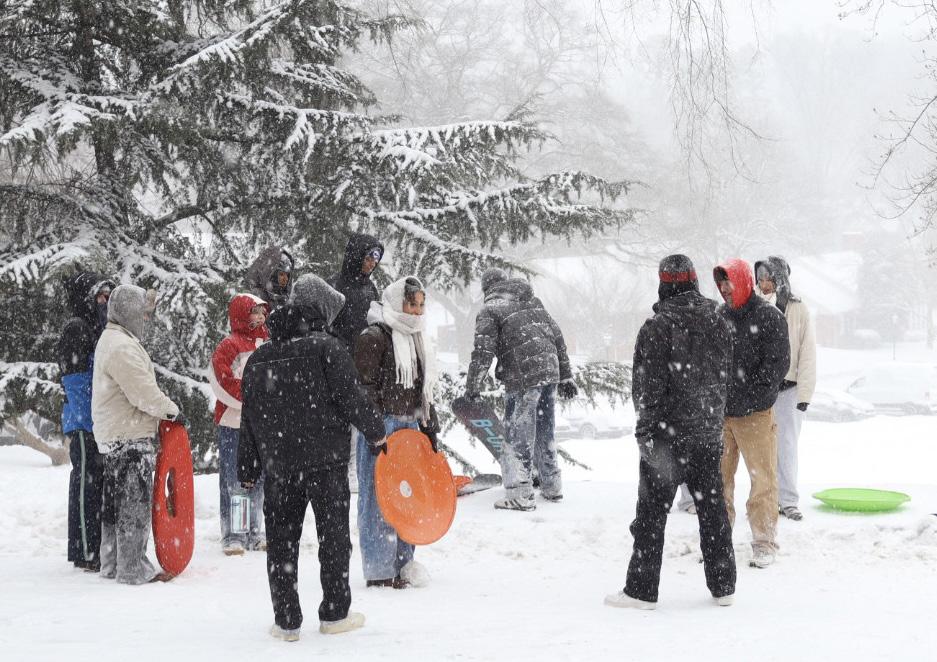
Students built snowmen and went sledding during a historic winter storm that blanketed Davidson with over nine inches of snow. Photos by Ada Long ’29 (left and right) and Aidan Marks ‘27 (center).
TYowl The
Irreverent student journalism since 2016. Castigat Ridendo Mores.
yowl.com/CabinFever Snow Issue
Yowl hires newsies to distribute paper
Page Strike
Mysterious Man seen looming around Commons mist
Page 2: Police report
February 4, 2026
CDC Investigates Undiscovered Strain of C. Diff. on Third Cannon Page 3: Campus Health and Safety
Is it too late to add/drop all of my classes?
Yeti Found on XC trails. Scares
Page 4: Opinion
FUCK ICE
he past 2 weekends have seen severe winter weather strike across much of the Eastern coast, and more importantly: Davidson College. These conditions have led to the proliferation of ice throughout the campus. This has created a dangerous environment for those on campus. Not all Davidson students are equally affected by ice, some have the privilege to buy expensive boots worth licking that give them the grace to ignore the ice around them, while others aren’t so lucky. Individuals without ice boots have been forced to walk around campus oh-so gingerly, in fear of falling on the slippery ground while just trying to go about their daily lives and access their right to education!
This ice on the roads and sidewalks is a real and present danger for all, regardless of whether one can afford snowshoes or not. This ice is a sign of the growing prevalence of extreme weather that is to come; it may be ice this time, but next time it could be a tornado, hurricane, or dust bowl. You may have the boots for ice, but one day, your spiky-ice boots will sink right into quicksand. The Davidson community must recognize that those vulnerable to ice need the aide and support of those who are less vulnerable.
The threat of people slipping and falling on ice should frighten and anger everyone on campus. Two Davidson students have been concussed while on the ice. It is atrocious that a student merely jaunting to class may be subject to such violence. Still, many on this campus do not take a stance. They claim “the cold doesn’t bother me anyway” and blame those who fall on the ice for not being prepared for the winter weather. The lack of empathy for the concussed, the bruised, and the battered reveals how normalized the presence of ice is, sadly becoming.
Our college administration has allowed for ice to stay long enough. This school has allowed sidewalks to remain iced over and refused to cancel classes, putting its very own students and community in harm’s immediate way. As students, we should not live in fear of being concussed by ice. Ice is a threat to our institution; it grows slowly, working its way deep into the crevices of our buildings and breaking them apart, and destroying our integrity.
Placement And Rush Coming Soon? Here Is Who To Blackball!
As eating houses and fraternities begin evaluating 18-year-olds based on their worst moments in college (freshman year), members, confused by freshmen younger than the MCU and the Dark Knight, might need a how-to guide on who to let in and who not to let in. To be clear, I am a firm believer in the eating house conspiracy theory that the program is a lie, and some warner cabal decides placement. Now, without further ado, here is who should be given a black ball.
• The rusk cow
• People who use FLibs instead of Fibs
• The Lux
• People on their phones for too long in the gym
• Secret society members
• People with a job
• Editors of the Davidsonian, if they censor the title “FUCK ICE” in our article
• ICE
• People who are too into certain professors People who are asses to their professors
• The Rusk letters
• A sensible and rational person (if they are rushing SAE)
• If they want to rush (if they are rushing FIJI)
• Someone who won’t shut up about the prestige TV show they are watching
• People who steal your booth at Brickhouse Thursdays
• Patriots fans
WRITERS
Page Cryptozoology
The
Since the election of Ronald Reagan (blessed be thy name), the Intolerant Left has been formulating smear campaigns under the guise of “progress,” otherwise known as “cancel culture.” This tirade of Leftism swept across the nation under the suppression of Barack Hussein Obama, the radical immigrant who tanked our economy. This “accountability” narrative not only violated our First Amendment rights, but it also saw to the obliteration of individuals who freely expressed their opinions. Do Evangelists even have the right to hurl slurs and throw punches at homosexuals anymore? The fact of the matter is: the Left has desecrated the sanctity of freedom.
Last Friday, in the Demon-rats latest stunt, the Trump Administration was forced to release 3 million pages of the Epstein files, including 2,000 videos and 180,000 photographs, to distract us from our brave Gestapo murdering dangerous criminals with iPhones. This pressure unfairly portrays President Trump as a criminal rather than an investigative journalist, and were the Department of Justice given more time, there would have been proper redaction and censorship that does not frame our President as a predator (which he is NOT), along with proper AI-generated images that would have convicted conspirators of the Trump Administration like Wicked Hillary.
Top Ten Weirdest Objects We Sled With This Weekend
A cardboard box
A container lid
A mattress 7. Trash can from Union 6. Nummit pitchers (one on each foot) 5. My RA’s bath towel 4. A layer of fossil-like pure glitter obtained from Turner’s bathroom
3. The hood of Doug’s car (shh — don’t tell him yet!)
2. Fifty defleshed and dried-out rat hides, sewn together
1. Massage oil (and nothing else.)
Dear Yowl Reader,
Conversely, the liberal anti-Christ, Bill Clinton, is plastered throughout the Epstein files. Documents say that Clinton and his followers would perform ritualistic abortions and homosexual activities. I ask this tainted political party: Where is your precious cancel culture now? Why can’t you stand behind our fearless leader as he exiles his pedophilic enemies? This can mean but one thing: cancel culture is nothing but a tool to silence strong Republican voices. But we won’t stay silent anymore. We DEMAND for the conviction of all the pedos listed in the files! (excluding Donald Trump, Elon Musk, Bill Gates, Howard Lutnick, Richard Branson, Steve Tisch, Sergey Brin, Jeffrey Epstein, or Casey Wasserman).
HEAR US ROAR!
NEW SECTION: Editorial Ramblings
This winter break, the editors were deep into discussions on how we can waste more space in the yowl layout. These discussions were unproductive, so the half-baked idea we are presenting here is a semi-recurring section where we, the anonymous editors, will speak frankly to our loyal readers about thoughts and events in our lives.
For the duration of this piece, I will be using a pseudonym to protect the crucial anonymous status of the yowl. Let’s call my pseudonym “A. Reboussin”. One day after trivia, which I host, I was lying down in my bed in Flowe 204 room A, scrolling through Instagram. A sudden realization came to my head as I was watching reel after reel of loud nonsense and flashing colors. I may very well be a sleeper agent. After all, if I can sit in my bed for hours on end, constantly consuming media of meaningless trends and subliminal messages, what is to stop the government from flashing a series of trigger words on the screen, activating a switch in my mind? I believe the dopamine spikes that I gain from watching reels are training my brain to activate at a moment’s notice to take decisive actions. I often ask myself, “A. Reboussin what evidence do you have?” None… I just have a gut feeling, which is the type of intuition a technocratic despot wants you to ignore. I have shared this belief with friends who claim that I would have to not remember a significant period of time, which would have been when I was trained to become a sleeper agent. My answer to that is I have no memory of 2018, and I would argue most people do not. Really think about what you were doing in 2018. Are those actually real memories? Anyway, I am remaining ever vigilant on what I may or may not be consuming. I would continue my textual sauntering and ramblings, but I all of a sudden have the desire to incite violence within radical protest groups after seeing a poodle eat half of a tuna sandwich and saying a series of numbers on reels.
Sincerely, Auguste R.
Incident of The Week
You fell infront of a ton of strangers on the ice and everyone saw and laughs
Quote of the Week
The Yowl’s quote of the week privileges have been temporarily revoked.
Sincerely, The Editors
Note: The Yowl is a satirical supplement to The Davidsonian Hence, nothing in it should be taken as truth. Unless you feel like it.