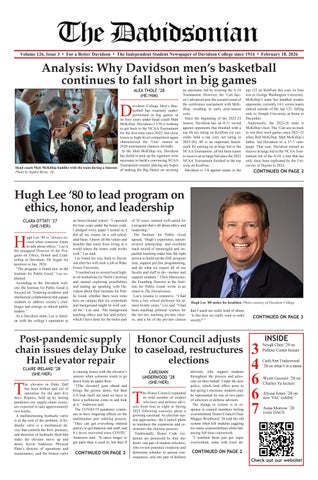
Volume 126, Issue 3 • For a Better Davidson • The Independent Student Newspaper of Davidson College since 1914 • February 18, 2026
Analysis: Why Davidson men’s basketball continues to fall short in big games ALEX THOLE ’28 (HE/HIM)
D
avidson College Men’s Basketball has routinely underperformed in big games in its four years under head coach Matt McKillop. Davidson (15-9) is looking to get back to the NCAA Tournament for the first time since 2022, but close losses to high-level competition again characterizes the ’Cats’ season as 2026 tournament chances dwindle. In the Matt McKillop era, Davidson has failed to pick up the signature wins necessary to build a convincing NCAA Tournament resumé, placing any hopes Head coach Matt McKillop huddles with the team during a timeout. of making the Big Dance on securing Photo by Sophia Byrne ’28.
an automatic bid by winning the A-10 Tournament. However, the ‘Cats haven’t advanced past the second round of the conference tournament with McKillop, resulting in early post-season exits. Since the beginning of the 2022-23 season, Davidson has an 0-15 record against opponents that finished with a top 60 net rating on KenPom (or currently hold a top sixty net rating in 2025-26). 60 is an important benchmark for earning an at-large bid to the NCAA Tournament: all but three teams to receive an at-large bid since the 2023 NCAA Tournament finished in the top sixty on KenPom. Davidson is 1-8 against teams in the
top 125 on KenPom this year, its lone win at George Washington University. McKillop’s team has handled weaker opponents, currently 14-1 versus teams ranked outside of the top 125, falling only to Temple University at home in December. Analytically, the 2025-26 team is McKillop’s best. The ’Cats are on track to win their most games since 2021-22 when Bob McKillop, Matt McKillop’s father, led Davidson to a 27-7 campaign. That year, Davidson earned an elusive at-large bid to the NCAA Tournament out of the A-10, a feat that has only since been replicated by the University of Dayton in 2024.
CONTINUED ON PAGE 2
Hugh Lee ‘80 to lead program on ethics, honor, and leadership CLARA OTTATI ’27 (SHE/HER)
H
ugh Lee ’80 is “always excited when someone wants to talk about ethics.” Lee is the inaugural Director of the Program on Ethics, Honor and Leadership at Davidson. He began his position in Jan. 2026. “The program is brand new in the Institute for Public Good,” Lee explained. According to the Davidson website, the Institute for Public Good is focused on “fostering academic and intellectual collaboration that equips students to address society’s challenges and emerge as ethical public leaders.” As a Davidson alum, Lee is familiar with the college’s reputation as
an honor-bound school. “I operated for four years under the honor code, I pledged every paper I turned in, I did all my exams on a self-scheduled basis. I know all the values and benefits that come from living in a world where the honor code works well,” Lee said. Lee found his way back to Davidson after his wife took a job at Wake Forest University. “I reached out to several local higher ed institutions [in North Carolina] and started exploring possibilities and ending up speaking with Davidson about their Institute for Public Good, whether there were roles here on campus that my credentials and background might be well suited for,” Lee said. “My background teaching ethics and law and policy, which I have done for the better part
of 30 years, seemed well-suited for a program that’s all about ethics and leadership.” The Institute for Public Good agreed. “Hugh’s experience, national-level scholarship, and excellent track record of meaningful and impactful teaching make him the right person to build out the EHL program area, support pre-law programming, and do what we expect all of our faculty and staff to do—mentor and support students,” Chris Marsicano, the Founding Director at the Institute for Public Good, wrote in an email to The Davidsonian. Lee’s resume is extensive. “I had been a law school professor for almost twenty years,” Lee said. “I had been teaching political science for the last ten, teaching pre-law classes, and a lot of the pre-law classes
Hugh Lee ’80 smiles for headshot. Photo courtesy of Davidson College.
that I teach are really kind of about, ‘Is this how we really want to order society?’”
Post-pandemic supply Honor Council adjusts chain issues delay Duke to caseload, restructures Hall elevator repair elections CLAIRE IRELAND ’28 (SHE/HER)
T
he elevator in Duke Hall has been broken and out of operation for the past five days. Repairs, held up by lasting pandemic-era supply-chain issues, are expected to take approximately two weeks. A malfunctioning hydraulic valve is at the root of the problem. A hydraulic valve is a mechanical device that controls the flow, pressure, and direction of hydraulic fluid that make the elevator move up and down. Kevin Anderson, Physical Plant’s director of operations and maintenance, said the broken valve
is causing issues with the elevator’s sensors when someone wants to go down from an upper floor. “[The elevator] goes ahead and brings the person down, but then it’ll lock itself out until we have to have a technician come in and look at it,” Anderson said. The COVID-19 pandemic continues to have lingering effects on the maintenance part ordering process. “They can get everything ordered and try to get material and stuff, and it’s never recovered since COVID,” Anderson said. “It takes longer to get parts than it used to, but they’ll
CONTINUED ON PAGE 2
CARLYANN UNDERWOOD ’28 (SHE/HER)
T
he Honor Council expanded its total number of student solicitors and defense advisors from four to eight in Spring 2025 following concerns about a growing caseload. As election season approaches, the Council plans to maintain the expansion and restructure the election process. Traditionally, Honor Code violations are processed by four students: one pair of student solicitors, who review potential violations and determine whether to pursue consequences, and one pair of defense
advisors, who support students throughout the process and advocate on their behalf. Under the new policy, which took effect prior to last spring’s elections, students may be represented by one of two pairs of solicitors or defense advisors. The change in system is in response to council members feeling overwhelmed. Honor Council Chair Maggie Woodward ’26 said the old system often left students juggling too many responsibilities while balancing full-time coursework. “I watched them just get super overworked, same with [our] de-
CONTINUED ON PAGE 3
3 4 6 6 7
INSIDE
Novak Chen ’29 on Pulitzer Center lecture CarlyAnn Underwood ’28 on what’s in a name Wyatt Gessner ’28 on Charles Yu lecture Alyssa Jones ’28 on new VAC exhibit Anna Morrow ’28 visits DACE
CONTINUED ON PAGE 2 Check out our website!
News
Honor Council representatives on caseload, AI and elections
CONTINUED FROM PAGE 1 fense advisors. And we are all fulltime students anyways, and so it wasn’t fair to be like, ‘you need to manage this all, just the two of you,’” Woodward said. Student solicitor John Endres ’26 said the new structure is more manageable. “I think there were about 40 cases in like a two week span during finals week for the team last year,” Endres said. “And just that was two people who had to work through all of that, and when they had finals to work on themselves, [...] when they have other things going on, it’s just really hard to ask one group of two people to do all of that.” Dividing and conquering helped students manage cases. “By adding a couple more solicitors to the team, you’re spreading out,” Endres said. “And what we found this year is that we couldn’t imagine it being any other way.” The expansion allows members to divide tasks and collaborate on cases, giving each incident the attention it needs. “Having a team of four on each [...] side has allowed for a lot more collaboration and delegation of tasks that I think has been helpful,” Woodward said.
Because the Honor Council has incomplete information about the number of past cases, Woodward is hesitant to speculate about whether there has been a significant increase in alleged violations. The type of violations, however, has shifted noticeably. “[There] has been an increase, not so much in volume, but in the type of cases—a lot of AI,” Endres said. AI cases, particularly in computer science and math classes, now make up the majority of the council’s workload, according to defense advisor Cole Mooney ’26. Determining responsibility in AI-related cases can be challenging. “The problem [...] we’ve been having with AI is just determining whether or not a student is responsible or not, given that’s such a hard thing to track,” Mooney said. Endres also noted that differences in departmental policies complicate some cases. “You have different professors in the same department with different rules and regulations about AI. So what some [people] would view as viable AI use in one class is not the same as another class in the same department,” Endres said. The Honor Council is also looking to restructure its election process. “In the past [it] has been kind of un-
Members of the 2025-2026 Honor Council. Photo courtesy of Maggie Woodward ’26.
organized and the communication has been sparse,” Woodward said. As part of these changes, the council will eliminate its Category I elections. This means no elections will be held in the fall. New members will continue to participate in the August “boot camp”
before classes to prepare for expectations and procedures, helping ensure smoother transitions within the council. As the Honor Council implements structural changes to manage cases and adapt to evolving pressures, increasing the number of students,
Duke elevator repairs raise accesibility concerns
CONTINUED FROM PAGE 1
get on it [and] try to get here as soon as possible.” On Feb. 12 RLO sent an email to the student body warning that the power in Duke might be impacted by repairs in the building. Anderson said power issues in the building were unrelated to the elevator, and had to do with library construction. “We were having to shut off the switch that went to for the new project at the stadium library,” Anderson said. “When we did that, that dropped power out just momentarily for the generator to kick in, but that had nothing to do with the elevator.” Assistant Dean of Students and Director of Residence Life, LaFarin Meriwether, corroborated that the
power issues were unrelated to the elevator repairs. “Residents were notified on 2/12 that while work was being done in the building, on something not elevator related, and they may experience flickers during that time,” Meriwether wrote in an email to The Davidsonian. Rose Cecchi ’27 lives in Duke. She said the broken elevator has added to the time it takes for her to leave the building. “[On] my side of Duke, we don’t have access to the first floor, [it’s] only for emergency exits, so I have to walk all the way to the other side and go up three flights of stairs, and it really delays me getting to my classes,” Cecchi said. “The elevators have just been kind of finicky for weeks [...] I sent in something about
Duke Hall residents noted elevator issues days before it stopped working. Photo courtesy of Claire Ireland ’28.
2
it, and now it’s broken-broken.” Annabel Groseclose ’27 also lives in Duke. She described the repairs as minorly disrupting. “It’s kind of annoying to go up, because I live on the other side of Duke [...] from the first floor, you can’t get to the stairs over that way [...] on the union side of Duke. You have to use the stairs on the main street side of Duke. So I have to walk up and then walk all the way around,” Groseclose said. When it comes to accessibility, Meriwether emphasized that no Duke Hall residents have been directly affected by the temporary closure. “Those we know with accessibility needs are able to navigate the building during these repairs,” Meriwether wrote. Still, Anderson insisted that a quick
repair process is a priority whenever dorm elevators are malfunctioning. “Usually if an elevator goes out, no matter if there’s a handicapped student or not, we try to get it back up,” Anderson said. “We’ll call it in for overtime hours, just in case a student wants to visit their friend in their building, or they want to go up a floor.” As the repair process continues, Duke Hall residents can defer to RLO for updated information. “As was shared with residents, we will update them accordingly about the repairs,” Meriwether wrote.
Duke Hall elevator signage indicates the ambiguous repair deadine. Photo courtesy by Aidan Marks ’27.
tracking case data and consolidating the election process improves continuity from one year to the next. “We were trying to codify things so that people in the [...] future can keep track of it, because it’s only a year long position, so stuff can get lost in translation,” Woodward said.
Big wins elude ‘Cats CONTINUED FROM PAGE 1 The NCAA classifies games into quadrants based on its NET rankings, a measurement used by the NCAA Tournament selection committee. Davidson is 1-6 in “big games” against Quadrant 1 and Quadrant 2 opponents this year. Two of Davidson’s Quad 1-2 opportunities were blowouts: the ‘Cats never led in losses to Utah State University (60-94, neutral) and Kansas University (61-90, away). Each of the other five big games ended with a single-digit point differential: close losses against Saint Mary’s College (6170, home), Virginia Commonwealth University (69-75, home), George Mason University (52-60, away), and Saint Louis University (82-91, home), along with the win over George Washington (84-79, away). Let’s break down why Davidson has fallen short in big games, especially in down-to-the-wire contests. Free throws Tight games are often decided at the free throw line, where Davidson is exceptionally poor. The ’Cats are converting on just 66.2% of their attempts at the foul line, which ranks 348th in Division I (DI) per CBB Analytics and KenPom. In big games, Davidson has cached in on only 58.3% of free throw attempts. Fortunately for the ’Cats, their opponents are also leaving points at the charity stripe. Davidson’s opponent free throw percentage is the 5th lowest in DI at 66.7% (68.8% against Quad 1-2 opponents). While knocking down free throws
CONTINUED ON PAGE 5
3
Features
Lee on value of honor, student accountability processes
CONTINUED FROM PAGE 1 ture collaborations. As director, Lee has the opportunity to shape the development of the Program on Ethics, Honor and Leadership. “I’m kind of still exploring what the best programmatic elements are for this program to thrive and be successful,” Lee said. “[It’s] really about how do you create an ethos of honor and ethical conduct? How do you create a culture in which those things are valued?” Lee’s position will place him in collaboration with Davidson’s Honor Council. Honor Council Chair Maggie Woodward ’26 emphasized the symbiotic relationship between the IPG Ethics program and the Honor council. “[The program] was presented as something that would be there for us [the honor council] in a kind of support capacity as well as, obviously, creating opportunities for other students. It was meant to serve as a resource,” Woodward said. Woodward has yet to talk to Lee, but she has high hopes for their fu-
“I think any support we can get from any organization on campus would be great. It’s been awesome having the IPG be in place and having an even more fleshed out connection of what the IPG looks like in the context of the Honor Council, and what their roles look like, will be really helpful,” Woodward said. “Ideally it’s something we can lean on and they can lean on us.” Malia Davis ’27 is a junior representative to the Honor Council. “[Lee] understands the workings of an institution—that you can’t come in and just assert all of these changes [...] if you haven’t talked to people,” Davis said. “I think it’s more like, he’s in charge of the culture, we’re in charge of adjudicating. [...] Now we have this other pillar of support for programming, outreach, ideas.” Lee is not in charge of implementing the Honor Code at DavidsonHowever, he explained that his work will address similar concerns. “It’s unavoidable, and appropriate, for me in this role to take stock
of the current climate on campus around the honor code and around how students and professors feel about its effectiveness in creating an environment that really does hold up [...] ethical behavior, as not a gold standard, but the expectation,” Lee said. A series of events accompany Lee’s new position. “I am responsible for our annual honor council convening, which is entering its third year,” Lee said. “I’m very excited about trying to expand that and trying to get the other academic institutions that participate in it to be involved in the planning and the curricular design of that.” The Honor Council Convening is an annual event where honor council members and advisors from an array of colleges and universities gather together to discuss how they will encourage ethical practices among their student body. “We’re leveraging all of these schools that are coming to the program, [...] their experience, their expertise, their background, in helping
Students and faculty finish lunch during a panel discussion about restorative justice best practices at the 2025 Honor Councils Convening in November. Photo courtesy of Stacy Riemer.
this program to make this an even better experience,” Lee said. “It’s been a fantastic success, I think, and I want to see it continue to grow.” Lee will also help coordinate the Celebration of Honors. “We’re going to have a week long of programming kind of to both celebrate the honor code and get people excited about having values that are meaningful to them,” Davis said. “So hopefully have a panel, get to meet the council. We’ll also have new leadership by then, so it’s a great way to introduce the incoming council to the community.”
While Lee’s position is new, he emphasized that Davidson’s commitment to ethics is not. “I think whenever we’re in a certain culture or society, it’s easy to be critical of it,” Lee said. “There’s lots of things that you would hold up to other schools and other communities and say, ‘Look at us.’ And I think that the fact that we have an honor code, that we have a student-led process, and that we have students who commit to it, is a significant difference between Davidson and other schools. I think we should never take that for granted.”
Politics
Ridwan Karim Dini-Osman lectures on role of journalism in global health equity
T
NOVAK CHEN ’29 (HE/HIM)
he Dean Rusk International Studies Program, in collaboration with the Pulitzer Center, hosted global health journalist Ridwan Karim Dini-Osman. He delivered the 2026 Spring Pulitzer Lecture titled “Global Health Equity in a Changing Aid Landscape: Lessons from Africa.” As a multiple time Pulitzer Center grantee, seven-time recipient of Ghana’s National Journalism Award and current Nieman fellow at Harvard University, Dini-Osman’s perspective was informed by current events and his previous journalistic work. Dini-Osman’s lecture focused most intensely on the state of global health equity in the wake of the Trump administration’s decision to dismantle the United States Agency for International Development and cut the U.S. President’s Emergency Plan for AIDS Relief by over half. Through the close-to-home example of Ghana’s northern regions battle against a meningitis outbreak, Dini-Osman explored the issues disrupting his nation’s healthcare landscape post-aid. “You had people who couldn’t simply access health care because something as simple as an ambulance wasn’t available. And for those who had access to an ambulance, they had to pay out of pocket to be able to pay for the fuel,” Dini-Osman
said. “A lot of the people were not on health insurance, and that meant they were hesitant in reporting their cases to the hospital, because they felt that if you go to the hospital and you don’t have insurance, you don’t have money, and eventually are going to die.” Dini-Osman leveraged statistics to make his case for global health equity, with a focus on showing the disparity between disease burden and healthcare funding support. “Data from the World Health Organization shows that [Africa] takes 25% of the global disease burden, but in terms of the support that it receives as a proportion of the global health expenditure, it was less than 1% — so that is what this continent is grappling with,” Dini-Osman explained. Students took interest in the intersection between public health and journalism, finding takeaways to ruminate on after the lecture. Sophie Rosenbaum ’29 said her perspective on the power of journalism was widened. “It was interesting to hear Mr. Deni-Osman talk about the meningitis outbreak in Ghana, which I wasn’t very informed on,” Rosenbaum said. “There were real problems in the past that led to vaccine hesitancy with questions unanswered and valid criticisms that were never addressed. So when someone actually showed up and interviewed people [...] vaccine rates went up.”
“Being able to see tangibly how journalism can impact an outcome for public health, really expanded my understanding of what journalism is and can give you,” Rosenbaum continued. Leeya Chaudhuri ‘29 found the lecture educational and informative about the field of journalism. “Tonight’s lecture was a wonderful way to learn about how Mr. Dini-Osman was able to navigate complex topics and interview people of different backgrounds as a journalist. This lecture taught me that stories are only as good as the people who make it up and to never lose sight of the human element of journalism,” Chaudhuri ’29 wrote in an email to The Davidsonian. Director of the Dean Rusk International Studies Program Jane Mangan hopes that this lecture, as well as future Pulitzer speakers, can continue to introduce students to exceptional journalists covering a variety of topics. “My hope would be that students are leaving that lecture with information about another part of the world that they didn’t know before, and that they are interested in asking more questions about that part of the world.” Mangan said. “Moreover, I hope they’re interested in asking some different questions about their experiences, whether it’s curricular or extracurricular, about their life in the US because of something they’ve heard about another place.”
Ridwan Karim Dini-Osman speaks to students in the Hance Auditorium about the importance of journalism in global health equity. Photo courtesy of Brillon Joseph ’25.
Dini-Osman personally hopes that his lecture can educate students about the broader systems that can make global health equity a possibility. “I just want students to be interested in global health, because it’s at the forefront of a lot of issues, whether you’re talking about the economy or whether you’re talking about like development in general, there is no country that can develop if it doesn’t take the health of its citizens seriously,” Dini-Osman said in an interview with The Davidsonian. Ultimately, Dini-Osman found Davidson students to be in a good position to contribute toward a reality
where global health equity exists. “I was particularly surprised by the range of interests and particularly amazed by the questions posed by the students. Just being in the class and answering the plethora of questions from the student also gives us hope” Dini-Osman said. “It gives me, in particular, a lot of hope that young people are thinking about some of these issues, and that they are observing what is going on. And that is significant.”
Perspectives
4
What’s in a name? CARLYANN UNDERWOOD ’29 (SHE/HER) This semester, in my Decolonizing Development in Africa class, my professor paused during a discussion and offered a hypothetical: “Imagine someone said to you, ‘Oh, I just had a wonderful trip to North America and ate lots of good food.’” Because what does that even mean? North America? Do you mean the United States? Canada? Mexico? The phrase feels broad and strangely unspecific. We rarely use it when talking about ourselves. We say “the U.S.” or simply “America,” as if that name belongs to us alone. Then she asked us to consider the reverse. When someone says they visited Africa, how often do we immediately ask which country? That question lingers because it reveals something deeper than semantics. The way we name places is not neutral. It reflects whose complexity we recognize and whose we collapse into shorthand. I hadn’t thought much about that before she pointed it out. But once she did, I started noticing it everywhere, in headlines, in conversations and even in my own language. Two weeks ago, when Bad Bunny performed at the Super Bowl halftime show, part of his message centered on unity across “America,” not just the United States, but North, Central and South America. In much of Latin America, “América”
refers to the entire landmass. The United States is not the only country within it. I was not used to hearing “America” mean so much more than just the United States. My professor’s question suddenly felt less hypothetical. Why does “North America” sound vague when applied to us, but “Africa” rarely feels incomplete? Why does one demand clarification while the other often passes without it? In class, we talk about how much of what we now consider the dominant narrative about development and progress comes from the colonial era. European powers divided and labeled vast regions in ways that flattened complexity, and the frameworks they left behind continue to shape how development is defined, measured and reported. Who sets the benchmarks, whose institutions are treated as universal, whose systems are considered the model? These questions are all deeply tied to colonial legacies. The more we unpack this framework, the more I realize that language operates in similar ways. When a hurricane hits Florida, headlines name the state. When economic instability strikes a European country, the country is specified. But when conflict breaks out in one African nation, coverage often expands outward. “”Violence in Africa,” or “Crisis in Africa.” If we’re lucky, it might even include a subregion, like “West Africa” or “East Africa,” but more often, the continent is treated as a single entity. One country
becomes representative of 55 countries (AU). Over time, these patterns do more than simplify geography. They shape how we imagine complexity itself. The United States is detailed and individualized. Africa is often flattened. One is treated as distinct and internally varied; the other becomes shorthand. Sometimes this flattening happens without conscious reflection. At other times, it is deliberate. Either way, it reflects centuries of colonial influence. The frameworks for development established during the colonial era were created according to European standards, and they still shape how entire regions are described and categorized today. Language does not simply carry those assumptions forward. It normalizes them. It makes certain hierarchies feel natural and certain omissions feel unremarkable. The flattening becomes so routine that we stop recognizing it as a distortion at all. This is why the Super Bowl moment felt significant to me. When Bad Bunny held up the football he carried that said “Together, we are America” and had all of the different countries’ flags trailing behind him, the symbolism was unmistakable. In that image, he expanded “America” beyond U.S. borders, and uprooted a definition many of us rarely question. He reminded viewers that millions of people beyond the United States also identify as American in a continental sense. The shift in my perspective has changed how
I notice language and power. The way we name places and tell stories about regions is never neutral. These choices carry the weight of colonial histories, shaping which voices we hear and which we overlook. As Davidson publicly reckons with its own slaveholding past, that responsibility applies here as well. How the college describes its history, whose experiences are centered, and what it chooses to name all directly shape how that history is understood. If institutions are serious about confronting their past, they must also be serious about examining the language that frames it. Paying attention to language is one way to honor complexity and resist oversimplification. The world is more layered than our shortcuts allow. Understanding it more fully begins with naming it more carefully. CarlyAnn Underwood is a freshman from Raleigh, North Carolina. She is an undecided major. She can be reached for comment at caunderwood@davidson.edu.
Libertarianism and social safety nets GABRIEL RUSS-NACHAMIE ’27 (HE/HIM) On February 11, Davidson’s Deliberative Citizenship Initiative hosted a forum called “The Case of Social Safety Nets.” A range of perspectives on social safety nets was presented, including libertarian views. One libertarian panelist argued for a Universal Basic Income (UBI) while another rejected most government social programs in favor of private charity and argued for entitlement reform. As the President of the Davidson Libertarians, I thought it would be beneficial to add to this conversation in The Davidsonian by presenting some general libertarian views on social safety nets. One common misconception is that most classical liberals and libertarians have always advocated for a form of near-anarchy, or reject most, if not all, government interference in the economy. This is false. Friedrich Hayek, the Nobel Prize-winning economist and one of the greatest defenders of classical liberal thought in the 20th century, wrote that “The range and variety of government action that is, at least in principle, reconcilable with a free system is thus considerable.” Hayek recognized that the classical liberal tradition, from John Locke and Adam Smith to modern thinkers like Milton Friedman, acknowledged the need for government intervention. However, government intervention must be constrained by general, predictable rules rather than discretionary decisions, so liberty can be preserved through the rule of law. Smith, the father of modern economics and capitalism, did not reject government interven-
tion in the economy either. Smith believed the government had a role in providing for national defense, administering justice and funding public goods that the market would underprovide. This is precisely why it is wrong to treat support for public goods and institutions as socialism, or to label oneself a “democratic socialist”, a new popular label, simply because one supports the government providing a greater amount of public goods. One can be a staunch capitalist while still supporting the government’s provision of public goods. Libertarians do reject certain government interventions in the economy. For example, libertarians oppose price controls, such as rent control or price ceilings, because they distort the information prices signal, leading to resource misallocation. Libertarians also generally reject efforts at redistribution to achieve “patterned” principles of justice, which hold that we can judge whether the current allocation of economic resources is just simply by looking at its distribution and comparing it to some ideal pattern. Instead, most libertarians embrace a historical or entitlement view of justice, which asks how holdings came about. For instance, an unequal distribution of income or wealth that emerges from free and voluntary exchanges is not automatically unjust simply because it results in inequality. Yet, a distribution that emerges from fraud or coercion might be unjust, even if it reduces inequality. Beyond the theoretical, what do libertarians believe in practice about social safety nets for people with low incomes? First, it’s important to recognize a historical fact: for most of human history, widespread poverty and desperation were the norm. It was not until the Industrial
Crime Log Time Reported 02/16/26 0232 hrs 02/14/26 2030 hrs
Description/Location Fraud Offenses: Obtaining Property by False Pretenses (X3) Off Campus, Further Investigation Assault Offenses: Simple Assault (X2) Davis, Inactive
Revolution and the rise of capitalism that sustained increases in living standards occurred. Data from Our World in Data shows that in 1820, the share of people living in extreme poverty was 75%. By 2018, that number had fallen to 10%. So, if one is serious about addressing poverty, one must first look to conserve institutions, such as private property and markets, that have enabled free trade, innovation, and the development of new ideas that have actually reduced poverty. It seems that most serious academic libertarian and classical liberal thinkers believe that the United States’s social safety net should be primarily reformed to be direct cash transfers rather than in-kind programs. Direct cash transfers can take many forms. Two examples are a universal basic income or abolishing the many hundreds of federal departments focused on poverty, and just sending direct cash vouchers to the poor. Besides lifting people out of poverty, cash transfers can fix two problems with our current social safety net. First, they reduce government paternalism by allowing recipients to decide how to best allocate their resources based on
their own needs. Second, current social programs often have high implicit marginal tax rates that punish people who work by reducing benefits. A cash voucher for the poor, or a UBI for every American, could help fix these problems. However, it must be weighed against the cost of some people working less if they receive a government check every month. Reforming the social safety net will not only simplify the welfare state but will restore dignity to those who require government assistance by allowing them to decide what’s best for them, rather than bureaucrats at the state and federal levels. Gabriel Russ-Nachamie is a junior mathematics and economics double major from Lincolton, North Carolina. He can be reached for comment at garussnachamie@davidson.edu.
Sports
5
Digging into the data behind ‘Cats’ close-game struggles
CONTINUED FROM PAGE 2 would certainly improve Davidson’s chances of winning critical games, the free throw percentage margin is minimal, suggesting that other factors are plaguing McKillop’s squad. Rebounding One area of concern for Davidson in big games has been rebounding. In Quad 3-4 games, Davidson has a +1.8 average rebound margin. In Quad 1-2 games, Davidson’s average rebound margin drops to -8.3. The total rebound margin alone doesn’t tell the full story in big games. On the defensive end, Davidson is gathering 7 more rebounds than their opponent, limiting extra possessions. However, the ’Cats have been outrebounded on the offensive glass by 15.3 rebounds per game. Davidson has averaged 11.1 offensive rebounds in big games, the 7th most in the A-10 in Quad 1-2 games. Why then are Davidson’s opponents still racking up defensive boards? The ’Cats aren’t hitting their shots. Shooting Davidson’s big game woes are likely rooted in shot selection and shot making, allowing for the poor
rebound margin. Davidson’s offensive short chart in Quad 3-4 games in 2025-26 (from CBB Analytics) is shown in Figure 1. The graph on the left shows Davidson’s percentage of shots made—or field goal percentage—at each spot on the court. The graph on the right shows Davidson’s frequency of shots at each spot on the court as a percentage of the total field goal attempts. The color represents how Davidson compares to the DI average (red is above average and blue is below average). In Quad 3-4 games, the ’Cats are highly efficient in the midrange and paint relative to the rest of the country. They also shoot well above average from the three-point line. Davidson’s shot distribution is consistent with national averages. Now observe Davidson’s offensive shot chart in Quad 1-2 games in Figure 2. The difference in field goal percentage against tougher opponents compared to weaker opponents is obvious, but first notice the percentage of shots in the paint. In Quad 3-4 games, the ’Cats take 29.4% of their shots at the rim. In Quad 1-2 games, they only take 20.6% of their shots at the rim. Instead, Davidson is shooting slightly more in the painted areas further
from the basket, represented by the four inner rectangular regions. Getting easy looks at the basket is essential for winning games, but Davidson has been unable to do that against Quad 1-2 opponents, getting pushed further away from the rim than desired. On the right side of the paint, the ’Cats are converting at roughly the same rate as they do in Quad 3-4 games. However, they haven’t shot even close to as well on the left side of the paint in big games. Davidson has also not knocked down three point looks in big games that they have made against lesser opponents. Two of Davidson’s best sources of offense in Quad 3-4 games have been left wing and right corner threes, hitting at 40.4% and 48.5% clips respectively. In Quad 1-2 games, the ’Cats only shoot 30.8% from the left wing and 30.4% from the right wing. McKillop’s team is prolific from deep—their 37.3% on the season ranks third in the A-10 and falls in the 92nd percentile among DI—it’s a matter of making big shots at the right time. Crunch time Finally, Davidson’s offensive (Figure 3) and defensive (Figure 4) shot
Coach McKillop directing players from the sideline. Photo by Sophia Byrne ‘28.
charts in the final ten minutes of big games is indicative of how the ’Cats have fallen short of picking up signature wins. Even when Davidson is attacking the rim in late game situations, they aren’t scoring, only making 52.2%
Looking ahead Davidson has been close to winning crucial games, but an inability to find good looks and make big shots, along with poor rebounding and free throw shooting, has prevented the ’Cats from breaking through. Until McKillop’s team executes late and stacks resumé building wins, only miracle runs through the A-10 Tournament will punch Davidson’s ticket back to the Big Dance. Still, six-plus point leads against VCU, George Mason, and Saint Louis—the A-10’s top three teams— proves that the ’Cats are capable of competing with NCAA-Tournament-quality opponents.
Figure 3 (above) and figure 4 (below).
Figure 1 (above) and figure 2 (below).
of at-the-rim attempts. The ’Cats are additionally shooting a mere 31.3% from three in the last ten minutes of Quad 1-2 games after shooting 37.6% in the first thirty minutes of those contests. Davidson’s opponents, on the other hand, are getting easy looks at the basket and converting on those opportunities 67.7% of the time, as well as shooting 33.3% from beyond the arc.
Written prior to Feb. 15 game at the University of Dayton — FINAL: Davidson 59, Dayton 70.
A10 Standings Update
Men’s Basketball Standings Team Saint Louis VCU George Mason Dayton Duquesne Saint Joseph’s Davidson George Washington Rhode Island Fordham Richmond St. Bonaventure La Salle Loyola Chicago
W
L
24 20 21 16 15 15 15 15 14 14 14 14 7 6
1 6 5 9 10 10 10 11 11 12 12 11 18 20
STK PCT W18 W9 L2 W1 W4 L2 L1 W2 L2 W2 L1 L1 L5 L2
.960 .769 .808 .640 .600 .600 .600 .577 .560 .538 .538 .560 .280 .231
Women’s Basketball Standings Team
W
Rhode Island 23 Richmond 22 George Mason 16 Saint Joseph’s 17 Davidson 16 Loyola Chicago 12 La Salle 14 Dayton 14 St. Bonaventure 15 George Washington 14 Saint Louis 11 VCU 8 Duquesne 9 Fordham 10
L
STK PCT
2 4 8 8 11 13 11 12 12 14 17 18 16 16
W17 W11 L1 W2 L1 L2 W2 W1 W1 L3 L7 L4 W2 L1
.920 .846 .667 .680 .593 .480 .560 .538 .556 .481 .393 .308 .360 .385
Arts & Entertainment
Author Charles Yu delivers 2026 Conarroe lecture
WYATT GESSNER ’28 (HE/HIM)
W
hen Charles Yu stepped onstage at sold-out Tyler-Tallman Hall to deliver the 2026 Conarroe lecture, few expected what came next. Since winning the 2020 National Book Award for his novel “Interior Chinatown,” the author-turned-Hollywood showrunner has established himself as one of the most influential creative voices of the decade. But instead of a glorified victory lap, on Feb. 10 Yu delivered a relatable lecture connecting themes of failure, AI and the rocky road to success. Professor of English Alan Michael Parker, who knows Yu personally and introduced him before the talk, was not surprised by his humility. “He’s not full of himself, he’s just a good guy,” Parker said. “And I think as a result he really connected with people.” All Conarroe lectures loosely center around the question: “How did you become a writer?” Yu’s path was far from linear. His first love was math, though being a “thirdstring mathlete” stopped him from pursuing it further. As an undergraduate he studied biology and planned on becoming a doctor, though poor test scores made him pivot to law school. Through sharing his multiple career pivots during the lecture, Yu sought to relieve the pressure Davidson students typically put on themselves to figure out their futures. For instance,
even in the midst of a successful career as a lawyer, Yu felt that he had not found his true passion and began writing in his spare time. “Once I was able to take the little bits of what I can make, my DIY kind of writing, and turn in something, I wrote what turned out to be my first novel [How to Live Safely in a Science Fictional Universe],” Yu said. But he did not find immediate success as an author. Yu read a review of his first novel from “Publisher’s Weekly”: “[The] self obsessed protagonist is straight out of the mainstream fiction that many science fiction fans love to hate, leaving this book without an audience.” Even writing “Interior Chinatown” was challenging. Yu started formulating the book in 2012 before he began seriously writing it in 2016. It was eventually published in 2020. Like many other students in attendance, Kirina Hogarty ’29 was comforted by Yu’s less than perfect story. “It was really reassuring to know that you don’t have to know what you’re doing with the rest of your life at 18 or 20 or 25 even, and that it’s okay to take different paths and see what works,” she said. Yu also spoke to student anxieties about AI and the loss of jobs. “We’re not overestimating AI as [much as] we’re underestimating ourselves,” he said. Yu connected the fear of being replaced by AI back to how he decided to become a writer. “‘What am I good at?’ and ‘What am I good for?’” are not as relevant as “Who am I?” and “What is that good for?’”
he said, outweighing the utility of AI with the totality of humanity. Parker applauded how Yu weaved different topics together throughout the talk. “I found it fascinating how the talk can be read as a compliment to the way [Yu’s] mind works [and the] architecture of the novel as well,” he said Yu’s National Book Award win in 2020 is what eventually led him to Davidson. Like most winners, he was invited back to the following year’s ceremony as a judge, where he met Parker, who was also solicited to the judiciary panel that year. The two could not meet in person due to COVID-19 precautions, but stayed in touch and formed a book club over Zoom. When it came time to find a Conarroe lecturer for this year, Parker, who is on the selection committee, nominated Yu. The Conarroe series occurs every two years and features a notable contemporary writer. The series is named for Joel Conarroe ’56, who passed away in 2024. He was chair of the English Department at the University of Pennsylvania, executive director of the Modern Language Association and headed the Guggenheim Foundation. He also chaired the National Book Award fiction jury and the Pulitzer Prize fiction jury. “He was a really interesting guy who had a stunning literary career,” Parker said. In addition to the lecture, Yu gave two other talks throughout the day. One focused strictly on “Interior Chinatown,” while the other discussed the Hulu miniseries of the
same name adapted from the book. Yu was a showrunner and executive producer for the miniseries. “We’re not the school where we pay you a lot of money, you come in a limo, you give a talk, and you leave in your limo,” Parker said. “It’s all about the students.” The lecture concluded with a sendoff for retiring Professor of English Randy Ingram ’87. Typically, when the Conarroe lecture aligns with an English professors’ retirement, the committee selects a speaker whose work is important to the professor. Yu is one of those authors. Yu was selected because of Ingram’s commitment to teaching “In-
terior Chinatown.” “I admired that book a great deal,” Ingram wrote in an email to The Davidsonian. “After I read it, I realized that I had been a fan of Mr. Yu’s work in other areas.” Ingram also made it clear that despite his retirement this would not be his last Conarroe lecture. “I hope to attend more, as a reader, as [a] former professor, and as a lifelong Davidson English major,” Ingram wrote. “The generosity of [the] Conarroe Lectureship extends beyond Davidson’s students and professors; it is a gift for everyone who gets a ticket and shows up.”
Charles Yu gives Connaroe Lecture in Tyler-Tallman Hall. Photo courtesy of Kaspars Golos ’27.
“Alternative Medicine” exhibit takes fresh look at healthcare
T
ALYSSA JONES ’28 (SHE/HER)
he Van Every/Smith Galleries at Davidson College opened its new exhibit: “Alternative Medicine: Healing Remedies for Harmful Times.” The opening reception on Feb. 11, and performance art piece that followed, raised questions about how modern culture understands health, pharmaceuticals, treatment and care, exploring the broader idea of healing for its viewers.
The exhibit includes paintings, sculptures and ceramics. Co-curated by Chair and Associate Professor of Art John Corso-Esquivel and Director of Art Gallery Lia Newman, the show brought awareness to the importance of relationships, food, culture and bodily awareness. “Medicine is never neutral, and it always carries a sense of power dynamics,” Corso-Esquivel said during the gallery discussion. “Even the word pharmaceutical has a kind of conflict in it. [...] I wanted to think about medicine from this critique,
Artist Jean Shin’s pieces, Chemical Balance IV and Chemical Balance, are composed of collected perscirpition pill bottles. Photo by Alyssa Jones ’28.
and I drew on the feminist ethics of care, which looks a lot at who’s oftentimes giving care, how care relationships get shortened for profit, and how medicine really becomes a transaction.” Inside the gallery, the artists spoke about their work and the personal experiences that shaped their approaches to art and healing. Two of artist Susan Chen’s pieces in the exhibit feature a pill personal to her, Plan B. “I vividly remember my first encounter with Plan B. I was sitting in a doctor’s waiting room as a young college student, terrified,” Chen said in an email to The Davidsonian. “I created the Plan B paintings and ceramics as a way to process my own experience years later and to create space for the shared grief and silence so many women carry.” The exhibit also includes a self-portrait by artist Hugh Hayden completely made out of pills that he takes on the regular—antihistamine, hair loss treatment, and HIV preventative—all arranged into an image of the Texas state flag, where he was born. Much of the exhibit is explicitly political, or at least responsive to the artists’ concerns about the state of the world. “I make a lot of work, like drawings and paintings, kind of documenting what’s going on in the world, kind of the heavy stuff, all the things that you know we’re all thinking about, even though we’re
6
trying not to think about it,” artist Rudy Shepard wrote in an email to The Davidsonian. “These objects are specifically meant to be sort of small and intimate and have a very direct connection to your body.” Afterward, guests returned to the reception area for Visiting Professor of Drawing and Sculpture Luis Sahagún’s “Instructions for Soul Searching” performance. This production was saturated with a variety of sounds, including bird sounds and deep hums. The immersive discomfort of audience members was intentional as it acted as a reminder that care can be both healing and invasive. Fellow attendee Bridget Prentiss ’28 said the performance made her reflect on definitions of care. “After seeing this, I would define care as all of the ways that we try to maintain our physical, mental, holistic, and reproductive health as a society and all of the benefits and disadvantages that it may manifest.” The exhibit is especially meaningful to Maddie Norris, visiting assistant professor of English, who is teaching a course on Illness Narratives. “I was particularly interested in this exhibition as it explores ways of care outside of capitalism,” Norris wrote in an email to The Davidsonian. “I hope students similarly consider what care can mean within different systems. [...] Art has the ability to move us on a deep emotional level, and I hope students visit
the exhibition so that they might experience the ways the art combines the intellect and the soul.” Attendee Paige Schneck ’29 said the exhibition prompted her to reflect on how pharmaceuticals function simultaneously as cure and poison. “We’re straying too far from the remedies that come from earth that [are] made for the body, and by doing that, we’re simultaneously filling the pockets of pharmaceutical companies,” Schneck wrote in an email to The Davidsonian. Through shared conversations and art pieces, the show allows guests to move from comfort to unease to reflection. Instead of offering a simple solution, it widens the conversation around healthcare and healing. Chen views her work as one piece of this discussion. “These artworks are my attempt to contribute to that evolving conversation so that the next generation of young women might not carry the same guilt or shame over what is, ultimately, a normal and deeply human bodily experience,” she wrote. To Corso-Esquivel, the exhibit is a way to process the state of the world. “I think that many of us are commiserating about the state of the United States right now,” he said. “It’s a time when we’re really as a culture suffering, and we’re seeing a lot of people who are being harmed. And we thought, well, ‘when we’re in this kind of place, what do we do’? We look at art.”
Living Davidson Across 1 Curly-tailed dog 6 Iroquois cousins 11 Vicious or Caesar 14 Fork over, as a payment 15 Permissible by law 16 Docs’ grp. 17 Assertive personality 18 Lyric lamentation 19 Chop (off) 20 Fast-food window 23 Phrase that can be interchangeable with what’s stretched through 20-, 36and 52-Across 26 Best of the hits 27 Sub commander of fiction 28 Dragonlike 32 Descartes or Lacoste 33 Fishbowl accessory 34 Tickle the funny bone of 35 Demolish, in Devon 36 It’s well below the Mason-Dixon Line 38 Bryn ___ (Pennsylvania college) 40 Lustrous velvet 41 “Love ___ neighbor” 44 Window part 45 Sopwith ___ (Snoopy’s plane) 46 Ancestry.com diagram 47 Heat to remove stress from, as glass 49 Op eds, often 51 Shift gears while pumping twice 55 Tippler’s road offense, briefly 56 Spa town near Lake Geneva 57 ___ Olay (former face cream brand) 61 Have brunch 62 Kind of fashion that’s “back” 63 Big name in designer handbags 64 Alcohol-free 65 Difficult expeditions 66 “And the following” (Lat.)
Down 1 Some hang-ups 2 Lock partner 3 Mischievous sort 4 Connected with 5 Classic gaming developer 6 Alt. synonym 7 Agitate 8 “Body Count” rap star 9 Four score 10 Lead to foam? 11 Acknowledges an officer 12 Comic Coca 13 Jane’s role on ‘Frasier’ 21 Self-identifying response 22 Ms. Winfrey 23 Rustic stopover 24 “Aw” follower 25 Hwy. mishap respondent 29 Tea serving, in Britain 30 Area of India 31 Sierra ___ 34 Lingus 35 I-85 or I-77, e.g. 36 Dork 37 Available for occupation 38 1920 Preakness winner 39 Lump sum alternative 41 “___ la la” 42 Tripled, a 2017 Katy Perry song 43 “Affirmative!” 44 Like baseball gloves 45 Ingenious 46 Casual garment 48 Vigilant 50 Aiming aid 52 Give a quote from 53 Bird symbolizing happiness 54 Juan’s ones 58 “Leaving ___ Vegas” 59 “___ on a Grecian Urn” 60 Browsers’ assistance abbreviation
Stretching the Obvious
7
Crossword by Victor Flemming ‘73
Answers to last week’s crossword:
Comic by Harris Huber ’27
“I don’t know why we hired that guy.” The Davidson Arts and Creative Engagement Studio (DACE) in the North Chambers basement. Photos courtesy of Anna Morrow ’28 (left and right) and Hajar Hussein ’27 (center).
ANNA MORROW ’28 (SHE/HER)
T
he Davidson Arts & Creative Engagement Studio or DACE, in the North Chambers basement was bustling in the week leading up to Valentine’s day. I spent (too much) time in the cozy studio making a ‘button frame’ as a galentine’s gift. While this process could have been done with a run to Michaels for buttons and hot glue, DACE offers something that can not be bought: commnity. In the studio, I held good conversation with other crafters and finding refuge away from my bustling Davidson life.
Visit to North Chambers basement Mikayla Bowens ’27 is an employee who I have frequently shared the DACE studio with. Bowens has been working in the studio for over a year and a half and greets each student with a smile as they walk into the studio. “I really love drawing and painting... And I also just love crafting and making things for people. So having a full studio to yourself with like-minded people was like a new world opened up to me,” Bowens said. According to the Davidson website, DACE strives “to integrate the arts into the daily lives of students, faculty and staff.” DACE operates under the direction of Sherry Nelson, a long-time Da-
vidson employee and management from many student employees like Bowens. Bowens has been drawn to DACE throughout her time at Davidson. “It’s a mini community away from the rigor and the competitive nature of Davidson, Bowens said. “I feel like by coming to DACE you can drop everything Davidson expects at times and just create art with other people, like talk to people and meet people around campus who you have not interacted with before.” Alongside Bowens in the studio was Bri Perez-Sosa ’27 who was working on a scrapbook page. As a DACE regular, Perez-Sosa dedicates time in the space.
“It’s a great way to de-stress,” Perez-Sosa said. “And then plus the music, it’s like just such a vibe.” When I walked into DACE, Bowens was working on a painting, using a canvas that was donated to the studio. “The studio already has many supplies and then we have a lot of people in the Davidson community who donate their items […] a lot of it is community supported, which I think makes it more enjoyable because we’re all in it together,” Bowens said. A more guided entry into the opportunities offered at DACE are the workshop events the student employees typically host on Wednes-
day evening. I first met Bowens at her ‘sock monkey’ event where she had detailed instructions, supplies, and her helping hands ready for students when they entered the studio. Perez-Sosa echoed Bowen’s enthusiasm about DACE’s workshop opportunities; she highlighted one that taught screen-printing. Both Bowens and Perez-Sosa encouraged students to spend time in DACE. “There’s something for everyone. There’s crafty stuff and sewing machines. You can do so much,” Perez-Sosa said. “Spend maybe an hour or two just down here, making some type of craft, and you’ll always want to come back,” Bowens said.
The
Yowl
Irreverent student journalism since 4:37 PM. Castigat Ridendo Mores.
inside
yowl.com/poopoopoobear
The Bathing Suit Issue
February 18, 2026
Student Nails 95 Theses to RLO
Build-a-Bae no longer cohosted with Student Health Advisors, patrons overstuffed
White boy prepares for study abroad program in Korea
Nummit to Serve Seafood
New Libs Cafe to See 230% Price Hike to Commons Market
Page 1: DoorDash
Page 2: Health
Page 3: White Boy Mecca
Page 4: Nummit
Page 5: Con-mons
Yowl-Libs
A glimpse into how the Yowl writes weekly articles.
This week, at _______ (#1, campus location), Davidson _______ (#1) staff handed out ________ (#2, noun) to students. Controversy arose when ________ (#3, school admin) stopped by _________ (#1) and saw ______ (#4, student) picking up (a/an) ________ (#5, noun), though, _______ (#6, campus org) insists _______ (#1)-gate was _______ (#7, adjective). In an interview with Yowl correspondents, ______ (#3) said, “_______ (#8, common phrase/idiom),” which flies in the face of _______ (#9, campus sport team).
R
LO, officially the Residence Life Office (though we have it on reliable authority that it actually stands for Really Lousy Office) has bravely taken up the fight against the most significant threat that today confronts America’s youth: tables. According to data released by the CDC, tables are the leading cause of death among college students, and have been known to cause cancer, C. diff, and spontaneous human combustion. “We are taking swift actions to protect our students from this dangerous menace” said Director of Residence Life S. L. Umlord. “Tables are pernicious, malicious, wicked things, a malignant tumor on our community.” Umlord reportedly personally removed game tables from the Armfield apartments and threw them into a volcano. “Thats the only way they can be destroyed”. Those tables in particular were extremely dangerous. “When they were installed, the total number of crimes committed on this campus reached its all time high” reported Cameron Poe, Chief of Campus Police. RLO is now bravely taking their fight against tables to the rest of campus, so that this plague cannot harm Davidson Students anymore. In other news, three students were hospitalized due to severe lung issues from mold in the residence hall vents.
L
A developing tragedy
ove was in the air like carbon monoxide on Saturday. Singletons across campus dreaded opening Instagram out of fear of what to expect. One unsuspecting friend group gathered for Galentine’s festivities made the fatal error of tapping through stories without any mental preparation. Boom. As if they were shot point blank, found: beautiful, radiant, glowing girl locking her sweet lips to a man who looked like he was assembled from the crushed Coors Light cans at the back of F. Witnesses reported audible gags followed by 5 ladies asphyxiated by their chocolate-covered strawberries with bile in their throats. Across campus, a 5’9, somewhat handsome, deceptively athletic, lab-section regular bio major on the premed track decided to check the story of the cute girl who once borrowed his pencil. Truly, he could pull if he didn’t chicken out. Nevertheless, what he found can only be described as spiritually destabilizing: her, smiling by what can be simply described as a fat fucking chud. Sources confirm the lab regular proceeded directly to Chidsey gym, where he attempted to process his emotions via bench press, only to discover that heartbreak does not, in fact, increase upper body strength. Elsewhere, some actual chud quietly eating alone at Commons experienced just about everything but death. After spotting his ex-situationship from a semester ago with a man that can only be described as the objectively hotter version of him, he could only pick up a fiery brie melt and burn for an extended period, contemplating the fragility of ego and the cruelty of side-by-side com- Feb 16, 2025 parisons. In a last-ditch effort to avoid emotional ruin, one hopeful romantic placed appy belated Valentine’s Day, Wildcats! This is your favorite all her faith in the Marriage Pact that failed to deliver. Unfortunately, the only lunchroom liaison with an insider “scoopie” on all the Comother option was the new Davidson Cupid, as advertised on YikYak, who was mons happenings! paired with the only other gay girl who did the survey. Spoiler: they’ve already This past Saturday, Vail Commons went all out for their very own love-struck ‘Cats. It was very exclusive, so don’t feel bad that you fingered one another. Turner House meeting will be fun! Pondscum to that. didn’t hear about it—and if you did, well, you earn bragging rights. My However, bisexual or not, we as a campus must acknowledge a universal sources told me that if you were gunning for a table, you had to reserve law: it is objectively good for society when hot people date hot people. The one during Fall semester, so remember that for next year! And if sometimeline breathes easier. The grid aligns. Skin clears. When two stunning girls thing unfortunate does come to pass between you and your sweetheart, post mirror selfies together? Restoration. Balance. Jubilee. Hallelujah, lesbithere is reservation insurance: get your table back with no cost! (In the ans. event that this does occur, the Commons insurance team will run an invesLikewise, the stylish hot guy bagging the even more stylish hot girl? Public tigation, and if found to be on solid grounds, then you receive all money back except for the necessary processing fee. If not approved, the full service. Infrastructure investment. Urban renewal for the eyes. price plus interest will be collected.) Or enjoy the lobster for one, applicaYet still, where are the gay men? bly named “Lonely Heart’s Lobster”. You poor thing. Sightings remain unconfirmed. Some speculate they’re gathered in unOf course if you and your beau wish to book an unforgettable disclosed cottages in Canada, engaging in candlelit media consumption and afternoon (and risk the food poisoning), here is a sneak peek at the menu! speaking via Russian monologue exclusively in references about said cottage. Others believe they are sealed inside the closet at Lula Bells, emerging only to Appetizer hand out textbook rentals before disappearing again. To any gay men reading Pan-seared scallops with garlic and lemon with greens this: please report to the quad. You are likely attractive. The public deserves Main Course visibility. Garlic butter broiled lobster tail on a bed of angel hair pasta Now. We must address the casualties. Though no official statements have been released, emotional devastation Sides spread rapidly after multiple hard-launches revealed couples that could only Asparagus + Parmesan smashed potatoes be described as “Shrek and Fiona coded but without the whimsy.” Beautiful girls, glowing like Renaissance paintings, arm-in-arm with men who are built Sweet Central Drunken honeyed figs with a lemon mascarpone whipped creme like scaled up toddlers. Alas, love is blind. Quite the undertaking for Commons, but don’t get your heartIf you posted your boyfriend this weekend, just know: you have contributed print boxers in a twist. They use only the finest ingredients, such as real to major disarray. Accountability starts at home. Maine lobster (flash frozen and stored for months ahead of the big event!) Next year will not be easier. In fact, statistically speaking, it may be you and scallops sourced from our very own Lake Norman. Talk about local! triggering widespread unrest with a soft-launch-turned-weaponized-grid-post Positively mouth-watering, eh? Looking forward to seeing you of your fugly boyfriend. all next year! Until then, this has been your faithful lunchroom liaison. So prepare now. National Boyfriend Day is approaching, so begin microdos ing exposure therapy immediately by rewatching the stories. Sit with the disXOXO, comfort. Practice typing “so cute omg” without grinding your molars into dust. And if all else fails? Your lunch lady <3 Might as well call baby poo.
H
This article was very thought provoking and caused me toofthoroughly evaluate the idea gender and the role itas our society. The article discussed peers using teasing as ainnecway to enforce gender norms. Iplays do not essarily see this aand problem. God made male and female and made us differently from each other on purpose for a purpose. God is very intentional with what He makes, and I Gender believe trying tonaturally change that would only do more harm. roles and tendencies should not be considered “stereotypes”. Women want to do womanly things because God created us with those womanly desires in our hearts. The same goes for men. God created men in the image of His courage and strength, and He created women inlive the image of His beauty. Hewe intentionally created women differently than and should lives with that in mind. It ismen frustrating to me when Iour read articles like this and discussion posts from my classmates of so many people trying to conform to the same mundane opinion, so they doto not step on people’s toes. I of think that is a given cowardly insincere way to live. Itand is important use the freedom speech weit have been in this country, and Ibe personally believe that eliminating gender inas our society would detrimental, pulls us farther from God’s original plan for humans. It is perfectly normal for kids to follow gender “stereotypes” because that is and how God made us. The reason so many girls want to feel womanly care for others in acreated motherly way is not because they feel pressured to fit into social norms. It is because God and chose them to reflect His beauty and His compassion in that way. In Genesis, God says that it is isnot good for man be alone, soto He created helper for man (which woman). Many people assume the word “helper” in this context to be condescending and offensive to women. However, thea original word inusing Hebrew isdirectly “ezer kenegdo” and that translates to “helper equal to”. Additionally, God describes Himself in the Bible “ezer kenegdo”, or His “helper”, and He describes Holy Spirit as our Helper as well. This shows the importance God places ondoes the role of the helper (women’s roles). God not view women as less significant than men. He created us with such intentionally and care and He made women in“folhis image ofrole being astereotypes” helper, and in thethat image of His beauty. IfI am leaning into means lowing then Iand am happy to be following a stereotype that aligns with the gifts abilities God gave me asdo a gender woman. I not think men and women are pressured to be masculine or feminine. Imore strongly disagree with the idea from the article that encouraging acceptance of diverse gender expressions could improve students’ confidence. Society pushing the liethey that there are multiple genders and everyone should be whatever want to is demonic and severely harms American youth. Ikids do not want to be teased or bullied inbe school. However, pushing the lie that everyone has their own truth and everyone can do whatever and be whoever they want is not biblical whatsoever. The Bible says that our lives are not our own but that our lives and bodies belong to the Lord for His glory. live my life based on this truth and firmly believe that there would be less gender issues and in-I securities into children if they were raised knowing that they do not belong to themselves, but they belong the Lord. Overall, reading articles such as this one encourage me to one day raise my children knowing that they have a Heavenly Father who loves them and cherishes them deeply that having their identity firmly rooted in who He isspecifically will give them the satisfaction and acceptance that the world can never provide for them. My prayer for the world and for American society and youth is off that they would not believe the lies being spread from Satan that make them believe they are better as another gender than what made them. I praythem they feel God’s love and acceptance asthat who He originally created toGod be.
Yowl
RLO Bravely Tackles Tables
Vail Commons Valentine’s Lobster Luncheon
Editorial Saunterings
The
Minimum 23 Dead After MULTIPLE Devastating Hard-Launches
WRITERS
Incident of The Week
Quote of the Week
Skin flap Poo-poo Poo-bear Netflix Korea Dubai CEO
Counting my chickens before they hatch. Throwing away my pearls before my swines.
“There is no hazing in Ba Sing Se” “I lowkey really fw funerals”
Note: The Yowl is a satirical supplement to The Davidsonian. Hence, nothing in it should be taken as truth.