THE UNIVERSITY OF THE WESTERN CAPE RISK & COMPLIANCE DIRECTORATE
1
2
THE UNIVERSITY OF THE WESTERN CAPE RISK & COMPLIANCE DIRECTORATE
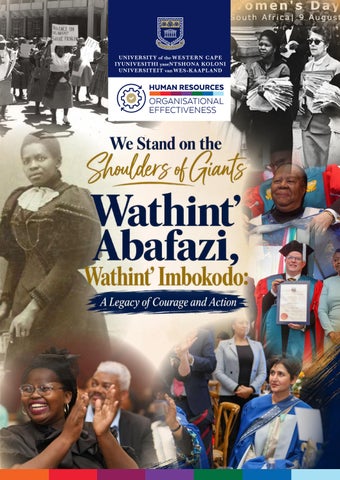
As we have wrapped up Women’s Month and usher in Heritage Month, we reflect on the significance of both commemorative periods and the ways in which they speak to our shared values, identity, history and collective responsibility. We pause not simply to celebrate, but to reflect on how far we have come and how far we still have to go. It is also a moment to remember that we stand on the shoulders of giants, women who had the courage to challenge the status quo, break barriers and pave the way for those who would follow. Many of the opportunities and freedoms we experience today were made possible because of their courage, resilience and determination. Our giants were the women who stood together on 9 August 1956, when approximately 20,000 women marched to the Union Buildings in Pretoria to protest against the discriminatory pass laws. Women from different backgrounds and communities united with extraordinary courage, resilience and determination. Their message was clear: women would not remain silent in the face of injustice. Their bravery became a defining moment in South Africa’s history and a lasting symbol of the power of collective action. Today, we honour
the legacy of these remarkable women, not only by remembering their sacrifice, but by recognising the responsibility their legacy places in our hands. That legacy was brought vividly to life this month at the University of the Western Cape, where five remarkable women were honoured as part of the University’s latest honorary doctorate recipients. Dr Naledi Pandor, Adv. Adila Hassim and former President of Ireland Mary Robinson received honorary doctorates in person, while the late Charlotte Mannya Maxeke and Mandisa Monakali were honoured posthumously. Their stories span generations, professions and continents, yet they share a common thread: a commitment to using their knowledge, leadership and influence in the service of others.
Wathint’ Abafazi, Wathint’ Imbokodo: A Legacy of Courage and Action
THE UNIVERSITY OF THE WESTERN CAPE RISK & COMPLIANCE DIRECTORATE
Also honoured was Ms Francesca Paola Albanese, United Nations Special Rapporteur on the situation of human rights in the Palestinian Territories occupied since 1967. She was awarded her honorary doctoral degree in absentia. As the first woman to hold this United Nations mandate, her work on international law, human rights, forced displacement and the protection of occupied populations adds another important dimension to UWC’s recognition of women whose leadership and scholarship speak to human dignity, justice and accountability.
1
Charlotte Maxeke, remembered as the “Mother of Black Freedom in South Africa”, was a pioneering educator, political activist and social reformer who helped lay the foundations for women’s political participation and social justice. More than a century after she became the first Black South African woman to earn a university degree, her recognition by UWC is a powerful reminder that the path she helped forge continues to shape the lives of women today. Mandisa Monakali similarly devoted her life to the rights and dignity of women and children, founding Ilitha Labantu in Gugulethu in 1989 and becoming a fearless advocate against gender-based violence and for women’s empowerment. Standing alongside these historical and community leaders were women whose influence extends into the present. Dr Naledi Pandor’s distinguished career as an educator, parliamentarian and diplomat reflects a lifetime of public service, while Adv. Adila Hassim has been a leading voice in constitutional rights, access to healthcare and social justice. Mary Robinson, Ireland’s first woman President and a former United Nations High Commissioner for Human Rights, has spent decades advancing human rights, gender equality and climate justice. The significance of this moment is not simply that these women received honorary doctorates. It is that their recognition provides a living bridge between generations of women who have challenged injustice, expanded possibilities and created space for others to follow. From Charlotte Maxeke and the women of 1956, to Mandisa Monakali, Naledi Pandor, Adila Hassim, Francesca Paola Albanese and Mary Robinson, we see different expressions of the same enduring principle: progress happens when people use their courage, knowledge and influence to make the path wider for those who come after them.
Wathint’ Abafazi, Wathint’ Imbokodo: A Legacy of Courage and Action
2
THE UNIVERSITY OF THE WESTERN CAPE RISK & COMPLIANCE DIRECTORATE
That legacy continues to live through women in our workplaces, communities and families. Every day, women are leading teams, building businesses, pursuing careers, challenging assumptions, innovating, mentoring others and creating opportunities where none existed before. They are breaking barriers in boardrooms, on project teams, in technical fields and across industries once considered out of reach. Progress is not only measured by titles or milestones; it is also found in the everyday acts of women supporting, championing and lifting one another, and in the colleagues and leaders who actively create environments where everyone can thrive. At UWC, this legacy is also visible in women’s
leadership across the University. We acknowledge the women who have served and continue to serve in key governance and management roles, including the Chairperson of Council, Ms Xoliswa Mpongoshe, women who have held the Deputy Vice-Chancellor portfolios, Professor Matete Madiba, Professor José Frantz, Professor Priscila Baker and incoming, Professor Sarojini Nadar, including the Registrar of the institution, Dr Nita Lawton-Misra and women serving as Deans, Professor Fatima Moolla, Professor Michelle Esau and Professor Anita Padmanabhanunni. Their presence in senior leadership is important not only as a reflection of progress, but also as an example to the many women across our institution who aspire to leadership.
At the same time, celebrating progress must not prevent us from asking where the gaps remain. Women are still underrepresented in management and decision-making spaces, and the representation of African women in senior positions requires particular attention. The latest UWC workforce figures show that women make up 1,558 of 2,649 staff members (58.8%), including 394 African women (14.9% of all staff) and 808 Coloured women (30.5%). However, women, particularly African women, remain underrepresented in senior and top management, with African women largely concentrated in skilled technical and lower employment categories. Wathint’ Abafazi, Wathint’ Imbokodo: A Legacy of Courage and Action
THE UNIVERSITY OF THE WESTERN CAPE RISK & COMPLIANCE DIRECTORATE
The picture therefore paints a persistent gender and race transformation gap in UWC’s leadership structures, requiring attention. As UWC continues its transformation journey, governance and appointment committees should place even greater emphasis on equity and gender transformation, with deliberate attention to the advancement and appointment of African women into management and senior leadership positions. As we close Women’s Month, our responsibility is not to close the conversation with the calendar. Instead, we must carry its spirit forward. We must continue to challenge inequality, create meaningful opportunities, listen to diverse voices, and ensure that the next generation inherits a workplace and society that is more inclusive than the one we inherited.
3
The women of 1956 showed us what is possible when courage becomes collective action. The women honoured by UWC remind us that this work did not end with that historic march, it continues in courtrooms, classrooms, communities, public institutions, workplaces and homes. We stand on the shoulders of giants, and now it is our turn to lift others higher. Let us honour their legacy not only through remembrance, but through action: by creating opportunities, opening doors, mentoring others, challenging barriers and building a future where every woman has the opportunity to lead, contribute, succeed and inspire the generation that comes next. Wathinta abafazi, Wathint’ imbokodo: You strike a woman, You strike a rock! Malibongwe igama lamakhosikazi! Salutations to our women!!
Wathint’ Abafazi, Wathint’ Imbokodo: A Legacy of Courage and Action