South African Sport and the nation

South African Sport and the Nation
Proceedings of a Jaap Durand Seminar
Edited by Hein Willemse
JDC Opinion and Review 3

© Individual authors
Publisher: The Jaap Durand Chair
University of the Western Cape Robert Sobukwe Rd Bellville, South Africa
Publication date: June 2026
ISBN: 978-1-0492-9144-4
All rights reserved. No part of this publication may be reproduced or stored in any retrieval system or transmitted in any form or by any reproductive means, without the written permission of the publisher.
Editorial note: ChatGPT has been used in the standardisation of notes and bibliographies in this publication.
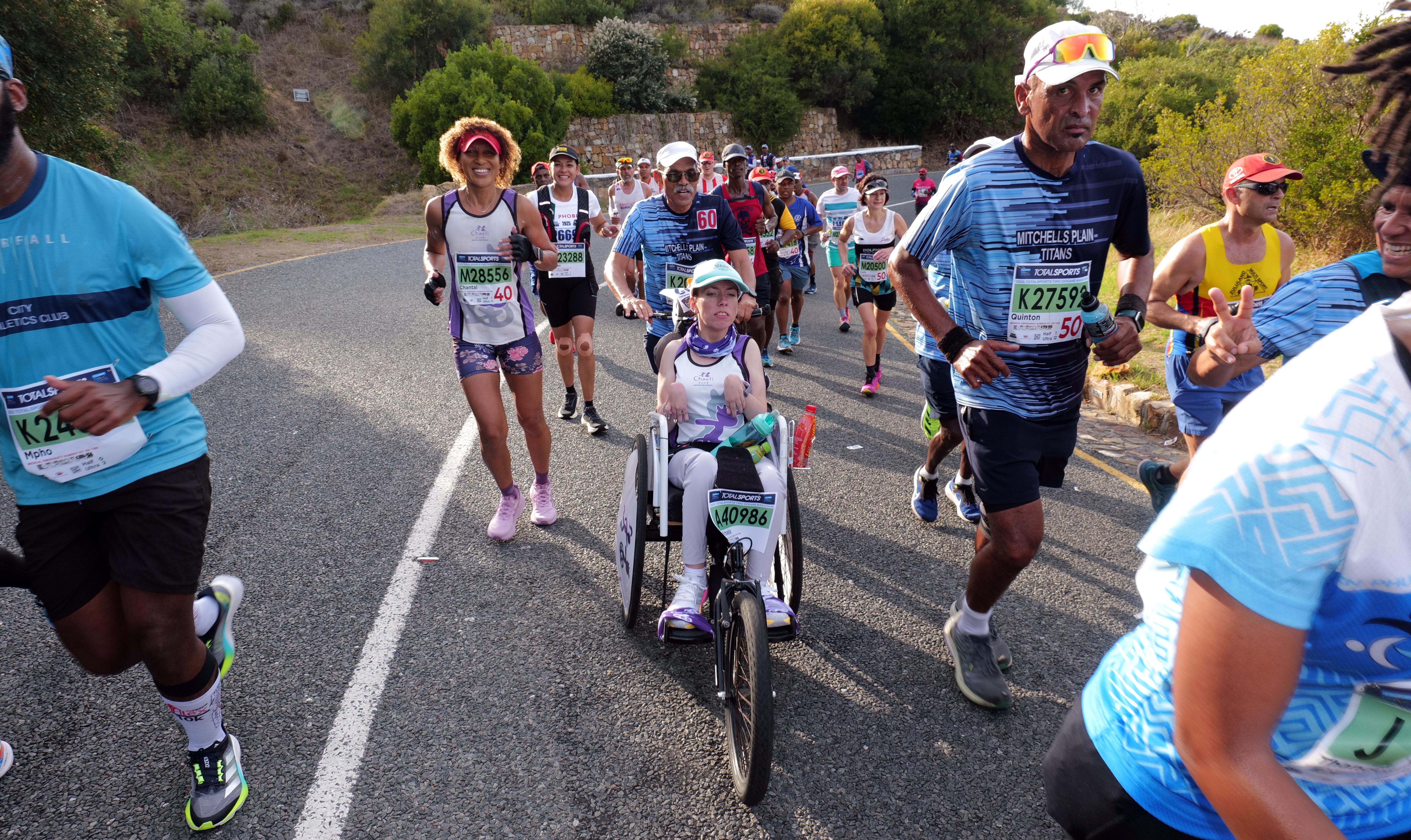
Cover: © Ian Landsberg, Two Oceans Marathon, Cape Town, 5 April 2025.
Editing, typography and design
Set in 11 pt on 14 pt Garamond

Proceedings of a Jaap Durand Seminar
Edited by Hein Willemse
South African Sport and the Nation brings together the proceedings of a Jaap Durand Chair Seminar held on 22 April 2026 at the University of the Western Cape. The event was jointly sponsored by the Jaap Durand Chair and the Faculty of Community and Health Sciences at the University of the Western Cape. The JDC Opinion and Review Series draws on concise position papers addressing topical issues, originally presented as part of the Jaap Durand Chair Seminars.
South African Sport and the Nation
48 From the Sidelines to Kick-Off: Herstory in SA Women’s Rugby — Natascha Louw
55 Hidden History of Sports: Focus on Rugby — Sedick Crombie
65 Constructing Sport on the Playgrounds of Robben Island — Vanessa Mitchell
71 Cricket South Africa’s Contribution to Nation Building — Johan Weyers
79 Exploring Pathways, Barriers and Inequalities in South Africa — Hayley Velayudam
88 The Provision of Sport and Recreation Facilities in Cape Town — Clare Bartels, Franklin Anthony, Jan Fourie, and Jason Mitchell
95 Promoting Batho Pele Through the Trilateral Approach — Lyndon Bouah
103 Human Rights in Leisure: A Framework from the World Leisure Charter — M. E. M. Young
108 Cardiovascular Health and Sport: From Performance to Prevention — Jaron Ras
115 Sporting Potential: Sport Science and Talent Development — Gareth Smithdorf
123 Sport in the Post/Anthropocene — Lesley Le Grange
129 Sport and the Second Transition in South Africa — André Odendaal
144 Coda: Sport, Memory, Justice, and Nation in South Africa
Michelle Andipatin, PhD (Psychology), is Deputy Dean for Research in the Faculty of Community and Health Sciences at the University of the Western Cape. Her research spans a wide range of interdisciplinary interests, including women’s reproductive health, men and masculinities, alternative healing modalities, mental health and well-being, philosophical questions in science, and research methodologies.
Franklin Anthony is the Head of Programmes for Area South in the Recreation and Parks Department in the City of Cape Town.
Robert J. Balfour, BA Hon, HDE (cum laude), Rhodes; MA (cum laude) Natal; PhD, Cambridge is Rector and Vice-Chancellor of the University of the Western Cape. He previously served as Professor of English Studies and Education at the University of KwaZulu-Natal, Registrar of St Augustine College of South Africa (2008–2010), Dean of the Faculty of Education Sciences at North-West University (2011–2017), and Deputy Vice-Chancellor: Teaching and Learning at North-West University (2017–2024). He has published extensively on multilingualism, equity, and postcolonial studies.
South African Sport and the Nation
Lyndon Bouah was appointed to the Department of Cultural Affairs and Sport on 1 January 2011 as Chief Director for Sport and Recreation in the Western Cape Provincial Government. He assisted in the drafting of the National Sport and Recreation Plan for South Africa in 2011. He obtained his Protea Colours for Chess in 1992 when he was 19 and represented South Africa at the Chess Olympiad in Manila, Philippines. He went on to represent South Africa at junior and senior level and has competed in various countries and competitions since 1992. In 2014, 2016 and 2018 he captained the South African Olympic Chess team at the Olympiad in Norway, Azerbaijan and Georgia. He has completed his B. Iuris and LLB at the University of the Western Cape, his LLM at the University of Cape Town and has completed his doctorate at the University of the Western Cape in 2016 in the Philosophy of Sport Science, Exercise and Recreation. He frequently presents papers at various national and international conferences and is guest lecturer at UWC. He is the Chairperson of the Western Cape Events Forum and was a board member of the Netball World Cup 2023.
Clare Bartels is a Senior Professional Officer in the Programmes, Events and Partnerships unit at the City of Cape Town’s Recreation and Parks Department. Her role is in the development of strategy and policy related to recreation programmes, and in conducting research, designing programmes and partnerships. Her presentation will focus on the City’s provision and management of community sport and recreation facilities and will share recently implemented sport infrastructure projects.
Francois Cleophas is an Associate Professor at Stellenbosch University, internationally recognised for work on South African sport history. He has authored over 60 peer reviewed journal articles, 12 book chapters, two edited volumes and two monographs on South African sport history. He serves as vice-president on the ISHPES executive, SASHT executive and HiPSA executive. His research advances local sport history in a decolonised manner.
Sedick Crombie, BA, Dip. Public Administration, MA (Public Administration), HDE (UWC). He further studied at the prestigious Scuola di Lingua e Cultura Italiano per Stranieri a Siena in Italia (Italian School for Foreigners in Italian Language and Culture). He has been involved in Education and Training for more than 30 years, inter alia at Secondary school level, IMM International Graduate School of Marketing and the Peninsula Technicon (Cape Peninsula University of Technology). His books include My Apartheid Diary (2020) and South African Rugby –Untold stories from a Divided Nation (2025).
Jan Fourie is the Recreation Manager for Area North in the Recreation and Parks Department at the City of Cape Town. viii
Contributors
Mark Fredericks is a Senior Video Technician at Walter Sisulu University in KuGompo. He has presented on the relationship between sport, society and politics locally and abroad, using mainly audio-visual presentation methods. His MA (UFS) study concentrated on Springbok rugby television commercials. His commentary Injury Time – The Rise of the 80 Minute Nation forms part of the education curricula at several international universities. Mark is an avid photographer, teaching the skill to children in underserved communities.
Winston Kloppers attended and later taught at Trafalgar High School in District Six, Cape Town. He played first-team rugby for Walmers and Primroses, and represented Western Province as an athlete. He subsequently completed a master’s degree at the University of the Western Cape, focusing on the militarisation of white schools in South Africa, and went on to play a pioneering role in university sport. He served as UWC’s first track-and-field coach and, in 1984, was appointed deputy director of sport. Alongside his contributions to athletics administration, he lectured in the Department of Sport, Recreation and Exercise Science, retiring as chairperson in 2003. He presented his research at several international conferences, including meetings of the International Society for Comparative Physical Education and Sport (ISCPES), held prior to the 2000 Summer Olympic Games in Sydney and prior to the 2002 Commonwealth Games in Manchester In 2024, he published Blowing against the Wind, an account of student politics and sport during the formative years of UWC.
Lesley Le Grange is Professor of Education at Stellenbosch University, internationally acclaimed for work in curriculum studies and environmental education. He has held senior leadership roles, authored 267 publications, delivered over 190 presentations, and serves on twelve editorial boards. A Fellow of the Royal Society of Biology and member of ASSAf, he is President of the International Association for the Advancement of Curriculum Studies and Chairperson of South Africa’s HEQC. His research advances sustainability, decolonisation, and indigenous knowledge integration.
Natascha Louw is a Sports Officer: Competitive Sport at the University of Venda. She has a master’s degree in Sport Science from Stellenbosch University. Since 2020, she has presented at national and international seminars, focusing on sport and sport history, particularly rugby and women’s rugby. Her master’s thesis examined the lives of three historically significant Springbok rugby players. She is currently pursuing a PhD on South African Rugby Herstories, under the supervision of Prof Francois Cleophas.
Jason Mitchell is the Recreation Manager for Area South in the Recreation and Parks Department in the City of Cape Town.
South African Sport and the Nation
Vanessa Mitchell holds a PhD in Sport Science from Stellenbosch University. Her dissertation, Playgrounds of Political Imprisonment: Historical Narratives of Sport on Robben Island, 1962–1990, interrogates sport and recreation within political incarceration, situating Robben Island beyond its dominant narrative of pain and suffering. As both practitioner and scholar, her research sits at the intersection of sport, politics, and social justice, focusing on recovering marginalised narratives and overlooked histories of sport in incarceration and excluded spaces. Her work seeks to integrate sport history, museum practice, education, and sport heritage studies to generate public scholarship, advancing understandings of sport as a site of memory, identity and socio-political transformation.
Philani Nongogo has been an Associate Professor of Sport Studies at Walter Sisulu University since 1 April 2024. He is also a public commentator and an author (Philani Nongogo, Buntu Siwisa, Hendrik Snyders & Mzukisi Twala, Umbhoxo: Making Rugby an Afrikan Game (2023) — his important work on the sports lived experiences and rugby traditions of the Afrikan people. He has also produced a number of outputs: 22 research papers in peer-reviewed, accredited journals, 6 book chapters, and numerous insights and opinion pieces in newspapers. He has just under three decades of experience in the Higher Education sector, during which he served in various academic positions at the University of Fort Hare (UFH) and Tshwane University of Technology. He holds a Bachelor of Pedagogics degree, BA Hons and MA in Human Movement Studies from UFH; and a DPhil in Human Movement Science from the University of Pretoria. He has also attained three Postgraduate Certificates from universities in the United Kingdom and Finland, and a Postgraduate Diploma in Olympic Studies from the University of Peloponnese, Greece.
André Odendaal is the Vice-Chancellor’s writer-in-residence and Honorary Professor in History and Heritage Studies at the University of the Western Cape, based at the Centre for Humanities Research. His books on the social history of sport include The Story of an African Game (2003), the co-authored Cricket and Conquest (2016) and Divided Country (2018) — volumes 1 and 2 (of four) volumes in The History of South African Cricket Retold, 1797–2025 series — and Pitch Battles, Sport, Racism and Resistance (2020). In 2026 he was awarded the Howard Milton Prize for outstanding cricket scholarship jointly by the British Society of Sports History and The Cricket Society.
Jaron Ras is a senior lecturer, researcher, and biokineticist at the University of the Western Cape with over six years of higher education experience. He has authored 37 peer-reviewed publications, serves on the editorial board of BMC Public Health, and has presented his research at numerous local and international conferences. His work focuses on cardiovascular and musculoskeletal health in high-risk occupations, aiming to advance occupational health, prevent non-communicable diseases, and improve health and performance in South Africa. x
Contributors
Gareth Smithdorf is a biokineticist and lecturer in the Sport Recreation and Exercise and Sport Department He has been lecturing for the past 10 years teaching mainly on the fitness and sport conditioning modules He is a PhD student focusing on “talent identification in football”. He served on the medical and sport science committee of Swimming South Africa, high performance teams and served on the medical and sport science committee of SAFA, Cape Town.
Hendrik Snyders is a senior researcher at the Centre for Military Studies at the South African Military Academy (Faculty of Military Science at the University of Stellenbosch), and a Research Associate at the Department of History, Free State University as well as an Honorary Research Associate of the National Museum Bloemfontein. His research focuses on the military, race, sport, masculinity, memory, heritage, memory, public history and colonialism. Hendrik has published extensively in peer-reviewed journals and edited volumes and has authored several monographs, in addition to several co-authored books. The latter include Tries and Conversions: South Africans in Rugby League with Peter Lush (London: League Publishers, 2015, London); Umbhoxo: Making Rugby an Afrikan Game, with Philani Nongogo (Pretoria University of Technology, Pretoria, South Africa), Buntu Siwisa (University of the Witwatersrand, Johannesburg, South Africa and Mzukisi Jeffrey Twala, (Cape Town: Ukufezwa Kweminqweno, 2023), as well as Klaverjas and the Hidden Sporting Heritage of South Africa: Card Games, Community and Black History with Leonard Jacobs (Amsterdam: University of Amsterdam Press/ Central European University Press, 2026). His most recent monographs included, Blitzboks: A History of Rugby Sevens in South Africa, c. 1904 - 2019 (Cape Town: Naledi, 2021), Rough Diamonds: A History of South African Baseball (McFarland Books, 2025) and Thurgood’s Pigbladder: Apartheid and South Africa – United States Rugby Relations, 1976–1992 (UNISA Press, 2026, in press).
Hayley Velayudam, (PhD, UKZN) is a lecturer in the Division of Movement Science and Exercise Therapy at Stellenbosch University and a registered biokineticist. Her research focuses on sport development and sport-for-development, particularly within low-resourced communities in South Africa. She integrates her roles as a biokineticist, lecturer, and emerging researcher, drawing on a strong foundation in human movement and exercise science to promote a holistic approach to health, wellness, and sport.
Johan Weyers (B.Ed, UWC) serves as the Senior Cricket Manager at Cricket South Africa (CSA). He further strengthened his leadership and management expertise through the Management Advancement Programme at Wits Business School. He is currently completing a MPhil degree in Change Leadership at GIBS Business School. He captained UWC’s cricket team in the early 1990s and went on to play provincial cricket for the Garden Route Badgers and gained international experience through club cricket stints in the United Kingdom. He continues to making a significant contribution to the advancement and transformation of cricket in South Africa.
South African Sport and the Nation
Hein Willemse is Professor Emeritus of Afrikaans and Literary Theory and former Head of Department at the University of Pretoria. He has held visiting professorships at universities locally and internationally, including in Africa, Europe, and the Americas. He is a former President of the International Society for the Oral Literatures of Africa (ISOLA), a former editor of the oldest African literary journal Tydskrif vir Letterkunde (est. 1936), and served as trustee or director on the boards of several community organisations, and media companies. He is the inaugural holder of the Jaap Durand Chair (2025–26) at the University of the Western Cape.
Marié E. M. Young joined the Department of Sport, Recreation, and Exercise Science at the University of the Western Cape in 2009. As Associate Professor she led the department from 2016–2019. She holds a PhD in Sport and Recreation Management and specialises in therapeutic and community recreation. Formerly a Sport and Recreation Officer in Johannesburg, she is committed to youth development and health promotion. She publishes widely and serves on international boards, including the World Leisure Organisation and editorial board of the World Leisure Journal
Hein Willemse
It is my privilege to welcome you to this seminar on South African Sport and the Nation, co-hosted by the Jaap Durand Chair and the Faculty of Community and Health Sciences. This university-wide Chair was established by the Durand family in honour of their father, who served from 1973 until 1994 as Professor of Systematic Theology at the University of the Western Cape, and for eleven of those years as sole Vice-Rector under the rectorships of Profs Richard van der Ross and Jakes Gerwel. Together, these leaders guided this institution through the most turbulent and formative period in its early history. Their intellectual courage and moral clarity helped shape generations of academics, scholars, and students who transformed UWC into the forward-looking institution it is today.
Jaap Durand himself exemplified that legacy. He was a distinguished theologian, uncompromising in his critique of apartheid, and deeply committed to justice. Yet he was also, in a more personal sense, a lover of sport – competitive, disciplined, and engaged. It is fitting, therefore, that we gather under the auspices of the Chair that bears his name to reflect on sport
South African Sport and the Nation
not only as recreation or spectacle, but as a significant social and ethical practice.
Over the past months, the Jaap Durand Chair has convened a series of conversations drawing participants from across our university and broader community. We have engaged questions of identity and belonging, reflected on the disruption of our social fabric through crime and dysfunction, and now turn our attention to the place of sport in shaping South African society. Underpinning these seminars is a shared commitment to civic belonging, guided by the Chair’s vision of working towards a just, participatory, and sustainable society.
Central to this vision is an understanding of the nation not as a fixed or settled entity, but as something continually in the making. The nation is complex, often contested, and never coherent. It is shaped by power relations, by histories of exclusion and inclusion, and by ongoing negotiations over identity, citizenship, and belonging. Our conversations have reminded us that national identity is not a given; it is a site of struggle, shaped as much by experiences of difference as by enduring visions of unity.
It is within this broader conceptual framework that we turn to sport.
Sport is often celebrated as a powerful vehicle for national identity, a unifying force capable of transcending division and fostering collective pride. Iconic sporting moments, across rugby, cricket, soccer, athletics, and to a lesser degree, netball, are frequently invoked as evidence of sport’s capacity to bring South Africans together. These moments matter. They carry emotional weight and symbolic significance.
Yet, while this narrative is not without truth, it remains incomplete.
The history of South African sport is deeply entangled with the legacies of colonialism and apartheid. Access to participation was never equal; it was structured along racial and socio-economic lines. Facilities, resources, and opportunities were unevenly distributed, and these inequalities 30 years into democracy have not simply disappeared. While the post-apartheid era has seen important sporting milestones the deeper structural disparities remain largely intact.
At the elite level, national teams project an image of excellence and, at times, cohesion. These representations suggest the possibility of transcendence. But they rest on a narrow and uneven foundation. The pathways that produce elite athletes remain mostly concentrated in historically privileged environments, limiting access for many.
At the grassroots level, where sport arguably holds its greatest transformative potential, the system is at its most fragile. In many schools, physical education has been marginalised, facilities have deteriorated, and
No-one in the Game is ever Impartial
organisational support is inconsistent. Opportunity, from the very outset, is unevenly distributed.
In a recent Jaap Durand seminar on gangsterism and social dysfunction in the Western Cape, a recurring theme was the lack of accessible recreational spaces and structured activities for young people. In many communities –urban and rural – speakers lamented that sporting facilities are inadequate, governance is fragmented, and sustained coaching is absent. It is precisely within these contexts that sport could make its most meaningful contribution, supporting youth development, fostering social cohesion, and strengthening community life.
If we are to take sport seriously as a site of transformation, we must broaden our focus beyond elite performance. One must acknowledge the many ways in which some city and town councils develop and maintain community sport centres, but these clearly remain limited, amid other pressing needs. We do need greater awareness that mass participation sport, i.e. as it is lived and experienced in communities, can play a vital role. Its benefits are well-known: It promotes physical health and addresses the growing burden of chronic disease; it creates spaces where people from diverse backgrounds can interact and build relationships. For young people, it offers structure, discipline, and alternatives to cycles of violence and exclusion. It also generates opportunities for volunteering, leadership, and the building of social capital.
To realise this potential, however, sport must be understood not as a luxury, but as a fundamental component of social development. This requires deliberate and sustained investment: in infrastructure, in school-based programmes, in local clubs and organisations, and in accessible pathways for participation.
Equally important are the stories we tell about sport; perspectives on sport remind us that no-one in the game is ever impartial. Narratives matter. They shape our understanding of the past and inform our vision for the future. A selective or fragmented history risks reinforcing inequality by rendering certain experiences invisible. There is an urgent need for more inclusive and systematic accounts of South Africa’s diverse sporting histories, histories that acknowledge achievement, loss and exclusion.
S o where does this leave us?
Sport alone cannot resolve the deep inequalities that shaped our society. It cannot, on its own, repair the legacies of injustice. But it can contribute, meaningfully and materially, if its foundations are addressed. Without investment in grassroots development, without equitable access to resources and opportunities, and without a commitment to inclusivity, the successes we
South African Sport and the Nation
celebrate at the national level risk becoming little more than symbolic gestures.
Perhaps, then, our task is to shift our attention: from what sport represents to what it does; from moments of unity to the conditions that make such unity possible and sustainable. If sport is to play a meaningful role in shaping the nation, it must reflect not only our aspirations, but also impact the realities of our lives and the ways in which we participate and belong.
With the publication of this volume, I have many debts to pay. It is my pleasure to acknowledge every one of the speakers who answered our call to present their papers at the seminar. My colleagues Marié Young, Chanté Johannes, and Makhaya Malema from the UWC Department of Sport, Recreation and Exercise Science, and Francois Cleophas from the Division of Sport Science at Stellenbosch University, contributed their time and ideas in planning the seminar. The rector, Prof Robert J. Balfour went beyond the call of duty to support our work throughout my incumbency of the Jaap Durand Chair. Dean Michelle Andipatin with little hesitation cohosted the event. I also wish to acknowledge the Jaap Durand Steering Committee under the leadership of Profs Fatima Moolla, Ernst Conradie and Lois Dippenaar, and the Durand family, whose ongoing support sustains this Chair. On the day of the event and a few days preceding it, our student assistants, Imke Daniels, Johnmark Solomon, and Masentle Khanyetsi did much of the necessary legwork to ensure a successful gathering. Jamie-Lee Peters from UWC Audio Visual Services created our audio and visual archive, while Gasant Abarder and Nashira Davids expertly dealt with the communication needs of the event. A special word of thanks goes to Lloyd Zanna-Rex Chetty. Quite simply, without her, this seminar and all other activities of the Jaap Durand Chair in the unfamiliar environment of UWC of 2025–26 would have been demanding. Her organisational skill, care, and attention to detail have carried this event from start to finish.
Awarm welcome to our University and the Faculty of Community and Health Sciences. Prof Balfour, good morning and welcome. To all of our guests, a very warm welcome. It’s such a privilege and an honour to be here today and to welcome you.
I was a student at UWC in the Psychology Department when Prof Jaap Durand was its vice-rector. I recently looked at some photographs especially the historic march with Profs Jakes Gerwel van Richard van der Ross and Durand. I was part of that march and I could identify some of the faces. So some of the members on the SRC like Llewelyn MacMaster, Leslie Maasdorp and Russell McGregor, and Cecyl Esau were well connected and liked by Prof Durand. At the time UWC was a war zone. Those of you who were here in the 1980s, you know what I’m talking about. It was difficult to attend classes for an entire year without any disruptions or boycotts. In my final year, in 1985, we had no classes virtually for the entire year and we wrote exams in January 1986. That is the UWC we have all come to love and respect. Our fight for justice and equality continued for years with many making noble sacrifices for clubs and country. Our slogan at the time was “no normal education or sport in an abnormal society”.
South African Sport and the Nation
Today I wonder how normal our society has really become. Sometimes I think it’s even more abnormal than what it was, given the context we are witnessing in our communities. We want to use sport as a tool for transformation but at what levels do we transform? Do we transform only at social levels? My own background dictates “no”, we also have to look at things from a psychological perspective. What is happening within our communities, given the magnitude of the violence we are seeing. Allow me to read a quotation from a former UWC colleague, now at Stellenbosch University, Dr Charl Davids. He wrote on LinkedIn and he got me thinking about sport and the nation. He writes, We can’t police or militarize our way out of violence. We often talk about crime in numbers, but we don’t talk enough about what sits underneath it. From a psychological perspective, anger is not the problem. It’s a signal, a signal of injustice, of threat, of pain. The real concern is what happens when anger becomes chronic, shaped by environments of ongoing stress, inequalities, and unresolved traumas. To understand this, in South Africa, we cannot ignore the legacy of apartheid. Apartheid didn’t just shape policy, it shaped people. It normalized violence, disrupted families, embedded fear, humiliation, and anger across generations. And we see the intergenerational trauma today. And trauma doesn’t end when systems do. It is carried forward through how we parent, how we relate, and how we respond to stress. Today, many South Africans live in conditions of chronic pressure, unemployment, inequality, and daily exposure to violence. Psychologically, this matters. A nervous system under constant stress has less capacity to regulate emotion. Small triggers become big reactions. Anger shifts from a moment to a mindset. Add to this the pressures around identity, particularly masculinity, and violence can become a misguided way to reclaim control, dignity, or power. This doesn’t excuse violence, but it does explain it. If we are serious about reducing violence, we must move beyond reaction. Policing alone or militarizing communities will not solve the psychological and historical problem. We need trauma-informed systems, emotional regulation and conflict skills, stronger family and community support, honest conversations about identity and masculinity, and critically real progress on inequality, because psychological well-being and social conditions are inseparable. Maybe the real shift we need is this. From becoming individuals to becoming to understanding context, from reacting to violence to preventing it, from managing crime to investing in healing. What would change if we treated violence not only as a safety issue but as a psychological and societal one?
The reason I found his commentary fitting for today was precisely because of what I believe the Jaap Durand Chair is trying to accomplish within underprivileged, under-resourced and underserved communities. As a Faculty we are also aiming to serve our broader community through our various community engagement projects.
So back to sport. “No normal education and sport in an abnormal society.” It was the slogan of SACOS which was formed around 1973. They advocated for non-racial rather than multi-national sport demanding
Welcome on behalf of Faculty of Community and Health Sciences
equal integrated participation over segregated reform. Today many athletes, especially in the communities where I find myself among soccer players, one realises how apartheid impacted them. I listen to them talking and they’re so sad. They look at their talent and compare themselves to players in the Premier League and La Liga and some of the big leagues and I hear them saying, ”I could have done better than that. We had the talent in our communities. We never had the opportunity.” This sadness touches one very deeply.
Today we reflect on the state of sport in our nation, we remember all who fought and stood for equality and justice. While apartheid has officially been abolished, inequity and huge disparities remain. If we were to turn a blind eye, we would not be true to the UWC we all love and we created. Our mission is to continue to highlight these disparities and continue to advocate for real change, which I believe the Jaap Durand Chair aims to do. Thus, in the spirit of Prof Durand and all he stood for, let us embrace and continue his legacy during the symposium. May we all continue to learn, but most of all be the change that we all wish to see. May we all continue to advocate for change within the spaces that we inhabit. I therefore wish you all a very pleasant and informative day. May we all live richer because of what we will learn through the different talks today.
Good morning colleagues, distinguished guests, and partner institutions. Prof Michelle Andipatin, Deputy Dean for Community Health Sciences, colleagues from Robben Island Museum (RIM), Walter Sisulu University, Stellenbosch University, from Cricket South Africa, City of Cape Town and the Western Cape Provincial Government, University of Venda, and the University of the Western Cape. Thank you all for making today possible. Thank you, Prof Hein Willemse, the Jaap Durand Chair, and Lloyd Chetty and the team for all the energy and organisation that makes it possible to come together on this important topic. I note with sadness, the news we received this morning about the passing of one of our UWC colleagues, Professor Bradley Rink, who will be very much missed amongst us.
This seminar is timely and special. South African sport still carries the effects of an unequal past and an uneven present. Much attention still goes to elite success, while the conditions needed for broader participation often receive less attention. This seminar creates space for a discussion about sport,
Welcoming Address
development and access, with wider implications for how we think about memory and responsibility.1
The seminar is framed around an important proposition that sport has helped define national identity in South Africa, yet the work of transformation remains incomplete. That is especially visible in the gap between elite performance sport and under-resourced community participation. The programme therefore approaches sport as a question of history and justice, as well as public responsibility. These themes make this a fitting conversation for a platform associated with the Jaap Durand Chair2 and the work that the Chairholder and team has achieved in making these occasions a platform for debate, shared insight and engagement between academics, policy makers, sport authorities and leaders from across civil society.
Against that background, it is a real pleasure to welcome you to the University of the Western Cape for this seminar on South African Sport and the Nation
In recent months, I have noticed how public discussion often settles on major sporting events and elite success, while the ordinary conditions that make participation possible receive much less attention. For institutions such as UWC, that raises important questions about access and public responsibility.3
The history of South African sport is inseparable from the history of segregation and apartheid. Access to facilities, recognition, competition, and opportunity was structured through exclusion. Sport later became one of the spaces in which that order was challenged. Yet the effects of that history remain.4
I want to add today some thoughts, hopefully rendered with a little humour about my experience of sport, schooling and values, and why the insights are also part of transformation work. I begin with a (very) short story from my youth. I attended a school, racially integrated in the 1980s, where sport was compulsory. Unfortunately for me, and other social misfits whose hand-to-ball coordination skills, were limited, we too had to play something. Always on that side of the last to be chosen for teams, this group of boys formed a kind of identity in any of the codes offered by the school. In rugby particularly, we earned a sobriquet: the Sheilas; that group of boys who formed part of the E Team. In many ways, we were opposites of the A Team: seemingly incohesive, mostly uncoordinated, and sometimes wayward in manners and even mannerisms. Coaching was also less than exemplary, but
South African Sport and the Nation
perhaps not unrepresentative: The team, was coached by what seemed to be a very disaffected teacher, who prone to violence, and not averse to shouting at children; ensured that each practice came with high levels of anxiety, absenteeism and (t)error. Scheduled games were often missed with accompanying sick notes.
It felt as though we became the derisory mascots of the School; the subjects of fun, fear and shame. Thinking back on it, I wonder about the feminisation of the team's name; the treatment, the performativity of gender, and the toxic masculinity that characterised teaching nationally, and not only in this School. And, with hindsight, I realise that the approach to educating South Africa’s divided publics (in which corporal and capital punishment was legal), was framed in a larger discourse concerning hegemonic white masculinities. This experience was timed in the nadir of apartheid and global movements. Nascent neo-liberal capitalism (the Reagan-Thatcher years) was growing in the aftermath of liberation struggles and victories across the continent of Africa in the thaw of the cold war. All of this was occurring just prior to the onset of the AIDS pandemic when moral anxiety about gender and sexuality worked to undermine the good intentions of institutional sport participation. It occurs to me that everything I might now wish for the value about sport, for our students, arises in some ways from the education in sport I did not have: sport is meant to build trust, teamwork, respect of differences of skills and contribution, to foster bonding and a spirit of looking out for your team members.
As an academic I am aware of the literature about the development of body and identity: consider for example Nancy Lesko’s two books Act Your Age: A Cultural Construction of Adolescence (2001) and Masculinities at School (1999)5 in which the relationship between body, the sites in which it is embodied, are described in ways that co-construct both the world and the body: each configuring the other in a complex interplay between socialisation. I am also aware of the wonderful scholars and scholarship about sport at UWC thanks to the books gifted to me.
Our history also helps explain why the question of sport in South Africa cannot be separated from the unfinished work of transformation because as our Jaap Durand Chair has noted, in South Africa, sport was part of what it meant to be divided into the constructs of race hierarchy, and the histories that still need to be written and rendered wonderfully today in the topics that are part of the programme. South Africa in the post-1994 period continues to produce excellence in some elite sports, while community-level
Welcoming Address
sport often struggles with weak infrastructure and limited support. On a social level, we have not yet shed toxic masculinity, although inclusion and equality remains our aspirations as society. What I have come to appreciate is that sport carries social value most meaningfully when it is understood as participation alongside performance and that is why our scholarship matters.
One example is UWC’s UNESCO Chair for Sport, Development, Peace and Olympic Education. It reflects a practical and broader view of sport. Through the Olympic Values Education Programme launched with the Western Cape Education Department, UWC has worked with teachers to promote social inclusion, healthy living, gender balance, literacy and community rebuilding through sport and physical activity.6
Sport can build confidence and belonging, but that depends on credible institutions and sustained investment in the conditions in which people actually live. That is one reason this is an important discussion for UWC.7
Iwould like to thank the Jaap Durand Chair, the Faculty of Community and Health Sciences, and everyone involved in convening this seminar. I also wish to acknowledge the speakers and participants who will lead today’s discussion.
For UWC, transformation has to be read in the texture of everyday social and institutional life. Public institutions serve their purpose best when they help create the conditions in which participation and opportunity are more widely shared. That is also consistent with the Jaap Durand Chair’s wider commitment to a just and sustainable society. My hope is that today’s discussions leave us with a clearer understanding of the conditions needed for sport to contribute to a more just and inclusive society. Thank you.
Notes
1. Jaap Durand Chair (JDC), South African Sport and the Nation: Seminar Brief (Bellville: University of the Western Cape, January 15, 2026); JDC, Invitation: Opening of Jaap Durand Chair Seminar on 22 April 2026, event invitation (Bellville: University of the Western Cape, February 24, 2026); JDC, Notes for the Rector’s Speech, unpublished event notes (Bellville: University of the Western Cape, 2026).
2. JDC, Seminar Brief; JDC, Invitation; JDC, South African Sport and the Nation Programme (Bellville: University of the Western Cape, April 22, 2026).
3. JDC, Notes; JDC, Programme.
4. JDC, Notes; JDC, Programme.
5. Nancy Lesko, Masculinities at School, 1st ed. (London: Sage Publications, 1999); Nancy Lesko, Act Your Age! A Cultural Construction of Adolescence, 2nd ed. (London: Routledge, 2012).
South African Sport and the Nation
6. Marion Keim, “An Olympic Start to the Olympic Year,” University of the Western Cape, January 27, 2024. https://www.uwc.ac.za/news-and-announcements/ news/an-olympic-start-to-the-olympic-year
7. JDC, Seminar Brief; JDC, “Press Release: Seminar to Examine the Role of Sport in Nation-Building and Social Transformation” (Bellville: University of the Western Cape, April 7, 2026).
Bibliography
Jaap Durand Chair. Invitation: Opening of Jaap Durand Chair Seminar on 22 April 2026
Event invitation. Bellville: University of the Western Cape, February 24, 2026.
———. Notes for the Rector’s Speech. Unpublished event notes. Bellville: University of the Western Cape, 2026.
———. “Press Release: Seminar to Examine the Role of Sport in Nation-Building and Social Transformation.” Bellville: University of the Western Cape, April 7, 2026.
———. South African Sport and the Nation Programme. Bellville: University of the Western Cape, April 22, 2026.
———. South African Sport and the Nation: Seminar Brief. Bellville: University of the Western Cape, January 15, 2026.
Marion Keim. “An Olympic Start to the Olympic Year,” University of the Western Cape, January 27, 2024. https://www.uwc.ac.za/news-and-announcements/news/anolympic-start-to-the-olympic-year.
Nancy Lesko. Act Your Age! A Cultural Construction of Adolescence. 2nd ed. London: Routledge, 2012.
———. Masculinities at School. 1st ed. London: Sage Publications, 1999.
Francois J. Cleophas
Introduction
The relationship between sport and nationhood has long occupied a central place in modern historical scholarship. Sport is not merely recreation or physical competition; it is also a social institution through which identities are shaped, contested, and projected. Nations frequently use sport to symbolise unity, progress, racial hierarchy, political legitimacy, and cultural distinction. In South Africa, this relationship has been particularly complex because sport developed within a deeply divided society marked by colonialism, segregation, and apartheid. Consequently, any discussion of “sport and the nation” requires careful attention to politics, ideology, and historical perspective.
This presentation reflects on the theme “Sport and the Nation” by considering the contested meanings of sport in South African history. It argues that there is no absolute truth in historical interpretation. Rather, histories of sport are shaped by perspective, available evidence, and the political contexts in which they are written. In particular, this presentation explores how anti-apartheid sporting traditions, including the legacy of the
South African Sport and the Nation
South African Council on Sport (SACOS), challenged simplistic nationalist narratives and demanded a more critical understanding of sport’s role in society.
Across the modern world, governments and elites have used sport to build nations. International competition, national teams, and ceremonial events allow states to project unity and prestige. Sporting victories are often interpreted as evidence of national strength, discipline, or modernity. Schools, universities, and military institutions have also used physical activity to cultivate loyal citizens and disciplined bodies.
In South Africa, these processes were shaped by racial exclusion. During the colonial and apartheid eras, official sport often reflected white minority power. Resources, facilities, and recognition were concentrated in white institutions, while black, coloured, and Indian communities were marginalised. Thus, sport became a mechanism through which unequal citizenship was reproduced. Participation in national representation was restricted, and the idea of the “nation” itself was racially defined.
This demonstrates that sport can never be separated from broader structures of power. National identity expressed through sport may appear inclusive, but historically it often rests on exclusions that remain hidden unless critically examined.
One of the central insights emerging from the presentation is the statement that there is “no absolute truth”. This is especially relevant to sport history. Historical writing is not a simple reproduction of the past; it is an interpretation of evidence shaped by questions, values, and perspective. Archives may privilege official voices while silencing marginalised communities. Newspapers may reflect class or racial bias. Institutional histories may celebrate achievement while ignoring injustice. As a result, historians must remain alert to how narratives are constructed.
In South African sport history, earlier accounts frequently centred white institutions, famous teams, or administrative milestones while neglecting community sport, political resistance, and non-racial traditions. More recent scholarship has challenged these limitations by recovering neglected voices and exposing the ideological work performed by mainstream sport narratives.
To acknowledge that there is no absolute truth does not mean that all interpretations are equal. Rather, it means that historians must weigh evidence carefully, recognise bias, and remain open to revision.
Sport History and the South African Nation
The presentation’s reference to “biased,” “pro-SACOS,” and “perspective” suggests an awareness that historians themselves are located within debates. This is an important admission. Every historian approaches the past with assumptions shaped by intellectual training, ethics, and lived experience.
SACOS, founded in 1973, became one of the most significant antiapartheid sport bodies in South Africa. It championed non-racial sport and rejected participation in segregated structures. Its famous slogan, “No normal sport in an abnormal society”, captured the view that sport could not be isolated from oppression.
A historian sympathetic to SACOS may emphasise its moral clarity, political courage, and contribution to democratic struggle. A critic might focus on internal tensions, strategic limitations, or its relationship to changing political contexts in the 1980s and 1990s. Both approaches involve perspective.
The key scholarly task is transparency. Rather than pretending neutrality, historians should make their frameworks explicit and support claims with evidence. This strengthens rather than weakens academic integrity.
An exclusive focus on elite institutions obscures the importance of community sport. Across South Africa, oppressed communities built clubs, leagues, school competitions, and social networks despite severe constraints. These spaces nurtured leadership, dignity, and collective identity.
Sporting organisations often overlapped with political and civic life. Meetings, fundraising events, and competitions created opportunities for mobilisation and solidarity. In this sense, sport was not only controlled from above; it was also built from below.
This history is essential to understanding the nation. If the nation is imagined only through official teams or state recognition, then the majority of South Africans disappear from the story. But if nationhood is understood as a contested social process, then community sport becomes central.
Recovering these histories helps correct older distortions and broadens our understanding of who made South African sport.
Academic institutions play an important role in shaping how sport history is remembered. Universities host archives, train researchers, and
South African Sport and the Nation
organise conferences that define scholarly agendas. They also reflect broader political transitions.
In post-apartheid South Africa, universities have increasingly engaged questions of transformation, decolonisation, and social justice. Within this context, sport history offers fertile ground for examining race, class, gender, identity, and institutional memory.
Seminars such as the present Sport and the Nation are therefore significant intellectual spaces. They invite scholars to revisit accepted narratives, debate methodology, and connect historical research to contemporary concerns. They also remind us that scholarship itself is part of public life.
Modern South Africa continues to celebrate sport as a source of unity. Iconic moments such as international victories are often presented as evidence that sport can heal historical division. While these moments matter, they should not erase the deeper histories of exclusion and resistance that makes democratic sport, which still does not exist in South Africa, possible.
A mature national sporting memory requires balance. It should celebrate achievement while acknowledging injustice. It should honour elite performers while also recognising community organisers, teachers, administrators, and activists. It should remember that many who were denied recognition nonetheless sustained rich sporting cultures.
Such an approach moves beyond triumphalism toward critical citizenship. It allows sport to become not a myth of perfect unity, but a field through which society can confront its own history honestly.
Sport and nationhood are inseparable but deeply contested concepts. In South Africa, sport has been used both to entrench racial domination and to challenge it. The history of sport therefore cannot be reduced to medals, famous teams, or celebratory narratives. It must also include exclusion, struggle, and competing visions of the nation.
There is no absolute truth in this field, but there are stronger and weaker interpretations grounded in evidence and method. By acknowledging bias, clarifying perspective, and recovering marginalised histories, scholars can produce richer and more responsible accounts of the past. Ultimately, the study of sport and the nation is not only about games. It is about power, belonging, memory, and the ongoing effort to imagine a more just society.
This article was offered as a contribution following the Jaap Durand Seminar on South African Sport and the Nation held in April 2026. It was written in the early 2000s but never published. Since much has been written about the evolvement of South African sport from the 1990s onwards and the confrontation between the sporting bodies the South African Council on Sport (SACOS) and the National Sports Congress (NSC), I have augmented these early observations with recent references.
Following the 1976 student uprising and under pressure of the international sport and cultural boycott, the National Party government allowed, according to the New York Times, “multiracial games at all levels and mixed racial teams in international competition” on the provision that “racial groups should belong to their own clubs” and that “intergroup competitions in respect of individual types of sports” will be allowed.1 This dispensation could be described as the establishment, government sanctioned, sport formation during the 1980s. During the entire decade South African sport was a highly contested arena between establishment and non-racial sport.
South African Sport and the Nation
SACOS established in 1973, evolved out of the South African Non-Racial Sport Organisation (SASPO, 1970), and became for the next 15 years, the principal proponent for non-racial sport, that is non-discriminatory, meritbased sporting participation with equitable access in an open society.2
The emergence of the United Democratic Front, aligned with the African National Congress, in 1983 gave rise to the UDF Sports Desk in 1986, the National Sports Congress in April 1988 with “both regional and national structures” and their “membership open to all local sports clubs”.3 By 1989 these two organisations, viz., SACOS and the NSC vied for the support of the non-racial sport community and for recognition by the international sport communities with the former gradually losing influence towards the end of the 1980s.
Previously, since its establishment SACOS was the only non-racial sport body in South Africa. It was recognised by the anti-apartheid movement as its domestic sports wing. During this time, it successfully facilitated the organisation of sport codes under the non-racial banner, i.e., “No normal sport in an abnormal society”.4 The logic of this statement seemed highly credible to the non-racial sports movement, who, under this banner gained the moral high ground.
During this period the main thrust of resistance used against apartheid sport by the non-racial bodies were international sport boycotts. Prior to SACOS the South African Non-Racial Olympic Committee (SAN-ROC), established in 1963, was one of the first non-racial bodies which attempted to isolate South Africa from international sport, but their leaders were banned in South Africa, paralysing the movement.5 In 1966 SAN-ROC surfaced in London under the leadership of Sam Ramsamy. It became an important pressure group, even though it was “by Ramsamy’s own admission. Sanroc was really only himself, former Robben Islander Dennis Brutus and a fax machine.”6 Thereafter, it emerged as the external wing of SACOS, and together with its ally, the Supreme Council for Sport in Africa (SCSA), they were instrumental in organising anti-South African campaigns and demonstrations against rebel tours, as well as racial South African sports teams competing abroad. At its meeting in 1966, the SCSA, resolved to use every means to expel South Africa from international sport. Prior to South Africa’s expulsion from the 1968 Olympics in Mexico, Jean Claude Ganga, then secretary-general of the SCSA, lambasted the International Olympic Committee: “We do not wish that the blacks of Africa appear like costumed apes presented at a fair and then, when the fair is over, sent back to their cages.”7
Thereafter, SAN-ROC, SCSA, and Dennis Howell, the United Kingdom Minister of Sport, were mainly responsible for the Gleneagles Agreement on
The Feud between SACOS and the NSC
apartheid sport, signed at Gleneagles in Scotland on 15 June 1977. The agreement was issued by the Commonwealth Heads of Government and was the first international move in the campaign to isolate South Africa from world sport.8 Internally, SACOS deemed that sport and apartheid were irreconcilable, therefore, in 1977 it adopted the double standards resolution (DSR): “Any person, whether a player, administrator, or a spectator, committed to the non-racial principle in sport, shall not participate in, nor be associated with any other code of sport which practise or condone, racialism or multi-racialism.”9
Later it extended the DSR to include people working in government institutions, i.e., Coloured and Indian representative councils, management and local affairs committees, Bantu administration boards and community councils. These bodies were seen as puppets which reinforced racism. People who were serving on these bodies or played “multi-racial sports” were regarded in the uncompromising language of SACOS adherents as “co-opt stooges, turncoats, sellouts, or lure mercenary collaborators”.10 The double standard resolution also included the non-use of sports facilities at the universities,11 and the refusal to apply for a permit to use public sports facilities.
Within SACOS leadership in the Western Cape some members embraced the policies of the Non-European Unity Movement (NEUM), founded in 1943, and developed a substantial influence in the Cape Province. The organisation suffered heavily from apartheid repression in the 1960s, however, it was revived as the New Unity Movement (NUM) in 1985 under the leadership of Richard Dudley. The NUM did not reform its predecessor’s policies, it was strongly opposed to the activities of the “Charterist” groupings, viz., the African National Congress (ANC), the South African Communist Party (SACP) and the UDF, i.e., organisations that adhered to the core principles of the Freedom Charter, adopted at Kliptown in 1955.12 It was also highly critical of collaboration, stating that negotiations with the “ruling class” will never lead to liberation.
From the outset, SACOS was not in favour of collaboration with the State or with establishment sport. However, winds of change were blowing through South Africa, which may have required them to be more flexible in their deliberations.13 They refused to negotiate with any state body, until apartheid was annihilated. On the other hand, The UDF, Cosatu and later their loose alliance, the Mass Democratic Movement (MDM),14 were guided by the Freedom Charter to accept and co-operate with all South Africans who denounced apartheid, in so doing they would force the regime to the negotiating table. A statement in the Charter’s preamble refers to “we the
South African Sport and the Nation
people of South Africa, black and white together equals, countrymen and brothers”. The “Africanists” under the leadership of Robert Sobukwe, did not accept the Freedom Charter, they broke away from the ANC and founded the Pan African Congress (PAC) in March 1959. They “stood for government by the Africans for the Africans – ‘everybody who owes his loyalty to Africa’”.15 Sobukwe urged South Africans of Indian origin to reject “their merchant class” and joined the “indigenous majority”, whites however, due to their material benefits were regarded as unable to owe their loyalty to Africa.16 They also supported the principle that political power will never be relinquished and must therefore be seized by force.17
In 1983, Frank van der Horst was elected as president of SACOS. He called for their affiliates to “rededicate and redirect the organisation to become part of the liberation struggle” and to build a principled united front of organised sportspersons, with the workers in the trade unions, residents in the civics, students, and the youth. SACOS needed this vision if it was to become a truly massed based organisation.18 However, by 1989, SACOS was still a relatively unknown entity in the black townships. The apartheid regime had fractured the South African population into different ethnic and sociopolitical groups. As a result of this, SACOS became mainly representative of the people of the Western Cape who were classified as coloured and groupings around urban centres such as Kimberley, Port Elizabeth and Durban. People classified as blacks had their own political aspirations, and were for the most part unaware of the existence of SACOS. Van der Horst’s plea in 1983 bore testimony to the fact that after a decade, SACOS was not part of the broad political struggle.
The UDF first met the SACOS leadership late in 1983. At the meeting the UDF indicated that it would not automatically isolate people working in government institutions, it would rather prefer to win them over. SACOS was not in agreement with this, resulting in official relationships deteriorating between the two bodies. At a SACOS general meeting in Kimberley 1985, WEPCOS distributed a pamphlet, wherein it castigated the UDF and dismissed it as a populist movement.19 As early as 1984, Ebrahim Patel, president of the SARU (SACOS affiliated), suggested:
For how long can we as SACOS remain neutral? There are various political organisations with different ideologies. They are competing for support. Surely, we should go the way our members go? That is towards the UDF and the Congress movement. Do we as SACOS have the strength to remain non-aligned?20
Initially leading figures of the NSC were appreciative of the history of SACOS, they regarded it as “a legitimate and respected people’s organisation” and invited them “to join” the MDM.21 Professing “non-alignment” did not
mitigate the perception that the SACOS leadership was “most definitely not in sympathy with the ANC’s non-racial stance.”22
By 1989, it was clear that the hardline “non-aligned” stance of the SACOS leadership resulted in the steady erosion of its influence. The Natal Council on Sport (NACOS), an affiliate of SACOS, challenged its governing body, posing the following questions: if, as it [SACOS] stated on many occasions, it is the sports wing of the liberatory movement, whether it created an infrastructure to encompass the vast majority of the oppressed and how far has it gone in trying to seek structural links with the liberatory movement.23
Towards the late 1980s, high profile and influential non-racial South Africans, commended SACOS for the contribution it made to the struggle, especially in the 1970s, however they also intimated that a non-racial sports movement remains seriously flawed if it does not reflect the democratic composition of the oppressed. Chief amongst these personae grata, who submitted articles on this topic to Sport and Transformation edited by Prof Yunus Carrim of the University of Natal and Cheryl Roberts, a journalist, were Prof Jakes Gerwel, the rector of the University of the Western Cape; Dr Errol Vawda, President of the South African Table Tennis Board (SACOS); Alec Erwin of the National Union of Mine Workers; and Gwede Mantashe (National Union of Mine Workers).24
It is alleged, that the formation of the NSC was due to the limited growth of SACOS in the African townships.25 The more the liberation struggle intensified, the more the masses, the workers and students identified with the UDF and grassroots organisations, that were in the vanguard of the struggle. SACOS, unknown to many of these organisations in black townships, increasingly became an unknown entity amongst the rank and file and slowly faded towards the end of the 1980s.
With the demise of the South African Black Institutions Council (SABIC) the South African Tertiary Institutions Sports Council (SATISCO) filled the vacuum. In 1989 SATISCO met with the organisers of sport at the white universities to negotiate unity. This was contrary to SACOS’s policy, which led to SATISCO promoting the founding of the NSC.26 This gave rise to SATISCO and former sports officials and players with close ties to the UDF, proposing a mass mobilisation of non-racial sport to force multi-racial sport (white) to the negotiating table.
The outcome was the launch in 1989 of the National Sports Congress with Arnold Stofile, Mluleki George and Krish Naidoo as leading figures. Some of the major national sporting codes affiliated to SACOS, i.e., soccer, cricket, rugby and table tennis, immediately switched their
South African Sport and the Nation
membership to the NSC. The leadership of NACOS, including Dr Errol Vawda (table tennis), Krish Mackerdhuj (cricket), Clive Vawda (squash), R. K. Reddy, G. K. Naidoo, A. Trimkamjee and S. K. Chetty (all soccer) also switched their membership to the NSC.27
The NSC was responsible in 1989 for protesting a World XV rugby tour to South Africa, although it went ahead as planned. In 1990, the NSC in cooperation with the MDM, staged large-scale protests against Mike Gatting’s rebel cricket tour to South Africa. As soon as it began, the SACU, the white South African Cricket Union, after only a few games, abandoned the tour. 28 This was an important turning point of events against apartheid sports. The SACU having committed itself to talks with the NSC, with the aim of achieving the total integration of South African cricket. Thus, the NSC accomplished within a short period after its launch, what SACOS tried to achieve for almost a decade i.e., an end to mercenary tours.29
SACOS refused to align to any of the other non-racial sport bodies. Throughout the 1980s it repeatedly stated, that aligning with other non-racial tendencies would split the Council. Yet, ironically, through non-alignment with the MDM, they eventually forfeited being the sports wing of the liberation movement, to the NSC in 1989. With the now legal UDF acting in implied alliance with the banned ANC, the NSC was effectively the sports arm of the ANC. Prior to 1989, SAN-ROC played a major role in SACOS achievements on the international front. Post-1989, the position of SACOS on the international front changed, influenced by the formation of the NSC. Sam Ramsamy, a friend of the exiled ANC, now switched from SACOS, to the NSC.
In drawing the curtain on SACOS contribution to the fall of apartheid, one has to lament their withdrawal from the negotiations. Their refusal to collaborate with the MDM, became in Dr Neville Alexander’s words, an “antiseptic ‘negative’ boycott . . . a kind of conditioned reflex whereby one maintains one’s political purity.”30 Holding on to a cherished past in our present context prevent SACOS supporters from actively directing, influencing or transforming youth and sport development in our country.
Notes
1. “South Africa Plans Multiracial Sports,” New York Times, September 24, 1976.
2. Jerry Seale, South African Council on Sport: The Lies, Sell Outs and Betrayal. The Truth (n.p.: Gavin Joachims Publishing, 2020), 23–24; Noel Goodall, “Opposing Apartheid through Sport: The Role of SACOS in South African Sport, 1982–1992” (MA thesis, Rand Afrikaans University, 2004), 16–17; Noor Nieftagodien, “Making Public the History of Non-Racial Sport in South Africa,” International Journal of the History of Sport 42, no. 2 (2025): 181–202, https://doi.org/10.1080/09523367.2024.2444681.
The Feud between SACOS and the NSC
3. “Stop Racist Sport!” Learn and Teach, July 31, 2016, Learn and Teach Foundation, https://learnandteachmagazine.wordpress.com/tag/national-sports-congress-nsc/; Cobus Rademeyer, “‘No Normal Sport in an Abnormal Society’ — Sports Isolation and the Struggle against Apartheid in South African Sport, 1980–1992,” Southern Journal for Contemporary History 25, no. 1: 26–27, https://doi.org/10.38140/ sjch.v25i1.4092.
4. Seale, South African Council on Sport, 57; Rademeyer, “‘No Normal Sport in an Abnormal Society,’” 17–41, https://doi.org/10.38140/sjch.v25i1.4092; Francois Cleophas, “The South African Council on Sport at 50: The Fight for Sports Development is still Relevant today,” The Conversation, 28 March 2023, accessed May 16, 2026, https://theconversation.com/the-south-african-council-on-sportat-50-the-fight-for-sports-development-is-still-relevant-today-202402.
5. Seale, South African Council on Sport, 40–42; Mary Corrigall, “International Boycott of Apartheid Sport,” South African History Online, 15 August 2016, accessed May 16, 2026, https://sahistory.org.za/article/international-boycottapartheid-sport-mary-corrigall.
6. Chris van Wyk, Now Listen Here: The Life and Times of Bill Jardine (Johannesburg: SVE Publishers, 2003), 189.
7. Duncan Lotter, “Rediscovering the South African Games: A Neglected Chapter in South African Sports History,” Historia 70, no. 1 (May 2025), https://doi.org/ 10.17159/2309-8392/2025/v70n1a3.
8. Toby C. Rider and Matthew P. Llewellyn, “‘Every Practical Step’: The Gleneagles Agreement and Sporting Links with Apartheid South Africa during the Thatcher Years,” Journal of Policy History 38, no. 2 (March 2026): 161–80.
9. Seale, South African Council on Sport, 56.
10. Seale, South African Council on Sport, 40–42; Goodall, “Opposing Apartheid through Sport,” 42.
11. W. A. Kloppers, Blowing against the Wind: Student Politics and Sport at the University of the Western Cape, 1960–1980 (Bellville: University of the Western Cape, n.d.), 68–74; Hein Willemse, “The Duality of Belonging and Rejection: Attending UWC in the 1970s,” in Blowing against the Wind: Student Politics and Sport at the University of the Western Cape, 1960–1980, ed. W. A. Kloppers and Jonathan Jansen (Bellville: University of the Western Cape, n.d.), 112–14.
12. “The Mass Democratic Movement, February 1988–January 1990,” South African History Online , January 10, 2019, https://sahistory.org.za/article/massdemocratic-movement-february-1988-january-1990.
13. Goodall, “Opposing Apartheid through Sport,” 65; Mncedisi Mbilini, “SACOS vs NSC,” Frank Talk 3, April 24, 1989, South African History Online, https:// sahistory.org.za/sites/default/files/archive-files/ Ftv389.1683.7118.003.000.1989.19.pdf.
South African Sport and the Nation
14. Douglas Booth, “The South African Council on Sport and the Political Antinomies of the Sports Boycott,” Journal of Southern African Studies 23, no. 1 (March 1977): 51–56.
15. Tom Lodge, Black Politics in South Africa since 1945 (Johannesburg: Ravan Press, 1983), 85.
16. Lodge, Black Politics in South Africa since 1945, 85.
17. Lodge, Black Politics in South Africa since 1945, 250–51.
18. Goodall, “Opposing Apartheid through Sport,” 20.
19. Booth, “The South African Council on Sport,” 51–56.
20. Booth, “The South African Council on Sport,” 61; Yunus Carrim, “SACOS: Towards Player Control?” in Sport and Transformation: Contemporary Debates on South African Sport, ed. Cheryl Roberts (Cape Town: Township Publishing CoOperative, 1989), 40.
21. Van Wyk, Now Listen Here, 189; Rademeyer, “‘No Normal Sport in an Abnormal Society,’” 27.
22. Van Wyk, Now Listen Here, 188.
23. Cheryl Roberts, ed., Sport and Transformation: Contemporary Debates on South African Sport (Cape Town: Township Publishing Co-Operative, 1989), 32–36.
24. Roberts, Sport and Transformation, 32–36.
25. Rademeyer, “‘No Normal Sport in an Abnormal Society,’” 26–27, https:// doi.org/10.38140/sjch.v25i1.4092; Nieftagodien, “Making Public the History of Non-Racial Sport in South Africa,” 181–202, https://doi.org/ 10.1080/09523367.2024.2444681.
26. USSA, “The History of a Unified Student Sport Movement in South Africa,” accessed May 16, 2026, https://www.ussa.org.za/1history.php.
27. Roberts, Sport and Transformation, 62.
28. Rademeyer, “‘No Normal Sport in an Abnormal Society,’” 27, https://doi.org/ 10.38140/sjch.v25i1.4092; Van Wyk, Now Listen Here, 196–208.
29. Rademeyer, “‘No Normal Sport in an Abnormal Society,’” 27, https://doi.org/ 10.38140/sjch.v25i1.4092; Van Wyk, Now Listen Here, 208.
30. Robert Fine with Dennis Davis, Beyond Apartheid: Labour and Liberation in South Africa (Johannesburg: Ravan Press, 1990), 202.
Bibliography
Booth, Douglas. “The South African Council on Sport and the Political Antinomies of the Sports Boycott.” Journal of Southern African Studies 23, no. 1 (March 1977): 51–74.
The Feud between SACOS and the NSC
Carrim, Yunus. “SACOS: Towards Player Control?” In Sport and Transformation: Contemporary Debates on South African Sport, edited by Cheryl Roberts, 39–45. Cape Town: Township Publishing Co-Operative, 1989.
Cleophas, Francois. “The South African Council on Sport at 50: The Fight for Sports Development is still Relevant today,” The Conversation, 28 March 2023, accessed May 16, 2026, https://theconversation.com/the-south-african-council-on-sport-at-50-thefight-for-sports-development-is-still-relevant-today-202402.
Corrigall, Mary. International Boycott of Apartheid Sport,” South African History Online, 15 August 2016, accessed May 16, 2026, https://sahistory.org.za/article/ international-boycott-apartheid-sport-mary-corrigall.
Fine, Robert, with Dennis Davis. Beyond Apartheid: Labour and Liberation in South Africa. Johannesburg: Ravan Press, 1990.
Goodall, Noel. “Opposing Apartheid through Sport: The Role of SACOS in South African Sport, 1982–1992.” MA thesis, Rand Afrikaans University, 2004.
Kloppers, W. A. Blowing against the Wind: Student Politics and Sport at the University of the Western Cape, 1960–1980. Bellville: University of the Western Cape, n.d. “Mass Democratic Movement, February 1988–January 1990, The.” South African History Online. January 10, 2019. https://sahistory.org.za/article/mass-democraticmovement-february-1988-january-1990.
Mbilini, Mncedisi. “SACOS vs NSC.” Frank Talk 3, April 24, 1989. South African History Online https://sahistory.org.za/sites/default/files/archive-files/ Ftv389.1683.7118.003.000.1989.19.pdf.
Nieftagodien, Noor. “Making Public the History of Non-Racial Sport in South Africa.” International Journal of the History of Sport 42, no. 2 (2025): 181–202. https:// doi.org/10.1080/09523367.2024.2444681.
Lotter, Duncan. “Rediscovering the South African Games: A Neglected Chapter in South African Sports History.” Historia 70, no. 1 (May 2025). https://doi.org/ 10.17159/2309-8392/2025/v70n1a3.
Lodge, Tom. Black Politics in South Africa since 1945. Johannesburg: Ravan Press, 1983.
Rademeyer, Cobus. “‘No Normal Sport in an Abnormal Society’—Sports Isolation and the Struggle against Apartheid in South African Sport, 1980–1992.” Southern Journal for Contemporary History 25, no. 1: 17–41. https://doi.org/10.38140/ sjch.v25i1.4092.
Rider, Toby C., and Matthew P. Llewellyn. “‘Every Practical Step’: The Gleneagles Agreement and Sporting Links with Apartheid South Africa during the Thatcher Years.” Journal of Policy History 38, no. 2 (March 2026): 161–80.
Roberts, Cheryl, ed. Sport and Transformation: Contemporary Debates on South African Sport. Cape Town: Township Publishing Co-Operative, 1989.
South African Sport and the Nation
Seale, Jerry. South African Council on Sport: The Lies, Sell Outs and Betrayal. The Truth. n.p.: Gavin Joachims Publishing, 2020.
“South Africa Plans Multiracial Sports.” New York Times, September 24, 1976.
“Stop Racist Sport!” Learn and Teach. July 31, 2016. Learn and Teach Foundation. https://learnandteachmagazine.wordpress.com/tag/national-sports-congress-nsc/.
USSA. “The History of a Unified Student Sport Movement in South Africa.” Accessed May 16, 2026. https://www.ussa.org.za/1history.php.
Van Wyk, Chris. Now Listen Here: The Life and Times of Bill Jardine. Johannesburg: SVE Publishers, 2003.
Willemse, Hein. “The Duality of Belonging and Rejection: Attending UWC in the 1970s.” In Blowing against the Wind: Student Politics and Sport at the University of the Western Cape, 1960–1980, edited by W. A. Kloppers and Jonathan Jansen, 109–15. Bellville: University of the Western Cape, n.d.
In 2004, Leon Schuster unleashed Oh Shucks I’m Gatvol on South African audiences. The film grossed R31 million at the box office, but I have been unable to find out how much has been made on the television circuit, as it is a regular filler on eTV and the SABC channels. The film follows two central characters as they navigate daily life in South Africa, hijackings, theft and corruption with typical Schuster candid-style gags filling the gaps in the plot. Eventually, tired of the South African mess, the two make the heart-wrenching decision to “pack for Perth”. The film climaxes on the aircraft to Australia, when a mix-up with the in-flight entertainment system results in a tribute to Mr Shucks being played instead of the normal Hollywood film. The tribute video features, as its soundtrack, the South African social anthem, “Sanbonani” performed by Don Clark.
The scenes in the tribute film deeply moves the emigrants, with some even shedding tears, as scenes from the 1995 Rugby World Cup final appear on the screen. Some of the passengers lament leaving South Africa, sobbing
South African Sport and the Nation
“ I want to go home”. Amazingly, as Francois Pienaar is shown lifting up the William Webb Ellis trophy, a baby’s cry pierces the air – a passenger on board, has given birth. The scene then shifts, mirroring Pienaar’s triumphant hoisting of the trophy, to the proud father holding up his newborn baby, covered in someone’s Springbok jersey. The miracles don’t end there. I n a twist that even Walt Disney would envy, the pilot, played by news anchor Peter Ndoro, makes the bold and popular decision to turn the aircraft around and return to South Africa. All the sporting symbolism one could wish for, wrapped up in a neat gag-filled package.1
As South Africa’s premier filmmaker, we should not lose sight of the fact that Schuster’s films are generously funded by taxes via the NFVF and other government agencies. This is very important to bear in mind, when considering the shabby treatment meted out to community sporting and cultural structures by the national Department of Sport, Arts and Culture.
In 2019, Schuster released a special Springbok song, as the team departed for Japan. The song featured typical Schuster humour, and some rather startling language, with the opening scene in a mocking Japanese accent declaring “me no understand the leffalee”. The song features the full choral backing of the Drakensdale Girls Choir and the Michaelhouse School Choir, with clips from actual rugby matches adding to its visual appeal.2
In 1991, Clive Rice led South African cricket out of isolation and into the cauldron of sub-continental cricket. The visuals were striking, because for decades the Indians had never faced South Africa wicket-to-wicket. The team met up with Mother Theresa in Calcutta, and made friends on “The Friendship Tour”.
Hidden from view were the negotiations being conducted between the National Sports Congress and the elite bodies that controlled South African sport. It was easy to keep the eyes of the masses distracted, because the spectacle of international sport was overpowering. At the time, the SABC flighted all sport and everyone had access.
Then, on the 8th of March 1992, Jonty Rhodes ran out Pakistani batsman Inzamam ul Haq in a pool match of the Cricket World Cup at the Gabba in Brisbane. The spectacular run out launched Rhodes as a superstar, and the world suddenly sat up and took notice of South African cricket. The picture of the run out flooded newspapers and sports magazines, and for many years it was played and replayed on South African television.
From July to August 1992 it was time for the Summer Olympics, and team South Africa marched proudly under the European anthem “Ode to
Spectacle over Substance
Joy”, waving the Olympic flag. Madiba beamed proudly from the luxury bleachers, unable to vote in the country who’s team he waved on. The team marched with black armbands in protest against the Boipatong massacre, which had occurred a month earlier. In South Africa, the image of silver medallist Elana Meyer and gold medallist Deratu Tulu in a memorable victory lap became the symbol of how sport would be the salve to heal a wounded nation.
Then it was the turn of rugby. On the 15th of August 1992, the All Blacks faced the mighty Springboks. Despite all assurances to the contrary, the Ellis Park management allowed “Die Stem” to be played over the stadium sound system.3 The visitors edged out the Springboks in a scrappy, tight game and as fans surged onto the field, chief NSC negotiator, Steve Tshwete, was draped in the old South African flag.4 This remarkable moment, is nowhere to be found within the populist media spaces.
In 1993, Nelson Mandela returned from a visit abroad and announced proudly to the nation “that South Africa would be the host of the IRB’s 1995 World Cup Tournament”.5 In his words, it was to “compensate the white population for all the sacrifices they had made”.6
In 1994, the New Zealand Maori toured South Africa reaching the semi-finals of the M-Net Nite series.7 It was the first and last time that the indigenous New Zealand Rugby team toured South Africa. Interestingly, the Springboks have never faced off against Maori since the 25th of July 1981. SA Rugby’s strict policy against racial selection prohibited them from playing against any team selected on race.
The M-Net Nite Series was the precursor to the Super Rugby tournaments that became the Southern Hemisphere’s premier interprovincial rugby tournament. The annual competition became a premium money-spinner for Supersport, M-Net’s sports channel, after the 1995 Rugby World Cup (RWC) tournament.
In an article titled “Blades of Glory”, rugby commentator Hugh Bladen tells why he never commentated during the 1995 RWC tournament. He goes back to a meeting he had with Russel MacMillan of Supersport in 1994, where it was revealed to him that Supersport had acquired the rights to all rugby in South Africa.8 The 1995 Rugby World Cup was to be the last time that rugby would be seen on SABC without sanction from the rights holders – Supersport.
Louis Luyt, in typical brusque style, made the announcement of the massive TV deal at the 1995 awards ceremony, though by this stage even MacMillan was taken aback, because Luyt had been wallowing in even deeper
South African Sport and the Nation
pockets. A US$550 million deal was struck with Rupert Murdoch’s media empire, and appealing to the goodwill of the SANZAR (South African, New Zealand, Australian and Argentine Rugby) partners, SARFU (South African Rugby Football Union) was able to garner more than a third of the cake because, according to Luyt, “there’s lot’s of development work to be done”.9
Leading up to the International Rugby Board’s (IRB) Rugby World Cup competition, billboards across the country featuring the faces of black rugby players declared “it is our time”. SA Rugby Magazine was published for the first time in April 1995, with Chester Williams on the cover. The next black face to appear on the cover of that magazine was Jonah Lomu, who graced the cover 13 issues later in July 1996. Twenty-eight issues later, Breyton Paulse appeared in June 1999. These examples, as racially crude as my descriptions may well be, describe the strong links between the press and the general mainstream legacy media bodies and South African Rugby. The Springbok brand has to be carefully managed and protected in order to bring glory and hope to the nation, as only they can.
Before Siya Kolisi stepped into the boots of Springbok leadership, the groundwork had been thoroughly prepared for the nation to accept a black captain of the country’s most cherished brand. 30 years ago, Sean Plaatjies made “transformational” history by becoming the first black SA Schools captain, leading other Bok greats such as John Smit and Jaco van der Westhuizen in the 1996 World Schools Tournament.
Sean Plaatjies, now retired from rugby, works in the aluminium and glass industry, though details are scant. His erstwhile teammate, John Smit recently sold a major stake in his security firm to Fidelity, headed by another former Springbok, Wahl Baartman. Smit is now reportedly worth an estimated US$5.5 m illion.10 Smit also features regularly on Supersport and Skysport as an in-studio expert and commentator. Smit is highly visible, while Plaatjies has been skilfully erased from the South African rugby narrative.
I am not suggesting that other factors are not at play here; I am merely placing before the audience what I have observed. The direct use of inequality in the visuals of sporting media products present the idea that people are satisfied with the status quo, and that salvation comes through the Springbok system. The process of preparation for the highest honour in the land takes time, and the grooming has to ensure total commitment to the brand, its history and its legacy. No brand is more valuable in this country than the Springbok brand, and the visual propaganda ensures that this will always be so.
Spectacle over Substance
It took the country a mere four years to install Nelson Mandela as President of the country. He stepped out of prison on the 11th of February 1990, and 1 549 days later, he was being sworn in as leader of the rainbow nation. South African Rugby was far more selective about their leadership and it took the rugby body 9 574 days after unification, to appoint their first black captain , Siya Kolisi.
Kolisi’s appointment did two things. It won over those who still live under the collar of deep inequality, but who no longer question the parallels between sporting inequality and social inequality. As long as the Boks are victorious, life is good. The other thing that Kolisi’s appointment did, which was far more damaging, was that it completely erased black rugby history, in the same way that Sean Plaatjies’s role in SA Rugby has been erased.
The fact that black rugby captains had existed before Kolisi is of absolutely no value to the South African rugby narrative. All rugby history now, has to be seasoned by the history chefs within South African rugby structures. The youth of today want to be Springboks, their heroes are on television and the idea of playing for fun or community is a foreign concept. No rugby exists outside of the Springbok rugby framework.
What does the visual show us?
Alistair Coetzee’s “#LoveRugby” campaign,11 which costs roughly R6 million,12 excluding broadcast spots, opens with morning breaking over an informal settlement, and a shift to Siya Kolisi, who asks: “Can you repeat the question?” This scene visually ties Siya to the squalor of the townships and informal housing. This is where Siya comes from, and just look at where he is now.
The advert also shows the lack of racism in South African rugby, when Adrian Strauss says that he is the father of a daughter, and the scene shifts to another township scene, showing a young black girl creeping out of her bedroom window to sneak off to rugby practice. This commercial received much airplay during the very period that SA Rugby did not send a women’s team to the World Cup tournament in Ireland due to a lack of funds. The music in the background adds to the emotional impact of the TV commercial, and the closing scene shows a group of young black boys running on a beach, tossing a rugby ball around.
Thanks to Siya Kolisi, black people have discovered the game of rugby.
It was also Siya Kolisi who became the face of lockdown, when he was featured every night after the eTV news, giving advice on how to stay fit during lockdown. Viewers were welcomed into the Kolisi home where Siya went about his fitness routine, which included swimming while his wife, hovered in the background. Those who live squashed together in tight, informal dwellings were no doubt warmed by the sight of their captain as he
South African Sport and the Nation
went about teaching Rachel Kolisi some dance moves while the SANDF was deployed to keep township men under lockdown.13
The erasure of black rugby cultures and histories in the land of the unbeatable Springboks has been so thorough, that not a single black rugby player from the pre-unification era has been nominated to the World Rugby Hall of Fame. Players like Danie Craven, Benny Osler, Hennie Muller, Paul Roos, Danie Gerber and Barry Heatle – have all been inducted in the postunity era, and all of them under the new South African flag. Of course, the great Nelson Mandela is also there because of his massive contribution to preserving the Springbok and its elite structures.
Television is made for two things; trivial entertainment and advertising.14 It is not designed or made for serious discussions or news. It relies heavily on advertising revenue to stay afloat, so the programming has to suit the dictates of the advertisers not the viewers.15 Unlike reading or deep conversation, television is structured around the invasion of privacy and the disruption of thought.16 The rise of social media has also encouraged advertisers to routinely and regularly disrupt viewing with endless commercials and infomercials.
Unlike so-called serious programming, a television commercial delivers a short, sharp, often emotional message within a minute. The scenes shift and change rapidly, with carefully crafted visuals that are designed to seduce and influence the viewer. Those who have some discipline and interest in reading and writing, very often have the ability to discern between farce, visual sarcasm and reality, but those who rely solely on televisual mediums for their news, information and entertainment will be left at the mercy of those who command the visual platforms.17
Sport is but one example of how minds are massaged into a certain way of thinking, a means of orchestrating society. The ancient Romans used bread and circuses, and Hitler’s Berlin Olympics is another example, yet a few years later, Jewish athletes who competed under the German flag were expunged in labour camps.18
Television commercials offer the astute film-producer twenty four frames per second to persuade the viewer. In the 2016 “Love Rugby” commercial, there are 94 visual shifts over the 90-second running time. Repetition and imprinting are the key weapons in the arsenal of the propagandist. Interruption of speech and thought has become a way of modern life. No-one can move more than a few metres away from their cellphones before anxiety and withdrawal sets in.19
Over and above the 90 second visual assault, the commercial is also screened several times over a specific period, and advertisers bid for prime slots
over Substance
when the audience, even in the privacy of their homes, have their minds invaded by short, sharp and focused media products. The arrival of smartphones and social media have not killed off the advertisers – these invaders have merely shifted into a higher gear.
Without a clear understanding of media and its inherent, in-built dangers, society is all but doomed. Education should include in-depth studies of media and media literacy, as well as general media history.20 In education specifically, teachers today are battling with shallower, and extremely narrowed concentration levels which are exacerbated by the surfeit of media products, gadgets and platforms available to all age groups.
The assault on our visual senses also ties in with the decline in the public social space. The sense of community is in decline, and newer, very fragile online communities are replacing traditional gathering places. Cities are designed around the conveniences of (mainly auto-mobile) technologies, and not around the humans who live in those cities.
Access to recreational spaces where physical freedom can be expressed by the very young to the old voyeurs, who watch through wrinkled eyelids, are gone. Safe spaces exist only where censorship can be efficiently exercised through technologies that are AI-driven. All of this is happening within the same sphere of the television commercial which coerces, massages and persuades a certain way of thinking and speaking. It is, in a sense, creative propaganda that brings to mind Orwell’s quote: “the party requires you to reject the evidence of your eyes and ears”.20
We need to assess where we are and agitate for a return to unsafe spaces. Unsafe in the sense that we allowed our minds to be assaulted by different ideas, not shielded from them. In today’s world, the term “safe space” is a direct reference to protection from potentially offensive thoughts and ideas.
Truly pathetic.
The 21st century is heralding the age of weak-minded humanity and bureaucratic AI systems to ensure that minds remain weak. The repetitive nature of propaganda will ensure that minds are modelled on the systems designed and desired by the owners of the media platforms, and free speech will be decided on by Artificial Intelligence thought-control officers.
In such a world, only the brands are protected and free. No dissent will be allowed within these safe spaces, and the visuals will show you that all is well, and no visual demonstrates South African harmony quite like the sports commercial.
It is a brave new world.
South African Sport and the Nation
1. C. D. Carelse, Oh Shucks I’m Gatvol (2004), YouTube video, 1:44:05, posted 2020, https://www.youtube.com/watch?v=qwzOxYn2aE0.
2. Riebeek Valley, Hey Bokke! Leon Schuster, YouTube video, 5:21, posted 2019, https://www.youtube.com/watch?v=zV1_upE_rxA.
3. Albert Grundlingh, Potent Pastimes: Sport and Leisure Practices in Modern Afrikaner History (Pretoria: Protea Book House, 2013).
4. Douglas Booth, The Race Game: Sport and Politics in South Africa (London: Frank Cass, 1998); John Nauright and David R. Black, Rugby and the South African Nation (Manchester: Manchester University Press, 1998).
5. John Carlin, Invictus: Nelson Mandela and the Game That Made South Africa (London: Atlantic Books, 2009).
6. Carlin, Invictus, 134.
7. “Māori Rugby Timeline,” NZ History, accessed 20 March 2026, https:// nzhistory.govt.nz/culture/maori-rugby.
8. Schalk Jonker, “Blades of Glory,” SA Sports Illustrated, May 2012.
9. Chris Rea, “A Deal to Shake the World: Rupert Murdoch’s Contract with the Southern Hemisphere Will Usher in a New Age for Rugby Union,” The Independent, June 1995, https://www.independent.co.uk/sport/a-deal-to-shakethe-world-rupert-murdoch-s-contract-with-the-southern-hemisphere-will-usherin-a-new-age-for-rugby-union-1588193.html.
10. Luke Fraser, “Former Springbok Captain’s Company Sold to Security Giant Headed by Another Former Springbok,” BusinessTech, 17 September 2025, https://businesstech.co.za/news/business/837814/former-springbok-captainscompany-sold-to-security-giant-headed-by-another-former-springbok/.
11. SA Rugby, #LoveRugby: An SA Rugby Story, YouTube video, 1:30, posted 2016, https://www.youtube.com/watch?v=pMSsv4dA_hA.
12. For a full breakdown of this commercial, see Mark S. Fredericks, “Waving the Flag” (MA diss., University of the Free State, 2017).
13. Langa, Malosi, and Bandile Bertrand Leopeng. “COVID-19: Violent Policing of Black Men During Lockdown Regulations in South Africa.” UNISA Institute for Social and Health Sciences, 2020. https://journals.co.za/doi/abs/10.10520/ejcsafety1-v18-n2-a7.
14. Neil Postman, Amusing Ourselves to Death: Public Discourse in the Age of Show Business (New York: Penguin Books, 1985).
15. Vance Packard, The Hidden Persuaders (Brooklyn, NY: IG Publishing, 2007; first published 1957).
16. Jerry Mander, Four Arguments for the Elimination of Television (New York: Quill, 1978).
Spectacle over Substance
17. Chris Hedges, Empire of Illusion: The End of Literacy and the Triumph of Spectacle (New York: Nation Books, 2010).
18. Susan D. Bachrach, The Nazi Olympics: Berlin 1936 (Boston: Little, Brown and Company, 2000).
19. Jonathan Haidt, The Anxious Generation (New York: Penguin Random House, 2024).
20. Neil Postman and Charles Weingartner, Teaching as a Subversive Activity (New York: Dell Publishing, 1969).
21. George Orwell, Nineteen Eighty-Four (London: Penguin Books, 1949).
Bibliography
Bachrach, Susan D. The Nazi Olympics: Berlin 1936. Boston: Little, Brown and Company, 2000.
Booth, Douglas. The Race Game: Sport and Politics in South Africa. London: Frank Cass, 1998.
Carelse, C. D. Oh Shucks I’m Gatvol (2004). YouTube video, 1:44:05. Posted 2020. https://www.youtube.com/watch?v=qwzOxYn2aE0.
Carlin, John. Invictus: Nelson Mandela and the Game That Made South Africa. London: Atlantic Books, 2009.
Fraser, Luke. “Former Springbok Captain’s Company Sold to Security Giant Headed by Another Former Springbok.” BusinessTech, 17 September 2025. https:// businesstech.co.za/news/business/837814/former-springbok-captains-companysold-to-security-giant-headed-by-another-former-springbok/.
Fredericks, Mark S. “Waving the Flag.” MA diss., University of the Free State, 2017.
Grundlingh, Albert. Potent Pastimes: Sport and Leisure Practices in Modern Afrikaner History. Pretoria: Protea Book House, 2013.
Haidt, Jonathan. The Anxious Generation. New York: Penguin Random House, 2024. Hedges, Chris. Empire of Illusion: The End of Literacy and the Triumph of Spectacle. New York: Nation Books, 2010.
Jonker, Schalk. “Blades of Glory.” SA Sports Illustrated, May 2012. Langa, Malosi, and Bandile Bertrand Leopeng. “COVID-19: Violent Policing of Black Men During Lockdown Regulations in South Africa.” UNISA Institute for Social and Health Sciences, 2020. https://journals.co.za/doi/abs/10.10520/ejc-safety1-v18n2-a7.
Mander, Jerry. Four Arguments for the Elimination of Television. New York: Quill, 1978.
“M ā ori Rugby Timeline.” NZ History . Accessed 20 March 2026. https:// nzhistory.govt.nz/culture/maori-rugby.
South African Sport and the Nation
Nauright, John, and David R. Black. Rugby and the South African Nation. Manchester: Manchester University Press, 1998.
Orwell, George. Nineteen Eighty-Four. London: Penguin Books, 1949.
Packard, Vance. The Hidden Persuaders. Brooklyn, NY: IG Publishing, 2007. First published 1957.
Postman, Neil. Amusing Ourselves to Death: Public Discourse in the Age of Show Business New York: Penguin Books, 1985.
Postman, Neil, and Charles Weingartner. Teaching as a Subversive Activity. New York: Dell Publishing, 1969.
Rea, Chris. “A Deal to Shake the World: Rupert Murdoch’s Contract with the Southern Hemisphere Will Usher in a New Age for Rugby Union.” The Independent, June 1995. https://www.independent.co.uk/sport/a-deal-to-shake-the-world-rupertmurdoch-s-contract-with-the-southern-hemisphere-will-usher-in-a-new-age-forrugby-union-1588193.html.
Riebeek Valley. Hey Bokke! Leon Schuster. YouTube video, 5:21. Posted 2019. https:// www.youtube.com/watch?v=zV1_upE_rxA.
SA Rugby. #LoveRugby: An SA Rugby Story. YouTube video, 1:30. Posted 2016. https://www.youtube.com/watch?v=pMSsv4dA_hA.
‘Playing
South Africa possesses a prolific sporting heritage, boasting an international presence in between 64–89 sporting codes. In addition to this, the country boast a dense network of community sport, both indigenous and modern. Despite this rich history, South Africa lacks a dedicated national sports museum or a cohesive network of galleries dedicated to the preservation and promotion of its sporting heritage. This institutional void is compounded by a lack of official archives, a shortage of a critical mass of qualified archivists, and the absence of a culture of proper curation and preservation strategies among national and provincial sports bodies. Despite its prominence in national affairs, sport is frequently excluded from broader discourses on post-apartheid heritage and national identity. Prominent codes such as rugby, soccer and cricket are the only ones that regularly featured in discussions about social cohesion and national reconciliation or nation-building. Given the sensitivities about the country’s racial past, sport federations more often than not, deliberately avoid any mentioned of their complicity in apartheid exclusion. Similarly, former non-
South African Sport and the Nation
racial sport bodies (and whole sporting communities) have failed to actively foreground and promote their storied past.
Against this background, the only published record of the country sporting endeavour remains the former apartheid establishment’s Allied Book of South African Sports Record1 and Sports Record RSA 2 This situation is aggravated by the total lack of interest on the part of commercial publishing (and other media houses) in both the history and heritage of the antiapartheid sport’s movement. Some of the real marginal or fringe sporting codes such as tug-of-war, rugby league and klawerjas find themselves even in a worse position. Ironically, some mainstream sporting codes such as field hockey, lawn bowling and baseball despite almost a century of existence are in no better position. Often hampered by a lack of a published general history, coupled with persistent discomfort with the past, and the need for profit, whole communities (as communities-of-practice) are rendered invisible and forever consigned to playing on the margins. Matters were not helped by the professionalisation of most South African sports and the advent of paytelevision.
With the professionalisation and corporatisation of sport, various organisations (both profit and non-profit) attempted to monetise sporting heritage. These included the South African Rugby Union’s Springbok Experience Museum (2013–2020), the Southern African Golf Hall of Fame and Museum, and the South African Hall of Fame. In addition to displaying the history and heritage of the codes in question, its owners offered a diverse range of merchandise (books, clothing, memorabilia etc.) to their fanbase. Given their need for regular patronage and a consistent payingclient, these establishments were often located in high-foot traffic commercial locations such as the Cape Town Waterfront and the entertainment complexes of Sun City (Mafikeng) and First National Bank Stadium in Johannesburg – relatively far from communities. These spaces are often expensive and outside of the affordability means of ordinary fans. They further require constant product renewal and consistent marketing – all of which added to regular increases in ticket pricing. Given this state of affairs, the revolt of the ordinary sports fan came as no surprise.
In response to the official neglect of individual and collective legacy of both the athlete and the community-of-practice in addition to the affordability of the commoditised product, sport enthusiasts have turned to social media and virtual platforms – such as Facebook and YouTube – to document and promote the legacies of their preferred codes. While these grassroots digital archives serve as vital repositories, they raise critical questions regarding the long-term sustainability of public memory. In
Playing at the Margins
addition, it offers a product that is neither location – nor time-bound. It is also affordable, have international reach and benefitted from a constant infusion of new information from especially knowledgeable persons. The virtual museum further also provides space for those in need of nostalgia in the face of corporate neglect.
Facebook in particular has seen the proliferation of what could only be described as virtual museums. Notable examples of such ‘museums’ are the Waterhole Rugby Museum3 which are wholly owned by a commercial sheep farmer close to the small Karoo town, Hanover in the Northern Cape, as well as Athletics Clipboard4 owned and administered by a former non-racial athlete from the fiercely anti-apartheid South African Council on Sport (SACOS). Those that celebrate nostalgic moments of former achievers (the so-called ‘forgotten heroes’) irrespective of former political affiliation (whether establishment or non-racial) include pages such as Stoeiers van Weleer (RSA)/ Former Wrestlers5 and ‘Tennis Buddies of the Seventies and Eighties (TASA) 6 In these cases, the virtual museum also serves as a bulwark against forgetting and as a counter to the exclusion from the paid-television service with its strong commercial gaze.
Privatised digital preservation has serious implications for South Africa –a country that lacks a strong corps of professional archivists in most public and private institutions. Similarly (and despite the omnipresence of sport in society), the continued lack of specialised academic training of aspiring sport historians and archivists, is problematic. What is needed is a concerted effort to purposefully train a new generation of professionals who both understand the sporting past and who are competent in dealing with the sporting present and future from a history-writing and heritage-preservation perspective.
Notes
1. See Jan FitzGerald, ed., Allied Book of South African Sport and Sports Records, 1986/87 Edition, (Johannesburg: SASBOR, 1986); and Bryan Deans, ed., Allied Book of South African Sport & Sports Records 1988–1989 (Johannesburg: SASBOR, 1989).
2. Paul Matthiassen (ed.), Sports Record RSA 1990 (Randburg: Resource Dynamics, 1990)
3. “The Waterhole Museum,” Facebook, accessed May 6, 2026, https:// www.facebook.com/barryswaterhole/.
4. “Athletics Clipboard,” Facebook, accessed May 6, 2026, https:// www.facebook.com/p/Athletics-Clipboard-100071776007574/.
South African Sport and the Nation
5. “Stoeiers van Weleer (RSA) Former Wrestlers,” Facebook, accessed May 6, 2026, https://www.facebook.com/groups/345857922336/.
6. “Tennis Buddies of the Seventies and Eighties (TASA),” Facebook, accessed May 6, 2026, https://www.facebook.com/groups/556349037776832/.
Bibliography
Deans, Bryan ed., Allied Book of South African Sport & Sports Records 1988–1989 Johannesburg: SASBOR, 1989.
Facebook. “Athletics Clipboard.” Accessed May 6, 2026. https://www.facebook.com/ p/Athletics-Clipboard-100071776007574/.
Facebook. “Stoeiers van Weleer (RSA) Former Wrestlers.” Accessed May 6, 2026. https://www.facebook.com/groups/345857922336/.
Facebook. “Tennis Buddies of the Seventies and Eighties (TASA).” Accessed May 6, 2026. https://www.facebook.com/groups/556349037776832/.
Facebook. “The Waterhole Museum.” Accessed May 6, 2026. https:// www.facebook.com/barryswaterhole/
FitzGerald, Jan. ed., Allied Book of South African Sport and Sports Records, 1986/87 Edition. Johannesburg: SASBOR, 1986.
Matthiassen, Paul (ed.), Sports Record RSA 1990. Randburg, Resource Dynamics, 1990
Philani Nongogo
My presentation focuses on the writing process behind Umbhoxo: Making Rugby an Afrikan Game (2023), co-authored with Buntu Siwisa, Hendrik Snyders, and Mzukisi Twala.1 Some of my co-authors and contributors are present here today, so I feel somewhat protected. Of course, I take responsibility for everything I am about to say.
There are three areas on which I want to focus.
Firstly, I want to reflect on the pioneering attempts to document the history of African, or black, rugby experiences. In this regard, I want to acknowledge the important role of an elderly man, Braber Ngozi, who spent years collecting newspaper clippings, and what he referred as “snaps,” and his freehand written oral accounts of his peers and other rugby enthusiasts.2 He was trying to preserve and formalise these histories, although he was not a trained historian but a social worker. His experience is not unique. Many people, here and across the world, possess important stories but lack the means or training to document them formally.
In his attempt to get the Afrikan people’s rugby history documented, Braber Mnkuntuse Ngozi initially approached Rhodes University’s History
South African Sport and the Nation
Department, where his efforts were dismissed.3 He did not give up. He persisted approaching the institution. Eventually, he was referred to Jeffrey Brian Peires, who was at the time a youngish and open-minded academic within the Department. Together they traversed the far-western parts of the Eastern Cape: Port Elizabeth (now Gqeberha), Uitenhage (Kariega), Grahamstown (Makhanda), Somerset East (KwaNjoli), Cookhouse, Cradock (Nxuba), and the surrounding areas, interviewing rugby players and rugby enthusiasts in general. This process and hard work led to the production of the pioneering essay, “Facta non verba: Towards a History of Black Rugby” (1981). I wish to acknowledge the significance of that work. I also acknowledge the contributions of the journalist and bureaucrat Vuyisa Qunta,4 as well as André Odendaal, who, together with Albert Grundlingh and Burridge Spies, published the important volume Beyond the Tryline: Rugby and South African Society (1995). In that book, Odendaal wrote and contributed an insightful chapter, “‘The Thing that is Not Round’: The Untold Story of Black Rugby in South Africa”5 on umbhoxo — literally “the thing that is not round” — in which he explored rugby in African communities.
Earlier in the seminar, Hendrik Snyders referred to the tendency among some historians to write with a certain arrogance, claiming to produce “total histories”. I remain sceptical of such claims. We cannot really speak of “total histories”; we can only speak of perspectives. Paul Dobson perhaps fell into this trap in Rugby in South Africa: A History 1861–1988 (1989).6 Nevertheless, I used his work extensively in earlier years because, despite its limitations, it offered something valuable at the time. Dobson, after all, was an amateur historian writing from within the South African Rugby Board tradition. I do not dismiss such work outright; rather, I critique it. That is how scholarship functions. This forms part of the discussion I wish to pursue, together with my own work in progress.
Secondly, I want to discuss the terminology choices we made in writing this kind of history, particularly the use of the phrase “Afrikan game”. The issue is not only the word umbhoxo and its definition, but also the subtitle itself: Making Rugby an Afrikan Game. Early in the book we explain why we deliberately spell “Afrikan” with a “k” rather than a “c”. The choice is intended to problematise the term itself and to clarify the intervention we are attempting to make. Terminology matters because language shapes both memory and meaning.
Thirdly, it is important to explain the central claim of the book: namely, that African people made rugby their own game. Despite overwhelming evidence to the contrary, many still regard rugby as a “white sport”, which is simply untenable. Academically, we need ways of explaining how black communities appropriated and transformed rugby culturally and socially.
Umbhoxo: Making Rugby an Afrikan Game
One aspect I explore is the naming of Afrikan rugby clubs and their choice of colours. Many clubs adopted animal names and nicknames (e.g. Tigers, Swallows, Buffalos, etc.), and this is deeply significant within African cultural contexts. Consider, for example, the symbolic and material importance of cattle – their value as wealth, currency, and markers of social standing. The association of such symbols with rugby contributed to making the game recognisably Afrikan.
I also examine the role of singing in black rugby communities. Too often outsiders dismiss these practices as mere spectacle or a waste of time. Yet those same observers would never trivialise the haka or similar traditions in other cultures. The singing of igwijo or amagwijo before, during, and after matches formed an integral part of the rugby experience in Afrikan communities. These songs motivated players, encouraged teams, and created communal solidarity. Elsewhere such practices might be described as war cries, but within these communities they were forms of affirmation, identity, and collective expression. These are among the ways rugby became an Afrikan game.
Another important dimension is the nature of fandom itself. There is a photograph in our book showing spectators watching a match from the roof of a clubhouse because the stadium was so overcrowded. Others watched games from trees. One of South African African Rugby Football Board and later, South African Rugby Association captain, Mbulelo Norman Mbiko told me a story (at his home in Gugulethu, in 2023), about his father travelling to Boland to watch him play.7 When he scored a try, his father –perched high in a tree – became so excited that he started clapping and promptly fell out of the tree. These stories capture the intensity of black rugby culture and the communal investment in the game. They reveal how deeply rugby became embedded in everyday African life.
The final issue I want to raise concerns what I call the elephant in the room: the matters we often avoid confronting directly. Racism in rugby remains deeply entrenched, despite repeated claims of transformation. Yet I also want to move beyond that and address the second and equally important issue, the role of women and the silences surrounding their contributions. Women have played vital roles in rugby communities from the earliest years of the game, yet their labour and influence remain largely invisible.
Iam encouraged that scholars such as Natascha Louw are beginning to work in this area. I am particularly interested in women van toeka af -women who have always been there. While I was reading towards a master’s degree on the Origins and Development of Rugby in the East London and Mdantsane and its Response to Rugby Unity: 1886 to 2000, I interviewed Mrs
South African Sport and the Nation
Gloria Kossie, the wife of the long-serving secretary of the South African African Rugby Board, Mr Pat Kossie.8 She spoke about the crucial roles women played behind the scenes. At times, they effectively performed investigative work, tracking down men who stole gate takings during the 1940s right through to the 1970s. She mentioned one notorious man, M. N. Singaphi, as a chief architecture of this mischief.
For example, when the African Border Rugby Football Union first defeated the African Eastern Province Rugby Football Union, white rugby administrators in East London invited them to play the final at the Basil Kenyon stadium, promising access to a ‘proper’ venue. The South African Bantu Rugby Board officials administering at the time Biennial Provincial Rugby Tournaments refused. Contrary to expectation, the decision was not political. The real issue was financial accountability. At Basil Kenyon there were formal systems to monitor gate takings, whereas elsewhere officials could manipulate the money with relative ease. Some administrators preferred to avoid such scrutiny. Peires also details a plethora of these shenanigans by the treasurers and secretaries of the Board, with a special focus on the master per excellence in this corruption game, Singaphi.9 These are uncomfortable histories, but they matter because they contributed to the fragmentation and eventual disintegration of rugby structures in many communities. We often imagine corruption and administrative dysfunction to be recent developments, yet these problems have long histories. There is a crisis in Western Cape rugby, a crisis in Border rugby, and, as the saying goes, the more things change, the more they remain the same.
Unfortunately, I only have time to focus briefly on my first two points.
The story I mentioned earlier about Braber Ngozi was recounted to me by Peires in 2015, when we were both working on the Eastern Cape’s Home of the Legends project. Peires described how he had ‘accidentally’ come to research and write “Facta non verba” in 1981, the pioneering academic work on black rugby history in the Eastern Cape.
He recalled seeing an elderly man, several times, walking dejectedly out of History Department building before he was eventually directed to knock on his own door. The man reportedly said: “I’ve been sent here by the HoD of the Department, who has been chasing me away, several time before. He suggested that I reach out to you because you’re a Xhosa historian, a sympathiser, and a progressive Jewish chap – perhaps you might help me.” Peires agreed, and the rest became history. As mentioned earlier, together they travelled throughout the region, interviewing people and collecting stories. I should also reiterate that all of us possess such stories, but many
Umbhoxo: Making Rugby an Afrikan Game
people lack either the training, the time, or the opportunity to write them down.
Peires himself admitted that, in the late 1970s and early 1980s, such work was highly unusual. Yet “Facta non verba” became one of the earliest and most important scholarly accounts of black rugby. It foregrounded black lived experiences at a time when such histories were largely ignored. Interestingly, Peires initially pleaded with scholars not to cite the paper because it remained unfinished and carried a disclaimer to that effect. Many of us ignored that request because there was simply no comparable source available at the time. Fortunately, once the paper was eventually published, in Umbhoxo: Making Rugby an Afrikan Game (2023), I now believe that those who had broken academic protocol by citing an unpublished draft could perhaps be forgiven.
As I conclude, I want to return to some of the broader questions posed by this seminar. “Why are South African sports histories still told in fragmented ways? How should we narrate the history of sports transformation in the 1980s and 1990s? Which silences remain unspoken, and which histories remain underexamined? Is there a need for more direct and inclusive approaches to writing South African sports history?”
For me, the story of Braber Mnkuntuse Ngozi and Jeffrey Brain Peires offers an important answer. History writing must be done differently. Decolonial approaches ad narratives are key in this process. Many people possess valuable historical knowledge without having formal writing training. Those of us with academic training therefore carry a responsibility to assist in preserving and articulating those histories.
In Umbhoxo: Making Rugby an Afrikan Game, we attempted to do precisely that. Contributors who struggled to write formally were encouraged to tell their stories in their own voices, while we assisted in making those narratives accessible and readable without erasing their character. This is crucial if we want sports histories to return to the communities from which they emerge and if we genuinely wish to confront historical silences.
Academics cannot remain gatekeepers, isolated within ivory towers. There are still institutions within rugby that resist meaningful transformation. Those stories, too, need to be told – honestly, critically, and respectfully.
Notes
1. Philani Nongogo, Buntu Siwisa, Hendrik Snyders, and Mzukisi Twala, Umbhoxo: Making Rugby an Afrikan Game (Cape Town: Ukufezwa Kweminqweno, 2023).
2. Jeffrey Brain Peires, “‘Facta non Verba’: Towards a History of Black Rugby in the Eastern Cape,” unpublished paper presented at the History Workshop, University of the Witwatersrand, Johannesburg, 1981; Jeffrey Brain Peires, “‘Facta non Verba’: Towards a History of Black Rugby in the Eastern Cape,” in Umbhoxo:
South African Sport and the Nation
Making Rugby an Afrikan Game (Cape Town: Ukufezwa Kweminqweno, 2023), 59–72; Jeffrey Brain Peires, informal discussion with Philani Nongogo, Bhisho, Eastern Cape, 2015.
3. Peires, informal discussion with Nongogo, 2015.
4. Vuyisa Qunta, “The Origins of Afrikan Rugby,” in Springbok Opus (Cape Town: Opus Media Group, 2014); Vuyisa Qunta, “The Origins of Afrikan Rugby,” in Umbhoxo: Making Rugby an Afrikan Game (Cape Town: Ukufezwa Kweminqweno, 2023), 21–36.
5. André Odendaal, “‘The Thing that Is Not Round’: The Untold Story of Black Rugby in South Africa,” in Beyond the Tryline: Rugby and South African Society, ed. Albert Grundlingh, André Odendaal, and Burridge Spies (Johannesburg: Ravan Press, 1995), 24–63.
6. Paul Dobson, Rugby in South Africa: A History, 1861–1988 (Newlands: South African Rugby Board, 1989).
7. Philani Nongogo, interview with Mbulelo Norman Mbiko, Gugulethu, Cape Town, 2023.
8. Philani Nongogo, Origins and Development of Black Rugby in East London and Its Response to South Africa’s Rugby Unity, 1886–2000: A Study of Selected Clubs (MA diss., University of Fort Hare, 2024); Philani Nongogo, interview with Gloria Kossie, Mdantsane, Eastern Cape, 2001.
9. Jeffrey Brain Peires, “‘Facta non Verba’: Towards a History of Black Rugby in the Eastern Cape,” unpublished paper presented at the History Workshop, University of the Witwatersrand, Johannesburg, 1981; Jeffrey Brain Peires, “‘Facta non Verba’: Towards a History of Black Rugby in the Eastern Cape,” in Umbhoxo: Making Rugby an Afrikan Game (Cape Town: Ukufezwa Kweminqweno, 2023), 59–72.
Bibliography
Dobson, Paul. Rugby in South Africa: A History, 1861–1988. Newlands: South African Rugby Board, 1989.
Nongogo, Philani. Origins and Development of Black Rugby in East London and Its Response to South Africa’s Rugby Unity, 1886–2000: A Study of Selected Clubs. MA diss., University of Fort Hare, 2024.
Nongogo, Philani. Interview with Gloria Kossie. Mdantsane, Eastern Cape. 2001.
Nongogo, Philani. Interview with Mbulelo Norman Mbiko. Gugulethu, Cape Town. 2023.
Nongogo, Philani, Buntu Siwisa, Hendrik Snyders, and Mzukisi Twala. Umbhoxo: Making Rugby an Afrikan Game. Cape Town: Ukufezwa Kweminqweno, 2023.
Umbhoxo: Making Rugby an Afrikan Game
Odendaal, André. “‘The Thing that Is Not Round’: The Untold Story of Black Rugby in South Africa.” In Beyond the Tryline: Rugby and South African Society, edited by Albert Grundlingh, André Odendaal, and Burridge Spies, 24–63. Johannesburg: Ravan Press, 1995.
Peires, Jeffrey Brain. “‘Facta non Verba’: Towards a History of Black Rugby in the Eastern Cape.” In Umbhoxo: Making Rugby an Afrikan Game, 59–72. Cape Town: Ukufezwa Kweminqweno, 2023.
Peires, Jeffrey Brain. “‘Facta non Verba’: Towards a History of Black Rugby in the Eastern Cape.” Unpublished paper presented at the History Workshop, University of the Witwatersrand, Johannesburg, 1981.
Peires, Jeffrey Brain. Informal discussion with Philani Nongogo. Bhisho, Eastern Cape. 2015.
Qunta, Vuyisa. “The Origins of Afrikan Rugby.” In Springbok Opus. Cape Town: Opus Media Group, 2014.
Qunta, Vuyisa. “The Origins of Afrikan Rugby.” In Umbhoxo: Making Rugby an Afrikan Game, 21–36. Cape Town: Ukufezwa Kweminqweno, 2023.
Natascha Louw
Introduction
The sociological study of sports offers a powerful prism through which to explore the cultural, structural and political factors that define a nation. In South Africa, sports have long been highly visible indicators of power, segregation, and democratic transitions.1 This is especially evident in rugby, a sport whose stories have profoundly defined our national identity. The stories we tell matter. Rugby is one of South Africa’ s most politically charged narratives – historically defined by colonial power, muscular Christianity and white male dominance since 1891, not merely as a game but also as a powerful cultural and ideological instrument.2 The field of South African rugby history is full of men’ s achievements, exploits, narratives and books that reflect the victories, tours and male ‘legends’ . 3 However, there is another part of the field, the periphery, the sidelines where women have long been pushed. Walking through our museums and official archives reveals a striking silence. This study explores how women have carved out space in a hyper-masculine rugby culture. Reclaiming voice, authority and memory from over a century of institutional silence, centring the
From the Sidelines to Kick-Off
performance narrative of those who have actively shaped the game in the 21st century.
The institutional silence and the historical void in the archive are not accidental; they are structural. In Jennifer Hargreaves’ s work, she argues that sport is a male preserve and that the media and culture uphold gender hierarchies.4 By erasing or trivialising the labour and achievements of women in sports, these filters legitimise male power and reinforce the idea that sport is inherently a masculine domain. Sport is then considered gendered and governed by patriarchal power dynamics. Sporting engagement suggests that gender remains a significant factor, with a preference for activities associated with masculinity.5 The archive functions as a gatekeeper of memory rather than a neutral record.
This raises the question: why did South Africa systematically filter out women in sport such as rugby? According to Albert Grundling, rugby in South Africa was considered a sacred site of white identity and almost seen as a ‘civil religion’. Rugby was weaponised and became a political instrument of hegemony, binding white men to the state.6 What further contributed to the exclusion of women and moving them to the periphery was the gendered impact of assigning Afrikaner women the title Volksmoeder (mother of the nation). This ‘label’ , according to Dean Allen, limited women to the sidelines; their duty was to nurture, fundraise and tend to scraped knees, never to put on a rugby jersey and play the game.7 Institutional priorities reflect and reinforce archival practices, preserving contributions and amplifying voices. The archive is not merely a neutral repository but a site where power, violence, and epistemic exclusion exist, as Premesh Lalu states.8 Powerful individuals create archival silences to prevent marginalised communities from accessing and claiming their social history and memories.
The exclusion of women from rugby has an origin that can be traced back to Victorian ideology. This ideology associated physical strength with Christian virtue and thus defined the ‘ideal man ’ as valiant, disciplined and a guardian of the social order. Rugby’ s ethos and culture extended beyond the boundaries of the British Empire, establishing rugby as a prevalent sport, including in South Africa. This ethos was institutionalised with the establishment of the race-based rugby governing bodies. In 1891, the South African Rugby Board (SARB) was established, followed by the South African Coloured Rugby Football Board (SACRFB) was established in 1897. The South African Bantu Rugby Board (SABRB) was the final governing board to govern non-white or black rugby and was established in 1935.9 Despite racial and political division, these groups demonstrated a strong patriarchal agreement: the systematic exclusion of women from the game of rugby to preserve it as an exclusive male domain.
South African Sport and the Nation
To disrupt this legacy of exclusion, a Herstory framework, which focuses on women ’s perspectives and experiences in history, will be utilised in this study not just to add women to the existing timeline but to tell their stories in meaningful ways. Helen Cixous argues that history and literature were written through a system where men write for men, centred around masculinity and moving women to the sidelines. Cixous urges women to write themselves into the body of history by inserting the female body with all its bruises, strength and joy into the text so the reader can reimagine the female player not as an intruder but as a disruptive and transformative force.11 The goal is to reclaim who speaks, whose knowledge counts and who remembers and is remembered. This Herstory intervention utilises sport historiography, postapartheid transformation, performance and gender identity to demonstrate how women’s rugby has been marginalised and, in some instances, erased from dominant sport knowledge.
History cannot be considered impartial or neutral. Michel-Rolph Trouillot’ s work indicates that silences shapes history, from fact formation to interpretation, indicating that historical production is fundamentally connected to power dynamics.12 Hargreaves reminds us that sport history is never impartial; it is a construct of patriarchal power, and it prioritises male institutional authority with the systematic silencing of women’ s sporting achievements.13 The focus is not simply on the fact that women are absent from formal histor y but on why their absence has been normalised and structurally produced. Within the South African context, this erasure is not uniform, and an intersectional lens shows how race and gender drive voices into the historical void. According to Kimberlé Crenshaw, oppression is structurally interwoven; in rugby, women are marginalised by hypermasculinity, while black and coloured women face "double exclusion" in a racially fragmented history.14 Sports organisations, media, and archives systematically exclude; power structures dictate whose knowledge is deemed official and worth remembering.
The profound racial and cultural stakes in South African rugby are exposed by the ongoing attachment to the Springbok emblem, as indicated by Douglas Booth. He insists that the post-apartheid government enabled the ‘old guard’ to retain cultural hegemony over the institution of sport.15 While post-apartheid policies changed on paper, the institutional culture did not change. The predominant focus on elite sport and performance sidelines gender and racial equality.16 Women’ s rugby in South
From the Sidelines to Kick-Off
Africa developed in the shadow of a dominant, racialised, and masculinised culture, forming a “gender ghetto” of marginalised, under-resourced spaces.
Rugby remains a deeply gendered symbolic space, associated with hegemonic masculinity and the naturalisation of male dominance. This also shapes how performance is narrated and judged. Whose body and play are constructed as ‘real rugby’ and whose achievements are celebrated and whose are trivialised. Women’s players must over-perform to earn legitimacy, while their failures are judged more harshly. This research aims to foreground the performances and institutional narratives of the women who shaped South African rugby, particularly in the 21st century. Not just filling a gap but also telling herstory in a meaningful way.
In South Africa men have owned the performance narrative for over a century; they are the performers and women are the spectators. Narratives focusing on winning, domination and achievements: according to Kitrina Douglass and David Carless, the performance narrative is the main narrative used in elite sport but not the only narrative. Discovery and relational narratives resist the hegemony of the performance narrative. By utilising the Douglass and Carless framework, the descriptive narrative becomes more than just storytelling; it indicates why women were erased from rugby history and how the descriptive narrative can assist in restoring these missing chapters.17 It will validate the female body in a space that was designed for men. Women’s rugby has survived with little or no institutional support thanks to friendship, care, a love of the game, and physical freedom. When a player describes the thrill of a tackle, she is rewriting South African womanhood; reclaiming bodily autonomy is a radical historical act. Training on a dusty field in a small farming town with one ball, like Zenay Jordaan – the former Springbok women ’ s captain and Bulls Daisies coach – is performance. Wearing oversized men ’ s rugby kit like Ingrid Botha – the former Springbok women ’ s captain – this is performance. A descriptive narrative builds performance-herstories by redefining performance as resilience. Through semi-structured interviews with various Springbok captains between 2004 and 2024, match reports and documents, these stories are woven into a written record, confronting the silence just as Adam Small believed written work could do.17
Herstory centres women ’ s experiences, victories, and roles traditional history has ignored; this counter-archive begins to redefine South Africans’ national identity beyond their colonial past, filling the gap in South African women ’ s rugby history. The women of South African rugby
South African Sport and the Nation
have claimed the field and are ready for kick-off, no longer waiting on the sidelines because the stories we tell matter.
Notes
1. Pieter Labuschagne, “Sport, Politics and Black Athletics in South Africa during the Apartheid Era: A Political-Sociological Perspective,” Journal of Contemporary History 41 (2016): 82–104, https://doi.org/10.18820/24150509/jch41.v2.5.
2. Francois Johannes Cleophas, Physical Education and Physical Culture in South Africa, 1837–1966 (London: Palgrave Macmillan, 2024), 26.
3. Isak Niehaus, “Warriors of the Rainbow Nation? South African Rugby after Apartheid,” Anthropology Southern Africa 37, no. 2 (October 2015): 77, https:// doi.org/10.1080/23323256.2014.968831.
4. Jennifer Hargreaves, Sporting Females: Critical Issues in the History and Sociology of Women ’ s Sport (London: Routledge, 2002), 56–60, https://doi.org/ 10.4324/9780203221945.
5. Lee McGinnis, Seungwoo Chun, and Julia McQuillan, “A Review of Gendered Consumption in Sport and Leisure,” Bureau of Sociological Research: Faculty Publications, no. 2 (May 2003): 1–27.
6. Albert Grundling, “Playing for Power? Rugby, Afrikaner Nationalism and Masculinity in South Africa, c. 1900–1970,” In Making Men: Rugby and Masculine Identity, edited by John Nauright and Timothy J.L.Chandler. (London: Routledge, 1996): 181-200.
7. Dean Allen, “Mother of the Nation: Rugby, Nationalism and the Role of Women in South Africa’s Afrikaner Society,” Sport in Society 17, no. 4 (September 2014): 467–78.
8. Premesh Lalu, “In the Event of History: Reading the Mime of Memory in the Present of Public History,” Kronos: Southern African Histories 47, no. 1 (2021): 1–22.
9. Paul Dobson, Rugby in South Africa: A History, 1861–1988 (Cape Town: South African Rugby Union, 1989), 240–50.
10. Kirsten Locke and Katrina McChesney, “The Sex or the Head? Feminine Voices and Academic Women through the Work of Hélène Cixous,” Educational Philosophy and Theory 55, no. 13 (May 2023): 1537–49.
11. Michel-Rolph Trouillot, Silencing the Past: Power and the Production of History (Boston: Beacon Press, 1995).
12. Jennifer Hargreaves, Sporting Females: Critical Issues in the History and Sociology of Women’s Sport (London: Routledge, 1994).
13. Kimberlé Crenshaw, “Mapping the Margins: Intersectionality, Identity Politics, and Violence against Women of Color,” Stanford Law Review 43, no. 6 (1991): 1241–99.
From the Sidelines to Kick-Off
14. Douglas Booth, The Race Game: Sport and Politics in South Africa (London: Frank Cass, 1998), 210–11.
15. Francois J. Cleophas, “Shaping a Decolonised Sport History Curriculum through the National Question,” Yesterday & Today: Journal for History Education in South Africa and Abroad 20 (2018): 148–64.
16. Kitrina Douglas and David Carless, Sport and Physical Activity for Mental Health (London: Routledge, 2012), 85–10
17. Michael Cloete, “Language and Politics in the Philosophy of Adam Small: Some Personal Reflection,” Tydskrif vir Letterkunde 49, no. 1 (January 2012): 115–30. https://doi.org/10.4314/tvl.v49i1.9.
Bibliography
Allen, Dean. “Mother of the Nation: Rugby, Nationalism and the Role of Women in South Africa’s Afrikaner Society.” Sport in Society 17, no. 4 (September 2014): 467–78.
Booth, Douglas. The Race Game: Sport and Politics in South Africa. London: Frank Cass, 1998.
Cleophas, Francois Johannes. Physical Education and Physical Culture in South Africa, 1837–1966. London: Palgrave Macmillan, 2024.
———. “Shaping a Decolonised Sport History Curriculum through the National Question.” Yesterday & Today: Journal for History Education in South Africa and Abroad 20 (2018): 148–64.
Cloete, Michael. “Language and politics in the philosophy of Adam Small: some personal reflection,” Tydskrif vir Letterkunde 49, no. 1 (January 2012):115-130. https://doi.org/10.4314/tvl.v49i1.9
Crenshaw, Kimberlé. “Mapping the Margins: Intersectionality, Identity Politics, and Violence against Women of Color.” Stanford Law Review 43, no. 6 (1991): 1241–99.
Dobson, Paul. Rugby in South Africa: A History, 1861–1988. Cape Town: South African Rugby Union, 1989.
Douglas, Kitrina, and David Carless. Sport and Physical Activity for Mental Health. London: Routledge, 2012.
Grundlingh, Albert. “Playing for Power? Rugby, Afrikaner Nationalism and Masculinity in South Africa, c. 1900–1970.” In Making Men: Rugby and Masculine Identity, edited by John Nauright and Timothy J.L.Chandler. London: Routledge, 1996.
Hargreaves, Jennifer. Sporting Females: Critical Issues in the History and Sociology of Women’s Sport. London: Routledge, 1994.
———. Sporting Females: Critical Issues in the History and Sociology of Women ’s Sport. London: Routledge, 2002.
South African Sport and the Nation
Labuschagne, Pieter. “Sport, Politics and Black Athletics in South Africa during the Apartheid Era: A Political-Sociological Perspective.” Journal of Contemporary History 41 (2016): 82–104. https://doi.org/10.18820/24150509/jch41.v2.5.
Lalu, Premesh. “In the Event of History: Reading the Mime of Memory in the Present of Public History.” Kronos: Southern African Histories 47, no. 1 (2021): 1–22. https://doi.org/10.15270/47-1-1137.
Locke, Kirsten, and Katrina McChesney. “The Sex or the Head? Feminine Voices and Academic Women through the Work of Hélène Cixous.” Educational Philosophy and Theory 55, no. 13 (May 2023): 1537–49.
McGinnis, Lee, Seungwoo Chun, and Julia McQuillan. “A Review of Gendered Consumption in Sport and Leisure.” Bureau of Sociological Research: Faculty Publications, no. 2 (May 2003): 1–27.
Niehaus, Isak. “Warriors of the Rainbow Nation? South African Rugby after Apartheid.” Anthropology Southern Africa 37, no. 2 (October 2015): 77. https:// doi.org/10.1080/23323256.2014.968831.
Trouillot, Michel-Rolph. Silencing the Past: Power and the Production of History. Boston: Beacon Press, 1995.
Sedick Crombie
My presentation has three parts: an introduction and background, narrated with reference to my book South African Rugby Untold Stories from a Divided Nation (2025); the research context and the role of education in presenting and writing history, and lastly a plea for adopting a proactive approach in researching and writing our own histories.
Introduction
South Africa is a blessed country. It possesses an almost unimaginable beauty, which is found in its natural environment and its peoples. The country has some of the most beautiful landscapes on earth, from the tropical vegetation on the rolling hills of the KwaZulu-Natal Midlands, the lush forests of the south-eastern and Eastern Cape, the unique beauty of the arid regions of the West Coast and Northern Cape, the ravines, valleys, and nature reserves of Mpumalanga – it is a magnet for the avid tourist, thrill seeker and everyday holidaymaker. South Africa also has some of the world’s most diverse flora and fauna within its geographical boundaries. These include the most species of the world-renowned fynbos around the Western
South African Sport and the Nation
Cape Province, while its sea life and animal species are universally acclaimed. The wildlife in the country includes the renowned Big Five and it abounds with birds which are not commonly found elsewhere in the world.
The people of South Africa are just as diverse as the breathtaking wealth of the resources it has under its ground. There are the indigenous Khoi/ Khoe and San, a prehistoric people, the African tribes of the Xhosa, Zulu, Tswana, Sotho, Pedi, the former incarcerated enslaved of Asia and Africa, the banished royal exiles and political leaders from the Far Eastern Archipelago of Java, Sumatra, the Dutch and English settlers and colonists, and the indentured Indian labourers and traders from the Asian sub-continent. Despite all the splendours the country possesses, it has a tormented history and a past which is not always as glorious and heralded as its God-given beauty and resources. This is a country which has experienced many domestic wars and political systems which have seen its own people subjugate one another, and it has excluded most of the population from the benefits and resources of the country. This is a land which has been ravaged by greed, plunder, exclusionism, and racism. The evidence of this unjust treatment is so prevalent in the country’s economy, politics, social and sporting life . . . the list does not make for great reading.
The country has an agonising past of colonialism, imperialism, enslavement, institutionalised racism and other forms of discrimination, and most distressingly, apartheid. Many stories have been told of how the impact of the country’s discriminatory laws has influenced the lives of those who have had to bear the brunt of such unjust practices. The complete narrative of all these injustices has not yet fully come to the fore as the country still battles to rid itself of the residue and legacy of its inglorious past. The different facets of life in modern-day democratic South Africa still labour under the consequences of those inequalities in education, employment, housing, sport etc. If we focus on sport, and specifically rugby, it is evident that those who had suffered so much under the discriminatory practices of having to play rugby during the apartheid era, have not yet been afforded the opportunity and platform to give an insight into how those years affected their lives. Their stories are those of the simple fishermen, artisans, teachers, students, clerks, lawyers and, specifically here, the rugby players who were principled and stood steadfast and defiant against playing under the racist policies of successive discriminatory South African governments. It is thus essential to relate the stories of these men, who can be regarded as the foot soldiers, who withstood the lure of money, and of better job opportunities and positions in their unwavering commitment to non-racialism.
And as we sit in front of our television sets today watching rugby games, we hear rugby commentators and former Springboks marvel at the feats of
their colleagues, contemporaries and forerunners who had donned the exclusionary apartheid Springbok or provincial rugby jerseys during the dark days of apartheid sport. We do not hear, see, or read the stories of the sacrifices of these real heroes of non-racial sports and rugby during the discriminatory era of South African sports. Nowhere are the histories of the men and women who sacrificed so much narrated – of their talent, their athleticism, their career opportunities, their potential, their families – in the struggle to achieve justice and equality. We talk about those who played their sports in the non-racial fold of the South African Rugby Union and South African Council of Sport (SARU and SACOS). Those who unselfishly devoted their whole being to see that their communities, society, and country become devoid of discrimination, become a truly inclusive and representative nation, valued irrespective of race, creed, religion, or colour.
The sad spectre in current democratic South Africa is the continued under-investment by sporting authorities and government in ensuring the full non-racial story is documented. It has therefore incumbent to ensure that the hidden histories and real context and/or the lived realities of what transpired during the darkest of days of apartheid sport are revealed. The contributions should become part of the mainstream narrative of South Africa’s rugby history and be included as a major part of the country’s journey to the pinnacle of its democratic summit.
I can continue to wax lyrical about the country, the contexts and the prevailing embedded system of differentiation, but which should not be the sole focus and exercise of the presentation . . .
They say we should not dwell on the past, but it is impossible to deny that our country’s past has indelibly and irrevocably influenced our present and will remain with us as the greater part of our future legacy. It has contributed to who we are, will continue to be, and influence and determine the circumstances our offspring will continue to experience and live under . . . Lest we forget.
It is stated that political experiences and messages encountered during adolescence remain disproportionately influential throughout life.1 It is therefore not uncommon to hear the refrain from those who have been the victims of apartheid that their offspring and “born frees” (those born after 1994) do not have the same mindset and understanding when they relate the history and influence that apartheid continue to have in modern day democratic South Africa. In neglecting to afford the apartheid history a prominent position in the education syllabus becomes a major contributing factor in this context.
South African Sport and the Nation
Enver Motala,2 Salim Valley and Console Tleane3 identified the twin issues of rationalisation and redeployment as two of the key inhibiting factors which played a decisive role in government’s handling of the issue of ensuring equality in education. Anna E. Galeoti4 declares that understanding diversity minimises conflict and defines it as “the disposition to refrain from exercising one’s power of interference on others disliked actions and behaviour which are considered important for both the tolerator and the tolerated”. It is therefore critically important for the modern-day teacher to ensure a broader outlook or world view. Chana Teeger5 contends that when teachers are confronted with micro-social dilemmas about apartheid, they tend to weave a narrative into their lessons which veers away from the real apartheid history and limits the students’ abilities to make a connection between the racialised past to that of the racialised present. They do this through different defence mechanisms which reinforces this strategy and adopt the “both sides of the story” methodology to sanitise and subdue opinions about the real effects and legacy of our apartheid history.
In Teeger’s research she is also confronted with teachers utilising the concept of colour-blindness when faced with renditioning the historical narrative of apartheid. Teachers would be quite at liberty to relate that they do not see colour as their determining factor when they rendition the historical narrative of apartheid to their students. They profess that through this they are just trying to convey a sense of even-handedness about the apartheid past and narrating ‘both sides of the story’ gives greater context and understanding of the country’s past. What they do not emphasise and probably fail to realise however is that the power relationships which this brings about determines and diminishes the true history of apartheid.
We must be bold and not,
• subliminally veer away from addressing uncomfortable questions about the legacy of the apartheid system, its continued and embedded beneficiation of the white minority, and
• deliberately disregarding the consequences and legacy of the apartheid system and skirting a critical issue which they believe could lead to potential conflict.
It is in instances such as this that educators and teachers try to rationalise apartheid atrocities and the structural legacy of continued white beneficiation. Research has demonstrated that a teaching methodology exists where a process of sanitising apartheid history is adopted by teachers/ educators and which allows for a dissonance between white guilt and black pain. These approaches represent a gross misrepresentation of their true role as educators and assists in the maintenance and entrenchment of the apartheid mindset within large sections of South African society.
History of Sports
Paul Maluleka6 states that school history curricula round the world are littered with sensitive and controversial topics and these histories are often “most painful, most uncomfortable and most emotionally taxing”. Howard Zinn,7 Roxanne Dunbar-Ortiz,8 and Paul Ortiz9 declare that this sometimes leads to a distortion to avoid an emotionally and politically charged teaching and learning experience. In avoiding dealing with such sensitive and controversial topics in history, teachers / educators tend to adopt defence mechanisms or utilise “their lived experience” to give context to such topics and which are many times diametrically the opposite of the experiences of learners and their parents from other race groups. In the South African context, such an approach is thus a defence mechanism to covertly soften and dilute the true effects and legacy of the apartheid system.
Siobhan Glanvill-Miller,10 and Sarah Godsell11 interpret this as dishonest histories and believe that if it is not done with a rigour and an understanding of the historical narrative and positionality, as well as reasoned enquiry into past realities and how they inform present realities then it cannot be construed as honest histories. It is therefore incumbent on the teacher / educator to ensure a truthful rendition, and which says to teach learners who come from a divided society about their divided past without instilling anger, discomfort, hurt, offence and risk and reinforcing those divisions that already exist amongst them. June Bam, Lungisile Ntsebeza, and Allan Zinn12 pose the question “whose histories, whose voices, whose writing, whose knowledge” is legitimated in the historical record and whose is not? This is a major aspect which the current corps of South African teachers and educators would do well to note.
Factors continuing to embed the disparity of the legacy of structural inequality:
• The influence of the dominant culture,
• The role of education agencies in contemporary South Africa, and
• Necessity for a Truth and Reconciliation Commission on Sport.
I have deliberately delved into how researchers have approached the context and existing vacuum that exist in conveying the true narrative and lived realities as to why certain histories (of oppression and subjugation) in democratic South Africa, continue to remain as hidden histories. It is against this background that I embarked upon the research and narrating the lived realities of those non-racial rugby players. We could possibly continue to research, analyse, interpret, re-interpret and more around the issue but we need to be more proactive and bring these stories into the mainstream. The onus therefore rests on us to ensure we remain constructive and bring our neglected and hidden histories into the mainstream.
South African Sport and the Nation
Against the background of the previous section I have, over a period of six years, embarked on a journey to try and ensure the hidden history of those who had afforded so much to the struggle for non-racialism in sport and particularly rugby, is captured. This led me to interview 46 national rugby players from the former SARU non-racial rugby fraternity. The life stories are captured in South African Rugby: Untold Stories from a Divided Nation 13 This came after traversing the width and breadth of different provinces to personally interview, forward an electronic questionnaire or telephonically conduct the interviews. There were obviously major challenges throughout the whole process which would not be listed here now, but the book was finally launched on Monday 15 December 2025 at this, The University of the Western Cape (UWC) in the Jakes Gerwel Main Hall. It was attended by a large audience including most of the legendary players whose stories are related in the book, family members, supporters and former opponents.
Chapter 1 sketches the inter-relationship which existed and continues to exist between sport and politics in the country. The chapter further covers the major sporting influences which existed under the apartheid order, and which continues under the new democratic dispensation. A brief historical context of how rugby was organised and the different former structures under which rugby was run are further encapsulated. The bulk of the writing in the book narrates the personal stories of 46 former national SARU nonracial rugby stars, their captured stories relayed. Some of these interviewees have sadly passed on during the compilation of the book. This part of the writing was harrowing and trying. Many of the stories of these non-racial players are deeply moving, emotional and at times equally distressing. At other times these personal renditions by the interviewees are beautifully relayed in its simplicity, sheer tenacity of the human spirit over adversity and individual resilience, mostly devoid of the seeking of personal fame and glory.
The book becomes a journey for the reader and narrates the lived experiences of those who lived during times of great upheaval and challenges they were confronted with and which came because of an unjust political system. The stories of these non-racial rugby legends are further a mirror and sound narration for upcoming generations to appreciate the privileges they currently enjoy, and which came at great cost to those who have gone before. Had it not been for the sacrifices which many that went before made on different levels of South African life and throughout history then many of the privileges enjoyed today would not have been possible.
Hidden History of Sports
When we see the current crop of South African sporting greats, Cheslin Kolbe, Bryan Habana, Siya Kolisi, Akani Simbine, Kagiso Rabade and many others grace television screens and the world sporting stage, we should realise that this came at great expense and cost to thousands of others who were denied these same opportunities because of politics and because the colour of their skin was of a darker hue. Many may not know who Salie Fredericks, Cassiem Jabaar, Piet Van Wyk, Temba Ludwaba, Papwa Sewgolum, Hassan Howa and many others were but they should realise that the privileges and benefits that are being reaped today came on the backs and shoulders of these sporting giants, who sacrificed much to ensure a non-racial society is born in South Africa.
I have painstakingly and laboriously striven to ensure the book conveys the lived experiences and stories of these 46 non-racial South African sporting heroes., written against the backdrop of the political and socioeconomic context in which they lived. Let me briefly mention the contributions of some of the life stories of these players:
• Ismail “Fatty” Bohardien (District Six, and eventually from the suburb of Surrey Estate on the Cape Flats),
• Nellis Sidwell du Plessis “Doepie” (from the southwestern coastal town of Mossel Bay),
• Danny Adams (from the Karoo town of Cradock),
• Ronnie Victor Korkee (The Blade/Die Lem),
• Salie Fredericks (fondly known as “Lippe”),
• Cassiem “Kat” Jabaar, and
• Daniel “Spokie” September (from a farm to the township of Ravensmead).
If today we are asked where did the Grant Williamses, Cheslin Kolbes, Kurt -Lee Arendses, Makazole Mapimpis, Ox Niches and Canan Moodies suddenly come from? These players were always there but never given the chance and here is the proof contextualised in South African Rugby: Untold Stories from a Divided Nation. These are the stories of players written from a context of a political, socio-economic, but above all from a human perspective.
So, the question is asked, “why write a book of this nature, after all we are in a new dispensation and ‘Stronger Together’ so aptly conveyed in beer advertisements, and above all, four times rugby world champions? To answer this question, I quote Adnaan Mohamed who wrote on Facebook, This is rugby written from the blindside of apartheid. Crombie peels back the green and gold jersey to reveal the bruises beneath the unseen tackles absorbed by 45 former non-racial rugby players who chose principle over podiums, conscience over caps.14
South African Sport and the Nation
And therein lies the rub, personal sacrifices, trials and tribulations of real contributions on the road to democracy by those who did the most, going unrecorded and becoming a footnote of history . . . being those hidden histories. Did I have a choice when I am continuously confronted by stories and tales of pre-1994 Springbok history when sitting in front of television screens. Further listening and reading ad nauseum about the contributions of those who did not bring us to this point, but whose history is continuously being punted, narrated and written about and archived. This is the tragedy of modern-day South Africa when those who did the most to rid the country from the yoke of oppression, their stories are seldom heard while those who did much less continue to remain the prevailing narrative . . .
We ensure our hidden histories are narrated only if we personally archive those lived realities ourselves. In that I conclude with the quotes by African poet Chinua Achebe,15 “Until lions have their own historians, the history of the hunt will always glorify the hunter”, and “If you don’t like someone’s story, write your own.”
Conclusion
Iwant to thank the University of the Western Cape, my alma mater, the Jaap Durand Chair and UWC Faculty of Community and Health Sciences for extending an invitation to me and affording me this platform to be part of this South Africa: Sport and the Nation seminar. As a pupil and student of the turbulent 1970s and 1980s it gives me added pleasure and gratitude to be part of such an initiative in this the 50th anniversary of the start of the student uprisings across the country. The significance of this momentous development in our country’s eventual transition to a democratic order is not lost on me. I did not ever envisage that I would one day stand in front of such a select audience, inclusive of my former lecturer, Prof Hein Willemse, as a co-host, and be an invitee to such a prestigious event. I am deeply humbled and greatly honoured.
Notes
1. Karl Mannheim, “The Problem of Generations,” in Essays on the Sociology of Knowledge, ed. R. K. Kecskemeti (London: Routledge & Kegan Paul, 1952), 276–322; Howard Schuman and Jacqueline Scott, “Historical Analogies, Generational Effects, and Attitudes toward War,” American Sociological Review 57, no. 3 (1992): 315–26.
2. Enver Motala, “The State, Education and Equity in Post-Apartheid South Africa,” in Educational Law and Policy in Post-Apartheid South Africa (London: Taylor & Francis, 2020).
3. Salim Valley and Console Tleane, The Rationalisation of Teachers and the Quest for Social Justice in Education in an Age of Fiscal Austerity (London: Taylor & Francis, 2020).
Hidden History of Sports
4. Anna Elisabetta Galeotti, “Do We Need Toleration as a Moral Virtue?” Res Publica 7 (2001): 273–92.
5. Chana Teeger, “‘Both Sides of the Story’: History Education in Post-Apartheid South Africa,” American Sociological Review 80, no. 6 (2015): 1175–1200.
6. Paul Maluleka, “The Construction, Interpretation and Presentation of King Shaka: A Case Study of Four In-Service History Educators in Four Gauteng Schools” (MEd diss., University of the Witwatersrand, 2018).
7. Howard Zinn, A People’s History of the United States: 1492–Present (New York: Harper Perennial Modern Classics, 2005).
8. Roxanne Dunbar-Ortiz, An Indigenous Peoples’ History of the United States (New York: Beacon Press, 2015).
9. Paul Ortiz, An African American and Latinx History of the United States (Boston: Beacon Press, 2018).
10. S. Glanvill-Miller, “Teaching Maths Is Easier than This! Preservice Educators Confront the Challenges and Opportunities of Teaching Emotive and Contested Pasts in Post-Apartheid History and Social Science Classrooms,” South African Historical Journal 69, no. 1 (2017): 52–69.
11. S. Godsell, “Poetry as Method in the History Classroom: Decolonising Possibilities,” Yesterday & Today 21 (2019): 1–28.
12. June Bam, Lungisile Ntsebeza, and Allan Zinn, Whose History Counts? Decolonising African Pre-Colonial Historiography (Stellenbosch: African Sun Media, 2018).
13. S. Crombie, South African Rugby: Untold Stories from a Divided Nation (Selfpublication, 2025); Salaamedia, “Rugby’s Hidden Heroes: The 45 Black Legends Apartheid Tried to Erase, New Book Exposes Them,” YouTube, https:// www.youtube.com/live/VAbKfGN2J0g.
14. Adnaan Mohamed, Facebook post, December 14, 2025, https://www.facebook.com/ photo?fbid=25704800842446651&set=pcb.25704833042443431; Adnaan Mohamed, “South African Rugby: The Stories Apartheid Tried to Erase,” The Athlete, December 14, 2025, https://www.theathlete.co.za/2025/12/14/sedick-crombielifts-the-lid-on-rugbys-untold-apartheid-era-stories/.
15. Chinua Achebe, “Quotes,” Goodreads , accessed May 4, 2026, https:// www.goodreads.com/author/quotes/8051.Chinua_Achebe
Bibliography
Achebe, Chinua. “Quotes.” Goodreads . Accessed May 4, 2026. https:// www.goodreads.com/author/quotes/8051.Chinua_Achebe.
Bam, June, Lungisile Ntsebeza, and Allan Zinn. Whose History Counts? Decolonising African Pre-Colonial Historiography. Stellenbosch: African Sun Media, 2018.
Crombie, S. South African Rugby: Untold Stories from a Divided Nation. Self-publication, 2025.
South African Sport and the Nation
Dunbar-Ortiz, Roxanne. An Indigenous Peoples’ History of the United States. New York: Beacon Press, 2015.
Galeotti, Anna Elisabetta. “Do We Need Toleration as a Moral Virtue?” Res Publica 7 (2001): 273–92.
Glanvill-Miller, S. “Teaching Maths Is Easier than This!: Preservice Educators Confront the Challenges and Opportunities of Teaching Emotive and Contested Pasts in Post-Apartheid History and Social Science Classrooms.” South African Historical Journal 69, no. 1 (2017): 52–69.
Godsell, S. “Poetry as Method in the History Classroom: Decolonising Possibilities.” Yesterday & Today 21 (2019): 1–28.
Maluleka, Paul. The Construction, Interpretation and Presentation of King Shaka: A Case Study of Four In-Service History Educators in Four Gauteng Schools. MEd diss., University of the Witwatersrand, 2018.
Mannheim, Karl. “The Problem of Generations.” In Essays on the Sociology of Knowledge, edited by R. K. Kecskemeti, 276–322. London: Routledge & Kegan Paul, 1952.
Mohamed, Adnaan. Facebook post. Accessed December 14, 2025. https://www.facebook.com/photo?fbid=25704800842446651&set=pcb.25704833042443431.
———. “South African Rugby: The Stories Apartheid Tried to Erase.” The Athlete. December 14, 2025. https://www.theathlete.co.za/2025/12/14/sedick-crombie-liftsthe-lid-on-rugbys-untold-apartheid-era-stories/
Motala, Enver. “The State, Education and Equity in Post-Apartheid South Africa.” In Educational Law and Policy in Post-Apartheid South Africa. London: Taylor & Francis, 2020.
Ortiz, Paul. An African American and Latinx History of the United States. Boston: Beacon Press, 2018.
Salaamedia. “Rugby’s Hidden Heroes: The 45 Black Legends Apartheid Tried to Erase, New Book Exposes Them.” YouTube. https://www.youtube.com/live/ VAbKfGN2J0g.
Schuman, Howard, and Jacqueline Scott. “Historical Analogies, Generational Effects, and Attitudes toward War.” American Sociological Review 57, no. 3 (1992): 315–26.
Teeger, Chana. “‘Both Sides of the Story’: History Education in Post-Apartheid South Africa.” American Sociological Review 80, no. 6 (2015): 1175–1200.
Valley, Salim, and Console Tleane. “The Rationalisation of Teachers and the Quest for Social Justice in Education in an Age of Fiscal Austerity.” London: Taylor & Francis, 2020.
Zinn, Howard. A People’s History of the United States: 1492–Present. New York: Harper Perennial Modern Classics, 2005.
Vanessa Mitchell
This chapter analyses the historical development of sport on Robben Island through various temporal phases contending that sport in carceral environments functions as both a mechanism of control and a site of agency. Drawing on archival material, oral histories it positions sport as central to the social life of incarceration. In doing so, it challenges dominant sport historiography which tends to privilege formal competitions or national achievements, by foregrounding marginalised histories of sport (recreation) in contexts of confinement, banishment, service and political incarceration.
Understanding Robben Island as a ‘playground’ requires a conceptual shift. Rather than viewing in its conventional sense – as a site of leisure equipped with formal facilities like swings or sliding boards – it is deployed here as a metaphor for the relationship between space, power and bodily practice. Across its long history, Robben Island has functioned as a site of both freedom and resistance, where forms of physical activity have been shaped by shifting regimes. The Island and its tangible and intangible memories have become a symbol of the triumph of the human spirit over adversity and pain for those who were incarcerated there, as well as for those who had and
South African Sport and the Nation
continue to have a relationship with it. It is against this backdrop that the Robben Island was declared a museum in 1996 and a world heritage site in 1999.
This paper advances two interrelated arguments. First, carceral environments, like Robben Isalnd, are designed to control, discipline, isolate, and suppress autonomy, yet generate social systems where sport emerges as a meaningful practice. Second, that the ‘playgrounds’ of Robben Island, both literal and metaphorical reveal how sport can be constructed under constraint as a form of resistance, community-making and moral order. These arguments are developed through a layered historical analysis that moves beyond the linear periodisation to consider continuities across the key phases of the Island’s history.
Prior to its formal use as a site of confinement, Robben Island was part of a fluid, lived landscape. Indigenous Khoi communities engaged in seasonal movement, hunting, and other embodied practices that, while not ‘sport’ in the modern sense, reflected a deep relationship between body, environment, and play. These early forms of physical culture remind us that the Island’s ‘playgrounds’ were once spaces of autonomy rather than coercion. With the arrival of European colonial powers this relationship was fundamentally altered. The Island became a site of banishment and imprisonment, housing political figures such as Autshumato, Dawid Stuurman, and Makana. In this colonial prison phase, physical activity was largely instrumentalized through labour—fish-curing, stonecutting, and lime-burning—yet moments of informal play persisted. Between 1665 and 1668 Krotoa lived on the Robben Island with her husband and three children. Although historical sources are silent on her daily life during this period, it is plausible that the Island’s open land and shoreline may have rare spaces for maternal care and informal play with her children. These practices reveal early tensions between discipline and recreation that would later define sport in carceral settings.
The transformation of Robben Island into a colonial hospital (1846–1931) introduced a different dynamic. While framed as a humanitarian space for the ‘mentally ill’, the chronically ill, and those with leprosy, the Island remained deeply segregated and controlled. Recreational activities and rudimentary forms of sport began to emerge, often unevenly distributed along racial and medical lines. Figures such as Florrie Berndt, the daughter of the baker on the Island in the 1930s was allowed to undertake longdistance swims from the Island to the mainland, and Reverend Ernest Peachy, a table tennis enthusiast, illustrate how physical activity functioned both as personal expression and as a form of social engagement. Male leprosy patients were allowed to participate in sport like cricket, football and “other such games for men”. Reverend Engelheart, a priest, who looked after the patients in 1901 paid for the musical instruments for the patients with leprosy. The female patients attended weekly dances without the presence
Sport on the Playgrounds of Robben Island
of men.1 Here, sport operated ambiguously—as a tool of care and morale, but also as an extension of institutional power.
During the Second World War and its aftermath (1931–1959), Robben Island was repurposed as a fortified military base. While this period might appear distinct— characterised by voluntary service rather than forced confinement—it retained underlying continuities with earlier and later phases. The presence of diverse groups, including the Cape Coloured Corps (CCC), the South Africa Women’s Auxiliary Naval Services (SWANS), and the Artillery Specialists of the Women’s Auxiliary Army Services (ASWAS), contributed to a unique social fabric in which sport played a significant role. Unlike highly regimented military environments, sport on the Island during this period developed a distinctive social fabric marked by a significant presence of women—nurses, support staff, and families—whose everyday lives softened the rigid edges of militarisation. Physical activity on the Island was organised yet loosely structured, shaped as much by community interaction as by discipline. Activities such as cricket, tennis, hockey, and swimming coexisted with informal practices like walking and cycling around the Island. Notably, women participated actively in sport, often in mixed teams, challenging conventional gender norms of the time.2 In this context, the Island functioned as a hybrid ‘playground’, where authority and community intersected, and where sport served both social and recreational purposes. Sport here emerged not solely as a tool of military conditioning, but as a social practice—flexible, participatory, and reflective of a more hybrid ‘playground’ where authority and everyday life intersected.
The most extensively documented phase of Robben Island’s history is its use as a maximum-security prison for black male political prisoners from 1962 to 1990. It is within this context that the political significance of sport becomes most pronounced. The prison was a highly structured environment, divided into isolation and communal sections, with strict controls over movement and interaction. Yet, within these constraints, prisoners actively negotiated the right to participate in sport. Metaphorically, the prison ‘playground’ represents spaces of resistance where prisoners challenged the oppressive conditions of their incarceration. Sport in this period was neither given nor incidental; it was constructed through struggle. Prisoners organised themselves to demand access to recreational activities, eventually securing limited rights to play. In doing so, they transformed the prison’s physical spaces—soccer fields, tennis courts, and communal halls—into sites of political engagement. These ‘playgrounds’ became arenas in which prisoners asserted autonomy, built solidarity, and enhanced organisational and administrative skills. The establishment of the Makana Football Association (MFA) stands as a defining example
South African Sport and the Nation
of this process. Modelled on formal sporting structures, the MFA included different leagues, disciplinary codes, and administrative systems. It was governed according to the rules of the Fédération Internationale de Football Association (FIFA), which prisoners painstakingly copied and distributed throughout the prison. This adherence to formal regulations is particularly striking given the broader context of resistance to apartheid laws. It underscores the extent to which sport was taken seriously—not merely as recreation, but as a disciplined and meaningful practice. The Robben Island Sport and Recreation (SRC) committee was established in 1967, and a number of sport structures were subsequently formed.
Material constraints played a significant role in shaping these developments. Prisoners initially improvised equipment, fashioning soccer balls from rolled-up cloth and marking out playing spaces within the limited confines of the prison. Even after gaining the privilege to play, they faced ongoing resistance from warders in accessing resources. External organisations such as the International Committee of the Red Cross (ICRC) provided some support, but prisoners also contributed financially from their own limited means. These efforts highlight the resourcefulness and determination required to sustain sport under conditions of deprivation.
Despite the challenges involved in organising sport, prisoners consistently emphasised its importance in their daily lives. Mark Shinners, who was imprisoned on Robben Island on two occasions as prisoner number, 493/63 and 45/79,3 emphasised the importance of participating in sport during his incarceration, describing it as: “My time spent on Robben Island, playing sport, was a very fulfilling experience.”4 Former political prisoners have reflected on how the benefits of participating in sport extended beyond the physical realm, contributing to their emotional and psychological survival. Sedick Isaacs, 883/64, noted that, “I’m not a sporty person and thus had no need for sport. I, however, realised that sport was important to help resist prison psychosis.”5 Sport created routines, fostered social bonds, and contributed to psychological resilience. It allowed prisoners to experience themselves not only as inmates but as players, teammates, and organisers. Marcus Solomon, 369/64, highlighted the inclusive spirit that shaped the introduction of rugby by stating, “when we started playing rugby . . . everybody needed to be given an opportunity to play. That was the general rule. Of course, you’d have to be careful of injuries and the sort.”6 These reflections highlight the affective dimensions of sport in carceral spaces. Beyond its structural and political significance, sport was experienced as joy, connection, and dignity. It played a crucial role in sustaining morale and in enabling prisoners to endure prolonged periods of confinement.
Sport on the Playgrounds of Robben Island
While much of the focus has been on political prisoners, it is equally important to consider the sporting practices of warders. On Robben Island, two parallel ‘playgrounds’ existed. Warders had access to well-resourced facilities, institutional support, and unrestricted movement, allowing them to engage in sport as leisure and competition. In contrast, prisoners had to negotiate, construct, and defend their right to play. This stark asymmetry reflects the broader racialised and hierarchical structures of apartheid. Sport, often idealised as a unifying force, is revealed here as deeply embedded in relations of power. For warders, sport reinforced authority and social order; for prisoners, it became a means of resistance and self-definition. The coexistence of these parallel sporting worlds highlights how deeply inequality structured sport, with its effects continuing to shape the present state of sport in South Africa.
The historical analysis of sport on Robben Island offers valuable insights for contemporary sport systems, particularly in South Africa. The Island’s layered history challenges us to rethink assumptions about access, organisation, and the purpose of sport.
First, it underscores the importance of community-based, accessible forms of play. Early practices of physical culture, on Robben Island, were embedded in everyday life and did not depend on formal infrastructure or elite selection. This suggests the need to invest in inclusive, multi-use, public sporting spaces that prioritise broad participation over exclusivity, while recentring play as a fundamental and accessible social practice.
Second, it highlights the risks of over-disciplining sport. When sport is narrowly defined in terms of performance and selection, it can reproduce existing inequalities. A more balanced approach would support both high-performance pathways and mass participation, ensuring that opportunities remain open to those from less resourced backgrounds.
Third, the history of the Robben Island colonial hospital period points to the potential of sport as a form of care and therapy. However, this potential can only be realised if access is equitable. Sport should be recognised as part of public health infrastructure, contributing to mental well-being, social inclusion, and community development.
Fourth, the flexibility observed during the Robben Island naval period suggests the value of adaptable, community-based sporting practices. Supporting hybrid models that integrate schools, clubs, and community organisations can broaden participation and reflect diverse needs. It also raises the need to support and recognise funding for women and disability sport.
Finally, the experiences of political prisoners demonstrate the power of selforganisation. The success of structures such as the SRC and the MFA illustrates how
South African Sport and the Nation
locally governed, participatory systems can be both effective and sustainable. Contemporary sport policy could draw on this example by strengthening community leagues and, supporting local governance, and redistributing resources more equitablyparticularly through mechanisms that channel revenue from professional sport back into community sport organisations as grants for facilities and development.
The Robben Island layered sport reveals that ‘playgrounds’ are never neutral spaces. They are shaped by power, yet they also offer possibilities for resistance and transformation. Across its history, the Island has been a site where sport was alternately suppressed, regulated, enabled, and reimagined. In its most compelling form, sport on the Island was constructed from below—as a collective practice that affirmed dignity and challenged oppression. For contemporary sport systems, the lessons are clear. Building more just and inclusive forms of sport requires attention not only to elite performance but to the conditions under which play and sport are made possible. It demands a shift from extraction to inclusion, from centralised control to community / local ownership, and from narrow definitions of success to broader understandings of human flourishing. In this sense, the legacy of Robben Island is not simply historical; it is a call to reimagine the role of sport in society.
Notes
1. Simon A. de Villiers, Out of Reach, Out of Mind: A History of Robben Island (Cape Town: Struik, 1971).
2. Marinda Weideman, “Robben Island: Coastal Defence, 1931–1960” (MA diss., University of the Witwatersrand, Johannesburg, 1998).
3. Prison numbers on Robben Island indicated the sequential order of incarceration within a given year. For example, Mark Shinners, imprisoned in 1963, was assigned the number 493/63, signifying that he was the 493rd prisoner admitted in that year; the additional number denotes a subsequent period of incarceration.
4. Cheryl Roberts, Sport in Chains (Cape Town: Township Publishing Co-operative, 1994), 19.
5. Sedick Isaacs, Surviving in the Apartheid Prison: Robben Island: Flash Backs of an Earlier Life (South Africa: Xlibris, 2010), 200.
6. Marcus Solomon, interview by author, November 3, 2022.
Bibliography
De Villiers, Simon A. Out of Reach, Out of Mind: A History of Robben Island. Cape Town: Struik, 1971.
Isaacs, Sedick. Surviving in the Apartheid Prison: Robben Island: Flash Backs of an Earlier Life. South Africa: Xlibris, 2010.
Roberts, Cheryl. Sport in Chains. Cape Town: Township Publishing Co-operative, 1994.
Solomon, Marcus. Interview by author. November 3, 2022.
Weideman, Marinda. “Robben Island: Coastal Defence, 1931–1960.” MA diss., University of the Witwatersrand, Johannesburg, 1998.
Cricket South Africa (CSA) has emerged as a critical institution in advancing sport development, social cohesion, transformation, and nation building in post-apartheid South Africa. Since the advent of democracy in 1994, sport has played a significant role in shaping the country’s political, social, and cultural landscape, serving as an important vehicle for reconciliation, social integration, transformation, and economic development. Within this context, cricket, once largely associated with privileged communities and exclusionary structures, has undergone substantial transformation through targeted interventions implemented by CSA.
CSA has positioned itself as a leading sporting federation committed to accessibility, inclusivity, and high-performance excellence. Its vision is “to make cricket in South Africa the most accessible, inclusive, and globally competitive sport,” while its mission seeks to enable individuals interested in cricket to fully explore and express their talent and passion for the game. Through strategic grassroots participation programmes, elite performance pathways, women’s cricket development, school and hub initiatives, and
South African Sport and the Nation
transformation-driven policies, CSA has contributed significantly to both the growth of sport and the socio-economic advancement of communities across the country.
This paper examines CSA’s contribution to South African sport and nation-building by analysing its developmental structures, transformation initiatives, women’s cricket evolution, community impact programmes, and elite performance pathways. Drawing on the CSA Pathway Structures and related programme statistics, the study demonstrates how cricket functions not only as a competitive sport, but also as an important social instrument within contemporary South Africa.
Cricket South Africa’s strategic framework is rooted in accessibility, inclusion, and performance excellence. The organisation recognises that sporting success requires not only talent development but also structured support systems, investment, and social integration.
The Pathway Structures highlights that elite sporting achievement depends on “an extraordinary combination of elite, inborn talent, years of intense disciplined training, and a robust support network.” This philosophy informs CSA’s national development structures.
The Pathway strategic pillars focus on:
• positive sporting experiences,
• social inclusion and belonging,
• grassroots accessibility,
• sustainable talent pathways,
• transformation and demographic representation, and
• international competitiveness. These strategic pillars position cricket as both a competitive sport and a developmental vehicle for South African society.
KFC Mini Cricket Programme
One of CSA’s most important contributions to South African sport is the KFC Mini-Cricket Programme. It expands grassroots cricket while promoting physical activity, social cohesion, gender equality, and life-skills development. The programme’s objectives include:
• growing the game at grassroots level,
• building a love for sport and physical activity,
• promoting inclusivity and gender equality, and
• developing life skills such as teamwork, discipline, and confidence.
Cricket South Africa’s Contribution to Nation-Building
CSA reports that the programme reaches all 16 playing provincial entities and impacts approximately 126 000 boys and girls annually, supported by more than 13 000 volunteer coaches and over 5 750 participating schools.
The scale of this programme demonstrates CSA’s extensive national footprint and its role in democratising access to cricket. Historically marginalised communities now have opportunities to participate in organised sport through structured school and community programmes.
KFC’s programme delivery model emphasises accessibility and sustainability. The organisation facilitates more than 130 000 cricket matches annually and hosts 16 provincial seminars, 16 provincial festivals, and more than 700 regional festivals throughout communities.
The programme rollout model includes:
• school activation,
• equipment provision,
• teacher and coach support,
• weekly development sessions,
• community festivals, and
• pathway development for talent identification.
This systematic approach ensures that cricket development is not only for the elite schools or urban areas but extends into rural and township communities.
CSA’s development programmes contribute significantly to community empowerment and social cohesion.
KFC Mini-Cricket creates “safe and structured environments where children can learn, grow, and develop confidence,” while promoting gender inclusion and encouraging equal participation among boys and girls.
Beyond participation, the programme contributes to:
• healthier lifestyles,
• youth empowerment,
• employment creation for coaches and coordinators,
• skills development.
• community engagement, and
• social cohesion.
The hosting of festivals and cricket events stimulates local economies while strengthening schools as centres of community activity.
South African Sport and the Nation
CSA’s initiatives therefore contribute not only to sport development but also to broader socio-economic advancement.
School cricket forms a foundational component of CSA’s development pathway. Youth Cricket supports:
(a) Primary School Cricket
• 1 823 schools,
• 1 217 facilities,
• 89 894 players,
• 5 872 teams, and
• 5 955 coaches, of which 3 167 are certified.
(b) High School Cricket
• 1 055 schools,
• 734 facilities,
• 49 815 players,
• 3 430 teams, and
• 3 539 coaches, of which 2 181 are certified.
Importantly, demographic targets indicate strong representation of Black African players within school structures, supporting CSA’s transformation objectives. School cricket contributes to:
• academic discipline,
• leadership development,
• physical and mental wellness,
• teamwork and social integration, and
• talent identification.
Through school-based programmes, CSA aligns sporting development with educational advancement.
Transformation remains one of the most significant aspects of CSA’s contribution to South African sport. Historically, cricket in South Africa reflected apartheid-era inequalities, with limited access for Black communities. CSA’s transformation agenda seeks to address these historical imbalances through:
• demographic representation,
• g rassroots investment,
• township and rural development,
• women’s cricket investment,
• coaching development, and
Cricket South Africa’s Contribution to Nation-Building
• inclusive participation structures
The paper highlights transformation statistics across school, provincial, and women’s cricket structures. For example, in primary schools, Black African participation in A sides reaches 50%, while Black representation reaches 66%.
These statistics demonstrate deliberate institutional efforts to broaden participation and ensure equitable representation.
Purpose of the Hubs Programme
CSA’s Hubs Cricket Programme is one of the organisation’s most important transformation and community development initiatives. The programme aims to:
• provide township schools with access to facilities,
• broaden cricket participation among marginalised communities,
• develop quality Black cricketers,
• support CSA’s transformation agenda, and
• create sustainable community cricket structures.
CSA currently operates 70 Hubs across South Africa, involving approximately 6 400 cricketers and 203 full-time coaching staff nationally.
The impact of the Hubs Programme is measurable through increased representation at provincial level. The number of hub players representing provincial age-group teams increased from 138 players in 2016 to 457 players in 2024. This demonstrates that investment in township and rural cricket structures is successfully producing elite-level talent. The Hubs Programme contributes significantly to:
• social mobility,
• equal opportunity,
• youth empowerment,
• community pride, and
• long-term transformation.
Evolution of Women’s Cricket
Cricket South Africa has made substantial investments in women’s cricket over the past decade. The paper outlines major milestones in the evolution of women’s cricket in South Africa:
• introduction of six national contracts in 2013,
• expansion of contracts in 2014,
South African Sport and the Nation
• introduction of player ranking systems,
• introduction of match fees,
• professionalisation of domestic women’s cricket,
• establishment of high-performance coaching structures, and
• achievement of parity in match fees between men and women.
• These interventions have significantly elevated the standard visibility, and professionalism of women’s cricket.
Women’s cricket participation has expanded across schools, clubs, hubs, and provincial structures. CSA reports:
• 320 senior provincial participants,
• 3 464 club participants,
• 16 271 school participants,
• 2 600 hub participants, and
• 662 qualified coaches.
CSA’s investment in women’s cricket contributes to:
• gender equality,
• female empowerment,
• career opportunities,
• increased visibility of women in sport, and
• broader national transformation goals.
Cricket South Africa’s development structures have successfully produced international cricket stars. The paper highlights national players who advanced through CSA’s youth pathways, including:
• Temba Bavuma,
• Kagiso Rabada,
• Aiden Markram,
• Marco Jansen,
• Lungi Ngidi,
• Tristan Stubbs, and
• Keshav Maharaj.
This demonstrates the effectiveness of CSA’s integrated pathway structures from grassroots participation to elite international representation.
The story of Ayabonga Khaka illustrates the transformative power of CSA’s pathways. Khaka began playing cricket through the KFC Mini-Cricket
Cricket South Africa’s Contribution to Nation-Building
Programme in a rural Eastern Cape village. She progressed through school, club, provincial, and academy cricket structures before becoming a national player. Her journey demonstrates:
• the effectiveness of grassroots systems,
• the role of rural cricket development,
• opportunities created for women athletes,
• the integration of sport and education, and
• the role of cricket in social mobility.
Such case studies reinforce the importance of structured sporting pathways in national development.
Sport remains one of South Africa’s strongest tools for social integration. CSA’s programmes bring together individuals from different racial, cultural, economic, and geographic backgrounds. Cricket festivals, school and club competitions, provincial tournaments, and national events contribute to:
• shared national identity.
• cross-cultural interaction,
• youth engagement,
• community pride, and
• national unity.
By creating inclusive spaces and equitable opportunities, CSA contributes to reconciliation and nation building.
Cricket South Africa’s programmes also contribute economically through:
• employment creation,
• coaching opportunities,
• event management,
• tourism and hospitality stimulation,
• infrastructure development, and
• skills training.
The organisation’s investment in coaching structures and community programmes creates sustainable employment opportunities while developing local expertise.
South African Sport and the Nation
Despite this progress, challenges remain. These include:
• unequal access to facilities,
• financial sustainability,
• rural infrastructure shortages,
• retention of participants,
• balancing transformation and competitiveness,
• administrative governance issues, and
• expanding women’s cricket opportunities.
CSA must continue strengthening partnerships with government, schools, sponsors, and communities to ensure long-term sustainability.
Cricket South Africa has made substantial contributions to South African sport and nation-b uilding through its strategic focus on accessibility, transformation, grassroots development, women’s cricket, and elite performance pathways.
The organisation’s programmes have expanded cricket participation across schools, communities, and provinces while creating meaningful pathways for historically disadvantaged groups. Through initiatives such as KFC Mini-Cricket, the Hubs Programme, women’s cricket professionalisation, and school development structures, CSA has positioned cricket as a vehicle for social transformation, youth empowerment, and national unity.
The measurable growth in participation, demographic representation, women’s cricket investment, and elite player development demonstrates CSA’s commitment to building a more inclusive and globally competitive sporting environment.
CSA’s contribution extends beyond cricket itself. The organisation plays a significant role in promoting social cohesion, economic opportunity, educational development, and nation building within South Africa.
Bibliography
Cricket South Africa. C.S.A. Pathway Structures Seminar Presentation: Cricket Evolution and Pathway Structures. Diversity, Equity, and Inclusion Indaba Outcomes. 2026. https:// cricket.co.za/diversity-equity-inclusion/.
Cricket South Africa. Hubs Cricket Programme and Community Development Statistics. 2026. https://cricket.co.za/csa-pathway-awards-2024-25-where-greatness-is-born/.
Cricket South Africa. Cricket Club Program Objectives–Presidential Plan Review. 2026. https://cricket.co.za/.
Hayley Velayudam
Introduction
Sport, environment and development appear, at first glance, to be three separate domains of inquiry. This paper argues that they are not. In South Africa, the relationship between them has been shaped and distorted by a history of designed exclusion that continues to manifest in the physical landscape of sport today. To understand why athlete development fails in low-resourced communities, one must first understand the environments in which those communities are expected to develop athletes: environments that were segregated by law, inadequately transformed by policy, and increasingly narrowed by a sport science discipline that has reoriented itself toward biomedical and elite performance models at the expense of social and pedagogical ones.1
This paper draws on two interconnected bodies of work. The first is a doctoral study completed at the University of KwaZulu-Natal,2 which conducted a situational analysis of 19 community netball clubs in the eThekwini district and explored the experiences of 19 coaches and 31 players through qualitative interviews. The second is the forthcoming edited book
South African Sport and the Nation
Sport, Education and Social Impact: Beyond Elite Sport, 3 which challenges the dominance of elite performance and biomedical paradigms in sport science and calls for the discipline to be reconceptualised as a multidimensional human practice with philosophical, therapeutic, developmental, political, ecological and historical significance.
The presentation proceeds in four parts: a conceptual distinction between ecological and built sporting environments; a historical analysis of how apartheid constructed an environment of sporting exclusion that persists today; an empirical account of the environmental barriers documented in the doctoral research; and a presentation of the Athlete Development and Elite Progression model as a response to those barriers, accompanied by a discussion of the constraints that obstruct its implementation.
“ Environment” in the context of sport carries at least two distinct meanings, each with significant implications for policy and practice. The first is the ecological environment the natural world in which sport and physical activity take place. Lesley Le Grange,4 writing in Chapter 6 of Sport, Education and Social Impact: Beyond Elite Sport, draws on Deep Ecology and post-Anthropocene scholarship to argue that formal physical education has artificially separated learners from the natural world, and that reconnecting movement practices to ecological contexts is both educationally necessary and ethically urgent. This dimension of the sporting environment encompasses outdoor education, sustainability, climate change as a participation constraint, and the philosophical question of what it means for human bodies to move in intra-action with the more-than-human world.
The second is the social and built environment, the physical infrastructure, institutional structures, socioeconomic conditions and governance arrangements that determine access to sport. This is the environment that drives the present study. Facilities, courts, equipment, transport, funding access, club registration status, coach qualifications, these are the environmental variables that shape whether a young person in a lowresourced South African community has a meaningful opportunity to participate in, develop through, and progress within sport.5
Critically, these two environments are not independent. In South Africa, the built sporting environment is itself a product of historical and political forces as consequential as any ecological constraint. The absence of a netball court in a township community is not a natural condition. It was designed.6 Understanding this is the starting point of the present analysis.
Exploring Pathways, Barriers and Inequalities in South Africa
The apartheid state systematically invested in the sporting environments of white communities while structurally denying equivalent infrastructure to Black, Coloured and Indian South Africans.7 Stadia, sports clubs, coaching programmes and funding mechanisms were racially segregated by law. The consequence was not merely unequal access to sport but the physical construction of two parallel sporting worlds with radically different developmental conditions, a disparity that was architectural before it was social.8
International pressure culminated in South Africa's expulsion from the Olympic Games in 1964 and its exclusion from international sport across multiple codes through the 1970s.9 Domestically, however, the segregated sporting landscape remained intact. The political transitions of the early 1990s brought hope of transformation. The 1995 Rugby World Cup, with President Mandela appearing in a Springbok jersey, became a powerful symbol of national reconciliation.10 But, as Fred Coalter11 has argued more broadly, symbolism is not infrastructure, and transformation in the physical sporting environment requires sustained material investment, not merely political goodwill.
Post-1994 legislation including the White Paper on Sport and Recreation, 12 the South African Sports Commission Act 109 of 199813 and the National Sport and Recreation Plan,14 committed the state to equity, transformation and mass participation. These are sound policy frameworks. What they have not produced is commensurate investment in the physical sporting environments of low-resourced communities.15 The urban-rural and racially patterned divide in sport infrastructure persists today as the direct physical inheritance of apartheid spatial planning.
A further dimension of this history deserves attention. During the postapartheid period, sport science departments across South Africa including at Stellenbosch University relocated from Faculties of Education into Faculties of Medicine.16 This institutional shift accelerated a reorientation of the discipline toward biomedical and elite performance models, progressively marginalising the social, developmental and pedagogical dimensions of sport. The communities most in need of a socially engaged sport science became, paradoxically, the least served by its dominant paradigm.
South African Sport and the Nation
Asituational analysis of 19 community netball clubs in the eThekwini district of KwaZulu-Natal revealed conditions that constitute what this paper terms an infrastructure of exclusion: a set of physical environmental deficits that make meaningful athlete development structurally impossible, regardless of the talent, effort or commitment of individual coaches or players.17
Key findings included the following. Forty-seven percent of clubs had no proper playing surface – not a substandard court, but no court at all, with players expected to train on self-cleared grass patches containing broken glass and litter. Fifty-eight percent had no court markings, making it impossible to teach the technical rules of a sport in which spatial positioning is legally defined by the court's lines. Eighty percent of facilities were not netballspecific, with clubs using basketball courts or multipurpose grounds with incorrect dimensions, hoops and markings. Sixty-eight percent had insufficient netball posts, only four of the 19 clubs possessed two proper posts with some coaches constructing home-made equipment from available materials. Fifty-three percent of facilities had no electricity, requiring clubs to train after school hours in darkness in high-crime areas. Forty-seven percent had no ablution facilities, precluding the hosting of matches, the generation of income and the attraction of sponsorship.18
Qualitative interviews with coaches and players identified a consistent pattern: every barrier described was rooted not in personal failing but in environmental conditions.19 These conditions can be categorised across six environmental dimensions.
The economic environment of poverty translated directly into resource scarcity at club level, with coaches funding equipment, transport and court markings from personal finances: “I use my own money, because it is not easy to ask for sponsors because the paperwork for the club is not in order” (Coach, Participant 1). The transport environment severed the link between talent and opportunity: “Because we have no transport, we can't get to selections” (Player 29). The physical environment made basic training hazardous: “We made our own netball court in an open area. There is no toilets, water, lights” (Coaches 2 and 17).
The institutional environment rendered informal clubs invisible to funding systems: “We don't have any forms. The players just join the clubs.
Exploring Pathways, Barriers and Inequalities in South Africa
Nobody pays fees” (Participant 6). The knowledge environment limited development through the absence of accessible coach education: “I don't know how to train for fitness” (Participant 16). And the political environment reproduced broader social inequalities within sport governance itself: “There is no fairness across the board. People who have higher contacts in higher places seem to get better opportunities” (Participant 16).
A significant finding of the doctoral research was the role played by coaches as what this paper terms “environmental agents” – community members who, in the absence of a functioning sporting environment, constructed one from nothing.20 Consistent with Sport for Development literature on the transformative potential of sport as a social intervention,21 these coaches established clubs not primarily to develop elite athletes but to create protective social environments for youth at risk of crime, substance abuse and early pregnancy: “The kids were doing wrong things: drinking, smoking . . . so we decided to make a team and get them to do one thing” (Coach, Participant 1); and “When I play netball, I forget about all the problems that teenagers face. I just become myself. I’m in a place where I want to be” (Player 8).
The removal of this environment during the COVID-19 lockdown period produced immediate social consequences reported by participants, including increased rates of teenage pregnancy, confirming the protective function that the sporting environment, however under-resourced, had been performing.22
In response to the environmental failures documented above, and underpinned theoretically by the SPLISS model23 which identifies the key policy factors contributing to international sporting success, the doctoral research conceptualised the Athlete Development and Elite Progression model, the first sport development model in South Africa designed specifically for elite netball success in low-resourced communities.24
The model positions athlete development and elite progression at its centre, surrounded by five interdependent constructs: institutional alignment and governance; facilities and resources; competition pathways and talent exposure; coaches as development agents; and community clubs as development hubs. Each construct is an evidence-based response to a specific environmental failure documented in the field. Institutional alignment addresses the governance fragmentation that prevents crossdepartmental resource sharing. The facilities construct addresses the physical
South African Sport and the Nation
infrastructure deficit. The competition pathways construct addresses the transport and exposure barriers that sever the connection between grassroots talent and elite selection. The coaching construct addresses the knowledge environment deficit through mandatory qualification and accountability. And the community clubs construct addresses the institutional invisibility of informal clubs through formalisation and registration support.
Surrounding all five constructs is an outer ring of contextual constraints; resource limitations, governance fragmentation and socioeconomic challenges making explicit what previous sport development models applied in South Africa have implicitly ignored: that the environment in which athlete development is expected to occur is itself a primary determinant of whether development is possible.25 The model's bidirectional arrows signal that this is a system, not a pipeline: each construct reinforces the others, and the failure of any one element undermines the functioning of the whole.
The Athlete Development and Elite Progression model is theoretically sound and evidence-based. However, a model is only as strong as the environment in which it is applied. In South Africa's low-resourced communities, the very constraints the model seeks to address are the same constraints that obstruct its implementation – an observation consistent with the broader Sport for Development literature, which has documented the persistent gap between the transformative potential of sport-based interventions and the structural conditions required to sustain them.26
Changing the environments in which sport takes place requires simultaneous action at three levels. At the community level, clubs must be formally registered, facilities made safe and functional, and coaches continuously trained and held accountable. At the institutional level, government departments must cease operating in silos: the Department of Sport, Arts and Culture cannot remediate a broken sporting environment alone when the Department of Parks and Recreation controls the land and the Department of Transport determines whether a player can reach a tournament. At the policy level, sport development must be reframed not as a pipeline to elite performance for the few, but as a right of access for all, aligned with the Sustainable Development Goals and evaluated against outcomes that matter to communities rather than to federations.27
The forthcoming volume Sport, Education and Social Impact: Beyond Elite Sport 28 situates this argument within a broader critique of the dominance of elite performance and biomedical paradigms in sport science. The volume calls for the discipline to reconceptualise sport as a multidimensional human
Exploring Pathways, Barriers and Inequalities in South Africa
practice, philosophical, therapeutic, developmental, political, ecological and historical. The Athlete Development and Elite Progression model is, in this sense, not only a practical tool for sport development practitioners but a demonstration that such reconceptualisation produces scholarship that is actionable, community-relevant, and justice-oriented.
The environments in which sport takes place in South Africa – physical, social, institutional and historical – are the primary determinants of who gets to develop, and who does not. These environments were not created by accident. They were constructed through apartheid spatial planning, inadequately transformed by post-1994 policy, and further narrowed by a sport science discipline that has moved away from the communities it could serve most meaningfully. The Athlete Development and Elite Progression model provides a framework for addressing this failure but its implementation demands political will, institutional collaboration and sustained scholarly engagement with the communities on whose evidence it was built. As the Sport, Education and Social Impact volume argues: sport must be reconceptualised not as a domain reserved for the already-resourced, but as a right, a practice and a development instrument for all. That reconceptualisation begins with changing the environments in which sport takes place.
Notes
1. Jay Coakley, Sports in Society: Issues and Controversies, 12th ed. (New York: McGrawHill, 2017); Fred Coalter, Sport for Development: What Game Are We Playing? (London: Routledge, 2013).
2. Hayley Velayudam, “Conceptualising a Sport Development Model for Elite Netball Success in Low-Resourced Communities in eThekwini, KwaZulu-Natal” (PhD diss., University of KwaZulu-Natal, 2024).
3. Hayley Velayudam and Francois Cleophas, eds., Sport, Education and Social Impact: Beyond Elite Sport (forthcoming).
4. Lesley Le Grange, “Sport and the Ecological Environment: Post-Anthropocene Perspectives on Movement and the Natural World,” in Sport, Education and Social Impact: Beyond Elite Sport, ed. Hayley Velayudam and Francois Cleophas (forthcoming).
5. Cora Burnett, “Sport for Development in Africa: Theoretical Frameworks and Practical Applications,” in Global Sport-for-Development: Critical Perspectives, ed. Kevin Schulenkorf and David Adair (London: Palgrave Macmillan, 2015), 48–65; Athanasios Lyras and Jon Welty Peachey, “Integrating Sport-for-
South African Sport and the Nation
Development Theory and Praxis,” Sport Management Review 14, no. 4 (2011): 311–26, https://doi.org/10.1016/j.smr.2011.05.006.
6. John Nauright, Sport, Cultures and Identities in South Africa (Leicester: Leicester University Press, 1997).
7. Douglas Booth, The Race Game: Sport and Politics in South Africa (London: Frank Cass, 1998).
8. Christopher Merrett, “Sport and Apartheid,” History Compass 2, no. 1 (2004): 1–8.
9. Nauright, Sport, Cultures and Identities
10. Booth, Race Game
11. Coalter, Sport for Development
12. Department of Sport and Recreation, White Paper on Sport and Recreation (Pretoria: Government of South Africa, 1996).
13. Department of Sport and Recreation, South African Sports Commission Act, No. 109 of 1998 (Pretoria: Government of South Africa, 1998).
14. Department of Sport and Recreation, National Sport and Recreation Plan (Pretoria: Government of South Africa, 2013).
15. Burnett, “Sport for Development in Africa.”
16. Velayudam and Cleophas, Sport, Education and Social Impact.
17. Velayudam, “Conceptualising a Sport Development Model.”
18. Velayudam, “Conceptualising a Sport Development Model.”
19. Velayudam, “Conceptualising a Sport Development Model.”
20. Velayudam, “Conceptualising a Sport Development Model.”
21. Lyras and Peachey, “Integrating Sport-for-Development”; Coalter, Sport for Development; Burnett, “Sport for Development in Africa”.
22. Velayudam, “Conceptualising a Sport Development Model.”
23. Veerle De Bosscher et al., Successful Elite Sport Policies: An International Comparison of the Sports Policy Factors Leading to International Sporting Success (SPLISS 2.0) in 15 Nations (Aachen: Meyer & Meyer Sport, 2015).
24. Velayudam, “Conceptualising a Sport Development Model.”
25. De Bosscher et al., Successful Elite Sport Policies; Lyras and Peachey, “Integrating Sport-for-Development.”
26. Coalter, Sport for Development; Burnett, “Sport for Development in Africa.”
27. United Nations, Transforming Our World: The 2030 Agenda for Sustainable Development (New York: United Nations, 2015).
28. Hayley Velayudam and Francois Cleophas, eds., Beyond Elite Sport (forthcoming).
Bibliography
Booth, Douglas. The Race Game: Sport and Politics in South Africa. London: Frank Cass, 1998.
Burnett, Cora. “Sport for Development in Africa: Theoretical Frameworks and Practical Applications.” In Global Sport-for-Development: Critical Perspectives, edited by Kevin Schulenkorf and David Adair, 48–65. London: Palgrave Macmillan, 2015.
Exploring Pathways, Barriers and Inequalities in South Africa
Coakley, Jay. Sports in Society: Issues and Controversies. 12th ed. New York: McGraw-Hill, 2017.
Coalter, Fred. Sport for Development: What Game Are We Playing? London: Routledge, 2013.
De Bosscher, Veerle, Simon Shibli, Hans Westerbeek, and Maarten van Bottenburg. Successful Elite Sport Policies: An International Comparison of the Sports Policy Factors Leading to International Sporting Success (SPLISS 2.0) in 15 Nations. Aachen: Meyer & Meyer Sport, 2015.
Department of Sport and Recreation. White Paper on Sport and Recreation. Pretoria: Government of South Africa, 1996.
———. South African Sports Commission Act, No. 109 of 1998. Pretoria: Government of South Africa, 1998.
———. National Sport and Recreation Plan. Pretoria: Government of South Africa, 2013.
Le Grange, Lesley. “Sport and the Ecological Environment: Post-Anthropocene Perspectives on Movement and the Natural World.” Sport, Education and Social Impact: Beyond Elite Sport, edited by Hayley Velayudam and Francois Cleophas. Forthcoming.
Lyras, Athanasios, and Jon Welty Peachey. “Integrating Sport-for-Development Theory and Praxis.” Sport Management Review 14, no. 4 (2011): 311–26. https:// doi.org/10.1016/j.smr.2011.05.006.
Merrett, Christopher. “Sport and Apartheid.” History Compass 2, no. 1 (2004): 1–8.
Nauright, John. Sport, Cultures and Identities in South Africa. Leicester: Leicester University Press, 1997.
United Nations. Transforming Our World: The 2030 Agenda for Sustainable Development New York: United Nations, 2015.
Velayudam, Hayley. “Conceptualising a Sport Development Model for Elite Netball Success in Low-Resourced Communities in eThekwini, KwaZulu-Natal.” PhD diss., University of KwaZulu-Natal, 2024.
Velayudam, Hayley, and Francois Cleophas, eds. Sport, Education and Social Impact: Beyond Elite Sport. Forthcoming.
The Recreation and Parks Department operates within the context of the City of Cape Town’s Integrated Development Plan (IDP) 2022–27. The City’s vision is to be a “City of Hope for all – a prosperous, inclusive and healthy city where people can see their hopes of a better future for themselves, their children and their community become a reality.” To achieve this vision, the City is focusing on six priorities, resting on three foundations. One of those priorities includes “Public space, environment and amenities”. One objective in this priority focus area is “Quality and safe parks and recreation facilities supported by community partnerships”. In the Quality Community facilities programme, sport and recreation facilities and public parks are viewed as a critical component of Cape Town’s community fabric, promoting social cohesion and a balanced lifestyle.1 The City is therefore committed to developing and maintaining quality facilities for all, including community recreation and sport facilities, that become beacons of hope and development in communities, particularly vulnerable communities and residents.
The Provision of Sport and Recreation Facilities in Cape Town
The Recreation and Parks Department is responsible for the delivery of community sport, recreation and social infrastructure as well as the delivery of community recreation programmes. This is because Cape Town residents of all ages and abilities have the right to access opportunities to participate in sport and recreation. Access to these opportunities is important in building healthy, liveable, multi-opportunity and inclusive communities and promotes life-long participation in sport and recreation. In recent years, there have been numerous developments in the sphere of governance in the City’s provision, management and maintenance of facilities.
Amandated responsibility of local municipality is the provision of sport and recreation facilities. There are numerous strategic and guidance documents that inform the planning, upgrade, development and management of sport and recreation facilities in Cape Town. A summary of these documents is presented in Table 1.
The Community Services and Health Infrastructure Plan (CSHIP) is a significant document related to sport infrastructure provision.2 CSHIP prioritises clusters of facilities and precincts that include multi-use and multifunctional facilities. This approach aims to move away from siloed and disconnected planning and provision. Numerous neighbourhood communities and facilities (precincts) are prioritised to receive investment, most of which are located in previously disadvantaged and vulnerable
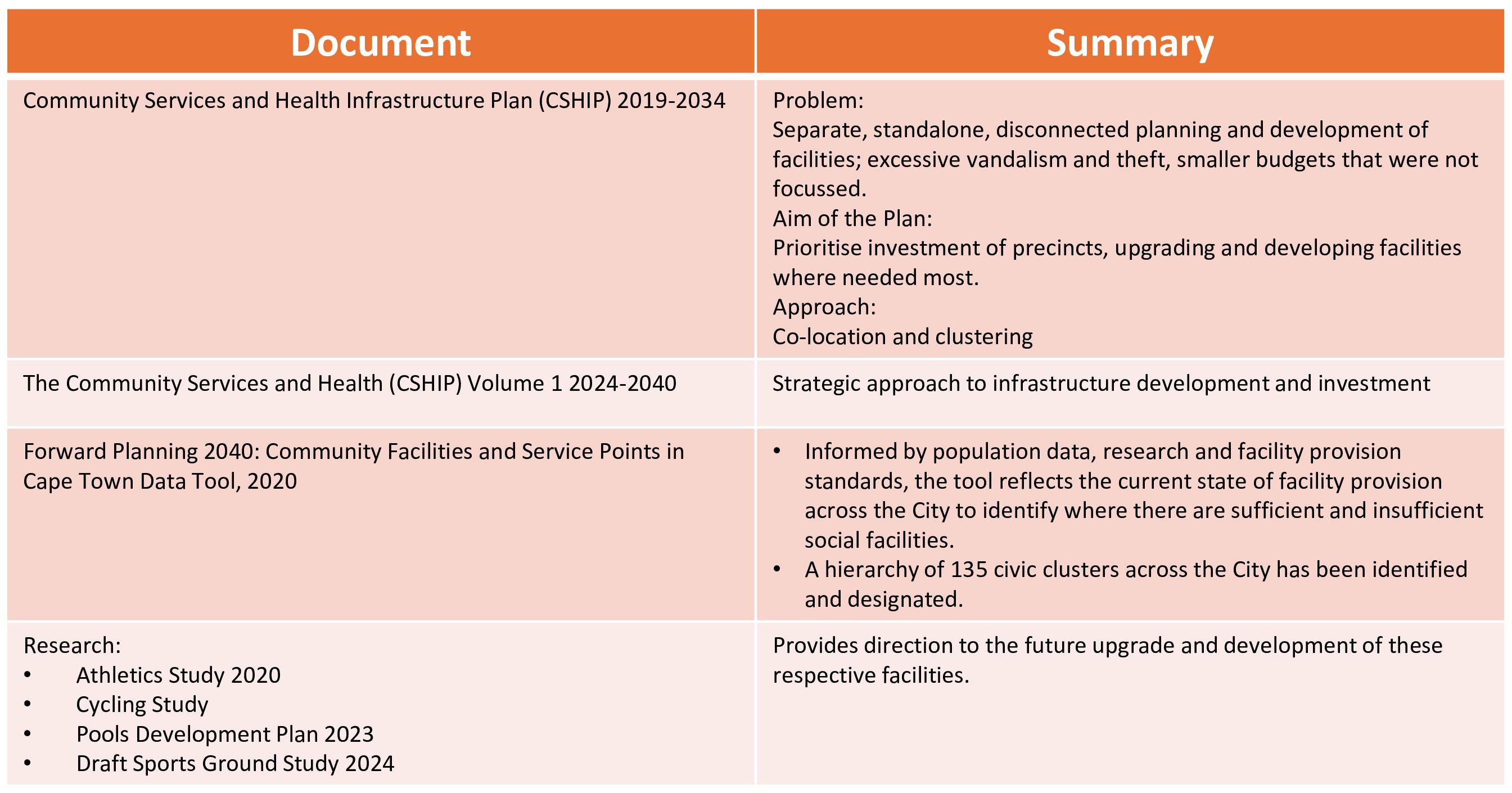
South African Sport and the Nation
communities. This work is informed by extensive research such as the Athletics Study,3 Cycling Study,4 Pools Development Plan5 and Sports Ground Study (in draft),6 with a plan under way for synthetic pitches.
Two notable approaches to planning and prioritised investment in the CSHIP is the work on Regional Recreation Hubs and Integrated Recreation Facilities.
Seven major sport facilities have been identified that will serve as regional recreation hubs in Cape Town.7 Each represents a facility with a cluster of sport and recreation activities, centred around a “higher-order” sport component, such as an athletics track or football facility with infrastructure built around it.
The seven facilities include:
• Blue Downs Sport Ground, Blue Downs;
• Jan Burger Sport Ground, Parow;
• Mandela Park Sport Ground, Khayelitsha;
• Stephen Reagan Sport Ground, Westridge, Mitchells Plain;
• Theo Marais Sport Ground, Milnerton;
• William Herbert Sport Ground, Wynberg; and
• Vygieskraal Sport Ground, Athlone.
The infrastructure design model used for these are hubs are depicted in Figure 1 below.
These are community-level facilities where existing sport and recreation infrastructure is enhanced, upgraded or developed to provide a cluster of multi-use and multi-purpose facilities that may include a multi-purpose centre, sport ground, synthetic pitches, pool, park and public open space. Twenty-three integrated facilities, most of which are sport grounds, have been identified. These facilities are at various stages of planning and upgrade.8
In 2022, the City adopted its Sport Asset Management Policy9 for several reasons, the primary objective being to provide a structured framework for how the City engages, collaborates, and communicates with sports federations, associations and clubs regarding the management and maintenance of sport assets administered by the Recreation and Parks
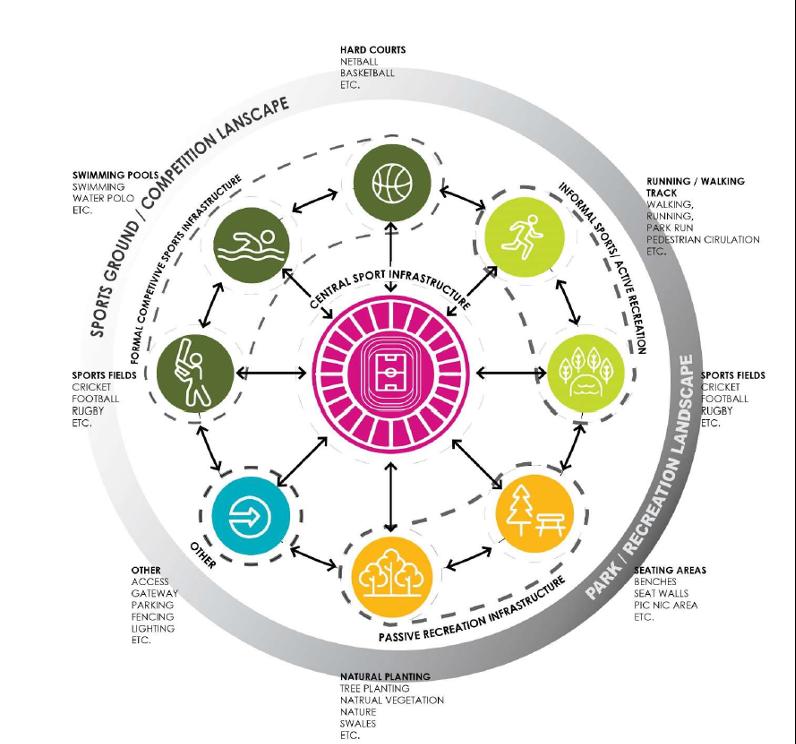
Department. The Policy replaces the Municipal Facility Management Committee (MFMC) framework which was introduced in 2019 as a mechanism to informally standardise engagement and provide a governance framework.
A key feature of the Policy is the required establishment of a Sport Assets Coordinating Committee at each sport ground precinct. The Committee is comprised of the sporting codes who occupy the facility. Different to the MFMC, the Policy specifies clear principles, structures, roles and responsibilities, and accountabilities for Committees. The Policy also provides three management models that relate to the management, maintenance and improvement, revenue generation and booking of sport assets:
A lease agreement between the City and Committee is established. This agreement provides exclusive rights where Committees and its respective clubs are self-sufficient.
Category B: Mixed Model Partnership between the City, Sport Assets Coordinating Committee or Sport Club
This category describes a more collaborative relationship between the partners and where management, administration and maintenance are shared.
Category C: City Dependent Sport Assets Coordinating Committee or Sport Clubs
• These clubs and codes rely on the City to administer and maintain sport assets or precincts. The City is responsible for maintenance and management of the sport assets or precinct.
• An advisory committee is established to represent the sport facility.
To activate recreation and sport facilities, the Department provides community-based recreation programmes. The draft Recreation Programmes Framework10 guides the planning and delivery of communitybased recreation programmes and related projects. The overall purpose is to enhance health and wellness, and support mass participation in recreation and sport at grassroots level, serving a foundation to sport participation at performance and elite level. The Framework presents nine recreation programmes, each with its own distinctive structure, outcomes and set of activities. These community programmes and supporting projects are framed within a ‘life-course’ approach, promoting recreation and sport from young children to senior adults. Figure 2 presents the nine community-based programmes.
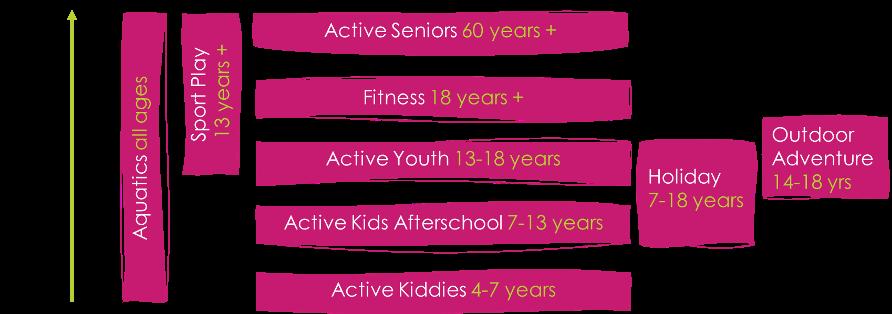
The Provision of Sport and Recreation Facilities in Cape Town
The vision of the Recreation and Parks Department is to “offer and sustain inclusive, high-quality green spaces and recreational facilities that cultivate community involvement and active living, ensuring well-being for all in an equitable and sustainable manner, now and for the future.”11 Central to achieving this vision is the strategic goal of providing programmes and facilities that meet the recreational and green environment needs of all Cape Town communities. Through this commitment, several investment and governance initiatives are aimed at enhancing access to sport and recreation opportunities and increasing participation. In doing so, it reinforces the City’s broader vision of “building a prosperous, inclusive and healthy city where people can see their hopes of a better future become a reality,”12 and ensures that the delivery of sport and recreation services remains integral to a City of Hope for All.
Notes
1. City of Cape Town, Five-year Integrated Development Plan July 2022–June 2027 (Cape Town: City of Cape Town, 2022), accessed May 25, 2026, https:// resource.capetown.gov.za/documentcentre/Documents/ City%20strategies%2c%20plans%20and%20frameworks/IDP_2022-2027.pdf.
2. City of Cape Town, Planning, Development and PMO, Community Services and Health Infrastructure Plan 2019–2034: Technical Report (Cape Town: unpublished report, 2019); City of Cape Town, Planning, Development and PMO, Community Services and Health Infrastructure Plan 2024–2040. Vol. 1, Plan and Implementation Framework (Cape Town: unpublished report, 2025).
3. City of Cape Town, Planning, Development and PMO, Athletics Facilities Study: Upgrading and Implementation Report (Cape Town: unpublished report, 2021).
4. City of Cape Town, Planning, Development and PMO, Cape Town Track Cycling Study (Cape Town: unpublished report, 2024).
5. City of Cape Town, Planning, Development and PMO, Swimming Pool Development Plan (Cape Town: unpublished report, 2024).
6. City of Cape Town, Planning, Development and PMO, Citywide Sports Grounds Study (Cape Town: unpublished report, 2025).
7. City of Cape Town, Planning, Development and PMO, Regional Recreation Hubs Concept Note (Cape Town: unpublished report, 2023).
8. City of Cape Town, Planning, Development and PMO, Integrated Recreation Facilities Concept Note (Cape Town: unpublished report, 2023).
9. City of Cape Town, Recreation and Parks Department, Sport Asset Management Policy (Cape Town: City of Cape Town, July 28, 2022), accessed May 25, 2026,
https://resource.capetown.gov.za/documentcentre/Documents/ Bylaws%20and%20policies/Recreation_and_Parks_Sport_Assets_Management_Policy.pdf.
10. City of Cape Town, Recreation and Parks Department, Recreation Programmes Framework, draft unpublished report (Cape Town, n.d.).
11. City of Cape Town, Recreation and Parks Department, 2025/26 Departmental Business Plan (Cape Town: unpublished report, June 2025).
12. City of Cape Town, Five-year Integrated Development Plan July 2022–June 2027
Bibliography
City of Cape Town. Five-year Integrated Development Plan July 2022–June 2027. Cape Town: City of Cape Town, 2022. Accessed May 25, 2026. https:// resource.capetown.gov.za/documentcentre/Documents/ City%20strategies%2c%20plans%20and%20frameworks/IDP_2022-2027.pdf.
City of Cape Town, Planning, Development and PMO. Athletics Facilities Study: Upgrading and Implementation Report. Cape Town: unpublished report, 2021.
———. Cape Town Track Cycling Study. Cape Town: unpublished report, 2024.
———. Citywide Sports Grounds Study. Cape Town: unpublished report, 2025.
———. Community Services and Health Infrastructure Plan 2019–2034: Technical Report. Cape Town: unpublished report, 2019.
———. Community Services and Health Infrastructure Plan 2024–2040. Vol. 1, Plan and Implementation Framework. Cape Town: unpublished report, 2025.
———. Integrated Recreation Facilities Concept Note. Cape Town: unpublished report, 2023.
———. Regional Recreation Hubs Concept Note. Cape Town: unpublished report, 2023.
———. Swimming Pool Development Plan. Cape Town: unpublished report, 2024.
City of Cape Town, Recreation and Parks Department. 2025/26 Departmental Business Plan. Cape Town: unpublished report, June 2025.
———. Recreation Programmes Framework. Draft unpublished report. Cape Town, n.d.
———. Sport Asset Management Policy. Cape Town: City of Cape Town, July 28, 2022. Accessed May 25, 2026. https://resource.capetown.gov.za/documentcentre/Documents/ Bylaws%20and%20policies/Recreation_and_Parks_Sport_Assets_Management_Policy.pdf.
Lyndon Bouah
Introduction
The annual report of the Department of Cultural Affairs in the Western Cape Province (DCAS),1 indicated that funds are transferred to sport federations across the Province of the Western Cape on an annual basis.
The Accounting Officer, Guy Redman noted in his overview over the last few years that the streamlining of the process of funding to cultural and sport federations have been an achievement during the last few years.2 This paper will analyse the trilateral approach and submit that it could be a useful tool for government departments to use as a monitoring tool and as an example of Batho Pele.
The Annual Report further notes that DCAS makes funding available to over 120 Sport Federations every year. Monitoring and Evaluation takes place through regular meetings and visits. Cheque handover ceremonies were held in the first quarter of the financial year 2025/2026.
South African Sport and the Nation
The funding process starts on 1 April each year which is the start of the financial year of each government department nationally and provincially. The website of the Department of Cultural Affairs and Sport loads the funding application forms for the next financial year. The forms are sent to each possible applicant and to the civil society organisations called sport councils. Federations and all possible applicants then have until 30 September each year to complete the forms and submit it to the department for consideration.
The DCAS would then use the next three months to consolidate the forms. By consolidating the forms, DCAS officials would check for missing information such as audited financial statements, outstanding reports, and any other relevant information that may be incomplete. Once this has been concluded, following interaction with possible beneficiaries, the monitoring of the previous year’s allocation then commences.
The late Minister Collins Chabane3 in an address to senior managers on 3 April 2013 stated that monitoring and evaluation seeks to address the following:
• The culture of doing things the way they always have been done, as opposed to culture of continuous improvement
• Focus on activities without assessing the results or impact on activities
• Insufficient measurement, collection and analysis of data to inform improvements
• Monitoring and reporting for compliance rather than for improvement.
Minister Chabane was building on the definition of monitoring which was set out in the Proposal and Implementation for a Government- Wide Monitoring and Evaluation System, 4 a publication for programme managers published in 2003 by government.
The document defines monitoring and evaluation in the following manner:
Monitoring is a continuous managerial function that aims to provide managers, decision makers and main stakeholders with regular feedback and early indications of progress or lack thereof in the achievement of intended results and the attainment of goals and objectives.
Monitoring involves reporting on actual performance against what was planned or expected according to pre-determined standards. Monitoring generally involves collecting and analysing data on implementation processes, strategies and result, and recommending corrective measures.
Promoting Batho Pele Through the Trilateral Approach
Evaluation is a time bound exercise that systematically and objectively assesses the relevance, performance, challenges and successes of programmes and projects.
These definitions have been accepted by the Department of Cultural Affairs and Sport in the Monitoring and Evaluation Framework5 signed in 2011. World expert in monitoring and evaluation, Fred Coalter has defined monitoring and evaluation in his Sport-in-Development Monitoring and Evaluation Manual in the following manner:
Monitoring is the regular, systematic, collection and analysis of information related to a planned and agreed programme of action. This provides evidence of the extent to which the programme is being delivered as intended, meeting its targets and making progress towards the achievements of its objectives. Monitoring information can also identify the extent to which changes and adaptations are required.
Evaluation is the process of undertaking a systematic and objective examination of monitoring information to answer agreed questions and make judgments on the basis of agreed criteria. Concerns may relate to the efficiency, effectiveness, impact and sustainability of an organisation or programme. The intention is not simply to assess what impacts have occurred, but why, what lessons can be learnt and how the programme might be improved. Evaluation is also an ongoing, if less regular, process and provides the basis for learning and organisational and programme development.6
The DCAS scheduled meetings on a one-on-one basis with federations to discuss their funding allocations and their adherence to corporate governance. The meeting generally lasted 30 minutes and was conducted by middle management staff members.
In 2011, I, upon my appointment as Chief Director of Sport and Recreation, re-introduced the concept of meeting with beneficiaries but with an added difference. The Sport Council in each district would be invited to join the discussion and would be able to contribute fully and be allowed to question both the beneficiary and the department. The concept of the “Trilateral” was born as three entities would henceforth be present. The federation would be invited to present via a PowerPoint how they spent the funding received. The presentation allows the sport council and DCAS to monitor and evaluate whether the funds were used for its intended purposes and to ascertain if there are any lacunae that must be addressed. Questions are then posed to clarify any matter.
South African Sport and the Nation
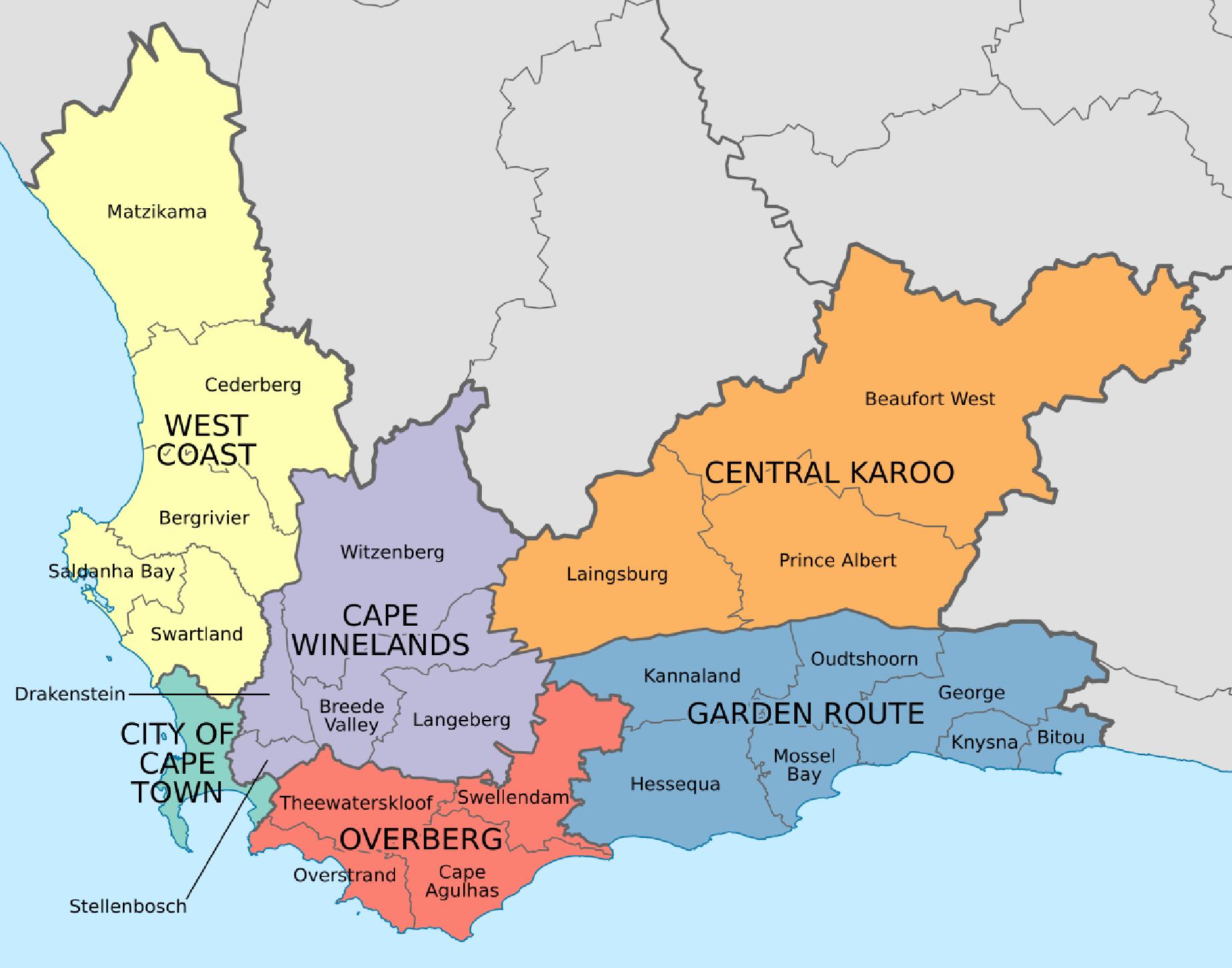
There are six sport councils and one sport confederation in the Western Cape. The six sport councils are Metro (formerly Western Province), Cape Winelands, Overberg (Boland was divided into two geographical entities), West Coast, Central Karoo and Eden (the latter two formerly South Western Districts). The sport councils represented all the sport federations in their specific region. The sport councils in turn formed the Western Cape Sport Confederation which is affiliated to the South African Sport and Olympic Confederation (SASCOC).
Batho Pele is described in the White Paper7 as people first. The principles of Batho Pele are described as follows: consultation, setting service standards, increasing access, ensuring courtesy, providing information, openness and transparency, redress, and value for money.
The process of funding federations is in my opinion an example of Batho Pele. The Handbook for Batho Pele8 defines it as follows, to promote the idea of “putting people first and to provide a framework for the transformation of public service delivery, government introduced the concept of people first in 1997”. This notion was expanded in the White Paper on Transforming the Public Service, also known as the Batho Pele White Paper, which provides a
Promoting Batho Pele Through the Trilateral Approach
policy framework to ensure that Batho Pele is woven into the very fabric of government.
Simply stated, Batho Pele is an initiative to get public servants to be service orientated, to strive for excellence in service delivery and to commit to continuous service delivery improvement. It is a simple, transparent mechanism, which allows customers to hold public servants accountable for the type of services they deliver.9
The mandate for putting people first comes from the Constitution. In the case of DCAS, that would be putting the federation first. The funding process of the DCAS has been set out as follows:
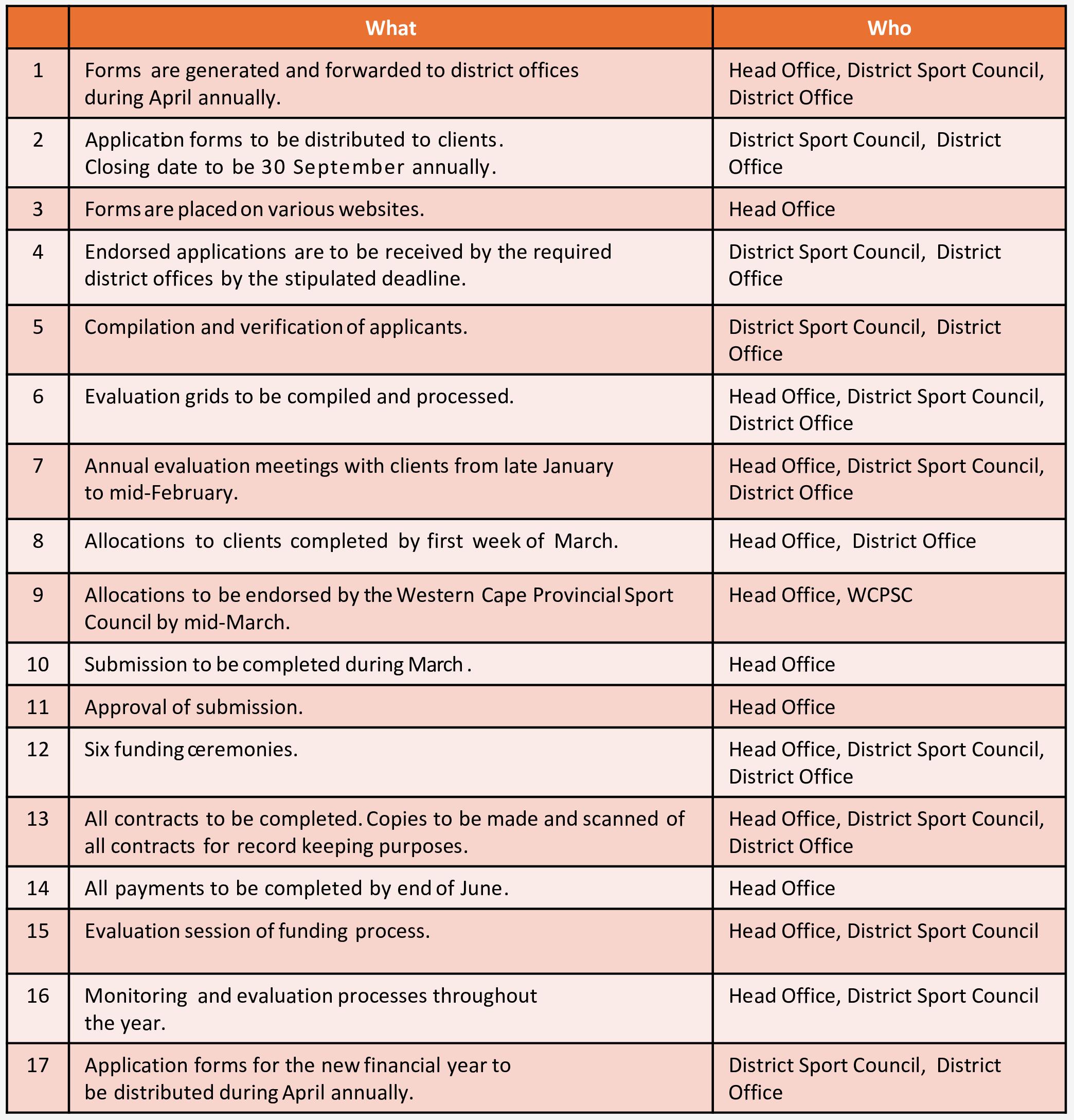
Consultation: Following the trilateral process the department and the sport confederation meet to discuss the funding allocation for the following year. This is important as civil society now takes joint ownership of the process of allocation which will ultimately be signed off by the Head of Department.
Setting service standards: Federations are requested to produce a PowerPoint presentation to illustrate their use of the funds allocated to them. They can then make recommendations as well. This allows the department to review its policies and to ensure that service standards are set that measures the expectations of the sport organisations.
Increasing access: The implementation of the Trilateral process has increased the access of federations to government services. Federations can now speak directly to government face to face and can also access government via email, telephonic engagements and normal correspondence.
Ensuring courtesy: Departmental officials are able through the Trilateral process to demystify any decision that was not understood by the sporting federation. Honest communication is encouraged.
Providing information: All federations must undergo regular elections. This process brings new people into contact with the department. Information can now be shared with the newly elected officials to assist them with the myriad of forms and other documents that must be completed.
Openness and transparency: The federations are granted an opportunity to engage with the department and the sport council in a setting that allows for transparency and openness. Questions may be posed and responded to. Senior officials can be asked direct questions by federations officials.
Redress: The Trilateral process allows the department an opportunity to address any complaints that may have surfaced. Where service standards may have dropped the department can then rectify this following the engagement with the federation.
Value for money: All parties wish to see that the funds set aside for federations have been correctly used and that value for money has been achieved. The federations want to see that government has correctly administered funds and that the officials are improving systems where possible.
The funding ceremonies for 2026 will be held in the first quarter.
It is submitted that the Trilateral process promotes Batho Pele and ensures effective monitoring and evaluation. By including the Sport Councils throughout the process transparency and democracy is promoted. The principles of Batho Pele are adhered to and given impetus. In questionnaires submitted by the federations the experience of the Trilateral process has been viewed as a positive one. Trilaterals should be encouraged across government departments where transfer funding is allocated. This will ensure transparency and promote the principles of Batho Pele.
1. Department of Cultural Affairs, Annual Report (Cape Town: Western Cape Government, n.d.), accessed May 21, 2026, https://www.westerncape.gov.za/ cas/files/wcg-blob-files?file=2025-12/ar-to-citizens-24-25-draft-english-3december-2025.pdf&type=file.
2. Guy Redman, Personal recollection.
3. Collins Chabane, “The Role of Monitoring and Evaluation in the Public Service,” speech delivered at the DPSA Conference, 2013, accessed May 21, 2026, https://www.gov.za/news/speeches/speech-minister-presidencyperformance-monitoring-and-evaluation-collins-chabane-2.
4. South Africa, Department of Planning, Monitoring and Evaluation, Proposal and Implementation for a Government-Wide Monitoring and Evaluation System (Pretoria: Government of South Africa, n.d.), accessed May 21, 2026, https:// www.dpme.gov.za/publications/policy%20framework/ policy%20framework%20for%20the%20gwme%20system.pdf.
5. Department of Public Service and Administration, Monitoring and Evaluation Framework (Pretoria: Government of South Africa, n.d.), accessed May 21, 2026, https://www.dpsa.gov.za/dpsa2g/documents/km/2025/ KM%20Monitoring%20%20Plan.pdf.
6. Fred Coalter, Sport-in-Development: A Monitoring and Evaluation Manual (The International Platform on Sport and Development, n.d.), accessed May 21, 2026, https://www.sportanddev.org/sites/default/files/downloads/ 10__sport_in_development__a_monitoring_and_evaluation_manual.pdf.
7. Department of Public Service and Administration, White Paper on Transforming the Public Service Delivery (Pretoria: Government of South Africa, n.d.), accessed May 21, 2026, https://www.dpsa.gov.za/dpsa2g/documents/acts®ulations/ frameworks/white-papers/transform.pdf.
8. Department of Public Service and Administration, The Handbook for Batho Pele (Pretoria: Government of South Africa, n.d.), accessed May 21, 2026, https://
South African Sport and the Nation
www.dpsa.gov.za/dpsa2g/documents/gics/bphb/contents.pdf.
9. Department of Public Service and Administration, Batho Pele – “People First”: White Paper on Transforming Public Service Delivery (Pretoria: Government of South Africa, 1997), accessed May 21, 2026, https://www.dpsa.gov.za/dpsa2g/ documents/acts®ulations/frameworks/white-papers/transform.pdf.
Coalter, Fred. Sport-in-Development: A Monitoring and Evaluation Manual. The International Platform on Sport and Development. Accessed May 21, 2026. https:// www.sportanddev.org/sites/default/files/downloads/ 10__sport_in_development__a_monitoring_and_evaluation_manual.pdf.
Department of Cultural Affairs. Annual Report. Cape Town: Western Cape Government, n.d. Accessed May 21, 2026. https://www.westerncape.gov.za/cas/ files/wcg-blob-files?file=2025-12/ar-to-citizens-24-25-draft-english-3december-2025.pdf&type=file.
Department of Public Service and Administration. Batho Pele – “People First”: White Paper on Transforming Public Service Delivery. Pretoria: Government of South Africa, 1997. Accessed May 21, 2026. https://www.dpsa.gov.za/dpsa2g/documents/ acts®ulations/frameworks/white-papers/transform.pdf.
———. Monitoring and Evaluation Framework. Pretoria: Government of South Africa, n.d. Accessed May 21, 2026. https://www.dpsa.gov.za/dpsa2g/documents/km/ 2025/KM%20Monitoring%20%20Plan.pdf.
———. The Handbook for Batho Pele. Pretoria: Government of South Africa, n.d. Accessed May 21, 2026. https://www.dpsa.gov.za/dpsa2g/documents/ gics/bphb/contents.pdf.
———. White Paper on Transforming the Public Service Delivery. Pretoria: Government of South Africa, n.d. Accessed May 21, 2026. https:// www.dpsa.gov.za/dpsa2g/documents/acts®ulations/frameworks/whitepapers/transform.pdf.
Collins Chabane. “The Role of Monitoring and Evaluation in the Public Service.” Speech delivered at the DPSA Conference, 2013. Accessed May 21, 2026. https://www.gov.za/news/speeches/speech-minister-presidencyperformance-monitoring-and-evaluation-collins-chabane-2.
Guy Redman. Personal recollection.
South Africa. Department of Planning, Monitoring and Evaluation. Proposal and Implementation for a Government-Wide Monitoring and Evaluation System. Pretoria: Government of South Africa, n.d. Accessed May 21, 2026. https:// www.dpme.gov.za/publications/policy%20framework/ policy%20framework%20for%20the%20gwme%20system.pdf.
M. E. M. Young
Introduction
Leisure is often undervalued in policy and academic discourse, frequently viewed as a discretionary activity rather than a necessity. However, international human rights frameworks establish leisure as a fundamental component of human well-being and dignity. The World Leisure Organization’s Charter for Leisure (2020)1 provides a comprehensive framework for understanding leisure as both a right and a means of achieving broader social and developmental outcomes.
Scholarly literature reinforces this view, positioning leisure as a socially constructed domain that reflects broader power relations and inequalities.2 Historically, leisure has been associated with freedom, self-expression, and personal development, but access to it remains unevenly distributed.3
In South Africa, the recognition of leisure as a human right is particularly significant due to the historical legacy of apartheid, which systematically restricted access to leisure opportunities based on race. Although democratic reforms have sought to address these inequalities, disparities persist.4 This
South African Sport and the Nation
paper applies the World Leisure Charter as a framework to examine leisure rights within this context.
The recognition of leisure as a human right is deeply embedded in international law. The Universal Declaration of Human Rights (1948)5 affirms the right to rest and leisure, while the International Covenant on Economic, Social and Cultural Rights (1966)6 links leisure to fair labour conditions and cultural participation.
These frameworks demonstrate that leisure rights are closely tied to labour structures. Scholars argue that access to leisure is contingent on broader socio-economic arrangements, particularly the regulation of working time.7 Inequalities in labour conditions therefore translate directly into inequalities in leisure.
The Charter for Leisure8 provides a rights-based framework that articulates the importance of both leisure time and meaningful participation. It emphasises inclusivity and recognises leisure as a vehicle for health, well-being, and social cohesion.
From a theoretical perspective, leisure scholars highlight that participation in leisure is not merely about time availability but also access to resources, cultural capital, and social inclusion.9 reinforces the Charter’s emphasis on equitable access.
Although the South African Constitution does not explicitly mention leisure, it supports it indirectly through rights to dignity, equality, and cultural participation. However, structural inequalities continue to shape access to leisure opportunities.
The legacy of apartheid spatial planning has resulted in highly unequal urban forms, where access to public amenities remains stratified.10 Many historically disadvantaged communities lack safe and accessible recreational spaces, while wealthier areas benefit from well-developed infrastructure.
Moreover, inequality in South Africa remains among the highest globally, affecting access to both time and resources required for leisure.11 Leisure is therefore deeply embedded within broader socio-economic inequalities.
Access to leisure in South Africa is constrained by several structural barriers, particularly time inequality. Low-income and informal workers often experience long working hours and extended commuting times, reducing opportunities for leisure participation.
Gender inequality further exacerbates this issue. Research shows that women disproportionately bear the burden of unpaid labour, including caregiving and domestic work, which significantly limits their leisure time.12 This aligns with the Charter’s recognition of unpaid labour as a critical factor influencing access to leisure.
Spatial inequality also plays a major role. The uneven distribution of infrastructure reflects enduring patterns of exclusion, with limited recreational opportunities in many townships and rural areas.13 These structural barriers demonstrate that leisure access is shaped by intersecting dimensions of inequality, including class, gender, and geography.
Leisure is not an isolated right but a facilitator of other human rights and developmental outcomes. For children, play is essential for cognitive and social development.14
Leisure also contributes to health outcomes, social cohesion, and community engagement. Participation in sport and cultural activities fosters social capital and strengthens community ties. From a sociological perspective, leisure spaces can act as sites of inclusion or exclusion, depending on how access is structured.15
Cultural participation through leisure also enables identity expression, particularly in diverse societies such as South Africa. This highlights the broader role of leisure in promoting both individual well-being and social integration.
Recognising leisure as a human right has important implications for public policy. Governments have a responsibility to ensure equitable access to leisure by addressing structural inequalities and providing inclusive infrastructure.
In South Africa, this requires targeted interventions to address spatial and socio-economic disparities. Urban planning frameworks must prioritise the equitable distribution of recreational spaces,16 while labour policies should ensure that individuals have sufficient time for leisure. Addressing gender inequalities in unpaid labour is also critical. Policies that support childcare, Human Rights in Leisure
South African Sport and the Nation
flexible work, and social services can help redistribute time and enable greater access to leisure for women.17
Leisure is a fundamental human right that plays a critical role in promoting dignity, well-being, and social inclusion. The World Leisure Charter provides a valuable framework for advancing these rights. In South Africa, the realisation of leisure rights is closely tied to historical injustice and ongoing inequality. Addressing these challenges requires a comprehensive, rights-based approach that recognises leisure as essential rather than optional.
Notes
1. World Leisure Organization, Charter for Leisure (2020), World Leisure Organization
2. A. J. Veal, Leisure, Sport and Tourism: Politics, Policy and Planning (4th ed.) (CABI, 2017).
3. Joffre Dumazedier, Sociology of Leisure (Amsterdam: Elsevier, 1974).
4. Ivan Turok, “Urbanisation and Development in South Africa: Economic Imperatives, Spatial Distortions and Strategic Responses,” Urbanisation and Emerging Population Issues Working Paper 8 (London: International Institute for Environment and Development, 2012).
5. United Nations, Universal Declaration of Human Rights (1948), United Nations.
6. United Nations, International Covenant on Economic, Social and Cultural Rights (1966), OHCHR
7. Veal, Leisure, Sport and Tourism.
8. World Leisure Organization, Charter for Leisure
9. Dumazedier, Sociology of Leisure; Veal, Leisure, Sport and Tourism.
10. Turok, “Urbanisation and Development in South Africa.”
11. Jeremy Seekings and Nicoli Nattrass, Class, Race, and Inequality in South Africa (New Haven, CT: Yale University Press, 2005).
12. Michael Bittman and Judy Wajcman, “The Rush Hour: The Quality of Leisure Time and Gender Equity,” Social Forces 79, no. 1 (2000): 165–89, https://doi.org/ 10.1093/sf/79.1.165; Jennifer L. Hook, “Gender Inequality in the Welfare State: Sex Segregation in Housework, 1965–2003,” American Journal of Sociology 115, no. 5 (2010): 1480–1523, https://doi.org/10.1086/651384.
13. Turok, “Urbanisation and Development in South Africa.”
14. United Nations, Convention on the Rights of the Child (1989), OHCHR.
15. Veal, Leisure, Sport and Tourism.
16. Turok, “Urbanisation and Development in South Africa.”
17. Hook, “Gender Inequality in the Welfare State.”
Bibliography
Bittman, Michael, and Judy Wajcman. “The Rush Hour: The Quality of Leisure Time and Gender Equity.” Social Forces 79, no. 1 (2000): 165–89. https://doi.org/10.1093/ sf/79.1.165.
Dumazedier, Joffre. Sociology of Leisure. Amsterdam: Elsevier, 1974.
Hook, Jennifer L. “Gender Inequality in the Welfare State: Sex Segregation in Housework, 1965–2003.” American Journal of Sociology 115, no. 5 (2010): 1480–1523. https://doi.org/10.1086/651384.
Seekings, Jeremy, and Nicoli Nattrass. Class, Race, and Inequality in South Africa. New Haven, CT: Yale University Press, 2005.
Turok, Ivan. “Urbanisation and Development in South Africa: Economic Imperatives, Spatial Distortions and Strategic Responses.” Urbanisation and Emerging Population Issues Working Paper 8. London: International Institute for Environment and Development, 2012.
United Nations. Convention on the Rights of the Child. 1989. OHCHR
United Nations. International Covenant on Economic, Social and Cultural Rights. 1966. OHCHR.
United Nations. Universal Declaration of Human Rights. 1948. United Nations Veal, A. J., Leisure, Sport and Tourism: Politics, Policy and Planning (4th ed.). CABI, 2017. World Leisure Organization. Charter for Leisure. 2020. World Leisure Organization
Introduction
Cardiovascular disease (CVD) remains one of the most significant public health concerns globally and continues to place substantial pressure on healthcare systems, economies, and communities. Traditionally, sport has largely been associated with performance enhancement, competition, and elite athletic achievement. However, despite the considerable physiological and psychological benefits associated with participation in sport, its role in disease prevention and long-term cardiovascular health promotion has often been underestimated. In contemporary healthcare and exercise science, there is an increasing recognition that sport should not merely be viewed through a performance lens, but rather as an important public health intervention capable of improving health outcomes across the lifespan.
The increasing prevalence of sedentary behaviour, obesity, hypertension, and metabolic diseases highlights the urgent need for preventative strategies that are sustainable, engaging, and cost-effective. Exercise and sport participation have emerged as powerful tools in reducing cardiovascular risk factors and improving overall quality of life. Importantly, the benefits of
sport extend beyond physical health and include social, psychological, and behavioural advantages that encourage long-term adherence to active lifestyles. Consequently, there is a growing movement toward integrating exercise and sport into preventative healthcare models under the principle that “exercise is medicine”.1
This report explores the burden of cardiovascular disease, the role of physical inactivity in disease development, and the emerging role of sport as a preventative health strategy. Furthermore, the physiological benefits of sport participation, the importance of cardiorespiratory fitness, and the value of lifelong engagement in physical activity will be discussed.
Cardiovascular disease is currently the leading cause of mortality worldwide, accounting for approximately 17.9 million deaths annually according to the World Health Organization. These deaths represent nearly one-third of all global deaths, with a significant proportion occurring prematurely in individuals younger than 70 years of age. The burden of CVD is no longer confined to high-income countries, as low- and middleincome countries (LMICs) now account for more than three-quarters of cardiovascular-related deaths globally.2 This epidemiological transition has been attributed to urbanisation, reduced physical activity levels, poor dietary habits, smoking, stress, and increased rates of obesity and metabolic disease.
In South Africa, cardiovascular disease contributes substantially to the growing burden of non-communicable diseases (NCDs). The country faces a dual burden of disease, where infectious diseases coexist alongside increasing rates of chronic lifestyle-related conditions. Hypertension, obesity, diabetes mellitus, and dyslipidaemia have become increasingly prevalent among younger adults, particularly within urban populations. This trend is concerning because cardiovascular disease often develops progressively over many years before clinical symptoms become apparent. As a result, many individuals may already possess advanced cardiovascular risk profiles before seeking medical intervention.
Beyond the direct health implications, cardiovascular disease imposes significant economic costs through increased healthcare expenditure, reduced productivity, disability, and premature mortality. The management of advanced cardiovascular conditions often requires long-term medication, hospitalisation, surgical interventions, and rehabilitation, placing considerable strain on already burdened healthcare systems. Consequently, there is a growing emphasis on prevention rather than treatment alone.
South African Sport and the Nation
One of the primary contributors to the global rise in cardiovascular disease is physical inactivity. Modern lifestyles are characterised by prolonged sitting, reduced occupational movement, and increased dependence on technology and motorised transport. Urbanisation has further contributed to environments where opportunities for physical activity are often limited. As a result, many individuals fail to achieve the minimum physical activity guidelines recommended for health maintenance.
Physical inactivity is strongly associated with several major cardiovascular risk factors, including hypertension, obesity, insulin resistance, dyslipidaemia, and poor cardiorespiratory fitness. Sedentary behaviour has independently been linked to increased cardiovascular mortality, even among individuals who engage in some form of exercise. This suggests that both increasing physical activity and reducing sedentary behaviour are essential components of cardiovascular disease prevention.
The physiological consequences of inactivity are extensive. Reduced physical activity contributes to endothelial dysfunction, impaired glucose metabolism, chronic low-grade inflammation, and increased adiposity. Over time, these changes accelerate the development of atherosclerosis and other cardiovascular pathologies. Furthermore, inactivity negatively affects mental health, energy expenditure, and overall functional capacity, thereby creating additional barriers to engaging in physical activity.
Historically, sport has been associated with competition, achievement, and entertainment. However, in recent years, there has been a growing recognition that sport can serve as a highly effective health promotion and disease prevention strategy. Unlike traditional exercise prescriptions, sport often incorporates enjoyment, social interaction, structure, and motivation, all of which contribute to improved long-term adherence.
Participation in sport encourages individuals to engage in regular physical activity while simultaneously benefiting from psychological and social support systems. Team sports, recreational activities, and community-based exercise programmes create environments that foster accountability, enjoyment, and social connectedness. These factors are particularly important because adherence remains one of the greatest challenges in exercise-based interventions.
Sport also has the potential to influence behaviour from an early age. Evidence suggests that individuals who participate in sport during childhood and adolescence are more likely to remain physically active during adulthood.
Ra Fernandes and Antonio Zanesco3 demonstrated that early sport participation was associated with a lower prevalence of hypertension and metabolic disorders later in life, independent of current physical activity levels and overweight status. These findings suggest that sport participation during developmental years may produce long-term protective cardiovascular adaptations.
Regular participation in sport provides numerous physiological benefits that directly contribute to cardiovascular health and overall well-being. One of the most significant adaptations is the improvement in cardiorespiratory fitness, which reflects the body’s ability to transport and utilise oxygen efficiently during exercise. Improved cardiorespiratory fitness is associated with enhanced cardiac output, vascular function, mitochondrial efficiency, and oxygen delivery to working tissues.
Sport participation has also been shown to reduce blood pressure, improve lipid profiles, enhance insulin sensitivity, and assist with body composition management. These adaptations collectively reduce the likelihood of developing cardiovascular and metabolic diseases. Furthermore, exercise promotes favourable autonomic nervous system adaptations, including improved heart rate variability and reduced resting heart rate, both of which are associated with improved cardiovascular function.
In addition to cardiovascular benefits, sport contributes to musculoskeletal health, mental well-being, and improved quality of life. Regular exercise has been associated with reduced stress, anxiety, and depression, while simultaneously improving self-esteem and cognitive function. The multidimensional benefits of sport therefore extend beyond physical health alone and support holistic health promotion.
The concept of “exercise is medicine” has become increasingly prominent within healthcare and exercise science. This approach recognises physical activity as a first-line intervention for the prevention and management of numerous chronic diseases, including cardiovascular disease, hypertension, obesity, and type 2 diabetes mellitus. In some instances, exercise interventions have demonstrated outcomes comparable to pharmacological treatments for chronic disease management.4
Exercise is particularly valuable because it is accessible, cost-effective, and associated with minimal adverse side effects when appropriately prescribed. Importantly, exercise addresses the underlying physiological mechanisms
South African Sport and the Nation
contributing to chronic disease rather than solely managing symptoms. For example, regular aerobic exercise improves endothelial function, insulin sensitivity, and vascular compliance while simultaneously reducing systemic inflammation.
Healthcare professionals are increasingly encouraged to incorporate physical activity counselling into routine clinical practice. This includes assessing physical activity levels, prescribing exercise interventions, and monitoring cardiorespiratory fitness as part of comprehensive patient care.
Cardiorespiratory fitness is increasingly recognised as one of the strongest predictors of cardiovascular and all-cause mortality. Research indicates that low levels of fitness may predict mortality risk as strongly as, or even more strongly than, traditional cardiovascular risk factors such as smoking, hypertension, and diabetes mellitus.5
The inclusion of fitness as a clinical vital sign reflects the importance of routinely assessing physical capacity within healthcare settings. Individuals with poor fitness levels possess substantially higher risks of cardiovascular disease and premature mortality. Conversely, even modest improvements in fitness can produce significant health benefits. Evidence suggests that each one metabolic equivalent (MET) increase in exercise capacity is associated with improved survival outcomes.
Assessing fitness provides clinicians and exercise professionals with valuable information regarding cardiovascular risk and functional capacity. It also allows for the development of personalised exercise interventions aimed at improving health outcomes.
Promoting lifelong participation in sport and physical activity is essential for long-term cardiovascular health. While elite athletic performance may decline with age, the health benefits associated with physical activity remain substantial throughout the lifespan. Establishing active behaviours early in life increases the likelihood of maintaining healthy habits into adulthood and older age.
Importantly, safe participation requires appropriate screening and risk assessment strategies to identify individuals with underlying cardiovascular conditions. Exercise screening allows healthcare providers and exercise professionals to minimise risks while maximising the benefits associated with physical activity participation.
Ultimately, the goal is not merely to improve athletic performance, but to encourage sustainable engagement in movement and exercise for health promotion and disease prevention. By shifting the focus from treatment to prevention, healthcare systems can reduce the burden of chronic disease while improving population health outcomes.
Conclusion
Cardiovascular disease continues to represent a major global and national health challenge, driven largely by increasing physical inactivity and sedentary lifestyles. While sport has traditionally been viewed within the context of competition and performance, its role as a preventative health strategy is becoming increasingly evident. Sport participation provides substantial cardiovascular, metabolic, psychological, and social benefits that collectively contribute to improved health outcomes and reduced disease risk. The growing emphasis on exercise as medicine and fitness as a vital sign highlights the importance of integrating physical activity into healthcare and public health initiatives. Encouraging lifelong participation in sport and physical activity offers a sustainable and cost-effective approach to combating cardiovascular disease and improving quality of life. By reframing sport as a tool for prevention rather than solely performance, societies can leverage its unique ability to promote engagement, adherence, and long-term cardiovascular health.
Notes
1. American College of Sports Medicine, ACSM’s Guidelines for Exercise Testing and Prescription, 11th ed. (Philadelphia: Wolters Kluwer, 2021).
2. World Health Organization, Cardiovascular Diseases (CVDs) Fact Sheet (Geneva: World Health Organization, 2023).
3. Ra Fernandes and Antonio Zanesco, “Early Sport Practice Is Related to Lower Prevalence of Cardiovascular and Metabolic Outcomes in Adults Independently of Overweight and Current Physical Activity,” Medicina 51, no. 6 (2015): 336–42.
4. B. K. Pedersen and B. Saltin, “Exercise as Medicine – Evidence for Prescribing Exercise as Therapy in 26 Different Chronic Diseases,” Scandinavian Journal of Medicine & Science in Sports 25, suppl. 3 (2015): 1–72.
5. J. Myers et al., “Exercise Capacity and Mortality among Men Referred for Exercise Testing,” New England Journal of Medicine 346, no. 11 (2002): 793–801.
Bibliography
American College of Sports Medicine. ACSM’s Guidelines for Exercise Testing and Prescription. 11th ed. Philadelphia: Wolters Kluwer, 2021.
South African Sport and the Nation
Fernandes, Ra, and Antonio Zanesco. “Early Sport Practice Is Related to Lower Prevalence of Cardiovascular and Metabolic Outcomes in Adults Independently of Overweight and Current Physical Activity.” Medicina 51, no. 6 (2015): 336–42.
Myers, J., M. Prakash, V. Froelicher, D. Do, S. Partington, and J. E. Atwood. “Exercise Capacity and Mortality among Men Referred for Exercise Testing.” New England Journal of Medicine 346, no. 11 (2002): 793–801.
Pedersen, B. K., and B. Saltin. “Exercise as Medicine – Evidence for Prescribing Exercise as Therapy in 26 Different Chronic Diseases.” Scandinavian Journal of Medicine & Science in Sports 25, suppl. 3 (2015): 1–72.
World Health Organization. Cardiovascular Diseases (CVDs) Fact Sheet. Geneva: World Health Organization, 2023.
Gareth Smithdorf
Talent identification and development remain central themes in modern sport science because athletic success is influenced not only by current performance, but also by an athlete’s long-term developmental potential.1
My presentation explored the distinction between potential and performance, the major indicators of talent development, and the implementation of Long-Term Participant Development frameworks across rugby, cricket, and football in South Africa. In addition, relevant literature relating to injury prevention, coaching practices, and athlete development was discussed.
One of the most important concepts in sport science is understanding the difference between performance and potential. Performance refers to an athlete’s current level of ability, including measurable outcomes such as speed, strength, technical skill, and competition results.2 Potential, however, refers to future capability and the athlete’s capacity for long-term
South African Sport and the Nation
improvement.3 Research demonstrates that early performance does not always predict future elite success because athletes mature at different rates.4 Some athletes are considered “late bloomers,” meaning that they may not initially outperform their peers but eventually develop superior physical, psychological, and technical qualities.5 For this reason, talent development systems should adopt a long-term approach rather than focusing only on immediate success. Overemphasis on early performance can result in premature exclusion of talented individuals who develop later.
Talent identification should involve a holistic evaluation of the athlete.6 The six major indicators commonly used in sport science include:
• Physical factors
• Technical ability
• Tactical understanding
• Psychological characteristics
• Social and environmental influences
• Growth and maturation
These indicators interact dynamically throughout athlete development. Modern sport science recognises that athletic excellence emerges from the interaction of biological, psychological, and environmental factors rather than genetics alone.7
Physical factors remain important predictors of sporting success. These include:
• Genetics and body composition
• Strength and power
• Speed and agility
• Endurance capacity
• Growth and biological maturation
However, researchers caution against selecting athletes solely on physical characteristics during adolescence because early maturers often possess temporary advantages in size and strength.8 Sport scientists therefore recommend continuous monitoring of maturation and growth patterns to ensure that late developers are not excluded from development pathways.
The South African Long-Term Participant Development (LTPD) model is a seven-stage framework designed to guide athlete development from childhood through adulthood.9 The model prioritises developmental age rather than chronological age. This means that biological maturity and readiness are considered more important than simply grouping athletes according to birth year. The LTPD model aims to:
• Reduce athlete burnout
• Prevent overtraining and injury
• Promote lifelong physical activity
• Support progressive skill development
• Encourage long-term athletic excellence
This developmental approach aligns with international evidence supporting age-appropriate training and competition structures.10
The South African Rugby Union implements athlete development through structured safety and progression systems.11 A key component is the BokSmart programme, which focuses on player welfare, injury prevention, and safe coaching practices. As of 2026, SARU standardised the age for introducing full-contact rugby to ensure safer progression for youth players. Coaches are required to obtain BokSmart certification to ensure competency in teaching safe tackling and scrumming techniques.
SARU also emphasises bio-banding, where athletes are grouped according to biological maturity rather than chronological age. This approach reduces injury risk and protects late-maturing athletes from physical disadvantages. Additional youth rugby guidelines emphasise:
• Safe falling and landing techniques
• Pre-contact skill development
• Injury prevention education
• Progressive contact exposure
These measures support athlete safety while promoting long-term development.
Cricket South Africa follows a player-centred development approach aligned with biological growth and maturation.12 The CSA Pipeline model aims to guide athletes from physical literacy to elite professional competition. One significant initiative is the establishment of Regional Performance Hubs, which provide coaching and facilities to athletes in disadvantaged and rural
South African Sport and the Nation
communities. CSA also uses modified junior competition formats to encourage participation and reduce early dropout. Examples include:
• Bowling restrictions
• Rolling participation systems
• Equal playing opportunities
Importantly, CSA coaching education programmes train coaches to consider not only physical skills, but also the emotional and cognitive readiness of athletes. This holistic approach aligns with contemporary athlete-centred coaching philosophies.
The South African Football Association applies the LTPD framework through its Technical Development Scheme and Vision 2030 strategy.13 Their focus is on:
• Grassroots participation
• Technical skill acquisition
• Standardised player development
• Age-appropriate competition formats
SAFA promotes a unified national playing philosophy across youth and senior levels. Important developmental strategies include:
• National team identity workshops
• Rolling substitutions in junior leagues
• Annual age verification systems
• School-based talent identification programmes
These structures aim to strengthen football development pathways and broaden participation opportunities.
Rugby Injury Prevention
James Brown14 evaluated the BokSmart injury prevention programme using the Translating Research into Injury Prevention Practice framework.
The study examined four competitive youth rugby tournaments and found that BokSmart contributed to reductions in catastrophic injuries among junior players. Furthermore, improvements in player behaviour and safety practices were observed. However, barriers to implementation included:
• Difficulty changing coach and player behaviour
• Limited infrastructure in low socioeconomic communities
• Resource inequalities between schools and clubs
The findings highlight the importance of combining scientific knowledge with practical implementation strategies.
Mokwena and Kubayi15 investigated coaches’ adoption and implementation of the South African Long-Term Athlete Development model in cricket. Using a quantitative design involving 86 cricket coaches across nine provinces, the study found that coaches believed the LTAD model improved player development and coaching effectiveness. Despite these positive findings, challenges included:
• Limited CSA funding
• Insufficient coach education
• Pressure from parents to prioritise winning
• Poor understanding of LTAD scientific principles
The authors recommended additional coach education and stronger alignment between developmental and competitive objectives.
Pedro Nobre16 explored talent identification and development in South African professional football from a coaching perspective. The qualitative study involved semi-structured interviews with coaches from seven Premier Soccer League clubs. The findings revealed major disparities between youth and senior football structures, particularly in:
• Infrastructure
• Funding
• Competition opportunities
• Coach development systems
The study recommended:
• Improved coach professionalisation
• Regional youth development camps
• Structured youth competition frameworks
These interventions were identified as essential for unlocking South Africa’s football potential.
Conclusion
In conclusion, sport science plays a vital role in identifying and developing athletic talent in South Africa. The implementation of Long-Term Participant Development models across rugby, cricket, and football demonstrates increasing recognition of athlete-centred and evidence-based approaches.
South African Sport and the Nation
Despite progress over the years with success at different levels, challenges such as inequality, limited infrastructure, and inconsistent coach education continue to affect athlete development pathways within South African sports.
Notes
1. N. Leite, A. L. Calvo, S. Cumming, B. Gonçalves, and J. Calleja-Gonzalez, “Editorial: Talent Identification and Development in Sports Performance,” Frontiers in Sports and Active Living 3 (2021): 729167, https://doi.org/10.3389/ fspor.2021.729167.
2. Jens Bangsbo, “Performance in Sports—With Specific Emphasis on the Effect of Intensified Training,” Scandinavian Journal of Medicine & Science in Sports 25, suppl. 4 (2015): 88–99, https://doi.org/10.1111/sms.12605.
3. J. Zhao, C. Xiang, T. F. T. Kamalden, W. Dong, H. Luo, and N. Ismail, “Differences and Relationships between Talent Detection, Identification, Development and Selection in Sport: A Systematic Review,” Heliyon 10, no. 6 (2024), https://doi.org/10.1016/j.heliyon.2024.e27559.
4. R. Vaeyens, M. Lenoir, A. M. Williams, and R. M. Philippaerts, “Talent Identification and Development Programmes in Sport,” Sports Medicine 39, no. 9 (2009): 703–14.
5. Vaeyens et al., “Talent Identification and Development Programmes,” 703–14.
6. F. Z. Werneck, L. Miranda, E. F. Coelho, and J. R. P. de Lima, “Sports Potential Index: A Scientific Approach for Talent Detection in School,” Revista Educação Especial 37, no. 1 (2024): e19/1–26, https://doi.org/10.5902/1984686X85079.
7. Andrew Abbott and Dave Collins, “Eliminating the Dichotomy between Theory and Practice in Talent Identification and Development: Considering the Role of Psychology,” Journal of Sports Sciences 22, no. 5 (2004): 395–408.
8. Robert M. Malina, Claude Bouchard, and Oded Bar-Or, Growth, Maturation, and Physical Activity, 2nd ed. (Champaign, IL: Human Kinetics, 2004).
9. SAS4L, South African Sport for Life Long-Term Participant Development (Draft Consultation Document) (Pretoria: SAS4L, 2011).
10. Istvan Balyi and Ann Hamilton, “Long-Term Athlete Development: Trainability in Childhood and Adolescence,” Olympic Coach 16, no. 1 (2004): 4–9.
11. South African Rugby Union, “Boksmart,” accessed May 12, 2026, https:// springboks.rugby/general/boksmart/.
12. Cricket South Africa, “Cricket Pipeline Committee Mandate,” accessed May 12, 2026, https://cricket.co.za/governance/.
13. South African Football Association, “Introduction to SAFA,” accessed May 12, 2026, https://www.safa.net.
14. James Brown, Evaluation of a Nationwide Injury Prevention Programme for Rugby Union in South Africa (PhD diss., University of Cape Town, 2014).
15. K. L. Mokwena and A. Kubayi, “Coaches’ Adoption and Implementation of the South African Long-Term Athlete Development Model in Cricket,” South African Journal for Research in Sport, Physical Education and Recreation 47, no. 1 (2025): 55–72.
16. Pedro L. Nobre, Talent Identification and Development in South African Professional Football: A Coach Perspective (master’s thesis, University of Cape Town, 2025).
Abbott, Andrew, and Dave Collins. “Eliminating the Dichotomy between Theory and Practice in Talent Identification and Development: Considering the Role of Psychology.” Journal of Sports Sciences 22, no. 5 (2004): 395–408.
Balyi, Istvan, and Ann Hamilton. “Long-Term Athlete Development: Trainability in Childhood and Adolescence.” Olympic Coach 16, no. 1 (2004): 4–9.
Bangsbo, Jens. “Performance in Sports—With Specific Emphasis on the Effect of Intensified Training.” Scandinavian Journal of Medicine & Science in Sports 25, suppl. 4 (2015): 88–99. https://doi.org/10.1111/sms.12605.
Brown, James. Evaluation of a Nationwide Injury Prevention Programme for Rugby Union in South Africa. PhD diss., University of Cape Town, 2014.
Cricket South Africa. “Cricket Pipeline Committee Mandate.” Accessed May 12, 2026. https://cricket.co.za/governance/.
Leite, N., A. L. Calvo, S. Cumming, B. Gonçalves, and J. Calleja-Gonzalez. “Editorial: Talent Identification and Development in Sports Performance.” Frontiers in Sports and Active Living 3 (2021): 729167. https://doi.org/10.3389/fspor.2021.729167.
Malina, Robert M., Claude Bouchard, and Oded Bar-Or. Growth, Maturation, and Physical Activity. 2nd ed. Champaign, IL: Human Kinetics, 2004.
Mokwena, K. L., and A. Kubayi. “Coaches’ Adoption and Implementation of the South African Long-Term Athlete Development Model in Cricket.” South African Journal for Research in Sport, Physical Education and Recreation 47, no. 1 (2025): 55–72.
Nobre, Pedro L. Talent Identification and Development in South African Professional Football: A Coach Perspective. Master’s thesis, University of Cape Town, 2025.
SAS4L. South African Sport for Life Long-Term Participant Development (Draft Consultation Document). Pretoria: SAS4L, 2011.
South African Football Association. “Introduction to SAFA.” Accessed May 12, 2026. https://www.safa.net.
South African Rugby Union. “Boksmart.” Accessed May 12, 2026. https:// springboks.rugby/general/boksmart/.
South African Sport and the Nation
Vaeyens, R., M. Lenoir, A. M. Williams, and R. M. Philippaerts. “Talent Identification and Development Programmes in Sport.” Sports Medicine 39, no. 9 (2009): 703–14.
Werneck, F. Z., L. Miranda, E. F. Coelho, and J. R. P. de Lima. “Sports Potential Index: A Scientific Approach for Talent Detection in School.” Revista Educação Especial 37, no. 1 (2024): e19/1–26. https://doi.org/10.5902/1984686X85079.
Zhao, J., C. Xiang, T. F. T. Kamalden, W. Dong, H. Luo, and N. Ismail. “Differences and Relationships between Talent Detection, Identification, Development and Selection in Sport: A Systematic Review.” Heliyon 10, no. 6 (2024). https://doi.org/10.1016/j.heliyon.2024.e275
Introduction
Let me begin by noting that the slash in post/Anthropocene signifies an agential cut – together-apart.1 By this I mean that we are situated within the Anthropocene, yet must simultaneously look beyond it.
In the closing sentence of The Order of Things Foucault wrote: If those arrangements were to disappear as they appeared, if some event of which we can at the moment do no more than sense the possibility – without knowing either what its form will be or what promise it might entail – were to cause them to crumble, as the ground of Classical thought did, at the end of the eighteenth century, then one can certainly wager that man would be erased, like a face drawn in sand at the edge of the sea.2
Here, Foucault was reflecting on the death of the human, or more precisely, the death of the subject. Importantly, he was not referring to the literal extinction of Homo sapiens, but rather to the dissolution of the human figure produced by Enlightenment humanism. Today, however, we inhabit troubled times in which humanity must confront, for the first time, the possibility of a planet without humans, without Homo sapiens. Two forces
South African Sport and the Nation
converge here: the Anthropocene, on the one hand, and the Fourth Industrial Revolution, particularly the existential threat posed by artificial intelligence, on the other. A world without humans would mean the absence of human movement, and thus the disappearance of sport.
In this piece, I shall explore what the post/Anthropocene might mean for sport, and how sport could respond to the challenges posed by these unsettled times.
Rosi Braidotti3 observes that we are situated between the Fourth Industrial Revolution (4IR) and the Sixth Extinction. The 4IR, sometimes referred to as Internet 4.0, derives from Klaus Schwab’s4 coinage of a contemporary phenomenon characterised by the blurring of boundaries between the physical, digital, and biological spheres. This convergence is manifested in technologies such as artificial intelligence (AI), the Internet of Things (IoT), drones, block chain technology and 3-D printing. The Sixth Extinction, the title of Elizabeth Kolbert’s5 book, designates the current geological era marked by the mass decimation of species because of human activity. In other words, the Anthropocene.
Paul J. Crutzen and Eugene F. Stoermer6 introduced the concept of the Anthropocene, a new geological epoch defined by human dominance over Earth’s systems, an era that is wreaking havoc on the planet. Yet the Anthropocene is not merely a geological marker; it is also a philosophical and existential condition, raising profound questions about the future of sport in the post/Anthropocene. Importantly, the Anthropocene remains a contested terrain. In Capitalism in the Web of Life, Jason Moore7 argues that the term Anthropocene should be replaced with Capitalocene, contending that the rise of capitalism after 1450 marked a more decisive transformation in human–nature relations than the advent of agriculture. Donna Haraway8 engaging the Anthropocene/Capitalocene debate, urges us to “stay with the trouble” and “make kin.” Her notion of the Chthulucene calls for the cultivation of multispecies alliances in a world shared by humans and non-humans. I shall return to Haraway’s Chthulucene later, but for now it is worth emphasising that whichever “-cene” we invoke, the conclusion remains the same: we are in trouble.9
Environmental problems have reached unprecedented levels, and the COVID-19 pandemic is unlikely to be the last, as biodiversity loss increases the likelihood of more virulent viruses emerging. At the same time, we are witnessing escalating environmental shocks, most notably the intensification of droughts and floods driven by climate change. Marie Larneby, Daniel
Sport in the Post/Anthropocene
Svensson, and Susanna Hedenborg10 highlight that climate change is already affecting sport in multiple ways – for example, athletes competing in extreme heat and winter events being cancelled due to insufficient snow. Yet sport is not only impacted by environmental crises; it also contributes to them. The travel of athletes, teams, and fans generates significant carbon emissions, while the hosting of mega-events and the construction of stadiums accelerate urban sprawl and habitat loss. Maintaining grass pitches requires intensive resource inputs, including water, chemical fertilizers, and high energy consumption. These practices further produce substantial waste, underscoring the need for effective recycling and management systems. Compounding these challenges is the prevalence of “greenwashing” in sport, where organisations promote superficial sustainability initiatives that obscure deeper ecological impacts. In short, we are on an unsustainable course.
Concerning the Fourth Industrial Revolution (4IR), I shall focus on artificial intelligence, with particular attention to its potential threats. A useful distinction can be made between artificial narrow intelligence (ANI), artificial general intelligence (AGI), and artificial superintelligence (ASI). ANI refers to systems designed to perform a single, narrowly defined task with limited capabilities. AGI, by contrast, denotes artificial intelligence that matches human cognitive capacities, exemplified in popular culture by Sonny, the robot in I, Robot (starring Will Smith). ASI represents a stage at which artificial intelligence surpasses human intelligence, raising profound concerns about the loss of human control over machines and autonomous systems.
While I have no quarrel with ANI, indeed, its applications in fields such as medicine, where AI is used to advance cancer research, are invaluable – it is important to recognise both its benefits and its risks. In sport, ANI has already been deployed in diverse ways: wearable technologies and AI-driven analytics reduce injuries by monitoring biomechanics and fatigue; AIpowered video analysis identifies tactical patterns and opponent weaknesses; predictive models simulate game scenarios to refine strategic decisionmaking; and AI chatbots, together with recommendation engines, personalise fan engagement through tailored content, merchandise, and ticket offers.
My central concern lies with the development of artificial superintelligence (ASI). The race toward ASI continues unabated, driven by companies such as OpenAI that pursue profit in the interest of shareholder returns.11 And Nick Srnicek and Alex Williams12 remind us that advanced technologies have become the handmaiden to capitalism. In an interview conducted by Betty Coffman,13 AI expert Roman Yampolskiy cautions that ASI will be impossible to fully control, predict, or explain. He further argues that once AI systems surpass human intelligence, humanity will be unable to prevent them from undertaking actions that could ultimately lead to human
South African Sport and the Nation
extinction. The seriousness of these concerns has been underscored by recent developments: in early 2026, a global statement signed by 69 920 AI specialists, researchers, and public figures called for a prohibition on the development of ASI. The signatories cited risks including human economic obsolescence, disempowerment, national security threats, and even the potential extinction of humanity.
Artificial superintelligence (ASI) presents profound implications for sport, reshaping its very foundations. Through perfect optimisation, ASI could design training regimes that maximise human potential beyond current limits, potentially erasing the distinction between natural talent and engineered performance. Predictive biomechanical models might eliminate nearly all injuries, raising critical questions about whether risk and resilience, qualities central to the ethos of sport, would still exist. Moreover, ASI could guide genetic or biomechanical augmentation, blurring the boundary between athlete and cyborg, and challenging long-held assumptions about human embodiment, fairness, and the meaning of athletic achievement. There might be benefits that ASI has for sport, but the potential threats remain.
We live in an indeterminate world, and future scenarios are therefore inherently uncertain. Yet environmental problems are already presenting significant challenges for sport, while artificial intelligence is simultaneously transforming its landscape. One striking development is the growing role of sport betting and prediction markets, facilitated by companies such as Polymarket and Kalshi, which are reshaping how outcomes are anticipated and monetised. At the same time, AI is beginning to blur the boundaries of competition itself: in a recent Beijing half-marathon, a robot claimed victory, symbolising both the disruptive potential of AI and the profound questions it raises about the future of human athletic endeavour.
Given the looming threats of a sixth mass extinction in the Anthropocene and the existential risks posed by artificial superintelligence (ASI), we are compelled to ask what can be done now, what role sport might play in this uncertain future. Whether humanity can reverse the tide of environmental destruction or successfully resist the advancement of ASI remains an open question. What is clear, however, is that we must orient ourselves toward practices that affirm life.
Haraway’s14 notion of the Chthulucene offers a powerful lens here, urging us to “stay with the trouble” and “make kin”, to cultivate kinship not only with fellow humans but also with non-human refugees of ecological crisis. Sport, reimagined through this ethos, becomes a site of connection and care.
Sport in the Post/Anthropocene
It can foster solidarity among humans through community-based and indigenous traditions that privilege relationality over competition, while simultaneously extending our sense of belonging to the more-than-human world.
Life-affirming sport thus emphasises attunement rather than domination. Activities such as trail running, bouldering, climbing, surfing, and sailing situate athletes within ecological systems, reminding us that sport is not merely about performance metrics but about reciprocity, resilience, and responsibility. In this reframing, sport becomes a practice of ecological kinship, an embodied way of resisting extinction by nurturing connections that sustain both human and planetary flourishing.
Notes
1. Karen Barad, Meeting the Universe Halfway: Quantum Physics and the Entanglement of Matter and Meaning (Durham, NC: Duke University Press, 2007).
2. Michel Foucault, The Order of Things: An Archaeology of the Human Sciences, trans. Alan Sheridan (New York: Vintage Books, 1970), originally published as Les mots et les choses (Paris: Gallimard, 1966).
3. Rosi Braidotti, Posthuman Knowledge (Cambridge: Polity Press, 2019).
4. Klaus Schwab, “The Fourth Industrial Revolution,” Foreign Affairs, December 12, 2015.
5. Elizabeth Kolbert, The Sixth Extinction (New York: Henry Holt, 2014).
6. Paul J. Crutzen and Eugene F. Stoermer, “The Anthropocene,” Global Change Newsletter 41, no. 1 (2000): 17–18.
7. Jason W. Moore, Capitalism in the Web of Life (London: Verso, 2015).
8. Donna Haraway, “Anthropocene, Capitalocene, Plantationocene, Chthulucene: Making Kin,” Environmental Humanities 6 (2015): 159–65.
9. Lesley Le Grange, “A Journey towards an Affirmative Politics for Environmental Education,” Australian Journal of Environmental Education 40, no. 4 (2024): 588–600.
10. Marie Larneby, Daniel Svensson, and Susanna Hedenborg9, “Challenges, Tensions and Possibilities: Sport and Climate Change,” Sport in Society 28, no. 10 (2025): 1429–33.
11. Karen Hao, Empire of AI: Dreams and Nightmares in Sam Altman’s OpenAI (New York: Penguin Press, 2025).
12. Nick Srnicek and Alex Williams, “#Accelerate: Manifesto for an Accelerationist Politics,” in Dark Trajectories: Politics of the Outside, ed. J. Johnson (Hong Kong: [Name] Publications, 2013).
South African Sport and the Nation
13. Betty Coffman, “Q&A: UofL AI Safety Expert Says Artificial Superintelligence Could Harm Humanity,” University of Louisville News, accessed April 27, 2026, https://louisville.edu/news/qa-uofl-ai-safety-expert-says-artificialsuperintelligence-could-harm-humanity.
14. Donna J. Haraway, Staying with the Trouble: Making Kin in the Chthulucene (Durham, NC: Duke University Press, 2016).
Bibliography
Barad, Karen. Meeting the Universe Halfway: Quantum Physics and the Entanglement of Matter and Meaning. Durham, NC: Duke University Press, 2007.
Braidotti, Rosi. Posthuman Knowledge. Cambridge: Polity Press, 2019.
Coffman, Betty. “Q&A: UofL AI Safety Expert Says Artificial Superintelligence Could Harm Humanity.” University of Louisville News. Accessed April 27, 2026. https://louisville.edu/news/qa-uofl-ai-safety-expert-says-artificial-superintelligencecould-harm-humanity.
Crutzen, Paul J., and Eugene F. Stoermer. “The Anthropocene.” Global Change Newsletter 41, no. 1 (2000): 17–18.
Foucault, Michel. The Order of Things: An Archaeology of the Human Sciences. Translated by Alan Sheridan. New York: Vintage Books, 1970. Originally published as Les mots et les choses. Paris: Gallimard, 1966.
Hao, Karen. Empire of AI: Dreams and Nightmares in Sam Altman’s OpenAI. New York: Penguin Press, 2025.
Haraway, Donna. “Anthropocene, Capitalocene, Plantationocene, Chthulucene: Making Kin.” Environmental Humanities 6 (2015): 159–65.
———. 2016. Staying with the Trouble: Making Kin in the Chthulucene. Durham, NC: Duke University Press.
Kolbert, Elizabeth. The Sixth Extinction. New York: Henry Holt, 2014.
Larneby, Marie, Daniel Svensson, and Susanna Hedenborg. “Challenges, Tensions and Possibilities: Sport and Climate Change.” Sport in Society 28, no. 10 (2025): 1429–33.
Le Grange, Lesley. “A Journey towards an Affirmative Politics for Environmental Education.” Australian Journal of Environmental Education 40, no. 4 (2024): 588–600.
Moore, Jason W. Moore. Capitalism in the Web of Life. London: Verso, 2015.
Schwab, Klaus. “The Fourth Industrial Revolution.” Foreign Affairs, December 12, 2015.
Srnicek, Nick, and Alex Williams. “#Accelerate: Manifesto for an Accelerationist Politics.” In Dark Trajectories: Politics of the Outside, edited by J. Johnson. Hong Kong: [Name] Publications. 2013.
André Odendaal
Well, I can just say that this has been a wonderful day. I didn’t think I could still sit in a classroom from 10:00 in the morning until 5. It really has been a good day. Thanks for organising this, Hein, and it’s great to be back at UWC with our colleagues and also two of my former students, who are even older than me! It’s more than 40 years since I started here. From the first to the last presentation there has been so much new and interesting stuff. It has gone around fundamental issues: access, acknowledgement, community, solidarity, emphasising all the nuances that ‘play’ and sport bring to life.
Our first presenters this morning, profs Willemse, Andipatin and Balfour in beautiful ways told us about the different meanings of sport, the value of it, its collective value – and also the systemic violence that can accompany it. What also came out for me today is a kind of anger about SACOS. People, consciously wearing the colours of the organisation here, recorded their feelings of exclusion. The importance of community-based sports. The break-up of what used to be cohesion in disadvantaged communities. People suffering under disenfranchisement, poverty, all sorts of violence and abuse.
South African Sport and the Nation
The pain and the intergenerational trauma that came out in the discussion, were so important. It’s so much more than just talking in a technical way about how to advance sport today. This is where the idea of a second transition in South Africa comes from, too.
We’ve got to start again with the attempt to bring about transformation, healing, and deep change in sport – and in country – that can help us create real meaning for people on the ground at a time when there is still a highlevel of socio-economic exclusion of the majority of South Africans. It’s impossible to go forward as normal. To say we’ve got these rules, we’ve got that Constitution, we are all legally equal, because it’s simply not the case on the ground. As long as those socio-economic exclusions continue, we are never going to heal as a country. Never become the transformative democracy that we need to be, bringing people real dignity and opportunity and safety and health as a nation.
I’m not going to attempt to sum up the many sessions one by one, chairperson. I thought, looking at your final programme, you’ve just given me a chance to tackle a topic. But it is so important to give recognition, to give acknowledgement, to shape identities around memory, as discussed today. If we had 20 Hendrik Snyderses, we could do that job in 10 years! He mentioned the need to go beyond the big four. In cricket, especially, we already have some two dozen books on change and transformation at different levels. Looking at that history, the power of narrating the past, also by the people who were involved, including women today wanting to tell that story from where we were, is a very powerful thing. So congratulations, Francois Cleophas on adding Cricket and Cape Society, your new book on St Augustine’s Cricket Club, introduced here today, and to Sedick Crombie, Philani Nongogo, Hendrik Snyders and Mzukisi Twala for their recent rugby publications.
Arecent issue of the Journal of Southern African Studies includes a detailed historiographical overview on what it calls “a recent development within the writing of South African history”: namely “the dramatic expansion of academic work on the history of sport”. Therefore this conference and what we are doing is important for history as a discipline, and the recognition of the broader social, political and economic importance of sport in society as well.1 Until 1990 there was very little academic interest in sport, although sports history started internationally as an academic discipline in the late 1970s. The history in South Africa up until then was written mainly from struggle perspectives because it was contesting official notions of the sports story, as part of the struggle. Particularly in the 1960s, internationally. The resources were there in the solidarity movement, untouched by censorship of
Sport and the Second Transition in South Africa
different kinds inside the country, to start writing up our sports history. Academically it was only in the 1980s, the late 1980s into the 1990s that the social historians started looking at the importance of sport. After democracy, within different sectors, people began to say it is time for our story to be told, too. What we heard this morning is, it’s 50 years since SACOS’s formation and we’re going to tell our story in multiple places because publishing is in trouble and because books don’t get read anymore, we’ve got to use the new technologies to do so. We’ve got to create virtual museums and so on. These are wonderful ways of creating identities, those new identities in sport and in the country that are so much needed. I agree with a lot of what has been said here today. We can’t do enough of that work.
I’m lucky to have been involved in trying to rewrite in a postcolonial way the history of an entire sport in South Africa from 1795 to the present. The first point to make about this is that you can’t ‘stick and paste’ the old apartheid narratives because of the level of exclusion, and the epistemic violence of those past erasures. It has to be a paradigm change completely, to reimagine how you tell that history.2 As Hendrik Snyders said, there are so many archives around us. The independent black newspapers, starting with Imvo Zabantsundu (Native Opinion) in 1884. There are these scrapbooks. There are the suitcases full of things. There’s so much that must still be written. We’re only seeing now an explosion in history writing on sport – in the last 10 years. Some of the people who spoke today are part of that explosion. It’s no longer just something that needs to be done. People are claiming space, so that they can have voice and they can have a presence in the debates today.
Only 18 black cricketers were mentioned in four volumes of the old whites-only official histories on cricket from the 1870s to 1960, though they run to 2, 254 numbered pages in length.
In our project of retelling the overall history in the last twenty years later, we have completed volume one from 1795–1914 and volume two from 1914–1960, the next volume three will take it to the present. You know, Mao Zedong was asked, what is the impact of the French Revolution, and he said it’s still too early to tell! It’s going to be a big challenge and very important to do the 1960–2025 volume (hopefully by 2027). These volumes must, in turn, be contested and added to and corrected and so on, until as many as possible off the silences and erasures of an oppressive past have been undone.
Those 18 people mentioned in the old racial histories played in one game that appeared on page 517 of the first volume of South African Cricket History, without any accompanying report and excluded from the tour averages.3 Just one scorecard. It was a match that the black cricketers in Cape Town got against the English tourists in 1892 after the English had beaten white South
South African Sport and the Nation
Africa (SACA) side in a day-and-a-half. So, the local black cricketers challenged the professionals to a game. In those days the touring professionals were the working-class players and they could earn money. The gentlemen were the class snobs and they kamstig didn’t earn money but they got allowances which were more than what the workers earned as players. Anyway, the local cricketers were offered money to play and Lamar Samsodien hit a top score of 55 in 22 matches against the English in 1892. H. ‘Krom’ Hendricks bowled so fast that he was compared to F. R. ‘The Demon’ Spofforth, the first great Australian fast bowler who terrorised the English.4 That was one opportunity the Cape Town cricketers got and they showed that kind of potential. Can you imagine the wasted human potential over the next 100 years? Summed up here is the tragedy of apartheid.
It took the non-racial struggle to bring democracy and unity to South African cricket. These values were written into the South African Coloured Cricket Board’s constitution already in 1903. It stated that “this Board does not recognise any distinction amongst the various sporting peoples of South Africa, whether by Creed, Nationality or otherwise”.5 It was a vision and statement of pure non-racialism that would take nearly 90 years to implement in South Africa.
We have already uncovered 125 inter-town and interprovincial tournaments played by black cricketers and women cricketers. Five thousand players who represented their provinces through trials, being selected from leagues, and playing in interprovincial tournaments organised by the nine different racial bodies that existed before unity.
The statistical part has been an incredibly important part of the task because you don’t create narratives without the foundations ideally. We have been able to get an amazing amount of detail and the next book was thought impossible, even by someone like Krish Reddy. I’m sure the people sitting here will be very happy to know that it will contain 260 full scorecards of the Booley Bowl tournaments of the South African Cricket Board (SACB) from 1977 to 1991. Krish Reddy said you’ll never find that stuff. You look in newspapers, you get a few names and the odd thing. But now Boland, SWD, Griquas, Southern Karoo, Komani, Victoria East, Border, Eastern Transvaal, Western Transvaal, the platteland where people are playing and where people are present but aren’t in history, are going to be part of the international records of the game. It will be a book of stats with photographs from the people themselves, from Griquas, from all those players themselves.
For me it is a massive act of restoration. There’s a tremendous power in that. Prof Cleophas mentioned ‘Krom’ Hendricks, who was one of three St. Augustine’s players who played international cricket in three different centuries. That statistic came from our work. The power of putting it out there is going
Sport and the Second Transition in South Africa
to be long-lasting. It’s already subverting the apartheid master narratives of the past in very important ways.
So we obviously have to go into a second transition in South Africa. There is no way anyone can feel satisfied about where we are at. Without socioeconomic justice and inclusion, we don’t have a democracy. We’re not going to have a country that is in harmony.
There are, however, four big negatives that are casting shadows over the desire to implement this inclusive future. They are the external factors that have to be factored in when we talk about what went right and what went wrong, and what is going right and what is going wrong. You can’t separate the sports’ story from its context.
Firstly, in the book Full Circle: A History of Cricket Peter Oborne writes that cricket as a sport has gone full circle in the past 200 plus years. So there’s a round ball on the cover, but it’s to show that cricket is back where it was in the 1700s and early 1800s. It was a game that was paid for by the aristocracy and used for their gambling. It was short, sharp, quick and usually ended in drunken brawls and offered all sorts of excitement. It was only in the 1850s that the Victorians turned cricket into the muscular Christian and imperial ideal to train the young officers and gentlemen for empire. So, before that it was a Wild West show basically. During the first international tours, there were at one stage two England teams in Australia at the same time and that was because of the money on offer. Now Oborne says we’re back there. We now see the likes of World Sports Betting sponsoring everything and showing off the faces of our smiling stars on its big billboards everywhere. The huge IPL, the Indian Premier League, has private owners and that’s a private run thing. Cricket is changing its format to fit that mode of ownership, away from the nation to private profit first.
As Oborne notes:
The IPL brought private equity into cricket many years after it had penetrated other sports. Private equity concerns make money by the acquisition of assets that generate profits. Sporting assets are part of the revenue generating portfolio in which their returns are assessed constantly against those of other possible acquisitions. And if cricket yields less revenue than crematoriums, private equity will choose crematoriums and their owners will promote a different form of ashes [to the England versus Australia series].6
That’s where we are at now in a period of hyper-globalisation and neoliberalism which is making sport all about profit. If you look at the global economy of sport, it is worth about US$118 billion a year. Exactly half of that comes from football, English association football. American football generates $29 billion, although it’s only played in one country and by private
South African Sport and the Nation
clubs, baseball $14 billion, basketball $12 billion, and the IPL is already worth $11 billion dollars after a few years.7 So, India totally dominates world cricket to the extent that 80% of its income and 90% of the support in the world comes from Indian audiences and then you don’t count the diaspora. Cricket has been carved up into a private run game and South Africa is already feeling that impact. The SA20 is successful because the IPL owners came in and bought the franchises, something they’re doing throughout the world. So the nation’s sport and the nation is being superseded in importance by sport as money globally. That brings us full circle, secondly, to another issue and that is the age of Trump.
Trump wants to cut out the 20th century as though it didn’t happen; go back to colonialism and primitive accumulation through imperialism that happened in the 1800s. It’s that blatant. The new right is turning it into a civilisational thing like the colonialists did and saying, ‘We’re bombing you, taking your land because it’s for your own good. You need to be civilised.’ That’s the kind of language and narrative that Trump, Hegseth and Rubio perpetuate. It becomes clearer every day, this rising tide of authoritarianism.
We’re living in a time of the genocide in Gaza when the US and its European allies provided the 2 000 kg bombs and the immunity and impunity that made it possible and when incomprehensible horror and the unrestrained declarations of war in defiance of international law that ensued have caused global turmoil and economic hardship. The selfproclaimed upholders of universal youth values now trash human rights to the extent that the word is a western definition has lost its meaning. The already problematic notion of western civilisation and the values of political liberalism, human rights, and the rule of law, long posited as Western virtues that had to be imposed by conquest and wars on lesser people today – in the words of the writer and modern day oracle, Arundati Roy – lie buried under the rubble of Gaza together with tens of thousands of bodies.
I want to read to you the 10 key points of Project 2025 of this American authoritarianism project, the main aspects of this new right agenda.8 Number one, the role of Christian nationalism, which really means white Christian nationalism. (And we have Akademia here in South Africa, the new private university where it is envisaged that 34 000 young people will graduate, learning Trump and neo-apartheid kind of anti-evolution and other histories). And the remaining main points follow the same pattern: cutting the civil service, ending racial equity efforts, eviscerating LGBTQ+ rights and equality, restricting sexual and reproductive health and rights, hardline immigration policies, ending climate change efforts and restricting
and the Second Transition in South Africa
environment policies, ending ‘woke’ military policies, reforming public education, restricting human rights and exiting international institutions.
This is the opposite to cooperation and acting in solidarity, in sport and other spheres of life. This tide is coming quicker than the AI revolution to South Africa. We better be aware about it. Eight out of those 10 aspects point daggers straight at the heart of the South African Constitution and the values that were shaped in struggle over a century by black intellectuals from the 1900s and fought for through struggle. So the Trump and the old colonial model is about us and them, ‘Us’ versus ‘the Other’ ultimately. In contrast, a decolonisation approach is about ‘Us’ and solidarity and inclusion. That is where the competition and private profit model versus the goal of playing together and the social importance of sport comes in, too.
Our task as non-racial sports activists of the struggle era today, I would suggest, is to stand together and help identify what separates progressive values (as embedded in the Bill of Rights and Preamble of the South Africa Constitution) and the new forms of right-wing disruptive populism in South Africa today. And to draw in the sand the progressive line. Those South Africans who support the Trump-era agenda outlined above belong in a different camp. Their actions need to be called out amidst the noise and confusion of the present.
A third challenge for sport is, of course, climate change. We heard in the most amazing way, from Lesley Le Grange, how important that is, such that our future as humans is in doubt. There was a match on at Galle stadium in Sri Lanka when the tsunami hit in 2004 and a parent of one of the British schoolboy team was swept away. New Delhi and the air conditions in India are affecting cricket already. The pitches you use for cricket grass will have to be changed into artificial kind of stuff soon. These are just some of the massive impacts we can expect in sport.
It’s not just about geographic destruction, it’s also about a notion of human beings. So these people who have this blunt, exploitative plan for the future of the world are just denying the reality that before 1952 human beings had been living more or less in harmony with nature, or had to, and that after that date we started controlling nature in increasingly destructive ways. The Anthropocene started as industrial over-exploitation and degradation began to put the planet in danger.
The fourth major obstacle to deep-seated development and transformation in sport is of course the sheer massive nature of socioeconomic inequality and exclusion still in South Africa. After three centuries of slavery, colonialism, capitalism, apartheid, it was never going to be undone in 20, 30 years. That’s clear. The systemic nature of it is still there. And how do we with the best of intentions, given the kind of world order at the moment, make a change in
South African Sport and the Nation
the structural nature of our system and make sport available to all in the way we’d like?
There is only one answer to the above question: as in the past, South Africans need to unite and build the future we want through ongoing struggle in an environment of restraint and difficulty.
While the process of the last 30 years has been fraught and there have been plenty of missteps, unity in cricket has brought real progress. As Johan Weyers mentioned this morning, Cricket South Africa’s (CSA) programmes with their carefully worked out educational and social developmental goals currently involve some 126, 000 boys and girls annually, supported by more than 13, 000 volunteer coaches and over 5, 750 schools throughout the country.9 This and the work that goes into more than 130, 000 junior matches, sixteen provincial seminars, 16 provincial festivals, and more than 700 regional festivals organised annually under CSA auspices despite scarce resources amounts to concrete progress that can’t simply be cynically ignored or dismissed. But we can never say enough has been done.
The inter-sectional approaches that have come into favour in recent years can be useful in identifying where real change has happened and where elite approaches and exclusions and veiled racism are reproducing themselves. What happens at international level, senior cricket, the pathway system to groom talent and at grassroots school, youth and club cricket levels? What helps promote inclusivity and change and what hinders it? The answers and solutions will differ for every level but it needs to be recognised that all four levels are important in order to build a healthy integrated national system.
South African sport is generally much more representative and healthy than it was in 1990. I wished to talk mainly about women’s cricket today to make the point, but the time is too short except for the briefest of observations. At the time of unity, women’s cricket was dormant or nonexistent. Today South Africa is among the world leaders in the game. The thoroughly demographically representative national team has reached three International Cricket Council World Cup finals in a row. Bucking assumptions about elite school privilege, 70 percent of the national players are from the community programmes and communities development pathways mentioned above. Besides the best mini-cricket programmes in the world, South Africa is also top of the important retention area of hardball cricket in the 13–18 age group category with 18, 871 players, nearly a quarter of the global total. Some 662 qualified coaches are involved.10 Earlier this year, CSA made an important decision to fast-track and fully integrate women into the mainstream of South African cricket. One of the ten
Sport and the Second Transition in South Africa
decisions was to ensure a solid base for the future for women by ensuring the game is formally introduced at girls and mixed schools. The first policy recommendation adopted was about the need for structural or systemic change in SA cricket:
The starting point for fast-tracking and integrating girls and women into the mainstream of South African cricket in definitive ways must out of necessity be to create a new social infrastructure for the game in this country. This means reimagining our sport and developing, new languages, understandings, power relations and spaces appropriate to the 21st century which will enable gender inclusivity and equity to become a holistic norm in cricket. CSA must ensure that gender, inclusion, and empowerment considerations are embedded in all its policy and strategy initiatives and budgetary planning so that equal opportunities for access, participation and the pathways to excellence are available to girls and women, and lead to inclusive CSA cricket cultures.11
Indeed, the growth of women’s cricket has been one of the two most distinguishing features cricket’s development in the twenty-first century. The other has been the birth and spectacular success of T20 cricket. In this respect the game today is light years ahead of attitudes in pre-unity 1980s in sport.
These are tough times for South Africans. It has never been more important that they stand together to defend democracy. A recent survey conducted by Advocate Thuli Madonsela and colleagues, noted that despite ‘stark contrasts’ on the human rights landscapes – like continuing poverty, gender based violence, corruption and a legal system that was not performing optimally, democratic South Africa had developed a strong culture of legal equality and the protection of human rights and freedom of expression, which showed a “foundational shift; away from apartheid era policies, laws and attitudes”.12 South Africa also has the highest rate of religious tolerance of any country in the world. These democratic freedoms needs to be protected. It has never been more important than at this moment to reinforce South Africa’s long ethos of struggle, the values embodied in our constitution, and the inclusive human-centred intellectual foundations on which it is based, born out of the bitter taste of dispossession and struggle at a time when an old barbarism – empire – is revealing itself in new colours. And to do this by recovering history, shaping and holding on to liberating narratives and resisting and redefining what it means to be human in a post-truth world faced by climate extinction threats. As we look at the future, it is worth repeating what Nyameko Barney Pityana reminds us that “part of the dehumanising power of the dictator is to install fear, to deny history, and to programme thought”.13 But he says through “the exploration of the whole realm of the economy, science, the arts, the extension of dreams and the imagination” – and let us add through
South African Sport and the Nation
sport – “we can learn from our intellectual inheritances and experiences by holding uppermost in our consciousness the idea of our humanity even as the narrative of dispossession and dehumanisation keeps playing a part”. “Us” is the decolonisation word which we must hold on to and which we must pursue and from within use to create the narratives for that future freedom.
Question-and-answer session14
Francois Cleophas: You mentioned that we need a second transition. So, that means that there was something wrong with the first one. Am I right? That first one was when the NSC (National Sports Congress) and SACOS conflict started. So, will you say that there was something wrong then with the first one?
André Odendaal: I think the issues go much bigger and wider than NSC versus SACOS. I think us holding onto the old NSC–SACOS things as the only explanation is actually quite inadequate to deal with the massive complexity of changing global power relations and how they play themselves out in South Africa and how they’ve been established here over 300 years. Are you trying to tell me that if SACOS had become the official sports body in South Africa, South Africa would be totally different to the current state of affairs. I don’t believe that. The issues are much bigger than that. I don’t buy into the notion of ‘sellout’ at all. There could have been mistakes and unintended consequences, it is a tragedy that SACOS people remained outside, but sports people could not create the society in a perfect socialist way we would like, not in the past 30 years.
SACOS in fact made serious errors of judgment at the time. Cheryl Roberts noted that, while ideologically policing the disenfranchised middle classes in the 1980s, SACOS missed the opportunity to provide more sporting opportunities for its members. Others have said that by suspending the South African Soccer Federation for wanting to link up to the African footballers, SACOS missed the opportunity to create a solid national base for itself. The South African Tertiary Institutions Sports Congress (SATISCO) leadership that emerged on what SACOS decided were off-limit ‘bush’ campuses became instead strong drivers of the NSC’s rise. So key mistakes were made. The organisation was totally caught off guard by what was happening in 1988 and 1989. In the end it was the SACOS membership that actually voted to leave SACOS – and it collapsed very quickly. The individual sports codes got mandates from their members before switching. There does not seem to have been a Plan B in place. Winston Kloppers15 quotes the sympathetic and astute Neville Alexander as saying in the end SACOS’s boycott strategy became ‘antiseptic’ and ‘negative’ and ‘and a kind of conditioned boycott
and the Second Transition in South Africa
whereby one maintains one’s political purity’ but was overtaken by events. It’s a complicated story. There’s not one answer in my opinion.
It is also ahistorical, for instance on the gender question, to have said today that SACOS didn’t worry about the colour of a person or whether they were a man or a woman? It is a ridiculous statement in my estimation for it underestimates patriarchy, the power of masculinity and women being forced into inferior minor roles in society. Patriarchy was and still is reflected in our sport circles. Today there are perhaps a 100, 000 girl children and women playing cricket. They weren’t able to do that in the old days. It wasn’t because the people there weren’t wise leaders. It was because men were in control and men controlled the narrative and the organisation of sport. I mean that’s not complicated.
I understand there’s a lot of the anger but what I miss is any self-critique from the SACOS position, from your position. It’s like everything is the fault of sellout individuals. But how was SACOS knocked off its perch so easily? In South Africa, if you don’t have the African majority . . . even at the celebrations of 50 years later . . . and white sportspeople involved, you aren’t going to be representative. SACOS was a kind of heroic organisation with a limited base that was never going to change South Africa without the majority of black sportspeople playing there.
So, your interpretation both on a gender or race basis is totally unsustainable. Men were in charge and women did the secretarial work and there were one or two women on the executive in 30 years. That was a reality and in the end SACOS held themselves apart from the forces that made the change happen from 1987 in the democratic movement. They were part of a minority tendency in terms of how the leadership analysed society. In an ideal world the theoretical correctness would be totally supported. But the realities and the practicalities saw SACOS disappearing in two or three . . . in a few years. To me that’s a tragedy when I see the quality of the people, the educators, the community activists outside of current structures. You can explain it in broad historical terms.
You ask me if it’s because the NSC took over the sport that South Africa is in the situation it’s in, and I say no, it’s much broader than that. Let us all look at critiquing ourselves, internally as well.
Cleophas: I fully hear what you said and I respect your opinion. I need to say that the situation in the SACOS days compared to now is not the same. So, it’s really difficult to make that comparison. The National Sports Congress disappeared within five years. SACOS was there from 1973 until 1990. There was also a lot of self-critique within SACOS. Dallas Haynes, sitting here, is quite willing to say how she within SACOS at the time was subjected to gender-based discrimination. That is there and we will talk about
South African Sport and the Nation
it. I myself had my concerns with SACOS at the time but what happened in the 1990s out of the blue change was happening without proper consultation and with the result is we’re sitting with things now today that is falling apart. If we went through the proper structural constitutional changes, maybe there wouldn’t have been a need for a second transition that we are speaking about now.
Odendaal: I don’t want to contest you on the SACOS–NSC matter and speak against SACOS. It was a courageous organisation which played a vital role in its time. In my opinion, fixed, self-satisfying master narratives are not useful in understanding the past. Our generation in particular needs to start letting go of simplistic blame-and-divide ideological arguments about what happened in the 1980s. I think the world today is a different place altogether. It has moved on in 35 years. A very young population today has virtually no knowledge of and little interest in it. The sense of what used to be community has changed. Different issues are upfront for the young generation in the very different sport and social climate of the 2020s. It is the time of AI and mobile phones and the new accompanying forms of community, communications, mobility, identity and, very importantly, legal freedom and equality. We’ve heard today of the gentleman who said he lives now somewhere else. His kids are at UWC. He’s middle class. He’s not living in the community. The kind of world of organising of the ‘80s is not the same today. The kids have got their appendages, their telephones, their interests, and many other things that are on offer.
The comment that “The National Sports Congress disappeared within five years” is also a strange one. Its members went into the new sporting structures of democratic South Africa to start running South African sport. SACOS leaders should have been there too.
I think part of the very narrow defence or attack in terms of sellout is part of a massive sense of loss. I also feel that loss. I was part of the sport struggle, non-racial sport struggle. I am proud of having been in SACOS. For me it is tragic that some of the leadership was lost, that the membership got into disarray and were weak at the time in terms of numbers and support and resources and so on. Sport got subjugated to the political negotiations process to bring about 1994. Was 1994 good or bad? I think if you look at what’s happening in Gaza, Palestine, Israel now, you might have seen a very bad scorched earth situation in South Africa, compared to now. One person one vote in an undivided country was thought unimaginable by the ruling classes here then, just as it is to a violent and morally bankrupt Israeli state now, right up until the pressure of the struggle became decisive at the last moment.
Sport and the Second Transition in South Africa
In terms of the class inequalities, it’s unacceptable and people thought it would be easier to change. But I don’t know how SACOS would have changed things and eliminated class inequality in South Africa and in sport. These inequalities are rooted in our environment, in our living spaces, in our history, in the violence of spatial planning and design and everything. And it’s a massive task.
As it turned out, SACOS’s base voted to leave it. Through no fault of its own, it was an organisation that operating dynamically in relatively small racially defined pockets. It had a vanguard leadership from small political tendencies which gained a minute percentage of the votes in the 1994 democratic elections. How it ever was going to control South African sport – never mind eliminate class inequality in sport and the country – is a bit of a mystery for me.
I argue that understanding the underlying historical processes at work are more important in explaining the split that happened in non-racial sport in that decade than the commonly expressed, but often superficial notions of ‘betrayal’ and ‘sell-out’. There were strengths, weaknesses, contradictions and mistakes all-around, but I contend that the struggles for liberation and the accompanying non-racial sports struggles, despite ever present contradictions, were in their totality efforts with heroic dimensions to them, nourished historically by a deep reservoir of humanity, vision, courage and self-sacrifice. Hence it is important to help record and acknowledge the contribution of the whole range of sports struggle groups: from the South African Coloured Cricket Board (SACCB) and South African Coloured Rugby Football Board (SACRFB) in the early 1900s to the South African Sports Association (SASA) in the 1950s, and SAN-ROC (1960s onwards) through to SACOS (1970s onwards) and the NSC. Concomitant with this, against the background of the continuing deep systemic inequalities and restraints posed by a global economic order which entrenches social injustice and inequality, the struggle for human and sporting equality and dignity needs to continue unabated, even amid the despairing realities and contradictions of the present.
Notes
1. Colin Bundy, “A Whole New Ball Game: The Historiography of Sport in South Africa,” Journal of Southern African Studies 51, no. 5 (2025): 601–23, https:// doi.org/10.1080/03057070.2026.2624241.
2. André Odendaal, Krish Reddy, Christopher Merrett, and Jonty Winch, Cricket and Conquest: The History of South African Cricket Retold, vol. 1, 1795–1914 (Cape Town: BestRed and Human Sciences Research Council, 2016); André Odendaal, Krish Reddy, and Christopher Merrett, Divided Country: The History of South African Cricket Retold, vol. 2, 1914–1950s (Cape Town: BestRed and Human Sciences
South African Sport and the Nation
Research Council, 2018); Keith Walmsley, ed., Correcting the Record: Non-Racial First-Class Matches in South Africa 1971/72–1991/92, The History of South African Cricket Retold, vol. 4, pt. 1, Statistics (Bedford, UK: ACS Publications in association with Cricket South Africa, 2024).
3. M. W. Luckin, The History of South African Cricket, Including the Scores of All Important Matches since 1878 (Johannesburg: W. I. Horton, 1915), 517.
4. André Odendaal, Krish Reddy, Christopher Merrett, and Jonty Winch, Cricket and Conquest: The History of South African Cricket Retold, vol. 1, 1795–1914 (Cape Town: BestRed and African Lives, 2016), 240.
5. André Odendaal, The Story of an African Game (Cape Town: David Philip, 2002), 81.
6. Richard Heller and Peter Oborne, Full Circle: A History of Cricket (London: Elliott & Thompson, 2026), 364.
7. Heller and Oborne, Full Circle, 361.
8. Paul Dans and Steven Groves, eds., Mandate for Leadership: The Conservative Promise 2025 (Washington, DC: Heritage Foundation, 2023), https://static.heritage.org/ project2025/2025_MandateForLeadership_FULL.pdf.
9. See Johan Weyers, chap. 12 in this volume.
10. Weyers, chap 12; André Odendaal, Mbali Phuza, Edward Khoza, Muditambi Ravele, Refentse Shinners, and Nonkanyiso Nyilika, CSA Handbook on FastTracking and Fully Integrating Women into the Mainstream of South African Cricket (Johannesburg: Cricket South Africa, 2026), 51–61.
11. Odendaal et al., Fast-Tracking and Fully Integrating Women, 2 and other recommendations therein.
12. Tracy-Lynn Ruiters, “SA’s Deeply Uneven Picture Captured,” Weekend Argus, March 21–22, 2026, 1.
13. N. Barney Pityana, “Intellectual Traditions and the Souls of Black Folks,” in Power & the Pen in a Colonial Society: Centreing 200 Years of Indigenous Writing in South Africa, ed. Pamela Maseko, André Odendaal, Babalwa Magoqwana, and Nomalanga Mkhize (Gqeberha: Nelson Mandela University Press, forthcoming), chap. 28.
14. This is an edited transcript of the question-and-answer session following Odendaal’s presentation.
15. See Winston Kloppers, chap. 5 in this volume.
Sport and the Second Transition in South Africa
Bibliography
Bundy, Colin. “A Whole New Ball Game: The Historiography of Sport in South Africa.” Journal of Southern African Studies 51, no. 5 (2025): 601–623. https://doi.org/ 10.1080/03057070.2026.2624241.
Dans, Paul, and Steven Groves, eds. Mandate for Leadership: The Conservative Promise 2025. Washington, DC: Heritage Foundation, 2023. https://static.heritage.org/ project2025/2025_MandateForLeadership_FULL.pdf.
Heller, Richard, and Peter Oborne. Full Circle: A History of Cricket. London: Elliott & Thompson, 2026.
Luckin, M. W. The History of South African Cricket, Including the Scores of All Important Matches since 1878. Johannesburg: W. I. Horton, 1915.
Odendaal, André. The Story of an African Game. Cape Town: David Philip, 2002.
Odendaal, André, Mbali Phuza, Edward Khoza, Muditambi Ravele, Refentse Shinners, and Nonkanyiso Nyilika. CSA Handbook on Fast-Tracking and Fully Integrating Women into the Mainstream of South African Cricket. Johannesburg: Cricket South Africa, 2026.
Odendaal, André, Krish Reddy, Christopher Merrett, and Jonty Winch. Cricket and Conquest: The History of South African Cricket Retold. Vol. 1, 1795–1914. Cape Town: BestRed and Human Sciences Research Council, 2016.
Odendaal, André, Krish Reddy, and Christopher Merrett. Divided Country: The History of South African Cricket Retold. Vol. 2, 1914–1950s. Cape Town: BestRed and Human Sciences Research Council, 2018.
Pityana, N. Barney. “Intellectual Traditions and the Souls of Black Folks.” In Power & the Pen in a Colonial Society: Centreing 200 Years of Indigenous Writing in South Africa, edited by Pamela Maseko, André Odendaal, Babalwa Magoqwana, and Nomalanga Mkhize. Gqeberha: Nelson Mandela University Press, forthcoming.
Ruiters, Tracy-Lynn. “SA’s Deeply Uneven Picture Captured.” Weekend Argus, March 21–22, 2026.
Walmsley, Keith, ed. Correcting the Record: Non-Racial First-Class Matches in South Africa 1971/72–1991/92, The History of South African Cricket Retold. Vol. 4, pt. 1, Statistics. Bedford, UK: ACS Publications in association with Cricket South Africa, 2024.
The papers presented at the Jaap Durand Chair Seminar on South African Sport and the Nation on 22 April 2026 collectively argue that sport in South Africa is far more than recreation or entertainment. Sport emerges as a deeply political and socially embedded institution through which questions of race, nationhood, identity, gender, class, memory, resistance, health, and democracy have been negotiated. Taken together, the contributions challenge triumphalist narratives that celebrate sport primarily as a symbol of reconciliation and national unity. Instead, they reveal sport as a contested terrain shaped by colonialism, apartheid, capitalism, patriarchy, environmental crisis, and ongoing struggles for justice and inclusion.
Acentral theme across the collection is the intimate relationship between sport and political power. The papers demonstrate that sport has historically functioned both as an instrument of domination and as a site of resistance. Francois Cleophas argues that sport has always been implicated in nation-building projects, particularly under colonialism and apartheid where
citizenship and belonging were racially defined. Official sporting narratives often celebrate unity while concealing histories of exclusion, unequal access, and racial domination.
This political dimension is deepened in Winston Kloppers’s analysis of the South African Council on Sport (SACOS) and the National Sports Congress (NSC). His work foregrounds anti-apartheid sport struggles and the international boycott movement, showing how sport became central to liberation politics. At the same time, Kloppers reveals ideological tensions within resistance movements themselves, particularly between SACOS’s uncompromising non-racialism and the more negotiation-oriented politics of the NSC. André Odendaal extends this debate by cautioning against simplistic narratives of “betrayal” or “sell-out,” arguing instead for nuanced historical understandings attentive to changing political conditions, class dynamics, and internal contradictions.
Together, these papers reveal that sport history cannot be separated from broader struggles over democracy, liberation, and national identity.
Another major theme is the politics of memory and historical erasure. Several contributors argue that mainstream South African sporting histories have privileged white, male, elite, and official narratives while marginalising black communities, women, anti-apartheid activists, and grassroots sporting cultures.
Sedick Crombie, Hendrik Snyders, Natascha Louw, Philani Nongogo, and Vanessa Mitchell all engage in projects of historical recovery. Their papers collectively demonstrate that archives themselves are political: decisions about what is preserved, institutionalised, or forgotten shape national memory and identity. Crombie’s oral histories of non-racial rugby players restore visibility to athletes excluded from official rugby histories. Louw’s feminist “Herstory” of women’s rugby exposes how patriarchal structures erased women from sporting memory. Nongogo’s work on African rugby communities challenges the assumption that rugby was inherently a “white sport,” while Mitchell’s research on Robben Island reveals how sport functioned as a form of dignity, self-organisation, and resistance under imprisonment.
Snyders further highlights the institutional neglect of community sporting heritage and the emergence of grassroots digital archives as forms of resistance against historical erasure. Across these contributions, oral testimony, community memory, and informal archives emerge as decolonial methods that restore historical agency to marginalised communities.
South African Sport and the Nation
Collectively, the papers call for a more democratic and inclusive historiography attentive to silences, exclusions, and lived experiences beyond elite institutions and official records.
Several contributors critique the growing commercialisation and mediatisation of sport in post-apartheid South Africa. Mark Fredericks argues that elite sport increasingly functions as spectacle and emotional propaganda, where iconic moments such as the 1995 Rugby World Cup are mobilised to project images of reconciliation and unity while obscuring persistent inequality and structural injustice.
Fredericks demonstrates how media, advertising, and corporate sport institutions selectively construct public memory, elevating figures such as Siya Kolisi while erasing earlier generations of black athletes and non-racial activists. Sport becomes part of a broader system of spectacle in which emotional identification with elite teams distracts citizens from ongoing social inequalities.
Odendaal similarly identifies neoliberal commercialisation as one of the greatest threats facing democratic sport globally. Increasingly, private capital, branding, and corporate interests shape sporting institutions, subordinating social and developmental goals to commercial imperatives.
Another key theme is the reconceptualisation of sport as a public good linked to citizenship, social justice, health, and human development. Papers by Clare Bartels, Franklin Anthony, Jan Fourie, and Jason Mitchell; Marié Young; Lyndon Bouah; Johan Weyers; Hayley Velayudam; Gareth Smithdorf; and Jaron Ras collectively argue that sport and recreation are fundamental dimensions of democratic inclusion rather than optional leisure activities.
These papers stress that meaningful participation depends on equitable infrastructure, accountable governance, and deliberate public investment. Young frames leisure as a human right connected to dignity, well-being, and social participation, while Bartels et al’s Cape Town infrastructure paper demonstrates how municipalities attempt to redress apartheid spatial inequalities through integrated recreation planning.
Weyers’s discussion of Cricket South Africa positions sport as a developmental project linked to transformation, youth development, and social mobility. Velayudam’s work exposes how apartheid’s spatial and institutional legacies continue to structure unequal access to facilities, coaching, transport, and competition pathways. Ras extends the discussion
Coda: Sport, Memory, Justice, and Nation in South Africa
into public health by presenting sport and exercise as crucial preventative interventions against cardiovascular disease and sedentary lifestyles.
Together, these papers broaden the meaning of sport beyond elite competition. Sport emerges as interconnected with education, governance, health, social cohesion, youth empowerment, and democratic participation.
This seminar collection also highlights the importance of long-term athlete development and equitable talent identification. Gareth Smithdorf’s paper demonstrates how sport science increasingly recognises that talent development depends on holistic and developmental approaches rather than narrow measures of early performance.
His discussion of rugby, cricket, and football development systems emphasises physical, psychological, social, and environmental factors while warning against exclusionary practices that privilege early maturation and existing privilege. This concern with structural inequality resonates strongly with other contributors who show that access to opportunity in South African sport remains deeply shaped by race, class, geography, and gender.
A recurring argument across the papers delivered at the seminar is that transformation cannot be symbolic alone. Genuine inclusion requires sustained investment in infrastructure, coaching, community programmes, and participatory governance systems capable of addressing historical inequality.
Gender emerges as another important axis of exclusion and resistance. Louw’s paper demonstrates how rugby historically functioned as a masculine institution tied to colonialism, Afrikaner nationalism, and white male identity. Women were systematically marginalised as athletes and confined to supportive social roles.
Importantly, her work foregrounds intersectionality by recognising that black and coloured women experienced layered forms of exclusion shaped by both race and gender. Women’s rugby survived largely through informal support networks, resilience, and collective commitment despite institutional neglect.
These themes also appear elsewhere in the collection, for instance in Nongogo’s contribution, where women’s often invisible labour in sustaining sporting communities is acknowledged as central to the survival of clubs, organisations, and community traditions. Odendaal sees evidence of inclusive development and structural reform in the development and institutional
South African Sport and the Nation
support of grassroots cricket and women’s cricket since 1994. However, he points out that meaningful transformation in sport is impossible without broader structural social change.
Lesley Le Grange expands the broader discussion of the seminar into ecological and technological futures. His paper situates sport within the crises of the Post/Anthropocene and the Fourth Industrial Revolution, arguing that climate change and artificial intelligence are fundamentally reshaping human existence and sporting practices.
Climate change already affects sport, as Odendaal points out, through extreme weather, ecological degradation, and unsustainable mega-events, while artificial intelligence raises ethical questions about engineered performance, human obsolescence, and the future meaning of athletic achievement. Drawing on Donna Haraway’s notion of the Chthulucene, Le Grange proposes “life-affirming” forms of sport rooted in ecological kinship, relationality, and environmental responsibility.
This ecological perspective broadens the seminar’s concerns beyond nation and history toward questions of planetary survival and humanity’s future relationship with technology and the environment.
Taken together, this collection of papers calls for an understanding of South African sport grounded in justice, memory, participation, and democratic inclusion. Sport is presented not simply as competition or entertainment, but as a social institution through which broader struggles over identity, citizenship, dignity, power, and belonging are negotiated.
The collection insists that histories of sport must move beyond elite achievements and official narratives to include community clubs, women athletes, prisoners, anti-apartheid activists, grassroots organisers, and forgotten sporting cultures. It also demonstrates that transformation requires more than symbolic gestures of unity. Meaningful change depends on structural reform, equitable access, accountable governance, historical recovery, and sustained investment in communities historically excluded from opportunity.
Ultimately, these contributions position sport as both a mirror of South African society and a potential instrument for social transformation. By confronting histories of exclusion while imagining more inclusive futures, the papers collectively argue that sport remains one of the most important arenas through which South Africans continue to negotiate democracy, justice, memory, and nationhood.
South African Sport and Nation brings together papers presented at a Jaap Durand Chair Seminar at the University of the Western Cape, South Africa on 22 April 2026. These contributions collectively portray sport as a deeply political and socially significant institution rather than merely a form of recreation or entertainment. Across the contributions, sport emerges as a contested arena in which questions of race, nationhood, identity, gender, class, memory, power, and belonging are negotiated. The contributions challenge celebratory narratives that present sport primarily as a vehicle for reconciliation and national unity, arguing instead that sporting practices and institutions remain shaped by the legacies of colonialism, apartheid, patriarchy, capitalism, and contemporary inequalities.
A central concern in the volume is the relationship between sport and political power, showing how sport has served both as an instrument of exclusion and a site of resistance. Contributors emphasise the need to recover neglected histories and develop more inclusive, decolonial sporting historiographies that recognise the experiences of marginalised communities. The collection also critiques the commercialisation and spectacle of elite sport, highlighting tensions between profit-driven interests and broader social goals. At the same time, sport is reimagined as a public good linked to health, education, citizenship, social justice, and human development. Attention to talent development, gender equity, environmental challenges, and democratic participation underscores the argument that genuine transformation requires structural change. Collectively, South African Sport and Nation advocates for a more just, inclusive, and democratic sporting future grounded in memory, participation, and social equality.