






3 - 8th

3 - 8th
2023, 8th edition revised by UWC
This is a revision by UWC of the UCT Language Development Group booklet ‘Studying at University: A guide for first year students’ by Stella Clark, 1998 (based on ‘Study Methods’ by Nan Yeld and Paddy Hobley).
This work is licensed under the Creative Commons Attribution-NonCommercial- ShareAlike 4.0 International License. You are free to copy, communicate, and adapt the work on condition that you attribute the Language Development Group, University of Cape Town (and Stacey Stent for the lustrations) and make your adapted work available under the same licensing agreement. To view a copy of this license, visit https://creativecommons.org/licenses/by-nc-sa/4.0/.
Sincere thanks go to the following:
Language Development Group: University of Cape Town
Nolubabalo Tyam: Xhosa translation: Multi Lindquist Education Project
Hanlie Dippenaar, Martie Jacobs: Language Teaching Community Engagement – Cape Peninsula University of Technology
Stacey Stent: Illustrations and Layout
And to the following UWC staff for their contributions:
Sue Pather and Naadirah Manie: Learning & Teaching, Office of the DVC: Academic
Brittany Adams,Tina Hlanjwa and Michelle Jaftha: Learning & Teaching, Office of the DVC: Academic
Dorothea Hendricks: Student Support Services
Rone Gerber: Therapeutic Services - CSSS
Arona Dison: The Writing Centre
Veruska Daniels: Disability Unit
Shehaamah Mohamed: Library
Faieza Khan: ResLife
Mandla Gagayi: Director Sports Administration
Nazrana Parker: Manager Career Services
Errol Solomon: Revised layout

We are comm itted to your success!
To offer an intentional and student-centered First Year Experience programme that fosters an inclusive student transition in a systematic and co-ordinated way, which celebrates diversity and UWC values. The UWC FYE programme integrates curricular and co-curricular activities in order to facilitate a shared sense of belonging, retention aand success for all our first-year students.
Your very first time at university could feel like you are entering a new “galaxy” where everything is unknown to you and may cause feelings of anxiety. In order to approach this new galaxy and be a successful student, you need to be COSMIC !!!


Connected - being in tune with yourself, your faculty and your institution and developing healthy relationships
Organised - being strategic when managing your time to balance your personal and academic life
Socially responsible - taking on the responsibility to contribute to the welfare of others
Motivated - being focused, self-driven and confident in your abilities and goals
Intentional - making purposeful decisions in the best interest of your well-being, health and safety
Constructive - having a positive and productive approach to your personal and academic life

The FYTP is a mentorship programme intentionally designed to promote student success through engagement for UWC first year undergraduate students.
The aim of this programme is to assist our first year students with a smooth transition into university. The First Year Transition Programme (FYTP) offers you academic, social and personal guidance and support, in order for you to achieve your full academic potential and graduate within the minimum period.
Supporting new students in the FYTP are First Year Transition Officer and a team of First Year Mentors, who are located in your respective faculty, and are dedicated in assisting you to succeed and build a solid foundation in your first year at UWC.
• A FYTO is a post graduate student from your faculty that is available to assist you with your university transition. They assist first year students with social and academic issues to ensure you stay connected to the university
• A First Year Mentor is an undergraduate student from your faculty who has walked in your shoes and is willing to help by guiding and advising you in your first year at UWC
• A first year student who seeks guidance and support from a mentor is called a mentee.
• Students (mentees) with mentors:
• positively adjust to university and have a mentor to guide you in your first year
• Help adjusting to first year university
• Are more likely to graduate sucessfully
• have a greater overall satisfaction with their university experience
• are motivated to perform well
• succeed academically and socially at university
To be a part of the FYT Programme contact your FYTO in your faculty:
FACULTY OF ARTS & HUMANITIES
• fytp-arts@uwc.ac.za

FACULTY OF COMMUNITY & HEALTH SCIENCES
• fytp-chs@uwc.ac.za
FACULTY OF DENTISTRY
• fytp-dentistry@uwc.ac.za
FACULTY OF ECONOMIC & MANAGEMENT SCIENCES
• fytp-ems@uwc.ac.za
FACULTY OF EDUCATION
•fytp-education@uwc.ac.za
FACULTY OF LAW
•fytp-law@uwc.ac.za
FACULTY OF NATURAL SCIENCES
•fytp-sciences@uwc.ac.za

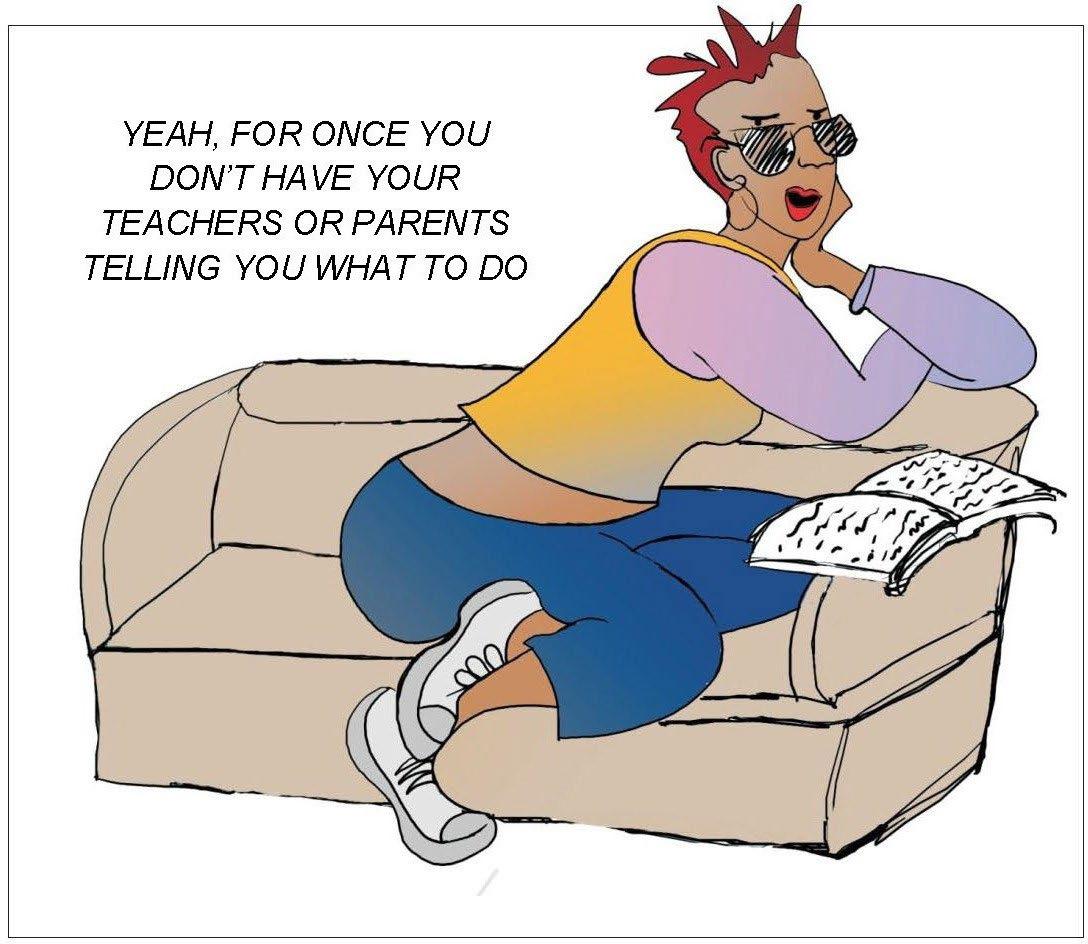
The central, and most important ‘rule’ at university, is that you have to take responsibility for your own learning
Umthetho ongundoqo nowona ubalulekileyo eyunivesithi kukuba umele ukuthatha uxanduva ngokufunda kwakho
Die belangrikste reël op Universiteit is dat jy verantwoordelikheid moet neem vir jou eie studies.
Certain words in this introduction are underlined. This means that you will be able to find a to your first year at the University of the Western Cape!
Wamkelekile
kunyaka wakho wokuqala kwiYunivesiti!
Welkom
Dit is jou eerste jaar aan die Universiteit van Wes-Kaapland!
Being here for the first time marks a big change in your life. You are at the start of a new and exciting journey! But before going on, take a moment to look back at the road behind you.
So far in your life, you have managed to establish yourself in a number of areas: home, school, social circles and perhaps work, sports, religious communities or political organisations. looking back, you will probably agree that each area required you to behave in particular ways in order to be accepted and to succeed. For instance, when you first went to school you had to talk (and even when to talk), what to avoid, what rewards and punshments to expect, and so on. All these special ‘school’ behaviours had to be learnt.
Many people think that university is a place for freedom from petty rules. like having to wear uniforms, not talking or eating in class, having to attend detention, and so on. It is true that life for a university student feels much more free, but in fact, the university is a separate world with its own set of ‘rules’ and new requirements that must be learnt if you are to make progress in your university career.
Often, unfortunately, the norms and rules underlying life at university are hidden. You’ll have to discover many of them for yourself as you live through your first year as a student. It takes time and experience to get to know how things work on campus, what you can do, what you must do, what is not acceptable, and so on.
For most students, this is easier said than done, and really, no one can tell you just how to do it. The specific purpose of this book is to help you to adjust to the academic learning aspects of life at UWC. We will tell you what kind of learning situations the university offers you and what is expected of you in return. We will also give you some guidelines on how to cope with these opportunities and demands. So we are hoping to make the academic rules and norms visible for you.
Remember: Part of being at university is asking for help when you need it. UWC offers many services from tutoring to career advice to emotional support. No problem is too small to ask for help. You are encouraged to use the UWC website, www.uwc.ac.za, to explore the services the university offers
whole section dealing with the highlighted issue later in the book. Look at the Contents page to locate the sections
Amanye amagama kule ngabulazigcawu enziwe ngqindilili. Oku kuthetha ukuba uza kukwazi ukufumana lonke icandelo elidilishana nendawo ezenziwe ngqindilili ekupheleni kwencwadi. Jonga kuludwe lwezalathisi ukufumana amacandelo
Sekere woorde in hierdie inleiding is onderstreep. Dit dui inligting aan wat later in die gids in meer detail bespreek word.
Doing this reading should not be seen as extra or optional work it is part of the work required for your course. In many courses, the lecturer will assume that you have done the prescribed reading before coming to the lecture
Ukufunda lomqulu makungabonwa njengomsebenzi owongeziweyo okanye umsebenzi onokuwenza xa uthanda- ngomnye wemisebenzi ekufuneka uwenzile kwikhosi yakho. Kwezinye iikhosi, umhlohli uyathekelela ukuba uwufundile umqulu obunikwe wona phambi kokuba uze eklasini
Hierdie leeswerk moenie as opsioneel of ‘ekstra werk’ gesien word nie. Dit word vereis vir jou kursus. In baie kursusse sal die lektor aanneem dat jy die voorgeskrewe leeswerk gedoen het as voorbereiding vir die lesing

Meetings all require your active participation
Zonke ezi ndibano zifuna thatheinxaxheba
Vergaderings vereis aktiewe deelname
Do remem ber that within the university, different faculties and departments operate according to their own subject-specific ‘rules’. This book cannot replace the important information that faculty handbooks and departmental guides will give you. So, please note that, rather than specific departmental and course requirements, this book offers general information and guidelines. It is important that you seek specialised information from your lecturers, tutors and departments whenever necessary. As part of taking responsibility for your own learning, you should always make sure of the detailed requirements for each of your courses by checking with the lecturer or tutor and consulting the relevant handbooks.
Much of the formal instruction at university takes the form of lectures, during which the central information for each course is introduced and explained. For each course you will be given reading material. This reading material might be a course reader or textbook that you have to buy or a set of notes or readings made available on the course’s iKamva site, or it could be a list of references for books or articles you will have to find in the library or online materials that you have to find on the web. Whatever form it is in, this reading material will expand on the content of the lectures and introduce new ideas that the lectures don’t cover.
Another part of the formal learning environment is some kind of smaller group structure in addition to lectures. This could be in the form of tutorials, seminars, workgroups, fieldwork sessions, laboratory sessions or practicals.
In a tutorial or seminar, you will typically meet in a small group with a member of staff, to discuss the content of the lectures and the prescribed reading. Tutorials provide the staff with an opportunity to determine whether you are coping with your coursework and to help you with any concepts which you do not understand. Tutorials also provide you with an opportunity to discuss the course content with your classmates and to ask your tutor about any parts of the work that you find difficult or confusing. Seminars are usually bigger discussion group meetings in which students will be asked to prepare and present discussion papers to the rest of the group, usually for assessment. In workgroups, fieldwork sessions, laboratory sessions or practicals, you will have to apply the information you gain from the lectures and prescribed reading. In some courses, particularly in the science faculty, marks you achieve in the practicals are included in the end-of-year mark.
iKamva is the university online webpage to which you will be signed up for each of your courses
iKamva yionline webpage yeyunivesithi apho uza kusayinela ikhosi nganye
iKamva is die universiteit se webblad waarop jy aangeteken sal word vir elke kursus
By the Way What your course marks mean:
A pass mark is anything above 50%; a failure is anything below 50%.
75% and above is a distinction.
A formal assessment usually takes the form of essays or other written assignments, online quizzes, class tests and examinations. The marks of class tests and assignments written during the course usually count towards your final course results, sometimes as much 60%. Written assignments and class tests offer you the opportunity to revise what you have learnt and express your growing understanding of the subject. They also offer a further learning opportunity because the feedback you receive from your lecturer or tutor will help you to see how well (or badly) you are coping with the work and where you can improve.
Some courses require essays and assignments to be submitted on the course’s iKamva site. Here the lecturer or tutor retrieves the assignments online. Using iKamva, lecturers may also generate an ‘originality report’ using a programme called ‘Turn-it-In’, as part of checking that your essay is original, correctly cited and not plagiarized.
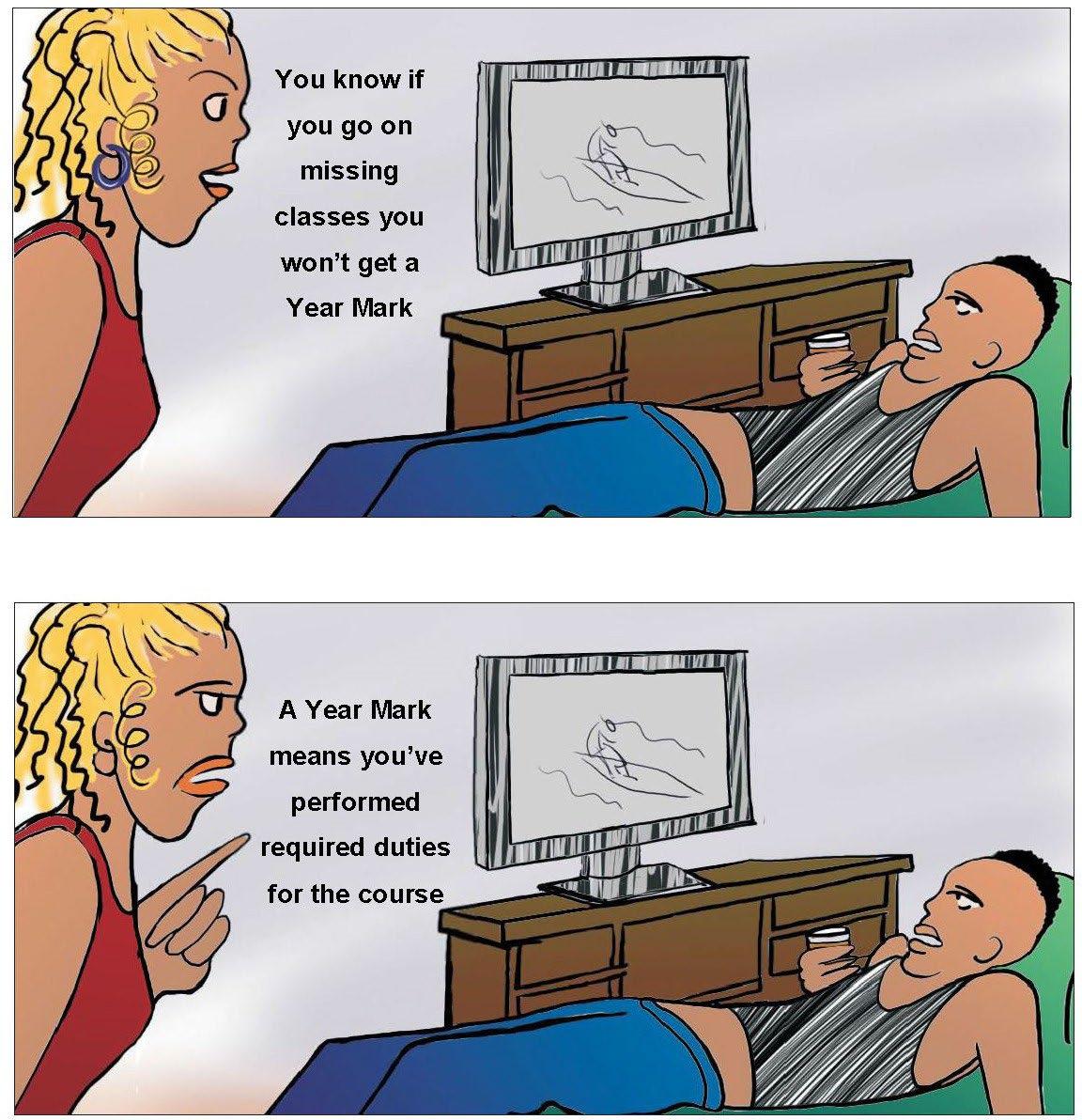
Most departments expect you to be present at your seminars, tutorials, workgroups or practicals, and usually prescribe a minimum attendance, for example at least 80% of class sessions. They also expect you to hand in all compulsory written assignments (on time!).
So, the learning activities central to your student life are:
• listening to lectures, reading references given and taking notes,
• participating in small group discussions, and
• interpreting, integrating and assembling information in written assignments, tests and examinations.
As has been m entioned, this book contains notes which provide a general orientation to these activities but don’t forget to consult your departmental and course handbooks as well!






Your progress at university will depend very much on you:
• how prepared you are
• how motivated you are
• how organised you are,
• how responsible you are,
It is appropriate to begin your study preparation by thinking about yourself. Your ability to study and learn successfully will depend on many personal factors, including your emotional state, your lifestyle and your social relationships.
Your first year at university, particularly the first semester, is a time of transitions (changes moving from one state of being to another). For some students, it is the first time they have lived away from home. Although almost all students are excited by this transition, and exhilarated by its possibilities, it can also be scary. Sometimes it seems that nothing is stable and predictable any more, and you might experience this as a sort of identity crisis, feeling that you are becoming a different person.
Whatever you feel, it is important to recognise and acknowledge your feelings, and perhaps to discuss them with friends or a mentor. Similar dilemmas arise around issues of smoking, drinking, sex, styles of clothing, music and many other things that embody personal and cultural values. If these issues are too difficult to talk about with your peers, you can book an appointment through the Student Counseling to talk with a counsellor. **Contact details appear on page 13.
You should also consider your physical state; if you aren’t healthy it will be very difficult to concentrate and do the amount of work that university study requires. Student Counseling can offer detailed advice about this aspect of your life, but, in general, you need to consider whether your habits in the following areas suit your new needs, or whether you need to change any of them: your diet, the amount of sleep you get (or don’t get!), relationships with others and recreational activities.
Where do I belong?
My home self
My University self (and how others at home see me) (and how others at university see me)
Healthy eating is not about strict nutritional dieting, wanting to stay unrealistically thin or depriving yourself of some tasty foods that you love. Choose foods that you can enjoy and that will be beneficial to your health at the same time.
Using the food pyramid is one tool to help you choose from the groups of food essential to maintain a healthy eating plan. From the major food groups that are illustrated in the food pyramid, choose a variety of foods to gain the most essential nutrients that your body requires to promote good health and functioning.
The lifestyle of being a student may make this choice difficult, especially if you live in a catered residence. However, you will still have choices regarding meals on campus and snacks you may keep in your room. It is possible to eat healthily without increasing your food costs.
• Choose a variety of foods from each major group so that you ensure that you get the nutrients your body needs.
• Adapt a plan to your taste and preference e.g. popcorn on campus can fit into your servings of grains.
• Combine food groups in one meal experiment with different tastes to make your meals interesting.



Meat, poultry & eggs
Vegetable oil & condiments
Omega foods: 1-3 servings (fish & sunflower seeds)
Calcium foods: 2-4 servings (broccoli, fish & dairy)
Flavonoid foods: 2-4 servings (broccoli, fish & dairy)
Vegetables: 7-13 servings
The food pyramid may be a useful guideline: it gives a suggested number of servings per week for each type of food

Different people need different amounts of sleep, but most people can’t really do with less than 7 or 8 hours a day. A late night here or there won’t have a long-term effect, but consistently having less sleep than you need, will seriously undermine your ability to concentrate on your studies. It can also make you more susceptible to illness and depression.
Think carefully about your own sleep needs and how they affect your studying. If you have early lectures on some days, try to adjust your evening schedule so that you aren’t too tired to get up in time on those mornings, or to concentrate in class when you do get there. This is easier said than done, especially if you are living in a university residence and those around you seem to be operating on a different schedule. Remember, though, that the university residences do have rules about ‘quiet time’ and ‘noisy hours’. Find out what the rules are in your own residence, so that you can plan your studying and sleeping accordingly.
It is not possible or desirable to spend all your time studying (you haven’t come for just that!). Relaxation is a necessary part of your life and the time you do spend studying will be more productive if you are enjoying leisure pursuits as well. Don’t think about recreation as something that competes with your time; rather see relaxation or physical exercise as an essential complement to the intense mental exercise required when studying. You do not have to spend hours running or cycling; even small doses of regular exercise are beneficial to your health, for instance in building up the immune system and reducing stress.
For some people, the perfect break from studying is working out at the gym; for others it is watching a movie. Whatever your preference, there is a vast range of recreational activities available to choose from on campus. There are student clubs and societies that cater for almost every need, be it sport, exercise, outdoor pursuits, religion, arts or culture. Keep an eye on the notice boards around campus for information on these.
You may think that your personal life is separate from your intellectual life, but disturbances in your relationships or deep unhappiness with your personal situation can certainly affect your university work. It is important to sort out problems before they interfere with your studies. Counsellors are available at Student Counselling for you to talk to about any problems.
As a new student at a big institution, you will come into contact with many new people, lots of whom may come from different cultures or backgrounds to yourself. Some students find this exciting, but it can be quite overwhelming, especially if your peer group at school was small and relatively unchanging. It is common for first year students to find themselves missing their family and friends and their familiar environment at home. Some students find it difficult to find a group of people with whom they feel comfortable, and so they don’t venture out of the circle of friends they have known for a long time. It might be useful to remind yourself that everyone else is probably as nervous as you are (even if you think they’re hiding it better) so try to develop relationships with your peers
Problem is I was so preoccupied with my relationship that in error I sent the break-up message to the tutor

Be security conscious at all times look after yourself as well as your possessions. Call Campus Protection Services if ever you feel nervous about your security or you need help. Contact Numbers have been listed
Come to the Centre for Student Support Services (CSSS), next to Block B. Telephone Reception on 021 959 2299 or for emergencies on 0800 222333 Email: csss@uwc.ac.za
All of these considerations around diet, sleep, relationships, leisure and exercise relate to maintaining a healthy self in general, but there are more specific aspects to think about in relation to your own learning. Ask yourself the question:
“What kind of student am I?” “Ndingumfundi onjani?”
“Watter tipe student is ek?”
You have already spent many years of your life studying, so use this experience to help you understand your own needs, and to plan for a successful first year at university. It might help you to think about your answers to questions such as:
• When I study, what helps me more: support or challenge, or both?
• How much feedback do I need?
• When have I successfully used group work? When has individual study been better for me?
• What really motivates me: the fear of failure, intellectual interest, the pressure of a deadline, the promise of a reward?
• When do I work best: early in the morning, late at night?
Your answers to these questions are unique to you, so you alone can plan appropriately for your needs. For instance, if you recognise that you really need a supportive group environment in order to study well, you should do your best to create one: ask a couple of people from your residence or tutorial group to join you for study sessions, or go and work with others in the library. If you realise that you produce good essays only when you are working to a deadline, and you also do your best work early in the mornings, then you need to make sure you go to bed early around the time your essays are due so that you will have enough time and energy to complete your work in time, in the way that best suits you.
The following are very important to successful learning, and you have control of them all (if these are absent, they could prevent you from learning successfully):
Your state of mind is important. Wanting to learn and having a sense of purpose are prime requirements for successful learning. Things that can help keep you motivated are trying to keep a clear idea of your goals in your learning (but being open to change as you discover new ideas through your learning experience), being positive and aiming high within your reach.
Remember how you learnt to ride a bicycle? You fell off, sometimes laughed, sometimes hurt yourself but you got back on and you picked up the technique. Your mistakes can be great teachers!
Engage with your learning community and taking part in discussions with fellow class mates, teachers or others inside and outside the classroom really does promote your learning. It gives you new ideas, generates feedback on your own ideas and questions (which can promote your selfesteem), and can stimulate further exploration of ideas. The existence of chat facilities on cell phones and the internet makes it easy to take up conversations about your course topics with others who are register in the same course.
Learning is about making connections!
Ukufunda kukwenza unxibelelwaniso!
Om te studeer, gaan eerstens oor die skep van nuwe netwerke!
While community is important, time to think on your own is also essential to learning. Reflection is important for making sense of what you have learned, what you have read, heard, seen and expressed.
There will be times when you lose confidence and when you may fail at things Keeping healthy and fit and making use of the resources available around you can aid you in your recovery from the low moments.
Your mistakes can be great lessons!
Iimpazamo zakho zingayimfundiso enkulu!
Jy kan baie uit jou foute leer!

All of us experience stress (pressure) and anxiety at times. In fact, a certain level of stress gives us energy and can help us perform to our best ability. However, too much stress affects academic performance negatively. For example, your ability to concentrate becomes poor and you are easily distracted, remembering information becomes difficult, you feel constantly tired and exhausted, you may suffer from headaches, stomach aches, sleeping difficulties, trembling or shaking, or you may have difficulty breathing.
Here are some tips on stress:
Keep up with assignments and coursework
• Make an assignment schedule
• Make daily ‘to do’ lists
• Reward yourself for completing work.
Review lecture notes each day
Take breaks while studying
• Stand up after 20 minutes
• Switch to a different subject
• Write, draw and talk out loud
Study actively
Get enough sleep
• Lack of sleep has a negative effect on your ability to remember
• Establish a good bedtime ritual to tell your body it’s time to sleep: read, do yoga or stretch, take a warm bath or drink warm milk
• Don’t take afternoon naps.
Eat healthy food
• Avoid junk/fast foods. Take multi-vitamins
• Include foods such as fish, whole grains and fruits
• Drink 2 litres of water a day.
• Avoid caffeine, bioplus, stimulants, cola and alcohol
• Visit Student Wellness if you feel ill
Take care of your body
• Exercise: walk, go to gym or dance
• Do physical activity: it is a good way to relieve stress
• Get a massage
• Do progressive relaxation techniques, visualisation and slow, deep breathing to relax
Ensure you have quiet time
• Balance your family, social and work time to ensure that you have time for yourself. Have a hobby.
• Unwind by taking a walk on the beach, soak in the bath, listen to music or watch the sunset.
• Use positive self-talk and retain appreciation.
Are you struggling to adjust in your first year? Feeling stressed, lonely and overwhelmed by academic pressure?
Contact the Centre for Student Support Services (CSSS) at csss@myuwc.ac.za OR visit them at the old Community and Health Sciences (CHS) Building, 2nd floor.
In order to create ideal conditions for learning, it is important to organise yourself in terms of where you study and how you manage your time.
1. Ensure you have all the right tools to study Online
Firstly, before starting with Online learning make sure you have all the right tools to learn from home. You will need a well-functioning computer or laptop, a good internet connection and/or data. Find out about UWC’s VPN, which allows you to be logged into the university network. Students who do not have the right tools to work from home should make contact with their lecturers, tutors, FYTOs or mentors to assist you.
2. Think about your workspace at home
W orking from home could be challenging for some students who are not lucky enough to have a study area. Identify a space in the house where you can work. Any surface where you can sit comfortably with your laptop and notes is good enough. If you’re used to studying in the campus library, you might find it quite difficult to transition to studying at home for the majority of the time, but it may be the best place to study from during the pandemic.
3. Engage with your learning
You need to engage with your learning in the same way you would in an actual classroom. You need to take notes while watching or listening to an online lecturer. Make sure you are in a comfortable space with minimal distractions. Always supplement the lecture notes and presentations with information from readers and prescribed text books.
4. Coordinate group chats
Make sure you make contact with peers from your classes. Create WhatsApp groups for your different modules so you can have support and keep in touch with peers. You could also make use of google meets or zoom that you can download for free and chat to your peers. Also make use of Ikamva chat to chat with your peers, tutors and lecturers.
5.Keep in touch with your tutor and lecturers
You may no longer be able see your tutors during their regular tutorial times or your lecturers during office consultation hours, but ensure that you keep in contact with them on a regular basis. Perhaps an email to your tutors or lecturers or message via Ikamva.



Working from home could create a challenge to balance personal chores and your studies. Try to create a regular schedule for university work e.g. 9am to 4pm. Don’t forgot to take breaks inbetween, this is more important now than ever when you are studying in your living space.
Final note:
When you are having a hard time concentrating, almost everything can constitute a distraction. It is not possible to create a distractionless environment if you are willing to be distracted; anything will seem to be more urgent or interesting than the studying you are supposed to be doing. Studying is an exercise in self-discipline! Of course you can, and should, work at reducing distracting things in your study space, and try out different places and times to find the conditions under which you will be able to do your best work.
We are all familiar with feelings and thoughts like: ‘I know I could do this well if only I had more time!’ Given the amount of work involved in studying at university, you are likely to feel this fairly often in your first year, especially if you haven’t managed your time very well. If you have come to university straight from school, you may not have had to organise your own time very much, as schools tend to be quite rigid and dictate when and how you study. They also require you to spend a lot more time in class, and this leads to the mistaken belief that there is so much ‘free’ time at the university. It is this ‘free’ time that you will have to take responsibility for now. There are ways to make time more concrete.
You could begin by thinking about the year as a block of time, and of all the things you have to fit into that time. The university year has its own pattern and rhythm which is embodied in the academic calendar. It shows the semester measured in academic weeks and days.
Each student should develop a semester planner. You can buy a year planner or make one yourself, and then fill in the basic information such as public holidays, university vacations, study week and so on. When you get all the information about your own timetable, fill it in, including due dates for assignments, test dates and other important information that will help you to plan.
Below is an example of a partially completed calendar, which shows the semester at a glance. It can be used to illustrate exactly when more work will be needed (for example before the Economics test) and when less time will be available for studying (for example around the time of the bursary interview), which means that you can plan for when you need more time for work, or how to compensate for time that will be lost to other activities.
When you have blocked in the time commitments at this level, it is time to start planning on the smaller scale. You should begin by looking at your daily and weekly time use. Try for a week to keep a detailed timetable of what you do. This means taking note of how much time you spend doing the following things:
• Attending lectures, tutorials and practicals studying, reading, online browsing or doing other work related to your courses,
• Working in a part-time job,
• Travelling to and from university and your job, sport, recreation and hobbies,
• Relaxing at home (reading the newspaper, watching TV, listening to music, browsing the web),
• Socialising (including WhatsApp, Twitter, Facebook, Skyping, emailing and talking on the telephone!), domestic duties (cleaning, cooking, laundry, going to town to pay accounts), and sleeping.
When you review this information, you’ll need to identify where you’re spending a lot of time. If it’s in front of the television, or in the student union playing cards, then you will know that you can afford to spend a lot more time studying. If you see that you spend long hours studying without any breaks or relaxation, you might want to reread the section above on Yourself as a Learner. Remember that relaxation is a necessary part of a healthy lifestyle, and try to find a more sustainable pattern of work. If you are spending too much time on domestic work (for yourself or others), you need to think about why this is so, and whether you can do anything to change this.
With your own requirements in mind, draw up a weekly timetable that will suit you. If you need to study in long, uninterrupted sessions, then plan for those; if you can get a lot done in short bursts of time, make full use of the time between classes and other bits of time that would otherwise be wasted. If you study best in the night, make sure you get all sorts of other time-consuming activities out of the way during the day; if your residence is too noisy in the evenings, plan to spend Saturday mornings in the library doing the work that needs the most concentration. Be honest with yourself. If you sit at your desk for the two hours every evening that you have allotted for studying, but you chat on WhatsApp, re-read old love letters, or fill the margins of your paper with sketches of cars, then you cannot count this time as ‘studying’ time. Try to stick to your timetable, but don’t be totally inflexible sometimes you might learn more by watching a debate on television, or having a discussion with a friend who comes around unexpectedly, than by sitting resentfully in front of your books. Good planning means that you should never get behind with your work, and so you can afford to be spontaneous now and then.

Overall, it is important for you to assess whether you are spending enough time on your university work. Remember also that this can change as the year progresses. The pressure of work increases through the year, especially if you have not used your time wisely at the beginning, and have allowed things to pile up till the last minute. Your time management depends on your understanding of how much work you need to do, and how long it will take you to do it. This might be more or less time than is needed by your friends and room -mates, and it is up to you to put in as much work as you need to, in order to achieve what you want to achieve. One way of making the most of your time is to make productive use of free periods on campus and quiet spaces like the library and learning commons. Use your timetable to allocate regular slots for reading for each of your courses. Generally, course lecture and tutorial times are arranged according to the following periods: (some practicals, for example in Science or Engineering laboratory sessions, may be arranged over a few hours).
Period Monday Mvulo Maandag
Week
1st 08.00-08.45
2nd 09.00-09.45
3rd 10.00-10.45
4th 11.00-11.45
5th 12.00-12.45
13.00-13.45
6th 14.00-14.45
7th 15.00-15.45
8th 16.00-16.45
9th 17.00-17.45
10th 18.00-18.45
Lwesibini Dinsdag
Lwesithathu Woensdag
Lwesine Donderdag
Lwesihlani Vrydag
Mgqibelo Saterdag
Cawa Sondag
As you can see, the periods are numbered 1 to 10, with a median slot at lunch time. The lecture slots each last 45 minutes and there are 10 minutes between each slot to enable you to change venues. So, for example, when your course handbook states,
Lectures: Monday to Thursday, 7th, ABC Building, Lecture Hall 3. Tutorials: Tuesday 4th or 6th, Wednesday 3rd or 6th it means that you will have lectures every Monday, Tuesday, Wednesday and Thursday at 3pm in the lecture theatre ABC Building and that your tutorials will be on Tuesdays either at 11am or at 2pm and on Wednesdays either at 10am or at 2pm Remember that tutorial class lists and their venues are decided after you have registered and the lists are put up on departmental notice boards and iKamva sites. (If in doubt, ask the tutor coodinator).
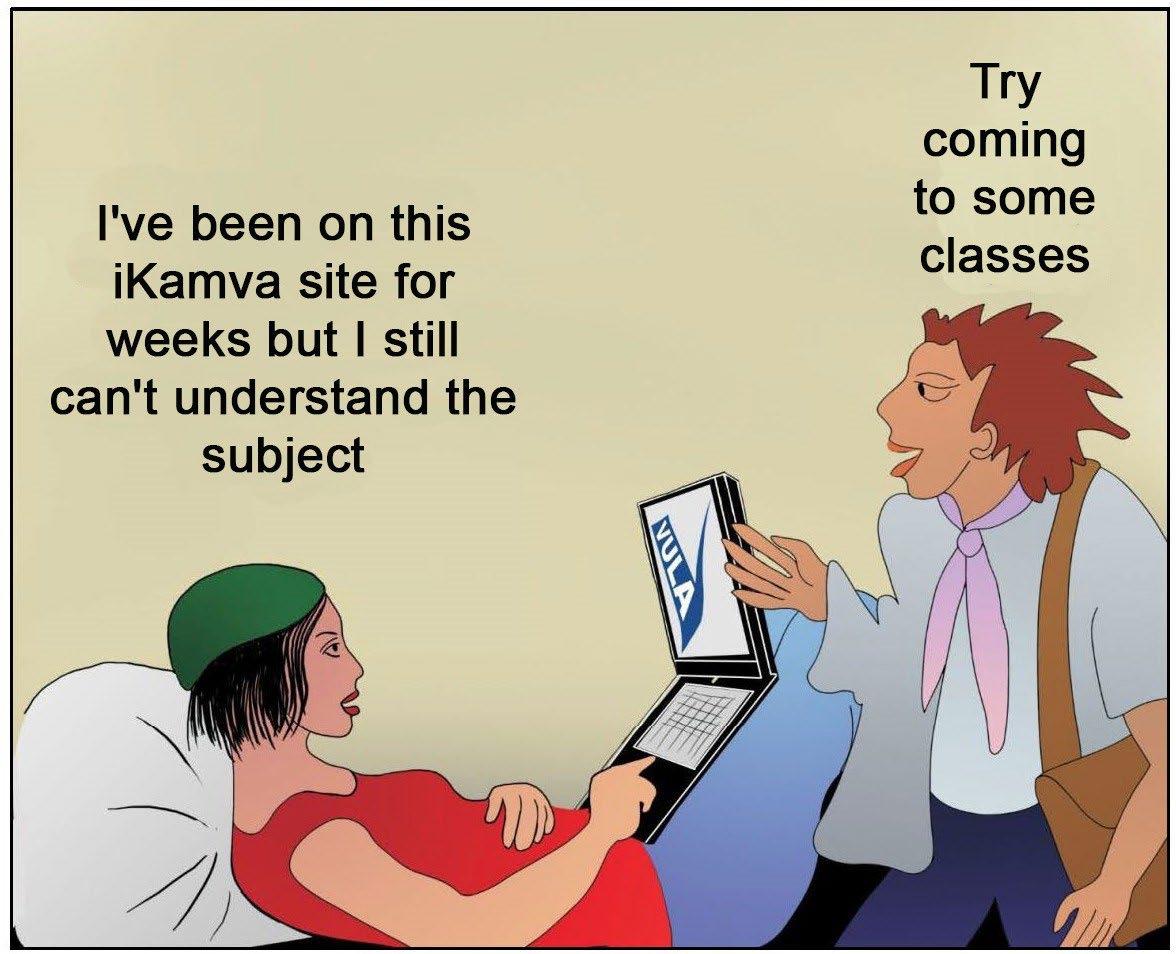
A lot of this information is now made available on the course iKamva sites together with lecture notes and further readings. BUT downloading the notes instead of going to the lecture is not an adequate substitute. The notes are provided to add to what is explained in the lecture in other words, the lecture is designed to help you to understand the notes!
Ulwazi oluninzi luyafumaneka kumacandelo kaiKamvanembalelwano engezifundo neminye imiqulu efundwayo. KODWA ukukhuphela inotes kwi- internet endaweni yokuya eklasini asiyonto eyaneleyo. Inotes uzinikelwa ukuba zikucacisele into iklasi ibingayo ngamanye amagama, isifundo sakhiwe ngendlela yokuthiuziqonde inotes!
Baie van hierdie inligting is nou beskikbaar op die iKamva kursus web-blaaie, tesame met lesingnotas en verdere leeswerk. MAAR om die notas slegs af te laai in plaas van om die lesing by te woon is nie voldoende nie. Die notas vul aan wat in die lesing bespreek word. Met ander woorde, die lesing sal jou help om die notas te verstaan!
Many of our students have a range of disablements. OSwD supports their access to academic reading material, venue and academic reading material access. The Office strives to implement an accessible and welcoming learning environment for students with disabilities as well as support for staff working with these students.
The OSwD assists prospective students with their enquiries and assesses their individual requirements and needs. Documentation confirming the disability is required to register here.
There are 2 fully equipped labs available for the use of only students registered at the OSwD in the department itself, while there is a smaller computer lab and study area in the UWC Library. A scanner, magnifiers, computers with large monitors, and text reading software programs are available in the labs. Blind students can be assisted with Braille conversion.
The OSwD has an established lease programme and Resource Centre in order to assist students who are unable to purchase assistive products. These devices are leased to students for 6 month periods. When the bursary payments come through, they can purchase their own and return the leased products.
Manager
Tel: +27 (0)21 959 3586
Tel: +27 (0)21 959 4170
Email: oswd@uwc.ac.za
Location: Ground Floor, former CHS Faculty Building, Main Campus
Administrative Assistant:
Tel: +27 (0)21 959 3128
Fax: +27 (0)21 959 2882
Email: oswd@uwc.ac.za
Administrative Assistant:
Tel: +27 (0)21 959 2770
Fax: +27 (0)21 959 2882
Email: oswd@uwc.ac.za
Administrative Assistant:
Tel: +27 (0)21 959 2770
Fax: +27 (0)21 959 2882
Email: oswd@uwc.ac.za
Promote universal access
Provide information on applications, enrolment, special accommodation and bursaries
Provide individual academic support
Provide adaptive study materials and assistive technology
Arrange alternative assessment, exam concession and examination methods
Facilitate access to funding in collaboration with our Financial Aid Office and NSFAS
Facilitate access to accessible residence accommodation
Network with academic staff
Provide information on employment possibilities, equity and non-discrimination
• Large screen computer monitors – for visually impaired students.
• Scanners – to enable students to scan their work and save it in document or audio format.
• Magnifiers – for visually impaired students.
• Braille embosser – for blind students and staff to convert documents into Braille.
• Special large font keyboards – for visually impaired students (in yellow and black, or black and white keyboards).
• Digital recorders – for students with physical challenges to enable them to record lectures and write notes at a later stage and at their own pace.
• Desk-top computers sourced from ICS for use in Residence rooms.
• Spare Crutches, White Canes, wheelchairs, Mobility vehicles for student use.
Specialised Software Programs:
JAWS for windows:
Powerful screen reading software that enables blind people to obtain optimum use of their computers.
ZoomText:
A software programme for visually impaired people that magnifies the desktop to the required level, in order to be able to navigate on-screen. It also has a screen reading speech facility for easier navigation.
Wynn:
A powerful tool for people with learning disabilities, e.g. dyslexia. It has spelling aids, homophone checkers, screen reading, scanning and study aids.
OpenBook:
For blind people to scan texts (e.g. books and text handouts) that can be converted into Braille. The software also has screen reading facilities. Scanned text can be converted into word document or audio format.
Dragon:
For people with physical impairment or learning disabilities to convert the spoken word into written format.
ClaroSuite:
This is a multi-sensory software package that caters for individuals who have dyslexia as well as those who are partially sighted, visually impaired or physically challenged.
For an appointment to consult with a Doctor or Nurse, please call 021 959 2876/5, or e-mail us at health@uwc.ac.za for an appointment.
Consultation: KINDLY NOTE THAT THESE COSTS MAY BE SUBJECT TO CHANGE:
(Basic consultation & up to 3 basic meds.)
Doctor Consultations / Nurse Consultations
Under grad students – Full time R 140 R 90
Under grad students – Part time R 190 R 100
Post grad students – Full time R 200 R 130
Post grad students – Part time R 250 R 180
Staff & non-UWC students R 320 R 220
Procedure etc.
Students / Staff / Contractors
General basic medical examination (No tests) R 280 R 300
Forms (Basic Home Affairs, PDP, etc.) R 230 R 290
Reporting to lawyers (accident claims etc.) R 250
Wart Cryotherapy (procedure fee) R 110*
Nebulisation R 70*
Surgical removal of lumps etc. (No suture used!) R 280*
Suturing of minor wound (Tetanus not included) R 380*
Tests
Students / Staff / Contractors
PAP smear: Under grad students
PAP smear: Post grad students
Pregnancy Test (urine dipsticks)
STD/STI Test (PRP screening)
Sugar/Diabetes test
Resting ECG
Lung function test
Meds. pick-up Free R 390 R 470 R 40* R 20* R 30* R 190* R 220* R 580
Vaccinations & Injections
Students / Staff / Contractors
Hepatitis injection (student service fee included) R 200
Flu vaccination
Tetanus Toxoid injection
Vitamin B injection R 90 R 120 R 80
Family Planning
Students / Staff / Contractors
Family Planning 1st Consultation (Injection, Pill) R 70 R 130
Family Planning Followup Visit
Visitor Family Planning visits
Visitor Family Planning Follow up visits
Emergency contraceptive Free R 130 R 60 R 80 R 130
Please call us or visit us to find out fees for further health services or care options available to you. Our friendly staff will be glad to assist you with all your health care questions. For an appointment to consult with a Doctor or Nurse, please visit us in person, call us at 021 959 2876/5 or simply book online at: http://doctorsvisit.co.za/members/ Thank you.
* plus consultation
** In the case that the fees and rates listed on this webpage differ from the fees and rates published in our practice rooms, only the fees and rates published in our practice rooms shall be valid. All fees and rates are subject to change.
Natural Medicine can be simply defined as any system of medicine that complements and enhances the body’s natural capacity to heal by restoring balance without the use of synthetic drugs or chemicals. The Natural Medicine Clinics are located on the 2nd Floor of Block B, and can be entered through Centre for Student Support Services.
Students, staff and the public can book for appointments for medical and physiotherapy consultations.
Clinic Enquiries and Appointments (UWC and Mitchells Plain):
Ms Esmerelda Presens
Email: epresens@uwc.ac.za (021)959 2703
Natural Medicine Training Clinics are open Mondays to Thursdays during term.
• Naturopathy
• Phytotherapy
• Unani-Tibb
• Chinese Medicine and Acupuncture
Read more about these clinics on : https://uwc.ac.za/Faculties/CHS/SoNM/Pages/Clinics.aspx
• Consultations are usually Free and medicinal and therapy charges are usually as follows:
• Students: R50. +
• Staff and Public R100 +
• These charges are subject to the interventions.
Physiotherapy Clinic
All fourth year students are required to complete their clinical practice at the Clinic where they treat patients with Physiotherapy related problems. The Clinic offers services to staff members, students and to members of the public.
Location: 2nd Floor, B-Block
Contact person for the clinic: Ms Rochelle Hoffman
Email: rohoffman@uwc.ac.za (021)959 2703
Substance abuse has a serious effect on one's life, and impacts on studies, work or relationships. Furthermore, it impairs your judgment, places you at risk of hurting yourself or others, creates trouble for you with the law, and has serious implications for your health. The health implication that it holds is that it damages major organs, increases the risk of cancer, increases the risk of contracting HIV/ AIDS, and could even lead to death.
The following are some of the effects alcohol and drug abuse could have on your life:
Poor Academic Performance
o Grades drop;
o Failing grades
Poor Work Performance
o Absenteeism
o Loss of productivity
o Arguments with bosses or colleagues
o Making more mistakes (including injuries on duty).
Difficulties in Relationships
o Tremendous strain on relationships
o Changing social cliques, thus unable to maintain long-term friendships
o Distancing self from others to hide over-use.
Personality changes
o Normally quiet people might become rowdy or violent
o Marijuana associated with "motivational syndrome" (losing interest in jobs, friends, and lives) becomes a risk
o Cocaine, amphetamines, and LSD could cause psychosis.
Personal Safety
Alcohol & drugs obstruct messages to the brain & alter perceptions, emotions, vision, hearing & coordination. It affects your judgment & could lead to dangerous behaviour that puts you at risk for:
o Accidental injuries
o Car crashes
o Sexually Transmitted Infections (STI"s)
o Unwanted pregnancy
o Sexual assault
o Fights & trouble with the Law
Alternative and Healthy Choices for Managing Stress
We all need "time out", when we need help with soothing a feeling or mood. Here's a list of likely scenarios that don't involve food, alcohol, or drugs:
o Take a scented bubble bath, with candles & soothing music in the background.
o Go to bed early and hope that tomorrow will be a better day.
o Allow yourself to cry, alone or with a friend.
o Take a walk.

o Do some vigorous exercise.
o Go to a beautiful, peaceful place.
o Talk to a sympathetic friend.
o Write in a journal.
o Dance.
o Go to a movie.
o Get a massage.
o Read a good book.

Do whatever it is you like to do or need to do, to take care of yourself. You can use this list or make your own, and place it somewhere you can see it when you're in need. Include phone numbers of people you can call. Be specific!
If you are worried about your drinking habits or drug use, Student Counselling invites you to contact one of their offices on your respective campuses, where you can schedule an appointment to speak to one of the counsellors who, if necessary, will refer you to a rehabilitation agency for further assessment, counselling and support.
Recovery from drug addiction

Addiction is a complex illness and impacts on all aspects of your life. On your journey to recovery and maintaining your sobriety, you will learn the tools needed to face challenges, like making drastic changes in your lifestyle, learn healthy coping skills to deal with your problems, as well as interpersonal skills on how you relate to others, and enhance the relationships in your life (Helpguide.org).
Cape Town Drug Counselling Centre (CTDCC)
Tel.: (021) 447 8026
e-mail: ctdcc@africa.com info@drugcentre.org.za web: www.drugcentre.org.za
Mental Health Information Centre of SA
Tel.: 021 - 938 9229
Cancer Association
Tel.: 021 - 689 5381
Parent Centre
Tel.: 021 - 762 0116 parent@iafrica.com
Nar- Anon
Tel.: 088 129 6791 www.naranon.com
Narateen
Location: Presbyterian Church, cnr Davies/Ross Roads, Bellville
Contact: Shanet 021 982 7897
SANCA
Tel.: (021) 945 2099
Substance Abuse Treatment Centres in the Western Cape http://www.westerncape.gov.za/directories/facilities/736
Lectures will probably be less familiar to you than any other learning situation in the university; they differ from high school classes most obviously in terms of size, but also in terms of function. At first, these two features might feel problematic to new students.
In some first year courses, you may be one of several hundred students sitting in a big lecture theatre, listening while the lecturer talks for 45 minutes, often about things you’ve never heard of before. Some students find it very difficult to learn in this situation, where they are anonymous and feel distant from the lecturer; they might end up feeling bored or frustrated. Some find it tempting to bunk lectures, knowing their absence will not be detected.
Although lectures can be easy to skip and hard to follow, it is very important to attend them! A lot of what the lecture does for you can’t be done in any other way. In a short space of time, lectures
• introduce you to new fields of study, new concepts, new terminology
• provide you with a lot of information (usually synthesised from various sources) in a relatively short space of time
• reveal to you the lecturer’s own position and point of view in relation to the subject matter of the course
• give you an overview of the course, including important dates (tests, due dates for assignments), requirements and administrative issues
Lectures are generally not interactive, although some lecturers will allow time for questions during or after the lecture. Lectures are delivered by the lecturer, to the audience. This implies a degree of passivity on your part, but there are ways to be an active listener, which will enhance your learning experience in lectures. The following sections will offer some ideas about what to do before, during and after the lecture to achieve this end.
Although you are not usually expected to ‘perform’ or ‘participate’ in lectures as you may have done in an interactive classroom at school, or in the same way that you would do in your tutorials, you should still prepare yourself for the lectures. The most important thing to do is to focus your mind before the lecture. Two possible steps in this process are thinking about the topic itself and considering what you already know about it. Let’s look at these
Read this riddle:
The beginning of eternity
The end of time and space
The beginning of every end
And the end of every place





You could find this out by looking at the course outline the lecturer gave out at the beginning of the course, or on the course iKamva site. The course outline might have the title of each day's lecture listed, or it might be blocked out in weeks, or according to the different sections being handled by various lecturers. In any case, it should be possible for you to use the course outline to orient yourself and know in advance the topic of the day's lecture.
You could also consult the notes you took in the previous lecture or lectures, or, indeed, those made available via iKamva. You could find out, for example, if the new lecture will be a continuation of the section handled previously, or a new section. Being aware of the context will allow you to ask yourself the next important question.
Having said, in the section above, that lectures are the place where NEW information is provided, it might seem strange to suggest that you ask yourself what you already know about the topic. This suggestion can be explained by referring to the way human beings learn. Although there are competing theories about it, it is generally accepted that:
Learning builds upon what is already known Ukufunda kongeza kulwazi obusele unalo Om te leer, beteken om te bou op wat jy alreeds weet

It is easier to learn something that can be connected to something you already know, or something that you have experienced. By the time you reach UWC you have already accumulated a multitude of skills and vast quantities of general and specific knowledge. It is important that you use what you already know to create a ‘hook’ for the new knowledge to hang on to. You could also think about it as using what you already know about the topic as the foundation, which will support the new understandings you will build up, using the new information in the lectures.
Once you know what the topic of the lecture is, spend a little time thinking about what you already know about this topic. Do you recall having studied this or a closely related subject at school? You may have read something in the newspaper, heard about it on the radio or seen a programme on television that referred to some aspect of this topic. You might also be able to exchange ideas and experiences with a fellow student or read over a relevant section in the textbook or course reader in anticipation of the new topic. Your lecture notes from previous lectures might also help you to realise what you already know about the topic.
You could also make a note of any questions that arise in your mind or your conversations, or things you are curious about in relation to the topic as far as you know it (or don’t). This can also make it easier to learn about the topic because you may then be alert for or recognise the ‘answers’ to your queries or the clearing up of your confusions!
From a practical point of view, you can also prepare for the lecture in the following ways:
• Try to arrive early for your lectures, so that you have time to organise your writing materials and your mind before the lecture starts. If you miss the introduction to the lecture you are probably missing the main point and the signaling of important issues to look out for, which would have helped you to make sense of all the subsequent details.
• Arriving early also means that you can choose a seat from which you will be able to hear the lecturer clearly, and that will allow you a clear view of the board or screen. This means that you can concentrate without being distracted by people coming late, or the struggle to see or hear the lecturer. It is also possible that lecturers will respond to your reactions if they can see you, and this could be very useful. For instance, if you were looking puzzled or worried, the lecturer might repeat an important point, or explain it in another way to help clarify your understanding.
• Make sure that you get any handouts that are distributed at the beginning of the lecture, and glance over them if you have time before the lecture starts.
• Not all lecturers make course notes available on the iKamva site, but even when these notes are made available, they may be incomplete and not cover every aspect, so it remains important to make some of your own lecture notes.
Knowing what the topic is, recalling what you already know about it and thinking about questions around the topic will help to focus your mind, and allow it to take in the new knowledge in the lecture
Ukwazi okungaso isihloko, ukukhumbula osele ukwazi ngaso nokucinga ngemibuzo emalunga ngesihloko kuza kukunceda ukuba umilisele ingqondo yakho, kwaye kuyivumele ukuba yamkele olu lwazi lutsha olufumene eklasini
Om vooraf te weet wat die onderwerp is, om te herroep wat jy reeds daarvan weet en om te dink aan vrae rondom die onderwerp, sal jou help om te fokus en die nuwe kennis wat in ‘n lesing aangebied word, sinvol te verwerk.

In this way your experience in lectures will be part of building up new understandings out of previous ones, instead of simply overwhelming you with unfamiliar and apparently disconnected facts.
• Man y students have got into the habit of recording their lectures and the lecturers’ slides on their cell phones. Whilst these recordings can serve as useful reminders later, your active rather than passive listening will improve your memory and your experience!
The taking and making of notes need to be done in ways which are useful to YOU!
Ukuthathwa nokwenziwa kwenotes kufuneka kwenziwe ngendlela apha eza kuba luncedo KUWE!
Maak notas op so ‘n manier dat dit vir JOU sin maak!
Developing your skills in note-taking is essential to your studies. Your notes taken from lectures, tutorials, discussions and readings can be used in preparing for assignments and examinations therefore they serve as reminders and resources. However, the (skilled) process of taking notes also helps with understanding and digesting the information you are presented with this process serves as an aid in concentration and in promoting questioning and debate.
Note-taking in lectures is difficult, but the difficulty is more complicated than just not being able to write fast enough to write down everything the lecturer says. This is why it is important not to give in to the temptation NOT to take notes. If you are a new student, struggling with note-taking, there are many excuses that seem attractive:
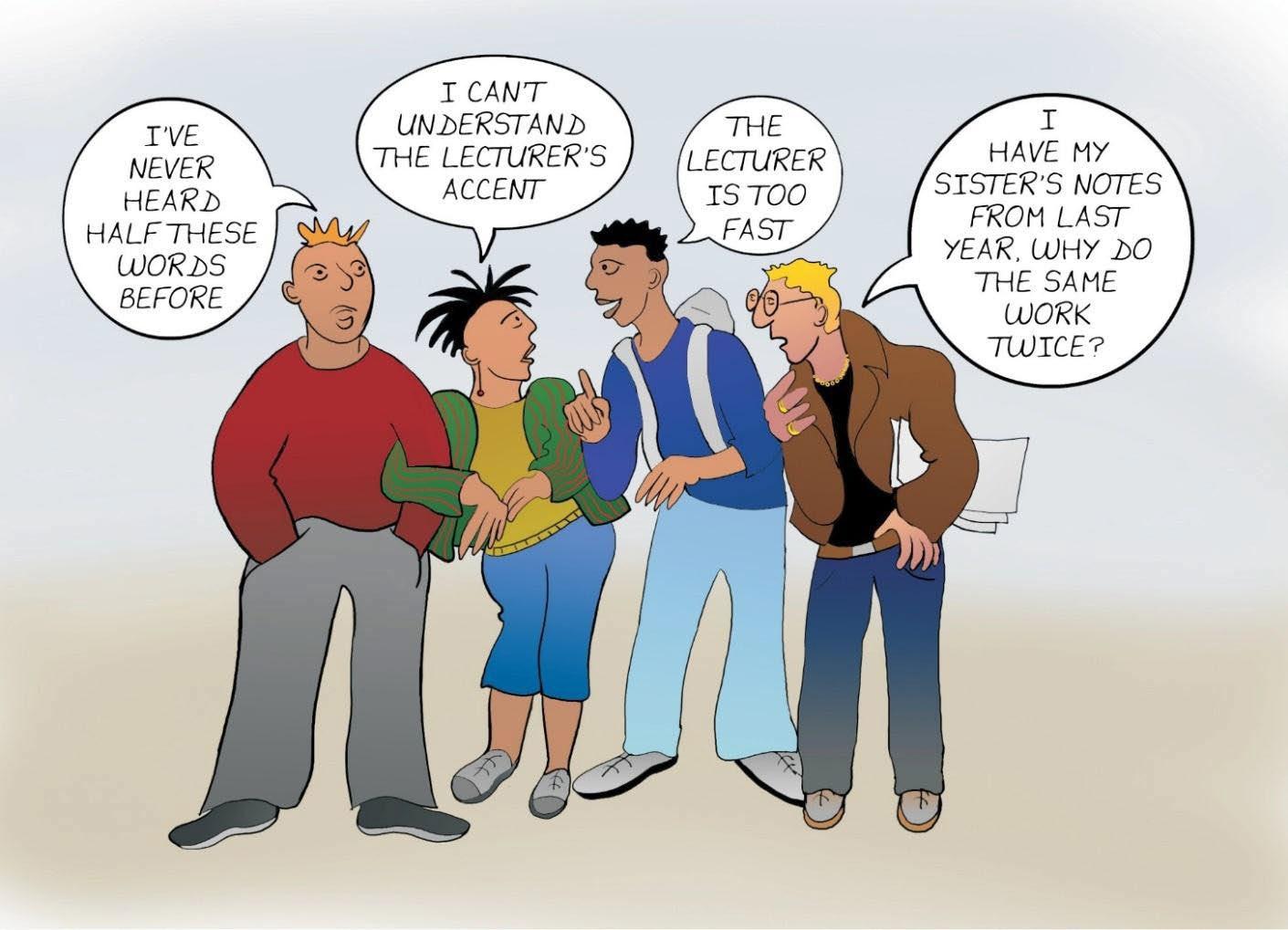
These commonly heard responses to note-taking presume that it is the job of the student attending lectures to copy down faithfully whatever is said in the lecture. Is this true?
W e have said that lectures are occasions on which lots of new information is provided, new ideas are introduced and new concepts are explained. This means that simply listening to the lecture is hard work. On top of this, many students believe that they have to record all this new information in its entirety. Actually, this is almost impossible. It is also a misguided assumption (phew!). Even the most complete set of notes that captures every word uttered by the lecturer (for example, a full transcription) is not the best set of lecture-notes. This is because it is not possible for knowledge that is in the lecturer’s head to transfer itself in a solid block to your head. The way you will gain knowledge is by processing what you hear in lectures, and finding a place for it in your own scheme of knowledge, by somehow making it your own representing the facts in a way that makes sense to you (rather than the lecturer). This is why a digital recording of the lecture (something that often seems to be a perfect solution!) is actually not as good as a set of good notes that you have made for yourself.
The notes you take in lectures will provide the ‘raw material’ with which you can construct your own new understandings. They will also provide the ‘raw material’ for many of the things you’ll be asked to produce, like assignments, essays, and test and exam responses. The quality of your written work and, ultimately, your success in your courses will probably be related to how well you have taken notes in lectures.
Note-taking is important, and lack of skill in this area can have bad consequences, BUT do not panic if you can’t come up with a brilliant set of notes in your first week of university. It takes time to get used to the pace of the lectures, the unusual accents you will be hearing and, perhaps, the level of language you will have to keep up with, especially if English is not your first language. Note- taking is a skill that will improve with time and practice.
Note-taking is best thought of as a creative process, during which you recreate your understanding of the concepts, ideas and information in the lecture, so your notes will not look the same as anyone else’s. Although you will develop your own system, there are some common note-taking strategies.
Don’t include anecdotes, jokes, little stories and illustrations. How to detect the main ideas is, of course, the difficulty, but the lecturer’s outline (sometimes displayed on the board, via an overhead projector (OHP) or PowerPoint) can help. The language used in the lecture can also alert you to main points.

You will know that something the lecturer repeats, writes on the board, or shows on a PowerPoint is a main point. Sometimes he or she will restate the same idea in a couple of different ways; this is also a sign that this is an important point. A point that is illustrated by an example or two is probably also important. A rhetorical question is often also a sign that the lecturer is going to make a significant point as he or she is drawing your attention to a pivotal issue, formulated as a rhetorical question. For example, “What does it mean to prove beyond reasonable doubt?”
Rhetorical Question:
A question for which an answer isn’t really expected Umbuzo ongadingi mpendulo (Umbuzo buciko) ‘n Vraag waarop ‘n antwoord nie nodig is nie

‘Today we are going to discuss the three major philosophical approaches to knowledge. Firstly ...’
This will help you to select the main points, and arrange the supporting ideas around them. If you miss the main point, take down whatever you can and then try later to reconstruct the main point.
NB: Don’t be tempted to write down only material that is shown on the board or screen and not listen; listening is your main priority for understanding the lecture!
Use abbreviations you are acquainted with, such as ‘i.e.’, ‘e.g.’, ‘viz’, ‘etc.’ or SMS-type abbreviations and shortening of words. And if, say, your lecture is about a particular revolution, and this word occurs in every sentence, you might write ‘rev’ or even just ‘r’. Remember, you must be able to decode your own notes later on!
The layout of your notes will probably be related to the structure of the lecture, which can usually be seen in the lecturer's outline or preamble. She might say, ‘Today we will deal with the three major causes of …’, so you will know that there will be three major sections. There are several ways of organising your lecture notes. People do have individual learning styles, so the ‘best’ style is the one that best suits your own learning style.Let’s look at three different ways of organising notes. Let’s say we wanted to take notes on the piece of text above labelled Lectures: Before the Lecture. You have read the text already. Now look at the different note-taking styles explained below and see which one seems to work best for you.
The most familiar is what might be called ‘linear’ notes; it would look like this:
Lectures

What they do: 1. 2. 3. 4.
Introduce new stuff
Lots of info in little time Show l’s p.o.v. Admin, business, dates etc.

How to prepare for them:
• Know the topic (title) and relate all details to it

• Existing knowledge - use as building blocks Focus the Mind!!!
In this style, as you can see, you use headings and subheadings, underlinings and numbered paragraphs to emphasise important points. This style preserves the order of the lecture, and this is useful if the exact sequence is important for your understanding.

Practical stuff: Arrive early Sit near front Front Get handouts
As you can see, this style of note taking shown below attempts to recreate the ‘bigger picture’ behind the lecture. It makes it possible for you to show the connection between two ideas, even if they didn’t occur consecutively in the lecturer’s presentation. This method is often more useful in note-making while reading (see later). It is quite hard to do this effectively while under pressure, especially if you haven’t used this method very often before.
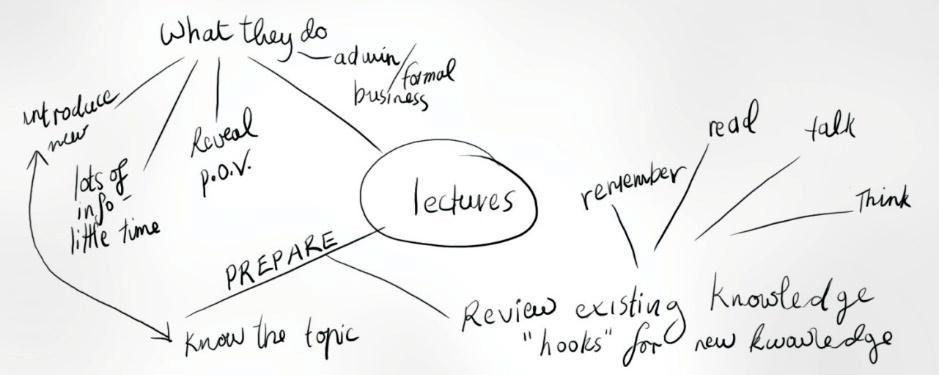
Another style that you may have seen before is the ‘mind map’ style. It is worth trying this out, as some people find this very useful and helpful.

Lectures
• • • • • What they do: Introduce new stuff Give lots of info Show l’s p.o.v. Practical info,e.g. test dates

How to prepare:
Know the topic course outlines think of previous knowledge or experience –‘hooks’ or building blocks read/think/discuss


(ref. orientation booklet) What about tutorials? Is this important to know?

also notice boards
and write the actual lecture

all this, every day!!???!!!
Can you do the readings advance?

Another way of organising your lecture notes is the ‘double column method’ which combines some features of the two styles mentioned above. You divide your page in two, notes on one side, using the other column for your own thoughts and responses to the lecture material. You might also use it to note down questions to ask at the end, or later in your tutorials.
As you see, the double column method allows you the freedom to add to your notes after the lecture, or to ask questions of your own without interrupting the flow of the lecture. You need to record the information, but in order to build up your own knowledge, you need to interact with the new knowledge – the double column allows you to do this, recording questions and even disagreements that you have in response to the lecture material. In cases where you have missed the main point, you can fill it in later.
W hatever method of organising you choose (and you may find that one style suits the lectures given in one course but not those in another!), it is very important to organise your notes in the more superficial sense of labelling them with course title, lecturer’s name, date and specific topic, and numbering each page. This means that should your files become disordered, as they will when you use them for lectures, tutorials, readings, essays and exams for all the courses you are doing, you will easily be able to reorganise them properly.
Etiquette in lectures includes the following:
• Arriving on time: This is good for you and also shows respect towards your lecturer and towards your classmates, rather than disrupting them all.
• Switching your cell phone onto Silent: Students do use their cell phones for recording lectures and whilst it is acceptable to use your phone or laptop for academic purposes during lectures, taking calls, sending or reading SMSs, going on Mix-it or playing games on your cell phone (or laptop) distracts others as well as yourself.
• Not running private conversations.
• Raising your hand to ask something: In terms of asking questions or raising issues with lecturers, it is better to raise your hand to alert them than simply to interrupt them. Lecturers will often make time for questions and points towards the end of a lecture. If space is not given for this, and you have a burning issue, approach your lecturers after lectures and ask to speak to them or make a time with them.
• Addressing your lecturers appropriately: There are various ways of addressing your lecturers – the most common is with their title and surname – e.g. ‘Dr Sicelo’, ‘Prof. Letlaka’, ‘Mr Aronson’.
Reflection and review after the lecture are also important. It is always advisable to read over your notes soon after the lecture, so as to fill in extra important bits of information that you remember. You may reflect on any questions the notes raise for you and use the opportunity to add to your notes and anticipate what is to follow in the coming lectures. You may also follow up on the topic by consulting readings and handouts, researching further or discussing issues that arise with your fellow students or in your tutorials.
You may work very hard on your lecture note-taking skills, and you may produce impressive notes in the appropriate style, but if you lose them, or can’t find the ones you want, you will not be able to use them when you need them. Retrieval of your notes is just as important as their creation.
There are different methods for keeping track of all the new information you are gaining. If you are taking notes on loose, lined sheets of paper, or an examination pad, then you should file them each evening in ring binders, preferably one for each course you are taking. There are many details to be considered here: For example, in most courses you will have lectures and tutorials every week. Do you divide your ring binder into two sections, one for lecture notes, and one for tutorial notes?
Or do you file everything chronologically, in the order in which it happened? This would mean that this week’s tutorial notes would be filed with this week’s lecture notes, last week’s tutorial notes with last week’s lecture notes and so on.
There are advantages and disadvantages to either system and it is up to you to decide on the one that suits your purposes. You may decide to divide each ring binder into sections representing different sections of the course, different lecturers, the four academic terms, or whatever, using coloured plastic or cardboard dividers. Of course, you may also type up notes on a computer.
W hatever you choose to do, make sure that you are consistent, and that you label sections, dividers and binders or computer files and folders properly.
It is very easy to spend a lot of time setting up a system for your notes, and tempting to spend money on beautifully coloured ring binders, plastic sleeves and so on, but remember that the point of making notes, filing them and retrieving them is to use them to construct and demonstrate your new knowledge in essays, assignments, tests and exams.
A lecturer’s job consists of other duties apart from teaching or lecturing. Usually lecturers are responsible for a few courses – often for large numbers of students. They may also act as supervisors of individual postgraduate thesis writers or small group research projects. They have to conduct research of their own and write this up for publication. They are often called on as consultant experts in their fields or to do presentations around or off-campus, and act as reviewers of journals or external examiners for other institutions.
They also have a fair number of administrative commitments within the university and their departments. So, while they are there for you, their time is not always immediately available for you. You are certainly allowed to request time with them but it may have to be arranged with them beforehand – done personally, by phone call or email. Some Blackboard sites also enable you to communicate with your lecturer directly.
Emailing your lecturer is a formal communication - don’t use SMS text or overly casual address!


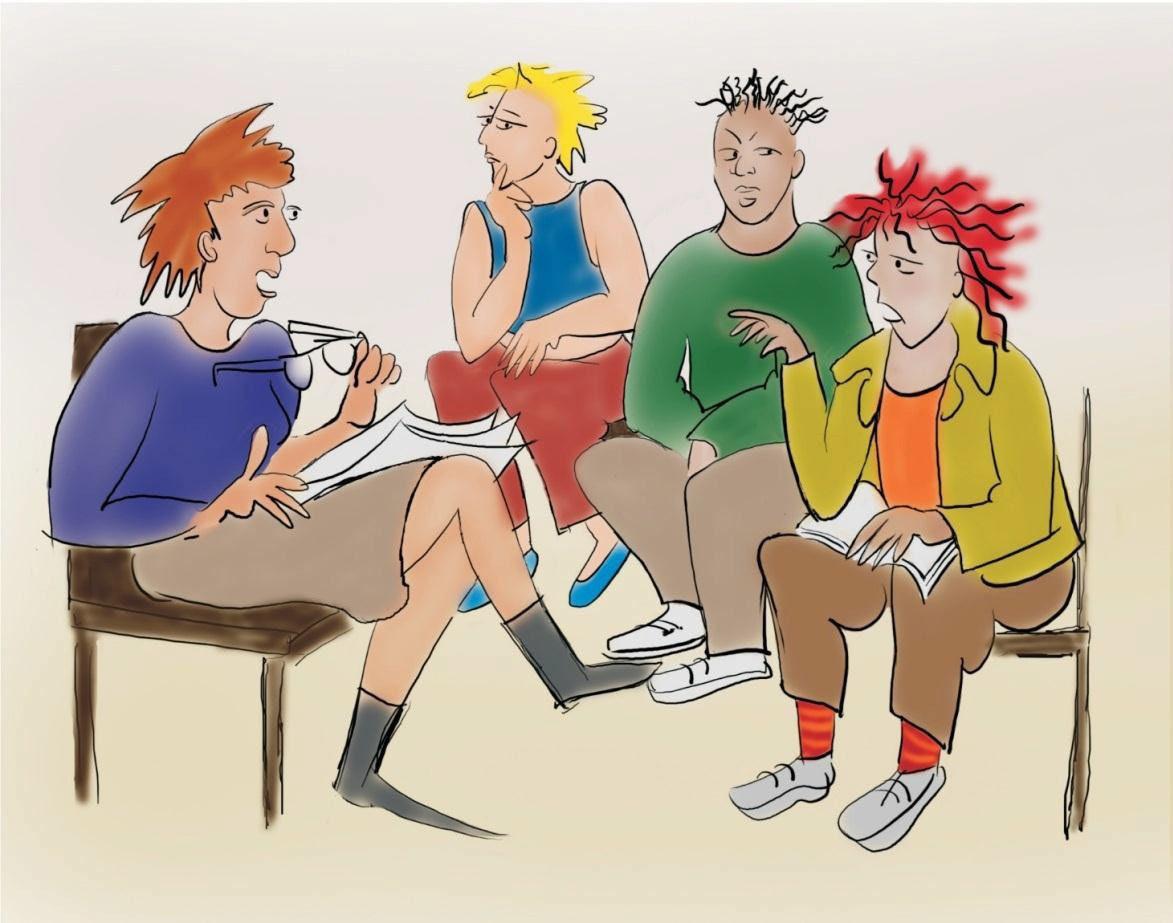
No matter which faculty or department you are in at the university, lectures will not be the only formal learning opportunity offered. You will be required to attend some other classes, which will be smaller than the lecture, and will have different purposes
Tutorials are generally small groups of students that regularly meet up to participate in discussions, debates and various other learning activities revolving around work covered in a particular module and/orlecture. Many students use this opportunity to actively participate with their peers, voice their opinions and/or concerns, and to receive and provide support - something they may not feel comfortable with or is not always possible to do in a lecture. Tutorials are led by a tutor who is either a post graduate student or a staff member. Tutorials are generally known as ‘tuts’ and is the duration of one period i.e. 50 minutes long. The tutorial structure may differ between faculties, where some will implement small group tutorials while others have a one-on-one session between tutor and student.
Practicals are generally groups of students that meet up to test and apply theory which they have learnt. In other words, a practical brings theory to life and gives students an opportunity to be more hands-on. For example, in the Science Faculty, medical bioscience students will more likely find a 3D heart to be more educating and exciting than in 2D and on paper. Practicals generally take place in a laboratory, and are led by a practical coordinator and practical demonstrators (also known as demis). The coordinator explains to students what the setup entails and the demis assist students with grasping concepts, challenges or questions they may have. Practicals may differ between faculties, and unlike tutorials, can take up to 3 hours. supervise the exercises. Practicals are usually much longer than the normal lecture or tutorial period, sometimes 3 hours long.
These are an opportunity for students to work together in small groups, focusing on certain sections of the work. The purpose here is to develop skills, as well as to work on the concepts related to the course. Workshops are communicated to students via email on UWC Communication, faculty and departmental noticeboards, and our website.
Depending on your courses, you may also be required to attend other kinds of class sessions, such as applying your knowledge in working through material that has been prepared for you online and working in ‘virtual communities’. Your participation is important in these cases. Formal assessments done via computers are becoming more popular. iKamva is UWC’s Learning Management System (LMS) which all students are required to access for important course material.
All of the smaller group learning situations referred to above are included in your curriculum because of the idea that learning is an active, rather than a passive, process. In the section on Lectures, we said that taking notes during the lecture is the beginning of this learning process, where you work out where this new knowledge fits into your own existing schemes of knowledge. As you place and integrate this knowledge, you are making it your own. You are creating your own understanding of the concepts and ideas.
This view of learning is called the ‘social construction of knowledge’ and it is worth thinking about. You will probably agree that humans have to learn almost everything they know – as we grow, we learn our language and our behaviours from those around us. But there must be more to it than just taking over what those older than us already know … If we only learn exactly what is passed on to us, then how do new ideas and discoveries come about? This puzzle can be answered if we change our idea of what learning is to include not only the things we receive from others, but also the unique way in which we receive and use that information. At school, where you probably had to learn lots of facts and get them right in examinations, the idea of ‘constructing’ your own knowledge may not have been very useful – in fact, it might have landed you in a bit of trouble! University is, like school, a place where knowledge is stored and transmitted to new students, BUT it is also a place where the creation of new knowledge is highly valued as well!
This means that your job as a student not only involves listening, learning, reading and understanding the knowledge being presented to you in lectures and books, but it also involves critical thinking. In other words, it involves questioning and challenging the knowledge presented to you and trying to work things out yourself – making new connections with your own previous understandings.
One of the most fruitful ways of doing this is by discussing ideas with your fellow students, and this is why the small group learning situations are very important to your development.
You will learn most from participating actively in your tutorials
Uza kufunda kakhulu ngokuthatha inxaxheba kwitutorials zakho
Jy sal die meeste leer deur aktief deel te neem aan die tutoriale sessies.

TUTS (tutorials) ± 45min

PRACS (practicals) ± 3hrs
WORKSHOPS ± 90min
A lot of students have struggled to participate actively in tutorials, for reasons such as being shy and nervous about speaking up, or feeling that it is a waste of time to listen to other relatively uninformed opinions, and that they would rather just go to lectures to hear the ‘right’ ideas. Sometimes, although they may feel that they have some good ideas, they don’t want to talk about them in tutorials because they would be unpopular with their peers. Some might also feel that they don’t want other people to copy, or ‘steal’, their ideas, especially if they are all busy preparing for an essay or assignment.
In order to get past these reasons for NOT participating actively, remember the benefits to be gained by the interchange of ideas:
• Remind yourself that everyone else is probably as nervous as you are, and try to contribute. This will get easier as you get to know the people in your group, and as you get used to the idea of learning from your peers.
• Your own ideas may be challenged in a discussion, pushing you to rethink; you may come up with a much better argument because of the opposition or support of your fellow students.
• As a result of discussion, you may be able to think of good arguments to refute or oppose the ideas of others.
• You will develop the skill of listening carefully and analytically to the arguments of others, and verbalising your own ideas will help you to formulate your written assignments and essays more convincingly.
Getting all the details of your tutorials, practicals and workshops sorted out will be a big job. It will probably be confusing at first, as your tuts, pracs, etc. will take place in different venues and in different time-slots from the main lectures in the course. Your times and venues will also be different from those of many of your fellow students, as the groups do not all meet at the same time. You will not always be in the same small groups as your friends, so don’t rely on them for this information. If the information is not available on the course Blackboard site, go to the departmental notice-boards, the departmental office or your lecturer to find out which group you are in, and when and where they meet. Once you have this information, fill it in on your timetable (see the section on Organising Your Time).
If you discover that the tutorial you have been assigned to clashes with another class of yours, ask your course convenor or the departmental secretary if they can put you in another group.
There will always be some preparation for tutorials and other such meetings. This might be the completion of a reading task, a writing assignment or something else. It is very important to do the preparation properly so that you can get the benefit of the discussion. Going to a tutorial without having done the preparation will contribute to the feeling of not wanting to say anything, and make your participation in the discussion less useful than it should be.
Your tutor, facilitator or supervisor will probably have ‘consultation hours’ every week. This is a time when he or she will be in an office or other appointed room, and available for individual discussions. If there are things that you don’t understand and that you feel you can’t bring up in the tutorial, then go and see your tutor during this time to talk about it. If you always have another lecture or meeting during the consultation hours, then ask the tutor if you can make an appointment to see him or her at some other time. Alternatively, you can consult your lecturer.
You are expected to conduct learning activities outside the classroom. These activities include reading, writing assignments, using computers for research and studying for exams. UWC has various resources to assist you with these activities, for example, Computer Labs, Library and iKamva. The services provided by these resources might change slightly from year to year. The most up to date information can always be found on UWC’s website: www.uwc.ac.za
UWC calls its online Learning Management System (LMS) “iKamva”
iKamva hosts various online spaces for academic courses, student societies, study and research groups, faculty and departmental groups, and assorted projects and initiatives. For many courses on campus, you will need to use the LMS to access important announcements, lecture notes and readings, online discussion groups, assignment information and hand-ins, plus tutorial groups, sign-ups and contact information. If your lecturer has created an online space for your course you will be automatically added to it. (If you don’t see a tab for a particular course please ask your lecturer or tutor if they are going to be using the LMS).
Instructions on how students will be able to access iKamva.
Students can go to the UWC Homepage then click on- https://ikamva. uwc.ac.za
Student Login Details:
Username: Student number (3912345)
Password: Date of Birth (yyyymmdd) OR ID number
Off Campus:
Students can type in the direct URL link: https://ikamva.uwc.ac.za
Or go to the UWC Homepage > www.uwc.ac.za
Go to Online Services- click on iKamva
You may view online instructional videos on how to make use of iKamva: https://tinyurl.com/ya9a65g3

It is extremely important to check your UWC email on a regular basis – like daily!
If you need to change your login password details you can visit http://mypassword. uwc.ac.za or contact the ICS Service Desk (021 959 2000).
Your username will always be your student number and remember your email address is (student number)@myuwc. ac.za.
When you click on a tab and enter an iKamva course site you will see a range of etools available in the left menu. This list of etools will vary from one site to the next, but the most common tools you can expect to see are Announcements, Course Resources (where course information, readings and lecture notes are normally stored), Discussion Forums (for online message posting and discussion), Assignments (for task information and online hand-in); Tests and Quizzes (engage in online tests to both formative and summative assessments) and Groups (for tutorial group allocation and sign- up).
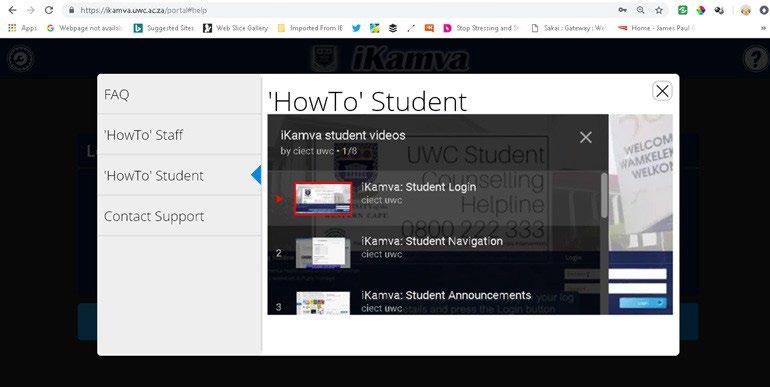
If you are required to sign up for a tutorial group, click the link in the left menu named (Site Info) Groups or Section Info (naming varies from site to site). View the available groups and then click the ‘Join’ link on the far right alongside the group that you want to sign up for.
Each faculty has its own computer laboratories for students, often simply referred to as ‘computer labs’. You gain access to the lab by swiping your student card through a card reader. Check the opening hours of your faculty lab and its location. The student lab computers are installed with software that is used for coursework in your faculty. A course may require you to visit a computer lab to retrieve additional readings, do research or check on updated course information. Some courses have tutorials and practicals in the computer labs. The labs can be busy when assignments are due. It is good to be well prepared before you go to the lab, having worked out all the tasks you will need to complete. Lab assistants are on hand to help you with technical problems, password changes, antivirus software updates, etc. and to provide basic support for applications. The library’s Knowledge Commons assistants will also be able to help with searching for course materials online.

Computer viruses can infect your computer in three ways: if you use infected files already on discs or flash drives that are put into your computer; if you open infected emails; or if you use untrustworthy sites via the internet. Remember that with more people using the same computer, there is more chance of infection. The computers in the labs are protected through antivirus packages, but it is important to be safe everywhere. If you have your own computer or laptop then you MUST install antivirus software onto it. Bring your laptop to ICS Students Service desk (ph 021-959-2000) and they will do this for you. You must also make sure that you regularly update the antivirus software. Remember to scan your flash drive regularly too. If you do get a virus on your computer or your flash drive, get it cleaned as soon as possible.
By the way, each student is given a UWC email account. You may already have your own personal email through other systems such as Google. However, when lecturers send out announcements, they will send these to your UWC email address. Any messages alerting you to the fact that there are new readings or messages on the iKamva site will also be sent to your UWC email address so do keep checking it
It is always important to backup your files – in case one gets damaged or lost on the computer. Also remember to run a virus scan regularly – to protect your work and others!
Kubalulekile ukuba usolok uzikhusela iifayile zakho-xa kunokuthi enye imoshakale okanye ilahleke kwikhompyutha.
Okunye khumbula ukusebenzisa ivirus scan - Oku kukhuselaumsebenzi wakho nowabanye!
Dit is belangrik om altyd ‘n ekstra kopie (backup) van jou lêer te maak in geval dit beskadig word of verlore raak op jou rekenaar.
Onthou ook om ‘n anti- virusprogram te gebruik om jou en ander se werk te beskerm!
The UWC library is a hub for learning and research. When you go into the library you will feel that this is a place of refuge for you to think, read and write. Although the Library may initially feel a bit overwhelming in terms of its size and collections, you will gradually find your own favourite spots for different kinds of activities.
Visit the library webpage dedicated to First Year students One of the videos available there is called “Getting help in the library”. One of the main benefits of using the library is having access to knowledgeable library staff.
The library is your go-to for any of the following:
The library website is the starting point for locating information sources to supplement your lecture notes or to guide your thinking in completing research assignments. uKwazi is the UWC search engine that searches across all the library’s collections, whether in print, digital or media formats. Watch a short tutorial on using uKwazi here
The library staff is dedicated to supporting students in their studies. Make a point of locating your faculty librarian’s office. These librarians are very experienced in coaching students in study tasks, such as information searches, interpreting lecturer requirements, referencing etc.
If you prefer, you could simply type in a query on the Ask a Librarian online service from the library homepage. This service is only available during regular office hours.
Accessing a PC 2 options are available
Print and Go: 10-15 minute limit. If you just need to do a quick job like download/print notes from iKamva or check your email, you can use one of the Print and Go PCs in the Library Foyer (and others just beyond the library loans desk). NB: There can be queues for these PCs so it makes sense to go for the next option
Reserve a PC: There are nearly 200 networked PCs available for students in the library. Access https://mypc.uwc.ac.za via your phone or from the library website. Make the best use of your time by advance booking a PC during free periods. You may reserve a PC for a period of an hour which can be extended for an additional hour, if necessary. This is ideal for accessing research materials or writing assignments. Most of these computers are located on Level 6 in the Knowledge Commons.
The Knowledge Commons (or KC for short) is staffed by friendly student assistants who are able to assist you with technical problems.
Load credit for printing or photocopying directly onto your student card at the CBA Office in the Library foyer. All PCs in the library are connected to network printers; you may also enable printing from your laptop by asking the KC staff.
Book a discussion room fitted with a PC for working on groupwork assignments. Use the same method for Reserving a PC. Level 10 is also a general workspace.
The Study Den on Level 4 is a strictly silent area, perfect for deep concentration.
These are only some of the benefits of using the UWC Library. A full booklet on using the library is available from the Library’s First Year students webpage. This will explain how you borrow books and use Short loan, introduce your faculty librarians and explain the use of e-Resources such as databases and ejournals.
UWC Library
(021)959-2946 http://lib.uwc.ac.za
The library has two satellite branch libraries: Dentistry library at Tygerberg Hospital and the Health Sciences library at Bellville
Library Semester hours Vacation hours
Main Library
Monday - Thursday: 7:30 - 22:00
Friday: 7:30 - 16:00 Saturday: 10:00 - 12:00
Branch Libraries
Monday - Thursday: 8:00 - 22:00 Friday: 8:00 - 17:00 Saturday: 9:00 - 16:00
Monday - Friday: 7:30 - 16:00 Saturday: Closed Please note, vacation hours only apply from the 15th of November
Monday - Thursday: 8:00 - 16:30 Friday: 8:00 - 16:00 Saturday: 9:00 - 12:00
• Reference books, including dictionaries, subject handbooks and encyclopaedias - essential for background information in all subjects.
• Short Loans books - these are transferred into Short Loans area because they have been identified by lecturers as useful for particular courses, and would therefore be in high demand.
• Books on the open shelves - Use this material to supplement your required reading and to write assignments and projects.
• Journals – your lecturer will refer you to research articles in “journals”. These are like magazines for research. Each issue contains articles contributed by scholars. In the same way that magazines are targeted for a specific readership, journals are dedicated to specific fields of study, for example psychology (South African Journal of Psychology).
• Electronic databases – There are over 180 electronic databases to help you find journal articles. Using a database allows you to search across hundreds of journals at one. Locate the databases relevant for your subjects on the Databases by Subject page.
• Past exam papers – The library maintains an archive of exam papers organized in folders by year, then choose your faculty and course code.
You will be downloading many articles from databases, ebooks or notes from iKamva. To save yourself time and stree, try to develop a practice of creating folders for each subject and sub folders for readings, notes and assignments. You will be able to locate your saved files more easily, especially if you give the files meaningful names. For example, instead of saving files with an automated file name eg, 24-78-3-804pb.pdf you could save it using the name of the author and some part of the title dlamini-management-principles- 2015.
You could also learn how to use Mendeley which lets you create your own personal digital library online. Ask your faculty librarian about that.

In order to keep the Library as a pleasant work and study space it is important to be mindful of the Library rules, which need to be respected and observed. The most important of these are that
Entry is by student registration card; no card = no entry. No food or drinks are allowed, except in spill-proof bottles.
No cell phone calls are allowed; cell phones must be switched to silent.
Keep quiet – don’t disturb others by talking loudly or playing music. Group work should be done on Level 10 or in the Discussion Rooms on Level 6.
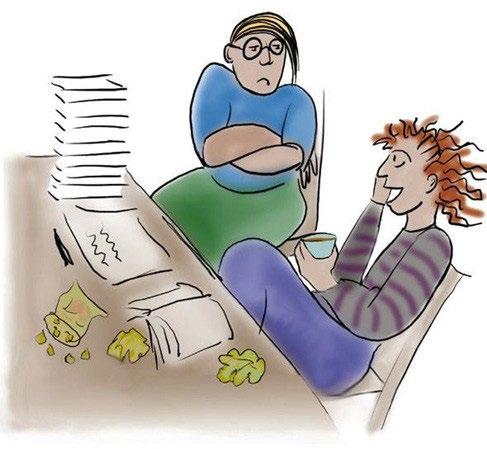






A full list of Library rules can be found on the library website
I’VE BEEN THINKING THESE THOUGHTS FOR YEARS BUT THIS BOOK REALLY KNOWS HOW TO SAY IT

As a reader, you are not simply a ‘blank slate’ onto which the ideas in the text are re-written.Reading is actually an interactive process during which your pre-existing ideas influence how you understand the ideas embodied in the text
Ukufunda akuthethi into yokuba akukho nto osele uyazi ngalento ufunda ngayo nanjengoko ezi ngcinga zibhaliweyo sele zikhe zabhalwa ngaphambili. Ukufunda kukuthatha inxaxheba kwinkqubo apho izimvo osele unazo zilukuhla indlela oqonda ngayo izimvo ezibekiweyo kokubhaliweyo
As leser is jy nie bloot ‘n ‘skoon bladsy’ waarop idees uit die teks oorgeskryf word nie. Lees is ‘n interaktiewe proses waartydens jou voorafbestaande idees ‘n invloed het op hoe jy die idees in die teks verstaan
The amount of reading required of students in different faculties does vary, but no matter what courses you are registered for, you are likely to spend more time reading than you have before.
Reading is one of the major ways in which you will learn at university. Reading for pleasure is an important leisure pursuit for many people, and if English is your second or additional language, then reading can also contribute a lot to the improvement of your English.
Reading is not a one-way process, where you, the reader, are simply informed about facts that are contained in the text. Every book or article is written by a person with a particular viewpoint, and you bring your own ideas and ways of thinking to what you are reading. It is helpful to see yourself as an active reader, who interacts with the text. There are different purposes for reading and you need to identify the purpose and choose the most useful strategy for this purpose. (See the section below.) This can help you to read more efficiently, more productively and with greater confidence.
Active reading is similar to the approach that we have encouraged of being an active listener in lectures. This involves identifying the topic or purpose of the lecture, preparing your mind by asking questions and recalling prior knowledge and taking notes.
Before you select a text, or before you start reading a selected text, ask yourself why you are reading it. Is it an assignment for a tutorial? In that case, are there accompanying questions that you should try to answer for that tutorial? Are you reading in preparation for an essay? In that case, you should already have a clear understanding of the essay topic and its requirements. Are you reading to consolidate some knowledge before examinations? Are you reading over something completely new as a way of preparing for a lecture? Are you following up a reference mostly for your own interest? Once you have a clear idea of what you need to get out of your reading, you are more likely to choose the appropriate kind of text (if it is not already prescribed) and the appropriate strategy for ‘reading’ it.
Different purposes require different kinds of reading material. It is important to know where to find particular kinds of information. If you need to find out what a word means, you know you can consult a dictionary. Of course this is often a good beginning, but it is important to remember that there is a difference between everyday use of the language and academic use of the language.
‘Active reading’ also involves understanding your own purpose or purposes, selecting appropriate reading strategies and making notes
‘Ukufunda okukuko’ kukwaquka ukuqonda injongo yakho okanye iinjongo, ukukhetha iindlela ezizizo zobuchule kunye nokuthatha inotes
‘Aktiewe lees’ beteken dat jy jou eie doelwit/doelwitte verstaan, geskikte lees strategieë kies en notas maak
‘Aktiewe lees’ het ook te doen met jou eie doelwit of doelwitte, keuse van toepaslike leesstrategiee en die maak van notas.
• An example of this is the word ‘argument’, which means one thing in everyday usage, but means something a bit different in academic usage.
• Another example is the word ‘character’, which will mean different things to students of literature, drama, mathematics and computer science
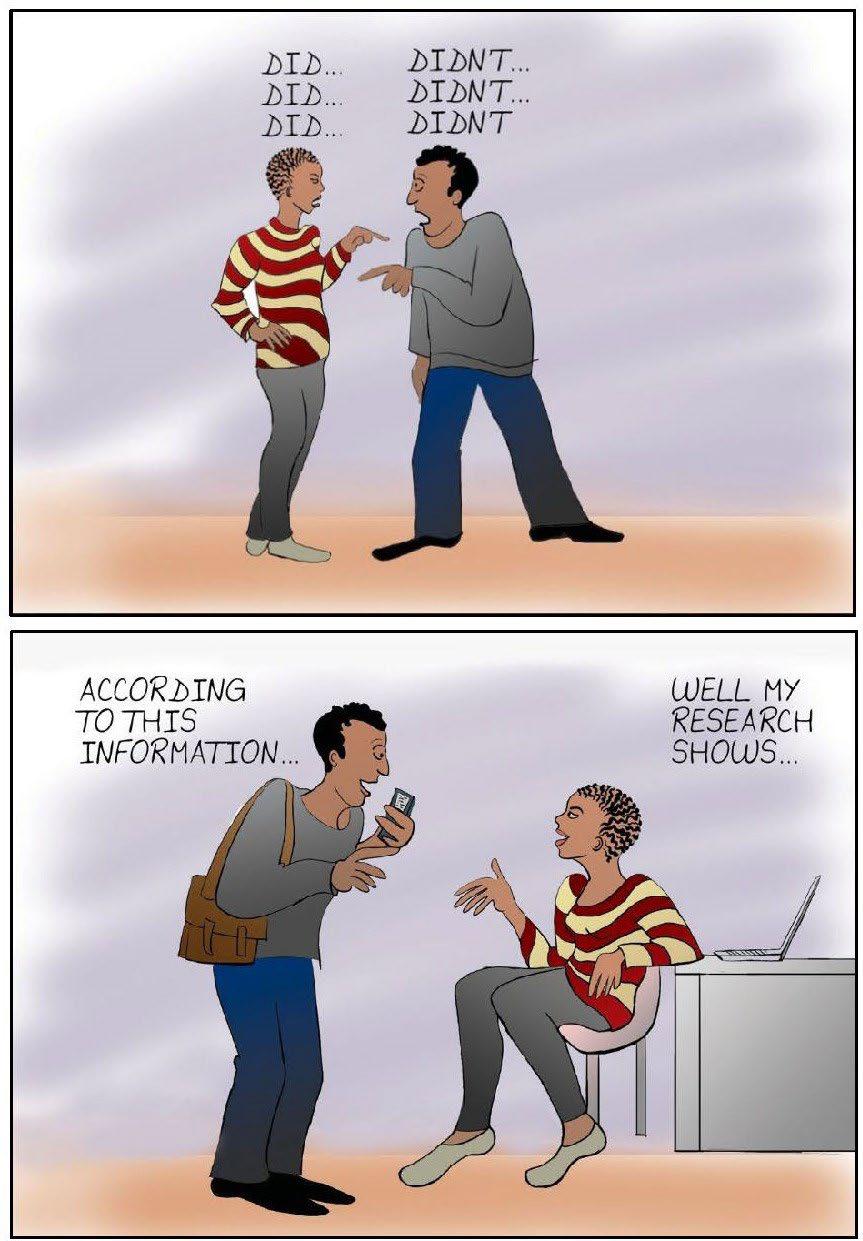
(If you want to find out more about a word that has a particular meaning in your own subject area, then you need a subject dictionary).
Always make sure that the material you are reading is appropriate to your subject or discipline and to your needs and purpose.
If you want a piece of information that has long been established and accepted, it will be found in an encyclopaedia or a textbook, but if you want to survey the most up-to-date research findings, the latest volume of a journal or periodical will be most useful. In some disciplines, for instance in the Humanities, it is useful to read the newspapers, as these are where a lot of current views are expressed.
In your first year at university, your lecturers and tutors will, most probably, offer very specific guidelines for reading materials, so finding the correct kind of reading material will not be a big problem, but it is often interesting and rewarding to explore further readings anyway. The more you read on a subject, the more familiar you will become with the whole field of study, including the language used and the range of opinions.

As toddlers, we all learnt how to put one foot in front of the other and move forward over the ground, and as we became more skilled, we learnt how to do this in different ways, and at different speeds. We also learnt when the best time to do particular kinds of movements forward was.
In each of these cases, our decision about which method to use in ‘moving forward’ is determined by our purpose. In the same way, we all learnt to read when we were little, but we would waste a lot of time if we always read in the slow, careful way we first learnt – paying attention to every word.
There are as many different types of reading strategies as there are types of walking. Efficiency in either of these skills depends on choosing the appropriate method for your particular purpose.
Here is a useful way of thinking about three approaches to reading: Preview broad - selecting the right texts for particular purposes ukunaba (kwezimvo) - ukukhetha eyona mbalelwano ilungileyo ngenjongo ethile wyd – kies die korrekte teks
Overview narrow - getting the general idea ukuncipha (kwezimvo) - ukufumana izimvo eziphangaleleyo nou – kry die algemene idee
Inview closely focused - getting a proper understanding Ukumilisela ingqondo okusondeleyo - ukufumana uku qonda okukuko duidelik fokus - begryp behoorlik
Acquaint yourself with the Libraries and learn how you can find books and resources there or on the internet.
Remember the librarians are available to help you in this! (See our section on Use of the Library)
Ziqhelanise nelayibrari ufunde ukuba ungazifumana njani na iincwadi nezinye izixhobo apho okanye kwikhompuytha. (Khumbula abancedisi elabrari bakhona ukukunceda kule nto)
Maak kennis met die biblioteek en leer hoe om boeke en materiaal daar of op die internet te vind. Onthou dat die bibiliotekaresse daar is om jou te help! (Sien ons beskrywing Use of the Library)
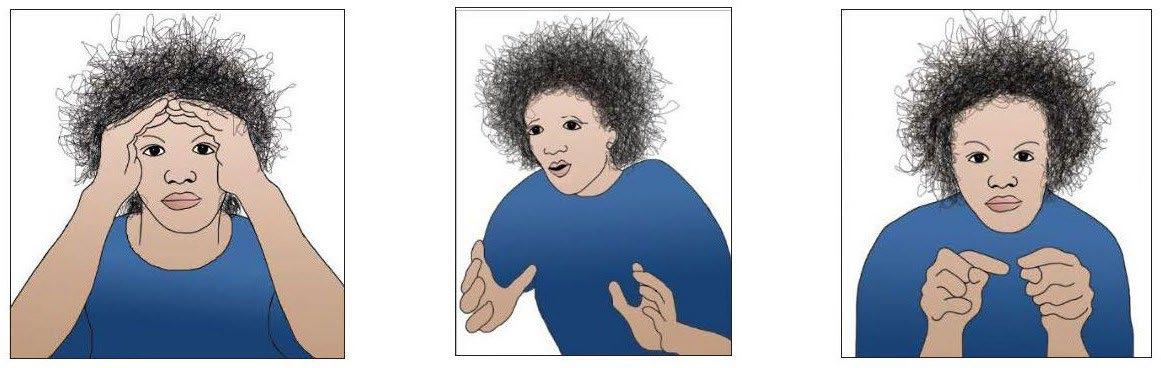
Preview represents a ‘pre-reading’ stage, where you would select a text that suits your purposes. Usually, in your first year, departments will give you a specific reading list for each assignment, but you might still be interested to see what else is available on the subject. Even within the range of titles on the reading list you will probably want to be selective, even if it is just to decide which book or article to read first, or to devote more time to.
In the light of your assignment topic, you could look at the following features of the books to decide which ones are more relevant or seem to offer the kind of information you are seeking.
• The title and subtitle of academic books usually reveal the central concerns addressed by the book
• The front and back covers of the book usually include the publisher’s description of what the book is about and comments by reviewers or other experts in that field. Useful information that you might find here could be an indication of who the author is and what his or her perspective is on the topic. The short ‘blurb’ on the covers might also reveal who the book is written for. If it is aimed at established scholars or experts working in a particular field, it might be too detailed to be of use to you at this stage. If it is too general, or too basic, it might not tell you anything you do not already know, and you might decide it would be a waste of time to read it. If you are looking for sociological material (looking at society in general), then a book by a psychologist (studying people in their individual capacity) – even though it is on the same topic – will be written from a perspective that you would find less useful.
• The contents page is always at the front of the book, and can be very helpful, especially if the chapters are by different authors. You can choose the chapter by an author who is familiar to you or well known in the field of study. You might be able to tell from the chapter titles and subtitles which parts of the book would be most useful to you.
• The printing history is usually found on the back of the title page. It will contain the date the book was first published, how many editions there have been, how many reprinting’s there have been. If you are only looking for recent information, or information since a certain date, then glancing at this page might eliminate a book from your list, or confirm for you that it is important. For instance, if you are required to find out about certain consequences of South Africa’s first democratic elections, then anything published before 1994 will not be useful and you would not spend time reading it for this assignment. If a book was first published long ago, but has been re-issued and re-edited many times since then, this might indicate to you that it is an important book that is probably still relevant.
Having previewed several texts (as outlined above), and finally chosen one, it is still better not just to open the book at page 1, begin reading, and plod through to the end. Your understanding of any text will be enhanced by conducting an Overview. This kind of reading is sometimes also called ‘skimming’.
W hen you enter a room for the first time, you glance around to get your bearings. You establish some ‘landmarks’, for instance, ‘Oh, there are two windows’, ‘There’s a table in the middle’, ‘There’s a sliding glass door at the back’ or ‘There’s someone in the corner that I would really like to get to know’. Although you don’t know every detail of what’s in the room, or whether the doors and windows work properly, you have a general impression of the room and could probably say whether it is a dentist’s surgery or a hairdresser’s or a family’s sitting room. Now, when you approach a piece of text for the first time, you can use the same sort of strategy. Instead of getting straight into the details, take a little time to look around, or overview, the whole text.
Let’s say that you have to read an article or a chapter in a book in preparation for an essay you are writing. In order to get an overview of the article, you would begin by reading the title, any subtitles and any words that are emphasised, perhaps by being printed in italics or bold type. If, for instance, an article is entitled ‘Intelligence and IQ: Nature or nurture?’, then the fact that the title is in the form of a question might suggest to you that the author is going to present more than one side of this argument. Subtitles like ‘The History of IQ Testing’ clearly reflect what that section of the article is about.
Flip through the article and note whether there are illustrations. Graphs or tables can often reveal what kind of argument authors are making and what kind of evidence they are using. Pictures and diagrams are also useful because they can highlight main points, and can also make the subject seem easier to understand.
Other strategies you can employ are: read the introduction and conclusion, as this is often where authors will summarise their whole argument; read the first and last paragraph of each section; and read the first and last sentence of each paragraph. This should give you an idea of the structure of the article, without any distracting details. The details can be filled in slowly as you read through the article again; doing the kind of reading we call Inview.
Once you have some general ideas about the article, and you believe that, for your purposes, it will be necessary for you to read and understand the article more fully, and then you begin a careful, detailed reading. As you do this kind of reading, you can take your time, going back to check on points the author made a few paragraphs back or facts that you don’t remember. The purpose here is for you to recognise the author’s argument. This involves identifying the facts or information the author is presenting, the author’s point of view (which is sometimes hidden) and the author’s interpretation of the data or information. Youalso need to see the connections the author is making between the different ideas and to understand how the conclusion is reached.

As an active reader, it is up to you to question the text and to think about what ideas and presuppositions you bring with you
Ngengomfundi oqondayo, kukuwe ukubuza nokucinga ngezimvo nezinto oqgiba ekubeni mawuzithabathele kuwe
As ‘n aktiewe leser is dit jou verantwoordelikheid om die teks te bevraagteken en om na te dink oor watter vooropgestelde idees en aannames jy met jou saambring
You might ask questions like: Do I agree with the author’s basic assumptions? Are there some facts that have been left out or misinterpreted? Do I dislike this argument because it challenges my own beliefs? How does this fit in with other things I’ve read on this subject? Does the author’s conclusion seem logical and well supported? What is this author’s bias or position?

This questioning approach to reading will help you to develop a critical and analytical approach to the information and ideas you are reading about. Part of your active reading process should also be making notes on what you read.
If you are reading for the purpose of writing an essay or assignment then you will need notes so that you remember the points that are relevant to your topic and so that your references will be accurate.
There are different ways of making notes from your readings. If you own the book or course reader or have made your own photocopy of the text, then you may want to underline the important points or highlight them with a highlighter pen (NOT if it belongs to the library or to someone else!). One of the problems with this kind of note- making is that it is very easy, and can be done quite mechanically and passively. Sometimes students read very carefully, underlining or highlighting as they go, and when they get to the end they realise they have underlined the whole paragraph, or sometimes even the whole page. This means that they have failed to separate the main point out from all the other supporting points. When they return to the reading material, they will have to read the whole page or section again, instead of just being able to locate the main point immediately. Remember that the notes you make from your readings serve the same purpose as the notes you take in lectures
– they serve as the ‘raw material’ which you will use to build up the essays, assignments and other work that you are required to produce for your courses.
If you own the material (again, not if you don’t!), selected underlining or highlighting can be supplemented with notes made in the margins. These can vary from simple numbering to short summaries of the paragraphs. These brief summaries are often very useful because making them involves thinking about the material and using your own words to relate the main points. The limited space can be a problem, however, and illegible, squashed notes are almost useless.
If the material is not your own, but has been borrowed from the library or someone else, then you will have to make notes on a separate page.
The way you make notes can vary according to your preferences and purpose. You can choose from the same styles that were described in the section on Lectures. These were linear notes and mind-mapping notes. A good test of your comprehension is to write a summary of the article or chapter you have read. This will also serve as a good reminder to you at a later time of what was important about the reading. Actually writing out a summary, as opposed to point-form notes, is an opportunity for you to practise using the language of the subject, and will help you to identify concepts that you don’t understand very clearly.
As with lecture notes, it is important that your notes reflect your understanding of the material, as well as your own critical response to it. Again, as with the lecture notes, your notes on the readings will be helpful only if you can find them when you need them, and if you do actually use them.
Much of the time you will be reading electronic documents such as journal articles in PDF format (Adobe). It is important that you find ways to interact with the text. If texts are in Adobe, you can use the “highlight text” function and the “add notes to text” function in order to emphasise important parts of the text and to comment and write questions as you read. Some students read academic texts on their phones. However in the case of important readings it may be worth printing the reading or sections of it, or spend time reading in the library or a computer lab if you do not have access to a larger screen at home.
It can be helpful to copy and paste quotations from electronic texts onto a word document as part of your note-taking BUT IT IS IMPORTANT to make sure that you do not paste chunks of text straight into your essay as if they are your own words. You need to make sense of what you are reading yourself and write ideas in your own words and acknowledge where you read the ideas in the appropriate way. See the section below on referencing for more information
You can highlight if the book is yours

You should always carefully copy down the full details of the text (title, author, date of publication, name of publisher and pages) so that you can refer to it correctly in your essay or assignment (see section on Essay Writing for referencing conventions).

If you have a computer, it is a good idea to store the details of all your readings –either in a file or via one of the citation programs, such as ‘Refworks’, ‘Endnote’ or ‘Mendeley’.
If you are reading and you come across a word which you do not understand, you can often work out the meaning without having to interrupt your reading to look it up in a dictionary. In fact, your first strategy should be to read the sentence, and see whether you can get the gist or general sense of it without actually understanding the word. Sometimes it is more important to just get the sense of what is being said than to find the precise meaning of the word.
If, however, you decide that you cannot understand the sentence without understanding the word, then you will need to think a little bit about what the word means. Sometimes, especially if a word looks long and complicated, the structure of the word gives a clue. For example, if the word you don’t understand is ‘subterranean’ and you know that ‘sub’ means under or beneath (as in submerge or submarine), you might be able to figure out enough of the meaning to be going on with, even if you don’t know what ‘- terranean’ means.
If you cannot follow the meaning of the sentence without the word, and there are no useful prefixes or pieces of the word that can help you figure out its meaning, it is sometimes useful to use the clues that may appear in the sentence or the paragraph. For example, consider the following sentence: ‘In South Africa, the tripartite alliance was formed in 1990 after an agreement by recently unbanned political organizations was reached to work together’. If you don’t know what the word ‘tripartite’ means, and you don’t know about the prefix ‘tri-’, then you could guess the meaning of the word by reading the next sentence: ‘The Alliance of three parties was formed between the African National Congress (ANC), the Congress of South African Trade Unions (COSATU) and the South African Communist Party (SACP)’, where more details of the system allow you to guess what the word ‘tripartite’ means.
If you cannot work out the meaning of a word yourself, then you will have to turn to the dictionary. This is not a bad thing to do, it is just that in some reading situations it should be treated as a last resort, as it can be very difficult to follow an author’s argument if you are constantly having to interrupt your reading to consult the dictionary.
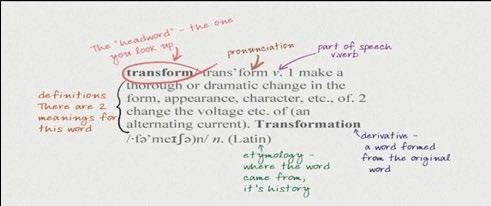
Of course, a lot of people use Wikipedia or other online dictionaries – they work in similar ways! Once you have worked out what a word means, or looked it up, it is worth trying to remember it, so that you don’t have to look it up again next time you see it, and also so that it is available to you when you write your essays and assignments. Some students keep a little notebook in which they write down all the new words they are learning, and the explanations of those words. Others may list them at the back of their textbooks or course readers. If you are using the double column method of lecture note- taking, the second column of your notes is a useful place to note down newly learnt words and their m eanings. Try using your new vocabulary in tutorials, assignments and essays, as the feedback you receive will help you to modify and refine your understanding of new words, especially those that are subject specific.
During your career at university you will almost certainly be asked to do some other kinds of writing, like reviews, dialogues, summaries and reports. The academic essay, however, is still the central means for creating academic understandings in most disciplines, and is probably the least familiar to most first year students, which is why this section concentrates on it.
There are two ways of looking at this question. Firstly, you write essays because they are required, and they constitute the primary way in which you will be evaluated as a student at university, apart from tests and exams. Lecturers and tutors use the essay (and other written assignments) as a way of assessing your mastery of the content of your courses as well as your familiarity with the kind of specialised language used in that discipline. Your success at university will depend very much on how successfully you complete your assignments.
The other way of thinking about the question ‘Why write essays?’ centres more on your intellectual growth and development. One of the things you can reasonably expect to acquire at university is a set of skills. If you think of a skill as something that can only be learnt by doing, then you will quickly realise that in order to acquire the kind of writing skills expected of a university graduate, you will have to practise that kind of academic writing. Every essay and written assignment offers you the opportunity to practise and improve your academic writing skills.
Man y students feel that the academic essay is boring and that it doesn’t allow them any creative or unique self-expression. It is true that academic writing is very different from the essays or compositions written at school; it seems fairly confined with all its rules around structure, argument, language and referencing – and it is essential that students learn the ‘rules’ for academic writing. However, it can be a very creative means of exploring ideas and reaching clarity in your own opinions and in the communication of your and others’ ideas!
The section on Tutorials mentioned the idea of the ‘construction of knowledge’; similar ideas came up in the idea of active note-taking and interactive reading. This view of learning can also help you to view your essays and written assignments positively, instead of simply as a chore. All the ideas and theories that you read about and hear about in your lectures have been generated by humans, each of them affected by his or her own context (which will include the ideas and theories they have been exposed to, the time in which they lived and wrote, their geographical situation, their religion, their gender and other factors). When you are asked to analyse or critique or comment on these ideas, remember that they are not holy, untouchable or absolute.
Although not obviously ‘creative’, the essay is not just an occasion for presenting the ideas of others, but an opportunity for you to ‘construct’ your own response to the question and to the readings and lecture notes related to the topic
Nangona ingeyonto uzidalelayo, isincoko asiyonto apho udlulisa izimvo zomnye umntu, kodwa lithuba lakho lokwakha eyakho impendulo embuzweni nakwimiqulwana efundwayo kunye
nenotes ozifumene eklasini ezisondele kwisihloko
Alhoewel nie oglopend ‘kreatief’ nie, is ‘n opstel nie net om die idees van ander weer te gee nie, maar ‘n geleentheid om jou eie reaksie op die vraag te formuleer, insluitend dit wat jy gelees het en lesingnotas oor die onderwerp
You do not have to believe and accept everything you read or are told. Once you have understood them, you can – and should – question the ideas you read or hear about. If you do this responsibly and respectfully, you will be constructing your own ideas and your own arguments
Akukho mfuneko yokuba ukholelwe yaye wamkele yonke into ebhaliweyo okanye oyixelelweyo. Usakube uqondile, unakho - kwaye kufanele - uzigoca-goce izimvo ofunde ngazo nove ngazo. Ukuba wenza oku ngendlela elungileyo nehloniphekileyo, uza kube usakha eyakho ingxoxo
Jy hoef nie alles te glo of te aanvaar wat jy lees of hoor nie. Sodra jy ‘n idee verstaan, kan - en moet - jy dit bevraagteken. As jy dit op ‘n verantwoordelike en eerbiedige manier doen, ontwikkel jy jou eie idees en argumente
As you get used to writing academic essays, you will begin to see that writing about academic topics actually allows you to come to grips with all the conceptual and theoretical aspects of the topic in a very useful way. Writing often highlights contradictions and issues that could be ignored or vaguely explained away in a casual conversation. For many people, writing an essay helps them to shape an argument more forcefully and more coherently.
A positive, constructive approach to writing your essays must, of course, be accompanied by learning the structure and the formal aspects of the academic essay. This will help you to create your arguments and present your thoughts in a way that will be useful and acceptable to other readers and thinkers in your discipline. Bear in mind that there are fine differences in essay requirements for different disciplines – essays in Engineering, Chemistry, Business, Education and Communication are all dealing with different types of ‘knowledge’ and ‘evidence’ and therefore require different conventions. Your different academic departments will issue you with specific instructions on how to write essays appropriate to that discipline, but here are some general approaches that will be helpful in writing for any subject or course.
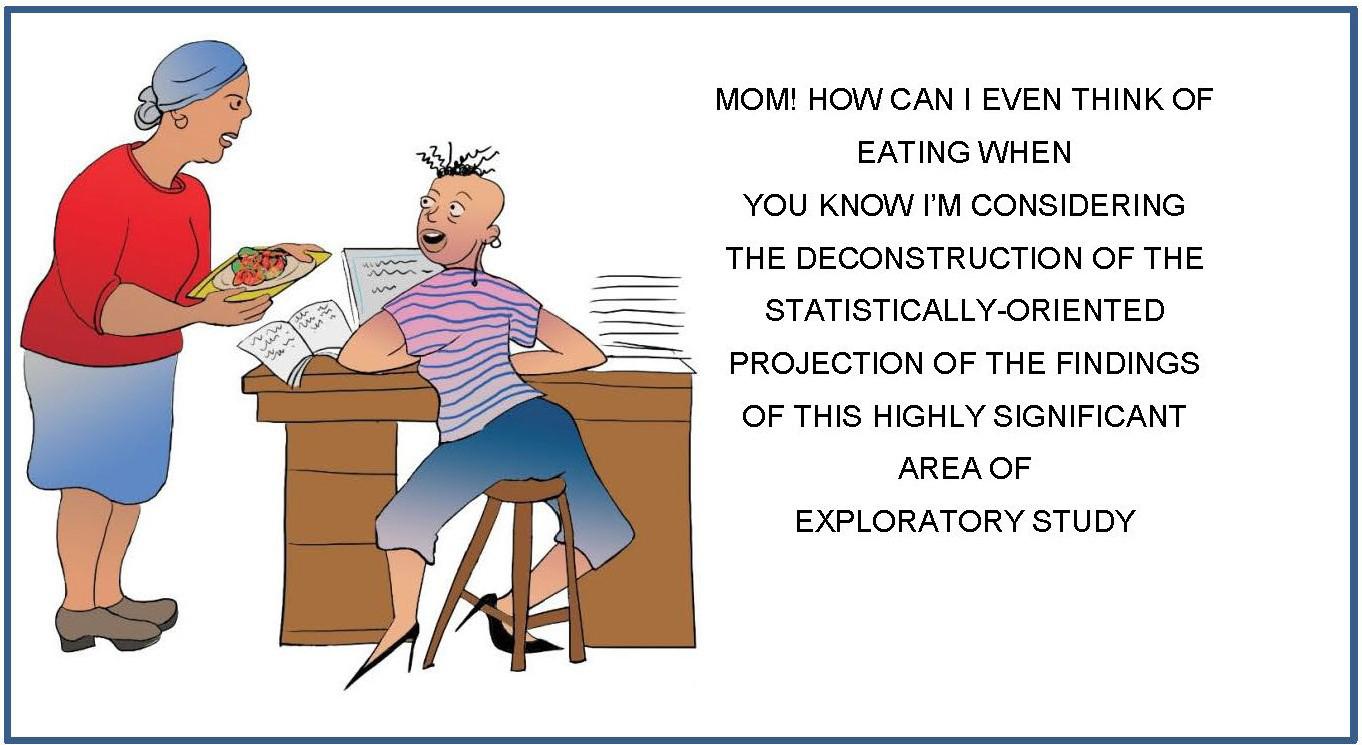
It is useful to think of writing as a process in dealing with most of the writing you will be asked to do at university. It might be more realistic to say that writing is a long process and includes many stages. UWC has a Writing Centre that can help you with each stage of this process, whether you are struggling to structure the essay, revise a draft or formatting your references. https://www.uwc.ac.za/Students/WrC/Pages/default.aspx
The first stage of the writing process will always be: understanding the question. This can take longer than expected at university, as it may involve re- reading some of your notes, or the recommended readings. You might need to consult your tutor or lecturer in order to clarify some of the terms or other aspects of the question that you don’t understand. Part of understanding the question always involves careful reading and analysis of the essay title. The title will indicate what general and specific areas of the subject should be included in the essay, and it might give you some idea of the kind of evidence that should be used. It will also tell you what you should be doing with this content. Should you be ‘identifying’ causes of something, or should you be ‘demonstrating’ how something happened? Should you simply give one side of the story, or should you be ‘comparing’ two interpretations? Analysis of the essay title will reveal to you what activity you should be doing in your essay. It is usually indicated by the action word – for example, ‘discuss’, ‘analyse’, ‘review’ or ‘explore’. At the end of this section is a list of possible ‘action words’ commonly found in essay titles, and an explanation of what each word would require you to do.
Once you are sure you understand the question, you can move into the next phase, which is planning. This stage looks different for different people, but in general, it must include the gathering of information (from the required sources and any others you have available to you), thinking about how the information can be used to answer the question and the drawing up of a plan for how you think the information can best be arranged in the essay. Reading is a major part of this early stage in essay writing. Often it takes place in a cyclical sort of way: you might do the required readings, which might raise some questions in relation to the topic; then you might go to the library to do some extra reading or research or look at academic articles on the internet, before adding some ideas to your plan. As your plan gets more detailed, you might want to do a bit more reading, or re-read something you have already read. Some people also like to talk to friends about the topic, or discuss in their study groups or tutorials how they are thinking about the essay. This planning stage is absolutely crucial and should not be neglected.
As you write more essays you will become more familiar with your own writing rhythms – some people spend a long time thinking and talking and reading before they ever put pen to paper (or finger to keyboard!), while others will begin sketching out plans on paper and do most of their thinking while they draw and re-draw their plan. Some people will come up with a carefully ordered numbered plan while others will be able to work from a mind map full of arrows and circles. Whatever works for you, you will discover that it takes time!
Finished your essay? Days ago
You cannot begin writing on essay the day before it is due to be handed in
Do you need any help with develop their academic reading and writing skills?
Contact the UWC Writing Centre Administrator: Tel: +27 21 959 2404
Email: writingcentre@uwc.ac.za
So far, the essay writing process may look familiar, except for the fact that at high school you may have been required to produce an essay or composition overnight. You probably then handed it in to the teacher and waited for your mark to be returned to you, after which you moved on to the next section of the work. The writing process approach, however, is based on the way real, published authors go about their writing, and its most important principle is that the first piece of writing you do in response to the title or questions is never the final one. Your first attempt (or draft, as it is called) should be read by someone who will then comment on it, or give you feedback. Sometimes tutors are willing to read and comment on first drafts, but very often students will ask a fellow student to read their first drafts. It is also a good idea to ask a consultant at the Writing Centre to read one of your drafts. This reading by staff at the Writing Centre is not so much to edit or point out spelling or grammar m istakes, but to comment on the logic, how well the information is arranged or how clear the meaning is. The comments made by the reader will often help you to see where your argument does or does not make sense, or where what you say is unsupported by evidence. Perhaps they will point out a contradiction, or a weakness in your essay that you hadn’t recognised while you were writing. They might point to something you have mentioned that is worth elaborating upon or they might draw attention to a vital piece of information that you have left out.
This leads you into the next phase, which is re-writing to produce your second draft. Some people repeat the whole cycle so far – again, getting feedback and then writing a third draft
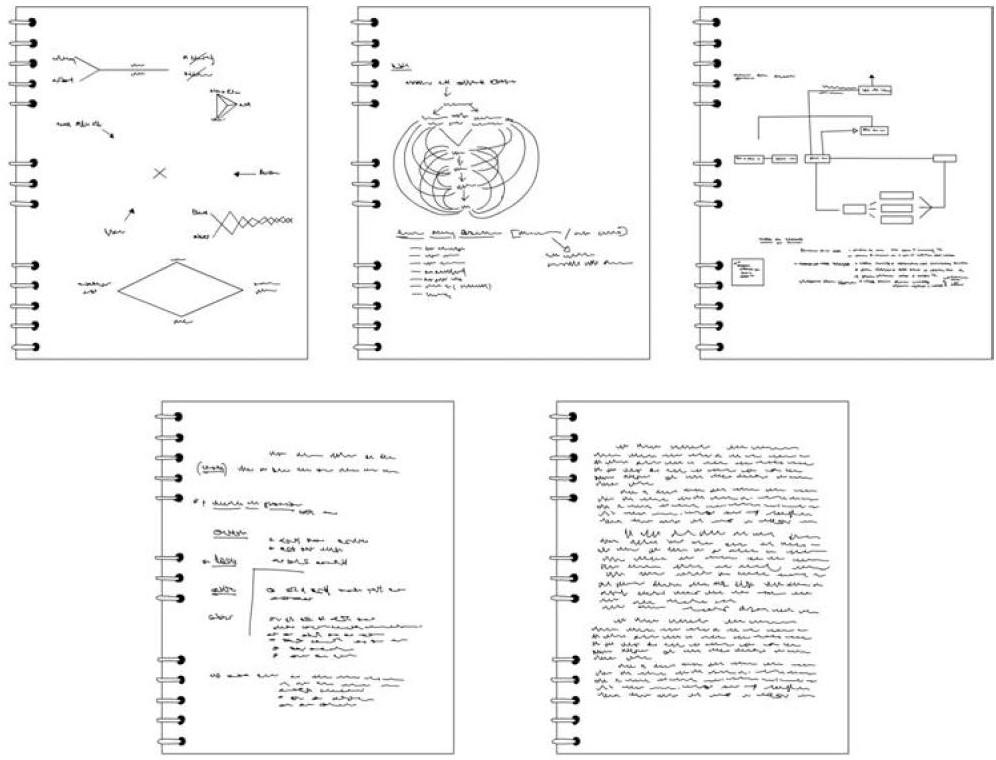
As you can see, these stages are not all self-contained, and some of them can be repeated many times. Every time you go through the loop of reading-planning-writing, you should re-read the essay title to make sure that your new ideas and re-written arguments still fit in with the original actions required by the title. It is quite common, as your thoughts develop, to wander a little from the central topic. Including details that are irrelevant is a serious weakness in an essay; it is always worth making quite sure that you have kept to the required topic and completed the required activities as specified in the title.
The final stage in the writing process is the editing you will do before handing in your final draft. At this stage you will have settled all the questions about content and style and structure, and you read through simply to make sure that the spelling, punctuation, grammar and references are correct. It is sometimes more useful to get someone else to read it through for this edit, as it is very easy to miss your own mistakes.
Some students don’t like the process writing approach, complaining that it is too time-consuming. It is time-consuming, but time is always a necessary ingredient in writing an essay that will result in a good mark for you, and also increase your writing skills. Most faculties at the university require essays to be typed. If you use a computer to write your essays, the whole drafting and redrafting process becomes much less time-consuming, as changes can be made and text moved around without having to re-write the whole essay every time.
Another objection to the drafting–feedback–redrafting phase of writing is the fear of showing one’s writing to other students. Most of us are a little shy of having our writing read by our peers. This is because it seems so public, and if we’ve misunderstood something, or written something down in a way that isn’t appropriate, we may feel that our peers will think we are stupid.
The solution is to ask someone you really trust, who will take you seriously, and not put you down for making a mistake. Sometimes the fear of sharing writing is based on the suspicion that your reader will ‘steal’ your ideas or copy your essay. Once again the idea of getting someone trustworthy comes to mind, but also remember that you have constructed your essay yourself by putting your understandings together in your own way, and no one can really steal that – and that this is your first draft, and you will probably alter it and improve it before you hand it in. If trust is a big problem for you, try using the Writing Centre – where confidentiality is guaranteed.
It’s soooo long

Part of the process approach to writing is that we never stop learning from our writing. It is useful to remember this when you get your essays back. Many students turn straight to the page which bears the mark. If they see 75%, they feel elated and cram the essay into the back of a file, never to be seen again. If they see 50%, they feel disappointed, crumple up the pages, tossing them into the bin, never to be seen again. Don’t underestimate the value of feedback! You will learn more if you read through your essay again, taking note of the comments made by the marker – otherwise how will you know which parts of your essay were correct or successful, and what aspects of it caused you to lose marks? If you don’t understand the feedback given by your tutors or lecturers, ask them to explain it – this is where you can really clear up misunderstandings and learn about writing in your discipline. You can use the insight gained by writing one essay to help you write the next one.
Course guides, handbooks and departmental handouts will usually give details of how that department expects students to write their essays and assignments. In fact, some are very detailed and helpful, and it is worthwhile reading them carefully. The following list provides some very general definitions and guidelines about what your finished product should look like, whatever guidelines are provided by your departments.
The introductory paragraph tells your reader what your essay is going to be about. It should refer to the title of the essay without merely restating it; you could think of this as the part of the introduction that contains the information given to you. It should also indicate what direction your argument will be taking,but this should be a general statement, not a detailed piece of your argument; you could think of this as the part of the introduction that contains the information that you will create. When you have finished writing your essay, you should re-read your introduction to make sure that you have in fact done what your introduction says you will be doing. Some people return to write the introduction after they have prepared the main body of the essay. This way they highlight or guide the reader through what will follow.
We are all familiar with this word in its everyday meaning – being that of disagreement, fight or dispute. In academic writing, this word has a slightly different meaning. It is the logical arrangement of information, which can include facts and interpretations, often relating different points of view or theories, so that a certain point can be proved or disproved, confirmed or brought into question. Your argument in introduced in the introduction, is developed in the main body of the essay and summarised in the conclusion. In your revision of your essay, you need to make sure that your argument has been developed systematically and clearly in the essa y.
Every claim you make in your essay should be supported by evidence. If you want to write, ‘Women are naturally more talkative than men’, you would have to consider someone who might say, ‘How do you know that?’ or ‘Can you prove it?’ Evidence is almost like ‘proof’, although real proof is often impossible, especially in the Humanities. The evidence used in academic essays usually comes from the readings or the information supplied in lectures. You do always need to give the source of your information in the form of a reference
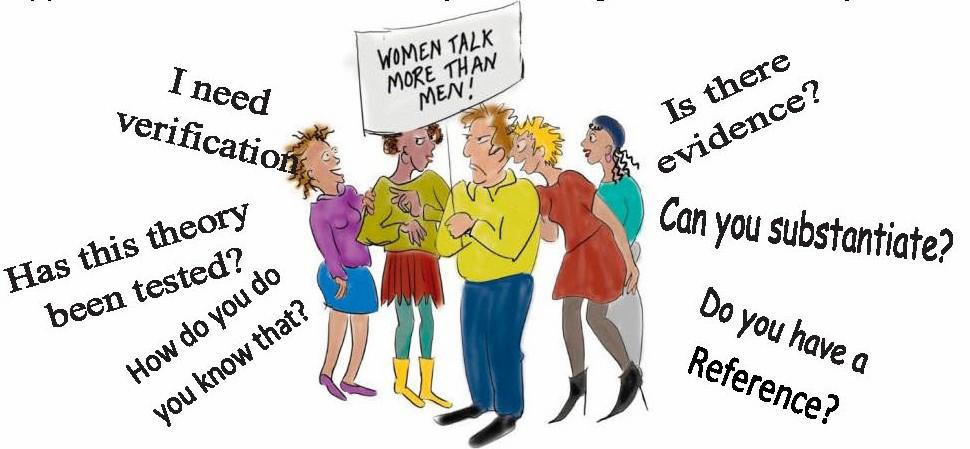
Here is an example where a claim is made, which is followed by evidence to support it:
Gender equality in the home is still something that needs to be achieved in modern society. This is evident in the fact that it is still women who do most of the household labour and caregiving, according to research findings by Rapoport and Sofer (2005).
The last paragraph is where you round off your essay. You can do this by summarising your argument or re-stating any conclusions the argument might have reached. You should never introduce new ideas or information in the conclusion. It is important to check that your conclusion is relevant to the essay title. If it is not, it means that your argument has wandered away from the required topic.
This is often the hardest thing new students have to learn about writing academic essays.
W hen and How do We Reference?
Often we wish to use other peoples’ words or ideas in our own writing. We do this because we want to build on or discuss their ideas, or to compare different peoples’ ideas, or to support what we are saying ourselves.
A reference is used when we refer to someone else’s work or ideas in our own writing. In other words, whenever we use words or ideas that we have got from other people, we have to provide the reference in our writing. The reference serves to acknowledge that it is the other person’s words or ideas, and to show where we obtained our information from and where the reader could find it. It also serves to show that we are using an authority to support what we are saying and that we are joining a conversation or debate where other people hold certain (and sometimes different) ideas. We reference as we are writing, in the body of our essay, as well as at the end of our essay –in the list of references.
It is important to note that different departments use different referencing styles such as A.P.A. or Harvard. You need to find out what referencing style your department uses. There should be guidelines in the departmental handbook. The examples that we give in this guide are in the A.P.A. style.

The reference list contains all the details of the book or article, but in the body of our essay, we simply give the author’s surname and the date of their publication and sometimes the page numbers that the quote or idea came from. If you use the author’s words, you must use quotation marks and provide page numbers as well. When you include the author’s ideas but state them in your own words, you do not need to use quotation marks, but you still need to give the author’s surname and the date of publication.
Every time you refer to, or mention, or quote, the ideas or words of another author in your essay, you must make a formal reference to it by using the referencing convention favoured by your discipline or department
Ngalo lonke ixesha usebenzisa amagama, ukucaphula izimvo zomnye umbhali, kwisincoko sakho, kufuneka wenze ngokusemthethweni usebenzisa indlela evunyiweyo lisebe elo ufunda kulo
Elke keer as jy verwys na, melding maak van, of aanhaal uit die woorde of idees van ‘n skrywer in jou opstel, moet jy ‘n formele verwysing gebruik volgens die verwysingskonvensies van jou studierigting of department
This is because, in the academic world, theories and ideas are ‘products’ –people work hard to produce them, and expect to be recognised and rewarded for them. It is as if because they have produced them, they then own them. If you use someone else’s product without acknowledging it, it is considered to be like ‘stealing’ their ideas. This is what is called plagiarism and has serious consequences in the university.
There are three main ways in which the work of others can be incorporated as part of our written text: Quotation Paraphrase Summary
Quotation is the reproduction of someone else’s words in our own text. For example, Dlamini (2003:53) explains, ‘language is not created in a vacuum. It emerges out of a particular culture, and as such, it is a carrier of culture’.
Paraphrase is our own formulation of the other person’s argument. For example: Dlamini (2003) argues that language is created within a culture and that because of this fact, it also serves to carry or contain that culture.
Summary is a highly condensed form of paraphrase in which the essence of a whole essay or book is conveyed in a few sentences or paragraphs.
A reference is simply the identification of a source. In this sense it must always accompany summary, paraphrase and quotation. References can be combined to support and clarify our own argument. For example,
Man y writers emphasise that language and culture are closely linked. (See, for example, Ngugi, 1986, Appel & Muysken, 1987 and Dlamini, 2003.)
In referencing within the body of your text, you MUST include the author’s surname, the date of the publication (book, article or internet site), and possibly also the page numbers that you got the quote or idea from.
(When referencing from an internet site, if you do not have the author’s name, give the first part of that web address, for example https://africasacountry.com , and if you cannot find the date it was written, give the date on which you accessed it, for example (accessed 27/11/2018).)
Certain disciplines will have specific aspects that require referencing in their own specific way, for example legal cases in Law. Check with your departments on the specific formats for referencing special types of materials.
W hen referencing within the text of your writing, DO NOT include the author’s initials, the title of the book or article, or any other details apart from those stated above.
It is always better to try to put the author’s ideas into your own words, because this helps you to absorb the ideas. However, sometimes it feels most appropriate to quote what the author has said. If you do quote authors, their words must be put in inverted commas, ‘like this’, and you must not add any extra words of your own. Do not use too many quotes in your essay. We want to hear your voice as the author of your own writing: we want to have an idea of how you have understood the readings and interpreted the ideas you have come across.
It is best to use the present tense when introducing other people’s ideas. The verbs you use when doing so are also important – they tell your reader how you think, feel or regard the ideas you are relating. Here are some suggestions:
Ngugi believes… thinks… insists… feels… demonstrates… recommends… suspects… argues… says… claims… hypothesizes… asserts… finds… reflects… complains… writes… suggests… notes… states… concludes… explains… continues… indicates…
People new to higher education often find it difficult to understand the idea of referencing. Referencing (also sometimes called ‘citing’ or ‘citation’) refers to the value and practice of always acknowledging the ideas and work of others you have depended on to produce your assignment.
In academic writing, one of the important values expected of any writer is that we are truthful. Part of that truthfulness is to acknowledge that we have borrowed ideas from the work of those who have gone before us. We all do that; after all, it would be impossible for us to go back and re-discover all the ideas and information that thousands of scholars have already uncovered and developed! So, in academic writing (and also in much professional writing) we read journal articles, books, web articles and the like, find ideas there, and then use them to build the foundations for our arguments and ideas. But, following the academic value of truthfulness, we must then signal to our readers that this is what we have done. We do this to
• reflect honestly what has happened,
• demonstrate that we have read about the topic and that our reading is current and relevant
• allow our readers to follow up on the reading and see if they agree with how we have used the ideas of others.
Citation lays a path that shows the journey we took to reach the ideas in our writing.
Perhaps we could borrow an idea from an ancient western scholar called Bernard of Chartres, who lived in the 12th Century. Talking about how his ideas appeared greater than those who had gone before him, Bernard commented that:

We are like dwarfs standing on the shoulders of giants. Our glance can thus take in more things and reach farther than theirs. It is not because our sight is sharper nor our height greater than theirs; it is that we are carried and elevated by the high stature of the giants (Oxford Reference Online 2009: Bernard of Chartres)
So let us say you have been asked to write an essay for Sociology on the relationship between culture and behaviour. Perhaps as part of your preparation you read a general sociology text and find this quotation:
TO A LARGE DEGREE CULTURE DETERMINES HOW MEMBERS OF SOCIETY THINK AND FEEL: IT DIRECTS THEIR ACTIONS AND DEFINES THEIR OUTLOOK ON LIFE.
If you use this quotation in your essay, you would need to show others
• that it is a quotation, and
• where you found it.
You show others that it is a quotation by adding quotation marks (‘ and ‘) at the start and end of the quoted section. You show where you found it by adding the author(s) name(s), date the book was published, and the page number where your reader can find the quotation. This you would do in the body of your essay. So it may appear like this:
The claim has been made: “To a large degree culture determines how members of society think and feel: it directs their actions and defines their outlook on life” (Haralambos & Holborn, 2008, p. 3).
Alternatively, you may wish to put this in your own words – to paraphrase it. However, you still need to acknowledge the original idea. So, you may do something such as:
Culture has a major effect on peoples’ thoughts, feelings, actions and outlooks, according to Haralambos & Holborn (2008).
But that’s not enough. Now at the end of your essay you must add a list of books and sources that you have used in preparing your essay, just as we have done about this section (see ‘References’ below). These give the full details that will help others find your sources. These two parts (the in-text author/date) and the references at the end, make up the two main elements of citation or referencing.
Each department in the university may have different ways it would like you to reference. You must make sure that you know what your lecturer expects of you.
Haralambos, M. & Holborn, M. (2000). Sociology : themes and perspectives (5th ed.). London: HarperCollins.
“Bernard of Chartres”. In: Oxford Reference Online. Oxford University Press. Retrieved from http:// www.oxfordreference.com/view/10.1093/acref/9780191826719.001.0001/q-oro-ed4-00000952?print on 5 November 2018.
Once you have referenced properly within your text, you must create a reference list. This is a list of all the pieces of writing you have consulted and referred to in your essay. It should contain all the details necessary to help your readers find the articles or books if they want to read more about the subject. Reference lists need to be formatted in the style that is required by your department and discipline. Here we have given a few examples from the A.P.A. (American Psychological Association) style of referencing.
When you list the details of a book, you include:
The author’s surname, author’s initials. (Year of publication). Book title (italics). The place where the book was published: The publisher’s name.
Djité, Paulin G. (2008). The sociolinguistics of development in Africa. Clevedon: Multilingual Matters.
When you list the details of a chapter in a book, you include:
The author’s surname, author’s initial. (Year of publication). Chapter title. In Book title (underlined/ italics), the editor’s name. The place where the book was published: The publisher’s name. The page range of the chapter
Brock-Utne, B. (2008). Language and democracy in Africa. In Equality in education: comparative and international perspectives, edited by D. B. Holsinger and J. James. Hong Kong: Comparative Education Research Centre, University of Hong Kong, pp. 172–189.
When you list the details of an article in an online journal, you include:
The author’s/authors’ surname/s, author’s initial. (Year of publication). Title of the journal (italics/underlined), volume and issue: page range of article. Doi [Digital Object Identifier] link.
Bayat, A., Louw, W. & Rena, R. (2014). The impact of socio-economic factors on the performance of selected high school learners in the Western Cape Province, South Africa. Journal of Human Ecology, 45 (3): 183–196. doi: 10.1080/09709274.2014.
When you list the details of an article in a newspaper, you include:
The author’s surname, author’s initial. (Year of publication). Title of the article. Title of the newspaper (underlined/italics). The link on the internet where it may be accessed. The date you accessed it.
Jansen, L. (2014). “Extra marks for African-language pupils have been scrapped for Matric.” Cape Times, 14 July 2014. Accessed 17 October 2018. https://www.pressreader.com/south-africa/capetimes/20140714/281517929233346.
When you list the details of an article found on the Internet, you include: Name of the author or organisation. The year of creation/publication. Title of the piece (underlined/ italics). The link on the internet where it may be accessed. The date you accessed it.
Equal Education. (2015). Press statement: Upcoming 2015 Matric results require careful scrutiny! 2 January 2016. http://old.equaleducation.org.za/article/2016-01-03-upcoming-2015-matric-results-require-careful-scrutiny. Accessed 15 October 2018.
Generally, your list will be organised in the following manner:
• It follows alphabetical order by surname of author.
• Book titles are in italics.
• The list should not be bulleted or numbered
Some departments require you to submit your essay via their course IKamva site – they will give you instructions as to how to do this. Others require you to place a typed copy (sometimes two copies – check with your department!) in a departmental box (be sure you to find out where this is). In whatever way you submit it, your assignment must have a cover page with the following information on it: your name and student number, the course name and code, the assignment topic, the name of the person to whom it is being submitted and the date of submission. You also need to complete a form declaring that the work is your own and that you have not plagiarised. An example of this declaration is given at the end of this section. In printed form, this declaration should be stapled to your assignment at the top left hand corner of the page. It is not necessary to do fancy bindings and decorations for normal first year academic essays.
Alternatively, the department may require that you first submit your essay document to an automated plagiarism checker, TurnItIn. TurnItIn compares the text of your essay against a vast database of other texts and provides and indication of the percentage of similarity to other texts. You will be given instruction on the use of TurnItIn.
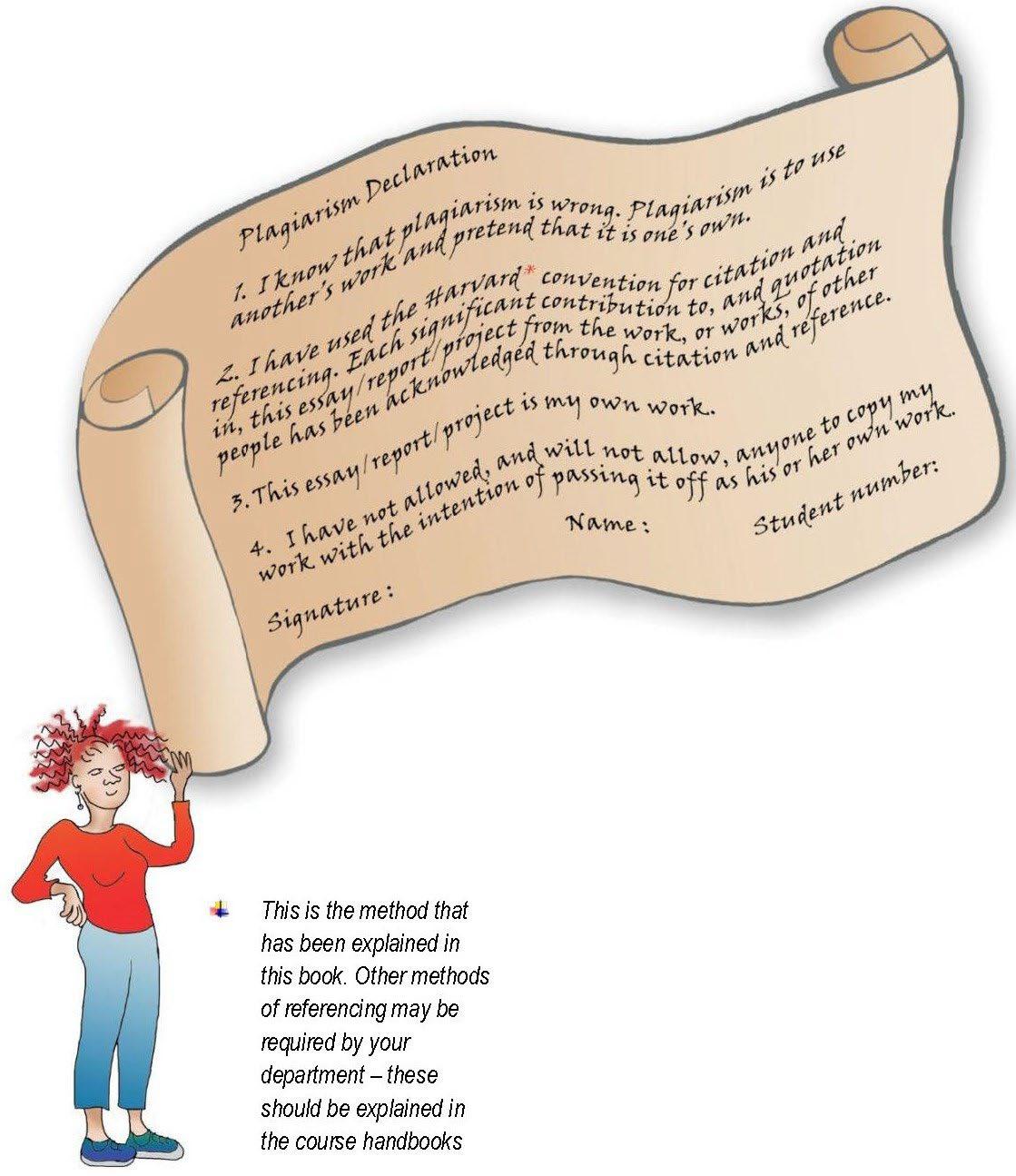
At the beginning of this section on Essay writing, we defined a skill as ‘something you can learn by doing’. This implies that your writing skills should improve as you have more and more experience as a writer. Much of this improvement will be the result of your deliberate efforts to learn from your mistakes and build on your successes. There are several ways of doing this:
• Make use of consultation times with, and feedback from, your tutors to correct errors and overcome weaknesses in your writing.
• Make an appointment with one of the consultants at the Writing Centre which is on the ground floor of the Old Arts building. Bring a draft of your writing when booking an appointment. You can email gdaries@uwc.ac.za or phone 021 9592390.
• Share your writing with some of your peers or the members of your study group. You will learn as much from reading and commenting on their drafts as you will from their feedback on your own writing.
• Find out and use the conventions appropriate to the various disciplines. If you make mistakes in referencing in your Sociology essay, ask your Sociology tutor to explain what you did wrong, and how you can correct it; don’t rely on information from your tutors or senior students in other departments. Seeking advice within the disciplines is essential to your success as an academic writer.
• When you read, be conscious of how other authors compose and structure their writing.
• When you think about how you, as a reader, are responding to a written text, you are preparing yourself to consider how to write for your own readers.
• Above all, plan well in advance, and allow yourself time to learn how to write academic essays.
A frequently asked question: ‘How will my essay be marked?’
Each assignment will have its own criteria against which it is marked – and these will be given with the assignment topic. Your lecturers will generally look at whether you have addressed the essay question(s), how you have structured your argument, how you have used your evidence, your referencing, your language and your adherence to specific criteria such as the length.
As a general guide, you might want to check your writing against the following:
Assignment task
Have you:
• clearly identified different positions in the debate?
• positioned yourself adequately in relation to the statement?
• referred to the different readings required?
Argument/discussion
• Have you constructed a logical argument?
• Does each paragraph have a purpose that contributes to the argument?
• Does each paragraph link to those before and after it, thereby providing a flow to the discussion? (Is the argument coherent?)
• Are important concepts defined?
• Are readings discussed rather than merely summarised?
• Are the arguments supported with evidence from the readings? Are examples integrated into your discussion?
• Does your relating of your own experiences build on to your argument?
Structure of the essay
• Is the assignment well organized in terms of the essay genre?
• Does the essay have an introduction that provides an idea of what it is about and of what your (the writer’s) position is?
• Does the essay have a conclusion that brings closure to the discussion and re-emphasises your (the writer’s) position?
• Does each paragraph have a main theme/topic sentence?
Language and referencing
• Is the language appropriate to formal academic writing?
• Are references cited correctly in the body of the text (author’s surname, year: page number)?
• Is the referencing style consistent throughout the essay?
• Is there a list of references at the end, with all the publication details included?
Also
Have you attached a cover page? Have you attached a plagiarism declaration?

Glossary of ‘Action’ Keywords in Essay Titles
Uluhlu Lwamagama Abalulekileyo Kwizihloko Zezincoko Woordelys van sleutelwoorde in ‘n opstel
Words given as tasks for you to do or actions for you to take Amagama owanikwe njengomsebenzi ukuba uwenze okanye uthathe intshukumo Instruksiewoorde wat gegee word as take om te doen of aksies om uit te voer
Note: This list is not complete. Also, some lecturers/tutors will require slightly different things to be done even though they have used the same word as another lecturer/tutor. Always check with your lecturer/tutor if you are not sure!
Qaphela: Nceda uqaphele ukuba olu luhlu lwamagama alugqitywanga. Kwaye, abanye abahlohli/abancedisi baza kufuna kwenziwe izinto ezingafaniyo ncam nangona besebenzisa kwala magama manye njengabanye abahlohli okanye abancedisi. Yiba soloko ungqinisisisa kumhlohli/mncedisi ukuba akuqinisekanga!
Let wel: Hierdie is nie ‘n volledige lys nie. Let ook daarop dat lektore/tutors nie altyd dieselfde vereistes het nie, al gebruik hulle dieselfde woord as‘n ander lektor/tutor. Doen altyd navraag by jou lektor/tutor indien jy onseker is!
Keyword
Igama
Sleutelwoord
Discuss Xoxa
Bespreek
Account for Okulindeleke kuwe
Verduidelik
Analyse
Cacisa
Kangang
Analiseer
Action Required
Into Ekufuneka Uyenze/Okufunekayo Kuwe
Stappe Wat Geneem Moet Word
This is the most widely used action word. A variety of possibilities for response exist – depending on subject or topic. What is generally required is an exploration of the area/topic through argument and reflection showing your insight and grasp of the subject matter.
Eli lelona gama elisetyenziswa kakhulu. Iindidi ezahlukeneyo ngembobo ezinokuvela kwimpendulo ziyenzaka-kuxhomekeka kwinto ekuthethwa ngayo okanye isihloko. Eyona nto ifunekayo noxa kunjalo, kukuvelela zonke iinkalo zengxoxo kulo nto kuthethwa ngayo/kwisihloko ubonise iliso elibukhali nokuqonda kwakho ngokucacileyo into ekuthethwa ngayo.
Hierdie aksiewoord het ‘n wye reeks betekenisse. Verskeie moontlike antwoorde bestaan – afhangend van die onderwerp of tema. Wat oor die algemeen verwag word, is dat die tema ondersoek word deur argumentasie en refleksie wat jou insig toon en wys dat jy die onderwerp sinvol interpreteer.
Provide reasons for something or show causes.
Nika izizathu zoko okanye ubonise oonobangela.
Voorsien redes of dui die oorsake aan.
Find and describe the main ideas through careful argumentation showing how they are related and why they are important
Funa uze uchaze ezona mbono zakho ngengxoxo ecwangcisiweyo kakuhle yaye uchaze ukuba kutheni zibalulekile.
Deur nougesette beredenering, identifiseer en beskryf die hoofgedagtes, om sodoende aan te dui hoe hulle verwant is en waarom hulle belangrik is.
Argue
Xoxa
Beredeneer
Assess
Vavanya
Evalueer
Comment
Hlomla
Lewer kommentaar
Compare
Thelekisa
Vergelyk
Contrast Fanisa
Kontrasteer
Criticise
Neoma okanye ugxeke
Give a logical set of carefully explained and supported reasons as to why you take a particular position or opinion.
Nika ingcaciso ebekwe ngobuchule enezizathu eziyixhasayo zokuba kutheni uhambelana nembono ethile okanye uluvo.
Gee ‘n logiese stel redes wat baie duidelike ondersteun is, hoekom jy ‘n spesifieke houding of mening het.
Evaluate an argument or issue, looking at the positive and negative attributes.
Phonononga ingxoxo okanye umba, ujonge izinto ezilungileyo nezingalunganga ngawo.
Evalueer die redenasie of saak deur te kyk na die positiewe en negatiewe eienskappe.
Discuss briefly giving own observations and criticisms.
Xoxa kancinci unika ezakho iimpawu yaye ugxeke xa kukho imfuneko.
Bespreek kortliks deur jou eie opmerkings te maak en kritiek te gee.
Show both the similarities and differences, emphasizing similarities.
Bonisa izinto ezifanayo kunye nezingafaniyo, gxininisa kwiindawo ezifanayo.
Bespreek beide die ooreenkomste en die verskille, en beklemtoon ooreenkomste
Show differences by setting differing points in opposition to each other.
Bonisa izinto ezingafaniyo ngokudwelisa imiba engafaniyo kumacala omabini.
Bespreek die verskille in teenstelling met mekaar.
Kritiseer Give your considered judgement or opinion in a well -reasoned argument.
Beka olwakho uluvo olucingisisiweyo okanye imbono yakho ngengxoxo ecwangciswe kakuhle.
Geejou weldeurdagte bevinding of opinie in ‘n welberekende redenasie.
Demonstrate
Bonisa
Demonstreer
Distinguish
Yahlula
Onderskei
Evaluate Phonononga
Evalueer
Examine
Vavanya
Ondersoek
Explain
Cacisa
Verduidelik
Illustrate
Bonisa
Illustreer
Show by reasoned argument why a particular opinion judgement or assertion is true.
Bonisa ngengxoxo ecingisisiweyo ukuba kutheni isigwebo okanye isigqibo esithile siyinyani.
Toon deur ‘n weldeurdagte redenasie hoekom ‘n sekere opinie, bevinding of bewering waar is.
Identify the features that make one position or concept different from others
Bonakalisa iimpawu ezenza umahluko kwezinye
Identifiseer die eienskappe wat die verskil maak tussen konsepte of posisies
Discuss advantages and disadvantages, reflecting on your own opinion or assessment
Cacisa izinto ezilungileyo nezingalunganga kweyakho imbono okanye kuvavanyo
Bespreek die voor- en nadele, gebaseer op jou eie mening of evaluering
Explore from different angles, showing cause/effect, considering relationships or focusing on important points.
Velela zonke iinkalo, ubonisa unobangela/sizathu, qaphela ukuzalana okanye ujonge iimpawu ezibalulekileyo.
Ondersoek deur verskillende oogpunte in ag te neem, die verwantskappe tussen oorsaak en gevolg aan te toon of op belangrike punte te fokus.
Make clear or intelligible in a fairly detailed way.
Cacisa okanye ubonise ngobuchule unika inkcazelo ebanzi.
Maak duidelik of verstaanbaar op ‘n redelik volledige en gedetaileerde manier.
Make clear or intelligible in a fairly detailed way.
Cacisa okanye ubonise ngobuchule unika inkcazelo ebanzi.
Gee voorbeelde om te verduidelik wat jy bedoel
Justify
Thethelela/Xhasa
Regverdig
Outline
Cacisa
Som op/omskryf
Review
Phinda uqwalasele
Beskou krities
Solve
Sombulula
Los op
State
Beka
Lys
Present a valid argument about why a specific idea or theory should be accepted.
Nika ingxoxo eqinileyo ngokuba kutheni uluvo oluthile okanye imbalelwano ethile kufuneka yamkelwe.
Bied ‘n geldige redenasie aan waarom ‘n spesifieke idee of teorie aanvaar behoort te word.
Present a valid argument about why a specific idea or theory should be accepted.
Nika ingxoxo eqinileyo ngokuba kutheni uluvo oluthile okanye imbalelwano ethile kufuneka yamkelwe.
Bied ‘n geldige redenasie aan waarom ‘n spesifieke idee of teorie aanvaar behoort te word.
Examine a topic critically.
Phonononga isihloko ngobuchule.
Ondersoek ‘n onderwerp krities.
Work out the problem, explaining your reasoning, to show a solution.
Sombulula ingxaki, ucacise izizathu zakho, ukubonisa isisombululo.
Los die problem op deur ‘n oplossing voor te stel en verduidelik jou redenasie.
List main points briefly without details.
Dwelisa eyona miba iphambili unganiki nkcaza.
Maak ‘n lys van hoofpunte alleenlik.
Study
Funda ngokubanzi
Bestudeer
Summarise
Shwankathela
Som op
Support
Xhasa
Ondersteun
To what extent
Ukusukela phi
In watter mate
Trace
Landa
Volg na
Explore and explain the details or facts. phanda yaye ucacise iinkcukacha okanye iimbono.
Ondersoek en verduidelik die besonderhede of feite.
Give a brief account of the main ideas omitting details, illustrations or examples.
Nika ngokufutshane ezona zimvo unganikanga nkcukacha zininzi, imiboniso okanye imizekelo.
Gee ‘n kort omskrywing van die hoofgedagte maar laat besonderhede, illustrasies en voorbeelde weg.
Substantiate or back up a statement or assertion with evidence.
Chaza ngokubanzi okanyeu xhasa izimvo, isigqibo sakho ngobungqina, ngemiboniso okanye ingenkcazelo.
Bekragtig of ondersteun ‘n stelling of bewering met bewyse, illustrasies of verduideliking.
This is basically asking you to justify that validity of an argument in as far as it can be accepted.
Oku kukucela ukuba uxhase ukuqina kwengxoxo kangangoko unako.
Hier word jy gevra om die geldigheid van jou redenasie te regverdig so ver dit aanvaar kan word.
Make clear or intelligible in a fairly detailed way.
Cacisa okanye ubonise ngobuchule unika inkcazelo ebanzi.
Maak duidelik of verstaanbaar op ‘n redelik volledige en gedetaileerde manier.
Do you need any help with develop their academic reading and writing skills? Contact the UWC Writing Centre
Administrator:
Tel: +27 21 959 2404
Email: writingcentre@uwc.ac.za

Your test and essay results should help you to answer questions like:
Am I working hard enough? Do I need to adjust my timetable or my learning habits?
Ndisebenza nzima ngokwaneleyo? Kuyimfuneko ukulungisa isicwangciso-sexesha okanye indlela endifunda ngayo?
Werk ek hard genoeg? Moet ek my rooster of my leermetodes aanpas?
Do I need help with understanding the work? Should I consult my tutor?
Ndifuna uncedo ukuze ndiqonde umsebenzi? Kufuneka ndidibane nomncedisi itutor?
Het ek hulp nodig om die werk te verstaan? Moet ek my tutor raadpleeg?
What factors contributed to my success? How can I make sure I succeed again?
Zeziphi izinto ezincedise empumelelweni yam? Ndingenza njani ukuza ndiphumelele kwakhona?
Watter faktore dra by tot my sukses? Hoe kan ek verseker dat ek weer sukses sal behaal?
Although this often seems to be the most threatening aspect of life as a student, testing is not all bad. You will write several tests during the year and, of course, your assignments and essays will also be assessed. These are good opportunities for you to monitor your own progress.
The more tests and essays you write the more familiar you will become with your departments’ expectations for their students. Even if you learn what you are supposed to learn, you also need to know what the department expects you to do with that information (Analyse? Compare? Apply?), and class tests and essays will show you the kinds of skills the department will finally evaluate you on. Your final exams (if your courses have them) will also test not only content, but also skills.
The end of the semester or the end of the year is too late to start preparing for exams. All the work you have done throughout the semester constitutes preparation – this becomes apparent when those who haven’t worked well throughout the semester realise that they cannot suddenly get everything into their heads in the few days before finals. If you don’t have much experience of studying at this level, it is all too easy to get into this position
– after all, when you look at your year planner, you see that big empty space called ‘study week’ as this is the time, after lectures have ended, when there is no new information coming in, but all the ideas, facts, information and skills accumulated during the year must be consolidated According to the South African Pocket Oxford Dictionary, consolidate means ‘to make or become strong or secure’ and ‘to combine’. This is exactly what you should be doing before your exams: making connections between ideas and concepts, constructing the ‘big picture’ using all the bits and pieces you have gathered during the year, and strengthening your understanding of the whole subject area. This kind of preparation will allow you to respond to a broad range of questions about the work, even ones that haven’t been explicitly prepared. This also means that you should expect to do some thinking (and not just regurgitation) in the exam room itself.
One way to work on constructing the ‘big picture’ is to try writing answers to old exam questions or practice questions given by the lecturer. This will test not only your understanding of content, but will also develop your skills at answering questions quickly and clearly.
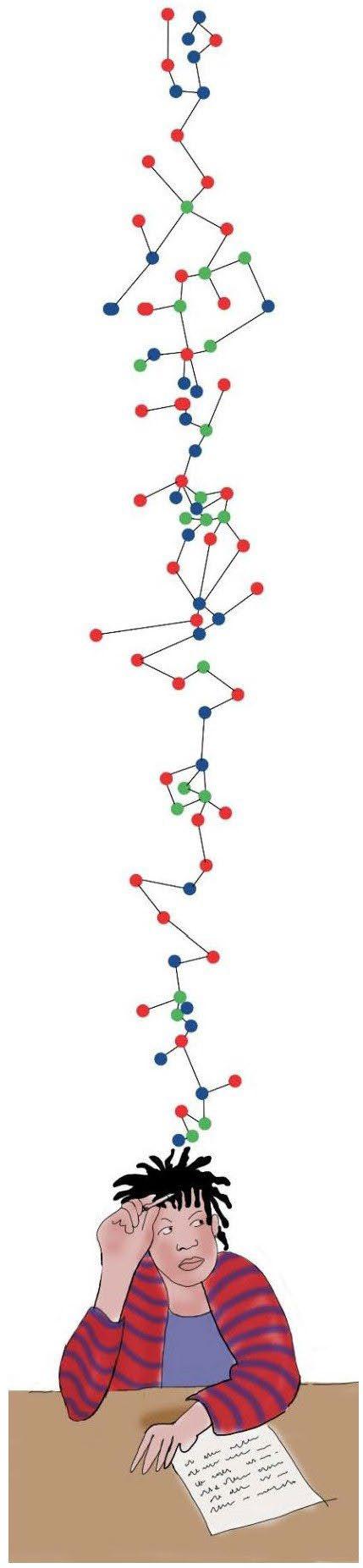
As the end of the semester or the year approaches, take care not to miss lectures, as this is the time when lecturers will share information about the examinations. They may clarify which sections must be learnt or which may be left out; they may illustrate the type of questions that will be asked, or how many of each kind you are obliged to answer in the exam; they may be prepared to answer some of the questions you have about the exam.
Look at copies of the examination papers from previous years. Some courses offer these on their IKamva site. This will give you a much better understanding of what you will face in the exam room, and if you copy down some questions or photocopy them, you will be able to practice answering the various kinds of questions usually asked. (This is not a strategy you should depend on if the course curriculum has changed very much recently.)
The danger in looking at old exam papers is that it encourages some students to ‘spot’ certain questions or sections for the exam. This is highly unreliable – you have no guarantee that just because every paper for the past 5 years has had a question on ‘gender and poverty in the Western Cape’ this year’s will too. Concentrating on one section of the work and neglecting others is always risky. Proper preparation should make such strategies unnecessary.
The draft timetable is circulated via email to all students using UWC Communication. For each course, it will show the name of the course, how many papers are being written, how long each paper is, which day it is being written, whether it will be in the morning or the afternoon and where it will be written. Sometimes a big course will be written in two venues, one for students whose surnames start with the letters A–M, and the other for those with names starting with N–Z, or some such division. Read the timetable carefully, make a note of the times and venues of your exams and report any clashes to your lecturers. Read the final examination timetable when it is put up, confirm the dates, times and venues of your exams, and note any changes. Although these details may be mentioned in your lectures and tutorials, it is ultimately your responsibility to find out about them.
Draw up a study plan for yourself. This will be a similar process to the one described in the section on time management in the Preparing to Study section in this book. Start by drawing a grid of the time period from the end of lecture to the last exam you write.
Fill in the exam slots, and show other fixed commitments. As with any time planning, try not to be unrealistic. The week between the end of lectures and the first exam is called ‘study week’ but it is unlikely that you will study all day every day during that week. By this time of the year you should have a good idea of your own patterns of learning, and should be able to draw up a plan that makes allowances for your specific learning needs. How long does it really take you to read a long article? Can you really get up at 06h30 and start studying at 07h00? Will you really manage a 4-hour study session with only one 10 minute break? Can you (and should you) come home from a 3-hour exam and begin work immediately without eating a meal or taking a break? You should also timetable in any other activities that you will spend time on – the laundry still has to be done, even though it is exam time. And exercise is very important at this time, so you may want to keep up with that weekly squash game, or your twice-a-week hour at the gym.
It is easier to keep track of how much time you are spending on which parts of the work if you plan it like this, and also of whether you are achieving your goals in your allotted times. If you are not, then try to adjust your schedule so that you don’t keep falling further and further behind.
Keep the whole of your exam timetable in mind as you prepare your study timetable. Don’t direct all your efforts during study week to the first exam you are scheduled to write, in the belief that you can prepare fully for all the others after the first one has been written. Try to include advance preparation for each of your exams in study week.
It is unwise to have a full social calendar at this time of the year and some activities will certainly have to be deferred, but you should still devote the minimum required amount of time to sleeping, eating and exercising. It would be foolish to put your body under extra stress at this demanding time.
It is not a promising start to arrive in the exam room breathless and hot and five minutes late because you missed the bus or got up late. You can prevent getting yourself into this distracting situation by getting up in time, eating a healthy breakfast, dressing comfortably and getting to the examination venue at least ten minutes before the exam is due to start. Remember that you are required to present your student card at all university examinations.
Do not use the short time before the exam to start going over whole sections of the work, or frantically trying to learn something new. Try to stay calm, and don’t let the pre-exam talk of others upset you, especially if they seem to know a lot more than you do, or if they are nervous and panicky.
Make sure your cell phone is switched off and left in your bag – you are not allowed to have your cell phone with you at your desk.
Once you are seated in your allotted seat in the exam room, you must listen to all the spoken instructions. There will be many groups of students there, writing different exam papers, so some of the instructions may not apply to you, but you should be alert so that you can take note of those that are relevant.

When you see a big time-slot free for studying, don’t just write in ‘Human Resources, 4 hours a day’; rather try to divide work up into sections, and visualise which part of the day you will spend on each, for instance:
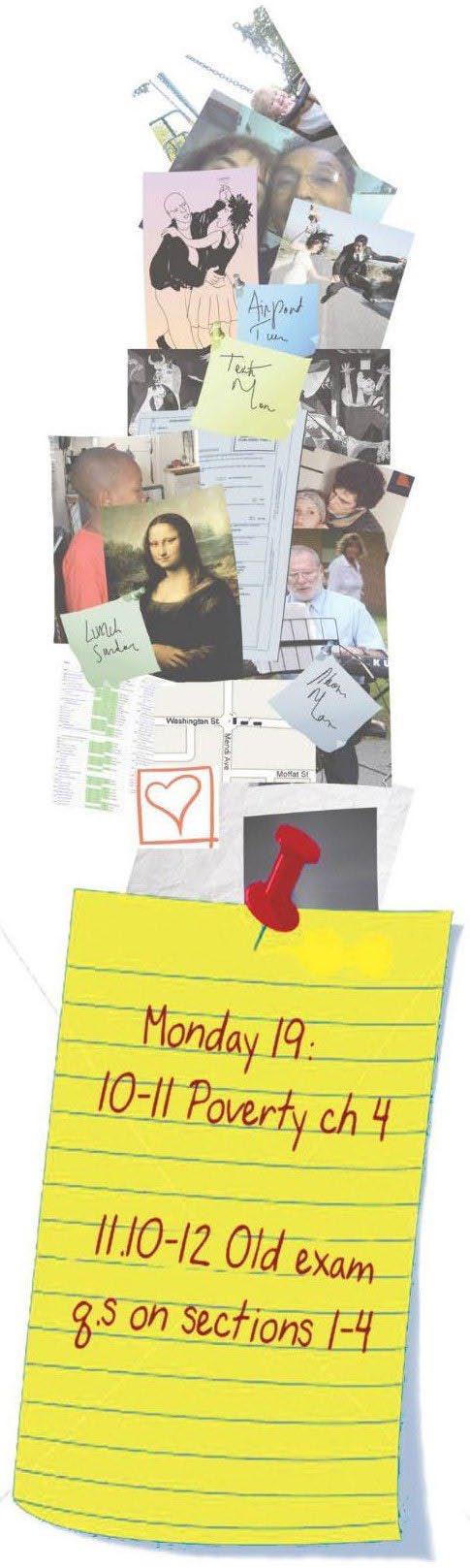
When you get your exam paper, make sure that it is the right one – it should have the course name and code on the front cover – and then read the instructions very carefully. This is probably the most important piece of advice you will get about exams:
Read the instructions on the exam paper carefully
Funda imiyalelo kwiphepha lemviwo ngobunono
Lees die instruksies op die eksamenvraestel baie versigtig
If there is any confusion, or if there is something you don’t understand about the instruction, ask the invigilator to explain. There will always be someone from your department in the exam room at the beginning of the examination. This person is there to answer questions, so don’t hesitate to ask
When the invigilator officially starts the exam, you should flip through the whole paper and choose the questions you will answer, in accordance with the instructions. Decide on how you are going to divide up your time. If you have to deal with three sections of equal weight, and the exam is three hours long, you should plan to spend an hour on each section. Be strict with yourself throughout the exam and stick to the times you have allowed for each section or question. Answering the first two sections very well will not make up for leaving out the third section altogether. If you feel that you probably can’t do the third section very well, you should at least spend enough time on it to get the maximum marks you can for it. If you have time left after doing the best on that section, you can always go back to the first two sections to improve your answers there. Remember that your marker knows that your answers have been produced under exam conditions, and won’t expect you to include every possible thing.
It is not always best to answer the questions in the order in which they appear on the paper. You can choose to start with any questions, as long as you number them all correctly. It is often a good idea to begin with the question that you feel you can answer best. This will make you feel confident about your knowledge and may help you to answer the next question well, too. Before handing in your paper, check that your questions are properly numbered.
You should be prepared for the different types of exam questions.
These should be treated in a similar way to essays that are written during the term (see section on Essay Writing). Of course the big difference is time, but otherwise the same steps should be followed:
• Analyse the essay title. What is the focus of the question, and what are the action words? Keep the title in mind as you plan and write, as going off the topic will lose marks.
• Plan. You might think that this is a waste of time in an exam, but, in fact, it could save you time as you won’t get stuck halfway through the essay, wondering how to proceed.
• Write the essay, keeping to your plan. If you are writing an ‘open book’ exam, observe all the usual rules for referencing and quoting. Plagiarism is as serious an offence in an open book exam as it is in an assignment during the term.
• Watch the time carefully, and don’t get carried away with one essay if it means neglecting other questions
These are very often included in exams. Although they look as if they should be quick, they often require careful thought, and sometimes you have to go through the process of eliminating the impossible or obviously wrong answers before choosing between two that look similar. In some subjects, you will have to complete some calculations before being able to choose the right answer. You should always check beforehand whether your department will employ ‘negative marking’, in which they will penalise you for a wrong multiple choice answer. This is done to discourage guessing. If no marks will be deducted for wrong answers, it is definitely worth guessing; if the penalty is very small, for example a quarter of a mark, then it is sometimes worth guessing, especially if you have excluded one or two of the possible answers already.
These are so called because they require answers that are shorter than essays. You do not need to do the kind of planning for them that you would do for an essay, but you do need to write short paragraphs which require some degree of thought. You should always be aware of the number of marks allotted to a short question so that you can give it the right amount of time. A question asking you to list six properties of something, for 3 marks, should obviously take less time than one asking for a paragraph on the advantages and disadvantages of something, for 8 marks.
Some courses opt for Take Home examinations. For more information about these and supplementary examinations, including rules and regulations, you can consult the Examinations website https:// www.uwc.ac.za/Students/Admin/Pages/Examination-Information.aspx#.UW5L1LWnBIE
Enjoy your studies, and Good Luck!
Nizonwabele izifundo zenu, yaye Sininqwenelela impumelelo!
Geniet jou studies, en voorspoed!
Do you need any library assistance?
Contact our Library circulation desk for any enquiries. Tel: +27 21 959 2946
Dentistry Librarian based in Tygerberg, off campus Tel: +27 21 937 3165
Visit the library website using the following links: http://lib.uwc.ac.za/ http://lib.uwc.ac.za/index.php/fye-1st-year-experience.html (go to quick links and click on “Ask a Librarian” if you have any query)


A collection of resources specifically for first-year
Emergency contacts
Campus Security
Medical Assistance
Rape
Theft
Ambulance
+2721 959 2564/3777
+2721 959 2100
+2721 959 2100
+2721 959 2564/3700
My important numbers:

Name:

Number:
Feelings of loneliness are common among first year students. Having separated from their high school and friends, and sometimes families, starting new friendships at university, becomes a challenge. Being lonely is not as a result of a defect in you or your personality. Moreover, you can do something about it – develop new friendships. How?
Close relationships don’t happen overnight, but there are steps you can take to help you connect with others and make friends. When looking for places to meet new people, try to be open to new ideas and cultivate an interest in other people, their lives, and their stories. Not everything you try will be successful but you will often have fun and learn from the experience.
• In class. In your modules you should be studying with others who have similar career interests and dreams to your own. Thus, shared / common interests create an immediate link with fellow class members. It should be easy and wise to befriend some of them, since you’ll be attending class and work together on assignments / projects over the next 3 to 4 years.
• Engage in student activities that you have interest in. In doing so, you will be more likely to meet people with whom you have something in common.
• Invite someone for a drink, or to a movie. Lots of students feel just as uncomfortable about reaching out and making new friends as you do. Be the one to break the ice. The person whom you’ve invited will thank you later.
• Join a car pool. It’s a good conversation starter and will help you connect to students who live near you, as well as save on transport costs.
• Find travel buddies. To travel together with other students while making use of public transport (bus, taxi, train), can be fun, while you’ll also feel safer.
• Attend lunchtime events, special lectures, or other community events where you can meet people with similar interests. Check with your public library or local paper for events near you.
Some people seem to instinctively know how to start a conversation with anyone, in any place, be it a party, class, the gym, a crowded elevator, on public transport, or in class. If you’re not one of these lucky types, don’t despair. Here are some easy ways to engage in conversation with someone new:
• Learn to juggle. Starting a conversation is an exercise in multitasking. Learn to make and hold eye contact and smile, while you lift your hand up in greeting, or shake hands, while remarking on the surroundings, or occasion. For example, if you’re at a party, you could comment on the venue, the catering, or the music in a positive way, like: “I love this song,” “The food’s great. Have you tried the chicken?”, or “That’s a great view!”
• Use a compliment. For example, “I really like your dress. You look lovely!”, or “You look like you know the library. Can you tell me where I can make photocopies?”
• Ask open-ended questions. Ask questions that requires more than just a ‘yes’, or ‘no’ answer. Such questions begins either with who, where, when, what, why, or how. For example, “Who do you know here?”, “What do you normally do over weekends?”, “Why did you decide to study this course?” “How is the food?” Most people enjoy talking about themselves, so asking questions, is a good way to get a conversation started, but avoid inquisitions. Don’t overdo it.
• Keep conversations going with small talk. Don’t say something that’s obviously
provocative and avoid heavy subjects such as politics, or religion. Stick to light subjects like the weather, surroundings, and anything you have in common such as school, movies, or sports teams.
• Listen effectively. Listening is not the same as waiting for your turn to talk. You can’t concentrate on what someone’s saying if you’re forming what you’re going to say next. One of the keys to effective communication in any situation is to focus fully on the speaker and show interest in what’s being said. Nod occasionally, smile at the person, and make sure that you look relaxed, friendly and approachable. Encourage the speaker to continue with small verbal cues like “yes”, “uh huh”, or “wow, interesting!”
• Note anything you have in common and ask a follow-up question. “I play soccer as well! What’s your favorite local team?”, or “Where do you practice?”
• Encourage interaction without demanding it. Statements that include both of you in the same storyline, establish fast rapport, such as: “I don’t know about you, but I’m hungry! Mind to grab a burger right now?” These sorts of statements encourage interaction, without demanding it.
• Don’t brag. When it comes to self-promotion, subtlety is required. Let the other person gradually, or over time find out about your special achievements.
• Be silly. People trust you when you trust them enough to let your guard down. Tell an em barrassing story, laugh at yourself, and people will feel more inclined to open up to you.
Practice some of the following to attract people to you:
• Focus on the good in others. If you want to be a friend to someone, make sure you let them know all the lovely things you can see in them. Specifically look for what is good and strong in others. If you do catch yourself focusing on their shortcomings, or negative aspects, remind yourself that nobody is perfect and that you too have faults.
• Remember to smile. Your friendly smile and eye contact will radiate warmth and positive energy, which will make you more approachable to others whom you try connecting with.
• Let go of grudges. It can be difficult to release yourself from negative thoughts about how someone harmed, or made you unhappy. Such negative thoughts poison your mind and generate distrust. It will make you hesitant to reach out to others and also make it difficult for others to be around you. Rather focus on the beauty of the present moment, which may be full of possibilities for great new friendships, than to brood on past hurts.
• Be grateful. It’s easy to take friends for granted. But if you want to strengthen your friendships, do the opposite. Think of your friends with gratitude. And then express your gratitude to them in words and deeds. Everyone loves being valued.
• Be helpful and kind. The key to creating lasting friendships is to think about what you can do for friends. The key question is: what do they need? For example, your friend may have recently lost a loved one. At a time like that, help is important. So you may decide to cook some meals for her, just to make things easier and to let her know that you care. There are six magic words that make friendships happen. These six words are: “What can I do for you?” Can you think of someone right away who would benefit from the six magic words?
Remember that making a friend is just the beginning of the journey into friendship. Friendships take time to form and even more time to deepen. You need to nurture this new connection. It’s a process that requires time, effort, and a genuine interest in the other person. Drs L. Robinson, G. Boose and J. Segal, gave the following tips on how to be a good friend:
• Be the friend that you would like to have. Treat your friend just as you want him/her to treat you. Be reliable, thoughtful, trustworthy, and willing to share yourself and your time.
• Be a good listener. Be prepared to listen and support your friend just as you want him/her to
listen and support you. Sometimes your friend, or partner will talk to you just because he/she needs you to listen and not necessarily because he/she wants you to come up with advice, or an answer. In fact, coming up with advice where it is not needed can block constructive communication. In such situations it is better to reflect back to the communicator your understanding of what he or she is trying to tell you. In that way the other person is able to tell you whether you understood correctly or not. You can respond by saying: “What I hear you say is …”
• Invest in the friendship. No friendship will flourish without regular attention. Find things you enjoy doing together and commit the time and energy to do them, even when you’re busy or stressed. Look at what you can contribute to and get from each friendship.
• Give your friend space. Don’t be too clingy or needy and expect too much too soon. Be sure not to abuse your friend’s generosity. Everyone needs space to be alone, or spend time with other people as well.
• Don’t set too many rules and expectations. Allow your friendship to evolve naturally. You’re both unique individuals, so your friendship probably won’t develop exactly as you expect.
• Be forgiving. No one is perfect and every friend will make mistakes. No friendship develops smoothly so when there’s a bump in the road, try to find a way to overcome the problem and move on. It will often deepen the bond of friendship between you.
• Give respect and expect respect. Show your friend that you can be trusted, that you honor the friendship and that you respect and appreciate him/her as person. This does not m ean sacrificing your own values to accommodate your friend, but it does mean being open and assertive in order to promote understanding and mutual respect between the two of you. You might need to say “No” at times. Don’t ever let someone use your student card, or your work, for example.
• Manage negative emotions. It is fine to have preferences, but if they are converted into “musts” we experience bad feelings if we cannot have what we think we “must” have. One of the techniques that are useful in resolving negative beliefs is using self–talk to convert them into positive beliefs; and converting “shoulds” and “musts” into preferences. For example, if you have an appointment with a friend and he / she appears an hour later without giving you prior notice that he/she is going to be late, you are probably not going to like it. Feeling irritated would be normal. However, if your belief is “People MUST be exactly on time, and my time SHOULD not be wasted like this”, you are likely to feel angrier than if your belief is “I prefer people to be on time for appointments and to keep me informed, if possible”.
• Resolve your differences in a fair way. Since in a relationship, you are individuals sharing lives, it is almost inevitable that sometimes you will have points of disagreement. In these situations it is important to be assertive, while at the same time being accommodative of your friend or partner. The following are some guidelines on how you can resolve your differences in a fair way:
► Deal with sm all but significant issues when they happen.
► Be able to let go of anger generated by trivial issues.
► Pick a good time. Deal with big issues as soon as possible, but in privacy.
► Know what you’re unhappy about. Be specific and direct.
► Only bring up one issue at a time.
► Address the behaviour, not the personality.
► Use non-blaming language by use of “I” statements.
► Do not generalize by using words like “never” and “always”.
► First try to see the issue from your friend or partner’s perspective and empathize.
► If you are really angry, count to 10 before you speak, or take any action or request a time to cool down before you address the issue.
► Aim for a win-win solution between the two of you.
► Sulking and silent treatments do not solve anything and are actually very cruel.
► If you are wrong admit it and be willing to forgive.
The Office for Student Development facilitates many Student Support Initiatives.
Here is a comprehensive list of all student support units on campus.
1. Campus Health & Wellness Centre located in the old Community Health Science (CHS) Building (next to B-Block), 1st floor.
Contact number: 021 959 2975/6
Email: health@uwc.ac.za
2. Therapeutic Services serve students who need support for emotional and psychological problems.
https://www.uwc.ac.za/Students/SD/CSSS/Pages/Therapeutic-Services. aspx located in the old Community Health Science (CHS) Building (next to B-Block), 2nd floor.
Students can come to Reception to book individual, group or other support groups such as: Rape Crisis, Genderworks, Drug Addiction programmes, and issues such as dealing with debilitating feelings such as suicidal feelings, anxiety, management of various emotions and traumas, Study skills and various groups.
• For general enquiries you may call our Receptionist at 021 959 2299.
•
• For all After Hours Mental Health emergencies, please call our dedicated FREE line on 0800 222 333. This service is available FREE to all students calling from Vodacom, CellC, MTN & Telkom Mobile/landline. A counsellor will be available to speak with you telephonically or via email.
3. Office for Academic Support
https://www.uwc.ac.za/Students/SD/CSSS/Pages/OAS.aspx
Visit us at CHS Building, 2nd floor
• Academic advising
• Graduate Development Programme
• Individual consultations
4. International Student Services Office. Coordinator: Contact number: 021 959 2763
E-mail: isso@uwc.ac.za
Admin Officer:
Phone: 021 959 2115
E-mail:isso@uwc.ac.za
https://www.uwc.ac.za/Registrar/ISSO/Pages/default.aspx
5. Residential Services - Assistance with student housing, administration
We understand students all would benefit by having on-campus accommodation. Please follow the application protocols and procedures. Guidance can be given for off-campus accommodation.
Tel: 021 959 2569
Email: resservices1@uwc.ac.za and resservices2@uwc.ac.za
RESLIFE is a division of Residential Services. Besides providing accommodation for students who applied and were fortunate to get campus accommodation, students we provide stimulating opportunities for growth and development academically, socially and personally. We have very creative programming, designed to cultivate in you a passion for learning and for growth.
Our Academic Support Unit in Reslife (RL) provides the following:
• Computer Literacy Classes
• Development Officers who manage after hours emergencies and Living & Learning activities across communities at the Residences.
• Leadership Support Unit with House Committees which are supported to enhance Capacity, build teams, provide workshops to transform alternatives to violence
• Skills and Resources Exchange programmes
• Special Projects Unit:
• Tutoring Programmes
ResLife Manager
Tel: 021 959 3631/3557
Email: reslifehelpline@uwc.ac.za
Student Leadership enquires:
Email: osls@uwc.ac.za
6. Module amendments and Changing courses
For assistance with module amendments (add and delete modules) or credit checks, or for advice on changing your current course, visit your respective faculties for further assistance and advice and ALWAYS follow-up on your requests.
First sem ester module amendments open the week after registration closes. Second semester module amendments open the first week of second semester. N.B! If you have failed any first semester modules, you cannot delete it in second semester.
Arts 021 959 2152
CHS 021 959 2852
Dentistry 021 937 3000
Education 021 959 2276
EMS 021 959 3164
Law 021 959 3291
Natural Sciences 021 959 3426
7. Student Representative Council (SRC) represents and advocates for rights of all the students at UWC, and their overall interest and social well-being on University committees.
Tel: 021 959 2802
Email: src@uwc.ac.za
Facebook: UWC SRC
Twitter: @uwc_src
8. Leadership and Social Responsibility.
https://www.uwc.ac.za/Students/SD/CSSS/Pages/LSR.aspx
Tel: 021 959 9755
Email: sla@uwc.ac.za
Located on the 3rd Floor, Student Centre
Get involved in highly stimulating leadership formation programmes. These can ignite and capture your potential to serve, lead and learn.
9. Careers Service
If you would like assistance with working towards or fulfilling your career goals, contact Career Services in the Office for Student Development, Room 165; Student Centre (next to lift/cafeteria), 1st floor.
Contact person: Nazrana Parker
Tel: 021 959 2436
Email cdp@uwc.ac.za or studev@uwc.ac.za or careerxplora@uwc.ac.za
See: https://www.uwc.ac.za/Students/Career-Services/Pages/default.aspx
Preparation for the professional world
Networking opportunities
Websites to check out
Career Resources such as a CV Manual, building a strong profile
Resume Builder and your potential
Letter of Motivation
View Job Opportunities and practice your Interview Skills
Interview Skills
Link to businesses scouting for UWC Talent, or students scouting for professional opportunities.
Career Expos invitations
Career Update Magazine
10. A must-do for UDubs students: Register on the Careers Management System: Xplora: https://uwc-csm.symplicity.com/students/?signin_tab=0
11. Download this app on your phone, and it will link you to the Career Service Events Calendar!This UWC Careers Service was voted in the Top 7 Best Careers Service in 2018.
•E-learning support
All students are expected to make use of iKamva (LMS: Leaning Management System) to keep up to date with their academic work. You can access this service via the UWC website and log in using your student number and password. https://ikamva.uwc.ac.za/portal
• Do you need financial assistance?
Contact the following:
• Financial Aid Office at +27 21 959 2737/9753
• Student Credit Management at +27 21 959 3558 (scm@uwc.ac.za)
• NSFAS Bursary: https://my.nsfas.org.za/mynsfas/selfservice.html
• Are you experiencing any health issues?
Contact Campus Health & Wellness Centre located in the old Community Health Science (CHS) Building (next to B-Block), 1st floor.
Contact number: +27 21 959 2975/6
Email: health@uwc.ac.za
• International students! Do you have any questions?
Contact International Student Services Office.
Contact person: Coordinator
Contact number: +27 21 959 2763
E-mail: isso@uwc.ac.za
Contact person: Admin Officer
Phone: +27 21 959 2115
E-mail:isso@uwc.ac.za
https://www.uwc.ac.za/Registrar/ISSO/Pages/default.aspx
• Are you struggling to adjust in your first year? Feeling stressed, lonely and overwhelmed?
Contact the Centre for Student Support Services (CSSS) at csss@myuwc.ac.za OR visit them at the old Community and Health Sciences (CHS) Building: They can assist with the following:
• Physical or learning disabilities: The Office for Students with Disabilities (OSwD) (also known as the Office for Differently Abled Students - ODAS) is ready to assist you to manage any challenges you may experience.
Contact CSSS at: Tel: +27 21 959 2299 or visit them, old CHS Building, ground floor
• Counselling and psychological services:
If you need any professional and confidential counselling or any other related services for problems you are faced with (personal, social, familial etc.), visit CSSS at the old CHS Building, 2nd floor: Tel: +27 21 959 2299
• Do you need any library assistance?
Contact our Library circulation desk for any enquiries.
Tel: +27 21 959 2946
Dentistry Librarian based in Tygerberg, off campus
Tel: +27 21 937 3165
Visit the library website using the following links: http://lib.uwc.ac.za/ http://lib.uwc.ac.za/index.php/fye-1st-year-experience.html (go to quick links and click on “Ask a Librarian” if you have any query)
• Do you need guidance regarding orientation?
Contact Student Development located in the Student Centre, 1st Floor (next to Cafeteria) Tel: +27 21 959 2436
Email: studev@uwc.ac.za
• Do you need assistance with student housing, administration and student development matters?
Contact Residential Services
Tel: +27 21 959 2569
Email. resservices1@uwc.ac.za or resservices2@uwc.ac.za
• Do you need any help with develop their academic reading and writing skills?Contact the UWC Writing Centre
Contact person: Administrator
Tel: +27 21 959 2404
Email: writingcentre@uwc.ac.za
• Are you interested in joining a sport’s club? Hockey, dance, rugby and many more…
Contact UWC Sport
Tel: +27 21 959 2023
Email: sport@uwc.ac.za
• Do you need assistance with module amendments (add and delete modules) or credit checks?
Visit your respective faculties for further assistance and advice and ALWAYS follow-up on your requests.
First semester module amendments open the week after registration closes.
Second semester module amendments open the first week of second semester.
N.B! If you have failed any first semester modules, you cannot delete it in second semester.
• Do you need any advice and assistance with an internal transfer (i.e. changing your current course to another)?
Visit your respective faculties for further assistance and advice and ALWAYS follow-up on your requests.
• The Student Representative Council (SRC) represents and advocates for rights of all the students at UWC, and their overall interest and social well-being on University committees.
Tel: +27 21 9592802
Email: src@uwc.ac.za
Facebook: UWC SRC
Twitter: @uwc_src
• For any emergency, do not hesitate to contact Campus Protection Services control room immediately!
Tel: +27 219592476
UWC Sports Department’s Mission is to bring students together, and to coordinate your sports experience to support your holistic development.
The UWC Sport Administration Offices are situated at the UWC SPORT STADIUM on the Main Campus. Call the office on 021 959 2023/9732 for any inquiries or visit us during office hours.
Join the gym! Learn to activate your physical potential to support your academic performance and to belong to the UDubs community. You could participate in these sports codes, or become a glam supporter. We have much to offer.


The revamped UW C Gym has become a big hit, attracting not only students and staff but also members of the neighbouring communities.
Among the services offered are cardio, weights and functional training facilities, interval training/boot camp-type sessions, aerobic/group classes. There are 11 floor instructors (mostly sports science final year and honours students) who are available to assist with operating equipment and to give training advice, and one personal trainer.
For information on the Gym’s hours and fees: https://www.uwc.ac.za/sport/Pages/Gym.aspx
Trials will take place the 1st week of February
Training days will be from Mon-Thursday 17h00 @ the UWC Netball courts across from the Cricket Oval
Contact: 021 959 2980
Dance Sport (Ballroom and Latin)
Training will take place on a Monday and Wednesday @ 16h30 at the UWC Sports Hall beginner classes
Contact: 021 959 2980

Venue/Dojo: Chris Hani Residence (recreational hall)
Days & Time: Mondays & Wednesdays , 17:15 – 18:45
Contact: 021 959 2548 for more information
UWC Cheerleaders
Venue: UWC Sports Hall (stadium)
Days & Time: Tuesdays & Thursdays, 17:00 – 19:00
Contact: 021 959 2548 for more information
Instagram: @uwc_cheerleaders
Facebook: UWC Cheerleaders
UWC Hockey
Training days: Mondays, Tuesday & Thursdays (Ladies & Men’s team) Time: 17:30
Venue: Hartleyvale Astro
Contact: 021 959 2548 for more information
Aquatics (swimming, water polo)
UWC Aquatic center consist of a long course (heated indoor) and a short course outdoor pool. We have various programs, ie.
Learn to swim - lunch hours (13h00 - 14h00), week days, ie. staff & students, which is of charge,
Learn to swim - Kids & adults, Monday, Wednesday & Friday (18h0019h00), fees includes 350 per month.
Competitive - 16h00 - 18h00 week days. Students pay 100, general public 450 per month.
Water polo - Monday, Wednesday & Friday, 13h00 - 14h00
Rowing
Training takes place at Zeekoe Vlei Dam on Saturday & Sunday, between 07h00 - 11h00. Competition takes place in two forms that is tertiary & community league.
Table Tennis
Takes place on Monday & Thursday, Sports Hall, Stadium, ie. Monday & Thursday.
Times: 16h00 - 19h00
Supa pool
Training/competition takes place at Nicks Snooker, Parow, ie. Monday & Thursday.
Times: 18h00 -22h00





Hiking
1 & 2 day hikes are organized over weekends.
Tennis Training takes place on Tuesday & Thursday. Times: 16h00 - 18h00
Recreation
Fun activities are organized throughout the year for the general student community. Please watch the UWC social platforms for notices.
Football Training Schedule
Males and Females: Tuesdays and Thursdays 16H30 – 19H00.
Venue: UWC Soccer Fields opposite the Stadium.
League Information
Females:
SASOL League - Saturdays and Sundays (March - November)
Tygerberg LFA - Fridays (April - October)
Males:
Northern Suburbs LFA - Saturday and Sundays (April - October)
Varsity Football - Thursdays (July - September)
USSA National Tournament (December)
Social Media
Females:
Facebook: UWC Ladies Football
Twitter: UWC Football: @UWC_Footy
Instagram: @UWC_Football OR @uwc_ladies_football
Males:
Facebook: UWC Males Football team
Twitter: UWC Football: @UWC_Footy
Instagram: @UWC_Football
Boxing Training Schedule
Males and Females: Tuesdays - Thursdays 16H30 – 19H00.
Venue: UWC Stadium. League Information
Males and Females: Western Cape Boxing League - Saturdays and Sundays (March - November)
Social Media
Facebook: UWC Boxing Club
Instagram: @uwcboxingclub
For more information for both sporting codes contact:
Mr H Sobekwa
UWC Football & Boxing Sport Administration University of the Western Cape Bellville, 7535
Tel: +27 21 959 2056
Email: msobekwa@uwc.ac.za
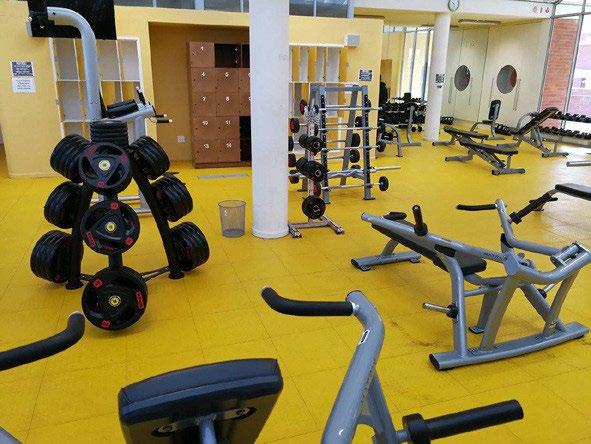




See: https://www.uwc.ac.za/Students/SD/Financial/Pages/default.aspx
To qualify, students would have to be academically deserving and financially needy. Students have to complete the UWC Financial Aid Application Form to be considered for financial assistance. A student’s financial need gets determined by applying a NSFAS Means Test.
This test will determine what amount the expected family contribution would be, and also determine the maximum allocation from NSFAS for the student’s study costs for that year.
Office Hours: 8h30 to 16h30.
For critical information from the Financial Aid Office, see this link: https://www.uwc.ac.za/Students/Financial-Matters/Pages/Financial-Aid. aspx#.Us0V1vQW1CY
Contact Numbers
Financial Aid Helpdesk
Student Credit Management
Contact Centre
Cashiers
+27 21 959 9753
+27 21 959 3558
+27 21 959 3900/01/02
+27 21 959 3107
If you find that you are regularly having to go without meals, UWC offers a food security programme. Contact:021-959-3338 (Financial Office).

The way you spend money is often linked to the type of person you are. Are you a careful person or are you someone who likes to take risks? You cannot effectively manage your finances unless you understand yourself as a person. This means going back to your roots and looking at the financial situation of your family and the emotional impact it had on you.
Messages about money are passed down from generation to generation. Your own memories about money could give you some insight into your present relationship with money and how you go about spending it.

We need to learn financial management skills from a young age; otherwise we never learn how to handle money competently and efficiently.
At the start of your academic life at the University it might be useful to think about your goals and what your financial requirements will be.
Developing goals for your life is most important because now you can work on a plan to achieve them.
Here are some financial tips to assist you in achieving your goals:
• Visit your institution’s Financial Aid office to find out more about bursaries and loans.
• Look for part-time work, on or off campus or become self-employed. Watch the notice boards for work on campus.
• Get rid of unnecessary costs and expenses, e.g. expensive clothing accounts and excessive entertainment.
• Look out for cheaper accommodation.
• Buy fruit and vegetables from hawkers because it’s cheaper.
• Eat chicken or fish rather than red meat.
Find the plan that works for you. Some people are not prepared to compromise on certain items or they see luxuries as a necessity in their lives and that is fine. Do not feel guilty about it; simply find other ways of sacrificing or being economical. As long as you are honest with yourself and do not fall into the debt trap of living beyond your means.


www.uwc.ac.za