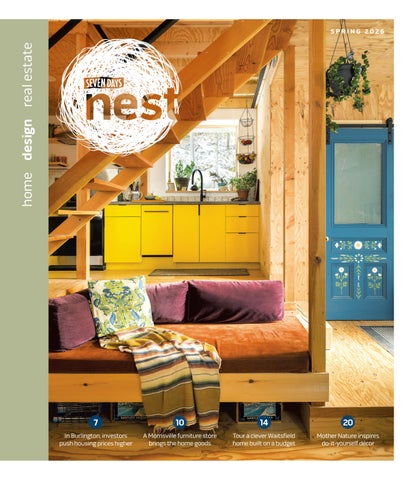
Nest – Spring 2026

Page 1


If you’ve bought a home or signed a lease in Vermont lately, chances are your wallet is feeling quite a bit lighter. Several stories in this issue of Nest —

Seven Days’ quarterly guide to homes, design and real estate — try to make dollars and sense of why affordable housing is so elusive. A new study reveals that while adding housing supply has long been thought to reduce home prices, INCREASED INVESTOR ACTIVITY in Burlington is actually raising them. The tight housing market often edges out middle-income Vermonters, but we toured a MONEY-CONSCIOUS WAITSFIELD HOME designed for that “missing middle.” To appeal to homeowners of all means, Morrisville’s MOSS HOME GOODS supplies snazzy housewares at a range of price points. For an even cheaper decorating option, make DIY HOME DÉCOR from materials foraged in nature. Whatever your budget allows, rest assured that reading these stories won’t cost you a thing.

The Building Dilemma 7

A UVM study says constructing more homes in Burlington won’t bring down costs — as investors and buyers with cash compete for what’s built BY

Fully Furnished 10

A Morrisville home goods store represents a renovation of the town’s retail sector BY

Cozy Cube ................................. 14

Small, bright and airy, an eco-friendly Waitsfield home helps fill the “missing middle” of affordable housing BY KEN

Natural Attraction 20

How to gather and create foraged home décor BY

Chrissy Bellmyer and Sam Gabriels’ home in Waitsfield

e Building Dilemma

A

Vermont policy makers have spent years trying to tackle the state’s housing crisis from multiple angles. But one idea has come to dominate the conversation: Build more homes. Adding supply, the thinking goes, should help bring prices down.

But a new study of Burlington home sales by researchers at the University of Vermont suggests that approach may not work. In today’s market, it doesn’t take many investors to push prices higher — especially when they’re armed with cash.

The study, by UVM economist and assistant professor Joe Ament and doctoral student Chris McElroy, analyzed more than 4,000 sales of single- and two-family homes in Burlington between 2003 and 2023, drawing on publicly available records to examine what’s driving rising home prices. McElroy and research assistant Will Jones combed through thousands of closing documents by hand.

During the study period, the average home price in Burlington climbed from about $188,000 in 2003 to nearly $500,000 in 2023, with the sharpest increases in recent years. Investor activity and other demand-side pressures drove the increase more than the lack of housing supply, the researchers found.

The study, titled “It’s Not About Supply,” identified 144 investor purchases of homes, rising from just three in 2003 to about a dozen

(or 12 percent of total sales) in 2023. The researchers tracked purchases made by LLCs and corporations, common proxies for investors that likely undercount the total, since some investors buy property under their own names, Ament said.

In the study’s models, each additional investor in the market was associated with a roughly $10,480 increase in overall home prices — rising to more than $13,000 when larger down payments were factored in.

Investors’ access to cash is a key part of what drives up prices. About a third of investor purchases in the study were all-cash, and many others involved large down payments, often covering 40 to 50 percent of a home’s price. That, in turn, is pushing up down payments across the market as other buyers compete. Among non-investors, down payments have more than doubled over the past two decades, and a majority of buyers now put down more than 20 percent — a pattern that was once far more common among investors.

All-cash purchases in Burlington have also

surged, accounting for nearly a quarter of sales in recent years.

The Building Dilemma « P.7 FROM T H E STUDY

Ament’s curiosity about down payments sparked the study. Back in 2020, after his family was outbid on a single-family home in Burlington, he began looking more closely at recent home sales in the city. Using public records such as mortgage filings, he pulled a handful of transactions and estimated down payments by comparing sale prices with mortgage figures. Many involved large amounts of cash.

“I don’t think people should be competing with the largest corporations that can swoop up neighborhoods [with] all-cash offers and not give an opportunity to people in my generation,” the millennial lawmaker said.

Removing a single investor from the market would have roughly the same effect as adding eight homes.

In Burlington, Ament’s study suggests that investor activity, even at a much smaller scale, is already shaping prices. By his estimates, removing a single investor from the market would have roughly the same effect as adding eight homes.

Given this, why all the focus on building?

When Ament and his team assembled a full dataset, the trend held. Investor activity and large down payments were closely tied to higher home prices in the study’s models. And as more buyers relied on cash or large up-front payments, interest rates — a traditional tool for cooling housing markets — appeared to have less influence.

“There’s just no evidence that building more housing would bring prices down,” Ament said. “It’s quite the opposite.”

THERE’S JUST NO EVIDENCE THAT BUILDING MORE HOUSING WOULD BRING PRICES DOWN. IT’S QUITE THE OPPOSITE . JOE AMENT

According to him, the findings suggest policy needs to address demand, including investor activity, alongside supply. But proposals aimed at curbing investor activity — at both the federal and state level — tend to target large institutional investors, like those who are buying up middle-class homes in Sunbelt states, not the smaller-scale buyers influencing Burlington’s market.

This legislative session, Rep. Emilie Krasnow (D-South Burlington) introduced a bill aimed at slowing the purchasing power of large real estate investors with significant financial backing. The proposal targeted institutional investors who own at least 10 properties and are backed by $300 million or more in assets.

Modeled on legislation in New York State, the bill would have required certain investors to wait 90 days from the time a house hits the market before purchasing single- and two-family homes, giving local buyers more time to compete.

The bill did not advance. Krasnow said it was designed to get ahead of trends seen elsewhere in the country.

The assumption that more supply would lower prices comes from a basic economic model that treats goods as interchangeable commodities, Ament said. Housing, he said, doesn’t behave that way. It is both a necessity and an investment, shaped by limited land, population dynamics and other forces — what his paper, currently available online through the Social Science Research Network, describes as “a reluctant fit in a market model.”

“The supposedly simple supply-anddemand model is not simple,” he said. “There are assumptions built in that don’t hold for housing. And there are power dynamics that need to be accounted for.”

That doesn’t mean building more housing has no impact on prices. But impact depends on how much and what kind of housing gets built, Ament said. In a high-demand market, smaller increases in supply may be quickly absorbed. And adding higher-end homes may do little to improve affordability compared to building more moderately priced units. At the same time, he noted, investors may play a key role in financing and developing rental housing, especially larger apartment projects, which his study did not examine.

For Ament, building housing in Burlington boils down to this: “If we’re going to make more, we need to be asking: What kind? And who will own it?” ➆

A Morrisville home goods store represents a renovation of the town’s retail sector

STORY CAROLYN SHAPIRO

PHOTOS JEB WALLACE-BRODEUR

Soon after Jennifer Hubbard moved from Baltimore to Stowe in 2009, she and her future husband decided to check out Morrisville, nine miles to the north.

“There was really nothing happening in town,” Hubbard recently recalled, but she thought the sleepy Vermont village had great potential. The historic downtown could support hip restaurants and funky shops and draw some of the Stowe crowds, she thought.

“What’s the story with Morrisville?” Hubbard asked her partner. “Why isn’t it cooler?”

Fully Furnished

In January 2021, Hubbard fulfilled some of that potential by opening Moss Home Goods, a décor store where she sold her own paintings and embellishments such as candleholders, baskets and pottery. A few years later, she moved across Portland Street into a much larger space vacated by Caplan’s Shoe, Apparel & Camping; there she added furniture, as well as an expanded kitchen section.

Morrisville has grown more vibrant since Hubbard’s

Top photo: Jennifer Hubbard at Moss Home Goods in Morrisville. Below: A cast-iron teapot; colorful vases; an assortment of throw pillows

first visit, and Moss has contributed to a business boomlet in the village. Along Main and Portland streets, Black Cap Coffee & Bakery and North Country Donuts arrived a few years before Hubbard opened her shop. Soulmate Brewing, located a few doors down, opened in 2023, and Gondolas Downtown, a burger joint on the other side of Moss, started serving in December. She Who Rules, a women’s clothing store, brought trendy styles to Portland Street last August. And Hubbard said a children’s boutique is set to open soon, prompting her to shrink the kids’ section at Moss.

Vermont. It’s not cottage chic or rustic farmhouse or ski cabin. Hubbard brings a bit of the city to her store, leaning into an urban simplicity that’s relaxed and down-to-earth, contemporary but casual.

In the open and airy showroom, Hubbard’s 14-year-old hound mix, Bootsy, weaves through the floor displays and greets customers with a deep bark. The front of the store showcases the work of Vermont artisans, including colorful earrings from Jewelwood of Vermont in Enosburg Falls and the groovy, vibrant cups and mugs of KP Farm Pottery in Wolcott.

THERE ARE FUN, INTERESTING THINGS THAT ARE UNIQUE THAT YOU CAN’T GO TO A CATALOG AND GET.

Committed to the downtown’s upward trajectory, Hubbard, 50, joined the board of the Morrisville Alliance for Culture and Commerce, which works to enhance and promote the commercial district and build a “brand identity” for the village, she said.

Moss is among the newer businesses that are helping make Morrisville a destination by offering “human curation” of items and a “personal touch,” said Jessica Seddon, who chairs the board of the Morrisville Food Co-op. “There are fun, interesting things that are unique that you can’t go to a catalog and get,” said Seddon, who grew up in Westfield and moved to Morrisville in 2020.

These retailers “attract people to make a little bit of extra effort to come there,” she added. “You can’t substitute some other town or some other place. You actually have to go to Morrisville.”

While Seddon and Hubbard see Morrisville drawing more visitors with its newfound appeal, Hubbard wants Moss to cater just as much to local residents by providing options to spruce up their abodes. Her customers aren’t necessarily outfitting second homes from scratch — though she welcomes those shoppers, too — but looking to refresh part of a room or add something new.

“I’m really focused on people who already live in their house, and maybe they are decorating around an inherited piece,” she said, right after helping a customer find a square basket for a room’s corner. “Maybe there’s something idiosyncratic about the way that their floor plan is. I find that more interesting and more challenging and more fun, to try to be a little more personalized.”

Moss’ vibe veers from the décor themes typically associated with

Hubbard stocks scented candles in pots from Mountain Stone Candle, a Hyde Park producer that embeds crystals in the coconut-based wax, and Three Buds Apothecary in Waitsfield. Moss also carries an array of goat milk bar soaps from Heritage Farm in Walden. A classic, caramel-colored leather sofa that goes for $6,000 dominates the furniture section in the center of the store. Next to it are a pair of round shearling-covered footrests, each $330. A circular stone coffee table framed in wood and wrought iron serves as a striking statement piece, costing $1,400.

For those who still display photos outside of their phones and social media accounts, Moss offers dozens of picture frames. Pillows with floral, plaid and geometric covers range in price from $49 to $98. Decorative baskets of various sizes and prices abound. Kitchen options include Japanese-style dishware and simple flatware sets, a pasta machine for $54, and Oliver Pluff & Co. teas.

Hubbard’s own paintings adorn the walls with quintessentially Vermont pastoral landscapes: red barns against blue skies and bright green grass; winter scenes of snow and silos. For the fine artist, the showroom provides a more permanent display space than the galleries that have exhibited her work, from River Arts in Morrisville to the Burlington International Airport.

Hubbard studied at Baltimore’s Mitchell School of Fine Arts and Maryland Institute College of Art before dropping out to focus on her painting. She moved to Vermont to follow a guy, now her husband, Timothy Danahy, who co-owns Green Mountain Distillers.

VERMONTERS DESERVE LOWER

HEALTH CARE

BONE DENSITY SCAN (DEXA)

• ULTRASOUND (including breast ultrasound)

LOWER COST: Our rates are significantly lower than local hospital rates. We will work with you to lower your out-of-pocket costs.

BETTER ACCESS: Walk-ins for X-rays without appointment. Same day or next-day scheduling for many exams. Others usually within 1 - 2 weeks.

We are a locally owned, independent, physician-led center focused on providing access to lower cost advanced imaging services.

The couple live in Hyde Park near the Green River Reservoir, tucked deep into the woods, where Hubbard never expected to put down roots. With limited income from her art, Hubbard initially worked a series of restaurant jobs around Stowe.

When the pandemic hit in spring 2020, she was making good money at the Stowehof inn and its restaurant. But the job seemed risky amid COVID-19, so Hubbard didn’t return when the shutdown lifted. Instead, she took some time off, hiking and trying to figure out what to do next.

The demographics around Morrisville had shifted in the intervening years, with the growth of Airbnb luring tourists — and the cultural amenities catering to them — outside of Stowe. Likewise, the skyrocketing cost of housing had pushed people out of Burlington and other populated areas. By the time the first space that housed Moss came up for lease in late 2020, people had moved into the area with some wealth and a desire to dine and shop in their nearby village, Hubbard said.

Many of Moss’ first customers were nurses and other staff at nearby Copley Hospital, as well as teachers at Peoples Academy private school. Those essential workers sent one another to the store and shared their Moss finds in a group text, Hubbard said.

She heard upbeat feedback: “This is going to be great for Morrisville. This is exactly the direction that the town is going and needed to go.”

furniture. Another Vermont store had

To appeal to customers of all incomes, Hubbard carries goods at a range of price points and orders a few things from China — ceramic ice cream dishes for $12 and a $10 stoneware salt cellar — because they are less expensive, she said.

“I’m not trying to alienate anybody through sticker shock,” she continued. “I have $6 notebooks. I have $10 tchotchke things. Whatever amount of money you want to spend, I’m trying to make it very easy.”

That’s tougher for retailers these days, with tariffs and rising fuel and transportation costs driving up the price of goods.

“The only thing I can tell my customers is that I’m doing the best I can,” Hubbard said.

Gio LaChance of Wolcott is a frequent Moss customer who said she shops for gifts at Moss and has three or four pairs of earrings from the store. “I turned my husband on to it, so now he knows where to get me gifts,” she said.

given up its account with furniture manufacturer Lee Industries, and its representative gave Hubbard the chance to take it over.

Today, clients can choose among hundreds of fabrics for upholstery on custom orders. In the Moss showroom, they can sink into the sofa cushions and swivel in a bucket chair to get a sense of how a piece would fit in their home.

Hubbard acknowledged that she brought a pricey store to a population that’s less accustomed to high-end retail.

Still, Hubbard said she hopes Moss will draw those shoppers willing and able to splurge. “If you have a house that’s 700 grand or up, and you want good furniture for it, you want to touch that furniture,” she said.

It’s also challenging for a small retailer to sell upholstered goods cheap enough to compete with online retail giants Amazon and Wayfair.

“Furniture is fucking expensive,” Hubbard said. “So even though I’m trying to be as price sensitive as I can be, I had to make a decision to go towards higher-end custom pieces that are more investment-level.”

In early April, she stopped at Moss to look for Easter basket options for her kids, ages 9 and 13. She went to the register with a couple of travel glasses hand-painted with chickens and a woodland scene; some drawing notebooks; and CATastrophe, a felinethemed game.

“We were thinking about changing out our rugs, too,” LaChance told Hubbard. Her décor at home “can feel stale,” she said. “I need to get inspired.”

Moss gives her that inspiration, LaChance added. Which is exactly what Hubbard hoped when Morrisville inspired her to open Moss. ➆

The showroom at Moss Home Goods

Cozy Cube

Small, bright and airy, an eco-friendly Waitsfield home helps fill the “missing middle” of affordable housing

When Chrissy Bellmyer and Sam Gabriels decided to design and build a house in the Mad River Valley a few years ago, they were confronted with what felt at the time like conflicting goals: They wanted it to be high quality, eco-friendly and affordable. The couple, who are in their mid-thirties, were looking to escape the rental market and start building the wealth that comes with homeownership — no easy task in a region rife with ski condos and multimillion-dollar mansions.

After purchasing a half-acre lot off Route 100 in Waitsfield for $90,000, Bellmyer and Gabriels approached Andy White, owner of Boreal Design in Waterbury, to help them design and build a home to fit their budget.

The result: a bright and airy cube of a house that, at 800 square feet, feels as cozy and playful as a tree house, without being claustrophobic. It’s also highly energy-efficient, meeting or exceeding the air-tightness and insulations levels of a Passive House, an international building standard that prioritizes eco-friendliness, comfort and indoor air quality. The home features two bedrooms, 1.5 bathrooms, an office nook, a kitchen, a living room and a dining area — and it cost less than $300,000 to build.

This house, and similar ones adjacent to it, provide what White called the “missing middle”: reasonably priced, market-rate housing for middle-income Vermonters that was built without state or federal subsidies. This often-overlooked demographic can struggle to find affordable homes, especially in tourism-dependent communities that cater mostly to short-term renters and wealthy second-home owners.

Bellmyer and Gabriels’ house is located in a 10-acre subdivision along the Mad River called the Waitsfield Ten. The former gravel pit contains a quirky, prismlike house that was built in the 1980s and ’90s by Yestermorrow Design/Build School founder John Connell and his students.

After that house was sold in 2022, the new owners, Mac and Bobbi Rood, petitioned the town to amend the zoning to allow for denser housing. New houses are now limited to 2,000 square feet, and, depending on the lot, the buyers at the time of purchase can earn no more than the median household income for Washington County — $83,449 in 2024, according to the U.S. Census Bureau.

Satisfying Bellmyer and Gabriels’ goals of

The first floor of Chrissy Bellmyer and Sam Gabriels’ home in Waitsfield
SATISFYING THE GOALS OF AFFORDABILITY, QUALITY AND ECO-FRIENDLINESS WAS CHALLENGING.
The kitchen
The main bedroom
Bellmyer and Gabriels with builder
Andy White (right) at their Waitsfield home

affordability, quality and eco-friendliness was challenging, their builder admitted. Having studied environmental science and ecological design at the University of Vermont, White used to build highefficiency mansions in California before he returned to Vermont a decade ago and opened his own design-build firm in 2017. But building to high-efficiency standards on a modest budget took ingenuity.

Fortuitously, the couple were designsavvy — Bellmyer works as operations manager at Yestermorrow, and Gabriels is a teacher in Montpelier — and they already had ideas for the home’s design when they met with White.

“One of our prompts was: Make it like Prickly Mountain,” Bellmyer said, referring to the iconoclastic Seussian houses that the late architect Dave Sellers and his cohorts built in Warren beginning in the 1960s. “We wanted that inspiration, that fun, that creativity, but to make it practical and high performance so we can be here for 30 years.”

Essentially, their house is a 22-foot cube, with a slanted mono-roof, and lacks a traditional concrete foundation. Instead, it sits on piers a few feet off the ground to allow it to sustain flooding from the Mad River with minimal damage. Its prefinished corrugated metal siding is durable yet affordable and won’t need painting. From afar, the house resembles a rook on a chessboard.

Among the project’s costlier components were its walls — 16 inches thick and filled with cellulose, providing an insulation value of R-42, considered exceptional by residential standards. That enables the couple to heat and cool the house with a single heat pump. In the first year, the couple’s electric bill averaged $150 per month, their only utility cost other than internet service.

Inside, one immediately notices the unconventional walls and floors, made from construction-grade plywood sheets that Bellmyer and Gabriels sanded and finished themselves and left unpainted. The house has very little Sheetrock, which saved the couple time and money; essentially, they moved in six months after the builder broke ground, albeit with parts of the house still unfinished.

“Another way we kept it affordable is, Sam and I did a lot of the work ourselves,” Bellmyer explained. Gabriels built the concrete kitchen countertops as well as the deck outside a sliding glass door. Bellmyer crafted and installed

PHOTOS COURTESY OF RYAN BENT
Cozy Cube « P.14
COZY CUBE » P.18
Clockwise from top: The main bedroom; the bathroom; built-in shelving for books and records

all the ceramic backsplash tiles in the kitchen and painted the cabinets with a friend.

“There are a lot of people who would love to take part in the building of their own house and save money doing that,” White said.

The couple further cut costs by shopping for building materials online. They found funky pink bathroom tiles and double- and triple-paned windows on Facebook Marketplace and bought their arty, cloud-themed cabinet pulls on Etsy. The sliding door to the first-floor bathroom is an antique, repurposed from a 19th-century house along Lake Champlain and hand-painted by their friend Meg Reinhold of Trillium Handcrafts.

Like a space-saving RV, the house has elements that serve dual purposes. Because the first floor is split-level, with the living room and kitchen on different planes, the crawl space below the dining area provides storage. And though the dining room looks small, its deep windowsill functions as bench seating.

“We’ve had 12 people sit around this table,” Gabriels said.

“It’s cozy, but it works,” Bellmyer added.

The living room is only 8 by 12 feet, with space for a small couch and a built-in daybed. But due to the large and abundant windows, it doesn’t feel cramped. Rather than having an entertainment center for a TV, the couple use a projector and ceilingmounted pull-down screen.

The staircase, in the center of the house, has no risers or walls, which allows more natural light to flood the entire living space. The railings are painted tube steel, creating a hip and modern look.

adding walls or reconfiguring rooms, with minimal construction. Without Sheetrock, the walls can be unscrewed and removed to, say, run electrical wires or replace a window, then easily bolted back into place.

THERE ARE SO MANY MODERATE-INCOME PEOPLE WHO WANT TO PICK UP A HAMMER AND HAVE A PART IN THEIR HOME.

On the second floor, the main bedroom is only large enough to accommodate a bed and nightstands; the smaller bedroom can fit a wardrobe. The couple opted to keep the main bedroom open to the rest of the house, though White designed it to accommodate standard French doors if they or future owners decide to add them later. A large wardrobe closet also contains a stacked washer and dryer, concealed behind a sliding plywood door that uses no hardware, another cost-saver.

The Waitsfield Ten has the look and vibe of an intentional community. Homeowners enjoy six acres of common land, including a pond and shared leach field, and the homeowners’ association put limits on short-term rentals as well as income caps on reselling the houses for the first 10 years. That said, the like-minded values in the neighborhood seem to have grown organically.

“Our neighbors helped us. That was the most beautiful part,” Gabriels said. “Every time we worked on [the house], people showed up.”

“There are so many moderateincome people who want to pick up a hammer and have a part in their home,” White added. “If you just remove some of the multitude of barriers to pulling that off, you end up with a community of good neighbors who want to help each other.”

White rigorously designed the entire house on a grid, which enables the owners to make modifications, such as

Above, from left: Bellmyer, White and Gabriels on the first level. Right: A reading nook

Natural Attraction

How to gather and create foraged home décor

On a bright, chilly spring day, poppies and irises had just begun blooming in the yard of Michelle Wallace’s Marshfield home. She snipped the blossoms from their stems and placed them gently on a round wooden table on the porch.

The tabletop was already jam-packed with a variety of plants, including leathery horsetail, which looks like miniature bamboo; aromatic branches of balsam fir; and the crinkly leaves of lady’s mantle. There were animal and mineral contributions, too: one mason jar of porcupine quills, another filled with bright white stones.

Wallace has worked at Vermont nonprofits for the past 26 years. In addition to her full-time job, since 2017 she has been making mandalas from items she gathers in nature. She photographs each one and uses the images on items such as cards, calendars and magnets. I met up with Wallace to try making some mandalas of my own.

What’s a mandala? From the Sanskrit word for “circle,” it’s a symmetrical and geometric design that represents the universe and is frequently used to assist meditation. My path to Wallace’s porch was

appropriately circuitous.

Two years earlier, I’d taken a stroll with Newport forager and artist Serena Morgan. Though we were focused on harvesting edibles and preparing a meal, I was enchanted by one of Morgan’s other endeavors: transforming materials she discovers on her hikes into jewelry, wreaths, salves and smudge sticks. She sells them at farmers and artists markets around the state.

In recent years, during my cancer treatment, I found art making therapeutic and was eager to learn new ways to make beautiful and practical items for my home — without dropping big bucks on supplies. So I sought out people who could show me how to pluck items from woods and fields and use them to create.

Enter Wallace and her spiritual side hustle. “Each image contains an intention, an aspiration, or hope or wish or prayer,” she explained. “I now have nine years of these vivid images of place and time or important life events and my own inner growth.”

How does Wallace get started? “When you’re walking through the landscape, if you’re paying attention, you’re going to notice things,” she said. When a particular color, texture or shape is appealing

COURTESY
Michelle Wallace in her garden
“Green Washing” by Mary Admasian
A mandala made by Wallace

— provided the item isn’t endangered, rare or poisonous — it can be collected and incorporated into a design.

Once you’ve selected materials, Wallace continued, let intuition be your guide. Using a piece of fabric, a decorative plate, the earth or the floor as your base, organize your pieces into a pattern that you find pleasing. “There are no rules,” she said. “You can approach the arrangement however you want.”

Wallace added that your design doesn’t actually have to be symmetrical; it just should feel right to you.

Once you’re happy with what you’ve made, you could, like Wallace, document it with a photograph. You might reproduce the image on a wall hanging or a coffee mug, or simply admire it in your digital archive.

Hewitt tends to go in search of the items she requires to make the specific things she wants and needs.

As a starting point for fabricating household items out of wood, branches and bark, Hewitt recommended getting out into the forest, “playing around with things” and seeing what you notice about different materials. “Anything that you can wrap around your wrist and it doesn’t break, that’s weavable,” she advised. Notice the grain patterns of different types of wood, and consider which might be good for carving.

IT’S REALLY IMPORTANT TO USE YOUR HANDS
MAKE STUFF; IT’S WHAT WE WERE DESIGNED TO DO.

Penny Hewitt of Stannard is the owner of Lazy Mill Treecraft. Her reason for learning to make things with found objects was eminently practical. “It was an extension of my homesteading life, the desire to know where stuff comes from and what the consequences of the materials are,” she explained. “I needed baskets, so I started making baskets. Needed shoes. Made shoes.”

PENNY HEWITT

Hewitt teaches workshops at her home — she’s launching a traditional skills school there called Lazy Mill Living Arts — as well as at craft schools around the country and at skillfocused get-togethers, such as the annual Roots Rendezvous at the Roots School in Bradford, which takes place in September. “These skill shares, these gatherings [are] a good place to get your feet wet,” she said. “They’re incredibly inclusive and beginner friendly.”

Even better, she said, she’s made lifelong friends of all ages through shared interests in crafting and sustainability.

One of Hewitt’s upcoming projects will be creating a birch-bark wallet, she said.

During the years when she was homeschooling her two sons and many of their lessons took place outdoors, Hewitt began gathering materials that she found appealing, then figuring out ways to transform them into useful home goods. “That’s a cool crook of a branch; I could make a good spoon out of that,” she recalled thinking.

Now, with decades of experience,

I met Hewitt two winters ago at one of her classes, in which we bent and folded slender strips of birch bark into the shapes of birds and comets, then strung them up to serve as festive holiday décor. We also learned how to sustainably harvest the bark. As someone who often feels a bit clumsy, I was astounded to find delicate ornaments taking shape beneath my fingers.

Can’t get to a workshop? Hewitt said excellent books are available on making baskets, carving kitchen tools

Students after a basket-making class with Penny Hewitt
e best way to predict your future, is to create it.
— ABRAHAM LINCOLN
16TH PRESIDENT OF THE UNITED STATES

to explore your artistic interests and become a visual storyteller.

and learning other craft techniques from around the world. She also suggested YouTube as a useful — if less communal — way to learn.

“I love that there’s interest in this,” she mused. “It’s really important to use your hands to make stuff; it’s what we were designed to do. We’re not just consumers.”

East Montpelier resident Mary Admasian is a marketing consultant, curator and fine artist who also uses items from nature. Her sculptures demonstrate that not all handcrafted objects need to have practical uses.

Admasian said she notices an “explosion of connections” when she lays out bits and pieces of material she’s gathered and begins assembling them with glue, nails and wire. “What’s so wonderful about that is the discovery,” she said. She often combines natural materials such as butterfly wings, river stones, bird nests and insect hives with found, human-made materials, including rusty flakes of metal and barbed wire.

“I could base my entire career on barbed wire,” Admasian quipped. “That’s an endless narrative.” To her, the scraps of fencing represent “confinement, boundaries, metaphorical concepts around social norms and tensions in our inner lives.” Like Wallace with her mandalas, Admasian juxtaposes colors, shapes and items that elicit a particular emotion, spark connections and, ideally, lead to a deeper understanding of herself.

Her advice to beginners is similar to Hewitt’s: “Train your eye to look at things that are interesting to you.” Making collages, tucking natural objects into embroidery or knitting, and building small sculptures are good ways

“Don’t think, I’m going to make a piece of art,” Admasian recommended. “Collect stuff that floats your boat, and give yourself the mental space to play.”

Her words about playfulness resonated, and I began thinking about items I might wish to gather. Then it struck me: Growing vegetables and preparing them is one of the driving forces in my life, and in my collection of seeds saved from my garden — dried and neatly labeled — there was plenty to inspire me.

Starting with a collage I’d already begun, which included images from seed catalogs, I began adding another dimension. I sorted through dozens of varieties of dried heirloom beans, zucchini seeds and kernels of pastel glass gem corn to find the prettiest examples and glued them to the page. The result is a bit too on the nose to count as fine art, but the idea of using garden seeds as a medium will stick with me.

As far as actual sticks are concerned, Hewitt’s influence sent me to the firewood pile to hunt for attractive hunks of maple, ash and birch. From a spalted piece I carved a small scoop, which I use to spoon up flour or grains when I’m baking. Imperfect it may be, but it’s functional.

The elements of the mandala I created on Wallace’s porch have decomposed in my garden, but the idea of creating evanescent works of art with flower petals, leaves, sprigs of herbs and other tidbits is now rooted in my mind. And I imagine it’s a practice I’ll return to again and again. ➆

A birch-bark bird made by Hewitt

Turn static files into dynamic content formats.

Create a flipbook
Nest – Spring 2026 by Seven Days - Issuu