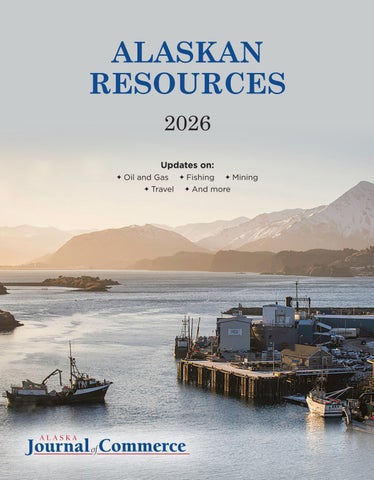
ALASKAN RESOURCES 2026 Updates on: ✦ Oil and Gas ✦ Travel
✦ Fishing
✦ Mining
✦ And more
Alaskan Resources 2026 1
2 Alaskan Resources 2026
Publisher: Ryan Binkley VP, Revenue and Audience Development: Kea Cuaresma Special Projects Director: Brandi Nelson Section Editor: Nina Wladkowski Sales: Ryan Estrada, Victoria Hansen, Jada Nowling, Joleesa Stepetin Advertising Operations: Lisa McGuire Main cover photo: Boat docks in Kodiak, Alaska. Photo provided by Pacific Seafood Processors Association This special publication was produced by the advertising departments of Anchorage Daily News and Alaska Journal of Commerce, in partnership with the industry leaders represented within. The Anchorage Daily News and Alaska Journal of Commerce newsrooms were not involved in its production.
Photo provided by Pacific Seafood Processors Association
2019 crewmember Helen Decker.
Seafood benefits all of Alaska. We are investing in a shared vision of our future that sustains people, economies, and healthy ecosystems for generations.
Alaska Journal of Commerce
Alaskan Resources 2026 3
From Turnagain Arm to Tomorrow: The People Behind Alaska’s Largest Energy Utility Presented by ENSTAR Natural Gas Company
B
ehind almost every warm home and running business in Southcentral Alaska is a crew most people rarely think about, but they have been there every hour of every day for the last 65 years. Since serving its first customer in August 1961, ENSTAR Natural Gas Company has grown alongside Southcentral Alaska. Today, the utility delivers energy to more than 156,000 homes and businesses, roughly 60 percent of the state’s population. The constant operation of a system of pipelines, compressors, communication facilities and more happens almost entirely out of sight. The people who keep it moving live in the very communities they serve. Beneath Southcentral’s roads and neighborhoods run thousands of miles of natural gas pipelines. This system stretches across 26 communities, from Homer in the Kenai Peninsula Borough to Houston in the Mat-Su Borough. It heats Joint Base Elmendorf-Richardson, schools and hospitals, and generates more than 80 percent of the region’s electrical power, making natural gas the energy foundation that Southcentral Alaska runs on. Transporting gas on the pipeline system requires year-round leak detection, inspections, capital improvements and infrastructure replacements, plus 24/7 response when the unexpected happens. Whether digging through January permafrost or navigating April mud, ENSTAR’s field crews handle physically demanding work and emergency gas response alongside local fire and police responders. Behind them is a network of over 230 Alaskans, dedicated to meeting ENSTAR customers’ needs and
4 Alaskan Resources 2026
Photo provided by ENSTAR Natural Gas Company
Potter Gate in the winter, 2024.
maintaining the reliable service they have come to expect. The headlines about Southcentral’s energy future are a source of concern for everyone who relies on natural gas for a heating source or power generation. ENSTAR does not produce or own natural gas, but strictly purchases and delivers it, and roughly 80 percent of a customer bill is tied directly to the cost of that fuel. While producers choose how much gas they sell to the market, under Alaska law, ENSTAR’s service to customers must be “reasonably continuous and without unreasonable interruption or delay.” Planning for what comes next requires that ENSTAR focus on a long-term solution that addresses reliable supply in addition to cost. To bridge the gap and protect consumers from volatile spikes, ENSTAR is moving forward with plans for a new liquefied natural gas (“LNG”) receiving terminal on the Kenai Peninsula alongside expanding access to natural
gas storage. ENSTAR has partnered with Glenfarne to develop this facility, with a target for first delivery in 2029. Glenfarne’s larger, comprehensive Alaska LNG project, which uses the same Kenai site and connects North Slope gas to the Cook Inlet, is critical infrastructure; the foundation needed to stabilize longterm energy prices and benefit from Alaska’s own abundant natural gas. Alaska LNG is the only project that has the potential to reduce the cost of energy for Southcentral Alaska. The state’s energy landscape is shifting, and the answers are not going to be inexpensive or simple, but this is not the first time our state has faced a steep climb. ENSTAR’s own history provides a good example of Alaskans meeting these challenges and doing the impossible. More than 60 years later, we find ourselves at another crossroads. When the water is deep and the tide is strong, ENSTAR keeps working until all the pieces are in place to serve our customers.
Alaska Journal of Commerce
Alaska’s Most Valuable Resource is Its People Presented by Velocity
A
laska’s resource industries have always depended on more than the resources beneath our feet. Every oil field, mine, hydroelectric project and infrastructure investment has relied on skilled professionals willing to solve complex problems in one of the world’s most demanding operating environments. As the resource industry continues to evolve, developing the next generation of leaders has become just as important as developing the next project. Across Alaska, experienced engineers, project managers, geologists, environmental professionals, operators and skilled tradespeople are passing along decades of knowledge as a new generation enters the workforce. This new generation brings with it new technologies, fresh perspectives and different ways of approaching challenges. The opportunity isn’t simply replacing one workforce with another; it’s ensuring valuable experience is preserved while encouraging innovation that keeps Alaska competitive. That investment in people has never been more important. The conversations surrounding Alaska’s energy future are becoming more complex, not less. Traditional oil and gas development is still a cornerstone of the state’s economy, but opportunities in critical minerals, carbon management, renewable energy and energy infrastructure continue to grow. These aren’t competing conversations so much as related ones. Regardless of the resource or technology, successful projects depend on skilled professionals who can evaluate risks, communicate across disciplines, and balance economic,
Alaska Journal of Commerce
environmental and community priorities. Preparing that workforce requires more than just technical expertise alone. The ability to collaborate, adapt, and build trust has become just as valuable as understanding engineering principles, sifting through permitting requirements, or managing project schedules. As projects become more integrated and stakeholders more diverse, tomorrow’s leaders will need both strong technical foundations and collaborative professional relationships that help turn complicated ideas into successful outcomes. Alaska’s resource industries are changing alongside advances in technology, evolving energy markets and increasing expectations around environmental stewardship. At the same time, many sectors are competing for the same skilled workforce. Meeting those challenges requires professionals who understand not only their own discipline but also how projects succeed through collaboration across engineering, construction, operations, environmental compliance, government and the communities they serve. One of Alaska’s greatest advantages is that this multi-faceted, collaborative spirit already exists. Unlike many larger markets, Alaska’s professional community is remarkably connected. Careers regularly span multiple industries, with professionals moving between oil and gas, mining, transportation, utilities, construction and renewable energy throughout their careers. Relationships built early often become the partnerships that deliver successful projects years later. That’s why creating opportunities
for young professionals to build these relationships matters. Internships, mentoring, career and technical education, and professional organizations all play an important role in preparing future leaders. Technical expertise will always be essential, but leadership is also built through communication, collaboration and an inclination to learn from those who came before. Organizations, such as Velocity, support that effort by connecting emerging professionals with established industry leaders and creating opportunities for education, networking and meaningful conversations about Alaska’s future. While no single organization can solve the labor force challenges facing our state, we can strengthen the entire resource sector by investing in professional development and building strong industry relationships. Alaska has never lacked opportunity. What has always set the state apart from the Lower 48 is the people willing to take on difficult work, adapt to shifting conditions and create long-term solutions for the communities they serve. As one generation prepares to pass the torch, the next is ready to carry it forward. By continuing to invest in coaching, workforce development and professional connections, we can ensure Alaska’s resource industries remain innovative, resilient and competitive for decades to come. After all, Alaska’s most valuable resource has never been found underground. It’s the people who make responsible resource development possible.
Alaskan Resources 2026 5
The Future That Didn’t Happen Presented by Alaska Oil & Gas Association
I
n 2012, the conversation surrounding the Trans-Alaska Pipeline System (TAPS) wasn’t about renewal, it was about survival. After decades of declining North Slope production, the U.S. Energy Information Administration (EIA) projected that, under a low-oil-price scenario, throughput on TAPS could fall to levels requiring decommissioning as early as 2026. It was a sobering forecast that reflected declining production, shrinking investment and growing uncertainty about Alaska’s energy future. That future never arrived. Instead of preparing to decommission TAPS, Alaska is preparing for the pipeline’s federal right-of-way renewal while a new generation of investment reshapes the North Slope. Production is rising, major new fields are coming online, and companies are once again making longterm investments in Alaska. That renewed confidence is also evident in recent lease sales, where major global energy companies, including firms new to Alaska, are competing for acreage and positioning themselves to invest in the state’s next generation of resource development. The momentum has become so unmistakable that the Financial Times recently described Alaska as the world’s “hottest oil play”—a remarkable turnaround from the uncertainty that surrounded the state just over a decade ago. In early 2026, Santos celebrated first oil at the Pikka development, more than a decade after the project first began taking shape. The milestone illustrates a defining characteristic of Alaska’s resource industry: major projects require patience. From exploration and permitting to engineering, construction and production, developing North Slope resources often takes a decade or more. That patience is now paying off. Pikka is expected to produce up to 80,000 barrels of oil per day during its first phase. Nearby, ConocoPhillips
6 Alaskan Resources 2026
Photo provided by Alaska Oil & Gas Association
Pump 1 Aerials 4-9-25.
continues construction of the Willow development, one of the largest new oil projects in the United States, expected to produce up to 180,000 barrels per day at peak production. Together, the projects represent more than $13 billion in private investment and are helping reverse a decades-long trend. The EIA forecasts Alaska crude oil production will increase this year for the first time since 2017. Every new barrel also strengthens the long-term viability of TAPS. New production helps maximize the value of this critical infrastructure while extending the life of one of Alaska’s most important economic assets. The renaissance isn’t defined only by new developments. It is equally evident in continued reinvestment across the Prudhoe Bay Basin. Nearly 60 years after its discovery, Prudhoe Bay remains a backbone of Alaska’s oil industry. Like every mature oil field, it naturally declines over time. But decline is not destiny. Through drilling, enhanced oil recovery, facility upgrades and infrastructure investments, operator Hilcorp continues extending the productive life of one of North America’s greatest oil fields. The company’s track record offers reason for optimism. Since taking over operations at Milne Point in 2014, Hilcorp has transformed one of
Alaska’s mature legacy fields—growing production from roughly 18,000 barrels per day to more than 50,000 barrels per day today through sustained investment, new drilling and operational innovation. In Cook Inlet, HEX and Hilcorp continue investing in natural gas development to strengthen Southcentral Alaska’s long-term energy security. For more than six decades, Cook Inlet natural gas has powered and heated homes, businesses, schools, hospitals and military installations across the Railbelt, making continued investment essential to maintaining reliable and affordable energy for Alaskans. Those investments ripple throughout Alaska’s economy. According to McKinley Research Group’s 2025 Economic Impact Report, the industry spent $5.8 billion on Alaska goods and services in 2024, supporting more than 1,000 Alaska businesses and communities across the state. Fourteen years ago, analysts contemplated a future in which 2026 could mark the beginning of TAPS decommissioning. Instead, 2026 is becoming a year defined by renewed production, renewed investment, renewed confidence and a renewed commitment to the pipeline that continues to connect Alaska’s resources to the world.
Alaska Journal of Commerce
The resource that replenishes itself: Alaska tourism Presented by Jillian Simpson, President/CEO, Alaska Travel Industry Association
A
laska’s foundation rests upon resources that provide tangible value, and the visitor industry is a primary example. This sector renews itself every season through the stories travelers share, the local businesses they visit and the community vitality they help maintain. Much like Alaska’s other economic engines, the long-term returns of tourism are directly linked to consistent, strategic investment. Between May 2024 and April 2025, more than 3 million visitors came to Alaska. They arrived by cruise ship, plane and highway, drawn by experiences few destinations can offer at the same scale: glaciers, mountains, wildlife, northern lights, Alaska Native cultures and the simple promise of adventure. That interest carries real economic weight. Tourism generated $3.9 billion in direct spending in 2022-23, and $5.6 billion in total economic impact across Alaska. In 2023, the industry supported 48,000 jobs. In 2024, tourism generated more than $181 million in revenue for the State of Alaska through permits, fees, tickets and taxes. Visitor spending increased 40 percent from 2016 to 2022, and travelers spent an average of 8.5 nights in the state, giving communities across Alaska the opportunity to benefit from each trip. Tourism dollars flow through local economies in practical, visible ways. A visitor may book a flightseeing tour in Talkeetna, buy art in Juneau, stay in a family-owned lodge on the Kenai, take a glacier cruise in Valdez, eat at a restaurant in Anchorage, rent a vehicle in Fairbanks or hire a guide in Kodiak. Those choices support Alaskans working in transportation, lodging,
Alaska Journal of Commerce
Photo provided by Alaska Travel Industry Association
Kayaking.
food service, retail, guiding, cultural interpretation, maintenance, marine operations, marketing and many other fields. “My small business directly supports and employs over 50 Alaskans, including direct employees, seasonal staff, contracted operators, transportation providers, local artists and more. For a small town like Sitka, the trickle-down effect is significant,“ said Teal West, founder and CEO of Sitka Lighthouse. “I am proud of the impact I’m able to have within my community.” Tourism also gives Alaska a way to turn the qualities that make the state distinctive into long-term economic value. A healthy tourism economy depends on strong communities, accessible public lands, reliable infrastructure, cultural respect and Continued on page 14
Photo provided by Alaska Travel Industry Association
Alaska in June.
Alaskan Resources 2026 7
Fraud Prevention Strategies in a Changing Payment Landscape
A
Presented by Erica Skiff, First National Bank Alaska Assistant Vice President and Treasury Management Sales Manager
s Alaska businesses continue to drive growth across industries, they all face an increasingly sophisticated threat: payment fraud. Today’s fraudsters are leveraging technology, social engineering, business email compromise (BEC) and generative artificial intelligence to target organizations of every size. According to the 2026 Association for Financial Professionals Payments Fraud and Control Survey, 76% of U.S. organizations experienced attempted or actual payment fraud in 2025. Checks remain the payment method most frequently targeted, followed by automated clearing house (ACH) transactions and wire transfers. Fraud prevention is no longer just an IT issue – it’s a business imperative. Fortunately, businesses can significantly reduce their risk by implementing a layered fraud prevention strategy that combines technology, strong internal controls and employee awareness. One of the most effective tools available is Positive Pay, which helps protect organizations against check and payment fraud. It works by comparing checks presented for payment against a list of checks issued by the business – any discrepancies in check number, amount or other identifying information are flagged for your review and further direction. You also have the choice to automatically pay or return flagged checks should you not be available to provide your bank timely direction. For organizations issuing paper checks, it’s one of the most valuable defenses available. For electronic payments, businesses should consider ACH fraud prevention
8 Alaskan Resources 2026
Photo provided by First National Bank Alaska
First National Bank Alaska and Goldbelt.
services, including ACH Positive Pay, ACH filters and ACH blocks. These solutions allow organizations to establish rules around authorized ACH transactions and prevent unauthorized debits from posting to their accounts. Companies that rarely receive ACH transactions may benefit from a complete ACH block, while those with established trading partners can use ACH filters to allow transactions only from approved originators. Check blocks offer a similar layer of protection for accounts where checks should never be presented. This is particularly effective for accounts dedicated to electronic payments, payroll or collections – eliminating an entire category of fraud risk before it can take hold. Technology alone, however, is
not enough. BEC is one of the most common fraud schemes impacting organizations today. Fraudsters frequently impersonate executives, vendors or trusted partners to trick employees into changing payment instructions or approving fraudulent transactions. To combat these threats, businesses should implement several key operational controls: • Require dual control: Implement a dual control system requiring one individual to initiate and another individual to approve a payment. • Verify vendor payments: Independently verify all vendor requests to change vendor payment information using a known phone number or trusted contact. Continued on page 14
Alaska Journal of Commerce
LET’S BUILD A STRONGER ALASKA First National understands the unique challenges of doing business in Alaska. Facing tight deadlines and remote locations, you need a bank that moves as quickly as you do — one that is responsive, reliable, and able to make decisions locally. Let’s work together to build Alaska’s future, one project at a time.
Shape Your Tomorrow
Explore how Drake Construction and First National Bank Alaska work together to build Alaska one community at a time.
FNBAlaska.com
MEMBER FDIC | NMLS #640297 | EQUAL HOUSING LENDER
Alaskan Resources 2026 9
Alaska Seafood: The Resource That Feeds Alaska’s Economy Presented by Julie Decker, President, Pacific Seafood Processors Association
W
hen people think about Alaska’s natural resources, they often picture oil, gas, mining or timber. Yet one of the state’s largest and most enduring resources arrives fresh at the dock nearly every day, harvested by commercial fishermen across the state. The Alaska seafood industry is more than just commercial fishing. In reality, it is also a transportation industry, manufacturing industry, technology industry, export industry and community development industry. The industry’s economic footprint reaches far beyond fishermen and processors. Every fishing vessel depends on shipyards, marine engineers, fuel suppliers, welders, equipment manufacturers, electricians, gear manufacturers and seafood logistics companies. Processing plants support accountants, human resource professionals, mechanics, refrigeration specialists, laboratory technicians, quality assurance experts and packaging suppliers. The result is an interconnected network of businesses that generates economic activity across nearly every region of Alaska. Seafood plays an often overlooked role in keeping Alaska connected. As one of the state’s largest private sector employers, moving over 40,000 people fishermen, deckhands and processors - in and out of remote communities every year, Alaska seafood supports airlines and the Alaska Marine Highway System. As one of the state’s largest export industries, seafood helps sustain marine transportation systems. Shipment of over 3 billion pounds of finished goods to markets around the world supports the marine transportation system that many communities depend upon for groceries,
10 Alaskan Resources 2026
Photo provided by Pacific Seafood Processors Association
FV Vigilant.
fuel, construction materials and consumer goods. By filling southbound barges and cargo vessels with high-value exports, the seafood industry helps create a balanced freight system that benefits communities throughout the state. Without that steady flow of exports, transportation options would be limited and costs for all Alaskans would certainly be higher. Few industries are as deeply rooted in Alaska’s communities. Commercial fishing has supported generations of families, creating opportunities for entrepreneurs, small businesses and local residents while sustaining the economic vitality of coastal towns. The industry also provides significant employment opportunities for young people entering the workforce, skilled tradespeople, scientists, mariners, engineers and business professionals. The benefits extend well beyond individual communities. Seafood exports strengthen Alaska’s presence in global markets while generating income that circulates throughout the state’s economy. Revenue earned from responsibly harvested Alaska seafood supports local governments, ports, schools and businesses, while contributing to the tax base that funds
essential public services, including services which also support sport fishing, such as the world-class resource management by the Alaska Department of Fish and Game and salmon fishery enhancement. Equally important is the industry’s commitment to responsible stewardship. Alaska’s fisheries are managed under one of the best science-based systems in the world, with conservation embedded into every decision. Healthy fish populations are not simply an environmental objective—they are the foundation of long-term economic sustainability. Responsible management ensures that today’s harvests continue to support future generations. Like every resource sector, Alaska’s seafood industry faces challenges. Global competition, changing markets, rising operating costs, workforce shortages and evolving trade policies all test the industry’s resilience. Yet it continues to adapt through investment, innovation and collaboration, maintaining Alaska’s reputation as a global leader in sustainable seafood production. It all begins at the dock, where Alaska’s harvest first comes ashore. But that dock is not the end of the story—it is the beginning. From there, every fish sets in motion a chain of economic activity that reaches shipyards, processors, transportation networks, manufacturers, exporters, schools and communities across the state. As Alaska continues to discuss its future of responsible resource development, seafood should be part of that conversation— not only because it is one of the state’s most valuable resources, but because it also feeds virtually every part of the state’s economy.
Alaska Journal of Commerce
Latest technologies help Providence expand cardiovascular care in Alaska Provided by Providence Alaska Medical Center
P
rovidence Alaska Medical Center (PAMC) is expanding access to advanced cardiovascular treatments, allowing more Alaskans to receive specialized care close to home and reducing the need to travel outside the state for certain procedures. Heart disease remains a significant health concern in Alaska. According to the American Heart Association and the Centers for Disease Control & Prevention, cardiovascular disease affects many Alaskans and is among the leading causes of death in the state. Now, patients receiving care at PAMC have access to the Sphere-9 Pulse Field Ablation system. This catheter-based technology is used to treat atrial fibrillation, also known as AFib, a common heart rhythm disorder. The technology combines cardiac mapping and ablation capabilities to help physicians identify and treat abnormal electrical signals in the heart. Mark Willcox, M.D., an electrophysiologist with the independent Alaska Heart & Vascular Institute (AHVI) who maintains medical staff privileges at PAMC, noted the clinical benefits of the system. “It’s a gentler, more powerful ablation procedure,” said Dr. Willcox. “Sphere-9 takes less time, and we’ve been able to cut anesthesia down with less risk for the patient. The beauty of Sphere-9 is that we don’t have to worry about damaging nearby structures that older techniques risked injuring.” Noelle Brassard, manager of Cardiovascular Services at PAMC, emphasized that these new treatment options benefit patients statewide by supporting shorter recovery periods and, in many cases, same-day discharge. Building on these advances, PAMC is also expanding treatment options for structural heart disease. In May 2026, physicians performed Alaska’s first minimally invasive repair of a leaky tricuspid valve using the
Alaska Journal of Commerce
Photo provided by Providence Alaska Medical Center
Providence Alaska Medical Center’s new catheterization laboratory is designed to create a more organized and efficient environment for patient care.
TriClip procedure. Josiah Brown, M.D., an independent structural cardiologist with AHVI who practices at PAMC, highlighted the importance of the latest treatments and technologies. “This valve has been called the ‘forgotten valve’ because we never really had options to treat it before, aside from medication,” Dr. Brown said. “Now we can, and we are doing it in Alaska.” Providence patients undergoing minimally invasive procedures now also benefit from a new 3D intracardiac echocardiography (ICE) technology — a miniature ultrasound that can provide 3D images directly in the heart to assist in these procedures. More than 10 clinical specialists participated in Alaska’s first TriClip procedure utilizing the new 3D ICE technology, reflecting the multidisciplinary approach required for advanced structural heart interventions. Providence further strengthened its cardiovascular care with the opening of a newly redesigned catheterization laboratory in June 2026. The updated space was designed to support procedural
efficiency and accommodate advanced cardiovascular technologies. “The new cath lab layout was designed specifically to support electrophysiology procedures and improve workflow for our care teams,” Brassard said. “The updated design helps us create a more organized and efficient environment for patient care.” Brassard added that the new imaging platforms reduce radiation exposure for patients and care teams while providing enhanced image quality. Providence further supports cardiac patients with rehabilitation services that help them regain strength and fitness after heart care. Board-certified cardiologists oversee the program and are supported by exercise physiologists and registered nurses with special training in coronary care, cardiovascular disease and cardiac rehabilitation. As new technologies continue to emerge, Providence remains committed to bringing the best cardiovascular care to Alaska. Drs. Willcox and Brown are independent physicians with Alaska Heart & Vascular Institute and are not employees of Providence Alaska Medical Center.
Alaskan Resources 2026 11
You bring out the best in us. Providence Alaska Medical Center (PAMC) is honored to be the only hospital in Alaska recognized as Best Regional Hospital in U.S. News & World Report’s 2025-2026 Best Hospitals Rankings. PAMC was also recognized as high performing in the treatment of two adult specialties and nine procedures and conditions, more than any other treatment center in the state. Our award-winning care reflects the exceptional work of our caregivers, providers and community partners, who share our commitment to ensuring Alaskans get the best care possible close to home. Learn more at Providence.org/PAMCawards.
12 Alaskan Resources 2026
Alaska’s Mining Industry Offers a Stronger Economic Future Presented by Connor Hajdukovich, Executive Director, Resource Development Council for Alaska
F
or generations, Alaska has been known for its vast natural resources. Today, those resources are taking on renewed importance as the United States works to strengthen domestic supply chains, expand domestic manufacturing, modernize energy infrastructure and enhance national security. The conversation around critical minerals is no longer simply about having the right geology. It is about economic competitiveness, national security and supply chain resilience. From copper and graphite to zinc and rare earth elements, the minerals needed to power advanced technologies are becoming increasingly vital to America’s future. At the same time, gold prices remain near historic highs, reinforcing the long-term strength of global mineral markets. Alaska possesses extraordinary mining potential. According to the Alaska Division of Geological & Geophysical Surveys, Alaska has the potential to produce 51 of the 54 critical minerals identified by the U.S. Geological Survey, more than any other state. At the same time, Alaska contains one-sixth of the world’s coal resource base which provides for an industry that continues to be a reliable source of affordable energy in the state. As the United States works to reduce its reliance on foreign sources, many controlled by geopolitical competitors, Alaska has a unique opportunity to supply these essential resources while continuing to demonstrate that responsible development and environmental stewardship go hand in hand. Around the world, governments are
Alaska Journal of Commerce
moving aggressively to secure mineral supply chains and attract investment. Alaska has an opportunity to lead, but only if we maintain a competitive environment that encourages responsible development. Developing a modern mine is one of the most complex and longterm investments any company can undertake. Projects often require years of exploration, extensive environmental review, billions of dollars in capital investment and decades of planning before production begins. They can also face years of additional delays from permitting uncertainty and litigation, increasing costs and making it more difficult for companies to commit longterm capital. Companies are prepared to meet Alaska’s rigorous environmental standards, but those investments also depend on a stable and predictable policy environment. Investors can plan around high standards; what they struggle to plan around is uncertainty. Meeting this opportunity will require leadership that recognizes the importance of maintaining a competitive investment climate, efficient and predictable permitting processes, and policies that encourage long-term private investment. Mining is already a major contributor to Alaska’s economy and supports far more than the mining industry alone. In 2024, Alaska’s mining industry supported approximately 12,400 direct and indirect jobs, generated $1.2 billion in statewide wages and spent $1.1 billion purchasing goods and services from more than 500 Alaska businesses. Those numbers are a reminder that mineral development supports many other industries including
Photo provided by Judy Patrick Photography
construction firms, engineering companies, transportation providers, ports, aviation, equipment suppliers, environmental consultants, manufacturers, utilities and countless small businesses throughout Alaska. This multiplier effect is why resource development has always been about more than any single industry. Alaska’s future will not be built by a single industry, but by the cooperation of many. As global demand for mining continues to grow, our state has an opportunity to help strengthen America’s supply chains, support national security, create family-wage jobs and demonstrate that responsible development and environmental stewardship can advance together. The question is whether Alaska chooses to lead that future, or watch it develop somewhere else.
Alaskan Resources 2026 13
Continued from page 7
good stewardship. When managed well, tourism rewards sustainable practices. The wildlife, landscapes, cultures and local character that draw visitors are the same assets Alaskans want to pass on to future generations. Alaska competes with other states and countries for travelers who have more choices than ever. The state is also a winter destination, a cultural epicenter, a culinary destination, an adventure basecamp and a place where meetings, independent travel, family travel and repeat travel can all grow. Alaska’s advantage is clear, but it is not automatic. Marketing investments keep Alaska top-of-mind among travelers planning trips months or years in advance. These investments help position Alaska as more than a once-ina-lifetime summer cruise destination to be checked off a list. The Alaska Travel Industry Association works to strengthen Alaska’s appeal. Through marketing resources, education and advocacy, ATIA supports tourism as one of Alaska’s major economic forces. Its “Tourism Works for Alaska” initiative helps share the importance of tourism
Continued from page 8
• Segregate duties: Ensure that no single employee has control over the entire payment process by segregating duties. • Regular reconciliation: Reconcile accounts regularly and promptly review exception reports. • Ongoing employee training: Provide continuous education for employees focused on phishing, social engineering and emerging fraud tactics. • Establish validation procedures: Create clear procedures for validating requests received by email, text message and phone. • Watch out for scams: If someone
14 Alaskan Resources 2026
Photo provided by Alaska Travel Industry Association
Kodiak in summer.
with businesses, policymakers and communities, making the case that visitor spending is not an abstract figure. It is payroll. It is tax revenue. It is small business growth. It is a yearround opportunity. Tourism is one of the few economic engines capable of reaching nearly
every region of the state while reinforcing the very things that make Alaska worth visiting and worth calling home. That is the promise of tourism as a renewable resource: when Alaska invests in it wisely, it returns value year after year.
calls or texts you claiming to be your bank and requests your account information such as username, password or PIN, do not engage. It’s a scam. Your financial institution will never contact you to request your login credentials or ask you to make a payment to resolve an urgent issue. Fraud prevention is most effective when businesses combine people, processes and technology. As fraud schemes continue to evolve, organizations that invest in layered controls and foster a culture of awareness will be better positioned to protect their finances, reputation and customers.
Your financial institution is your partner in this effort. Engage with your banker about payment controls and treasury management solutions that can help keep your organization one step ahead of fraud. -First National Bank Alaska Treasury Management Sales Manager Erica Skiff has more than 15 years of banking experience. She’s passionate about helping Alaska businesses succeed. Learn more about fraud prevention tips and solutions at FNBAlaska.com/fraud. EQUAL HOUSING LENDER / MEMBER FDIC / NMLS# 640297
Alaska Journal of Commerce
Rig 3 at Prudhoe Bay
Experience That Delivers, No Matter the Conditions. Drilling. Workover. Remote Camps. Alaska-Owned.
Scan to learn more. A Proud Subsidiary of Calista Corporation
Alaskan Resources 2026 15
16 Alaskan Resources 2026