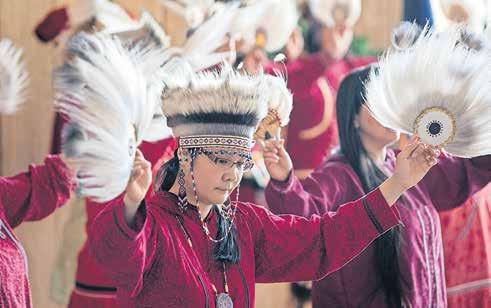
Soar through the artistry, traditions and contemporary voices of Alaska Native peoples. Pg. 56
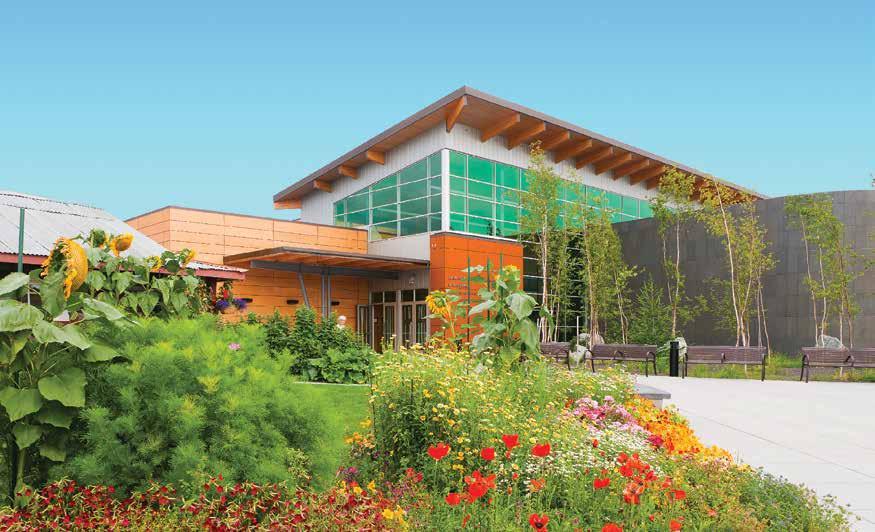
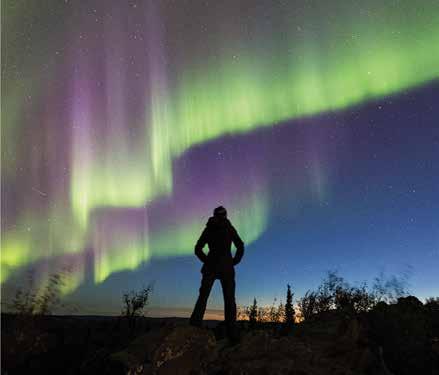
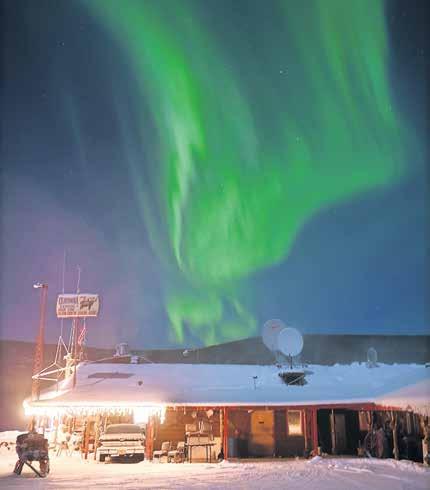
Be inspired by the light of the Aurora Borealis. Renew your energy under the Midnight Sun. Experience the warmth of Fairbanks Alaska’s Golden Heart and the basecamp to Denali, Interior and Arctic Alaska. Make the Morris Thompson Cultural and Visitors Center your first stop to planning your Alaskan adventure.
THE CLASSIC ALASKA EXPERIENCE — AND WHAT COMES NEXT
DEAR READER,
For this year’s Visitors’ Guide we asked artist, filmmaker and writer Mary Goddard to write a short guide for visitors who hope to learn more about Alaska Native culture and art. It’s an impossible task to condense such a vast topic into a single article, but in her graceful and practical essay, her core message is this: “We invite you to experience our home not only as guests, but as family.”
What struck me is how this resonates with every part of our mission in assembling this guide for you — we would like you to experience our home state as though you are not only a visitor but, as Mary puts it, “traveling as a good relative.”
That means helping you accomplish your bucket-list missions, whether it’s flightseeing around the summit of Denali, catching a salmon, riding on a dog sled or taking a boat tour right up to a calving glacier. Maybe there are quieter hits on that list: eating a reindeer hot dog grilled by a downtown street vendor or spending an afternoon at the Anchorage Museum seeing our most famous works of art.
Most visitors have limited timelines and finite dollars. What kind of good relatives would we be if we didn’t help you achieve the biggest priorities on your wish list? These are classic Alaska experiences for a reason.
But here’s the thing about classics — they are often the gateway for developing an appreciation for the deep cuts. And if you live in Alaska any longer than a handful of months, your must-see, must-do and must-eat list expands.
We appreciate a soaring alpine view and a cracking, iceblue glacier as much as anyone. There’s also great beer, quirky museums and surprising dining options to check out. Not to mention hole-in-the-wall dive bars, remarkable food trucks, a swanky Nordic spa and a roadhouse where they make pancakes from 100-year-old sourdough starter.
We’ve tried it all and we’d love to tell you all about it. After all — Alaska is a big state, and we don’t believe in gatekeeping when it comes to family.
— VICTORIA BARBER Editor
7 / DENALI NATIONAL PARK
How to get there, where to stay and more
9 / FLIGHTSEEING
Flight tours that will take your breath away
11 / BOAT TRIPS
Wildlife cruises, rafting and other water excursions
13 / WRANGELL-ST. ELIAS
Explore Kennecott Mines and more
15 / WILDLIFE
Where to see animals up close — safely
18 / HIKING
Stay dry, stay warm and have fun on the trails
ANCHORAGE
39 / Museums, galleries and cultural centers
43 / An insider’s guide to local dining
48 / Downtown Anchorage nightlife, shopping and more
VALDEZ
51 / Endless options at the end of the road
JUNEAU • SOUTHEAST • KODIAK
53 / Unforgettable ports of call
PUBLISHER Ryan Binkley
EDITOR Victoria Barber
PRODUCTION
COORDINATOR Nina Wladkowski
AD OPERATIONS Lisa McGuire
VP OF SALES AND SPECIAL PROJECTS Brandi Nelson
SALES MANAGER Kris Carlson
SALES Katie Collins, Ryan Estrada, Victoria Hansen, Joleesa Stepetin
20 / FISHING
Alaska’s fisheries are famous for a reason
22 / KENAI FJORDS NATIONAL PARK
A glacial wonderland you can drive to 26 / TRAVEL WITH CHILDREN
A practical guide for all ages
29 / CANNABIS
It’s legal in Alaskahere’s what to expect
32 / ALASKA BREWERIES
Where to sample some great Alaska beers
34 / GLACIER GUIDE
See that famous blue ice up close
36 / CLASSIC TRAILS NEAR ANCHORAGE
These hikes are can’t-miss favorites
KENAI PENINSULA
55 / Explore Hope, Seward, Soldotna, Kenai and Homer
56 / Alaska Native cultures and art FAIRBANKS
58 / City of spectacular extremes MAT-SU • EAGLE RIVER
61 / There’s magic in the Valley
GIRDWOOD • WHITTIER • SEWARD
63 / Plan your epic road trip down the Seward Highway
The newsroom of the Anchorage Daily News is responsible for the content of the Alaska Visitors’ Guide.
EDITOR Vicky Ho
PHOTO EDITOR Anne Raup
GRAPHIC DESIGN Kevin Powell
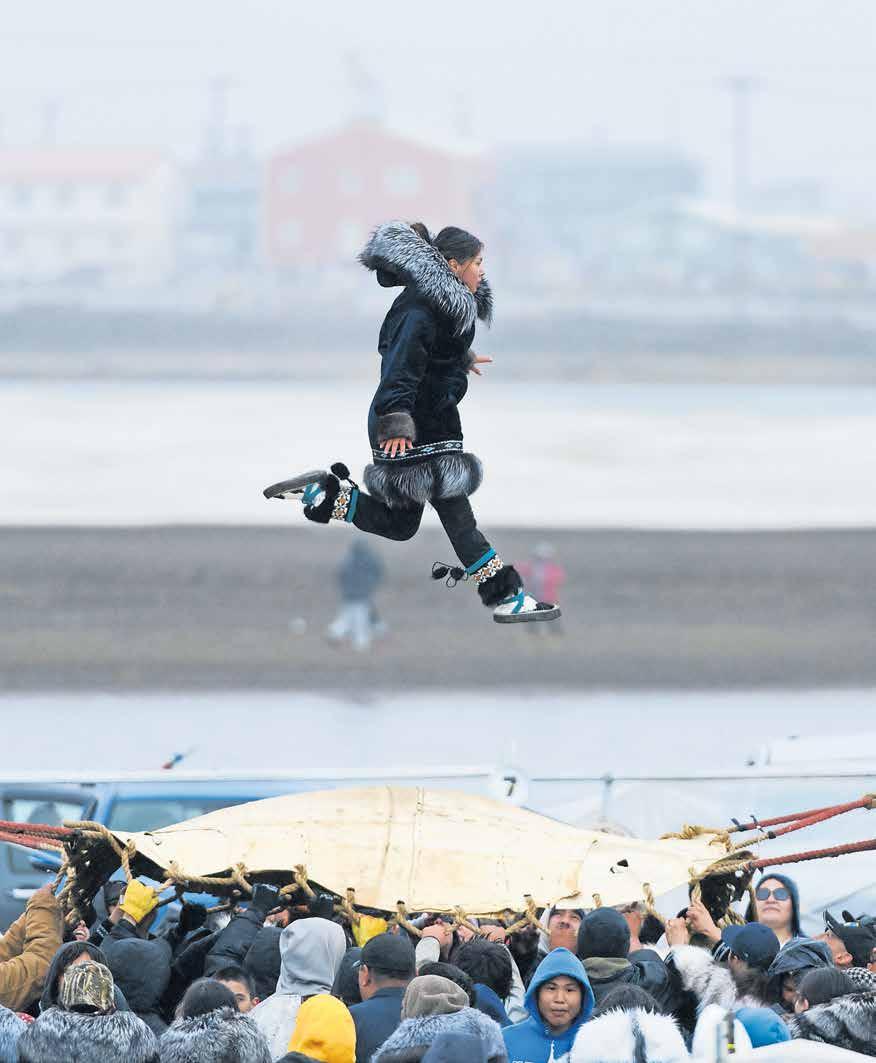
COVER PHOTO A woman soars during blanket toss. Photo by Marc Lester
CONTRIBUTORS Bailey Berg, Mary Goddard, Bob Hallinen, Alli Harvey, Erik Hill, Loren Holmes, Zachariah Hughes, David James, Marc Lester, Lisa Maloney, Emily Mesner, Josh Niva, Katie Pesznecker, Anne Raup, Bill Roth, Mara Severin
EXPLORING DENALI: GETTING THERE, WHERE TO STAY AND MORE
by BAILEY BERG
At6 million acres, Denali National Park and Preserve has options for every type of visitor. Whether you’re an avid backpacker looking to forge new trails or a relaxed traveler content to watch for animals on a tour, you’re sure to experience jaw-dropping scenery.
GETTING THERE
Located roughly four hours north of Anchorage and two hours south of Fairbanks on the George Parks Highway, it’s an easy drive to the heart of the state — after all, there’s only one road entrance to the park. If you don’t have your own wheels, here’s how to get there.
BUS: For a ride in a deluxe motorcoach, one option is The Park Connection, where travelers can either book tickets from Anchorage, Seward or Whittier. (Tickets are $115 for adults/$57.50 for children one way from Anchorage to Denali National Park.)
TRAIN: Taking the Alaska Railroad adds about three hours of travel time to your journey, but it goes through wilderness only accessible by track. Plus, there’s a dining and bar car, knowledgeable guides and dome cars with sweeping views of the mountains and valleys along the way. The train makes a stop on the nearly 1,000-foot-long railroad bridge over an enormous gorge known as Hurricane Gulch. On a clear day, you can see the mountain range from there. (A more economical option both in terms of funds and time is taking the rails one way and a motorcoach back. Bonus: You’ll see even more of the state.) Check out alaskarailroad.com for more information on riding the train. (The Denali Star Train is $205 for adults, $103 for children two to 11 one way from Anchorage to Denali.)
GETTING AROUND
The National Park Service maintains the only road leading into the park. It’s a 92-mile, mostly gravel route running parallel to the
Alaska Range to what was once the mining community of Kantishna. Normally, from late May to early September, visitors can drive the first 12.5 miles of the road to Savage River with just their park pass.
To go farther than the dozen-ish miles allowed to personal vehicles, travelers have to be on foot, bike or riding on one of the school-bus-style shuttles. You can hop on a cheaper, more flexible bus tour that allows you to get off and on and explore on your own, or you can take a narrated bus tour with a driver who crafts an itinerary for you. There are also courtesy buses that serve the portion of the park road that is publicly drivable, which includes stops at the sled dog kennel and Visitors Center.
For summer 2026, the road is expected to only be open to Mile 43 due to rock slides (the full 92 miles of road are expected to reopen in time for the 2027 season, as of this writing). Be sure to check the National Park Service site for the most up-to-date information before your visit.
‘WILL THE MOUNTAIN BE OUT?’: WHERE TO SEE DENALI
Rising 20,310 feet, Denali can be seen from Anchorage to Fairbanks on a clear day. But clear days can be hard to come by. National Park Service rangers stress to visitors that the mammoth mountain is out only one of every three days (a rule that isn’t hard and fast — it could be out for days at a time and then hidden for a month straight).
Even with its great height, the mountain isn’t visible from the park entrance, the surrounding campgrounds or nearby hotels. Miles 9 and 11 are your first chances of spotting it, the latter spot having a pullout and interpretive waysides with information about
the cliff. There are many other spots along the road that allow for peeks of the peak.
The most iconic view of Denali is at Reflection Pond, near Mile 85, but the road to that view is closed in 2026, unless you’re staying at one of the fly-in-only accommodations in Kantishna. The same goes for Wonder Lake, where Ansel Adams’ famous photograph of the mountain was taken. It’s also located at Mile 85 and therefore only accessible to those staying in Kantishna this season.
OPEN IN 2026
SLED DOG KENNEL: Denali is the only national park in the U.S. where rangers do winter patrols via dog sled. But during the few precious months when there isn’t snow on the ground, the dogs have different duties: educating tourists, posing for pictures and getting belly rubs. Their kennel is free to visit, and their handlers are available to chat about what goes into making a sled dog. (Bonus: There’s usually a litter of puppies there training to become full-fledged sled dogs.)
DENALI NATIONAL PARK VISITORS
CENTER: If you come in by train, the visitors center will be one of the first buildings you see. It’s the main information center in the park, with exhibits on the park’s history and the animals you might see in the boreal forest outside its doors. There are also various ranger-led activities and hikes that launch from there.
ADVENTURE SPORTS AND FLIGHTSEEING: Various operators tout all manners of escape from their storefronts on Glitter Gulch, a halfmile stretch of road near the park entrance. Activities range from ATV rides and ziplining near the park to rafting down the Nenana River or flightseeing around the mountain.
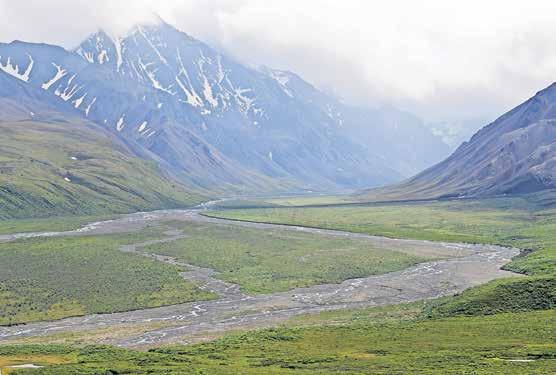
Weather rolls in on the East Fork River and surrounding landscape in Denali National Park and Preserve. PHOTO BY EMILY MESNER
Shop around to find an itinerary that matches your interest and budget.
CLOSED IN 2026: Due to the Park Road closure, Eielson Visitor Center (located at Mile 66) will not be open this summer. Be sure to check with the National Park Service for updates on when the Visitor Center will reopen.
If you’re planning ahead for 2027 and beyond, be sure to check the National Park Service site to see if you can add a shuttle to Eielson Visitor Center to your list. On a clear day, the views of Denali from the facility are stunning. Three maintained trails spider out from the center, and inside there’s a small art gallery with works depicting the wilderness of Denali.
WHERE TO STAY: There are four campgrounds in Denali National Park that will be accessible in 2026: Riley Creek (at the park entrance), Savage River (13 miles in), Sanctuary River (23 miles) and Teklanika River (29 miles).
The sites have anywhere from seven to 53 tent-only campsites, with the exception of Riley Creek, which has 150 sites suitable for camping and
RVs. Considering how few campsites there are in the park, we highly recommended you make a reservation ahead of time. For more information, go to reservedenali.com.
There are also many hotel, cabin, B&B and hostel options for visitors to Denali National Park. Many are clustered just outside the park entrance, a few are found at the end of the park road and more are located in neighboring towns, such as Healy (to the north) and Cantwell (to the south).
While remote, the accommodations at the end of the park road in Kantishna are far from roughing it. Places like Denali Backcountry Lodge, Kantishna Roadhouse and Camp Denali may be 92 miles into the national park, but they don’t skimp on creature comforts like running water, electricity, heat and private bathrooms (granted, there’s no cell reception and only Denali Backcountry Lodge offers Wi-Fi). Generally much spendier than the options at the park entrance, these lodges are usually all-inclusive. During the 2026 season, these accommodations are fly-in only.
Outside the park, your options vary widely. Crow’s Nest is made up of terraced rows of cozy cabins tucked up on a hillside, offering exponentially better views of Mount Healy the higher you go, and Denali Princess Wilderness Lodge and Holland American Denali Lodge are two of the biggest lodging options with high-end amenities, including an espresso bar, a dinner theater and laundry services. More lodging options can be found at denalichamber.com.
IS IT DENALI? OR MOUNT MCKINLEY?
For thousands of years, Indigenous Koyukon Athabascans called North America’s highest mountain Denali, meaning “The High One.” However, in the late 1800s, a prospector named
it Mount McKinley to honor then-presidential candidate William McKinley, who had no connection to Alaska. The name stuck federally in 1917, despite local resistance. The state adopted the Denali name in 1975, though it wasn’t until 2015 that former president Barack Obama restored the mountain’s Indigenous name for federal purposes, recognizing its deep cultural significance. In early 2025, President Donald Trump issued an executive order to revert the name back to Mount McKinley, a decision met with pushback from many Alaskans who said they’d continue to call the mountain Denali. So really, it depends on who you ask.
Bailey Berg is a writer who has covered Alaska for 10 years and is the author of “Secret Alaska: A Guide to the Weird, Wonderful, and Obscure.”
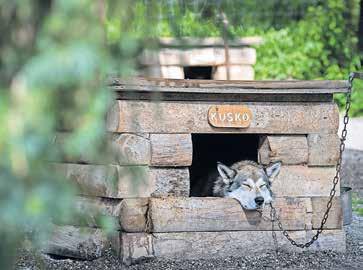
Kusko, a sled dog from Denali Kennels’ “Alaskan Youth” litter, sleeps in his dog house. PHOTO BY EMILY MESNER
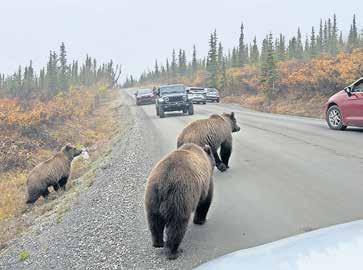
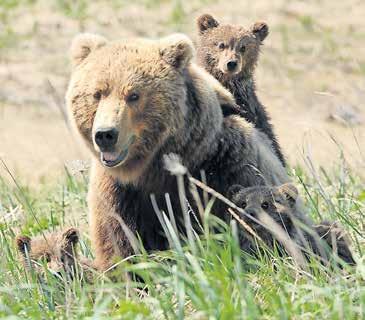
A brown bear sow and her two cubs negotiate parked vehicles as they cross the road in Denali National Park and Preserve. PHOTO BY BILL ROTH
FLIGHTSEEING TOURS TRANSPORT VISITORS TO PLACES BEYOND ROADS, RUNWAYS AND CIVILIZATION
by JOSH NIVA
Many of Alaska’s most iconic landscapes can feel practically impossible to reach: Denali’s summit, the glacial grandeur of Wrangell-St. Elias, the hidden coves of Kenai Fjords.
But there’s a not-so-secret Alaska travel hack that makes the state’s must-see sights remarkably accessible — no climbing ropes, kayaks or years of planning required. Flightseeing tours offer one of the easiest ways to experience Alaska, lifting visitors above rugged terrain into places with no roads, no runways and little sign of civilization. From the secrets of Southeast Alaska’s Inside Passage to the peaks and glaciers of the Alaska Range, from bear-viewing day trips in Southcentral to selfie time at the Arctic Circle, if it’s on an Alaska must-see list, there’s likely a flightseeing itinerary that gets travelers there.
That includes the state’s most popular aerial experience: a Denali flightseeing tour literally revolves around North America’s tallest peak. Planes lift off and climb steadily as Denali’s massive south face fills the windows. On clear days, pilots circle the 20,310-foot summit multiple times, flying past crags, crevasses and, occasionally, climbers inching their way upward.
The journey itself is nearly as memorable as the destination. Passengers soar above braided rivers, hanging glaciers and mile after mile of Denali National Park wilderness, every stretch narrated by pilots who know the terrain as
intimately as any trail map.
And Denali is only the beginning for Alaska flightseeing fun.
“So, you’re planning that bucket-list trip to the Last Frontier and you keep hearing that flightseeing in Alaska is the thing to do. It really is,” travel blogger Heather Kasvinsky of Alaska Adventurers writes. “Flightseeing gives you a rare chance to see and truly grasp the scale and shape of the landscape — glaciers, hidden valleys and remote peaks — that aren’t visible any other way.”
FLIGHTSEEING: UNIQUELY ALASKA
In Alaska, planes aren’t just used for tourism, they’re part of everyday life. And flightseeing here bears little resemblance to commercial air travel or scenic flights offered in many other travel destinations.
Small, sturdy planes and helicopters operated by experienced pilots typically carry just a handful of passengers, ensuring everyone has an unobstructed window seat and million-dollar views. Some flights stay airborne for the duration; others include landings on glaciers, remote lakes or backcountry airstrips for added adventure.
The experience is often described as breathtaking and unforgettable, but one of its defining qualities is how it expands what’s possible for travelers exploring Alaska. Flightseeing allows visitors to reach rarely seen landscapes quickly and safely, offering perspective on the state’s scale, geography and remoteness in a way that’s impossible from the ground.
What other form of Alaska travel reveals mountain ranges, vast ice fields, braided rivers, tundra, volcanoes and wildlife in a single day trip? Along the way, pilots double as tour guides, sharing stories, pointing out landmarks and often spotting wildlife from the air. With routes spanning every region of the state, flightseeing experiences fit a wide range of interests, schedules and comfort levels.
Getting travelers there are longtime Alaska operators employing pilots who love flying and showing off the state as much as their passengers love taking it all in. Pilots connect with guests through headsets, discussing landmarks and landscapes, sharing stories from the air and calling out wildlife sightings along the way.
With so many options across a state this large, it helps to think about flightseeing by theme rather than by route.
“Alaska offers some of the world’s most breathtaking and awe-inspiring flightseeing tours,” writes Alec Sills-Trausch, a well-traveled photographer and storyteller who operates the Explore with Alec website. “Whether you’re a first-time visitor or a seasoned traveler, exploring Alaska from above is a truly unique and exhilarating way to appreciate the beauty of this rugged and remote wilderness.”
POPULAR PEAKS
Nearly every flightseeing trip includes mountain scenery, but some are designed to deliver
maximum alpine drama.
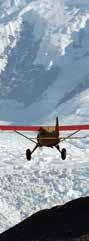
Denali National Park gets the brightest spotlight. Most tours include views of the summit (weather permitting) and landmarks such as Ruth Glacier, the Wickersham Wall and the Kahiltna Glacier, base camp for climbers. Some operators offer glacier landings, often on Ruth Glacier, where passengers step onto the ice to breathe alpine air, snap photos or enjoy brief excursions. Denali flights depart from several locations, including Anchorage, Talkeetna and the park entrance.
Denali is far from Alaska’s only mountain-heavy destination. Wrangell-St. Elias National Park and Preserve boasts four mountain ranges and nine of the nation’s 16 highest peaks, along with glaciers, rivers, wildlife and remnants of a copper-mining past. Closer to Anchorage, flights over the Chugach Mountains and Alaska Range deliver dramatic terrain, volcanoes and glaciers in surprisingly short trips.
GLACIER GREATNESS
Alaska’s glaciers are mesmerizing from the air, and literally chilling up close.
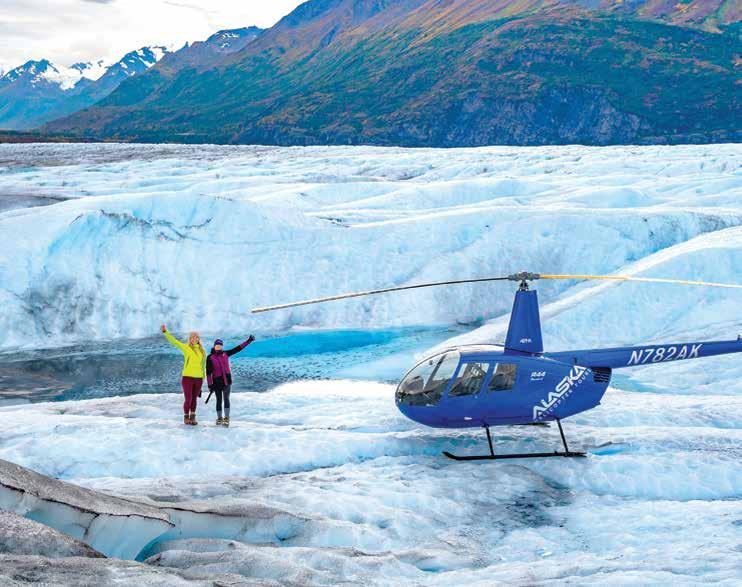
Many flightseeing tours include glacier landings, allowing visitors to step onto rivers of ice carved over thousands of years. Some trips add another Alaska classic: after landing, passengers meet sled dogs and their mushers, then take a short ride across the ice, a high-energy contrast to the stillness beneath their boots.
Knik Glacier, north of Anchorage, is among the most
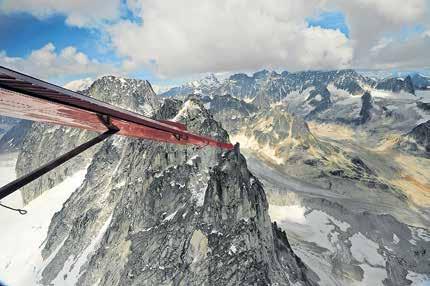
Journey above glaciers, gorges and peaks on a flightseeing tour for unique views of Alaska’s landscape. PHOTO BY BOB HALLINEN
popular destinations for glacier landings and add-on excursions, with helicopter tours from the Matanuska-Susitna area packing a lot of adventure into a half-day. On the Kenai Peninsula, flights from Seward soar over the Harding Icefield and its spillover glaciers, offering a bird’s-eye view of one of the largest ice fields in the country.
“Flightseeing is one of the best ways to get a sense of the vastness of the Harding Icefield,” the National Park Service notes. “Soaring over this expanse of ice broken only by isolated mountain peaks, or nunataks, is like traveling back over 12,000 years, to the Pleistocene.”
WILDLIFE VIEWING
FROM THE AIR AND GROUND
Few Alaska travel experiences rival bear viewing, and flightseeing makes it possible to reach coastal areas where brown bears gather to fish and forage.
From Anchorage, flights cross Cook Inlet to Katmai National Park and Preserve, one of the world’s premier bear-viewing destinations. At Brooks River and Brooks Falls, visitors observe bears from elevated platforms designed to keep people and wildlife safe while still allowing remarkably close viewing. Schedules typically follow salmon runs from late spring through summer, with several hours on the ground.
Other destinations include Lake Clark National Park, directly west of Anchorage, and Kodiak Island, home to the famous Kodiak brown bear. Each location offers a different perspective, but all provide memorable encounters with Alaska’s most formidable wildlife.
Even on flightseeing trips not dedicated to wildlife viewing, sightings of Dall sheep, mountain goats, caribou and the occasional moose are common.
KENAI FJORDS AND COASTAL SCENERY
Boat tours are often the way visitors explore
Kenai Fjords National Park, but flightseeing covers far more ground and water in less time. From the air, jagged mountains, tidewater glaciers, deep fjords and the Harding Icefield fall into focus, revealing a scale difficult to grasp from sea level. Watch for whale and seal sightings along the coast.
Prince William Sound offers similar coastal sights. Flights near Valdez reveal waterfalls, ice fields and Columbia Glacier, one of Alaska’s most impressive tidewater glaciers. Some tours include glacier landings or close passes over calving ice.
SENSATIONAL SOUTHEAST
Juneau, Alaska’s capital city, is a scenic gem. Helicopter tours fly around or land on popular glaciers such as Mendenhall, Taku, Norris and Herbert, often paired with aerial views of the Tongass National Forest.
Other Southeast ports also offer memorable flights. From Sitka’s Baranof Island and Mount Edgecumbe volcano to Ketchikan’s Misty Fjords National Monument, visitors experience rainforest-cloaked cliffs, waterfalls and marine wildlife. Flights from Gustavus access Glacier Bay, with options that include glacier landings, sweeping overflights of fjords and tidewater glaciers, and the occasional humpback whale below.
CUSTOM AND WILD OPTIONS
There are quirky curveballs like winter flights out of Fairbanks to the Arctic Circle and the community of Coldfoot to experience top-of-the-world wilderness and aurora watching, as well as flights into the most desolate and dramatic of parks: Gates of the Arctic National Park and Preserve
Ultimately, flightseeing is highly customizable. Operators regularly tailor trips for wilderness lodge drop-offs, fishing access, photography routes and multi-day adventures. Some flights combine sightseeing with hiking or camping logistics; others are built entirely around what passengers want to see and do.
PRICING, DEPARTURE POINTS AND MORE
Some travelers know exactly what they want to see; others start with a theme and plan from there. Either way, shopping around helps ensure the right fit for your goals, location, schedule and budget.
Departure points matter. A Denali flight from Southeast Alaska isn’t realistic; neither is a bear-viewing trip from Fairbanks. Trip length matters, too: options range from short scenic flights to full-day excursions with landings to multi-day drop-offs.
Prices vary by season, operator, aircraft and whether landings or ground time are included. Ballpark prices typically range from about $250 to $1,000 and rise from there, with higher fares for glacier landings, longer routes and full-day bear trips. Custom experiences are also available for travelers seeking a more tailored adventure.
Peak flightseeing season coincides with Alaska’s busy summer travel months, and popular flights fill up quickly. Flexibility is key. Weather can change fast, and delays or cancellations sometimes happen for safety reasons. Operators are generally happy to help travelers navigate expectations and alternatives.
READY TO TOUCH THE SKY?
From the air, Alaska becomes both largerthan-life and surprisingly accessible. Glaciers stretch like frozen oceans, mountain ranges rise in every direction, and the world below feels impossibly distant.
Flightseeing offers a rare chance to experience Alaska at its most expansive, and to carry that perspective long after the plane touches back down.
Josh Niva is a writer and former Anchorage Daily News reporter based in Anchorage.
GET UP CLOSE TO WILDLIFE AND GLACIERS BY KAYAK, CHARTER, RIVER RAFT OR PADDLEBOARD
by ALLI HARVEY
For many people, being near or out on water is at once deeply soothing and thrilling. If that’s true for you, Southcentral Alaska has world-class water adventures available for every level of ability.
UP CLOSE WITH THE GLACIERS
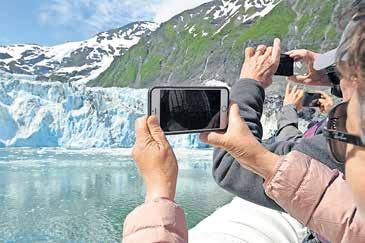
Picture an ice slab the size of a house cleaving in slow motion from a massive blue and white glacier, sending up sparkling spray as it slips into the water. You’re witnessing this in real-time from a boat, at a safe distance but still close enough to hear.
While seeing a glacier calving isn’t guaranteed, getting up close to the ice is reliably awesome. Bonus: You don’t need a perfect sunny day to get the best views. The beautiful glacial blues are actually more prominent when it’s overcast.
Several outfits offer boat tours less than a day’s drive from Anchorage.
If you’re based in Anchorage and have limited time, check out the M/V Ptarmigan to Portage Glacier. Only an hour’s drive from Anchorage, you’ll spend about an hour on Portage Lake cruising right up to the face of the ice. Tickets run $49 per adult and $29 per child.
For those with more time, the 26 Glacier Tour run by Phillips Cruises & Tours says it all in the name. Departing from Whittier, the nearly six-hour, narrated cruise covers 150 miles of Prince William Sound , and includes breathtaking views across College Fjord and Blackstone Bay. Tickets are $219 per adult, $137 per child, and include a meal and hot drinks, plus plenty of USB chargers onboard.
WILDLIFE VIEWING
Alaska isn’t just about pretty old ice: You’re here to see the diverse and often charismatic
wildlife! Whales, sea otters, puffins and Steller sea lions abound. Many day cruise operators focus on wildlife viewing (and you’ll likely get some glaciers in there too).
Based in Seward, Major Marine Tours cruises to Kenai Fjords, where the whalewatching in particular is world class — but then, like so much in Alaska, so is the rest. There is an array of day tours to choose from, including private charters. Prices range from
$99 for an adult or $49.50 per child, up to an 8.5-hour cruise at $309 per adult (no children under 12 on this itinerary).
Also out of Seward, Kenai Fjords Tours ventures into Resurrection Bay and beyond, offering options for different interests and food on every tour. Choose between a wildlife or glacier emphasis, or calmer water tours for those with concerns. Prices can range from $109 per adult/$54.50 per child in the early
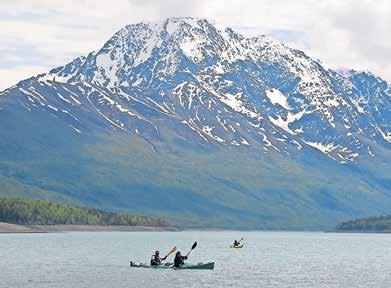
Paddlers kayak on Eklutna Lake near Anchorage. PHOTO BY BILL ROTH
WATER TOURS
season to $249 per person for an eight-hour Northwestern Fjord tour.
Want to get really close to the action? Little compares to paddling on calm blue saltwater near a wild and forested shore, watching shorebirds wheel overhead, spotting eagles on their perch, and seeing otters floating on their backs nearby. Homer provides a stunning starting point for outfitters such as True North Kayak Adventures, which offers kayak trips, gear rentals and even cozy lodging in gorgeous Kachemak Bay. A half-day kayak trip runs $165 per person.
Finally, while you’re out on the water, why not catch some dinner? There are myriad salmon and halibut fishing charter options in both Seward and Homer, and easy pack/ flash freeze/ship outfitters back on land to get your catch conveniently and safely processed. Check out Alaska Northern Outfitters in Seward and Homer Charter Fishing in Homer as starting points. Trips run roughly $400 per person.
RIVER RAFTING
Your view of Alaska is going to change the closer you are to the water. Guided rafting trips provide a family-friendly experience with a bit more of a rugged, adventurous edge. If you choose a guided rafting tour on
the Kenai Peninsula , you’ll experience an otherworldly green-blue river moving your raft swiftly along as you scan the shoreline for bears feeding on fish. This region is teeming with life. One outfitter is Alaska River Adventures, offering half- and full-day float trips beginning at $75 per adult/$37.50 for kids.
NOVA tours, based in the Matanuska Valley, offer a glimpse of a more rugged, exposed, grand Alaska that makes you feel like you truly are as far north as you traveled. The light hits differently up there across an expanse of glacially fed river and jagged mountain peaks. Their Matanuska River Whitewater Rafting tour promises a rollicking three hours out on the water (no experience necessary, but knowing how to swim is recommended) for $139 per person, ages 12-65.
Up for a spicier ride? Try a guided trip with Chugach Outdoor Center to Sixmile Creek, near Hope. This fabled local whitewater route is not for the faint of heart (or those who can’t swim). Choose between a Class IV, two canyon itinerary for $149 per person or three canyons including IV and V (the latter being more difficult) rapids ($225).
Finally, for the more experienced and intrepid explorer, try packrafting. For
BEAR VIE WING - FLIGHT SEEING - FISHING
the uninitiated, packrafts are inflatable and portable rafts designed to compress into a backpack, enabling you to flex your backpacking skills while accessing more remote, wild water. These versatile and increasingly popular boats allow you to hike in and paddle out. Alaska Packraft School guides an overnight packraft trip through fabled Crow Pass, a three-day experience that includes 15 miles of hiking and eight to 10 miles of rafting on Eagle River ($950). This year’s dates are Aug. 13-16, but custom dates are available July through September. The maximum group size is six people.
LAKES OF THE GREAT LAND
Alaska’s lakes feature heavily in the imaginations of many people imagining the far north, as they should — Alaska has over 3 million of them. Not even lifelong Alaskans will get to see every one, but there are some beautiful lakes worth visiting only a stone’s throw from Anchorage.
Eklutna Lake sits 12 winding road miles away from the Glenn Highway, tucked back away into the Chugach Mountains. But at 7 miles long, it’s the largest lake in the region. On a clear day, it glows an ethereal bluegreen. Lifetime Adventures at the lake’s edge provides day-rental kayaks starting at $50.
There is, of course, the aptly named Big Lake, located to the west of Wasilla in the Mat-Su Borough. Big Lake (the region and the body of water) is where Southcentral Alaska starts to feel more like the Interior region of the state, with its lower-lying topography and rural feel. The area is bustling in the warmer months since Big Lake’s 67 miles of shoreline hosts campers, boaters, fishers and more. Check out Berg’s Frontier Fishing Guides for lake fishing opportunities, running roughly $170 per person.
Craving even more adventure and an “only in Alaska” experience? Hardy travelers can try paddleboarding on a remote icy blue glacial lake accessed via helicopter at Knik Glacier with Alaska Sundog Guiding ($1,299 per person).
The options for witnessing Southcentral Alaska from its many waterways are as numerous as there are bodies of water. You could spend a lifetime trying to see every one. Instead, why not pick one or two standouts and enjoy yourself fully while you’re there? It’s as sure of a bet as you can make for creating an unforgettable life experience.
Alli Harvey lived in Alaska for 15 years before moving into an Airstream trailer to create landscape paintings while exploring more of the Lower 48 states. Alaska is tough to shake — Alli is most often spotted out on the trails on her frequent visits north.
WRANGELL-ST. ELIAS: BIGGER THAN DENALI AND A MAGNET
FOR ADVENTURE SEEKERS
by BAILEY BERG
At 13.2 million acres, WrangellSt. Elias is the largest national park in the United States, covering roughly the same area as the next two biggest national parks combined (Denali and Gates of the Arctic, also in Alaska). It’s difficult not to talk about the area in superlatives, because that amount of acreage holds a lot: four major mountain ranges; the second- and thirdhighest peaks on the continent; nine of the 16 highest peaks
in the U.S.; incredibly diverse wildlife; and the nation’s largest glacial system.
For true adventure seekers and wilderness lovers, the park is a kind of El Dorado, a place rife with opportunities to play — from backpacking, fishing and camping to rafting, hiking and climbing — and see wilderness in all its glory.
HOW TO GET THERE
Only two roads, both dirt, lead into the park: McCarthy Road and Nabesna Road. Of the two, the 60-mile-long McCarthy Road is far more traveled. You’ll know when the Edgerton Highway merges with McCarthy Road in Chitina because it will go from
pavement to dirt road atop what was once a railroad track. It’s slow going, with blind corners and potholes, but the scenery makes up for it: spectacular views of distant mountains, the Copper River raging below and the impressive Kuskulana River Bridge, which spans a vertigoinducing gorge. The road ends at the Kennicott River. From there, you cross the river on a footbridge and can either shuttle or walk
the half-mile to McCarthy or 4.5 miles to Kennicott.
Alternatively, Copper Valley Air Service flies four days a week between Anchorage, Glennallen, McCarthy and May Creek in June, July and August (and drops down to biweekly flights the rest of the year). Wrangell Mountain Air does three daily flights from Chitina into the park from midMay to mid-September.
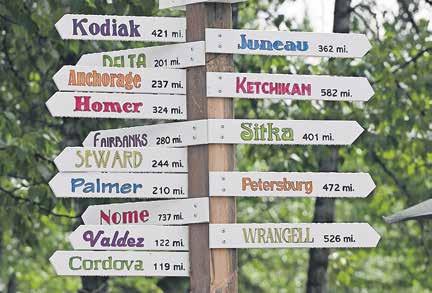
The Pioneers of Alaska erected a signpost in McCarthy, designating distances from McCarthy to other Pioneer Igloos within the state. PHOTO BY ANNE RAUP
WHAT TO SEE AND DO
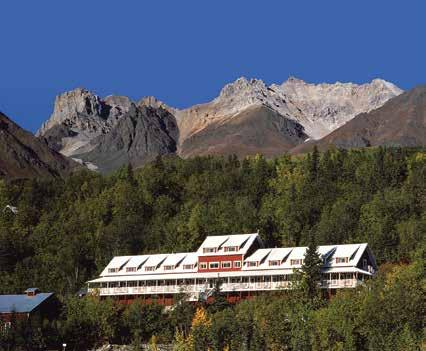
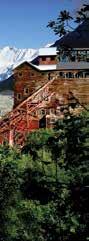
KENNECOTT MINES: Within 35 years, the Kennecott Mines went from being an established mining camp — pumping out copper around the clock — to a ghost town. For decades, the mill sat empty and abandoned. Then, in 1998, the National Park Service purchased the mill, power plant and many other camp buildings from private owners and began restoring them. You can take a tour of the mill, a 14-story behemoth that was used to process ore through a multistage process. The tour is worth it for the glaciers and mountain view from the top floors and the opportunity to check out the massive, nearly 100-year-old machinery. There’s also oodles of information about the history of the mines and the people who once worked there at the Kennecott Visitor Center.
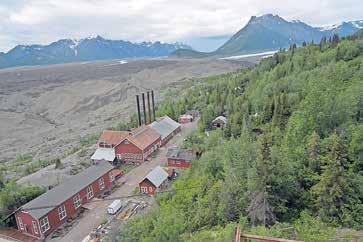
The view from high in the Kennecott mill affords expansive views of other mine buildings, as well as the Wrangell Mountains and the Kennicott Glacier.
MCCARTHY-KENNICOTT HISTORICAL MUSEUM: While it could be argued that both towns are museums in and of themselves, the actual museum, located in what was once a railway depot, does a good job of showing the history from the town’s inception in the late 1800s to today. You can see old photographs, artifacts, a miniature model of historic
McCarthy and a diorama of the Bonanza Mine.
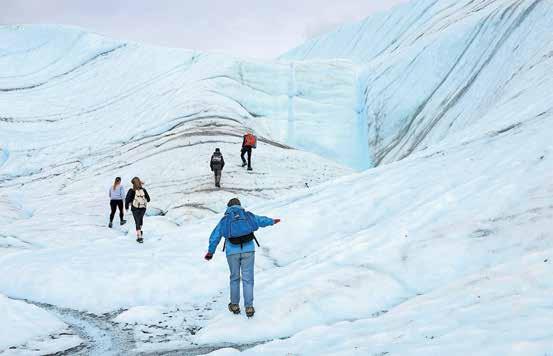
ROOT GLACIER TRAIL: Past all the wagon-red buildings of the mining camp on the far end of town is the start of the Root Glacier Trail. It’s an easy 4-mile round-trip jaunt out to one of Alaska’s most accessible glaciers. Even from a distance, you can look for the blue pools and streams speckled across the top of the glacier and admire the nearby peaks. If you intend to walk on the ice, wear good footwear and take appropriate safety measures.
GUIDED WILDERNESS
ADVENTURES: Companies like Kennicott Wilderness Guides, McCarthy River Tours & Outfitters and St. Elias Alpine Guides offer hiking, ice climbing, packrafting and multiday trips through the spruce forests, alpine tundra, glacier fields and canyons of the park.
Bailey Berg is a writer who has covered Alaska for 10 years and is the author of “Secret Alaska: A Guide to the Weird, Wonderful, and Obscure.”
Guided visitors explore Root Glacier near Kennecott. The glacier joins the Kennicott Glacier near the Kennecott Mine site in Wrangell-St. Elias National Park and Preserve. PHOTO BY ERIK HILL
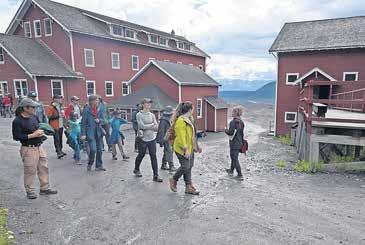
Dani Cowan, guide with St. Elias Alpine Guides, leads a tour of the Kennecott mill at the Kennecott Mines National Historic Landmark. PHOTO BY ANNE RAUP
The view from high in the the Kennecott mill affords expansive views of other mine buildings as well as the Wrangell Mountains, and the Kennicott Glacier. PHOTO BY ANNE RAUP
WHERE TO SEE MOOSE, WHALES AND OTHER WILDLIFE UP CLOSE
by BAILEY BERG
The 49th state is home to an astounding variety of wildlife: Some species are present at the highest density anywhere in the world. These animals have the power to captivate locals and visitors alike; you’ll often see cars pulling over to get a closer look. Here are just a few for your bucket list and tips on where to scope them out.
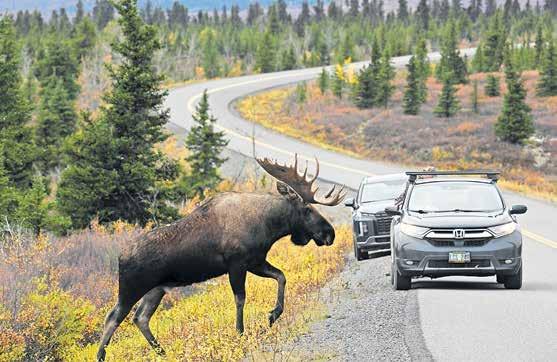
MOOSE: Locals will joke that moose are to Alaska what squirrels are to the Lower 48. While they’re not quite that ubiquitous, they do often show up where you’d least expect them — perusing a backyard garden, browsing shrubs in a grocery store parking lot or enjoying the long grass on the side of the highway. They’re hard to miss: Adult females weigh between 800 and 1,300 pounds and males tip the scales at 1,200 to 1,600 pounds.
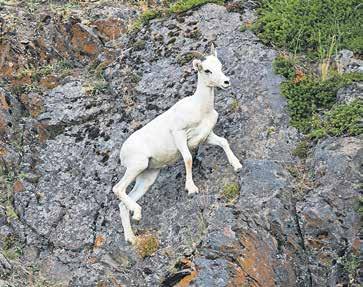
DALL SHEEP: Snow white with
small, curved, golden-brown horns, this nimble subspecies of sheep thrives in mountainous terrain, where predators can’t reach and humans don’t bother them. You might see them high up on the near-vertical rock face of the Seward Highway — where they can sometimes distract drivers and present a traffic hazard. They’re also found throughout Chugach State Park and scattered around Denali National Park and Preserve.
SALMON: Five kinds of salmon can be found in the rivers and streams of Alaska: sockeye (also called red), pink (aka humpy), king (or chinook), coho (silver) and chum (dog). During the summer months, salmon return from the sea to the waters where they were hatched. Their internal homing devices bring them remarkably close to where they entered the world, and that’s where they mate, spawn and die. You can watch their epic homecoming journeys
throughout the state, though one of the easiest viewing areas, Ship Creek, runs through the heart of downtown Anchorage. There you can watch kings, coho and pink salmon charging upstream and eager anglers standing shoulderto-shoulder, trying to fill their freezers. Kings start running in late May through July and cohos claim the river from August through mid-September.
BALD EAGLES: Bald eagles, Alaska’s largest resident bird of prey with a wing span of up to 7.5 feet, are a frequent sight in the Last Frontier. Some towns, like Unalaska/Dutch Harbor, are practically overrun with this national emblem. It’s estimated that a whopping 30,000 bald eagles are in Alaska.
WHALES: Take a boat in Prince William Sound or Resurrection Bay and, if the timing is right, you’ll see the tails of humpback, bowhead and gray whales waving in the distance. A few of the other kinds of whales in Alaska: beluga
Sharing Alaska’s Military History
• Located in Downtown Anchorage
• Alaska’s Military History from the Civil War to modern day
• Volunteer docent storytellers onsite
• Dozens of artifacts and exhibits
• All branches of the military represented
• Entry $5.00 - Kids under 5 are free.
Alaska Veterans Museum 411 W 4th AV, Suite 2A www.alaskaveterans.org (907) 677-8802
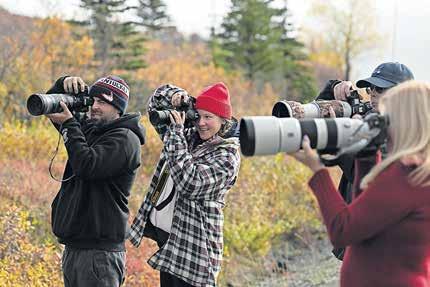
A flock of ptarmigan on both sides of Denali Park Road caught the eye of photographers traveling in Denali National Park and Preserve on a September day. PHOTO BY BILL ROTH
A Dall sheep looks for food along the rocks at windy corner along Turnagain Arm. PHOTO BY LOREN HOLMES
populations found in Cook Inlet and Turnagain Arm; bowheads, which come close to North Slope villages during their migration; and orcas, found in the Glacier Bay area through to the Aleutian Islands.
BEARS: Of the species of bear found in Alaska, the two you’re most likely to see are brown bears and black bears. Black bears, the smallest of the bunch, usually dwell in forested areas, but are also more likely to wander into town or pick through garbage cans. Brown bears, also called grizzlies, are spread throughout much of the state. A subspecies of brown bear, the Kodiak bear, is one of the largest kinds of bears and found exclusively in the Kodiak Archipelago. Then there’s the Arctic-dwelling polar bear, found in coastal areas above the Arctic Circle and on the North Slope.
If there’s one wildlife experience that consistently tops visitors’ Alaska bucket lists, it’s the spine-tingling excitement of
watching bears fish for salmon. And unlike many wildlife sightings here, bear viewing can be surprisingly reliable if you know where and when to go.
KATMAI NATIONAL PARK AND PRESERVE
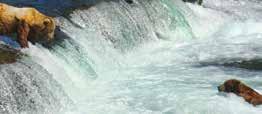
If you’ve got time for one bear trip, make it Katmai. Here you’ll find Brooks Falls, where, in the summer, dozens of brown bears line up at the lip of the cascade like anglers at their favorite hole, waiting for sockeye salmon to launch themselves over the waterfall to continue upstream to their mating grounds. Big males hold the best spots on the falls; younger and female bears patrol below for missed catches and slower moving fish. From the park service’s raised viewing platforms, you can watch the whole thing unfold at eye level — the splashes, the squabbles, the very satisfying moment when a fish gets plucked midair. Outside the park, Katmai’s
bears have become unlikely national celebrities. The park’s live bear cams draw millions of viewers each year and culminate in Fat Bear Week, an annual, bracket-style vote that tracks which bears packed on the most weight before hibernation. The event now regularly lands national headlines, including a New York Times declaration that “The Bears Are Back and They’re
A young bear cub climbs aboard his mother and prepares to leave the beach for more inland terrain at Hallo Bay. PHOTO BY ANNE RAUP
Fatter Than Ever,” turning individual bears into recognizable figures well beyond Alaska. Getting to Katmai requires a little planning: Most visitors take a small plane from Anchorage or King Salmon, either as a day trip or overnight at Brooks Lodge or the campground. While entering the park is free, the flight price typically starts at $1,200 per person from Anchorage.
BEST TIMING: Late June through July for peak salmon runs; September for fewer people and very chunky, pre-hibernation bears.
LAKE CLARK NATIONAL PARK AND PRESERVE
For a more off-the-grid feel, Lake Clark is a favorite among guides and photographers. Bears here aren’t just fishing; they’re digging for clams on tidal flats, grazing sedge meadows or dozing on beaches. It feels less like a spectacle and more like observing everyday life.
The other difference is proximity. With experienced guides who know the animals’ patterns, you can often sit on the beach or tundra and let the bears pass through at a respectful distance. It’s calm, unhurried and surprisingly intimate.
Most trips involve a floatplane from Anchorage to a remote lodge or guided day camp, which keeps visitor numbers low and the experience feeling wild.
BEST TIMING: June through August for coastal feeding; July through September for salmon streams.
KODIAK NATIONAL WILDLIFE REFUGE
Kodiak bears don’t just look bigger — they are bigger. Thanks to rich food sources and island isolation, they’re among the largest brown bears on Earth, with some males pushing 1,500 pounds.
Bear viewing here is typically done via fly-out trips to remote rivers and valleys inside the refuge. It’s more rugged and less infrastructure-heavy than Katmai or Lake Clark, which is part of the appeal: fewer people, more wilderness, and the feeling that you’ve truly gone somewhere hard to reach.
BEST TIMING: July through September during salmon runs.
WHERE TO SEE OTHER ALASKA ANIMALS UP CLOSE
ALASKA WILDLIFE CONSERVATION CENTER (PORTAGE): Each of the animals at the Conservation Center has a story. Uli, the female black bear, was found wandering downtown Juneau as a 5-pound cub; Jade, the red fox, was found by joggers after being orphaned; Artemis,
a musk ox calf, was found hiding under a raised utility building near Prudhoe Bay after she was separated from her herd. They’ve all found a lifelong home at the sanctuary, which is dedicated to animal care, conservation, research and education. The center has over 200 acres of habitat for the animals — including moose, wood bison, deer, elk, birds of prey, coyotes and reindeer. Some, like the wood bison, are raised and reintroduced to the wild. (Mile 79 of the Seward Highway, Portage, $30 per person ages 13 and up, $26 per person ages four to 12, with discounts available for Alaska residents and military)
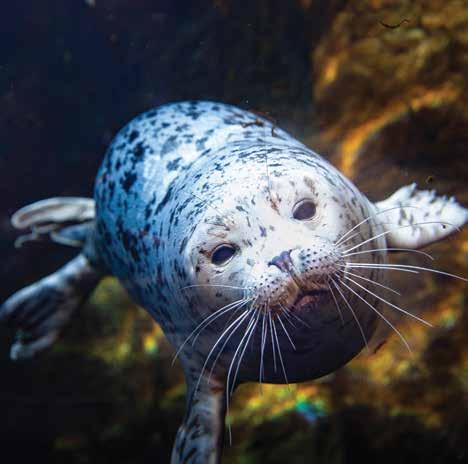
ALASKA ZOO (ANCHORAGE): Started in 1969 with just Annabelle, an elephant won by a local grocer in a contest, the zoo now includes more than 100 animals, including polar bears, Dall sheep, harbor seals and Arctic fox. Beyond simply providing a way to view the animals, the zoo focuses on education, research and animal rehabilitation. (4731 O’Malley Road, Anchorage, $25 per person ages 15 and up, $12 per person ages 3 to 15, discounts for Alaska residents, seniors and military)
ALASKA SEALIFE CENTER (SEWARD): The only coldwater marine science facility in the Western Hemisphere, the SeaLife Center in Seward is where to go if you want to see Steller sea lions, seals, puffins and other coastal birds, salmon, octopus, crabs, starfish and sea urchins. A big part of the SeaLife Center’s mission is rehabilitating injured or abandoned animals from throughout the state, so you might even see an infant walrus, beluga whale or other sea mammals. (301 Railway Ave., Seward, $32 per person)
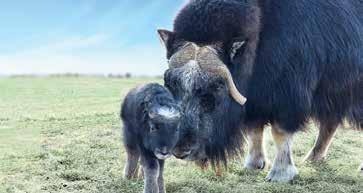
THE MUSK OX FARM (PALMER): Located on a Colony farm in Palmer, the Musk Ox Farm is a domesticated animal operation that began in 1964. Part of the farm’s animal husbandry involves collecting the hair that’s
shed from musk ox undercoats each spring. The fibers, called qiviut, are said to be softer than cashmere and warmer than wool when spun into yarn, which you can purchase in the farm’s gift shop. You can only get as close as the fences allow, but you’ll have no problem seeing the handful of new calves born each spring. (12850 E. Archie Road, Palmer, $16 per person for adults, $8 per person ages 3 to 17, $14 for seniors)
REINDEER FARM (PALMER): You can pet and feed the roughly 150 reindeer at the Reindeer Farm in Palmer — they’re friendly and will take grain pellets out of your hand. Fun fact: These same reindeer participate in the annual Running of the Reindeer at the Anchorage Fur Rondy festival each February (think running of the bulls, but with reindeer in downtown Anchorage). (5561 S. Bodenburg Loop Road, Palmer, $19 per person ages 12 and up, $8 per person ages 3 to 11, seniors, military or resident)
ROBERT G. WHITE LARGE ANIMAL RESEARCH STATION (FAIRBANKS): Bordering the University of Alaska Fairbanks, this research station is mostly devoted to studying musk oxen, which gives students at the university experience maintaining colonies of large animals. You don’t have to be a student to meet their musk oxen (and the reindeer and cattle that also live there) — LARS has regularly scheduled open hours in the summer and pre-arranged tours in the winter for visitors to stop by. (2220 Yankovich Road, Fairbanks, $20 per person for adults, $15 for kids ages 5 to 17)
Bailey Berg is a writer who has covered Alaska for 10 years and is the author of “Secret Alaska: A Guide to the Weird, Wonderful, and Obscure.”
Motorists watch a bull moose cross Denali Park Road. PHOTO BY BILL ROTH
HIKING TIPS: STAY WARM, DRY AND SAFE ON ALASKA TRAILS
by LISA MALONEY
You’ve got your backpack, your hiking boots and your bear spray. You’re poised at the trailhead — or are you? Shouldn’t there be a sign? Is that narrow footpath, leading straight uphill through the trees, really where you’re supposed to go?
Welcome to hiking in Alaska, where hard-working trail crews ensure that some of our trails do, in fact, come with the usual bells and whistles like navigation signs, switchbacks and even a few spectacularly situated open-air toilets. Meanwhile, some of our other trails are literally a wide
spot in the road with a footpath zooming straight up a mountain. What’s a visiting hiker to do?
PACK YOUR INDEPENDENT STREAK
First, a little research. Most mapping apps — AllTrails, GaiaGPS and Komoot to name a few — should have most of our major trails in them, although the accuracy of the trail names varies.
You might be surprised by how quickly some of our hiking trails take you beyond range of cellular service, so it’s always a good idea to download your route in advance and, if you’re out for anything more than a very short day hike, consider bringing an old-fashioned navigational aid — like a map and compass, supplemented by a good guidebook — in case your phone battery dies or the screen gets
broken.
As long as we’re on the topic of what to carry, I strongly recommend looking up the “10 essentials‚” a mind map of sorts for what you should have to address needs like navigation, shelter, water, food and fire in case of emergency. (A rundown of the 10 essentials list can be found on the website of the National Park Service.) It’s a very flexible system that can be tailored to the sort of outing you’re undertaking; my 10 essentials kit for short day hikes fits
in a quart-size zip-close bag. There’s one other thing you should always have with you, and it’s small enough to fit in any pocket: the peace of mind that comes from having filed a trip plan. That’s as simple as letting someone you trust know where you’re hiking to, how you plan to get there, plus when — and who — to call for help if you haven’t checked in by a designated time. The more identifying details you supply, such as your vehicle make, model, color and license plate, the color of your
The Winner Creek Trail passes through Chugach National Forest near Crow Creek Road in Girdwood. PHOTO BY MARC LESTER
outerwear, and the color/make of your tent and backpack, the easier it becomes for people to send help or find you in case of emergency.
HEY, BOO BOO!
There’s a funny push and pull when it comes to seeing wildlife on a hike. On one hand, it’s thrilling. On the other, meeting critters like moose and bears can be pretty scary, too — a perfectly normal reaction to wild animals that are much larger and stronger than you and have their own opinions about how your encounter should work out.
Consider, however, that there are plenty of bears and moose inside Anchorage city limits, too. They’re just so remarkably good at blending in that we often zip right by without realizing they’re there. They are living proof that most of the time wild animals want nothing to do with us, and will avoid us if given an opportunity.
That same principle plays out on hiking trails, over and over: As long as you travel in a group, make noise so critters can see and hear you coming, and avoid places you know are likely to generate an up-close encounter (for example, hiking beside salmon streams when the fish are running), bears and moose will usually melt out of your way so quietly, you’ll never even know they were there.
If you do happen to see a bear or moose, give them plenty of distance. And, as you may already have heard, never get between a mother and her young of any species, no matter how relaxed she might seem. Trust me on this one — it is a trap.
If you’ve done both of those things and the critter is still interested in you, it’s time to make some choices. With moose, the answer is simple: If you can get far enough outside their “bubble” that they no longer perceive you as a threat, they’ll leave you alone. In theory that means running away but, since even Usain Bolt can’t
outrun an angry moose, you’ll probably end up having to keep something substantial between you — a solid tree is ideal. For all their strength and speed, moose don’t corner all that well.
There’s more nuance to handling up-close bear encounters, and expert advice used to be determined by what species the bear was: Black bear or brown (grizzly) bear? Nowadays, biologists and other experts parse encounters out by their motivation: Is a surprised bear that feels the need to defend itself? Or is it an incredibly rare predatory attack?
Regardless of the answer, the No. 1 commandment for bear encounters is that you do not run. I’ll never forget interviewing a wildlife biologist who explained that because of a bear’s instinctive prey drive, “Even if it doesn’t want to eat you, it would love to chase you.”
That doesn’t mean you have to stay put. If you’re able to calmly depart the encounter without the bear following you, do. But if the bear does follow, the next step is usually to stand your ground, prepare any deterrents you’re carrying (such as bear spray, which is always a good idea to have along), and get increasingly loud and aggressive to deter Yogi’s interest. If a surprised and defensive bear makes contact, experts recommend that you play dead while protecting your head, neck and vital organs, staying quiet and still until the bear leaves the area.
And lastly, even though the odds are incredibly slim: If you do believe you’re experiencing a predatory attack, your mission is just the same as it would be with any other predator. Fight back to save your life.
GEAR
OK, so your No. 1 survival tool, your brain, is packed full of information. You know where you’re going, you’ve filed a trip plan and you know how to handle
wildlife encounters. But what on earth are you going to wear whilst engaged in your fabulous outdoor adventures?
The answer: Dress in layers. This is the same principle as carrying a jacket or sweater you can throw on if you find yourself getting chilly, or take off if you find yourself getting too warm. But because Alaska’s weather can be moody and quick-changing, it’s usually best to think in terms of a base layer (long underwear) that you wear under everything else; a weatherproof outer layer to keep out wind and rain; and an insulating layer, usually made of fleece or wool, that you wear in between the two. In really cold weather many Alaskans turn to puffy layers, made of down or synthetic materials, for lightweight warmth.
Try to avoid cotton as much as you can. That’s because when it gets wet — whether from windblown rain or your own sweat — cotton actually saps the heat from your body instead of making you warmer. That heightens your risk of
hypothermia which, yes, is possible even during the summer.
Don’t forget a good pair of hiking boots or shoes. Some people really benefit from the ankle support and sturdy foot protection of boots whereas others, like me, feel more comfortable in lightweight hiking or trail running shoes.
The most important thing is that whatever footwear you choose has great traction and is sufficiently warm to keep you comfortable. After all, the old adage that “there is no bad weather, only unsuitable clothing,” is very much true here in Alaska — and you wouldn’t want to miss a day of your trip.
Lisa Maloney is an Anchorage-based writer and author of numerous outdoor and travel guides, including “Day Hiking Southcentral Alaska,” “50 Hikes Around Anchorage,” “Moon Alaska” and the newest edition of “Alaska Off the Beaten Path.” Contact her at lisa@ maloneywrites.com, and follow her adventures as @hikingalaska on most social media.
FISH ON! ALASKA OFFERS A FISHING ADVENTURE FOR EVERY TASTE AND BUDGET
by JOSH NIVA
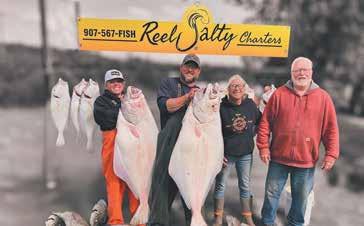
Afirst-time fisherman feels the thrill of reeling in their first silver salmon from Ship Creek in downtown Anchorage. A fly fisherman gracefully casts in a repetitious rhythm at a remote lake, hours after a floatplane drop-off. A heavyweight clash ensues between a fisherman and a hulking halibut from the deck of a deep-sea charter boat on Kachemak Bay. A sudden bend in a fisherman’s rod along the Russian River’s busy banks during a hot king salmon run makes nearby anglers snap to attention to see what prize gets pulled from the wild waters.
Fishing in Alaska is many things to many fishermen, with experiences as vast as the state itself and as diverse as the spectrum of species they dream of landing. And while the lore of sportfishing across the state is unquestionably world-class — and for some, a top-of-thebucket-list mission — most Alaska fishing adventures are incredibly accessible and achievable.
One surprising aspect of Alaska fishing is the range of opportunities available to every interested visitor, whether you’re an experienced fisher or a beginner. You might be on a tight timetable and budget or have built your entire trip around fishing, hoping to hook into any, or many, of Alaska’s all-star lineup of fish. The ultimate in access is Anchorage, Alaska’s travel hub and largest city, which offers easy connections to varied fisheries.
“The combination of size, diversity of habitats, and diversity
of fish species makes Alaska the ultimate fishing destination,” said Justin Driskell, who creates content across the state and beyond on his popular Alaska Fish Hunters YouTube (youtube. com/@alaskafishhunters) and Instagram (instagram.com/ alaskafishhunters) channels.
Marcus Weiner, founder and publisher of Fish Alaska magazine (fishalaskamagazine. com), expanded on that.
“Alaska is one of the best places on the planet to explore as an angler. It combines access and varied fisheries, with the opportunity to put together almost any kind of trip that you could conceive,” Weiner said. “From float trips to high-end lodge visits, guided salmon and bottomfish charters, some downtown DIY salmon angling or a quiet day on a lake, the Anchorage area offers an angler many choices.”
From Anchorage, the iconic postcard image of remote wilderness fishing becomes realistic. So does posting an epic video of a giddy friend landing a hard-fighting salmon or holding their prize catch. Anchorage is also a drive or boat ride away from freshwater and saltwater sweet spots on the Kenai Peninsula and in the MatanuskaSusitna region. And it serves as the launching pad for flights to off-grid trips, including multinight stays at faraway lodges where hospitality is matched by outstanding angling.
There’s “a bounty of opportunity for an Anchoragebased angler,” Weiner said.
Species like Arctic char, Arctic grayling, Dolly Varden char, rainbow trout and northern pike can all be caught within a short drive of Anchorage, Wiener noted. Anadromous species including sockeye salmon, pink salmon, chum salmon,
coho salmon, king salmon and steelhead trout are all within a day’s drive from Anchorage, when they return from the saltwater to their natal rivers. Saltwater charters for species like halibut, lingcod and rockfish are available across Southcentral Alaska.
WHERE TO GO
With proper planning and a little fisherman’s luck, anglers can net some of Alaska’s special species in its all-world fisheries. That winning combination fuels many of the state’s most popular fishing excursions out of Anchorage.
“Anchorage gives you all the comforts and convenience of a big city, and is a great jumping off point to explore the Kenai Peninsula or to take a fly-out to a Southcentral hotspot to catch fish, and still make it back to a good meal and a comfortable bed by evening,” Weiner said. “There’s probably not too many cities out there where you can walk to a river and fish for king or silver salmon.”
URBAN AND ROADACCESSIBLE FISHING: The low-cost, low-stress leader for Anchorage fishing includes everything from the famous salmon of Ship Creek downtown to creeks and fish-stocked lakes in every corner of town. Less than an hour’s drive away are additional highlights, including Eklutna Tailrace to the north and Bird Point to the south.
CLASSIC RIVER AND FRESHWATER FISHING: Big-time fishing is reachable farther along the road system from Anchorage. The world-famous salmon fishing on the Kenai River and nearby gems like the Kasilof River live
up to their billing, while Willow Creek, the Deshka River and the Little Susitna River offer everything from salmon to trout. Hiring a guide improves odds and access on both banks and boats.
“A lot of great fishing opportunities are on the road system,” noted Driskell, “and the laws and regulations allow for a huge amount of public access to amazing fisheries.”
SALTWATER AND DEEP-SEA CHARTERS: Discover a different side of Alaska fishing on daylong or half-day trips aboard guided saltwater charter boats. Seasoned captains and crews take groups from Homer, Seward, Ninilchik and Whittier to hunt for deep-sea dwelling halibut and rockfish. There’s also a chance of intercepting a salmon run and spotting wildlife along the way (breaching whales and puffins included). Charters typically run from $200 to $600.
FLOATPLANE/WILDERNESS
FLY-OUTS: Even the loftiest Alaska fishing fantasy has a guide with a plane or helicopter ready to make it a reality. Landings on remote lakes or sandbars along rivers accessible only by air place fishermen in hard-to-reach settings with fish that dominate their waterways. These are aspirational Alaska trips with price tags to match — and unforgettable returns on investment.
SPECIALTY FISHING: Other options include winter ice fishing around Anchorage and the MatSu, fly-fishing-focused outings across the state and family- or first-timer-friendly trips. A bit of research reveals the right fit for anglers seeking something popular, different or specific.
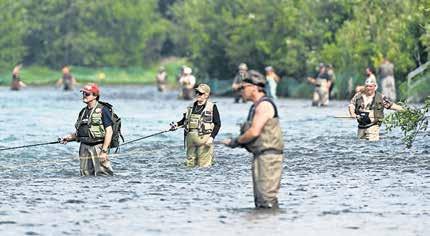
Fishermen work along the south side of the Kenai River near its confluence with the Russian River. PHOTO BY MARC LESTER
Even the most experienced Alaska fishermen admit there’s always someplace new to fish.
“I love the adventure that comes along with fishing in Alaska,” Driskell said. “When we are fishing a new place, half the fun is learning the river, exploring the area, figuring out what fish and food is around, and sometimes, what furry friends are around.”
WHEN TO GO
Sportfishing is a year-round activity across Alaska, though the action surges from May to September, when fish are active and accessible, salmon make their annual runs, Alaska’s midnight sun is warm and bright and fishermen are fired up.
“Any time of year, you can find some kind of fishing opportunity,” Driskell said. “I fish mostly for rainbow trout, Dolly Varden and salmon, and I can find fish to catch May through December, and that’s without cutting any holes in the ice.”
Overwhelmed by options? Looking for information and inspiration? These considerations can help:
• Consider where you’re based: Are you starting in Anchorage and other city? Or will you start from a port stop along a cruise route, or inland on the road system?
• What is your itinerary? Is this a trip built around fishing? Or is it a vacation with a small window to squeeze it in?
• Skill level and group makeup: First-timers may not want to tackle Kenai-area rivers alone, advanced anglers may skip urban fishing, and family trips should be easy and flexible.
• Budget and timing: Think through the species sought; whether you want to be self-guided or professionally guided; if you’re pursuing a walk-in, drive, boat ride or flight trip; your commitment to a half-day, full-day or multi-day excursion; any hotel return or lodge stays you’ll need; and plan whether you’ll bring gear or rent it locally.
• And, of course, the kind of fish you’re trying to catch.
A quick scroll of social media reveals a steady stream of Alaska
fishing videos and content, and there’s also an extensive lineup of books, magazines, websites, blogs and message boards devoted to the state’s fisheries.
KNOW BEFORE YOU GO: LICENSES, CLOSURES AND MORE
Alaska Department of Fish & Game remains the most reliable and comprehensive resource. The fishing section of adfg.alaska.gov shares information on licenses, regulations, restrictions and closures, and what’s happening across the state. Its We Fish AK and Go Fish AK sections help ambitious anglers and families with forums, how-to videos, stocked lake information and more. The Fish & Game app displays licenses and regulations, allows fishermen to record catches, and includes a sport fish species identifier.
Fish & Game’s Sport Fish Information Center in Anchorage (333 Raspberry Road) also provides fisheries information and visitor assistance. Curious anglers can even get geared up through the Rod Loaner Program.
Fishermen are often portrayed as secretive, but most Alaska anglers and retailers are happy to share tips, techniques and local insight. Whether chatting at a lake or shopping for tackle, just ask.
“One of my favorite things is helping someone who does not fish a lot land a fish,” Driskell said.
available online (adfg.alaska.gov and the Fish & Game app) and in free printed publications wherever fishing gear is sold. Emergency orders and closures are announced year-round: In fact, on Feb. 9, 2026, Fish & Game announced that king salmon fishing in most Southcentral region fisheries is either closed or restricted until June 2026 or later.
A FEW FINAL TIPS
• Alaskans buzz about dipnetting for salmon to fill their freezers, but only residents may legally participate.
“(A) good buddy comes to mind — when we were in college I took him fishing on the Kenai for kings. He caught like a 15- or 20-pound king. I have caught probably 100 of those in my life … (but he) was so excited he was shaking while holding up the fish. That feeling of giving someone that opportunity and excitement is priceless.”
Nonresidents age 16 or older must carry a sportfishing license, with options ranging from one day ($15) to an annual license ($100). King salmon fishing requires a separate tag, which runs an additional $15 for one day and up to $100 for a year. Licenses are available at most sporting goods shops, some grocery and convenience stores, and online by searching “License” at adfg.alaska. gov.
It’s also the fisherman’s responsibility to know regionand site-specific regulations and emergency orders, which are
• Ask about fishing derbies: Landing a tagged derby fish without a ticket purchased beforehand is a bittersweet bite when it could have paid for your entire Alaska trip.
• Always be bear aware and considerate — clean fish properly and dispose of fish waste responsibly.
No matter where your dreams take you, enjoy every cast, bite and moment of the truly special experiences Alaska fishing offers.
“I like to fish for a wide range of species using a wide range of techniques, and that’s all possible in Alaska,” said Weiner. “I also like to catch and harvest my own fish to eat for the year, so that’s part of the joy of fishing. But it’s much more than that. The sights, sounds, camaraderie, anticipation of what you might catch, and just being out in nature are what make it all worthwhile.”
Anchorage.
Josh Niva is a writer and former Anchorage Daily News reporter based in
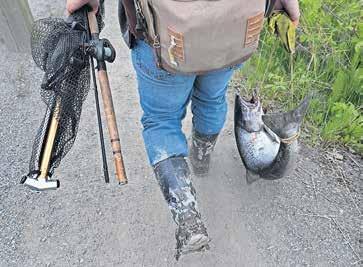
A fisherman carries a 15.75-pound king salmon that he caught while fishing an incoming tide at Ship Creek near downtown Anchorage. PHOTO BY BILL ROTH
KENAI FJORDS NATIONAL PARK: A GLACIAL WONDERLAND REACHABLE FROM THE ROAD
by BAILEY BERG
Kenai Fjords is one of the most accessible wild places in Alaska — and one of the most concentrated. In a single day, it’s common to see a tidewater glacier calve, a humpback whale breach, sea otters drifting in kelp beds and puffins tucked into cliffside nests.
The park covers roughly 670,000 acres along the edge of the Kenai Peninsula. More than half of it is draped in glacial ice. Above everything sits the Harding Icefield, a 700-squaremile expanse of snow and compressed ice that feeds dozens of glaciers still actively grinding their way toward the sea. Those
glaciers carved the steep-sided fjords that define the coastline today.
Unlike other protected lands in the National Park system, there’s no big interior road and no long scenic drive — this is a park you experience mostly by water or your own legs.
GETTING THERE
Kenai Fjords is one of the simplest national parks in Alaska to reach. The park’s gateway town is Seward, about 2.5 hours south of Anchorage along the Seward Highway; longer if you stop for photos (which you will).
The Seward Highway is one of Alaska’s classic road trips, tracing Turnagain Arm past waterfalls, hanging glaciers, and the occasional Dall sheep improbably perched on the narrowest of rock faces above the road.
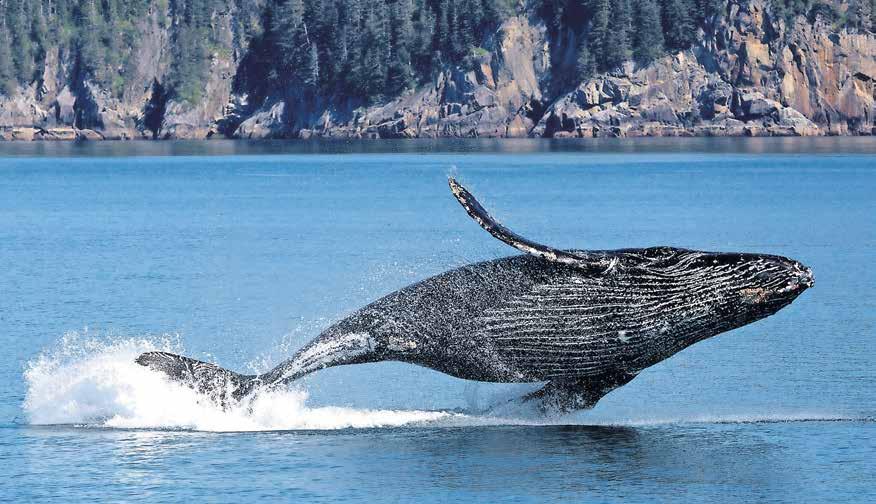
A humpback whale breaches in Kenai Fjords National Park. PHOTO BY KAITLIN THORESEN / NATIONAL PARK SERVICE
IF YOU DON’T HAVE A CAR TRAIN:
The Alaska Railroad runs daily summer service between Anchorage and Seward. The ride takes about four hours and threads through backcountry you can’t access by road — past wetlands, waterfalls, and the occasional moose sighting — with dome cars and a café car onboard. (One-way fares start at $133 from Anchorage.)
BUS: Several motorcoach operators, such as Alaska Tour and Travel, connect Anchorage and Seward, typically timed with cruise ship schedules. (One-way fares start at $80 per adult, $40 per child from Anchorage.)
THE GLACIERS:
WHERE TO SEE THE ICE ON LAND
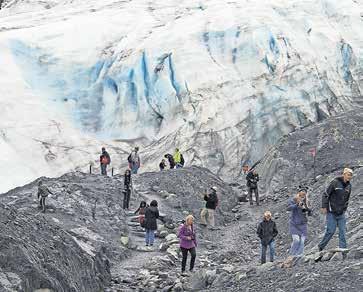
Exit Glacier is the only part of the park you can reach by car, and it’s where most people get their first look at the ice.
A short paved path leads toward the glacier’s toe, with several overlooks along the
way. It’s an easy walk, good for families and anyone short on time. What makes it especially interesting are the small signs posted along the trail marking where the glacier used to sit — decades ago, then decades before that. Each marker is hundreds
of feet from the next, so you can physically walk the timeline of its retreat.
threading into tighter fjords where tidewater glaciers like Aialik Glacier and Holgate Glacier spill directly into the sea. Ice starts appearing in the water — first slushy bits, then refrigerator-sized chunks glowing bright blue.
Half- and full-day cruises typically bundle glacier viewing with wildlife watching, which means you’re constantly scanning the water rather than sitting still. Dress warmer than you think you need. Even sunny days feel chilly once you’re near the ice.
If you want to see the source of it all, the Harding Icefield Trail climbs straight up the valley wall. It’s about 4.5 miles one way and gains more than 3,500 feet, so plan on most of a day. At the top, the trees fall away and the icefield spreads out in every direction — a solid, white horizon that feels more like an ocean than a glacier.
It’s strenuous, but it’s the best way to grasp the scale of what shapes this entire park.
BY WATER
Most people experience Kenai Fjords from the deck of a boat — and for good reason.
Boat tours leave Seward’s small-boat harbor and head out into Resurrection Bay before
Beyond town, boat tours into Kenai Fjords National Park reveal towering cliffs, tidewater glaciers, and abundant marine life — sea otters, seals, puffins, orcas, and migrating whales often make appearances. There are a range of companies offering day tours and boat charters — Major Marine Tours and Kenai Fjords Tours are two larger outfits — with tours lasting anywhere from four to eight hours. Some boats hold a half dozen people, others can accommodate 100 or more and include meal service and restrooms — check out the Seward Chamber website to research all the options. (Prices range from about $125-$380 for adults, with some discount prices available for children, military or Alaska residents.)
If you prefer something quieter, guided kayak trips let you explore the same coastline at paddle speed, slipping into coves and along rocky shorelines the larger boats skip.
Towers of rock jut out of Resurrection Bay in Kenai Fjords National Park. PHOTO BY LOREN HOLMES
WILDLIFE YOU’LL PROBABLY SEE
This is one of the most reliable wildlife spots in the state.
It’s common — not lucky — to see humpback whales diving near the boat, especially from June through August, when activity levels are at their highest. Orcas pass through some days. Sea otters raft together in kelp beds. Harbor seals lounge on ice. Steller sea lion colonies bark from rocky islands. Puffins and murres crowd the cliffs.
In total, nearly 200 bird species, around 30 land mammals, and more than a dozen marine mammals have been documented here.
WHERE TO STAY
Plenty of visitors try to squeeze Kenai Fjords into a quick day trip. It’s doable. But staying at least one night makes a big difference — especially if weather forces you to reschedule a boat tour.
There are a handful of hotels, including Harbor 360 Hotel and Seward Gateway Hotel, within walking distance of the small-boat harbor (where nearly every cruise departs early in the morning), restaurants, gear shops, and the park visitor center. Seward Windsong Lodge sits just outside downtown Seward, between the harbor at Exit Glacier, offering a
quieter, forested setting, plus easy perks like a shuttle, a bar and restaurant and larger rooms that work well for families or longer stays.
If you’re camping, Exit Glacier Campground is the only established
campground inside the park itself and puts you right at the trailhead for the glacier walks and Harding Icefield hike. Nearby spots like Miller’s Landing along Resurrection Bay offer additional tent sites and rustic cabins, while the neighboring Salted Roots cabins offer more seaside stays with a range of amenities.
If you want to wake up inside the park rather than commute in from town, consider Kenai Fjords Wilderness Lodge, a short boat ride across Resurrection Bay. Originally developed in the 1960s as a remote fishing and recreation camp, it was later rebuilt and expanded into today’s small lodge of private cabins strung along the shoreline with big windows, hot showers, and hearty, familystyle meals served in a central dining hall that looks straight out to the bay.
Bailey Berg is a writer who has covered Alaska for 10 years and is the author of “Secret Alaska: A Guide to the Weird, Wonderful, and Obscure.”
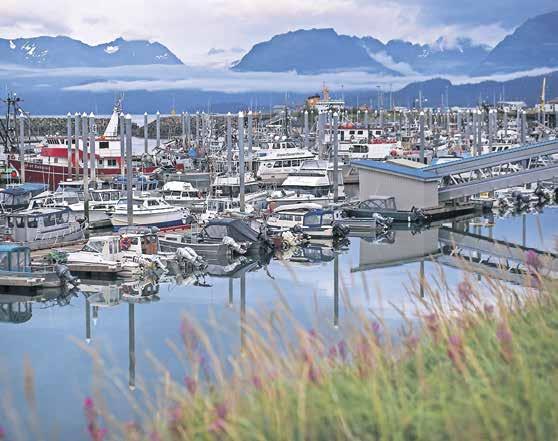
The Homer Boat Harbor. PHOTO BY EMILY MESNER
KID-FRIENDLY ADVENTURES IN AND AROUND ANCHORAGE
by ERIN KIRKLAND
With about 1,961 square miles of land making up the Municipality of Anchorage, there are a lot of options when it comes to exploring the state’s most populous area with kids. From forest trails in local and state parks to immersive museums and cultural experiences in and around Alaska’s biggest city, youngsters of any age will find plenty of activities, no matter their interest or abilities.
Stretch out everyone’s legs with a walk or hike on one of the many trail systems that wind through the city and nearby mountains. For a short walk among the forests and flowers native to the state, try the Alaska Botanical Garden at the eastern edge of town, where meandering pathways combine with interpretive signs and unique art just right for smaller kids.
Families wanting to explore the wilderness may enjoy one of many trails adjacent to town. Chugach State Park, the thirdlargest in the nation, offers visiting hikers the chance to get into the backcountry without ever leaving the city limits. With many hikes above treeline, it’s also one of the best ways to view
the Anchorage Bowl below, as well as Cook Inlet, the Alaska Range and, on a clear day, Denali. The Glen Alps trailhead provides access to a number of hikes that range from moderate to difficult. Parking fees are $5 per day, payable on site.
The Alaska Public Lands Information Center on Fourth Avenue has a wealth of information regarding local, state and federal lands in Anchorage and beyond, plus several interesting displays about local wildlife, history and natural science unique to Alaska.
Cover more ground by renting bicycles and pedaling along popular routes that pass through Anchorage neighborhoods and business districts. The Tony Knowles Coastal Trail travels 11 miles between downtown and Kincaid Park, with several parks and playgrounds along the way for rest breaks or a picnic, like Elderberry, Westchester or Lyn Ary parks. Ambitious bikers can try the Moose Loop challenge, a 32-mile ride combining four of the city’s main multi-use trails through the city’s urban greenways. When viewed on a map, the route’s shape resembles the head of a moose, one of Anchorage’s most iconic
wild animals. Grab a map and information about bike rentals at the downtown Log Cabin Visitor Center on Fourth Avenue.
One of the best ways to learn more about Anchorage’s history and cultural traditions is by visiting its museums. Downtown, the Anchorage Museum at Rasmuson Center features three floors of permanent and rotating exhibitions specific to Alaska’s culture, industry and history. The all-ages Discovery Center is designed specifically for children, with interactive science, art and nature displays.
The Alaska Native Heritage Center, just minutes from downtown, is situated on 26 acres of land and includes both indoor and outdoor exhibitions that explore the history, traditions and lifestyles of Alaska’s First People. Catch a demonstration of Alaska Native games by local youths, visit authentic replicas of dwelling houses constructed to teach the similarities and differences among Alaska’s Native tribal groups, and join in the dancing and drumming presentations held each day. The center is Alaska’s largest cultural facility, and there’s something to pique everyone’s interests.
The whole family will also
enjoy the Alaska Aviation Museum, found along the shoreline of Lake Hood, the world’s busiest seaplane base. Featuring four hangars of vintage aircraft, including an Alaska Airlines jet, and exhibitions showing off Alaska’s long relationship with flight, the museum has plenty of hands-on activities for kids, including flight simulators, touchable aircraft and the Seybert Tower, where live radio transmissions from Lake Hood are routed so visitors can listen.
Any trip to Alaska would not be complete without a look at the wildly popular sportfishing industry. Fortunately, Anchorage provides many opportunities to drop a line in the water, and children are welcome to try their hand at landing a fish. The Alaska Department of Fish and Game office on Raspberry Street provides a rod loaner program for kids, and can advise on current licensing requirements and regulations. Staff are also on hand to provide maps and information about the best fishing spots in town.
A great place to learn about Alaska’s fish species is at William Jack Hernandez Sport Fish Hatchery along the banks of Ship
Spotted Lady’s Slipper orchids are in full bloom at the Alaska Botanical Garden. PHOTO BY ANNE RAUP
Creek in downtown Anchorage. Here, kids can witness the eggs-to-fingerling process of Alaska’s sport fish populations before they’re taken to local waters for anglers to catch. There’s even an outdoor viewing area where salmon, returning to their home waters, splash their way up Ship Creek for spawning each summer. Just downstream of the hatchery is The Bait Shack, where parents and kids can rent a full line of gear (and receive helpful tips from longtime fishers).
And speaking of wild critters, make sure you take the kids to The Alaska Zoo, located just off O’Malley Road in South Anchorage. Open daily and featuring a wide variety of mammals and birds suited to life in northern climates, the zoo offers a quiet, forested retreat during an otherwise busy day. There’s a small cafe and plenty of space for picnic lunches or dinners when everyone’s hungry. The zoo also offers a free shuttle during the summer months from downtown Anchorage (online reservations required at alaskazoo. org).
For a longer day trip outside the city proper, drive south along the Seward Highway to Girdwood. A designated Scenic Byway, this 40-mile stretch is a wonderful area to look for beluga whales in chilly Turnagain Arm, Dall sheep on the rocky cliffs above, and the
occasional moose browsing along popular “Bird to Gird” trail adjacent to the highway.
In Girdwood, take the Alyeska Resort Aerial Tram to the top of Mount Alyeska for a bird’seye view of scenic Glacier Valley with its seven hanging glaciers circling the area. Take the tram both ways, or hike one way up or
down the steep slope for a truly invigorating adventure.
Girdwood is also home to Crow Creek Gold Mine, a well-preserved mine site dating back to 1896, with authentic buildings, equipment and the chance to pan for gold along the rushing creek itself. Kids will enjoy
Chomper, the Anchorage Museum’s common snapping turtle, explores its space in Anchorage at the museum’s Discovery Center. PHOTO BY BOB HALLINEN
wandering the mine structures and artifacts before taking a short walk to the creek with a gold pan and bucket of “paydirt” with which to try their luck at striking it rich.
Just south of Girdwood is the Alaska Wildlife Conservation Center, a 200acre sanctuary for animals not able to live independently in their own habitat. Kids will love wandering the 1.5-mile loop to view animals like moose, musk ox, brown and black bears, wolves and a herd of wood bison. Want to have a truly immersive experience? Try one of the animal encounter tours that go behind the scenes for a deeper education on the habitats, health and care of the center’s critters.
For those wanting to venture deeper into the local wilderness, Eklutna Lake sits deep within the Chugach Mountains 22 miles from downtown Anchorage. Operated by Alaska State Parks, this 7-mile-long lake is a glorious turquoise color and features plenty of hiking and biking trails along and near the shoreline. Or, take to the water aboard a kayak rented from a lakeside outfitter and see the stunning landscape in a different way. Kids will also enjoy playing along the shoreline at one of the many day use sites. Parking fees are $5/day, payable on site.
At the end of the day, don’t forget to stop at Wild Scoops ice creamery on E Street downtown, or on Benson Boulevard in Midtown, for an Alaska-themed treat. This microcreamery makes truly delectable scoops representative of the state’s favorite flavors.
Erin Kirkland is a travel writer who has covered Alaska’s family-friendly destinations and activities since 2009
Children play tag at Russian Jack Springs Park in Anchorage. PHOTO BY LOREN HOLMES
CANNABIS BUYERS GUIDE: ALASKA LAWS, WHERE TO SHOP AND FINDING
UNIQUE LOCAL FARE
by ZACHARIAH HUGHES
So, you’re visiting Alaska and wondering about weed.
These days, buying and consuming legal weed in the 49th state is not much different from places like Oregon or Massachusetts. Whether you’re a cannabis connoisseur or just looking to sample a novel local offering during vacation, pot shops in Alaska are likely to have whatever you’re looking for. But
you might pay a little bit more for it.
THE BASICS
Alaska has long had permissive rules when it comes to cannabis, but following a 2014 ballot initiative, the state fully legalized recreational consumption for anyone 21 and older. That includes tourists, as long as you can provide a valid government ID. Cannabis is regulated more or less like alcohol, so if you’re wondering whether something is legal or not, ask yourself: “Would I get in trouble doing this with an open beer or spiked seltzer in my hand?”
The big caveat is that Alaska
has almost no equivalent to bars or restaurants for pot. With the exception of one establishment in Fairbanks, Good Titrations (which bills itself as “one of the first on-site consumption cannabis cafés in the nation”), there are no “pot cafes” or easy commercial locations in which to light up.
This leaves visitors with relatively few places to legally consume. Most hotels and bars ban indoor smoking (of everything). While there are ample outdoor smoking areas, and it is not uncommon to detect whiffs of pot smells emanating from them, within the Municipality of Anchorage and several other jurisdictions it is technically unlawful to consume cannabis there, even non-odiferous versions like edibles and vape pens. If you’re staying on private property like an Airbnb or lodge, check the rules or with your host. As with
alcohol, it technically remains unlawful to consume in public parks and greenbelts.
This all gets especially confusing given that federally governed entities like planes, marine ferries and national parks within Alaska still have full prohibitions on cannabis.
WHERE TO BUY
Most cities and towns in Alaska have cannabis retail shops, and they are rarely hard to find. You can literally just Google it. If you’re in population centers like Anchorage, Juneau or Fairbanks, you should have no problem finding a number of reputable, high-quality retailers, many of them right in the centers of downtown. Even smaller towns that tend to see lots of summer tourists and cruise-ship passengers have multiple wellstocked businesses with a full range of products.
This is not the case in small,
Budtenders at cannabis retail shops around the state are a resource for information about local marijuana varieties. PHOTO BY BOB HALLINEN
rural, primarily Indigenous communities, some of which have bans on cannabis commerce as they do with alcohol. While under Alaska statutes “a local government may not prohibit the personal use and possession of marijuana and marijuana products,” they do have something called “local options laws,” which allow a community to ban the importation and sale of them. While bigger hub communities like Nome, Kotzebue, Bethel and others have pot shops, almost none of the smaller villages in rural Alaska do. Currently, the state’s Marijuana Control Board does not have a list detailing individual communities’ local option laws for cannabis.
Shops abide by strict standards for IDing customers, so make sure you have your driver’s license or a state-issued ID handy when you enter. They also deal primarily in cash, though businesses will typically have an ATM on site for withdrawals.
Once inside, “budtenders” are there to help you find what you need, and they’re generally exceptionally well versed in the attributes of the products on hand. Don’t be afraid to ask questions. Staff, especially budtenders, are accustomed to helping customers find what they’re looking for, not dismiss or belittle people. If you are new to pot, don’t be afraid to ask questions.
Same as you would with a barista or bartender, always tip your budtender.
WHAT TO BUY
Owing to a number of regulatory and financial factors, Alaska has a unique cannabis industry relative to other states that have legalized recreational use. While there are some bigger players, the state’s cultivators, manufacturers and retailers are generally small and independently run. Although there’s been a degree of consolidation in the sector the last few years, we are overwhelmingly a “mom and pop”-type cannabis industry, without a ton of major corporate, heavily financed conglomeration that has dominated some states in the Lower 48.
The cannabis scene here is creative, collegial and comprehensive. You’ll find most of the same products you’d encounter in bigger, more sophisticated markets. The catch, though, is that the range
of options, particularly for more cutting-edge and highly refined products, is narrower.
And a bit more costly. Everything is more expensive in Alaska, from energy costs to cultivation equipment to labor, and that’s reflected at the point of sale. Businesses work hard to keep costs low for consumers, but you’re still likely to find products a bit pricier than if you were buying them in Colorado or Washington, for example.
Bud flower remains the most popular product in retail shops across the state, with plenty of strains to choose from.
Higher THC strains are are the predominant offering at product counters. Some say this is because of users’ preferences, others say it has more to do with market incentives created by the state’s policy of collecting a flat tax on raw cannabis according to weight, not strength. Regardless, if you’re wanting lower potency
flower you may have to work a little harder to find it.
There are lots of small and ambitious edible operations that have thrived in the last few years. Cookies and gummies, sure, but also highly local fare like THCinfused fireweed honey, cannabis ice cream and “Sled dawg cherry soda,” which … does not actually come from sled dogs. It can be hit or miss wandering into a shop if you have a specific edible product in mind, so check menus online or look up an edible manufacturer’s website and see where they sell their products. Better to go in with an open mind than a shopping list, basically.
As far as more avant-garde concentrate products go, from disposable vapes to sugar wax to live rosin, Alaska lags a little behind what’s happening in major markets. Again, it’s best to query a particular store or company in advance if you have a specific product you’re intent on purchasing, many of them put their menus up on their websites. Again, you can literally just google it.
Whatever your level of interest in cannabis, spending a little cash while you’re visiting (even if it’s just on a shop T-shirt or hat) supports local businesses and chips in a bit of tax money to our state and local budgets, which are things to generally feel good about.
And lastly: Always, always tip your budtenders.
Zachariah Hughes is a staff reporter for the Anchorage Daily News.
Like most commodities, you’re likely to find that familiar cannabis products are a bit pricier in Alaska than in the Lower 48. PHOTO BY MARC LESTER
SIP YOUR WAY THROUGH ALASKA’S EXCEPTIONAL CRAFT BREWERY SCENE
by MARA SEVERIN
In exchange for living in what is perhaps the country’s most beautiful state, Alaskans sometimes have to do without: professional sports teams, Trader Joe’s and, well, sunlight for half the year. But we make up for it with the Iditarod, reindeer sausages and chasing the aurora borealis. In other words, we often have to make our own fun. And by “fun” I mean “beer.” Those words are interchangeable, right? Beer is a big part of life for Alaskans. We hike with it, camp with it, boat with it, cook with it and pair it with foods like the stuffiest of sommeliers. We throw it monthly birthday parties like the First Tap events at Broken Tooth Brewing Co. (otherwise known as Bear Tooth Theatrepub and Moose’s Tooth Pub & Pizzeria), complete with national musical acts like Modest Mouse, Clinton Fearon, and Norah Jones. We even occasionally do yoga with it (at downtown’s Williwaw Social). In other words, we take it everywhere and we take it seriously.
Beers from the state’s biggest brewery, Alaskan Brewing Co. based in Juneau, might already be in your refrigerator if you live in one of the 25 states where it’s available. Established in 1986 by Marcy and Geoff Larson, it was the 67th independent brewery to open in the country. With a steady line of signature brews, including their most recent “Wildness” beer, it’s the most well-established of all the state’s breweries.
Expect seasonal specialties that incorporate ingredients like cranberries, raspberries, locally roasted coffee, locally grown white wheat from the MatanuskaSusitna area and even Alaska spruce tips. Ubiquitous around Alaska, this is our Papa Beer, if you will (I’ll show myself out).
But Alaskan Brewing is just one out of the more-than 50 breweries, distilleries, meaderies and cideries in the state (for an excellent list visit brewersguildofalaska.org).
And while almost half of them are in Anchorage or within a short drive of our state’s largest city (including the relatively populous communities of Girdwood, Eagle River, Palmer and Wasilla), some of our most remote ports of call and tiniest towns are also in on the brewing action (I’m looking at you, Cooper Landing Brewing Company in Cooper Landing,
population 231).
The ever-expanding Denali Brewing Co. in Talkeetna (population 997) may be a smalltown hero, but it’s anything but small. Their four signature beers — Mother Ale, Chuli Stout, Single Engine Red and the everpopular Twister Creek IPA, as well seasonal brews like Slow Down Brown and Flag Stop Milepost #3 — are year-round mainstays of summer barbecues and winter bonfires around the state.
This brewery is also home to the more recently established Alaska Cider Works, Alaska Meadery (featuring “Razzery,” a mead made with raspberries, sour cherries and apples) and Denali Spirits (featuring vodka, gin, whiskey, and “smoke” whiskey), because when you’ve fermented one, why not ferment them all?
(Denali Spirits’ canned cocktails, especially their blueberry mojito, have been so popular in Anchorage that at one time there was a Facebook page largely dedicated to tracking them down. Luckily, supply has since
caught up with demand.)
Some breweries are even more remote. Ports of call and island hopping here can be one way to get your fill of hops. Breweries can be found in Ketchikan (Bawden Street Brewing Co.), Kodiak (Kodiak Island Brewing & Still, Double Shovel Kodiak Cidery and Olds River Inn), Homer (Homer Brewing Co. and Grace Ridge Brewing Co. for beer, and you can also check out Sweetgale Meadworks & Cider House for hard cider and locally sourced meads featuring ingredients like nagoonberry), Sitka (Harbor Mountain Brewing), Seward (Seward Brewing Co. and Stoney Creek Brewhouse), Valdez (Valdez Brewing and Growler Bay Brewing), and Skagway (Klondike Brewing Co. and Skagway Brewing Co.).
Of course, many trips to Alaska begin and end in Anchorage. And if, during your travels, you’ve foolishly left some beers untasted, you can make up for lost time in our state’s biggest city which boasts — let’s
Tent City Taphouse features several Alaska beers on tap. PHOTO BY BILL ROTH
face it — a ridiculous number of exceptional craft breweries.
Downtown’s Glacier Brewhouse specializes in oak-aged English and American West Coast-style beers, 13 of them, from blondes to stouts. Beneath the floor of the Brewhouse is a “Wall of Wood” comprised of casks of special release beers that are conditioned in oak barrels once used to age wine and bourbon. The history of the oak imparts “mother tongue” flavor characteristics, like vanilla and coconut, into these limited edition brews. Opt for one of these unique beers or choose from their flagship choices like raspberry wheat, oatmeal stout, imperial blonde, Bavarian hefeweizen or a flight that includes them all.
Down the street is 49th State Brewing Co., which expanded into Anchorage from its original location in Healy, at the edge of Denali National Park and Preserve. If you are unable to visit their flagship location, where you can sip beer while playing bocce or horseshoes on the lawn, you can
catch up with them here. There’s a unique selection that includes beers like Smok, a smoked lager, as well as seasonal offerings like the Tiger’s Blood Sour, an homage to shave ice described as ”ferociously fruity.” Or there’s “Apple Fritter Ale,” with hints of cinnamon, icing, caramel, and vanilla. This location also boasts some of the best views in Anchorage and an expansive outdoor rooftop patio.
Just about all of the fullservice restaurants in downtown Anchorage proudly feature some variety of Alaskan beers. In the heart of downtown, Humpy’s Great Alaskan Alehouse prides itself on a huge selection of beers, both international and local. Tent City Taphouse offers a diverse and carefully curated list of 24 rotating local brews, including their house beer, Tent City Tangerine IPA brewed by Glacier Brewhouse. Tent City regularly hosts “Taste of the North” beer dinners featuring Alaskan brewers. One, in collaboration with Grace Ridge Brewing Co., featured smoked
salmon canapes with Black Pepper IPA, classic beef Wellington with an Oystercatcher stout and roasted honey lamb chops with a Winter Cranberry Ale.
If you have transportation around the city, treat yourself to a brewery tasting-room tour. Found in unassuming little side streets in the more industrial areas of Anchorage, some of our best beers can be sipped and savored at the source. Finding these funky little spots can feel like being invited to a secret party. And it’s a glimpse into Anchorage’s most authentic beer culture.
In midtown, Onsite Brewing Co. has unique, small-batch brews in a funky relaxed environment. Farther south, King Street Brewing Co., Turnagain Brewing, Cynosure Brewing, Magnetic North Brewing Co., Brewerks and one of our newest, Ship Creek Brewing Co. are all within a stone’s throw of one another. If you’re lucky, you might run into one of Anchorage’s popular food trucks parked outside, so you’ll have something to wash down with your flights. Depending on the day, you might find reindeer sausages, pad Thai, cheesesteaks or pupusas. On the weekends, Anchorage Brewing Co. features a top-notch in-house pop-up restaurant, called Familia, with a rotating menu featuring local Alaskan ingredients.
One of the newest and furthest south breweries, while still in the Anchorage Bowl, is Raven’s Ring Brewing Co., which is a brewery/ winery and meadery. From a traditional IPA to a Concorde grape wine called Grape Juice to a rotating Vintner’s pour like
Sweet Peach Jalapeno mead, this ambitious operation is challenging the notion that you can’t please everyone.
Other Anchorage points of interest for non-hoppy but still home-grown adult beverages include Anchorage Distillery, Zip Kombucha, Double Shovel Cidery and Hive Mind Meadery
If your travels are over and you still haven’t had your fill, check out the Silver Gulch Brewing & Bottling Co. inside Terminal C at the Ted Stevens Anchorage International Airport on your way out of town. An offshoot of the flagship Silver Gulch brewery in Fox, Alaska (about 10 miles north of Fairbanks), this location has a bar and restaurant, and a retail shop carrying growlers of their own brews as well as those of other Alaskan brewers and distillers. Last-minute souvenir shopping never tasted so good.
Before you start your great Northern beer safari, bear in mind that tasting rooms often have limited and varying hours, so always double-check before planning a visit.
Whether your travels take you to fine-dining restaurants, low-key alehouses or even rustic cabins in the woods, make like an Alaskan and fuel your adventures with one of our beloved, home-grown brews. When in Alaska, drink as the Alaskans do.
Mara Severin is a food writer who writes about restaurants in Southcentral Alaska for the Anchorage Daily News.
WANT TO SEE A GLACIER UP CLOSE? HERE’S WHERE TO GO IN SOUTHCENTRAL ALASKA
by LISA MALONEY
Any photo can show you what a glacier looks like: massive, jumbled chunks and ripples of ice that may look blue or white, depending on the lighting and snow cover. But few photos can really capture what it feels like to be near a glacier: the creaking, cracking and groaning as the ice shifts its balance, the explosive release of tension as chunks calve off the face, the constant “glacier breeze” as ice-cooled streams of air sink downhill, flowing past jumbles of ice that, when seen from the right perspective, stretch all the way to the horizon and beyond. As alluring as these up-close encounters can be, glaciers are not benign. They are forces of nature so massive and mighty that they literally reshape the earth, bulldozing their way down mountains, scouring out massive fjords and, when the ice itself can’t do the job, releasing literal rivers of meltwater to carve out new contours. Like all wild forces of nature, there are some rules of the road you should follow if you want to enjoy them without putting yourself and others at excessive risk.
GLACIER DO’S AND DON’TS
The No. 1 rule of glacier safety is also the No. 1 rule for moose, bears, musk oxen, mudflats and pretty much any other big thing in Alaska that can hurt or kill you: As long as you keep a respectful distance, you should be fine. For most laypeople, that means never approaching the terminus or toe of a glacier, whether by land or water, because that crumbling face can drop
house-sized chunks of ice without warning. It also means never setting foot on a glacier unless you have the proper equipment and training to identify hazards, like crevasses, and rescue yourself (or anyone with you) if necessary. If your glacier dreams don’t include taking classes on the technical aspects of glacier travel, don’t worry. There’s a cheat code for that: Hire a guide. When you book with any of the numerous guiding outfits that service the Matanuska Glacier (around Mile 101 of the Glenn Highway) or with Exit Glacier Guides (near Seward), you’ll be traveling with a professional who has the skills and gear to handle an emergency, plus a deep familiarity that comes from spending many days on the glacier you’re traveling on. Want to know where the prettiest glacier ponds or best ice faces to climb are hiding? How about a giant moulin — think a tunnel-like sinkhole in the glacier — with a waterfall of icemelt roaring into it? Your guide will know which way to pick around the jumbled chunks of glacier ice in search of those goals. That opens the door to all sorts of new adventures, from trekking right on the glacier to pulling out your crampons and ice axes and having a go at scaling near-vertical ice.
GOING SOLO (SORT OF)
Even if you’d rather travel on your own, there are still plenty of places where you can get up close and personal with glaciers without ever getting too close. Consider the following Southcentral hikes that reward you with splendid views of glaciers. Please note, all distances given are one-way:
• Crow Pass to Raven Glacier (from Girdwood: 3.7 miles)
• Portage Pass (from Whittier: 0.8 miles to your first views of the glacier, 2.6 miles to the glacier lakeshore)
• Exit Glacier (near Seward: 2.1-mile loop)
• Harding Icefield (near Seward: 4.6 miles)
• Spencer Glacier (accessible only via the Alaska Railroad Glacier Discovery Train: roughly 1/4 mile to a glacier viewing platform, with longer options available)
As an honorable mention, if you gut your way almost 3 miles to the first prominent viewpoints on Pioneer Peak, one of the
region’s mightiest hikes, you get distant, but still spectacular, views of the massive Knik Glacier in the distance.
Sticking closer to the road? No problem: There are several roadside, or almost-roadside, glaciers you can glimpse pretty easily. The most prominent are the aforementioned Matanuska Glacier, which you can catch glimpses of from roughly Mile 99 to Mile 104 of the Glenn Highway,
Celebrating
Over 50 Years of Qiviut!
• Qiviut is eight times warmer than wool
• Finer and softer than cashmere
• Traditional based village patterns
• Hand knit by 200 Alaska Native indigenous members
• Does not itch and will not shrink
• is the
Qiviut downy underwool of the Musk Ox
Passengers aboard the Klondike Express take photos of Surprise Glacier during their Prince William Sound cruise. PHOTO BY ANNE RAUP
but is best seen from pedestal-mounted viewing scopes in Matanuska Glacier State Recreation Area at approximately Mile 101; and Worthington Glacier, best viewed from the state recreation site of the same name, located at Mile 28.7 Richardson Highway.
TAKE TO THE SEA
But wait — in Alaska there’s almost always more, and we haven’t talked about taking day cruises to see glaciers from the deck of a ship. If you’re hoping to see glaciers calve, this gives you the best odds of making that dream come true. Some of the most easily accessible options from Southcentral include the famous 26 Glacier Cruise out of Whittier (at least, it’s famous to anyone who grew up here and has the company’s jingle forever graven in their memory); jet ski tours out of Whittier that get you thrillingly close to local glaciers; and day cruises aboard the M/V Ptarmigan to see Portage Glacier from the water.
You’ll also find a broad selection of day cruises from Seward, although a little care is recommended in choosing whether the cruise focuses on wildlife watching, glacier viewing, or both. The biggest day-cruise companies there are Major Marine Tours and Kenai Fjords Tours, but if you’re looking for a truly personalized Alaska experience, I encourage you to seek out the handful of smaller tour operators who offer similar experiences from smaller boats, which also means smaller crowds.
TAKE TO THE AIR
I’d be remiss in not mentioning glacier flightseeing trips, which are so plentifully available that you’re probably better off doing a quick internet search for options than reading a list here, although I will name some of the major players. Talkeetna Air Taxi and K2 Aviation operate out of Talkeetna, arguably the flightseeing capital of Alaska, where you can combine flightseeing around the 20,310-foot Denali summit with a glacier landing. Rust’s Flying Service and Regal Air both operate out of Anchorage’s Lake Hood, the largest and busiest seaplane base in the world.
However, most small communities on the Southcentral Alaska road system have at least one flightseeing operation based nearby. You can even book with a helicopter service — Alaska Helicopter Tours being just one example — that will land you near a glacier dog sled camp, where you can hop out and ride a sled pulled by dogs — even in the middle of the summer.
Lisa Maloney is an Anchorage-based writer and author of numerous outdoor and travel guides, including “Day Hiking Southcentral Alaska,” “50 Hikes Around Anchorage,” “Moon Alaska” and the newest edition of “Alaska Off the Beaten Path.” Contact her at lisa@maloneywrites.com, and follow her adventures as @hikingalaska on most social media.
HIKES NEAR ANCHORAGE: CLASSIC TRAILS JUST A SHORT DRIVE FROM DOWNTOWN
by LISA MALONEY
With 495,000-acre Chugach State Park hovering right on the city limits, Chugach National Forest to the south and spectacular destinations like Eklutna Lake and Hatcher Pass within an easy 90-minute drive, Anchorage is one of the best hiking base camps in all of Alaska. You could easily spend weeks exploring all our trails, but if you’re looking for a place to start, consider these can’t-miss favorites.
FLATTOP MOUNTAIN
Easily the most-hiked mountain in Alaska, Flattop Mountain’s distinctive, shelf-like summit is a defining feature of Anchorage’s skyline. For those with vehicles that can handle a rough, unpaved access road, my favorite route up Flattop starts from the Canyon Road Trailhead, also known as the Rabbit Creek or Flattop Sunnyside Trailhead. You may have to steer around serious potholes on the way to the trailhead, but your reward is a straightforward 1.7-mile hike along beautiful switchbacks to Flattop’s summit.
Or, you can tackle the 4.4-mile Rabbit Lake Trail from the same trailhead. Rabbit Lake is arguably the quintessential long day hike for families in the Anchorage area, and it’s a popular first backpacking trip.
For easier access to Flattop trails but a tougher hike overall, thanks to a rocky scramble near the top, head to the Glen Alps Trailhead, which sits on a different side of the mountain. As a bonus for those without their own vehicle, this trailhead is served by the Flattop Mountain Shuttle, which makes daily trips from downtown Anchorage during the peak tourism season of late May to late August.
Glen Alps also serves as the launching-off point for other popular hikes, including the 2.7-mile trek up Little O’Malley Peak on the far side of the valley; the straightforward 6-mile ramble along Powerline Pass Trail to the eponymous pass; and the 9-mile Middle
Fork Loop, which traverses both sides of the valley and connects with the only slightly less-used Prospect Heights Trailhead before circling back to Glen Alps.
STRAIGHT INTO THE MOUNTAINS
Perhaps you’re dreaming of hopping right out of your car and into the Alaska tundra? If you know where to go, you can get pretty darn close to that. One of the best places to do this is Arctic Valley Ski Area , located about 30 minutes northeast of Anchorage along the Glenn Highway. Arctic Valley sits just inside the boundaries of Chugach State Park, and although it’s an active ski area in the winter, it makes a fine hiking trailhead during the summer.
Here you’ll find 4,105-foot Rendezvous Peak and its only marginally higher-elevation neighbor, Mount Gordon Lyon. Both make wonderful first summits for new mountain hikers, but they offer such spectacular vistas of mountain ridges — rolling into the distance like waves — that they’re worthy goals for seasoned hikers, too. Better yet, once you leave your car, you only have to hike a short distance to get above brushline and into the tundra proper.
With that said, my favorite trail in the area is the Muktuk Marston Trail. Officially open since 2023, this trail skirts 4 miles along Rendezvous’s south and west flanks, just barely at or above treeline the whole time. During late summer and early fall, this is
one of the best hikes for spotting wildflowers — and the ski area’s main valley is a well-known berry-picking destination in the fall.
For even more direct access to tundra hikes, consider the 90-minute drive to Hatcher Pass, which has been steadily gaining notoriety for its “Lord of the Rings”-like combination of rolling mountain slopes and craggy granite outcrops.
With about a dozen hikes in Hatcher Pass proper, few are more family-friendly than the 1.6-mile walk to Gold Cord Lake, where you might hear the shrieking whistles of marmots or the tiny, hoarse squeaks of pika. The 1.4-mile April Bowl Trail, which can be extended all the way up the rocky slopes of Hatch Peak if you like, comes in a close second.
Meanwhile, the 0.5-mile loop around roadside Summit Lake — which confusingly sits a short distance below the actual “summit” of Hatcher Pass, whereas April Bowl starts right at the high point — is a good choice for those who want an easy, flat trail that’s not paved. Or for an ADA-accessible adventure, explore the paved trails around nearby Independence Mine State Historical Park, where you can enjoy rugged mountain views and historical mine buildings at the same time.
I think most hikers would agree that the 4.4-mile Reed Lakes Trail is the crowning glory of Hatcher Pass, whether you’re looking for a long day hike or
a moderate backpacking trip. However, that same popularity means it can be a challenge to find a parking spot. Show up early, and come ready to scamper through the extended field of carsized boulders you encounter a couple miles into the hike. Heads up: Most dogs can’t handle the boulders.
WORTH THE DRIVE: EKLUTNA LAKE, HOPE AND WHITTIER
Also to the northeast of Anchorage, a little more than an hour out of town, is Eklutna Lake. This 7-mile-long, glacier-fed lake is a remarkable multisport playground, with kayaks and bikes for rent. But hikers will be most interested in two trails here.
The first is the Eklutna Lakeside Trail that runs along a series of shallow hills overlooking the lakeshore, starting as an old dirt road and eventually
narrowing toward a brushy footpath as you near the far end of the lake. This is a popular trail for biking, too, and be aware that ATVs are allowed from Sunday through Wednesday.
Or if you’re up for some altitude gain, head up the steep, sustained Twin Peaks Trail, which in official terms ends after 1.3 miles at a nondescript bench in the woods. But you can follow a narrow footpath onto the slopes overlooking Eklutna Lake, and even — if you’re able to decipher the web of faint footpaths continuing uphill — continue uphill to tag the summit of roughly 5,400-foot Pepper Peak.
Good news for anyone without their own vehicle: You can book transportation to and from Eklutna Lake with Lifetime Adventures.
There are beautiful hikes to the south of Anchorage, too. It’s worth driving almost two hours along the incredibly scenic
Hikers take in the view of Portage Glacier from Portage Pass. PHOTO BY MARC LESTER
Seward Highway to the small, seaside town of Hope, where you can catch an early lunch before you tackle the 4-mile walk up 3,700-foot Hope Point, which presides over stunning views of Turnagain Arm.
For an even more remotefeeling adventure, turn your vehicle’s headlights toward the small town of Whittier, whose only land access is via the longest highway tunnel in North America: the 2.5-mile Anton Anderson Memorial Tunnel, whose single lane accommodates vehicle traffic in alternating directions and the occasional train passing through. (You can also get to Whittier on the Alaska Railroad’s Glacier Discovery Train.)
After literally driving (or riding) through the mountain, it’s only a short distance to the trailhead for the Portage Pass Trail, which starts out with a steep, 0.8-mile hike up to the pass of the same name. That alone pays immense dividends, earning you views of Portage Glacier glittering in the distance while, if you turn and look behind you, you’ll overlook Whittier and the wildlife-rich waters of Prince William Sound beyond it. But if you continue all the way down to the lakeshore in front of the
glacier — a 2-mile trip according to Chugach National Forest, or 2.6 miles by my GPS — you can dip your toes in the frigid water or maybe even fish out a small piece of iceberg.
NOTES: Unless otherwise noted, all distances given here are one-way. Parking is free at the Hope Point and Portage Pass trailheads; parking at the other trailheads listed here costs $5. If you’re not comfortable hiking on your own, consider grouping up with friends or hiring a guide like Go Hike Alaska.
Finally, most national rental car agreements prohibit driving on the gravel portion of Hatcher Pass Road, which is needed to access the April Bowl and Summit Lake trails. Some locally owned companies, such as GoNorth Alaska, Alaska Auto Rental, Alaska 4x4 Rentals and RentASubaru, do permit travel on gravel roads.
Lisa Maloney is an Anchorage-based writer and author of numerous outdoor and travel guides, including “Day Hiking Southcentral Alaska,” “50 Hikes Around Anchorage,” “Moon Alaska” and the newest edition of “Alaska Off the Beaten Path.” Contact her at lisa@ maloneywrites.com, and follow her adventures as @hikingalaska on most social media.
A trail runner makes use of the Williwaw Lakes Trail in Chugach State Park. PHOTO BY MARC LESTER
MUSEUMS, HERITAGE CENTERS AND GALLERY EXHIBITS TO CHECK OUT IN ANCHORAGE
by KATIE PESZNECKER
Anchorage’s arts and culture scene offers a rich mix of perspectives that honor Alaska’s deep history, celebrating contemporary creativity and amplifying the living traditions of its Indigenous peoples. Whether you’re drawn to art, history, science or storytelling, Alaska’s largest city delivers meaningful cultural experiences at every turn.
A natural starting point is the Anchorage Museum, the city’s largest and most comprehensive cultural institution. Located within easy walking distance of downtown hotels, the museum blends permanent galleries with rotating exhibitions that span art, history, science and Alaska Native cultures.
One of its cornerstone installations is “Living Our Cultures, Sharing Our Heritage: The First People of Alaska,” an interactive gallery featuring more than 600 objects from the Smithsonian’s National Museum of the American Indian. Selected and interpreted with guidance from Alaska Native advisers, the collection includes traditional clothing made from skins and furs, intricate beadwork and baskets and historic tools — together highlighting the resilience, creativity and beauty of Alaska Native cultures.
The “Alaska Exhibition” explores the ingenuity, technology, and deep connection to place that have allowed people to thrive in Alaska’s challenging environment. Nearby, “Art of the North” unfolds across expansive gallery spaces filled with sculpture, photography, video and painting, including iconic Romantic landscapes by Sydney Laurence. The museum also hosts historic works from the National Gallery of Art’s Modern Masterworks in Alaska series, featuring pieces by iconic American artists like Georgia O’Keeffe and Mark Rothko.
Anchoring the museum’s exhibit lineup through October 2026 is “Tricksters and Sourdoughs: Humor and Identity in Alaska,” a playful yet profound look at how humor reflects and shapes life in the Last Frontier through contemporary art, cartoons, ephemera and Indigenous perspectives. Other temporary displays on view earlier in the season have included exhibitions like “Dog Show,” a celebration of human-dog relationships across cultures and time.
Looking ahead into summer 2026, new shows include “Everyday Anchorage: Duke Russell & Ward Wells” and “Arctic Marine Science: Sikuliaq to Shore.” Both offer fresh perspectives on life in Alaska from both artistic and scientific angles.
Before leaving, browse the museum store for thoughtfully curated gifts and Alaskamade treasures; proceeds support educational programs and exhibitions. Just off the lobby, Muse — operated by Crush Bistro — offers grab-and-go fare with a local focus, along with hot and cold beverages. In summer, Wednesdays bring the popular “Lunch on the Lawn” series, featuring food trucks, live music, science activities and family-friendly fun in the museum’s green outdoor space.
ALASKA NATIVE HERITAGE CENTER
The Alaska Native Heritage Center offers one of the most immersive cultural experiences in the state. Devoted to sharing the living legacy of Alaska’s Indigenous peoples, the center provides an encompassing
our locally owned gift shops featuring salmon, jams and candy at AK&CO Gourmet Market; a large variety of stylish tees and Alaska Made gifts and jewelry at Alaska Mercantile; trendy fashion and accessories at Moosetique; tea, candy and a large selection of great reads at Mosquito Books and Kobuk To Go.
look at history, traditions and contemporary life.
Located on 26 scenic acres northwest of Muldoon Road and the Glenn Highway, the center combines indoor exhibits with expansive outdoor spaces. Its largely Alaska
Voted Favorite Local Business and Best Gift Shop 2019 Featuring Alaskan made:
• Jewelr y
• Or naments
• Handycrafts & Ar t
• Teas & Coffee
• Award winning donuts
Acilquq Singers and Dancers perform at the Alaska Native Heritage Center. PHOTO BY LOREN HOLMES
Native staff leads demonstrations and programming that highlight the resiliency, diversity and shared experiences of Alaska Native cultures.
Visitors will find exhibits, cultural demonstrations, a cafe and a gift shop featuring work by Alaska Native artists. The center’s Hall of Cultures offers updated exhibits focused on Alaska’s five major cultural regions.
One of the center’s most compelling features is its collection of life-size village sites set along the shores of Lake Tiulana. These re-created structures offer hands-on insight into traditional ways of life and include a Dena’ina log home; a Yup’ik/Cup’ik Qasgiq and Enet; an Iñupiaq/St. Lawrence Island Yupik Qargi; a Sugpiaq Ciqlluaq; an Unangax Ulax; and an Eyak/Tlingit/Haida/Tsimshian clan house and carving shed. Each site reflects traditional architecture and daily-use cultural items, giving visitors a rare opportunity to experience Alaska Native diversity in one setting.
Part of the Native Heritage Center’s charm is its bucolic location. It operates a free roundtrip shuttle from early June to mid-September from downtown Anchorage’s Log Cabin Visitor Information Center (546 W. Fourth Ave.). Check the Native Heritage Center website for details.
SMALLER MUSEUMS WITH BIG STORIES
Several smaller museums offer focused and fascinating perspectives.
Downtown, the Alaska Law Enforcement Museum, operated by the Fraternal Order of the Alaska State Troopers, explores the history of policing in one of the nation’s largest and most remote jurisdictions. The museum houses a collection of historical law enforcement memorabilia, including a fully restored 1952 Hudson Hornet patrol car.
Also downtown is the Alaska Veterans Museum, with the mission of preserving and sharing veterans’ stories. Displays feature artifacts, uniforms, oral histories, photographs, models and military memorabilia spanning from early territorial defense through World Wars to modern conflicts, offering a chronological glimpse into Alaska’s military legacy.
The Oscar Anderson House Museum is a charming 1915 home in historic Bootlegger’s Cove once occupied by Anchorage’s 18th settler. Surrounded by a park with views looking out toward Cook Inlet, the home is designated a National Trust for Historic Preservation “Distinctive Destination.” The museum has been closed in recent summers for repairs; reopening updates are shared on its website.
On Anchorage’s east side, the Alaska Museum of Science and Nature is a lesser-known gem that explores the state’s geological, cultural and ecological story from prehistoric times to the present. Designed as an interactive learning experience for all ages, the museum sheds light on Alaska’s fossils, wildlife and natural history. It is typically open Thursday through Saturday.
Given Alaska’s reliance on aviation, it’s fitting that the Alaska Aviation Museum ranks among Anchorage’s most popular attractions. Located beside Lake Hood Seaplane Base — often called the busiest seaplane base in the world — the museum sits in a setting that’s an attraction in its own right. Visitors can watch floatplanes land and take off or stroll the shoreline for photos.
Inside, the museum features more than two dozen vintage aircraft displayed across four hangars, along with outdoor exhibits and artifacts that tell the story of aviation’s role in shaping Alaska. The museum is open daily, with admission options for individuals and families.
CULTURE ON YOUR WAY HOME
Even as your Alaska journey winds down, arts and culture await at Ted Stevens Anchorage International Airport.
On the lower level, the Alaska Sports Hall of Fame celebrates athletes, events and moments that define the state’s unique sports culture. Inductees range from Olympic champions and professional athletes to dog mushers, mountaineers and Special Olympics competitors.
The most recent inductees into the Alaska Sports Hall of Fame honor both individual achievement and iconic moments in sports history. The Class of 2025 includes
Anchorage-born NHL veteran Brandon Dubinsky and Eagle River’s Alev Kelter, a three-time Olympian who earned a bronze medal with Team USA in rugby sevens at the 2024 Paris Games.
Also recognized were two historic moments: Mario Chalmers’ legendary gametying 3-pointer in the 2008 NCAA men’s basketball championship, and Anchorage’s selection as America’s candidate city to host the 1992 Winter Olympics. Interpretive displays and portraits provide context that brings Alaska’s athletic legacy to life.
Nearby is a life-size bronze statue of the late U.S. Sen. Ted Stevens, for whom the airport is named. Depicted seated on a bench with an arm outstretched mid-conversation, the statue is a fitting tribute to a figure who shaped Alaska’s political and economic development for decades.
Travelers with access to the newly remodeled Alaska Airlines Lounge should also take time to view the artwork on display. Curated with support from the Alaska Native Heritage Center, the rotating collection includes QR codes linking to deeper information about each piece, offering one final opportunity to engage with Alaska’s creative spirit before departure.
Katie Pesznecker is an Anchorage writer and former reporter for the Anchorage Daily News.
A member of the Commemorative Air Force stands on a Consolidated BT-13 that was on static display during the Alaska Aviation Museum’s Fly-By Festival at Lake Hood Seaplane Base. PHOTO BY BILL ROTH
FROM FRESH SEAFOOD TO REINDEER SAUSAGE HOT DOGS, AN INSIDER’S GUIDE TO DINING IN THE ANCHORAGE AREA
by MARA SEVERIN
Our food reviewer has sampled the best of Alaska dining for 20 years. Here are her top tips for 2026
“Where do the locals eat?”
As an Alaska food writer for almost two decades, visitors ask me this all the time. And while I love this question, I sometimes think the better one is: What do the locals eat? Anchorage boasts some exceptional sit-down restaurants, but after a long, dark
winter, most of the Alaskans I know are making up for lost time. They’re on the go and want their favorite foods to keep up. That’s why many of my best dining recommendations revolve around the places where you’re most likely to rub elbows with a local: farmers markets, specialty shops, watering holes, pop-ups and food trucks.
SEAFOOD
Of course, no Alaska culinary catalog is complete without seafood. While many locals have a freezer full of salmon and halibut destined for a backyard grill, sometimes we like to let someone else do the work.
Fish tacos are an Alaska staple, and my favorite version is found at downtown’s El Green Go’s, a seasonal Latin-leaning, al-frescoonly spot offering top-notch, house-smoked proteins of all kinds (including tofu). This is not your grandmother’s fish taco. Think halibut topped with cold, spiced watermelon or pickled blueberries and fresh fennel.
Despite the copious quantities of pork, chicken, brisket and fish that they dole out daily, it’s also a mecca for vegan and vegetarian diners. (Regardless of your carnivorous habits, don’t snooze on their black bean coconut queso.) Bonus: On a clear day, their dining area offers unmatched views of Sleeping Lady.
CELEBRATING OVER 65 YEARS OF EXCELLENCE Voted “B est Steak” 29 years Press Picks since 1998
CLUB PARIS
Lunch: Mon–Fri, 11:30am–2:30pm Dinner: Mon–Fri at 5pm Sat/Sun at 4pm
The halibut sandwich is a local favorite at the White Spot Cafe in downtown Anchorage. PHOTO BY BOB HALLINEN
With no view but plenty of vintage vibes, head to The White Spot, which has been serving up halibut sandwiches along with an “if it ain’t broke don’t fix it” philosophy since 1959. A perfectly breaded, flaky fish fillet topped with lettuce, tomato, onion, tartar sauce and a slice of good old-fashioned American cheese, this sandwich tastes nostalgic even when eating it for the first time. No pickled blueberries were injured in the construction of this old-school filet o’ fishstyle sandwich.
Keep your eyes peeled for the “Big Blue,” aka the Salmon HookUp Truck, which makes appearances at festivals, breweries and food truck fairs around Anchorage throughout the summer. Owned and operated by commercial fishermen, the Cook Inlet salmon in their sandwiches, quesadillas, tacos and kebabs is as fresh as it’s possible to get anywhere. It’s a little taste of the ocean on wheels.
For a taste of Alaska with a touch of East Coast flair, head to Birch and Alder, a cozy little micro bakery in Indian. Just a stone’s throw from Anchorage, it’s a perfect pit stop to fuel up for a day in the ski resort town of Girdwood or for more far-flung adventures on the Kenai Peninsula. Serving up excellent coffee and beautiful baked goods, this spot also offers the best breakfast sandwiches
around. My favorite is The Bagel Experience (choose from plain, everything, sesame and, just for kicks, furikake), which is topped with Alaska cold salmon lox, cream cheese, local sprouts, preserved lemon, onion, capers and crisp tomato chips. When I go, I order two — one for now and one for later. When you try it, you’ll understand.
For a more upscale but still playful seafood experience, check out Pearl Restaurant, a relatively new-to-the scene downtown Anchorage hotspot that specializes in fresh, local oysters. The chefs here are shucking icy raw oysters. These are served with a classic mignonette but have more unusual preparations. Consider the Once Upon a Time In Mexico oyster, featuring tajin mignonette, scorched corn and citrus cream. Or try the baked forager oyster, with locally sourced mushrooms, truffle panko and lemon herb butter. Or you could do an Alaska seafood twofer with the playful Pokémon oyster that comes topped with king salmon poke, green onion, yuzu mignonette and sesame seeds.
Landlubbers rejoice, my seafood recommendations end here.
REINDEER SAUSAGE
Many cities boast their own iconic hot dog, and Anchorage is no exception. Our local
Come meet the locals! Bears, lynx bison, moose, reindeer, muskox, wolves, caribou, porcupines, and others that call the Alaska Wildlif Conservation Center home
Wildlife viewing, tours (feed a be and educational opportunities ab just 45 minutes south of Anchorag the scenic Seward Highway.
AWCC is a non-profit sanctuary dedi preserving Alaska’s wildlife through c education, research, and quality anim
reindeer sausages can be found on breakfast platters, in quiches and on pizza pies across the city (and in my freezer), but for me there’s nothing better than a classic reindeer dog on a bun wrapped in foil and eaten while strolling.
Excellent hot dog carts like Anchor Town, Tiki Pete’s, Tia’s and Yeti Dogs can be found downtown, at food truck festivals, in park parking lots, and at the downtown Anchorage Market. But my favorite place to grab a dog is at International House of Hotdogs, a permanent, year-round hot dog stand that is serving up some of the most creative dogs in town. You can dress your sausage up Seattle-, Chicago- or New York-style, or you can go a little crazy and order the Frankenstein, a monster of a dog topped with cream cheese, sauteed ham, pineapple, onions, chipotle and mustard all wrapped up in a blanket of bacon. Or try my favorite — the Monte Cristo, which comes with diced onions, caramelized onions, jalapenos and, of course, strawberry jam. These combinations might sound whimsical, but the friendly folks at IHOH take their hot dogs very seriously.
PIZZA
Speaking of things that locals take very seriously, let’s talk pizza. Anchorage has its share of excellent pizzerias, and everyone has a favorite that they will defend to the death. I’m partial to the unusual and upscale pies at Hearth Artisan Pizza , like the beet pizza, with beet pesto, kale, roasted garlic and goat cheese, or the Little Piggy, with cottage bacon, rosemary and a drizzle of hot honey. I also love the traditional East Coast vibes of Saverio’s, where you can buy a beautiful, thincrust margherita pizza, a classic pepperoni or a posh gorgonzola onion pie by the slice. Also, for a fantastic take-and-bake option, hit up Originale for delicate, pillowy pinza-style pies that cook up in minutes.
But Moose’s Tooth Pizzeria and its culinary offshoots are in a category of their own.
Less pizzeria and more culinary empire, these interconnected eateries are composed of the OG Midtown pizzeria, the cafe at their dine-in Bear Tooth Theatrepub, the Southwest-themed Bear Tooth Grill (boasting some of the best margaritas in town) and Eye Tooth, the newest “tooth” in Anchorage, featuring Detroit- and tavernstyle pies.
The Moose’s Tooth Pub & Pizzeria menu offers something for everyone. There’s the very Alaska smoked salmon spread (the perfect spread for their Pipeline stout-basted breadsticks), robust salads with perfect house-made ranch dressing, and Hungarian mushroom soup (if you know, you know).
But the pizza is the thing. The restaurant offers classic pies with traditional toppings
alongside many outside-of-the-pizza-box concoctions. I’m partial to their gyro pie with thin slices of seasoned lamb and tzatziki sauce. Or try the Amazing Apricot, with blackened chicken, red peppers, carrot threads, green onions, cilantro, mozzarella, provolone, cream cheese and apricot sauce. Or stay on theme with the quasi-Alaskan Call of the Wild, featuring local reindeer sausage, steak, bacon, portabella and cremini mushrooms, red peppers, green onions, garlic cream sauce, mozzarella, provolone and garlic oil. Whatever you order, know that if you’re eating Moose’s Tooth, you’re eating like a local.
If you’re visiting the OG — Moose’s Tooth Pub and Pizzeria on Old Seward Highway — give yourself time, because it’s probably the busiest spot in town on any given night. I have a theory that if a local sat at the Moose’s Tooth bar every day for one week, they would see every other Alaskan they know. Maybe more than once. Call it six degrees of Moose’s Tooth.
WHEN IN TALKEETNA
Despite it being a teeny tiny truck from a teeny tiny town, Talkeetna Spinach Bread has a huge following. And while there are plenty of delightful reasons to check out the small town of Talkeetna, this wholesome hippie-style food truck is at the top of the list. (You might be able to catch them at one of Alaska’s many music festivals or at the Alaska State Fair.) A spent-grain crust smothered in spinach, cheese and garlic, this is a delicacy whose whole is greater than the sum of its parts. It sounds healthy. It looks healthy. It might even be healthy. But the taste is pure decadence. Wash it down with a Brazilian limeade and you’ve captured an Alaska summer in a bite and a sip.
PACK AND GO
If your Alaska adventures have you hitting the road and maybe the trail, you’re going to need fuel that’s easy to pack and light on its feet.
These suggestions might not be Alaska specialties but they’re decidedly culinary insider baseball: Fire Island Rustic Bakeshop is a no-fail go-to for beautiful bread, baked treats and a gold-standard chocolate chip cookie. I can never resist their rotating sandwich menu — do not fail to order the Big Messy Tomato sandwich if it’s on offer. It’s like winning the sandwich lottery.
Lucky Wishbone fried chicken is my favorite camping food. I wrap it in foil and oversized Ziploc bags and find nooks and crannies for each bundle in my pack. And then I wait for the raves from my fellow campers. This chicken is delicious warm on the day you pick it up but is also great cold
the next day — even for breakfast. Or you can celebrate Alaska’s status as the second largest consumer of Spam in the United States by grabbing some Spam musubi (so popular here it can be purchased at some local Chevrons), a perfect portable snack. Protein packed and pocket-sized, don’t leave home without it.
Lastly, Originale Italian deli makes incredible sandwiches with authentic, imported salumeria on their made-fresh-daily focaccia bread. What’s more, they will vacuum pack it for you for safe, space-saving storage for your off-road adventures or even for your plane ride home.
Talkeetna spinach bread. PHOTO BY MARA SEVERIN
PERFECT PICNICS
If you plan on stopping at an obliging picnic table or have a handy checkered blanket in your luggage, consider gathering the ingredients for an Alaska-themed faux charcuterie board. Most local markets will have some of our most special specialty products, like silky smoked salmon lachs from Alaska Seafood and Salmon. While you’re there, grab some Kenai dip, a classic cheese spread found on many a local sandwich or burger, but I think it’s best when eaten straight from the tub. Add a jar of fireweed jelly for a sweet floral note and a jar of Barnacle Foods local kelp sauerkraut or pickles for a hit of bright acid. Add sweet, Alaska-grown carrots (look for Pam’s Carrots, the gold standard, if you’re traveling late in the summer) and Sailor Boy Pilot Bread for authentic spreading and dipping. Take note: Real Alaskans won’t forget the sunscreen and the bug spray.
BEVERAGES
Of course, no meal is complete without a proper pairing. And when it comes to unique beverages, Alaska boasts an embarrassment of riches.
While our beer (and cider and mead) culture is well-documented, (Moose’s Tooth, with their aptly named Broken Tooth brewery, is a big player here), we also have a lively cocktail culture with a number of local distilleries offering unique and decidedly Alaska cocktails. The blueberry mojito from Denali Spirits, for example, is a must-try. Found on tap in some spots (reliably at their home bar in Talkeetna) and in cans at liquor
stores and some state-wide watering holes, this bright, tangy, mint- and lime-inflected cocktail is like sunshine in a can.
Or, try Amalga Distillery’s spruce Collins, which features “Juneauper” gin, lemon and spruce tip simple syrup, or the gin and juice from Anchorage Distillery, made from Alaska-grown barley and glacier water. You can’t get much more local than that.
But perhaps Alaska’s most famous alcoholic drink is the elegantly named Duck Fart. Invented at the popular Peanut Farm bar and restaurant, it is now a tavern staple and available from far-flung establishments like Ernie’s Old Time Saloon in Sitka and the Red Dog Saloon in Juneau to Anchorage’s own Darwin’s Theory. An indulgent, layered drink made with Kahlua, Irish cream and whiskey, it’s traditionally consumed as a shot. Personally I think it holds up beautifully to after-dinner-sipping. Either way, it’s Duck Fart o’clock somewhere.
COFFEE AND TEA
Looking for something more invigorating? You’re in luck. Even the most hardened Alaskans rely on copious amounts of coffee to get us through the darker months. In Alaska, coffee is therapy and local coffee roasters are household names.
Check out one of the 16 locations of Kaladi Brothers, a company that started as a lone espresso cart in 1984 and grew into a business with locations around the state. Then there’s SteamDot Coffee Co., whose Midtown cafe features a “slow bar,” where your coffee is ground and brewed fresh to order. Or try “The Lab” — which they describe as “the
mothership” of their operation. Here you can enjoy your favorite hand-crafted beverage or take a seat at their pour-over bar if you like your brew with a little bravado. And then there’s Black Cup Coffee — they serve a full menu of espresso drinks but their motto, as their name implies, is: “Extraordinary coffee best served black.”
Prefer tea? Head to The Kobuk, downtown’s charming and historic gift shop, for a housemade old-fashioned doughnut and a cup of their signature Samovar tea. This timehonored blend contains the perfect blend of cinnamon oil, cloves and citrus, and is as delicious iced as it is hot. It also makes a lovely souvenir or gift (and your luggage will smell heavenly when you arrive home). This tea is so perfectly crafted that no sweetener is required (besides, that’s what the doughnut is for).
DESSERT
You might not think of ice cream as particularly Alaskan, but local micro creamery Wild Scoops is here to change your mind. Specializing in unique blends and locally sourced ingredients like roasted beets, Alaska honeycomb, salmonberries and even Alaska Pure Sea Salt, Wild Scoops is quickly becoming an Alaska icon. I’m partial to the rhubarb crumble. And I’ll never miss an opportunity to get my cone Baked Alaskastyle — with a cap of torched marshmallow fluff.
Whether you’re chowing down on a reindeer hot dog or sipping Champagne while you toss back raw oysters, Alaska is a culinary playground. And while I hope you enjoy my suggestions, I’ll leave you with my very best one: When in doubt, ask a local.
Mara Severin is a writer and restaurant reviewer who has been eating her way through Alaska since 1999.
Birch & Alder, a drive-thru bakery and coffeehouse off the Seward Highway south of Anchorage. PHOTO BY EMILY MESNER
Elissa Brown, owner of Wild Scoops, makes matzah toffee ice cream sandwiches with Alaska sea salt in her test kitchen. PHOTO BY BILL ROTH
HEAD TO DOWNTOWN ANCHORAGE FOR FOOD, NIGHTLIFE AND FUN
by KATIE PESZNECKER
Anchorage may stretch across more than 1,700 square miles, but its downtown core is refreshingly compact — and packed with history, culture, shopping and dining.
Nearly 40% of Alaska’s roughly 738,700 residents call Anchorage home, and downtown represents the city’s oldest and most walkable neighborhood. With its alphabetized street grid and manageable footprint, downtown Anchorage is easy to explore on foot. Many buildings date back to
the early 1900s, offering a glimpse into the city’s early character and its frontier roots.
Begin your visit at the Log Cabin Visitor Information Center, located at the corner of Fourth Avenue and F Street. Staffed yearround by knowledgeable local hosts, the center is an excellent first stop for maps, historical context, brochures, and help booking tours and excursions. Many city tours and shuttles depart from nearby, making this a natural launch for Anchoragebased adventures.
As you wander downtown, keep an eye out for interpretive signs placed along sidewalks and street corners. These displays share historic photos and stories from Anchorage’s earliest days, highlighting significant buildings, businesses, and moments that shaped the city. Make time to check out the new over-road arch crowning the city’s Mushing District, conveniently beside the statue of famous Iditarod dog Balto. Established with much fanfare in 2025, the steel arch art installation commemorates the
Downtown Anchorage. PHOTO BY LOREN HOLMES
city’s rich dog-racing traditions.
Adjacent to the visitor center stands the two-story Historic City Hall, which opened in 1936. Structures like this are especially significant in Anchorage, where many early buildings were destroyed during the devastating 1964 Good Friday Earthquake.
Today, City Hall remains one of downtown’s architectural gems. In summer, its front lawn often fills with food vendors selling ever-popular reindeer hot dogs and other food-cart snacks like gyros. The space occasionally hosts free outdoor concerts and community events.
Just a few blocks away, a small collection of circa-1915 cottages along Third Avenue offers a glimpse of Anchorage’s earliest residential architecture. The squat bungalows are mostly privately owned today. Below downtown, near Ship Creek’s industrial corridor, the Alaska Railroad Anchorage Depot, built in 1942, continues to serve as an active rail hub and reminder of the city’s
transportation legacy.
Another historic highlight is the Oscar Anderson House Museum, a circa-1915 home nestled in a peaceful park in the Bootlegger’s Cove area just downhill from downtown. Donated to the city in 1976, the house has been closed for renovations and repairs; updates on reopening and accessibility are posted on the museum’s website.
Additional must-stops for history and culture include the Anchorage Museum, which houses expansive collections spanning art, history, science, and Alaska Native cultures, and the Alaska Law Enforcement Museum, operated by the Fraternal Order of Alaska State Troopers. The latter offers a fascinating look at the men and women who brought law and order to one of the nation’s largest and most remote jurisdictions.
A quieter but deeply meaningful downtown destination is Anchorage Memorial Park Cemetery.
Established in 1915 by President Woodrow Wilson, the 22-acre cemetery spans nine city blocks and serves as the final resting place for many of Anchorage’s notable pioneers, including Alaska Native leaders, politicians, artists, and community builders. The broad, flat space crisscrosses with paved walkways, a contemplative place for reflecting on the city’s past.
SHOPPING DOWNTOWN
Downtown Anchorage is an excellent place to hunt for
Alaska-made souvenirs and authentic keepsakes. Strolling central downtown streets reveals everything from casual gift shops selling affordable T-shirts and hats to higher-end boutiques offering handcrafted jewelry, fur items, ivory carvings, pottery, stationery and Alaska Native art. Sevigny Studio features locally crafted jewelry, pottery and artwork, including originals and prints by namesake artist Katie Sevigny. The Kobuk is a longtime favorite, known for its eclectic mix of locally made goods,
A steel arch commemorating sled dog racing was installed over Fourth Avenue in downtown Anchorage in November 2025. PHOTO BY MARC LESTER
international crafts and shelfstable foods, gourmet candies and an expansive tea selection; there is a cozy tea shop in the back.
Nearby, the Tiny Gallery on Fourth Avenue showcases rotating works from local artists in an intimate, treasure-filled space. For crafters, Cabin Fever features fiber arts like fabric with designs from regional artists, embroidery kits, locally dyed yarns by Alaska artists and musk ox yarn called qiviut.
The Anchorage 5th Avenue Mall has seen changes in recent years, but it remains worth a visit for a mix of familiar retailers and local favorites. Alaska Cake Studio tempts visitors with beautifully crafted sweets, while Alaska Wildberry Products offers chocolates, preserves and edible souvenirs that travel well.
ANCHORAGE DINING AND NIGHTLIFE
Downtown Anchorage’s dining and nightlife scene ranges from casual dives to polished cocktail
lounges and beer-forward pubs. In summer, patios and decks are prime real estate, offering long daylight hours, people-watching and sweeping views.
For a classic Anchorage pub crawl, start near the corner of Sixth Avenue and F Street across from the Alaska Center for the Performing Arts. Humpy’s Great Alaskan Alehouse has served locals and visitors for decades, offering Alaska-inspired pub fare like fried halibut and king crab nuggets alongside an extensive beer list.
Next door, Flattop Pizza + Pool provides a relaxed urban vibe with pizzas and pool tables. Both are popular spots for watching sports.
Another standout for open-air views is 49th State Brewing Co., whose expansive deck overlooks Cook Inlet. On clear days, visitors may even spot the distant peak of Denali. Its gift shop adjoining the lobby area is a great spot to snag hoodies, T-shirts and other vacation memorabilia.
For a more refined evening, downtown offers several standout
fine-dining options. Ginger serves Pacific Rim–influenced cuisine in a warm, welcoming setting with a chic bar, making it a popular pre-show stop for nearby performances. Crush Wine Bistro and Cellar delights wine lovers with expertly curated flights, small plates and seasonally inspired entrees; its adjacent wine shop allows guests to take home a favorite bottle and browse Alaskamade beer, ciders and spirits.
F Street Station is a locals favorite and poorly kept secret. With no reservations and limited seating, scoring a seat can require hovering and patience. But it’s worth it for its incomparable hand-breaded halibut fish and chips, daily fresh oysters (raw or fried) and delicious grilled halibut sandwich.
For sunset views of Sleeping Lady (Mount Susitna), Simon & Seafort’s delivers Alaska seafood and craft cocktails in a classic setting. Its happy hour is especially popular. For sweeping 360-degree views, head to the Crow’s Nest atop
the Hotel Captain Cook, where fine dining, exceptional cocktails, and a deep wine cellar pair with oldschool elegance.
No Alaska experience is complete without a visit to a classic dive bar, and downtown features some gems. Darwin’s Theory is beloved for its free popcorn, stiff drinks, non-digital jukebox and unpretentious crowd, while nearby Pioneer Bar proudly proclaims itself home to Alaska’s “almostperfect bartenders.” Both offer friendly service, affordable pours and a strong selection of Alaskabrewed beers and ciders.
Mad Myrna’s stands out as downtown’s iconic gay nightclub and cabaret, featuring drag shows, karaoke, dancing, and live performances. With a lively summer patio and a long tradition of inclusive entertainment, it’s both a nightlife anchor and a sleeper hit for surprisingly delicious food.
Katie Pesznecker is an Anchorage writer and former reporter for the Anchorage Daily News.
VISITING VALDEZ: GLACIERS, WILDERNESS AND A STORY TO TELL
by KATIE PESZNECKER
Valdez sits at the end of the road and the beginning of adventure — a place where towering mountains tumble into deep fjords, where icebergs float alongside kayaks, and where great food, world-class fishing, Alaska history, and local brews await at every turn.
Tucked at the head of a deep fjord in eastern Prince William Sound, Valdez is just over 300 miles from Anchorage by road. That drive is an adventure in its own right, with jaw-dropping mountain panoramas, vast glaciers, cascading waterfalls, and the chance of wildlife sightings along the way.
The route will take travelers through the charming town of Palmer, past the sprawling Matanuska Glacier, and alongside massive Wrangell-St. Elias National Park & Preserve. Allow time to maximize roadside pullouts for photo ops along the way.
Upon arriving in Valdez, the landscape feels like a dramatic natural amphitheater, and this small town packs a rich and entertaining story within it.
A TOWN SHAPED BY HISTORY
Valdez holds a unique place in Alaska’s past. During the early 1900s Gold Rush, it prospered as a gateway to the Interior. Many of the families who settled there remain.
But the town’s first incarnation was swept away in the 1964 Good Friday Earthquake and subsequent tsunami, which claimed 32 lives and destroyed much of the original town
settlement.
Today, Old Town Valdez — just 4 miles east of the modern town settlement — stands as a quiet place of remembrance with interpretive signage and a pioneer cemetery. Many of its original buildings were salvageable after the earthquake and relocated to town.
Back in downtown Valdez, the Valdez Museum & Historical Archive tells the story of the region’s earliest Alaska Native residents, Gold Rush days, and growth into a modern coastal community. Nearby, the Maxine & Jesse Whitney Museum showcases one of the world’s most significant collections of Alaska Native art and artifacts; operating hours are typically May to late August, with specifics on the museum’s website. Both museums are must-visit stops for history buffs.
Though Valdez comes alive in summer, nearly 4,000 people call it home year-round. The town’s simple layout — one main grocery store, one post office, one hospital, and one high school — belies its sprawling natural playground and welcoming community.
OUTDOOR ADVENTURE EVERYWHERE
Valdez is a launch point for endless outdoor pursuits. Hikers and trail runners can explore routes like the Dock Point Trail, Gold Creek Trail or Valdez Glacier Lake. Kayakers paddle through glacier-strewn waters, and backcountry explorers find routes that lead deep into the surrounding Chugach Mountains.
For guided experiences, local outfitters offer everything from glacier tours and ice climbing to mountain biking and multisport adventures.
Whether you’re a novice or an experienced adventurer, companies in town can tailor trips to your interests and skill level. Anadyr Adventures and Pangea Adventures are longtime reputable outfits that offer a range of outdoorsy experiences.
A more relaxed way to enjoy Prince William Sound’s splendor is aboard a wildlife and glacier cruise. Stan Stephens Glacier & Wildlife Cruises runs day trips from Valdez aboard comfortable vessels, combining glacier viewing with wildlife spotting — think humpback whales, orcas, sea lions, puffins and eagles — all against a backdrop of soaring peaks and calving ice.
Valdez’s wild neighbors aren’t just out on the water. Black bears, especially around Port Valdez and Allison Point, are a common sight during salmon season. Sea otters, bald eagles and even occasional orcas can make appearances around town and in the bay.
FOOD, SHOPS AND LOCAL BREWS
Valdez’s compact core is rich with spots to eat, drink, shop and take home a memento of your visit. For outdoor gear and Alaska essentials, The Prospector remains a go-to outfitter for everything from fishing tackle to cold-weather wear. Nearby, the Valdez Art Co-Op highlights work by local artists in a variety of mediums.
Two local breweries anchor Valdez’s craft beer scene.
Valdez Brewing pours pints alongside branded hoodies, beanies and other trendy merchandise in its industrialchic taproom and patio, often with a food truck parked out front. Growler Bay Brewing Co. also crafts small-batch beers and supports the local arts community with events like First Friday showcases.
Dining in Valdez spans casual to classic Alaska fare. The Fat Mermaid on North Harbor Drive is known for great pizza, salads and a full bar, with occasional live music.
Another pizza hot spot: the
Stampmill and Dead Canary Mine. This restaurant on main road Egan Drive boasts its own hand-made pizza dough, with an inventive roster of toppings. Don’t miss the fun upstairs arcade area, and the ground-floor bar that indeed feels like the interior of a mine.
Fu Kung Chinese Restaurant offers a generous menu with vegetarian options, a longstanding local favorite that’s dependably open year-round and also a great takeout option. Additionally, a cluster of food trucks along Harbor Drive add tacos, Thai food and more to the local mix.
Another waterfront favorite, The Roadside Potatohead (typically open spring through mid-September) serves wellpaired beer and wine with patio views of the mountains and fishing boats returning with the day’s catch. Simply called “The Potato” by locals, it has limited indoor seating and an outdoor patio, and also features breakfast. Its sister restaurant operates in McCarthy.
GETTING THERE
Valdez is accessible by road via the scenic Richardson Highway (roughly a 5.5-hour drive from Anchorage) or by the Alaska Marine Highway System ferry from Whittier, a relaxing way to absorb front-row views of Prince William Sound before stepping off the ferry into town.
Katie Pesznecker is an Anchorage writer and former reporter for the Anchorage Daily News.
ALASKA • MEXICO • HA W AII • GAL Á P AGOS • COST A RICA
UnCruise Adventures takes you deep into t he heart of nature wit h award-winning smal l-ship cruises to fi ve breat htakingly remote dest inat ions. W it h just 22 to 86 guests onboard, every journey feels personal, immersive, and unforget table. Your fare is al l inclusive wit h guided excursions led by expert natural ists, adventure gear, fresh farm-to-table cuisine, and handcrafted cocktails t hat taste l ike celebrat ion. And yes adventure is always on t he menu. Ready to go where t he big ships can’t ? Don’t cruise, UnCruise. t UnCruise. Don’
Scan, go to UnCruise.com , or cal l 888-862-8881 for more details.
INSIDE PASSAGE: FROM JUNEAU
by BAILEY BERG
With busy fishing fleets, thriving art and food scenes, vibrant Indigenous communities and quirky little museums, it’s hard not to fall deeply, madly in love with the coastal communities of Southeast Alaska. You can drive to a few towns in the area, but those road trips require many, many miles. Most often, your best bet is to travel by boat or plane. (Note: If you’re hoping to travel on a ferry via the Alaska Marine Highway System, be sure to check updates at dot.alaska. gov/amhs.)
One word of advice — pack some waterproof layers. Known as the Alaska Panhandle, Southeast Alaska is part of the world’s largest temperate rainforest. There’s a reason for all that lush greenery you’ll see as you travel through. Ketchikan normally gets just under 23 inches of rain between June and August, but some years, it blows that average out of the, um, water. From May to August
2001, Ketchikan residents (grudgingly) welcomed 57.12 inches of rain to town.
JUNEAU
Alaska’s capital city is where glaciers spill into valleys, fishing vessels cruise the fjords, the smell of salt and spruce fills the air, and bald eagles casually perch on lampposts like they own the place (which, they kind
Broadway Street in Skagway is full of visitors on a rainy summer day, many of them from the cruise ship Coral Princess. PHOTO BY ANNE RAUP
of do). Mendenhall Glacier is a must-see, with its electric-blue ice and thundering waterfalls. For a front-row seat to some of the best wildlife viewing in the state, hop on a wildlife-watching cruise from Auke Bay — humpbacks breach, Steller sea lions bark from rocky outcrops, and otters float along with piles of mussels on their bellies. If you’re feeling brave, you can take the tram up Mount Roberts for sweeping views before hitting alpine trails lined with wildflowers and scampering marmots. Or for a more leisurely afternoon, wander around downtown, sip a spruce-tip beer at Alaskan Brewing Co., and pop into Tracy’s King Crab Shack for buttery crab legs the length of your arm.
HAINES
Haines is Southeast Alaska without the crowds — just soaring peaks, wild rivers and laid-back locals. The downtown is small but packed with personality. Colorful buildings line Main Street, where you’ll find art galleries, quirky museums (like the world’s first dedicated to the history of the hammer) and the excellent Haines Brewing Co. For something a bit wilder, drive out to the Chilkat Bald Eagle Preserve, home to the world’s largest concentration of bald eagles — hundreds of them soar overhead or perch in riverside trees, waiting for salmon to make their final swim.
SITKA
It could be the mist or fog that often hugs Sitka. Or perhaps it’s the insane sunsets that take over the entire sky. Maybe it’s just the really good coffee at the local bookstore. Whichever “it” of Sitka grabs you, the place sticks with visitors forever. Ignore the rain and keep on paddling during a guided kayak trip around the islands off Sitka. Walk the pathways and take time at each totem pole at Sitka National Historical Park. The park, where Russians invaded and fought the Tlingit people, offers an immersion course in the Russian occupation of the town. Sitka served as the capital of Russian America from 1808 until Alaska became part of the United States 59 years later. Open the drawers in the exhibition space of the Sheldon Jackson Museum — first opened in 1887 — to see antique children’s toys, jewelry and more beautiful artifacts. It’s quite the intimate and peaceful museum experience. For a locally made treasure, head straight to the Island Arts Gallery, a co-op run by roughly two dozen of the town’s artists.
KETCHIKAN
Ketchikan tends to be all hustle and bustle in the summer when cruise ships are in, but there’s more to the town than just that.
Ketchikan has one of Southeast Alaska’s most colorful art scenes. Get the lowdown on who creates what on the Ketchikan Area Arts and Humanities Council site. The city’s bestknown artist, Ray Troll, is the talent behind the punny T-shirts you’ll see everywhere from airport gift shops to festivals across the state. Check out Troll’s work, along with pieces by Evon Zerbetz and many of Ketchikan’s other fine artists, at the Star Gallery (5 Creek St.). But the art goes on … from the docks to the school buildings, the island community celebrates local artists at every turn. Turn a walk around town into a public art treasure hunt. Or, for art that’s equal parts craftsmanship and storytelling, visit the Totem Heritage Center — or just keep your eyes open for some of the many, many totem poles around town. Prefer learning about the, ahem, saucier side of olden times? Stop in at Dolly’s House Museum (24 Creek St.) to learn about Ketchikan’s Prohibition-era red light district. Then, take a flight trip out to Misty Fjords National Monument for the chance to kayak among whales.
SKAGWAY
This is Klondike Gold Rush territory, flat out. Skagway has its modern bits — Glacial Smoothies & Espresso, the breweries Skagway Brewing Co. and Klondike Brewing Co., and gift shops that sell things that aren’t made in Alaska — but at its core, it’s a town-sized Gold Rush museum. As Skagway is home to the Klondike Gold Rush National Historical Park, visitors intent on camping should consider staking their tents in the former town of Dyea, home to ruins and cemeteries that include the gravesites of many a person
who once moved to the area to strike it rich. Of course, there’s plenty more to explore here, with trails to hike and, after a helicopter ride out, glaciers to dogsled on. One of the only Southeast towns accessible by road (via the Klondike Highway), visitors can also get to town by air, ferry or cruise ship.
KODIAK
Famous for its sizable namesake brown bears, Kodiak should be just as well known to outsiders for its ever-so-green landscape — its nickname is the Emerald Isle. Between Kodiak City and the villages, there are around 13,000 year-round residents on the island. Hike the local trails. Launch a kayak or standup paddleboard in Anton Larsen Bay. Keep watch for whales or, often just as thrilling, puffins speeding by. Drive out Anton Larsen Bay Road to see the island’s famed wild bison. (Just slow down as you approach them. You don’t want to startle a herd of something so sizable.) Dig into Kodiak’s history at the Alutiiq Museum — home to more than 250,000 artifacts, recordings and documents — or the Kodiak History Museum, formerly known as the Baranov Museum. Get ideas for the next day’s adventures over a brew at Kodiak Island Brewing Co.
Bailey Berg is a writer who has covered Alaska for 10 years and is the author of “Secret Alaska: A Guide to the Weird, Wonderful, and Obscure.”
Downtown Juneau on a February day.
PHOTO BY MARC LESTER
KENAI PENINSULA: LEGENDARY FISHING, QUAINT TOWNS AND MORE
by BAILEY BERG
Accessible wilderness, heaps of trails and enough trophy fish to spawn “it was THIS big” stories for years to come: It’s easy to see why the Kenai Peninsula is sometimes referred to as Alaska’s playground. While there are oodles of worthwhile spots to visit, here are just a few to get you started.
HOPE
Impossibly charming, Hope is a worthwhile detour for those zipping down to conquer the Kenai Peninsula. The atmospheric downtown with stunning views of Turnagain Arm offers a good jumping-off point for a variety of hikes. Gull Rock Trail, an old wagon road, is a local favorite — it’s 5 miles one way with negligible elevation gain. Hope Point is a strenuous climb following an alpine ridge that offers incredible views (and serious bragging rights). Those looking for an adrenaline rush can book a rafting trip down Sixmile Creek. For those seeking a more relaxing trip, there are heaps of cabins with cozy porches ideal for cracking into a book. The Dirty
Skillet makes for a solid dinner spot and the Creekbend Company attracts some popular Alaska bands for nighttime entertainment.
SEWARD
Just over 120 miles away, Seward could make a nice day trip from Anchorage. But why rush? It has all the Alaska elements: water, mountains, forests, fishing and quirky local charm. Want to see a glacier up close? Access some by water in Kenai Fjords National Park or by land at Exit Glacier. Want to see sweeping views of Resurrection Bay? Meet Mount Marathon and marvel at how local and international athletes get to the top, and back again, in an iconic Alaska footrace each year (traditionally held on the Fourth of July). Looking for something the whole family will enjoy? Don’t miss the touch pool at the Alaska SeaLife Center, and look for vessels with pun-inspired names in the harbor. Complement your adventures with a meal at one of the local eateries, many of which are housed in historic buildings.
SOLDOTNA AND KENAI
Drive through these towns in the height of summer and you’ll notice many cars laden with big, round dipnets, rods and reels with all the bells and whistles, coolers and muddy Xtratuf boots. The
salmon that return en masse to the Kenai River are legendary. (Be advised: The area’s dipnet fishery is deservedly famous but open to Alaska residents only. See our fishing guide for an overview of other great options, and always make sure you have the correct permits; the Alaska Department of Fish and Game’s We Fish AK site is a good place to start, or call 907-267-2218.)
If fishing doesn’t call to you, there are breweries with airy patios, the Kenai National Wildlife Refuge Headquarters & Visitors Center offers naturalist-led outdoor programs, and Soldotna’s Homestead Museum showcases homesteaders’ cabins with free guided tours.
HOMER AND HALIBUT COVE
Visitors to Homer find there are many ways to explore “the end of the road.” Just 220 miles from Anchorage, the town sits between the water and the mountains and extends out onto a skinny, 4.5-mile-long spit. It’s a town where fishermen, artists, beer lovers,
foodies, musicians, adventurers and beachcombers all feel at home.
It’s easy to while away a few days — tramp along the beautiful trail systems, check out the tide pools, eat at first-rate restaurants, pick through the various art galleries and handicraft stores. You can learn a bit more about the 49th state’s local ecosystem at the Center for Alaskan Coastal Studies or the Exxon oil spill at the Pratt Museum.
If time and budget allow, tick off some bucket-list experiences: Get a bird’s-eye view of nearby glaciers and wildlife on a flightseeing tour; cruise around on a water taxi looking for sea creatures; try your hand at reeling in a “barn door”sized halibut on a charter; or take a water taxi across the bay to Halibut Cove, an artist enclave known for divine dishes at The Saltry Restaurant and stunning scenery.
Bailey Berg is a writer who has covered Alaska for 10 years and is the author of “Secret Alaska: A Guide to the Weird, Wonderful, and Obscure.”
Fishermen work along the south side of the Kenai River near its confluence with the Russian River. PHOTO BY MARC LESTER
EXPLORING THE WORLD OF ALASKA NATIVE CULTURE AND ART
by MARY GODDARD
Alaska, known for its scale, its beauty and its wildly epic landscapes, is often imagined through images of glaciers, whales, soaring eagles, towering mountains and vast wilderness — earning a place at the top of many bucket lists. Yet Alaska is more than wilderness alone. It is home to 229 federally recognized tribes, organized by five cultural regions, the most of any state in the nation. These represent dozens of languages, traditions, ways of life and art forms that continue to thrive today. These regions and tribes are:
INSIDE PASSAGE REGION: Home to the Tlingit, Haida and Tsimshian
Southeast Alaska’s rainforests, islands and coastal waters shape cultures deeply connected to the ocean. The region is known for monumental wood carvings like totem poles, bold formline design, woven robes, woven baskets and finely engraved silver, copper and gold jewelry.
ARCTIC REGION: Home to the Iñupiat and St. Lawrence Island Yupik
CITIES: Utqiaġvik (Barrow), Kotzebue
In Arctic Alaska, cultures are shaped by sea ice, tundra and marine life. Art from this region often includes ivory and bone carving, engraved storytelling scenes and objects tied to whaling traditions and survival in extreme environments.
INTERIOR REGION: Home to the Athabascan
CITIES: Fairbanks, Fort Yukon
Interior Alaska’s river systems and boreal forests shape Athabascan cultures, rooted in mobility, adaptability and seasonal knowledge. Art is often practical, detailed and beautiful — featuring beadwork, quill work, birch bark baskets, tools and clothing made for daily life.
SOUTHCENTRAL REGION: Home to the Athabascan, Alutiiq (Sugpiaq) and Eyak
Southcentral Alaska is shaped by forests, rivers and coastal ecosystems. Art forms reflect subsistence traditions tied to salmon, marine life and seasonal movement. Visitors may encounter bentwood hats, masks, skin sewing, beadwork and contemporary mixedmedia storytelling.
SOUTHWEST REGION: Home to the Yup’ik, Cup’ik, Unangax, and Sugpiaq (Alutiiq)
CITIES: Kodiak, Unalaska (Dutch Harbor), Bethel, King Salmon, Dillingham
Southwest Alaska’s river deltas and wetlands support cultures rich in storytelling, performance and ceremonial art. Visitors may encounter elaborate dance masks, grass basketry, carving and seasonal celebrations tied to abundance and community.
Alaska Native cultures are diverse, but many share core values shaped by life in close relationship with the land and one another. Respect, reciprocity, humility and responsibility guide how people gather food, create art, care for elders and welcome others into their communities. Understanding these values offers visitors more than cultural insight — it provides a way to move through Alaska with intention.
For thousands of years, Alaska Native peoples have cared for our homelands with future generations in mind, an approach often described as thinking seven generations ahead. This long-term perspective recognizes that land, water, wildlife and culture are deeply connected, and it is offered as an invitation. We invite you to travel as a good relative, and this means recognizing that you are entering someone’s home and choosing to act with care, awareness and respect for the relationships that sustain life here.
WHAT IT MEANS TO TRAVEL AS A GOOD RELATIVE
The following guidelines offer simple ways to put these values into practice during your visit.
ACKNOWLEDGE ALASKA NATIVE DIVERSITY
Learn whose ancestral lands you are visiting and what Alaska Natives prefer to be called. Avoid general terms like “Eskimo” or “Native American,” which can be inaccurate or offensive. We are Tlingit, Haida,
Tsimshian, Eyak, Athabascan, Yup’ik, Cup’ik, Alutiiq (Unangax and Sugpiaq), Inupiaq and St. Lawrence Island Yupik — each with unique histories and living cultures.
EMBRACE CURIOSITY — WITH CARE
Curiosity is welcome. Questions asked with humility often open doors to meaningful exchange. If you are unsure how to pronounce a word, how to behave at a cultural site, or whether participation is appropriate, asking respectfully is encouraged.
To learn more about Alaska Native cultures, check out these centers:
• Alaska Native Heritage Center in Anchorage — Indigenous-led exhibits, performances, storytelling and hands-on demonstrations. (907-330-8000; alaskanative. net)
• Walter Soboleff Center in Juneau — Exhibitions, cultural programming and contemporary Native art. Be sure to check out the new Kootéeyaa Deiyí (totem pole trail) on the waterfront. (907-463-4844; sealaskaheritage.org)
• Morris Thompson Visitor and Cultural Center in Fairbanks: A key hub for Athabascan-led interpretation, storytelling and visitor education. (907-459-3700; morristhompsoncenter.org)
• Smithsonian Arctic Studies Center at the Anchorage Museum: Features communitycurated exhibitions that share Alaska Native and Arctic cultures. (907-929-9200; anchoragemuseum.org)
• Jilkaat Kwaan Heritage Center in Klukwan: (about a 30-minute scenic drive from Haines): A personal favorite of this writer, as it is deeply connected to my clan history and home to original clan crest panels. Entering the space feels sacred and special, a feeling reinforced by the no-photography and no-recording protocols that invite visitors to be fully present and respectful. (907-767-5485; jilkaatkwaanheritagecenter.org)
RECOGNIZE CULTURE BEARERS
Elders are our culture bearers. They are the keepers of language, history and protocol. They are deeply respected within Alaska Native communities. Listening attentively when they speak, and refraining from interrupting or correcting them, reflect an understanding of cultural values and relational respect.
Many companies other than museums and cultural centers work with cultural bearers to share Alaska Native cultures to ensure accurate representation. A couple of those are:
• True Alaskan Tours, Inside Passage region: Showcasing wildlife, glacier cruises and shore excursions designed to fit cruise ship schedules. (allenmarinetours.com)
• Salmon Berry Travel and Tours, Anchorage: Offers day tours, from dog sledding to glacier and city tours. (salmonberrytours.com)
Depending on the timing of your visit, here are some events that beautifully showcase aspects of Alaska Native cultures.
• Celebration is a biennial Tlingit, Haida and Tsimshian cultural event that showcases dancing, singing, arts and many other activities. It is held during the first week of June 2026 and every even year in Juneau. (sealaskaheritage.org/shi-celebration)
• Cama’i Dance Festival: An annual event held in March in Bethel. This large gathering celebrates the living traditions of Yup’ik dance, music and storytelling.
• The Gathering Place: A spot to check out at the Alaska State Fair in Palmer that showcases Alaska Native storytelling, performances and traditional food vendors (held each year from late August to early September; alaskastatefair.org).
RESPECT ALL LIVING THINGS
In Alaska Native worldviews, land, water, animals and people are deeply interconnected. For thousands of years, Alaska Native peoples have lived in relationship with the land, harvesting food, creating clothing, tools and
art and sustaining families and communities through careful use and deep respect for what is provided.
As you travel, be mindful that the places you walk through are not just scenery, but living sources of nourishment, culture and livelihood. By staying on established trails, giving wildlife space, leaving natural objects where they are found and packing out everything you bring in, you are acting as a good relative — helping protect the systems that sustain a vibrant life here.
TREAT SACRED SITES AND CULTURAL EXPRESSIONS WITH REVERENCE
Certain names, songs, dances, designs and regalia hold spiritual and cultural significance. Not everything is meant for public use, photography or replication. Do not climb on totem poles, touch ceremonial objects or record songs and dances unless explicitly invited. When in doubt, a respectful question goes a long way; we understand that our protocols may be unfamiliar, and asking shows care and consideration.
ACQUIRE GIFTS AND SOUVENIRS THOUGHTFULLY
Shopping for souvenirs and gifts is part of the fun of traveling! We encourage you
to purchase items that celebrate our vibrant cultures. Be mindful, some found items such as eagle feathers and certain animal parts are protected by law and cannot be taken home legally. These materials also hold deep cultural significance for tribal members and are traditionally reserved for ceremonial, cultural and subsistence purposes.
Instead, look to the work of Alaska Native artists, who create extraordinary art that reflects living cultures and generations of knowledge. Purchasing authentic art from Native-owned businesses directly supports artists and their communities. One helpful indicator of authenticity is the Made in Alaska emblem, though not every locally made piece carries this mark. If you are unsure, a knowledgeable shop or gallery sales associate can help guide you toward genuine Alaska Native art.
There are many places to shop for Alaska Native art. Here is a sampling:
• The Anchorage Museum gift shop (907929-9200; anchoragemuseum.org)
• Alaska Art Alliance, downtown Anchorage (907-570-4148)
• Georgia Blue Gallery, Anchorage (907563-2787; georgiabluegallery.com)
• Aan Hít (Village House), Juneau (907463-7335; 219 S. Franklin St.)
• Cape Fox Village Store, Ketchikan (907225-4421; 2711 Killer Whale Ave)
You can also visit the Alaska Native Arts Directory online (alaskanativeartsdirectory. org) and explore a vast list of artists that sell to stores and galleries.
WE CAN’T WAIT TO WELCOME YOU
As Alaska Native people, we invite you to experience our home not only as guests, but as family — shifting the common perspective from seeing Alaska as a destination to entering a place that is cared for, respected and loved like family. In return, we believe your visit will be more than a vacation: a trip full of meaningful connections and lasting relationships.
Mary Goddard, also known as Alaska Mary, is an Alaska Native artist and filmmaker based in Sitka. Through her work, she shares placebased stories that invite readers and visitors to approach Alaska not only as guests, but as good relatives. You can find more of her work in Alaska gift shops or online at AlaskaMary.com.
FAIRBANKS: SUMMER IS GOLDEN, BUT THE COLD SEASON MIGHT BE THE BEST OF ALL
by DAVID JAMES
Located near the geographic center of the state, Fairbanks is known as Alaska’s Golden Heart City. Established along the Chena River in 1901, it originally served prospectors working outlying gold claims. It’s since grown to include a university and two military bases, and has become the commercial hub of Interior Alaska.
The Fairbanks Convention and Visitors Bureau is the first stop for information. And upon arrival more can be learned by stepping into one or more of several welcome centers that can be found downtown. Among them is the Morris Thompson Cultural and Visitors Center, which provides an excellent introduction to the history and culture of Interior Alaska’s original inhabitants, the Athabascan people.
Downtown has many shops, restaurants and events. Often on summer evenings, the Golden Heart Plaza is brimming with activity. From there, it’s a short stroll to nearby Pioneer Park, which offers fun for the whole family with playground equipment, historic buildings, a train ride, restaurants, gift shops, an art gallery, museums and more.
Fairbanks is the site of several summer festivals where residents and visitors enjoy being outdoors during the long daylight hours. Every summer brings the Midnight Sun Baseball Game, featuring the Alaska Goldpanners, a collegiate
summer baseball team, which is held under the endless summer hours of daylight. This year’s game is at 10 p.m. June 19. The Midnight Sun Festival, hosted by the Downtown Association, takes place in the city’s downtown center from noon to midnight June 21. The large outdoor gathering includes live music, vendors and activities.
The weeklong Golden Days celebration, the largest summer event in Fairbanks, includes a variety of happenings downtown and elsewhere, including a street fair and a rubber duckie race on the Chena River. Many Fairbanks residents dress up in Gold Rushera clothing to mark the city’s founding. This year, Golden Days begins on July 18 and culminates with a parade on July 25.
Every July 4 at noon, the quirky and artistic community of Ester, located west of Fairbanks about six miles down the Parks Highway, holds a Fourth of July parade known for irreverent humor, ragtag floats, and participants who are encouraged to bribe the judges with treats and small gifts in hopes of earning top honors for their entries. It’s followed by a potluck lunch at nearby Ester Community Park. The tiny but close-knit village hosts this and many other events throughout the year.
Finally, the Tanana Valley State Fair runs from July 31 through Aug. 9. The annual event offers attendees a chance to watch livestock shows, take in live music, wander through commercial exhibits and let the kids go on some rides, all while keeping fueled on the endless food options.
Museums are scattered throughout town, including the Museum of the North, which holds one of the state’s
premier collections of Alaska and Arctic artifacts. The Fairbanks Community/Dog Mushing Museum focuses on city history, culture, weather and Alaska’s number one sport, dog mushing. Car buffs will motor toward the Fountainhead Antique Auto Museum. Summer visitors wanting a taste of winter can experience 20-below temperatures at the Ice Museum. And restless young ones will enjoy a stop at the Fairbanks Children’s Museum.
Fairbanks has a lively and supportive arts community, with several galleries open year round displaying the work of local artists. For those seeking a deeper knowledge of Alaska and its culture, people, and history, the secondhand bookstore ForgetMe-Not Books, which is operated by and benefits the Literacy Council of Alaska, always has a large selection of Alaska-related books – some of them quite rare – along with plenty of other volumes on all topics.
Much of Fairbanks’ growth has been driven by resource extraction. A tour of Gold Dredge 8 north of town gives visitors a taste of the area’s rich gold mining history, while the nearby Trans-Alaska Pipeline Viewpoint lets people walk right up to one of the world’s engineering marvels.
For a taste of nature, Creamer’s Field Migratory Waterfowl Refuge, located on the north side of town, offers birding and wildlife viewing as well as miles of walking trails. The Large Animal Research Station on the north part of the University of
Alaska Fairbanks campus allows visitors a close look at musk oxen.
Sportspersons looking to go fishing or hunting first need to obtain the proper license from the Alaska Department of Fish and Game. The Department also has advice for obtaining a licensed and qualified guide to help arrange transportation, supplies, and other needs to make the experience complete.
For outdoor recreation, walking, hiking and mountain biking trails can be found on the UAF campus, at the nearby Birch Hill Recreation Area, in the Chena River State Recreation Area east of town, and elsewhere. More vigorous multi-use trails are located in the White Mountains National Recreation Area, 37 miles north of Fairbanks. Trails on Birch Hill and campus are groomed for skiers when the snow arrives.
The Chena River winds through downtown and is popular with paddlers. Mountain bikes, canoes, and kayaks can be rented from several establishments, many of which offer skis and fat bikes for rental in winter.
The Fairbanks Hiking Club, Fairbanks Cycle Club, Fairbanks Paddlers and Running Club North can be contacted for further information on outdoor activities. All four welcome-outof-town guests to their events.
ATVs and snowmachines can be rented for excursions on the vast network of public multiple-use trails that extend in all directions beyond Fairbanks. Check with rental companies for information on accessing the
A paddler rides with the Chena River current through Fairbanks on a bright summer day. PHOTO BY LOREN HOLMES
trails, as well as proper etiquette for sharing the trails with non-motorized users.
For getaways, Denali National Park is just a two hour drive south on the Parks Highway, which continues onward to Anchorage, while the Arctic Circle lies about five hours north on the Dalton Highway. The Riverboat Discovery Tour provides the opportunity to slip out of town and head down the Chena and Tanana Rivers via sternwheeler. (Disclosure: The Binkley family, which owns the Riverboat Discovery and Gold Dredge 8, also owns the Anchorage Daily News, which publishes this guide.)
The nearby town of North Pole is home to the Santa Claus House, where it’s Christmas all year. A bit further down the road is the Chena Lake Recreation Area. Open all year, it’s popular in summer with paddlers, cyclists, walkers, and swimmers. Overnight visitors can stay at one of the 45 campsites. In winter, it’s a nearby destination for snowmachining, skiing, fat biking, ice fishing and more. Wildlife viewing can be enjoyed during any season.
Many races are available for those seeking a workout. This year’s Midnight Sun Run will be 10 p.m. June 20. Held annually on the Saturday night closest to summer solstice, the race often attracts as many as
3,000 participants for a 10K dash under the perpetual daylight of summer. In September, the Equinox Marathon, starting and finishing at the University, puts runners on one of the most grueling marathon courses in North America. With over 3,000 feet of climbing and descending along a route that is largely set on trails and dirt roads, the route offers a spectacular view of the Alaska Range from the top of Ester Dome — if the skies are clear. Some years it snows on race day, so be prepared for anything. This year the race is Sept. 19, and there will be a full marathon as well as a relay.
After a full day of activities, it’s time to relax. Fortunately, restaurants for all tastes and budgets can be found in Fairbanks, including a remarkable number of very good Thai restaurants. And later, visitors can kick back at one of the growing number of breweries and distilleries.
FAIRBANKS IN WINTER
Winters bring icy temperatures dipping to minus 40 or lower, and visitors should come prepared. But usually it’s nowhere near that severe. And with the dry climate and minimal wind, zero in Fairbanks can feel warmer than 30 above in Anchorage. Winter solstice brings just 3 hours and 41 minutes of direct sunlight,
but the low lying sun envelops the town and hills in a beautiful pink and golden glow. And by late January the light is back.
December is when the darkness reaches its zenith, and the season is marked by a number of events downtown, leading up to the solstice itself. During the week of Dec. 21, an evening festival concludes with a fireworks show welcoming back the light. Ten days later, on New Year’s Eve, fireworks again illuminate the sky, this time from the West Ridge of the UAF campus. Other winter events fill the calendar during February and March, including the annual Yukon Quest sled dog race that takes off on the Chena River downtown.
Fairbanks is the ideal location for aurora viewing, and a number of local businesses cater to this growing clientele. It also offers some of the best winter recreational opportunities in Alaska. Snowmobile tours are gaining in popularity, and several guides offer them, both near town and further afield. Dog sled tours are available for those wanting to experience mushing.
For winter athletes, the Chena River to Ridge Race offers 25- and 50-mile routes for skiers, fat bikers, and runners every March. The Tanana River Challenge has running, biking, skiing, and skijoring divisions, with 25- and 45-mile options for participants to
FAIRBANKS
test their skills on. And for those looking for an extreme racing event, the White Mountains 100 challenges walkers, skiers and cyclists with a 100-mile trip though the White Mountains Recreation Area. Those with more modest ambitions can rent cross-country skis, fat bikes, and snowshoes from several local businesses for winter excursions on the many public trails throughout the borough. Check websites for availability. Trails exclusively groomed for cross country skiing can be accessed on Birch Hill and the university campus. Downhill ski runs can be found on Birch Hill and Moose Mountain.
Finally, no visit to Fairbanks is complete without a trip to Chena Hot Springs Resort, 56 miles east of town. While open year round, winter is the best time to climb into the outdoor pools. The hot water keeps bathers comfortable even as air temperatures drop below zero, snow and ice sweeps upward from the pool edges, and the northern lights dance in the sky. It’s the quintessential Fairbanks experience, and one of the reasons why many residents consider winter in Fairbanks the best season of all.
David James is an Alaska author and literary critic based in Fairbanks. You can find more about his work at davidjamesak.com.
The northern lights glow over the Chatanika Lodge on the Steese Highway north of Fairbanks. PHOTO BY MARC LESTER
THE MAGIC OF MAT-SU: PEAKS, PARKS AND PIONEERS
by ALLI HARVEY
Drive less than an hour north of Anchorage, and the landscape changes dramatically as you enter the Matanuska-Susitna Borough. The view opens up to showcase dramatic peaks rising steeply from a vast, flat valley floor. This is only the beginning. At 25,000 square miles, the Mat-Su — also called the Valley (which is actually two valleys) — is nearly the size of West Virginia. The attractions in the region are varied and surprising; you will find everything from world-class wilderness experiences to historic sites and delicious Alaska eats.
The charms of Mat-Su start even before its official boundary, in Eagle River. Be like a local on a sunny Saturday and hike up Mount Baldy, which offers a short, steep climb to above treeline with terrific views. Intrepid hikers can extend the hike deeper in the Chugach Mountains on the stunning and remote-feeling Blacktail Rocks trail. Either
way, you’ll earn your lunch (and schoonersized signature beer) at Pizza Man, chased by a quick pick-me-up from the well-loved coffee shop Jitters. Not quite ready to leave the area? Head a little farther north on the Glenn Highway and take the exit to Eklutna Lake. Rent kayaks for the day and paddle out on this pristine, glacial lake that supplies Anchorage its drinking water.
Next stop: Palmer. You could spend an afternoon or a lifetime here and have plenty to do. Downtown is postcard-picturesque, with breathtaking mountain views. Park the car and take a walk: Check out the Palmer Museum of History and Art for a deeper understanding of the region, plus a lovely gift shop. Duck into the independent Fireside Books, fuel up at delicious and often locally sourced Turkey Red restaurant, and top off your visit with a trip to Poppy Lane Mercantile for locally made products and Alauda Coffeehouse right upstairs. This area has a rich agricultural history, and is sometimes called the bread basket of Alaska. The growing Matanuska Community Farmers Market is a worthwhile stop on Wednesdays from 4-7 p.m. throughout the summer. If you miss that, Bushes Bunches has a stand specializing in local produce. Need to stretch your legs? Options range from hiking the popular Bodenburg Butte trail to more strenuous hiking on Lazy Mountain. On your way out of town, pay a visit to the Musk Ox Farm to learn firsthand about this unique and iconic Arctic creature from knowledgeable guides. Beer lovers: Don’t skip Bleeding Heart Brewery, right at the foot of the iconic Palmer water tower — and they have great food, too! Heading north, don’t miss historic Hatcher Pass. Hatcher Pass Road winds 12 miles from downtown Palmer and over 3,000 feet up into
Matanuska Peak is visible from downtown Palmer. PHOTO BY MARC LESTER
the Talkeetna Mountains, with incredible views at every turn. Learn about the mining history firsthand by visiting the unique museum set right in the alpine at Independence Mine State Historic Park; take a hike and see remnants from perilous gold mining operations amid the jawdropping tundra scenery. If an afternoon visit isn’t enough, stay over at Hatcher Pass Lodge in one of their iconic reddish A-frame cabins. Or grab a hot cocoa in the cozy cafe with stellar views.
Wasilla gets a bad rap for its most prominent feature: box stores. Locals know there’s much more just off the beaten path. Pay a visit to the Wasilla Museum and Visitors Center to orient yourself.
Venture down Knik-Goose Bay Road to the Knik Museum, sited at what was once the most populated community along Cook Inlet. Golf much? Keep driving, and tee off at Settlers Bay Golf Course. Back in the core of Wasilla, enjoy a meal at the cozy gem of a Laotian eatery, Cafe Khao Neow, or opt for the popular pizzeria and brewery Bearpaw River Brewing Co., which has two locations in Wasilla. Take advantage of convenient one-stop shopping by fueling up the car and getting groceries before continuing north.
Talkeetna is as charming and quirky as Alaska towns come. The walkable downtown is like a scene from the ‘90s TV show “Northern Exposure” (if that had actually been filmed in Alaska). The journey down the 14-mile spur road to town from the main highway is long because there’s so much to see. Inventive and tasty
Denali Brewing Co. is wonderful; ditto with Flying Squirrel Bakery Cafe, a standalone cabin tucked away in the forest. Alaska Wild Harvest offers tours and tastings in its birch syrup production facility, and it has a wonderful gift shop. Approaching town, the Denali view on a clear day is worth the entire trek. A visit to Talkeetna Roadhouse is a must — either to stay or to feast, or both. Visit Dancing Leaf Gallery for a flavor of well-curated local art and craft. Want to get a closer look at the “Great One”? Check out K2 Aviation for flightseeing tours of Denali.
Finally, push the boundary of the Mat Su region and your physical ability by paying a visit to Denali State Park . No, this isn’t the national park and you won’t actually summit The Mountain. But you’ll still experience the thrilling and wild Alaska outdoors with
an overnight at K’esugi Ken Campground, and a hike up the Curry Ridge trail, where if the weather is in your favor you’ll earn stellar and consistent Denali views.
If there’s one region in Alaska with a little taste of everything magic about the state, it’s Mat-Su. Fuel up, power down, explore and enjoy all that you’ll find in this
amazing corner of the world.
Alli Harvey lived in Alaska for 15 years before moving into an Airstream trailer to create landscape paintings while exploring more of the Lower 48 states. Alaska is tough to shake — Alli is most often spotted out on the trails on her frequent visits north.
Tourists walk in the rain during a visit to Tallkeetna.
PHOTO BY BILL ROTH
PLANNING YOUR ULTIMATE SEWARD HIGHWAY ROAD TRIP
by KATIE PESZNECKER
In Alaska, the journey often rivals the destination — and nowhere is that more true than along the Seward Highway.
Anchorage may offer an impressive lineup of excursions, dining and urban adventure, but travelers who point their car south are quickly rewarded with one of the most scenic drives in North America. The 125-mile Seward Highway delivers an easy escape from the city and a frontrow seat to Alaska’s raw beauty and a scattering of charming and hospitable roadside towns.
The drive begins by hugging the western edge of Turnagain Arm, a narrow tidal waterway famous for its extreme tides and occasional sightings of beluga whales. It was named by Captain James Cook, who was forced to quite literally “turn again” when his ship reached the Arm’s dead end. The waterway sets a dramatic tone for what lies ahead. Keep an eye out for white beluga whales, soaring bald eagles and cliffside Dall sheep.
As the miles unfold, the drama of the scenery only intensifies. The Chugach and Kenai mountains rise sharply on either side of the road, striped with ancient white glaciers that contrast vividly with lush summer greenery. Along the way, travelers pass alpine lakes, small communities, and classic roadhouses before the highway finally ends in the seaside town of Seward on Resurrection Bay.
For the time-crunched tourist, it’s possible to complete the round trip from Anchorage to Seward in a very long day; it would entail nearly six hours behind the wheel, without scenic
stops. However, building in an overnight stay affords a more relaxed experience and time to explore the region’s recreation, history and dining.
GIRDWOOD
Just 45 minutes south of Anchorage, the town of Girdwood has a laid-back skiresort vibe, with artsy, downto-earth locals. Once located directly along the water, the town was relocated inland after the 1964 Good Friday Earthquake and today feels tucked comfortably into the surrounding peaks.
Beloved by both Alaskans and visitors, Girdwood is a recreation hub anchored by memorable restaurants, art galleries, A-frame cottages and elegant chalet homes. In winter, Alyeska Resort buzzes with skiers; in summer, the slopes transform into a playground for downhill mountain biking and hiking.
Paved walking paths wind through town, inviting leisurely strolls with mountain views. For those craving a little adrenaline, the Veilbreaker Skybridges — open July through September — feature more than 400 feet of suspended walkways soaring 2,500 feet above the valley floor.
Hikers will find no shortage of options. The Winner Creek Trail begins behind the storybookperfect Hotel Alyeska, while ambitious trekkers can climb the resort’s North Face and enjoy a complimentary tram ride back down. For a more demanding adventure, tackle the southern end of the 21-mile Crow Pass Trail, which climbs steadily past glaciers, jagged peaks and remnants of historic gold-mining operations.
Girdwood’s dining scene punches well above its size.
Longtime local favorite The Bake Shop has been a morning staple for more than 40 years, serving
sourdough pancakes, sweet rolls, homemade soups and sandwiches on fresh-baked bread (check current hours before visiting).
For an elevated evening out, Jack Sprat features seasonal, Alaska-inspired cuisine and incomparable mountain views out its tall chalet windows. The iconic Double Musky Inn is famous for its French Quarter décor, extensive wine cellar and classic Creole dishes infused with Alaska flair.
To unwind, consider an indulgent visit to the Alyeska Nordic Spa at Hotel Alyeska. An unparalleled Alaska experience, the spa is a deep dive into hydrotherapy, with hot and cold pools, saunas and steam rooms, exfoliation and relaxation rooms, surrounded by breathtaking rainforest scenery.
For lower-key R&R, check out Girdwood Brewing Co., where fire pits warm the outdoor seating and rotating local food trucks dish up casual fare. Inside, sample pints or taster pours — and don’t forget to grab a hoodie or sticker as a souvenir of your Girdwood detour.
PORTAGE
Like Girdwood, Portage was once located along the Seward Highway, but the 1964 earthquake reshaped its fate. Today, little remains of the original town beyond scattered remnants of cars and cabins rapidly reclaimed by dense brush.
In its place stands the Alaska Wildlife Conservation Center (Mile 79), a 200-acre sanctuary dedicated to orphaned and
injured Alaska wildlife. Large natural enclosures allow visitors to observe bears, moose, wolves, musk oxen and other iconic Alaska species in a setting that prioritizes animal welfare and mimics their natural habitat.
Guests can explore the center by car, on foot via a 1.5-mile walking loop, or by joining a guided tour led by staff naturalists. Summer hours typically run from May through mid-September; check the website for current schedules.
A scenic turn onto Portage Valley Road leads to the Begich, Boggs Visitor Center and, just beyond it, the end-of-the-road town of Whittier.
Usually open from Memorial Day weekend through early September, the visitor center sits beside a lake formed by the retreating Portage Glacier. Named for U.S. Reps. Nick Begich and Hale Boggs — whose 1972 flight vanished in Alaska — the center offers hands-on exhibits focused on glaciers, climate science and the Chugach National Forest, the northernmost national forest in the U.S.
WHITTIER
Beyond the center lies one of Alaska’s most unusual travel experiences: the Anton Anderson Memorial Tunnel. Stretching 2.5 miles through solid mountain rock, this one-way toll tunnel is shared by vehicles and trains and is the longest of its kind in North America. Schedules vary, so timing your arrival is key — the one-way traffic pattern
People get off the Alyeska Aerial Tram and take in the view while visiting Alyeska Resort in Girdwood. Turnagain Arm is visible in the distance below. PHOTO BY EMILY MESNER
SEWARD
as it alternates from Portage-toWhittier and from Whittier-toPortage throughout the day.
Whittier itself is a working deepwater port with a quirky layout. Due to limited buildable land, most residents live in one of two large buildings, giving the town an unmistakably unique feel.
Visitors can book glacier cruises, hike nearby trails, or try their luck fishing. For a bite to eat, Swiftwater Seafood Cafe serves up fresh seafood like halibut, shrimp and calamari during the summer season. The Inn at Whittier restaurant is a solid dining option (11:30 a.m. to 10 p.m.), or enjoy its bar, open daily until about midnight. Breakfast is offered weekdays. The inn’s hotel rooms remained closed at press time; check its website for updates.
If time allows, stop by the compact but surprisingly comprehensive Prince William Sound Museum, which does an excellent job chronicling Whittier’s military and maritime history.
SEWARD
Arriving in Seward affords a grand finale feel. Surrounded by steep mountains rising up from sparkling Resurrection Bay, this lively coastal town delivers one of the most striking scenes in Alaska.
Home to roughly 2,700 yearround residents, Seward swells with activity in summer as cruise ships arrive and fishing charters, kayak tours and wildlife
excursions unfurl throughout the busy harbor. Visitors can stroll the docks, explore shops or simply soak in the views.
The Alaska SeaLife Center is a hands-on aquarium and research facility offering close encounters with puffins, sea lions, octopus and more. From there, Fourth Avenue invites a walk through Seward’s frontier past, lined with historic storefronts, murals, churches and interpretive plaques. A paved waterfront path connects the SeaLife Center to the harbor, offering an easy, scenic stroll along the shoreline.
Seward provides a wide range of overnight options, from hotels
and vacation rentals to hostels, campgrounds and RV parks.
Beyond town, boat tours into Kenai Fjords National Park
reveal towering cliffs, tidewater glaciers and abundant marine life — sea otters, seals, puffins, orcas and migrating whales often
The Alaska SeaLife Center, lower left, is in downtown Seward. PHOTO BY MARC LESTER
make appearances. There are a range of companies offering day tours and boat charters — Major Marine Tours and Kenai Fjords are two of the big ones — with trips lasting anywhere from four to eight hours. Some boats hold a half dozen people, others can accommodate 100 or more and include meal service and restrooms — check out the Seward Chamber website to research all the options. (Prices range from about $125-$380 for adults, with some discount prices available for children, military or Alaska residents.)
For a land-based glacier experience, Exit Glacier offers a relatively easy walk to viewpoints overlooking the retreating ice at the edge of the Harding Icefield, a powerful reminder of Alaska’s changing landscape.
Dining is a highlight in Seward. Locals favor the laidback Seward Alehouse, where you can order tacos directly from the window of neighboring Lone Chicharron Tacos. For a more
refined experience, The Cookery showcases Alaska’s seasonal bounty with fresh seafood, locally raised meats, Kenai Peninsula produce and thoughtfully paired wines.
Other favorites include the wine bar at Primrose Provisions;
and house-baked pastries.
Fishing is central to Seward’s identity, with numerous halfand full-day charters targeting halibut, salmon or both. Most trips include gear and offer fish processing and shipping services, allowing anglers to bring home a literal taste of Alaska.
These long days on the water often deliver more than fish — wildlife sightings, dramatic scenery and memories that last well beyond the trip itself.
Katie Pesznecker is an Anchorage writer and former reporter for the Anchorage Daily News.
pull up a stool to the counter at this vintage shop and enjoy charcuterie and views of Resurrection Bay. Slightly tucked into the woods off Exit Glacier Road is Le Barn Appétit, a longtime favorite known for its crepes, Belgian-Alaskan waffles
Visitors to Kenai Fjords National Park in the Seward area get a look at Exit Glacier.