


After more than 60 years, Mario Tomasini’s legacy returns. It is the re-emergence of absolute quality at a level modern philately rarely sees. October 4 & 5, 2026
After more than 60 years, Mario Tomasini’s legacy returns. It is the re-emergence of absolute quality at a level modern philately rarely sees. October 4 & 5, 2026
Editor & Advertising Manager: Tony Bard
Telephone (WhatsApp): +44 7977 989812
editor.ccphilatelist@gmail.com
Proofreader: Richard Colberg
Publications Committee:
John Barwis RDP
Robert Gray
Matthew Healey
Daniel M. Knowles
Executive Secretary and Librarian:
Andrea Matura collectorsclub@collectorsclub.org
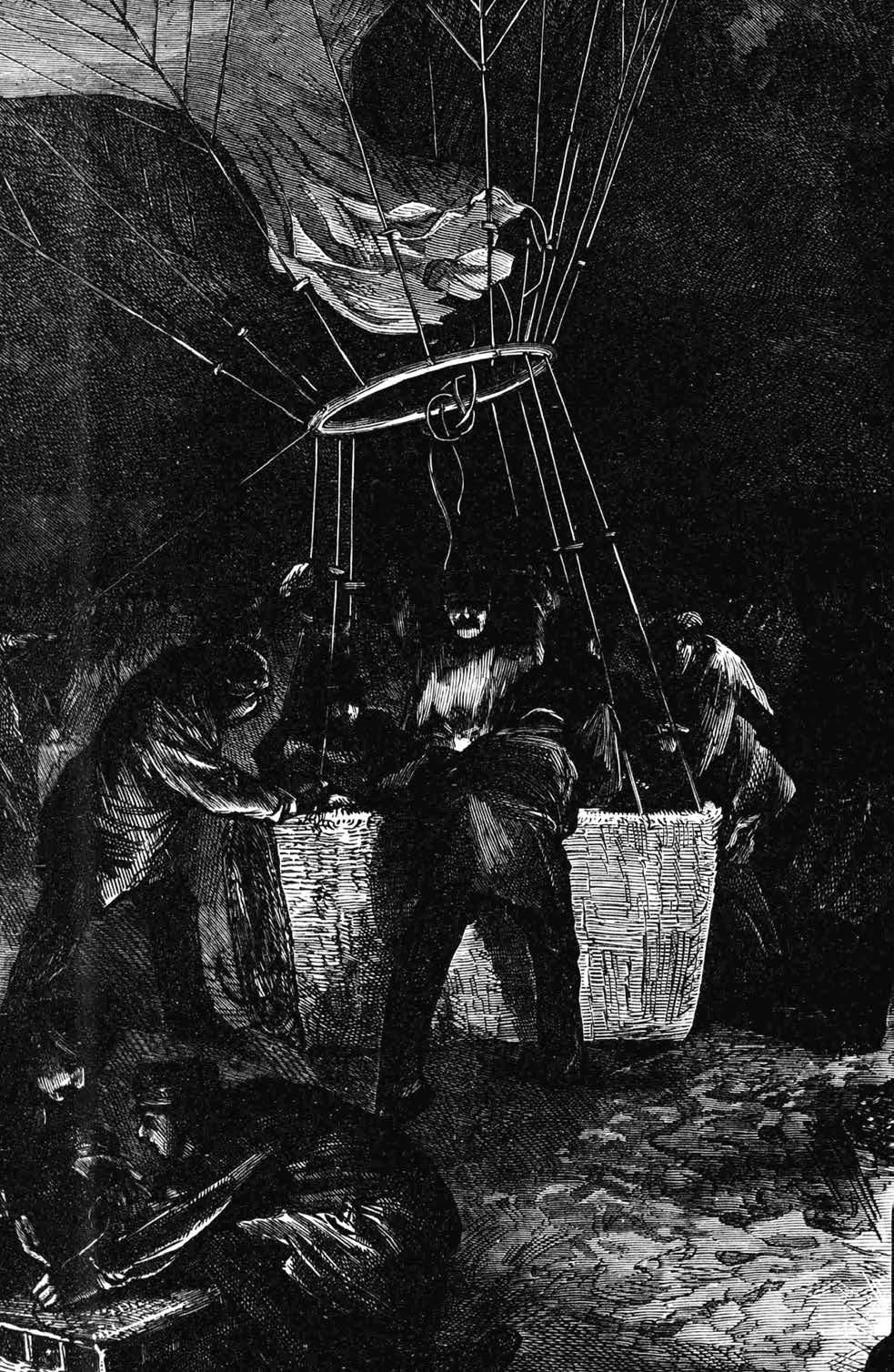
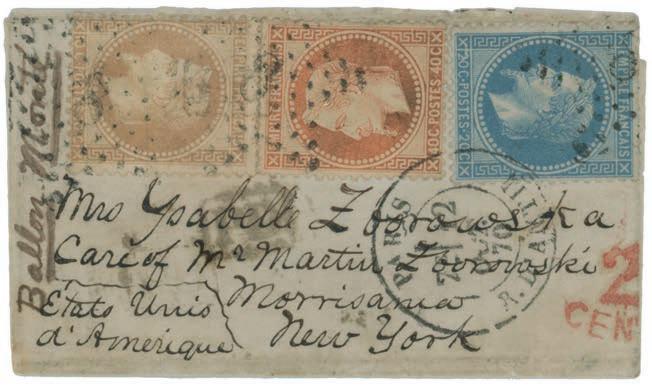
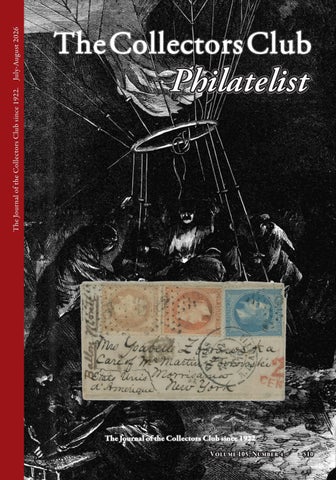
Front cover: 1870 Ballon Monté miniature envelope carried out of Paris on the balloon Le GodefroyCavaignac, and eventually delivered to what became the Bronx in New York City. The background image is derived from the front page illustration, Night Ascent of A Balloon, Chemin de Fer Nord, Paris of The Graphic, published in England on January 21, 1871. See page 204.
Guidelines for submitting articles for publication in The Collectors Club Philatelist are available from the Editor.
The Collectors Club Philatelist (ISSN 0010-0838) is published bimonthly in January, March, May, July, September and November by The Collectors Club, 58 W 40th St. Mezzanine, NEW YORK NY 10018. A subscription to The Collectors Club Philatelist is included with dues paid by members of The Collectors Club. Subscription price for nonmembers in the United States is $70. Prices for foreign addresses and/or other classes of mail are higher depending on actual cost; consult publisher. Subscriptions for outside the United States should be paid in U.S. funds drawn on a U.S. bank. Back issues $9, including postage. For a complete list, write the publisher. Claims for undelivered issues will be honored only within six months of the date of publication. Beyond that, replacements will be provided at the single copy price. Periodicals class postage paid at New York, New York 10001 and additional offices. Office of Publication: The Collectors Club, 58 W 40th St. Second Floor, NEW YORK NY 10018. Copyright 2026 by The Collectors Club. All rights reserved. We do not give implied or other consent for copying for more than personal use.
Indexed in PhiLindx by E.E. Fricks and included in the article index of the American Philatelic Research Library and the Global Philatelic Library. The opinions and statements contained in the articles are those of the authors and not necessarily those of The Collectors Club, its officers or staff.
POSTMASTER: Send change of


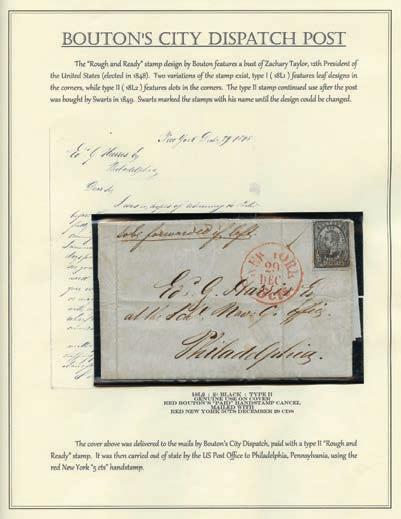


Cherrystone Auctions is honored to present a dedicated sale featuring selections from the renowned Farrell Collection, one of the most important holdings of U.S. local posts, carrier stamps, independent mails, and express stamps ever formed.
Members of the Collectors Club are invited to receive a complimentary copy of this special auction catalog for their philatelic libraries.
To reserve your copy, please scan the QR code, visit: https://bit.ly/42dT6wl or email: alexh@cherrystoneauctions.com www.cherrystoneauctions.com

58 W. 40th St., Mezzanine, New York, NY 10018 (212) 683-0559 www.collectorsclub.org info@collectorsclub.org
The Collectors Club is open Monday through Friday, 10 a.m. to 5 p.m.
President
Vice President
Secretary
Treasurer
CLASS OF 2026
Vincent Cosenza
Joan Harmer
Kathryn Johnson
Behruz Nassre
Steve McGill
Robert Gray
Vincent Cosenza
Matthew Healey
Roger S. Brody RDP
GOVERNORS EMERITI
Mark Banchik
Roger S. Brody RDP
Stephen Reinhard
CLASS OF 2027
Alan R. Barasch
Jere Dutt
Andrew Kelley
Larry Lyons
Robert G. Rose
Lawrence Haber
CLASS OF 2028
David Fritz
Robert Gray
Matthew Healey
Daniel J. Ryterband
Bob Gray

You can tell by my selfie that Boston was exhausting. It was, however, well worth the effort. The exhibition hall was enormous filled with exhibits, dealer and society booths and more. The show included many seminars, dinners, and special exhibits one of which included Queen Elizabeth’s Rolls Royce. Another was kinetic Lego structures. The US Post Office was a major site for philatelic fun as well.
The Collectors Club had a huge booth shared with two other philatelic associations. We had a lot of booth traffic and with many visitors mentioning how much they appreciated the Club’s webinar program.
The Club’s joint dinner with the US Philatelic Classics Society at Boston 2026 seated 200 guests on the 51st floor of the Prudential Building, which permitted a magnificent view of the city. Our thanks go to Carol Bommarito and Dr. Vernon Morris who organized this amazing opportunity to be with our fellow philatelists.
Many awards were presented with the highlight for me representing the Collectors Club was awarding two Lichtenstein Memorial Awards. The 2025 award went to Dr. Yamil H. Kouri, Jr., President of Boston 2026; and for 2026 to Alfredo Frohlich. Both awardees are also signers as Fellows of the Royal Philatelic Society London and recipients of the American Philatelic Society Luff Award.
Dr. Steven Berlin presented the Collectors Club with a signed copy of his Mail Robbery Postal History (From Around the World) , and the American Society of Polar Philatelists donated a copy of Hal Vogel and Serge Kahn’s Cold War: Polar Military Conflict Mail .
New Club member Dieter Michelson, Global Philatelic Network Managing Director, donated four Edition D’Or books for our library.
In June the club hosted an HR Harmer auction of Japanese Dragon covers and several individuals attending this have since joined the Club. A second auction is planned in November.
This summer we will take a break from the webinars. The club remains open, so if you find your way to NYC please stop by. We will be preparing the program for the 2027 webinars and some special events for the fall of 2026.
The Club will be convening at NOJEX, a World Series of Philately exposition from October 2-4 and I hope to see you at the club or at NOJEX.

The annual Single-Frame Competition is one of the most energetic and exciting events at the Collectors Club.
As always, the exhibition will be judged by a crew of qualified judges with a Grand, a Reserve Grand, and several Awards of Merit being presented. The Holyoake Friendship Cup will be bestowed on the exhibit voted most popular.
Members may apply for up to two single-frame exhibits.
Exhibits may be sent via FedEx, but we prefer participants to attend the competition. If the frames are oversubscribed, priority will be given to maximizing the number of participants as well as to the date of receipt of entry.
The deadline for entries to be received is the close of business, Friday, October 16th.
The exhibition setup will be on Wednesday, November 11th, between noon and 4 pm. All exhibitors will be invited to a special dinner after the frames are taken down. Exhibit takedown will take place on the Wednesday evening.
The link to instructions and the entry form is on the front page of the Club’s website at https://www.collectorsclub.org
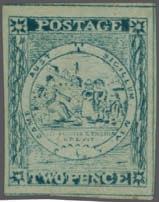

* CHF 33‘210.-
* USD 42,177.-



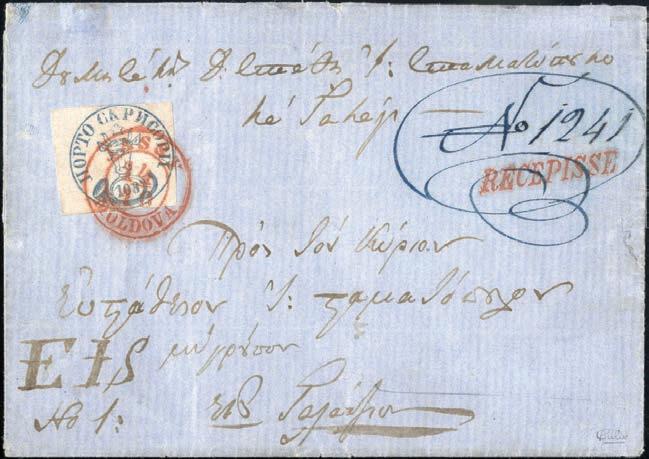




* CHF 28‘290.-
* USD 35,928.-

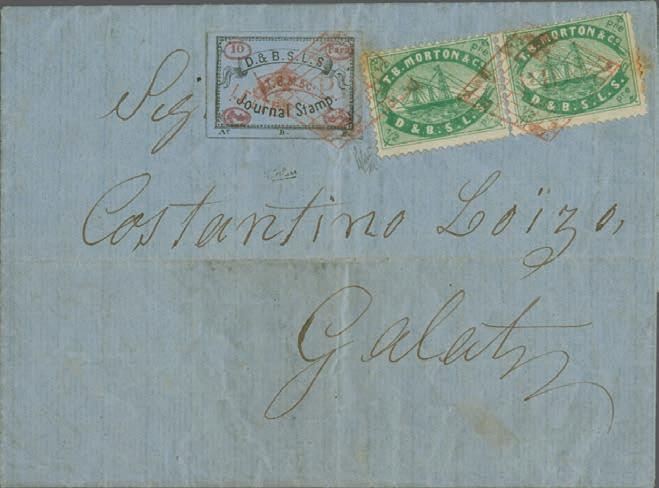
* CHF 67‘650.-
* USD 85,916.-
We operate our business since 1919. Selling in Swiss Francs is a quality assurance nancially. Continuously we run auctions in traditional formats: printed auction catalogues for all material offered; shipped in thousands to all its destinations; parallel ONLINE presentations; starting prices as the only reserve; to verify our transparency, our auditor testi es on our website in his report the plausibility and the correct processing of the accounting for vendors and buyers; auctions as LIVE performances.
THE CORINPHILA JUNE 2026 SALE PROVES THAT OUR STATEMENT TO SELL YOUR STAMPS WHERE THEY SELL BEST REMAINS.
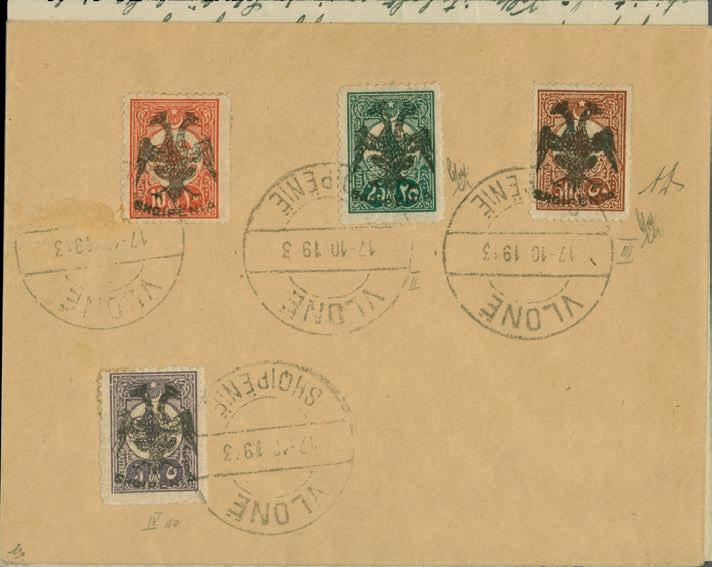


* CHF 24‘600.* USD 31,242.-
* CHF 209‘100.* USD 265,557.-
Provenance: Paul Mirabaud (1900) Ernst Zumstein (1908) ‘ERIVAN’ (2019)




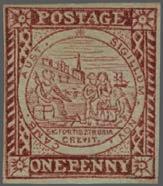

* CHF 27‘060.* USD 34,366.-
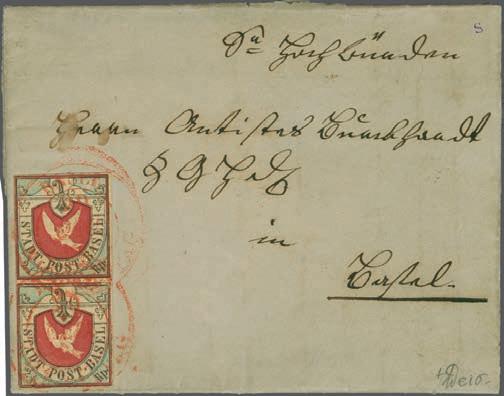



Next Corinphila Auction: 23 – 28 November 2026
Separate ‚hard bound‘ Auction Catalogues for ‚one country‘ or ‚single owner‘ a specialty. We are quite willing to discuss larger holdings in your own home.
Latest date for consignments: 4 September 2026
The arrival of America’s once-a-decade international philatelic exhibition, after years of anticipation, did not disappoint.
From the 23rd to the 30th of May, several thousand collectors descended upon the Massachusetts Convention Center near the Boston seafront to spend more than a week immersed in the world’s greatest hobby. The mood was vibrant, and visitors’ reactions to the world-class exhibits, dealer offerings and wide range of meetings and social events were generally enthusiastic.
For the Collectors Club, the gathering was an opportunity to shine. Our joint reception and dinner with the U.S. Philatelic Classics Society on Saturday, May 23 took place at the top of the famous Prudential Tower, with its magnificent, 360-degree views of Boston and its suburbs.
We made use of the occasion to ceremonially bestow the Alfred F. Lichtenstein Memorial Award for Distinguished Service to Philately on the 2025 recipient, Yamil Kouri, and the 2026 recipient, Alfredo Frohlich. This was but the first of a weeklong series of elegant dinners, receptions and soirées, proving that the social aspect of philately is, for many, the paramount attraction at major shows.
By day, the Collectors Club shared a “super-booth” near the front of the exhibition hall with the Philatelic Foundation, the USPCS and the US Stamp Society. Dozens of visitors stopped by throughout the week to chat, ask questions and pick up a complimentary copy of The Collectors Club Philatelis t, and we signed up several new members.
Halfway through the week, the annual signing of the Roll of Distinguished Philatelists took place. We noted with pride that the handful of new honorees included two of our own members, Alex Haimann RDP and Jon Aitchison RDP .
On the exhibition front, it was extremely gratifying to note that a majority of those taking Large Gold medals at Boston 2026 were also members of the Collectors Club—a list appears on page 202.
Our congratulations to them and to all of our members who exhibited at the show or volunteered to make it a success.
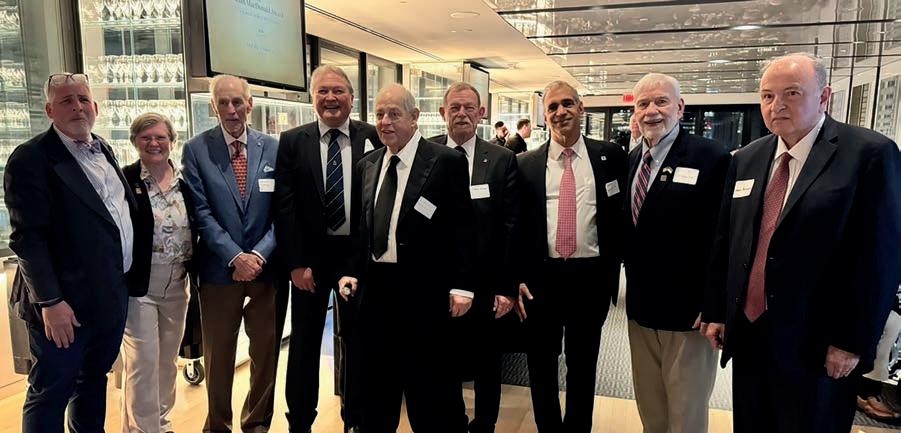


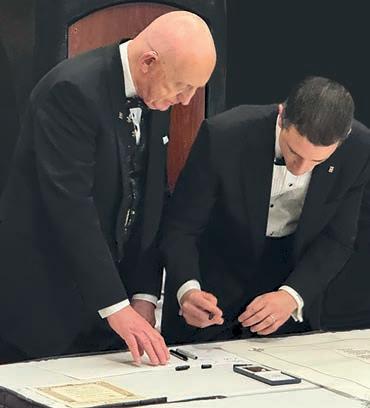
The two members of the Collectors Club who signed the Roll of Distinguished Philatelists at Boston 2026. Left: Jon Aitchison—who also officiates as Keeper of the Roll. Right: Alex Haimann.
Nick Kirke’s New York City Foreign Mail 1845-1878 Wins the 2026 Crawford Medal

The Crawford Medal is awarded annually by the Royal Philatelic Society London for the most valuable and original contribution to the study and knowledge of philately in book form. This year, it has been awarded to New York City Foreign Mail 1845-1878 (Volume 1: 1845-1870) by Nicholas M. Kirke FRPSL, published by the Collectors Club.

Daniel Ryterband Awarded the Mueum of Philately’s Second Rowland Hill Medal
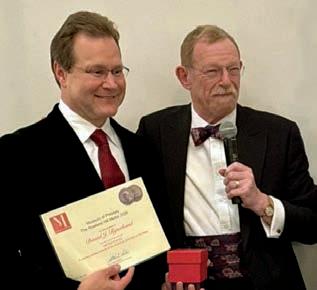
Daniel Ryterband has been awarded the Rowland Hill Medal by the Museum of Philately for his exhibit, A Country Divided: Effects of the American Civil War on the Mails. The medal was presented during the Royal Philatelic Society London’s dinner held in Boston in conjunction with the Boston 2026 World Stamp Show. The medal reflects the Museum’s commitment to preserving exceptional stamp and postal history collections while promoting, educating, and inspiring the public through philately.
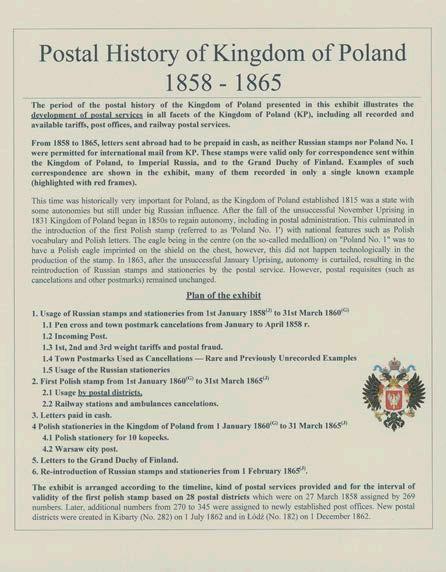
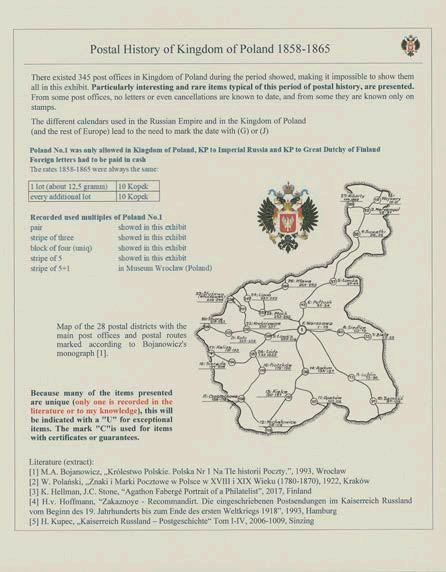
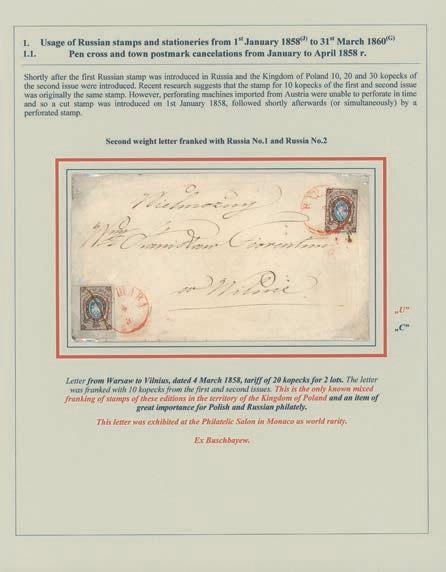
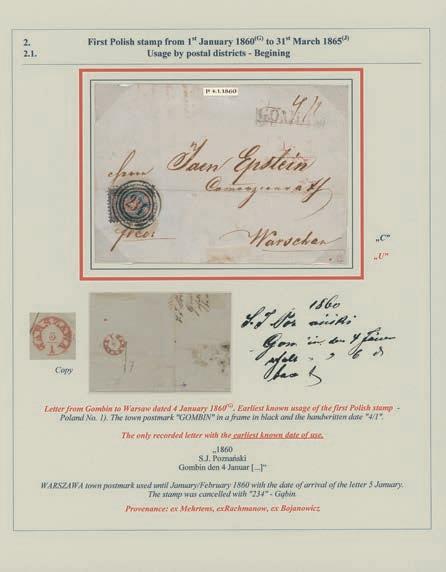
Bogdan Pelc Postal History of Kingdom of Poland 1858-1865 | Cheryl Ganz RDP Zeppelins & the United States | Chris King RDP Anglo-Danish Mail c.1800-1875 | Daniel J. Ryterband
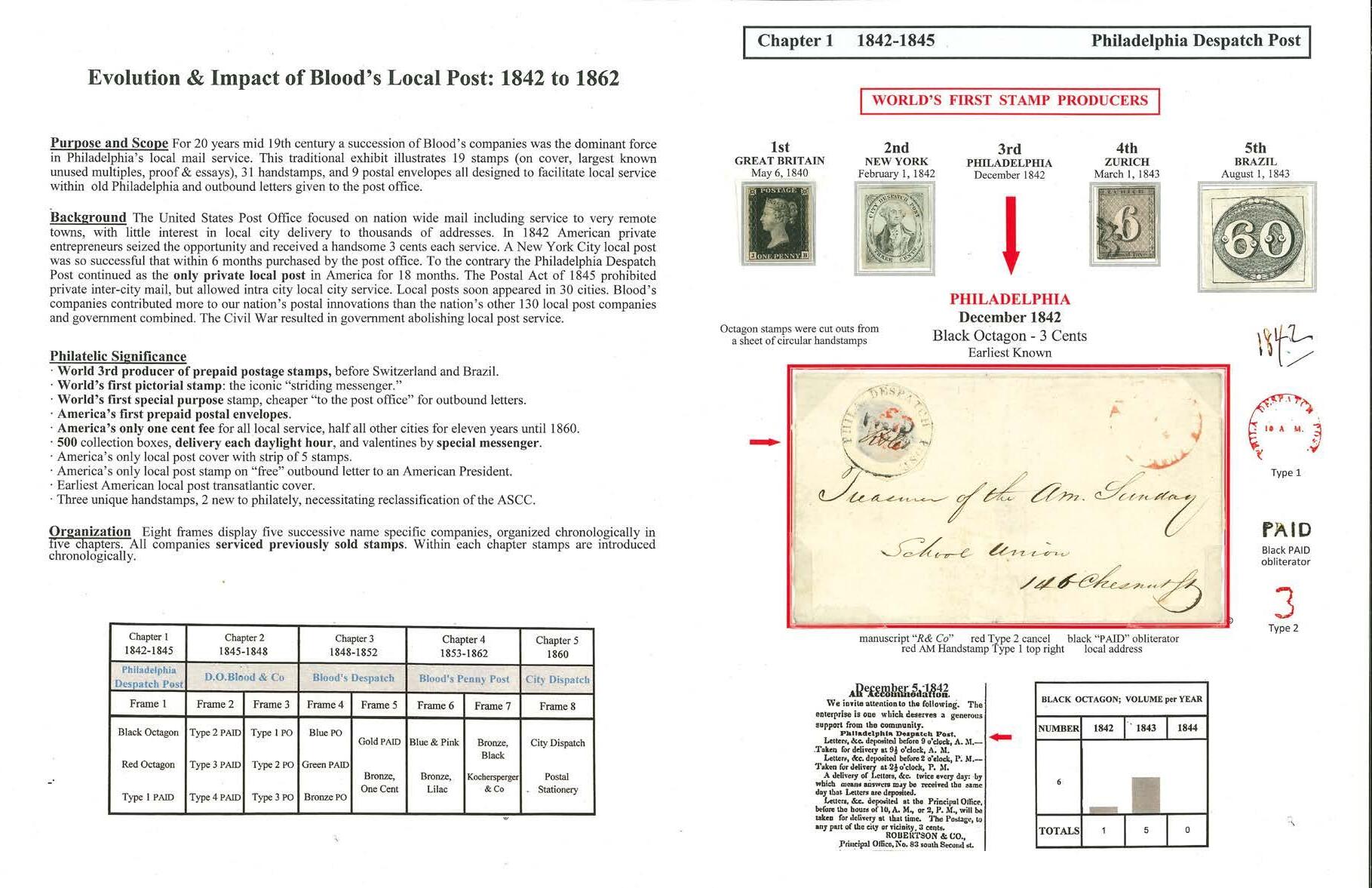
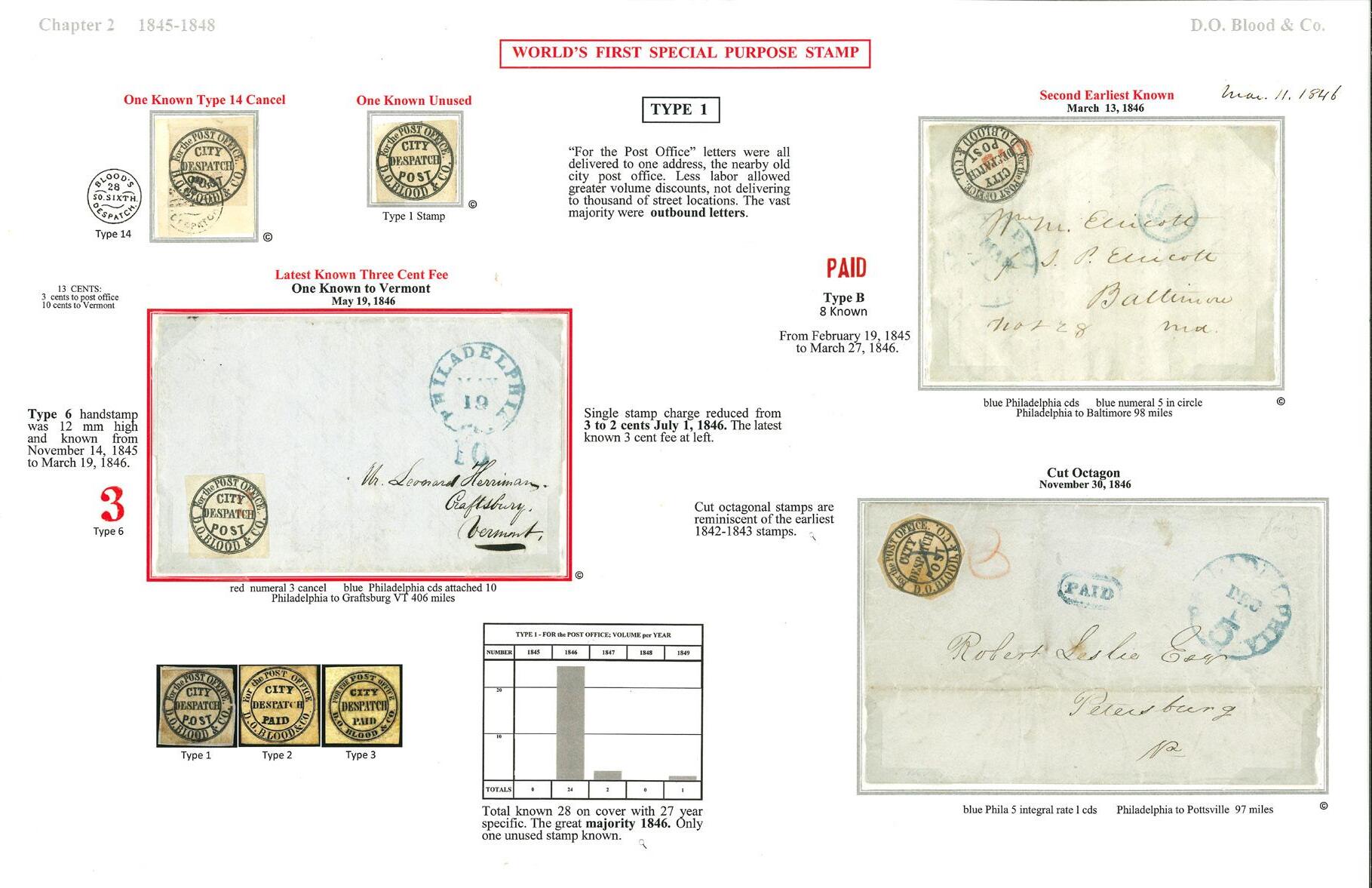
A Country Divided: Effects of the American Civil War on the Mails | Daniel M. Knowles Handling American Domestic and International Mail 1860-1869: The Decade of Turmoil, Expansion and Resurgence | Dwayne O. Littauer | Pre-UPU Mail Between the United States and Bremen | Gordon E. Eubanks First Federally Issued Postage Stamps of the United States | Murray A. Abramson Geographic Expansion of Commercial U.S. Mail to Foreign Destinations via Airmail (1922-41) | Nicholas Kirke New York City Foreign Mail 1845-1878 (Volumes 1and 2) | Patrick Maselis RDP The Medallion Issue of Belgium: 1849-1863 | Steven C. Walske La Débacle: Postal History of the 1870-71 Franco-Prussian War | Vernon R Morris, Jr. Evolution & Impact of Blood’s Local Post: 1842 to 1862 | Vernon R Morris, Jr. Transition of American Mail from British Colonial to USPO: 1685 to 1799 | Eigil Trondsen Cunard Line: The Ships and the Transatlantic Mail 1840-1867, the Monopoly Years | Jan Berg Pre-Colonial Madagascar Domestic and International Postal Services. For Part 1 of selections from the above stamp and postal history exhibits, see page 233.
Tony Bard
Icanbe easily satisfied in certain situations, like getting home from Boston without bronchitis (courtesy of GASS 2025) or Covid (PhilaKorea, 2025). My trip out wasn’t stress free. The problems began as soon as I left for the airport. Traffic conditions and journey time estimates (90 minutes), meant I’d check in even earlier than my wife’s 2 hour strict minimum requirement.
That was the plan. Four hours later (!) I got to the check-in desk, after the motorway had been closed twice while I was en route. OK, I’d made it. I was the last person to check in and the were flight was closing in five minutes.
I should point out that three weeks earlier I had impulsively decided to publish my first book, based on the Tapling Collection’s USA and Hawaii sections. Boston would be the perfect opportunity for a “soft” launch. The finished books arrived three days before my departure.
Back to check-in. I decided to take 70 books from the print run of 100 with me. I worked out these could fit into 3 cases, with just enough room left for a change of socks! I was pretty certain by calculating weight of the books, that I wouldn’t be overweight. That was until I put the first bag on the scale, which was when I realised I had forgotten to include the weights of the cases. the smallest bag was just under the limit, but that meant my two larger cases were definitely going to be overweight. To cut the story short, thanks to a helpful beyond measure Virgin check-in person (there’s a proper title for the job, but it escapes me), I unpacked the two excess baggage offenders and sent three boxes of books through as additional baggage. I made the flight.
I arrived in Boston more relaxed, but after 90 minutes waiting at immigration found that all the books but only two of my bags had arrived. What joy. Turned out the missing one had all my clothes in - it would, wouldn’t it? Anyway, the bag arrived on day one of the show, which was when I realised that because of the chaotic packing and repacking, the case’s keys were no doubt still on the floor near the check in desk at Gatwick airport. The hotel maintenance guy swiftly fixed the problem, removing the padlock in under ten seconds. Now that last glitch was sorted, I was finally ready to enjoy what Boston 2026 had to offer.
My main non-philatelic target was an authentic lobster roll. As it turned out the average price for this delicacy was beyond the pocket of somebody from a soon to be third world economy like the UK! And the show? Well, most of you who didn’t visit will have heard back from friends or read the reports. High spots were the Joint Dinner, meeting more Club members in person, and almost selling out of my book—a big surprise. An international always restores my faith in humanity, as none of the unpleasantness in the world manages to pollute the atmosphere. No one cares where you’re from, or what your politics or biases might be. It’s all about the mutuality of philately. Low spots? Average coffee, $15 sandwiches in the food court and a strong belief that eight days for a show is three or four too many. Overall, I would rate the show good, and there were plenty of elements that other exhibitions could learn from, although it helps when your national postal service fully supports a show, as USPS demonstrated brilliantly. And to round my trip off perfectly, my hearing aid went AWOL on the return flight, but the Virgin cabin staff literally took my chair apart and recovered it. Isn’t travelling a delight?!
Matthew Healey
Figure 1. October 1870 cover from Paris to Morrisania, New York, prepaid with 70 centimes French postage. Carried out of Paris by ballon monté Le Godefroy-Cavaignac, and then to the USA through normal postal channels. 2 cents credit applied on arrival in the USA.
Four years ago, I wrote an article for this journal describing an 1865 cover mailed from Dublin to New York. I titled it, rather optimistically, “To the Five Boroughs, Part 1…” My ambition was to do a series featuring noteworthy 19th century covers addressed to each of New York City’s five boroughs in turn: Manhattan, the Bronx, Brooklyn, Queens and Staten Island.
The first piece (see The Collectors Club Philatelist, Vol. 101, No. 5, Sept.-Oct. 2022) was mailed in April, 1865 from the Liffey waterfront to a tiny, rural post office in what was then called Harsenville, NY, but would later become part of what was known simply as the Upper West Side. As the vast majority of mail addressed to New York City in the nineteenth century went to the southern end of Manhattan— nowadays the Financial District—the Harsenville cover was a rare outlier.
The continuation of this series has been slower than anticipated. Covers to Brooklyn are not terribly hard to find, and I have one or two in my collection addressed to present-day Queens and Staten Island. The Bronx, however, has proven devilishly elusive. So it was with great delight that I spotted the fabulous ballon monté cover from the 1870 siege of Paris in Schuyler Rumsey’s sale during Boston 2026.
This tiny, folded cover, shown in Figure 1, was described, not inaccurately, as addressed to New York. But just above that designation was another word: Morrisania.
Eureka!
I had known that I would be unlikely to find any nineteenth century covers addressed specifically to “Bronx, N.Y.,” as the borough was not created until the consolidation of modern New York City in 1898. Until that time, the area was a sparsely settled group of towns and villages belonging to Westchester County. Even as late as 1900, the entire population of the future borough was less than 200,000. The key was to locate a cover addressed to one of those individual settlements.
Jonas Bronck, the legend goes, was a Swedish farmer who began tilling the soil on Lenape land around 1639, having leased about 500 acres from the Dutch East India Company and local tribes. The stream running down the east side of his property became known as Bronck’s River, a name it still holds today, albeit with modern spelling.
Richard Morris served in Oliver Cromwell’s Parliamentarian army after the conclusion of England’s Civil War of 1642-1651, and spent time in Barbados before arriving in New York and purchasing, in 1670, a piece of what was then known as Broncksland. He and his young wife died shortly after, leaving an infant son, Lewis. Richard’s brother, also called Lewis, arrived with his wife from Barbados to bring up the baby heir.
Young Lewis grew up to be the first lord of what would become Morrisania manor. He also served as the eighth colonial governor of New Jersey until his death in 1746. Morristown, NJ, is named for him.
One of his sons, Lewis Morris Jr., served as Speaker of New York’s colonial assembly. He grew the Morrisania estate to over 2,000 acres, owned 40 to 60 slaves, and served as a judge on the High Court of Admiralty. He died in 1762.
In 1776, one of his sons, again named Lewis, signed the Declaration of Independence. Another son, Gouverneur Morris, would help draft the United States constitution.
The Morris estate was looted and burned by British soldiers during the Revolutionary War; Lewis would offer the land as a potential site for the U.S. capital. In 1840, Gouverneur II (son of Mr. “We the People”) allowed a railroad to be built through the property. In 1846, the parts of the modern borough closer to the Harlem River, including the Morrisania estate, were incorporated into a town called West Farms. Two years later, the younger Gouverneur Morris donated a portion of his estate to skilled workers to establish the village of Morrisania, which—thanks to the railroad—grew steadily until it was incorporated in 1864.
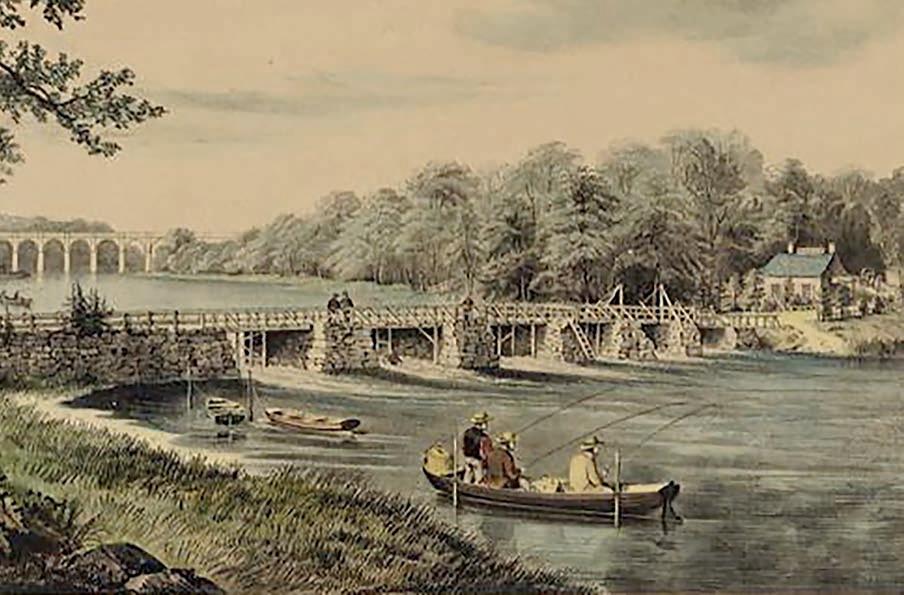
This in turn cemented the place name for posterity, as the village would eventually become the present-day Bronx neighborhood of Morrisania. A mid-nineteenth century print showing a view of Morrisania from Harlem is shown in Figure 2. It captures the quiet idyll along the river channel, although the bridges hint at the development to come.
At this point in the narrative, I allowed my attention to wander to the actual addressee of the letter: Mrs. Isabelle Zborowska, “Care of Mr. Martin Zborowski.” This is a relatively uncommon name (in comparison to, say, Morris) and therefore one that should be somewhat easy to trace. I had read that there was an influx of Slavic immigrants to Morrisania by the turn of the twentieth century, so I wondered whether this cover was early evidence of that demographic shift.
As it turns out, Zborowski was a fake name.
A real estate developer whose original name was Martin Ryerson Zabriskie, the future “Mr Zborowski” grew up in New Jersey. Perhaps a distant descendant of Polish nobility, he was evidently respectable enough in society to marry Anna Elliot Morris, a great-granddaughter of the signer, Lewis Morris. The couple acquired a parcel on the family estate where they built a house in 1858 or ’59, which they named “Claremont”. The home drew the admiration of many for its fine terraced lawns and sweeping vie ws.
Accounts vary as to when exactly Martin assumed his new name and aristocratic pretensions, but this cover shows it had already happened by 1870.
Martin and Anna had four children; their daughter, also Anna, married a Comte de Montsaulnin. Their youngest, William Elliott, perhaps envious of his sister’s noble title, embraced his father’s love of European aristocracy and married Margaret Astor, lately the Baroness de Stuers, in 1892, on the same day she caused a scandal in high society by becoming the first Astor to get a divorce.
The couple moved to England to escape the social opprobrium, and there Elliott (he dropped the name William) Zborowski developed a passion for racing, first on horses and later in motor cars. He would be killed in 1903 driving his Mercedes up La Turbie hill during a race in Monaco. Their son, Louis, followed in his father’s footsteps as a renowned racer, building the cars that would be immortalized by Ian Fleming in “Chitty Bang Bang” until Louis, too, was killed in a car crash during the Italian Grand Prix of 1924. He was just 29.
Where does our Isabelle fit into all this?
Turns out, Martin’s wife Anna had died in 1864. Two years later, Martin was sailing for France. A passage from Recollections Grave and Gay, published by a Mrs. Burton Harrison in 1911, recounts what happened next:
In October, 1866, my mother and I sailed in the ship “Arago” for Havre, the passenger list made up of many New Yorkers known to each other… [among the] people we knew on board were Mr. Martin Zborowski, of New York—whose wife had been a Morris—with his sons, John, or “Laddie,” and Elliot, and his young daughter Anna, now the Countess de Montsaulnin, of Paris. A young Southern widow, Mrs. Hewitt, formerly Miss Belle Key, of Mississippi … was taking a little blonde daughter, Marie Hewitt, subsequently the handsome Mme. Wilkinson, of Paris, to be put at Mme. Grenfell’s school in Paris. It was hardly a surprise to us when some months later we were bidden to the marriage of Mr. Zborowski with Mrs. Hewitt. Afterward we saw much of their conjoined families abroad and in Westchester County where Mr. Zborowski had a charming home.
Martin’s wedding to Isabella (or Belle), the daughter of Peyton Key of Kentucky, took place at the American Embassy in Paris in 1867. After their marriage, according to a contemporary syndicated newspaper account, they traveled to Poland:
An American Beauty Abroad.
Among the many famous beauties whom our city boasts, none were ever so much admired, probably, as the brilliant and fascinating Miss Belle Key, who married the late Col. James Hewitt, C.S.A. (who was killed at Chicamauga), and after remaining in great seclusion abroad, was married to a distinguished and wealthy Polish gentleman, residing in New York, about a year ago. The happy couple are now visiting Poland. The Warsaw Courier of Nov. 2 makes the following allusion to an American family recently visiting that city. The persons alluded to are Mr. Martin Zborowski (Zabriski), of Morrisania, and his beautiful and accomplished wife:
During the representation at the theatre on Saturday night, all eyes were turned on the parterre-box at the left of the stage, and really the curiosity of the spectator was more than gratified, for in the box was seated a lady, splendid in beauty, and glittering in precious stones.
We admit, in all frankness, that we have never seen such a diadem as that which crowned the classic brow of this beautiful creature; and so, also, with the collar of oriental pearls of great price, joined by stars of diamonds, yet even less perfect than the neck which they surrounded. We are informed that the husband of the lady belongs to one of our illustrious families, a member of which settled in America 200 years ago, and that he and his wife are now on a visit to this country, where his ancestors—its honor and its glory—formerly lived. These distinguished personages have already traveled for some years in Europe, and intend to honor Warsaw with their presence for a few weeks.
These were times of upheaval in Europe. The Franco-Prussian war broke out in the summer of 1870 and Paris was soon besieged by Prussian forces. The only way mail could leave the city was by balloons filled with lighter-than-air coal gas. 65 of the 66 successful launches (one balloon, The Jacquart , was lost over the Irish Sea) carried an estimated 2.5 million letters out between September 23, 1870, and the armistice in January 1871.
The vast majority of the mail was addressed to places within France, but a few were forwarded abroad, including to the US. Several ballon monté covers to New York are documented but a comprehensive census does not, as far as I know, exist yet. The number going to the Bronx? Probably just one.
The cover’s auction description identified the balloon which carried this letter as Le Godefroy-Cavaignac , which departed from Orléans Station, Paris, on October 14, 1870. The balloon also carried three passengers, 170 kg (375 lbs) of mail in four bags, six carrier pigeons (other sources give four) and some freight This was the eleventh ballon mont é departure of the siege of Paris. It was piloted by Edmée Godard, aged 68, whose family were responsible for the construction of 32 balloons that escaped Paris, i.e. nearly half the total.
Among his passengers was Count Émile de Kératry (1832-1904), a soldier and an elected politician who went on to raise the “army of Brittany” in an unsuccessful attempt to defeat the Prussian forces. He was accompanied by his chief of staff Mr A. Jay, and a M. du Quesneau, a Commandant or Major in the French National Guard.
The flight covered 256 kilometers (159 miles) before landing at Brillonen-Barrois in the Meuse d é partement, almost 5 hours after taking off. As it transpired, the landing point was actually in enemy-controlled territory, but the pilot, all the passengers and the mail (which also included one letter to Russia and one to Ireland) avoided capture. We do not know the pigeons’ fate!
The three-color 70 centimes franking on the cover is made up of the 1863-70 Laur é 10c, 20c and 40c values, which are tied by the Paris numeral "8" star cancel and double-circle “ PARIS /2E/2 OCT / 70”datestamp, and there is a strike of the red New York "2 / C ENTS " credit handstamp applied on arrival.
Martin and Isabella had no children together. They must have returned to Paris shortly after the war, because she died in 1873 at the age of 38 and is buried in Père-Lachaise cemetery.
On her grave stands a pillar, where her name is inscribed as Ysabelle Key Zborowski. The pillar is surmounted by a graceful bust, presumably her likeness (Figures 3-5).
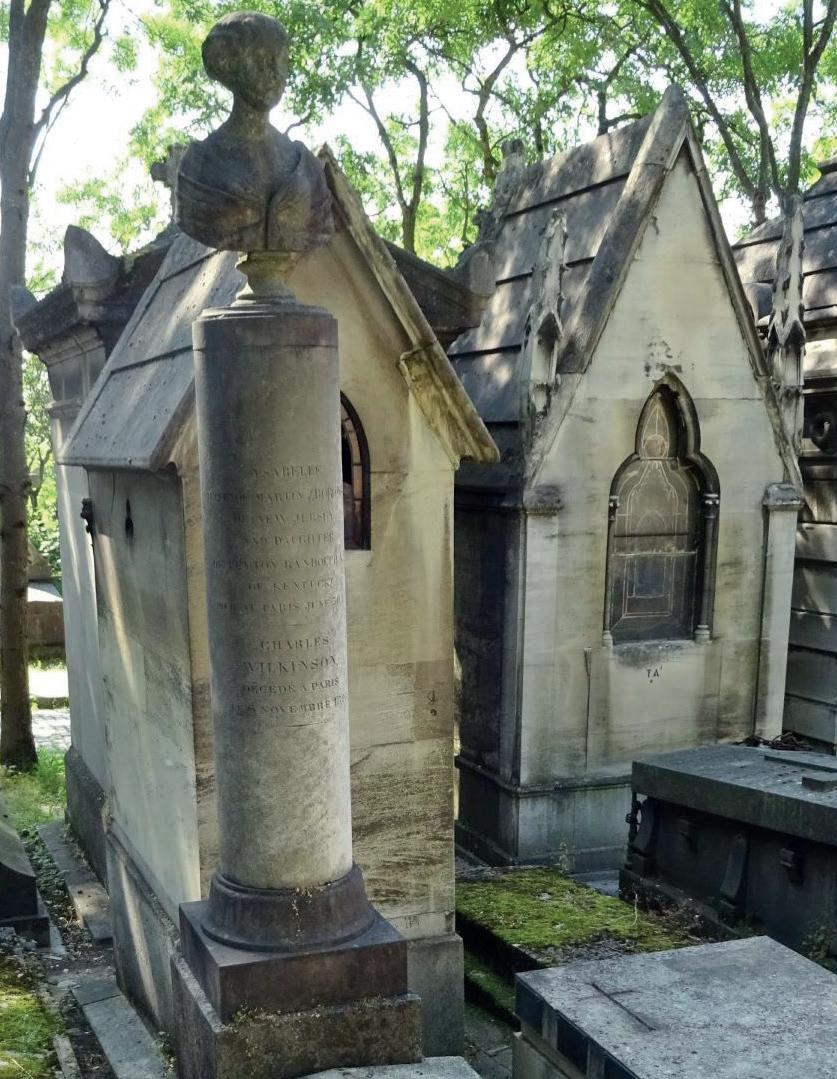
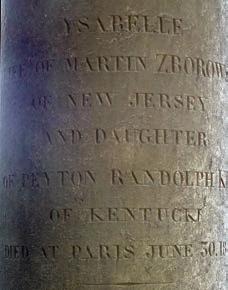
WIFE OF MARTIN ZBOROWSKI OF NEW JERSEY AND DAUGHTER OF PEYTON RANDOLPH KEY OF KENTUCKY DIED AT PARIS JUNE 30 1873”

Martin Zborowski died in 1878. In 1874, the town of Morrisania had been annexed to New York City, the first area added outside of Manhattan. A few years later, the Third Avenue Elevated railway was extended there, resulting in a further influx of residents. The modern world was fast encroaching on the idyllic landscapes of the old farms.
The Zborowski estate passed to the city of New York in 1884 and was turned into Claremont Park, the mansion later becoming the Bronx headquarters of the New York City Parks Department. A map of the proposed park, indicating the former Zborowski and Gouverneur Morris estates, is in Figure 6 and a photo of the house is shown in Figure 7. In the late 1880s, consideration was given to holding the 1892 Columbian Exposition there.
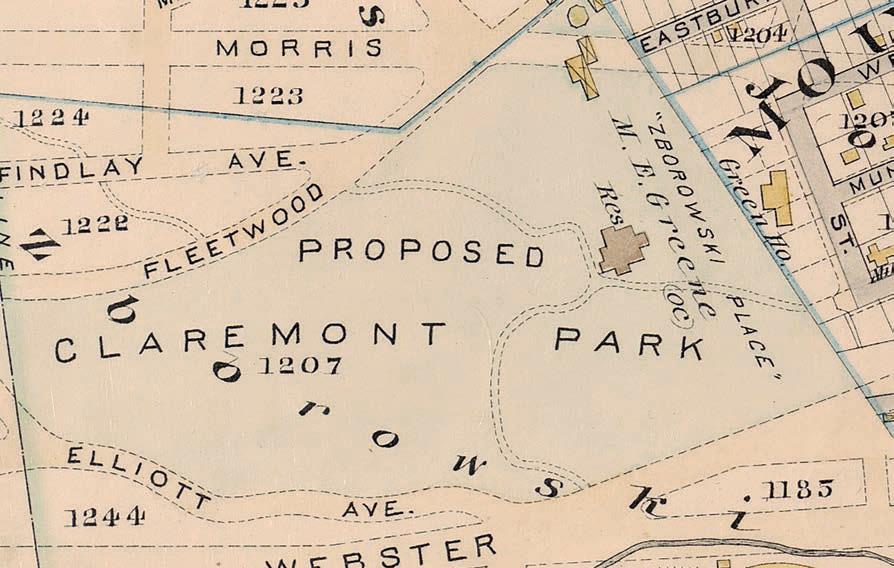
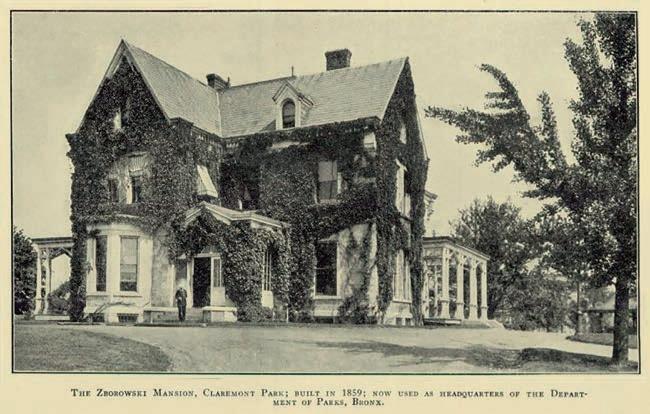
Sadly, the mansion was razed in 1938; today a gazebo stands on the spot. Morrisania, unfortunately, descended during the twentieth century into poverty and urban blight, with the South Bronx becoming one of the poorest areas in the United States.
It is remarkable how much human history can be carried by such a tiny envelope.
Author’s note
The research process for this article did not involve conventional methods in places like the Collectors Club library, as the philatelic details of the cover itself had been settled by the time I acquired it; instead, the story of the addressee was researched entirely online using Google and its built-in AI tool, Gemini. These led to repositories of primary sources such as Ancestry.com and FindaGrave.com, in addition to the obvious assortment of Wikipedia pages, community blogs and the like. How to be confident these results are reliable? I applied old-fashioned methods of corroboration, cross-examination and common sense—the three C’s, if you will.
Many sources, even historical primary sources, can get details wrong. For example, Isabelle’s gravestone gives her father’s name as Peyton Randolph Key; further digging, however, shows her father was in fact the less-famous Peyton Adams Key. Some sources state that Martin Zborowski was born in Poland; clearly, that was not the case. In a few cases, I just had to admit I didn’t know something: for example, the exact date the Claremont mansion was built is given variously as 1858 and 1859. The New York City Parks Department even stated for years that the house was built by Elliott Zborowski, even though he was just a newborn at the time!
Several times, I had to revise portions of the narrative as more reliable facts came to light. My initial assumption had been that Isabelle was Martin’s child; I had forgotten that in the nineteenth century, women were often addressed in “Care of” their husbands, as if they were minors. The most surprising and serendipitous result came via Gemini, which steered me to Mrs. Harrison’s obscure memoir and its key passage about the ocean crossing. That really tied a lot of strings together, and I would never have found it on my own.
The provenance of the cover itself—in particular, how and when it first came on the philatelic market—is not fully known to me. It is accompanied by a Swiss certificate, so at some point it was presumably in a European collection. If any readers have further information, I would love to learn it. I can be emailed at matthewhealey@gmail.com

Edition D’Or, 88
If you would like one of the 4 copies kindly donated to the Club, this can be purchased online at www.collectorsclub.com
Vivek S. Chopra and Danforth Walker RDP FRPSL
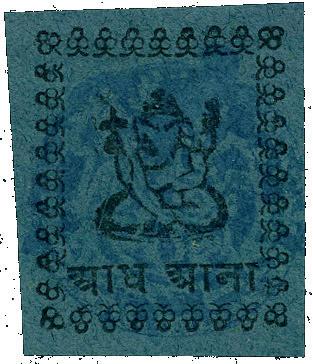
TFigure 2. The Duttia 1896 ½ Anna black on blue-green wove paper with control handstamp, SG5, which was sold as lot 272 in the Stanley Gibbons auction on May 11, 2021. All corner shamrocks are set at 45 degrees angles. (Image source: Museum of Philately, https://www.museumofphilately. com/rarity/315)
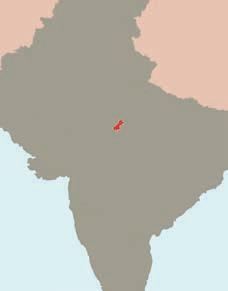
he former Princely State of Duttia (today known as Datia), located in central pre1947 India (Figure 1), is believed to have first produced stamps in 1893, based on four examples in the H. D. S. Haverbeck sale, which consist of the state’s control stamp applied within a red ruled outline with manuscript inscriptions. The first typographed stamps appeared in 1894, and these as well as all subsequent issues feature the Hindu god Ganesh. The first typeset issues, which were produced in very limited numbers, have fascinated and intrigued collectors of the Indian Princely States.
In May 2021, a remarkable Duttia stamp achieved a record realization of £69,600, establishing a benchmark for the Indian States. Accompanied by a BPA certificate identifying it as the 1896 “½ Anna Black on Blue-Green, SG5”, the stamp was widely accepted as a classic rarity within the established framework of Duttia philately (Figure 2).
Yet, as is often the case in our field, closer scrutiny reveals that even the most celebrated items may warrant re-examination. This paper revisits this important example and proposes that it is not a standard SG5, but rather a previously unrecognized die (cliché) variety—SG5 var. SG5 is believed to be extremely rare, with fewer than four examples known to exist, so one can only imagine the rarity of this SG5 var.
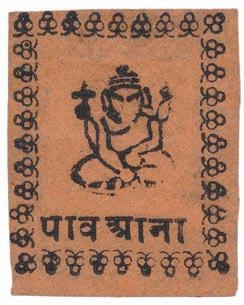
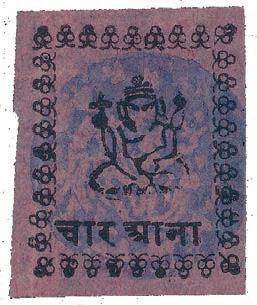
The starting point of this reassessment lies in a seemingly small, yet highly significant detail: the orientation of the “clover” (or “trefoil”) ornament in the upper left corner. In the accepted “Trefoil” series (so called because of the use of repeated three-leaf ornaments to form the stamp’s border), the second issue design of Duttia which includes SG5, the upper left clover is aligned vertically, while the other three corner ornaments are positioned at approximately 45 degrees (Figures 4a-4d show various examples from the same series). However, the 2021 example clearly shows the upper left clover also inclined at 45 degrees (Figure 3), i.e., matching the orientation of the other three.
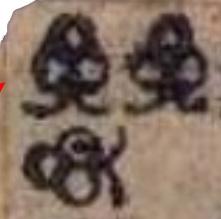
SG5 alignment

“SG5 var” alignment
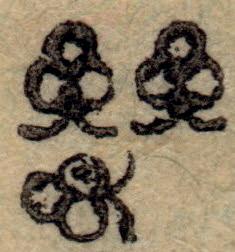
Regular Trefoil issue alignment

Stationery indicium alignment.
Figure 3. Corner ornament alignment varitions

Corner ornament upright.
Corner ornament at 45o.
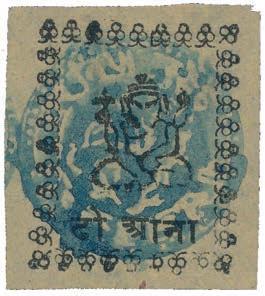
Figures 4a--d Trefoil issues. (a) SG4a, ¼ anna without control handstamp, black on orange wove paper. (b) SG5a, ½ anna without control handstamp, black on blue green wove paper. (c) SG6, 2 annas black on yellow wove paper. (d) SG7, 4 annas black on rose wove paper. All show the original trefoil alignment to be at 45 degrees angles in three corners except for at top left which is upright at 90 degrees. Also note the deeper shade of blue-green in the stamps in Figures 2 and 7.
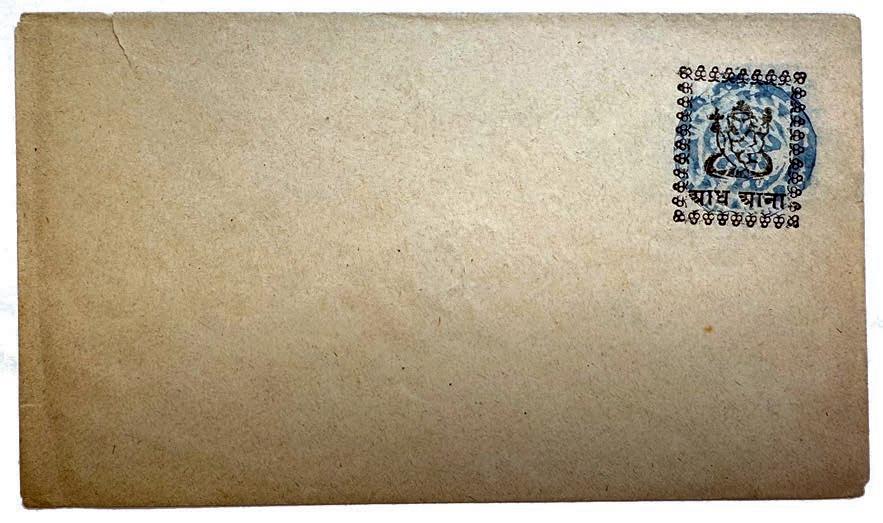
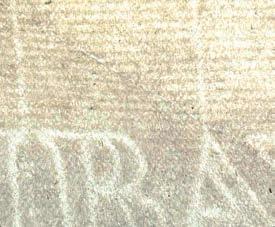
This feature corresponds precisely with the design seen on Duttia postal stationery indicia, where all four corner ornaments are symmetrically angled. Duttia stationery (Figure 5), however, was printed on laid paper (Figure 5 inset), unlike the wove paper used for the stamps.
Several points support the interpretation that the die originally prepared (or modified) for postal stationery was later used to print adhesive stamps:
• Duttia postal stationery is consistently found printed on local foolscap laid paper, typically watermarked (Figure 5 inset).
• The postage stamp under discussion is printed on bluish-green wove paper, consistent with the Trefoil issues (SG4a to 4d).
• Examples of Duttia postal stationery bearing the above design printed on wove paper have not been recorded.
• The last four Hindi characters for the denomination “Anna” are perfectly aligned at the top, whereas the first two of these characters of the word in the Trefoil issues are out of alignment with the others (Figure 6) .

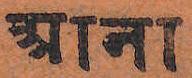


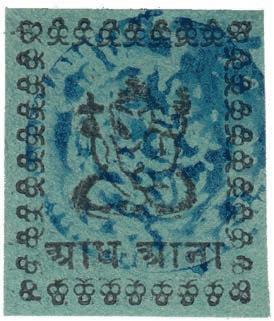
Figure 7. One of the two other recorded examples of SG5 var, showing the angled top left corner ornament and the even alignment of the Hindi characters for “Anna”.
It should also be pointed out that the blue-green shade of paper used for SG 5var is a deeper shade than that seen on typical SG5 and SG5a printings.
These features are consistent across at least two additional examples examined by the author (one of them shown in Figure 7).
It is plausible that the original die used for the second issue exhibited an asymmetrical clover design, later corrected for postal stationery use. This corrected die appears to have been reused for a small number of adhesive printings, giving rise to the variety now proposed as SG5 var.
It is important to acknowledge that the original classification of the 2021 example as SG5 was intuition and experience based on paper and denomination. However, philately evolves through careful observation and comparative study.
The new discovery sold in May 2021, and with the additional examples now known it should therefore be regarded as a distinct variety—SG5 var.—arising from the use of a modified or transferred die, a “cliché error”.
This reassessment underscores the importance of specialist philatelic knowledge and a keen eye for detail!
Acknowledgements
The author wishes to thank the owners of the additional SG5 var. examples for making them available for examination and for kindly providing images for this article. Grateful thanks are also extended to Ricardo Verra FRPSL, David Feldman RDP FRPSL , Joël Feldman, Guy Croton and Gregor Gaetjens for their valuable insights and comments. Trefoil stamp images (Figures 4a-4d) are from lots 120-123, Postiljonen 247th and 248th International Stamp Auction, March 17-20, 2026. See https://auction.postiljonen.se/ en/cat/12624/lots?pos_von=120&pos_bis=136&losbereich_title=Duttia
References
Deschl, E. F. (1994). The comprehensive India states postal stationery listing , The author, North Bergen, NJ.
https://sgbaldwins.com/stories/elephant-well-never-forget https://www.youtube.com/watch?v=oQxQ_NXvw38
Olds, Phill (n.d.). The postal stamps of Duttia 1893 to 1921 , the author, UK.
Svetislav Jelic
Issue background and development
Tthe mail coach has long been a widely used motif in stamp design around the world, recognized as a universal symbol of early mail transport and communication. In line with this broader tradition, the Yugoslav Post also issued a stamp featuring this motif. Their depiction reflects both the historical development of postal services and their enduring identity in visual postal heritage.
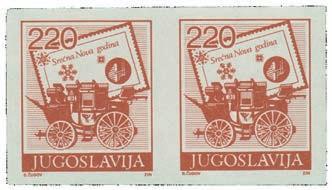
The definitive stamp featuring the mail coach with New Year’s greeting card design was issued on December 6, 1988. Designed by artist Dimitrije Čudov, an employee of JUGOMARKA—the enterprise responsible for producing stamps for the Yugoslav Post.
This issue was printed by the Institute for the Manufacture of Banknotes (ZIN) for use on regular letters at the first weight tier in domestic postal traffic, in accordance with the postal rate from October 5, 1988. The stamps were printed on ordinary paper by offset lithography, with matt white gum, and issued in comb perforation 13¼.
The mail coach, as the central design element, was subsequently extended beyond adhesive stamps. Čudov, the JUGOMARKA artist, illustrated the motifs for the postcards and postal stationery issued on March 22, 1989, retaining the coach as the dominant feature.
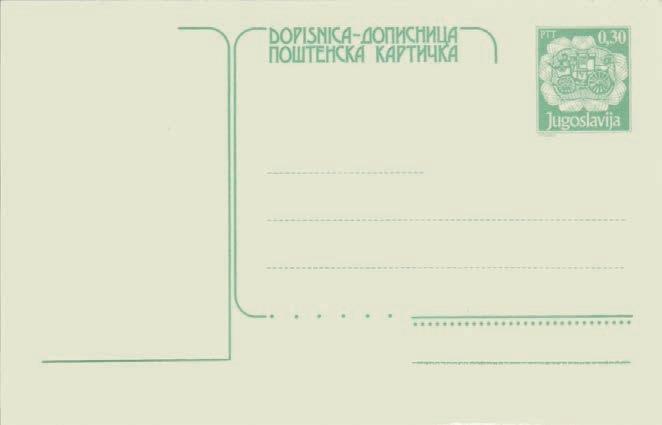
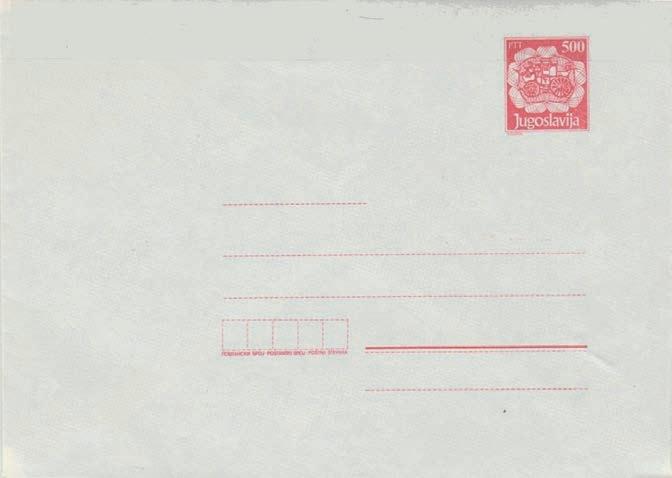
3. 500 dinar postal stationery envelope featuring the mail coach design indicium.
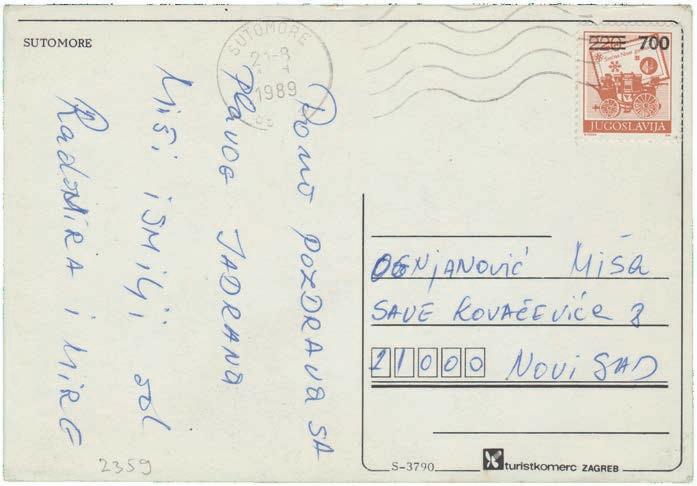
On July 20, 1989, the postal rate for sending inter-city postal cards in domestic traffic was increased from 400 to 700 dinars — a change that forms the central point of this analysis. The Yugoslav Post anticipated the increase and acted in advance: on July 19, it issued a stamp overprinted with the new face value of 700 dinars over the original 220 dinar definitive issue, thereby ensuring continuity in postal operations during the transition.
This reflected a deliberate effort to maintain visual and thematic continuity across different segments of postal production. This reuse of the established motif ensured recognizability and coherence within the postal system, while adapting the design to the functional requirements of postal cards and stationery in everyday domestic use.
Figure 4. Intercity postal card sent on August 21, 1989, franked with the 700 dinar overprinted on 220 dinar stamp.
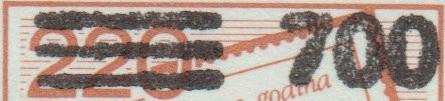
The new 700 dinar overprint was applied in black by letterpress (typography). The old denomination was cancelled by three horizontal parallel bars, and the new face value was impressed alongside in the upper right corner of the stamp.
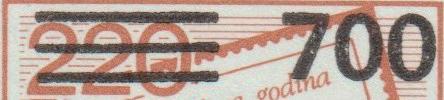

5. The 700 (dinar) overprint enlarged, and with background removed.
Ever since this overprinted issue debuted, philatelists have categorized the overprints into two types: thick and thin. In the lower left section of the counter sheet, these variations are striking enough to be readily identified by the naked eye. For decades, this remained the standard perspective on the issue, accepted as a simple surface-level distinction without the need for deeper technical analysis.
Even on today’s philatelic market we find only “thick” and “thin”, or Type I and Type II overprints offered, sometimes erroneously described as “errors”.
By using modern technology for deeper analysis, it reveals that there are in fact six distinct overprint types, the illustration and classification of which are shown in Figure 6.
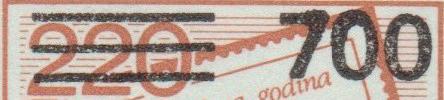
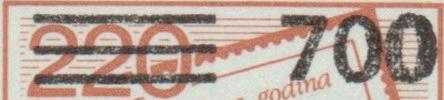
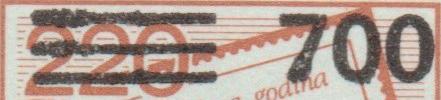
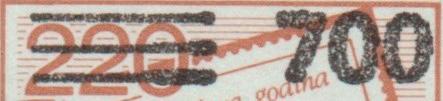
Of particular interest is the fact that overprint Type I appears on 80 of the 100 stamps on the sheet (Figure 7), while the remaining types are found only on some stamps on the first four positions of the last five rows — the so-called “block of 20”.
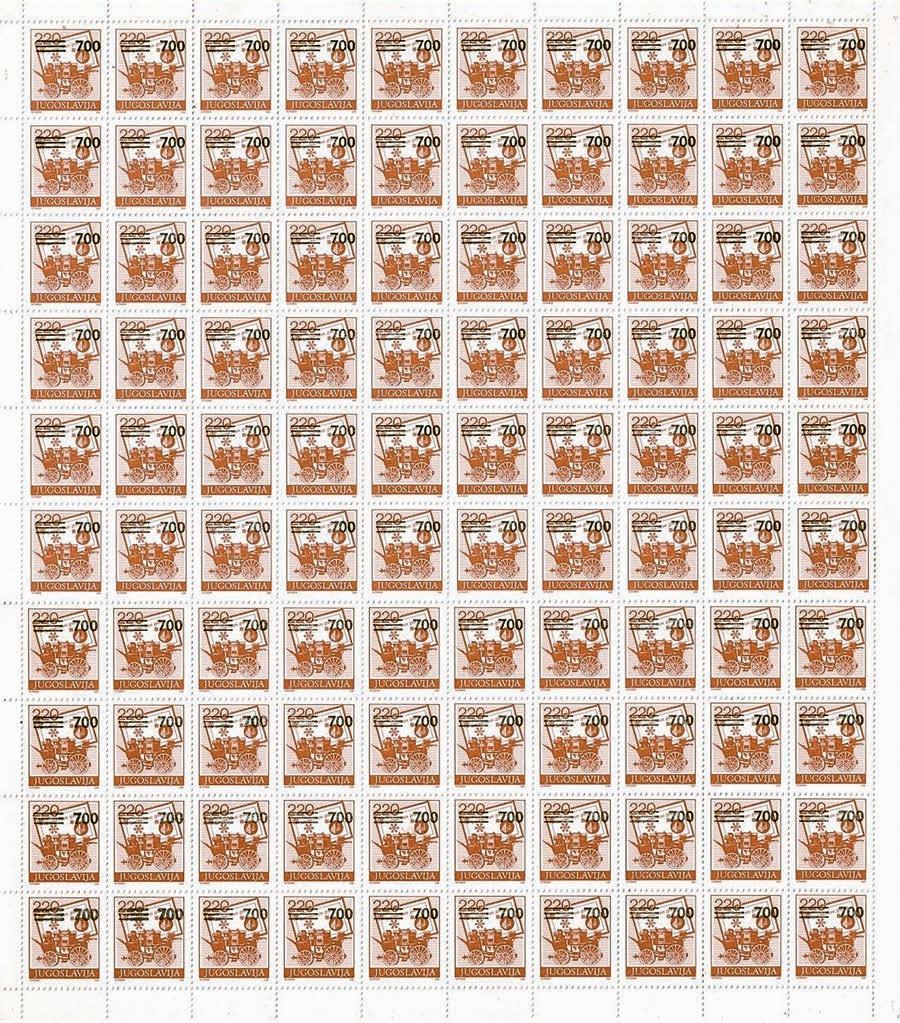
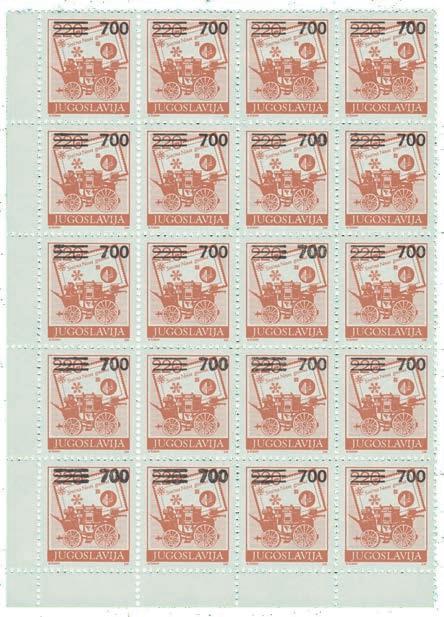
Figure 8. Block of 20 showing the six different overprint types.
Forged overprints
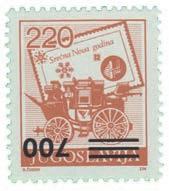
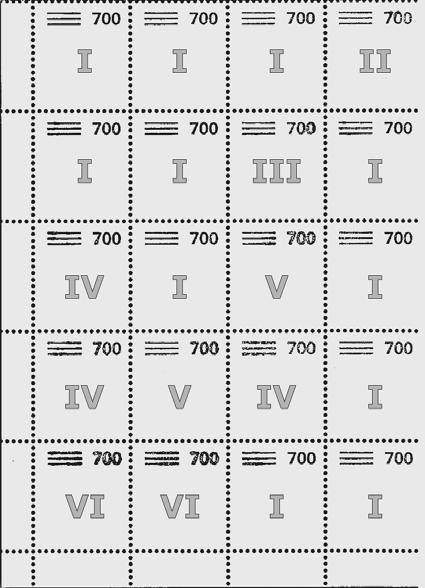
Figure 9. Positional layout of the different overprint types in the block of 20.
As provisional issues with overprints occupy a special niche in traditional philately, precisely because of the varieties that may be found, this issue too is not without its forged overprints.
Figure 10. Forged inverted overprint.
Comparative analysis of the genuine and forged overprint with negatives
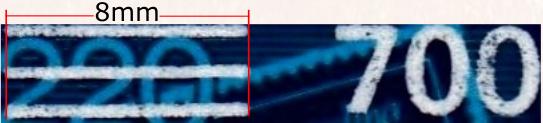
Figure 11. Genuine typographed overprint, with clear ink squeeze around the digits. Bar measures 8 mm.
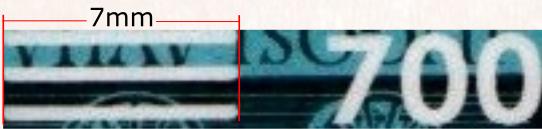
Figure 12. Forged digital overprint heavy black ink, with no ink squeeze around the digits. Bar length 7 mm.
The 1989 Yugoslav Mail Coach overprint serves as a compelling example of how a seemingly simple provisional issue can reveal rich technical complexity under modern philatelic scrutiny. While the market has long been satisfied with a basic “thick vs. thin” classification, the identification of six distinct overprint types found in the “block of twenty”—adds significant depth to the study of this period.
Chris King RDP Hon FRPSL
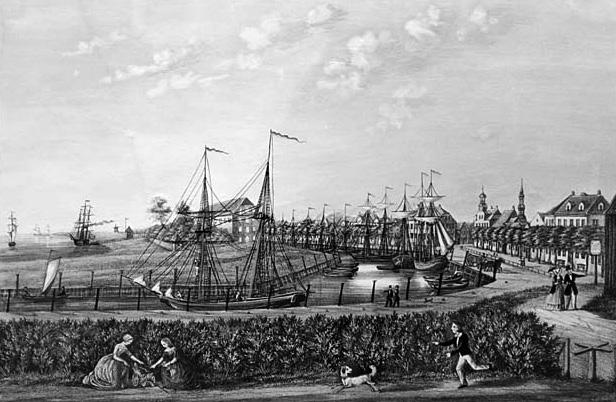
Der Hafen von Tönning um das Jahr 1800 (Tönning Harbour in 1800). Source: Collection of the Museum der Landschaft Eiderstedt, St. Peter-Ording, Nordfriesland.
The letters in this article demonstrate the speed with which commercial enterprises re-established trading relationships as the Napoleonic Wars drew to a close, although they must have been frustrated at the delays in the postal services as the armies that had dominated Europe for more than twenty years, gradually returned to their barracks and to civilian life.
J. P. Suhr & Søn was a Copenhagen trading house which existed from 1749 to 1897. It originated with Johan Peter Suhr (1712–1785), who in 1728 entered into apprenticeship with the linen merchant Oluf Hansen Aagaard, at his premises in Gammeltorv in Copenhagen. On November 22, 1748 Suhr married Aagaard’s daughter, Anna Dorthea; and on the death of his father-in-law in the following year, he assumed control of the business.
Under Suhr’s direction the enterprise prospered. While continuing its retail activities, the firm progressively expanded into wholesale commerce and established trading connections with Norway, the Baltic ports and the Netherlands. Its principal commodities included iron, grain and salt, a portion of which was conveyed to Copenhagen in vessels owned by the house itself. In the course of time the business developed into one of the most substantial mercantile establishments in Copenhagen.
Ole Berendt Suhr (1762-1815), head of J. P. Suhr & Søn in 1814.
Postal historians interested in Denmark will know the company from its voluminous correspondence which has survived in significant numbers. There are folded letters to and from Great Britain, and this article considers three of them.
The French Revolutionary and Napoleonic Wars lasted almost continuously from 1792 until 1815, separated briefly by the Peace of Amiens (1802–1803). Trade was severely interrupted by the Continental System, a continental embargo by Emperor Napoleon Bonaparte against the British Empire from November 21, 1806 until April 11, 1814. Napoleon issued the Berlin Decree on 21 November, 1806 in response to the naval blockade of the French coasts initiated by the British government on May 16, 1806. The embargo ended on April 11, 1814 after Napoleon’s first abdication.
As Napoleon’s armies moved ever further east, postal communications between Great Britain and Europe became increasingly difficult. With the fall of Hamburg on November 19, 1806, followed by the British bombardment of the Danish capital from August 16 to September 7 and seizure of 64 vessels, including 18 ships of the line, all northern European ports were closed to British trade. Postal connections continued and smuggling grew, but there was very little post between Denmark and Great Britain between August 1807 and March 1814.
The letter dated July 28, 1807 (Figure 1) was certainly carried on one of the last two packet ships, the Lord Nelson or Lady Nepean arriving at Tönning in the Danish Duchy of Schleswig on August 15-16, until the service resumed in 1814.
George Hart, the British packet agent in Tönning wrote to Francis Freeling, Secretary of the General Post Office:
On board His Majesty’s Packet Lord Nelson at sea: August 18 th 1807. On Saturday last the 15 th inst. Captain Stewart of the Lord Nelson Packet arrived at Tönningen with the mails of the 8th, and being on his way through the Town to deliver as customary the Mails and Dispatches at my office, he was suddenly surrounded by several Danish Officers, attended by Soldiers who, looking into the Waggon and perceiving the Mails, ordered the Driver immediately to proceed to the Danish Post Office.
Following the British bombardment of Copenhagen, the burning of the city, and the seizure of the Danish fleet, Denmark was forced by circumstance to enter into an alliance with France. This led to a formal declaration of war against Britain by the Prince Regent on August 16, 1807.
On October 31, 1807, Denmark joined the continental system, a coalition intent on blocking British trade with mainland Europe, in a formal treaty with France signed at Fontainebleau. This led to seven years of conflict known as the Gunboat War during which, on March 14, 1808, Denmark declared war on Sweden. The conclusion was the Treaty of Kiel, signed on January 14, 1814.
This was a disaster for Denmark, causing the loss of Norway to Sweden, Heligoland to Great Britain, following the bankruptcy of the state on January 5, 1813. The value of the banknotes in relation to silver reached its lowest point, at 9 per cent, in September 1813, and inflation over the year reached 300%. This had a major impact on postage rates. Danish paper notes and silver currencies were not exchangeable at par until 1838.
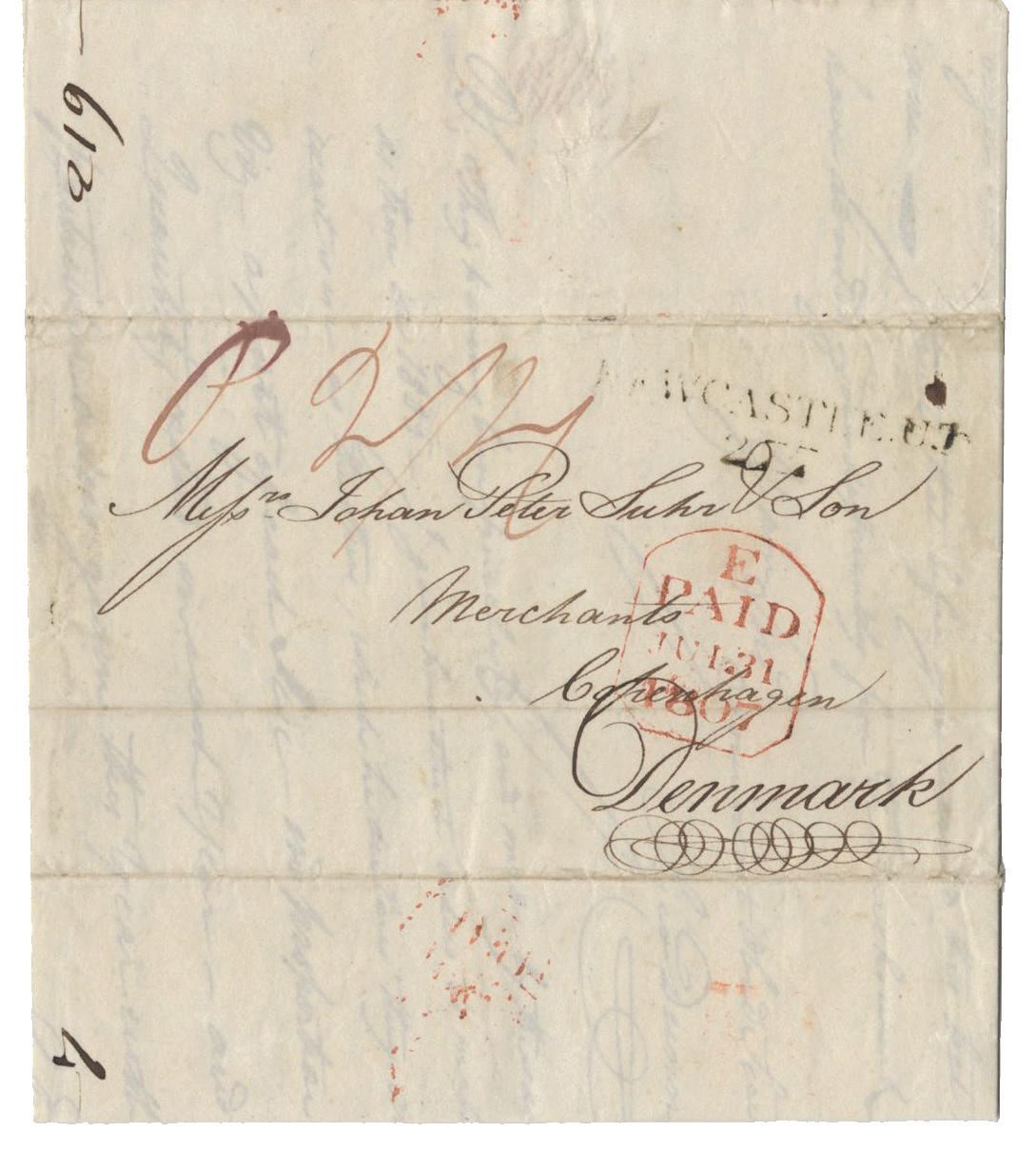
Figure 1. July 28, 1807 Entire commercial letter sent from Newcastle to Copenhagen. Paid 2/4d being 10d inland and 1/6d packet post. Danish postage 7 Lybske Schilling. Sent via London (July 31), Harwich and Tönning, where it was seized by Danish soldiers following the outbreak of hostilities at Copenhagen, finally arriving on September 26.
The letter in Figure 2, dated February 8, 1814, as noted by the writer, is the first possible since July 28, 1807. George Dunn & Sons, owners of the Whitefield Colliery in the Parish of Ryton, in the County of Durham, wish to resume trade with J. P. Suhr & Søn of Copenhagen. Coincidentally, we know that the latter sent a letter dated February 12, which presumably crossed with this one, also seeking to resume trade.
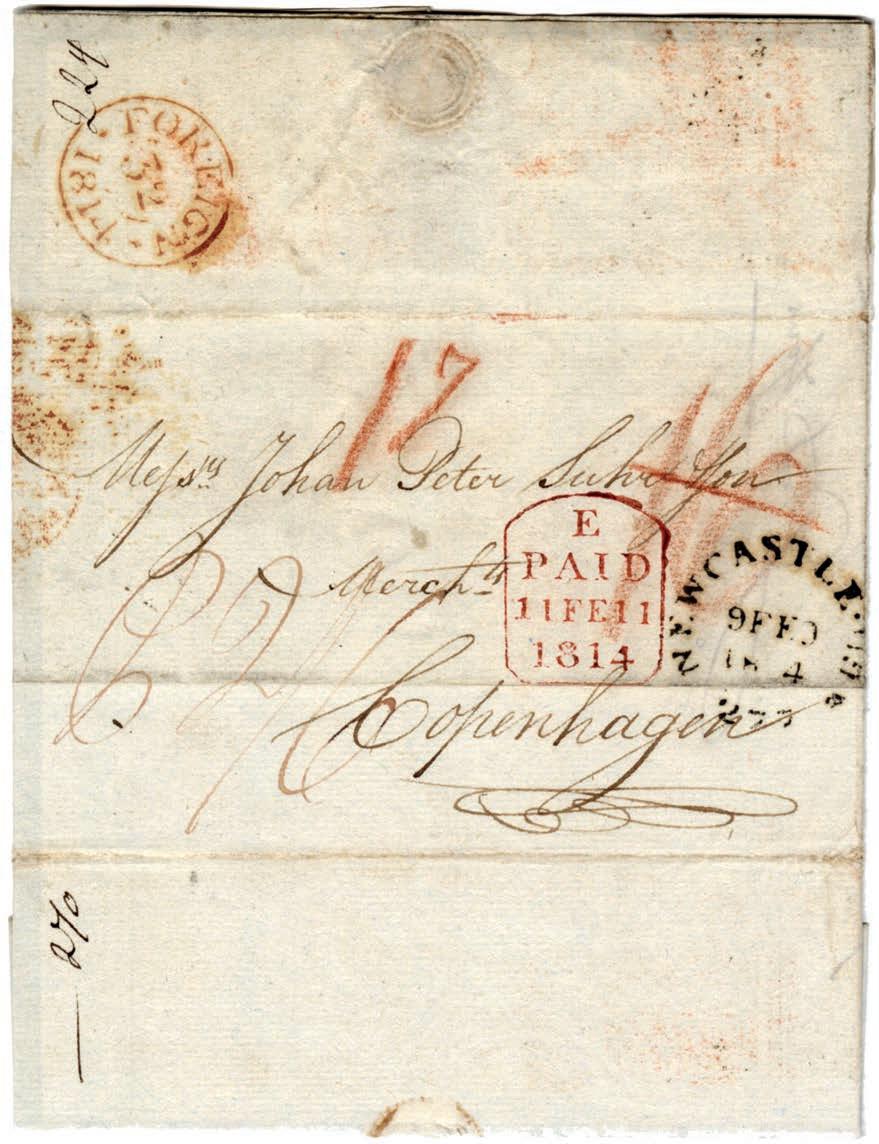
Figure 2. February 9 1814, Entire letter sent from Newcastle to Copenhagen. Marked 2/6 being 10d inland (1/less 2d 52 Geo III c 88) and 1/8d packet postage. The French occupation of Lübeck saw the Danish postal services expelled from the city, and an alternative was set up at Stockelsdorf on the city’s border with Danish territory. This letter was routed Newcastle-London-Harwich-Brielle-Amsterdam-Wildeshausen-Lübeck-StockelsdorfCopenhagen. Marked “16” (Lübeck Skilling) plus 1 LSk additional to Stockelsdorf = 17 (LSk). Postage from Stockelsdorf to Copenhagen was 11 LSk, making a total of 28 LSk. At 3.22 Danish Skilling to the Lubeck Skilling, this equals 90 Skilling, multiplied by an inflation factor of three, equals 270 Skilling (“270” in manuscript in bottom panel”), marked on reverse with Danish karte number “224”.
Both companies had quickly followed up on the opportunities offered by the signing of the Treaty of Kiel only a few weeks earlier. The reopened service was announced on February 8.
Gentlemen
The day is at length arrived when we may with safety & with pleasure renew our long interrupted correspondence; & we flatter ourselves our commercial intercourse will again revive & be carried on in the same friendly manner as formerly.
On our part, having still the Whitefield Colliery which is now in very high perfection, we are fully prepared to supply our friends with any quantity of coals of the very best quality. As the season is fast approaching when ships will sail for the Baltick, we are very desirous to receive your orders as soon as possible, being persuaded that the first arrivals of coals at your port must do very well. The prime cost here will be nearly the same as in 1807, we having made no alteration in our price, but there is an addition of about 1/- fChar [i.e. “per chaldron” – a measure of weight or volume for coal] to the King’s duty. We have to lament the death of two of your old acquaintance Mr Cram, & Mr Henderson senr, the former died about 3 years ago, the latter in this year; Pearson and Thomson are both very well, and we dare say will pay you a visit when circumstances will permit. We were very glad to receive a letter the other day from Mr. K. Wulff who is now in London preparing for a voyage to the East Indies; it afforded us the utmost pleasure to learn from him, that he left you in good health so late as last December, but our joy was damped by the melancholy acct of your son’s death; we condole with you most sincerely on this sad event, & doubt not you will support the affliction with due resignation to the will of the Supreme disposer of Events.
We have little more to add at present than to assure you that, we are most anxious to recommence our old trade & every possible attention will be given on our part, to render it mutually advantageous & pleasant as herefore.
We are Gentlemen Your most Obedient Servants Geo Dunn & Sons.
P.S. You will please notice an alteration in the firm of our house, having on the 1st Instant, taken Mr Cuthbert Dunn into partnership; he is our premier’s 2d son. G: D: & Sons.
Replied 30 April 1814.
The next letter, Figure 3, dated April 2, follows on from the first, and is also in reply to a letter sent on February 12, 1814, by J. P. Suhr & Søn. Clearly, George Dunn (17531833), who had sunk the pit at Ryton in 1800 was keen to retrieve the business lost by the intervention of the Napoleonic Wars.
Newcastle 2 April 1814
Messrs Johan Peter Suhr & son
Gentlemen
We have received with much pleasure your esteemed favour of 12th Febry & most sincerely congratulate you on the peace now so happily concluded between our two countries, & trust that we shall again resume our friendly intercourse.
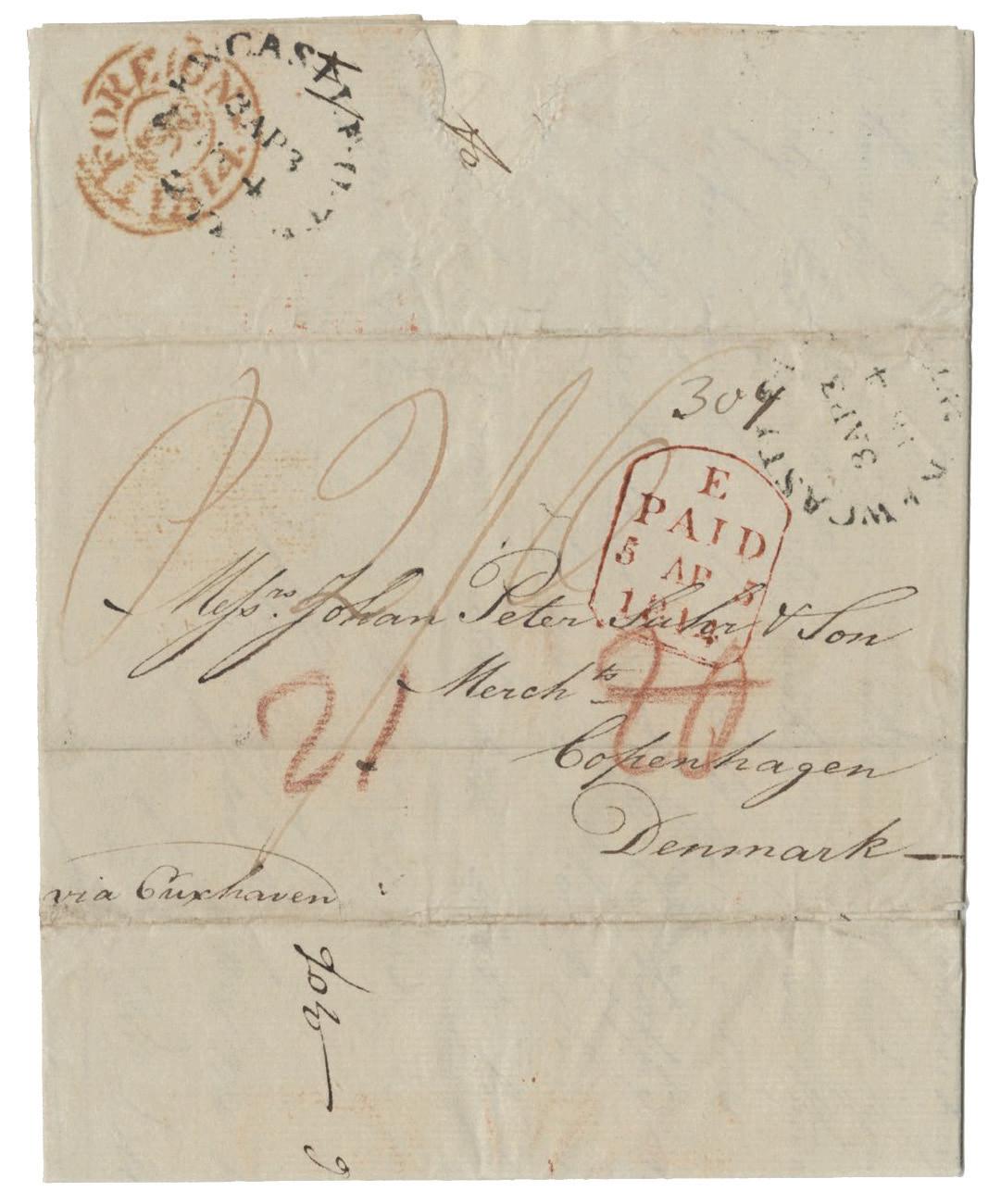
Figure 3. April 2, 1814, Entire letter from Newcastle via London and Harwich to Copenhagen, arriving 30 April. Directed via Cuxhafen but carried by the Henry Freeling packet to Helvoetsluys in Holland. Then routed AmsterdamWildeshausen-Stade–Glückstadt, as Hamburg was occupied by French forces until the end of April 1814. Prepaid 2/6d - 10d to London (1/- less 2d 52 Geo III c 88) plus packet rate 1/8d to Brielle. Then Holland-Stade 17 Lybske Skilling (LSk) and 4 LSk Stade-Glückstadt = 21 LSk: Glückstadt-Copenhagen charge 11 LSk making 32 LSk. Converted to Danish RBS - 32 x 3.2 exchange rate = 102.4 RBS. Inflation factor 3 = 307.2 RBS. “307” on front but “306” marked on reverse.
We wrote you 8th Febry containing nearly all the information required by your letter, but are afraid from the uncommon severity of the winter you may not have received it so soon as we expected.
We still continue proprietors of Whitefield Colliery which is now in high perfection, and the cost of a cargo here will be nearly the same as when we last shipt them for you in 1807, we have made no addition to our price but there is an advance of about 1/-fChar on the Kings duty.
Lead is now selling at £30 pfodder {per fodder, a measure of weight for lead] for refined & £29 for common, but expected to be higher soon, particularly if we should have a general peace, which is not improbable.
We cannot yet say what the freight of coals will be to your part, but as the expence on shipping in our country has risen very much since our last connections with you, & freights to all parts are in consequence much advanced, we think they will not be less than £20 fkeel [per keel: the “Builder’s Old Measurement”, a standard method used in England from approximately 1650 to 1849 to calculate a ship’s cargo capacity for taxing and registration purposes) to Copenhagen, this however is only our opinion, but you may rely that you shall not pay more than is current when we have to execute your orders.
In other respects we shall be happy to deal with you in the same liberal manner as formerly & every attention shall be paid to your interest on all occasions.
Geo. Dunn & sons
P.S. Having sent our former letter via Gothenburg we hope you may have received it ere this.
However, we shall forward this via Cuxhafen, in the hope you may receive it sooner.
Neither of the 1814 letters followed the route expected by the writer. The mails were badly affected by the weather in February 1814 with Gothenburg being ice-bound in mid-February, and no mail arriving from there until April 7. The German rivers were also affected by ice, with the London Morning Post reporting on April 9 that “The Elbe is still so obstructed by ice that direct communication with Cuxhafen is not possible.”
Bibliography
Abildgren, Kim (2010). “Consumer Prices in Denmark 1502–2007”, Scandinavian Economic History Review , 58: 1 ISSN 0358-5522.
Feldbæk, Ole (2001) “Denmark in the Napoleonic Wars: A Foreign Policy Survey”, Scandinavian Journal of History, 26: 2, ISSN 0346-8755.
Märcher, Michael (2010). “Danish Banking before and after the Napoleonic Wars: A Survey of Danish Banking, 1736–1857” , in Talvio, Tuukka and von Heijne, Cecilia (eds.), Monetary Boundaries in Transition: A North European Economic History and the Finnish War 1808–1809, Swedish History Museum, Stockholm, pp.127-43.
Tabeart, Colin (2019). British Long Distance Mail Packets 1793–1815: Rates, Routes and Ships Out and Home, Colin Tabeart, Fareham. ISBN 978-0-9548407-3-0.
Jacob Alex Klerman
Meriam Webster defines “poetic justice” as “an outcome in which vice is punished and virtue rewarded usually in a manner peculiarly or ironically appropriate” (https://www.merriam-webster.com/dictionary/poetic%20justice).
Perhaps the cover displayed in Figure 1 meets that definition; perhaps the story is more complicated. To understand, some backstory is appropriate.
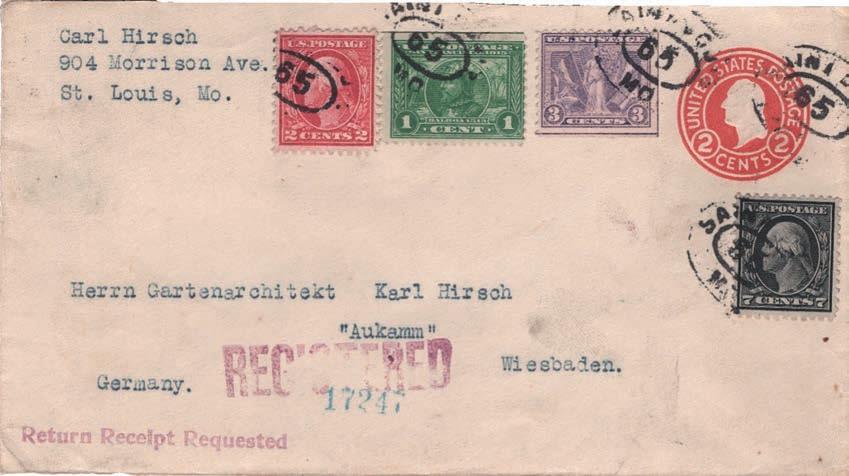
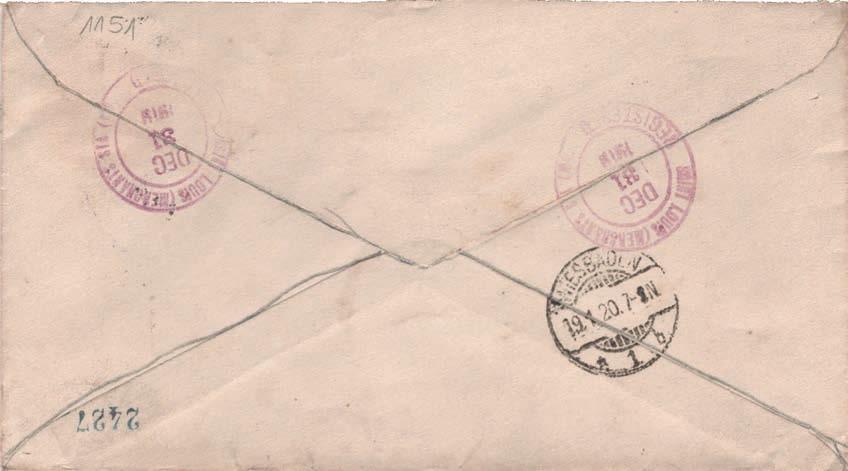
I am preparing an exhibit of US mail to Germany during World War I. This cover seems like an appropriate end to that exhibit. World War I had begun in the summer of 1914; the US had entered the war in the spring of 1917; fighting had ended with the Armistice at 11am on 11 November 1918; and, the Versailles Peace Treat was signed 28 June 1919. This cover was postmarked 31 December 1919, the last day of 1919.
On March 13, 1919, the US had issued the 3¢ Victory Commemorative. As Akaki (2023; see also Swain, 2019; Starkweather, 2011) notes, the 3¢ value was appropriate for the “War Rate” but was quickly obsoleted by the return of the first class single rate to 2¢ on July 1, 1919. Thereafter, the stamp was only useful as a makeup for higher rates.
This cover is an example of such a makeup rate. It is a UPU registered single, for which the rate was 15¢. That rate by properly paid by an uprated a 2¢ Washington Circle postal stationery entire with 7¢ and 2¢ Washington-Franklins, a 1¢ Panama Pacific Commemorative, and our 3¢ 1919 Victory Issue commemorative.
Other markings are conventional. On the front, there is a magenta 1911 Type 2 “REGISTERED” handstamp (Straight, 2008) and a magenta “Return Receipt Requested” handstamp. On the back, there are two strikes of the conventional, magenta, St. Louis, Merchant’s Station (#65) registered dater, and a Wiesbaden, Germany receiving mark for January 19, 1920.
Total travel time was 20 days. In the pre-war period, normal travel time was closer to ten days, but transportation in Germany had not returned to pre-war speed. In part, this was because, starting in November 1918 and continuing through June 1919, German reparations to France had denuded the country of most of its railway locomotives and cars. So, this timing seems reasonable.
While fighting had ended in November 1918, the Treaty of Versailles would not be signed until 28 June 1919, and the war’s postal consequences continued through most of 1919. Shortly after declaring war (4/6/1917), the US had suspended mail service to Germany (Klerman, 2018, 2025). Mail service did not resume with the Armistice. Only parts of Germany were occupied by Entente forces (the area west of the Rhine and small bridgeheads to the east of the Rhine). Mail service to those areas resumed April 10, 1919. Mail service to the balance of Germany would not resume until July 17, 1919, shortly after the treaty was signed (see Klerman 2026a).
Figure 2 displays an early cover from immediately after full resumption of mail service. It is a simple UPU single from Philadelphia, PA to Wahren (near Leipzig), Germany, with a red sticker “Business letter”. The letter was mailed July 21, 1919 and would have made the first post-resumption sailing of the Scandinavian Line United States on July 22, 1919.
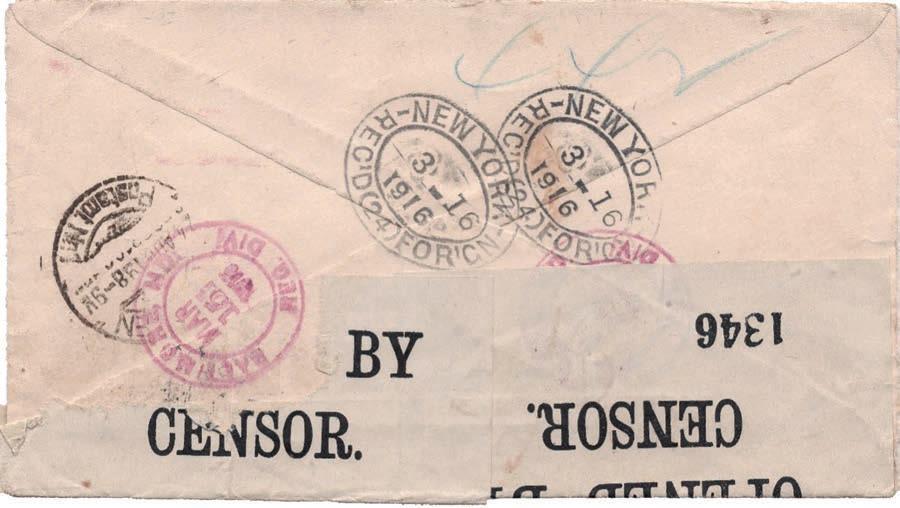
Starting in late-1915, the British had started lifting US mail to Germany (and other countries) on neutral steams and censoring them. Often, the censoring identified something problematic and the mail was not forwarded to the addressee. Starting June 23, 1919 and continuing through (roughly) the end of August, the British censors re-reviewed held mail. Personal correspondence was destroyed; business correspondence was forwarded (Mark, 2000, pp. 169-170, 244).
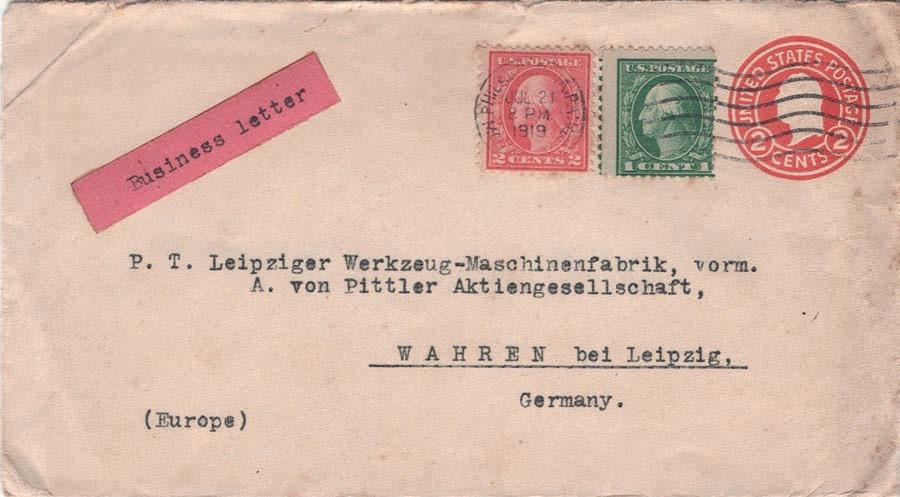
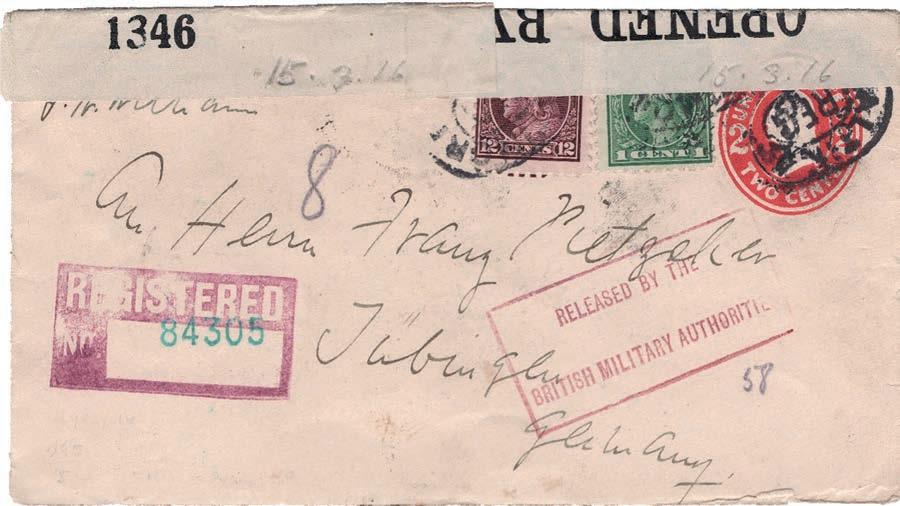
Figure 3 displays an example. It is a registered (business) letter from Baltimore, MD (March 15, 1916). The letter passed through the New York Foreign Mail office the next day (March 16, 1916). It was likely placed on the Scandinavian America Line Hellig Olav which sailed on March 17, 1916. That turned out to be unfortunate. This was the first Scandinavian America Line sailing to be censored (Klerman, 2026b).
Look carefully, there are two different “OPENED BY / CENSOR” labels. Looking at the front of the cover, the one to the right was applied first; likely in early April 1916 when the British initially censored mail on this sailing (see New York Times , April 4, 1916). Something about the contents caused the British to hold the cover.
In the summer of 1919, the British re-reviewed the contents. The censors released the cover; the post office applied the magenta boxed “RELEASED BY THE / BRITISH MILITARY AUTHORITIES” (as in: “late delivery is not because of the post office”) and forwarded the cover to Germany. The Wiesbaden backstamp implies that the cover arrived August 24, 1919.
Thus, the cover in Figure 1 is an appropriate conclusion to an exhibit about US mail to Germany during World War I. It was mailed on the last day of 1919. By then, the postal effects of the war were finally concluded. The 3¢ 1919 Victory stamp gives the cover a certain “poetic justice”; mail from the victorious United States to defeated Germany.
Akaki (2023) displays a wonderful solo franking of the 1919 Victory stamp and asks: “Could there be a more appropriate use of this stamp?” I think this cover comes close!
Business Context
When I first saw the cover in Figure 1, I thought it was too good to be true. Mailed on the last day of the year—with the 1919 Victory—stamp, the cover must be philatelic. I no longer think so.
Look carefully at the sender and the addressee. The letter is from Carl (with a “C”) Hirsch in S. Louis to Karl (with a “K”) Hirsch in Wiesbaden. A coincidence? The internet does not think so.
The address for Wiesbaden is modified by “Aukamm” in quotes. Since the 1950s, this area has been the location of a large US military housing complex. In 1919, Dr. Hans Guradze was opening the Alfred-Erich-Heim orthopedic clinic there. This was the beginning of the development of this area as a medical center.
Now look again at the address “Karl Hirsch” is proceeded by “Herrn Gartenarchitekt”; in English that would be a title; sometime like: “Mr. Garden Architect”, or more colloquially landscape designer. In Germany in this period, this was an official credential.
Julius Hirsch (1856-1912) had built a prominent and successful landscaping firm in the Aukamm district of Wiesbaden. In the early 1900s, his sons Heinrich Franz Karl Hirsch (1881-1956) and the more prominent Frederick Wilhelm Hirsch (18871957) entered the business, taking over on their father’s death in 1912, shortly before the start of the war. (Note 1)
It seems likely (but not certain) that the sender Carl (with a “C”) Hirsch at 904 Morrison Avenue in St. Louis (a multi-story brick building in the Soulard/LaSalle Park, working class neighborhood of German immigrants, near the local AnheuserBusch Brewery complex) was a cousin or close relative of the addressee Karl—with a “K”—Hirsch in Wiesbaden (likely named after the same relative as the address Karl—with a K—Hirsch).
The later years of the war had been a period of true famine for German civilians (Vincent, 1985). As of 1918, Germany was defeated. Food shipments had only restarted in late March 1919. The full blockade would only be lifted with the signing of the peace treaty in June 1919. German civilians were suffering. Poverty was everywhere. Likely, this registered letter contained money to help family members financially.
Discussion
A simple registered cover with the 3¢ 1919 Victory Commemorative appears to have a rich backstory. Those with other insights are urged to contact the author at KlermanStamps@gmail.com
Note
1. Several web references (and some help from google ai to locate and google to translate) fill in the story. In German, see: https://de.wikipedia.org/wiki/ Wilhelm_Hirsch_(Gartenarchitekt) and https://gartentexte-digital.ub.tu-berlin. de/archiv/Gartenkunst/Jg.34/B01.pdf. Also, see this one in Polish: https:// www.slubice24.pl/poznaj-slubice/slubice-wczoraj-i-dzis/5674-wilhelm-hirschprojektant-zieleni-miedzy-folwarkiem-i-wieza-kleista
References
Akaki, Bob (2023). “The WWI Victory Issue, Scott 537”, Collectors Club Philatelist, 102: 5, pp.299-300. Klerman, Jacob Alex (2018). “World War I Suspension of Mail to Germany”, The United States Specialist , No. 1056, pp.69-74.
Klerman, Jacob Alex (2025). “World War I Suspension of Mail to Germany: An Update”, The United States Specialist , No. 1141, pp. 113-119.
Klerman Jacob Alex (2026). “Resumption of US Mail to Germany after WWI”, unpublished manuscript.
Klerman Jacob Alex (2026). “Onset of Censoring of US Mail to Germany and Northern Neutrals”, unpublished manuscript.
Klerman Jacob Alex (Forthcoming 2026). “Resumption of US Mail to Germany after WWI”, The United States Specialist , No. 1157 [August] pp.367-374.
Mark, G. (2000). British Censorship of Civil Mails during World War I, 1914-1919 , Stuart Rossiter Trust Fund, UK.
Starkweather, A.W. (2011). “FDCs of the 1919 Victory Stamp”, First Days , 56, p.8.
Straight, David L (2008). “The Modernization of Registered Mail”, The United States Specialist, 80, 3, pp.105-109.
Swain, Steve (2019). “The WWI Victory Commemorative: Symbolic and Challenging [Scott 537]”, First Days , 445, p.14
Vincent, C.P. (1985). The politics of hunger: Allied blockade of Germany, 1915-1919, Ohio University Press, Athens, OH.

Boston 2026: Selections from Club Members’ Large Gold Medal
Notall Club members had the opportunity to attend Boston 2026, and I would surmize that many who did visit the show may not have viewed all of the eventual Grand Prix and Large Gold medal exhibits.
Space naturally prevents the inclusion of complete 8-frame exhibits in the pages of the CCP, and if our journal could be expanded infinitely, I personally would love to be able to feature selections from many more Club members’ entries. However, as that is impossible, please enjoy the selections that follow. I am grateful to all those winners who provided scans for this “pet project” (it’s something that I have introduced in a number of other journals that I edit). The sheets are published on a first come, first served basis, so I will be publishing those contributions which missed the print deadline in the next issue as Part 2.
The featured exhibits display a wide variety of topics and treatments. Many contain items that are unique, but this is not designed to be a “Boston Beauty Pageant” (my original working title for this column, which I soon dropped!). Instead, it is an effort to provide access to the work of our fellow Club members, and to appreciate elements of their exhibits such as presentation, research and how the subject matter is treated: factors which apply to all exhibition entries, regardless of the intrinsic value of the material involved or medals won.
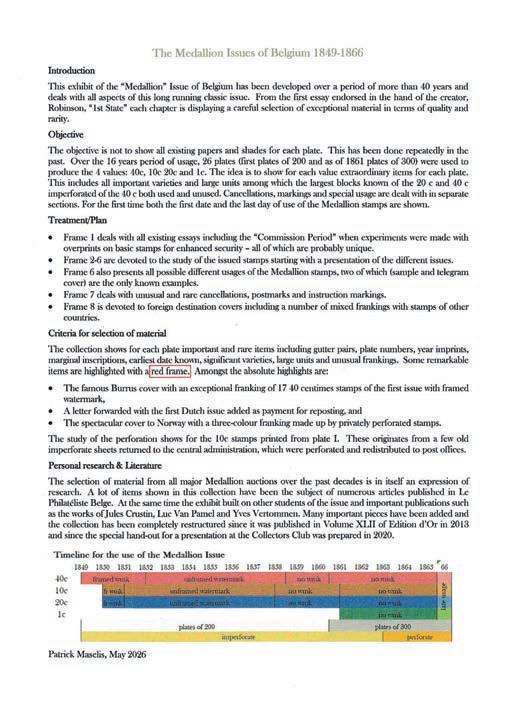
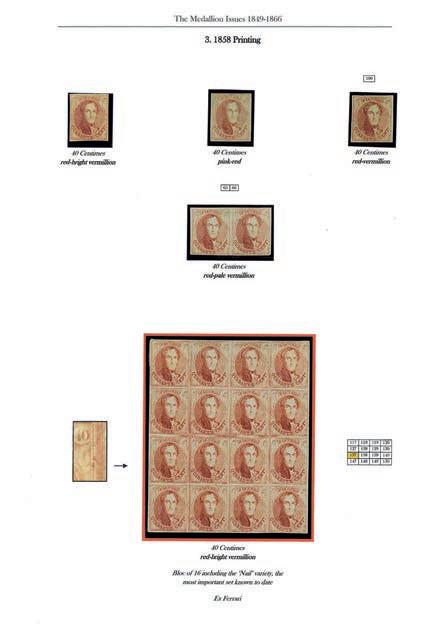
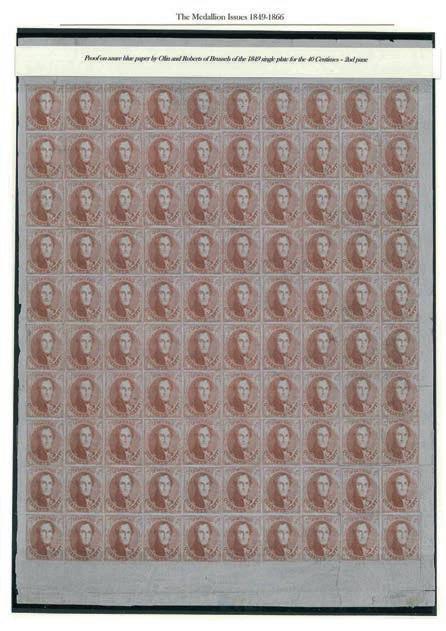
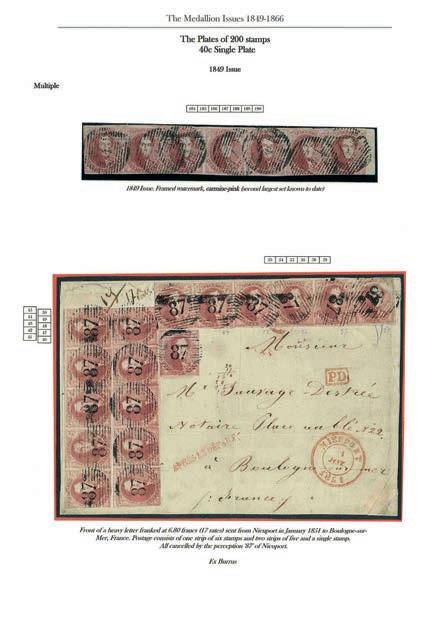
Patrick Maselis
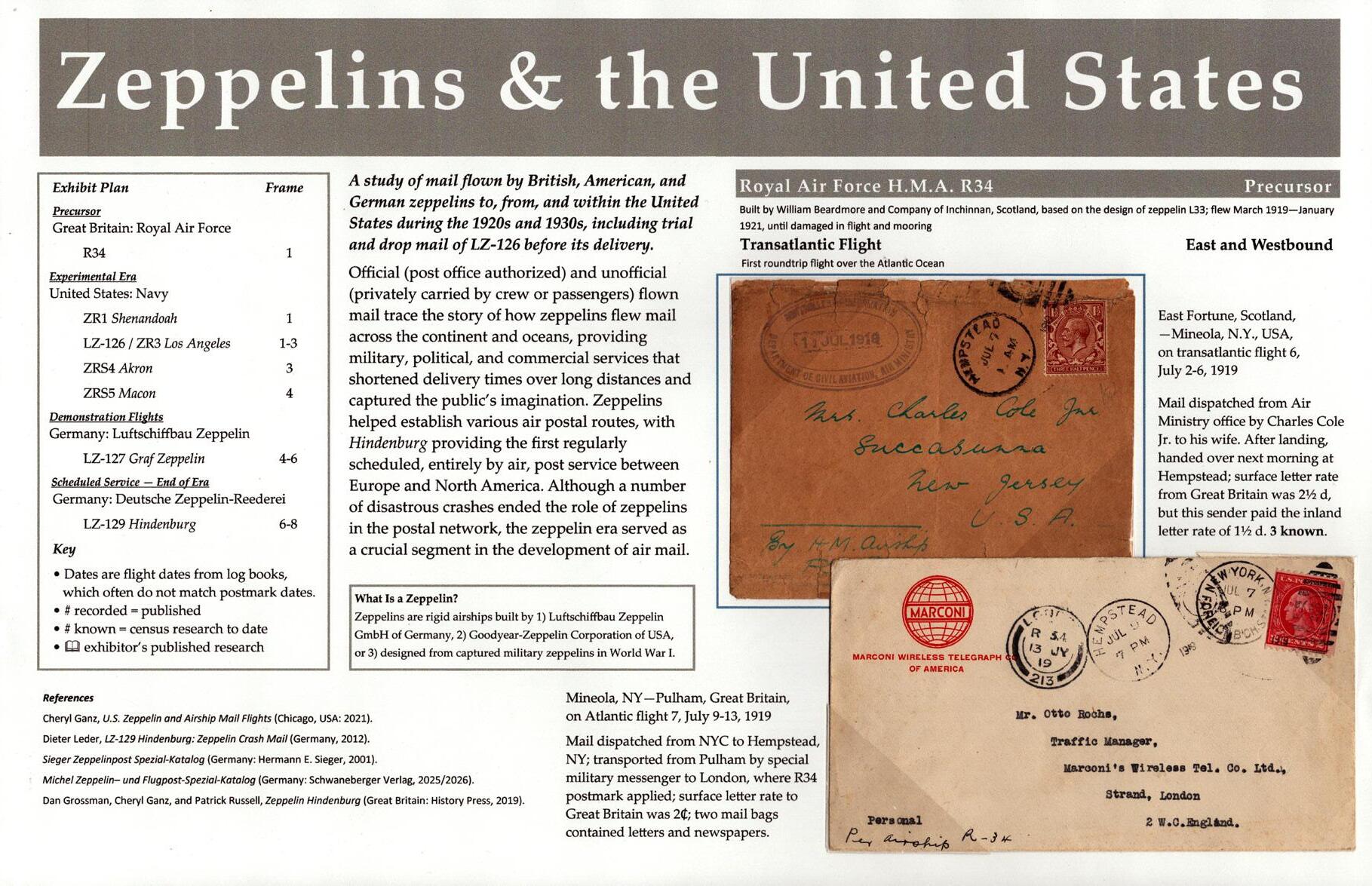
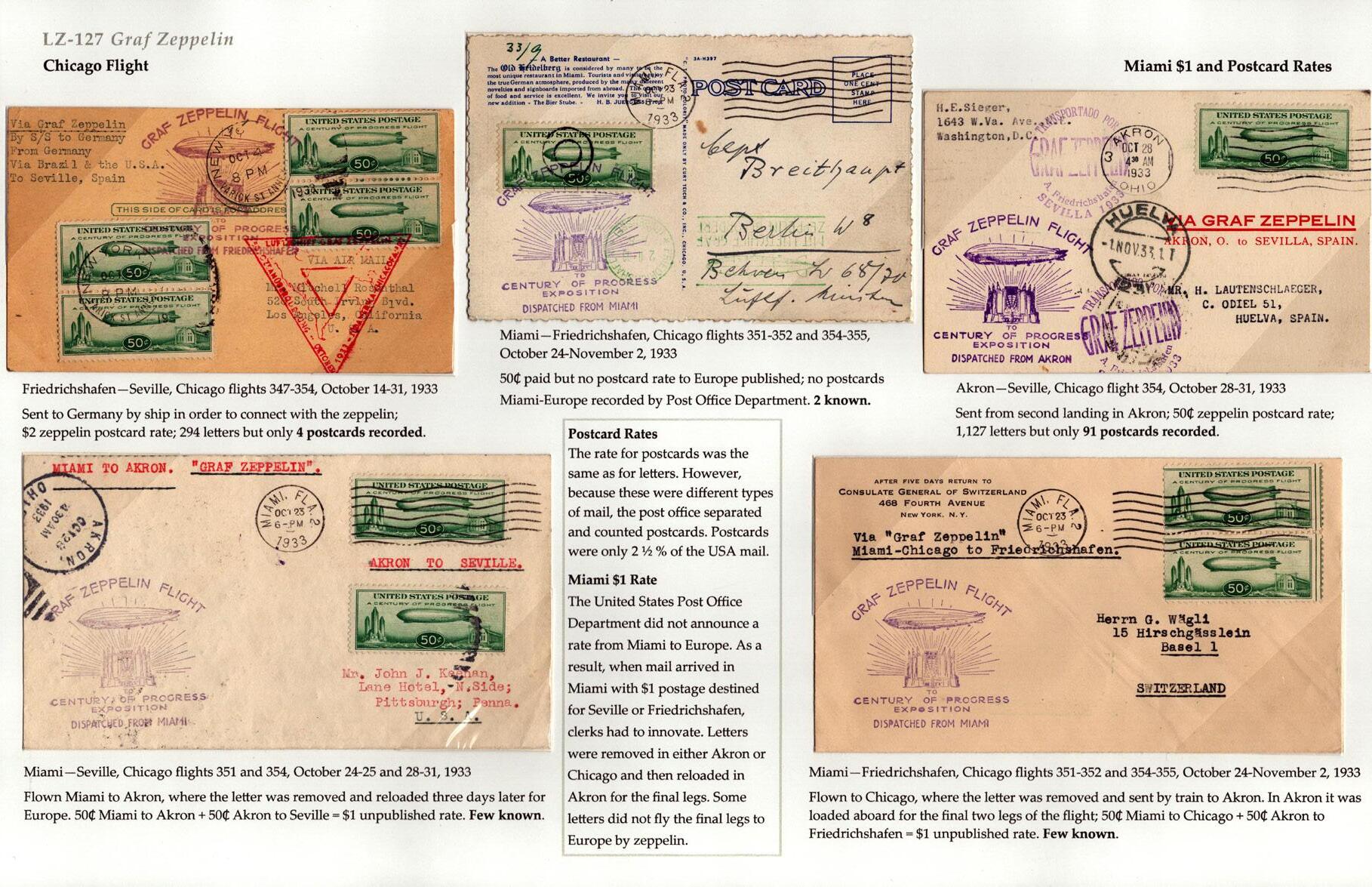
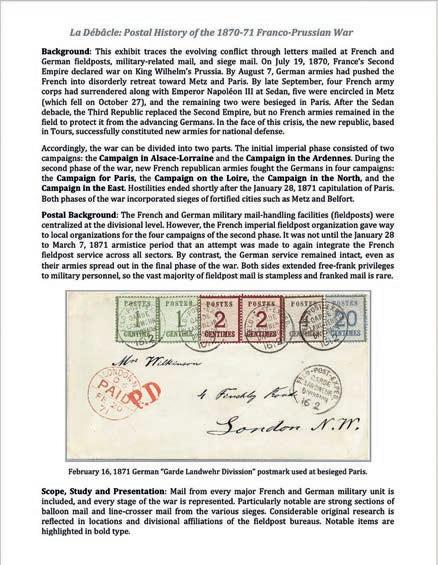
Cheryl Ganz RDP
French Naval Campaigns Naval Concession Rate: July 24 – March 7
The July 24 military free frank applied to personnel actively engaged in the war. On September 24, this was extended to all naval personnel at foreign stations, except that Paris balloon mail still required a 20 centimes franking.
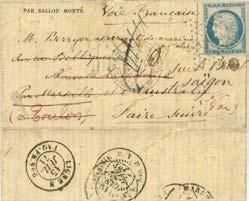

Posted January 12 in besieged Paris – left January 13 on the balloon “Général Faidherbe” 20c military rate to armored corvette “Belliqueuse” at New Caledonia – arrived March 26
Postmarked January 14 at Ste. Foy landing spot – routed to Marseille on January 16 Ligne V and P&O steamships from Marseille via Egypt to Australia and then Nouméa
Addressee had returned to France – letter forwarded by naval ship to Toulon on June 10
Addressee had joined the aviso “Bruat” at Saigon – letter left Marseille again on June 17 Forwarded via Egypt and Hong Kong (July 15 Ligne N postmark) to Saigon on July 19

French armored frigate
Campaign in Alsace-Lorraine Siege of Metz Balloon Service: September 5-15
Some recovered letters, or papillons, were forwarded inside of another envelope, or envelope de reéxpédition.” Fewer than 15 from the pharmacists’ service are known.
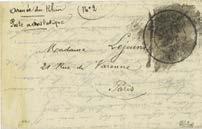

Datelined September 8 in Metz - 6th Pharmacists’ balloon left September 11 with 50 letters
Postmarked September 14 in occupied Forbach – then defaced to conceal French origin
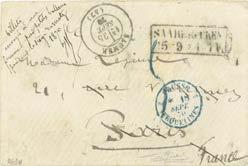

Placed in above envelope and posted unpaid on September 15 in nearby Saarbrucken, Prussia Routed via Prussia to Paris on September 18 per blue entry mark – caught in the Paris siege Carried out of siege by postmen Brare and Gême on September 21 – arrived September 23
Escaped from two different sieges
Campaign to Suppress the Paris Commune Historical Summary: April 6 – June 10
• Paris Commune was proclaimed on March 28, 1871
• Postal blockade of the Commune began on March 31
• Federal Armée de Versailles was formed on April 6-23
• Armée de Versailles re-captured Paris from May 21 to 28
• Normal postal relations with Paris resumed on June 7
• Armée de Versailles returned to Versailles on June 10
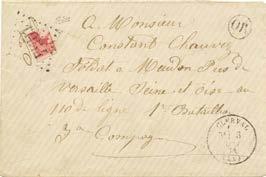

Posted May 3 in Clerval – addressed to a soldier in the Armée de Versailles at Meudon 20c prepaid in cash to postman – confirmed by a ¼ 80c stamp over manuscript “P.P.” Fewer than five quartered 80c Bordeaux Issue covers are known
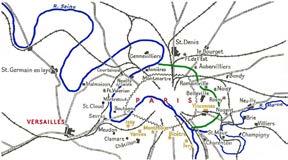
Map of the German occupation line (green) and Commune forts (gold)
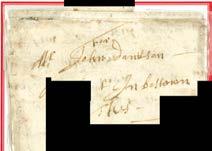
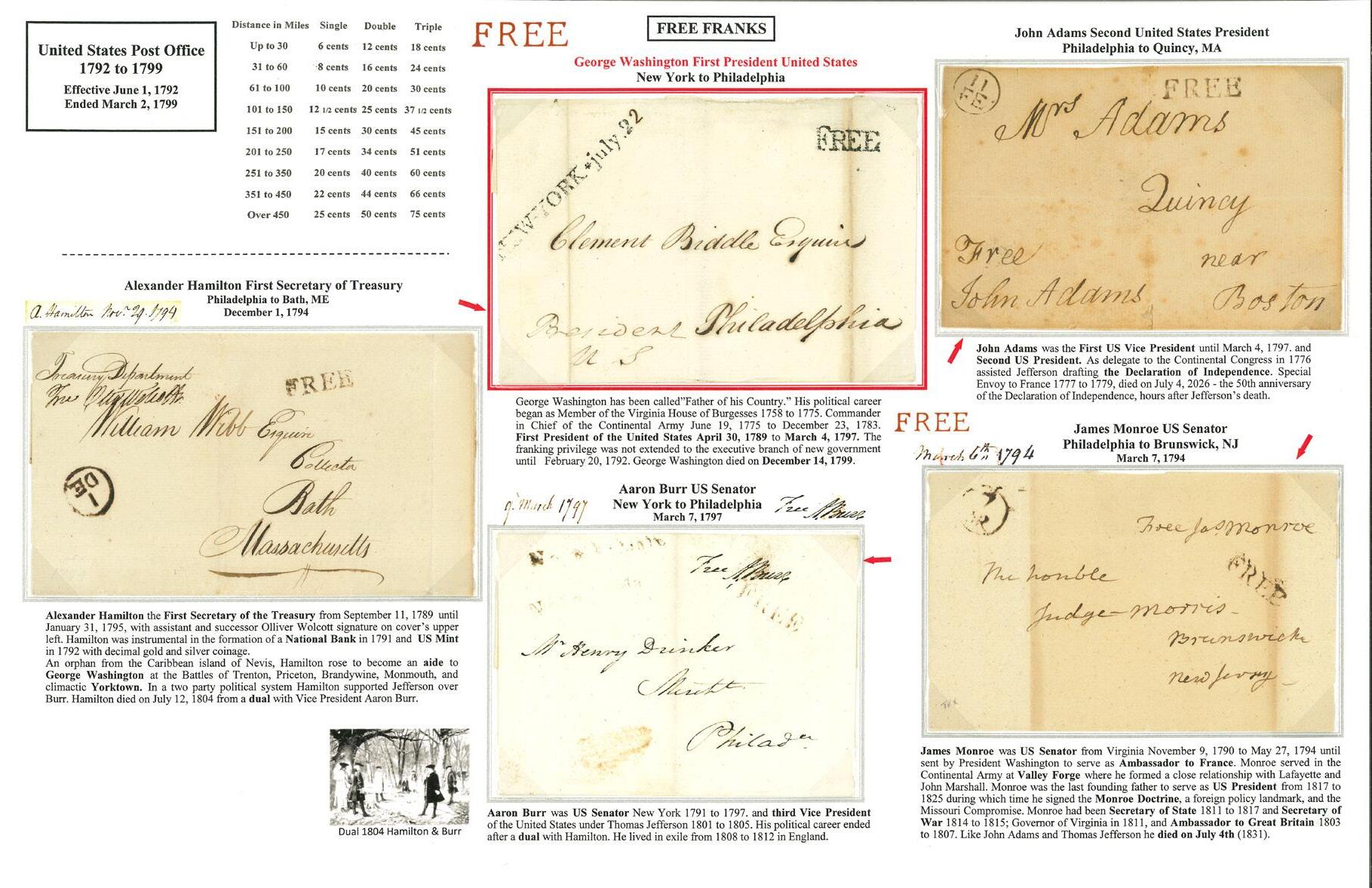
Transition ofAmerican Mail from British Colonial to USPO; 1685 to 1799
�: By the endof the 18th centurycommunicationneeds of5 millionAmericansrequired anorganized andefficientpostalsystem. This8 frame postalhistoryexhibit reviews 115 yearsofpostaldevelopment.
�: England's first official post office began July 1, 1635. Settlements in the present day United States of America were slow to appear, and written communications was usually with Europe rather than otherNorth American colonies. In December of 1672New York began a very short lived domestic post for several months confirmed by 2 archival examples. In 1685 the population reached 180,000 and NewYorkrestarted domestic postalservice, with3likelyinter-colonyexamplesavailabletocollectors.
During the reign of Queen Anne, by Act of Parliament, in 1711 Great Britain established a "General Post Office for all Her Majesties Dominions" for the entire British empire with direct control of all postal activi
tiesincludingthe power toopenletters. Dueto the uncertainty ofdelivery onhigh seas and/orthrough Indian land, prepaymentwas notexpected.
On July 26, 1775 the Continental Congress established an American post. Severe inflation occurred during the Revolutionary War and Confederation Period. Not until the First Postal Act of 1792 to March 2, 1799 was payment requiredinUSdollars.
�: Chronologic appearance of 5 major rate periods, each a decade or more. Rates were based upon distance and weight. Given 7 minor short live rate periods during the Revolutionary War, the total numberofrateperiods is11.
1. Forerunners 1683. Frame 1
2. Actof QueenAnne 1711. Frame 2
3. ActofKing GeorgeIII 1765. Frame3
4. Transition 1775. Frame4
5. Continental CongressPost 1776. Frame5 & 6
6. Confederation CongressPost 1782. Frame7
7. United States General Post Office 1792 Frame 8
�: All periods begin with a shaded box in left upper comer with adjacent rates. Postal milestones announced at top of page by red text box Above each cover is the origin, destination, date, and significance. Important covers in red frame with red header Many idealized postmarks nearby. Rate and route description below or aside. Rarity does not include unobtainable archival material. Historical context usually at bottom andlightly shaded. All pagesreadlefttoright.
�: Very special examples include two 1685 domestic inter-colony examples; second earliest domestic postal rate in the Westem Hemisphere; earliest and latest recorded Queen Anne covers; earliest recorded postmark of New Jersey, Maine, Florida, Washington DC, and present day West Virginia; earliest Committee of Correspondence cover; the only cover to an American post office in present day Canada; earliestCongressionalCongressratedcover,andearliestmourningcoverintheWesternHemisphere.
Philadelphiabecamethemost populous18th century English speakingcityin the Western Hemisphere,home of Ben Franklin's workshop, home of theContinentalCongress, signing of theDeclaration of Independence, signingoftheUnitedStatesConstitution, and thenation'scapitalduringthe finaldecadeofthe century. Second Earliest Recorded Inter-Colony NorthAmerica
Vernon Morris
Vladimir Milic
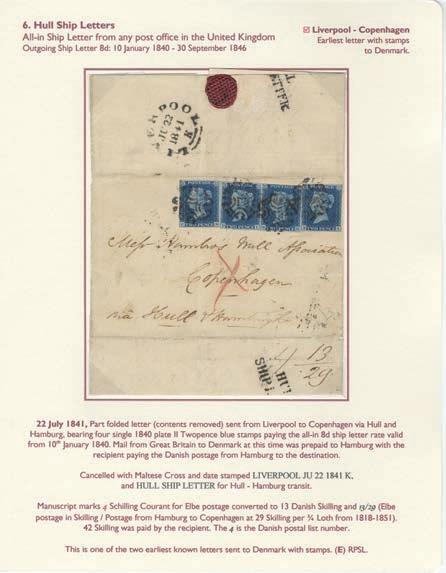
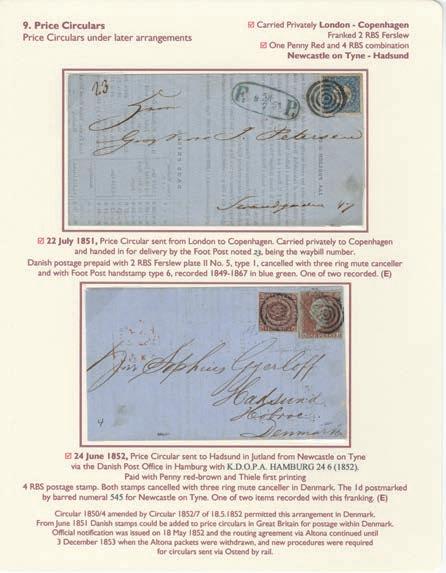
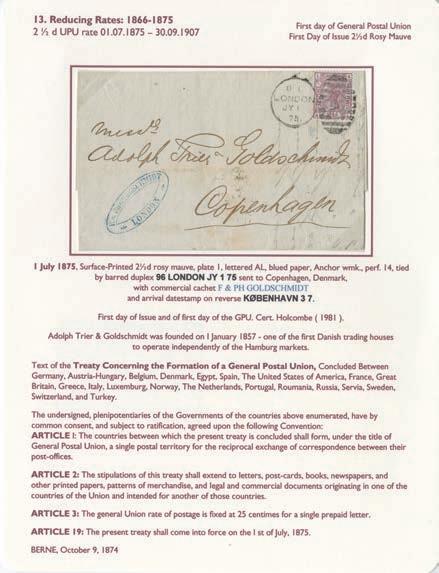
This exhibit charts the changing postal rates and routes between Denmark and the United Kingdom, and vice versa through the nineteenth century until both countries became founding members of the General Postal Union which came into force on 1 July 1875. The final page shows a first day of use for the 2½d stamp issued by Great Britain for the new GPU rate.
The exhibit begins with the rise of Napoleon Bonaparte to First Consul of France and its postal consequences for the disrupted British and Continental mails during the Napoleonic Wars and charts the reduction and simplification of postal rates during the period.
There was no postal agreement between Denmark and the United Kingdom before 1846, and while both charged postage based broadly on weight and distance, the British largely controlled the packet boats and other ships that exchanged mail at either Hamburg or Altona - although many other ports were used depending on conflict or weather. Most routes are shown in the exhibit, together with material showing the inland rates payable, and those charged for the packet service.
Ship letters offered a parallel service to the packet boats, by 1832 the service from Harwich to Hamburg had given way to ships departing from the River Thames, and the long sea crossing gave way to the shorter Channel crossing with virtually all mail carried by rail via Belgium and The Netherlands to Hamburg for onward transmission to Denmark from the end of 1853.
Distances and weight were calculated using different standards, with the Danish mile being 7.532 km and the Danish Lod weighing 15.6 grammes, while the British Ounce was 28.35 grammes - making the postal weight steps different in the two countries. Initially each country treated registered mail differently, postal agreements saw prix courants bearing mixed frankings between Danish and British stamps, and when stamps were permitted, at times neither country issued stamps which could exactly prepay the published rates.
With the Treaty of 1846 all through postal rates were agreed, meaning that mail for the first time could be paid to destination, and the following 30 years saw rates fall from the prohibitive levels at the beginning of the century to 2½d or 20 øre in 1875.
The exhibit shows chronologically the key developments in mail between the two countries, with all basic postal rates and routes illustrated. Where possible different routing and payment handstamps are shown.
1 The North Sea Packets during the Napoleonic Wars 1797-1806 8 Danish West Coast Ports 1851 9 Price Circulars 1851-1874
2 North Sea Packets 1807-1814 10 Privately Carried Ship Letters 1855-1865
3 The British Fleet 1807 11 Reducing Rates: 11½d, 10½d, and 9d 39, 34 and 30 Skilling rates 1854-1864
4 North Sea Packets Resume 1811-1814
5 Thames Ship Letters and Packets 1828-1845 12 Reducing Rates: 9d, 8d, and 4d: 32, 30, 24 and 14 Skilling rates 1864-1866
6 Hull Ship Letters 1841-1845 13 Reducing Rates: 4d, 3d, and 2½d, and 14, 10 Skilling and 20 øre rates 1866-1875
7 The 1846 Postal Convention 1846-1853
Much of this material is difficult to acquire and rarity statements are included in the descriptive text or indicated in the right hand header thus þ
Bibliography: British Letter Mail to Overseas Destinations 1840-1875. Jane & Michael Moubray
Briefverkehr vom Vereinigten Königreich nach Skandinavien vor Juli 1875 Brauers & Kirschneck
An Introduction to the Postal History of Denmark 1625-1950 David Cornelius Danske Frimærkefrankerede Forsendelser til og fra Udlandet 1851-1905. Karsten Jensen
British Long Distance Mail Packets 1793-1815, and Vol. 2, The Harwich Packets 1816-1834. Colin Tabeart
The Stamps and Postal History of Albania, by Thimi Nika, Mediaprint, Tirana, 2015. 425 pages. Reviewed by Allan D. Smith.

“Albania is the most romantic country in Europe, probably in all the world. It is a lawless land where might makes right, and parts of it are as forbidding to the foreigner as darkest Africa.”
Sowrote journalist Frederick Moore in 1906 (The Balkan Trail, p. 219). Something similar might also be said of the philately of Albania. The many obscure local, provisional, and bogus issues, together with numerous forgeries of primitively produced stamps and overprints, may repel some collectors, while attracting the more adventurous.
Up to now, the available literature on Albanian stamps has been produced by Western European and American writers. At last, we have a book on the subject by an Albanian collector and scholar, the late Thimi Nika who passed away in 2018. Nika had been involved with stamps for most of his life, as a collector, as editor of Koleksionisti, the journal of the Albanian Association of Philatelists, and as a member of the Albanian State Commission of Stamps, the official body that reviews and approves stamp designs.
The first thing to be said about this book is that it is beautifully designed and produced, with color illustrations of Albanian stamps and covers of the past 100 years (though omitting many of the “wallpaper” issues of the communist period). It is a pleasure just to hold it and browse through the images.
Aside from its aesthetic appeal, the book adds to the existing philatelic literature on Albania in three main ways. It opens with an extensive introduction to this literature, not only naming the titles, as in an ordinary bibliography, but discussing the various authors and their contributions to the field. Included are the works of Albanian philatelists, little of whose work is translated or known outside the country.
Secondly, the book records Nika’s extensive researches into the official government archives concerning stamp issues, their exact dates, quantities issued and quantities subsequently destroyed. This is information unavailable anywhere else. While it may seem tedious to the average reader, it is of deep interest to specialists.
Finally, the book concludes with an essay on the artists who contributed to the design of Albania’s stamps, starting with Qemal Butka, designer of the issue celebrating the 25th anniversary of Albanian independence in 1937. These stamps, with their dramatic allegorical imagery of Albanian emancipation from Turkish rule, are familiar to all collectors of a certain age who began collecting the world as children. Thimi Nika was a man of aesthetic sensibility, an art collector as well as a philatelist, with a deep appreciation of the artistic accomplishments of his countrymen.
The fascination of Albania’s stamps, especially the early ones (1913 to 1945) derives from the country’s complex history. The small group of nationalists who declared independence in1912, in the coastal city of Vlora, controlled very little of the territory eventually incorporated into the country. A unified kingdom had barely emerged when World War I broke out, and the territory experienced waves of occupation and the setting up of shortlived provisional governments, each of which had its philatelic consequences.
The 1920s, which saw the emergence of a unified Albania, first as a republic, then as a kingdom, were also a tumultuous period with many stamp issues overprinted to reflect political changes. World War II brought annexation by Italy followed by Nazi occupation. After the war, the country fell under the control of the notorious dictator Enver Hoxha, who installed one of the most isolated and repressive communist regimes of all time. Only in 1990 did Albania finally emerge as a more or less normal country.
A familiarity with this history is essential to understanding Albania’s stamps, but Nika but does not go into it in detail, preferring to focus on the stamps themselves, and the details surrounding their production. The classic work on Albanian philately, which covers both the historic background and the early stamps and postal history in depth, is The Stamps and Posts of Albania and Epirus, 1878 to 1945, by John S. Phipps. As Thimi Nika freely acknowledges, this classic work is still an essential resource for all Albania collectors. His own book does not supersede it but adds to it by extending the story up to 2013 and providing the perspective of a native Albanian who lived through the difficult communist years and the country’s emergence into the modern world.
One of the aspects of Albanian philately that would never be accessible to us except from within the country, is the correspondence to and from people imprisoned during the communist period. Nika has explored this area and written a study of it, detailing the intricate rules that had to be followed in order to satisfy the paranoid censors. He shows images of some of the rare covers that survive from the correspondence of these prisoners.
While this book is a pleasure to hold and peruse, the text presents some difficulties. It is highly technical, as is to be expected, but the wording is awkward at times. The translator is clearly not a native English speaker and makes mistakes (using the word “texture” to mean “text,” to cite one example). Nevertheless, the book is a beautiful and indispensable contribution to the philatelic literature on Albania. The stamps are presented in an attractive way, and should appeal to collectors hungering for new realms to conquer.

The following new members were approved by the Board of Governors:
June 30, 2026
Resident
Non-Resident:
Thomas G. Meier, Yonkers, NY
Ahmed Aobuesh, Chico, CA
Semaan Bassil, Beirut, Lebanon
Joseph G. Bock, Cottonwood, AZ
Shane C. Dietrich, Kensington, MD
Tobias Huylmans, Nierstein, Germany
Ryan T. Lee, Portsmouth, RI
Teela Pongpakdee, Sioux Falls, SD
Dietrich Michelson, Oberursel, Germany
Anthony Brian Port , Salem, OR
Alfred Schmidt, Haldensleben, Germany
If you would like to update your contact information, please contact our Executive Secretary, Andrea Matura, at info@collectorsclub.org
Respectfully submitted, Alan Barasch, Membership Chair
September 2
From Perkins, Bacon to De La Rue. The Story of the 1879 and 1880
GB Tenders Howard Hughes
Please note that the preview for this presentation will be posted on the Club website.
September 16 East Germany. The Cold War Propaganda Forgeries 1953-1957 Oliver Wyrtki
September 23
The Hindenburg Crash Cover: A Philatelic Icon Cheryl Ganz RDP
September 30 Indian Stamps Used in Iraq Akthem Al-Manaseer
October 14 Poland. Airmail of the Siege of Przemysl (1914-1915)
October 28
November 4
November 11
Jerzy Kupiec-Weglinski
GB QV Surface-Printed issues: An Inside Look at How We Up dated and Expanded the SG Specialised Catalogue Matthew Healey
The Postal History of the American Civil War Dan Knowles
Single-Frame Competition
November 18 Early Transatlantic Mail Carol Bommarito
December 2
Panel Discussion on the Hobby's Future
December 9 Governors’ Open House
December 16 Postcard exhibiting Liz Hisey
Robert “Bob” Paul Odenweller RDP
September 19, 1938 – May 26, 2026

Bob Odenweller, distinguished philatelist, author, editor, exhibitor, and internationally respected authority on the stamps and postal history of New Zealand and Samoa, passed away at the age of 87.
Born on September 19, 1938, in Colón, Panama Canal Zone, Bob was the son of Lieutenant Colonel Charles Joseph Odenweller Jr., a career United States Army officer, and Robina Katherine Watson Odenweller. Raised in a military family, he grew up alongside his siblings Charles, Peter, and Robin.
Bob attended Swarthmore College before transferring to the United States Air Force Academy, where he earned a Bachelor of Science degree in 1960. Upon graduation, he was commissioned as an officer in the United States Air Force and served as a pilot, attaining the rank of captain before leaving military service in 1966.
Following his Air Force career, Bob devoted himself to philately, a field in which he would become one of the world’s foremost scholars and leaders. Joining the Collectors Club of New York in 1964 and the American Philatelic Society in 1968, he quickly established a reputation for meticulous research, intellectual rigor, and a passion for sharing knowledge.
Over a career spanning more than five decades, Bob authored landmark works that transformed the study of Pacific philately.
His books The Stamps and Postal History of Nineteenth Century Samoa (2004) and The Postage Stamps of New Zealand 1855–1873: The Chalon Head Issues (2009) remain essential references for collectors and historians worldwide. He also wrote extensively for leading philatelic journals and served for more than twenty-five years as a columnist for The Philatelic Exhibitor .
Bob’s leadership extended throughout the philatelic community. He served as editor of The Collectors Club Philatelist from 2005 to 2012, guiding the publication through its transition to full-color production. He held numerous positions within the American Philatelic Society, the Philatelic Foundation, the Association Internationale des Experts en Philatélie, the Collectors Club of New York, and the Fédération Internationale de Philatélie. As an accredited judge, expertizer, mentor, and organizational leader, he influenced generations of collectors and researchers.

Details of the front covers of Bob Odenweller’s classic studies of Samoa and the New Zealand Chalon, Head issues.
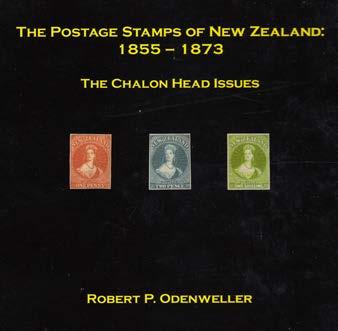
His scholarship and service earned many of philately’s highest honors. In 1991, he signed the Roll of Distinguished Philatelists, one of the field’s most prestigious recognitions.
He received the Alfred F. Lichtenstein Memorial Award, the American Philatelic Society’s Luff Award for Distinguished Philatelic Contributions, the Smithsonian National Postal Museum’s Philatelic Achievement Award, the Royal Philatelic Society London’s Crawford Medal, and numerous other international distinctions. He was named an Honorary Fellow of both the Royal Philatelic Society London and the Royal Philatelic Society of New Zealand.
As an exhibitor, Bob achieved extraordinary success, winning the American Philatelic Society’s Champion of Champions award in 1973 and the Fédération Internationale de Philatélie Grand Prix d’Honneur in 1980. His exhibits on Samoa and New Zealand set enduring standards for philatelic research and presentation.
Beyond his achievements, Bob was known for his generosity, integrity, mentorship, and unwavering commitment to advancing philatelic knowledge. Through his writings, exhibits, expert opinions, and leadership, he helped shape modern philately and inspired collectors around the globe.
He leaves behind a legacy in the philatelic community and among all who benefited from his scholarship, friendship, and dedication to the preservation of postal history. His contributions will continue to inform and inspire future generations of collectors, researchers, and historians.
Memorial contributions may be made to philatelic research organizations, libraries, or educational institutions dedicated to the study and preservation of postal history.
Bob P. Odenweller is survived by his loving wife, Jane, his children Liesl and Joy and grandchildren, Anna and Keoki.
Roger Brody RDP
October 8, 1963 – May 15, 2026

It is with great sadness to report that Club member Harry Olivar died tragically in a traffic accident on Friday, May 15. The accident occurred in central Georgia and Harry’s stepson, David Jackson, was also killed. Harry’s wife, Leigh, was seriously injured but, as of this writing, has been released from the hospital and is expected to recover. Harry leaves behind his wife and four sons: Jordan, David, Harry III, and Robert.
Harry was 62 years old and was the Chair of the National Securities Practice at Quinn Emanuel Urquhart & Sullivan, LLP, the world's largest business litigation and arbitration specialist. Harry served 26 years at the firm and was a titan in the legal community, recovering over $4.9 billion in verdicts, judgments, and settlements on behalf of plaintiffs and appearing against nearly every major financial institution in more than twenty cases involving mortgage-backed securities.
Harry’s partners, associates, and staff remember him as an extraordinary mentor whose unassuming manner, impeccable judgment, and genuine warmth made everyone feel that they belonged. His many professional honors included recognition in Chambers USA, Legal 500, and The Best Lawyers in America. He was also selected to the Lawdragon 500 Hall of Fame.
Outside of his legal practice, Harry supported civic and community service in the Los Angeles community and elsewhere. He and Leigh were devoted patrons of the Pasadena Playhouse, and Harry served on the Board of Directors of the Stone Trust and La Salle College Preparatory School. Harry received his J.D., cum laude, from Harvard Law School in 1989, where he served as Executive Editor of the Harvard Law Review, and his B.A., summa cum laude, from Yale University in 1985.
Harry became a stamp collector in his youth and, like everything Harry did, he became a giant in philately. I believe that Harry formed the most comprehensive and highest quality “traditional” United States stamp collection of all-time. The depth, breadth, and quality of his collection is astonishing. He took as much pleasure in acquiring common used stamps from the mid- to late-twentieth century as he did the highest quality classics. Harry served on the Board of the Philatelic Foundation since his appointment in 2018 and was Treasurer at the time of his passing. He supported numerous philatelic clubs and societies, most recently becoming a member of the Club de Monte Carlo. He was also recently appointed to the Council of Philatelists at the Smithsonian National Postal Museum.
On a personal note, Harry was a close friend, and his loss leaves an immeasurable void. He exemplified the values of integrity, kindness, and care for others in everything he did. Harry was never flustered, always sensible, and always optimistic. When you engaged with Harry, he gave you all his attention. In my opinion, Harry was always the smartest person in the room, but those who knew him best will recall his incredible humility and patience. Harry set the standard for the rest of us to strive towards – he was an exceptional human being who was loved and respected by everyone who knew him. He was a true builder of communities who positively impacted everything and everyone he touched. I am deeply grateful for our friendship, the time we spent together, his generosity, and his influence on me in philately and all aspects of life. Harry will be deeply missed.
Daniel J. Ryterband
September 16, 2026. Oliver Wyrtki
East Germany. The Cold War Propaganda Forgeries 1953-1957
It began as a parody label, turned into an instrument of sabotage, and inspired collectors and philatelic forgers. The propaganda forgeries of East Germany by the Action Group Against Inhumanity ( Kampfgruppe gegen Unmenschlichkeit or KgU) during the height of the Cold War represent philately in action and illustrate a colorful and dramatic period in Cold War Berlin.
The KgU was a home-grown, West Berlin anti-communist organization with an extensive list of contacts in the Russian Occupation Zone. The CIA began funding its operations and providing operational guidance to the KgU in 1949, confirmed in 2007 with the declassification of CIA internal documents and the opening of the East German security services (Stasi), and KgU files held in German archives.
The KgU used multiple means to disrupt the East German authorities, including leaflets, mail, forged letters and documents, and forged stamps to sabotage, confuse, misdirect, and otherwise reduce the operations and efficiency of the East German economy.
Join us as Oliver Wyrtki discusses the KgU, its creation of the ten parody/ forgery stamps, and their use as part of the KgU campaign during the height of the Cold War.
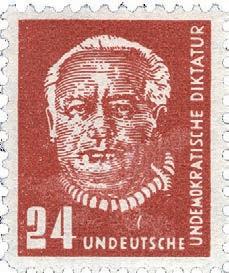
The first KgU stamp to appear in March 1953, with the head of the East German President, Wilhelm Pieck, shown with a noose around his neck and the inscription “UnGerman Undemocratic Dictatorship”.
A parody of the East German Five-Year Plan series showing a worker demanding free elections from Party Secretary Ulbricht with a hand and note directing him to return to Moskow.
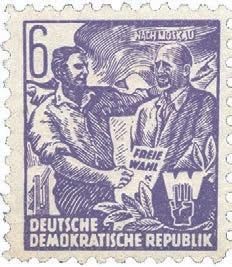

A symbol of the KgU from the letterhead of a membership application, 1949.
On its first North America trip of 1937, German zeppelin LZ-129 Hindenburg burst into flames while landing at Lakehurst, New Jersey, on a rainy evening. It suffered total destruction in 34 seconds. The disaster took 36 lives and destroyed most of the 17,000+ pieces of mail aboard. Less than 400 pieces of mail survived, of which half remained unburnt in a sealed container.
The May 6 Hindenburg disaster was the first aerial tragedy captured on film. The next day, the newsreels were in theaters and newspaper headlines reached Europe. A “perfect storm” moment, when a spark ignited loose hydrogen mixed with oxygen, has been debated ever since to determine the cause.
On September 23 at the Collectors Club, Cheryl Ganz will talk about Hindenburg’s important role in bridging continents with the first, regularly scheduled North Atlantic airmail service, the disaster, survivor experiences, the handling of salvaged mail, and collector investigations. Her stories are the result of studying this mail for over 50 years.
Smithsonian National Postal Museum curator emerita and past president of the APS, Cheryl has authored articles and books on zeppelins, edited and co-edited a zeppelin journal for thirty-seven years, and currently administers a zeppelin collector Facebook group. Currently, she is part of a team creating a free, online, illustrated zeppelin post catalog that launches September 1 at www.zeppelincatalog.org.
Attend Cheryl Ganz’s in-person presentation or webinar to learn the answers to the following! How could any mail survive Hindenburg burning? Did the passenger who wrote this card survive the disaster? Why did this Hindenburg crash card receive a paquebot cancel?
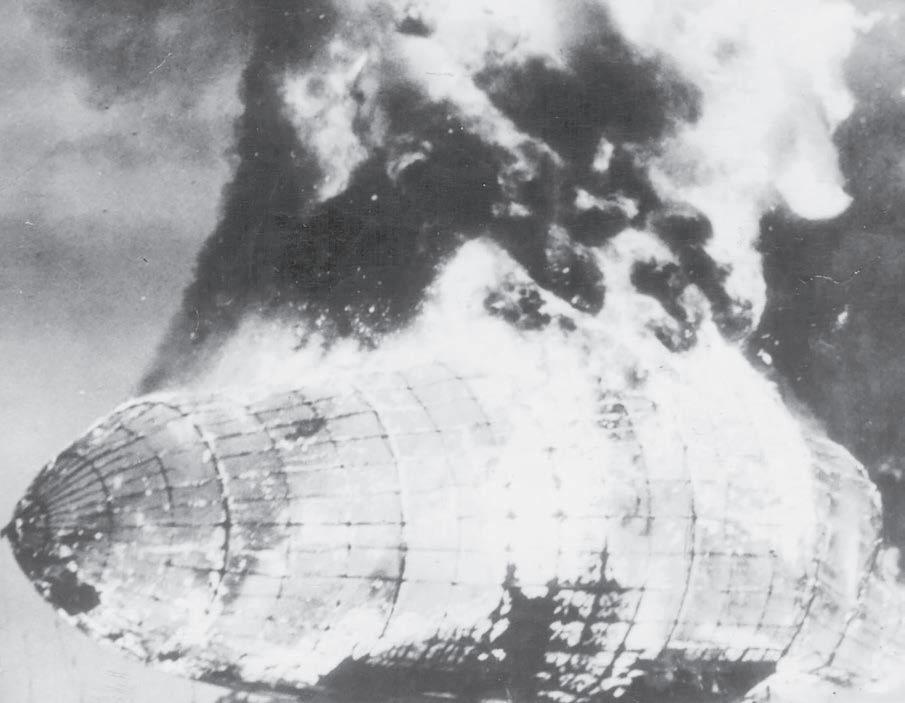
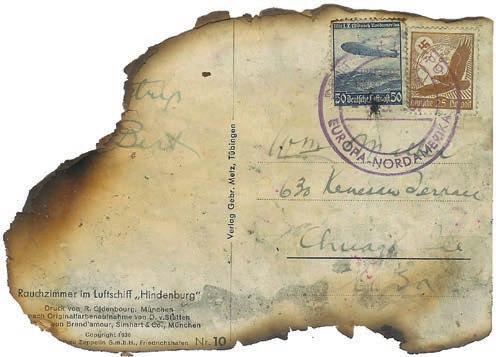
The presentation covers the Indian postal service in Iraq, which started in 1868 and ended in 1918. The topic spans the reigns of three British Monarchs, and some ten different postal cancellations were used until October 1914. The talk will also cover the I.E.F (Indian Expeditionary Force) stamps with different Field Post Offices used during World War I.
After surveys by the East India Company in 1856-1860, Postal Agencies were established at principal ports and trading centers around the Arabian/Persian Gulf. Normal Indian stamps and stationery were used.
Bussorah or Busreh in the south of Iraq, is the largest city had many names throughout its history, Basrah being the most common. In Arabic, the word Baṣrah means “the overwatcher,” which may have been an allusion to the city’s origin as an Arab military base against the Sassanids. Others have argued that the name is derived from the Aramaic word basratha, meaning “place of huts, settlement.”
In 1914, HMS Espiegle participated in the action for the capture of Basra in 1914. War was formally declared on November 5, by which time the Espiegle had dropped anchor at Saihan. On November 7, the 16th infantry Brigade made a landing on the Turkish shore at Fao, covered by the guns of Espiegle. On November 17, the Turks abandoned Basra, and on the 21st Espiegle, accompanied by HMS Odin, forced a passage up the Shatt al Arab and anchored opposite the custom house (Evening).
The Indian Post offices closed on April 30, 1919.
September 14/16, 1873. From Busreh to India with one anna 1865 India stamp canceled by the “BUSREH + 19” duplex.
May 8, 1868. From Bussorah to Bombay, cancelled by the “357 + BUSSORAH” duplex. Earliest recorded Date by Parsons 26 November 26, 1868. Unrecorded Early Date.
November 20, 1914, from FPO 27, which was with the 17th Brigade. Earliest date recorded by Proud for mail from the Indian Expeditionary Force “D”.

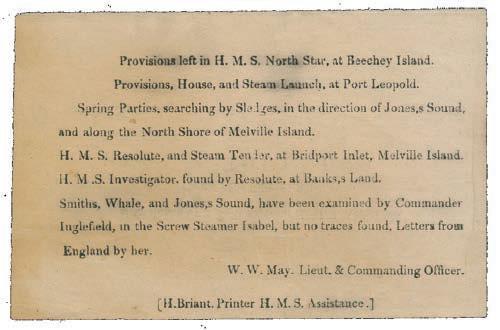
June 18th, 2026 - Lot 691 1852/54, the Sir John Franklin Search Expeditions, balloon-dropped message
OTTAWA | CANADA
613-567-3336 | info@sparksinternational.ca
sparksinternational.ca
Realized $10,500



Germany’s Oldest Stamp Auction House Proven Excellence Since 1913
Whether you are looking to acquire a rare masterpiece or pass your life’s work into the best possible hands, Heinrich Köhler combines over a century of tradition with cutting-edge innovation to ensure your goals as a consignor or buyer are met with excellence.
Why Global Collectors Choose Heinrich Köhler:
• Scientifi c Precision: We utilize the VSC 8000 for forensic authenticity testing and “ProFi”, our AI-powered digital “Provenance Finder,” to trace the history and rarity of your stamps in mere seconds.
• Unmatched Security & Stability: As an industry pioneer, we are certifi ed according to DIN ISO 9001:2015 and hold the CrefoZert credit certifi cate with a perfect score of 100/100 points— guaranteeing you a financially rock-solid partner.
• Emotional Presentation: Your stamps deserve more than a listing. We produce high-end, award-winning catalogues and use expert “storytelling” to ignite the passion of the world’s most serious bidders.
• Global Reach, Local Expertise: Through the Global Philatelic Network, your collection is presented to a premium international audience in the world’s most lucrative markets, from Wiesbaden and Zürich to New York and Hong Kong. Your collection is exceptional. Its sale should be, too.
Contact us today for a discreet consultation and professional valuation.

Heinrich Köhler Auktionshaus GmbH & Co. KG

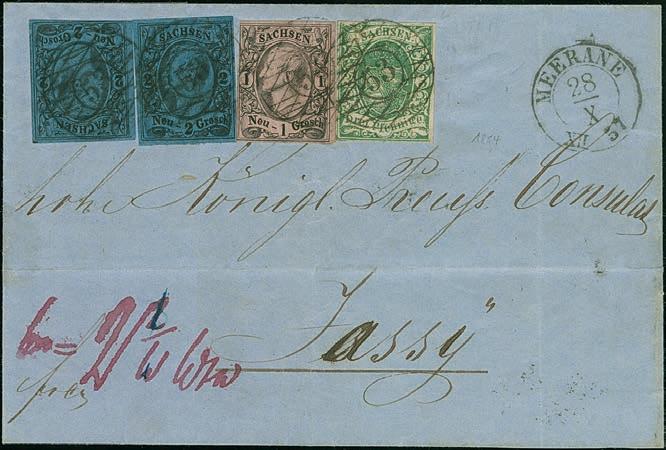







Saxony 1855/63, 1 Ngr. and two copies 2 Ngr., together with 3 Pfennig coat-of-arms on cover from Merane to the Royal Prussian Consulate in Jassy, Romania. An attractive three-colour franking with a rare destination.
German New Guinea 1908, the ‘KIETA’ provisional, one of the rarest stamps in colonial philately.
Kiautschou 1900, 5 Pf on 10 pf., overprint type 9a, with a hand-stamped overprint of 5 Pf. The print run of the original stamp with type 9a comprises only 13 possible copies. A great rarity and the only registered copy.
Austria 1850, unissued 12 Kreuzer blue, with fresh colour and wide margins, cancelled by straight line ‘Franco’. One of the great rarities of Austrian philately in perfect condition. Just another 4 examples with the 'Franco' handstamp have been recorded.
Provenance: Sammlung Rothschild (1947), 208. Heinrich Köhler-Auktion (1973)
Bavaria 1850/58, 3 Kreuzer blue as additional franking for domestic postage to re-directed cover from Naples to Munich, forwarded to Starnberg. A unique combination.
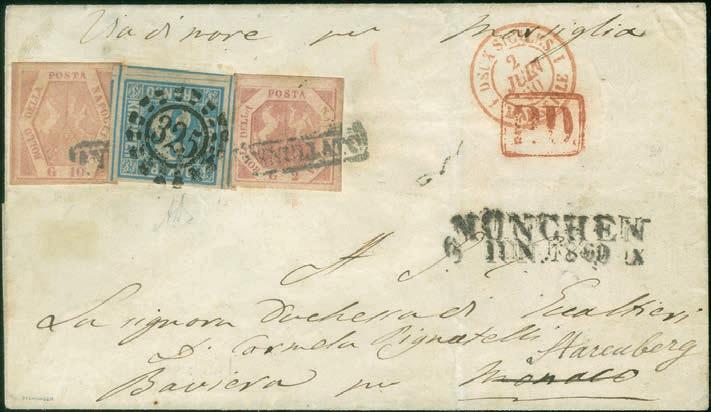



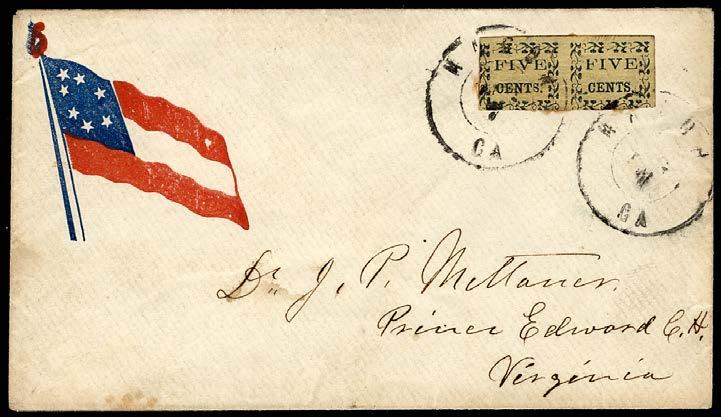
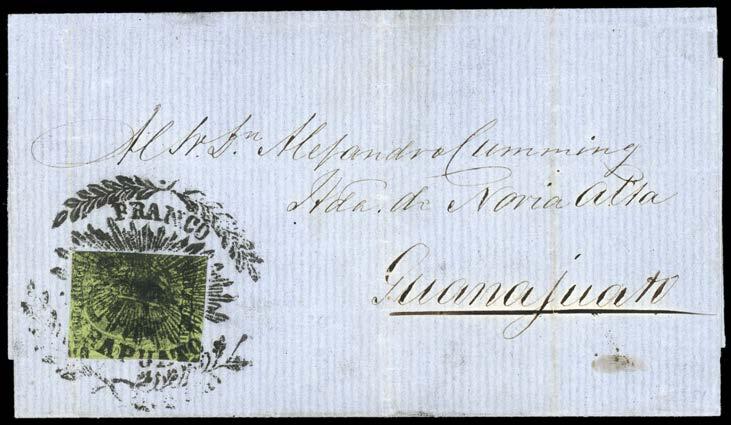
When choosing an auction house, you should also consider the things they don't sell.
Knowledge. Experience. Integrity. Things that cannot be bought, bartered or sold. Yet they’re responsible for realizing the highest prices for your stamps. At Rumsey Auctions, we’ve built our reputation on these qualities as much as on the impressive financial results we achieve for our clients. Please call or email us and let us show you how much we can do for you.


The second sale of the Magnolia Collection of Texas Postal History features an outstanding array of items from the Civil War period, including rare Confederate postmasters’ provisionals.
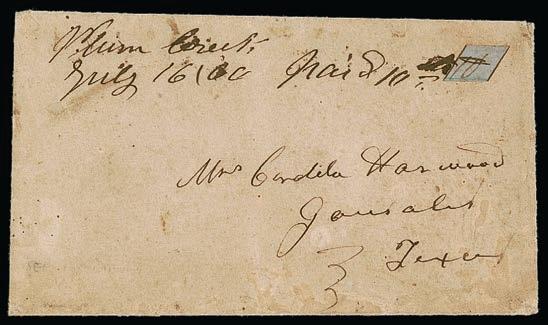
Sale Date: Tuesday, April 21
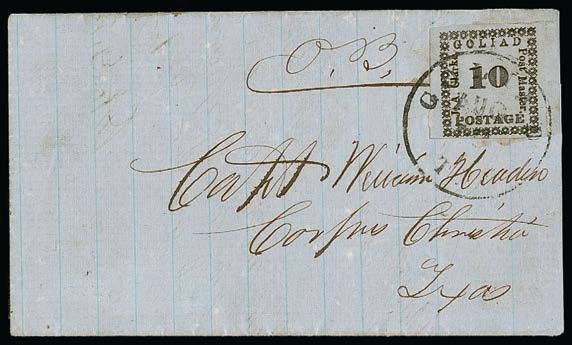
The 1869 Pictorial Issue collection formed by Nick Kardasis over 40 years is without question the finest assemblage of high quality examples ever gathered in one collection.

Assembled over 20 years by a discerning collector, the collection includes proofs, gem-quality singles, and rare multiples.
The Boardwalk Collection was formed by a gentleman who spent 75 years collecting stamps, starting as a boy and acquiring rarities over the last 40 years of his life.
These two outstanding auctions begin the Fall 2026 sale season at Siegel.

ROBERT

ROBERT A. SIEGEL AUCTION GALLERIES, INC.
SUPERB UNITED STATES 19TH AND 21 WEST 38TH STREET, 7TH FLOOR, NEW YORK, N.Y. 10018
21 WEST 38TH STREET, 7TH FLOOR, NEW YORK, N.Y. 10018
For buyers or sellers, Siegel Auction Galleries offers unparalleled expertise, a worldwide client base, financial reliability, intelligent marketing, and the best internet resources and search tools. America’s
Phone (212) 753-6421 • Email: stamps@siegelauctions.com
For buyers or sellers, Siegel Auction Galleries offers unparalleled expertise, a worldwide client base, financial reliability, intelligent marketing, and the best internet resources and search tools. America’s premier stamp auctioneer since 1930
Phone (212) 753-6421 • Email: stamps@siegelauctions.com