

















Editor & Advertising Manager: Tony
Publications Committee:
John Barwis RDP
Robert Gray
James Grimwood-Taylor RDP
Matthew Healey
Daniel M. Knowles
Robert P. Odenweller RDP (member emeritus)
Executive Secretary and Librarian: Andrea Matura collectorsclub@collectorsclub.org
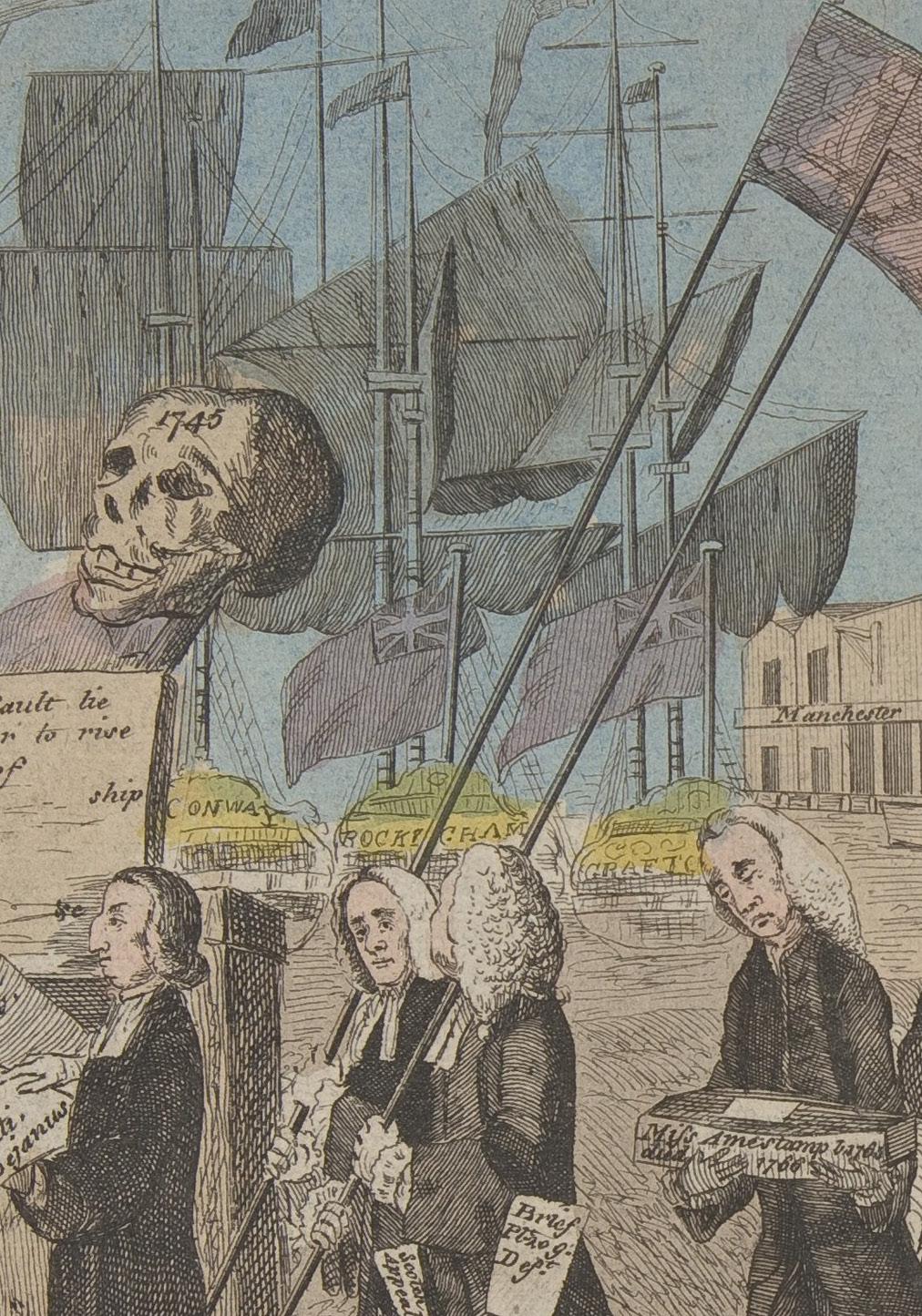
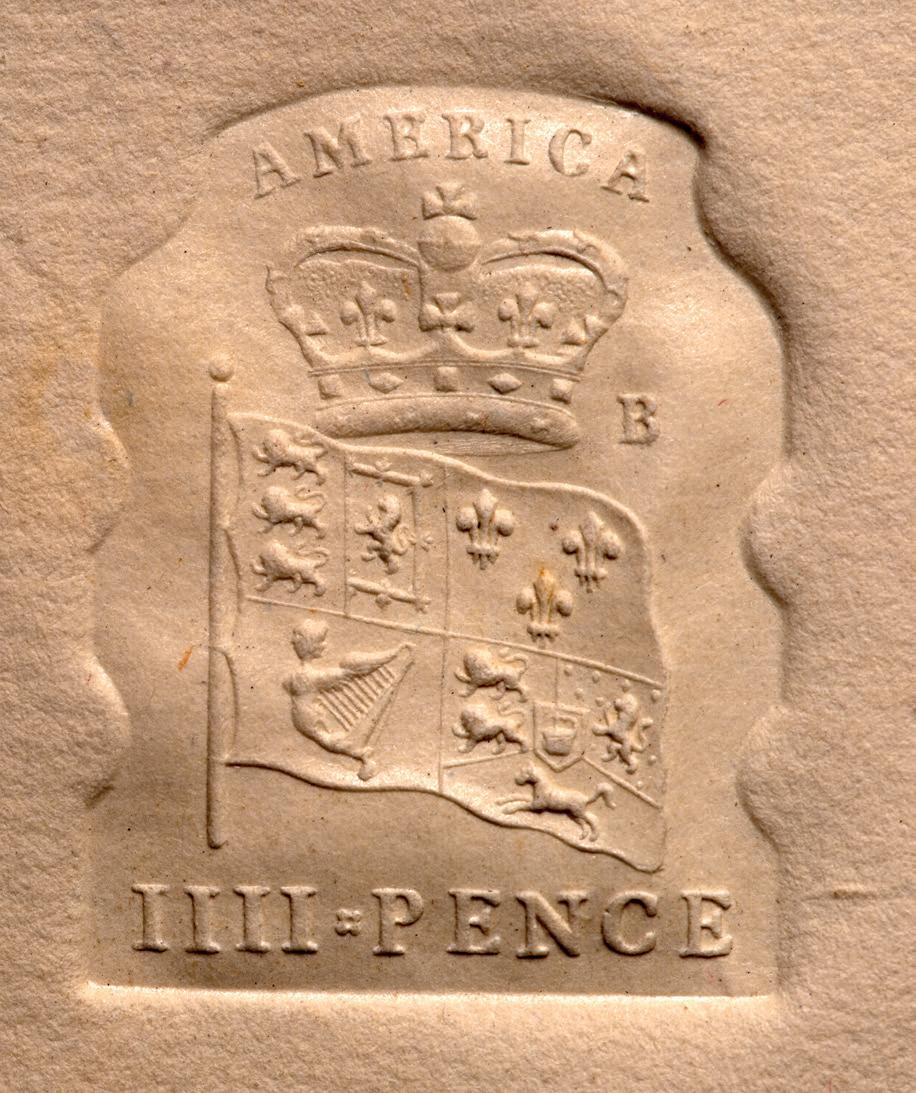
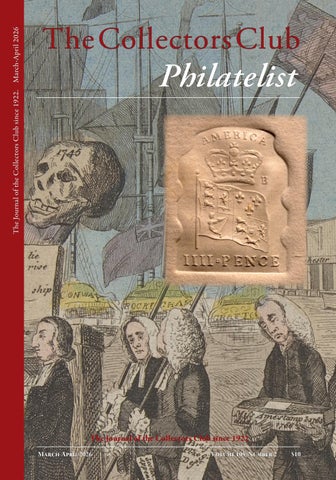
Front cover: “AMERICA / IIII Pence” revenue die proof and a detail of Benjamin Wilson’s satirical print The Repeal of Miss Americ‑Stamp. See Richard Scott Morel’s article on the Stamp Act proofs, p.74.
Guidelines for submitting articles for publication in The Collectors Club Philatelist are available from the Editor.
The Collectors Club Philatelist (ISSN 0010-0838) is published bimonthly in January, March, May, July, September and November by The Collectors Club, 58 W 40th St. Mezzanine, NEW YORK NY 10018. A subscription to The Collectors Club Philatelist is included with dues paid by members of The Collectors Club. Subscription price for nonmembers in the United States is $70. Prices for foreign addresses and/or other classes of mail are higher depending on actual cost; consult publisher. Subscriptions for outside the United States should be paid in U.S. funds drawn on a U.S. bank. Back issues $9, including postage. For a complete list, write the publisher. Claims for undelivered issues will be honored only within six months of the date of publication. Beyond that, replacements will be provided at the single copy price. Periodicals class postage paid at New York, New York 10001 and additional offices. Office of Publication: The Collectors Club, 58 W 40th St. Second Floor, NEW YORK NY 10018. Copyright 2025 by The Collectors Club. All rights reserved. We do not give implied or other consent for copying for more than personal use.
Indexed in PhiLindx by E.E. Fricks and included in the article index of the American Philatelic Research Library and the Global Philatelic Library. The opinions and statements contained in the articles are those of the authors and not necessarily those of The Collectors Club, its officers or staff.
POSTMASTER: Send change of address to
58 W. 40th St., Mezzanine, New York, NY 10018 (212) 683-0559 www.collectorsclub.org info@collectorsclub.org
The Collectors Club is open Monday through Friday, 10 a.m. to 5 p.m.
Please call ahead if intending to visit.
President
Vice President
Secretary
Treasurer
CLASS OF 2026
Vincent Cosenza
Joan Harmer
Kathryn Johnson
Behruz Nassre
Steve McGill
Robert Gray
Vincent Cosenza
Matthew Healey
Roger S. Brody RDP
GOVERNORS EMERITI
Mark Banchik
Roger S. Brody RDP
Stephen Reinhard
CLASS OF 2027
Alan R. Barasch
Jere Dutt
Andrew Kelley
Larry Lyons
Robert G. Rose
IMMEDIATE PAST PRESIDENT
Lawrence Haber
CLASS OF 2028
David Fritz
Robert Gray
Matthew Healey
Daniel J. Ryterband
Bob Gray

The photo is from the top of the Empire State Building. It reflects the top of the world feeling when I was elected as President of The Collectors Club. It is an honor and obligation to continue the great legacy of this organization.
Most of you do not know me, so please permit a brief introduction.
My philatelic biography began while working in Europe in 1999. It took me sometime to focus on India during the World War I era. Returning to the US, I joined The Collectors Club because I wanted a social and philatelic experience.
There I had the chance to volunteer as advertising manager and for our amazing library. I joined the board and was later elected to Vice President and then President this January.
My philatelic interests include publishing articles, occasionally exhibiting and membership in the Civil Censorship Study Group, as Americas Secretary, the German Colonies Collectors Group, Military Postal History Society, Forces Postal History Society, and the India Study Circle.
The Collectors’ Club was founded 130 years ago as a social club bringing some of the most important collectors and philatelic businesses together in the greater New York area. Its purpose is to further the study of philately, promote the hobby within a social, educational, and non-commercial setting.
Over the years, the club occupied ten Manhattan locations including today’s club near Bryant Park in midtown Manhattan. Unlike bygone years, today most of our members live well beyond the greater New York City area.
To fulfill its mission our club provides programs at our Manhattan headquarters, Zoom Webinars, PDF and print copies of our journal and the publication of monographs and books.
These activities along with the effort and the support of members who reach out to other philatelists, have made it possible for our club membership to remain steady at around 600 despite the general decline observed in many other philatelic clubs.
Here is what to expect in 2026 beyond the daily work required to keep the club running and the already planned programs. I recognize that most members cannot experience the conviviality of a club-based program. Therefore, we need to find ways of bringing that social experience to the membership.
At the Club itself, I would like to see some informal programs perhaps sharing a favorite cover or a library volunteer day. Key to long term success is a solid strategy and an appropriate multi-year plan will be developed this year. This will start with a survey of our members and to maintain data on participation at the club’s activities.
This year our club is sponsor at Westpex, Boston 2026 and NOJEX. At Westpex Collectors Club members have entered 79 frames. There are club dinners at each of these shows and a club table and chairs in the exhibition area.
At Boston 2026 we have a large booth shared with other organizations. Please stop by, sit awhile and chat with your fellow Collectors Club members and others. Details are at www.collectorsclub.org.
Looking forward to meeting many of you this year IRL. Frankly, it’s a damn sight better than sitting alone in your stamp room.
Once a fixture in The Collectors Club Philatelist, the “Every Cover Tells A Story” feature withered on the vine and disappeared from our journal’s pages quite a few years back
Having successfully introduced a similar, “broad appeal / broad author engagement” feature in one of my previous editing roles, I felt it worth reviving in the CCP. The aim is to encourage members who might have never considered submitting an article for publication, to write a short piece (ideally two pages with one or two images) about a cover they feel has a story worth telling.
All your write up needs to be, above all, is interesting! Value, rarity, provenance, etc., are not prerequisites (nor are they a barrier!) for submitting a contribution, so please consider joining the “revival movement”!
The first instalment of the new series appears in this issue.
Tony Bard, Editor
Tony Bard
I’ve been approached by Harold Krische Co-Director at Collaboration Crew to provide my views on two topics to be discussed at Boston 2026 in a full-day session on May 25th. One topic, in my opinion, requires a crystal ball (“What’s needed to ensure that philately is flourishing in 2035?”), while the other ask how“key philatelic entities” can deal with philately’s current challenges. I have taken part in similar panel discussions where the focus was more or less on the same topics, but I’m not sure what I can bring to the discussion. The
Regarding the first question - the crystal ball one - you only have to look back over the last decade to realise that we really can’t have any idea of what the future holds. How many readers interacted with Zoom or AI in 2015 - not many, I would guess. Now both have made a huge impact in organized philately and in research, respectively. Apparently, AI will make me and my fellow editors redundant within ten years. Maybe. I don;’t anticipate an outpouring of grief should that happen, but given the notable inaccuracies in AI-generated output, my concern is that it might start producing the articles for a publication as well! True, there probably won’t be any typos, but the only way you’ll actually get a printed copy is through a print on demand portal - assuming that pdfs don’t become the norm. And what about the future of stamps themselves, new issues particularly? The rot has already started to creep in. A number of postal administrations (chiefly Scandinavian, as we speak) have dispensed with new issues completely, and more will definitely follow in the future.
But don’t get hung up on change always being a bad thing. The “key philatelic entities” need to get their acts together to ramp up support for the hobby, albeit in a different landscape. If we accept that attracting school kids to collecting is an un-winnable uphill struggle, remember there are plenty of hobbies people take up later in life. I don’t know of any young teens who collect ceramics, classic cars, fine wines, etc. The key changes, as I see them, will be the progressive demise of local philatelic societies (an age-related problem), and the demise of printed philatelic literature (doomed by the non-stop rise in mailing costs).
On the plus side, AI’s tentacles will eventually dig further, and reveal more information for researchers. Domestic and international shows, plus broad-based national, international and broader-based specialty societies will monopolize our social interactions, and none of these will impact hugely on our interests (unless you collect new issues, of course). As long as there’s material to buy and channels for selling, plus ways to communicate with fellow collectors online, then I think we’re good. But that’s just my opinion, and what do I know?!
This CCP offers a varied buffet of international philately, with the latest revelations of hitherto unpublished material residing in the British Library as the entrée. I thought it only fair, being a Brit, that these treasures should be presented to a primarily American readership in this special year, but please don’t get any ideas about repatriating these gems that you didn’t want in the first place - it ain’t gonna happen, mate!
Provenance:
H.C.V. Adams (1956)

128th Mercury auction (1957)
Josiah K. Lilly (1967)
Christie’s auction (1990)
Spink auction (1997)
Sir Gawaine Baillie (2004)
Dimitris Bertsimas (2019)




We operate our business since 1919. Selling in Swiss Francs is a quality assurance nancially. Continuously we run auctions in traditional formats: printed auction catalogues for all material offered; shipped in thousands to all its destinations; parallel ONLINE presentations; starting prices as the only reserve; to verify our transparency, our auditor testi es on our website in his report the plausibility and the correct processing of the accounting for vendors and buyers; auctions as LIVE performances.




CONSIGN NOW !
Next Corinphila Auction: 1 – 6 June 2026
Separate ‘hard bound’ Auction Catalogues for ‘one country’ or ‘single owner’ a specialty We are quite willing to discuss larger holdings in your own home.
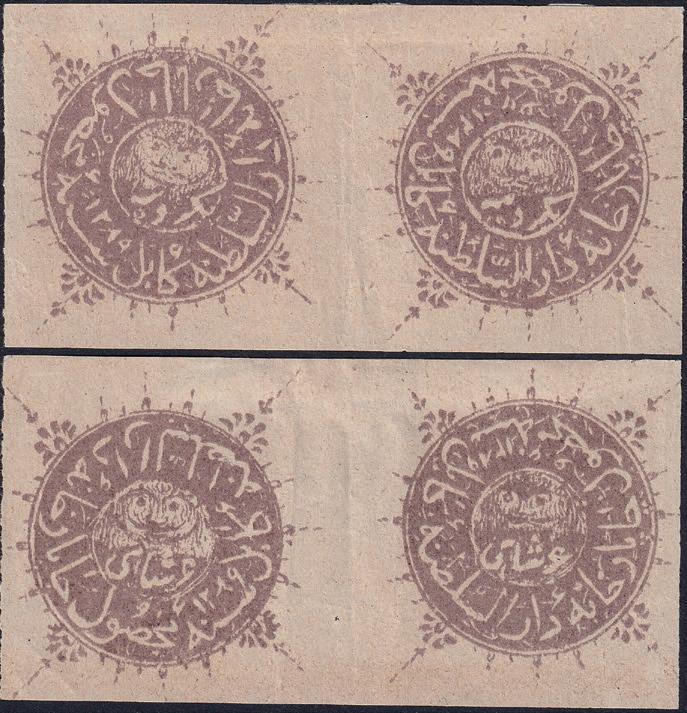
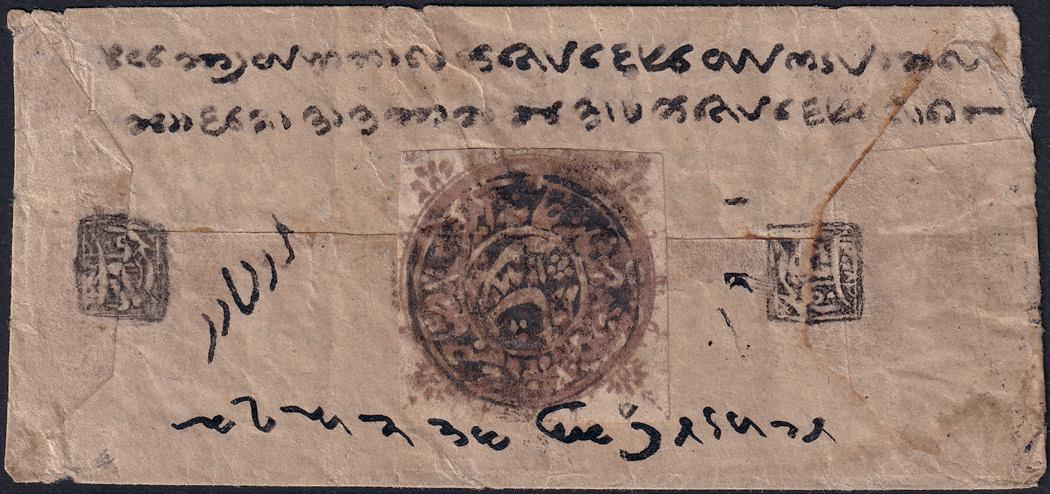
Latest date for consignments: 6 March 2026 Afghanistan’s Classic Issues –The CAMELLIA PLC Collections


Provenance 1 Rupee:
Philippe von Ferrari (1926)
Corinphila sale 49 (1963)
Major Adrian Hopkins MC. (1988)
Corinphila sale 77 (1988)
Horst Dietrich (2003)
Provenance 6 Shahi: Hadlow’s Auction (1893)
Philippe von Ferrari (1926)
Corinphila sale 49 (1963)
Corinphila sale 77 (1988) Horst Dietrich (2003)


Richard Scott Morel, Curator, The British Library Philatelic Collections
The Declaration of Independence in 1776 marked the final rupture between Britain and its 13 American colonies. Yet the tensions leading to it were evident a decade earlier in colonial resistance to the 1765 Stamp Act. Political histories, shaped by the Act’s place in America’s foundation narrative, often consider it an ill-judged imposition. Wider imperial studies offer an alternative view, showing that the measure neither arose spontaneously nor was it an experimental tax, but ultimately faltered because British and colonial conceptions of constitutional authority diverged sharply.
Despite their importance, the revenue stamps produced for this Act have scarcely featured in scholarship. Since the Board of Inland Revenue’s Stamping Department Archives in the British Library Philatelic Collections preserve the most complete surviving corpus of this material, the Library can illuminate the Act’s administrative machinery and its wider imperial significance. This paper argues the 1765 Stamp Act was Britain’s failed attempt to export a mature fiscal technology, refined during 70 years of domestic use, to its colonies in North America and the Caribbean. Nevertheless, the Stamp Office, charged with administering this duty, possessed the institutional memory, personnel, and procedures capable of converting legislation into revenue stamps, and revenue stamps into systems of revenue generation.
Established in 1694 alongside the Bank of England, the Stamp Office became a central pillar of Britain’s financial revolution, helping develop fiscal‑administrative machinery enabling the state to fund prolonged warfare and sustain an expanding empire. By embedding taxation directly into legal, commercial, and transactional documentation, Stamp Duties generated dependable revenue streams essential for servicing the national debt, a burden that rose sharply during the Seven Years’ War (1756–1763).
Victory brought substantial territorial gains but doubled Britain’s debt, from about £75 million to over £132 million (equivalent to (333 million and 586.1 million preRevolutionary dollars, respectively). Domestic taxpayers, already strained by wartime imposts, resisted further increases. At the same time, ministers viewed permanent peacetime garrisons as essential to securing Britain’s enlarged North American and Caribbean colonies. They also perceived them as undertaxed relative to British consumers and expected the colonies to contribute to the cost o f their own defence.
In India, Britain inherited a sophisticated Mughal revenue system when the East India Company assumed authority after the 1765 Diwani settlement. Its colonies on the western Atlantic, by contrast, lacked comparable administrative infrastructure capable of supporting an imperial tax. Building such machinery locally would require time and negotiation; exporting a proven metropolitan system therefore appeared the most efficient solution.
Although the Stamp Bill passed swiftly through Parliament, its speed concealed a longer and more intricate period of development. George Grenville’s ministry refined initial proposals drafted in 1763–64, shaping its structure through sustained administrative discussion and consultation with colonial officials. Central to this process was the Stamp Office solicitor, Thomas Cruwys, a key official guiding the Bill’s final form. When the measure received Royal Assent on March 22, 1765, it emerged as a carefully engineered fiscal instrument marrying administrative feasibility with clear imperial rationale.
1.
Situated in London on the edge of Lincoln’s Inn New Square, the Stamp Office had by 1765 developed into a large, complex organisation employing 128 staff. At its apex stood the Stamp Commissioners, responsible for policy, custody of dies, and overall revenue control. Their work was coordinated by the Secretary, who directed the Office’s administrative hub, issued instructions, maintained correspondence, and oversaw registers and minute books governing all organisational transactions. A cadre of clerks supported the Secretary, operating the “charge-and-discharge” accounting system.
This method maintained organisational financial discipline by treating stamped sheets as embodied revenue rather than manufactured goods. Each sheet charged at full statutory value only became discharged upon the return of funds or unused stock. Two warehouse-keepers, one for unstamped stock and another for stamped, ensured strict separation of custody, preventing any officer from controlling more than one stage of the chain.
The Marker of Dice produced the embossed revenue dies and engraved copper plates required by statute. Once completed, these were presented to the Stamp Office, where they were jointly registered by the Secretary, Receiver- General, Comptroller, and Supervisor in dedicated register books, creating a formal legal record for each die and plate.
Sheets of paper, vellum, and parchment were procured from London stationers near Lincoln’s Inn and other Inns of Court. Upon delivery, these sheets were placed in the warehouse of unstamped goods until impressed with the appropriate revenue die. Once stamped by the printing staff, the sheets were valued, entered, and transferred to the warehouse - keeper of stamped goods. Only then could they be requisitioned for use.
Because American consignments were to leave metropolitan oversight, they became subject to especially strict valuation to ensure the Receiver-General remained accountable for the full theoretical revenue of the Act. This complex bureaucracy was therefore the natural choice for generating imperial revenue from Britain’s Atlantic territories, far from the blunt instrument later memory has often imagined.
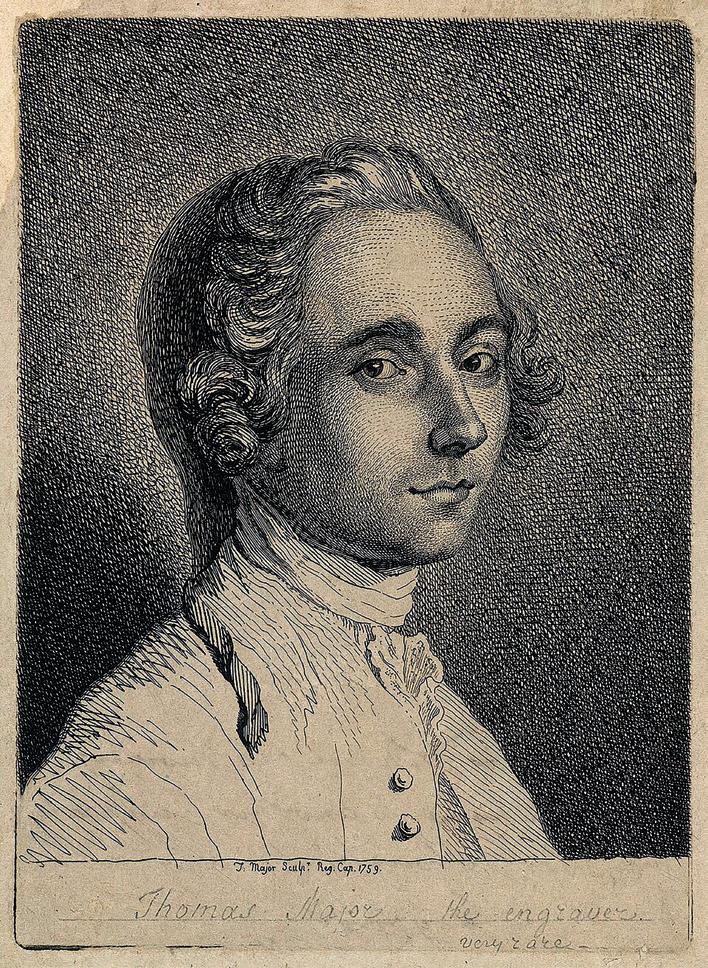
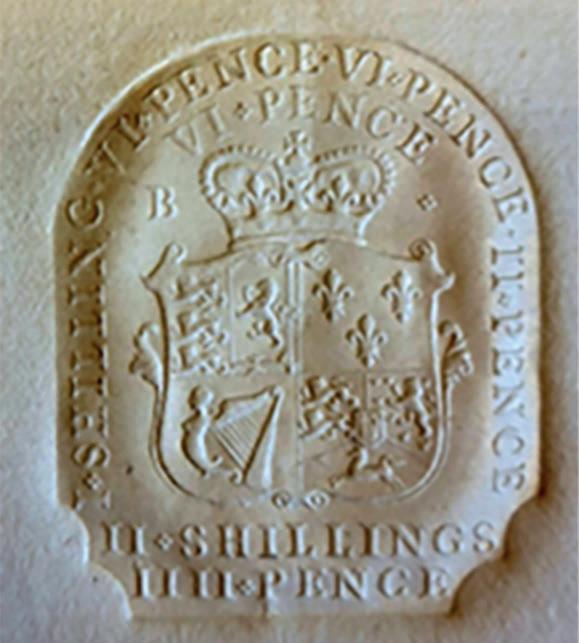
The revenue stamps were created by Thomas Major, the Marker of Dice and later Chief Seal Engraver to the King (Figure 2). Employed by the Stamp Office from 1756-1797, Major served as its principal engraver for more than four decades, making him one of the longest‑serving and most significant officials to hold the role. A highly skilled commercial engraver, Major’s technical competence made him ideally suited to produce secure fiscal instruments. Alongside a large output of revenue stamps, he engraved numerous royal and deputed colonial seals across Great Britain, the Caribbean, North America, and Asia. Notable examples include the seal of the Supreme Court of Judicature at Fort William, Bengal, George III’s emergency Great Seal of 1784, and the first colonial deputed seal for New South Wales (c. 1789). Each required exceptional precision, legibility, and anti-forgery design, the same qualities essential to the engraving of revenue dies.
Major’s long service, combined with his mastery of seal engraving, ensured that the high technical traditions of British security engraving were brought directly to the dies and plates of the 1765 Stamp Act. Major’s embossed revenue stamps formed the core of the 1765 Stamp Act’s documentary taxation. In their design, engraving techniques, and official registration, they closely followed established British practice. Since the introduction of stamp duty in 1694, every statutory charge required its own distinct stamp, and as these operated within a single domestic jurisdiction, no geographical headings were needed.
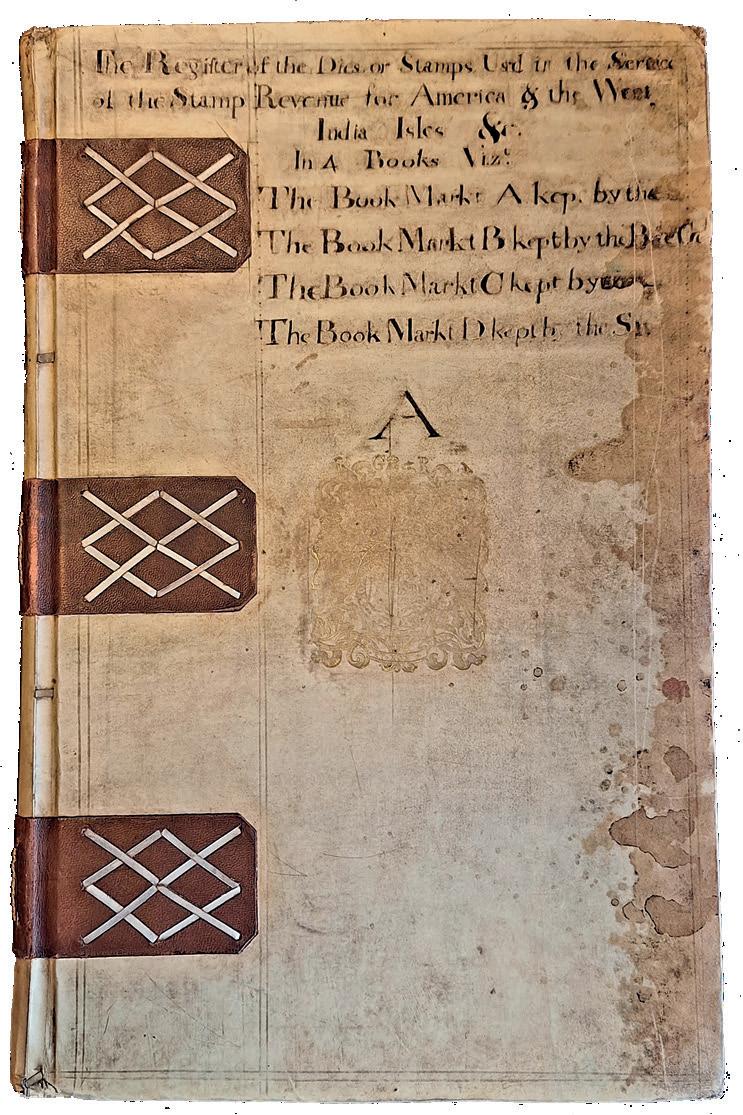
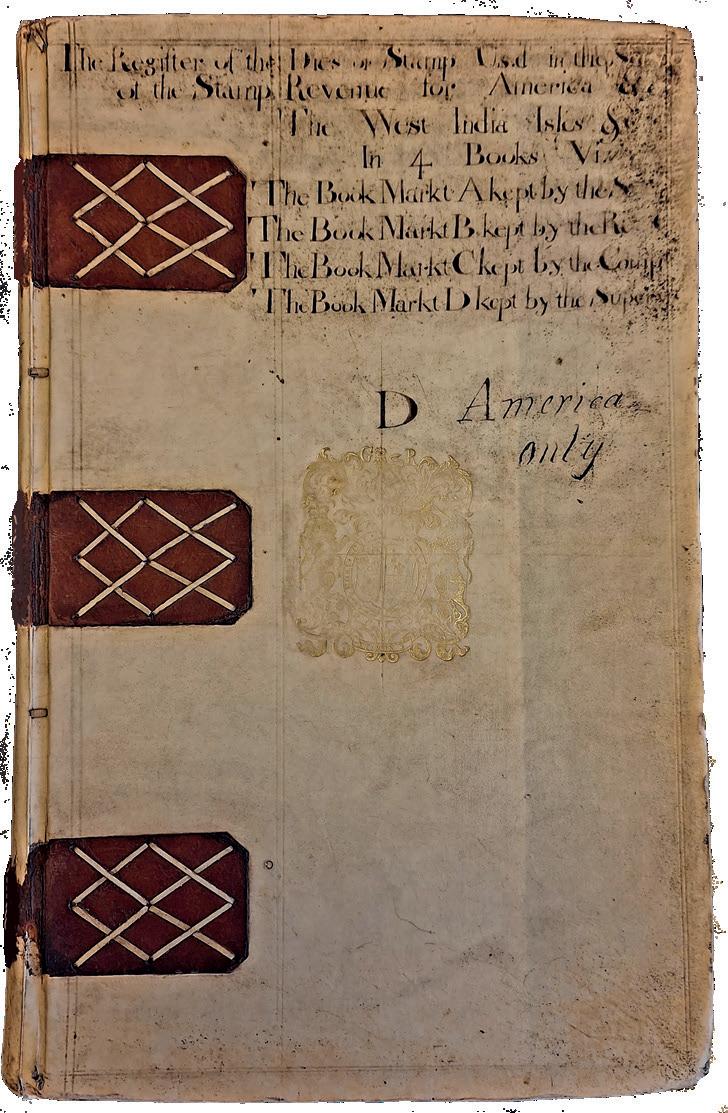
Figures 3 & 4. Two of the four books titled: The Register of the Dies or Stamps Used in the Service of the Stamp Revenue for America & the West India Isles &c. Book A was kept by the Secretary and Book D: America Only by the Receiver General.
Exporting stamp duties overseas in 1765 changed this. For the first time, the system had to operate across several distinct legal jurisdictions, making engraved geographical headings essential. Once engraved, Major delivered the dies to the Stamp Office, where they were entered into four registers. Only two survive for the 1765 material. Book A, kept by the Secretary, and Book D, kept by the Receiver-General (Figures 3–4). With only minor discrepancies, both registers contain matching sets of dies, differing solely in layout, and demonstrate that most were commissioned on March 26, 1765, just days after the Bill received Royal Assent.
The 1765 Stamp Act dies differed from their British counterparts in one essential way. Each includes an engraved regional heading reflecting the Act’s division of Britain’s Atlantic possessions into three statutory duty-rating zones, as follows:
Statutory Duty Zone A: “AMERICA” these stamps were to be applied universally (Figures 5-7) and correspond to the Act’s terminology for duties charged “throughout the colonies and plantations in America.”
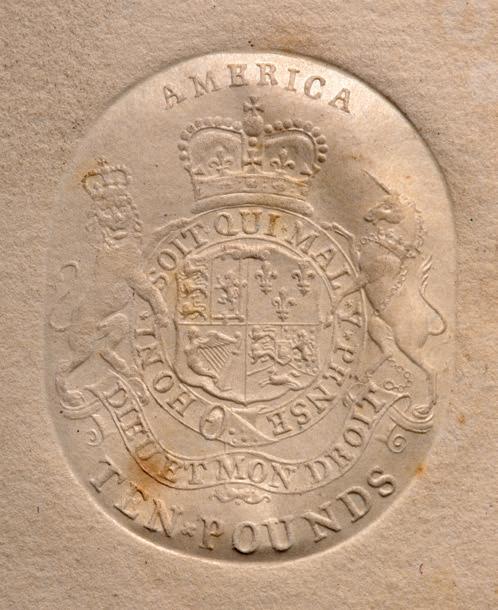
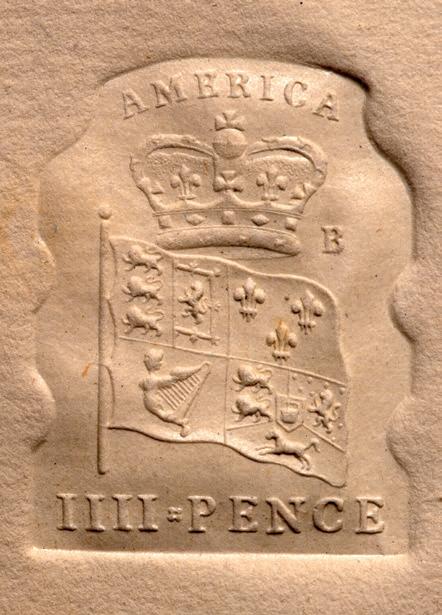
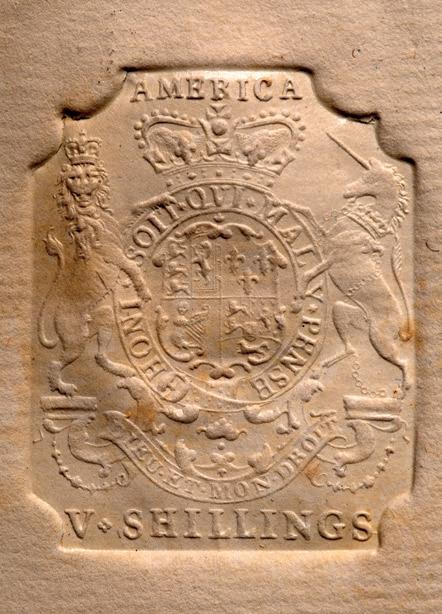
Using Major’s “AMERICA” die proofs alongside the legislation, it is possible to tabulate the British Library’s holdings against their documentary usage as delineated in Table 1, while illustrations for each design appear in Appendix 1.
Table
Revenue
Collections Book / Page Value/Die Documentary Usage Book / Page Value/Die Documentary Usage
A1/D1
A3/D3
A5/D5
A7/D7
A9/D9
A11/D11
£10 Professional licences
£6 Grants & privileges
£4 Wine licences
£3 Wine licences
£2 Ecclesiastical & educational
£1 Maritime
A13/D13 10s. Judicial
A15/D15 5s. Judicial
A17/D17 4s. Judicial
A21/D21 2s 6d, Die A Contracts & instruments
A23/D23 2s 3d, Die A General instruments
A21/D23 2s 3d, Die B General instruments
A25/D25 2s. Die B Judicial
A25/D25 2s. Die B Judicial
A27/D27 1s 6d, Die A Equity pleadings
A55/D47 1s 6d, Die B Equity pleadings
A41/D41 1s, Die A Ecclesiastical
A31/D31 6d, Die A Copies (EC/Admiralty)
A31/D31 6d, Die B Copies (EC/Admiralty)
A45/D33 4d, Die A Maritime/commercial
A45/D33 4d, Die B Maritime/commercial
A35/D35 3d, Die A Judicial
A35/D35 3d, Die B Judicial
A51/D45 3d, Die C Judicial
A53/D46 1s, Die B Judicial
A43/D43 Dice 10s Gaming
A49/D44 Cards Gaming
Note: With the exception of the 3d, Die C, 1s, Die B [August 30] and Cards [June 28] all other dated dies show March 26, 1765.
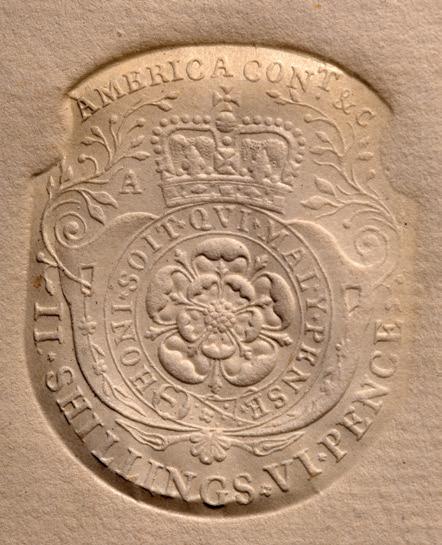
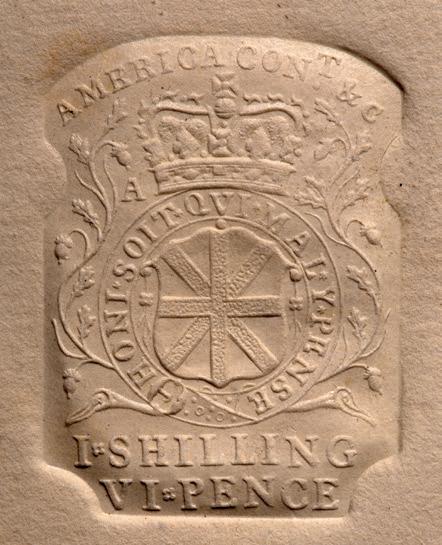
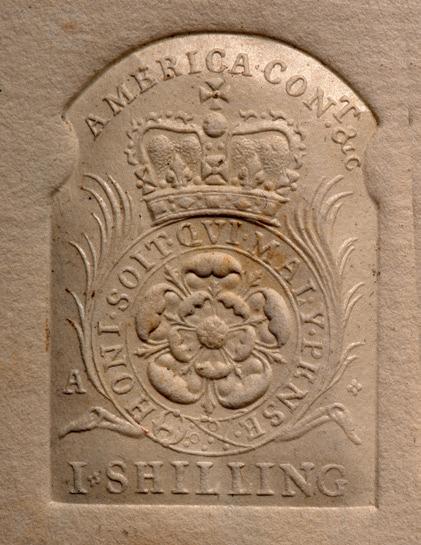
Statutory Duty Zone B: “AMERICA CONT. &c” (Figures 8-10) This was a reduced-rate heading matching legislative clauses applying to instruments issued “within the British Colonies and Plantations upon the Continent of America, the Islands belonging thereto, and the Bermuda and Bahama Islands.” Unlike their “America” counterparts, these stamps would have been used in selected regions falling under the Act. Table 2 provides a clear indication of what the library holds in terms of these dies and their documentary usage.
Table 2. “AMERICA CONTINENT &C” Revenue Dies in the British Library’s Philatelic Collections Book / Page
A21/D21
Value/Die
2s 6d, Die A
A27/D27 1s 6d, Die A
A29/D29 1s, Die A
Documentary Usage
Land (Usage B only)
Bonds (Usage B only)
Bonds (Usage B only)
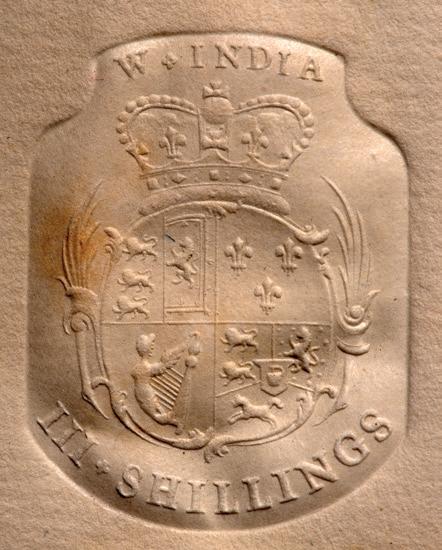
Statutory Duty Zone C: “W. INDIA” This stamp (Figure 11) reflected the Act’s separate treatment of instruments executed “within all other parts of the British dominions in America,” notably “the British islands in the West Indies.” Table 3 correlates this engraved heading directly with its documentary usages and the valuation bands prescribed by statute.
Table 3. “W. INDIA” Revenue Dies in the British Library’s Philatelic Collections Book / Page
A19/D19
Value/Die
3s
Documentary Usage
Land (Usage C only)
Significantly, rare archival documentary examples in Jamaica, Barbados, Quebec, Ottawa, and England confirm that these stamps were applied exactly as the statutory duty zones required. Taken together, the registers and surviving impressions reveal a geographically precise and technically sophisticated revenue system, not the uniform colonial impost implied by later historiography.
Alongside the embossed dies, Thomas Major also engraved revenue stamps for newspapers, pamphlets, and almanacs on copper plates for mass production. Once again, their design, engraving techniques, and official registration closely followed established British practice (Figures 12-15). The Act prescribed three denominations for newspapers; ½d for half-sheet newspapers and pamphlets, 1d for full sheets, and 2d for newspapers printed in languages other than English. Each plate carried a unique plate number and 25 impressions of different dies headed “AMERICA,” arranged in a 9‑8‑8 format (See Appendix).
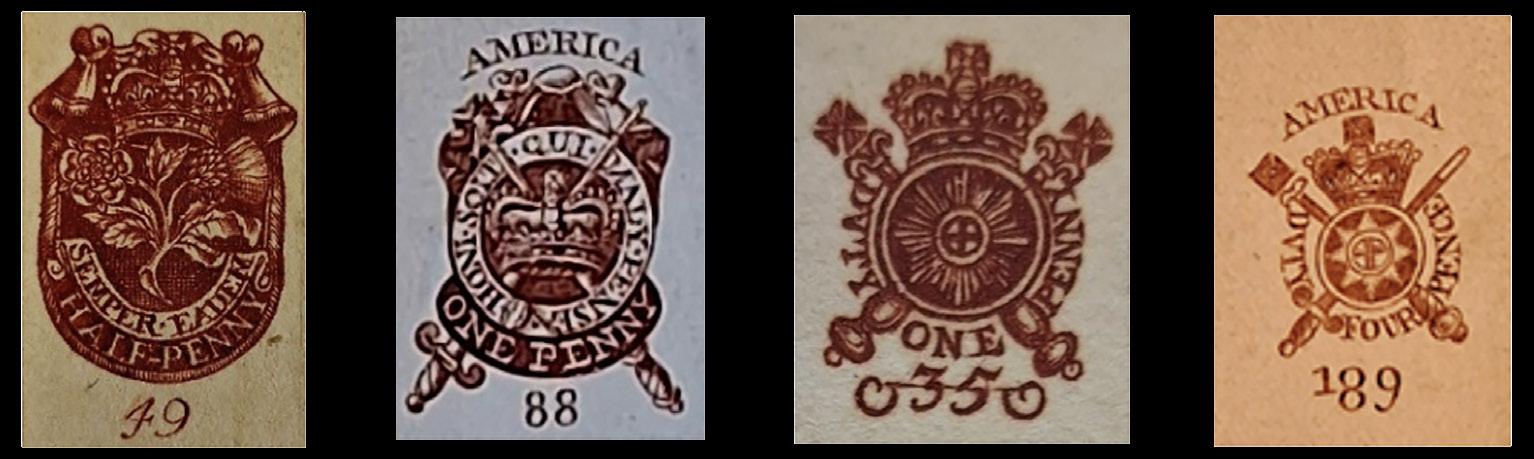
Figures 12 15. Newspaper and almanac stamps: British and American designs and printing techniques.
Once formally registered, the plates were issued to the Rolling‑Press Officer, who assigned a printer supported by Wetters and Layers of paper. Using stock supplied by the Warehouse‑Keeper of Unstamped Goods, the Wetters damped twenty‑five sheets, and the Layers arranged them on the inked plate in an overlapping stepped formation, exposing only the corner of each sheet over its corresponding die. The Printer then passed the plate and sheets beneath the heavy roller, repeating this cycle until all impressions were completed, with a second plate prepared while the first was in use.
Philatelic studies of British and Irish Newspaper and Almanac Stamps confirm the longevity and uniformity of this printing method across the wider Imperial system. Once dried, the sheets were transferred to the Warehouse-Keeper of Stamped Goods, packaged and sealed by denomination, and dispatched to colonial distributors, each shipment transferring the charge from British to colonial custody.
Table 4. Newspaper Plates Created & Examples in the British Library’s Philatelic Collections
Value Plates Dies Commissioned BL Reference Notes
½d 1 1-25
½d 2 26-50
½d 3 51-75
½d 4 76-100
½d 5 101-125
½d 6 126-150
½d 7 151-175 May 10, 1765
½d 8 176-200 May 10, 1765
1d 1 1-25
1d 2 26-50
1d 3 51-75 April 18, 1765
Not held
Not held
Not held
Not held
Not held
Not held
List 6, Vol. 3, p.33 Missing dies: 151-167; 171-175
List 6, Vol. 3, p.33 Missing dies: 180-183
Not held
Not held
List 6, Vol. 3, p.34 Missing dies: 51-56; 74-75
1d 4 76-100 April 18, 1765 List 6, Vol. 3, p.34 Sheet complete
1d 5 101-125
1d 6 126-150
1d 7 151-175 May 10, 1765
1d 8 176-200 May 10, 1765
2d 1 1-25 May 10, 1765
2d 2 26-50 May 10, 1765
2d 3 51-75
2d 4 76-100
Not held
Not held
List 6, Vol. 3, p.35 Missing dies: 151-167; 169-175
List 6, Vol. 3, p.35 Sheet complete
List 6, Vol. 3, p.36 Missing dies: 1-17; 20-25
List 6, Vol. 3, p.36 Sheet complete
Not held
Not held
The full range of surviving plates and dies held in the British Library’s Philatelic Collections is set out in Table 4. Registration sheets from the Library’s holdings are illustrated in Appendix 1.
Almanacs, widely used across mainland and Caribbean societies, were taxed at 2d, 4d, and 8d, the highest rate reflecting double duty on foreign‑language editions. Their dies were engraved on copper plates and printed in the same manner as the Newspaper stamps. Table 5 provides a complete record of the plates and dies in the British Library’s Philatelic Collections, registered on April 18, May 10, and May 24, 1765. This listing includes plates 3 and 4, containing 4d dies that were previously unrecorded, together with one further unrecorded 4d die (no. 189) preserved in the Tapling Collection. In total, 48 additional 4d almanac dies (absent from Koeppel’s census) have now been identified.
Table 5. Almanac Plates Created & Examples in the British Library’s Philatelic Collections Value (Dies) Plates Dies
2d 1 1-25
2d 2 26-50
Commissioned BL Reference Notes
April 18, 1765 Not held
April 18, 1765
List 6, Vol. 3, p.42 Missing dies: 29-33
2d 3 51-75 Not held
2d 4 76-100 Not held
2d 5 101-125
2d 6 126-150
2d 7 151-175
2d 8 176-200
4d 1 1-25
4d 2 26-50
4d 3 51-75
4d 4 76-100
4d 5 101-125
4d 6 126-150
May 10, 1765
May 10, 1765
May 24, 1765
May 24, 1765
April 18, 1765
April 18, 1765
List 6, Vol. 3, p.43 Missing dies: 115-125
List 6, Vol. 3, p.43 Missing dies: 132-134
Not held
List 6, Vol. 3, p.44 Missing dies: 176-184; 180-192
List 6, Vol. 3, p.45 Missing dies: 1-9; 11-17; 23-25
List 6, Vol. 3, p.45 Sheet complete
May 24, 1765 Red Folder Missing dies: 51-53
May 24, 1765 Red Folder Sheet complete
May 10, 1765
May 10, 1765
List 6, Vol. 3, p.46 Missing dies: 101-112
List 6, Vol. 3, p.46 Sheet coomplete
4d 7 151-175 Not held
4d 8 176-200 Red Folder & Tapling USA Missing dies: 176-178; 190-200
8d 1 1-25 Not held
8d 2 26-50 Not held
16.
Turning from the dies to the paper. 1765 Stamp Act Audit Office accounts reveal sheets of paper, vellum, and parchment were purchased from Tonson & Company, a stationer on the Strand near the Stamp Office. Comparison of the British Library’s surviving plate-proof fragments and embossed stamp registers has now identified the paper’s manufacturer through their watermarks, an entirely new discovery with major implications for philatelic provenance research and forgery detection. All surviving examples carry distinctive fleur‑de‑lys or armorial watermarks of the I. Villedary type (Figure 16), indicating the stationer sourced their paper from overseas. The Villedary family were a well-established French papermaking dynasty recently relocated to the Netherlands and known for exporting substantial quantities of high‑grade paper to Britain at the time.
Altogether, evidence from the embossed dies, newspaper and almanac plates demonstrate the Stamp Office prepared a technically sophisticated suite of printed‑matter duties for the 1765 Stamp Act. Planning, production, and supply were closely coordinated, drawing on skilled engravers, specialised printing staff, secure accounting procedures, and carefully sourced high-grade paper.
Within London, the system operated with striking efficiency, ensuring that every statutory requirement, from dies and plates to stamped sheets and distribution protocols, was in place for the Act’s intended commencement on 1 November.
Although the types of documents taxed and the levels of duty reflected the expanding schedule of stamp charges then current in Great Britain, their sudden imposition on a population encountering such taxation for the first time, without any representation in Parliament, made the system appear abrupt, intrusive, and immediately suspect. It was only once the stamped paper was shipped overseas that the system unravelled.
Upon arrival, consignments entered the custody of colonial distributors, each debited at full statutory value under the same “charge-and-discharge” principles used in Britain. The system relied entirely on these officers. They were to receive stock, sell stamped sheets, and remit the proceeds or return the unused balance. To administer this, the Stamp Office divided its American responsibilities into nine regional jurisdictions, each theoretically supervised by a travelling Inspector.
Table 6 reveals the breadth of the planned distribution network, but in practice it never materialized. Widespread unrest led many distributors to resign before receiving stock, while others were prevented from acting by sustained local resistance. In several Colonies, consignments were locked in customhouses, kept aboard ships, or held under naval guard. In others, they were seized or destroyed during disturbances. The 1772 Audit Office accounts accordingly record substantial returns and frequent notes of stock “mislaid.”
Only a handful of jurisdictions, Quebec, Montreal, Jamaica, St Kitts, Barbados, Georgia, and West Florida, managed to operate the system briefly, and even these efforts collapsed quickly as opposition spread.
Of the more than £172,000 ($230,000) of stamped paper charged out for American use, only a small proportion generated revenue; over £150,000 ($200,000) worth of stock was ultimately cancelled and returned to London. The evidence is unequivocal, large consignments of stamped paper never entered civil circulation in the Thirteen Colonies.
These immobilized consignments reveal that the collapse of the system stemmed not from technical or bureaucratic failings but from the political environment into which the measures were introduced. Taxation imposed from Britain without colonial representation was widely seen as illegitimate, with the slogan “No taxation without representation” becoming the principle motivating refusal to let stamped paper circulate. This opposition produced immediate cultural responses; Benjamin Wilson’s satirical print The Repeal of Miss Americ‑Stamp, (detail on front cover) depicting the funeral of the infant tax, became remarkably popular on both sides of the Atlantic; whilst the Act was even alluded to in the work of enslaved poet Phillis Wheatley. Popular resistance ultimately prevented distributors from acting and stopped the system before it began.
Taxation imposed from Britain without colonial representation was widely seen as illegitimate. “No taxation without representation” was not merely a slogan but a core political principle underpinning the refusal to allow stamped paper to circulate. Popular resistance prevented distributors from acting and halted the system before it could begin.
The Stamp Act collapsed not because of weaknesses in metropolitan planning but because no viable colonial distribution network existed to enforce it in a politically hostile environment. This point was not lost on the British government. When the Irish Parliament introduced stamp duties in 1774, the measure was enacted and administered locally through an Irish Stamp Office modelled on London but scaled to Irish conditions. Crucially, assessment, collection, and enforcement operated within the same jurisdiction that imposed the tax, giving these systems the legitimacy and practical capacity the 1765 American scheme fatally lacked.
Later Imperial practice also reflected this lesson. In Ceylon and the Cape of Good Hope, stamps continued to be manufactured in London, but legislation and administration were carried out locally by treasury officials. British technical support was paired with taxation enacted and enforced within the colony an alignment absent from the American scheme of 1765.
A brief custodial history helps explain why Stamp Office material survives only in fragmentary form across institutional and private collections. After the Act’s repeal on March 18, 1766, the Office neglected its records. Die impressions were cut from stamped sheets so the paper could be reused. Other material was withdrawn for exhibitions or lost during successive departmental reorganisations. An 1840s account records that two bags of embossed cuttings held at Somerset House were cleared out and destroyed, although surviving examples suggest that a small number were nevertheless obtained by collectors.
By the later nineteenth century, material began to disperse. Several almanac and newspaper plates, including the 8d duties photographed for the 1876 Philadelphia Centennial Exhibition, are now missing. The single 4d almanac die in the Tapling Collection proves proof material entered private hands before 1891. Judge Philbrick’s 1890 notes mention consulting only Book A of the embossed dies, suggesting much loss or dispersal occurred between 1876-1890.
Only in the 1950s was the corpus stabilised, when the Board of Inland Revenue transferred its Philatelic and Security Printing Archive to the British Library Philatelic Collections. Readers now have, for the first time, a full account and visual record of everything preserved there.
So what survives in the British Library Philatelic Collections against what should have survived? Of the four registration books created for the embossed dies of the 1765 Act, only two remain - a 50% survival rate. Because embossed impressions also appear on contemporary documentary instruments in private collections, distinguishing official proofs from genuine period usages is extremely difficult. The picture is clearer for the newspaper and almanac material. Almanac stamps were never issued, so any surviving examples outside the British Library must derive from the original archival proofs. Newspaper proofs, although issued in practice, were printed on different paper, making them far easier to distinguish from used documentary examples. For these classes of material, we can compare the number of plates and dies created, as set out in Tables 2–4 above to determine what survives within the library against what is dispersed.
The takeaway from this analysis is clear. Much of the material is no longer within the archive. Koeppel’s pioneering census, coupled with subsequent discoveries proves some of this dispersed proof material survives in other museums and private collections. Identifying examples surviving outside the British Library Philatelic Collections indicates what may still await discovery. Updating Koeppel’s original census is therefore essential.
The 1765 Stamp Act emerged not as an improvised imposition but as the export of a fully matured British fiscal technology. Drawing on more than seventy years of administrative experience, the Stamp Office produced a complete suite of dies, plates, and stamped paper through disciplined routines of registration, custody, and bureaucracy. Whether embossed or struck from copper plates, these stamps embodied an engineered imperial system in which geography, hierarchy, and statutory authority were literally inscribed into the design. The Act failed not because the machinery faltered but because its operating environment collapsed. Once stamped paper left London’s tightly regulated control, it entered a political world governed by different constitutional assumptions. Without cooperative distributors, and confronted by organised colonial resistance, circulation became impossible. Consignments lay immobile in customhouses, remained aboard vessels, or were destroyed outright. The system remained impeccable on paper, but it could not function in polities rejecting taxation imposed without local representation.
What survives today, unused sheets, proof impressions, and scattered archival remnants, does not signal administrative inadequacy but the limits of imperial authority. These fragments form the material afterlife of a fiscal project perfectly designed yet never allowed to operate. They mark the moment when a sophisticated imperial technology met a constitutional culture that refused it, where the ambitions of the British state exceeded the political structures capable of sustaining them.
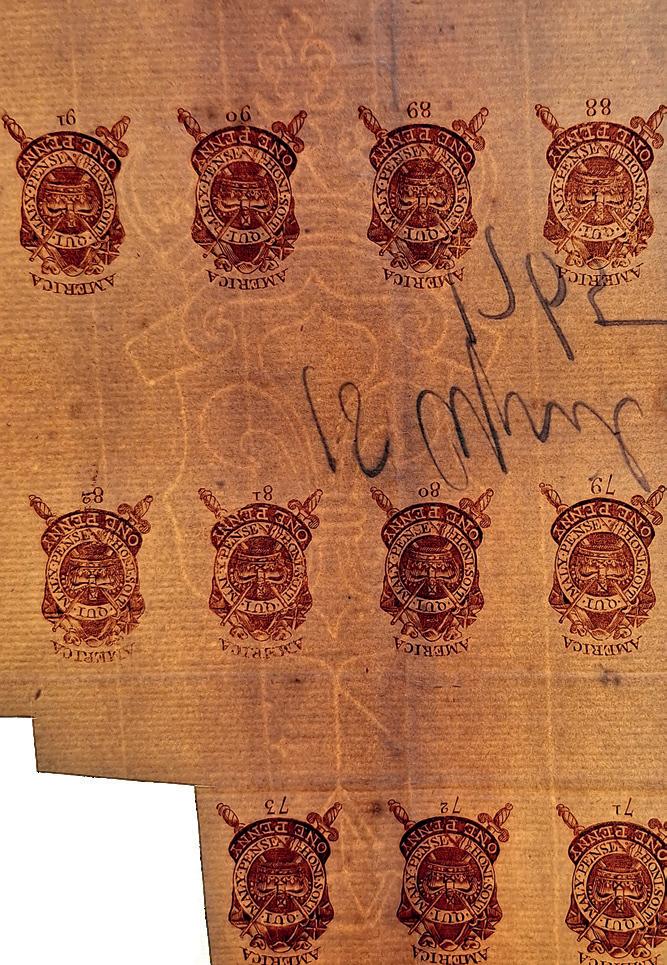
Appendix 1: “AMERICA” Almanac and Registration revenue sheets. (Figures 17-20). Note that all sheets show their manuscript legal registrations at the under the lowest line of stamps. This notation took the following format (with relevant value and date changes):
Brought by Mr Thos Major Engraver Two Copper Plates for the One Penny Duty on News Papers & Pamphlets the one Number’d from 151 to 175 the other from 176 to 200 Inclusive, the Impressions whereof here on this Sheet Number’d, In Witness whereof We have hereunto set our Hands the 10th May 1765 By Order of the Commissioners
We do hereby Acknowledge to have this Day Received back the Above mentioned Copper Plates to be deposited among the other Plates & Dies used in the Service of the Stamp Revenue; to be kept according to the Method & Usage of the Office; Witness our Hands the 10th May 1765
Figure 17. Registration sheet for the One Penny (1d) “AMERICA” Newspaper revenue stamps. Plate 7. Die 168. Plate 8: Dies 176 200.
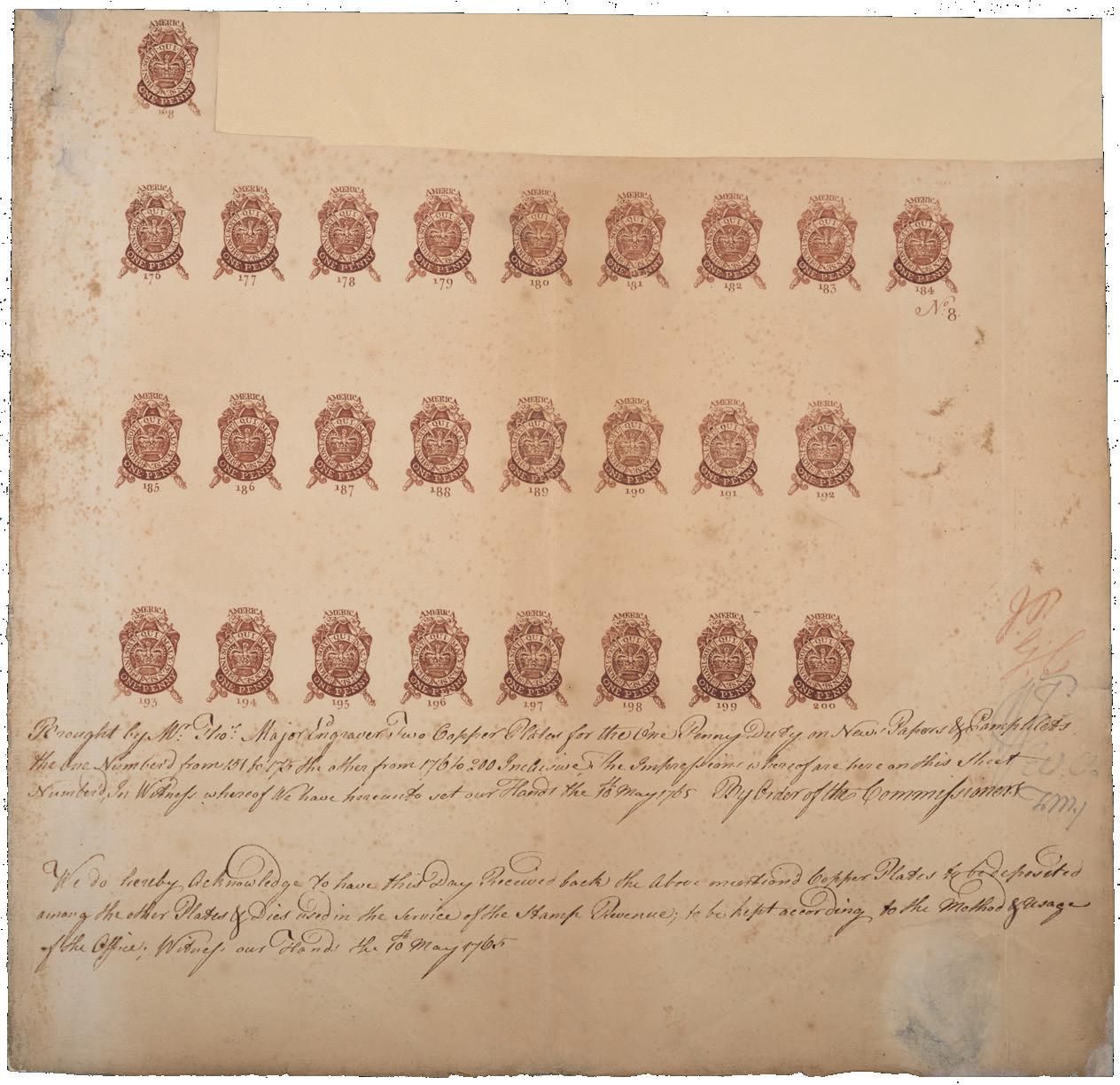
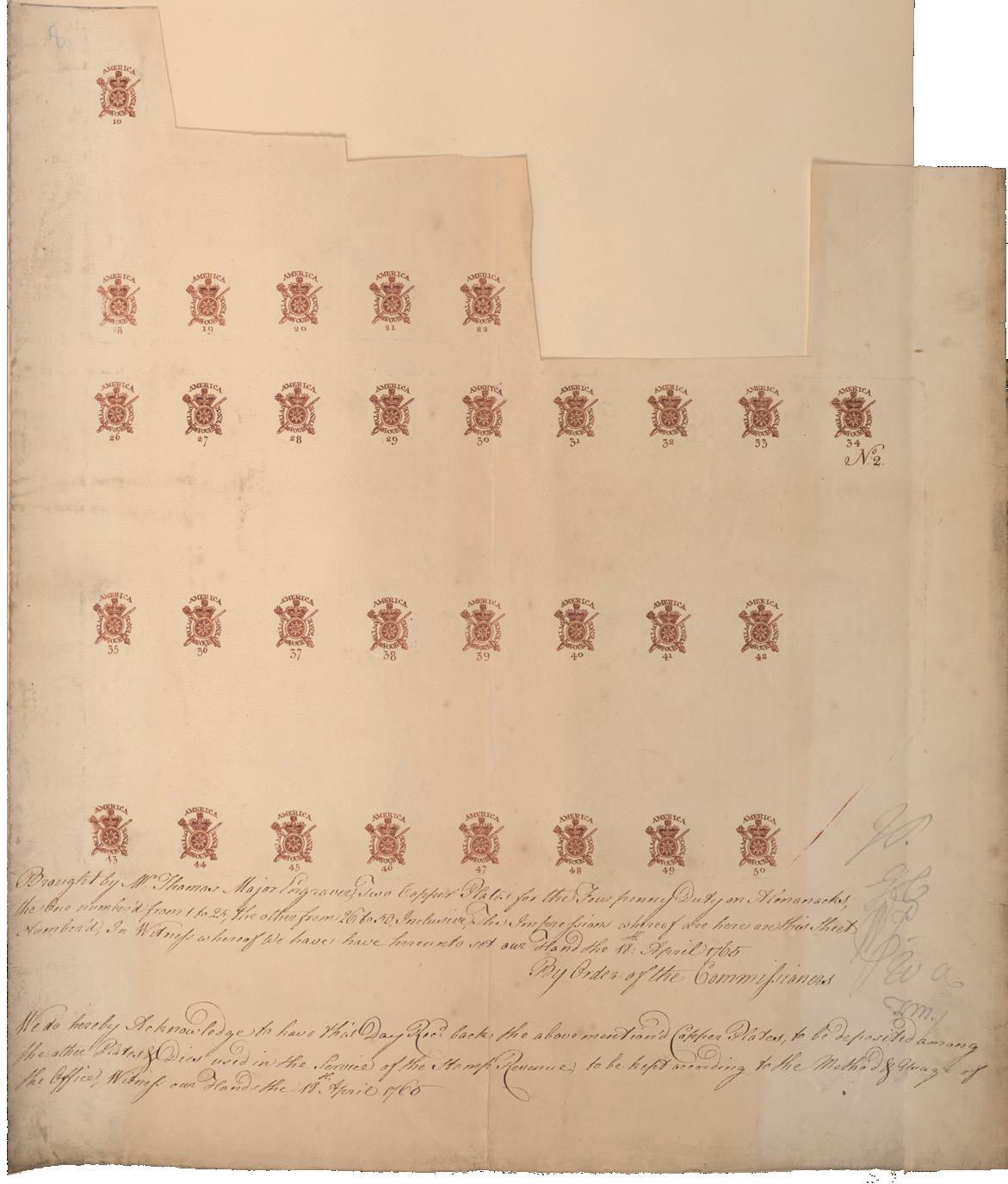
Figure 18. Registration sheet for the Four Pence (4d) “AMERICA” Almanac revenue stamps. Plate 1: Dies 10, 18 22. Plate 2: Dies 26 50.
Figure 19. Registration sheet for the Half Penny (½d) “AMERICA” Newspaper revenue stamps. Plate 7: Dies 168 170. Plate 8: Dies 176 179, 184 200
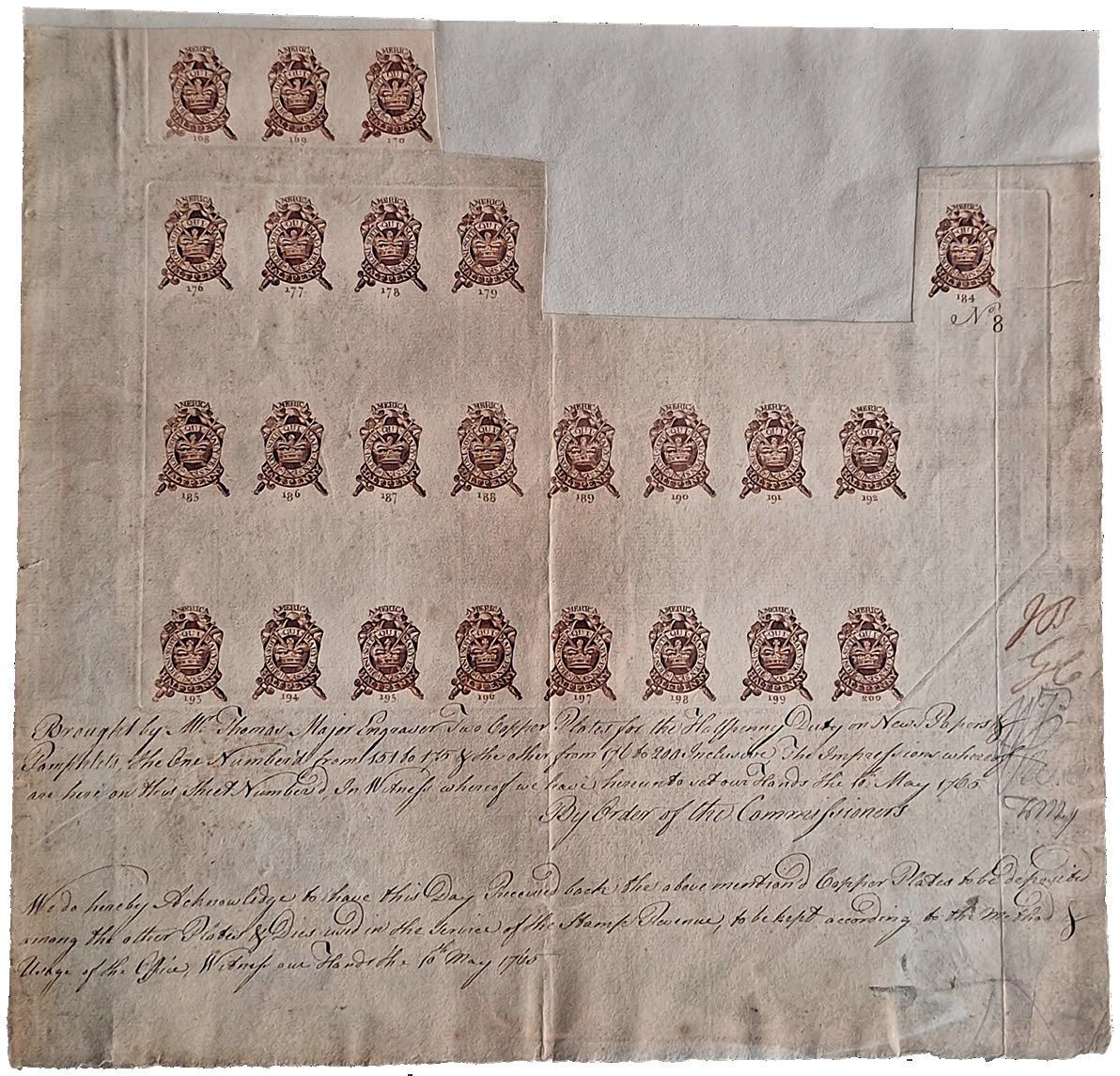
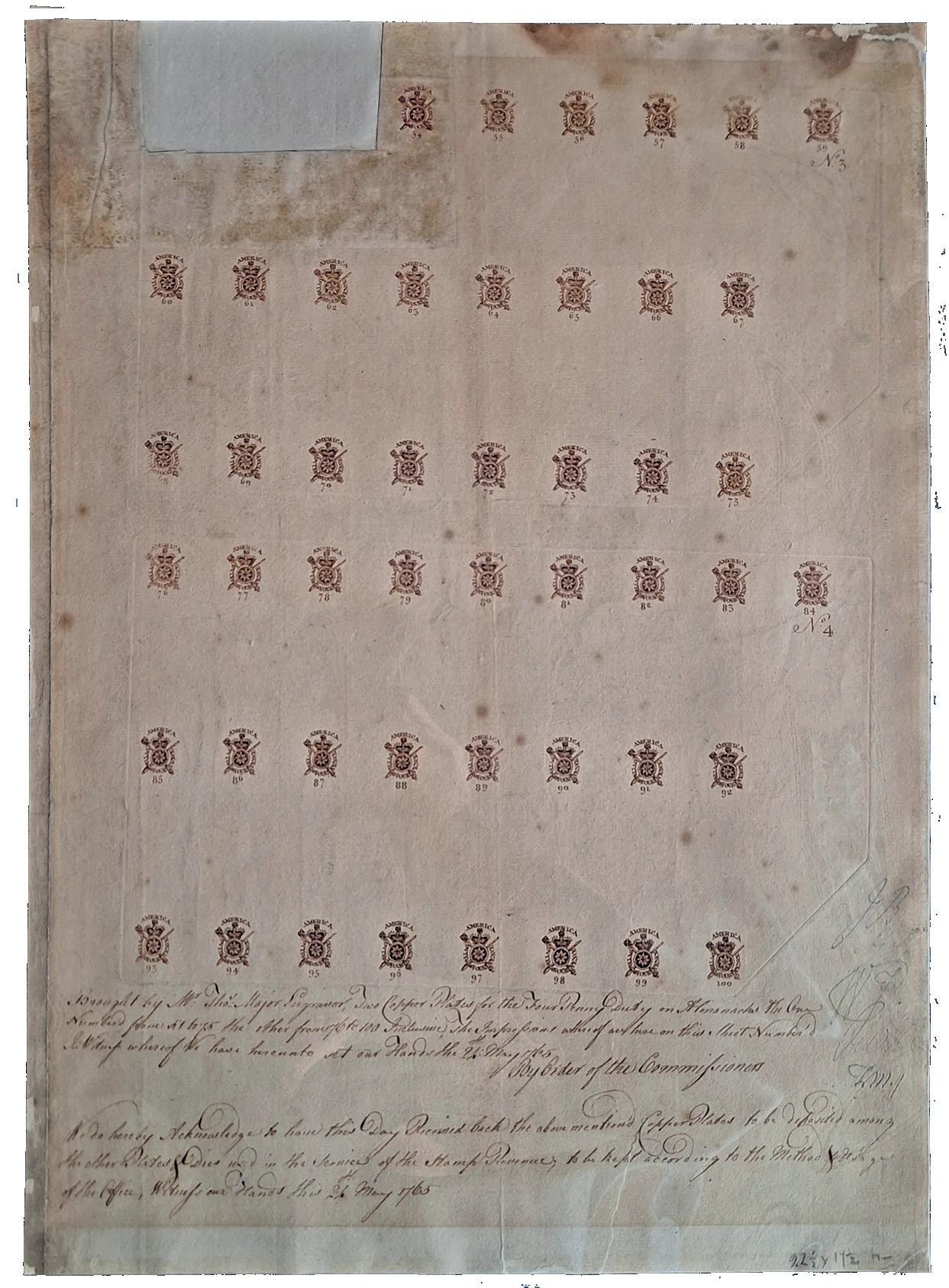
Figure 20. Registration sheet for the Four Pence (4d)“AMERICA” Almanac revenue stamps. Plate 3: Dies 54 75. Plate 4: Dies 76 100. Note the complete impression of Plate 4, with the complete outline of the plate employed.
Bibliographic Sources Consulted
Anon (1876). “The American Tax Stamps of 1765”, The American Journal of Philately. [20 June], pp.83-86. Barber, William A (2009). The Impressed Duty Stamps of the British Colonial Empire, Chesapeake, VA. Brewer, John (1990). The Sinews of Power: War, Money and the English State, 1688–1783, Harvard.
Dagnall, Harry (1994). Creating A Good Impression: Three Hundred Years of The Stamp Office and Stamp Duties, HMSO, London.
Dickson, P. G. M. (1967). The Financial Revolution in England: A Study in the Development of Public Credit, 1688–1756, London.
Frank, Samuel B and Schonfeld, Josef (1974). The Stamp Duty of Great Britain and Ireland. Vol. 3, Mamaroneck, New York.
Goddard, Richard (2025). Thomas Major (1719 1799). Engraver, Public Servant and Author, Global Academic Press.
Gould, Eliga H. (2000). The Persistence of Empire: British Political Culture in the Age of the American Revolution, North Carolina.
Greene, Jack P. (2011). The Constitutional Origins of the American Revolution, Cambridge.
Hughes, Edward (April 1941). “The English Stamp Duties, 1664-1764”, The English Historical Review, 56: 222, pp.234-264.
Koeppel, Adolph (1962). New Discovery from the British Archives on the 1765 Tax Stamps for America, American Revenue Association, Pennsylvania.
Koeppel, Adolph (1976). The Stamps that caused the American Revolution: The Stamps of the 1765 British Stamp Act for America. New York.
Marshall, P. J. (2005). The Making and Unmaking of Empires: Britain, India, and America c.1750–1783 , Oxford.
Miller, John C. (1943). Origins of the American Revolution, Boston.
Morel, Richard Scott (2024). “Satirizing Stamps: A Brief History of Philatelic Cartoons, 1765-2020”, Philatelic Literature Review. Whole No. 285. 4th Quarter, pp.14 35.
Morgan, Edmund S. and Morgan, Helen M. (1963). The Stamp Act Crisis: Prologue to Revolution, North Carolina.
Oats, Lynne and Sadler, Pauline (2008). “Accounting for the Stamp Act Crisis”, The Accounting Historians Journal, 35: 2., [December], pp. 101-143.
O’Brien, Patrick K. (1988). “The Political Economy of British Taxation, 1660 1815”, The Economic History Review, 41: 1, [February], pp.1-32.”
O’Shaughnessy, Andrew J. (1994). “The Stamp Act Crisis in the British Caribbean”, The William and Mary Quarterly, 51: 2., [April], pp.203-226.
Spindel, Donna J. (1977). “The Stamp Act Crisis in the British West Indies”, Journal of American Studies, 11: 2., [August], pp.203-221.
Turner, Sydney R. (1945). Some Notes on the Stamps of the Stamp Act, 1765 1766, The author, London.
Archival Sources Consulted
The British Library Philatelic Collections, Board of Inland Revenue Stamping Department Archives. List 1, Volume 1: Registration sheets for America Almanac and Newspaper Revenue Stamps
The British Library Philatelic Collections, Board of Inland Revenue Stamping Department Archives.
List 1, Volume 2: Book A: Register of America Revenue Dies Kept by the Secretary.
The British Library Philatelic Collections, Board of Inland Revenue Stamping Department Archives.
List 1, Volume 3: Book D: Register of America Revenue Dies Kept by the Receiver General
The British Library Philatelic Collections, Board of Inland Revenue Stamping Department Archives.
List 6, Volume 3. Registration sheets for America Newspaper and Almanac Stamps.
The British Library Philatelic Collections. Crawford Library of Philatelic Literature. Crawford 1178. The Notebooks of Frederick Augustus Philbrick
The British Library Philatelic Collections. The Tapling Collection, USA: America 4d Almanac Stamp.The National Archives, Kew. AO3/1086. Audit Office Accounts of American Stamp Revenue plus list of stamp distributors and consignments of stamps to America.
“The 1765 Stamp Act. Stamp Act of 1765” - Wikisource, the free online library
Lubor Kunc FRPSL
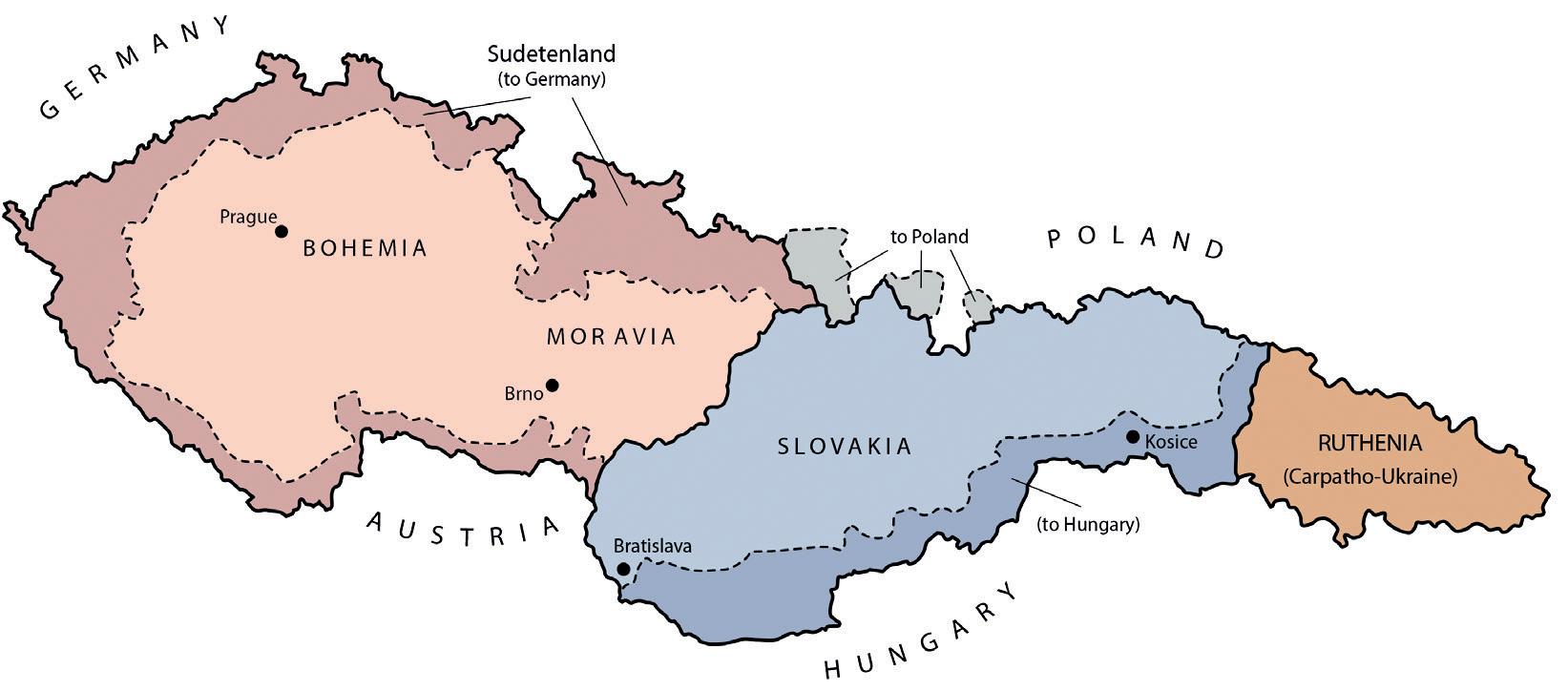
Figure 1. Czechoslovakia 1938 1939.
Following the Munich Agreement in September 1938, Czechoslovak history was impacted not only by both the German-Polish-Hungarian occupation of its border areas, but also by the autonomy of Slovakia and Ruthenia within the Czechoslovak state in October‑November 1938. These political developments are also reflected in the postal arrangements of Czechoslovakia during the Slovak and Ruthenian autonomy had been incorporated into Acts No. 299/1938 Coll. (Slovakia) and 328/1938 Coll. (Ruthenia/Carpatho-Ukraine). These were constitutional laws passed by the National Assembly of the Czecho-Slovak Republic, and key components of the political transformation that created the short-lived Second Czecho-Slovak Republic following the Munich Agreement in September 1938. This development meant that Czechoslovak stamps issued up until December 31, 1938 (i.e. up to Pofis 349 / Scott 254) were valid in all Czechoslovak territory, and stamps issued from January 1, 1939 (from Pofis 350 / Scott 254a) were only valid for use in the individual regions of Czechoslovakia.
This legal situation led to the creation of the autonomous Slovak and Ruthenian postal administrations, which commenced operations in January 1939. This development meant that Czechoslovak stamps issued up until December 31, 1938 (i.e. up to Pofis 349 / Scott 254) were valid in all Czechoslovak territory, and stamps issued from January 1, 1939 (from Pofis 350 / Scott 254a) were only valid for use in the regions of Czechoslovakia.
The autonomous Slovak Postal Administration issued a postage stamp for the very first meeting of the regional Slovak Parliament (Pofis 350/ Scott 254a) on January 18, 1939, by overprinting an existing Czechoslovak stamp of 1936 (Pofis 313 / Scott 226) shown in Figure 2b.
This was the only Slovak issue put into circulation during the existence of Czechoslovakia. All the other issues were released when the Slovak Republic was created by the independence declaration of March 14, 1939.
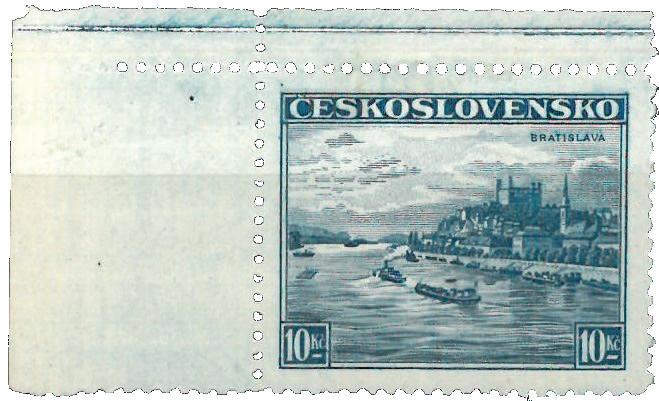
Figure 2a. The original 10K Czechoslovak stamp of 1936, featuring Bratislava, the capital city of Slovakia.
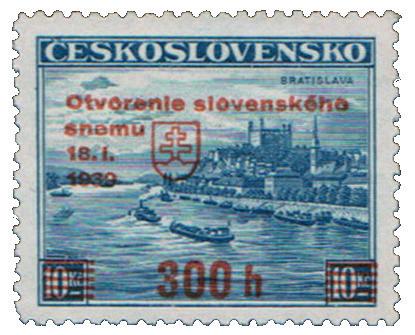
Figure 2b. The newly issued 300 heller (or 3K) Slovak Parliament stamp of 1939.
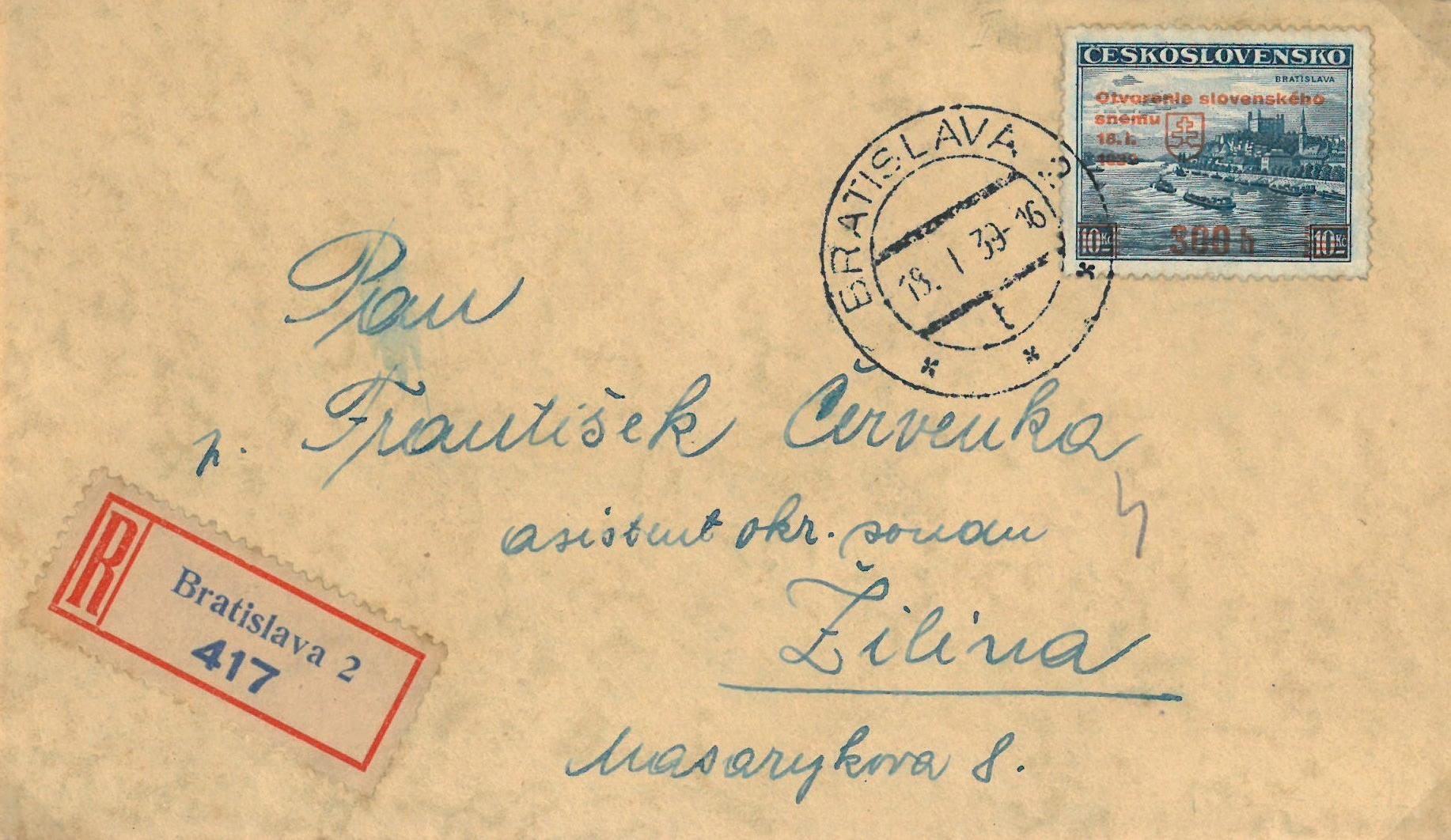
Figure 2c. Domestic registered letter franked with the 300 Heller Slovak Parliament stamp paying the 1K letter rate plus 2K registration fee. Mailed from Bratislava to Žilina (both in Slovakia) on January 18, 1939 (first day of issue).
Slovak stamps prepared during the Czechoslovak period showed General M. R. Štefánik, in blue, (Pofis 351x/ Scott 254x), as well as the politician Andrej Hlinka (Synek 23‑24/ Scott 233 24) (Figures 3 and 4a). The final Slovak stamps were overprinted (Figures 4b and c): only the “Blue Štefánik” stamp had also been issued without the overprint. Hlinka stamps without overprints are considered as unissued (Synek NZ 23-24 only).
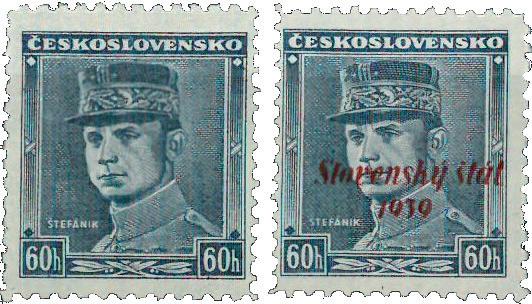
Figure 3. “Blue Štefánik ” stamps with and without overprint (1939).
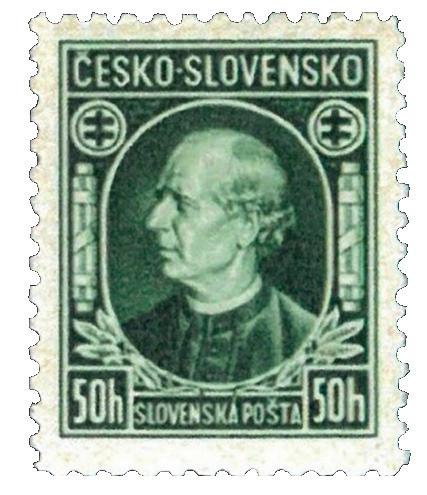
Figure 4a. Unissued Hlinka stamp printed during the existence of Czechoslovakia without overprint (Note the “ Česko-Slovensko ” upper inscription).
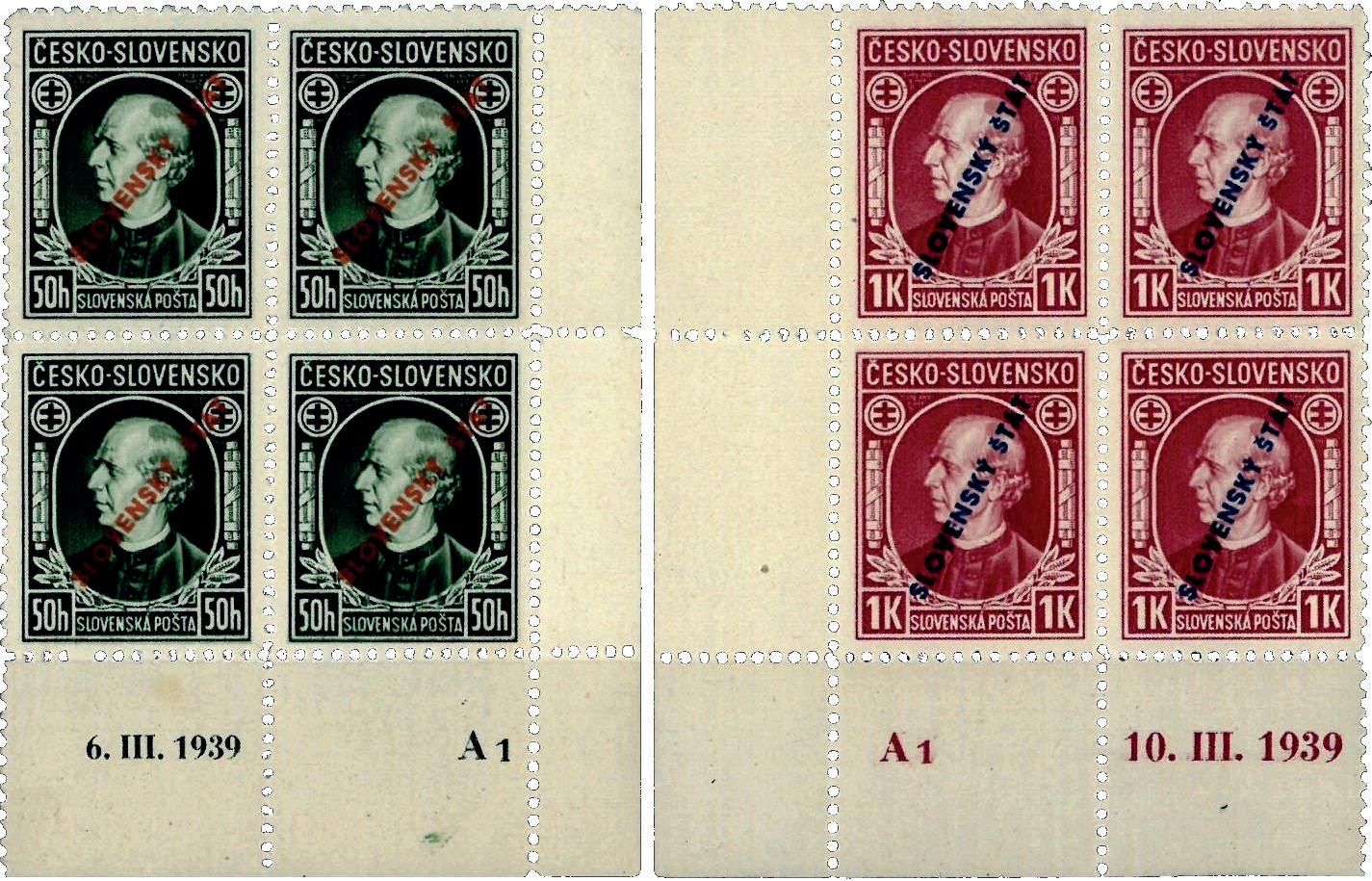
Figure 4b. Issued 50 heller and 1K Hlinka stamps in blocks of four showing the printing date of the original stamps (March 6 and March 10, 1939). Printed from the first plate “A1”.
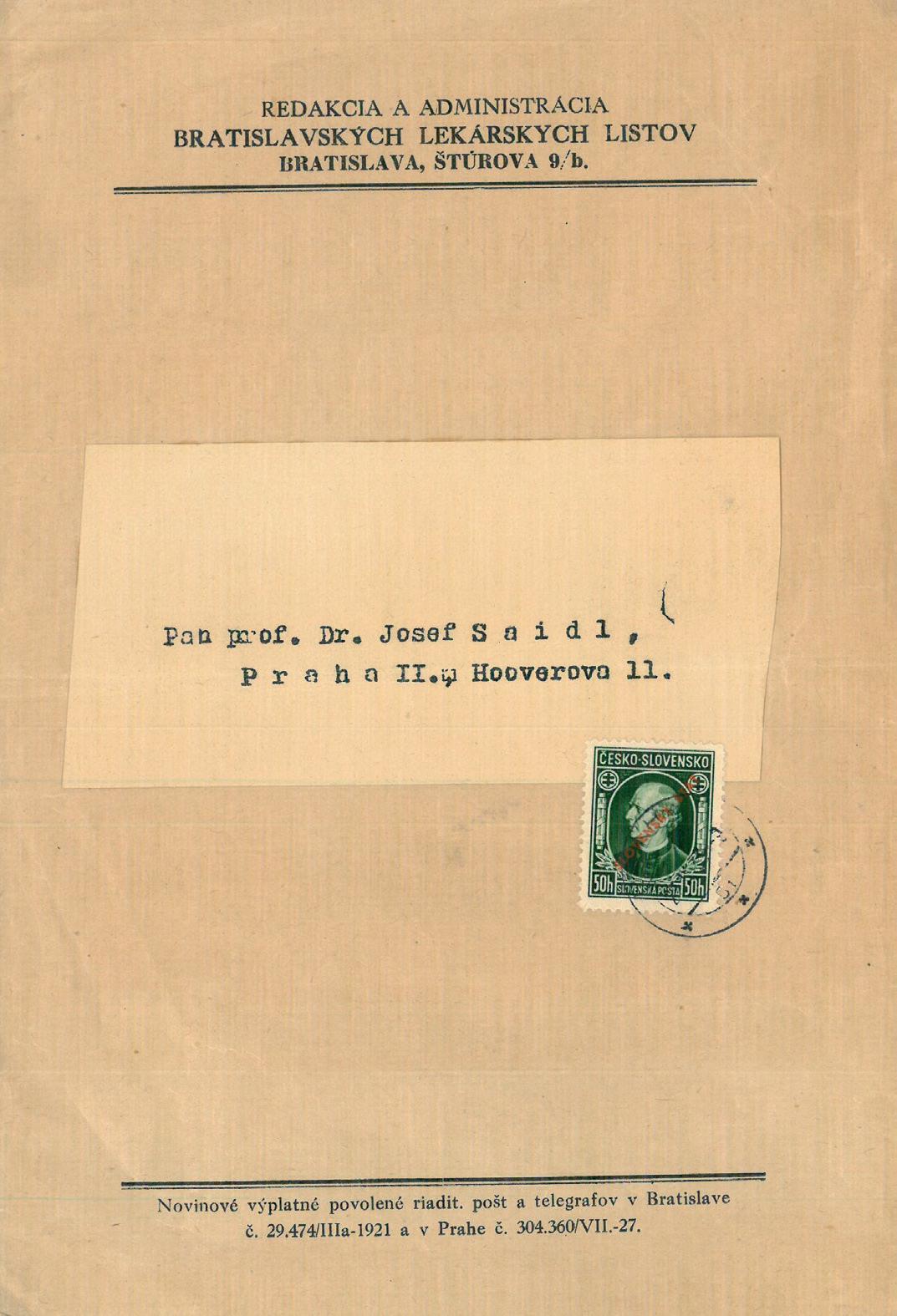
Figure 4c. Printed matter properly franked with the overprinted 50 heller Hlinka stamp (Bratislava, April 23, 1939).
Ruthenian autonomy existed for a short time. Its only stamp (Figure 5b) was issued on March 15, 1939, for the opening of the regional Ruthenian Parliament (Pofis 351 / Scott 254x), but the Parliament declared independence instead of autonomy. The newly born state of Carpatho Ukraine existed for just one day before its territory was occupied by Hungary. Hungary had started its military intervention on March 14, 1939, when Slovakia declared its independence from Czechoslovakia.

Figure 5a. Original “Jasiňa” Czechoslovak 60 Heller, issued on October 28, 1928 (Pofis 236 / Scott 145).
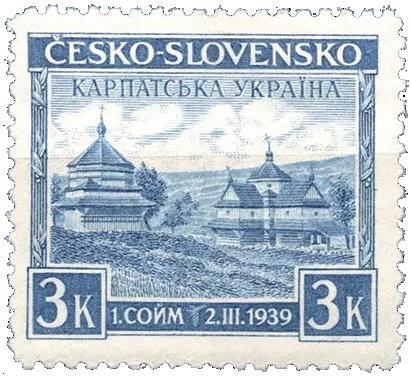
Figure 5b. The only Ruthenia (Carpatho Ukraine) stamp, issued in 1939.
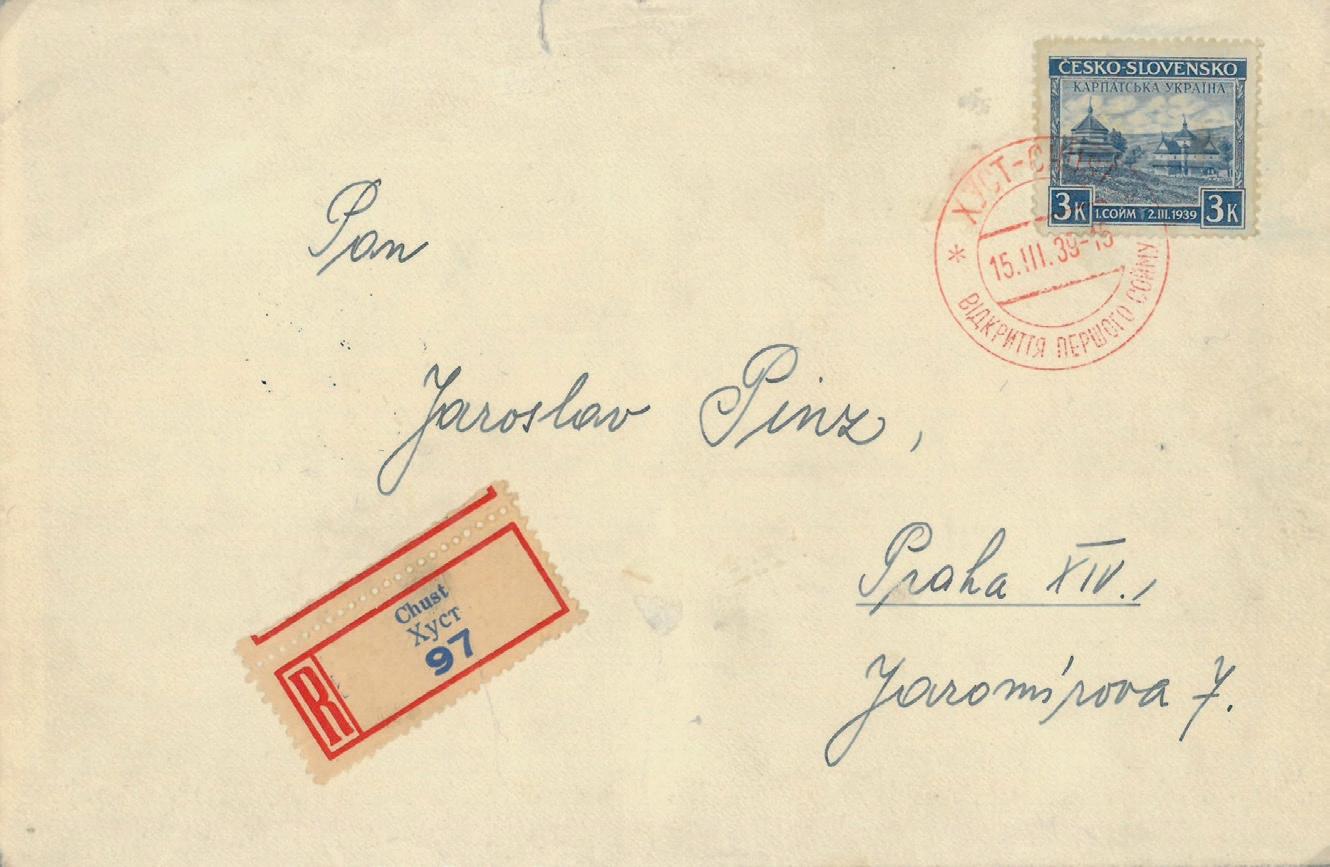
Figure 5c. Registered cover franked with the 3K Ruthenian stamp on its only day of validity (March 15, 1939), paying the 1K letter rate plus 2K registration fee. The cover was confiscated by the Hungarian Army after the occupation of the city of Chust/Huszt/Khust and all mail was handled by the Hungarian Post Office to the Protectorate in late March 1939. Certified by Mrňák.
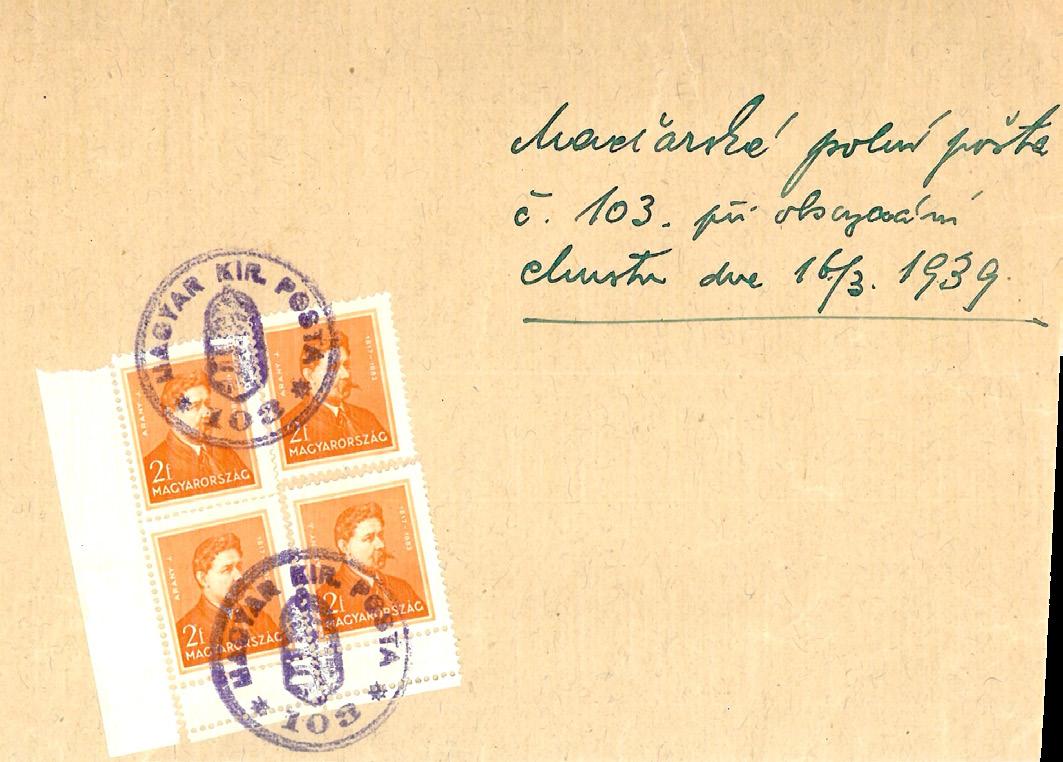
Figure 5d. Philatelic souvenir produced at the Khust post office on March 16, 1939. The office’s facilities were controlled by Hungarian military postmen, using Hungarian stamps as well as numbered temporary postmarks (postmark #103 was assigned to the Khust post office).
The original Czechoslovak Postal Administration remained responsible only for the postal operation in Bohemia, Moravia and Silesia (jointly called “the Czech Lands”) with effect from January 1, 1939. The administration also started to prepare postage stamps valid only in these regions of Czechoslovakia, but the task was not so urgent in comparison to the autonomous postal authorities in Slovakia and Ruthenia, because the Prague postal administration had access to stock of all the previous Czechoslovak stamp issues.
Without respect to the political changes, the original Czechoslovak Postal Administration continued to deliver the existing Czechoslovak stamps to the Slovak and Ruthenian postal authorities. The original Czechoslovak stamps remained valid in the Czech Lands until December 15, 1939, and in Slovakia until July 31, 1940. In Ruthenia, the Czechoslovak stamps were replaced by those of Hungary with immediate effect after the March 16, 1939, occupation.
The original Czechoslovak Postal Administration decided to issue only three new stamps for the Czech Lands. They were for payment of printed matter and postcards (50 heller face value, in green), domestic letters (1 Crown, in red) and a new airmail stamp (30 heller, in violet). The postal authority informed the public about the decision, and the information was published in philatelic magazines like Národní sběratel no. 3 of 1939.
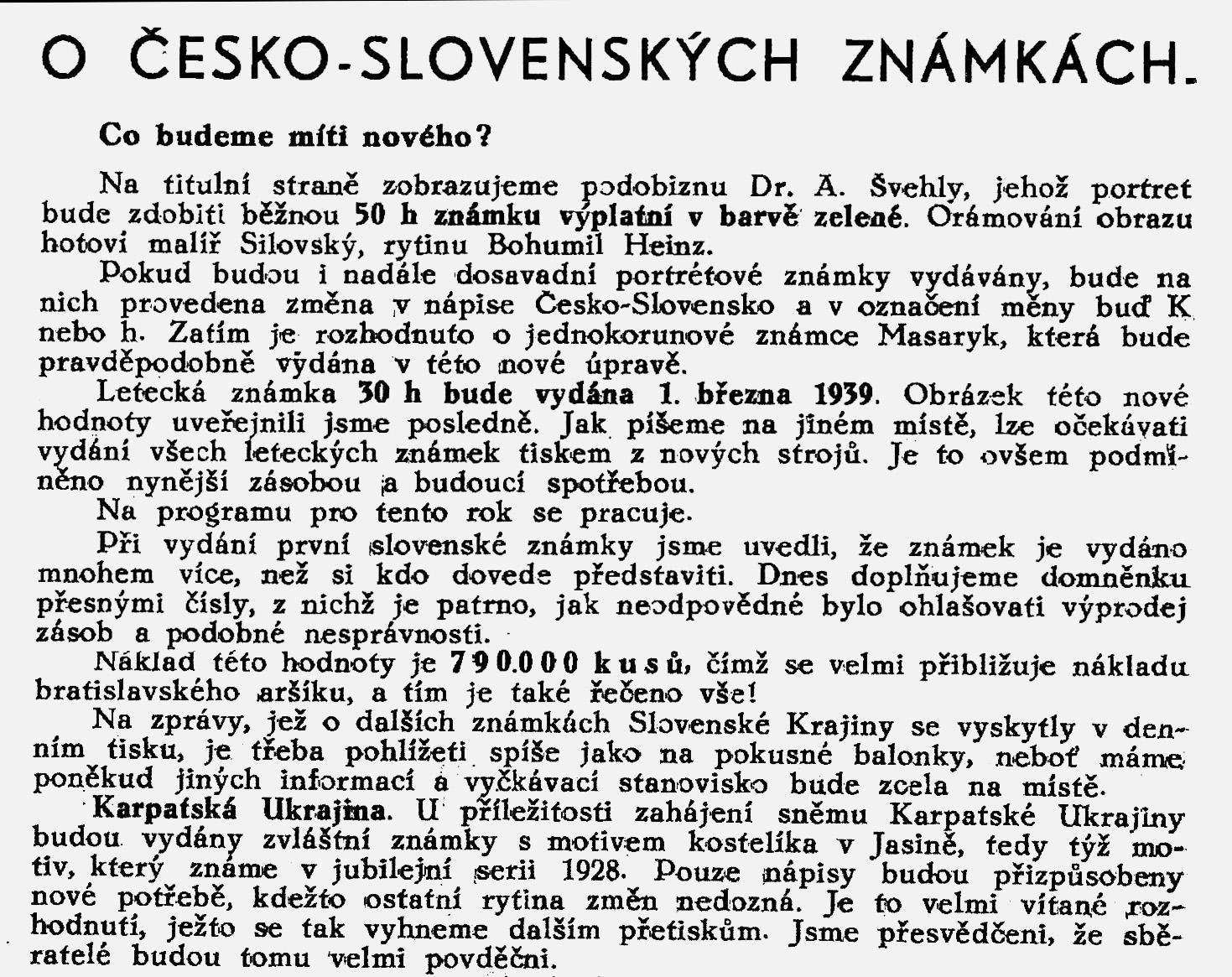
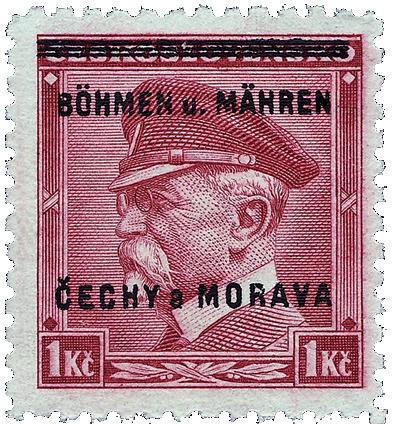
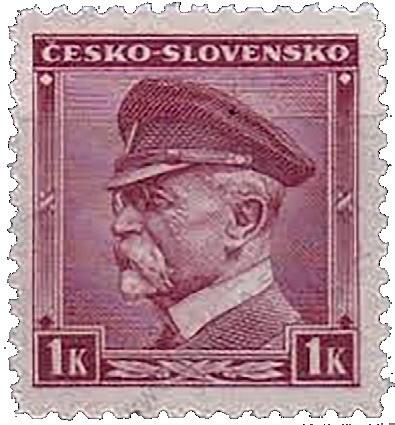
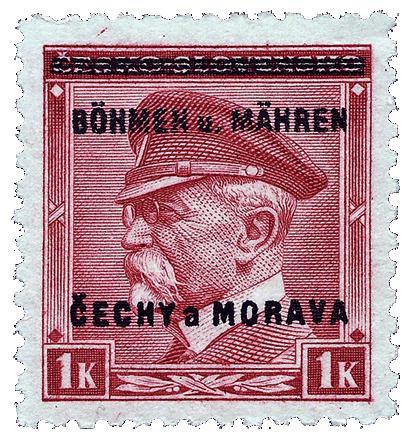
But real life went differently. Only two of the postage stamps were actually issued: a 1K Masaryk definitive (Pof. 352 / Scott 256) on April 13, 1939, and a 30 heller airmail stamp (Pofis L15, Scott C10x) on April 22, 1939 (Figures 7c and 8b). Both stamps used the design of the existing Czechoslovak stamp issues, i.e. the original 1935 1Kč stamp (Pofis 303 / Scott 262a) (Figure 7a) and the 1930 original 30 heller airmail stamp (Pofis L7/Scott C10) (Figures 7a and 8a). Their production was therefore easier and faster, because the only changes needed were to the country name – “Česko Slovensko”, instead of the original “Československo” – and the currency abbreviation – “K” instead of the original “Kč”).
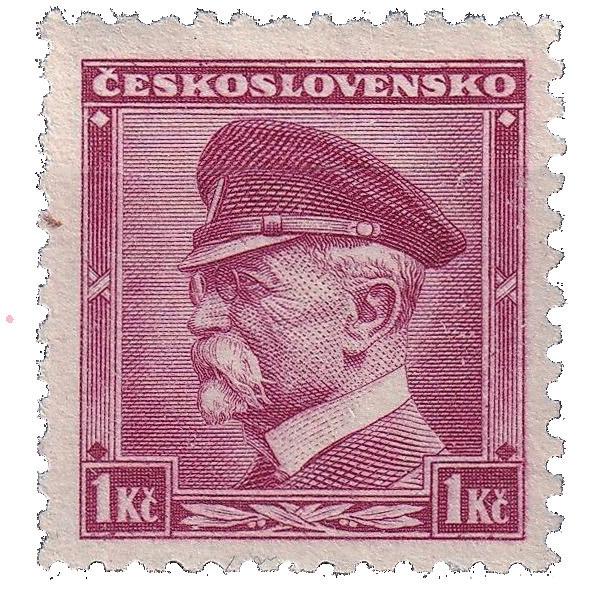
a.
b. The same stamp with the “BÖHMEN u. MÄHREN / ČECHY & MORAVA” Protectorate overprint for Bohemia and Moravia of July 15, 1939 (Pofis 9 / Scott 9).
c. The April 13, 1939 new issue 1K Protectorate stamp of 1939, inscribed “CESKO SLOVENSKO” (Pofis 352 / Scott 256).
d. The same stamp with the Bohemia and Moravia Protectorate overprint of July 15, 1939 (Pofis 10 / Scott 10).
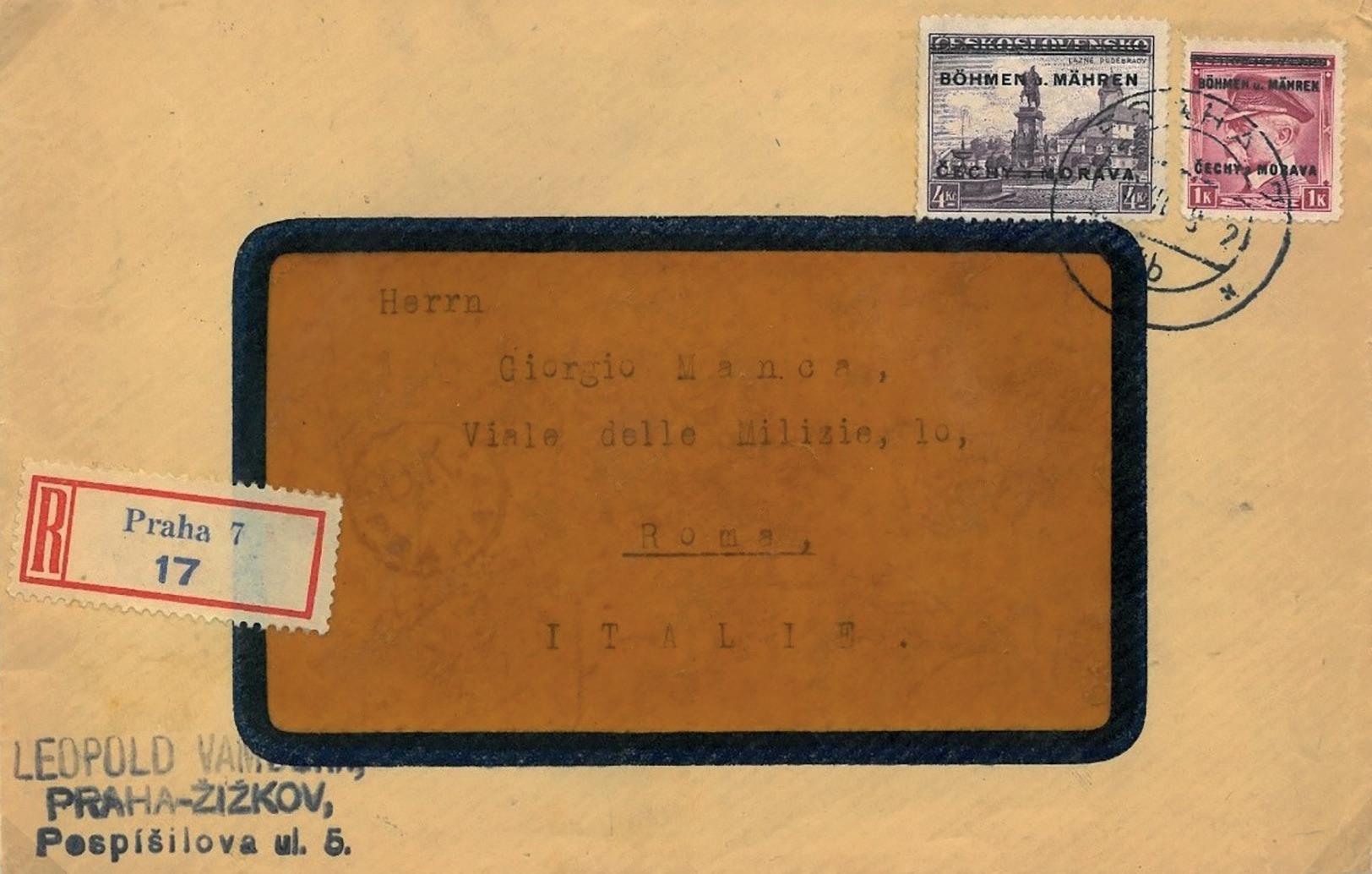
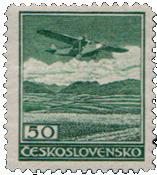
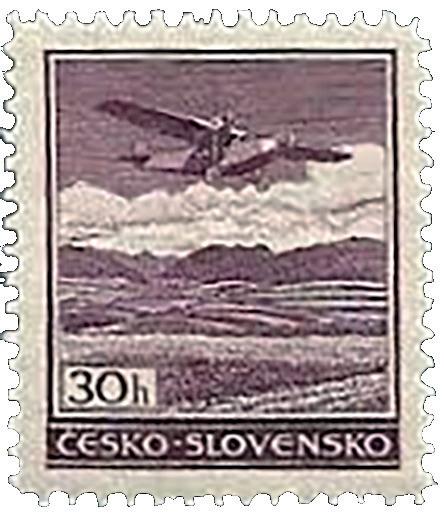
Figure 8a (left). Original Czechoslovak 50 heller airmail stamp of 1930.
Figure 8b (right). The newly issued 30 heller Protectorate airmail stamp of 1939.
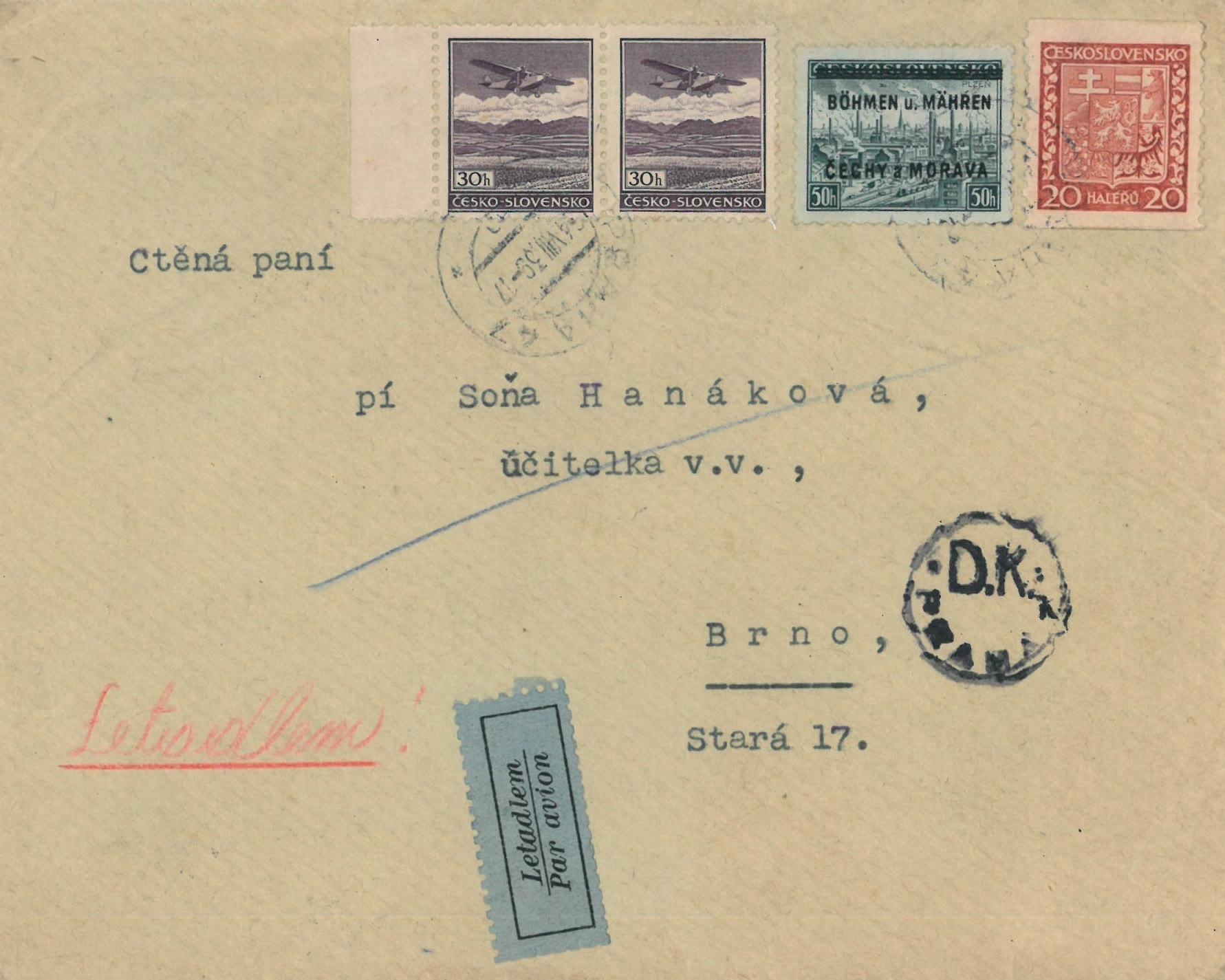
Figure 8c. Domestic airmail letter sent via the only operative inland route, Prague Brno. Properly franked with 1K domestic letter postage plus 30 Heller airmail surcharge (from August 24, 1939); “D.K. / PRAHA” censorship mark applied at Prague 1 GPO.
There was no appropriate design available for the 50 heller stamp. The Czechoslovak Postal Administration had several stamps of that face value, but none of them was fit for purpose. The most recent 50 heller stamp showed President Edvard Beneš (1937, Pofis 314 / Scott 227), who was living in exile in the United Kingdom at that time (Figure 9a). Even before the German occupation of Czechoslovakia, it was politically impossible to issue a new stamp with the portrait of the former President.
The existing stocks of the stamps were withdrawn from postal counters, when a new Czechoslovak President, Dr. Emil Hácha, took over the function in November 1938. Hácha was a friend of Beneš as well as a lover of English literature, having translated some works into the Czech language. Hácha therefore did not approve a stamp issue with his portrait, because he hoped for the speedy return of Beneš to Czechoslovakia.
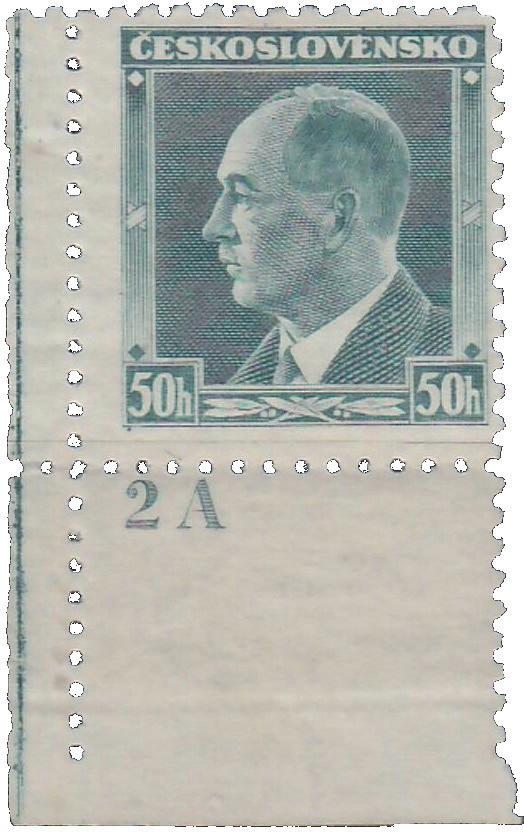
9a. Czechoslovak 50 heller “Beneš” stamp of 1937 (Pof. 314 / Scott 227). A corner marginal single from plate 2A.
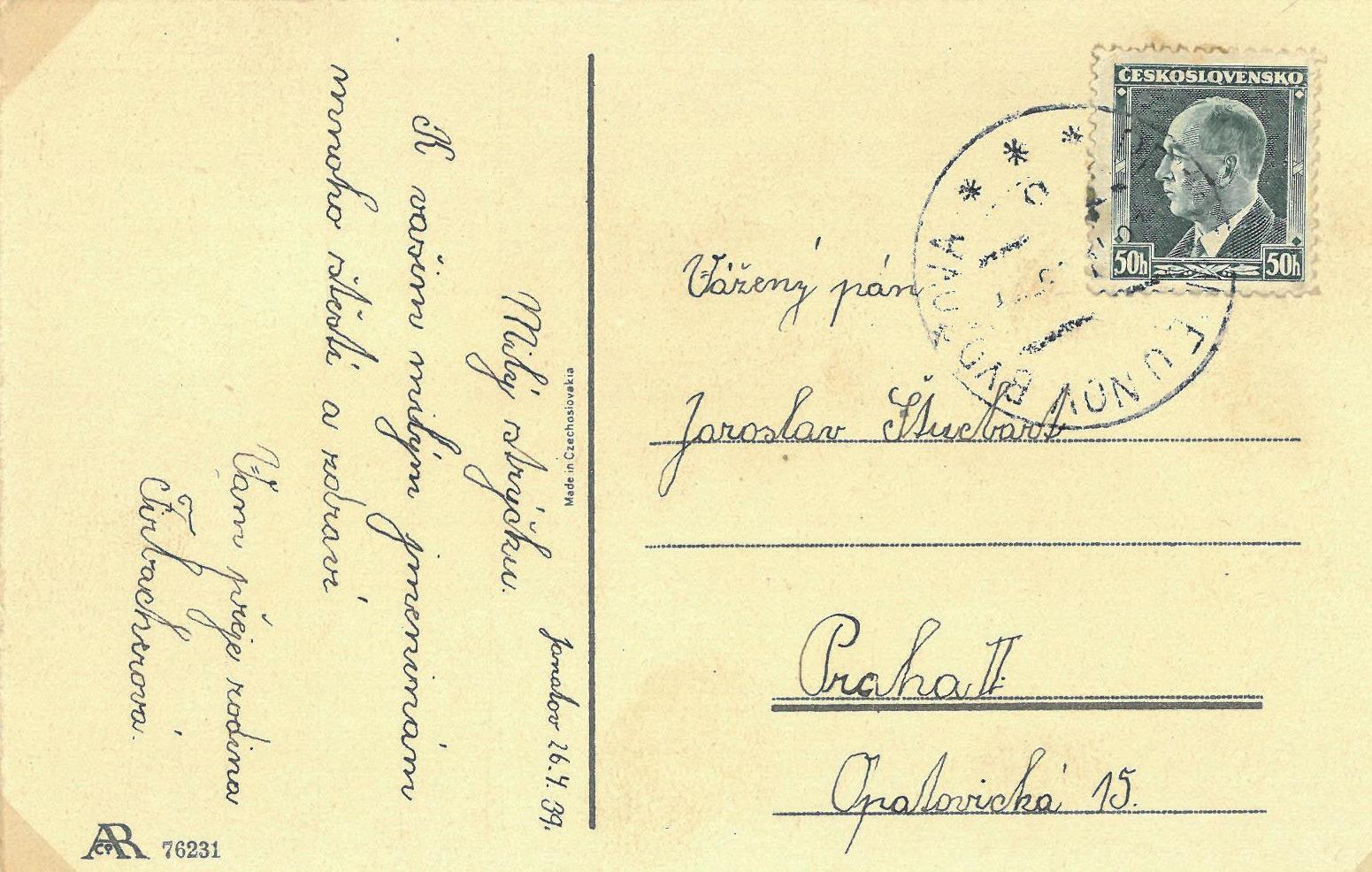
9b. April 26, 1939, postcard properly franked with the Beneš postage stamp at Petrovice u Nového. Bydžova post office.
The Czechoslovak Postal Administration started preparation of a new 50 heller stamp in January 1939. Due to the absence of a suitable design, they appointed a famous painter and engraver, Bohumil Heinz (1894-1940). This name might sound familiar not only to the collectors of Czechoslovak stamps, but also to other philatelists.
Bohumil Heinz’s main employer was the Czechoslovak National Bank (engraving bank notes) and the State Postal Printing Work in Prague (designing and engraving Czechoslovak postage stamps since 1935), but he was also hired by De La Rue to engrave foreign and British Empire stamps, e.g. the Siam stamps of King Pradjadipok (1932), a Chinese stamp of the Martyrs issue (1933), King George VII stamps issued by Ceylon, Nigeria and St. Lucia, General Gordon stamp of Sudan (1935), the Swedish P. H. Ling stamp (1939) and the King Charles I stamp of Barbados (1939).
Heinz started painting a picture of the new postage stamp showing the Czech politician, Antonín Švehla (1873-1933). Švehla was Prime Minister of three Czechoslovak governments between 1922-1929, remaining popular even after his death. The Švehla stamp became a mystery of Czechoslovak philately because it was never issued and there are no known trial prints or any other philatelic material relating to it. Many collectors believed that the stamp has never really been prepared. Others believed its preparation probably had started but was never finished and no print of the stamp was executed. The negative opinion was also supported by the absence of any existing philatelic material. The stamp has not yet been recorded in the stamp catalogues.
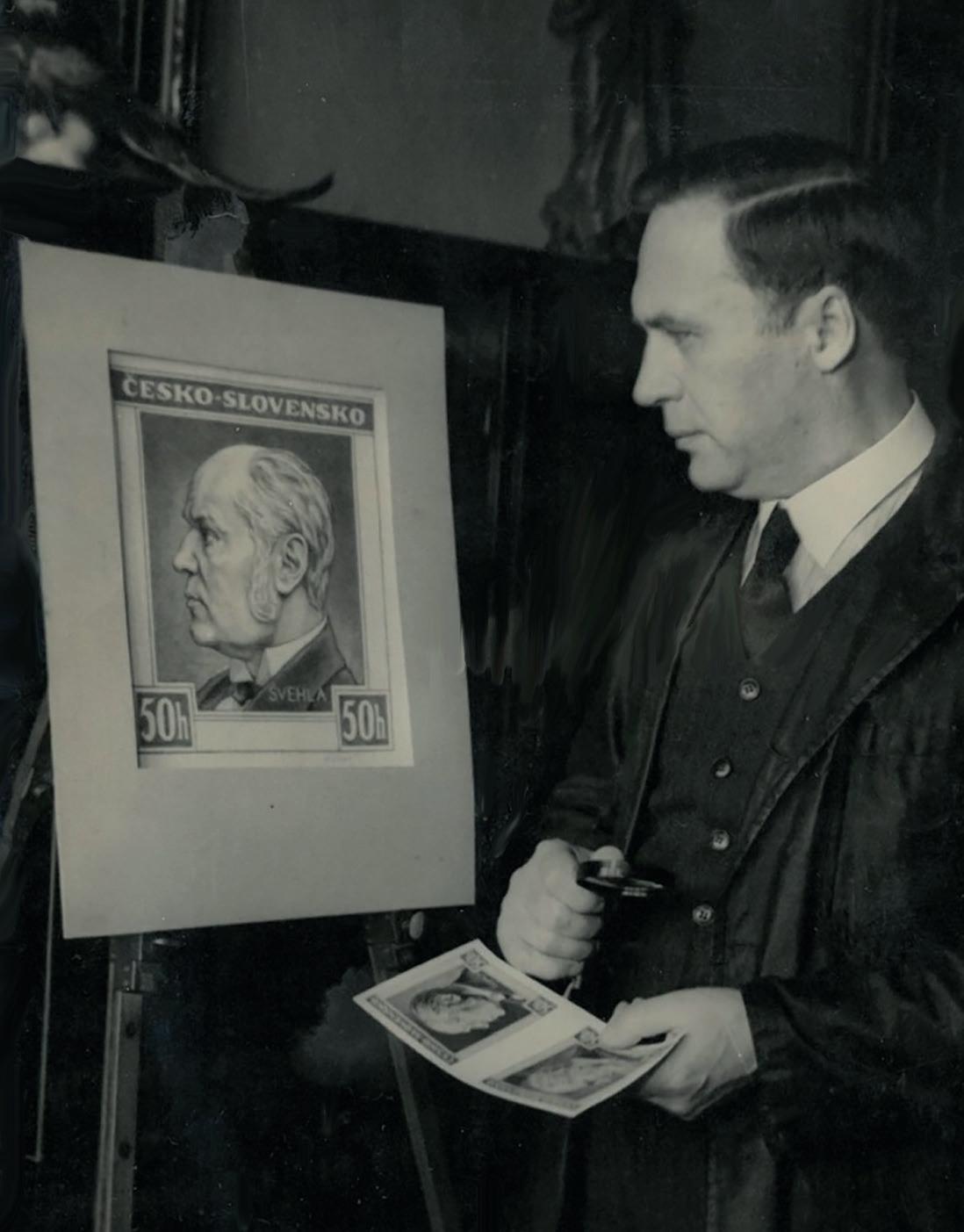
Today we can proudly say that the mystery has been solved by the discovery of the photograph (Figure 10) showing the author and engraver Bohumil Heinz in front of his painting of the Švehla postage stamp. Considering the absence of the full frame of the stamp, we can estimate the photograph was taken in February 1939, i.e. at roughly the time when the Národní sběratel article in Figure 6 was published. The photograph was kept by the Švehla family until 2022 when Jan Švehla, the nephew of Antonín Švehla, died. Jan Švehla was also a keen stamp collector.
This photograph therefore proves that the Švehla stamp was in preparation (in fact it was almost finished), with only a part of the frame remaining to be done. Because of the Nazi occupation of Czechoslovakia on March 15, 1939, the stamp was not issued, as the occupation authorities had no reason to issue a stamp showing the former Prime Minister of a country they occupied. None of the documentation relating to the Švehla stamp is likely to have survived WWII.
A new 50 heller stamp design (Figures 11 a and b) was prepared. The final design shows the Karlštejn Royal Castle (Pofis 29 / Scott B126). The author and engraver of this new postage stamp was also Bohumil Heinz. This extreme workload was a key driver in Heinz’s early death in 1940 aged 46; a result of illness, long-term stress and his being a workaholic.
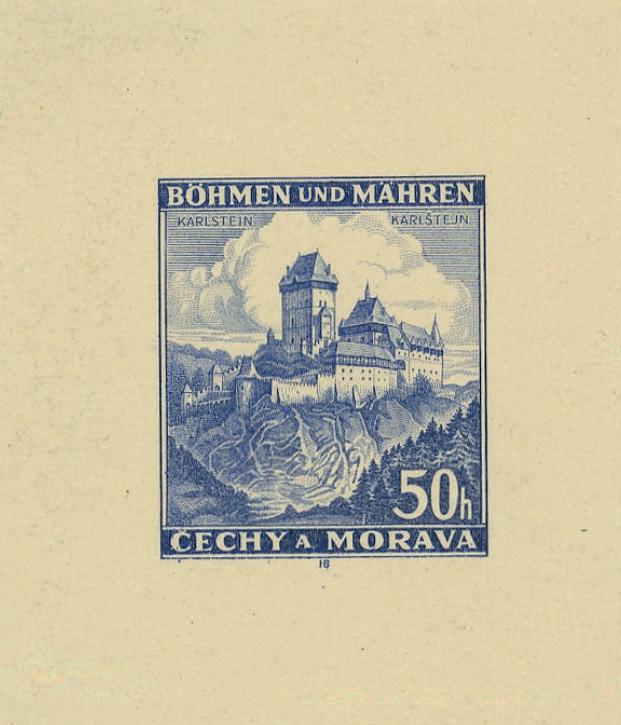
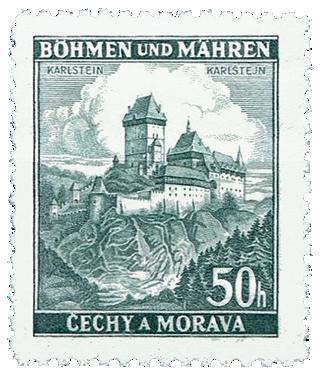
Figure 11a. Proof of the 1939 Karlštejn 50 heller (Pofis 29 / Scott B126). Figure 11b. The Karlštejn stamp issued on March 31, 1939.
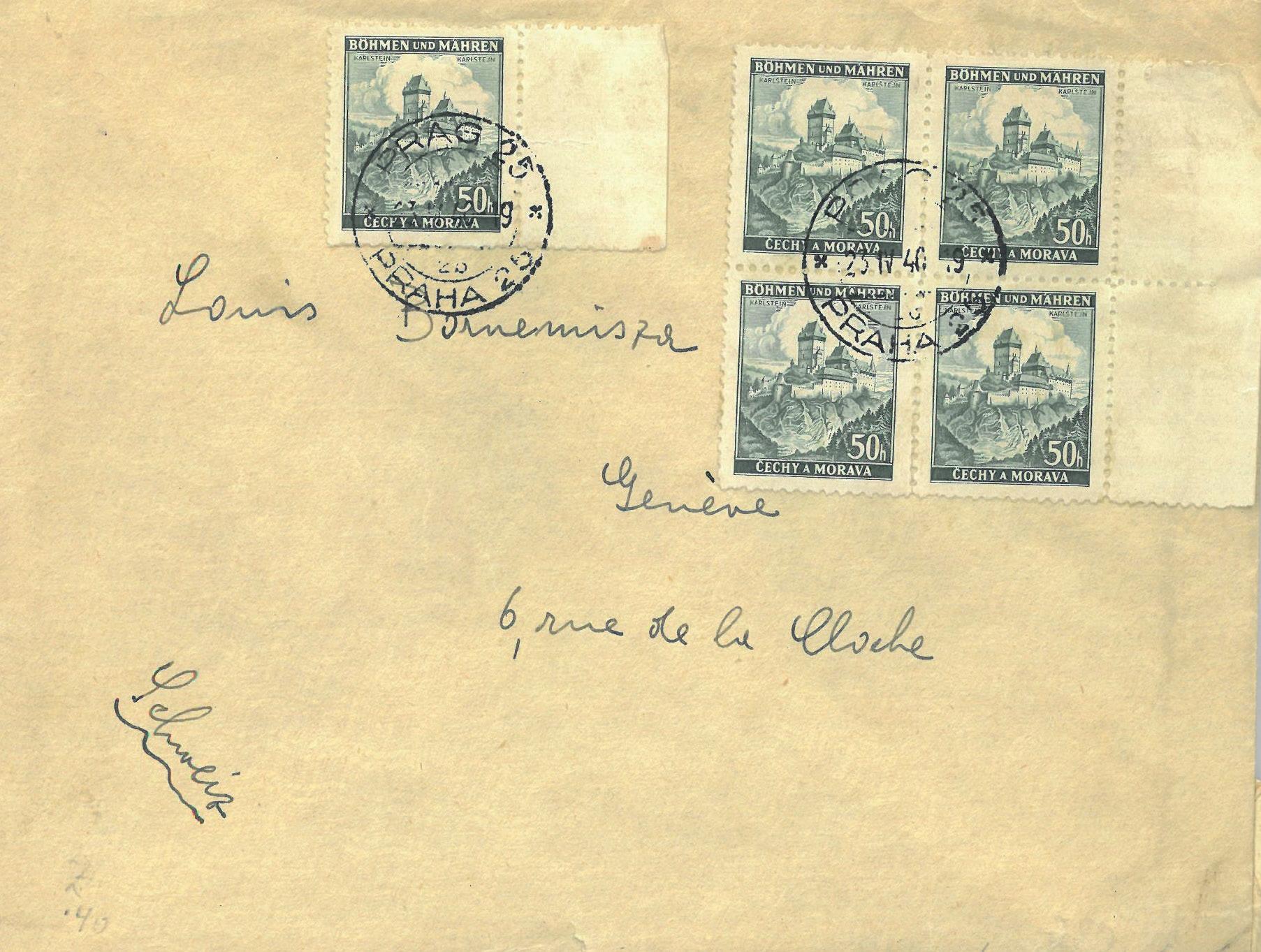
Figure 11c. Cover dated April 23, 1940, from Prague franked with 5 x 50 heller Karlštejn definitives paying the correct rate to Switzerland, with German censorship tape on the reverse.
An epilogue to the stamp issues was a souvenir sheet (Figure 12) issued on November 8, 1943, for the Czechoslovak stamp exhibition held in Grosvenor Place, London. The sheet was printed in London by Waterlow & Sons. It had no postal validity, instead it was used as promotional material for the Czechoslovak government in exile.
The sheet combined issued and unissued stamps. The unissued stamps are a 5Kč value showing Prague, plus a 10Kč stamp showing the political representatives of Czechoslovakia. However, the politicians’ portraits were derived from Czechoslovak postage stamps, namely that of Štefánik (see Figure 3), as well as that of Beneš, which faces the opposite way to the original stamp of 1937 (see Figure 9). The 1Kč (Jasiňa) and 2Kč (Velehrad) values were inspired by the Czechoslovak stamps issued in 1928. Finally, the 3Kč Bratislava stamp was based on the 1936 issued design (see Figure 2a).
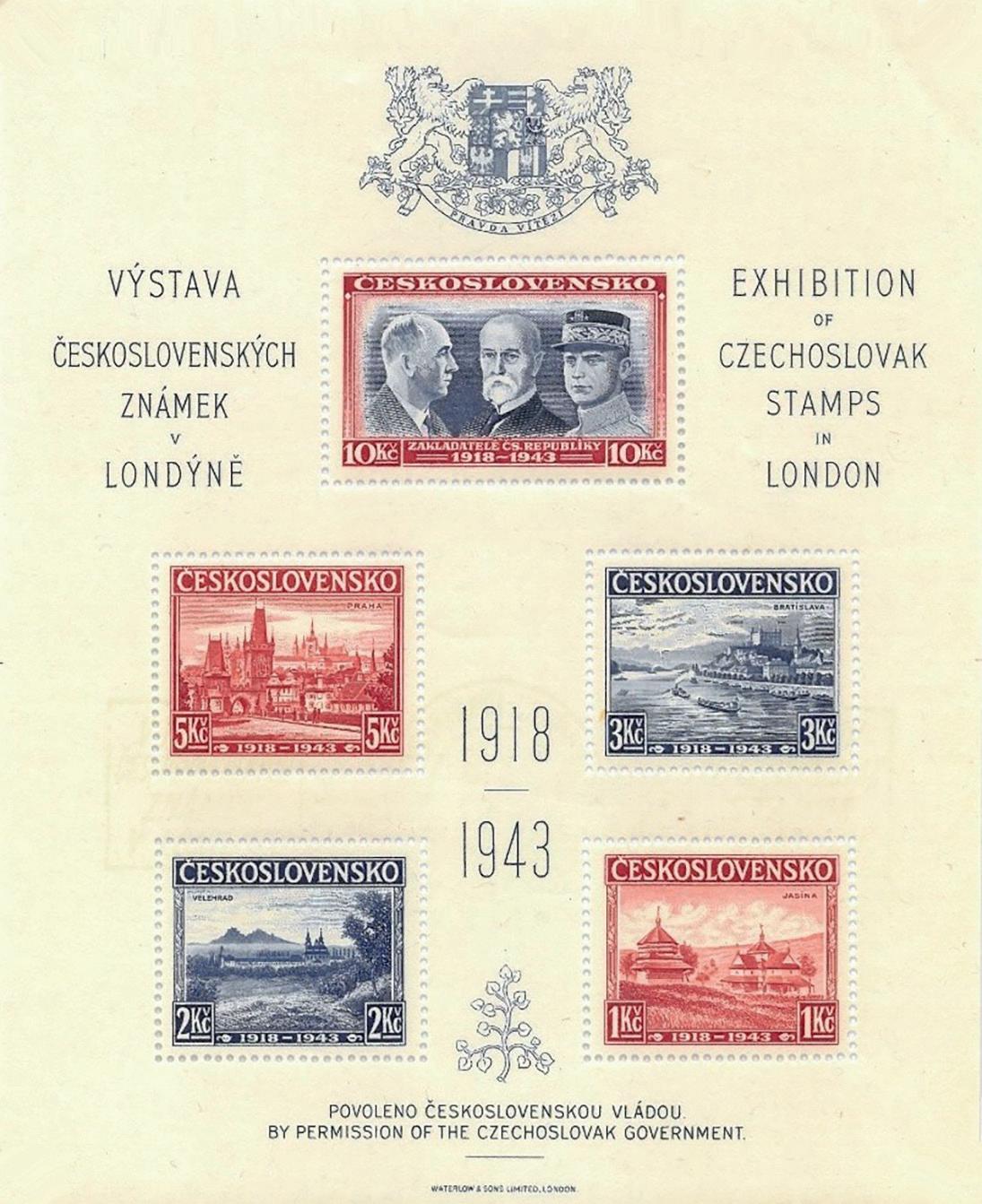
Figure 12. 1943“Exhibition of Czechoslovak Stamps in London” sheet
References
Kunc, Lubor (2021). “Českoslovenští vojáci v létech 1939-1945”, Filatelie, 8, FILATELIE s.r.o., Prague.
“O Česko Slovenských Znánkách”, Národní sběratel, 3, 1939, Spolek neodvislých filatelistů v ČSR [Association of Independent Philatelists in Czechoslovaia], Prague,.
POFIS Stamp Catalogue 2013 (2012). Protectorate of Bohemia and Moravia 1939 1945, POFIS, Prague.
POFIS Stamp Catalogue 2015 (2015). Czechoslovakia 1918 1939, POFIS, Prague. Stamp Engravers Blogspot at https://stampengravers.blogspot.com/2013/11/heinzbohumil.html
Stanley Gibbons (2017). Stanley Gibbons Stamp Catalogue of the Czech Republic and Slovakia, 1st edition, Stanley Gibbons, London.
Synek Stamp Catalogue (2019). Slovakia 1939 1945, Filatelia-Numizmatika Album, Bratislava, Slovakia.



19 – 20 & 23 – 28 March 2026
Highlights from the March auction: Germany from 1849 – The “American” Bruce Wright Collection (part III) Hamburg 1857–1867 – The “St Georg” Collection Kingdom of Saxony – King John – The Michael Schewe Collection German East Africa – The “Waldersee” Collection German war and post-war areas WWI & WWII – The "Mare Balticum" Collection Baltic States from 1918 – The "Mare Balticum" Collection Russia No. 1 – The “Elin” Collection (part II) Croatia 1940–1945 – The Prof. Dr. Shaul P. Ladany Collection Grand Duchy of Oldenburg – The Jens Kuhn Collection (Part I) The stamps of the North German Postal District during the era of the German Empire from 4 May 1871 – The Hansmichael Krug Collection Horseshoe cancels – The Jens Kuhn Collection (Part I) Weimar and the Third Reich with variants, proofs and essays – The Nils Schmidt Collection Ship Mail until 1945 – The Friedrich Steinmeyer Collection (part II)
Heinrich Köhler Auktionshaus GmbH & Co. KG
www.heinrich-koehler.de
info@heinrich-koehler.de

Vladimir Milić

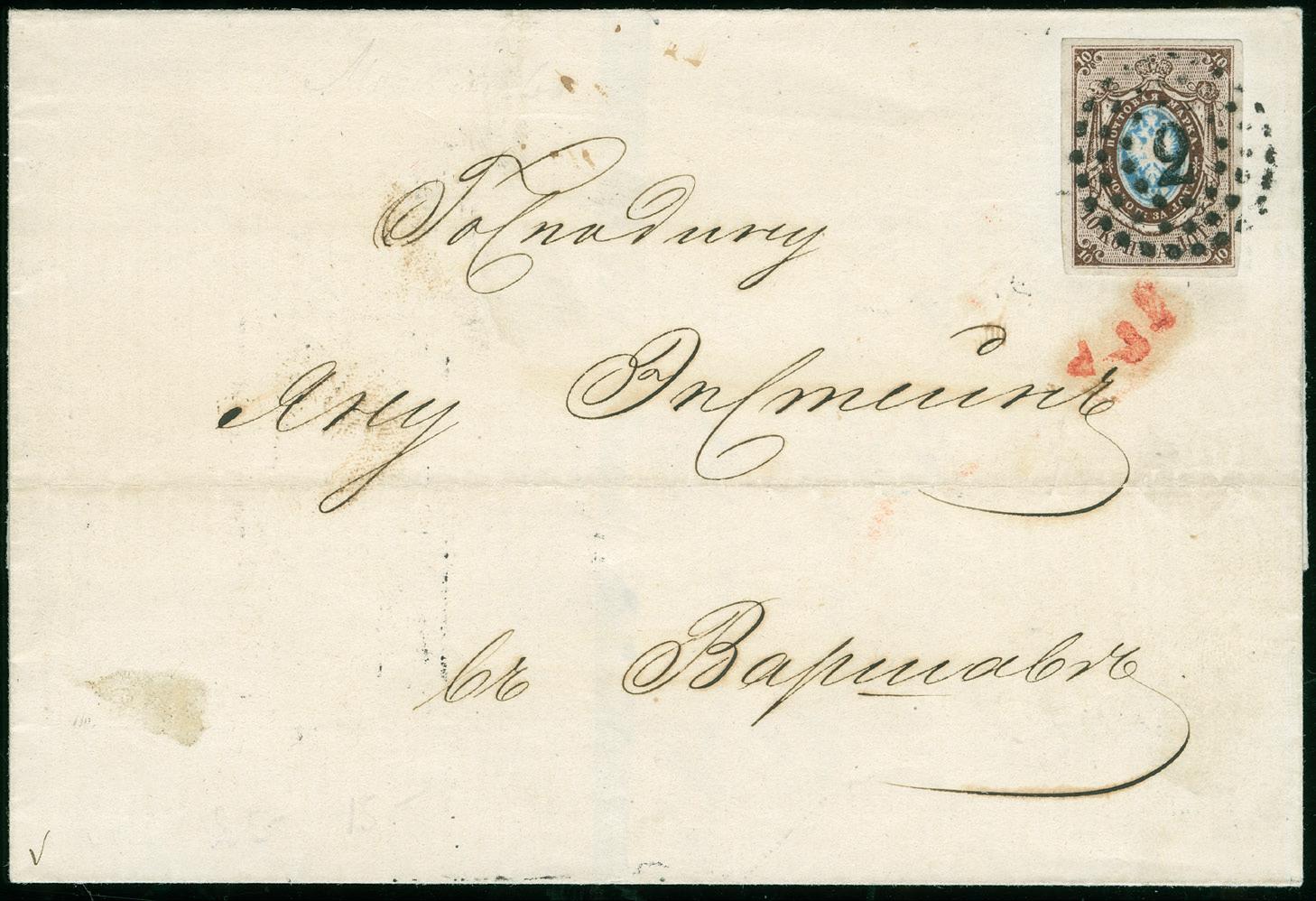
Russia 1858, 10 kopeck tied by dotted numeral "2" on cover from Moscow 22 April 1858 to Warsaw. Only one of three covers recorded with this cancellation.
Provenance: Liphschutz (1994)
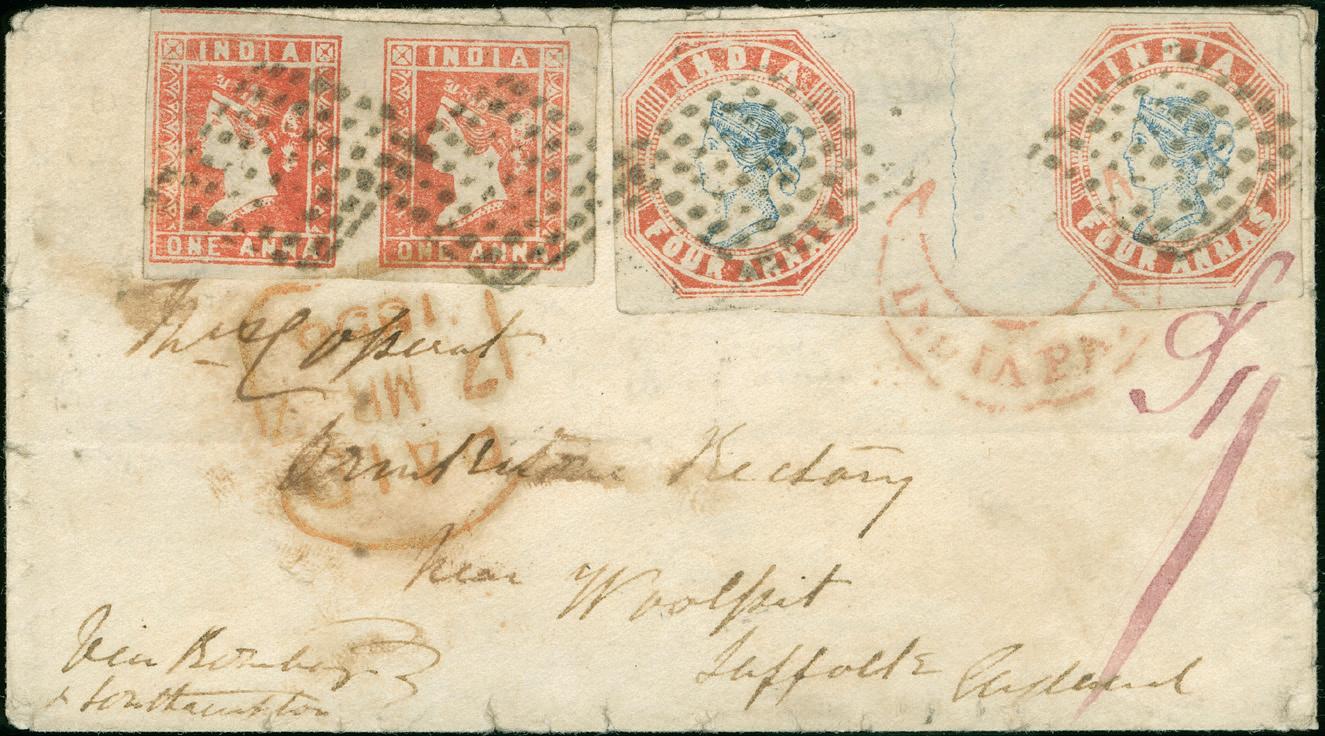
India 1854, 3rd Printing, Head
Die II, Frame Die I, 4 a., horizontal pair with 1a red, tied to 1856 cover to Bury St. Edmonds – One of the finest pairs of the 3rd printing recorded.
Provenance: Gray Piccus Heddergott Dr. Kornan
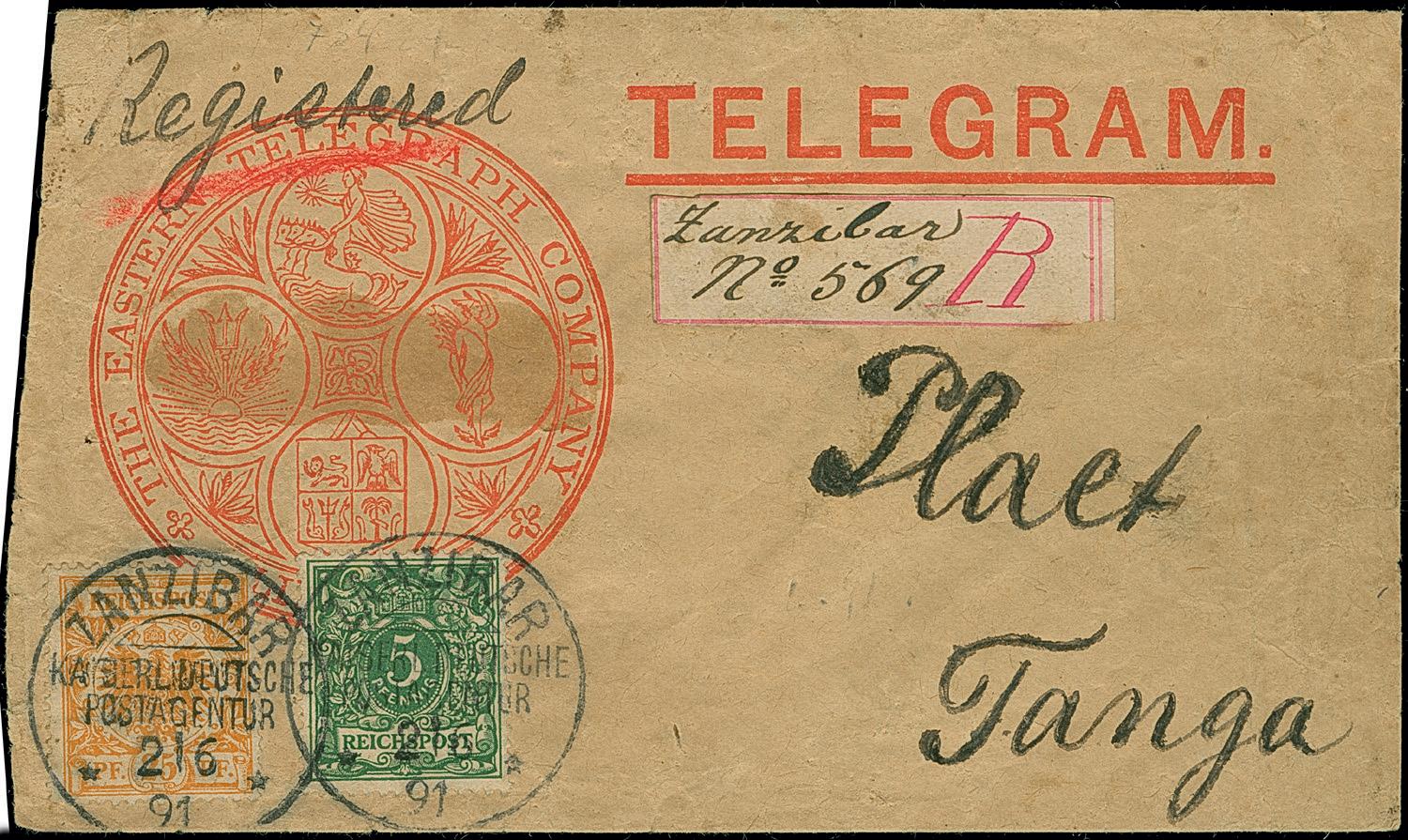
German East Africa, Zanzibar 1891, forerunner 25 pfennig and 5 pfennig on registered telegram with provisional label to Tanga. Unique!




Tanga


Ingo Nessel FRPSL FRPSC
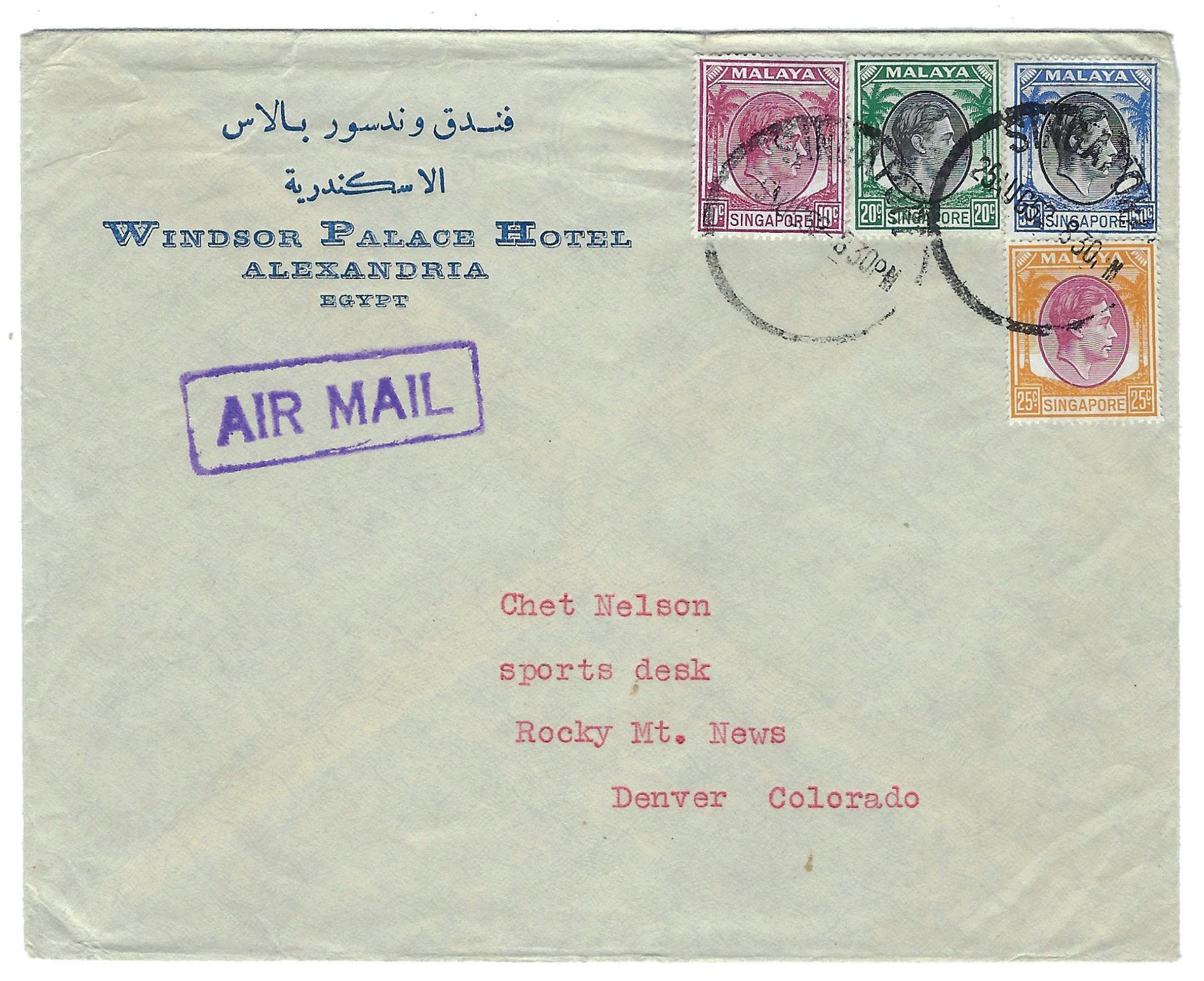
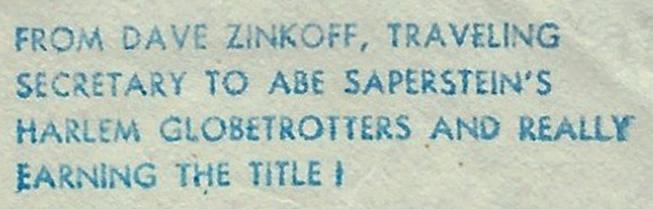
August 25, 1952, air mail cover sent from Singapore during the Harlem Globetrotters’ 1952 World Tour. The postage of $1.05 Singapore dollars has been prepaid with King George VI definitives. The inset image shows Zinkoff’s cachet on the reverse of the cover.
This is the story behind a cover with a seemingly confusing origin.
An envelope from the Windsor Palace Hotel, Alexandria, Egypt is addressed to Chet Nelson, Sports Desk, Rocky Mt. News, Denver, Colorado. But surprisingly it is mailed from Singapore on 25 August 1952 with postage stamps totalling $1.05. This is the airmail rate per ½ oz. It was a somewhat short-lived rate being instituted 1 March 1952 and lasted only until 1 November 1952. It is a nice but not overly exciting bit of postal history. However, there is so much more to the social and sports history of this cover.
A small handstamp on the back bears the curious statement “ From Dave Zinkoff, travelling secretary to Abe Saperstein’s Harlen Globetrotters and really earning the title!” That handstamp is what made me keep this cover when I disposed of my Malayan collection some years ago. A check of the two men named on this idiosyncratic handstamp and the addressee revealed some interesting sports history.
Abraham Michael “Abe” Saperstein (1902–1966): He was the founder, owner and earliest coach of the Harlem Globetrotters. Saperstein was a leading figure in black basketball and baseball from the 1920s through the 1950s, primarily before those sports were racially integrated. In the years following WW2, the Globetrotters embarked on overseas tours culminating in a 1952 silver anniversary worldwide “goodwill tour”. This cover is an artifact from that tour.
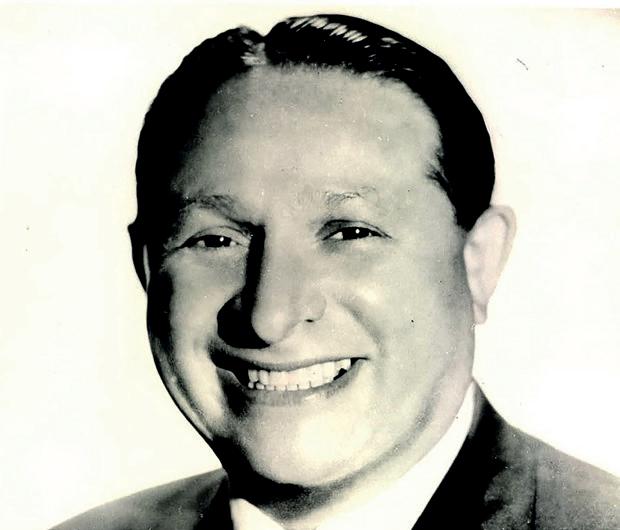
Saperstein was a tireless worker, taking off just one day a year, Yom Kippur. He continued to work right up until his death from a heart attack in March 1966. “; He had more energy than the Grand Coulee Dam ” wrote Chuck Menville in The Harlem Globetrotters: An Illustrated History
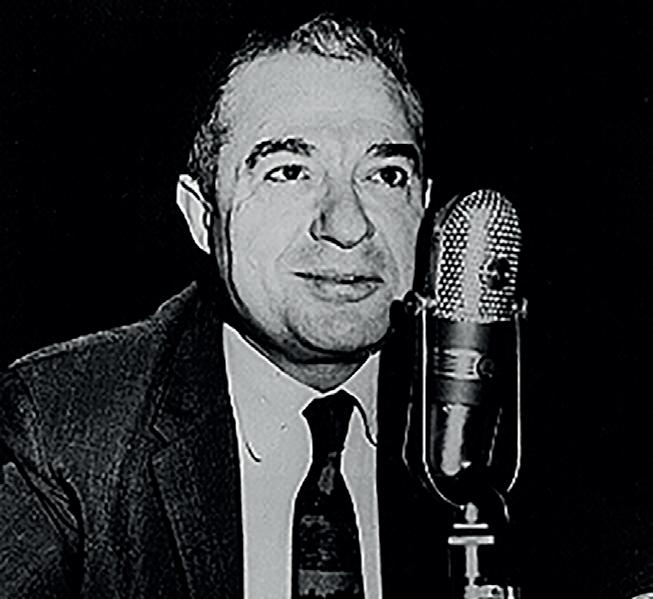
Dave Zinkoff (1910–1985): According to the Philadelphia Jewish Sports Hall of Fame, Dave was a nice Jewish boy whose parents wanted him to be a lawyer, a doctor or a CPA. But “The Zink” pursued a career in sports reporting and became perhaps the most famous voice in the history of professional basketball. For years he was the voice of the Philadelphia 76ers. Never an athlete because he was born with “two left feet,” Zink was a sports devotee. Besides basketball, he also called Phillies games at Connie Mack Stadium.
Chester “Chet” Nelson, the addressee: The Colorado Sports Hall of Fame states that “Horatio Alger would love the story of Chet Nelson’s sports writing career.” Chet started out as a stringer covering semipro baseball and wound up sports editor and sports columnist for the Rocky Mountain News. In 1931, Nelson was running the Merchants Park scoreboard and keeping box scores for the Rocky Mountain News. By the time he retired in 1976, Nelson’s byline had appeared on stories from the Super Bowl, World Series, Kentucky Derby, major prizefights and more.
These three interesting characters from the sporting world are connected by this cover. In 1952, Zinkoff was hired by Saperstein to be the general manager and travelling secretary for the Harlem Globetrotters’ round-the-world tour. A massive logistical undertaking, it lasted from June 2–October 2.
The team was internationally famous as basketball clowns but also as exceptionally talented players with an immensely lopsided winning record. Their adventures are recounted in Zinkoff’s Around the World with the Harlem Globetrotters. The team and a small support staff led by Saperstein with Zinkoff as ‘fixer’ started their tour in Great Britain, progressed through much of Western and Southern Europe with side trips to North Africa.

Round-the-World Tour Official Souvenir Program front cover.
At each venue they played games under conditions that ranged from outdoor dirt floor facilities to full fledged sports arenas. During the Egyptian part of the tour the team played two games in Alexandria, which explains the corner card of the cover. They stayed in the Windsor Palace Hotel, described as a luxury heritage hotel that opened in 1906 and is still in operation today.
After Egypt the Globetrotters continued their journey to play in Thailand, Malaya and Singapore. This cover with Zinkoff’s personal handstamp suggests that one of his duties as travelling secretary was to send press releases back home. The tour was big news in the sporting community, and newspapers carried sensational stories of these exhibition games.
From Singapore the tour continued through several East Asian countries, ending in Japan. On the Transpacific route back to America, they made stops for games in Guam and Hawaii.
Researching the elements of this quirky cover has been an absorbing study in postal, sports and social history. Philately never stops amazing me!
References en.wikipedia.org/wiki/Abe_Saperstein phillyjewishsports.org/2014/03/dave zinkoff/ coloradosports.org/hall-of-fame/athletes/1983-inductees/chester-nelson/ Proud, Edward (2000). The Postal History of Malaya, Vol. 1 Straits Settlements, 2nd edition, Proud Bailey Co. Ltd., UK.
Zinkoff, Dave and Williams, Edgar (1953). Around the World with the Harlem Globetrotters, Macrae Smith Company, Philadelphia.
Daryl Kibble
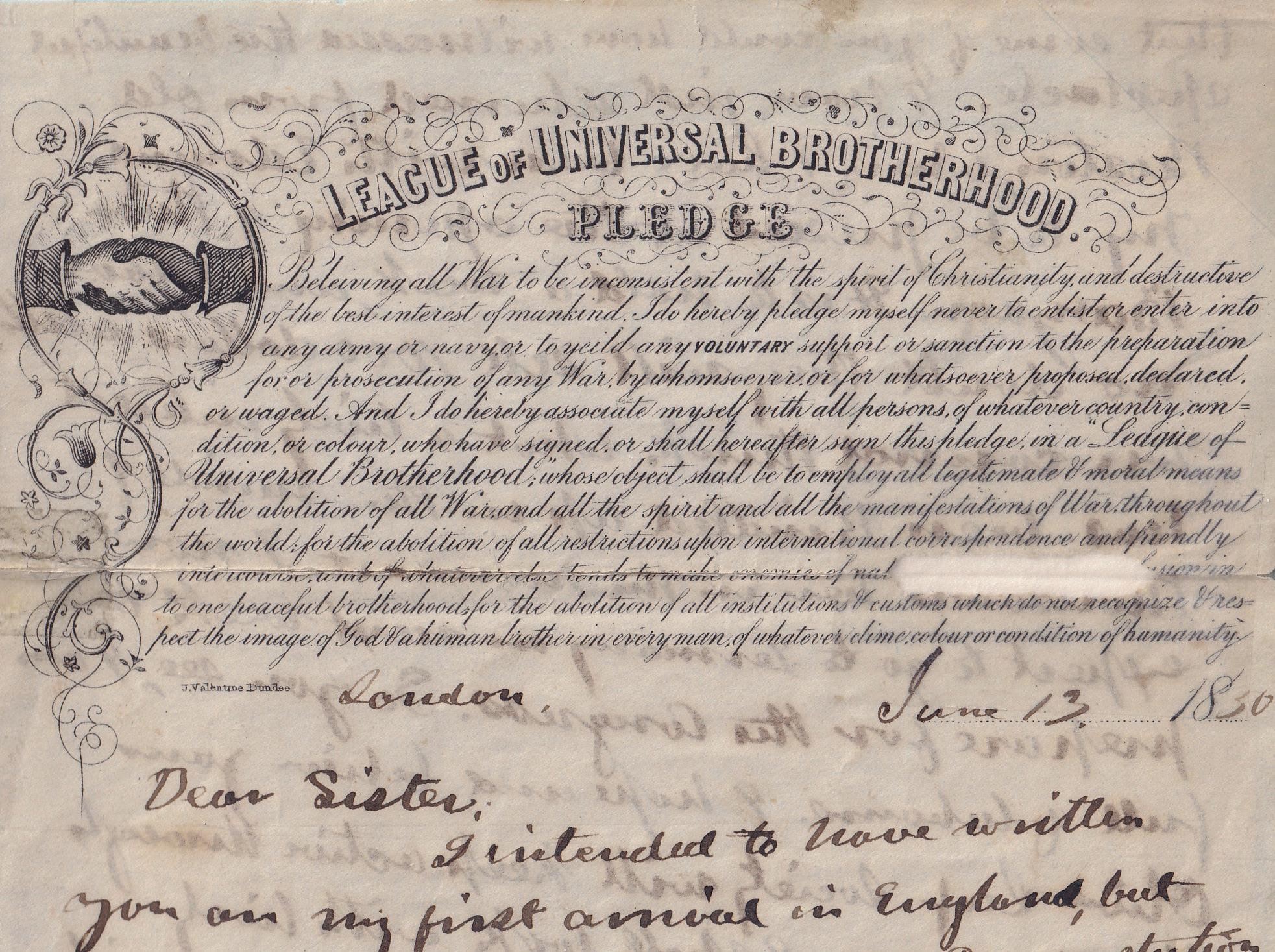
Figure 1. Unique example of a League of Universal Brotherhood illustrated letter stationery (notepaper) by lithography, used as a stampless folded letter by way of a single large sheet of paper within the USA. This specific design is also one of only four held in private hands. The other three examples of this design however are on smaller sized letter stationery. Most examples of LUB illustrated letter stationery are preserved in public institutions.
Introduction
Official government postage stamps were first issued in the USA in 1847. The use of envelopes for the sending of letters did not commence until the 1840s in line with other postal reforms, and then slowly so. The pre-envelope stampless folded letter period would for a time overlap with the introduction of official postage stamps used on envelopes.
During this pre-envelope period, illustrated letter stationery printed by lithography was sometimes used as the sheet of paper that would be folded to create a stampless letter sheet. As Milgram records in his publication American Illustrated Letter Stationery 1819-1899, “for the most part these images were produced in very limited numbers by lithography.” [Migram]
One such illustrated letter stationery, for the League of Universal Brotherhood (LUB), was used in the USA as a stampless folded letter in 1850. It should be noted however that this is a British (not American) illustrated letter stationery, making it an even more remarkable example of this type of postal history. It is the only recorded example of LUB illustrated letter stationery being used as the paper for a folded stampless letter, whether in the USA or elsewhere. All other known LUB stationery was sent enclosed inside an envelope. The design in this is example includes the LUB pledge and the LUB clasped hands emblem.
This folded letter sheet was addressed in the handwriting of, and signed by, American Elihu Burritt while abroad in England. Historians have referred to Elihu Burritt as the hero of the anti-war movement of the mid-19th century. A devout Christian, he adopted the idea of a pledge from temperance circles, for the complete abstinence from every possible form of war. This became the basis for his own non-sectarian peace organization when founding the LUB in 1846. The League recognised the concept that emphasized the recognition of the oneness of humanity as crucial for world peace.
There were several designs and varieties of illustrated letter stationery used by officers of the LUB, which will be treated in my future publication on the subject. However, in this example, the stationery used was engraved and printed by James Valentine of Dundee, Scotland, with his imprint clearly seen in the letterhead. The engraving shows the emblem of the LUB of clasped hands together with its pledge in full. This specific LUB stationery design is the only one showing the LUB pledge in a script font.
The LUB pledge on the letterheads is:
Believing all war to be inconsistent with the spirit of Christianity, and destructive of the best interests of mankind, I do hereby pledge myself never to enlist or enter into any army or navy, or to yield any voluntary support or sanction to the preparation for or prosecution of any war, by whomsoever, or for whatsoever proposed, declared, or waged. And I do hereby associate myself with all persons, of whatever country, condition, or colour, who have signed, or shall hereafter sign this pledge, in a "League of Universal Brotherhood;" whose object shall be to employ all legitimate and moral means for the abolition of all war, and all the spirit and all the manifestations of war, throughout the world; for the abolition of all restrictions upon international correspondence and friendly intercourse, and of whatever else tends to make enemies of nations, or prevents their fusion into one peaceful brotherhood; for the abolition of all institutions and customs which do not recognize and respect the image of God and a human brother in every man, of whatever clime, colour, or condition of humanity.
Note that the spelling of the text printed on any LUB stationery is always in British English, given that the LUB was both formed in England and all known illustrated letter stationery was printed in England (whether used abroad or otherwise).
When Burritt took over as editor of the publication of the American Peace Society for the single year of 1846, he renamed it from The Advocate of Peace to the Advocate of Peace and Universal Brotherhood. This led to him founding the LUB in 1846. Central to Burritt’s LUB imagery and message were his “clasped hands” cognisance (an heraldic term for emblem). This would be the primary symbol that would represent the idea and identity of the LUB Burritt developed the idea of a pledge for his LUB along the lines of the temperance movement prior, of which he was also a part. He would not only write a pledge, but he would also incorporate the clasped hands emblem used on many temperance medals into his LUB imagery as his official cognisance. Burritt would be described as one who would come “amongst us, with the clasped hands as his cognisance, as a teacher and promulgator of Christ’s own doctrine of love.” [Howitt, p.241]
Of significance, however, is that Burritt was the first to ever use the image of a black hand shaking a white hand as his emblem. [Kibble] Included in the pledge was the statement that the signatories would promise to “associate… with all persons, of whatever country, condition or colour”. At the risk of alienating people by mixing the issues of peace and anti-slavery into his LUB movement, Mary Howitt observes:
Unfortunately, however, for Burritt, at the same time that he advocates the increasingly popular subject of peace, he advocates, likewise the liberty of the black man; and this at present tends very much to lessen his pecuniary advantage; but that is of small consequence of this brave man. His motto, that God made of one flesh all nations of the earth, and his cognisance, which henceforth, as he told us, shall be the black hand clasped in white, testify to his opinions; and the time will come when they will cease to bring odium or loss to anyone. [Howitt, p.245]
The first use by Burritt of his clasped hands cognisance would be on LUB illustrated letter stationery (notepaper) , which included the Pledge. The earliest recorded use of such notepaper is from 26 January 1847 but it differs from the design discussed here. [Elihu Burritt Library]
Burritt wanted to promote the idea of “hands across the ocean” through the LUB emblem, which has a white hand and a black hand shaking, to simultaneously promote his antislavery efforts. He had first mentioned this “hands across” idea in written form when editor of The Advocate of Peace and Universal Brotherhood.
In his article titled “To Ministers of Jesus Christ, in Great Britain and the United States” in the February 1846 No. 2 edition of The Advocate of Peace and Universal Brotherhood , Burritt wrote:
“Let, then, the gospel Ministers, on both sides of the Atlantic, arise and shake hands across the ocean.” [The Advocate of Peace and Universal Brotherhood, 1846]
Postal History
Figure 1 shows a portion of the LUB illustrated letter stationery while Figure 2 shows the addressee side of the stationery used for mailing when folded over. The design was printed on a large sheet of paper that was folded into a stampless letter. Other LUB illustrated letter stationeries of this and other designs, were printed on smaller pieces of paper and sent inside small letters.
Even though this example is not “American”, but British, Milgram included it at page 171 of his book American Illustrated Letter Stationery 1819‑1899. He briefly described this as an 1850 letter written by Elihu Burritt, however there were no details as to the origin or history of the stationery or its full postal history.
This stampless folded letter was written on June 13, 1850 from London, and addressed in Elihu Burritt’s handwriting to his sister, Almira, formally known as Mrs Stephen L. Strickland of New Britain, CT (Elihu and Almira’s place of birth).
Burritt writes on the second page of the letter of his going to Germany to prepare for the fourth annual 1850 Peace Congress and makes mention of his sister’s Olive Leaf Society — groups of sympathizing benevolent ladies who helped fund his activities.
Rate & Route: Red “5” numeral was the 5¢ rate from 1 July 1845 to 31 May 1851 for a ½ ounce letter sent under 300 miles: The distance from Worcester, MS to New Britain, CT was approximately 46 miles. The cds is “WORCESTER MS / JUN 28” (1850)..
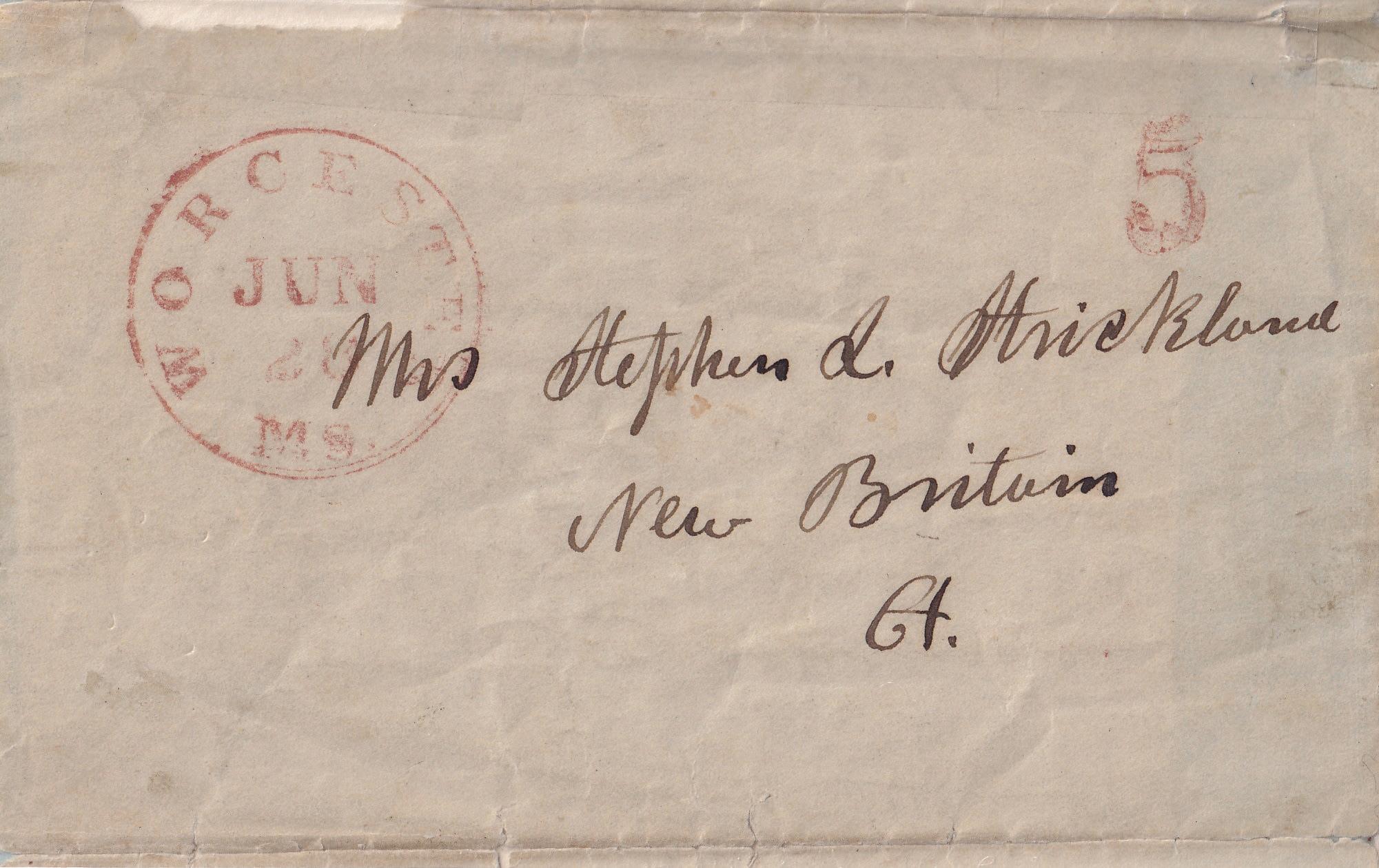
Figure 2. Addressee portion of the folded letter stationery once folded, It is addressed to Elihu Burritt’s sister.
Worcester was a town in which Burritt spent much of the earlier and middle portion of his life, working as a blacksmith and starting his weekly newspaper The Christian Citizen in 1844. It was the first journal in America which was specially devoted to the cause of peace. So even the town used for mailing within the USA has a strong Burritt connection.
This letter was carried by hand from the UK on the RMS Niagara (Cunard Line), This 1,824 ton ship was built by R. Steele & Co, Glasgow, and its maiden Liverpool Halifax Boston voyage was on May 20, 1848. The Niagara sailed June 15, 1850 for Boston, two days after the letter was written, arriving in Boston 26 June, 1850. Worcester is 46 miles west of Boston, where the letter was mailed on 28 June, 1850. Transatlantic voyages by ship from the UK to the USA at this time typically took around 10-14 days.
References
Elihu Burritt Library, Central Connecticut State University. Burritt handwritten LUB notepaper, used from Portsmouth, Hants (UK) to Thomas Drew, dated “January 26, 1846”, although there is a later, added query “(1847?)” in another hand. https://collections.ctdigitalarchive.org/ node/2170034?search=Thomas%20Drew%2C%20in%20Portsmouth%2C%2C%20England
Howitt, Mary (1847). “Memoir of Elihu Burritt,” The People’s Journal, [ed. John Saunders], People’s Journal Office, London.
Kibble, Daryl (2026)., “Jacob Campen 1860s Illustrated Envelope – League of Universal Brotherhood Clasped Hands Emblem”, Postal History, The Journal of the Postal History Society, UK, 397 March, p.4.
Milgram, James W. (2016). American Illustrated Letter Stationery 1819 1899, p.5, Lake Forest, IL, Northbrook Publishing Company.
The Advocate of Peace and Universal Brotherhood (1846). 1: 2, [February], p.45, J. Howland, Worcester, MA.
Vladmir
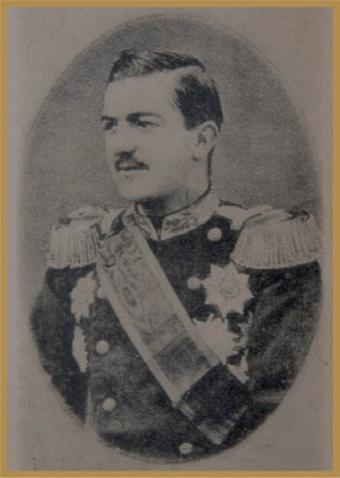
The introduction of the decimal currency system in Serbia and the transition to the dinar required the creation of an entirely new postage stamp series, in line with new legislation and prescribed denominations for domestic and international postal services. On July 19, 1880, the Ministry of the Interior announced that existing stamps would cease to be valid as of 1 November and ordered the preparation of a new issue.
The artistic design and engraving were entrusted to the Parisian engraver Louis Paul Pierre Dumont (1822–1885), a leading figure of the French academic engraving tradition. His engagement followed the established Serbian practice of employing European engravers for state stamp issues, like Karl Katzler for the 1866 issue of Prince Mihailo Obrenovich and Radonicki for the 1869 issue of Prince Milan Obrenovich.
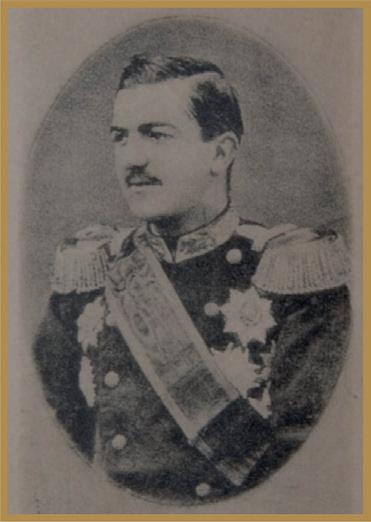
The first dinar issue with Prince Milan Obrenovich (Figure 1) was the last stamp series issued under the Principality of Serbia and remained in use after the 1882 proclamation of the Kingdom of Serbia until 1890.
Compositional Essays without denominations
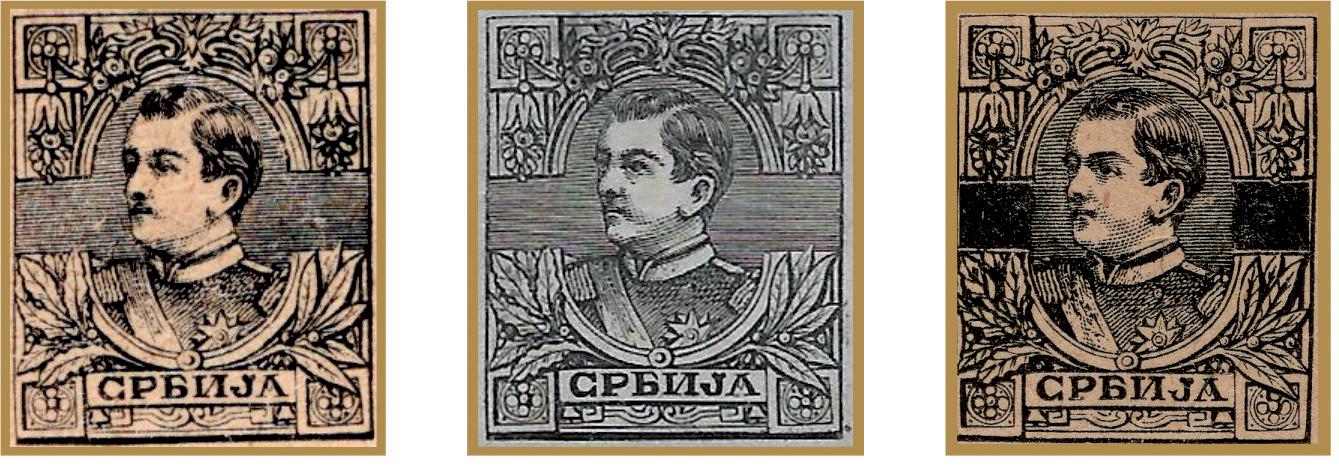
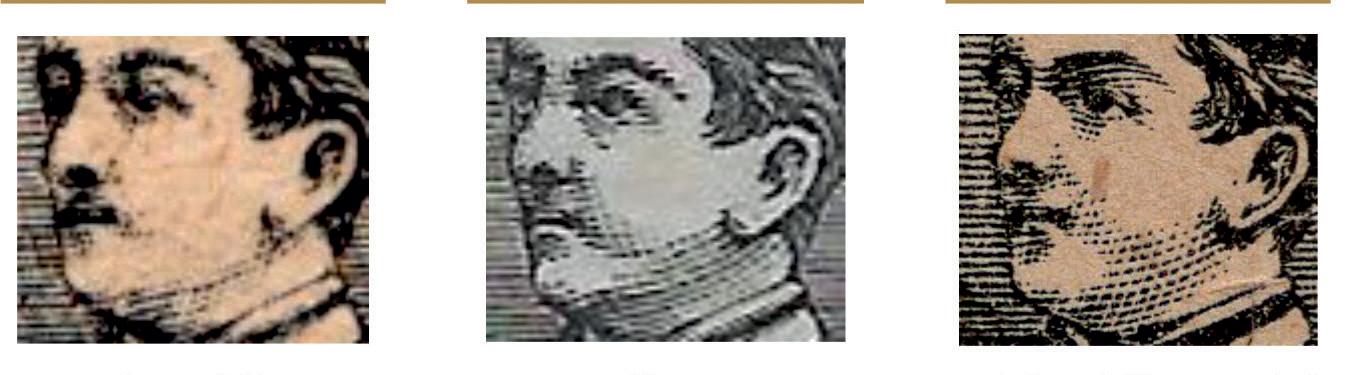
Dumont’s earliest design proposals for the new dinar issue were rejected prior to the approval of the final stamp design. This initial concept depicted Prince Milan Obrenović in half‑profile and was never adopted for postage stamps or for postal stationery.
Based on documented material, at least five distinct portrait design drafts can be identified within this rejected compositional concept. These drafts were executed independently and do not form a linear or progressive development toward the final adopted design.
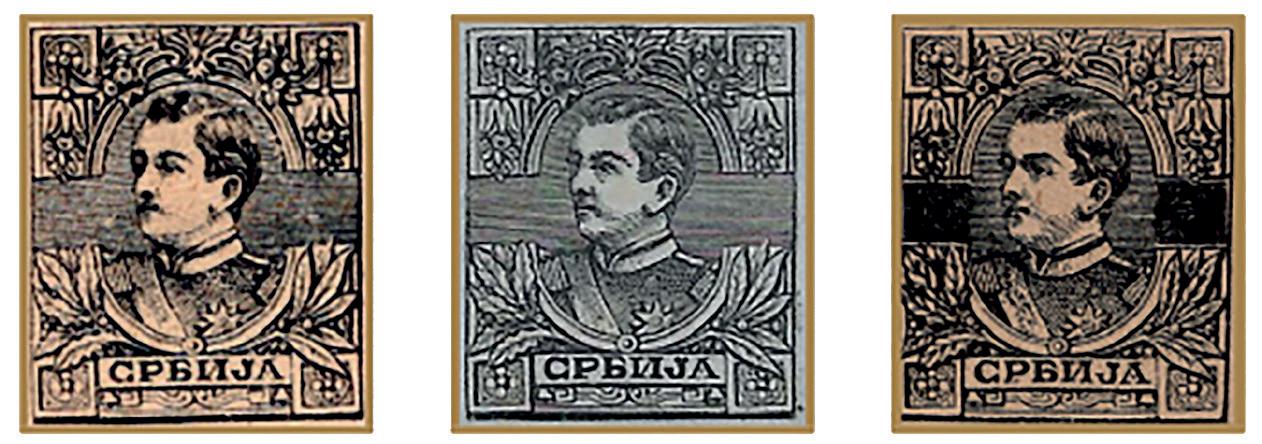
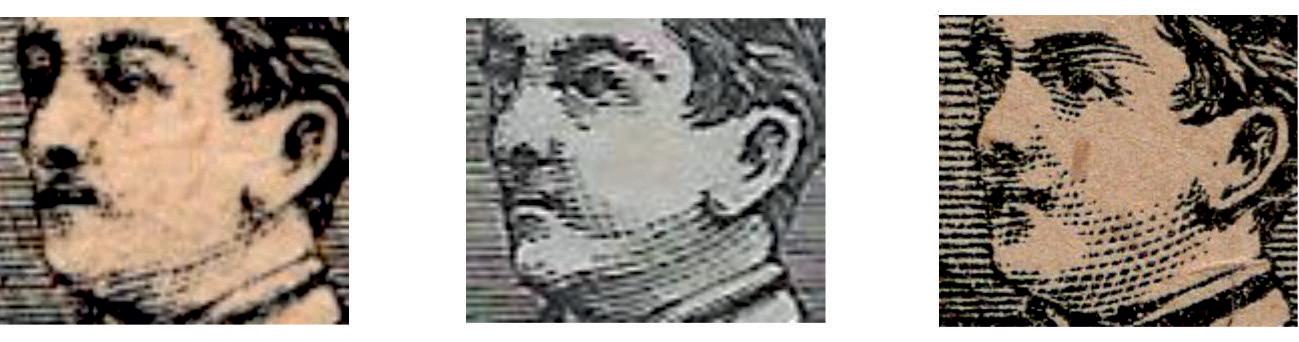
Earlier authors (Derocco, Rašić, and Dr. Kardosch) stated that the clichés were prepared in Paris, while all stamp printing was carried out in Belgrade. However, the majority of the essay material discussed in this study was unknown to earlier authors and has not previously been documented or analyzed in the philatelic literature. The existence of several closely related but independently executed essay design drafts associated with Dumont’s rejected concepts demonstrates that the Paris design phase involved multiple parallel studies of the same motif, a body of material that has remained entirely unrecorded. These materials should be understood strictly as developmental design work, produced prior to the acceptance of the final design, which was ultimately printed in Belgrade.
The rejected half‑profile portrait of Prince Milan Obrenović represents the earliest known unused design concept submitted by Dumont to the Ministry. As noted by Rašić, this half profile proposal was not adopted. The surviving material consists of several independently executed essays, differing in portrait treatment and ornamental detail while retaining the same general compositional idea.
Within this rejected design, a group of essays can be identified in which the emphasis was not placed on the denomination itself, but rather on the overall visual effect and portrait rendering. These variants do not represent successive stages of a single engraving process, but document independent experimental approaches executed in parallel during this otherwise undocumented phase of the Paris design work. As such, they must be understood as parallel design studies rather than as ‘phases’ of a single evolving engraving (Figure 2):
• Reduced line face shading, without a denomination field: This version is characterized by sparse, simplified facial line shading, without dot modulation. The rectangular denomination field is entirely absent. Recorded in black ink.
• Line face shading, without denomination field: In this version the facial modelling is rendered predominantly with parallel line shading and is coarser and more open in character. The denomination field is entirely absent.
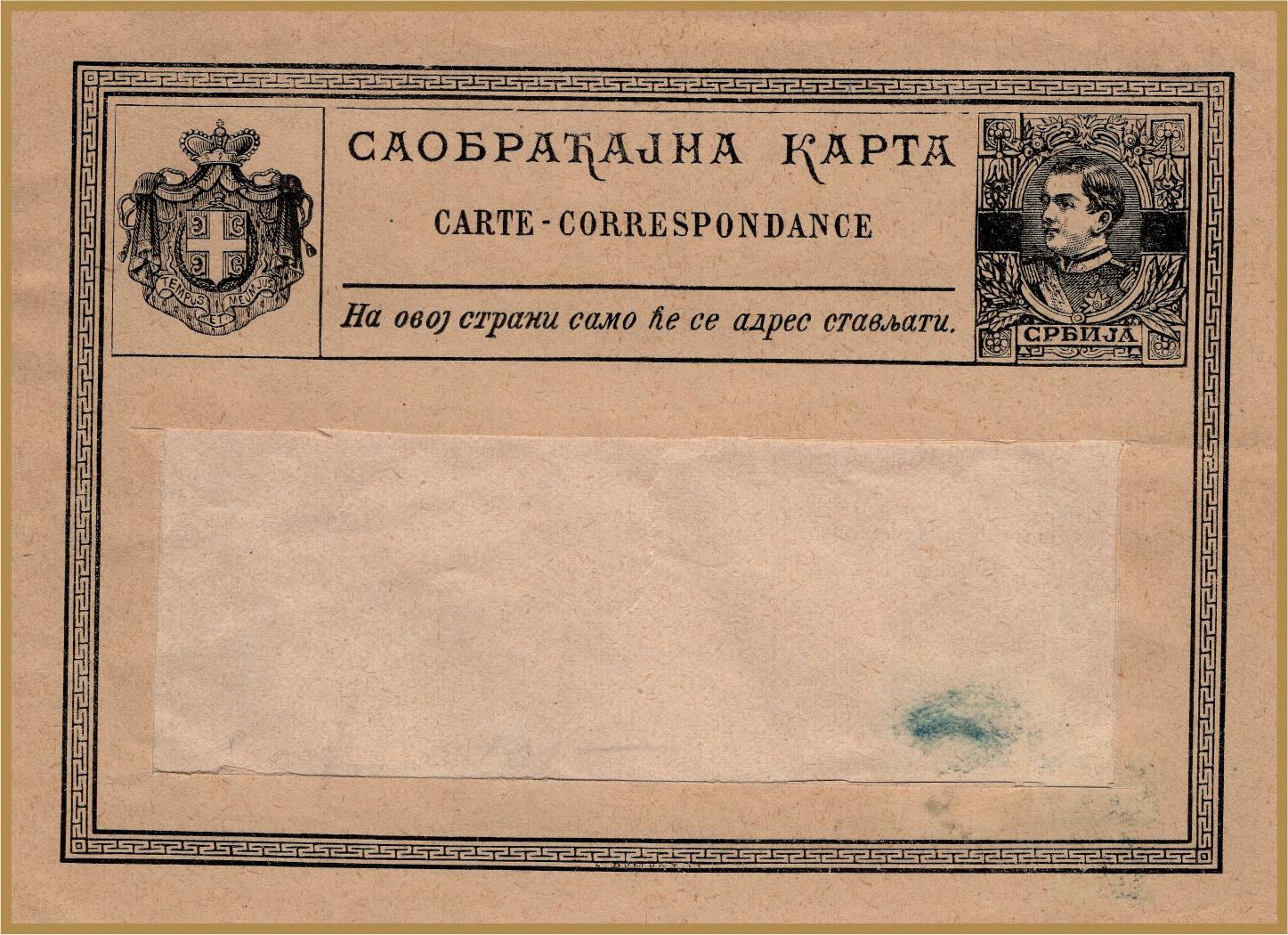
• Combined line and dot face shading, with a filled denomination field: A version in which facial modelling combines line and dot shading. The denomination area is replaced by a solid rectangular block. This design (Figure 3) was used for the essay of the international postal card of the first dinar issue, which was printed in black on thin cream gray paper measuring 120 × 85 mm [4.7 x 3.35 inches]. The central portion of the card has been excised, allowing for tests of various address line configurations.
The engraver’s signature, “L. DUMONT”, appears at the center of the lower horizontal border, and is composed of repeating “Τ” elements. In the upper left corner of the card appears the stylized coat of arms of the Obrenović dynasty with the motto “TEMPUS ET MEUM JUS” (“TIME AND MY RIGHT”), attributed to Prince Mihailo Obrenović when he was forced to leave Serbia in 1842.
Essays with denominations
A later stage introduced essays, produced in Paris, with specific denominations, which were still experimental in nature. Compared to the earlier undenominated essays, these demonstrate finer and softer design features. The portrait remains shallow in modelling, with simplified facial shading and uniform detail, while the ornamental frame is lighter and more open (Figure 4).
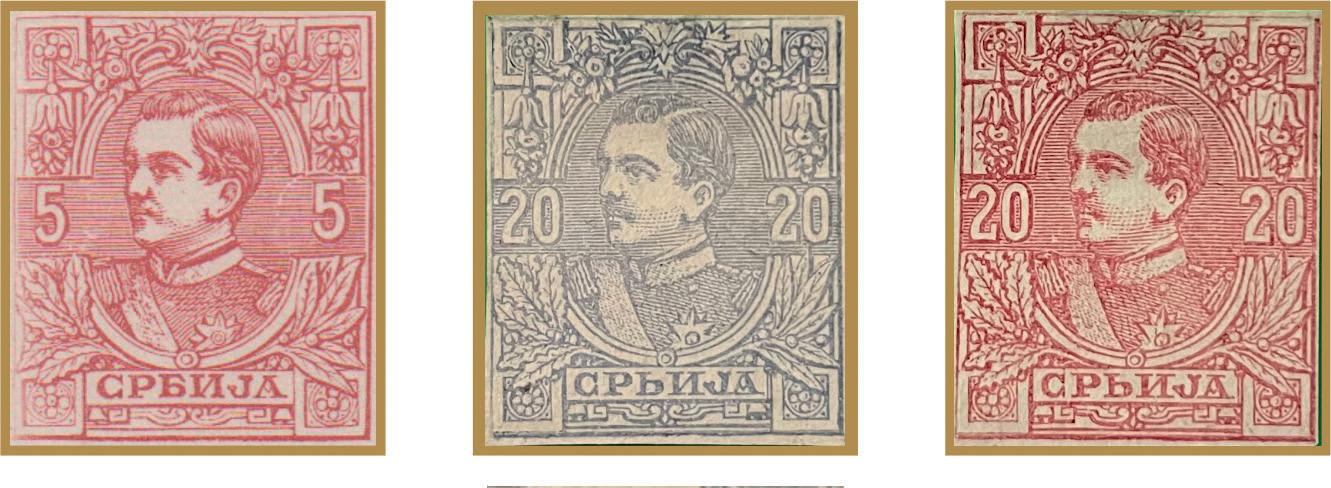
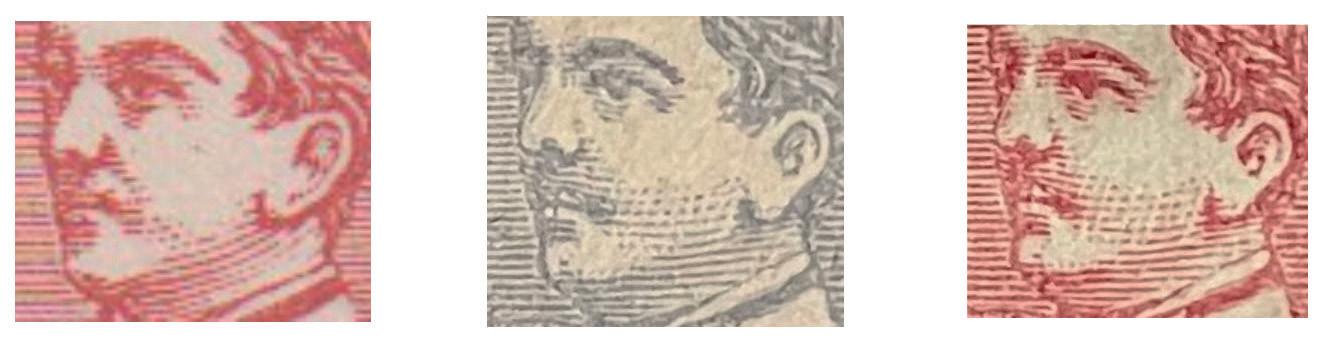
4. Variants with denominations and enlarged face details.
The “5 PARA”
In this group, the previously solid rectangular fields on the left and right sides of the design are replaced by the numeral “5”, forming the denomination “5 PARA”. The graphic rendering of the numeral is fully integrated into the composition .
Of particular significance is the fact that this “5 PARA” cliché is, to date, known exclusively from its use on a postal stationery essay, printed in red (Figure 5), which was previously unknown in the context of the first dinar issue. This indicates that the design was developed in parallel with the preparation of both postage stamps and postal stationery, with this specific cliché tested only within the context of an international correspondence card. The bilingual inscription “САБОРАЋАЈНА КАРТА / CARTE DE CORRESPONDANCE” clearly reflects this intended postal stationery application.
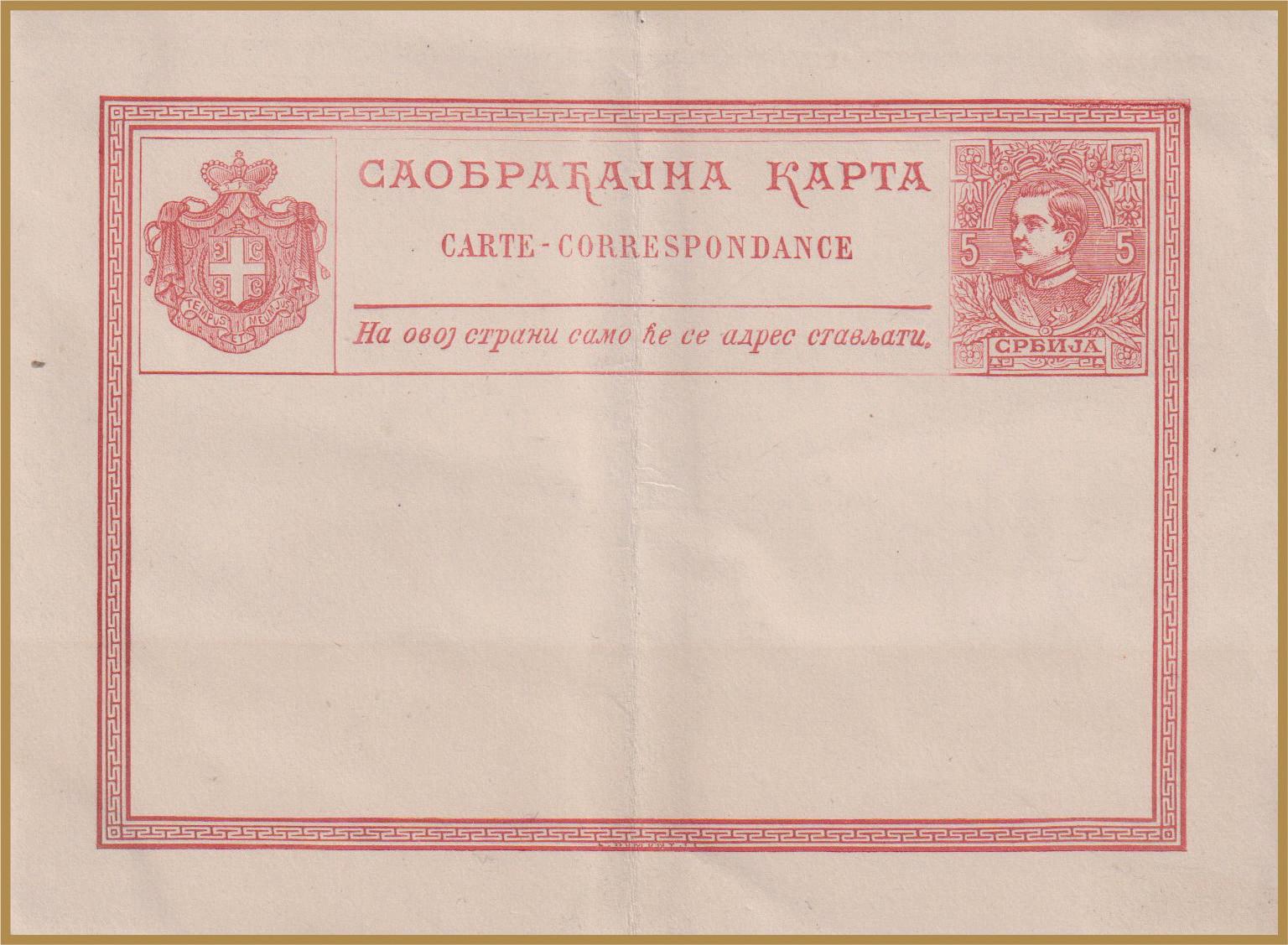
Figure 5. Essay of the postal card featuring the essay with 5 para denomination.
However, the absence of the mandatory bilingual inscription “СВЕТСКИ
/ UNION POSTALE UNIVERSELLE” indicates once more that this material originates from an incomplete and experimental stage of the design process. The precise administrative or artistic reason for the final rejection of this design remains undocumented.
The “20 PARA” essays in blue and red represent the next phase in the development of the rejected design, in which the denomination was explicitly tested within the composition for the first time. The portrait shows a clear advance in visual quality, with more precise modelling and deeper, controlled shading, while the denomination numerals are fully integrated into the decorative framework.
The ornamental elements, including laurel and oak motifs, are executed at the highest level of refinement, with clean, deeply cut lines, and the background is evenly shaded, giving the composition greater visual stability. Structural differences in the lower left ornamental field confirm that these essays originate from a newly engraved and structurally independent version, rather than from any modification or reworking of earlier essays.
Examples of the 20 Para essays, in both colors, exhibit a printing defect in the inscription “СРБИЈА” (“SERBIA”), in which the horizontal stroke of the letter “Б” is only partially visible. (Can we illustrate this defect?)
Conclusion
The Paris essays discussed in this study represent parallel and independent design experiments for the first dinar issue of Serbia, forming a previously unknown and undocumented corpus of material. Rather than constituting a linear developmental sequence leading toward the adopted stamp design, these essays allow, for the first time, a reconstruction of the experimental design environment in which Dumont operated in Paris in 1880.
The rejected half profile portrait of Prince Milan Obrenović was explored through multiple independently engraved variants, differing in facial modelling, shading, and ornamental treatment. Their significance lies not in a direct relationship to the adopted design, but in documenting the otherwise unrecorded experimental design environment in Paris in 1880.
The later introduction of explicit denominations marks a distinct subsequent phase focused on integrating value numerals into the composition. While the 5 Para variant is currently known only from its use on a postal stationery essay, the “20 PARA” essays show a higher level of drawing refinement and structural modification, consistent with the preparation of a new and independent version.
None of the recorded variants met the requirements for adoption, and the entire group of Paris essays was rejected. Whether trial essays for other denominations of the first dinar issue, such as the 10, 25, and 50 para or 1 dinar, were also produced during the Paris phase but have not survived or have yet to be identified remains an open question.
The final issued stamps constituted the first Serbian dinar issue in the decimal currency system, differing completely from the rejected Paris essays discussed in this study (Figure 6).
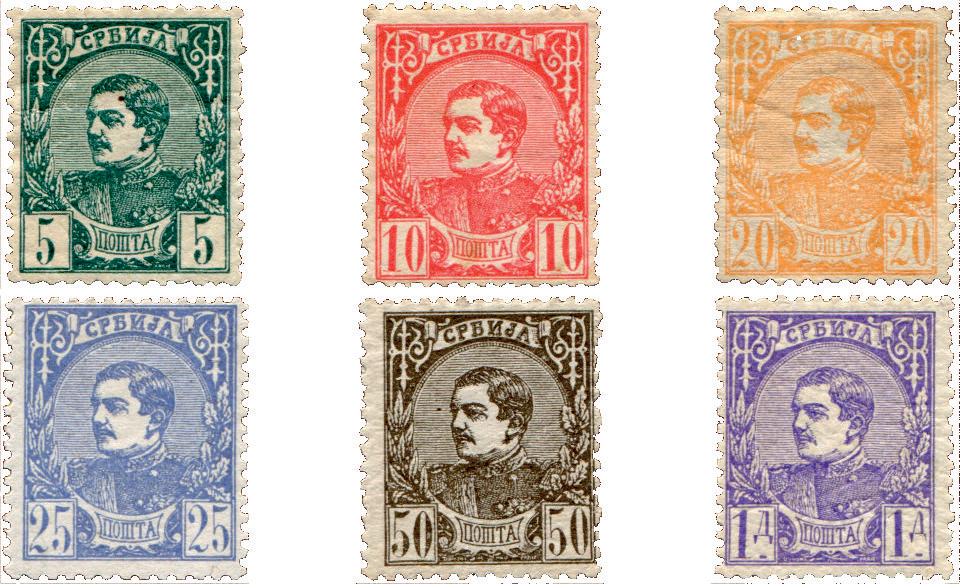
6. The issued 1880 Prince Milan definitive series of Serbia (5, 10, 20, 25, and 50 para and 1 dinar), based on the design by engraver Dumont.
The author gratefully acknowledges the assistance and the material provided by philatelists and collectors: the late Aleksandar Boričić, Milan Vujović, Nikola Ljubičić, and Mario Peronja during the preparation of this article.
References
Derocco, Eugen (1940). Istorija poštanskih maraka Srbije, Jugoslovenski filatelistički savez, Beograd. Kardosch, Dr. Velizar M. (1996). The Principality of Serbia. Postal History and Postage Stamps 1830 1882, V.M. Kardosch, Romanshorn, Varese, Italy.
Rašić, Mirko R. (1979). The Postal History and Postage Stamps of Serbia, The Theodore E. Steinway Memorial Publication Fund, New York.
David R. Wilcox
In 2023-24, I published in The Collectors Club Philatelist three articles summarizing valuable information from a survey of 1,339 Independent Mail company covers. The first article focused on correspondence in the survey (Wilcox, 2003), the second on details of the surveys themselves (Wilcox, 2004a), and a third used the survey data to present the history of the Independent Mails. (Wilcox, 2024b) The entire survey with images of the covers will appear in a series of “Guide” books that will be published soon.
While researching Pomeroy’s Letter Express, I made a new discovery – a double impression of Pomeroy’s black on white 117L4 (Figure 1a). This stamp is the only double impression ever reported for any of the Pomeroy issues.
The stamp was affixed as a single franking to a cover sent to Hon. A. C. (Azariah Cutting) Flagg in Albany during his second term as Comptroller of the Currency (Figure 1b).
1b. A Pomeroy
cover to Hon. A. C. Flagg, NY State Controller, dated 8 1 44. The content was a Herkimer, NY
is a double impression.
A. C. Flagg (Figure 2) was New York State’s eleventh Secretary of State from 1826 to 1833. He became the NY State Comptroller from 1833-1839 and again from 1842-1847. He was succeeded by Millard Fillmore, later Vice President (1849-1850) and then America’s thirteenth President (1855-1865). Prior to the Comptroller position, Flagg was an American newspaper printer and editor. During 1812-14 he fought in America’s War of 1812. An illustrious career, to say the least.
The Flagg cover was sent on August 1, 1844, from The New York State Register 1844 Agricultural Bank in Herkimer County. It was a folded printed copy of their Quarterly Report dated August 3rd and is an example of the type of business correspondence received by NYS Comptrollers of the Currency (Figure 3). Herkimer County is just east of Utica NY and about one-hundred miles northwest of Albany, NY.
“The first bank in the Village of Herkimer was the Agriculture Bank, which commenced business in the year 1839 with Harvey W. Doolittle as president and General P.F. Bellinger as cashier.” (Voorhees.)
Both Bellinger as Cashier and Doolittle as President signed the Quarterly Report, although curiously Doolittle’s signature has been crossed off. Presumably, he originally signed this document but was no longer President. General Peter F. Bellinger received his “General” title as a member of the “Old State Militia.” After being Cashier, he later opened Bellinger Bank (he died in 1895). An 1862 Bellinger Bank 50c note is shown in Figure 4.
As the NY State Comptroller, Flagg received a few other surviving Pomeroy covers. Three covers were single franked from Rome, Rochester, and Buffalo all to Albany, and two others from Buffalo and Rochester both to Albany and double franked. Unlike the 117L4 Flagg cover, these five were franked with Pomeroy’s workhorse general issue, the black on yellow 117L1 stamp. Examples in Figures 5a c are from Buffalo and Rome (both 7-18-44) and from NYC (8-5-44). These are from the same period as the 117L4 Flagg cover, but the content is unknown, and all are franked with 117L1.
As NYS Comptroller, Flagg no doubt received hundreds of covers delivered by Pomeroy and the US mail as well. This August 1st Flagg cover is the only surviving Independent Mail cover franked with a Pomeroy stamp showing a double impression. The stamp is Pomeroy’s 117L4 black on white stamp. The stamp is canceled with a red “Cd” often seen applied in Albany (PSE1344954 is for the cover but does not mention the double impression, Siegel 1167 2416, author’s collection, PF609436 for the double impression).
Double impressions are believed to occur during the offset printing process particularly when there is a shift in the paper when the printing is momentarily stopped. (Stamps.com) They are sometimes also called double transfers although the cause with engraved stamps is sometimes different. Doubling in engraved stamps like the Pomeroy issues can occur when the plate is being made, and the transfer die accidentally makes two entries if the transfer die is pressed on the final plate twice.
A double transfer on an engraved stamp will appear on every stamp in that position whenever the plate is used for a printing. A double impression on an engraved stamp, on the other hand, is seldom plate position specific and may only occur once. The two can be similar in appearance, and plating is the best way to be sure which variant is represented.
Full sheets of some Pomeroy stamp issues have survived. After inspection of many sheets, there was no indication that any of these stamps had a similar double impression. In one of the “Guides” to be published later, a careful and methodical scheme is introduced for plating all 40 positions on the Pomeroy plate. Seven major plate flaws and several minor flaws can be used along with the location of the “1” in the bottom panel and other markings to determine each of the forty positions accurately.
Using this scheme to plate Pomeroy stamps from many sources and in many colors (whether in full sheets or alone), there were no examples found where the stamp being examined could not be plated (117L2 is an exception). This supports the conclusion that a single Pomeroy plate seems to have been used throughout all the stamp printings. (Wilcox, 2024b)
While plating hundreds of stamps from all the 40 positions (on covers, singles, and sheets), no other example of a double impression was found on any of the Pomeroy issues (117L1-9). This argues that the Flagg variety is a double impression and not a double transfer. It occurred during printing. The “normal” stamp scans in Figures 6, 7 and 8 are of a black Pomeroy from the last printing on fibrous paper from the same pR6 position on the sheet. If this doubling was from a double transfer during formation of the plate, the later fibrous printing would have shown the doubling. There is no sign of the doubling, therefore, this is an impressive double impression that occurred during an early printing of Pomeroy’s 117L4 black.
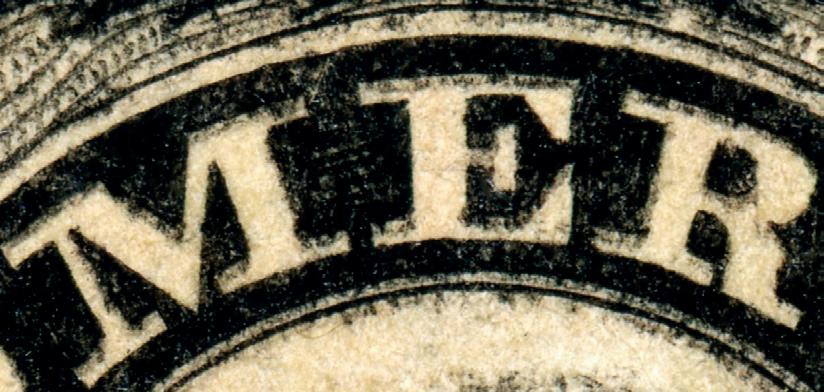
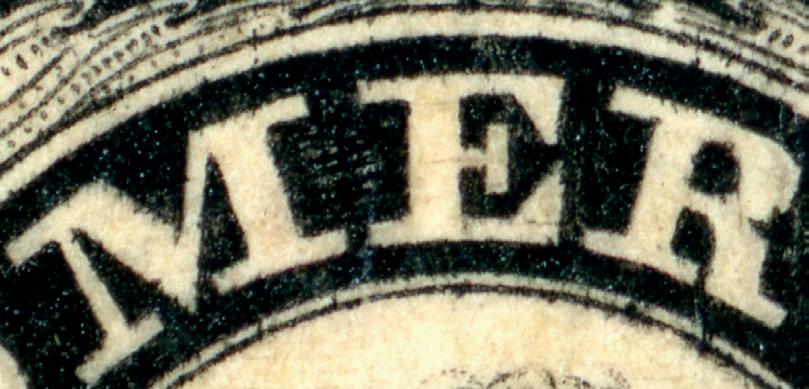
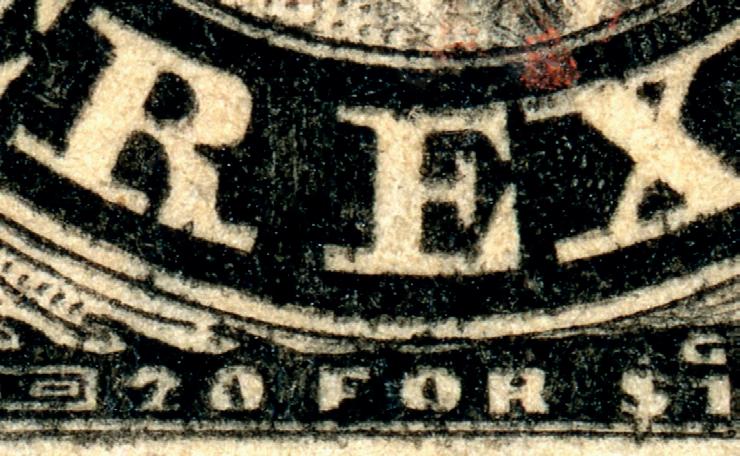
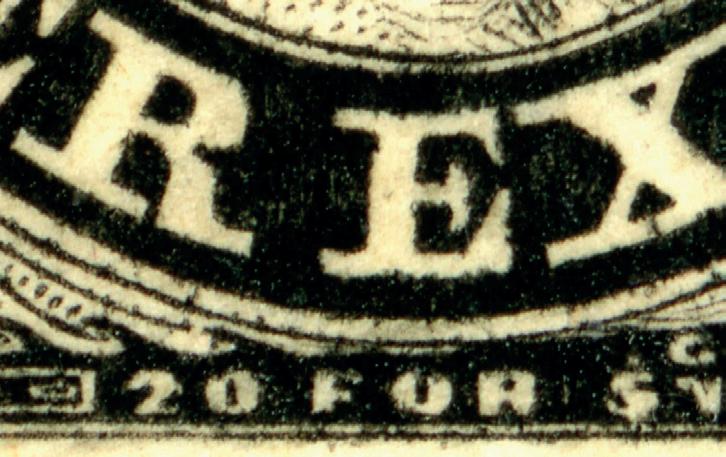
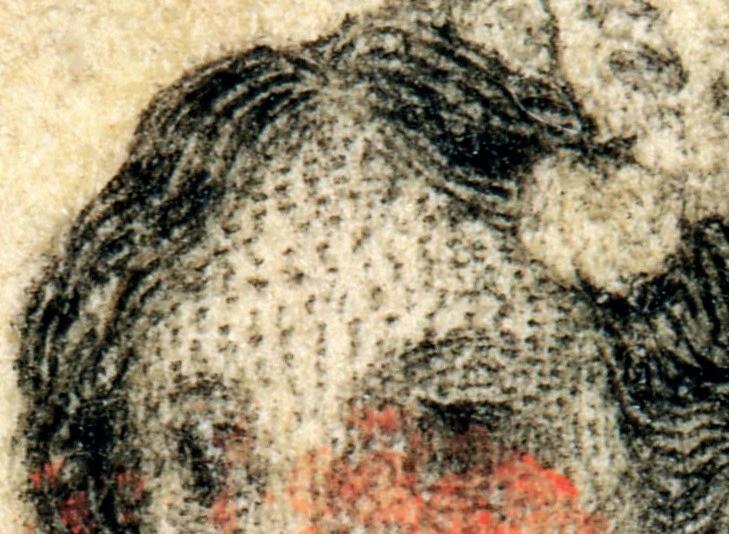
Sometimes double impressions are not easily detected in the final printing. In this 117L4 example, however, the doubling is clearly seen in the lower portion of the word “POMEROY” in the upper label (Figure 6). The shift caused a second image seen at the top of the lettering. Similar doubling is seen in the lower label and at the top of “20 for $1” (Figure 7). Even the doubling at the top of the “20” stands out. The doubling affected the entire design and can also be seen in the lettering up the sides. In addition, doubling is seen in the vignette. Some of the most striking doubling appears under high magnification of the engraved dots on the forehead (Figure 8). A doubling over the entire stamp image is uncommon.
In the cover survey mentioned earlier, 121 Pomeroy 117L1 black on yellow covers were recorded. Twenty six 117L3 blue, ten 117L5 red, and sixteen 117L6 lake covers were found. Almost all were located with an image. No double impressions were identified on any of these covers. For the 117L4 black issue, thirty‑seven covers were identified and most had an accompanying scan.
The 117L4 black was the most represented of all the single-color issues. No covers other than the Flagg cover, and no singles used or unused (or sheet stamps) showed the doubling that is seen here. This double impression, therefore, appears to be unique among all Pomeroy stamp issues.
Readers are encouraged to check their own copies of Pomeroy issues for other double impressions. If found, please contact the author at dwilcox1@comcast.net
1. Wilcox, David R. (2023). “Correspondences of the U.S. Independent Mails 1844‑ 45”, The Collectors Club Philatelist, 102: 6, pp.340-368.
2. Wilcox, David R. (2024a). “The Independent Mails Cover Survey: Part 1 Survey Analysis,” The Collectors Club Philatelist, 103: 3, pp.148-173.
3. Wilcox, David R. (2024b). “The Independent Mails Cover Survey: Part 2 History of Those Services”, The Collectors Club Philatelist, 103:4, pp.210-221.
4. Voorhees, Betsy, Town of Herkimer Editor, “Betsy’s Bits & Pieces, Herkimer County, NY”, https://web.archive.org/web/20250828215426/http://herkimer. nygenweb.net/herktown/bitsandpieces.html [Original link no longer opens.]
5. Stamps.com for engraved stamps, online 2024, and Glossary of Terms for the Collector of United States Stamps for offset printing, online 2024.
6. Wilcox, David R. (2024c). “Pomeroy’s Letter Express Colors Part 1: Unissued Stamps Were Not Reprints”, The Collectors Club Philatelist, 103: 6, pp.336-356.
Ken Lawrence
Postal reform came slowly and haltingly to the United States in the mid-nineteenth century, in measurable contrast to the 1840 Act that introduced the Uniform Penny Post to Great Britain and Ireland.
The Penny Black and Two Pence Blue Queen Victoria stamps and Mulready postal stationery to pay the postage accompanied the British reform; the U.S. Post Office Department delayed the issues of stamps until 1847 and postal stationery until 1853. But the impetus in both countries was the need for cheap, efficient, dependable mail service to facilitate commerce.
American postal reform arrived in two stages: the first on July 1, 1845; the second on July 1, 1851. In 1845 there were no U.S. postage stamps to pay the reformed rates. In 1851, although postage stamps were available, their use was not compulsory, and most letters were still sent stampless.
An Act to reduce into one the several acts establishing and regulating the Post-office Department of March 3, 1825, had specified this complex of postal rates for domestic letters: For every letter composed of a single sheet of paper conveyed not exceeding 30 miles, 6 cents; over 30 miles and not exceeding 80 miles, 10 cents; over 80 miles and not exceeding 150 miles, 12½ cents; over 150 miles and not exceeding 400 miles, 18¾ cents; over 400 miles, 25 cents; and every double letter, or two pieces of paper, double said rates; every triple letter, or three pieces of paper, triple said rates; every packet of four or more pieces of paper, or one or more other articles, and weighing 1 ounce avoirdupois, quadruple such rates, and in that proportion for all greater rates.
This set of rates was cumbersome and expensive, which prompted private entrepreneurs to establish independent mail services at cheaper rates over the most widely used routes. The system of charging by the number of pieces of paper discouraged the use of envelopes.
Reformers finally prevailed when Congress passed An Act to reduce the rates of postage, to limit the use and correct the abuse of the franking privilege, and for the prevention of frauds on the revenues of the Post Office Department of March 3, 1845, which simplified and reduced postal rates to 5¢ per ounce for letters sent to locations under 300 miles distant, and 10¢ per ounce for any distance over 300 miles, and which gave the Post Office Department a monopoly to transport mail over post roads, thus abolishing the independent mails, effective July 1, 1845.
The Figure 1 folded letter from Chicago to New York City is a first day cover of the latter rate. The contents are dated June 30, 1845. Even if it had been deposited at the Chicago post office on that date, it must have been mailed too late to be dispatched to New York City until the following day. Postal practice required letters to be postmarked on and charged for the date of departure, in this instance on July 1.
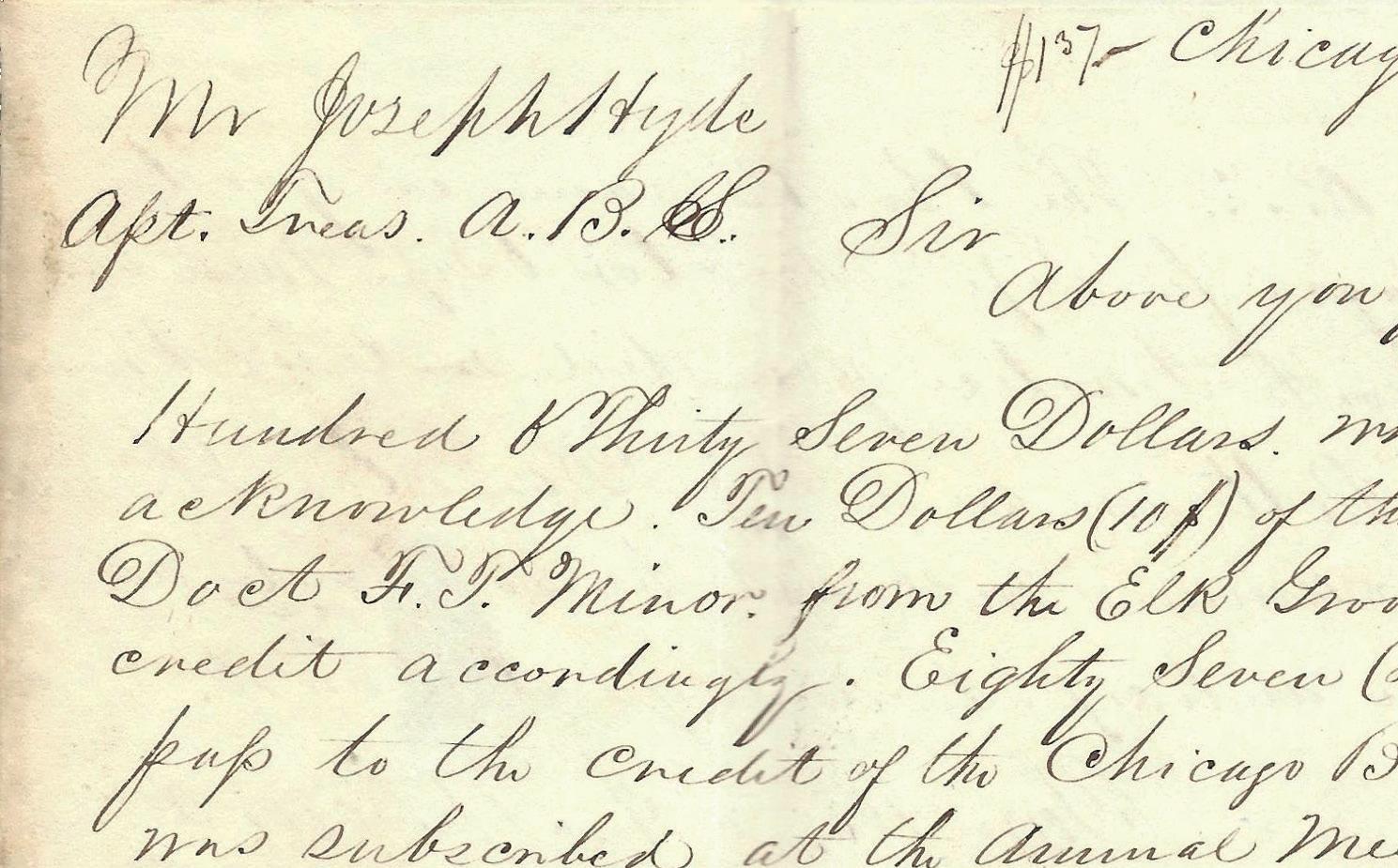
1.
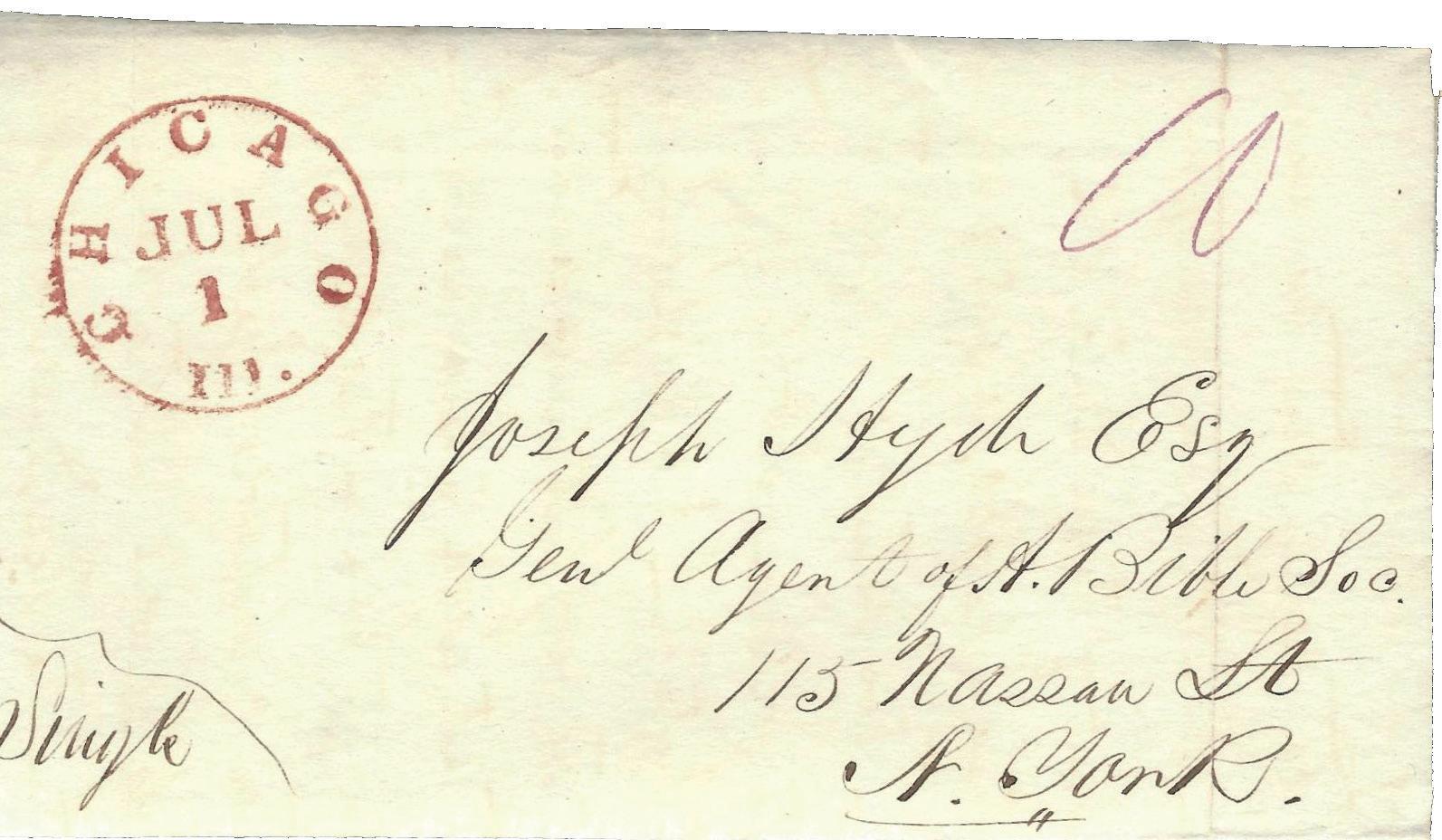
The endorsement “single” meant just one sheet of paper. The top section of the letter has been cut away. The letter text reveals that the missing piece consisted of a bank draft to the New York Bible Society for $137. By sending it in that fashion, if it had been rated under the 1825 postal rate schedule, it would have qualified for the single sheet amount, which would have been 25¢, one-and-a-half times the reformed rate. The letter was sent unpaid, as was most mail at that time, with the 10¢ charge collected from the recipient.
The New York Daily Herald reported on July 2, 1845:
WORKING OF THE NEW POSTAGE LAW.—Yesterday, the first day, was a favorable one for the new post office system. Stacks of letters were poured into the office in this city directed to all parts of the Union, in order to enjoy the novelty of paying the cheap rates and giving the new law a fine start. One gentleman dropped in over a hundred letters; another pre paid the postage on sixty eight; and thus was the system set in operation here. If the increase of yesterday is but a criterion of what it will continue to be, there will be no reason to regret the change from the old extortionate law.
Three days later, the Baltimore American reported on Independence Day:
The new Postage Act will have the effect of increasing largely the correspondence of the country. At New York, on the first day of its operation, five times as many letters were received as made the usual average under the old postal rates. In all the other large cities, the increase was equally great.
The simplified rates of 1845 made portable postage for prepayment possible, in the form of adhesive stamps and postal stationery, first issued as postmaster provisional stamps and stamped envelopes, and finally two years later in the form of the nation’s first two adhesive stamps, the 5¢ Benjamin Franklin and 10¢ George Washington stamps of 1847, Scott 1 and 2. But those rates were still too high to satisfy postal reform advocates.
Finally, Congress passed An Act to reduce and modify Rates of Postage in the United States, and for other Purposes on March 3, 1851, which further reduced the domestic letter rates, and included for the first time a discount for prepayment:
For every single letter in manuscript, or paper of any kind, upon which information shall be asked for, or communicated, in writing, or by marks and signs, conveyed in the mail for any distance between places within the United States, not exceeding three thousand miles, when the postage upon such letter shall have been prepaid, three cents, and five cents when postage thereon shall not have been prepaid; and for any distance exceeding three thousand miles, double those rates.
The new rates became effective on July 1, 1851. On June 10, Postmaster General Nathan Kelsy Hall announced:
To facilitate the prepayment of postages upon letters and packages, postage stamps of the following denominations are provided and furnished by the Postmaster General, pursuant to the 3d section of the “act to reduce and modify the rates of postage in the United States, and for other purposes,” approved the 3d March, 1851, viz:
No. 1. Printed in black, representing the head of Washington, of the denomination of twelve cents.
No. 2. Printed in red, representing the head of Washington in profile, of the denomination of three cents.
No. 3. Printed in blue, representing the head of Franklin in profile, of the denomination of one cent.
A separate announcement from Hall the next day announced:
The five and ten cent stamps issued by this Department under the provisions of the 11th section of the act of March 3, 1847, and now in use by the public, will not be received in prepayment of postage after the 30th of the present month. Therefore, persons holding any such will, as soon as practicable after that date, and before the 30th of September next, present them for redemption to the Postmaster from whom they were purchased, or to the nearest postmaster who has been authorized to sell postage stamps.
Rare July 1, 1851, first day covers do exist franked with two varieties of the 1¢ Benjamin Franklin stamps (Scott 5A and 7), and for two varieties of the 3¢ George Washington stamp (Scott 10 and 10A). None are recorded for the 12¢ Washington stamp (Scott 17); its earliest documented use is August 4, 1851.
In the 2001 book The 1851 Issue of United States Stamps: A Sesquicentennial Retrospective, Wilson Hulme published a census of 1851 first day covers franked with stamps: two with 1¢ Franklin stamps, a single Scott 5A on a cover from Boston and a strip of three Scott 7 from New York City; 43 Scott 10 or 10A 3¢ Washington stamps on covers from 23 cities in eleven states.
The July 2, 1851, Washington, D.C., Daily National Intelligencer reported:
Upon inquiry at our City Post Office we learn that the first day’s experience under the operation of the new postage law has proved highly satisfactory to all parties, so far as letter postages were concerned, and a very general disposition has been evinced to prepay letters by stamps, between $300 and $400 worth of which have been purchased during the day.
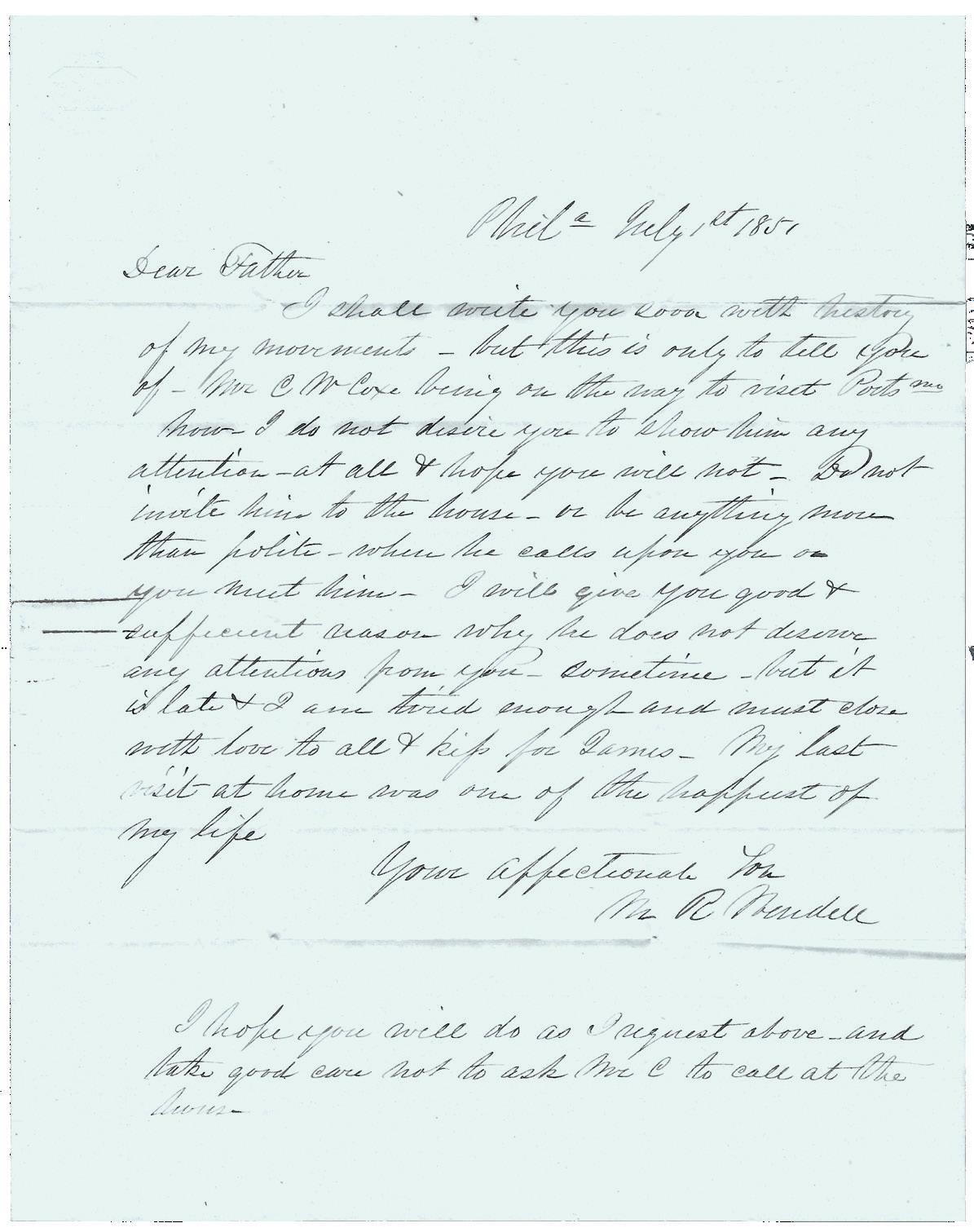
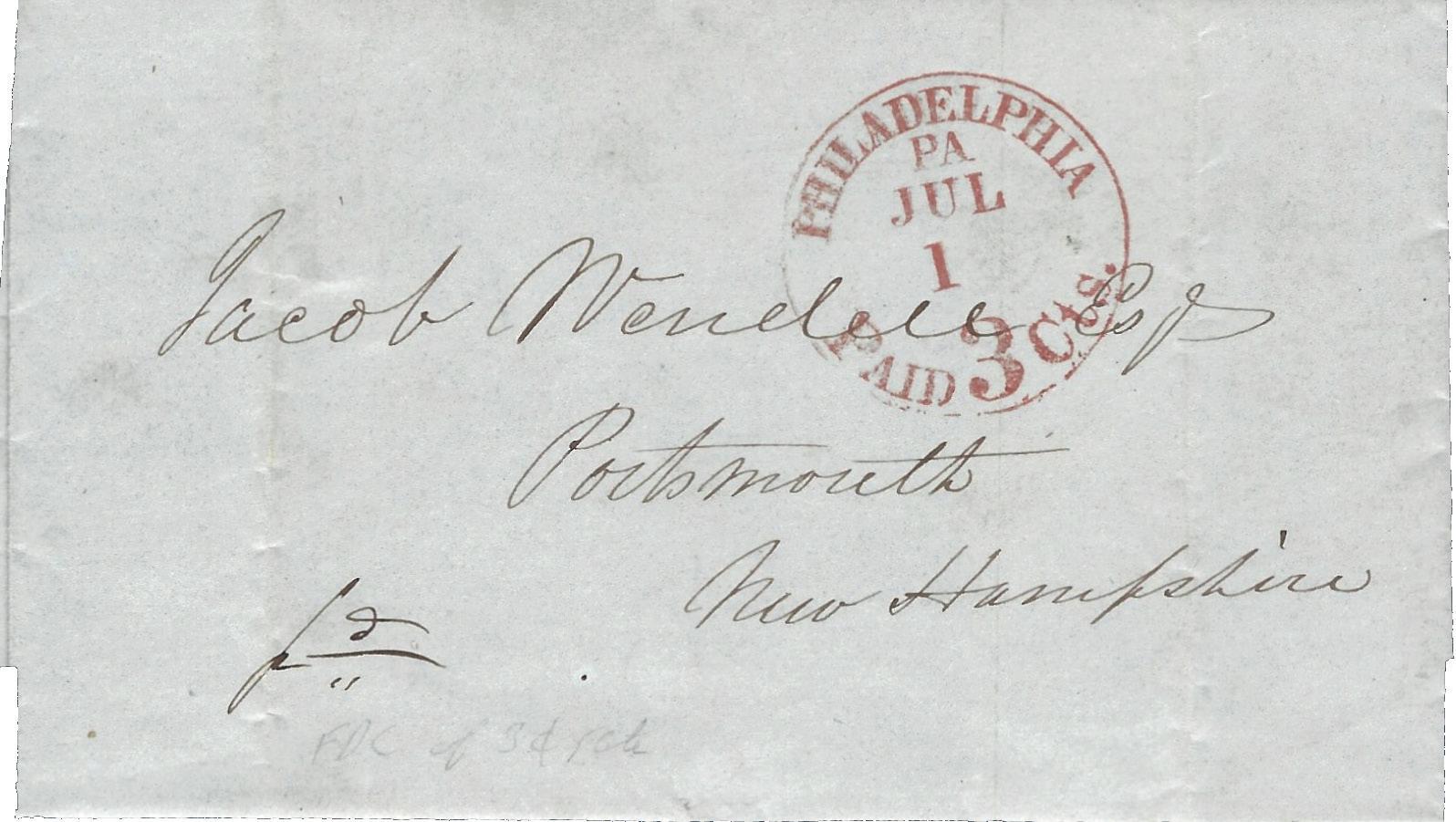
Besides prepayment by stamps, letters could be prepaid in cash at the time of mailing. In those cases, the stampless letters were postmarked and marked paid, as seen here on the Figure 2 folded letter, from Philadelphia, Pennsylvania, to Portsmouth, New Hampshire, which is also a first day cover. The July 3, 1851, Philadelphia Public Ledger reported:
THE NEW POSTAGE LAW—We learn that the number of letters received at the post office in this city on Tuesday, the first day of the operation of the new postage law, was double the average received daily under the late law, and amounted to about twenty thousand. The number of prepaid letters was about one-third the amount received, which is but little over the number of paid letters under the former law. This may be owing to the fact that stamps sufficient were not procurable, and the trouble of paying at the window in consequence of the crowd caused vexatious delay. Yesterday about one-half the number of letters received were prepaid. In New York, we see by a statement in the Courier, the number of prepaid letters on the first day, compared with the average number under the late law, were as five to one.
Thus, both stages of American postal reform were immediately successful. Stampless first day covers are tangible mementos of both events.

The following new members were approved by the Board of Governors:
January 27, 2026
Resident:
Non-Resident:
Wiliam Armstrong, Westport, CT
Neil McGregor, Waikato, New Zealand
Robert Brilliant, San Mateo, CA
If you would like to update your contact information, please contact our Executive Secretary, Andrea Matura, at info@collectorsclub.org
Upcoming meetings at the Club continue throughout the year. Our ongoing 2026 remote “Zoom” and combined “Zoom + Live” meeting series is in progress.
Respectfully submitted, Alan Barasch, Membership Chair
Many of Jon Aitchison’s collections focus on Cinderellas, and he has written extensively about the British Channel Islands. He produced two editions of The Stamps and Postal History of Lundy Island, plus the standard Channel Islands and Isle of Man locals’ catalogues. A prolific exhibitor, he has won numerous gold and large gold medals, and his Egypt postal stationery and officially sealed mail exhibits have gained high awards, as have his Siege of Paris mail exhibits. Jon has given numerous displays to societies include the Collectors Club and the Royal Philatelic Society London. He was chairman and principal organizer of EuroPhilEx Birmingham 2025 and has served as British commissioner to more than a dozen internationals. He has been active in many societies and has been Keeper of the Roll of Distinguished Philatelists since 2016. in 2008, Alex Haimann initiated and developed the Young Philatelic Leaders Fellowship programme of the American Philatelic Society (APS). He served as Chairman of both the APS Board of Vice Presidents (2013 -2016) and the APS Campaign for Philately Committee (2016 to 2022). His principal collecting interest is the Anglo-Zulu War of 1879, which includes varied artefacts to present the subject within its broader historical context. In July 2023 he curated a major public exhibition at the RPSL, attracting more than 2,000 visitors. The online presentations derived from its content, have attracted over one million views. Alex has published articles in a wide range of publications, including The London Philatelist and The American Philatelist. He also developed numerous online exhibits and mini-articles for the Smithsonian National Postal Museum’s virtual collections website, focused on expanding digital access to philatelic scholarship.
March 18
April 15
The Postal Stationery of Queensland 1880-1917. Part 1 - Post Cards and Registered Envelopes
Bernard Beston by Zoom
Mail Robbery In Military Conflicts 1745-1945
Steve Berlin by Zoom
April 22 The Prexie Coils. New Discoveries, Usages and Rarities
Bill DiPaolo by Zoom
April 29 The Lithograph Provisionals of Trinidad, 1852-1860
May 6
May 27
June 3
Nigel Mohammed by Zoom
To be confirmed
Live from Boston!!!!!
Panel Discussion on Boston 2026
June 17 The Special Arrangement
June 24
Mark Schwartz
Modern US
Jay Bigalke
September 2 From Perkins, Bacon to De La Rue. The Story of the 1879 and 1880 GB Tenders
Howard Hughes
September 16 East Germany. The Cold War Propaganda Forgeries 1953-1957
Oliver Wyrtki
September 23 The Hindenburg Crash Cover: A Philatelic Icon
Cheryl Ganz RDP
September 30 Indian Stamps used in Iraq
October 14
October 28
Akthem Al-Manaseer
Poland. Airmail of the Siege of Przemysl (1914-1915)
Jerzy Kupiec-Weglinski
GB QV Surface-Printed issues: An Inside Look at How We Up dated and Expanded the SG Specialised Catalogue
Matthew Healey
November 4 The Postal History of the American Civil War
November 11
Dan Knowles
Single Frame Competition
November 18 Early Transatlantic Mail
December 2
December 9
December 16
Carol Bommarito
Panel Discussion on the Hobby's Future
Governors’ Open House
Postcard exhibiting
Liz Hisey
All Clubhouse Programs are recorded and available to view on the Club website
The Postal Stationery of Queensland 1880-1917. Part 1 - Post Cards and Registered Envelopes
Each of the six Australasian British Colonies issued postal stationery. Whilst the Colonies became a part of the Commonwealth of Australia in 1910, they each continues to issue their own postal Stationery well into the early 1910s, and in the case of Queensland up to 1917.
My talk is divided into 3 parts. The first presentation will be confined to the early Postal Cards of 1880 1888; and 1891 plus the later Registered envelopes. Interestingly, the Queensland Postal Administration did not issue any postal envelopes, and this aspect will be further developed in Parts 2 and 3.
Part II will address the Post Cards, Newspaper Wrappers, Letter Cards and Postal Notes from 1898 1912. Part III will round up with an eclectic mix of Printed to Order Envelopes 1895-1917; and new discoveries.
The first Colonial postal stationery, issued in New South Wales in 1838. This predated the Penny Black by two years..
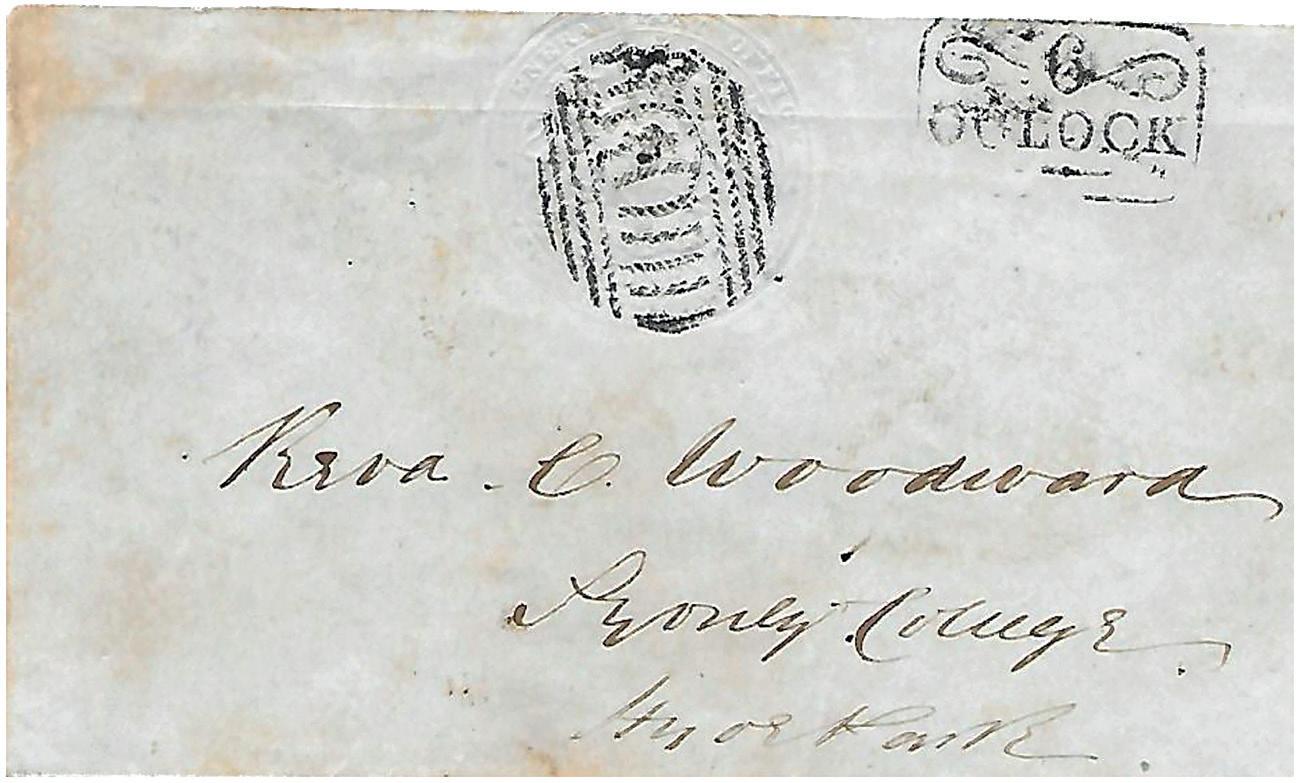
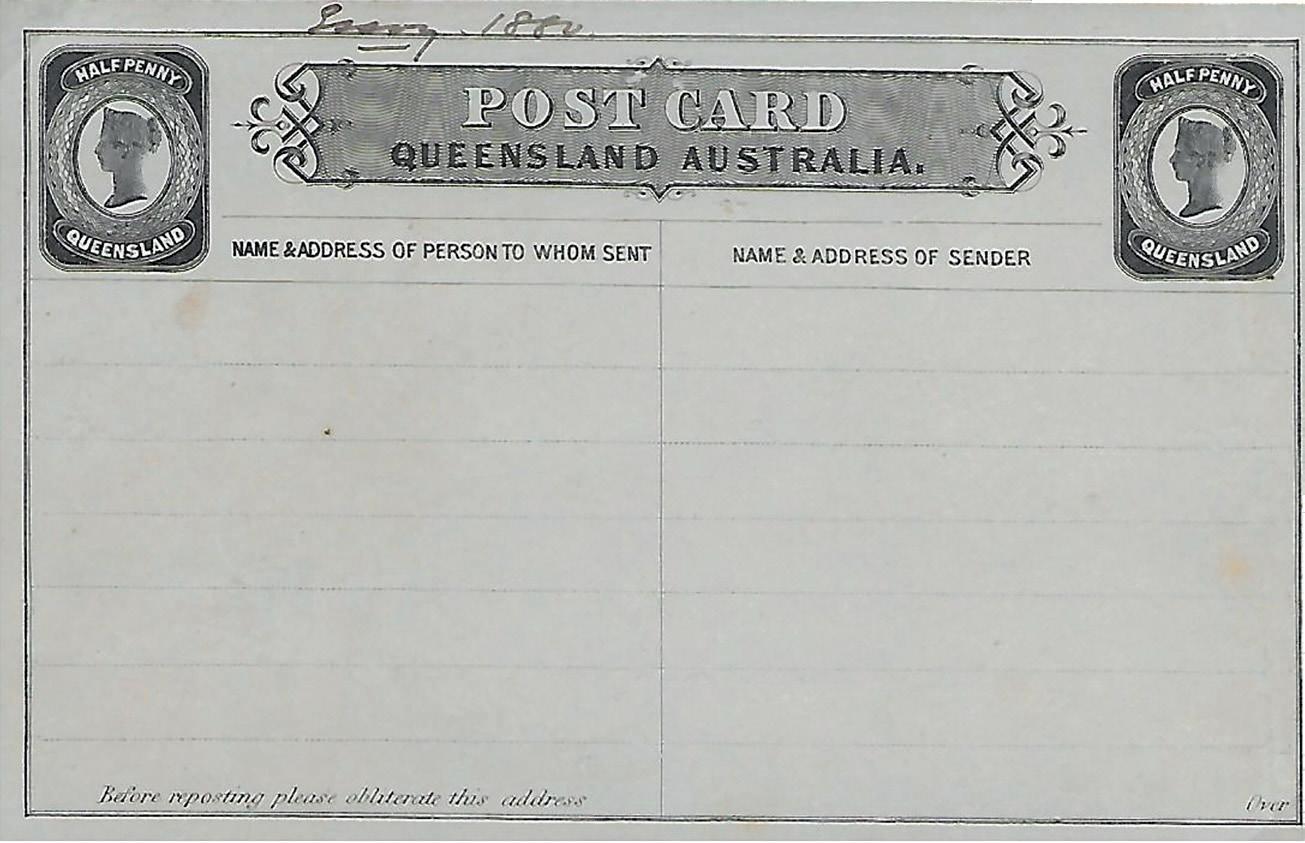
The initial 1879 essay for the first Queensland 1d post card with a ½d value. It was issued in a similar format in 1880 but with a 1d face value, a rate valid for domestic transmission only.
Mail Robbery postal history is very scarce, if not rare. Most of such material was destroyed either by thieves or as a result of acts of war. Mail robbery was usually undertaken to steal cash, bonds or other valuables. During wartime, the aim was to secure enemy intelligence being transmitted through the postal system.
Mail robberies during the eighteenth and nineteenth centuries were often punished by death. Perhaps that is why there are so few robberies recorded during these times The U.S. Postal Museum in a previous exhibit indicated that there were as many as 3,000 mail robberies a year in the United States, with only 10% of the robbers ever being prosecuted.
My presentation will start in 1745 with the Second Jacobite Rebellion, continue through the South African wars in 1898, the IRA Rebellion in 1921-23, World War 1 and World War 2, with a few interesting conflicts in between. Covers subjected to delay due to war or any military conflict where mail robbery has taken place are also included.
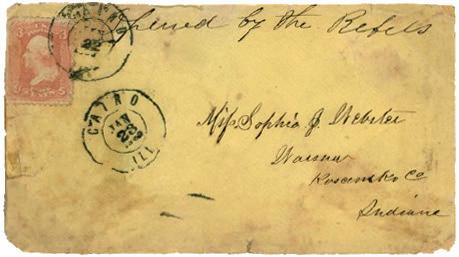
January 22, 1863 cover from Cairo, IL to Wausau, IN delayed as detailed by the manuscript note; “Opened by the Rebels”. A “CAIRO” datestamp for January 23, 1863 may have been applied on the recovery date. Harper’s Weekly, for January 24, 1863 mentions “raids of the rebel guerillas upon our supply trains and railway communications out west”. The only documented cover from the Civil War.
March 29, 1922. Cover from Portrush to Cookstown delayed by the IRA. The cachet applied reads “RAIDED MAIL / CORRESPDCE” .Only three covers are known with this marking, all dated March 29 and addressed to Cookstown.
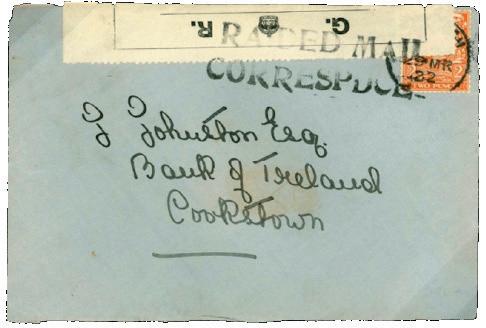
Despite the popularity of the 1938 Presidential Series, the Fifth Bureau Issue, there has been little specific study focused on the nine denominations of the coil format. These stamps, produced to pay common rates, can provide unusual and rare examples of what on the surface appear to be common usages.
Since the coils have not been subjected to in depth examination, they provide an opportunity for significant new discoveries, some quite surprising. Where there is not detailed philatelic exploration, the lack of information often leads to conclusion jumping.
When applied to the Prexie coils, some of these generally accepted conclusions are erroneous. While one would think that such a long running series, produced during the equipment shortages of a World War would be replete with EFOs. in the coil format, for miscuts, it is not the case. The coil EFOs are actually quite scarce.
The program will review new findings about the series that could displace some current thinking. There will also be some rare usages of the stamps for very common rates, a detailed review of the 10¢ value and opportunities for dollar box finds.
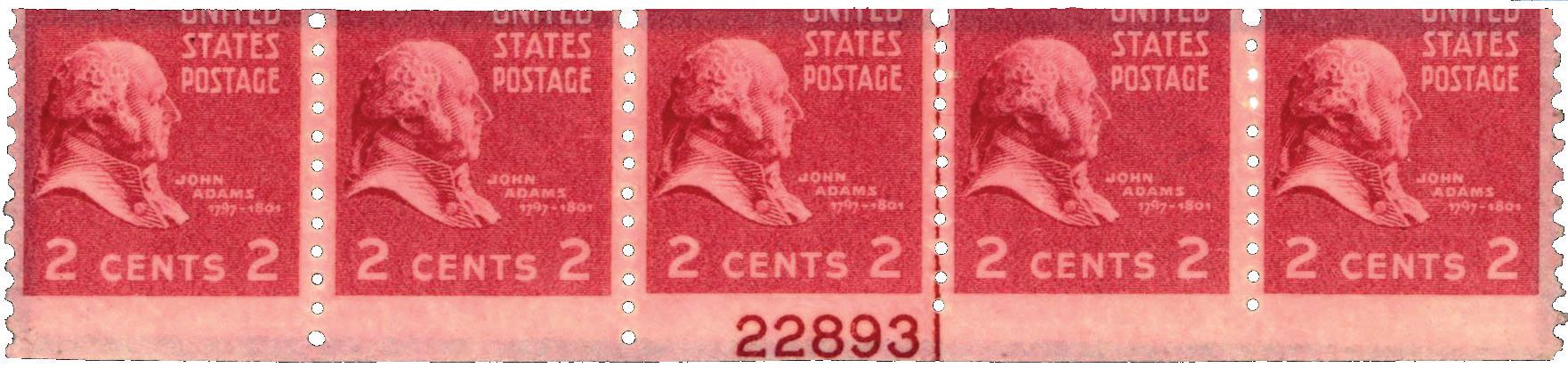
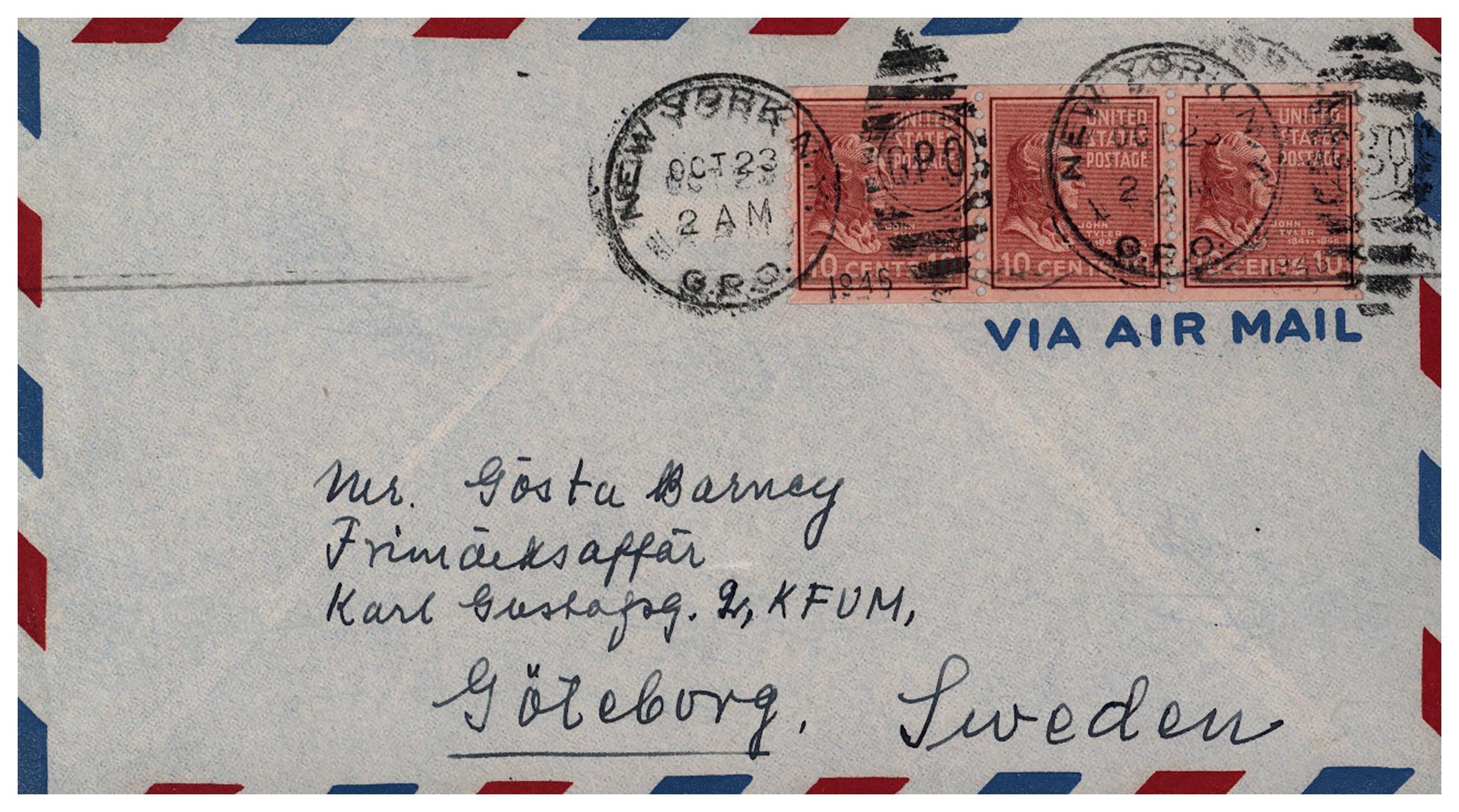
29,
Trinidad, a British colony in the West Indies, frequently faced an inconsistent supply of postage stamps during the first nine years after the establishment of its Post Office in 1851. This instability resulted from several factors: slow administrative processing in England, delays in producing and shipping the stamps, lengthy transit times, and the rapidly increasing volume of mail on the island.
To address these shortages, the Postmaster General hired Charles Petit, a highly skilled local printer of French heritage. Between 1852 and 1860, five distinct issues of provisional stamps were produced. All were printed from a single lithographic stone and followed the design of the imperforate, seated Britannia. Collectors commonly refer to these issues as the “Lithos.” They were printed in various shades of blue ink on sheets of 54 stamps arranged in a 6-row by 9-column format. Although no value appeared on the stamps themselves, each represented a denomination of 1 penny (1d). The fifth and final issue was unique in being printed in both blue and red ink.
The earliest printings are notable for their sharp detail and clarity—qualities so refined that some examples may be mistaken for printings by Perkins Bacon, the renowned London firm. In contrast, later printings, particularly the fourth and fifth issues, exhibit significant deterioration in quality, often appearing crude or blurred. These printings are sometimes mistaken for forgeries due to the worn state of the lithographic stone.
This presentation examines all five issues, including examples of both stamps and covers. Known covers have been organized into a census, and multiple strips—both on and off cover— are shown for comparison. The few surviving mint copies are illustrated, and the various shades of blue ink are highlighted to demonstrate color variation across the issues. Most Lithos were used in the capital Port of Spain and in San Fernando, the island’s second-largest town. For postmark collectors, numeral cancels from several smaller towns are also presented.
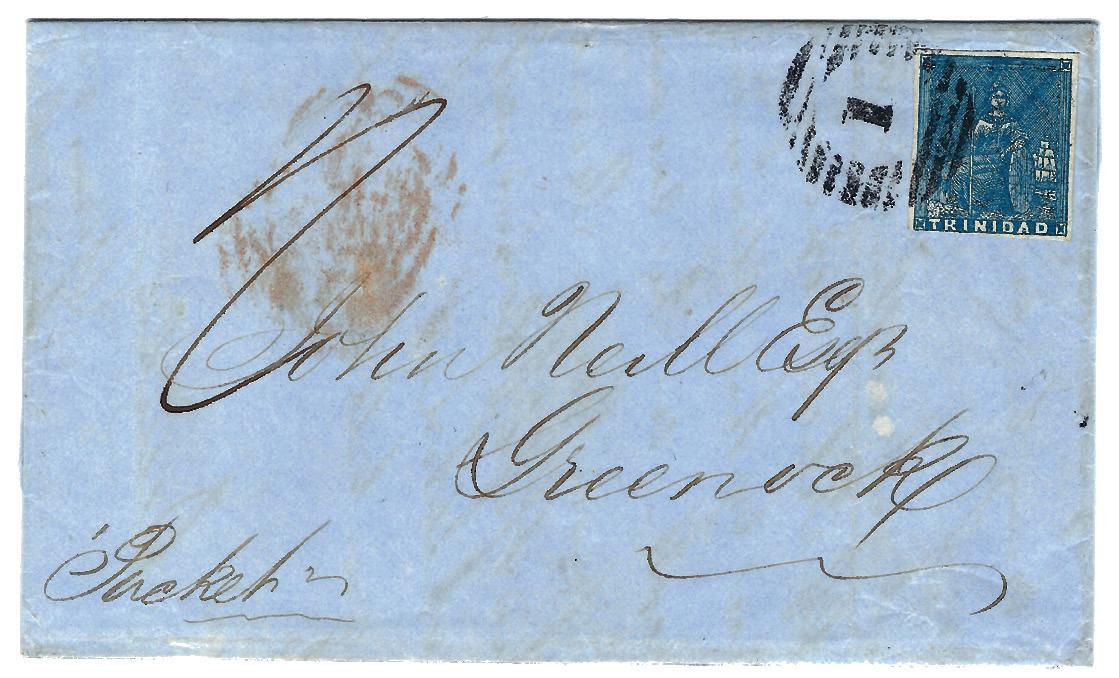
Fourth Printing on cover dated December 21, 1858.
First Printing on cover to Greenock, Scotland, dated November 9, 1852.
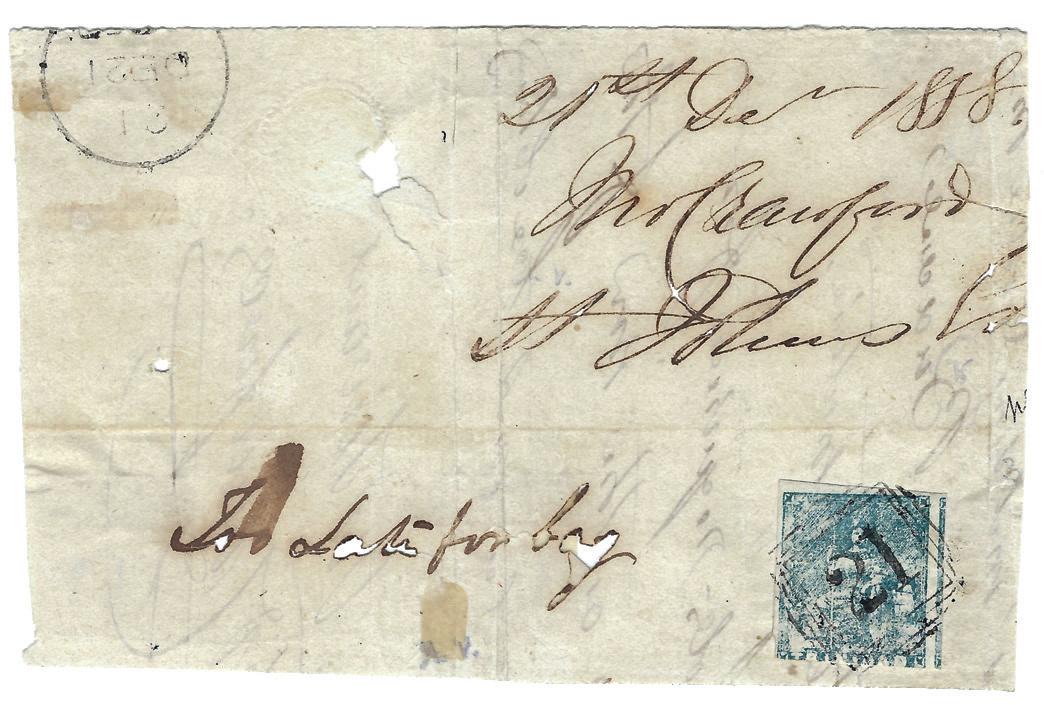
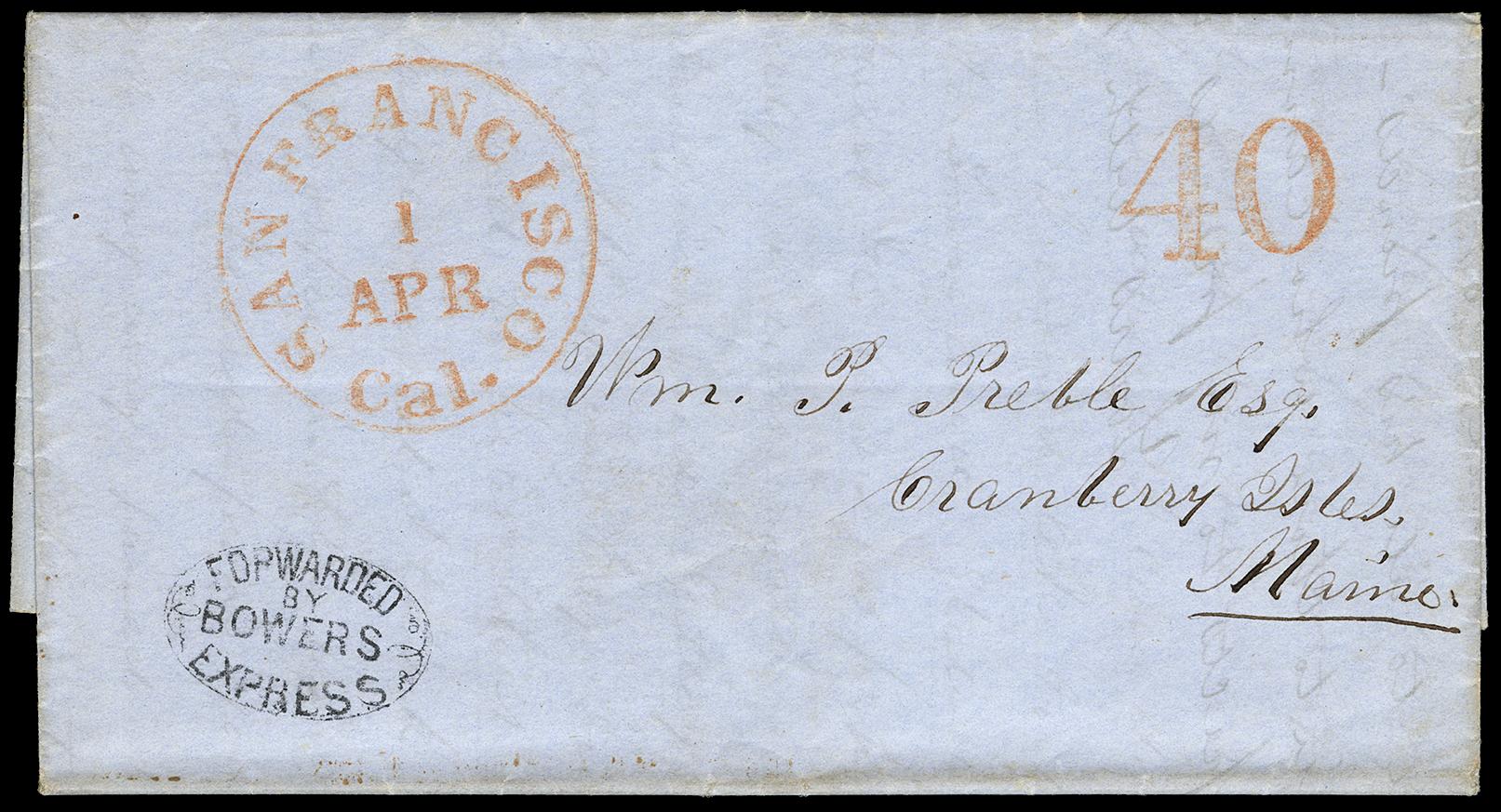
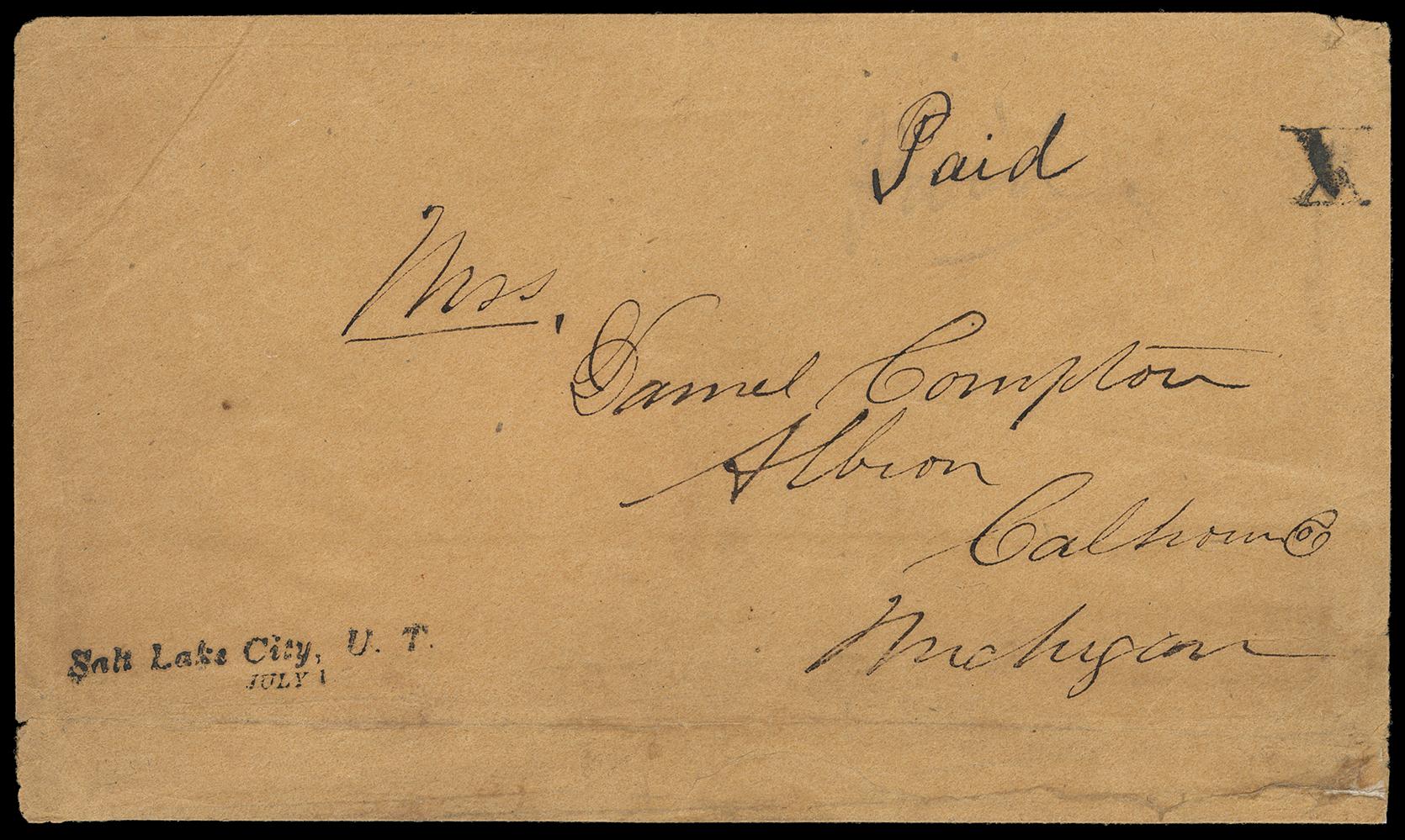
Dr. Milgram has long studied the development of the American West through the lens of postal history. His collection features an exceptional array of trail letters, illustrated lettersheets, expresses, material from the Indian Territories, and much more. Many pieces include their original enclosures, each carefully chosen for its historical significance. This remarkable collection is scheduled to be offered in February 2026
415 781 5127 srumsey@rumseyauctions.com visit us at www.rumseyauctions.com

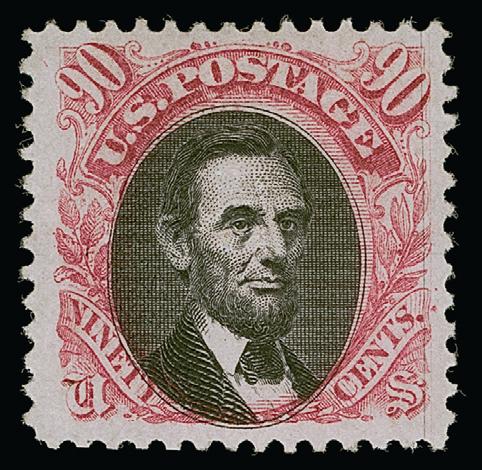
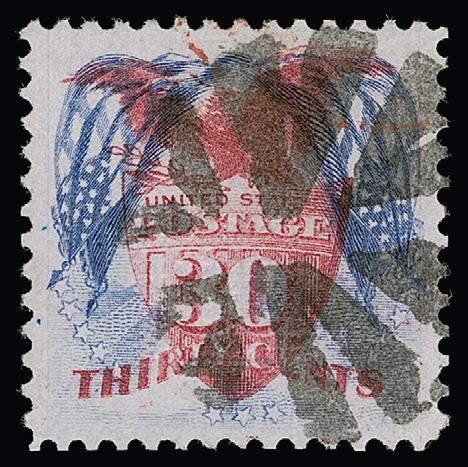
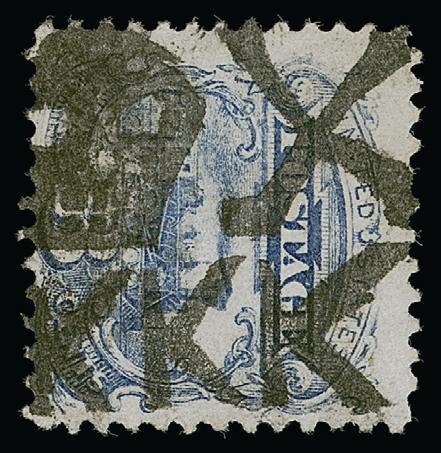
Sale Date: Tuesday, April 21
The 1869 Pictorial Issue collection formed by Nick Kardasis over 40 years is without question the finest assemblage of high quality examples ever gathered in one collection.
SUPERB UNITED STATES 19TH AND 20TH CENTURY STAMPS
Sale Date: Wednesday, April 22 – Assembled over 20 years by a discerning collector, the collection includes proofs, gem-quality singles, and rare multiples.