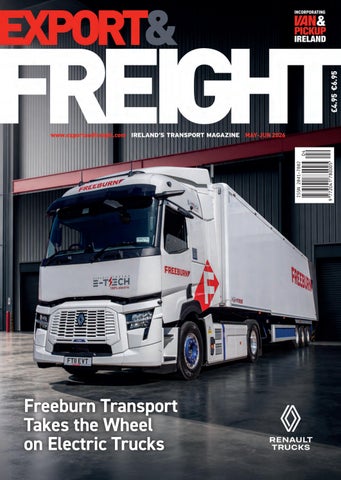
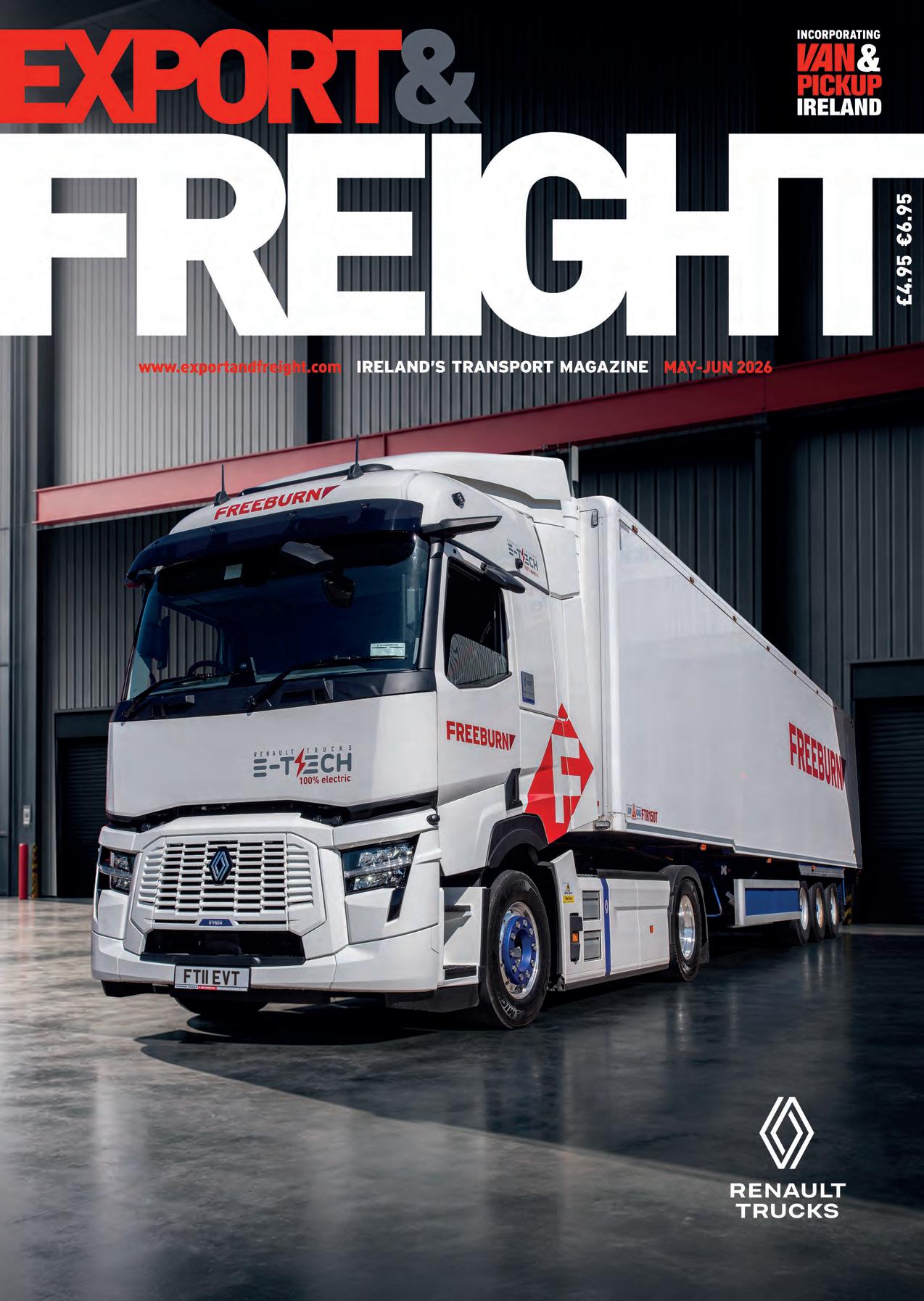
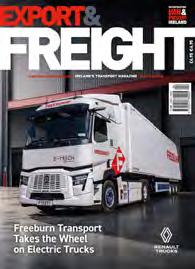
Freeburn
Transport Takes the Wheel on Electric Trucks
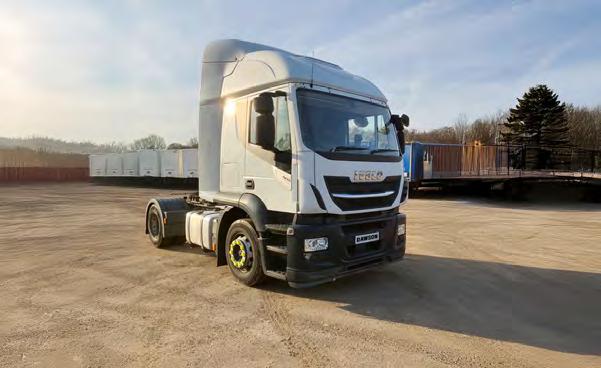
Bluetooth • Night Heater • Air Con • Sleeper Cab Iveco Stralis AT440 4x2
Full Air Kit
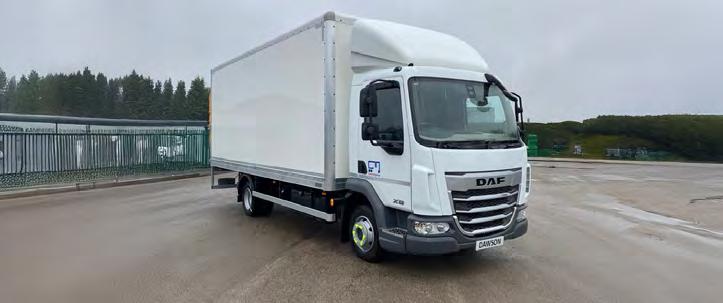
• LOW KMS
• PACCAR 20ft Body with Roller Shutter Door
• DEL Column Tail Lift with Safety Gates
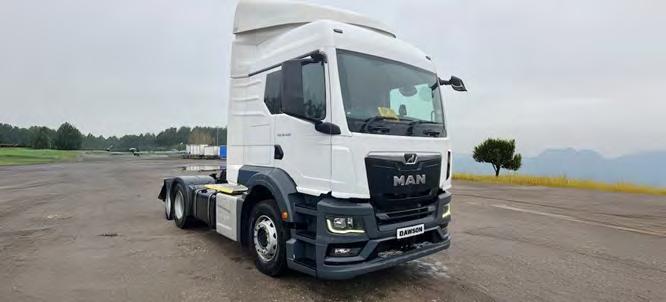
• Rear Camera MAN TGS 18.400 38t 4x2
• Low KMs • Tipmatic 12 Speed Auto Gearbox
• Reversing Alarm • Fitted with Kuda Air Kit • Sleeper Cab
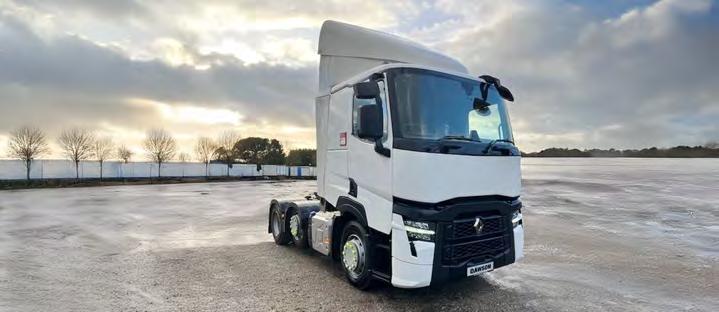
Renault T480.26 44t 6x2 • Optidriver AT 2612F Auto Gearbox • Fitted with Carrier Eco Drive Engine Driven PTO • Lane Departure Warning System • AEBS & Eco Cruise Control • Sat Nav with 7” HD Colour Display • Sleeper Cab • Low KMs • 12 Speed Auto Gearbox

SHOWTIME
It’s only May and we are already in the middle of trade show season.
During April, the first Road Transport Expo (RTX) Northern Ireland took place at the Eikon Exhibition Centre outside Lisburn. Just the following week, the Commercial Vehicle Show attracted visitors and exhibitors to the National Exhibition Centre in Birmingham.

NEWS
Export & Freight attended both shows, and in this issue we bring you extensive coverage of these important industry events.
For many in the transport and logistics sector, the next major date in the diary is Road Transport Expo at Stoneleigh, which this year begins on Tuesday, 30 June.
Trade shows remain an incredibly important part of the industry, which is why they continue to attract such strong attendance. Not only do they provide businesses with the opportunity to showcase their latest products and services to a highly targeted audience, they also offer a valuable chance to meet people from across the sector - to network, exchange ideas and, hopefully, do a few deals.
In this issue, we also feature special reports on commercial vehicle insurance and GPS and telematics - now an essential part of every fleet, helping to improve both efficiency and safety.
We are delighted to bring together another busy and varied magazine for our readers, and we hope you enjoy reading it. As always, it has been a pleasure to put together.
Now, we are off to clean our golf clubs in preparation for the Annual Export & Freight Golf Masters on 11 June. We hope to see some of you there!
Austin Lynch Editor
Email: austin@4squaremedia.net
TRANSPORT
SERVICE
& FREIGHT SUBSCRIPTIONS, 4 SM (NI) Ltd
Email: accounts@4squaremedia.net
Web: www.exportandfreight.com
REGULARS
MAY-JUNE 2026 COVER STORY
RENAULT TRUCKS AND DIAMOND TRUCKS URGES OPERATORS TO TAKE FRESH LOOK AT ELECTRIC
FEATURES
SHIPPING NEWS
VAN
PICK-UP IRELAND

Email: helen@4squaremedia.net
publication be
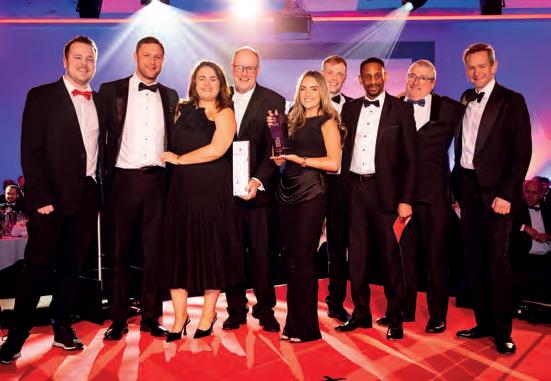
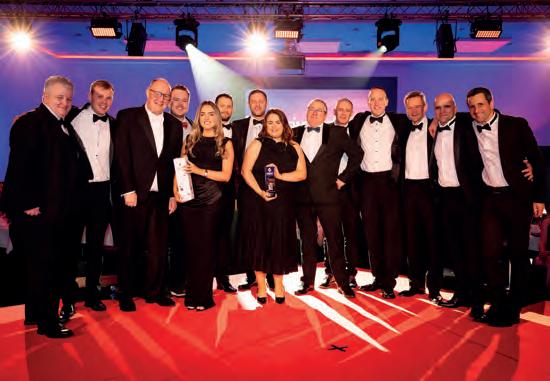
Diamond Trucks wins Dealer of the Year Award
Diamond Trucks has scooped two awards at the Renault Trucks Dealer Awards.
The annual awards recognise the outstanding achievements of its UK dealer network in 2025. Diamond Trucks took home the title of Dealer of the Year, marking their achievements over 2025, and they also won Commercial Truck Sales Dealer of the Year.
The award ceremony, held at the ICC Wales on 20th March 2026 and hosted by British actor and comedian Alexander Armstrong, celebrated Renault Trucks commitment to innovation, sustainability and customer experience that is exemplified by its dealers. The dealer awards cover a wide range of categories celebrating all aspects of the dealer network. RH Commercial Vehicles won the award for Customer Experience Dealer of the Year and Brand and Communications Dealer of the Year.
James Charnock, Interim Managing Director of Renault Trucks UK & Ireland, said: “Renault Trucks’ dealer network is essential to our success as a business, the expertise and commitment shown in 2025 deserves to be celebrated through these awards. I am proud to congratulate Diamond Trucks for achieving Dealer of the Year which highlights their performance across the year. I also want to congratulate all our dealers for upholding Renault Trucks’ values and delivering excellence year after year.”
Respect for retreads: Bandvulc launches 5th generation Deliverymaster tyre for LGV fleets
Bandvulc, a brand of Continental, has unveiled the Deliverymaster 5 retread, the latest generation of its drive-axle tyre developed for regional LGV fleets.
The Deliverymaster 5 replaces the Regiomaster BDE1 across the 17.5” and 19.5” ranges and provides enhanced all-weather performance compared with its predecessor. It is engineered to support the requirements of regional applications and multi-drop retail routes. Designed specifically for retail delivery fleets, the Deliverymaster 5 offers dependable performance across regional applications and demanding stop-start environments. Its 3PMSFaccredited tread pattern supports reliable grip across all seasons, while its tread geometry is developed to maximise surface contact and aid water dispersion on wet road surfaces.
Tony Mailling, Head of Hot Retread Production EMEA and ContiLifeCycle Plant Manager, said: “When developing the Deliverymaster 5, we worked closely with our customers to understand the operational
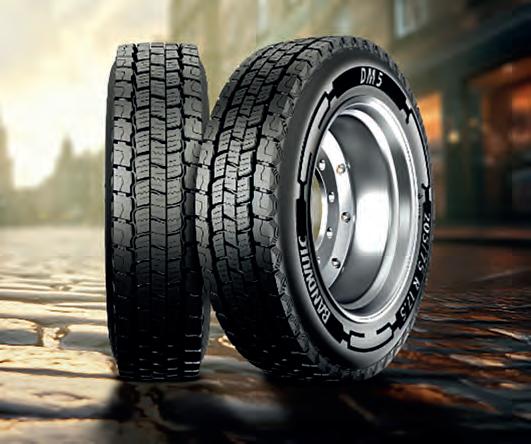
pressures they face –particularly the increased risk of sidewall damage during intensive kerbside activity.
“The Deliverymaster 5 tyre has
been developed as a tailored response to these insights, incorporating reinforced sidewall elements and design features intended to support fleets operating in challenging stop-
start delivery environments.
“All tyres produced at our plant in Ivybridge are an important part of Continental’s circular lifecycle approach, helping operators make continued use of quality casings within the retreading process.”
As highlighted in Continental’s Respect for Retreads campaign, many fleets still overlook the potential of retreading to maximise casing value before disposal. By adopting a circular approach, operators can optimise their tyre assets over time and contribute to more resourceefficient fleet operations.
Depending on casing condition and operational use, premium retreads such as the Deliverymaster 5 can also form part of further retreading cycles, supporting extended mileage potential within a managed tyre lifecycle.
To find out more about the Deliverymaster 5 tyre, please visit: Engineered for Urban Retail applications, Ready for any route - BANDVULC.
A Brand of Continental
Commercial Truck Sales Dealer of the Year - Diamond Trucks.
Dealer of the Year - Diamond Trucks.
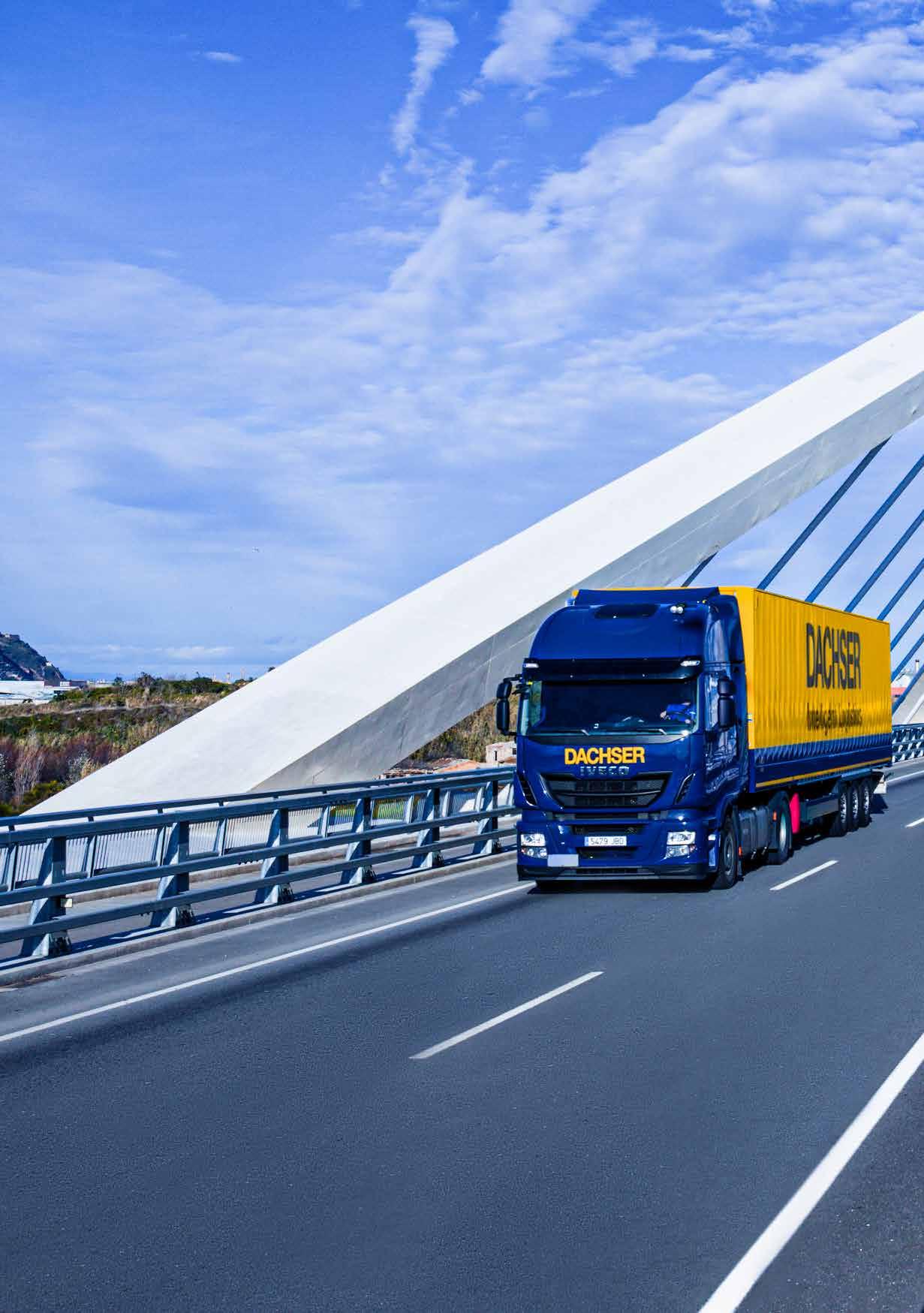
Anywhere in Europe.
Our stated aim is to deliver your shipments safely, on time, and intact. In other words, we offer quality you can depend on.
How you can benefit from DACHSER’s transport and logistics solutions: A comprehensive European groupage network
High delivery frequency across Europe
Automated and digital processes along the entire supply chain
Consistent performance standards
Customer-specific solutions
Sustainable logistics and infrastructure concepts
DACHSER Ltd. • Space Antrim
High Street 51 / 55 • BT41 4AY Antrim
Tel.: +44 28 9602 0640 • nathan.gavin@dachser.com dachser.co.uk
DACHSER European Logistics
Asda adds 55 dual-temp’ refrigerated moving double decks from Tiger Trailers
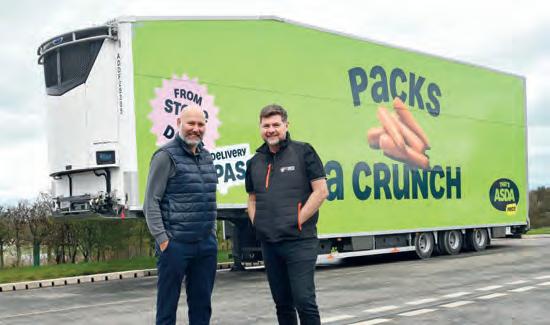
Following successful trials last year, Asda has begun introducing an additional 55 Tiger temperature-controlled step-frame moving-deck double deck trailers to its fleet.
The order is Tiger’s first for the dual-temperature variant of its refrigerated lifting deck trailer and will provide versatility for transporting chilled and frozen goods across the retailer’s network. These new trailers deliver safer load stability, cargo capacity of up to 43 pallets or 72 cages, and reduced running costs and environmental impact through fewer journeys and streamlined maintenance.
Chris Hall, VP Asda Logistics Services, comments: “We’re very pleased with these new dualtemperature moving double deck trailers from Tiger. This is Asda’s third year collaborating with the manufacturer and from our team having regularly visited Tiger’s factory it’s always been clear to see their ongoing innovation, flexibility, and attention to detail, along with impressive support.” Asda’s trailers have been designed with a lower deck height of 1940mm and an upper deck height of 1860mm, giving the supermarket optimal clearances and air flow for its operations. The three-quarter-length 10-tonne-
rated lifting deck is powered by Tiger’s in-house four-ram hydraulic system. The deck is operated by buttons that are accessible from both ground level and bay height, as part of Tiger’s ‘operator first’ approach to safety. Carrier HE19 fridge units with MHS2200 singledischarge evaporators take care of the dual-temperature capabilities. The bespoke specification delivered for these trailers includes deep-insulated floor slabs, alloy flooring to suit MHE use, a temperature-retaining shutter at
the rear and a heavy-duty gate at the front of the moving deck, multi-purpose load securing, an LED fuel gauge, and reinforced rear bay protection buffers.
Darren Holland, Tiger Trailers’ Sales Director, says: “Asda is an integral part of Tiger’s customer base and it’s exciting to have worked closely with them on their latest refrigerated double deck trailers, which are the pinnacle of what we currently offer as a manufacturer. We’re proud that each generation of trailers we supply Asda with
incrementally raise the bar when it comes to design, engineering, safety and sustainability”.
Axscend TrailerMaster tyre pressure monitoring and electronic brake performance monitoring systems are fitted to the trailers, along with the Haldex TEM Safe Parking Valve, Nexus’ ground-level sliding coupling, and extra protection to safeguard the fridge and trailer against tree damage.
Tiger has been building refrigerated trailers and rigid bodywork since 2020 in partnership with Spanish manufacturer LeciTrailer. The innovative moving-deck double deck model was launched in 2024 and Tiger offers competitive lead times. Asda’s latest trailers from Tiger are finished in the retailer’s bold ‘Delivery from a to brie’ cheese and ‘Packs a crunch’ carrot liveries, with ‘Not all jams are bad jams’ rear doors. They join the 485 existing trailers the Cheshire manufacturer has supplied to the supermarket to date which include ambient double decks and short-length ‘urban’ single-deck fridge trailers.
BPW idem Telematics introduces BRAKE TRAK PRO, the evolution of its Electronic Brake Performance Monitoring System
BPW idem provides a digital trailer telematics solution that enables real-time fleet management, optimising operational efficiency and reducing downtime for transport operators.
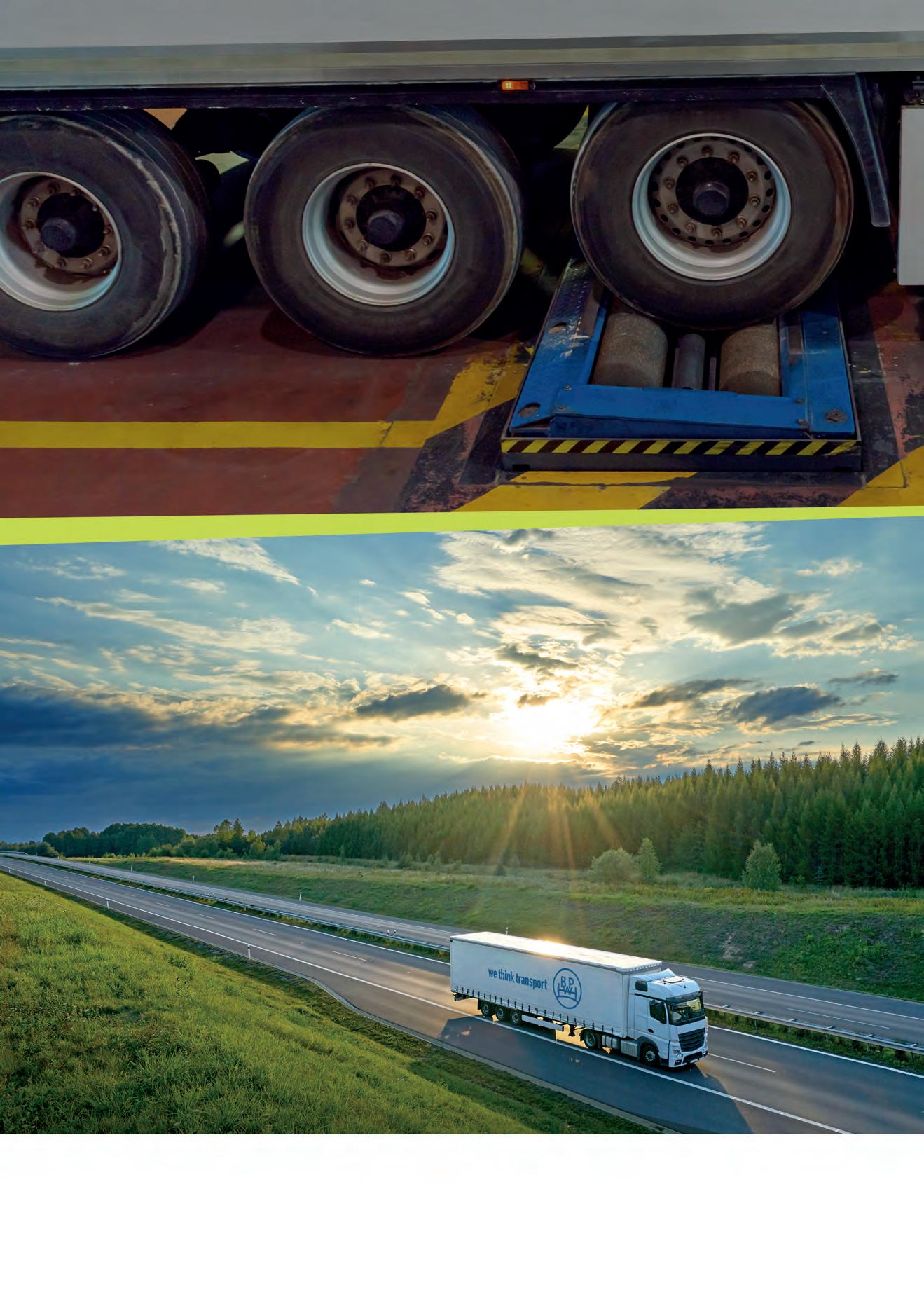
BRAKE TRAK PRO is the new vehicle safety platform from BPW idem, offering fleet operators a range of options to lower operating costs, improve compliance and increase uptime. It also gives workshops and technicians the benefits of automated reporting, earlier fault detection and less disruption to inspection routines. At the heart of BRAKE TRAK PRO is an Electronic Brake Performance Monitoring System. Compliant with the current Driver and Vehicle Standards Agency (DVSA) regulations as set out in the DVSA Guide to Maintaining Roadworthiness, this in-service brake monitor can automatically generate a brake performance report aligned with a fleet’s maintenance schedule. A meaningful brake report can serve as an alternative to laden roller brake testing, reducing the need for testing to one during the annual MOT inspection. The BRAKE TRAK PRO platform also supports
scalable features, including a Tyre Pressure Monitoring System (TPMS), Brake Lining Wear Sensors, and Individual Wheel Station Sensing. The BPW idem Tyre Pressure Monitoring System
(TPMS) continuously monitors tyre pressure and temperature to improve safety, efficiency, and performance. Fully compliant with UN ECE 141 regulations, the system transmits live tyre data directly to the truck via the Electronic Braking System (EBS), enabling immediate driver alerts and reducing the risk of costly tyre blowouts.
Brake Lining Wear Sensors help determine when the friction material is approaching the wear limit, optimising its use and preventing premature or delayed replacement.
Individual Wheel-station Sensing delivers nextlevel diagnostic capabilities to fleets, enabling them to pinpoint poor brake performance to specific brakes. Together, these features can maximise trailer uptime, enhance on-road safety, support compliance obligations, and reduce total operating costs by enabling earlier fault detection and smarter maintenance decisions.
Chris Hall and Darren Holland.




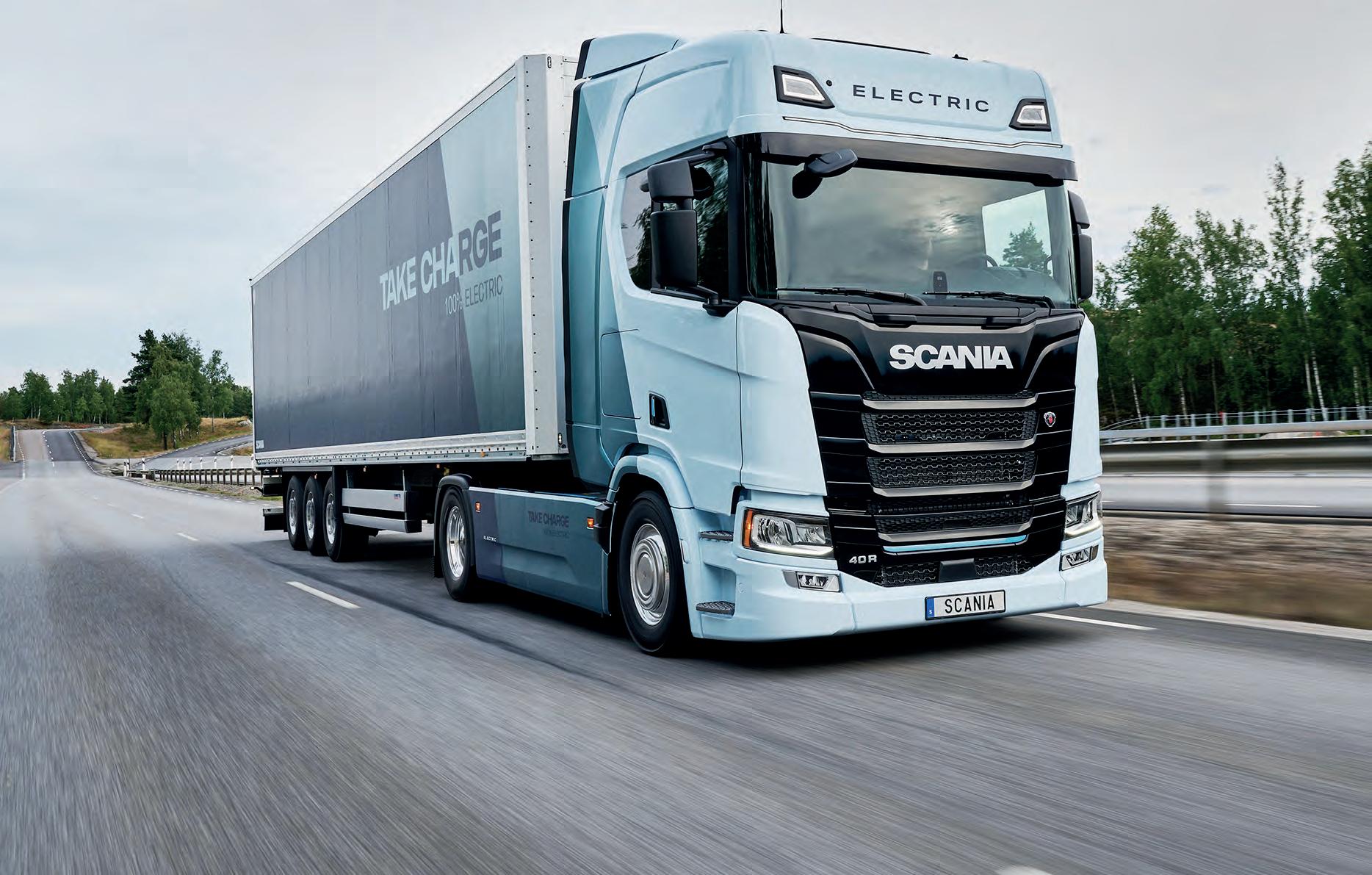
SCANIA SERVICES 360 PROGRAMME GETS AN UPGRADE
Scania’s Services 360 programme has just got an upgrade, with the introduction of two new repair and maintenance (R&M) options - Scania Classic and Scania BEV – designed for operators running electric or vehicles more than five years old.
Introduced in 2024, Services 360 is based on smart flexible maintenance planning supported by a suite of digital tools and services, which gives customers a range of different servicing packages that are tailored to their needs.
The expansion of this servicing programme comes as Scania continues to give as many of its customers valuable peace of mind. And that’s true of the introduction of Scania Classic, an advanced service offering for Scania vehicles over 5 years old.
Acknowledging this price-sensitive segment, used vehicle customers can choose from four different packages – Core, Plus, Full and Pro – which offer varying levels of service and maintenance: from the basic Fleet Maintenance and digital monitoring in Core through to the additional Proactive and Powertrain repairs that come with the Pro package.
Lars Gustavsson, Senior Vice President and Head of Trucks at Scania CV AB, said: “We pride ourselves in being close to our customers’ pain points, and extending Services 360 is a way to reach even more transport operators and cover the full ecosystem of needs around their business. “No matter the type of powertrain, operation or business sector, the
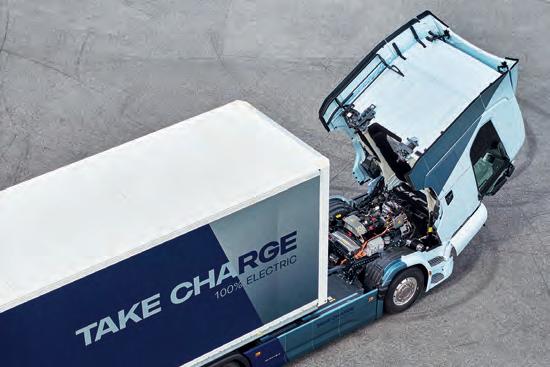
underlying goal of Services 360 is to support the customer and make them more profitable and sustainable for the long term.”
For the first time, BEV operators will be able to utilise Scania Services 360 programme, thanks to the addition of a new comprehensive R&M package that provides added peace of mind. By purchasing this service package, Scania will take care of all the BEV’s repair and maintenance needs. Including anything related to the vehicle’s batteries.
Lars adds: “We want our battery electric truck customers to only focus on maximising
the use of their vehicles.
“By offering a single service level – Full. We ensure that every repair, every interaction between systems and every unexpected issue is handled and covered by Scania, giving our electric truck customers all the support they need.”
These two new Scania Services 360 R&M offerings will be available to UK customers.
Scania Classic is available to today, while Services 360 BEV package will be available to customers later in 2026.
Scania has also introduced a new comprehensive Repair
and Maintenance package for battery-electric vehicles, marking the first time BEV operators can access Services 360. The single ‘Full’ package covers all repair and maintenance requirements, including batteryrelated components.
Lars Gustavsson, senior vice president and head of trucks at Scania CV AB, said the expansion reflects a focus on supporting a wider range of customer requirements.
“We pride ourselves in being close to our customers’ pain points, and extending Services 360 is a way to reach even more transport operators and cover the full ecosystem of needs around their business. No matter the type of powertrain, operation or business sector, the underlying goal of Services 360 is to support the customer and make them more profitable and sustainable for the long term.”
Gustavsson said the aim is to make things more straightforward for electric truck customers.
“We want our battery electric truck customers to only focus on maximising the use of their vehicles,” he said.
By offering a single service level, we ensure that every repair and every unexpected issue is handled and covered by Scania.”
While Scania Classic is available in the UK now, the Services 360 BEV package is set to launch later in 2026.

Across Ireland, our experts are well-versed in businesses like yours, so they won’t just listen to your plans, they’ll understand them.


Mission Accomplished: Steven McBride Conquers Everest Base Camp for Cash for Kids NI
From diverted flights and missing luggage to the thin air of the Himalayas, Steven McBride’s journey to Everest Base Camp has been nothing short of legendary. As the first-ever fundraiser to take on this trek for Cash for Kids NI, Steven reached the 5,364-meter summit on April 21st, 2026, marking a historic milestone for the charity.
The Mission
“I’m pushing my limits so we can help local children who are facing their own uphill battles. Whether it’s alleviating poverty or supporting those with disabilities, every penny raised stays right here in Northern Ireland.”
The trek was filled with “surreal” moments - from receiving words of encouragement from mountaineering legends

Dawson Stelfox and Kristin Harila to trekking through fresh snow in his signature shorts. Steven has officially left his
‘Cash for Kids’ flag at Namche Bazaar for future trekkers to sign, symbolizing the lasting impact of this mission. At time of going to
Senior leadership evolution to drive next phase of strategic growth at Harris Group
Harris Group has announced a significant evolution of its senior leadership structure as the business positions itself for the next phase of strategic growth across Ireland, the United Kingdom and wider international markets.
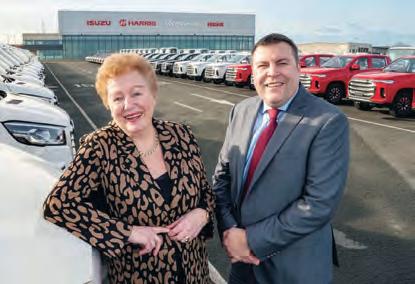
Under the new leadership structure, Denise Harris will assume the role of Executive Chairperson, with Brian Patterson appointed as Chief Executive Officer.
The appointments reflect the continued evolution of Harris Group as one of Europe’s leading commercial vehicle distributors and support the company’s long-term strategy of expanding its market presence, strengthening and diversifying its portfolio across the truck, van, bus and plant sectors
print, Steven had raised almost £8,000 and he is making one final push to reach their £10,000 goal to support disadvantaged children across Northern Ireland. Steven gives an example of how his donations could help children:
• £10 could provide a warm meal.
• £50 could fund essential sensory equipment. But any amount makes a difference, he says.
You can support this great cause to by visiting: https://www. cashforkidsgive.co.uk/campaign/ charity-champions-northern-ireland/ fundraisers/stevie-mcbride/
Montgomery Transport Group are strong supporters of Cash for Kids, and Steven is delighted to be supporting them through his efforts this April.
Montgomery Transport’s Group Managing Director Steven McBride has just recently completed a walk to Everest Base Camp to raise money for ‘Cash for Kids’.
Denise Harris and Brian Patterson.
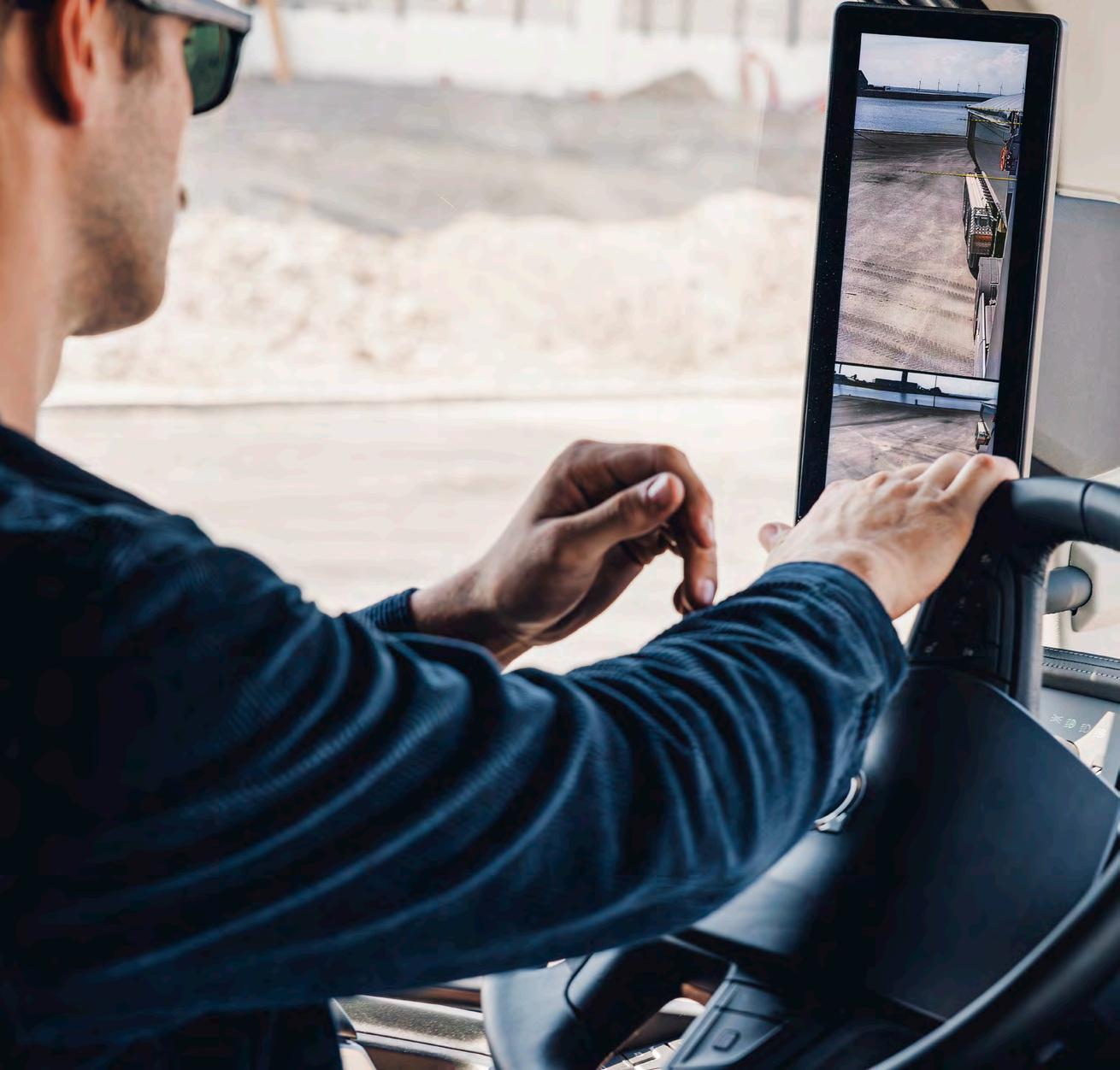
A better view. Streamlined for ef ficiency.
The Camera Monitoring System replaces the rear-view mirrors, using cameras on the side of the truck, improving the aerodynamics of the truck to save energy. It also opens up your visual field in both good and challenging conditions. Using infrared technology to improve night time visibility. The views on the displays adapt to the driving situation. Your efficiency. Extended.
Contact your local Volvo Trucks dealer or visit volvotrucks.co.uk
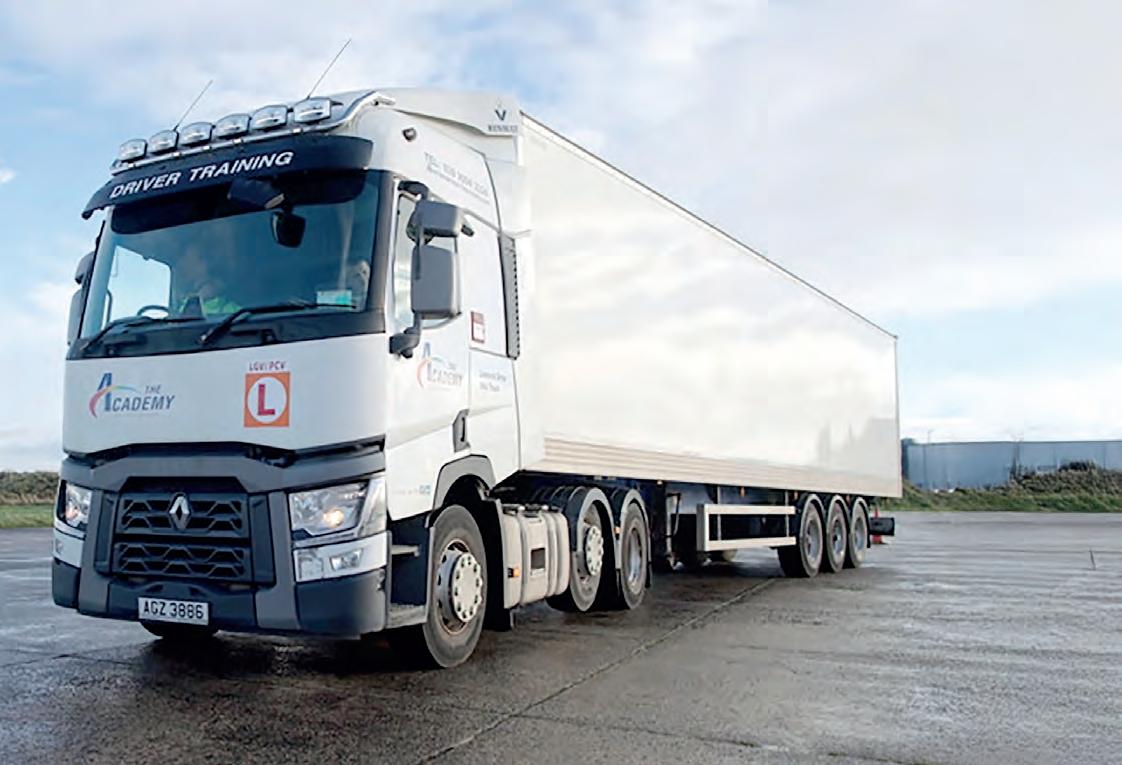
NORTHERN IRELAND’S TRAINING POWERHOUSE: HOW THE ACADEMY AT HENDERSON’S IS SHAPING THE FUTURE OF PROFESSIONAL DRIVER TRAINING
For businesses across Northern Ireland and beyond, the challenge of maintaining a safe, compliant, and operationally efficient fleet has never been more pressing. Rising regulatory demands, driver shortages, and growing pressure to demonstrate duty of care are forcing fleet operators to rethink how - and with whom - they invest in driver training. For a growing number of organisations, the answer lies with The Academy at Henderson’s.
Part of The Henderson Group - one of Northern Ireland’s largest and most respected employers with over one hundred and thirty years of heritage - The Academy has evolved from a provider of internal training into one of the most capable and comprehensive external training operations in the region. And at the heart of that evolution is a simple but powerful commitment: to be a genuine partner to every business it works with, not just a training provider.
A FULL FLEET SOLUTION, BUILT AROUND YOUR BUSINESS
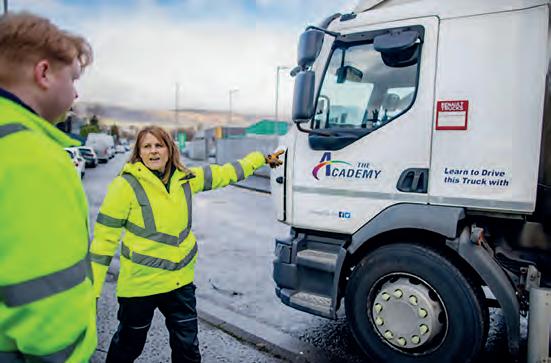
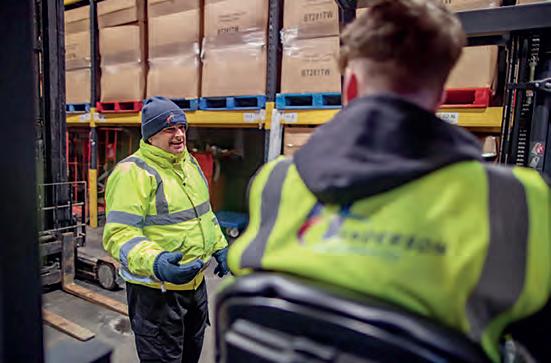
What sets The Academy apart from many training providers is the sheer breadth of what it offers. While many companies focus narrowly on HGV licensing, The Academy covers the complete range: vans, rigid lorries, articulated vehicles, car and trailers, minibuses, and forklifts - including specialist categories such as reach trucks, counterbalance, and telescopic handlers. This makes it uniquely positioned to serve as a single, trusted training partner for businesses running diverse, mixed fleets.
But it’s not just about breadth. The Academy designs every programme around the actual operational realities of its clients. Training is tailored to your fleet composition, your drivers’ experience levels, and your business goals - delivered in-cab, in the classroom,
online, or through blended approaches that fit your schedule. The result is training that’s genuinely relevant, practically grounded, and built to make a difference.
ACCREDITATION THAT MATTERS
The Academy holds status as Northern Ireland’s only National Register of LGV Instructors Examination Centre - an exclusive accreditation that underpins the quality and independence of its instructor standards.
For corporate procurement teams and fleet managers, this is more than a badge. It’s a guarantee that the training their drivers receive meets the most rigorous independent standards available in the region.
Add to this the Academy’s JAUPT approval for Driver CPC delivery, and the picture becomes clear: this is a provider whose credentials are verified, whose quality is independently assured, and whose commitment to excellence is built into everything it does.
COMPLIANCE, RISK, AND THE COMMERCIAL REALITY
For any business operating commercial vehicles, compliance is the baseline.
Driver CPC requirements, licence category obligations, and duty of care responsibilities create a complex web of legal obligations that must be met consistently. Non-compliance carries serious consequences - financial penalties, reputational damage, and, most critically, avoidable risk to drivers and the public.
The Academy cuts through this complexity, acting as a trusted guide through the regulatory landscape. Its programmes are designed not just to meet requirements but to embed a culture of safety and professionalism across the workforce. The return on investment is tangible: fewer incidents, reduced insurance exposure, lower vehicle downtime, and a more reliable, professional driving operation. In an industry where margins are tight and reliability is everything, this partnership pays for itself.
GROUNDED IN REAL OPERATIONAL EXPERIENCE
What makes The Academy’s model particularly compelling for corporate clients is that its training is grounded in genuine industry experience.
As a division of The Henderson Group - itself a major logistics and retail operation - The Academy understands what businesses actually need from their drivers. It builds programmes accordingly, drawing on real-world insight that classroom-only providers simply cannot match. This is why over three hundred retail and
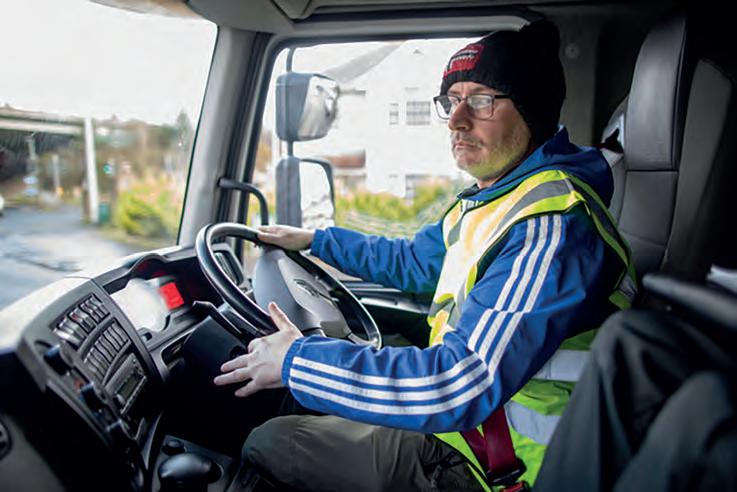
logistics businesses across Northern Ireland choose The Academy as their training partner. They’re not just buying courses - they’re investing in a relationship with a provider that understands their world, speaks their language, and is genuinely invested in their success.
A PARTNER FOR THE LONG TERM
For Northern Ireland’s logistics and transport sector, the opportunity to access a training partner of The Academy’s calibre - with the
heritage, accreditation, infrastructure, and sector expertise it brings - is significant. As workforce development becomes an increasingly strategic priority, and as the bar for compliance and safety continues to rise, the value of a trusted, long-term training partner will only grow.
The Academy at Henderson’s isn’t just a training provider. It’s a partner in building safer, more capable, more competitive businesses - and a relationship that delivers value far beyond the training room.
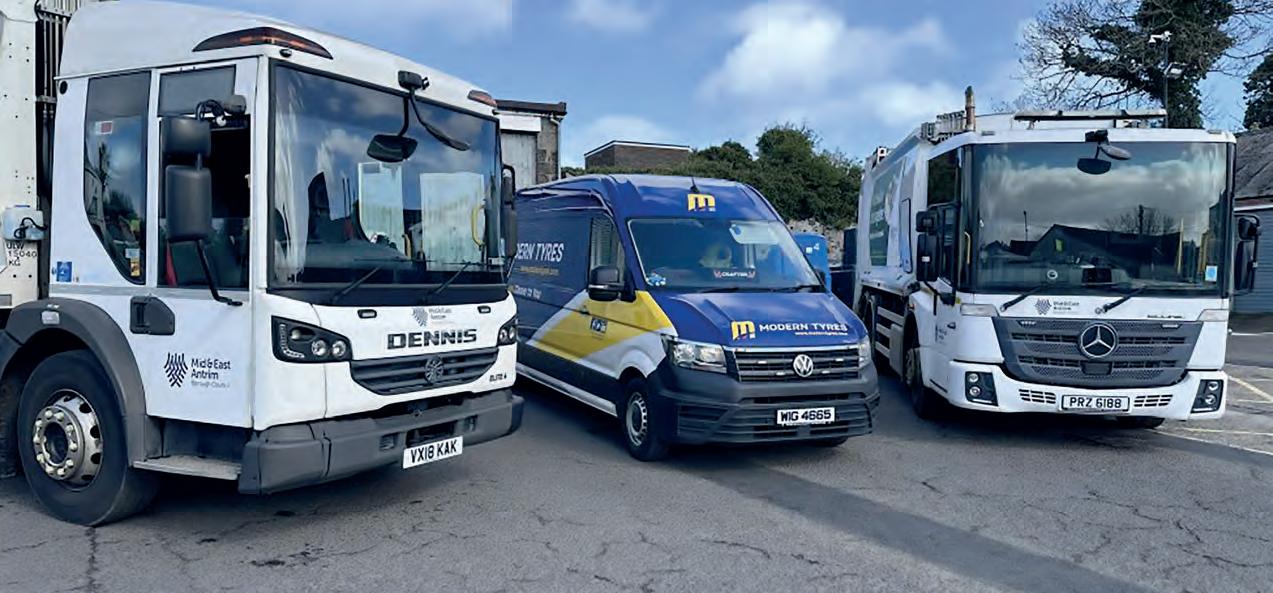
MID AND EAST ANTRIM BOROUGH COUNCIL DELIVERS SAFETY AND SUSTAINABILITY WITH MICHELIN
Michelin has helped Northern Ireland’s Mid and East Antrim Borough Council to boost the efficiency of its 160-strong commercial vehicle fleet and realise CO² savings of 27.7 tonnes in the three years up to and including 2025.
The local authority has been fitting its vehicles exclusively on Michelin tyres since 2021, having used a mix of manufacturer’s products before. It continues to work with Michelin via the CCS tyre framework agreement RM6535.
A representative of Mid and East Antrim Borough Council says:
“I think it’s the best thing we’ve ever done. Opting for Michelin tyres through the CCS guaranteed that we were engaging with a quality provider from the start.
“We’re now more than four years into our relationship, and by adopting a multi-life Michelin tyre policy for our HGVs, and the general improvement seen in the longevity of the tyres across our fleet, we’ve demonstrated strong lifecycle value, boosted efficiency and delivered sustainability savings.”
The council runs 100 vans that are used to provide services from dog wardens to medical and welfare
checks, and parks maintenance. The local authority also runs 60 HGVs including 32-tonne hook loaders and 26-tonne Refuse Collection Vehicles. The fleet is out in all weathers, 24/7, with performance, safety and compliance key metrics. The vans use the MICHELIN Agilis family of tyres, while the trucks are fitted with tyres from the MICHELIN X Multi range, predominantly sized 295/80 R22.5 and 315/80 R22.5.
Mid and East Antrim Borough Council has adopted a Michelin multi-life policy for its truck fitments. This sees the tyres regrooved once the tread depth reaches 3-4mm, helping to extend each casing’s life during its most fuel-efficient state. Once the regrooved tyres have worn, they are retreaded at the Michelin factory in Stoke-on-Trent and can then be regrooved again to extend their life further. The council utilises both Remix and, due to its reinforced
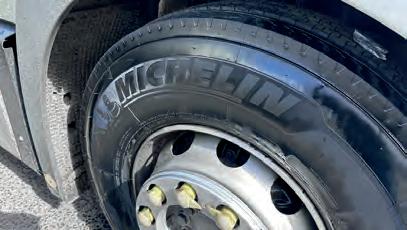
sidewall, Encore retread products on exposed vehicle positions.
From 2023 through 2025 a total of 10.2 tonnes was diverted from landfill, 13.2 fewer tonnes of material was used compared with the production of a new tyre, and the equivalent of 27.7 tonnes of CO² was saved on the back of the tyres and services used.
The council representative adds that while the initial outlay for premium tyres was higher than budget alternatives, there was a powerful value for money argument with retreads and significant qualitative benefits too.
“Our use of Michelin tyres has resulted in a reduction of the number of punctures we experience across the fleet each year. Fewer punctures mean less downtime and helps us deliver a timelier service. It also means our drivers are happier because their vehicles aren’t off the road,” they add.
The local authority also opted for the CCS framework RM6315 offer from MICHELIN Connected Fleet for fleet management services. This delivers data supporting compliance; fuel use; harsh braking events, which is used for driver coaching; and to assist the council in enhancing driver safety; as well as achieving further CO2 reductions while improving the overall cost efficiency of the fleet. Additional support is provided by Primoz Lakota, Truck Sales Account Manager & Defence Account Manager for the UK & Ireland at Michelin, and the fleet’s service requirements are handled by Modern Tyres in Ballyclare.
The UK Government’s CCS features more than 100 commercial agreements with vetted suppliers such as Michelin, that provide local authorities with a transparent, trusted route to good value public procurement.

To discuss tailored fuel supply solutions, speak to our team.
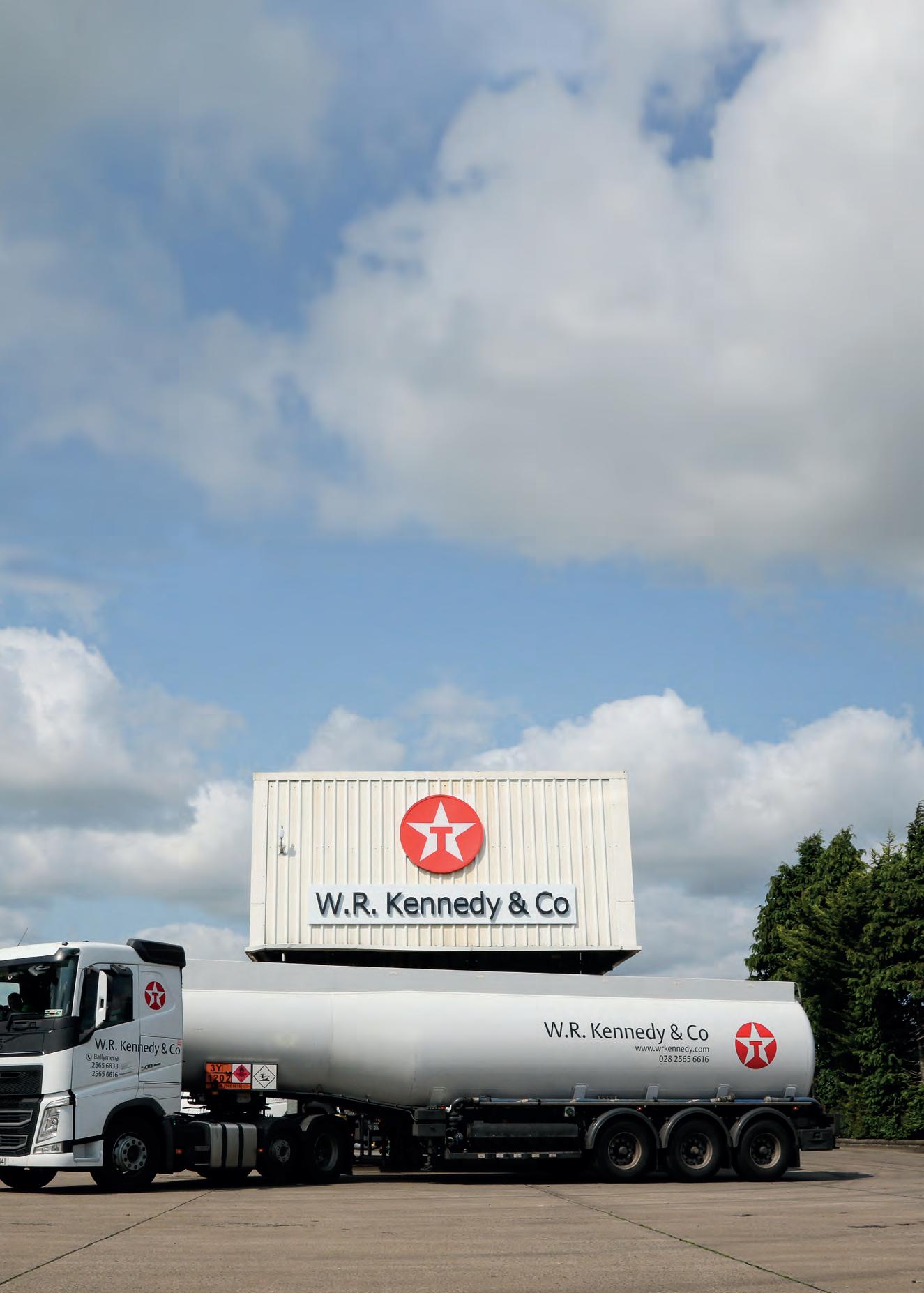
Powering Northern Ireland’s Export & Freight Sector
Over 60 years of keeping NI moving and warm
W.R. Kennedy & Co provides dependable fuel and energy solutions to the export, freight and logistics industries across Northern Ireland.
Based in Ballymena, we work with transport operators and commercial fleets who value reliability, consistency and local expertise — delivering quality fuel supply with a service standard you can rely on.
Quietly efficient. Professionally delivered.
Whether it’s kerosene or diesel for your plant, we have you covered with quality Texaco lubricants and fuels. We have been fuelling the construction, manufacturing and haulage sectors for decades; whatever your fuel or lubricant needs, let us help you with prompt delivery and competitive pricing. Diesel | HVO | AdBlue | Engine Oils | Hydraulic Oils |
W.R. Kennedy & Co
Ballymena | Northern Ireland
RENAULT TRUCKS AND DIAMOND TRUCKS URGES OPERATORS TO TAKE FRESH LOOK AT ELECTRIC
Electric trucks are becoming a viable option for more fleets, with the UK Government’s £1 billion funding helping tackle cost and infrastructure barriers, as Renault Trucks and its dealer Diamond Trucks encourage operators to start the conversation about where they can fit within their fleets.
Diamond Trucks, with depots in Mallusk, Warrington & Carlisle alongside trusted partners covering Northern Ireland, and North West of England, is working with Renault Trucks to support operators assessing whether electric vehicles could now make sense in their fleets.
Recent government support for zero-emission trucks and depot charging is helping to reduce two of the biggest barriers to adoption: upfront vehicle cost and reliable charging infrastructure. For operators who have previously seen electric as too expensive, too complex or too far ahead of the market, Renault Trucks says now is the time to reassess the business case.
“Electric trucks are not a future concept. They are working today,” says Roger Clarke, Head of Electromobility and Customer Advanced Solutions at Renault Trucks UK and Ireland.
“The key is understanding where they fit, how they will be charged, what duty cycle they will operate on and what support the operator needs to make that transition with confidence.”
WHERE ELECTRIC WORKS NOW
For many operators across Ireland and Northern Ireland, the strongest opportunities for electrification are in the planned, return-to-depot work that already forms part of many fleet operations.
“Electric will not suit every operation today, but for local and regional back-to-base work, where
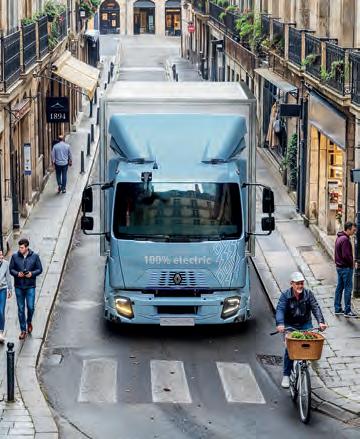
the vehicle can charge overnight or between shifts, there are real opportunities,” says Iain Latimer, Dealer Principal at Diamond Trucks. “The important thing is doing the groundwork first, looking at the routes, the loads, the charging and how the vehicle will fit into the operation.”
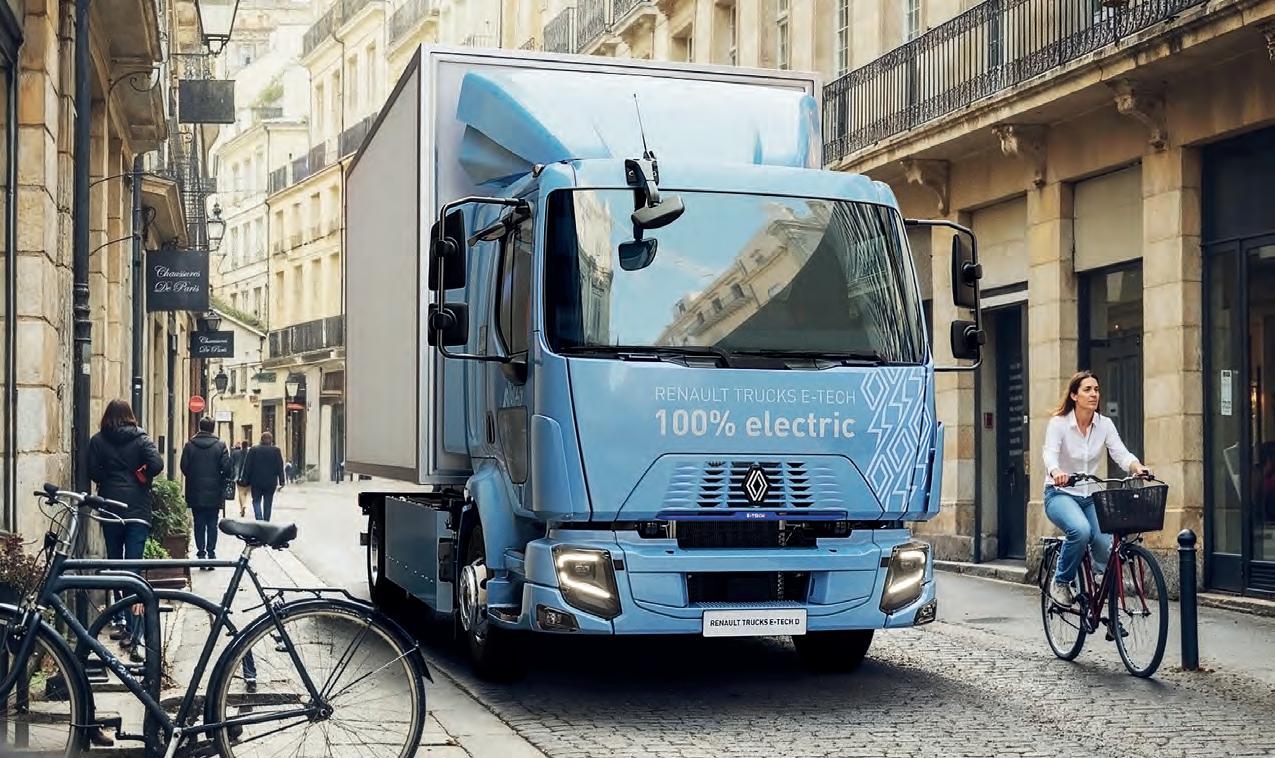
That makes Renault Trucks’ E-Tech a strong fit for local distribution, pallet networks, municipal
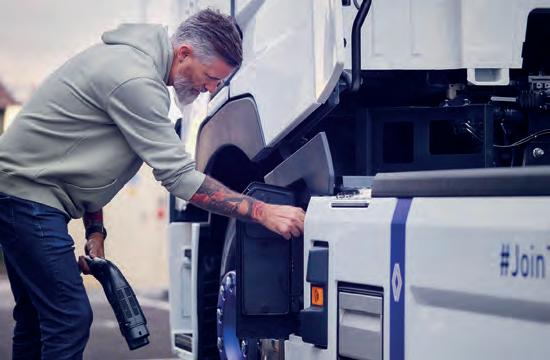
work, construction supply, temperaturecontrolled deliveries, retail distribution and multidrop routes. These are the types of operations where vehicles are doing useful daily mileage, but are not necessarily away from base for days at a time. They can be charged at depot, scheduled around known delivery patterns and supported through planned maintenance.
Available across the 14 to 26 tonne rigid sector, the E-Tech D and E-Tech D Wide sit at the heart of that opportunity, giving operators electric options for the urban and regional work that is common across Ireland and Northern Ireland. For fleets operating into towns, retail sites, depots, construction locations or customer premises where noise and emissions are increasingly under scrutiny, the benefits are practical as well as environmental: quiet operation, zero tailpipe emissions, smooth driveline performance and a modern cab environment for drivers.
For long haul, technology is moving forward at pace as Renault Trucks pushes electric into the core 6x2 tractor segment with new E-Tech models built around an integrated e-axle. Here, the electric motors and transmission are positioned at the rear axle, allowing battery capacity to be distributed along the chassis more efficiently.
The line-up includes the E-Tech T585 6x2, offering up to 460km of range, and the E-Tech T780 6x2, extending that to up to 600km,
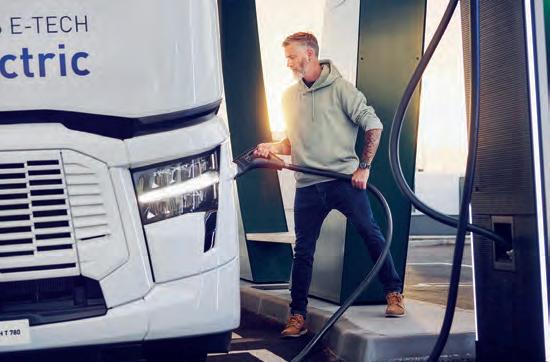

alongside the E-Tech T540 4x2 for regional work. Renault Trucks has been delivering electric trucks into real-world customer fleets since 2020, with customers now covering more than 111 million electric kilometres across the UK and Europe. That experience underpins its message to operators: electric is no longer an unknown, but it does need to be planned properly.
GRANTS STRENGTHEN THE CASE
For UK operators, the latest funding support gives operators another reason to revisit the numbers. Under the UK government’s Zero Emissions Truck and Van Grant, the heaviest eligible vehicles can receive support of up to £81,000, while the Depot Charging Scheme is designed to help businesses install the charging infrastructure needed to support electric vans, coaches and HGVs at base.
For Renault Trucks, the value is not just in the headline saving. It is in helping operators move from interest to action, with support available on vehicle specification, grant applications, funding routes and charging strategy. Renault Trucks can also help manage the vehicle grant process, with eligible funding reflected in the price paid by the operator, rather than leaving fleets to navigate the paperwork alone.
“Grants can make a significant difference to the business case, but they are only part of the picture,” says Roger Clarke. “That is where Renault Trucks, working with partners such as Diamond Trucks, can add real value. We help operators look at their fleet, identify the right applications, support the grant process and put the right vehicle and charging plan in place.”
LOCAL SUPPORT, BACKED BY RENAULT TRUCKS EXPERTISE
Diamond Trucks is already working with operators exploring electric vehicles from its Mallusk site, backed by Renault Trucks’ wider dealer and authorised service network. With investment in EV capability, including
technician training and charging facilities, the business is giving operators confidence that the support around electric trucks is developing alongside the vehicles themselves.
For Iain Latimer, the conversation with customers has changed as the commercial case has improved. “The grant support is important because it changes the conversation,” he says. “For some operators, electric has previously felt too far away commercially. Now, if the routes, loads and charging work, it is becoming a much more viable option.”
Just as important, he adds, is the groundwork behind each vehicle. “We can work with Renault Trucks’ energy transition specialists to look at route analysis, load simulations, charging and the practical detail that gives customers confidence.”
That early analysis can include reviewing an operator’s routes, daily mileage, dwell time, payload requirements and charging options before any vehicle is specified.
CUTTING THROUGH THE JARGON
Renault Trucks is also helping operators get to grips with electrification through its ‘Zeroing
In’ video series, a free resource created for fleet decision makers who want clear, practical answers on electric trucks. Launched last year and led by Renault Trucks’ own electromobility experts, the series is designed to cut through the jargon and explain what operators need to know before making the move.
The videos tackle the questions hauliers are already asking, such as: how to work out whether an electric truck will suit a route, what charging infrastructure is needed at depots, how range and payload should be assessed, what the driver needs to know, and how electric vehicles fit into day-to-day fleet planning. Episodes are available through Renault Trucks UK’s social media channels and the dedicated Zeroing In online hub.
As Clarke concludes: “Electrification does not mean replacing a whole fleet at once. It can begin with one vehicle, one depot, one customer requirement or one route where the conditions are right. The operators that engage now will build knowledge and confidence, and that learning will become increasingly valuable as the market develops.”
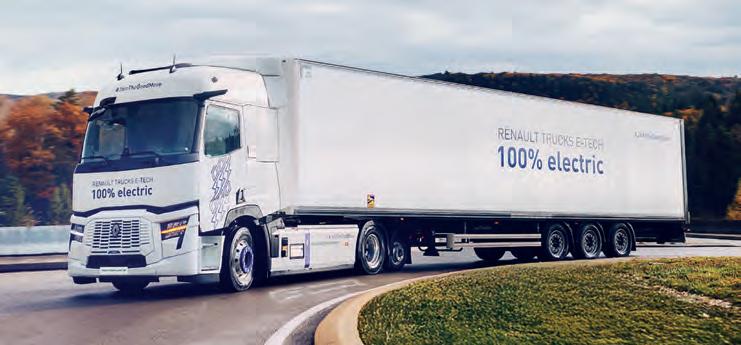
FREEBURN PREPARES FOR E-TECH T ARRIVAL
Freeburn Transport is preparing to put its first fully electric truck into service, with a new Renault Trucks E-Tech T tractor unit supplied by Diamond Trucks.
The County Tyrone haulier showcased the vehicle on the Diamond Trucks stand at RTX Northern Ireland and is working closely with Renault Trucks and Diamond Trucks on route modelling, charging plans and driver training before the truck enters operation.
The E-Tech T is expected to be used initially on trunking work, moving trailers between Freeburn sites, before being introduced more widely as
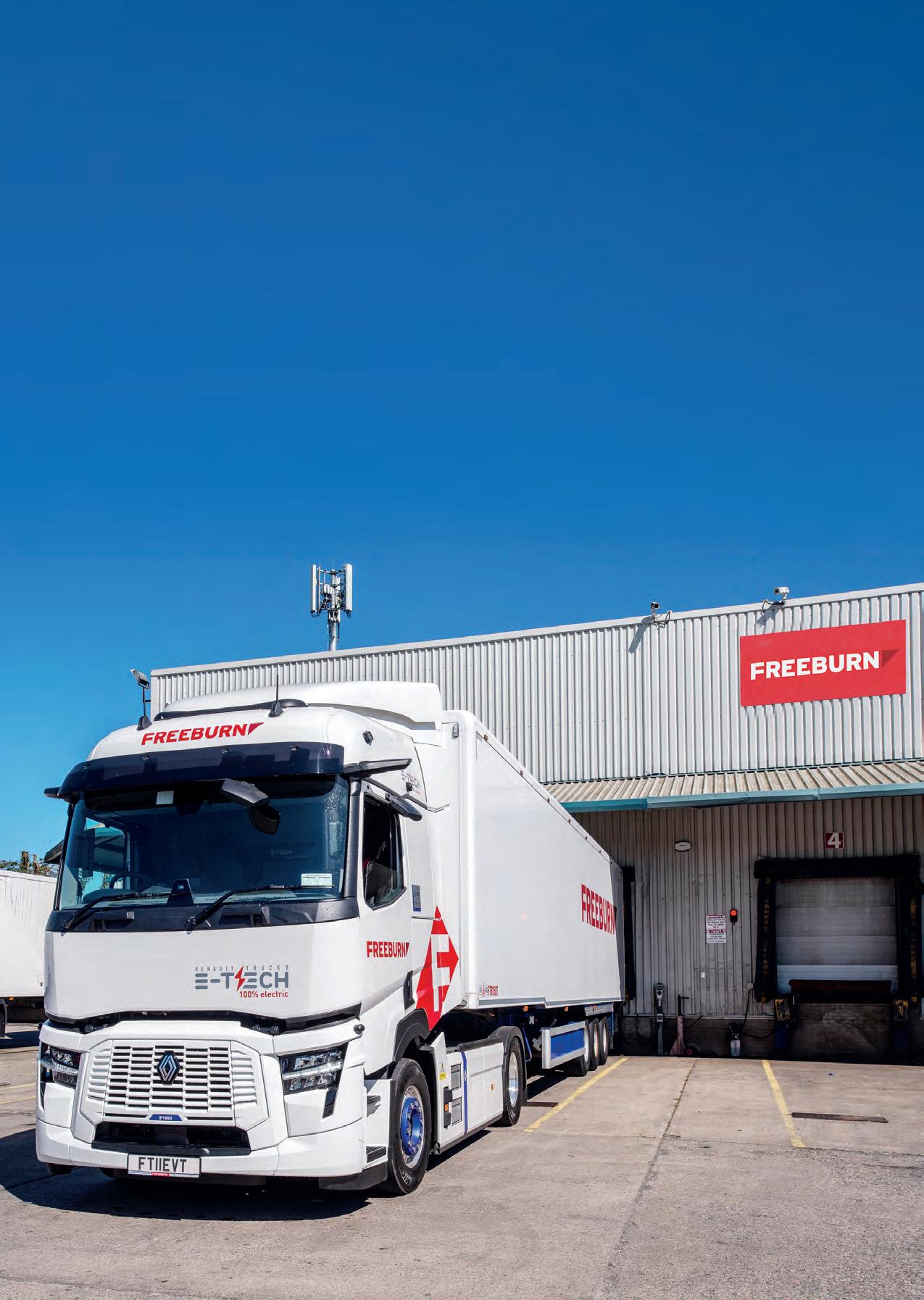
the business builds real-world experience of electric operation. The vehicle is planned to be based near Ballygawley, where an 80kW charging setup is expected to charge the truck in around five hours.
Richard Lee, Operations Manager at Freeburn Transport, says the new vehicle marks an important first step for the business. “Electric is where things are going, and we have
had interest from customers, particularly in retail. Working with Renault Trucks and Diamond Trucks has helped us look at where electric could fit into the operation, and when the opportunity came up to take the E-Tech T, it felt like the right time.”
But he is clear that the E-Tech T is not simply there to make a statement. “There is no point having it as a showpiece,”
adds Richard. “We want to see what it can do.”
Freeburn, headquartered in Moy, operates across the UK, Ireland and Europe, with services spanning ambient, chilled, groupage, warehousing, customs clearance and distribution.
If the E-Tech T performs as expected, Richard says success would mean “more of them”, with the potential to add electric trucks and charging infrastructure at other depots. Coming soon: big news on Freeburn Transport’s move into electric operations.
028 90 837171
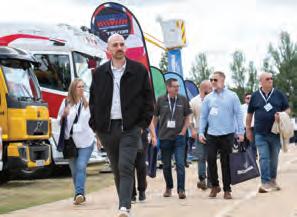
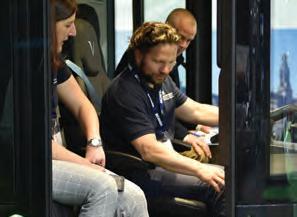

RTX 2026: THE BIGGEST AND BOLDEST YET!
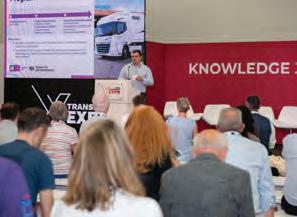
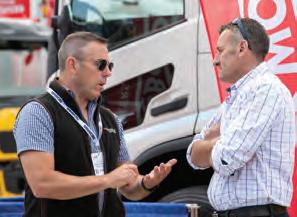
As the pressure on UK road transport operators continue to intensify, one event has firmly established itself as the place to see what’s new, ask direct questions and compare solutions side by side: Road Transport Expo (RTX) returns to NAEC Stoneleigh from 30 June to 2 July 2026, marking its fifth consecutive year and promising its most ambitious outing to date.
Since its launch in 2022, RTX has grown rapidly from a new entrant on the exhibition scene into a fixture of the commercial vehicle calendar. Its rise reflects a clear demand from operators for an event that focuses on real-world operation - a place where fleets can see vehicles, equipment and systems working as they would on the road.
The brand has also expanded adding RTX Scotland, which debuted in November 2025 and RTX Northern Ireland – which took place just a few weeks ago at the Eikon Centre, Lisburn. And further expansion is planned in 2027 with the addition of RTX Ireland, taking the place of RTX Northern Ireland on an alternate year rota basis.
Attendance has increased year on year, with more than 14,000
visitors attending last year’s threeday show. Organisers expect 2026 to surpass that figure as fleet operators, workshop managers and logistics professionals look for practical guidance during a period of continued change.
RTX show director Vic Bunby believes this year’s event could not come at a better time for the industry: “Fleet operators are under pressure from every direction, whether that’s increased costs, compliance or technology change,” he says. “RTX brings the industry together in one place, giving operators hands-on access to solutions, straight answers from suppliers and the confidence to invest in what they know will work on the road.”
A VENUE DESIGNED FOR TRUCKS
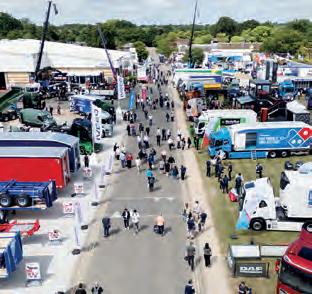
RTX has made a successful home at NAEC Stoneleigh. The venue’s combination of expansive outdoor space and flexible indoor halls makes it particularly well suited to the commercial vehicle industry. Visitors can move seamlessly between compact urban delivery vehicles, longhaul tractor units, trailers and infrastructure solutions. Charging and fuelling equipment, workshop layouts and safety systems can be viewed in situ, helping operators understand how new technology might fit into their own depots. Stoneleigh’s central location, strong road connections and free parking make it a practical
destination for fleets travelling from across the UK, whether attending for a morning visit or spending a full day at the show.
JOIN RTX THIS SUMMER!
Registration for RTX 2026 is free for all industry professionals. Operators are encouraged to secure their place early at what promises to be one of the most important transport events of the year.
Register now at: roadtransportexpo.co.uk
SDC RETURNS TO RTX STONELEIGH FOR FIFTH CONSECUTIVE YEAR
SDC Trailers will return to the Road Transport Expo at Stoneleigh from 30 June to 2 July, exhibiting for the fifth consecutive year and presenting a focused display of four trailers that reflect the strength and versatility of its product range.
The manufacturer’s semi-trailer line-up includes a pallet network double deck, specified with galvanised decks and wraparound curtains for enhanced durability and operational efficiency.
Also on show is a 4.5m SDC postless curtainsider, equipped with the latest trailer technology to support performance, compliance, and ease of operation.
To complete SDC’s showcase, the curtainsider will be loaded with a further two trailers – an SDC extending platform and SDC extending skeletal – demonstrating the flexibility and
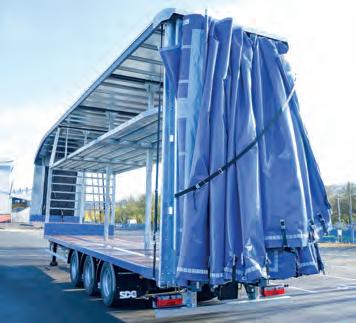
breadth of the manufacturer’s engineering capability and large trailer product portfolio.
With a long-established reputation for trailer design, manufacturing quality and aftersales support, SDC continues to work closely with customers across the road transport and logistics sector to develop trailers that meet
the demands of modern fleet operations.
SDC Truck & Trailer Parts will also be represented at RTX, with the aftermarket team spotlighting Arisun Tyres by ZC following SDC Parts’ announcement as distribution partner for Arisun Tyres across the UK and Ireland.
Paul Bratton, SDC President, said:“RTX is always a valuable opportunity to meet with customers, operators and industry partners from across the transport sector. This year’s display brings together four trailers that showcase the strength, versatility and engineering capability of the SDC product range. We look forward to welcoming our customers at what is set to be another well-attended event.”
From high-capacity pallet network operations to specialist platform and skeletal requirements, SDC RTX show display highlights the company’s ability to support operators with robust, reliable and adaptable equipment.
Visitors can see SDC Trailers and SDC Truck & Trailer Parts at Road Transport Expo, Stoneleigh, from 30 June to 2 July on stand B20.
VOLVO LAUNCHES NEW ELECTRIC TRUCK WITH MASSIVE 700KM RANGE
Volvo Trucks has set a new benchmark for heavy-duty trucks with the launch of its latest electric models with improved performance, flexibility and ranges up to 700 km.
The manufacturer is already a global leader in the electric heavy goods vehicle segment, with one of the largest electric truck line-ups in the industry. The company has now improved its offer further with some ground-breaking new additions.
First, a new long-distance electric truck, the FH Aero Electric with extended range, capable of driving up to 700 km on one charge* – a significant breakthrough for heavy electric trucks.
Second, the next generation heavy-duty Volvo FH, FM and FMX Electric trucks, with major improvements in flexibility, productivity, driving comfort and with ranges up to 470 km* – making it possible to switch even more transport assignments to battery-powered drivelines.
Roger Alm, President, Volvo Trucks, says:
“We’re really sharpening our offering here. We are broadening it and making electric solutions possible for an even wider range of transport assignments, and also adding a cutting-edge electric truck with a range of up to 700 km. This means we can fully match the business needs of our customers. It has never been easier to replace diesel trucks with electric ones.
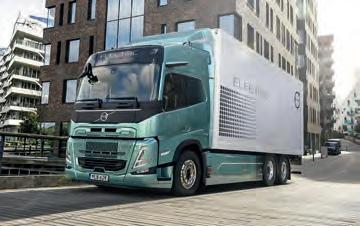
“We stand firm in our belief that electric vehicles will deliver a large part of the world’s truck transport in the future. With the amazing performance of all our new trucks, it’s easy to see why.”
The new Volvo FH Aero Electric with extended range can drive up to 700 km on one charge thanks to a new driveline technology, the e-axle, which creates space for significantly more battery capacity onboard.
The truck is adapted to the new MCS (Megawatt Charging System) standard and can charge eight batteries from 20% to 80% in approximately 50 minutes. This charging can be done within the
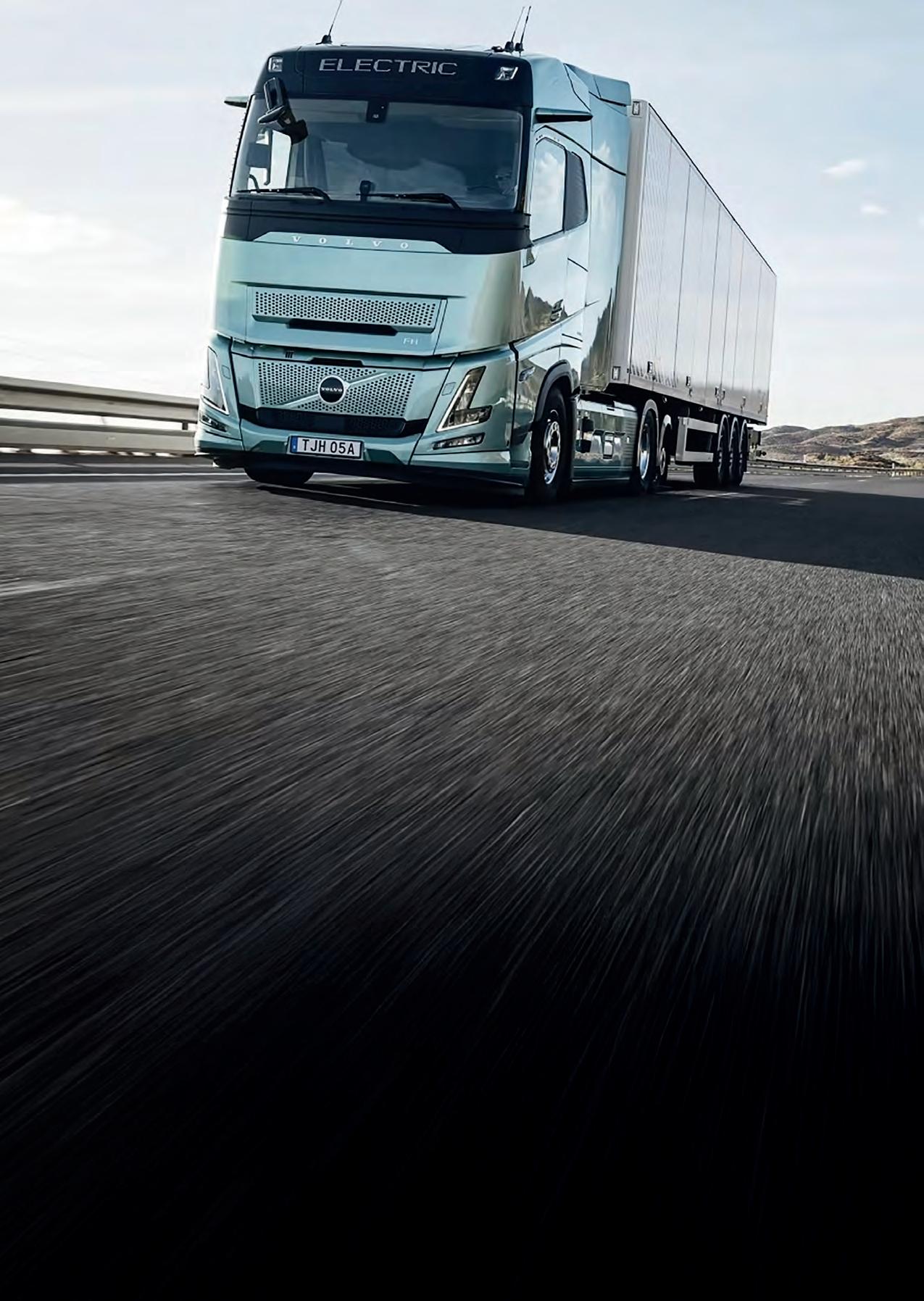
legislated rest period for truck drivers in the EU, improving productivity.
“This long-haul electric truck is the best in the industry. It offers an outstanding range in combination with high payload, fast charging and great riding comfort.
With this truck, our customers can drive really long distances and throughout an entire working day with the same productivity as diesel trucks,” says Alm. Seamless gear shifting with all-new trucks
All the new trucks are equipped with a gearbox optimised for electric transmission paired with dual motors to deliver smoother and more controlled performance. The new powershift gearboxes – eight-speed on the new Volvo FH, FM and FMX Electrics and six-speed on the FH Aero Electric with extended range – offer seamless gear shifting and also produce less noise and vibration for a more comfortable workday.
The new trucks will be rolled out stepby-step to markets starting in 2026.
*Range depends on external conditions such as weather and wind resistance, as well as factors such as total weight of the truck and the driver’s performance.

SCANIA TO SHOWCASE ITS LATEST VEHICLES AT RTX STONELEIGH
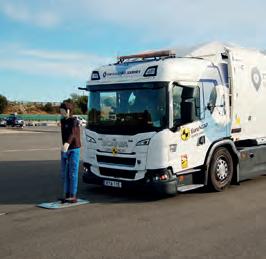
Scania is back at Road Transport Expo for 2026. This year the UK team will be showcasing its current generation of vehicles – from the fuel-efficient Super in 11- and 13-litre forms right through to the mighty V8 range.
While those operators looking to move towards renewable fuel options, will be able to get close and personal to Scania’s R460 6x2*4 CNG powered truck – the first gas variant with three full axles. For those looking for zero emission solutions, Scania’s latest battery electric options will also be on display, as will sibling company Erinion – who will be showcasing how they are making installing truck charging infrastructure a reality for customers across the UK. And finally, straight from Sweden after featuring in Scania and Red Bull’s viral video, which saw mountain biker Matt Jones jump between two trailers pulled by self-driving trucks in the opposite directions, is one of the autonomous trucks.
It will be on display for everyone to take a closer a look at. Take the opportunity to see all the cameras and sensors fitted to the truck to help the truck see while it’s driving autonomously.
TOP OF THE CLASS –SCANIA’S L-CAB LEADS THE WAY WHEN IT COMES TO TRUCK SAFETY
The Scania L-Cab 4x2 rigid chassis has achieved the highest overall score in the latest round of Euro NCAP’s Safer Trucks Programme. Scania’s low-entry cab scored 90% and was praised by Euro NCAP’s testers for boasting exceptional direct vision and for robust safety equipment ensuring it is a leader in
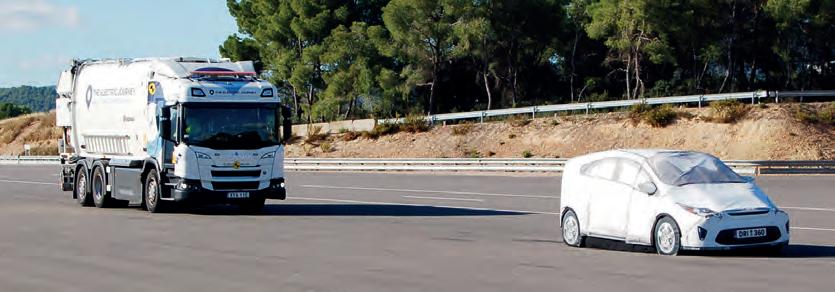
all-round protection when specified with full safety equipment options.
It joined three more Scania trucks in achieving a five-star rating in Euro NCAP’s impartial safety tests.
These included Scania’s L-cab 6x2 refuse truck, which received Euro NCAP’s top rating in January 2026, and a pair of P-cab trucks in 4x2 distribution and 6x2 utility forms.
Lars Gustafsson, Head of Trucks at Scania CV AB, said: “The L-cab high rating is another strong validation for Scania, especially considering it received Euro NCAP’s maximum rating for direct vision.
“To see our P-cab follow suit and receive the same high rating as our L-cab truck shows that safety is something we put our pride in.
“Our trucks deliver on our promise to not only have great comfort, but also safety that is on par with the highest standards of the Euro NCAP.
“Safe trucks are vital given the importance transport has
in society. The safety of road users is something we always keep in mind while developing new transport solutions.”
The P-cab is one of Scania’s most versatile cab types. It’s ideal for urban and regional operations and is often chosen by operators for construction, and other demanding jobs. A robust choice that allows drivers to sit high enough to get a good view of the traffic ahead.
The addition of Scania’s City Door also enhances visibility.
Alongside the five-star rating, the cabs also scored the highest mark in Euro NCAP’s CitySafe testing, which rates features on heavy duty vehicles designed to prevent accidents in urban environments.
With its low cab position and corner-eye camera system, the cabs give the driver high visibility of vulnerable road users.
This recently updated accident prevention system achieved an overall score of 93% on Euro NCAP’s testing, which is a testament to the high performance and reliability of Scania’s active safety technology. Scania’s advanced driver systems, which includes frontal collision mitigation, lane departure prevention, and Vulnerable Road User Brake Side (VRUBS), which protects cyclists during turning manoeuvres, delivered excellent results, with the latter achieving an 100% score.
Matthew Avery, Director for Strategic Development at Euro NCAP, said: “It is great to see Scania leading the way in safety by producing safer trucks for the city environment and in so doing protecting Europe’s more vulnerable road users – a real achievement.”
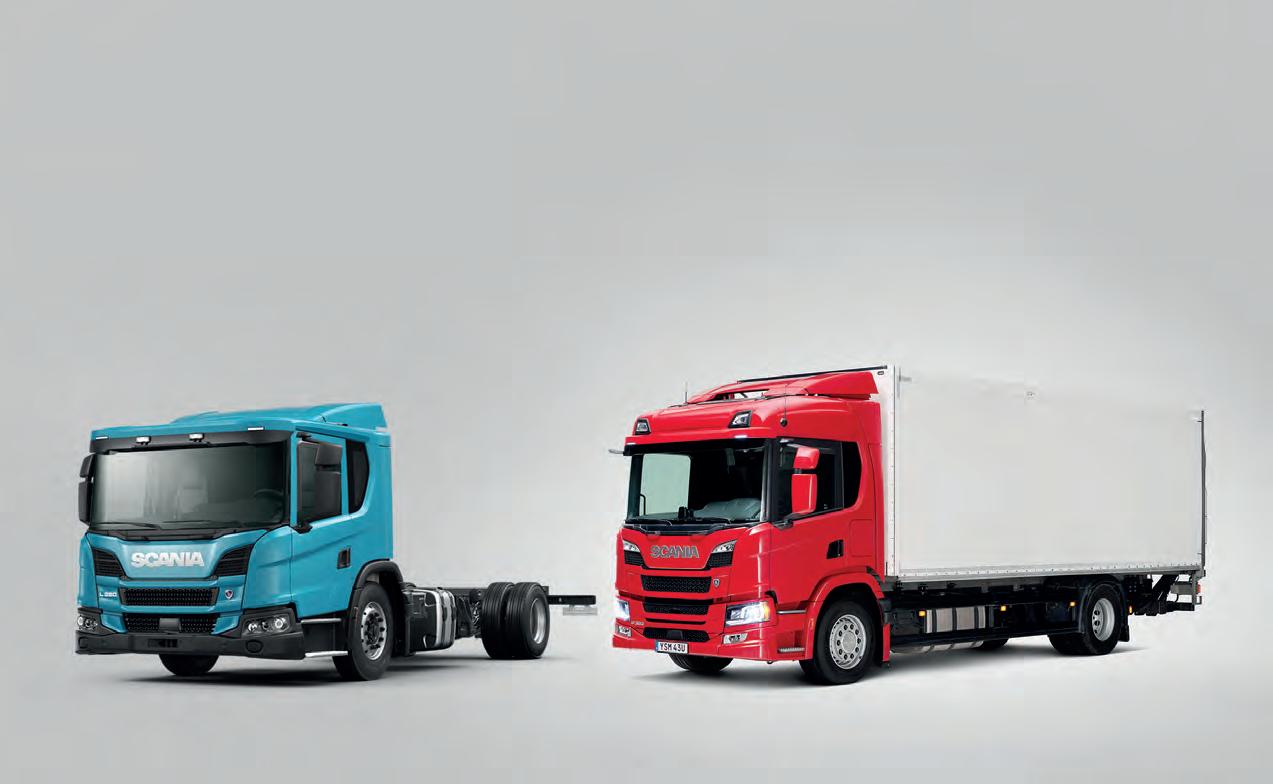
A NATURAL WONDER

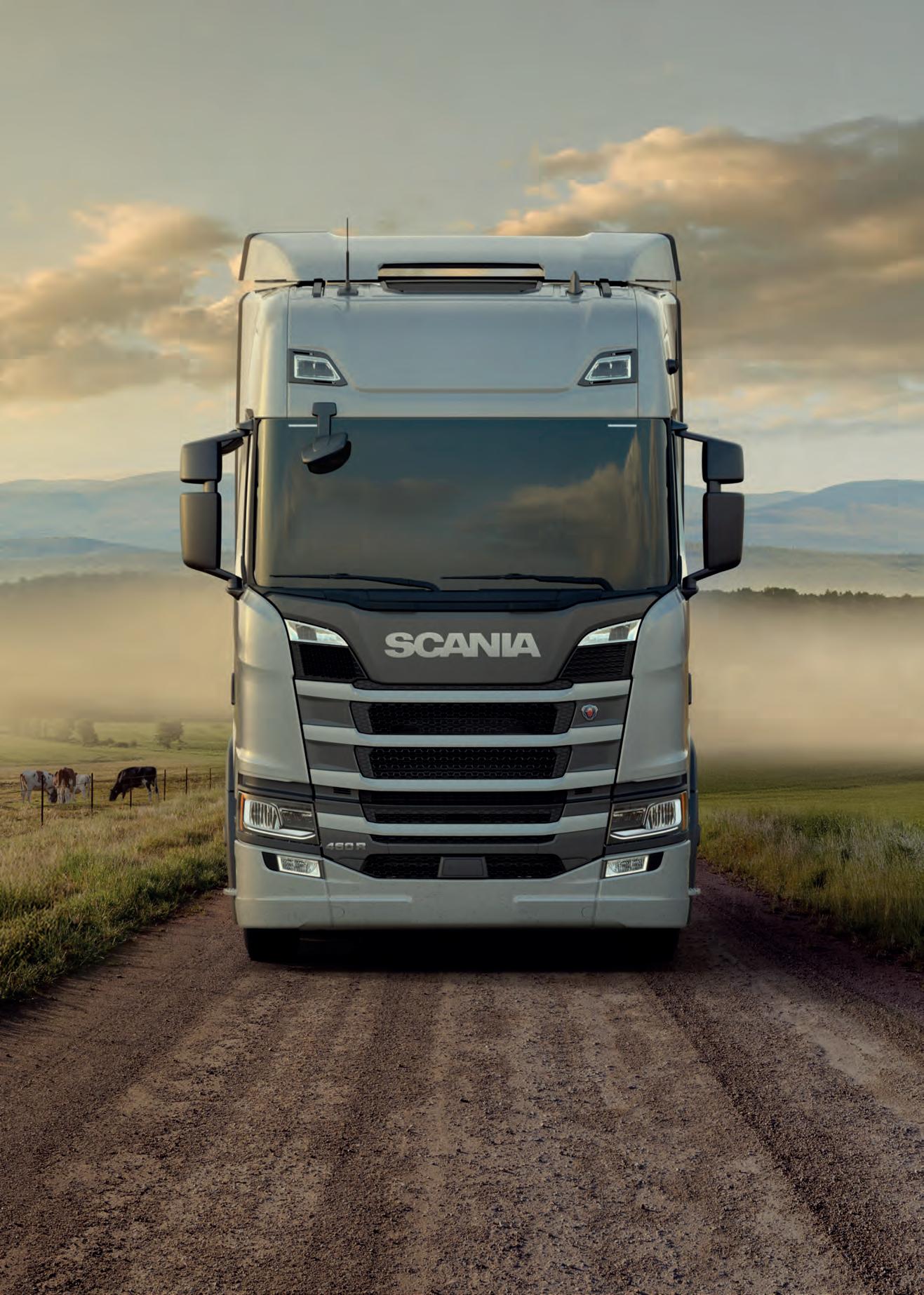
Biogas is one of the most climate-smart fuels we have – locally produced from food waste, manure and sewage. When you drive on biogas, you can reduce your carbon dioxide emissions by over 100 percent. Scania’s gas trucks offer a range of up to 1,800 kilometers and the power required for everything from urban distribution to construction and long haulage transport, making it easy to take the step. By choosing biogas, you open the door to more of tomorrow’s businesses and contribute to a more sustainable transport system.

POWERED BY BIOGAS

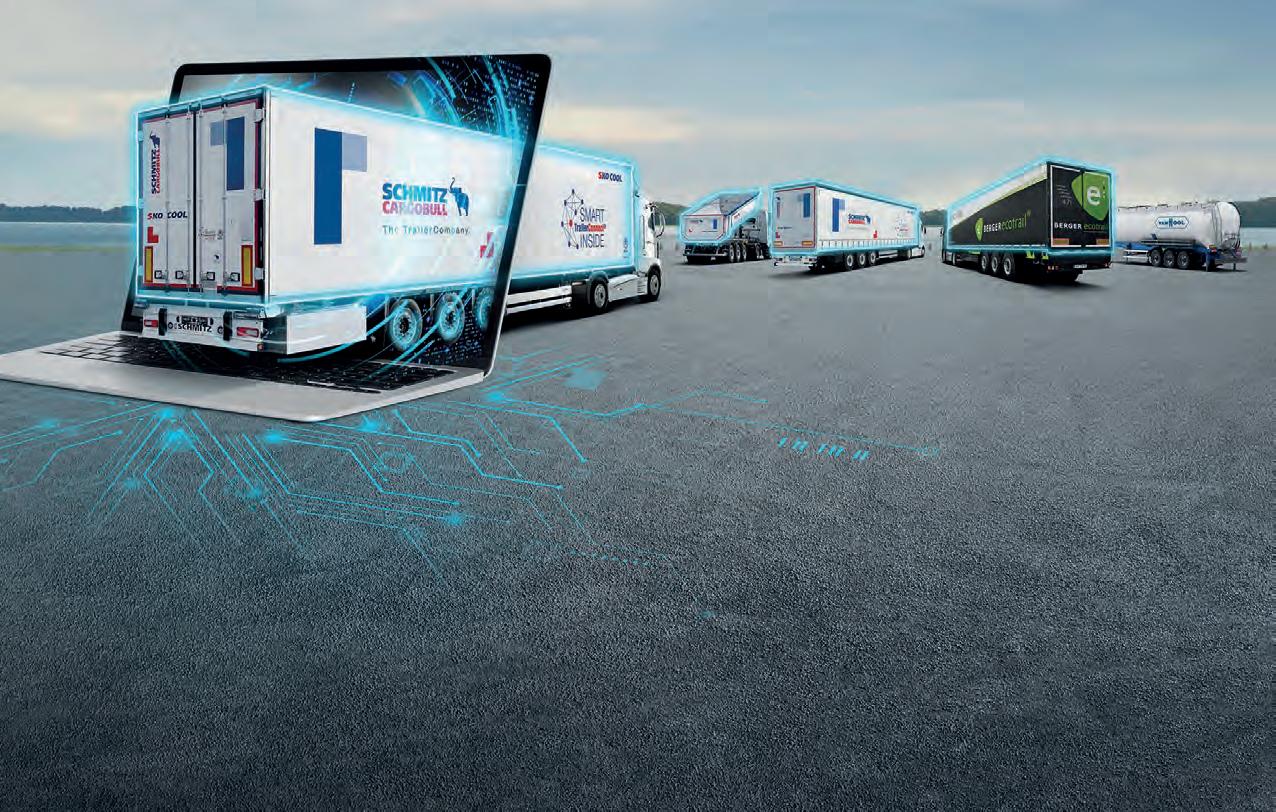
SCHMITZ CARGOBULL FIRST TRAILER MANUFACTURER TO OFFER A CERTIFIED TRAILER TELEMATICS SYSTEM FOR TÜRKIYE
Leading trailer manufacturer Schmitz Cargobull has started offering its proven TrailerConnect® telematics system in a version certified specifically for the Turkish market. This provides transport companies operating in Türkiye or engaged in cross-border transportation with a fully approved and reliable solution for digital monitoring and control of trailer fleets.
Schmitz Cargobull equipped the product ranges with the TrailerConnect® telematics system as standard. The telematics system and its various services are tailored to the specific requirements of each transport task and vehicle. To date, more than 305,000 telematics units have been sold.
However, approval in individual countries requires compliance with country-specific regulatory requirements. In Türkiye, specific regulations governing the operation of telematics systems; these include the mandatory use of Turkish SIM cards and the transmission of data through servers controlled by national authorities.
“With the country-specific adaptation of TrailerConnect®, we guarantee the use of fully compliant and high-performance telematics for our customers in Türkiye,” says Dr. Cafer Ince, Head of Product Line Digital Services at Schmitz Cargobull. “Compliance with BTK (Information and Communication Technologies Authority) requirements gives transport companies the necessary assurance to efficiently manage their fleets with real-time data and reliably meet all legal requirements.”
SCHMITZ CARGOBULL TÜRKIYE HAS GROWN STEADILY SINCE 2017
Kerem Tas, Managing Director of Schmitz Cargobull Türkiye, highlights the continuous growth of the plant in Sakarya-Erenler, which has been in operation since 2017. He emphasises that the product portfolio is being continuously expanded every year through new projects and developments.
“Today, the plant is one of only two Schmitz Cargobull plants worldwide that produce Schmitz Cargobull axles. It is also the only plant manufacturing Schmitz Cargobull container
chassis for markets worldwide,” says Tas. Murat Tokatlı, Head of Sales and Marketing at Schmitz Cargobull Türkiye, highlights the strong performance of the Turkish semi-trailer market in recent years.
“Our S.CU transport refrigeration units are designed for all types of transport. With over 38,000 units sold, we are underlining our strong position in temperature-controlled transport and the cold chain. Furthermore, according to data from the Turkish Heavy Commercial Vehicle Manufacturers’ Association (TAID), the preference for two out of every three refrigerated semi-trailers sold in Türkiye has remained unchanged. This confirms that Schmitz Cargobull has been consolidating its leading position in this sector for years,” adds Tokatlı.
INCREASED EFFICIENCY, SAFETY AND SUSTAINABILITY
TrailerConnect® collects all relevant information from the trailer and transport refrigeration units – including position, EBS data, tyre pressure, door status, temperature data and other technical parameters – and transmits it to the TrailerConnect® portal in real time. This provides dispatchers with a reliable data set to make optimal use of capacities and avoid empty runs. Individual alarms and configurations in the portal make it easier to control the entire fleet. In the event of deviations from predetermined routes or safety-related incidents, those responsible are promptly notified, significantly enhancing operational safety. At the same time, better trailer utilisation and reduced empty trips enable companies to operate more efficiently and with lower emissions.
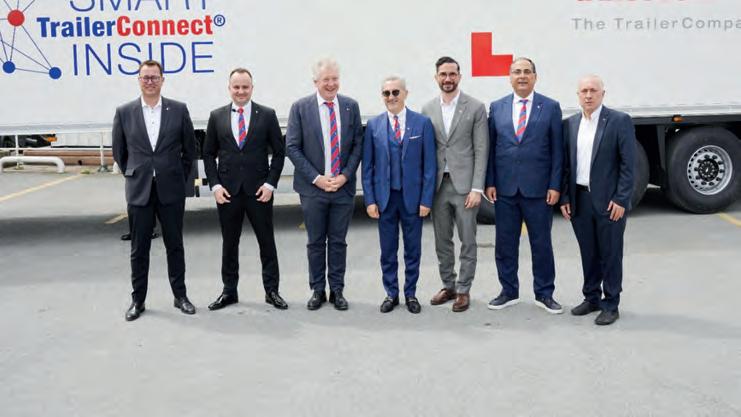
(Pictured from left) Dominik Henne (Director Procurement, Schmitz Cargobull AG, Ibrahim Sari (Product Marketing Manager, Schmitz Cargobull Türkiye), Andreas Schmitz (CEO, Schmitz Cargobull AG), Kerem Tas (Managing Director, Schmitz Cargobull Türkiye), Dr. Cafer Ince (Head of Product Line Digital Services, Schmitz Cargobull AG), Murat Tokatli (Head of Sales and Marketing, Schmitz Cargobull Türkiye), Mehmet Dinçer (Director Aftersales, Schmitz Cargobull Türkiye).

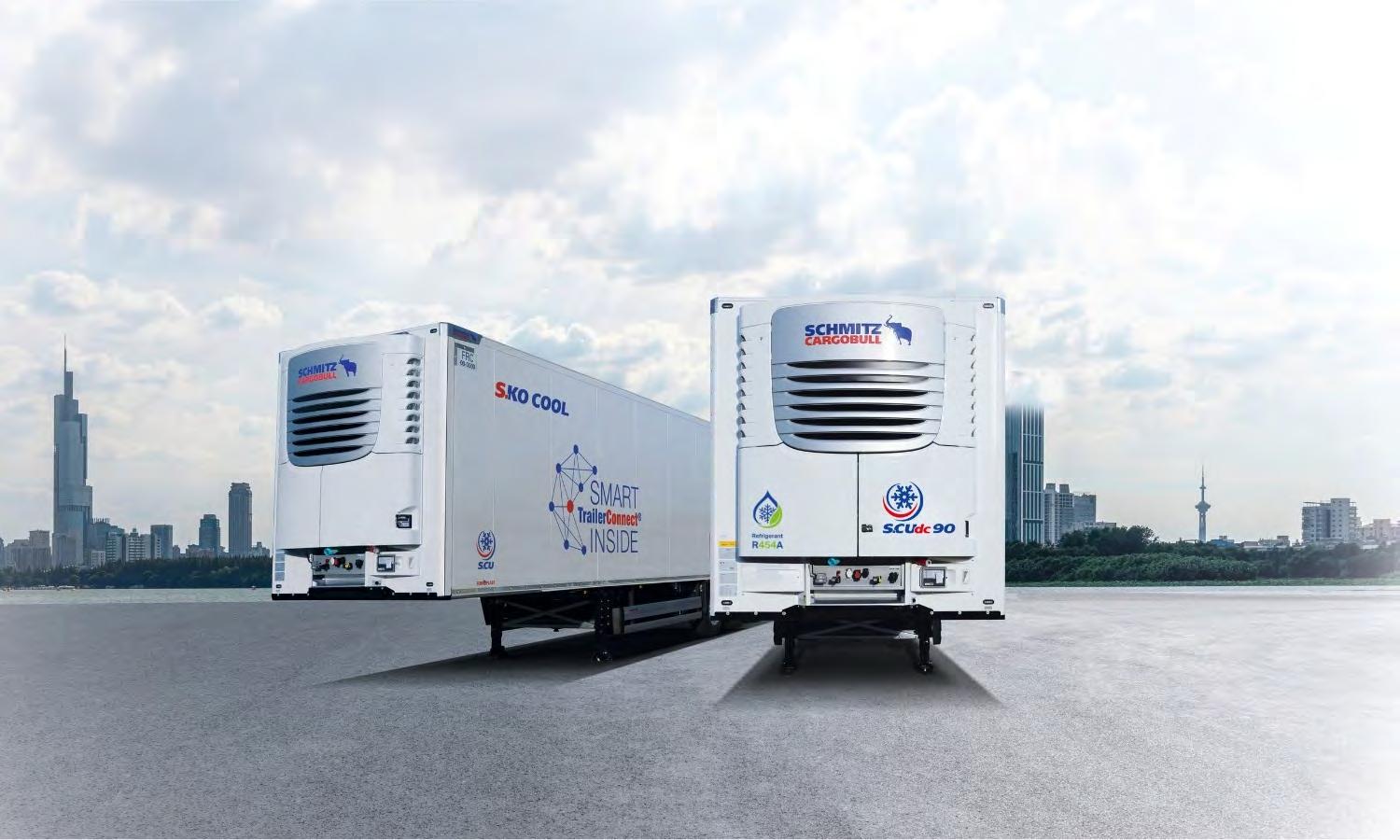
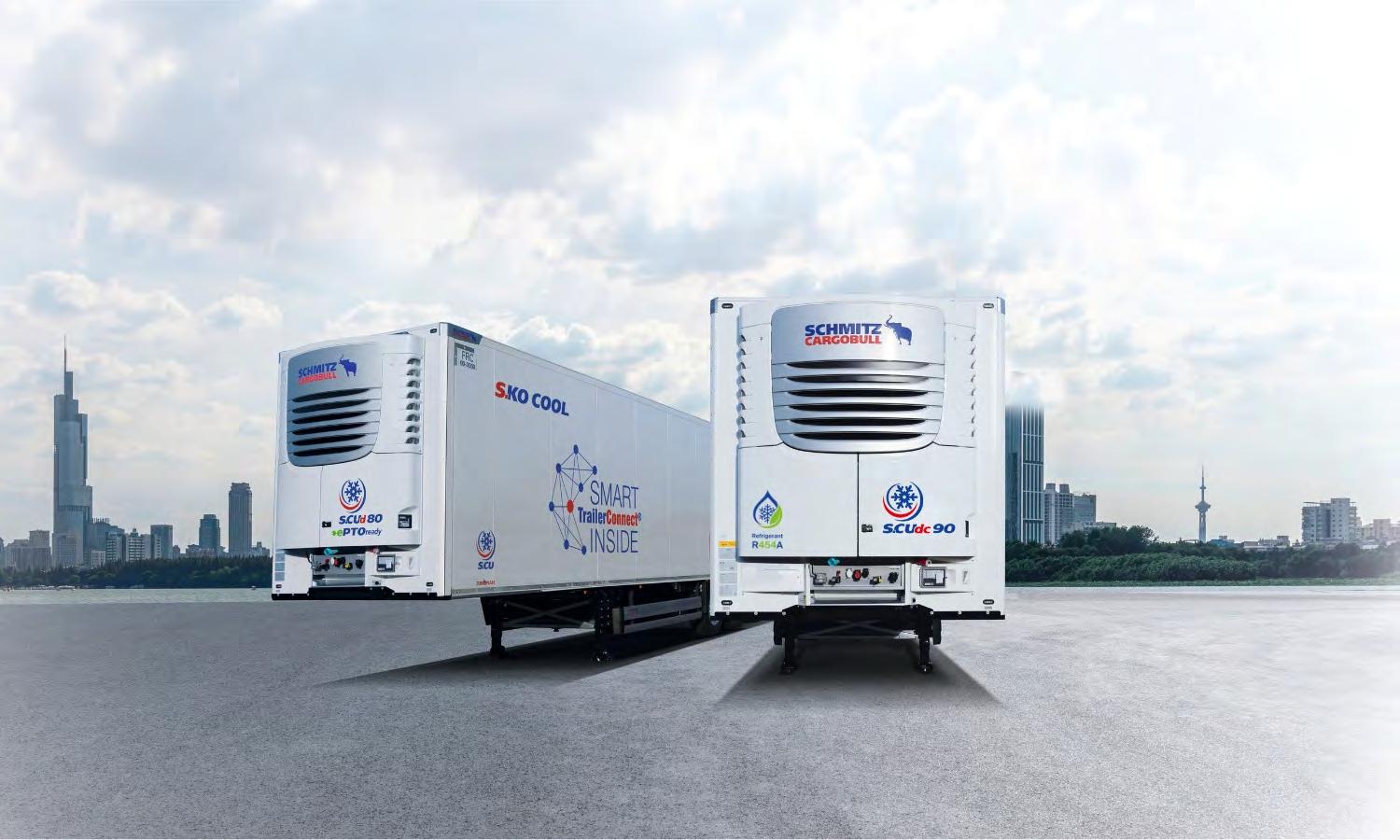
The new S.CU dc90 transport refrigeration unit
Schmitz Cargobull sets new standards in temperature-controlled transport with the new cooling unit. With up to 6%* more cooling capacity, 10%* lower fuel consumption and 89% less CO₂ equivalent thanks to the innovative refrigerant R454A, it offers a solution for efficient and environmentally friendly transport. Schmitz Cargobull is the first manufacturer to use R454A as standard in its S.CU modular system – a strong sign of sustainable technology and responsibility in the transport sector.
* compared to the previous model S.CU dc85

DAF TRUCKS CELEBRATES Q1 EV MARKET LEADERSHIP WITH NEW PLUG-IN FINANCE DEALS
DAF Trucks has proudly assumed the position of EV truck market leader for Q1 2026, following a positive start to the year for electric vehicle sales. The title comes off the back of the successful DAF XG and XG+ Electric launch and coveted International Truck of the Year 2026 title for the DAF XD and XF Electric.
To celebrate DAF’s achievement in the electric truck marketplace, the manufacturer has unveiled a suite of limited-time-only finance deals across the XB, XD, XG Electric line-up. When combined with the government’s revitalised Zero Emission Truck Grant (ZETG), the offers make it even more attractive for operators to take either their first or next steps towards fleet decarbonisation. Every finance package is offered to customers as a Contract Purchase through PACCAR Finance. Working similarly to a passenger car PCP agreement, customers make monthly payments against the truck and receive a guaranteed future value, giving flexibility to decide whether to return the vehicle, extend the finance or purchase the truck at the end of the term.
To help operators and drivers build confidence with their new electric truck, all vehicles will come with the support of DAF Fleet Services, who provide triage services and VOR management to support uptime.
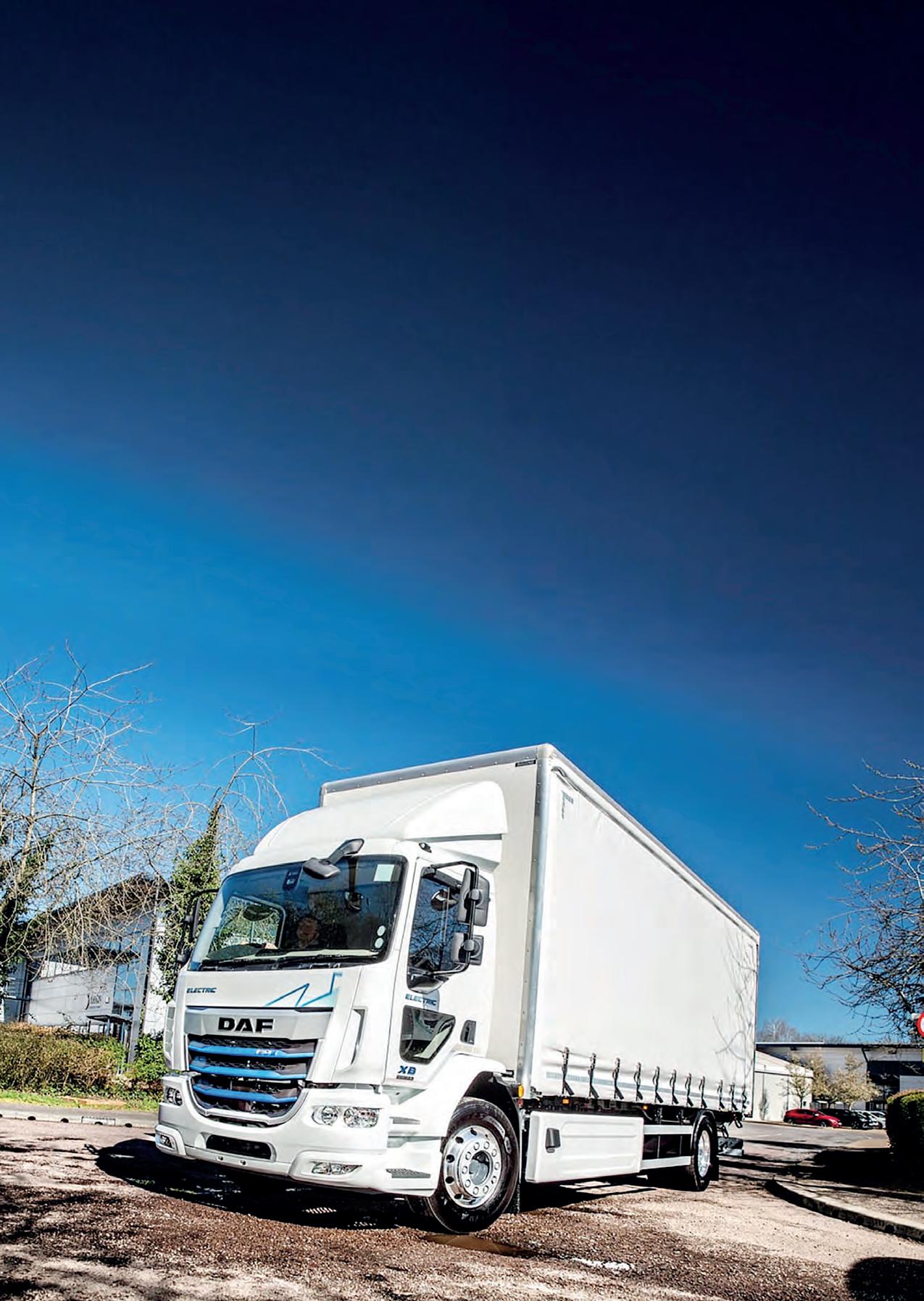
With high fuel prices presenting an ongoing challenge for haulage and logistics businesses, the new deals mean DAF’s medium duty offering, the 19-tonne XB Electric, could save operators almost £19,000 over the course of a 60,000km per annum, 60-month contract purchase*, compared to the combustion equivalent.
For DAF’s distribution-focused XD EV, TCO calculations show that the electric truck could save more than £23,000 over five years and 500,000 kilometres*, against a diesel XD. Fleets choosing the larger XG FTN EV could see savings in excess of £8,000 for the same contract specification*.
“Our electric truck range offers customers an opportunity to cap their diesel dependency and make inroads into fleet decarbonisation at a time of great uncertainty at the pumps,” said Louis Jones, EV & Connected Services Director at DAF Trucks. “Ending Q1 as UK EV market leader demonstrates that DAF is pushing forward with an attractive proposition for fleets in the urban, distribution and haulage sectors.
“DAF’s commitment to electric is reflected with our newly unveiled, limited-time finance deals. We want to make the road to decarbonisation as smooth as possible, and these packages are just one of the ways we’re helping to deliver that for customers.”
In addition to its diverse vehicle portfolio, DAF has a suite of complementary solutions that offer a near one-stop-shop approach to onboarding an electric fleet. One such example is PACCAR Power Solutions, who can supply an array of DC fast charging options – including the ChargeMax and PowerChoice – as well as a portable PacMobile charger capable of delivering 40kW continuously. All can be complimented with tailored service packages and can be installed alongside PACCAR Power Solutions’ Battery Energy Storage System (BESS). Acting as a heavy-duty battery bank, BESS locally stores energy on-site and allows operators to capitalise on lower tariffs, retain excess solar energy and maximise vehicle efficiency when recharging vehicles.
BPW LAUNCHING BRAKE TRAK PRO SAFETY PROGRAMME AT RTX
BPW Limited returns to the Road Transport Expo at NAEC, Warwickshire, from 30 June to 2 July, marking its fifth year.
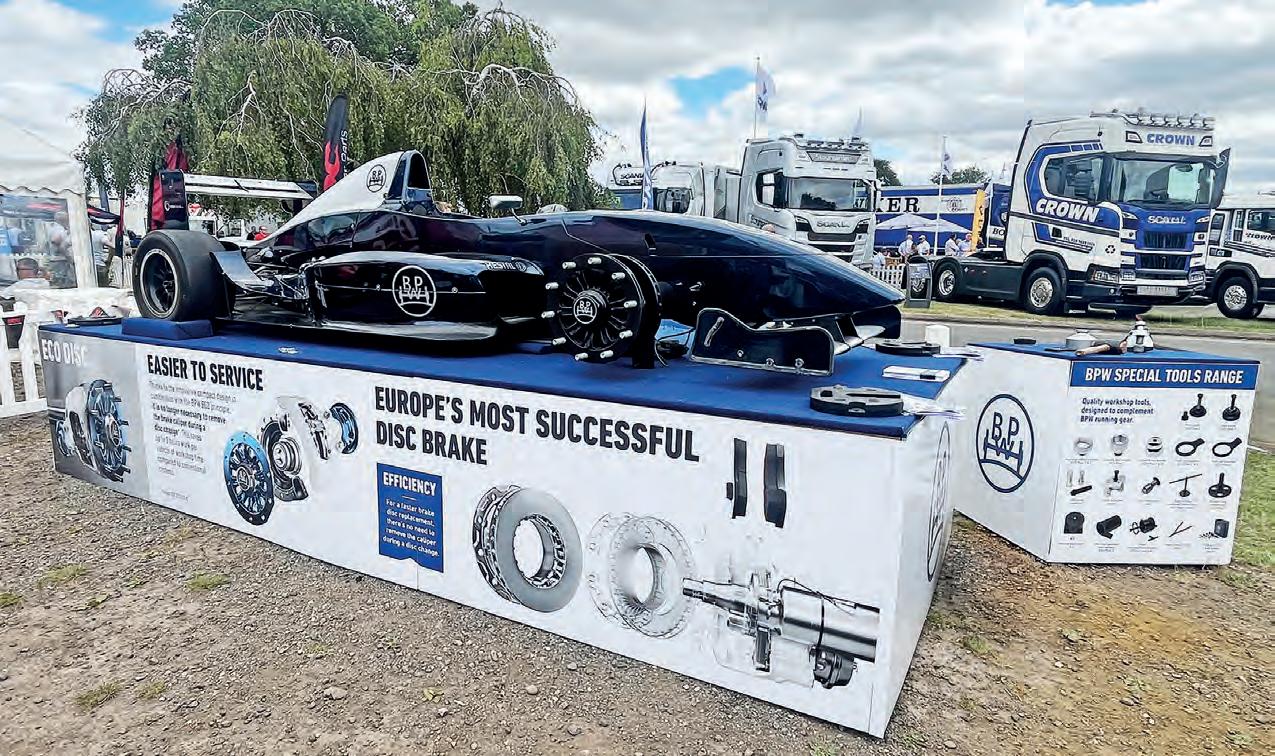
Highlights at this year’s show include the launch of BRAKE TRAK PRO, BPW idem’s new vehicle safety platform, and the impressive BPW tri-axle display. Visitors can also see BPW drum and disc brake options on its Formula Renault racing car, the BPW Airsave tyre inflation system, and ePower, the electric drive axle.
BRAKE TRAK PRO, launching at Road Transport Expo 2026, offers improved operational efficiency and meets compliance requirements. Alongside a DVSA-compliant electronic brake performance monitoring system (EBPMS), the platform features advanced safety solutions, including scalable options like a tyre pressure monitoring system (TPMS), brake lining wear sensors, and individual wheel station sensing. Together, these features ensure maximum uptime, lower
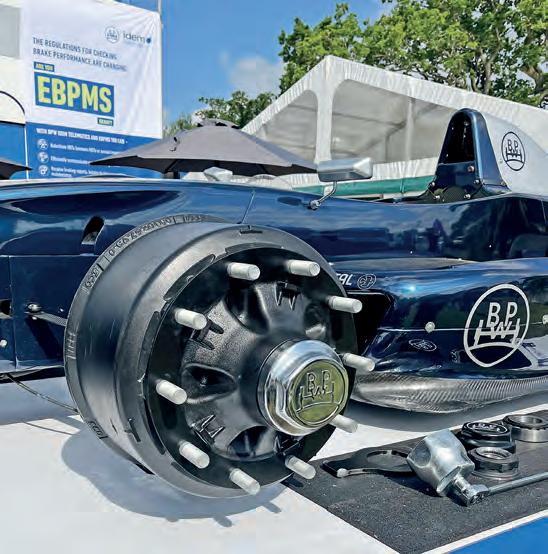
maintenance costs, and reliable, industry-leading performance without compromising safety.
Building on previous successes, the BPW Formula Renault racing
car returns to the show, featuring BPW’s drum and disc braking systems. Using the BPW Formula One principle, a live hub removal demonstrates how maintenance
is easier and more efficient. The team will be available throughout the show to discuss the benefits of drum and disc brakes and advise customers on the right braking system for their fleet.
BPW AirSave uses the trailer’s existing pneumatics to automatically maintain preset tyre pressure, improving safety, reducing fuel consumption, and lowering emissions. If a permanent pressure loss occurs, AirSave alerts the driver, helping to prevent accidents. Maintaining optimal tyre pressure ensures safer driving and lower fuel costs.
Finally, BPW ePower is an advanced electric power axle for refrigerated transport featuring dual generators that efficiently convert wheel rotation into energy. The energy is temporarily stored in a backup battery and used to support refrigeration, reducing fuel consumption and emissions. Don’t miss the opportunity to experience our innovations firsthand. Visit BPW Limited at stand B19 for live demonstrations, expert advice, and the latest news.

DAY-ONE READY: MODUL-SYSTEM STEPS UP NORTHERN IRELAND ENGAGEMENT
Modul-System is sharpening its focus on Northern Ireland’s utility, engineering and field-service sectors as operators face mounting pressure on efficiency, downtime and the transition to electric.
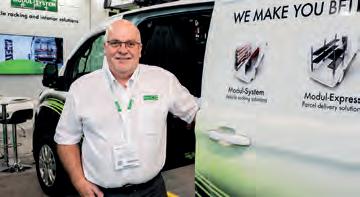
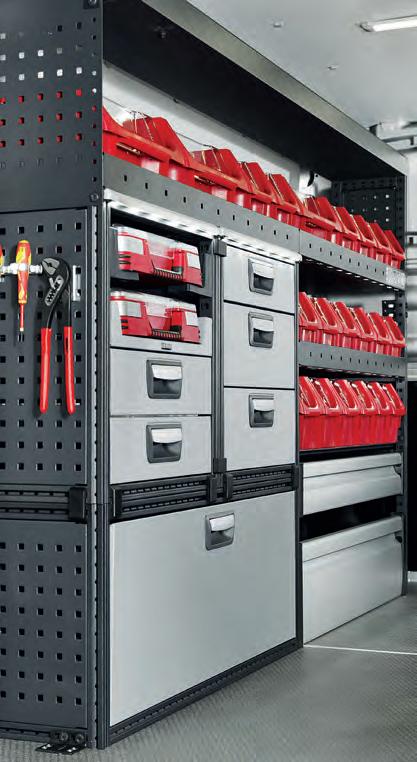
The Swedish manufacturer, building vehicle racking and conversion systems since 1970, sees Northern Ireland as central to the UK transition — a region managing mixed diesel and electric fleets, raising safety standards and chasing productivity across rural and urban routes. Leading engagement locally is Area Sales Manager John Dickey, who says operators now want integrated systems that directly improve performance.
“Operators here are no longer asking for shelving,” John explains. “They’re asking how to complete more work in a day. Whether a utility team out of Belfast or an engineering fleet running cross-border, every element of the vehicle has to justify its value. Every minute spent searching for equipment is a minute that cannot be billed.”
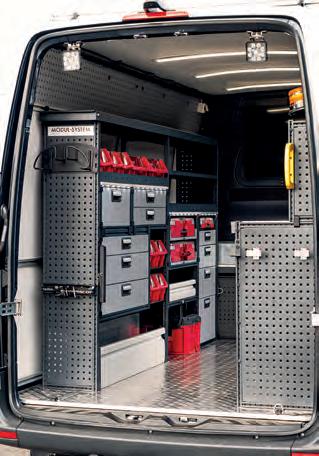
Northern Ireland’s fleet landscape leans heavily on gas, electricity, water, telecoms and plant maintenance — making payload optimisation, safe storage and rapid tool access central to vehicle design. John also points to growing concern over timber racking safety, which Modul-System’s crash-tested steel construction is designed to address.
Work Smarter Deliver Faster
The consultative approach runs deeper. ModulSystem recently hosted the first of a planned series of vehicle familiarisation days for SGN, bringing fleet managers, engineers and union representatives together to trial the latest diesel and electric vans before frontline service. Similar sessions are planned across Northern Ireland and the Republic of Ireland this year. Managing Director Kevin Walker calls it “dayone readiness, not week-six rediscovery,” and intends to make it standard practice. “Our relationship with customers is not transactional,” Kevins says. “It does not begin and end with fitting racking and electrical systems, however well engineered.
It is an ongoing partnership where we share responsibility for helping operators remain safe, compliant and productive over the long term.”
The latest developments reflect growing EV adoption. Lightweight, high-strength steel racking protects payload, critical on EVs, where every kilogram costs range, while a no-drill flooring system protects underfloor battery structures during conversion. Modul Connect, the company’s telematics platform, delivers visibility on driver behaviour, vehicle utilisation and compliance across mixed fleets. That EV credibility was reinforced at CV Show 2026, when Kia named Modul-System among the first five approved UK conversion partners for the all-electric Kia PV5, with Modul Connect integrated directly into the vehicle’s infotainment. For John, the message is straightforward. “Fleet businesses here have always worked harder to protect margins, geography sees to that,” he says. “We reduce friction in the working day, cut downtime and help operators present a more professional image on site. In Northern Ireland, professionalism and efficiency aren’t a bonus, they’re the margin.”

commercial vehicles into efficient, organised mobile workspaces with industryleading lightweight van racking and fleet solutions.
for performance, safety, and durability,
helps businesses maximise payload, reduce downtime, and keep teams productive on the move. Trusted by
John Dickey, Sales Manager Modul Systems.

Alastair Gunn
RHA Policy Lead - Trade

RHA MEMBERS FACE MANY CHALLENGES IN A TIME OF GLOBAL UNCERTAINTY
Congratulations to all involved with the inaugural Road Transport Expo NI, at Lisburn’s Eikon Exhibition Centre. Whilst there’s some way to go until it rivals the Balmoral Show, the consensus was the event was a success and a fantastic platform to build upon.
The RHA’s stand was busy throughout. We were pleased to put on two Knowledge Zone events including a data-rich presentation on decarbonisation charting the journey our sector is on that was candid about the support we’ll continue to need from government. With just over 1,000 zero emission HGVs now registered on UK roads out of around 500,000 lorries overall, there’s a long way to go if the planned new diesel HGV phase-out dates of 2035 for sub26 tonne vehicles and 2040 for everything else are to be achieved. Meanwhile, I chaired a panel on trade. Two local hauliers were up alongside trade specialists, combining to offer insight on trends and direction of travel during a turbulent time for global trade. A strong case was made to be optimistic about Northern Ireland’s economic prospects, ongoing frustrations with the Windsor Framework notwithstanding.
On that note, there has been hard data published that paints a clearer picture of where the problems may lie. In my last column, I pointed to 2024 stats showing overall goods movements rising 4.6% year on year. And yet, those coming from Great Britain – Northern Ireland’s biggest market – were down 7%. We already know over a third of hauliers from Great Britain have stepped away from moving goods across the Irish Sea, and the Federation of Small Business have found similar from their GB members. Road freight
has traditionally been a sector dominated by small and medium enterprises, as is true of Northern Ireland overall. It’s unclear what cutting these businesses out of GB-NI goods movements might mean in the long term.
The Annual Business Inquiry for 2024 also paints a worrying picture for road freight operators. Despite overall economic performance yielding positive results, it found three sectors underperforming. These included manufacturing –critically important to Northern Ireland’s economy – and our own transport and storage sector, which is essential for all other forms of business and integral to their supply chains.
The numbers demonstrate a transport sector shrinkage of £300 million – a near 11% drop –despite overall growth of around 10% across all industries, or £3.8 billion, led by striking advances in construction, wholesale and retail, and professional services. There’s cause for pause before sounding the alarm. For one, our sector had posted strong growth the year before. Second, Northern Ireland clearly did perform well overall. However, transport usually does well when sectors like construction thrive and, as an economic enabler, underperformance in the transport section of supply chains ultimately becomes a
problem for business overall. Indeed, the most recent quarterly findings from the ever-insightful Northern Ireland Chamber of Commerce does suggest a challenging time, with profitability subdued. And that was before the Iran war pushed fuel costs up nearly 40% - an inflationary shock rippling its way through the logistics sector that, assuming no action from the UK government, will be felt in full by the consumer.
The quarterly findings asked the question about the Windsor Framework, finding nearly half of regional businesses were impacted by it, typically from lack of clarity on rules or difficulty with the current Trader Support Service. A newly procured replacement is under development.
The RHA’s view that moving goods efficiently isn’t possible under the Framework is well-rehearsed. But there are many other challenges our members face. We are being tasked with decarbonisation when the infrastructure isn’t there to support that journey and it remains a struggle to attract new drivers into the profession.
The more that decision makers in Westminster and Stormont work to understand our sector, and why we’re missing out on Northern Ireland’s growth story, the better for us. Doing so may be critical to keeping that growth going, in a period of intense volatility in the global economy.
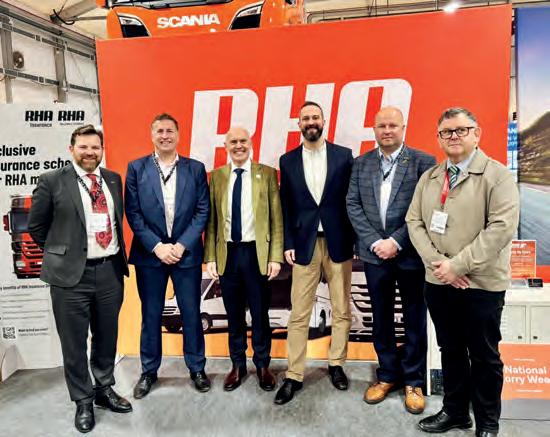
L-R: Alastair Gunn, RHA; Stephen Marshall, Manfreight; Marco Forgione, Chartered Institute for Export and International Trade; Jonathan Walsh, Fortior Insight; Geraint Davies, RHA; Ally Hobson, Montgomery.
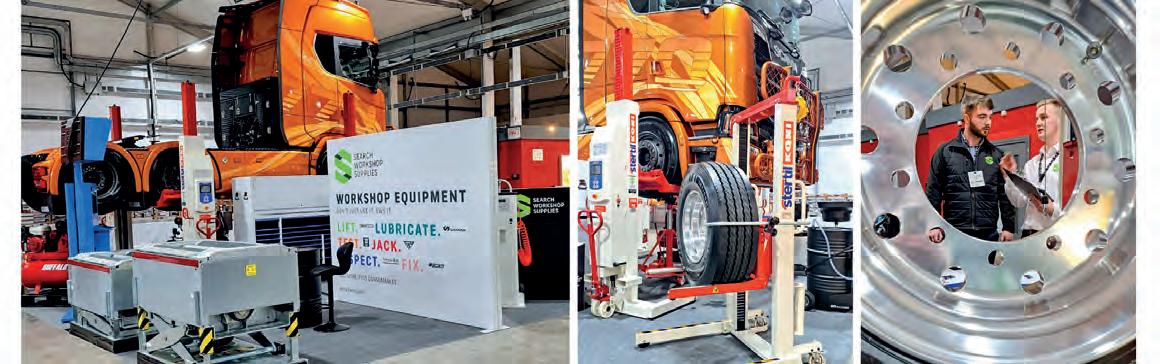
AS SEEN AT RTX NI 2026
If we missed you at the RTX NI truck show, don’t worry. We’re out there delivering - every day, across the whole of Ireland.
RTX NI was a great show. A welcome opportunity to meet-up with the truck community, including many of our customers - both old and new. But that was only for two days - what about now?
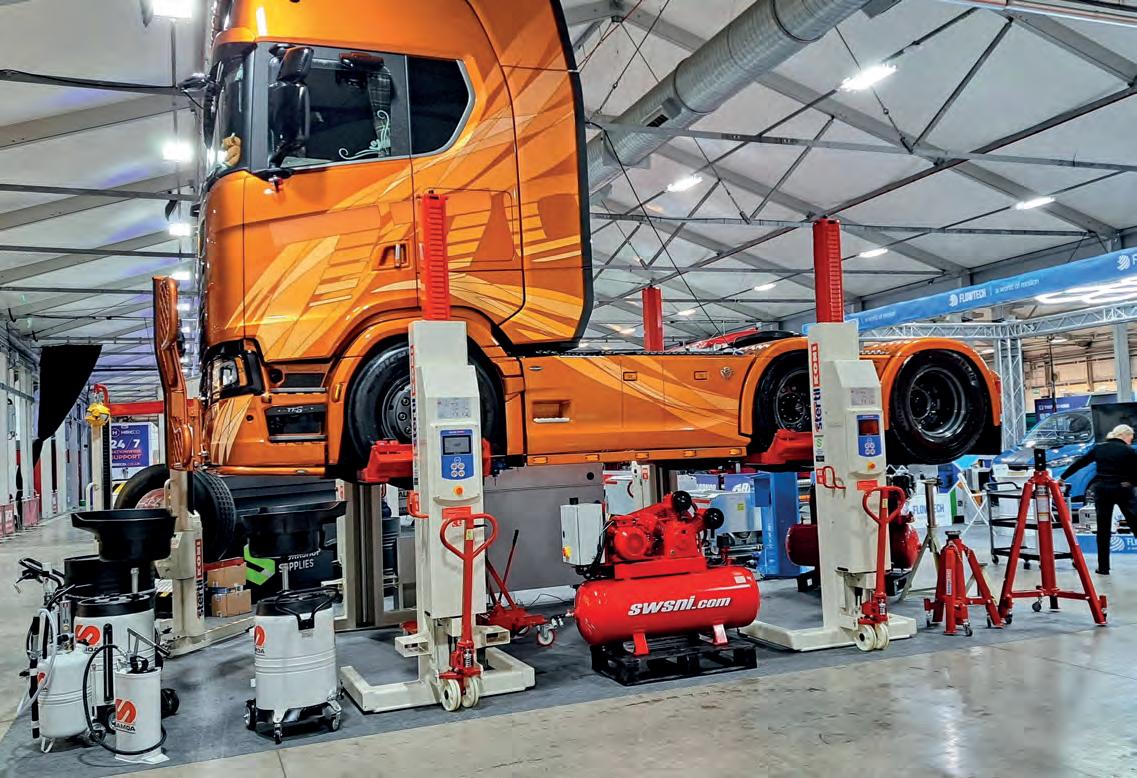
SWS are out there, meeting customers, discussing needs in truck and bus workshops
across the length and breadth of Ireland - and putting in place solutions that fully meet those needs; are totally fit for purpose, fully certified and designed to give years of trouble-free service. As the top-tier supplier for many leading workshop brands, SWS can ensure that every workshop installation meets these criteria.
SOME OF THE BRANDS THAT SWS SUPPLY.
Stertil-Koni - a global market leader in heavyduty vehicle lifting systems, specializing in safe, hydraulic solutions for trucks, buses,
agricultural and specialised commercial vehicles.
Samoa - manufacturer of a full range of lubrication equipment to pump, dispense, measure, monitor, control and recover lubricants and other service fluids.
VLT - brake testing equipment for all HGV and commercial vehicles.
Majorlift - GB manufacturer of a complete range of hydraulic lifting equipment for the automotive, truck, bus and plant industries
Premier Pits - inspection pits for all types of commercial vehicles, designed to comply fully with all workshop regulations and requirements This is only a small sample of what’s available. Whatever the requirements in the workshop are, SWS have the solution, the products, the stock and the service.
Josh Fenton
Policy
Manager
– Trade, Customs and Borders, Logistics UK
SPS AGREEMENT MUST FOCUS ON IMPLEMENTATION AND REGULATORY ALIGNMENT
Confirmation from the UK government that the UK-EU Sanitary and Phytosanitary (SPS) agreement is expected to come into force by mid-2027 is welcome news for the logistics sector and a significant step towards boosting trade with the potential to deliver £5.1 billion each year.
UK businesses have faced considerable border friction since Brexit. Red tape has driven up costs and delays for the movement of goods, and current SPS requirements add hundreds, if not thousands of pounds, to the cost of each load, reducing the smooth flow of trade and constraining growth. Logistics UK has been pushing for confirmation of delivery of the agreement since it was first announced in 2025 and continues calling for accelerated implementation, as it will be critical to addressing border friction and giving businesses renewed confidence in trading with the EU. The agreement, which spells out new movement requirements for hauliers, is expected to alleviate friction by removing most routine checks on plants, animals and animal products and cutting costs associated with paperwork. UK businesses will need to meet EU rules whether trading with the EU or serving only the UK market. However, in order for it to be successful, the SPS agreement must ensure regulatory alignment with the Windsor Framework or risk increasing cost and complexity for Northern Ireland businesses.
BORDER FRICTION REDUCES COMPETITIVENESS
The logistics sector enables the movement of goods in and out of the UK, a trade worth more than £900 billion a year. UK-EU trade is
a critical part of this: the EU is the UK’s primary source of imported fresh fruit, vegetables and meat. However, persistent friction in UK-EU trade has been increasing costs and fuelling inflation, reducing competitiveness and weakening supply chain resilience. Logistics is agile in the face of trade disruption, but border friction has played a major role in the decline of the UK’s competitiveness in the World Bank’s 2023 Logistics Performance Index, dropping from 4th to 19th. This highlights the urgent need to resolve trade friction, which has been exacerbated by the introduction of requirements following Brexit. The requirements, which are often lengthy and complicated for businesses to navigate, include inspections at Border Control Posts that face long waiting times, compounded by inconsistent communication and the Common User Charge (CUC) for certain imports. The need for customs paperwork and physical checks also lengthen the time it takes to move goods across the border as errors cannot be corrected quickly. This friction is being felt by businesses and adds to inflationary pressures, with some reporting delays and damage to shipments, as well as duplicated stockholding and the need for additional warehouse space purely to manage SPS divergence for identical products moving between GB, NI and EU. SMEs transporting mixed and lower-value consignments

have especially been affected. To manage risks and deliver a more efficient border, Logistics UK is calling for expedited implementation of the SPS agreement, enabling trade to flow faster and reduce costs and delays across GB-EU and GB-NI trade.
REGULATORY ALIGNMENT IS KEY
The delivery of the SPS agreement will need to ensure regulatory alignment with the Windsor Framework to ensure Northern Ireland businesses do not face additional cost and complexity. The framework was adopted by the UK and EU in 2023 and while it is an improvement on the Northern Ireland protocol, it has not been wholly successful in its ambition to restore the smooth flow of trade and safeguard Northern Ireland as intended. This is because businesses moving goods from GB to NI continue to face operational challenges, including additional data requirements and checks, insufficient clarity and new labelling requirements. Frustratingly for business who have incurred considerable expense and inconvenience complying with post-Brexit requirements, many of these will become obsolete once an SPS agreement is in place. Whilst the logistics sector continues to work hard to serve the NI market, some GB businesses have been reluctant to move goods into
Northern Ireland owing to these complex requirements. Due to the constant changes, often the logistics sector has had to spend significant time educating their unaware customers about the frameworks processes and data requirements. This has hindered trade and dissuaded some GB suppliers from continuing to serve the NI market, which in turn is adding costs, harming investment and leading to higher costs for NI consumers. It is critical that the UK government, NI Executive and EU work together to minimise the impact of any UK-EU regulatory divergence and maximise the economic benefits of NI’s unique dual market access. Failure to properly align the Windsor Framework with the new SPS agreement and clearly spell out requirements for hauliers could disproportionately affect these Northern Ireland businesses, many of whom operate on 1% to 3% profit margins but deliver £1.5 billion to the Northern Irish economy.
CONCLUSION
The planned implementation of the SPS agreement by mid-2027 will help to reduce costs significantly and address border friction brought on by Brexit, but Logistics UK is urging the government that it focuses on delivering it sooner rather than later, to enable economic growth and boost trade. Regulatory alignment with the Windsor Framework will be key to ensuring Northern Ireland businesses do not face significant pressures, as strained movement due to the framework’s requirements is already affecting trade. The reform that is delivered needs to be practical and co-designed with industry that understands firsthand how damaging border friction is to business. Logistics UK and the wider logistics sector stand ready to collaborate closely with government to ensure that border processes and regulatory cooperation support the efficient and reliable flow of goods.
Schmitz Cargobull acquires 100% of Berger Fahrzeugtechnik
Schmitz Cargobull have just completed a major deal by acquiring the remaining shares in Berger Fahrzeugtechnik GmbH. As a result, Schmitz Cargobull, which has held a 49 per cent stake in Berger since 2024, will become the 100 per cent owner of the company. The transaction is subject to approval by the relevant competition authorities.
The decision is based on the collaboration since 2024, which has demonstrated that Berger’s expertise in lightweight construction and Schmitz Cargobull’s industrial knowhow, together with its Europe-wide sales and service network, form a powerful combination. Against this backdrop, full integration was prepared as the next logical step. In 2025, both companies jointly invested in production technology at the Radfeld site and in the development of the new Evolution Generation of BERGERecotrail. The new product line combines Berger’s weightoptimised lightweight chassis with Schmitz Cargobull’s modular and versatile body system.
Andreas Schmitz, CEO of Schmitz Cargobull AG, says: “The collaboration has demonstrated the depth of technical expertise and
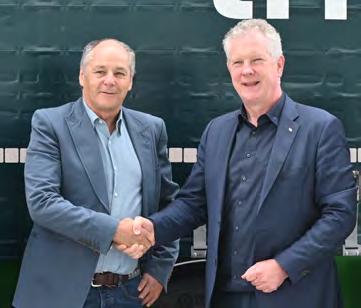
commitment behind Berger Fahrzeugtechnik’s products. With this acquisition, we gain Berger’s distinctive expertise in lightweight
construction, which ideally complements our portfolio. For our customers, this creates an even broader range of efficient transport solutions from a single source.”
Gerhard Berger, main shareholder of BERGER Fahrzeugtechnik, explains: “The handover and integration into the Schmitz Cargobull Group provides the ideal conditions for further developing our technologies more quickly and reaching more customers in Europe. Combining our lightweight construction expertise with Schmitz Cargobull’s industrial strength and network provides a solid foundation for further growth.”
The aim of the integration is to secure and further expand Berger Fahrzeugtechnik’s specialisation in lightweight construction. Schmitz Cargobull offers the appropriate structures and framework conditions for this.
Added value for customers
For customers, this will result in an expanded range of trailers from a single source –including Berger’s lightweight construction solutions – complemented by Schmitz Cargobull’s Europe-wide sales, service, and spare parts network. Existing products, contacts and services will remain unchanged. The completion of the transaction is subject to antitrust approval by the relevant authorities.
Gerhard Berger and Andreas Schmitz.
MAN FOCUSES ON UK MARKET WITH CUSTOMER-FIRST STRATEGY AND INCREASED MARKET SHARE
At a London management briefing, MAN Truck & Bus delivered a clear message: while European markets remain unpredictable, the company is steadily building momentum - anchored by a long-term commitment to the UK and a sharpened focus on customer relationships.
Led by CEO Alexander Vlaskamp, alongside sales chief Roman Sitte and UK Managing Director Jan Kohlmeier, the briefing outlined a business transitioning from post-pandemic recovery into a phase of strategic growth.
STABILISATION AFTER A VOLATILE CYCLE
Reflecting on the past two years, Vlaskamp described a company emerging from COVID-era disruption and internal restructuring into a more stable operating environment. However, that recovery has not been linear. After a slowdown that began in 2023, the European truck market has largely moved sideways through 2024 and into 2025. Truck volumes remained flat, shaped by declining registrations across most regions. Yet there are early signs of renewed confidence: order intake improved during 2025, suggesting underlying demand is returning. The same mixed picture applies across MAN’s wider portfolio. Bus sales dipped amid regulatory changes - particularly the transition to new cybersecurity requirementsbut rebounded strongly, with global deliveries reaching around 7,000 units last year. Meanwhile, the van business continues to outperform, achieving 30% growth to 31,000
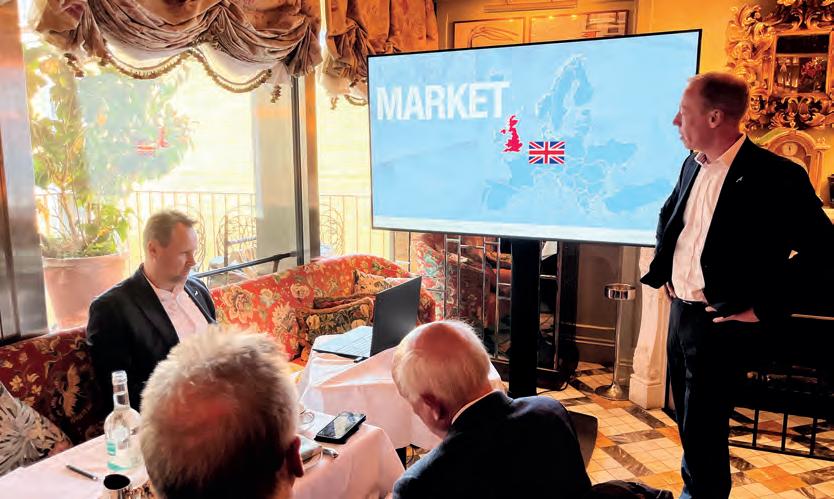
units, underlining the strength of MAN’s diversification strategy. Despite market headwinds, the company has achieved modest financial growth, with revenues nearing €3 billion. At the same time, a tightening used vehicle market points to reduced supply and potential pent-up demand— an indicator that replacement cycles could accelerate over
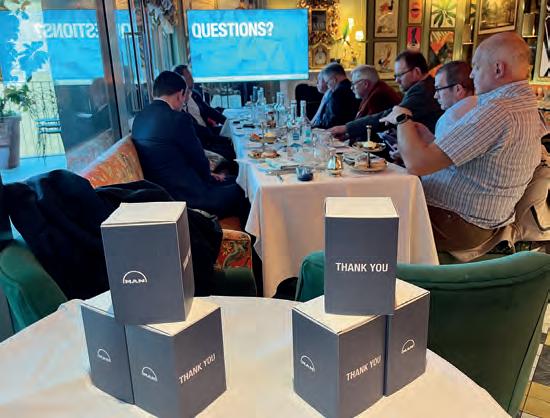
the next two years, assuming geopolitical conditions stabilise.
MARKET SHARE GAINS AGAINST THE ODDS
Across Europe, the broader picture remains challenging. Truck registrations fell by around 8%, while vans declined by close to 10%. Germany, Austria and Switzerland, which are key markets
for MAN, have proven particularly weak with Mr Vlaskamp calling them ‘economic troublemakers in Europe – especially for us’. Yet in this environment, MAN has increased its market share from 14.4% to 15% across the EU27+3 region, which includes the UK. Crucially, this growth has been driven outside its traditional core markets.
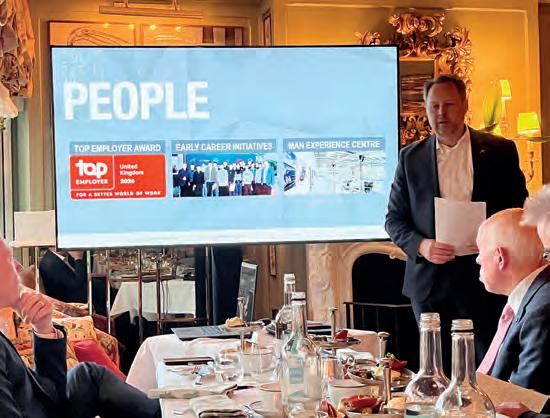
Roman Sitte, Senior Vice President, Head of Europe (standing) delivering a press briefing at the Ivy Victoria Brasseries, London with Jan Kohlmeier, Managing Director MAN Truck and Bus UK) looking on.
Members of the press during the meeting with MAN top management.
Jan Kohlmeier, Managing Director MAN Truck and Bus UK giving his presentation during the London meeting.
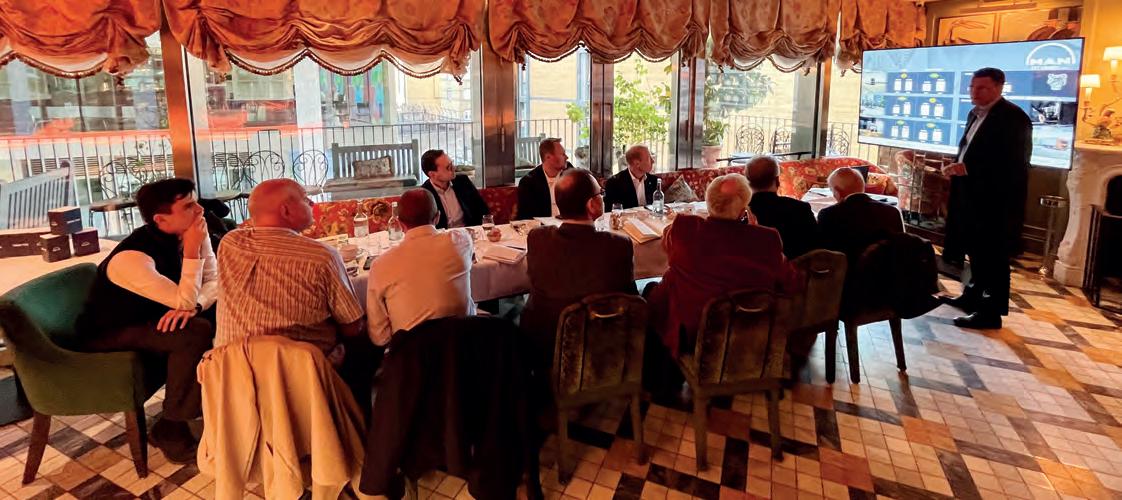
For Vlaskamp, this reinforces a strategic pivot first outlined two years ago: prioritising growth markets such as the UK.
UK: A STRATEGIC PRIORITY
“The UK was a focus market then, and it remains a focus market now,” was the consistent message from MAN’s leadership. That focus is already translating into results. Under Sitte’s leadership, UK volumes have grown from around 8,000 units in 2022 to approximately 10,000 in 2025 - a 20% increase with the ambition to grow by a further 30% by the end of the decade.
“We think this isn’t only a cold dream, but that it’s a reality that will happen” said Sitte.
This expansion is being delivered through what executives describe as a “step-by-step” growth. Rather than chasing short-term gains, MAN is investing in the fundamentals: customer segmentation, application-specific solutions, partnerships with bodybuilders, and – critically - aftersales support. Sitte emphasised that the truck business remains fundamentally relationship-driven. “You can sell a truck once with a few promises,” he noted, “but you need to keep your promises, especially on the service side, in order to sustain that customer relationship.”
INVESTING IN SERVICE, NOT JUST SALES
That philosophy is most visible in MAN’s UK investment strategy. Over the next five years, the company is committing approximately £45 million to expanding and upgrading its service network. The goal is simple but ambitious:
ensure customers are never more than 30 to 45 minutes from a MAN service point. This includes new and upgraded facilities across the country, alongside a broader European network investment of €300 million. Importantly, MAN is doubling down on a hybrid model that combines its own retail operations with private dealer partners—rejecting any move away from direct service involvement.
“We are continuing to invest heavily into the service operation because we have a strong belief this is something we do not want to divest from, but that is the heart of our customer operation that we want to continue to support’, said Roman Sitte.
Behind the scenes, significant resources are also being directed towards training. From sales teams to workshop technicians, MAN is investing in skills development to ensure consistent service quality as volumes grow.
ELECTRIFICATION: PROGRESS WITH CAVEATS
Like all major OEMs, MAN is heavily invested in electrification.
The company now offers a broad electric portfolio across multiple applications, with further variants - including 12- and 16-tonne models - rolling out this year, with Sitte commenting MAN believe they have the best electric truck on the market. However, Vlaskamp was candid about the pace of adoption.
‘It’s going too slow’. Battery electric trucks currently account for just 2.1% of registrations across Europe, including the UK - far below expectations.
The barriers are well understood: limited charging infrastructure,
constrained grid capacity, and high upfront vehicle costs driven by battery raw materials.
“There are two sides to the equation,” Vlaskamp explained. “We have the products. Now we need the infrastructure and the right economic conditions.”
Some European countries are working with operators- e.g. in Germany and Austria BEVs are exempt from motorway tolls.
Even so, there are signs of progress.
Total cost of ownership (TCO) is improving in some markets, supported by incentives such as toll exemptions. MAN also points to real-world use cases where up to 80% of transport operations could already be electrified.
SUPPORTING CUSTOMERS THROUGH TRANSITION
In the UK, Jan Kohlmeier has positioned MAN not just as a manufacturer, but as a partner in transition.
‘I think we are well positioned to support our customers in that transformation’.
The company has already delivered more than 1,000 hours of consultancy through its Transport Solutions team, helping operators redesign routes and adapt to electric operations. At the same time, all UK service locations have been upgraded to handle electric vehicles, addressing a key customer concern around uptime and support.
Early adoption is gaining traction. By the end of this year, MAN expects close to 100 electric trucks to be operating on UK roads, supported by growing customer confidence and demonstrable energy efficiency gains.
But the company is also pragmatic.
Alongside electric vehicles, MAN continues to support alternative fuels such as HVO and biodiesel, while exploring hydrogen - albeit acknowledging its significantly higher cost base.
PEOPLE AT THE CORE
If there is a single theme running through MAN’s UK strategy, it is people.
From apprenticeships to advanced training programmes, the company is investing heavily in workforce development. By the end of the year, around 180 apprentices will be enrolled in its UK programme, supported by a dedicated training centre in Manchester.
This is not just about MAN’s own operations, but the wider industry. With more than 600,000 HGVs and a chronic driver shortage, the UK logistics sector faces structural challenges that require long-term solutions.
A MEASURED PATH FORWARD
For MAN Truck & Bus, the outlook is one of cautious optimism. Markets may be flat, and external pressures remain, but the company is gaining ground where it matters: market share, customer relationships, and strategic positioning.
In the UK, that translates into sustained investment, deeper partnerships, and a clear ambition to grow.
As Kohlmeier concluded, the goal is not simply to supply trucks, but to “stand side by side with customers” as the industry navigates one of the most significant transformations in its history.
“It is important that we are not just a supplier but we are partner to our customers, helping them through that transformation.’
MAN Truck and Bus CEO Alexander Vlaskamp takes time out of his busy schedule to give a media briefing in London recently.

John McMahon
BLOCKCHAIN AND SMART CONTRACTS IN THE NORTHERN IRELAND HAULAGE AND LOGISTICS SECTOR: COMMERCIAL OPPORTUNITIES, COST SAVINGS AND LEGAL CONSIDERATIONS
The haulage and logistics sector in Northern Ireland is facing increasing commercial pressure arising from rising operating costs, customs complexity, labour shortages, compliance obligations and growing customer expectations for transparency and speed. Against that background, blockchain technology and smart contracts are increasingly being explored as practical tools capable of reducing administrative costs, improving traceability and automating commercial processes.
While blockchain technology is often associated with cryptocurrency markets, its commercial application in freight transport and logistics is considerably broader. For operators engaged in cross border trade between Northern Ireland, Great Britain, Ireland and the wider European Union, blockchain based systems may offer significant efficiencies in document management, supply chain visibility, customs compliance and payment automation.
This article examines the practical commercial benefits of blockchain technology and smart contracts for logistics operators in Northern Ireland, together with the principal legal and regulatory considerations under Northern Irish, United Kingdom and European Union law.
WHAT IS BLOCKCHAIN TECHNOLOGY?
Blockchain is a distributed digital ledger system which records transactions across multiple computers in a secure and tamper resistant manner. Each transaction is recorded in a “block” linked chronologically to previous entries, creating an immutable audit trail. In the logistics context, blockchain systems can be used to record:
Application Example
Freight documentation Electronic consignment notes and shipping records
Customs data Import and export declarations
Proof of delivery T imestamped delivery verification
Supply chain tracking Real time cargo tracing
Maintenance records Vehicle servicing and compliance logs
Payment systems Automated freight payments
The principal commercial advantage is the creation of a single verified source of information accessible by authorised parties across the supply chain.
WHAT ARE SMART CONTRACTS?
Smart contracts are computer programs which automatically execute contractual obligations when predefined conditions are met.
The European Union Data Act defines a smart contract as: “a computer program used for the automated execution of an agreement or part thereof”.
Examples within logistics operations include:
Smart Contract Use Case Automated Action
Delivery confirmation Automatic release of payment
Customs clearance Automatic movement authorisation
Temperature monitored transport Alerts or insurance notifications triggered
Fuel purchasing Automated supplier payments
Warehousing agreements Automatic charging based on storage periods
The commercial attraction lies in reducing manual administration, payment delays and disputes.
IMMEDIATE COMMERCIAL BENEFITS FOR NORTHERN IRELAND OPERATORS
1. Reduction in Administrative Costs
Paper based logistics remains heavily embedded within freight transport operations.
The EU Electronic Freight Transport Information Regulation (“eFTI Regulation”) seeks to reduce reliance on paper documentation by requiring EU Member State authorities to accept compliant electronic freight information.
For Northern Ireland operators involved in EU trade, blockchain enabled document systems could reduce:
Cost Area Potential Saving Manual document handling Reduced staffing time
Lost or duplicated paperwork Reduced operational disruption
Customs administration Faster processing
Audit preparation Improved data retrieval
Claims management Better evidential records
The ability to provide secure, verifiable and timestamped records may significantly reduce disputes concerning deliveries, delays and cargo condition.
2. Faster Payment Cycles
Cash flow remains a major issue within the haulage sector.
Smart contracts can automate payment release once delivery milestones are verified. This may reduce:
Traditional Problem
Long payment terms
Invoice disputes
Blockchain Solution
Automated settlement
Immutable delivery records
Manual invoice reconciliation Real time verification
Delayed subcontractor payments
Trigger based payment systems
For small and medium sized transport operators in Northern Ireland, improved cash flow may provide a significant operational advantage.
3. Improved Cross Border Trade Efficiency
Northern Ireland operators face unique trading complexities arising from the Windsor Framework and continuing alignment with aspects of EU goods regulation.
Blockchain based logistics systems may assist with:
Operational Challenge Potential Benefit
Goods traceability Real time supply chain visibility
Customs compliance Shared digital records
SPS documentation Verified document integrity
Cross jurisdiction verification Reduced duplication
The increasing digitisation of freight documentation under the eFTI framework is likely to accelerate industry demand for interoperable digital logistics systems.
LONG TERM STRATEGIC BENEFITS
1. Supply Chain Transparency
Major customers increasingly demand environmental, ethical and operational transparency.
Blockchain systems may provide:
Strategic Advantage Commercial Impact
End to end traceability Improved customer confidence
ESG reporting support Better tender competitiveness
Carbon tracking Enhanced sustainability compliance Fraud prevention Reduced liability exposure
2. Reduced Fraud and Cargo Disputes
Because blockchain records are difficult to alter retrospectively, they may strengthen evidential certainty in commercial disputes.
Potential areas of reduced risk include:
• Delivery disputes.
• Cargo substitution.
• Fraudulent documentation.
• Insurance claims manipulation.
• Mileage or maintenance record tampering.
3. Integration with Internet of Things Technology
The combination of blockchain with connected transport systems may create substantial efficiencies.
Examples include:
Connected Device Blockchain Function
Vehicle telematics Immutable operational records
Temperature sensors
Automated compliance evidence
GPS tracking Verified route history
Fuel monitoring systems Automated reporting
This aligns closely with the developing EU regulatory framework concerning data sharing and connected devices under the EU Data Act.
LEGAL CONSIDERATIONS AND REGULATORY RISKS
Contract Law and Enforceability
Under the laws of Northern Ireland, smart contracts may in principle be legally enforceable provided the ordinary contractual requirements are satisfied, including:
• Offer and acceptance.
• Intention to create legal relations.
• Certainty of terms.
• Consideration.
However, practical legal difficulties may arise where:
Legal Issue Risk
Coding errors Incorrect automated performance
Ambiguous commercial terms Disputed interpretation
Irreversible execution Limited ability to rectify mistakes
Jurisdiction uncertainty Cross border enforcement complications
Careful drafting remains essential. Smart contracts should generally supplement rather than entirely replace traditional written agreements.
Data Protection and GDPR Compliance
Blockchain systems used within logistics operations are highly likely to process personal data, particularly driver information, customer records and vehicle tracking data.
Operators must therefore comply with:
Relevant Legislation Application
UK GDPR UK based processing
EU GDPR EU related operations
Data Protection Act 2018 UK implementation framework
Key compliance concerns include:
• Lawful basis for processing.
• International data transfers.
• Data minimisation.
• Security obligations.
• Data subject rights.
One significant legal challenge is the tension between blockchain immutability and GDPR rights such as rectification and erasure.
The EU Data Act also introduces additional obligations concerning access to and sharing of data generated by connected devices and digital services.
CONCLUSION
Blockchain technology and smart contracts are no longer purely theoretical concepts within the logistics sector. They are increasingly becoming commercially relevant tools capable of improving efficiency, reducing administrative costs and enhancing supply chain transparency.
For Northern Ireland haulage and logistics operators, the potential benefits are particularly significant given the region’s unique cross border trading environment and increasing regulatory complexity.
In the short term, blockchain adoption may reduce paperwork, speed up payments and improve compliance management. In the longer term, operators who successfully integrate digital freight systems, smart contracts and connected data platforms may achieve substantial competitive advantages in operational efficiency, customer confidence and regulatory compliance. However, the legal and regulatory landscape remains complex. Businesses must carefully consider contract enforceability, data protection obligations, cybersecurity risks and compliance with emerging EU digital legislation, including the EU Data Act and the eFTI Regulation. Spencer West have expert lawyers in each of these disciplines and are available to assist.
The most successful operators are likely to be those who treat blockchain technology not as a speculative innovation, but as a commercially practical tool capable of delivering measurable operational and legal efficiencies across modern freight transport networks.
John.McMahon@spencer-west.com spencer-west.com
Exceeded driving hours and truck was overweight
A driver was convicted at Belfast Magistrates’ Court and fined a total of £700 for a number of driver hours and tachograph offences. The conviction arose when DVA Enforcement Officers were conducting compliance checks in the Belfast Harbour Estate when they encountered a Volvo Heavy Goods Vehicle in combination with Bulk Tipper.
The vehicle was directed for compliance checks to the DVA Weighbridge. The gross vehicle weight was noted to be 44,000kgs, therefore requiring a tachograph to be installed and used. When the vehicle was weighed the Gross Train Weight (GTW) was calculated to be 45,790Kgs which is 1790Kgs/4.07% overweight.
The vehicle was listed on an operator’s licence. The tachograph data was downloaded and
analysed and this revealed that the driver exceeded his 4.5 hour driving time by 33 minutes. Additionally, there was period of driving without a valid driver’s card inserted which was attributed to him as he was the driver of vehicle before and after the period of driving without a valid card inserted.
Once this period of driving was added to driver’s hours record a further offence was brought to light – he had also exceeded his
4.5 hour driving time by 45 minutes without taking the appropriate break. On another occasion the driver also had insufficient daily rest within the 24-hour period, 11 hours rest was required because the driver had already availed of his maximum of 3 reduced daily rests (9 hours) for that week. He had only taken 9 hours 1 minute which is 1 hour 59 minutes short of the required 11 hours as this would have been his 4th reduced daily rest which is not permitted under legislation.
Tachograph had not been downloaded in 100 days
A County Antrim Operator was convicted at Belfast Magistrates’ Court and fined a total of £800. The conviction arose when DVA Enforcement Officers were conducting compliance checks in the vicinity of Sprucefield, when they encountered a Volvo 4-axle rigid heavy goods vehicle which was directed to the DVA Weighbridge Site at Sprucefield. The gross vehicle weight was noted to be 32,000kgs, therefore requiring tachograph recording equipment to be installed, calibrated and used.
The vehicle was listed on the operator’s licence. Checks conducted at the roadside found that the drivers Certificate of Professional Competence (CPC) had expired. When examined, the tachograph recording equipment
was noted to be a Siemens VDO digital tachograph which met the calibration requirements. The driver’s digital drivers’ card and the tachograph vehicle unit were downloaded. When analysed it was established that the vehicle
unit had not been downloaded in 100 days. Under the EU Regulations 581/2010 operators are required to carry out a download of the vehicle unit every 90 days. Therefore, at the time of detection the vehicle unit deadline had been missed by 10 days. Furthermore, a technical inspection of the vehicle was conducted, and it was deemed the vehicle to be in a dangerous condition due to a significant number of defects.
Drivers Hours & Recording Equipment offences
A County Londonderry Operator was convicted at Belfast Magistrates’ Court and fined a total of £750.
The conviction arose when DVA Enforcement Officers were conducting compliance checks in the Belfast area, when they stopped a 2 axle DAF rigid vehicle. The driver stated that he was driving the
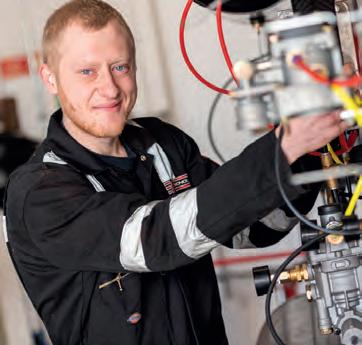
vehicle, between Toome and Belfast. It was noted that the tachograph was not sealed correctly, the drivers’ digital drivers’ card had not been downloaded as required and the driver had 3 daily rest offences.
The operator was later interviewed in relation to the offences identified, namely tachograph not sealed in accordance with the regulations, failure to download driver’s card and 3 x insufficient daily rest offences.
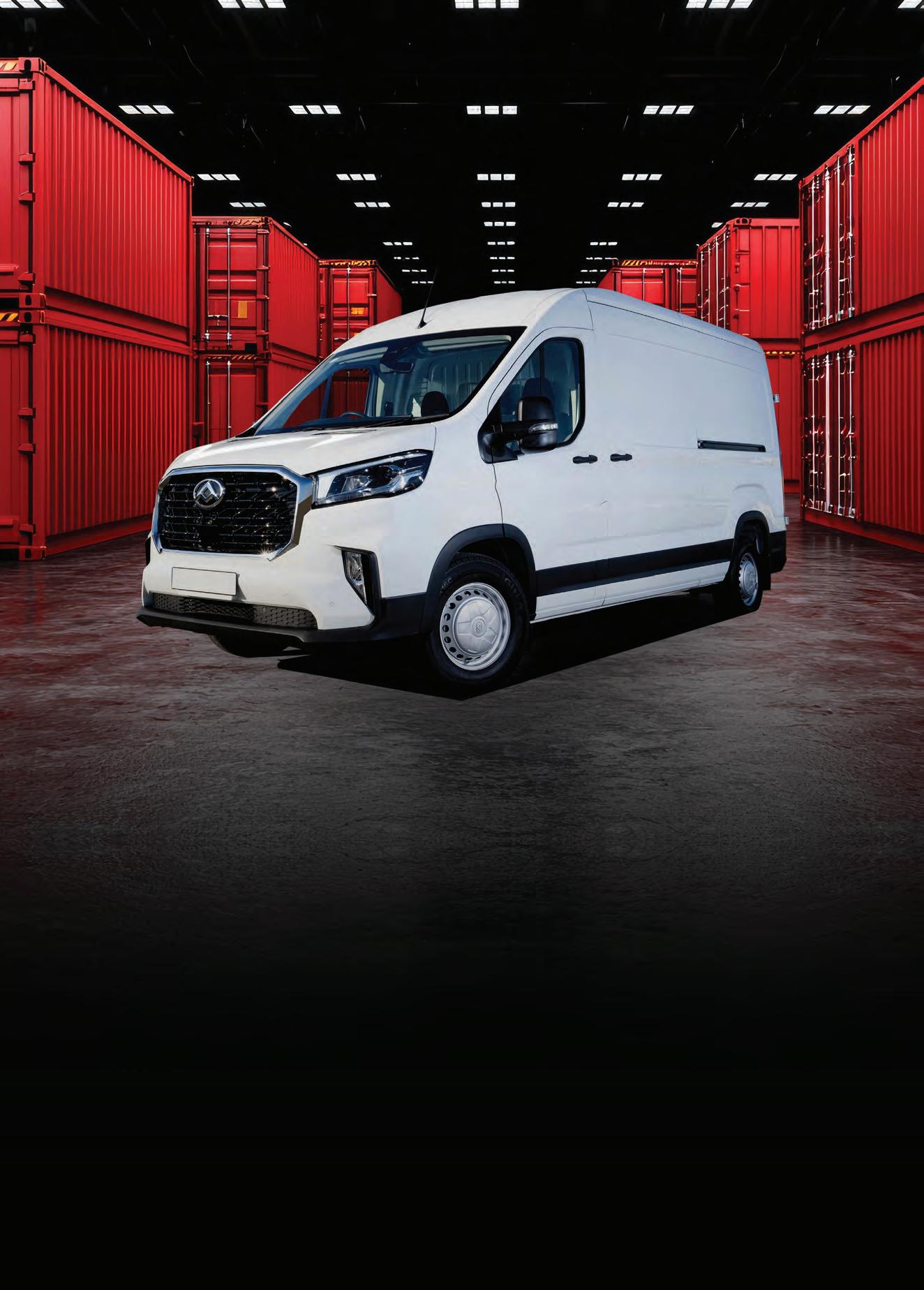
MULHOLLAND: DRIVING THE HARRIS MAXUS UK NETWORK DEEPER INTO NORTHERN IRELAND
In a fiercely competitive light commercial vehicle market, dealer appointments are rarely just about putting another pin in the map. They are a strategic statement about brand visibility, operator demand and where manufacturers see the next battleground for growth.
That is precisely what Harris MAXUS UK’s latest move into County Antrim represents. The appointment of Mulholland MAXUS in Randalstown sees Harris MAXUS UK securing a significant foothold in one of Northern Ireland’s key transport corridors, strengthening access for fleet operators and SMEs alike, while underlining the broader ambitions of the MAXUS brand across the UK and Ireland. Positioned just off the M22 arterial route between Belfast and Londonderry, Mulholland’s new franchise is more than a convenient retail point. It places the full MAXUS Euro6 and electric vehicle line-up directly within reach of LCV fleets, small businesses and public sector operators for whom reliable, cost-effective vehicles are a non-negotiable.
For Harris MAXUS UK, the move forms part of a growth strategy seeking to capitalise on increasing demand for competitively priced vans that meet both conventional Euro-6 operations and the accelerating shift toward electrification. With operators under pressure to control whole-life costs with vehicles which promise volume, payload and reliability, the MAXUS DELIVER 9 – with both Euro-6 and electric options – is emerging top of buyers’ shopping lists. Competing in the large van segment, the model combines substantial load capacity,
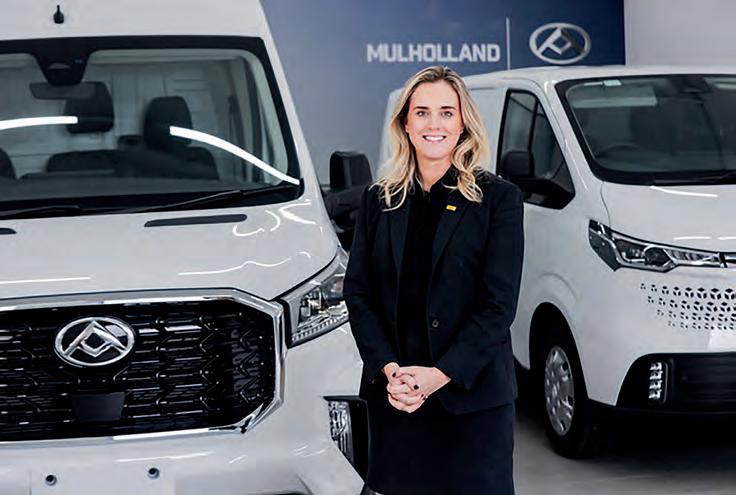
multiple configurations, advanced driverassistance systems and strong warranty support.
For customers balancing acquisition cost with operational demands, it offers a credible, value-led alternative to established rivals.
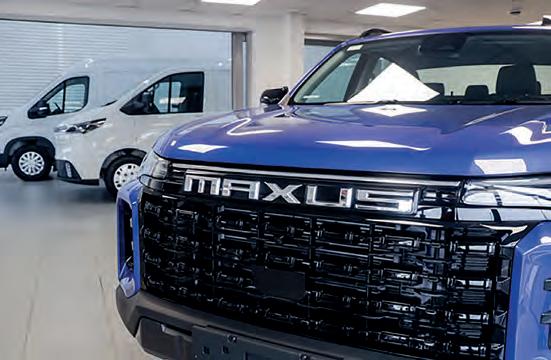
For Mulholland Motors, whose roots in the Northern Ireland vehicle sector stretch back nearly four decades, the franchise is also a response to sustained customer demand. “Customers have asked us to supply vans for
Shona Mulholland.
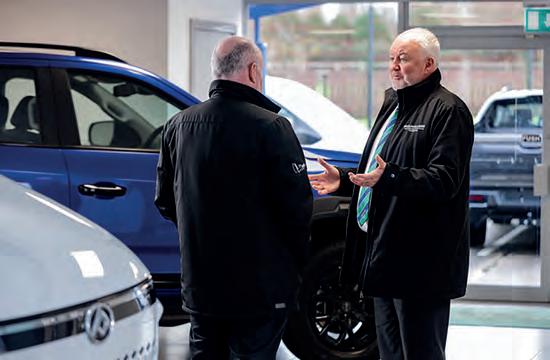
some time,” says Shona Mulholland, who now leads the business founded by her late father John Mulholland. “What made MAXUS stand out was the combination of value, quality and range. MAXUS gives us the ability to serve everyone from single-vehicle operators to major fleets, with credible Euro-6 and EV models,” she said.
That offering is central to the dealership’s local proposition. Mulholland has long-established ties across County Antrim’s commercial community, serving businesses ranging from sole traders to substantial public-facing fleets, including major taxi operations. In a sector where trust is almost always earned through aftersales support rather than headline pricing, the company’s emphasis on workshop capability, parts back-up and commitment to uptime will prove critical to customer retention. This is where Mulholland’s established reputation offers Harris MAXUS UK a distinct advantage. Since entering the commercial vehicle market in 1988, the business has built
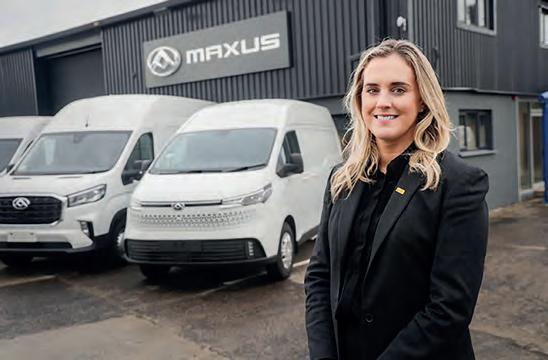
its reputation on value and local accountability; two qualities that remain highly prized among fleet, trade and service-sector operators.
“Our strength locally is really important,” added Shona, “EVs, for example, may attract attention for their emissions credentials, but customers, ultimately, need to be confident in servicing infrastructure, workshop expertise and full dealer support.
“We’re reflecting a wider commercial shift in Northern Ireland, where fleet purchasing is more than the vehicle marque,” she added, “Businesses are, first and foremost, assessing whole life cost, route suitability, infrastructure readiness and brand support. Dealerships capable of combining a reliable product with a Total Cost of Ownership matrix are likely to do the business. And that’s us.”
Beyond commercial positioning, Mulholland’s community credentials remain a defining part of its identity. The company’s ongoing fundraising for Friends of the Cancer Centre – including
donations from every vehicle sold – reinforces a local-first philosophy that resonates strongly in the local community where business reputation often extends beyond balance sheets.
For Harris Group, celebrating its 60th birthday this year, and now a major force in the commercial vehicle industry, the addition of Mulholland is another step in a larger transformation; building a robust, geographically relevant network capable of supporting the MAXUS brand’s rise from challenger to major player.
As fleet operators across the UK continue to reassess procurement strategies amid economic uncertainty and drivetrain transition, the expansion into County Antrim may prove pivotal of a bigger industry truth; success depends not just on vehicle innovation, but on trusted regional partnerships that keep businesses moving.
In Randalstown, Harris MAXUS UK appears to have found exactly that.
www.johnmulhollandmotores.com
COMMERCIAL VEHICLE INSURANCE - PROTECTING YOUR BUSINESS
In an industry where margins are tight and reliability is everything, commercial vehicle insurance has become far more than an essential requirement - it is now a strategic safeguard for businesses operating across the transport and logistics sectors.
From long-haul HGV fleets to last-mile delivery vans, the risks facing operators have grown in both complexity and cost, driven by evolving supply chains, rising accident repair expenses, and increasing regulatory scrutiny.
Against this backdrop, insurers are adapting their offerings to better reflect the realities of modern transport. Telematics, data-driven underwriting, and tailored fleet policies are reshaping how risk is assessed and managed,
offering operators greater visibility and, in some cases, more competitive premiums. At the same time, external pressures - from inflation and parts shortages to the transition toward low-emission vehicles - are influencing both the availability and affordability of cover. For logistics providers, choosing the right insurance partner is no longer a box-ticking exercise. It requires a clear understanding of operational risk, contractual liabilities, and the
geographic scope of their activities, particularly as cross-border trade continues to evolve.
Getting the right cover is key to the continued successful running of your operation – no matter what happens – and working in partnership with your insurance provider will provide peace of mind for you and your employees keeping you on the road, and on time.
This feature explores the key trends shaping commercial vehicle insurance today, examines how providers are responding to industry demands, and considers what operators can do to future-proof their coverage. As the sector continues to navigate uncertainty, one thing is clear: robust, responsive insurance is not just protection - it is a critical enabler of resilience and growth.
ABBEYAUTOLINE: THE BROKER THAT KNOWS YOUR BUSINESS
In an industry as demanding and complex as road haulage and freight, the risks are real, the margins are tight, and the consequences of being underinsured can be catastrophic. For too long, many operators have approached insurance as a box-ticking exercise, a necessary cost to be minimised rather than a critical business tool to be properly understood. At AbbeyAutoline, we believe that approach leaves too much to chance.
The freight and transport sector in Northern Ireland is unique.
Operators here don’t just navigate the physical roads - they navigate a business landscape shaped by crossborder trade, evolving post-Brexit customs arrangements, fluctuating fuel costs, and the ever-present pressure to keep vehicles moving and loads delivered on time. It’s a sector that demands specialist knowledge, and that’s exactly what we bring to the table. There is no shortage of insurance providers willing to offer a quote.
A few clicks online and you’ll have a price in minutes. But a price alone tells you very little about whether your business is protected. It doesn’t tell you whether your liability cover is appropriate for the type of loads you’re carrying.
It doesn’t tell you whether your policy accounts for the specific cross-border exposures that are a daily reality for so many Northern Ireland hauliers. And it certainly won’t tell you where the gaps are - until something goes wrong.
That’s the difference between a price and advice. And it’s a distinction that matters enormously when you’re running a fleet, managing drivers, and responsible for goods in transit across multiple jurisdictions.
At AbbeyAutoline, our team of specialist haulage advisors work exclusively with businesses operating in and around the transport and logistics sector. We understand the pressures our clients face because we’ve been working alongside them for years. We know the questions to ask about vehicle use, load types, cross-border routes, driver profiles, and business structures - because we know that the answers shape the cover you need, not just the cover that’s easiest to sell.
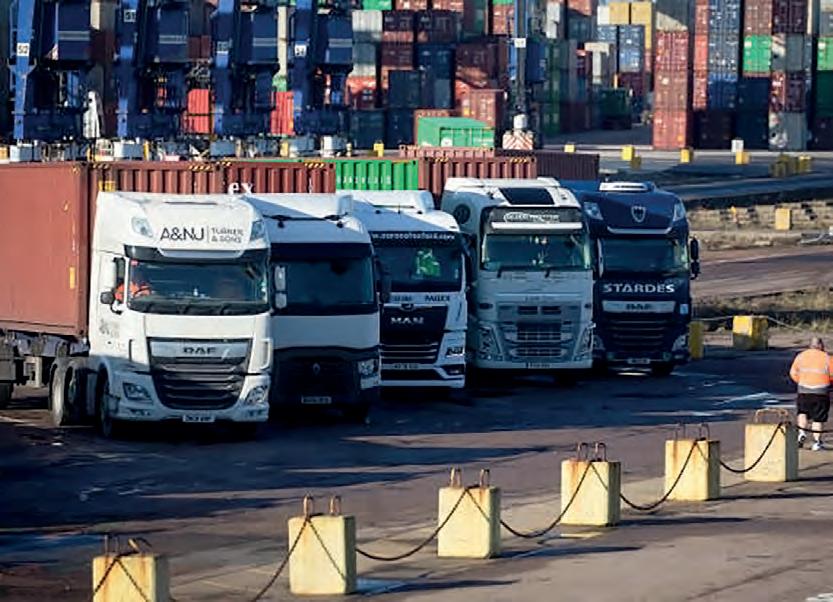
This expertise is further strengthened by our relationships with world-leading insurers and finance providers, enabling us to deliver tailored cover and competitive solutions for businesses across the transport and logistics sector.
By combining the strength and security of major global partners with the responsiveness of a local team, we can support customers with everything from fleet expansion and specialist vehicle cover to finance options that help keep businesses moving forward with confidence.
Claims handling is another area where the value of local, specialist advice becomes most apparent. When an incident
occurs, whether it’s a road traffic collision, a cargo loss, or a thirdparty liability claim - the speed and expertise with which that claim is managed can make a significant difference to the outcome.
Our dedicated claims team acts as an advocate for our clients throughout the process, not simply as a conduit between them and an insurer.
Northern Ireland’s freight and haulage sector is a cornerstone of the local economy, keeping supply chains moving, supporting businesses large and small, and connecting this region to markets across Ireland, Great Britain, and beyond. The businesses that operate within it deserve insurance support that reflects that importance.
Support built on genuine expertise, genuine relationships, and genuine accountability.
At AbbeyAutoline, we’re proud to be that partner. Not just a price on a screen, but a local team that knows your business, understands your risks, and is there when it matters most. Because in this industry, getting it wrong isn’t an inconvenience. It’s a business risk you simply can’t afford to take.
To find out how AbbeyAutoline can support your business, email haulage@abbeyautoline.co.uk or call us on 08000 66 55 44.
www.abbeyautoline.co.uk

MARSH – PROVIDING GENUINE LOCAL SERVICE WITH A GLOBAL PERSPECTIVE
Marsh has been part of Northern Ireland’s story since 1907 - more than a century of local know-how and trusted insurance broking. Today, that heritage is underpinned by a global presence: We advise clients in 130 countries and have an annual revenue of $27 billion and more than 95,000 colleagues.
By working with us, you can use our global perspective, combined with genuine local service, to make informed business decisions which support you.
Our clients get big‑picture intelligence data analytics, global placement power, and market leading risk management delivered by advisors who know the local market and the practical realities of doing business here. We call this the Marsh Experience. Two of the largest sectors we support locally are food and logistics. Together they account for more than 75% of Northern Ireland’s food exports, fuelling kitchens at home and tables around the world. Our logistics capability however didn’t happen overnight it has been built by backing ambitious start‑ups from their small beginnings, and by being risk advisors to
some of the giants in the sectors. That breadth of experience means we understand complex supply chains, marine and cargo exposures, transit risks, warehousing, and the evolving regulatory landscape that affects exporters every day. We are also a Centre of Excellence for the charity sector in Northern Ireland because protecting communities matters to us as much as protecting balance sheets.
We’re proud to support the Export and Freight Awards and to sponsor the Food Distributor of the Year category — a fitting way to celebrate the people and businesses who drive exports, champion innovation, and keep Northern Ireland’s economy moving. Our commitment to the sector is reflected not only in awards and partnerships, but in the tailored insurance programmes and
risk solutions that help companies scale, trade safely and manage disruption.
Marsh is also stepping into new global conversations most notably as a newly announced sponsor of Formula One reinforcing our position as a dynamic partner at the intersection of risk, technology, and global commerce.
We’re here to protect your business and champion Northern Ireland’s exporters.
To find out more about how we do this, please visit www.marsh.com or contact your local Marsh advisor.





CATEGORIES ANNOUNCED TRANSPORT & LOGISTICS AWARDS 2026
NEW CATEGORY
FAMILY BUSINESS OF THE YEAR
This award recognises an outstanding family-owned and/or family-led business operating in the export, freight, logistics and transport sector. The winner will demonstrate strong commercial performance, operational excellence and a reputation for reliability, while maintaining the values, culture and long-term vision that make family businesses so successful. Judges will look for evidence of growth, customer service, innovation, people investment, and a clear commitment to the future through succession planning and continuous improvement.
NATIONAL & INTERNATIONAL HAULIER OF THE YEAR
(OPERATORS WITH MORE THAN 30 VEHICLES)
The National & International Haulier of the Year Award recognises outstanding haulage operators delivering excellence across national and international operations.
Open to companies operating under a Standard Operator’s Licence with more than 30 vehicles specified, this award celebrates hauliers that demonstrate professionalism, operational excellence, regulatory compliance, strong customer service, and the ability to adapt in a demanding and fast-moving industry.
Judges will look for evidence of scale, capability, and consistency - alongside innovation, flexibility, and a clear commitment to customers, drivers, and operational standards.
CHILLED OPERATOR OF THE YEAR

The Chilled Operator of the Year Award recognises chilled distribution businesses that deliver excellence across temperature-controlled transport, storage, and customer service.
This award celebrates operators with modern, well-maintained refrigerated fleets and high-quality chilled distribution services, combined with strong compliance, innovation, sustainability, and a commitment to people development. Judges will look for evidence of operational excellence, reliability, and the ability to adapt in a timecritical and highly regulated environment.
APPRENTICE OF THE YEAR
This year’s award will be presented to an apprentice, not certified at Level 3 before September 2026, who has demonstrated knowledge, skill and determination in the course of their training and who is excelling in a workshop setting. The winner of this category will be decided through a practical test.

DRIVER OF THE YEAR
This year’s award will be presented to the commercial vehicle driver who offers the highest standard of driving skills; has an excellent driving record, shows dedication to the trade and personifies the ethos and reputation of his employer in his daily work. A practical driving test will determine the winner of this highly competitive category.
TRANSPORT MANAGER OF THE YEAR
This award recognises an outstanding Transport Manager who demonstrates excellence in compliance, operational control and leadership, while delivering measurable improvements in safety, efficiency, driver performance and customer service.
Open to Transport Managers working across the export, freight, logistics and transport sector, including haulage, distribution, own-account fleets, ports, warehousing and multi-site operations.
ROAD TO NET ZERO CHAMPION
The Road to Net Zero Champion Award recognises businesses, teams, or individuals across the transport, logistics, and supply-chain sectors that are taking meaningful, measurable action towards a net zero future. Open to organisations and individuals at any stage of their sustainability journey, this award celebrates credible planning, effective execution, and demonstrable environmental and commercial benefit.
Judges will look for evidence-based progress - not pledges alone - and for initiatives that deliver real impact while supporting a sustainable and competitive industry.
SAFETY AWARDTRANSPORT & LOGISTICS SECTOR
This award recognises organisations within the transport, logistics, and fleet sectors that demonstrate exceptional leadership in health, safety, quality, and wellbeing - protecting people, assets, and the public while maintaining the highest operational standards.
Entrants must show how health and safety is embedded across their business, from board-level governance to day-to-day operations. Submissions should clearly describe roles, responsibilities, and systems used to manage risk, ensure compliance with all relevant regulatory bodies, and drive continuous improvement.
Judges will consider how effectively current controls - or those in development - support the consistent delivery of safe, compliant, and high-quality transport and logistics services.

Completed applications must be submitted on or before the closing date of 20th June to allow the independent judges sufficient time to give all applications the necessary consideration and, where appropriate, to organize site visits and/or interviews.
FLAGSHIP FLEET TRUCK OF THE YEAR
This award will be presented to an outstanding vehicle, one that not only represents your fleet, but stands out on its own.
Displaying your fleet livery but also exceptional and possibly individual in its appearance this truck will be representative of your company ethos and kept in exceptional condition – ‘the pride of the fleet’. Judging in this category will require photographic and video footage of the truck. All the finalists will be put forward for an online vote, which will take place in August.
LOGISTICS SERVICES PARTNER OF THE YEAR
The Logistics Services Partner of the Year Award recognises a company that has gone beyond standard service provision to work in true partnership with its customer, actively collaborating to design and deliver innovative, effective logistics solutions that address real-world supply chain challenges.
This award celebrates organisations that demonstrate excellence in problem-solving, adaptability, collaboration, and value creation, whether through operational innovation, technology adoption, service redesign, or continuous improvement.
The award is open to logistics service providers, distributors, transport operators, and supply chain specialists that can evidence.
FOOD DISTRIBUTION COMPANY OF THE YEAR


This award recognises ambient and chilled food distribution businesses that demonstrate excellence across storage, handling, and delivery while meeting the highest standards of safety, compliance, and customer service.
Open to food distribution companies, including food & drink manufacturers and processors, operating within the supply chain, this award celebrates organisations that combine operational efficiency with regulatory excellence, environmental responsibility, and the agility required to serve a demanding and time-critical sector.
Judges will look for clear evidence of best practice across food safety, fleet and warehouse operations, sustainability, and customer service.
HAULIER OF THE YEAR
(UP TO 30 VEHICLES)
The Haulier of the Year Award recognises outstanding mid-scale haulage operators delivering excellence through professionalism, reliability, and customer-focused service.
Open to companies operating under a Standard Operator’s Licence with up to 30 vehicles specified, this award celebrates hauliers that demonstrate strong operational standards, compliance, flexibility, and a clear commitment to customer service -regardless of fleet size.
Judges will be looking for evidence of quality, consistency, and a business that punches above its weight in a competitive marketplace.
WORKSHOP OF THE YEAR
Judging for ‘Workshop of the Year’ is open to any commercial workshop, both private and public sector in Northern Ireland, including all council and government bodies.

The winner of this award will have the best equipped, most up to date workshop that looks after its staff and its customer to an equally high standard.
EXCELLENCE IN CUSTOMER SERVICE
This award recognises companies within the transport, logistics, and freight sectors that consistently deliver outstanding customer service and place customers at the heart of their business.
Open to hauliers, logistics providers, shipping companies, dealers, service agents, and equipment suppliers, the award celebrates organisations that go beyond expectation, demonstrate measurable service quality, and build strong, lasting customer relationships.
Customer testimonies are encouraged in this category and will be treated as strictly confidential and securely destroyed following the judging process.
TOP TEAM OF THE YEAR
The Top Team of the Year Award recognises outstanding teamwork across the transport, logistics, freight, warehousing, shipping, exporting, and dealership sectors.
Open to teams of any size - from two people to over one hundred, this award celebrates collaboration, leadership, and shared purpose. It recognises teams that, by working together on a project, initiative, or strategy, have delivered a significant and positive impact on their organisation, customers, or wider industry.
Judges will be looking for clear evidence of teamwork in actionovercoming challenges, achieving measurable results, and demonstrating a strong culture of collaboration, wellbeing, and continuous improvement.
INNOVATION OF THE YEAR
This award recognises an organisation in the export, freight, logistics or transport sector that has introduced an innovation delivering measurable results within the last 12–18 months. Innovations may include new technology, equipment, processes or sustainability solutions.
Judges will look for clear evidence of impact, strong implementation and real customer or operational benefit.
VAN OF THE YEAR
The Van of the Year award recognises the commercial vehicle that delivers the strongest all-round performance for professional operators. Judges will assess real-world suitability across comfort, driveability, efficiency, payload capability, safety technology and overall operational value.
This category is open to all new or significantly updated vans available to the UK/Irish market within the awards eligibility period, including diesel, petrol, hybrid and fully electric models.
FLEET TRUCK OF THE YEAR
This award invites all truck manufacturers to nominate one vehicle from their model range over 18 tonnes GVV which they see as the ultimate fleet truck for the UK and Ireland. The winner will be ascertained through a practical driving test and presentations.
TRANSPORT PERSONALITY OF THE YEAR

This award will be presented to the individual whose personal achievement deserves industry recognition.

TRANSPORT & LOGISTICS
TOP TABLE AWARD courtesy of IT’S NOT AS COMPLICATED AS YOU MIGHT THINK. IN FACT, OUR ADVICE AS ALWAYS IS: KEEP IT SIMPLE.
JUDGING 2026
The judges are looking for excellence, outstanding qualities or contributions, unrivalled service and innovation, individuals and organisations who have gone the extra mile –so demonstrate all of that in the answers to your questions.If a company is shortlisted, they will then be asked for supporting material or a site visit or Zoom Call will be organized.
HOW DO YOU ENTER?
Your entry will not be judged on presentation but on your answers to the criteria questions. You could be an individual, a company with less than 10 employees or a large national/ international outfit. You will be judged on merit, not size.
The judges are looking for excellence, outstanding qualities or contributions, unrivalled service and innovation, individuals and organisations who have gone the extra mile – so demonstrate all of that in the answers to your questions.
If you are asked to provide any additional information to support your entry once you are selected as a finalist, keep it as brief and to the point as possible. Feel free to send customer testimonies to support your entries. Entries should state the category they are entering. Entries must be made by emailing the answers to the questions stating the award category to helen@4squaremedia.net
Separate award entries to be emailed for each category entered. Award entry enquiries can be made to Helen Beggs: helen@4squaremedia.net or M: 07779 713762
You can enter any number of categories but bear in mind, it is left to the judge’s opinion to reallocate any entry which may be more suitable to another category or an additional category. The judges’ decision is final and no correspondence will be entered into. All entries are private & confidential. The winner will remain confidential until the event.
Closing date for entries - Friday 20th June, 2026
TABLES OF TEN PLACES - £1,550+VAT
Helen Beggs: helen@4squaremedia.net or M: 07779 713762
NON CATEGORY SPONSORS



AFTER SHOW PARTY courtesy of TBC
DAF Trucks UK & Ireland names Nigel Beckett as Managing Director
DAF Trucks has restructured its senior leadership team in the UK & Ireland, with the appointment of Nigel Beckett as Managing Director. Nigel succeeds David Kiss, who moves to the position of European Sales Director, with responsibility for multiple countries and based in Eindhoven.
Nigel joined DAF Trucks in 2005 and, since then, has gained extensive experience across all areas of the business.
Over the past 20 years, time spent in the service, sales and parts functions has given him a broad and in-depth understanding across the DAF Trucks business, in preparation for this new role. Most recently, Nigel was Director, Service & Engineering for the United Kingdom and Ireland – a position he assumed in August 2024. Nigel’s knowledge and passion for the DAF brand have earned the respect of DAF’s customers and dealers.
“I’m delighted to step into the role of Managing Director, DAF United Kingdom & Ireland and I very much look forward to what the future holds for the brand and the truck
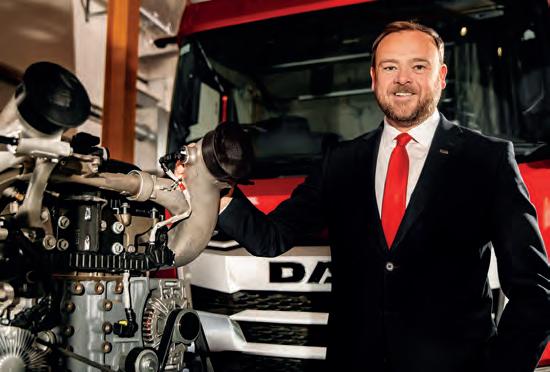
industry as a whole,” commented Nigel. “The coming years promise lots of change and, whilst there will undoubtedly be challenges,
there will also be fantastic opportunities for DAF to support its customers and drivers with the best products and services possible.
With the strength in depth of our product range and our fantastic Dealer Network, we are perfectly positioned to demonstrate to the industry why DAF is the number one truck brand in the UK.”
In his new role David Kiss will be responsible for all sales and aftersales activities in the United Kingdom and Ireland, Poland, the Czech Republic and Slovakia, Turkey, Italy, Spain and Portugal, Austria and Switzerland, and Hungary.
In a further key appointment, James Stewart has been promoted to Truck Sales Director, UK & Ireland. He succeeds Russell Patmore who was recently appointed Director of Marketing at the DAF headquarters in Eindhoven, with responsibility for the DAF brand globally.
James’ career with DAF Trucks began in 2009 as an intern during his Business Studies degree. After graduating, he rejoined the company full-time in 2011 as Commercial Services Analyst. Since then, he has advanced through a series of key leadership positions with increasing responsibility, including Fleet Sales Manager, Fleet Sales Director, and, most recently, Marketing & Strategic Initiatives Director since 2024.
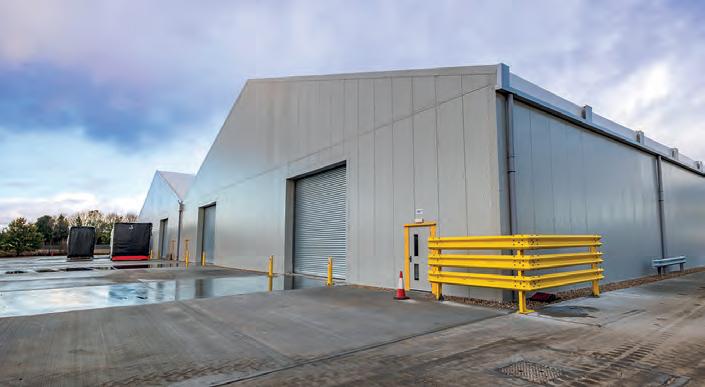
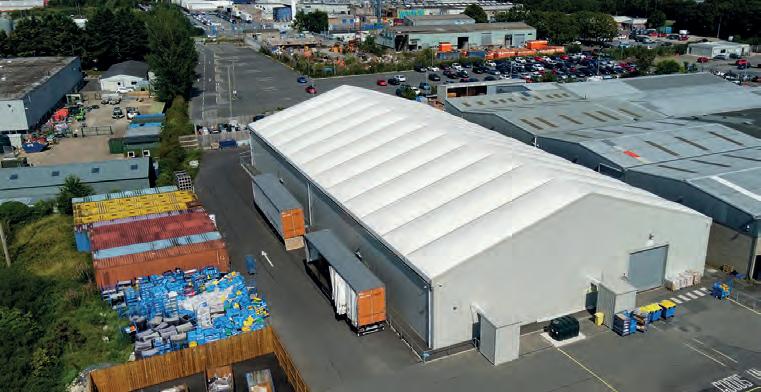
Nigel Beckett.

KEEPING YOUR FLEET ON THE RIGHT TRACK
In an industry where timing and efficiency define success, telematics and GPS technology have become indispensable tools across the transport and logistics sector. From long-haul freight operators to last-mile delivery fleets, businesses are increasingly relying on connected systems to monitor vehicles, optimise routes, reduce fuel consumption and improve customer service in real time.
What began as a simple navigation aid has evolved into a sophisticated ecosystem of data-driven fleet management solutions.
Modern telematics platforms combine GPS tracking with onboard diagnostics, driver behaviour monitoring, vehicle performance analytics and cloud-based reporting, giving operators unprecedented insight into every stage of the supply chain.
In an environment shaped
by rising fuel costs, tighter environmental regulations and growing pressure for faster deliveries, these technologies are no longer optional — they are central to operational competitiveness.
For fleet managers, the benefits are tangible. Real-time tracking enables more accurate scheduling and improved asset utilisation, while predictive maintenance alerts help reduce downtime and costly repairs. Driver safety can also be
enhanced through monitoring systems that identify harsh braking, speeding or fatiguerelated risks. At the same time, customers increasingly expect accurate delivery windows and live shipment visibility, expectations made possible by integrated GPS and telematics solutions.
The expansion of e-commerce and global trade has accelerated demand for smarter logistics infrastructure, pushing technology providers to innovate
at pace. Artificial intelligence, machine learning and Internet of Things (IoT) connectivity are now being integrated into telematics platforms, enabling companies to make faster, more informed decisions based on live operational data.
In this feature, Export & Freight focuses on some of the leading companies operating in this space, and how their services and products can give your business a competitive edge.


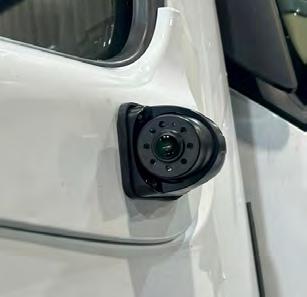
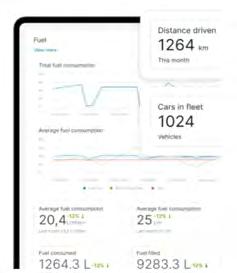

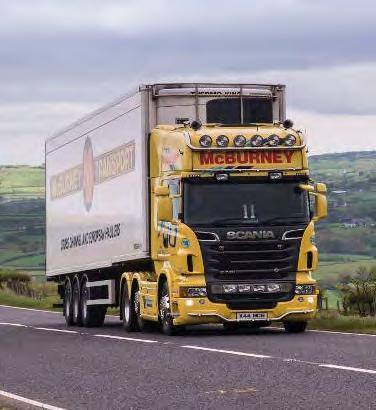
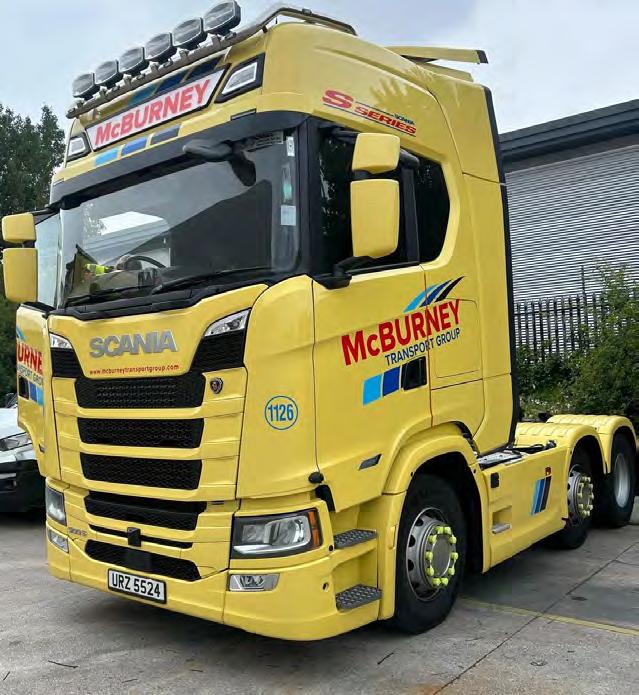





ELECTRAC: DRIVING SMARTER, SAFER FLEET OPERATIONS ACROSS THE UK AND IRELAND
Electrac has established itself as a specialist provider of fleet telematics, vehicle safety technology, CCTV systems, and electrical integration services.
Based in Lisburn the company works with transport operators, logistics firms, construction businesses, and commercial fleet owners across Northern Ireland, the Republic of Ireland, and the wider UK market. In a transport and logistics sector increasingly shaped by safety legislation, compliance requirements, insurance pressures, fuel costs, and operational efficiency, Electrac positions itself as more than just a technology supplier. The company combines fleet management expertise with electrical engineering capability to deliver fully integrated vehicle solutions tailored to each customer’s operational needs.
THE COMPANY BEHIND THE TECHNOLOGY
Founded in Belfast and operating from Lisburn, Electrac began with a mission to help businesses improve fleet safety, protect assets, and gain better operational visibility through modern vehicle technology. Over the years, the company has grown into a trusted regional provider for businesses operating everything from small van fleets to large specialist transport vehicles. What separates Electrac from many off-the-shelf telematics providers is its consultative and engineeringled approach. Rather than simply supplying hardware, the company assesses each fleet’s operational risks, compliance demands, vehicle types, and driver behaviours before recommending a tailored solution.
One of Electrac’s primary offerings is GPS vehicle tracking and telematics systems. These solutions provide businesses with real-time visibility over fleet movements and driver activity. For logistics operators, this level of visibility helps improve route planning, reduce fuel consumption, minimise downtime, and strengthen customer service through accurate delivery tracking. Telematics can also help companies reduce insurance claims and improve driver accountability.
FLEET SAFETY AND COMPLIANCE SYSTEMS
Safety technology is another major area where Electrac has developed expertise. The company supplies and installs a wide range of systems designed to reduce accidents and
improve vehicle compliance. Their fleet safety technologies include: blind spot monitoring systems; cyclist and pedestrian detection; reversing cameras and sensors; audible warning systems and fatigue and driver monitoring systems These technologies are particularly important for logistics operators working in urban environments such as Belfast, where increasing road safety expectations and vulnerable road user protection are becoming central operational concerns.
VEHICLE CCTV AND CAMERA SYSTEMS
Electrac also provides vehicle CCTV and live camera systems for fleets. These range from basic dashcams to advanced 360-degree live-streaming camera setups fully integrated with telematics platforms.
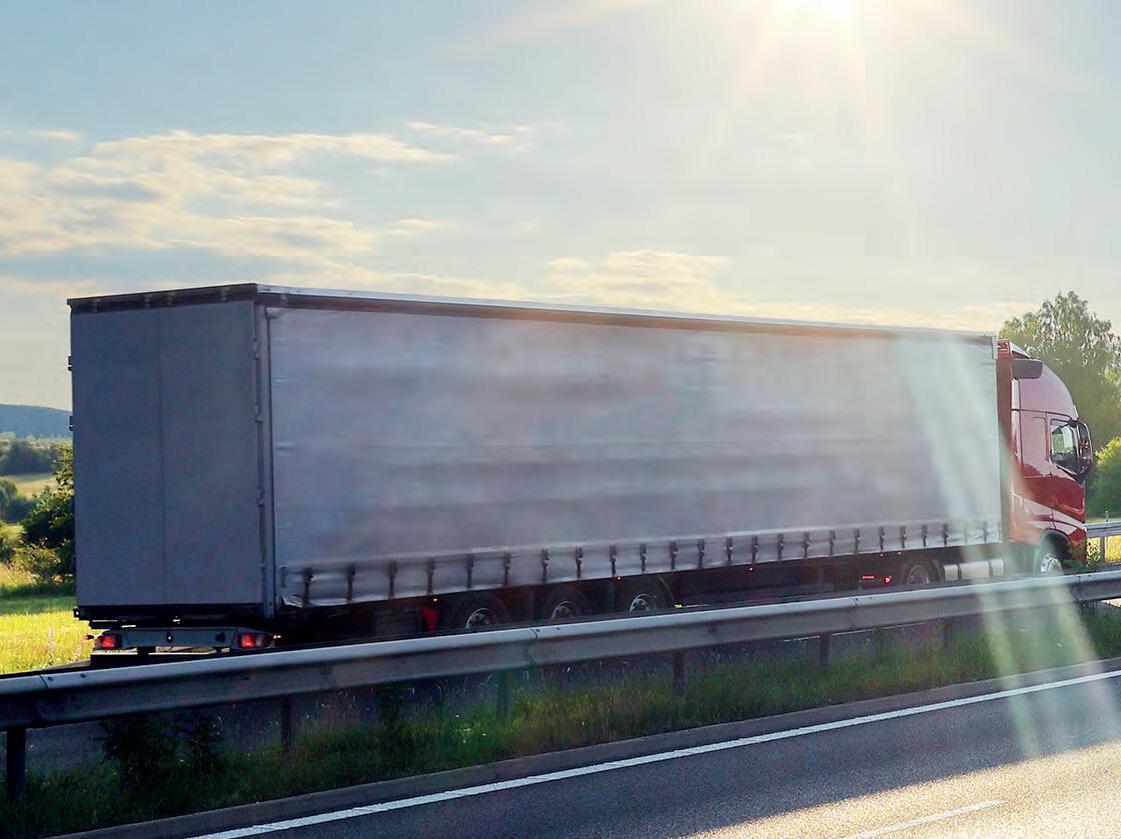

For logistics and haulage companies, CCTV systems have become increasingly important for protecting drivers and businesses from fraudulent claims and disputes.
The integration between cameras and telematics also allows fleet managers to connect footage directly to vehicle data and incidents, creating a more complete operational picture.
TACHOGRAPH MANAGEMENT
Stop wasting hours on manual compliance tasks. Our automated system keeps your tachograph files up to date — no physical downloads, no chasing drivers, no missed deadlines.
Everything is scheduled, stored, and ready when you need it. And if you’re looking to optimise even more, our solutions cover everything your fleet needs — from safety to fuel control and more.
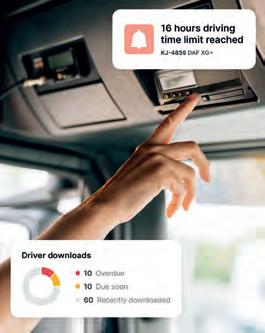
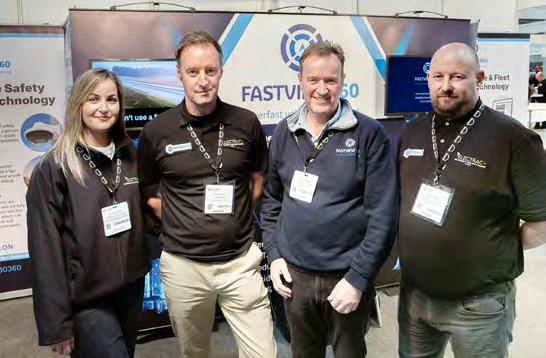
WHAT MAKES ELECTRAC UNIQUE?
One of Electrac’s strongest differentiators is its ability to combine multiple technologies into one cohesive system. Rather than supplying standalone products, the company integrates telematics, CCTV, safety systems, and electrical infrastructure into unified fleet solutions. This creates a centralised operational environment where businesses can monitor vehicles, drivers, incidents, and compliance data from a single platform. For transport managers, this reduces complexity and improves operational oversight.
Electrac strongly promotes its Northern Ireland roots and local engineering support. The company’s Belfast and Lisburnbased teams provide on-site installation, maintenance, upgrades, and technical assistance.
BESPOKE RATHER THAN OFF-THE-SHELF SOLUTIONS
Electrac emphasises tailored solutions over standardised packages. The company assesses each customer’s vehicle types, routes, risk exposure, driver behaviour and operational objectives before designing a system. This flexibility makes the business attractive to operators with specialist fleets or complex operational environments. Many technology providers focus either on compliance or efficiency. Electrac aims to combine both by helping fleets:
• Improve safety standards
• Reduce accidents
• Lower fuel costs
• Protect assets
• Improve driver accountability
• Strengthen compliance reporting
• Reduce insurance risks
This broader operational focus aligns well with the modern transport and logistics industry, where technology investments must deliver measurable commercial value. As fleet digitisation continues to grow, businesses increasingly need partners capable of integrating multiple technologies together — not simply selling standalone hardware. Electrac’s combination of telematics expertise, electrical engineering capability, and local support positions it strongly within this market.
For logistics operators seeking greater visibility, improved safety, and better operational efficiency, companies like Electrac represent the next generation of integrated fleet technology providers — combining practical engineering expertise with modern connected vehicle systems.
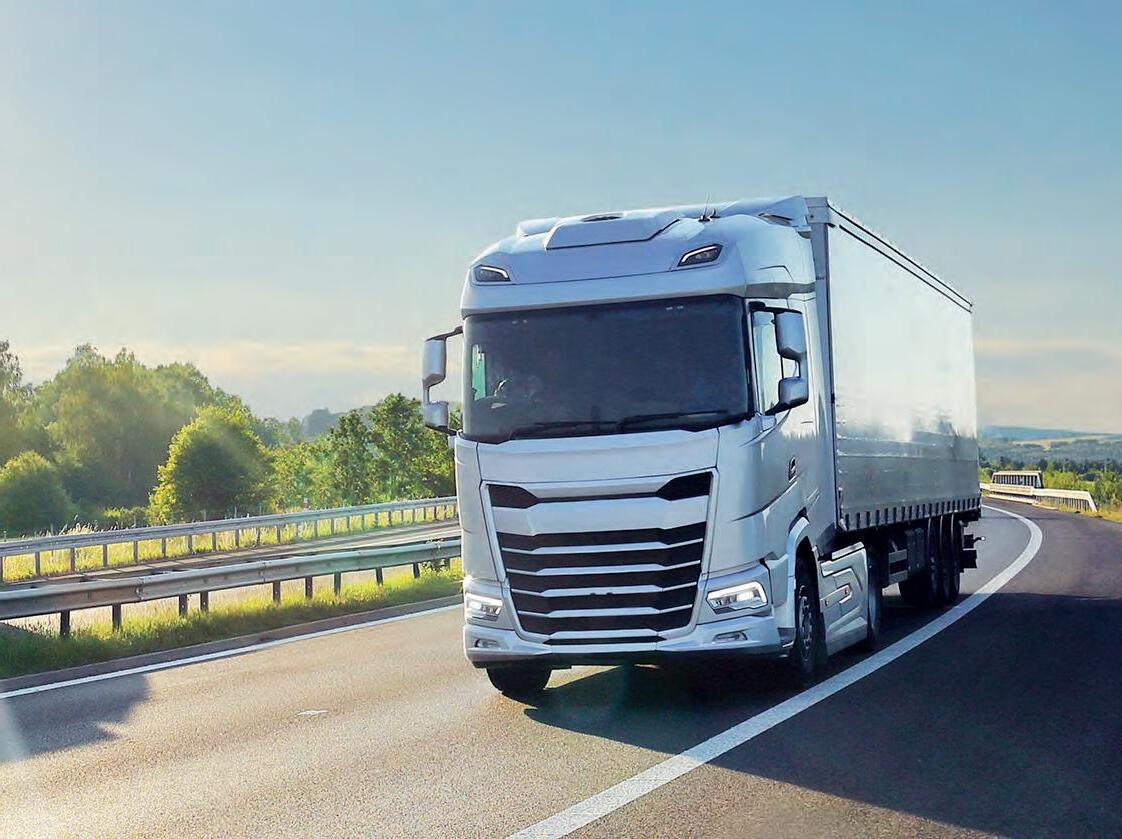
Get in Touch with Electrac Have a question, need a quote, or want to see a demo? Our team is ready to helpreach out today.
Call +44 (0) 28 9099 2893
Jonny@electracni.com info@electracni.com www. electracni.com
Celine Black, Seamus Black, Nick Billington and John Mayne.

CONNECTING FLEET SYSTEMS FOR SMARTER COMPLIANCE
Aquarius IT, a market-leading provider of driver and fleet management software, works closely with transport operators across multiple sectors in the UK, and a clear theme is emerging: fleets are not short of data, but bringing it together to deliver real operational value remains a challenge.
Most operators have already invested in telematics, camera systems and route planning tools. These are embedded in dayto-day operations. The challenge is no longer access to information, but how to connect it. In many fleets, critical data sits across multiple platforms. Driver activity, vehicle tracking, incident footage and compliance records are often managed separately.
While each system performs its role well, the lack of integration creates inefficiencies, duplication and gaps in visibility. This becomes increasingly problematic as compliance expectations continue to rise. With schemes such as DVSA Earned Recognition placing greater emphasis on accurate, accessible and auditable data, operators need confidence that information can be easily evidenced. Managing this
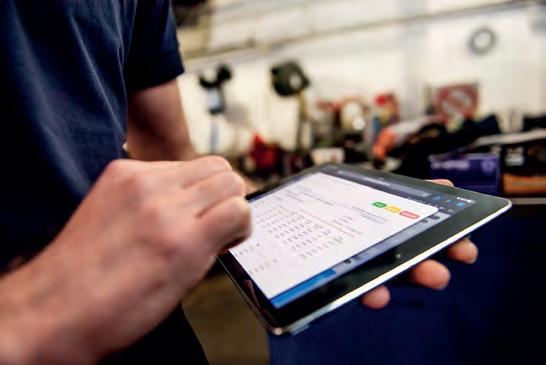
across disconnected systems introduces unnecessary complexity and risk.
Aquarius supports operators by acting as the integration and compliance layer across the operation. Rather than replacing existing technology, Aquarius works alongside telematics, camera and route planning providers, using API integration to bring these data sources together into a single environment.

“The conversation is shifting,” says Mark Johnston, Managing Director at Aquarius IT. “It is no longer just about adding new systems, but about how existing technology is integrated and used across the operation. That is where operators start to see real value.”
The impact goes beyond visibility. By connecting systems, operators can link incident data to driver records, align tracking data with tachograph analysis, and integrate vehicle maintenance activity with wider workflows. This creates a clearer operational picture and supports faster, more informed decision making.
Operators also benefit from improved access to performance data across drivers and

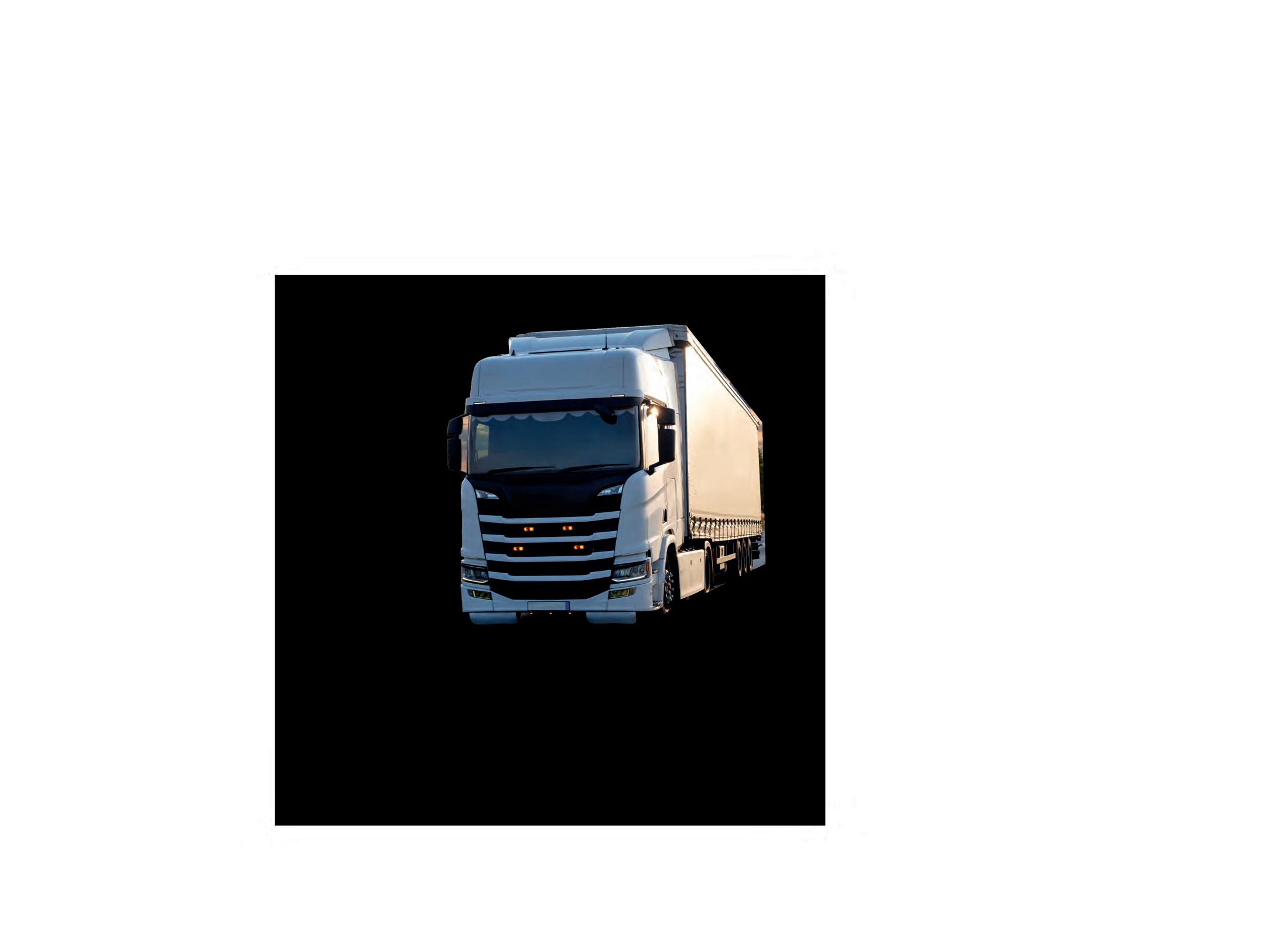
DAF launches interactive route simulator for electric trucks
DAF Trucks is launching an interactive route simulator that provides transport operators with insight into the real-world deployability of electric DAF trucks in their specific daily operations.
Using customer-defined routes, the DAF Electric Route Simulator provides an initial indication of range and operational feasibility for all variants within the broad DAF Electric truck program.
The simulator reflects the modular design philosophy of the New Generation DAF XB, XD, XF, XG and XG+ Electric vehicles. All these EV trucks are available with multiple battery pack options, as well as a wide range of e-motors, axle configurations and cab variants.
Impact of specs
The DAF Route Simulator quickly shows how optimal vehicle specifications enhance the truck’s performance in daily use. Users of the simulator can adjust the number of battery packs, chassis configuration, and vehicle weight to instantly view the calculated range and route viability. For detailed calculations and further advice,
operators can contact a DAF dealer through the simulator directly, which has advanced software available for in-depth, detailed advice. Tailored vehicle advice
The interactive route simulator is part of DAF’s all-encompassing approach when it comes to electric transport. This includes amongst others, electric vehicle consultancy, charging infrastructure solutions via PACCAR Power Solutions, financing and leasing services, connectivity and fleet management tools, driver training, and dedicated electric after sales and service support, through the professional dealer network throughout Europe and beyond, with well-trained mechanics and workshop equipment, specifically installed for maintaining electric vehicles.
DAF provides a comprehensive portfolio of electric trucks, ranging from the
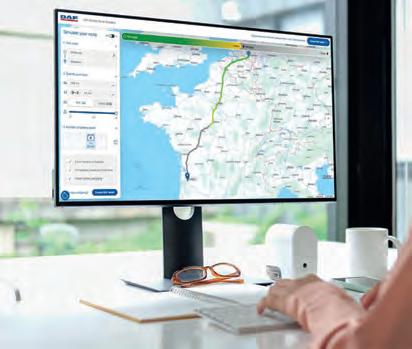
12-tonne DAF XB Electric designed for ‘zero emissions’ local distribution, to the XG+ Electric for longer-distance operations.
The XD and XF Electric models, built for a wide variety of applications, have been awarded ‘International Truck of the Year 2026’, in recognition of their advanced, efficient driveline technology and excellent driver comfort, in combination with a wellthought through vehicle concept for highest efficiency, safety and driver comfort.
The route simulator is accessible via www.daf.com/e-mobility.
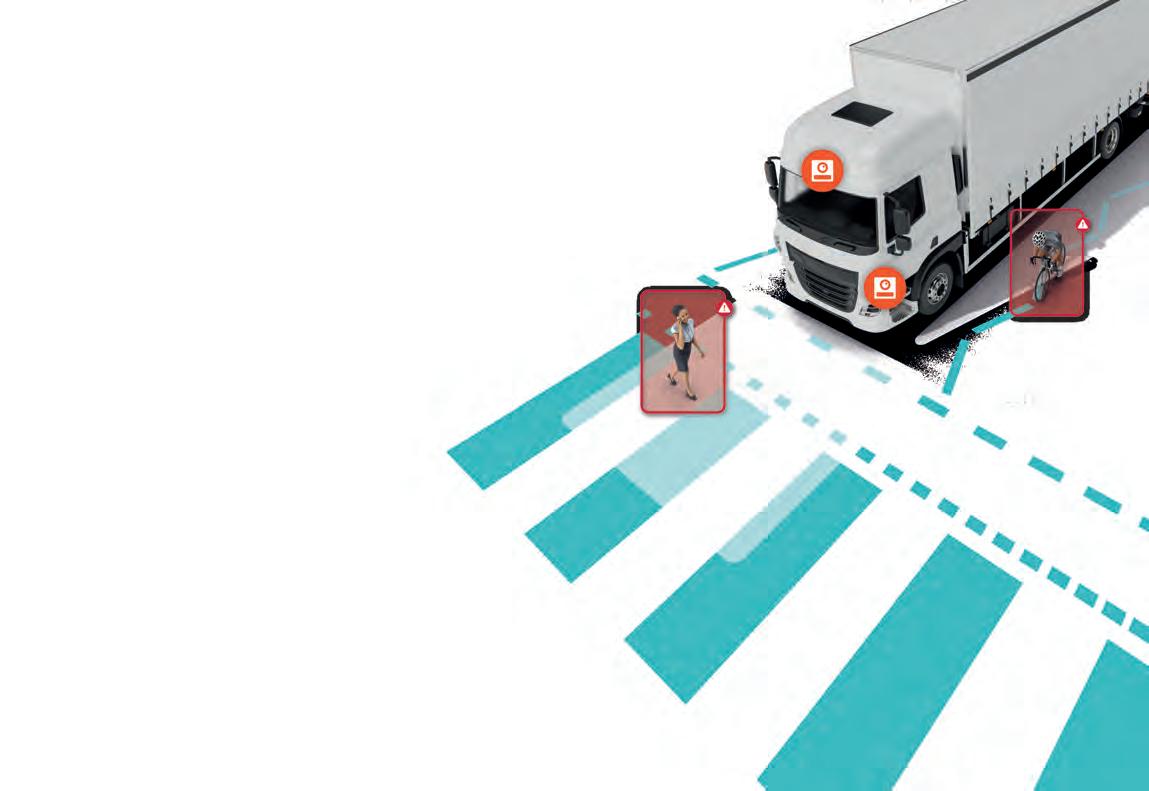
• Recognises and alerts the driver to people in the detection zone
• Works with existing cameras, monitor and cabling
• Compatible with up to two analogue cameras
Renault Trucks UK & Ireland appoints Aymeric Larcher as Managing Director
Renault Trucks UK & Ireland has appointed Aymeric Larcher as Managing Director, taking up the role from 1 May 2026. He succeeds Carlos Oliveira Rodrigues, who has been promoted to Senior Vice President, Renault Trucks Europe, after seven successful years leading the UK & Ireland business.
Aymeric joins Renault Trucks UK & Ireland from his role as Head of Key Account Sales in France. Having started at Volvo Group in 2006, he has held a number of leadership positions at both European and global level. He joined Renault Trucks in 2017, progressing through key commercial roles including Key Account Manager and Head of Used Trucks. He brings extensive experience in driving growth, shaping sales strategy and developing major customer relationships.
As Managing Director, Aymeric will lead the strategic and commercial direction of Renault Trucks UK & Ireland, building on the strong foundations established in one of Renault Trucks’ most advanced and strategically important European markets. His focus will be on supporting customers across the full Renault Trucks range, including the transition to low carbon transport, strengthening the dealer network and driving sustainable, profitable growth.
Carlos Oliveira Rodrigues, Senior Vice President, Renault Trucks Europe, says, “The UK and Ireland play a central role in Renault Trucks’ wider

European growth strategy, particularly as our industry undergoes profound transformation driven by decarbonisation and evolving customer demands. Aymeric’s appointment reflects our commitment to strengthening leadership at this pivotal time for the business. He brings a strong track record of delivering
results, developing high-performing teams and maintaining a clear focus on customer success. As the transition to low carbon transport gathers pace, supported by continued investment in our dealer network, Aymeric will lead the business into its next phase of sustainable growth.
I would like to thank James Charnock, Commercial Director and Derek Leech, Service Market & Retail Development Director, for stepping into the roles of Acting Managing Director while this appointment was finalised.”
Aymeric Larcher, Managing Director, Renault Trucks UK & Ireland, adds: “The UK and Ireland markets are recognised across Europe for their pace of innovation and commitment to decarbonisation. I am proud to take on this role at such an important time for our industry.
Our ambitions are clear: to accelerate the shift to low carbon transport and continue to deliver the high levels of service, reliability and partnership all of our customers expect. I look forward to working closely with our colleagues, dealer partners, and customers to further strengthen Renault Trucks’ position as a trusted, long-term partner across the UK and Ireland.”
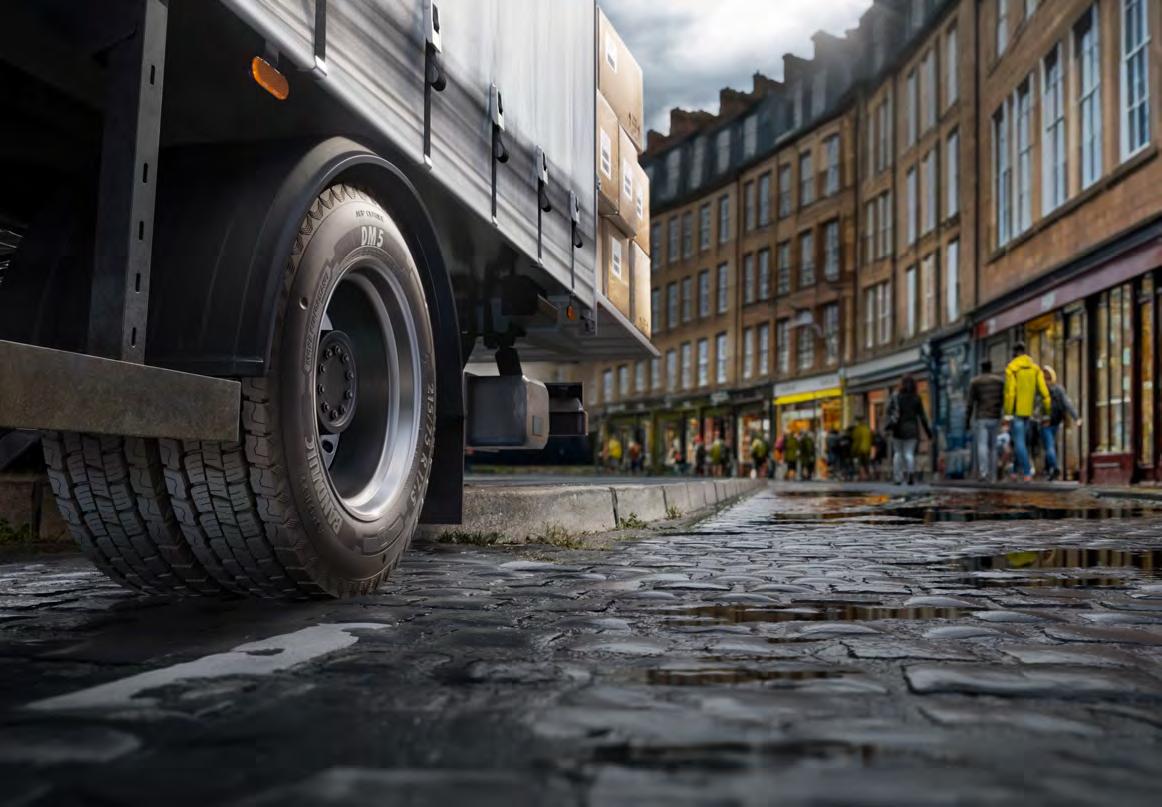

Aymeric Larcher.
FIRST RTX NORTHERN IRELAND HAILED A SUCCESS
BY AUSTIN LYNCH
The trucks have come and gone, the stands have been taken down, and the exhibitors have packed up and gone home. But the first Road Transport Expo (RTX) Northern Ireland has left a lasting impression on both visitors and those businesses who exhibited at this year’s show.
Over 60 exhibitors, including major manufacturers Scania, DAF, Volvo, MAN, Iveco, Mercedes-Benz and Renault Trucks and a host of other major local and UK businesses descended on the Eikon Centre for the two day show in mid-April, and the feedback has been positive, with businesses talking about the ‘quality’ of visitors to their stands and having enough decent conversations and enquiries to make their attendance at this first show in Ireland to be more than worth their while.
The Eikon Centre, Lisburn was the perfect venue for this trade show which is most definitely ‘all about the truck’. And as well as the many trade stands RTX also brought its ‘Knowledge Zone’ conference programme to Belfast, which ran over both days and tackled a range of highly relevant issues from driver safety to debarbonisation. Each day also had a ‘Big Debate’ which involved a number of prominent professionals from the local transport and logistics
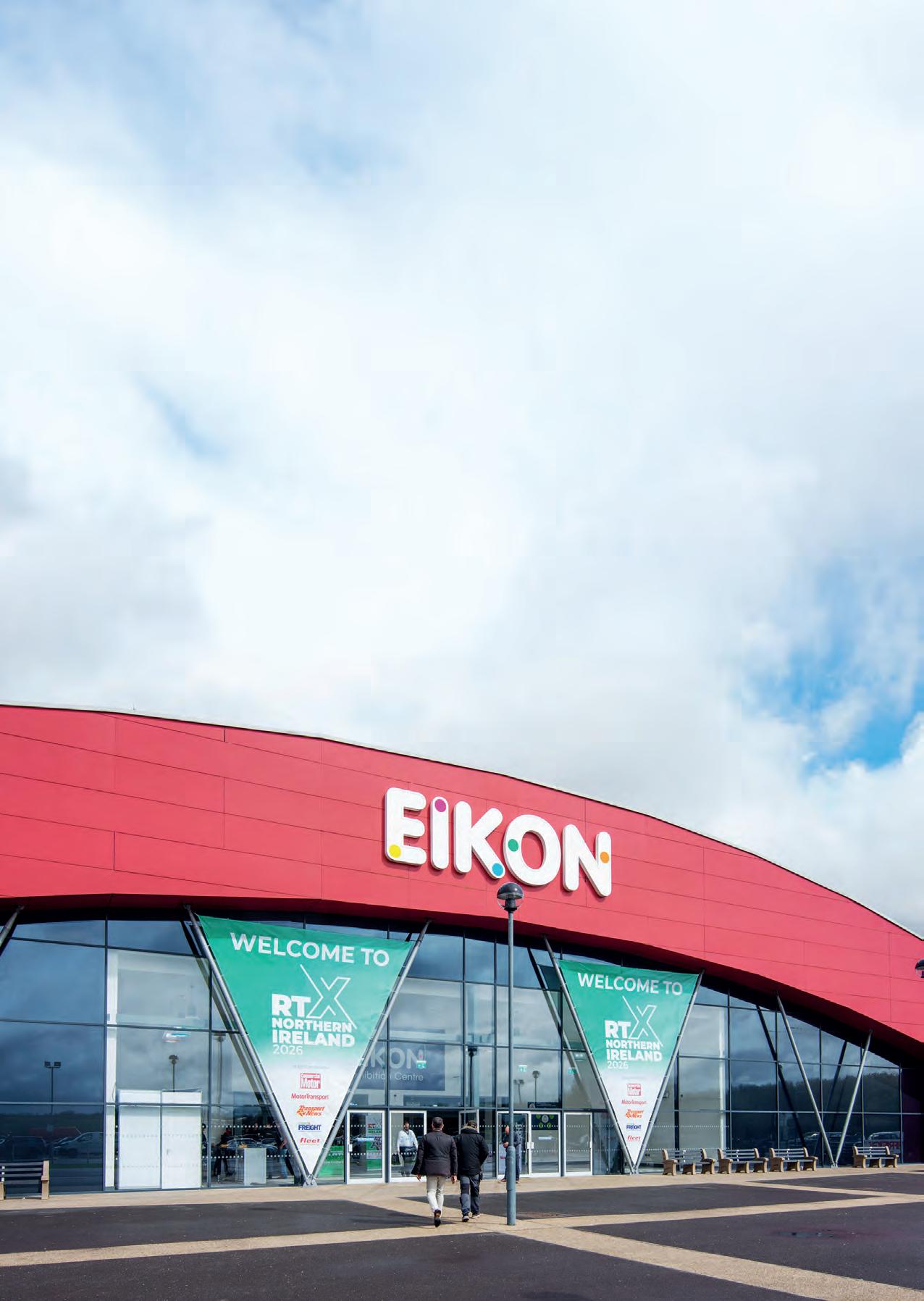
industry - and this proved to be a real draw for the crowds at the show.
The Eikon Centre, located just 8 miles outside Belfast, has room for both inside and outside stands and a couple of manufacturers decided that they wanted the room and flexibility of being outside. And while the weather may not have played ball on Wednesday, the rain stopped and the sun came out on Thursday morning and those outside, including Mercedes Benz and Scania Road Trucks reported a higher footfall, and better business on the second day. There was also a ‘Ride and Drive’ event running throughout the two day show which proved a big draw – with one manufacturer reporting they had 150 test drives during the course of the show.
Road Transport Expo (RTX) Northern Ireland was organised by Road Transport Media, who already run the successful RTX at Stoneleigh in Warwickshire each June, and who also introduced RTX Scotland last November.
In 2026 they wanted to bring the already successful trade show format to Ireland, and to bring this to fruition the Road Transport Media team joined forces with Export & Freight and Fleet Transport trade magazines, who brought their local knowledge and expertise to the event. Instead of just one Irish show, the plan is to create two shows – running alternate years – so in 2027 the industry can look forward to RTX Ireland, with RTX Northern Ireland returning in Spring 2028.
The RHA had a strong presence at the show and Geraint Davis RHA Director of Partnerships, said it was a privilege to be at the show and to support RTX NI.
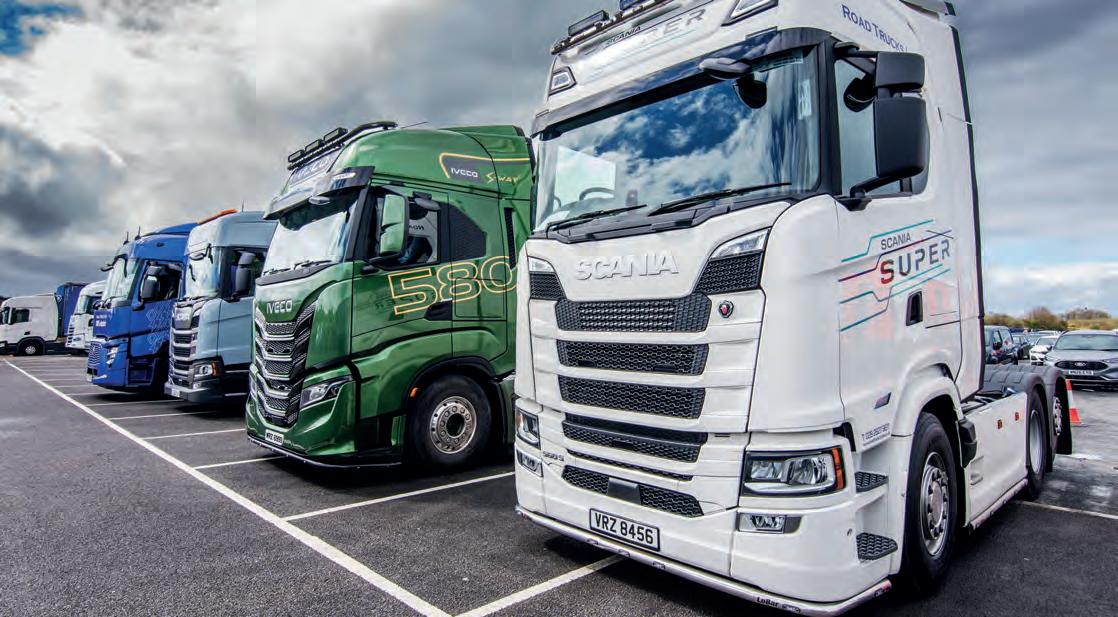
“It’s been a really good show for us as we can link in with our members – existing members, new members - and support the van, truck and coach sectors here on the ground in Northern Ireland. The RHA participated in a number of debates and conferences at the Knowledge Zone with Geraint’s colleagues Chris Ashley and Alastair Gunn both contributing to panel discussions. “Chris gave some insight into the topic of Decarbonisation and how businesses can get there pragmatically.”
Geraint said the RHA has a strong membership base here in Northern Ireland but are always looking to grow this, and in the current climate the RHA is more relevant that ever giving the industry a voice in Stormont and Westminster and fighting their members’ corner at a time when many are genuinely struggling with their costs.
The aim of the Road Transport Expo shows is to provide a unique opportunity to connect with industry leaders, get behind the wheel of the latest trucks, and discover solutions that could
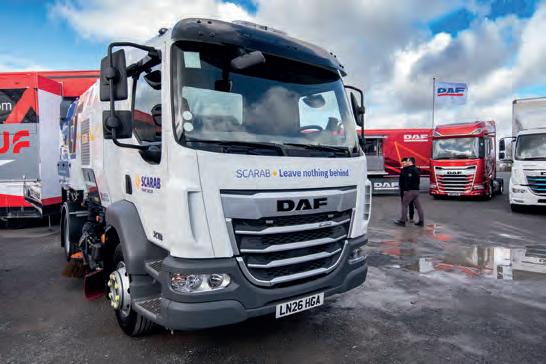
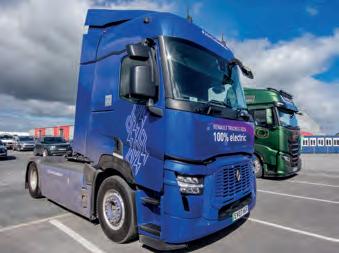
transform your operation – all in one location. Also present at the show was the volunteers from the Breaker Breaker charity, who raise awareness and support mental health across the haulage industry. It was great to see so many companies showcasing the latest in vehicles, technology and equipment, and from trucks to trailers, and from tyres to telematics RTX Northern Ireland certainly delivered on its promise to be ‘all about the truck’.
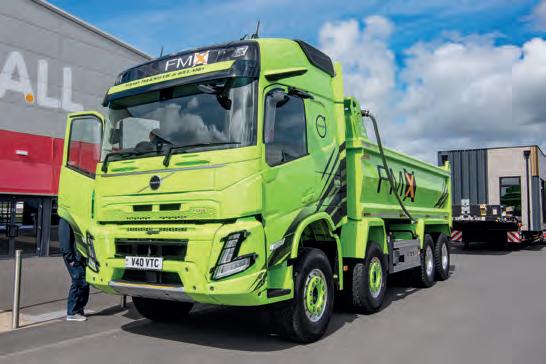
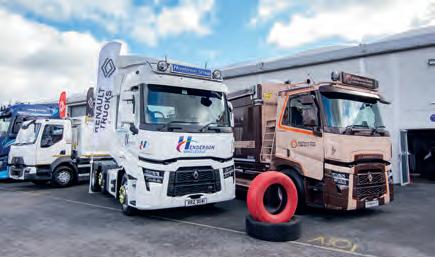
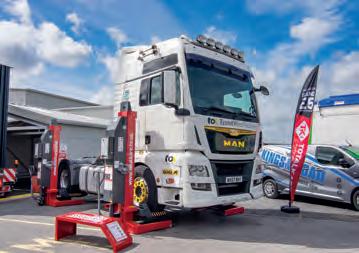
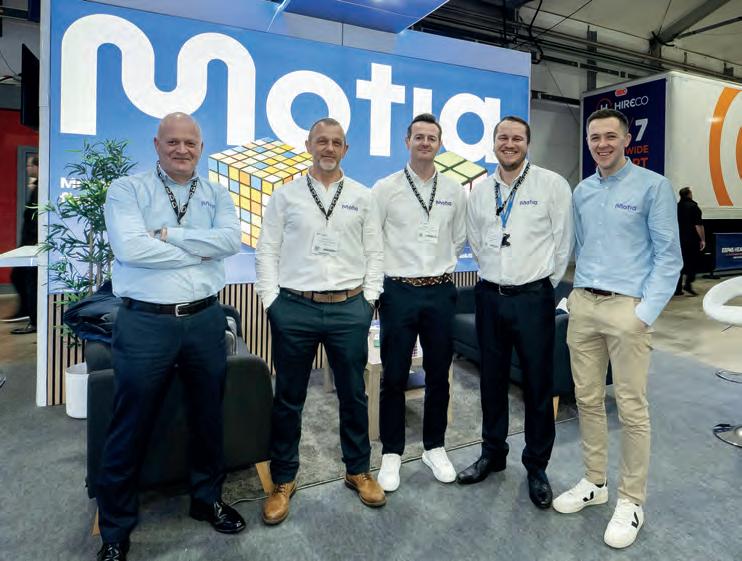
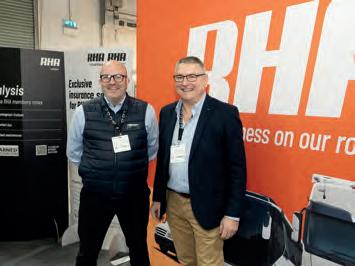
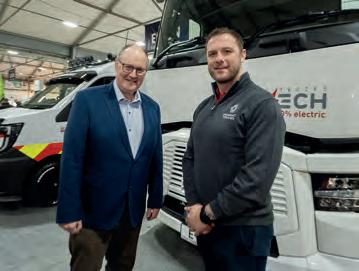
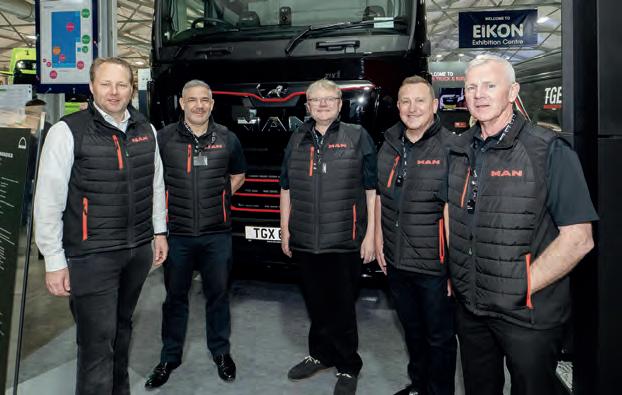
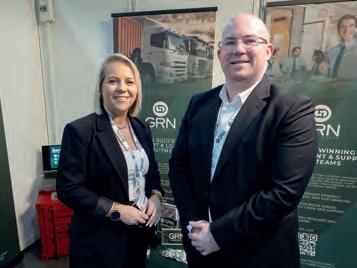
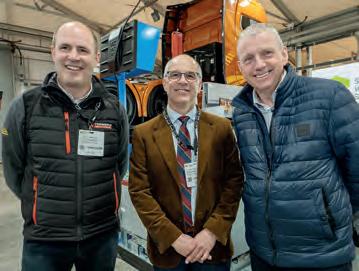
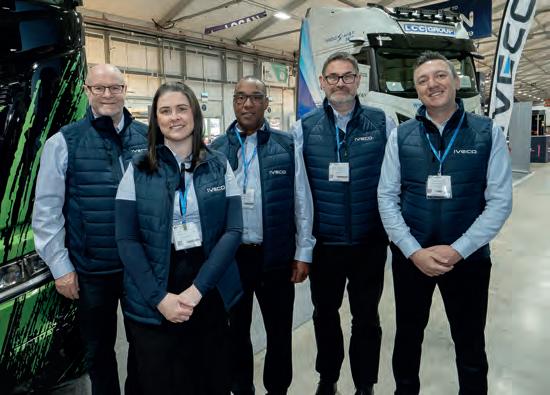
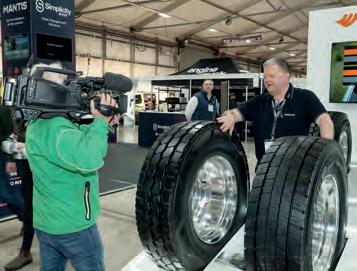
The team from Motia - Geoff Reid, Gary Wilson, Robert Steele, Reece Hampton and Niall Delargey.
Martin Tomlinson and Joe Roddy on the Volvo stand.
Ian Green and Janice Watt on the GRN stand.
Harry Nash and Iain Latimer on the Renault Trucks stand.
RHA - Pete Short and Martin Dean.
Raymond Smyth, Terberg, Mark McCloskey and Stephen Robinson.
On the Iveco stand is Rod Hawkins, Emma Duffy, Gavin Graham, Gary Bridge and Greig Goodings.
Liz Haselden from Aquarius with Helen Beggs.
Miles Chalkey, Dearbhla Anderson and Trudi Turkington on the Derry Bros stand.
Interview time at the Hankook stand.
MAN - Jan Kohlmeier, Tony Farish, Brian Beattie, Julian Brown and John Donnelly, RK Trucks
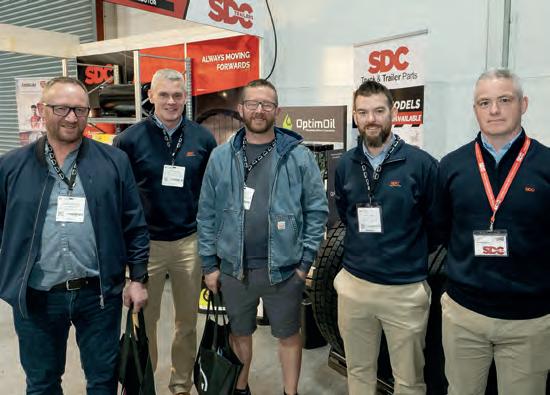
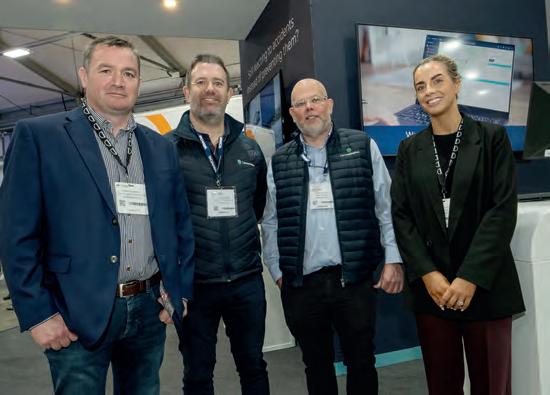
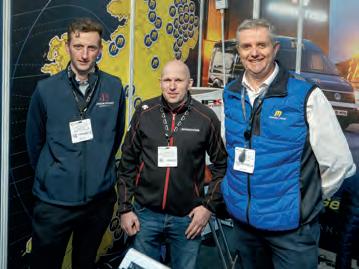
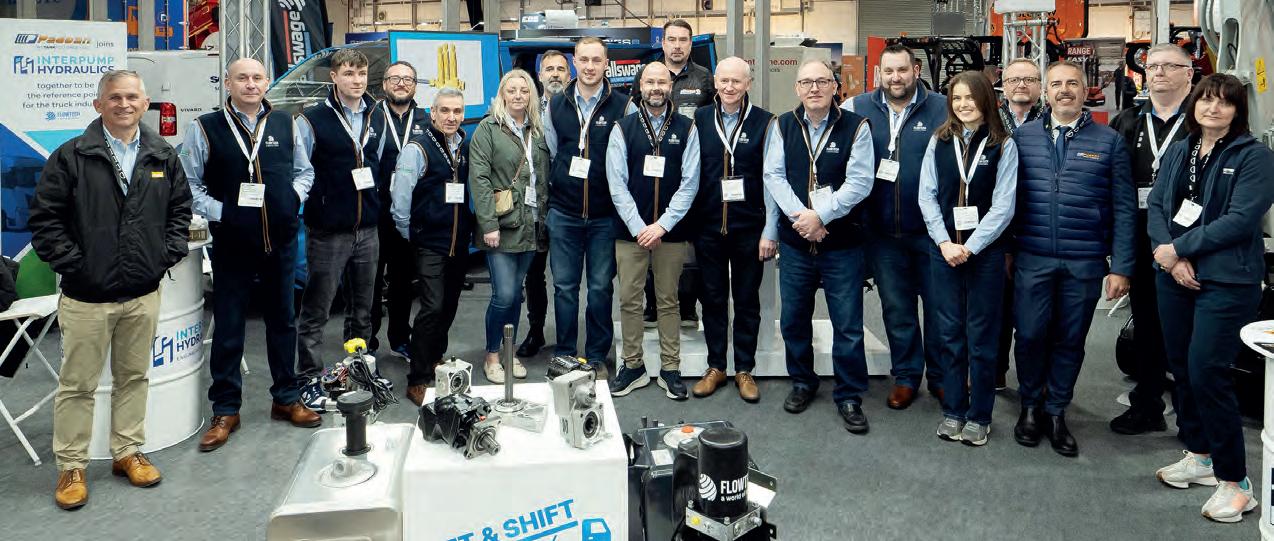
Angus Johnston, Andrew Bushe and Stephen Shaw on the Modern Tyres stand.
HireCo - Ricky Graham, David Millen and Lorna Phillips.
Matt Magee, Matt Vass, Dean Little, Justin Stronge and Mattie McCreanor are from Mantis.
The team from SDC - Patrick Cullen, Gavin Diamond, Kevin Cullen, Shane Coveney and Kevin Shaw.
Cameramatics Stand - Simon Murray, Alan Goggin, Liam Murphy and Nicole O’Hanlon.
Dennisons - Michael Walsh, Robert Cromie and David Dennison.
Brigade - Philip Baile, Jonathan Jenkinson and Duane Gatland.
The Flowtech team.
THE FATAL FIVE: INSIDE PSNI’S STARK WARNING ON ROAD SAFETY
At a rather harrowing road safety presentation delivered by the Constable Mark Dumigan Police Service of Northern Ireland (PSNI) as part of the Knowledge Zone at RTX Northern Ireland, the message was clear, unsettling, and impossible to ignore: most road deaths are preventable.
“We call them collisions, not accidents,” the office explained. “Ninety-five percent are down to human error.” It’s a deliberate choice of language - one that shifts responsibility squarely onto drivers. Last year, 56 people lost their lives on Northern Ireland’s roads. While that figure marked a decline from previous years, the trend remains fragile. At the time of the presentation, fatalities were already significantly higher than the same period the year before, alongside hundreds of life-altering injuries. At the centre of the PSNI’s road safety campaign are the so-called “Fatal Five” - five key behaviours that consistently contribute to serious and fatal collisions: drink and drug driving, speeding, careless driving, not wearing a seatbelt, and mobile phone use. Through the use of some hard-hitting videos and TV advertising, Constable Dumigan took the audience through the ‘Fatal Five’.
1. DRINK AND DRUG DRIVING
The first - and perhaps most widely understood - risk is driving under the influence. Yet misconceptions persist. Many drivers still believe there is a “safe” amount of alcohol they can consume before getting behind the wheel. In reality, there isn’t.
“Any alcohol in your system will affect your ability to drive,” the officer stressed. Reaction times slow, judgement is impaired, and even a single drink can make the difference between avoiding danger and causing tragedy. The same applies the morning after - only time, not coffee or sleep, clears alcohol from the body.
Drug driving is an increasing concern, with roadside testing revealing a high failure rate among motorists. The implication is stark: impaired drivers are not rare exceptions, but an everyday presence on the roads.
2. SPEEDING
Speed remains one of the most lethal factors in road collisions - not just excessive speed, but inappropriate speed for conditions. The officer highlighted a crucial shift in thinking: drivers should move from “driving to the speed limit” to “driving to the conditions.”
The statistics are sobering. A pedestrian struck at 20 mph has a 90% chance of survival. At 40 mph, that drops to just 10%. Yet many drivers routinely exceed limits, particularly on familiar roads where complacency sets in.
“Most fatal collisions happen close to home,” the audience was told. Familiarity breeds inattention, and inattention at speed can be catastrophic.
3. CARELESS DRIVING
Careless driving is described as the single biggest cause of death and serious injury on
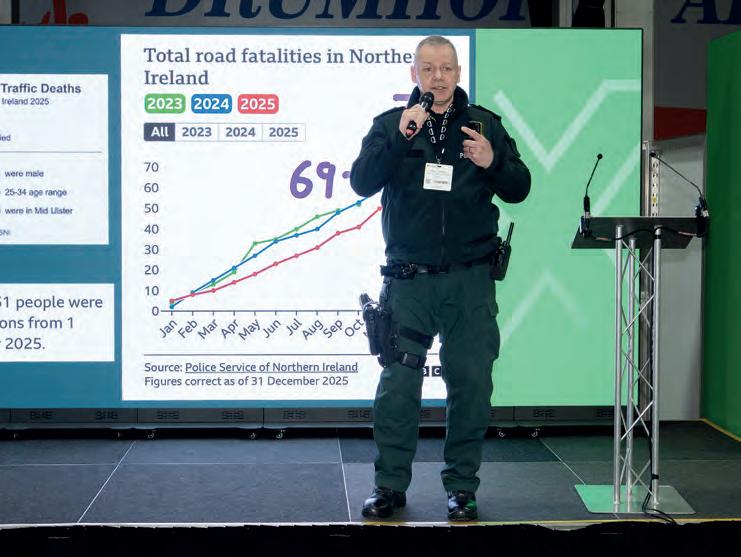
Northern Ireland’s roads. It encompasses a wide range of behaviours - tailgating, failing to observe properly at junctions, or becoming distracted by passengers or external events.
One particularly striking concept discussed was “saccadic masking” - a quirk of human vision where the brain fills in gaps as our eyes move, potentially causing drivers to miss hazards entirely. It explains the all-toocommon phrase: “Sorry, I didn’t see you.”
The message is simple: looking is not the same as seeing. Effective observation requires deliberate, focused attention.
4. SEATBELTS
Despite decades of public awareness campaigns, seatbelt use remains inconsistent - and the consequences can be devastating. The officer recounted attending a crash where a young driver, unrestrained, was ejected through the windscreen. The injuries were fatal.
“A seatbelt could have meant walking away,” he said.
Failure to wear a seatbelt doesn’t just endanger the individual. Unrestrained passengers can become lethal projectiles in a collision, causing fatal injuries to others in the vehicle.
5. MOBILE PHONE USE
Finally, mobile phones - arguably the most modern of the Fatal Five—continue to pose
a growing threat. While fewer drivers now hold phones to their ears, many conceal them on laps or seats, diverting their eyes from the road for critical seconds.
“It’s just as dangerous,” the officer warned. Using a phone while driving impairs concentration in much the same way as drink driving. Yet it is often perceived as less serious, perhaps because it has become so commonplace.
A LASTING IMPACT
The presentation concluded with real dash-cam footage of a fatal collision - an ordinary journey that escalated into road rage, excessive speed, and ultimately the death of an 81-year-old man.
The driver was a young man driving a powerful Volkswagen Golf R, with a number of friends onboard in and around Belfast. It started out as any ordinary journey, simply leaving a busy car park on the Boucher Road. But as the journey progressed, with the police officer stopping the footage a number of times, the story changed and ultimately had a tragic and fatal end .
The driver received a prison sentence, but as the officer noted, the psychological consequences will last far longer.
“No one sets out to kill someone,” he said.
“But it happens when we switch off.”
The Fatal Five are not abstract risksthey are everyday decisions. And as the PSNI made clear, changing those decisions is the key to saving lives.
Constable Mark Dumigan, Police Service of Northern Ireland.
PRAGMATISM, PRESSURE AND PROGRESS: THE RHA’S ROADMAP TO DECARBONISING FLEET TRANSPORT
At RTX Northern Ireland’s Knowledge Zone, Chris Ashley of the Road Haulage Association (RHA)
set out a clear but uncompromisingly realistic vision for decarbonising the UK’s fleet sector. His message was rooted not in idealism, but in pragmatism: the transition to zero-emission transport must work commercially for operators, or it simply will not happen at scale.
Following a detailed presentation from Chris, a panel discussion took place with Chris joined by Stephen Thompson from RiverRidge and Fiona Derry from Derry Group Ireland.
The RHA, now representing around 9,000 members, has positioned itself as both a supporter and a critical friend of the net zero agenda.
“We want to make it work,” Ashley explained, “but we’re not afraid to call things out.” At the heart of its approach is a defined end goal: a market where zero-emission HGVs, coaches and vans are not only available, but affordable - supported by a healthy second-hand market.
That second-hand market, Ashley stressed, is crucial. Small and medium-sized enterprises make up roughly 85% of the haulage sector, and most rely on used vehicles rather than new purchases. Without a viable resale ecosystem, the transition risks leaving the majority of operators behind.
This economic reality underpins the RHA’s broader argument. The haulage industry, Ashley reminded the audience, already operates in a fiercely competitive environment, delivering transport services at minimal cost to businesses and consumers. The challenge, then, is not just decarbonisation—it is maintaining that competitiveness in a net zero world.
“We’re moving from a perfectly competitive diesel market to needing a perfectly competitive zero-emission one,” he said. “The question is how we create the conditions for that transition.”
Central to this are the barriers operators face today. Cost remains the most immediate hurdle, with zero-emission vehicles and supporting infrastructure requiring significant upfront investment.
Grid capacity and depot charging present further complications, particularly for fleets operating at scale. Performance is another concern: operators need confidence that electric or hydrogen vehicles
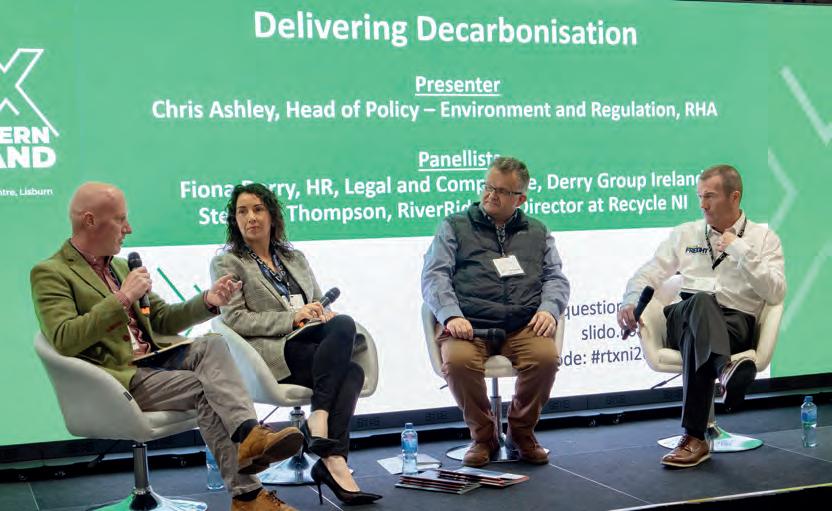
can match the range, payload and reliability of diesel counterparts.
Skills and workforce readiness also feature prominently. Engineers and drivers accustomed to diesel technology must be retrained, while businesses must adapt to entirely new operating models. Alongside this sits a less tangible but equally important factor – mindset of the businesses who operate in this space. For an industry operating on tight margins and daily pressures, change can be difficult to prioritise.
Despite these challenges, Ashley pointed to early signs of progress. There are now just over 1,000 electric heavy goods vehicles on UK roads - a small fraction of the total fleet, but ahead of initial projections. “These are green shoots,” he noted, “but we shouldn’t underestimate how far we still have to go.”
Indeed, the scale of the task becomes clear when viewed against future targets. With the phase-out of new diesel HGV sales under 26 tonnes set for 2035 - and all others by 2040 - the pace of adoption must accelerate
rapidly. Projections suggest thousands of additional zeroemission vehicles will need to enter service each year from now on.
Whether that trajectory is achievable remains uncertain. Ashley highlighted significant risks, from infrastructure delays to wider global economic pressures. “The next couple of years will be crucial,” he said. “That’s when we’ll really see if the transition is on track.”
To better understand industry readiness, the RHA recently conducted a major survey of operators. The findings revealed a mixed picture. While around a quarter of respondents are planning to introduce electric HGVs within five years, a striking 70% currently have no such plans. The reasons were consistent: cost, infrastructure, and operational viability.
One particularly pressing issue is payload loss. Heavier batteries reduce the amount of goods electric lorries can carry, especially at the widely used 44-tonne limit. RHA analysis suggests this can increase operating costs by nearly 19% compared to diesel
equivalents—rising further when additional journeys are required.
To address this, the RHA is calling for regulatory changes, including increasing maximum weight limits to offset battery mass. However, such proposals come with their own challenges, particularly around road wear and infrastructure impact. Ashley acknowledged the complexity, but emphasised the need for evidence-based solutions and collaboration with government. Encouragingly, there are signs of support. Recent funding announcements—including grants for zero-emission trucks and depot charging—are helping to ease the financial burden. But Ashley was clear: more must be done to ensure the transition is commercially viable. Ultimately, the RHA’s approach is about enabling progress without losing sight of economic realities. Decarbonisation, Ashley concluded, is not just a technological shift—it is a systemic transformation. And for it to succeed, it must deliver not only lower emissions, but a sustainable future for the businesses that keep the economy moving.
Stephen Thompson, Riverridge, Fiona Derry, Derry Group Ireland, Chris Ashley, RHA and Austin Lynch, Export & Freight.
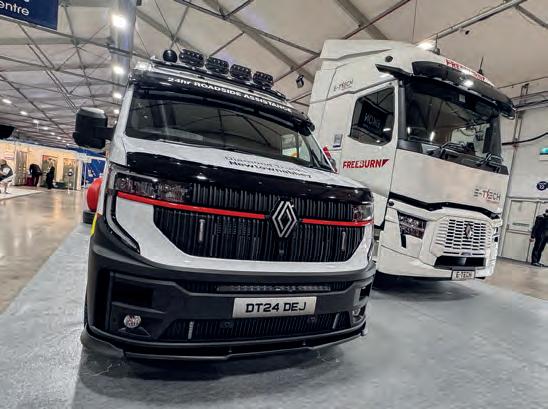
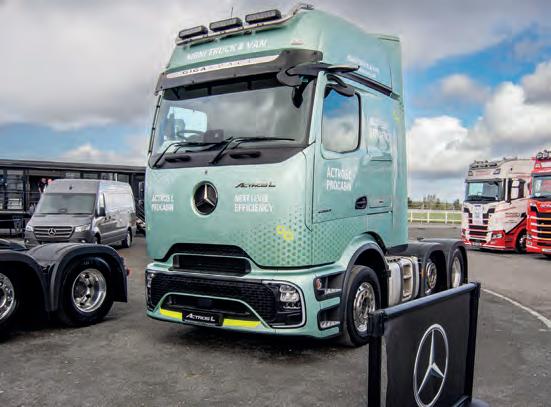
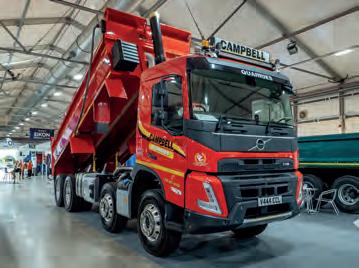
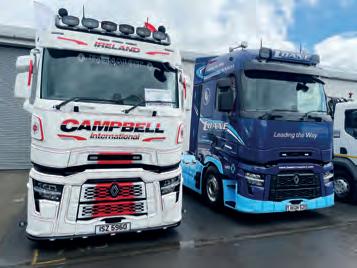
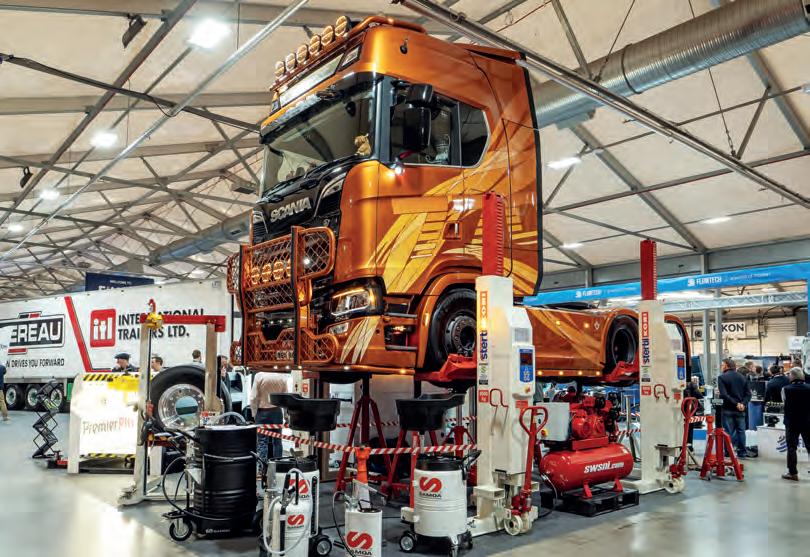
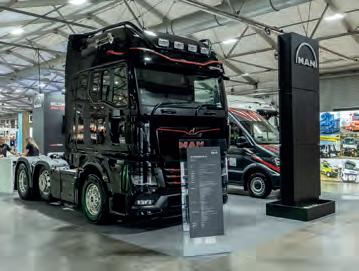
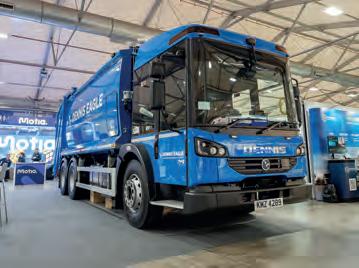
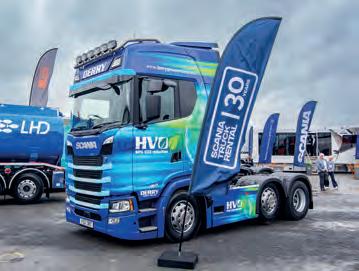
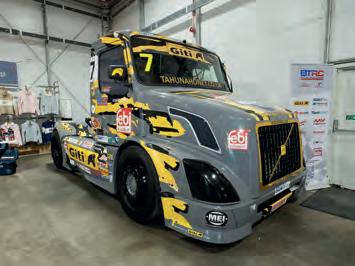
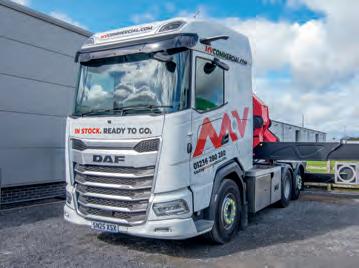
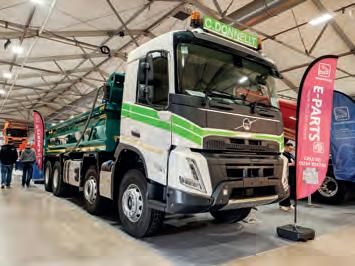

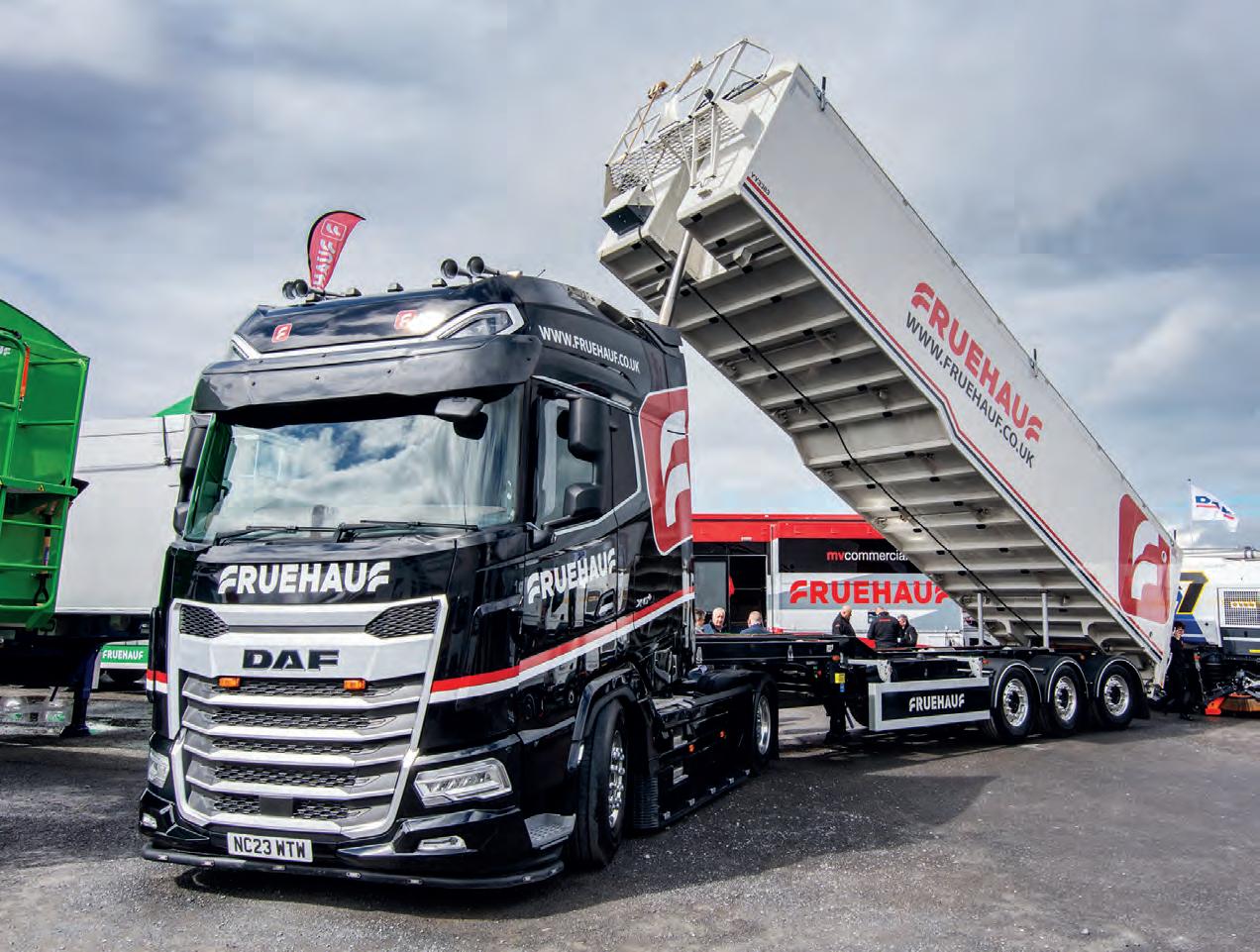
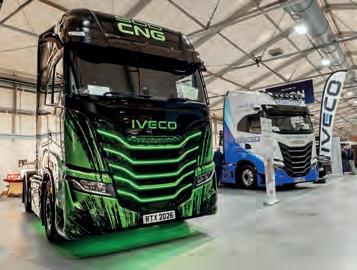
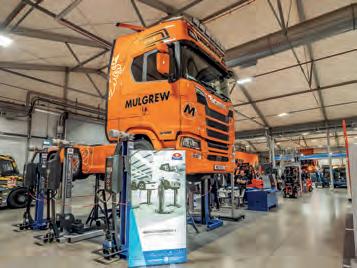
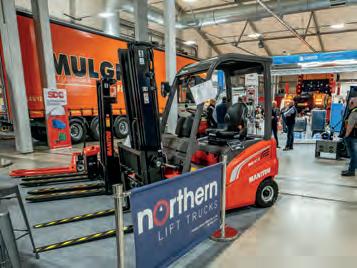
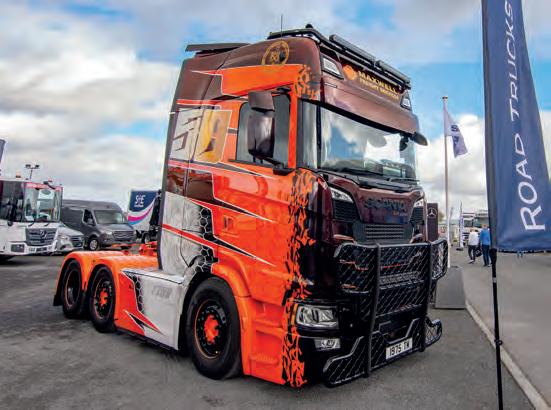
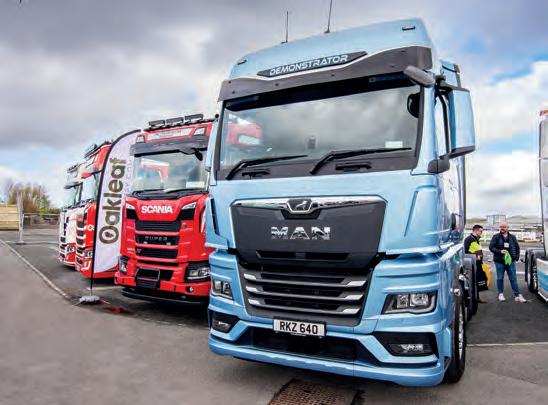
FROM COMPLIANCE TO CULTURE: HSENI SETS THE STANDARD FOR SAFER FLEET OPERATIONS
At RTX Northern Ireland’s Knowledge Zone, Kellie McNamara of the Health and Safety Executive for Northern Ireland (HSENI) delivered a clear and practical message to operators across the transport and logistics sector: compliance is not about paperwork - it’s about proof.
Her session focused on what she described as “practical compliance” - moving beyond theory to demonstrate real, measurable control across fleet operations. For an industry under constant pressure to deliver, the challenge is not simply meeting legal obligations, but embedding safety into everyday practice.
“Effective compliance doesn’t just keep you within the law,” she explained. “It improves safety performance, reduces incidents, and strengthens organisational resilience.”
RESPONSIBILITY CANNOT BE DELEGATED
At the core of the HSE NI presentation was a reminder of a fundamental legal principle: responsibility for health and safety always rests with the operator.
Even when work is outsourced or conducted off-site, that accountability does not transfer. Tasks can be delegated - but responsibility cannot. This distinction is critical in a sector where subcontracting and distributed operations are common.
The regulatory framework governing heavy goods vehicle (HGV) operations is extensive, built around overarching duties to protect employees and others affected by business activities. But as McNamara emphasised, regulators are less interested in what companies intend to do, and more concerned with what they can prove they are doing.
MAINTENANCE: THE FIRST LINE OF DEFENCE
Vehicle condition remains one of the most scrutinised areas during inspections - and one of the most common causes of enforcement action. Robust maintenance systems are essential, not only for compliance but for preventing avoidable incidents. Daily driver walkaround checks, clear defect reporting processes, and documented repair records form the backbone of effective fleet safety.
“If drivers don’t understand how to report defects, they won’t report them,” Kellie McMamara noted, highlighting the importance of clarity and communication.
Inspectors will typically examine maintenance logs alongside evidence that reported issues have been rectified promptly. Poor systems in this area can expose operators to operational disruption, legal liability, and reputational damage.
DRIVER WELFARE IS A SAFETY ISSUE
A recurring theme throughout the session was the reframing of driver welfare—not as an
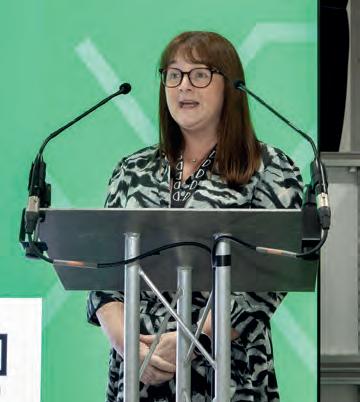
optional extra, but as a critical safety control. Fatigue, stress, and distraction are persistent risks in fleet operations. Yet many organisations, McNamara suggested, remain heavily focused on delivery targets at the expense of workforce wellbeing.
“Your drivers are assets, just like your vehicles,” she said. “Are you investing in them in the same way?”
She challenged operators to consider whether their working conditions would stand up to scrutiny if presented transparently. Excessive hours, unmanaged stress, and lack of support mechanisms can all contribute to increased incident rates.
Effective fatigue management policies, mental health support, and realistic scheduling are not just good practice - they are essential components of a safe system of work.
LOADING, UNLOADING, AND THE HIDDEN RISKS
While moving vehicles often dominate safety discussions, many serious incidents occur when vehicles are stationary - particularly during loading and unloading.
Improper load securing, unsafe manual handling, and falls from height remain significant risks. McNamara stressed that load restraint is a technical skill requiring proper training, not a task to be improvised.
“It’s not just about throwing a strap over a load,” she said. “There’s real expertise involved.”
Equally important is the segregation of pedestrians and vehicles in loading areas. With public access often difficult to
control, physical barriers, clear signage, and defined walkways are essential.
TRAFFIC MANAGEMENT: DESIGNING OUT RISK
On-site vehicle movements present another major hazard, with reversing manoeuvres identified as particularly high-risk.
Where possible, these should be eliminated through site design - using one-way systems and dedicated turning areas. Where that is not feasible, additional controls such as trained banksmen, reversing aids, and clear communication protocols must be implemented.
“Common sense isn’t always common,” McNamara observed, noting that many sites still lack basic measures such as adequate lighting, signage, or speed controls.
Effective traffic management not only reduces risk but can also improve efficiency— streamlining vehicle flow and reducing delays.
LEARNING, NOT BLAMING
A strong safety culture depends on how organisations respond to incidents. McNamara urged operators to move away from blame and towards learning.
Near-miss reporting, in particular, should be encouraged as a positive indicator of engagement, not a sign of failure. Early identification of risks allows for corrective action before serious harm occurs.
Regulatory reporting requirements must also be met accurately and on time, with sufficient detail to demonstrate understanding and control.
EVIDENCE OVER INTENT
Ultimately, HSENI’s expectations are straightforward: operators must be able to demonstrate that their systems work.
“Good intentions won’t hold much weight,” McNamara warned.
“We’re looking for evidence.”
That means documented risk assessments, verified training records, active supervision, and continuous monitoring. It also means leadership—embedding safety as a core organisational value rather than a reactive obligation.
As the session concluded, one message stood out: in today’s transport environment, safety is not a standalone function. It is a defining feature of operational excellence—and a key driver of long-term business success.
Kellie McNamara.
BREAKER BREAKER –SUPPORTING MENTAL HEALTH IN THE HAULAGE INDUSTRY
Attending both Wednesday and Thursday of the show, and located in their own special trailer in the outside exhibition area, were representatives from the charity Breaker Breaker.
Breaker Breaker was selected as the charity partner of Road Transport Expo Northern Ireland and is a charity dedicated to raising awareness of mental health and wellbeing across the haulage industry throughout the UK and Ireland.
The organisation was founded by Leanne Lyons following the loss of her husband David in December 2018 after his battle with mental health. Experiencing first-hand the devastating impact mental health struggles can have within the industry, Leanne established Breaker Breaker with a clear purpose: to make sure that drivers and those working across the transport sector know they are not alone and that support is available.
The haulage industry plays a vital role in keeping the economy moving, but it is also an industry that can bring significant pressures. Long hours, demanding schedules, financial worries and the isolation that can come with life on the road can all take a serious toll on mental health. Too often these struggles remain hidden, and many
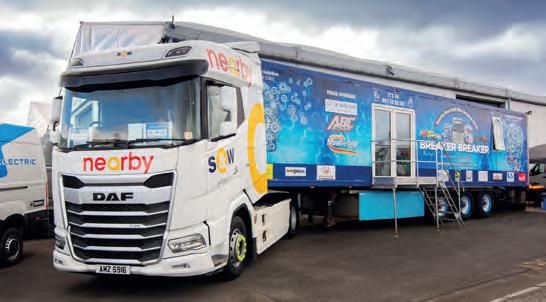
drivers feel they have nowhere to turn or no one who understands the pressures of the job. Breaker Breaker is working to change that.
Through awareness campaigns, industry engagement and partnerships across the transport sector, the charity encourages open conversations around mental health and promotes the importance of looking after wellbeing in an industry that keeps the country moving.
A key part of this work is the 24 hour Haulage Helpline, delivered in
partnership with Inspire Wellbeing. This confidential service provides professional support for people working across the road transport industry who may be struggling or simply need someone to talk to.
The helpline ensures that those in the industry have access to help when they need it most.
Breaker Breaker also engages directly with drivers and companies through industry events, transport hubs and community initiatives, helping to raise awareness and connect people with support.
Being the charity partner for RTX Northern Ireland 2026 provides an important opportunity to continue this mission. The event brings together drivers, operators, suppliers and industry leaders from across the sector, creating a platform to highlight the importance of mental health and wellbeing in transport.
By working together as an industry, we can help ensure that the people who keep our roads and supply chains moving know that support is there whenever they need it.
Paul James, a volunteer with the Breaker Breaker charity, also explains the charity has its own truck show every year at Nutts Corner. “It’s a fun day out for everyone, and we have about 250 trucks attending. And because we have received funding for the show, everything we take at that show will go to fund the charities services.
“We’ve done alright at this show (RTX NI) and what we say is even if we help one person then we have hit our target, and we certainly did that yesterday.
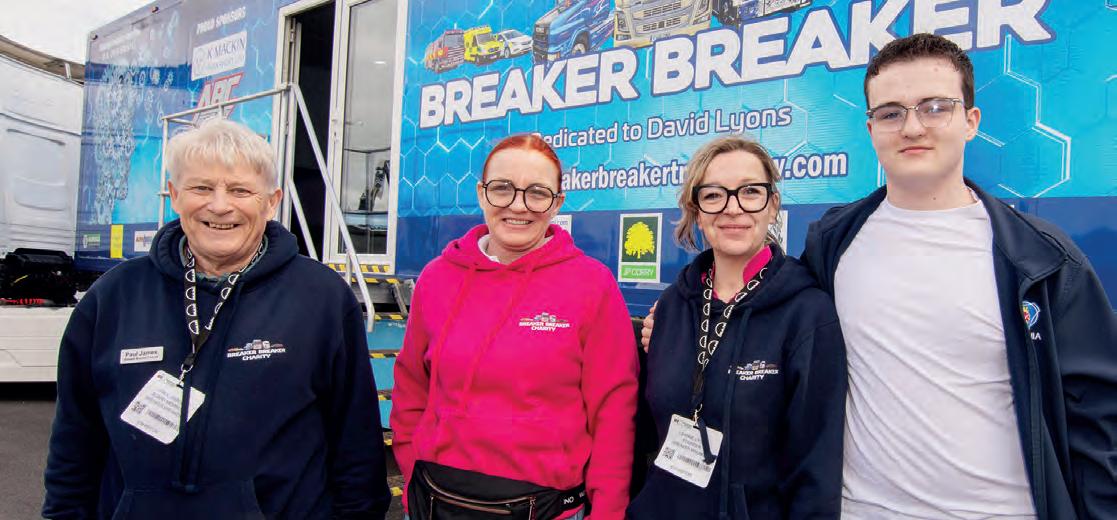
The team from the Breaker Breaker charity at their outside stand at RTX Northern Ireland.
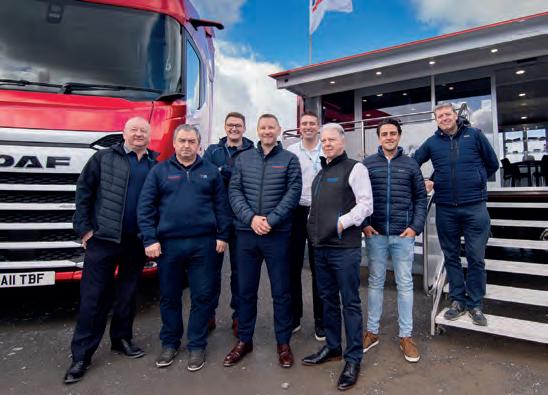
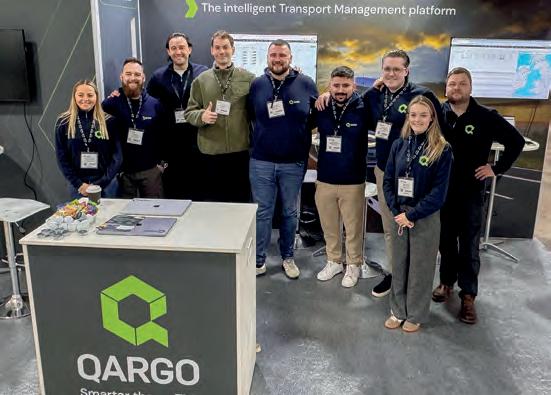
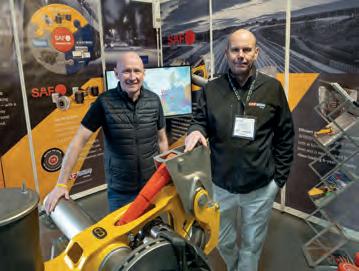
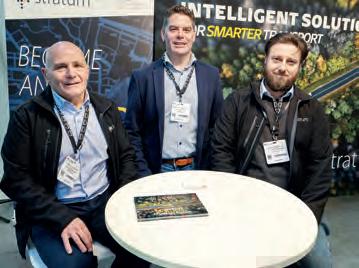
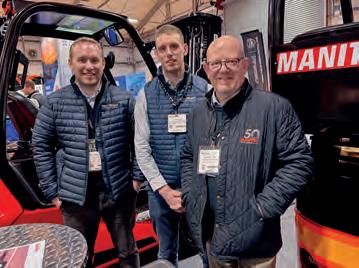
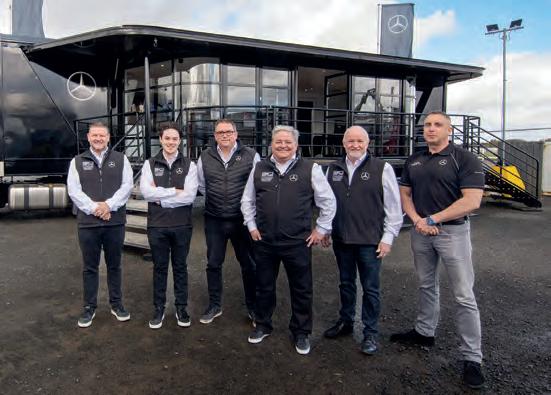
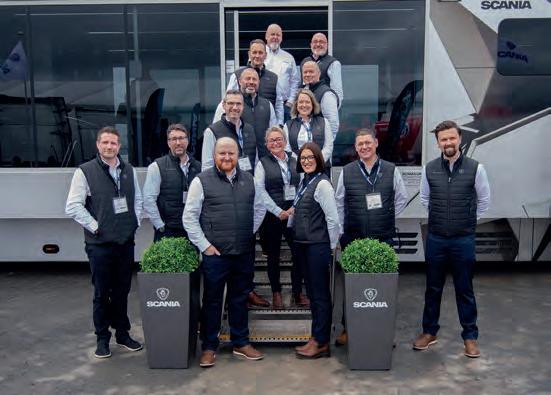
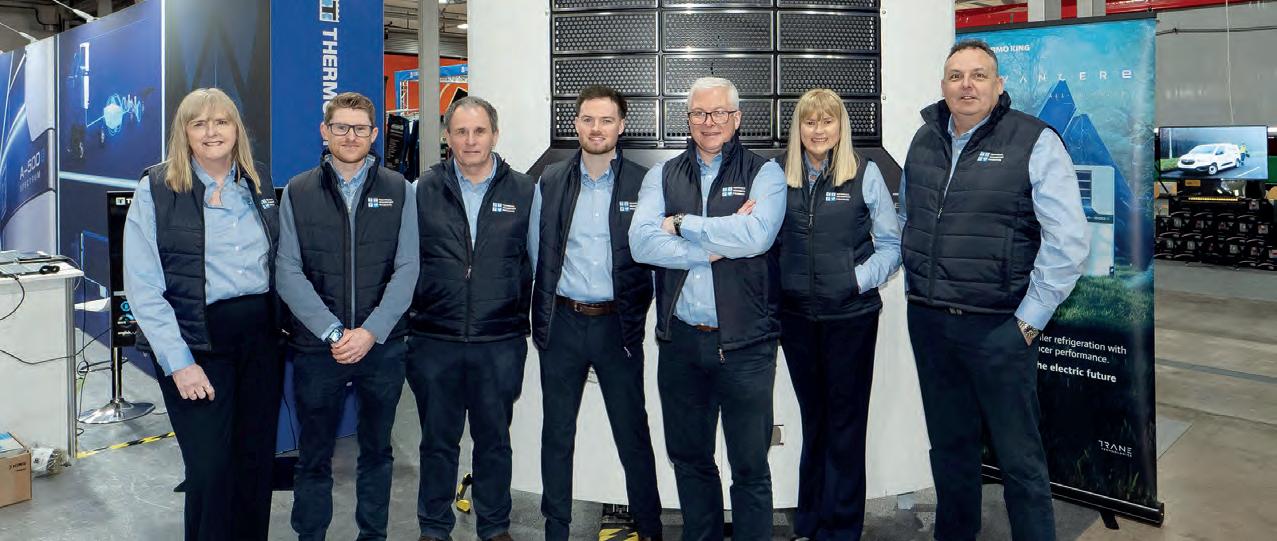
Cus Curran at his team at the Qargo stand at RTX Northern Ireland.
Francis Murphy, Sebastian Perciavalle and John O’Driscoll from Stratum.
SAF Holland -Craig Lawton and Andy Dyer (MD).
Neil Johnston, Ray Graham and Richard Sloan from Northern Lift Trucks.
Alan Espie and the TBF Thompson team at the DAF outdoor stand at RTX NI.
The Scania Road Trucks team at RTX NI.
The Mercedes Benz Truck and Van team at their stand.
Tracy Martin, Diarmuid Bucke, Nathan Dickey, Kathryn Dickey, Denver Suttors and David McAllister from Thermoking.
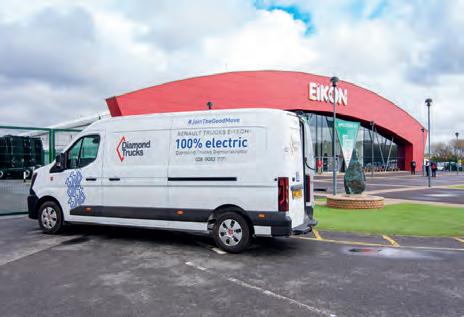
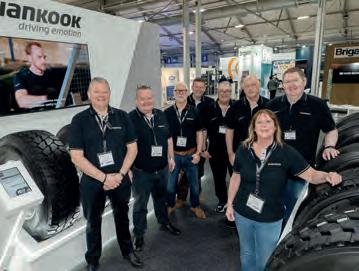
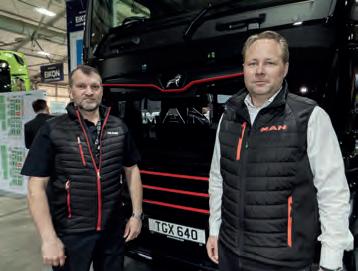
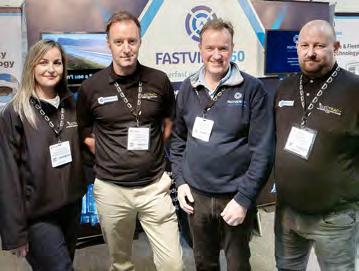
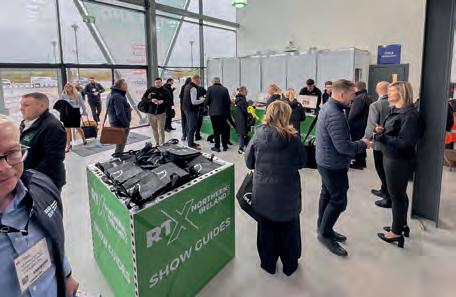
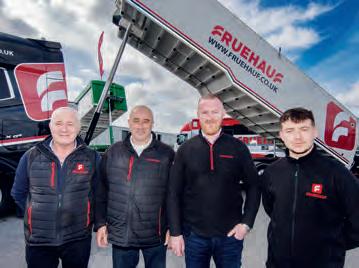
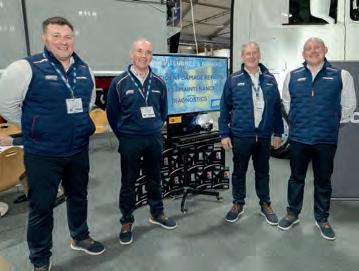
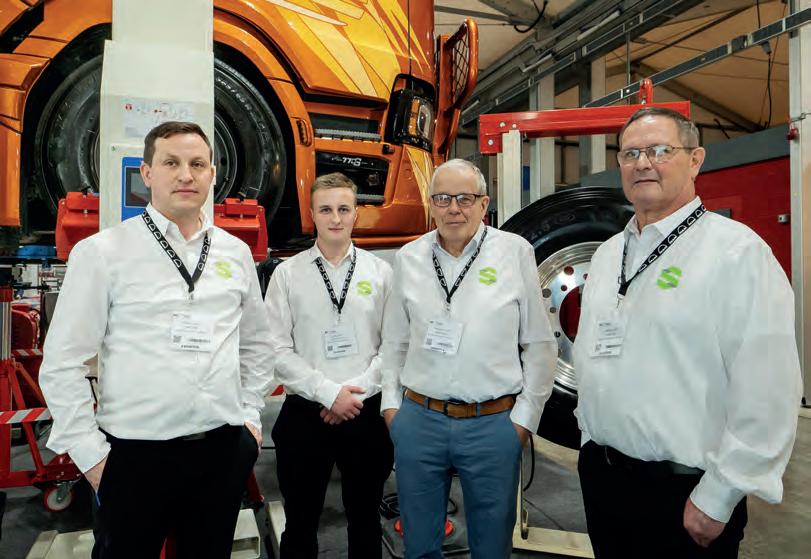
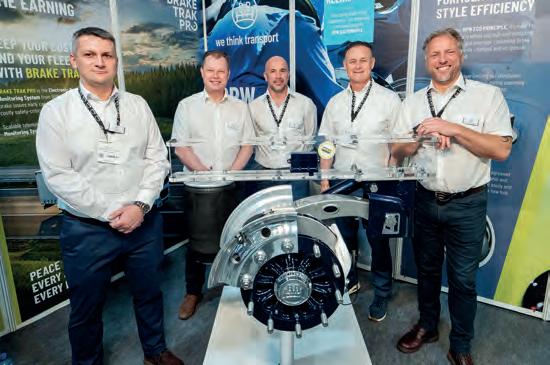
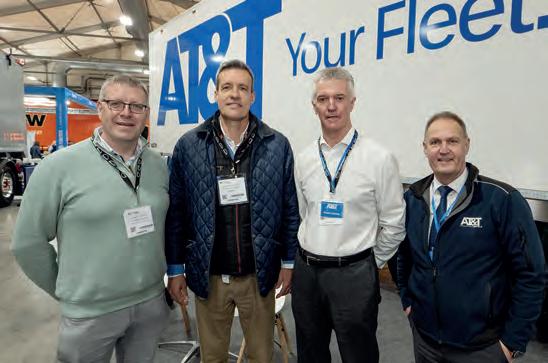
The team from Fruehauf.
The team at the Hankook stand at RTX NI.
The Granco stand at RTX NI.
Simon Wood and Jan Kohlmeier at the MAN stand at RTX NI.
Celine Black, Seamus Black, Nick Billington and John Mayne.
Eric Magil, Garret Comerford, International Trailers, Jordi Amargos, Bosch Chereau and Fedellis Courtney, AT&T
BPW - Lee Wade, Darren Getty, Michael Stayman and Matt Kita and John Byrne.
Search - Garvin Glass, Jedd Glass, Stephen Taylor and Simon Glass.
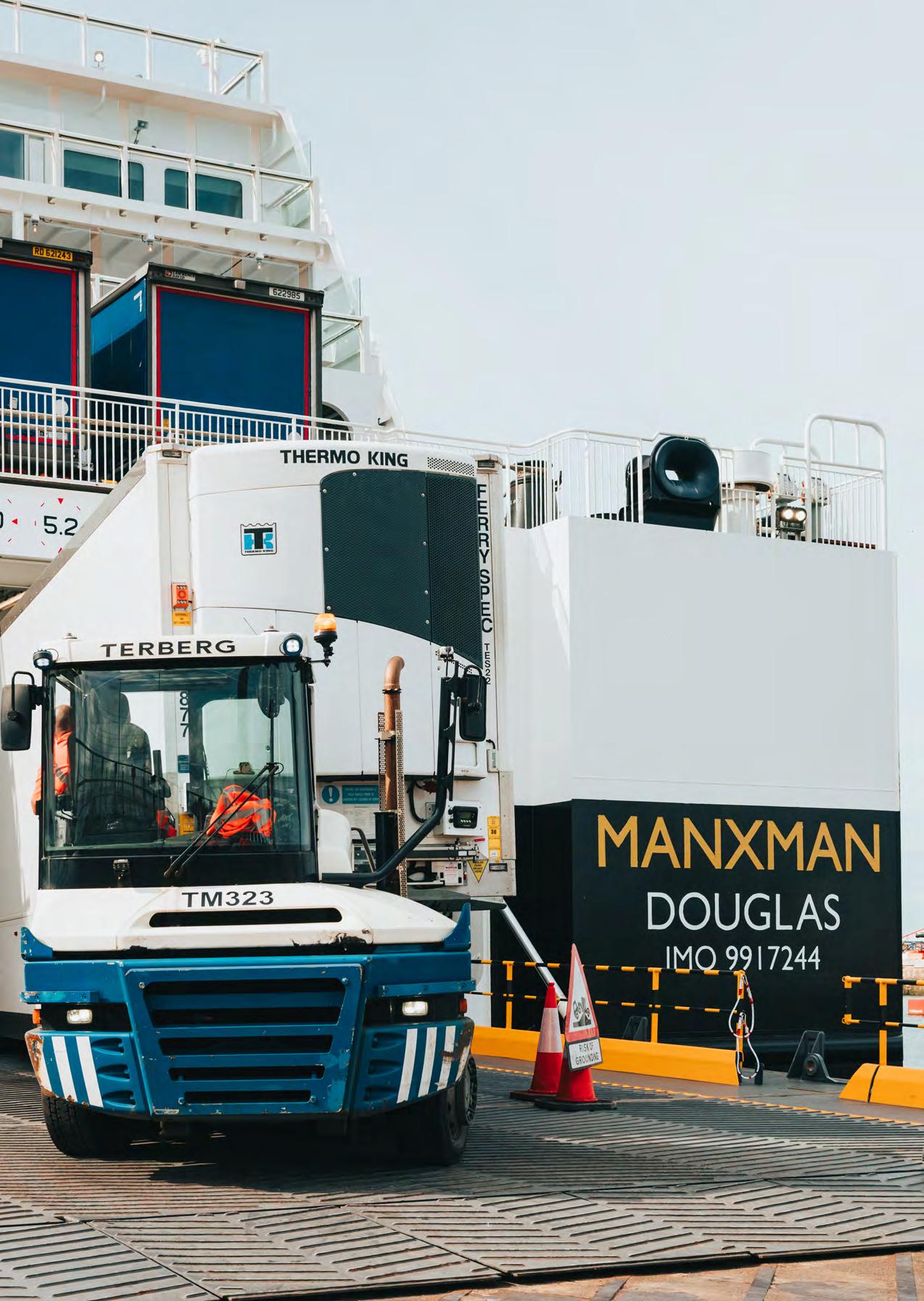
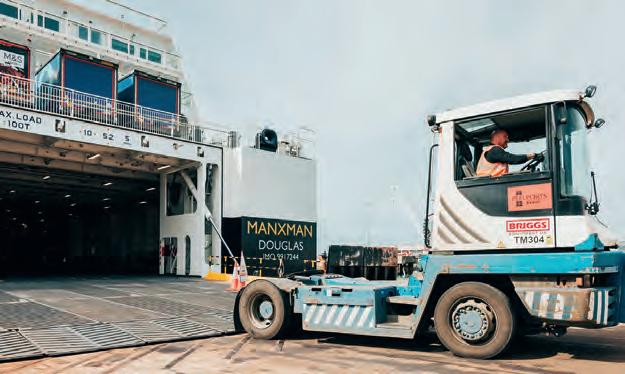
ISLE OF MAN STEAM PACKET COMPANY PUTTING CUSTOMERS FIRST FOR ALMOST 200 YEARS
As the longest continually operating ferry company in the world, The Isle of Man Steam Packet company (IOMSPC) is proud of its almost 200-year history of supporting Isle of Man businesses to import and export their goods and services between the UK and the Isle of Man.
The Steam Packet is the lifeline for the Island, importing all essential freight which its 90,000 population requires and in 2025 the IOMSPC (Isle of Man Steam Packet Company) carried over 470,000 freight HGV meters of foodstuffs, medical supplies, mail and parcels, building supplies, animal feed and almost 5,500 trade vehicles.
The company is committed to this lifeline and has invested heavily in its fleet including the recent addition of its flagship ‘Manxman’.
“Putting customers first and creating a greener environment is how we operate and Manxman was designed to accommodate all our customer’s needs. With increased deck space, modern on-board facilities, and the ability to carry trailers of all types on all decks it has been a very welcome addition for our freight customers
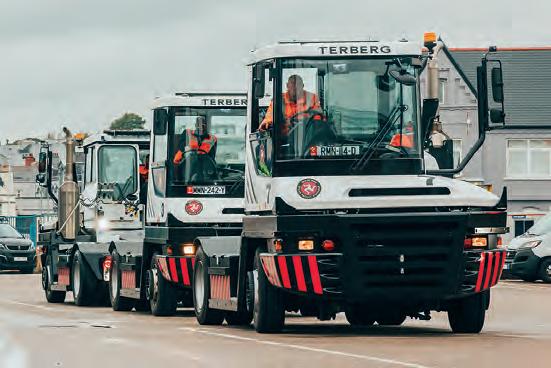
shipping goods to the UK,” said a spokesperson for IOMSPC.
“Our new year-round services between the Isle of Man and Larne will commence in late July
and will see services operate on Monday, Wednesday, and Fridays. These services will be operated by our vessel Ben-my-Chree which until recently was our flagship
for 25 years. It will undergo a major refit in June / July before entering service for both freight and passenger traffic on the Larne to Isle of Man route.
The Head of Operations for IOMSPC, Mr James Royston has welcomed the new services and states that ‘a frequent and reliable service between the Isle of Man and Larne Port will help to improve connectivity for all our customers and open many import and export opportunities to new and existing customers’.
The BMC can accommodate up to 500 passengers and has 1000 lane metres of vehicle deck space.
CONTACT DETAILS
www.steam-packet.com/ferry/ commercial-freight or email iom.freight@steam-packet.com to book freight going forward.
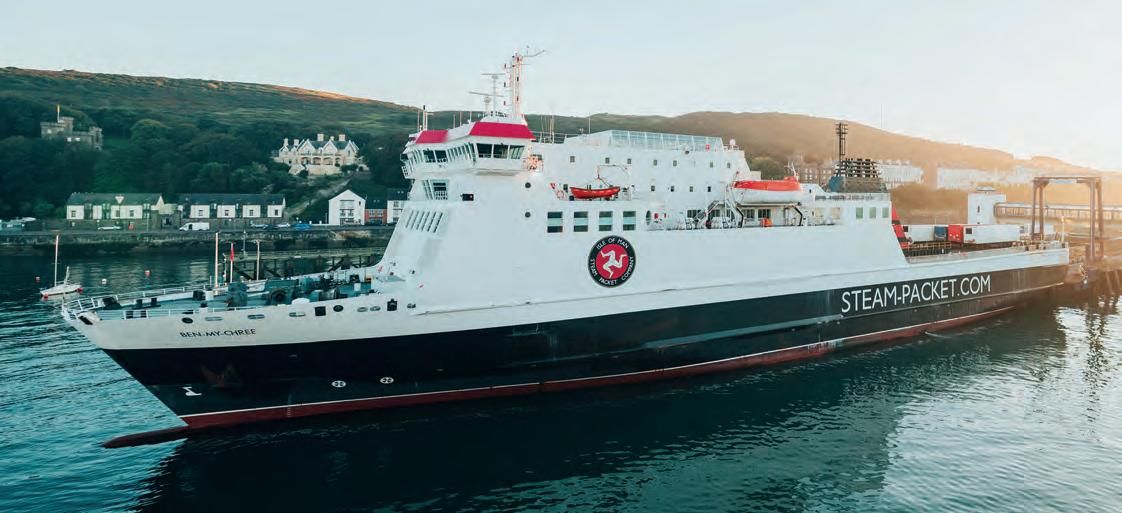
Isle of Man Steam Packet launches New Larne Route with Inaugural Sailing Celebration
The Isle of Man Steam Packet Company has just marked a major milestone in regional connectivity with the launch of its new ferry service between the Isle of Man and Larne.
The inaugural sailing, which took place on April 1, was attended by the Lord Mayor of North Antrim, Jackson Minford alongside senior representatives from the Steam Packet Company, marking the beginning of an exciting new chapter in travel between the two regions.
The new route strengthens links between the Isle of Man and Northern Ireland, offering passengers greater choice, flexibility, and opportunities to explore both destinations.
Commenting on the launch, Brian Thomson said: “We are delighted to introduce this new service to Larne, opening up more
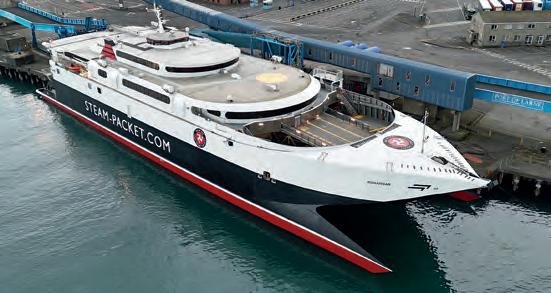
opportunities for tourism, business, and cultural exchange. Today’s inaugural sailing represents our ongoing commitment to improving
connectivity for our passengers.”
Passengers on the first crossing enjoyed a celebratory sailing experience and the opportunity
to be part of a historic journey.
Passengers arriving into Larne can enjoy easy access to some of Northern Ireland’s most scenic attractions, close to The Giant’s Causeway and Carrick -a -Rede Rope Bridge and scenic Atlantic Coastline, making the new route ideal for short breaks and day trips. It is hoped that the new route will provide a boost to tourism and local economies on both sides of the Irish Sea, making it easier than ever to experience everything the Isle of Man and Northern Ireland have to offer.
For more information or to book visit the IOMSPC website.
Stena Line Invests £14 Million in Irish Sea Fleet
Significant upgrades set to elevate the passenger experience across seven routes.
Stena Line has announced a substantial investment of approximately £14 million in the ongoing refit and upgrades of its Irish Sea fleet. The investment underscores the company’s commitment to delivering best-inclass service, safety, efficiency and comfort for its customers across the Irish Sea.
Stena Line’s Irish Sea fleet comprises of 11 vessels operating on popular crossings from Belfast to Cairnryan, Birkenhead (Liverpool) and Heysham; Dublin to Birkenhead and Holyhead; as well as Rosslare to Fishguard. This comprehensive network plays a crucial role in connecting communities and facilitating travel and the critical movement of trade.
The investment will enable a wide range of enhancements and modernisation across the fleet, including:
• Extensive cabin improvements across all vessels
• Increased number of pet-friendly cabins
• Enhanced Stena Plus lounges providing a premium travel experience
• Upgraded family entertainment areas
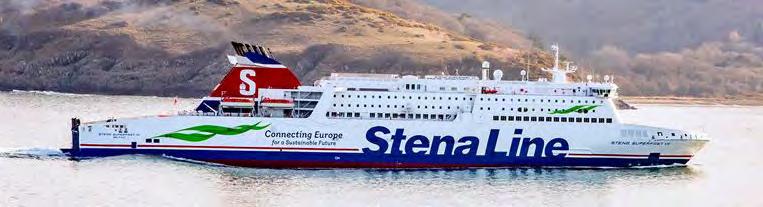
These ship enhancements reflect Stena Line’s continued commitment to innovation and enhancing onboard facilities, providing bestin-class travel experiences that accommodate a wide range of customer requirements.
Mark Scouler, Stena Line Fleet Manager Irish Sea, commented: “This investment demonstrates our dedication to delivering the highest standards of safety, efficiency, comfort and reliability for our customers. By upgrading and modernising our vessels, we ensure that Stena Line remains the leader for the Irish Sea freight and travel market. We continually seek to invest in our vessels and provide a premium sustainable service for all our customers.”
Orla Noonan, Commercial Travel Manager, said: “This investment reflects our commitment to
continuously improving the onboard experience for our customers. By acting on feedback, we’ve delivered a range of enhancements - from upgraded family entertainment and contemporary lounge spaces to expanded pet facilities. We’re passionate about delivering an excellent travel experience and this substantial programme of work allows us to meet and exceed our customer’s expectations.”
Stena Line is one of Europe’s leading ferry operators, renowned for its extensive route network and dedication to innovation, sustainability, and customer service. The company’s Irish Sea operations remain a vital link for both leisure and freight customers, connecting Ireland and Great Britain with reliable, comfortable, and efficient crossings.

Kia’s first full-electric, dedicated van, the PV5, is awarded ‘2026 International Van of the Year’
The PV5 Cargo (L2H1) has also proven its real-world usability, holding a GUINNESS WORLD RECORDS™ title for the longest distance travelled by an electric van with full payload on a single charge
Kia’s all-electric PV5 has been named the ‘2026 International Van of the Year’ (IVOTY), marking a historic first victory for both Kia and a Korean manufacturer. The award was presented on 19 November at the IVOTY Award Gala during SOLUTRANS 2025 in Lyon, France, following a vote by a jury of leading commercial vehicle journalists representing 26 countries.
“Congratulations to Kia for winning the prestigious 34th International Van of the Year Award,” said Jarlath Sweeney, Chairman of the International Van of the Year jury. “The all-electric Kia PV5 sets a new benchmark for innovation, efficiency, and all-round capability in the light commercial vehicle segment. It combines zero-emission performance with versatility and practicality, redefining what businesses can expect from a modern van. Kia has long been celebrated for its award-winning cars, and now, its van division is making an equally powerful impact on the industry.”
In appreciation of this recognition, Ho Sung Song, President & CEO of Kia Corporation, said, “Kia has long stood at the forefront of EV innovation, and the PV5 brings that leadership into the commercial vehicle space with purpose. We developed the PV5 by listening closely to our business customers and by focusing on creating a vehicle that is both highly practical and distinctly Kia in its refined, modern design and functionality. Also, the PV5 brings innovation in the traditional LCV production through our conveyor and cell integrated manufacturing system enabling environmental modification process. To have the PV5 named International
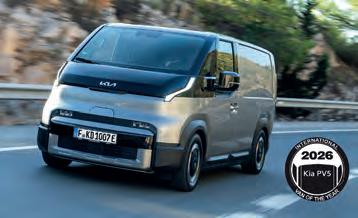
Van of the Year in its debut is an exceptional honor. It reinforces our belief that Kia can redefine this segment and continue shaping the future of smart, sustainable and electric mobility for businesses around the world.”
Kia’s all-electric PV5 was listed for consideration alongside six other models launched in 2025, including two other electric vans, further highlighting the growing importance of electrification as the industry accelerates toward a more sustainable future.
Marc Hedrich, President & CEO of Kia Europe stated, “Winning the prestigious International Van of the Year Award is a true honour and a strong endorsement from some of the most respected journalists in the LCV industry, especially as the first vehicles are just arriving in Europe. Though new to the LCV market, this achievement confirms Kia’s readiness to deliver engineering, design, and practicality to strengthen our position as a leading mobility solutions provider. Our sincere thanks go to the IVOTY jurors for this recognition and to
all Kia employees for their dedication.”
Based on Kia’s Electric-Global Modular Platform for Service (E-GMP.S), the PV5 offers up to 258 miles (Cargo L2H1) and 256 miles (Passenger five-seater) of all-electric range (AER, WLTP), with DC charging from 10-to-80% in under 30 minutes and a payload capacity of up to 790 kilogrammes. Additionally, less than a month since its launch, the PV5 has also already earned a GUINNESS WORLD RECORDS™ title for “the greatest distance travelled by a light-duty battery-powered electric van with maximum payload on a single charge”, achieving 693.38 kilometres (430.85 miles).
Sangdae Kim, Executive Vice President and Head of PBV Division at Kia Corporation added, “In 2022, Kia launched its PBV division with the ambition to redefine the LCV market through innovation, something Kia has always stood for. The Kia PV5 brings that vision to life and receiving the International Van of the Year Award with our very first PBV model confirms that we are heading in the right direction. The PV5 has been developed by actively listening to customer voices, with every detail thoughtfully designed to meet real-world business needs. This award marks an important milestone, yet our journey to deliver meaningful value to customers continues as we expand the PBV line-up.”
Available now in Cargo (L2H1) and Passenger (five-seater) versions across Europe, the PV5 will be joined from 2026 by new variants, including a Chassis Cab, short-wheelbase Cargo (L1H1), and High Roof (L2H2). The larger PV7 and PV9 are currently in development.
Volkswagen Commercial Vehicles introduces new Transporter Commerce Pro S
Order books are now open for new Transporter Commerce Pro S, priced from
Volkswagen Commercial Vehicles has expanded the award-winning new Transporter line-up with the Commerce Pro S trim.
Available in both Panel van and Kombi, prices start at £43,050 (excl. VAT)1 or £509 per month3 on a Solutions Personal Contract Plan.
The new Commerce Pro S arrives with a sharper, design-led aesthetic for customers seeking a professional presence with added visual distinction, including exclusive gloss black 17-inch alloy wheels, a body-coloured front splitter, extended rear spoiler and gloss black grille detailing. Now open for orders, first
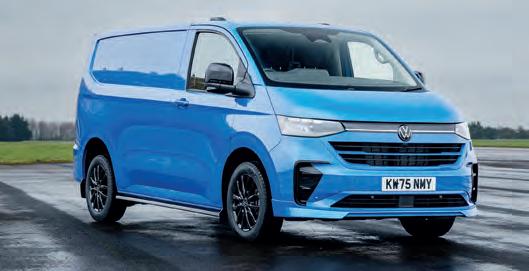
deliveries of the new Commerce Pro S are expected in April.
The new Transporter Commerce Pro S variants come with a choice of short or long wheelbase, providing sufficient space for equipment, and a choice of powertrains – diesel and electric with eHybrid to follow – offering customers flexibility to select the right powertrain for their needs. Prices start at £53,086 (incl.
VAT and OTR costs)5 for the new Transporter Panel Van Commerce Pro S, and £54,7425 (incl. VAT and OTR costs) for the Transporter Kombi Commerce Pro S, which combines versatility and practicality, with five seats as standard and the option for a six seat configuration. The entire Transporter line-up also includes Volkswagen’s enhanced warranty and service plan, the 5+ Promise, at no extra cost. This comprises five services – three services for electric models – three MOTs, a five-year Warranty and five years’ Roadside Assistance.4
For more details on Volkswagen Commercial Vehicles’ Transporter range, visit www. volkswagen-vans.co.uk.
THE ALL-NEW TRANSIT CITY REVEALED AT SPECIAL FORD PRO EVENT
Three body styles, all the essentials as standard - the all-new Transit City makes going electric simple and efficient for urban businesses.
Since Ford launched the first Transit in 1965, the line-up of this now-legendary van family has continually evolved to help customers deal with all the challenges work throws at them. Today, those challenges aren’t just about carrying larger and heavier loads. Van operators in cities and towns - part of the van-powered sector worth over €1 trillion to Europe’s GDP 1 - now also need to consider factors such as clean air zones, rising costs and operating restrictions while still delivering for their customers.
Ford Pro saw a way to help cost-conscious firms who need the right tool for work in increasingly electric-only cities. With the right battery, load area and equipment levels, they could offer a super-simple vehicle that still ticks every box – to the point that you wouldn’t need a single optional extra.
A fresh- thinking and bold approach was needed – and this has led to a new member of the iconic Transit family being developed, with a laser-sharp focus on maximising efficiency and minimising cost.
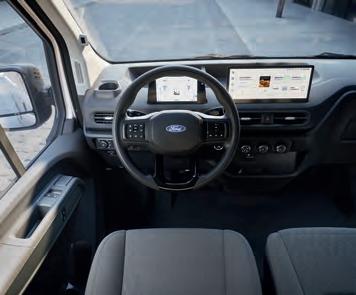
Ford are very excited to reveal the all-new Transit City 2 - the answer that those hard-pressed, hard-working urban firms have been waiting for.
To reveal the all-new Transit City 2, Ford Pro held a special preview launch event at Dunton in England and Export & Freight were invited along to see - and test drive – the new van for ourselves.
CARGO & CONVERSIONS
The business end of any commercial vehicle is the load area. With the Transit City 2 Ford are offering three body styles, specifically targeted to meet the needs of urban customers:
• L1H1 Van: A compact configuration ideal for tight streets and congested loading bays. Capable of carrying three Euro pallets and payloads up to 1,085 kg 3
• L2H2 Van: A high-capacity variant with 8.5 m3 of load volume, payload up to 1,275 kg and over 3,000 mm load length 3
• Chassis Cab: Ideal for conversions such as delivery vans, or dropsides for municipal operators and utilities firms
Regardless of body style, Ford offer a single, comprehensive specification to help keep costs and complexity down.
COST-EFFICIENT ELECTRIFICATION
In an electric vehicle, the battery is what determines your cost, weight and range. Transit City delivers a competitive payload and enough range to comfortably cover a day’s work – all at an attractive price point. Data from thousands of connected Ford
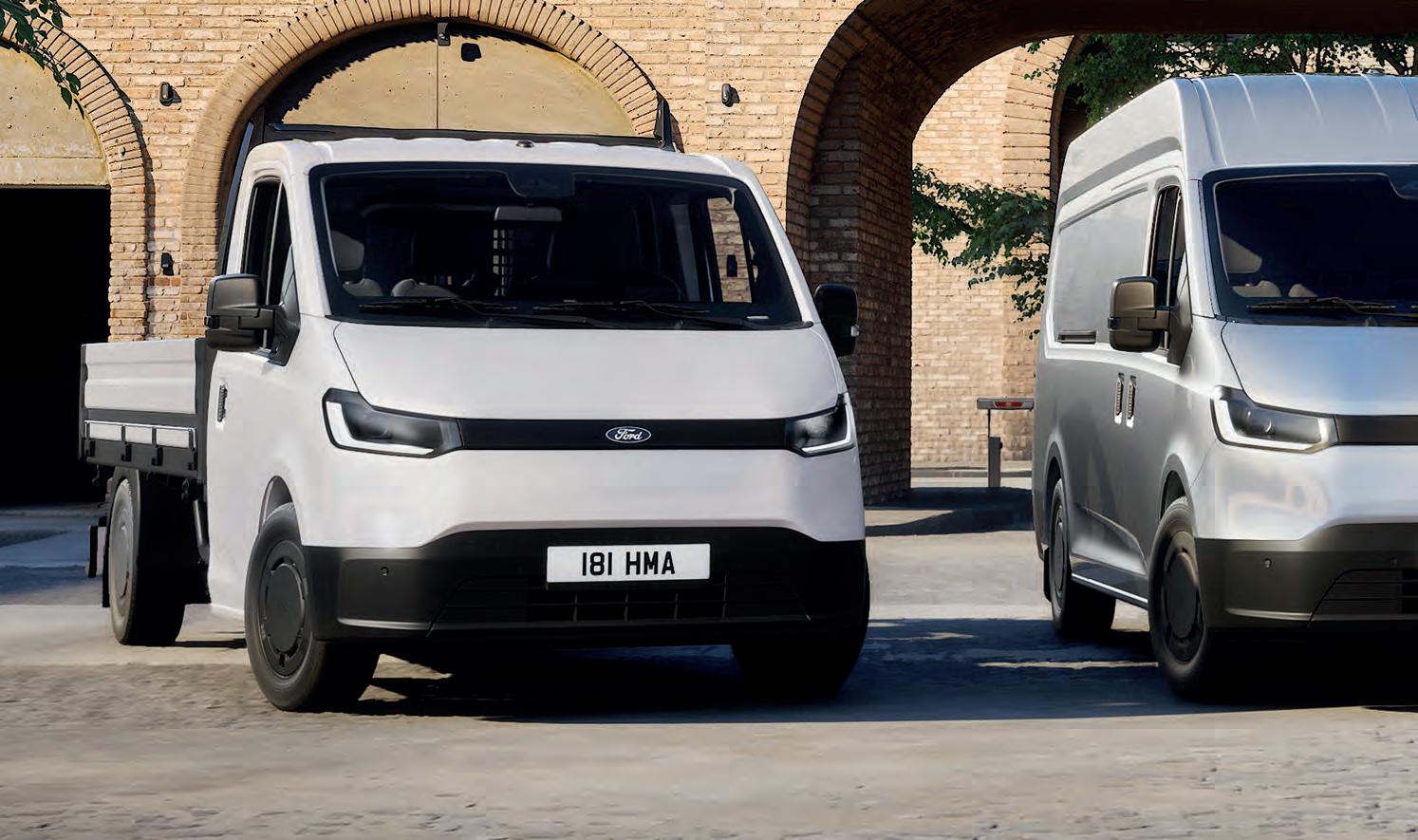
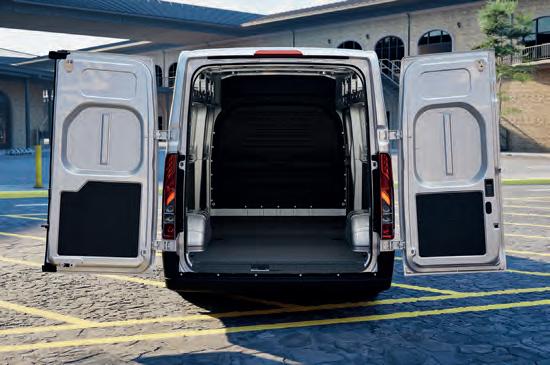
Pro electric vehicles revealed 90 per cent of vans in Transit City’s segment drive under 110 kilometres a day on average. The battery’s 56 kWh useable capacity and lithium-iron phosphate (LFP) chemistry help maximise cost-effectiveness and durability while targeting a range of up to 254 km - 2 more than double the distance the majority of urban customers typically need. An LFP battery is also more suited to regular DC fast charging, so is a practical choice for city businesses that need dependable performance and minimal downtime.
FOCUSED ON REDUCED COST OF OWNERSHIP
The efficiency benefits of a right-sized battery extend to charging. Ford Pro Charging can help customers connect with providers of home and depot charging hardware and software to help maximise the benefits of going electric. Customers may benefit from significant potential savings on energy compared to diesel vans when charging using cheaper off-peak tariffs. Going electric can also yield financial
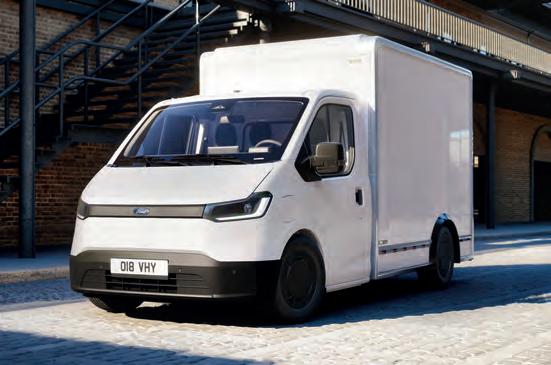
benefits beyond saving on energy. Fewer moving parts and service items mean it is expected maintenance costs will be reduced by around 40% compared to an equivalent diesel vehicle; the service interval on Transit City is two years or 40,000 km.
PRODUCTIVITY-BOOSTING TECH
Throughout Transit City’s development, the focus has been on delivering a cost-effective van that’s still safe and comfortable for drivers, and gets the job done for fleets. A delivery driver can get in and out over 200 times a day, so every Transit City is fitted with a heated driver’s seat – it’s more efficient than trying to heat the air in the cabin. Keyless start is also standard to help save time and reduce mental load.
The 12-inch touchscreen with Apple CarPlay and Android Auto compatibility makes navigation and using AI assistants simple. 6 Transit City features a suite of systems to help drivers deal with busy, tight streets: 4
• Automatic Emergency Braking
• Front and rear parking sensors
• Rear-View Camera
• Adaptive Cruise Control
• Lane Departure Warning
Where required, an available plug-in device integrates Transit City with Ford Pro Telematics 7 or other systems to help fleet managers optimise productivity. This gives real-time access to essential vehicle data including location, speed and charge level. Customers can be confident in the comprehensive base vehicle warranty. Beyond that, an eight-year, 160,000-kilometre warranty for all high-voltage components ensures peace of mind and should help residual values when it comes to resale.
Transit City is also backed by uptime-boosting Ford Pro Service, which includes 800 specialist Transit Centres across Europe and an expanding fleet of about 500 Mobile Service vans.
Order books open in the second quarter, and the first models should be in Transit Centres at the end of the year.
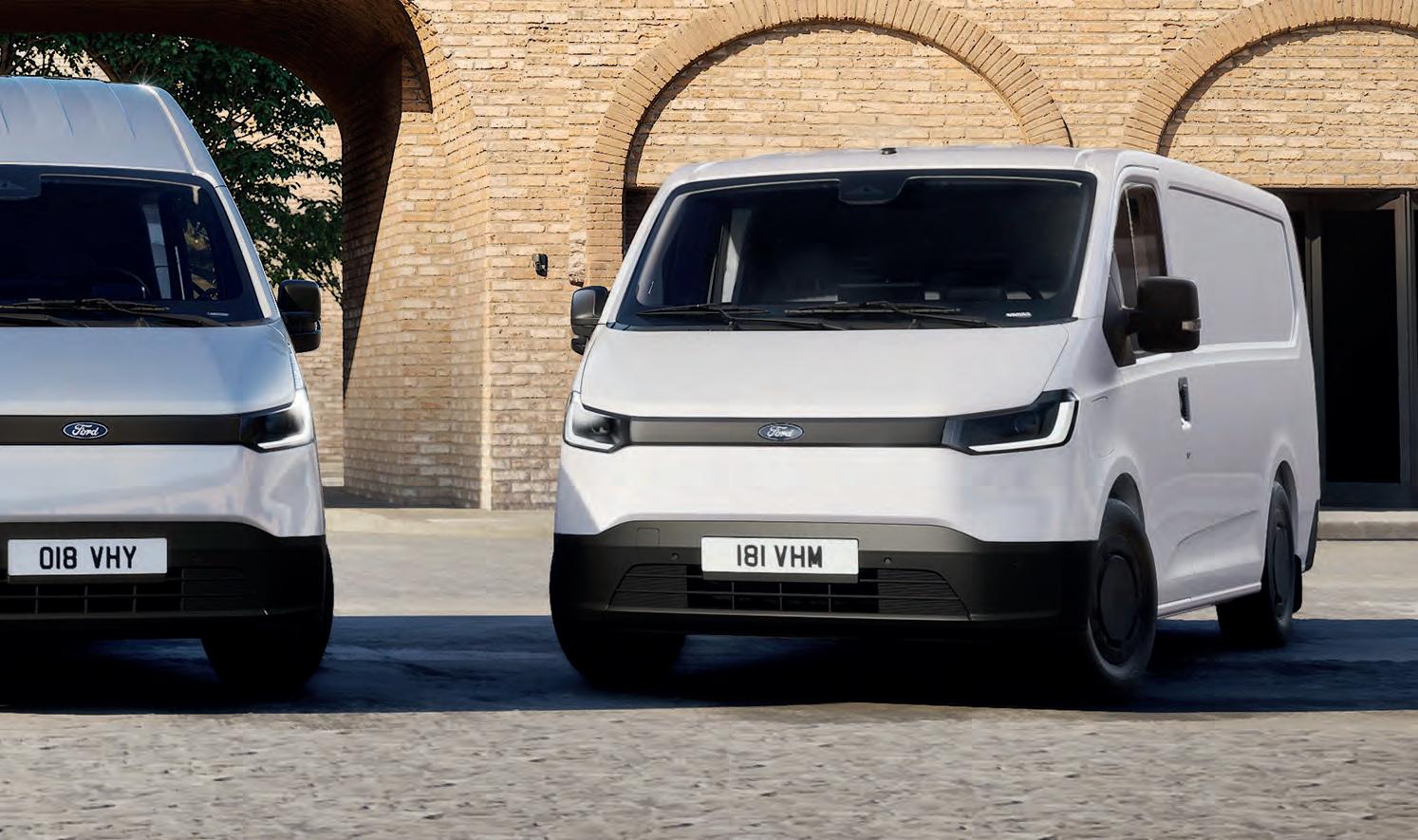
LAUNCHES AND NEW MODELS ALL PART OF BUSY COMMERCIAL VEHICLE SHOW 2026
There was a great buzz about NEC in the middle of April for the annual Commercial Vehicle (CV) Show. Running over three days in two halls, this was the largest show to date and the crowds appear to have returned for this major trade show, cementing once again its place in the busy show calendar.
With 320 exhibitors, and with the new Bus & Coach Expo for the first time, the 2026 show remains a hugely important event for the commercial road transport sector and an important date in the In attendance were some of the major manufacturers of LCVs, including Chery makings its UK debut as it prepares for its expansion across the UK, IVECO with their eJolly and eSuperJolly, as well as the returning Farizon, Ford, Isuzu, KIA, and Renault. With the theme ‘Fuelling Change: the route to decarbonising road transport’, this year’s show arrives at a critical point for the industry. As operators across LCV, HGV, and bus & coach sectors navigate the transition to net zero, the CV Show provides the most comprehensive
view of what the future holds.
Beyond decarbonisation, the 2026 show also shone a spotlight on artificial intelligence, emerging vehicle and fleet technologies, the future workforce and skills development, and driver welfare. Together, these themes reflect the full spectrum of change reshaping the sector.
It’s not every day you see an offroad track ‘inside’ an exhibition hall like the NEC, but that’s exactly what Harris Group had on their stand. Encompassing the full breadth of the company’s vehicle portfolio, those attending the show could view the full range of Euro-6 and fully-electric vans including the debut of a new, strategically positioned L1H1 addition to the
DELIVER 7 model line-up; the new 7.5 tonne eDELIVER 7.5 –MAXUS first foray into the 7.5 tonne market; the MIFA 9 fully electric luxury people carrier, and a show first off-road demonstration of the eTERRON 9 - Europe’s first fully-electric 4x4 pick-up. Over on the IVECO stand another two UK debuts took place, with the Italian manufacturer launching their eJolly and eSuperJolly fully electric vans. Also on their stand, if you fancied a bit of exercise, they had a pedal-powered Scalextric challenge and a Grand Prix simulator.
Newcomer to the UK market Chery Commercial Vehicle (CCC) had a global reveal of its new DELIVAN brand alongside its Future Super Commercial Vehicle (FSCV) strategy.
Rounding off the launches on Day 1 of this year’s show Mellow Vans, a South African manufacturer of compact electric commercial vehicles, gave the MellowVan, a purpose built solution for last mile and crosscity urban delivery, its UK debut.
BY THE INDUSTRY, FOR THE INDUSTRY
The CV Show is where the industry’s future takes shape, bringing together manufacturers, innovators, fleet operators, policy-makers and industry bodies to address the challenges and opportunities ahead. Organisations such as the RHA, SMMT and Logistics UK were all present, providing their insight and expertise on the current state of the commercial vehicle landscape.
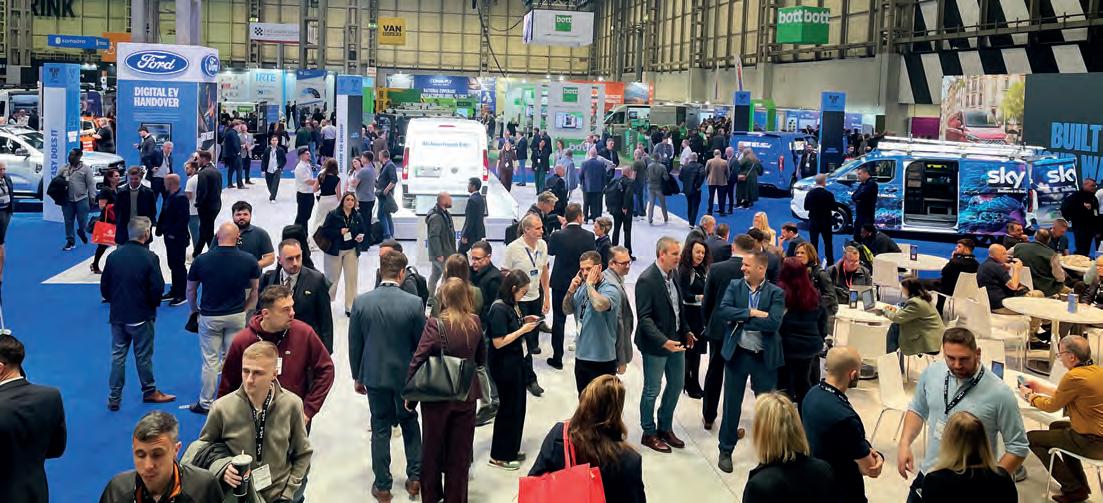

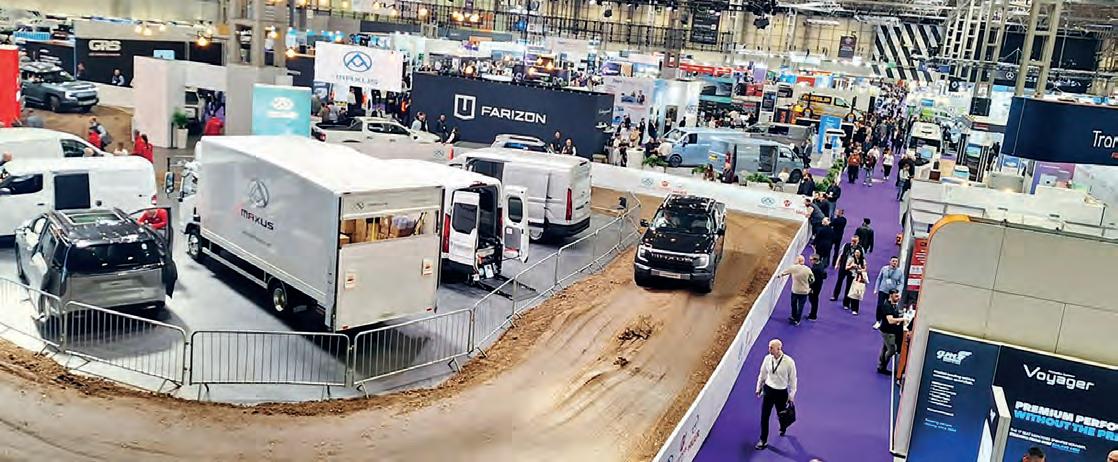
The Show has expanded from three stages to six, adding the Future Fleet Arena, Driver Safety Theatre and Bus & Coach Leaders Forum to the established Main Stage, Technical Theatre and Decarbonisation Theatre.
With over 150 speakers across more than 75 seminars and panel discussions, sessions explored decarbonisation pathways, digital transformation, workforce development, safety, finance and regulation, with a strong focus on practical, solutions-led insight. Across the halls, new vehicles and technologies reflected a clear shift towards electrification, alternative fuels and intelligent, connected systems. More than that, they demonstrated how commercial vehicles are evolving into fully integrated platforms, combining hardware, data and services to deliver greater value for fleets. From last-mile delivery and urban logistics to data-
driven fleet management, safety and compliance, the focus was clear: smarter, more efficient and more commercially viable ways to operate. This year also highlighted how the UK continues to act as a key launch pad for global innovation, with brands choosing CV Show to introduce new concepts, enter the market and establish long-term strategies. CV Show remains where the industry comes together to exchange ideas, build partnerships and launch what comes next.
2026 marked our biggest and most ambitious edition yet - a reflection of an industry accelerating into its next chapter.
“Whether you joined us in Birmingham or followed the momentum from afar, this was a show that set the tone for the year ahead. We’ll see you next year,” said Nick Davison, Event Director, CV Show.
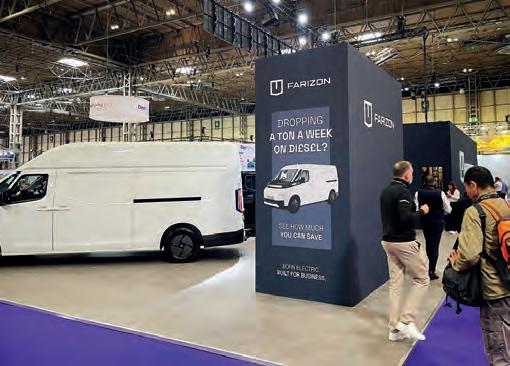
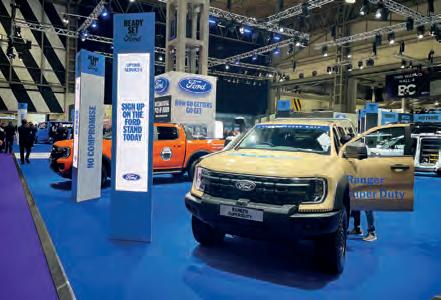
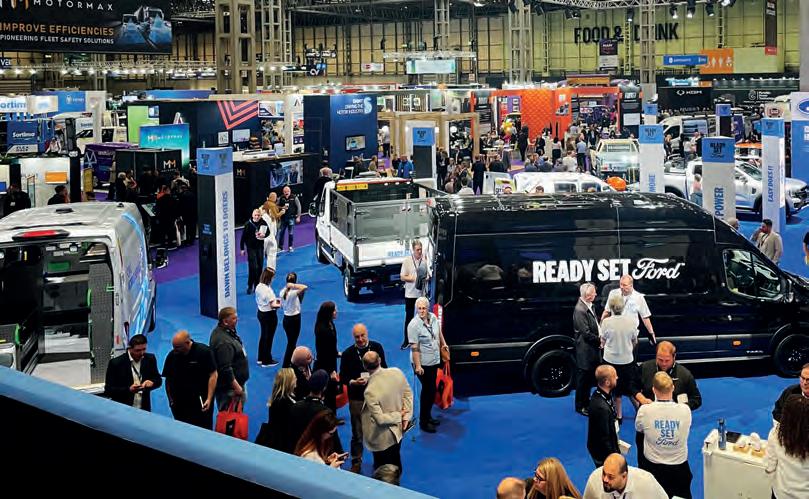
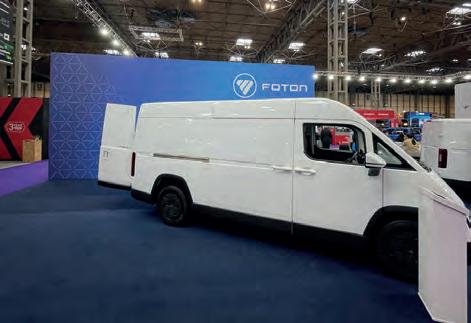
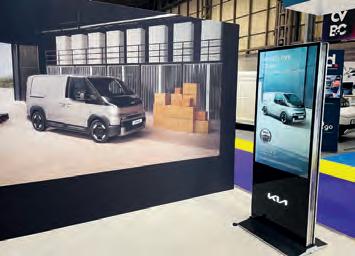
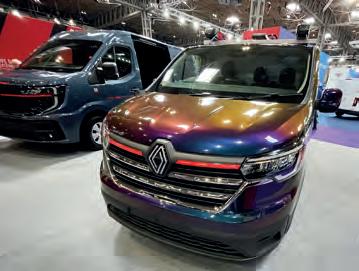
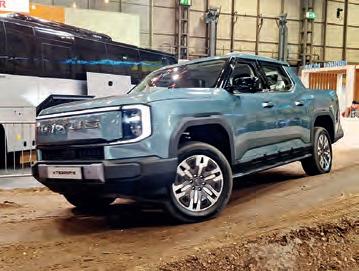
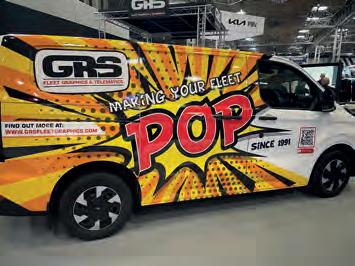
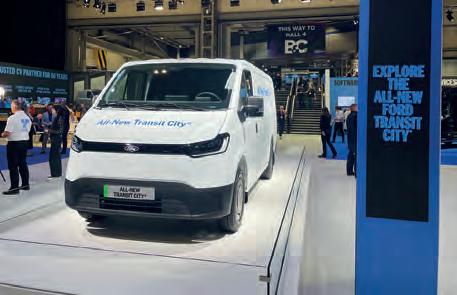
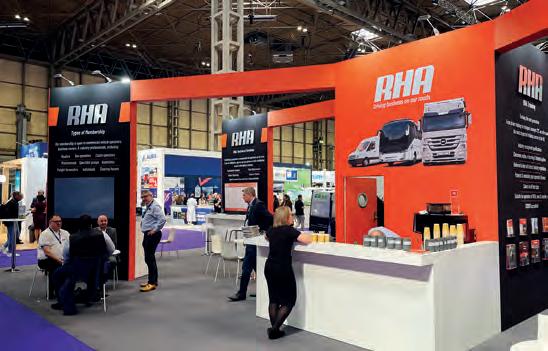
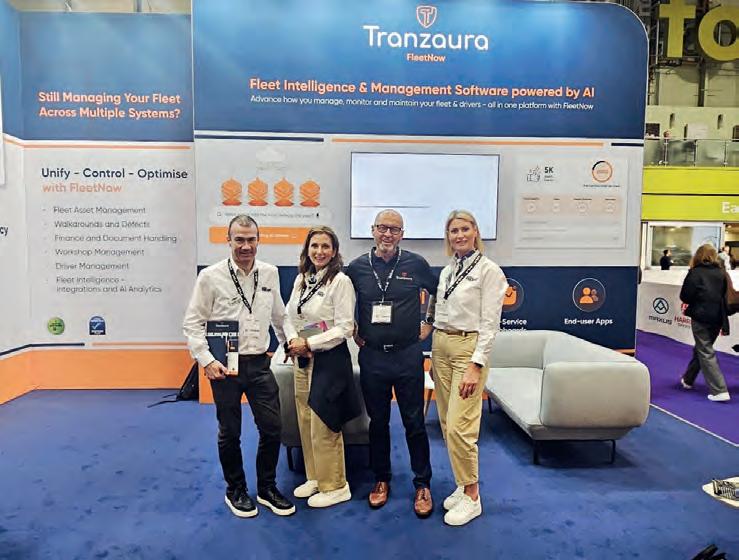
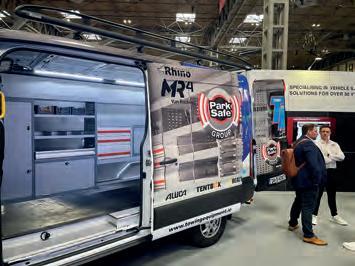
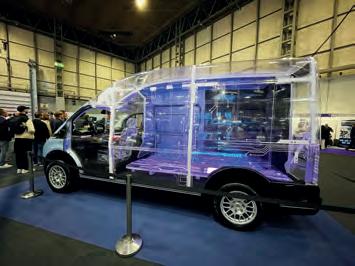
The Export & Freight team on the Tranzaura stand at the CV Show.
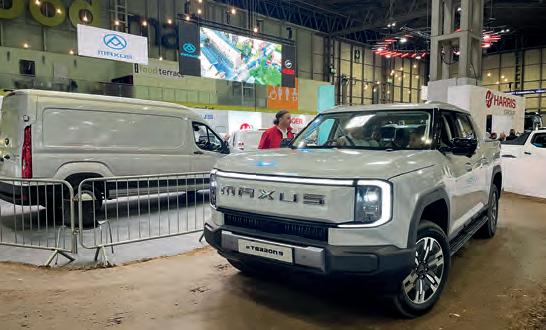
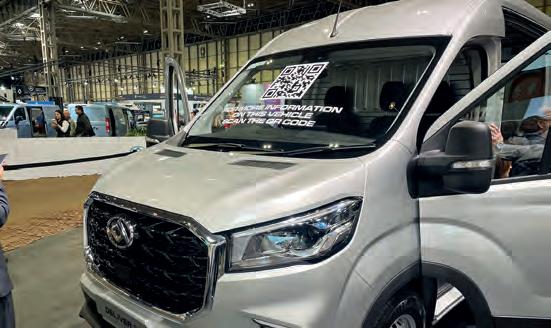
HARRIS MAXUS UK HITS CV SHOW WITH ‘STRENGTH IN DEPTH’ PRODUCT LINE-UP
Harris Group arrived at this year’s CV Show with a clear, unified proposition: strength-in-depth across its MAXUS and HIGER brands.
This runs alongside its established Isuzu operations in Ireland - underpinned by a commitment to deliver high-quality vehicles and the lowest Total Cost of Ownership for operators across the UK and Ireland.
The Group’s presence brings together a comprehensive portfolio of light commercial vehicles, pickups, trucks, buses and coaches, reflecting both the scale of its ambition and sustained investment in network, after-sales and customer support.
At the centre of its CV Show activity for 2026 is MAXUS, with an expanding product lineup spanning electric and Euro-6 models. The Harris MAXUS stand was designed to make a major impact for show-goers. The stand included a new van model unveiling, updates to its eDELIVER 75 7.5-tonner, and the fully-electric MIFA 9 luxury specification seven-seat people carrier. The stand also featured a unique off-road ‘indoor’ demonstration experience with the all-electric eTERRON 9 - something most show goers will probably never have seen before at such a show.
DELIVER 7
At the centre of the MAXUS show stand is the 3,370-kg GVW DELIVER 7 panel van – the latest addition to the MAXUS range, and joining its eDELIVER 7 fully-electric stablemate. The ‘L1H1’ Euro-6 DELIVER 7 will go toe-to-toe with the market’s established models, offering excellent payload potential, industry leading five-year / 100,000-mile Warranty, GSR2 compliance, a spacious driving environment and a high level of equipment.
eDELIVER 75
Alongside it, the MAXUS eDELIVER 75 7.5-tonner takes a significant step forward since its
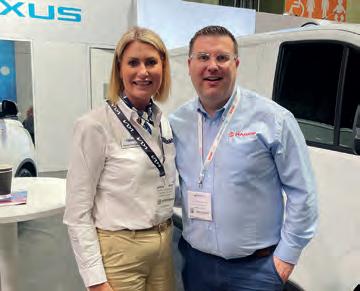
unveiling as a pre-production vehicle last year. With production beginning in June, eDELIVER 75 has undergone extensive refinement for the UK market, reflecting a clear focus on usability, operational fit and Total Cost of Ownership.
eTERRON 9
Another highlight on the Harris MAXUS UK stand is the eTERRON 9, Europe’s first all-electric 4x4 pick-up, combining genuine off-road work-horse performance with a high degree of lifestyle desirability. CV Show goers will be able to experience the eTERRON 9 on a unique ‘indoor’ off-road demonstration course, giving visitors the opportunity to see its capability first-hand MIFA 7 – all-electric luxury people carrier Also on display is the seven-seat MAXUS MIFA 7 luxury seven-seat people carrier, introduced as a compelling opportunity in the private hire and high-end VIP transport sector, and demonstrating the breadth of the MAXUS electric portfolio beyond traditional commercial applications.
A major evolution of the Harris MAXUS UK aftersales strategy reinforces this approach. With uptime at its core, new initiatives include MAXUS Assistance, a dealer-led roadside
support model, the MAXUS Uptime Portal and a national mobile servicing programme, designed to transform customer support.
This is supported by continued investment in parts logistics, service planning and technician capacity, ensuring the network is prepared for a rapidly expanding vehicle parc – now totalling 33,000 vehicles. The objective is clear; measurable gains in uptime, operational efficiency and total cost of ownership.
The same focus is evident in the strengthening of the MAXUS dealer network. Following rapid growth, Harris MAXUS UK is implementing operational upgrades to improve performance and consistency, including faster delivery through revised logistics, UK-based warranty and finance operations, and more advanced, data-driven stock allocation.
Across MAXUS and HIGER, Harris Group’s strategy is consistent; a fully integrated commercial vehicle ecosystem combining product, network and aftersales, to deliver uptime, transparency and long-term value. The approach underpins its commitment to Total Cost of Ownership, from competitive pricing and strong warranty cover to predictable service costs and reduced downtime.
In Ireland, this is further strengthened by Harris Group’s long-standing partnership with Isuzu, providing a proven pickup and LCV range supported by an established network. Together, MAXUS, HIGER and Isuzu form a broad, balanced portfolio, enabling Harris Group to serve multiple sectors with consistency and confidence.
“As our impactful presence at the CV Show demonstrates,” said Group Managing Director, Brian Patterson, “we’re not simply expanding our product range; we’re executing a longterm strategy built on investment, alignment and delivery. With a growing network, strengthened aftersales capability and an unwavering focus on customer support, this company is positioning itself as a major automotive force in the UK and Ireland.
Export & Freight’s Pamela McGookin with Andrew Dickinson on the Harris Maxus stand at the CV Show.
DOUBLE ELECTRIC LAUNCH FOR IVECO AT THIS YEAR’S CV SHOW
The IVECO stand at the CV Show saw the debut of two new Iveco models, expanding the Italian marque’s all-electric range.
At the show IVECO launched their new eJolly and eSuperJolly. Together, these vehicles represent IVECO’s commitment to delivering electrified solutions for every commercial application, from dense urban delivery and versatile service missions to full size, load-carrying operations.
Present at the launch on their stand at the CV Show were IVECO’s top management from the UK including new Managing Director Mike Cutts, and recently appointed Light Business Line Director Chris Bunce. Chris Bunce has worked in the motor trade for over 30 years, working with manufacturers including Renault, Fiat and Volkswagen Commercial. He has worked in both the manufacturing and dealer end of the trade, including a time working as a Dealer Principal with Volkswagen. Chris has worked for the last 8 years with IVECO and he recently was promoted to Light Business Line Director IVECO UK & ROI –which encompasses vans from 3.5 tonnes to 7.2 tonnes.
“It’s an exciting challenge and
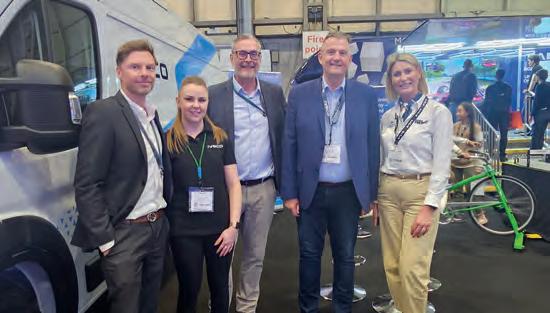
IVECO have some exciting new products,” said Chris when we got talking to him on the IVECO stand at the Commercial Vehicle Show at the NEC recently.
Chris said the current focus is on electric powered vehicles, but they will not be forgetting about diesel just yet – the hugely popular Daily is still available with a diesel powertrain and is still an important model for IVECO.
“Our expanded electric LCV range gives operators genuine choice, whether they are navigating city streets or carrying significant payloads, all backed by IVECO’S proven commercial vehicle expertise.”
eJOLLY
The eJolly marks the expansion of IVECO’s eLCV portfolio into the
medium van segment, offering a compact and capable performance on inner-city missions focused on agility and manoeuvrability.
49 or 75kWh battery configurations provide a WLTP range of up to 271 miles, while 1ookW fast-charging capabilities can return 60 miles of range in just 15 minutes. It offers GVWs of between 2.8-3.2t, with payloads up to 1,175 giving practical load carrying abilities for delivery, logistics or service work.
eSUPERJOLLY
eSuperJolly, the larger sibling to eJolly has a high density 110kWh battery delivering up to 260 miles of range, with 110kW charging capability.
Offering up to 17m3 of load space and payloads up to 1.4 tonnes the eSuperJolly is ideally suited to
multi-drop delivery operationsand delivers a strong balance of range, payload and productivity.
Completing IVECO’s eLCV range is the flagship eDaily built on the proven Daily platform bringing electrification to heavier-duty missions.
Chris Bunce said they are bringing these vans to the market with very competitive packages including a 5 year warranty.
The eSuperJolly is ready to go and models will be in dealers by the end of April, 2026, while the eJolly will be available a few months after its big brother. More information on dates, deliveries and demonstrators will be available from IVECO dealerships.
Asked about how the show was going for them, Chris Bunce said he was happy with the footfall, and they had been really busy on the stand.
“We have had quality customers coming to the stand, and there have been a lot of new people to talk to. These are exciting times for IVECO and to have two new products at the same show is fantastic.”
Talking about Mike Cutts being appointed to UK Iveco Managing Director, Chris said it’s ‘brilliant to have a Managing Director from the UK. He is working here and knows the market.”
BUILT FOR THE CITY: FARIZON
V7E GETS IT DEBUT AT CV SHOW
Farizon took the wraps off its new V7E medium electric van at this year’s Commercial Vehicle Show.
Joining the SV large van, the new Farizon V7E will offer class-leading cargo capacity, payload and range, on a city-optimised electric platform and a design that prioritises efficiency and ease-of-use.
With a born-electric platform that delivers the nimble agility drivers need in tight city streets and distinctive styling that includes striking LED ‘tomahawk’ headlights, the V7E has been developed specifically for the rapidly expanding urban logistics market.
Available with the choice of two batteries, the V7E will travel further than similarlyspecified rivals. Like the larger SV, the V7E will also be loaded with convenience,
safety and connectivity features.
Making things simple for fleets of all sizes and sole traders, the V7E is launched with a straightforward line-up: a single body size finished in one of three paint finishes; a single comprehensive specification and with the choice of a 50kWh or a 67kWh battery.
With cutting edge aerodynamics producing a drag coefficient of 0.27 the V7E will travel
further than V7E, the van is back in the UK by a five-year/ 120,000 mile manufacturer warranty. Established in 2016, Farizon is the commercial vehicle division of Geely, China’s largest vehicle manufacturer with the brand earning a strong reputation in its domestic market through a focus on technology, the user and zero emissions.
Prices start from £28,000 for the 50kWh model and £30,500 for the 67kWh model.
IVECO - Mick Cutts, Jessica Main, Duncan Nurse, Chris Bunce and Pamela McGookin.
ELECTRIC VAN COMPANY’S ‘CITYSPRINT’ HOPING TO CAPTURE SHARE OF URBAN DELIVERY MARKET
The Electric Van Company is a new British start-up that is hoping to shake things up in the electric urban delivery sector.
The Electric Van Company was exhibiting at the CV Show, having just returned from here last week where they attended RTX Northern Ireland.
With only four years until the ban on sales of new ICE light vans the Electric Van Company (EVC) believe its CitySprint range can capture a sizeable share of the emerging market.
The CitySprint is made to deliver significant cost savings and operational efficiency for small to medium sized enterprises (SMEs) in the delivery sector.
By switching to the EVC CitySprint from a conventional ICE van, the EVC estimate
businesses can reduce their running costs by 50-60%. The CitySprint should be an ideal choice for companies operating within a daily driving range of less than 200km.
Prices start at £15,250, excluding VAT, and a three year lease will cost approximately £400 a month.
With a wheelbase of 2,495mm and a width of 1,440mm, this vehicle is designed to be extremely agile and able to navigate narrow city streets far more easily than a 3.5 tonne van.
The EVC CitySprint is assembled at a factory in Nelson, Lancashire. Keith Sims
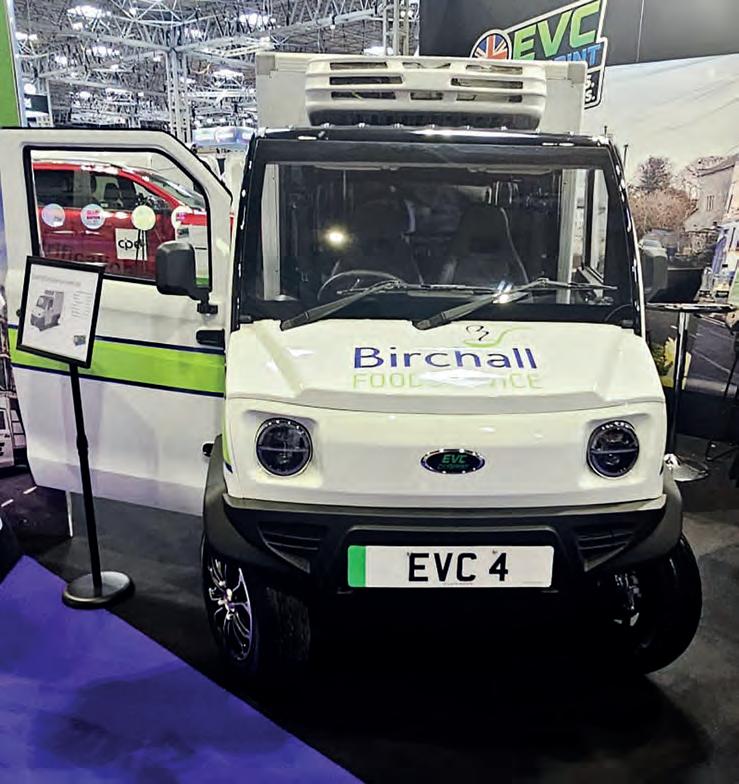
is the EVC Managing Director and Des Evans in a non-executive director.
“These vehicles have been designed around reality not for an infrastructure that does not exist, “ said Sims.
“These are not a converted diesel platform - they are built from the ground up on the principles of ‘keep it simple, make it work and make it reliable.
A range of body types, including tippers, box vans, pick-ups and fridges can be fitted at the factory. And all vehicles are fitted with Geotab telematics enabling operators to monitor drive and vehicle performance, battery charge and range in real time using AI-driven tools that turn data into usable insights.
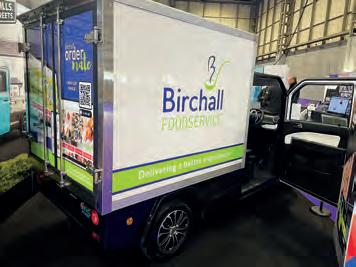
RENAULT TRUCKS SHOWCASES CONVERSION EXPERTISE AT COMMERCIAL VEHICLE SHOW 2026
Renault Trucks was at this year’s CV show with a simple message – ‘We Do Vans Too’.
Whether running local deliveries, national routes or a growing fleet the Renault Trucks van range is designed around real working life and backed by a 3 year, 100,000 miles warranty.
Renault Trucks is highlighting its specialist vehicle conversion capabilities and commercial vehicle expertise at this year’s Commercial Vehicle Show 2026 with a trio of vans on display on stand 5D80 in Hall 5.
The manufacturer presented a range of purpose-built solutions based on its latest Renault Trucks Master and Trafic models, underlining its ability to deliver tailored vehicles for a wide variety of professional applications. With a strong heritage in truck engineering and bodybuilder integration, Renault Trucks supports customers with specialist conversions backed by a nationwide commercial vehicle dealer network.
Taking centre stage on the stand was an E-Tech Master Red EDITION
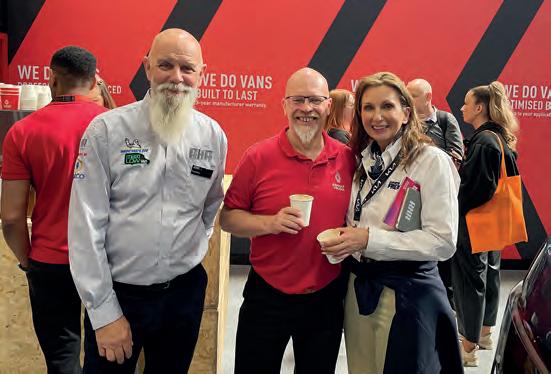
L3H1 4T0 electric 3-way tipper with matching toolpod. The van is ideal for the construction or utility industries offering ultra-fast charging, at 130kW DC and a WLTP range of up to 460kms alongside the robustness and practicality of Renault Truck’s build philosophy. Making its debut at the show is the new Master Red EDITION Exclusive L3H2 model with 170ps diesel engine and the latest generation 9 speed ZF Automatic gearbox.
Exhibited in the launch silver blue
metallic paint with colour coded bumpers, and fitted out with Legend interior lining, the vehicle will be shown with the optional cost custom leather interior which elevates the vehicle to provide a comfortable, premium experience for everyday work.
Completing the stand line-up is a Renault Trucks Trafic L2H1 Red EDITION+ panel van, equipped with a high-specification tradesperson interior conversion designed to enhance productivity for
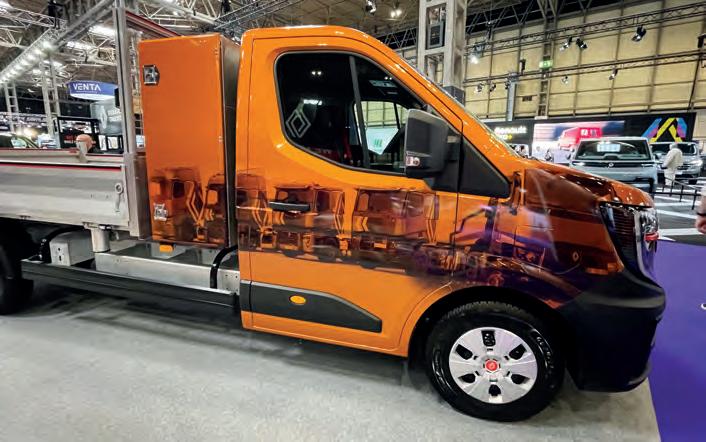
professional users. Powered by the latest Euro 6 150hp engine, the Trafic combines strong payload capability with premium driver comfort features including leather upholstery, supporting long working days on the road.
Grahame Neagus, Head of LCV & Municipal UK & Ireland at Renault Trucks, said: “The Commercial Vehicle Show provides the perfect platform to demonstrate how Renault Trucks works with customers and bodybuilders to deliver specialist vehicles tailored to real operational needs.
Our expertise in truck engineering and vehicle body integration means we’re uniquely positioned to support complex conversions, whether that’s emergency service vehicles, utility platforms or fully equipped trades vans.”
He added: “Visitors to the stand will see how the Renault Trucks network supports customers with more than just the base vehicle. From specialist conversions to commercial vehicle workshop facilities and extended service support, our focus is on keeping businesses moving with solutions that are designed specifically for their operations.”
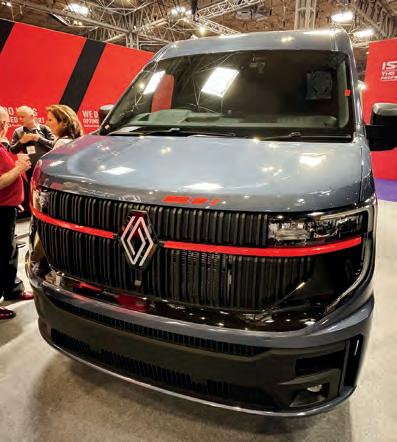
RENAULT TRUCKS - Grahame Neagus with Helen Beggs and Paul Allera.


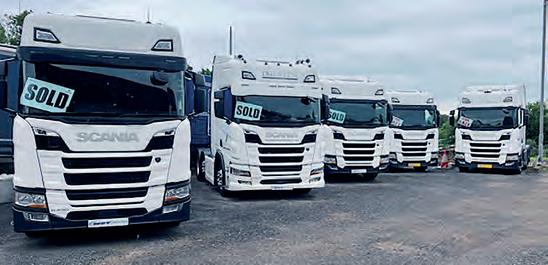
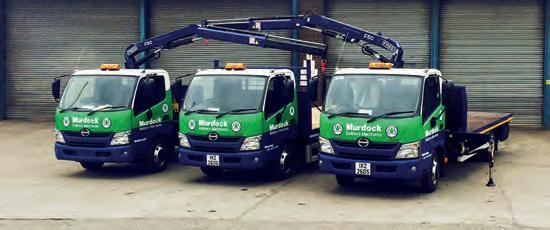








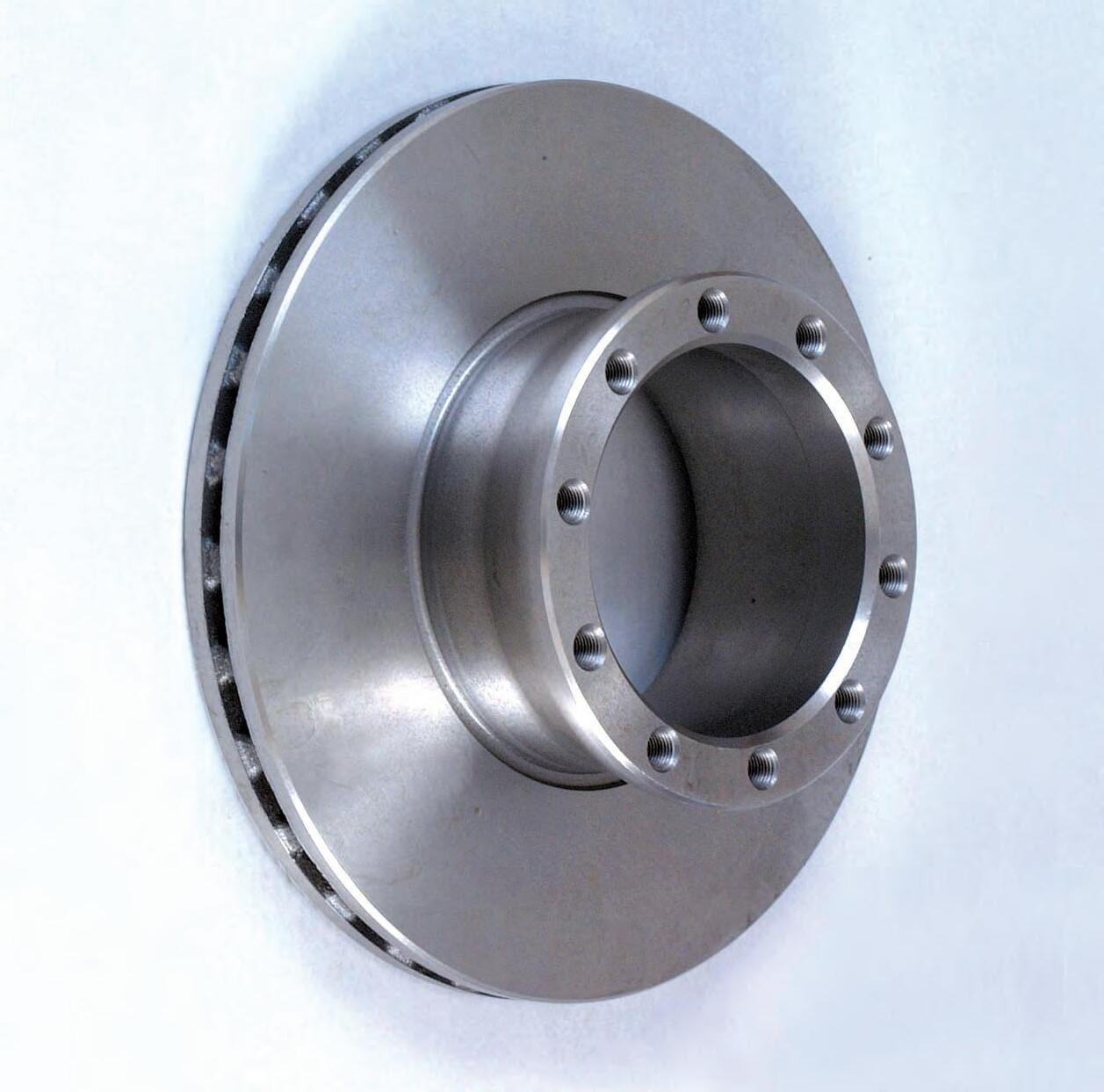








Transport Supplies now has over 12,000 product lines in stock from all the leading specialist brands. Plus there’s our fast delivery direct to you provincewide as well as free collection from our stores.



















THE IRISH SEA’S LEADING FERRY COMPANY
Our network of 18 routes links key ports and road connections across northern Europe.
With more routes and sailings than any other ferry company on the Irish Sea, we offer the most convenient and reliable way to reach your destination.
At Stena Line, we’re committed to providing safe, comfortable and sustainable journeys.
7 ROuTES to Britain and France
12 VESSELS in operation
uP TO 38 daily departures