
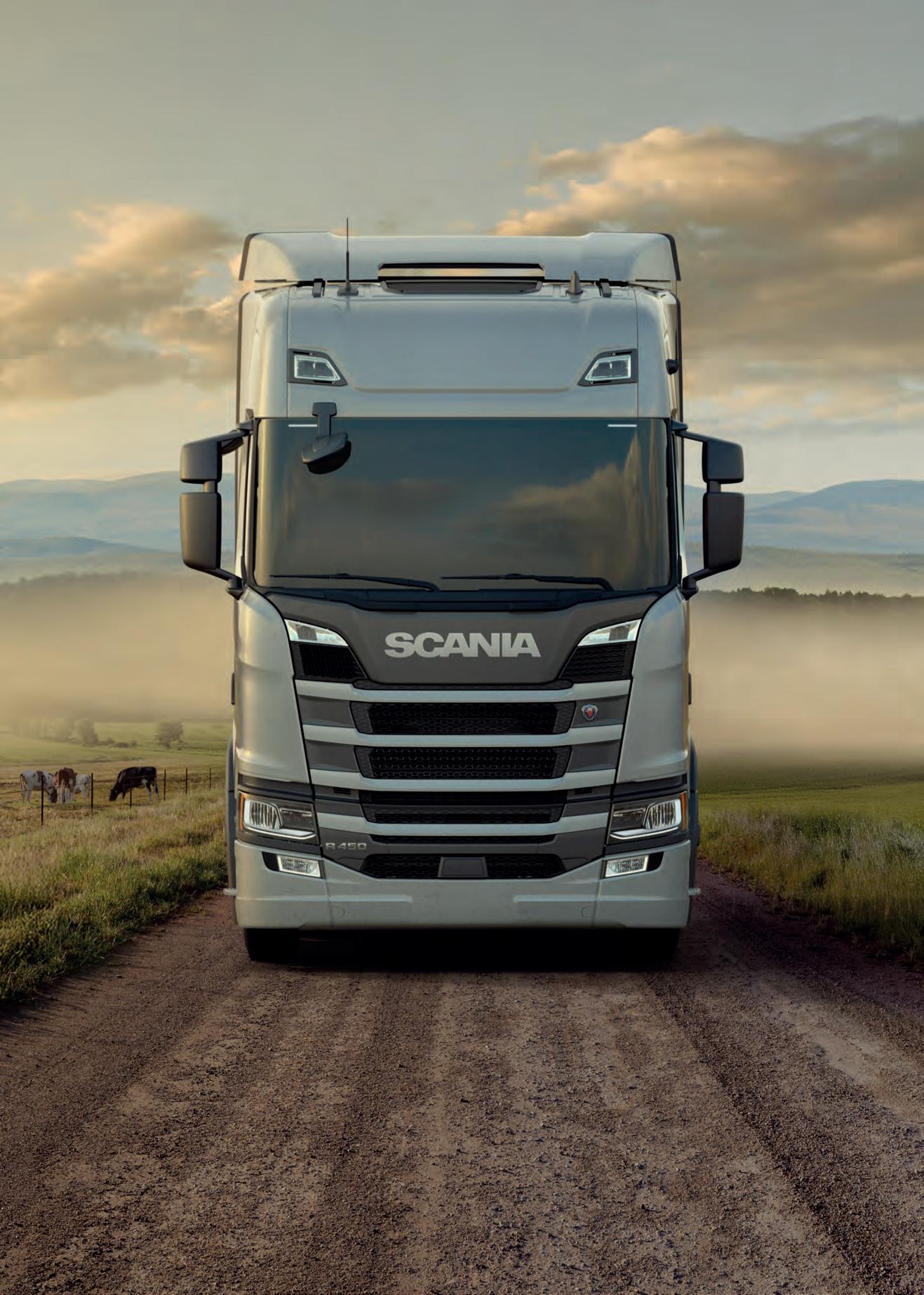
Biogas is one of the most climate-smart fuels we have – locally produced from food waste, manure and sewage. When you drive on biogas, you can reduce your carbon dioxide emissions by over 100 percent. Scania’s gas trucks offer a range of up to 1,800 kilometers and the power required for everything from urban distribution to construction and long haulage transport, making it easy to take the step. By choosing biogas, you open the door to more of tomorrow’s businesses and contribute to a more sustainable transport system.

After what was definitely the longest - and wettest - January in history we have made it safely into February and with the evenings, and mornings, getting slightly brighter things are starting to look up.

And just like the green shoots of growth that we can see in the garden there is a lot happening across our industry and in this FebruaryMarch issue of Export & Freight we bring you a snapshot of the latest developments in the local logistics industry.
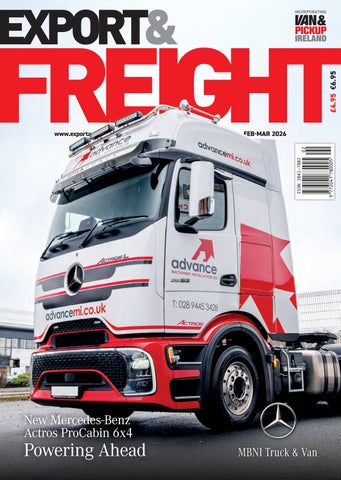
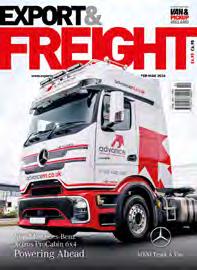
Our cover story features local business Advance Machinery Installation making a significant investment in a powerful new Mercedes Benz Actros, supplied by local dealer Mercedes Benz Northern Ireland Truck & Van (MBTVNI). And inside we feature a unique gatefold spread featuring TST in Ballymena taking delivery of 10 new Scania trucks from an order of 20, supplied by Scania Road Trucks.
And the positivity continues inside as we cover the arrival of major logistics company Dachser into Northern Ireland, and we also feature a brand new hybrid ferry arriving in Belfast before beginning servicing the busy freight route of Belfast to Heysham.
Export & Freight got an exclusive look inside the new Stena Connecta and learned all about its innovative rotor sails – which make it stand out from the crowd. The Stena Connecta joins the Stena Futura, which was the first ship to be officially named in Belfast in over 20 years back in November, on the Belfast Heysham route.
We have an exclusive interview with Ben Fletcher, the new Chief Executive of Logistics UK, and we welcome Alastair Gunn, RHA Policy Lead for Trade, as a new columnist to the magazine.
This issue features a dedicated Trailer Feature, along with a spotlight on Shipping, Customs Agents and Freight Forwarders. You’ll also find a feature on Training, which I’m personally proud to be part of.
We hope you enjoy reading this issue, it was a pleasure putting it together.
Austin Lynch Editor
Email: austin@4squaremedia.net
IRELAND’S TRANSPORT MAGAZINE
EXPORT & FREIGHT SUBSCRIPTIONS, 4 SM (NI) Ltd
Email: accounts@4squaremedia.net
Web: www.exportandfreight.com

£500K investment for Armagh based customs business Page 4
Aquarius launches DVLA approved licence-checker solution Page 5
National award for Allen Logistics Page 8
Logistics UK new Chief Executive pays visit to Northern Ireland Page 16
Contintental Tyres backs retreads campaign Page 24
Momentum builds for RTX Northern Ireland Page 28-29
Josh Fenton, Policy Manager, Customs and Borders, Logistics UK Page 32
Alastair Gunn, RHA Policy Lead – Trade Page 38
John McMahon, Corporate Partner, Spencer West, LLP Page 60-61
Court Reports Page 62
TST take major delivery of new Scania trucks Page 17-23
Trailer Feature Page 51-59
Training Feature Page 63-69 Guide to Shipping Page 70-81
Customs Agents and Freight Forwarders Page 83-91
Farewell to the Ford Ranger Plug-in Hybrid Page 92-93

Email: helen@4squaremedia.net
County Armagh–based customs and compliance provider Allied Fleet Services has announced a £500,000 investment that will create 15 new jobs.
The investment will also see Allied Fleet Services, founded in 2017 and headquartered in Armagh with operations across the UK, Ireland, Europe and India, rebrand to Allied Group as part of its evolution into a multi-service customs, compliance and logistics support provider.
The business has also relocated to new state of the art headquarters at Edenaveys Industrial Estate in Armagh and launched a new corporate website that reflects its broadened service offering and strengthened Group identity.
The investment reflects the scale of the organisation’s recent growth, with the business recording a 45% increase in revenue in 2024 and a further 12% rise in 2025, along with workforce growth from 15 employees in 2024 to 21 in 2025. This uplift in revenue has been driven primarily by the expansion of the company’s customs and regulatory compliance services, as businesses seek greater support to navigate the complexities of trading in and from Northern Ireland.
Rising demand for accurate and compliant cross border customs support across the UK, Ireland and Europe have also contributed to this growth, with customers ranging from private individuals to manufacturers, FMCG firms, transportation operators and healthcare providers.
The Armagh based company’s transition to Allied Group brings
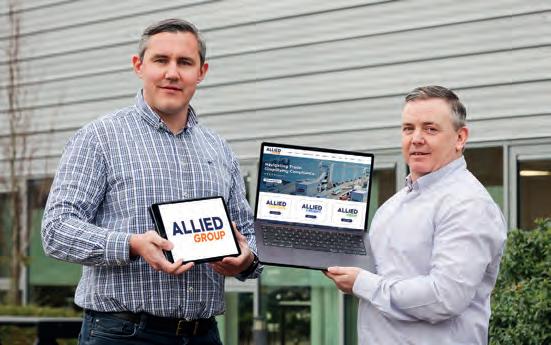
its core services together under three specialist divisions, with Allied Customs delivering expert and compliant customs clearance across the UK, Ireland and Europe.
Allied Freight provides end to end freight forwarding and logistics solutions, while Allied CBAM supports businesses as they prepare for the introduction of the EU Carbon Border Adjustment Mechanism.
Stephen McAneney, Founder and Director of Allied Group, said: “This investment represents a major milestone for our organisation and reflects the significant growth we have achieved in recent years.
“Customs and compliance sit at the heart of what we do, and the transition to Allied Group reflects the natural evolution of our organisation as we expand our service offering through our
three specialist divisions and strengthen our role in supporting cross border trade across the UK, Ireland, Europe and further afield.
“The creation of new jobs, our move to larger headquarters in Armagh and the launch of our new website will give us the capacity to support more customers, more efficiently, across increasingly complex regulatory and cross border environments.
“Our growth has been driven by diversification and by the trust our clients place in us to deliver compliant, reliable and solutions focused support. As regulatory frameworks continue to evolve, particularly in areas such as customs and emerging mechanisms such as CBAM, our priority is to ensure businesses have the clarity, capability and confidence they need to trade without disruption.”
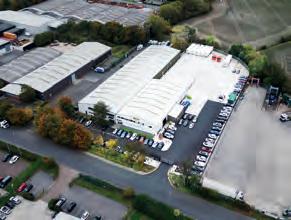
Manfreight is proud to announce that its Skelmersdale facility has successfully achieved AA BRCGS Accreditation, reaffirming the exceptionally high standards maintained across the site and the wider Manfreight facilities.
The accreditation audit highlighted Manfreight’s continued commitment to food safety, quality assurance, and operational excellence, recognising the robust systems and controls in place to support compliant and secure supply chains.
Manfreight’s 15,000 sq ft temperaturecontrolled facility in Skelmersdale plays a critical role in the business’s logistics
operations. Strategically located less than 45 minutes from Liverpool and Birkenhead ferry terminals, with direct access to the M58 and M6 motorways, the site serves as a key consolidation hub for both eastbound and westbound Irish Sea traffic. Further strengthening its compliance credentials, the facility has also achieved a PASS rating in its first APHA NIRMS
The company’s introduction of Allied CBAM is a direct response to growing uncertainty in the market, giving businesses a clear and practical solution as new EU carbon reporting obligations come into effect.
With importers facing stringent disclosure requirements, increased audit scrutiny and the risk of financial penalties for noncompliance, the new division ensures customers receive the guidance and regulatory expertise needed to navigate CBAM with confidence and avoid operational disruption.
Mr McAneney added: “Throughout our journey, we have focused on anticipating customer challenges and delivering practical, compliant solutions. The introduction of Allied CBAM is a natural extension of this approach. With new regulations coming into force, there remains significant uncertainty in the market around what will be required.
“CBAM will create real operational and financial pressure for many businesses, with strict reporting obligations and the risk of penalties or delays for those who do not comply. Our role is to provide customers with certainty and a clear route through these requirements.
“We make sure they remain protected, compliant and penalty free, with goods moving as expected even as the regulatory landscape becomes more complex.” For more information on Allied Group visit: www. allied-group.co.uk
audit, demonstrating the effectiveness and maturity of its control processes and regulatory compliance framework.
Manfreight would like to extend sincere thanks to its dedicated team, customers, and partners. Their expertise, commitment, and ongoing collaboration continue to underpin the company’s success and drive standards forward.
Get digitally savvy and unlock special offer prices with a membership of Volvo Involved.
Exclusive Genuine Volvo Offers
Access exclusive Genuine Volvo Parts, Service, Contracts and Digital special offers, only available to Volvo Involved members.
It’s not just Volvo, you’ll get access to exclusive discounts from our Extended Offer range of All Makes Parts & Accessories, Lubricant & Chemicals, Trailer Parts, Workshop Equipment & Consumables from leading proprietary brands and suppliers.
To become a member, simply register at volvo-involved.co.uk or scan the QR code below.

Scan to get Involved:

Driving for Better Business (DfBB) has launched a free online course on how to manage driver mental health, along with a free video podcast series on fleet risk management.
Launched to coincide with World Mental Health Day (10 October), the Driver Wellbeing Toolkit is a free online course for transport managers that provides a wealth of information on how to manage driver mental health and wellbeing
Titled ‘The Hidden Risk’, the podcasts bring together industry leaders, seasoned fleet
operators and safety specialists to share insights and innovative techniques.
In 2024, HGVs and vans were involved in collisions resulting in the death of 91 pedestrians, 21 cyclists, 59 motorcyclists,129 car occupants, 15 van drivers and five HGV drivers, according to government data. Far more people were seriously injured.
Simon Turner, engagement manager for Driving for Better Business, said: “Managing road risk is a pressing concern for all fleet operators, but they need the tools to achieve it. Operators need to be able to identify, assess, prevent and mitigate risks which are not easy for them to see, let alone monitor and manage. We intend to uncover the hidden risks affecting logistics, and truck and van operations, and to provide the resources and knowledge to deal with them.”
Turner added that the podcasts – which feature a range of experts from inside and outside the industry – will help business leaders see and understand those hidden risks, challenge outdated mindsets and take confident, strategic steps toward safer, stronger and more responsible operations.
For details, log on to: drivingforbetterbusiness.com
Aquarius IT has launched its own DVLA-approved Licence Check tool, fully integrated within its ClockWatcher Elite software, giving operators a more connected, single-screen view of driver compliance.
Unlike previous third-party plug-ins, this new solution has been built by Aquarius’s in-house team of developers to work seamlessly within ClockWatcher’s Driver Hub. Licence Check links directly with the company’s awardwinning suite of driver compliance tools - including accident reporting, defect checks, working time, drivers’ hours, and time & attendance. With everything accessible from a single login and displayed on one screen, transport managers gain a complete, real-time view of each driver’s compliance data record. This helps to streamline workflows, support better decision-making, and reduce administrative burden.
The new Licence Check enhances this view by surfacing critical DVLA data - from licence entitlements and penalty points to overspeeding, disqualifications, conviction dates, medical indicators, endorsements, Driver CPC, and expiry dates. It allows transport teams to check driving licence data directly with the DVLA, all from within the system - eliminating the need for separate processes.
A key advantage is the easy setup - the platform walks users through a clear step-by-step process to request and record driver consent, link licence details to the system, and configure check frequencies based on risk. Licence checks can then be scheduled, with built-in alerts for drivers with endorsements or changes in licence status. This depth of detail

supports a smarter, more proactive approach to compliance and risk management – and early testers have reported that the system is “so easy to use” and particularly liked the built-in calendar view.
For every employee driving on company business, employers have a legal duty to confirm licences are valid and drivers are qualified for the vehicles they operate. Failing to carry out these checks not only puts the business at risk of fines and prosecution but can have serious consequences in the event of an incident. Now, with Licence Check, these checks are simple, automated, and auditable - giving operators a smarter way to meet this vital obligation.
Mark Johnston, Managing Director at Aquarius IT, said: “Compliance is a moving target, and the more joined-up your data, the better positioned you are to keep up.
With this latest development, we’re giving operators the ability
to track licence data with the same level of clarity and control they already have with their driver and vehicle data. It’s another important step in our continuing aims to simplify compliance and reduce risk through smart digital tools.”
The new Licence Check is suitable for all businesses with employees driving on company time - from large HGV and PCV fleets to company cars, vans, and grey fleet drivers. Whether staff are making deliveries or heading to a meeting, employers must ensure licences are valid. The Aquarius solution offers a reliable and timesaving way to stay compliant. It also supports recruitment and onboarding by verifying licence credentials in real time, as well as insurance processes. With more insurers seeking evidence of proactive risk management, being able to demonstrate structured, auditable checks can strengthen negotiations and provide
protection in the event of a claim. With Aquarius’s Licence Check, operators can clearly show insurers they are monitoring driver risk and responding appropriatelysafeguarding the business from legal and financial exposure. Aquarius recommends conducting checks at least every three months, with more frequent reviews for higher-risk drivers - an approach that aligns with the latest FORS guidance. While no fixed legal frequency exists, being able to demonstrate consistent, risk-based checks is critical to protecting both compliance and reputation.
Neil Chetwynd, Director of Development at Aquarius IT added: “We’ve developed our integrated Licence Check to help operators manage compliance in one place, alongside other driver data - securely, efficiently, and in line with best practice. It quickly brings everything from licence checks and driver hours to incidents and defects into a single digital workflow, reducing risk, saving time, and eliminating the need to switch between systems or spreadsheets.”
This latest solution reinforces Aquarius’s commitment to delivering smart, connected tools that improve visibility, simplify compliance, and help road transport operators manage their responsibilities more efficiently. For more information or to book a consultation, visit: www.aquariusit.com
To discuss tailored fuel supply solutions, speak to our team.
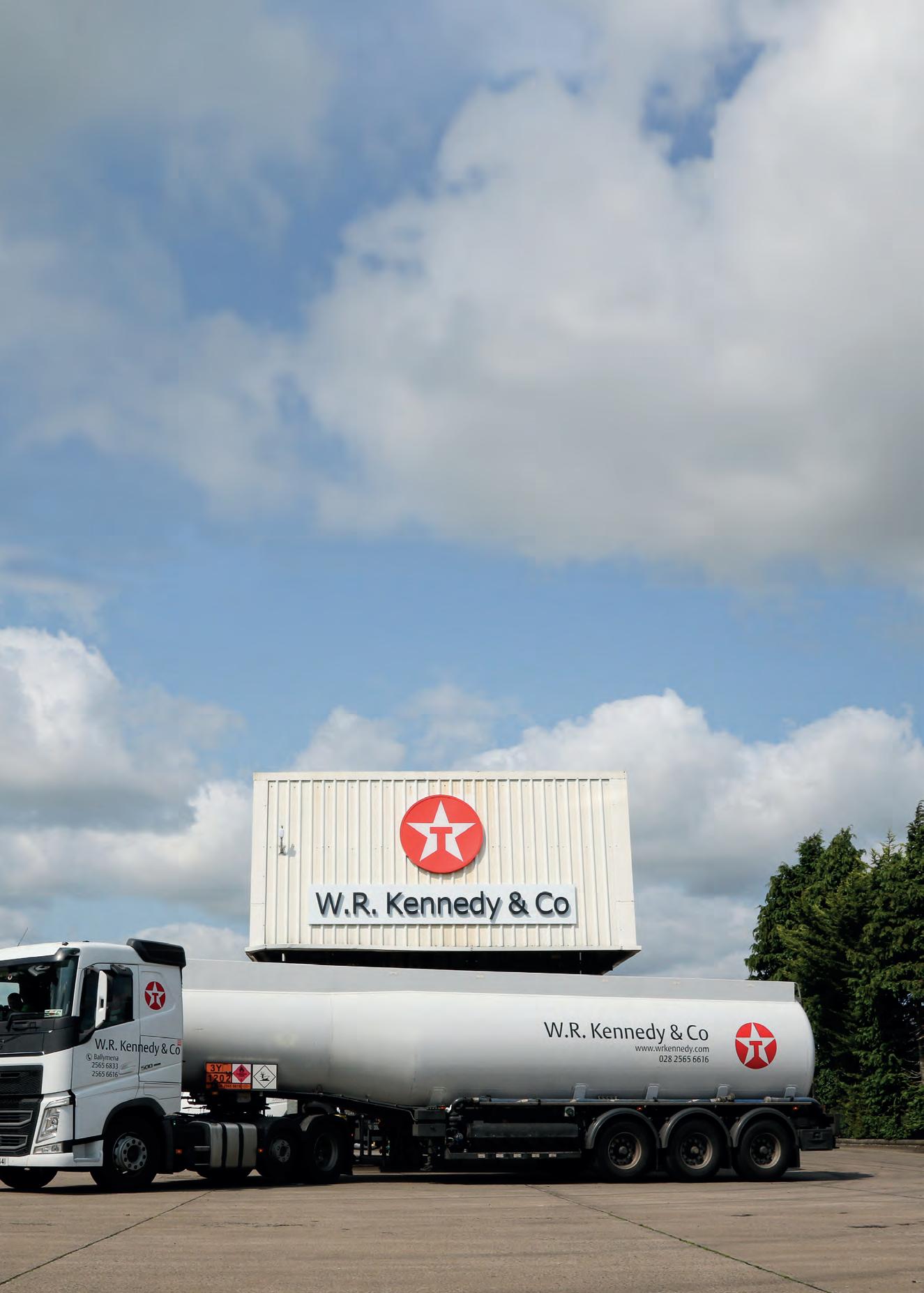
W.R. Kennedy & Co provides dependable fuel and energy solutions to the export, freight and logistics industries across Northern Ireland.
Based in Ballymena, we work with transport operators and commercial fleets who value reliability, consistency and local expertise — delivering quality fuel supply with a service standard you can rely on.
Quietly efficient. Professionally delivered.
Whether it’s kerosene or diesel for your plant, we have you covered with quality Texaco lubricants and fuels. We have been fuelling the construction, manufacturing and haulage sectors for decades; whatever your fuel or lubricant needs, let us help you with prompt delivery and competitive pricing. Diesel | HVO | AdBlue | Engine Oils | Hydraulic Oils |
Ballymena | Northern Ireland
Allen Logistics has won the prestigious Fortec Member of the Year award.
The award recognises the company’s exceptional performance, service excellence, and unwavering commitment to the Fortec network throughout the past year.
The accolade was presented during the PallEx Group’s ‘30 Years of Excellence’ Annual Awards, held at the Hilton Metropole in Birmingham at the beginning of February. The event brought together shareholder members from across the Pall-Ex and Fortec networks, as well as international partners from the wider Pall-Ex Group.
The Fortec Member of the Year Award, sponsored by Service Express, is voted for by other members of the network and was awarded to Allen Logistics in recognition of its consistently high service levels, proactive communication, and dedication to supporting fellow members across the network.
With over 50 years’ experience, Allen Logistics has become a market leader in the transport industry in both Northern Ireland and the UK. By offering a dependable and personal service to customers, Allen Logistics now operates a fleet of modern, high specification vehicles across its sites in Lichfield and Craigavon.
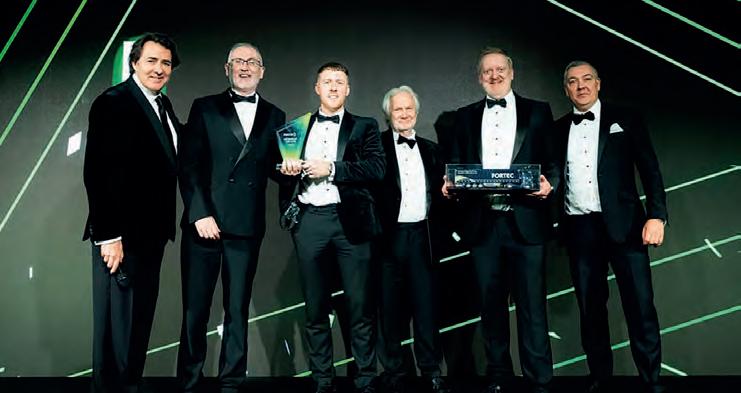
James Allen, Managing Director at Allen Logistics, commented on the win: “We are incredibly proud to be named Fortec Member of the Year. Over the past year, we’ve focused on strengthening our service and supporting the network wherever possible, so it’s fantastic to see that recognised.”
Barry Byers, Chief Operating Officer, Pall-Ex Group, added: “The Fortec Member of the Year award recognises those who go above
and beyond for the network, delivering exceptional results and consistently upholding the highest standards. Allen Logistics has demonstrated remarkable dedication and performance throughout the year, making them truly deserving winners.”
Find out more about Allen Logistics award-winning pallet distribution at: https://allenlogistics.com paul@allenlogistics.com
The Road Haulage Association (RHA) has welcomed a Scottish Government announcement that the speed limit for Heavy Goods Vehicles (HGVs) on Scotland’s trunk roads is to be increased to 50mph.

The trade association supporting people and businesses in the road transport industry has campaigned over many years for the current 40mph to be increased.
Transport Secretary Fiona Hyslop has announced that the Government will be starting the Parliamentary process to alter the trunk road limit following a public consultation.
Martin Reid, the RHA’s Policy Director for Scotland, Wales and Northern Ireland, said: “We applaud the Scottish Government for this announcement. We have engaged in productive discussions
with the Government, and they have listened and acted.
“This is tremendous news for Scotland’s road haulage industry. We believe it will make these roads safer, reduce emissions and help regional and national economic growth.
“We know through the trial on the A9 that when the speed differential between cars and trucks is reduced it also reduces the likelihood of risky overtaking.
“We also know that lorries use less fuel and create fewer emissions when they can drive at 50mph.
“This change will also rebalance the competitive disadvantage faced by hauliers in Scotland, compared to those in England and Wales, because of the current 40mph trunk road speed limit.
“When journeys take less time, they create savings which can be passed on to customers, creating a positive ripple effect throughout the Scottish economy.”
The RHA has indicated that it will work with the Scottish Government and Transport Scotland to support its implementation.

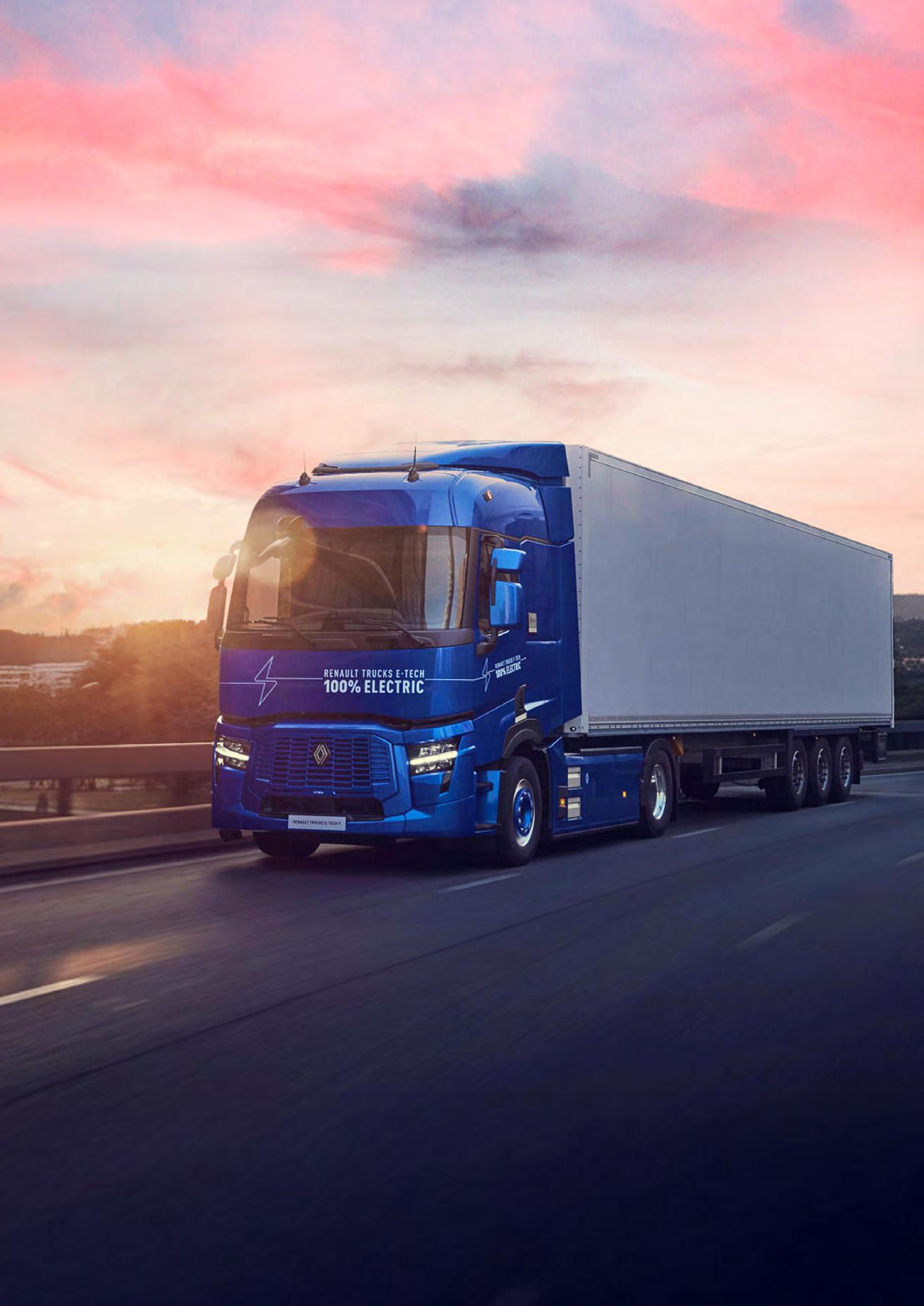
We’re proving electric trucks work in the real world. With millions of electric miles already covered, we have the proof to back our promises. Experience you can rely on. Expertise you can trust.
renault-trucks.co.uk
Scan the QR code to watch our Zeroing In electromobility series
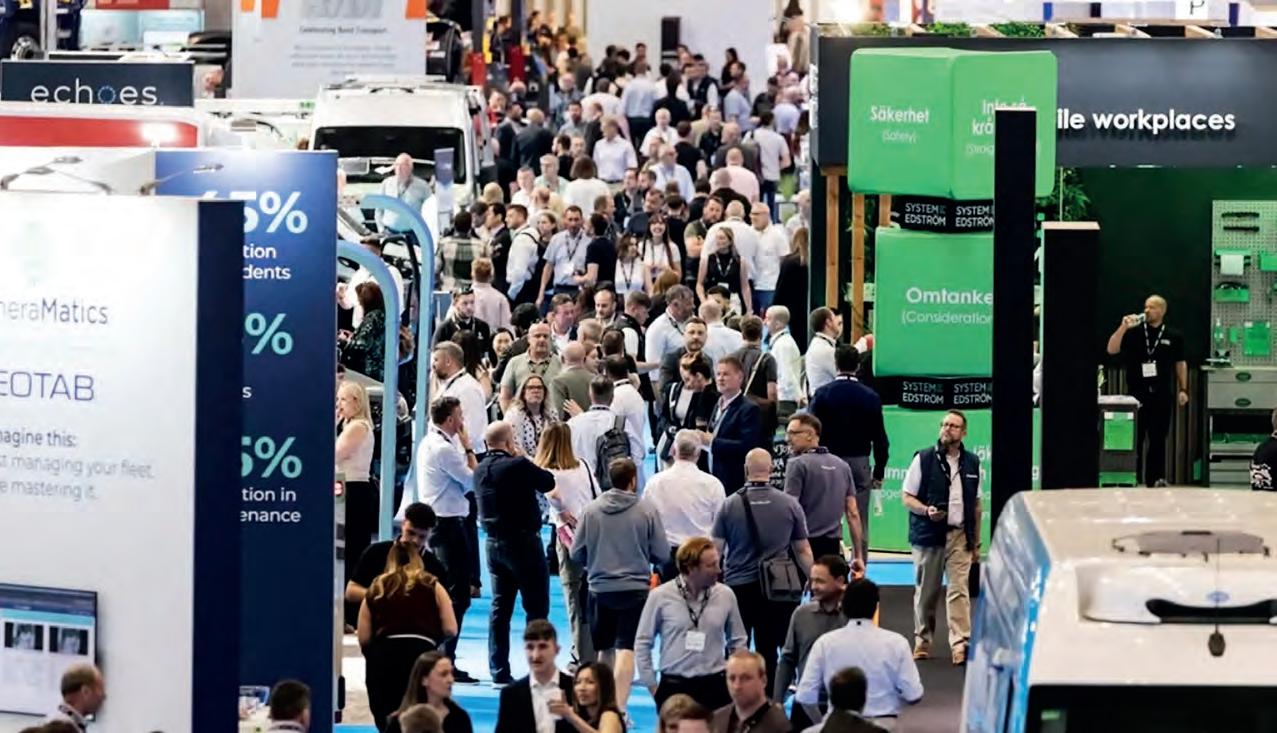
The Commercial Vehicle Show brings together fleet operators, OEMs, manufacturers, service providers and solution specialists, all in one highly targeted environment.
Taking place at the Birmingham NEC between April 21-23, this year’s show will see more than 300 exhibitors in attendance, about 10,000 products on display as well as 150 speakers at the various seminars covering the most relevant industry topics.
The UK’s largest commercial vehicle event is being run by Nineteen Group now, SMMT and RHA are strategic partners of the show.
Designed to support an evolving sector, it is not just a trade exhibition but a learning hub built to inform, connect and prepare the industry for the road ahead.
Some of the event highlights to look forward to include:
Hosted by SMMT and RHA, this stage will place the spotlight on decarbonisation, the government’s ZEV mandate, emerging technologies, and key industry challenges. Expert speakers will offer actionable insights to drive innovation and sustainability. Day three will focus on diversity, workforce development, talent retention, and inclusion –empowering businesses to build a motivated, future-ready team. Other topics discussed will be AI, cybersecurity, skills, vehicle maintenance, and tool theft, and the main stage will also see the launch of the SMMT’s latest Commercial Vehicle Report. There will be contributions from companies, as well
as representatives from the Department for Transport (DfT) and BVRLA.
The Technical Stage will host toolbox talks designed to engage drivers and fleet managers through interactive, hands-on sessions. With real-life case studies, live demonstrations, and insights from top innovators and manufacturers, it will deliver practical ideas and actionable solutions for implementation in organisations.
Located at the EV Café Village, the Decarbonisation Theatre will host a free-to-attend conference packed with expert insights on EV adoption, fleet transition, charging infrastructure, battery technology, and the Zero Emission Van Plan. This is designed to give businesses
the knowledge and confidence to accelerate their electric journey.
The Future Fleet Arena will showcase the technologies shaping tomorrow’s transport. From autonomous systems and connected vehicles to AI-driven fleet management, next-generation fuels, and smart infrastructure, it will offer a first look at the innovations set to transform fleet operations.
Delivered in partnership with National Highways, the Driver Safety Theatre will have free sessions focused on road safety and driver wellbeing. Topics will include fatigue management, mental health, incident prevention, and compliance, providing both operators and drivers with practical strategies to stay safe and perform at their best.

New for 2026 is The Bus & Coach Expo – the UK’s dedicated event for the bus and coach industry. Co-located with the Commercial Vehicle Show, it will bring together operators, manufacturers, and suppliers from across the sector. With a strong line-up of exhibitors and thousands of industry professionals, it will also showcase the latest innovations in:
• Buses, coaches, minibuses, and accessible vehicles
• Buses, coaches, minibuses and accessible vehicles
• Telematics, route planning and scheduling software
• EV charging, hydrogen refuelling, and depot infrastructure
• Workshop, garage, and fleet maintenance equipment
• Safety systems, accessibility technology, and regulatory compliance
Nick Davison, Event Director, said “We’re thrilled to launch Bus & Coach Expo in 2026. This is not just another industry event, it’s a strategic new platform built for the challenges and opportunities ahead. With its co-location alongside the Commercial Vehicle Show, we’re delivering two powerhouse exhibitions in one, offering attendees more value, more connection and more reasons to attend”


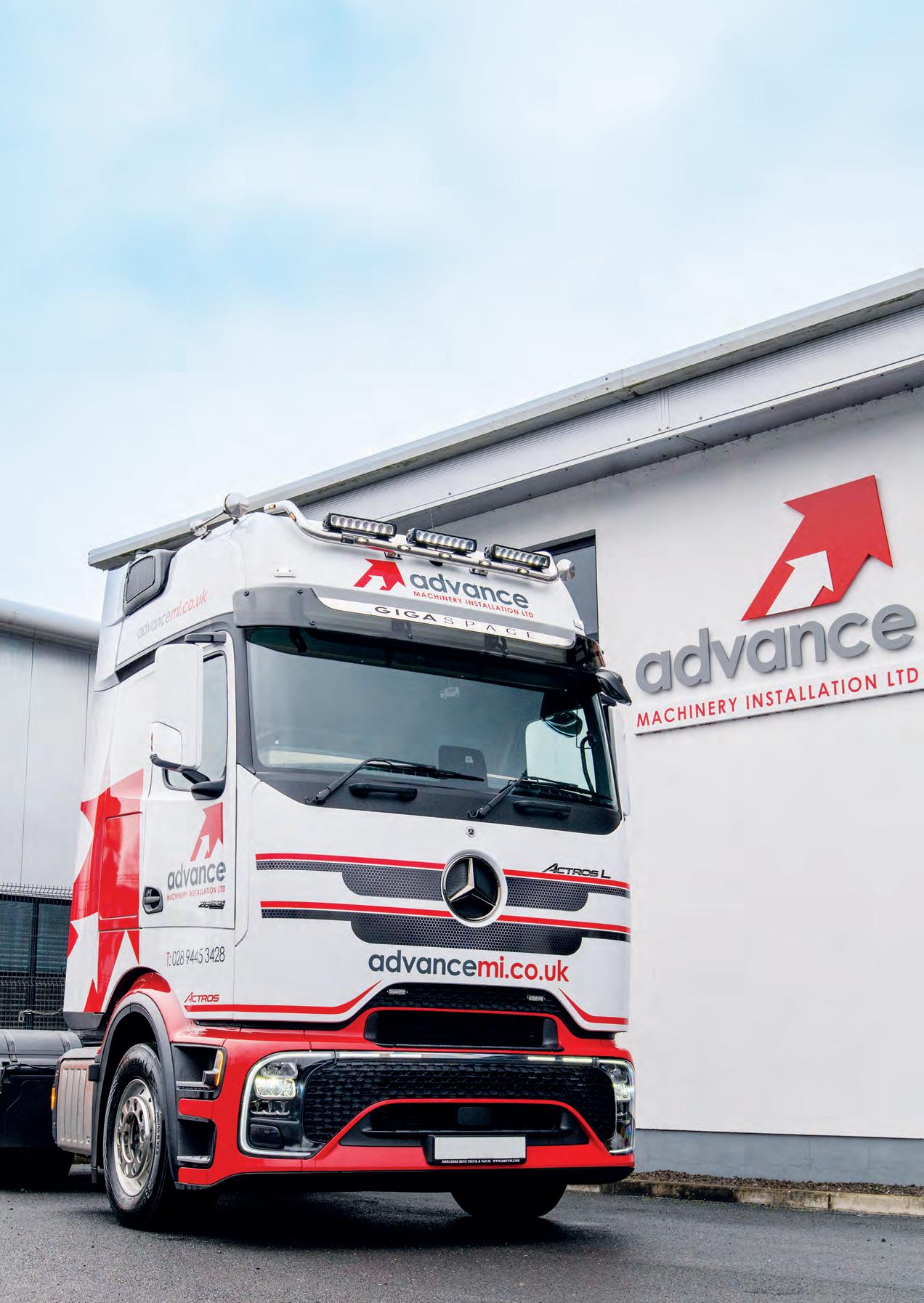
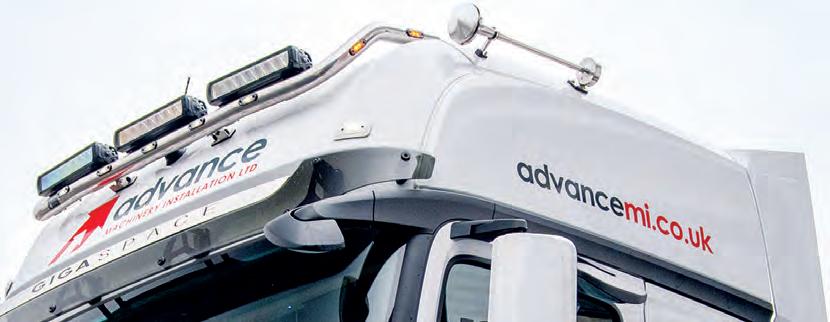
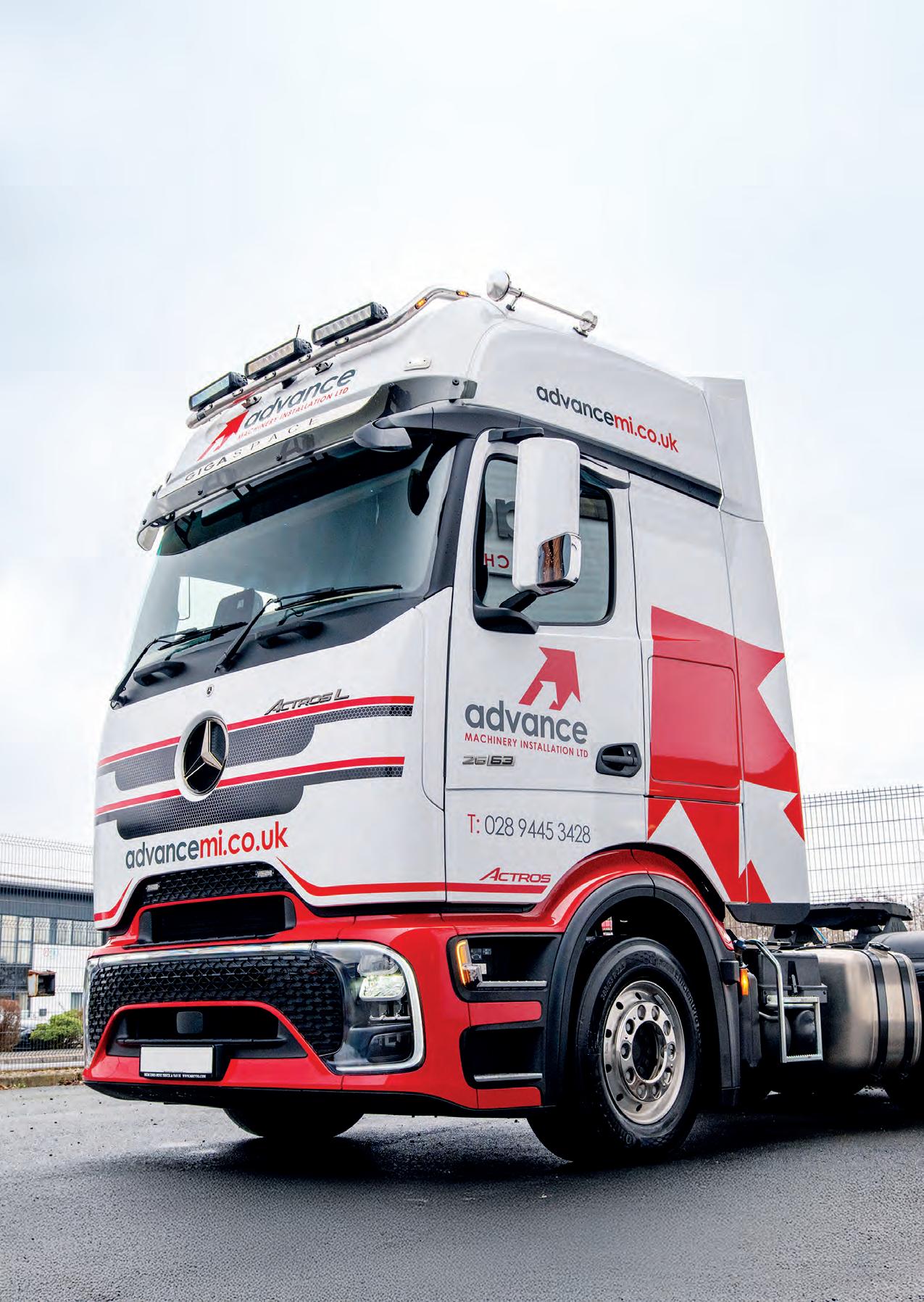
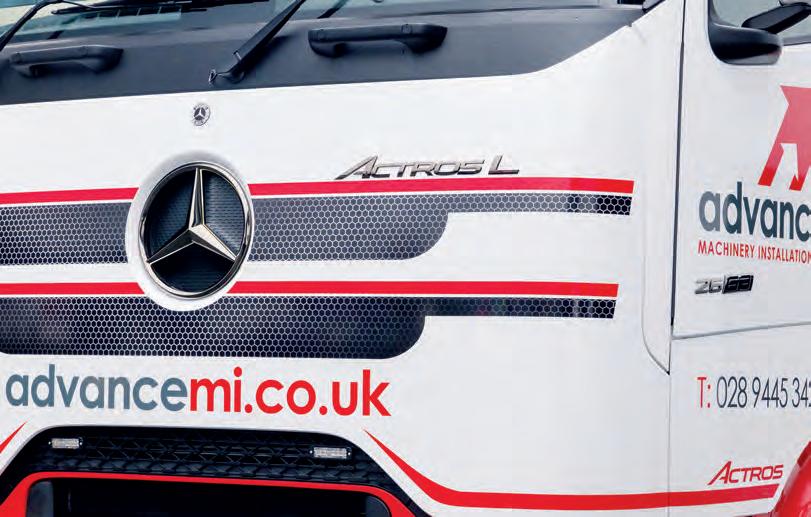
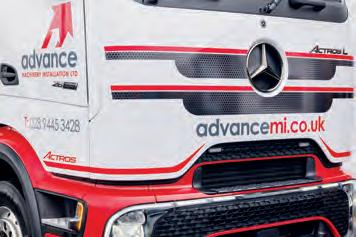
When it came to replacing their nine year old Mercedes-Benz Actros there really was only one option for Bill Lawrence from Advance Machinery Installation.
Bill and his team at Advance Machinery Installation in Antrim, a specialist industrial services company, ordered a new Mercedes-Benz Actros ProCabin 6x4 630 which was delivered to their Antrim headquarters at the start of February. Bill traded in the old Actros and has leased the new vehicle from MBNI Truck & Van.
“As a valued customer, it’s great to see Advance Machinery Installation investing in progress by upgrading their MercedesBenz Actros to the new ProCabin,”
Stephen Irvine, Truck Sales Manager, MBNI Truck & Van
The new truck was in the yard briefly to get a wash, and get its photograph taken and then it was put straight to work.
Incorporated in May 2010, Advance Machinery Installation has over a decade of experience in the installation and relocation of industrial machinery and equipment, serving clients throughout Ireland and the UK.
The company delivers tailored solutions in plant relocation, machinery installation, factory relocation, and specialist equipment handling, combining technical expertise with robust project planning.
“We are machinery removal and transportation experts and this new truck is our major, and most important piece of kit,” comments Bill Lawrence.
“It’s our toolbox on wheels.”
The new Mercedes Actros ProCabin 6x4 is rated for Heavy Haulage – STGO Class 2 and will spend most of its working life pulling a heavy 4-axle low-loader for the business.
“Our kit is very heavy, and the truck is usually accompanied to a site by one of our vans with the smaller tools and our technicians.
“Every detail of the new ProCabin has been designed to direct airflow around the vehicle with as little resistance as possible, delivering up to a three per cent reduction in fuel consumption. From a safety perspective, Active Brake Assist 6 monitors 270 degrees around the vehicle and can now recognise cyclists, while Active Sideguard Assist 2 supports the driver during left turns and can initiate braking in critical situations.”
Stephen Irvine, Truck Sales Manager, MBNI Truck & Van Advance Machinery Installation work entails visiting various factories and either moving machinery around or installing new machinery using big, heavy lifting gear, which Bill explains is what is on the back of the truck.
Advance Machinery Installation works across a diverse range of industry sectors, including manufacturing, food and drink, engineering, aerospace, and packaging. The team’s comprehensive service offerings also include method statement preparation, risk assessments, haulage and storage support, export packaging, and logistical coordination.
Operating in such a specialist field Advance Machinery Installation works for some of the biggest companies – and in some of the
biggest factories - in Northern Ireland.
Customers include Boeing, Ardboe, Kerry Foods, Caterpillar and Sam Aerospace.
This is a small company of 16 staff that does very specialised work, and its team of trained professionals place a strong emphasis on safety, efficiency, and minimising operational downtime, ensuring that machinery movements are executed smoothly and securely.
Over the years, the company has built a strong reputation for reliability, professionalism and delivering on complex industrial projects with precision-making it a trusted partner for businesses requiring high-value machinery handling and industrial plant services.
As the new truck is a STGO Category 2 it can carry a gross weight of up to 80 tonnes, but Bill said it wouldn’t always be carrying this maximum weight - but more often somewhere in the region of 60-70 tonnes.
“I needed something heavy-duty to take the heavy loads, moving machinery around a site, or transporting it on or off site.
The company employs two drivers to drive this specific truck, which is the flagship of the business, covering not necessarily huge miles, but critical miles that require accuracy and precision considering the weight – and value – of the loads being carried.
While the majority of the work that this truck, and Advance Machinery Installation, do is on the island of Ireland if they have a customer who wants them to move something over to England or Scotland then they will go. “This is what we do.”
And although this is not a 24/7 365 operation, Bill explains that they are busier around holiday time when factories are closed or people are off on annual leave as it is often a good chance to get machinery moved with minimal disruption to the operations of these large organisations.
When asked why he decided to replace his existing Mercedes with another one, Bill has
quite a simple answer. “This was the only vehicle that was up for the job – and that came with the right package.”
The vehicle was supplied by MBNI Truck & Van at Mallusk
MERCEDES-BENZ
PROCABIN 5 2663 LS 6X4 DOUBLE DRIVE
• Configuration: 6x4
• Model: Actros 630
• Application: Heavy haulage / machinery movement
• Gross Train Weight: Up to 80 tonnes
• Cab: ProCabin (aerodynamically optimised)
• Fuel Efficiency: Up to 3% improvement vs previous generation
• Predictive Power Control (PPC) as standard for improved fuel efficiency
• Safety Systems: Class-leading Safety Features
Active Brake Assist 6 (270° monitoring, cyclist detection)
Active Sideguard Assist 2 (left-turn support with braking intervention)
• LED Matrix Headlights

RSA Insurance in Northern Ireland has officially completed its rebrand to Intact Insurance, marking a major milestone in the company’s evolution and reflecting a broader strategy to unify its operations across the UK, Ireland and Europe under a single global identity.
The change, which was effective from 6 October, sees RSA - one of the region’s most recognised commercial and specialty insurers - adopt the Intact Insurance name following its acquisition by Canada’s Intact Financial Corporation (IFC) in 2021. This transition brings together the heritage of RSA and the global scale of Intact,
with the aim of strengthening the insurer’s market position and strategic growth ambitions. Under the new brand, the business continues to offer a broad portfolio of commercial and specialty insurance products. It also retains its deep broker relationships and local underwriting expertise while benefiting from
Intact’s global network spanning more than 150 countries.
Ken Norgrove, CEO of Intact Insurance UK & Ireland, described the change as more than a simple name swap: “This is more than a change of symbol and name. It’s a powerful statement of who we are – built on expertise, known for being easy to do
business with, and driven by our values and a clear purpose.”
STRATEGIC GROWTH AND MARKET AMBITIONS
The move aligns with Intact’s broader strategy to expand its commercial lines presence in the UK & Ireland and build a leading global specialty lines insurer. The
company has previously integrated other brands such as NIG and FarmWeb into the Intact umbrella as part of this unified identity.
Industry observers note that the rebrand — while leveraging Intact’s global expertise — will test the new name’s recognition in markets where the RSA brand held strong historical awareness, with roots tracing back over three centuries.
For customers and brokers, the transition is designed to be seamless; existing policies, services and points of contact continue without interruption, with further updates phased in as part of the ongoing integration.
As Intact Insurance, the business looks to build on RSA’s legacy while pursuing ambitious growth goals, including plans to significantly expand its UK & Ireland operations by 2030.
Tim Graham, Director of Intact Insurance in NI is ‘excited for the future and the opportunities the rebrand will bring, at the same time continuing to lean on the many years of local market knowledge in the Transport and Logistics industry offering a complete end to end service,

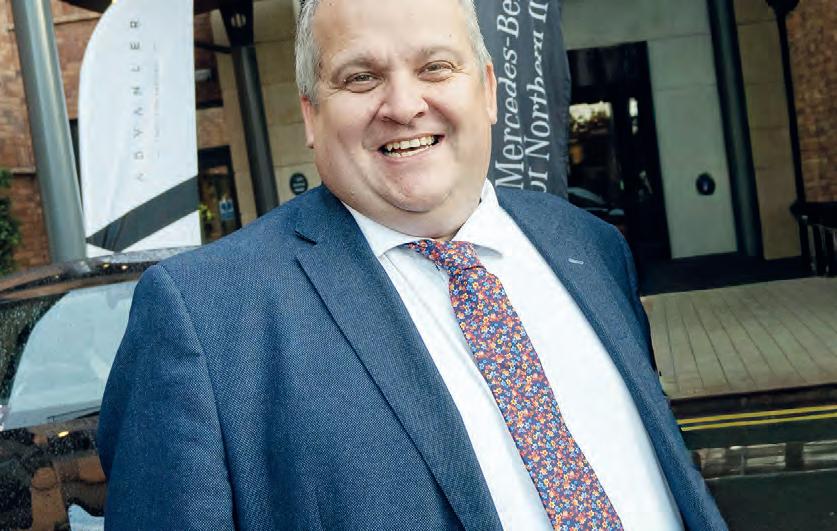
from policy inception to claims to both our broker and client base.
In a very competitive marketplace, we understand that no two clients are the same and each have their own individual needs. With our in depth expertise, we aim to provide a bespoke solution for our policyholders providing a one stop
shop for their insurance needs.
As sponsor of the prestigious NI Export & Freight Driver of the Year Award, Intact Insurance is committed to promoting safe driving, at the same time recognising that accidents do happen. It’s at these times that you need to ensure that you have the
appropriate cover in place with an insurer who understands the uniqueness of the transport sector.
As a leading player, you can trust Intact Insurance to keep your wheels turning. So, if you’re not currently insured with us, ask your insurance broker to obtain a quote from us at your next renewal.’
RSA Insurance is now Intact Insurance.
The new name in Commercial lines.
Ben Fletcher, the new Chief Executive of Logistics UK, paid a visit to Northern Ireland at the end of January to meet with fellow members and decision makers.
Mr Fletcher, who only formally took up the role on 1st January, 2026, had a number of meetings during his time here including just one media interview – with Export & Freight.
Describing Northern Ireland as a ‘vital market’ Ben Fletcher said one of his immediate priorities is to fill the role of Head of Trade and Devolved Policy recently vacated by Nichola Mallon.
During 2025 the economy here in Northern Ireland grew by 2.9%, which compared very favorably to the rest of the UK, which only recorded a growth rate of 1.3%.
“This is a fantastic thing for the economy, and a great opportunity for Northern Ireland – and we need our sector to grow. We need people here on the ground who know this place best.
Logistics UK aims to provide a voice for NI businesses and to advocate ‘loudly and strongly’. And just a few weeks ago a number of prominent members met in Brussels on lobby on behalf of businesses here.
Logistics UK hasn’t had a dedicated representative in Northern Ireland since the recent departure of Nichola Mallon.
In the interim, Josh Fenton, Policy Manager, Trade Customs and Borders has stepped up brilliantly and over the past number of months has worked hard on Northern Ireland issues including building a strong relationship with Minister Archibald. But Logistics UK realise that a region as important as Northern Ireland needs its’ own a dedicated person.
“Having boots on the ground here (in Northern Ireland) is vital. Our members, and our industry have significant issues here, and we want to make sure someone is here to manage that.”
“We want to get the right person, and it’s really important to have that person with the local knowledge who can tell the decision makers a story.
“We need someone who knows the industry, who can advocate for the industry and then help translate this into policy that works. Policy gets you in the door, anecdotes get politicians to listen.”
“When we find the right person we will know,” continued Ben Fletcher, who points out it is a very exciting job, and one that will greatly enhance any career in this industry as it involves sitting down with important people and representing Northern Ireland and its logistics industry.
During his brief visit here Ben Fletcher and Josh Fenton met with the Economy Minister

for Northern Ireland, Dr. Caoimhe Archibald at Parliament Buildings, Stormont. Discussions centred around the critical role of logistics in Northern Ireland and how it underpins the NI economy. “We raised issues with her that our members here are concerned about, and how we need to create the right environment for economic growth.”
Furthermore, the discussions, which Ben Fletcher described as ‘really constructive’, included the role of decarbonisation in the sector, skills shortages and the ongoing challenge of GB to NI trade.
He also stressed to the Minister how the NI logistics industry is particularly important as we have no significant rail network here.
“We told the Minister if you want to generate growth, you must invest in infrastructure – and she was listening,” said Ben Fletcher who said they raised the A5 as a ‘key priority’ project.
With more than 6,000 logistics businesses in Northern Ireland employing nearly 70,000 people – or approximately 8% of the entire workforce, they highlighted the benefit of Northern Ireland having its own logistics strategy.
Logistics UK want to be at the heart of the debate about the importance of this industry, and not just at policy level where they try to get politicians to understand the size and scale of this industry - but at a practical level raising issues such as safety within the industry, and staff well-being.
As part of the visit Ben Fletcher attended a Logistics UK Council meeting, which took place at the headquarters of TST Group in Ballymena.
“I spent some time with Maire-Claire Reid as I wanted to understand what members want from the new person, and to find out what’s happening on the ground from the professionals who work here.
“All this information will help us shape who we are looking for.
Getting young people to consider a career in logistics is also a hugely important part of the role of Logistics UK and to support this ‘Generation Logistics’ has been created.
“We are committed to encouraging people into the industry and this can be a challenge, as kids don’t really know what this industry is.”
Generation Logistics aims to find a way to connect kids to this industry and highlight the many varied, exciting and rewarding careers that are part of the logistics industry.
So how are they doing that? The programme is going into schools and targets 13-24 year olds aiming to get kids switched on to the potential opportunities from a career in logistics.
Advantages of this industry include it is skilled, well-paid and it has a huge future.
“We want to get parents and kids switched on to the possibility of a career in logistics.
We are hopefully helping to open the doors to what could be a rewarding career. “School and university are not for everyone, and perhaps the career pathway for some lies in this industry, where they are a lot of varied roles available.”
And finally we asked Ben Fletcher about the importance of technology, and AI, for this industry.
“I think AI is a very positive thing, and it is important as it will allow us to become more efficient, faster and more accurate in this industry. We should embrace technology as it has a lot of offer, not least in terms of safety.
“It will change things in the long-term and will change the nature of some of the jobs in this industry but we need to upskill people to work with it and not panic about it. We should be asking – how can we embrace this technology to become more effective and more efficient.
More info is available on www.generationlogistics.org
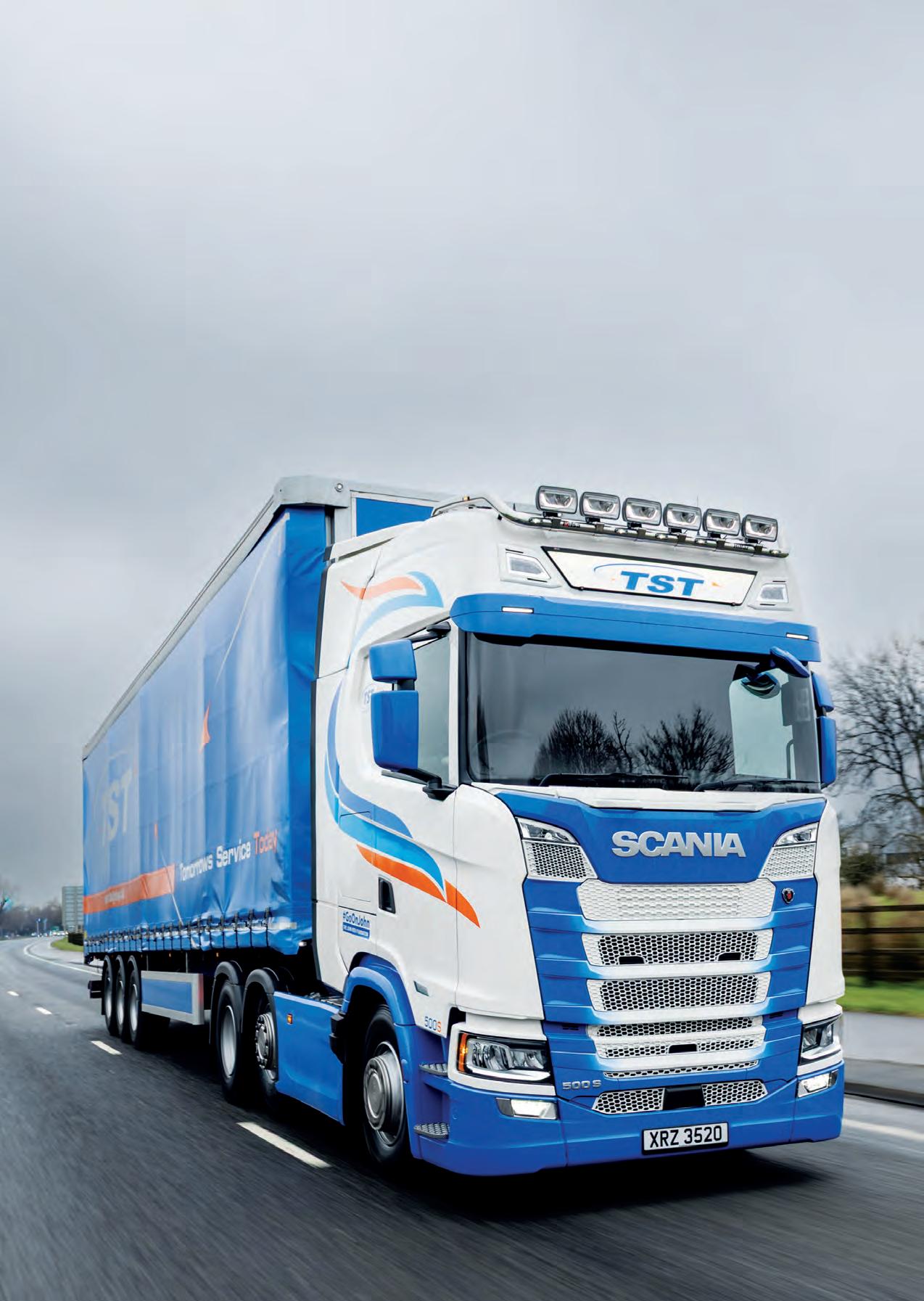
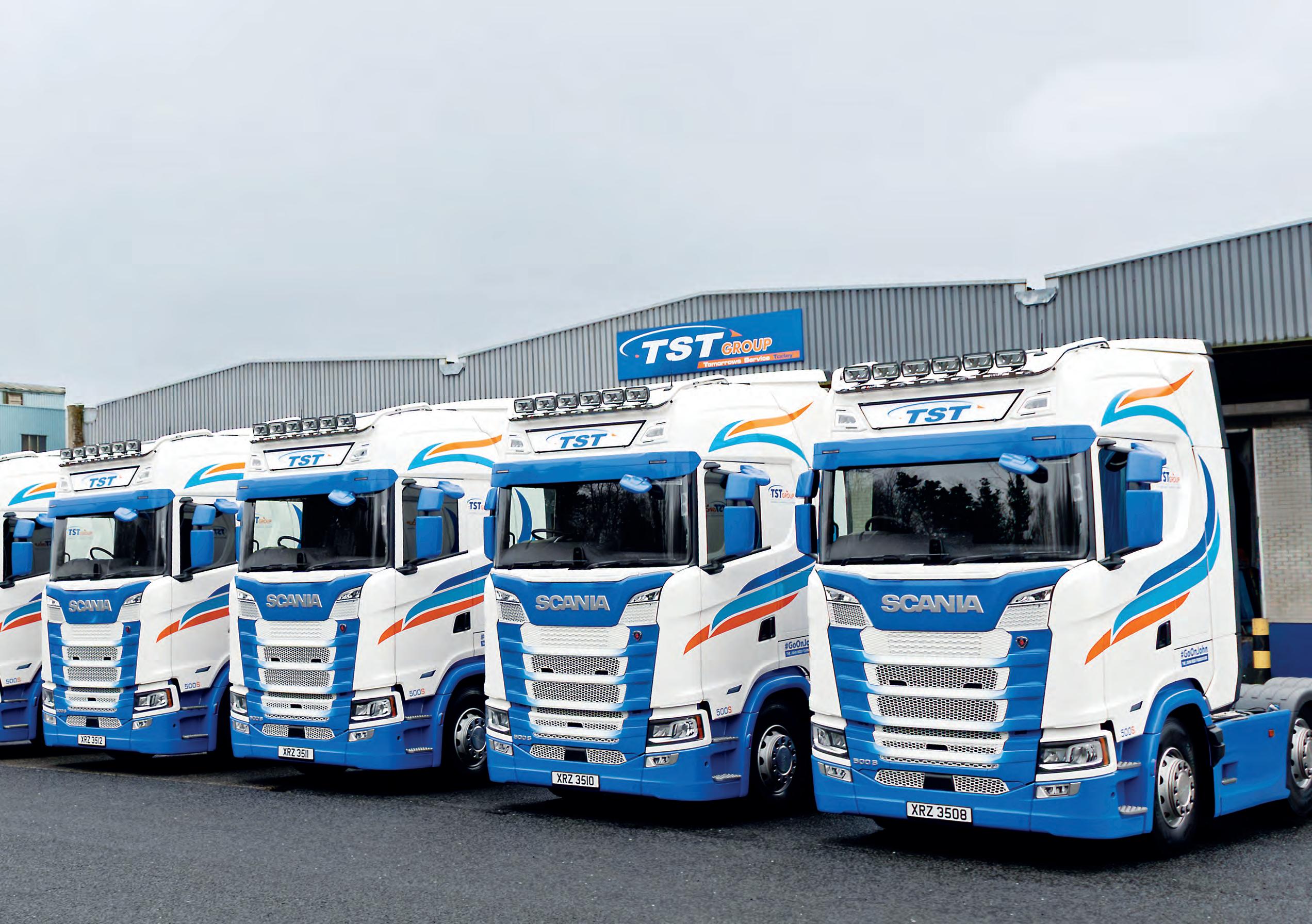
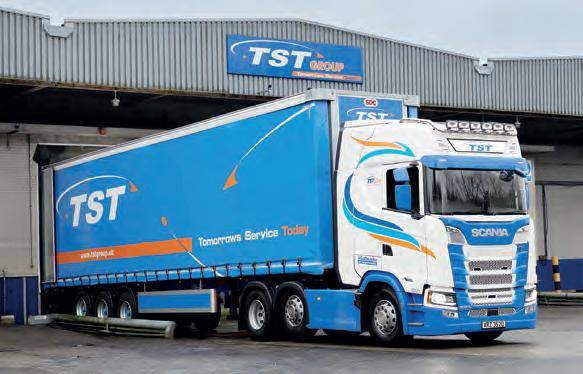
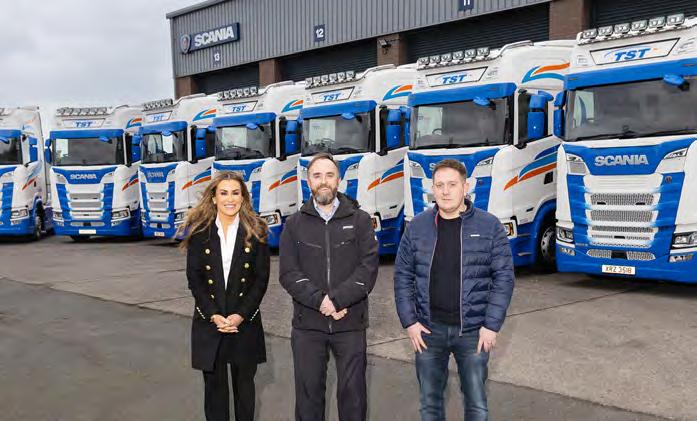
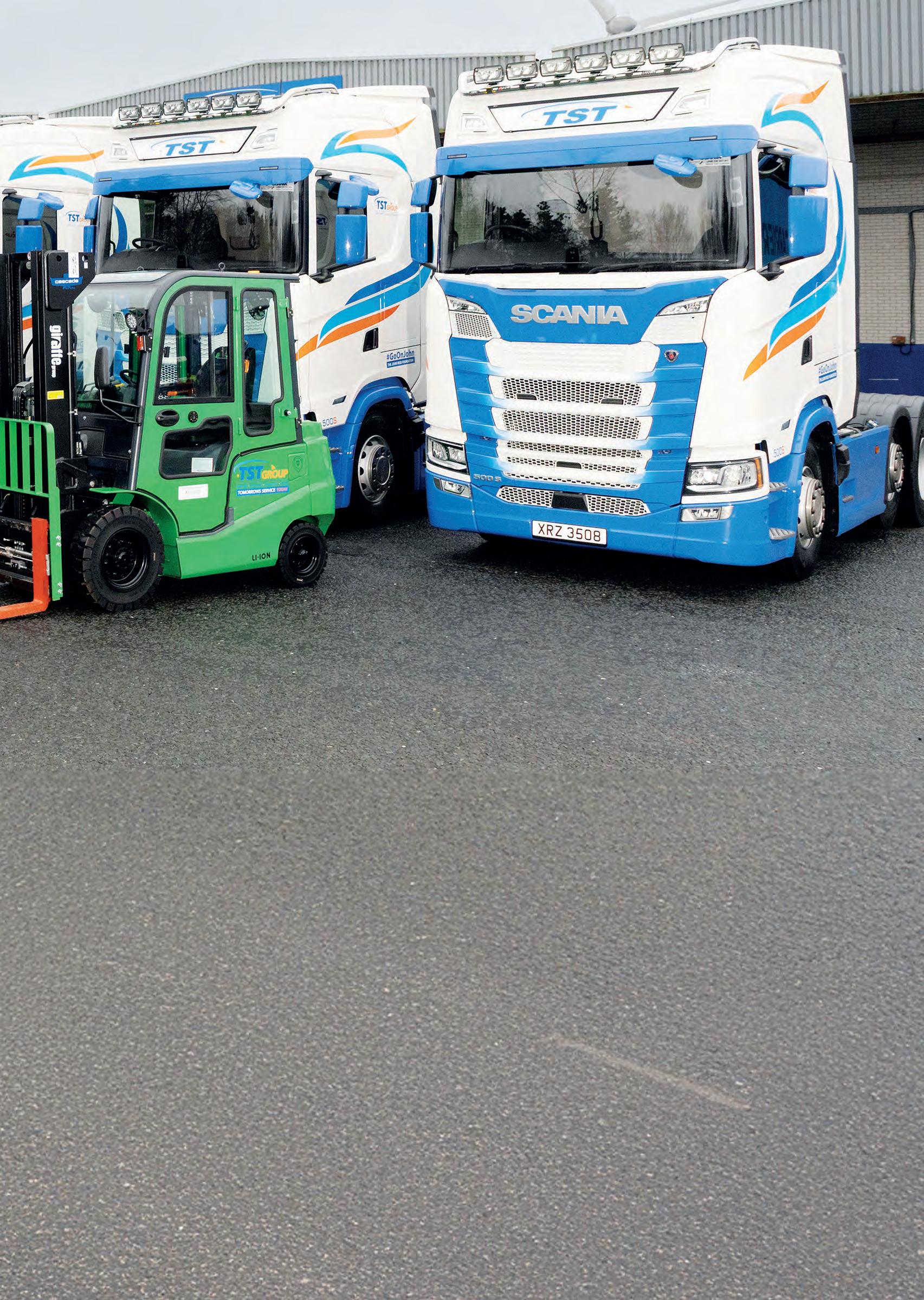
TST Group has taken delivery of the first 10 vehicles from a 20-truck order of Scania 500Ss, marking a £3.4 million investment in its fleet as the business continues to respond to growing customer demand across the UK and Ireland.
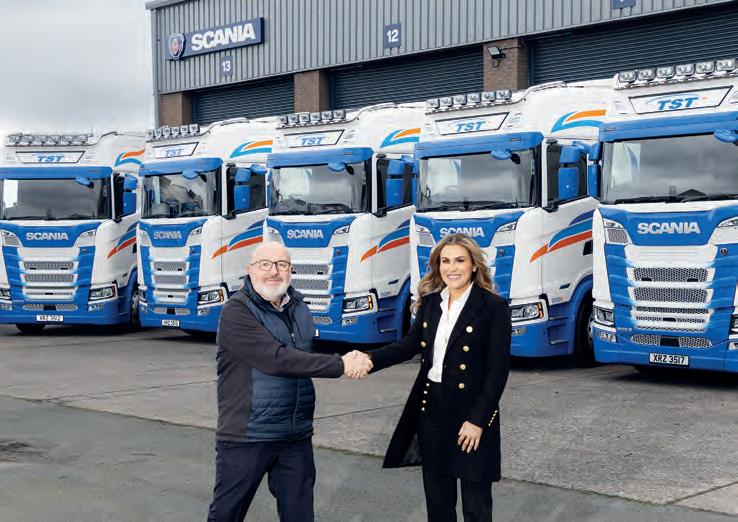
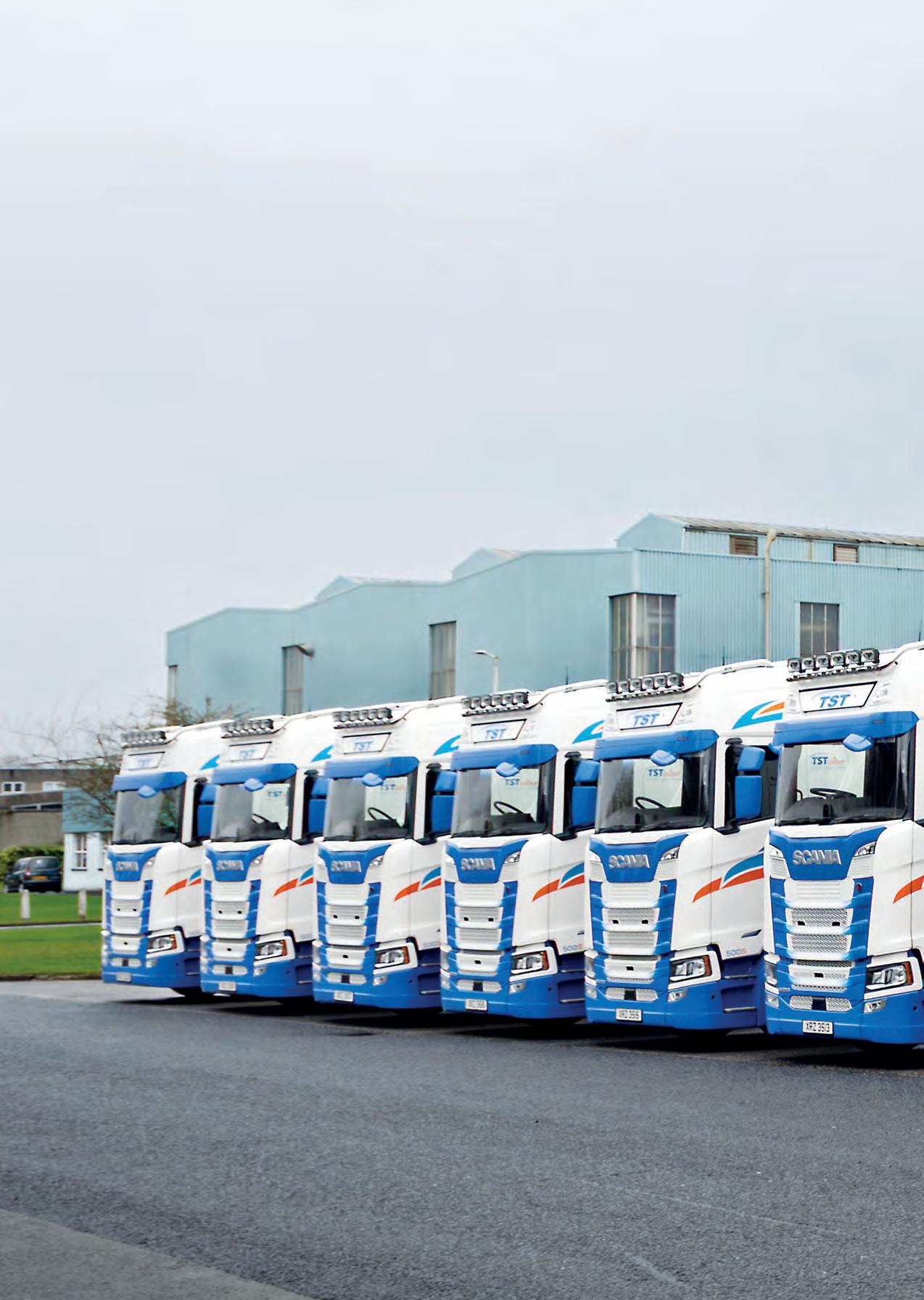
The new trucks form part of a wider programme of fleet investment designed to support new contracts, strengthen operational resilience, and enhance service levels for customers as TST Group prepares for 2026.
For a business operating at scale across transport, warehousing, and customs, vehicle performance is only one part of the equation - reliability, driver comfort, and supplier partnerships are equally critical. Choosing Scania was driven by a combination of capability and people-focused thinking. The 500S offers the performance needed for long-distance and high-volume operations, but just as importantly, it delivers a premium driving experience.
“These trucks are ideally suited to the work we do, but we also place huge importance on driver welfare and retention,” says Maire Claire Reid, MD of TST Group. “Our drivers spend long hours on the road, so comfort, safety, and usability really matter. Scania consistently delivers on that front, and it makes a genuine difference to day-to-day operations.”
Well-specified, dependable equipment plays a vital role right across the business. For drivers, it means confidence behind the wheel and reduced fatigue. For planners, it supports reliable scheduling and utilisation. For warehouse teams, it ensures smoother inbound and outbound flows. And for customers, it translates into consistency, visibility, and on-time delivery- all essential in today’s fast-moving supply chains.
Equally important has been the delivery partner relationship with Road Trucks, whose experience and practical understanding of TST Group’s operational requirements helped ensure a seamless process from specification through to handover.
“Working with Road Trucks was straightforward from start to finish,” Maire Claire continues.
“They took the time to understand our business and our needs, which meant the vehicles arrived exactly as required and ready to perform from day one. In logistics, it’s not just about buying assets - it’s about capability, reliability, and the partners you choose to work with.”
That focus on trusted supplier relationships

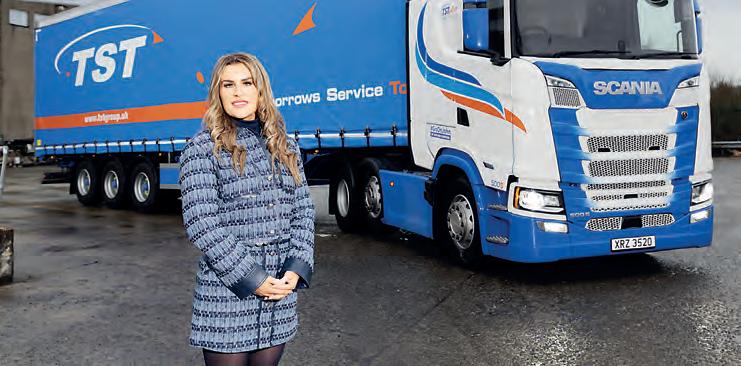
mirrors how TST Group works with its own customers. The business continues to invest across its fleet, facilities, and systems to provide a resilient, end-to-end logistics offering spanning transport, warehousing, customs, and integrated technology. As
volumes increase and service expectations rise, having dependable equipment and responsive partners becomes even more important.
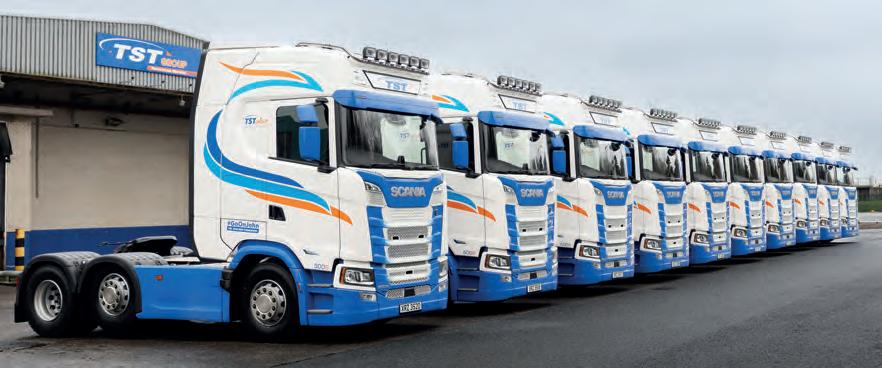
The Scania 500Ss now entering service will be deployed across key routes supporting FMCG, retail, and manufacturing clients, helping TST Group maintain its high delivery performance while creating a better working environment for drivers. With the remaining vehicles scheduled for delivery as part of the wider order, this latest investment reinforces TST Group’s long-term commitment to growth, people, and service excellenceensuring the business is well positioned to meet customer needs today, while building capacity for tomorrow.
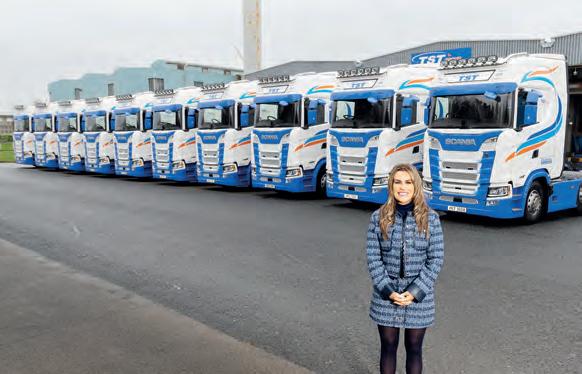
‘ROAD TRUCKS ARE DELIGHTED TO BE INVOLVED IN THE CONTINUED GROWTH OF TST, AND WE LOOK FORWARD TO BUILDING A STRONG PARTNERSHIP IN THE YEARS AHEAD.’
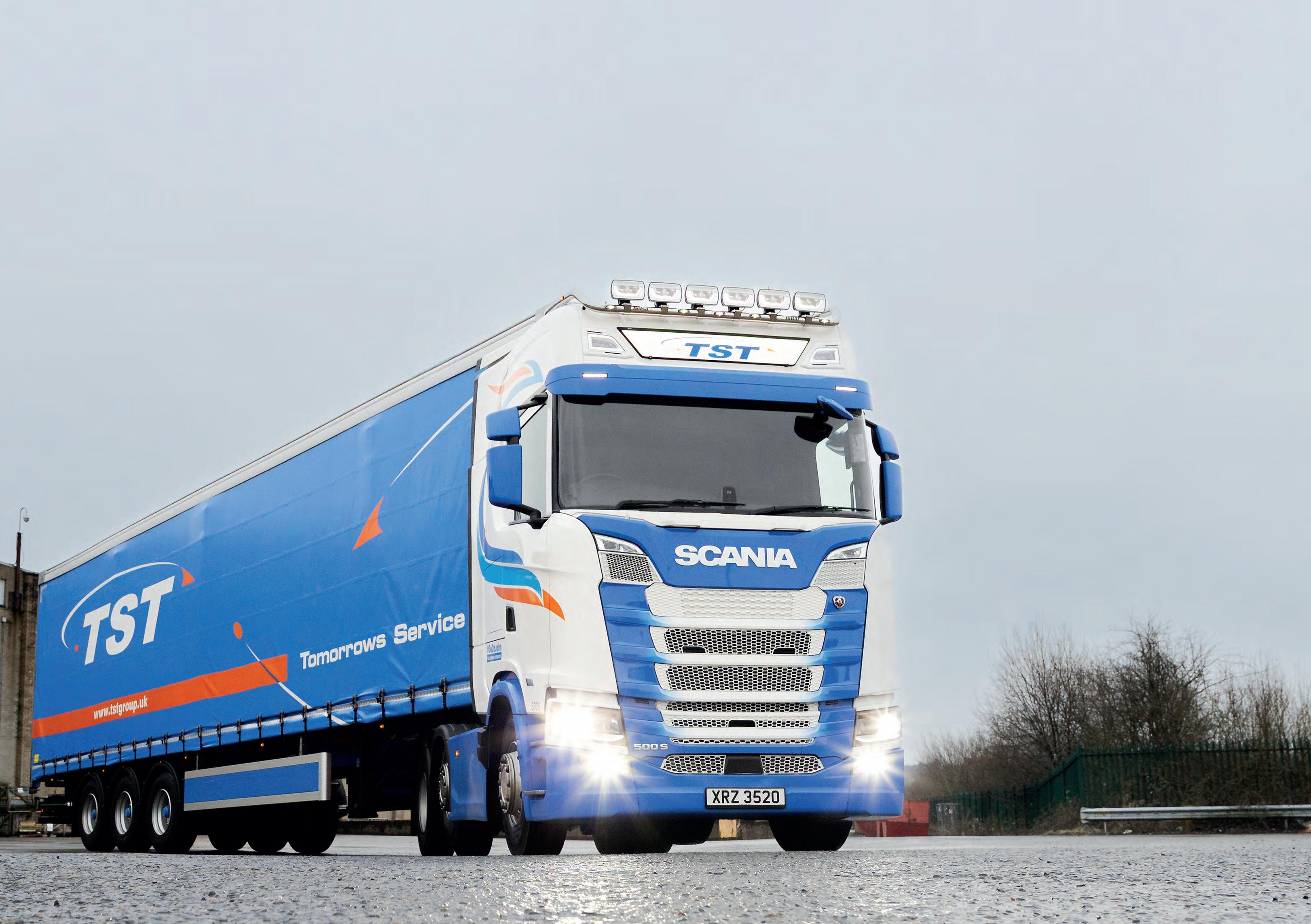
Winning new business isn’t just a win for Scania and Road Trucks, but an opportunity to show how much value they can add to a business.
That’s why for Scania and Road Trucks their recent deal to provide 20 new Scania 500S A6x2/2 tractor units, complete with five years Repair and Maintenance contracts for added peace of mind – is such big news.
Fitted out with some creature comforts to make the drivers’ lives that bit more comfortable and enjoyable, each vehicle is fitted with premium leather seats, LED lighting pack, a microwave, and rear cab storage.
But for this Ballymena firm, there’s more to these trucks’ arsenal than meets the eye. And they will put a smile on management’s face as much as it does their drivers.
Scania’s S-Cab vehicles have been designed with the driver in mind. From a luxurious to the touch interior and clever ergonomics, these trucks are designed for comfortably living in. Add in a flat floor, extended storage facilities and exceptional visibility – these trucks are geared up for TST Transport’s operations. The new trucks are finished in Ivory White with Jaybird Blue contrast colour complete with TST Livery.
From the sculpted dashboard, giving drivers excellent visibility all around the truck to a soothing climate control system, and an electrically adjustable seat that allows you to tweak, heat or cool your seat like a pro,
to Scania’s latest generation Digital Dashboard, which gives drivers all the information they need to know at their fingertips and allows them to seamlessly connect their mobile devices to access Apple CarPlay and Android Auto.
While no expense on development has been spared when it comes to ensuring a driver’s comfort or practicality, these Scania 500Ss are designed to pull their weight and deliver where it matters … against a business’ bottom line.
With Scania’s 13-litre Super diesel engine pumping out up to 500hp, this unit is not only powerful but it’s frugal too. Thanks to superior technical robustness, extended component service lives, and improvements to the combustion cycle, which include how the truck breathes, the engine cools and how it lubricates itself. Mixed in with a larger total power spread from the gearbox combined with the optimised axle gear ratios that deliver peak torque at lower rpm, it all contributes to a smoother drive, less noise, fewer gear changes and – outstanding fuel economy. The Super engine is a sustainable ICE solution for the here and now – and one that makes a real impact on an operator’s carbon footprint.




On 1 April 2025, Northern Materials Handling marked 40 years in business — four decades supporting logistics, warehousing and industrial operations across Northern Ireland, the UK and Ireland.
Since its foundation, the company has built a reputation for reliability, technical expertise and responsive support. As supply chains grow more complex and uptime more critical, Northern has evolved to meet those demands — delivering not just equipment, but complete, dependable materials handling solutions.
Operating as a true one-stop partner, the company provides new equipment sales, flexible hire, professionally refurbished machines, comprehensive service and maintenance, and fully integrated asset management programmes — all tailored to operational requirements and long-term investment strategies.
Northern supplies electric, lithium-ion, diesel and gaspowered forklift trucks for
every environment, from intensive warehouse operations to demanding outdoor
sites. The range centres on counterbalance models, supported by side loaders and articulated trucks, alongside a comprehensive warehousing line-up including reach trucks, powered pallet trucks, stackers and order pickers. Access platforms, industrial cleaning equipment, racking systems and warehouse safety solutions further enable customers to streamline operations through a single, trusted source. Service excellence remains central to the business.
Strategically positioned engineers, fully equipped mobile service vehicles and stocked parts facilities support a 95% on-site, same-day fix
rate. Preventative maintenance programmes, LOLER and PUWER inspections, and detailed fleet reporting ensure equipment remains compliant, safe and operationally efficient.
A proud member of the UKMHA and an approved Safe Contractor, Northern Materials Handling operates to the highest standards of safety and compliance. As the company enters its fifth decade, it continues to strengthen supply chain operations by delivering reliability, flexibility and expert support across every major industry sector.
Shaun Reid, Group Operations
Director, TST Group
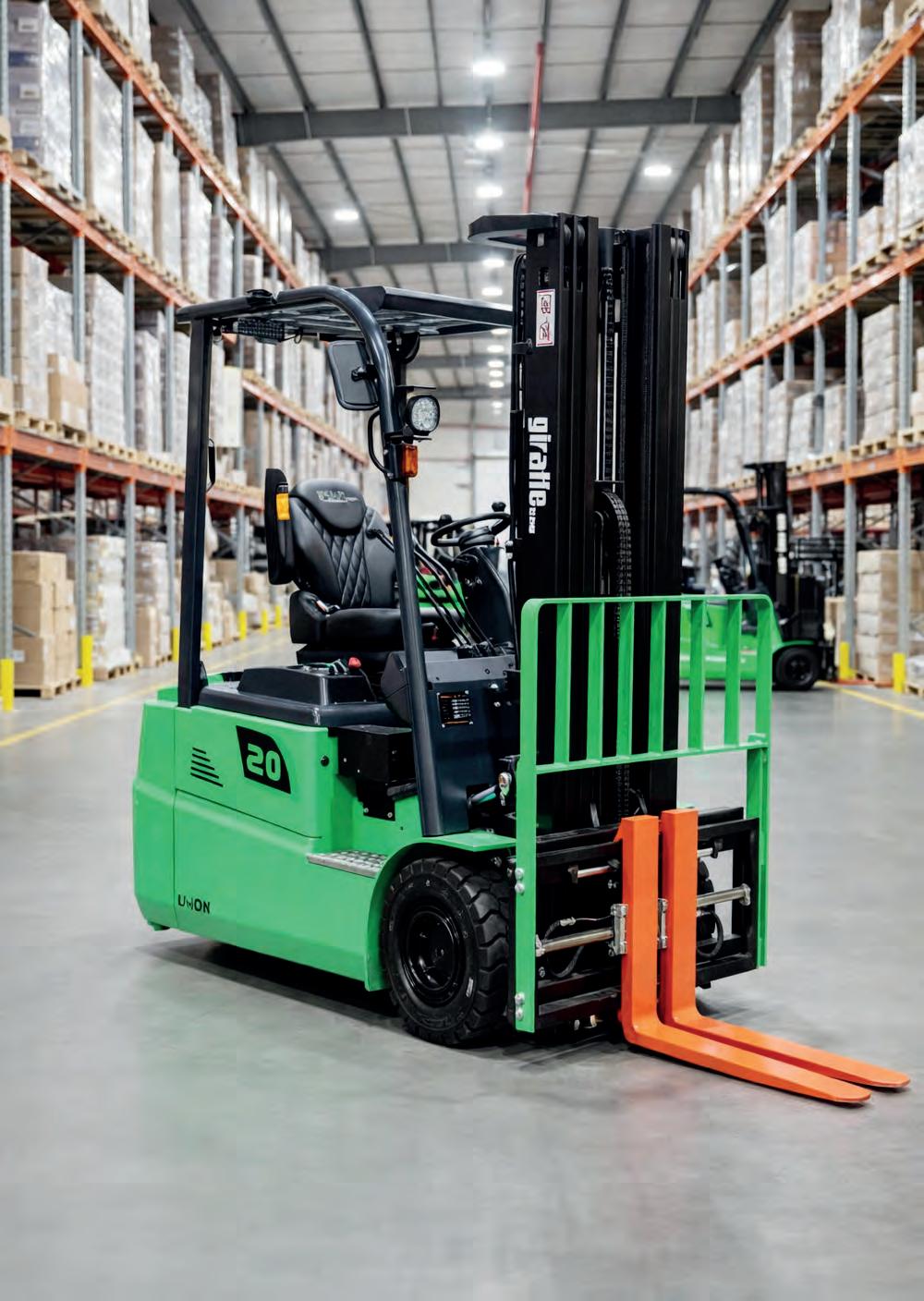
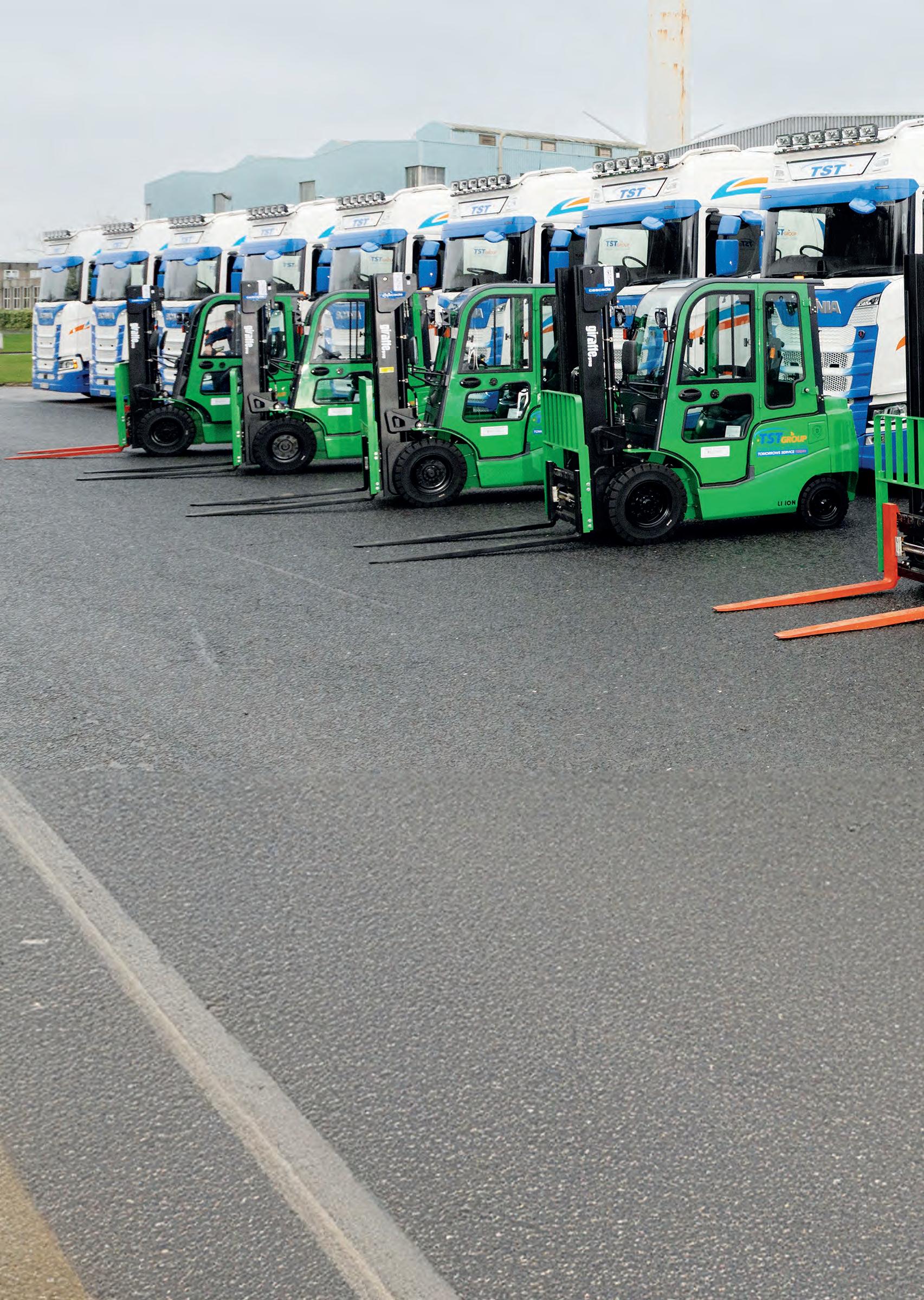
As part of its comprehensive materials handling portfolio, Northern Materials Handling supplies the Giraffe range of forklift trucks — engineered to meet the demands of today’s logistics, warehousing and industrial environments.
Built with durable chassis construction and proven mast and drive components, Giraffe forklifts deliver stable lifting performance, operational reliability and consistent uptime. Designed for intensive

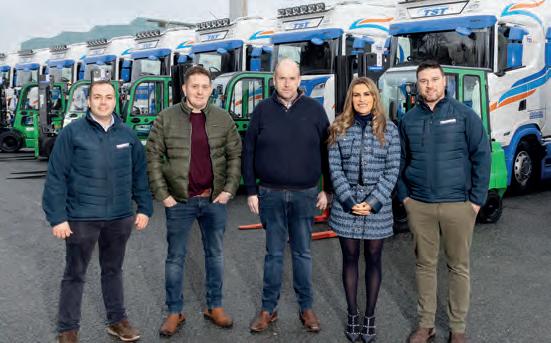
“TST Group has worked with Northern Materials Handling since 2018, and their level of industry knowledge has had a clear and positive impact on our operation.
From the outset, they approached our business strategically rather than transactionally. They carried out a detailed assessment of our fleet usage, shift patterns and site layout, identifying an opportunity to replace our gas-powered trucks with lithium-ion electric models. That transition has reduced fuel costs, lowered maintenance-related downtime and improved overall efficiency across the site. By eliminating gas usage, we are saving approximately
daily use, they provide the strength and control required in high-throughput freight and distribution settings while maintaining low whole-life operating costs.
Operator-focused design enhances safety and efficiency, with intuitive controls, excellent visibility and ergonomic layouts that support productivity across extended shifts. Straightforward servicing and reduced maintenance requirements further contribute to dependable fleet performance.
The range is strengthened by advanced lithium-ion battery technology, offering rapid opportunity charging and
£52,000 per year, and because we generate renewable energy on site, we are able to power the lithium fleet sustainably. This has not only strengthened cost control but has also significantly reduced our carbon footprint and supported our wider environmental objectives.
The move to lithium technology has streamlined our daily workflow. Opportunity charging has eliminated gas bottle changeovers, reduced disruption during peak periods, and increased truck availability across shifts, creating a smoother, more productive operation.
Equally important is the level of service support. Northern’s response times are consistently strong, and their engineers arrive prepared, knowledgeable, and solution-
consistent power delivery throughout the shift. Unlike traditional lead-acid systems, lithium-ion eliminates battery changeovers and watering requirements, reduces downtime and improves energy efficiency — making it particularly suited to multishift warehouse operations.
Combining robust engineering with modern electric innovation, the Giraffe range aligns with Northern Materials Handling’s commitment to quality, performance and long-term operational value — delivering a future-ready solution for businesses focused on reliability and supply chain efficiency.
focused. Preventative maintenance is scheduled and managed proactively, helping us avoid unexpected breakdowns and maintain compliance without disruption. Communication is clear, service reporting is thorough, and any issues are resolved quickly and professionally. It’s the reliability of that support which makes the difference. We know that if something needs attention, it will be dealt with efficiently. That consistency gives us confidence in our fleet performance and allows us to focus on running the business.
Northern Materials Handling doesn’t just supply equipment — they understand our operation, anticipate challenges and deliver solutions that continue to strengthen how TST Group performs.”
Continental Tyres believes operators need to embrace retreading to help manage the number of waste tyres generated by fleets each year. However, a lack of awareness around the used tyre disposal process is resulting in retread-suitable carcasses going to waste. Some operators may also be forgoing a financial rebate by returning their used tyres to manufacturers.
In a Continental-commissioned survey of more than 700 UK-based fleets revealed that, alarmingly, more than a quarter of question responders (26.8%) didn’t know if they had an agreed disposal method for their used truck and bus tyres.
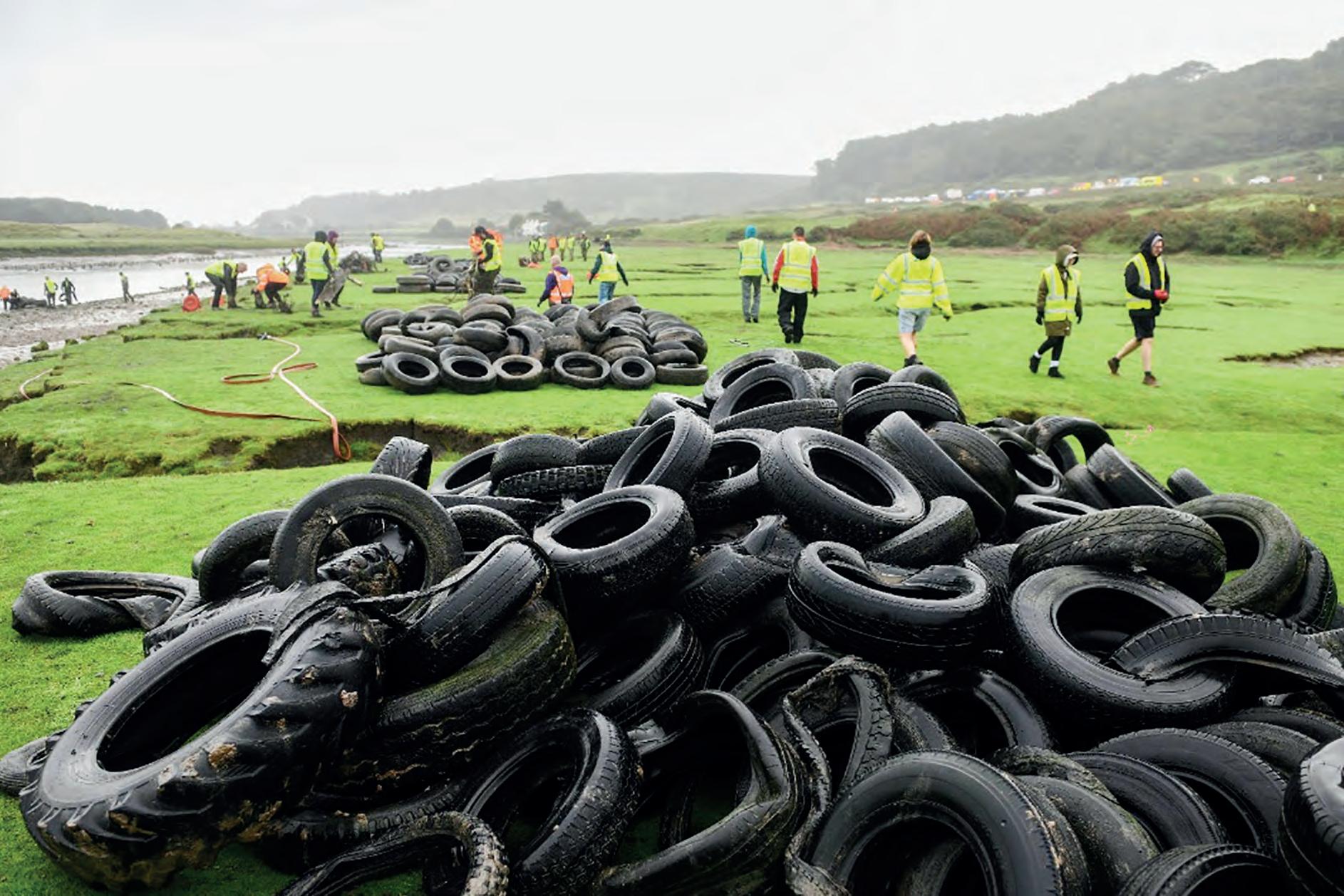
An agreed tyre disposal programme with a manufacturer, retailer or specialist firm not only supports the retreading ecosystem but helps to maximise recycling and reduce waste. Sadly, in some cases, tyres are illegally ‘dumped’. The scale of the problem was highlighted by A Peace for Nature’s ‘Ogmore River Clean Project’ in South Wales, which was supported by Continental. The activity saw thousands of discarded tyres recovered from the estuary where the River Ogmore meets the Bristol Channel. As previously revealed by Continental, many fleets are failing to take advantage of a costeffective method of extending the life of their tyres before disposal is needed. Retreading effectively remanufactures the tyre, allowing them to be safely reused rather than ending

up in landfill or incineration. This circular approach not only benefits manufacturers and operators but is also more sustainable. In addition to offering performance capabilities that are comparable to those of a brand new tyre, premium retreads can also be regrooved to extend their service
life. In many cases, they can even undergo a second or third retreading cycle, which can further increase their mileage potential.
Pete Robb, Marketing Director at Continental, explains: “Many operators simply don’t realise the opportunities they’re missing when it comes to used tyres – both in recovering costs and reducing waste. Retreading offers a practical, sustainable way to keep tyres in use longer, helping fleets save money while protecting the environment.”
Continental has been retreading truck tyres for more than 120 years, significantly extending tyre life and reducing waste. In the UK, its dedicated retreading plant, ContiLifeCycle in Ivybridge, Devon, has been pioneering sustainable tyre production and recycling since initially opening its doors in 2016.

Brigade’s Driver-safety cameras and IP driver distraction cameras are designed to mitigate driver fatigue. Using AI technology, the cameras provide driver warnings against potential issues caused by inattention, distraction and tiredness.
Forward-facing camera: Driver-facing camera:
• Lane departure warning (LDW)
• Headway monitoring warning (HMW)
• Forward collision warning (FCW)
• Drowsiness
• Distraction
• Yawning
• Mobile phone use
• Not wearing a seatbelt
• Smoking

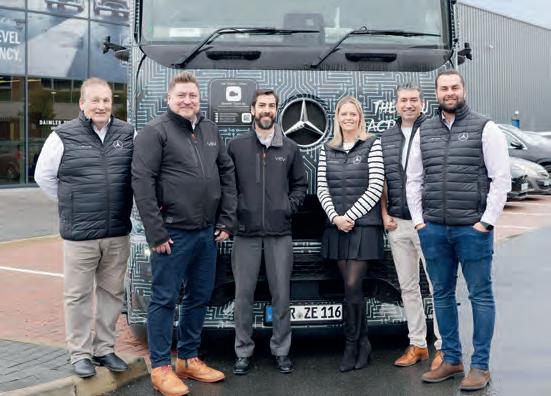
Mercedes-Benz Trucks, a market-leading manufacturer of electric trucks, has added VEV as a partner for the free TruckCharge consultancy service it provides to help customers make the transition towards sustainable transportation.
Backed by the world’s leading energy trader, Vitol, VEV offers a proprietary VEV-IQ software platform - a first-of-its-kind solution that integrates vehicles, charging infrastructure and sophisticated power management through a single, intelligent operator portal.
The TruckCharge consultancy service, combined with the eActros 600 becoming the International Truck of the Year 2025 with a class-leading 500+km range, has quickly established MercedesBenz Trucks as the clear leader in the transition to electric trucks.
Ibrahim Kraria, eMobility Trucks eConsultancy Manager at Daimler Truck UK, said: “By adding a top player like VEV as a partner for our TruckCharge service, we’re now able to give customers the best service in the market – the best truck, the best charging solutions, and now the best installation partner.”
“Our customers tell us that our TruckCharge eConsultancy is the
best on the market and the most useful resource available, which has been a key factor in MercedesBenz Trucks becoming the market leader for electric HGVs in the UK,” added Ibrahim Kraria. “The addition of VEV as a partner allows us to continue growing our market share and providing even better support
to our customers,” he continued. As every depot and business is different, Mercedes-Benz Trucks introduced the TruckCharge service to help customers decide on the infrastructure they need now and for the future in order to achieve their decarbonisation targets. It also includes a comprehensive
analysis of the costs and benefits to consider, including any subsidies, grants and tax breaks available. “It is important to help customers understand how to overcome any perceived obstacles to switching to operating electric trucks,” said Ibrahim Kraria. Research by VEV’s in-house data team shows that up to 30% of logistics fleets could be electrified today without any major changes to their operations.
Andrew Brown, Strategic Partnerships Director for VEV, said: “Our mission is to help set businesses up for success in an electric future. In many cases, our analysis of duty cycles and site constraints shows that vehicles can electrify immediately with no operational compromise, proving that electrified fleets are not only sustainable, but a smart business move. We are delighted to be working in collaboration with Daimler Truck to support the dealer network and their customers to accelerate this transition.” Mercedes-Benz Trucks can also provide financing options for charging installations from Daimler Truck Financial Services.
Premium tyre manufacturer, Continental Tyres, is pleased to announce the appointment of Rebecca Shedden as General Sales Manager – Commercial Tyres UK & Ireland.
As part of this development, Grant Willman, currently Sales Director Truck UK & Ireland, will assume additional responsibility for Commercial Specialty Tyres. His role will evolve to Sales Director Commercial Tyres UK & Ireland, reflecting a broader remit across the full commercial portfolio.
The newly created role brings together the Truck Regional Sales and Commercial Specialty Tyres Sales teams under a single leadership structure, strengthening collaboration across the business and enabling Continental to deliver even greater value to its customers. Rebecca brings a wealth of experience to the position, having spent 27 years with Continental Tyres across a wide range of commercial roles. Her career spans truck, fleet and commercial specialty tyres, where she has built deep market knowledge and a strong reputation for maintaining long-term customer partnerships. Most recently, she has led the Commercial Specialty Tyres business

in the UK and Ireland, working closely with customers in highly technical and demanding sectors including earthmover and port tyres. In her new role, Rebecca will be responsible for
driving sales strategy and performance across the full Commercial Tyres portfolio, while creating stronger synergies between truck and specialty tyre operations. A key focus will be getting even closer to customers, understanding their evolving needs and delivering tailored solutions that enhance the overall customer experience.
Commenting on her appointment, Rebecca said: “After nearly three decades with Continental, I’m incredibly proud to take on this new role. Bringing these teams together presents us with a fantastic opportunity to provide even better service to our customers.”
Grant Willman added: “This new structure is a significant step forward for our Commercial Tyres business. Combining our team’s expertise and knowledge means we can take advantage of our combined strengths and deliver greater value to customers. Rebecca’s experience, energy and customer-first approach make her ideally suited to lead this next phase of development.”

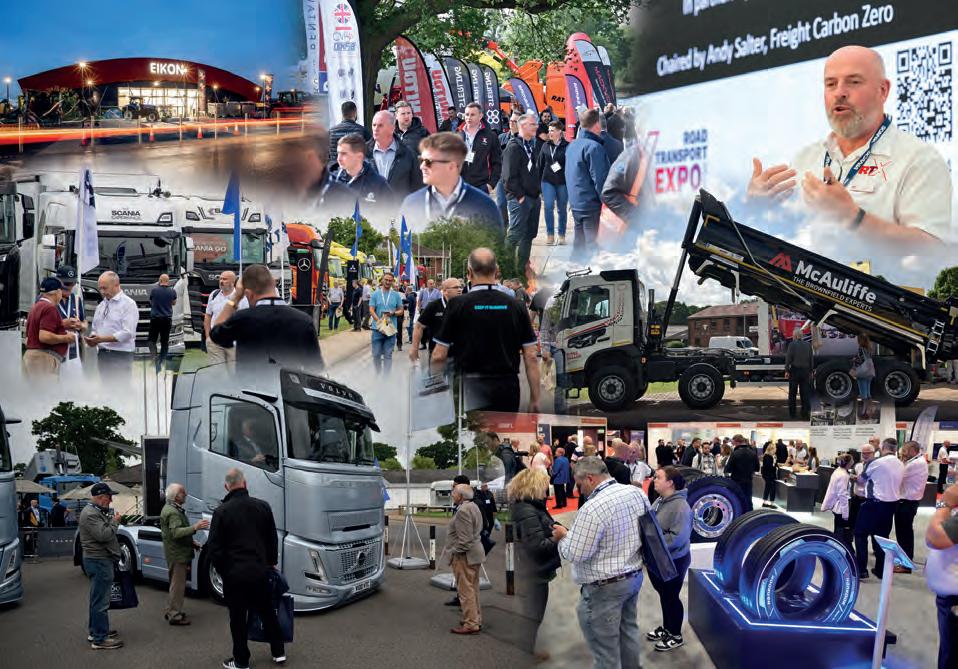



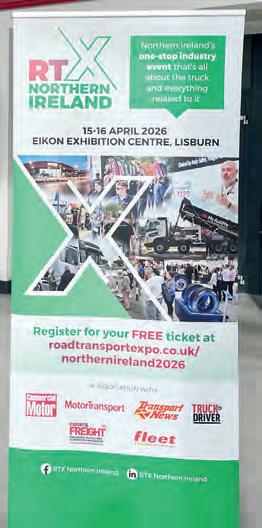
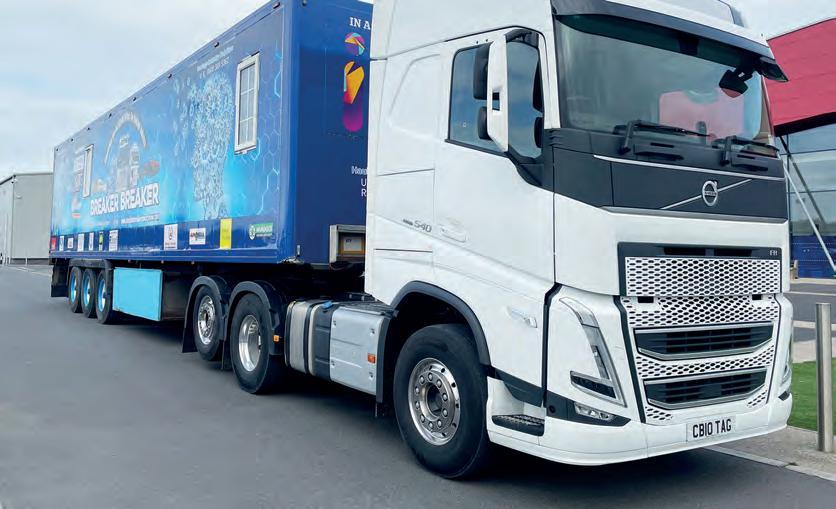
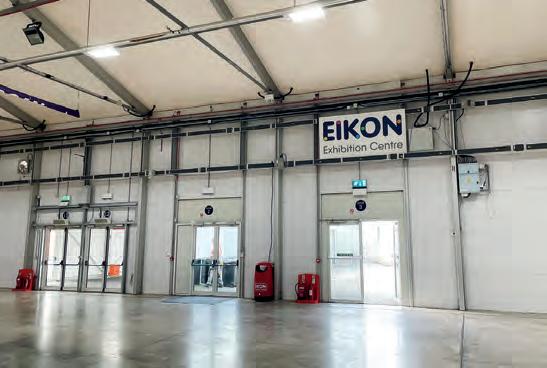
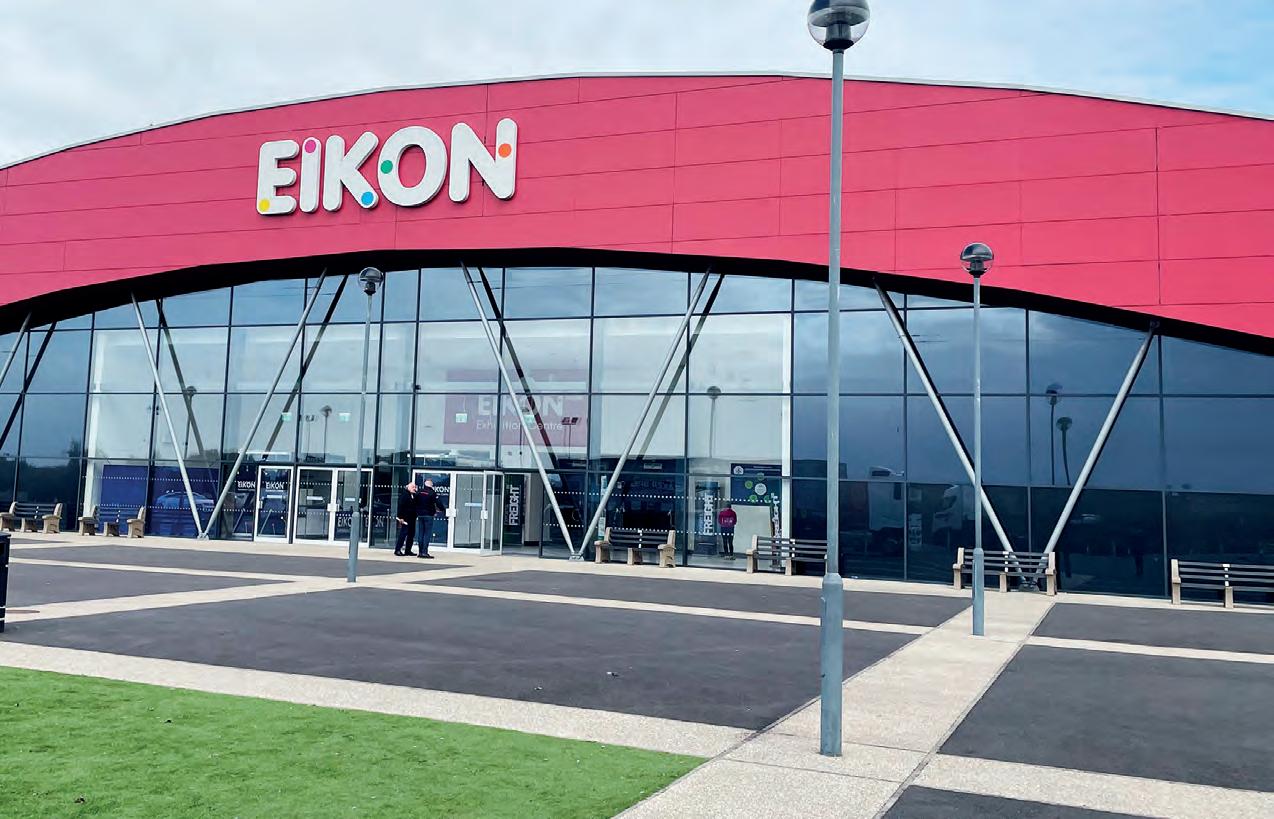
RTX Northern Ireland is set to make a strong debut this spring, establishing itself as a must-attend event for HGV fleet operators across the region.
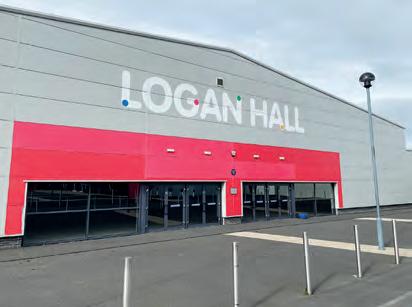
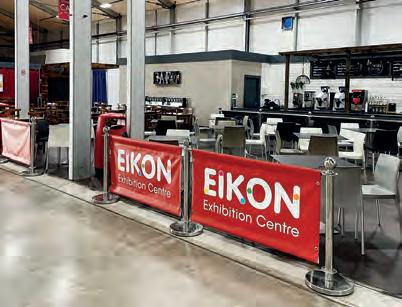
Taking place on 15–16 April 2026 at the Eikon Exhibition Centre, Lisburn, the brandnew business tradeshow will bring together the very best of the road transport industry across extensive indoor and outdoor exhibition spaces The event is organised by the team behind the established Road
Transport Expo, held each summer in Warwickshire, England, and RTX Scotland, which launched successfully in Glasgow last year and is debuting in partnership with Export & Freight and Fleet Transport magazines. The RTX portfolio will continue to expand with the launch of RTX Ireland in Dublin in 2027 With an “all about the truck”
focus, RTX Northern Ireland is designed to be a one-stop shop for everything fleet-related. A growing number of leading vehicle manufacturers and suppliers have already confirmed their attendance, highlighting the strong industry support behind the inaugural event. Major OEMs confirmed include DAF, Fruehauf, Mercedes-
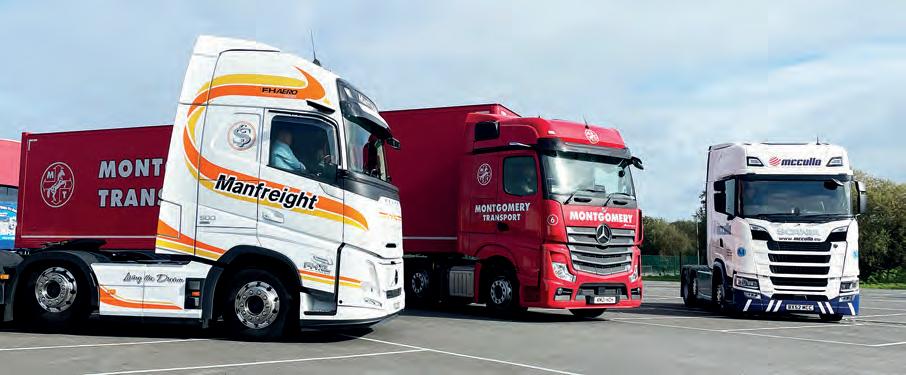
Benz, MAN, Renault Trucks, Thermo King, Thompsons UK and Volvo, all of whom will showcase a selection of their latest vehicles and innovations. In addition, fleet operators will have the opportunity to explore the latest in technology, tyres and equipment from a wide range of industry suppliers and dealerships. Exhibitors already signed up include Assured Performance Ireland, Brigade Electronics,

Fastview360, Flowtech Ireland, Granco Trucks and Hankook Tyres, with many more expected to join in the coming weeks.
Alongside the exhibition, visitors can benefit from the Knowledge Zone, a two-day programme of expert-led sessions covering the issues that matter most to HGV operators. Topics will include compliance, skills and driver shortages, road safety and decarbonisation, providing valuable insight and practical guidance for fleet decision-makers. For those keen to get hands-on, the Ride & Drive Experience will offer visitors the chance to test drive a selection of the newest vehicles on site (appropriate licence required).
Designed specifically with HGV fleet operators in mind, RTX Northern Ireland also provides a relaxed environment for informal networking, enabling attendees to connect with industry peers and build valuable new business relationships.
“We are very much looking forward to bringing the popular RTX format to Northern Ireland this spring and have been delighted with the industry support we’ve received,” said Vic Bunby, Show Director of RTX Northern Ireland
“As with all our RTX events, the show will provide an excellent mix of quality exhibitors, knowledgeable
conference sessions and a relaxed networking environment.”
He added: “We can’t wait to welcome visitors in April, so please do register for your free ticket to join us.”
RTX Northern Ireland takes place on 15–16 April at the Eikon Exhibition Centre, Lisburn. Entry is completely free for visitors. Register now at roadtransportexpo.co.uk/ northernireland and join us.

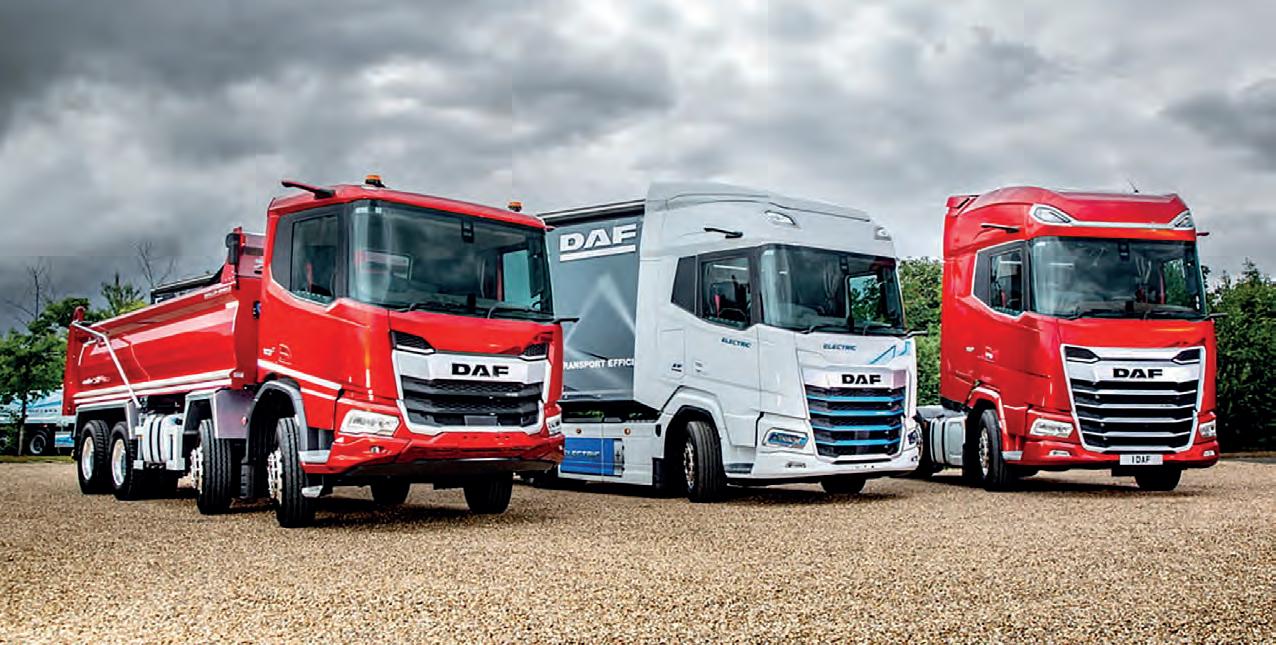
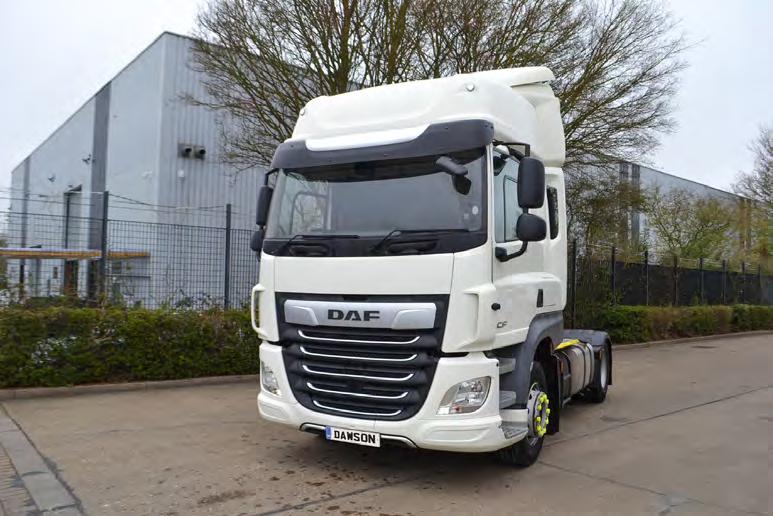
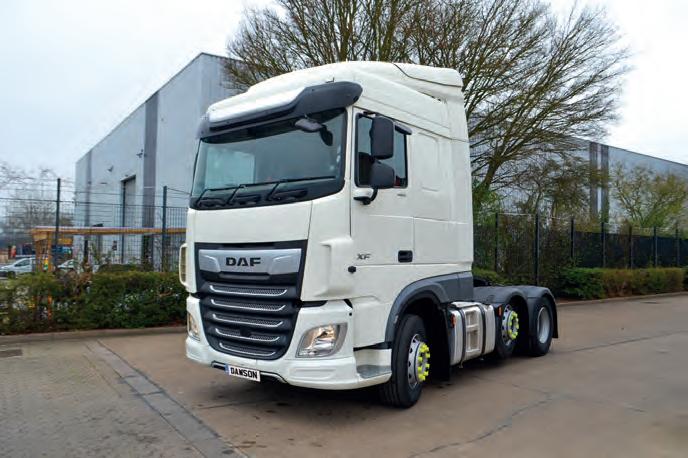
As the UK truck industry undergoes significant operational and technological transformation, DAF Trucks’ market-leading position remains unchanged, retaining its status as the nation’s top truck manufacturer in 2025.
Securing a market share of 29.7% above six-tonnes GVW, the built-in-Britain brand’s unbroken run at the top of the UK market now enters its fourth decade, reflecting sustained confidence from operators across all sectors. DAF Trucks’ UK market leadership rises from 28.4% in 2024, with 12,041 registrations holding up well compared to 12,780 the previous year, particularly when viewed against an overall 10% reduction in the market, falling from 44,988 in 2024 to 40,504 vehicles in 2025.
Figures supplied by the SMMT show the medium-duty two-axle rigid sector from six to 16-tonnes GVW contracted as a proportion of the total market, falling from 20.2% of the total to 18.6% with a sector size of 7,533; a fall of 1,571 units from 9,104 in 2024. Heavy-duty rigid registrations, which include two-axle rigids above 16-tonnes GVW, and three- and four-axle rigids, fell by 2,088 units and shrank slightly as a proportion of total registrations to represent 36.3% of the market; from 37.4%. Tractor unit registrations, at 18,254 units, are down a mere 825 from 19,079 in 2024, while the sector has grown as a proportion of the total market, now accounting for 45.1%; an increase from 42.4% in 2024.
Registration of electric trucks
grew strongly with 587 electric heavy trucks registered in 2025 (representing 1.5% of the total market) compared to 217 (0.5% of the market) in 2024. DAF Trucks registered 84 electric vehicles in 2025. The strong growth in electric truck registrations has been supported by ZEHID funding and DAF’s own initiatives for early adopters, demonstrating clear progress. However, additional work remains necessary to reduce barriers to adoption, and encouraging more operators to make the transition required to achieve legislative and environmental objectives. Very recently announced increases in the value of Plug in Truck Grants is welcome news, albeit at this stage only a short-term action to encourage uptake.
2025 marked significant milestones for DAF Trucks, celebrating 30 years of market leadership coinciding with 30 years of the DAF Apprentice Programme. In February ‘25, the programme relocated to the brandnew DAF Apprentice Academy in Nottingham, which boasts an 18-bay workshop and state-of-theart classrooms. 525 apprentices are currently enrolled on technical, parts and truck sales courses.
The New Generation DAF range of vehicles received notable recognition through numerous national and international awards. The XB was named Fleet News’ Best Truck up to 7.5-tonnes, while the XD claimed ‘Truck of the Year’ at the Motor Trader Commercial Industry Awards. The XF won the prestigious Motor Transport Fleet Truck of the Year Award, and the DAF XD and XF Electric were voted International Truck of the Year 2026 – the third time the New Generation DAF has received this accolade since market introduction in 2021.
The DAF Dealer Network continues to invest in new and improved locations, with several new facilities opening in 2025 including two new sites in the southwest for Adams Morey in Plymouth and Roche (Cornwall), and for Chassis Cab in Newmarket. In 2025, 24 workshop bays were added to DAF’s UK workshop capacity. Since 2018, the DAF UK Dealer Network has added a total of 156 workshop bays –over 3km of extra lane space. The workshops at all 33 DAF Truck Sales locations achieved the highest-level Platinum Status in the Maintenance Provision Rating Scheme which was introduced in 2025.
Central to DAF’s continued success is the UK’s most comprehensive dealer network, spanning more than 130 locations nationwide.
The network continues to set benchmark standards in aftersales performance and uptime commitment, achieving impressive results across a range of KPIs in 2025:
- The DAF UK Dealer Network carried out 47,961 MOT tests in 2025 with a First Time Pass Rate of 98.9%.
- DAFaid responded to over 100,000 calls for assistance in 2025 with 90% of issues rectified at the roadside, helping to minimise vehicle downtime and avoid recovery costs. Calls to the DAFaid control centre are answered on average within eight seconds.
“Market leadership is earned by consistently delivering what operators need,” said David Kiss, DAF Trucks Managing Director. “In a time of fundamental industry change, our focus is on helping customers manage transition practically and commercially, protecting uptime today while preparing for tomorrow. Our dealer network, aftersales performance and approach to electrification are making a significant difference.”
Josh Fenton
Policy Manager – Trade, Customs and Borders, Logistics UK

The postponement of the EU Deforestation Regulation (EUDR) for another year until 30 December 2026 is a decision welcomed by hauliers and traders, as it gives businesses much-needed time to prepare. However, while the postponement has extended the deadline for compliance, by the end of this year logistics companies will still have to navigate the complex, challenging and often expensive requirements of the EUDR.
For Northern Ireland, the guidance is not yet clear about how businesses will be expected to comply with the EUDR. Northern Ireland follows some EU laws as laid out in the Windsor Framework, and the UK has yet to designate an authority for Northern Ireland to oversee compliance. The extension to the deadline should provide traders with enough time to get ready for the changes to legislation, but in order for this to be the case, it is essential that NI businesses are given clarity about what is required of them so they do not run the risk of being penalised.
The EUDR, which came into force on 29 June 2023, stipulates that certain commodities and products placed on or sold into the European market cannot be linked to deforestation. According to legislation documentation, deforestation is defined as the conversion of forest to agricultural use, where forest is land spanning more than 0.5 hectares with canopy cover of more than 10%.
It focuses on seven major commodities: cattle, wood, cocoa, soy, palm oil, coffee and rubber and also includes derived products; such as leather, chocolate, tyres and furniture.
Businesses placing products into the European market – referred to as ‘operators’ in EUDR documents, typically the importer – are required to conduct due diligence into the relevant products and commodities and create due diligence statements following their findings. Operators must carry out risk assessments and determine the risk categories of their products. This includes looking at where the product was produced, the complexity of its supply chain and the risk rating of the country. 140 countries have been designated as ‘low risk’ by the EU which includes all EU member states, while four countries have been designated ‘high risk’: Belarus, Myanmar, North Korea and
Russia. The rest are considered standard risk. Low-risk countries will have simplified due diligence requirements (such as the absence of geolocation data and risk assessment and mitigation processes) while standard and high-risk countries require the operator to go through the full due diligence process. Products that are sourced from high-risk countries will be subject to greater scrutiny. By the end of 2026, large and mediumsized exporters will have to comply with these requirements, while smaller operators have until 30 June 2027.
The chosen wording reflects the level of specificity in the EUDR which traders must face and translate its requirements for their particular businesses. The scale of information operators must source, collect and analyse puts the burden on traders to not only investigate their supply chain, but to understand their specific responsibilities around risk.
An operator selling a chocolate bar, for instance, is selling a product that contains multiple commodities, including cocoa, cocoa butter and possibly palm oil. As spelled out by the EUDR, this operator will only have to conduct due diligence on the products listed under the commodity deemed relevant; for chocolate bars this commodity is cocoa. Operators are also required to understand the legislation of the country from which they are sourcing the commodity or product, and to verify the documentation they collect during the due diligence process to ensure its legitimacy. Penalties for non-compliance are significant: businesses can be fined up to 4% of their annual turnover, suspended from EU markets, goods can be seized, and company directors may face potential criminal liability. Penalties are severe to ensure businesses are held accountable, but
ambiguity and vagueness of the legislation could result in traders being penalised for noncompliance, which is why it is essential for legislation to be clarified as a matter of urgency.
Implementing robust traceability procedures and systems and coordinating with third party suppliers to verify information will take time for businesses. A report published by the European Commission shows that the growing number and complexity of rules is hampering the flexibility of EU businesses and stifling competitiveness*. Clarity also urgently needs to be provided around how the legislation will apply to NI traders and which authority will be responsible for overseeing compliance. Under the Windsor Framework, Northern Ireland is aligned with certain EU single market rules, but new legislation does not automatically apply. The EUDR falls into a grey area as it has not yet been formally added to the Windsor Framework and until that happens, it technically doesn’t apply in Northern Ireland.
The legislation is expected to have an impact on NI businesses regardless. If buyers are EUDR-compliant, they may very well expect their suppliers to meet the same standards, and if these businesses are unable to supply the relevant documentation, their contracts may be affected.
The EUDR is a complicated piece of legislation that may affect the efficiency and competitiveness of businesses facing the administrative requirements of implementing traceability systems. The onus is on legislation to clearly map out the responsibilities of business, and the IT system to be fit for purpose, to ensure that businesses are not disrupted and the flow of goods remains smooth.
* European Commission: ’The future of European competitiveness’
Fit for purpose quality / In stock for immediate despatch / On-time delivery anywhere in Ireland.
In today’s fast paced world there’s never been a greater emphasis on ‘service’. But what is service? Or more specifically, what does ‘service’ mean to a busy commercial workshop where the impossible appears to have become the normal. SWS have been practising, and refining, this for 50 years and more. They understand that downtime for a truck equals loss of earnings for your customer. They fully appreciate that being told that what you need is still over the
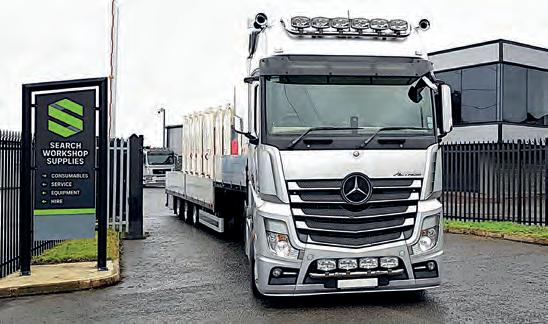
water in the UK is not what you want to hear. They know that your time is at a premium, and placing an order, whether online or by phone, needs to be totally
stress free; as easy as ABC. At SWS, this is not just words on a page. It’s a fact, the result of a lot of hard yards. Products have to be ‘fit for purpose’ to
be included in the range. Stocks must be maintained at healthy levels to ensure your needs can be met. The ordering process needs to run smoothly. Deliveries have to be on time; every time. There’s a lot happening at SWS this year. During March, a comprehensive catalogue for the complete consumables range will be launched. This will be followed later in the year with a similar one for equipment. With a 72m² stand taken at RTX NI there will be plenty to engage the visitors’ interest. And we’re only at the start of the year. But, and this is the essential but, none of this must be allowed to detract from what we started with - service. Of all the essentials - it’s the most important.



Nathan Gavin.
Contact Nathan Gavin anytime regarding all your transport requirements on Telephone - 07345417303 / 028 96020640
Nathan.gavin@dachser.com
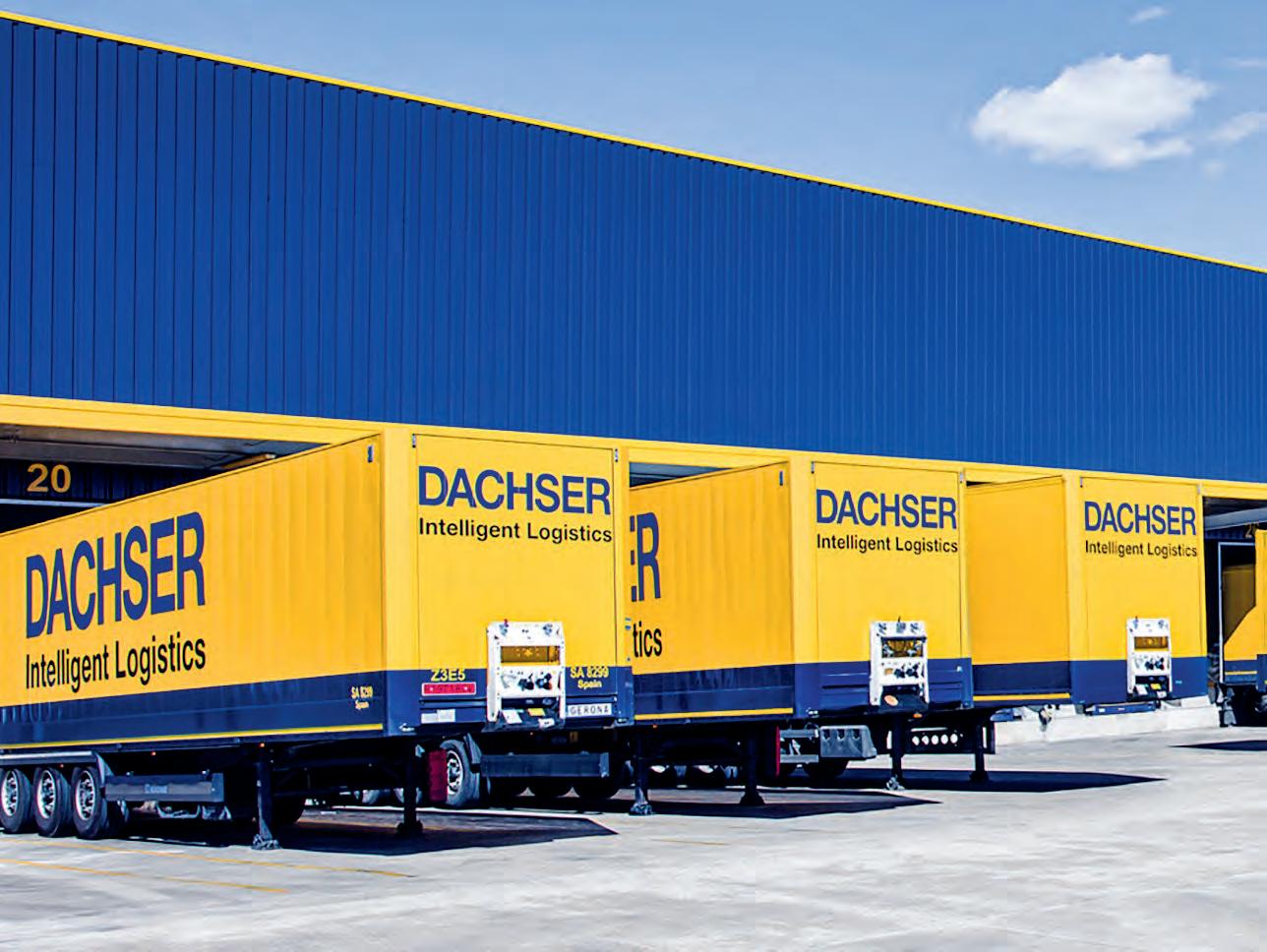
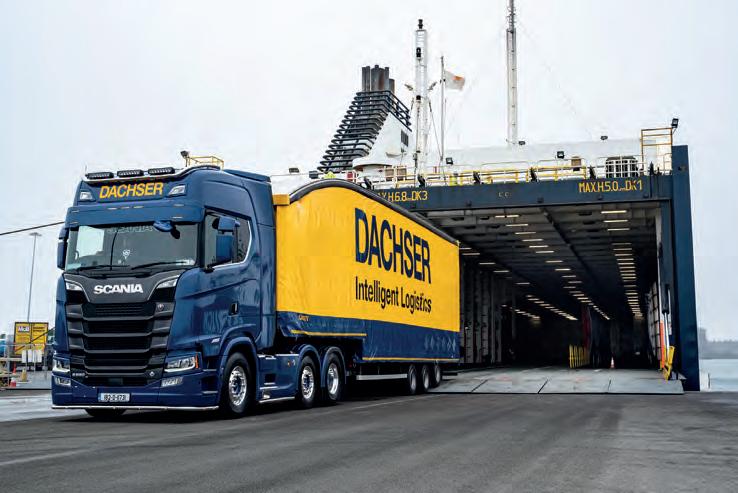
Northern Ireland is a strategically important market for Dachser, offering strong export capability, resilient businesses and direct access to both UK and EU trade lanes.
To find out more about Dachser coming to Northern Ireland, the core services they deliver and how their arrival can benefit businesses across the region, we asked Nathan Gavin, NI Sales Manager DACHSER Ltd to answer a few questions for Export & Freight.
1. WHY IS NORTHERN IRELAND A STRATEGIC PRIORITY FOR DACHSER, AND WHY LAUNCH NOW?
Northern Ireland plays a unique and increasingly important role in UK and European trade. Its position as a gateway between Great Britain, the Republic of Ireland and the wider EU make it strategically significant for customers operating across multiple markets. Launching now reflects growing demand from customers for expert support navigating post-Brexit trading conditions, particularly those operating across the Irish Sea.

Establishing a dedicated local presence allows DACHSER to be closer to customers, better understand regional requirements, and provide tailored solutions at a time when clarity, compliance and reliability are more important than ever. This local presence lets us support companies that want dependable logistics to help them grow and trade more confidently.
2. HOW DOES THIS EXPANSION STRENGTHEN DACHSER’S UK AND EUROPEAN NETWORK?
The Belfast location strengthens connectivity between DACHSER’s UK network, its established Irish operations, and its extensive European road freight network.
By having a dedicated team focused on Northern Ireland, DACHSER can further optimise groupage flows, and enhance service consistency for customers trading between the UK, Ireland and mainland Europe.
It reinforces DACHSER’s integrated network approach, where local expertise is combined with pan-European reach.
3. WHAT CORE SERVICES WILL DACHSER DELIVER IN NORTHERN IRELAND FROM DAY ONE?
From day one, customers will have access to daily groupage as well as full and part-load services into the rest of the UK and Europe. These are established, high-frequency services built around reliability and predictable transit times.
The Belfast team act as a central coordination point, working closely with DACHSER’s other UK, Irish and European sites to manage freight movements efficiently while ensuring compliance with all regulatory requirements.
4. WHICH LOCAL INDUSTRIES ARE SET TO BENEFIT MOST FROM DACHSER’S ARRIVAL?
Northern Ireland has a strong manufacturing, retail and engineering base. These businesses need reliable transport, strong European links, and the ability to scale, which is exactly what DACHSER offers.
Businesses trading with Great Britain, Ireland and mainland Europe will particularly benefit from DACHSER’s leading groupage network and its experience supporting complex supply chains across multiple territories.
5. HOW WILL DACHSER HELP NORTHERN IRELAND BUSINESSES TRADE CONFIDENTLY POST-BREXIT?
DACHSER gives businesses confidence through dependable services, clear processes and consistent operations across the UK and Europe.
Supported by digital solutions and knowledgeable local teams, customers can navigate documentation, compliance and transit requirements with ease, allowing them to focus on growth while DACHSER manages the complexity behind the scenes.
6. WHAT DIFFERENTIATES DACHSER FROM OTHER LOGISTICS PROVIDERS IN THE LOCAL MARKET?
DACHSER’s strength lies in its fully integrated European network, made up of company-owned branches, supported by its own IT systems and a consistent service model across all countries.
Rather than relying on fragmented subcontracted solutions, DACHSER operates a tightly controlled groupage network with uniform standards.
Combined with local expertise in Northern Ireland, this enables high levels of reliability, transparency and service quality that customers value.
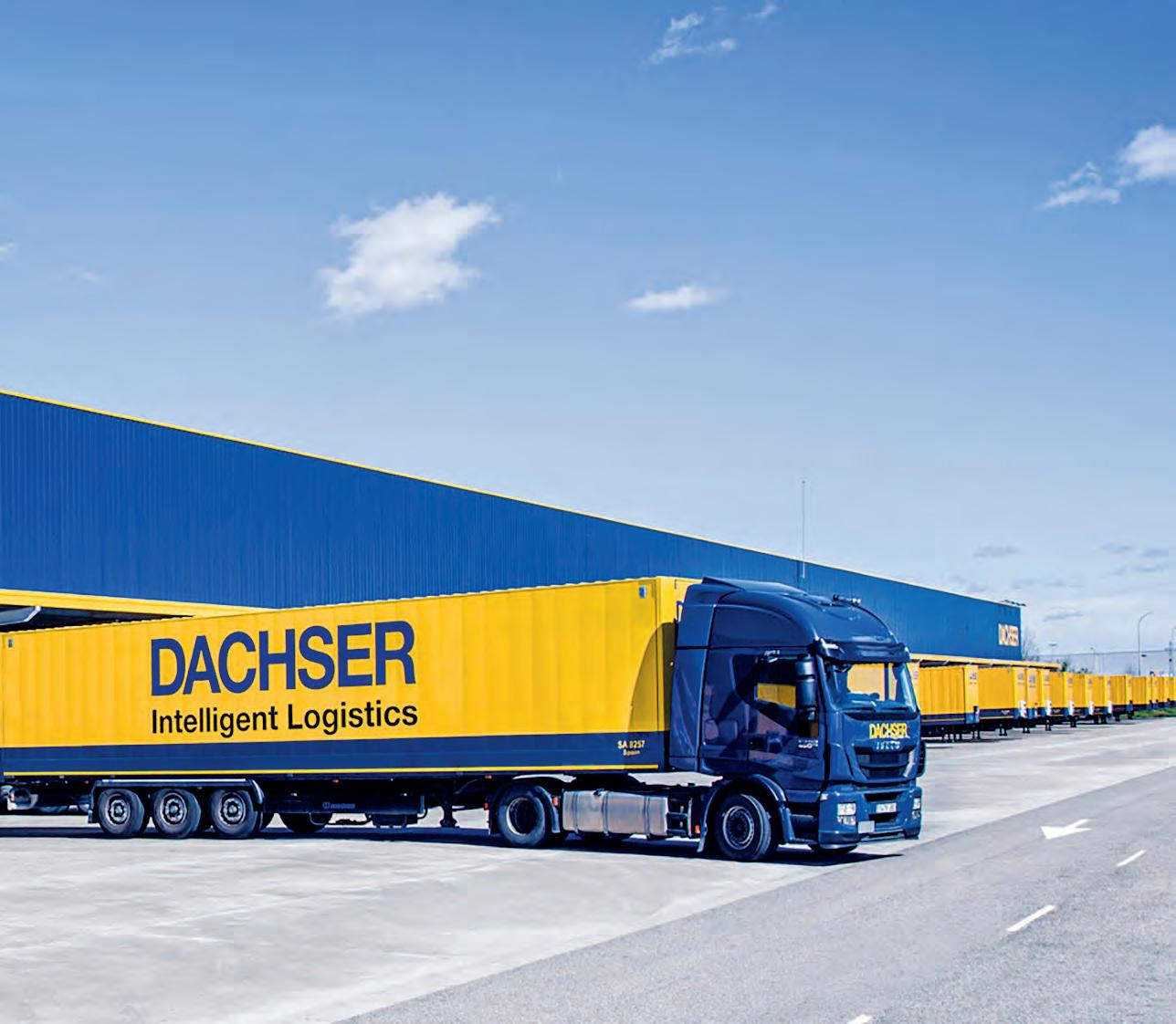
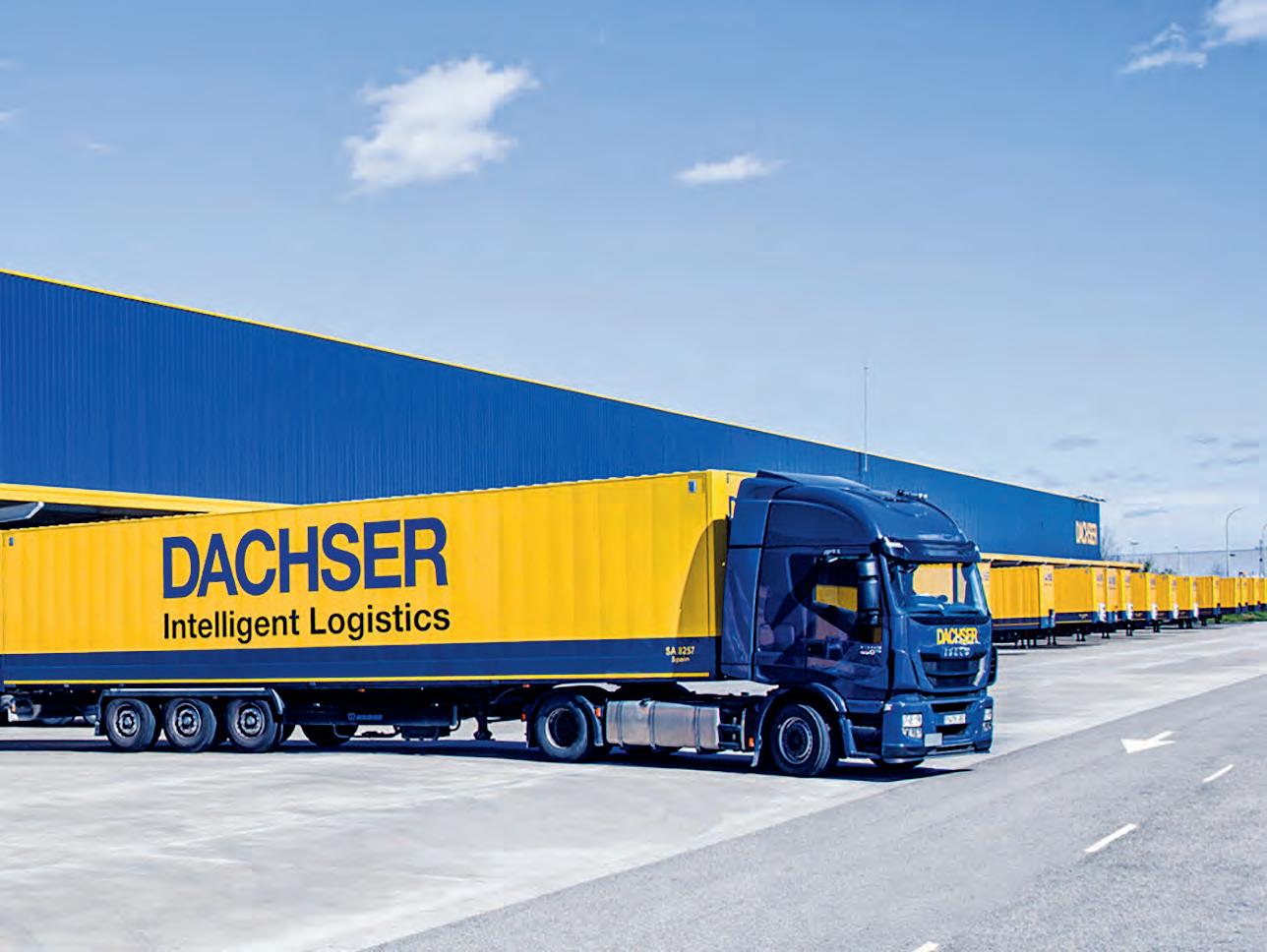
7. HOW WILL TECHNOLOGY ENHANCE VISIBILITY, RELIABILITY AND CUSTOMER EXPERIENCE?
Technology is central to DACHSER’s operations. Customers benefit from end-to-end shipment visibility, proactive tracking, and digital documentation through DACHSER’s in-house IT systems. These tools enhance planning accuracy, reduce delays, and provide customers with real-time insights into their supply chains, which are an essential capability in today’s fastmoving logistics environment.
8. WHAT ROLE DOES SUSTAINABILITY PLAY IN DACHSER’S NORTHERN IRELAND OPERATION?
Sustainability is one of DACHSER’s values and a core pillar of its longterm strategy. This includes continuous optimisation of transport networks, investment in low-emission technologies, and initiatives to reduce empty running and overall carbon intensity.
Northern Ireland customers will benefit from DACHSER’s network efficiencies and ongoing sustainability programmes that support more environmentally responsible logistics solutions.
9. WHAT MESSAGE WOULD YOU LIKE TO SEND TO NORTHERN IRELAND BUSINESSES CONSIDERING A NEW LOGISTICS PARTNER?
Northern Ireland businesses deserve a logistics partner that understands both the local market and the wider European landscape.
For companies looking to grow beyond local markets, DACHSER offers strong European reach, dependable services and a true partnership approach.
Backed by one of Europe’s most comprehensive road freight networks and reinforced by its new Belfast presence, DACHSER is committed to being a long-term partner that delivers stability, transparency and expertise.
10. WHAT LEVEL OF LOCAL INVESTMENT AND JOB CREATION CAN THE MARKET EXPECT?
The opening of the Belfast office represents an initial investment in local expertise and customer support, with plans to grow the team in line with customer demand and market development.
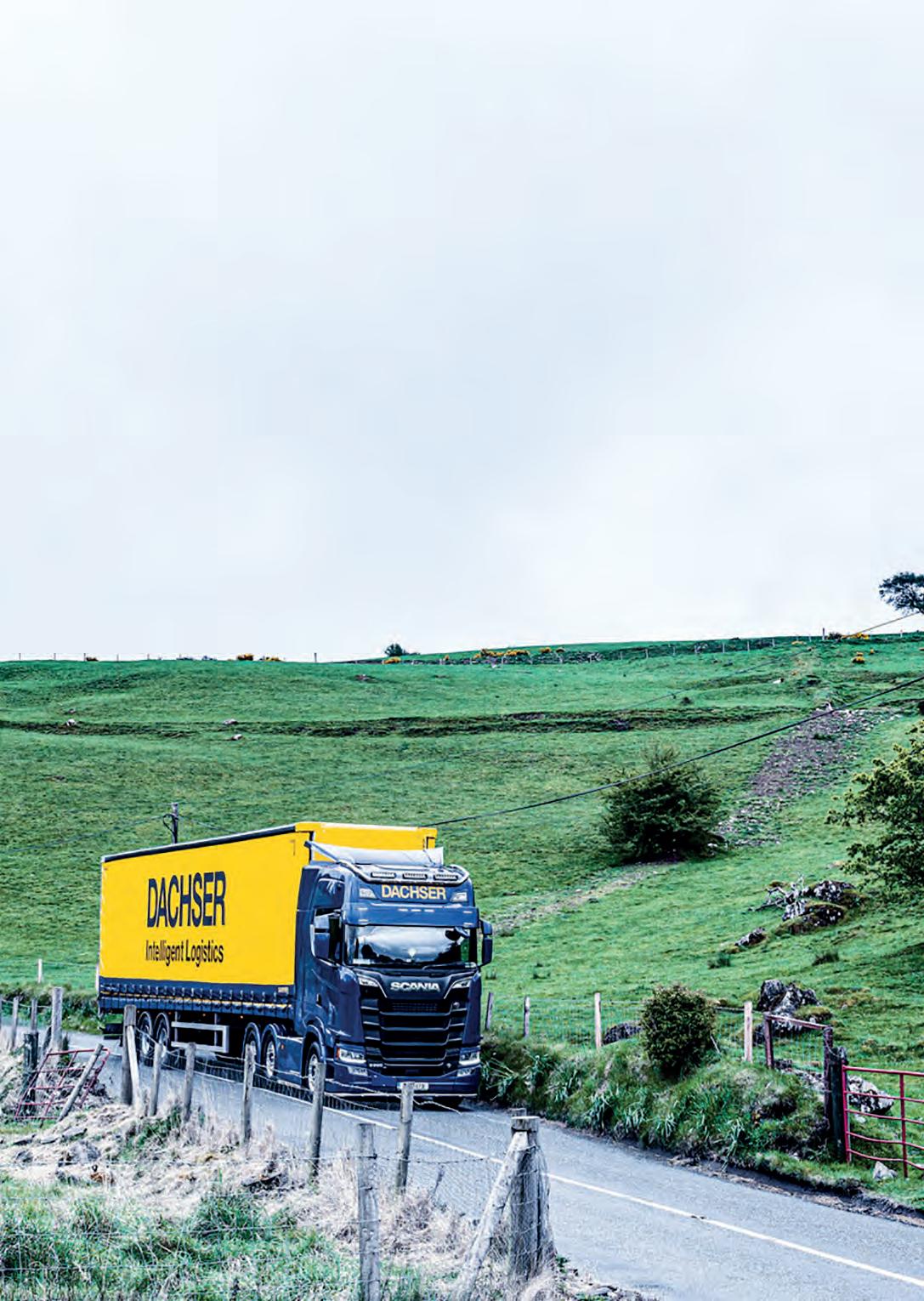
DACHSER views Northern Ireland as a long-term growth market, and local investment will scale as volumes and service requirements expand.
11. WHAT DOES SUCCESS IN NORTHERN IRELAND LOOK LIKE FOR DACHSER OVER THE NEXT 12 MONTHS?
Success means building a solid customer base, developing strong customer relationships, and delivering reliable service day in, day out, while establishing DACHSER as a trusted logistics partner in the region.
Over the next 12 months, the focus is on supporting businesses with seamless access to Irish and European markets, as well as the rest of the UK, while creating clear momentum for sustainable future growth.

www.dachser.com




2026 is gearing up to be a big year for the Road Haulage Association in Northern Ireland, with a signature hire and big event in the pipeline to build on our growing reputation as an authority on the challenges and opportunities its businesses are facing.
Regular readers will be aware that Brian Beattie is joining us soon to oversee our Northern Ireland operation. With over 25 years in the business most notably at McCulla’s, Brian is a well-known and respected figure across Ireland’s logistics sector.
Coming into a senior role, Brian’s appointment guarantees a Northern Irish voice right at the top of the RHA – something not every trade association can claim to have. The RHA has always worked to ensure it has a presence in all parts of the UK but the danger of becoming too focused on England, or even just Westminster, is a real one. That’s why this appointment should be seen as a real statement of intent.
Brian’s joining the RHA supplements my own addition to our Policy Team. Brought in last year to step up our work on trade policy issues, I’m working to help the logistics sector as a whole grapple with the new trade barriers that affect goods movements into Europe. That, of course, includes the ongoing difficulties moving goods to Northern Ireland from Great Britain. Read on for more on that.
Our enhanced focus doesn’t stop at putting
bigger boots on the ground. April will see the Road Transport Expo (RTX) come to Lisburn’s Eikon Exhibition Centre, bringing the premier industry trade show for everything trucks to Northern Ireland for the first time.
Started in 2022, the RTX is a bandwagon that’s built some serious momentum behind it, getting bigger year-on-year and spreading its wings. The inaugural Scotland event took place in November to rave reviews and I’m expecting the same again in just a few weeks’ time.
With 50 plus exhibitors lined up already (with more to come) and panels planned on hot topics including how the decarbonisation agenda is affecting our sector, it promises to be a memorable couple of days for the road transport sector in Northern Ireland.
As for me, I’ll be arranging a panel on the unique trade situation Northern Ireland finds itself in, with the promise of Dual Market Access being held back by the Windsor Framework’s complexities amid a volatile global trade environment. It’s important not to overdo any doom and gloom. Certainly, as compared to the rest of the
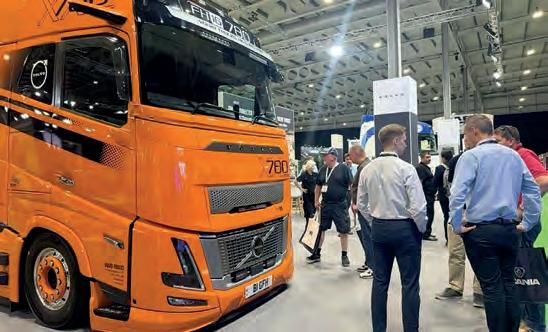
UK, the regional economy is flourishing. The promise of Dual Market Access as promised with the Windsor Framework is largely delivering, with north-south trade coming on leaps and bounds. If you’re looking for the best place in the UK to start a business or expand your market, Northern Ireland has a great claim to be top of that list. That positive message must not get lost even if, sadly, it’s not the whole story. A series of reports last year found lots of frictions for hauliers and businesses trading across the Irish Sea. The Murphy Review got to the heart of it and shone a welcome light on what our members are seeing day-to-day, with costs from delays and data combining to put profitability under the screw.
The RHA has always been clear the Northern Ireland Protocol would disrupt east-west goods movements, before it was fashionable to do so. That’s why we’re now part of the debate, being invited to brief MLAs in Stormont in November as well as MPs and Lords in Westminster. We’ll be off to Brussels too, where the European Commission need to engage constrictively in solving these issues.
Our ability to speak to realities and offer ways forward is built on listening to our members in Northern Ireland and being there for them. I’m looking forward to doing that and more in 2026 and taking the readers of Export and Freight on the journey with us.
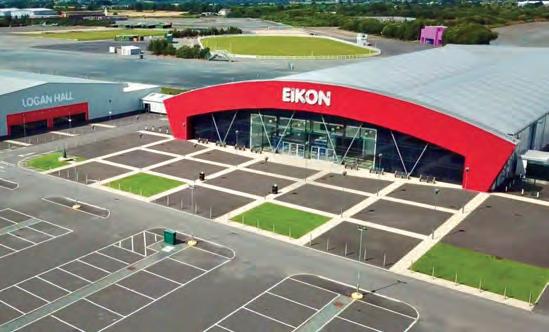

Across Ireland, our experts are well-versed in businesses like yours, so they won’t just listen to your plans, they’ll understand them.
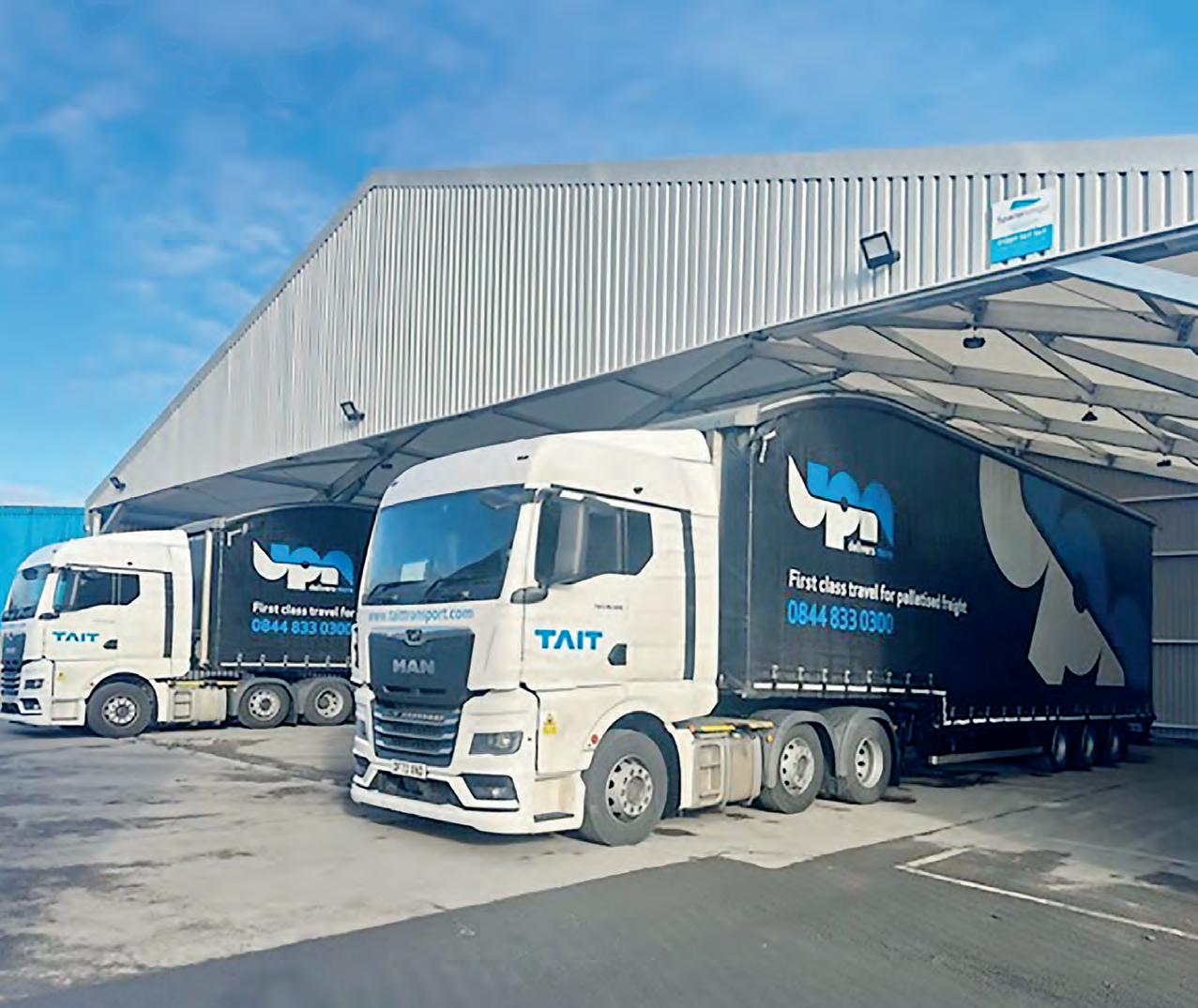
In an era where agility and speed are critical to success, the ability to adapt infrastructure quickly has become a defining advantage for businesses operating across export, freight, and logistics. Spaciotempo UK has positioned itself as a trusted partner in this space, delivering innovative, flexible building solutions that respond directly to the changing demands of modern supply chains.
Spaciotempo UK specialises in the design, supply, and installation of highquality temporary and semi-permanent structures, offering a practical alternative to traditional bricks-and-mortar facilities.
From warehousing and distribution hubs to production, loading, and covered storage areas, their solutions allow businesses to scale operations rapidly without long lead times or excessive capital investment.
For freight and logistics operators, flexibility is key. Seasonal peaks, new contracts, port congestion, or changes in trade routes can all place sudden pressure on existing infrastructure.
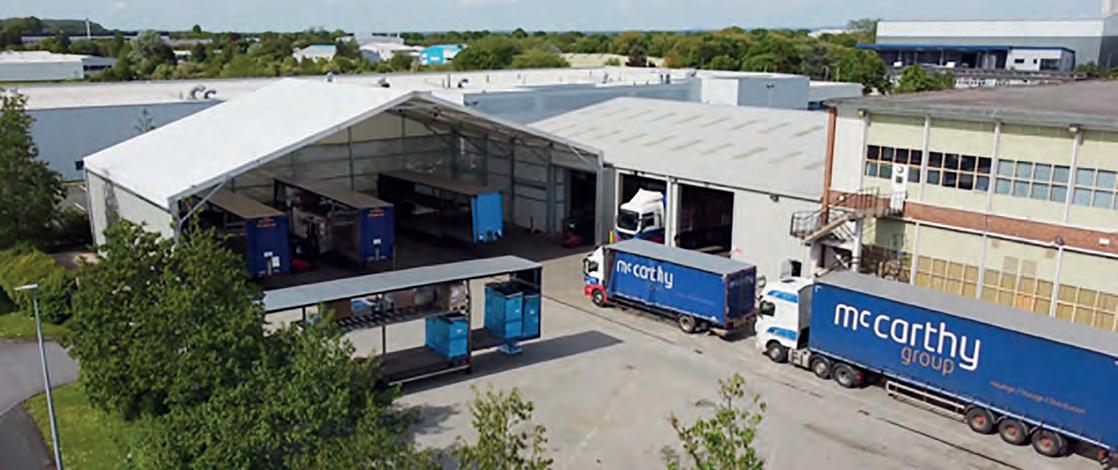
Spaciotempo UK’s structures are engineered to provide fast deployment, robust performance, and compliance with UK standards, enabling clients to respond to operational challenges with confidence and speed. What sets Spaciotempo UK apart is its consultative approach. Each project is tailored to the client’s operational needs, site constraints, and long-term objectives. Whether supporting short-term overflow capacity or longer-term strategic growth, the company works closely with customers to ensure solutions are both
cost-effective and operationally efficient. Sustainability and efficiency are also increasingly important considerations across the freight and export sector. By extending the usable life of sites and reducing the need for permanent construction, Spaciotempo UK helps businesses minimise disruption while making more effective use of existing land and resources. Their modular approach also allows for relocation or reconfiguration as business needs evolve. As global trade continues to shift and supply

chains remain under pressure, infrastructure partners who can offer speed, reliability, and adaptability are more valuable than ever.
Spaciotempo UK’s proven expertise and focus on flexible space solutions make it a compelling choice for organisations looking to stay resilient in a competitive and fast-moving market. For companies seeking smarter ways to expand capacity, manage risk, and maintain momentum, Spaciotempo UK is helping to create space where it matters most.
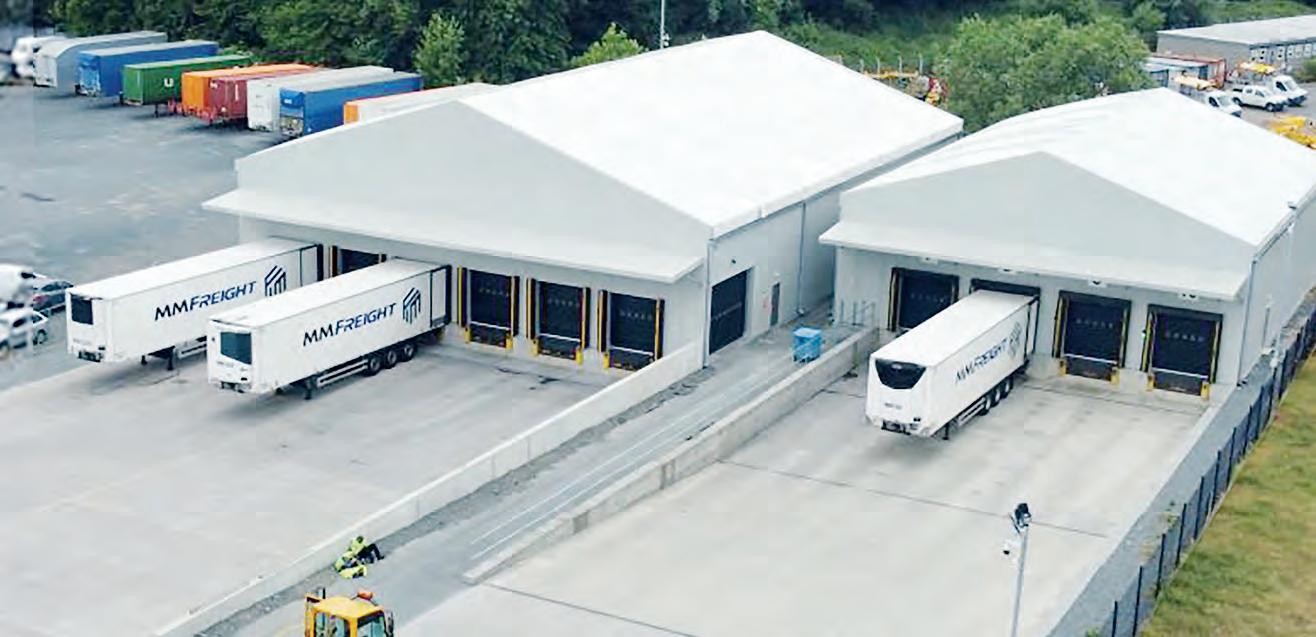
As the transport, haulage, and logistics sectors continue to evolve, operators across Northern Ireland and the Republic of Ireland are facing new risks, tighter regulations, and increasing cross border complexities.
We sat down with Dickson Group MD Ashley Dickson to discuss how his business supports firms of every size, from long established haulage fleets to highly specialised oil distributors, through expert advice and tailored insurance solutions.
Q: WHAT MAKES DICKSON GROUP STAND OUT FOR TRANSPORT AND HAULAGE OPERATORS?
Our team lives and breathes transport. We’re recognised as class leading experts because we’ve built deep, specialist knowledge over decades of working closely with the industry. We understand not just insurance, but the day to day realities of running fleets, managing compliance, and navigating risks unique to transport and logistics. We have long standing relationships with many of the largest haulage firms in Ireland, and that has given us insight you simply can’t buy. Our clients trust us because we already understand their challenges before they pick up the phone.
Q: CROSS BORDER TRANSPORT COMES WITH ADDED COMPLEXITIES. HOW DO YOU SUPPORT OPERATORS WORKING BETWEEN NORTHERN IRELAND AND THE REPUBLIC OF IRELAND?
Cross border expertise is one of our strongest areas. The movement of goods between NI and ROI is unlike any other region in the UK or EU - not just because of regulatory overlap but because of the practical realities on the road. We have a sister company Dickson & Wilson Insurance Brokers based in Monaghan and Dunboyne led by MD Shane Wilson, who has looked after logistics clients for many years.
They provide support for the client’s Republic-based business operations, so in practical terms this means Dickson & Wilson negotiate with Dublin and European-based insurers for the client’s ROI-based risk, whilst Dickson & Co in NI deal with the NI and GB-based insurers. Whether a fleet crosses the border once a day or once a month, we ensure they’re fully protected with no gaps, no confusion, and no unnecessary premium.
Q: YOU SAY THAT YOU HAVE SPECIALIST HAULAGE CLIENTS. WHAT DOES THAT INCLUDE?
Specialist haulage isn’t just about heavy loads. It’s about anything that requires deeper technical understanding. That can include abnormal loads, ADR, hazardous goods, temperature controlled transport, tanker work, just to give a few examples. These operations often fall outside the scope of standard motor policies, which is why operators need an insurance broker who genuinely understand the sector. Our expertise means we can pair clients with insurers who appreciate the realities of specialist haulage and offer cover that reflects the true risk, not a box ticked estimate.
Q: OIL DISTRIBUTION IS A NICHE AREA. WHAT EXPERIENCE DO YOU HAVE THERE?
We have a particular and long established expertise in the oil distribution sector. Distributing oil, whether kerosene, diesel, lubricants, or home heating fuels, comes with a distinct set of risks:
environmental exposure, contamination, product integrity, spillage liabilities, and complex fleet requirements. We’ve supported oil distributors across Ireland for years, helping them secure robust motor, fleet, liability, and environmental cover that protects both their business and the communities they serve.
Q: WHAT WOULD YOU SAY TO OPERATORS CONSIDERING REVIEWING THEIR INSURANCE?
The industry is changing quickly. Costs, risks, and regulations have all changed in recent years. Whether a haulier is moving general goods, oversized machinery, fuel, or anything in between, having a broker who truly understands the transport world makes all the difference. If they’re after expert advice, competitive terms, and a partner who knows the industry and the market inside out, my team is here to help.

We know that a penny at the pump can make a real impact on your costs. We deal with over 150 insurers, giving you the peace of mind that you have the best insurance cover at the best price for your business.


Whether it’s for your vehicles, your premises, your employees or the goods you transport, we have the expertise to create a tailor-made insurance programme specific to you.
As well as core insurances such as motor, employers’ liability and property, talk to us about cover for cyber insurance, warehouse legal liability, or legal advice immediately following an accident.
Megawatt-scale eHGV charging hub launched at Kuehne+Nagel Midlands Gateway
The eFREIGHT 2030 consortium, part of the UK Government’s Zero Emission HGV and Infrastructure Demonstrator programme (ZEHID), has reached a major milestone with the official opening of the first megawatt-scale electric heavy goods vehicle (eHGV) charging site.
The site uses Voltempo’s HyperCharger technology at East Midlands Gateway to support Kuehne+Nagel’s UK road operations. Formally opened on 15 January with Chris McDonald, Minister for Industry in the Department for Energy Security and Net Zero (DESNZ) and the Department for Business and Trade (DBT) in attendance, the Kuehne+Nagel hub is the first MCS-ready (Megawatt Charging System) charger to be deployed in the UK. Designed and implemented by Voltempo, lead partner of the eFREIGHT 2030 consortium and the programme’s charging infrastructure provider, the new charging hub at East Midlands Gateway is powered by Voltempo’s HyperCharger system, capable of delivering charge rates up to one megawatt - enough to charge future eHGVs in less than 30 minutes. It is the first of Voltempo’s Megawattscale HyperChargers to be deployed under the planned national rollout of 35 depot charging hubs through eFREIGHT 2030, part of UK government’s £200 million Zero Emission HGV and Infrastructure Demonstrator (ZEHID) Programme, funded by the Department for Transport and delivered in partnership with Innovate UK. “This first deployment of Voltempo’s
HyperCharger at Kuehne+Nagel’s depot is a significant milestone for zero emission freight,” said Simon Smith, CEO, Voltempo. “As lead partner and charging infrastructure provider for eFREIGHT 2030, our focus has been on delivering infrastructure that works for real-world freight operations today, while being ready for the next generation of high-power electric and autonomous HGVs tomorrow.”
The Kuehne+Nagel site features six DC charging bays powered by Voltempo’s HyperCharger infrastructure. At the heart of the system is a single megawattscale HyperCharger pod, which intelligently distributes power across a network of charge points with one positioned at each bay, enabling flexible, high-power charging to support future freight operations.
The East Midlands Gateway charging infrastructure will support Kuehne + Nagel’s continued investment in decarbonising its fleet, initially serving an electric fleet of twelve eHGVs which are part of the ZEHID project, including both DAF XF Electric and Renault Trucks E-Tech Ts as part of eFREIGHT
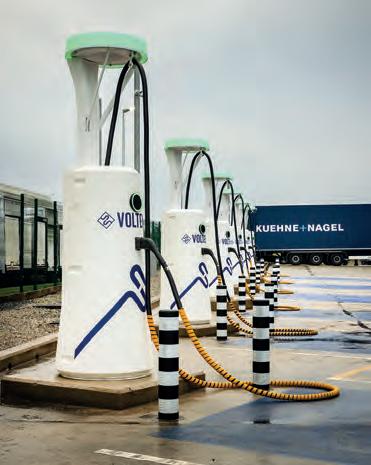
2030 operating across regional, national and international routes. Each truck is providing valuable real-world performance and efficiency data to support the eFREIGHT 2030 programme, including analysis of energy use, range, charging cycles and total cost of operation.
Kuehne+Nagel’s 200,000 sq. ft. East Midlands Gateway facility serves as the company’s UK key operations hub for road logistics activities, featuring 67 loading docks and handling a wide range of goods, including pharmaceuticals, HighTech and groupage services. Its prime location adjacent to the M1 and East Midlands Airport makes it one of the UK’s most connected logistics hubs, and an ideal base for demonstrating the viability of electric HGV operations.
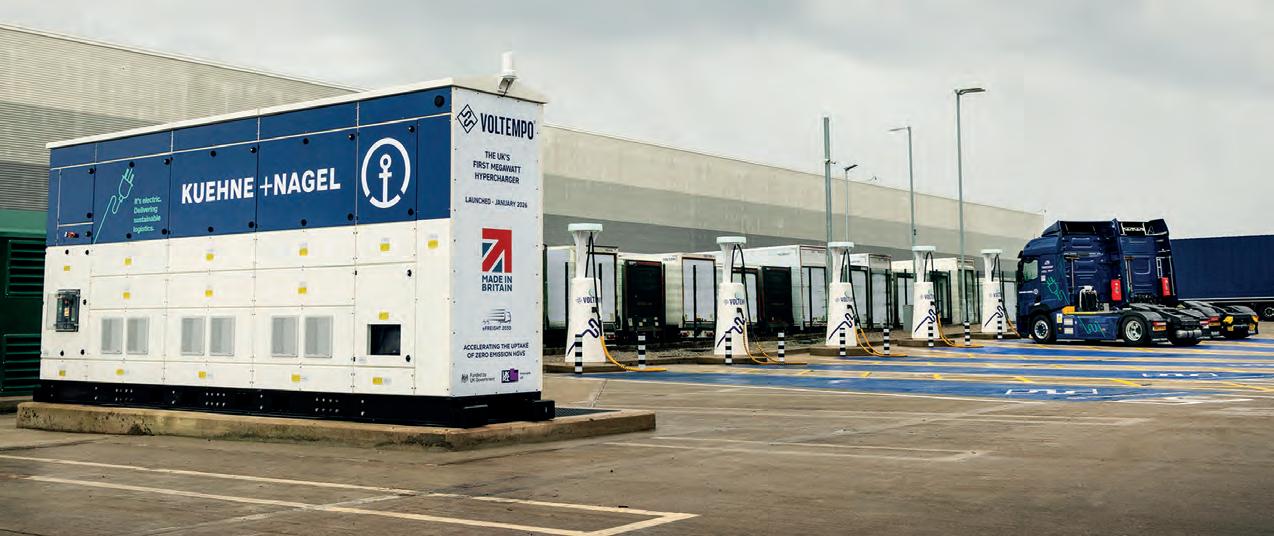
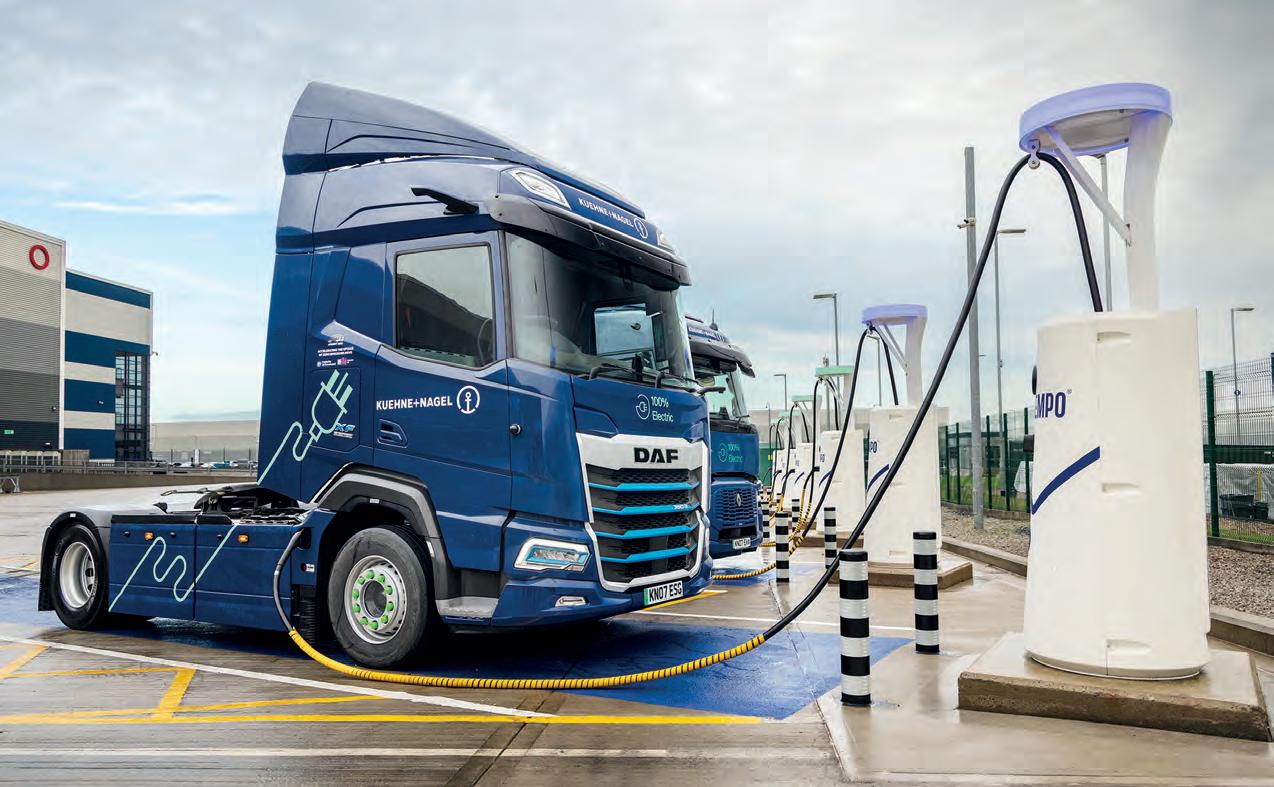
Kate Broome, Sustainability and Social Impact Director at Kuehne + Nagel, said: “As part of eFREIGHT 2030, we’re proud to be working with partners like Voltempo and their innovative technology, alongside vehicle manufacturers
DAF and Renault Trucks, to open the first charging hub at our site - a real milestone made possible through collaboration across industry.
Located at the heart of our UK road logistics operations, the combination of the HyperCharger and our new electric fleet enables us to deliver more sustainable logistics for our customers at real operational scale.”
Kuehne+Nagel’s participation in eFREIGHT 2030 builds on its Vision 2030 commitment to be the most trusted supply chain partner supporting a sustainable future, with validated sciencebased emissions targets and a track record of pioneering electric road freight.
Its UK electric HGV programme has already surpassed 150,000 zero-emission miles, and the company is proud to hold Bronze Carbon Literate Organisation status, having created the industry’s first Carbon Literacy© course focused on logistics.
The Voltempo HyperCharger is a British-designed and manufactured charging system, developed specifically for heavy-duty freight applications. The technology has recently achieved Made in Britain membership eligibility, recognising that the product is substantially designed, engineered and manufactured in the UK, with all labour involved in producing the finished system based in Tyseley, East Birmingham.
Each HyperCharger can deliver up to one megawatt of dynamically distributed power, supplying up to six vehicles simultaneously. The system can be scaled across multiple
charge-points to support larger fleets and evolving depot requirements.
Designed with sustainability and simplicity in mind, the HyperCharger functions efficiently and flexibly due to the configuration and control of the power modules allowing multiple vehicles to be charged to suit their range requirements and time of despatch, helping operators minimise vehicle charging time as well as lower the fleet’s carbon emissions. The chargers are OCPP 2.0+ compliant and Plug and Charge capable.
The Voltempo system simplifies the driver’s experience - with no payment terminal required, the system authenticates the trucks from the operator’s fleet list and manages all the charging
transactions seamlessly in the background. Alistair Barnes, Senior Programme Manager at Innovate UK said: “We are delighted to support the launch of this pioneering charging hub at Kuehne+Nagel’s East Midlands Gateway depot. Voltempo’s state-of-the-art HyperCharger is enabling eFREIGHT 2030 to meet the sustainable haulage demands of today and tomorrow.
The ZEHID programme, funded by the UK Government and delivered in partnership with Innovate UK, is providing strategic insights into the future of road transport. Powerful partnerships like this are accelerating the transition to zero-emission freight and driving the UK’s clean growth ambitions forward.”
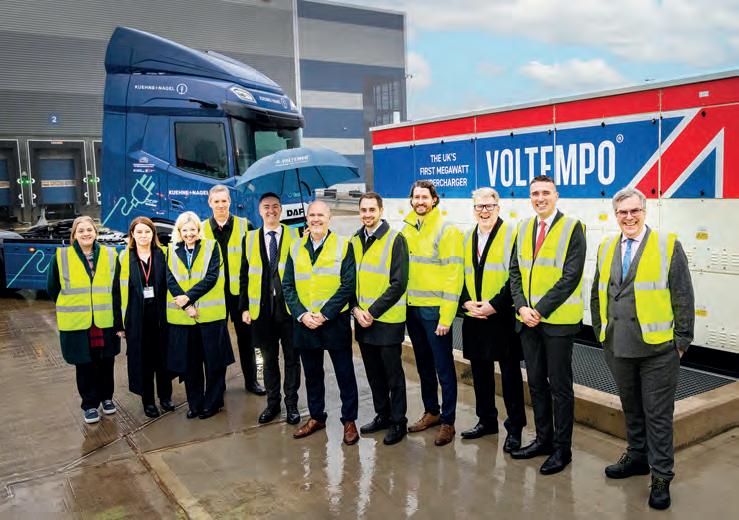
The UK government is being urged to consider allowing 48-tonne, six-axle combinations for batteryelectric heavy goods vehicles (eHGVs), a move that could significantly improve the commercial viability of zero-emission trucks and accelerate their adoption across the freight sector.
At present, the legal maximum gross vehicle weight (GVW) for articulated lorries in the UK stands at 44 tonnes. While this limit has served diesel operations well for decades, it presents a growing challenge for electric truck deployment. The heavy battery packs required to deliver sufficient range inevitably reduce available payload, placing operators at a commercial disadvantage compared with diesel-powered equivalents. According to DAF Trucks UK, payload loss remains one of the biggest barriers to wider electric truck uptake, particularly for operators in sectors such as general haulage, retail distribution, construction and bulk logistics, where vehicles already operate close to the 44-tonne ceiling. The manufacturer is now calling for a regulatory rethink that would allow battery-electric HGVs to operate at 48 tonnes, offsetting the additional weight of battery systems and restoring lost payload capacity.
Closing the Payload Gap
Electric HGVs typically carry battery packs weighing between two and four tonnes, depending on range and application. While advances in battery energy density are gradually improving this equation, the weight penalty remains significant. For operators already running at or near the 44-tonne limit, this translates into fewer pallets per load, lower productivity, increased journey frequency, and ultimately higher operating costs.
DAF Trucks UK marketing manager Phil Moon argues that a 48-tonne allowance would provide operators with the flexibility needed to justify the investment in electric vehicles. He notes
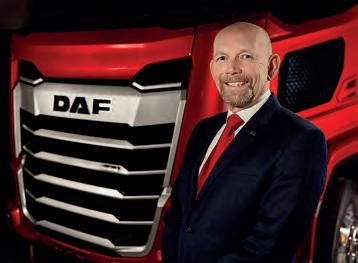
that most fleets would not routinely operate at maximum weight but need the capability when required - a principle that already underpins the widespread adoption of three-axle tractor units in conventional diesel operations. Crucially, the proposal is not about encouraging heavier trucks, but about maintaining payload parity between diesel and electric models during the industry’s transition to zero-emission transport.
The proposal aligns closely with the UK’s broader decarbonisation ambitions. Road freight accounts for a significant proportion of domestic transport emissions, and electrification of the HGV sector is seen as essential if the UK is to meet its net-zero target by 2050. Government incentives, including enhanced purchase grants of up to £120,000 per vehicle, have already helped stimulate interest in batteryelectric trucks. However, operational practicality
remains just as critical as financial support. Without regulatory changes that address payload and axle weight challenges, many fleet operators may struggle to integrate electric HGVs into their existing transport models.
The government is expected to consult in the coming months on the future direction of heavy vehicle CO2 regulations, presenting a timely opportunity to reassess weight and axle rules alongside wider decarbonisation policy. Aligning with European Practice
Several European countries already permit higher gross weights for alternatively fuelled or zero-emission vehicles, recognising the unique challenges posed by heavy battery systems. Aligning UK regulations with these practices could strengthen the country’s competitive position and ensure British hauliers are not placed at a disadvantage in cross-border operations.
As electric truck technology continues to mature, regulatory frameworks must evolve in parallel. Allowing 48-tonne, six-axle electric combinations represents a pragmatic and targeted policy adjustment that could deliver immediate benefits, removing a major operational barrier while maintaining road safety and infrastructure standards. For UK operators weighing up the transition to zero-emission transport, such a change could prove decisive — accelerating fleet investment, boosting confidence, and helping the logistics sector move faster toward a cleaner, more sustainable future.
IVECO continues to affirm its role in sustainable transport with another major international achievement for the third consecutive year.
After the eDaily in 2024 and the Eurocargo CNG in 2025, the biomethane-powered IVECO S-Way LNG has now been crowned ‘Sustainable Truck of the Year’ in the Tractor category, confirming the brand’s ability to set the pace of innovation in heavy-duty transport.
Established in 2016 by Italian industry magazine Vado e Torno, the Sustainable Truck of the Year
awards are assigned annually by an independent jury of specialized journalists. Their assessment covers sustainability and efficiency criteria, including emissions reduction, safety performance, driving comfort, and overall environmental impact.
“This recognition celebrates a form of sustainability that is tangible, immediately accessible and aligned with real-world operator needs confirming the IVECO S-Way LNG’s ability to deliver sustainable long-haul performance without compromising on safety or profitability” commented Giandomenico Fioretti, Head of Alternative Propulsion Business Development di IVECO. “It is further proof of IVECO’s unwavering
commitment to placing customers at the center of every innovation, standing by their side with solutions that combine operational efficiency and environmental responsibility.”
By awarding the IVECO S-Way LNG, the Tractor category highlights a solution that demonstrates how the energy transition can already be implemented today without operational compromises. Powered by the 500 hp xCursor 13 engine developed by FPT Industrial, the LNG tractor - fully compatible with biomethanedelivers performance on par with diesel versions, while ensuring lower environmental impact and improved overall driveline efficiency. The latest updates have also
significantly enhanced safety, comfort, and ergonomics, confirming the IVECO S-Way LNG as a mature, reliable, sustainable, and fully viable option for long-haul heavy-duty transport.
For decades, IVECO has been a pioneer in alternative energies, leading the way in natural gas technology and developing solutions that have consistently supported customers in their day-to-day operations. Its longstanding commitment to methane and biomethane has positioned the brand as a benchmark in sustainable transport, with vehicles capable of delivering concrete environmental benefits without compromising operational effectiveness.








This award recognises an outstanding family-owned and/or family-led business operating in the export, freight, logistics and transport sector. The winner will demonstrate strong commercial performance, operational excellence and a reputation for reliability, while maintaining the values, culture and long-term vision that make family businesses so successful. Judges will look for evidence of growth, customer service, innovation, people investment, and a clear commitment to the future through succession planning and continuous improvement.
The National & International Haulier of the Year Award recognises outstanding haulage operators delivering excellence across national and international operations.
Open to companies operating under a Standard Operator’s Licence with more than 30 vehicles specified, this award celebrates hauliers that demonstrate professionalism, operational excellence, regulatory compliance, strong customer service, and the ability to adapt in a demanding and fast-moving industry.
Judges will look for evidence of scale, capability, and consistency - alongside innovation, flexibility, and a clear commitment to customers, drivers, and operational standards.

The Chilled Operator of the Year Award recognises chilled distribution businesses that deliver excellence across temperature-controlled transport, storage, and customer service.
This award celebrates operators with modern, well-maintained refrigerated fleets and high-quality chilled distribution services, combined with strong compliance, innovation, sustainability, and a commitment to people development. Judges will look for evidence of operational excellence, reliability, and the ability to adapt in a timecritical and highly regulated environment.
This year’s award will be presented to an apprentice, not certified at Level 3 before September 2026, who has demonstrated knowledge, skill and determination in the course of their training and who is excelling in a workshop setting. The winner of this category will be decided through a practical test.

This year’s award will be presented to the commercial vehicle driver who offers the highest standard of driving skills; has an excellent driving record, shows dedication to the trade and personifies the ethos and reputation of his employer in his daily work. A practical driving test will determine the winner of this highly competitive category.
This award recognises an outstanding Transport Manager who demonstrates excellence in compliance, operational control and leadership, while delivering measurable improvements in safety, efficiency, driver performance and customer service.
Open to Transport Managers working across the export, freight, logistics and transport sector, including haulage, distribution, own-account fleets, ports, warehousing and multi-site operations.
The Road to Net Zero Champion Award recognises businesses, teams, or individuals across the transport, logistics, and supply-chain sectors that are taking meaningful, measurable action towards a net zero future. Open to organisations and individuals at any stage of their sustainability journey, this award celebrates credible planning, effective execution, and demonstrable environmental and commercial benefit.
Judges will look for evidence-based progress - not pledges alone - and for initiatives that deliver real impact while supporting a sustainable and competitive industry.
This award recognises organisations within the transport, logistics, and fleet sectors that demonstrate exceptional leadership in health, safety, quality, and wellbeing - protecting people, assets, and the public while maintaining the highest operational standards.
Entrants must show how health and safety is embedded across their business, from board-level governance to day-to-day operations. Submissions should clearly describe roles, responsibilities, and systems used to manage risk, ensure compliance with all relevant regulatory bodies, and drive continuous improvement.
Judges will consider how effectively current controls - or those in development - support the consistent delivery of safe, compliant, and high-quality transport and logistics services.

Completed applications must be submitted on or before the closing date of 20th June to allow the independent judges sufficient time to give all applications the necessary consideration and, where appropriate, to organize site visits and/or interviews.
This award will be presented to an outstanding vehicle, one that not only represents your fleet, but stands out on its own.
Displaying your fleet livery but also exceptional and possibly individual in its appearance this truck will be representative of your company ethos and kept in exceptional condition – ‘the pride of the fleet’. Judging in this category will require photographic and video footage of the truck. All the finalists will be put forward for an online vote, which will take place in August.
The Logistics Services Partner of the Year Award recognises a company that has gone beyond standard service provision to work in true partnership with its customer, actively collaborating to design and deliver innovative, effective logistics solutions that address real-world supply chain challenges.
This award celebrates organisations that demonstrate excellence in problem-solving, adaptability, collaboration, and value creation, whether through operational innovation, technology adoption, service redesign, or continuous improvement.
The award is open to logistics service providers, distributors, transport operators, and supply chain specialists that can evidence.
This award recognises ambient and chilled food distribution businesses that demonstrate excellence across storage, handling, and delivery while meeting the highest standards of safety, compliance, and customer service.
Open to food distribution companies, including food & drink manufacturers and processors, operating within the supply chain, this award celebrates organisations that combine operational efficiency with regulatory excellence, environmental responsibility, and the agility required to serve a demanding and time-critical sector.
Judges will look for clear evidence of best practice across food safety, fleet and warehouse operations, sustainability, and customer service.
The Haulier of the Year Award recognises outstanding mid-scale haulage operators delivering excellence through professionalism, reliability, and customer-focused service.
Open to companies operating under a Standard Operator’s Licence with up to 30 vehicles specified, this award celebrates hauliers that demonstrate strong operational standards, compliance, flexibility, and a clear commitment to customer service -regardless of fleet size.
Judges will be looking for evidence of quality, consistency, and a business that punches above its weight in a competitive marketplace.
Judging for ‘Workshop of the Year’ is open to any commercial workshop, both private and public sector in Northern Ireland, including all council and government bodies.

The winner of this award will have the best equipped, most up to date workshop that looks after its staff and its customer to an equally high standard.

This award recognises companies within the transport, logistics, and freight sectors that consistently deliver outstanding customer service and place customers at the heart of their business.
Open to hauliers, logistics providers, shipping companies, dealers, service agents, and equipment suppliers, the award celebrates organisations that go beyond expectation, demonstrate measurable service quality, and build strong, lasting customer relationships.
Customer testimonies are encouraged in this category and will be treated as strictly confidential and securely destroyed following the judging process.
The Top Team of the Year Award recognises outstanding teamwork across the transport, logistics, freight, warehousing, shipping, exporting, and dealership sectors.
Open to teams of any size - from two people to over one hundred, this award celebrates collaboration, leadership, and shared purpose. It recognises teams that, by working together on a project, initiative, or strategy, have delivered a significant and positive impact on their organisation, customers, or wider industry.
Judges will be looking for clear evidence of teamwork in actionovercoming challenges, achieving measurable results, and demonstrating a strong culture of collaboration, wellbeing, and continuous improvement.
This award recognises an organisation in the export, freight, logistics or transport sector that has introduced an innovation delivering measurable results within the last 12–18 months. Innovations may include new technology, equipment, processes or sustainability solutions.
Judges will look for clear evidence of impact, strong implementation and real customer or operational benefit.
The Van of the Year award recognises the commercial vehicle that delivers the strongest all-round performance for professional operators. Judges will assess real-world suitability across comfort, driveability, efficiency, payload capability, safety technology and overall operational value.
This category is open to all new or significantly updated vans available to the UK/Irish market within the awards eligibility period, including diesel, petrol, hybrid and fully electric models.
This award invites all truck manufacturers to nominate one vehicle from their model range over 18 tonnes GVV which they see as the ultimate fleet truck for the UK and Ireland. The winner will be ascertained through a practical driving test and presentations.

This award will be presented to the individual whose personal achievement deserves industry recognition.

TRANSPORT & LOGISTICS
TOP TABLE AWARD courtesy of IT’S NOT AS COMPLICATED AS YOU MIGHT THINK. IN FACT, OUR ADVICE AS ALWAYS IS: KEEP IT SIMPLE.
The judges are looking for excellence, outstanding qualities or contributions, unrivalled service and innovation, individuals and organisations who have gone the extra mile –so demonstrate all of that in the answers to your questions.If a company is shortlisted, they will then be asked for supporting material or a site visit or Zoom Call will be organized.
HOW DO YOU ENTER?
Your entry will not be judged on presentation but on your answers to the criteria questions. You could be an individual, a company with less than 10 employees or a large national/ international outfit. You will be judged on merit, not size.
The judges are looking for excellence, outstanding qualities or contributions, unrivalled service and innovation, individuals and organisations who have gone the extra mile – so demonstrate all of that in the answers to your questions.
If you are asked to provide any additional information to support your entry once you are selected as a finalist, keep it as brief and to the point as possible. Feel free to send customer testimonies to support your entries. Entries should state the category they are entering. Entries must be made by emailing the answers to the questions stating the award category to helen@4squaremedia.net
Separate award entries to be emailed for each category entered. Award entry enquiries can be made to Helen Beggs: helen@4squaremedia.net or M: 07779 713762
You can enter any number of categories but bear in mind, it is left to the judge’s opinion to reallocate any entry which may be more suitable to another category or an additional category. The judges’ decision is final and no correspondence will be entered into. All entries are private & confidential. The winner will remain confidential until the event.
Closing date for entries - Friday 20th June, 2026
Helen Beggs: helen@4squaremedia.net or M: 07779 713762
NON CATEGORY SPONSORS



AFTER SHOW PARTY courtesy of TBC


New transport cooling unit reflects Schmitz Cargobull broader strategy to lead the transformation of temperature controlled transport.
Schmitz Cargobull’s new S.CU dc90 transport cooling unit could be viewed as the cornerstone of the company’s transition from a traditional trailer manufacturer to a fully integrated, digitally connected solution provider for temperature-controlled transport. The S.CU dc90 represents more than a new cooling unit; it reflects Schmitz Cargobull’s broader strategy to lead the transformation of temperature-controlled transport. By combining modular engineering, digital connectivity, proactive service and a clear electrification pathway, the company positions itself to meet tightening regulations, rising sustainability expectations and the operational realities of modern logistics. Efficiency, reliability and future readiness are no longer optional extras, but core requirements that the S.CU dc90 is designed to deliver at scale
Schmitz Cargobull appreciate that refrigeration performance cannot be treated as a standalone feature. Their approach integrates the FERROPLAST® insulated trailer
body, S.CU cooling unit, TrailerConnect® telematics, and a comprehensive service ecosystem into a single, optimised solution.
The FERROPLAST® body delivers industry-leading insulation, with k-values as low as 0.295 W/ m²K, supporting mono- and multi-temperature operations. Combined with an advanced air distribution system, the trailer ensures even temperature control throughout the load space. Certifications including ATP, HACCP, pharmaceutical transport compliance and PIEK noise standards reinforce suitability for sensitive and high-value cargo.
TrailerConnect® telematics is standard ex-works, providing real-time temperature monitoring, route tracking, digital temperature recording to DIN EN 12830, and automated deviation reporting. These capabilities are underpinned by Proactive Monitoring, which uses continuous data analysis to identify potential failures early, recommend actions and coordinate service interventions, maximising uptime.
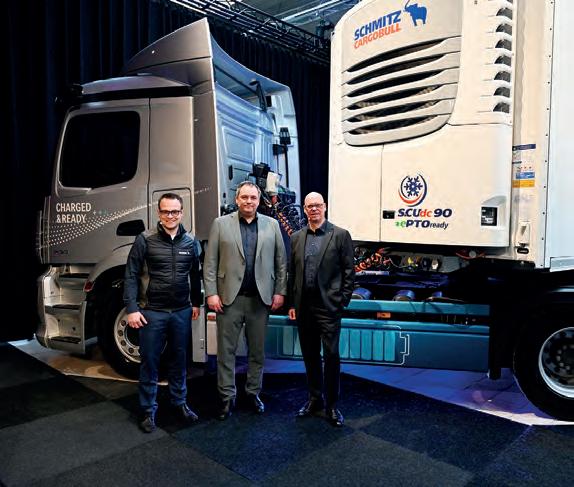
The MyCargobull digital platform acts as a central hub for customers, offering access to service contracts, maintenance records, invoices, service requests, workshop coordination and technical documentation. This transparency reflects Schmitz Cargobull’s shift towards software-defined trailers, where data, connectivity and predictive maintenance are as critical as physical hardware.
Service support is delivered through a Europewide network of approximately 1,400 service partners, complemented by mobile service vans, 24/7/365 breakdown assistance and guaranteed spare-parts availability within 24 hours. Flexible full-service contracts range from 24 to 96 months, providing cost predictability and operational security.
Since its introduction in 2012, the S.CU platform has followed a modular development strategy, allowing Schmitz Cargobull to refine quality, reliability and segment-specific functionality
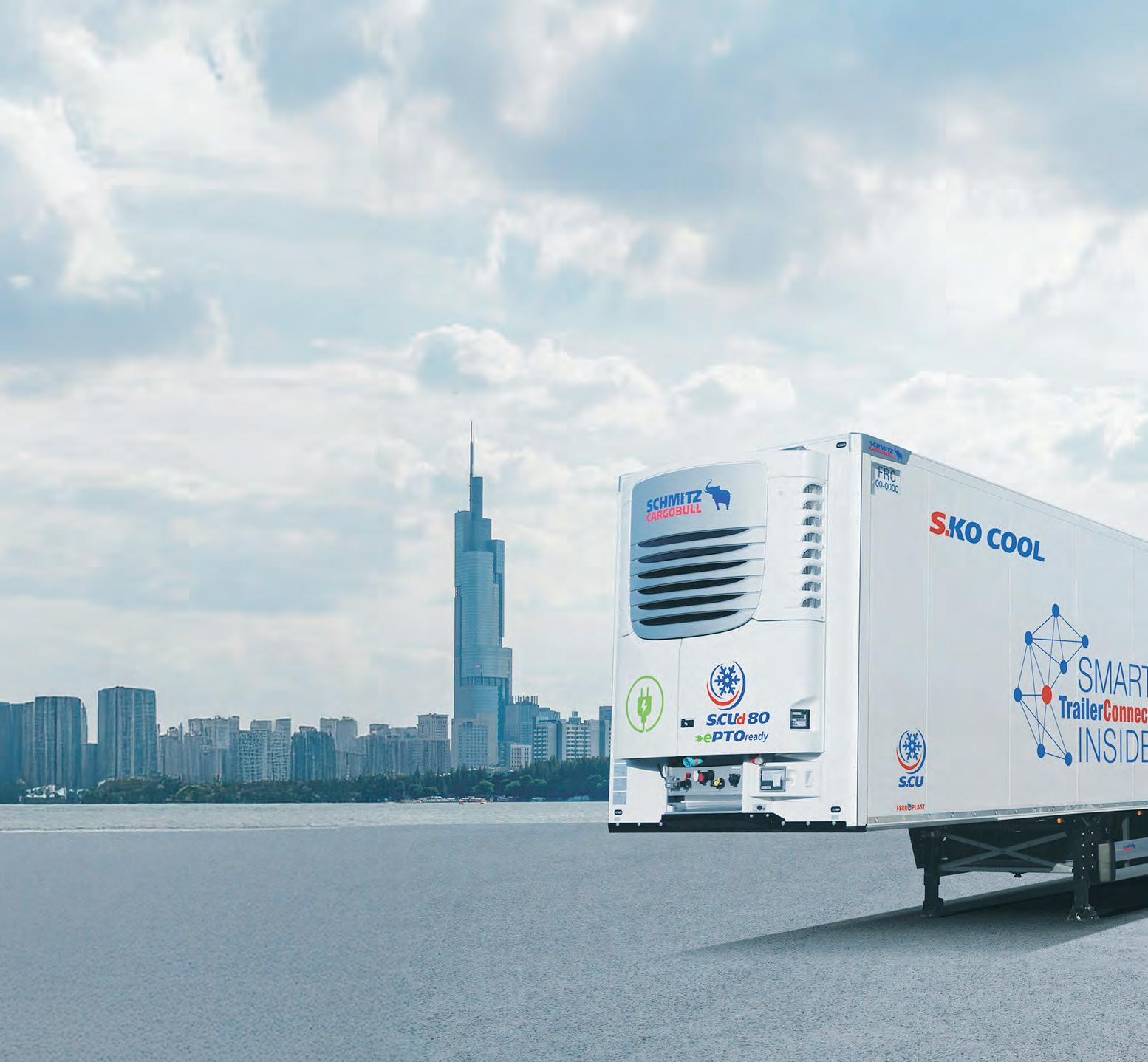

while maintaining scalability across regions. Today, S.CU units operate globally across Europe, North America, Australia, New Zealand and South Africa, generating more than 181 million operating hours and over 7 billion kilometres of telematics data.
This modular approach underpins the launch of the S.CU dc90, positioned as the next step in efficiency, sustainability and regulatory readiness.
The S.CU dc90 introduces a range of engineering improvements compared with its predecessor, the dc85. At its core is an efficient Hatz common-rail diesel engine, compliant with EU Stage V and CARB ULETRU standards, and thermodynamically optimised for an extended speed range.
The unit is also compatible with HVO100 alternative diesel fuel, supporting immediate CO2 reductions without infrastructure changes. A new two-stage piston compressor delivers up to 6% more cooling capacity while reducing fuel consumption by up to 10%.
The switch to a refrigerant with a significantly lower global warming potential results in an 89% reduction in CO2 equivalent emissions compared with the previous refrigerant.
Operational reliability is enhanced through features such as a microchannel condenser, optimised airflow management, improved defrost cycles and electric heating rods for faster defrosting. Maintenance is simplified through improved component accessibility, reduced part count due to electrification of the refrigeration circuit, and a semihermetically sealed compressor design. Driver comfort and usability are also addressed, with intuitive controls common across all S.CU units, automatic 12-volt

battery recharging in standby mode, and a Silence Kit supplied as standard without compromising cooling performance.
When integrated into the S.KO COOL system, the S.CU dc90 achieves maximum efficiency through coordinated design. A partially recessed second ceiling evaporator preserves interior height while enabling the highest air volume flow on the market. Dual 400V radial fans ensure consistent air circulation, even in mono-temperature operation, while recirculation modes and advanced evaporator design reduce defrost frequency and duration. This configuration enables use of a
second chamber of up to 7.85 metres, setting a benchmark for flexibility in temperature-controlled transport.
Schmitz Cargobull emphasises that zero-emission solutions must be economically viable to be sustainable. The ePTO-ready S.CU configuration offers a transitional solution for mixed fleets, allowing diesel-powered refrigeration units to draw power from electric trucks without sacrificing payload or operational flexibility. This approach delivers immediate CO2 savings, leverages existing charging infrastructure and avoids the need for additional vehicles. The company highlighted compelling returnon-investment figures, with ePTO solutions achieving ROI in under three months and fully electric S.KOe COOL trailers achieving ROI in under eight years for distribution applications.

With activity across more than 40 countries, Schmitz Cargobull is Europe’s leading trailer manufacturer, holding an average market share of 25%, and significantly higher shares in core segments such as refrigerated semi-trailers, where it commands close to 50% market penetration.
What makes Schmitz Cargobull different is their ability to use vertical integration. Over 38,000 transport cooling units have been produced in total, with every fourth S.KO COOL refrigerated trailer now fitted with a Schmitz Cargobull S.CU unit. This scale enables consistent quality, tight system integration and extensive operational data, supported by more than 150,000 active telematics units across the fleet.
Building on their already strong reputation for efficiency and operational reliability
Schmitz Cargobull has introduced the new S.CU dc90 transport cooling unit.
The new cooling unit, an evolution of its predecessor, the dc85, was unveiled at an online press conference at the start of February.
Schmitz Cargobull relies on a modular system for its S.CU transport refrigeration units, which includes both diesel and purely electrically powered transport refrigeration units.
The latest development is the S.CU dc90 transport refrigeration unit, which sets new standards in terms of efficiency, sustainability and future-proofing in temperaturecontrolled transport with the introduction of the new refrigerant R454A in Europe. Both the S.CU d80 and the new S.CU dc90 can be optionally equipped with an ePTO (electric Power Take Off) ready interface, enabling purely electric operation in combination with an electric tractor unit.
Temperature-controlled transport is subject to the highest requirements in terms of reliability, transparency and operational safety. Whether fresh food, frozen food, pharmaceuticals or sensitive chemicals: an uninterrupted cold chain is crucial.
As a full-service provider, Schmitz Cargobull offers a complete system that combines all the relevant components - from the S.KO COOL refrigerated semitrailer to the in-house S.CU transport refrigeration units and the TrailerConnect® telematics system through to customised service packages for the trailer and transport refrigeration unit.
The harmonised interaction of all components ensures maximum operational reliability, optimum energy efficiency and seamless temperature documentation along the entire supply chain. This holistic system expertise is the basis for the company’s continued market success.
With a market share of around 50 per cent, Schmitz Cargobull has been one of the leading manufacturers in the refrigerated semi-trailer segment in Europe for many years. Since the founding in 2012 of Cargobull Cool GmbH & Co. KG, based in Vreden (Germany), and the introduction of the first S.CU transport refrigeration
unit, around 38,000 units have been produced. The penetration rate of the S.CU in S.KO COOL vehicles has risen continuously in recent years, so that around one in four S.KO COOL refrigerated trailers is delivered with the S.CU transport refrigeration unit.
Ralph Kleideiter, CSO, Schmitz Cargobull AG said: “Reliability is the top priority in temperaturecontrolled transport. Today, our customers not only expect a highperformance refrigerated trailer, but also a seamlessly integrated system solution for their transport task. That’s why we take a holistic view of the cold chain and consistently develop our vehicles, technologies and our service and telematics offerings. Only by securely mastering all interfaces can we guarantee our customers maximum efficiency, the greatest possible safety and maximum transparency in their daily transport business.”
Today, Schmitz Cargobull transport refrigeration machines are on the road all over the world.
Schmitz Cargobull continues to
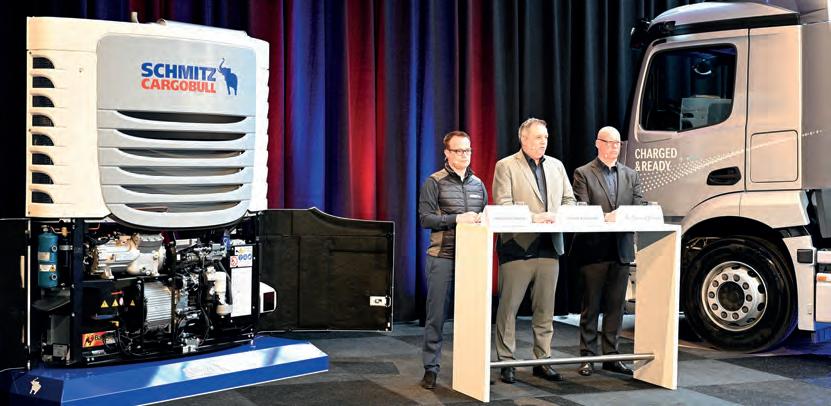
drive forward the international expansion of its transport refrigeration machines. Since the founding of the joint venture “Cargobull North America (CBNA)” with Utility Trailer Manufacturing Company LLC in 2023, S.CU transport refrigeration machines have also been produced for the North American market. Schmitz Cargobull’s modular design principle enables a high degree of flexibility, faster response times and efficient product developments that precisely match the framework conditions of the regions and fulfil the strict emission requirements of the California Air Resources Board (CARB).
All units are equipped with the TrailerConnect® telematics system from Schmitz Cargobull as standard and are used exclusively in utility refrigerated trailers.
Schmitz Cargobull is the leading manufacturer of semi-trailers for temperature-controlled freight, general cargo and bulk goods in Europe, and a pioneer in digital solutions for trailer services and improved connectivity. The company also manufactures transport cooling units for refrigerated box body semi-trailers for temperaturecontrolled freight transport. With a comprehensive range of services from financing, spare parts supply, service contracts and telematics solutions to used vehicle trading, Schmitz Cargobull supports its customers in optimising their total cost of ownership (TCO) and digital transformation.
Schmitz Cargobull was founded in 1892 in Münsterland, Germany. The family-run company produces around 50,000 vehicles per year with over 6,000 employees and generated a turnover of around €2.16 billion in the financial year 2024/25. Its international production network is made up of factories in Germany, Lithuania, Spain, Turkey and the UK.
Continental completes its Generation 5 hybrid tyre family for regional freight transport with the introduction of the new Conti Hybrid HT 5 trailer tyre.
Fleet operators now have a technically consistent solution for steering, drive, and trailer axles, designed to meet the daily demands of distribution transport – from inner-city routes to highways and even short on-/off-road routes.
“We developed the new Conti Hybrid HT 5 specifically for fleets that have to withstand the high demands of regional distribution transport on a daily basis,” says Hinnerk Kaiser, Head of Product Development for Bus and Truck Tyres at Continental. This includes situations such as frequent stop and go braking, manoeuvring in narrow streets, cornering, and varying load conditions. “The Conti Hybrid HT 5 combines safety, efficiency, and durability and supports reliable, economical operation under changing conditions.”
Compared to its predecessor, the Conti Hybrid HT 3+, the Conti


Hybrid HT 5 achieves a 15 percent higher mileage*, resulting in lower tyre replacement costs in trailer operation. For a typical regional transport fleet with 80 trailers and an average annual mileage of 110,000 km per trailer, this means savings for the fleet of around 32 trailer tyres per year*.
In addition, the effort involved in tyre changes, warehousing, and procurement is also reduced.
“The optimised rolling resistance of the tyre ensures fuel-efficient operation and helps to reduce fleet costs,” emphasises Kaiser. After all, tyres account for up to 53 percent of the operating costs of a commercial vehicle fleet. In addition to the economic effects, there are also ecological benefits. By not producing new tyres, raw material consumption is reduced, and CO2 emissions are lowered along the entire value chain.
The Conti Hybrid HT 5 impresses above all with its significantly improved grip on wet and cold roads. “A newly developed tread compound and a comprehensively optimised tread design ensure that the tyre grips reliably even in demanding weather conditions. This is reflected in the B rating for wet grip on the EU tyre label,“ says Hinnerk Kaiser. reduction in noise pollution.
The right tyre technology for every axle
With the introduction of the Conti Hybrid HT 5, Continental now offers technologically coordinated solutions for all axles in regional transport. The Conti Hybrid HS 5 for the steering axle stands for precise tracking and driving comfort, while the Conti Hybrid HD 5 for the drive axle is designed
for strong traction and stable, balanced braking performance. The new Conti Hybrid HT 5 complements the portfolio on the trailer axle with high running stability, robust construction, and reliable grip under varying load conditions. “All tyres in the Hybrid family are designed for high mileage and long-term performance in demanding regional applications,” summarises Hinnerk Kaiser. The optimised casing construction of the Conti Hybrid Gen 5 forms the basis for high-quality retreading over several life cycles. All tyres are also equipped with RFID sensors. Available sizes
The new Conti Hybrid HT 5 trailer tyre will be available in March in sizes 385/65 R22.5 and 385/55 R22.5. Continental will add further key sizes to the portfolio by 2027. All tyres are available ex works as smart tyres. The pre-installed tyre sensor allows them to be seamlessly integrated into the ContiConnect digital tyre management system.
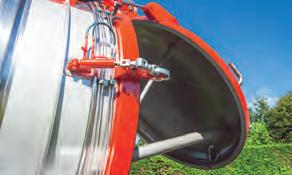





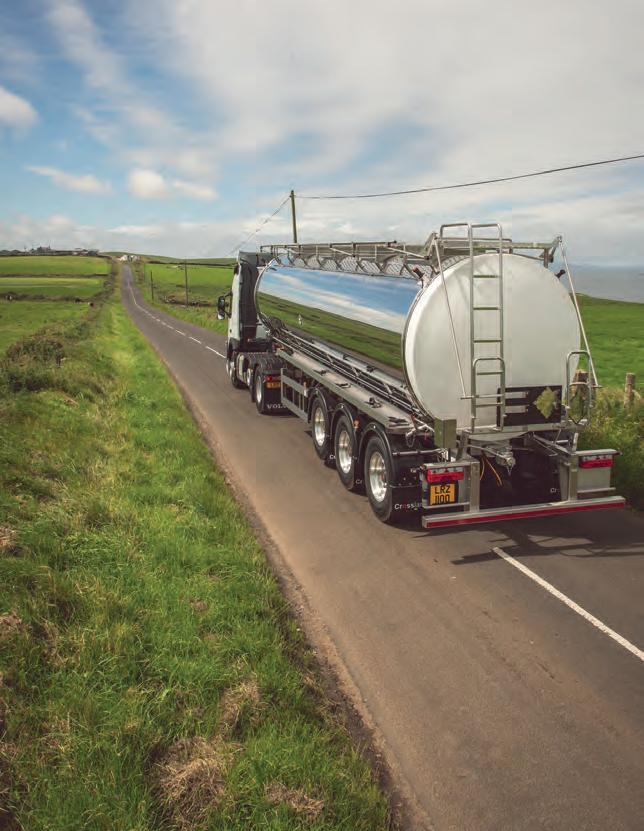
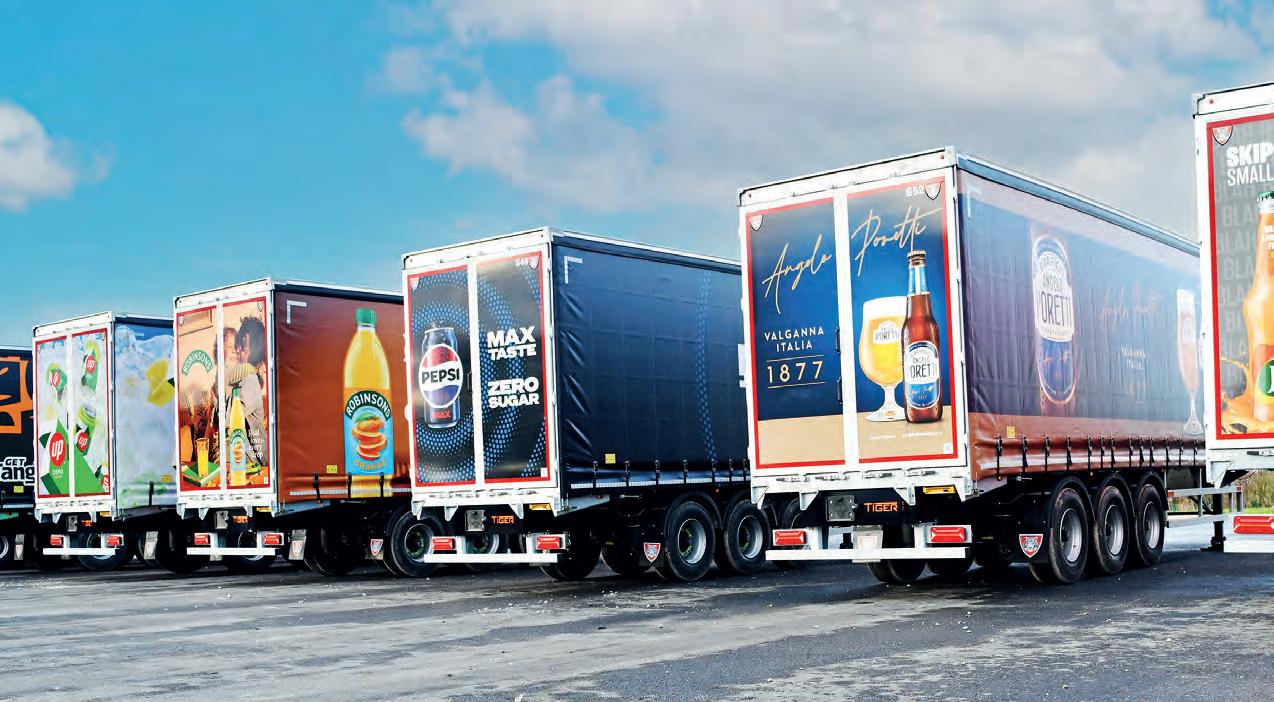
Beer and soft drinks powerhouse, Carlsberg Britvic, has changed supplier for the manufacture of thirty-seven new trailers for its primary logistics operations, replacing older vehicles. Tiger Finance facilitated fully bespoke contract hire with maintenance for these trailers, as part of the manufacturer’s services which also include Rentals and Parts.
Carlsberg Britvic’s thirty-four new single deck Tiger curtainsider trailers showcase bold liveries spanning Pepsi MAX, Lipton Ice Tea, 7UP, 1664, Robinsons, Tango, Birrificio Angelo Poretti, J2O, and Carlsberg Danish Pilsner, primarily transporting bottles and cans, and at times large-pack loads such as kegs and casks, delivering to internal sites, NDCs, RDCs, wholesalers, supermarkets, larger festivals, and sports grounds.
Sarah Perry, VP Customer Supply Chain at Carlsberg Britvic, comments: “In addition to Tiger’s reputation for high quality products and strong customer service, we were also impressed by its sustainability agenda – which includes investing in energy efficiency, planting one tree for every trailer ordered, and its community road safety activities. We are very pleased with the finished vehicles.”
The three Hobgoblin-branded double deck trailers have both a fixed three-quarter-length main deck rated at ten tonnes with Expamet steel flooring for added safety and durability, and an additional fixed deck above the neck area, rated at four tonnes. Cargo is secured using three fullheight nets fitted to each side, with transverse
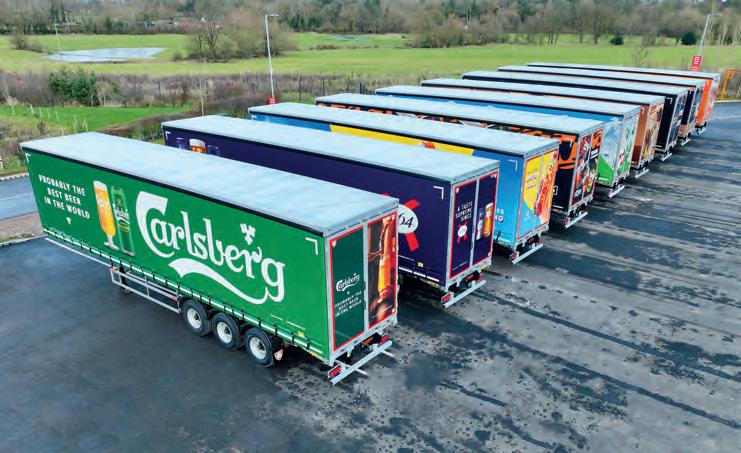
netting enabled by the under-deck tracks. Tiger tailors its products to meet each customer or end user’s requirements, and in this instance the drinks firm specified
flush-fitting rear doors, various additional grab handles and straps to raise operator safety, plus added vehicle durability through galvanised components and extra buffers.
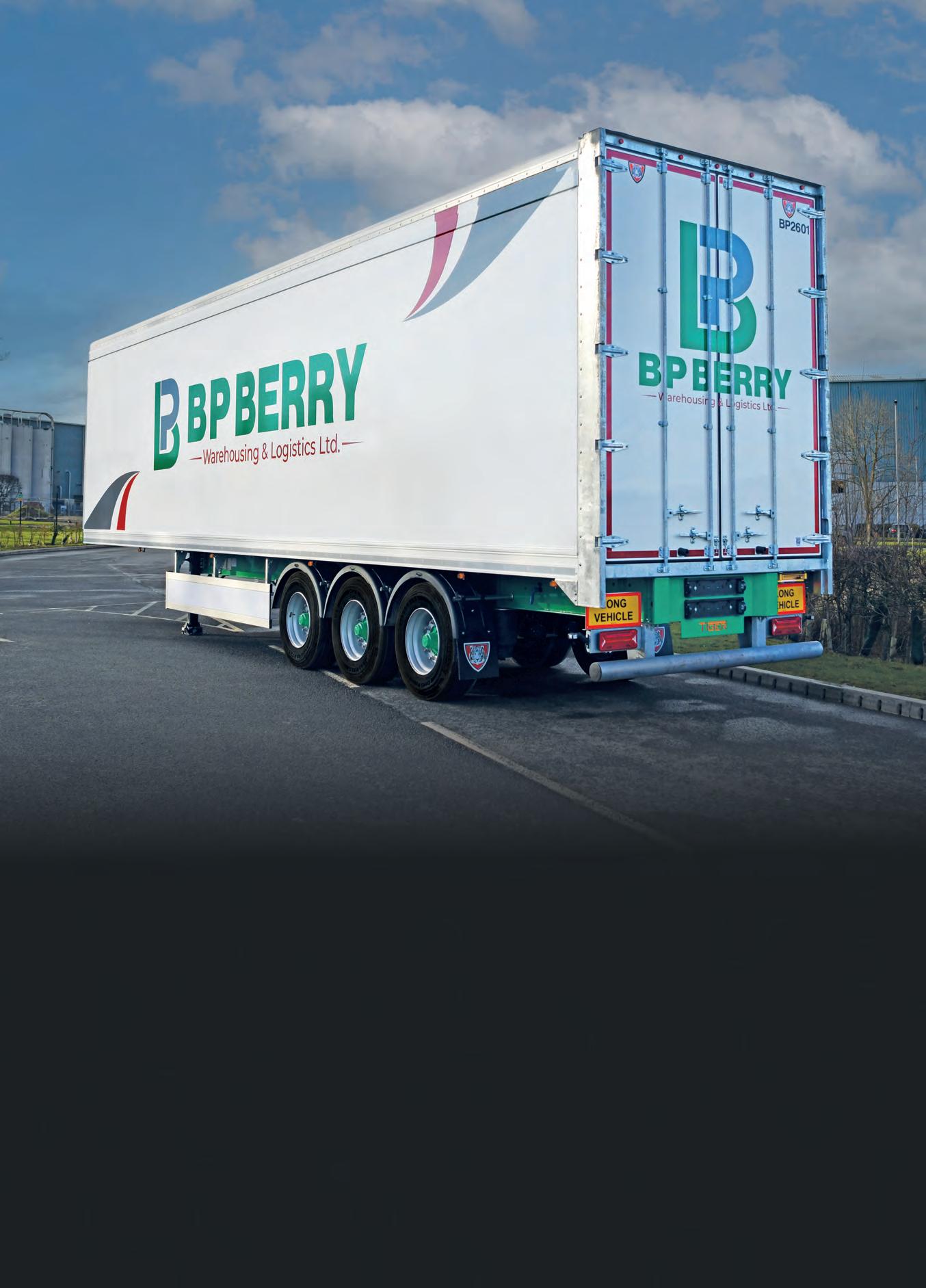
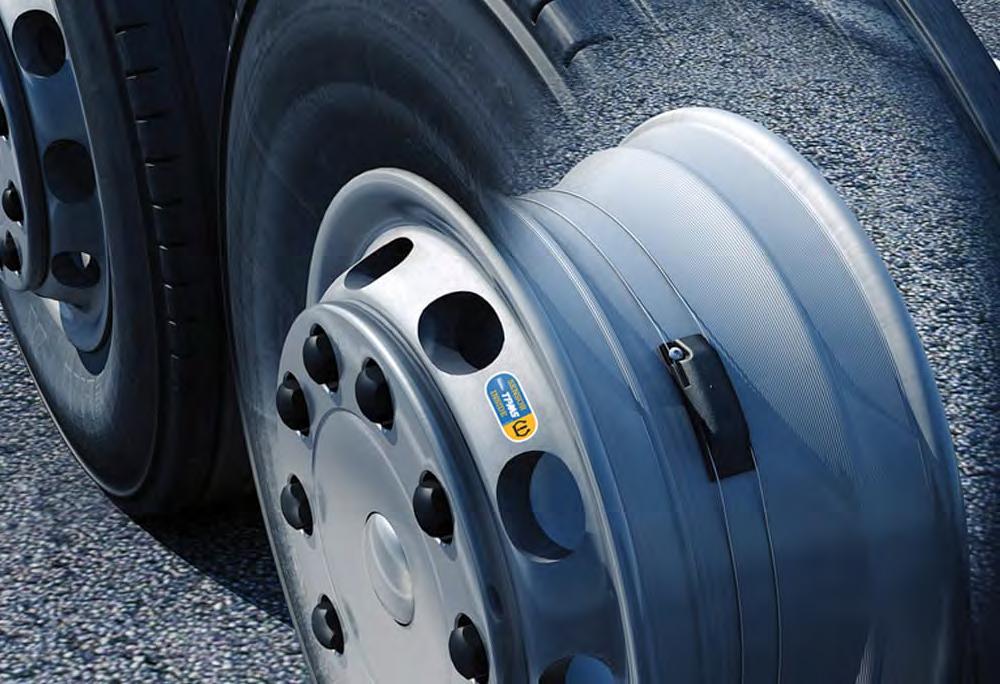
Haldex has highlighted the features and workings of its TPMS 2.0 tyre pressure monitoring system, which is compliant with R141 European regulations.
The Haldex TPMS 2.0 system consists of rim-mounted wheel sensors, wireless receiver and control unit, optional handheld digital tool, plus smartphone app. It is designed to continuously monitor tyre pressures and temperatures and alert operators of problems with low tyre pressures, in a simple and easyto-use interface. It is compatible not only with the Haldex EB+ 4.0 EBS electronic braking system, but also with other brands that are compliant with R141 regulation.
“Tyres running at low pressure require more fuel to move and also heat up because of internal friction; such conditions could, in an extreme case, lead to a blow-out,” said Haldex.
“Since tyre pressures decrease in proportion with falling temperatures, an unsophisticated TPMS system could flag a false positive tyre pressure alert on very cold days. That is the reason why EU legislation, which came into force for new types of trucks and trailers in July 2022, requires
that TPMS pressure readings are temperature-compensated.
“There are other technical requirements in terms of data communication: a new standardised data transmission format between a TPMS receiver unit and the trailer EBS system (which is via a wired CAN-Bus sensor).
“For that same reason, the Haldex EB+ 4.0 features a data gateway that will read signals from other brands of TPMS receivers. Between the RCU and the
wheels, individual wheel sensors send data over a wireless radio spectrum signal using a proprietary protocol. The RCU determines system status and receives the analogue signals, digitises them, and forwards them on.
“As a minimum, the system has to submit a warning if a tyre pressure drops below a certain threshold –by default 20 per cent although it could be set at a lower fraction. If the truck is equipped accordingly, tyre pressures, warnings, alerts and system status can be displayed in the cab. Pressures measured are up to 10 bar.


“TPMS 2.0 exceeds regulatory requirements by assigning each wheel a unique identifier. This nice-to-have feature helps make it easier to identify the problem tyre: not such an easy task in case of a single slow puncture on an eight-axle, twin-wheel low-loader, for example.”
To support the TPMS 2.0 functionality, Haldex provides three supplemental devices. First is a new handheld TPMS trigger tool, which wirelessly connects to wheel sensors to read tyre pressure, temperature, ID and battery status. Second, a small diagnostic box works with Haldex’s own smartphone app to configure the system.
Third, Haldex’s permanent, trailer-mounted display, EB+ Info Centre, which presents axle, suspension and brake diagnostic data, can display tyre information including pinpointing problems (which axle, which side).
“The Haldex TPMS 2.0 system works for up to five axles, 20 tyres and up to four spares,” said the company.
“Although the regulation only requires wheels touching the ground to be measured, Haldex is going the extra mile to allow a
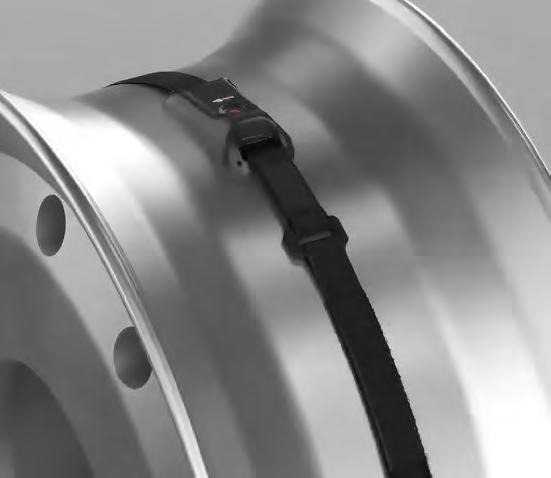
spare tyre to be ready and waiting pre-configured, so that a service technician need not demount the tyre to fit the sensor.
“Wheel sensors are powered by a non-replaceable battery rated for seven years’ operation. To conserve power, sensors transmit less frequently when the vehicle is stationary, only waking at wheel speeds in excess of 20kph.
“On twin wheels, the 143g sensors should be mounted 180deg apart. RCUs should be no more than 3m from wheel sensors, which means that on full trailers, two RCUs might be required. The system is set up and diagnosed using Haldex’s Diag++ maintenance software.” Haldex products are sold and supported by SAF-HOLLAND UK LTD www.saf-holland.co.uk













































The fully integrated solution that helps UK transport operators meet the latest braking performance assessment requirements. It combines SAF INTRADISC axles, Haldex EB+ 4.0 braking systems, and AXSCEND’s advanced telematics into one effective, streamlined combination.

Operators get FREE ACCESS to the AXSCEND EBPMS as part of the package. And as if that wasn’t enough, we’re including the AXSCEND Maintenance Planner as part of this high-value, exclusive offering.


Contact SAF-HOLLAND UK for more information on this unique solution.














The Northern Ireland haulage and logistics sector enters 2026 operating within one of the most complex trading environments in Europe. The sector continues to sit at the intersection of UK internal market rules, EU single market requirements, and evolving customs and regulatory frameworks. While political uncertainty has not disappeared, 2026 is shaping up to be a year of consolidation rather than disruption, with operators expected to focus on compliance maturity, cost control, workforce resilience, and technological adaptation.
This article considers the key legal, regulatory and commercial developments likely to shape the sector in Northern Ireland during 2026.
1.1
By 2026, the Windsor Framework will be firmly embedded as the operative trading framework for goods moving between Great Britain, Northern Ireland and the European Union. Key operational realities for hauliers include:
• Continued use of green and red lanes for goods moving into Northern Ireland.
• Expanded use of trusted trader schemes and simplified customs declarations.
• Ongoing data sharing requirements with HMRC and EU authorities. For compliant operators, the focus in 2026 will be on process efficiency rather than structural change. Businesses that invested early in systems, training and professional advice are expected to see reduced friction compared to the early post Brexit years. However, smaller operators may continue to experience disproportionate administrative burden, particularly where mixed loads or irregular consignments are involved.
A persistent issue for 2026 is regulatory divergence between Great Britain and the European Union, particularly in:
• Product standards.
• Environmental regulation.
• Vehicle and road safety requirements.
Northern Ireland operators moving goods across multiple jurisdictions will need to manage dual compliance, especially where vehicles, drivers and consignments move between Northern Ireland, Great Britain and the Republic of Ireland.
2.1
The driver shortage remains a structural issue rather than a cyclical one. In 2026, operators are expected to focus less on recruitment campaigns and more on:
• Retention strategies.
• Improved working conditions.
• Investment in training and career progression.
An ageing driver population and continued competition from mainland UK operators
will keep upward pressure on wages.
2.2 Employment Law and Compliance
While employment law in Northern Ireland remains distinct from Great Britain in some areas, 2026 will see increased scrutiny around:
• Working time compliance.
• Health and safety obligations.
• Employment status and agency driver arrangements.
Operators using cross border drivers will need to remain alert to social security coordination and posted worker considerations, particularly for EU journeys.
3.1
Although fuel price volatility may stabilise compared to earlier years, margins are expected to remain tight due to:
• Increased insurance premiums.
• Higher borrowing costs.
• Vehicle acquisition and maintenance expenses.
Smaller fleets are likely to feel these pressures most acutely, potentially accelerating consolidation within the sector.
In 2026, there is expected to be greater emphasis on contractual risk management, including:
• Fuel surcharge mechanisms.
• Force majeure and delay provisions.
• Liability caps and insurance alignment.
Operators increasingly recognise that poorly drafted transport contracts can erode already thin margins.
Digital compliance is no longer optional. In 2026, successful operators will be those who:
• Integrate customs, transport management and accounting systems.
• Maintain accurate, auditable data trails.
• Respond efficiently to HMRC and EU compliance checks.
Manual workarounds that emerged during earlier transition periods are increasingly viewed as commercial risks.
4.2
Technology adoption continues to be driven by cost control and regulatory compliance rather than innovation for its own sake.
Key uses include:
• Driver behaviour monitoring.
• Fuel efficiency analysis.
• Predictive maintenance.
These tools are increasingly relevant in defending insurance claims and regulatory investigations.
5.1
While Northern Ireland has not adopted identical timelines to Great Britain, environmental pressure from customers and supply chains continues to intensify.
In 2026, expectations will focus on:
• Fleet emissions reporting.
• Route optimisation.
Risk Area Likely Impact in 2026
Regulatory compliance
Labour availability
Cost inflation
Technology gaps
Environmental pressure
Medium to High
High
Medium
Medium
Medium
For the Northern Ireland haulage and logistics sector, 2026 is unlikely to deliver dramatic regulatory shocks. Instead, it will reward businesses that have adapted to complexity, invested in compliance, and approached risk management strategically. The competitive advantage in 2026 will
• Incremental transition planning rather than full electrification.
Operators serving multinational customers may face sustainability requirements that exceed statutory minimums.
5.2 Practical Realities for Northern Ireland
Geography, infrastructure limitations, and cross border operations mean that alternative fuel adoption remains uneven.
The legal risk in 2026 is less about immediate penalties and more about loss of contracts where sustainability credentials are insufficient.
Mitigation Focus
Process standardisation and professional advice
Retention, training, improved conditions
Contractual risk sharing and efficiency
Systems integration
Reporting and customer engagement
lie not in scale alone, but in operational discipline, legal awareness, and commercial resilience. Those operators who treat compliance and governance as part of their commercial strategy, rather than a regulatory burden, are likely to be best placed to navigate the years ahead.
John.McMahon@spencer-west.com spencer-west.com
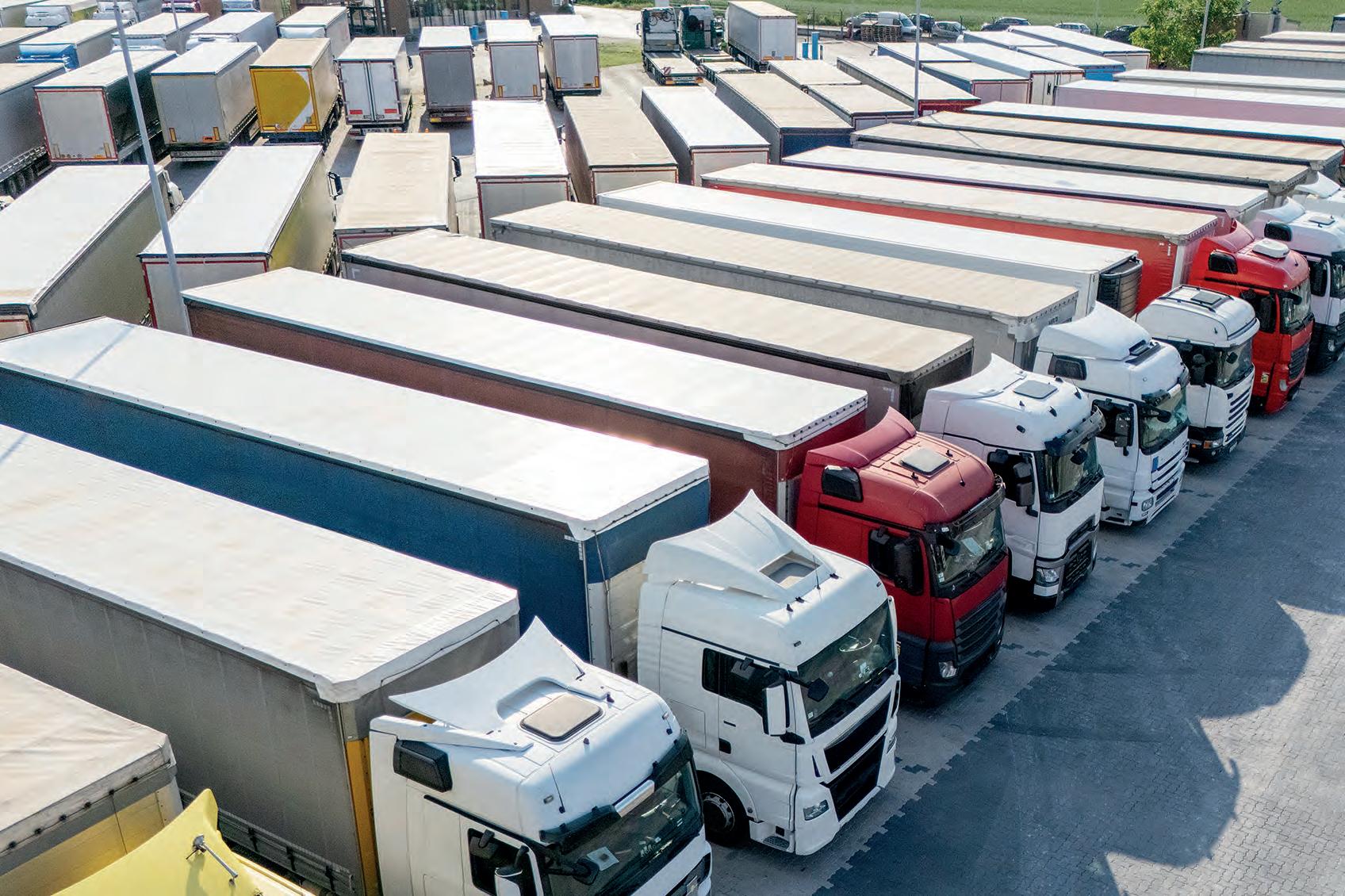
An Operator was convicted at Ballymena Magistrates’ Court and fined a total of £3,000 for multiple driving related offences.
The conviction arose when DVA enforcement officers were carrying out compliance checks.
During the encounter DVA Enforcement Officers identified the tachograph unit as a Siemens VDO 1381. When the tachograph unit was downloaded, it was identified that the driver’s digital tachograph card had not been downloaded in 441 days which is 413 days over the deadline.
Furthermore, the vehicles tachograph unit had not been downloaded in 655 days which is 565 days over the deadline.
When the tachograph was analysed, it showed that there were multiple periods of driving without a valid driver’s card inserted totalling 6 hours and 3 minutes of driving covering approximately 355kms. When a technical inspection was carried out
by DVA enforcement officers, the vehicles Electronic Control Unit (ECU) was analysed and it was identified that the vehicle’s max speed was set at 95km/h and further analysis of the vehicles Tachograph unit showed numerous over speed warnings when the vehicle drove in excess of 95km/h for extended periods of time. The operator was prosecuted for following offences: Cause/ Permit driving without an appropriate driver’s card inserted (x2), Failure to maintain a Speed Limiter, Failure to download the vehicle unit, Failure to download the digital driver card.
A County Armagh Operator was convicted at Newry Magistrates’ Court and fined a total of £900. The conviction arose when DVA enforcement officers were conducting compliance checks when a 3 axle Volvo articulated unit was observed stationary in a lay-by, the vehicle moved off from the lay-by towards Newry in the presence of the DVA Liveried vehicle, it was followed a short distance and subsequently stopped for inspection.
The vehicle tachograph unit and driver’s digital tachograph card were downloaded for analysis, it was noted that his driver card had only been inserted at 1605 hours and the vehicle tachograph unit had only recorded one minute of driving. Officers were concerned there was no driving was recorded for the journey instead the tachograph recorded rest.
Analysis of the driver’s hour’s records indicated that he was 44 hours 43 minutes into a weekly rest, a regular weekly rest is 45 hours. This indicated the driver’s rational for manipulating the vehicle tachograph recording system. In failing to record driving data instead recording rest the driver creating a false record.
The vehicle was detained for inspection and no irregularities were found with the vehicle wiring or sender unit on the vehicle’s gearbox. The only remaining component which provided the user capable of manipulating drivers hours’ records was the tachograph unit itself, which was removed from the vehicle and held as evidence. A prohibition notice of unfit vehicles was issued and the vehicle returned to the company.
On a later date, DVA officers obtained tracker data, which enabled comparison of the data gathered by the tracker, namely the vehicles movements against the data recorded by the vehicle tachograph unit.
It confirmed the journey missing from the tachograph records on the date of detection. Offences noted as follows: failing to record driving data - instead recording rest therefore multiple false records created which appeared to facilitate continuous driving of 4 hours 59 minutes - opposed to the driver taking the required break after 4 hours 30 minutes. If driving and failing to record driving data instead of recording rest, this indicated multiple false records created on a further date.
The driver is a director of the company, is a qualified transport manager and holds a valid driver’s certificate of professional competence. He also admitted to planning the work.
The most recent downloads of both the driver card and vehicle tachograph unit had been carried out only 2 days since the previous download suggesting this is done regularly by the company. The downloaded data compared with their tracker data would have been an opportunity for the company to address the illegal activity had they have wanted to. However, evidence indicates they have failed in their responsibility of carrying out regular checks as required by regulationsotherwise this would have been identified prior to the DVA stop. Multiple anomalies were found when cross referencing tracker information and tachograph data. However for proportionality, and in line with statute barred constraints, only a selection of the false records have been reported. However there was a request for this to be taken into consideration as it demonstrates that that the offending on the date of detection was not an isolated incident.
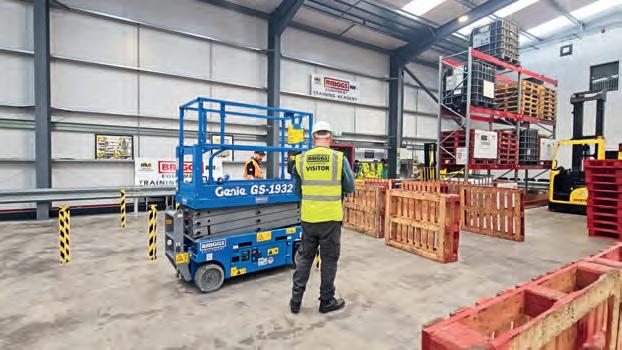
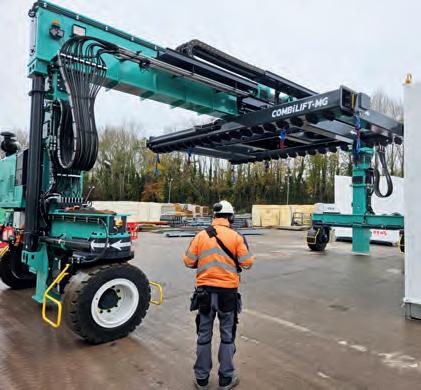
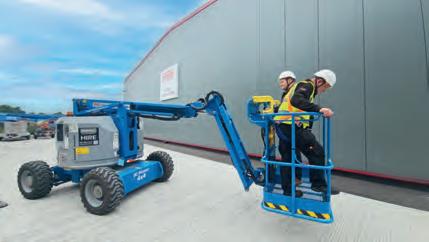
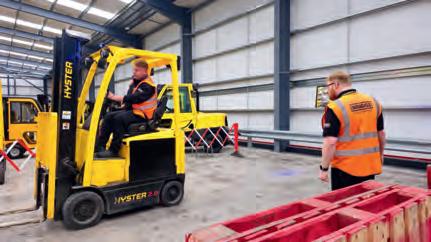
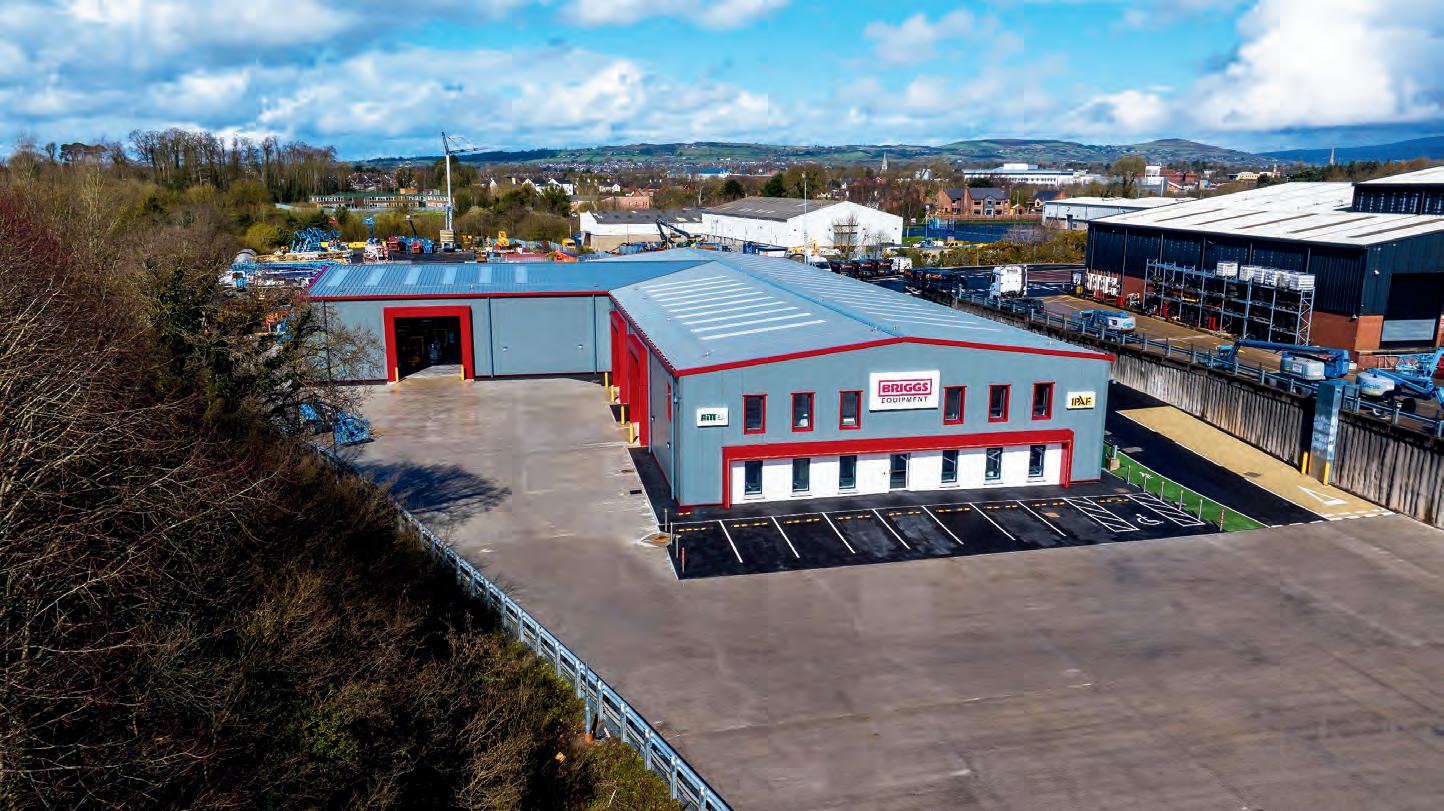



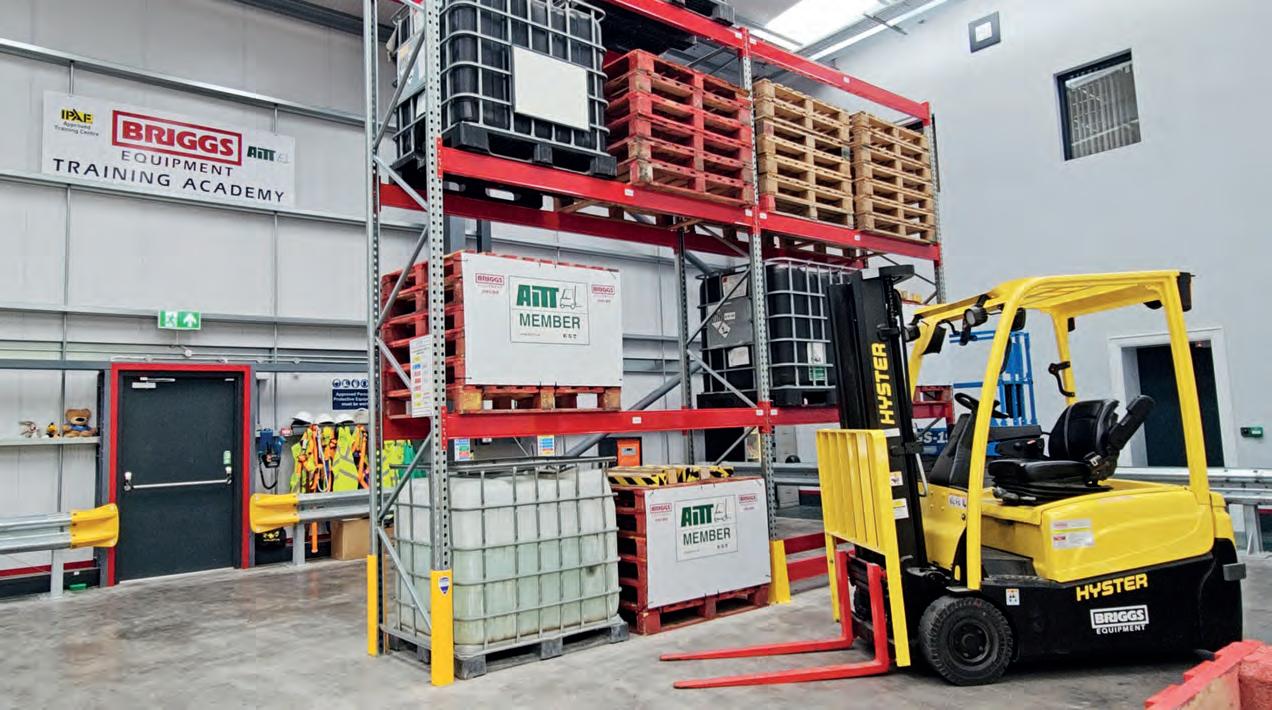
When Briggs Equipment established its Training Academy, the aim was not to add another certification provider to an already crowded market. It was to address a growing issue in workplace safety — the gap between formal qualification and real world readiness.
Too often, operators were arriving on site certified but lacking confidence, situational awareness, or practical experience. Briggs’s response was straightforward — training should reflect the environments people are actually expected to work in.
“Our goal was never just certification,” says Chris Budd, Briggs Equipment Training Manager. “We wanted people to leave here confident, capable and ready to work.”
The Training Academy began by supporting Briggs’s own employees and customers, operating with a small team and limited space. As demand increased, it became clear that effective training required more than adapted warehouse areas or temporary setups. That need led to the development of Briggs
Equipment’s purpose-built Training Academy in Lisburn, which opened in 2024 following a £3.5 million investment.
The 23,000 square foot facility includes indoor and outdoor practical training areas, supported by four modern classrooms. Designed to replicate real working environments, the Academy allows trainees to move naturally between theory and hands-on application. Participants train using professional equipment in layouts that mirror active warehouse and site operations, helping bridge the gap between learning and deployment.
Briggs Equipment training instructors hold recognised accreditations including AITT, IPAF, First Aid, and CPC, and bring extensive
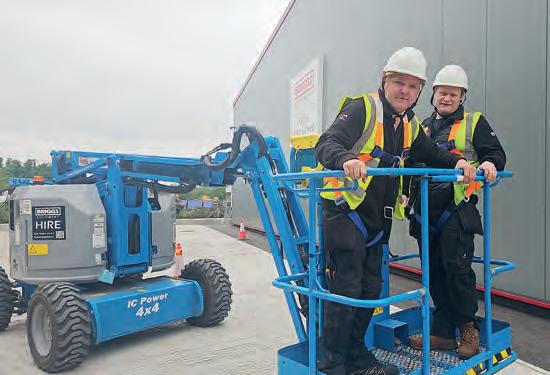
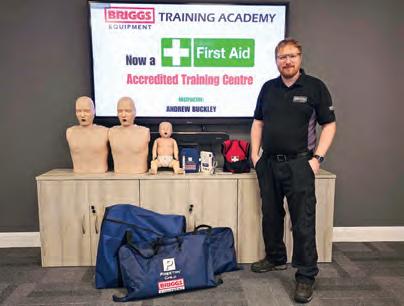
experience across warehousing, logistics, construction, and manufacturing.
“I enjoy seeing people arrive nervous on day one and leave confident by the end of the week,” says Chris Budd. “That shift is what tells you the training has worked.”
Lead Training Instructor Andrew Buckley brings more than 21 years’ experience in the materials handling industry.
“Teaching isn’t just about forklifts,” says Andrew. “Standards are important, but it comes
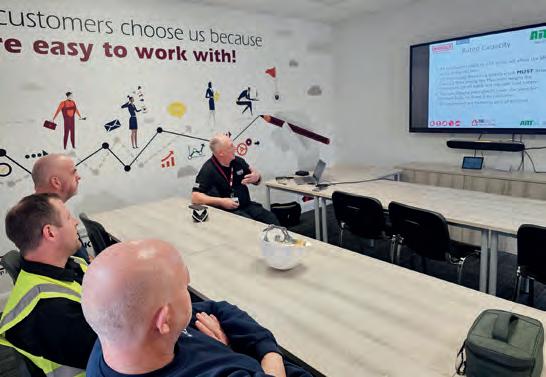
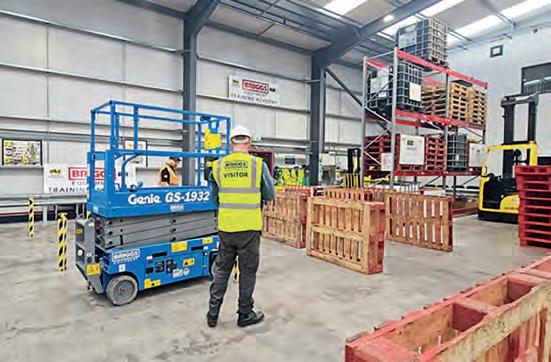
down to one question — would I feel safe working beside this person on site?”
Assessment standards at the Academy are deliberately firm. Trainees are only passed when they meet the required level of competence.
“Seeing former trainees come back as supervisors or team leaders is incredibly satisfying,” adds Chris Budd.
The Academy delivers both on-site and off-site training, adapting course content to reflect workplace layouts, equipment types, and risk profiles.
Key programmes include:
• B1 Novice Counterbalance Forklift courses
• IPAF Operator training (3a and 3b, including load and unload)
Additional courses include:
• Workplace safety awareness
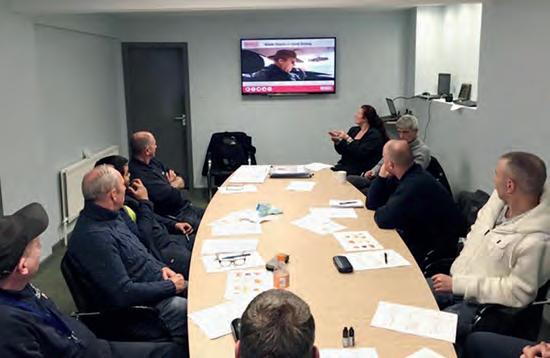
• Bespoke training packages
• CPC training
This flexibility allows Briggs to support organisations of all sizes, from large logistics and manufacturing businesses to smaller independent warehouses, as well as individuals seeking to improve employability.
Alongside operator training, the Academy delivers CPC training for professional drivers, focusing on practical application and real-world scenarios. The aim is to support compliance while reinforcing safer, more professional driving practices beyond the classroom.
The Academy works with a wide range of clients across Ireland, including several blue-chip organisations. Many provide full access to their
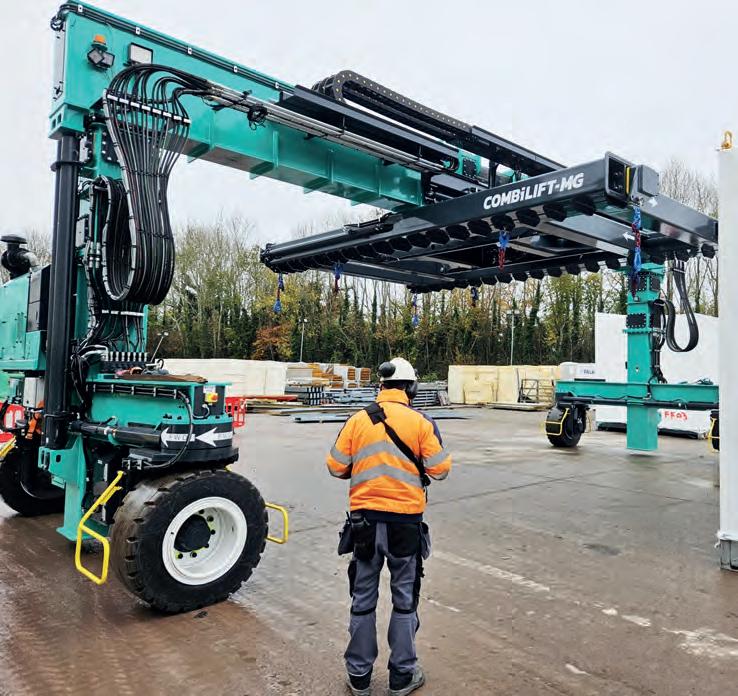
sites for training — a level of trust built through long-term relationships and consistent delivery.
Client feedback highlights improved operator confidence, reduced incidents, and increased productivity.
The Academy also supports employment initiatives and community outreach programmes, delivering free courses each year in partnership with charities and local organisations.
Demand for training continues to grow, with plans in place to introduce additional specialist equipment courses and further enhance Academy facilities. Opportunities to replicate the Academy model in the Republic of Ireland are also being explored.
“We want to be a training provider people trust,” says Chris Budd. “That comes from consistency, high standards, and making sure people leave genuinely ready for work.”
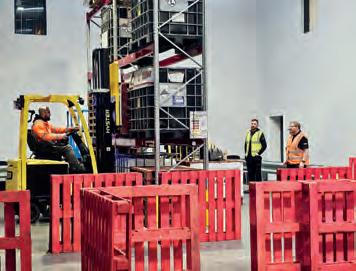
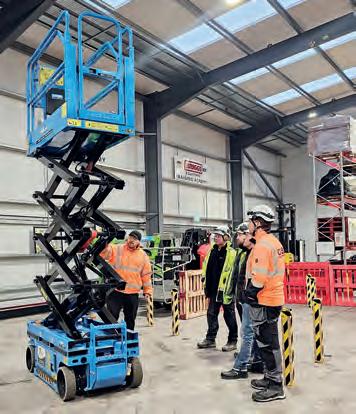
BY AUSTIN LYNCH
There
are some moments in your life that stay with you forever, and I have heard it said the day of your driving test is one of them!
I still remember the day, over 30 years ago now, that I passed my car driving test – back long before there was such a thing as a theory test to worry about.
Fast forward to now and I don’t think I will forget when a driving examiner the other week congratulated me for passing my HGV Class 1 (C+E) test. The mix of joy and utter relief is something that will stay with me for a long time.
Little did I think back all those years ago when I first got my licence that I would be back with a examiner sitting beside me in 2026 - but this time not in my driving instructor’s Nissan Sunny but rather in a blue Mercedes Actros with a 40 foot trailer coupled on behind!
Trucks are such an everyday sight to us all, that most people probably never pass any remarks or think twice about them, not even taking time to consider where they are coming from; where
they might be going and what they are carrying.
Whether most people realise it or not, the logistics industry is an integral part of all our lives. But how often do those outside this industry give a second thought to the professionals that keep our economy ticking, and for the purpose of this article I am talking specifically about the drivers.
Driving a car is one thing – but driving a large goods vehicle (LGV) is quite a different matter, and one that takes a totally new set of skills including patience and a huge amount of concentration.
I have already written about my experience going for my Class C licence, which I passed just less than a year ago. But there was always going to be a ‘to be continued’ with that particular story. And never one to shy away from another challenge in late August 2025 I was
back up with TTS (Transport Training Services) at Nutts Corner this time learning to drive the artic. Having passed the rigid test gives you a great grounding for this next stage of the training process, but the bigger licence is another few steps up the ladder (both literally and figuratively). Now, not only are you dealing with a large vehicle but you have a long trailer to control, and make sure it follows you, and goes the way you want it to.
When learning to drive the rigid I took some time to get to grips with the reversing, and the same was the case this time around – especially when a 40 foot trailer can be wayward as a toddler who has had too much sugar. But with enough practice I cracked it.
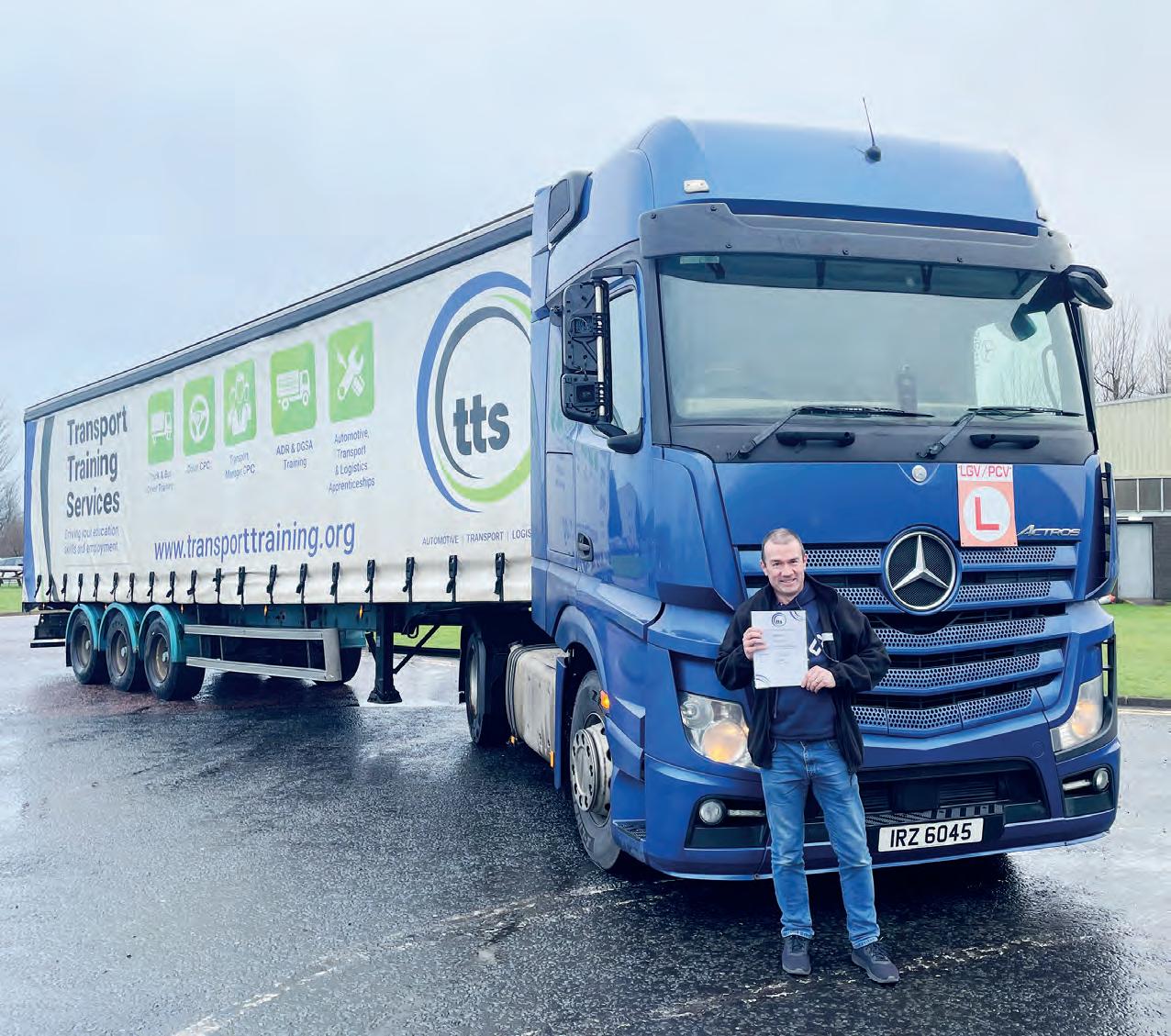

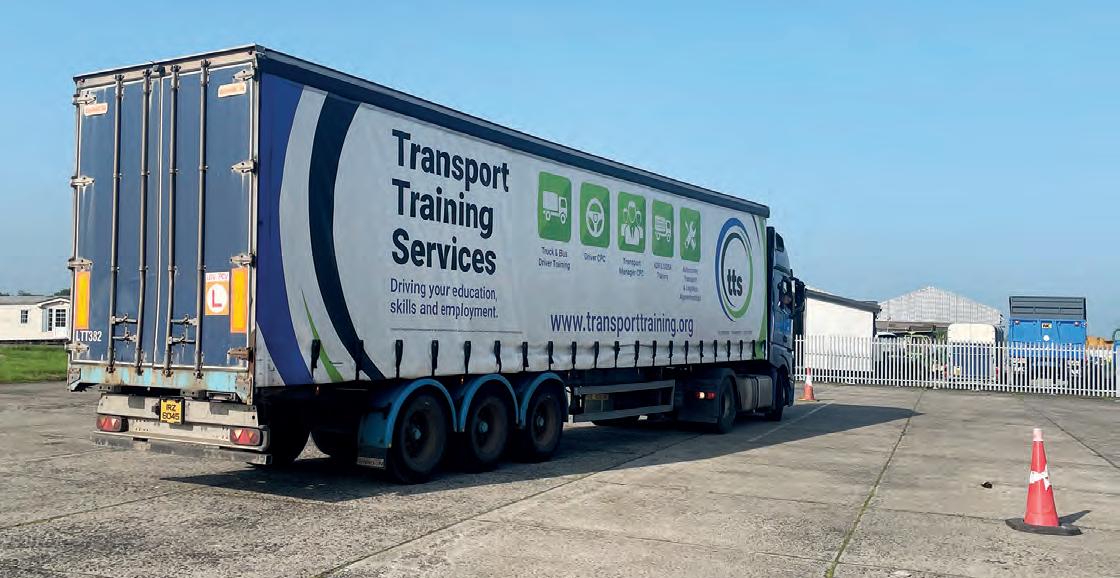
What I didn’t expect to gain from learning to drive trucks was the depth of knowledge you gain from going through the training, and thanks to Iain for showing me the ropes, the air-lines and everything else I needed to know.
In this job I have heard terms like fifth wheel, kingpin, dog clip but until you have to couple and uncouple a tractor unit from a trailer these are really just words and its hard to appreciate what they do and their importance .
The driver training, which involved hours of driving both down rural roads and through busy town centres with unpredictable levels of traffic is tough, and tiring with one of the most tiring aspects being the utter and total concentration that is required. You literally cannot take your eyes off the road as you are driving a huge vehicle that could cause a lot of damage in a moment of inattention.
The other thing that this driver training has given me is the utmost respect for truck drivers and the job they do. It’s not all just sitting in a warm cab and listening to the radio! This is a demanding, highly skilled job and we all owe a huge debt
of gratitude to the men, and women, who get up early each morning to drive these trucks –keeping our supermarket shelves stocked, and moving every other consumable good from point of manufacture to point of sale – and beyond.
Neither HGV driving test is easy – and nor should they be. The whole purpose is to give a potential driver the necessary skills to firstly understand that a truck – and trailer - must first be roadworthy before a wheel is turned. Next, it is the driver’s responsibility to ensure the vehicle is properly loaded and the load secure. And the driver must have the required skills to get the goods / freight onboard to its destination on time, and in the same condition as they were when loaded onto the lorry.
For the Class 1, the test begins with some safety questions following by the reversing manoeuvre.
I took one of my two allowed shunts but managed to get the trailer safely pass the ‘B’ cone and into the garage. Once again, no cones were harmed!
Next up is the coupling/uncoupling where you
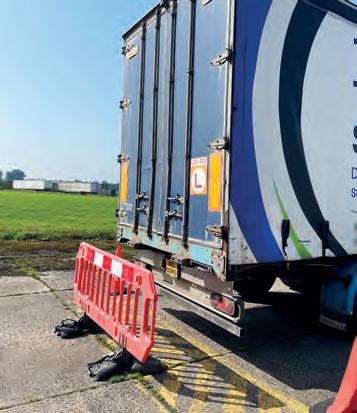
firstly uncouple from the trailer you have just reversed – and then hook back into it again. BLACK is the key to this one (Brake, Legs, Air lines, Clip (Dog clip) and Kingpin. And then you do it in reverse to hook in again.
Once you have these two parts of the test completed it’s time for an hour of driving on a route dictated by the examiner. I had to drive through the centre of Craigavon, out to Tandragee and back through Guildford.
When the drive is over and you return to the test centre, there is the seemingly endless wait for the examiner to tell you how you got on. Thankfully, this time the news was good.
I am pretty sure I will never forget that Friday morning at a wet and windy Craigavon Test Centre when I was told I had passed. And I now look forward to the next time I get the opportunity to get behind the wheel of a truck.
A huge thanks to Geoff, Iain, Carol, Michael and everyone at TTS for all their training, help, time and patience. Thanks to them I have now attained both my C and C+E HGV licence. It has been a great experience and one that I will always remember.
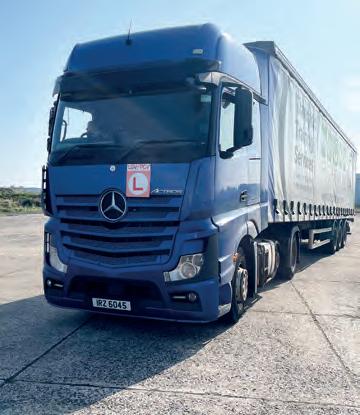
I am an HGV driving Instructor with Asda Logistics Services. Asda recruits warehouse colleagues from around the country onto their Licence Acquisition programme. Those colleagues come to our training facility at Lutterworth for a period of approximately 10 days and, during this time, they sit all their theory tests, which they take at our in-house Theory Test Suite. They then learn how to drive an HGV to test standard, covering is coupling/uncoupling the unit from trailers and a reversing exercise to display competence.
My role involves dealing with a wide range of people with a vast range of skillsets and confidence levels and guiding them through this very intensive process installing the knowledge and confidence to serve them well on the road driving an HGV and to pass their HGV practical driving test. I have held my HGV licence for 22 years. You need to have this licence yourself to be able to instruct others. I also am qualified to train as I hold an RTITB HGV qualification and I am on the NRI (National Register of Instructors) I did not attend university; I was employed by Asda three years ago to set up the new Licence Acquisition program that they
wanted to launch. I had previous experience in HGV training and I brought these skills and knowledge with me when I joined the business. I found the posistion on Indeed (a job website) after looking for a new challenge, and this was a perfect fit. My previous experience in being an HGV driver myself for an extended period, coupled with the drive to share my knowledge with new people coming into the sector, meant that I was well suited to a role in training, and I found this an easy, and natural progression
The best thing about my role is going on the development journey with the colleagues that come through the program. It is a
Liam started working in logistics at 18, but at that point he wasn’t thinking about it as a possible career.
“I just wanted to earn some extra money during college, but then I quickly saw the opportunities at DHL.”
He regularly put himself forward for more hours, and as he did so it was given more tasks and more responsibilities – to the point he realised he was already building a career in the role. From there, things moved quickly.
“I completed various roles in different departments, and even though I’ve been here at DHL for years, I’ve never
stopped learning along the way.”
In his current role, Liam manages a Service Centre, which he attributes to hard work, and having the vision to see the opportunity and job satisfaction ahead of him.
“Logistics is fast-paced and you need to work hard, but you can really feel the reward when you help solve other people’s problems. It’s also really interesting to see some of the important shipments we have to get around the world, from life-saving equipment to high value bank documents.”

pleasure to watch them grow as individuals and achieve the results in gaining their HGV Licence. Moving on to become drivers and really having a massively positive effect on their whole lives. My biggest highlight to date was when I first joined the business, and I set up the program that the business wanted. I was the last piece in many months of work behind the scenes to get this idea off the ground – my part was to put it all together and make it work and deliver results. This I achieved and now the Licence Acquisition program is ever evolving and growing year on year, helping hundreds of colleagues to upskill and futureproofing the business in their retention of HGV drivers for years to come.

In 2016, aged just 21, Liam won the ‘Employee of the Year’ award and was taken to Venice for an all expense paid trip as a reward for his hard work and commitment.
The Association of Fleet Professionals has launched two new 90-minute online courses for time-pressed fleet managers, covering time management and career development, with practical skills designed to fit easily into busy working schedules.
Fleet managers who are pushed for time can now take advantage of two shorter online courses, run by The Association of Fleet Professionals (AFP).
The ‘Time Management’ and ‘Change Gear in Your Career’ courses are 90 minutes long and are designed to fit into busy schedules, helping fleet managers develop practical skills and strategies. Each course costs £99 for AFP members or £145 for non-members.
Time Management is intended to improve decision making, enabling fleet managers to focus on work that generates high value, longterm results. It will be held on 10 February and 28 April. The AFP said that Change Gear in Your Career helps identify strengths and talents, increases impact and enhances professional image. The course will be held on 3 March. Ronnie Gillman, training manager at the
AFP, said: “We believe time-pressured fleet managers should have the opportunity to access high quality, effective training and these bite-sized courses are our response to that need.
“Covering areas of personal development that fleet managers often tell us they want to tackle in a cost-effective course that can be easily squeezed into a working day, they provide valuable new approaches that can be put into practice straight away.”
In addition to the online courses, the AFP recently added another in-person Accelerate course, Navigating People Challenges.
Gillman said: “Accelerate has become a popular concept. These courses provide fleet managers with a strong grounding in essential areas of the profession and have been an important part of the success of the AFP Fleet Academy
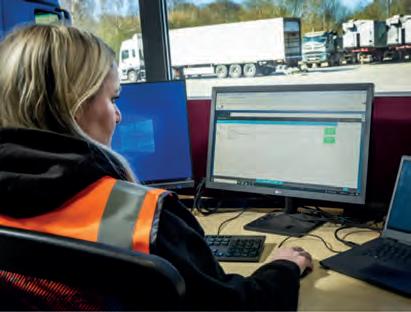
in recent years. The new course, Navigating People Challenges, helps develop your skills to create better personnel outcomes.
“Whether managing people is a new part of your responsibilities or something you’ve been doing for many years, it explores a range of different tools and approaches in a safe and supportive environment.”
The RHA (Road Haulage Association) is urging the Government to reinstate key driver training programmes and reform flexible skills funding to boost HGV driver numbers, following new research revealing the scale of the issue.
100,000 HGV drivers have allowed their Driver Qualification Card (DQC) to lapse in the last year, representing one in six of all working age drivers. A significant proportion of those leaving the industry are in their 30s and 40s.
The RHA now estimates that 60,000 drivers need to be trained each year for the next five years to meet demand and support growth.
With 80 per cent of goods and materials transported on UK roads in lorries, businesses in the road freight sector are key economic enablers. Urgently addressing this issue is therefore vital to the wider economy.
RHA MD Richard Smith said: “To future-proof businesses and the supply chain for the long term, driver recruitment, training and

retention must be an urgent priority for Government. With an ageing workforce and significant numbers of experienced drivers leaving the profession, attracting people into HGV driving has become increasingly urgent.
“HGV driver bootcamp training
has been closed nationally, leaving many firms struggling to pay for training at a time when costs are rising. We want to see these bootcamps reinstated until the Growth and Skills Levy is reformed to allow permanent driver training programmes.”
Many are also departing due to long working hours and existing challenges around a lack of roadside facilities and secure parking.
Richard added: “A lack of roadside facilities, safe and secure parking remains a chronic issue too. We’re making headway, but there’s a long way to go on that, and the work on this continues.
“A thriving road freight and logistics sector is a key enabler - but the goods and materials our economy needs to prosper can’t move if we don’t have enough people behind the wheel. So, our message to Government is clear. Work with us to futureproof our workforce to ensure drivers are in place for the next decade and beyond.”
The RHA is calling on industry partners, training providers and decision-makers locally and nationally to work together on long-term solutions to address these challenges.
The Irish Sea remains one of the most important arteries of trade and transport linking Ireland with Great Britain and markets further afield. Every day, a constant flow of ferries, cargo ships and container vessels criss-cross these busy waters, carrying everything from food and fuel to machinery, construction materials and consumer goods that keep businesses operating and communities supplied.
In recent years, shipping on the Irish Sea has continued to evolve.
New routes have been introduced, new vessels have entered service and emerging technologies are helping to make operations more efficient, resilient and increasingly sustainable. Behind every successful crossing is a dedicated network of shipping lines, port operators, logistics providers and maritime professionals working around the clock to ensure freight moves safely, reliably and on time.
Northern Ireland’s ports sit at the very heart of the region’s trading economy, acting as critical gateways for goods moving
between Great Britain, the island of Ireland and beyond.
Among them, Belfast Harbour and the Port of Larne stand out as strategic hubs, underpinning supply chains across retail, manufacturing, agri-food, construction and industrial sectors.
Together, Belfast and Larne form a complementary port system that underpins the resilience and competitiveness of Northern Ireland’s logistics sector. As shipping lines invest in new vessels, operators adopt smarter technologies, and ports expand infrastructure to support decarbonisation and growth, these
gateways continue to evolve to meet the changing needs of trade.
In this feature we take a look at these gateways to trade and explain some of what comes and goes through these important ports.
There has been a lot happening over the past 12 months, and more developments to come in the year ahead.
From Stena introducing two new hybrid ferries on the Belfast Heysham route to the Isle of Man Steam Packet Company set to launch a year round service to the Isle of Man, Ireland has never been better connected to the rest
of the UK and mainland Europe.
And just a few months ago Belfast Harbour saw the first official ship naming ceremony in over 20 years as Stena named one of the new ferries, the Connecta, in Belfast.
The Northern Irish economy grew during 2025 – something which would be impossible without a functioning and constantly developing port infrastructure.
And we are fortunate here to have a number of progressive ports serviced by the many businesses that ensure the swift and efficient movement of exports and freight.
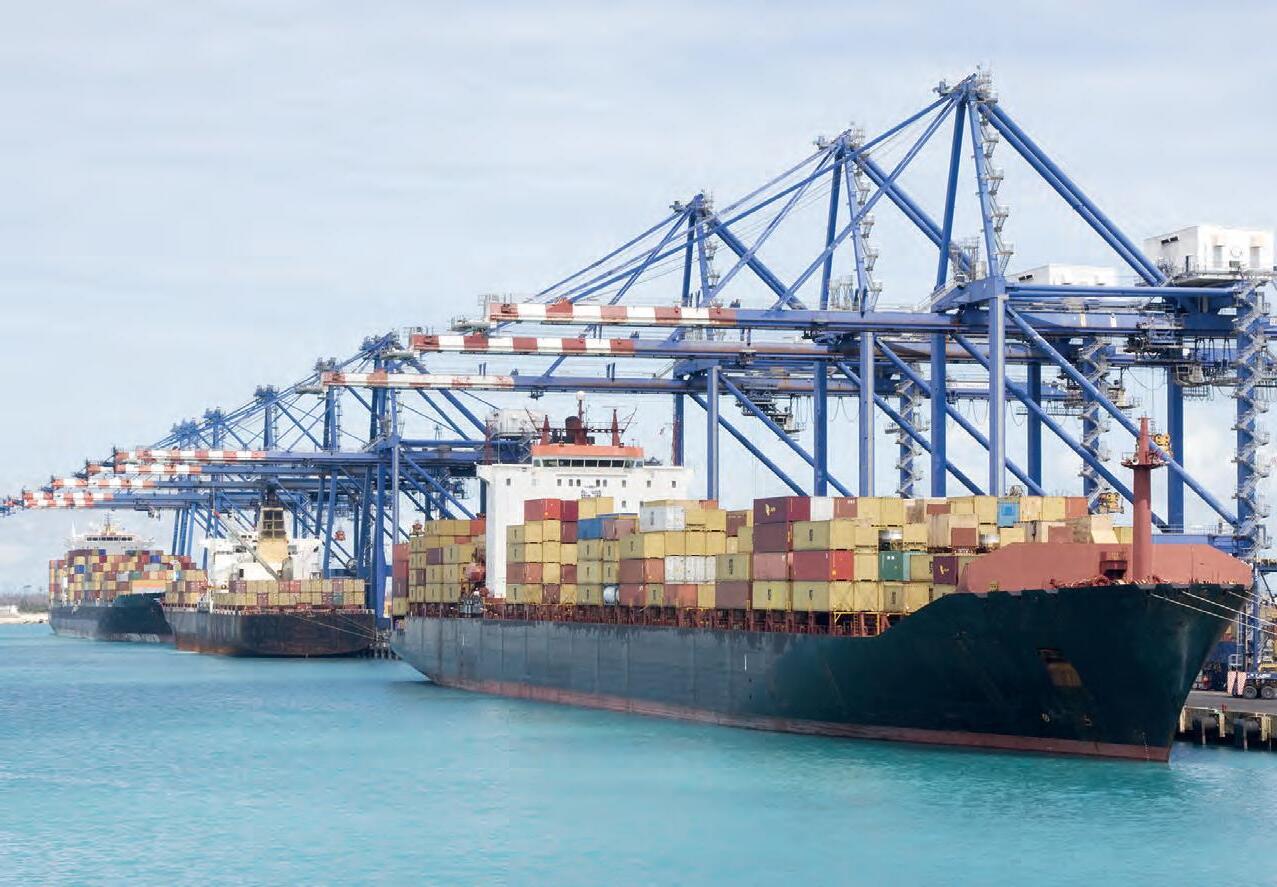
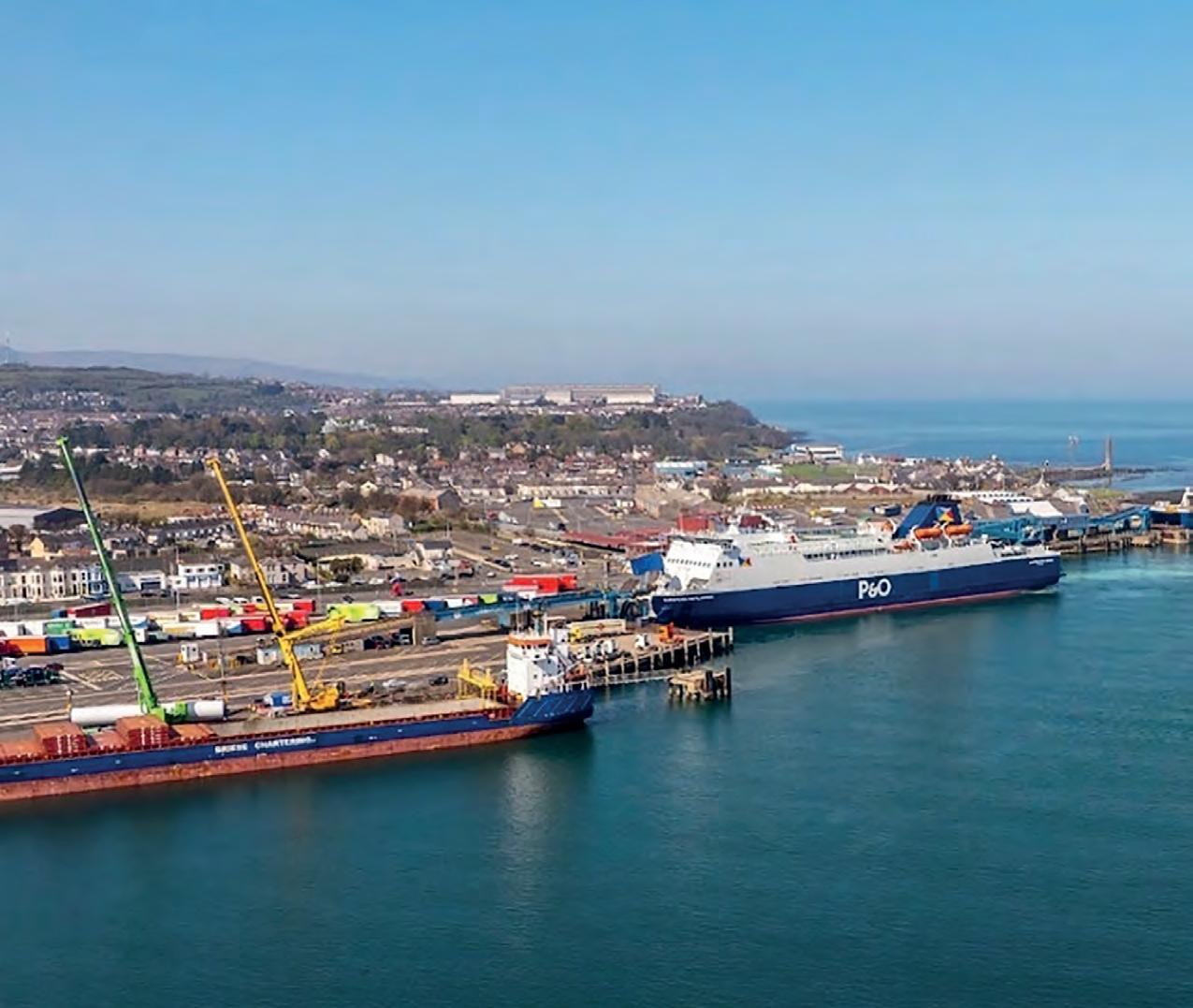

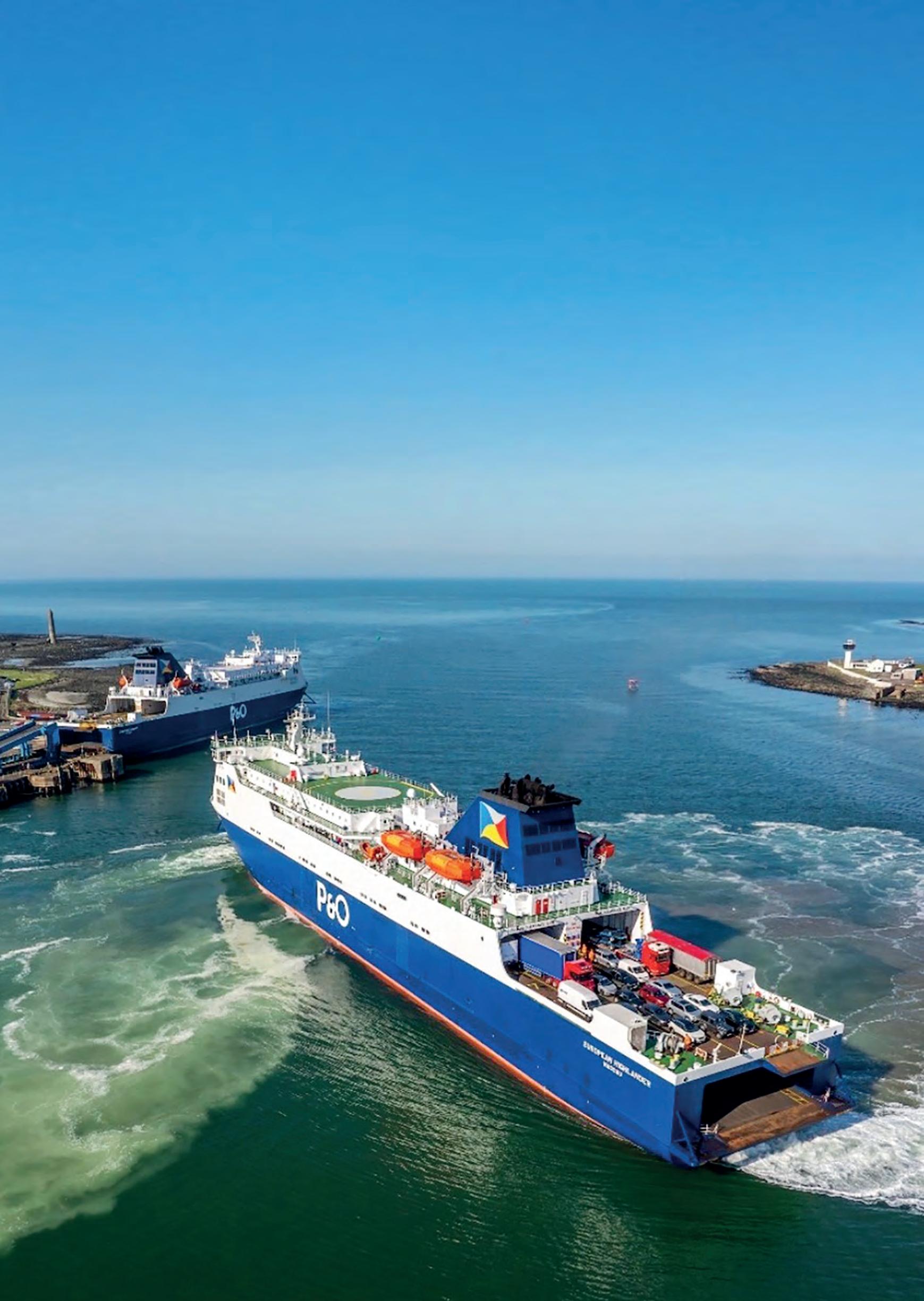
New All-Year-Round Isle of Man
Service from Mid-July 2026
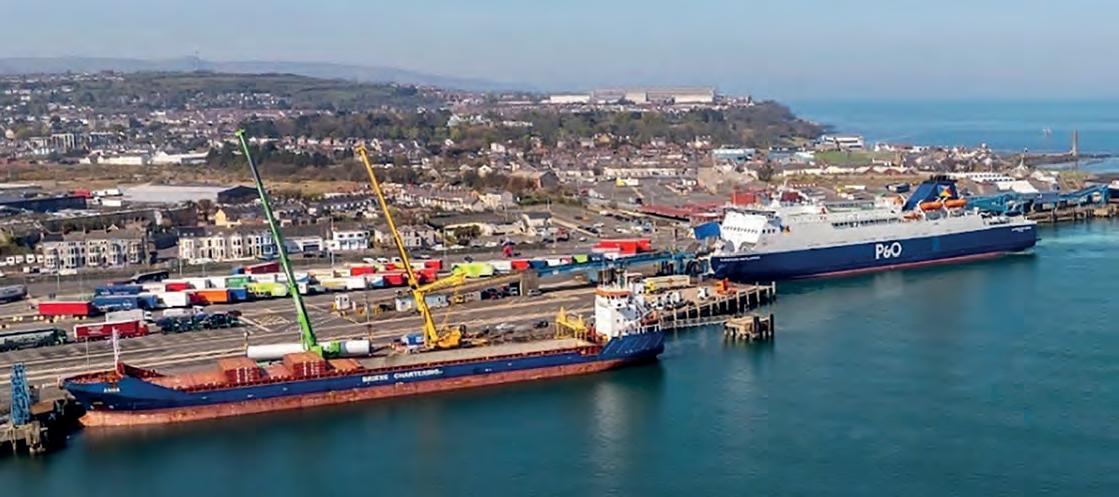
From mid-July 2026, Larne Port will further expand its Irish Sea connectivity with the introduction of a new all-year-round service to the Isle of Man. Operated by the Ben-my-Chree, the route will offer three sailings per week on Monday, Wednesday and Friday, providing a reliable link for both freight and passengers and strengthening trade and tourism links between Northern Ireland and the Isle of Man.
This new service complements Larne Port’s established highfrequency operations and reinforces its role as a key gateway for Irish Sea trade.
Located just 30 minutes from Belfast, and just two and a half hours from Dublin, Larne Port handles in the region of a quarter of a million commercial vehicles each year.
The Port’s most regularly visiting ships are P&O’s two powerful and reliable RoPax ferries – European Highlander and European Causeway – which operate across the North Channel every day of the week.
With the Larne to Cairnryan route being the shortest crossing to
Great Britain, at just two hours, it is clear why Larne continues to be popular with both freight operators and passengers alike.
The combination of the shortest crossing time and fast loading and discharge from these ‘drivethrough’ vessels means lorry drivers spend less time onboard, allowing both drivers and freight to get back on the road more quickly. By offering great value, convenient online booking and a wide selection of sailing times, it is not hard to see why P&O continues to maintain this vital trade route between Northern Ireland and Great Britain.
“We generally have six ferry arrivals and departures per day, which rises
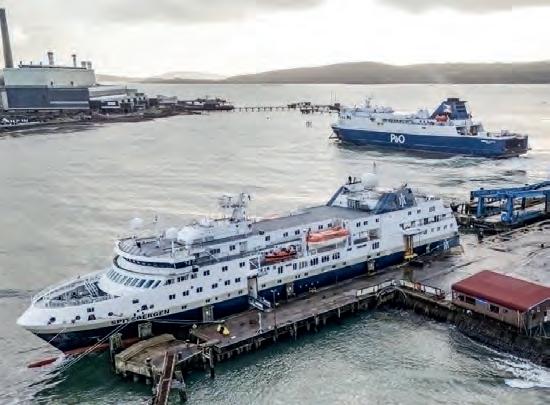
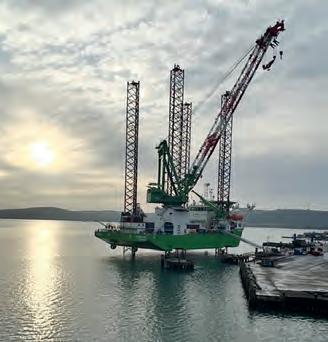
to seven crossings per day in the summer months,” explains Tom McKay, Harbour Master – Larne & Cairnryan. The two P&O RoPax ferries cater for both passengers and freight, with the capacity to carry up to 440 passengers per sailing, in addition to significant volumes of freight traffic. Currently, these vessels carry around 15 per cent of the goods coming in and out of Northern Ireland, including vital medicines and fresh food.
With approximately 40 acres of extensive trailer and vehicle parking, a trained workforce and a fleet of modern tugmasters, the port is fully equipped to handle unaccompanied traffic as well as driver-accompanied vehicles. Fast, efficient check-
in facilities and modern freight driver amenities continue to make Larne Port a popular choice with hauliers and drivers.
Having deep water, a range of quays and generous land availability, the port can also accommodate a wide variety of other vessels. “In the past year there has been a growing interest from the renewables industry, specifically wind farms, and we have handled a number of vessels carrying cargoes associated with this sector,” continued Tom McKay. The port is fast becoming an important hub for the import of wind farm components and for vessels undertaking maintenance work on the many offshore wind farms in the Irish Sea.
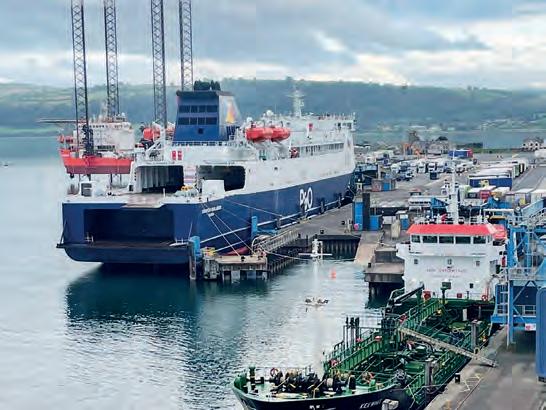
2025 was another record year for Stena Line freight volumes on its three Belfast services with growth of 1.0% increasing volumes to almost 600,000 freight units shipped from Belfast to Cairnryan, Liverpool (Birkenhead) and Heysham.
The record freight volumes were set in the year Stena Line marked 30th years of operations from Belfast Harbour following its move from Larne in 1995.
Demand for freight services to and from Belfast has been increasing steadily in recent years with the Belfast-Liverpool (Birkenhead) route in particular growing in popularity as evidenced by a record number of freight units being shipped, over 270 000.
Stena Line’s Belfast to Heysham 2025 freight service also recorded its highest volumes in the last 5 years. Stena Line anticipates further significant growth on this route in the year ahead with the introduction of the
newly built Stena Connecta on 23 January.
Stena Connecta will operate alongside sister ship Stena Futura which was launched onto the route in November 2025. Both ships will provide an additional 40% freight capacity when fully operational with a choice of 24 sailings per week.
Paul Grant, Stena Line Irish Sea North Trade Director, said: “The 2025 results underscore Belfast’s position as one of the most strategically important business hubs across the Stena Line network.
“These routes provide vital infrastructure linking NI and GB. Our Irish Sea business has been transformed over the last three
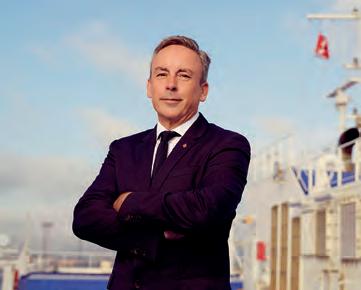
decades through a combination of fleet and port investments along with the continued support of our customers.
“It was fitting that we were able to name and launch a new purpose-built ship, Stena Futura in Belfast Harbour in our record 2025 year, and our 30th anniversary year in Belfast Harbour.
“Stena Line continues to have a positive outlook for its Belfast services which is why we are about to introduce a second purpose-built ship Stena Connecta on our Belfast-Heysham service.”
Belfast Harbour plays a pivotal role in the economy of Northern Ireland. 2025 was a very busy year for Belfast Harbour.
Roll-on/roll-off (RoRo) traffic, critical for freight trucks moving between GB and Ireland, set a new record with over 625,000 freight units. Grain and Feed reached an all-time high with 2.76m tonnes transported, liquid bulk was up 6% and steel up 11%.
To ensure its operations, and this growth, are sustainable Belfast Harbour recently unveiled a farreaching Draft Masterplan that sets out a clear strategic vision for the port’s development from 2025 to 2050.
Designed to guide investment, infrastructure delivery and community engagement over the next quarter-century the plan positions Northern Ireland’s principal maritime gateway at the heart of future economic growth, logistics resilience and environmental leadership. Handling around 70 per cent of Northern Ireland’s seaborne trade, Belfast Harbour already plays a pivotal role in the regional economy. Each year, the port manages goods valued at £26.7 billion, supports approximately 155,000 jobs and provides a base for major
employers, logistics operators and visitor attractions. With independent forecasts predicting trade volumes could rise from 24 million tonnes today to more than 40 million tonnes by 2050, the Masterplan sets out how the port intends to expand capacity while maintaining efficiency, sustainability and community integration.
Central to the strategy is the ambition for Belfast Harbour to become the leading port on the Dublin–Belfast Economic Corridor by 2050. Operating as a Trust Port, Belfast Harbour reinvests profits into infrastructure, regeneration and community projects, enabling a long-term approach to development. This model has already delivered more than £374 million of investment over the past 25 years, including major schemes such as the £130 million City Quays regeneration, which has transformed both port operations and the city waterfront. Sustainability is embedded throughout the Masterplan.
Belfast Harbour is targeting net zero emissions across its own operations by 2030, supported by investment in low-carbon buildings, shore power connections, clean energy infrastructure and enhanced biodiversity.
The Draft Masterplan has been shaped through extensive early engagement with stakeholders, including industry partners, government bodies, community
groups and residents
To deliver its long-term ambitions, the Masterplan adopts a threehorizon framework, providing a structured roadmap for investment and development.
Horizon 1 (2025–2029) focuses on strengthening existing infrastructure and preparing the port for sustained growth. A flagship project is the £90 million dual-purpose deepwater quay (D3), designed to accommodate both cruise vessels and offshore wind installation ships, reflecting the port’s dual focus on tourism and renewable energy. Additional investments include upgrades to RoRo facilities and crane infrastructure to handle larger, cleaner vessels, alongside new warehousing and distribution space to support modern logistics operations.
This phase also includes a Maritime Skills Academy will be established to support workforce development in logistics, port operations and clean energy, ensuring local talent is equipped for future roles.
Horizon 2 (2030–2040) represents a step-change in scale, with strategic investments to expand capacity and accelerate decarbonisation. Redevelopment of Stormont Wharf and Victoria Terminal 3 will allow the port to handle larger vessels and diversify trade flows, while expanded logistics warehousing will strengthen regional supply chains. Shore power infrastructure
will be rolled out across the estate, enabling vessels to reduce emissions while alongside. Horizon 3 (2040–2050) looks to long-term transformation, including plans for a new terminal created through land reclamation to support rising freight demand. The development of a Clean Energy Hub will position Belfast as a centre for offshore wind and lower-carbon fuels, while flexible redevelopment of port lands will provide new mixed-use neighbourhoods. Climate resilience and adaptive design will be embedded across all projects to future-proof infrastructure against environmental and economic change.
While many early-stage developments will be funded through retained profits, Belfast Harbour acknowledges that longer-term ambitions may require new funding models. Reclassification of Northern Ireland Trust Ports is seen as key to unlocking additional investment, particularly to support housing and large-scale infrastructure. Together, these plans present a compelling blueprint for the future of Belfast Harbour. By combining logistics expansion, clean energy investment, skills development and urban regeneration, the Masterplan sets out a balanced, forward-looking strategy designed to secure the port’s role as a vital economic engine for Northern Ireland for generations to come.
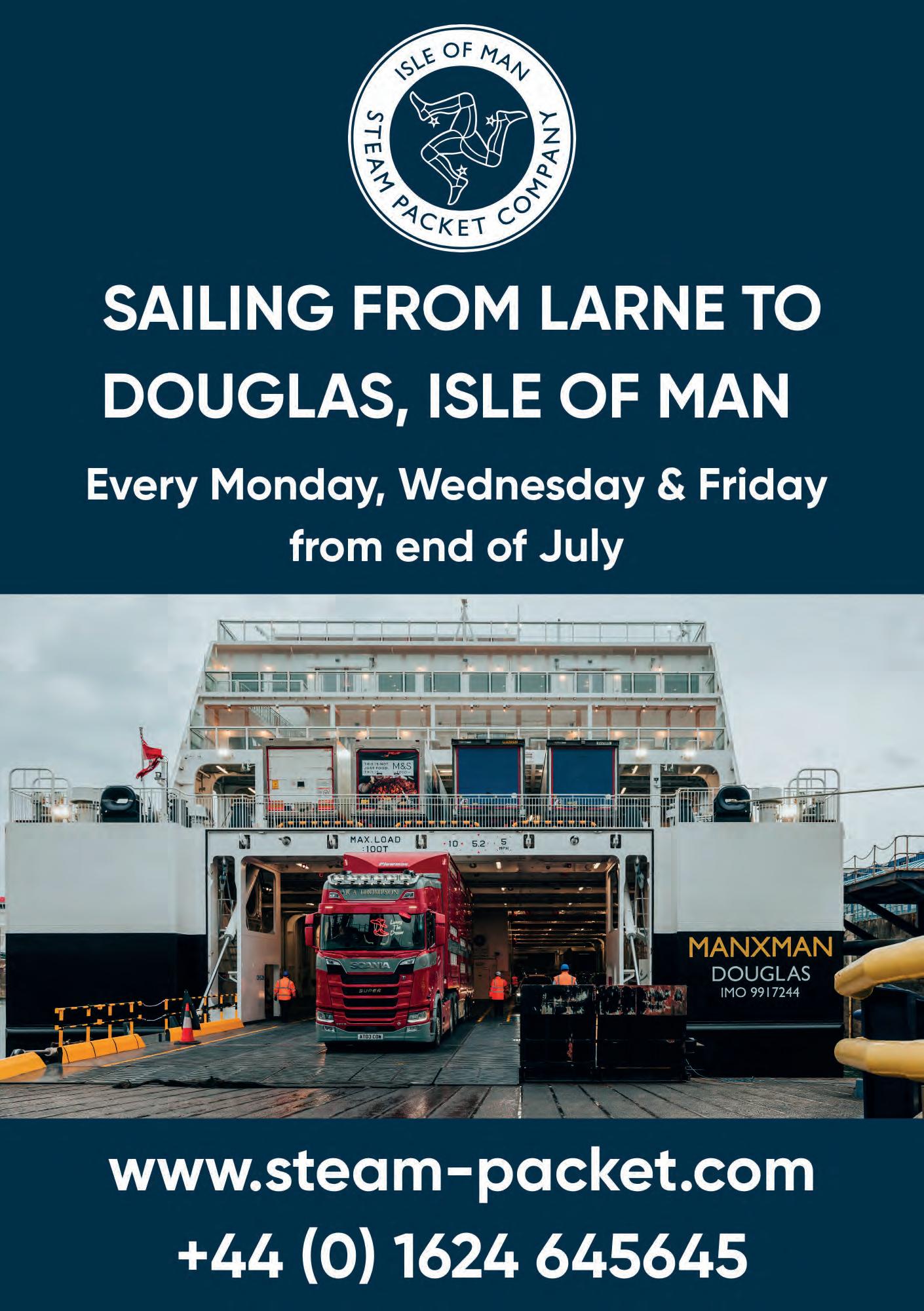
In 2025 the IOMSPC carried over 470,000 freight lane meters and close to 5,500 trade vehicles.
The Isle of Man Steam Packet company (IOMSPC) is proud of its almost 200-year history of assisting Isle of Man businesses and customers to import and export their goods and services between the UK and Ireland. The company is the lifeline for the Island, importing all essential freight which its 90,000 population requires and in 2025 the IOMSPC carried over 470, 000 freight HGV meters of foodstuffs, medical supplies, mail & parcels, building supplies, animal feed and almost 5, 500 trade vehicles.
The company is committed to this lifeline and has invested heavily in its fleet of vessels including the recent addition of its flagship ‘Manxman’. Putting our customers first and creating a greener environment is how we operate and Manxman was designed to accommodate all our customers. With increased deck space, modern onboard facilities, and the ability to carry trailers of all types on all decks it been a very welcome addition for our freight
customers shipping goods to the UK.
Our new year-round services from Larne to the Island commence in late July and will see services operate on Monday, Wednesday, and Fridays. These services will be operated by our vessel the Ben-my-Chree which until 2023 was our flagship for 20 years. It will undergo a major refit in June / July before entering service for both freight and passenger traffic on the Larne to Isle of Man route.
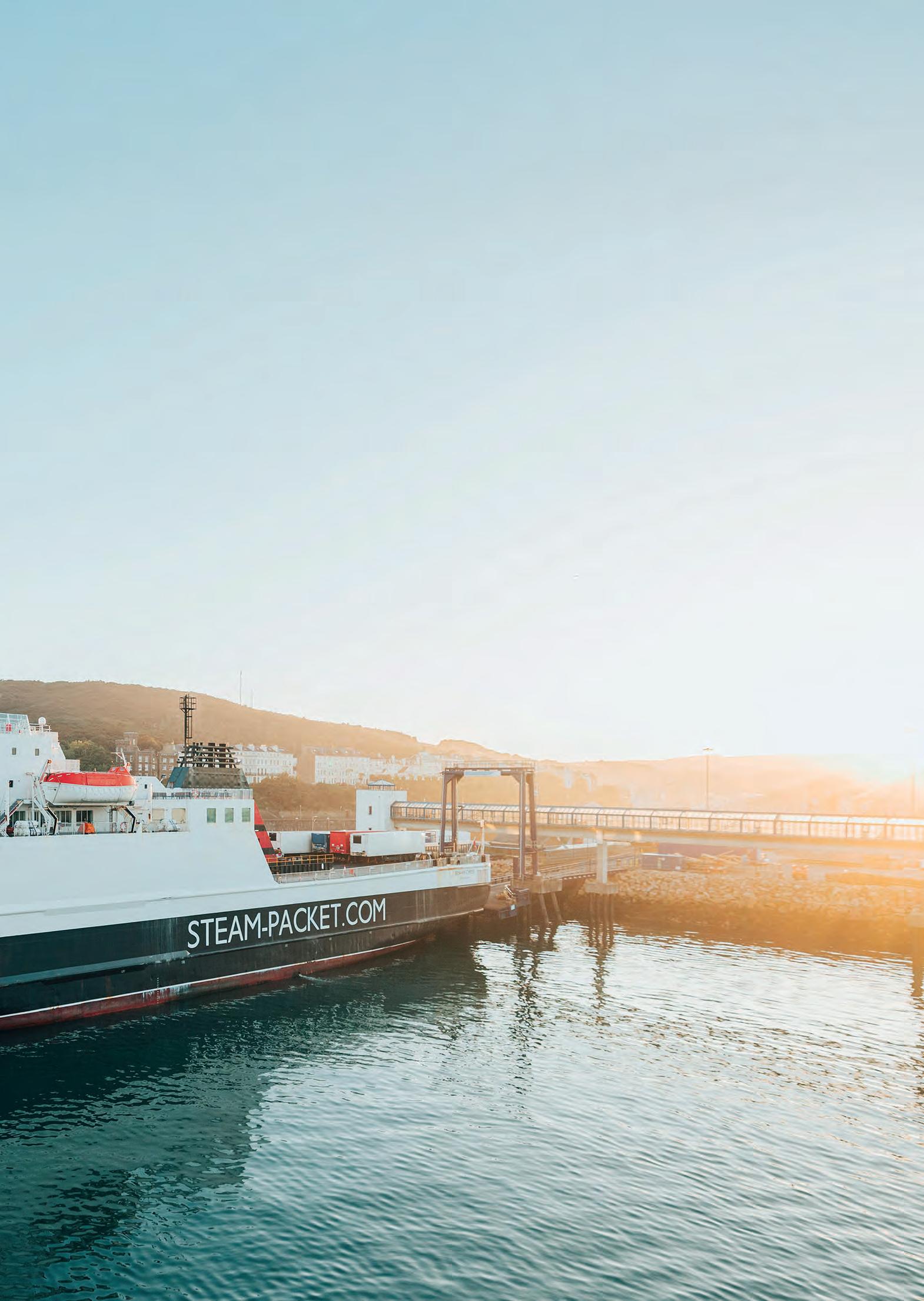
The Head of Operations for IOMSPC Mr James Royston has welcomed the new services and states that ‘a frequent and reliable service between the Isle of Man and Larne Port will help to improve connectivity for all our customers and open many freight opportunities to new and existing Irish customers’. The BMC can accommodate up to 500 passengers and has previously shipped up to 500 metres of freight per sailing.
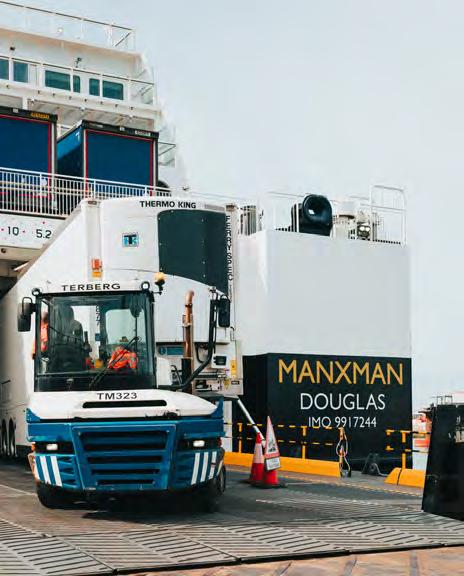
As the leading regional gateway for trade into and out of Northern Ireland the importance of Belfast Harbour cannot be overstated. And, reflecting the overall growth in the economy Belfast Harbour had a very successful 2025.
Trade through Belfast Harbour pushed up towards record levels in 2025, driven by across the board increases in goods transported by all shipping modes. Releasing its annual trade figures, Belfast Harbour today reported that 24.3 million tonnes of goods passed through the Trust Port in 2025, up from 24.1 million tonnes the year before.
Belfast Harbour is the leading regional gateway for trade, handling more than 70% of the Northern Ireland’s seaborne imports and exports and 25% of sea trade for the island of Ireland. Each year, the port handles goods and freight valued at £26.7bn, enabling more than 15% of Northern Ireland’s economic output.
2025 was a strong year for the shipping of commodities in and out of Belfast, with grain and animal feeds reaching record levels of 2.76 million tonnes, surpassing last year’s previous record figure of 2.46 million tonnes and indicating the continued strength of the region’s farming and agrifood sector.
It was also a strong year for liquid bulk commodities, with volumes of refined oils including petrol and diesel up 6% on the year before, while break bulk volumes were also robust, with steel up
11% to 200,000 tonnes.
2025 was also a record year for Roll-On Roll-Off (RoRo) freight traffic delivered by Belfast Harbour’s partner, ferry operator Stena Line, with 625,000 freight equivalent units comprising of HGVs, smaller commercial vehicles and cars for the motor trade, passing through the port. This surpassed the previous record performance of 618,000 delivered in 2024.
The figures demonstrate the importance of Stena Line’s freight traffic routes to Scotland and England to the local economy, with numbers expected to increase as the operator introduces its new larger vessels on Belfast routes.
Container traffic saw a positive performance, ending the year up 1% on the previous year with 124,118 units handled – a second consecutive year-on-year increase. Meanwhile, agri-food exports remain a vital part of Northern Ireland’s trading strength, relying on fast, reliable connections to key GB markets to maintain supply chains and support continued growth across the sector.
Michael Robinson, Belfast Harbour’s Port Director, said: “The results for 2025 show that the Port community is continuing to do a great job transporting people
and delivering the goods and services that we all rely on, not only in business and industry, but in all aspects of our daily lives.
“Trade through Belfast Harbour has once again been resilient in the face of local and global headwinds and we were proud to keep supporting essential industries such as agrifood throughout the year. We continue to invest in our Port facilities and will this year unveil our 20252050 Masterplan, which contains plans for major port expansion and upgrades that will further increase our port trade capacity.
“While we remain vigilant to the challenges facing the economy, we are encouraged by this strong performance across all categories, which once again demonstrates the important role Belfast Harbour plays in keeping the local economy moving.”
Paul Grant, Trade Director Irish Sea North, Stena Line said: “Stena Line’s routes from Belfast Harbour continue to be some of the most successful across our network, and we’re delighted to have once again hit a record number of freight units passing through the city. With the recent arrival of our two new freight vessels for our Belfast – Heysham service, Stena Futura and Stena Connecta, we expect that this growth will
continue with increased capacity to meet continued high demand.”
Claudine Heron, Agri Division CEO, W&R Barnett, said: “The Agrifeed market continued to show strong demand throughout 2025, and the reliability and efficiency of operations at Belfast Harbour have been central to supporting that growth. The longterm commitments set out in the Belfast Harbour 2050 Masterplan provide confidence that the port will continue to invest in the modern, sustainable infrastructure needed to keep supply chains resilient and competitive, particularly for our Agri customer base. For businesses like ours, this forwardlooking approach is essential to enabling productivity, supporting future expansion and contributing to wider economic prosperity across Northern Ireland.”
Michael Bell OBE, Executive Director, Northern Ireland Food and Drink Association said: “Increased trade across the Irish Sea demonstrates both the strength of the Northern Ireland food and drink industry, and the importance of our region to UK food security. Locally our industry supports some 113,000 jobs across the supply chain and feeds 10 million people across the UK. With a growing world population and heightened geopolitical uncertainty, our strategic role in feeding the nation has never been more important, and the seamless movement of goods between Great Britain and Northern Ireland is key to fulfilling that mission.”
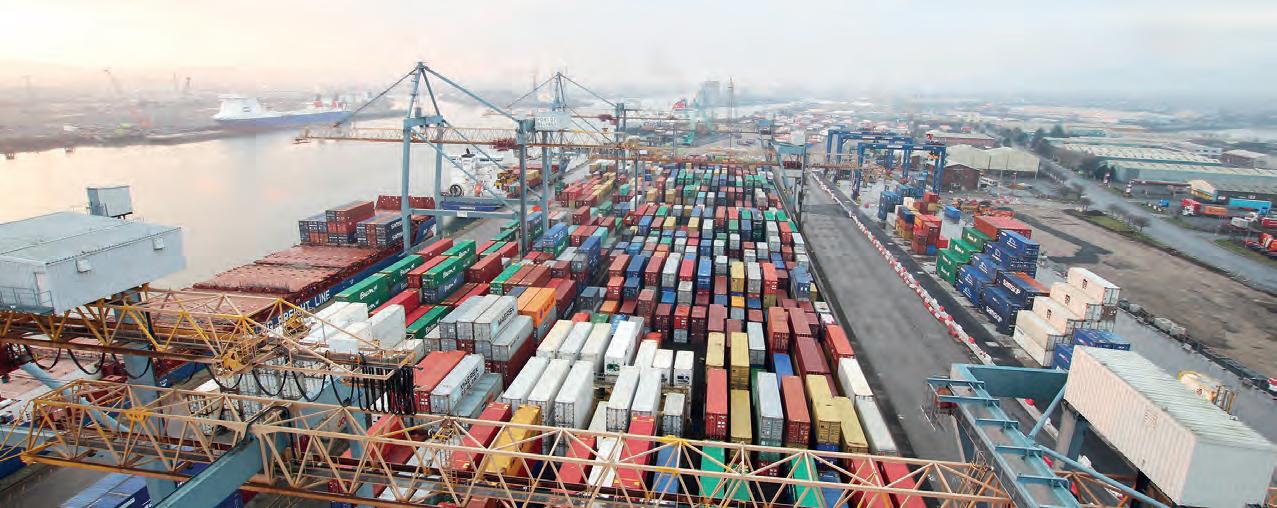
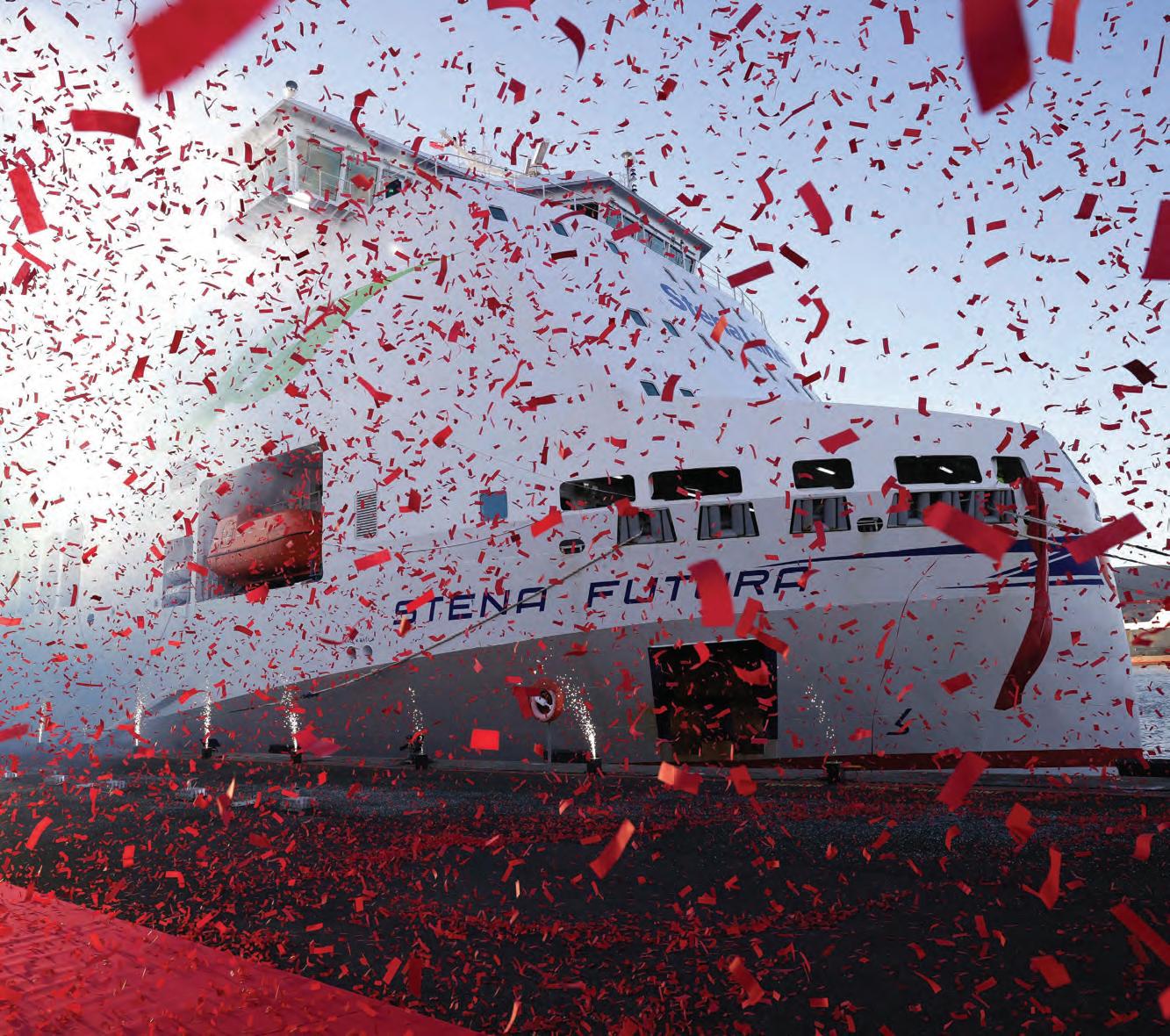
Belfast Harbour has welcomed Stena Line’s two new vessels, Stena Futura and Stena Connecta, onto the Belfast-Heysham route providing 40% additional capacity on this vital corridor.
Working with our partners, we’re continuing to invest in our port infrastructure, strengthen the region’s supply chains and support long-term economic growth.
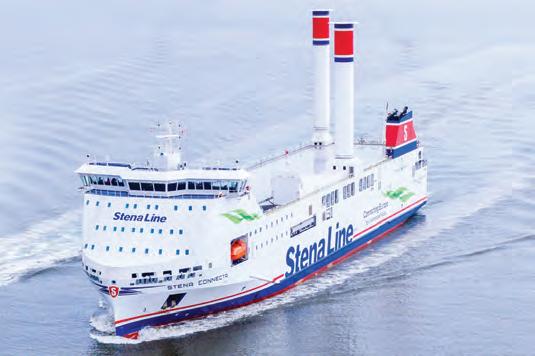
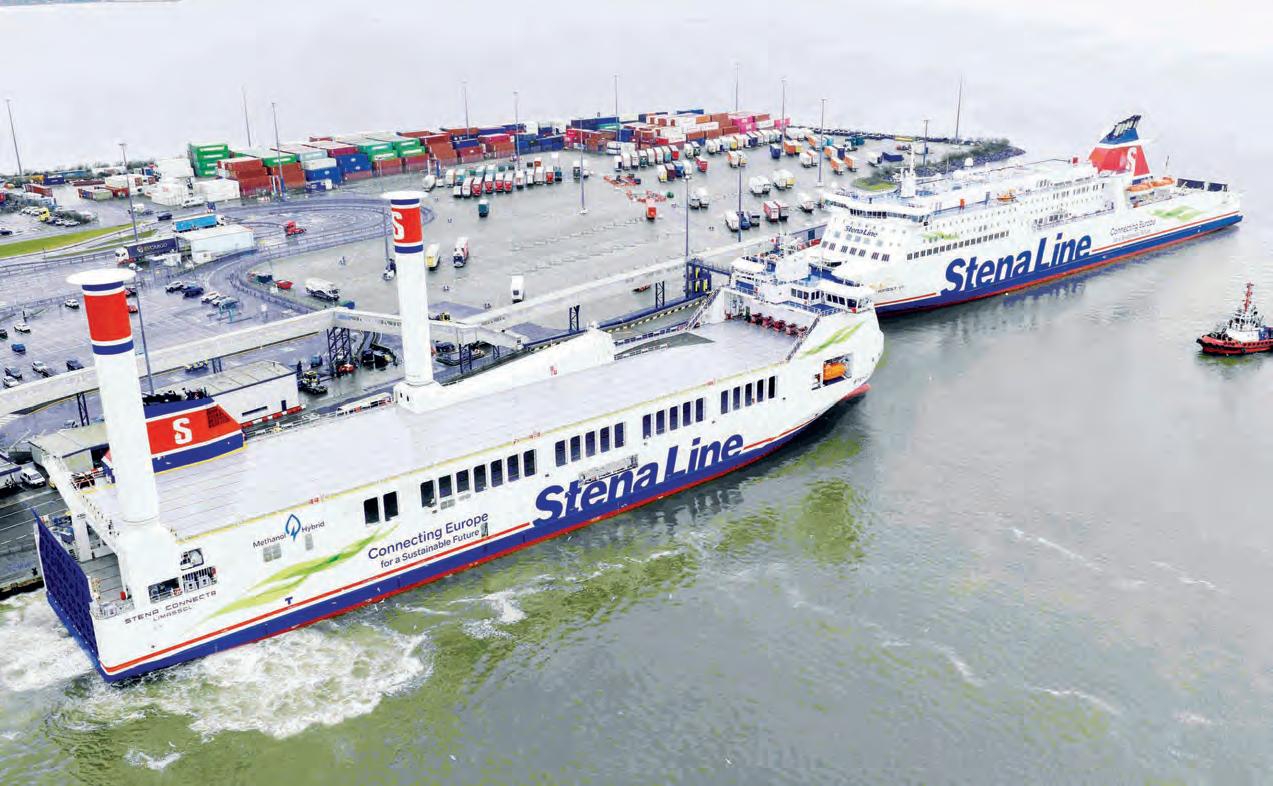
New Max RoRo ship fitted with Norsepower Rotor Sails™, designed to enhance energy efficiency by generating thrust from the wind.
Stena Connecta, the latest purpose-built freight vessel commissioned by Stena Line for the Irish Sea arrived in Belfast Harbour on 19th January after sailing for 60 days from the Chinese shipyard where it was built. The new hybrid ferry, instantly identifiable
by its two 28m tall rotor sails, went into commercial service on the BelfastHeysham route on 23rd January 2026.
The ship joins its sister vessel Stena Futura, which went into service on the BelfastHeysham service in October 2025. Together
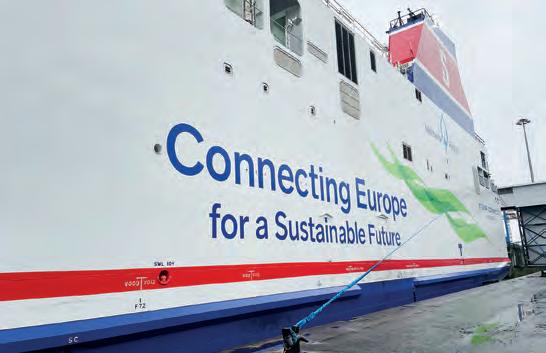
they offer an additional 40% freight capacity on the increasing popular trade route between Northern Ireland and Britain.
Stena Connecta, like Stena Futura, is a ‘New Max’ RoRo ship built for maximised freight capacity, with 2,848 lane metres across its 147-metre length. It is powered by a multihybrid propulsion system enabling the use of battery power, biofuel, and methanol.
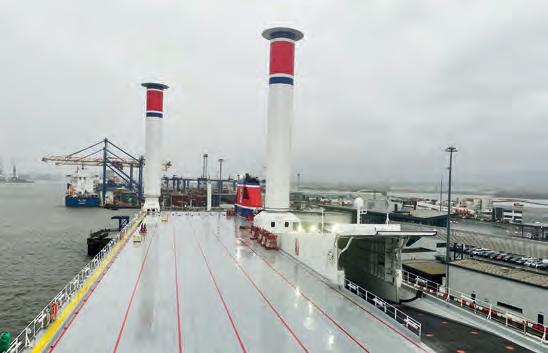
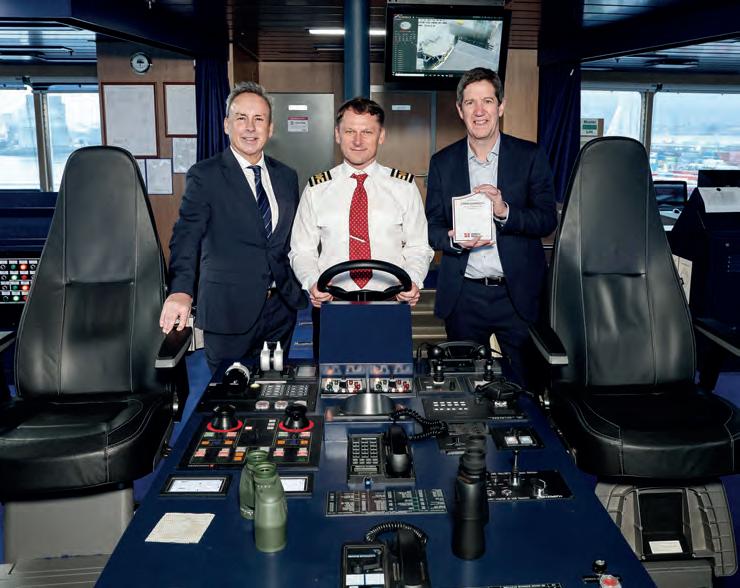
The Stena Connecta also has two 28m x 4m Norsepower Rotor Sails™, designed to enhance energy efficiency by generating thrust from the wind. These rotor sails have the ability to deliver up to 9% fuel savings on its Irish Sea route between Belfast and Heysham.
Paul Grant, Stena Line Irish Sea North Trade Director, said: “Our significant investment in Stena Connecta and Stena Futura demonstrates our strong confidence in the continued growth of the Irish Sea region and our commitment to strengthening trade and connectivity links.
“The Stena Connecta is the fourth new ship we have brought into service since 2020, which amounts to half a billion pound investment including here in Belfast and the whole infrastructure between here and Great Britain.
Talking about the Connecta being fitted with these innovative Norsepower rotor sails, Mr Grant said, “We will be able to make a comparison between the Connecta and her sister ship (Futura) in terms of how much fuel these ships are able to conserve. These ships are built for the future being able to run on methanol and to run on batteries – and the Stena Futura is ready for rotor sail installation.
With these two new ships (Stena Futura and Stena Connecta) we will add 40% capacity on the Belfast Heysham route.
Mr Grant explained last year was a record year for Stena Line with the company moving nearly 600,000 freight units.
“In 2025 our Heysham - Belfast freight service recorded its highest volumes in the last 5 years with 113,000 units being shipped. These vessels were commissioned in response to customer demand for increased freight capacity on this route.
Paul Grant added: “When operational both vessels will offer a choice of up to 24 sailings per week on the increasingly popular Belfast-Heysham service. We are particularly pleased to introduce two of
Stena Line’s most advanced vessels to the Irish Sea region further enhancing Belfast’s significance as a key network business hub.
“These vessels represent the very latest in maritime technology and will not only play a crucial role in maintaining essential transport links in Ireland and the UK but also make a significant contribution to our sustainability goals of reducing CO2 emissions by 30 percent by 2030.”
Stena Line now carries 68% of all the freight between Northern Ireland and Great Britain on their three routes.
Heikki Pöntynen, CEO of Norsepower, commented: “Stena Connecta is a strong example of how forward-looking vessel design can combine operational efficiency with tangible emissions reductions. By integrating Norsepower Rotor Sails™ alongside hybrid propulsion and alternative fuel readiness, Stena Line is demonstrating a practical, data-driven approach to decarbonising short-sea shipping.
We are proud to support Stena Line and Stena RoRo in bringing scalable wind propulsion into everyday commercial operation on the Irish Sea.”
Jukka Kuuskosi, Chief Customer Operations Officer at Norsepower, who was there to welcome the Stena Connecta to Belfast, explained that Norsepower have already installed 40 rotor sails on 22 different ships across the world – and they have a further 44 units in the delivery process.
He explained that the rotor sails use an electric motor to generate thrust for the ship when interacting with the wind and spinning.
“It’s a common misconception that these are turbines to generate electrical power. The rotor sail uses some power from the ship for the electrical motor, which makes the rotor spin, and through wind meeting the spinning surface thrust is created, which will help the ship reduce propulsion power therefore reducing fuel consumption and emissions.”
And the Belfast – Heysham route is particularly suitable for rotor sails, as it is often very windy! Michael Robinson, Port Director at Belfast
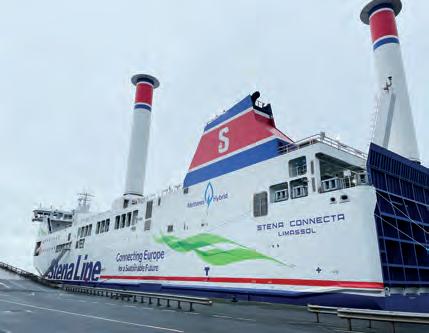
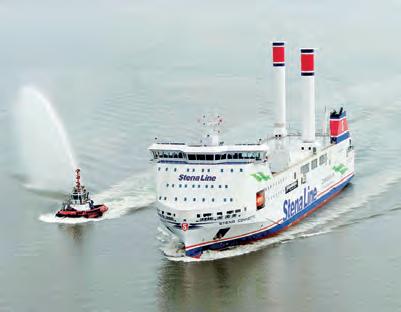
Harbour, said: “We’re excited to welcome the second of Stena Line’s new hybrid vessels, Stena Connecta, to Belfast Harbour. Coming so soon after last year’s celebration of 30 years of Stena Line in Belfast and the launch of sister ship Stena Futura, this arrival underlines the strength of our partnership, which is essential for connecting people and transporting the goods we all rely on. Together with Stena Line, we’re connecting the island more reliably than ever and delivering longterm economic benefits for businesses across Northern Ireland.”
Stena Line is the largest ferry operator on the Irish Sea, with the biggest fleet providing up to 242 weekly sailings offering the widest choice of routes including: combined passenger and freight services from Belfast to Cairnryan and Liverpool, Dublin to Holyhead, Rosslare to Fishguard, in addition to the dedicated freight only routes from Belfast to Heysham and Dublin - Liverpool.
Length: 147 m
Beam: 26.3 m
Built: 2023–2025, CMI
Shipyard, Weihai, China
Passenger capacity: 12
Crew: 26
Height clearance: 5.3 m
Width clearance: 12 m
Freight capacity: 2,848 lane metres
Route: Belfast – Heysham (approx. 12 sailings per week)
To coincide with the recent Northern Ireland National Apprenticeship Week, one local South West College (SWC) student is showcasing exceptional talent and dedication. Adam Kee, a Level 3 Light Vehicle Repair apprentice at Omagh campus and former pupil of Omagh High School, has been named a finalist for the prestigious NI Apprentice of the Year 2026.
Representing SWC and his employer, Baxter Prestige Tempo, Adam’s journey from the classroom to the workshop has been defined by more than just mechanical skill. Diagnosed with Autism, Adam has used his unique perspective to identify a gap in how automotive concepts are taught to students with additional learning needs in the workshop and classroom setting.
Working in close collaboration with his lecturer Paul O’Loughlin, the SEN-SE Development Project Manager Deirdre McElholm, and Technical Consultant Diarmuid Kelly from InnoTech, Adam has spearheaded the development of a pioneering range of 3D-printed learning tools. These tools—highly detailed recreations of car components, including gearboxes and engine setups— utilise specific colors and textures to provide a unique tactile, visual learning experience.
“We are incredibly proud of Adam’s achievements,” says the college team.
“By turning his own experiences into a resource for others, he isn’t just learning the trade—he’s helping to redefine it for future generations of neurodivergent mechanics.”
Adam’s work highlights the 2026 Apprenticeship Week theme, “Invest in Talent – Your Future Business.” By fostering an environment where apprentices are encouraged to innovate, employers are seeing first-hand how diverse thinking leads to practical, industry-leading solutions.
The winners of the Northern Ireland Apprenticeship Awards will be announced at a gala ceremony on Wednesday, March 25, 2026, at the Titanic Hotel, Belfast. Regardless of the final result, Adam has already secured his place as a leader in Northern Ireland’s automotive future.
For more information, or to apply for an apprenticeship or Higher Level Apprenticeship, visit www.swc.ac.uk and search ‘apprenticeship’.
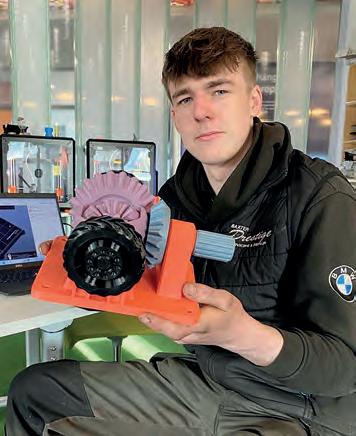
Apprenticeships and technical training hold the key to driving economic growth and there needs to be a shift in values to reward technical mastery as much as academic qualifications, according to business group Logistics UK.
Speaking during National Apprenticeship Week, Head of Skills Policy Bethany Windsor called for apprenticeships and training to be more closely aligned with labour market needs and highlighted the financial benefits of apprenticeships: in many cases, higher level apprentices can earn almost £5,000 more than an average graduate five years after completing their courses*.
“There is a pool of untapped talent of almost one million 16-to-24-year-olds who are not in education, employment or training and, at the same time, there are some 213,000 job vacancies that are attributed to skills shortages*,” said Windsor. “It is a massive, missed opportunity and indicative of an education system that has historically prioritised academic achievement
over technical pathways, rather than ensuring both are equally valued in preparing young people for the highly skilled careers that drive economic prosperity.
“Apprenticeships offer employees hands-on experience, sectorspecific skills and professional training – all while earning a salary. And the financial rewards continue: five years after qualifying, higher level apprentices earn £37,300, on average, compared to £32,100 for the average university graduate after the same period.
In many cases, young people are encouraged to pursue degrees that may not match their talents and interests or align with current economic demand.
Currently, 37 per cent of graduates are over-qualified for
their jobs and 41 per cent work outside of their field of study*.
While university education has clear and lasting value, there must also be a sharper focus on training the workforce for the jobs the country needs to thrive and drive growth. The UK needs both world-class universities and world-class technical training if it is to compete globally.
“Logistics UK supports the government’s plans to replace the Apprenticeship Levy with a Growth and Skills Levy, as this will provide employers with greater flexibility and allow up to 50% of funds to be invested in high-quality, nonapprenticeship training that meets immediate workforce needs. Skills England must now move quickly to approve a broader range of sector-relevant courses eligible for levy funding, ensuring the
skills system responds directly to the labour shortages across the economy. The reformed levy should also back national careers awareness initiatives such as Generation Logistics, which are critical to attracting new talent into essential sectors.”
Logistics UK is committed to nurturing the next generation in the sector and, as a specialist, government-approved apprenticeship provider, it offers industry-focused apprenticeship programmes that meet the business needs of the logistics sector.
Developed by logistics professionals, Logistics UK’s apprenticeships range from Level 2 Traffic Coordinators to Level 5 Operations Managers and are designed to strengthen capability, build confidence, and develop strategic thinking across the workforce. For more information on Logistics UK’s apprenticeships visit: Logistics UK Apprenticeships


Customs agents and freight forwarders form the backbone of international supply chains, ensuring goods move efficiently, compliantly and on time across increasingly complex borders.
From the ongoing impact of Brexit and the Windsor Framework to the phased implementation of systems such as ICS2 and the EU’s Carbon Border Adjustment Mechanism (CBAM), businesses are facing a regulatory landscape that demands expert navigation. Customs agents and freight forwarders are no longer seen simply as service providers, but as strategic partners, helping companies mitigate risk, maintain compliance and protect commercial continuity. Beyond documentation and declarations, today’s
leading operators deliver integrated solutions that combine customs clearance, transport management, warehousing, digital tracking and supply chain consultancy. Investment in technology, data analytics and staff training is enabling greater visibility, faster processing and enhanced resilience, even as border controls tighten and customer expectations rise. At the same time, sustainability and decarbonisation are reshaping logistics strategies, with forwarders playing a central role in optimising routes, consolidating
shipments and advising on lower-carbon transport options. In this fast-changing environment, agility, expertise and proactive communication are key differentiators. Both customs agents and freight forwarders are interconnected, as seamless customs processing is crucial for timely deliveries. Any delays in clearance can lead to storage fees, demurrage, and disruptions in supply chains. Businesses rely on experienced professionals to navigate complex global trade regulations, ensuring compliance and efficient movement of goods.
In today’s fast-moving global economy, where supply chains are under constant pressure and regulatory frameworks continue to evolve, efficient customs clearance has never been more critical. At the forefront of this complex landscape stands Doyle Shipping Group (DSG), a company widely recognised for delivering dependable, intelligent and responsive customs solutions that keep international trade flowing smoothly.
With decades of experience and a strong operational footprint across key trading corridors, DSG has built a reputation as a trusted partner for businesses navigating the intricacies of cross-border trade. Its mission is simple yet vital: to remove friction from customs processes, enabling clients to move goods efficiently, compliantly and with confidence. At the core of DSG’s service offering is a highly skilled team of customs clearance specialists, strategically positioned across regional offices to provide hands-on support. These experts guide clients through every stage of the import and export process, managing consignments seamlessly while navigating the complexities of the Automated Export Processing (AEP) system. The result is a streamlined clearance experience that minimises delays, reduces administrative burdens and ensures cargo reaches its destination on time.
Regulatory compliance sits at the heart of DSG’s operational ethos. In an environment shaped by Brexit, heightened security requirements and constantly changing trade rules, staying ahead of legislation is
essential. DSG’s team of seasoned professionals continuously monitors developments across international trade policy, offering proactive guidance and practical solutions. This expertise spans a wide range of essential services, including Brexit support, ENS safety and security declarations, Pre-Boarding Notifications (PBNs), Goods Movement References (GMRs), TRACES documentation for veterinary and sanitary controls, T2L documentation for intra-EU trade, and NCTS transit procedures. Technology plays a pivotal role in DSG’s commitment to efficiency and transparency. By investing in advanced customs management systems, the company provides clients with real-time visibility of cargo movements, enabling informed decision-making and improved supply chain planning. This digital capability not only enhances operational performance but also strengthens resilience, helping businesses adapt quickly to changing market conditions.
Security is another cornerstone of DSG’s approach. In an era marked
by geopolitical uncertainty and evolving risk profiles, the integrity of supply chains is paramount. DSG implements robust security protocols, backed by extensive industry experience, to safeguard cargo and ensure full compliance with international safety standards. This proactive stance significantly reduces exposure to risk while reinforcing confidence across the logistics chain. What truly sets DSG apart, however, is its unwavering focus on customer service. Every client relationship is built on collaboration, understanding and responsiveness. By taking the time to appreciate each customer’s specific challenges, DSG delivers tailored solutions that add tangible value. This client-first philosophy has fostered long-term partnerships across a diverse range of industries, reinforcing the company’s standing as a dependable and adaptable customs partner. The wider impact of effective customs services cannot be overstated. Beyond facilitating trade, they underpin economic
growth, enhance competitiveness and support global prosperity.
In this context, DSG plays a vital role, enabling businesses to operate efficiently across borders and contributing to the smooth functioning of international commerce.
As global trade continues to evolve, the demands placed on customs providers will only intensify. Doyle Shipping Group’s continued investment in expertise, technology and customer service ensures it remains well placed to meet these challenges head-on. Through its commitment to excellence, DSG continues to shape best practice in customs operations- setting the benchmark for reliability, compliance and service quality in an increasingly complex world.
Tel: +44 (0) 2890755881
Email: customs@dsg.uk

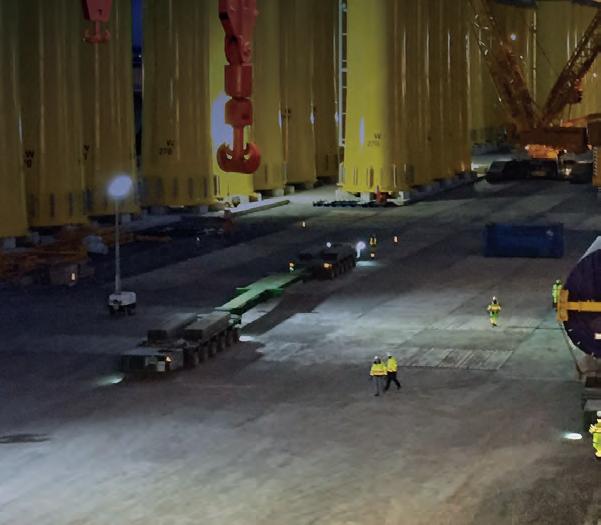
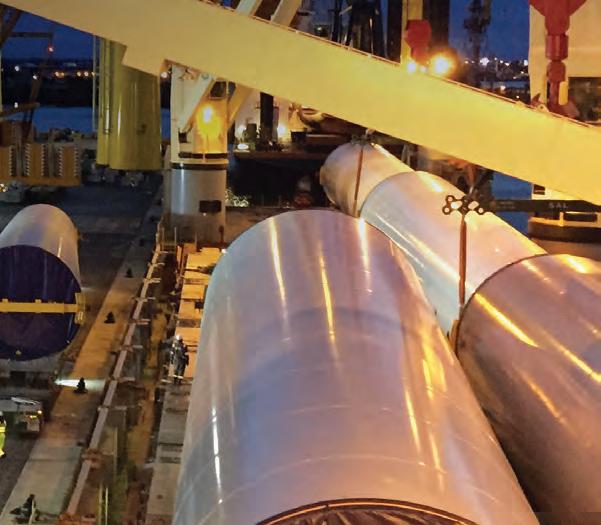


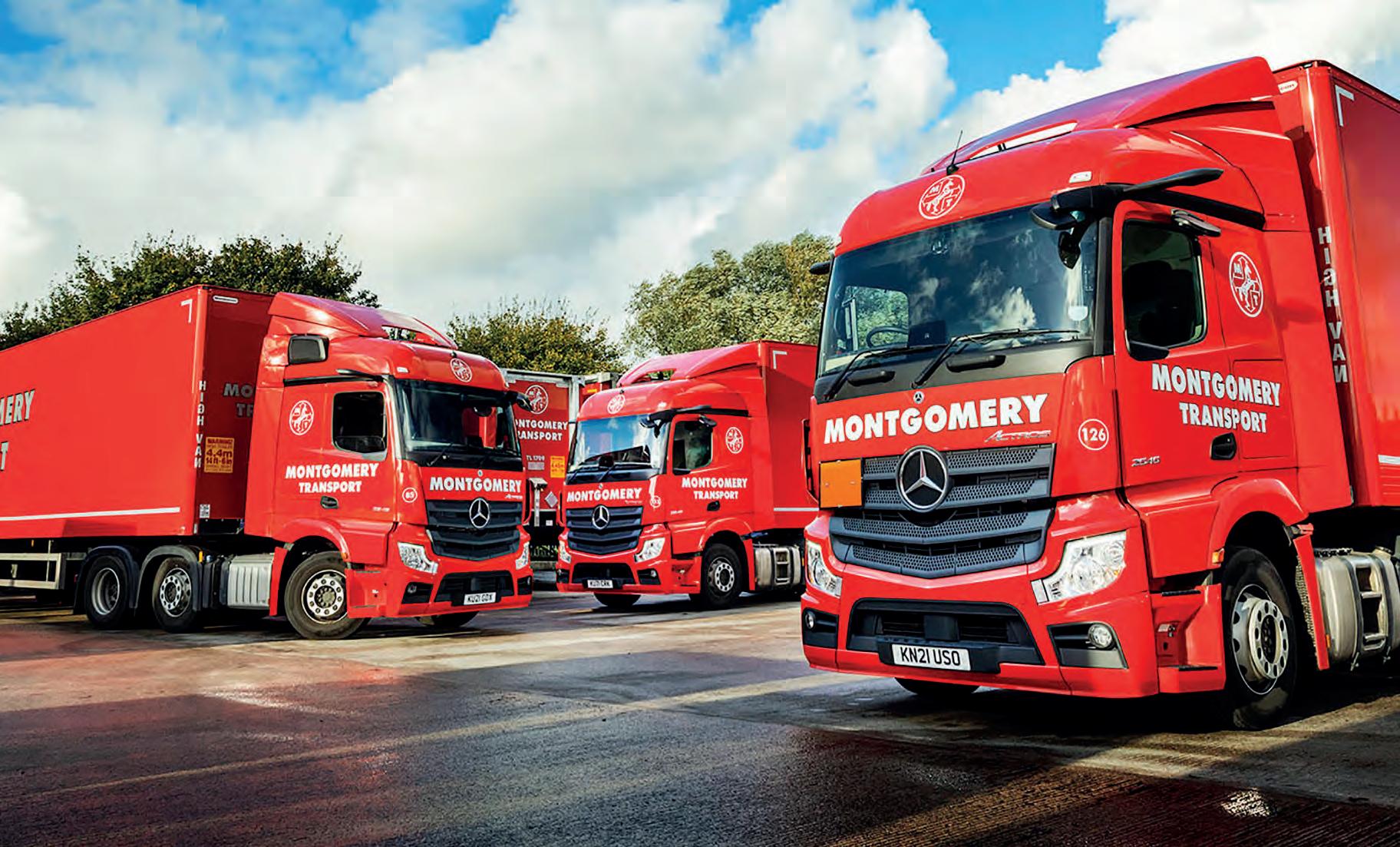
Policy discussion is no longer abstract. Measures such as CBAM, ICS2 and the Windsor Framework are operational realities that determine whether goods move smoothly, are delayed, or fail to move at all.
Montgomery Transport Group was named ‘National and International Haulier of the Year’ - not simply for managing the complexities of logistics but for the calm, consistent execution they deliver every day,
“Our starting point is simple: customs is not an add-on to transport, it is a core operational function. Treat it lightly and the supply chain pays the price later.
For many businesses, customs still feels risky, opaque and time-consuming. That perception is understandable when guidance shifts, liability falls on the leastprepared party, and clarity often lags behind consignments. Montgomery Transport Group’s proactive customs team removes that uncertainty by translating regulation into practical, workable border processes.
“We manage declarations, classifications and documentation in full, ensuring compliance is built in from the outset.”
“Accuracy matters. So does early risk identification and intervention when something does not stack up. Just as importantly, it means being honest. If a movement cannot be cleared compliantly,
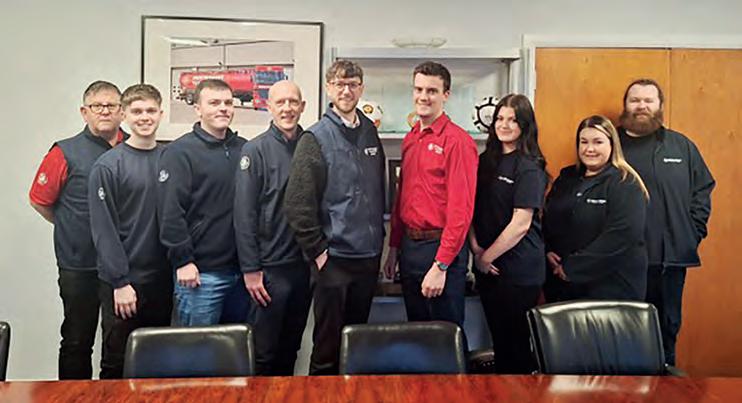
we say so early. That approach protects customers from penalties, reputational damage and costly downstream disruption. What truly differentiates Montgomery Transport Group is integration. Customs,
transport and operations work as one, not in silos. Their teams understand how a declaration affects a sailing, how a data gap impacts a driver, and how a regulatory shortcut today can become a commercial

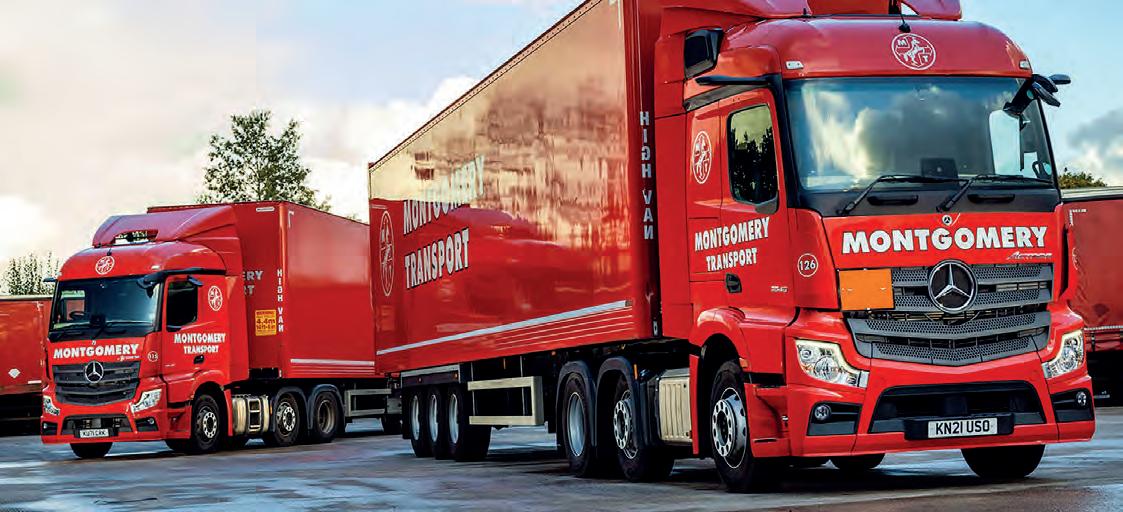
problem tomorrow. That joined-up view is essential as regulation accelerates faster than systems and guidance can keep pace.
Regulatory change is no longer cyclical; it is permanent. Montgomery Transport Group remains actively engaged with industry bodies, stakeholders and policymakers, bringing the lived experience of moving goods across borders into the conversation - not theory, slides or assumptions. Internally, the same
mindset drives our change management.
“We invest early in training, systems and process design so customers never become test cases. When guidance is ambiguous - as it often is - we take defensible, documented positions rather than quietly passing risk down the supply chain.”
Technology plays an important role, but customs remains a people business.
“Our teams are experienced, accessible and
approachable, serious about compliance while focused on solutions. The goal is to make expertise usable for businesses of all sizes, from seasoned exporters to those new to international trade.
Industry awards are welcome recognition, but they are not the objective. The real test comes every day. The declarations still matter. The rules still change. The trucks still move. That is the Montgomery Transport Group focus.
Motis has been at the forefront of providing simple solutions to comply with requirements for Cross border safety and security declarations (S&S/ENS).
The full enforcement of ICS2 for road freight on 1 January 2026 has changed the compliance landscape for Non-EU to EU transport. Entry Summary
Declarations for road and rail movements must now be lodged directly in the EU’s Import Control System 2 (ICS2). The former French ICS(1) system is no longer authorised for these flows.
For transport operators, this creates a clear operational obligation. Every movement must be supported by correctly submitted safety and security data before arrival at the EU border. French Customs made
clear ahead of the deadline that where an ENS is not lodged in ICS2, or is missing or incorrectly lodged, authorities are entitled to refuse entry into the EU customs territory or initiate legal action for failure to meet safety and security formalities. The implications are visible across all external EU borders and are particularly evident on highvolume Smart Border routes, including accompanied and unaccompanied trailers moving by ferry across the short sea or through the Channel Tunnel and for direct routes from GB to RoI. These flows represent a substantial
share of EU trade and require disciplined departure procedures.
To submit ENS in ICS2, operators must hold a valid EU EORI number and establish an approved method of access to the system. An operator without the correct EORI cannot submit an ENS.
At the same time, when transporting to/through France (i.e. via Calais for example) the ELO (Enveloppe Logistique Obligatoire) continues to shape Smart Border practice. French Customs has stated that once operators submit ENS in ICS2 for Smart Border flows, they must be able to create and
use ELOs to facilitate crossings and accelerate processing.
Taken together, these requirements make safety and security data central to Non-EU to EU freight operations. Compliance depends on reliable systems, accurate information and consistent submission procedures. Motis has worked alongside hauliers throughout the transition to full enforcement, translating regulatory requirements into practical transport processes. Through Motis Freeflow, operators can lodge ICS2 ENS declarations using a platform built specifically with hauliers and transporters in mind. Our systems are designed around
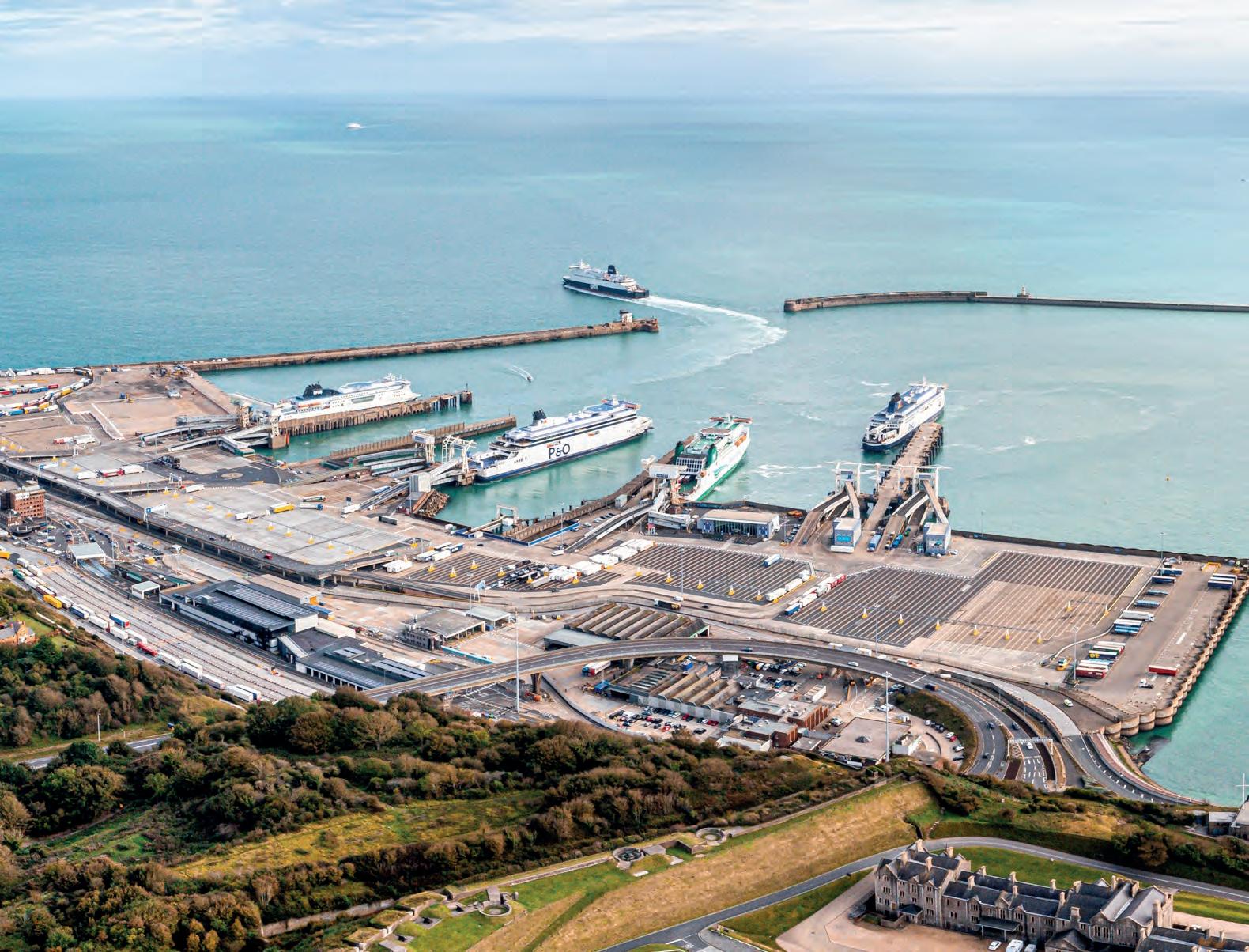
the operational realities of transport - high-frequency departures, tight schedules and time-critical border crossings.
Motis supports operators moving goods into the EU across all Non-EU entry points. Through a single integrated workflow, road freight operators can lodge ICS2 ENS declarations, arrange EU EORI registration where required and align ENS and ELO processes before departure. Where an EU EORI number is required, we manage registration through our portal, ensuring operators have the necessary identifier to submit in ICS2.
By aligning ENS submission, EORI validation and Smart Border processes within one system, safety and security data is managed correctly before the vehicle reaches the port. Combined with industryleading 24/7 customer support, this approach gives transport managers clarity, consistency and confidence in daily operations.
Motis can also provide a complete “Border crossing package” where, for UK exports, they will provide a T1 Transit Document (issued at their site within the Port of Dover, 24/7, with rapid issuing providing significant time
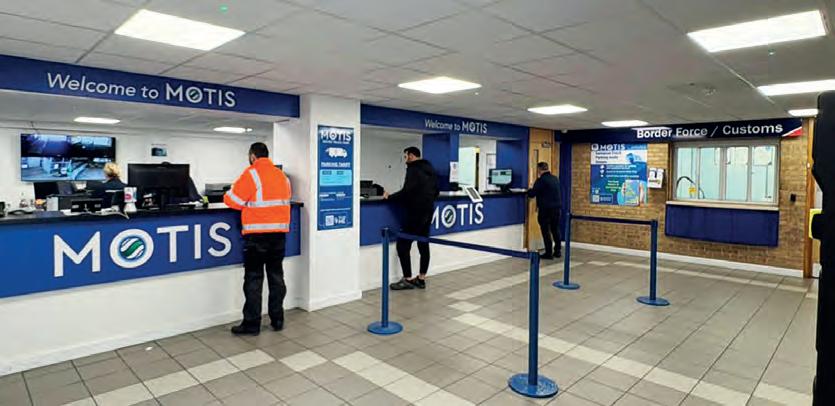
savings vs alternatives) along side an ICS2 ENS Declaration pre-packaged within an ELO- in other words, an express service for a full cross border package.
One key point this addresses is that an ELO cannot actually be created until the driver has physically collected their T1 Document.
Given that this is often within 45 minutes of arriving at the port, this can put extreme pressure on operators to create an ELO (24/7).
Motis has this issue covered by
providing the T1 “pre-packed” in an ELO. Motis can also provide a 24/7 service in Dover to provide Driver support if they are missing any element of the requirements (key to operators who do not have 24/7 Administrative cover).
ICS2 is now part of the established framework for Non-EU to EU trade. Operators require dependable submission processes and informed guidance to keep vehicles moving without disruption. Motis provides that support through integrated systems and specialist
expertise focused on the realities of international road freight coupled with a 24 hour a day presence within the Port of Dover providing real time assistance when their customers need it.
Motis’ origins lie within the Freight Ferry booking industry so of course they extend this service to incorporate Ferry bookings and provide favourable package discounts (Customs, Secure Parking, Motorway tolls), offering a one stop shop for all their customers cross border requirements.



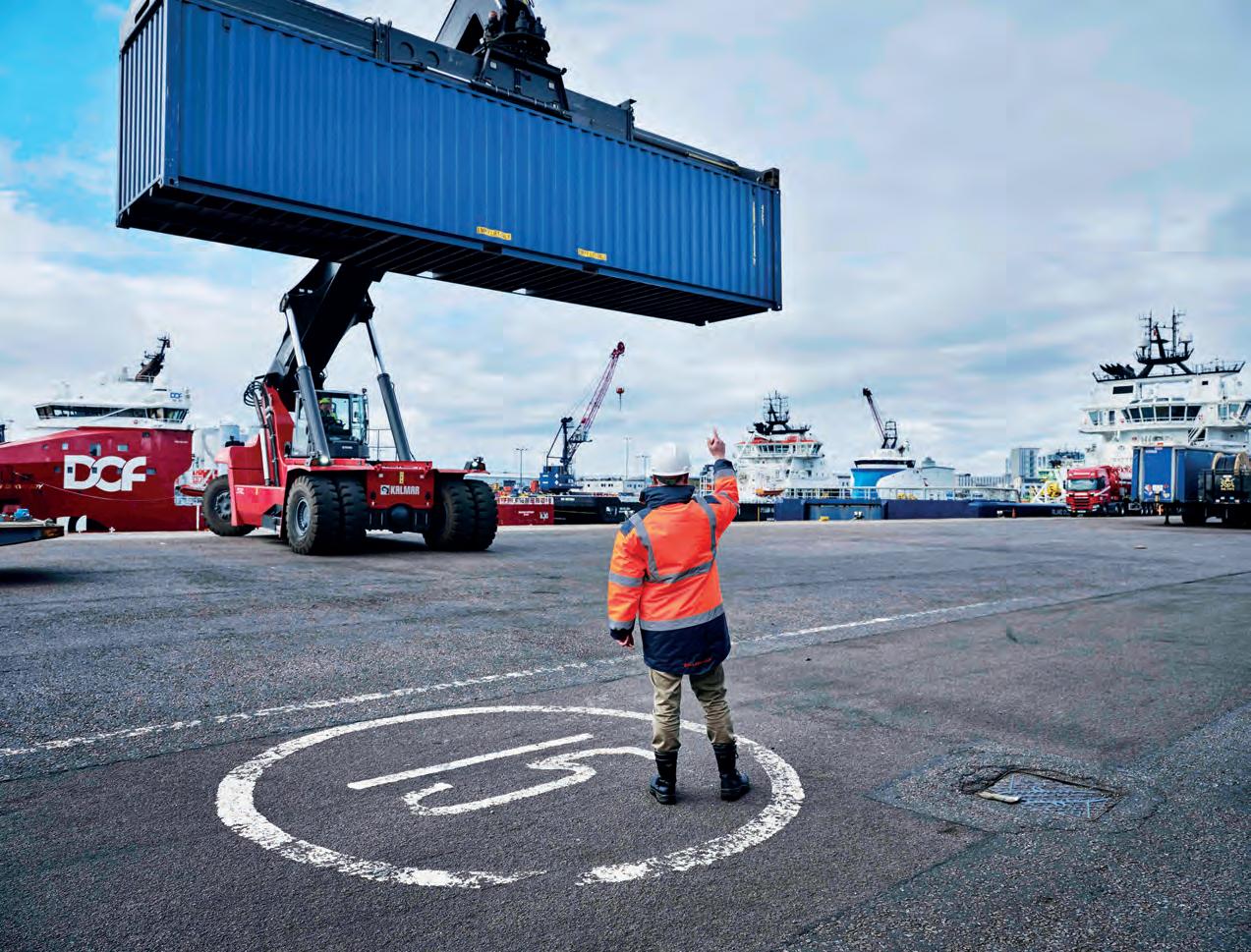
In today’s competitive maritime and logistics landscape, efficiency at port is no longer optional — it is a commercial advantage. Clarksons Port Services delivers exactly that: decisive coordination, operational precision and the expertise required to keep customs and freight operations moving without disruption.
Operating at the core of Northern Ireland’s key ports, Clarksons Port Services provides dynamic, hands-on port agency solutions tailored to the demands of modern shipping. Whether supporting high-volume container traffic or complex offshore vessel calls, the team is focused on one outcome — protecting clients’ time, cost and reputation.
Container operators and shipping lines operate on tight schedules where even minor delays can have major financial consequences. Clarksons Port Services NI understands the commercial pressures facing container clients and acts with urgency and precision from pre-arrival planning to final departure clearance.
The team manages berth bookings, liaises directly with port authorities
and terminal operators, oversees documentation, and ensures regulatory compliance is fully aligned before the vessel arrives. By anticipating operational challenges and resolving them proactively, Clarksons minimises turnaround times and avoids
unnecessary cost exposure.
In a market where schedule reliability defines customer confidence, Clarksons provides a responsive, accountable point of contact on the ground. Their local expertise, combined with the global strength of the Clarksons Group,
ensures container operators benefit from seamless communication, transparent cost management and consistent service standards. For new entrants to Northern Ireland routes or established operators seeking improved port performance, Clarksons Port Services NI delivers measurable operational value.
Offshore operations demand a different level of coordination — and Clarksons Port Services has the experience and capability to meet that challenge. Supporting offshore support vessels, survey ships, project cargo movements and energy-sector activity, the team works closely with operators to manage complex logistics safely and efficiently.
From crew changes and specialist equipment handling to customs coordination and port service arrangements, Clarksons ensures
offshore vessel calls are executed with meticulous attention to detail. The company understands that offshore downtime is costly — and that proactive planning is essential. By maintaining strong relationships with local suppliers, marine contractors and port stakeholders, Clarksons delivers a fully integrated service designed to keep offshore projects on schedule and within budget.
As offshore energy and marine infrastructure projects continue to evolve across UK and Irish waters, Clarksons Port Services NI is strategically positioned to support both established operators and new market entrants.
Clarksons Port Services NI is not simply a port agent — it is a commercial partner. Every service is delivered with a clear understanding of its impact on the client’s bottom line. The team prioritises transparency, rapid communication and cost control, ensuring there are no surprises — only solutions.
Being part of the globally respected Clarksons Group provides clients with additional assurance. International standards, global market insight and financial stability combine with dedicated local delivery, giving customers the confidence of working with a market leader.
As Northern Ireland continues to strengthen its position within UK and EU trade corridors, the need for dependable, commercially focused port services has never been greater.
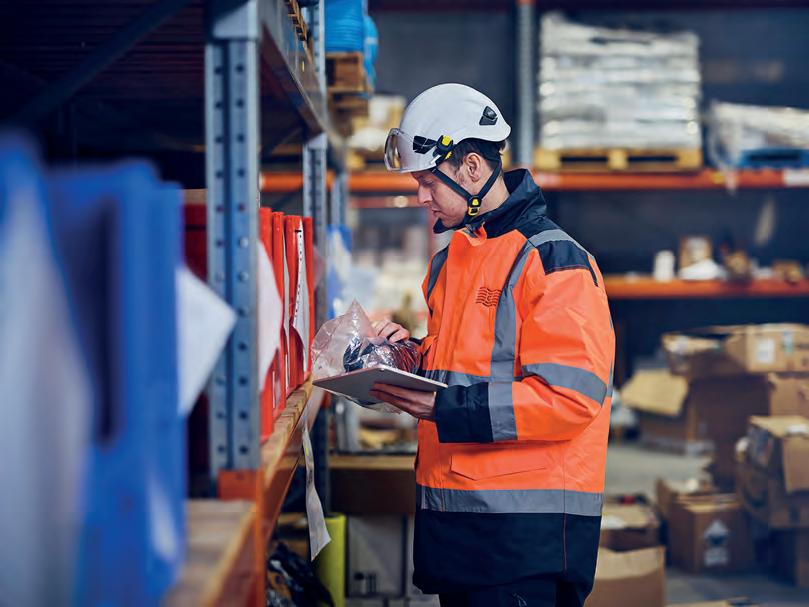
Clarksons Port Services NI is actively seeking to support container operators, offshore operators, charterers and shipping lines looking for a trusted, performance-driven partner. For businesses that demand efficiency,
accountability and operational excellence at port, Clarksons Port Services Northern Ireland is ready to deliver.
Now is the time to secure a port partner that works as hard as you do.

BY AUSTIN LYNCH
The Ranger PHEV is Europe’s first plug-in hybrid pickup from Ford, which marks a major step for electrification in the rugged pickup market.
After eight weeks or so I have had to say goodbye to the Ford Ranger PHEV.
I had the Ranger, courtesy of Harris PR and provided by Automotive in Sandyford in Dublin, for a long-term test drive since early November but at the start of January our time together was up so I dropped it back to its base just off the M50.

As I said before I have driven other pickups but this was my first hybrid, and certainly the most powerful and most advanced I have ever experienced.
The Pick-up is a type of vehicle growing in popularity because the manufacturers have updated the recipe – broadening its appeal and changing its image.
Things have come a long way from the early Toyota Hilux – one of the pioneers in this market segment. The Ford Ranger I drove,
for instance, had heated leather seats, digital dash, every imaginable onboard extra and enough power to embarrass a boy racer. There really is a lot to like about the Ford Ranger. It has to be one of the biggest passenger vehicles on the road, giving the occupants a great view of the world around them and the driver an excellent elevated driving position. It is also very comfortable, very smooth to drive and it is a great looking machine.


As I mentioned before the family absolutely loved it – and any trip to school, football or the town had to be in the Ranger. Apparently, my car is boring in comparison! Since pick-ups introduced the ‘crew car’ – in other words a second row of seats (I don’t think the phrase is even used anymore) - it has meant this is now a vehicle for five people, suddenly making it practical for transporting more than just tools, or the proverbial bale of hay and a sheepdog.
During my time with the Ranger I have been trying to answer the question –why? Why has Ford created the Ranger PHEV hybrid, and just how good is it?
Ford say ‘the Ranger is Ideal for customers who want electric driving for daily/ urban driving (zero-emissions in EV mode) combined with the utility of a work vehicle / pickup’.
And being able to power work tools from the vehicle via ‘Pro Power Onboard’ makes it especially useful for job sites or “off-grid” work. And I think this is one of the stand-out features that has made this an award winning vehicle.
I felt it was necessary to have this vehicle for a long-term test drive as it takes quite a while to figure out how to get the best from a hybrid. It should be pointed out you can drive the Ranger on the 2.3L petrol engine alone, and simply not charge the battery. But by doing this you are missing the point – and costing yourself money. Start driving the PHEV on a fully charged battery and you are automatically in ‘Auto EV’ mode, where the electric motor will combine with the petrol engine to give you more power, and more efficiency with the electric motor continually
kicking in when it feels needed.
I did this on one long journey, and 30-40 miles later I realised I only had about 35% of my battery left! What the hell? But that’s not how you get the best out of this hybrid. You have to learn all 4 ‘EV’ modes and use them wisely.
On a long journey – like driving to Belfast or Dublin – I would either use ‘EV Later’ where is saves your battery completely for when you have some urban driving to do, or ‘EV Charge’ which actually uses regenerative braking and downhill coasting to recharge the battery.
Driving back to Dublin I put almost 40% back into the battery by using this mode, and then I clicked into ‘EV Now’ when driving through built up areas.
The stated full EV range (27 mi / 43 km) is decent but relatively modest compared to full EVs, making it good for short commutes, but not suited to long EV-only trips.
Charging time (up to 4 hours) means it’s more suited for overnight / fixed-point charging rather than frequent fast top-ups.
The Ranger PHEV is Europe’s first plug-in hybrid pickup from Ford, which marks a major step for electrification in the rugged pickup market. And this model is receiving international praise and recognition, having recently picked up the International Pickup Award (IPUA) winner for 2026/27.
If you are in the market for a SUV or Pick-up and want a combination of practicality, and luxury while also doing your bit for the environment – and maybe saving yourself a few quid on fuel – then the Ford Ranger PHEV is a serious contender for your cash.
And much as I enjoyed driving it, especially during the recent wintry conditions when the four-wheel drive was essential, I don’t know if this is the vehicle for me. I think I’ll stick with my boring car- for now!
KEY SPECIFICATIONS:
• Engine: 2.3L Turbocharged Petrol + Electric Motor.
• Total Power: Up to 281 PS (279 bhp).
• Torque: Up to 697 Nm (690 Nm in some specs).
• Battery: 11.8 kWh
• Electric Range: Approximately 26-27 miles (WLTP).
• Transmission: 10-speed Automatic.
• Drivetrain: Selectable 4-Wheel Drive.
• Towing Capacity: Up to 3500 kg.
• Electric-Only Modes: EV (electric only), Hybrid, EV Now, EV Later.
• Pro Power Onboard: Available with 2.3kW or 6.9kW outlets for tools/appliances.
• CO2 emissions (WLTP): around 70–72 g/km.
• Fuel consumption (WLTP): approximately 3.1–3.2 L/100 km (reported for certain markets).
• Launch variants in Europe: includes Stormtrak (limited launch), plus Wildtrak and XLT trim options.
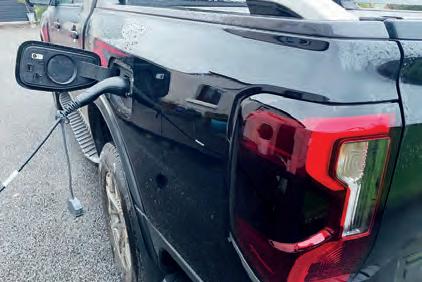
Harris MAXUS Ireland, one of Ireland’s leading producers of light commercial vehicles (LCVs), has capped 2025 with exceptional full-year registration growth with its MAXUS range of fully-electric and dieselpowered vehicles, outpacing a strengthening LCV sector in Ireland and securing a top-ten brand position.
Harris MAXUS Ireland
delivered an impressive 39.6% uplift in registrations across its electric and diesel ranges in 2025, with December’s figures positioning MAXUS third in the market with 14.4% – a performance the company believes to be representative of the brand’s ambitions in 2026 and beyond.
MAXUS delivered an impressive 39.6% uplift in registrations across its electric and diesel ranges, with 709 units registered in 2025 delivering a solid 2.2% overall share of the LCV market. The total LCV market in Ireland grew by 6.9% ending the year on 32,779 units. Of particular note are December’s figures which saw MAXUS claim 14.4% of the market in third position – a performance the company believes to be representative of the brand’s ambitions in 2026 and beyond.
Building on Q3 momentum, where MAXUS registrations surged 122% against a 25.6% industry rise, the brand’s full-year success underscores its versatility in both the zero-emission EV market – notably eDELIVER 9 – and diesel models like the T60 MAX pickup. This dual-power strategy
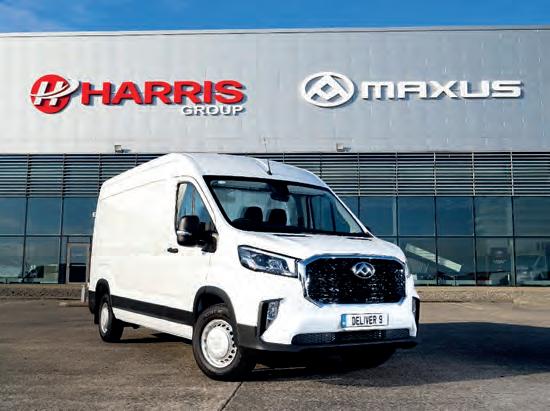
positions MAXUS as the go-to marque for operators navigating EV transition while prioritising low total cost of ownership.
The company’s dual-power strategy positions MAXUS as the go-to marque for operators navigating EV transition while prioritising low total cost of ownership.
The brand’s expanding dealer network has strengthened regional access and customer support across Ireland, with growing availability
of sales, service and aftersales provision ensuring operators receive comprehensive local support regardless of location.
Aftersales capability remains a key differentiator, with investments in the Dublin-based Harris Group Training Academy delivering technician upskilling across MAXUS electric and diesel models and systems – minimising downtime and supporting 24/7 roadside recovery for maximum fleet availability.
Karl Haughton, Managing Director, Harris MAXUS Ireland: “December’s third-place finish with 14.4% market share shows what’s possible when everything aligns – strong product, competitive pricing and comprehensive dealer support.
“Achieving 40% growth and consolidating a top-ten brand position represents a breakthrough moment for MAXUS in Ireland.
These results validate our dualpower strategy and demonstrate that operators recognise the quality, capability and value proposition we’re delivering.
“December’s third-place finish with 14.4% market share shows what’s possible when everything aligns – strong product, competitive pricing and comprehensive dealer support. That performance sets the benchmark for our 2026 ambitions.
“Our focus on technician training, diagnostics capability and parts availability ensures operators achieve the lowest possible total cost of ownership, whether they’re running electric or diesel. We’re proud of this performance and we’re geared-up to build on it in 2026, partnering with customers to meet their evolving needs in efficiency, compliance and uptime.”
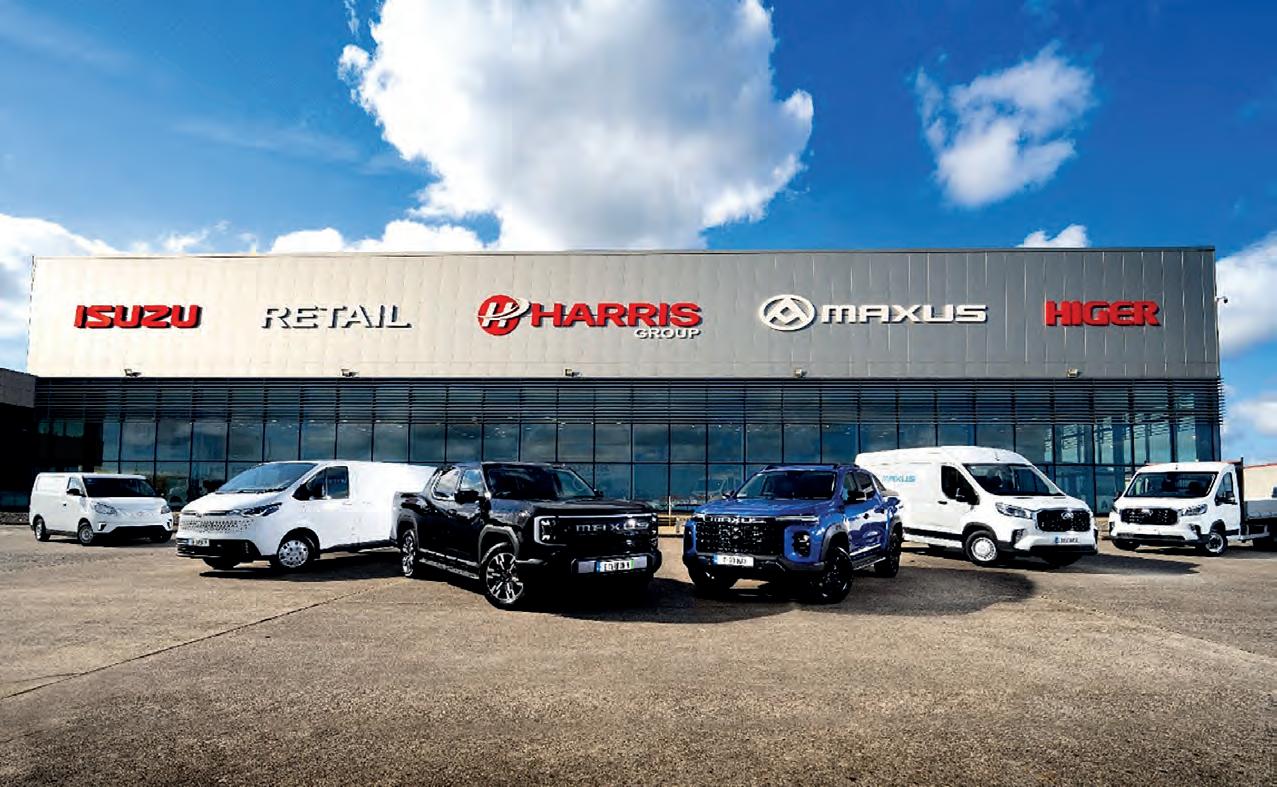


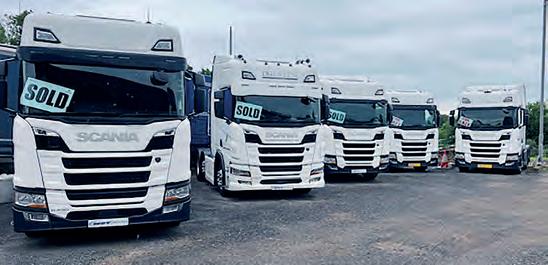
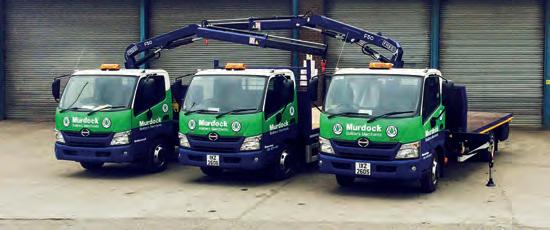








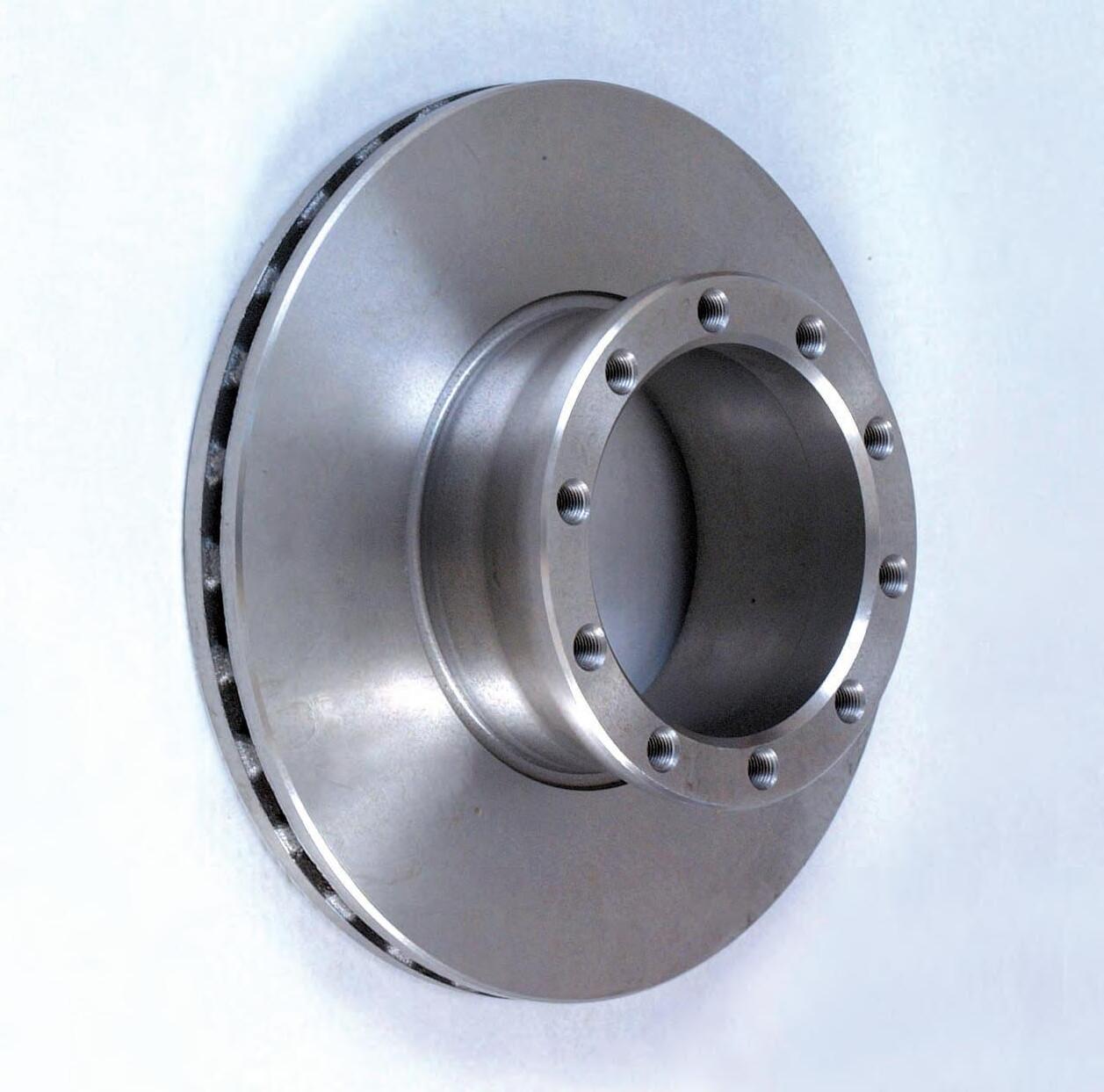








Transport Supplies now has over 12,000 product lines in stock from all the leading specialist brands. Plus there’s our fast delivery direct to you provincewide as well as free collection from our stores.



















Our network of 18 routes links key ports and road connections across northern Europe.
With more routes and sailings than any other ferry company on the Irish Sea, we offer the most convenient and reliable way to reach your destination.
At Stena Line, we’re committed to providing safe, comfortable and sustainable journeys.
7 ROuTES to Britain and France
12 VESSELS in operation
uP TO 38 daily departures