Kansas City is our beat. As the city’s definitive magazine, we bring Kansas City to life with dynamic storytelling, unforgettable photography and design that pops. We’re the metro’s trusted, modern guide—celebrating what works, questioning what doesn’t, spotlighting innovation and curating the very best in culture, food, fashion and city life.
EDITOR-IN-CHIEF
Dawnya Bartsch
GENERAL MANAGER, BUSINESS OPERATIONS
Alex Healey
ART DIRECTOR
Kevin Goodbar
FOOD EDITOR AND DINING CRITIC
Tyler Shane
ARTS AND ENTERTAINMENT EDITOR
Nina Cherry
SOCIAL MEDIA COORDINATOR
Alex Kerr
PRODUCTION COORDINATOR
Dominique Parsow
ADVERTISING SALES
Angie Henshaw and Bob Ulmer
COPY EDITOR
Kelsie Schrader
WEB COORDINATOR
Madison Russell
NEWSSTAND CONSULTANT
Joe. J. Luca & Triva Bridges JK Associates, www.jkassoc.net
WRITERS
Nina Cherry, David Hodes, Nicole Kinning, John Martellaro, Weston Owen, Ian Ritter, Tyler Shane and Clayton Steward
PHOTOGRAPHERS AND GRAPHIC DESIGNERS
Overland Park 7575 W 150th St, 66223 6904 W 135th St, 66223
or reproduced without the publisher’s permission. Kansas City magazine assumes no responsibility for unsolicited materials. Kansas City magazine adheres to American Society of Magazine Editors guidelines, which requires a clear distinction between editorial content and paid advertising or marketing messages. SUBSCRIPTIONS kansascitymag.com/subscribe or call (913) 469-6700 Scan here to subscribe to our newsletter and magazine. Prairie Village 3975 W 83rd St, 66208 Leawood 13420 Roe Ave, 66209
Zach Bauman, Amber Deery, David Henderson, Samantha Levi, Laura Morsman, Anna Petrow, Ian Simmons, Zach Smith , Clayton Steward, James Waynauskas and Jake Wickersham
City magazine is
by
Publishing, LLC. No part of this publication can be
INQUIRIES
KC Publishing, LLC
605 W. 47th St., Suite 200 Kansas City, MO 64112 (913) 469-6700
Enjoy Vibrant Senior Living
this month on kansascity mag.com
only online
KC’s World Cup Moment
Kansas City is about to step onto the world’s biggest stage. This summer, the FIFA World Cup arrives in our backyard, bringing with it an electric mix of global culture, competition and once-in-a-generation energy. For a city that already knows how to host—whether it’s championships, festivals or packed parade routes—this moment is both a challenge and a celebration.
Every Wednesday leading up to kickoff, Kansas City magazine will explore how local businesses are gearing up for an international influx, spotlight the athletes and fans who are shaping the soccer scene here at home, and take you behind the scenes with the organizers, creatives and civic leaders working to make sure the city is ready for its global close-up. Scan here to check out our series.
From Tacos to Treks
KANSAS CITY RUNS on barbecue. Burnt ends come first. But somewhere after the ribs and before the slaw, there’s another local obsession, folded, fried and dusted with Parmesan: the KC taco.
I’m a Kansas Citian now, but before that I was a Californian. My first visit to Fountain City was with my boyfriend (now husband) who brought me to his native state to meet his family. One of our first stops was the now-closed Northland institution El Sombrero, and that’s where I had my first KC taco. Coming from L.A., I didn’t know a “Kansas City taco” was even a thing. A fried, pinched shell with a snowfall of Parmesan? I was skeptical.
Then I took a bite and was hooked. The crackle, savory filling and salty finish had me. The KC taco is distinct, unapologetic and very Kansas City.
Which is why our main taco feature feels personal. In this issue, Food Editor Tyler Shane and a small army of writers dig into the tortilla-wrapped soul of our streets—the legacy joints, the new-school spins and the origin story of that iconic crispy fold. El Sombrero may be gone, but Shane discovered there are still a few establishments keeping the KC taco tradition alive.
This issue is filled with all sorts of discoveries and adventures, from tasting a new type of taco and finding a new Harrisonville ’cue spot to sipping a locally made whiskey at a bar and distillery in an abandoned West Bottoms train tunnel. Every page highlights the people and places that keep Kansas City alive and vibrant, but there is one story of adventure that truly stands out.
At 82, a local father trekked with his son to Mount Everest’s base camp—thin air, steep trails and no shortcuts. It’s a story about endurance, yes, but more than that, it’s about devotion. About deciding there are still summits worth chasing.
Crispy tacos and Himalayan switchbacks might seem worlds apart, but both take an adventurous soul to embrace and enjoy.
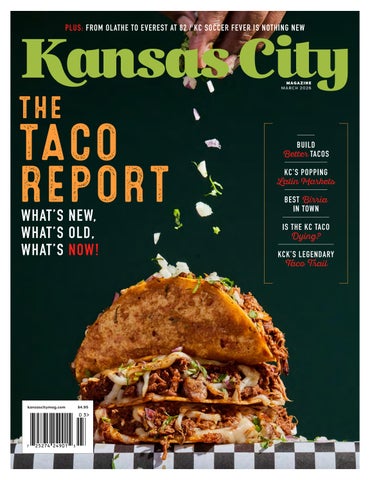
The cover photo was shot by the Pilsen Photo Co-op, a KC-based commercial photo duo composed of Rebecca Norden and Caleb Condit. A few of their clients include Garmin, Taco John’s, Applegate and National Pork Board.
Clayton Steward Photographer & writer
Clayton Steward, who started off in local news, is a Kansas City-based photojournalist, writer and educator who travels across the Midwest and South telling stories through both the lens and pen.
Zach Bauman Photographer
Editorial and commercial photographer Zach Bauman shot this issue’s taco feature. A longtime Kansas City magazine contributor, his work has also been featured in Bon Appétit, Food & Wine and Outside magazines.
Swipe Less, Love More
February’s story about the world’s first therapistvetted dating app, Sova Dating, created by KC resident and therapist Kieri Olmstead, really got people’s attention and created hope that there might be a better dating experience.
Sold.
- KCHope
Seriously this may be the smartest thing ever.
- Shonda Kay
I have been dreaming of this.
- Laura Colleen
Millions of profiles. Zero matches ready. Lol.
- Clayton Miller
Say What?
“There’s
Numbers From This Issue
82
The age Dave McClung was when he climbed to Mount Everest’s base camp. Page 64
1981
The year the Kansas City Comets soccer team debuted. Page 18
108,000
The number of cars crossing the Kit Bond Bridge daily. Page 15
Shout Out
We’d like to say thank you to Tony Gordon of Streats KC for being the hand model not once, but twice for this issue’s cover.
Behind the Scenes
Photographers Rebecca Norden and Caleb Condit of Pilsen Photo Co-op getting the perfect shot of a Birria taco from Streats KC for this issue’s cover.
- Dave McClung on his summit of Everest base camp at 82.
Bye Bye, Bridge
After seven decades, the northbound US-169 bridge won’t reopen, leaving commuters scrambling for alternatives
By
(Continued on next page)
Nicole Kinning
Photography by David Henderson
River Reroute: 169’s vanishing act
(Continued from previous page)
AFTER 70 YEARS spanning the Missouri River, the northbound US-169 bridge won’t reopen. This sudden closure is forcing tens of thousands of daily commuters to find new routes just as Kansas City prepares to host the World Cup this summer.
Missouri Department of Transportation officials made the decision in late 2025 after inspectors discovered critical structural damage beneath the bridge deck. Reports from concerned drivers about a bouncy expansion joint led to the discovery that the bridge’s foundation had shifted underground, displacing the rockers, which are curved supports that allow the structure to expand and contract.
“The abutment moved and the rockers are basically not under the bridge the way they’re supposed to be,” says Greg Bolon, district engineer for MoDOT’s Kansas City District. “Instead of rocking on the bottom, they’re actually perpendicular to where they’re supposed to be. The bridge can’t function that way.”
Rather than attempt temporary repairs on a bridge already slated for replacement, MoDOT opted for permanent closure. The bridge, built in the midto-late 1950s and absorbed into the state highway system in the 1990s, has simply reached the end of its usable life.
“When you get bridges 60, 70 years old, that’s pretty much their service life,” Bolon says. “Its time for replacement was already scheduled. We just had to close a little sooner than we’d hoped.”
The closure impacts roughly 40,000 vehicles each day, pushing traffic onto other river crossings. To keep the cross-river flow moving, MoDOT has implemented temporary head-to-head traffic on the southbound span while designing permanent crossovers that will provide one lane in each direction. Those crossovers, which require median barrier removal and new asphalt at some points, are awaiting contractor assignment and better weather.
In the meantime, Bolon recommends considering alternative river crossings rather than overloading already-congested routes. “The Fairfax Bridge, the Chouteau Bridge and the Heart of America Bridge all have under 20,000 cars a day,” he says. By comparison the Kit Bond Bridge and I-435 are already near capacity at 108,000 and 80,000 vehicles, respectively.
The replacement project, originally planned for a March letting with post-World Cup construction, will now proceed on an accelerated timeline. Contractors may begin demolition earlier than anticipated, though they’ll need to coordinate with the railroad that runs beneath the bridge. The new structure, designed to modern standards, will be slightly longer than its predecessor (about 10 feet) and mirror the southbound bridge built by MoDOT in 1977.
The finish line for the new bridge is looking to be sometime in 2028, so until then, commuters will need to get creative with their routes or get comfortable with some congestion.
WORLD CUP WORRIES?
As the city prepares to host World Cup matches this June and July, does the northbound 169 bridge closure add a slight wrinkle to an already-overwhelming transportation plan?
Millions of visitors are expected to visit during the tournament, and KC2026’s ConnectKC26 plan promises three new motorcoach services—Region Direct, Stadium Direct and Airport Direct—including routes from Independence Center, east of the closed bridge.
Jason Sims, the director of transportation for KC2026, Kansas City’s World Cup host committee, was unavailable for an interview before press time, but KC2026 spokesperson Haley Harrison-Lee offered some assurance via email: “Good news—no concerns about the 169 bridge impacting the ConnectKC26 transportation network during the World Cup.” Bolon was similarly unconcerned. By summer, one lane in each direction will be operational, and he expects most international visitors will stick to major interstates like I-29, I-35 and I-435. Whether that holds true when World Cup watchers arrive remains to be seen.
Photography by David Henderson
No Wrecking Ball Required
Instead of tearing down century-old homes in Rockhill Crest, an urban renewal firm is going to restore and resell them
By Ian Ritter
WHEN A DEVELOPER snaps up a cluster of houses in Kansas City’s urban core, especially from a major institution like the University of Missouri–Kansas City, flashy renderings of glassy mixed-use projects seem to follow.
That’s not the plan in Rockhill Crest.
Local firm CORE Urban Renew is purchasing 10 homes from UMKC along 53rd to 55th streets, between Troost and Holmes, just south of the Volker campus. Instead of demolition, CORE intends to restore the century-old houses, many of them Craftsman style, and return them to the market.
Reilly expects a broad mix of buyers: singles, couples, small families and downsizers looking to remain in a central city neighborhood.
The sale follows a process that began in 2023, when UMKC’s Neighborhood Advisory Council explored options for several properties the university had acquired over time through alumni and supporter donations. Community feedback favored owner-occupied homes over rentals, and neighbors helped shape language in the university’s request for proposals.
The homes sit near Troost’s growing commercial strip, including the popular Tiki Taco and Gaels Public House & Sports, across from Rockhurst University’s entrance.
“We’ve seen the worst of the worst in many cases,” says Karen Reilly, a partner at the Kansas City-based firm, which has redeveloped 48 houses since its founding in 2021. “And we haven’t torn anything down.”
CORE, co-owned by Reilly and Steve Cook, more often than not takes the structures they work on down to the studs. Renovations include more than a new paint job and landscaping; often, there are new plumbing, electrical and HVAC systems before they put them back on the market.
CORE’s experience with aging housing stock and its relationships with contractors who specialize in foundations and sewer lines make that level of rehab possible, Reilly says. RK Contractors and Nueva LLC are both assisting with the UMKC homes. “We work with people and try to create really affordable housing in some cases, and affordability comes in all shapes and sizes,” Reilly says. “Sometimes the efficient thing to do is to take the house down to the studs and really replace the systems.”
Construction will move quickly. The first phase runs from March through August, with a second phase scheduled from September to May 2027. CORE does not plan structural additions, aiming to preserve the homes’ character and fit within the surrounding neighborhood.
Reilly expects a broad mix of buyers: singles, couples, small families and downsizers looking to remain in a central city neighborhood.
The CORE deal stands in sharp contrast to another institutional landowner’s actions just north in Midtown. There, Kansas City Life Insurance demolished several historic homes near 35th Street, saying they were no longer habitable—a move that drew criticism from some residents. Disputes over remaining properties in that area continue.
Kansas City’s Soccer Glow-up
After decades of near misses and comeback seasons, KC has become one of America’s hottest soccer towns
By David Hodes
ALTHOUGH KANSAS CITY has had an on-again, off-again love affair with soccer for nearly 50 years, the city is now in the full flush of soccer passion.
When the sport first arrived in the late 1960s, it struggled to compete in this football-first town. The Kansas City Spurs of the North American Soccer League, brought here in 1968 through negotiations involving Lamar Hunt’s United Soccer Association, played two seasons at Municipal Stadium before folding in 1970. Even a surprise NASL championship in 1969 couldn’t win over fans. Soccer, it seemed, was a nonstarter in KCMO.
Then came lightning in a bottle.
In 1981, the Kansas City Comets of the Major Indoor Soccer League debuted at Kemper Arena with the flair of a rock concert—theme music blasting, laser lights sweeping the arena and players introduced by a booming announcer. More than 16,000 fans regularly packed the house. Families filled the stands, and youth leagues sprang up across the suburbs. The Comets had a hometown hero in Gino Schiraldi, who averaged four goals a game, and the team delivered: three second-place league finishes and seven playoff appearances in 10 seasons.
But the momentum faded. Attendance dipped to 7,000 by 1991, and the Comets shut down. Even so, the sport had taken root.
Outdoor soccer returned in 1997 with MLS’s Kansas City Wizards, founded by Lamar Hunt. The team played at Arrowhead Stadium before rebranding as Sporting Kansas City in 2010 and moving to Children’s Mercy Park in the Legends district (renamed Sporting Park in 2026). Patrick Mahomes joined the ownership group in 2021, and Peter Mallouk, CEO of Creative Planning, now holds a majority stake. On the field, Sporting KC has claimed MLS Cup titles in 2000 and 2013 and U.S. Open Cup championships in 2004, 2012, 2015 and 2017.
The rise of the Kansas City Current has pushed the city’s soccer profile even higher. Founded in 2021 and co-owned by Patrick and Brittany Mahomes, the National Women’s Soccer League team plays at CPKC Stadium on the Berkley Riverfront—the first stadium in the world purpose-built for a women’s professional team. In 2025, the Current set league records for wins (21), points (65) and shutouts (16), with a record 11 home victories. They became the first team in NWSL history to sell out every regular-season match in 2024— and did it again in 2025.
Indoor soccer has returned as well. A second iteration of the Kansas City Comets launched in 2010 and continues to play at Cable Dahmer Arena, extending the city’s long indoor tradition.
All of it underscores the strength of Kansas City’s soccer culture—strong enough that FIFA selected the city to host six matches in the 2026 World Cup.
Over the decades, professional soccer in Kansas City has stumbled, regrouped and evolved. As Dutch great Johan Cruyff once said: “Soccer is a game of mistakes. Whoever makes the fewest mistakes wins.” Kansas City, it seems, has learned from its early missteps—and is now winning.
Comets player Waldir “Val” de Souza at Kemper Arena in the early 1980s
Snakes and Shamrocks
This Northland tradition celebrates St. Patrick’s day a little early
By Nina Cherry
BELOVED NORTHLAND TRADITION Snake Saturday—a parade and carnival held each Saturday before St. Patrick’s Day—has humble beginnings. It started as a promotional parade for a Rodeway Inn. But two years after its inaugural parade in 1985, founders Mickey Finn and Bill Grigsby teamed up with then-mayor Clark Ferguson to expand the celebration beyond the motel parking lot, taking over the downtown streets of North Kansas City. Today, festival president JD Green says the event draws approximately 100,000 people each year.
But why is the event called “Snake Saturday”? Fifth-century legend has it that Saint Patrick eradicated snakes from Ireland by chasing them into the ocean.
Rain, snow, sleet or shine (Green recalls having celebrated in temps as low as 3 degrees), the parade happens. This year, it kicks off at 11 am with 120 extravagantly decorated floats and marching bands from area high schools. Afterwards, attendees can enjoy a family-friendly carnival featuring a petting zoo, a bicycle giveaway, a car show, concessions and more. The event also supports local nonprofits, raising approximately $50,000 each year for various causes.
GO: March 14. 11 am. Downtown North Kansas City. For more details, visit snakesaturday.com.
This year, Green says festivalgoers will notice a small change: The parade route kicks off at 16th and Swift streets instead of 14th Street. Televised by KCTV5 for the second year, this year’s theme “Kicks and Kilts” pays homage to the nearing World Cup matches.
mar
WHAT YOU WANT TO DO THIS MONTH BY
NINA CHERRY
4–14
Big 12 Basketball Tournament
March Madness is officially here. For over a decade, T-Mobile Center has been home to the Big 12 Basketball Tournament, welcoming collegiate ballers from Kansas, Texas, Arizona and beyond. The women’s tournament tips off on March 4, followed by the men’s tournament, which kicks off March 10. March 4–14. Times vary. T-Mobile Center.
6–Aug 9
“The World in Kansas City”
The Kemper Museum of Contemporary Art prepares for this summer’s World Cup matches with its latest exhibition, “The World in Kansas City.” Representative not only of the global event but also of KC as a multicultural hub, the exhibit features a diverse array of artists with ties to the region. Curator Jessica S. Hong says the display aims to
showcase “how we all belong to a shared, complicated and nuanced social and cultural fabric.” March 6–August 9. Times vary. Kemper Museum of Contemporary Art.
7 & 8
Winterlude Jazz Festival
Winterlude Jazz Festival returns to Johnson County Community College’s campus for two jam-packed days of music, bringing headliner Arturo O’Farrill to KC. Joined by his Afro Latin Jazz Orchestra, the Grammy Award-winning pianist, arranger and bandleader—known for challenging conventions of traditional Latin jazz—continues the legacy of his late father, Cuban composer Chico O’Farrill. The weekend’s lineup also includes guest lectures and performances from local jazz musicians like organist Chris Hazelton, bassist Gerald Spaits, trumpeter Trent Austin and more. February 7 & 8. Performances begin at 2 pm. Midwest Trust Center.
13 & 14
Alvin Ailey American Dance Theater
Over three decades after choreographer, dancer and activist Alvin Ailey’s death, his company remains one of the most popular modern troupes. This tour marks the inaugural season under artistic director Alicia Graf Mack, formerly a longtime dancer for Alvin Ailey American Dance Theater. Ushering in the new era with five world premieres, the company will also perform its signature work, Revelations. Set to spirituals, blues and gospel, Ailey’s landmark piece—choregraphed in the midst of the Civil Rights Movement—chronicles African-American faith, deeply inspired by his rural Texas upbringing. March 13 & 14. Times vary. Muriel Kauffman Theatre.
10
Vitamin String Quartet
Reimagining pop songs with classical counterpoint, Vitamin String Quartet is best known for its work on the Regency-era romance TV series Bridgerton soundtrack, covering songs like Ariana Grande’s “thank u, next” and Scandinavian popstar Robyn’s “Dancing On My Own.” For over two decades, the LA-based modern quartet has steadily released an array of tribute-style albums, paying homage to The Beatles, Lady Gaga and more. The band hits the road on its all-encompassing “The Music of Billie Eilish, Bridgerton & Beyond” tour. March 10. 7 pm. Uptown Theater.
13
Book Social: A Reading Party
The Spencer Art Reference Library teams up with the Nelson-Atkins Museum of Art to put on a bookworm’s ideal (and low-key) Friday night. Come with a novel in tow, grab a drink and kick off the evening with half an hour of independent reading time. Participants are then invited to mingle in small groups with guided prompts—and then the process repeats. March 13. 6 pm. Nelson-Atkins Museum of Art.
14
Petite Performance: Woodwinds
The Kansas City Symphony’s Petite Performance series offers an engaging introduction to classical music for budding listeners. Designed for children under the age of 6, this springtime-themed educational concert invites curious concertgo-
ers to explore and groove to the various sounds of the woodwind section up close on the Helzberg Hall stage. March 14. Times vary. Helzberg Hall.
17
Kansas City St. Patrick’s Day Parade
In 1974, Kansas City’s St. Patrick’s Day parade began as a short, one-and-a-half-block jaunt for downtown workers and shoppers. Despite being advertised as “the world’s shortest and worst parade,” hundreds of revelers showed up and out. After 50 years, the parade route has changed (and been elongated) several times, reliably drawing over 100,000 partygoers to Westport each year. The mile-long parade kicks off at 11:30 am, marching south down Broadway Boulevard from Linwood Boulevard to 43rd Street. March 17. 11:30 am. Westport.
17
Cardi B
Rapper Cardi B’s debut studio album, Invasion of Privacy, was a tough act to follow, charting number one on Billboard’s Top 200 at its debut. But her sophomore release, Am I The Drama?, has been keeping pace just the same with hits like “Safe” and “Pretty & Petty.” The 23-track record also includes a stacked line-up of special guests, including features from Bruno Mars, Janet Jackson, Selena Gomez and more. In support of her latest release, the hip-hop star embarks on the Little Miss Drama Tour—her first tour since 2020. March 17. 7:30 pm. T-Mobile Center.
17–22
The Great Gatsby
Nearly a century after The Great Gatsby was first published, a musical adaptation of F. Scott Fitzgerald’s Prohibition-era classic made its Broadway debut. Now, two years after its premiere, the jazz-infused production is hitting the road. Featuring a sweeping score and lavish Art Deco-inspired costuming and set design, PNC Broadway brings this story of opulence, dissatisfaction and obsession to KC. March 17–22. Times vary. Kansas City Music Hall.
KC Current Season Opener
KC Current kicks off the 2026 season with a home game against the Utah Royals, welcoming new head coach Chris Armas, a former midfielder for the U.S. Men’s National Soccer Team. One of the top-ranked teams in the National Women’s Soccer League, the KC club has consistently made waves and beat records over the past two seasons thanks in part to two-time NWSL MVP and star forward Temwa Chawinga. KC, baby! March 14. 3 pm. CPKC Stadium.
21–28
Kansas City Fashion Week 2026 Spring/ Summer Collection
Kansas City Fashion Week returns with its 2026 Spring/Summer Collection, welcoming local and international designers alike to Union Station. The collection culminates in four bold nights of runway shows, beginning Wednesday, with several student designers making their KCFW debut. Beyond the runway, the weeklong series of events also includes the return of the popular (and adorable) fashionFIT Puppy Yoga, held Tuesday at Hotel Kansas City. March 21–28. Times vary. Union Station.
26–Apr 19
Moby Dick: A Sea Shanty
Music Theater Heritage brings a new sea shanty-filled spin on Herman Melville’s classic novel to
the stage. Written and directed by the organization’s artistic director Tim Scott, the tale follows Captain Ahab’s frenzied, incessant voyage for the whale that took his leg, all narrated to the tune of sailor Ishmael’s maritime ballads. The production features musical direction by multi-instrumentalist Fritz Hutchison, a mainstay of the KC’s music scene. March 26–April 19. Times vary. Main Stage at Crown Center.
29
Unlimited Miles: Miles Davis at 100
Trumpeter and visionary Miles Davis pushed the boundaries of jazz, repeatedly redefining the genre with albums like Birth of the Cool, In a Silent Way and Jack Johnson. One hundred years after Davis’ birth, The Folly Jazz Series honors his lasting legacy with a tribute performance. Under the direction of Grammy Award-winning pianist John Beasley, an all-star sextet delves into the
many eras of Davis’ career. The ensemble features leading forces in the genre today, including trumpeter Sean Jones, saxophonist Mark Turner, guitarist Kurt Rosenwinkel, bassist Ben Williams and drummer Terreon Gully. March 29. 3:30 pm. Folly Theater.
30
Royals Home Opener
Baseball season is back—and so is the Hot Dog Derby. The Royals return to open their home schedule at Kauffman Stadium against the Minnesota Twins. After signing a two-year extension, catcher and team captain Salvador “Salvy” Perez returns to anchor the lineup alongside other standout players like shortstop Bobby Witt Jr., third baseman Maikel Garcia and designated hitter Vinnie “Pasquatch” Pasquantino. March 30. 3:10 pm. Kauffman Stadium.
Taking It to the Streetcar
Local creatives are bringing an interview video series to the streetcar rails
By Nicole Kinning
IMPROVISED STREET INTERVIEWS have become the internet’s favorite way to take a city’s temperature. Now, Kansas City has its own version.
Launched in January, KC Streetcar Takes is a video series that borrows the spirit of viral social formats like New York’s SubwayTakes while showcasing what makes this city so special: its people.
The project’s team is an impressive dock of creative local talent. There’s Matt Keck, the on-camera host and a comedian who ran the Wendy’s Twitter account for a decade. Keck is also known for creating the viral video “I’m a Snake,” racking up 35 million views before Instagram algorithms even existed. These days, Keck works for actor Ryan Reynolds’ production company Maximum Effort but calls Independence home. David Henderson handles production and videography, and Patrick Moore co-produces and manages guest bookings alongside his audio work.
Keck says he wants the world to understand why everyone here loves Kansas City. For him, this project is different from his usual comedy work. “This is the realest project you’ll get from me,” he says. “This is entirely unscripted, out in the real world, talking to people I might never have the chance to otherwise.”
The concept of the series is simple: Ride the streetcar, strike up conversations, and capture the hot takes riders want to share. Episodes feature a mix of invited guest hosts (local business owners, creatives and community leaders) and impromptu conversations with everyday riders. The goal, according to Moore, is to “highlight local business owners, maybe have some people from some charities that people don’t know about. Just highlight people in the community.”
Moore says early guests have included Adam Roberts, owner of Screenland Armour, and local comedian Brittany Tilander. The team is already dreaming big, though, and has “The Big Slick” major players on its wish list. (Looking at you, Jason Sudeikis).
The series launch coincides with a major turning point for the streetcar itself. Last October, the streetcar’s $352 million Main Street extension opened to riders, adding 3.5 miles of track and ultimately connecting River Market to UMKC. It was the first time streetcars had gone south of Pershing Road since 1957. The streetcar has become a central artery for the city.
The breakthrough idea for KC Streetcar Takes came when the production crew connected with Donna Mandelbaum, the KC Streetcar Authority’s marketing and communications coordinator. A New York native herself, she immediately saw the potential and helped coordinate the efforts.
What makes Streetcar Takes work is Keck’s commitment to the improvised nature of it all. He doesn’t want to see questions or discussion topics beforehand. “I want people to get the true natural reaction to the things we’re talking about,” he says. “I’m going to be funny, but it’s also going to be real. We need a little more reality going around these days.”
Moore says they’re planning to record in bulk to streamline production. And the timing couldn’t be better with KC gearing up to host World Cup matches and continuing its growth as a destination city. “I think the streetcar could be a great option for that,” Henderson says, “and also a way to lean into helping people see what other people in town are doing.”
Catch the series on Instagram, YouTube and TikTok via the KC Streetcar Takes (@kcstreetcartakes) and KC Streetcar (@kcstreetcar) accounts.
From still waters to shadowed valleys, David’s ascent to the throne is filled with towering giants, wild animals, and Philistine soldiers. After unprecedented victories lead to devastating failures, this passionate warrior will face the biggest battle of all: the one within himself.
With original music inspired by the Psalms, DAVID is a state-of-the-art theatrical experience the whole family will enjoy. Witness one of the most legendary Bible stories as it comes to life with spectacular special effects, massive sets, and live animals during this final season in Branson, MO.
MARCH – OCTOBER | BRANSON, MO
BOOK EARLY. BOOK DIRECT. | SIGHT-SOUND.COM
Party Arty: Painted Night
THE NELSON-ATKINS’ annual fundraiser Party Arty: Painted Night was a tremendous success. Hosted by the museum’s Young Friends of Art, the after-hours event raised more than $140,000 to help fund art education, outreach programs and free museum admission.
We want to hear from you. Tell us about events happening in the community. –Dawnya Bartsch, editor-in-chief editor@kansascitymag.com.
Banding Together
From
the stage to the studio, this nonprofit record label is supporting Kansas City musicians
By Nina Cherry
SHAUN CROWLEY KNOWS firsthand the struggles of being an independent musician.
The founder and executive director of Manor Records, a nonprofit record label that supports Kansas City musicians, was signed to a local label as a teenager while playing guitar with garage pop band Rev Gusto. “I grew up in the local music scene,” Crowley says. “If you’re trying to make a career here, it’s really difficult to do it by yourself. But that’s what a lot of musicians have to do.”
Now, Crowley wants to help KC artists grow their careers, in part by helping bring their recording projects to fruition.“[Releasing music] can help get you to that next step,” Crowley says.
Manor Records has humble roots. It informally began in 2014 as a DIY house show series presented out of Crowley’s then-home in Johnson County. Originally dubbed the Shawnee Manor, he hosted touring acts like British indie-pop band Glass Animals
and Madrid-based alternative rock band Hinds before both groups reached wider audiences and acclaim. He’s got a knack for scouting emerging talent.
After moving out of the house, Crowley shifted his focus and officially launched Manor Records in 2017 with a small grassroots mission. “We basically covered the cost of cassettes for musicians,” he says.
Today, Manor Records does far more than front cassette bills. Since its inception, the organization has seen a couple brick-and-mortar venues: a bar and music venue in Strawberry Hill, followed by a record store on Troost. Those spaces have since closed, and the nonprofit has reprioritized its efforts. Spanning folk to funk, the label currently boasts a roster of 10 local artists. Crowley and a robust team of volunteers help those musicians with marketing, press, booking and more.
For this year’s artist roster, Manor Records expanded to an open call for the first time in the organization’s history. In total, 75 artists applied. Among those selected are funky singer-songwriter Jamogi and soul band Freia, an ensemble led by vocalist Frankie Shorez.
The record label is also doubling down on physical media. Crowley says the label anticipates releasing “more vinyl than we ever have” this year. On February 25, the organization launched preorders for a compilation album, featuring music from each of the artists currently on the roster.
Beyond those 10 performers, Manor Records produces concerts and acts as a booking agent for venues across the city. That includes Songbird Sessions, a singer-songwriter night held each Sunday at ArtsKC’s Crossroads locale, as well as programming regular entertainment for J. Rieger & Co. Last month, the nonprofit also launched Music Maker Mondays, a monthly happy hour networking event for musicians to connect in a laid-back environment. The program, which takes place at Brewery Emperial, is a collaboration with hiphop artist Flare Tha Rebel.
Crowley is also gearing up for Manor Fest, the organization’s annual multi-venue festival. Taking place over the course of the last two weekends of May (20–23 and 27–30), the extensive lineup welcomes approximately 60 performers across 20 area venues. To close out the festival, the local label is teaming up with the KC Streetcar to bring live music aboard the tram, as well as performances at venues along the route—like the lawn of the Kemper Museum and the Kansas City Public Library’s scenic rooftop terrace.
↓
Learn more about Manor Records’ artist roster and upcoming events at manorrecords.com or on Instagram @manorrecordskc.
Above all, Crowley sees Manor Records as a way to strengthen KC’s music industry. “There are a lot of barriers, and I want to break those down,” Crowley says. “I want to make this an open conversation for anybody who wants to be a part of the local music scene.”
SUMMIT FAIR:
Your lucky break for indoor golf fun.
Lucky moments deserve a little sparkle.
zalbrecht@blockandco.com
Fat Bee Café Lucky sips are brewing, treat yourself to boba.
Craft Putt
KAY Jewelers
Heavenly Olive Oils & Vinegars Lucky finds for your kitchen await.
Aroma Expert
Perfumer Heather Bath wants to bring niche fragrance to KC
By Nina Cherry
PERFUMER HEATHER BATH comes from a long lineage of winemakers. Her grandfather was a rancher in Sonoma County; her father brought Northern California wines to KC as the founder of the Plaza’s now-defunct Starker’s Restaurant; her cousin is a master sommelier. Although Bath refers to herself as the “odd ball out,” she often compares her personalized scent styling sessions to vino. “It feels like a wine tasting, but with fragrance,” she says.
Located inside the Brookside lifestyle store GEORGE, Bath’s fragrance bar H. Bath features over 100 niche perfumes, predominantly crafted in Europe (Paris, Amsterdam and Tuscany), with the exception of one domestic brand, Zernell Gillie, made in Chicago. Unlike many
mass-produced designer scents’ decorative packaging, these artisanal scents rely much less on ornamentation. “It’s not about the bottle,” Bath says. “It’s all about the artistic expression.”
With decades of experience in the fragrance industry, Bath spent much of her career honing her craft (and nose) in Los Angeles, where she developed scents for luxury lifestyle brand Jenni Kayne. Two years ago, the perfumer returned to her hometown of KC, and she launched H. Bath this past May. Now, she’s gearing up to expand the bar and fragrance selection later this month.
During a half-hour fragrance fitting at the Brookside shop, Bath took account of my preferences, starting with lighter fragrances and gradually building to bolder aromas. Her approach is largely gender neutral—much to my surprise, I found myself drawn to what she says is one of Travis Kelce’s favorite scents: Ex Nihilo’s Blue Talisman. Ultimately, though, I landed on Essential Parfums’ earthy, bright and spicy Mon Vetiver.
Shop H. Bath’s collection in person (315 E. 55th St., KCMO) or learn more online at hbathperfumer.com.
Runway Revival: Kansas City Fashion Week Returns This Spring
KC Fashion Week CEO Teisha Barber shares the trends she’s loving, the newcomers to watch and how KC is reclaiming its fashion legacy
By Nina Cherry
KANSAS CITY HAS long been a hub for fashion and clothing manufacturing. During the Garment District’s height, it was estimated that one in seven women in the United States donned a garment made in KC.
“That started to change during the Great Depression, and it never really got back to the way it was,” says Teisha Barber, Kansas City Fashion Week CEO. But since co-founding KCFW in 2010, she says the local industry has seen some resurgence. “It’s not so much of a manufacturing hub as it used to be, but we are seeing a lot more custom fashion designers that are making a name for themselves in Kansas City and beyond,” Barber says.
Today, KCFW produces two weeks of runway shows each year: one week for a Spring/Summer collection and another for Fall/Winter. Attracting local and international applicants alike, each collection features approximately 40 designers. Beyond KC, Barber also acquired St. Louis Fashion Week last year, which will make its return for the first time this June.
We sat down with Barber to talk trends, her personal style and more ahead of KCFW’s spring show, which runs from March 21–28 at Union Station.
What drew you to the fashion industry? My background is in interior design and architecture, but I did some modeling and event planning right out of college and was introduced to people in the fashion industry at those events. I started planning charity fashion shows and met our former owner Phil Willoughby. He asked me to help start Kansas City Fashion Week.
As a co-founder of KCFW, you served as the organization’s longtime president before acquiring the business in 2023. How have you seen the organization grow and evolve since its inception? When I first came on, Phil thought I was crazy. I wanted to do two weeks a year, just like New York. He said: “No, no, no—you’ve got to slow down. We’ve got to start with just one.” I said “Nope, if you’re going to have me on, we’re going to do two.” It’s been successful ever since, except for the year of Covid. Over the last 15 years, we’ve gone from a hotel ballroom with maybe 400 guests per night to Union Station, where we sometimes have over 900 guests per night.
As someone who is very tuned in to trends, which styles are you loving right now? One of the biggest shifts I’m seeing is a move toward elevated everyday dressing. People want pieces that feel polished but still wearable—tailored silhouettes, great fabrics and thoughtful details that work just as well for daytime as they do for evening. Something you can wear from the office directly to a happy hour or afterwork event. What’s been really exciting is that people are less focused on following trends and more focused on expressing their own style. We’re seeing more individuality, creative layering and styling that reflects lifestyle rather than a single season.
Tell me what we can expect from KCFW’s upcoming collection. Are there any newcomers we should keep an eye out for on the runway? A lot more separates, actually. We have a lot of designers that do gowns and dresses, but this season we have a lot of designers that are piecing together complete looks with a lot of separate pieces that you mix and match.
I would watch Elle Stovall—she’s showing on Saturday night—and Emerald Honesta on Friday night. Wednesday night is full of all of our students. We have 11, which I’m really excited about, and most of them are new.
I’d love to know more about your own personal style. What do you like to wear? Polished off-duty. I work from home, so day-to-day is all about comfort, but when I step out for a meeting or a night out, I love relaxed silhouettes styled with intention—baggy denim, sneakers, a great sweater or jacket, or a flowy dress in a rich color or print. It’s effortless but still put together.
The Clothes Whisperer
Alyx Jacobs is keeping clothes alive through mending, alterations and hand-crafted embroidery
By Nicole Kinning
ALYX JACOBS CAN look at your most beloved, beat-up pair of jeans and see what you can’t: a 10-minute fix.
That ability—to assess damage quickly and imagine a garment’s second or third life—has become the foundation of her clothing repair business. And Jacobs works from a simple belief: We already have enough.
“I wholeheartedly believe that there are enough clothes on the planet that nobody ever has to buy anything new again,” Jacobs says. “But I know that that’s just not the way that the world works.”
A 2016 graduate of the Kansas City Art Institute with a degree in graphic design, Jacobs didn’t set out to be a garment repair specialist. She stumbled into it through a junior-year quilting elective where a visiting instructor from Los Angeles introduced her to boro, the Japanese art of visible mending. At the time, Jacobs was living what she calls a “pretty strict” sustainable lifestyle, toting reusable jars to coffee shops
and avoiding purchasing new clothing. In fact, since 2016, she’s purchased almost no new clothing, opting instead for thrifted and vintage pieces.
What began as a personal philosophy became a business, and it’s only growing following a recent move into a storefront at 6 Westport Road. Last year, Jacobs’ team completed more than 1,500 pieces. The work is roughly an even split between alterations and mending, but Jacobs is careful to keep repair at the heart of what she does. She’s even become a contracted vendor for Patagonia’s Worn Wear program, the outdoor company’s flagship repair initiative that offers lifetime warranties on products and hosts free public mending events where customers can bring in any garment to be fixed on the spot.
Jacobs’ mending work varies, but a big part of her business includes repairing heirloom quilts, sometimes sourcing fabric from the early 1900s to match the original. “That is kind of the beauty of a quilt, specifically,” she says. “It was generally made by women, and they would use clothes that the family members had grown out of or had holes in. Then throughout the years, you would repair the quilt with the next generation’s clothes.” For one particularly meaningful project, a client wanted to repair her grandmother’s quilt, and Jacobs asked the client to provide outgrown children’s clothes for it, continuing the generational tradition of mending with family fabric.
She also restores valuable vintage pieces for sellers and performs invisible denim repairs for customers across the country, and she recently added another branch to the business: chain stitch embroidery. She uses a machine from the 1960s (designed in the early 1900s) to add custom lettering and hand-drawn illustrations to jackets and wedding banners.
Invisible repairs draw on a different set of skills, involving problem solving as much as art. You have to understand construction, anticipate stress points and think several wears into the future. But Jacobs has found that clients are refreshingly open to visible mending. “Oftentimes people will come in and they’re just like: ‘Do whatever you want. I love what I see, so just do what you want,’” she says. But she’s learned to ask for parameters, as too much freedom can be overwhelming. She’ll sometimes scroll through a client’s Instagram to understand their color preferences, determined that they’ll “walk away feeling really excited about the repair.”
“Is mending future-proof?” Jacobs says. “Is it recession-proof? I still believe that it fully is because it’s one of those things that will never be able to be automated.” She also knows the fashion industry’s math: making new clothes is still cheaper than fixing old ones. But for the growing number of people who want their clothes to last, Jacobs is proving that repair is worth the investment. Book appointments at alyxjacobsrepair.com.
Give
’Em Nelle
One woman’s architectural vision shaped how generations of Kansas Citians live
By Nicole Kinning
Photography by Ian Simmons
WHEN NELLE PETERS struck out on her own in Kansas City in 1909, she had, as she later described it, “very small savings and a large amount of nerve.” Few could have predicted she would become one of the city’s most prolific architects, but now, you’re hard-pressed to take a 10-minute drive through town without finding one of her buildings dotting the landscape.
Ethan Starr is executive director of Historic Kansas City, a preservation advocacy organization dedicated to protecting KC’s historic buildings and neighborhoods. Peters’ work has become central to the organization’s mission, as her buildings represent some of the city’s most significant and endangered residential architecture. “I’d venture that [Peters] has built more buildings than anyone who will ever live in Kansas City,” Starr says.
During her six-decade career, Peters designed nearly 1,000 buildings (that we know of). Documentation from that time period remains fuzzy. Peters transformed the city’s residential DNA during what was arguably the most explosive time in Kansas City: the Roaring Twenties. But her legacy extends beyond sheer volume. Peters made apartment living beautiful, functional and accessible.
In the 1920s, Kansas City transitioned from small-scale apartment buildings to both larger apartment complexes and apartment hotels—multi-story structures offering kitchenettes and hotel-like amenities. Peters partnered with developer Charles Phillips beginning in 1913 and designed dozens of buildings in the Midtown, Plaza and Broadway corridors.
“Nelle Peters was right at the center of this building boom,” Starr says. As Peters told the Kansas City Journal in 1925, “I want each building to be as perfect, as economical and practical as if I were building it for myself.”
When building codes changed in 1924 to require reinforced concrete for structures over two stories, Peters embraced it with her signature style. She softened the hard surfaces of brick, stone and terracotta with whimsical patterns and ornamental details that gave each building a personality.
“Despite the functionality associated with these apartment buildings—and boy, have they functioned well over a century now—the design is intentional and it’s playful,” Starr says. “She was often working with Tudor style, but of course, she was often working with Mediterranean Spanish and these other styles that come to be very closely associated with Kansas City.”
Her grit was unmatched. When Peters made the leap as an independent designer in 1909, she numbered her first three house plans as 25, 26 and 27 so she wouldn’t appear a novice. She consistently downplayed the gender discrimination that was prevalent at the time, famously telling the Kansas City Journal in 1925, “All the talk you hear about men not wanting to take instructions from a woman is bunk, I believe.” However, she strategically changed her name from Nellie to Nelle and sometimes signed plans as N.E. Peters to obscure her gender. “Nelle Peters goes from sort of hiding the fact of her identity to overseeing other male architects,” Starr says. “That was probably profound and rather unprecedented.”
The Ambassador Hotel 3560 Broadway Blvd., built in 1924 When it opened, this eight-story building was KC’s largest apartment hotel, with 105 apartment units, 108 hotel rooms, shops and a rooftop garden.
The Ambassador perfectly demonstrates Peters’ transition to larger-scale modern buildings.
The Valentine Apartments
3724 Broadway Blvd., built in 1927
Originally the 11-story Valentine on Broadway Hotel, this Art Deco-style building still stands as one of Peters’ most prominent projects. The building originally housed 68 apartments and 72 hotel rooms when it opened. After decades of neglect and a failed condo project, the building underwent a historic renovation in 2009 and now houses 65 apartments with fully restored public spaces.
The Luzier Cosmetics Building
3216 Gillham Plaza, built in 1928
Now home to Billie’s Grocery and office spaces, this building’s crown jewels are its brick facade and floral terracotta panels. Peters also designed the nearby McConahay Building at 821 E. 31st St. in 1922, where a young Walt Disney had his first studio, Laugh-O-Gram, on the second floor.
Nelle E. Peters Historic District
37th St. and Summit Ave., built in the early 1920s
This district, designated in 1982, includes prairie-style apartment buildings with horizontal lines, limestone sills and brick exteriors. These apartments continue serving as affordable housing. “There’s simply no way in which we can create these kinds of units remotely resembling the price that it requires to preserve existing ones,” Starr says.
The Literary Block/ Poet Apartments (West Plaza)
708-748 W. 48th St., built in 1927-1929
These are arguably Peters’ most famous works.
Named after literary figures (including Cottesbrook, David Copperfield, Vanity Fair, Mark Twain, Washington Irving and Robert Browning), these apartment buildings form a designated historic district. Each building is built in Spanish Colonial and Tudor styles with courtyard layouts.
“The stone has the effect of climbing up the corner of the building,” Starr says, creating what he calls a “storybook” look.
PLANNER SPRING EVENT
MAR
Country Club Plaza
March 28, 11 – 3 PM
Spring Market & Shopping Stroll
The Culinary Center of Kansas City
April 25
The Village at Briarcliffe The Culinary Center's newest location is open in Briarcliff. Classes are live! Join them for a grand opening celebration on April 25. Learn more at kcculinary.com
Country Club Plaza is excited to welcome back the Spring Market & Shopping Stroll on Saturday, March 28, 11 a.m.–3 p.m., featuring store & restaurant deals, tastings, experiences, & a local artisan market. countryclubplaza.com
APR
Parkville, MO
consectetur adipiscing elit, sed do eiusmod tempor incididunt ut labore et dolore magna aliqua. Ut enim ad minim veniam, quis nostrud exercitation ullamco laboris nisi ut aliquip ex ea commodo consequat. Sed ut perspiciatis unde omnis iste natus error sit voluptatem accusantium doloremque laudantium. webaddress.com
April 25, 1:00 - 5:00 PM Parkville Microbrew Festival e Parkville Microbrew Fest is one of KC’s largest beer festivals with live music, handcrafted ales, and great food in Historic Downtown Parkville, Missouri. Festival admission includes a commemorative logo tasting glass, live music, and all the beer you care to sample. parkvillemicrobrewfest.com
It’s time to begin planning your spring events and activities. We’ve uncovered a variety of experiences that should be on your radar in the coming months, so mark your calendars and plan to include these fun and memorable events.
Springfield, MO
April 29-May 3
Route 66 Centennial Kickoff Celebration e Springfield, MO – the Birthplace of Route 66 –is proud to host the National Route 66 Centennial Kickoff Celebration, a once-in-a-lifetime showcase of American music, hometown pride, and the open-road spirit that made Route 66 an icon of freedom and adventure. springfieldmo.org
Hermann, Missouri
For more things to do, subscribe to the Loop, our weekly e-newsletter that is an essential resource for current events.
MAY
Hermann, MO
May 2 & 3
Saturday 10 – 5 PM Sunday 11 – 4 PM
Green Dirt Farm
May 10, 3 – 5 PM
Mother's Day
Cheese & Bubbles
The Hermann Wine Trail is introducing a new event this year, Winetails & Tapas. Wine cocktails are paired with delicious Spanish-style appetizers at each of the six participating wineries. Learn more on the event website. hermannwinetrail.com
Make your plans now for Mother's Day. Green Dirt Farm is hosting a one-of-a-kind Mother's Day experience. Treat Mom to the best of KC with fresh, locally made cheese and a little bubbly at their Cheese & Bubbles event. greendirtfarm.com
City of Overland Park
May 16, - 7 PM
Stems: A Garden Soiree Overland Park Arboretum & Botanical Gardens
Sip and sample from local restaurants, explore the gardens in full spring bloom, and discover live music, entertainers, photo ops, art exhibits, and unforgettable moments with friends. Funds raised from Stems support the Overland Park Arboretum & Botanical Gardens, Deanna Rose Children’s Farmstead and public art initiatives. artsandrec-op.org
MAY
Chef Fernanda adds iconic tacos from the street to the menu
That commitment to flavor and community shows up not just
something new, or just enjoy
fuss. With locations across the metro, from Westport to State Line to Downtown Overland Park, there’s a familiar place to meet up or take a breather, each one offering fresh and authentic flavors and genuine hospitality.
TACO NACO KC’s newest addition looks to the north of Mexico for inspiration. Burritos Juárez draw from the streetside burritos of Ciudad Juárez, where the focus is less on size and more on balance. Wrapped in warm flour tortillas and grilled until lightly crisped, these burritos are built with seasoned meats and classic fillings that feel deliberate rather than overdone. There’s no excess here, just clean flavors and a structure that holds together the way a good burrito should.
TACOS A LA
where I’m from, while still holding to the quality and consistency people expect from TACO NACO KC.”
The result is a focused but soulful lineup. Savory tripa until tender with just the right bite. Deshebrada, slow-braised, and pulled until melt-in-your-mouth soft. And classic guisados like
the philosophy of aprovechar todo, using every part of the animal. Mexican butcher shops and street vendors traditionally worked hand in hand, transforming cuts like tripa (tripe), buche (pork stomach), and lengua (tongue) into some of the most beloved tacos in the country. These aren’t fringe offerings; they’re staples, prized for their texture, richness, and depth of flavor when prepared correctly.
That philosophy is what drew Executive Chef Fernanda Reyes to the concept. “These are the tacos I grew up eating,” Reyes says. “They’re comforting, humble, and incredibly flavorful. I wanted to bring something truly authentic, something that honors
Pork Rojo
TACO
TACO
From immigrant kitchens to chef-driven menus, — Kansas City’s — taco scene is wrapped in history, and still unfolding
By Brenda Cortes, Ritz Dasgupta, Alex Omorodion, Tyler Shane and Sarah Sipple
Photography by zach bauman
The KC Taco Is Dying… The KC Taco Is Dying…
But Maybe There’s But Maybe There’s Hope.
By tyler shane
IN 2019, José R. Ralat declared in a national Eater article what longtime Kansas Citians already knew but maybe weren’t ready to admit: Our city’s very own taco, the so-called KC taco, was on the verge of extinction.
In his piece, Ralat, who is now Texas Monthly’s taco editor, argued that the growing demand for “authentic” Mexican food, particularly street-style tacos, posed the greatest threat to the KC taco. In my latest attempt to track down the taco of my childhood, I don’t have better news. There are even fewer places serving the KC taco than Ralat identified seven years ago. But it’s possible that not all hope is lost. A new, chef-driven taqueria is serving a version that makes me think the KC taco, in all its oily, glorious excess, might not just survive but evolve.
The KC taco, as many of us know it, is a corn tortilla that’s filled with seasoned beef, fried, topped with shredded lettuce, a thin, almost ketchup-like salsa and dusted with parmesan cheese.
If you grew up here, like me, you might not have ever heard it called a “KC taco.” I hadn’t until reading Ralat’s article. On menus, it’s usually just listed as a beef taco. You order it and you know what’s coming. That’s the beauty of it. The KC taco is so embedded in Kansas City’s culinary identity that I was hardly aware that the entire country was not eating their tacos greased with oil and dusted with white cheese. My siblings and I ate them, mostly from the late Claycomo Mexican restaurant El Sombrero. My dad and his siblings ate them. My grandma Rita, whose father moved to Kansas City from New Mexico to work on the railroad, and her 13 siblings ate them. We never questioned the oil-slicked tortillas or the snowfall of white cheese. That was just how tacos were.
dusty sombreros and framed photos of the Barrera family felt like living proof of Kansas City’s Hispanic history. I still hear the sizzle of those metal plates and the server’s near-command: “Watch out, they’re hot.” La Fonda El Taquito is now gone, too.
I followed Ralat’s lead to P R’s Place, a West Side dive. The bartender told me that of the two sisters who own it, one has passed, and the other only comes in to make tacos “every now and then.” A server at Lilly’s Cantina told me that they used to serve “the parmesan taco” but don’t anymore.
There is, thankfully, a silver lining. Los Corrals, Kansas City’s oldest Mexican restaurant and the rumored birthplace of the KC taco, still serves them, nearly perfectly, with that signature lazy drip of sweet red salsa. Manny’s and Rudy’s in Westport continue the tradition with parmesan cheese, too.
Still, over several weeks, searching for something as simple as a fried beef taco felt heavier than it should have. It wasn’t just about scarcity. It was about time. The KC taco isn’t disappearing because no one wants it. It’s fading because the generation that built it and ordered it without irony is fading.
The KC taco isn’t disappearing because no one wants it. It’s fading because the generation that built it and ordered it without irony is fading.
My Kansas City childhood existed in that in-between space: Americanized Hispanic, rooted in tradition but shaped by Midwestern practicality and improvisation. The KC taco represented that duality. Not quite Mexico, not quite Tex-Mex, but wholly ours. In his article, Ralat made an argument for the KC taco, despite its waning existence. He said it’s just as true to Kansas City as any al pastor taco served along the streets of Puebla, Mexico. And he’s right. To me, the KC taco is the truth of my experience having grown up with Hispanic roots in Kansas City. To me, the KC taco is authentic.
Born in the mid-20th century, the KC taco, like many immigrant dishes, is a story of adaptation and a reflection of what was available at the time—corn tortillas filled with beef. They were pinched shut and fried like tacos dorados. But the toppings are what make it distinctly Kansas City: shredded iceberg lettuce, a thin red salsa (like Spanish Gardens or Art’s, both local brands) and, most notably, parmesan cheese, a flourish and nod to the city’s deep Italian roots.
The texture of it is everything. The center goes soft and rich with oil and grease, but the edges stay shatteringly crisp. A true KC taco, in my opinion, wears parmesan, but there are variations across the city that carry its essence—In-A-Tub, Ponak’s, Humdinger Drive-In—even if the cheese changes.
When I set out to find the epitome of the KC taco, though, I found that only three restaurants still served it with parmesan. El Sombrero, the Claycomo restaurant of my childhood, closed three years ago after nearly six decades. Its wood-paneled walls,
Then, inside Torn Label Brewery in the Crossroads, I found something unexpected.
Tacos Valentina is a taqueria and molino making tortillas from heirloom Mexican corn sourced from Oaxaca and the Estado de México, stone-milled daily and pressed to order. Its menu leans deeply regional, thoughtful and precise—the kind of place you’d expect to reject parmesan outright.
But there it was. Alongside barbacoa, orinoco and pollo adobo tacos was a taco simply labeled “Kansas City.” Fried. And dusted with parm.
I can’t believe I’m writing this, but right now, it might be the best version of our taco in the city.
Maybe that’s how traditions survive—not by resisting change but by letting the next generation reinterpret them. The KC taco may no longer be everywhere. But as long as someone is willing to fry it, drizzle it and dust it with parmesan, it isn’t extinct. It’s just entering its next chapter.
Constructing the perfect taco with Chef Fernanda Reyes
By Sarah Sipple illustrations by jessie lin
“A TACO WITHOUT lime is not a taco,” says Fernanda Reyes, owner of Westport’s Taco Naco as she stands in the taquera’s kitchen. However, setting aside that one rule for the “perfect taco,” the rest of Reyes taco philosophy is quite fluid.
As she gestures to a variety of dried peppers, tortillas of all sizes and types, and marinated meats, she explains that the “Naco” in her restaurant name represents the uniqueness that a wide variety of subcultures bring to the table. Reyes has had to remind people that Mexico itself is made up of 31 states and recognizes 68 distinct indigenous groups. That is why, in Kansas City, Reyes won’t be the chef to diss Midwesterners for adding cheese to tacos or Hindu customers for swapping meat for a potato filling.
Kansas City diners clamor for the chicken al pastor taco and have made it the bestseller across all Taco Naco locations. A heap of lightly sweet marinated chicken al achiote is topped with cilantro aioli and pineapple relish, which are made fresh every day. The vehicle is a corn tortilla from KC’s own James Beard Award-winning Yoli Tortilleria, ready to be topped in hot sauce, dipped in salsa and devoured in a few bites.
But when it comes to Reyes’ perfect taco build, the answer is precise. It needs to be high in salt, fat and acid and served on a nixtamalized corn tortilla.
Her philosophy may be inclusive, but her palate and eye for detail have been expertly honed. Reyes’ experience in the kitchen goes deep, from working in her mother’s restaurant in Santiago Papasquiaro, Mexico, from the age of 10, to a formal education culminating in a master’s degree in both business administration and nutrition.
With her intricate knowledge of Mexican foods, Reyes can detect differences in corn varieties and will always prefer a tortilla made with non-GMO corn that has been nixtamalized, or steeped in an alkaline solution to enhance the flavor and workability of dough and improve the bioavailability of some nutrients. Yoli Tortilleria and Las Marias Tortilleria fit this bill locally. However, for fish tacos, Reyes recommends using a flour tortilla.
Protein is the next step in Reyes’ perfect taco, and her go-to is her own brisket barbacoa. A key step in taco excellence is not being afraid of grease. Reyes adds a spoonful of rich, coppery, well-seasoned grease to her tortilla and brisket on the griddle. For this perfect taco, a thin layer of cheese is melted onto the tortilla, too.
Once the tortilla is warmed and the cheese is melted, it’s moved to a paper-lined tray. This is an important step, as Reyes believes that tacos are best eaten fresh, whether that means standing on a sidewalk next to a street vendor or dining in at a restaurant.
To complement the umami depth of the brisket and cheese, Reyes tops it with chipotle aioli, pickled onions, and cilantro. Suddenly, it has become a feast for the eyes. But to complete the sensory experience and balance the fattiness, Reyes adds a squeeze of lime, a sprinkle of salt and an unshy portion of hot sauce. A cup of fresh tomatillo salsa is an ideal match for these flavors, and it happens to be one of the easiest salsa varieties to make.
Last but not least, Reyes points out that the radish and cucumber served on the side are not decorative or arbitrary but a thoughtful addition for cleansing the palate. Does every taco require this level of effort and additions? No. In fact, at Taco Naco, any taco can be served “a la Mexicana,” where only onion and cilantro accompany the protein. But we’re going for perfection here, and Reyes’ taco particulars are worth the effort.
Where There’s Smoke, There’s Bigotón
In a tent off Ninth Street, hardwood smoke and homemade tortillas have turned a humble pop-up into a community obsession
By Brenda Cortes
THE CONCEPTION OF Carnitas El Bigotón, a low-key pop-up serving the best carnitas experience in the city, didn’t begin as a grand entrepreneurial plan. Instead, it was a solution. After Juan Arceo lost vision in one eye, continuing his work in construction became nearly impossible. His family knew he needed a new path, and they knew exactly what that was.
“He used to make carnitas for family parties and small gatherings,” his son, Juan Jr., explains. “He never wanted to turn it into a business. He was a blue collar worker. But we told him, ‘just try it.’”
So the family came together, making and selling their Michoacana-style pork carnitas in small batches out of their front yard. They sold out on their first day. Two months later word, of the authentic carnitas experience had spread like wildfire. It became clear this was no longer just a side hustle.
“It was going to a different level,” Juan Jr. says. But still, the Arceo family stuck to their pop-ups, only scaling up their production.
With a weekend pop-up model, Carnitas El Bigatón began operating Saturdays and Sundays from morning until they sold out, often by late morning or early afternoon.
“We didn’t know if people were going to come out and buy,” he says. “We wanted to grow little by little and see if it was legit.”
In July, the Areco family found an opening between two buildings (4832 E. Ninth St., KCMO) for a permanent city-approved pop-up space. They set up a large tent, picnic tables and chairs. Heaters are used in the winter so customers can keep warm while they wait in line. The Arceo family plans to invest in a food trailer, and when summer arrives, they’ll stay open into the evening.
What sets their carnitas apart from any other in the city?
A cooking method that involves a massive copper pot (so big that it takes six months to ship from Mexico) and an entire pig.
Many restaurants rely on gas or propane for speed and control. At Carnitas El Bigatón, everything is cooked over an open hardwood fire using oak and a touch of cherry wood. The process begins long before customers arrive. Prep starts midweek with produce and ingredients. But the real work begins early Saturday morning.
“We’re there by 1:30 in the morning,” Juan Jr. says. “The fire has to be on. We cook with wood—no propane, no gas.”
The large copper pots allow for even heat distribution. The pork simmers gently into the lard without burning. The results are a perfectly tender interior and crispy exterior. Juan, Juan Jr. or whoever is manning the pork adds different cuts in timed stages. First the pig shoulder, then stomach, ribs and the rest of the components, each spaced about 30 minutes apart. Unlike many cooks who consistently stir their meat, the Arceos’ technique is more restrained.
“We don’t keep mixing it,” Juan Jr. says. “We drop the meat in and let it cook. We don’t touch it. The paddle is only there to lift it when it’s ready.”
When you order at the counter, you’ll see someone using a large cleaver to dice the meat, pork skin and stomach, delivering a richer, more traditional style, similar to what you might see in Michoacán, a state in west-central Mexico.
If you’re new, you’ll be offered a free sample before ordering, a step the Arceos consider essential to the experience. Your order will be taken in line or at the front of the line. Along with carnitas, you’ll get fresh tortillas for tacos, nopales (prickly pear cactus), homemade salsas and vegetable toppings, all prepared in house. There’s also tortas and menudo. This summer, the Arceos plan to add chicken carnitas as well for those who don’t eat pork. Expect to wait in a line each weekend when you visit.
“We see people coming back almost every week—big restaurant people, too,” Juan Jr. says. “That surprises me. You build friendships from that.”
Despite the growth, the Arceo family’s philosophy remains the same.
“We do everything with love,” Juan Jr. says. “If you’re not doing it with love, it’s not going to come out right.”
Follow the Taco Trail
The KCK Taco Trail not only treats you to some of the best tacos in the metro but also showcases family enterprise and preserves immigration history
By Tyler Shane
WE ALL KNOW that the culinary spotlight usually shines brightest on Missouri’s Kansas City, but I’ve always been a big fan of the Kansas side of things. KCK boasts some of the metro’s most divey dive bars, has plentiful parking and, of course, has the Taco Trail. Most people don’t need to be sold on pursuing a trail of tacos, but if I learned anything from the many tortillas and marinated meats I’ve devoured recently, it’s that KCK’s quietly legendary taco scene is even better than you might imagine.
The Taco Trail is a passport program featuring more than 60 authentic, locally owned taquerias, restaurants and food trucks. It was designed to spotlight the city’s deep Mexican and Central American culinary roots, grounded in decades of Hispanic immigration.
To take on the Trail properly, I enlisted Roman Raya, chef and owner of the sophisticated Mexican restaurant Barbacoa. As we ate our way through El Camino Real’s al pastor shaved from the trompo, El Pollo Rey’s flame-licked whole chickens and GG’s Barbacoa’s smoky Tabasco-style barbecue, I realized something: Eating through the Taco Trail isn’t just a food crawl; it’s a history lesson.
Waves of Hispanic immigrants, many from Mexico as well as Central American countries, settled in KCK throughout the 20th century, drawn by work in the rail yards (like my own family), meatpacking plants and the metro’s industrial corridors. They brought family recipes, regional cooking techniques and a deep food culture that turned neighborhood markets and small taquerias into community anchors. Over time, those businesses became generational, with parents passing down recipes and storefronts to their children. The Taco Trail highlights this history through dozens of takes on the humble taco.
At Tarahumaras Restaurant, whose owners hail from Chihuahua, Mexico, you’ll find everything from classic street tacos to beefy, consommé-soaked quesabirria tacos and
even fried tacos tucked into flour tortillas. Some dishes reflect the family’s northern Mexican roots; others subtly cater to Midwestern tastes. Whatever you’re craving, this comfy Mexican joint has likely mastered it.
Then there’s A&J Molcajete, the definition of a hole-inthe-wall. The “A” and “J” stand for husband-and-wife duo Angie and Jose Gomez. Angie is from northern Mexico; Jose’s from the south. Together, they blend their regional styles, most notably in their molcajete taco layered with chorizo, steak and cactus—one of the most unique and delicious bites I enjoyed on the Trail.
Raya, who began his career with his own taco trailer Taco Tank, drops bits of knowledge along the way. When a street taco is served with the standard two stacked corn tortillas, it’s called con copia—“with a copy.” It’s practical, yes, but also traditional. He tells me tripas, a common street taco filling made of intestines, are best served crispy, and he’s right. With each salsa, tortilla and Jarrito we devoured, he was also gathering inspiration for his own kitchen.
At every stop, we agreed: These taquerias weren’t built for trends or Instagram. They were built to feed families, preserve culture and create opportunity. There’s a familiar hominess that transcends any language barrier you might encounter.
If tackling more than 60 spots feels overwhelming, start with the dense corridors along State, Central and Kansas avenues, where you can easily make a crawl of it. Or book a seat on the Taco Trail bus tour, a three-hour guided experience led by Robert Galicia that highlights a curated selection of taquerias with rotating monthly themes.
The Kansas City, Kansas, Taco Trail is more than a checklist It’s a living archive of immigration, resilience and entrepreneurship. As the broader dining world rushes toward the next trend, KCK continues to thrive in the history and hard-earned enterprise built by immigrant families.
To learn more about KCK's Taco Trail check out, visitkansascityks.com.
Women of the Taco Trail
By Ritz Dasgupta, Senior Manager, Integrated Marketing Communications for Visit Kansas City
Women like Perla Garcia, Gisela Stephany Polanco and Veronica Solis Galicia are not only serving food and leading tours along the Taco Trail but also serving as role models to budding female entrepreneurs. Through their restaurants, they are preserving heritage, building community and inviting others to experience KCK one taco at a time.
Perla Garcia of Tarahumaras Mexican Restaurant
Perla Garcia’s parents opened their first restaurant in 1999. Originally from Chihuahua, Mexico, they lived in various metro locales before eventually settling in Strawberry Hill. When Tarahumaras opened, Garcia followed in her parents’ footsteps, stepping into ownership as a secondgeneration restaurateur.
Over the past eight years, Perla has helped expand the family business to two locations: the original in Strawberry Hill and a second spot farther south near I-35 and Merriam Lane. What once felt like a hidden gem no longer flies under the radar. As word continues to spread that Tarahumaras has some of the city’s best birria, new customers seem to stream through the doors daily, Garcia says. During the holidays, her traditional tamales draw lines that can stretch to the door.
Gisela Stephany Polanco of Las Palmas
Las Palmas has been woman-owned since it opened in 2007, when Gisela Stephany Polanco’s mother, Consuelo Ardon, opened the restaurant as a single mother of three. Ardon was driven by her passion for cooking and a desire to share the dishes of Central America with Kansas City. Now, Polanco is helping carry her mother’s vision forward.
Las Palmas’ tacos, made from a family recipe, remain a customer favorite. But Polanco points to the Platillo Típico as the dish that most fully represents her family’s roots. The plate brings together traditional Central American staples like pupusas, stuffed ripe plantains, tamales, yucca, bananas and pastries.
Veronica Solis Galicia of Red Machine Party Bus
Veronica Solis Galicia plays one of the more unique roles along the Taco Trail. She doesn’t own a restaurant herself, but her husband, Robert Galicia, co-owns the Red Machine Party Bus. In partnership with Visit KCK, the couple offers guided Taco Trail tours, shuttling riders to local taquerias while sharing the stories behind each stop. Some tours revolve around a theme—birria tacos, for example, with the Galicias leading guests to some of the best birria in KCK.
Originally from Chihuahua, Mexico, Veronica says her favorite part of the job is spotlighting lesser-known, family-owned restaurants serving authentic regional Mexican cuisine. For her, the bus tours are about building connections, celebrating the Taco Trail and ensuring these stories—and flavors—are shared.
tortilla Time
The Local Tortillas You Need to Try Around KC
By Tyler Shane Caramelo
(841 Pennsylvania St., Lawrence, KS)
Caramelo’s tortillas aren’t just some of the best in Kansas City—they’re some of the best in the country. Ruben Leal’s Sonoran-style flour tortillas have earned nods from Bon Appétit, Saveur, The Wall Street Journal, and The New York Times. Chef David Chang even used Leal’s corn tortillas on his Netflix show Dinner Time Live to make chilaquiles for Aziz Ansari and Cord Jefferson.
Leal, originally from Hermosillo, Mexico, also makes corn tortillas at his Lawrence-based factory, but it’s the flour tortillas that are truly extraordinary: thin, slightly greasy, free of seed oil and strong enough not to break when folded. For a closer option, check Broadway Butcher or Red Kitchen in Overland Park, and splurge on the duck fat.
Yoli Tortilleria
(1668 Jefferson St., #100, KCMO)
Yoli Tortilleria became a Kansas City treasure when it won the 2023 James Beard Award for Best Bakery. This female-owned artisan tortilla company offers possibly the largest selection in KC, from Sonoranstyle flour tortillas made with pork fat and avocado oil to corn tortillas crafted from stone-ground heirloom white, yellow, red and blue corn. Find Yoli at the Overland Park Farmers’ Market or stop by their West Side retail location for a quick lunch. You won’t be disappointed.
Carniceria y Tortilleria San Antonio
(830 Kansas Ave., KCK)
Step inside Carniceria y Tortilleria San Antonio and you’ll see tortillas being made fresh behind the counter. This taco shop and market sells corn and flour tortillas daily, though you might need to request the corn variety. While you’re there, don’t skip some of the best street tacos in KC.
If you’ve been grabbing store-bought tortillas, consider this your sign to head to Ninfa’s in KCK. Their flour tortillas are made daily and sit near the register for purchase. Thin, light and perfectly tender, they also come in a warmer with your meal if you dine in— bonus points if you give them a squeeze of the tableprovided margarine alongside their fresh salsas.
Las Marias Tortilleria (4010 E. Truman Road, KCMO)
Off Independence Avenue, Las Marias crafts 100-percent-natural corn tortillas using the ancient Mesoamerican technique of nixtamalization. Enjoy them at local spots like Jade Jaguar or Taco Naco, or visit the shop where owner Enrique Chaurand will explain his methods and why his tortillas are top-notch.
Say Cheese
Here are the best quesabirrias in KC
By Alex Omorodion
SPLASHED ACROSS social feeds, quesabirria tacos being dunked dramatically into cups of broth more times than we can count have been trending for some time now. But it doesn’t mean they should be dismissed. Crispy, cheesy, beefy tacos dipped into savory consommé are too delicious to be a gimmick.
Traditionally, birria is a meat stew made with goat, beef or lamb and marinated slowly in a deeply spiced, chile-laced broth. The collision of birria stew, melted cheese and tortillas fried on a griddle until crisp then served with birria broth or consommé for dipping was born in Tijuana, Mexico, but KC, with its deep Latin roots, has plenty of places that do it right.
Here are four standout spots for when you’re craving a melt-inyour-mouth taco experience.
Streats
(1111 Petticoat Lane, Suite 155, KCMO, @streatskc)
If this roundup were an award show, Streats would win the category of Best Cheese Pull.
Ashton Shelby and Tony Gordon opened their downtown Mexican eatery specializing in street tacos, birria tacos and ramen in November. They truly put the “quesa” in quesabirria, with a generous portion of melted cheese that’s coupled with well-seasoned meat and consommé for dipping.
If you want to dive into something more adventurous, Streats has shrimp quesabirria tacos and shrimp birria quesadillas, both served with consommé, as well as tacos made with halal chicken. The birria ramen is just as flavorful.
Streats made me wish I had three arms: one for the tacos, one for the ramen and another for napkins.
Taqueria La Nueva
(Multiple locations, taquerialanueva.com)
Many late nights spent in Westport bars end at Taqueria La Nueva, and for good reason. When it comes to quesabirria tacos, La Nueva ticks all the boxes: tortillas sturdy enough to withstand the birria juices, an ideal beef to cheese ratio, a consommé that lends itself to being sipped on its own and groovy Latin music to set the mood.
I’m not fluent in Spanish, but I can recite my order of four quesabirria tacos and a Coke like my ABC’s. Give it a try and you’ll understand why.
Cancun Fiesta Fresh
(4019 Pennsylvania Ave., KCMO, cancunkc.com)
Of the restaurants in this roundup, Cancun Fiesta Fresh boasts the most expansive menu, with a range of dishes from Asada Cheetos fries to veggie burritos and chimichangas. However, despite a plethora of options, the quesabirria taco remains the restaurant’s No. 1 crowd pleaser.
It’s the crispy tortillas that set this quesabirria taco apart from the rest. The satisfying crunch when biting down on the slightly burnt, frilled edges of the taco shell really exemplifies why this taco is considered one of the best.
If you’re passing through the drive-thru, be sure to order one of their to-go margaritas.
Tarahumaras Mexican Restaurant
(Multiple locations, tarahumaras2.com)
When I set out to find the best quesabirria tacos in town, I asked friends for recommendations, and Tarahumaras was one of the most popular answers. I now understand why. I always order my quesabirria con todo, which typically includes cilantro and onion. The freshness and potency of those two ingredients in Tarahumaras’ quesabirria was lively and perfect. Each ingredient had a chance to shine even before the taco hit the consommé. It was flat out spectacular.
At Tarahumaras, the consommé is sold separately, which isn’t common but is a true sign of how good it is. Sipping it and scooping up the last bits of meat at the cup’s bottom is a truly satisfying way to end the meal.
Taco Night Starts Here
Your go-to local guide for fresh tortillas, prime cuts, fiery salsas and everything in between
By Alex Omorodion
Supermart El Torito
(Multiple locations, en.supermarteltorito.com)
Supermart El Torito is a one-stop shop that houses a full meat market, freshly made tortillas, a bakery, deli, fresh produce and even a taqueria. Operating both in KCK and Topeka, you can find all your taco essentials at El Torito.
Carniceria Y Tortilleria San Antonio
(830 Kansas Ave., KCK)
A well-known KCK Taco Trail staple, the full service meat market and restaurant Carniceria Y Tortilleria
San Antonio excels in everything taco-related. Whether it’s grabbing your own house-made tortillas (corn and flour), tostada shells, jalapenos or meat from the butcher, you’re sure to find exactly what you want.
Recently named Best Mexican Restaurant in Kansas by Tasting Table, the beloved local establishment is gaining national recognition.
El Mercado Fresco
(Multiple locations, elmercadofresco.com)
The most ubiquitous of the supermarkets on this list, El Mercado Fresco has nine locations spread across the metro. Along with all the must-have fixings to create the perfect at-home taco bar, there’s also a wide selection of general groceries.
Bichelmeyer Meats
(704 Cheyenne Ave., KCK)
For nearly 80 years, Bichelmeyer Meats has been a KCK fixture and one of the most trusted butcher shops in the region. Sourcing most of its meat from local farms, Bichelmeyer offers all cuts of meat. There is probably no better place to get your taco night beef.
Taco Naco (8220 Metcalf Ave., Overland Park)
Taco Naco’s Overland Park location features a small market where you will find a variety of goods, including some of their famous fresh guacamole and salsas, Mexican food products and pantry staples.
Yoli Tortilleria (1668 Jefferson St., KCMO)
James Beard Award-winning Yoli Tortilleria offers freshly made Sonoran-style flour and corn tortillas. Along with house-made tortillas, the Westside retail shop has a selection of grab-and-go food and drinks. Yoli’s tortillas have become so popular they are now stocked in stores nationwide.
Steve’s Meat Market (32685 Lexington Ave., De Soto, KS)
Serving the Kansas City metro since 1969, Steve’s Meat Market specializes in whole, sides and quarters of locally raised beef, hog, lamb and goat. Every Saturday morning, they host a live market where customers can hand-pick and purchase stock directly from local farmers and have it butchered.
Lee’s Summit COMMUNITY GUIDE
Kansas City Magazine is shining the light on Lee’s Summit. Learn more about the community, from dining to downtown, and all it has to offer. Let us be your guide to one of the metro’s most vibrant and growing areas. If you’d like to position your business alongside the content, contact us for additional details.
getaways
Spring is the ideal time for a road trip. Route 66 marks its 100th anniversary this year and these destinations along the Mother Road are only a short drive away. Discover historic landmarks, iconic diners, and hidden gems along the route.
Authentic Experiences and a Welcoming Pace
Springfield, Missouri is the kind of place where a great day comes together effortlessly. One minute you’re wandering downtown, spotting colorful murals and public art or browsing local boutiques, and the next you’re stepping into an American icon at the original Bass Pro Shops. Whether you’re craving a craft beer, a quick coffee, or time on the water, Springfield makes it easy to do a little bit of everything.
This is a city where urban energy meets outdoor calm. Miles of scenic trails connect neighborhoods, while gardens and green spaces offer peaceful places to slow down. Families and sports fans will feel right at home cheering on the Springfield Cardinals, the Double-A affiliate of the St. Louis Cardinals, or diving into hands-on fun at Wonders of Wildlife National Museum and Aquarium. From sharks swimming overhead to playful penguins and powerful conservation stories, it’s one of the city’s must-see attractions. Outdoor adventure is always close by. Paddle the James River, fish a quiet Ozarks stream, or explore Fantastic Caverns, America’s only ride-through cave. Above ground, forested trails invite everything from leisurely walks to full-day hikes, all showcasing the natural beauty of the Ozarks.
For More Information
If you want to try a
Springfield is also steeped in classic Americana. As the Birthplace of Route 66, and the host of the National Centennial Kickoff Event in April 2026, the city celebrates the Mother Road with vintage diners, museums, and historic theaters. A stop at the Route 66 Car Museum or History Museum on the Square brings those road-trip vibes to life.
The Queen City of the Ozarks is home to a thriving food scene. From global flavors to the city’s signature cashew chicken, Springfield serves up comfort, creativity, and plenty of local pride. In Springfield, the experiences are authentic, the pace is welcoming, and the best discoveries are waiting just around the corner.
If you want an experience that you can’t get anywhere else, take a ride-thru tour of Fantastic Caverns, the only complete ride-thru cave in America.
Hidden gems are meant to be found. Spring is the perfect time to discover them. Learn more at springfieldmo.org.
With over 100+ stores, Battlefield Mall is your one stop shop in Southwest, Missouri.
pulaski county, MO
Light Up Your Nights at Route 66 Neon Park
Cruising down Historic Route 66 evokes a sense of reverence, an admiration for the pioneers who adventured down the long, winding highway in search of the American Dream — or simply a good time. In Pulaski County, MO, the new Route 66 Neon Park captures those emotions in a luminous, one-of-a-kind display.
When Route 66 was commissioned in 1926, neon signs became a common marketing tactic. They were used to draw weary travelers off the road for an evening of rest and respite. These dazzling, electrified spectacles became synonymous with the Mother Road itself, an enduring trait of the highway’s allure. As the decades passed, however, the rise of the Interstate Highway System led to the decommissioning of Route 66 in 1985 — and as the Mother Road faded away, so too did the neon signs that lit the way for generations. The businesses closed. The signs, though icons of cross-country travel, were dismantled and cast aside, fading into another roadside memory.
With the passage of time comes a longing for the past — nostalgia.
As renewed interest in Route 66 grew, so too did the desire to preserve and
Dine in eateries boasting international flavors, from the sweet and smoky taste of Missouri barbecue to the spicy, tangy flavor of Korean bulgogi.
rejuvenate those comforting icons of yesteryear. In Saint Robert, MO, signs that once stood over Missouri’s portion of Route 66 — once left to decay under piles of rusty junk in dusty old barns — have been restored to their former glory. Now, as the Mother Road celebrates its centennial, each sign stands once again as a bright and shining spectacle at Route 66 Neon Park, a marvelous tribute to the history of Route 66 and its continued influence on American culture. As you make your way down the Main Street of America like so many cross-country travelers before, stop in Saint Robert and admire these mid-century masterpieces lighting up the twinkling night sky above the Mother Road, just as they did generations ago.
Shop antique malls, thrift stores, and flea markets along Route 66, each full of vintage find swaiting to be reclaimed and brought home.
Plan Your Mother Road Adventure Celebrate the Route 66 Centennial in the heart of the Ozarks! Learn more at visitpulaskicounty.com
Discover incredible attractions like historic sites honoring our military heritage, quirky Mother Road stops, and natural wonders in the Ozarks.
Olathe’s Dave McClung, 82, treks 40 miles to Everest Base Camp
By Clayton Steward
NSTEAD OF A “bucket list,” Dave McClung keeps a “Done That” list. He already has more than 1,100 experiences logged.
Last fall, the 82-year-old Olathe resident added one of his most remarkable accomplishments yet to the list when he became the oldest person to reach Mount Everest’s south base camp, 17,500 feet above sea level.
“Seventeen thousand five hundred feet is a long way up,” McClung says.
In October, Dave and his son, Dennis McClung, completed the 40-mile trek to Everest Base Camp in eight days. What began as a passing joke turned into the adventure of a lifetime.
Dennis, who frequently travels to Asia for work, had been looking to add a side trip to an upcoming visit. He came across an advertisement for a trekking service promoting Everest expeditions as “suitable for people ages 20 to 85—or something like that,” he says. Dennis forwarded it to his dad with a note: If you’re going to do this trip with me, we better make it quick because you’re almost 85.
Dave was in.
At first, work schedules didn’t align. Months passed. Then Dave told his son, “If we want to do it, let’s just do it.”
After further research, they realized they didn’t need to join a large tour group. They could make the journey with just the two of them, accompanied by local guides and porters.
The trip was set. Now they just had to prepare.
Preparing for 17,500 Feet
How does someone get ready for a trek to Everest Base Camp at age 82?
“I didn’t do anything different than what I normally do,” Dave says.
Dave and his wife, Linda McClung, have long been intentional about their health. They focus not just on extending their years together but preserving their quality of life. Nearly every morning, regardless of weather, they climb a hill off Black Bob Road in Olathe.
In many ways, Dave had been training for Everest without realizing it.
The couple eats healthy, monitors their bloodwork and stays active. Dave lifts weights. Linda practices yoga and Pilates. Years ago, while working through estate planning, they were encouraged to think not only about what they would leave their children, but also about the life they wanted to live now and into the future.
and
Far Right: Climbing to the base camp of Mount Everest is now one of the over 1,100 experiences on Dave’s “Done That” list, which also includes things like hiking the Great Wall of China, seeing the pyramids and dipping a foot in the Irish Sea, to name a few.
Left: Linda and Dave McClung start most of their days the same—by climbing the hill off of Black Bob Road in Olathe, rarely taking days off for weather. The training allowed Dave to be ready for his trek up Everest without having to include any additional rigorous training.
The Trek Begins
The journey to Everest Base Camp begins in Lukla, the last town outside Kathmandu accessible by air. Beyond Lukla, roads give way to narrow paths used by pack animals and hikers.
Starting in dense forests, the terrain is constantly shifting. One day they followed yak trails across tundra. Another took them through the basin of a dried glacial lake. They stayed overnight in tea houses, simple hostels along the route, and ate local fare.
“It’s like you walk up two flights of stairs, then down one, then up two and down one,” Dave says. “It’s constantly up and down. You don’t have long uphill stretches.”
The eight-day pace was intentional. Spreading the 40 miles over more than a week helps prevent altitude illnesses such as pulmonary or cerebral edema. At higher elevations, thinner air means less available oxygen, forcing the lungs to work harder.
“That gives you a good excuse to take it easy,” Dennis says. “And we did. We took it very slowly.”
Moving slowly also gave them time to absorb the sweeping Himalayan views.
“I really feel close to God when I’m out in nature,” Dave says. “There’s something spiritual about pressing yourself, finding what you can do and realizing you can do more than you thought.”
“THERE’S SOMETHING SPIRITUAL ABOUT PRESSING YOURSELF, FINDING WHAT YOU CAN DO AND REALIZING YOU CAN DO MORE THAN YOU THOUGHT.”
Right: Dennis
Dave McClung, the father and son duo, completed the trek in eight days. “If we want to do it, let’s just do it,” Dave said to his son after a few months of talking about the trip.
Left: The crew that made the trek up Mount Everest, including Dennis and Dave McClung, completed the trek in just over a week, consisting of huge climbs in elevation and staying at tea houses along the route.
Right: Dennis did not stop his training when he returned from Nepal. He continues to dedicate his mornings to his physical health and encourages other people to do the same.
Five-Toed Shoes and Skeptical Hikers
Dave believes four factors make his story especially compelling: the remoteness of the region, the altitude, his age (of course) and his footwear. He wore black, five-toed minimalist shoes that resemble gloves for the feet.
Most hikers opt for sturdy boots with ankle support. Dave’s choice drew skepticism.
“They make a big deal [about shoes] because the trail is so rough and pretty treacherous,” he says. “They really pay attention to footwear.”
However, Dave’s footwear choice drew some smiles too. Dennis recalls a group of Japanese tourists who became “unglued” when they spotted Dave’s unusual footwear.
There was logic behind the choice, Dave says. The shoes improve balance—critical on uneven terrain and especially important as people age. Their only drawback: They weren’t waterproof, so puddles required careful navigation.
Dennis can attest to their effectiveness.
“I fell a couple times on the trek,” Dennis says. “He never did.”
In fact, when the shoes were discontinued, Dave bought what he calls a lifetime supply.
The Final Push
The last day was the most physically demanding. The altitude was unmistakable. Even putting on shoes (fivetoed or otherwise) left them breathless, they say.
“It’s almost like drowning [when you’re] up there,” Dennis says.
However, reaching base camp made it all worthwhile. Seeing the colorful tents against the stark backdrop of the mountain was awe-inspiring.
Dave, a former Air Force pilot who flew more than 200 combat missions in Vietnam, had originally resisted the idea of leaving by helicopter, thinking it might not be safe, rather than returning by foot, but he changed his mind. “At that altitude, I didn’t want to take a helicopter,” Dave says. “But once I saw how modern [the helicopters] were and how well they handled it, the day before we reached base camp I told Dennis, ‘Why don’t we take a helicopter back?’”
They did.
KEEP GOING
Dave’s advice for aging well is simple: Keep going. He believes there’s a mental component to growing older. “If a person decides they’re old and going to sit in a rocking chair, sure enough, they’re going to be old and sit in a rocking chair.”
What’s next for his “Done That” list remains to be seen. For now, Dave continues climbing the hill off Black Bob Road each morning alongside Linda. “There was never a doubt we were going to make it,” he says of his trek up Mount Everest.
Fair Weather and Gratitude
When planning their trip, they learned April and October offered the best conditions. They chose October and their timing proved nearly perfect.
“We had a week with no bad weather,” Dave says. “There was a blizzard the week before and a blizzard the week after.”
Earlier that month, about 900 people were stranded during a severe snowstorm. Dennis credits both careful research and good fortune.
“It’s just extraordinary,” Dennis said of the experience. “I don’t take for granted getting to share something like that with my dad.”
“THEY MAKE A BIG DEAL [ABOUT SHOES] BECAUSE THE TRAIL IS SO ROUGH AND PRETTY TREACHEROUS. THEY REALLY PAY ATTENTION TO FOOTWEAR.”
The finalists have been nominated and now it’s time to vote. Choose your favorites in the annual Best of KC reader’s poll. Vote once per day to recognize the best KC has to offer in more than 300 categories. Visit our website, cast your votes and let your voice be heard!
Making the Morning Rounds
By Weston Owen
FROM AN EARLY age, standing side by side with her grandmother in the kitchen, Andrea Rainey has found comfort and catharsis in her love for baking. She’d always dreamt of owning her own bakery, but cooking had only been a hobby for Rainey, who worked as both an ICU and pediatric nurse for nearly 20 years. In October of 2025, however, her dream became a reality when she opened Morning Rounds in the Crossroads (217 W 19 Terr., KCMO).
Photography by Anna Petrow
“On the surface, there may not seem to be many parallels between health care and baking, but the comfort, nourishment and community we associate with food are also core tenets of nursing and caring for others,” Rainey says.
Rainey’s pastries, like flaky almond croissants and brown butter rosemary shortbread, are on par with some of the best in the city. And she opens her bakery earlier than most (at 5:30 am, to be exact) to help serve her fellow health-care professionals, whether coming off a night shift or heading in for the day.
Morning Rounds is cozy—a space for friends and family to gather, reflect and spend time, not unlike the “rounds” that nurses and health-care professionals make to support and nurture their patients, Rainey says.
Distilling the Spirit of Kansas City in a Historic Tunnel
By Weston Owen
WEST BOTTOMS WHISKEY CO. is rich with character. Both a bar and distillery, it’s set in a turn-of-the-century train tunnel with whiskey barrels moonlighting as furniture and an upstairs loft overlooking the bar below. It’s a perfect place for a first date or night celebrating with friends.
Since opening in January 2021, founder and master distiller Alex Lindsey and his fiancé, Cassandra Benavidez, have made it a priority to create not just a gathering place, but a gathering place that leaves a lasting impression. “The West Bottoms was the heartbeat, the engine room, of Kansas City,” Lindsey says. “This district is where industry was advancing, where innovation was happening. Our cocktails, our space, everything we do pays homage to that era of forward-thinking craft.”
That same intentionality carries into the spirits. Lindsey and Benavidez have experimented with distilling methods and various flavors, yielding multiple whiskey lines for enthusiasts of all types. Some are blended, others small-batched and barrel-aged, yet each is sippable and aromatic—worth breathing in before drinking down. Their flagship, Kansas City Whiskey, is a 99-point-rated, pre-Prohibition blend: part bourbon, part rye, a dash of Oloroso sherry and completely delicious.
“Leaving with the feeling that you went somewhere special, a unique environment with quality service and drinks, that’s what we’re focused on,” Lindsey says. West Bottoms Whiskey Co. (1321 W. 13th St., KCMO) also offers distillery tours—a perfect way to spend International Whiskey Day on March 27.
Photography by Jake Wickersham
Cocktails, Culture & Diana Condori
A glimpse into
the James Beard nominee’s cocktail past—and future
By Tyler Shane
EARLIER THIS YEAR, on Jan. 21, when Diana Condori woke up to several missed calls from her boss at Fern Bar, there were two scenarios running through her mind: Either the bar, which she had closed the night before, went up in flames or it had been broken into. As Bryan Arri, the owner of Fern Bar, would soon reassure her, neither of those things had happened. Instead, his back-to-back calls were to alert her to something much more positive: The James Beard Foundation had announced its 2026 nominees, and Condori made the list. Her response? “Ain’t no way.”
Although Condori says her nomination for Outstanding Professional in Cocktail Service feels like “a fluke,” a quick glimpse into her career in cocktails makes it clear to those of us on the outside just how much value she brings to the beverage industry, especially when it comes to tiki.
DIANA CONDORI’S PER FEC T DAY IN KC
Breakfast
I’m starting my day with Mildred’s breakfast sandwich, then heading to Café Corazón for a dirty chai latte.
Lunch
Before spending the past couple of years as bar manager at Fern Bar, which focuses primarily on agave spirits, Condori worked at the late Tiki Cat in Westport, Last Rites in San Francisco and Zombie Village, a hidden, legendary tiki bar also in the Bay Area. Since 2021, she’s also operated a tiki pop-up, Condor’s Cove, and she’s even created her own line of pre-bottled coquito, a coconut-based rum cocktail traditional to Latin America (think the Latin version of eggnog). Rum is the Bolivia native’s spirit of choice when it comes to mixology, but she says she can’t help hoping mezcal becomes the next trending spirit in KC. I can’t say for sure—the James Beard Foundation doesn’t disclose specific reasons for its nominations or who submits them—but I’d imagine it’s not just Condori’s storied resume that propelled her to national recognition. It’s obvious that creating a positive and safe culture at whatever bar she works in is of utmost importance to her. After experiencing the bartending norms in San Francisco, Condori wants to ensure her staff are well paid, ideally working no more than eight-hour shifts and fully aligned when it comes to hospitality.
Empanada Madness in Crown Center is owned by a Brazilian and Colombian family. They have arepas stuffed with shredded beef and cheese. I’ll probably grab a pineapple Jarritos on the side. That’s a good lunch right there. Super Latino.
Park
Shawnee Mission Park is such a beautiful park. If I need to clear my head, I’ll walk the trails or have a solo picnic and just watch the paddleboarders. It’s such a good vibe. I feel like people sleep on that park.
Dinner
Antojitos del Peru is the closest thing I get to Bolivian cuisine because Peru and Bolivia share such similar cultures and foods. Like lomo saltado which is rice, vegetables, marinated strips of beef—it’s so good. I’ll also get salchipapa, a Bolivian street food with sliced hot dogs and fries.
“I’m in service all the time,” Condori says. “We’re on our feet all day and mentally giving our all to people. Burnout in this industry is real. So one of the main things I strive for is making sure staff understand each other and get along. If we’re not all on the same page, then we’re not going to be able to give that authentic, genuine hospitality to our guests—and people can tell.”
Although the nod from the James Beard Foundation was a surprise, it couldn’t have come at a better time. This month, the mixologist is purchasing an Airstream mobile bar, complete with draft systems and an eight-person lounge area, to run Condor’s Cove full time. She plans to take her tiki drinks to festivals while also allowing other bartenders to host their own pop-ups from the space.
As Condori pursues her rum-punched dreams, she’ll be easing out of her role at Fern Bar. But while she’s still there, be sure to buy her a shot and say congratulations.
Photography by Zach Smith
Brats, Brisket and Beyond
The Harrisonville BBQ rule-breaker
worth the drive
By John Martellaro
KURZWEILS’ COUNTRY MEATS , a combination meat market and restaurant, is unlike any other barbecue emporium I’ve come across.
The restaurant offers beef brisket and pulled pork, for sure, but also things you won’t find anywhere else, such as a smoked pork chop platter, a smoked short rib grilled cheese sandwich with horseradish sauce, a charcuterie board appetizer and an array of non-BBQ burgers and sandwiches.
The dining room is in the back. Out front, the retail store offers smokehouse products such as sliced brisket, bacon, smoked pork chops and multiple flavors of snack sticks and summer sausage. There’s a freezer case loaded with an array of brats and other smoked sausages—more than 30 varieties ranging from classics like andouille and boudin to originals such as Philly cheesesteak and caramelized pear with gorgonzola. Charcuterie meat offerings include 11 different flavors of
Today, demand is so high that the family farm can’t produce enough meat, so they supplement their supply with purchased large cuts.
dried fermented salamis, including red wine Genoa, Calabrese, hot honey and tiger cry. Cured and dried meats include sweet or spicy coppa (capicola) and four flavors of loma (cured boneless pork loin): red wine, paprika, cayenne and fennel orange. A wider array of retail choices are available on Kurzweils’ website, including steaks and assorted gift boxes.
Smoked pork chops ($15), served as a pair of bone-in chops, are a delight—maple cured, smoked then griddled, tender and richly flavored with a hint of sweetness. A classic brisket sandwich on a roll ($11 small, $13 large) served without sauce offers moist, lean slices piled high. The short rib grilled cheese sandwich ($14) is full-flavored and offers a great combination of textures—crisp toast, creamy gouda, tender meat and just-crisp sauteed onion straws. The sandwich includes a creamy horseradish sauce, an excellent alternative to classic tomato-based barbecue sauce.
Two house sauces are on each table: a sweet original and a spicy version with a mild kick. Sides include crispy fries, meaty pit beans, a nicely crisp slaw made from shredded cabbage and carrots, and a potato salad spiked with pickle relish.
In another departure from the BBQ norm, ribs and burnt ends are each available only one day a week (ribs on Mondays, burnt ends on Fridays).
Kurzweils’ was founded by three Kurzweil brothers—James M., Tom and Dennis. The brothers grew up in a farming family. In 1991, the three brothers and their wives added a hog operation to the farm. Trying to find a better market for their hogs, the idea of the meat market emerged. It opened in 1995 as a retail meat market. The restaurant was added in 1998. Today, demand is so high that the family farm can’t produce enough meat, so they supplement their supply with purchased large cuts.
Harrisonville is on the fringe of the metro, but it’s less than a half-hour drive south from I-435. Kitchen hours are 11 am to 3 pm, but the meat market is open 9 am to 5:30 pm. One way to make the trip worth the drive is to do what I do: Pack a cooler, enjoy lunch, then grab some sausages and other meats to bring home.
Kurzweils’ Country Meats, 2817 Cantrell Road Harrisonville
Photography by Beth Barbosa
Newsfeed
What’s new in Kansas City food and drink
By Tyler Shane
Kata Nori Heads South
Kata Nori, Kansas City’s only hand-rolled sushi restaurant, is opening a second location in Overland Park at the former André’s Confiserie Suisse space. Owners Kyung “KK” Kim, Nam Phan and chef Anh “Bass” Pham have long planned to expand following the success of their Crossroads restaurant, which we dubbed one of Kansas City’s Best New Restaurants in 2023 and later included in our 2025 Best KC Restaurants list.
The larger 2,800-square-foot space will include a 20-seat sushi bar, a 20-seat dining room and a cocktail bar, accommodating up to 50 guests. The menu will expand but remain focused on temaki— crisp hand-rolled sushi. The team hopes to open in June, ahead of the World Cup.
From Story to Scratch
After 15 years, Prairie Village’s Story has closed its doors. Owned by Carl and Susan Thorne-Thomsen, the restaurant earned national recognition, including two James Beard semifinalist nods. The space will soon house an expanded Scratch Gourmet Kitchen, which is relo-
cating from next door with nearly triple its seating, from 28 to 95.
Owner Tyler Morrison held an opening, featuring a new spring menu from executive chef Mitchell Fetterling and an expanded cocktail program by Kaylee Addison. Founded as a catering company in 2020, Scratch is aiming to grow even more, with additional restaurants potentially on the horizon.
Six KC Semifinalists for James Beard Awards
KC’s food and drink scene earned six James Beard Award semifinalist nominations this year. Anjin, led by Nick and Leslie Goellner and Drew Little, is among 30 national nominees for Best New Restaurant. Helen Jo Leach of The Town Company is again nominated for Outstanding Pastry Chef or Baker, while Drastic Measures is recognized for Outstanding Bar. First-time nominee Diana Condori of Fern Bar is up for Outstanding Professional in Cocktail Service. Best Chef nominees include Swetha Newcomb of Of Course and Johnny Leach of The Town Company, a multiple-time semifinalist. Congrats to all of the nominees.
Yard Work at Boulevard
Boulevard Brewing Co. is expanding its Tours & Rec Center with a new second-story outdoor bar and patio, Boulevard Yard, set to open this summer. Construction on the addition began in mid-January. Boulevard Yard will sit above the current Beer Hall patio and be more than triple its size. The patio will serve Boulevard’s full lineup of beers, with plenty of seating and large-screen TVs. The project connects to the upper parking deck for easy access and is being led by Helix Architecture + Design and A.L. Huber.
Story
Kata Nori
surreal estate
Vanishing Act
What happened to the nearly 30 animal sculptures that once lined The Landing’s pedestrian mall?
By Nicole Kinning
SOME TIME AFTER a 1970 mall renovation, dozens of animal sculptures vanished. But for about a decade prior to that disappearance, the artwork turned a shopping center into a family-friendly space speckled by sculpted giraffes, kangaroos, walruses and penguins. In 1960, the J.C. Nichols Company commissioned local artist Jac T. Bowen to create something special for its new shopping center at 63rd and Troost, then known as The Landing. According to author Marybeth Lake, who chronicled Bowen’s career, the mall’s name was derived from Westport Landing, the rock ledge near the Missouri and Kaw rivers where Kansas City first emerged as a trading center in 1834. Bowen took that origin story a step further. Drawing inspiration from the biblical story of Noah’s Ark, he reimagined it as a Missouri River paddleboat, loaded with animals “about to come in for a landing,” Lake wrote.
The result was a sprawling installation of roughly 30 sculptures arranged along the pedestrian mall. Bowen, who’d already established a relationship with J.C. Nichols through his work weatherproofing the beloved bunny sculptures throughout the Country Club Plaza, designed The Landing’s animals to withstand both the elements and rough play. Built primarily from cement and fiberglass, according to Lake, the sculptures were durable enough for children to climb and sit on daily.
And that was very much the point. The sculptures weren’t roped off or elevated on pedestals. Kids could climb aboard a towering elephant, sit astride a kangaroo or pose with a zebra. The animals were “reproduced in natural coloring and, where possible, shown in their natural habitat and characteristic pose along the length of the pedestrian mall,” according to Lake’s research. Bowen even created custom trash receptacles shaped like tree trunks, adorned with squirrels, rabbits, owls, deer and other woodland creatures.
The animals were “reproduced in natural coloring and, where possible, shown in their natural habitat and characteristic pose.”
The Landing itself reflected a midcentury vision of experiential retail. The shopping center officially opened on March 1, 1961, according to The Wednesday Magazine. A 1961 Kansas City Star advertisement listed family-friendly stores including The Landing Toy Store, The Chick-a-Dee Shop for Tot’s ‘n’ Teens, and Shoe Land, a children’s shoe store—businesses that encouraged families to linger rather than rush from errand to errand.
But in 1970, everything changed. A major remodel enclosed the open-air shopping center and transformed it into The New Landing Mall. When the doors reopened, the animals were gone.
According to research from the Missouri Valley Special Collections at the Kansas City Public Library, the sculptures were supposedly destined for the Kansas City Zoo, but they never arrived. Some pieces found temporary homes elsewhere (a pair of giraffes briefly appeared at Bowen’s studio), but most disappeared entirely. No formal records detail where they went, who removed them or whether they were preserved, sold or destroyed.
Today, The Landing still stands, but at a crossroads. In December 2024, Mayor Quinton Lucas asked for public input about the mall’s future, acknowledging the vacant storefronts and noting that the city had been working with the owners Block & Company on redevelopment plans. While the mall’s future is being debated, a piece of its past remains unaccounted for: the nearly 30 animal sculptures that once lined its sidewalks.
Make it
Springfield, Mo
Whether you explore hidden gems, kayak the Ozarks waterways or get nostalgic at the Birthplace of Route 66, you make the call and set your own pace. Here in the City of the Ozarks, it’s all about making it your own.