The Psychology of Puzzles: This Is Why We Love Word Searches
I’ve spent countless hours talking with some of the world's most brilliant minds and a pattern that always emerges is the relentless desire to understand why. Why do we make the choices we make? Why do some habits stick while others fade? Why are we drawn to certain activities that, on the surface, seem almost trivial? It's a line of inquiry that almost always leads back to the foundational principles of human psychology. We are fundamentally wired for progress, for order and for meaning.
So much of our modern lives is spent navigating ambiguity We face unclear career paths, complex relationships and long-term projects that seem to have no finish line. It's mentally exhausting. This is precisely why we crave experiences that offer clarity, control and a measurable sense of accomplishment. It’s easy to dismiss something like a word search puzzle as a simple distraction, but if you look deeper, you’ll find it’s a masterclass in psychological satisfaction. It taps directly into the core drivers of human motivation.
The question isn’t just what we do to unwind, but why it works so effectively. Understanding the psychology behind a simple paper-and-pen puzzle can reveal profound truths about our own needs and how we can meet them in a healthy, intentional way.
Satisfying Our Need for Order and Progress
Life is messy and unpredictable. Our brains, however, are biological machines built to seek patterns and create order from chaos. It’s a primal survival mechanism that has guided us for millennia. A word search puzzle provides a perfect, contained environment where this innate drive can be fully satisfied.
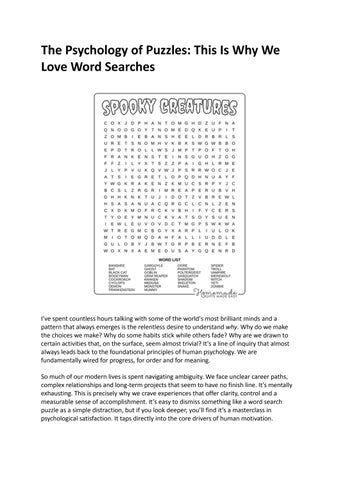
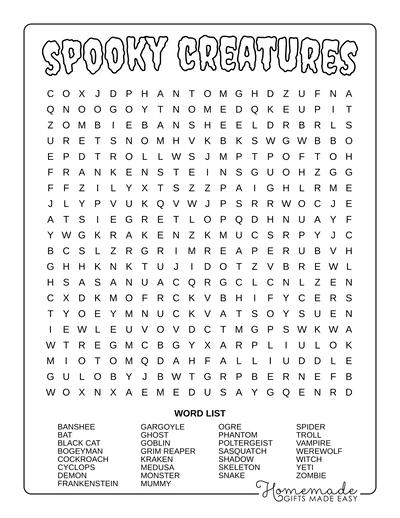
You are presented with a jumbled grid of letters, pure randomness. You are also given a list of words, a clear set of objectives. Your task is to impose order on that chaos by finding the hidden patterns. Every word you find is a small victory, a moment where you successfully made sense of the nonsensical. This process of creating structure from disorder provides a deep sense of psychological relief It’s a temporary escape from life’s bigger, unsolvable problems into a world where every problem has a definite solution waiting to be found.
Achieving Flow State Through Simple Rules
This brings us to the concept of a "flow state", that immersive feeling of being completely absorbed in an activity where time seems to melt away. The psychologist Mihaly Csikszentmihalyi identified several conditions for achieving flow and word searches meet them perfectly:
● Clear Goals: You know exactly what you need to do, find the words on the list.
● Immediate Feedback: You know instantly whether you’ve succeeded. The word is either there or it isn’t.
● A Balance Between Challenge and Skill: The puzzle is difficult enough to be engaging but not so hard that it becomes frustrating.
This trifecta draws you in, quieting the external noise and internal anxieties. You're not worried about an email you forgot to send or a meeting you have tomorrow. You are entirely present, focused on a single, achievable task.
The Healthy Dopamine Loop of Puzzle Solving
Let’s talk about dopamine. It's often mislabelled as the “pleasure molecule,” when it’s more accurately the “motivation molecule.” It’s the neurotransmitter that drives you to seek rewards and repeat behaviours. Social media platforms and video games are expertly designed to exploit this system with unpredictable, variable rewards that keep you hooked.
A word search puzzle engages this same dopamine loop, but in a healthier, more predictable manner
1. Anticipation: You see a word on the list and begin your search. Your dopamine levels rise in anticipation of the find.
2. Search: The hunt itself is a focused, goal-oriented activity driven by that motivational surge.
3. Reward: You find the word. Your brain releases a small burst of dopamine, delivering a feeling of accomplishment and satisfaction.
Unlike the infinite scroll of a social feed, this loop has a natural endpoint. You finish the puzzle, you close the book. The satisfaction is self-contained and earned, not engineered by a tech company to create dependency. When you choose a puzzle that resonates with your interests, like a book from Chris Alick’s nostalgia-themed collections on Amazon, the reward is amplified. Finding words from your favourite 90s movies in the 1990s Word Search Collection connects that dopamine hit to your own positive memories, deepening the feeling of satisfaction.
Building Confidence Through Mastery and Competence
One of the most fundamental human needs, as described by self-determination theory, is the need to feel competent. We all want to feel that we are capable of mastering skills and overcoming challenges. This feeling is known as self-efficacy, the belief in our own ability to succeed.
Modern life can often chip away at our self-efficacy We face complex problems with no easy answers, which can lead to feelings of helplessness or inadequacy. A word search, in its beautiful simplicity, helps to rebuild it. Each puzzle is a solvable challenge. With every word you find and each grid you complete, you are gathering tangible evidence of your own competence.
It’s a micro-dose of mastery. This might sound small, but these little wins accumulate. They create a positive feedback loop that boosts your confidence and creates momentum. For someone learning a new skill set, a book like Circuit Sleuth for electronics enthusiasts can transform daunting jargon into a series of achievable goals. This isn’t just about finding words; it’s about proving to yourself, one puzzle at a time, that you are capable.
The Power of Nostalgia and Social Connection
We are social creatures, wired for connection. While puzzles are often a solitary activity, they can also tap into our shared cultural experiences. This is where a well-chosen theme becomes so important.
Nostalgia is a powerful, bittersweet emotion that provides a sense of continuity and comfort. Engaging with a word search from the Totally Radical ‘80s or Groovy Days: A 1960s Nostalgia Word Search collection does more than just challenge your brain; it transports you. You’re not just looking for letters; you’re reconnecting with the music, fashion and moments that shaped you.
This also creates opportunities for social connection. A puzzle book can become a conversation starter between family members, bridging generational gaps. It’s a shared reference point, an anchor for storytelling. And with accessible formats like large-print word search books, everyone can participate, making it a truly inclusive activity.
Turning Attraction into a Nourishing Habit
Anything that triggers a reward loop has the potential for compulsion. The key is to engage with it intentionally, turning it into a nourishing habit rather than a mindless escape. A puzzle should serve you, not the other way around.
Set clear boundaries. Decide to use a word search as a deliberate tool for a specific purpose. Maybe it’s a 15-minute, screen-free ritual before bed to calm your mind. Perhaps it’s a way to reset your focus during a break from deep work. By defining its role in your life, you remain in control.
The goal isn’t to become the world’s fastest puzzle solver. The goal is to use this simple, powerful tool to cultivate focus, build confidence and give your mind a well-deserved break from the chaos of the modern world. It’s about finding a source of satisfaction that is healthy, contained and entirely your own.
Your mind is the engine that drives everything you do. Take the time to understand what it needs and give it the right fuel.
Ready to see for yourself? Find a theme that speaks to you in Chris Alick’s collections of word search books on Amazon and discover the psychological satisfaction of bringing order to chaos.
References
Chris Alick website: https://chrisalick.com
Word Search Books by Chris Alick: https://chrisalick.com/word-search-books/ Mihály Csíkszentmihályi: The Father of Flow: https://positivepsychology.com/mihaly-csikszentmihalyi-father-of-flow/