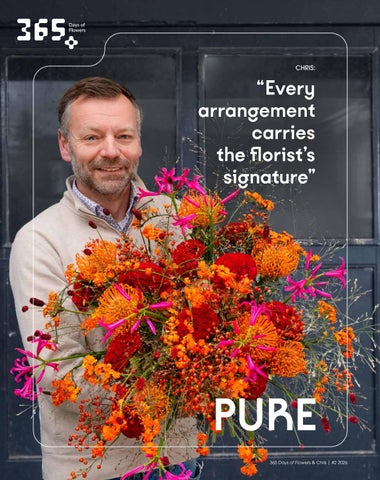
CHRIS:
“Every arrangement carries the florist’s signature”
PURE 365 Days of Flowers & Chris | #2 2026
The
Anemone is an elegant flower with soft petals, countless stamens and slender stems.
Forword
3
Pure Less is more. In a world that seems to be getting ever
Not impressing for its own sake, but through honest
busier, fuller and louder, we are increasingly looking
craftsmanship. By daring to stand up for what you find
for moments of tranquillity. For simplicity. For what
beautiful and what suits you.
really matters. And it is precisely this that you find in the flowers you work with every day: pure, sincere
In this magazine, we introduce you to growers who cultivate
and powerful in their simplicity.
flowers with passion and precision, such as the Klaver family, who grow Gypsophila in Ethiopia under “thirteen
This edition of 365 Days of Flowers is all about the theme
months of sunshine.” You can read how florists such as
Pure. It’s not about embellishment or excess, but about the
Chris, Pien, Suzanne and Mireille translate purity into
essence: bouquets in which every stem matters. Arrange-
their own style. And you will discover how sustainability
ments that are calm and serene, but at the same time say
and simplicity go hand in hand: less packaging, more
so much. Because pure work requires boldness: the bold-
seasonality, more attention to what really matters. We
ness to go back to the basics, to deliberately choose fewer
hope this edition inspires you to take a fresh look at your
elements and, in doing so, make more of an impact.
profession. To embrace the power of simplicity. To choose purity – in your arrangements, in your store and in how
Pure fits in with those special moments in your customers’
you work.
lives. A birth, a wedding, a farewell. Moments of pure emotion, in which simplicity has the power to truly touch people. It’s about flowers that speak without being overly extravagant, about arrangements that give space to feelings.
JACCO VAN DER HOEVEN
But pure is also about you as a florist. About the develop-
Cut flowers product manager
ment of your own authentic style, about creating work
at Royal FloraHolland
that feels sincere and is recognizable as yours.
365 Days of Flowers & Chris | #2 2026
Tips
4
Pure. Pure floral arrangements let colours speak for themselves. The deep blue colour of Gentiana, for example, in a minimalist bouquet comes to its own when it is the only colour in the arrangement.
Gypsophila proves that
a single flower variety, repeated in simplicity, evokes more tranquillity and emotion than an exuberant mix. Beautiful for a wedding, birth or farewell. Berries appear only after the flower has finished blooming. Using Rose hips or Hypericum without combining them with exuberant flowers allows you to show the natural season.
365 Days of Flowers & Chris | #2 2026
CONTENTS In brief | 6
5
UP-TO-DATE
The art of growing | 8 GYPSOPHILA
Floral Moodboards | 15 | 23 | 31 WITH TIPS FROM CHRIS
Trends | 16 SUSTAINABLE GROWING
Did you know | 21 | 32 | 46 DAHLIA, SOLIDAGO, HYPERICUM
Florist in the spotlight | 24 CHRIS, MIREILLE & SUZANNE, PIEN
Trends | 33 PURE AND SIMPLE
Bouquets | 36 FIVE PURE BOUQUETS
365 Days of Flowers & Chris | #2 2026
In brief
Up-to-date 6
Interesting flower news, events and more. Keep up-to-date on the latest news!
Tips van Chris Each edition features a florist who shares useful tips. This time Chris Derksen shares tips throughout the magazine. You can read his story on page 24.
FleuroStar Award The FleuroStar Award went to Digitalis purpurea
Stay up to date! Every month, we send out a newsletter with inspiration, facts, events and other news. Would you like to stay up to date with developments in the flower profession and ensure that your flower shop stands out from the rest?
Become a free
subscriber
365 Days of Flowers & Chris | #2 2026
Hanabee F1 White. This foxglove grows compactly and has pure white flowers that contribute to biodiversity. A wonderful award for the most promising and exceptional varieties.
Events Feérie Florale 25 to 28 September 2026, Alden Biesen (BE)
Pure inspiration Looking for a bouquet that radiates pure
7
Novafleur 6 and 7 October 2026, Tours (FR)
tranquillity? With its natural shapes and
Trade Fair
bright colours, this arrangement brings
3 to 5 November 2026, Aalsmeer (NL)
harmony to any room. This bouquet features Gentiana, Scabiosa and Dianthus barbatus, among other flowers. Skimmia is used to add fresh
IFTF 3 to 5 November 2026, Vijfhuizen (NL)
green accents. Looking for more inspiration within the Pure theme? As of page 36, you will find five more creations.
Academy for you! Would you like to learn more about business, growing flowers or creating innovative arrangements? Every month, our “Academy” releases a new video. Subscribe for free and watch all the videos on our platform.
Watch the
video’s
365 Days of Flowers & Chris | #2 2026
The art of growing
8
Brother and sister Gert-Jan and Lydia Klaver grow Gypsophila all year round in Ethiopia.
365 Days of Flowers & Chris | #2 2026
Family with flowers in its blood The history of the Klaver family of growers goes back more than a century. “Our grandfather started the family business in 1907,” says Lydia. “Our father and uncle pecialized in growing lilies. Between 2000 and 2005, we took over the business as brother and sister and opened a branch in Ethiopia. We started with lilies here too, but the climate in Ethiopia turned out to be ideal for Gypsophila.” It was always clear to Gert-Jan that he wanted to join the family business. “I’ve wanted to do this since I was a child,” he says. For Lydia, it wasn’t so obvious that she would also enter the flower industry: “I worked for myself in financial services. So I logically became involved in the administrative side of the family business. Gert-Jan and I each have our own tasks and we don’t get in each other’s way, which is why it works so well.” In addition to them, operations director Danny Koppes also plays an important role within the company. “He lived in Ethiopia for ten years and was responsible for the day-to-day management. He now lives with his family in the Netherlands, but, like Gert-Jan, he travels to the nursery every month.”
Focus on quality When the Klaver family started growing Gypsophila, their goal was clear: to grow Gypsophila that could compete with
Gypsophila: white clouds
the quality from Ecuador. “At the time, the best quality Gypsophila came from there,” says Gert-Jan. “We wanted to prove that it could also be done in Africa. The same firmness, the same white colour, the same shelf life. And we succeeded. We now supply Gypsophila of the high-end segment, with a consistent quality all year round.”
The power of pure white It may appear fragile, but looks can be deceptive.
Gypsophila is anything but easy to grow. Gulilat Bekele,
Gypsophila – better known as baby’s breath – is one of
manager of the nursery in Ethiopia, knows this better than
the most delicate yet resilient of flowers. Siblings Gert-
anyone. He ensures that everything on the 120 hectares
Jan and Lydia Klaver cultivate the flower in Ethiopia,
of land runs smoothly when Lydia and Gert-Jan are in the
where the sunlight and sandy soil provide the perfect
Netherlands. “It’s a crop that needs constant attention,” he
growing conditions.
says. “The flowers grow outdoors, not in greenhouses,
365 Days of Flowers & Chris | #2 2026
9
so we depend on the sun, rain and temperatures. Every stage requires precision: from the cuttings to the moment the small white flowers open.” Before the young plants are transferred to the open field, they first undergo a careful acclimatization process. In the nursery, the small cuttings are cultivated into young plants, which are then moved to the “hardening room”. “Here, the plants can get used to the conditions outside,” says Gulilat. Two weeks later, they are planted in the field. “This intermediate step ensures we get healthy, sturdy plants that grow better.” The flower is cut when the buds are still closed. Then comes the most delicate part of the process: opening the Gypsophila flowers in special tunnels. Gulilat explains: “That takes five to six days. If the temperature or humidity are just slightly off, the flowers turn brown and the entire harvest is lost. It involves precise custom work, or rather degree work. A difference of two degrees can be fatal for the flowers.”
13 months sun The nursery is located at an altitude of 1,700 metres, while Gypsophila normally grows between 2,000 and 2,600 metres. “Gypsophila thrives in the warmth, sun and a well-drained soil. Soil that is too wet is disastrous; it causes the plant to rot,” explains Gulilat. “We can grow it year-round, even during the short rainy season when the sun still shines. The Ethiopian calendar has thirteen months, and so therefore thirteen months of sunshine, as they say here.” “We grow the flowers outdoors, because they become too soft when grown indoors in a greenhouse,” adds Lydia. “The climate and soil in Ethiopia turns out to be ideal for Gypsophila.” The company grows two different varieties of Gypsophila: the small-flowered Zinzi® Discovery and the large-flowered Xlence®. “We continue to experiment with new varieties,” says Gert-Jan. “We work closely with breeders and now also have our own greenhouse next to the nursery with
365 Days of Flowers & Chris | #2 2026
The art of growing
11
“The climate and soil in Ethiopia turns out to be ideal for Gypsophila.”
365 Days of Flowers & Chris | #2 2026
mother plants for producing cuttings. The first part of the
September
greenhouse is the flowering area, while the rear section houses thousands of mother plants. This allows us to produce fresh cuttings all year round. In total, we cut around 50 million stems annually.” 12
Flower full of challenges Gypsophila has a very intensive cultivation process. Each plant produces harvestable stems after three months. After harvesting, the plant is cut back and can bloom again two to three times a year on average. “We work continuously with a strict planting and harvesting schedule so that we can send fresh flowers to Europe every week,” says Gert-Jan. The flowers are transported dry in boxes, directly by plane to Europe. “During transport, sufficient cold air must flow through the boxes to keep the temperature stable. Otherwise the flowers would heat themselves up. If the boxes become too warm, the flowers discolour and the product becomes worthless.”
Sustainable cultivation The cultivation takes place outdoors and the company strives to work as sustainably as possible. “We always look for organic solutions before resorting to chemical plant protection products,” says Lydia. “We have invested a great deal in water conservation and crop rotation, which involves growing different crops on the same plot of land. We do this to prevent soil disease. In Ethiopia, we don’t use automation; you want to keep it as simple as possible. It’s difficult to find technical people in the area. We also think it’s important to give something back to the local community here; we support fifty students, a clinic, and a hospital in the village. What’s more, we provide good employment opportunities. Before our nursery was here, there was nothing. We now employ 2,300 people.”
Read
more
View Gypsophila is not only grown in distant countries; there are also Gypsophila nurseries in the Netherlands.
365 Days of Flowers & Chris | #2 2026
Gypsophila
The art of growing
13
365 Days of Flowers & Chris | #2 2026
August
14
TIP FROM CHRIS: “It’s an eye-catcher on its own, but also looks beautiful in an arrangement with shades of blue, purple and lilac.”
View
Gentiana
365 Days of Flowers & Chris | #2 2026
Floral moodboard
1. Gentiana / 2. Dahlia / 3. Sedum / 4. Ageratum 5. Antirrhinum / 6. Eryngium / 7. Agastache
4.
5.
2.
1.
6. 7.
3.
Trend article
16
Growing sustainably Sustainability in the flower industry goes far beyond paying attention to plant protection products. Efforts are being made on all fronts to achieve greater awareness and purer cultivation: from water and energy to transport packaging and social responsibility. Do you know how you, as a florist, can contribute in your shop?
365 Days of Flowers & Chris | #2 2026
17
365 Days of Flowers & Chris | #2 2026
Trend article
18
“Opportunities are always there and everywhere,” says
efficient systems. Some growers work with automated
Helena van Achterberg, brand manager at a seasonal flower
systems that dose precisely what the plant needs.
grower. “We sometimes say that sustainability is a journey,
Others collect rainwater and store it for efficient use.
not a destination.” That idea perfectly sums up what is
Did you know that nurseries also use smart sensors
happening in the sector: growers from all over the world
that measure the moisture content around the roots to
have the same goal, but are each following their own path
prevent water wastage? Water purification systems, known
to get there.
as “wetlands”, have also been created. These systems purify wastewater so that nurseries can reuse it for irrigation, and
Tell the story
can also protect local ecosystems and reduce the ecological
Consumers are becoming increasingly critical: customers
impact.
want to know more and more how sustainable the flowers they buy are. That is precisely why it is important for florists
Packaging and transport
to dare to tell the whole story. Transparency should be seen
Whereas packaging is highly valued abroad, in the
as an opportunity not a risk. Grower Annemieke de Haan
Netherlands there is a growing focus on how to reduce it.
believes transparency is important: “We work according to
Growers are increasingly switching to certified paper
green, environmentally friendly methods, but this is hardly
and using reusable transport packaging.
ever communicated. Tell people about all the good things
Growers abroad are looking at how transport
being done!”
lines can be shortened without complicated workarounds, and whether it is possible
Helena also notices that there are persistent prejudices
to transport goods by sea instead of air.
about the flower industry. “Well-informed florists are better equipped to deal with the increasingly critical customer.
Energy
If you know more about what is already being done
The Netherlands is investing heavily in energy-efficient
– from water management to social projects – you can
cultivation. This includes solar panels, LED lighting and
dispel misunderstandings. That helps build trust and
more efficient cooling techniques. Growers who cultivate
enables you to help customers become more aware in
outdoors make use of the natural conditions. In countries
their choices.”
such as Ethiopia and South Africa, almost all cultivation takes place outdoors, so energy consumption is minimal.
Water management
This theme can also be extended to shops, where you can
Water management is an important part of sustainable
switch to LED lighting and energy-efficient cooling
growing, which is why so many growers are investing in
systems. Small changes with a big impact.
365 Days of Flowers & Chris | #2 2026
Helena
Annemieke
Lydia
van Achterberg
de Haan
Klaver
Crop protection
There are many misconceptions about the use of crop protection, among both consumers and florists. Grower Annemieke explains: “Consumers think that organic flowers are not sprayed, but chemicals are used for these as well. Only in this case, they are ‘green’ products, such as garlic. Growers are experimenting extensively with such alternatives. And they are making great progress, but you hardly ever hear about it.” That is why Annemieke is calling for more transparency: “Tell the honest story. Customers learn more from concrete examples, not from quality marks that mean very little to them.”
Waste and recycling Did you know that many growers process waste into compost or soil improver? This improves soil fertility and supports a healthy ecosystem. Florists can do the same in their shops: separate waste, dry the remaining flowers or use them in workshops, and purchase in a more aware manner. It doesn’t have to be big to make an impact; every kilo less of waste makes a difference.
Social sustainability Sustainability involves not only the plant, but also the people who work in the sector. Helena: “We work closely with the local villages near our nurseries in Africa. Our foundation helps to strengthen the community.” The family business where Lydia Klaver works wants to give something back to the local community around their nursery: “We support a clinic and a hospital in the village,
QUALITY MARKS Skal certificate: Dutch quality mark for organic products. MPS (Environmental Project in Floriculture): Certification system that measures and assesses the environmental impact of flori culture companies in terms of water, energy, crop protection and waste. FSI (Floriculture Sustainability Initiative): Initiative that brings together businesses within the international floriculture sector to promote sustainable and transparent trade. GlobalGAP: International standard for safe and sustainable agricultural production, including flower cultivation. Focus on working conditions and the environment. CSRD (Corporate Sustainability Reporting Directive): EU reporting obligation (not a quality mark) for large companies regarding their sustain ability performance.
as well as fifty students. We also provide good
365 Days of Flowers & Chris | #2 2026
Trend article
employment opportunities. Before our nursery was here, 20
there was nothing.” These are valuable stories for florists. They show that sustainable cultivation goes far beyond environmental labels or CO2 emissions. This is something that many customers are unaware of, but often appreciate when it is explained to them. In the Netherlands and Europe, social services are well regulated by the government. Standards regarding working conditions are also regulated by law. Dutch growers therefore keep extensive records and are monitored for compliance with all regulations by the Netherlands Food and Consumer Product Safety Authority (NVWA).
WHAT CAN YOU DO AS A FLORIST? Season Choose seasonal flowers.
Quality mark Use packaging that carry a quality mark, or package less.
Lighting Switch to LED lighting in both your shop and workshop.
Waste and energy Separate waste and keep water and energy use to a minimum.
Origin Read about the origins of flowers and share the growers’ story.
Story Place signs next to flowers with a story, for example: “This flower has only travelled 5 kilometres” or “This grower has reduced water consumption by 25%.”
Sustainable Take a look at the sustainability page of growers.
More about how you can grow sustainably? the QR-code.
scan
365 Days of Flowers & Chris | #2 2026
Did you know...
the Dahlia is often associated with inner purity and beauty. The flowers exude a feeling of harmony and simplicity. The beautiful petals and lush flowers also make Dahlias a symbol of elegance. In addition, the flower is considered a symbol of eternal love.
View
Dahlia
365 Days of Flowers & Chris | #2 2026
November
22
TIP FROM CHRIS: “Sanguisorba seems simple, but it actually allows other flowers to stand out in an arrangement.”
View
Sanguisorba 365 Days of Flowers & Chris | #2 2026
Floral moodboard
1. Crocosmia / 2. Sanguisorba / 3. Helleborus
2.
1.
3.
24
“Behind every work there is a story, which we try to capture in colour and form”
Chris Derksen (50) grew up among the flowers of the shop De Eeuwige Lente in the Dutch city of Apeldoorn and is the third generation to continue working in the family business.
365 Days of Flowers & Chris | #2 2026
Florist in the spotlight
25 From an early age, it was predestined: Chris would take over his father’s flower shop. As a third-generation florist, he specialized in funeral bouquets. “The best thing about this profession? That you can translate emotions with flowers.”
What does purity mean to you as a florist?
that the ‘tone-on-tone’ trend with soft pastel colours is
“A flower is pure in itself. In an arrangement, you let the
used more often again.”
flowers speak for themselves, without adding too much around them. A single flower can also look beautiful on
What techniques do you use to create more
its own in a vase. Take, for example, a very large vase filled
tranquillity in your arrangements?
with Gypsophila. A flower that wasn’t that popular for a
“My father always used to say: the foundation is sixty
long time but is now making a comeback.”
percent of the work. That has to be right. By working with layers, depth and maturity, tranquillity naturally emerges.
You also specialize in funeral arrangements.
I place the mature flowers deeper, while adding the young
What does it mean to you to create funeral
buds closer to the surface. This mimics nature and allows
arrangements?
the flowers to look their best. Through my other company,
“It’s really special to be able to translate emotions and
Afscheid met Bloemen (Farewell with Flowers), I recently
offer comfort through flowers. Each arrangement receives
decorated a wicker lid with fresh, white flowers and shades
the attention it deserves. Behind every work there is a
of green. The lady loved freesias, which she also had in her
story, which we try to capture in colour and form. The best
bridal bouquet.”
thing is that you are entrusted with the task of providing that final tribute, something you have only the one chance
How do you translate the emotions of the
to do right.”
bereaved into a fitting flower arrangement? “We invite the bereaved to our shop to sit at a large table
Are there any particular trends in funeral
and tell us their story. As we chat, I start arranging things
arrangements?
in my mind and then everything just falls into place. We
“The style and taste for funeral arrangements is, of course,
work with the Afscheid met Bloemen sales book, which
very personal. You could say that the use of colour has
helps people identify what appeals to them. They often
changed in recent times. Five years ago, you saw much
choose a particular colour scheme and atmosphere, and
more colour in funeral arrangements, but now I notice
I look for flowers that suit the season.”
365 Days of Flowers & Chris | #2 2026
26
“We are all about authenticity”
younger customers as well. We made changes to the shop’s image and product range. Now, people the same age as our children also come in. It’s wonderful seeing such a diverse group of customers.”
How does that work for you, running a business and being friends? Suzanne: “It works very well for us. We know each other through and through, and that gives us peace of mind. If something is going on, at home or in the shop, we can
Mireille’s family’s flower shop has been a household name
share it with each other right away.”
in the Dutch city of Oss for generations. Since Mireille and
Mireille: “Suzanne is the real florist; I take care of the
Suzanne took over together, they have set a clear course:
atmosphere and presentation in the shop. Who does what
working with the seasons, focusing on the customer and
work happens naturally. We understand each other per-
running a shop where it is all about authenticity. Their
fectly, which makes working together so enjoyable.”
collaboration flows naturally; one glance is enough. “For us, being pure means staying true to yourself and doing what feels right. For the customer, the store and ourselves.”
What does pure mean to you? Mireille (laughing): “Pure chocolate!” Suzanne: “For us, it’s all about authenticity, a pleasant
How did you start in business?
atmosphere in the shop, attention to the customer, and a
Mireille: “The flower shop is my family’s business, but I
positive attitude toward your profession. And perhaps the
never intended to take it over. I was an interior stylist
most important: staying true to yourself. Choosing what
and involved in purchasing pots and vases. My father said:
you want to convey as a florist. The older we get, the more
if you can do that there, you can do it in our shop too.
we value this.”
So I started by revamping the shop’s appearance and took
Mireille: “For me, pure is also about working with what
floristry classes in the evenings. When an employee became
the season offers you. Not everything has to be available all
pregnant, I made the switch.”
the time. If we see Ranunculus at the auction in November,
Suzanne: “I had once done a work placement at the
we don’t buy them straightaway but wait until March or
shop and knew Mireille by sight. We later lived on the
April. Customers appreciate it when you explain why you
same street and became friends. When the subject of the
choose seasonal flowers.”
takeover came up, I asked Mireille if she wanted to do it together. From that moment on, we took the step to run
How do you ensure that a simple arrangement
the shop together.”
can still make an impact? Mireille: “By choosing one or two special, high-quality
How did you end up following your family’s
flowers. A good chat with the customer helps: what is the
footsteps, Mireille?
occasion, what message does the customer want to convey?
Mireille: “The shop has been in the family for generations.
Then you can create something powerful with just a few
My great-grandparents started it, then my grandparents
varieties and materials.”
took it over, followed by my father and uncle. When we
Suzanne: “And working purely with seasonal flowers, such
took it over, the clientele was a little on the old side.
as rose hips in autumn, Ranunculus in spring and clematis
We still have that clientele, but the shop quickly attracted
in summer.”
365 Days of Flowers & Chris | #2 2026
Florist in the spotlight
Family business Josina Bloemen in the Dutch city of Oss has existed for more than one hundred years. In 2014, friends Mireille Huizer-de Bruijn (53) and Suzanne de Bekker-van Druten (55) took over the shop.
365 Days of Flowers & Chris | #2 2026
How did you end up in the flower profession? “Actually, I just kind of fell into it. I was at secondary school, didn’t have any plans, and sometimes chatted with a girl who worked at a flower stall in Naarden. When I found out 28
she wasn’t working there anymore, the owner asked if I was interested. I started right away. I didn’t know anything
“With us the experience starts already outside”
about flowers. But shortly after that, we got the chance to take over a flower shop. I was only 18. But it felt right, and we had a clear vision. I’m a real go-getter, so running my own business suited me like a glove.”
What makes your shop so special? “It’s all about the experience, and that starts already outside where everything is on display. Twice a year, we transform the shop front: from a summery look with flowers and greenery to a wintery look with lights, attractive branches and loads of atmosphere. This encourages people walking past to come inside. When inside, that feeling continues seamlessly: music, candles, warm colours, a five-meter-long flower display. There’s so much to see that customers often
When you walk into Jasmijn Bloembinders, it feels like you’ve
walk around three times to see everything.”
stepped into another world. Warm colours, unique home accessories, tall vases, lots of atmosphere: there’s something
What does pure mean for you?
to see everywhere. Pien and her husband Patrick have been
“For me, pure means working with what the season has to
running their shop in the Dutch city of Haarlem for thirty
offer and letting the craft speak for itself. Craftsmanship
years. “Craftsmanship and experience are part and parcel
takes time and energy, but that is precisely what makes
of everything we do. From the flowers we choose to how
our work so pure. We love working with warm colours and
we wrap them: it should feel like you’re taking something
unusual top-quality flowers. We create natural arrange-
special home with you.”
ments that are not rigid or symmetrical, because that’s not how things grow in nature. We like to work with large flowers and few leaves, to create a sense of calm.”
What makes your style so recognizable? “You see it not only in the way we arrange flowers and use colours, but also in how we package them. We’ve been doing this the same way from the very start. When someone walks down the street with one of our bouquets, you can see from a distance that it comes from Jasmijn. It really is a gift, both to give and receive.”
365 Days of Flowers & Chris | #2 2026
Florist in the spotlight You have many followers. What do you think is the power of social media? “It’s truly become an extension of the shop. When we post something online, it sells immediately. Customers from all over the Netherlands send requests with specific wishes.
Scan and
read more
29
These days we FaceTime from the shop. It takes time, but it’s so rewarding! The Covid pandemic has really accelerated our channels.”
Pien Valk (48) together with her husband Patrick (53) runs the flower shop Jasmijn Bloembinders in the Dutch city of Haarlem.
365 Days of Flowers & Chris | #2 2026
July
30
TIP FROM CHRIS: “Never put Zinnia anywhere cold; this sensitive flower needs warmth and stays beautiful longest that way”
View
Zinnia
365 Days of Flowers & Chris | #2 2026
Floral moodboard
1. Tanacetum / 2. Rosa (rozenbottel) 3. Zinnia / 4. Dianthus barbatus
4. 3.
1.
2.
Did you know...
the flowers of Solidago, also known as “goldenrod,” were once used to purify water and make medicines? This is why the flower symbolizes purity and healing.
View
Solidago 365 Days of Flowers & Chris | #2 2026
Trend article
33
Trend: Pure and simple The trend “pure” is here to stay. Calm shades and arrangements where every stem counts. Trendwatcher Aafje Nijman suggests that this movement fits in perfectly with how consumers want to decorate their interiors and their minds. She explains why pure is so popular and how florists can respond astutely to this trend.
Why are consumers opting for simplicity in floral
Which styles go well with this?
arrangements now?
“Minimalist vase styling is very popular. Just a few branches
“This is all to do with how we want to feel at home.
in a beautiful organic vase, carefully arranged with skewers
People are looking for peace and quiet and fewer stimuli.
or in a bed of kenzans. Differences in structure are essential
Interiors are becoming lighter and softer, with for example
here; for example, the elegance of a Gloriosa contrasts well
beige, grey and green tones, organic shapes and natural
with the opulence of a Paeonia and the rustic charm of
materials. Flowers should complement that atmosphere,
an Iberis. This keeps things interesting, without needing
not disrupt it. That’s why white, beige and soft pink shades
much.”
work so well. The popularity of the Japandi style plays
“I also see a new generation of floral arrangers experimenting
an important role in this. This minimalist interior style
with compact forms. On social media, you see pieces that
combines the best of Japanese and Scandinavian design
resemble soft ‘bumps’ of moss or floral foam, from which
principles (tranquillity, simplicity and functionality) with
flowers subtly emerge. Florists don’t use it much yet, but
a focus on natural materials.”
it’s a form that fits perfectly with pure work.”
365 Days of Flowers & Chris | #2 2026
34
When does pure become “boring”? And how can
towards a coarser, rougher form of minimalism. Still with
you avoid this?
tranquil colours, but less polished. Just think of flowers with
“It’s all about aesthetics and proportions. A single small
whimsical, curved stems, striking leaf structures, and materials
branch can be very powerful, as long as the line, structure
that feel rougher. The stem itself will play a much larger role.
or form is interesting enough. What one person considers
At the Trade Fair in 2025, I saw, for example, a Ranunculus
minimalist and stylish, another may regard as empty. So
with a twisted stem and metallic-like leaves. Aesthetically, an
it’s also very personal. But technically speaking, it helps
incredibly interesting opportunity. We’ll be seeing more of
if you work with different textures within a single colour
these kinds of distinctive shapes.”
palette. That keeps the arrangement exciting.”
What other flowers suit this rawer pure style? “Large flowers! Helianthus in all sorts of varieties: pompom shape, almost black, deep dark red. Not as a full
Aafje Nijman
bouquet, but loose in a vase without the leaves, so that the
is a trendwatcher
shape and texture take centre stage.”
and co-owner of Bureau Nijman + van Haaster.
What is your practical tip for florists who want to start tomorrow with the Japandi trend? “What’s so wonderful about the flower profession is that the temporary nature of the product gives you the opportunity to do something completely different. Start with
What colour palette fits in best with pure?
your flower wall, and choose flowers in neutral colours
“It’s all about soft shades that are similar to each other:
without too much greenery. You could do that for a week
beige, salmon, soft yellow, white, greyish green. But you
and see what kind of reactions you get from your customers.”
can also add a dark red flower to give it a black and white feel.”
How do you make a shop presentation “purer” without it becoming cold?
How do you develop your own style as a florist
“It starts with the materials you use. Glossy plastic or
within this trend?
bright white ceramics can easily make a presentation
“Don’t think that a bouquet of only white flowers is enough.
appear harsh. Matte ceramics, light wood or natural stone
Purity is also all about form and structure. Display one
immediately convey a sense of calm and softness. Combine
convincing example in your shop: a vase with five branches
that with flowers in soft shades and your space will imme-
in different shapes and textures. Show how you can create
diately feel more accessible. It doesn’t have to be boring at
something really exciting with very little. Start small. Put
all: choosing organic shapes and natural materials actually
together a pure presentation corner in the shop: light,
gives the whole thing character. An Antirrhinum in a
peaceful, with a little greenery and natural materials.
brilliantly white, sleek container looks cold, but the same
This immediately removes any visual noise, and customers
flower really comes to its own in a matte pot.”
surprisingly often recognize themselves in this.”
Do you see the pure trend changing already? “Pure is here to stay, but it will look different. We are moving
365 Days of Flowers & Chris | #2 2026
scan
and discover how you, as a florist, can create a pure bouquet.
Colour spectacle 36
This bouquet is a beautiful way to end the summer and fits in with today’s colourful trends. The Dahlias in various shades of orange, soft yellow and pink create a cheerful arrangement. The orange Crocosmia and pink Dianthus barbatus give that extra colour to the bouquet, while Lepidium adds a touch of lightness. Base To make the flowers look their very best, try using a glass bowl that is not completely transparent. For the base, you can use (organic) floral foam, chicken wire or a flower frog. Tip: Make sure there’s not too much water in the bowl, but change it regularly throughout the week to keep the water fresh.
In this bouquet: Crocosmia / Dahlia Dianthus barbatus / Lepidium More
365 Days of Flowers & Chris | #2 2026
inspiration
Bouquets
Bouquets
Soft and warm An attractive bouquet using just three types of flowers: Helleborus, Antirrhinum and Sanguisorba. There’s no need to use lots of flowers to create a beautiful combination, as long as the flowers and the vase go well together. Combination of colour The deep wine-red, almost velvety colours of the Helleborus and Sanguisorba contrast with the white and light yellow of the Antirrhinum to create a pure and warm bouquet. Tip: cut the stems of the Hellebores vertically after cutting them at an angle; this will keep them fresh longer. You can also first dip the stems in hot water.
In this bouquet: Antirrhinum / Helleborus / Sanguisorba
More
inspiration
365 Days of Flowers & Chris | #2 2026
39
Pure nature If you like garden flowers then this bouquet is an ideal 40
combination. This creation also uses three types of flowers. There is a mix of pink, red, yellow and purple Zinnias. Playfully protruding throughout are twigs of Bupleurum and Bouvardia, creating an airy effect and adding just that little bit of extra variety. Eye-catcher The Zinnia is the star of the show here. Not only the diversity in different colours, but also the differences in double and single flowers ensure that they steal the show in this bouquet. Tip: since Zinnias have hollow stems, they can break easily below the flower. Therefore, hold the Zinnia carefully at the bottom of the stem. Once in the vase, you can enjoy them for a long time.
In this bouquet: Bouvardia / Bupleurum / Zinnia More
365 Days of Flowers & Chris | #2 2026
inspiration
Bouquets
Bouquets
Slender and graceful 43
This elegant bouquet is all about height. The base is formed by sturdy Gladioli in deep pink shades. The fresh yellow Antirrhinum and purple Callicarpa provide a strong contrast. Tall vase Give the height of the bouquet even more shape by using a tall vase and, for example, placing it on a pillar. The result is a beautiful creation for a large space. Ideal for in a hotel lobby or a restaurant. Tip: twist off the top point of the Gladiolus, then they will open completely.
In this bouquet: Antirrhinum / Callicarpa / Gladiolus
More
inspiration
365 Days of Flowers & Chris | #2 2026
Interplay of lines 44
Would you like to create a beautiful eye-catcher for your hallway or some other high-ceilinged space? This bouquet also takes into account the location where it will be displayed. The combination of the flowers and vase takes this bouquet to a higher level. Playful The delicate white flowers of the Tanacetum, the dark red colours of the Skimmia and Sedum, and the red berries of the Rosa (rose hips) form a beautiful base as they emerge from the vase. From here, the long stems of the Gladioli, Sanguisorba and Tagetes extend playfully. Tip: use long, elegant flowers at the top and heavier (green) flowers at the bottom. This creates a lighter effect at the top.
In this bouquet: Gladiolus / Rosa (rose hips) Sanguisorba / Sedum Skimmia / Tagetes / Tanacetum More
365 Days of Flowers & Chris | #2 2026
inspiration
Bouquets
Did you know...
in ancient symbolism, the berries of Hypericum were seen as bearers of vitality and protection?
View
Hypericum 365 Days of Flowers & Chris | #2 2026
Colophon The themed magazine ‘365 &’ is part of the ‘365 days of flower’ campaign. This campaign is an initiative of the committee 365 days of flowers. Over 1800 growers from 15 different countries make this possible. They grow over 150 different flowers which are promoted throughout the year based on Royal FloraHolland availability dates. The objective of the ‘365 days of flowers’ campaign is to jointly develop sales opportunities for florists. CIRCULATION 10,000 copies PRINT 2026, edition#2 COPYRIGHT Nothing from this publication may be reproduced and or published by means of print, photocopy, audio recording, digital or in any other way, without the written permission of 365 days of flowers. CREDITS Photography: Janita Sassen, Klaver Flowers, Studio Mees Illustration: Ray Heinsius, JeRoen Murré Copy: De Content Toko Final editing: Wilke Martens Florist: Le Fleurieus Design: BTTR Printer: Drukkerij Roelofs CONTACT E-mail: hello@365daysofflowers.com www.365daysofflowers.com
In the next edition, you can read all about the trends and flowers that fit in with the trend of
Together.
TRENDWATCHER AAFJE NIJMAN:
“People are looking for peace and quiet and fewer stimuli. Flowers should complement that atmosphere.” P. 33