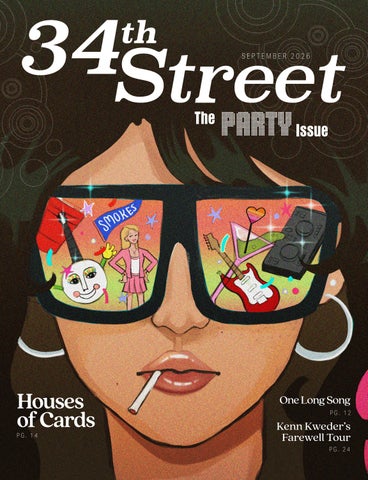
SEPTEMBER 2026
AUGUST 2026 The
The
PARTY Issue
party Issue
Houses of Cards
PG. 14
One Long Song
PG. 12
Kenn Kweder’s Farewell Tour PG. 24
Offering 60+ eateries, stores, and entertainment venues, Shop Penn is giving you plenty of reasons to stay and play around campus this semester.
S H OPSATPE N N .COM
Calling all Movers Shakers + Quakers Wants Needs + Must-Haves
Shop Local. Shop Penn. #S HOPPE N N @S HOPSATPE N N
2
34 T H ST R E E T MAGAZ I N E
Foodies Deliveries + Shopping Sprees
12 WHERE THERE’S SMOKE, 19 THERE’S STUDENTS DO--IT--YOURSELF 22 FRAT RANKING KENN KWEDER’S FAREWELL TOUR 24 ONE LONG SONG
Humming in the color of dust and tie–dye
Penn’s favorite bar gets its staying power from its adaptability.
FEATURE
The Bard of South Street is looking to “slow down”— something he hasn’t done in decades. Will he let himself?
30
PARTIES OUT OF PLACE
The City of Brotherly Love lacks a social scene for its sapphic sisters. At Penn, it’s folded into the fabric of queer nightlife as a whole.
HOUSES OF
CARDS
Amid a slew of new regulations, students say that OFSL is tearing down the social Ivy brick by brick.
14 ON THE COVER By Kate Ahn Is there a future to parties at Penn? Or do we already look back on it with nostalgia....
S E PTE MB ER 2026
3
LET TER FROM THE EDITOR
Play hard, never work!
T
he best party I’ve ever attended was themed around European Union expansion. The interior of the house was West Berlin in all its cosmopolitan glory—the backyard was the East, the Schwarz–Rot–Gold and compass keeping close watch over the revelers below. Dividing the two was a wall haphazardly constructed out of hundreds of cardboard boxes, stopping partygoers (who were sorted into sections by a doorman in a long coat and ushanka) from interacting with their brethren on the other side of the barrier. Two DJs and two drink menus, each themed around their respective zones, gave each side its own unique aura. And then the clock struck midnight. The music cut out. And a sharp cry pierced through the air. “Mr. Gorbachev, tear down this wall!” And so it was. Maybe LARPing German reunification isn’t your idea of a good time. Thankfully, on any given weekend at Penn, there’s no shortage of parties— both on and off campus—open for you to enjoy. With clubs, bars, and house shows open every weekend, there’s also no reason your social life should be constrained by the irregular borders of Penn’s core campus. Whatever space you find most comfortable, you’re more than likely to find it profiled in this issue. In the spirit of Penn’s “work hard, play hard” culture, we at Street have worked hard on the Party Issue to question the state of play on Penn’s campus. From queer party profiles to bar reviews, we examine Penn’s social scene on Locust Walk and beyond, exploring the social spaces students seek out in order to
take a load off after a long day of work. In a feature on the Penn administration’s recent crackdown on fraternity life, we investigate where Penn’s social scene might go after it is squeezed off campus. And we would never relegate you to the status of a passive reader— with our crossword and DIY frat ranks, you’ll find plenty of opportunities to make your mark (literally) on the pages that follow. If you’ve read this far, here’s some advice for you: It’s easy to work hard and play hard. It’s harder to find a unity between the two. Don’t waste your life here doing work you know is meaningless. Don’t waste your time in social spaces where you feel like you don’t belong. Building a cardboard wall, finding two DJs, manning a door—all of that is hard work. But to see the fruits of your labor in the joy people feel when they enter the space you created makes all that work seem like child’s play. In the spirit of reunification, let your work and play become one. Dear reader—tear down that wall! W SSSF,
EXECUTIVE BOARD Nishanth Bhargava, Editor-in-Chief Samantha Hsiung, Print Managing Editor Kate Ahn, Design Editor Sophia Mirabal, Digital Managing Editor Jackson Zuercher, Assignments Editor T H I S I S S U E ’S T E A M Executive editor Jasmine Ni Copy editors Prashant Bhattarai, Jessica Huang Street Photo editor Connie Zhao Deputy Design editors Kiki Choi, Chenyao Liu, Amy Luo, Andy Mei, Alex Nagler, Julia Wang Design associates Catherine Garcia, Camila Leon Bolivar, Maggie Wang, Tiffany Zheng SECTION EDITORS Sadie Daniel, Features Ethan Sun, Features Diemmy Dang, Focus Henry Metz, Film & TV Aaron Tokay, Music Laura Gao, Arts Jessica Tobes, Style Fiona Herzog, Ego STAFF Features writers Kayley Kang Focus beats Melody Cao, Vasanna Persaud, Saanvi Ram Film & TV beats Julia Girgenti, Susannah Hughes, Shannon Katzenberger, Sophia Leong, Chenyao Liu, Élan Martin–Prashad Music beats Leo Huang, Remy Lipman, Drew Neiman, Joshua Wangia, Brady Woodhouse Style beats Jordan Millar, Alex Nagler, Addison Saji, Adalia Vargas Arts beats Anjali Kalanidhi, Jack Lamey, Lynn Yi Ego beats Rodin Bantawa, Sophie Barkan, Jackson Ford, Jaya Parsa Staff writers Emma Katz, Jenny Le, Suhani Mittal, Irene Antón Piolanti, Henry Planet, Namya Raman, Alena Rhoades, Tanvi Shah, Conor Smith, Sara Turney, Diamy Wang LAND ACKNOWLEDGEMENT The Land on which the office of The Daily Pennsylvanian stands is a part of the homeland and territory of the Lenni— Lenape people. We affirm Indigenous sovereignty and will work to hold the DP and the University of Pennsylvania more accountable to the needs of Indigenous people.
CONTACTING 34 th STRE E T M AGA Z IN E If you have questions, comments, complaints, or letters to the editor, email Nishanth Bhargava, editor–in–chief, at streeteic@34st.com. You can also call us at (215) 422–4640. www.34st.com © 2026 34th Street Magazine, The Daily Pennsylvanian, Inc. No part may be reproduced in whole or in part without the express, written consent of the editors. All rights reserved.
WET 4
34 T H ST R E E T MAGAZ I N E
T T
THE SOUL OF THECITY
*
A series of nights spent dancing below old Parisian rails BY SADIE DANIEL DESIGN BY ALEX NAGLER he soul of Paris lies on a dark street, just past an old rail bridge in the 19th “arrondissement.” A stone path leads to the building that holds it, an abandoned, and now repurposed train station dressed with the painted face of a woman. Chatter is abundant along the path, tables full of old friends and new acquaintances drinking. It’s unassuming when you push open the front door, a beige room covered in colorful graffiti from lives past and a series of closed doors leading to who knows where. Around the corner is the start of the evening. Jazz plays every night of the year from 9 p.m. to midnight. Or 10 p.m. because that’s when they feel like starting. On a large portion of those nights the music is terrible. On the few nights when it’s not, the city’s soul reveals itself. The crowd sways to whatever sort of experimental jazz the club chose for the night. Sometimes it’s Congolese, other times just Parisian. Sometimes the drummer takes over. Other times the pianist. But the soul extends into the crowd and absorbs them for the night. At midnight, the air shifts again. The crowd slowly moves downstairs, deep into the cave that holds the station up. Be it Detroit techno or deep house,
T
EDM carries the rest of the night. The crowd piles in from around the world. They dance quietly to the music below and scatter to talk and smoke out back in the gravel yard below the old rails. In the cave and on the gravel is where the night tends to unfold. +++ I’m barely 19 years old the first time I visit. I’m in Paris for spring break, volunteering for a food distribution group near Gare de l’Est. On one of the distributions, I meet a 30– year–old woman. She’s French and English—we wander the city for two hours after walking uselessly behind the people with sandwiches to distribute. We decide to meet at the station the upcoming Friday. I wait for her on a bench for 20 minutes, men in dark clothes passing by. I’ve never been this far north in the city before and I twiddle my thumbs nervously. It’s my first solo trip after all. When she arrives, we go in and the soul of the space moves through us for the two hours of time we’ve allotted to feel it. Eventually, we make our way downstairs. The cover is €15 tonight. It’s quiet for now.
It’s about an hour later when we meet him. Communication fails us the first couple of minutes where we don’t realize that he doesn’t speak French. He’s wearing stupid sunglasses and his hair is lightly combed up. He tells us he’s Indian and from Thailand. He says he’s a filmmaker and that he’s here for a month to film, whatever that entails. He asks how old I am, I tell him. I don’t ask back. Eventually, she moves to the side as he and I dance closer and closer together. About as fast as we join hips, he’s kissing me. He pushes his sunglasses up and me against one of the stone arches. An unknown amount of time passes as we make out—all I can think about is how I’ve never done this before. All sorts of friends of mine have made out on the sticky floors of fraternity basements. But I’ve never been approached or stuck around long enough to be into it. After we make out, he asks for my Instagram, a follow request I never accept. I walk back over to my new friend immediately after. “You were looking at him like you were in love with him,” she says. “Il baise bien,” I reply. She laughs, “Babe, that means he fucks S E PTE MB ER 2026
5
good, not kisses good.” It’s been a while since I’ve had to use French so colloquially. Whoops. +++ It’s early July when I visit again, this time with my best friend in tow. I’ve promised her a fun night, although the two hours getting ready lead us to miss the jazz. Like every visit, we eventually make our pilgrimage down into the cave. The techno is okay tonight, but she’s a great dance partner—always has been. I find myself far too invested in finding someone here. She’s just finished up a month studying in Spain, and I’m frankly jealous of how much action she got. Outside of my last visit to the tracks, I don’t go out clubbing much. I don’t really know people here. She tells me to focus on myself, it’s not all that important to find someone. “We’ve got each other,” she says. I’m reminded of our ongoing bit where we agree it would be exponentially easier if we were attracted to each other, but we most definitely aren’t. We tire of the cave after about an hour of dancing. At some point, sitting down and sharing a CBD cigarette, a group of Italian boys approach us. We chat for a bit, about nothing interesting, and go back inside. On our second round out, we see them again. They ask her where she’s from, she responds that she’s Ukrainian. “Zelensky’s more of a fascist than Putin,” they taunt. We tell them to go fuck themselves and go
6
34 T H ST R E E T MAGAZ I N E
home for the night, too upset to stay. It’s a bitter end to an alright night. +++ It’s our last date tonight, one of three. The first time we met, she invited me to a costume party two blocks away from my apartment. We spend the night trading touches among people she knew, or knew of, from high school. We kiss in the doorway to my apartment complex before she takes her Uber home. Our second date involved cheap pre–poured plastic glasses of wine and Japanese crackers along the Seine. She kisses me in the Invalides station before I leave. Tonight we’re at the station. I had dreamed of coming here with a partner months prior when I thought my then–boyfriend and I would be living together this summer. I broke up with him over the distance. I learned two weeks later he came to Paris anyway, much to my distaste. Europe is big enough for the both of us. With her, things are easier. I’m leaving soon and these days I like girls more. We go inside before the jazz starts, grabbing a Red Bull vodka and a Monaco to go drink outside. Sitting on the steps, a man asks us if we’re American. He’s from Brooklyn,
N.Y.—she was born there, and I’m from Philadelphia. We chat long enough that we miss a good portion of the jazz. After the jazz, we go out back to wait for the techno to get good, running into a boy from England and another from Australia. After sharing another one of my CBD cigs, my hand around her waist, we convince them to go back in with us. I ask her, “They probably aren’t smart enough to realize we’re here together, you think they’ll buy us drinks?” She laughs, and we convince them to buy us shots. Even on a date, we have no interest in paying for our own drinks. An hour later, we’re dancing up against one of the stone pillars. Some hot bisexual guy asks if we’re dating, and we say no but keep dancing together. She’s smoother than I am, asking if I can just kiss her instead when I offer her my chapstick. “Dark back corner, over there, come on,” I tell her. It’s the first time I’ve kissed a girl and really liked it—not because I don’t like them, but because the others were abominably bad kissers. We end the night in a cab home, holding each other in the backseat, slipping in and out of French and English on the way back. Maybe I like girls more than I thought, at least more than men. The club can do that to a girl. W
Hometown Carlisle, Mass.
Field of Study Real Estate and Computer Science
Activities Elmo, Herzog Collective, Bloomers, Kinoki Senior Society, The Order
A
s I plop myself down in a cushioned chair inside the Elmo library, I take in the scenery around me. There are posters and pictures of former Elmo members everywhere on the walls—decades of history in the room—and I almost feel like I’m desecrating the area with my presence. Eevee Darling sits across from me with her bleach blonde hair, twiddling a red ball in her hand. It’s hard to imagine that I’ve never seen her on campus before, as she embodies a distinct aesthetic that would make her stand out from a crowd of Penn students—it's not only her hair that’s striking, but her silver jewelry and black attire. At some point, we migrate to the backyard of the house, where mosquitoes start launching themselves toward me. I squeal as they bite me, but attempt to play it cool so as to not interrupt our conversation. By the time our interview is over, I can count at least 15 mosquito bites scattered across my legs. It’s a small price to pay for an afternoon inside the world of Eevee Darling.
Eevee Darling Eevee Darling talks the politics of a Penn party BY SAMANTHA HSIUNG Photo by Connie Zhao Design by Chenyao Liu THIS INTERVIEW HAS BEEN EDITED AND CONDENSED FOR CLARITY.
S E PTE MB ER 2026
7
The Jerome Fisher Program in Management and Technology is a pretty intense program. You’re also a part of Elmo, a member of Herzog, a DJ, and in Bloomers. How do you see these different parts of your life fitting together? I think I’ve sought out similar things in each area. I’ve used my perspective on real estate to give physical spaces on campus a purpose—either as a home, or as a social space, or for some external purpose or audience on campus. If you want to create an effect on the physical space of the world, which dictates all of our lives, a strong way to do that is to work in the business of space. I’ve also put my engineering side to use. It fits well with my experiences in audio engineering, which is very electrical, very physics–based. It has enabled us to invest in the actual equipment for all these functions that we provide—a lot of audio gear, lighting systems, things of that nature. I’ve kind of sought out similar things in both regards. Most of my extracurricular focuses at Penn have also just been about finding a strong community—a community where I’m able to make a difference in my day–to–day life, but also a meaningful impact on the lives of those around me. Does M&T influence any part of how you DJ? Are there any computer science classes you’ve taken that have taught you how to DJ better? I think that more broadly, the engineering side has helped me. I started out doing systems, so I took a lot of electrical classes as well. I’ve done a lot of audio engineering, and that’s very electrical and physics– oriented. I buy vintage speakers a lot to fix them up. Our system here at Elmo’s is pretty analog. A lot of the gear at Herzog is, as well. I think the engineering perspective of knowing
8
34 T H ST R E E T MAGAZ I N E
how to put things together, and how they’re working electronically, has helped make a lot of things possible for us. It’s enabled us to invest in higher quality gear for a lot cheaper because we know how to put it together. How much power do you think a DJ has over the mood or behavior of a crowd? The crowd is influenced by the music. You start to pick up on what’s landing and what’s not. If you are attentive to it, you can really guide things. Is there a go–to song that you’ll play when you know that the energy is down? Nope. I’ve never really planned a set out. It’s always been very in the moment for me. My philosophy is that I always just play exactly what I want to hear at that time. If you are listening to stuff around campus, and if you’re paying attention to what’s happening, I think it’s actually not too hard to predict what is going to work. It comes intuitively once you’ve been exposed to different types of music and thought about it intentionally.
zations, because we don't have the same gendered model, that could be true—but we don’t internally identify like that. We do our own thing. We’re not grouped in the system or the hierarchy in the same way, which also gives us more freedom to self–identify and change over time. If other Panhellenic sororities or fraternities became co–ed, do you think they would embody the same vibe as Elmo, or would they still be grounded in a hierarchy? With greek life, you have entrenched identities that have formed traditions. For Elmo, it was a gradual transition—we had already been taking in women as social members for a while before they got full rights within the fraternity. I think it’s not super uncommon at other schools. I think it takes a certain identity within the organization to make that happen successfully. Elmo is also quite old. It’s the oldest frat at Penn, and it’s the third oldest nationally. A lot of the old fraternities have more of a sovereign identity school–to–school than their national organizations, just because they’ve been around for so long. I think that allows for more fluidity in that sense, because the chapter can kind of self–identify as its own thing. The more recent greek organizations, which have more consistent top–down control or a national sense of sisterhood, would be harder to shift because then you’re deviating from this charter that’s coming from above you.
Do you feel like Penn has a distinctive party culture, or is it pretty similar to other schools? I think a lot of the events at Penn have moved away from the classic fraternity party model, where they’re blasting typical pop music. At Penn, there’s more pressure to put something on that’s worth going to and that people would choose Most people at Penn would say over going out to a club or a bar off– that greek life is exclusive, but campus. Elmo’s public events aim to be inclusive. How do you manage that Elmo is known around campus tension and make Elmo a welas the queer frat. Do you feel like coming space for other people? that perception holds true? I think we’ve always tried to be We definitely are placed in that as welcoming as possible. We work bucket and corralled in that way. I really hard to cultivate an inclusive think relative to other greek organi- culture internally. The primary pur-
pose of all these organizations is to bring benefit to members of the house, for our community and the community around the house. That purpose is something that we carry forward, especially relative to other groups on campus who might care less about that. So you wouldn’t say an Elmo event is meant to cater to everybody at Penn, right? It would primarily be members of Elmo and friends of Elmo? I think that’s the more honest intention of a lot of these kinds of organizations. As both a DJ and party planner for Herzog, you probably pay more attention to how people behave at parties than the average person. What have you learned about Penn students from watching them party? Penn is a very social school. Everyone just wants to hang out and talk! I think that’s something that we’re trying to facilitate at Herzog, even more than the dancing and stuff per se. For people who don’t know, what is Herzog? What is the primary goal of the collective? We’re primarily an artist collective. What that actually means is that on top of living in the same home, we have this model where we pool our resources. We all pay a little bit extra that goes into a fund that’s intended to be used for whatever the vision of the house is at any given moment. We usually respond to some kind of need that we feel on campus, whether that’s to socialize more, or connect, or have some kind of release by coming and dancing, or celebrating something at the start or end of the year. It’s a resource pooling model that allows us to pursue a collective vision that we develop together.
What’s the takeaway that you want people to have from Herzog parties? We always try to show people a new experience—something that they would be excited to come to and enjoy with other people. We think a lot about how we’re setting up the house physically, how we’re designing the space and the arc of the night, and the different experiences that we enable at each point within an event. We never do any event twice. It’s not about the event itself or the project itself, but the feeling and need that we can serve in that moment.
zations to be a part of that are doing similar things, but with people that have different focuses or occupy different identities as a collective.
What would you change about Penn’s party culture? It’d be cool if people put a little more thought into it—if they were being intentional about trying stuff out, being more out–there with genre, and showcasing what they actually find interesting. There is a circuit of the same songs that will get picked up as a trend on campus. People just co–opt things because they have worked well in the past. But ultimately, stuff gets burned out. Penn students spend much of There’s so much music out there—if their lives thinking about classes, people were a little braver in makrecruiting, clubs, and what comes ing their own vibe and making their next. Do you think going out is own style, it’d be more interesting. W an escape from that culture, or do the same pressures and hierarchies show up in Penn’s social scene? I think it does mirror it a lot. You escape that more and more the oldDescribe what a party is in er you get at Penn. Everything at three words. Penn is very status–oriented. That is Sound, light, space. also why it has been refreshing to be in spaces like Elmo and Herzog that care a lot less about that. I haven’t Worst song request you’ve thought about those aspects of Penn ever received? in a long time. I think a lot more “All Too Well (10 Minute Verabout my friends and who we want sion)” to spend time and hang out with.
rapid fire
You mentioned that everything at Penn is very status–oriented, and that Elmo and Herzog have been an escape from that. One could argue, though, that membership in organizations like Elmo and Herzog have become status indicators in their own right. Would you agree? That is also true. I think we think about that less from the inside. It comes from the scarcity [of these types of groups on campus]. It would be nice if there was more competition, and if there were more organi-
Best song request you’ve ever received? I’ve never had a good song request. Ex at the same party: stay or leave? Stay Best night to go out? Friday
S E PTE MB ER 2026
9
Where There’s Smoke,
there's students
Penn’s favorite bar gets its staying power from its adaptability. BY ALEXIS BOLAND DESIGN BY ANDY MEI
W
alk down South 40th Street almost any weekend night and you’ll likely see a growing queue of athletes, fraternity date night post– gamers, and Kenn Kweder fans wrapping around the block. The light at the end of their tunnel is Penn’s infamous watering hole Smokey Joe’s. If you make it through the doors without getting a “Not tonight” from the bouncers, a small wooden staircase brings you up to a small wooden bar, with almost every available surface bearing 10
34 T H ST R E E T MAGAZ I N E
scratched–in messages and initials left behind by countless generations of Penn students. Smokes’ has cemented itself as part of Penn’s history as much as any on–campus building, learning to change as students do without losing its familiar charm. Smokes’ opened in 1933, but it was bought by Paul Ryan in 1952 upon his return from World War II. Since then, it’s been kept in the Ryan family. Ryan’s first move was hiring ten Penn football players as staff, a decision that has
since grown into a tradition. Smokes’ continues to employ ten Penn students as bouncers and bartenders—a crucial aspect of its culture has become visiting your bartender friend or befriending the bouncers to avoid paying cover. Its close ties to the student body has earned it the nickname “Pennstitution,” and its walls are covered with Penn images and memorabilia. Paul Ryan III has been working there since his freshman move–in day at Penn. Ever since the bar was acquired
by his grandfather, working to keep it alive is nothing short of a family tradition. He’s had a bartender’s–eye view of the establishment since the 2000s, making him keenly aware of the era’s social culture. Since then, he’s helped the bar adapt to the ups and downs of the modern age. “It’s a family business, so I’ve been in one way or another since I was a teenager,” Ryan says. “What’s interesting is it’s your neighborhood bar, but the neighborhood changes every four years.” Smokes’ biggest setback this century was COVID–19, which caused the shutdown of many public spaces, including bars. The Ryans pinched pennies and scraped by, given a slight advantage due to the other local bars they own. But not all of University City’s college bars were so lucky—Cavanaugh’s, Blarney Stone, and City Tap House all closed their doors permanently due to the pandemic, leaving Smokes’ standing solo on South 40th. It would seems natural that Smokes’ would be grateful for the dwindling competition, but according to Ryan, it harms both Smokes’ and the neighborhood. “When you’re the only bar left, people get really bored of you really quickly, and they’ll go downtown or go to house parties,” Ryan says. “When you have a number of bars in the area, you can walk to different spots and go see people at different places.” Smokes’ post–pandemic struggles have largely been social. Both new technologies and new regulations have changed Penn nightlife greatly over the years—social media has made it easier to communicate where and when events are happening, but the Office of Fraternity and Sorority Life now turns those groups away to meet the 100– person cap. When asked about those changes, Ryan gives me the verbal equivalent of a shrug. What changed, he says, was not the number or the kind of students going out, but their behavior. Now bearing the burden of being Penn’s only college bar, Smokes’ has had to adapt as students’ preferences
change. The first large shift Ryan noticed was in drinking habits. “Drinking has gone down a lot, and people won’t go out as much during the weeknights,” Ryan says. “National alcohol brands have seen sales dip big time. I think your generation is much more health conscious than past generations, especially in terms of drinking culture.” Recent studies have shown that not only are more college students abstaining from drinking (28%, up from 20% in the 2000s), but those who chose to drink consume less. Binge drinking among college students has decreased from 40% to 20% in that same period.
of anything social going on,” Ryan says. “I gotta make it worth their while to get out of their room and go do something.” Ryan acknowledges that his statement comes from “the old curmudgeon” in him and accepts that phones do come with social positives. They enable people to connect with others outside of their immediate vicinity, or turn one–off bar conversations into lasting connections. But perhaps the most noticeable consequence of online social culture is the possibility of being recorded. “I was raised in the age of ‘What happened at the bar, stays at the bar,’ and you never talked about what happened at the bar the night before,” Ryan says. “[If] I were your age, I’d be worried that, at any moment, someone’s gonna take a picture or video of me doing something stupid, and ruin my life.” While there are no easy answers to these changes, these shifts are also not necessarily things to be “solved.” For now, Smokes’ will simply continWhile everyone has a few friends that ue doing what it does best: providing seem to disprove these trends, this de- a physical third space where students cline spells bad news for a bar. When feel comfortable spending time and faced with this issue, Ryan’s solution making new memories.W was to find other reasons to get people in the door. They introduced specials like Quizzo and karaoke nights, which have now become Penn staples, and they also brought in student groups, like Penn’s stand–up comedy club Simply Chaos, to perform some nights. “We’re pushing people to come out for an experience, not just to come out for booze,” Ryan says. The newest struggle Smokes’ is facing is technological. Having attended Penn in the 2000s, Ryan III is internet– age, getting the first glimpses of how modern–day staples like cell phones and social media affect students’ social lives. The biggest change is that of the “virtual third space,” where people now have a way to see, talk to, and spend time with other people without leaving the comfort of their dorms. “Now you can be in your room, technically alone, but instantly be attached and be a part
“We’re pushing people to come out for an experience, not just to come out for booze.”
S E PTE MB ER 2026
11
I
Humming in the color of dust and tie–dye BY AARON TOKAY DESIGN BY CHENYAO LIU AND JULIA WANG
12
34 T H ST R E E T MAGAZ I N E
have no idea how long I’ve been at the Philadelphia Folk Festival. At the longest running folk music festival in the nation, days aren’t counted by the calendar as much as they are by clouds turning from sun to rain. Like a large percentage of the attendees, I am a “Fest–baby,” aka someone whose first babbles were the opening lyrics to “This Land is Your Land” and whose Virgo birthdays are celebrated a month prior during a dusty tie–dye weekend. By my seventh Fest, my dad had gifted me a Martin guitar with a green paisley strap. But this year, no one in my group brought any instruments at all—a transgression thoroughly condemned by our self–proclaimed Fest mother. She takes the same shuttle as us—a pickup truck driven by a tall
woman in a cowboy hat—and asks us if this is our first time here. I respond “No,” at which point we both realize that we know each other (she sometimes plays the banjo at gigs with my dad). My boyfriend and my friend admit that, regretfully, we all left our instruments at home. That’s a difficult thing to admit to any hippie in the Philadelphia Folk Song Society, which aims “to preserve the past, promote the present and secure the future of folk music.” The community of jam sessions and campfire songs loves nothing more than to come together to forget time for a few days. So Fest–mother Stacy leaves a mandolin, a ukulele, and a guitar at our campsite. Under the shade of a languidly constructed tent, we strum some new songs together.
Although I can barely remember the lyrics to a song we’re learning, mistakes in folk music turn into new beginnings. “I wanted to play, so I figured it out” is painted next to a 12–foot–tall portrait of Elizabeth Cotton beside the main stage of the festival. So, when I can only recall “Shut the door, keep out the devil / light a candle, everything’s alright,” we intersperse the phrases between improvised lines by each player. Nostalgic tunes become a call–and–response game. Music becomes a communal economy. This game keeps us thoroughly entertained until we’re tired enough to swing ourselves back and forth on someone else’s hammock—a tradition in the festival’s forested Dulcimer Grove. When the sun peeking through the tree canopy makes the grove too hot, we follow the sound of a fiddle until we can join a crowd swaying to the beat of a tambourine. There is always a melody you could parse out from the fog of cicada chirps and giggly chatter, but at night, the music is louder near the tents than by the stage. The party won’t sleep until the weekend is done. The festival’s first iteration occurred in 1962, headlined by folk royalty like Reverend Gary Davis and Pete Seeger. The community philosophy of these big names didn't end at the edge of the stage: Pete Seeger, for example, was so moved by the atmosphere that he donated his performance payout back to the festival. The 63rd annual Philadelphia Folk Festival is not easily documented. The festival may have big names as headliners to welcome in new attendees, but its real heart can be found within the pedestrian crowd. Alongside those big names are local acts like Roberta Faceplant (referred to as a “cowpunk miracle” and “honky–tonk hurricane” in the program), who embody the eccen-
tric yet humble heart of the weekend. Partway through her set, she brings her sister onstage to sing harmony, fusing Roberta’s enormous, unruly voice with her sister’s timid smile. A shirtless man wearing overalls and a guitar slide tears into a solo that bends notes until they nearly break, and my friends and I dance to choreography we invented with strangers. We learned this line dance choreo with new friends we met last night in front of a dulcimer player’s small crowd, right across from the tent where Roberta had joined the campers to sing after midnight. We set up our tent in the suburbs of the campground’s party epicenter, north of “WhoHill” and south of “Jonestown.” Attendance once reached 12,000 to 14,000 people in the second half of the 20th century; after a series of economic concerns, however, the population has fallen to roughly a third of that number in recent years. What remains is not just the legacy of a historically massive gathering of folk musicians and artists, but the burning fervor of a community both intimate and strikingly alive. Our tent goes quiet before most of the surrounding tents—we don’t have Fest stamina yet—and a mandolin’s tremolo is already going by the time the heat wakes us. We set ourselves apart by being perhaps the only tent to be practicing Rihanna’s “Pon De Replay,” which we were arranging ourselves with just three voices, stacking harmonies by trial and error. We make sure to plan for a not–yet–assigned fourth part to turn our cover from pop performance to folk tradition. Then we switch instruments and cut a new pick for the mandolin out of an old debit card. Stacy’s daughter laughs when we perform our improvised songs for her—her first impression of us— and joins in anyway. By nightfall
she’s leading us to the big events: catching beads thrown into the crowd by Terrance Simien & The Zydeco Experience and then finding the Big Dipper in the stars behind Tom Rush. “In Louisiana,” the creole band’s singer says over a piano vamp, “we say you can’t feel the music in your seat—you gotta feel it in your feet.” We’re up off our blankets, hopping to the beat of “Going Down the Bayou” until the band leaves the stage halfway through the song to parade through the audience of outstretched hands. My shoes are falling apart, but behind a melody wheezed out of an accordion and a rhythm section refusing to let up behind it, not one person between the ages of four to 94 can resist the call to dance. Each season, Fest babies will continue being born and a bagpipe will sing in memoriam for recently passed friends. Even amateur guitar players who recently moved to Philadelphia from Virginia become part of the family by the second song of a moonlit jam session. My boyfriend and my friend can already feel this hospitality when the content of our conversations has switched to discussing all that we’d do when we come back next year. For as long as we’ll continue finding grass in our backpack or humming to “Take Me Home, Country Roads,” there’s no real difference between being at Fest and having just been. Out here, community is the campground’s real currency, and a jam session doesn’t care what day it is. So, I have no idea how long I’ve been at Fest. It’s just been one long song. The beat never drops, and the walls of the tent can’t even block out a whisper. But year after year, the oasis at Old Pool Farm in Upper Salford remains. Someone there will light a candle at a campsite in the dark, and for a few days, everything is alright. W
S E PTE MB ER 2026
13
Amid a slew of new regulations, students say that OFSL is tearing down the social Ivy brick by brick. BY NISHANTH BHARGAVA AND ETHAN SUN DESIGN BY ALEX NAGLER
14
34 T H ST R E E T MAGAZ I N E
Citing fear of retribution from the Uni- they evade investigation and suspenversity, all students in this article have sion from an increasingly aggressive been granted pseudonyms. administration. As fraternities slowly lose both their n a typical Friday night, Penn’s right to throw and their place at Penn, student body leaves their prob- one question hangs over campus: lem sets behind to puzzle over a What does the future hold for partying different kind of problem: how to give a at Penn? campus of over 10,000 undergraduates +++ a fun night out. For decades now, Penn has been inSome students pass around Partiful formally referred to as the “social Ivy”— invites for house parties, others hold and for just as long, Penn students have intimate birthday celebrations, and been groaning about this reputation’s still more head to venues in the city. demise. In 1989, when the term first But the loudest, proudest, and likely showed up in The Daily Pennsylvanian, most popular campus tradition is the a writer had already declared that, due fraternity party. in no small part to “the deemphasis of You’ve never had to look far to see a the fraternity system … The ‘social Ivy’ fraternity hosting a party. Many have is infinitely more lame and closeted a house on or near Locust Walk—and than it was even four years ago.” historically, they haven’t been afraid A similar alarm is being raised today. to make their presence known. Eager But while previous party regulations students have always pooled outside were primarily aimed at discouraging fraternity doors, eyeing hundreds of heavy or underage drinking, recent blurred bodies dancing on the other OFSL policies have reached further, side of a strobe–lit window. capping all registered events at just 100 Today, you’d be hard–pressed to find attendees. such a sight. Instead, you’re more likely The policy was instated during the to find yourself unsuccessfully scav- 2024–25 school year, but enforced only enging for a function to attend, gaining on St. Patrick’s Day, when fraternities entry to a fraternity only for the event and other student groups traditionally to be shut down in minutes, or trek- hold darties while students trek across king several blocks to an unregistered, campus with neon green BORGs in off–campus party. hand. Over the past three years, the Office While the St. Paddy’s crackdown of Fraternity and Sorority Life has in- might have been shrugged off as a one– stated a strict set of rules for registered off act, last fall, fraternities and sororievents amounting—in practice—to ties were shocked to learn the 100–pera ban on parties. To throw, organiza- son cap would be in effect yearlong. The tions must either bring their events off campus and greatly reduce their size, or open their doors to all with bated breath, hoping
O
move sparked outrage across Penn’s greek spaces, making it clear that OFSL was escalating its regulatory agenda. “Every year gets more and more strict, and I do think the 100–person cap is a very significant development to that,” says Luke, a former fraternity vice president. The math speaks for itself: By conservative estimates, a fraternity party might include 30 brothers in attendance, each of whom will bring a plus one or two. In the best–case scenario, that leaves a few dozen spots for everyone else. Steve, a brother and resident of a house on Locust, explains that his fraternity has to block off all but one small side entrance and hire a University–affiliated event monitor to track the number of attendees with a clicker. When the number hits 100, everyone, including residents of the house, is denied entry. Event monitors often overcount the number of guests inside, Steve says, missing some of the departing students. “70 people leave, but they only let in 40 more because they didn’t count 30 of the people who left,” he explains. The result is, unsurprisingly, lackluster. Dance floors meant to accommodate hundreds are left sparsely populated, with oceans of dead space between would–be revelers. To adapt to the University’s new rules, some fraternities have purposefully shrunk their spaces. “We’ve done dumb stuff like curtaining off a part of the room … so it looks more full,” Steve admits.
S E PTE MB ER 2026
15
At the same time, OFSL has implemented a pernicious cease–and–desist policy, placing fraternities suspected of a rule violation under de facto probation. In one injunction letter obtained by Street, OFSL claimed to have received “information which suggests alleged violations of Code of Student Conduct.” The same message gave the organization notice that they had been “formally referred to The Center for Community Standards and Accountability.” OFSL informed the fraternity that they were “placed on immediate cease and desist of all chapter operations until further notice.” Under these orders, organizations are banned from hosting parties, holding chapter meetings, or even allowing non–residents in the house, according to fraternity brothers. The restrictions remain in place for as long as the administration takes to investigate an alleged violation, which members say can last from weeks up to months. Erik, the current president of a fraternity on Locust, says that OFSL’s punishments can be issued for citations as minor as having a members–only dinner. “Basically any kind of gathering in a house on campus … that’s still grounds for them to require you to register,” he says. “If you don’t, then you’re liable for probation or further punishment from them.” What happens in closed–door OFSL meetings often stays there—in an email obtained by Street, OFSL specifically warned sorority leaders not to share conversations or “internal Panhellenic business” with the DP. Brothers who are willing to go on the record allege that OFSL has become increasingly aggressive, refusing to engage with student grievances surrounding their policies. Ashton, a former fraternity president, explains that his meetings with the office grew more adversarial throughout his tenure. In the begin-
16
34 T H ST R E E T MAGAZ I N E
ning, OFSL would send him emails to cooks in the kitchen, it’s hard to say for set up a time to “talk out sure who the buck stops with when the issue,” he explains. But it comes to the erosion of that conciliatory approach the “right to party.” didn’t last long—by the secSteve admits that ond half of his presidency, the bureaucracy ofOFSL began “making judgten leaves OFSL as a ment decisions without “scapegoat” for unpoputalking to us,” the former lar decisions. fraternity executive recalls. “It’s not like they alone In one instance, Ashton are some wet blanket that alleges that OFSL accused just chooses to crack down his fraternity of having a on fraternities because they party after finding emphate fun,” Steve says. “It’s very ty beer cans in the house opaque as to how directives that were left out by rescome down or why decisions idents the night before. are made.” “We’re all in college. It’s a Friday +++ night. Like, yeah, there’s maybe a couThe Office of Risk Manple cases of Natty,” he says. agement and Insurance, But while OFSL reDPS, and University Life— mains the most consisthe administrative departtent target of students’ ment that houses OFSL— ire over fraternity policy, wrote in a joint statement Erik acknowledges that to Street that Penn is “foOFSL staff are largely uncused on maintaining an able to act independently environment of personal from the whims of adminissafety while allowing for trators at the Division of the an enjoyable social expeVice Provost for University Life. rience.” “They get a lot of the flak be“It is this focus on cause they’re the main face,” Erik safety which led to resays, “but they have very little quirements of party power to really determine anyregistration and capacity thing.” limits for parties hosted by stuThe bizarre complex of dents,” the statement continues. agencies governing frater“Safety is first, always. nity life makes it difficult Registered events reto discern precisely where duce harm.” to lay blame for recent polThis concern is not icy shifts. There are plenty without merit—for the of other three– and four– past several decades, fraletter agencies involved ternities have come under with Penn’s greek life reguincreasing scrutiny both lations, from the Division on campus and across the of Public Safety doing on– country. the–ground enforcement, The most harrowing case to the Office of the General for safety comes from the Counsel handling disputes death of Phi Gamma Delta that spiral out of control alumnus Michael Tobin, who (OGC did not respond to rewas found dead behind his old quests for comment). With so many chapter house in 1999. An autopsy re-
vealed the alumnus had a blood alcohol content over twice the legal driving limit and had fallen down Fiji's cement stairs, fracturing his skull. In 2021, a Phi Upsilon brother was accused of assaulting another student while the fraternity was throwing an open party. When the brother was found innocent by a judge, many Penn students demanded that the University hold the accused student and his fraternity accountable. Following a four–day protest, however, Penn did little to address student concerns, and the fraternity stayed on campus. Perhaps the biggest force in turning the tide against fraternities across the nation was the #MeToo movement. In 2016, activists covered Locust with printouts of an email that the off–campus fraternity Oz sent to freshman girls, requesting in rhythmic verse that they “wear something tight” and not be a “tease.” “THIS IS WHAT RAPE CULTURE LOOKS LIKE,” the fliers read. “WE ARE WATCHING.” While the safety concerns OFSL has responded to are more than legitimate, some fraternity brothers say that the agency’s strict rules end up making Penn’s social scene less safe by incentivizing fraternities to push their parties off campus. “There are some things that you just can’t change about Penn, and one of those is that 18– to 22–year–olds are going to be social,” Steve says. “They’re going to have parties, and they’re going to find venues in which they can speak to people and get drunk and hook up.” Regulating these events “to the point of crushing” them creates fewer safe environments for those activities to take place, he continues. Ashton argues that as sprawling regulations make official parties less and less tenable, unregistered events will fill the social vacuum they leave behind. In recent semesters, ticketed “downtowns”—events hosted by fraternities at rented venues off–cam-
pus—have proliferated, he says. “You’re seeing these events that are not necessarily safe or monitored by the school,” Ashton says. “God forbid, if somebody were to get hurt at one of these events, you don’t have the facilities in place that you would if we could register a party.” +++ As painful as they are, increased on– campus event policies form only one horn of the dilemma that fraternities find themselves in today. The other side of the problem is perhaps even thornier—that of on–campus real estate. Fraternities have had a space on Penn’s campus since the 1800s, and for a long part of that history, they’ve lived in buildings nominally under the control of Penn’s administration. While the real estate deals between Penn and its fraternities are often strange and convoluted, they tell the story of an administration that accepted the presence of fraternities on campus, whether they liked it or not. In recent years, however, that fragile consensus has shattered. While fraternities have long felt secure in their on–campus homes, today’s climate has left many organizations questioning their future at Penn. The problem of fraternity real estate first arose in the 1920s, when a sudden rise in enrollment made dorm space scarce. With nowhere else to turn for student accommodations, the University administration requested assistance from the fraternities. The proposition was simple: The University would buy up fraternity houses and incorporate them into the student dorm system. In exchange, brothers would get preferential rents and the right to nominate other students to live with. The fraternities agreed. The purchase price? One dollar. Though they were a great deal for the University, these transactions were hardly unilateral. Some of these deals offered fraternities support to pay off mortgages or fund renovations—one
contract even allowed the fraternity to take loans from the University itself. All of them allowed the properties to become tax–exempt given Penn’s status as a nonprofit. The University’s control over the properties was premised on their continued use as student dormitories, according to contracts from the 1960s and 1970s reviewed by Street. If that use–case ever changed, Penn was obligated to either return the house to the fraternity or pay them “fair market value” for the property. Which option they chose, of course, was entirely up to the University itself. Many contracts contained unique and often bizarre fraternity–specific clauses. A 1968 contract with Fiji, for instance, allowed the fraternity to buy back their house any time in the next 21 years for just one dollar. Another contract with Zeta Beta Tau transferred the payment of over $662,000 in mortgage and overdraft payments to a private, third–party corporation. Common between all the deals, however, was an assurance that fraternity members could remain in the space for as long as reasonably possible. “Every organization has the right to use its house while it’s here,” says Erik. “So they have some protection in that regard.” But the amount of protection any given house has, he says, depends on the pull they have with Penn. “There are differences in what different organizations can get away with based on their level of alumni influence and leverage against the University,” Erik says. While the terms of their contracts are equal in principle, differences in practice emerge between fraternities with “pull” and fraternities with none. In the 1950s, when Penn put Crows’ house at 219 South 36th St. in their crosshairs for demolition, the fraternity’s prominent alumni sent a slew of letters to the University requesting preferential treatment when it came time for relocation.
S E PTE MB ER 2026
17
These alumni were hardly afraid to flex their value to the University. One writer argued that the University had a “moral obligation" to give the fraternity a plot of land that a Crows alumnus had previously sold it. Another highlighted his monetary contributions to the University, providing an itemized list of his tens of thousands of dollars in donations. In the end, Penn offered even more than the Crows alumni asked for—the fraternity still occupies its historic home on 36th Street. Penn’s strategy of acquisition has brought nearly every on–campus fraternity house under its jurisdiction, with St. Anthony’s Hall and Crows marking the two notable exceptions from the rule. Hall pays for upkeep on their property with alumni donations channeled through the St. Anthony 1907 Foundation, a nonprofit dedicated to the maintenance of the fraternity’s on–campus home. In their most recent IRS filing from 2023, the foundation reported nearly $840,000 in net assets at the end of the year. In practice, the historical property relation between fraternities and the University was less landlord–tenant and more informal co–owners. When CBS sought to use the Psi Upsilon house for broadcasting during the 1948 Democratic National Convention, they signed an agreement with both the University and the fraternity itself. In 1968, the University agreed to return ZBT's property to the fraternities’ hands if it was condemned by the city, allowing the frat to proceed with independent damage claims. Though publicly available contracts hardly display administrator’s sentiments towards the fraternity system at large, they do communicate a tacit understanding that—whether out of legal obligation or social necessity— they were a permanent fixture of University life. +++ Perhaps the most important part of
18
34 T H ST R E E T MAGAZ I N E
these contracts for fraternities—and the most difficult for Penn to swallow—is the existence of revisionary clauses that allow a fraternity to reclaim its house from the University. Though the actual exercise of these clauses was rare, documents show that their very existence was sometimes a thorn in the side for University administrators. In the 1950s, Penn sought to expand Dietrich Hall and turn Castle’s house at 36th and Locust streets into an academic space. The contracts the University had previously signed, however, quickly presented issues. “If we move Psi Upsilon,” the University Treasurer’s office wrote to then– Vice President William DuBarry, “we are morally bound to pay … and we are probably under the obligation of offering them suitable sites for relocation.” A memo from the same period called for Castle to give up their reverter clause and agree to move across the street to a new location. While one document in the University Archives contains references to "agreements" between the University and Castle to move the fraternity, no such transfer ever occurred. Despite the administration’s desires, Castle’s castle remained in place." Previous reporting from the DP and Street confirms that modern–day fraternity contracts still maintain some version of these revisionary clauses, though their precise nature remains unclear from public documents. In previous years, sources from Facilities and Real Estate Services and OGC have said that some contracts allow fraternities to buy their houses back for a single American dollar. Despite the apparent power of the revisionary clause, fraternities have plenty of reasons not to exercise their rights to buy back their homes. One of the largest is that certain costs borne by the University today would have to be shouldered by the fraternities
themselves, including upkeep and cleaning. Another is that, as outlined in more recent contracts, the price of these buybacks is often set by auditors from Penn’s administration. The value proposition of holding campus real estate has also declined in the face of OFSL’s recent crackdown. Beyond serving as a status symbol, having a prominent place on Locust used to allow fraternities to establish themselves as the literal center of campus social life, luring in passing students with the music and chatter that wafted through their fogged windowpanes. But that value dissipates when security is waiting at the door to turn prospective partygoers away. As events come under increased scrutiny from administration, why would fraternities bother to buy property they can’t use? Erik says that his fraternity’s contract gives them a first right to repurchase their building from the University—despite this favorable clause, however, he thinks that Penn’s continued investment in the upkeep of fraternity houses is ultimately self–serving. “I think admin thinks that enough of these houses will have had a significant enough incident happen that Penn can repurpose all of these buildings and use them for University offices or classrooms,” Erik says. Given OFSL’s hardline stance on parties and the structural barriers to the exercise of their revisionary rights, losing campus houses remains a latent pain point for fraternity brothers. “We worry about that every day,” Steve says, adding that his fraternity house “looks like it would make a great admissions hall.” At the beginning of this school year, Zeta Psi (which had been on campus since 1850) was kicked out of its long–time house at 34th and Walnut streets. With brothers barred from entering the building, rumors have swirled among students that Zete’s
old house will soon be converted into academic space. Meanwhile, Sigma Nu was quietly removed from OFSL’s list of on–campus fraternities, and the Greek letters on the facade of its house—across the street from the University president’s residence— have begun to be taken down. “There would be a certain degree of evidence pointing towards the University trying to take the house from us,” Steve says. “Yeah, we’re worried about it. What can we do?” +++ Penn has long been known for its “work hard, play hard” culture. Concerns over student safety, drinking habits, and even land use, however, have brought that age–old adage under new scrutiny from administrators. Under the new regime, fraternities are stuck between a rock and a hard place: either stop hosting events and slip into irrelevance or throw clandestine parties and risk an outright ban. The future of Penn’s social scene remains largely up in the air. Will Penn students looking for action branch out across the city, trying their luck with fakes at real bars and clubs? Will the scene shrink as more underclassmen host drinking circles in their cramped Quad dormitories? Or—as many students suspect—will the Penn bubble simply shift a few blocks over, with off– campus events taking over as the primary spaces of student social life? Whatever the future holds for Penn at large, the sentiment among many fraternity brothers is that things are likely to get worse before they get better. “I’m happy that I was able to keep things afloat during my time and my tenure on exec,” Luke says. “But I do feel bad for the next person, and the next person, and the person after them, because it’s only going to be harder.” W
Catering • Delivery • Takeout 4040 Locust St. pattayarestaurant.com
S E PTE MB ER 2026
19
F L E S R U O Y DO–IT–
>
FRAT MATRIX TOUSE
<
EVIL
BOUSE >
20
34 T H ST R E E T MAGAZ I N E
DM US YOUR RANKIN @34STM G AG
GOOD
>
S E PTE MB ER 2026
21
WHERE DID ALL THE
TEEN MOVIES GO? What we gained and lost when teenage culture stopped speaking one language BY HENRY METZ DESIGN BY KIKI CHOI AND CHENYAO LIU
I
f you look at Wikipedia’s “List of teen films,” you’ll find both All Quiet on the Western Front and Frozen. Putting those two movies in the same category is the strongest argument teachers have ever had against using Wikipedia as a reliable source. But keep scrolling and things don’t get much clearer: 21 Jump Street, Lady Bird, even Addison Rae’s abomination He’s All That. Apparently, the only requirement for admission into the teen movie canon is the presence of a teenager on screen. So what, exactly, is a “teen movie?” The simplest answer is that it’s a movie about teenagers. But that doesn’t work. All Quiet on the Western Front follows young soldiers barely out of school, Spider–Man: Homecoming stars a high schooler, and 21 Jump Street is about adults pretending to be kids. None quite fit, so age clearly isn’t enough. Maybe it’s tone. Most obvious teen movies are funny: Fast Times at Ridgemont High, Clueless, American Pie, Mean Girls, Superbad, Easy A, Booksmart, Bottoms. But Lady Bird unmistakenly feels like a teen movie without primarily being a comedy, so that doesn’t work either.
22
34 T H ST R E E T MAGAZ I N E
Maybe “teen movie” is less of a genre than a shared language: school, parents, friends, crushes, cliques, and the looming threshold between adolescence and whatever comes next. Few settings capture that shared language better than the high school party. For decades, it was where every teen movie’s scattered relationships, anxieties, and social hierarchies finally convened. But while the party is still here, the teen movie—at least as a cultural institution—increasingly isn’t. So what changed? To understand where the teen movie went, we can start by asking what the function of the on–screen party was in the first place. The party isn’t there simply because teenagers party. It solves one crucial storytelling problem: How do you fit an entire teenage social world into one room? American Pie, Mean Girls, and Superbad all arrive at roughly the same answer. Take the cliques normally separated by lunch tables and classrooms, remove the teachers and parents keeping them apart, put them under one roof, add alcohol, and wait. Your crush is there. Your best friend is there. The people you desperately want to impress are there. Every friendship, rivalry, and insecurity the movie has
established is suddenly rubbing shoulders with each other. The stakes feel enormous because, at 17, getting invited somewhere might genuinely feel like the most important thing that has ever happened. But the party doesn’t serve the same purpose in every film. In American Pie, it’s a finish line: the place its characters believe will finally transform them into the people they want to become. In Mean Girls, it’s a collision: Cady’s (Lindsay Lohan) carefully separated identities become impossible to maintain once everyone enters the same house. Superbad does a little bit of both. Seth (Jonah Hill) and Evan (Michael Cera) spend the entire movie trying to reach the party because they believe one night might rewrite their high school experience—before graduation ends it altogether. Project X asks what happens when the teen movie stops building toward “the big party” and simply becomes one. It’s the teen movie party pushed about as far as it could possibly go. But it didn’t kill the party. Booksmart returned to the Superbad model in 2019, sending Molly (Beanie Feldstein) and Amy (Kaitlyn Dever) on a one–night graduation–eve mission
to experience the high school life they missed. Lady Bird uses parties to let Christine (Saoirse Ronan) test different versions of herself, while Bottoms gathers its teenage social order at a football game rather than a house. Today’s teen movies still find reasons to gather their characters in one place. What’s changed, however, is the world waiting outside the front door. The digital revolution weakened the unique social significance of the party. Social media had already begun moving teenage life out of school hallways and into the computer, and COVID–19 only accelerated that shift. Group chats keep conversations running after everyone leaves; photos circulate instantly; relationships get hard launched online. Someone excluded from a party can watch it unfold from their bedroom, while someone who humiliates themselves at midnight might find the evidence waiting online the next morning for the entire world to see. The party is no longer the place where teenage status becomes public, because teenage life itself is now continuously public. The teen movie once needed the party to showcase where everyone stood. Now, the party matters because it’s where everyone finally has to stand somewhere. The party has adapted to a changing teenage world, but the teen movie’s place in popular culture has had a harder time doing the same. There are still teen movies being made. Netflix has kept the genre alive (or perhaps on life support) with movies like Do Revenge, Incoming, and You Are So Not Invited to My Bat Mitzvah. It’s not that Hollywood literally stopped making movies about high schoolers, but that the teen movie stopped occupying the same place in popular culture. We could say that teenage stories just moved to television, or that recent teen movies simply haven’t had enough time to become generational landmarks. But that misses the larger change: the audience fragmented
alongside the teenage social world. Just as social media moved teenage life beyond one physical gathering place, streaming and the internet moved teen culture beyond a handful of movies everyone was expected to know. You no longer need to attend the same party to know what everyone is doing, and you no longer need to watch the same movie to participate in teenage culture. One place teen stories have flourished is on television. Euphoria follows high school students through romance, drugs, friendship, violence, and identity. Never Have I Ever turned the high school romantic comedy into a multi–season story. Heartstopper, Outer Banks, and The Summer I Turned Pretty center young characters navigating the same relationships, status anxieties, and identity crises that once belonged to the teen movie. And yes, they still party. The advantage that television has over the teen movie lies in its longer time–scale. A show gets six, eight, ten episodes—or several seasons— to move characters between social groups. It can spend one episode at a party, another at school, another on a date, and another in someone’s bedroom. What Superbad needs one house to accomplish, Euphoria can spread across a season. And teenage stories are particularly well suited to that extra time. So much of adolescence is defined by relationships that change slowly—friendships evolve, relationships form, how you act changes depending on who’s in the room. The longer we spend with these characters, the more those changes mean. But TV hasn’t recreated the old monoculture either. Euphoria is huge, but it exists in a world with more shows, platforms, and creators competing for attention than Gossip Girl ever did. The teen story didn’t vanish, but the cultural shift has demonstrated that maybe it was ambitious to believe that one teen story could ever truly
reach—and represent—everyone. For all their differences, classic teen movies overwhelmingly represented the same slice of adolescence: straight, white, middle–class, and suburban. A more fragmented media ecosystem has made room for stories built around experiences previously left outside the mainstream. Bottoms and Heartstopper tell radically different queer stories. Never Have I Ever centers around a first–generation Indian American teenager. Smaller audiences now have the chance to watch more specific versions of themselves. The tradeoff is that now it takes far more for any one of those stories to become a shared cultural object. We gained choice and specificity while losing some of the common language that let Mean Girls or Superbad belong to an entire generation. Maybe that explains why, through all of this fragmentation, the party refuses to leave the teen story. Its old narrative job has been partly replaced by the phone; a filmmaker no longer needs to put every teenager under one roof to show us who belongs, who doesn’t, who wants whom, and who everyone is talking about. All of that can happen online before anyone walks through the door. But eventually, a screen stops being enough. The crush has to become a conversation, the friendship an argument. Someone has to embarrass themselves without a delete button. The party, both on screen and in life, still forces teenagers into the same room at the exact age when being seen by the right people—when you haven’t yet figured out who you are—feels terrifyingly important. Maybe we lost something when the teen movie stopped being one of the places an entire generation gathered. Maybe it’s better that teenagers now get dozens of different, personal stories instead of one supposedly universal version of adolescence. Either way, the party survives because some parts of growing up still have to happen in person. W
S E PTE MB ER 2026
23
KENN KWEDER'S
FAREWELL TOUR The Bard of South Street is looking to “slow down”—something he hasn’t done in decades. Will he let himself? BY CONOR SMITH DESIGN BY KIKI CHOI AND CATHERINE GARCIA
I
t’s a quarter to midnight at a half–empty Smokey Joe’s, Penn’s go–to campus bar. For the third time of the night, Kenn Kweder is performing “Heroin”—a bizarre anthem that has outlived the rest of his extensive discography. The song’s plot, like the 75–year–old rockstar, is a bit hard to decipher. Kweder, slashing at his guitar strings with increased intensity this time around, is singing nonsensically about receiving a pre-
24
34 T H ST R E E T MAGAZ I N E
scription for heroin by his drug– pushing doctor. Shooting up, as the repeated chorus makes addictively clear, is supposedly the “only way” for Kweder to feel the love of a failed romantic interest again. The crowd is emblematic of a usual Thursday night at Smokes’. Student–athletes drink a few to cope with the wear and tear to their bodies. Classic Ivy League overachiever types, who have been programmed to go from A
to B their whole life, finally learn to live a little. Top sorority girls. Single men trying (and failing) to get the attention of said top sorority girls. And don’t forget the Smokes’ regulars—a mix of restaurant workers who just got off their shifts and middle–aged blue–collar men avoiding their families. Even with such an eclectic group, they have a few things in common. They’re drunk, and they know every single word to “Heroin.” “Heroin, heroin, heroin—it is the only way!” Kweder’s 34–year–old residency at Smokes’ is what younger generations know him for now, but the artist has been a mainstay in Philadelphia since the late 1970s. Most notably, he was the frontman of The Secret Kidds, a band that took the city by storm, opening up for the
likes of the Ramones and Patti Smith. The Bard of South Street, as he became known, pushed the group to cult stardom in the punk–rock scene through his large personality and onstage antics. It was his second attempt to make it big after the same stunts killed his first love—folk music. “I was coming out with firecrackers and whips and shit,” Kweder says. “I thought that was going to change the scene. And I got banned, like lifetime banned, from the folk community.” The rocker has some choice words for Philadelphia’s folk scene to this day. “They were fascist,” he adds. “If you move to the left or the right, all of a sudden, they get angry. I was very creative. I was extremely creative. They should have embraced that.” Today, Kweder’s antics have outlived many of his original critics. Whether at Smokes’ or one of his other gigs, Kweder still pulls out all the stops to get an audience’s attention—one that he admits has dwindled from generation to generation. He regularly comes to shows with a money gun, shooting fake $100 bills into the crowd. He is known to shout obscenities at the audience, urging them to sing along. The stuntman gives out an impressive amount of merchandise at his shows—from Kweder pins to Kweder stickers to a silver Kweder coin, it’s hard to find something he hasn’t stuck his face onto. “I used to do a lot of drugs,” Kweder admits. “One day, I just stopped. I said, ‘All the money I put in the drugs, I can just put into the stickers.’ They stick around. You get on drugs one night, and then it's done. The
stickers, they stick around. The coin, that’s gonna outlast me.” Still, Kweder’s grand persona is not confined to the stage. He tells stories—ones he’s told countless others before you— with a contagious sense of excitement as though he doesn't know what word is going to come out of his mouth next. Sometimes he doesn’t. He switches quickly from topic to topic, jumbling decades–old stories. One moment he’s talking about how the Philadelphia mob is misunderstood, then he’s claiming to
“They call this thing the cancel culture. I was the fucking original canceled motherfucker in Philadelphia … I walked down the street, and people wanted to kill me.” have discovered a young Taylor Swift while hungover at a coffee shop down the shore. Other times, you'll think you know where a conversation is going, and then Kweder will throw a wrench in it. For example, when explaining a new vinyl pressing he was working on, the conversation fell into his admiration for artificial intelligence. “I’m thinking about putting out either a double or triple vinyl album of newer Kweder stuff plus older Kweder stuff—done by AI,” Kweder says. “You won’t know which is which. It’s like a whimsical thing of life—sounds hilarious, but it’s gonna cost me
the money, but it’s okay. I don’t care. I don’t give a flying fuck about money.” Now why would Kweder, who has found decades of joy writing and playing his own music, give the reins over to the robots? He explains it for himself: “Since a lot of people in real life have not yet discovered me, I think AI has discovered me. That sounds weird, but I know AI doesn’t have a conscience … It’s not aware of itself. To me, it’s a whimsical thing. I know AI is probably a bit of sorcery. I believe that, but at the same time, theoretically, let’s say it is like the devil. I'm going to use the devil for my benefit.” Recently, he unveiled “AI Kweder,” who sang alongside him during a gig on South Street. Kweder claims a few of the bar– goers took offense to his new duet companion, telling the rockstar they found anything AI to be a disgrace to human creativity. Kweder, who still had a few hours left in his performance, responded, “Well, you got to fucking live with me now!” For the most part though, Kweder is open to listening to his audience—which he refers to as his “oxygen.” Kweder takes a lot of pride in the “fluid experience” of his performances, where taking requests ensures that he never plays the same show twice. The septuagenarian, although usually playing a medley of classic rock hits, generally has his finger on the pulse of what music young bar–goers want to listen to. One of his favorite new age punkers to play is Avril Lavigne. In contrast, he also knows his fair share of Justin Bieber. A lot of these songs, Kweder admits, he learned from Teague.
S E PTE MB ER 2026
25
“Kenny's pretty much stayed in his realm of doing the folk rock stuff, but he’s learned a lot of stuff since playing with me,” Teague says. “He’s taken some stuff that I do and actually learned it for when he does other gigs without me. So together, we know a lot of music.” But, of course, Kweder does have a few tricks up his own sleeve. During a solo performance at the New Deck Tavern, celebrating the Irish pub’s 40th anniversary, he surprised audiences with a few anthems from Northern Ireland. After running out of protest songs, he noticed a few toddlers sitting with their parents. To their delight, the “Heroin” singer played a rather raspy rendition of “Baby Shark.” “When we started planning the anniversary party last month, the first thing we thought about was music,” New Deck owner Mary Funchion says. “Kenn Kweder was the first person we called. Having him there for our 40th celebration felt like having a piece of Philadelphia history in the room.” Kweder’s story is not without its few hitches. In fact, his grand personality may have turned away as many people as it’s captivated. After first making it big in the city, a now–infamous television interview turned him into a leper. After being embraced by the punk rockers on South Street, Kweder told a reporter that punk bassists “don’t really know how to play guitar.” The comment stemmed from Kweder’s belief that he was unfairly labeled a punk rocker because of his over–the–top stunts and emotional playing style. At that point in time, he still saw himself as a folk artist despite being blackballed by the city’s
26
34 T H ST R E E T MAGAZ I N E
scene. Even though the quote may seem benign in comparison to that of the social media age, it did a lot more than just rub some punkers the wrong way. “They call this thing the cancel culture,” Kweder says. “I was the fucking original canceled motherfucker in Philadelphia … I walked down the street, and people wanted to kill me.” With no prospects in Philadelphia, the dejected rockstar briefly moved to England in
“I have a great amount of gratitude on a cellular level to the Penn community. These [students], they want to do something. I always wanted to do something, but I had some obstacles. It was really like getting ‘oxygen.’” hopes of making it big overseas. He lived in a Buckinghamshire cottage with Tony Bidgood, a Philadelphia bartender turned talent manager. Bidgood had found previous success managing The Stray Cats, an American band fronted by Brian Setzer, but was no longer with the group. Kweder hoped to follow in their footsteps, but his efforts were to no avail. After 11 months in England and a few drinks with Stray Cats’ drummer “Slim” Jim Phantom, Kweder returned to Philadelphia, and it seemed the
city had missed him. “I come back here, and everyone wants to see me—like they forgot whatever the fuck happened,” Kweder says. Time didn’t heal all wounds, though. A small sect of old punk rockers, spurned by Kweder’s past comments and still dressed head–to–toe in leather, have it out for him to this day. After his short stint in England and a few years back in Philadelphia, Kweder found himself completely detached from music following the untimely death of his friend Billy Schied and left the scene in its entirety. With music seemingly behind him, Kweder began bartending at the Palladium—a bar that was located in the heart of Penn’s campus at 36th Street and Locust Walk. It was a popular pregame spot for frat parties and was readily overrun on the weekends. Kweder, who became increasingly resigned due to his repeated failures and Schied’s death, found unlikely inspiration from drunk college students who stumbled in. “I was coming face–to–face with young people who had yet to become cynical and wanted to do things,” Kweder says. “It reignited me.” Then, Smokes’ came knocking. Kweder had been previously banned from the Penn staple in the late ’70s for—well, he's not entirely sure because he was high. But he was banned nonetheless. However, during his visits to the Palladium, Smokes’ owner Paul Ryan saw how engrained the then–retired rockstar had become with the Penn students. Ryan offered Kweder the chance to return to playing at Smokes’. He hasn’t left since. “I have a great amount of gratitude on a cellular level to the
Penn community. … I got this job [at Smokes’], and I could see there’s a different world out there,” Kweder says. “These [Penn students], they want to do something. I always wanted to do something, but I had some obstacles. It was really like—I always say getting ‘oxygen.’” The appreciation goes both ways. Alex Ross (C ’24) became a huge fan of Kweder during his time in college. On multiple occasions, Alex booked the rockstar to perform at his frat, Sammy. Kweder was there to ring in Alex’s 21st birthday and to supply the soundtrack to his last night out before graduating. Last fall, the two got to reconnect when Kweder was invited to play at the Penn Club of New York—a swanky, members–only club for the Ivy’s alumni located
in midtown Manhattan. “We spoke to some of my friends’ parents who had [went to Penn] and remembered him being there, even all the way back … Everyone just loves this guy,” Alex says. “He’s got crazy songs about crazy stuff. He’s very unique. He’s his own guy.” Alan Cherches (W ’26), a Smokes’ bouncer, adds that “Kweder just kind of holds everything together. He is an older guy with a young soul. If we’re all working there until 2 a.m. and it’s a Thursday night, Kweder's showing up. The time flies so fast because we’re just jamming out.” For Kweder, it seems to be the people that are making it the hardest to retire. At the New Deck’s 40th anniversary celebration, the Bard of South Street was greeted by a flux of famil-
iar faces who returned for the event: a few reporters who had previously written about his famous antics, some “movers and shakers” from the ’80s and ’90s, bar owners who he had hounded to let him play, and finally some old Penn alumni who made the trip back to see their favorite rockstar from college. Some brought their children. Seeing them all together brought him to tears. “I want to be part of the brand new parts of these copyrights of happiness,” Kweder says. “You know, I just become a different kind of a species, or something. Like most people my age—nothing against them—I love them, but they just don't want to come out of their house.” “I’m going to keep coming out, man. I want to keep doing shit.” W
FOLLOW US ON INSTAGRAM FOR REGULAR UPDATES!
Walnut Hill College has been developing generations of great chefs, pastry chefs, and hospitality professionals for more than 50 years! Get a taste of the future of the food industry at our student run, open to the public restaurants. 4207 Walnut Street, Philadelphia, PA 19104 www.walnuthillcollege.edu | 215-222-4200 S E PTE MB ER 2026
27
When the party's over While not purely a rock album, Charli XCX’s second album this year departs from the Brat sound to deliver guitar–heavy tracks with even heavier lyrics. BY SHREYA DARJI DESIGN BY KIKI CHOI AND SHREYA DARJI
28
34 T H ST R E E T MAGAZ I N E
F
resh off the Wuthering Heights soundtrack in February, Charli XCX released her album Music, Fashion, Film on July 24. The album is short, with a modest 30–minute run time and 11 tracks in total. If fans are in need of more content, it also has a companion film available on YouTube. Charli officially announced her album via an Instagram post of its cover, which features John Cale, Marc Jacobs, and Martin Scorsese photographed in black–and–white by The Moment director Aidan Zamiri. Guitar–heavy in nature, Charli’s newest project ventures into a rock–adjacent realm while still keeping that signature electronic feel. The album answers the pressing question on audiences’ minds: How does one follow a phenomenon as distinct and universal as Brat? Charli’s response? You don’t. Music, Fashion, Film wasn’t made with the intention to replicate Brat. In an interview with Rolling Stone’s Angie Martoccio, Charli elaborates on the interaction between her albums as “repelling” each other. With “Rock Music”—Charli’s lead single released in May— the album shows this departure from previous projects immediately. Declaring the dance floor “dead,” the single marries glitchy vocals with heavy guitar. Opening on the image of the indie sleaze revival movement’s darling hanging out a window, the “Rock Music” music video directed by Zamiri leans heavily on visuals of cigarettes and the electric atmosphere of a mosh– pit–like scene. It also features cameos from A.G. Cook and Finn Keane—both collaborators on her previous and present album along with her spouse George Daniel of The 1975. Though titled “Rock Music,” the track feels like it transcends genres. And that’s because it
does—as Charli explained in her Rolling Stone interview, she does not think of genre in a “binary way.” The rest of Music, Fashion, Film is equally as experimental, but lends itself to more emotional depth. “SS26”—another single from the album—comments on the inauthenticity of art in a doomsday–like tone. Charli’s pre–chorus is brimming with references to past experiences being utilized as a way to commodify her art. “Think my politics could work as a press strategy / And my heritage could give me quite the USP,” she sings over a guitar hum in the background. Directed by Torso, the music video for “SS26” speaks to the second component of Music, Fashion, Film—taking the viewer behind the scenes of a fashion show. “SS26” is not short on representing the fashion industry, with appearances from Creative Director of Yves Saint Laurent Anthony Vaccarello to “famed editor” Carine Roitfeld. Amid the show’s disarray, her lyric about “walking on a runway that goes straight to Hell” manifests literally, as models disappear at the end of the catwalk. Throughout the album, the act of pretending—and the pressure that accompanies it—is woven into the lyrics. “Card Declined” is the most prominent example. In it, Charli adopts a monotonous voice as she meditates about buying a “personality” over slowed guitar in a cycle of emptiness. The track examines how being materialistic can change a person—despite its ability to “unlock a new side of your personality,” it can feel “very, very fake,” Charli confesses to TapeNotes Podcast. “Card Declined” is dark yet complex. Keane notes that the chorus brings back a higher and more “hopeful” tone. Charli adds on to this, likening the track to “put[ting] the jacket on and becom[ing] who you’re sup-
posed to be.” “Magic Metal Montana”—a tribute to Charli’s friendship with Cook—stands out on the track list with its levity. It treads the balance between vulnerable and playful, with indie rock instrumentals and a lively synth overlay. The song contrasts with the dark tracks in the rest of the album: “ You’re my best friend, but we don’t talk / We make music, we talk that way.” Charli sings as she shares her admiration of their friendship. The shift almost feels out of place. But then the next track plays. By far the longest song on the album, “No One Lasts Forever” is a welcome reprieve from angst and anxiety. This closing note also features film director David Cronenberg, who Charli named one of her dream collaborators on a film in her interview with Martoccio, citing his movie Maps to the Stars as one of her favorites. As she sings about impermanence, a recording of a conversation between Charli and Cronenberg begins to play, recounting the director’s near–death experience where he collapsed on a sidewalk. “As I was lying there on the sidewalk / I did not think about art at all / I thought about people, I thought about life,” Cronenberg says. A line of dialogue begins to loop, his voice capturing the piece’s focus on mortality: “They are dead, they are gone / No one lasts forever.” As the words play again and again, the unease built up from each previous track begins to purge away. “No One Lasts Forever” is a culmination of the album’s thesis, urging the listener to sober up and face the fact that life is fleeting. Music, Fashion, Film— in many ways antithetical to the hedonism of Brat—asks what matters most: the present or the legacy that you’ll never see? W
S E PTE MB ER 2026
29
OUT OF PLACE The City of Brotherly Love lacks a social scene for its sapphic sisters. At Penn, it’s folded into the fabric of queer nightlife as a whole.
I
n the sapphic social scene, the promise of another night is never guaranteed. Fleeting moments of energy and familiarity are left on the dance floor once the DJ finishes their set, leaving partygoers to wait for another to take initiative and organize the next function at whatever space is willing to accommodate. This doesn’t come as a surprise to those familiar with the environment—a permanent home for these parties is hard to find. The brick–and–mortar spaces that do exist for the LGBTQ+ community are often bars and clubs geared towards gay men. Out of the 803 recorded LGBTQ+ bars across the country in 2023, 194 bars served exclusively gay men—only 29 existed for lesbian women. With the sapphic community marginalized within gay spaces, it falls on the shoulders of grassroots move-
30 30
34 34TTHH ST STRREEEETT MAGAZ MAGAZIIN NEE
BY JESSICA TOBES DESIGN BY CATHERINE GARCIA AND AMY LUO
ments to keep the social scene alive. Community organizing is a pillar of sapphic spaces to MP, who requested they be referred to by their initials rather than their legal name. MP runs Alphabet Soup, a sapphic–centered organization that plans events and parties for lesbians across the DMV and Philadelphia. Based in Washington, D.C., MP started Alphabet Soup upon noticing the disparities between the sapphic and gay male social scenes. “Gay bars flourish [in D.C.] because there’s at least seven of them … and they all kind of hit a different niche or corner within the gay man community,” she notes, “Historically, people just haven’t been used to there being a market for lesbians and sapphics, so we’re kind of behind in that sense.” She began working to combat this imbalance in 2023, hosting sapphic events at the queer bar she worked
at until its unexpected closure the next year. Without a stable space, she thought of abandoning the idea altogether until others in the sapphic community suggested an alternative. “A lot of people were like, ‘You know, you can just reach out to other bars and clubs. They don’t have to be gay bars,’” she recalls. “That’s how I started Alphabet Soup.” Alphabet Soup’s nomadic existence—jumping from bar to bar and hosting events at any venue that welcomes them—is what keeps them afloat. Without a lasting alternative, the sapphic community follows. As MP describes it, an Alphabet Soup party attracts Generation Z and early millennial lesbians from diverse backgrounds by acting as a space where energy breeds connection. “In this age of AI and technology and being so disconnected from each other, what I would want any-
one that comes to an Alphabet Soup event to get out of it is some sort of connection,” MP says. Despite these efforts, brick–and– mortar spaces remain the ideal for satisfying a community without a place. “If a city does have a lesbian bar, it’s one lesbian bar, and that lesbian bar has to appease the entire sapphic community,” MP says. “That’s why it’s hard for sapphic spaces to be successful—because there’s only one, but the community has outgrown the need for just one.” Val’s Lesbian Bar bears this weight for Philadelphia. While other bars and clubs are popular amongst the women–loving–women community—like the lesbian–owned Stir Lounge and women’s sports bar Marsha’s South Street—Val’s remains the only place in the City of Brotherly Love explicitly labeled as a space to serve its sapphic sisters. Lesbian spaces are a relatively new addition to Philadelphia’s streets—Val’s only launched in March of 2026, with Marsha’s opening six months prior. “It’s automatically a sapphic night if you’re doing it there,” Hope Martin says of Val’s. Martin often hosts Levee—a sapphic–centered electronic party series in Philadelphia—at Val’s. Levee came out of their desire to create spaces exclusively for the lesbian community, away from the queer nightlife scene that tends to attract cisgender gay men. This trend of hosting sapphic–exclusive spaces has unfolded over time as historically lesbian spaces across Philadelphia change to take on a general “queer” label. Martin points to Franky Bradley’s as the prime example. Before Franky Bradley’s was Franky Bradley’s, it was Sisters—a lesbian nightclub that started in the 1990s until the space was shut down in 2013 and rebranded to Franky Bradley’s in 2015. “Now it’s like a gay [bar] infiltrated by a lot of straight people,” Martin says. “I was trying to have Levee at Franky Bradley’s to bring back the fact that it is historically a lesbian
nightclub.” Despite it being one of the largest gay nightclubs in Philadelphia, Martin believes the space has become increasingly less queer. “Their biggest dance floor is just everyone in the city who likes going out dancing,” Martin says. “They’re not loud about the fact that they’re a gay club.” Speaking with the bar’s previous manager, Martin was told that Franky Bradley’s was a space for everyone. “That’s lame,” Martin says. For now, organizers in the sapphic party scene in Philadelphia must make do with what they have—whether it’s Val’s or the next queer space ready to open its doors to non–queer people. Rohan Kurup (C ’27) echoes Martin’s sentiment on Franky Bradley’s— he’s been there with his straight friends more than his queer ones. “Franky Bradley’s is not a gay bar anymore. It’s more of an everybody bar,” he says. “I think they’re getting a little colonized, which is okay. But it’s sad to see their roots kind of disappear.” Entering Penn as a gay freshman searching for a party implied a sort of code–switching for Rohan. “When you come to Penn, if you want a social life, that outlet is frats,” he says. “It’s only frats, right? And frats are not gay. They’re the opposite.” The social scene changed for Rohan, however, when he went to his first Swalloween, the LGBTQ+ Halloween party hosted by Penn’s queer senior society Carriage. “I just thought that was such a cool concept—the idea that gays can throw their own party and it’s only for gay people,” he remembers. “It’s very liberating.” At a school home to over 50 Greek organizations and senior societies, groups like Carriage, Elmo, and Herzog are some of the few spaces where queer social life has a home at Penn. And as the current president of Carriage, Rohan hopes to keep queer spaces on campus alive. He accomplishes this by enforcing
the one policy Carriage has for its events: If you’re straight, don’t show up. Despite exclusivity being the goal, however, it isn’t always achieved—at every Swalloween, Rohan says, you’ll find your fair share of straight students invading the scene. “But it’s an affinity space for gay people only, right?” Rohan emphasizes. He sees Swalloween as a way for Penn’s LGBTQ+ community to emulate straight culture—to look at a person at a party and not question their sexuality. “Swalloween is our night to have that,” he says, “ … and if I see two girls making out, that’s normal. That’s Halloween, you know.” Paradoxically, exclusivity in who gets to dance on the floors of Penn’s queer social scene is how party culture becomes inclusive of LGBTQ+ students searching for on–campus nightlife. It’s why Rohan stepped back from advertising parties Carriage hosts to the broader Penn student body other than to amplify its philanthropic goals of giving back to the LGBTQ+ community. “There is some niceness in being small and not being super recognized by everybody,” he says, “because when we want to throw an affinity event, if only the affinity [group] knows about it, that’s kind of how that should work, right?” Penn’s sapphic social scene has a place on campus, albeit mixed within the greater fabric of its queer party subculture. This trend follows for the sapphic community outside of the Penn bubble, which similarly has to assimilate into the greater fabric of urban queer nightlife in order to survive. Martin attests to the difficulty of creating sapphic–exclusive spaces. “Maybe one day I could open a bar or club space, and that’d be really cool,” they say. “But I think that would probably end up being more in general queer rather than sapphic, just because of the range of people who I work with and know in the community.” W
PTEMB MBER ER 2026 2026 SSEEPTE
31 31
The doors of Val’s Lesbian Bar are open to all. But getting them open wasn’t easy. BY DIAMY WANG DESIGN BY ALEX NAGLER
I
t’s a half hour past midnight on a Saturday night—technically Sunday morning now, but who’s keeping track—and Val’s Lesbian Bar on South Street is still humming with a soft, lively energy. There are a couple of seats left at the downstairs bar, but all ten tables are occupied. Lovers cozy up next to each other in booths, friends chat while nursing their cocktails, and one person sits by themselves against a wall, head down on their phone. One couple sits at the bar, tenderly chatting and people watching as they occasionally kiss and run their fingers through each other’s hair. Behind the bar, vibrant batches of fresh flowers— orchids, lilies, baby’s breath, a single red rose—line the walls alongside bottles of alcohol.
32
34 T H ST R E E T MAGAZ I N E
As its tagline states, Val’s certainly is a bar for lovers. This is the spirit in which Val’s was christened. Several months ago—before the venue officially opened—the bar’s owners, Clover Gilfor and Julia Harris, hosted a ticketed event on Valentine’s Day called LoveFest. The event sold out online, but the promise of walk–up tickets drew a line out the door. Pink, orange, and red lights—colors on the lesbian flag—illuminate the space, and the menus are printed with ink in shades ranging from a light rose to a bright magenta. The seasonal drinks include names such as “Butch Bait” and “Touch–me–not,” referencing phrases that describe certain archetypes within the lesbian and sapphic—or women–loving–
women—community. It’s a subtle reminder: Everyone is welcome, but at its core, Val’s was established with lesbians in mind. “Sorry, she’s had too many drinks,” Ashley McCall laughs as her wife Wendy Ultreras cracks another joke. It’s the couple’s first time in Philadelphia, all the way from Culver City, Calif. Val’s is quiet this rainy Wednesday night, and they’re in town to attend Penn State University’s graduation the following weekend. “We travel pretty frequently [around] the country, and we just always look up lesbian bars, and there are never any,” Ultreras laments. There are fewer lesbian bars currently in the United States than there have been U.S. presidents. Unlike the latter, the former number has
fluctuated dramatically. During the COVID–19 pandemic, fewer than 20 remained afloat, leading some to fear for their extinction. However, after lockdowns lifted and people sought in–person gatherings amid rising political attacks on LGBTQ+ communities, the tide shifted. When Val’s hosted its grand opening on March 18, it became the 37th lesbian bar in the country. But it is the only one in Philadelphia, after Toasted Walnut fell victim to a myriad of factors in 2021, including untenable rent rates and an unrelenting landlord. Sure, there are gay bars in Philadelphia—Woody’s, Tavern on Camac, U Bar, Franky Bradley’s. For the most part, they’re welcoming enough to all the letters in the alphabet, but— perhaps inadvertently—the clientele ends up being mainly cisgender gay men. “It ends up feeling like you’re sort of a guest, not the target audience,” Ultreras says. “So I think that a place like this, that is explicitly for lesbians and there’s no issue around gender identification or any of that stuff—like, that’s rare, and it’s nice.” And, McCall adds, the drinks are better at lesbian bars. For Gilfor and Harris—who are co– owners and girlfriends—all of this is by design. Harris just graduated from Harvard University with her Ph.D. last month, where she studied lesbian history. Gilfor is likely the only trans woman to currently own a lesbian bar in the country—although, she tells me, she recently learned of a “much more old school” trans woman who owned several bars, including a lesbian bar, in California during the latter half of the 20th century. “It sounds like she thought [the lesbian bar] was kind of a mistake, because it didn’t really make money,” Gilfor says. In a way, Gilfor and Harris are on a mission to prove her wrong. Gilfor is tall, lanky, and affable, with tattoos on her neck creeping out from
under her T–shirt. I called her at a good time, she says—she’s on her way to get her cat’s medication. After the whirlwind rush of the weekend, Mondays—when the bar is closed—are when she can run errands like these. At Val’s, she describes her role as “kind of like a general manager.” People come to her with questions, problems, and things that need to be fixed. Something’s wrong with the point– of–sale system? The bar needs to get proper signage up front (as of now, it’s currently still a temporary banner anchored to the front of the building). The soda gun is jammed and it’s gushing Coke all over the place? Gilfor is probably already on it. Gilfor was born in Northeast Philadelphia, but moved to Massachusetts around the age of eight, where she ended up going to college, studying film studies, and doing “a lot of naive Communist organizing.” Then, she worked at a botanical garden, which, in a very roundabout way, led to her moving to Portland, Ore., in the middle of the COVID–19 pandemic to work for a habitat restoration company. She moved back to Philadelphia around three years ago. The way she tells it, Val’s is just another way her life has changed by asking, “Why not?” It was originally Harris’ dream to open Val’s. Just as others dream of opening cafes, bookstores, and flower shops, Harris had “a floating conception of a bar that she could run where all of her friends would get to be there, and everybody would get to hang out,” Gilfor says. She wanted it to be Valentine’s Day themed, in a “kitschy and sort of tongue–in–cheek” way— which seems on brand for someone who has now received a doctorate in lesbian history. But a dream was all it remained until Gilfor was getting ready to move back across the country from Portland. “I can’t even remember how or why now, but somehow I thought,
‘You know what? Why not? Let’s just try it.’ And we just started figuring out what we could,” she says. Gilfor acknowledges the work they have to do to curate trust among lesbians of color in Philadelphia, and among LGBTQ+ people of color at large, given that their ownership is entirely white. Val’s has already hosted a couple of events in collaboration with entertainers and promoters of color, designed specifically for Black and brown queer women. “We knew [it was] impossible to make a space where every single day, every different type of person feels like it’s their space,” she says. “But if you can give it to people every once in a while, right? Once a week, twice a month, they can feel like they are in charge of the place. Then they know, on those off days, they have a claim [to the space].” People have given the team at Val’s plenty of grace to find its footing, Gilfor says. So far, the reception has been overwhelmingly positive. After all, lesbian spaces are so hard to come by in the first place. “A lot of bars are very focused on—you go here to get drunk and hook up with people,” Ducharme says. “But it’s also like, it is nice to have a nightlife space that is not solely catering towards that.” Val’s wants to be both—the place where you get drunk and make out with someone on the dance floor, and the place where you just sit at the bar with your friend after work. They’re not picky about who walks through their cobalt–blue doors, as long as you’re a lesbian, a friend, or a lover. “We’re lesbians, and we’re going to be opening a lesbian bar,” Gilfor says. “And if there’s a lot of people who like being around lesbians and like a type of bar that lesbians are gonna open, then those people are welcome.” W
S E PTE MB ER 2026
33
PARTY TR!CK This one’s BYOB: Bring your own brain. BY NIRA GOYAL DESIGN BY ANDY MEI 8/26/26, 1:45 AM
ACROSS
25 Term for a samurai without a master 28 Nine–digit ID number 29 Second United States president 30 Kenn known as “The Bard of South Street” 32 Streets or avenues 33 Picks a time for a wedding 37 “Land” in España 41 Worked, as on the New York Stock Exchange 42 Words of encouragement 46 Container for 18– Across, for short 47 One of Jupiter’s moons, named after a princess from Greek mythology 48 Ruckus
1 Bra material 5 Fiji, Crows, or Castle 9 Mistake made at the club, abbr.? 13 “Famous” person making cookies 14 Jared who sent a live rat and dead pig to his Suicide Squad costars 15 Harvests 17 Compound used on roads to melt ice 18 Bullets 19 Host, as a party 20 Phi ___ Theta 22 Johnson who stars in Jumanji 23 Joey’s love interest on Dawson’s Creek
1
2
3
4
5
6
7
8
9
13
14
15
17
18
19
20 23
21 25
29
30
32
33 38
39
42
26
28 31 34
40
55
52
35
36
63
64
41 43
51
12 16
27
44
45
46
47 50
11
22
24
37
10
48 53
49
54
56
57
58
59
60
61
62
65
66
67
69
70
https://puzzleme.amuselabs.com/pmm/crossword-pdf
L A C E F R A T D F MO AMO S L E T O R E A P S S A L T AMMO EMC E E D E L T A DWA Y N E P A C E Y RON I N S S N A D AMS KWE D E R RD S S E T S A D A T E T I E R R A T R A D E D Y E S Y OU C A N MA G E U RO P A NO I S E I SM T A RO T A N T E S SMO K E S U P S E T L A T A O K E R I S I NG A S T ON P E A T I N R E HO S E HO L A E G A D Print
34 T H ST R E E T MAGAZ I N E
68
rival 12 Begins 16 The “vu” in “déjà vu,” literally 21 Fleur–de–___ 1 Spanish article 22 Acted, according 2 Doctors’ org. to Shakespeare 3 Unsolved 23 Nighttime NSO investigations event 4 Hold in high ___ 24 Singer of https://puzzleme.amuselabs.com/pmm/crossword-pdf 5 Dull “Headphones On” 6 States or “Diet Pepsi,” 7 Dough dispenser, familiarly abbr. 26 Have a debt 8 Also 27 URL ender, 9 Got closer perhaps 10 Natural disaster 31 Nutrition stat. org. 34 Owning up to 11 Bloomingdale’s 35 Rib
DOWN
8/26/26, 1:45 AM
1/1
34
50 Suffix for capital– or social– 53 Card used for fortune telling 54 Starting bets 55 UPenn haunt since 1933, familiarly 57 Anger 59 Campus hot pot spot 60 Actress Russell of Felicity and The Diplomat 62 Animated movie featuring Taron Egerton as a musical gorilla 65 ___ Martin, luxury car brand 66 Rich soil 67 Memo starter 68 Tool for watering plants 69 Spanish greeting 70 “Oh my god!”
36 Cubes have 12, pyramids have eight 38 Kind of bread 39 Road going from Key West to Maine 40 Vibes 43 “___ blimey!” 44 Penn service fraternity, abbr. 45 With “light,” stereotypical drink of choice for members of a 5–Across 48 Rapper Lil ___ X 49 Baby’s outfit 50 Puerto Rico, por ejemplo 51 ___ or pass 52 Pennsylvania’s is
“Virtue, Liberty, and Independence” 56 “Get Smart” evil org. 58 Falafel sandwich bread 60 Speed measurements in the United Kingdom 61 Mission of the 1/1 federal org. that sued Penn for a list of Jewish faculty and students 63 2nd Amendment org. 64 High school diploma substitute, abbr.
K
OPEN LATE & LATE NITE DELIVERY
Domino’s
TM
SUN-THURS: 10AM - 2AM • FRI & SAT 10AM - 3AM
WE MAKE ORDERING EASY!
CALL DIRECT OR CHOOSE YOUR ONLINE OR MOBILE DEVICE
215-662-1400 4438 Chestnut St.
215-557-0940 401 N. 21st St.
S E PTE MB ER 2026
35
36
34 T H ST R E E T MAGAZ I N E