TA B L E O F C O N T E N T S
LETTER FROM THE EDITOR
3
WORD ON THE STREET American Dad / Chinese Baba
5
EGO
Meet Jade Gonzales
11
ARTS
Pornhub’s Classical Nudes Museum Guide
12
FEATURE
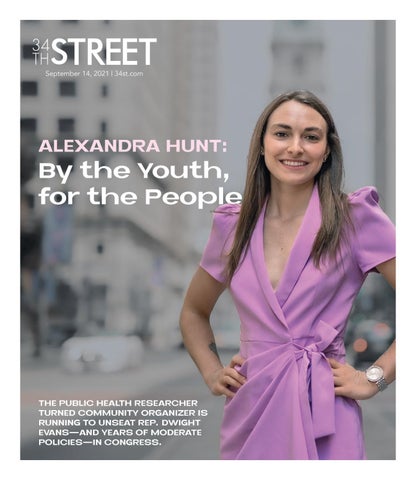
Alexandra Hunt: By the Youth, for the People
16
FOCUS
The Exotification of Shohei Ohtani
22
UNDER THE BUTTON Boy Confused Why Scoring Delta Girl Bad
On soft launches, secret pleasures, and letting yourself be happy
H
ere’s a secret: I have a hard time writing these letters when I’m happy. And another: I’m having an extra hard time writing
this one. I don’t know why, but I’ve always viewed good things like birthday wishes—they disappear once you start blabbing. Everything I cherish exists in half–kept secrets. I soft launched both my ex–boyfriends in a series of subtle Instagram stories, and my best friend and I seldom take photos together. There’s little evidence that I exist in my favorite places—the coffee shop on the corner of Locust and 20th Street, Fitler Square, the Schuylkill River Trail dog park—and I like to keep it this way. As silly as it sounds, people can’t ruin things if they don’t know they exist. My therapist says all this secrecy is about an unabating need for continuity and control, two things life isn’t really known for giving in spades. Can you really enjoy something if you’re white– knuckling it the entire time, waiting for the exact second a perfect moment becomes yet another unremarkable one? Are you truly happy if you’re anticipating feeling sad tomorrow? My therapist would probably say no, and I’m working on agreeing with her. So in the spirit of self–improvement, I’m going to tell you the brighter side of everything. I’m the happiest I’ve been since September of my first year, where Penn was shiny and I didn’t know it was possible to feel regret in real time. I spent the weekend in New York City, visiting friends who are careening headfirst into adulthood. One just landed a job she never expected to want, and the other is investing in cryptocurrency companies he used to read about instead of going to class. They’re both doing the things we used to whisper about under bed sheets and after long production nights, and I left feeling grateful—about the future, about the present, and the fact that I have people who call me to celebrate. I’m going to end this on a piece of counterintuitive advice:
Don’t waste your college years living in perpetual fear, even if it worked out for me when it mattered. Superstition wastes energy. And I’d argue that if you spend all your time hiding your pleasure, you’re sitting a whole lot closer to shame than joy. After all, happiness isn’t like nearly every other tangible thing experiencing a shortage right now. It’s a naturally occurring resource. It ebbs and flows but never disappears. So stop insulating the good in your life. The need to do so makes it feel less good.
Illustration by Jackie Lou SSSF,
Bea
34TH STREET STAFF
Copy Editor: Brittany Darrow Cover Design by Isabel Liang
2
3 4 T H S T R E E T M AG A Z I N E S E P T E M B E R 14 , 2 0 21
looking camp right in the eye
WORD ON THE STREET
BABA She had trouble thinking about love and her father as two things that belonged together.
A male, typically white, who has a child or children. Produces a hearty laugh. Swings his little kids in the air, tells cheesy jokes, and often sits in the front row to clap and cheer at a football game, band concert, spelling bee. Kind but firm temper. Chastises with stern words, an explanation, an occasional spanking that he hates to do. Hugs you afterward because he knows you’ve learned your lesson.
Content warning: The following text describes instances of abuse, which can be disturbing or triggering for some readers. Please find resources listed at the bottom of the article.
I
n childhood, she loved her father more than anyone else. When he spanked her or waved his leather belt at her, she didn’t think it was wrong. When he shoved her into the bathroom and slammed the door behind him, shouting that she dare not come out, she didn’t consider it out of the ordinary. When he flew into a rage and drove away with the car, not to return for several hours, she believed her mother’s words: “He’s just going to get gas. He’ll be back soon.” There was only a small stirring of disquiet in her heart as she watched him pull out of the driveway into the darkness. During her elementary years, she pushed her friend into a bookcase, smacked another friend in the head until he cried, and called many others all sorts of insults she didn’t really mean. She once invented a disease out of a girl’s name, so that all the other children would flee when she came near, yelling, “Mary has Marionitis! Run, run!” She was seven years old and thought she was so clever, just like her Daddy. There were many moments with her father in her childhood that she came to remember as last moments. The last time her parents ever kissed, for example. They were just about to leave for a trip, putting on their jackets near the front door. She stood up from tying her shoes
A Chinese male who has a child, usually one but sometimes two. Prefers sons. A hard–working man who puts all of his money into family, though not much else. Drops off kids at concerts or competitions and says, “Call me when it’s over.” Spends much of his time working alone or on business trips. Wild, unpredictable temper. Be wary.
and turned to see her father pecking her mother’s lips in an innocent, almost embarrassed way. That was 12 years ago, maybe more. Kisses were replaced by sarcastic comments, shouting matches, and the threat of divorce. There was also the last time she used her father’s laptop. While he was taking a nap, she opened a new tab on his computer and began to search for something, probably the name of a book or video game. The first suggestion in history after typing in the letter "a" was ashleymadison. com. The website said, “Life is short. Have an affair.” She closed the tab immediately and never told anyone. When she was a child, things were simple; her father was always right, so she always loved him. But as she grew older, she had trouble thinking about love and her father as two things that belonged together. They argued about everything and nothing, from how late she stayed out tonight to her tone of voice when she talked back at him. She knew from talking with her friends that these arguments were normal. But there was something in her father that scared her. It wasn’t just that they disagreed; she felt that he wanted to hurt her. For instance, when she and her father were arguing about whether or not to order pizza. She was against it because he had high blood pressure, and he had been ordering junk food too much lately for it to have been healthy. She was leaning her arm on a kitchen counter, her elbow touching the edge of the sink. He had just poured a glass of water, but he didn’t drink a sip of it. Abruptly he threw all of the water in his glass into the sink, only he missed
it completely and covered half her shirt. As she looked up at his face, confused, she saw his lips were parted slightly, and he was breathing heavily. His parted lips, an almost animalistic snarl, came to disgust her. She had been conditioned to understand that it was a sign of danger. She immediately noticed it one night at dinner when she was 15. She brought her laptop with her to the table to do work while she ate, a habit that occurred several times a week. Out of nowhere, as her father often did, he told her to put it away. “It’s distracting, and you need to concentrate on eating,” her father said. Already something was wrong. She knew by instinct that she couldn’t simply argue this away, but she couldn’t stop herself. “Then why are you allowed to watch TV during dinner?” she asked, annoyed. “Shouldn’t you be concentrating on eating, too?” She reached for the remote and turned off her father’s program, closing her laptop at the same time. His eyes had gotten pointed, beady; his lips were parted again. The room was silent as she began to eat. She avoided his gaze and felt her shoulder blades tighten painfully. “Turn on the TV,” he said. “Why?” she said. “You don’t tell me what to do.” Every word was enunciated harshly. “No.” He stood quickly, his chair legs grinding and squealing against the floor in protest. She was on the other side of S E P T E M B E R 14 , 2 0 21 3 4 T H S T R E E T M AG A Z I N E
3
WORD ON THE STREET
the table, but he somehow got to her in no time at all. He was blocking the way out of the kitchen. She had no choice but to try to get past him. He lunged at her and grabbed a hold of her arm, his grip hard, almost unbreakable. She didn’t know what he would do. She struggled, finally free, then ran upstairs to her bedroom. Upstairs, she checked the tops of all of the doors. He hid keys there so he could get in during an emergency. She took the keys, ran into her room, and locked the door. She grabbed the pair of safety scissors on her desk. She sat on the floor on the left side of her bed, where her father wouldn’t see her if he broke in. He was screaming at her from downstairs, but she couldn’t hear the words. She got up and checked to see if the door was still locked. Then she walked into her bathtub and sat with the curtains closed, scissors clutched against her chest. She was gasping, and her cheeks burned from crying. She thought, He's going to kill me. Later in the night, her stomach was growling. She had only gotten a few bites of dinner. She opened her door slowly so that the hinges wouldn’t creak and snuck downstairs, pausing on every step to make sure her father hadn’t noticed her. He was sitting at the kitchen table on his laptop. She tiptoed to the dining room instead and stole a jar of Hersey’s chocolate bars. She did not talk to her father for days after. She knew that as a child, she had once wished him dead from a heart attack, an emotional outburst that she had immediately taken back, both because of her mother’s chastisement and her own guilt. It was wrong to say or even think things like that. But she found herself wondering if it would really be so bad. She decided then that she would not cry at his funeral. Once she asked her older sister, who had already moved out of the house, why their father acted this way. Her sister replied that their grandfather’s name in Mandarin meant “mountain.” When her father was born, their grandfather named him “peak of a mountain.” He had not named their aunt this, even though she was born first. As the youngest and a male child, her father was spoiled in comparison to their aunt. He was used to having his way. When the two siblings were both in high school, their aunt was caught dating a boy, something forbidden to teenagers in China. Their grandfather wanted to split them apart and moved their aunt to a worse school, sacrificing her education. Their aunt couldn’t test into college, while her father went to one of China’s best universities. Though their aunt was in many ways considered less successful, she had still beaten her brother in one way: She had two boys. He was ashamed that he had conceived daughters instead of sons. There would be no one to carry on his name, the all–important Chinese family identity. She was a disappointment from birth. This newfound information about her father did not make her angry. She simply exhaled and thought, Oh. Maybe it wasn’t just me after all. At this time in her life, she believed that she hated her father absolutely. Yet, she got over what happened, like she always did after fights. She told him about her day when he picked her up from high school, about how the chemistry test went and when the next pep rally was. Going to college far away made it easier to be around him when she was home. When she was at school, she never called him, but she sent him presents for his birthday and Father’s Day. One time it was a gift card for a restaurant he liked. When she came back for break, he took her out to eat with the card. He hugged her when he sent her off to the airport. Once, when they were on good terms, she asked him about immigrating to America. He told her that when he first arrived, he washed dishes at a diner while earning his master’s and trying to get his wife and first daughter into the United States. He lived in the living room of an apartment with three other people, paying fifty dollars for rent every month. Then, when his wife and daughter made it over, they opened up a Chinese restaurant, which did well enough for them to move into their own
apartment. After her mother and her father brushed up on their English, they found good–paying jobs in their fields. Her father extended a branch of the company he worked for into Shanghai and began a local operation there. Before he left on business trips, he would come into her room while she was sleeping to give her a hug and say goodbye. His goal in life was to secure the American Dream, to cross into the Land of Opportunities and work his way to success. When he had accomplished this, he taught her how to pursue her own dreams, giving her his time and money for tutoring, camps, textbooks, and tuition. She would not be the same with an American father. So how could she hate him for what he’d done? She imagined how she would feel if her wishes for her father to die came true. She would walk up to the casket and see him lying there. His face would be smoothed and powdered like a mannequin, and she would hardly be able to recognize him as her father. He would be still, harmless, peaceful. When she looked at the lines of his face, would she remember a smile or a snarl? Would she cry at all, and if she did, would they be the same kind that fell after fights or genuine tears of mourning? Her greatest fear would be not saying “I love you” to her father before he was buried. Or saying it and knowing it wasn’t true.
She would not be the same with an American father. So how could she hate him for what he’d done?
Illustrations by Alice Heyeh
4
3 4 T H S T R E E T M AG A Z I N E S E P T E M B E R 14 , 2 0 21
EGO
JADE GONZALEZ HOMETOWN:
Lexington, Nebraska
MAJOR:
International relations with minors in environmental studies and history
ACTIVITES:
Penn First, Penn Student Agencies (PSA), Carriage and Gryphon Senior Societies, Perry World House Student Fellow, set building for Penn Singers and other theater groups
Leader, social advocate, set builder, chef, cat lover —what can't Jade do? | MADDIE MULDOON
34th STREET: Could you tell us about your involvement with Penn Student Agencies and how you became president? JADE GONZALEZ: I actually started out as a barista at Williams Café the fall of my sophomore year. I loved it so much. I enjoyed all the people, but I wanted to have more responsibility. How it works at PSA is eventually you can be elected by your peers to the role of president once you've worked for a full year. I went ahead and tried for it, and I was elected in fall of 2020. Now, my role primarily revolves around external relations: things like talking to alumni, speaking with the University about different regulations, and reaching out to potential vendors and businesses. Overall, it's just overseeing all nine of the different agencies we operate. I almost act like a consultant—if they have a question or a problem and want an outside perspective on it, they come to me. STREET: Could you talk about your experience with Penn First? JG: I got involved with Penn First my
[first] year through PENNCAP and the Pre–Freshman Program. I wanted to find people on campus who came from a more similar socioeconomic background to myself. I eventually got elected to the board. I started as professional development chair and realized I wasn't terribly professional–development–oriented. I found myself constantly going back to these spaces of, "Well, this is an obstacle that students on campus face," or, "This is something I've felt that I've heard other students experience." After that, I ended up shifting my efforts towards the advocacy and university relations side of things. Once my term as professional development chair was up, I became advocacy chair. I now help give professionals at Penn a perspective on what students might be feeling on particular issues when asked, and also when I notice something, I can go to them unprompted and hope they listen. STREET: What community at Penn has shaped your experience the most? JG: I would definitely say my involve-
ment with the FGLI [first–generation, low–income] community at Penn. I'm only on the Penn First board, but my experiences with that community go so much deeper. Those are the people I eat meals with over fall break, those are the people I organize storage with, those are the people I talk about food stamps and couponing and just how to scrape by with. It feels a lot more raw than a lot of other communities at Penn, where things might be more focused on outward perceptions rather than those day–to–day realities. STREET: Tell me about yourself outside of Penn and school. What makes you unique? JG: Outside of Penn, I'm someone who cooks a significant amount—I always have some random stuff in the fridge that I throw together to see if it tastes good or not. It's about 50–50 that it does. I own two cats named Mabel and Elliot. They’re mother and daughter. I have them with me in Philadelphia—they're the light of my life.
SEPTEMBER 14, 2021 34TH STREET MAGAZINE
5
EGO
I come from rural Nebraska, so I grew up with parents who were welders. That's why I found myself involved in set building, because I have a welding and metal fabricating background. I really enjoy 3D art and physical construction, rather than painting or drawing or something of that nature. STREET: What change would you like to see at Penn in the next 10 years? JG: I guess a change that I would like to see at Penn in the next 10 years is just normalizing free time a lot more. A lot of times, Penn people either bite off more they can chew and start to flounder a bit, or they work themselves to the bone. Both of these scenarios are not good for you, either mentally or physically. I think rec-
ognizing the need to slow down is a conclusion a lot of people reached during the pandemic. That kind of goes along with patience. I don't think we're a very patient campus. We all want to make moves and do awesome things. It works great for our advocacy and our change–making, but I don't know what that does for us as people. STREET: What has been your most memorable experience at Penn? JG: I broke my thumb playing Twister once at a Penn event. That's definitely a memorable experience. And honestly, I would say it's a lot of the time I spent in the PAC [Performing Arts Council] Shop during tech week for different performing arts groups. Especially when I work as master carpenter, it's being able to look
at the set when the actors are performing and think, "I'm the reason they're standing on something right now." So I'd say that's pretty impactful. Otherwise, very much breaking my thumb playing Twister and then having to go to work on Monday with a crooked thumb. STREET: What's next for you after Penn? JG: I am moving to Washington, D.C., where I will be working for a consulting firm. [I'm] hoping to specialize in public and social sector work before I go back to grad school. I eventually want to pursue a career in sustainable policy and environmental issues overall, hopefully on an international scale—but very much keeping nature and the environment at the core of what I do.
LIGHTNING ROUND STREET: Last song you listened to? JG: I actually listened to a podcast right before you called me: "The Cost of 9/11" by Today, Explained. STREET: If you were a building on campus, which one would you be and why? JG: I think I would be Williams because it doesn't make any sense, but so many people love it all the same. Plus the coffee. STREET: Who do you look up to? JG: I probably most look up to my mother. She had me when she was 17, and she's been fighting ever since. STREET: What's your favorite sunny day activity in Philadelphia? JG: I like to thrift shop, but I also like to just wander around. I recently purchased a little Razor scooter, so I just like to scoot about. STREET: There are two types of people at Penn … JG: The people who take SEPTA and those that Uber everywhere. STREET: And you are? JG: SEPTA. It was a steep learning curve coming from rural America, but I made it work.
6
34TH STREET MAGAZINE
SEPTEMBER 14, 2021
MUSIC
Illustration by Isabel Liang
LITTLE SIMZ'S SOMETIMES I MIGHT BE INTROVERT IS THE BEST RAP ALBUM IN YEARS The artist takes listeners on an hour–long journey into the constantly fluctuating life of an introvert. | EVAN QIANG
T
o dedicated fans of Little Simz, the title of her fourth studio album might come as a surprise. Simz’s third album, the Mercury Prize– nominated GREY Area, brought mainstream attention to the London–based rapper; her unswerving, no–frills flow distinguished her as a promising and confident lyricist. By exploring personal themes such as the tumultuous time of Simz’s 20s, GREY Area exhibited an artist in the midst of finding herself. On Sometimes I Might Be Introvert, Simz reveals another part of her intricate self by further inspecting her vulnerability. The result is a monumental record that will undeniably be remembered for years to come. On the opening track “Introvert,” Simz sounds like her GREY Area self. Lush strings and striking bass bolster her defiance and fearlessness. Even when the instrumental simmers down to just a piano, Simz never loses her footing when she talks about balancing two different characters at odds with each other. This dynamic creates an everlasting battle in her life, causing her to find too many differences between “Simz the artist or Simbi the person.” She even struggles to put up an honest facade, sometimes “smiling” when she’s around other people but “really hurting” when she’s alone. Although Simz sounds the same as she has in her past work, she’s much more mature in her self–reflections. She explicitly defines more of the profound struggles that define her as an introvert, including being “wordless” on “one day” but a “wordsmith” the next. When she’s expected to “have this extroverted persona all the time” in the rap industry, she finds it challenging to support op-
posing identities. The ending of “Introvert” features Emma Corrin, an actress who appeared on the Netflix series The Crown. Corrin appears on most of the album’s interludes, but her spoken word outro on “Introvert” is particularly important for characterizing the current state of Simz’s complex personality. She directly references the introversion and how it “led” Simz to be in this disorienting position, almost like she’s talking to Simz herself. However, Corrin also celebrates what Simz’s introversion has to offer, including feelings that are “well balanced” and truths that are “unveiled with time.” These qualities take Simz on “a journey,” and what follows on the rest of Sometimes I Might Be Introvert is an appreciation of that introversion. The other interludes offer similar pep talks, from calls to “follow the arrow” and “find your calling” on “Gems” or “[reach] for the stars” on “The Rapper that Came to Tea.” At times, these interludes can sound Disney–esque with their luxurious, cinematic sounds, but they perfectly fit Simz’s path to recognizing as she recognizes her introversion and its originally unforeseen benefits. The internal dialogues Simz experiences can also be traced back to earlier in her life. On “I Love You, I Hate You,” Simz discusses her turbulent relationship with her father. Feeling mistreated by the unfulfilled vows he made, she questions the purpose of false promises “to God to be there for [his] kids” and “to give them a life [he] didn’t live.” However, now that Simz is older, she’s aware of the more pressing challenges that he faced. She sees “how fickle life can be” and while she thinks her father gave her her “first heart-
break,” she believes these mistakes “contribute to [her] growth.” Now that Simz is at a new stage of her life, she’s more forgiving and willing to move on from moments left in the past. In an interview with NME, Simz mentions how her approach would have been completely different if she’d “written this song two or three years ago,” further signifying the catharsis of self–acceptance. Besides diving deeper into her life through the lyrics, Simz isn’t afraid to push the sonic boundaries on the album either. “Rollin Stone” is inspired by the latest mainstream trap trends, but the track is elevated by Simz’s vocal flares and modifications. Her voice becomes almost emotion-
less after it’s reverbed and autotuned, which represents Simz’s transition from happy times “in Sao Paulo / eatin’ palm hearts” to “an illusion” where nothing is “picture perfect” there. This distinct tone acts like another one of Simz’s personas—or an “evil twin” as she describes it. She continues the embrace of her introversion on “Protect My Energy,” Simz’s contribution to the disco revival of the 2020s. Although Simz concedes that she “got problems,” she knows she’s not “f*ckin’ weak” because to her, “total silence” is her “therapy.” Simz chooses to trust her “internal guidance” the most rather than seek “sympathy” from others.
It’s too early to say if Sometimes I Might Be Introvert will be seen as highly as My Beautiful Dark Twisted Fantasy and The Miseducation of Lauryn Hill, or more recently acclaimed albums like IGOR and To Pimp a Butterfly—but Simz has solidified her position as one of the top hip hop artists to watch. She’s constantly evolving as a person, finding power from her introversion rather than seeing it as a flaw. The letters of the album title spells out her name Simbi, short for her birth name Simbiatu, because being an introvert is now a part of her identity. Her most dynamic and impressive album to date comes from times when she’s just by herself.
WEDNESDAYS IN SEPTEMBER STARTING AT NOON BENJAMIN FRANKLIN STATUE IN FRONT OF COLLEGE HALL
SEPTEMBER 15
Double Binds and Oppression Sukaina Hirji Assistant Professor of Philosophy
Watch the livestream on Facebook or Twitter @PennSAS
S E P T E M B E R 14 , 2 0 21 3 4 T H S T R E E T M AG A Z I N E
7
MUSIC
CERTIFIED LOVER BOY Delivers Classic Drake In the highly--anticipated Scorpion followup, Drake raps about fame, women, and his son—topics his fans are all too familiar with. | FERNANDA BRIZUELA
T
he past week was a major moment for music this year as it saw the debut of Drake’s album Certified Lover Boy (CLB) on Sept. 3, featuring 21 new tracks. The record succeeds his 2018 hit Scorpion, which discussed topics expected from the rapper—fame, women, a balance between insecurity and confidence, and long–standing feuds—with a layer of exploring unanticipated fatherhood. CLB delivers classic “Champagne Papi”—yet despite its successful moments, there isn’t much thematic diversity when compared to his past work. The release of the record drew parallels that of another long–awaited album, Donda by Kanye West, with whom Drake has a long history of feuds. Like Ye, Drake pushed back the date for CLB, which was originally scheduled for a January 2021 release. After several months of anticipation, the artist finally confirmed the release date in late August by posting the album cover art—a colorful collection of pregnant woman emojis atop a white background. The artwork, designed by Damien Hirst, stands in stark contrast to Drake’s past album covers that feature somber, darker hues. The combination of the cover with the album’s title, both decidedly different from their predecessors, promised a new Drake: perhaps more playful, perhaps more risk–taking. Ultimately, however, the Certified Lover Boy delivers more of what we already know and love. The opening track “Champagne Poetry,” clocking in at five minutes and 36 seconds, accurately prepares the listener for what’s to come in the 86–minute album. Before Drake can even share his first line—“I been hot since the birth of my son”—a warped yet melodious voice engulfs the speakers with a sample from Masego’s “Navajo.” As the sample persists, Drake raps about topics he’s all too familiar with: success and family. His feelings about “build[ing] a 8
second guest home ‘cause [he] growin’ too much” are juxtaposed with the sample’s lyrics “I need you, I need you, I need you / I need to make you see / What you mean to me.” Different beats continue to flow seamlessly throughout the duration of the song. Both of these elements—alternating beats and a long runtime —are common in most of the tracks. Conflicting ideas are present throughout the album—perhaps even representative of it. In a similar way to most of the songs on the track list, “Papi’s Home” is introduced with a distorted voice, in this case lamenting “I know that I hurt you / I was a child trying to be a man / I walked out on my only son.” The track is immediately accompanied by piano, suggesting a slower, more self–reflective song about fatherhood. Unexpectedly, the beat drops and the listener realizes that instead of referring to his family, the rapper wants the world to know that their daddy’s home. He returns to singing about his life “standing at the top” with sexy supermodels who “lock the door to the bathroom ‘cause they doin’ something that is not Pepsi.” The song ventures off to a new beat and something else catches the listener’s attention—is that Nicki Minaj? The appearance is initially surprising since her name doesn't appear on the tracklist. Her sassy remarks add an extra layer to the song before Drake replaces his rapping with more melodic singing. In fact, Minaj’s name was only one on the list of collaborations, most of which occurred with other major artists such as JAY–Z, Travis Scott, Future, Lil Wayne and Kid Cudi. These collaborations were mostly successful, as “Girls Want Girls” with Lil Baby sits at No. 1 on Drake’s Spotify profile. Despite the questionable lyrics—in which Drake declares himself a lesbian—the track features catchy lines that are unfortunately likely to be chanted
3 4 T H S T R E E T M AG A Z I N E S E P T E M B E R 14 , 2 0 21
Illustration by Alice Heyeh along to. Another collaboration, “Knife Talk” with 21 Savage and Project Pact, was ranked as the number one song on the album by Billboard critics, who believe that the track elevates the album with its “ominous flare and villainous tone.” Even with the big names on CLB, some of the most satisfying collaborators were the lesser–known artists in the album: Yebba and Tems. “Yebba’s Heartbreak,” the interlude sang by the songwriter from Arkansas, is an unexpected, soft deep cut in the record. Drake allows her to shine when she sings “How much better can I show my love for you / Than say, ‘I do, I do, I do’?” with the repetition reminiscent of the opening track of the album. Even though the interlude is a successful transition into the record's second half—which includes tracks more sonically similar to Drake’s past commercial successes—it could have been further transformed if it had been developed as a longer song featuring Drake’s bars. The Tems feature “Fountains”—which joins “Race My Mind” as a track that heavily steers towards R&B as opposed to rap—is a friendly yet fresh reminder of Drake’s 2016 album Views. The rapper is singing melodiously about his emotions— which “threaten to explode like fountains”—when Tems steps in, enhancing the song with her vocals. Despite the similarities to his past hit “Controlla,” “Fountains” goes further by introducing a more Caribbean–like melody, vaguely reminiscent of Doja Cat’s popular “Woman,” as well as Bad Bunny and J Balvin’s “COMO UN BEBÉ.” Much like the introduction to the album, the outro “The Remorse” is representative of the record in itself. The track is rap–heavy, long (maybe even a little bit unnecessarily), and touches the topics he has mastered: success, relationships, cockiness, and a dash of self–pity. It is sonically
representative of the album; as a seemingly unrelated warped voice consistently plays in the background, a change in mood occurs towards the middle of the song before finishing the album off with piano. Predictably, CLB garnered attention immediately upon its release. Although it rose on the charts, not all of the attention was positive. The album is filled with references to previous music; Drake boasts his budget on CLB with at least 11 of the tracks containing samples from popular songs. One of these is “TSU,” which credits singer–producer R. Kelly, who is currently undergoing a public trial for a myriad of sex crimes. The controversy surrounding R. Kelly also bears comparisons to Ye’s Donda, which included collaborations with Marilyn Manson and DaBaby. Though CLB producer Noah “40" Shebib was quick to clear the air regarding the credits to R. Kelly, claiming that the credit was a “forced license” and nothing but a blip on the album, the sample forces listeners to think about the power dynamics that underline every song on the radio. Samples and collaborations are now inherently political. They’re shorthand for what artists do and don’t believe will tarnish their reputations. And though CLB is fun in a corny, dude–cheugy kind of way, the “TSU” sample begs the question: Does Drake think he hovers above accountability? And who is Drake even accountable to? The album is a successful release in the 2021 musical landscape. However, when compared to Drake's past discography and paired with the shameful history surrounding the album, the release is not just underwhelming but disgraceful for fans who simply got their typical Drake—mostly unchanged but with a new name as the Certified Lover Boy.
MUSIC
Shang–Chi Doesn't Have to Be Great Cinema —Because It's Fun
Marvel's latest release boasts its first Asian protagonist. Its greatest strength is that it's a genuinely fun movie. | HARSHITA GUPTA Editor's Note: This article contains spoilers for 'Shang–Chi' and the Legend of the Ten Rings.
S
hang–Chi and the Legend of the Ten Rings, the latest from Marvel Studios’ Phase Four, is marketed by both the studio and its star as the brand’s first Asian superhero film. The mystical, Wuxia–inspired movie takes cues from both traditional Chinese martial arts films and Marvel’s predictable, cut–and–dry superhero plots. While it isn’t exactly a cinematic masterpiece, it's definitely fun and does its best to highlight one version of the Asian American millennial experience. The first movie I watched in a theater in almost two years, it was worth the price of the ticket—and that’s not nothing. Shang–Chi follows protagonist Shang–Chi (Simu Liu), a seemingly ordinary valet in San Francisco who's suddenly confronted by a past he abandoned. After training to be a deadly assassin under his father Wenwu, the wielder of the titular legendary Ten Rings, Shang–Chi ran away as a teenager. Now, ten years later, he's confronted by his father’s mercenaries and dragged back home to help invade his deceased mother’s home—the magical village Ta Lo. The film’s biggest issue is its predictable plot beats, which is a symptom of the greater Marvel universe. With every subsequent movie balancing its own plot and the through line of the entire Marvel Universe, the very structure of the Marvel superhero film is racing forward toward some nebulous end goal. At the end of the film, as Shang–Chi tries to prevent his father from destroying his mother’s village, both are interrupted by random monstrous villains called Soul Suckers. These are the film's ultimate antagonists, led by a giant, flying tentacled beast referred to as Dweller–in–Darkness. Introduced pretty late , these creatures end up being a trite plot point that hasten the showdown between the villagers of Ta Lo and the Ten Rings. When they're actually defeated, there's a lack of emotional catharsis. Yes, it’s cool to see a Chinese water dragon wrestle a huge tentacle creature, but it lowers the emotional stakes when they’re just big monsters whose defeat is inevitable. Because of this last-minute complication, Wenwu and Shang–Chi never properly resolve their confrontation before Wenwu dies, leaving their relationship up in the air. How do you deal with a dysfunctional father–son relationship, further complicated by the Asian notion of filial duty and collective grief? How do you resolve your relationship with a father who loved you but also blames you for your mother’s death? How do you reject a legacy of violence while continuing to fight? The film never finds
these answers. Compelling emotional arcs are set up only to be dropped in favor of a big monster fight. Shang–Chi would have fared better if it had simply followed its father–son conflict to its end, allowing their confrontation to be the film’s most epic battle. It could've grounded itself in stunning fight choreography instead of using CGI to make the fights flashier. But perhaps it’s a movie that forces us to confront the fact that, at the end of the day, a lot of viewers go to the theater for grandiose, theatrical knockdowns. After all, it’s not a crime to make a cool movie. And with its gorgeous fight choreography, multitude of interesting female characters, and cinematic settings ranging from poppy underground fight clubs to mystical villages with phenomenal animal designs, Shang–Chi is definitely cool if nothing else. The actors and their engagement with the characters was definitely the best part of the film, though that still had its own problems. Shang–Chi’s mother, Ying Li, functions as a plot device and martyred perfect mother figure. An intriguing antagonist, a masked figure who trained Shang–Chi and keeps up
with his fighting ability, is taken out by a random monster instead direct confrontation. Still, Hong Kong film star Tony Leung found a three–dimensional, profound character in a shallow archetype— as a former warlord haunted by his dead wife, who was the only person keeping him from being a murderer. So far, the film has had an incredibly successful opening, which is good news for further similar endeavors. However, it was a long time coming, especially since Marvel Studios has a habit of taking from Asian martial arts and aesthetics for their previous films. This success can be attributed to the Asian American population who went and supported a hero who represents them. When I watched the film, almost the entire theater was filled with Asian American students. I walked out of the theater feeling like I had seen cool fight scenes and had a good night, pleased about the Asian representation and humor in the film—and that means Shang–Chi and the Legend of the Ten Rings was definitely a success.
beer springfield distributor
Studying too hard?
Take a break with us.
WE DELIVER
WE DELIVER! Corner of 27th and South St. 22nd East & Washington DIRECTIONS: on Chestnut, right on 23rd, right on Lombard
ave, Philadelphia
(215) 546-7301
(215) 546-7301
springfieldbeer.net
SEPTEMBER 14, 2021 34TH STREET MAGAZINE
9
YOU COULD WIN
2022 EAGLES SEASON TICKETS
PLUS PRIZE PACKAGES, GAME TICKETS, AUTOGRAPHED MERCH, PERSONALIZED JERSEYS, GIFT CARDS AND MORE!
HOW TO PLAY:
LOOK FOR THESE TAGS THROUGHOUT THE STORE
Buy $10 in participating products Your receipt at checkout will contain a prize code* Enter your code at www.ACMESwoopInandWin.com
SAVE
5%
ON YOUR TOTAL ORDER OF 20 OR MORE $
WHEN YOU SHOP IN-STORE WEARING YOUR EAGLES APPAREL ON GAMEDAYS
WE’RE ONLINE! Visit us at ACMEmarkets.com or follow us on social media *Up to 5 codes per transaction. No purchase necessary to enter or win. See customer service for official rules and details. Void where prohibited by law. Sweepstakes ends 1/13/22. **Restrictions apply. See customer service for details. Valid on Eagles gamedays, home and away
10 34TH STREET MAGAZINE
SEPTEMBER 14, 2021
**
ARTS
Deep Inside Pornhub’s Classic Nudes Museum Guide Who knew museums could be this sexy? | JESSA GLASSMAN
C
lassic Nudes is an interactive guide to an assortment of the world’s steamiest fine art. The project pairs a curated selection of erotic artworks from museums around the world with short, cheeky descriptions. From the Renaissance to Impressionism and everywhere in between, the works in the guide touch on cornerstones of art history. The guide can be found on Pornhub’s website, and it includes for each museum a map that lays out where the sexy artworks are, an audio tour voiced by Asa Akira, and a video guide for each museum included. The minute–long audio clips are playful and filled with innuendos and pop culture references. Predictably, the videos are NSFW and involve the recreation of sensuous scenes like Gossaert’s Adam and Eve. While Pornhub’s Classic Nudes guide draws on many works from the European artistic tradition, it does include the category “Another Perspective”— which purports to celebrate non–white bodies. Featuring art from regions such as South America and South and East Asia, this section tries to contribute to broader efforts to make the fine art world less Eurocentric. It’s unclear whether a small section in the guide is a genuine attempt at reaching that goal, or is just trying to garner praise by piggybacking off of the movement for inclusion. If you would be surprised to hear the words “Pornhub” and “Louvre,” “Prado,” or “Uffizi” in the same sentence, you wouldn’t be the only one. Legal teams from the three museums expressed their disapproval of the inclusion of works from their collections in the erotic guide, claiming it was “totally illegal” and had “been done without any permission.” The threat of legal action from three mighty museums was enough to convince Pornhub to remove their works, including Titian’s Venus of Urbino and Goya’s La Maja Desnuda, from its guide. While regulations from the Italian government itself are certainly reason enough for the gallery to try to stop its images from appearing in the guide, they may not be the only motivation behind the Uffizi’s reaction. The greatly respected museum, which displays the so–called paragons of Western culture, likely would not want to associate with Pornhub, a site full of dirty images. The Uffizi (and perhaps
Illustration by Lilian Liu the other museums that threatened legal action) could feasibly believe that the diminishment of its artistic treasures to mere smut would tarnish their reputation. While the inclusion of works from the previously mentioned museums certainly rounded out the museum guide, removing them didn’t spoil Pornhub’s party. Top museums including the National Gallery, The Met, and the Musée d’Orsay are still part of the guide. For Pornhub, demystifying the close relationship between pornography and the arts was a goal of the campaign, one which clearly shocked and horrified many esteemed global fine art institutions. A previous project called Remastured, in which artificial intelligence experts restored historic dirty movies, had a similar intention. In what seems like an unrequited crush, Pornhub has consistently attempted to align itself with the arts, as evidenced by the project motto: "Because porn may not be considered art, but some art can definitely be considered porn.”
While many museums viewed Pornhub’s actions as anything but charitable, the company claims it was trying to help them recover from the pernicious effects of the pandemic. By using eroticism to tempt audiences, Pornhub hoped it could arouse its consumer base in a different way than usual—one which would make fine art seem less pretentious and intimidating. Pornhub’s project creatively bridges a gap between two fields many consider as oil and water, attempting to argue that they may be more like flip sides of the same coin. Whether this logic is compelling or farfetched is a personal choice, but it is undeniable that the guide makes thought– provoking points. The Classic Nudes guide by Pornhub is fresh and unexpected. Perhaps it is the bastard child of pornography and art history. In an old–world–meets– new–world fusion, it humbles fine art while also sophisticating pornography. Long story short: It’s hot. Check it out.
SEPTEMBER 14, 2021 34TH STREET MAGAZINE
11
F E AT U R E
F E AT U R E
Alexandra Hunt: By the Youth, for the People The public health researcher turned community organizer is running to unseat Rep. Dwight Evans—and years of moderate policies—in Congress. | MIRA SYDOW
A
lexandra Hunt never planned to run for Congress. During a late–July shift at a food distribution site last year, Hunt wiped sweat from her brow and turned to look at the dozens of community members lined up outside of the center. Tracing the line with her gaze, her stomach sank. It felt endless, wrapping around the next block and out of sight. As summer 2020 came to a close, Hunt spent part of her free time participating in community aid efforts to combat the spread of COVID–19, braving sweltering heat to distribute food and COVID–19 tests to Philadelphians in need. Those few months were hard. The Philadelphia community saw a large peak in COVID–19 cases in April, with the number of new cases per day climbing above 600. The impact fell squarely on low–income, minority neighborhoods, people experiencing homelessness, and prison communities. Hunt witnessed the fallout firsthand, as a volunteer on the frontlines. One weekend, she administered COVID–19 testing; the next, she helped high schoolers collect menstrual products for their classmates; the week after, she worked at a food distribution site. Staring down the hardened, masked faces of a ravaged neighborhood, Hunt decided to run for Congress. It wasn’t a decision motivated by self–importance, but a desperate, earnest desire to serve her community. “I was looking at [the line], and I just had this thought of, ‘They're not coming to help us,’” Hunt says. “And my next thought was, ‘What am I waiting for?’” Alexandra Hunt is an unabashed 28–year–old progressive from a working–class background running for Congress in Pennsylvania's 3rd District, which includes West Philly, parts of North Philly, and most of Center City. Raised in Rochester, N.Y., Hunt moved to Philadelphia after college to get her master’s degree in interdisciplinary health sciences—and she’s been here ever since. When not on the campaign trail, Hunt works as a public health researcher, community organizer, and girls’ soccer coach. She’s striving to unseat moderate Democrat and two–term incumbent Rep. Dwight Evans in the Democratic primary next spring. Her candidacy shouldn’t be controversial, but, given the older, majority–male makeup of Congress, it’s definitely out of the ordinary.
Hunt's age alone is an anomaly. The average age of members of the United States House of Representatives is nearly 58 years old, with Democrats lagging behind Republicans for the most millennial members. Thanks to policies made by their predecessors, Gen Z and millennials are inheriting the housing crisis, student debt, a lack of health care, and unabating unemployment. “Young people are very frustrated with how little they are represented and how little they've been thought of as the next generation inheriting this world,” Hunt says. “Growing up, we were not viewed as sacred. We were kind of neglected and put as an afterthought.” The Hunt campaign practices what it preaches. To ensure their voices are heard, the campaign houses a youth advisory committee also known as Youth for Alexandra, which helps to educate young voters on the upcoming election, Hunt’s platform, and progressivism in general.
Philadelphians deserve broad reform in every area possible—from housing, to criminal justice reform, to gun violence, to public health—and the current administration just isn’t cutting it. One of the group’s co–founders is Anna Doyle, a West Philly native and junior studying political science at Temple University. Doyle began volunteering for the campaign’s research team after seeing Hunt’s videos on TikTok. Realizing what a large impact youth had on the campaign, Anna pitched the idea of forming a youth advisory committee for Hunt based on programming from a previous internship. “I was like, ‘[Hunt] is really awesome.’ I loved to see someone so progressive running in my district, and I wanted to help out,” Anna says. “[My idea] was met with a lot of enthu-
siasm from the campaign.” Hunt’s TikTok is a large part of what draws young people to her campaign, and part of what differentiates her from her opponents. On TikTok, Hunt speaks candidly about past experiences that are often taboo in politics, like the abortion she had when she was a teenager and her time as a stripper during college. To date, Hunt has garnered over 35,000 followers and over 500,000 likes on the platform. Her success allows Anna to rope high school students from across Philadelphia into the youth arm of the campaign. “All ideas are totally welcome,” Anna says. “It's a really great spot to get your foot in the door, if you want to do campaigns or just learn more about politics.” While her youth focus sets her apart from many congressional candidates, Hunt’s leftist policy positions and unpretentious past also make her an outlier. While progressives continue to push left–wing policies like Medicare for All and the Green New Deal, their work is often held hostage by moderate Democrats in the House and swing votes in the Senate. Furthermore, a large percentage of Congress are millionaires, putting them wildly out of touch with working–class Americans, whose minimum–wage salary can’t pay rent for a two– bedroom apartment in any state in the country. In the fray of wealthy moderates ruling with an iron fist, Hunt is a breath of fresh air. “I'm the daughter of two teachers, and I think I've always seen politicians as greedy and self–interested,” Hunt says. “My interest is in having the people, and the needs of the people, actually represented in our government—and not just represented, but having legislation work to meet those needs.” And she’s not alone. Hunt joins a wave of young progressives running to unseat moderate Democrat incumbents. Among this group are members of “The Squad,” which include Reps. Cori Bush, Alexandria Ocasio–Cortez, Ilhan Omar, Rashida Tlaib, and Ayanna Pressley. As a woman running for office, Hunt is familiar with the level of harassment and character assault that representatives like Bush and Ocasio–Cortez endure. In a TikTok she shared in August, Hunt recalls the comments she’s received on the campaign trail, which include being told that she looks “anorexic” or “dresses like a hooker.” It makes elected progressive women’s advocacy all the more impressive and vital. “I've experienced a sliver of that [harass-
"My interest is in having the people—and the needs of the people—actually represented in our government—and not just represented, but having legislation work to meet those needs" ALEXANDRA HUNT
Photo Courtesy of Alexndra Hunt
12
13
12 34TH STREET MAGAZINE
SEPTEMBER 14, 2021
SEPTEMBER 14, 2021 34TH STREET MAGAZINE
13
F E AT U R E
ment], and it's absurd,” she says. impressive and vital. “I've experienced a sliver of that [harassment], and it's absurd,” she says.
Hunt doesn’t have one or two campaign priorities. Rather, she focuses on a slate of interconnected issues. First on the docket: tackling the climate emergency. In the 1900s, Philadelphia averaged four days a year with temperatures above 95 degrees Fahrenheit. By 2100, that
number could be as high as 52 days a year—almost the entire summer. Hunt is a firm believer that climate change is intrinsically linked to issues of public health and safety. Another issue close to her heart? Health care. On top of her graduate degree from Drexel, Hunt also holds a Master of Public Health from Temple University. She also works as a public health researcher, which shapes her perspective on the current state of health care “that benefits from people being sick, and from people suffering and needing care.” Hunt also emphasizes public education, housing, and criminal justice reform. She notes that she can’t consider just one issue a “priority” when she knows her work in certain areas is impacted by challenges in the others. These bold policy ideas were what drew Mason Lumer (C ’24) to Hunt’s campaign. Mason grew up just outside of Philadelphia, and he is now a student at Penn. This past spring, he worked as a digital media intern on Hunt’s campaign, after responding to a posting in the Penn Democrats Facebook group. Mason recalls that Hunt’s campaign “really resonated” with him. He believes that her progressive stance is what West Philadelphians need. Mason monitored media coverage on topics close to Hunt’s heart, such as climate change, health care, and sex work. Through covering these topics, he realized the importance of reading the news, as well as the importance of bringing young people into the fold of politics as soon as possible. “In this campaign, she's hitting all the points that our generation, and future generations, really care about,” Mason says. “It's helpful not just for the youth
14 34TH STREET MAGAZINE
SEPTEMBER 14, 2021
voters, but also for these youth voters to promote it to their families, to their parents, to their grandparents, and really get the word out.” Mason is concerned with both youth issues and issues that impact the West Philly community, especially pertaining to climate change. In his 20 years living both in and out of the city, he says he’s never gotten so many natural disaster alerts in one week. Mason’s support for Hunt comes from witnessing his community deteriorate due to climate change and a failing health care system. Ultimately, what Hunt’s platform comes down to is this: Philadelphians deserve broad reform in every area possible—from housing, to criminal justice reform, to gun violence, to public health—and the current administration just isn’t cutting it. “The Biden administration is putting little drops in the bucket of infrastructure and climate legislation, but we don't have time to wait,” Hunt says. “Because we've just really stripped our world of resources, we need to go into overhaul of addressing and funding these social programs.”
“The Biden administration is putting little drops in the bucket of infrastructure and climate legislation, but we don't have time to wait." ALEXANDRA HUNT
This outlook manifests itself in Hunt’s campaign. Hunt supports ending mass incarceration, a steep progressive tax, a New Deal for Education, demilitarizing the police, and other progressive policies across the board. She considers her opponent a moderate Democrat who compromises on imperative legislation. During Evans’ last campaign for re–election, he appeared to be a huge proponent of Medicare for All, even cosponsoring a previous version of the bill. However, he failed to support the bill when it came to the floor, citing technicalities about the timeline. Hunt argues that Evans no longer has a sense of urgency, and Philadelphians don’t have time to waste. “[The fact] that our government isn't showing up to fight for the people, no matter Republican or Democrat, is a big part of why we're running,” Hunt says. Reflecting on the campaign’s progress thus far, Hunt is inspired by her grassroots support and powerful community organizing partners. The difficult tasks—making endless fundraising calls to obscure family members and taking sexist abuse from critics of the campaign—are offset by rewarding day–to–day interactions with Philadelphia residents. “[I’ve gotten] to meet so many people in the district who have their own stories, and who talk about the ways that they are fighting for change,” Hunt says. “I'm so proud to have gotten the chance to know them, to speak with them, to hear their stories, and to carry that with me on this campaign trail.” While some community members view her campaign as brave, Hunt believes that her values are the bare minimum. A representative by the people, for the people, is a tale as old as time, but it’s rare in today’s polarized political climate—even in a city like Philadelphia, which prides itself on electing diverse representatives. “One of the biggest lessons I’ve learned is how little we expect our politicians to give,” Hunt says. “I think there should be a standard. You should love your community. You should love the people in it.”
w
OPEN LATE & LATE NITE DELIVERY
R LOOKING FMOE WORK? TI T R A P R O L FUL NG! I R I H E R ’ E W .com s o n i m o d . s job
Domino’s Dom
TM
SUN-THURS: 10AM - 2AM • FRI & SAT 10AM - 3AM
WE MAKE ORDERING EASY!
CALL DIRECT OR CHOOSE YOUR ONLINE OR MOBILE DEVICE
Smart Phones
215-662-1400
4438 Chestnut St.
Tablets
215-557-0940 401 N. 21st St.
SEPTEMBER 14, 2021 34TH STREET MAGAZINE
15
Illustration by Alice Heyeh
FOCUS
THE EXOTIFICATION OF
Shohei Ohtani Examining how the MLB superstar is viewed through an American gaze | KATHRYN XU
A
t one of the heights of Ohtani–mania, the phenomenon that hit just before starting pitcher Shohei Ohtani was to participate in the MLB’s annual Home Run Derby, ESPN media personality (and seminal purveyor of hot takes) Stephen A. Smith suggested that Shohei Ohtani wasn’t marketable because he needed an English interpreter. The pushback was swift and imme-
diate. ESPN reporters such as Clinton Yates and Joon Lee were quick to point out that speaking English had no effect on baseball skill, or that the concern of marketability was just one more way in many of dismissing non– white, non–English–speaking people. ESPN reporter Marly Rivera emphasized that the global nature of baseball is why she loved the sport. Stephen A. Smith issued two apologies and spoke with ESPN baseball reporter Jeff Pas-
16 3 4 T H S T R E E T M AG A Z I N E S E P T E M B E R 14 , 2 0 21
san on Smith’s show. The saga promptly ended. After the dust had settled from ESPN’s Ohtani gaffe, Detroit Tigers broadcaster Jack Morris did a mock– Asian accent just before Ohtani was at bat. “Be very, very careful,” he said, with the exaggerated liquid phoneme common to Japanese. Morris was suspended indefinitely for his comments. These incidents were not the only ways that Ohtani’s Japaneseness has
cropped up in the coverage of him, but they were the most broadly criticized. Angels commentators often attach Japanese taglines to Ohtani’s homers—former Angels commentator Victor Rojas brought “Big Fly, Ohtani–san!” to United States television. Much of the pushback against Smith likely came from a line of baseball fans who were already tired of his large paycheck for making intentionally incendiary takes. At least on
FOCUS
Reddit, Smith’s comments received much more attention and unilateral condemnation than those of Morris. ESPN was quick to capitalize on Smith’s controversy. Jimmy Traina aptly noted that, “People at First Take knew what he was going to say. The segment was planned. The segment was teased. The segment was promoted.” And while Jeff Passan’s appearance on the show was applauded as Ohtani’s defense, he similarly promoted his appearance on Twitter beforehand. ESPN was the biggest winner; they got their clicks and views. However, even coverage that is not as blatantly offensive (or that which doesn’t come from a widely despised mouthpiece) often centers around an exotified view of Ohtani’s Japaneseness. In many ways, the perception of Ohtani is antithetical to stereotypical portrayals of East Asian men. His build certainly helps: he is 6– foot–4 and 210 pounds. A quick search on Twitter of the keywords “Ohtani” and “hot” paints a picture of what fans think of him. On the other hand, he’s more familiarly ascribed a sort of childishness and innocence, as another search on Twitter with the keywords “Ohtani” and “pure” shows. In comparison, Japanese Formula 1 driver, Yuki Tsunoda, is often compared with small animals or Kirby despite being raucous and swearing his way onto team radio with impressive regularity, perhaps because of his 5–foot–2 frame. No matter what the build or attitude, the odds of being infantilized or designated innocent are high for East Asian men. General media coverage surrounding Ohtani treats his Japaneseness with an interesting dichotomy. On one hand, a lot of media handle Ohtani with a gaze that has been seen before by many Asian Americans, from COVID–19 responses to sports coverage, treating modern–day East Asian culture as uniquely bizarre or ascribed to historical figures such as Confucius. A long feature piece on Ohtani
by Rustin Dodd at The Athletic miliar kind of malleable—emphasized diate weaponization of anti–Asian opens up with a haiku to say, “Jap- difference when it could be interesting racism in order to target Black anese baseball, then, came to be or amusing or quirky, but somehow men. Which is to say, despite influenced by bushidō, the moral also representing everything that is constant reiteration that home code of honor developed by the good about America. The so–called runs are universal and baseball samurai warrior class … A centu- Japanese work ethic is spartan or in- is best for being a global sport, ry later, as Ohtani came of age in tense, but when reframed into being a well–received defenses of Ohtani Iwate, the old influences remained “grunt worker,” it is cast as American. are primarily focused on the value …” Ohtani is also described as a Passan’s comments on First Take, as Ohtani brings to America and “baseballing monk,” a “happy war- much as they were widely heralded as reiterate American exceptionalrior,” a “purist” with “adherence to a dramatic takedown of Stephen A. ism. Morris and Smith’s comtradition.” Smith to defend Shohei Ohtani, were ments are more blatantly racist, The articles treat Japan as a place milquetoast at best. Overlooking Pas- but the broader media picture of that is quirky and different, ob- san’s engagement in ESPN’s revenue Ohtani—including even defenses sessed with diagnosing or ascrib- generation from a self–created racism of Ohtani—still center around ing one baseball player’s existence controversy, his statement on Ohtani tired tropes and well–trodden disto broader cultural patterns—still relied on what Ohtani meant for course. rooted in the old ways, or bizarrely America. If there’s anything to be taken obsessed with comics, as if Marvel “He left behind everything he away from the Smith debacle, it’s isn't a fad in the United States. knows to go and pursue the American that the profitability of racist comIt’s an issue that is exacerbated the Dream,” Passan says. He continues, ments often comes in the fallout. more popular you are: these same “We should look at Shohei Ohtani as Even on the very surface, the Passan articles are not being written about a bastion of what this country and this appearance as Ohtani’s white knight Yusei Kikuchi, who attended the sports world is about … and he has garnered views and engagement, same high school as Ohtani, but found [his greatness] here in America.” but at the same time, his appearance they are about Shohei Ohtani. It’s difficult to view Passan's chosen showed that discussing Ohtani’s At the same time, Ohtani is por- praise as flattering, especially after de- Japaneseness has value the same trayed as embodying a Western, cades of discourse about how Asian way that Asians are often spoken specifically American ideal. As Americans are often portrayed as the about in the broader political Dodd talks about Masaoka Shi- 'good minority' as well as the imme- landscape: as an American token. ki, a poet from Ohtani's hometown of Iwate, he mentions that Shiki "pulled from Western influences." Dodd conExp.2/23/12 4/11/12 Exp. tinues his article to say that Ohtani is For Fast Delivery Call 215-386-1941 everything, all at once—pitcher and hitter, thinker and 4004 chestnut street | (215) 386-1941 naturally talented—and connects Exp.2/23/12 4/11/12 Exp. this to a quote by filmmaker Ema For Fast Delivery Call 215-386-1941 Ryan Yamazaki: “He’s kind of like an American version of a Japanese player.” Ohtani is Japanese, but a commonly pushed sellExp.2/23/12 4/11/12 ing point is what Exp. with your PennCard he can mean as an American. His For Fast Delivery Call 215-386-1941 Japaneseness is a fa-
Welcome
CLASS OF
2016
All You Can Eat Buffet Every Day!
TAKE 10% OFF
Welcome
$4 beer! shots! wine! We Deliver! CLASS
OF
2016
order online @ newdehliweb.com | closed mondays
S E P T E M B E R 1 4 , 2 0 2 1 3 4 T H S T R E E T M A G A Z I N E 17
Illustration by Becky Lee
ST YLE
A Look Inside Philadelphia’s Organic Nail Salons These local businesses are offering a more natural alternative to the traditional manicure. | PHUONG NGO
W
ho doesn't love a good manicure? In turbulent times, treating your fingernails to a trim, buff, and fresh coat of polish can provide a much–needed sense of stability and relaxation. However, many nail salon regulars are starting to realize that the ingredients used in their go–to products include hazardous chemicals. Enter organic nail salons—an alternative to the traditional nail parlor that avoids using toxic substances in order to protect the well–being of both workers and clients. Organic nail salons in Philadelphia are few and far between. Still, business-
es like Raw Lab Spa and Juju Salon & Organics are working hard to make natural products the norm. Though they do offer many of the services found at typical salons, these two places take the experience to the next level by prioritizing their customers’ health. Under its current management since December 2018, Raw Lab Spa guarantees its customers an enhanced experience that not many salons can offer. Candice Nguyen, a nail technician, struggled to put into words just how much care and dedication her mother, owner Spa Thuc Nguyen, puts into ensuring that only materials of the highest
1 8 3 4 T H S T R E E T M AG A Z I N E S E P T E M B E R 14 , 2 0 21
quality are used on her customers. For example, whenever customers book one of the salon's special services—like the Ginger Ale Pedicure or Herbal Foot Treatment—the salon ensures that the ingredients are as fresh as possible. “As soon as somebody [books a special pedicure], we'll go to the store the night before or the day before,” Candice says. "Every single time my mom is prepping for these pedicures, she goes to the store and says, 'I need to buy ginger for the customers.'" Unlike typical nail salons, Raw Lab Spa doesn't provide acrylic services. In-
stead, it encourages its clientele to opt for a dip powder that is enriched with vitamins from the brand Emchi, which was started by the Nguyens. Emchi products promise to uphold the high standard that customers expect from a salon treatment—while also being vegan and cruelty–free. For customers that prefer traditional nail lacquer, Raw Lab Spa also carries polishes from Zoya, known for its line of "clean," high–quality products. Meanwhile, Juju Salon & Organics—nestled in the heart of Queen Village—holds the title of Philadelphia's first organic salon. The business has op-
ST YLE
erated on the values of being non–toxic and environmentally friendly ever since its owner, Julie Featherman, first opened its doors back
are " We definitely more
concerned about the integrity of your hair and nails than how many clients we can see in a day. ADRIAN NOVAK
in 2005. Adrian Novak, nail technician and manager of Juju Salon & Organics, says the business is dedicated not only to providing high–quality services but also to upholding the integrity of all of the products they use. Before Adrian, or any technician or stylist, can introduce a new product to the salon's lineup, they have to guarantee that it's cruelty–free, vegan, and non–toxic. The product must be 5–Free, meaning that it's free of toluene, dibutyl phthalate, formaldehyde, formaldehyde resin, and camphor—harmful substances often present in nail products. "We would consider bringing something in if it hit all the points we needed it to. If it were as clean as it has to be [and] non–toxic; if it provided a service that our customers were looking for, and we were able to do it safely and cleanly," Adrian says. When asked if she ever considers expanding her list of products or services to cater to a wider range of clients, Adrian explains that, while she keeps up with new trends in the nail industry, she never strays from the salon’s values. "We are definitely more concerned about the integrity of your hair and nails than how many clients we can see in a day," she says. I had the chance to experience the salon's Juju Organic Manicure. The service started off with the traditional markers of any salon appointment—filing, buffing, and trimming
my cuticles. But Adrian surprised me when she applied a clear gel along my cuticles that I was unfamiliar with; it was an aloe gel for hydration. This was followed by an exfoliating salt scrub and a hot towel before she painted my nails with Madam Glam gel polish, a 21–free product—meaning that it's free of 21 common toxic chemicals found in nail polish. During the manicure, I took in the chic and bustling environment that Juju Salon & Organics cultivates in their store. Clients conversed with each other and their stylists, and I enjoyed my pampering manicure while chatting with Adrian in her section of the salon. Juju Salon & Organics’ commitment to an eco–friendly experience goes beyond the manicure desk. Much of the furniture housed in the salon is second–hand. Owner Julie repurposed and redecorated several pieces to give Juju a charming and chic look while maintaining the business' commitment to sustainability. When asked whether the nail salon industry as a whole will start making strides toward eliminating toxic products, Candice and Adrian both emphasize that at the end
of the day, it’s up to the customer. "There will always be a market for acrylic and extensions," Adrian says. Candice agrees that it's unlikely the nail industry will become sustainable. “People like crazy, fun designs, and some of those things are not achievable unless you have acrylic," she says. However, the increasing popularity of organic nail salons demonstrates that there has been, and will continue to be, a growing interest in cleaner and greener alternatives. "The pandemic gave people the time to reevaluate some of their choices, especially where their health is concerned," Adrian says. "We've had a little upsurge [in clients]—maybe folks who were looking for a cleaner way to do things." Traditional nail salons will always have a large market to cater to, but those who are looking for a cleaner option to the typical manicure can now find their niche at an organic nail salon. Leading the charge are small businesses like Raw Lab Spa and Juju Salon & Organics, who are bringing natural and non–toxic services to our own backyard.
40TH & SPRUCE copabanana.com 215-382-1330
JOIN US FOR BRUNCH SATURDAY & SUNDAY Reservations Required MIMOSAS FROM 12PM TO 2PM S E P T E M B E R 14 , 2 0 21 3 4 T H S T R E E T M AG A Z I N E 1 9
FOCUS
20 34TH STREET MAGAZINE
SEPTEMBER 14, 2021
OVERHEARDS
OVERHEARDS Design Is Their Passion: "I'll be honest. I find Comic Sans kind of soothing."
Me Explaining My Internal Monologue: "I must be obsessed with myself in orderto survive."
This week: comic sans, a fake coke scandal, and the scene-iest girl you've ever met.
Anytime I Hear Something Unpleasant: "Is this about Camila Cabello?" The Final (SWUG) Boss: "The only scar I have is from Two Friends at NOTO. Is that embarrassing?"
Expectation: "You have cocaine on your lip." Reality: "No, that's pimple cream."
Available Now! 415 S. 40th Street 7 bedroom Available to rent as whole house or by the room 215.222.5500 hermanrealtygroup.net Serving the Penn community for OVER 50 YEARS!
Your Mother will be happy! SEPTEMBER 14, 2021 34TH STREET MAGAZINE
21
UNDER THE BUTTON
BREAKING: Your Friend Who Keeps Saying "Everyone Needs Therapy" Really Has to Go to Therapy | JACKSON PARLI
J
ason Smith (C '22) seems to have it all. He’s the president of PAC exec, SMAC exec, Glee Club, ILMUNC, and Social Deduction Club and has jobs lined up at Bain, Paramount Plus, and Goldman Sachs after graduation. Some could say he’s really motivated — others might say it helps distract him from his severely untreated depression and anxiety that he developed in the competitive Penn environment. When asked about his peers who struggle with mental health, Smith said, “Mental health issues? Sure, lots of people have mental health issues. But don’t make it my problem. I’m very empathetic to issues of mental health, but I don't have time to
worry about yours. You should go to therapy! In fact, everyone should go to therapy. Except for me. As you can see, I’m really flourishing under the stress. I work best under pressure! Plus, I don’t have time to go to therapy, I’m in charge of six groups on this campus. No, I can’t say no to things, but is that a problem? I don’t think that’s a problem. I’m just highly motivated. What was I talking about? Oh, therapy. I hear it really works! Not for me though. I don’t need it, I’m fine.” Smith then ran off to coordinate a BYO for the three groups he is social chair of before crying himself to sleep while watching Survivor.
Photo (with edits) by Wonderlane / Public domain
Boy Confused Why Scoring Delta Girl Bad | MERESA GARCÍA
B
Photo from Pixabay // CC 2.0 2 2 3 4 T H S T R E E T M AG A Z I N E S E P T E M B E R 14 , 2 0 21
rad (C '22) was confused. Well, he was always confused, but this time he was really, really confused. The other morning, someone from Penn Public Health called him, telling him that he had recently come into contact with someone who tested positive for Delta. Brad felt incredibly annoyed as the health official droned on about him having to relocate to Sansom West. "Obviously, she was Tri-Delta! I only go for the finest sororities around!" Brad thought as he packed his belongings. He and the boys went out a couple nights back and happened to run into some sisters. Six Trulys, two Tito shots, and one mega puff later, Brad had landed the hottest Delta
babe ever. There must have been some misunderstanding. Some sort of miscommunication. Why would Penn immediately blacklist anyone who came into contact with a Delta girl? "It must be a joke," guessed the thirdyear college student. But if it was, his friends were also playing along. As Brad tried explaining to the guys his situation, they all had a similar (unreasonable) reaction: "Jesus-fucking-christ! Delta? Bro, that some serious shit." Unfortunately, all Brad could do was trudge over to the dreary apartments of Sansom West as he continued to wonder what was so bad about getting with a Delta girl.
UNDER THE BUTTON
Penn, Do Better: Fisher-Bennett East Stairs Violate OSHA 1910.29(b)(1) | DARRION CHEN
T
o ensure that people are safe at work, the Occupational Safety and Health Administration regulates the height of the guardrails on elevated walking surfaces. As I was walking by the staircase in Fisher-Bennett Hall, I noticed that the balconies seemed strangely short. Curious, I measured the height and found them to be about 33.5 inches. Since the Fisher-Bennett East Stairs are only about 33.5
inches, they are in direct violation of OSHA 1910.29(b)(1), which state that “the top edge height of top rails, or equivalent guardrail system members, are 42 inches (107 cm), plus or minus 3 inches (8 cm), above the walking-working surface.” It is obvious that 33.5 inches is less than 39 inches. Penn, please do better. I don’t want to go over the balcony and turn myself into a pile of hairy strawberry ice cream, especially in Fisher-Bennett Hall.
BREAKING: Guy in Class Would Like to Direct Group’s Attention to Another Page | LIWA SUN Photo by Darrion Chen / The Daily Pennsylvanian
JOIN THE MOVEMENT to prioritize people over profits, help local businesses and
FIGHT
income inequality and climate change
Photo by billerickson / CC By 2.0
I
n a devastating turn of events coming out of the second floor of FisherBennett Hall as of 10:20 this morning, James Katz (C ’24) has indeed indicated that he would like to turn the group’s attention to page 51 of the book. The tragedy happened in ENGL 025: "Folklores, Poetry, and Interpretive Dances of the Marxist Tradition," which satisfies the Arts and Letters sector requirement of the College of Arts and Sciences. At the time, the group had been dwelling on page 30 for almost half the duration of the
class. Katz, who studies history, ventured during a lull in the discussion: “Hmmm … I’d like to turn our focus to a different page …” At which point, the entire class shat their pants. Gasps turned into bawling. The professor physically collapsed at the dais. As of noon, half of the class had been sent to the Hospital of the University of Pennsylvania. The other half refused medical treatment because they “did not have insurance.” Penn Police has launched an investigation into this matter.
When you sign up get $100 added to your account to use at local merchants. A portion of the $100 goes toward your purchase. Every student you sign up gets you an additional $100 in your account. Be the first student to sign up 200 students and get $20,000 added to your account.
Learn more at: www.positions.college/?R=MichelleHarrison or call 267-974-3121
S E P T E M B E R 14 , 2 0 21 3 4 T H S T R E E T M AG A Z I N E 2 3
S H OPSATPE N N .COM
Calling all Movers Shakers + Quakers Shop Penn offers an inspired, contemporary shopping and dining experience, open to all. Spanning ten city blocks from 30th to 40th Streets and across Spruce, Walnut, and Chestnut Streets, Shop Penn features more than 75 carefully curated shopping and dining locations.
Wants Needs + Musthaves
Shop Local. Shop Penn. #S HOPPE N N @S HOPSATPE N N
24 34TH STREET MAGAZINE
SEPTEMBER 14, 2021
Scones Phones + Ice Cream Cones