Eunice Choi, Kiki Choi, Chenyao Liu, Amy Luo, Andy
Mei, Julia Wang
Design Associates
Eliza Green, Alex Nagler
CONTRIBUTING WRITERS
Alexis Boland, Jaya Parsa
TWOFER
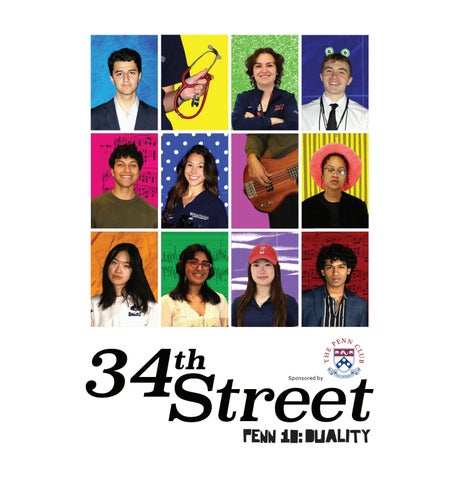
duality
At Penn, we are often pushed toward singularity: to choose one path, build a resume around it, and turn ourselves into a coherent story. We’re rewarded for specialization, certainty, and knowing exactly how to package ourselves into a one–minute pitch or a five–year plan.
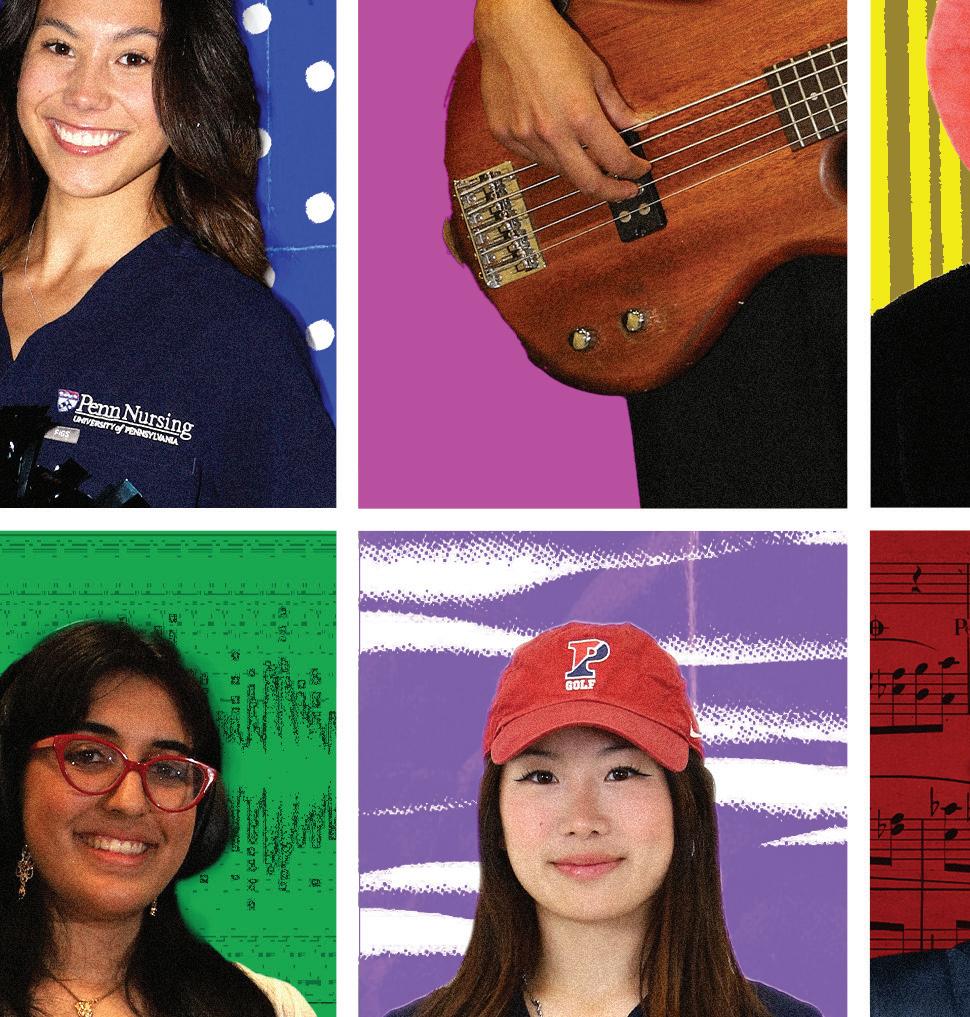
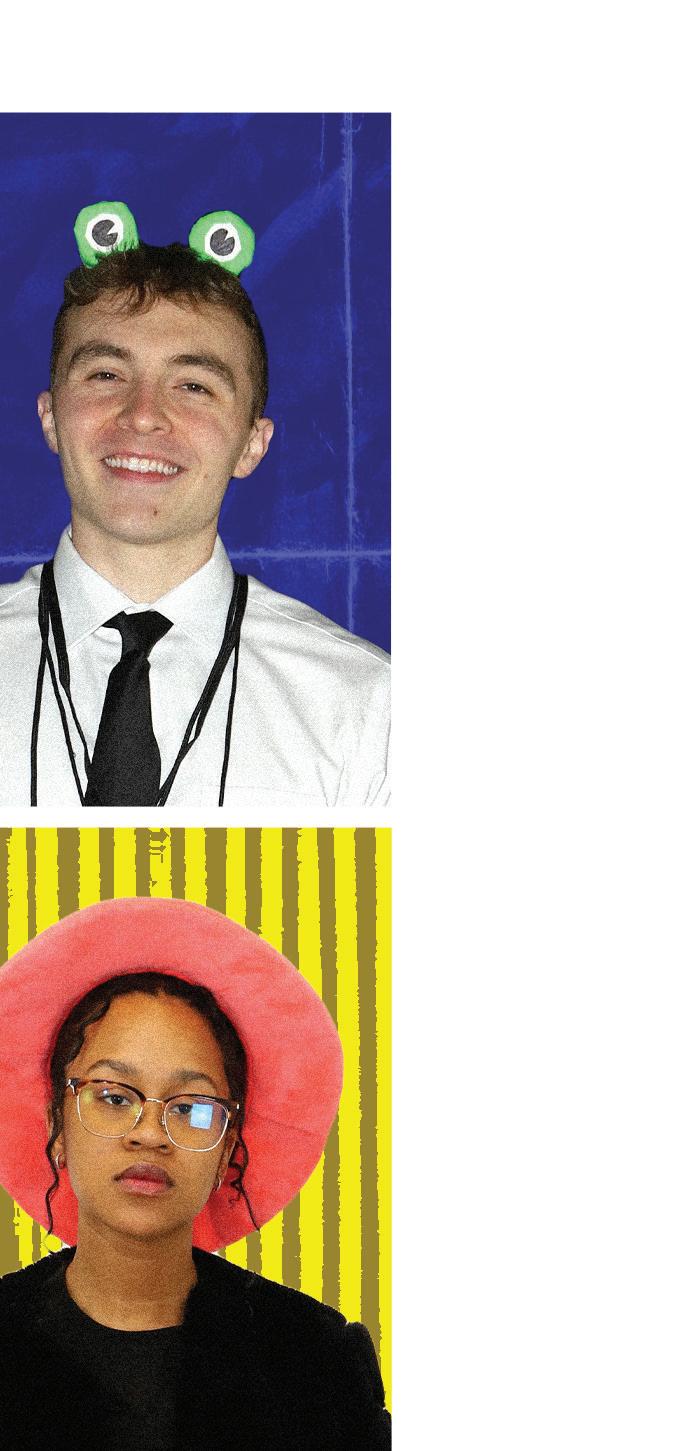
This year’s Penn 10 Issue features seniors who have resisted that pressure. Their college careers were defined by duality, rather than singularity—by the art of doing two very different things at once. They are athletes and artists, scientists and storytellers, performers and researchers. Their days on campus moved between spaces that rarely seem to link together. But they did it anyway—and they don’t plan to stop any time soon.
These seniors have spent their time at Penn building lives that are full of contradiction and multiplicity, embracing every opportunity life throws at them. At a school that often pushes students to define themselves quickly, they remind us that having more than one passion doesn’t mean you lack direction. Instead, it makes your life far more expansive—and, frankly, more interesting.
LAND ACKNOWLEDGEMENT
The Land on which the office of The Daily Pennsylvanian, Inc. stands is a part of the homeland and territory of the Lenni–Lenape people. We affirm Indigenous sovereignty and will work to hold the DP and the University of Pennsylvania more accountable to the needs of Indigenous people.
CONTACTING 34 th STREET MAGAZINE
If you have questions, comments, complaints or letters to the editor, email Nishanth Bhargava, Editor–in–Chief, at streeteic@34st.com.You can also call us at (215) 422–4640.
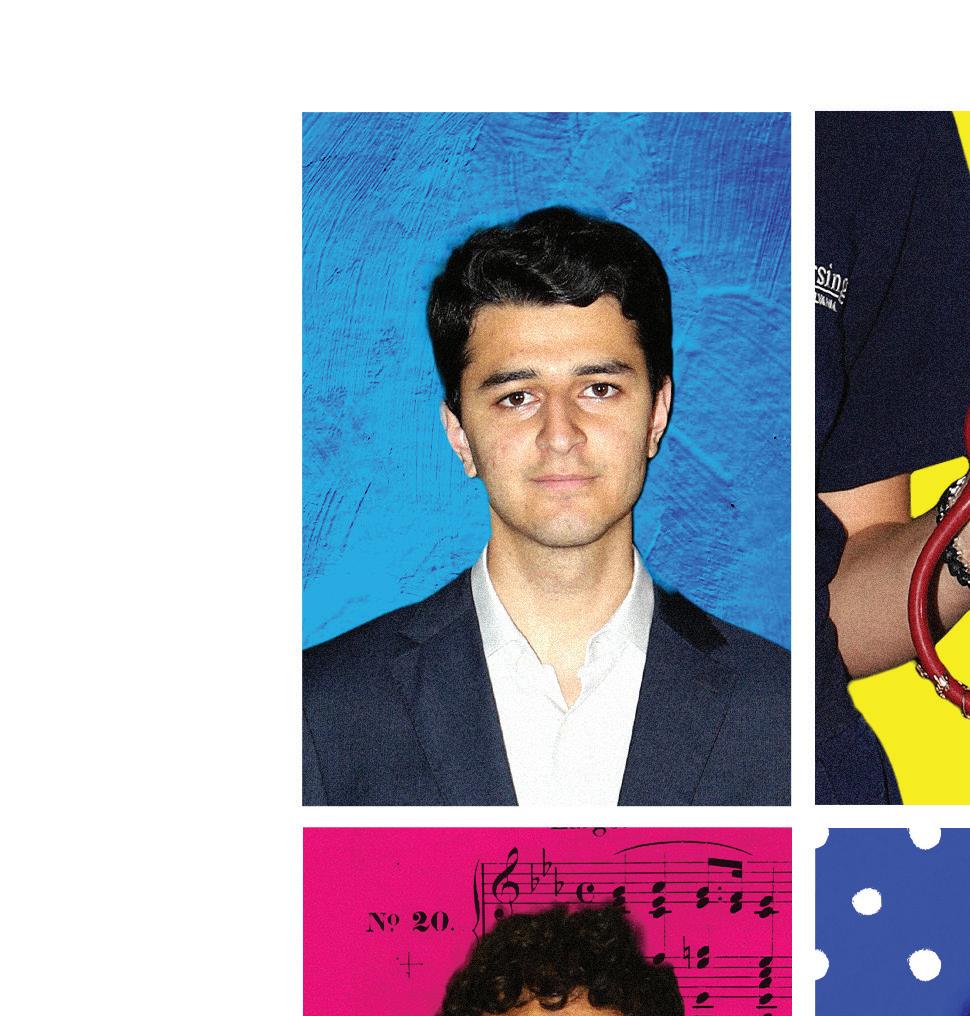
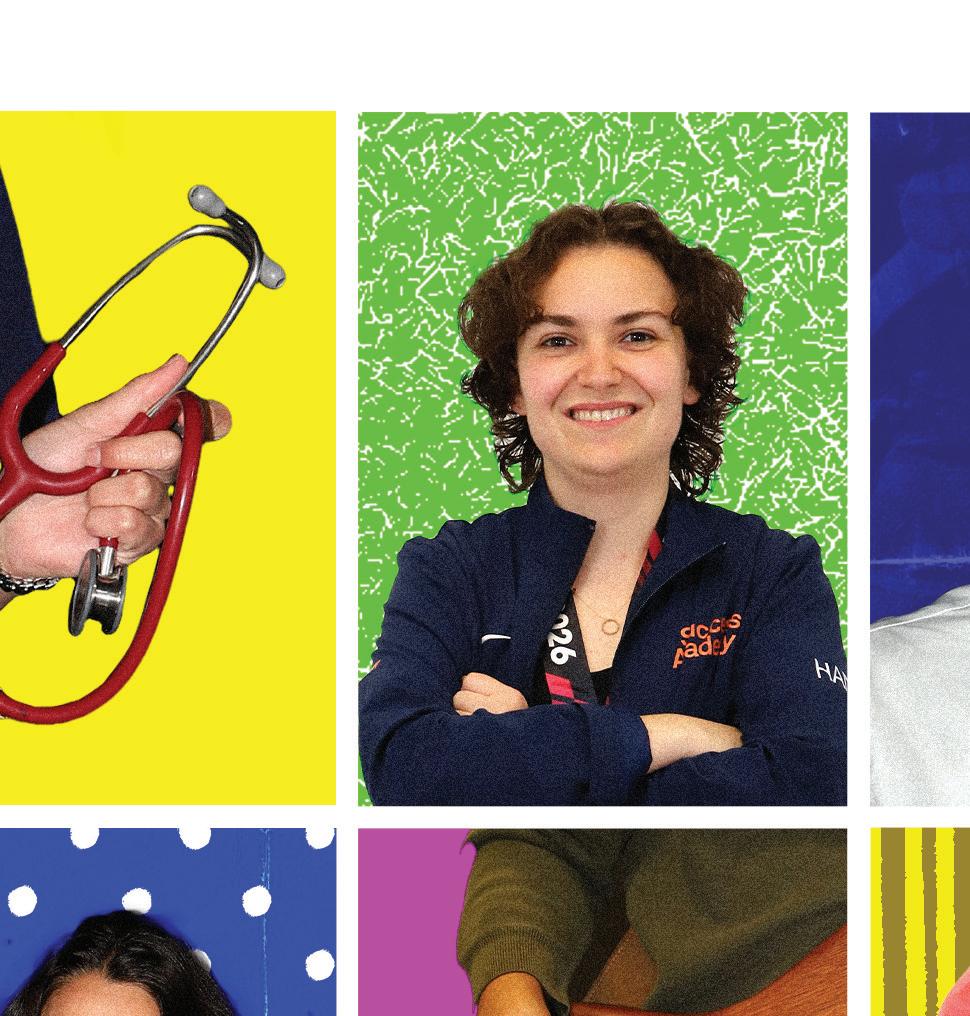
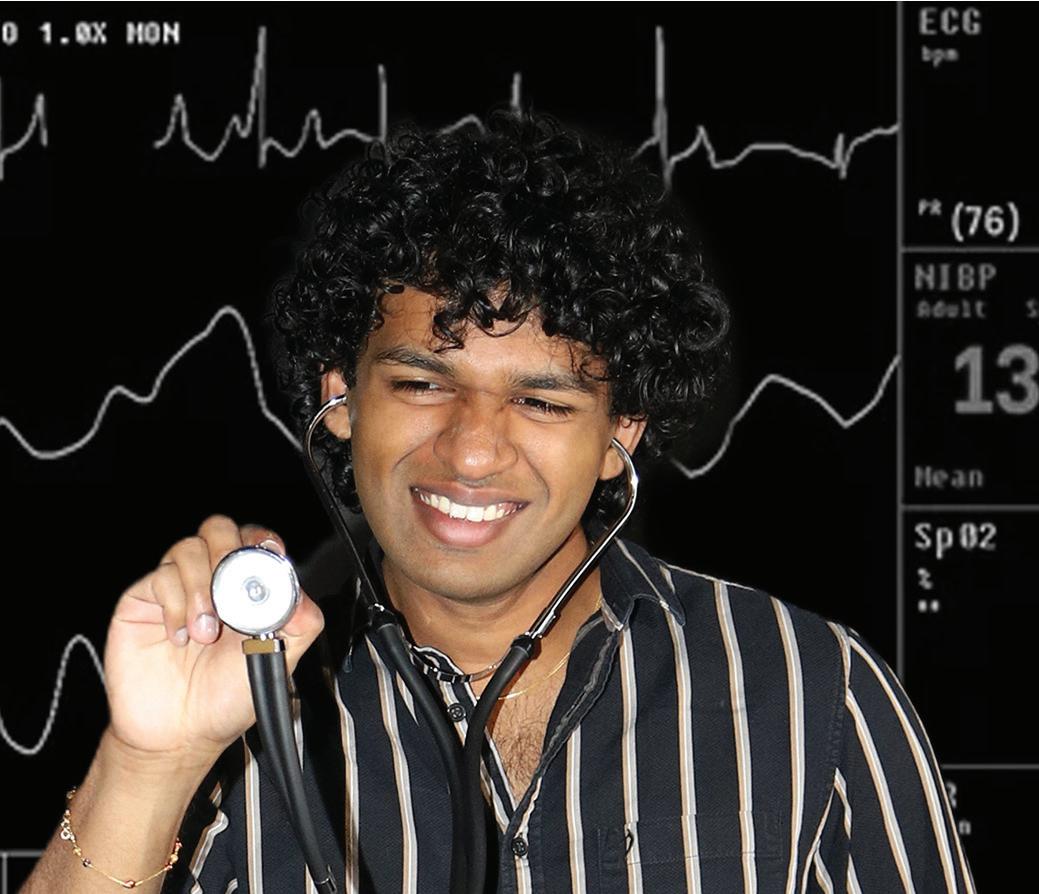
This soon–to–be doctor’s interest in music allows him to connect better with patients.
BY JACKSON ZUERCHER
DESIGN BY CHENYAO LIU
PHOTO BY CONNIE ZHAO
Have you ever been treated by a doctor in the emergency room, then seen the same guy shredding at a gig later that night?
Neither have I. But after meeting Aashish Codada (C ’26), I think I know exactly who that doctor could be.
“Duality” is, objectively, the wrong word to describe Aashish’s Penn career. Or maybe it’s simply insufficient. A senior in the Roy and Diana Vagelos Program in the Molecular Life Sciences, Aashish studies neurobiology and biophysics. As any MLS student will tell you, the mandatory double major already takes enough of a toll— but Aashish wasn’t fulfilled with just his STEM degree, opting to pick up a third major in architecture. On top of his academics, Aashish also works as an EMT in the suburbs of Springfield, Pa. and plays guitar in the Penn Glee Club band.
But when I sit down with him amidst the lunch crowd at Franklin’s Table, I don’t get the sense that he’s rushed, stressed, or counting down the minutes until he can run off to his next commitment. Maybe it’s because he’s taking a highly warranted two credits this semester—a staggering step down from his usual six. Aashish would be the first to agree that a well–rounded schedule is an integral, unifying piece of his personality. His disparate commitments don’t fracture his life so much as allow it to coalesce, making him a more grounded and balanced person.
“I just get bored if I’m doing one thing all the time,” he tells me. “So I like having multiple communities where I’m putting forward different aspects of myself.”
Aashish understands how each of his interests weaves together to form the fabric of his life. Some people heed the call to pursue their less financially lucrative interests; others know that they probably should but continue down the path of least resistance and financial stability. But when asked if, provided he could guarantee himself a stable living, he would ever consider playing music as a career, it becomes clear that Aashish fits
into neither of these categories.
“No, honestly,” he says, almost immediately. “Music was always a really fun hobby for me. And I would definitely play music in a professional band, but I don’t think I could ever see it as my main thing. I think the problem with music is that it’s really easy to get creatively burnt out. At least in my case, specifically, if I’m forced to do it or forced to create, eventually I [would] just kind of run out of steam, and I could never really imagine myself enjoying doing it if it feels like what my livelihood is based on. I like having it as a free thing—a creative outlet. Also, because, as the years went on, I got more and more into the idea of medicine as a career. And I think now I am fully locked into that.”
“I just get bored if I’m doing one thing all the time. So I like having multiple communities where I’m putting forward different aspects of myself.”
No matter how rewarding it may be in the long run, medicine is still a field that drives many to the point of burnout, so I was curious if juggling all of his commitments was ever too much for Aashish to handle; if there was ever a week where Glee Club tech week intersected with a brutal flood of midterms; if he ever considered dropping something to lighten the workload.
“Definitely sometimes,” he allows. But the fleeting thought would always dissipate when he remembered: “I’m doing this because I want to do it. And I get so much out of it. It’ll be fine. I’ll do it.”
Aashish believes that cultivating diverse interests is important for anyone, not just him. He explains that if you go through all of college identifying yourself with just one thing—a researcher, a biology student, an engineer—and you fail a midterm or a project, you have “nothing to fall back on.” His outside interests act as a necessary stabilizing force within the competitive world of pre–med classes and research at Penn, as well as in the rat race of medical school applications that looms on the horizon for him and many of
his peers. Post–graduation, he’s planning to take a gap year to conduct research at a Penn neuroscience lab and apply to medical school over the summer. Application season is a time when every hopeful medical student is faced with the task of representing their complexity on paper to be analyzed and judged. But beyond the opportunity to give one’s list of achievements a little more flavor, Aashish firmly believes that every pre–med student should pick up genuine interests outside the realms of volunteering and research. While the latter fields “are important for sure,” he says, you should “also explore your interests and feel free to dive into your interests, even if it doesn’t feel immediately relevant to your future career path. Because it can come back and help you in ways that you wouldn’t expect. It helps you grow as a person, and that’s really important for medicine too.”
While he’s still figuring out his exact medical path, his EMT work draws him towards the world of emergency medicine. What gives him pause, however, is the brutal lifestyle of the ER doctor: the grueling 12–hour shifts and inevitable desensitization to trauma. “I don’t think it’s very sustainable, especially if you want a family,” he admits. “And that’s something that I also am looking for. But I’m definitely thinking about it, because the actual practice of emergency medicine really appeals to me.”
I ask him if he has plans to use his architecture degree for anything tangible—building a hospital, maybe—or if it was simply another creative interest that added some spark to the STEM grind.
He laughs at this. “That’s always the default answer. ‘I guess I could design a hospital.’ And I did take a course about design-
ing hospitals. It was called something like ‘Towards an Architecture of Health.’ It was actually really interesting.”
Ultimately, though, his perception of his architecture background is similar to how he views playing guitar. These pursuits are not worthwhile for how they can be commodified, but instead for how the skills they’ve taught him add to his figurative toolbox.
Aashish spent hours on his first architecture project, and it did not turn out well. “Architecture is working within a problem,” he says. “And I realized that you really have to get everything perfect. You can’t mess up a single corner—otherwise, it’ll mess up the rest of the building. It forced me to be more meticulous.” He credits architecture with giving him a new appreciation for creative thinking and time management, skills he may not have developed as fully if he had stayed within the parameters of science and math.
It is deeply human to explore our passions and to understand the world through art and music—Aashish is a perfect example of both these tendencies. Beyond expanding his capacity for creativity and problem solving, his outside interests have also allowed him to develop the kind of people skills that are crucial to working in tense situations with patients.
“I feel like one part of medicine that people miss is that being a good doctor is not the same as being good at science,” Aashish tells me. Slowly, everything about him clicks into place. His boundless wonder for the arts; his grounded sense of self; his willingness to talk and his genuine joy at being listened to. Later, after the interview officially ends, he’ll stay a few minutes longer to ask me questions about myself, and that will make sense, too.
“These are very different things,” he continues. “Being a good doctor is also understanding people and having a sense for how the world works … and how any random person would approach the world. And I feel like the more diverse experiences you have in anything, the better you get at that.” n
Allison LI
As both a writer and an aspiring doctor, this senior is bursting the Penn bubble and joining the fight against addiction.
BY NISHANTH BHARGAVA
DESIGN BY ALEX NAGLER
PHOTO BY CONNIE ZHAO
The courtyard of Kelly Writers House is an oasis of concrete and metal chairs against an overgrown jungle teeming with bugs. While waiting for my subject, I have to switch tables three separate times as wasps swoop in and out of my line of sight, terrorizing me as I try to prepare for my interview.
It’s in this chaos that I meet Allison Li (C ’26), whose first comment on the record is that she has a body hidden in her room—a joke (I think). But Allison is deadly serious about her work. As the former president of Penn’s Student Harm Reduction Coalition and a volunteer in harm reduction operations in Kensington, Pa., Allison has spent her time at Penn engaging deeply with the public health issues impacting Philadelphia the most.
Much of Allison’s work centers around doing outreach in the Philadelphia neighborhoods most affected by the opioid epidemic. “Going on outreaches just presents a whole different side of humanity,” she explains. Engaging in fieldwork allows Allison to better understand the technical principles of healthcare and neurology that she has learned as a neuroscience major, while also putting that knowledge into practice to improve people’s lives.
Allison’s engagement with harm reduction has sharpened her knowledge of the complex policy issues that shape the work that harm reduction workers are able to do. While few oppose helping those in need, how that help should be delivered in practice is an object of deep controversy as the opioid epidemic becomes a deepening national crisis. Nowhere is that clearer than in Philadelphia, where the City Council recently passed new restrictions on mobile medical service providers operating in Kensington and other neighborhoods. The ban was ostensibly motivated by community members’ goal to improve their communities and make the streets safer for their children—goals which they felt certain forms of harm reduction work were undermining.
Allison was there for the Philadelphia City Council meeting where the mobile services ban was debated, and she recalls being stunned by the amount of pushback harm reduction efforts received from the very communities they were meant to serve. “There’s so much moral injury in this field that it’s maddening,” Allison explains. After she says this, a table of people outside my line of sight (but within earshot) erupts into rapturous applause. Whether they were reacting to Allison or something else remains unknown.
The landscape of harm reduction and the public debates that shape its everyday practice are convoluted and deeply contradictory. “There’s no right way to do these things,” she explains. To make sense of it all, Allison turned to a new outlet to help her gather her thoughts: creative writing. Much of Allison’s early writing for The Woodlands Magazine—a creative writing and reported nonfiction magazine at Penn—centered around untangling the narratives and stigmas that surround harm reduction and drug addiction. Recently, she’s also engaged in a senior project interviewing the patients, healthcare providers, and outreach workers she labors alongside—a project she hopes will recenter the voices of those engaged in care work. She describes it as an attempt to gather “all the stories I’ve heard that make this space feel so alive, and worth … I don’t know. Worth, period.”
was amazing!” Another facet of her creative engagement is her involvement with The Excelano Project, Penn’s spoken–word poetry collective. Writing to be heard and not to be read, she explains, pushed her to look at the craft of writing in a radically different way. “Instead of just writing for yourself, you’re writing to perform in front of a crowd,” Allison says. “That changes what you say—and how you’re willing to say it.”
means that harm reduction isn’t still a worthy cause. “This work is still important,” Allison says. “And you do it anyway because you love the people.”
“Discourse around the Penn bubble to me feels inane— you’re here in Philadelphia; go see the world!”
What’s common to all of Allison’s creative experiences is her focus on community, whether in serving others as a tutor or sustaining spaces for creative practice alongside Excelano. The most frequent theme in her work, however, remains her own lived experiences in the harm reduction space; she acknowledges that writing about harm reduction presents unique challenges when it comes to the ethics of representing people’s struggles without erasing their own voices. To illustrate just how dire that problem can get, she invokes Salman Rushdie, a novelist who was stabbed in 2022 over his criticisms of Islam—“If you write about the wrong thing,” Allison warns, “people can get very, very mad.” As a journalist, I can certainly empathize.
Years of engagement in community outreach and harm reduction has led Allison to think about how she could do the most good in confronting addiction— should she stick to her plans to be a doctor? Get a Ph.D.? Engage in advocacy or policy work to create stronger structures of care?
Allison regrets getting into creative spaces relatively late in her Penn career. After graduating, however, she hopes to keep her creative work and scientific career largely separate. She cites the convoluted ethics of care and the need to be professional as the reasons for not wanting her two passions to overlap— but she believes that a cross–disciplinary response to harm reduction is necessary to deal with addiction in all of its facets. “Combining … the objectivity of the clinical profession along with the expansiveness of literature and humanities,” Allison says, “is what will get you to that secret third thing that’s somewhere interesting.”
Not all of Allison’s creative work has stuck so closely to her experiences in harm reduction spaces. One of the experiences she cites as most rewarding was tutoring students as a member of Cosmic Writers. “I was working with this eighth grader who just had so many ideas,” she says. “I didn’t even have to do anything as a tutor or a coach—I just sat there, opened the Zoom, and he just yapped. It
Allison is still unsure about precisely what her future holds. Though she describes herself as a pre–med student, she says her biggest post–graduate priority is “living in alignment with the morals and values I’ve built throughout four years of college.” Speaking to people involved in the harm reduction space has been sobering—one healthcare professional told her frankly that “you aren’t saving anyone.” She acknowledges that even being a doctor isn’t necessarily the best way to address the problem of addiction at its roots—after all, there’s only so much an individual care provider can do to “solve” systemic issues. Of course, none of that
Allison appreciates the freedom that being a student has opened up to her, even as she acknowledges the fact that Penn encourages students to close themselves off too early. “The linear way of looking at life that this school tends to place on people is a little sad,” she says, encouraging students to keep their options open and explore everything that Penn—and Philadelphia—has to offer. “Discourse around the Penn bubble to me feels inane,” Allison says. “You’re here in Philadelphia; go see the world!”
The persistent buzzing of bees and hornets around us doesn’t faze Allison—she’s found a space of care and humanity for herself amidst the chaos of the world. As her time at Penn comes to an end, she holds no regrets as to how she’s spent her time here. Even the worst parts of her Penn experience, she says, had a key role in shaping who she is today. For her past self and her future students, she only has one point of advice: “Do it scared.” n
Emily monfort
BY SARAH LEONARD
This Penn senior shows her passion for care in both medicine and theater.
DESIGN BY ANDY MEI
PHOTO BY CONNIE ZHAO
when Emily Monfort (C ’26) finally got through “General Chemistry I,” she prayed to God about it. She’d wanted to be a doctor since kindergarten, but Penn’s pre–med “weed out” courses were proving to be a slight hindrance to that plan.
“I really had to sit and think, ‘Okay, is pre–med what I want to do? Am I willing to go through the strenuous studying process?’ … So I de nitely prayed about it, asked God for guidance,” Emily remembers. Ultimately, after consulting those around (and above) her, she decided to stick with it. “I felt led to just continue with that path.”
It’s lucky she did, because her excitement is tangible when she talks about her experiences shadowing pediatricians and working with patients at the Children’s Hospital of Philadelphia.
As a patient navigator and family services assistant, Emily works directly with both surgeons and patients to ensure communication between the two and provide comfort in stressful situations. She loves being front–of–house, letting families know what’s going on and leading them to recovery rooms, just as much as she loves the people working behind the scenes.
“I just get to meet di erent families, and be that front of the line communication, and also get to know some of the surgeons,” she says. “It’s like you see in the movies, where you have di erent sur-
“High School Musical kid,” she grew up involved in both athletics and the arts, from community theater to the AG Youth Fine Arts Competition, which she describes as “ ica’s Got Talent, but the church version.” ough she came to Penn thinking about a more typical pre–med major like biology or health and societies, she took a few introductory theater courses too, and began seeing unexpected links between theater and her medical interests. She speci cally remembers being moved by Angels in America, a play by Tony Kushner about the AIDS crisis in 1980s New York.
“ e point of the play really brings awareness to HIV. You get to watch an actor who’s su ering through this, and see how it’s impacting him,” she says. “ is is literally public health. is is bringing awareness.”
“I just get to meet different families, and be that front of the line communication, and also get to know some of the surgeons.”
On a broader level, Emily sees connections between the way she thinks about her characters and the way doctors should think about their patients.
“In theater, we do a lot of character work and analyzing who they are,” she says. “What are their circumstances? What are their backgrounds? And I’ve noticed in shadowing physicians, that’s a lot of what they do already. ey’re asking the patient, ‘Who are you?’
ey’re looking at your medical history. ey’re asking di cult questions. ey’re asking these questions to help them make a better
“They’re
teachers, they’re hearing about this and being educated about these illnesses that may not be as comnot be as visible Emily says. like, ‘Okay, I heard about this at one of our meetings,’ and it’s better able to help them in medical school. So when they become physicians one day, it’s like, ‘Oh, I’ve heard about
theater, whether that’s through community theater productions or volunteering with her church. Her main focuses now, however, are pediatrics and public health. She emphasizes that it’s the human side of medicine that draws her in the most, citing in speci c her experiences shadowing pediatricians.
Medicine is a eld built on compassion, but it’s too often in ltrated by the kinds of apathy rampant in the wider world: racism, misogyny, and an unwillingness to look beyond what can be seen by the naked eye. rough her work with the Invisible Illness Awareness Network—which she helped found— and the National Society of Black Women in Medicine, Emily pushes against these tendencies. e IIAN raises awareness about diseases that often go unnoticed or underdi-
“ e hope is that pre–health students, or even nursing students or
this before.’”
a pediatrician just because of that. I didn’t want to deal with the parents.’ But I think in seeing that and being able to shadow, I was like, ‘ is is exactly what I want to deal with.’ is is where my heart and passion is.” n and as mon and may to the eye,”
Emily also serves as the treasurer for Penn’s chapter of the Society of Black Women in Medicine, a role she says working at a Dollar Tree in her hometown helped prepare her for. ough she had many “crazy experiences” at that job, she speci cally recalls one situation with a mentally ill community member she had to deescalate—it’s clear that she brings compassion into every realm of her life, including customer service.
“Getting to walk alongside a physician and seeing how [they], one, navigate with the parent, to take better care of the child, but also address the child and their needs. at excited me so much,” Emily says. “I saw that other physicians were like, ‘Oh, I didn’t want to be
Human connection is the beginning and end of medicine for Emily. e biology is important, but so are holistic patient–doctor relationships and health advocacy. at’s why she’s returning to Penn next year for her master’s in public health.
“I realized that my mind tend[s] to be more interested in focusing on public health and thinking about those systems in place rather than, you know, wet lab biology,” she says. “ at is de nitely important, but I think I noticed that my interest may be more towards … social and economic conditions, and thinking about all those things, and how that can in uence a patient’s care.”
Despite being taken aback by Philadelphians who don’t eat their cheesesteaks with lettuce and tomato like she did growing up, Emily’s grown to love the City of Brotherly Love. She has a sister at Temple University she visits regularly, and she talks about how homey the city feels compared to New York. She’s also had the opportunity to travel internationally with Penn’s eatre Arts Department, serving as a stage manager for the play Edinburgh Festival Fringe.
a theatre arts major, Emily knows all about communication and navdescribed work Illness agnosed in patients. and sister versity at the plans
After graduating, Emily plans to continue her involvement with
BY FIONA HERZOG
Through facing his failure as a ‘traditional business student,’ Francesco has gained the wisdom of 1,000 lives.
DESIGN BY ANDY MEI
PHOTO BY CONNIE ZHAO
On a warm April night on Locust Walk, Francesco Salamone (W ’26) smiles as he ecounts his many travels and experiences funded by the SNF Paideia Program. During the summer of his junior year—a time many Penn students spend sucking up to their internship managers to secure a return offer—Francesco tried out life as a Buddhist monk at a temple in a Japanese fishing village. He’s also tried out beginner classes in classical ballet and filmmaking, and spent time purchasing mystery boxes of books in Rome. While he doesn’t believe in making firm choices for a future version of himself, Francesco currently aspires to become a professional psychoanalyst.
Francesco came to the Wharton School as a rst–generation low–income student from Palermo, Italy. When he rst arrived on campus, he was eager to stick to the well de ned, preprofessional path that past students had clearly carved for him. “Freshman year, I did the nance clubs and went to New York to do work for them,” he says. “I remember presenting at Apollo.” He laughs and makes nger quotes as he calls it “a sexy rm.”
“It was in an o ce overlooking Central Park, and [it was] my rst time in New York. I thought to myself, ‘ is is it. I’m winning,’” he explains. “So I spent all of my sophomore fall preparing for recruiting.”
ough he joined all of the right clubs, talked to all of the right people, and prepared all of the right materials, Francesco never felt like he was being nourished. ere was some unmet need that he wasn’t listening to. By the time January of his sophomore year came around, he says, “I just had a meltdown. I couldn’t function.” He was taking the course “Existential Despair” at the time, which was the rst time he felt he had a safe space on campus. It was “not safety from challenge, but comfort in accepting challenges,” he says. “It created space for the discomfort I’d been suppressing, and it came out like a tsunami.” By the end of the semester, Francesco had withdrawn all of his job applications.
In Sicily, Italy, students don’t get jobs straight out of college. ey need more time, more degrees, more unpaid internships for even
a slim chance at a decent salary. e “sexiness” of Apollo and the lifestyle it promised was incredibly attractive—as such, Francesco attached his self–worth to his professional future.
“I thought I was worth $150K a year because I was going to apply to those jobs. ere’s something good in that con dence, but it’s also problematic when what you actually want is something else entirely,” he says. “My failure as a traditional business student is [a success] at shifting the criteria. e standards I was failing by were ones I’d internalized from Penn— and they’re no longer my criteria.”
Stepping back from the recruiting timeline allowed Francesco to expand his understanding of what business really is. “Business is polymathy par excellence. You cannot be a good business person
well, it was to take the position with extreme responsibility. I was in charge of a community of 33 TAs that reached 633 students for the Class of 2029,” he says. “ e way we talked about things, the TAs we hired, had an impact on everyone’s rst–year experience.”
To make the class a positive environment, Francesco focused on training TAs to ask real questions and connect with students in their one–on–ones. One such question simply asked, “What are your values?” He explains that “sometimes students are never asked that. You create a safe space and build from there.” Intellectual curiosity, he maintains, is fostered through one–on–one conversations. Francesco measures his success as a head TA through the time he spent with students. “ e best compliment I received as a TA
“The humanities teach you to fall in love with questions. That’s a much richer life. Not financially, but psychologically. You’re never bored.”
unless you do everything else that isn’t business,” he says. “Marketing is applied literature. e business cycle is a conceptualization of life. We can’t avoid a recession any more than we can avoid getting sick. e question isn’t how to avoid it—it’s how to contain the uctuation, how to have a smooth landing.”
is when I’m talking to a student, we’re scheduled to meet for 45 minutes, and they say they have somewhere to be right after—yet they then end up staying long after,” he explains. “Suddenly, the
what people pursue when they love learning, requires you to choose a department. I want to read everything.”
Within his four years at Penn, Francesco has built his own education by poring over the books in Fisher Fine Arts Library, engaging in one–on–one conversations with professors and students, and using grants from the SNF Paideia Program to travel across the world and explore disciplines he had never before considered. rough it all, he’s held onto the stubborn belief that everything has something to teach him.
One quote Francesco loves is, “knowing what you want stops you from guring out what you want.” us, as of right now, he has no immediate plans for his life after graduation. Vaguely hoping to train as a psychoanalyst—a one–on–one profession—he imagines that he’ll be immersed in teaching, reading clubs, and community. Perhaps he’ll be in Europe, surrounded by the weight of centuries of history and culture.
Francesco is not nished guring anything out—and he’ll be the rst to say so. “Everything I talk about is something I struggle with,” he says. “I don’t come from a place of having gured it out. It’s me screaming that I haven’t. at’s what makes it welcoming for others to join.”
On Locust, the night is still warm.
To Francesco, business isn’t just a career path, but a way of understanding the world. e elds of liberal arts and business are complementary, not opposed. “ e humanities teach you to fall in love with questions,” he says. “ at’s a much richer life. Not nancially, but psychologically. You’re never bored.” His life now is a product of his refusal to obsess over rules he broke and his decision to start paying attention to the new framework he’s living by.
As head teaching assistant of WH 1010, a class that serves as an entry point for every incoming Wharton student, Francesco found himself tasked with the responsibility of instilling curiosity in them.
“I think if I’ve done one thing
mysterious meeting fades as they realize the conversation they’re having is one they’re not typically having.”
his room to read, with no music and no screens to distract him. For someone who arrived at Penn
tan, it turns out that the life he eter—but also much
“Even academia, which is
HANNAH MOSKOWITZ
Hannah’s no stranger to the stage or the field.
BY ALEXIS BOLAND
DESIGN BY CHENYAO LIU
PHOTO BY CATHERINE FAN
When I ask Hannah Moskowitz (W ’26) to describe herself, she tells me she lives her life in a “centrifugal force, where, if you attach a ball to a string and you swing it around, it’s gonna lift up and go as wide as the string will let it.” On the surface, that tracks. Hannah exists within multiple worlds—comedy, athletics, business, and education, flitting between them at a pace that’s hard to keep up with. But all that outward motion originates from a single center—and the more time you spend with Hannah, the more that center comes into focus. Her diverging interests aren’t different worlds, but different ways of being exactly who she is.
“centrifwhere, it.” that
tion from her freshman year residential advisor to stop by a rugby practice turned into a three–year commitment to the women’s club rugby team— which unfortunately came to a halt after she broke her collarbone at a tournament in her junior spring. While Hannah misses both the sport itself and her teammates, she finds that not playing rugby has given her more time to explore other interests. “It’s not like I was necessarily looking to have my theater outlet, and now my sports outlet,” she explains. “But when someone told me, ‘Hey, do you want to come by a rugby practice?’ I liked the idea of being able to call up my mom and be like, ‘Guess what I’m trying this week!’”
Hannah studies operations, information, and decisions in the Wharton School, but she carries herself with a lightness not typically seen in business students burdened by career worries. Instead, she spends her free time writing sketches for Bloomers Comedy. That outlet suits her, as she’s drawn more to hands–on, practical work than to abstract theory and long readings—quite ironic, given that she plans to become a history teacher. Although the grounded work she wanted wasn’t necessarily what she found in her degree, Hannah doesn’t regret it because she believes “there is an inherent value to [having a] range of experience[s].”
That philosophy carries into everything she’s done. From the moment Hannah stepped foot on campus, she was immediately set on trying anything that came her way. An invita-
A more natural choice for Hannah was her decision to join Bloomers Comedy. She was no stranger to the stage, having done improv for most of her high school years. But after seeing the free show that Bloomers put on during New Student Orientation, she was hooked. “I was just like, ‘Bloomers is lit!’” she recalls. “The people seemed lit, and I thought that their sense of humor was the most closely aligned to mine. That was kind of the first thing I dug my heels into at Penn.” This “digging in” motivated her rise from a cast member to director, which, for her, was an obvious choice; there weren’t many people in her Bloomers class to fill the position, and she always wanted to be in a role that would allow her to create a vision rather than just participate in one. She was largely motivated by her mentor—an upperclassman who picked her out of the crowd— who taught her about everything from writing sketches to how to think about comedy, eventually inspiring her to give that same attention and direc-
“I think it would be harder for me to not do very different things ... I think that I’d get really bored very quickly.”
tion to future Bloomers. Though Hannah came into Penn not knowing who she would be or what activities she would be involved in, she knew exactly what she wanted to do after: education. Having grown up around parents who were educators, she describes herself as an “educational nepo baby”—an identity that was further reinforced by her extensive experiences as a tutor and a teaching assistant. For her, education is more than simply communicating information. She sees it as a kind of performance—one that will satisfy the Bloomers itch once she graduates. “You have a classroom of 32 kids that have no other choice but to sit and listen to you,” Hannah explains. “I’m like, ‘This is my dream.’” Above all else, Hannah prides herself on her authenticity. As someone who spent most of high school code–switching between different versions of herself depending on the room she was in and the people she was interacting with, she understands the inherent exhaustion that comes with juggling multiple identities. When I ask her if any of those old tensions resurface given the different worlds she occupies at Penn, she ponders my question for just a moment. “No,” she finally says. “I honestly have trouble understanding when people express that tension in their life. I feel like it’s way less tiring to interact in any space when you feel like you can be fairly consistent.” The proof is in her friendships. Where most people maintain subtly different versions of themselves for different social circles—balancing “club
friends” and “class friends”— Hannah brings the same funny, lively demeanor to everyone she meets. That way, she can (and does) sit five of her friends from completely different parts of her life down for dinner and only have to worry about whether she’ll run out of food. If Hannah’s life is a centrifugal force, her center of gravity is what she calls “variety for variety’s sake.” People often express a mix of surprise and envy over her ability to juggle so many things, which she finds puzzling. “I think it would be harder for me to not do very different things,” she says. “I think that I’d get really bored very quickly.” Hannah’s honest about how she got here, though. Most of it was accidental: “I was in a mindset where I was willing to accidentally fall into a lot of different things.” That openness and willingness, she thinks, is more accessible to people than they realize. Most people underestimate their own agency and what they could reasonably achieve if they attempted something. That said, variety for variety’s sake has its limits, and Hannah knows them. She never found the time to pick up multiple minors, rush a business fraternity, or participate in communities that constitute a big part of other Penn students’ lives. But to Hannah, this isn’t something to mourn—it’s just the cost of doing things she actually cares about. It is only through this strict prioritization that Hannah can derive the energy to “run [herself] ragged” for the things she loves. n
JuLie SHIN
Between two dance clubs and varsity golf, Julie thinks she’s doing “nothing too crazy.”
BY JAYA PARSA
DESIGN BY KIKI CHOI
PHOTO BY CATHERINE FAN
It’s not every day you get to meet someone living two entirely different lives at Penn—but Julie Shin (C ’26) does exactly that, balancing early mornings on the golf course and late nights in the dance studio. In a school that often rewards specialization, Julie has built a life expansive enough to be a part of both competitive athletics and the performing arts.
Recruited to Penn for golf, Julie’s high school days were filled with early morning workouts and 25–hour practice weeks. “I actually think I had a hard time adjusting,” Julie says about her freshman year at Penn. Eventually, though, she was able to settle into the community, becoming close friends with the girls on the golf team and finding her place at the school.
her upperclassmen friends to audition. Many of her friends, though, were worried that she was overcommitting herself: “A lot of them told me, ‘Oh girl, that’s going to be way too much.’”
“Things are going to work out in the end. You’ll fi nd your place.”
Julie had “a slight interest” in dance before she came to college but claims that it was “nothing too crazy”—the most experience she had with dance was performing at a pep rally and talent show at her high school. That slight interest, however, was enough for her to join her first dance group—K–Beats—during her sophomore year at Penn. She initially felt hesitant about auditioning, noting that many people around her weren’t sure that she’d be able to juggle dance and golf at the same time. “I understood that,” she says, “but I just did it anyway because I felt like if I didn’t do something, I would regret it.”
Through dance, Julie was able to tap into her growing love for performance. And to her surprise, her golf scoring averages rapidly improved after she joined K–Beats—culminating in her first individual tournament win.
But Julie didn’t stop her dance career at K–Beats. In her sophomore spring, she made the decision to join her second dance group, Penn Hype Dance Crew, after being convinced by
Contrary to her friends’ concerns, Julie found the workload quite manageable and believes that being part of K–Beats, Penn Hype, and the golf team is one of the best decisions she’s made at Penn. Since joining K–Beats, she’s not only placed fifth at the Ivy League championships for golf—a career–high performance—but also improved her academic outcomes. “That’s why I feel like if I put my mind to something, I can make it happen,” Julie says. “I’ll make it work somehow.”
Going into her senior year, Julie ramped up her involvement within the varsity golf team and her two dance groups. “This is, like, your last year to do anything, so just go crazy,” she recalls thinking to herself. That mindset has certainly paid off, as she now serves as co–captain of her golf team, internal vice president for K–Beats, and a choreographer for Penn Hype. Though she was new to each of the roles, choreography felt the most unfamiliar to her. “I was honestly scared of it because I feel like it’s hard to choreograph,” she says. “I knew I would struggle with it because it doesn’t come naturally to me at all.” But through perseverance and determination, everything eventually fell into place. “I’d look back at the show videos and [be] like, ‘Wow, it really came together,’” she says. “It was so great.”
so much to do and so little time to do it, she doesn’t have much room for hesitation, so she’s learned to trust herself in the in–between moments—whether that’s choosing to show up to an extra practice or pushing through a long day. That mindset, she explains, didn’t develop overnight. It was built through choosing commitment again and again over the years. It came from never letting others’ skepticism become her own, and from proving to herself that she could handle anything she set her mind to.
her freshman–year self, Julie’s answer is quite amusing: “Girl, don’t take those Econ classes. You don’t need them.” Beneath the joke, she laughs that her only real regret is the sleep missed—those six–plus hours per night—and the time spent stressing over the little things. “Things are going to work out in the end. You’ll find your place,” she says. n
time, persisting—she’s excited next. the the
Beyond the numbers—tournaments won, dances performed, board positions held—what stands out about Julie is her intentionality with her time. With
What Julie has experienced in her four years at Penn have been far from her original goals of just doing well in golf and “hopefully” keeping up with her academics. “Now, in my free time, I’m just dancing!” she laughs. “Which is not at all what I expected, it’s just something I haven’t experienced before.” Though she will miss the unique energy of college—constantly being on the grind, perpetually struggling, yet always persisting—she’s excited for what comes next. “I feel like I’ve honestly done as much as I could, and it makes me really glad I made the choices I did,” Julie says.
After Julie graduates, she’ll either be in New York or her home city of Washington, working in marketing analytics. Her careers in golf and dance won’t be forgotten, though; she plans to go to casual golf tournaments and dance workshops when she has the time to do so. “Everything else is more up in the air, for sure,” she says.
When asked what she would tell
Kennedy Smihula
BY LAURA GAO
How this Penn senior balances long hospital shifts with tumbling on Franklin Field
DESIGN BY ALEX NAGLER
PHOTO BY CONNIE ZHAO
On Tuesdays and Thursdays, Kennedy Smihula (N ’26) clocks out of the cardiac intensive care unit at the Children’s Hospital of Philadelphia at 7:30 p.m. after spending nearly 13 hours beside some of the most seriously ill children in the city. Then, with barely any time to grab dinner, she immediately heads to Weightman Hall to meet her team for cheer practice.
Some days, a patient has passed away. Other days, she’s sat with a family through the toughest time of their lives. But an hour later, without fail, she’s doing her stretches on the turf and chatting with her teammates about upcoming games.
“It’s very particular to be a nurse and a student at the same time,” she says.
Kennedy is a senior nursing student and a member of Penn Cheer. These two identities could not be more diametrically opposed—one asks her to hold space for grief, sickness, and the fragile inner workings of a child’s heart; the other asks her to show up in Penn’s red and blue and move her body with precision and joy. Kennedy has spent the past four years figuring out what it means to be both.
The story of how Kennedy ended up in nursing—and at Penn—is, in her own words, “kind of a funny one.” One day, amid casual conversation, Kennedy confessed to her high school cheer coach that she didn’t know what she wanted to do with her future. She had considered health care management, but she still wasn’t sure about it. Her coach, who was also an operating room nurse, responded by asking Kennedy, “Have you ever been in the hospital?” She hadn’t. So the coach offered to take her along for a day of shadowing at her private plastics practice.
“I was like, ‘Oh, it’s a free day off school,’” Kennedy recalls.
Her mom was convinced it would backfire. One look at the “guts and blood” would kill any interest in being a nurse, she figured. But instead, when Kennedy came home that night, she told her family, “This is what I want to do for the rest of my life.”
The moment she stepped into the operating room, Kennedy was instantly fascinated by both the science of medicine and the practice of being by the patient’s
side, which Kennedy described as “walking them through these scary times.”
This was October of her senior year of high school, the middle of college application season. Kennedy immediately dropped all her plans and flew to Penn—home to the number one nursing school in the country—two days later. She loved the campus, and immediately got busy working on her early decision application.
“The rest is history,” she laughs.
As she progressed in her studies and her work—today, she’s a nurse technician in the cardiac intensive care unit at CHOP—Kennedy fell more and more in love with caring for patients. She learned that translating and advocating for patients is a big part of a nurse’s job—oftentimes, doctors and surgeons may be too focused on the science behind their work to effectively engage with patients on a human level. But a nurse’s voice, both in interpreting a doctor’s words and in advocating for patient needs, is the difference between whether a patient feels heard or not.
to be a normal college student.
“That’s something special about the nursing community here at Penn,” Kennedy says. “We’ve all seen more than what the average student has. That, in a way, has bonded us.”
Ultimately, Kennedy is grateful for the work–life separation that cheer provides her. Focusing on practice helps her “leave what is at the hospital, at the hospital” and has “kept [her] sane in certain times.” While the situations she encounters at the hospital are incredibly difficult, having a safe space to stay active around her friends and take her mind off of it is, in a way, “so eye–opening and refreshing.”
“I mean, it’s really what is preached to nurses all the time right now,” Kennedy says. “Take care of yourself so you can take care of others.”
“The fact that I get to walk outside is such a privilege, and something that is so easily taken for granted. Being so much more grateful is how I navigated everything.”
“We are at the bedside,” Kennedy says. “We know them. We know their families. We know so much, and getting to be that person for them is so special.”
That’s not to say her work is without challenges, especially when it comes to managing her double life as a nurse and a cheerleader.
“There were a lot of days that I would go from … patients unfortunately passing and helping their families through that process, to immediately going to class [the] same day, or talking at practice about cheer, [or] talking with friends about situationships and boyfriends.”
Kennedy has discussed this struggle at length with her nursing peers. Working in healthcare comes with seeing the cycle of life, death, and suffering up close, every day; it’s jarring to go straight from a hospital to a classroom or practice session, where you suddenly have
that she lives off of mango green tea Celsius—she’s grateful for the perspective it has brought her. Last winter—the coldest Philly winter in ten years—Kennedy was walking to the hospital, freezing. She was about to complain about it when she reminded herself of a patient who has been in and out of hospitals her whole life, battling difficult diagnoses and struggling to walk independently. After achieving a big milestone, the nursing team celebrated this patient by taking her on a little excursion to the garden right outside CHOP. It wasn’t much, but the patient was blown away, smiling the whole time—it was her first time being outside since she was transferred to the hospital several months ago.
Kennedy has participated in gymnastics and cheerleading her whole life. In high school, she was simultaneously competing in three highly competitive cheer teams, with two of them having three practices each week. Penn Cheer, by comparison, is much more relaxed—they practice twice a week, which is the “perfect” level of commitment, as it allows her to stay fit without consuming her life.
Through cheer, Kennedy has made some of her closest friends at Penn, and she praises her teammates and coaches for being incredibly supportive of her dual life. This has made it much easier to balance both commitments— the cheer practice schedule was even pushed later in order to accommodate nursing students’ clinical hours. On days she’d had a particularly difficult shift at the hospital, she is supported when she needs to miss practice.
“I’ve also definitely fallen asleep on a cheer mat,” she says.
Even though the life Kennedy signed up for comes with a lot of work and exhaustion—she jokes
“The fact that I get to walk outside is such a privilege, and something that is so easily taken for granted,” Kennedy says. “Being so much more grateful is how I navigated everything.”
The cardiac ICU, Kennedy says, is “probably the most intense” floor. “A lot of our patients, [the] majority of the time, are intubated, sedated, or are babies, so they can’t really talk to us,” she says.
But once in a while, there is a patient who can. There was one patient who Kennedy “absolutely adore[s]” and calls “the cutest little girl you’ll ever meet.” After a particularly difficult recovery, she began to improve and was able to ingest her own liquids, so Kennedy and another nurse set up a fake lemonade stand in front of her room. “We had a little table, and we had a little sign, and she had her little lemons everywhere, and this big pitcher of hospital–made lemonade from the nutrition room,” she recalls.
For Kennedy, moments like these are magical.
“It’s these people’s worlds,” she says. “The happiness and excitement of the whole unit and the families is just such a privilege to be a part of.”
In the end, Kennedy doesn’t see her two lives as all that different.
“Cheer and nursing—I feel like it’s more of an intersect[ion] than people think,” she says. “I went from cheering on teams to cheering on patients.” n
Marc Vaz
This senior is leaving Penn with a startup offer— and a band that isn’t quite finished yet.
BY SOPHIA MIRABAL
DESIGN BY AMY LUO
PHOTO BY CONNIE ZHAO
Marc Vaz (E ’26) is headed to New York after graduation, where he’ll join a young startup as a forward–deployed engineer, embedded directly with clients and working at the shifting edge between product and problem. It’s the kind of role that demands adaptability, and Marc speaks about it with nothing but excitement. In his words, it’s a chance to “start learning once again.”
But lately, programming have only been half of his story.
Outside of the classroom, and beyond the neat career trajectory a computer science degree provides him, Marc spends his nights playing bass for Blue Shade, a five–person band he formed with friends this past August.
“We mostly did covers for the first couple months,” says Marc. “But now we’ve been writing some of our own music. We’ve been doing more gigs [in] different places.” What began with boiler rooms and house shows has turned into a steady rotation of local bars, rooftop venues, and wherever else they can haul their equipment. The group—two guitarists, a drummer, a singer, and Marc—moves fluently between rehearsals, performances, and whatever daytime obligations occupy the rest of their schedule. It’s a commitment, he says—one that can take a lot of time and energy, but is nonetheless “thoroughly enjoyable.”
Marc’s dedication to music long predates Blue Shade. It’s something he’s carried with him since childhood—less a pastime than a principle—and always held close to his heart.
“Whenever I play, it just reminds me of being back home with my family,” he says. “I started playing the guitar and singing for my mom when I was a kid, and so being able to continue doing that through college makes me feel connected to me.” After arriving at Penn, Marc kept up with the habit through The Mask and Wig Club, joining the band his freshman fall and staying for three years before starting Blue Shade. He credits the experience for helping him develop as a musician—but perhaps more importantly, for giving him a set of collaborators. One of these collaborators, close friend and
drummer Joseph Dattilo (E ’26), followed him into his next project. At face value, Marc’s dual pursuits seem like an unlikely combination, governed by different sets of rules and operating in different registers. One involves moving through problem sets and tight deadlines; the other unfolds in ways that are harder to quantify.
But it’s an arrangement that isn’t so uncommon, according to Marc. “Weirdly enough, when I was a freshman in the Mask and Wig band, there were eight of us in it, and I think seven of them were CIS majors. … I think there is an overlap between STEM–related degrees and strong musicians,” explains Marc. If he attributes this intersection to anything, it’s probably the discipline demanded of both—there’s a kind of quiet similarity in the way a musician hones his craft with constant practice, and an engineer hits the books. There’s also a “mathematical” nature to music, Marc says. He observes a patterned structure in composition, in chord progressions, and even in the arrangement of a fretboard.
On the flip side, Marc’s creative instincts also find their way into his coursework. “When I’m writing code, it is an art form,” he says. “There’s multiple ways in which you can do it.” With the room it provides for style and taste–based decision making, coding requires an imagination perhaps overlooked by those outside of the field.
meaningful to him now, in a band that allows him a new level of creative freedom. “Especially [with] the music that we’re playing now,” he says. “I get to pick a lot of the set list, so it’s all songs that I really enjoy and have listened [to] for most of my life.”
Marc is inspired by many of the greats—Pink Floyd is the largest influence on his sound, alongside Dire Straits, which has been with him for a long time. The band leans into classic rock, for the most part, but their music changes to fit the audience. Marc’s favorite gig so far was a rooftop show at 3737 Chestnut St. for an Eid celebration. “It was right during the sunset. So it was a cool environment to be playing music. That’s up there for sure.”
“I never felt like it was a waste of time to [play] music instead of focusing on a job.”
Still, there’s a kind of creative liberty music provides him that he can’t find in the confines of his coding assignments. To put it simply, it makes him “feel like himself.” Grueling gig prep, while exhausting, is the thing he looks forward to each week—as it turns out, the band is prime homework–finishing fuel. “I feel motivated to get all my work done so that I can spend time rehearsing, you know, so I can fit everything in my schedule and get to the next gig,” he explains. This incessant pressure to make time to play is driven by his love to create—something that’s especially
But music isn’t the only place that this senior strives for greatness. His senior design thesis, a mobile app that encourages you to keep in touch with friends and family, recently won Penn’s Social Impact Award. The app lets users import their contacts and set rough intentions for how often they want to reach out and why. It then nudges them to actually follow through. “The goal here is not to make interacting a chore,” he explains. “It gives you insights into how well you’re actually doing and staying in touch with people.” It’s a problem he’s struggled with himself, which might come as a surprise. Bouncing between Mask and Wig and Blue Shade, preparing for gigs and group projects, you might assume Marc is in constant contact with others, that a schedule this full leaves little room for distance. “Every start of the semester, I would make a notes app [note] and I would write, ‘these are the people I need to catch up with,’” he confesses. “And then I’d never look at the notes app or talk to them at all.”
To Marc, that kind of human connection is essential; it’s a form of kinship that grounds him, reinforced by a relationship with loved ones which he describes as unwaveringly supportive, espe-
cially when it comes to his musical ambitions. “It was always seen as like, ‘Wow, this cool thing that you’re able to do’ and not ‘you should be doing something else,’” he explains. “I never felt like it was a waste of time to [play] music instead of focusing on a job.”
That support is a blessing he’s clearly grateful for. From the ease with which he talks about the seeming dualities in his life, it seems to take no real effort for him to maintain his combination of interests. In fact, the University’s elite environment has made that balance all the more normal.
“I think Penn especially is a very high achieving place. Everybody’s doing something cool,” he says, as though holding both is a given. Between his supportive foundation and the Penn atmosphere, he seems to be doing exactly what he should be.
But as he leaves campus to take his next big professional step, where will music fit into his life?
“This is one of the discussions I’ve been having with my band a lot recently,” Marc starts, explaining that post–graduate plans will leave him and fellow members scattered across Boston, Philadelphia, and New York. The future is uncharted territory, but a semi–hopeful one nonetheless.
“We’re trying to figure out a way to make it work. … I mean, we’re going to enter such new phases of life that it’s kind of difficult to predict what’s gonna go where,” he says. “But I definitely intend to keep music in my life.”
This doesn’t mean he won’t bask in the last couple months of senior bliss, with all the time it provides for music–making. As much as he’s eager to start his career in the Big Apple, he’s aware of the ticking clock—right now, it’s just about making the most of the time he has left. “This is kind of one of my last opportunities to do music to my fullest capability,” he says. “So I’m taking advantage of that now.”
As for what comes next, Marc doesn’t seem especially concerned with resolving the question too neatly. He moves between the lights of the stage and the glow of the computer monitor with an unforced confidence—one that suggests he’ll keep finding a way to carry both forward. n
Maya Gambhir
BY CHENYAO LIU
From being ‘the math girl’ to leading an a cappella group, Maya refuses to see her passions as mutually exclusive.
DESIGN BY ALEX NAGLER
PHOTO BY CONNIE ZHAO
Maya Gambhir’s (E ’26)
Wednesdays begin with voice lessons in a quiet room at Gutmann College House. By the afternoon, she’s deep in mathematical theory, preparing to present her thesis to professors whose work in shaping the future of algorithms. By night, it’s time for rehearsal—she runs harmonies with a professional music director and leads one of Penn’s most unconventional a cappella groups.
The day’s packed schedule is emblematic of her life at Penn. Wednesdays, she explains, are her longest and busiest days, shifting between academics and extracurriculars, analysis and performance, math and music. That duality has come to define her.
For Maya, there has never been much of a reason to see these two parts of herself as contradictory. They are both real, both necessary, and both deeply hers. “I have thought about how those two pieces make up me as a person and how I need both in order to be happy,” she says. “But I don’t think I feel out of place because of that in any way.”
That balance didn’t emerge all at once. For her, math arrived first, and more reluctantly.
Math was something she was pushed toward as a child—for a long time, that push made it feel more like an obligation than a passion. “I didn’t really start liking math until high school,” she says, recalling a teacher who finally changed her perspective. “I had this amazing math teacher, and I was like, ‘Oh, wait, this is actually kind of fun and not just the thing that my mom makes me do every time I have a free summer.’”
From there, math became the place where she felt most at home. Even now, she describes herself as “the math girl.” It’s a label that’s followed her through high school and into college, where she found herself surrounded by people who knew her most immediately through coursework, research, and teaching.
At Penn, that side of her grew more ambitious. She has worked as a research assistant, been a teaching assistant for multiple computer science courses, and is currently finishing her thesis examining sortition algorithms. What draws her most to research
isn’t just the theory, but the possibility of using it to shape the world around her. In the fall, she’ll be starting a Ph.D. program at Princeton University, looking at ways to make algorithmic decision–making systems more fair. “What I really am interested in is bridging the gap between the policies that people are writing [and] consequential decision–making algorithms, like loan applications or resume reviews or things like that,” she says.
That gap matters because, in her view, the people making policy often don’t understand the technical realities of the systems they hope to regulate. “I’m really interested in … doing computer science that is informed by policy and then informing policymakers themselves,” she says. Maya doesn’t believe that socially responsible algorithms construct themselves. “It’s something that you have to be very proactive about,” she says.
That attention to structure, fairness, and clarity shapes the way she moves throughout the rest of her life. If math is where she learned discipline, music becomes the place where she learned to loosen up.
took on the role her sophomore year, becoming deeply invested in how the group could become a community. “How do we balance the fact that we’re no–audition and we’re not trying to make anyone’s life super hard with the fact that we are working very hard to put on a high–quality show, even if we don’t have a barrier to entry like some other groups do?” she asks.
The job was part creative, part logistics, and part culture–building. “I enjoy doing broader leadership and goal setting,” she says. “But I also like managing logistical stuff and making plans and making schedules.”
Maya had to handle everything from figuring out rehearsal schedules to deciding on set lists to keeping track of forms, ticket sales, and event planning. “There was a lot of big–picture planning,” she says. “And then there’s also the entire day–to–day stuff.”
“If you have an idea, it matters. Even if it’s your first semester.”
Maya didn’t come into college as a seasoned performer. In fact, she began as an athlete. “Until COVID hit, I was a squash player,” she says. But in her senior year of high school, she auditioned for her school’s spring musical and found something she hadn’t expected—joy. “I just had so much fun,” she says. “I love that this is a collaborative effort, [because] I’m not actually a competitive person.”
That experience changed the kind of college student she wanted to be. She arrived at Penn determined to keep performing, but her path to do so wasn’t immediately clear. After auditioning for multiple a cappella groups and not being accepted, she ended up in Penn Six, a group that would become central to her Penn experience.
One of the defining features of the group, she says, is its no–audition model. Maya ran for president and
a show environment that makes people feel like, ‘Oh, this is a fun time,’” she says.
Maya’s two worlds have each changed her in ways the other could not. Music, she says, has made her more comfortable with being bad at something. “I think it’s given me a level of comfort with being bad at things,” she says. That lesson carried over into her research, where she had to learn how to ask questions, challenge ideas, and speak confidently in rooms full of people who knew more than she did.
“It also helped me get over my fear of talking to a professor who’s really smart and already knows the answer,” she says. “You can still be very respectful of a person who has a lot of experience, like a professor, whilst still not quieting yourself.”
What she valued the most was the group’s openness to new voices. “When I joined, it was much less a friend group than it is now,” she says. Now, she believes the social side is a major strength. More importantly, Penn Six made room for people with wildly different backgrounds to contribute something meaningful. “If you have an idea, it matters,” she says. “Even if it’s your first semester.”
That philosophy shapes the way she considers performance as a whole. Penn Six isn’t just about singing well—it’s about creating a space where experimentation is welcome and the audience feels like it’s part of the energy. She remembers one performance in particular, when the group mentioned the Philadelphia Eagles in a comedy skit and the crowd responded by singing the entire fight song.
“I thought that was really great,” she says. “I love when the audience gets interactive.” For her, that response meant the group had built the right kind of atmosphere. “I feel like we’ve created
The reverse is true, too. Her analytical side shapes the way she approaches music, even when she sometimes has to fight against it. Her voice teacher, she says, can tell when she is overthinking. “She’s like, ‘Girl, you got to get off book so you can just feel it!’” Maya recalls with a laugh.
Both of her passions have helped her understand herself more clearly. Earlier in college, she says, she spent too much time comparing her path to those of others. That started to change when she met students with entirely different definitions of success. “There are so many ways to be happy,” she says. “I think that was something that I really hadn’t internalized coming into college.”
Now, as graduation approaches and Princeton becomes the next chapter in her life, she is less interested in choosing between identities than in continuing to expand them both. She wants to keep singing—maybe join a jazz combo, maybe start a band, maybe even learn piano. “I can’t imagine my life without music,” she says. At the same time, she is stepping into her Ph.D. program with a new sense of purpose, working at the intersection of computer science and policy. The goal isn’t to resolve the differences between her two worlds, but to keep living in both. “These are the two things that I love,” she says. “I can’t have one without the other.” n
WALKER CARNATHAN
A performing arts aficionado by day and a bouncer by night. What can’t he do?
BY SAMANTHA HSIUNG
DESIGN BY ALEX NAGLER
PHOTO BY HENRY LEE
the first thing Walker Carnathan (C ’26) says when he sees me is that it feels strange being the one interviewed. As the former Sports editor of The Daily Pennsylvanian, he’s far more used to asking questions than answering them. Now that the tables have turned, he’s adjusting—slowly, but willingly.
Walker’s career at the DP is arguably the least interesting thing about him. Walker is somehow also a theater kid, an a cappella singer, and a bouncer at Smokey Joe’s. He’s perhaps the only person on campus who might card you at the door and then sing at you later.
trying out roles that demanded more from his voice. That leap of faith eventually led him to join Off the Beat, one of Penn’s a cappella groups. After seeing their set at Student Performing Arts Night—the annual showcase that brings together over 50 performing arts groups for an audience of freshmen—Walker felt a calling to audition. It didn’t go well the first time; he was cut in the final round and remembers thinking, “OK, I guess this is just not for me.” But a friend in the group had other ideas and talked him into trying again the following year. That time, he made
not much room to agonize over the mechanics of saying hello—and eventually, you come to master the art of small talk. To Walker, that shared anxiety over small interactions is evidence that there’s more that unites Penn’s student body than separates it: “At the end of the day, we’re all at this school together at the same time, and we might all do lion different things, but there’s a certain unity to that [anxiety about small talk].”
lo—and art anxmore Penn’s body separates end we’re school together time, different there’s certain [anxiety could in
him perform an hour earlier are suddenly handing him their IDs at the door, and they’ll sometimes recognize him. Walker thinks these moments demonstrate how unified Penn’s student body really is. “They were at this show, and now they’re at Smokes’,” he says. “I was at the show, and I’m also at Smokes’. It’s just like we’re all running around and figuring it out, having fun to-
they’ll body “They were the show, having gether.”
Walker’s roots in theater stretch back to his time at “a little Catholic school in Harrisburg,” where it was just “a fun thing to do.” He continued acting all throughout high school and arrived at Penn set on only one thing: doing college theater. He set his sights on the Pennsylvania Players specifically, drawn in by the fact that the group hires a professional director for both its fall musical and spring play. “It seemed like the most artistic, or most committed to the art of theater,” he says. After landing his first college role as the lead villain in Penn Players’ production of , he was hooked for the rest of college. “Pretty much everyone else who was in it has graduated now, but there’s still such a mythos around that show,” Walker says. “It was just so fun and so good.”
Theater also nudged him toward singing—an art he had spent years actively avoiding. Back in Harrisburg, Walker played Peter Pan, then Captain Hook— and every time a song came up, he simply talked his way through it. “I was just like, that’s not a skill that I have,” Walker explains. However, toward the end of high school, he decided to give singing a real shot—joining choir and
Though the performing arts have defined Walker for most of his life, Penn has handed him a few new identities—including Smokes’ bouncer. He’s not much of a partier, he says, but being a bouncer gives him everything a night out would, without any of the downsides. “I get to interface with a lot of campus that I maybe already knew, but I get to see them again or meet them for the first time,” Walker
“What I’m always looking to do is to make an impact on the audience, somehow, and to deliver a line or a note or something that leaves an impression.”
The job has also, somewhat unexpectedly, turned him into a small talk expert. “Something it’s sort of helped me [realize] is just that small talk is not as hard as you think it is,” Walker says. students, he thinks, have a tendency to overcomplicate casual interactions: turning a brief run–in on Locust Walk into a lengthy internal monologue on whether they said “hi” correctly, smiled the right amount, or handled the exchange in a socially appropriate way. But when you’re working a Smokes’ shift and cycling through hundreds of interactions a night, there’s
That same unity could be found in Walker’s two identities. In both the performing arts and at Smokes’, Walker believes it’s important to connect with people. “What I’m always looking to do … is to make an impact on the audience, somehow, and to deliver a line or a note or something that leaves an impression,” Walker says of his performances. At Smokes’, he tries to impact people in a similar manner; he wants people to “feel welcome,” whether that means greeting them when they walk in or telling them to have a good night when they leave. He also draws a direct parallel to acting:
“You’re playing a bit of a character,” Walker says, describing the way both theater and being a bouncer require him to step into a different role. There are nights at Smokes’ when he doesn’t feel especially cheery, but he still tries to smile at everyone; there are also moments when he has to quickly “flip the switch” and tell someone they’re not getting in.
It’s clear that Walker is good at many things—at being a bouncer, a theater kid, and a singer— but his long–term goals are most closely tied to the performing arts. His “biggest dream” is to be a screenwriter. In some ways, that ambition connects back to his years at the DP, where he spent so much time observing, interviewing, and turning lived experiences into narratives. Most recently, he won a creative writing prize for a screenplay about college students covering sports for a school newspaper, a premise that feels especially on–the–nose given his time as the Sports editor of the DP.
And maybe his sports writing career isn’t quite finished yet. At the end of our conversation, Walker harkens back to his days writing for the DP and reflects on leaving that part of college behind. “It’s weird to think that it’s over, that I’ll never cover another Penn basketball game,” he says. “Maybe I’ll find a way to keep writing about basketball in some capacity.”
It didn’t group him he it. have few er get with lot maybe knew, them explains. has edly, small small talk is not as it is,” thinks, a a lengthy monologue on whether amount, a socially approhundreds interactions there’s Penn means them a draws a acting: and a
Some nights, Walker comes straight from a show to his shift, and the audience unintentionally follows. People who watched
His advice for everyone else— the freshman watching SPAN, singers who just failed an audition, and anyone still figuring it out—is simple: “Give it a shot. n