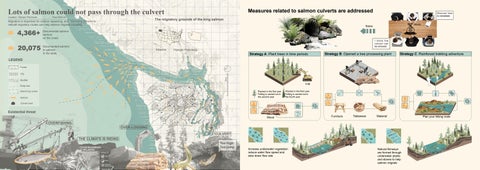


Measures related to salmon culverts are addressed


![]()


At the site on the Olympic Peninsula, I used three strategies to improve the success of salmon migration: removing some culverts, demolishing roads and bridges, and building natural fish passages


The diagram shows the removal of culverts and the construction of bridges to increase salmon migration

Location: Yuyao City, Ningbo, Zhejiang Province Time:2025.03


The cement plant was originally constructed on the outskirts of the city. However, decades of urban expansion eventually surrounded it within the city’s core. In response to shifts in the urban industrial structure—specifically, the decline of secondary industry and the rise of tertiary industry—the plant was eventually relocated. Its original site was subsequently abandoned, transforming into a typical industrial brownfield.

Collage of Shunjiang Cement Plant


-Resting points
-Shoping Street


The


Small landowners
The distribution of water rights on farms is seriously uneven, often due to the interception of upstream large farms and water shortages in the dry season, land salinization intensifies, crop yields are reduced or even harvests are cut off


Farmworkers
The high energy consumption and high pesticide mode of large farms lead to soil compaction and water pollution, and longterm drinking of contaminated water has led to respiratory and gastrointestinal diseases.


Researchers
The land salinization of the farm is serious, and it is necessary to restore the riparian forest on a large scale to alleviate the problem of land salinization.


The Huangkeng Village project is positioned as "Paper Farmer Ancient Village and Bamboo Rhyme Mountain Residence", digging deep into the intangible cultural heritage resources of thousand-year-old papermaking, and building a "one heart, two axes, and three districts" protection and development structure. Spatially, the characteristics of mountainous architecture in southern Zhejiang are retained, and local materials such as bamboo and stone bricks are used to connect the paperfishing experience area, mini market, research academy and other nodes, and implant papermaking cultural symbols. The industry integrates intangible cultural heritage experience, ecological agriculture and cultural and creative research, and attracts urban customers through time-sharing activities, four-season theme activities and villager communication. The project will promote the transformation from traditional farming to the integration of culture and tourism, and become a model of rural revitalization and cultural inheritance.


