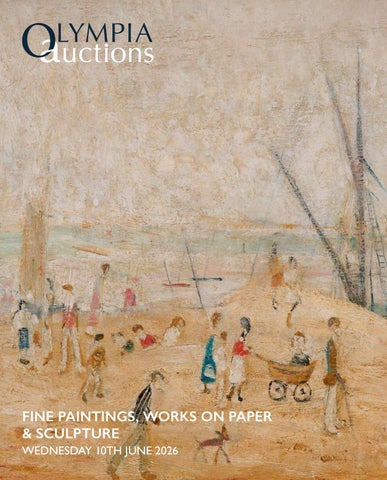
FINE PAINTINGS, WORKS ON PAPER & SCULPTURE
WEDNESDAY 10TH JUNE 2026



FINE PAINTINGS, WORKS ON PAPER & SCULPTURE
WEDNESDAY 10TH JUNE 2026
TO BE SOLD BY AUCTION: 25 Blythe Road, London W14 0PD
AUCTION: Wednesday 10th June 2026, 12pm, precisely
PUBLIC EXHIBITION:
Sunday 7th June, 12pm to 4pm
Monday 8th June, 10am to 8pm (Drinks from 5pm)
Tuesday 9th June, 10am to 5pm
SALE NUMBER OA0182
ENQUIRIES:
Adrian Biddell, Head of Sale adrian.biddell@olympiaauctions.com
Tazeena Thorowgood, Assistant and Administrator tazeena.thorowgood@olympiaauctions.com
Veronique Biddell, Specialist veronique.biddell@olympiaauctions.com
Nick Hemming-Brown, Specialist nick.hemming-brown@olympiaauctions.com
Charlotte Norman-Butler, Specialist charlotte.normanbutler@olympiaauctions.com
Suzanne Zack, Consultant for watercolours and drawings Suzanne.zack@olympiaauctions.com
+44 (0)20 7806 5541 pictures@olympiaauctions.com
ONLINE CATALOGUE AND LIVE INTERNET BIDDING AVAILABLE THROUGH: www.olympiaauctions.com www.the-saleroom.com www.invaluable.com www.drouotonline.com
This auction
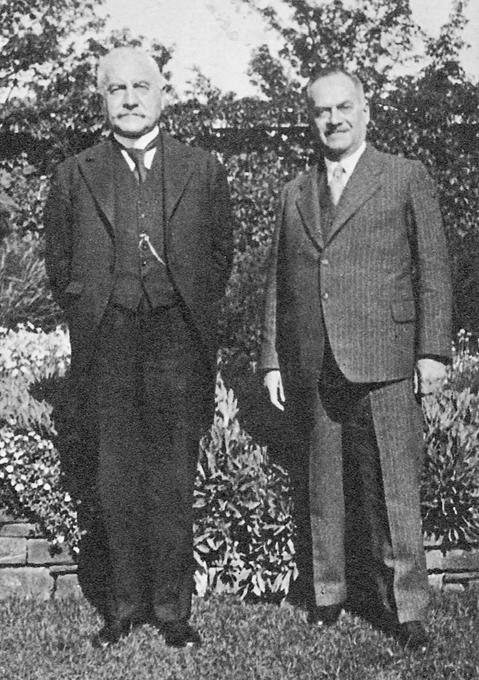
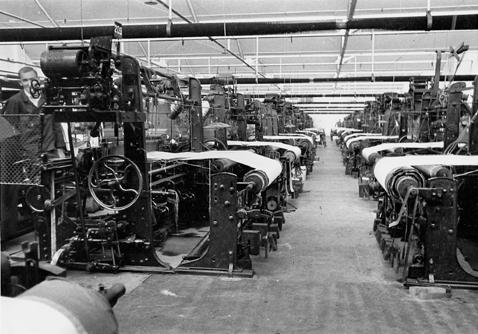
The following seven paintings were acquired in the 1920s and early 1930s by the collector and businessman Paul Wertheimer (1872-1941). As the works attest, Wertheimer’s taste was for traditional Flemish and Dutch Old Masters.
From the invoices for his purchases that survive it is clear that he bought his paintings from reputable sources, such as the dealership Gerke & Co in Hannover which was within easy reach of Bielefeld. Records also suggest that he was assiduous in keeping supporting expertise on file, for example opinions from Professor Boden and also the Munich based dealer and auctioneer Hugo Helbing (see lot 4).
The Wertheimer family had been living in Bielefeld since 1839. In 1889 Josef Wertheimer, Paul’s father, built a state of the art silk weaving factory in Bielefeld-Jöllenbeck. The company gained a reputation for paying above average wages and having enlightened family-friendly working practices. By the time Paul and his brother Eduard took over the running of the business the company was employing some six hundred and sixty workers and still expanding.
But with the establishment of the Third Reich and Hitler’s rise to power Paul became concerned for his family’s future. After his youngest son and daughter became a target for the Hitler Youth he sent them to be schooled in Switzerland. Soon after his and Eduard’s passports were confiscated, their account books seized and they were locked out of their factory. Then in 1936 the brothers were forced to sell the business for a knock down price.
Facing an impossible future in Germany, in 1938 Paul left with his family for England. He brought as much of his art collection as he could with him, including the following lots, and established a rayon and silk weaving company in London. He urged his brother to follow. But despite Eduard’s increasing persecution at the hands of the Nazis - his house was seized, his assets frozen and he was forced to live off a limited allowance - he opted to remain in Bielefeld. Then, in 1942, warned in advance of a mass deportation of Jews from Bielefeld to Theresienstadt, the Nazi concentration camp in occupied Czechoslovakia, Eduard took his own life.
Now in Bielefeld a Stolpersteine has been laid to commemorate Eduard, and a street, Wertheimerstrasse, has been named after the family.
Property formerly in the Collection of Paul Wertheimer, Bielefeld, Westphalia
1
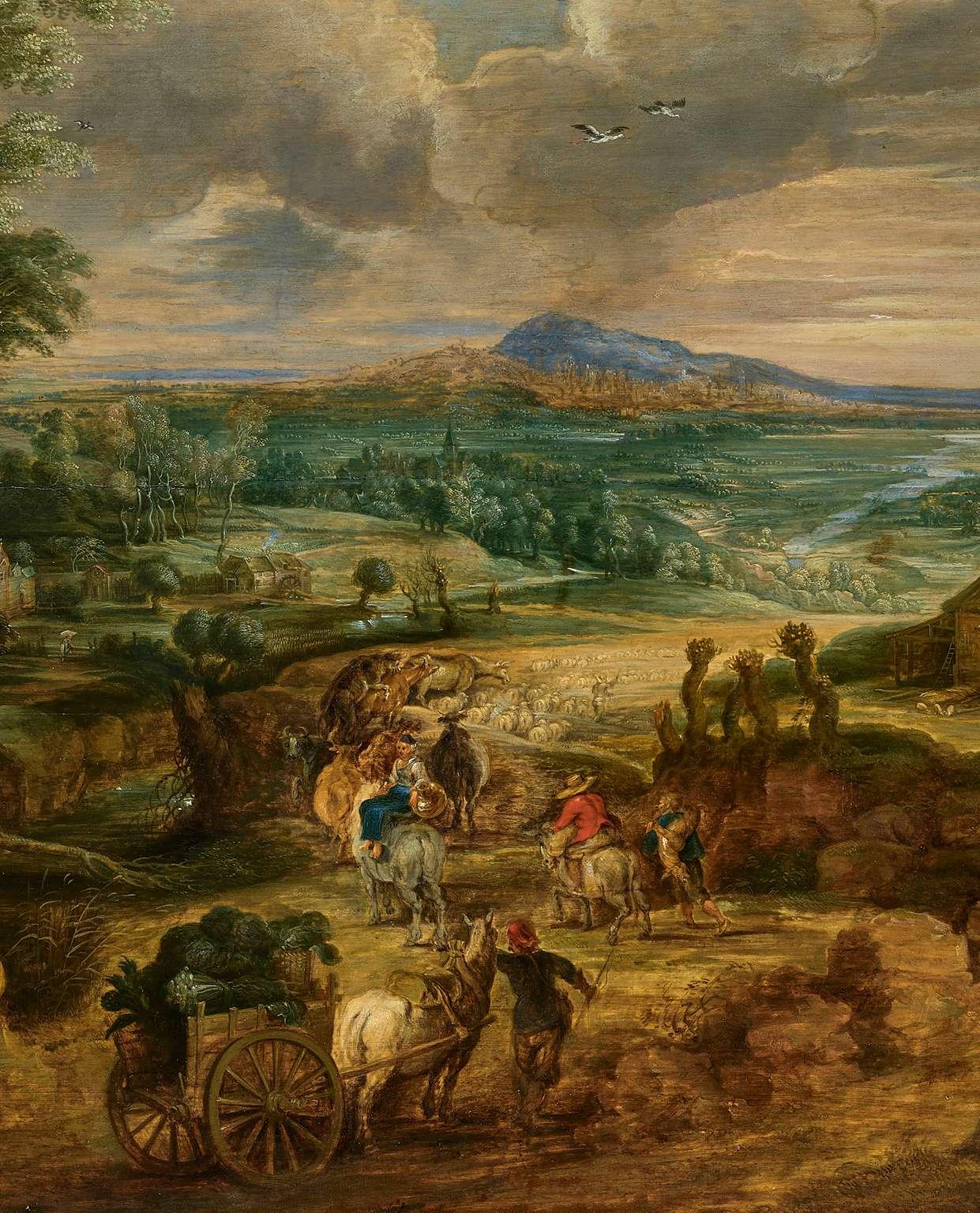
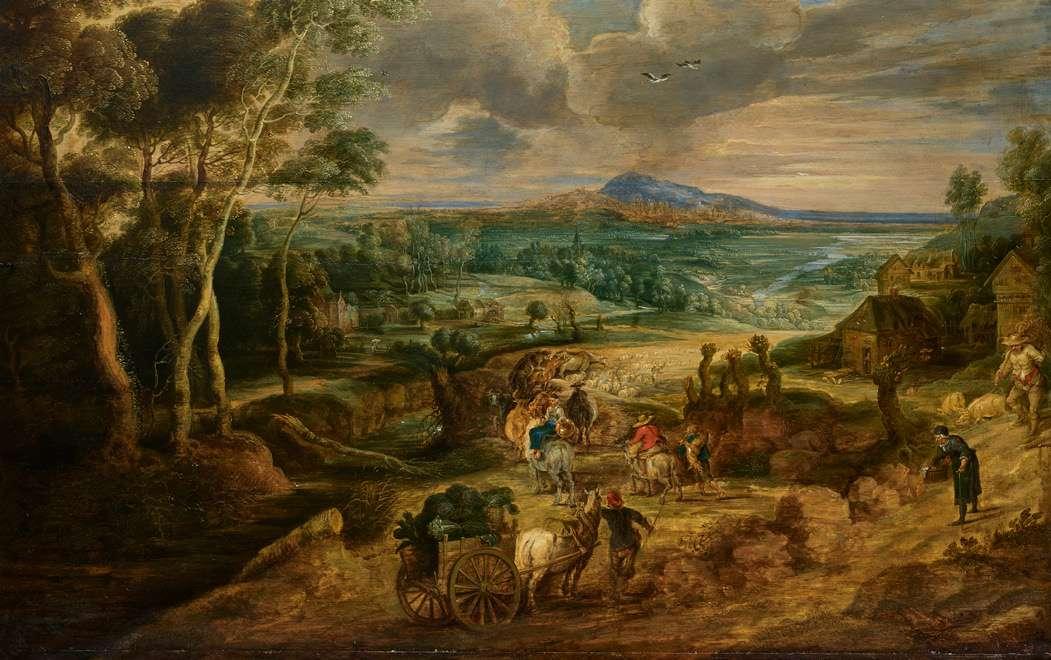
ATTRIBUTED TO LUCAS VAN UDEN (FLEMISH 1595-1672)
SUMMER: PEASANTS GOING TO MARKET, AFTER SIR PETER PAUL RUBENS
oil on cradled panel
56 x 85cm; 22 x 33½in
76 x 105cm; 30 x 41¼in (framed)
Provenance
Paul Wertheimer, Bielefeld, Westphalia (acquired circa 1930)
Thence by descent to the present owner, grandson of the above
The present work is a reduced copy after Rubens’ original painting Summer: Peasants going to Market painted circa 1618, now in the Royal Collection, London. Other copies of Rubens’ work by van Uden include The watering place sold at Christie’s London 11th December 1992, lot 220 (Rubens’ original, painted circa 1615-22, is in the National Gallery, London) and Landscape with a rainbow in the Kunsthistorisches Museum, Vienna (Rubens’ original, painted circa 1636 is in the Wallace Collection, London).
Working mainly in Antwerp, Lucas van Uden was closely associated with the landscape artist Jan Wildens (1586-1653) who frequently collaborated with Rubens. Despite this and the strong influence Rubens had on van Uden’s work, it is no longer thought that the painter was a member of Rubens’ studio and there is no evidence to suggest that the two artists worked together on any compositions. However, van Uden did collaborate with David Teniers the Younger (1610-1690) and Jan Brueghel the Younger (1601-1678) both of whom added figures and animals to van Uden’s landscapes. In fact, van Uden’s Peasant’s merry-making before a country house in the National Gallery, London shows figures not dissimilar to the figures in the present composition added to the landscape by Teniers.
£6,000-8,000
Property formerly in the Collection of Paul Wertheimer, Bielefeld, Westphalia
2
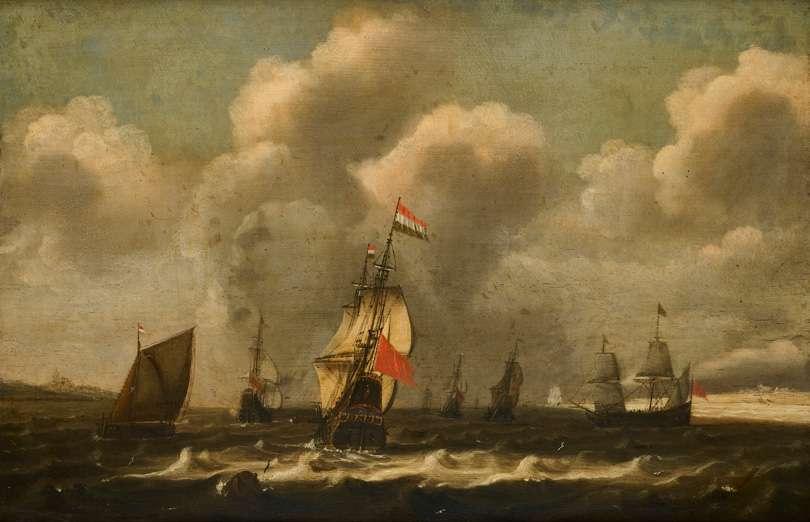
CLAES CLAEZ. WOU (DUTCH C.1592-1665)
A DUTCH SQUADRON OFF THE COAST, POSSIBLY NEAR VLISSINGEN
signed Wou lower right oil on panel
46 x 70cm; 18 x 27½in
66 x 90cm; 26 x 35½in (framed)
Provenance
Paul Wertheimer, Bielefeld, Westphalia (acquired circa 1930)
Thence by descent to the present owner, grandson of the above
£1,500-2,500
Property formerly in the Collection of Paul Wertheimer, Bielefeld, Westphalia
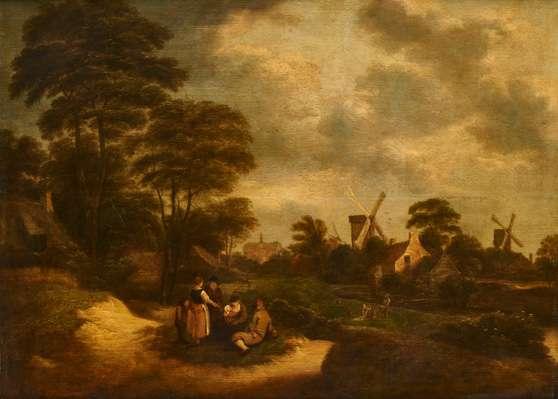
3
KLAES MOLENAER (DUTCH 1630-1676)
A FAMILY BY A RIVER WITH WINDMILLS IN THE DISTANCE
signed K Molenaer lower left oil on panel
47 x 63cm; 18½ x 24¾in
72 x 89cm; 28¼ x 35in (framed)
Provenance
See previous lot
£800-1,200
Property formerly in the Collection of Paul Wertheimer, Bielefeld, Westphalia 4
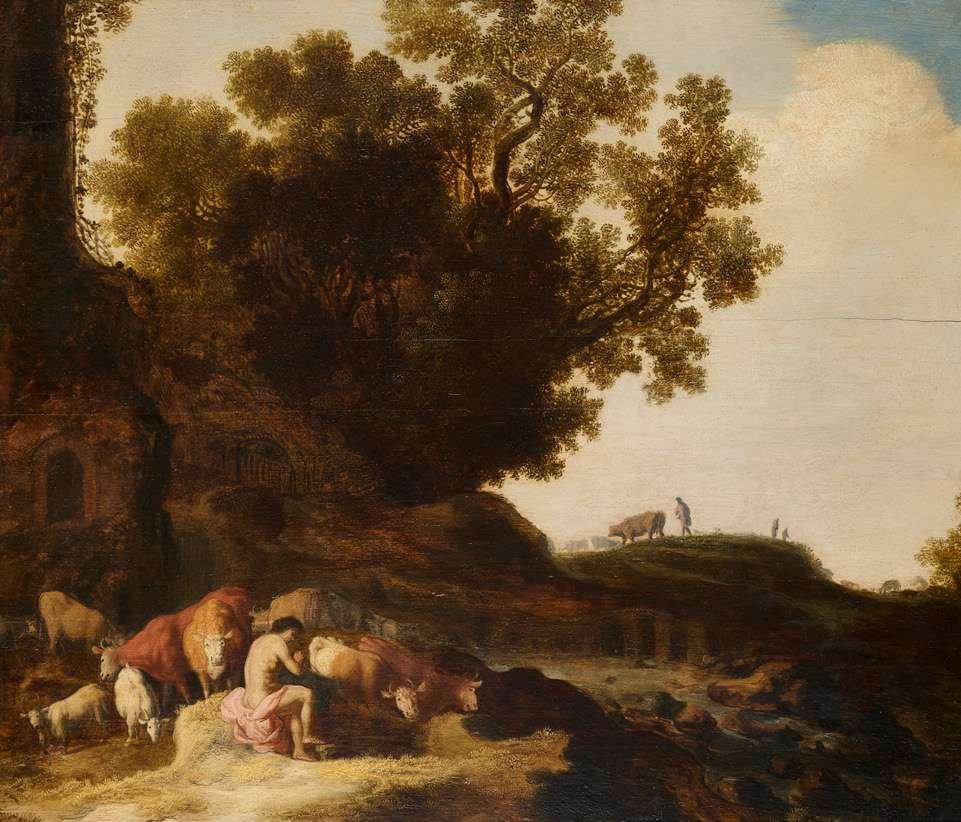
ATTRIBUTED TO MOSES VAN UYTTENBROECK (DUTCH C.1595-BEFORE 1647)
A BARD WITH CATTLE AND SHEEP IN AN ARCADIAN LANDSCAPE
oil on panel
34 x 40cm; 13½ x 15¾in
54.5 x 60cm; 21½ x 23¾in (framed)
Provenance
Paul Wertheimer, Bielefeld, Westphalia (acquired circa 1930)
Thence by descent to the present owner, grandson of the above
In 1926 the Munich based specialist Hugo Helbing wrote in support of the present work’s attribution to van Uyttenbroeck, considering it to be ‘characteristic’ and ‘genuine’.
After living and working in Italy as a young man in the early part of the 17th century, van Uyttenbroeck spent the majority of his life in The Hague. An accomplished court painter, he was adept at both portraiture and landscape painting, the latter being typically Italianate in style and depicting both religious and mythological subjects. Rather more rumbustuous paintings by van Uyttenbroeck of peasants carousing are in the Royal Picture Gallery Mauritshuis, The Hague (Landscape with Shepherds of 1626) and in the Herzog Anton Ulrich-Museum, Braunschweig (Bacchanale of 1627). Van Uyttenbroeck took inspiration from Adam Elsheimer (1578-1610) as well as the work of Jacob Symonsz Pynas (1592/93-1650) and Cornelis van Poelenburch (c.1594-1667).
£6,000-8,000
Property formerly in the Collection of Paul Wertheimer, Bielefeld, Westphalia 5
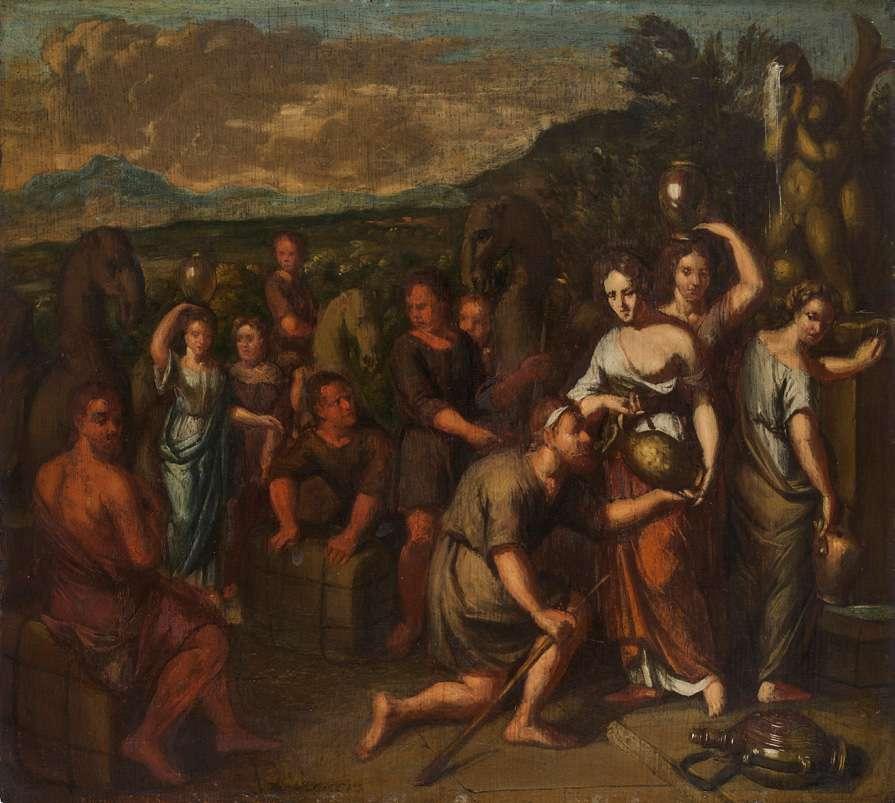
REBECCA AND ELIEZER AT THE WELL signed …Beckers lower left oil on panel
25 x 28cm; 9¾ x 11in
41 x 44cm; 16 x 17¼in (framed)
Provenance
Paul Wertheimer, Bielefeld, Westphalia (acquired circa 1930)
Thence by descent to the present owner, grandson of the above £600-800
Property formerly in the Collection of Paul Wertheimer, Bielefeld, Westphalia
6
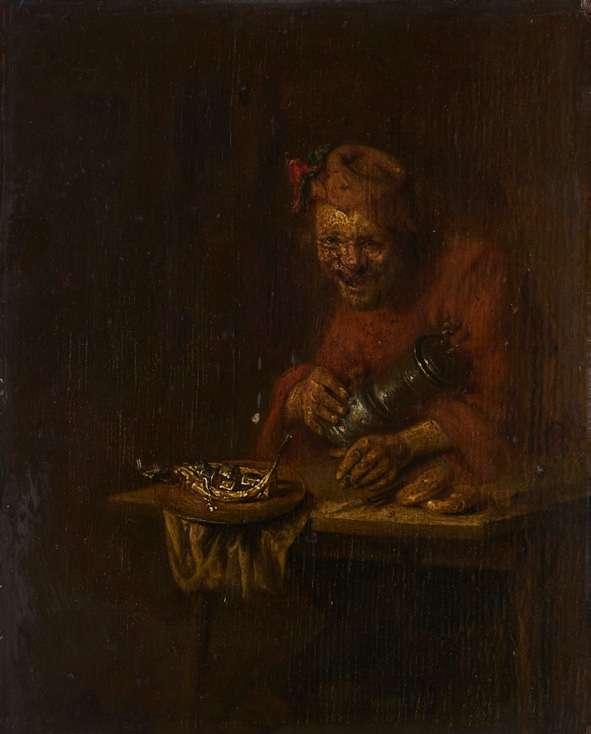
ATTRIBUTED TO ABRAHAM DIEPRAAM (DUTCH 1622-1670)
MAN DRINKING AND EATING HERRING oil on panel
21.5 x 17cm; 8½ x 6¾in
33 x 29cm; 13 x 11½in (framed)
Provenance
Paul Wertheimer, Bielefeld, Westphalia (acquired circa 1930)
Thence by descent to the present owner, grandson of the above
Diepraam was greatly influenced by the raffish peasant figures of the artist Adriaen Brouwer (c.1605/06-1638) and spent much of his career chronicling the lively and often humourous characters who inhabited Dutch taverns. One of his most famous works, The Tavern, depicting similar figures to the figure in the present work is in the Rijksmuseum, Amsterdam.
£600-800
Property formerly in the Collection of Paul Wertheimer, Bielefeld, Westphalia
7
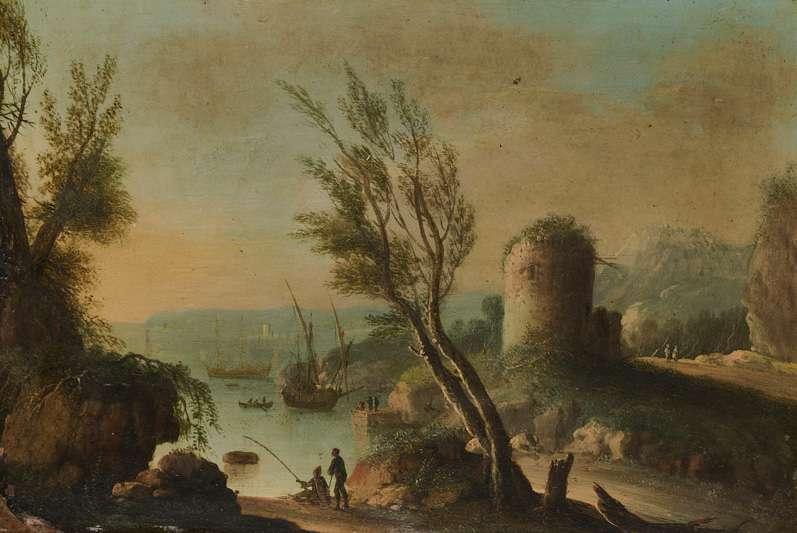
STYLE OF JOHANN CHRISTIAN VOLLERDT (GERMAN 1708-1769)
FISHERMAN BY THE COAST NEAR A RUINED TOWER oil on copper
15 x 22cm; 6 x 8¾in
34 x 40.5cm; 13½ x 16in (framed)
Provenance
Paul Wertheimer, Bielefeld, Westphalia (acquired circa 1930)
Thence by descent to the present owner, grandson of the above
£300-400
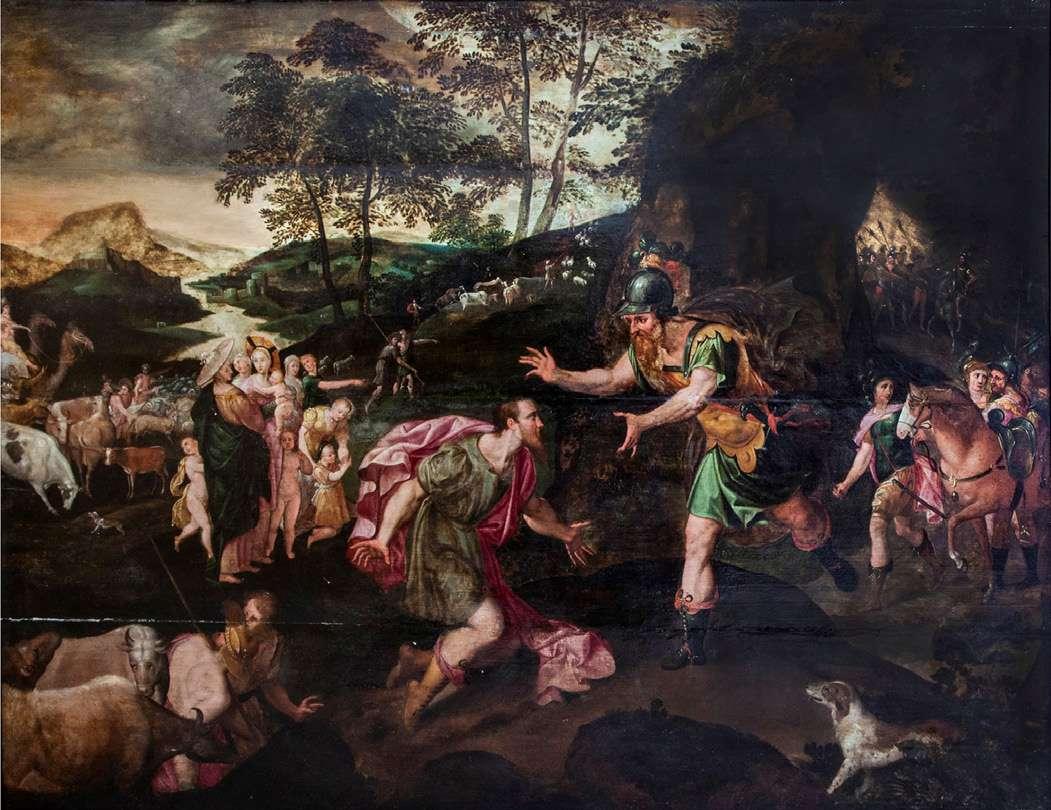
THE RECONCILIATION OF JACOB AND ESAU oil on panel
98 x 125cm; 38 x 49¼in
114 x 142cm; 45 x 56in (framed)
Provenance
Purchased by the present owner in Sweden in 2017
£3,000-5,000
Property from a Private Collection, Stockwell 9
PORTRAIT OF CORNELISZ. VAN BERESTEYN (1586-1638)
inscribed AEtatis 30 / Ano 1617 centre left oil on panel
69.5 x 59.5cm; 27¼ x 23½in
84 x 73.5cm; 33 x 29in (framed)
Provenance
Edel and Wanda von Westernhagen, Schloss Oppin, Landsberg, Saxony-Anhalt and South Africa
Rose von Westernhagen, Schloss Oppin, Landsberg, Saxony-Anhalt, daughter of the above (Rose von Westernhagen fled Schloss Oppin with her family and the few possessions she could take with her, including the present work, when the castle was seized by Russian forces and the district became part of the Soviet Occupation Zone, later East Germany, at the end of the Second World War.)
Thence by descent to the present owner, daughter of the above
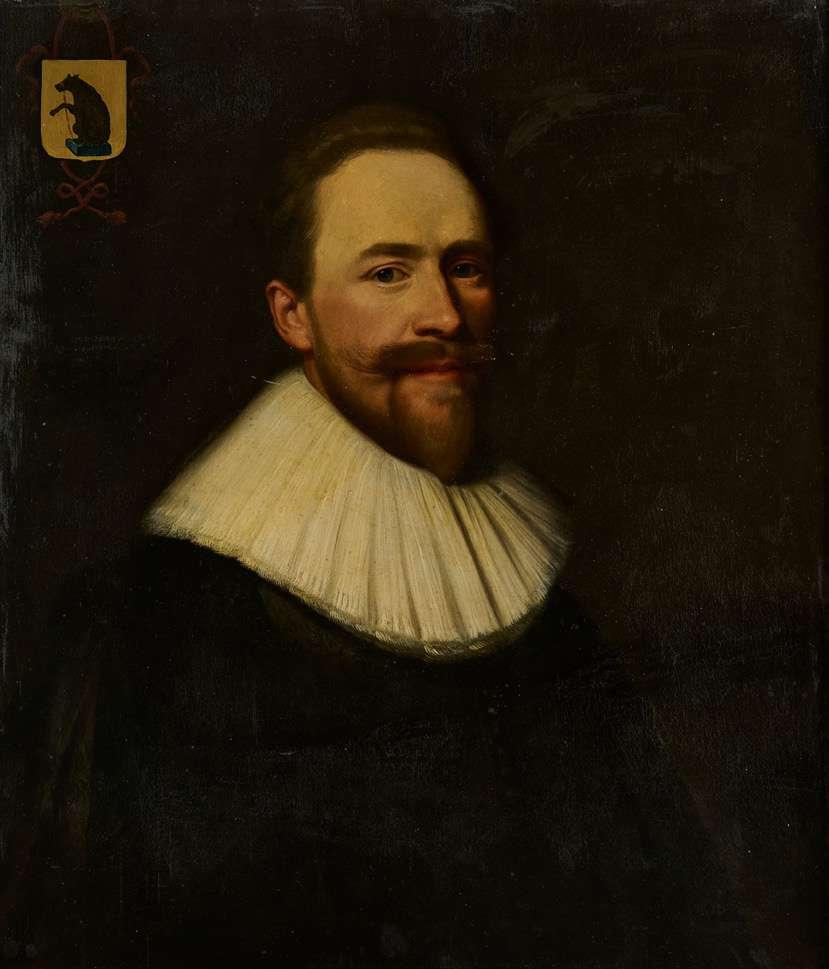
The present bust length portrait of Cornelisz. van Beresteyn is based on the larger three-quarter length version (114 x 84.5cm) by Michiel Jansz. van Mierevelt painted in 1617 also with the family coat of arms upper left, now in the collection of the Holland Museum, Michigan USA. Another version of the present work not inscribed but of the same size and with the van Beresteyn coat of arms top right is recorded on the website of the RKD (Netherlands Institute for Art History). A later portrait painted by Rembrandt in 1632 thought possibly to be of the same sitter is in the Metropolitan Museum of Art, New York.
Cornelisz. van Beresteyn was the son of the influential merchant Paulus Cornelisz. van Beresteyn (1548-1625) from Harlem and Volckera Claesdr. Knobbert (1554-1634), daughter of a Delft brewer. Paulus rose to prominence as a member of Delft’s influential Council of Forty, and was appointed variously alderman, burgomaster and municipal treasurer amongst other leading civic roles.
Van Miereveld completed a series of portraits of the van Beresteyn family, including those of Paulus in 1612 and Volckera in 1618 (both now in the Kasteel Keukenhof Collection, Lisse, with copies in the Rijksmuseum) and at least three of their children: daughter Caecilia in 1615, Cornelisz in 1617 (Holland Museum, Michigan) and Arend, their youngest son.
Cornelisz was the fifth of Paulus and Volckera’s eight children and their second son. He married Jannetje Berckel (1592-1615) in 1613, and subsequently Corvina van Hofdijck (1602-1667) in 1619 with whom he had one daughter.
£2,000-3,000
Property from a Private Collection, Scotland
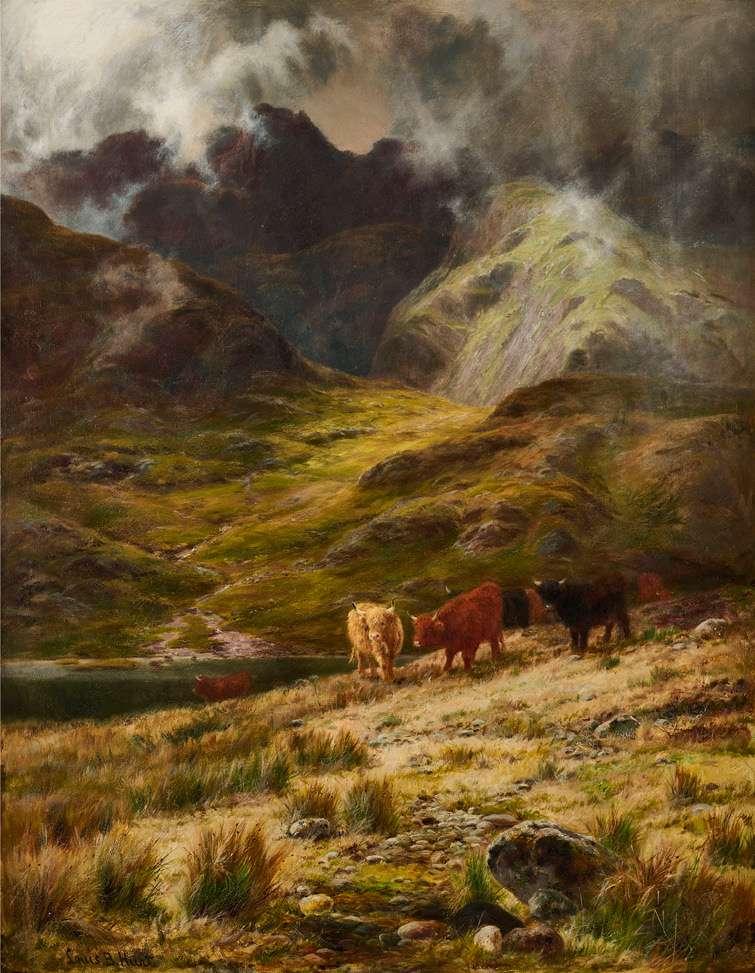
signed Louis B. Hurt lower left; signed, titled, inscribed and dated ‘Hills of the Isle of Mist’ / Louis B. Hurt / Ashbourne / Derbyshire / 1885 on the reverse oil on canvas
104 x 82cm; 41 x 32¼in
116 x 94cm; 45½ x 37in (framed)
Provenance
Purchased in Inverness by the present owner circa 1980
Raised in Ashbourne, Derbyshire, Hurt lived with his wife Harriet in Ivonbrook House near Matlock where they kept their own herd of Highland cattle. In his youth Hurt had trained under George Turner (1841-1910), known as ‘Derbyshire’s Constable’ and soon became successful with his dramatic views of the local scenery and as a frequent visitor to Scotland, for his depiction of Highland cattle. His paintings capture the dramatic atmospheric effects of the Highland weather, with its shafts of mist and sunlight sweaping the hills. He also painted in North Wales, in Betwys-y-Coed where he had a cottage. Hurt exhibited regularly at the Royal Academy (1881-1901) and at the Royal Society of British Artists. He was sought after by influential patrons including Sir Merton Russell-Cotes, William Isaac Palmer and George McCulloch. Examples of his work are in the South African National collection, the Reading Museum and Manchester.
£2,000-3,000
Property of a Gentleman 11
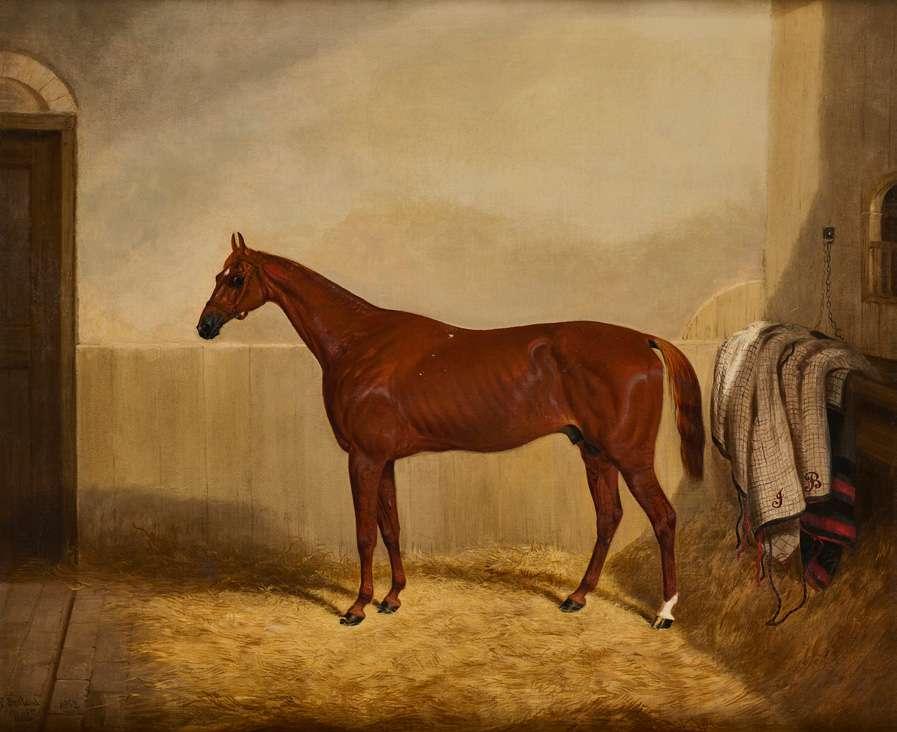
THOMAS WALKER BRETLAND (BRITISH 1802-1874)
THOROUGHBRED DANIEL O’ROURKE, WINNER OF THE 1852 EPSOM DERBY
signed and dated T. Bretland / Nott 1852 lower left; inscribed with the initials JB lower right on the blanket oil on canvas
63 x 76cm; 24¾ x 29¾in
76.5 x 89cm; 30 x 35in (framed)
Provenance (probably) John Bowes, Paris and London
Richard Bateman
Sale, Rosebery’s London, 6 December 2017, lot 534 (purchased by the present owner)
Bretland painted the present portrait of Daniel O’Rourke, known as ‘the little horse’, to celebrate the thoroughbred’s Derby win of 1852. The initials JB on the horse’s blanket refer to John Bowes (1811-1885), one of the most succesful racehorse owners of his generation. Foaled in 1849, Daniel O’Rourke also won the St James’ Palace Stakes at Ascot, and came 3rd in the St Leger. Bowes later sold the horse to Sir Tatton Sykes for stud after which it was purchased by the Austrian Government for 800 guineas and shipped to Vienna.
Bowes was the son of the 10th Earl of Strathmore and Kinghorne and a distant ancestor to the late Queen Mother, Elizabeth Bowes-Lyon. In 1852 he married the actress and society hostess Joséphine Coffin Chevallier (1824-1874). A gifted painter who had studied with the Austrian painter Karl Josef Kuwasseg (1802-1877), and showed at the Paris Salon and the Royal Academy in London, Joséphine took a keen interest in the arts, commissioning authors and playwrights and amassing a formidable collection.
On their return to England the couple built the Bowes Museum to house their burgeoning collection of some 15,000 art works on land near John Bowes’ ancestral home close to Barnard Castle. Conceived in a grand French chateau style by French architect Jules Pellechet, sadly neither Joesphine nor John lived to see it open to the public in 1892.
Thomas Walker Bretland was born in Nottingham, the eldest son of Peter Bretland, the owner of a coach and carriage painting business. By 1840, after his father’s death, Thomas left the family business and took up the full time occupation of animal painting. He was much encouraged by Lord Middleton one of his first important patrons. Other patrons included the Dukes of Buccleuch and Montrose, Lord Chesterfield and Baron Rothschild. He worked mainly in oils and his subject matter covered animal portraits generally as well as hunting scenes and landscapes.
£1,000-1,500
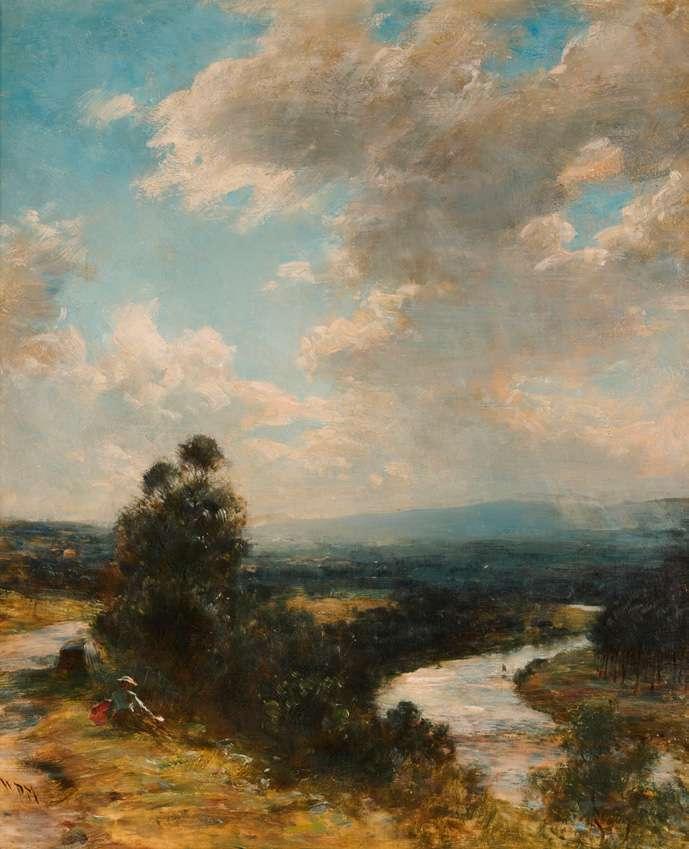
LADY SEATED BY AN EXPANSIVE RIVERSCAPE, POSSIBLY NORMANDY
signed with initials HDM lower left oil on canvas
61 x 50.5cm; 24 x 19¼in
87.5 x 76.5cm; 34½ x 301⁄8in (framed)
Born and raised in Albany, New York, Homer Dodge Martin was encouraged to pursue an artistic career by Erastus Dow Palmer (1817-1904). During the early 1860s, Dodge Martin spent his summers in the Catskills, Adirondacks and White Mountains and composed expansive lake and mountain views in the manner of the Hudson River School. From 1882-1886 he lived in France spending much of his time in Normandy, influenced by the work of Jean-Baptiste-Camille Corot and
Eugène Boudin. Adopting the looser brushwork of both artists he earned the label the ‘first American impressionist’ and on visits to England he befriended James McNeill Whistler. The present oil combines the sublime of the American landscape with painting en plein air learnt from the French Barbizon painters.
He returned to New York in 1893. Ill with cancer and suffering from depression, he moved to Saint Paul in Minnesota with his wife, partly blind. There in 1895 he painted two of his best known works, Ardirondacks Scenery, which he painted from memory and Harp of the wind which was acquired by the Metropolitan Museum of Art, New York. In the present work the poetry of the panoramic, luminous landscape combines the sublime of the American landscape with the painting en plein air approach to nature of the French Barbizon painters.
£2,500-3,500
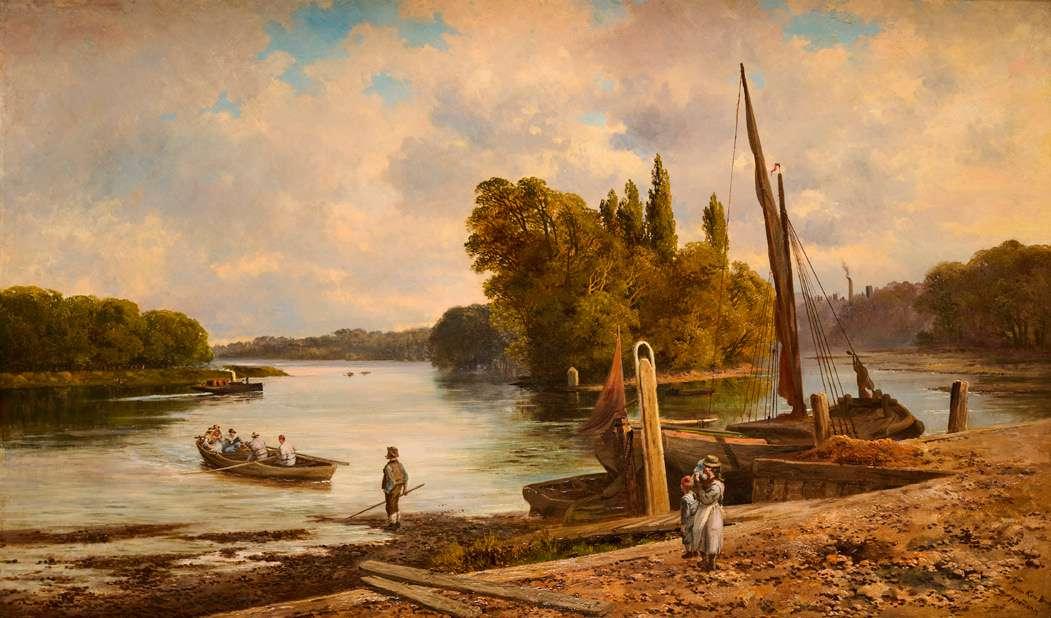
EDMUND JOHN NIEMANN (BRITISH 1813-1876)
FROM KEW BRIDGE
signed and titled Niemann / From Kew Bridge lower right
77 x 128cm; 30¼ x 30½in
114 x 164.5cm; 45 x 64¾in (framed)
Provenance
Sale, Sotheby’s London, 12th March 1997, lot 33
£1,000-1,500
Property from a Private Collection, Surrey 14
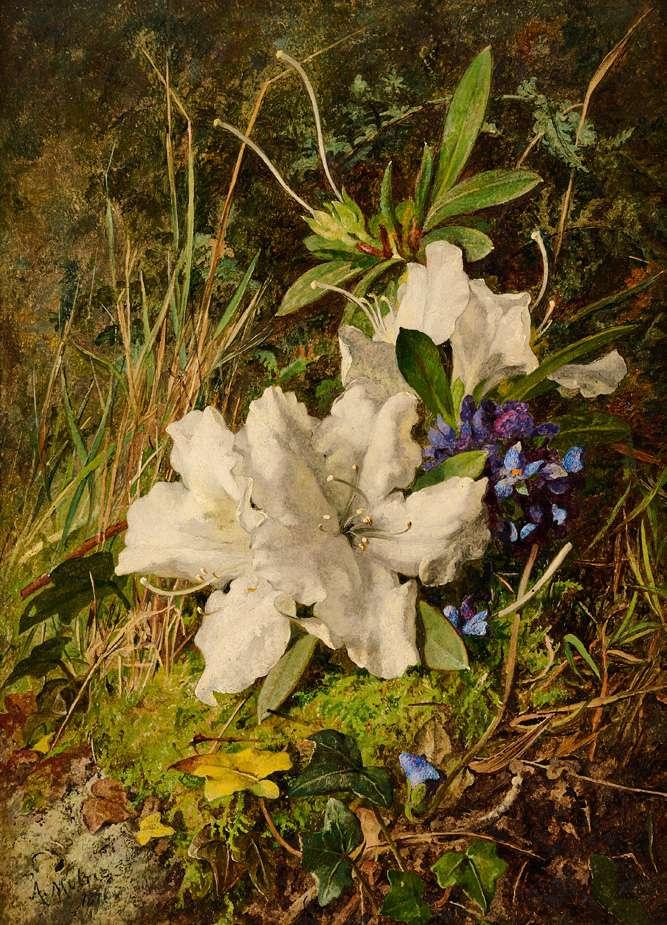
ANNIE FERAY MUTRIE (BRITISH 1826-1893)
WHITE AZALEAS AND VIOLETS IN A WOOD
signed and dated A. Mutrie 1876 lower left oil on canvas
28 x 20cm; 11 x 8in
36.5 x 30cm; 14½ x 11¾in (framed)
Provenance
Christopher Wood Gallery, Motcomb Street, London
Barbara Barrett, London (purchased from the above in the late 1970s)
Thence by descent to the present owner, niece of the above
£800-1,200
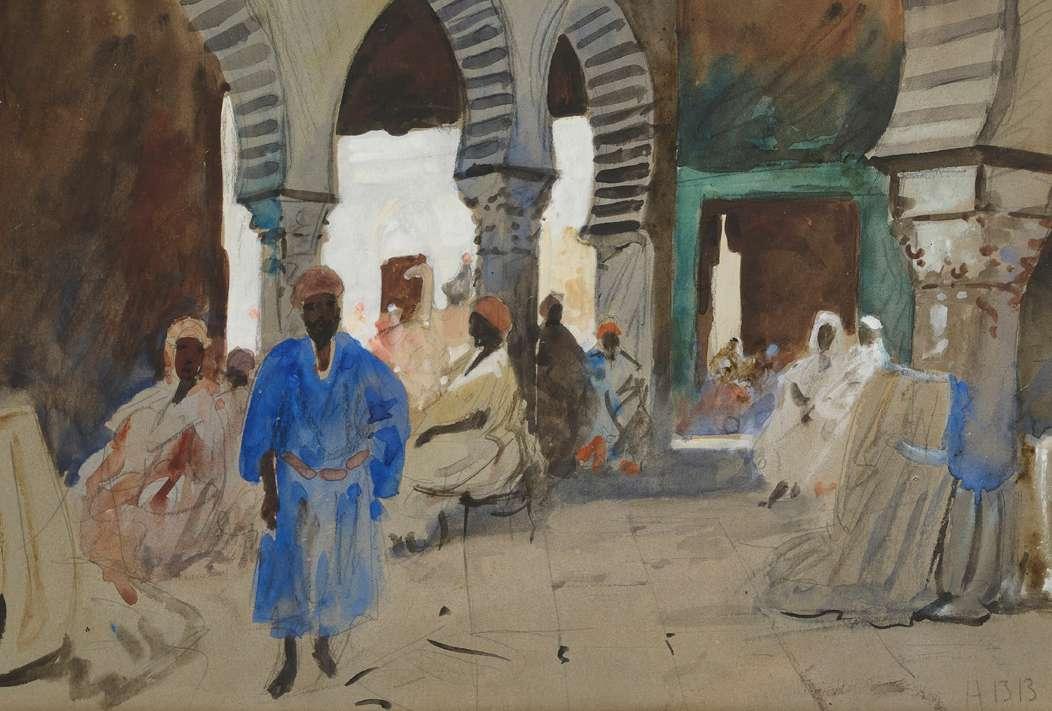
Property from a Private Collection, Surrey 15
HERCULES BRABAZON BRABAZON (BRITISH 1821-1906) IN THE SOUK
signed with initials lower right watercolour on grey paper
21.5 x 32cm; 8½ x 12in
49 x 58cm; 19¼ x 22¾in (framed)
Provenance
Dr John Storey, Adelaide (purchased in the 1940s) Thence by descent to the present owner, daughter of the above £500-700
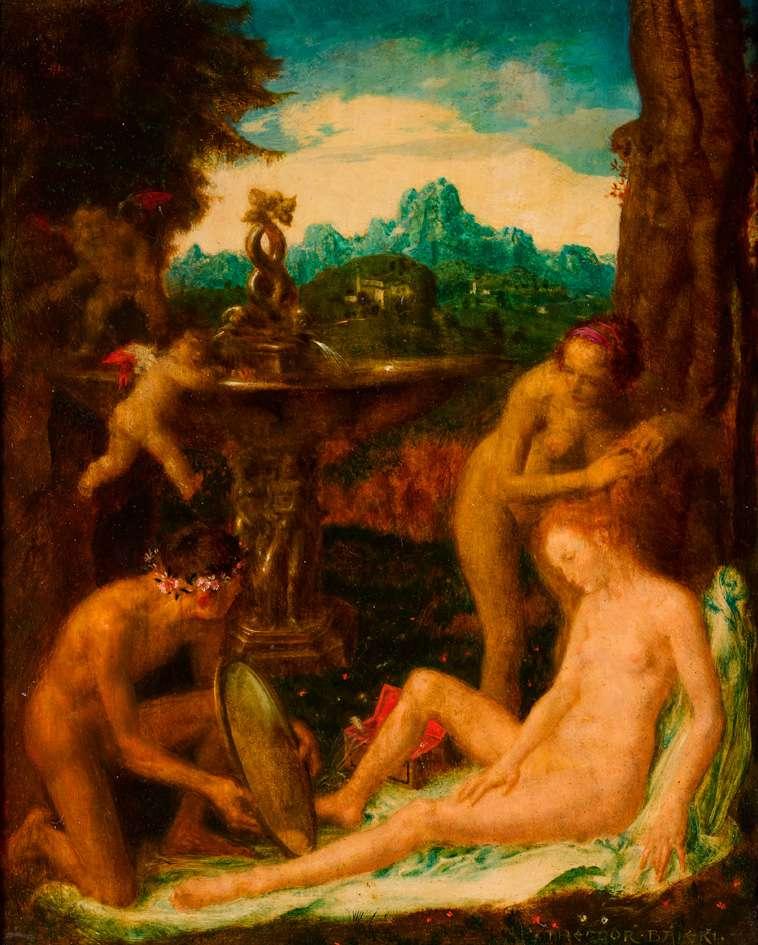
16
THEODOR BAIERL (GERMAN 1881-1932)
VENUS AT HER TOILET
signed THEODOR BAIERL lower right oil on panel
38.5 x 31cm; 15¼ x 12¼in
63 x 59cm; 24¾ x 23¼in (framed)
Painted circa 1920.
Provenance
The Leicester Galleries (Ernest Brown & Phillips), London Sale, Dreweatt’s Newbury, Peter Nahum at The Leicester Galleries, The Remaining Stock, 24th February 2009, lot 70
Purchased at the above sale by the present owner
Baierl studied at the Munich Academy under Franz von Stuck (1863-1928) and Martin Feuerstein (1856-1931). A true romantic, he immersed himself in the art, love sonnets and pagentry of a distant
medieval past, the purity of his palette, poetic compositions and attention to detail reflecting the influence of the Old Masters.
In the present work, painted in the wake of the upheaval of the First World War, the huge trees that arch over Venus with putti and her attendants and the village and mountains in the background suggest the harmony and calm of the Italian painters of the quattrocento. However the curious incongruity of the massive fountain and Baierl’s use of saturated blue-greens for the distant hills, belies his Munich secessionist training.
Up until the First World War, Baierl received public and private commissions for frescoes, altar paintings and Stations of the Cross for churches in numerous German towns, including Augsburg, Munich and Schweinfurt. Thereafter such commissions largely ceased and Baierl devoted his time to easel painting.
£500-700
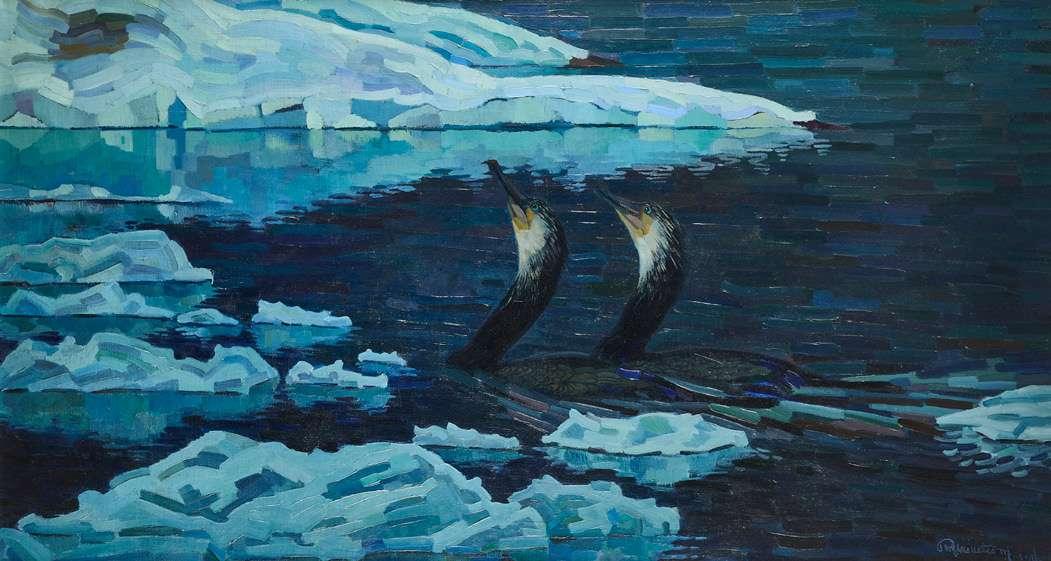
A PAIR OF GREAT CORMORANTS AMONGST ICE signed and dated Rolf Mellström 1916 lower right oil on canvas
80 x 148cm; 31½ x 58½in
94 x 160cm; 37 x 63in (framed)
Exhibited
Stockholm, Konstnärshuset, Harald Klinckowström och Rolf Mellström. Utställning af landskap och djurmålningar (Exhibition of landscapes and animal paintings), 1916, no. 27
Mellström completed the present distinctively modernist painting of two cormorants amidst ice flows following his first visit to the Faroe Islands in 1915. The canvas is a highwater mark in Mellström’s work and was one of twenty shown to wide acclaim in his joint exhibition in Stockholm in 1916 with fellow naturalist painter Harald Klinckowström (1897-1973), son of Baron Axel Klinckowström (1867-1936), the leading zoologist, Arctic and Antarctic explorer and writer.
The exhibition followed Mellström’s attendance at Caleb Althin’s School of Painting in Stockholm (1911-14), time under the eye of painter Gunnar Hallström (1915-16) and regular study with the acknowledged master of Swedish wildlife painting Bruno Liljefors (1860-1939).
The markedly wide format of the canvas and emphatic horizontal composition was a style Hallström favoured, while the broken facture of the paint surface suggests the influence on Mellström of leading Swedish modernist Axel Törneman (1880-1925). Gradually, however, Mellström’s practice became closer to that of the elder Liljefors as he specialised in capturing the sea birds and wildlife of Sweden’s multitudinous archipelagos, and following the elder artist’s death, Mellström was hailed as his worthy successor and Sweden’s premier living bird and wildlife painter.
Cormorants, part of seafaring folklore for generations, are often viewed with mixed emotions. Their distinctive profile with wings spread out to dry conjour the form of a cross. Amongst certain Nordic cultures the birds were thought to contain the souls of those lost at sea, while in certain coastal communities they were credited with talismanic powers. But whatever the myths, over the years their voracious appetite for fish made them exceedingly unpopular with fishermen, and in Sweden by the beginning of the last century the birds had largely been hunted to extinction. But in the Faroes, where they were still plentiful around the islands’ coast line, Mellström found a subject that inspired the present work. Indeed on the same trip he also met his wife to be, an islander from birth.
⊕ ‡ £1,000-1,500
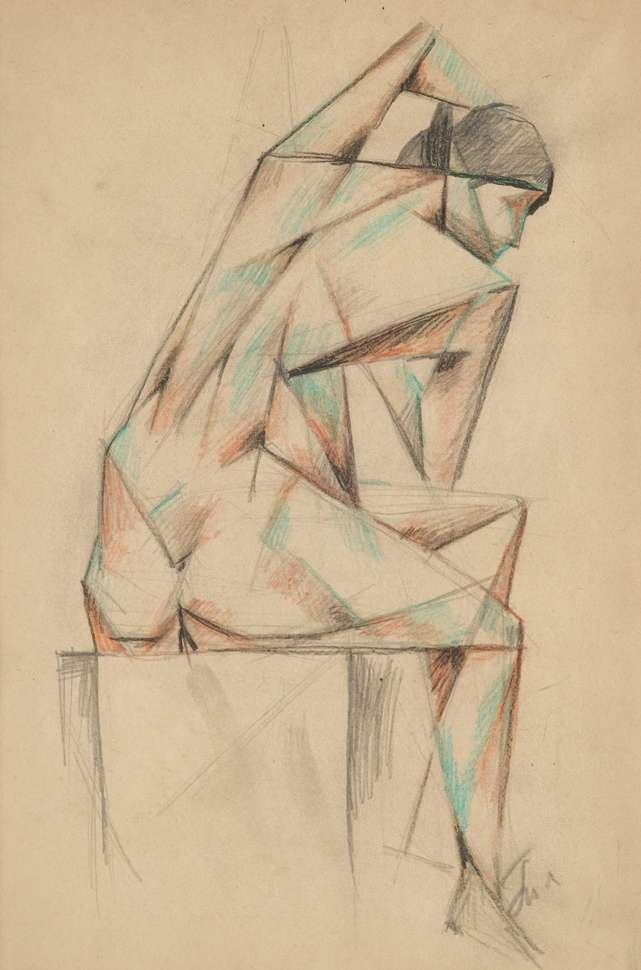
Property from a Private Collector, London 18
RUSSIAN SCHOOL (20TH CENTURY) SEATED FEMALE NUDE (RECTO & VERSO) with initials lower right - recto coloured crayons on paper - recto; brown crayon - verso
40.5 x 29cm; 16 x 11½in (sheet)
79 x 64cm; 31 x 25¼in (framed)
Executed circa 1913
Provenance
David Harrington Gallery, London
Purchased from the above by the present owner in the early 1990s
Executed circa 1913, the present work has long been attributed to Vladimir Tatlin (Ukrainian 1885-1953), one of the foremost Constructivists of his generation and a leading artistic innovator during the Russian Revolution. His work ranged from paintings and drawings to theatre designs, relief constructions and gliders, culminating in his plans for the ‘Monument to the Third International’ (1919-20).
Executed circa 1913, the work reflects the artist’s keen awareness of Cubism in the early twentieth century, when the Russian collector Sergei Shchukin (1854-1936) was accumulating his modernist collection in the Troubetskoy Palace. Shchukin’s collection included an extensive collection of Picassos which became a natural destination for aspiring artists. As John Richardson noted, ‘By opening his palace to the public every Sunday (spring, 1909, onwards) and exposing Russian artists like Tatlin and Malevich to the latest Picassos and Matisses, Shchukin helped them to make a major contribution to the modern movement.’ (John Richardson, A Life of Picasso, 1907-1917: The Painter of Modern Life, London, 1996, vol. II, p. 305).
Another opportunity to see the latest Modernist work in Moscow that emanated from Paris was at the annual Knave of Diamonds exhibition. Among the thirty-eight exhibitors in the inaugural show of 1910-1911 were four French cubists: Jean Metzinger, Albert Gleizes, Andre Lhote and Robert Le Fauconnier, artists whose distinctive cubist styles reasonate in the present work. (Interestingly, it wasn’t until the following year that Picasso participated, whilst Tatlin, who had arrived in Moscow in 1910 to study at the Moscow School of Painting, Sculpture and Architecture, first exhibited in the third Knave of Diamonds exhibition in early 1913).
Tatlin had been so impressed by the works of Picasso that he had seen in Moscow that at the end of 1913 he travelled via Berlin to Paris to visit the Spaniard. There he appealed to him to take him on as his studio assistant or pupil. Picasso recalled Tatlin playing the accordion. ‘They communicated by gestures, smiles and drawings and according to Tatlin, understood each other perfectly’.
£3,000-5,000
Property from a Private Collection, Surrey 19
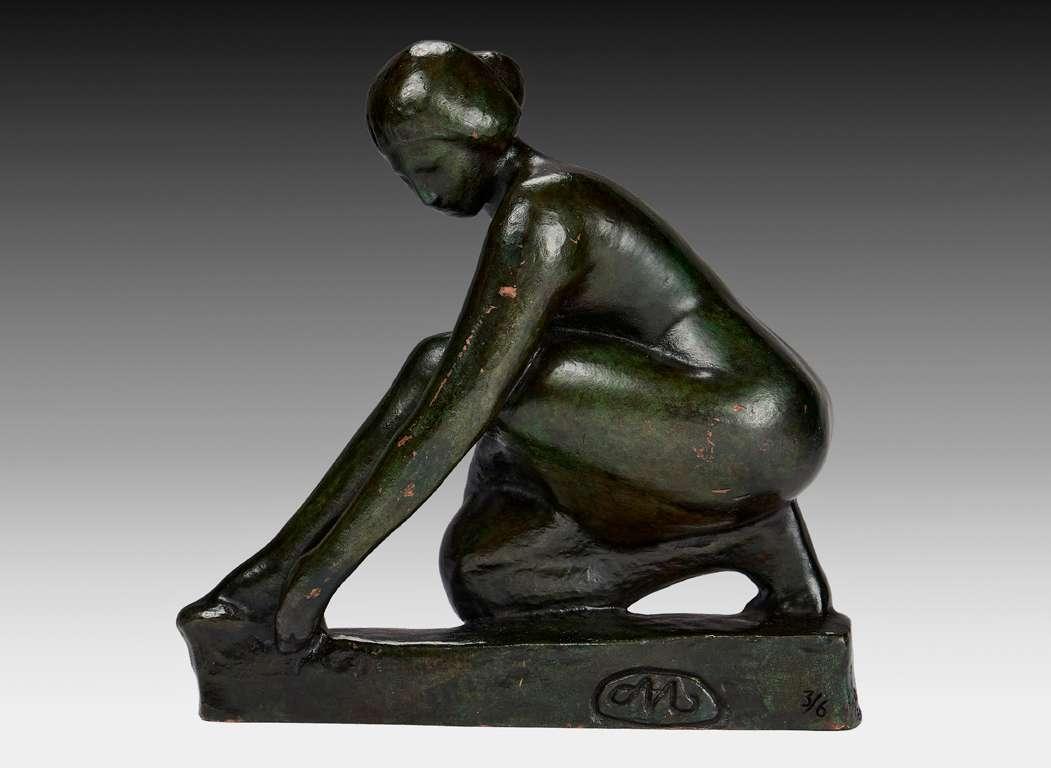
RAMASSEUSE D’HERBES SAUVAGES stamped with the monogram, bearing the foundry mark ‘Alexis Rudier / Fondeur Paris’ and numbered 3/6
bronze height 14.5cm; 5¾in
Conceived circa 1930 and probably cast after the artist’s death.
Provenance
Sale, Drouot-Richelieu Paris, 7th December 2016, lot 58
Sale, Christie’s London, 1 March 2017, lot 526
Purchased at the above sale
Celebrated for his study of the female form, fame came to Maillol when he was on ‘the threshold of old age’ (Bertrand Lorquin, Maillol, London, 1995, p.101). Like Degas, Maillol took his subjects from daily life represented in the most simple and natural postures to create a harmonious whole. From 1921 to 1935, he combined working on large scale commissions and public monuments with the modelling of small-scale statuettes, such as the present work where a gentle action has been captured with simplified outlines. Maillol’s interest in the simplification of forms was an ideal he shared with his friend Matisse who looked back at Primitive art and the essence of things. ‘Both artists have in common a conviction that simplified forms are based on an art of synthesis, and that it takes forty years to reduce a complex figure to a single line’. (Lorquin, p.104)
‡ £15,000-20,000
Works by Augustus John and Loben Slade from a Private Collection, London (lots 20-25) 20
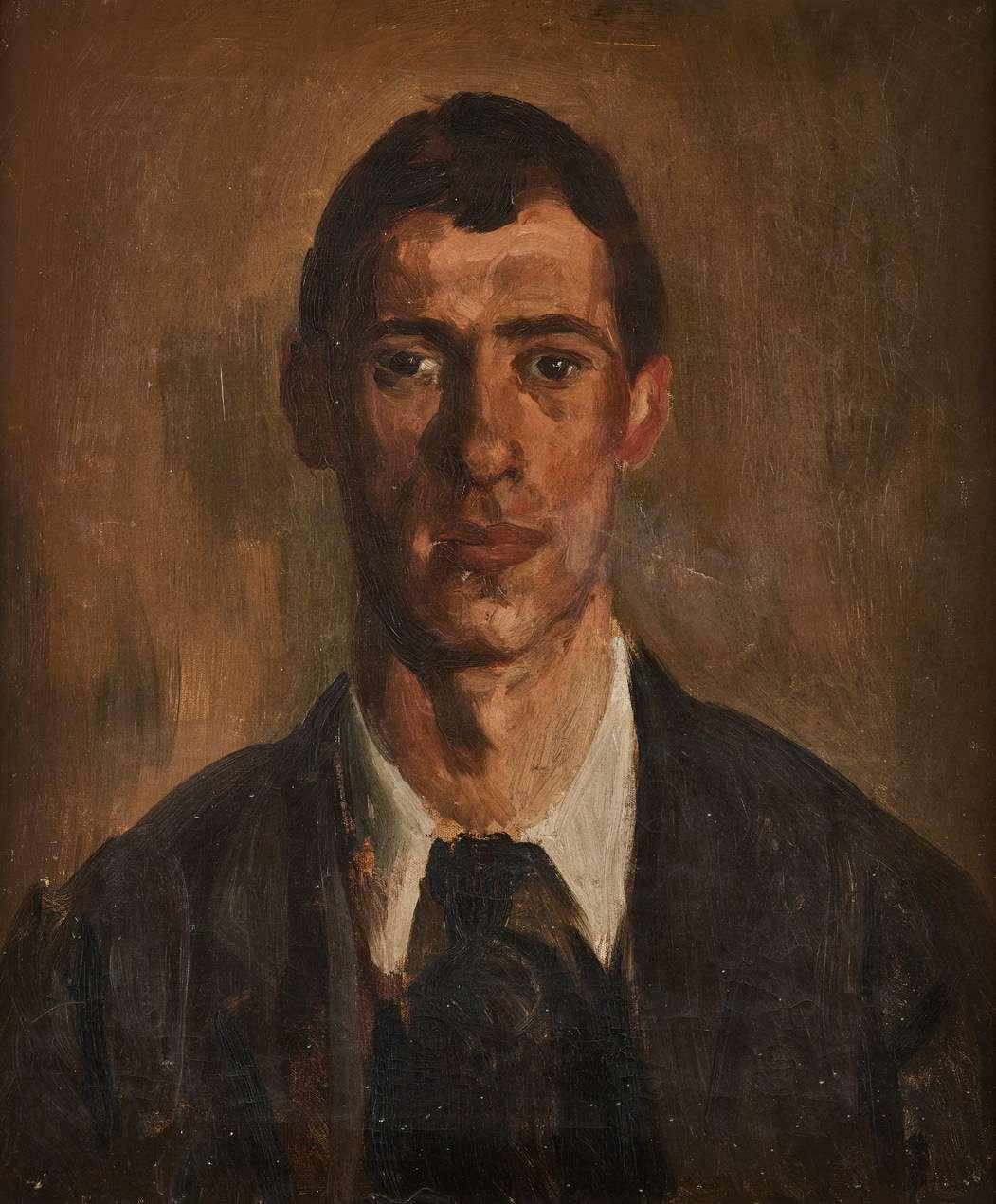
AUGUSTUS JOHN RA (BRITISH 1878-1961)
PORTRAIT OF EDGAR ALBERT ‘LOBEN’ SLADE
oil on canvas
59.5 x 49.5cm; 23½ x 19½in
81.5 x 72cm; 32¼x 28¼in (framed)
Provenance
Jean Hornak, née Slade. (Jean Hornak, 1914-1998, was Loben Slade’s daughter. After studying at St Martin’s School of Art she worked as a scene painter at various London theatres and later collaborated with leading interior designer John Beresford Fowler, 1906-1977, on a range of country house commissions including for the National Trust at Petworth)
Michael and Jane Thomas (purchased from the above in the early 1960s; the Thomases were close friends with the Slade family)
Thence by descent to the present owner, daughter of the above
Exhibited (possibly) London, Wilton Gallery, Drawings by E.A. Slade, Paintings by Carl Grünewald, 1961
According to the typed inscription on the old label on the reverse of the frame (fig.1), John painted the present work when he was twenty, ‘the evening before his first portrait commission’. The commission referred to is Portrait of An Old Lady in the collection of Tate Britain.
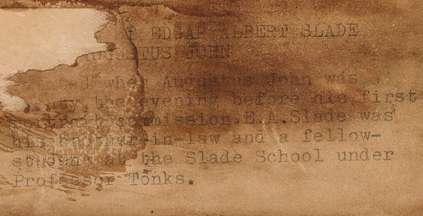
According to Michael Holroyd in his biography on Augustus John, the painting was left unfinished as John grew bored with his subject and the old lady restless. (Michael Holroyd, Augustus John, vol.1, The Years of Innocence, London, 1974, p.85). The present portrait by John of Loben was thus, in essence, a warm up exercise, with both portraits displaying the same sketchy brown background and loose brushwork. Born in Islington, the painter Edgar Albert ‘Loben’ Slade (1872-1963) had been introduced to John by his younger brother Charles whilst they were together at the Slade School of Art in the late 1890s. The brothers were nephews of Felix Slade (1790-1868), a well-known collector and benefactor of the arts who founded the eponymous art school.
Loben went on to marry Jessie McNeill (see lot 21), the sister of Augustus John’s muse and mistress Dorelia whilst Charles became a photographer. Two later drawings by John of Loben dated 1903 and 1909 are known to exist, as are sketches by John of Charles. Photographs of John by Charles Slade from the early 1900s are in the National Portrait Gallery.
Slade first worked with a lithography firm before travelling to Australia, Burma and South Africa, where he was a political cartoonist during the Boer War (1899-1902). He exhibited occasionally at the New English Art Club and the Chenil Gallery and later in 1961 a retrospective exhibition was held at the Wilton Gallery on Motcomb Street. From the early 1920s Slade lived at Monksfield in Freshwater on the Isle of Wight and is buried on the Island at Shalfleet.
We are grateful to Rebecca John, the artist’s grand-daughter, for her assistance in cataloguing this lot.
⊕ £3,000-4,000
Property from a Private Collection, London 21
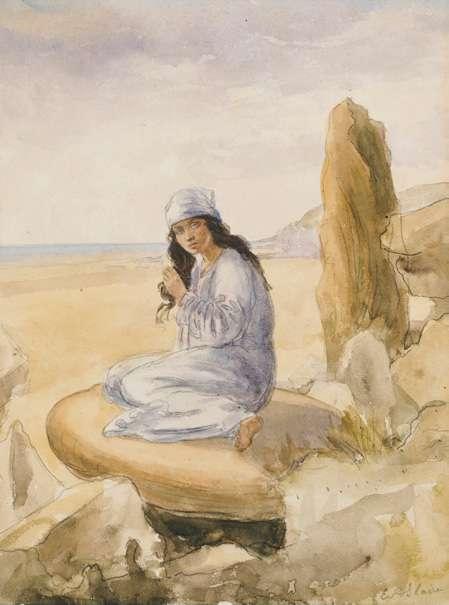
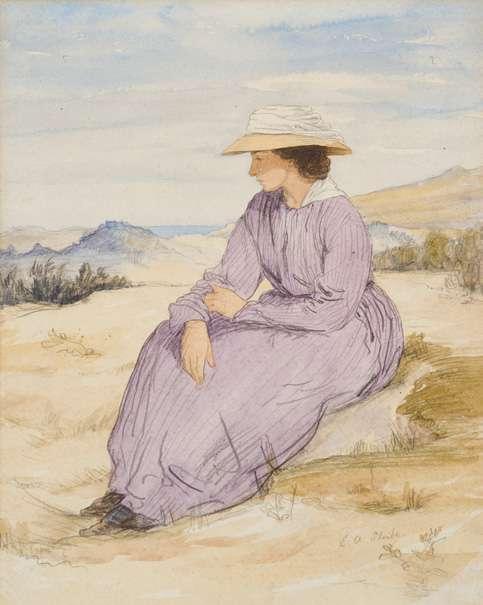
EDGAR ALBERT ‘LOBEN’ SLADE (BRITISH 1872-1963)
JESSIE MCNEILL BY THE SHORE
signed E A Slade lower right; inscribed Jessie at […] on a label on the reverse pencil and watercolour on paper
30 x 22.5cm; 11¾ x 9in
50 x 43cm; 19¾ x 17in (framed)
Provenance
Margaret ‘Peggy’ Thomas (née Astbury), acquired from the artist (Peggy Thomas, 1908-1991, was a close friend with both Loben Slade and his daughter Jean and a regular visitor to Monksfield in Freshwater on the Isle of Wight, the artist’s home from the early 1920s onwards)
Michael and Jane Thomas (son and daughter-in-law of the above)
Thence by descent to the present owner, daughter of the above
The dedication to Jessie on the reverse of the present work refers to Jessie McNeill, Loben Slade’s wife and sister of Dorelia McNeill who was Augustus John’s muse and mistress (see note to previous lot).
⊕ £200-300
Property from a Private Collection, London 22
EDGAR ALBERT ‘LOBEN’ SLADE (BRITISH 1872-1963)
PEGGY SEATED IN A LANDSCAPE
signed E.A. Slade lower right; signed and dedicated To Peggy / with love from Loben on an old label on the reverse pencil and watercolour on paper
30 x 24cm; 11¾ x 9½in
50 x 42.5cm; 19¾ x 16¾in (framed)
Provenance
Margaret ‘Peggy’ Thomas (née Astbury), a gift from the artist
Michael and Jane Thomas (son and daughter-in-law of the above)
Thence by descent to the present owner, daughter of the above
see note to lot 20 and provenance to lot 21
⊕ £300-400
Property from a Private Collection, London 23
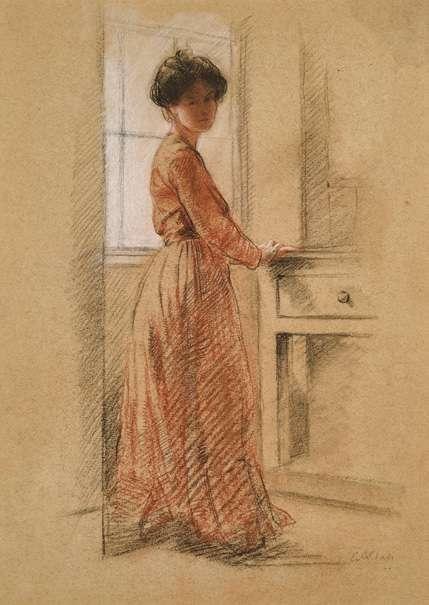
EDGAR ALBERT ‘LOBEN’ SLADE (BRITISH 1872-1963)
WOMAN STANDING BY A WINDOW
signed E A Slade lower right black and red chalks heightened with white on buff paper
34.5 x 20.5cm; 13½ x 8in
55 x 43.5cm; 21¾ x 17¼in (framed)
Provenance
Margaret ‘Peggy’ Thomas (née Astbury), acquired from the artist
Michael and Jane Thomas (son and daughter-in-law of the above)
Thence by descent to the present owner, daughter of the above
see note to lot 21 and provenance to lot 21
⊕ £100-150
Property from a Private Collection, London 24
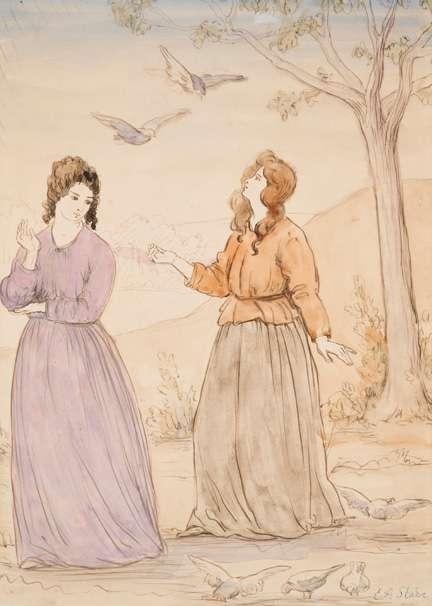
EDGAR ALBERT ‘LOBEN’ SLADE (BRITISH 1872-1963)
FEEDING THE BIRDS
signed E A Slade lower right; inscribed To Dear Michael and Jane / Wishing you every happiness / from / All at Monksfield on the reverse pen and ink with traces of red pencil and watercolour on paper
34 x 24cm; 13½ x 8½in
54.5 x 43cm; 21½ x 7in (framed)
Provenance
Michael and Jane Thomas (a gift from the artist, probably on their engagement in 1963 before their marriage the following year)
Thence by descent to the present owner, daughter of the above
see note to lot 20
⊕ £100-150
Property from a Private Collection, London 25
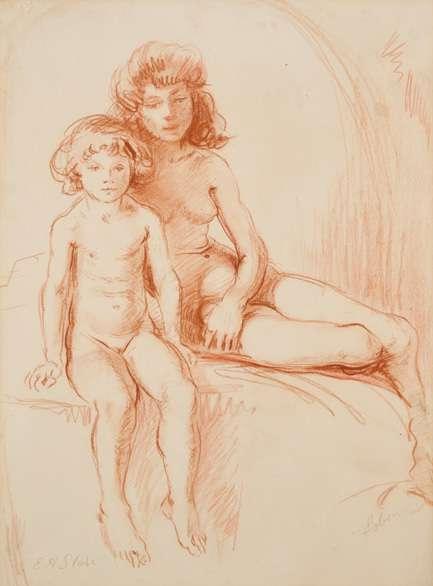
EDGAR ALBERT ‘LOBEN’ SLADE (BRITISH 1872-1963) SISTERS
signed E A Slade lower left; signed Loben lower right sanguine on paper
33 x 24.5cm; 13 x 9½in
53 x 44cm; 21 x 17½in (framed)
Provenance
Margaret ‘Peggy’ Thomas (née Astbury), acquired from the artist
Michael and Jane Thomas (son and daughter-in-law of the above)
Thence by descent to the present owner, daughter of the above
see note to lot 20 and provenance to lot 21 ⊕ £100-200
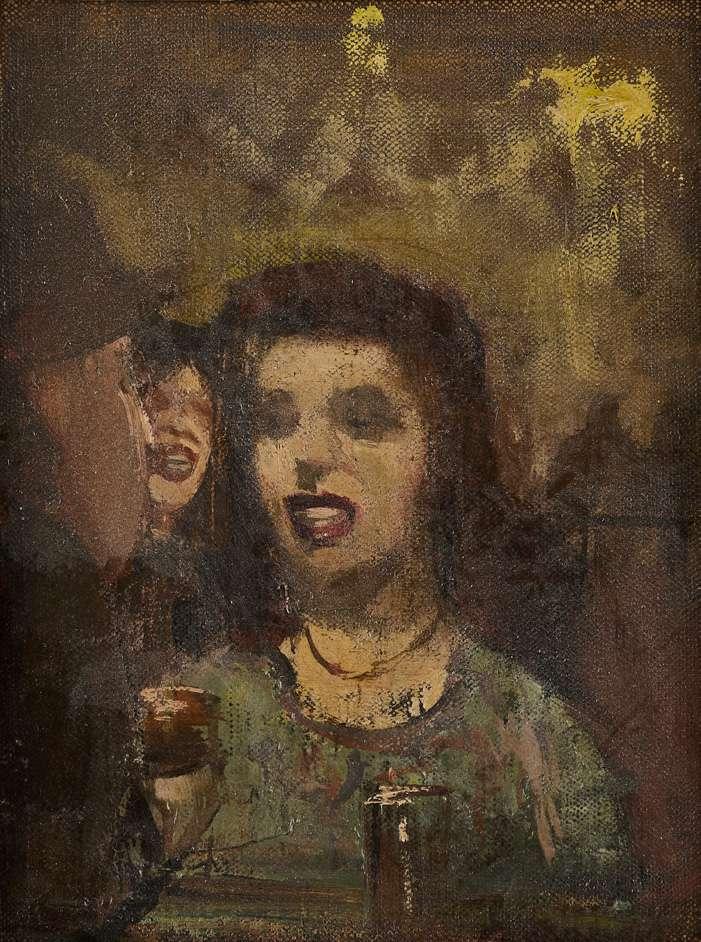
RODRIGO MOYNIHAN RA (BRITISH 1910-1990)
CHATTING AT THE BAR
signed R Moynihan lower right oil on canvas
22 x 17cm; 8¾ x 6¾in
38.5 x 33.5cm; 15¼ x 13¼in (framed)
Provenance
Acquired from the artist by the late owner
Painted in the late 1930s. Moynihan enrolled at the Slade in 1928 and in the early 1930s explored abstraction before turning his interest to social realism and the work of Victor Pasmore, William Coldstream and the Euston Road School. During the War he served first in the Royal Artillery, then with the Camouflage Unit before becoming an official War Artist.
Appointed Professor of Painting at the Royal College of Art in 1948, his students included Frank Auerbach, Leon Kossoff, Peter Blake and David Hockney. But he relinquished the professorship in 1957, turned once again to abstraction and lived and worked abroad. Then in his work of the 1970s he returned to figuration painting still-lifes and completed a number of notable portrait commissions.
⊕ £600-800
Property from the Estate of Hans Feibusch, Hampstead 27
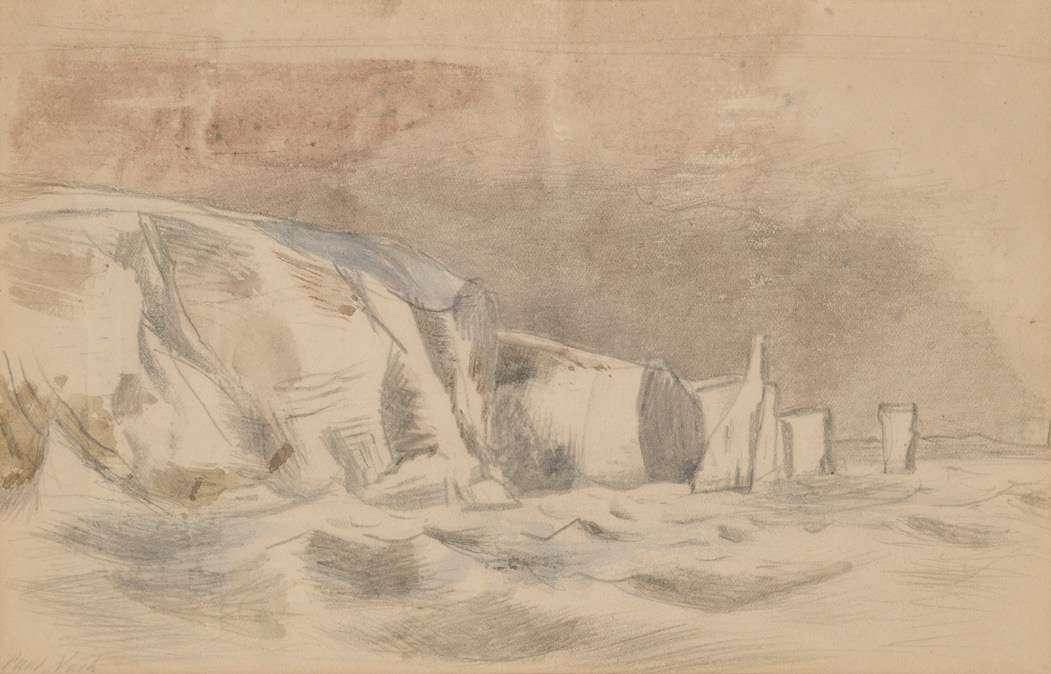
OLD HARRY ROCKS AND THE PINNACLES OFF BALLARD DOWN, SWANAGE, DORSET
signed Paul Nash lower left pencil and watercolour
12.5 x 20cm; 5 x 8in
33.5 x 39cm; 13¼ x 15¼in (framed)
Provenance
(possibly) Sale, Christie’s London, 29th November 1941 (purchased by Mr Roberts)
The Leicester Galleries (Ernest Brown & Phillips Ltd), London Phyllis Bray, London (Phyllis Bray, 1911-1991, had a successful career as a mural painter, assisting the German mural artist Hans Feibusch (1899-1998), a collaboration that lasted over forty years. Bray studied at the Slade,1927-1931, and was a member of the East London Group of artists in the 1930s, interested in Surrealism. She was also a book illustrator.)
Hans Feibusch, London (a gift from the above)
Thence by descent to the present owner
Executed circa 1935. Nash had noted the Surrealist potential of Swanage within days of his first visit in 1934, describing the town as ‘just a Surrealist dream’. He had moved to the coastal town to relieve his asthma. His flat in The Parade on Swanage sea front looked out across to the distinctive cliffs of Old Harry Rocks, with its two chalk stack ‘Pinnacles’ at the foot of Ballard Down to the east of Swanage Bay. Nash immediately saw the opportunity the view represented, and was quick to incorporate it into his work.
1, Dorset Shell Guide by Paul Nash with the author’s photograph of the Pinnacle on the cover
In 1935 he was preparing for the International Surrealist Exhibition to be held in London the following year. In developing his ideas for the exhibition he revisited the theme of water flooding into a broken room in his watercolour Empty Room of 1935. Andrew Causey describes the appearance of the view from Nash’s balcony in the composition: ‘the furthest left-hand walls of the room are missing, leaving the room open to the sea; beyond are the Ballard Cliffs, with the Pinnacle Rock jutting out just short of the coast’ (see Andrew Causey, Paul Nash, Oxford, 1980, p. 280 & no. 836, Empty Room illustrated). The dramatic prominence of the rocky coastline in Empty Room is markedly similar to that which appears in the present sketch suggesting this work may be a preparatory study for the larger finished composition.
The present work may also possibly have been a preparatory sketch for an illustration in Nash’s popular Dorset Shell Guide, published in 1936 (see Causey, pp. 430-431, nos. 828, 831, 832 and 843). The cover of the guide features Nash’s photograph of a close up of the Pinnacles (Fig. 1).
£400-600
Property from a Private Collection, London 28
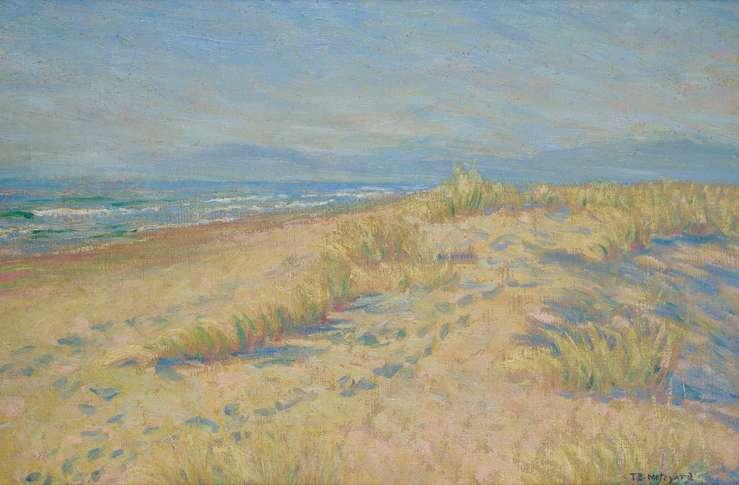
THE DUNES
signed T. B. Meteyard lower right oil on canvas
36 x 54cm;14¼ x 21¼in
51 x 69cm; 20 x 27¼in (framed)
Painted circa 1900.
American painter and graphic artist Thomas Meteyard grew up in Rock Island, Illinois, and was a student at Harvard (1885-1887) before leaving for Europe. In England he discovered the Aesthetic Movement, notably the work of Walter Crane and Edward Burne-Jones, then in Paris he studied variously in the ateliers of Léon Bonnat (1833-1922), Alfred Phillippe Roll (1846-1919) and with Auguste-Joseph Delecluse (1855-1928) at his eponymous Académie.
Like many aspiring American painters in the 1890s he joined the artists’ colony that had grown up around Claude Monet (1840-1926) at Giverny. Flourishing within this avant-garde milieu, Meteyard was one of the first Americans to have his work included in the early Post-Impressionist exhibitions. He moved back to England in 1906 where he painted until his death.
£1,000-1,500
Property from a Private Collection, Kingston-upon-Thames 29
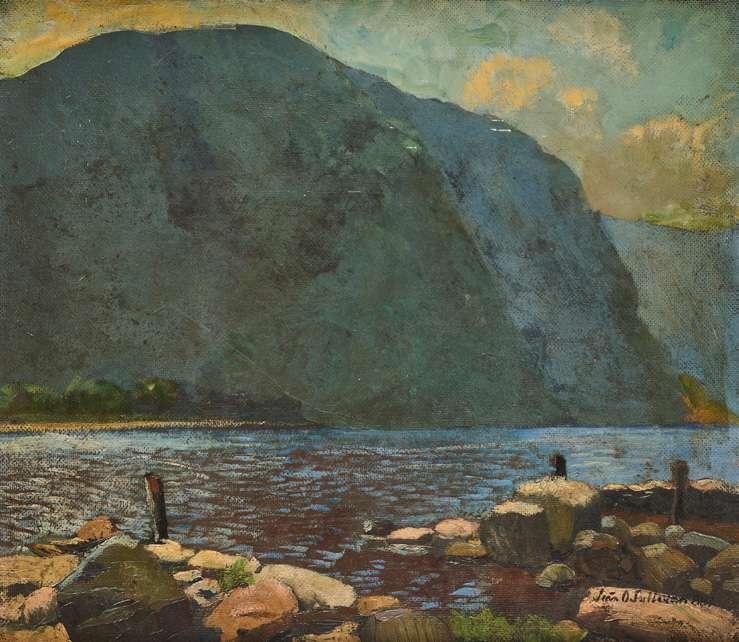
signed Sean O’Sullivan lower right oil on board
53 x 60cm; 20¾ x 23¾in
73 x 80cm; 28¾ x 31½in (framed)
Provenance
Purchased in Ireland by the present owners in July 1998
⊕ £1,500-2,500
Seven Works by Australian Artists from a Private Collection, Surrey (lots 30-36)
30
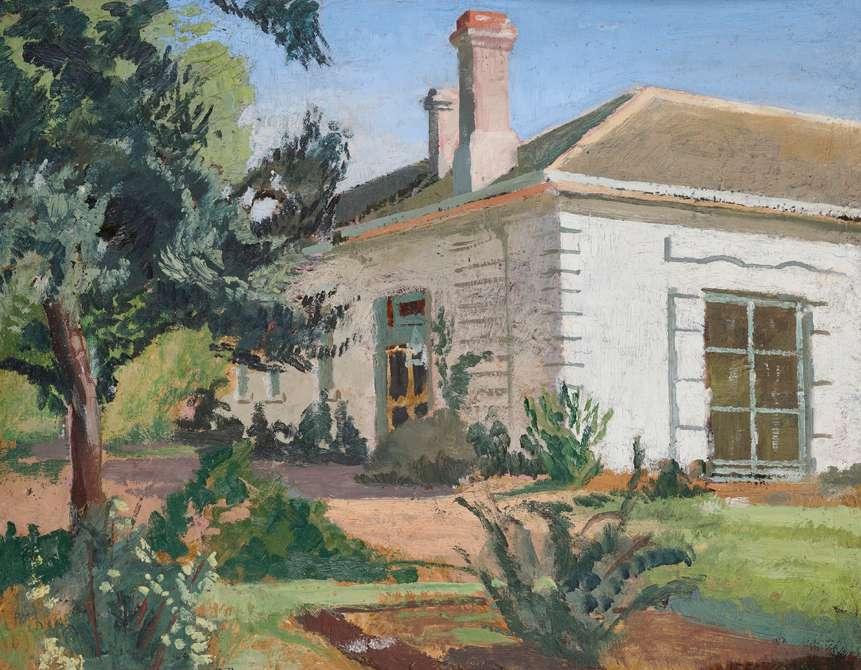
HOUSE IN WOODVILLE, NORTH ADELAIDE
signed and dated ‘44 lower right oil on board
38 x 48cm; 15 x 18¾in
49.5 x 59.5cm; 19½ x 23½in (framed)
Provenance
Dr Julian Storey, Adelaide, Australia, a gift from the artist (Storey, 1919-1952, was a doctor in Adelaide and friends with Smart when the artist was at art school. The present work is of Storey’s first home in Woodville, North Adelaide which he purchased in the early 1940s)
Thence by descent to the present owner, daughter of the above Smart was predominantly interested in landscape, and especially focused on the urban environment, fascinated by the anonymity of houses, shops, factories, airports, highways and road signs. Although his compositions were based on reality, over the years the mood of his paintings became increasingly enigmatic. He introduced figures that shared the same sense of detachment as their surroundings, the resultant canvases often bordering on the surreal.
One of a number of Australian artists who turned to the city for inspiration, Smart was influenced by such painter pioneers as Hans Heysen (1877-1968) and Horace Trenerry (1899-1958) who had explored the vast open spaces of the continent before him. He was also a keen reader of the poetry of T.S. Eliot (1888-1965) whose incantations of streets and buildings can be felt in the visual disengagement of Smart’s city imagery, similar to that of Eliot’s contemporary, the American painter Edward Hopper (1888-1965).
The present early work by Smart already shows his interest in geometry and precisely composed landscapes in bright colours. He commented ‘My only concern is putting the right shapes in the right colours in the right places. It is always geometry’.
Smart studied at the South Australian School of Art in Adelaide from 1937-1941 and at La Grande Chaumière in Paris from 1948-1949 where he was taught by Fernand Léger. He returned to Australia in 1951 and worked as art critic for The Daily Telegraph in Sydney but in 1963 he travelled once more to Europe, where he settled in Italy.
⊕ £4,000-6,000
Property from a Private Collection, Surrey 31
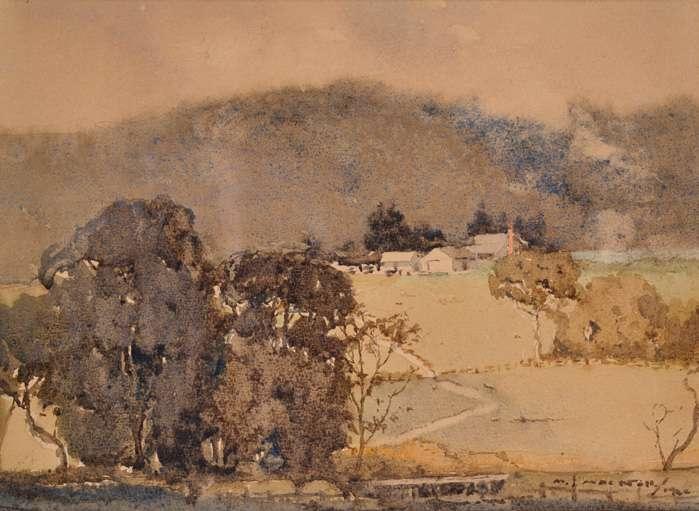
MCNALLY (AUSTRALIAN 1873-1943)
LANDSCAPE WITH A FARM signed and dated M.McNally 1922 watercolour on paper 22 x 31cm; 8¾ x 12in
42.5 x 49.5cm; 16¾ x 19½in (framed)
Provenance
Arthur and Florence Barrett, Melbourne (purchased in the early 1900s)
Barbara Barrett, London (grand-daughter of the above)
Thence by descent to the present owner, niece of the above
Artist, art critic, book reviewer and writer, McNally devoted his artistic career to working in watercolour often praised for their ‘poetic charm’.
£100-150
Property from a Private Collection, Surrey 32
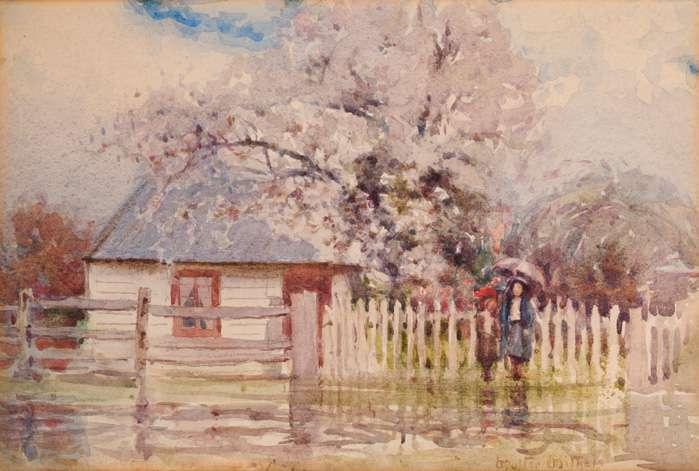
WITHERS (AUSTRALIAN 1854-1914)
RAINY DAY IN SPRING
signed Walter Withers lower right watercolour on paper 21 x 31cm; 8¼ x 12¼in
39.5 x 52cm; 15½ x 20½in (framed)
Provenance
Arthur and Florence Barrett, Melbourne (purchased in the early 1900s)
Barbara Barrett, London (grand-daughter of the above)
Thence by descent to the present owner, niece of the above
Withers was born in Birmingham, England and studied at the Royal Academy, the South Kensington Schools and in Paris. He moved to Australia in 1883 and although originally intending to settle on the land, he soon moved to Melbourne. Renowned for his plein air painting, his fascination in evoking the weather’s effects on the landscape pervades his work.
£300-500
Property from a Private Collection, Surrey
WILLIAM BLAMIRE YOUNG
(ENGLISH-AUSTRALIAN 1862-1935)
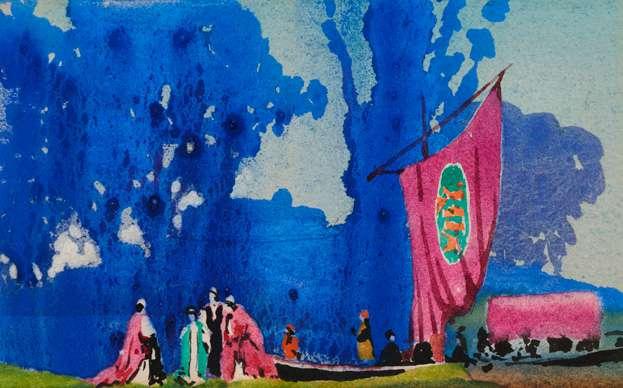
THE ROYAL BARGE
watercolour on paper
10 x 16cm; 4 x 6½in
34 x 39cm; 13¼ x 15¼in (framed)
Provenance
Arthur and Florence Barrett, Melbourne (purchased in the early 1900s)
Barbara Barrett, London (grand-daughter of the above)
Thence by descent to the present owner, niece of the above
Exhibited
Melbourne, The Fine Art Society
£200-300
Born in Londesborough in Yorkshire, Blamire Young oscillated between England and Australia. At Cambridge, where he studied maths, he became a member of the Fine Art Society and frequented the Fitzwilliam Museum. Then in 1885 he emigrated to New South Wales to teach at Katoomba College. There he met fellow British émigrés and college staff Phil May (1864-1903) and Richard Godfrey Rivers (1858-1925). May combined his teaching with working as a cartoonist and illustrator for The Sydney Bulletin. While Godfrey Rivers was a recent graduate of the Slade School of Art in London.
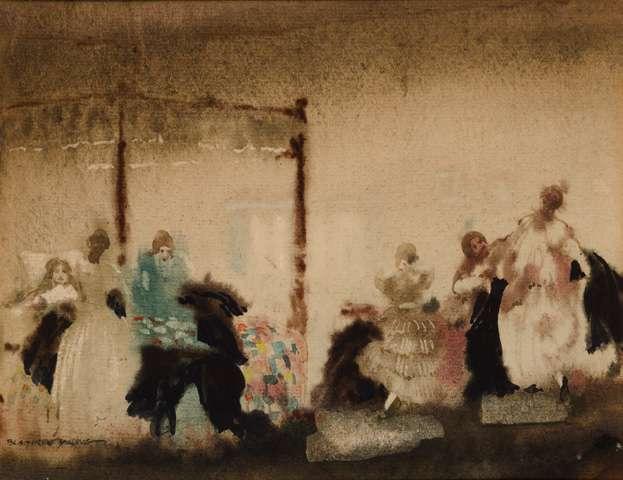
Instructed by both artists, Blamire Young established his own studio, which became a magnet for other aspiring talent including Theodore Fink (1855-1942) the influential publisher and politician. But following a catastrophic fire which destroyed much of his work in 1893, Young returned to England where he studied with Hubert von Herkomer and associated with the Beggarstaff Brothers, James Pryde and William Nicholson, their fluid manner clearly evident in the present lot and lot 34.
Following his marriage in 1895 he returned to Australia, established a co-operative producing Art Nouveau style posters and turned to writing, publishing two one-act dramas: Art for Arts Sake which played at the Melbourne Repertory Theatre in 1911 and Children’s Bread published in 1912. That same year he departed with his family once more for Europe, travelling via Spain and arriving in England in 1914. During the following decade he served in the First World War, was elected to the membership of the Royal Institute of Painters in Watercolours and the Royal Society of British Artists, exhibited at the Royal Academy and the Royal Scottish Academy, showed at the Chester Gallery and had a solo exhibition at the Fine Art Society on New Bond Street before finally returning to Australia in 1923.
In Australia Blamire Young’s work is in the art galleries of Melbourne, Sydney, Adelaide and Geelong and in the collections of Plymouth Art Gallery and Watford Museum in the UK.
Property from a Private Collection, Surrey
WILLIAM BLAMIRE YOUNG (ENGLISH-AUSTRALIAN 1862-1935)
PREPARATIONS FOR THE BALL signed Blamire Young lower left watercolour on paper
16 x 21cm; 6¼ x 8¼in
55.5 x 58cm; 21¾ x 22¾in (framed)
Provenance
Arthur and Florence Barrett, Melbourne (purchased in the early 1900s)
Barbara Barrett, London (grand-daughter of the above)
Thence by descent to the present owner, niece of the above
£300-500
Property from a Private Collection, Surrey
35
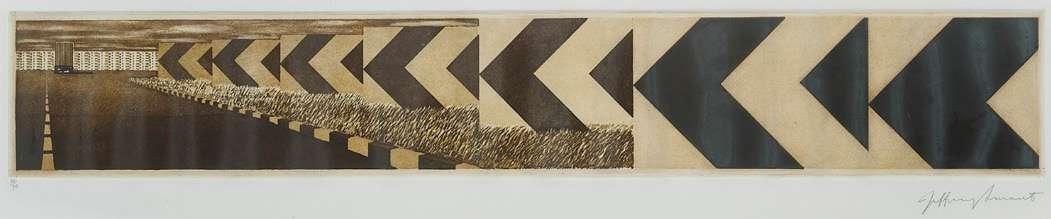
JEFFREY SMART (AUSTRALIAN 1921-2013)
THE DIRECTORS (1977)
signed Jeffrey Smart lower right and numbered 88/90 lower left aquatint on paper
12 x 75cm; 4¾ x 29½in
39.5 x 120cm; 15½ x 47¼in (sheet)
50 x 130; 19¾ x 51¼in (framed)
Provenance
Lady Madeleine Robinson, London (purchased from the artist in the 1990s)
Thence by descent to the present owner, daughter of the above see note to lot 30
⊕ £600-800
Property from a Private Collection, Surrey 36
FRENCH (AUSTRALIAN 1928-2017)
PORTRAIT OF BORIS GODUNOV
signed, titled and dated 25th Oct 1982 / An attempt to show the duality / of the strange personality of Boris Gudunov / the mask like royal costumed Tzar / in front of the darker, sinister image / of the Mongolian peasant / Leonard French on a label on the reverse
enamel, oil and gold leaf on hessian covered board
88 x 72cm; 34½ x 28¼in
97 x 82.5cm; 38 x 32½in (framed)
Provenance
Sir Albert and Lady Robinson, London (purchased from the artist in Melbourne in the late 1980s)
Thence by descent to the present owner, daughter of Lady Robinson
⊕ £3,000-5,000
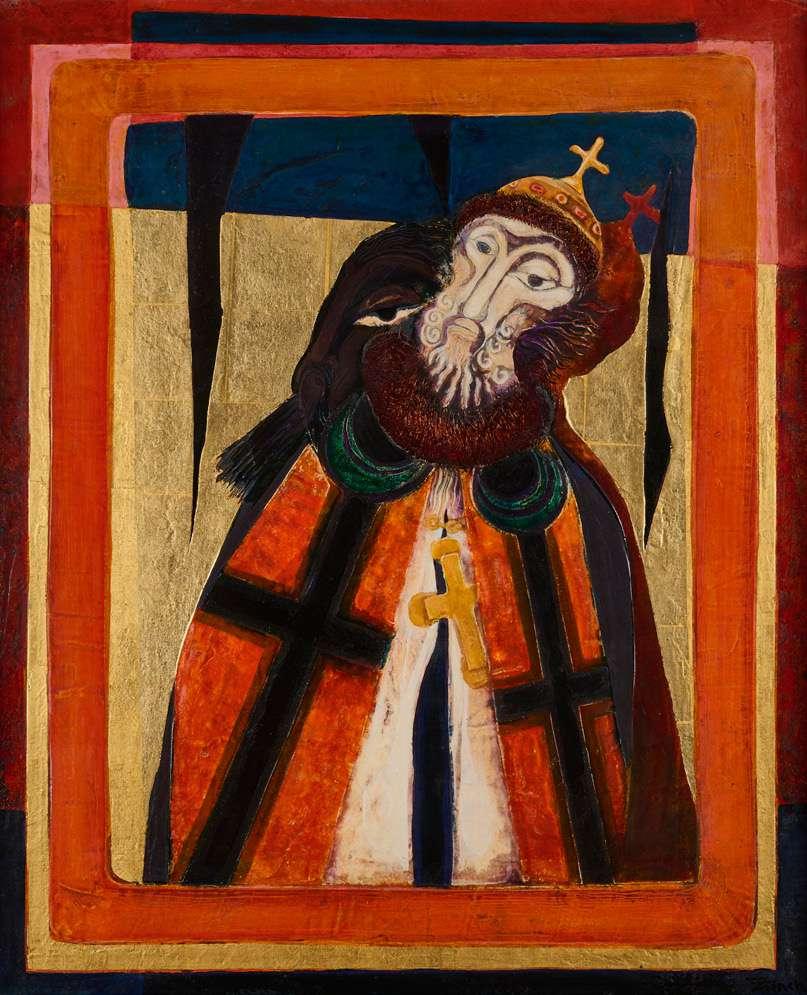
Boris Godunov (1552-1605) was the de facto regent of Russia (1585-1598) and then Tsar (1598-1605) during the ‘Time of Troubles’, a period of political crisis which would lead to the establishment of the Romanov dynasty in 1617. Born to a landowning family of Tatar origin, Godunov rose to power through strategic marriages and connections. He is probably best known as the ruthless ill-fated tyrant of Modest Mussorgsky’s eponymous opera of 1873, who after being crowned Tsar grapples with his part in the murder of the rightful heir to the throne, Dmitriy.
Raised in a working class family in the Melbourne industrial suburb of Brunswick during the years of the Great Depression, French left school at an early age and became an apprentice signwriter, a training that explains the unconventional techniques and materials that he later used in his art. As in the present work, his built up, well crafted enamel
surfaces with professionally applied areas of gold leaf is unique in the context of Australian painting.
French discovered the art of Fernand Léger during his first trip abroad in 1950, visiting the retrospective on the French painter at the Tate Gallery in London. For French, the impact of Léger went considerably beyond a stylistic influence: what appealed to him was the whole philosophy of art into life, of monumental art within architecture, and made relevant and accessible to the working masses. French frequently used literary sources as inspiration such as the writings of Homer or James Joyce, and merged them into a personal heroic vision. The present representation of Godunov not only reflects the grand tradition of Russian icons but also the influence of Byzantine art and Celtic iconography on his work, whilst the clarity of design belies his abiding interest in stained glass for which he was celebrated.
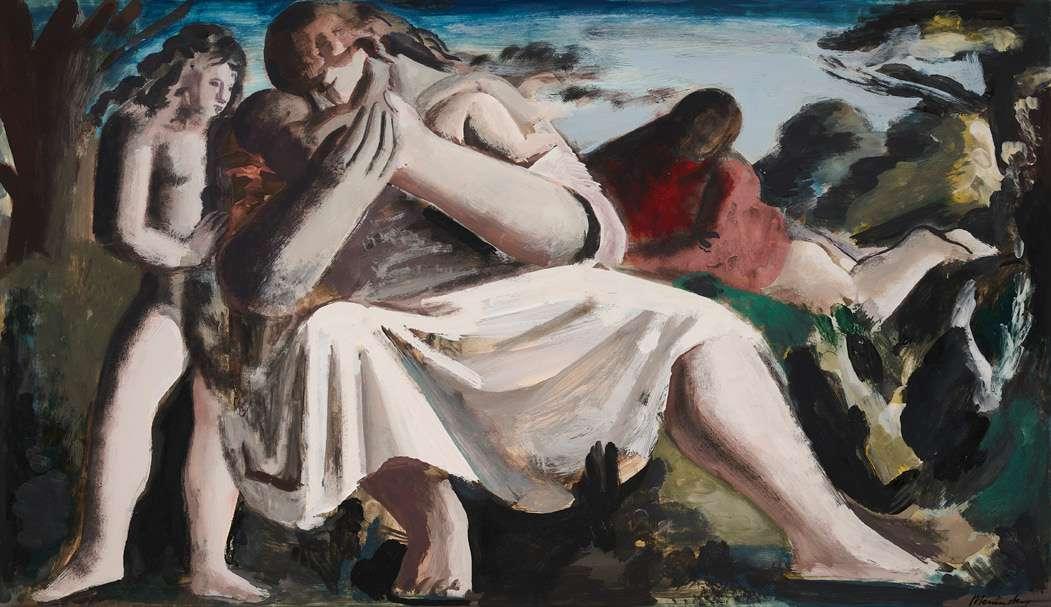
Property from a Private Collection, Hampstead
MOTHER AND CHILD WITH FIGURES IN A LANDSCAPE signed Meninsky lower right gouache on paper
35 x 61cm; 13¾ x 24in
47 x 73cm; 18½ x 28¾in (framed)
Meninsky was one of a talented generation of Anglo-Jewish painters in London during the first half of the last century, among his contemporaries were David Bomberg and Mark Gertler. Meninsky’s parents moved from Konotop in Ukraine to Liverpool soon after he was born. Later he attended the Liverpool School of Art, the Académie
Julian in Paris and the Slade in London, where he arrived in 1912 to study under Henry Tonks and Philip Wilson Steer. Among his Slade cohort were William Roberts and Paul Nash (see lot 27) who became lifelong friends.
In his biography of Meninsky, John Russell Taylor wrote that ‘as a man and so as a teacher, Meninsky was moody and unpredictable’, and commented of his work of the post-War period when the present work was painted: ‘Meninsky’s rich-tone landscapes … were peopled with mothers and children, family groups travelling (… inspired by the New Testament story of the Flight into Egypt), pilgrims with staff in hand, shepherds without flocks and heavy-limbed women resting.’ (John Russell Taylor, Bernard Meninsky, London, 1990, p. 56)
£600-800
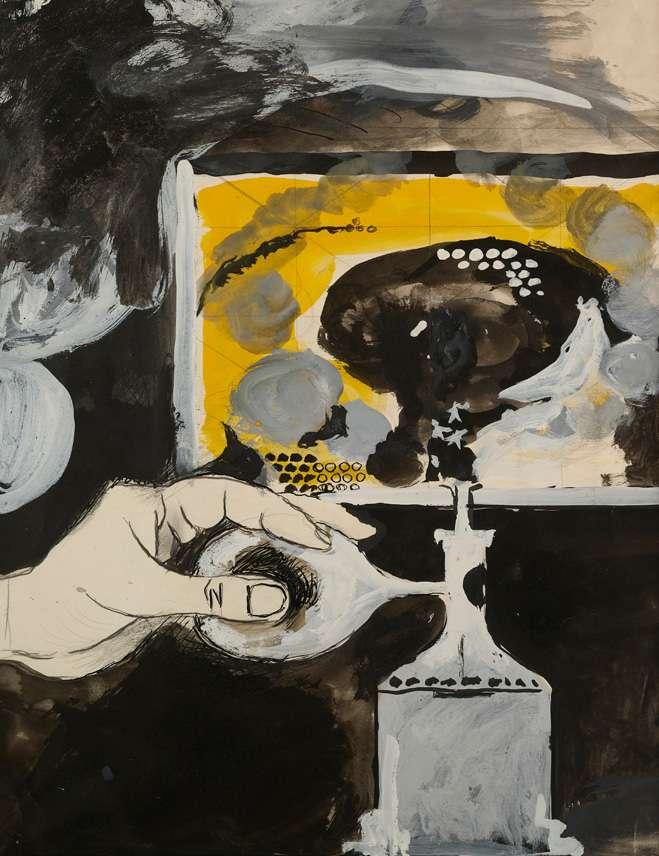
Property from a Private Collection, London
GRAHAM SUTHERLAND (BRITISH 1903-1980)
STUDY FOR SMOKING
watercolour and gouache, pencil, pen and ink on paper
38 x 30cm; 15 x 11¾in
78 x 68cm; 30½ x 26¾in (framed)
Executed circa 1977, Sutherland executed two variants of the present composition the same year both recorded in private collections, each signed with initials and dated 1977, one of the same size, the other smaller.
Provenance
Sale, Sotheby’s London, 25th May 2006, lot 265
Purchased at the above sale by the present owner
⊕ £4,000-6,000
Property from a Private Collection, Kent
39
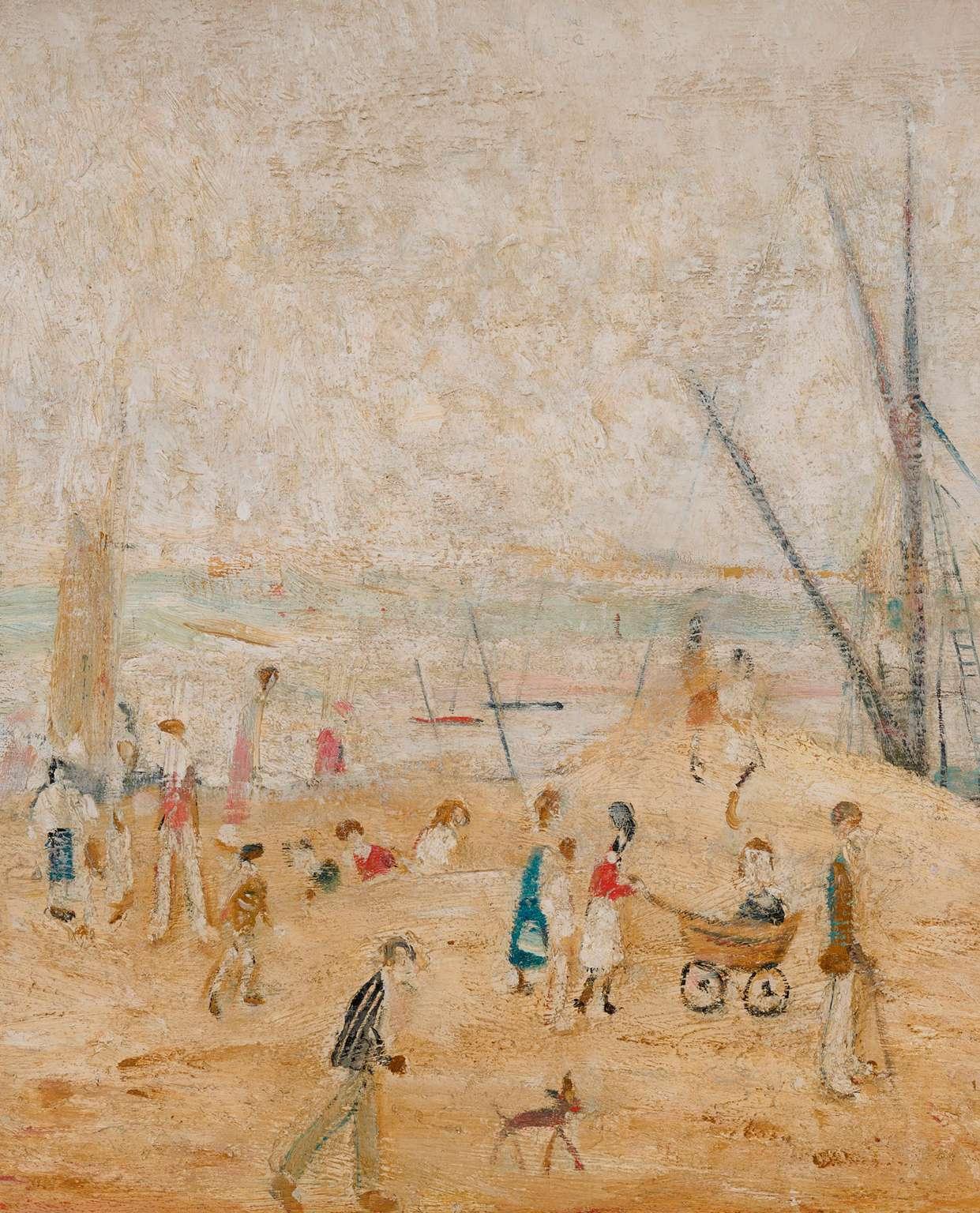
STEPHEN LOWRY (BRITISH 1887-1976)
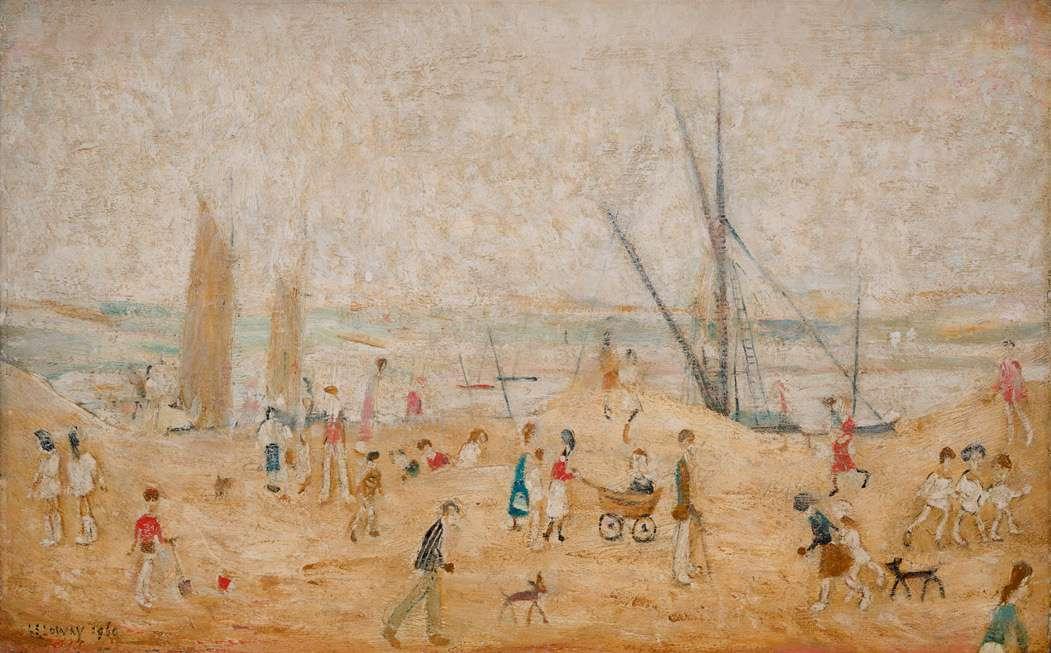
FIGURES ON A BEACH
signed and dated L S Lowry 1960 lower left oil on canvasboard
38 x 60cm; 15 x 23½in
55 x 77cm; 21¾ x 30¼in (framed)
⊕ £110,000-160,000
Provenance
Monty Bloom, Southport (acquired from the artist)
Sale, Christie’s London, 21st November 1969, lot 56
Ronald Lyon, Wentworth (purchased at the above sale)
Sale, Christie’s London, 15th March 1985, lot 267
Sale, Christie’s London, 12th June 1987, lot 301
Purchased by the uncle of the present owner circa 2000
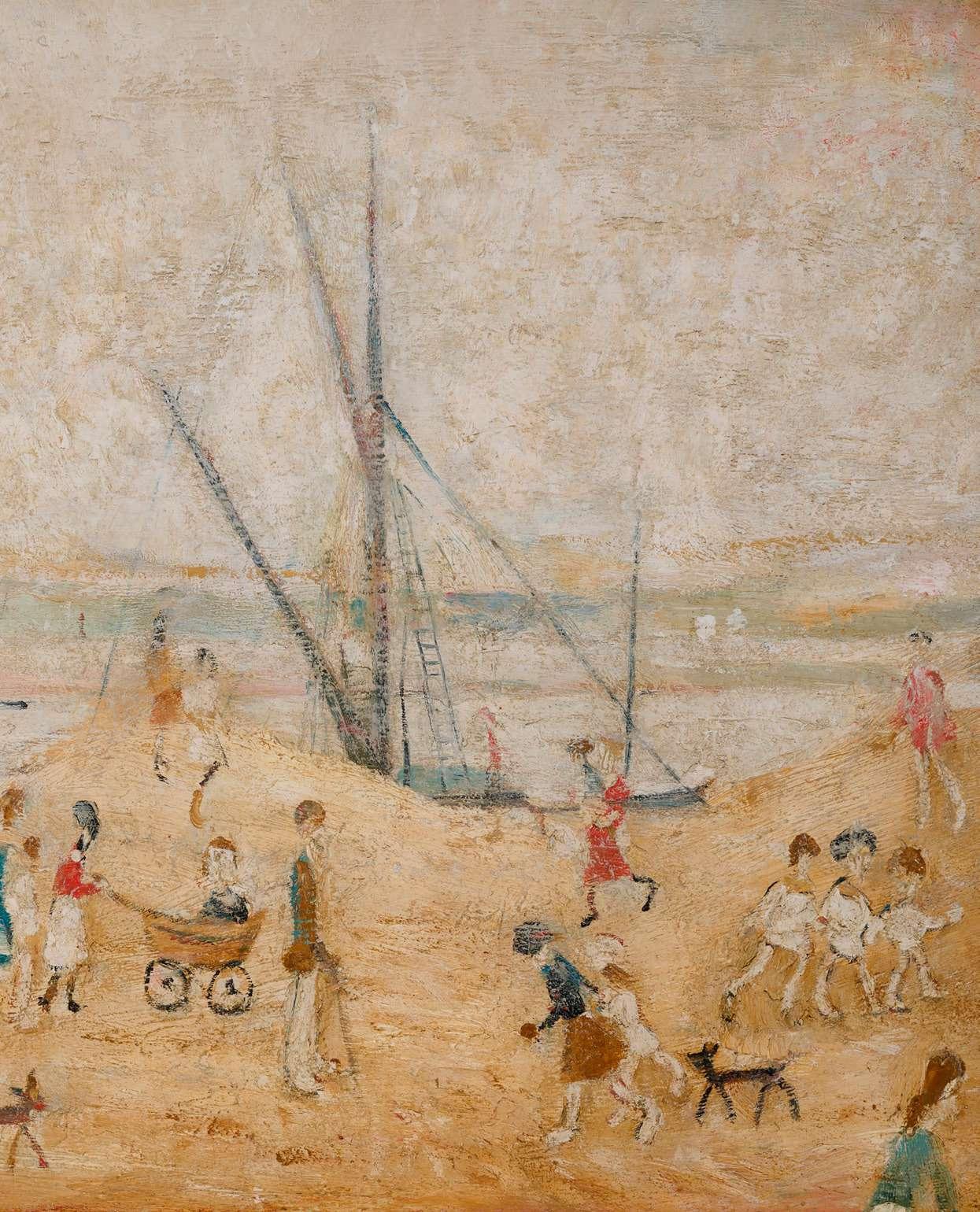
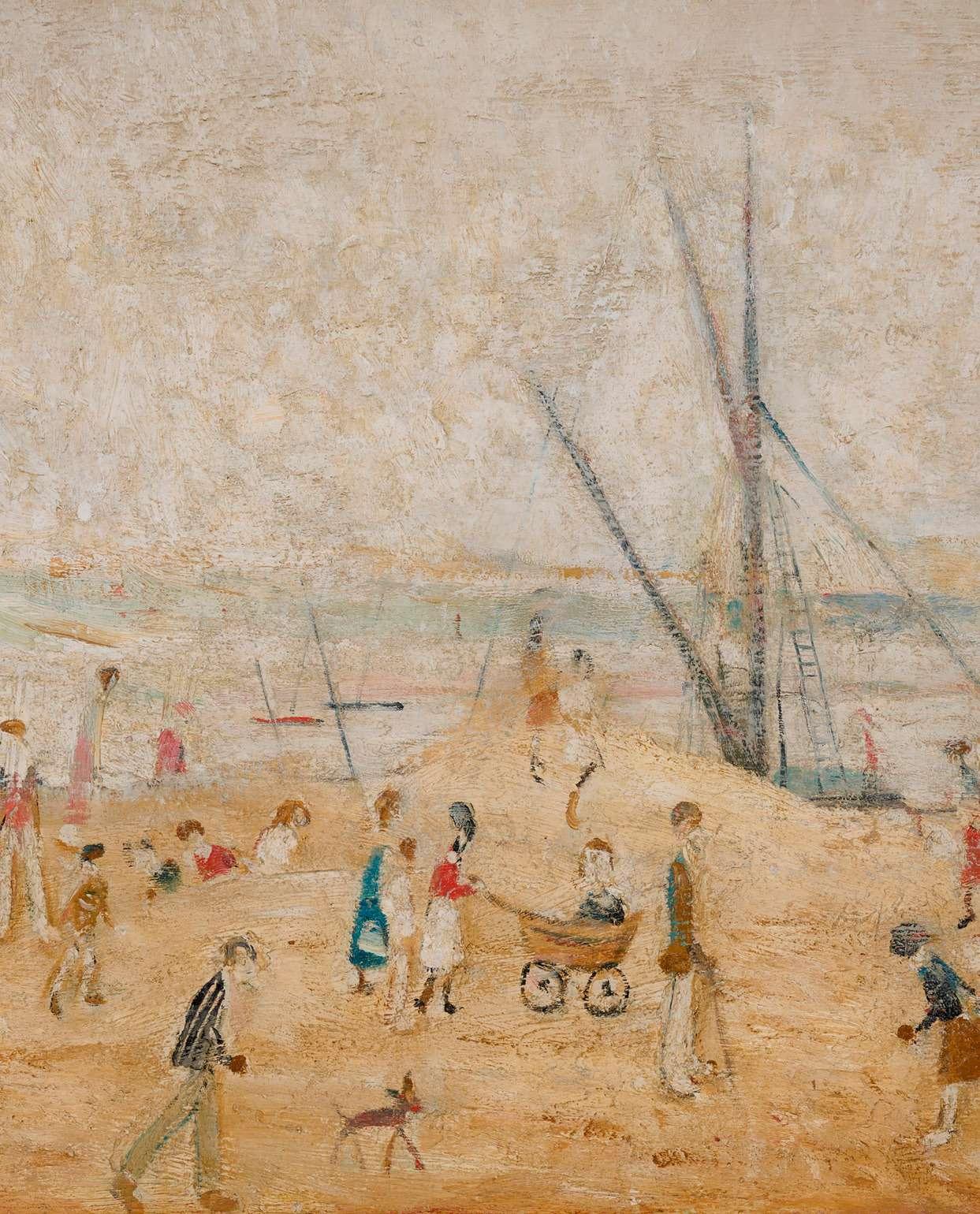
Lowry’s Figures on a beach brilliantly captures the variety of activities of day trippers and holiday makers young and old at play, in conversation or immersed in their thoughts as they walk or run across the sands. The holiday setting and carefree mood is far removed from the artist’s typical depictions of life in the city. In the foreground a man in a stripey blue blazer walks his dog. Nearby another man in white flannel trousers pauses, his walking stick dug into the ground, as he surveys the children approaching him with their dog and the trio of three girls in white dresses that walk away from him. Between the two men a woman with her son pushes a child in a pram as she talks to her friend in a green dress. To the right a mother in red hurries across the beach carrying her baby. Behind them parents watch as children play: amongst them three bury themselves in the sand, a boy digs with a spade and two girls in white dresses walk off the scene. As Michael Howard comments, in such beach scenes Lowry ‘celebrates the restrained, puritanical pleasures of doing nothing, or the banal activities that mask the private pleasures of observation and contemplation’ (Michael Howard, Lowry A Visionary Artist, Salford, 2000, p. 231).
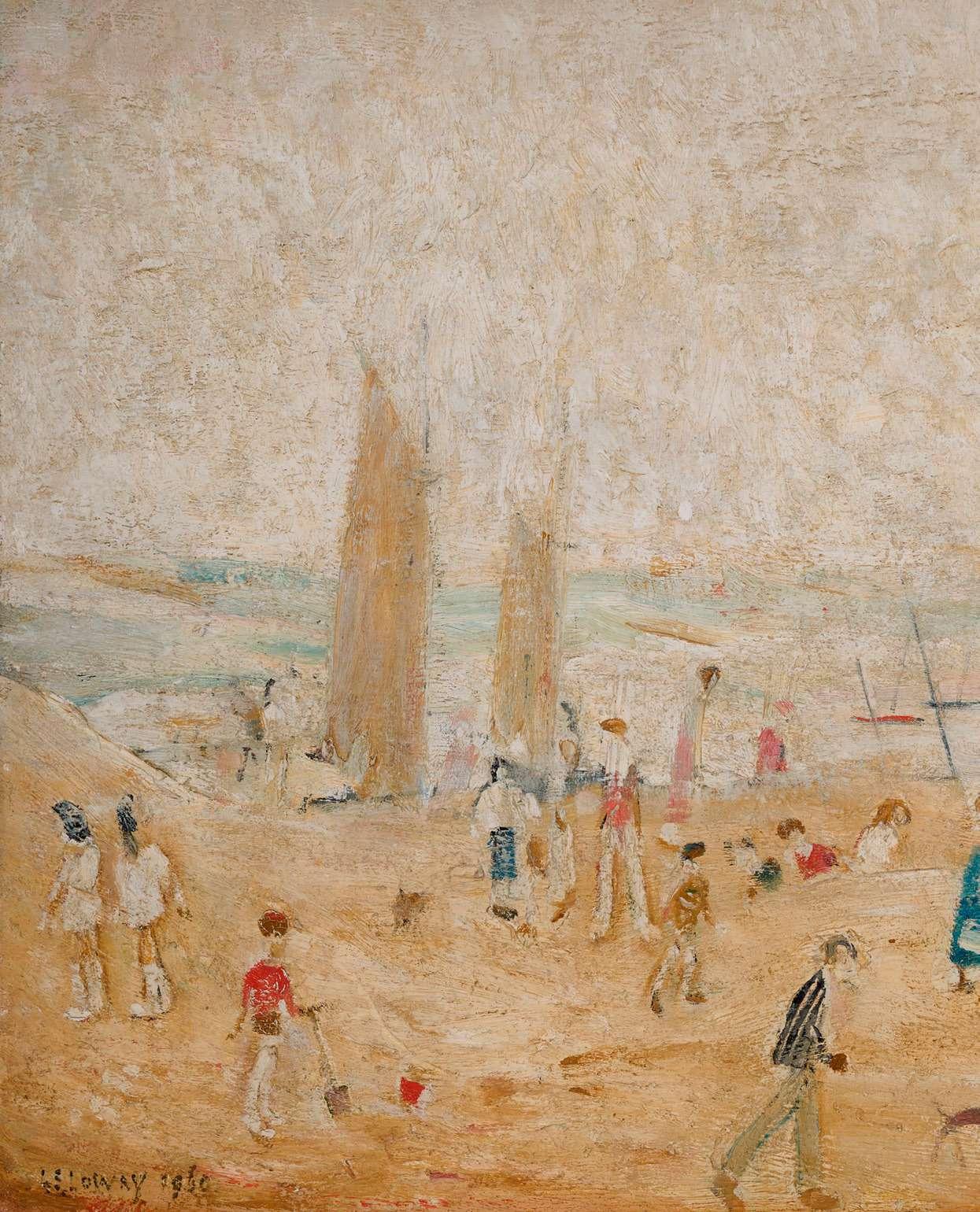
The inconsequential, humdrum activities of young and old together on a beach is underlined by the soft touch of Lowry’s brush. The light colouring of the sand, sea and sky almost merge into one, the figures are similarly muted with just a few of their clothes picked out in red, blue and green, or distinguished by the colour of their hair. Likewise, the pastel hues of the masts and sails that give a vertical structure to the composition are similarly restrained. The effect is quietly symphonic, the capturing of a world that is many layered but essentially harmonious. By the time he painted the present work Lowry’s reputation was already well established. He had retired in 1952 from his full time job as a rent collector for the Pall Mall Property Company where he had worked for over forty years. And he was feted as an artist in particular for his cityscapes and factory scenes which recorded the fast disappearing industrial communities of the north. With more time on his hands he was interested in exploring other subject matter and new opportunities, including visiting the seaside. As a child he had spent his holidays in such resorts as Lytham St Anne’s and Rhyl. Now he explored further afield, travelling regularly to such coastal resorts as Newbiggin-by-the-sea, ports like Berwick-upon-Tweed in Northumbria, or staying in a modest hotel on the seafront in Sunderland. In such locations he watched the boats, surveyed the mood of sea and sky, and captured the incidental activities of the people that criss-crossed his line of vision. As the present work attests, the affinity he found with the sea and the families and generations who enjoyed walking the shore produced a number of remarkable seascapes and beach scenes.
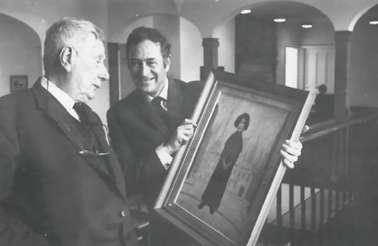
The first owner of the present work was Monty Bloom, who from the end of the 1950s became Lowry’s most important patron and one of his closest friends. At one point Bloom owned over one hundred works by the artist. Bloom’s interest in Lowry was peaked after he watched John Read’s 1957 BBC documentary Artist into Film: L.S. Lowry A successful businessman from Southport, Bloom had been born in the Ebbw Valley in South Wales, and Read’s film prompted him to approach Arthur Frape, the curator at Salford City Art Gallery, to commission Lowry to paint a landscape that would remind Bloom of his childhood home. The artist and patron soon met in Lowry’s studio where Bloom immediately bought a handful of paintings. It was the beginning of a friendship that would last for the next two decades. Lowry frequently visited Bloom and his wife Phyllis for tea or a meal, while Bloom in turn called in on Lowry in his studio and the two men made regular visits together to Wales.
Ronald Lyon, 1928-2004, who purchased the present work at Christie’s in 1969 was a colourful businessman, property developer and collector who at one point owned twenty-one paintings by Lowry. The son
of an Essex housebuilder, Lyon was quick to see opportunity in the property market after the War. He bought up war-surplus buildings and leased them to manufacturers, developed a system of off-the-shelf steel-framed units that could be rapidly assembled for industrial use and devised a sell and buy-back land and property scheme to cash in on the Government’s development grants. His different businesses ranged from dealing in scrap metal to trading estates and in later life collaborated on the development of the Thames Gateway area to the east of London. He traded variously under the names of Ronald Lyon & Co., Ronald Lyon Estates and Lyon Group and luxuriated in his Sunningdale mansion replete with swimming pool. Sociable and stylish by turn, he hosted boxes at Goodwood races and held lavish parties during Royal Ascot. When the breathalyzer was introduced he hired a fleet of Rolls Royces to ferry his guests to and fro for one of his huge parties at The Dorchester, and after jewellery was stolen from his house he bought a three year old cheetah called Princess Roza for his wife to take on a lead to the shops.
Ten works from a Cheshire Collection (lots 40-48)
40
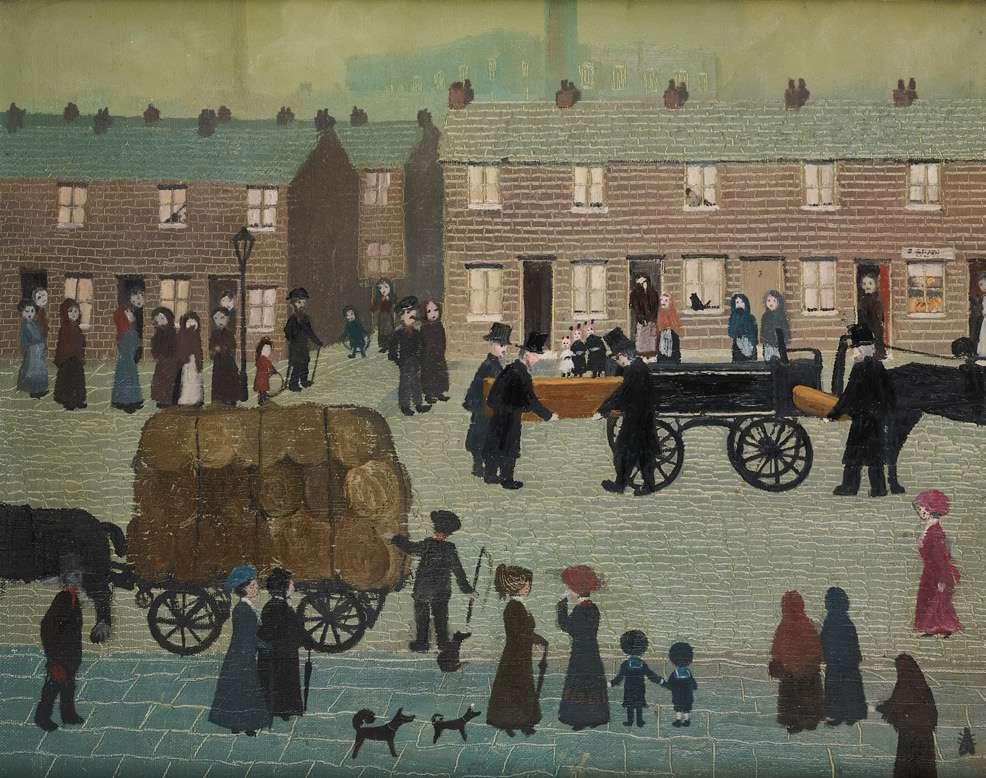
THE DEATH OF ANNIE SIMPSON
signed with a fly symbol lower right; signed, inscribed and dated “Surely” cried Mother and the aunts “the coffin can’t have come for Annie Simpson and her new Baby” alas it had, for there was Miss Carter (who wore Pink) hurrying across the road to enquire for Annie Simpson. ‘Cleaned’ for Miss Carter. We all watched her funeral and (the year was 1908) / Helen Layfield Bradley (1966) on the artist’s label glued to the backboard oil on canvasboard
40.6 x 50.8cm; 16 x 20in
56 x 66.5cm; 22 x 26¼in (framed)
Provenance
Mercury Gallery, London (by 1967)
Mr and Mrs D. Long (purchased from the above on 3rd January 1967)
Sale, Phillips London, 17th November 1992, lot 73
The Lyver and Boydell Galleries, Liverpool (by 1993)
Purchased by the father of the present owner
Exhibited
London, W. H. Patterson, Helen Bradley M.B.E. Commemorative Exhibition, 2000, no. 36
Bath, The Holburne Museum, Helen Bradley - Paintings of a Victorian Childhood, 2000, no. 25
Bradley began her art education at the age of 13 winning a scholarship to Oldham Art school. However, her early artistic endeavours were cut short both by the outbreak of war and her family’s reluctance for her to explore an artistic career. She married after the war and dedicated the next 40 years to raising her family thus it wasn’t until she was 65 that she rekindled her artistic talent.
She met L.S. Lowry in the 1960s who encouraged her to narrate her childhood experiences through her canvases. Her early works focused on the period 1904 to 1908 - she tended to write short descriptions of childhood events and then illustrate them in her paintings - these works often included Miss Carter (who wore pink), Helen herself, her younger brother George, her mother, her three maiden aunts and Mr Taylor, the bank manager, characters who are all present in the present painting.
⊕ £6,000-8,000
Property from a Cheshire Collection 41
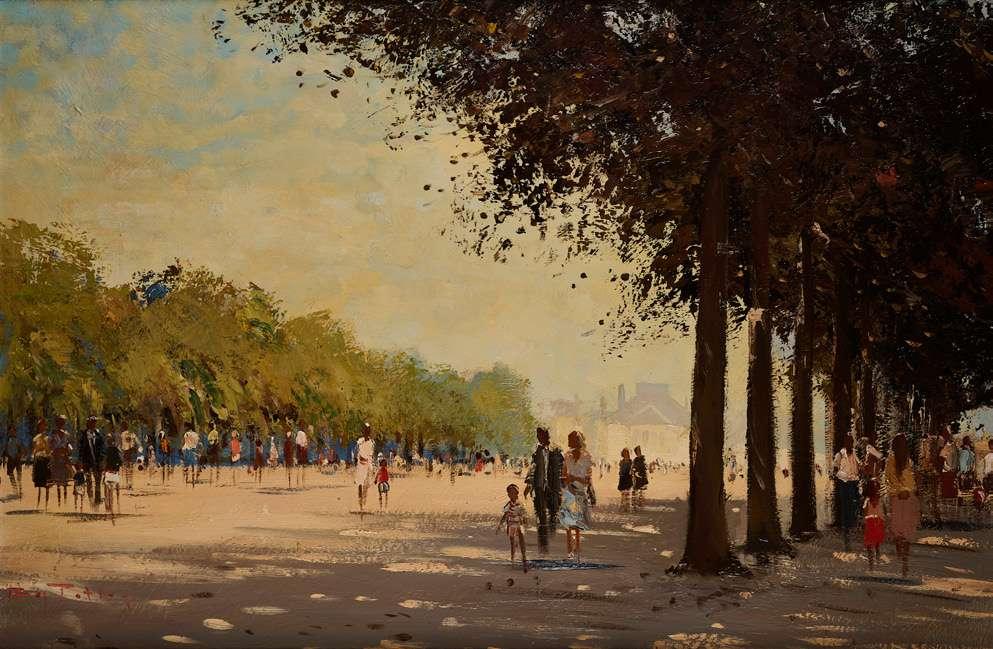
PETLEY (BRITISH B.1951)
THE LUXEMBOURG GARDENS, PARIS
signed Roy Petley lower left oil on panel
59 x 89.5cm; 23 x 35¼in
96 x 126cm; 37¾ x 49½in (framed)
Provenance
Purchased by the father of the present owner
Painter and draughtsman born in Norfolk, Petley is known for sunlit landscapes with figures, often showing the influence of Constable, Sickert, Lavery, Campbell Mellon and Seago. After his parents separated, he was placed in a children’s home and school for ten years, where he began to draw. At Brighton School of Art in 1967 Petley’s request for a transfer from the commercial to the fine art course was refused, so he left after the first term. He spent a year on the continent studying art in museums and galleries, earning his living with instant sketches, which honed his draughtsmanship.
⊕ £1,200-1,800
Property from a Cheshire Collection 42
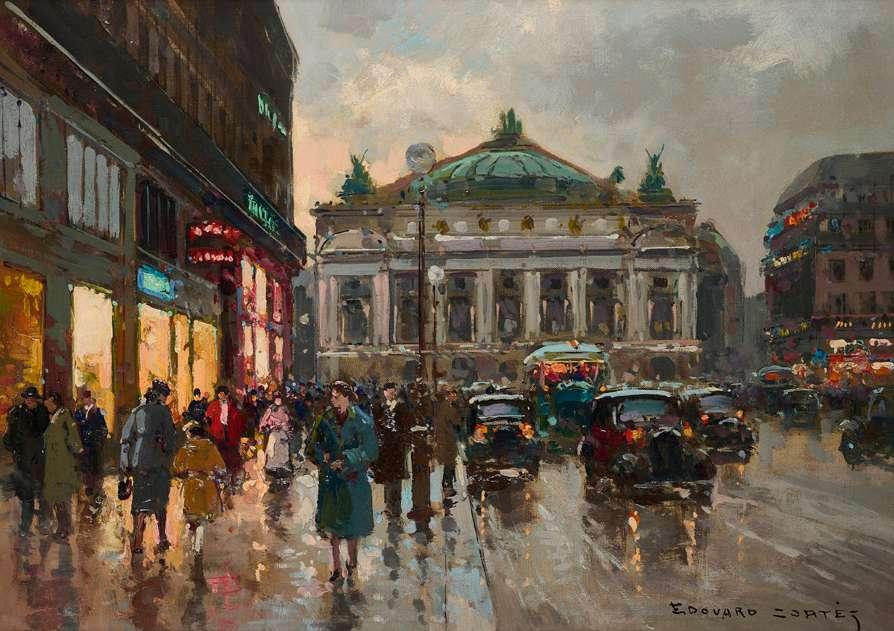
CORTES (FRENCH 1882-1969)
OPERA GARNIER, PARIS
signed EDOUARD CORTES lower right oil on canvas
33 x 45cm; 13 x 171⁄5in
52 x 64.5cm; 20½ x 25¼in (framed)
Provenance
Williams and Son, London
Purchased from the above by the father of the present owner
⊕ £8,000-12,000
Property from a Cheshire Collection 43
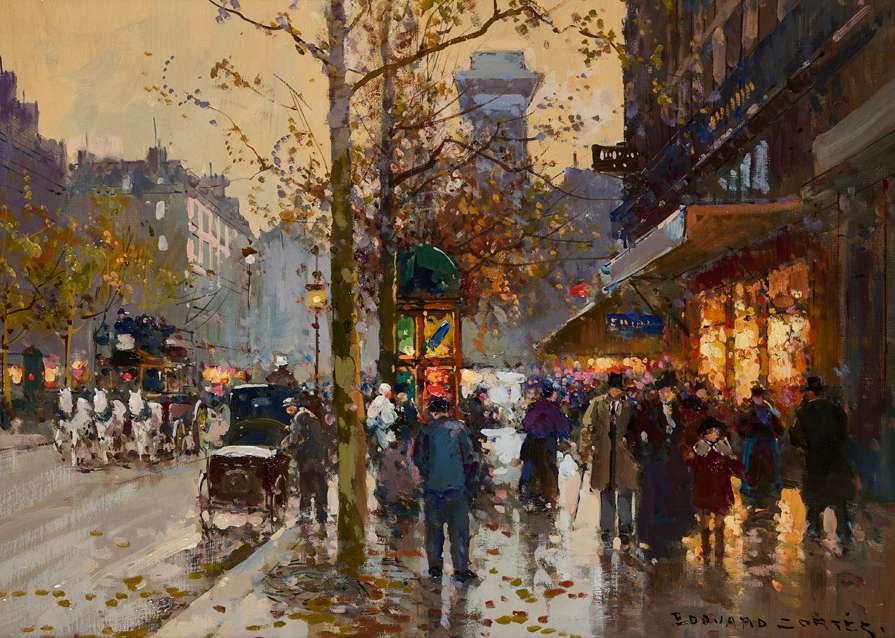
1882-1969)
PORTE ST. DENIS, PARIS
signed EDOUARD CORTES lower right oil on canvas
33 x 46cm; 13 x 18in
52 x 64.5cm; 20½ x 25¼in (framed)
Provenance
Williams & Son, London
Purchased from the above by the father of the present owner
⊕ £8,000-12,000
Property from a Cheshire Collection
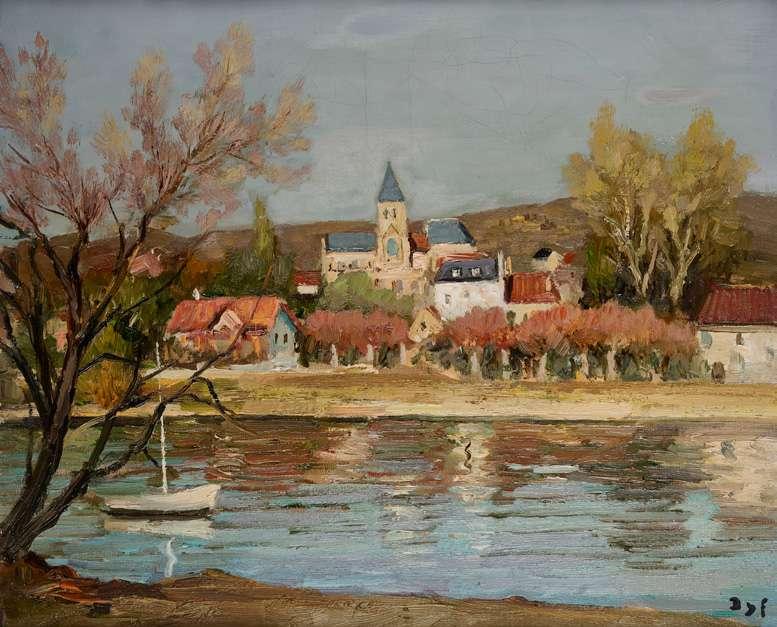
MARCEL DYF (FRENCH 1899-1985)
TRIEL-SUR-SEINE
signed Dyf lower right; with the artist’s studio stamp and dated 1970 on the stretcher oil on canvas
46 x 55cm; 18 x 21¾in
66 x 74cm; 26 x 29in (framed)
Provenance
Frost & Reed, London
MacConnal Mason & Son Ltd., London
Purchased from the above by the father of the present owner
⊕
£5,000-7,000
Property from a Cheshire Collection 44
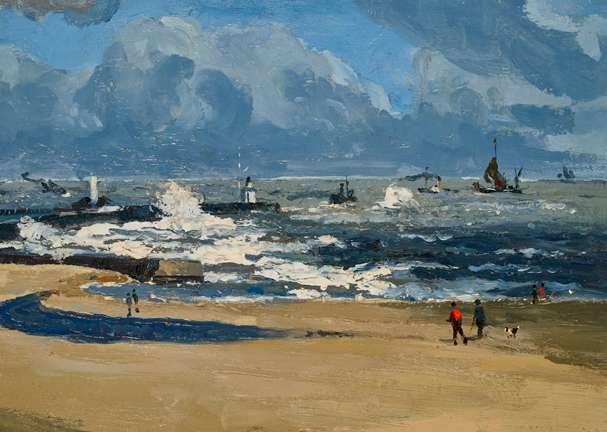
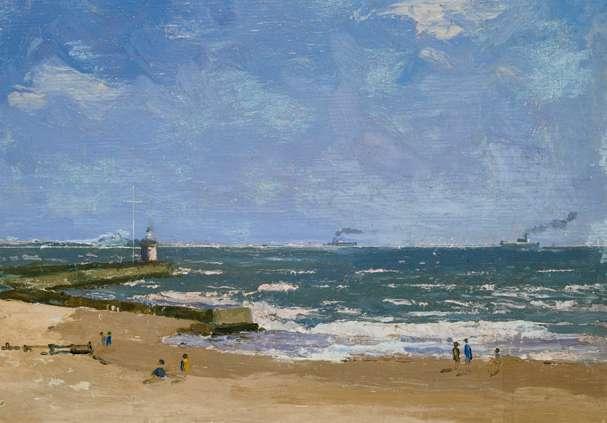
CAMPBELL ARCHIBALD MELLON (BRITISH 1878-1955)
VIEWS OF THE BEACH, GORLESTON-ON-SEA, NORFOLK - A PAIR each oil on board both 22 x 29cm; 8½ x 11½in both 34 x 42cm; 13¼ x 16½in (framed) (2)
Provenance
W.H. Patterson, London
Purchased from the above by the father of the present owner
Born in Berkshire, Mellon settled in Nottingham in 1903, but after service in the First World War moved to the town of Gorleston in Norfolk where he became well-known for his seaside views. He enjoyed painting the sea and beach whilst looking into the sun and was fascinated by the play of light on the sand. Often small format, the scenes give a strong sense of the ever-changing Norfolk weather, with vast skies and billowing clouds sweeping up and down the coast. Mellon studied under Sir John Alfred Arnesby Brown (1866-1955), who lived and worked in Nottingham and later moved to Norfolk and was best known for his Impressionistic landscapes. Although Mellon worked out-doors, his paintings were mostly composed in the studio, where he re-arranged details to suit his own ideas.
£3,000-5,000
Property from a Cheshire Collection
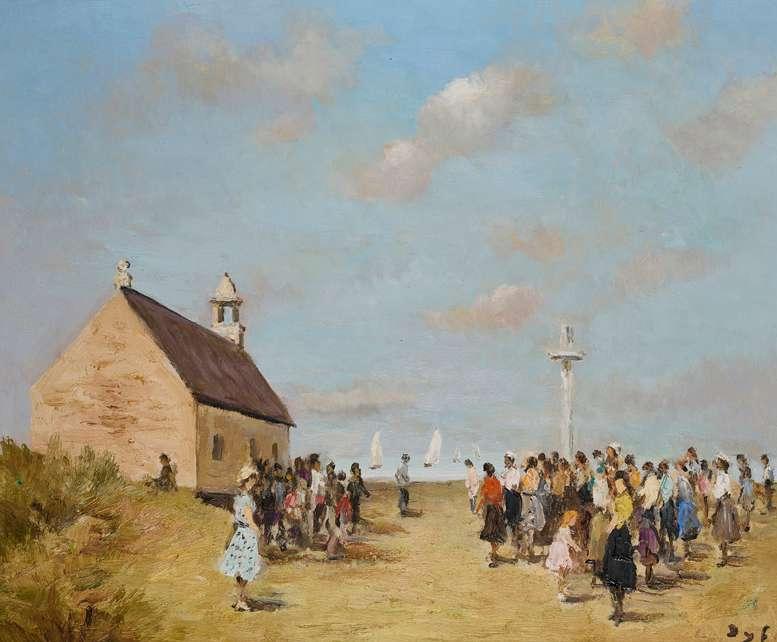
MARCEL DYF (FRENCH 1899-1985) PARDON, CHAPELLE DU CROISTY
signed Dyf lower right oil on canvas
44 x 53cm; 17¼ x 20¾in
66 x 74cm; 26 x 29in (framed)
Provenance
Frost & Reed, London
Purchased from the above by the father of the present owner
⊕
£4,000-6,000
Property from a Cheshire Collection 47
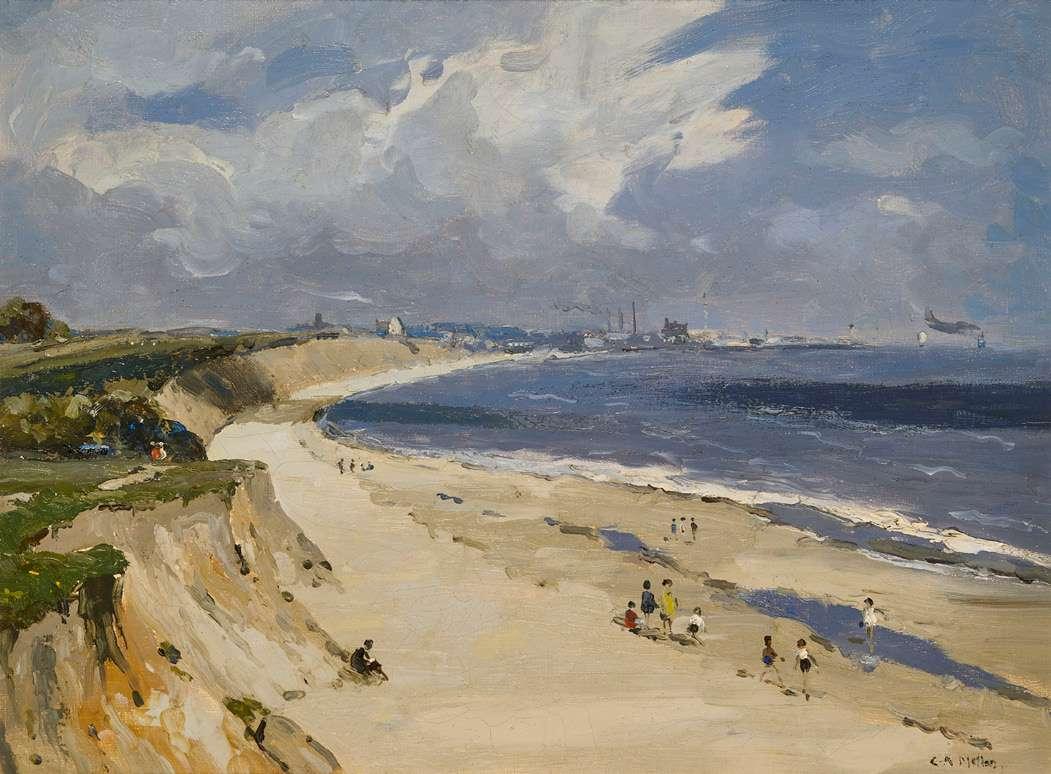
CAMPBELL ARCHIBALD MELLON (BRITISH 1878-1955)
WHITE SANDS, YARMOUTH
signed C A Mellon lower right oil on canvas
29 x 39cm; 11½ x 15¼in
43 x 53cm; 17 x 20¾in (framed)
Provenance
John Magee Ltd., Belfast
Purchased from the above by the father of the present owner
see note to lot 44
£2,500-3,500
Property from a Cheshire Collection 48
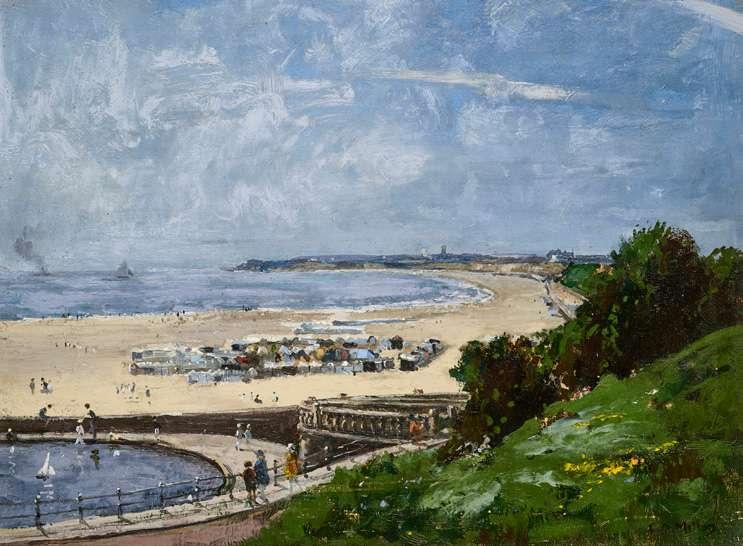
CAMPBELL ARCHIBALD MELLON (BRITISH 1878-1955)
THE BOATING POND AND BEACH, GORLESTON-ON-SEA
signed C A Mellon lower right oil on canvas
29 x 39.5cm; 11¼ x 15½in
44 x 54cm; 17¼ x 21¼in (framed)
Provenance
Williams & Son, London
Purchased from the above by the father of the present owner
see note to lot 44
£2,500-3,500
Property from a Private Collection, London
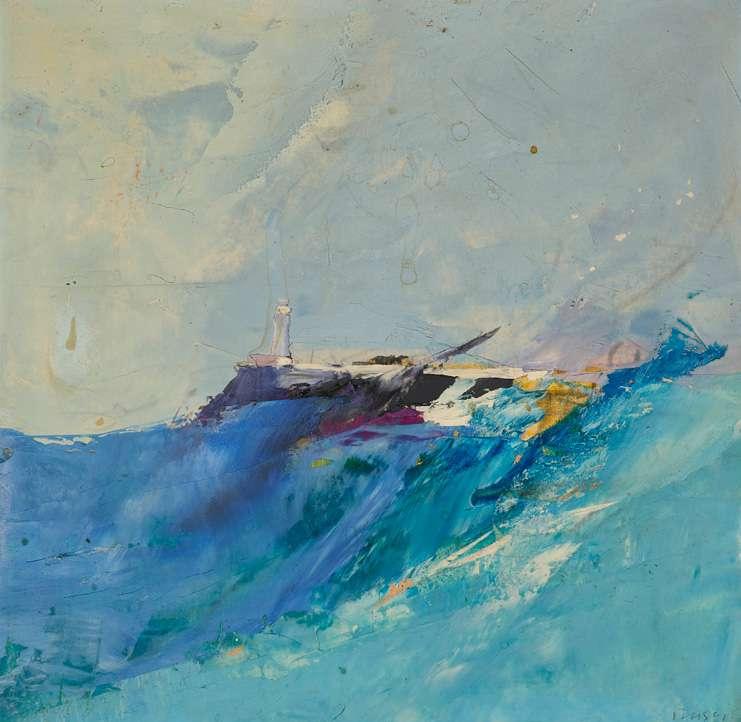
DONALD HAMILTON-FRASER (BRITISH 1929-2009)
ROUGH SEAS BY THE LIGHTHOUSE
signed Fraser lower right oil on paper
22 x 22.5cm; 8½ x 9in
38 x 38.5cm; 15 x 15¼in (framed)
Provenance
Sale, Gorringes Lewes, 2nd July 2009, lot 1750
Purchased at the above sale by the present owner
⊕ £1,000-1,500
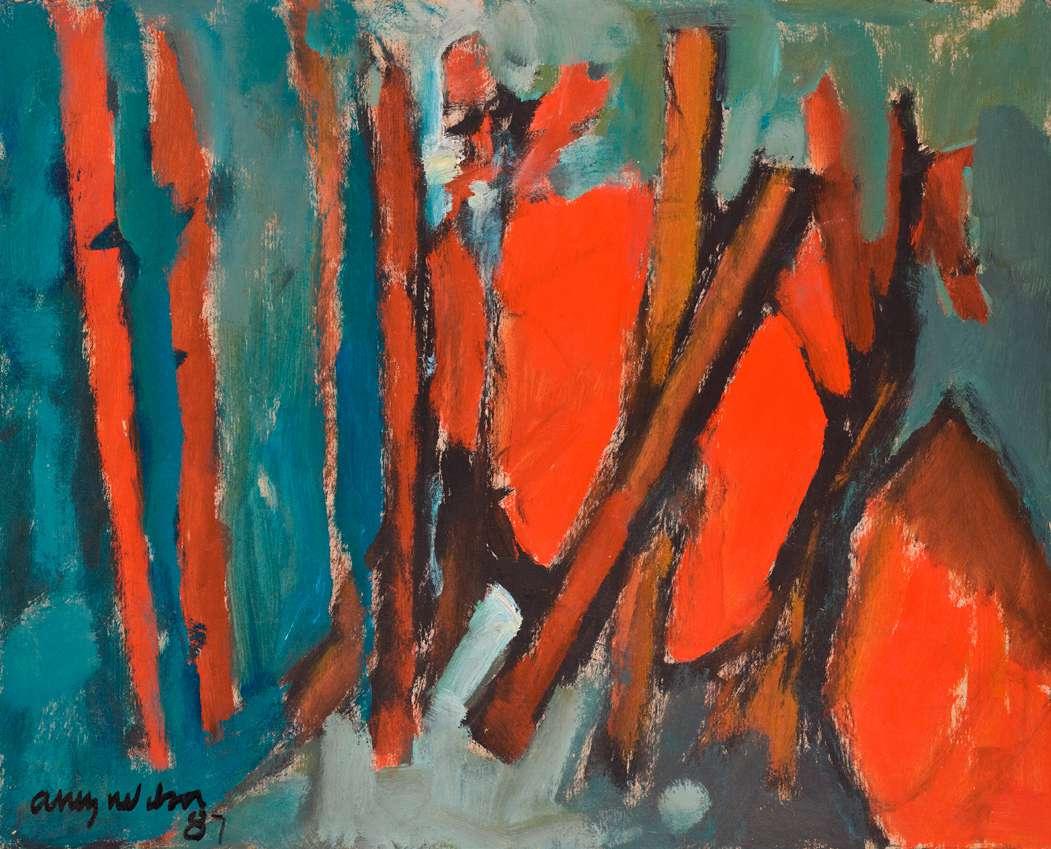
ABSTRACT RED AND BLUE
signed and dated Avray Wilson / 87 lower left oil on board
41 x 51cm; 16 x 20in
54.5 x 65cm; 21½ x 25½in (framed)
Provenance
Purchased from the artist by the present owner in 1989
Avray Wilson studied Biology at Cambridge before spending time in Paris and Norway after the Second World War. His interest in Abstract Expressionism developed via his exposure to the New York School of artists and his exploration of the spontaneous brushwork, drips and scribble-like marks that characterised Tachisme in Europe. Back in
London, he became a member of the progressive Free Painters Group and befriended like-minded tachiste Denis Bowen. With Bowen, Avray Wilson founded the New Vision Centre Gallery in 1956 and during the next decade promoted hard-edged, lyrical and expressive forms of abstraction, balancing free and explosive impulses with geometry and structure, reflecting both his scientific study and contemporary currents in European painting. A regular visitor to Paris during the 1950s, Avray Wilson enjoyed a succession of solo exhibitions in London, Paris and Brussels, and participated in group shows alongside Hans Hartung, Alfred Manessier, Georges Mathieu, Jean-Paul Riopelle and Pierre Soulages, exhibiting jointly with Soulages in 1956 and 1957. Retrospectives of his work were held by the Paisnel Gallery in 2011 and by Whitford Fine Art in 2016 and 2018.
⊕ £500-700
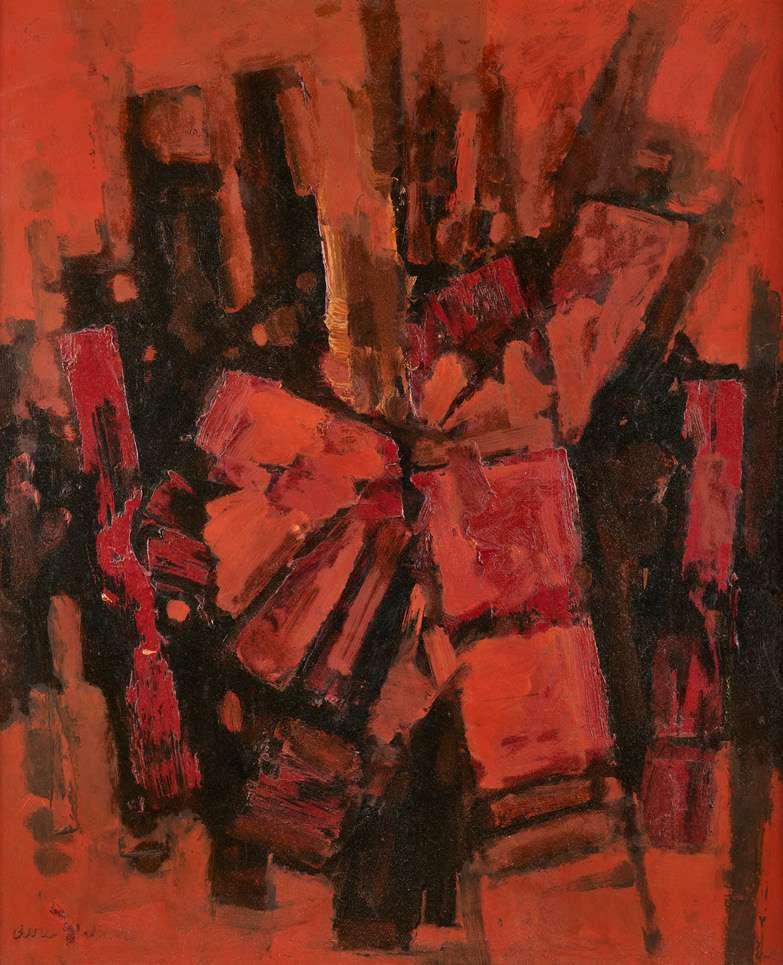
Property from a London Collector
RED ABSTRACT
signed Frank Wilson lower left oil on board
85 x 72cm; 33½ x 28¼in
92 x 78cm; 34¼ x 30¾in (framed)
Provenance
Sale, Bonhams London, 17th January 2012, lot 129
Purchased at the above sale by the present owner see note to previous lot
⊕ £1,200-1,800
Property from the Estate of Martin Froy
52
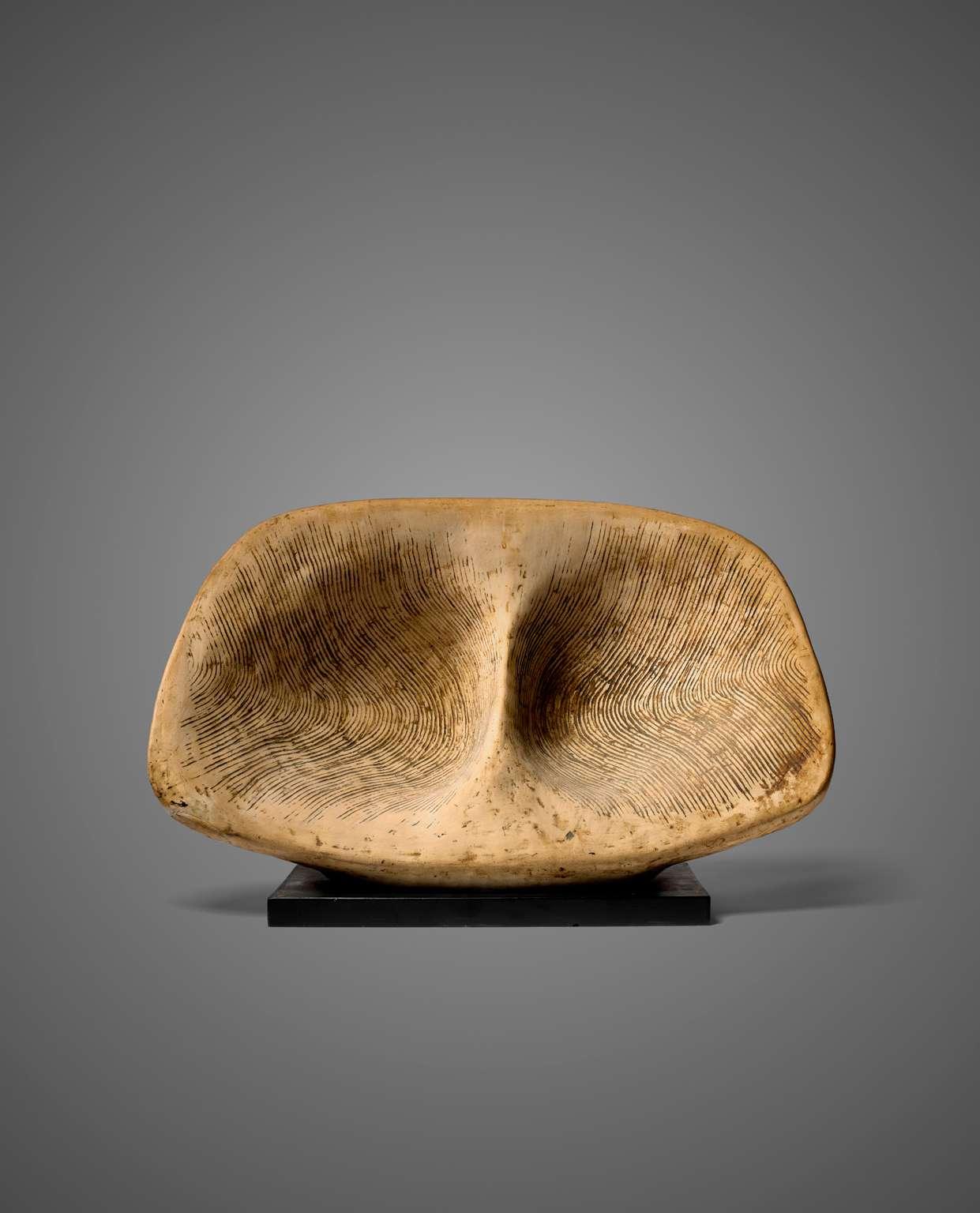
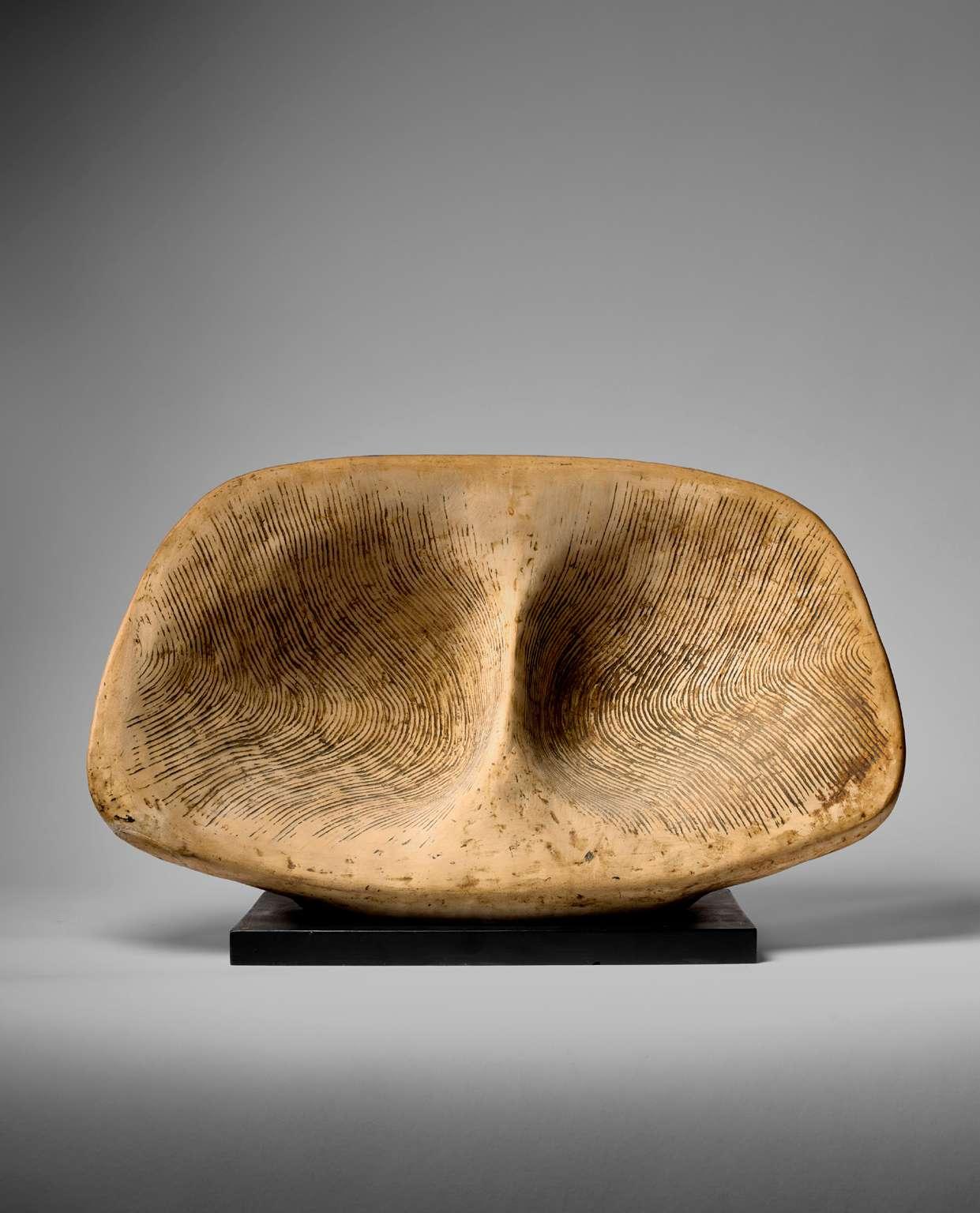
CONCAVE FORM VIII
earthenware and white slip
48 x 79cm; 19 x 31½in
52 x 79cm; 20½ x 31½in (including base)
Executed in 1961.
Provenance
A gift from the artist to the late owner in the early 1960s (Martin Froy, 1926-2017, became friends with James Tower at Bath Academy of Art at Corsham Court where Froy was Head of Fine Art from 1954-65. After Corsham Court Froy was appointed head of painting at Chelsea School of Art, and then Professor of Fine Art at Reading University. In the 1970s he was a trustee of both the National Gallery and the Tate Gallery)
Exhibited
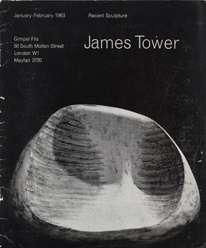
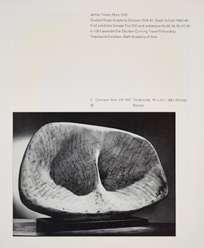
London, Gimpels Fils, James Tower, Recent Sculpture, 1963, no. 2 (illustrated in the catalogue)
Literature
Timothy Wilcox, The Ceramic Art of James Tower, London, 2012, p. 62, fig. 47, illustrated (incorrectly dated and described)
The present work is from the series of thirteen Concave forms that Tower showed with Gimpel Fils gallery in London in January 1963. The exhibition was accompanied by a catalogue illustrating all thirteen (fig.1).
Describing the series Wilcox wrote: ‘Each of the forms has a strong silhouette, a defining edge that encloses a shallow volume […] Though made of fired earthenware, they are finished with white slip so they appear like plaster.’ He goes on to note that the pieces were going to be cast in bronze, but ‘in practice only one or two were’. (Wilcox, p. 43).
A bronze cast of the present work was sold at auction in Canada in 2011 (Sale, Heffel Fine Art Vancouver, 28th April, 2011, lot 30).
Tower’s work became hugely collectable in the 1950s and 60s when he was represented by the fashionable
I look to the strong English tradition of absorption in landscape and organic forms, the search to find a poetic metaphor for landscape, sea and weather, to try and translate the ephemeral into the permanence of terracotta and glaze James Tower
London gallery Gimpel Fils. Executed mostly in ceramic, Tower pushed visual boundaries and introduced a new way to appreciate sculptural form in Britain, much like the work of his contemporaries Henry Moore and Barbara Hepworth, whose work was regularly shown along side his at the gallery.
Wilcox notes in his analysis of Tower’s Concave form series that: ‘Each of the Concave forms has a grooved surface, in some the grooves run horizontally, regardless of the curvature of the form.’ He continues: ‘In the present work [this lot]…, the graphic skin twists and bends more than the shape itself, introducing new cross rhythms. A central spine divides the inner space in half, creating two equal chambers’ (Wilcox, p. 63).
Tower reflected on how the concave form that so intrigued him recurs in the landscape, the human body and inert objects in apparently equal measure: ‘The shallow concavities which hold light and shadow on the downs, parallels the same shallow concavity which holds light and shadow on the palm of the hand. Again, it is paralleled in the concavities and convexities of objects worn by use.’
Born on the Isle of Sheppey on the north Kent coast, Tower grew up in a landscape between land and water, windswept beaches and the mudflats of the tidal Thames which revealed to the artist many configurations of pattern and texture. Tower later studied in London at the Royal Academy Schools (1939-41) and at the Slade (1946-49) where he was taught drawing by Thomas Monnington (1902-1976).
After graduating, he enrolled at the University of London’s Institute of Education to train as an art teacher where ceramics was taught by the New Zealand potter William Newland (1919-1998). Tower showed immediate talent for the medium and began teaching the new Slade intake two days a week, before leaving in 1949 to set up the ceramics department at Bath Academy of Art at Corsham Court with minimal experience. Fellow new artists appointed there included William Scott and Kenneth Armitage to teach painting and sculpture respectively. In 1957 Tower was awarded the Steuben Corning Travel Fellowship and in 1961 the Leverhulme Research Award.
sold with a copy of the 1963 Gimpel Fils exhibition catalogue in which the present work is illustrated
⊕ £4,000-6,000
TWO INTO ONE WILL GO
signed, titled and dated ‘Two into One Will Go’ / no.12 / 2nd Series / 1983 / Gwyther Irwin lower left watercolour and brush and pen and ink on paper
68.5 x 91cm; 27 x 36in
84 x 107cm; 33 x 42in (framed)
Provenance
Sale, Rosebery’s London, 12th March 2024, lot 366
Purchased at the above sale by the present owner
Irwin spent most of his life in North Cornwall. In 1964, he represented Britain at the Venice Biennale along with Joe Tilson, Bernard Meadows and Roger Hilton. His early work consisted primarily of complex collages made up of newspapers and advertisements collected off the street which he assembled to achieve extremely subtle and delicate colouration. In the 1980s, Irwin’s earlier tonal and almost monochromatic collages gave way to works of great complexity and vibrant colour. ‘Two Into One Will Go’ sits chronologically between his exhibition at Kettle’s Yard, Cambridge in 1981 and a retrospective at Gimpels Fils, London in 1987.
⊕ £1,000-1,500
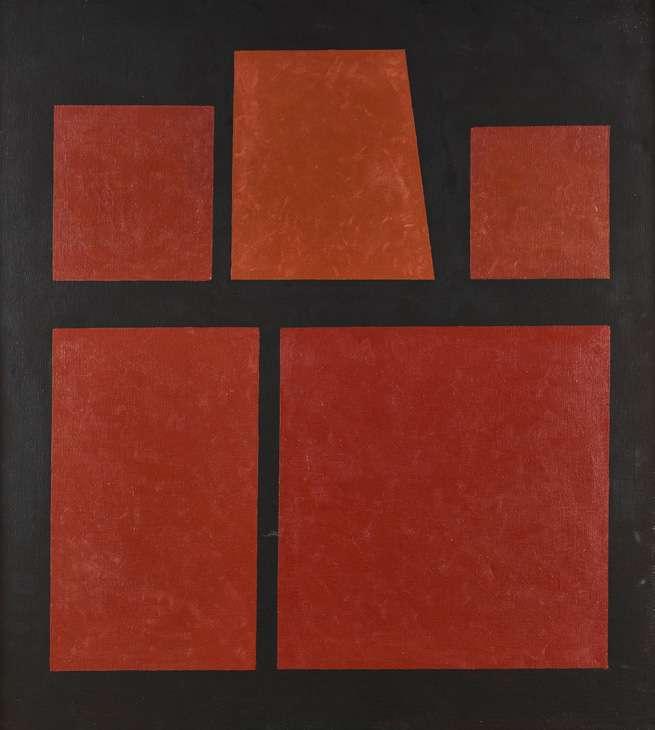
signed, inscribed and dated 14- ‘92 / March / Haigh on the reverse oil on canvas
91.5 x 81cm; 36 x 32 in
The son of a farmer, Haigh trained as a textile sample dyer, a skill that gave him a life long understanding of shape and colour. He sold his first painting at the age of 15, his early work reflecting his admiration for Augustus John and Walter Sickert. However, as his style evolved his compositions became more geometric and abstract and his colours more muted as evident in the present lot.
⊕ £800-1,200
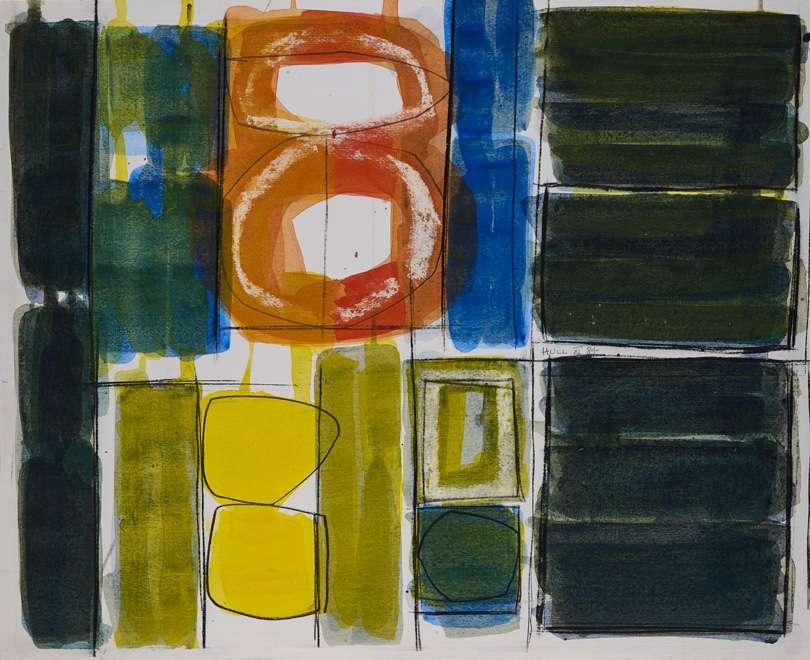
COMPOSITION - BLUE RED AND YELLOW
signed and dated HULL XI 84 centre right watercolour with charcoal on paper
61 x 75cm; 24 x 30in
76 x 89cm; 29 x 35in (framed)
Hull aptly summed up his work as ‘a tension of objects in space.’ The way in which simplified geometric forms interlock and appear to support each other in ‘Composition, Blue, Red & Yellow’ is typical of his later work. After a successful early career as an artist, Hull turned his back on painting full time after winning a competition to design the interior of the Daily Mirror building, spending the 60s as a design consultant for the International Publishing Corporation (IPC). In 1980 he returned to painting, his work starting to gain traction once again by the end of the decade, first at the Strickland Gallery in 1986, and then with Adrienne Resnick Gallery and Whitford & Hughes in 1989. His death a year later was all too premature.
⊕ £700-900
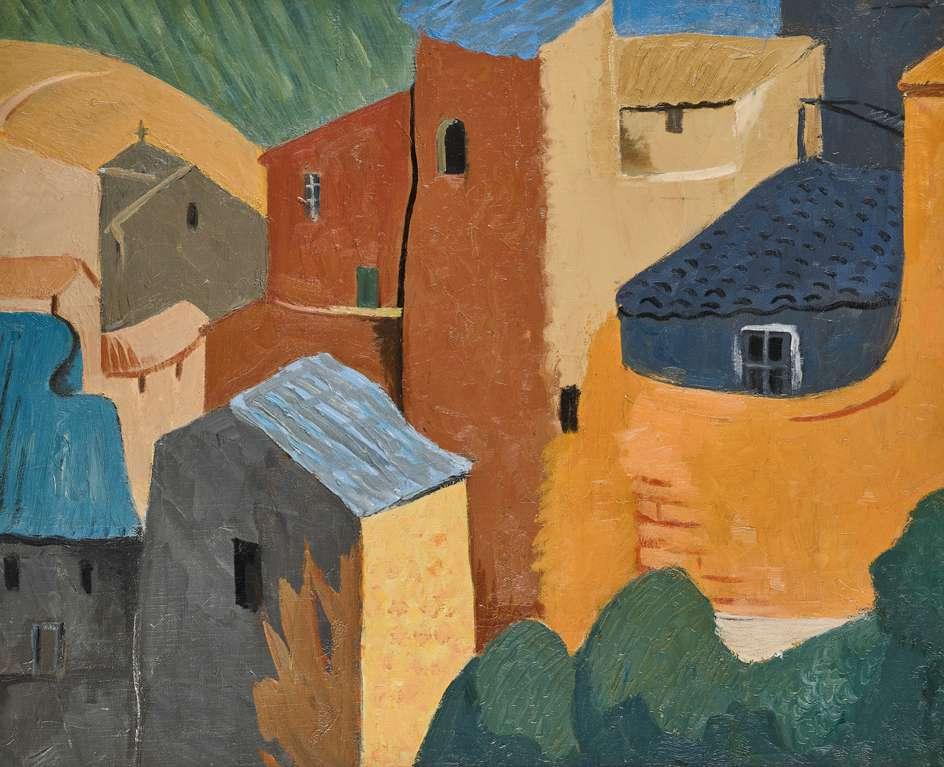
HILL TOWN, ITALY
oil on canvas
44.5 x 54cm; 17½ x 21¼in
63 x 72cm; 24¾ x 28¼in (framed)
Provenance
Estate of the artist
Purchased from the above by the present owner circa 1999
Exhibition
London, Whitford Fine Art, Cissie Kean, 1999, no. 31
⊕ £1,000-1,500
Property from a London Collector
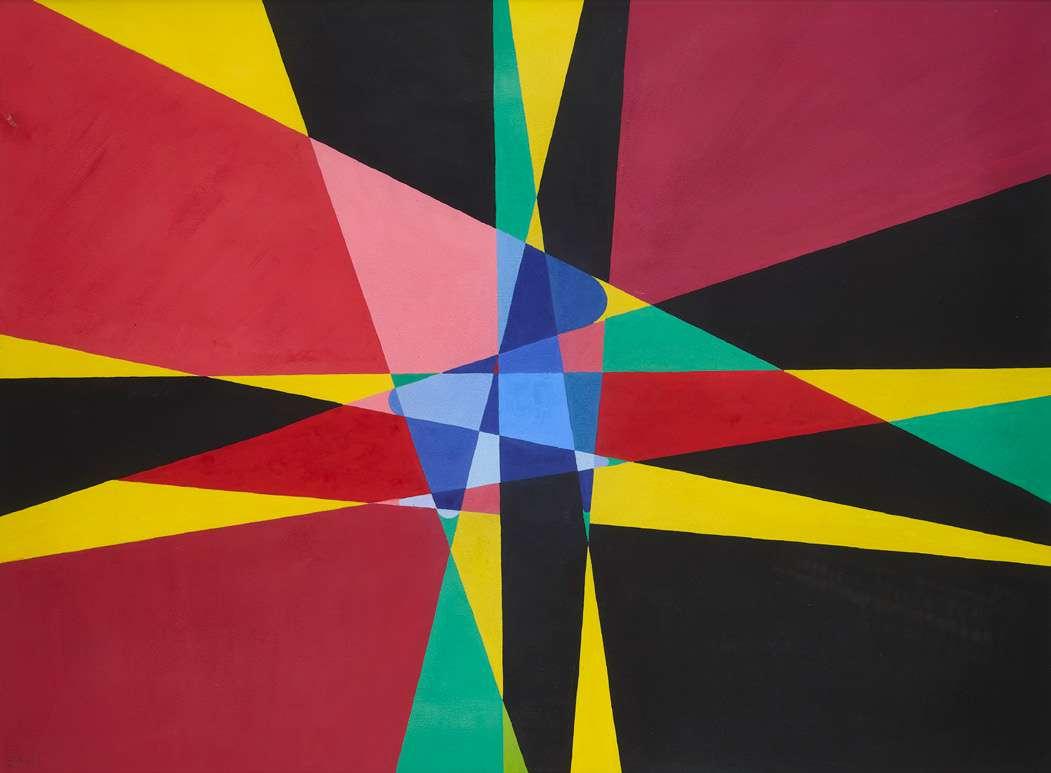
ETIENNE BEOTHY (HUNGARIAN 1897-1961)
ABSTRACT
signed with initials and dated ‘52 lower left; signed with initials, with the studio stamp and dated ‘52 on the reverse gouache on paper
56 x 76cm; 22 x 30in
80 x 98cm; 31½ x 38½in (framed)
Provenance
Sale, Christies London, 24 June 2011, lot 158
Purchased at the above sale by the present owner
Sculptor-painter Etienne Beothy studied architecture in Budapest before moving to Paris in 1925, where he became one of the founder members of the group Abstraction-Creation in 1931 alongside Piers Mondrian (1872-1944), Hans Arp (1886-1966) and Franz Kupka (1871-1957). In 1946 he participated in the creation of the Salon des Réalités Nouvelles which played a vital role in the diffusion of geometric abstraction. Often incorporating mathematical and geometric principles into his compositions such as the ‘golden ratio’, his work balances the universal concepts of time, space and matter with human emotions such as the human conscience and thoughts, feelings and free will. Beothy’s contemporaries from the 1950s abstract movement included Jean Leppien (1910-1991), Edgar Pillet (1912-1996) and André Lanskoy (1902-1976).
⊕ £1,000-1,500
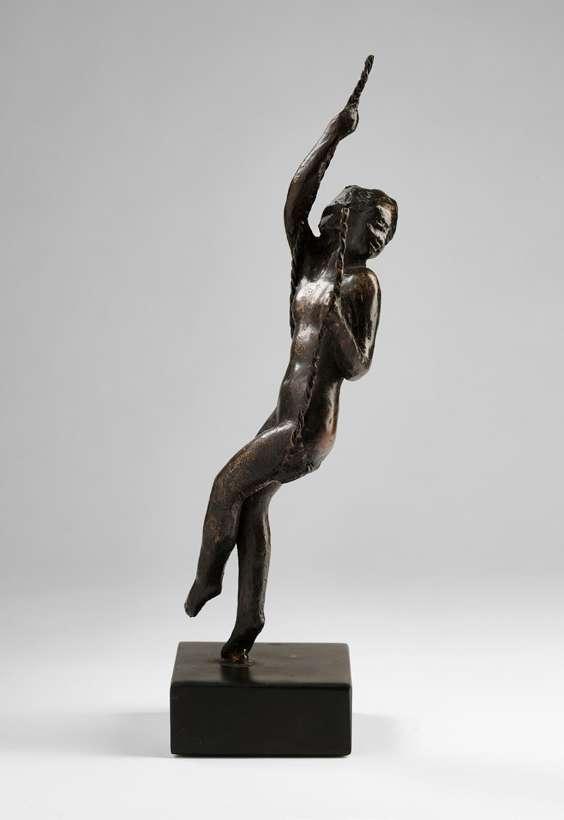
Property from a Private Collection, West London
SYDNEY HARPLEY RA (BRITISH 1927-1992)
GIRL ON A SWING
with the artist’s stamp Harpley and numbered 3/12 bronze
height: 23cm; 9in (excluding base)
height: 25cm; 9¾in (including base)
Provenance
Cecilia Green, London (Cecilia Green, 1931-2003, was the muse and model of the painter William Russell-Flint from the early 1950s to the mid-1960s)
Inherited from the above by the parents of the present owner
Hartley sculpted dancers, acrobats and girls on swings with equal audacity and elegance. He established the single female as his favourite subject while still a student, exhibiting examples with the Young Contemporaries and at the Royal Academy, selling his first pieces to the National Gallery of New Zealand, Wellington and the artist Fleur Cowles (1908-2009).
The son of an electrician and cabinet maker, Harpley grew up in Dagenham, leaving school at 14 to become an apprentice electrician. But after seeing the carved head of Ramases II in Cairo during National Service with the Royal Engineers (1945-48) he was compelled to sculpt. He became a student of sculpture at Hammersmith School of Art in 1951, and in 1953 began at the Royal College of Art under the instruction of John Skeaping. After the RCA he returned to Hammersmith to teach part-time and began to receive commissions for portrait busts and figurative groups. Elected to a fellow of the Royal Society of British Sculptors in 1963, he joined the staff at Leicester Polytechnic in 1972 and was elected a Royal Academician in 1981. A succession of successful exhibitions followed at home and abroad, including two at the Chris Beetles Gallery in 1987 and 1990.
⊕ £1,500-2,000
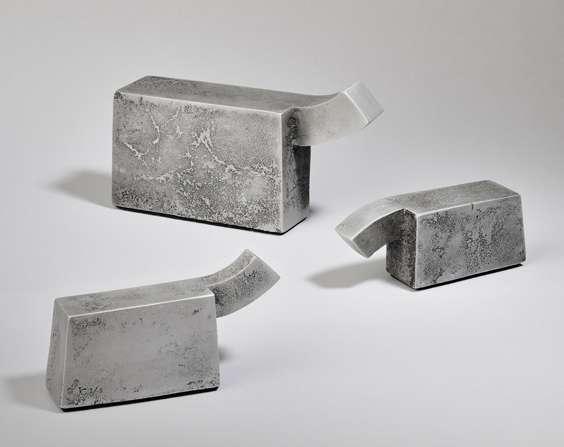
Property from a Private Collection, West London
59
JOHNATHAN CLARKE (BRITISH B.1961)
STOCK (EWE WITH LAMBS)
each stamped with initials and numbered 2/9
cast aluminium
height: 9cm; 3½in (largest)
height: 6cm; 2½in (the smaller two) (3)
Cast in 2022, Stock (Ewe with Lambs) is a development of an earlier work from 2007, titled ‘Browsers’, a large-scale commission in New Street Square, London. This sculpture is about proportion and relationship, mother and offspring, instantly recognizable in this minimalist form. Each element is entirely free, instilling a naturalistic feeling to the work.
⊕ £300-500
60
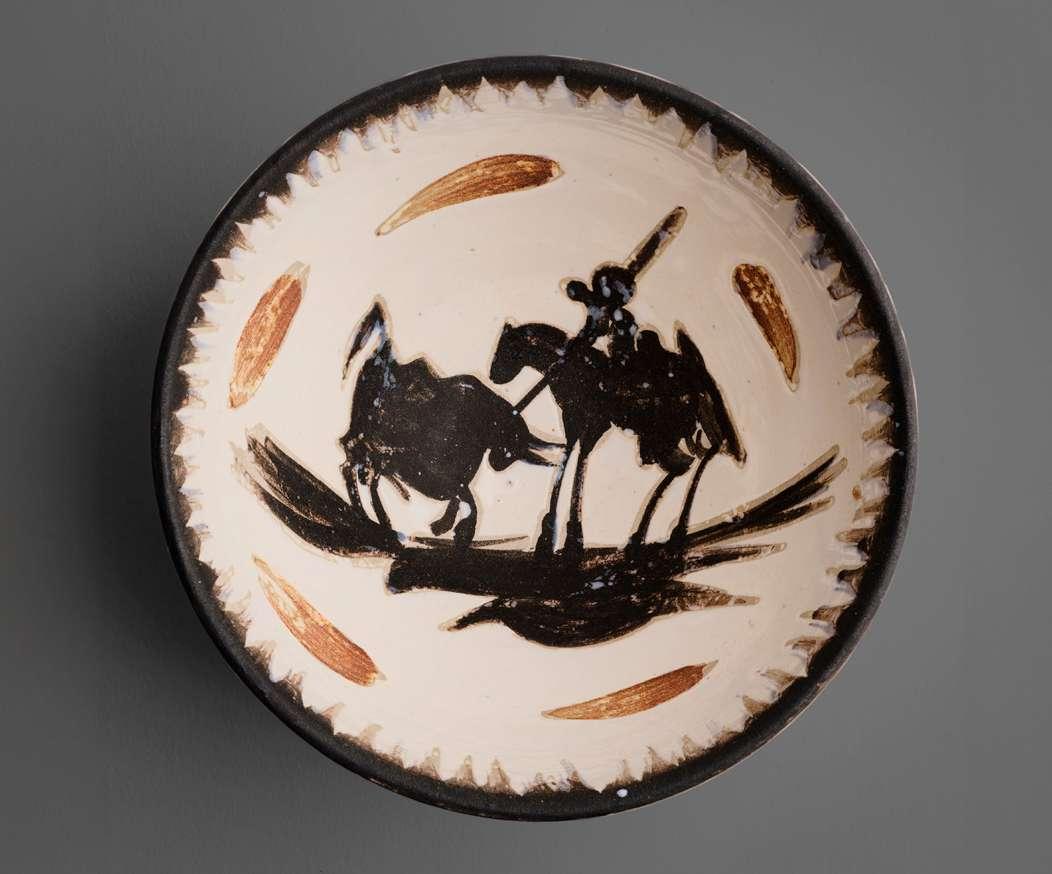
PABLO PICASSO (SPANISH 1881-1973)
PICADOR (A.R. 289), 1955
inscribed EDITION / MADOURA / PICASSO on the base
white earthenware ceramic bowl with black and red engobes and glaze
height: 7cm; 2¾in
diameter: 12.5cm; 5in
Provenance
Cecilia Green, London (Cecilia Green, 1931-2003, was the muse and model of the painter
William Russell-Flint from the early 1950s to the mid-1960s)
Inherited from the above by the parents of the present owner
Literature
Alain Ramié, Picasso: Catalogue of the Edited Ceramic Works, 1947-1971, Madoura, 1988, no. 289 (illustration of another example from the same edition)
⊕ £3,000-5,000
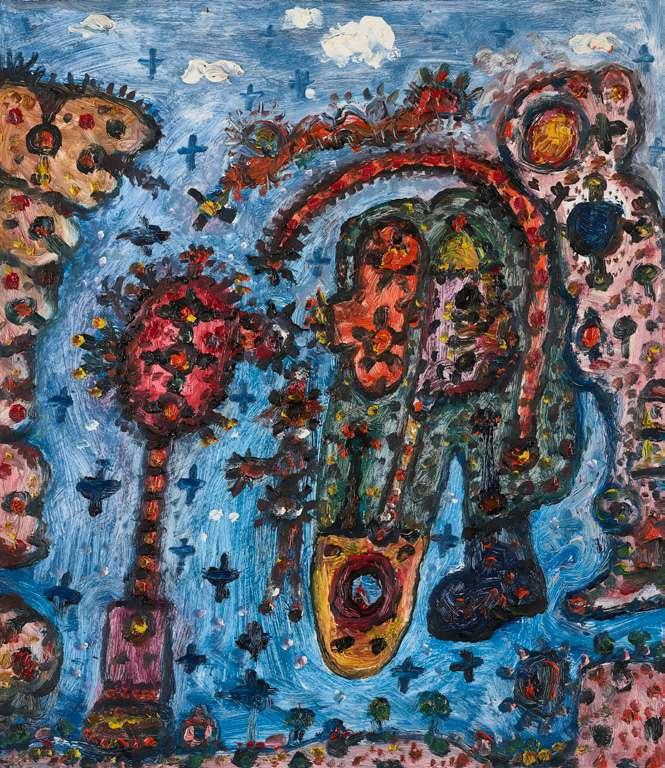
Property from a Private Collector, Kingston 61
ALAN DAVIE RA (BRITISH 1920-2014)
GIANT SKYSCAPE (OPUS 01948)
signed, titled and dated Alan Davie 08 / GIANT SKYSCAPE / Opus - 01948 on the reverse oil on board
37 x 32cm; 14½ x 12½in
40 x 35cm; 15¾ x 13¾in (framed)
Provenance
Estate of the artist
Gimpel Fils, London
Acquired from the above by the present owner circa 2020
Exhibited
Paris, Gimpel & Muller, Alan Davie, The Seventies, 2017
Alan Davie was one of the leading Scottish artists of his generation; his career spanned six decades and he first exhibited with Gimpel Fils in 1950. His rise to international prominence after the Second World War was precipitated by a number of exhibitions in Europe when his series of monumental paintings attracted the early attention of collectors. Davie was one of the first artists to appreciate the zeitgeist of the New York School, meeting de Kooning, Pollock, Motherwell amonst others in New York in 1956. The same year his work was purchased by a number of important museums. Throughout his career, Alan Davie had a long association with Cornwall and the St Ives School of Modernists, and was acquainted with most of the second generation of St Ives artists including Patrick Heron, Terry Frost, Bryant Wynter and Peter Lanyon.
£800-1,200
Property from a Private Collector, Kingston 62
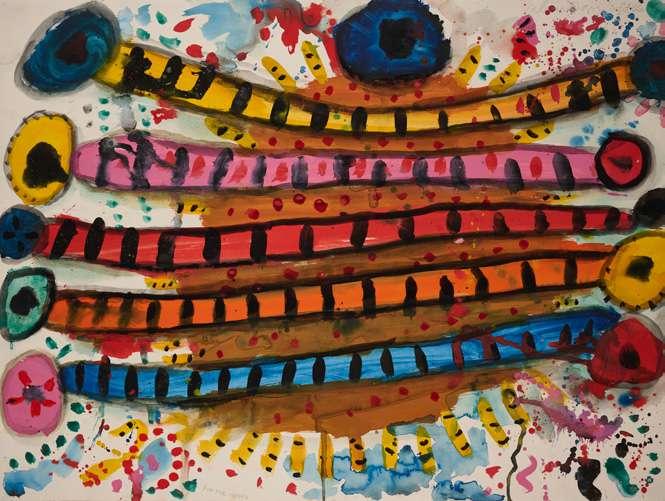
ALAN DAVIE RA (BRITISH 1920-2014) FOR FIVE SISTERS (OPUS G.309)
signed and dated Sept 66 upper right; titled FOR FIVE SISTERS lower left watercolour on paper
56 x 74.5cm; 22 x 29¼in unframed
Provenance
Studio of the artist Gimpel Fils, London
Acquired from the above by the present owner circa 2015 Exhibited
Harrogate,108 Fine Art, Alan Davie: Channels of Communication Paintings and Drawings 1948-2004, 2006 (illustrated in colour in the catalogue)
⊕ £500-700
Property from a Private Collector, Kingston 63
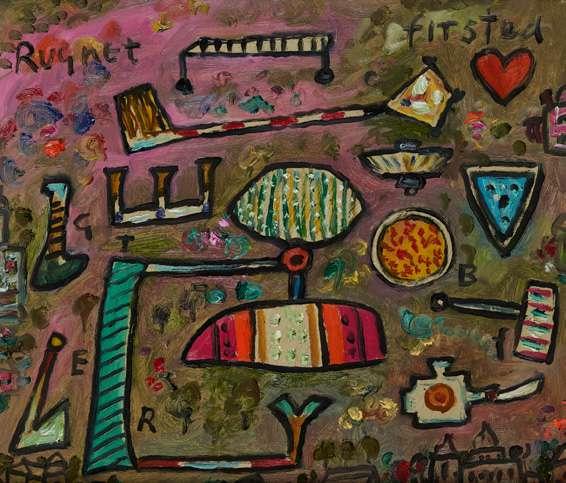
ALAN DAVIE RA (BRITISH 1920-2014) RUGNET FIRSTED (OPUS 01396)
titled rugnet firsted upper edge; signed, titled and dated Alan Davie 1998 / RUGNET FIRSTED / OPUS 01396 on the reverse oil on board
24.5 x 29cm; 9¾ x 11½in
39.5 x 43cm; 15½ x 17in (framed)
Provenance
Estate of the artist Gimpel Fils, London
Acquired from the above by the present owner circa 2020
⊕ £600-800
Property from a Private Collector, Kingston 64
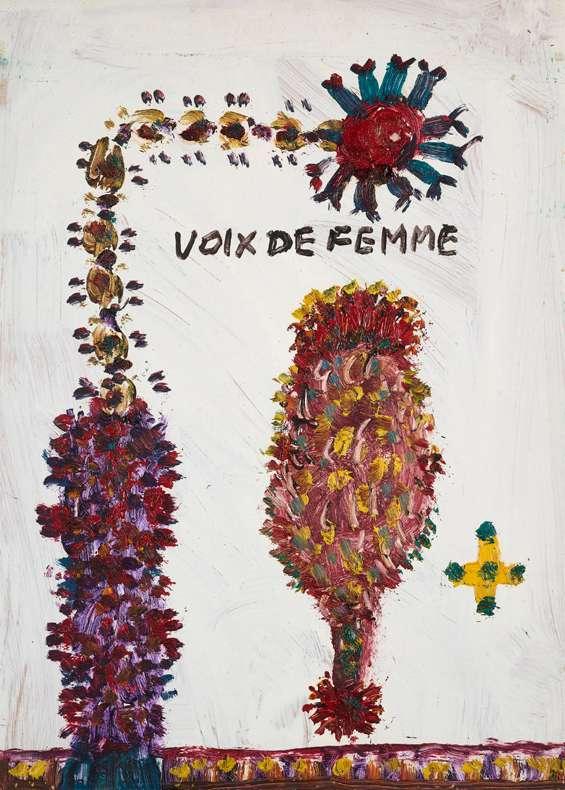
ALAN DAVIE RA (BRITISH 1920-2014) VOIX DE FEMME (OPUS 0.2093) titled VOIX DE FEMME upper centre; signed, inscribed and dated Alan Davie / 2009 / 0pus 0.2093 on the reverse oil on board
40.5 x 29cm; 16 x 11½in unframed
Provenance
Studio of the artist Gimpel Fils, London
Acquired from the above by the present owner circa 2015
⊕ £400-600

Property from a Private Collector, Southampton
ROE ETHRIDGE (AMERICAN B.1969)
MARY BETH
chromogenic print on aluminium
74 x 59cm; 29 x 23¼in
82 x 67cm; 32¼ x 26¼in (framed)
Executed in 2005 in an edition of five (numbered 4/5 on the Andrew Kreps Gallery label on the reverse)
Provenance
Andrew Kreps Gallery, New York
A postmodernist commercial and art photographer, Ethridge is known for taking a seemingly ordinary art historical narrative then subverting the image. He often takes an outwardly generic landscape or ‘straight forward’ portrait and introduces a surprising incongruity or constructs a series of photographs individually bland in subject matter but personal and subversive when placed side by side. The present work is at first glance a straight forward portrait, however the figure’s downward gaze and shortened arm whispers of Dutch Old Master portraiture. As well as his museum and gallery exhibitions, Ethridge has worked for the likes of Kenzo, Balenciaga, Comme Des Garcons and Mercedes Benz.
£700-1,000
Property from a Private Collector, Southampton
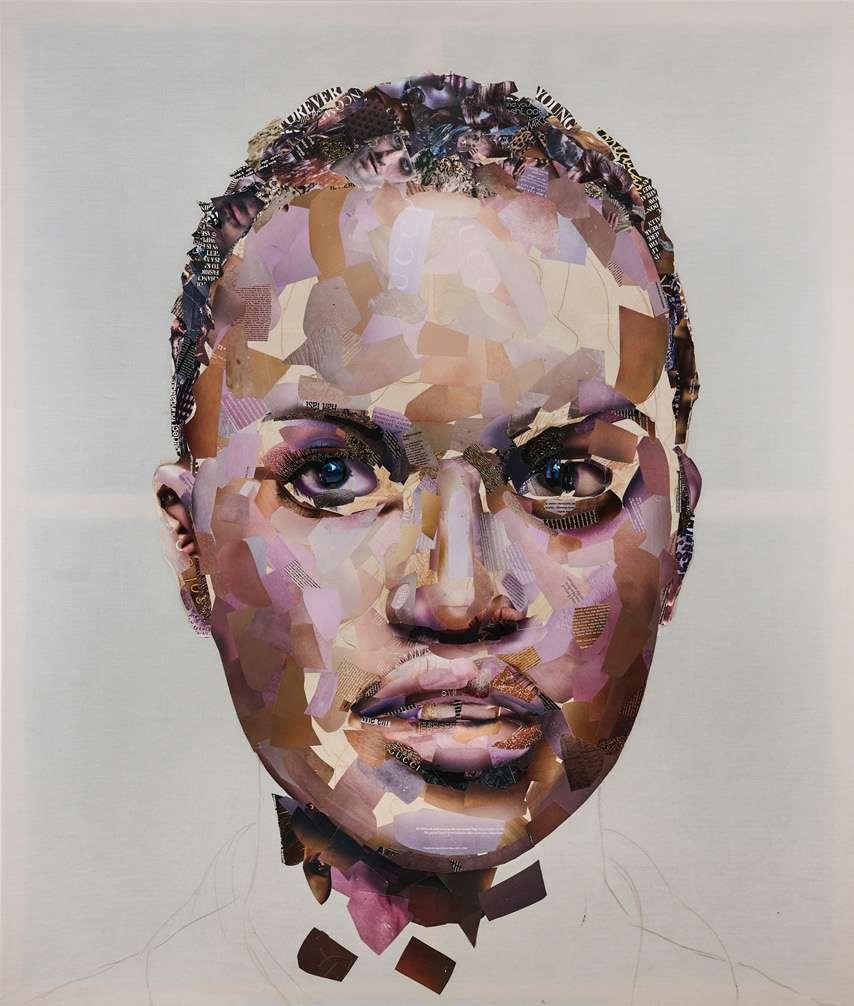
GABI TRINKAUS (GERMAN B.1966)
UCCI
signed, titled and dated UCCI / TRINKAUS / 05 on the stretcher on the reverse magazine paper-cuttings on fine canvas
165 x 140cm; 65 x 55in unframed
Referring to herself as a ‘media thief,’ Trinkaus is known for her collage portraits and cityscapes created from glossy magazine cuttings. The resultant bold collages draw the viewer in with the intention of provoking questions about the media’s idealised view of beauty - she takes this idealised imagery and, in her own words, ‘I tear them out, cut them up and shake the bag.’
⊕ £3,000-5,000
Avray Wilson, F 50 & 51
Baierl, T 16
Beothy, E 57
Brabazon Brabazon, H 15
Bradley, H 40
Bretland, T 11
Clarke, J 59
Cortes, E 42 & 43
Davie, A 61-64
De Beckers, I 5
Diepraam, A, Attrib. to 6
Dyf, M 45 & 46
Ethridge, R 65
Flemish School, 16th Century 8
French, L 36
Haigh, P 53
Hamilton-Fraser, D 49
Harpley, S 58
Hull, J 55
Hurt, L B 10
Irwin, G 54
John, A 20
Kean, C 56
Lowry, L S 39
Maillol, A 19
Martin, H D 12
McNally, M 31
Mellon, C A 44, 47 & 48
Mellström, R 17
Meninsky, B 37
Meteyard, T B 28
Molenaer, K 3
Moynihan, R 26
Mutrie, A 14
Nash, P 27
Niemann, E J 13
O’Sullivan, S 29
Petley, R 41
Picasso, P 60
Slade, E A 21-25
Smart, J 30 & 35
Sutherland, G 38
Tower, J 52
Trinkaus, G 66
Van Miereveld, M J 9
Van Uden, L, Attrib. to 1
Van Uyttenbroeck, M, Attrib. to 4
Vollerdt, J C, Style of 7
Withers, W 32
Wou, C C 2
Young, B 33 & 34
The following notes are intended to assist Bidders and Buyers, particularly those who are inexperienced or new to our saleroom. The sale of goods at our auctions are governed by our Terms of Sale (for Live Auctions or Online Auctions as applicable), our Privacy Policy, the Important Information for Buyers, and any notices that are displayed in our saleroom or announced by the Auctioneer (in the case of a Live Auction) or displayed on any Listing for a Lot in our Online Auction catalogue (in the case of an Online Auction) (collectively, the “Terms and Conditions of Business”). The Terms and Conditions of Business are available for inspection on our Website and at our saleroom on request. Our staff will be happy to help you if there is anything in our Terms and Conditions of Business that you do not fully understand.
Please make sure that you read the applicable Terms of Sale carefully before bidding. If your bid is successful, you will be obliged to comply with our Terms of Sale.
As Auctioneers we usually act on behalf of the Seller whose identity, for reasons of confidentiality, is not normally disclosed. If you buy at auction your Contract for your purchase of the goods is with the Seller, not with us as Auctioneer.
Estimates are designed to help you gauge what sort of sum might be involved for the purchase of a particular Lot. Estimates may change and should not be thought of as the Lot’s value or predicted sale price. The lower Estimate may represent the Reserve price (the minimum price for which a Lot may be sold) and will not be below the Reserve price. Estimates do not include the Buyer’s Premium or VAT (where chargeable). Estimates are prepared some time before the auction and may be altered by a saleroom notice or announcement by the Auctioneer before the auction of the Lot (for Live Auctions), or on the Listing for a Lot in our Online Auction catalogue before the auction of the Lot (for Online Auctions). They represent a matter of opinion and are not definitive.
The Terms of Sale oblige you to pay a Buyer’s Premium at 25% on the Hammer Price of each Lot purchased. The Buyer’s Premium is subject to VAT at the standard rate (currently 20%).
The following paragraphs are intended to give general advice on VAT for items purchased at auction. We have covered the common situations, and this may not be comprehensive. We are unable to offer Tax advice and we suggest you seek independent advice if you require clarifications or further information.
5.1 Items in our catalogue may be marked in the following ways:
(a) (†) indicates that VAT is payable by the Buyer on both the Hammer Price and the Buyer’s Premium. VAT will be chargeable at the standard rate (presently 20%) for most Lots. Qualifying books will be charged at 0%. This imposition of VAT is likely to be because the Seller is registered for VAT within the UK and is not operating the Dealers’ Margin Scheme on their consignment to us.
(b) (‡) indicates that the Lot has been imported from outside the UK using customs Temporary Admissions procedures. Import VAT of 5% (reduced rate due to nature of the Lot) is due on the Hammer Price and an amount in lieu of VAT at 20% will be included in the Buyer’s Premium. This VAT on the Buyer’s Premium cannot be itemised separately on our invoices. The successful Bidder and therefore Buyer of the Lot will become its importer.
(c) (Ω) indicates that the Lot has been imported from outside the UK using customs Temporary Admissions procedures. Import VAT of 20% (higher rate) is due on the Hammer Price and an amount in lieu of VAT at 20% will be included in the Buyer’s Premium. This VAT on the Buyer’s Premium cannot be itemised separately on our invoices. The successful Bidder and therefore Buyer of the Lot will become its importer.
(d) Lots which do not display one of the above symbols (referred to herein as unmarked Lots) have no VAT payable on the Hammer Price. This is because such Lots are sold using the Auctioneers’ Margin Scheme. Therefore, an amount in lieu of VAT at the standard rate is included within the Premium and will not be shown separately on our invoice or be recoverable as input Tax.
5.2 For the items marked (‡) or (Ω), Buyers registered for VAT in the UK should notify us as soon as possible after the sale so that we can correctly instruct our shipping agents to complete the import into the UK under the Buyer’s VAT registration and HMRC can issue a form C79. The charge on our invoice for the import VAT is not sufficient evidence to make a claim for the import VAT.
6.1 For Buyers from outside the UK, the VAT charged on the Hammer Price and Buyer’s Premium or included in lieu of VAT in the Buyer’s Premium can be refunded so long as the Buyer has:
(a) registered to bid with an address outside the UK; and
(b) discussed with us the proof of export we require and the timeframes to complete the export.
6.2 Once we are satisfied that the requirements referred to in Clause 1.6.1 have been met, and with the proof of export provided, the following VAT will be refunded:
(a) For Lots marked (†): The VAT on the Hammer Price and on the Buyer’s Premium.
(b) For Lots marked (‡) and (Ω): the import VAT and, the VAT in lieu in the Buyer’s Premium.
(c) For unmarked Lots: the amount in lieu of VAT in the Buyer’s Premium.
6.3 To enable us to refund the VAT charged correctly we normally require the use of our international shippers to assist with the required paperwork. For private Buyers, we will only be able to refund the VAT if our shippers are used for the export of the Lot outside the UK.
For unmarked Lots, you can request a Lot to be reinvoiced outside the Auctioneers’ Margin Scheme. VAT at 20% will be charged on the Hammer Price and the VAT on the Buyer’s Premium will be itemised separately on our invoice. This will enable a VAT registered business to reclaim all the VAT. Please note that the item will no longer be eligible to be sold in the Margin Scheme. We recommend you seek advice before proceeding. Requests must be made within 6 months of the sale and certain conditions apply.
As we act on behalf of the Seller, we are dependent on information provided by the Seller about their goods. We may inspect Lots and will act reasonably in taking a general view about them. However, we are normally unable to carry out detailed examinations of Lots to check their condition in the way a Buyer would do. You will have the opportunity to inspect the goods (upon request). Where a Lot is made available for inspection, we strongly recommend that you inspect any Lots that you are interested in prior to bidding at the auction. Please carefully note the exclusion of liability for the condition of Lots set out in the Terms of Sale for Online Auctions at Clause 22.5 and the Terms of Sale for Live Auctions at Clause 18.5.
These are sold as “antiques” for their historical and decorative attributes, and for collection and display only. They are not intended for use. If you buy goods with electrical components and intend to use them, you must ask a qualified electrician to check them for compliance with safety regulations before you use them.
If you intend to buy goods which contain endangered species, you need to find out if there is a prohibition on the purchase of goods of that character. For goods containing elephant ivory, you also need to satisfy yourself that they have been correctly registered or certified and meet the exemption conditions under applicable legislation.
If you intend to export goods you must find out:
11.1 whether an export licence is needed; and
11.2 if there is a prohibition on exporting goods of that character outside of the UK or on importing goods of that character in your intended country of import such as because the goods contain prohibited materials such as elephant ivory or other protected flora and fauna.
Bidders will be required to register with us before the auction starts. We Reserve the right to impose a deadline prior to the auction by which you must register or by which we must receive a commission bid. If you wish to bid on high value Lots this deadline may be several days before the auction in order to allow us sufficient time to carry out the necessary checks. Lots will be invoiced to the name and address on the registration form. Please enquire in advance about our arrangements for telephone or online bidding. You will need to provide us with proof of your identity in a form acceptable to us and such other information as we may require. Please note that we may refuse to register you if you do not provide us with all the information and documentation that we ask for or at our discretion.
We offer free online bidding directly through our Website (www.olympiaauctions. com). You may also bid using an independent Bidding Platform. Bidders using an independent Bidding Platform or service should note that the platform may impose an additional fee or charge, which will be added to the total amount payable in the event your bid is successful. Please refer to the terms and conditions on the relevant independent platform for rates.
As Auctioneers we may have to conduct various checks into our customers under the Money Laundering Legislation, under sanctions legislation and other related legislation. Unless we confirm we already have this information, on registration to bid you will be required to provide the following:
(a) For individuals, official photo identification (driving licence, passport or equivalent) and proof of address (if this is not included in your ID document).
(b) For corporate entities, the certificate of incorporation (or equivalent) with the entity’s official name, registered number (if any) and registered address, as well as details and ID documentation for directors and beneficial owners of the entity.
(c) For trusts and estates, details and ID documentation for executors/trustees and details of beneficiaries: please contact us for further information.
14.1 You may be asked for further information if we deem this necessary.
14.2 If you are bidding for another person (your Principal) you will be required to provide the above information for yourself and your Principal, along with a signed letter from your Principal authorising you to bid on his/her behalf.
14.3 If you require further information about ID requirements, please contact enquiries@olympiaauctions.com. If we deem that you have not provided sufficient information for us to complete our anti-money laundering, terrorist financing and sanctions checks to our satisfaction, we may refuse to register you to bid and we may postpone completion of or cancel any Contract made by you and the Seller in the event you have made a successful bid.
You may leave commission bids with us indicating the maximum amount to be bid against a Lot (excluding the Buyer’s Premium and/or any applicable VAT). We will execute commission bids as cheaply as possible having regard to the Reserve (if any) and competing bids. If two Buyers submit identical commission bids, we may prefer the first bid received (where this can be reasonably ascertained). Please enquire in advance about our arrangements for the leaving of commission bids by telephone or fax/email or via our Website or online Bidding Platform.
16.1 Online: Payment can be made at www.olympiaauctions.com/payments.
16.2 Cheque: Usually any cheques will need to be cleared before you can take the goods away. We require seven days to clear sterling cheques unless special arrangements have been made in advance of the sale.
16.3 Bank Transfer: Payments must be received from a bank account held in the name of the person or entity named on the invoice for the Lot.
16.4 Cash: £6,000 and “card holder not present” payments above £2,000 cannot be accepted.
16.5 Credit Card payments in person: Payments above £6,000 cannot be accepted.
16.6 Debit card payments in person: Payments are without limit.
Please note what the applicable Terms of Sale say about collection and storage (see Clause 13 of the Terms of Sale for Live Auctions and Clause 15 of the Terms of Sale for Online Auctions). It is important that you pay for and collect goods promptly. Any delay may involve you having to pay storage charges. You (or your agent) must bring photographic ID for collection. Please note that collection may be made during working hours only, usually Monday to Friday 09:30 to 17:00.
If you purchase a Lot in an Online Auction as a Consumer in the UK or EU from a Seller who is a Trader, you may have a right to cancel your purchase of that Lot from the day of the auction up to the day which is 14 days after the date on which you take possession of the Lot. You may also have the right to cancel Services provided by us. Further information is set out in the Terms of Sale for Online Auctions.
1.
Please note that all measurements are approximate and that illustrations are not to scale. The condition of a Lot is not usually included in catalogue descriptions, and no assumptions should be made in the absence of this information. Condition reports are available on request.
Obvious faults may be recorded in italics at the end of a description for ceramics.
All Lots are sold “as is” and the absence of any reference to the condition of a clock or watch does not imply that the Lot is in good condition and without defects, repairs or restorations. Most clocks and watches have been repaired in the course of their normal lifetime and may now incorporate parts not original to them. Furthermore, we make no representation or warranty that any clock or watch is in working order. As clocks and watches often contain fine and complex mechanisms, the Bidder should be aware that a general service, change of battery or further repair work, for which the Buyer is solely responsible, may be necessary. The Bidder should be aware that the importation of watches such as Rolex, Frank Muller and Corum into the United States is highly restricted. These watches may not be shipped to the USA and can only be imported personally.
Please note that armour stands and many of the display mounts used in the catalogue(s) and the sale exhibition(s) do not form part of the Lot unless stated in the catalogue, though they may be made available to the successful Buyer of the relevant Lot(s). Please contact us for prices and further details.
5. FIREARMS
Please note that all bore sizes are approximate.
6.
It is common practice for many gemstones to be treated by a variety of methods to enhance their appearance and the international jewellery trade has generally accepted these methods. Although heat enhancement of colour is usually permanent, in some cases this could affect the durability of a gemstone. Oiled gemstones may need reoiling after a certain period. If no gemmological report is published in the catalogue, prospective Buyers should be aware that the gemstones or pearls could have been enhanced by some method.
In addition to the explanations set out below regarding categorising terms for works, please note the following. The date given is that of the image (negative). Where no further date is given, this indicates that the photographic print is vintage (the term “vintage” may also be included in the Lot description). A vintage photograph is one which was made within approximately 5–10 years of the negative. Where a second, later date appears, this refers to the date of printing. Where the exact printing date is not known, but understood to be printed later, "printed later" will appear in the Lot description.
Unless otherwise specified, dimensions given are those of the piece of paper on which the image is printed, including any margins. Some photographs may appear in the catalogue without the margins illustrated.
All photographs are sold unframed unless stated otherwise in the Lot description.
A work catalogued with the name(s) or recognised designation of an artist, without any qualification, is, in our opinion, a work by the artist. In other cases, the following expressions with the following meanings are used:
(a) “Attributed to”: means in our opinion it is probably a work by the artist in whole or in part.
(b) “Studio of ” or "workshop of ”: means in our opinion a work executed in the studio or workshop of the artist, possibly under his supervision.
(c) “Circle of ”: means in our opinion a work of the period of the artist and showing his influence.
(d) “Follower of ”: means in our opinion a work executed in the artist's style but not necessarily by a pupil.
(e) “Manner of ”: means in our opinion a work executed in the artist's style but of a later date.
(f) “After”: means in our opinion a copy (of any date) of a work of the artist.
(g) “Signed”, “dated”, “inscribed”: means in our opinion the work has been signed, dated or inscribed by the artist. The addition of a question mark (?) adds an element of doubt.
(h) “Bears signature”, “bears date”, “bears inscription”: means in our opinion the signature, date, inscription or stamp is by a hand other than that of the artist.
Weights may only be accurate to within 5 grams. Weights shown as “(* oz)” are in troy ounces and usually rounded down to the full ounce.
10.
(a) () indicates a Lot with no Reserve.
(b) (✧) indicates a “Premium Lot”. For Premium Lots, you must complete the required Premium Lot preregistration application and deliver to us such necessary financial references, guarantees, deposits and/or such other security as we may in our absolute discretion require, as security for your bid. Our decision as to whether to accept any pre-registration application shall be final.
(c) (◉) indicates items that have been identified at the time of cataloguing as containing organic material which may be subject to restrictions regarding import or export, such as a CITES certificate. The absence of the symbol is not a warranty that there are no restrictions regarding import or export of the item. We accept no liability for any Lots which may be subject to restrictions but have not been identified as such. Please refer to section A, paragraph 10 above.
(d) (⊕) indicates a Lot that may be subject to Artist’s Resale Right.
(e) (○) indicates “Guaranteed Property”. The seller of lots with this symbol has been guaranteed a minimum price from one auction or a series of auctions. This guarantee may be provided by Olympia Auctions or jointly by Olympia Auctions and a third party. Olympia Auctions and any third parties providing a guarantee jointly with Olympia Auctions benefit financially if a guaranteed lot is sold successfully and may incur a loss if the sale is not successful. A third party providing a guarantee jointly with Olympia Auctions may provide an irrevocable bid, or otherwise bid, on the guaranteed property. If the Guaranteed Property symbol for a lot is not included in the printed or pdf auction catalogue (where applicable), then Olympia Auctions will notify bidders that there is a guarantee on the lot by one or more of the following means: the lot’s specific webpage will be updated to include the guaranteed property symbol, a notice will be added to the Olympia Auctions webpage for the auction, or a pre-sale or pre-lot announcement will be made indicating that there is a guarantee on the lot. If every lot in a sale is guaranteed, a Special Notice will be included to this effect and this symbol will not be used for each lot.
(f) (∏) indicates “Monumental”. Lots with this symbol may, in our opinion, require special handling or shipping services due to size or other physical considerations. Buyers are advised to inspect the lot and to contact Olympia Auctions prior to the sale to discuss any specific shipping requirements.
(g) (W) indicates property stored and to be collected from off-site storage. Please note that property can only be released once payment has been received in full and cleared funds. If you are sending your own authorised agent to collect property from Olympia Auctions on your behalf, please provide a letter of authorisation, a copy of your paid invoice and photographic ID.
(h) (#) Book sales. Although these items are not free from VAT, Olympia Auctions is able to use the margin scheme and VAT will not normally be charged on the hammer price. Olympia Auctions must bear VAT on the buyer’s premium and hence will charge an amount in lieu of VAT at the standard rate on this premium. This amount will form part of the buyer’s premium on our invoice and will not be separately identified.
OLYMPIA AUCTIONS
SALE TITLE: FINE PAINTINGS, WORKS ON PAPER & SCULPTURE
DATE: 10 JUNE 2026
CODE: OA0182
Please mail, fax or scan and email to: Olympia Auctions, 25 Blythe Road, London W14 0PD Fax +44 (0)20 7806 5546
Email: enquiries@olympiaauctions.com
Important
Please bid on my behalf at the above sale for the following Lot(s) up to the hammer price(s) mentioned below. These bids are to be executed as cheaply as is permitted by other bids or reserves and in an amount up to but not exceeding the specified amount. The auctioneer may open the bidding on any lot by placing a bid on behalf of the seller. The auctioneer may further bid on behalf of the seller up to the amount of the reserve by placing responsive or consecutive bids for a lot.
I agree to be bound by Olympia Auctions Conditions of Business. If any bid is successful, I agree to pay a buyer’s premium on the hammer price at the rate stated in the front of the catalogue and any VAT, or amounts in lieu of VAT, which may be due on the buyer’s premium and the hammer price.
Methods of Payment
Olympia Auctions welcomes the following methods of payment, most of which will facilitate immediate release of your purchases.
Online: www.OlympiaAuctions.com/payments
Bank Transfer: Payments must be received from a bank account held in the name of the person or entity named on the invoice for the Lot.
HSBC Bank Plc, 38 High Street, Dartford, Kent, DA1 1DG
IBAN No: GB39HBUK40190422033119
BIC: HBUKGB4B
Sort Code: 401904
Account No: 22033119
Account Name: Olympia Auctions Ltd
Sterling Bankers Draft: Drawn on a recognised UK bank.
Cheque: Usually any cheques will need to be cleared before you can take the goods away. We require seven days to clear sterling cheques unless special arrangements have been made in advance of the sale.
Cash: £6,000 and “card holder not present” payments above £2,000 cannot be accepted.
Credit Card payments in person: Payments above £6,000 cannot be accepted.
Debit card payments in person: Payments are without limit.
Please print or type
Please note that if you have not dealt with us before, you will need to supply us with a copy of photographic ID and proof of address. Name
The London Sale
Live Sale: Wednesday 8th July
Viewing: Sunday 5th July, Monday 6th July, Tuesday 7th July
Olympia Timed: Indian, Islamic, Himalayan and South-East Asian Art
Starts: Friday 10th July, 14.00, Ends: Sunday 19th July, 16.00
Jewellery & Watches
Live sale: Thursday 10th September
Viewing: Sunday 6th September, Monday 7th September, Tuesday 8th September
Olympia Timed: The Autumn Sale
Ends: Sunday 27th September, 16.00
Viewing: Sunday 20th September, Monday 21st September, Tuesday 22nd September
Olympia Timed: Paintings, Works on Paper and Sculpture
Ends: Sunday 11th October, 15.00
Viewing: Sunday 4th October, Monday 5th October, Tuesday 6th October
Olympia Timed: From the Studio: Works from Artists’ Estates
Ends: Sunday 11th October, 14.00
Viewing: Sunday 4th October, Monday 5th October, Tuesday 6th October
Modern & Contemporary African and Middle Eastern Art
Live sale: Wednesday 21st October
Viewing: Sunday 18th October, Monday 19th October, Tuesday 20th October
Olympia Timed: Pip Rau Collection Part II
Ends: Sunday 1st November, 16.00
Viewing: Sunday 25th October, Monday 26th October, Tuesday 27th October
pictures@olympiaauctions.com | www.olympiaauctions.com 25 Blythe Road, London WI4 0PD
Chinese & Japanese Works of Art
Live sale: Wednesday 4th November
Viewing: Sunday 1st November, Monday 2nd November, Tuesday 3rd November
Indian, Islamic, Himalayan and South-East Asian Art
Live sale: Wednesday 11th November
Viewing: Sunday 8th November, Monday 9th November, Tuesday 10th November
European Works of Art, Objects and Silver
Live sale: Wednesday 18th November
Viewing: Sunday 15th November, Monday 16th November, Tuesday 17th November
Jewellery & Watches
Live sale: Wednesday 18th November
Viewing: Sunday 15th November, Monday 16th November, Tuesday 17th November
Antique Arms, Armour and Militaria
Live sale: Day One: Wednesday 2nd December, Day Two: Thursday 3rd December
Viewing: Sunday 29th November, Monday 30th November, Tuesday 1st December
Olympia Timed: Antique Ams, Armour and Militaria
Ends: Sunday 6th December, 16.00
Viewing: Sunday 29th November, Monday 30th November, Tuesday 1st December
Fine Paintings, Works on Paper and Sculpture
Live sale: Wednesday 9th December
Viewing: Sunday 6th December, Monday 7th December, Tuesday 8th December
Please note sale dates are subject to change Please see our website for up-to-date information