OLYMPIA TIMED: THE PIP RAU COLLECTION OF
6TH FEBRUARY - 1ST MARCH 2026

THE PIP RAU COLLECTION OF IKATS, EMBROIDERIES AND COSTUMES, PART 1
TO BE SOLD BY AUCTION:
25 Blythe Road, London W14 0PD
TIMED AUCTION:
Ends Sunday1st March 2026, 2pm precisely
PUBLIC EXHIBITION:
Sunday 22nd February, 12pm to 4pm
Monday 23rd February, 10am to 8pm
Tuesday 24th February, 10am to 5pm
Wednesday 25th February, 10am to 5pm
SALE NUMBER OA0175
ENQUIRIES:
Jacqueline Coulter, Consultant indianandislamic@olympiaauctions.com
Arthur Millner, Indian and Islamic Objects and Works of Art arthur.millner@olympiaauctions.com
Nicholas Shaw, Indian and Islamic Manuscripts and Paintings nicholas.shaw@olympiaauctions.com
Lara Defries, Administrator lara.defries@olympiaauctions.com
+44 (0)20 7806 5541 enquiries@olympiaauctions.com
Photography: Rolant Dafis
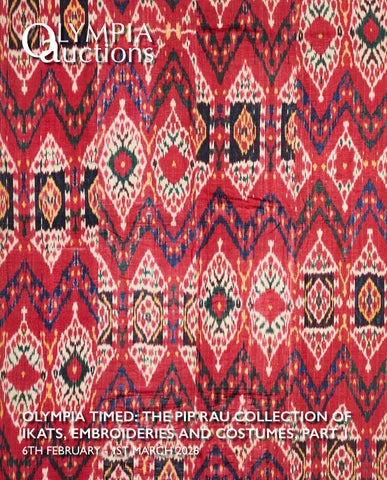
Front cover: Lot 124 (detail)
Back cover: Lot 38
We are indebted to Christine Ramphal for her help with this catalogue
ONLINE CATALOGUE AND LIVE INTERNET BIDDING AVAILABLE THROUGH: www.olympiaauctions.com www.the-saleroom.com
This auction is conducted by Olympia Auctions in accordance with our Conditions of Business printed in the back of this catalogue.
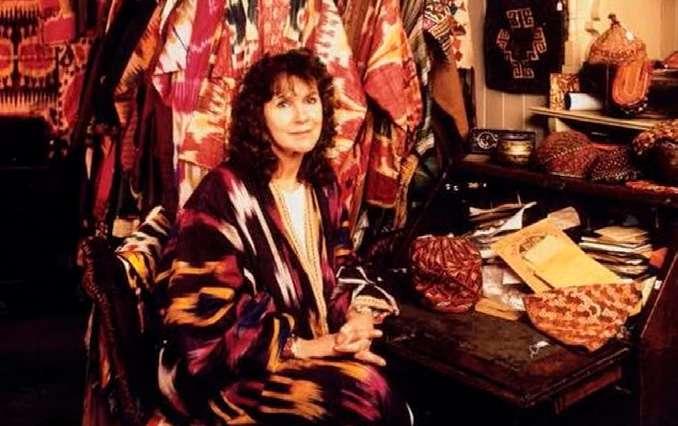
PIP RAU (1938-2024)
For 40 years, Rau, the small shop in Islington, North London was a magnet for enthusiasts in the field of Central Asian textiles, displaying ikats, embroideries, rugs and objects chiefly from Uzbekistan, Pakistan and Afghanistan. The owner, Pip Rau, was not only in demand by an international and eclectic clientele of collectors and dealers, but also from film directors, who came to borrow items from her collection for films including The Shining (1980) and Gladiator (2000).
Born in London just before the second world war, Pip soon showed her adventurous and restless spirit, enrolling in numerous art school courses, none of which, as she freely admitted, were completed, including St. Martins and the Central School of Arts and Crafts in London, and others in Jerusalem, San Francisco and Paris. Her appetite for travel and adventure, particularly in her youth, led to brief imprisonment in New York (for joining in a nuclear disarmament rally), a car accident in Russia, followed by a marriage proposal when recovering in hospital from a Soviet colonel (duly refused) and time spent in Israel, leading to her marriage to Ili Gorlizki, an actor.
In 1974 she opened her London shop, filled with textiles, costumes and objects, which she continued to replenish over the following decades with items she collected on her frequent travels. Most of all, Pip loved Afghanistan, which she had first visited in 1973 when the country had only just opened up for visitors. During the 1970s it became an essential component of the ‘Hippie Trail’, for those travelling overland to India. On her almost yearly visits, Pip rapidly gained a reputation as a formidable negotiator and a keenly discriminating eye amongst traders in the bazaars. (Rather fittingly, after she closed her Islington shop in 2014, the premises become an Afghan restaurant.) It was in Kabul in 1976 that she purchased her first ikat, which led to a lifetime’s passion for these spectacular textiles. Ikat is a warp faced fabric created through tying and dying the warp threads before they are set up on the loom; called abr-bandi in Central Asia, or ‘bound cloud’, the technique results in the characteristic softened edges of the motifs. Adras ikat has cotton warps, often resulting in a heavier fabric with a pronounced horizontal rib, whilst those with silk wefts are thinner and crisper (referred to in this catalogue as atlas ikat). The ikat technique was also used to make luxurious velvets.
For Pip, visual and graphic appeal always overrode the scholarly and technical aspect, but Ikat textiles and costumes from her collection were widely exhibited, including at the Crafts Council, London in 1988. In 2007, the Victoria and Albert Museum exhibited and published part of Pip’s collection. A dozen of the lots in this sale were published in one of the catalogues for these seminal exhibitions. Included in this auction is a wide range both of the ikats which she had collected and embroideries, most notably several suzanis, and the costumes, rugs and artefacts she collected on her travels over the years. A group of around fifty Lakai embroideries from Uzbekistan from her collection is now in the British Museum.
Uzbekistan and the adjacent lands have been famed for its silk fabrics since antiquity: those represented here date from the 19th and early 20th centuries. The Khans in 19th century Central Asia encouraged the production of woven silks, and the dying and weaving was carried out by numerous craftsmen ateliers, each specialising in an aspect of their manufacture. The quality and elaborateness of the fabrics reflected the social status and wealth of their owners; the brightly coloured ikat silks were used as wall hangings, bed quilts and made up into robes for men, women and children. The robes (chapan, though also referred to as khalat), were worn by the wealthier classes, layered for display and warmth. Examples of the less ostentatious simple striped chapan are also included here, as are the embroidered robes of the Turkman tribes. Ikat was also made up into munisak, shaped robes for women designed to show off the figure, and kurta - loose tunics. There are also examples of paranja, a kind of cloak, similar to the Turkman chyrpy. Embroidered and appliqued, decorated with ikat, beads and tassels, the hats, boots, bags and purses of Central Asia are also represented in this sale, as are the costumes and embroideries of Afghanistan, Kohistan and Pakistan which Pip Rau collected over a lifetime of adventure.
AN IKAT PANEL, UZBEKISTAN, SECOND HALF 19TH CENTURY
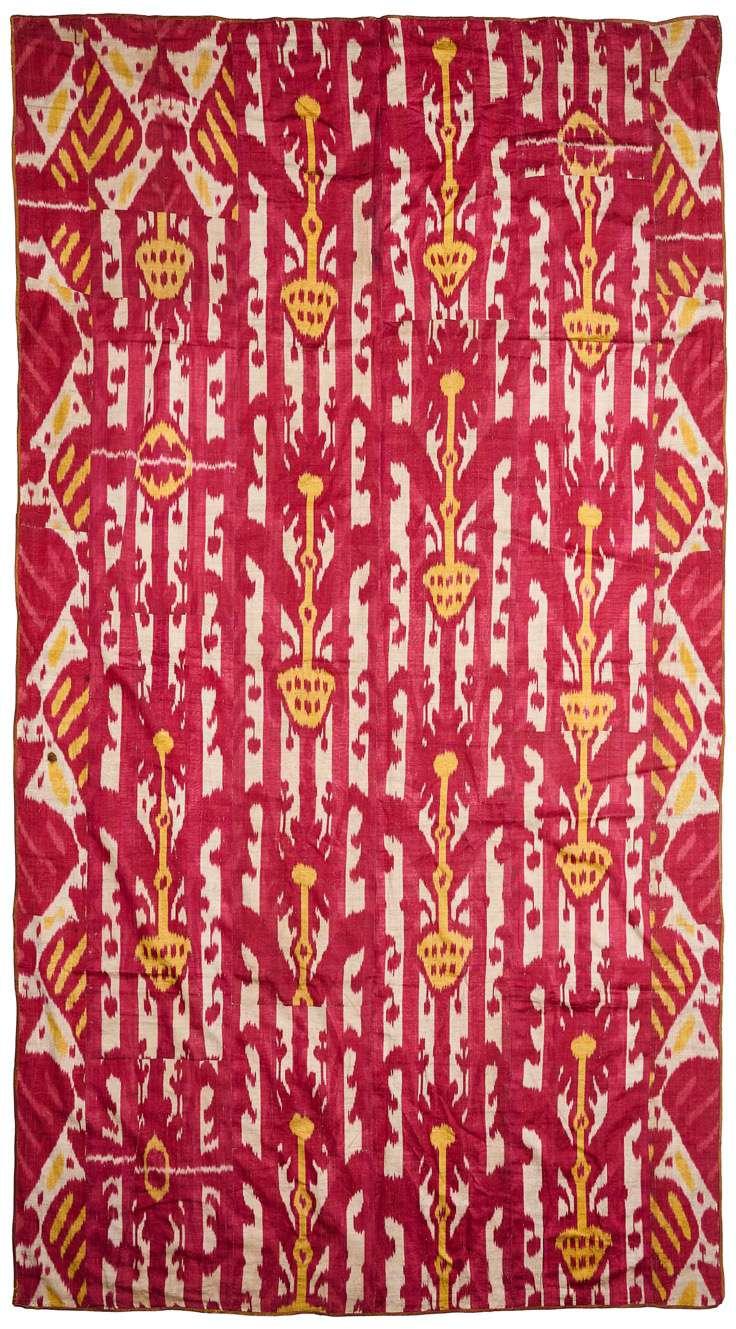
the adras ikat in pink and white with bold yellow stems with flowerheads, approximately 226 x 124cm
See Hali, Issue 226, Winter 2025, p. 150, fig. 1 for a photograph of this ikat hanging in Pip Rau’s home.
£800-1,200
A LARGE IKAT QUILTED PANEL, BOKHARA, UZBEKISTAN, EARLY 20TH CENTURY
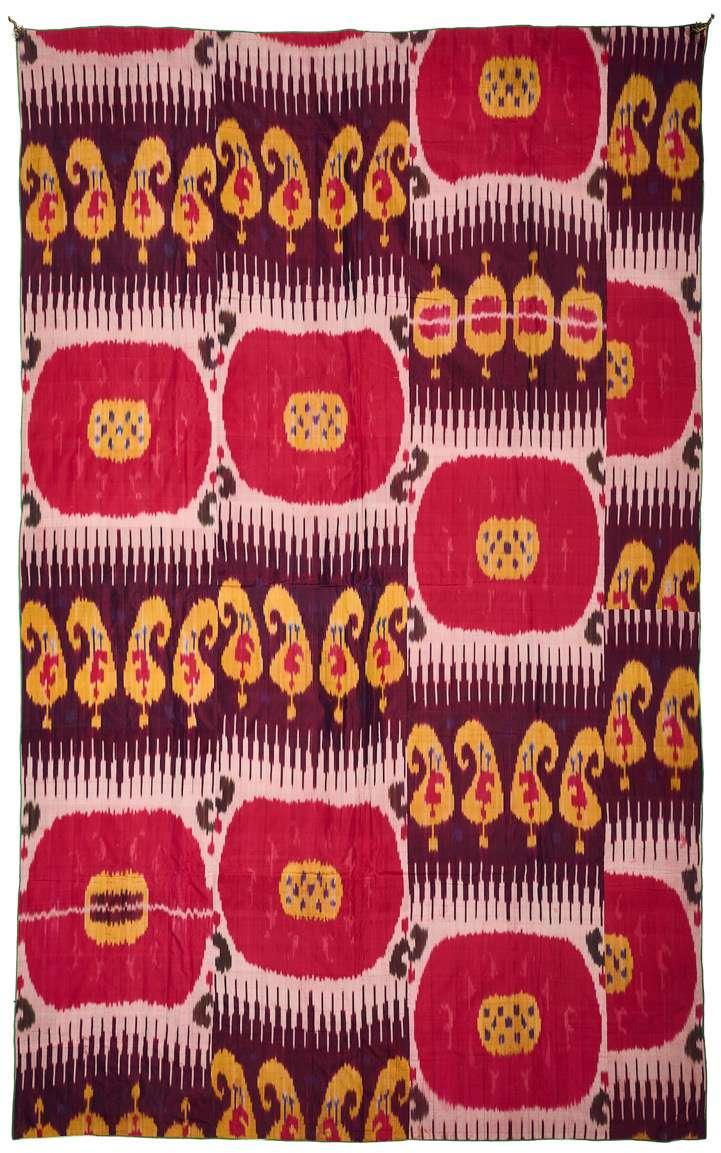
the atlas ikat with large crimson flowerheads and reciprocal feather edged bands of aubergine containing yellow and pink botehs, approximately 240 x 140cm
Literature: Hale, A., Fitz Gibbon, K., et al, Ikats, Woven Silks from Central Asia, The Rau Collection, Oxford 1988, p. 69
£800-1,500
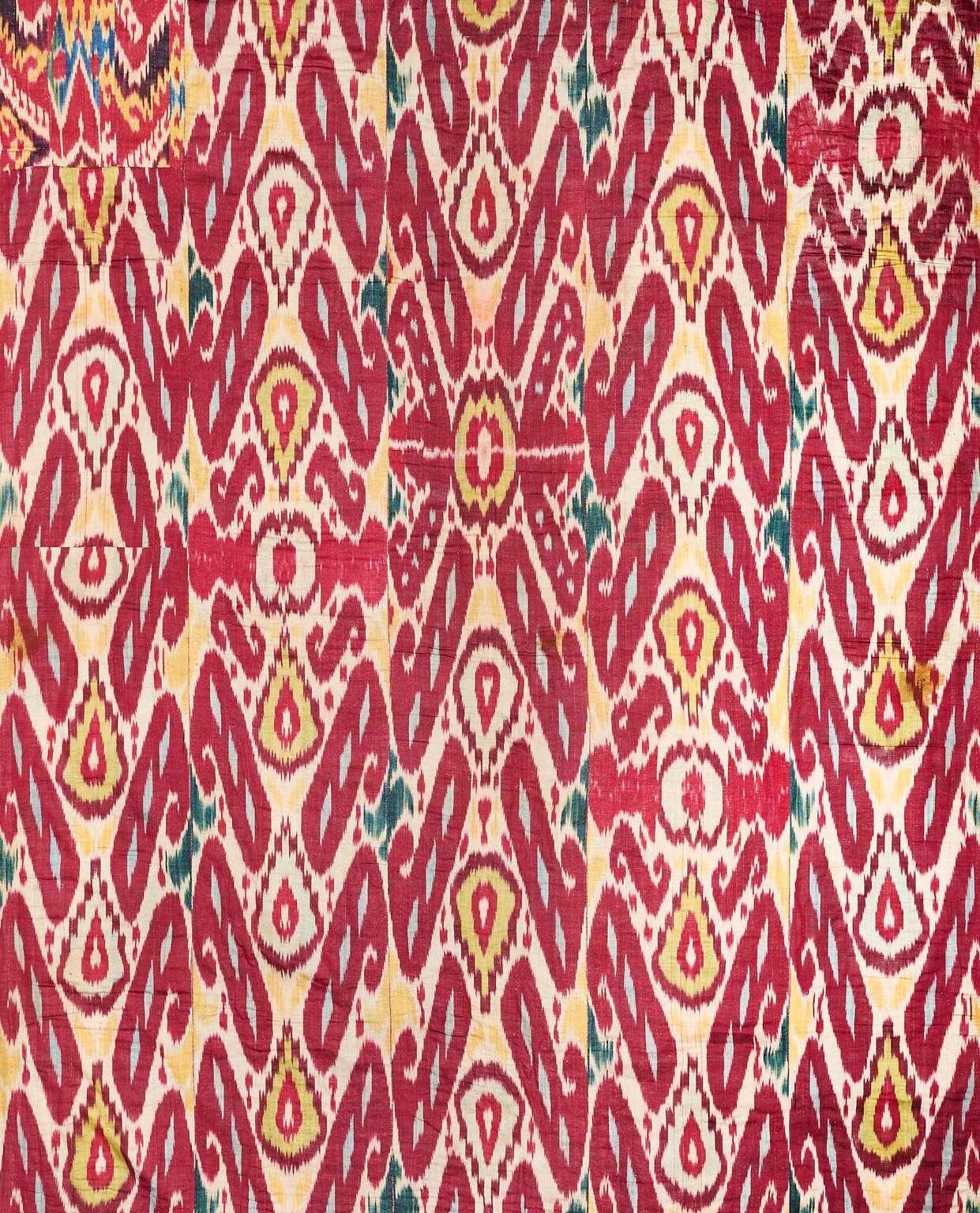
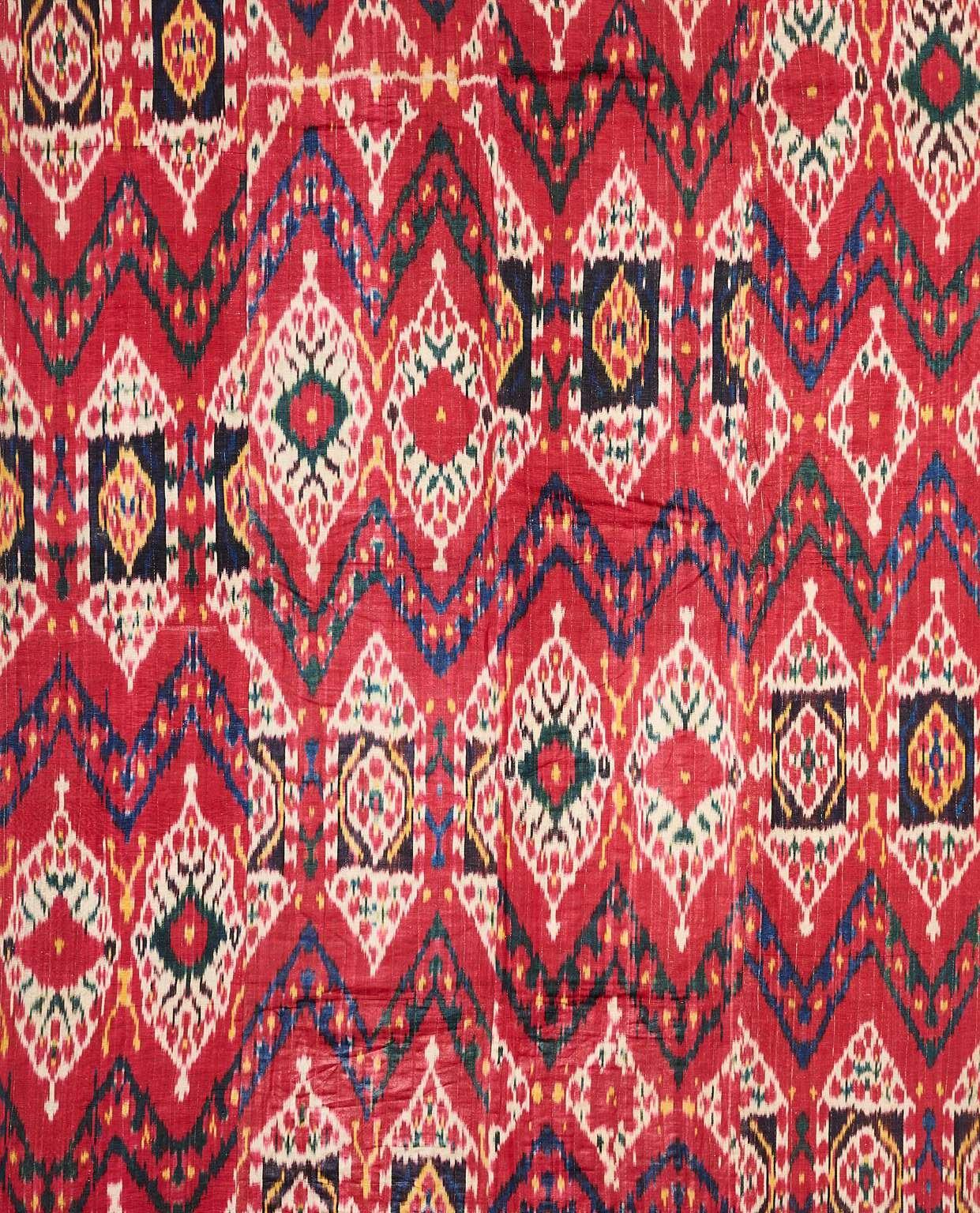
AN IKAT PANEL, UZBEKISTAN, SECOND HALF 19TH CENTURY
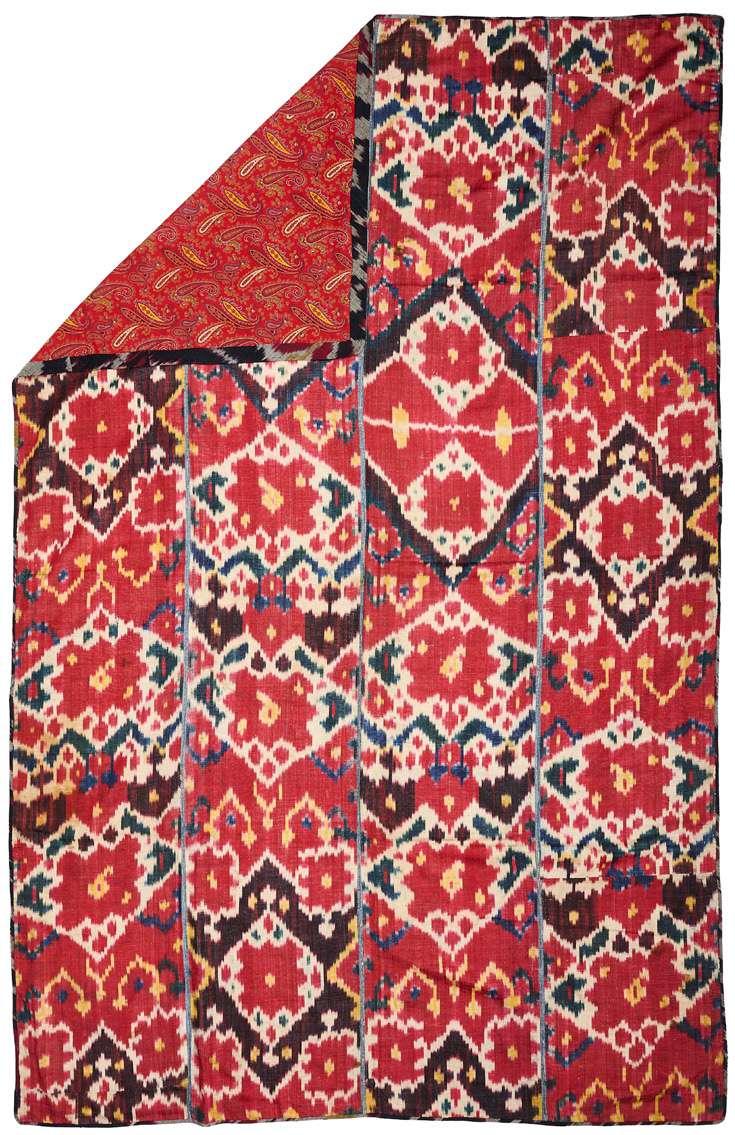
the adras ikat with bold stepped zig zags containing guls and flowerheads, coloured in forest green and aubergine, red and yellow flowerheads in ivory stepped diamonds, approximately 185 x 118cm
£800-1,500
4
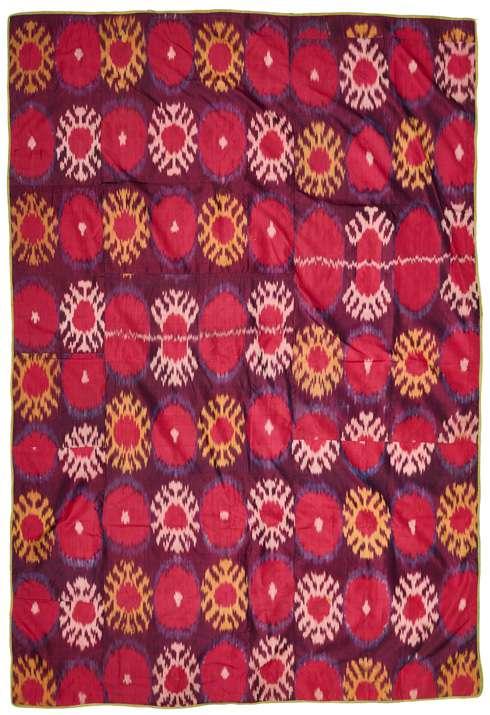
AN IKAT PANEL, BOKHARA, UZBEKISTAN, LAST QUARTER 19TH CENTURY
the atlas ikat woven with aubergine ground and columns of sunburst flowerheads and roundels, in ivory, saffron, crimson and indigo, approximately 155 x 106cm
Literature: Hale, A., Fitz Gibbon, K., et al, Ikats, Woven Silks from Central Asia, The Rau Collection, Oxford 1988, p. 68
£800-1,500
5
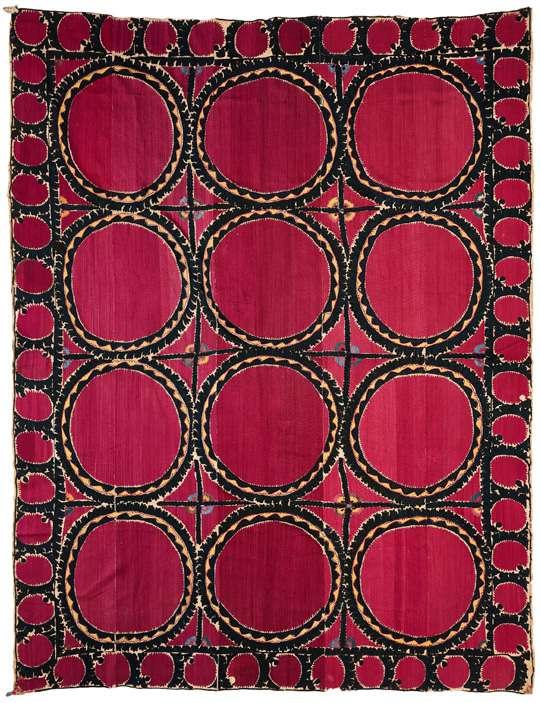
A TASHKENT SUZANI, UZBEKISTAN, EARLY 20TH CENTURY
the roundels in dark crimson, crimson palmette border, approximately 240 x 180cm
£700-1,000
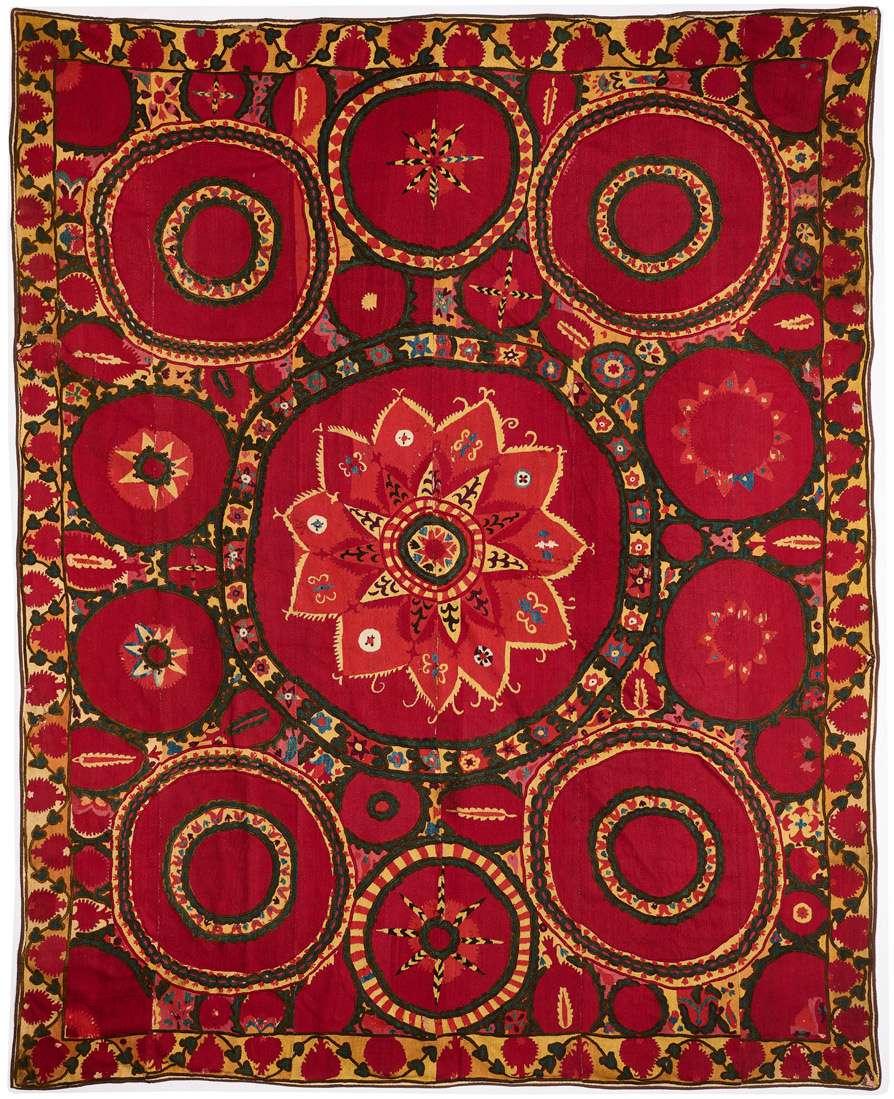
A PISKENT WOOL AND SILK EMBROIDERED SUZANI, UZBEKISTAN, LATE 19TH CENTURY
with a large central flowerhead medallion in madder wool, within a crimson roundel, surrounded by large flower roundels, reciprocal yellow and melon orange running vine and flower border, approximately 250 x 200cm
£2,000-4,000
7
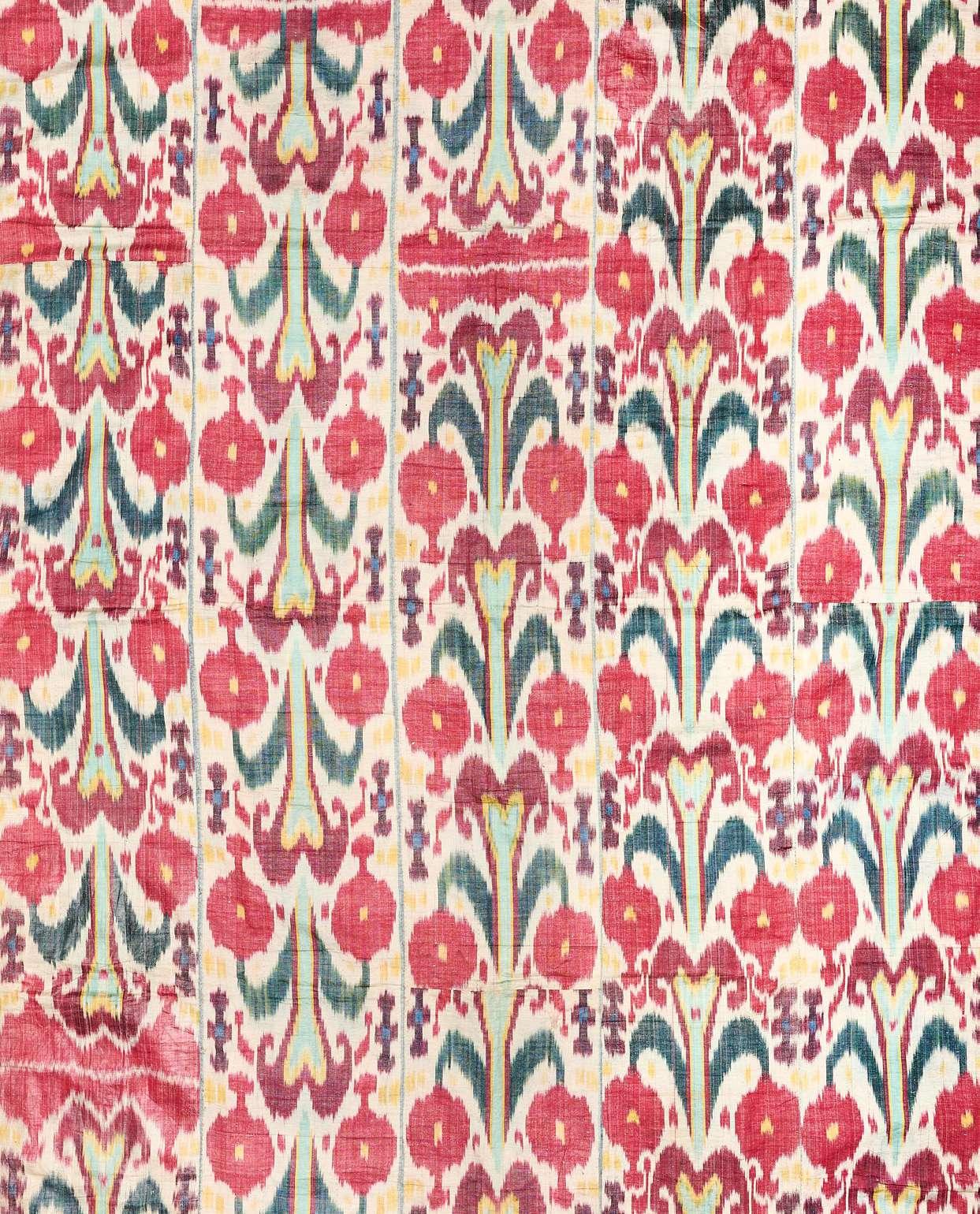
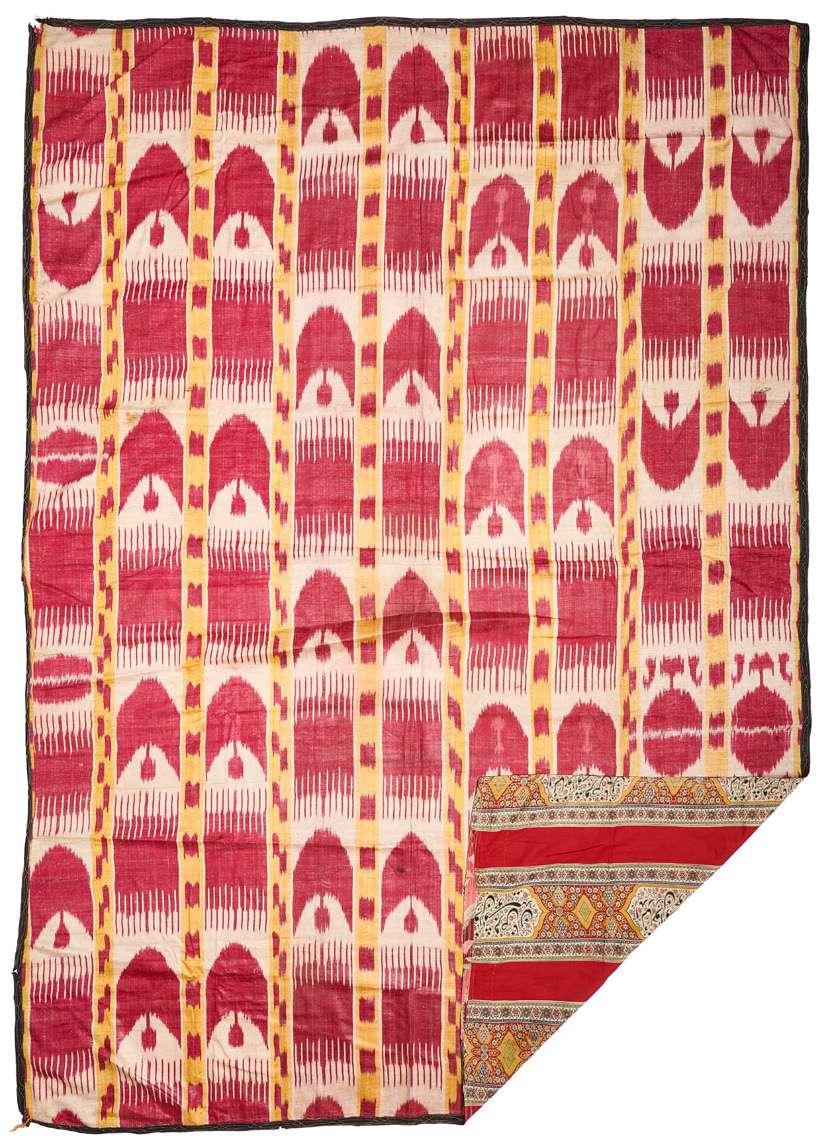
A LARGE IKAT PANEL, UZBEKISTAN, LATE 19TH CENTURY
the adras ikat with columns of stylised flowering plants interspersed with reciprocal feathered bands, narrow yellow stripes with crimson flashes between, approximately 240 x 165cm £800-1,200
8
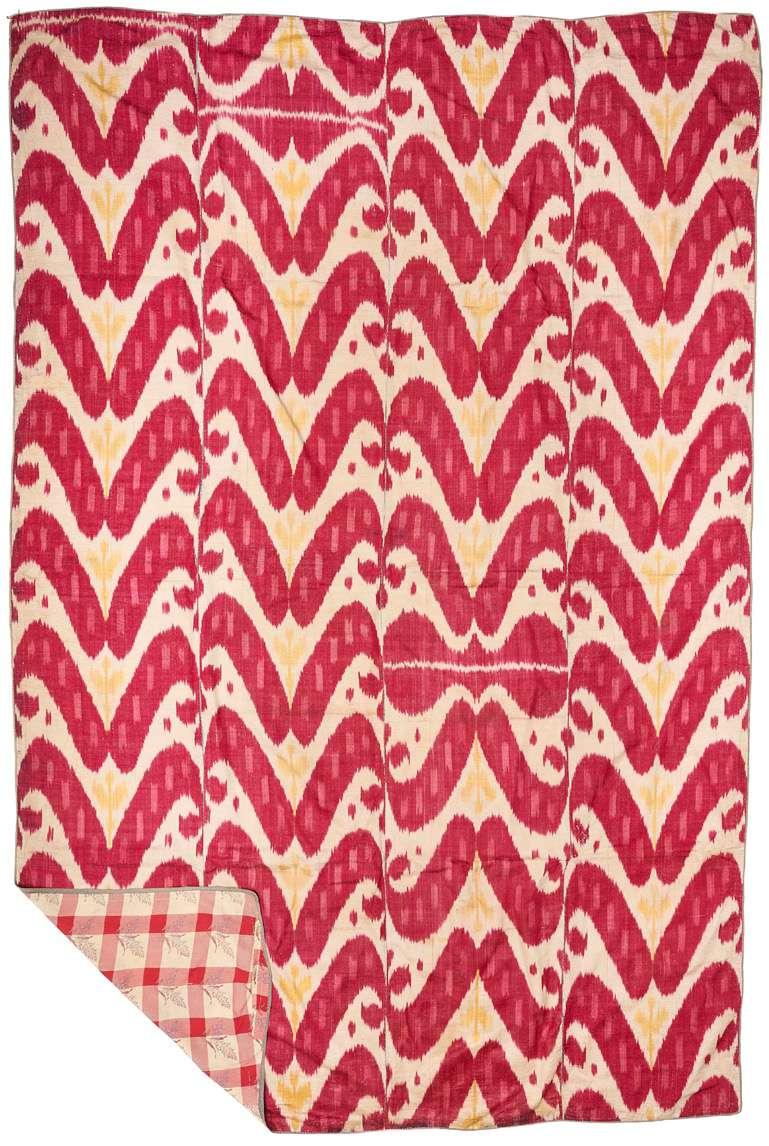
A LARGE IKAT PANEL, UZBEKISTAN, LATE 19TH CENTURY
the adras ikat with bold curved crimson leaves forming swags, interspersed with small yellow plants, on an ivory ground, approximately 212 x 140cm
£500-1,000
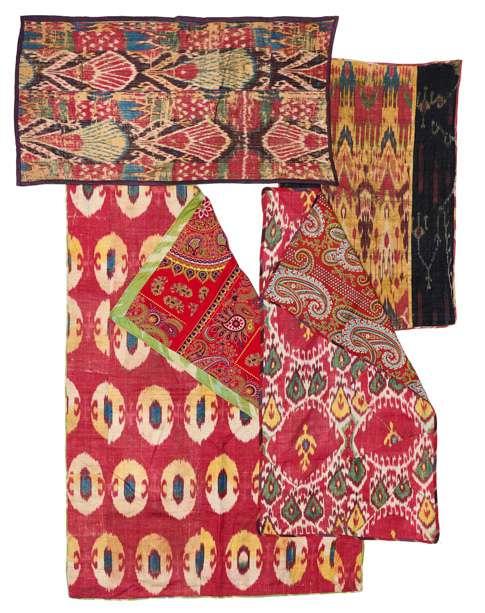
TWO IKAT WOMEN’S ROBES (MUNISAK), UZBEKISTAN, LAST QUARTER 19TH CENTURY
of adras ikat, the first woven with polychrome vegetal motifs, printed cotton lining, tablet braid trim to cuffs, openings and hem, the second in red and white with complementary printed lining, edged in black braid, approximate length 120cm; 132cm
£450-650
11
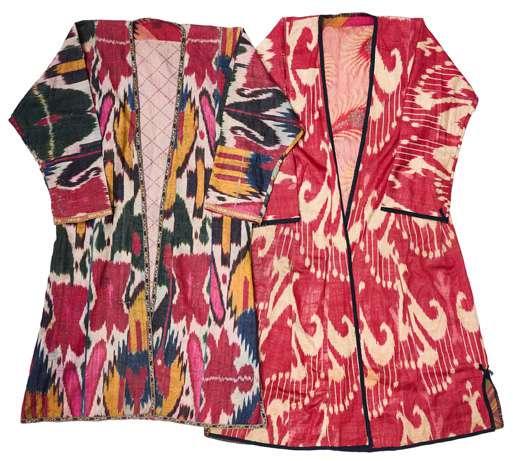
A BOY’S IKAT CHAPAN, BOKHARA, UZBEKISTAN, LAST QUARTER 19TH CENTURY
of adras ikat, with printed cotton lining, tablet braid edging to openings and cuffs, approximate length 110cm
Literature: Hale, A., Fitz Gibbon, K., et al, Ikats, Woven Silks from Central Asia, The Rau Collection, Oxford 1988, p. 48
£300-500
10
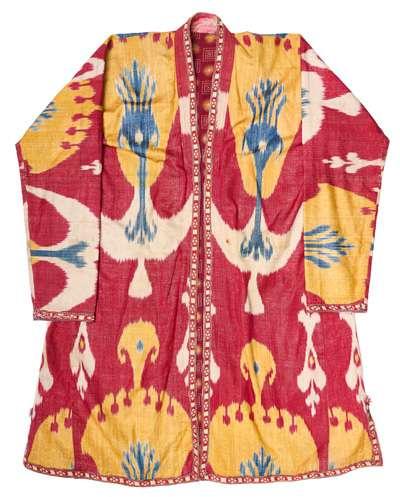
AN IKAT PANEL, SAMARKAND, THIRD QUARTER 19TH CENTURY AND THREE IKAT PANELS, UZBEKISTAN, 19TH CENTURY
the Samarkand panel with crimson ground and overall flowerheads in ivory and yellow with indigo and aubergine centres, approximately 120 x 86cm; the second with aubergine ground with polychrome fan palmettes, approximately 92 x 47cm; the third with yellow ground, stylised plants and palmettes, indigo ikat side borders, approximately 76 x 51cm, the fourth with flowerheads and small cypress trees, approximately 100 x 50cm (4)
Literature: Hale, A., Fitz Gibbon, K., et al, Ikats, Woven Silks from Central Asia, The Rau Collection, Oxford 1988, p. 55 (the Samarkand panel)
£800-1,500
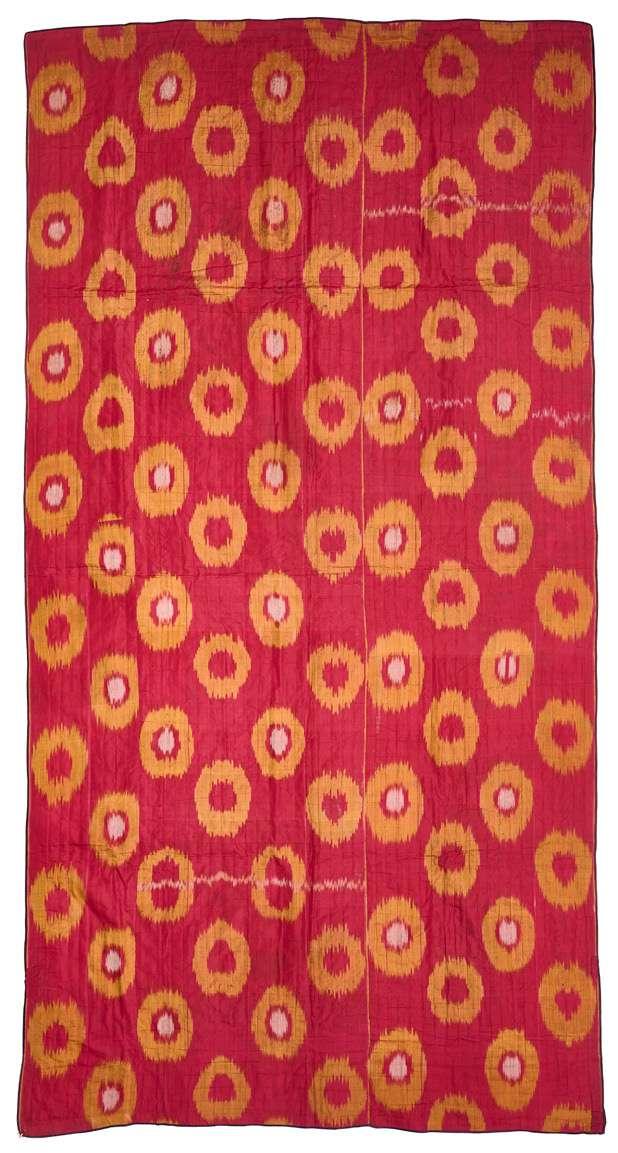
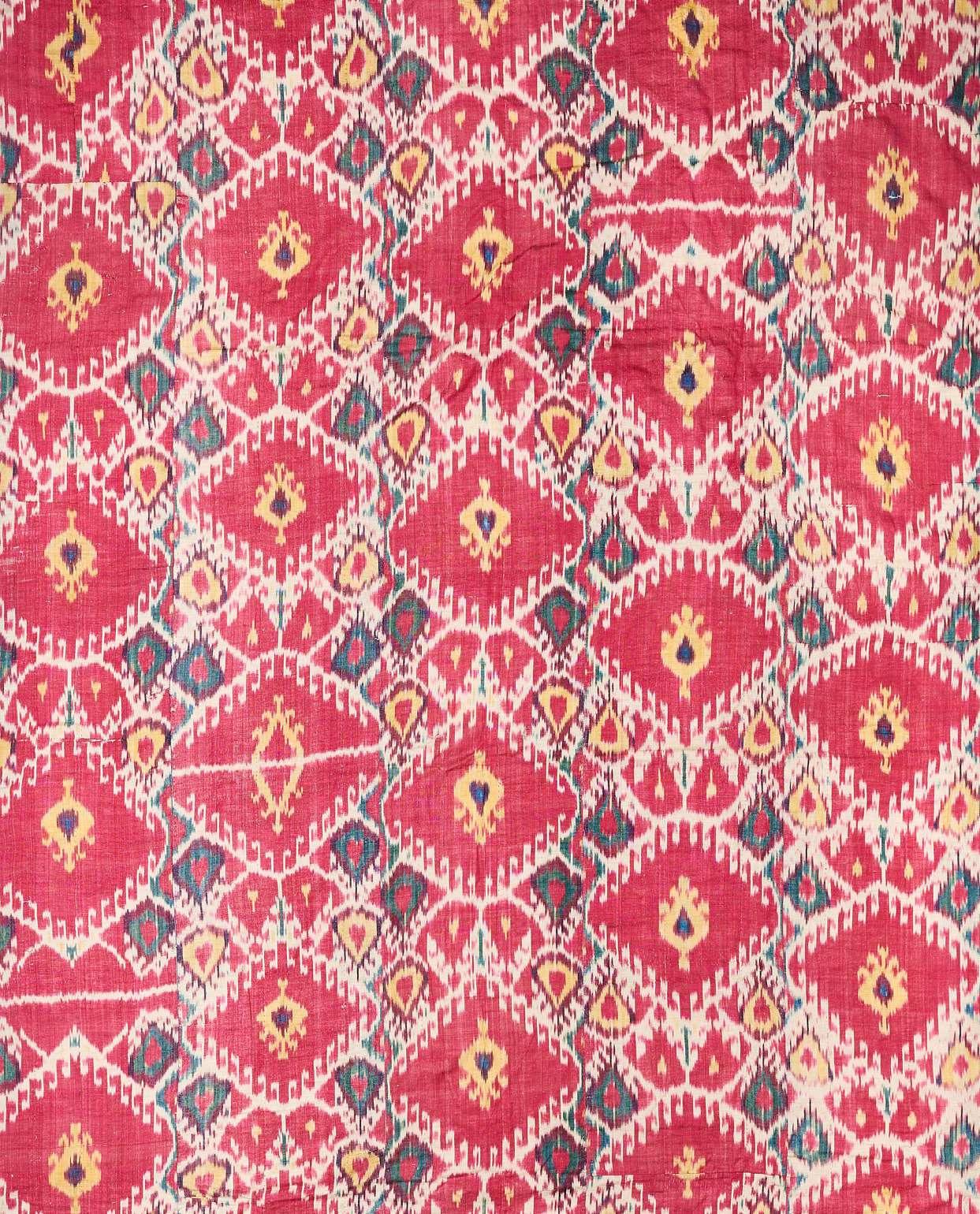
AN IKAT PANEL, UZBEKISTAN, POSSIBLY SAMARKAND, SECOND HALF 19TH CENTURY
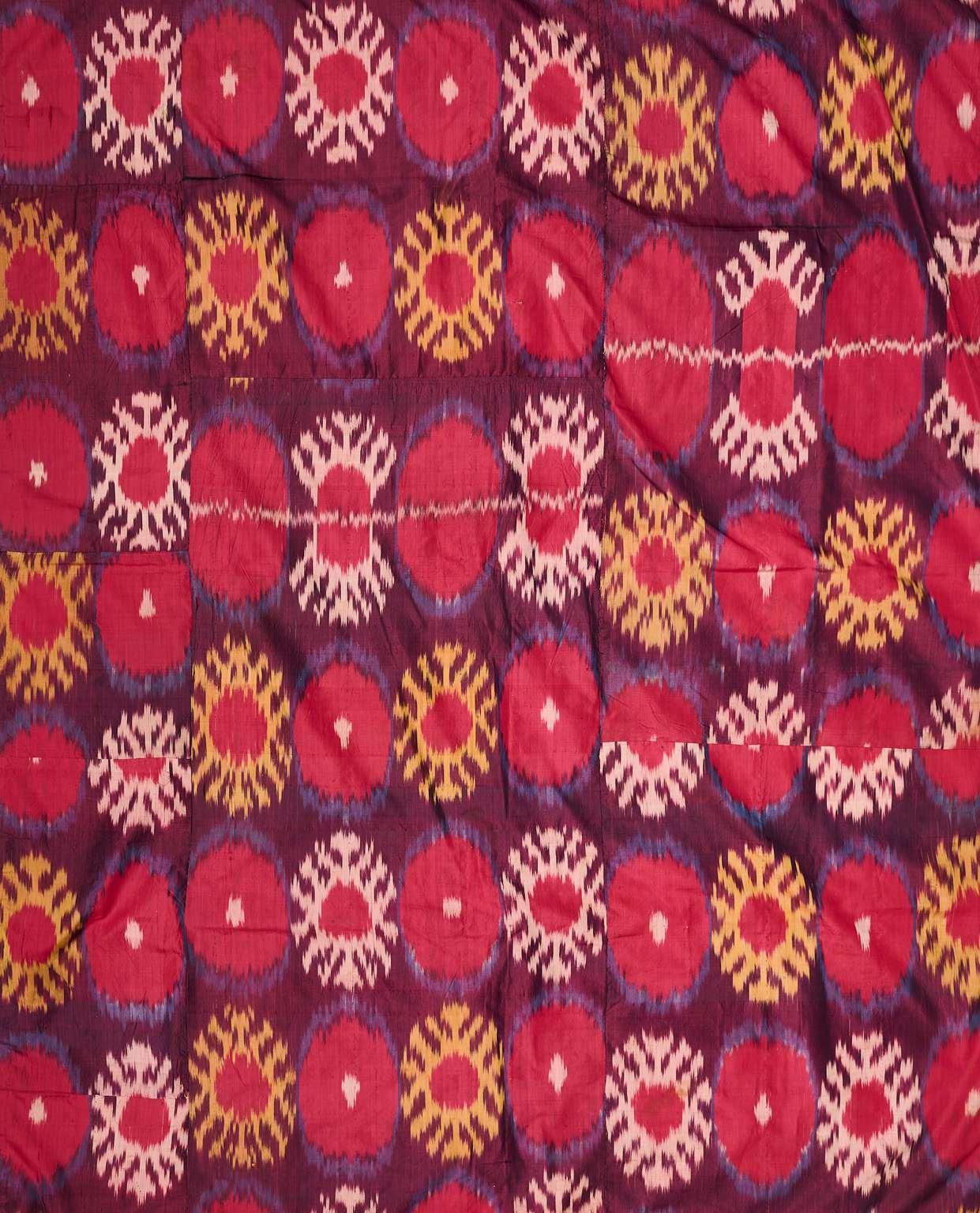
the atlas ikat woven in rosy red with saffron roundels with crimson and ivory centres, approximately 190 x 97cm
£500-800
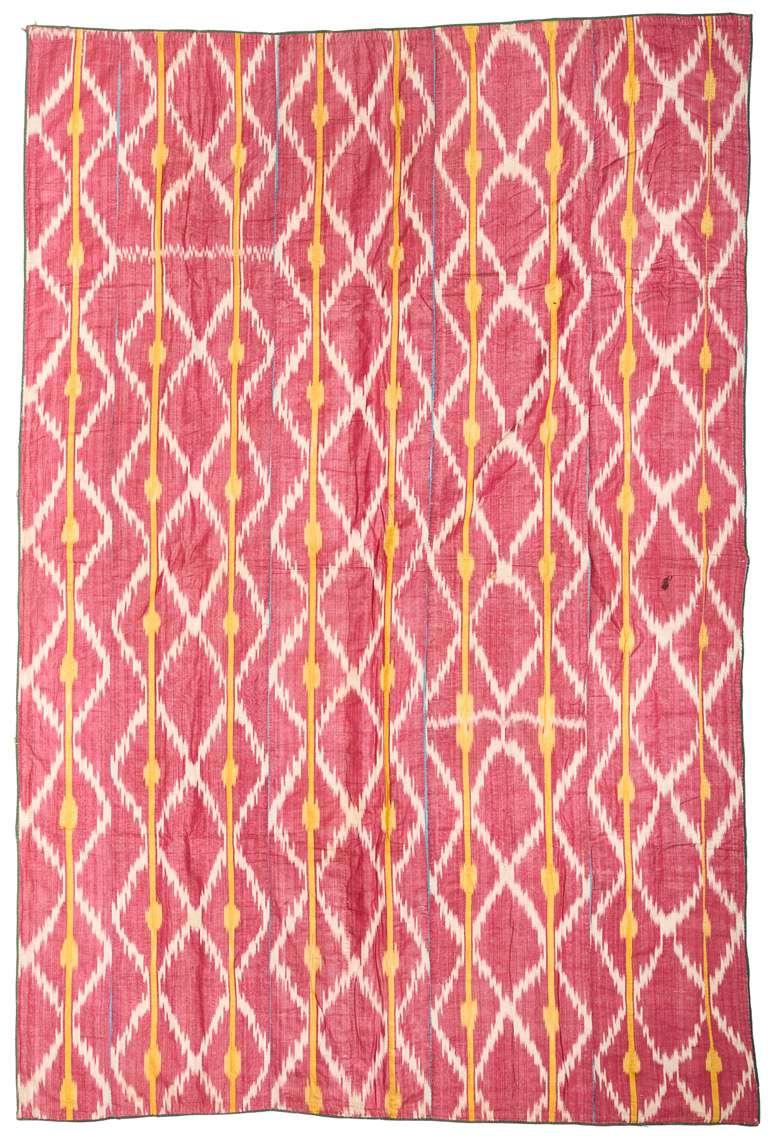
AN IKAT QUILTED PANEL, UZBEKISTAN, LATE 19TH CENTURY of adras ikat with yellow stripes and rosy pink diamonds, approximately 360 x 120cm
See Atanova, S., et al, Central Asian Textiles: The Neville Kingston Collection, London, 2025, Cat. No. 2.100, p. 237, for a pair of lozim (women’s trousers) made up in a similar ikat.
£500-1,000
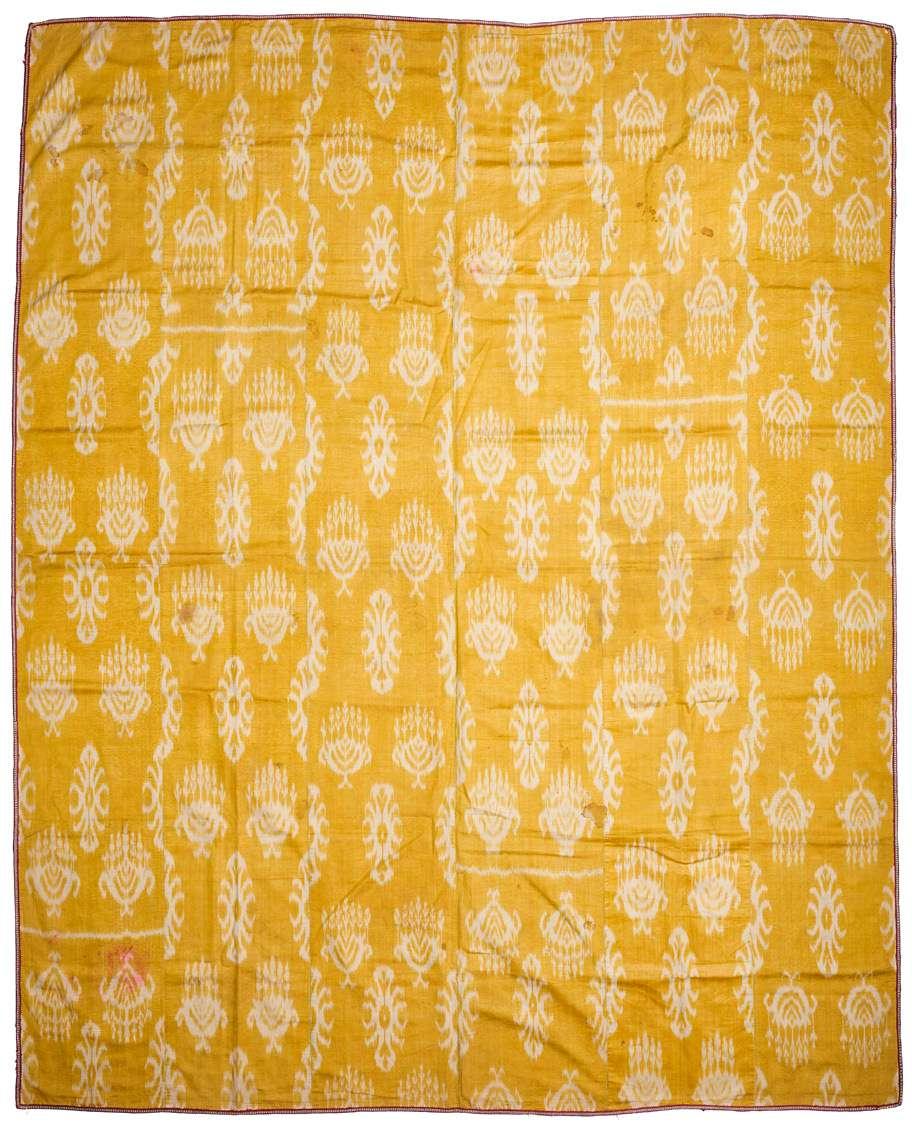
A LARGE IKAT PANEL, UZBEKISTAN, POSSIBLY FERGHANA FOR THE JEWISH MARKET, SECOND HALF 19TH CENTURY
the finely woven adras ikat in yellow with ivory motifs, possibly menorah, and guls, fine tablet braid edging, approximately 215 x 170cm
£700-1,200
15
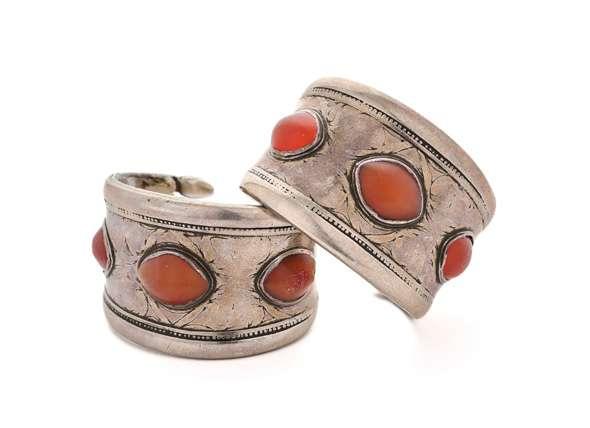
A PAIR OF SMALL TURKMAN BRACELETS, CENTRAL ASIA, 19TH CENTURY
silver, set with carnelians, of flat crescentic form with a trio of pointed finials at each end, 6.5cm max. diam.
£100-150
17
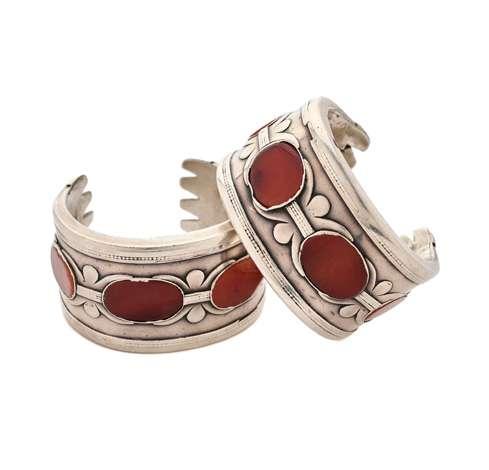
A PAIR OF TURKMAN BRACELETS, CENTRAL ASIA, 19TH CENTURY
silver, set with carnelians, of crescentic form, with five pointed finials at each end, 6.5cm max. diam.
£120-180
16
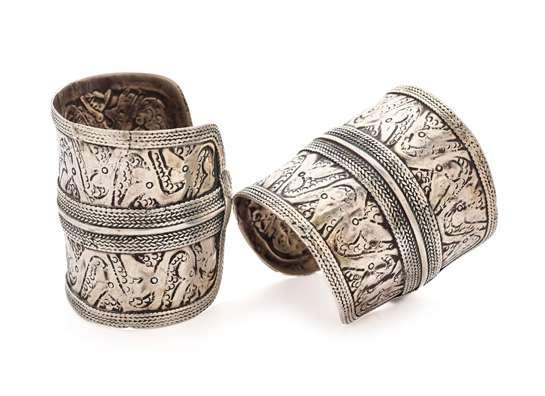
A PAIR OF TURKMAN BRACELETS, CENTRAL ASIA, 19TH CENTURY
silver, of crescentic form, with twin bands of engraved arabesque decoration, 6 x 4 x 5cm
£60-80
18
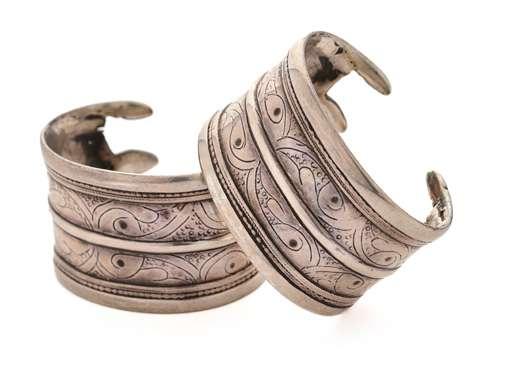
A PAIR OF TURKMAN BRACELETS, CENTRAL ASIA, 19TH CENTURY
silver, decorated with twin bands of embossed arabesque and ropework decoration, palmette finials at either end, 6.5 x 5.5 x 5.5cm
£80-120
19
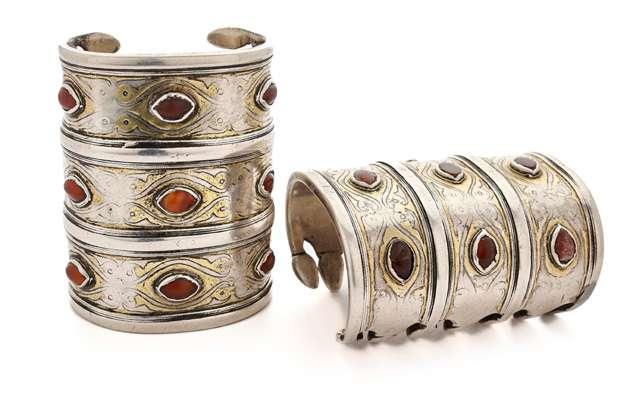
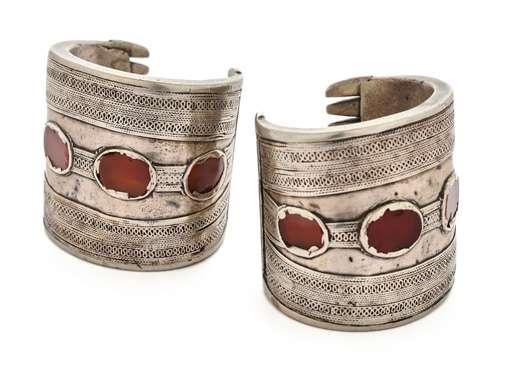
A PAIR OF TURKMAN BRACELETS, CENTRAL ASIA, 19TH CENTURY
parcel gilt silver, set with carnelians, of wide crescentic form, the decoration divided into three bands, seven bud-shaped finials at either end, 7 x 9 x 5cm
£200-300
20
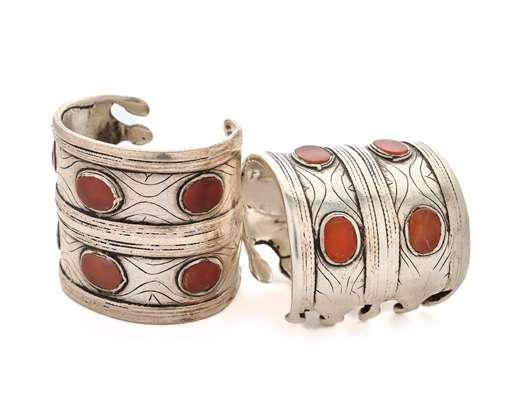
A PAIR OF TURKMAN BRACELETS, CENTRAL ASIA, 19TH CENTURY
silver, with wirework applique and set with oval carnelians, of crescentic form with serrated finials, 6.5 x 6.5 x 5.2cm
£200-300
21
A PAIR OF TURKMAN BRACELETS, CENTRAL ASIA, 19TH CENTURY
silver, set with carnelians, of crescentic form, each end with five bud shaped finials, 6 x 6 x 5.5cm
£120-180
22
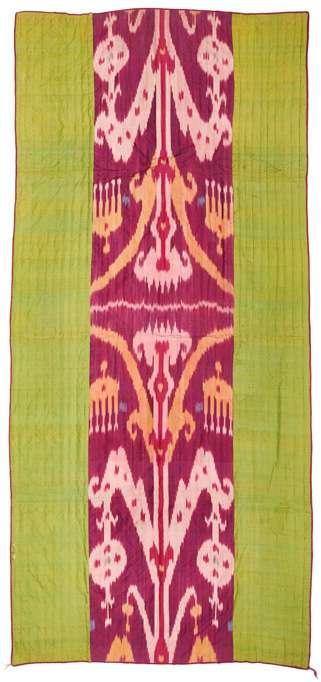
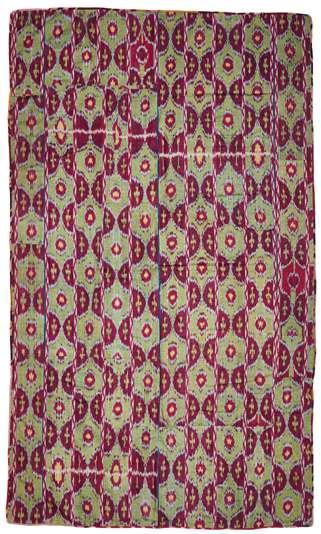
AN IKAT AND SILK QUILTED PANEL, UZBEKISTAN, LATE 19TH/ EARLY 20TH CENTURY
the central panel of silk atlas ikat, green silk side panels, approximately 198 x 96cm
£200-300
23
AN IKAT PANEL, UZBEKISTAN, LAST QUARTER 19TH CENTURY
the adras ikat with narrow stripes of green and crimson guls, some piecing, approximately 168 x 100cm
£300-500
24
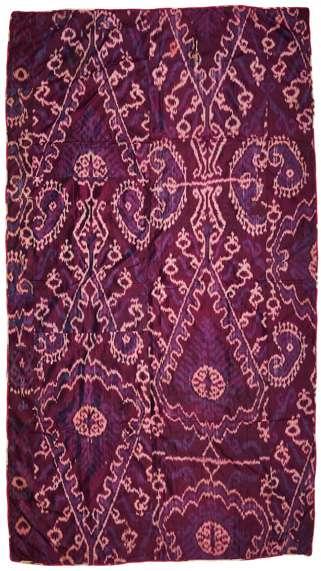
AN IKAT PANEL, UZBEKISTAN, SECOND HALF 19TH CENTURY
the atlas ikat woven in shades of aubergine, indigo and ivory with palmette motifs, pieced, approximately 200 x 104cm
£250-400
25
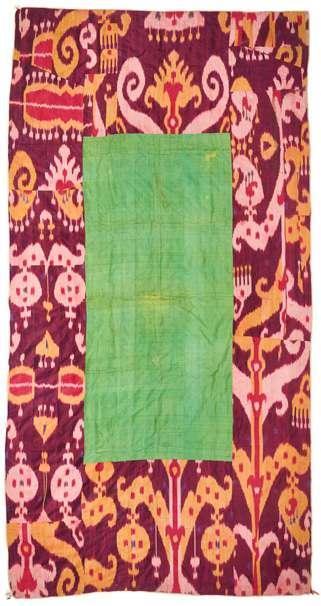
A SILK AND IKAT QUILTED PANEL, UZBEKISTAN, PROBABLY BOKHARA, CIRCA 1900
the field with a plain green silk panel with a broad border of atlas ikat, aubergine ground, bold stems, roundels, palmettes, pomegranates and scrolls, in yellow, ivory and crimson, approximately 235 x 116cm
£250-400
26
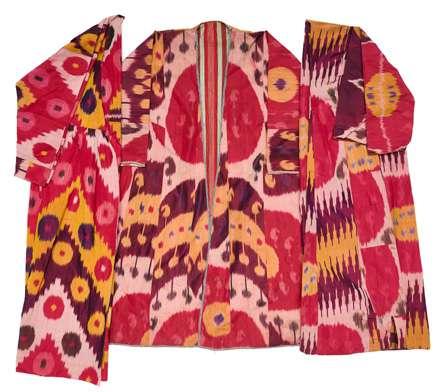
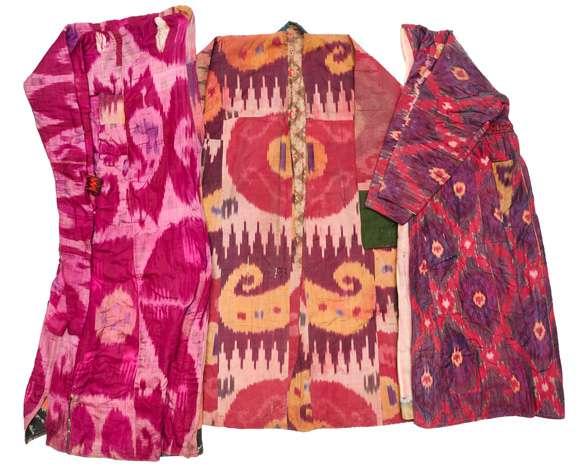
AN IKAT MUNISAK AND TWO CHAPAN, BOKHARA, UZBEKISTAN, CIRCA 1900
of atlas ikat, the munisak and one chapan unlined, one with printed cotton lining and braid trim, longest approximately 135cm (3)
£300-500
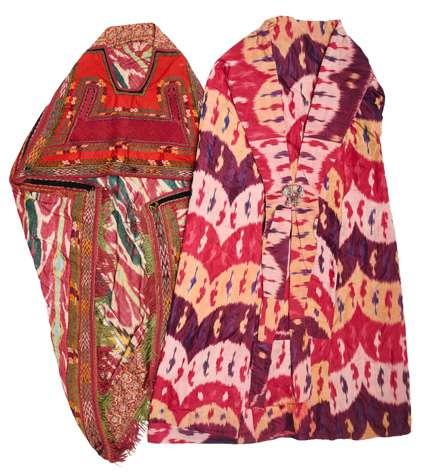
AN EMBROIDERED AND IKAT KARAKALPAK KIYMESHEK (CLOAK), AND A QUILTED IKAT PARANJA, 1875-1900
the kiymeshek with embroidered broadcloth front panel and adras ikat cloak with embroidery and fringe trim, the paranja of padded and quilted atlas ikat approximate lengths 150 and 147cm (2)
For a related kiymeshek, see Atanova, S., et al, Central Asian Textiles: The Neville Kingston Collection, London, 2025, fig. 48, p. 127. The kiymeshek formed a key element of the Karakalpak bride’s attire in the late 19th and early 20th century. It was worn draped over the head as a cowl, and the sawkele, a helmet-shaped wedding headdress was placed over it. After marriage, it was worn only on important ceremonial occasions, together with a turban. In both cases, the headdress would have covered the simpler printed cotton section at the top, whilst the face and shoulders were framed by the embroidered broadcloth panel.
£500-800
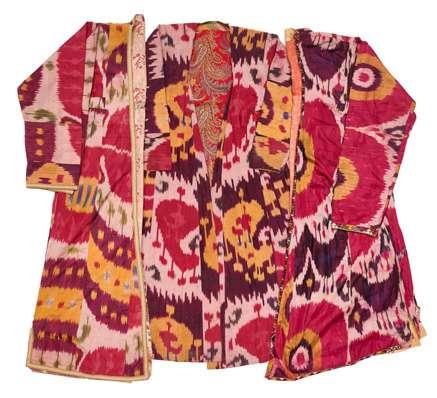
28
THREE LADIES’ IKAT ROBES (MUNISAK), BOKHARA, UZBEKISTAN, CIRCA 1900
of atlas ikat, each padded and quilted, printed cotton linings, two with braid edging, the longest approximately 124cm long (3)
£350-550
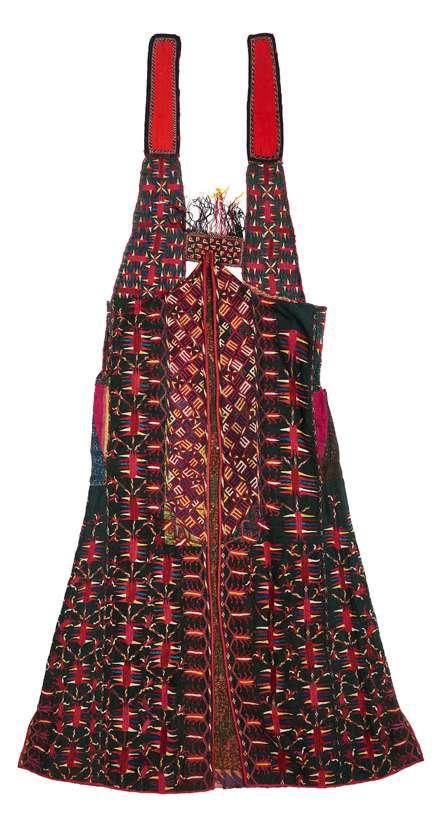
29
A FINE SILK EMBROIDERED TURKMAN TEKKE CHRYRPY, WEST TURKESTAN, LAST QUARTER 19TH CENTURY
of blue-black silk, the front and side panels with ascending checkered stems bearing feathered motifs and flowering branches, the front edges and hem slits bordered with an undulating vine supporting tulips, the back panel with a lower section of trellis work enclosing guls with flower centres, hooks and spikes, three columns of elaborate hooked motifs above, the sleeves and collar section in blue-green silk, the sleeves with flowers and spiked motifs, linked by a tasselled panel, the collar in interlocking fret, the embroidery in pink, madder, azure blue, yellow, ivory, dark indigo and walnut, the sleeves finished with red wool broadcloth lappets, the chyrpy lined in Indian block printed heavy plainweave, ikat facings, narrow red braid edging, approximately 115cm long
The Chyrpy formed part of the traditional costume of Tekke tribeswomen, and the colour reflected their age and social status: red for a bride, blue-black or green after the birth of the first child, later yellow and then white. They were worn over a headdress, as a type of cloak, similar to the paranja, with the vestigial sleeves hanging down the back. For further discussion and examples, see Atanova, S., et al, Central Asian Textiles: The Neville Kingston Collection, London, 2025, pp. 44-61
£500-800
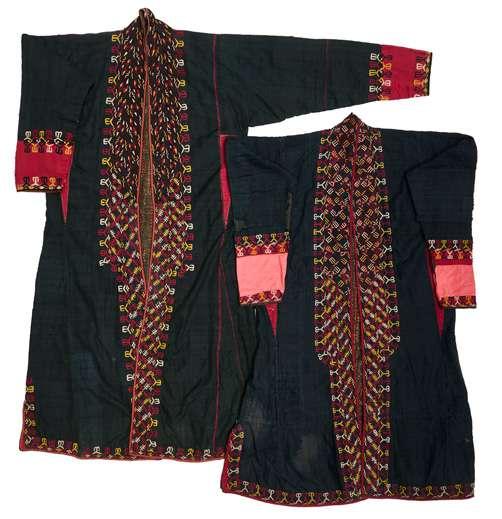
30
TWO EMBROIDERED SILK TEKKE ROBES (KURTE), WEST TURKESTAN, 19TH CENTURY
the first with diamond and bar collar embroidery, feathered leaf plackets, all bordered with stylised running leafy vine, red silk sleeve bands, block printed lining, the second with panelled fret with guls to collar feathered leaf plackets, all bordered with stylised running leafy vine, red silk sleeve bands and gores, block printed lining, approximate lengths 125cm, 112cm (2)
£150-250
31
A FERGHANA IKAT SUZANI PANEL, EMBROIDERY PROBABLY LAKAI, UZBEKISTAN, LAST QUARTER 19TH CENTURY
the indigo and ivory adras ikat embroidered with a central flowerhead medallion and boteh border, approximately 152 x 112cm
Literature: Hale, A., Fitz Gibbon, K., et al, Ikats, Woven Silks from Central Asia, The Rau Collection, Oxford 1988, p. 60;
For related examples, see Sotheby’s, New York 25 November 2008, lot 72 and an embroidery in the collection of Marshall and Marilyn Wolf, see Ernst J. Grube, Keshte, New York, 2003, no. 29.
£3,000-5,000
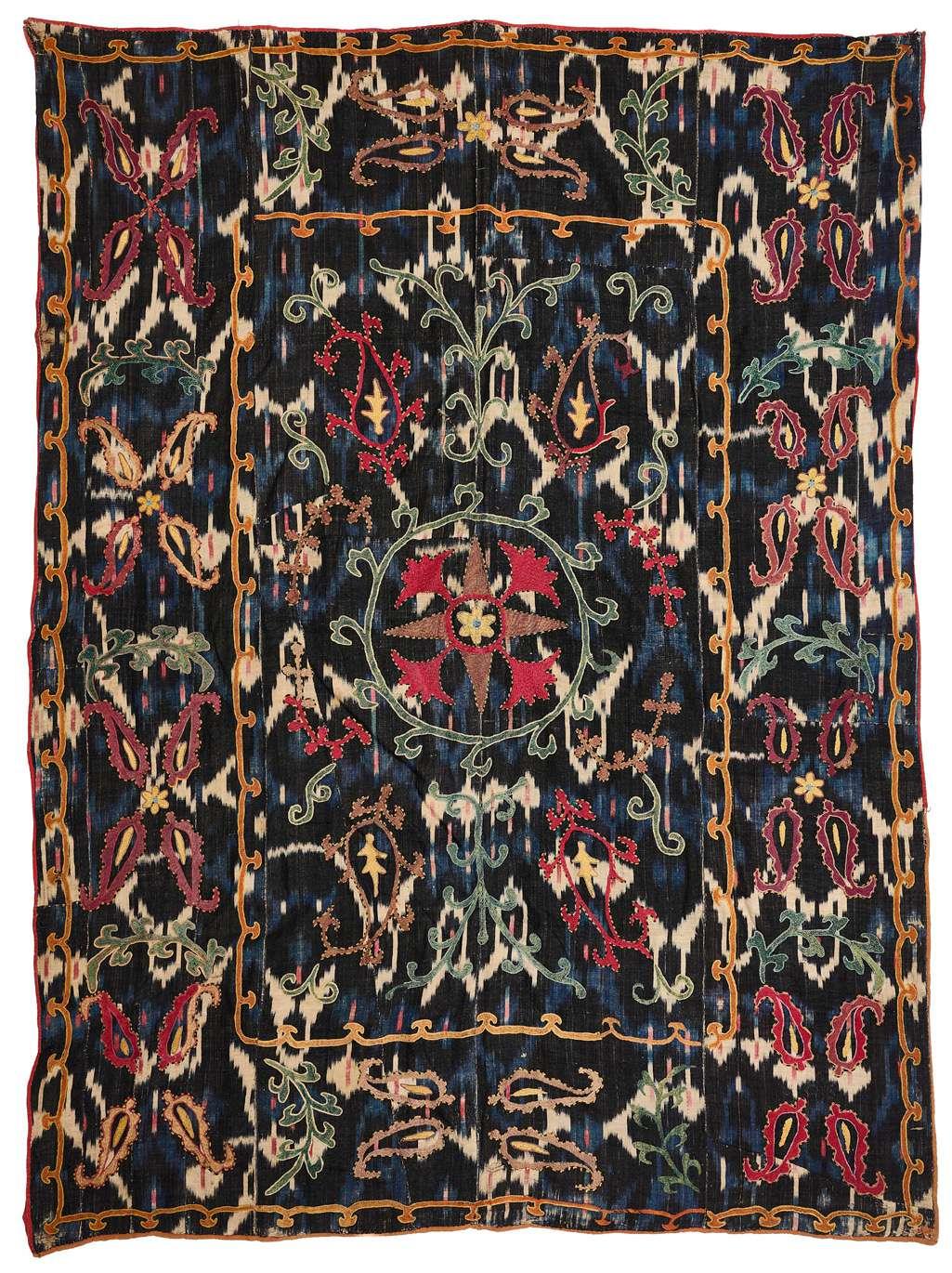
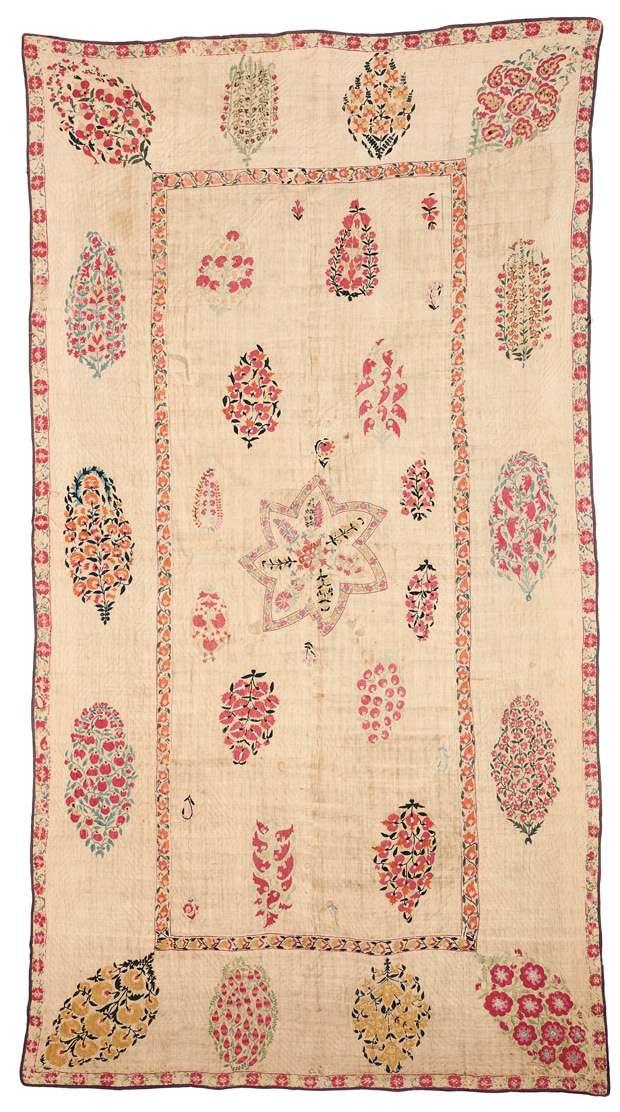
A QUILTED NURATA SUZANI, UZBEKISTAN, MID 19TH CENTURY OR EARLIER
the ivory field quilted in a diamond diaper, with a central flower star medallion and scattered sprays of blossom, in rose pinks, saffron yellow, melon orange, blues and green, approximately 240 x 130cm
This suzani is notable for the individual characterisation of each of the flower sprays, and for the delicacy of their drawing and colouring.
The indebtedness of this type of embroidery to 17th and 18th century Mughal textiles is clearly visible; the fine quilting is also reminiscent of Mughal floorspreads. An 18th century date for this piece is conceivable.
£1,500-2,500
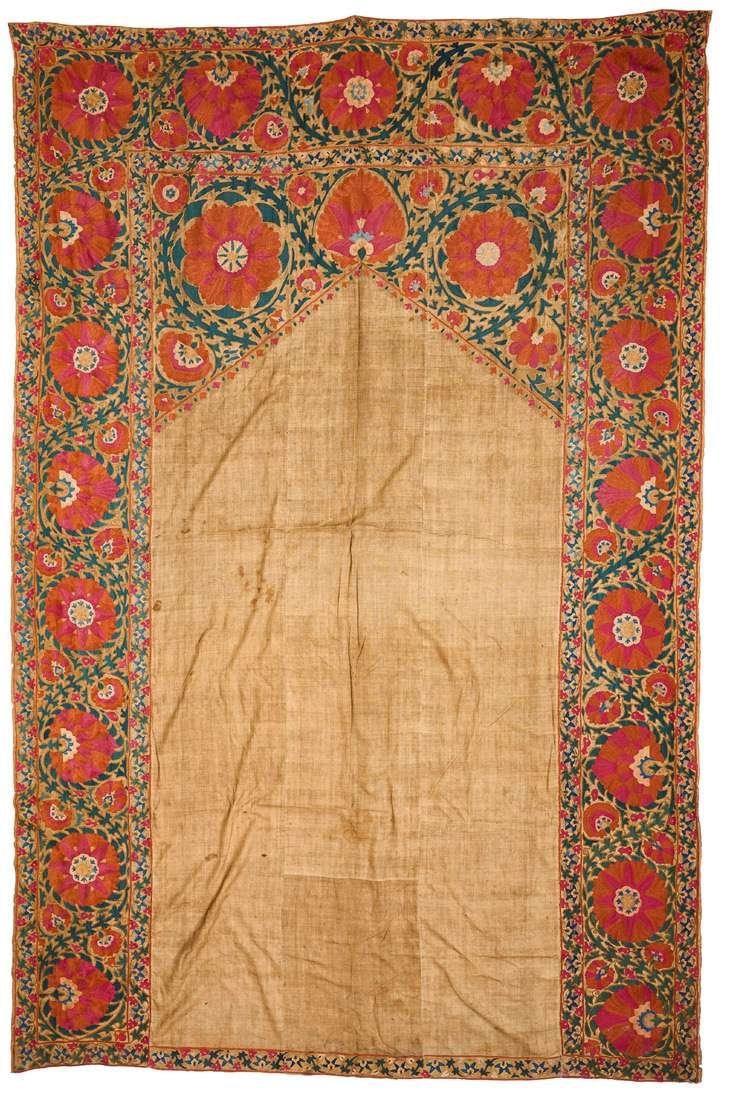
A BOKHARA NICHE SUZANI, UZBEKISTAN, MID 19TH CENTURY
the caramel ground with a plain central niche, the spandrels with a palmette at the apex and large flowerhead roundels with sea green leaves, complementary border of undulating sea-green leafy vines bearing alternate palmettes and rosettes with smaller palmettes and pomegranate buds between, narrow lower guard, approximately 250 x 170cm
£1,000-2,000
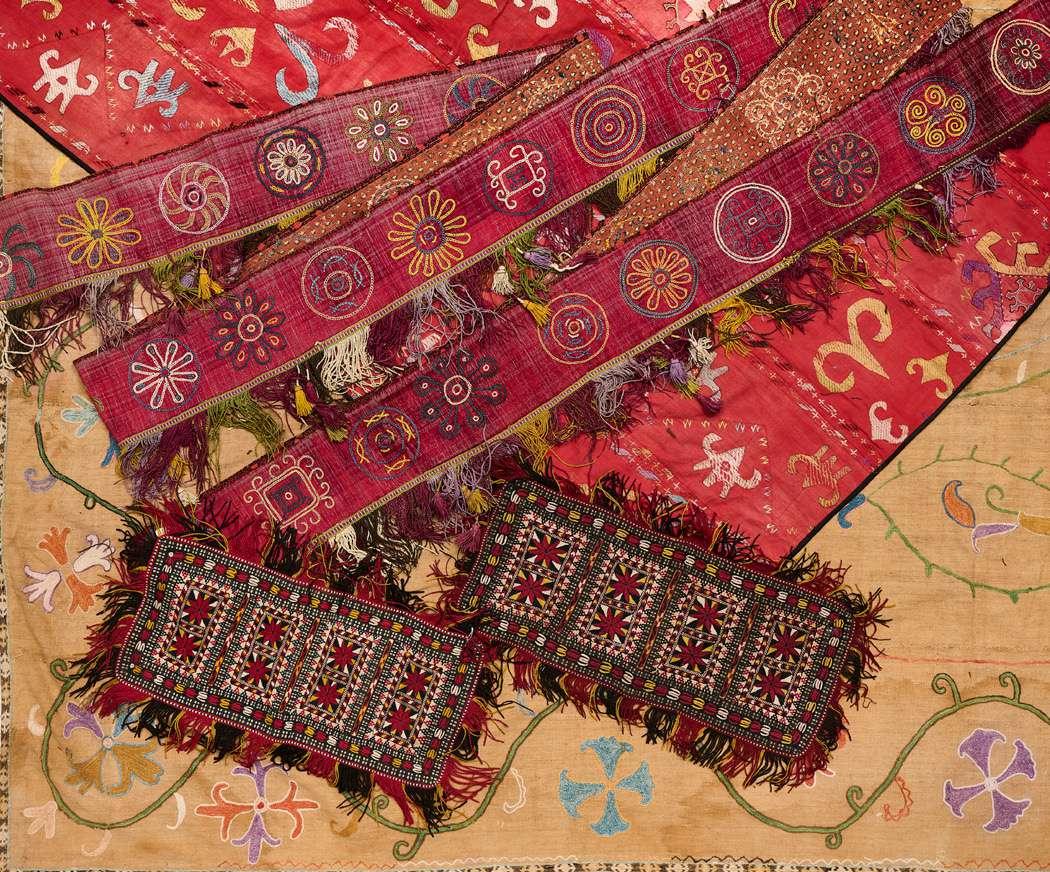
A QUANTITY OF CENTRAL ASIAN EMBROIDERIES, LATE 19TH AND EARLY 20TH CENTURY
including an Uzbek embroidered panel fragment, together with another Suzani, an embroidered tent band and a pair of Tekke embroideries, the panel with a rose red ground embroidered with flower sprays, guls and leafy motifs, the suzani with leaf encircled motifs on a light camel ground, the tent band embroidered with roundels and with fringing, the Tekke panels finely worked with panelled star guls and geometric borders with fringing to all four sides, the embroidery approximately 140 x 170cm, the suzani approximately 240 x 180cm, the tent band 13cm deep, the Tekke panels each approximately 49 x 21cm excluding fringes (5)
£500-1,000
35
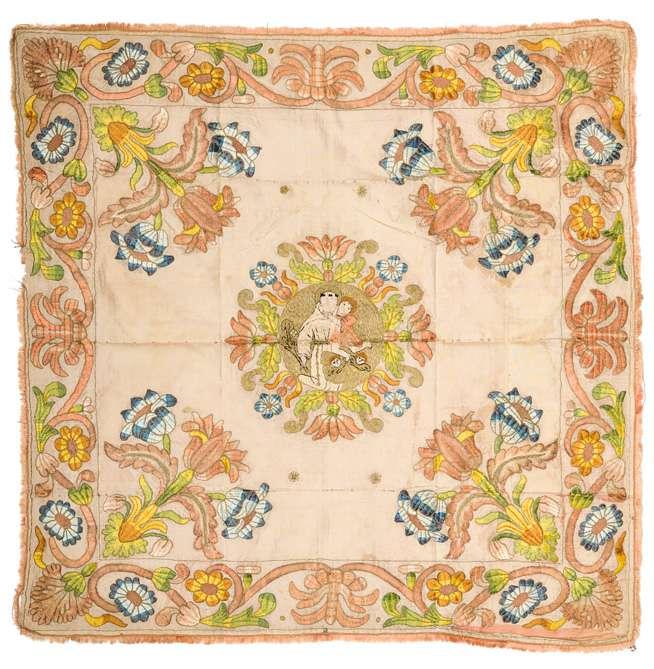
A SILK AND METAL THREAD EMBROIDERED CHALICE COVER, PROBABLY CASTELO BRANCO, PORTUGAL, 18TH CENTURY
worked in floss silks and gold metal thread with ecclesiastical figural group, floral motif spandrels, 64cm square
£250-400
36
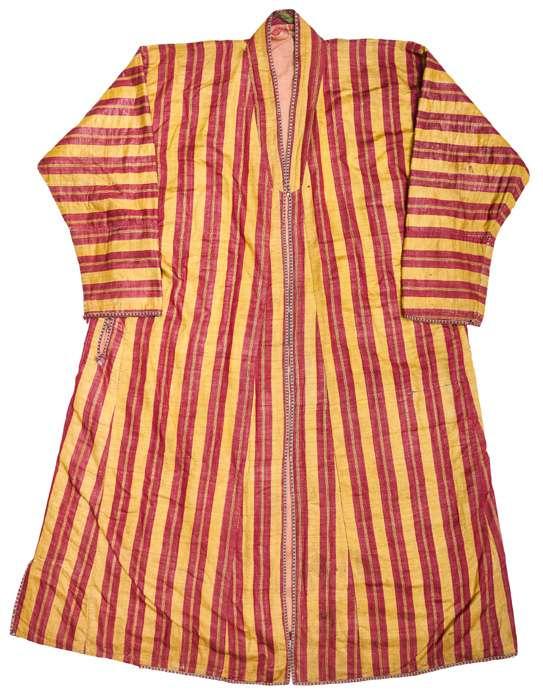
A QUILTED STRIPED CHAPAN, CENTRAL ASIA, CIRCA 1900
of glazed silk and cotton fabric, in saffron and crimson stripes, lined in peach coloured cotton, padded interlining, ikat facings, narrow tablet braid edging, approximate length 120cm
£250-500
37
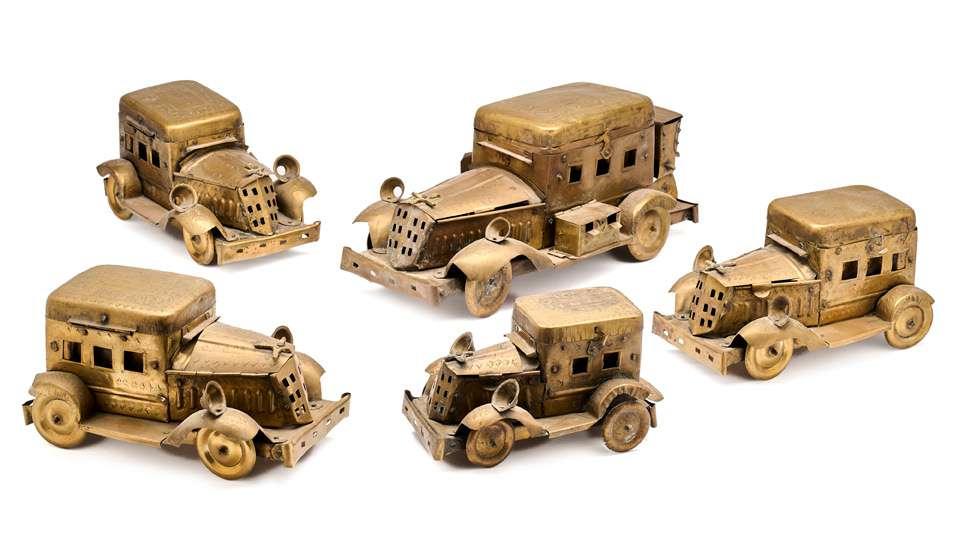
FIVE BETEL BOXES IN THE FORM OF VINTAGE CARS, INDIA, 20TH CENTURY
cut and embossed sheet brass, each with hinged compartments under roof and bonnet with trays and lidded containers, 15.5 x 34 x 17cm and smaller (5)
£120-180
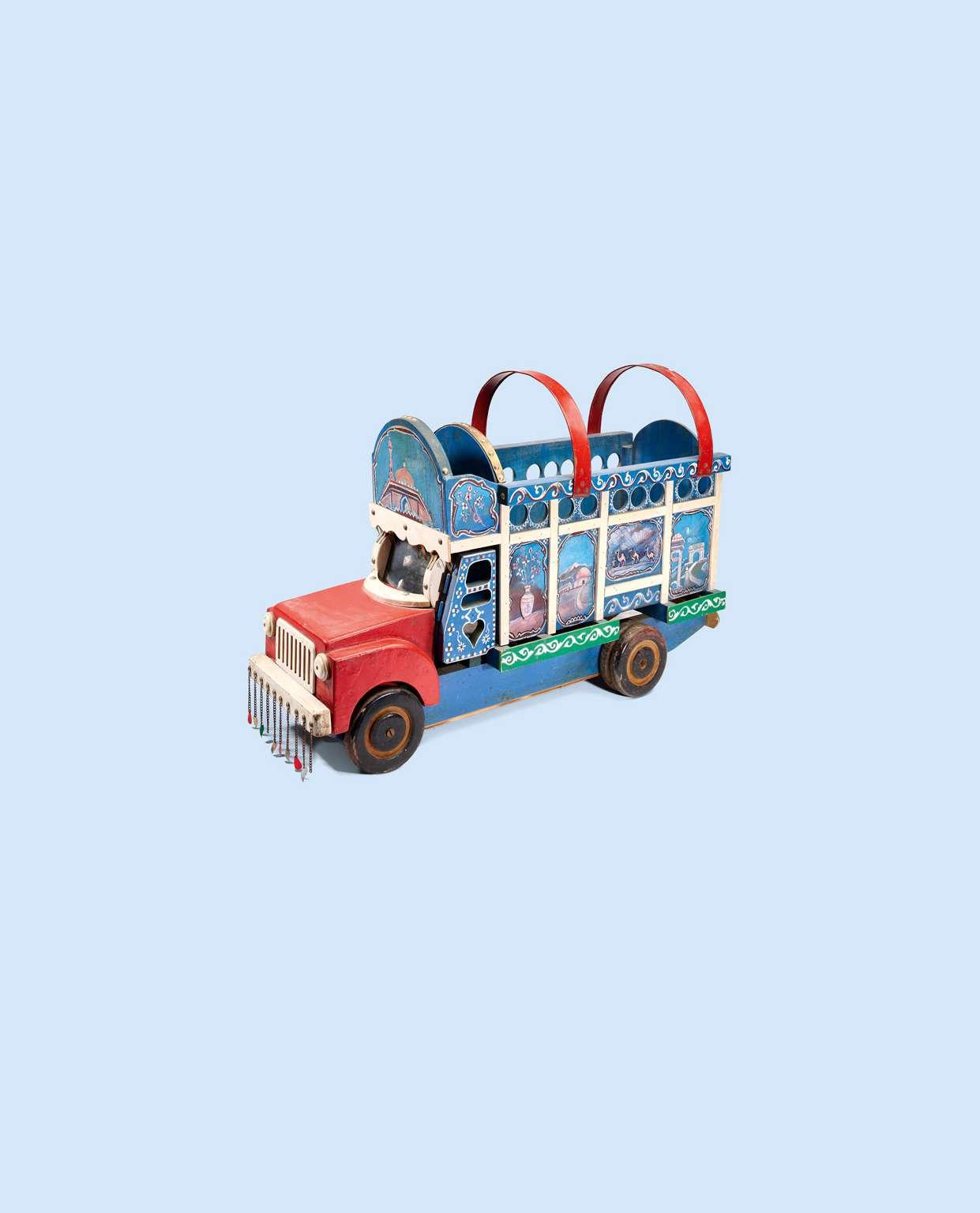
38
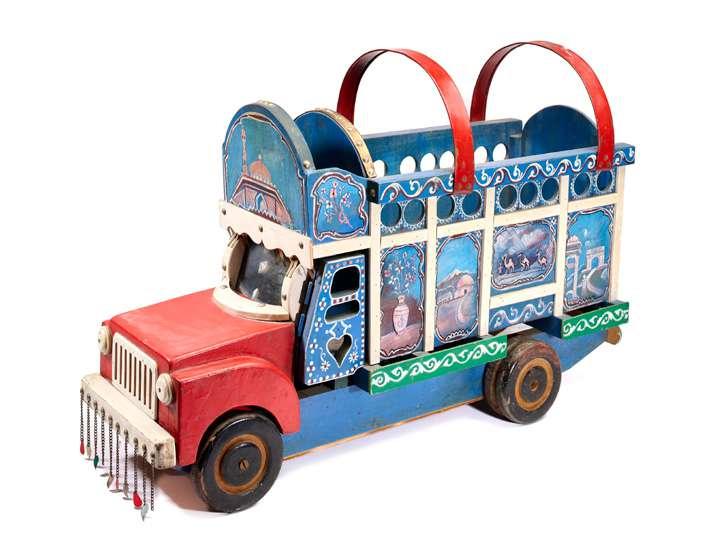
A PAINTED WOOD MODEL LORRY, PAKISTAN, MID 20TH CENTURY
with glass and metal elements, the sides richly painted with various motifs, 52 x 75 x 23cm
£80-120
39
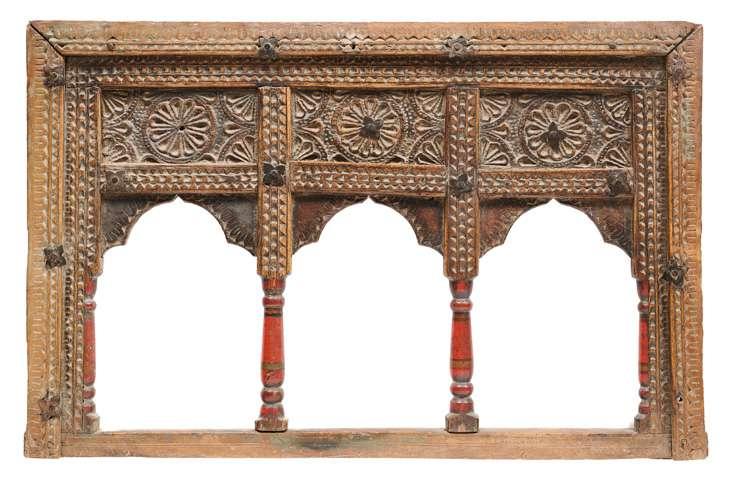
A CARVED AND PAINTED WOOD SHELF FRONT, SWAT VALLEY, PAKISTAN, 19TH CENTURY
in the form of a triple arcade, with red painted turned columns, the upper frieze with carved rosette panels, iron mounts, 45 x 69 x 3cm
£100-150
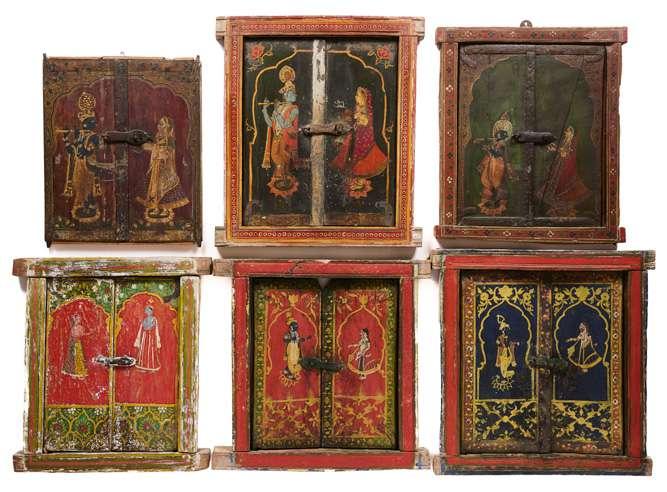
40
SIX PAIRS OF PAINTED WOOD SHUTTERS, RAJASTHAN, INDIA, 19TH CENTURY
each of rectangular form, the pivoted twin doors each depicting Radha and Krishna respectively underneath a lobed arch, iron mounts, 47 x 45 x 5cm and smaller (6)
£300-500
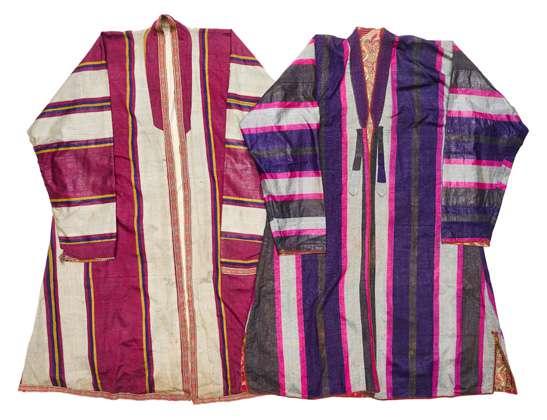
41
TWO STRIPED CHAPAN, CENTRAL ASIA, CIRCA 1900
of glazed silk and cotton fabric, the first with broad ivory and crimson stripes, edged in yellow and purple, tablet braid edging, ikat facings, plain cotton lining, together with one in shocking pink, purple, silver and grey stripes, printed cotton lining with botehs, ikat facings, very narrow red braid edgings, tie front. approximate length 120cm (2)
£300-500
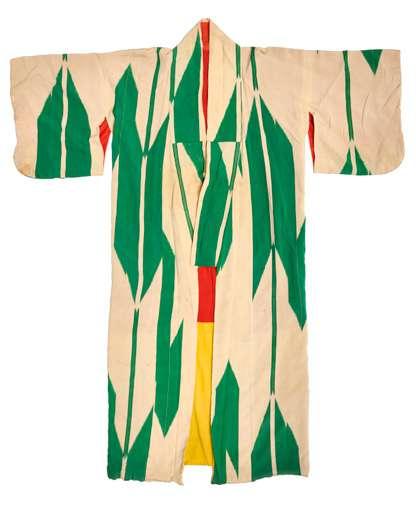
42
A JAPANESE SILK KIMONO, FIRST HALF 20TH CENTURY
in ivory with bold green ikat flashes, lined in panels of red and yellow silk, approximately 150cm long
£50-70
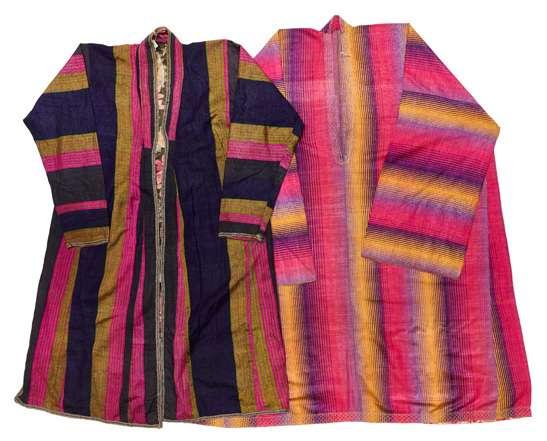
A STRIPED CHAPAN AND A TUNIC, CENTRAL ASIA, LATE 19TH CENTURY
the chapan striped in broad bands of purple, with dark grey, lime green and shocking pink, floral printed lining, ikat facings, narrow tablet braid edge, the large tunic striped in varying widths of pink, purple and golden yellow, neck opening lined in floral cotton, approximate length, 130cm (2)
£200-400
44
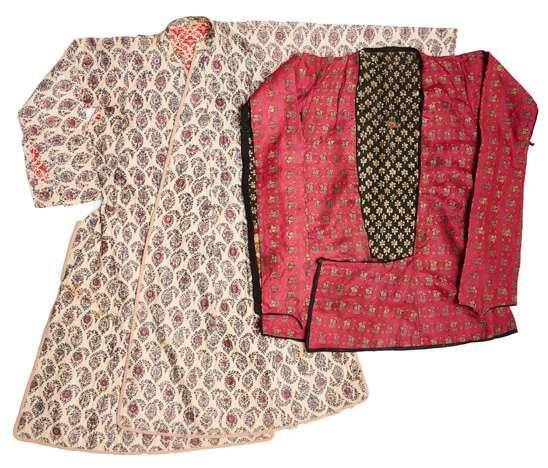
A WOMAN’S SILK AND METAL THREAD BROCADE JACKET AND A QUILTED KALAMKARI COAT, IRAN, 18TH/19TH CENTURY
the jacket of rose pink brocade with small flower sprigs, the coat with delicate flower sprigs and boteh overall, approximately 60cm and 85cm in length (2)
£800-1,500
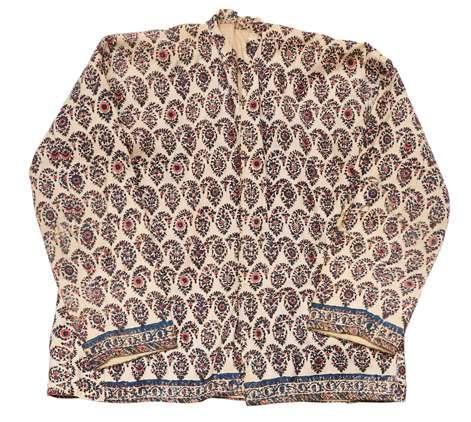
45 AN INDIAN KALAMKARI JACKET, 20TH CENTURY
with overall boteh pattern, approximately 60 cm long, 60cm wide
£100-150
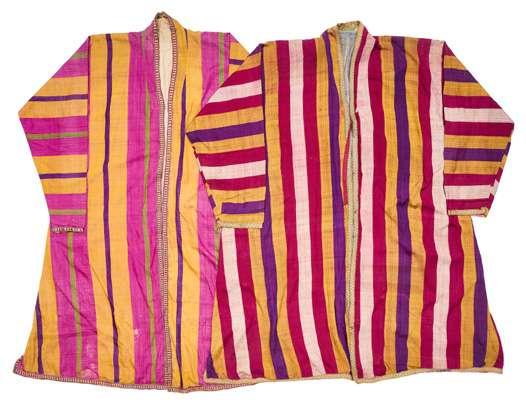
TWO SIMILAR STRIPED CHAPAN, CENTRAL ASIA, CIRCA 1900
silk and cotton fabric, one striped in magenta, yellow, purple and green, tablet braid edging, ikat facings, plain cotton lining, the other with regular stripes in magenta, purple, yellow and ivory, tablet braid edging, ikat facings, pale blue striped lining, the longer approximately 140cm (2)
£300-500
47
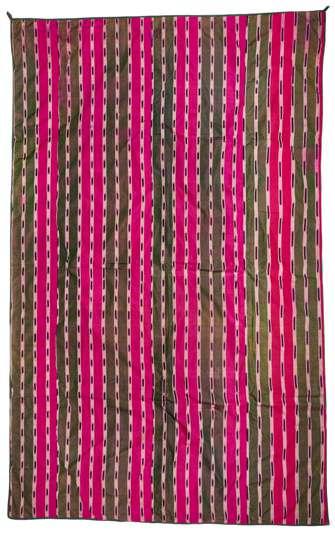
AN IKAT PANEL, CENTRAL ASIA, CIRCA 1900 of atlas ikat in green, ivory and shocking pink stripes with purple flashes, approximately 200 x 128cm
£200-400
48
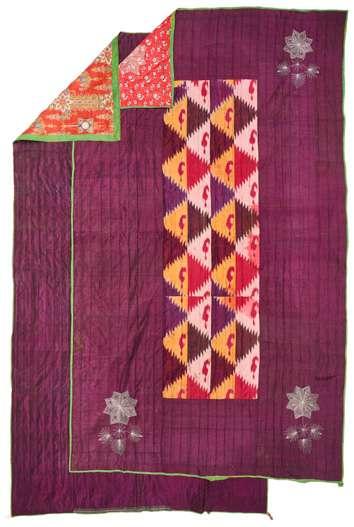
AN IKAT AND SILK QUILTED PANEL, AND A PLAIN SILK QUILTED PANEL, UZBEKISTAN, CIRCA 1900
the first with a single loom width of atlas ikat in the central panel, pieced in the length, with interlocking polychrome feathered triangles and boteh, broad aubergine adras border, with floral embroidered decoration, approximately 212 x 124cm together with a plain aubergine silk quilted panel approximately 220 x 120cm (2)
£200-500
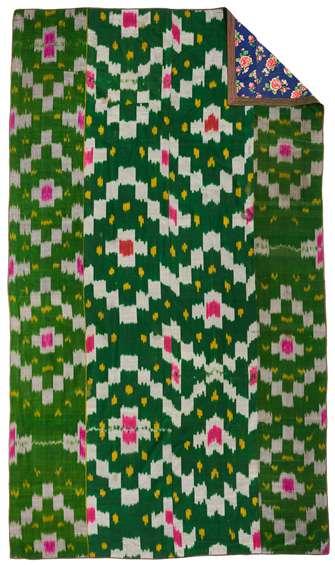
49
AN IKAT PANEL, UZBEKISTAN, EARLY 20TH CENTURY of adras ikat with green ground, pink and silvery grey cruciform motifs, approximately 242 x 138cm
£250-500
50
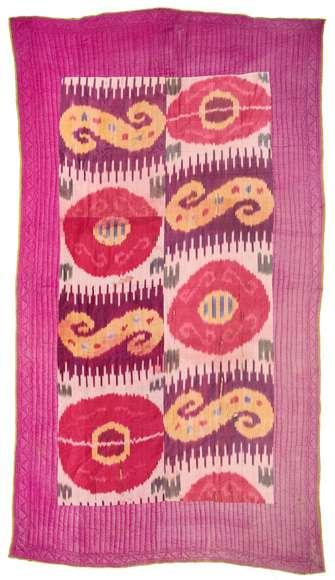
AN IKAT AND SILK QUILTED PANEL, UZBEKISTAN, PROBABLY BOKHARA, LATE 19TH/EARLY 20TH CENTURY
the central atlas silk ikat panel with large crimson roundels and yellow ‘S’ motifs on feathered aubergine panels on an ivory ground, within a quilted crimson border, approximately 252 x 216cm
£500-700
51
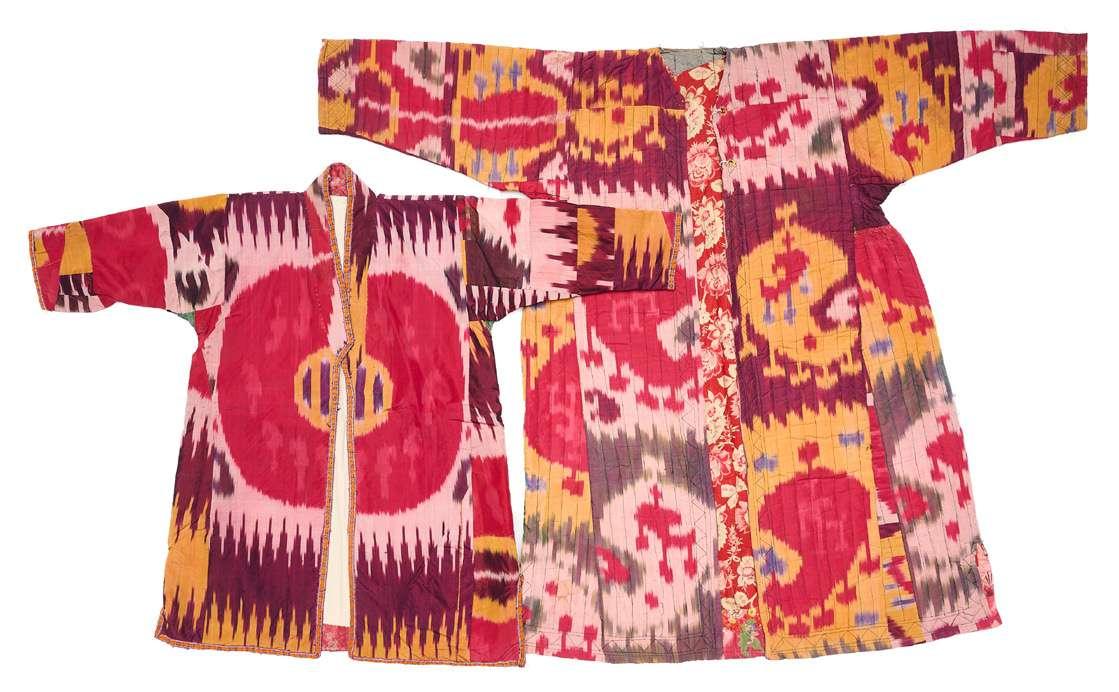
A GIRL’S AND A CHILD’S IKAT CHAPAN, BOKHARA, UZBEKISTAN, EARLY 20TH CENTURY
the larger padded and quilted, lined in printed cotton, the smaller with plain lining and tablet braid trim, approximate lengths 100cm, 73cm (2)
£200-400
52
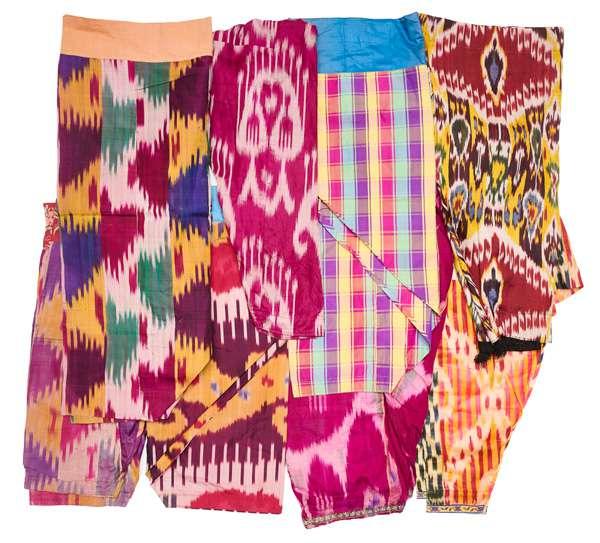
A GROUP OF EIGHT PAIRS OF TROUSERS (LOZIM), UZBEKISTAN, LATE 19TH AND EARLY 20TH CENTURY
seven variously of adras and atlas ikat, one of checked silk (8)
£300-500
53
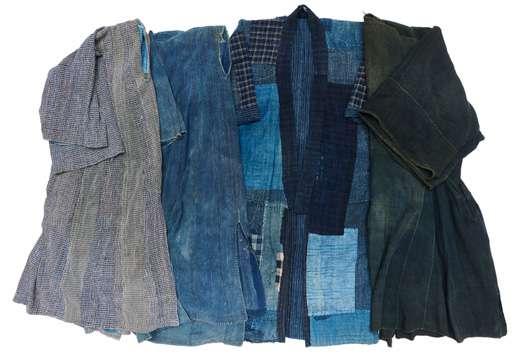
A GROUP OF ‘BORO’ AND WOVEN JAPANESE KIMONO AND WORKDRESSES, EARLY 20TH CENTURY
one plainweave kimono with button fastening, another striped with multiple patches of various indigo fabrics, one workdress in blue and white check with patches, the other indigo denim, approximate lengths 110cm, 130cm and 2 x 120cm (4)
£500-800
55
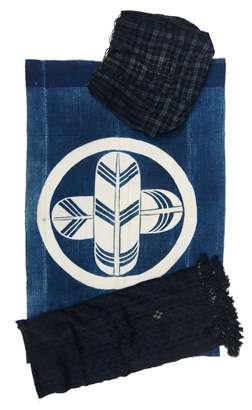
THREE JAPANESE TEXTILES, EARLY 20TH CENTURY
including a indigo resist dyed curtain (noren) with blazon, a drawstring bag in indigo plaid and a shawl with feather pattern in shades of indigo, the curtain approximately 87 x 130cm, the shawl 187 by 74cm; the bag 45 x 50cm (3)
£150-250
54
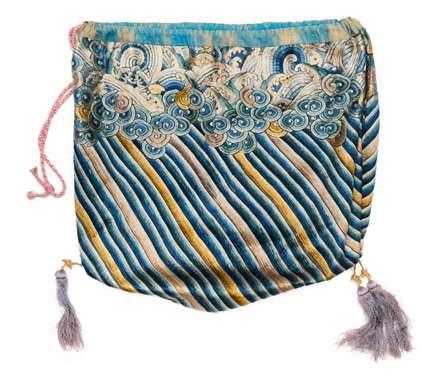
A SILK EMBROIDERED CHINESE DRAWSTRING BAG, CIRCA 1900
worked in stripes, with cloudscrolls along opening edge, approximately 40 x 40cm
£80-120
56
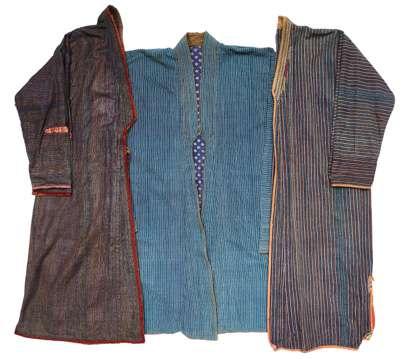
THREE STRIPED CHAPAN, CENTRAL ASIA, FIRST HALF 20TH CENTURY
each with indigo ground, one with ivory stripes, blue spotted lining, corduroy facings, the others striped in red and yellow, one with rose printed lining, narrow red silk braid edging, the other unlined, cotton facings, faded red wool braid (3)
£150-250
57
A
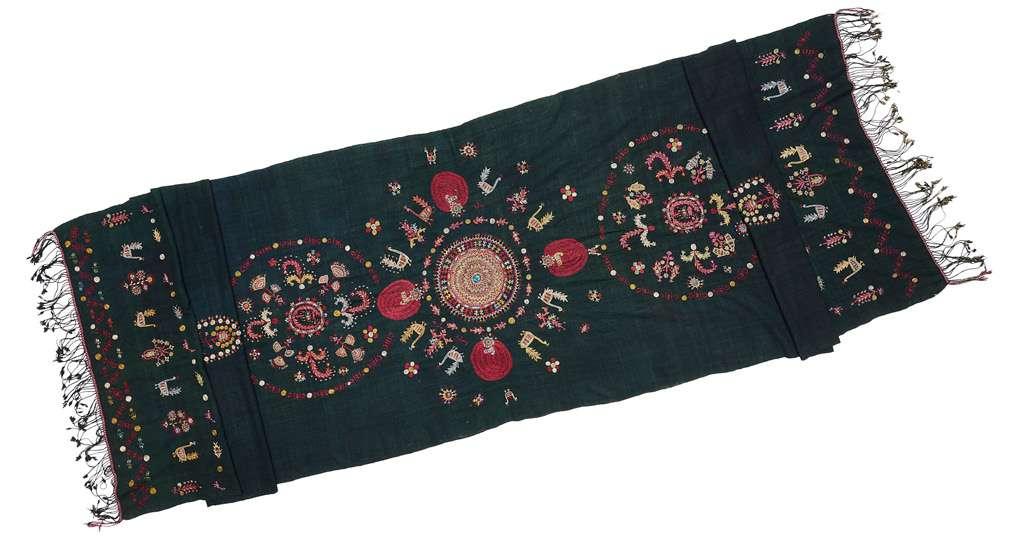
ZOROASTRIAN (PARSI) WEDDING SHAWL, PERSIA, POSSIBLY YAZD, MID 19TH CENTURY
with embroidered inscription, the dark indigo silk ground embroidered in polychrome silks with a central dazzler roundel, centred by a pierced turquoise glazed ceramic button, the roundel encircled by fish, peacocks, plants and flowers, flanking secondary medallions of a deer in a leafy wreath, within a ring of birds and feathery leaves, pendant palmette sprays, bands of peacocks, birds and fish and flower filled urns at each end, finished with narrow braid and silk fringe, approximately 300 x 75cm
The inscriptions reading be-nam-e khoda ‘In the name of God’
A similar shawl, on a blue-green ground, is in the Victoria and Albert Museum, Accession number IS.9B-1954. For a detailed discussion of Zoroastrian wedding costume see ‘A Time of Roses and Pleasure’ by the late Patricia Baker in Asian Art, The Second HALI Annual,1995, pp.80-85. For discussion of an example sold Christie’s South Kensington 5 October 2012, lot 925, see HALI, Issue 174, p.109
£1,500-2,500
58
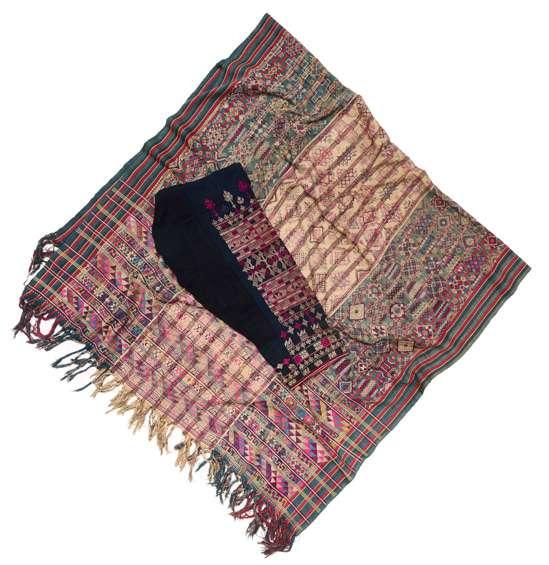
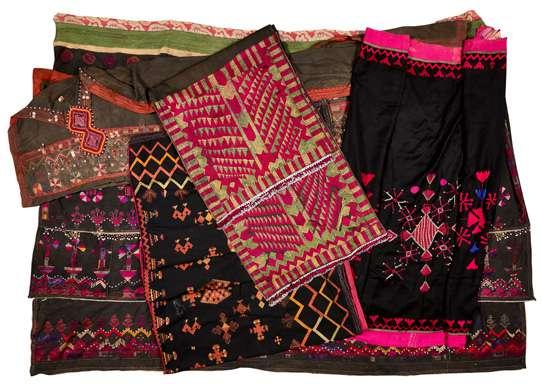
A LARGE EMBROIDERED SHAWL, AND PAIR OF TROUSERS, PROBABLY SWAT, PAKISTAN, FIRST HALF 20TH CENTURY
the shawl heavily embroidered with polychrome geometric motifs, on a woven striped ground, together with a pair of indigo and black cotton trousers, with geometric embroidery to the legs, shawl approximately 270 x 140cm (2)
See Crill, R., Indian Embroidery, London, 1999, pp. 128-129 for related examples
£400-600
59
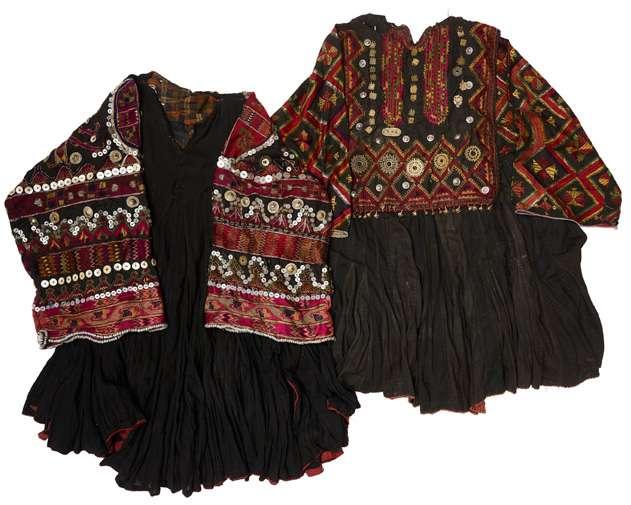
TWO EMBROIDERED KOHISTAN
WEDDING DRESSES, PAKISTAN, MID 20TH CENTURY
each decorated with silk embroidered geometric motifs, buttons, beads, metal tokens and brooches, one with zipper trimmed sleeves (2)
£250-400
61
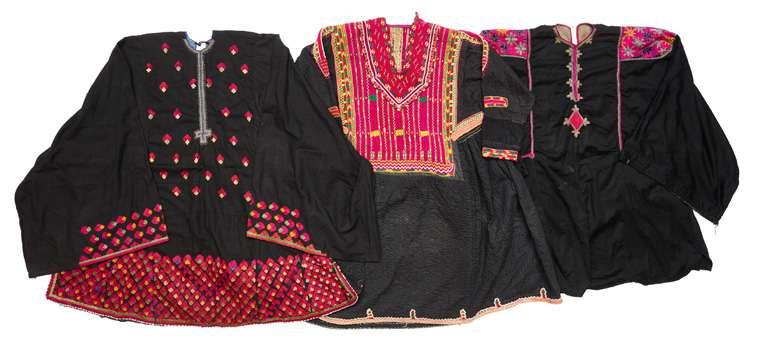
THREE PHULKARI
EMBROIDERED DRESSES, PUNJAB, 20TH CENTURY
the black ground heavily embroidered in brightly coloured silks with flowers, and geometric motifs, one with gilt metal thread decoration, approximately 100cm, 90cm and 90cm
£300-500
60
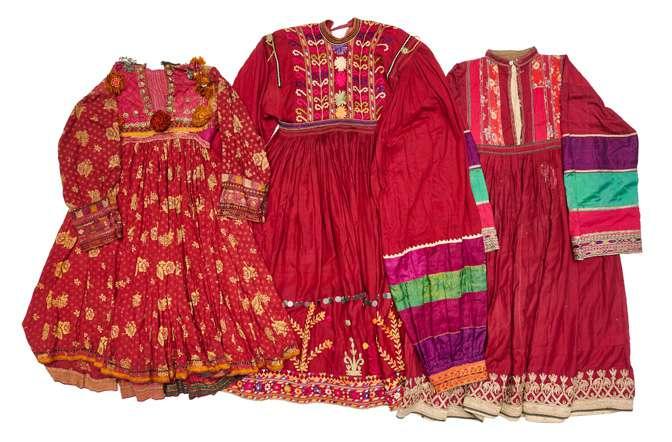
A KUTCHI DRESS AND TWO SIMILAR DRESSES, AFGHANISTAN, 20TH CENTURY
the first of floral printed cotton, decorated with tassels and cowrie shells, the others with embroidered yokes and polychrome sleeve bands, approximate lengths 99cm; 110cm; 114cm
£300-500
62
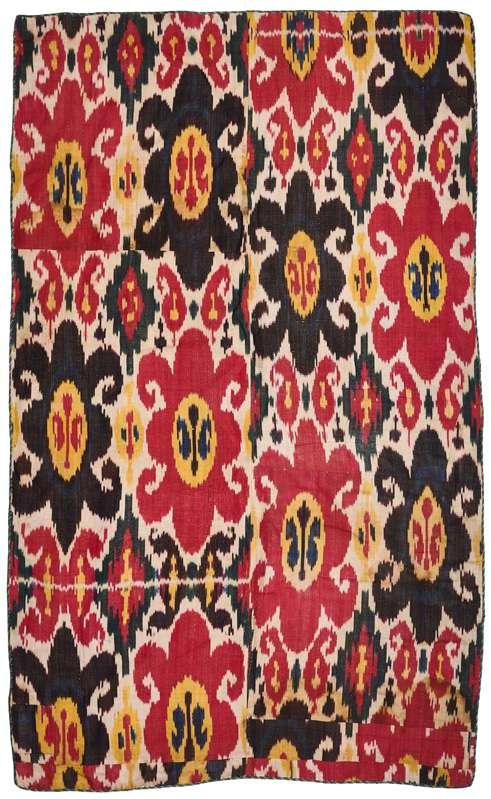
AN IKAT PANEL, BOKHARA, UZBEKISTAN, THIRD QUARTER 19TH CENTURY
the adras ikat woven with large flowers with curled petals in crimson and blackish purple, yellow centres, overall boteh and guls in crimson, forest green and yellow on an ivory ground, approximately 140 x 86cm
See Atanova, S., et al, Central Asian Textiles: The Neville Kingston Collection, London, 2025, Cat. No. 2.206, p. 206 for an ikat panel of related design.
£300-600
63
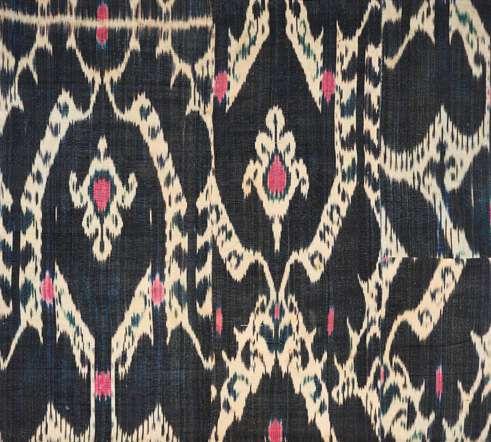
AN IKAT PANEL, FERGHANA, UZBEKISTAN, SECOND HALF 19TH CENTURY
of adras ikat, mounted on stretcher, approximately 81 x 90cm
£300-500
64
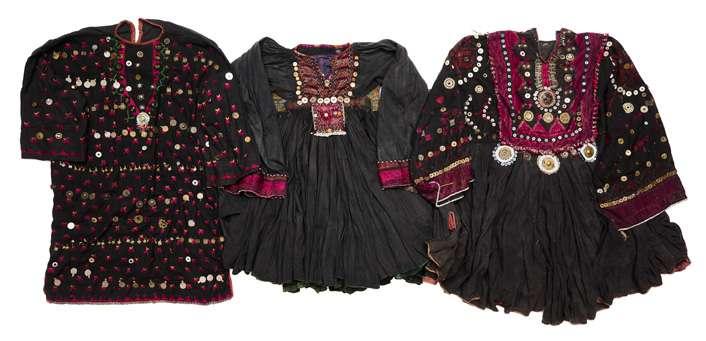
THREE EMBROIDERED AND DECORATED WEDDING DRESSES (JUMLOS), AFGHANISTAN/NORTHWEST PAKISTAN,
1960-1980
the first of black cotton, with geometric embroidery to yoke decorated with an applied brooch with semi precious stones and foiled glass, pearl buttons, coins, metal tokens and discs, beads and tassels, sleeves similarly decorated and with white metal beads to edges, the second in black cotton decorated with geometric motifs and rows of coins and tokens, with buttons, the third a full-skirted bridal dress example in black with band of grey to lower back, the yoke embroidered with geometric motifs, metal coins, small beads and plastic buttons, approximately 105cm, 95cm, 85cm in length (3)
£500-800
65
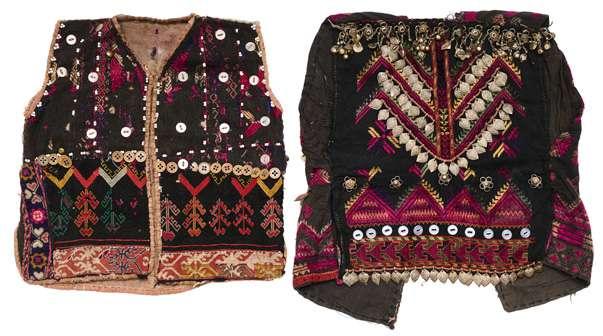
TWO SMALL CHILDREN’S WAISTCOATS, SWAT VALLEY, PAKISTAN, MID 20TH CENTURY
with black ground decorated overall with embroidered geometric motifs and buttons, one with multiple metal tokens and amulets (2)
£50-100
66
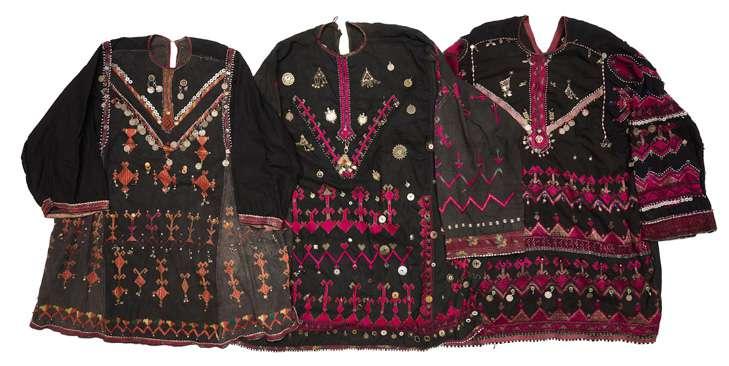
THREE EMBROIDERED KOHISTAN DRESSES, PAKISTAN, MID 20TH CENTURY
each decorated with silk embroidered geometric motifs, buttons, beads, coins, metal tokens and amulets (3)
£150-300
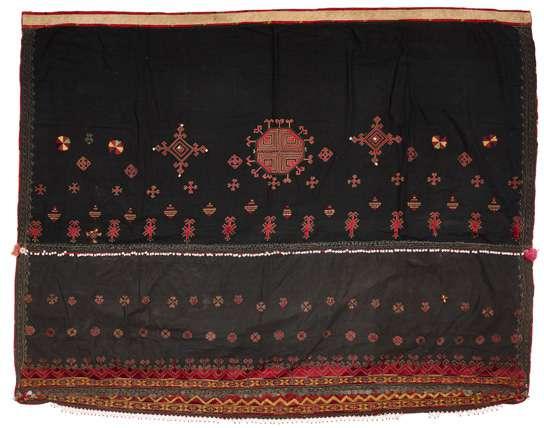
AN EXTREMELY FINE EMBROIDERED KOHISTAN VALLEY WEDDING SHAWL, PAKISTAN/AFGHANISTAN, CIRCA 1900
the black cotton ground decorated with a central geometric gul motif with gilt metal thread hook motifs, flanked by smaller cruciform guls decorated with white beads, rows of small guls and arrowheads beneath, a band of stylised plants below, fringing formed of white beads divides the field with a lower panel of arrowhead and cruciform guls above a row of zig-zags and reciprocal hooked arrowheads, fine cross-stitch border beneath, a secondary panel hangs behind, similarly decorated with hooked arrowheads and with a netted bead trim, the upper section lined in printed cotton, approximately 140 x 175cm
£1,000-2,000
68
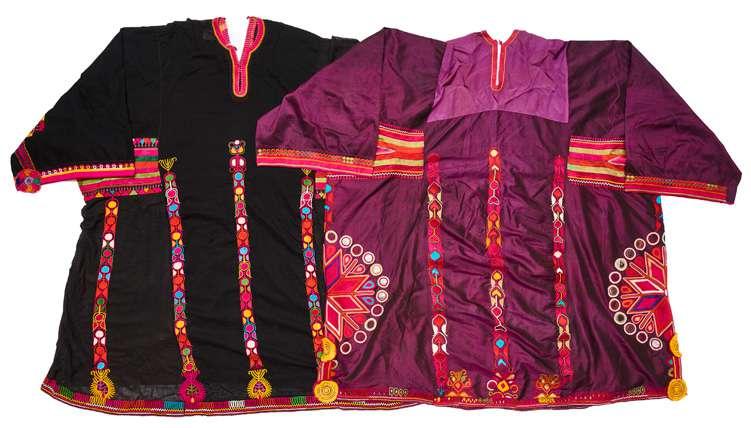
TWO EMBROIDERED AND MIRRORWORK PASHTUN DRESSES, BELUCHISTAN OR AFGHANISTAN, MID 20TH CENTURY
one on a fine black ground the other on aubergine silk with brightly coloured bands of embroidery with mica inserts, each approximately 130cm long (2)
£150-250
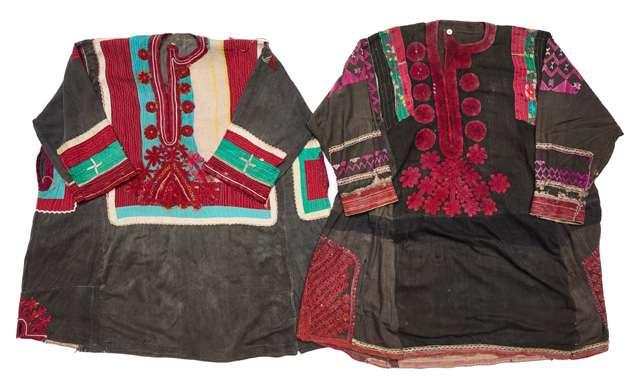
TWO SINDH TUNICS, PAKISTAN, EARLY 20TH CENTURY
with black ground, one with bold red floral embroidery to front and hems, the other worked in orange red against a turquoise blue panel, approximately 120cm and 110cm long (2)
£300-600
70
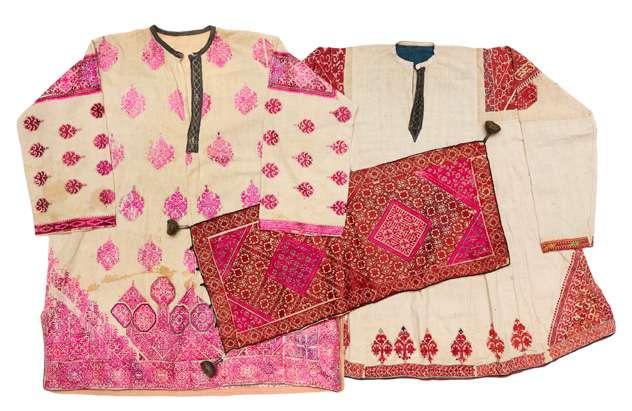
A PHULKARI SILK EMBROIDERED PILLOW COVER AND TWO SWAT DRESSES, PAKISTAN, EARLY 20TH CENTURY
the pillow face finely embroidered with concentric geometric patterns in madder and bright pink, tassels encased in white metal holders on three corners (one missing), and with toggle fastening (approximately 80 x 30cm), together with two dresses in heavy ivory cotton with embroidered decoration on sleeves and hems, braided cuffs, approximately 110 (hem width) x 90cm and 79 (hem width) x 95cm (3)
£500-800
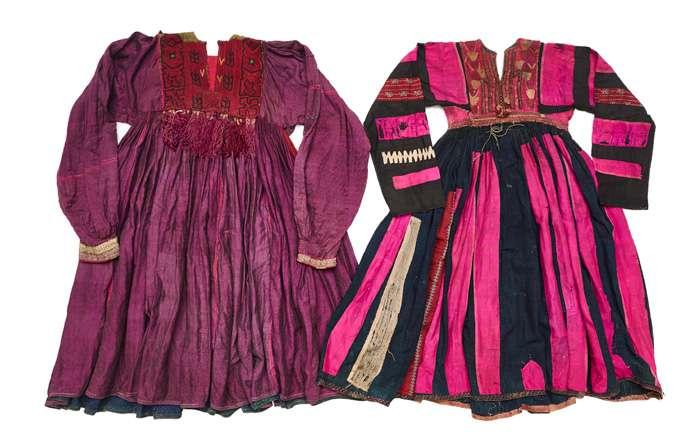
TWO EMBROIDERED AND APPLIQUE WAZIRI DRESSES, AFGHANISTAN OR PAKISTAN, EARLY 20TH CENTURY
the first panelled in madder wool, cotton satin and aubergine silk, with heavily embroidered yoke decorated with tassels, metal thread epaulettes, and braid trim to cuffs, together with an example in dark indigo plainweave, the skirt and sleeves with appliqué stripes in pink silk, printed cotton, muslin and ivory cotton sateen, heavily embroidered yoke, approximately 115 cm and 110cm (2)
£200-400
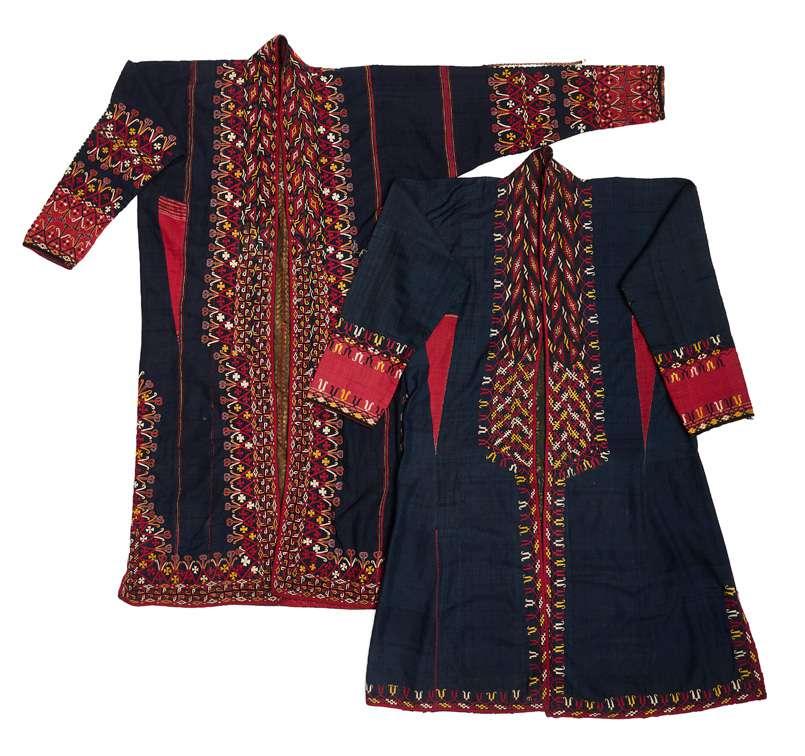
TWO EMBROIDERED SILK TEKKE ROBES (KURTE), WEST TURKESTAN, 19TH CENTURY
the first with elaborately embroidered borders to collar, edges, hem slits and red sleeve bands, worked with geometric patterns, guls, and stylised plants, the second with flowerhead and diamond embroidered collar with leafy vine pendants, all bordered with running vine and calyx motifs, red sleeve bands, block printed lining, approximate lengths 115cm, 120cm (2)
For a related example, see Atanova, S., et al, Central Asian Textiles: The Neville Kingston Collection, London, 2025, fig. 35, p. 68
£200-400
73
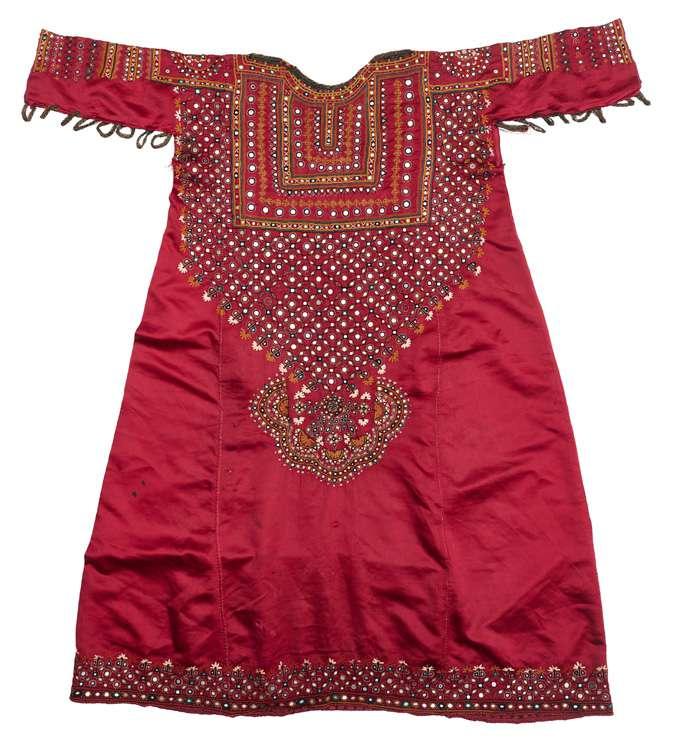
A KUTCH DRESS, GUJARAT, LATE 19TH/EARLY 20TH CENTURY
the red silk dress finely embroidered in polychrome silks and decorated with mica, approximately 105cm length
£300-500
74
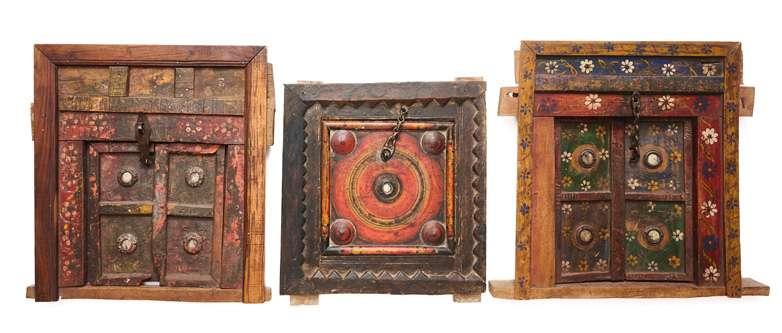
THREE SMALL SETS OF SHUTTERS, PROBABLY RAJASTHAN, INDIA, 19TH CENTURY
each with panelled and painted doors with pivot hinges, decorated with bosses and floral decoration, iron mounts, 49 x 47 x 5cm and smaller (3)
£150-200
75
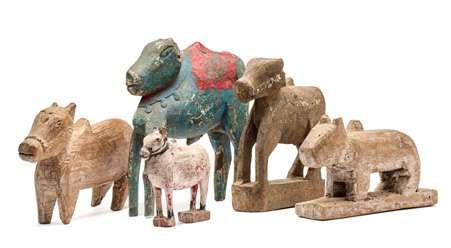
FIVE CARVED WOOD FIGURES OF NANDI BULL, INDIA, 19TH/20TH CENTURY
each standing, with pronounced hump on his back, traces of paint, 24cm high and smaller (5)
£100-150
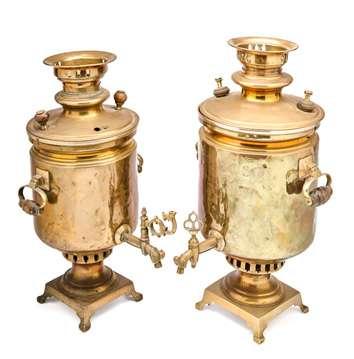
76
TWO BRASS SAMOVARS, RUSSIA, CIRCA 1900
each of cylindrical form with projecting tap, waisted support on square four-legged base, with embossed inscribed medallions at the front, 50, 45cm (2)
£100-150
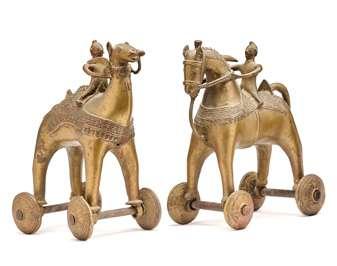
77
TWO ‘JUNGLI’ TOY ANIMALS, EASTERN INDIA, EARLY 20TH CENTURY
bronze, each depicting a rider holding a sword, one horseback, the other on a camel, both on wheels, 23cm high approx. each (2)
£100-150
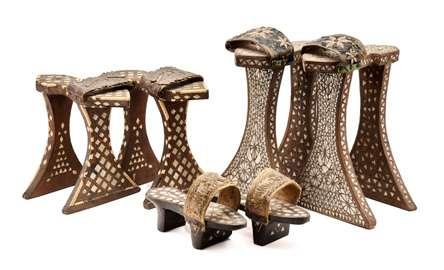
78
THREE PAIRS OF HAMMAM SANDALS, DAMASCUS, SYRIA, CIRCA 1900
wood inlaid with mother of pearl and bone decoration, two pairs with metal thread embroidered straps, the other pair with leather straps, 31cm high and smaller (6)
For similar sandals in the Metropolitan Museum of Art, New York, see inv. no.2002.164a, b
£200-300
79
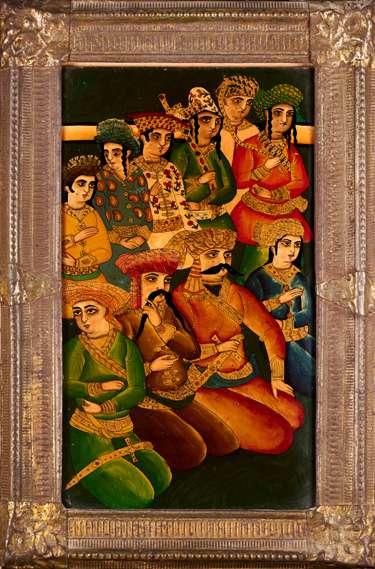
A QAJAR REVERSE GLASS PAINTING, PERSIA, CIRCA 1900
depicting a group of seated male and female courtiers, gilt metal frame, 69 x 39cm
£250-350
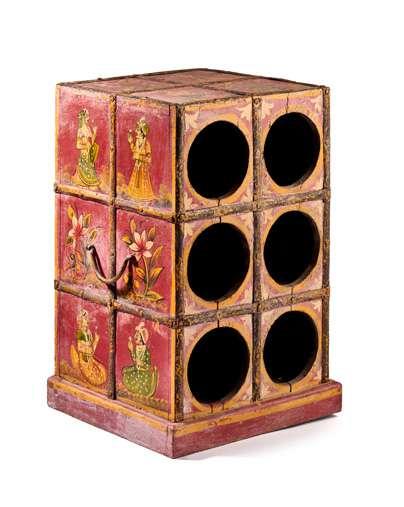
80
A PAINTED WOOD BOTTLE RACK, INDIA, 20TH CENTURY
with six openings at the front, the twin handled sides decorated with flowers and male and female figures, iron mounts, 42.5 x 28 x 26cm
£80-120
81
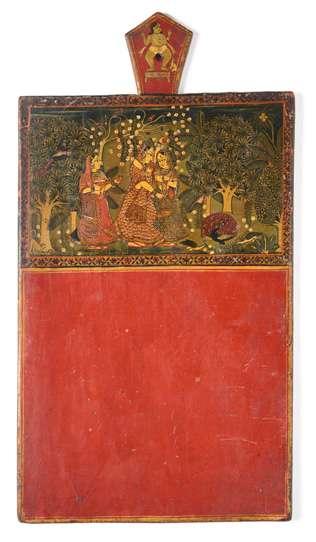
A PAINTED WOOD HANGING PANEL, RAJASTHAN, INDIA, 19TH CENTURY
gouache with gold on wood, the rectangular panel with a painted scene of maidens in a forest at the top, the lower portion plain red, a pierced projection at the upper edge for hanging, depicting a youthful figure of Siva, 54 x 29.5 x 1cm
£300-500
82
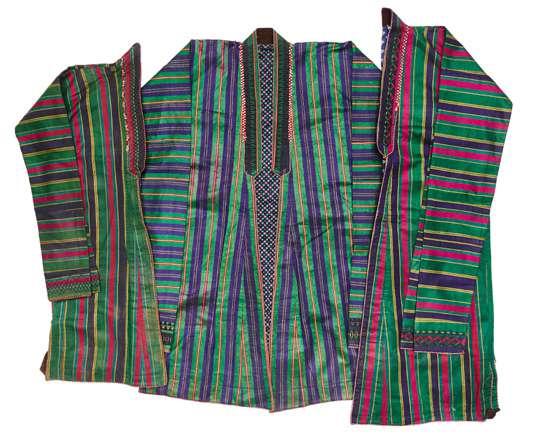
TWO STRIPED CHAPAN, CENTRAL ASIA, FIRST HALF 20TH CENTURY
one in red, purple, green, yellow and indigo, floral printed cotton lining, striped facings, braid edge, the other of dark indigo with red and ivory stripes, unlined, corduroy facings, narrow braid edging, with tassels and embroidered cuffs and collar placket, approximate length 150cm (2)
£100-200
83
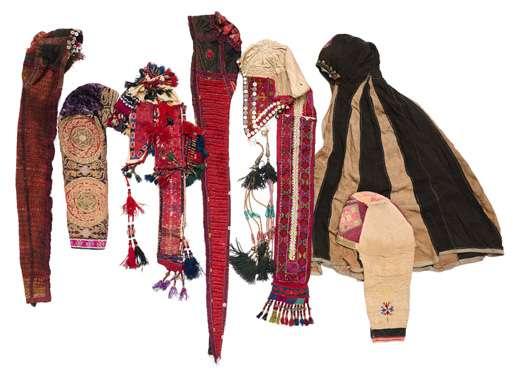
A GROUP OF SEVEN HEADDRESSES, CENTRAL ASIA, LATE 19TH/20TH CENTURY
including a purple velvet Bokhara example, worked in metal thread with roundels, the others variously embroidered in polychrome silks, with tassels, metal tokens and buttons (7)
£250-400
84
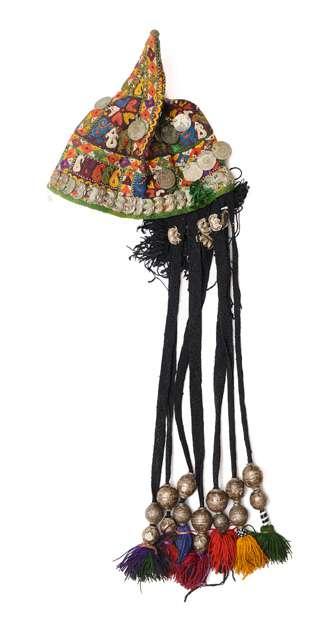
AN EMBROIDERED AND EMBELLISHED CEREMONIAL HEADDRESS, AFGHANISTAN (?), MID 20TH CENTURY
embroidered and decorated with coins ranging from an 1808 Ottoman coin to mid -20th century Saudi Arabian coins, metal tokens, tassels with large metal beads
£200-300
85
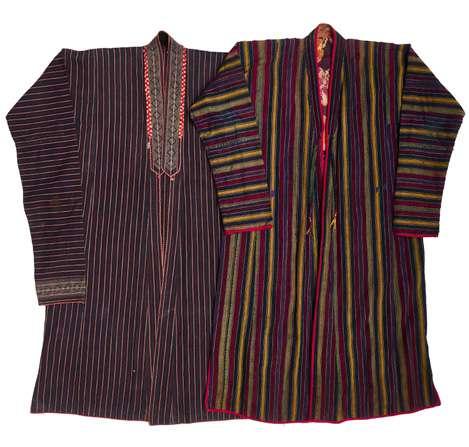
THREE STRIPED SATIN CHAPAN, AFGHANISTAN OR TAJIKISTAN, 20TH CENTURY
each in green, red and blue, printed cotton lining, corduroy binding, approximate lengths 120cm; 114cm; 96cm (3)
£150-250
86
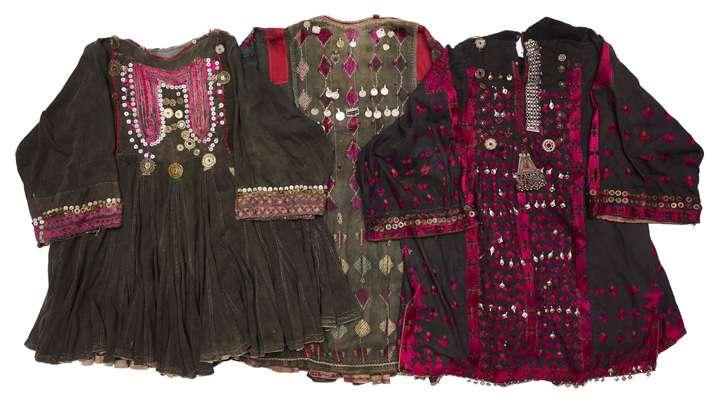
THREE EMBROIDERED WEDDING DRESSES, AFGHANISTAN, MID 20TH CENTURY
each decorated with silk embroidered geometric motifs, buttons, beads, coins, metal tokens, jewellery and amulets
£150-250
87
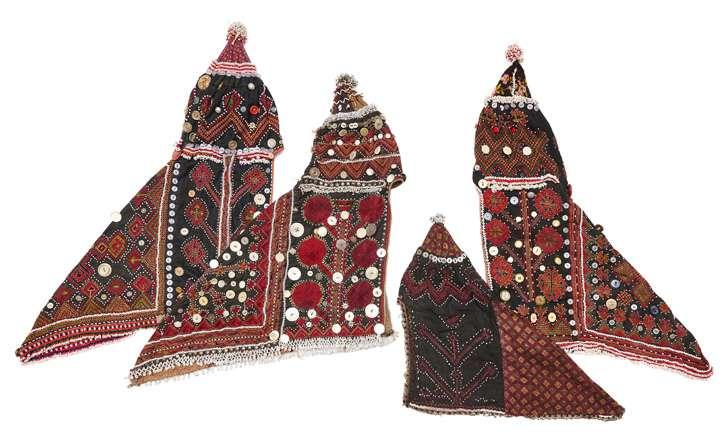
FOUR KOHISTAN HOODS (NATIYO), AFGHANISTAN/NORTHWEST PAKISTAN, 20TH CENTURY
each decorated with embroidery, and variously with buttons, metal tokens and small glass beads (4)
£200-400
88
A KOHISTAN VALLEY WEDDING SHAWL, WITH THREE OTHERS AND A KOHISTAN WEDDING TURBAN, 20TH CENTURY
variously embroidered with geometric and floral motifs (5)
£300-500
90
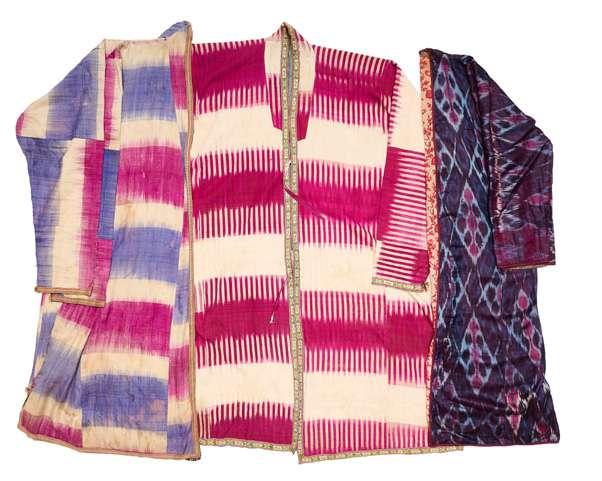
THREE IKAT CHAPAN, UZBEKISTAN, FIRST HALF 20TH CENTURY
two of adras ikat with feathered stripes on ivory, one with pink and lavender, one with crimson, the third of atlas ikat with diamonds, longest approximately 140cm (3)
£250-400
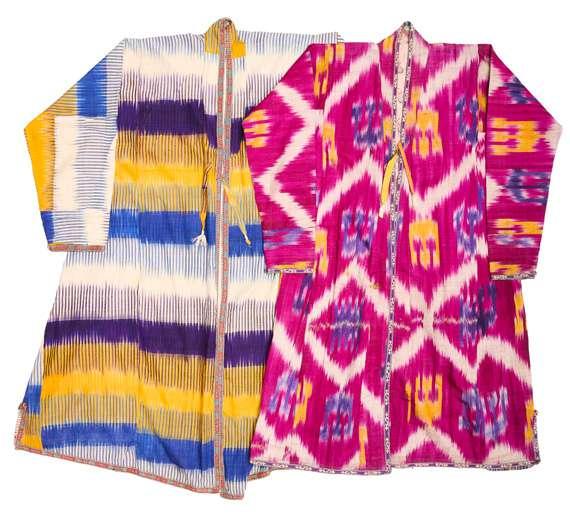
TWO LARGE ADRAS IKAT CHAPAN, UZBEKISTAN, 20TH CENTURY
the longer with feathered bands of purple, ivory, blue and yellow, the other in shocking pink with large zig-zags, each with tablet braid trim and tie fastenings, approximate length 140cm, 134cm (2)
£200-400
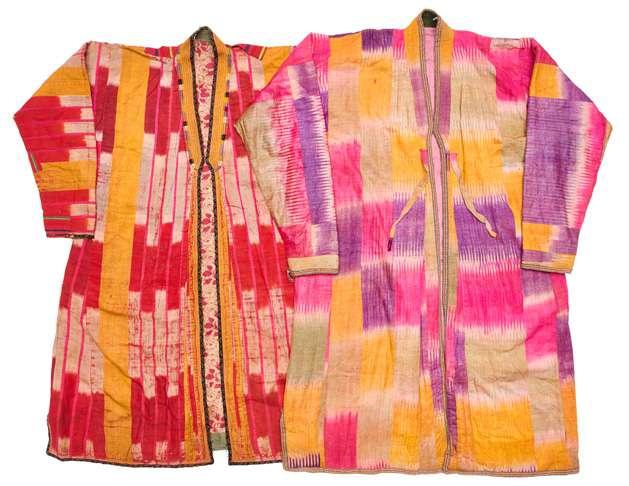
TWO QUILTED IKAT CHAPAN, UZBEKISTAN, EARLY 20TH CENTURY
each of adras ikat in bold stripes and blocks of colour, longest approximately 130cm (2)
£200-400
92
THREE IKAT CHAPAN, UZBEKISTAN, FIRST QUARTER 20TH CENTURY
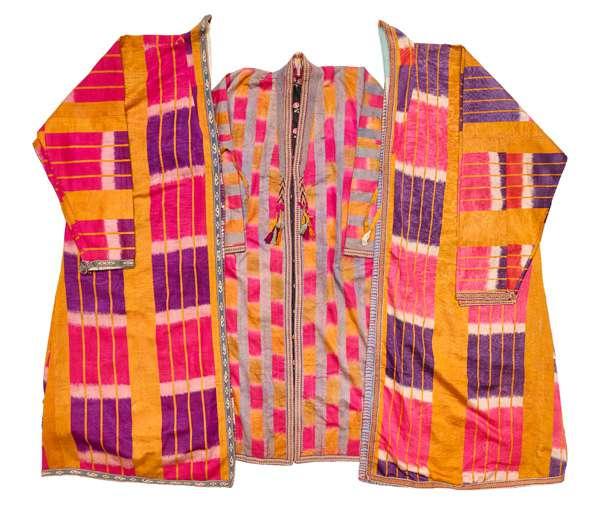
of adras ikat, two of large size and with similar design of pink and purple checks with golden yellow stripes, the third with pink and yellow blocks on grey, all trimmed with tablet braid, approximate length 145cm (3)
£200-400
93
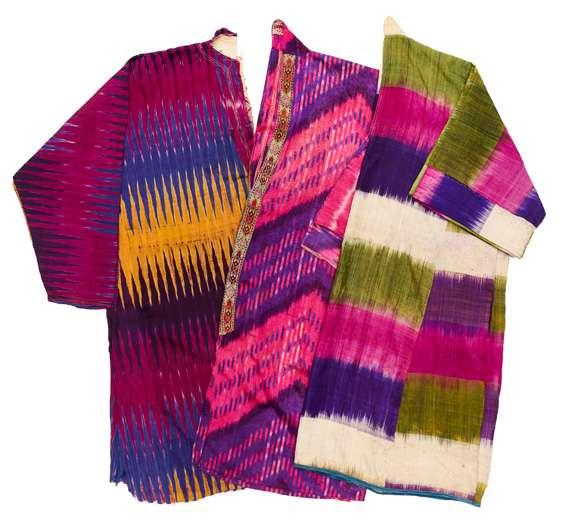
THREE IKAT TUNICS, UZBEKISTAN, 20TH CENTURY
each of boldly coloured adras ikat, the longest approximately 120cm (3)
£150-250
94
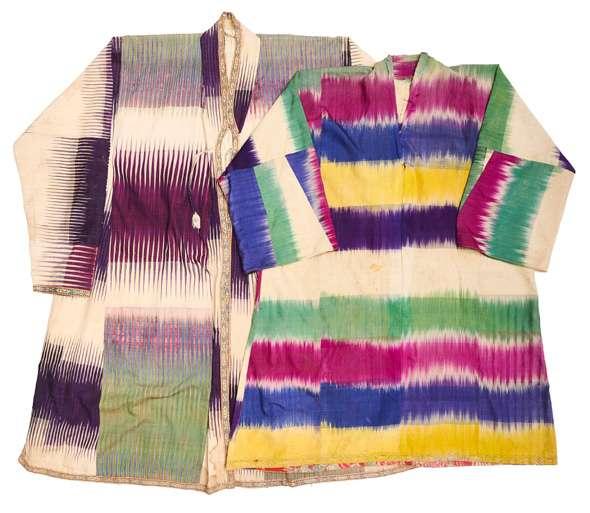
AN IKAT CHAPAN AND TUNIC (KURTA), UZBEKISTAN, EARLY 20TH CENTURY
each of adras striped ikat, the chapan with braid trim (tear to back), the longest approximately 140cm (2)
£100-200
95
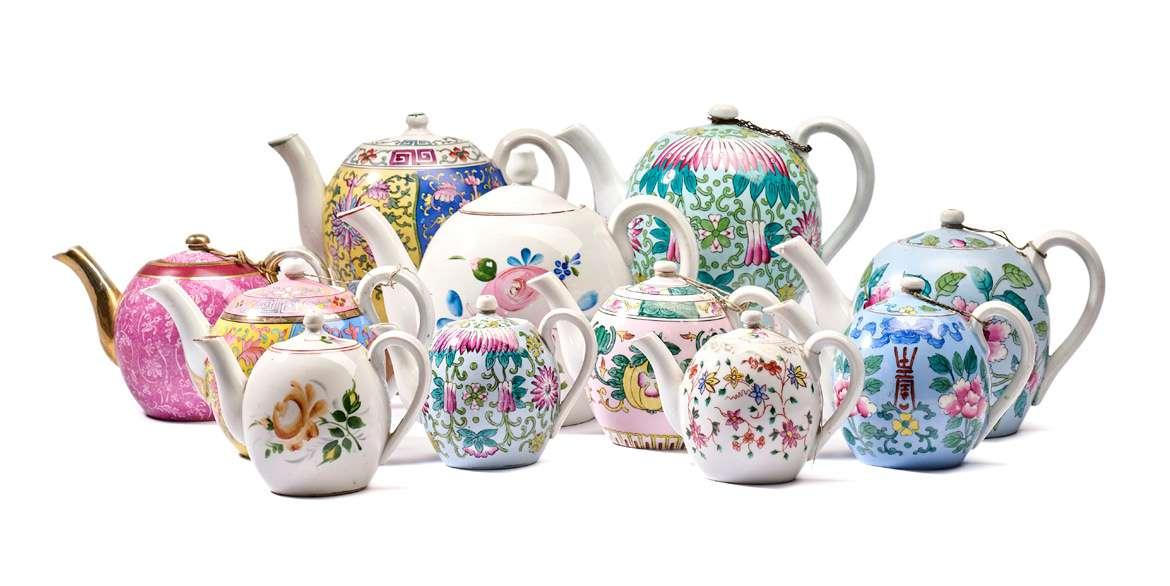
A GROUP OF SIX PORCELAIN TEAPOTS, RUSSIA FOR THE CENTRAL ASIAN MARKET, 20TH CENTURY
polychrome painted and transfer printed in Russian and Chinese styles, various makers, 18cm high and smaller (6)
£500-800
A GROUP OF FIVE PORCELAIN TEAPOTS, RUSSIA FOR THE CENTRAL ASIAN MARKET, 20TH CENTURY
polychrome painted and transfer printed in Chinese style, various makers, 19cm high and smaller (5)
£400-600
97
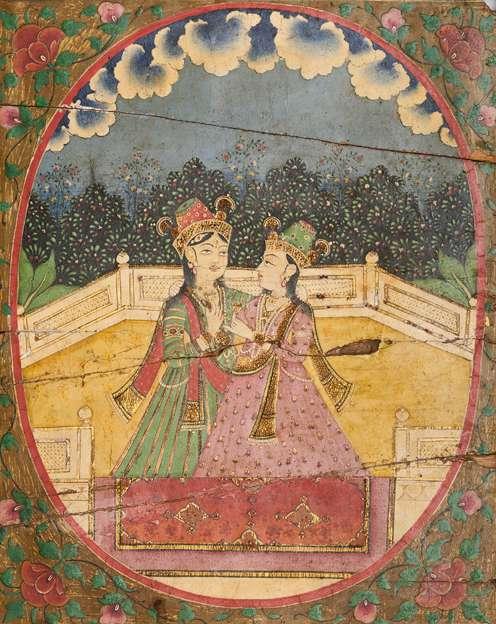
TWO MAIDENS ON A TERRACE, RAJASTHAN, MID-19TH CENTURY
gouache with gold on wood panel, later frame, 27.5 x 22cm
£300-400
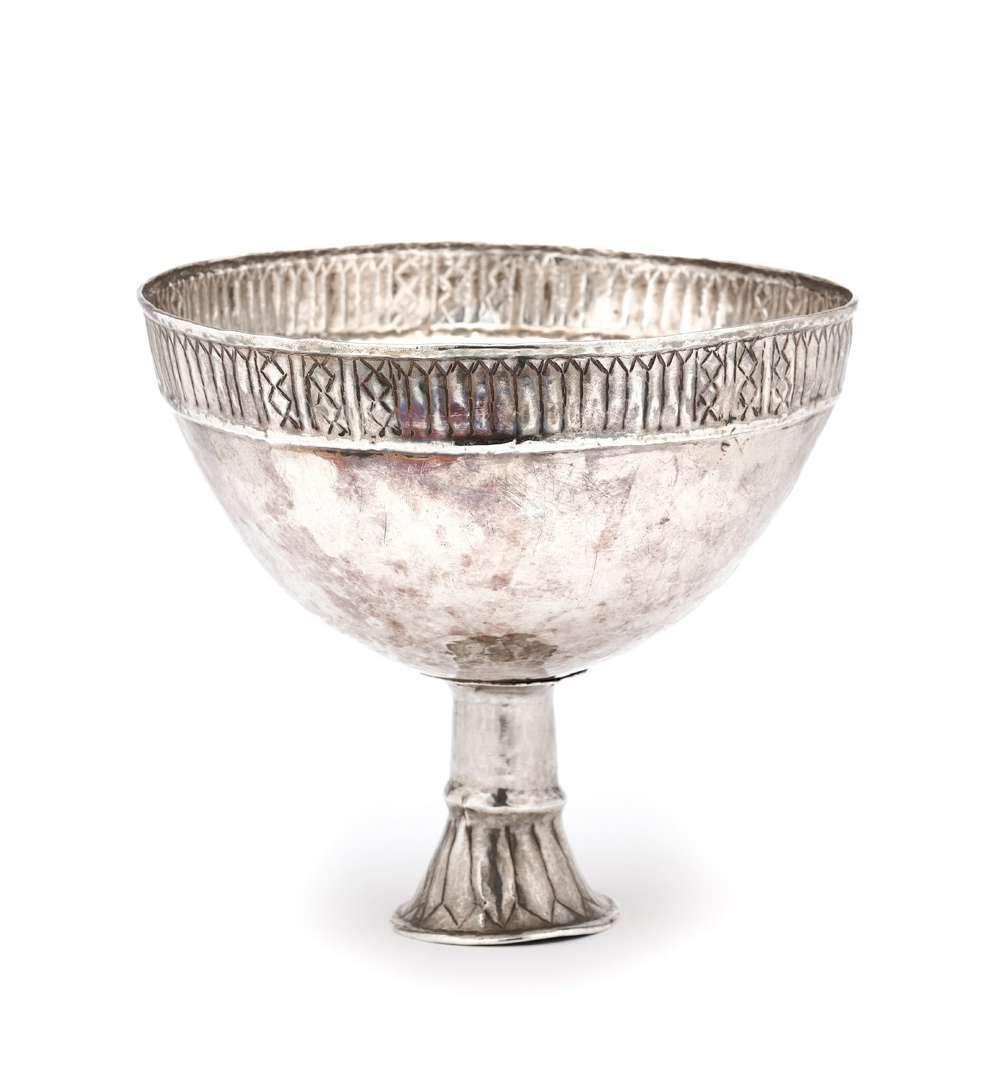
A RARE SILVER WINE GOBLET, NURISTAN, AFGHANISTAN, 19TH CENTURY
the wide bowl with rim embossed with stylised leaf design, standing on small flared foot, 19.5cm high; 21.5cm diam.
For a very closely related example of this unusual type in the Pitt Rivers Museum, Oxford, see inv. no. 1980.8.3. In the entry for their goblet on the museum website, it is noted that these very rare silver vessels were produced as dowry pieces in what was then known as Kafiristan, before the forced conversion of the population to Islam. See https://prm.ox.ac.uk/collections-online#/item/prm-object-26209
£600-800
100
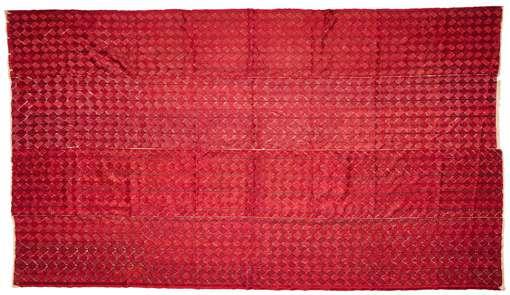
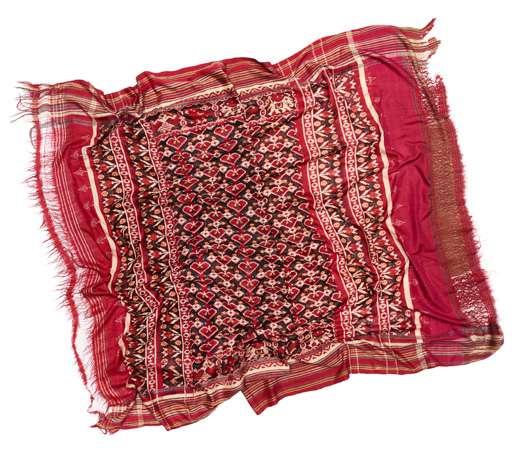
A SILK PATOLA SARI, PROBABLY PATAN, GUJARAT, 19TH/20TH CENTURY
with a ‘pan bhat’ pattern, approximately 320 x 130cm
See Gillow, J. and Barnard, N, Traditional Indian Textiles, London 1991, p. 88 for an almost identical example
£150-300
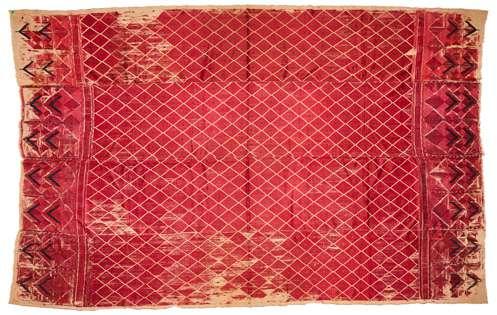
A LARGE PHULKARI SILK EMBROIDERED SHAWL, PUNJAB, FIRST HALF 20TH CENTURY
overall fine green stems bearing barred diamonds in madder red, plain madder side bands, approximately 240 x 140cm
£200-400
101
A LARGE PHULKARI SILK EMBROIDERED SHAWL, PUNJAB, EARLY 20TH CENTURY
with an overall diamond pattern in rosy red with indigo centres, zig zag end divisional borders and stylised plant end panels, approximately 240 x 150cm
£200-400
102
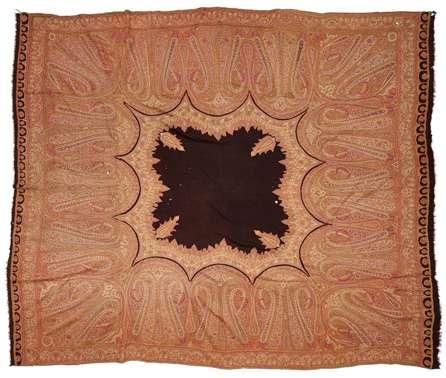
A FINE HAND EMBROIDERED KASHMIR SHAWL, FIRST HALF 19TH CENTURY
the chocolate brown centre surrounded by arcaded panels of embroidered and pieced interlocking boteh, border of lobed arches containing fans and palmettes, brown ground arcaded ends enclosing palmettes, all in shades of soft red and pistachio green, approximately 200 x 160cm
£700-1,000
103
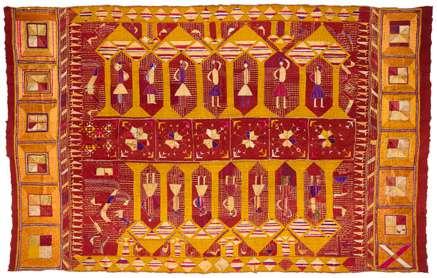
A SAINCHI PHULKARI SILK EMBROIDERY PUNJAB, FIRST HALF 20TH CENTURY
the brown-red field with a central band of geometric motifs flanked with women carrying pots on their heads, within “Divine Gates” (Darshan dwar), borders of chickens and peacocks, and geometric motifs, approximately 220 x 130cm
For a related example, see Museum of Fine Arts, Houston, The Banoo and Jeevak Parpia Collection, gift of Banoo and Jeevak Parpia, Object number 2024.727
£300-600
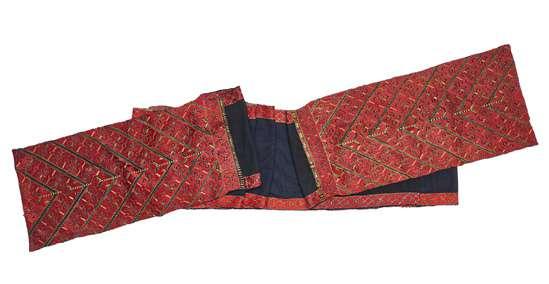
105
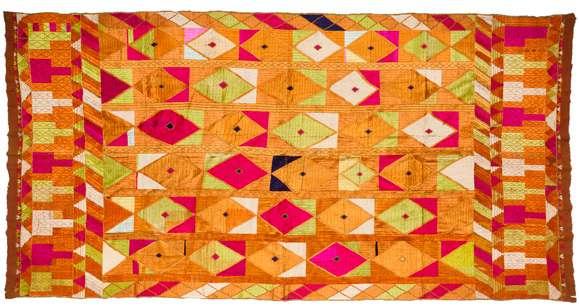
A PHULKARI SILK EMBROIDERY, PUNJAB, MID 20TH CENTURY
the soft brown cotton ground densely covered with interlocking geometric shapes in marigold, shocking pink, green, yellow and ivory, approximately 240 x 130cm
£250-500
104
AN EMBROIDERED SWAT WEDDING TURBAN, PAKISTAN, EARLY 20TH CENTURY
with double sided embroidery, pieced from four sections, the dark indigo ground with narrow side borders and deep geometric and floral end borders, approximately 320 x 35cm
£100-200
106
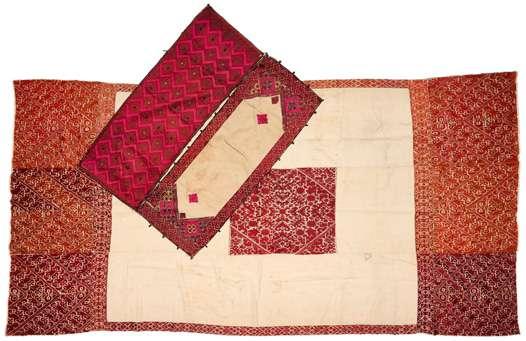
TWO EMBROIDERED PILLOW COVERS AND A WEDDING SHAWL, SWAT VALLEY, PAKISTAN, FIRST HALF 20TH CENTURY
one pillowcase worked in madder and shocking pink concentric diamonds, the other with plain field with feather motifs, leafy borders, the wedding shawl with a central panel of embroidery, plain ground, embroidered end borders, approximately 89 x 33cm (the pillow covers); 220 x 110cm (3)
£300-500
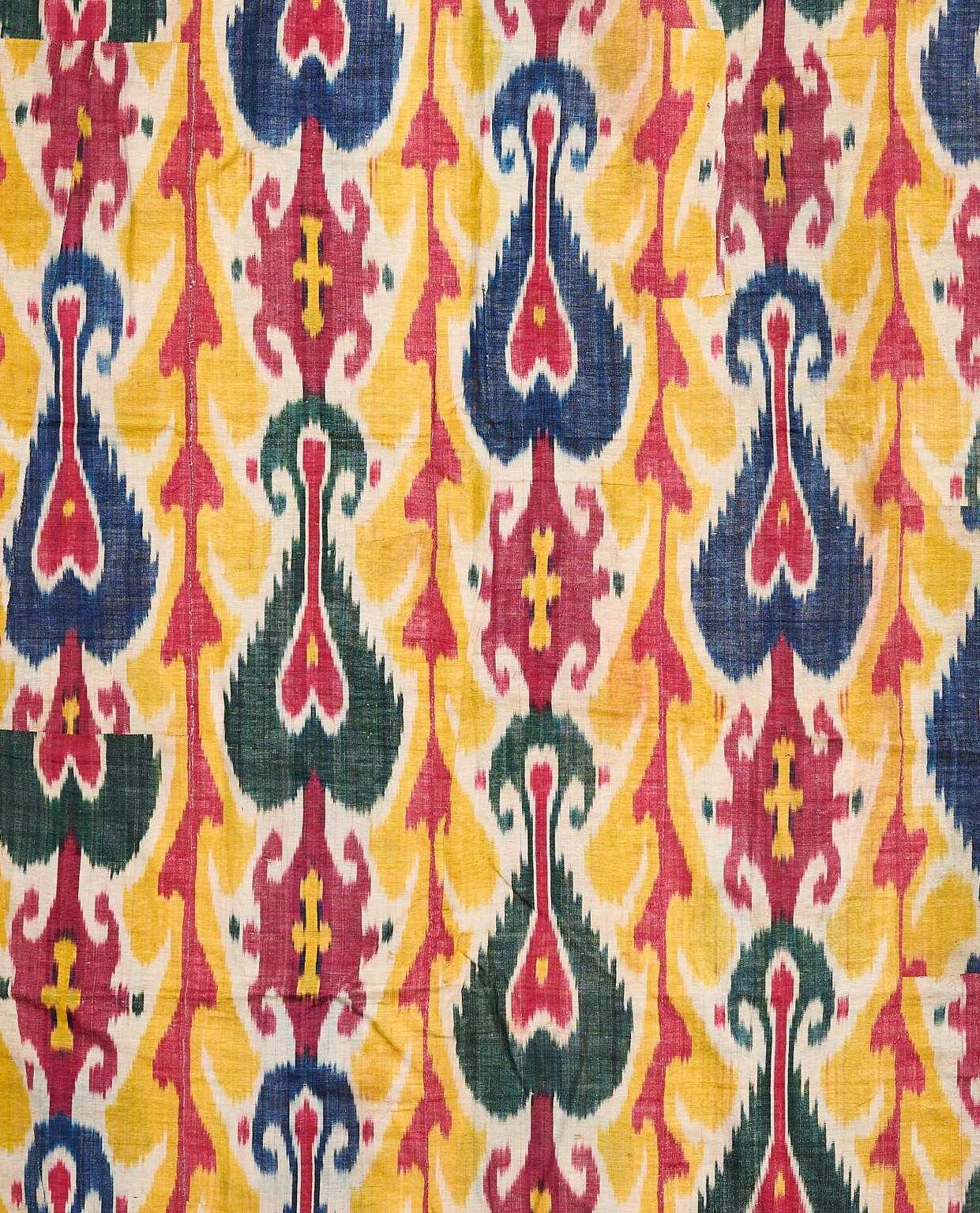
107
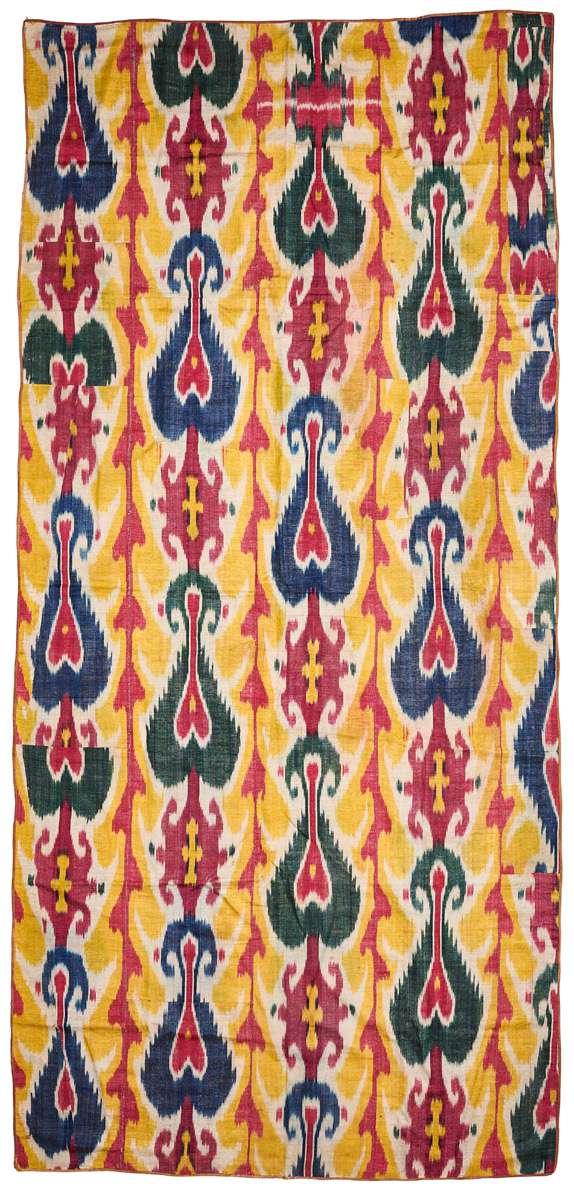
AN IKAT PANEL, UZBEKISTAN, SECOND HALF 19TH CENTURY
the glazed adras ikat with stems of large heart shaped palmettes and hooked flowerheads in yellow, crimson, indigo and forest green on ivory, approximately 220 x 100cm
A panel of similar ikat is in the collection of The Textile Museum, Washington D.C., Accession Number: 2015.11.58, Gift of Guido Goldman in honor of Bruce P. Baganz. See also Clark, R., Central Asian Ikats from the Rau Collection, London, 2007, pp. 58-59 and Hale, A., Fitz Gibbon, K., et al, Ikats, Woven Silks from Central Asia, The Rau Collection, Oxford 1988, pp. 52-53 for a coat made up in a similar ikat.
£600-900
108
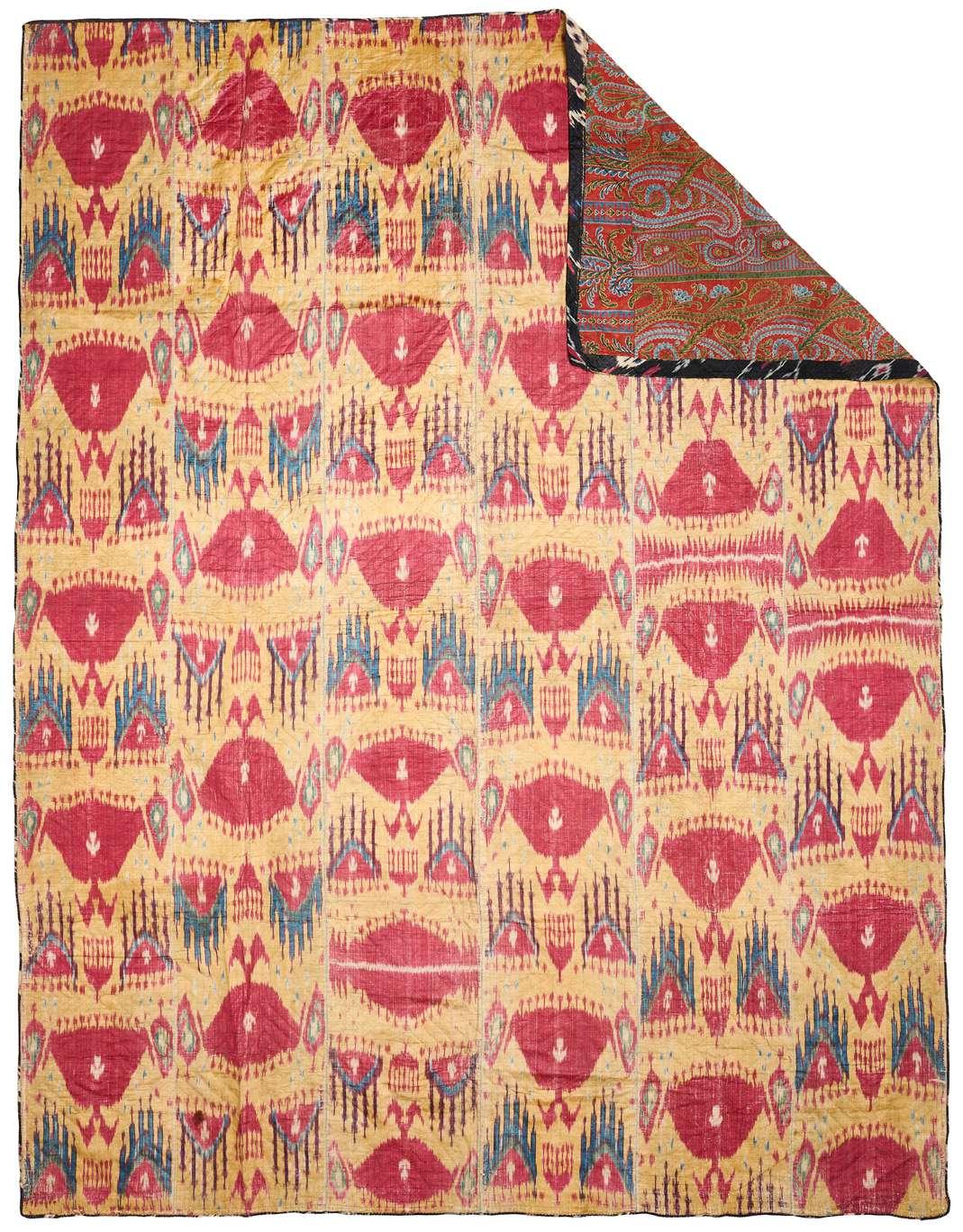
A LARGE IKAT QUILTED PANEL, UZBEKISTAN, MID 19TH CENTURY
the adras ikat with glazed finish, finely quilted with concentric diamonds, the yellow ground with columns of crimson palmettes flanked by cypress trees interspersed with amulets, decorations in crimson, aubergine, indigo, ivory and green, approximately 215 x 165cm
Literature: Clark, R., Central Asian Ikats from the Rau Collection, London, 2007, p. 42
£2,500-4,000
109
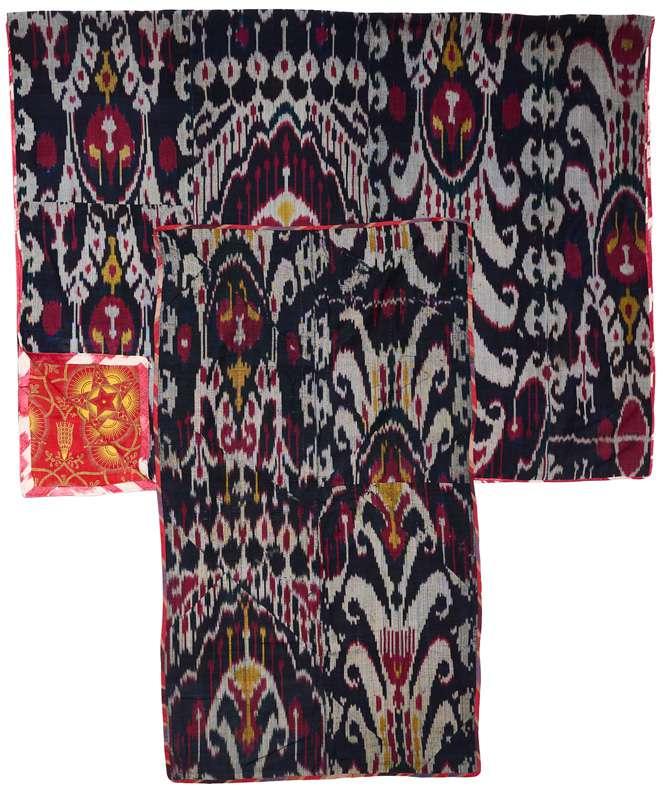
TWO SIMILAR IKAT PANELS, UZBEKISTAN, PROBABLY FERGHANA, LAST QUARTER 19TH CENTURY
each of dark indigo adras with motifs in silvery gray, crimson and yellow, the first panel approximately 206 x 140cm; the second approximately 124 x 70cm (2)
£400-600 110
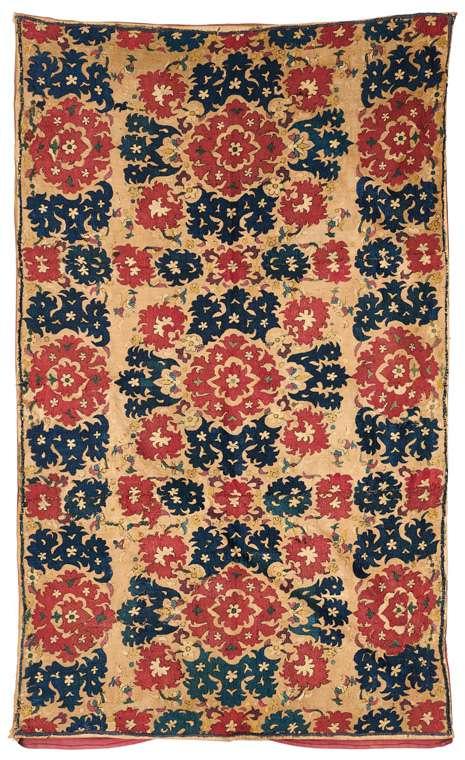
A SILK EMBROIDERED ALGERIAN PANEL, 18TH CENTURY
the light caramel ground with rosettes and palmettes in madder, ivory, indigo, plum and yellow, with some walnut outlines remaining, pieced, lined and backed, 120 x 76cm
£400-600
111
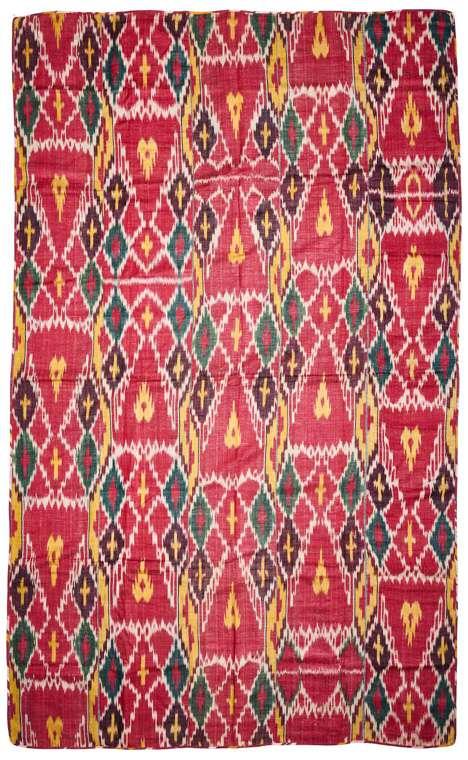
AN IKAT
PANEL, BOKHARA, UZBEKISTAN, THIRD QUARTER 19TH CENTURY
the adras gound with columns of feathered gulls in red with ivory, aubergine, green and yellow, approximately 205 x 158cm
Literature: Hale, A., Fitz Gibbon, K., et al, Ikats, Woven Silks from Central Asia, The Rau Collection, Oxford 1988, p. 32
£800-1,200
112
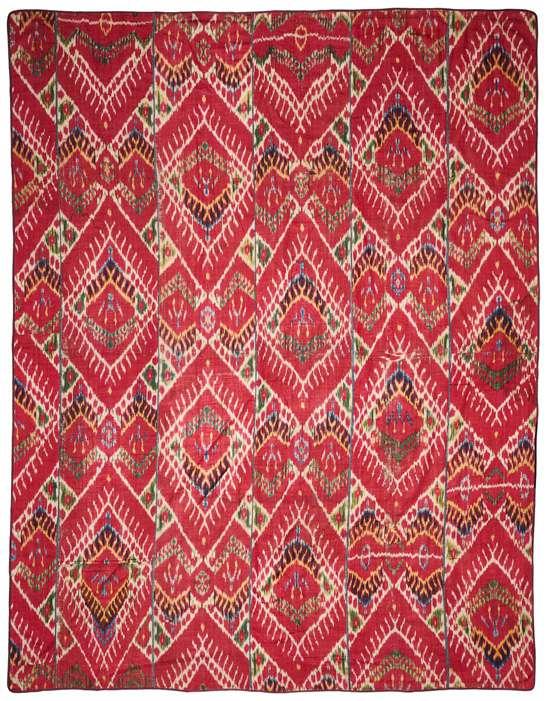
AN
IKAT PANEL, BOKHARA, UZBEKISTAN, LAST QUARTER 19TH CENTURY
the glazed adras ikat with large madder palmettes or cypress trees, with smaller green, aubergine and yellow palmettes, approximately 208 x 126cm
Literature: Hale, A., Fitz Gibbon, K., et al, Ikats, Woven Silks from Central Asia, The Rau Collection, Oxford 1988, p. 51
£500-800
113
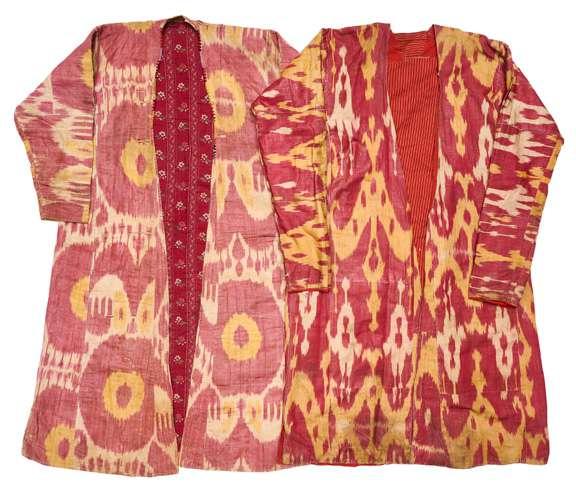
TWO QUILTED IKAT LADIES’ CHAPAN, UZBEKISTAN, SECOND HALF 19TH CENTURY
each of adras ikat, one lined in floral stripe cotton with embroidered trim to neckline, the other with plain stripe lining, approximate length 123cm (2)
£180-300
114
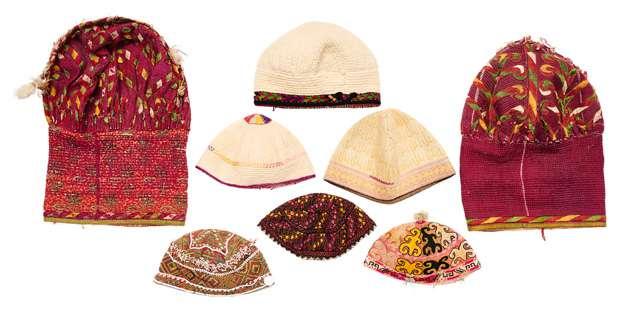
EIGHT TURKMAN AND CENTRAL ASIAN HATS, LATE 19TH, AND 20TH CENTURIES
including two embroidered domed Turkman chykysh tahya, two white quilted examples, another worked in cream and yellow cross stitch with inscriptions, and three embroidered examples (8)
£300-500
115
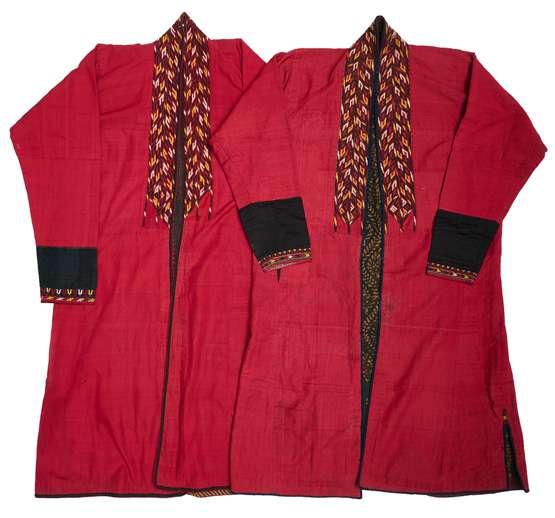
TWO SIMILAR EMBROIDERED RED SILK TEKKE ROBES (KURTE), WEST TURKESTAN, LATE 19TH CENTURY
one with black cotton sateen gores and cuffs, the other with black silk gores and lavender silk cuffs, lined in Indian block printed heavy cotton, the collars similarly embroidered with panels of fret interlace, each approximately 120cm long (2)
£150-250
116
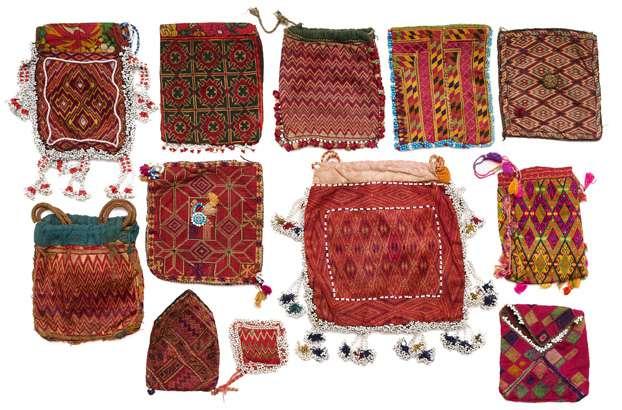
A COLLECTION OF EMBROIDERED PURSES AND POUCHES, HAZARA, AFGHANISTAN, LATE 19TH/20TH CENTURY
including eleven small purses and pouches, together with an embroidered amulet, all finely worked in coloured silks, several decorated with glass beads and tassels (12)
£300-500
118
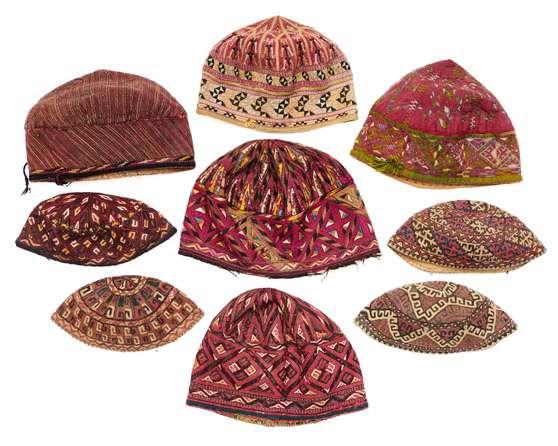
A COLLECTION OF TURKMAN HATS (TAHYA), LATE 19TH/ FIRST HALF 20TH CENTURY
mainly Tekke and Yomut, various sizes and styles (9)
£250-400
117
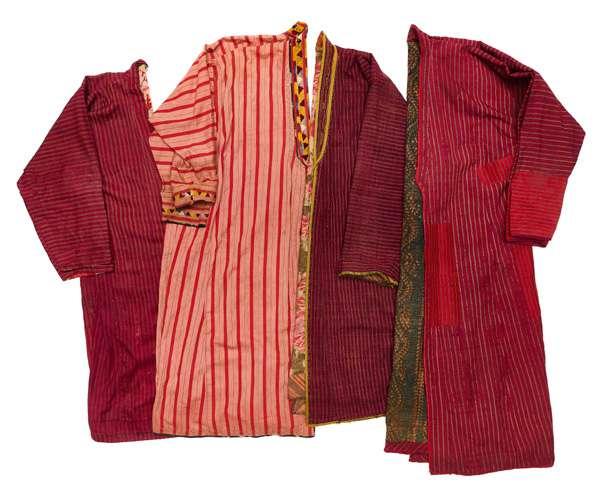
FOUR STRIPED CHAPAN, CENTRAL ASIA, EARLY 20TH CENTURY
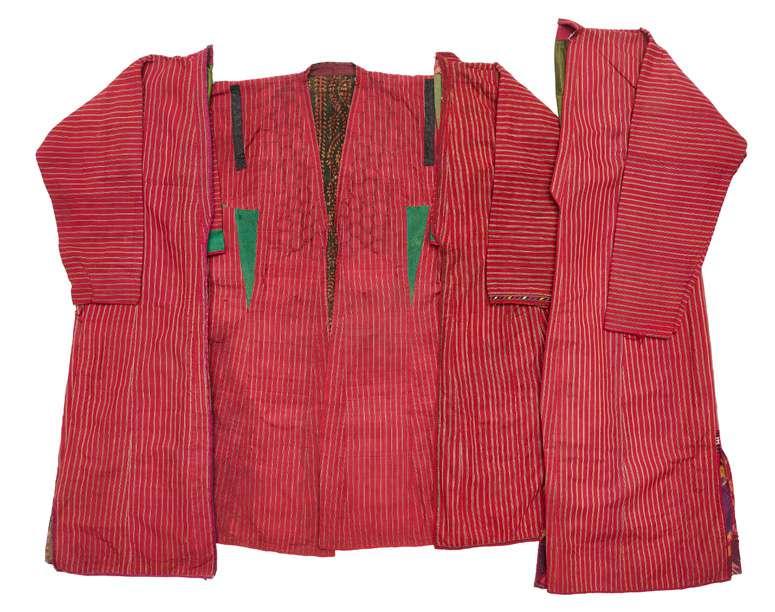
the first of silk in apricot and soft madder stripes, narrow printed cotton facings, embroidered cuffs and collar placket, together with three chapan in madder with yellow and black pinstripes, floral printed cotton linings, one with braided edge and beaded tassel fastenings, the longest approximate length 120cm, the others 105cm (4)
£200-400
119
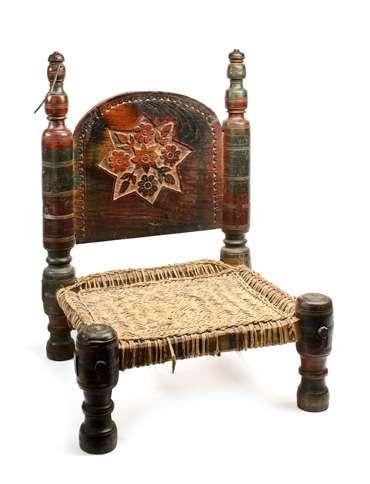
A CARVED AND TURNED WOOD LOW CHAIR, SWAT VALLEY, PAKISTAN, 19TH OR EARLY 20TH CENTURY
with strung hide seat, the arched back with relief carved floral star medallion, traces of pigment, 72 x 52 x 52cm
£200-300
120
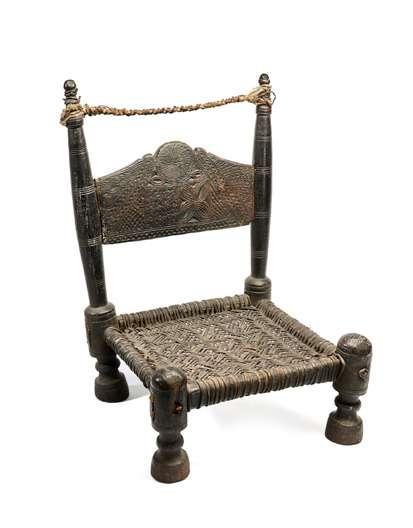
A CARVED AND TURNED WOOD LOW CHAIR, SWAT VALLEY, PAKISTAN, 19TH CENTURY
the seat strung with hide, the back with abstract and stylised floral relief carving, 61 x 41 x 40cm
£120-180
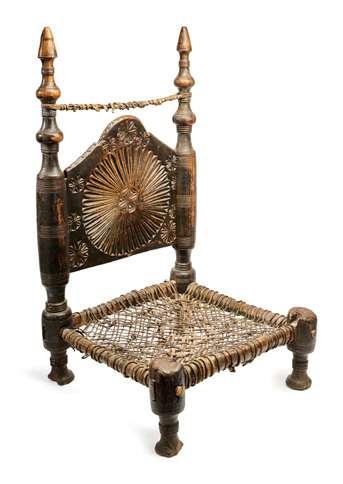
121
A CARVED AND TURNED WOOD LOW CHAIR, SWAT VALLEY, PAKISTAN, 19TH OR EARLY 20TH CENTURY
with strung hide seat, the back with striking relief carved radiating roundel, surrounded by smaller roundels, the supports with pointed finials, 83 x 48 x 48cm
£200-300
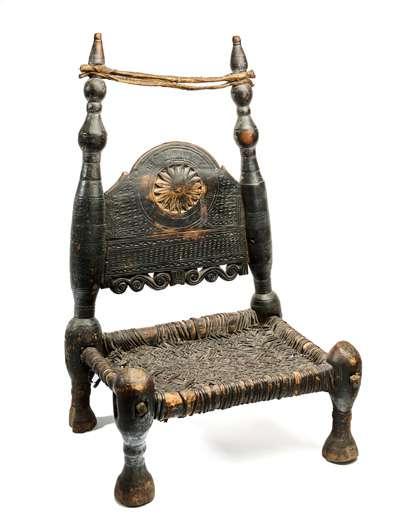
122
A CARVED AND TURNED WOOD LOW CHAIR, SWAT VALLEY, PAKISTAN, 19TH CENTURY
with strung hide seat, the back panel carved in relief with floral roundel, abstract and scroll decoration, the supports with pointed finials, 77 x 49 x 37cm
£200-300
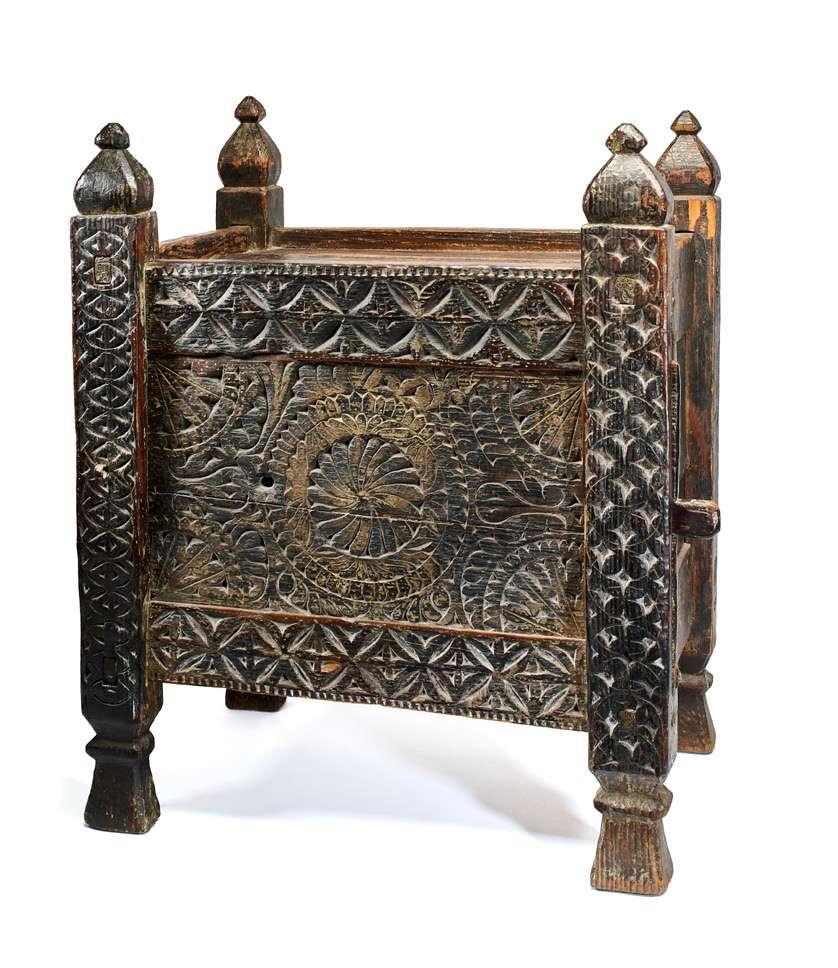
A CARVED WOOD STORAGE CHEST, SWAT VALLEY, PAKISTAN, 19TH CENTURY
the front with carved sliding panel decorated with stylised floral and leaf motifs, the frame terminating in bud-shaped finials in each corner, 76 x 63 x 43cm
£300-400
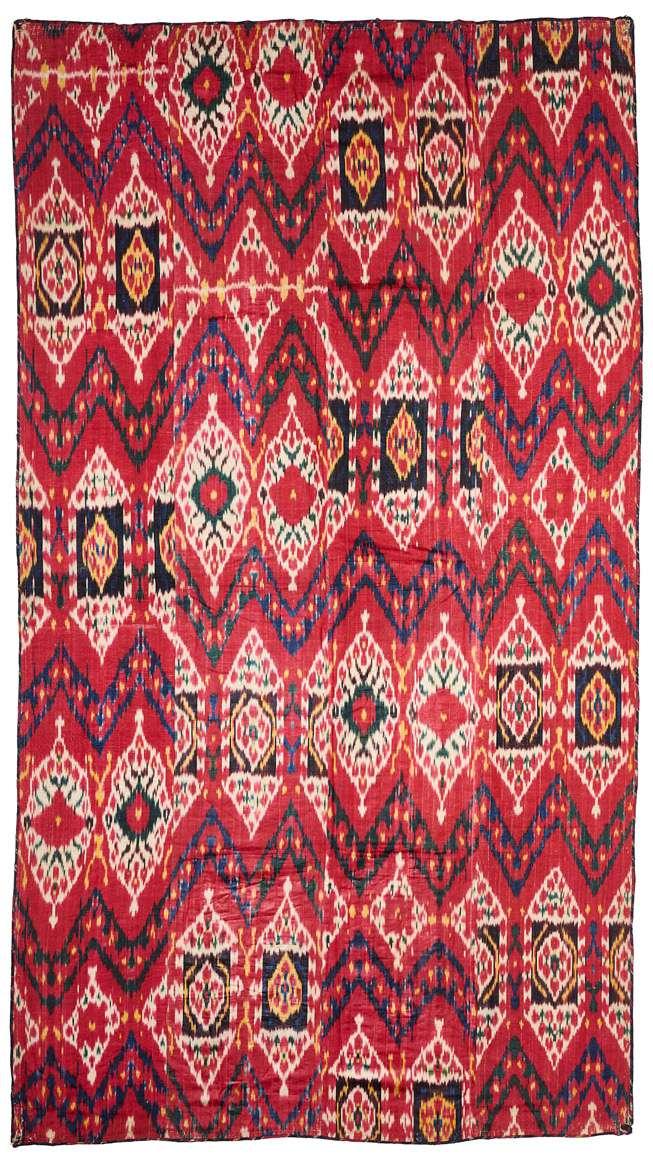
AN IKAT PANEL, BOKHARA, UZBEKISTAN, THIRD QUARTER 19TH CENTURY
the glazed adras ikat woven with rows of zig-zags bracketing flowerheads radiating small blossoms, in shades of ivory, yellow, indigo, madder, forest green and blue black, approximately 205 x 108cm
Literature: Hale, A., Fitz Gibbon, K., et al, Ikats, Woven Silks from Central Asia, The Rau Collection, Oxford 1988, p. 49
£1,500-2,500
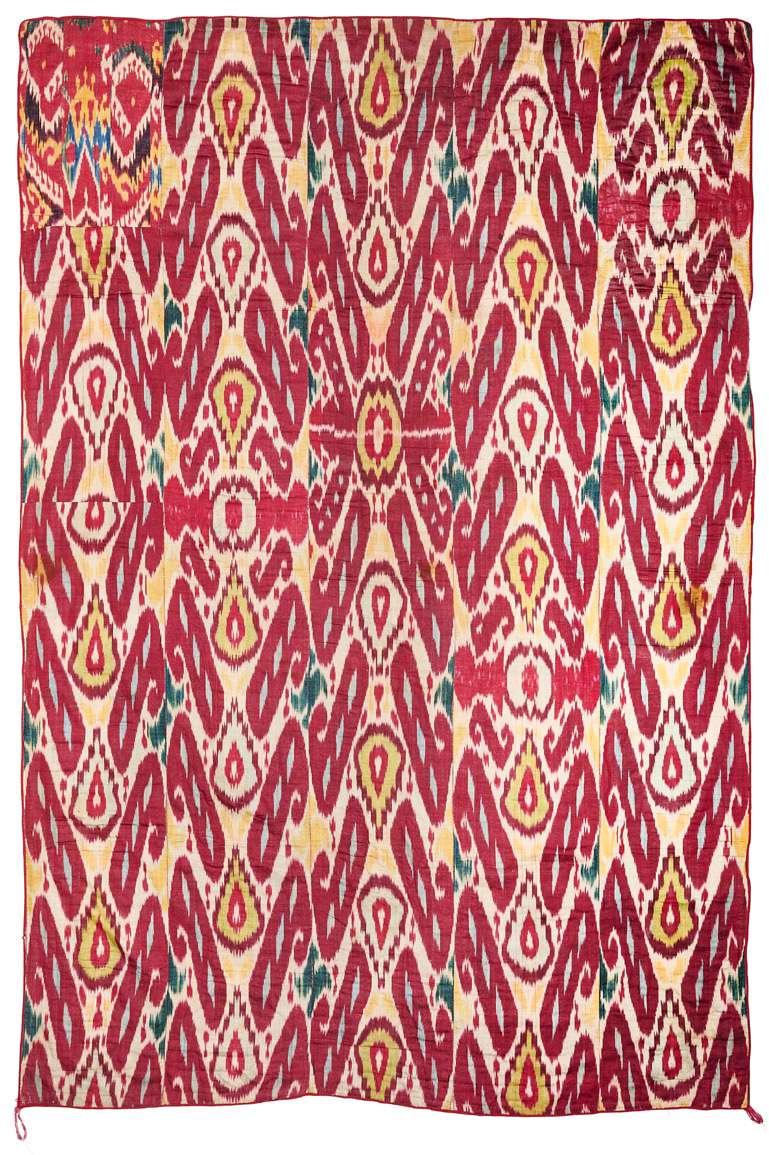
A LARGE QUILTED IKAT PANEL BOKHARA, UZBEKISTAN, LAST QUARTER 19TH CENTURY
the glazed adras ikat woven with large curled leaves and cypress trees, centred by rosettes, approximately 195 x 130cm
Literature: Hale, A., Fitz Gibbon, K., et al, Ikats, Woven Silks from Central Asia, The Rau Collection, Oxford 1988, p. 54 £2,000-3,000
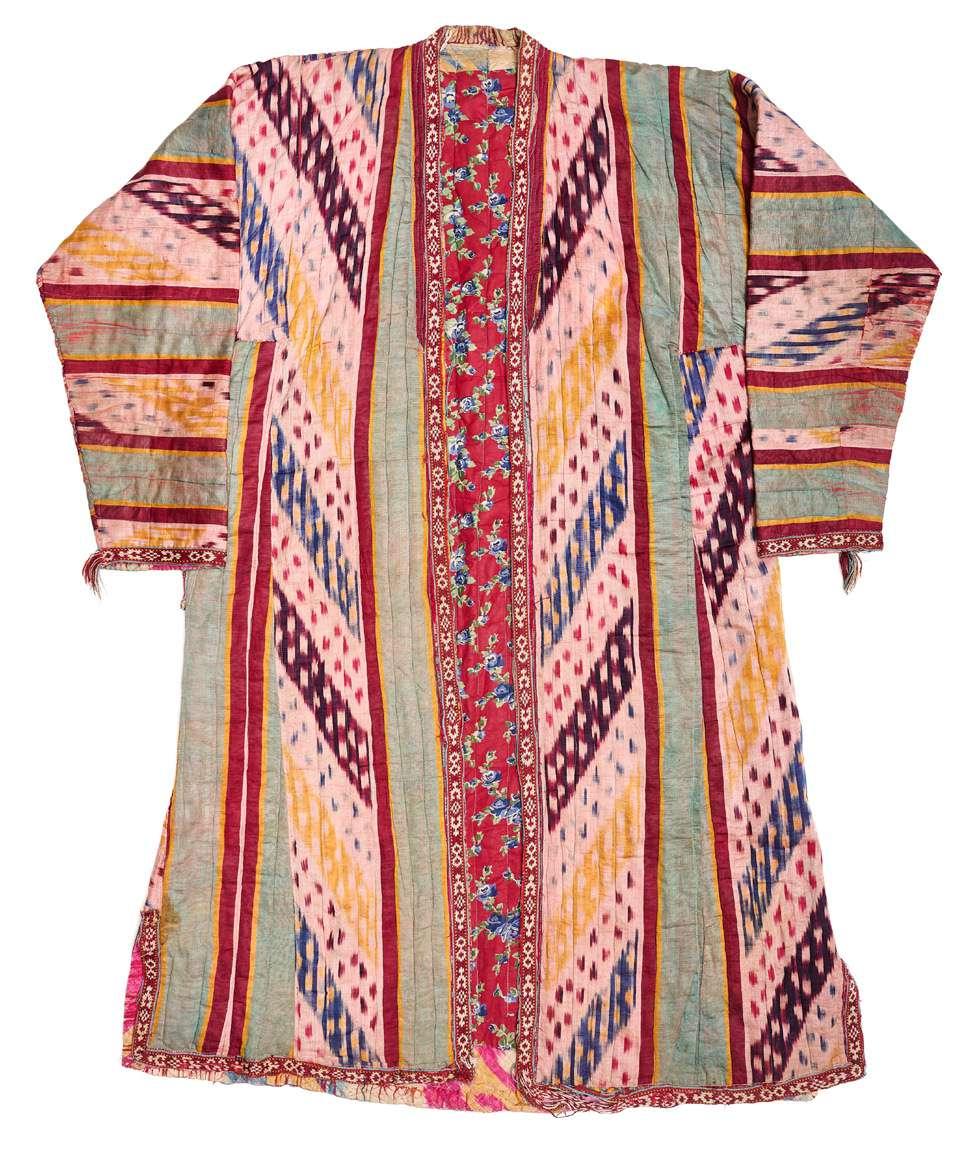
A QUILTED IKAT BOY’S CHAPAN, BOKHARA, UZBEKISTAN, CIRCA 1900 in adras ikat woven in diagonal spotted stripes between green and red stripes, tablet braid edging to sleeves, the single pocket and openings, broad ikat facings and floral printed cotton lining, approximate length 122cm
Literature: Hale, A., Fitz Gibbon, K., et al, Ikats, Woven Silks from Central Asia, The Rau Collection, Oxford 1988, p. 79 £300-500
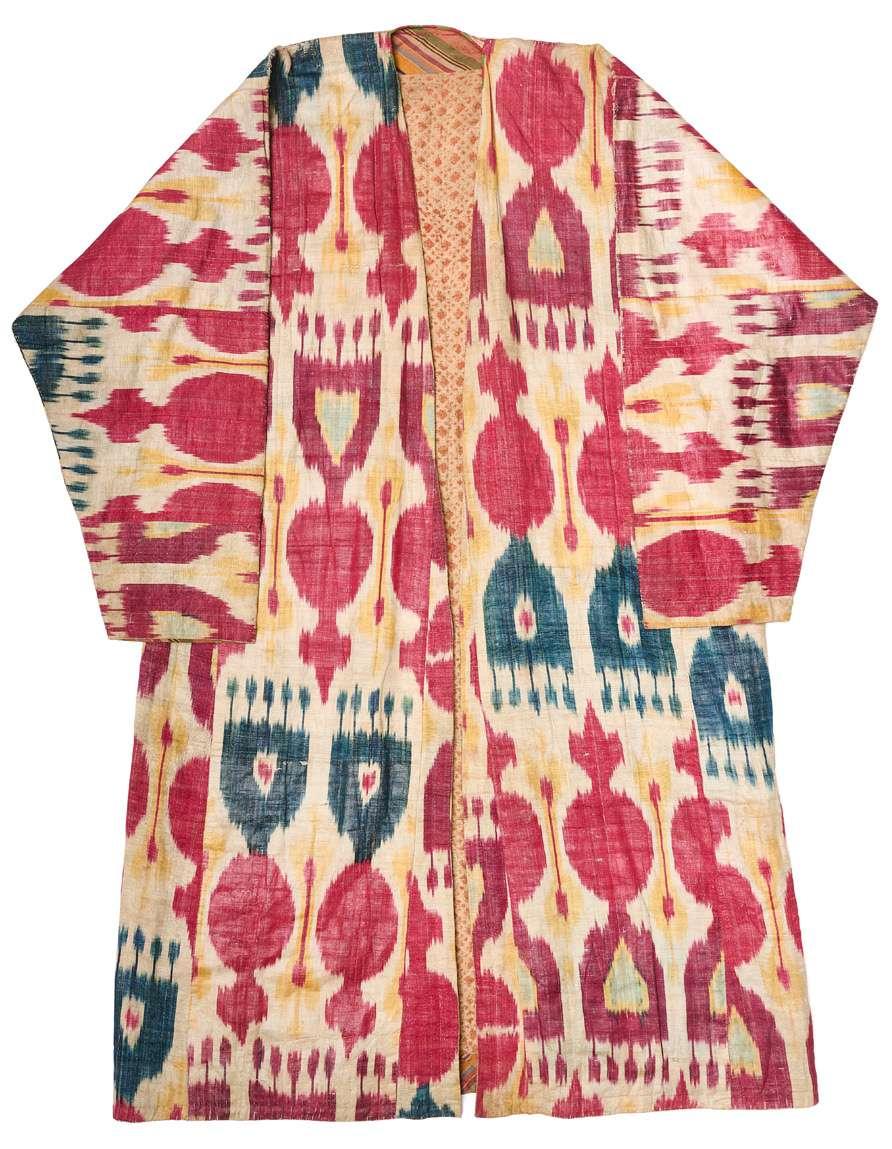
AN IKAT CHAPAN, UZBEKISTAN, SECOND HALF 19TH CENTURY
of glazed adras ikat, with pomegranate amulets, in madder, plum, forest green and yellow on an ivory ground, block printed lining and woven stripe facings, approximate length 124cm
See Atanova, S., et al, Central Asian Textiles: The Neville Kingston Collection, London, 2025, Cat. No. 2.1, p. 218, for a robe made up in a similar ikat
£300-500
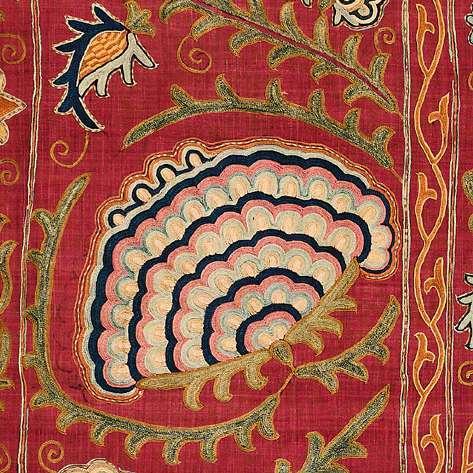
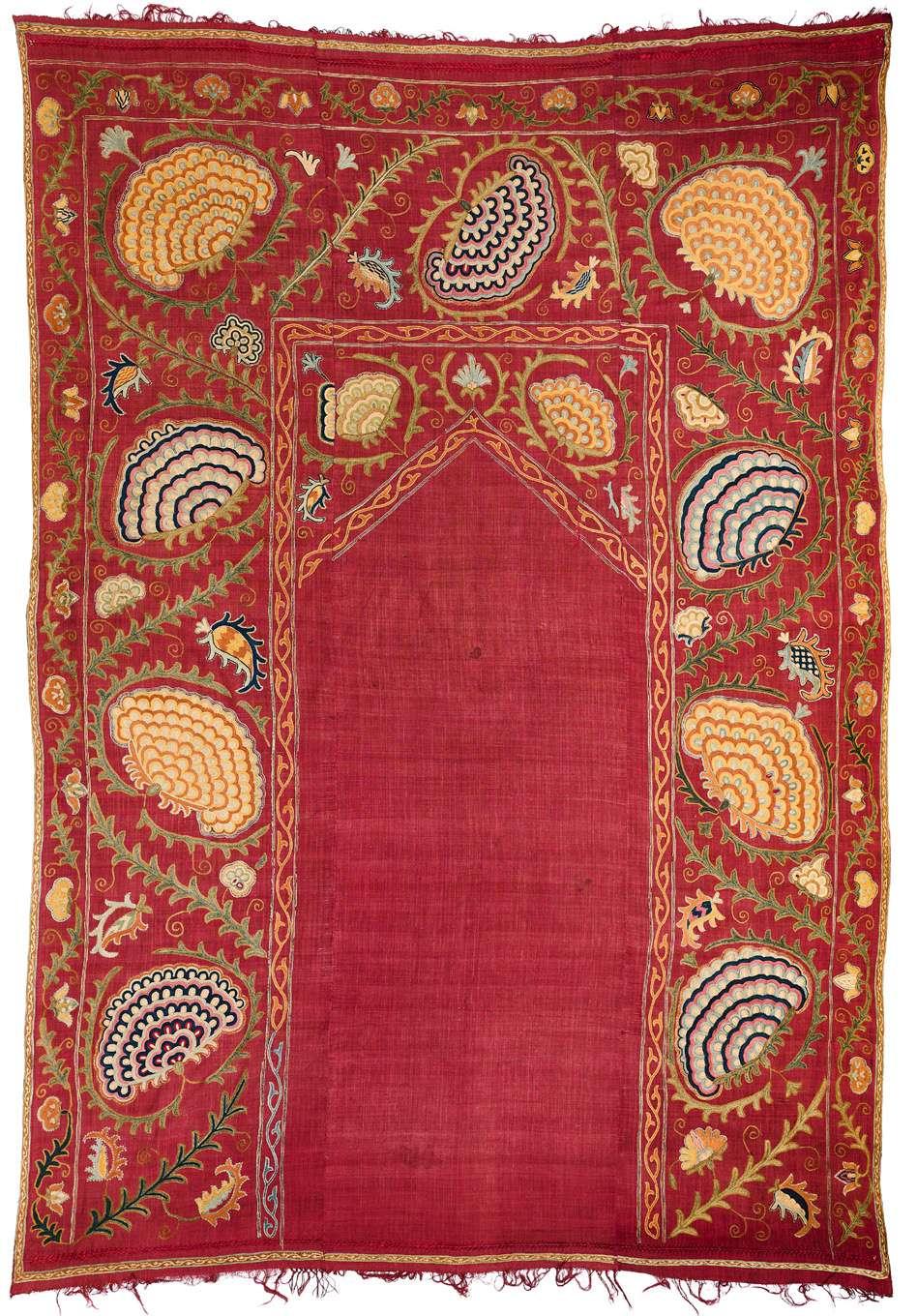
A SHAKHRISYABZ NICHE SUZANI, UZBEKISTAN, MID 19TH CENTURY OR EARLIER
the red silk ground with a plain niche, worked in tambour stitch with palmette spandrels, the wide border with polychrome ‘peacock fan’ palmettes and boldly articulated feathery vines, drawn threadwork bands at upper and lower edge, hand knotted fringe, tablet braid trim, approximately 240 x 165cm
The exquisite quality, and sophisticated drawing and execution of this extraordinary suzani suggests it might have been the product of a city workshop or professional atelier, made for an important patron. The embroidery is worked on a heavy handwoven silk ground of a beautiful shade of rosy red, which has been embellished with drawn thread work and hand tied fringing at each end, further decorated with braid with a running vine motif. The large palmettes are reminiscent of the peacock fan tail seen in a palampore in the Royal Ontario Museum (ROM 934.4.13. Harry Wearne Collection. Gift of Mrs. Harry Wearne). A Shakhrisyabz suzani sold at Rippon Boswell, December 3rd 2016, Lot 76 has related, albeit more stylised, shell-like shaped fan palmettes, but no direct comparison has been identified for this exceptional embroidery.
£10,000-15,000
129
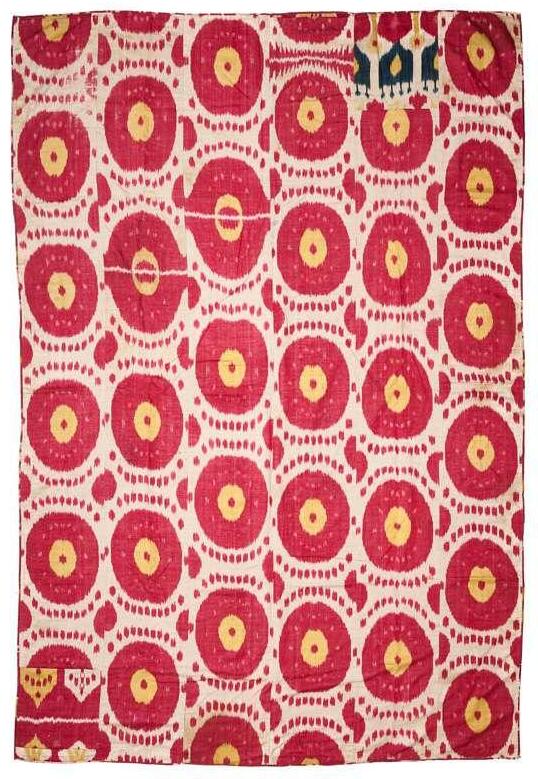
AN IKAT PANEL, UZBEKISTAN, LATE 19TH CENTURY
the adras ikat in ivory with rosy red flowerheads with yellow centres, one small section of different adras with amulets in green, approximately 220 x 146cm
£600-900
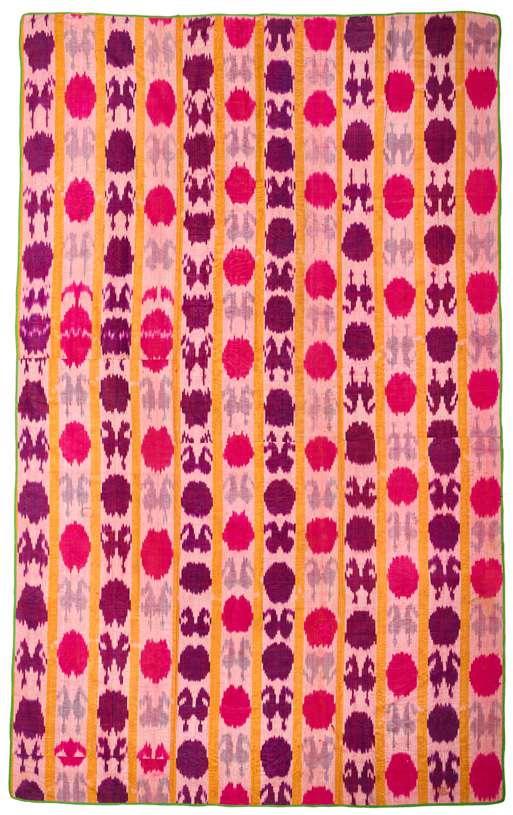
130
AN IKAT PANEL, UZBEKISTAN, LATE 19TH CENTURY
adras ikat with ivory and yellow stripes, columns of purple spots and plants alternating with similar motifs in pink and pale blue, approximately 200 x 128cm
£400-600
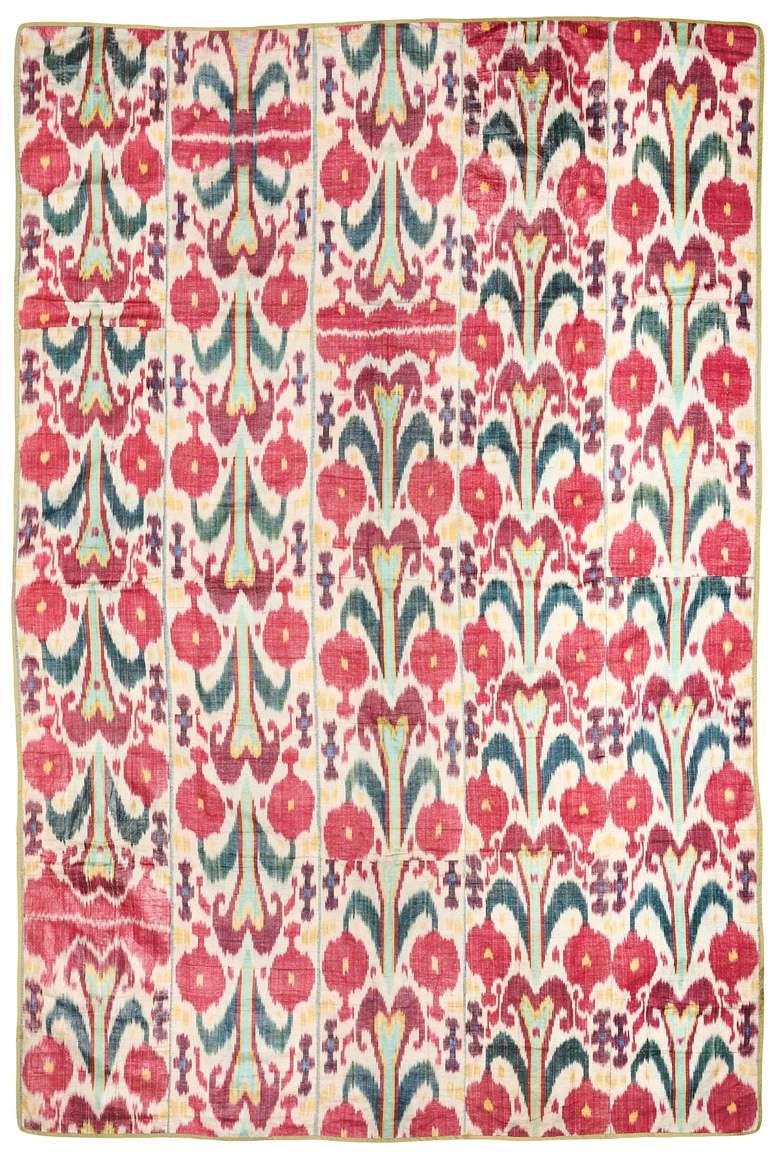
AN IKAT PANEL, UZBEKISTAN, SECOND HALF 19TH CENTURY
the glazed adras ikat woven with polychrome rose spray palmettes on an ivory ground, approximately 184 x 124cm
£2,000-3,000
132 A LADY’S AND A SIMILAR MAN’S QUILTED IKAT CHAPAN, UZBEKISTAN, BOKHARA, SECOND HALF 19TH CENTURY
the adras ikat woven with large rose pink roundels with yellow centres, and pink feathered panels on an ivory ground, each approximately 120cm long (2)
£100-200
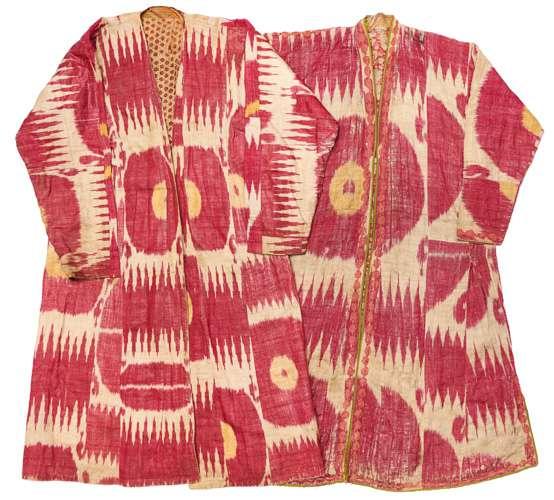
134
THREE IKAT CHAPAN, UZBEKISTAN, SECOND HALF 19TH CENTURY
133
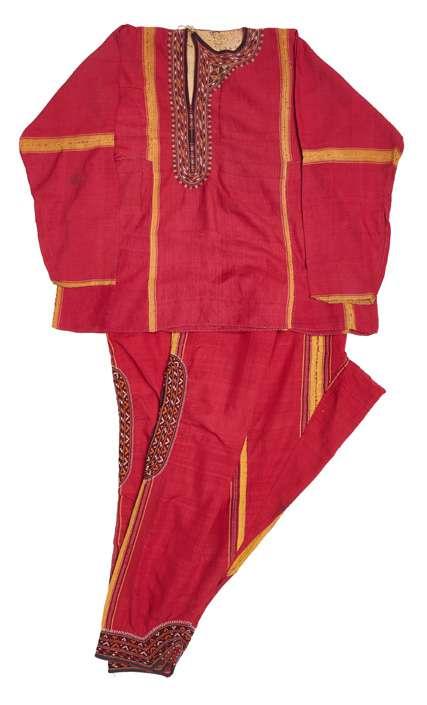
A RARE TURKMAN SHIRT AND TROUSERS, WEST TURKESTAN, SECOND HALF 19TH CENTURY
the red silk with yellow stripes, the shirt with asymmetric fastening very finely embroidered with geometric motifs to neckline, the trousers with oval embroidered vents to the thighs and embroidered cuffs, the trousers possibly later than the top, top approximately 70cm long, trousers 80cm (2)
£200-300
each of adras ikat, one unlined, one lined and with red velvet sleeve bands, one lined and with multiple red velvet patches to sleeves and neckline, the longest approximately 130cm (3)
£100-200
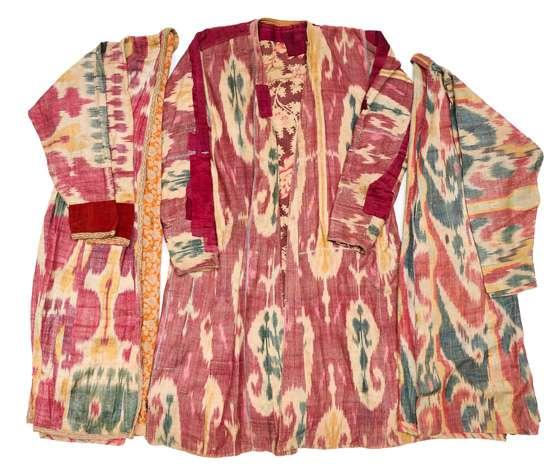
135
AN IKAT PARANJA, A CHAPAN AND A MUNISAK, UZBEKISTAN, CIRCA 1900
each of atlas ikat, the paranja and diamond ikat munisak padded and quilted, with large plain silk section on back, the paranja approximately 133cm (3)
£150-250
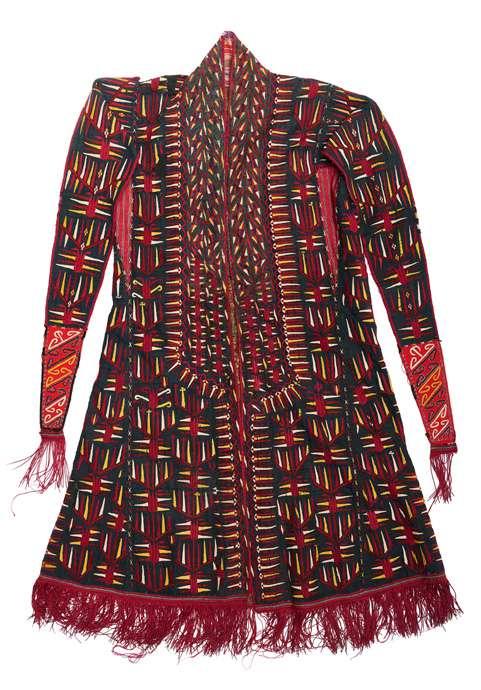
137
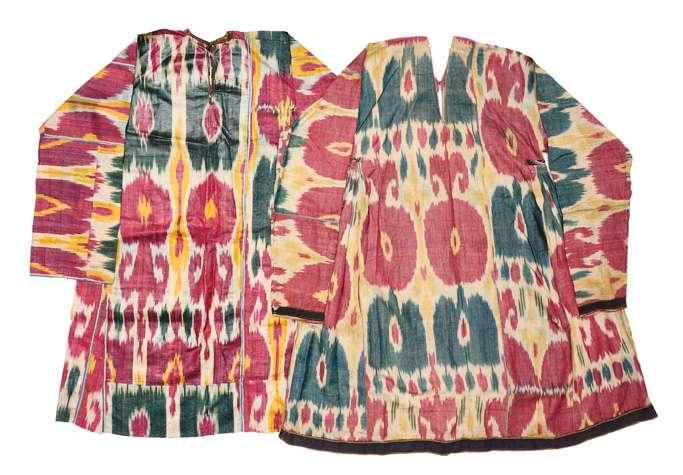
TWO IKAT TUNICS (KURTA), UZBEKISTAN, LATE 19TH CENTURY
each of similar adras ikat woven in madder red, green and yellow on an ivory ground, simple slit neck openings, one with braid collar, the other with plain cuff and hem trim, the longest approximately 115cm (2)
£200-400
136
A SILK EMBROIDERED TEKKE CHYRPY, WEST TURKESTAN, SECOND HALF 19TH CENTURY
the dark indigo ground worked with columns of stylised tulips, striped gores, block printed lining, braid and fringe-to hem of skirt and vestigial sleeves, approximate length 115cm
£200-300
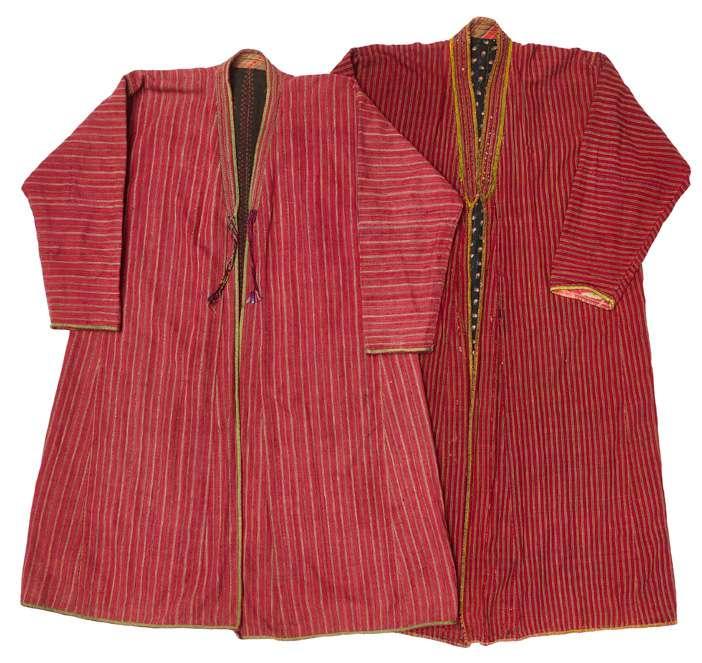
TWO STRIPED CHAPAN, CENTRAL ASIA, LATE 19TH/ EARLY 20TH CENTURY
each of madder red plainweave with narrow black and yellow stripes, black floral printed linings, stripy facings, narrow braided edging, approximate length 120cm and 130cm (2)
£100-200
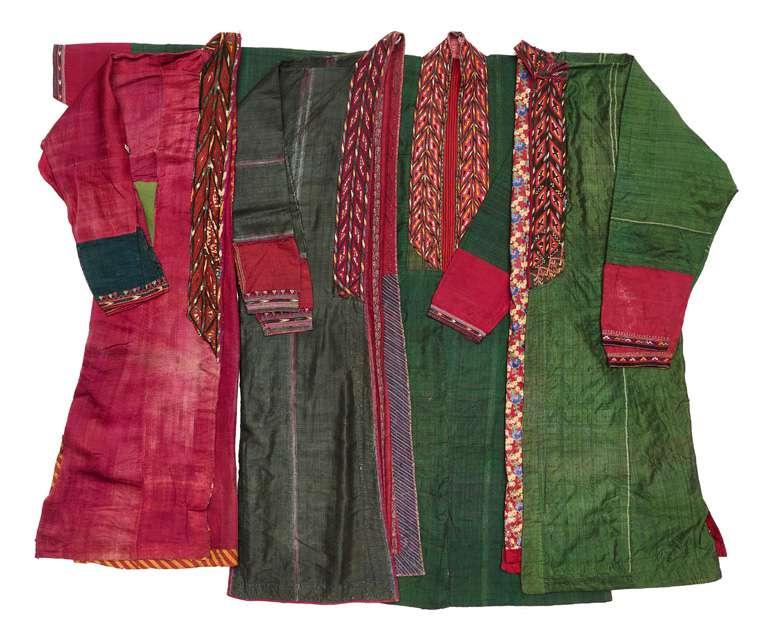
139
A CRIMSON SILK VELVET TURKMAN ROBE (KURTE) AND THREE SILK KURTE, CENTRAL ASIA, LATE 19TH CENTURY
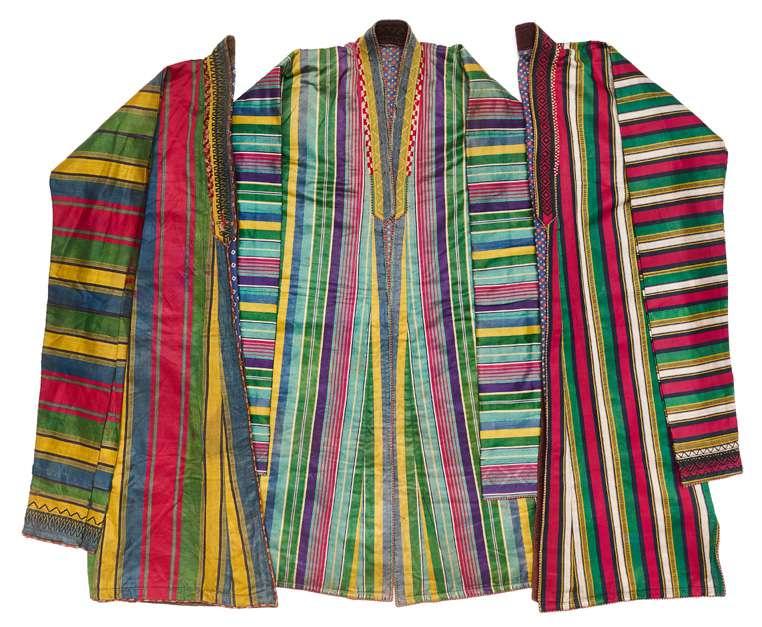
the collar embroidery later applied to velvet example, approximate length 112cm; two chapan in green silk with crimson or madder gores and sleeve bands, embroidered collar bands, cotton linings approximate length 115cm, 110cm; a charcoal silk example with purple stripes, finely worked collar band approximate length 114cm (4) £200-400
140
THREE STRIPED SATIN CHAPAN, PROBABLY AFGHANISTAN, 20TH CENTURY
each striped in shades of red, green, yellow and blue, one with padded lining, of similar size, the longest approximately 124cm (3)
£180-250
141
FOUR STRIPED TURKMAN CHAPAN, CENTRAL ASIA, EARLY 20TH CENTURY
variously with tablet braid, ikat trim, printed or plain colour linings, decorative patches and embroidery, approximate lengths 130cm, 128cm, 120cm, 105cm (4)
£250-400
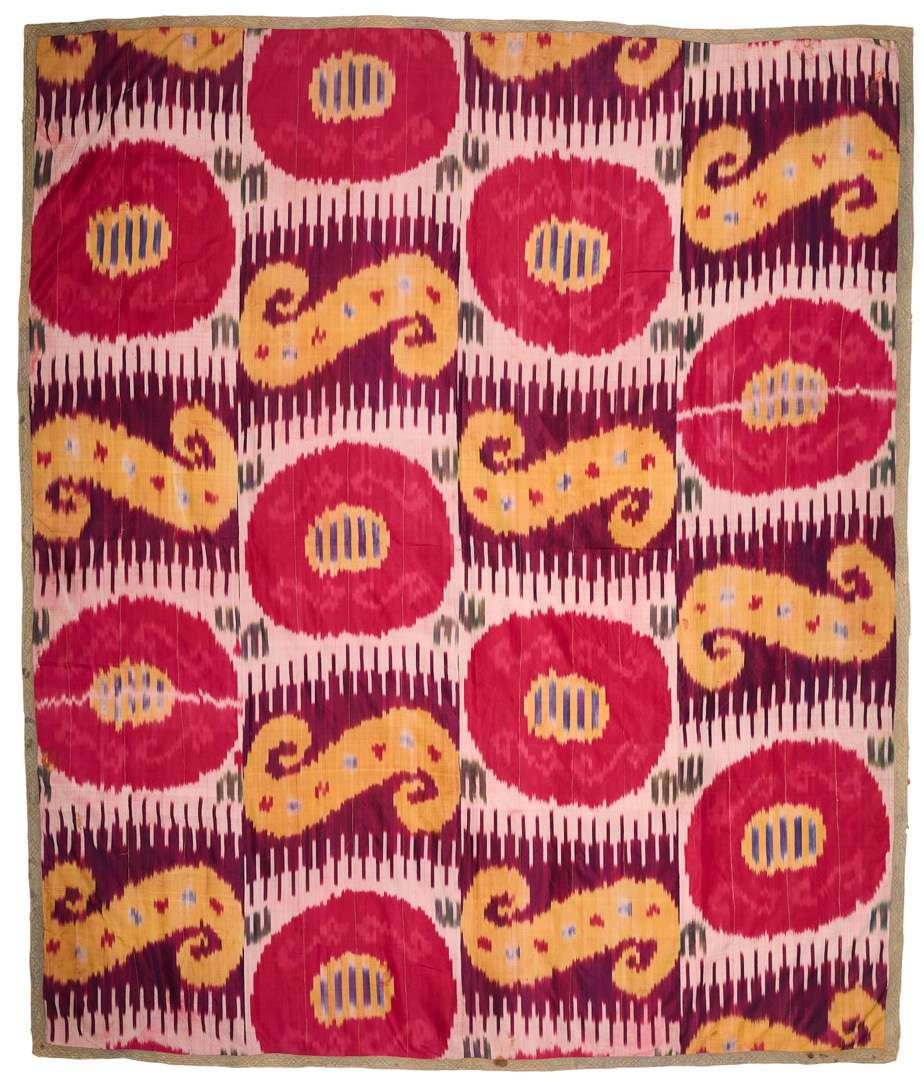
A LARGE IKAT PANEL, BOKHARA, UZBEKISTAN, CIRCA 1900 the atlas ikat woven with reciprocal ivory and aubergine panels enclosing large rosy red flowerheads and ‘S’ motifs respectively, approximately 200 x 175cm
A related example is in the collection of The Textile Museum, Washington D.C., Accession Number: 2015.7.1, Gift of Bruce P. and Olive W. Baganz in honor of Jack Lenor Larsen. See also Atanova, S., et al, Central Asian Textiles: The Neville Kingston Collection, London, 2025, Cat. Nos. 2.85 and 2.86, p. 234 for two women’s dresses (kurta) made up in similar all silk (atlas) ikat.
£600-900
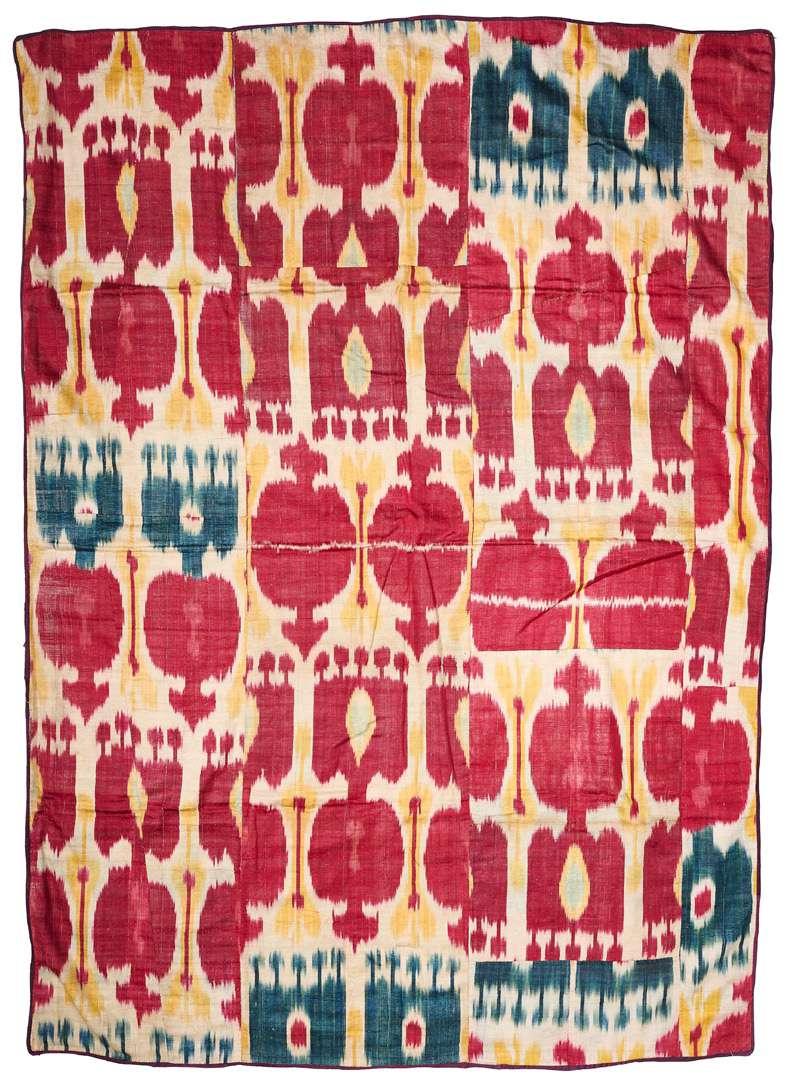
AN IKAT PANEL UZBEKISTAN, LATE 19TH CENTURY
the adras ikat woven with large crimson and indigo pomegranate amulet motifs, minor motifs in yellow and pale green, ivory ground, approximately 168 x 125cm
See Atanova, S., et al, Central Asian Textiles: The Neville Kingston Collection, London, 2025, Cat. No. 2.1, p. 218, for a robe made up in a similar ikat £500-800
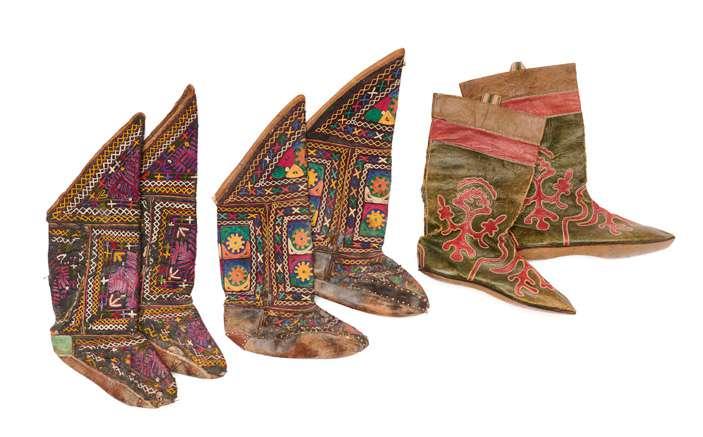
144
THREE PAIRS OF BOOTS (MAKHSI), CENTRAL ASIA, EARLY 20TH CENTURY
the first of pieced and inset embroidered leather with scrolling foliate patterns, Uzbekistan, the others of embroidered cloth, leather soles (3)
For a pair of makhsi similar to the middle pair see Atanova, S., et al, Central Asian Textiles: The Neville Kingston Collection, London, 2025, fig. 51, p. 129; for a pair of related pieced leather technique see Atanova, op.cit., Cat. No. 2.188, p. 51. These soft soled decorated boots would have been worn indoors by both men and women; a sturdier shoe or slipper was worn in addition outdoors.
£100-200
145
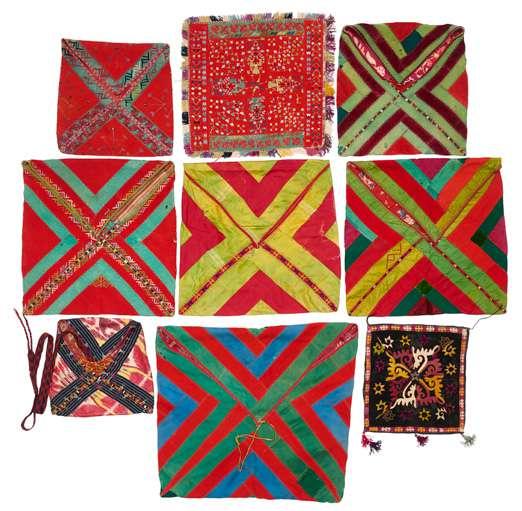
AN EMBROIDERED TURKMAN BROADCLOTH TRAY COVER, A PANEL AND SEVEN POUCHES (BUKCHA), CIRCA 1900
the first finely worked in polychrome silks on wool with floral motifs centred on a star gul, with a small animal, polychrome silk fringe, approximately 42 x 45cm, the small panel of black velvet with leaf and rosette embroidery, the pouches variously in ikat silk, silks, velvet and pieced brightly coloured woollen broadcloth, one with embroidery, the smallest approximately 29 x 32cm, the largest approximately 57 x 67cm (9)
£300-500
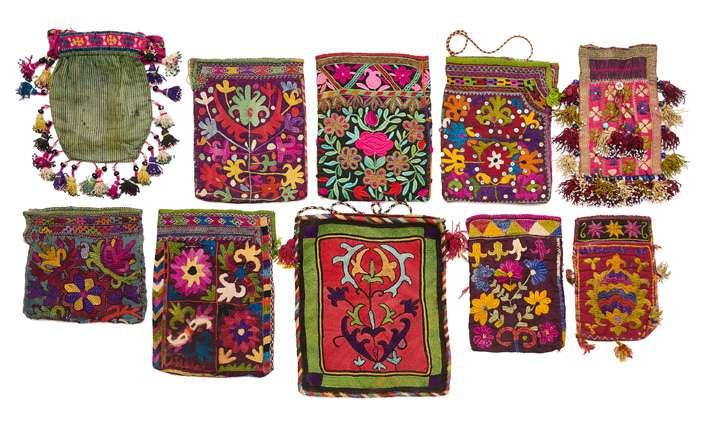
146
A COLLECTION OF TEN
EMBROIDERED LAKAI AND UZBEK POUCHES, 20TH CENTURY
decorated mainly with polychrome floral decoration, tablet or gilt metal braid and tassels (10)
£250-500
147
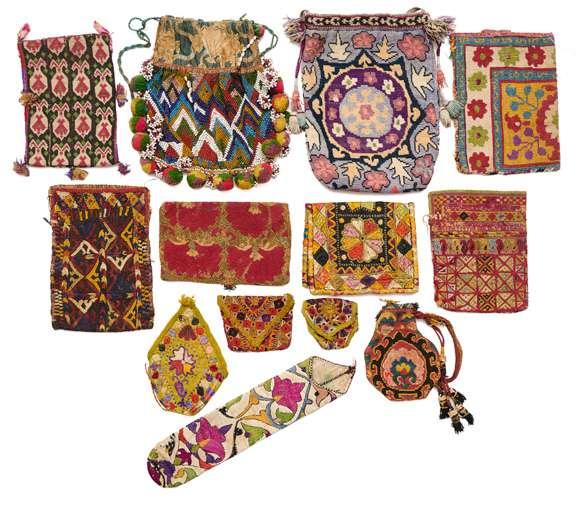
AN UZBEK BEADED POUCH AND TWELVE OTHERS, SHAKHRISYABZ, BOKHARA, UZBEKISTAN, 19TH AND 20TH CENTURY
the beaded pouch with cowrie shells, pom-poms and beaded tassels, variously embroidered in cross, buttonhole and satin stitches with floral and geometric designs (13)
£500-800
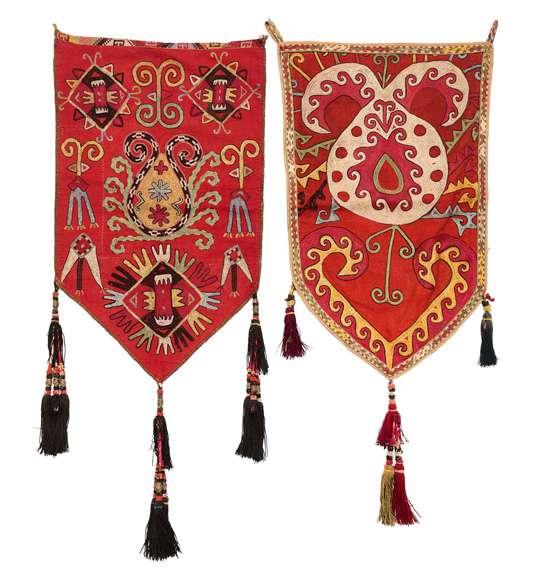
148
TWO LAKAI EMBROIDERED BAG FACES (UUK KAP), UZBEKISTAN, CIRCA 1900
of typical shield shape, each worked on red woollen broadcloth, with polychrome silk embroidery, complete with pendent tassels, approximately 55cm in length (2)
See Atanova, S., et al, Central Asian Textiles: The Neville Kingston Collection, London, 2025, Cat. Nos. 3.45 and 3.46 for related examples
£300-500
149
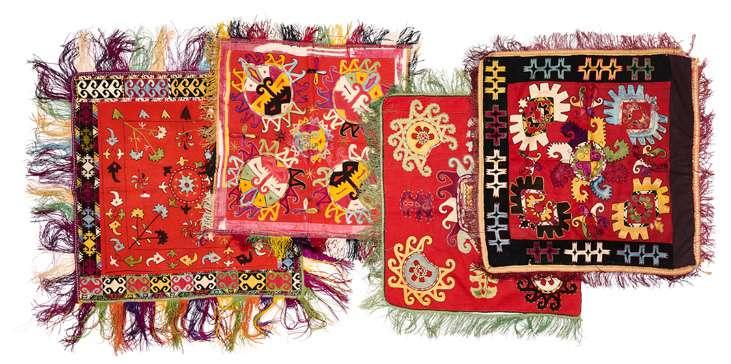
FOUR EMBROIDERED LAKAI TRAY COVERS (LALI POSH), UZBEKISTAN, EARLY 20TH CENTURY
each of red woollen broadcloth embroidered in silk, with polychrome fringing, the largest 68 x 68cm (4)
£500-800
150
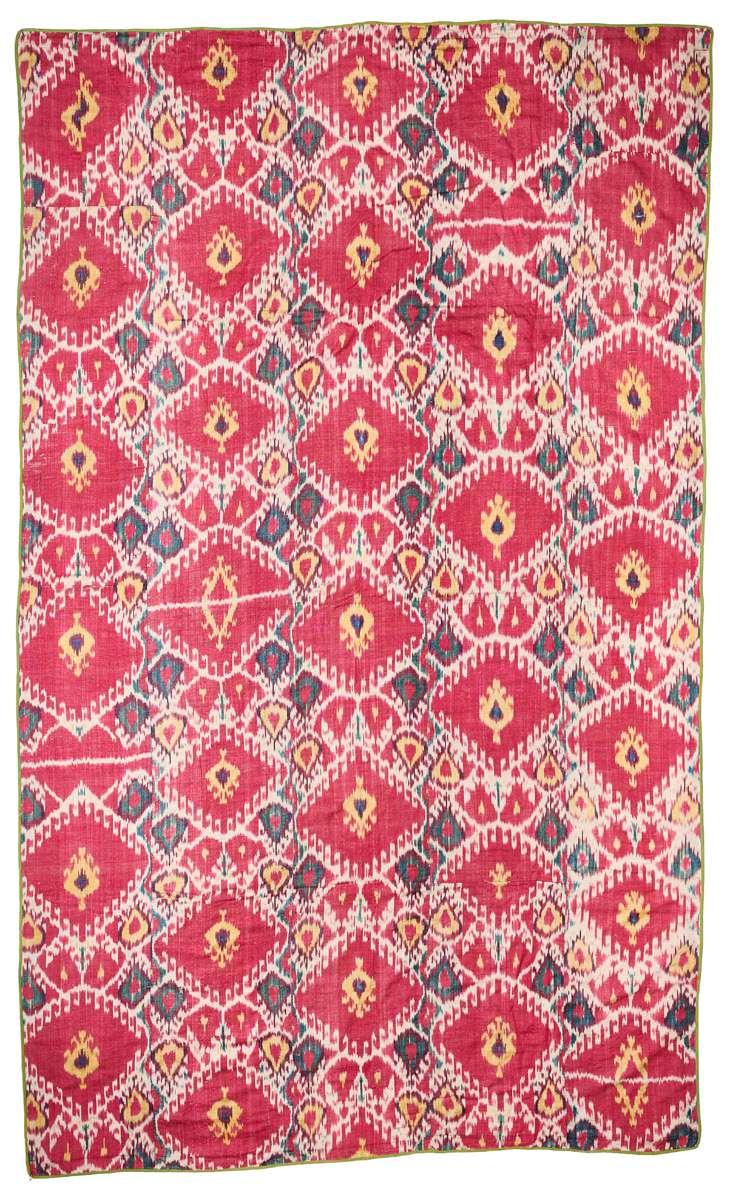
A LARGE IKAT PANEL, UZBEKISTAN, MID 19TH CENTURY
the adras ikat with columns of crimson hooked guls enclosing small palmettes, flanked by polychrome guls in green and yellow with aubergine, approximately 225 x 135cm
£700-1,000
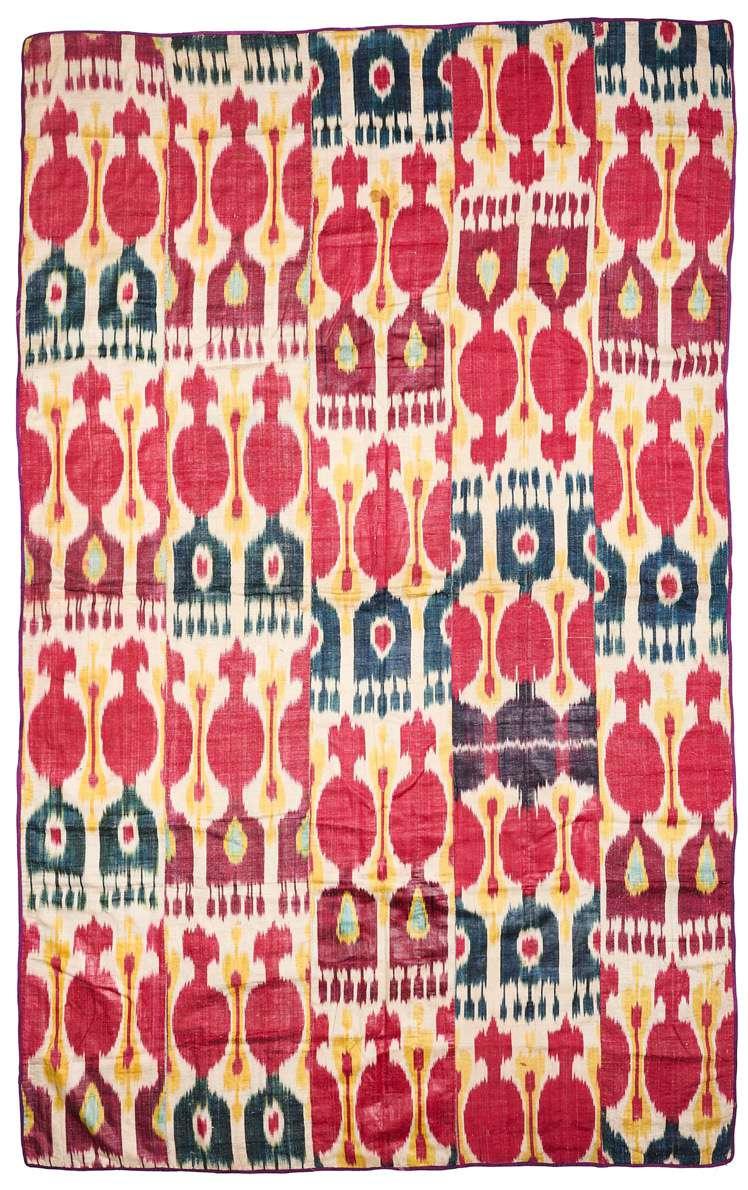
AN IKAT PANEL UZBEKISTAN, LATE 19TH CENTURY
the adras ikat woven with large crimson and indigo pomegranate amulet motifs, minor motifs in yellow and pale green, ivory ground, approximately 200 x 127cm
£600-900
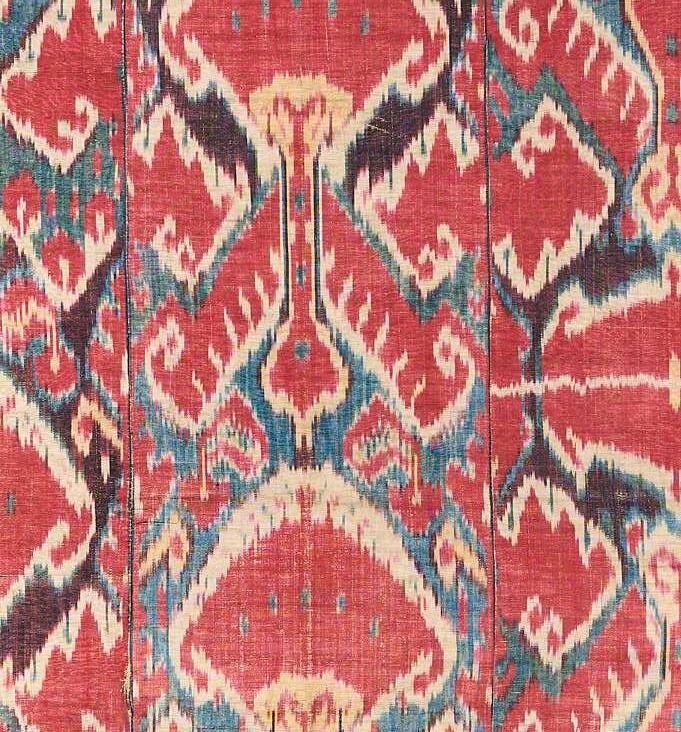
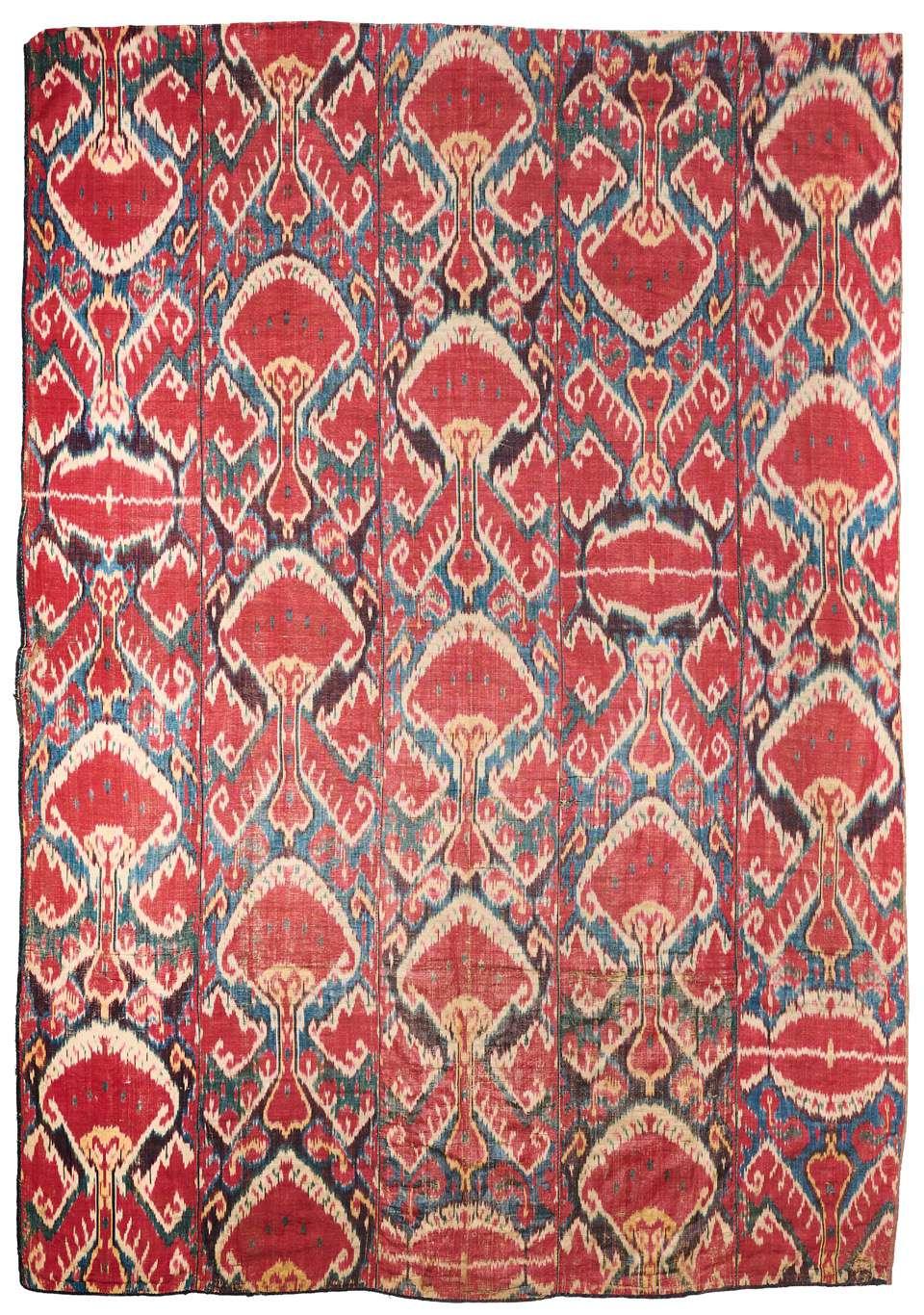
A LARGE IKAT PANEL, UZBEKISTAN, MID 19TH CENTURY
the adras ikat woven with large palmettes with curled feathery leaves, small blossoms and flowers, interspersed with roundels, all in shades of ivory, yellow, rosy red, aubergine and bright indigo, approximately 206 x 145cm
£4,000-6,000
154
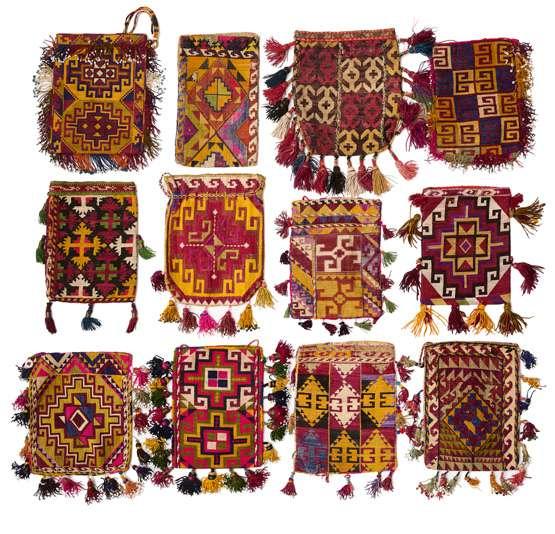
A COLLECTION OF NINE SMALL EMBROIDERED BAGS (HALTA). CENTRAL ASIA/AFGHANISTAN, EARLY 20TH CENTURY
variously worked with geometric and foliate patterns (9)
£300-500
153
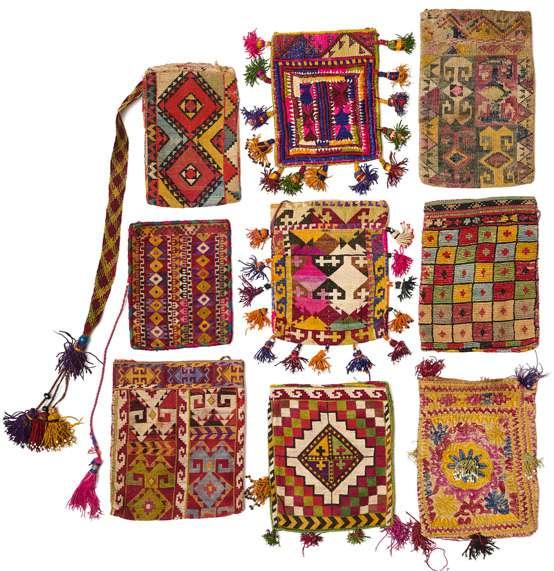
A COLLECTION OF POUCHES, UZBEKISTAN, EARLY 20TH CENTURY
silk embroidery in cross stitch, variously decorated with polychrome guls, tablet braid and tassels (12)
£400-600
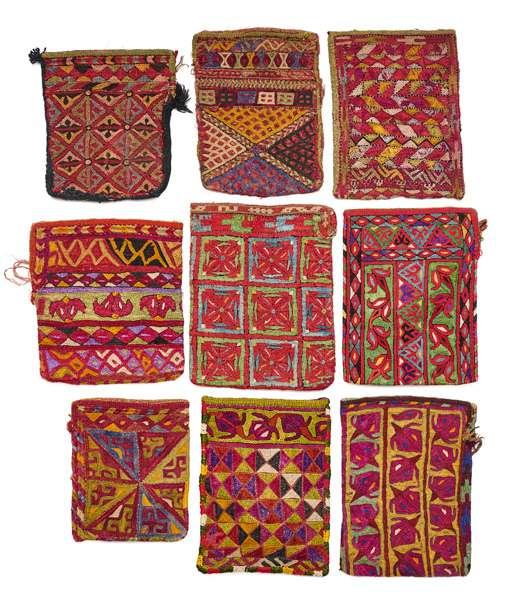
155
A COLLECTION OF NINE SMALL BAGS ((HALTA), UZBEKISTAN, EARLY 20TH CENTURY
mainly embroidered with geometric motifs in cross stitch, six with tassel decoration (9)
£400-600
156
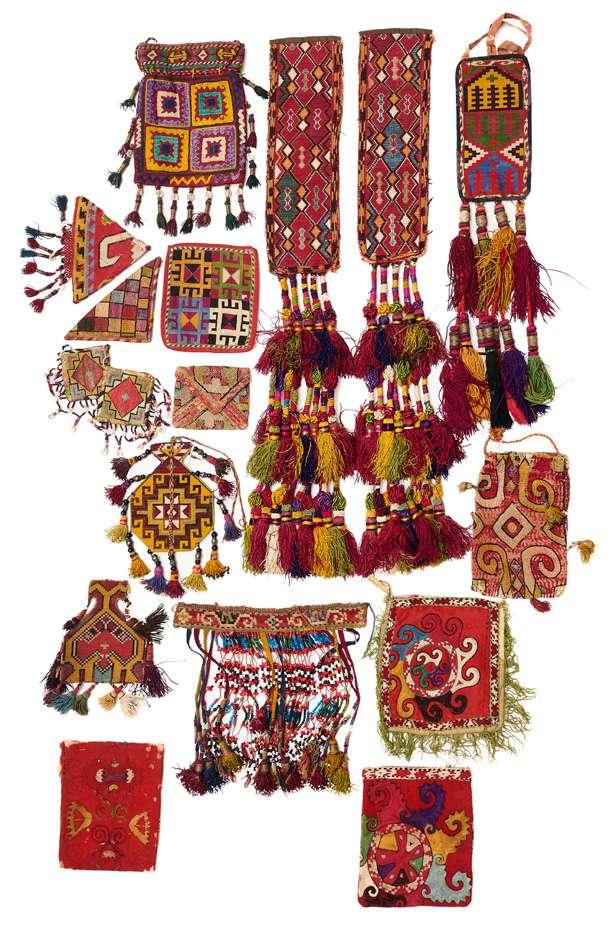
A COLLECTION OF LAKAI AND UZBEK EMBROIDERIES, UZBEKISTAN, LATE 19TH/EARLY 20TH CENTURY
including a headband with beaded veiling, amulets, decorative bands with tassels and small pouches (17)
£800-1,500
157
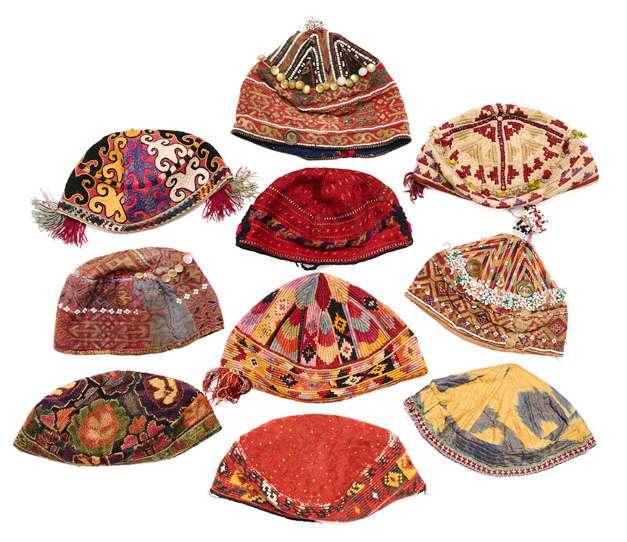
A COLLECTION OF HATS, UZBEK, AFGHAN AND TURKMAN, 20TH CENTURY
various sizes and styles, one ikat example, the remainder embroidered and embellished (10)
£300-400
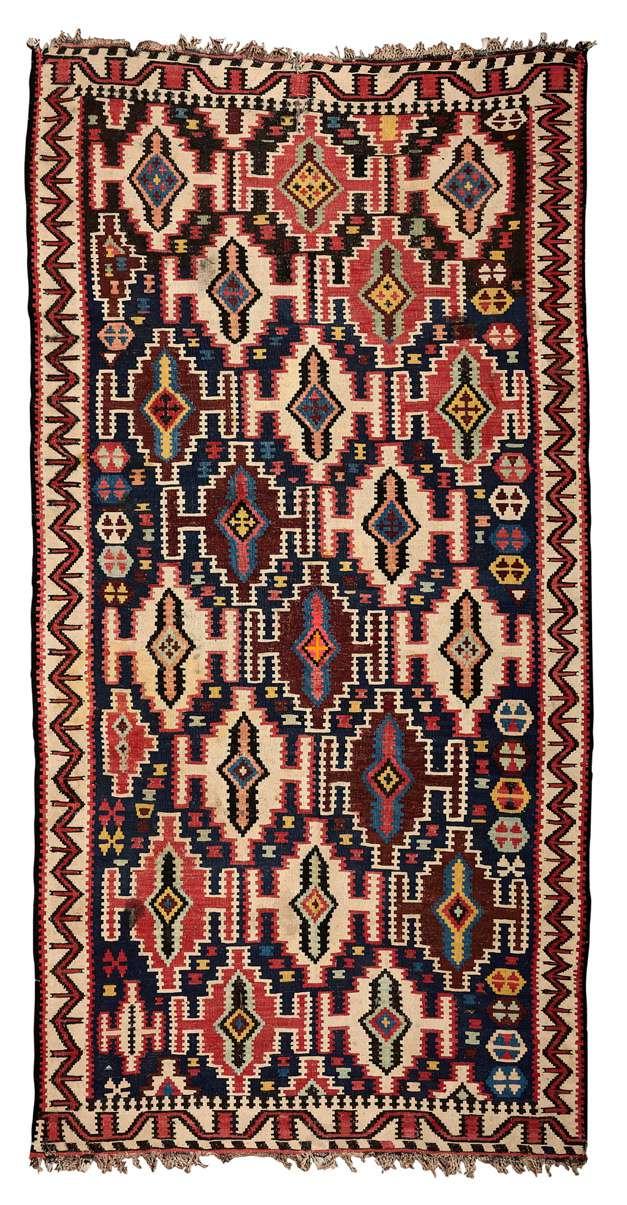
158
A KUBA KILIM, EAST CAUCASUS, CIRCA 1900 with polychrome guls, approximately 290 x 148cm
£400-600
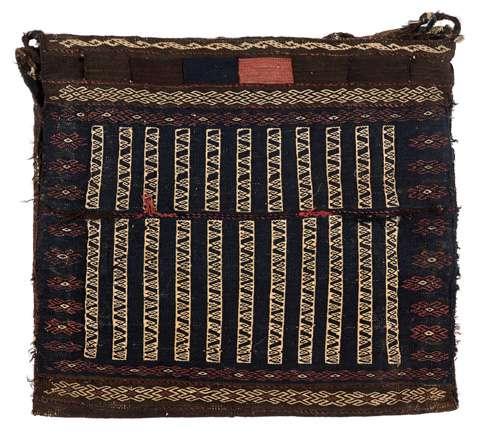
159
A BELUCH BAG, FIST HALF 20TH CENTURY
with weft faced embroidery of a dark indigo ground with ivory stripes with indigo vinery, approximately 53 x 59cm
£80-120
160
A REYHANLI KILIM, SOUTHEAST ANATOLIA, LATE 19TH CENTURY
woven in two parts, with bands of polychrome hooked guls, approximately 340 x 150cm
£500-800
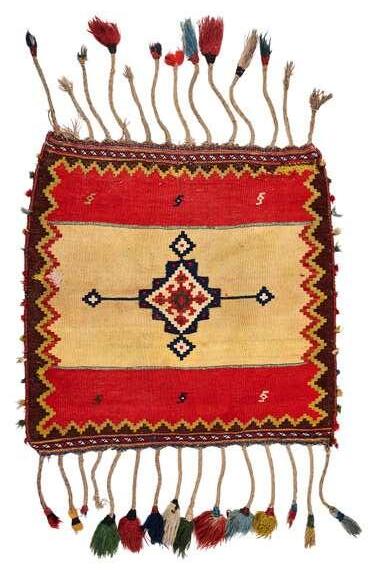
161
A QASH’QAI SMALL KILIM SOFREH, SOUTHWEST PERSIA, EARLY 20TH CENTURY
polychrome bands with central cruciform gul, tassels to each end, approximately 79 x 77cm
£100-200
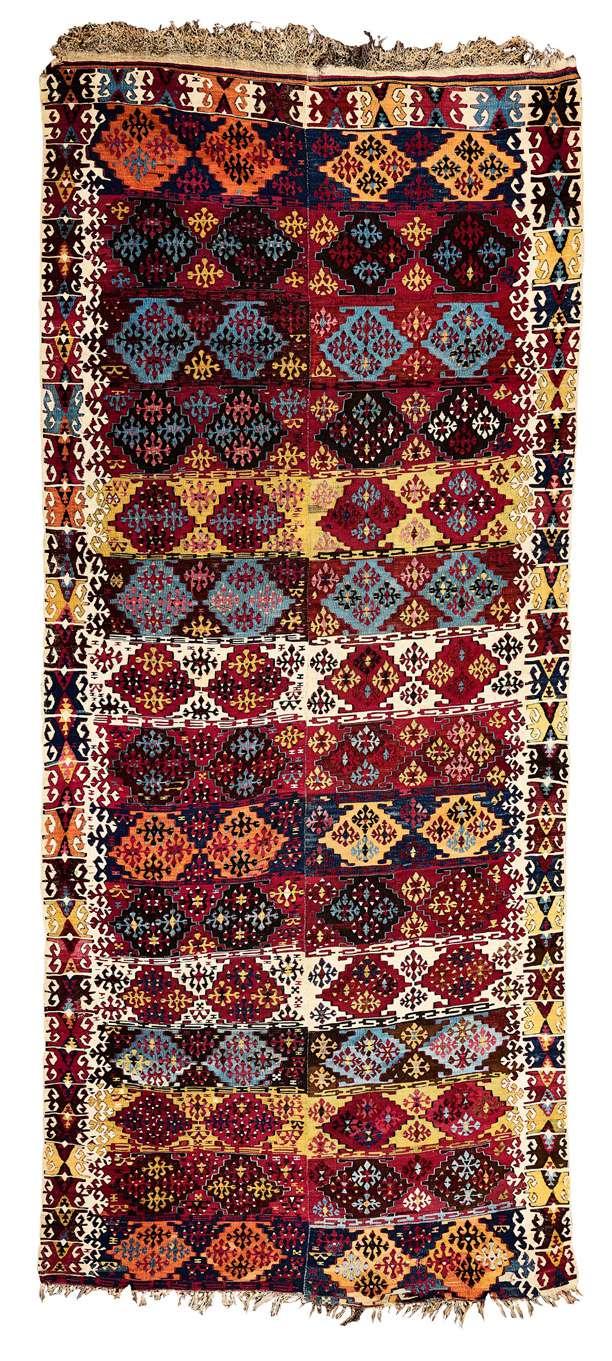
162
THREE STRIPED CHAPAN, CENTRAL ASIA, EARLY 20TH CENTURY
in woven striped fabric, including one for a child, one with tablet braid trim, embroidery and flower printed lining, approximate lengths 102cm; 125cm; 125cm (3)
£150-250
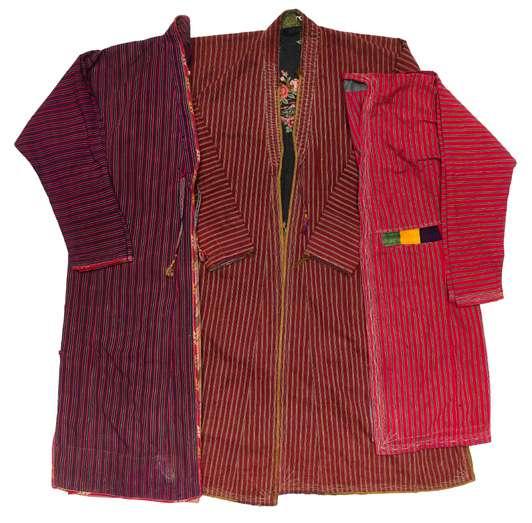
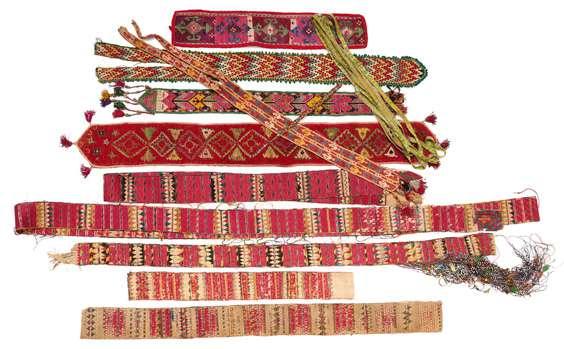
163
A COLLECTION OF UZBEK AND TURKMAN EMBROIDERIES, CENTRAL ASIA, LATE 19TH/EARLY 20TH CENTURY
including a red velvet embroidered band, four cross-stitch embroideries, five fragments of similarly embroidered belts or bands, one with beaded veiling fringe, a length of tablet braid and an embroidered watch strap (12)
£300-500
164
TWO STRIPED CHAPAN, CENTRAL ASIA, EARLY 20TH CENTURY
one of green and madder part silk striped plainweave, small floral printed cotton lining, elaborated tablet braid trim, the other of madder and indigo striped plainweave, printed cotton facings, both approximate length 115cm (2)
£100-200
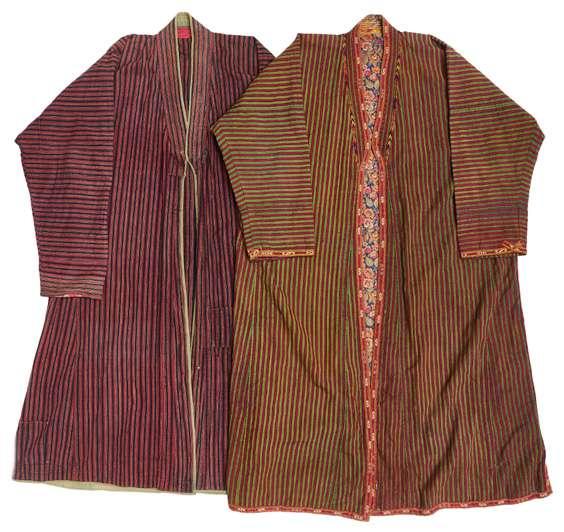
165
THREE EMBROIDERED AMULETS AND SIX EMBROIDERED POUCHES (BUKCHA), CENTRAL ASIA, CIRCA 1900
one with beaded links and tassels, of various sizes (9)
£300-500
166
THREE LAKAI EMBROIDERIES, THREE POUCHES AND A CHIRPY DECORATION, LATE 19TH CENTURY
including an embroidered Lakai headband and two fragments of Lakai embroidery, Uzbekistan, two small Hazara embroidered pouches, Afghanistan, one of very fine work, trimmed with metal thread braid, and a slightly larger pouch worked in metal thread overall, together with a Turkman aragerbi chyrpy with three pendant amulets (7)
£300-600
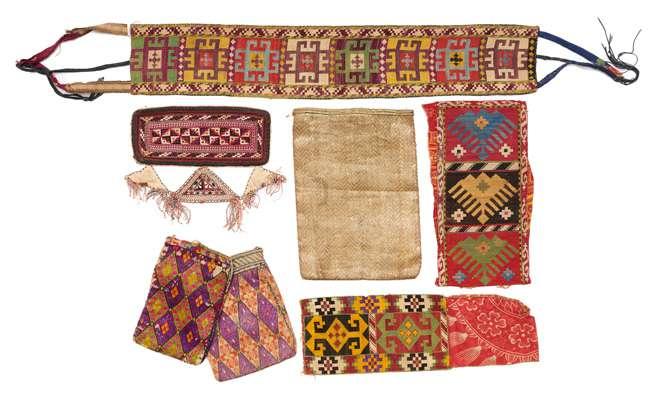
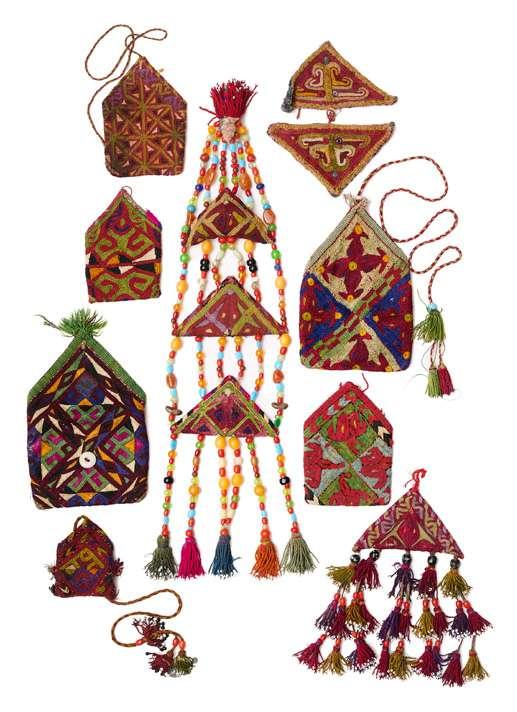
167
A COLLECTION OF SEVEN EMBROIDERED POUCHES, AFGHANISTAN, 20TH CENTURY
worked with geometric patterns in bright polychrome silks (7)
£80-120
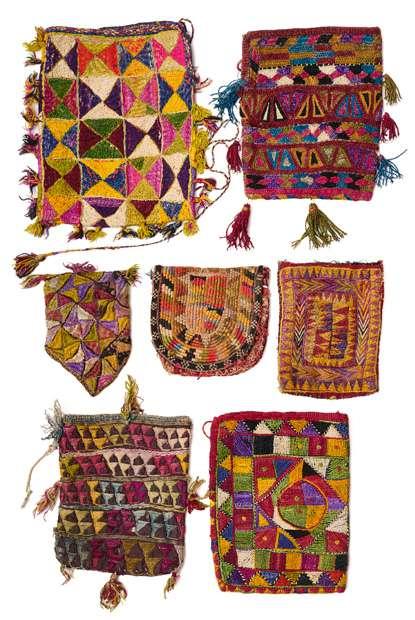
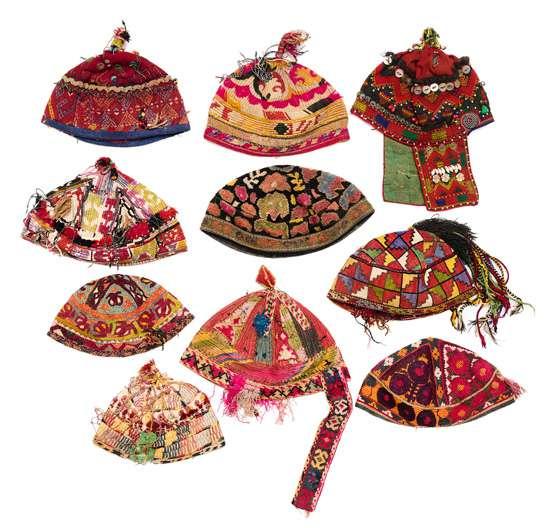
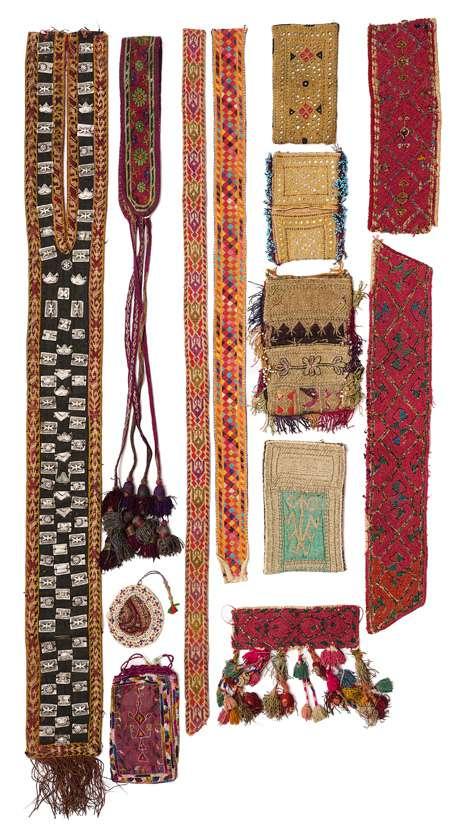
169
A GROUP OF AFGHAN AND CENTRAL ASIAN EMBROIDERIES, 20TH CENTURY
168
A COLLECTION OF HATS, UZBEK AND AFGHAN, 20TH CENTURY
various sizes and styles, embroidered and embellished (10)
£300-400
including four Pashtun embroideries, a Kirghiz neck ornament and ten others including a headband, amulet, pouches and embroidered bands (15)
£150-250
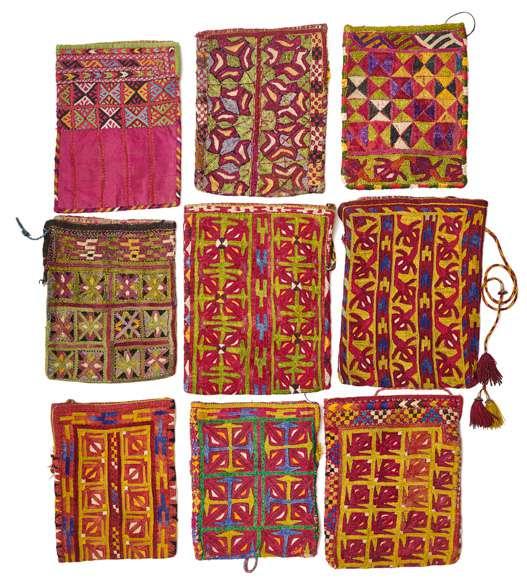
170
A COLLECTION OF NINE SMALL EMBROIDERED BAGS (HALTA). CENTRAL ASIA/AFGHANISTAN, EARLY 20TH CENTURY
variously worked with geometric and foliate patterns, one with tassels (9)
£300-600
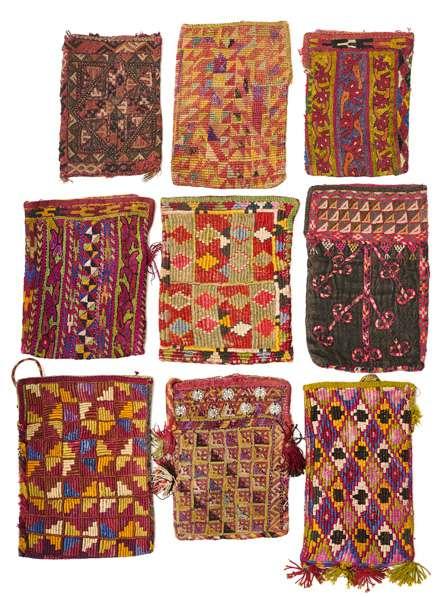
171
A COLLECTION OF NINE SMALL BAGS (HALTA), CENTRAL ASIA, EARLY 20TH CENTURY
Turkman, Uzbek and Afghan (9)
These small bags were often used for tea
£300-500
172
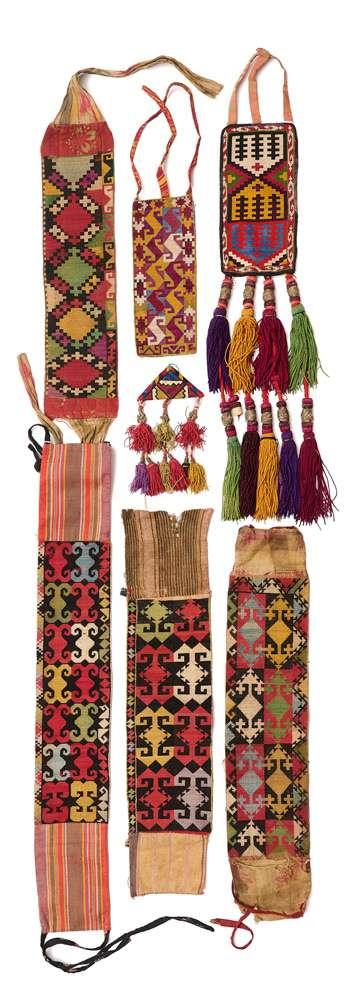
SIX LAKAI EMBROIDERED BANDS AND AN AMULET, UZBEKISTAN, LATE 19TH/EARLY 20TH CENTURY
the amulet and one band decorated with tassels (7)
£300-500
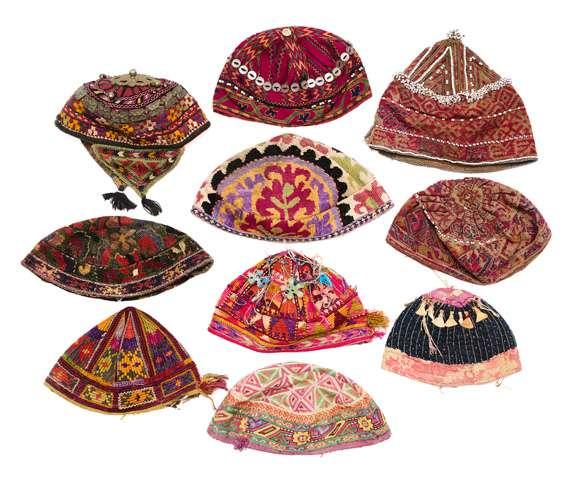
173
A COLLECTION OF TEN EMBROIDERED AND EMBELLISHED HATS, CENTRAL ASIA AND AFGHANISTAN, 20TH CENTURY
variously decorated with buttons, beads and metal tokens, one with bones and one with plastic flowers (10)
£300-400
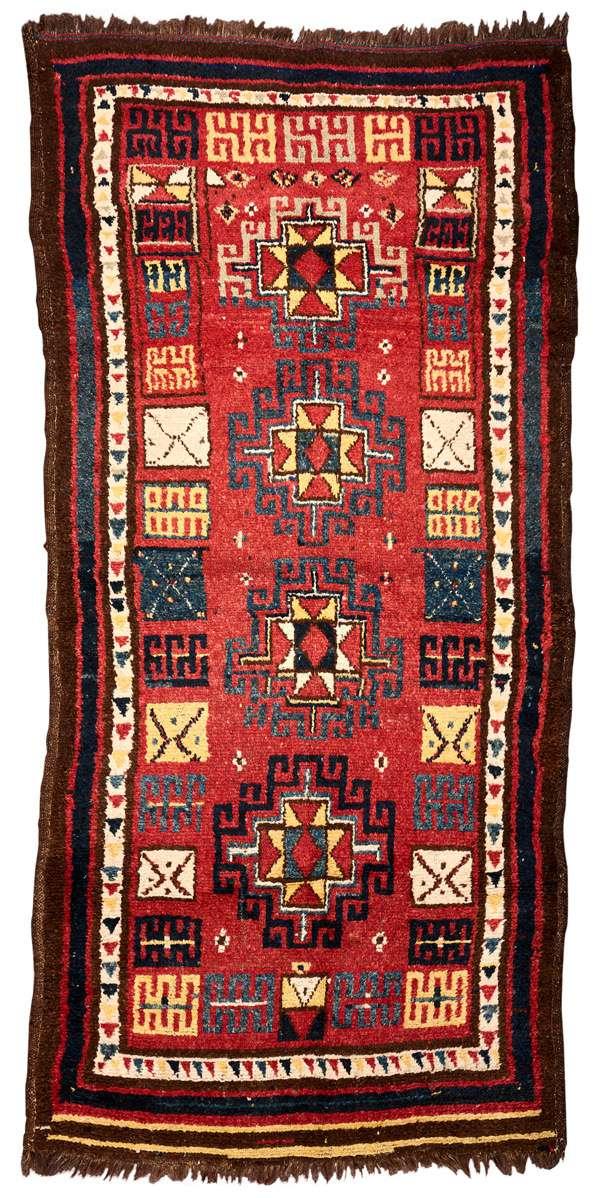
174
A UZBEK PILED RUG, FIRST HALF 20TH CENTURY
the red field with a column of four hooked, stepped guls, approximately 247 x 117cm
£300-500
175
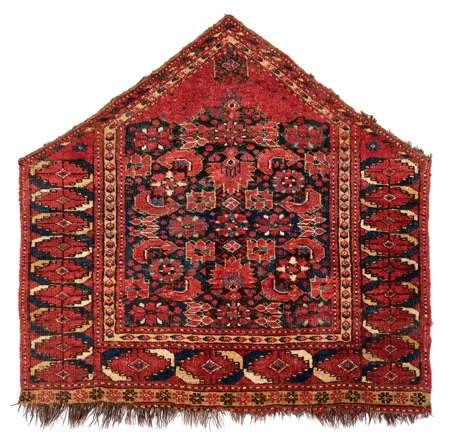
A BESHIR ANIMAL TRAPPING, MIDDLE AMU DARYA, TURKESTAN, 19TH CENTURY
of pentagonal form, possibly an Azmalyk, or a saddle cover, indigo field with herati, madder spotted apex, stepped gul border, approximately 98 by 95cm
£400-800
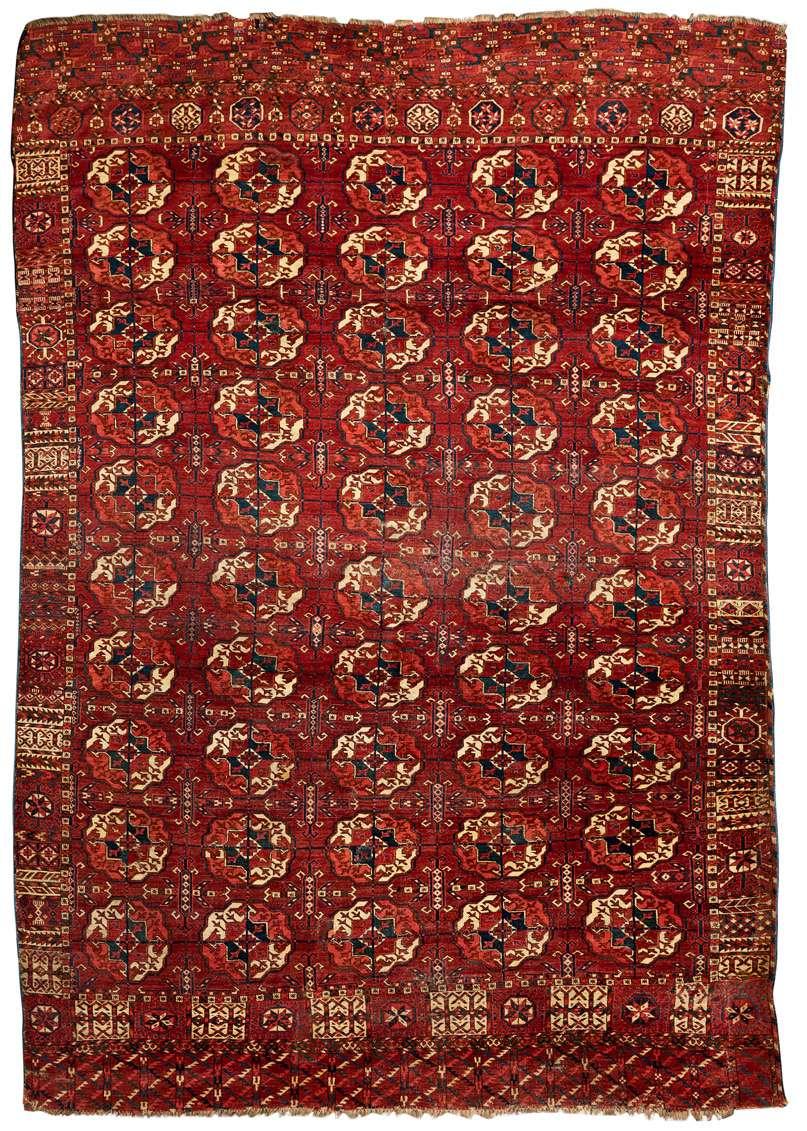
A TEKKE CARPET, WEST TURKESTAN, CIRCA 1900 with ten rows of five guls, gul and sunburst border, approximately 280 x 192cm
£500-700
177
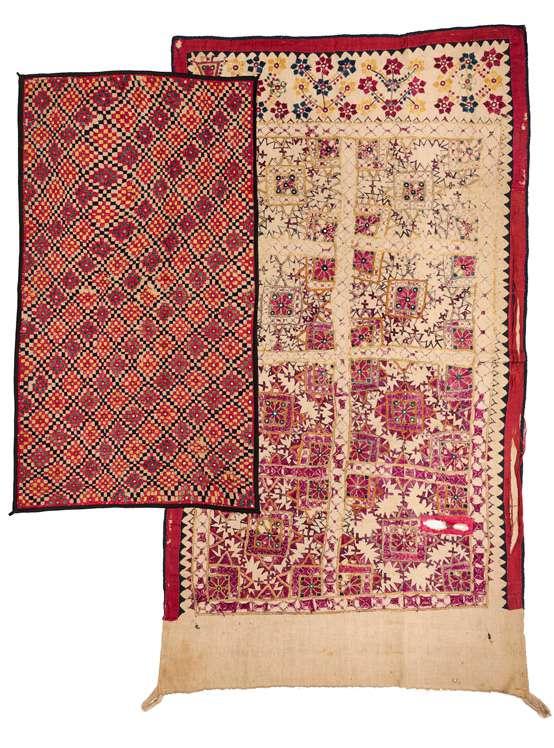
A BANJARI SILK AND MIRRORWORK EMBROIDERED PANEL AND A HANGING, NORTH INDIA, 20TH CENTURY
the first decorated all over in checkerboard pattern, in red, green and yellow within a blue lattice, the second embroidered with squares filled with geometric motifs, approximately 63 x 110cm and 170 x 95cm (2)
£100-150
178
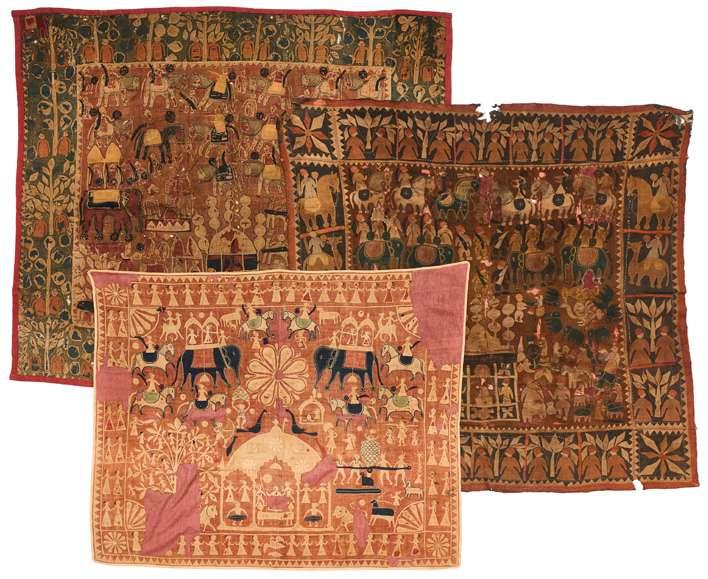
THREE KANDURI SHRINE CLOTHS, UTTAR PRADESH, INDIA, EARLY 20TH CENTURY
each worked in appliqué with a depiction of a shrine, surrounded by elephants, and armed mounted horsemen with shields and swords, with border of trees with couples standing beneath, losses and damage, approximately 120 x140cm; 125 x 125cm; 95 x 120cm (3)
£500-800
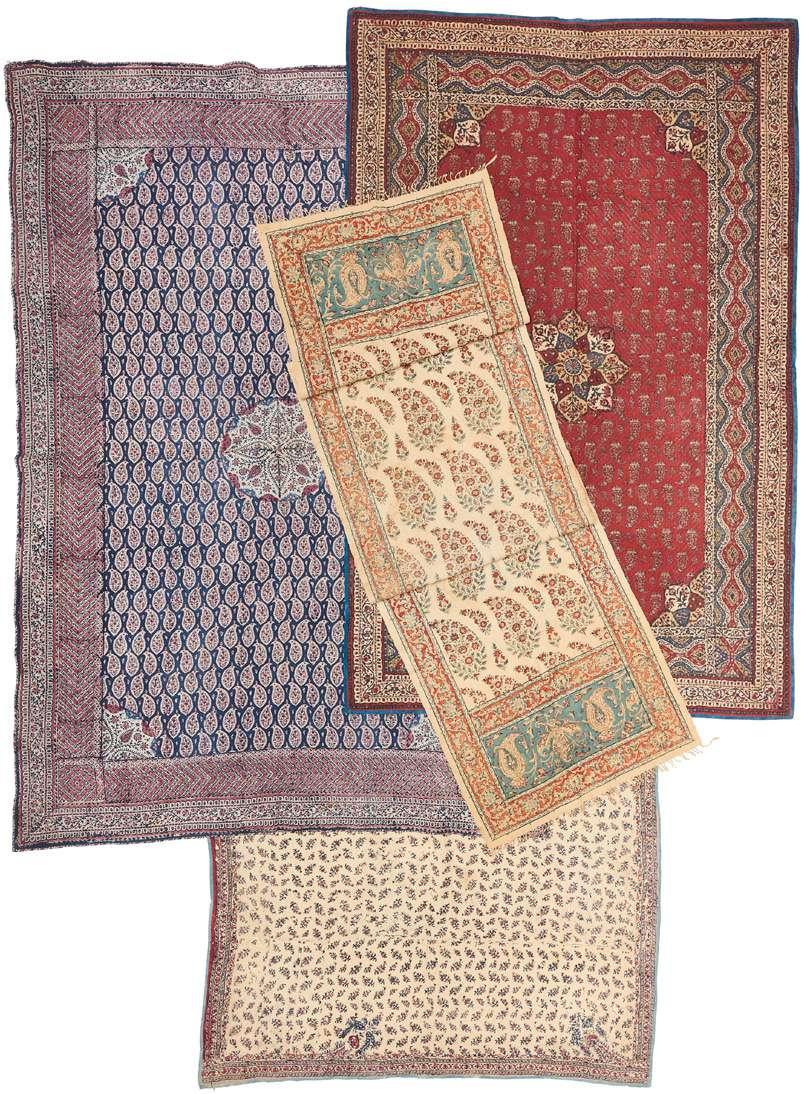
THREE KALAMKARI KANTHA FLOORSPREADS, PERSIA, OR INDIA FOR THE PERSIAN MARKET, LATE 19TH CENTURY
one quilt with red field with overall boteh and flowerhead medallion, ogival medallion border, plain red lining (approximately 130 x 85cm); one with blue ground, overall boteh, ivory medallion and spandrels, zig-zag border, printed cotton lining (approximately 150 x 100cm); one with ivory ground and overall small flower sprigs, narrow vinery border, printed cotton lining (approximately 110 by 88cm); together with A Finely Printed and Painted Sash, with overall botehs, palmette and boteh end panels, arabesque and palmette borders, approximately 170 x 45cm (4)
£1,000-1,500
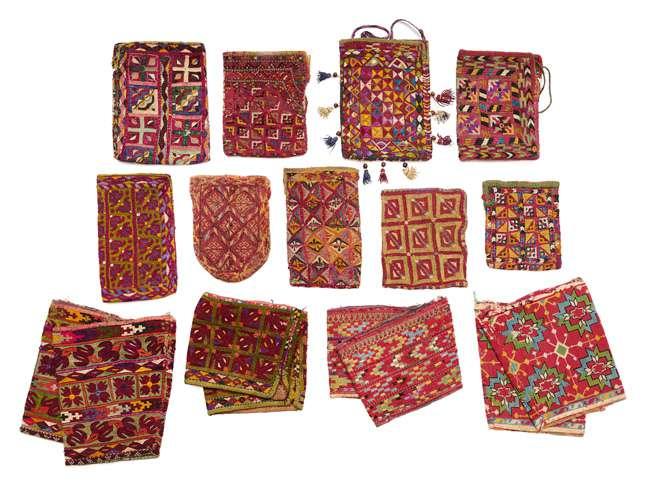
180
A COLLECTION POUCHES (HALTA), AND CUFFS, UZBEK, AFGHAN AND TURKMAN, EARLY 20TH CENTURY
the silk embroidered nine pouches and four pairs of cuffs mainly worked in buttonhole stitch, one pair of cuffs in cross-stitch (13 pieces)
£100-200
181
A COLLECTION OF EIGHT SMALL EMBROIDERIES, CENTRAL ASIA, LATE 19TH/EARLY 20TH CENTURY
including a wallet, two square panels, a narrow panel and four smaller panels, the latter probably aragerbi chyrpy (decorative panels used to hold the sleeves together) (8)
£80-150
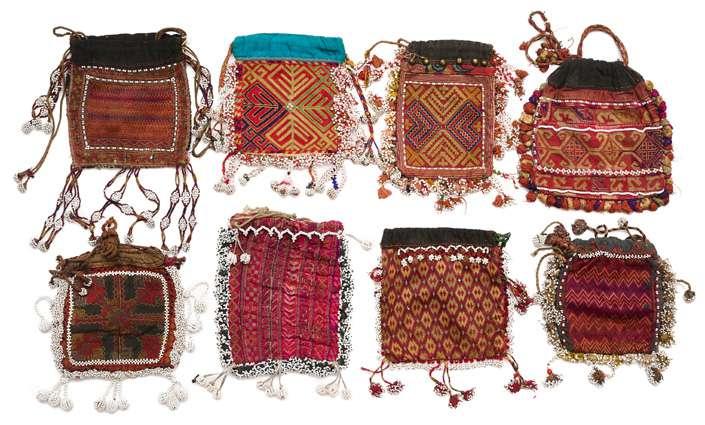
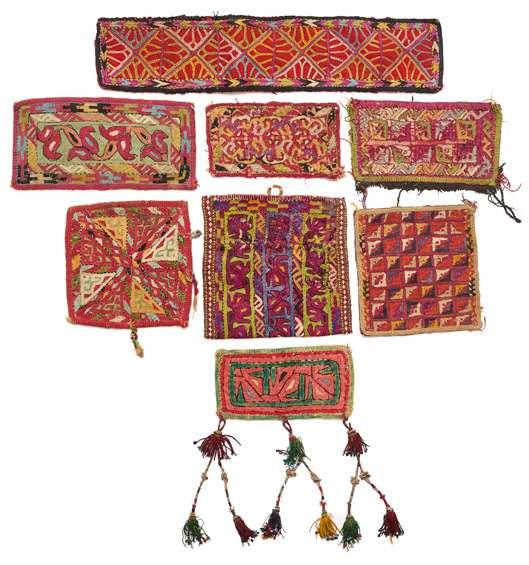
182
A COLLECTION OF EIGHT HAZARA POUCHES, AFGHANISTAN, LATE 19TH/ EARLY 20TH CENTURY
finely embroidered in silk, decorated with small glass beads, tassels and pom poms (8)
£300-500
183
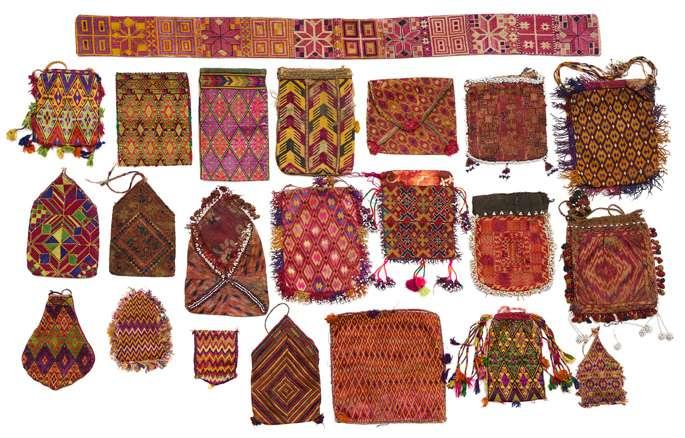
A COLLECTION OF EMBROIDERED PURSES AND POUCHES, HAZARA, AFGHANISTAN, LATE 19TH/EARLY 20TH CENTURY
including 21 small purses and pouches, variously decorated in polychrome silks with geometric motifs, tassels, pom-poms and glass beads, together with an embroidered band (22)
£500-700
185
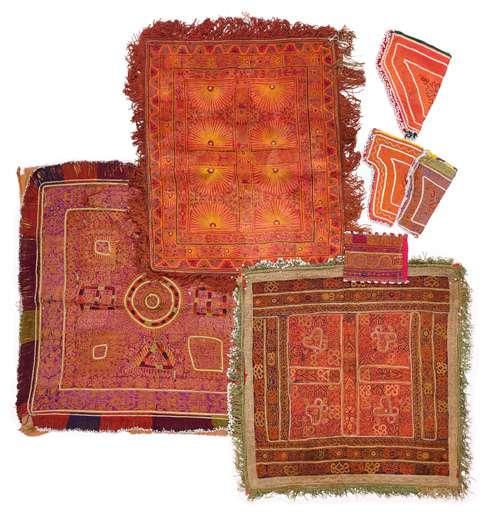
A COLLECTION OF EIGHT KATAWAZ EMBROIDERIES, AFGHANISTAN, AND THREE BELUCH POUCHES, 20TH CENTURY
the Katawaz embroideries including a decorative band and small pouches and purses, decorated with silk embroidery, mica, buttons, blue glass beads, and tassels (11)
£250-500
184
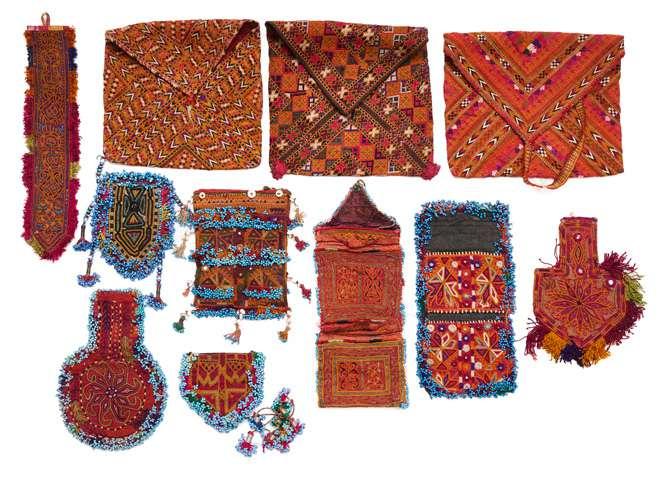
A COLLECTION OF SEVEN KATAWAZ EMBROIDERIES, AFGHANISTAN, 20TH CENTURY
including a purse, three holsters and three tray covers, each with embroidery, variously with metal thread braid and glass bead fringing, the largest 66 x 66cm
£300-500
186
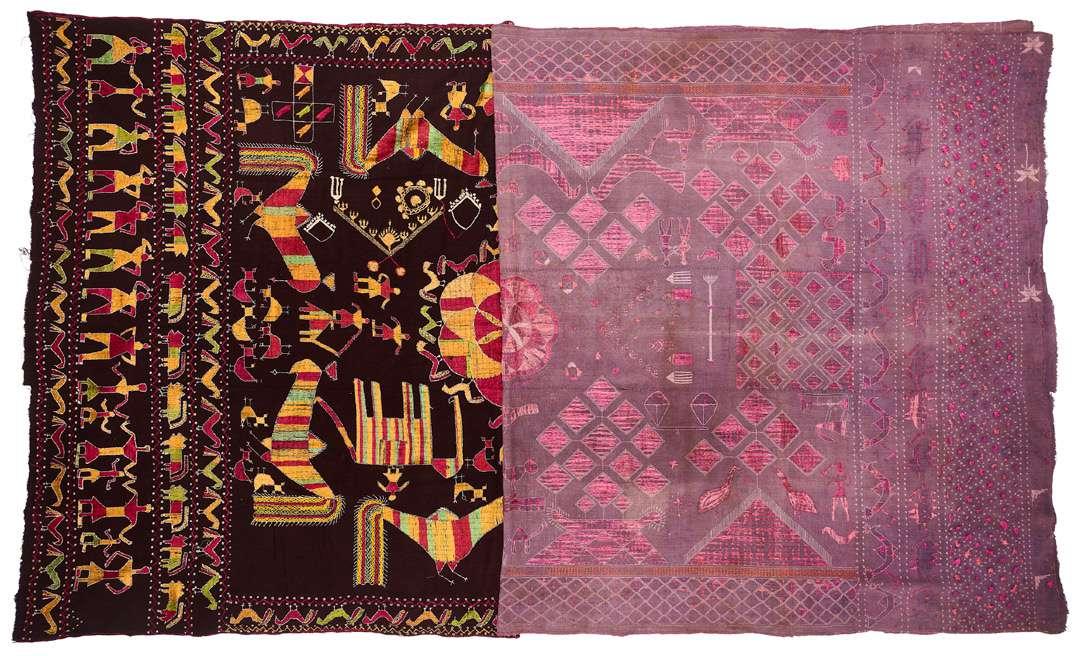
A SAINCHI PHULKARI SILK EMBROIDERY AND ANOTHER EMBROIDERY, PUNJAB, 20TH CENTURY
The first on a dark brown ground with a central flowerhead medallion, surrounded by animals, birds and geometric motifs, within borders of animals, birds and rows of dancing figures, together with a mauve ground embroidery with geometric motifs, figures and birds (losses), approximately 200 x 120cm and 240 x 130cm (2)
£400-700
187
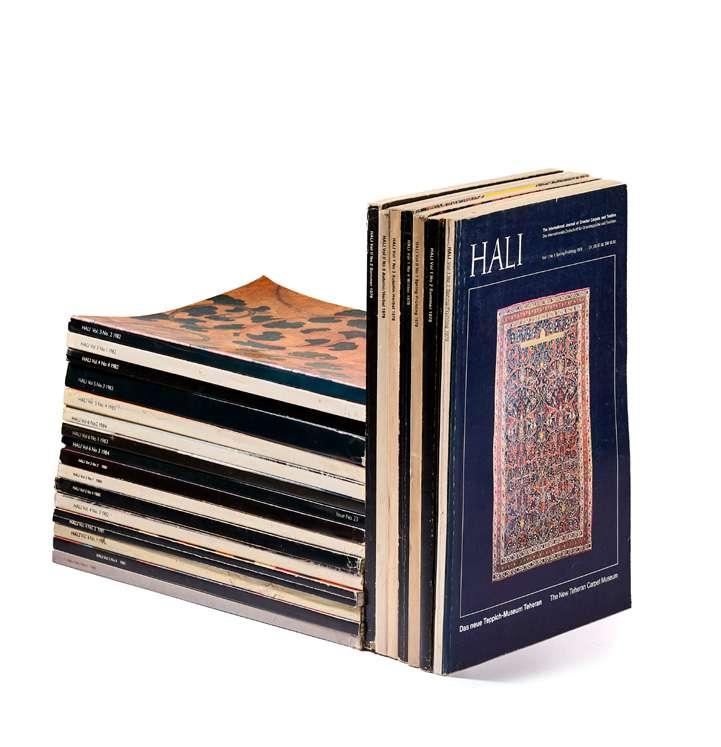
A COMPLETE SET OF HALI MAGAZINE (1978-SPRING 2020)
comprising 203 issues, plus nos. 205 and 206, three extra copies of nos. 40, 123 & 179; Hali Annual 1994, Hali Index Supplement 1996-2000 (a lot)
£300-500
188
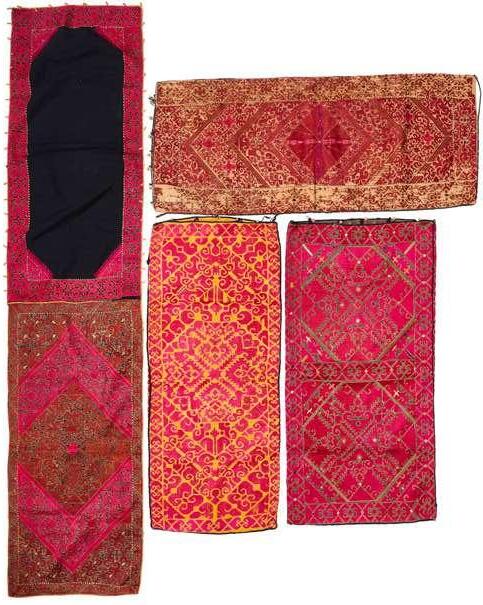
A GROUP OF FOUR SILK EMBROIDERED PILLOW COVERS, SWAT VALLEY, PAKISTAN, FIRST HALF 20TH CENTURY
one now opened out with crimson and madder embroidery to face, and plain indigo ground with embroidered borders to reverse, one with yellow ground, one with olive green ground and one with light caramel ground, all densely embroidered, the largest approximately 80 x 39cm (4)
£300-400
189
A PHULKARI SILK EMBROIDERED SASH, PUNJAB, EARLY 20TH CENTURY
the natural cotton ground worked with linked madder diamonds, green centres, voided zig-zags, green zig zag end borders, plant end panel at one end, approximately 200 x 35cm
£50-100

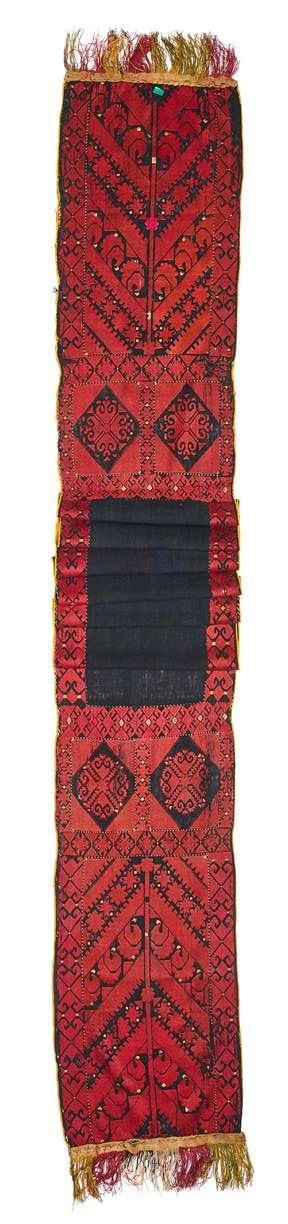
190 AN EMBROIDERED SWAT WEDDING TURBAN, PAKISTAN, EARLY 20TH CENTURY
with double sided embroidery, the dark indigo ground with narrow side borders and deep geometric and floral end borders, applied braid and silk fringing, approximately 320 x 35cm
£100-200
191
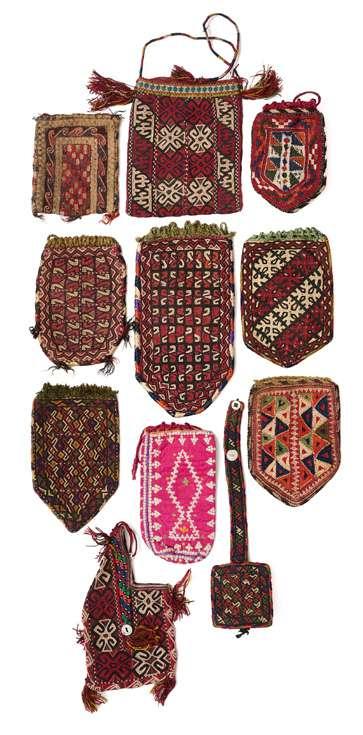
ELEVEN SMALL EMBROIDERIES, MAINLY TURKMAN, CENTRAL ASIA, LATE 19TH/ EARLY 20TH CENTURY
including nine small tea or sweet pouches (suyjilik and cay halta), an amulet and a small bag (11)
£150-250
192
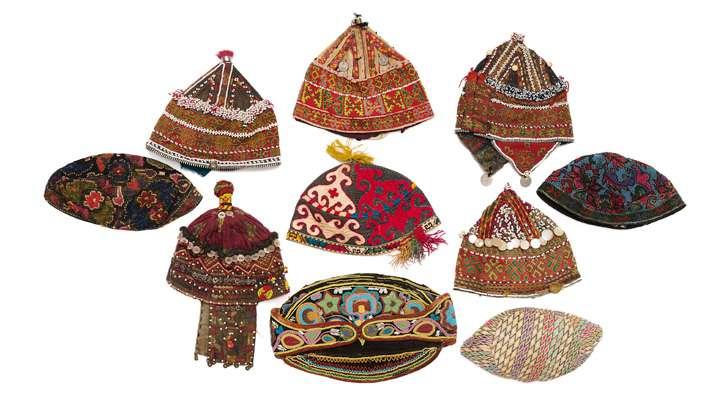
A COLLECTION OF TEN EMBROIDERED AND DECORATED HATS, UZBEKISTAN, AFGHANISTAN, PAKISTAN, 20TH CENTURY
variously decorated with embroidery, glass beads (one coloured glass beads), zippers, coins, buttons, braid and pompoms (10 pieces)
£250-400
193
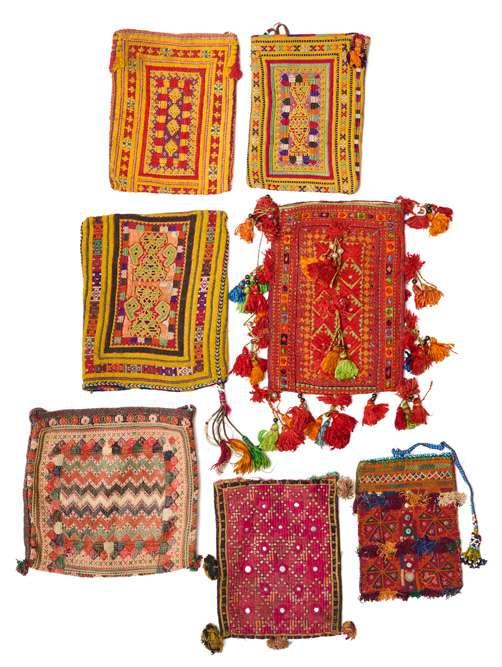
A COLLECTION OF SEVEN EMBROIDERED POUCHES, MAINLY BELUCH, 20TH CENTURY
decorated with silk embroidery, mica, tassels and small beads (7)
£150-300