ONLINE CATALOGUE AND LIVE INTERNET BIDDING AVAILABLE THROUGH: www.olympiaauctions.com www.the-saleroom.com www.invaluable.com www.drouotonline.com
This auction is conducted by Olympia Auctions in accordance with our Conditions of Business printed in the back of this catalogue.
DOMINICAN REPUBLIC
“I’ve
always been an artist. My earliest memory as a three-year-old was drawing mermaids and dolphins.”
Tiffany Alfonseca
Property of a Lady, London 1
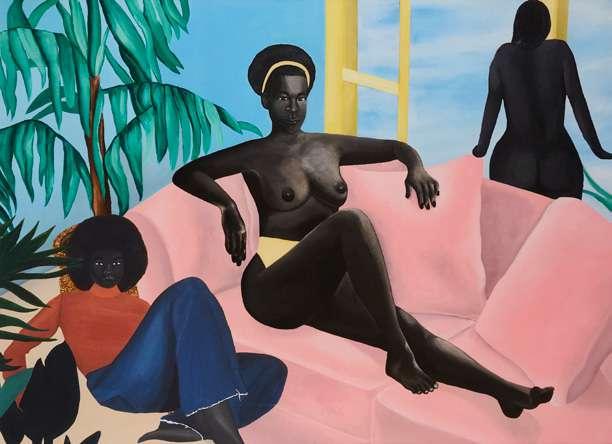
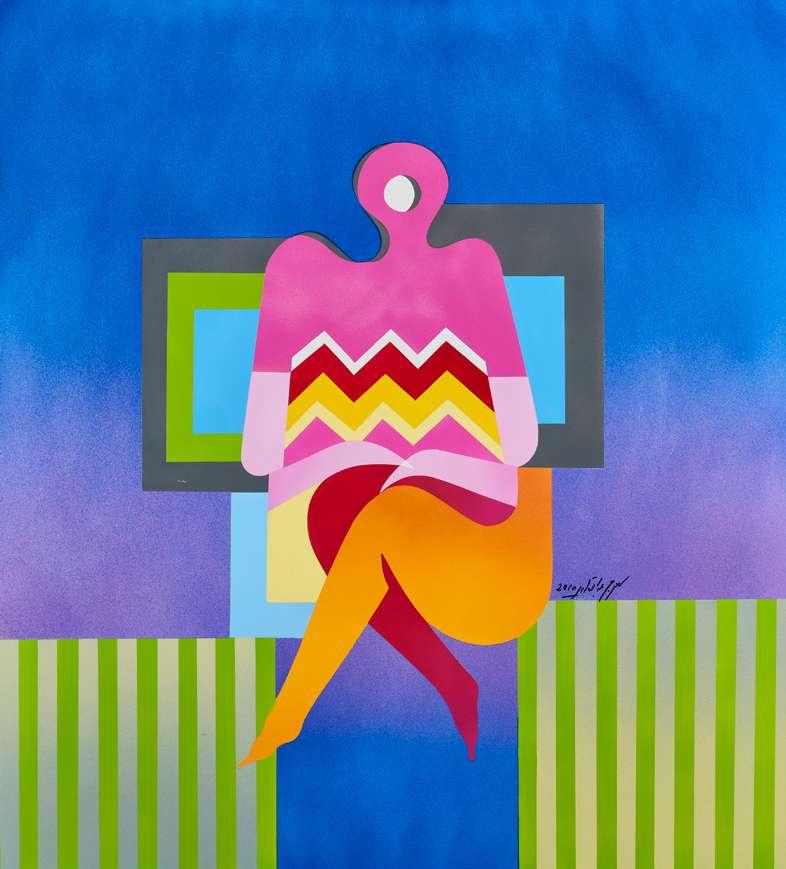
TIFFANY ALFONSECA (DOMINICAN / AMERICAN B.1994)
LAS BELLACAS
screenprint in colours on wove paper
55 x 29.8cm; 215⁄8 x 116⁄8in
73.3 x 93.8cm; 287⁄8 x 37in (framed)
Edition 24/30 (total edition includes five artist’s proofs)
Provenance
Sale, Sotheby’s, London, 2023
Acquired from the above by the present owner
Tiffany Alfonseca is an Uptown-based Dominican American mixed-media artist whose practice centres the Black and Latinx diasporic experience. Drawing on her Dominican heritage, she creates vibrant compositions that examine the cultural, social, and emotional dimensions of identity while foregrounding beauty, complexity, and self-definition.
Working across painting, drawing and print making, Alfonseca situates her figures within richly articulated spaces informed by lived experience, memory, and community. Her compositions engage themes of womanhood, colourism, class, family, ritual, and inheritance, offering nuanced reflections on the structures and narratives that shape everyday life.
Her work further considers questions of race, visibility, and double consciousness, presenting subjects with dignity, presence, and agency. Through a visual language marked by chromatic intensity and compositional care, Alfonseca constructs spaces in which Black and Latinx identities are affirmed, honoured, and made fully visible.
† £1,500-2,500
NIGERIA
Property of a Private Collector, Lagos
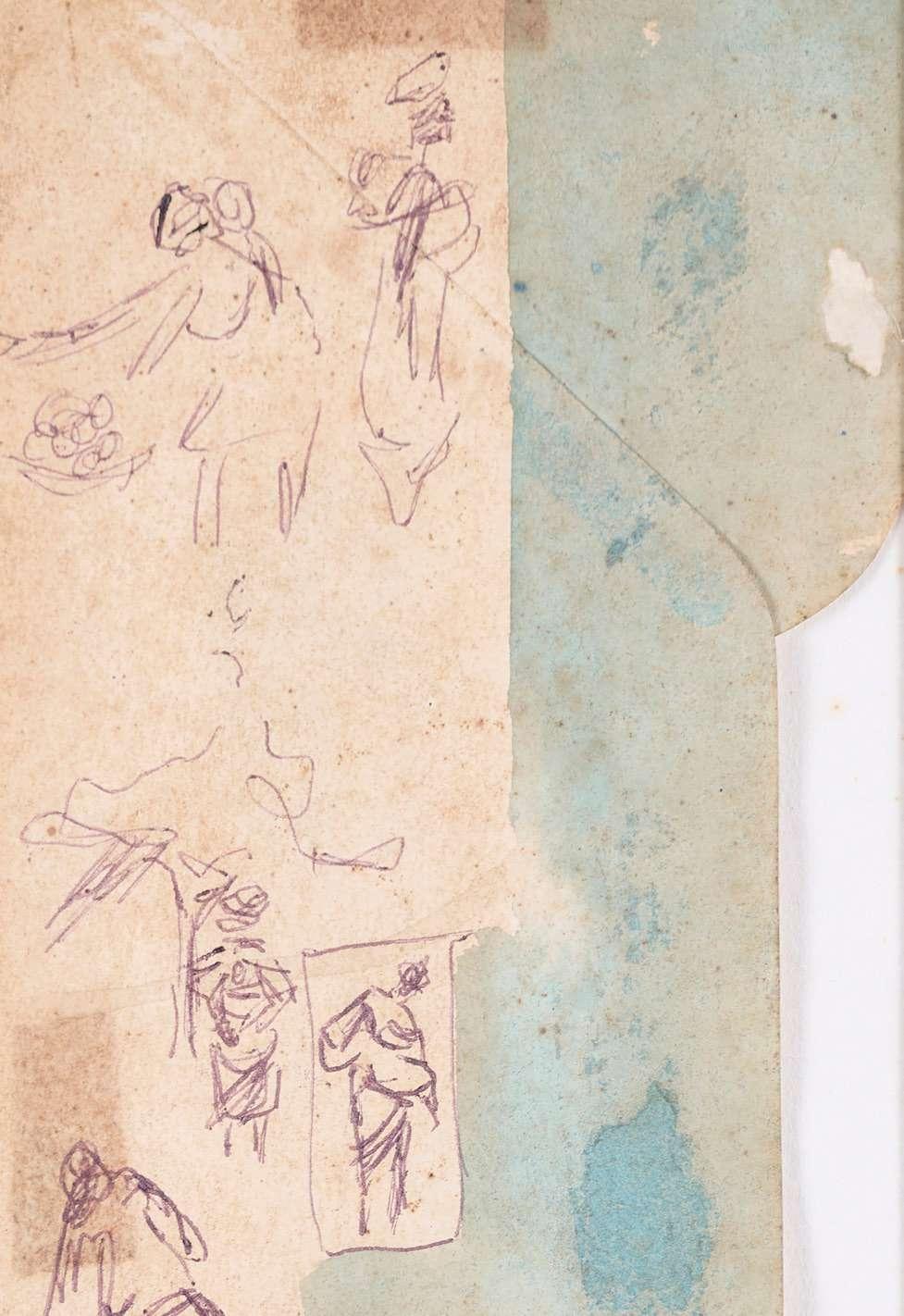
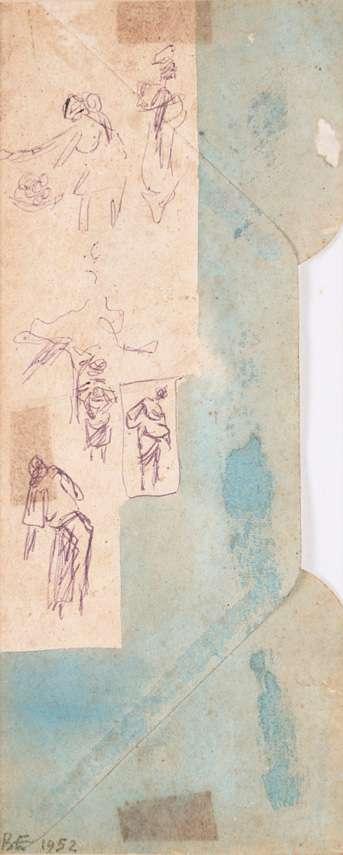
BEN ENWONWU MBE (NIGERIAN 1917-1994) UNTITLED
initialed and dated BE 1952 lower left pen on paper
23 x 9.3cm; 9 x 35⁄8in
57.5 x 43.9cm; 225⁄8 x 17¼in (framed)
Certificate of Authenticity available upon request
Provenance
Treasure House Gallery, Lagos
Acquired from the above by the present owner
Ben Enwonwu was born in Onitsha, Nigeria. Formally trained at Goldsmith’s College of Art and later the Slade School of Art in London, Enwonwu was among the first cohort of postcolonial African artists to advocate an art form which embraced the technical stylistic developments of the European painterly and sculptural traditions. Importantly, Enwonwu combined this inter and postwar style with a focus on African subject matter to articulate a postcolonial artistic tradition for Nigeria. Often depicting scenes of precolonial cultural traditions, rural life or mythical folklore, Enwonwu’s singular technique and compelling artistic vision quickly distinguished the artist as among the most influential artists of the 20th century. Maintaining a studio in Onitsha and London, Enwonwu participated in various international exhibitions and commissions, most notably a bronze portrait of Queen Elizabeth II to mark the occasion of Nigeria’s independence.
This pen drawing, initialled and dated 1952, offers an intimate glimpse into Enwonwu’s draughtsmanship at its most concentrated: a few precisely placed lines, charged with the spontaneous formal intelligence that defines his best work on paper. By 1952 Enwonwu was already exhibiting in London and lecturing in the United States. Here Enwonwu begins a period of intense creative development leading to the vocabulary he would bring to its fullest expression in the celebrated Tutu series of 1973. Works on paper from this early period are rare, and offer a unique demonstration of the artist’s distinct style.
‡ £2,000-3,000
Property of a Lady, London
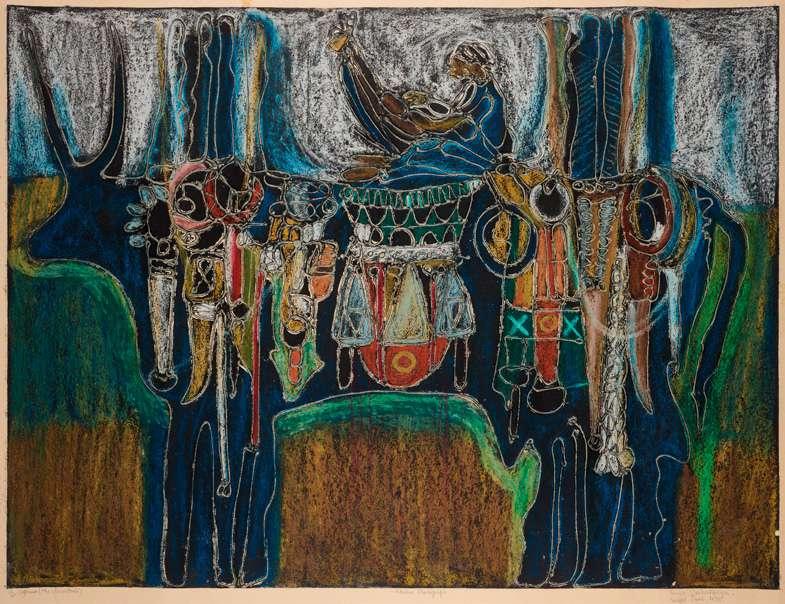
BRUCE ONOBRAKPEYA (NIGERIAN B. 1932)
OGBESIA (THE MINSTREL)
inscribed 22/30 / Ogbesia (The Minstrel) / additive plastograph / Bruce Onobrakpeya / Lagos June 1988 lower margin additive plastograph on paper 67.5 x 89.6cm; 26½ x 35¼in unframed
Provenance
Nigerian Ambassador to Switzerland
Gifted from the above to the current owner’s father
Bruce Onobrakpeya is widely regarded as one of the foremost figures in modern Nigerian art and among Africa’s most inventive printmakers. Born in 1932 in Agbarha-Otor, Delta State, he trained at the Nigerian College of Arts, Science and Technology in Zaria, where he was a founding member of the influential Zaria Art Society, a cohort of young artists committed to forging a distinctively Nigerian aesthetic that synthesised indigenous visual traditions with international modernism. A recipient of the Nigerian National Order of Merit (NNOM), he established his celebrated annual Harmattan Workshop in Nigeria in 1998, shaping generations of Nigerian artists through a programme of creative and scholarly exchange.
The additive plastograph, the technique in which the present work is made, is among Onobrakpeya’s most significant technical inventions, involving the building up of a textured relief surface on plastic using adhesives and found materials, producing prints of rich tactile depth that recall the patina of Benin bronzes and the markings of traditional woodcarving. Titled Ogbesia meaning minstrel or praise-singer, the work highlights Onobrakpeya’s sustained engagement with Niger Delta cultural traditions: the minstrel as keeper of communal memory, mediator between the living and the ancestral.
£2,000-3,000
Property of a Private Collector, Maryland 4
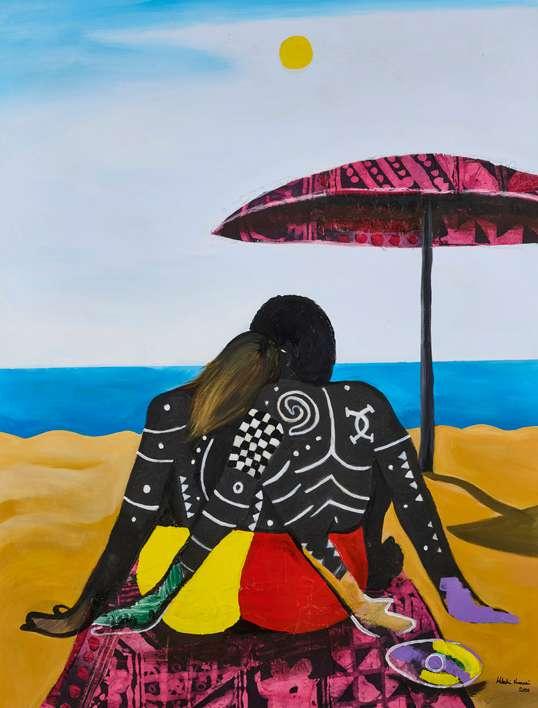
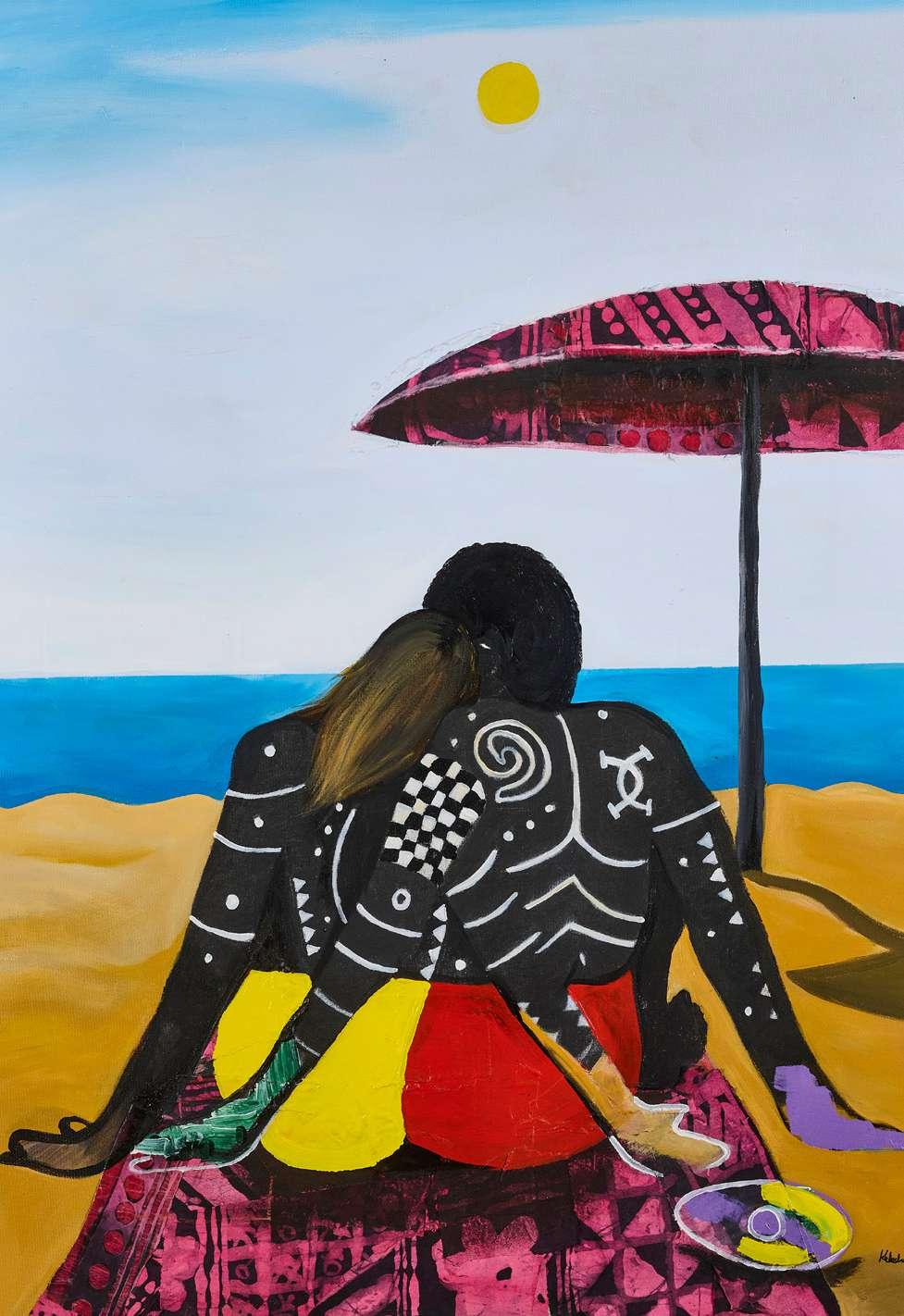
KELECHI NWANERI (NIGERIAN B.1994)
SISTERS
signed and dated Kelechi Nwaneri / 2021 lower right mixed media on canvas
114.3 x 87cm; 45 x 34¼in unframed
Provenance
Acquired directly from the artist
Kelechi Nwaneri is one of the most compelling voices to emerge from the generation of Nigerian artists who have come to international prominence since the early 2020s. Born in Lagos in 1994 and self-taught, he turned to visual art while studying at the University of Nigeria, Nsukka, and has since exhibited internationally, with works entering the Arthur Lewis Collection, the Africa First Collection, and the Embassy of Spain in Abuja. His practice weaves indigenous African ideographic script into dreamlike, psychologically charged compositions that engage with mental health, social values, and the textures of contemporary Nigerian life; an art at once deeply local in its cultural references and entirely international in its ambitions. Sisters dates from the period immediately preceding his most significant international recognition, and is offered here alongside a companion work by the same hand.
£3,000-5,000
Property of a Private Collector, Maryland 5
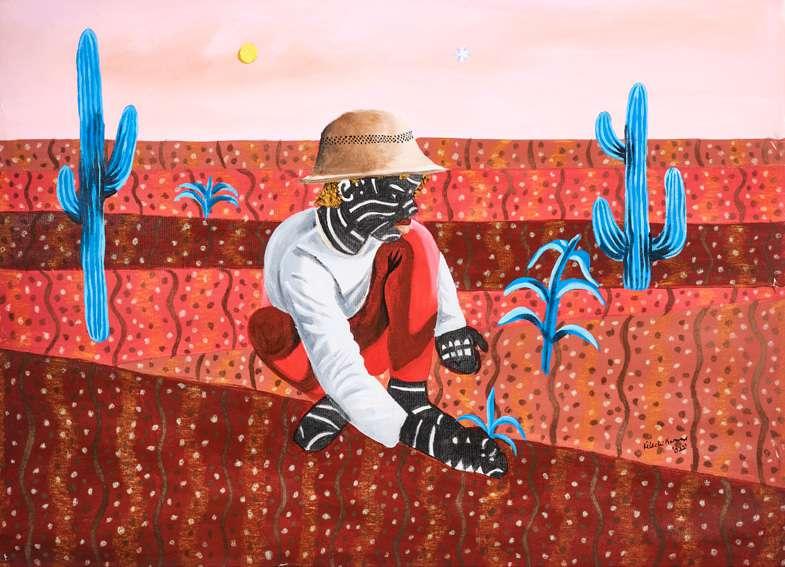
KELECHI NWANERI (NIGERIAN B.1994) GARDENER
signed and dated Kelechi Nwaneri / ‘022’ lower right oil on canvas
78.5 x 111cm; 31¼ x 43¾in unframed
Provenance
Acquired directly from the artist see note to lot 4
£1,500-1,800
Property of a Private Collector, Maryland 6
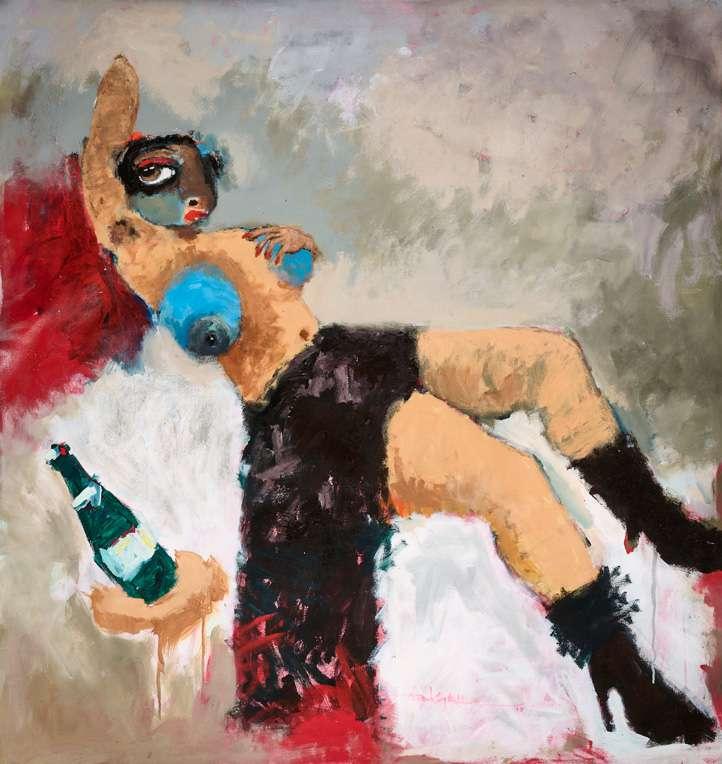
KINGSLEY OBASI (NIGERIAN B.1983) OLOSHO
signed Obasi Kingsley lower right; inscribed Exhibition / Olosho / 130 x 120cm / Obasi Kingsley / 2018 on the reverse oil on canvas
130 x 123cm; 511⁄8 x 483⁄8in unframed
Provenance
Acquired directly from the artist
Born in Abia State, Nigeria, Kingsley Obasi has developed a striking figurative style that has drawn recent international attention.
After studying at Yaba College of Technology, Obasi worked as an art teacher in Lagos before transitioning to full-time practice.
His work has been showcased at Signature African Art Gallery in London, including a solo exhibition in 2019 and a group show in 2021 titled One’s Guise. His work has also been shown at Fondation Gandur pour l’Art, Geneva.
Obasi’s portraits blend historical and contemporary influences, presenting an array of fictional, historical and popular figures and often exaggerating his subjects’ eyes, exposing the tension between outward appearances and inner realities.
Olosho, dated 2018, is among the largest and most ambitious of Obasi’s figural works. The directness of its engagement, the Yoruba word olosho carrying a complex charge of social designation and stigma, is characteristic of an artist committed to examining those who exist at the margins of society.
£2,000-3,000
Property of a Private Collector, Maryland
7
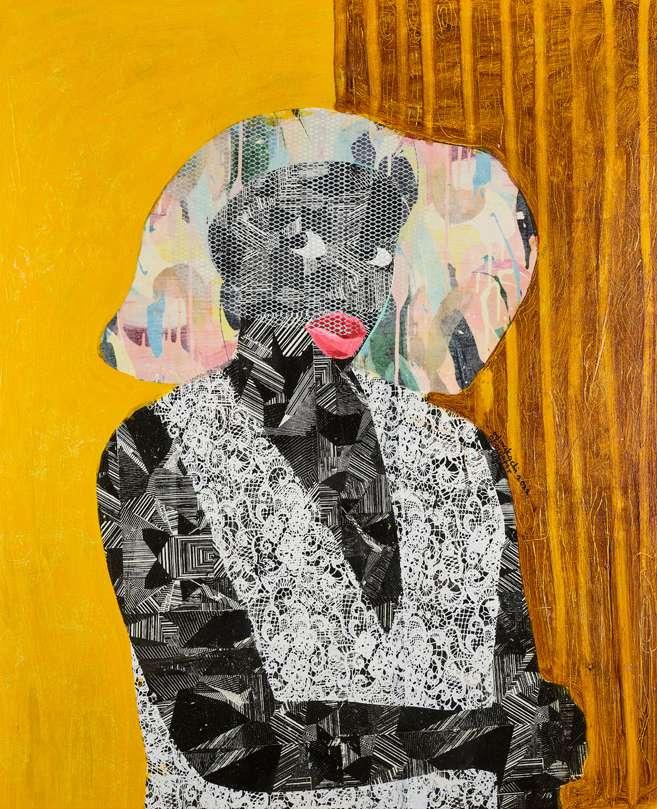
ODINAKACHI OKOROAFOR (NIGERIAN B.1987)
SEE THROUGH IV
signed and dated Odinakachi Okoroafor 2022 centre right; inscribed
See Through IV / Acrylic and Transfer on Canvas / 100cm x 80cm / 2022 on the reverse
acrylic and transfer on canvas 98 x 80cm; 38½ x 31½in unframed
Provenance
Acquired directly from the artist
Odinakachi Okoroafor is a mixed-media artist living and working in Enugu State, Nigeria, whose practice has attracted growing critical attention for its technical originality and conceptual depth. Working in screen printing, acrylic, and image transfer, he constructs compositions in which the human figure is simultaneously revealed and obscured by densely interlocking fields of line; barcode-like formations and lace-derived structures drawn from the textile traditions of southeastern Nigeria, where intricate needlework has long served as cultural expression.
Okoroafor’s style meditates on the reduction of human beings to units of economic exchange, while the delicacy of his patterning insists on the beauty and complexity of the figures it brings into being, an art of quietly devastating dual consciousness. See Through IV belongs to one of the artist’s most sustained and critically regarded series.
£2,000-3,000
OLUWOLE OMOFEMI (NIGERIAN B.1988)
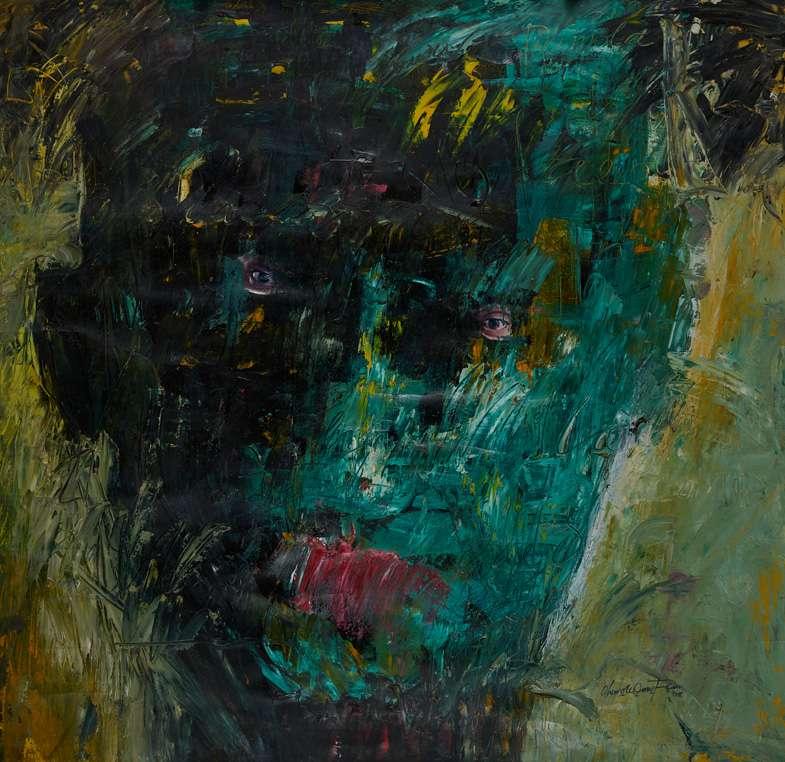
UNTITLED
signed Omofemi / 17 lower right mixed media on canvas
100.5 x 100.5cm; 39½ x 39½in unframed
Oluwole Omofemi is one of the most immediately recognisable figurative painters of his generation. Born in Ibadan in 1988, Omofemi built a rapidly expanding international profile with exhibitions across the United Kingdom, Spain, Belgium, Italy, France, Ghana, and the United States. In 2022 he achieved international prominence as the first African artist commissioned to paint the reigning British monarch, producing a portrait of Queen Elizabeth II for Tatler magazine’s Platinum Jubilee edition, an image that brought his distinctive visual language to a global audience. In 2026, he was commissioned once again to depict HRH The Prince of Wales. That language is immediately his own: figural compositions in which subjects are rendered with penetrating psychological intensity against atmospheric, gestural grounds, their identities inscribed with haloed Afros, close-cropped sakora cuts, and scarification marks - his visual lexicon for African femininity, heritage, and self-possession. Lots 8 and 9, produced by Omofemi in 2017 and 2016 respectively, reflect the earliest iterations of his practice. This abstracted portrait reveals the development of the artist’s distinctive style. Depicted with an expressive and colourful palette, Omofemi builds the figure from a series of impasto markings, following in a painterly tradition that invokes the work of West African luminaries like Ablade Glover (see lot 10).
£2,000-3,000
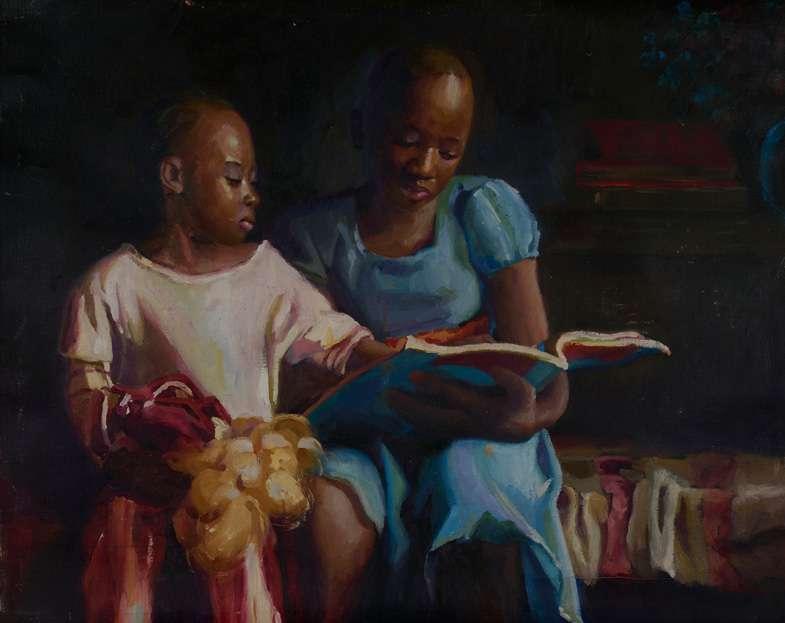
OLUWOLE OMOFEMI (NIGERIAN B.1988) EARLY LESSONS FOR TOMORROW III signed and dated Oluwole Omofemi / 16 lower right oil on canvas
70 x 85.8cm; 27½ x 33¾in unframed
This contemplative oil on canvas work represents Omofemi’s practice in a formative period immediately preceding the surge of international recognition that followed his 2020 London solo exhibition The Way We Are at Signature African Art, Mayfair. Rather than depicting a central figure, this work captures an intimate genre scene: two sisters sit together to read. The high colour contrast of the composition recalls the painterly innovations of Caravaggio, whilst the expressive brushwork demonstrates an affinity with the modernist tradition. The two works herein featured in this auction together offer a compelling opportunity to trace the development of one of the most sought-after figurative painters working in Nigeria today. see note to lot 8
£3,000-5,000
GHANA
Property of a Private Collector, London
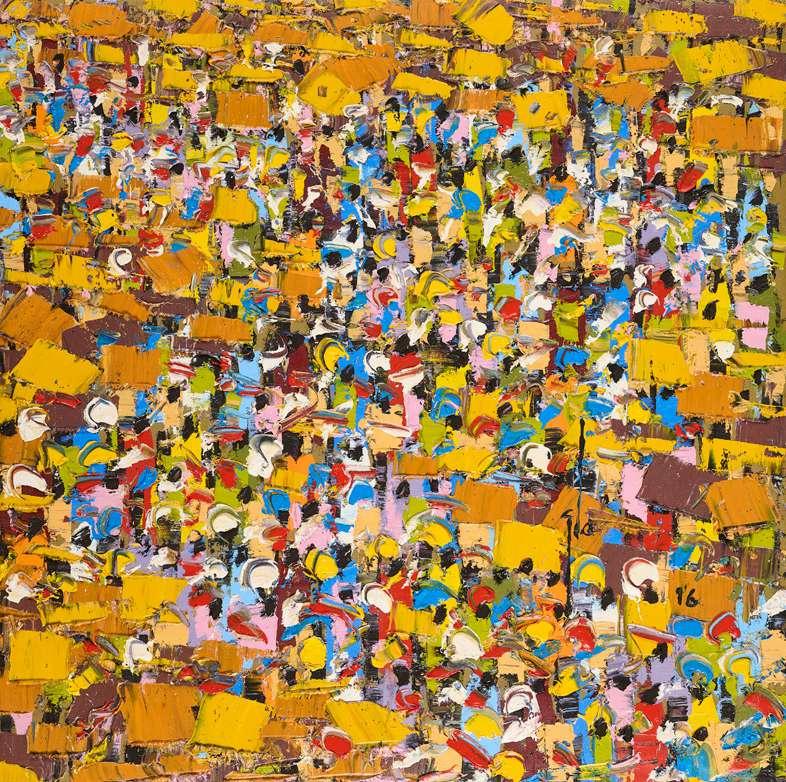
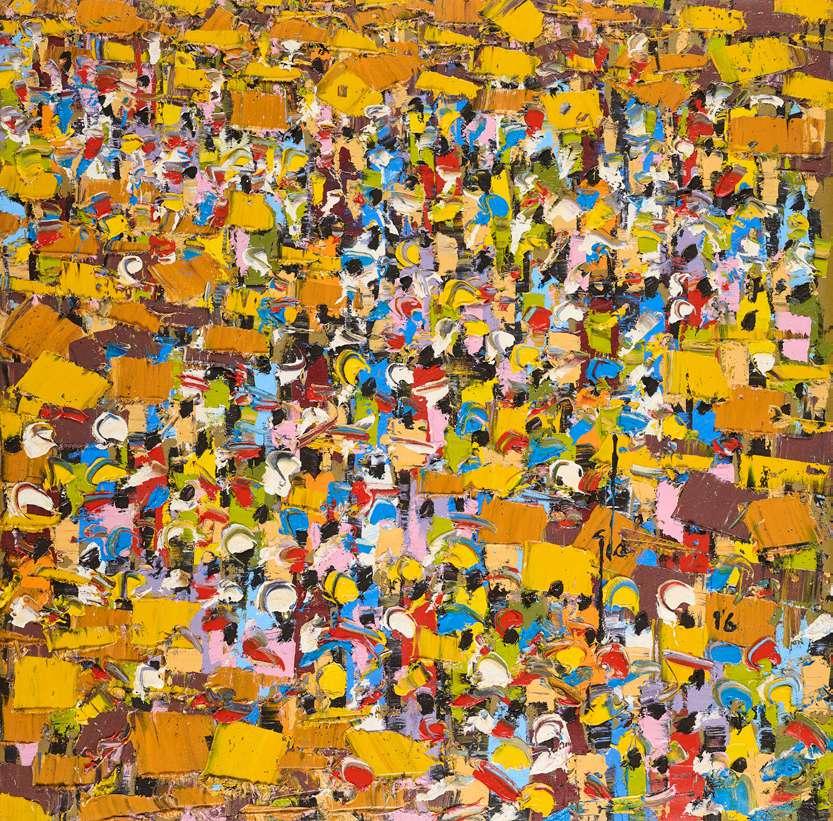
ABLADE GLOVER (GHANAIAN B.1934)
UNTITLED
signed and dated glo / 16 lower right; inscribed 30 x 30 on the reverse oil on canvas
75.6 x 76cm; 29¾ x 30in
85.5 x 86cm; 335⁄8 x 337⁄8in (framed)
Provenance
Acquired directly from the artist
Glover is an artist and educator who has exhibited his art internationally, building a reputation over several decades as a significant artist and icon on the contemporary West African art scene. He graduated from the Kumasi University of Science and Technology in teacher training education, the Central School of Art and Design in London in textile design (1959-62), and the University of Newcastle on Tyne (1964-65) in art education. He continued his artistic studies in the United States, earning an MFA at Kent State University (1971-72), and a PhD in Fine Arts at Ohio State University (1972-74). After his PhD, Glover taught at the College of Art at Kumasi University until 1998 where he became the Head of Department and Dean of the School of Fine Arts.
£8,000-12,000
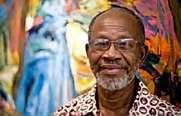
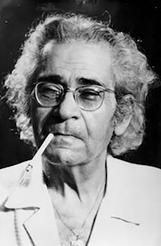
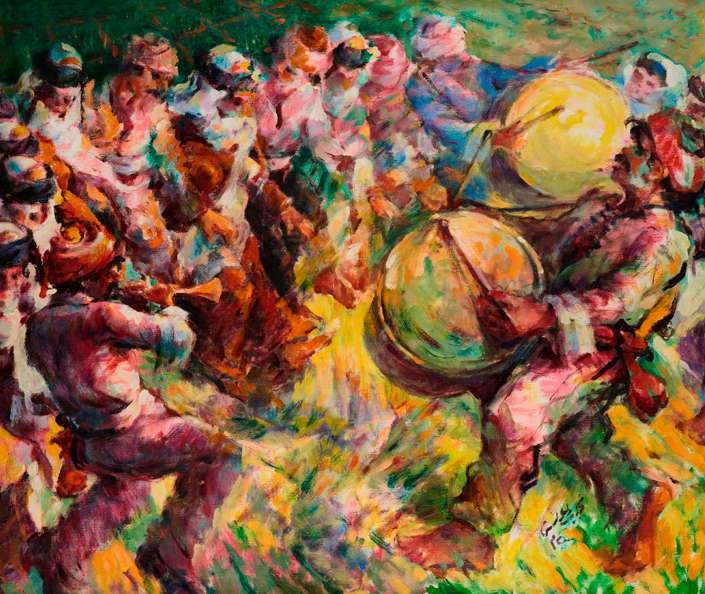
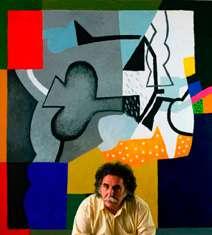
Ablade Glover Wikimedia Commons
“The crowd has been my love. I will continue to paint the crowd movement and the crowd spirit.”
Ablade Glover
MOROCCO
Property of a Private Collector, Marbella 11
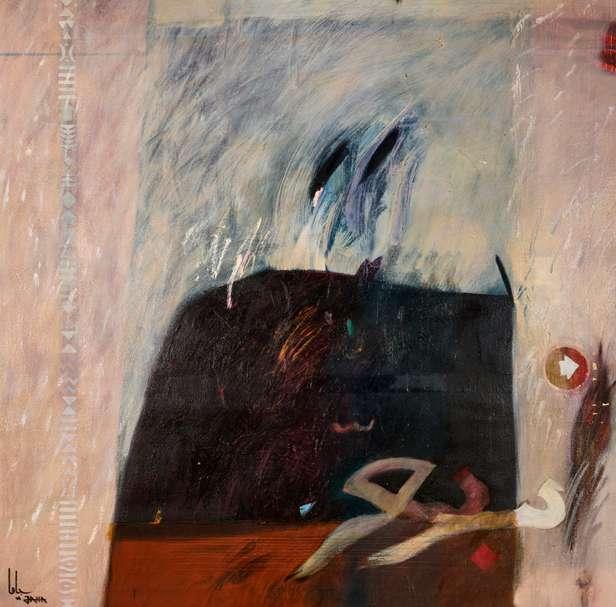
ABDELKADER LAARAJ (MOROCCAN B.1950)
UNTITLED
signed Laraaj Abdulkader in Arabic and dated 2010 centre right celluloid on panel 109cm x 99.3cm; 43 x 39in 112cm x 102.1cm; 44 x 401⁄8in (framed)
Includes a Certificate of Authenticity signed by the artist
Provenance
Acquired directly from the artist by the present owner
Self-taught, Abdelkader Laâraj is a foundational figure in contemporary Moroccan art, whose practice has defied categorisation for over four decades. Born in Casablanca, Laâraj trained alongside Mohamed Melehi and Mohamed Chabâa and operates with a rare fluidity between painting and sculpture, treating both as visceral, physical experiences. His work is characterised by a relentless investigation into the triad of material, body, and space. By imbuing his abstract colour field paintings with figuration, he has subtly moved away from his mentors. However, rather than treating the human form as a static subject, he captures it as a trace of energy or a tension within the medium itself, effectively blurring the lines between flesh and matter.
Based in his native Casablanca, Laâraj has established a significant international presence, exhibiting across Europe, North America, and the Middle East. His versatility is perhaps best exemplified by his diverse creative interventions - from the murals of Asilah to his award-winning ice and snow sculptures in Chicago and Canada. By harmonising the traditional with the modern and abstraction with figuration, Laâraj continues to evolve the language of Moroccan art, infusing it with a universal, spiritual resonance that speaks to the shared human experience.
£8,000-10,000
TUNISIA
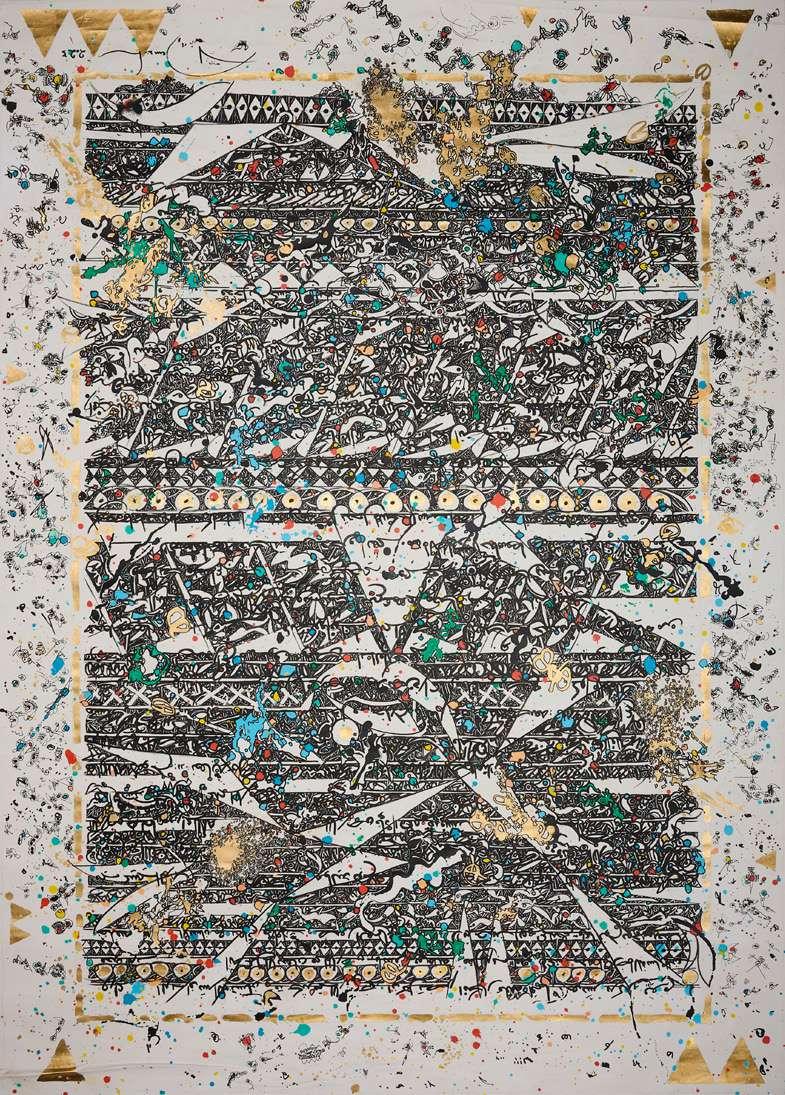
“It is about following the trace and the writing, not the calligraphic one which has proven itself undoubtedly in the field of art, but that belonging to everyone. Precisely, that we learned at school and forgot that it is signature and drawing.”
Imed Jemaiel, September 2022
Property of a Private Collector, UAE 12
IMED JEMAIEL (TUNISIAN B.1965)
UNTITLED
signed and dated JemaiL / 2023 lower right; inscribed And the god saw that the wickedness of man was great in the earth in Arabic lower left acrylic and gold leaf on canvas
207.5 x 152.6cm; 81¾ x 60in unframed
Executed in 2023
Provenance
Acquired from the artist by the present owner
Born in Bizerte, Imed Jemaiel lives and works in Tunis and has taught at the School of Fine Arts of Tunis since 1992.
Rejecting the rigid didacticism of the blackboard for the expansive potential of the window, Jemaiel’s work is rooted in a lifelong defiance of academic boundaries. Since his formative transition from the medical sciences to the Institute of Fine Arts in Tunis in 1986, his practice has evolved into a rigorous interrogation of the Dadaist legacy.
By deconstructing the secular traditions of engraving, he subjects the medium to a process of radical hybridisation, a synthesis of figure, trace, and texture. His compositions function as temporal palimpsests where the “playful instinct” collides with theoretical precision. In his recent cycles, such as Archipelagos of Ink, the artist cultivates a world of “maculated conceptions” where fauna and flora emerge from the interstices of a handwritten script. The inscription on the present work is taken from Genesis 6:5 in the Bible, initiating the narrative of Noah and the Flood, alluding to a world perpetually on the verge of being given a deeper, visual promise, yet hauntingly withheld.
Jemaiel’s early international exposure began in France, and he has since held several notable solo and group exhibitions. His first two solo exhibitions in Europe took place at the Galerie Du Château de Servières in Marseille (1992 and 1993), where he began deconstructing traditional engraving techniques. He has held a series of significant solo shows in Tunis including Le dessous des ratures (The Underside of Erasures) in 2014, Maculée conception (Maculated Conception) in 2016 and Archipels d’encre (Archipelagos of Ink) in 2018.
Attracted by his ability to transform text into texture, Jemaiel’s work is sought after by both institutional and private collectors who focus on contemporary Arab art and the “Cultural Narratives” of the Maghreb and can be found in collections such as the Art Jameel Collection in Dubai and Jeddah; whilst his large-scale acrylic and gold leaf works on canvas are held in private collections across the Middle East, including notable acquisitions in Doha, Qatar, and throughout Tunisia.
‡ £20,000-25,000
EGYPTIAN WORKS (LOTS 13-36)
EGYPT
Property from the Zulficar Family Collection, Alexandria 13
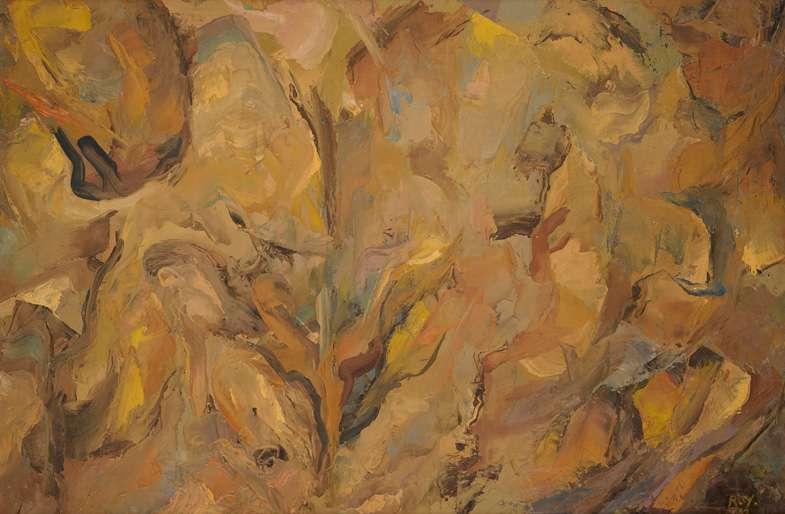
RAMSES YOUNAN (EGYPTIAN 1913-1966)
UNTITLED ABSTRACTION
signed R.Y. / 62 lower right oil on canvas
49 x 73cm; 19¼ x 28¾in
53.4 x 77cm; 21 x 30¼in (framed)
Provenance
Acquired directly from the artist by the present owner
Ramsès Younan was a pioneering Egyptian artist, writer, and intellectual, best known as a founding figure of Cairo’s Art et Liberté movement. Born into a Coptic Christian family in Al-Minya, Younan trained at the School of Fine Arts in Cairo, later teaching drawing across Egypt and publishing influential critiques of French cubism and European art theory. His early paintings, distinguished by smooth, surreal humanoid figures set within vast dreamlike landscapes, stood out among the Egyptian avant-garde and earned him international recognition. He participated in the First Exhibit of Independent Art, shaping both artistic and political dialogue in Egypt. Younan’s engagement extended beyond painting; he was an active art critic and editor for The New Magazine, contributing to Arabic-language journals and exploring the philosophical and cultural issues influencing society. In 1947, he relocated to Paris, co-founded the publishing house La Part du Sable, and distanced himself from mainstream Surrealism. Alongside Georges Henein, Younan critiqued Surrealism’s fixation on mythology, arguing it distracted from true liberation. This period of philosophical evolution led to a decade-long hiatus from painting and a “crisis of expression,” during which he worked for Radiodiffusion-Télévision Française. His time in Europe ended abruptly in 1956, when he was deported for protesting anti-Arab sentiment during the Suez Crisis.
Upon his return to Egypt, Younan experienced a creative rebirth. With a government stipend beginning in 1960, he moved away from the recognisable figures of his youth, embracing a dense abstraction layered with earthy tones, ochres, browns, and greys, as seen in the present lot, which reflected his philosophical rejection of decipherable truths and forms. He represented Egypt at the biennials of Saô Paulo, Belgrade, and Venice in the early 1960s, further cementing his influence. Although he died in Cairo at the age of 53, Younan’s legacy has endured. Renewed global interest has brought his art to recent exhibitions of Egyptian and international Surrealism, highlighting his pivotal role in both visual arts and critical discourse and demonstrating his lasting impact on modern art in Egypt and beyond.
‡ £7,000-9,000
Property of a Private Collector, London 14
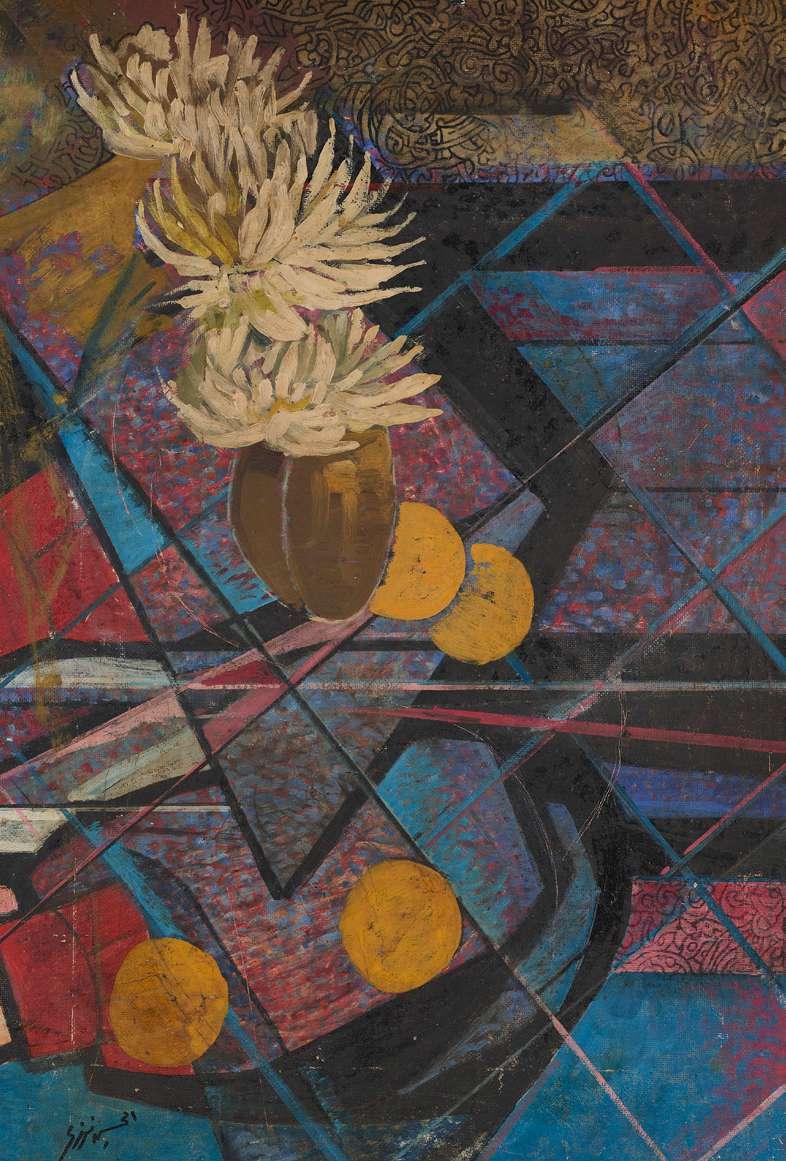
EL HUSSEIN FAWZI (EGYPTIAN 1905-1996)
STILL LIFE
signed El Hussein Fawzi in Arabic lower left oil on board
84.5 x 58cm; 33¼ x 23in
104 x 78cm; 41 x 30¾in (framed)
Provenance
Dr Mohammed Said Farsi
Acquired from the above by the present owner in 2013
Literature
Dr. Sobhy Al Sharouny, A Museum in a Book: Selections From Dr Mohammed Said Farsi’s Art Collection, Cairo, 1998, no. 11/35, pp. 146, 148, illustrated
El Hussein Fawzi was a central figure in the evolution of Egyptian modern art, celebrated as a pioneer of journalistic graphic arts and an academic leader. Born in the Helmia district of Cairo, he began his formal education in 1922 at the School of Fine Arts, where he initially focused on oil painting. His early talent earned him a prestigious fellowship to study in Paris, where he spent several years refining his craft. During this European period, he earned diplomas in lithography and decorative arts, and his skill was recognised internationally when he received an honorary degree at the French Salon in 1939.
Upon returning to Egypt, Fawzi dedicated himself to both education and institutional development. He founded the Department of Graphic Arts at the Faculty of Fine Arts and served as its director for many years. His influence extended to the southern reaches of the country, where he supervised the fine arts studio in Luxor from 1954 to 1960.
As a practitioner, Fawzi was remarkably versatile. While he was a master of classical oil painting, highlighted by his masterpiece El Dalalah, which is widely regarded as one of the most beautiful works in Egyptian art history. He was equally influential as an illustrator. He collaborated with the Nobel laureate Naguib Mahfouz, creating illustrations for his stories in the Al Ahram newspaper, and spent years documenting Egypt’s historic mosques through intricate watercolours and drawings.
His international prestige was further cemented when he became one of only four Egyptian artists selected to have their designs engraved on crystal by the Steuben Glass factory in New York. Throughout his long career, Fawzi received numerous accolades, including the State Prize and the Order of Sciences and Arts in 1963, as well as the State Prize of Merit in 1989, leaving behind a legacy that bridged the gap between traditional fine art and the modern graphic press.
£6,000-8,000
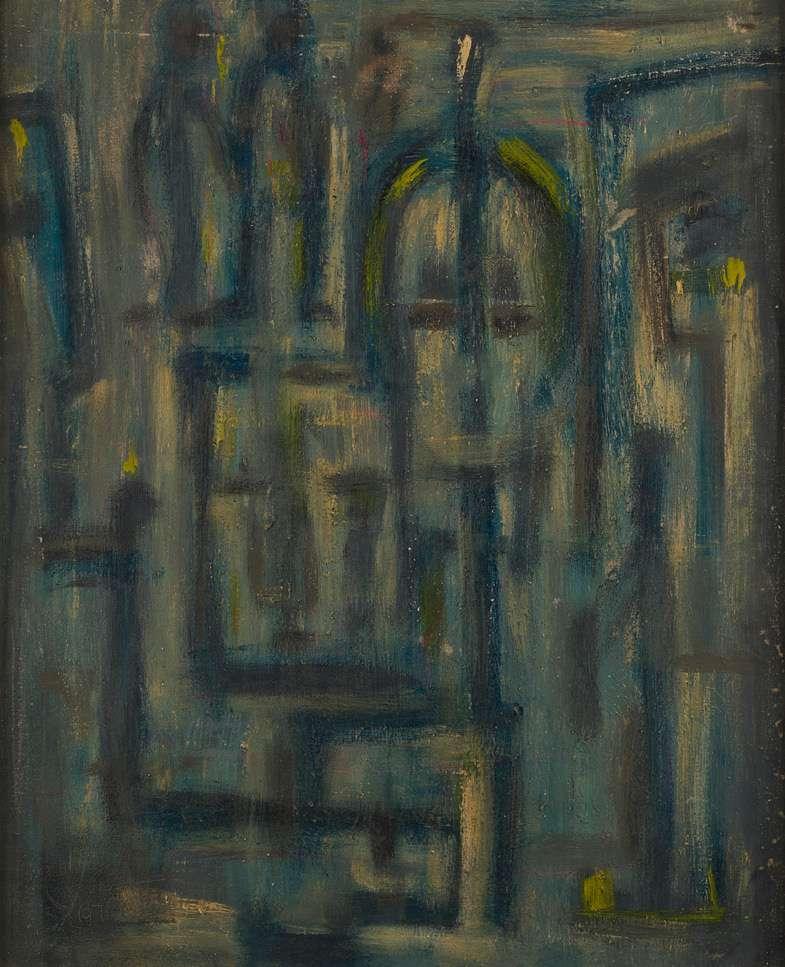
Property from the Zulficar Family Collection, Alexandria 15
SAMI RAFI (EGYPTIAN 1931-2019)
UNTITLED
signed in Arabic and dated 1971 lower right oil on canvas
71 x 57.4cm; 28 x 225⁄8in
82 x 69.2cm; 32¼ x 27¼in (framed)
Provenance
Acquired directly from the artist’s family by the previous owner
Acquired from the above by the present owner
Sami Rafi was a central figure in the development of Egyptian modernism, operating at the intersection of architecture, scenography, and fine art. The younger brother of Samir Rafi (see lots 23 and 24), he was educated at Cairo University and the Academy of Fine Arts in Vienna. Grounded on this fundamental training, Rafi developed a practice characterised by structural rigour and a commitment to civic identity. His work is defined by an analytical approach to form, utilising the principles of architectural drafting to explore the cultural and social landscape of post-revolutionary Egypt.
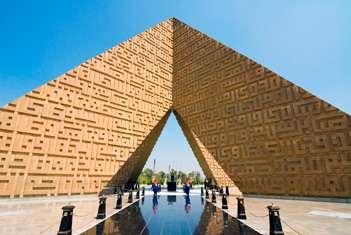
Rafi is perhaps best known for his contribution to the Egyptian built environment, specifically the Unknown Soldier Memorial in Nasr City (1975). In this work, he recontextualised the pyramidal form through a brutalist lens, creating a hollow, geometric canopy that functions as both a site of national mourning and a study in spatial volume. This project solidified his reputation as an artist capable of translating complex historical narratives into stark, minimalist gestures.
His studio practice was equally disciplined. In his paintings, Rafi synthesised the avant-garde movements he encountered in Europe, such as Cubism and Bauhaus-inspired abstraction, with local folkloric motifs. His compositions are often marked by a rhythmic use of line and a compartmentalisation of space that betrays his architectural training, as evidenced in the present work. By reducing the human figure and the Egyptian landscape to essential geometries, Rafi moved away from mere representation toward a more cerebral, graphic language.
In addition to his visual art, Rafi’s influence on the performing arts was extensive. He designed over 180 sets for the Cairo Opera House and other major institutions, treating the stage as a three-dimensional extension of his canvas. Throughout his tenure as a professor at the Faculty of Fine Arts in Cairo, he advocated for a multidisciplinary methodology, mentoring decades of practitioners. Today, Rafi is recognised as a pivotal bridge between the classical traditions of the Nile Valley and the precision of 20th century international modernism.
‡ £3,000-5,000
Tomb of the Unknown Soldier, Anwar Sadat’s Resting Place
Property from the Zulficar Family Collection, Alexandria
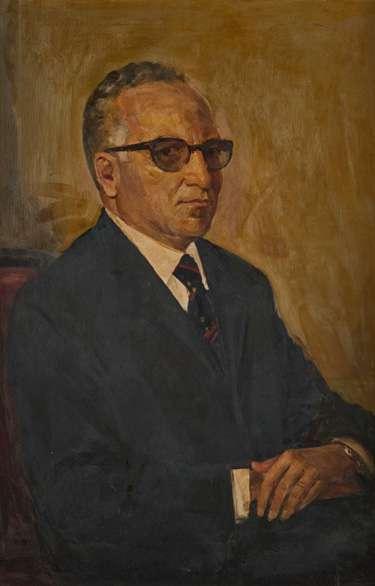
KAMEL MOUSTAFA (EGYPTIAN 1917-1982)
MAHMOUD HAMED (GOVERNOR OF THE CENTRAL BANK OF EGYPT)
signed K. Mostafa lower right oil on wood
82.2 x 54.3cm; 32¼ x 213⁄8in
94 x 66.7cm; 37 x 26¼in (framed)
Provenance
Acquired from the family of the artist And thence by the Zulficar Family Collection
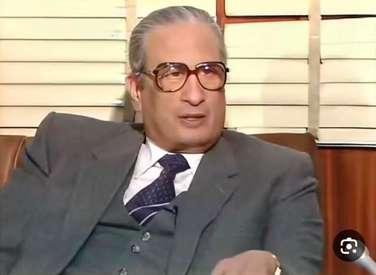
Kamel Moustafa’s reputation as one of Egypt’s premier portraitists is exemplified by his high-profile commissions, most notably his portrait of Mahmoud Hamed, the former Governor of the Central Bank of Egypt from November 1986 to October 1993. This work serves as a prime example of Moustafa’s ability to navigate the formal requirements of official portraiture while maintaining his characteristic focus on anatomical precision and tonal balance. In this piece, he captures the professional gravity of the subject through a disciplined use of light and shadow, a hallmark of the classical training he received in Rome.
The portrait of Mahmoud Hamed reflects a broader trend in Moustafa’s career where his technical mastery made him a preferred artist for the Egyptian elite and state officials following the 1952 Revolution. By applying the rigorous academic realism of the second generation of Egyptian modernists to figures of national significance, Moustafa helped define the visual language of the modern Egyptian state. This specific portrait remains a significant part of his legacy, illustrating his transition from the “Impressionist” street scenes of his youth in Alexandria to the sophisticated, institutional realism that characterised his later professional tenure.
Kamel Moustafa was a prominent Egyptian painter and educator associated with the second generation of the Egyptian modern art movement. A graduate of the Faculty of Fine Arts in Cairo, Moustafa later refined his technical skills in Italy at the Academy of San Luca in Rome. This European training provided him with a rigorous foundation in classical composition and anatomical precision, which he subsequently integrated into a distinctly Egyptian thematic framework. His work is recognised for its technical clarity and its focus on the landscapes, rural life, and people of Egypt, often rendered with a balanced, academic approach to realism.
Throughout his professional career, Moustafa combined his studio practice with significant institutional leadership. He played a vital role in the development of art education in Egypt, serving as a professor and eventually as the Dean of the Faculty of Fine Arts at Alexandria University. His pedagogical influence was instrumental in establishing a curriculum that valued classical mastery alongside regional identity. Today, his work is held in major public and private collections, including the Museum of Egyptian Modern Art, where he is remembered for his disciplined contribution to the country’s 20th century visual record.
‡ £3,000-5,000
Governor of the Central Bank of Egypt Courtesy of the consignor
AHMED NAWAR
(EGYPTIAN B.1945)
21ST CENTURY EGYPT BIRD
signed and dated in English and Arabic
A. Nawar 1997 lower middle mixed media on board
117 x 92.5cm; 461⁄8 x 363⁄8in
134.1 x 111.7cm; 526⁄8 x 437⁄8in (framed)
Provenance
Dr Mohammed Said Farsi
Acquired from the above by the present owner
Ahmed Nawar is a definitive figure in the history of contemporary Egyptian art, recognised for a career that balances rigorous technical execution with high-level cultural leadership. His body of work is characterised by an analytical approach to form, a trait developed through his formal training at the Faculty of Fine Arts in Cairo and later at the San Fernando Royal Academy of Fine Arts in Madrid. This academic foundation was uniquely tempered by his service as a sniper during the War of Attrition, an experience that introduced a distinct “optical precision” into his aesthetic, where the themes of surveillance, distance, and the mechanical anatomy of objects predominate.
Throughout his professional life, Nawar has functioned as both a creator and a strategist for the Egyptian arts. His early output focused heavily on graphic arts, where his etchings and drawings displayed a preoccupation with geometric order and the deconstruction of the human and industrial form. Over time, his practice expanded into painting, shifting from monochromatic discipline to a sophisticated use of colour and abstraction. Regardless of the medium, his work consistently examines the tension between organic life and structural rigidity, often reflecting on national identity and the concept of human endurance.
Beyond the studio, Nawar’s influence is cemented by his extensive contributions to Egypt’s cultural infrastructure. As a former Dean of the Faculty of Fine Arts at Minia University and the longtime Head of the Fine Arts Sector at the Ministry of Culture, he was instrumental in professionalising the regional art scene. Most notably, his role in founding the Cairo International Biennale in 1984 provided a vital platform for cross-cultural exchange between the Middle East and the global art community. His works are currently held in major international collections, including the Metropolitan Museum of Art in New York and the Museum of Modern Art in Cairo, marking him as a pivotal architect of Egypt’s modern visual identity.
⊕ £2,500-3,500
Property of a Lady, London 18
IBRAHIM EL DESSOUKI
(EGYPTIAN B.1969)
UNTITLED
signed and dated Ibrahim El dessouki 09 lower left oil on board
27.5 x 22.2cm; 105⁄8 x 8¾in
47.4 x 42.4cm; 185⁄8 x 165⁄8in (framed)
Provenance
Acquired directly from the artist by the present owner
Husband of Hend Adnan (see lot 19), El Dessouki was born in Cairo and served as a Professor of Painting at the University of Fine Arts in Cairo from 1992 to 2017. During this period, he transitioned into a full-time painter.
El Dessouki was immersed in a rich cultural environment, coming from a family of artists with a keen interest in literature, translation, and Egyptology. His father, Fahmi El Dessouki and mother Atyat Sayed were well-known, established Egyptian expressionist painters and free-thinking intellectuals, and both greatly influenced the artist that Ibrahim had become. This upbringing shaped his varied expertise, which ranges from press illustration to translating literary and artistic critique, as well as contributing to archaeological findings.
He earned his Master’s Degree in 1997 with a thesis on The School of London and British Painting since 1945, followed by a PhD in 2003 focusing on Dynamics in Painting
El Dessouki’s artistic practice is characterised by his exploration of diverse themes and techniques, predominantly in oil painting. He employs methods such as layering colours, and scraping surfaces with different tools to uncover hidden depths. Manipulating light and shadow, he juxtaposes intricate detail with flat expanses of negative space. El Dessouki’s approach alternates between strict adherence to perspective and deliberate disregard for it, resulting in a harmonious composition. Much of his art documents and reflects upon Egyptian life, often revealing subtle perspectives through colour and structure. He is particularly well known for his luminous, beguiling studies of the female figure, either solo, as seen here, or in groups.
El Dessouki has exhibited widely in both the Middle East and Europe, including an exhibition at Bousheri Gallery, Kuwait (2012); the Institut du Monde Arabe, Paris, France (2008); Art Sawa gallery, Dubai, UAE (2009); and Casa Arabe, Madrid, Spain (2014). His work was also featured in the 10th Cairo International Biennale in 2006 and El Diriyah Biennale in 2021, and is included in the collections of the Museum of Egyptian Modern Art in Cairo and the Arab Museum of Contemporary Art in Qatar. In recognition of his contributions, he was awarded the Egyptian state prize for excellence in arts in 2019.
£3,000-5,000
Ibrahim El Dessouki Courtesy of the artist
Property of a Lady, London 19
HEND ADNAN (EGYPTIAN B.1970)
UNTITLED
signed and dated 2008 / Hind Adnan in English and Arabic lower left oil on canvas
39.5 x 29cm; 15½ x 113⁄8in
60 x 49.8cm; 235⁄8 x 195⁄8in (framed)
Provenance
Acquired directly from the artist by the present owner
Wife of Ibrahim El Dessouki (see lot 18), Hend Adnan earned her BA in Visual Art from the Painting Department at the Faculty of Fine Arts in Cairo in 1992.
Adnan values creative freedom in working with oil paints and live models, with particular attention to the nuanced portrayal of shadows. She aims to convey psychological states and emotions through realistic renderings, utilising the full range and texture of oil colours.
Adnan’s oeuvre is characterised by fluid colours and silvery light-infused shadows that possess greater depth than the hues themselves. Her technique incorporates oil paints applied in thick, textured layers or lighter washes, with broad, balanced brushstrokes to create effects ranging from transparent to opaque, allowing for diverse textural outcomes. During the preparatory stage, she employs graphite, charcoal, or pastels on coloured paper to produce multiple sketches, ensuring accurate form and composition for each painting.
As evidenced in the current work, the model remains central to each artwork, serving as both inspiration and foundation. Each piece interprets an emotion or mood concealed within the subject’s features. Here as in her other paintings, the distinctly black hair of Egyptians serves as a fundamental colour, transforming into shades of red and ochre, reminiscent of how Nile waters reflect the sunlight.
Her work has been featured in numerous national and international exhibitions, festivals, and meetings, and is included in both Egyptian and global collections.
£2,000-3,000
Property of a Private Collector, Germany
20
RABAB NEMR (EGYPTIAN 1939-2025)
UNTITLED
signed and dated in Arabic Rabab Nemr 87 lower left; inscribed in Arabic on the reverse oil on panel
79.9 x 79.9cm; 31½ x 31½in
96.5 x 96.5cm; 38 x 38in (framed)
Provenance
Sale, Bonhams Cornette de Saint Cyr, Paris, 2024
Rabab Nemr is a distinguished figure in contemporary Egyptian art, recognised for a practice that synthesises traditional folk motifs with rigorous formal technique. Born in Alexandria, Nemr received her foundational training at the Faculty of Fine Arts in Alexandria before relocating to Spain to earn a doctorate from the San Fernando Academy in Madrid. This academic trajectory provided her with a sophisticated technical range, enabling her to bridge the aesthetic sensibilities of the Mediterranean with the broader traditions of European modernism.
Nemr has a distinctive practice. Her body of work is primarily characterised by a meticulous approach to line and volume, and she is perhaps best known for her bold geometric figurative compositions, featuring elements of her native Alexandria. Utilising pen, ink, and oil, Nemr employs intricate hatching and pointillist techniques to construct monumental figures that frequently reference Pharaonic proportions. Her subject matter consistently focuses on the Egyptian working class, specifically the fishing communities of the coast, integrating symbolic elements such as the fish, the boat, and the sun. These motifs serve as structural and thematic anchors, elevating scenes of daily labour into formal studies of equilibrium and cultural continuity.
Over a career exceeding sixty years, Nemr’s contributions have been recognised through significant accolades, including the Egyptian State Incentive Prize. Her work has been exhibited extensively in international biennials and is held in permanent collections such as the Museum of Modern Egyptian Art in Cairo and the World Bank in Washington, DC. Through her disciplined exploration of form and her commitment to regional iconography, Nemr remains a central figure in the evolution of Egyptian visual arts.
‡ £26,000-30,000
“I have endless conversations with the figures in my paintings, and stop painting only when they ask me to stop talking to them. The process of painting is like composing a symphony: you never know where it will take you”
Rabab Nemr
Property of a Lady, London 21
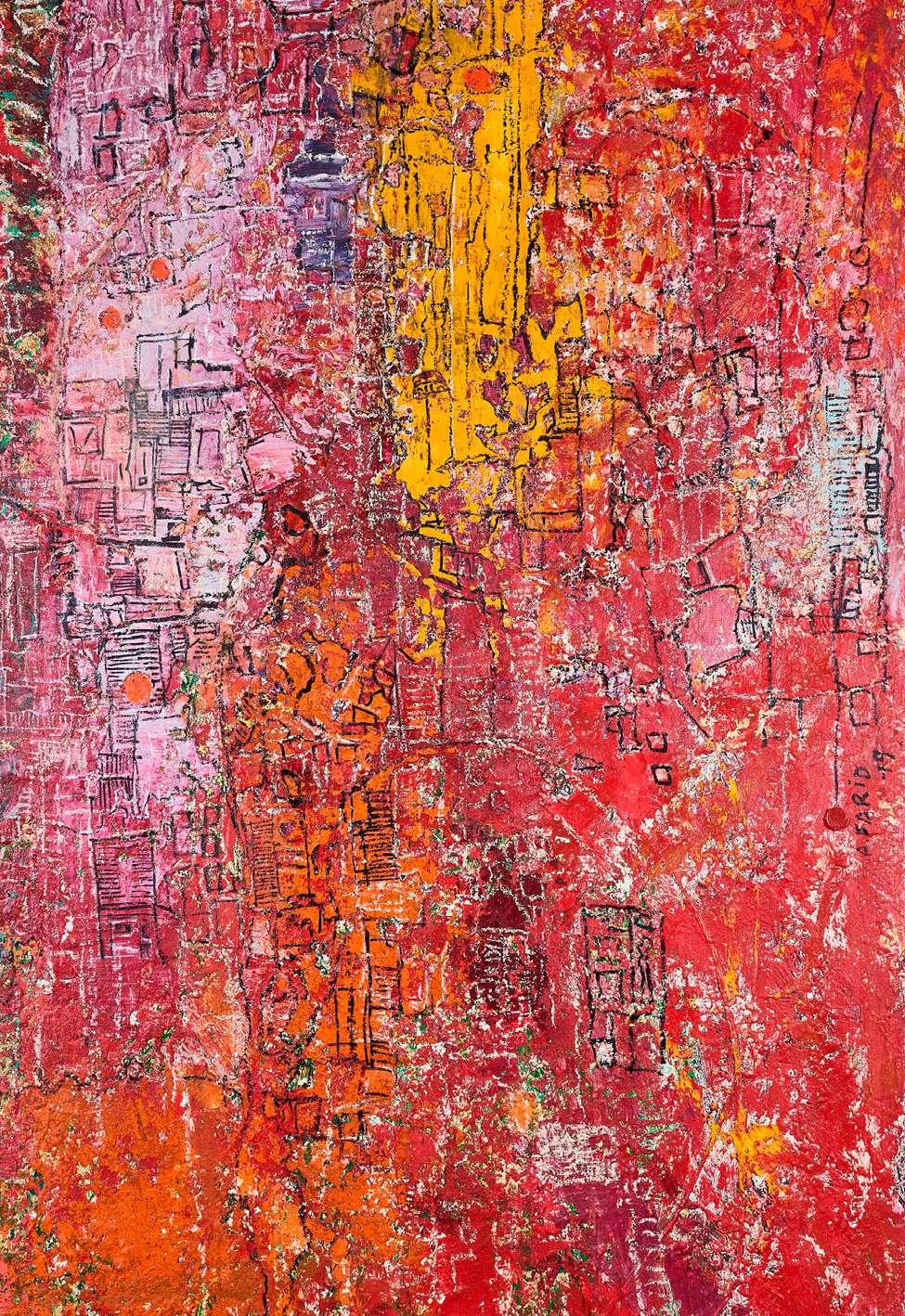
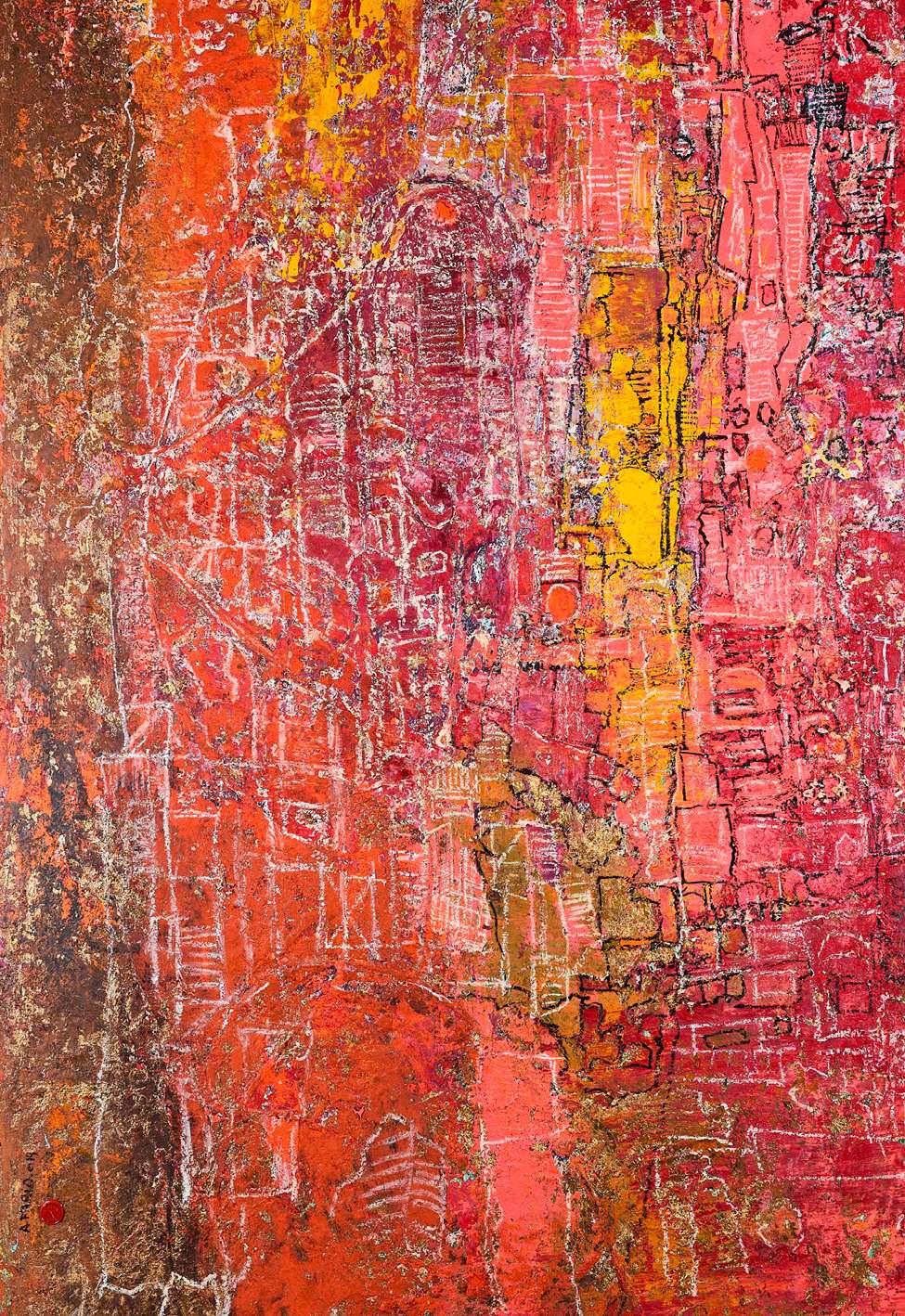
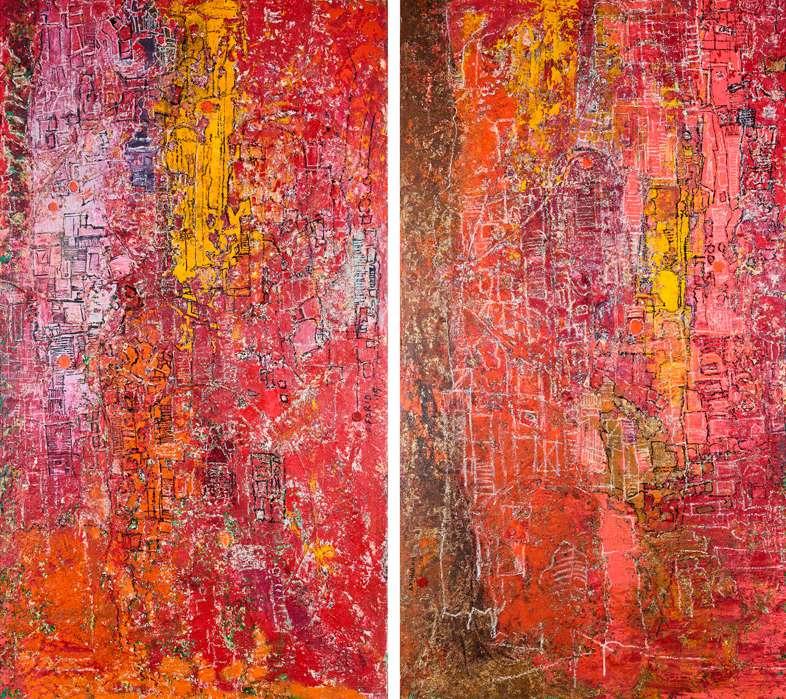
AHMED FARID (EGYPTIAN B.1950)
(I) and (II) HIDDEN IDENTITIES
(i) and (ii) signed and dated A.FARID. 019 centre right (i) and (ii) oil on canvas (i) and (ii) 220.5 x 122cm; 867⁄8 x 48in each (i) and (ii) unframed
Provenance
Art D’Egypte
Acquired from the above by the present owner in 2020
Born in Cairo, Ahmed Farid is an influential Egyptian painter whose creative journey is marked by an enduring dialogue between Eastern tradition and Western innovation. Early in his life, Farid immersed himself in the studios of established artists, training through apprenticeships that shaped his unique approach to art. His transition from a career in marketing and business to painting was inspired by extensive travels during the vibrant cultural era of the early 1970s, which exposed him to both the aftermath of Europe’s post-1968 upheavals and the American ‘summer of love,’ as well as Egypt’s political and social transformations.
Farid quickly earned recognition as a leading figure in contemporary Egyptian art. His international reputation was cemented through acquisitions of his work by Luxury Living, a subsidiary of LVMH’s Fendi Casa in Miami, Florida, and his appointment as visiting professor at the Academia D’Arte (ADA) in Florence, Italy. He has also participated in auctions and galas such as the Chain of Hope Gala in London, and his painting Melody of Chaos is on permanent display at the Museum of Egyptian Modern Art.
Farid’s artistic style is characterised by layered abstraction, where he builds compositions with oil, acrylic, ink, or gold leaf, then covers them with additional layers to create complex, tactile surfaces he calls “terrestrial crusts.” This technique symbolises the accumulation of history and human experience. His paintings, while often appearing abstract, are populated by ethereal figures, marked by oversized eyes, that emerge from beneath waves of colour and act as silent witnesses to the human condition. Through series like Building Humanity and Collision, he explores the tension between the rigid architecture of modern cities and the fluid, emotive values of their inhabitants, focusing more on the ongoing process of being human than on capturing moments in time.
Influences from artists such as Gazbia Sirry and Nicholas de Stael can be glimpsed in Farid’s pursuit of harmony through vibrant colours and balanced forms. His distinctive blend of American painting techniques with Egyptian cultural references makes his work stand out in the contemporary art scene, not as a mere continuation of past trends, but as a personal and modern evolution of artistic language. Farid continues to live and work in Cairo, exhibiting his art in major cities like London, Florence, and Miami, and maintaining his place as a central figure in Egyptian art. His presence in significant collections and his success at high-profile auctions further underline his impact and legacy in both local and international spheres.
£15,000-20,000
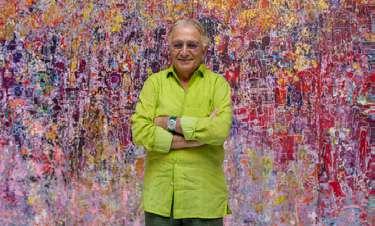
Ahmed Farid Courtesy of the artist
“When you reflect your soul through your artwork, each piece becomes a voice from a different corner of your spirit – scattered across spaces, yet sharing one heartbeat”
Ahmed Farid
Property from the Zulficar Family Collection, Alexandria 22
SALAH
TAHER (EGYPTIAN 1911-2006)
UNTITLED
signed and dated Salah Taher / 88 in Arabic lower right mixed media on paper
33.2 x 43.6cm; 131⁄8 x 17¼in
41.8 x 52.6cm; 16½ x 203⁄8in (framed)
Provenance
Private Collection, Alexandria
Acquired from the above by the present owner
Salah Taher played a significant role in Egyptian modernism, contributing to the development of the nation’s artistic identity. Born in Cairo, Taher began his career within the framework of academic realism, earning recognition as a portraitist among Egypt’s elite. A visit to the United States in the 1950s influenced his subsequent shift in style.
Throughout his career, Taher’s art evolved from realism to figurative symbolism and later to contemporary abstraction. He moved from using brushes to palette knives, layering paint to create what he termed a universal language, a rhythmic, chromatic approach that aimed to cross cultural and linguistic boundaries. His work in abstraction influenced the direction of Egyptian modern art.
Outside of painting, Taher was active in Egypt’s cultural scene. He graduated from Cairo’s Academy of Fine Art in 1934 and lectured there until 1954. He held several leadership positions, including Director of the Museum of Modern Art in Cairo, General Director of the Cairo Opera House, and head of the Society of Advocates of Fine Arts in the 1980s. He also worked as an artistic consultant for the Al-Ahram newspaper.
Taher produced an estimated 15,000 paintings and held over 80 solo exhibitions internationally. His accomplishments include the Guggenheim Awards in 1959 and 1961, Mubarak Award in 2002, the State Incentive Award, and the Alexandria Biennale Award. His work has been shown in exhibitions across Egypt, Venice, New York City, San Francisco, Geneva, Beirut, Kuwait, and Jeddah. His paintings are included in collections such as the White House and the Mathaf: Arab Museum of Modern Art, establishing his place in the history of modern art. ‡ £2,000-3,000
Property from the Zulficar Family Collection, Alexandria
23
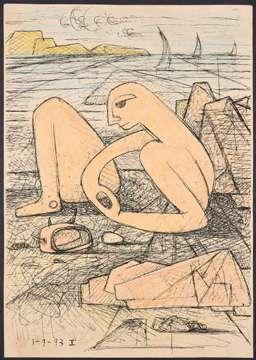
SAMIR RAFI (EGYPTIAN 1926-2004)
(I) - (III) UNTITLED
(i) dated 20.7.91.I. lower left
(ii) dated 1-9-93 I lower left
(iii) inscribed 26-1-55 D’apres Dessinder Paris
24-12-54 III lower right
(i) and (iii) reproduction with added pen and pencil
(ii) reproduction with added pencil
(i) and (ii) 41.7 x 29.4cm; 16¼ x 11½in
(iii) 41.9 x 29.6cm; 16½ x 11½in
(i) - (iii) unframed
(3)
Provenance
Acquired from the family of the artist by the previous owner
Acquired from the above by the present owner
Born in Cairo to a multi-confessional family, Samir Rafi received early artistic training under Hussein Youssef Amin before attending the School of Fine Arts, where he developed a distinct style apart from Western academic art. His originality gained support from educators and led to a graduation project inspired by surrealism. After earning honours in 1948 and completing further studies at Ain Shams University,
Rafi taught in several schools and became a professor at Cairo University. In 1954, he moved to Paris on a scholarship, studying modern art and museology, and pursuing his PhD at La Sorbonne. There, he engaged with major artists but ultimately travelled to Algeria in 1964, where he was briefly imprisoned, later teaching art history in Algiers before settling back in France.
Rafi’s career emerged during Egypt’s turbulent 1930s and ‘40s, interacting with movements like Art and Liberty, which opposed Fascism and embraced Surrealism. While influenced by these groups, Rafi co-founded the Contemporary Art Group, focusing on local Egyptian themes rather than Western or colonial art. His works often highlighted everyday people and integrated mystical elements rooted in Egyptian folk culture. Rafi also referenced ancient Egyptian art and traditions, fusing them with modern techniques. His artistic legacy lies in blending symbolic imagery from Egypt’s past with contemporary issues, making him a key figure in modern Egyptian art. Samir Rafi died in Paris in 2004.
⊕ £3,000-5,000
Property from the Zulficar Family Collection, Alexandria 24
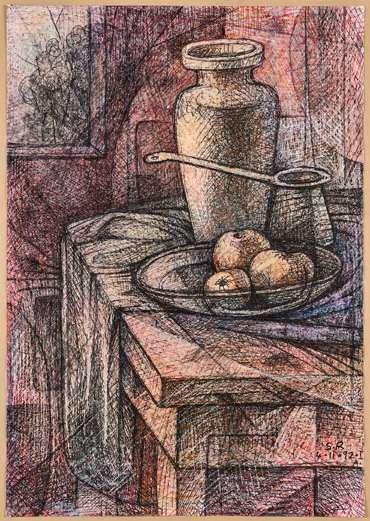
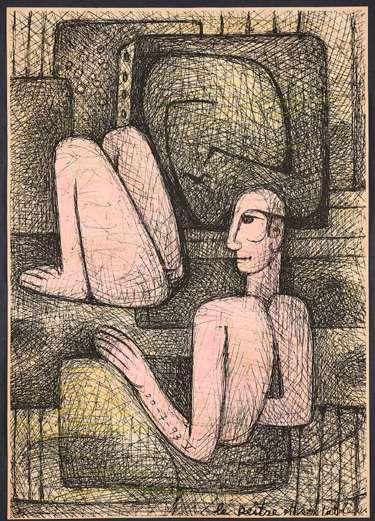
SAMIR RAFI (EGYPTIAN 1926-2004)
(I) and (II) UNTITLED
(II) LE PEITRE ET SON TABLEAU
(i) signed and dated S.R 4.11.92. I lower right
(ii) titled le peitre et son tableu lower right; dated 20-7-93 IV lower centre
(i) - (ii) reproduction with added pen, pencil and pastel
(i) 42 x 29.5cm; 16½ x 11½in
(ii) 41.6 x 29.4cm; 163⁄8 x 11½in
(i) - (ii) unframed
(2)
see note to lot 23
⊕ £4,000-6,000
Property from the Zulficar Family Collection, Alexandria
25
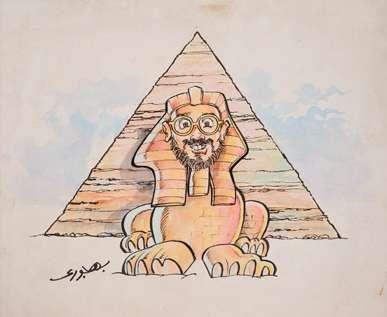
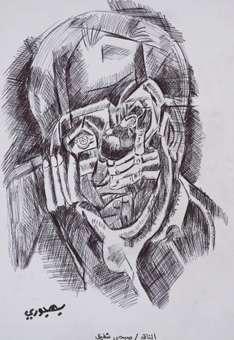
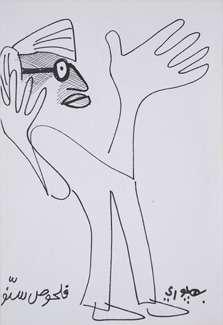
GEORGE BAHGOURY
(EGYPTIAN / FRENCH B.1932)
(I) - (II) UNTITLED
(i) - (ii) signed Bahgoury in Arabic lower left (i) watercolour on paper (ii) pen on paper
(i) 30.5 x 36.6cm; 12 x 143⁄8in
38.9 x 49.6cm; 15¼ x 19½in (mounted)
(ii) 49 x 33.5cm; 19¼ x 131⁄8in
54.5 x 41.8cm; 21½ x 16½in (mounted) (2)
George Bahgoury is a preeminent figure in the world of contemporary Egyptian art, widely celebrated as a master painter, sculptor, and the “grandfather of Egyptian caricature.” Born in 1932 in Luxor, Bahgoury’s work is deeply rooted in the cultural fabric of his homeland, yet it resonates with a universal humanism shaped by his decades living and working in Paris. His signature style seamlessly blends the expressive fluidity of European modernism with the timeless motifs of Coptic and Pharaonic heritage, creating a visual language that is both avant-garde and profoundly traditional.
Throughout his prolific career, Bahgoury has established himself as a keen observer of the human condition. His artworks often pulse with the vibrant energy of Cairo’s
streets, capturing the rhythm of daily life through bold lines and a rich, emotive palette. He studied at the Faculty of Fine Arts in Cairo before further refining his craft at the École Nationale Supérieure des Beaux-Arts in Paris, an experience that allowed him to bridge the gap between Middle Eastern and Western artistic perspectives. This dual identity is a hallmark of his portfolio, which ranges from poignant political cartoons that challenged social norms to monumental oil paintings that explore themes of music, spirituality, and national identity.
Bahgoury’s contributions to the arts have been recognised through numerous international exhibitions and prestigious awards, and his works are held in esteemed collections worldwide, including the Museum of Modern Egyptian Art and various private institutions across Europe and the Middle East. Beyond the gallery walls, he is a respected critic and author, having published several books that reflect his philosophical approach to creativity. Today, George Bahgoury remains an enduring icon of the Arab art world, continuing to inspire new generations of artists with his unwavering commitment to artistic freedom and his unique ability to find beauty in the intricate details of the Egyptian spirit.
⊕ £2,000-3,000
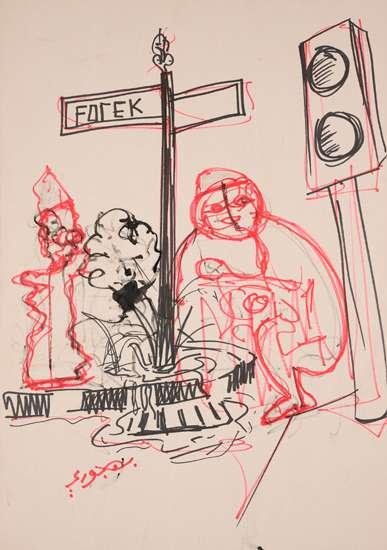
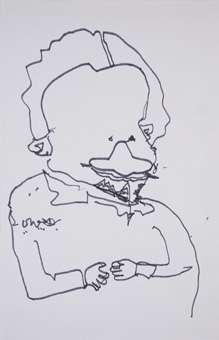
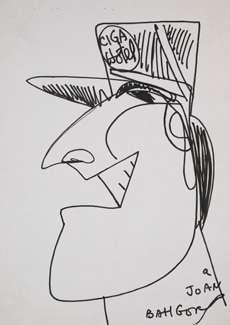
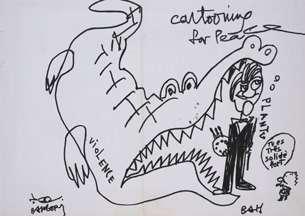
GEORGE BAHGOURY (EGYPTIAN / FRENCH B.1932)
UNTITLED (SEVEN SKETCHES)
pen on paper
29.6 x 20.9cm; 115⁄8 x 8¼in
38.4 x 29cm; 151⁄8 x 113⁄8in (mounted) (smallest)
29.6 x 20.9cm; 115⁄8 x 8¼in
44.1 x 52cm; 173⁄8 x 20½in (mounted) (largest) (7)
see note to lot 25
⊕ £2,000-3,000
Property from a Private Collection, London
27
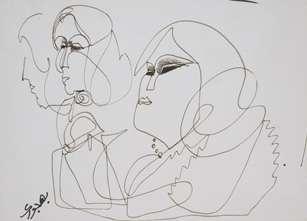
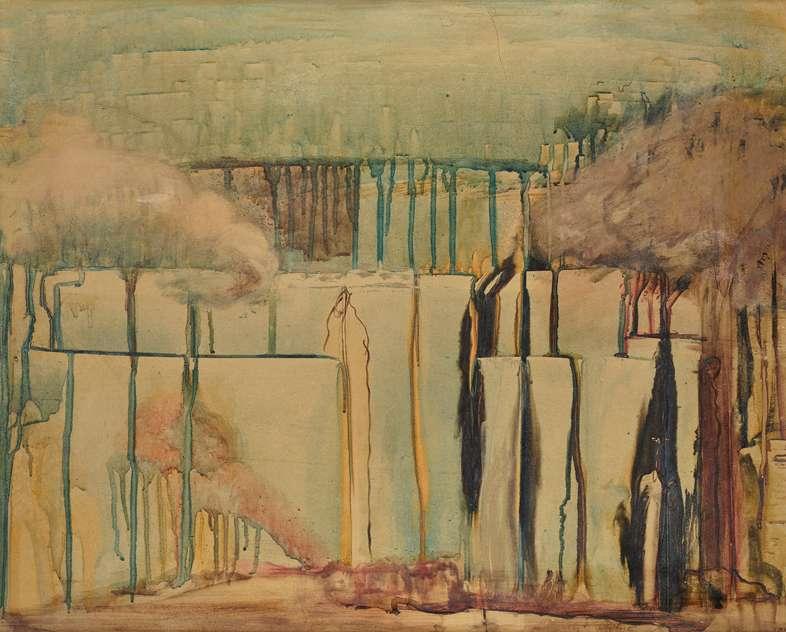
QUEEN FARIDA OF EGYPT (EGYPTIAN 1921-1988)
ABSTRACT LANDSCAPE
oil on gold paper
48.5 x 59.5cm; 191⁄8 x 233⁄8in
65.5 x 74.6cm; 256⁄8 x 293⁄8in (framed)
Provenance
Dr Mohammed Said Farsi
Acquired from the above by the present owner in 2013
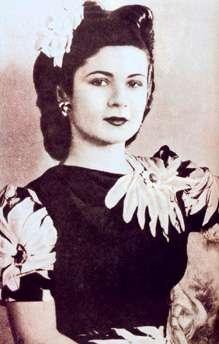
In the tapestry of 20th century Egyptian history, the life of Queen Farida, born Safinaz Zulficar, unfolds as a poignant transformation from a captive icon of royalty to a liberated voice of the avant-garde. While her marriage to King Farouk in 1938 cast her as the “Emerald of the East” in the public eye, it was her divorce and subsequent exile that allowed her to polish a far more enduring facet of her soul: her identity as a painter.
Her artistic journey was never a mere hobby of the leisure class; it was a psychological sanctuary. Under the early tutelage of her uncle, the legendary Egyptian master Mahmoud Sa’id, Farida developed a sensibility that married the grandeur of her upbringing with a raw, introspective humanity. When the 1952 Revolution finally dismantled the monarchy, she traded the stifling etiquette of the Abdeen Palace for the bohemian studios of Paris and Beirut. It was here, stripped of her crown but draped in the vibrant colours of her heritage, that Farida truly found her kingdom.
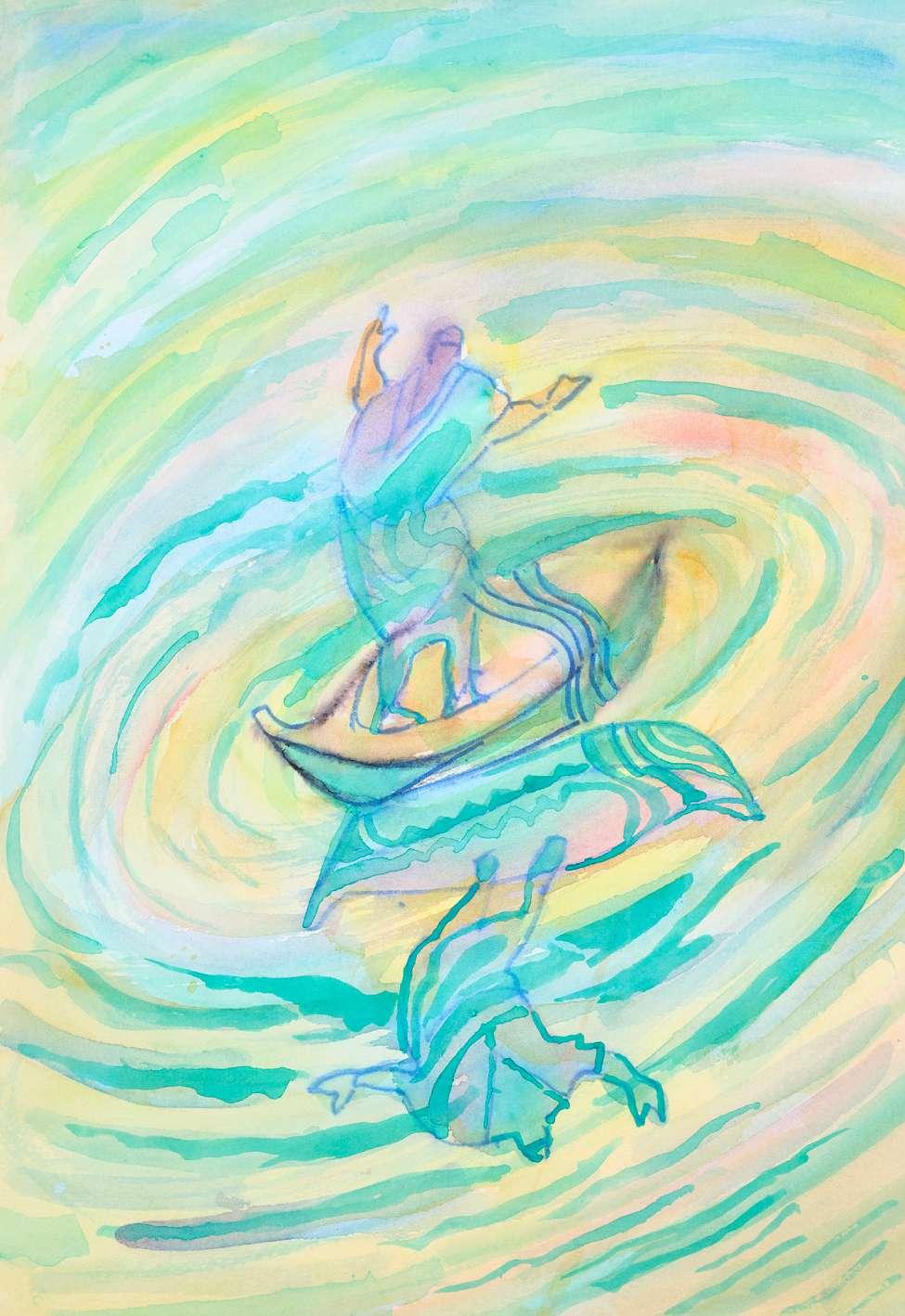
Her prose on canvas was written in light and shadow. Her work leaned heavily into a lyrical Impressionism, characterised by a profound sense of longing. She often painted the Egyptian landscape from memory, her brushstrokes capturing the hazy, golden humidity of the Nile and the rhythmic geometry of Sufi dervishes in mid-whirl. These subjects were not just cultural motifs; they were manifestations of her own search for spiritual equilibrium and a way to bridge the distance between her European exile and the soil that remained her greatest muse.
In her later years, Farida’s return to Cairo signalled a quiet triumph. She was no longer viewed through the lens of political tragedy, but as a respected peer among Egypt’s artistic elite. Her legacy remains a testament to the idea that title and status are temporary, but the creative spirit, once unburdened, is sovereign. She died in 1988, leaving behind a body of work that serves as a vivid, colourful bridge between the vanishing world of the pashas and the enduring heartbeat of modern Egyptian art.
Queen Farida’s works have been shown in numerous exhibitions, most recently at Liwan Gallery in Cairo in 2025 with her granddaughter Yasmine Perreten. The artist has entered the collections of Mathaf: Arab Museum of Modern Art (Doha, Qatar), Queen Farida Museum / Al-Shumu’a Gallery (Maadi, Cairo), Alexandria Museum of Fine Arts (Alexandria, Egypt), National Museum of Egyptian Civilization (Cairo, Egypt), Royal Jewelry Museum (Alexandria, Egypt), the private collection of Janet Gaynor and Paul Gregory (United States) and various private collections (Paris, Zurich, and Beirut).
£7,000-9,000
Queen Farida
Property of a Lady, London 28
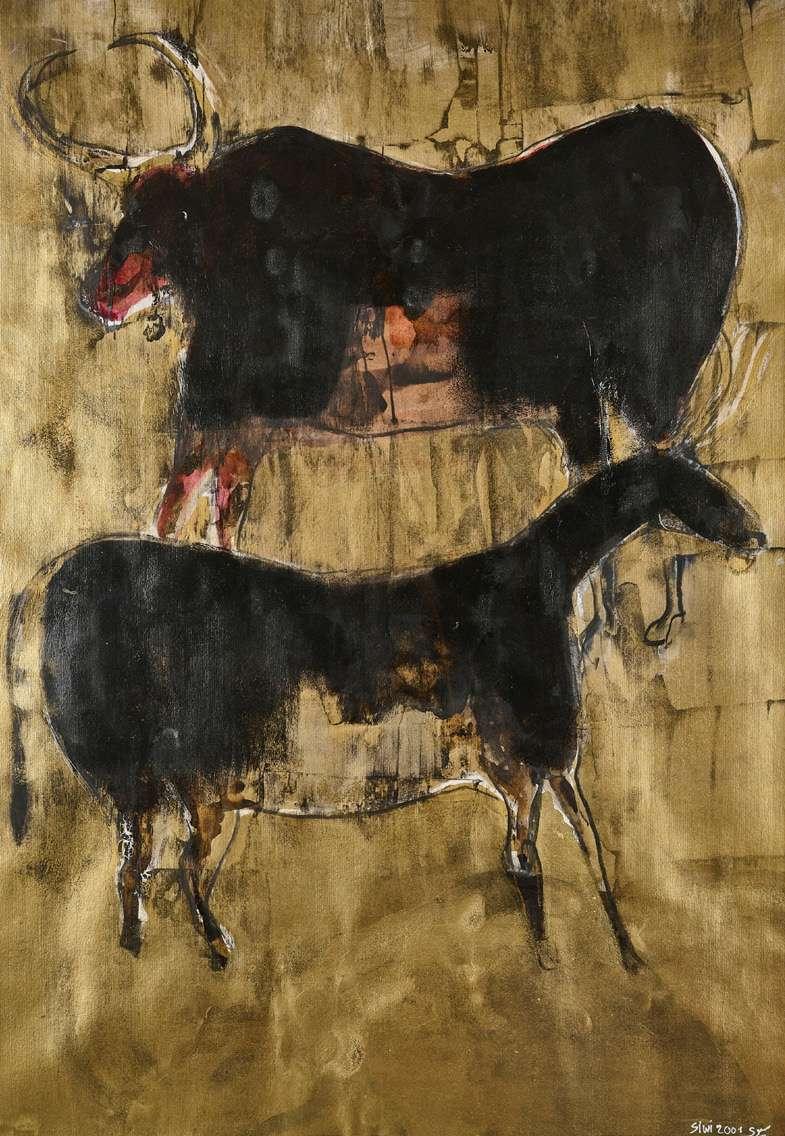
ADEL EL SIWI (EGYPTIAN / ITALIAN B.1952) TAURUS
mixed media on paper
signed and dated Siwi 2001 in English, and Siwi in Arabic lower right
97.3 x 67.5cm; 38¼ x 26½in
139.7 x 100.7cm; 55 x 39½in (framed)
Provenance
Sale, Bonhams, London, 2018
Acquired from the above by the present owner
Adel El Siwi is primarily recognised for his monumental figurative paintings, a style that bridges the clinical precision of his medical background with a deep fascination for historical Egyptian aesthetics. His work is characterised by a “hieratic” quality-a formal, stiff, and sacred stillness reminiscent of Pharaonic art and Coptic icons. He frequently focuses on the human face, rendering it on an oversized scale that strips away individual identity to explore more universal, psychological archetypes.
While his medical training informs his understanding of human anatomy, his execution is rarely realistic. Instead, he treats his subjects with a sense of “Oriental Regality,” often elongating features and placing them in a silent, static space. This focus extends to his frequent inclusion of animals, such as cats and birds or, as in this case, buffalo found in rural Egypt; rather than serving as mere symbols or background elements, these creatures are given equal weight and presence to his human figures, creating a shared narrative of quietude and introspection.
Technically, El Siwi’s style is defined by a sophisticated use of a limited, often earthy palette. He avoids excessive ornamentation, preferring to build depth through layers of paint that create a subtle interior radiance. The mood of his work is often described as sombre or melancholic, lacking in celebration but rich in psychological weight. This approach allows him to navigate between the whimsical and the profound, using traditional mediums to maintain a dialogue with the past while addressing contemporary displacement and memory.
Adel El Siwi (b. 1952, Behera) is a Cairo-based artist whose work is shaped by a background in medicine and a decade spent living in Europe. Although he trained as a doctor at Cairo University between 1970 and 1976, he simultaneously pursued independent studies at the Faculty of Fine Arts from 1974 to 1975. In 1980, he relocated to Milan, Italy, where he practiced for ten years before returning to Cairo to establish his permanent studio.
El Siwi’s professional record includes numerous solo exhibitions across the Middle East and Europe, including shows in Egypt, Lebanon, Syria, Tunisia, Italy, France, England, Bahrain, and Dubai. He has been a frequent participant in major international biennials, representing his work at the Cairo Biennale (1996, 2008), the Sharjah Biennale (1997), and the Venice Biennale (2009).
His participation in group exhibitions includes notable surveys such as Rencontres Africaines (1994) and Oum Kalsoum: La Quatrième Pyramide (2008) at the Institut du Monde Arabe in Paris, Modernities and Memories at the 1997 Venice Biennale, and Word into Art in Dubai. Additionally, his work has been featured in urban projection projects organised by Le Laboratoire: Sculpture Urbaine, which displayed his imagery on historical buildings in Rio de Janeiro, Grenoble, and Algiers.
Beyond his studio practice, El Siwi contributes to Arabic art scholarship through his work as a translator. He has translated several foundational art historical texts into Arabic, including writings by Leonardo da Vinci and Paul Klee.
⊕ £3,000-5,000
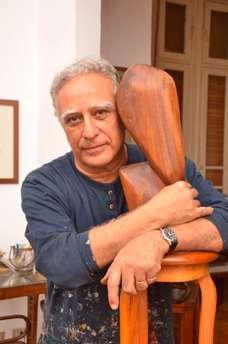
Adel El Siwi
Property of a Lady, London
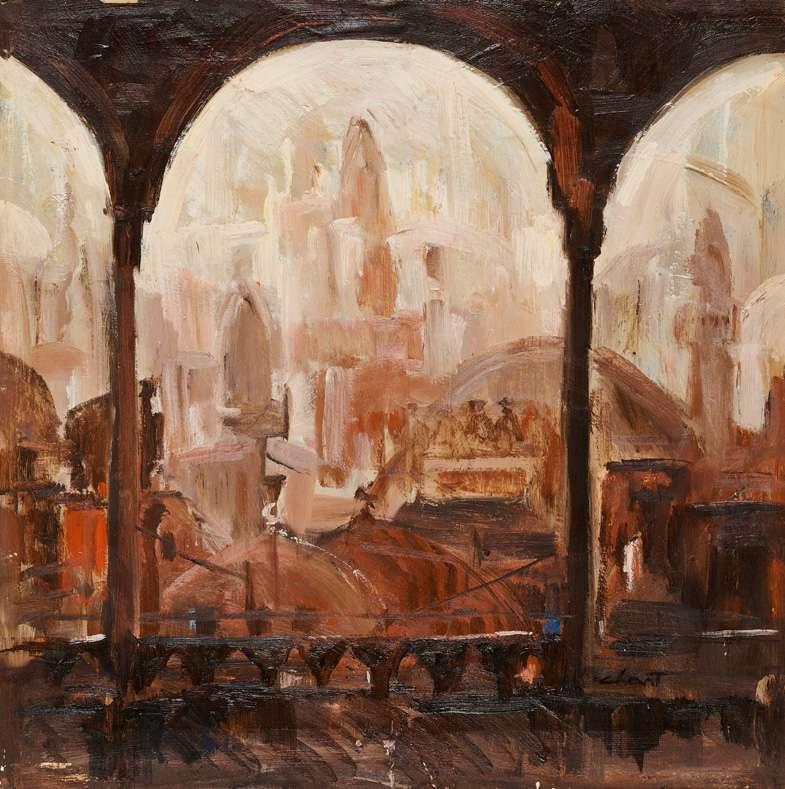
CHANT AVEDISSIAN (EGYPTIAN 1951-2018) UNTITLED
oil and metallic pigment on canvas
50.5 x 50.5cm; 20 x 20in (each)
50.5 x 203.2cm; 20 x 80in (together) unframed in four parts
Executed in circa late 1970s - early 1980s
Provenance
Acquired directly from the artist by a Private Collection, Egypt
Acquired from the above by descent to the present owner
Chant Avedissian was born to a family of Armenian refugees in Boulaq, a poor suburb of Cairo, Egypt. In 1967 he graduated from the Kalousdian Armenian school. After studying fine art at the School of Art and Design in Montreal and applied arts at the National Higher School of Decorative Arts in Paris during the 1970s, Avedissian returned to Egypt. His work frequently addressed questions of national identity, traditions, and culture, fusing techniques, concepts and cosmopolitan experiences acquired abroad with the heritage of his Armenian-Egyptian background to produce striking commentaries on the world around him.
Through his collaboration with the Aga Khan Foundation and noted Egyptian architect Hassan Fathy (1900-1989), Avedissian developed an interest in traditional art forms and local materials, which informed his approach to exploring his own identity.
Avedissian began working with Hassan Fathy in 1981, managing his archives, cataloguing drawings, plans, and theoretical texts, a partnership that continued until Fathy’s death in 1989. During this time, he travelled the length and breadth of Egypt, photographing Fathi’s extant buildings for a book published by the Aga Khan Foundation. Fathy’s perspectives on the importance of integrating genuine Egyptian art with craft revival efforts - as well as his view that combining ancient and modern art should avoid external influences - significantly influenced Avedissian’s artistic development. Many works produced by Avedissian during the 1980s reflect methods and content shaped by this association, notably he produced numerous paintings of agrarian Egypt, including sketches and studies, such as the present lot.
His work is in very prominent public collections such as The British Museum (UK), Mathaf Museum of Modern Art (Qatar), National Museum of African Art - Smithsonian Institution (USA), the British Airways Collection (UK) and National Museum of Scotland, amongst others.
£5,000-7,000
Property from a Private Collection, Hampstead 30
CHANT AVEDISSIAN (EGYPTIAN 1951-2018)
UNTITLED
signed Chant lower right oil on canvas
50.5 x 50.5cm; 20 x 20in unframed
Provenance
Acquired from the artist by the present owner see note to lot 29
£4,000-5,000
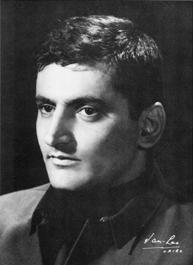
Avedissian Courtesy AGBU Egypt
Chant
Property of a Private Collector, Cairo 31
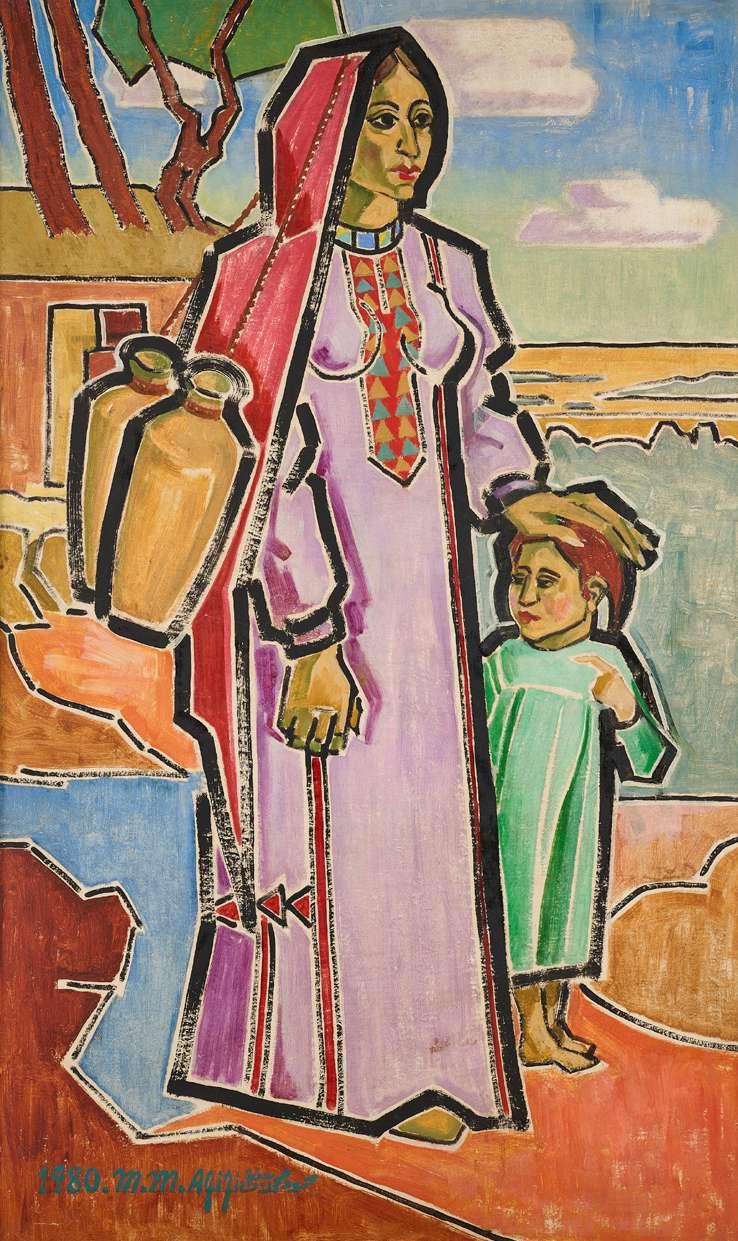
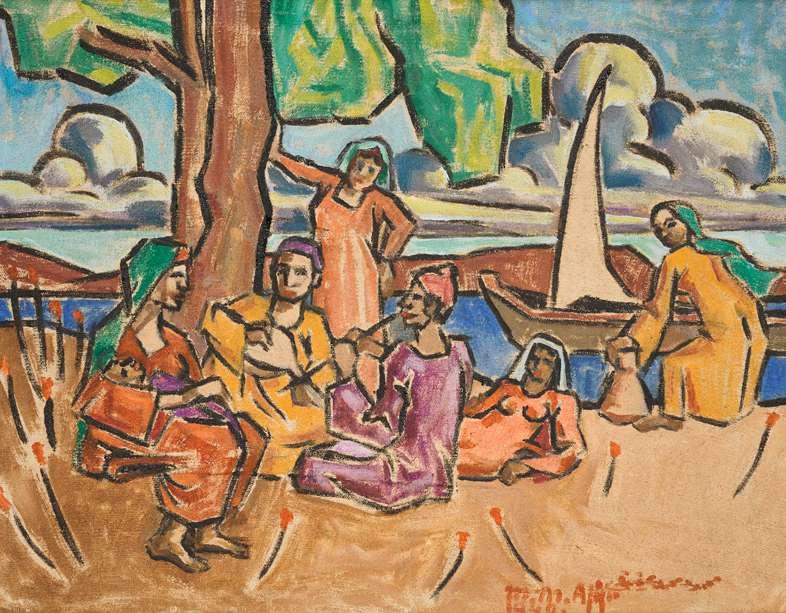
MAHMOUD AFIFI (EGYPTIAN 1920-1984)
FROM THE NEW VALLEY
signed and dated 1980 M.M. Afifi in English and Mahmoud Mohamed Afifi in Arabic lower left; inscribed From the New Valley in Arabic on the reverse oil on panel
120.2 x 73.5cm; 47½ x 287⁄8in
131.5 x 85cm; 51¾ x 33½in (framed)
Provenance
Acquired from the artist by the present owner
Born in Alexandria, Mahmoud Afifi was a cornerstone of Egyptian modernism whose career spanned continents and styles. After graduating from the Faculty of Arts in 1940, he refined his craft in Italy, earning a diploma in Painting from Rome in 1955. However, his philosophical foundation was laid much earlier under the mentorship of Hamed Said. In 1946, Afifi joined Said’s influential Art Assembly, a collective dedicated to stripping away artifice to reconnect with nature and primal origins.
Afifi is perhaps best known for his “Hard Edge” aesthetic, a technique defined by heavy, unwavering black outlines that give his figures a monumental presence. This style bore such a striking resemblance to the stained-glass aesthetic of French master Georges Rouault that Afifi became affectionately known as the “Egyptian Rouault.” His work often creates the illusion of leaded glass, where expressive shapes are held together by a sense of rhythmic grace and technical proficiency.
Beyond the canvas, Afifi was a vital cultural administrator. He spent twenty years at the Al Ghoury Agency, eventually rising to become the Director of the Handcrafts Division. Following the death of sculptor Abdel Hamid Hamdy, he also took over leadership of the Society of Al Ghoury Artists, ensuring the continuation of the founder’s vision.
Afifi’s subject matter acted as a mirror to the Egyptian soul, capturing everything from the intimacy of family life as evidenced in the present work, as well as romance and the high drama of the nation’s history. He was particularly moved by political upheaval, entering a phase where he used his canvas to symbolise the spirit of the Egyptian alliance. His depictions of historical conflicts, such as the battles of Saladin and Rashid, transformed military history into powerful visual symbolism. Later, inspired by his participation in the 1960s Spain Biennale, he transitioned into a fascination with sports, proving that his bold, structured style was as capable of capturing athletic motion as it was historical gravity.
‡ £6,000-9,000
Property of a Private Collector, Cairo
32
MAHMOUD AFIFI (EGYPTIAN 1920-1984)
UNTITILED (MUSICIANS)
signed and dated M.M Afifi / 1948 in English and Mahmoud Mohamed Afifi in Arabic lower right oil on canvas
32.6 x 40.5cm; 127⁄8 x 16in
41.3 x 49.4cm; 16¼ x 19½in (framed)
Provenance
Acquired from the artist by the present owner see note to lot 31
‡ £4,000-6,000
Property from a Private Collection, Jeddah
33
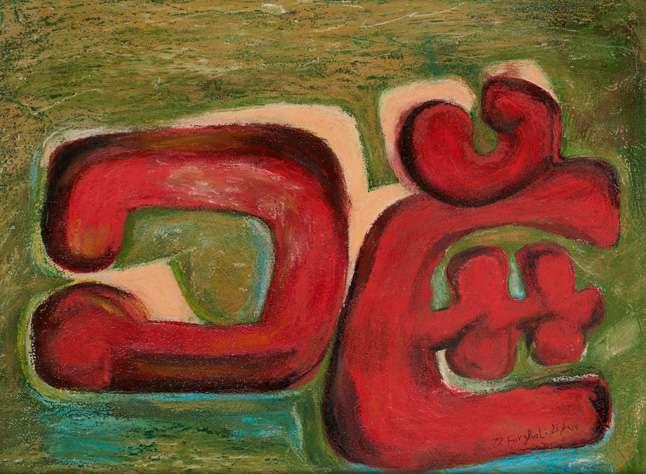
FARGHALI ABDEL HAFIZ (EGYPTIAN 1941-2023)
UNTITLED
signed and dated 72 Farghali in English and Arabic lower right oil on celotex board
32.8 x 42.8cm; 127⁄8 x 167⁄8in
46 x 55.8cm; 181⁄8 x 215⁄8in (framed)
Provenance
Zamalek Gallery
Acquired from the above by the present owner in 2021
Farghali
Abdel Hafiz
Farghali Abdel Hafiz is a prominent figure in contemporary Egyptian art, recognised for a career spanning over sixty years of aesthetic experimentation and academic leadership. Born in Deirout, he has developed a visual language that integrates Egypt’s ancient heritage with modern abstraction. His work is notable for its departure from traditional media; early in his career, he began incorporating organic materials such as sand, mud, straw, and natural pigments directly into his canvases. This focus on materiality allows his compositions to physically embody the landscape of the Nile Valley and the desert.
His artistic style frequently utilises Pharaonic, Coptic, and Islamic motifs, reimagined through a contemporary lens. By employing human silhouettes, architectural fragments, and symbolic scripts, Abdel Hafiz explores themes of cultural identity and the passage of time. His approach emphasises texture and depth, creating a tactile connection between the viewer and the environmental realities of his homeland.
Beyond his creative practice, Abdel Hafiz has been a significant influence on Egypt’s artistic infrastructure. A graduate of the Institute of Art Education in 1962, he later studied in Florence, Italy, gaining a technical perspective that bridged Middle Eastern and European traditions. He served as a professor and eventually the Dean of the Faculty of Art Education at Helwan University, where he mentored several generations of artists and advocated for a balance between local heritage and global artistic trends.
As a co-founder of the Axis Group (Jama’at al-Mihwar), Abdel Hafiz played a key role in the development of the Egyptian avant-garde. His work has been featured in major international exhibitions, including the Venice and São Paulo Biennials, and is held in significant collections across Europe and the Middle East.
‡ £8,000-12,000
Property of a Lady, Cairo 34
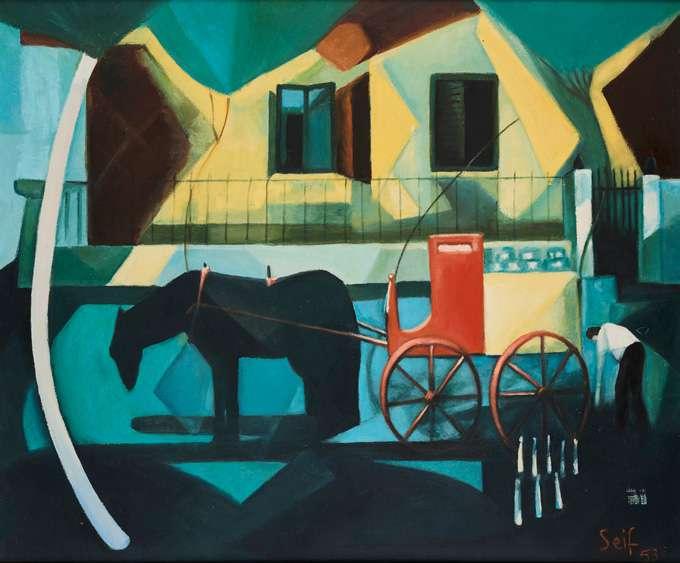
SEIF WANLY (EGYPTIAN 1906-1979)
THE MILKMAN
signed and dated Seif / 53 lower right; inscribed in Arabic on the reverse oil on board
50 x 59cm; 195⁄8 x 23¼in
56 x 66cm; 22 x 26in (framed)
Sold With a Certificate of Authenticity from the Egyptian Ministry of Culture Provenance
From the collection of the uncle of the present owner
Born in Alexandria, Seif Wanly was raised in a French-speaking Turkish aristocratic family and was privately tutored in his family house. Seif Wanly and his brother, Adham started developing an interest in painting and art. They attended Italian painter Ottorino Becchi’s new studio in Alexandria, Egypt. Becchi introduced them to avant-garde movements like Futurism and Cubism; these two techniques formed the basis from which Wanly developed his personal style defined by angular lines, bright shades and colourful geometric shapes.
Becchi left Egypt and the Wanly brothers set up their own studio in Alexandria in the 1940s, in
collaboration with filmmaker Mohammed Bayoumid. Their studio is frequently credited with bringing attention to the art of the region.
The brothers travelled extensively after the Second World War, particularly during the 1950s to France, Italy and Spain, where they sketched and painted scenes of ballet, opera, theatre performances and landscapes. In 1957, he travelled to Nubia to create a collection of paintings and drawings depicting life in Upper Egypt. This project was initiated by the government to document the culture and conditions of the area before the relocation necessary for the construction of the Aswan High Dam. During this project Seif Wanly worked with other well-known artists of their generation, including Tahia Halim and Hussein Bikar.
The Wanly brothers were close both in life and work and, after Adham died in 1959, Seif’s grief was reflected heavily in his art. The brothers were pioneers in introducing modern pictorial trends to Alexandria, depicting international subjects, and moving away from the folklorist style of their contemporaries.
⊕ £9,000-12,000
Property from a Private Collector, Toulouse 35
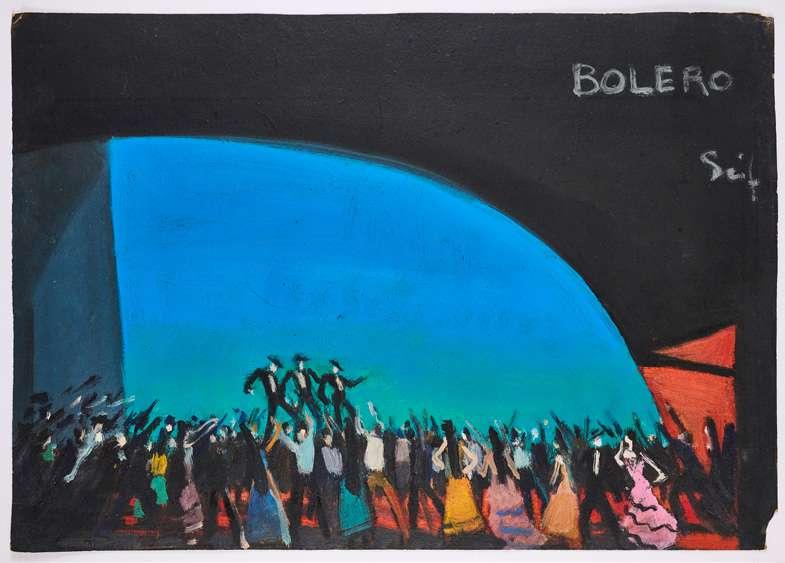
SEIF WANLY (EGYPTIAN 1906-1979)
BOLERO signed and titled BOLERO / Seif upper right oil on card
35.7 x 50.7cm; 14 x 20in unframed
Provenance
The Estate of the poet Paulette Sarradet Thence by descent to the present owner see note to lot 34
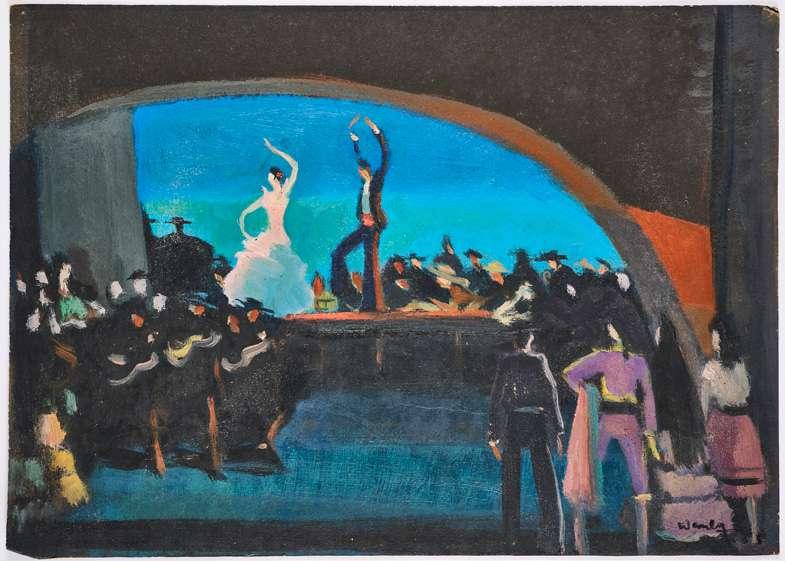
signed and dated Wanly 55 lower right; titled Bolero on the reverse oil on card
35.5 x 49.3cm; 14 x 19¼in unframed
Provenance
The Estate of the poet Paulette Sarradet
Thence by descent to the present owner
Born to an affluent aristocratic family in Alexandria, Wanly received a private education alongside his siblings, including studying oil painting with his brother, Seif, under Italian painter Arturo Zanieri (1870-1955). Wanly and his brother joined the studio of Italian painter Ottorino Bicchi (1878-1949) after it opened in Alexandria in 1929 to continue their painting studies. When Bicchi closed his studio in 1935 before the start of the Second World War, Wanly and his brother along with painter Ahmad Fahmi and filmmaker Mohammed Bayoumi opened their own studio in Alexandria. After travelling extensively throughout Europe, Wanly and his brother were appointed as professors at the Faculty of Fine Arts in Alexandria in 1957.
⊕ £3,600-5,500
SAUDI ARABIA
Property of a Lady, Madrid, Spain
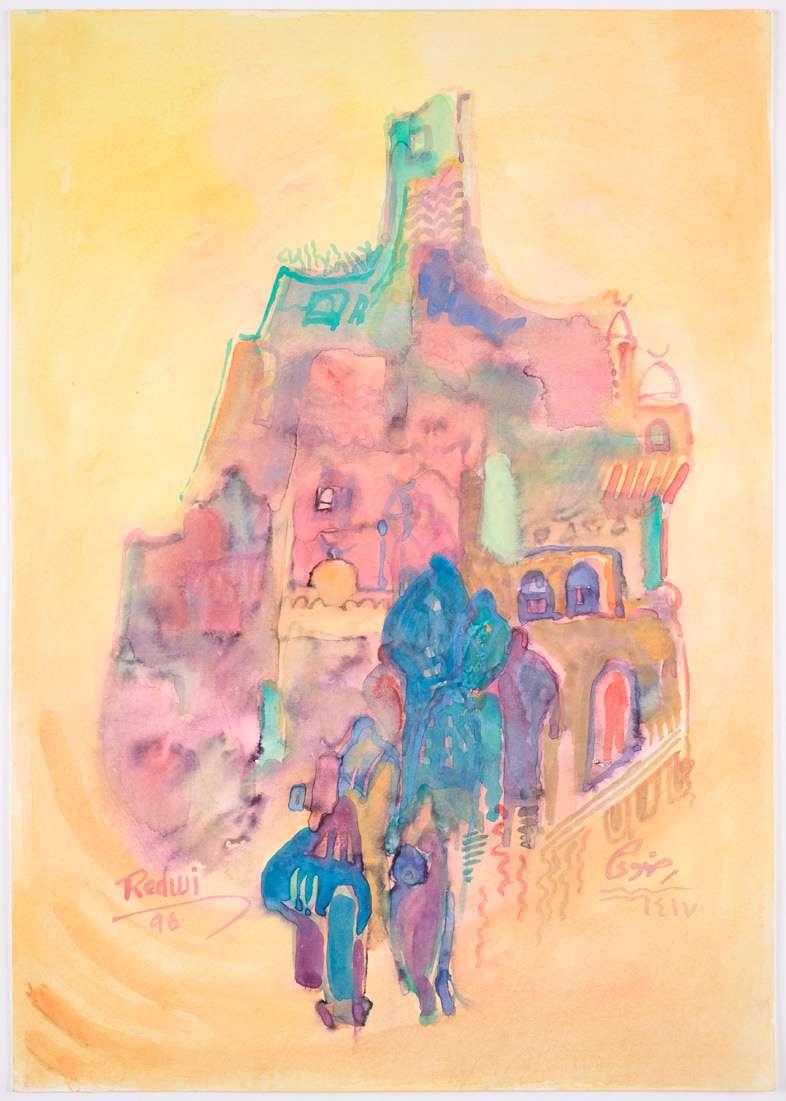
37
ABDULHALIM RADWI (SAUDI ARABIAN 1939-2006)
UNTITLED (CITY SCENE)
signed and dated Redwi / 96 lower left; signed and dated Radwi / 1417 in Arabic lower right watercolour on paper
45.8 x 32.2cm; 18 x 125⁄8in 49 x 35cm; 19¼ x 13¾in (mounted)
The authenticity of this work has been confirmed by the family of the artist.
Provenance
Faustino Moreno Villalba Collection, Spain
Acquired from the above as a gift by the present owner
Abdulhalim Radwi, born in Mecca, Saudi Arabia, was a prominent sculptor, curator, and poet whose artistic practice was shaped by both his cultural heritage and modernist influences. Radwi significantly contributed to the advancement of Saudi modernism, drawing upon his experience as one of the Kingdom’s pioneering artists to pursue studies abroad. He earned his Fine Arts degree in Rome between 1961 and 1968, a period during which his work evolved from realism towards abstraction. Upon returning to Saudi Arabia, he began teaching, which reinforced his reputation within the local arts community and inspired emerging artists such as Taha Al Sabban and, later, Ahmed Mater. Although deeply engaged with Western art movements, Radwi remained committed to his roots, integrating elements of Arab heritage into Cubist and Expressionist frameworks, which distinguished his work from that of his peers.
In the 1970s, Radwi served as Action Director of the Association for Arab Artists in Madrid and completed his studies at the Royal Arts Academy in 1979. That same year, he was awarded a professorship and taught in Madrid until 1984. Throughout his prolific career, Radwi produced thousands of artworks and held leadership roles in numerous art organisations, including serving as director of Jeddah’s Centre for Fine Arts.
His works have been exhibited throughout the Middle East and Europe, notably receiving third prize at the Ibiza Biennale in 1968. Radwi’s body of work exemplifies a sophisticated synthesis of tradition and innovation, and his integration of regional themes with contemporary techniques paved the way for the development of modern Saudi art.
‡ £4,000-6,000
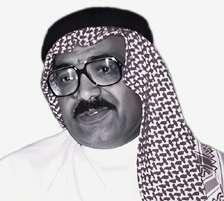
Abdulhalim Radwi
Property of a Lady, Madrid, Spain
38
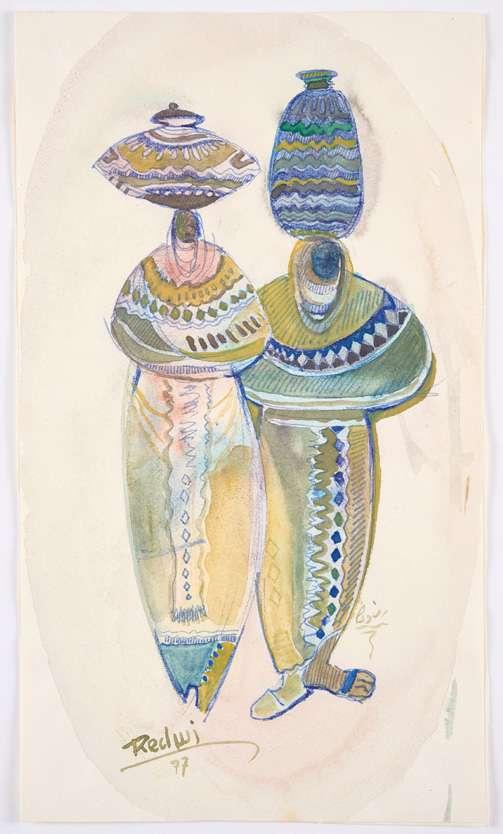
ABDULHALIM RADWI (SAUDI ARABIAN 1939-2006)
UNTITLED (WOMEN WITH POTS)
signed and dated Redwi / 77 in English; signed Radwi in Arabic lower centre watercolour on paper
30.7 x 18.2cm; 12 x 71⁄8in
41.7 x 29.5cm; 163⁄8 x 115⁄8in (mounted)
The authenticity of this work has been confirmed by the family of the artist.
Provenance
Faustino Moreno Villalba Collection, Spain
Acquired from the above as a gift by the present owner
see note to lot 37
‡ £4,500-6,000
Property of a Lady, Madrid, Spain
39
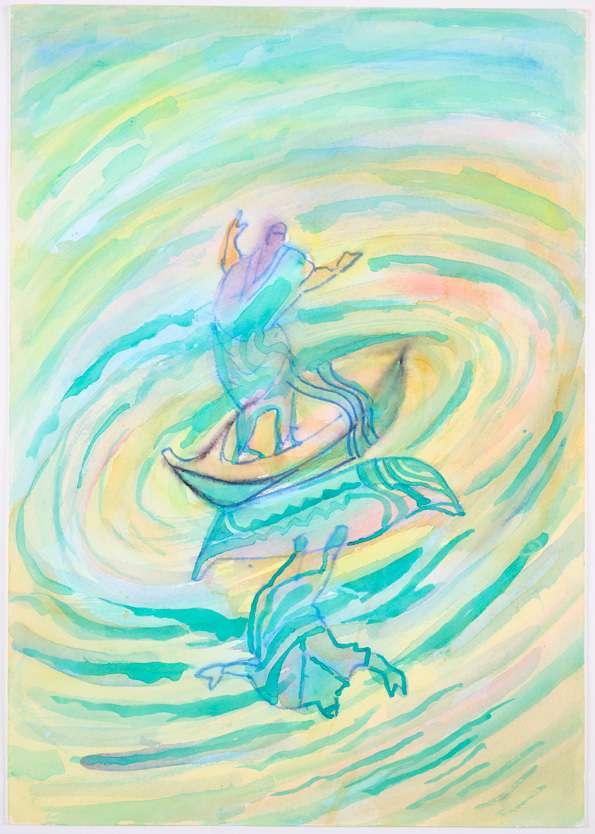
ABDULHALIM RADWI (SAUDI ARABIAN 1939-2006)
UNTITLED (BOAT)
watercolour on paper
45.8 x 32.1cm; 17¾ x125⁄8in
49.1 x 35.1cm; 19¼ x 13¾in (mounted)
The authenticity of this work has been confirmed by the family of the artist.
Provenance
Faustino Moreno Villalba Collection, Spain
Acquired from the above as a gift by the present owner
see note to lot 37
‡ £4,000-6,000
Property of an Important Collector, London
40
YOUSEF JAHA (SAUDI ARABIAN B.1953)
UNTITLED
signed JAHA in English and Arabic lower left acrylic on canvas
86.2 x 86cm; 3315⁄16 x 337⁄8in unframed
Sold with a Certificate of Authenticity from Al-Alamia Gallery
Provenance
Acquired directly from the artist by the present owner
Yousef Jaha is a prominent Saudi visual artist whose work is central to the development of contemporary abstraction within the Kingdom. Based in Makkah, his practice focuses on the intersection of landscape and formal abstraction, moving away from literal representation toward a study of colour, light, and spatial rhythm.
Jaha’s aesthetic is defined by a disciplined use of texture and a palette often inspired by the natural environments of the Hijaz region. His compositions frequently employ fluid, gestural brushwork to explore the structural elements of nature, distilling complex vistas into simplified forms. This approach allows for an emphasis on the emotive qualities of oil and acrylic, prioritising the balance of the canvas over decorative detail.
A long-standing figure in the Saudi art community, Jaha has participated in numerous domestic and international exhibitions, including showcases at Athr Gallery and various state-sponsored cultural initiatives. His career reflects a sustained commitment to the evolution of the Saudi art scene, contributing to a modern visual discourse that integrates regional identity with a universal abstract language. His work is held in several significant private and public collections throughout the Middle East.
£3,000-5,000
Property of an Important Collector, London
41
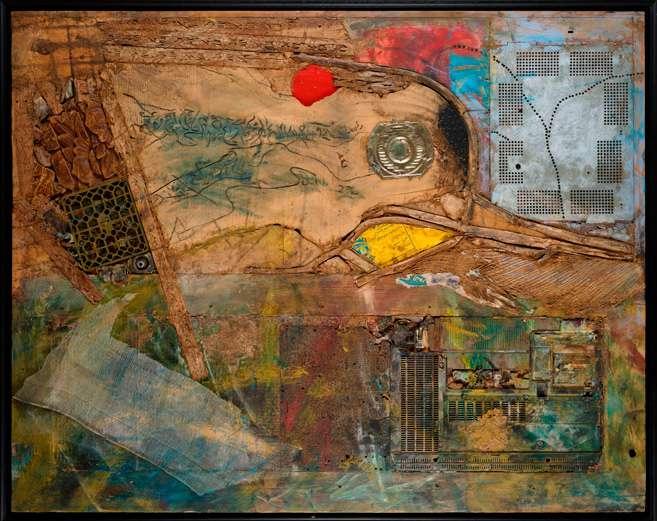
MOHAMMED AL GHAMDI
(SAUDI ARABIAN B.1959)
UNTITLED (RECLAIMED WOOD)
signed M. ALGhamdi and inscribed in Arabic on the reverse mixed media on board
113.6 x 143.7cm; 44¾ x 565⁄8in
119.5 x 149.6cm; 47 x 587⁄8in (framed)
Sold with a Certificate of Authenticity from Al-Alamia Gallery
Provenance
Acquired directly from the artist by the present owner
Mohammed Al Ghamdi is a pioneering Saudi contemporary artist whose work serves as a bridge between the Kingdom’s engineering evolution and its rich cultural heritage. Born in Al Baha, Al Ghamdi pursued a formal education in Aviation Engineering in California, graduating in 1982. This technical background profoundly influences his artistic practice; he frequently employs engineering principles to deconstruct and reassemble discarded materials, most notably recycled wood and found objects. His practice is a deliberate act of “fossilising” moments and materials that a rapidly modernising society might otherwise deem obsolete, transforming refuse into evocative sculptures and mixed-media installations that challenge modern notions of value and beauty.
Since his first major exhibitions in Jeddah during the late 1990s, Al Ghamdi has become a staple of the Middle Eastern art scene. His career is marked by a series of significant international milestones, including participation in the Cairo Biennale in 2001 and the Nahbat exhibition in Shanghai in 2010. His work has been featured in seminal showcases organised by Edge of Arabia and is included in prestigious collections such as the Basma AlSulaiman Collection (BASMOCA). Most recently, his contributions were highlighted in the 2026 Diriyah Contemporary Art Biennale and the “What Lies Within” exhibition in AlUla, underscoring his continued relevance in documenting Saudi identity through a sophisticated, material-driven lens.
Based in Jeddah, Al Ghamdi remains a critical figure in the generation of artists who shifted the Saudi art narrative from traditional decoration to conceptual, environmentally-conscious contemporary expression.
£4,000-6,000
Property of a Private Collector, London
42
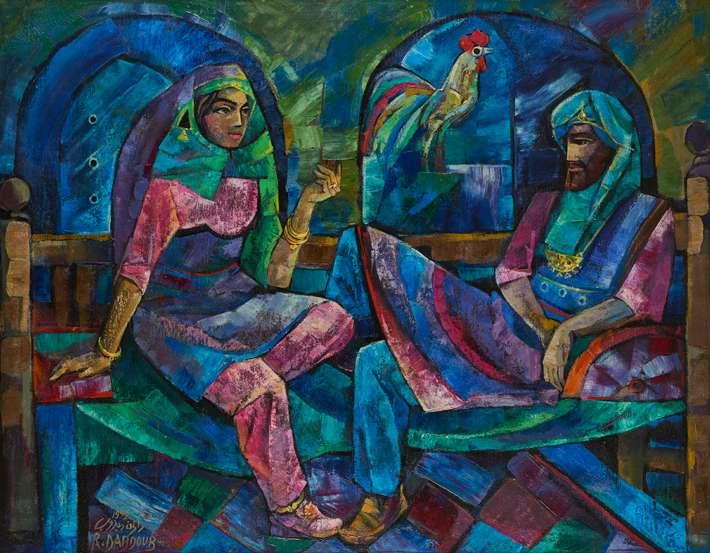
RAKAN DABDOUB (IRAQI 1941-2017)
UNTITLED
signed and dated 1992 / R DABDOUB in English and Rakan Dabdoub in Arabic lower left oil on board
85.3 x 109cm; 851⁄8 x 427⁄8in
97.1 x 120.9cm; 38¼ x 47½in (framed)
Sold With a Certificate of Authenticity signed by the Artist’s son
Rakan Dabdoub (1941-2017) was a prominent figure in Iraqi Modernism whose career was defined by a rigorous exploration of form and a deep engagement with regional heritage. Educated at the Institute of Fine Arts in Baghdad and the Academy of Fine Arts in Rome, his style evolved from classical figuration into a sophisticated, structural abstraction. Throughout his decades of practice, Dabdoub maintained a balance between technical precision and a rhythmic, almost lyrical approach to the canvas, earning him international recognition and numerous technical accolades.
A significant portion of Dabdoub’s work was dedicated to the interpretation of folklore and
literary tradition, most notably through his depictions of Scheherazade and King Shahryar from the One Thousand and One Nights as depicted in the current lot. In these series, he utilised his signature geometric style to reimagine the power dynamics of the narrative. Rather than relying on literal illustration, Dabdoub distilled these figures into symbolic forms, using layered textures and a controlled palette to evoke the atmosphere of the tales. His portrayal of Scheherazade, in particular, often emphasised a sense of structural grace, positioning her as a central pillar of intelligence and survival.
In his later period, his work moved toward a more minimalist abstraction. He treated the canvas with a tactile sensibility, often employing thick impasto and rhythmic perforations to create surfaces that felt physical and enduring. These compositions moved beyond mere representation, focusing instead on the interplay of light, shadow, and patterned repetition. By the end of his life, Dabdoub had established a visual language that was both highly personal and broadly resonant, securing his legacy as a master of form and a vital contributor to 20th century art.
£9,000-12,000
Property of a Private Collector, London 43
NAJIB YOUNIS (IRAQI 1930-2007) DRUMMERS
signed and dated Najib Younis / 2000 in Arabic lower right oil on canvas
79.4 x 93.6cm; 31¼ x 36¾in
99.8 x 114cm; 393⁄8 x 447⁄8in (framed)
Najib Younis was a cornerstone of the 20th century Iraqi art movement, celebrated for his ability to blend academic precision with a deep, soulful devotion to his homeland. Born in Mosul, he refined his craft in Cairo during the 1950s, where he mastered the nuances of Impressionism under Egyptian masters. However, rather than remaining in the sphere of European styles, Younis returned to Iraq to pioneer a movement known as “Popular Realism,” focusing his lens on the vibrant daily life, architecture, and people of his native city.
Beyond his technical mastery of oils and portraiture, Younis was a visionary educator who shaped the artistic landscape of Northern Iraq. He founded the University Studio at Mosul University and established several departments at the Institute of Fine Arts, ensuring that future generations had the tools to express their own cultural identity. By the time of his passing in 2007, he had earned his place as a pioneer of Iraqi art, leaving behind a vast body of work that serves as a luminous, historical record of Mosul’s enduring spirit.
Najib Younis’s artworks are held in several prestigious public and private collections that focus on modern Arab and Iraqi art. Because he was a central figure in the “Pioneers” movement, his work is often featured in institutional surveys of Middle Eastern modernism.
The most notable collections include The Ibrahimi Collection (Amman/Baghdad), Dar Al-Anda Art Gallery (Amman, Jordan), The Museum of Modern Art (Baghdad), the University of Mosul Collection and Private Collections in the UAE and Bahrain.
£5,000-7,000
Property of a Lady, London
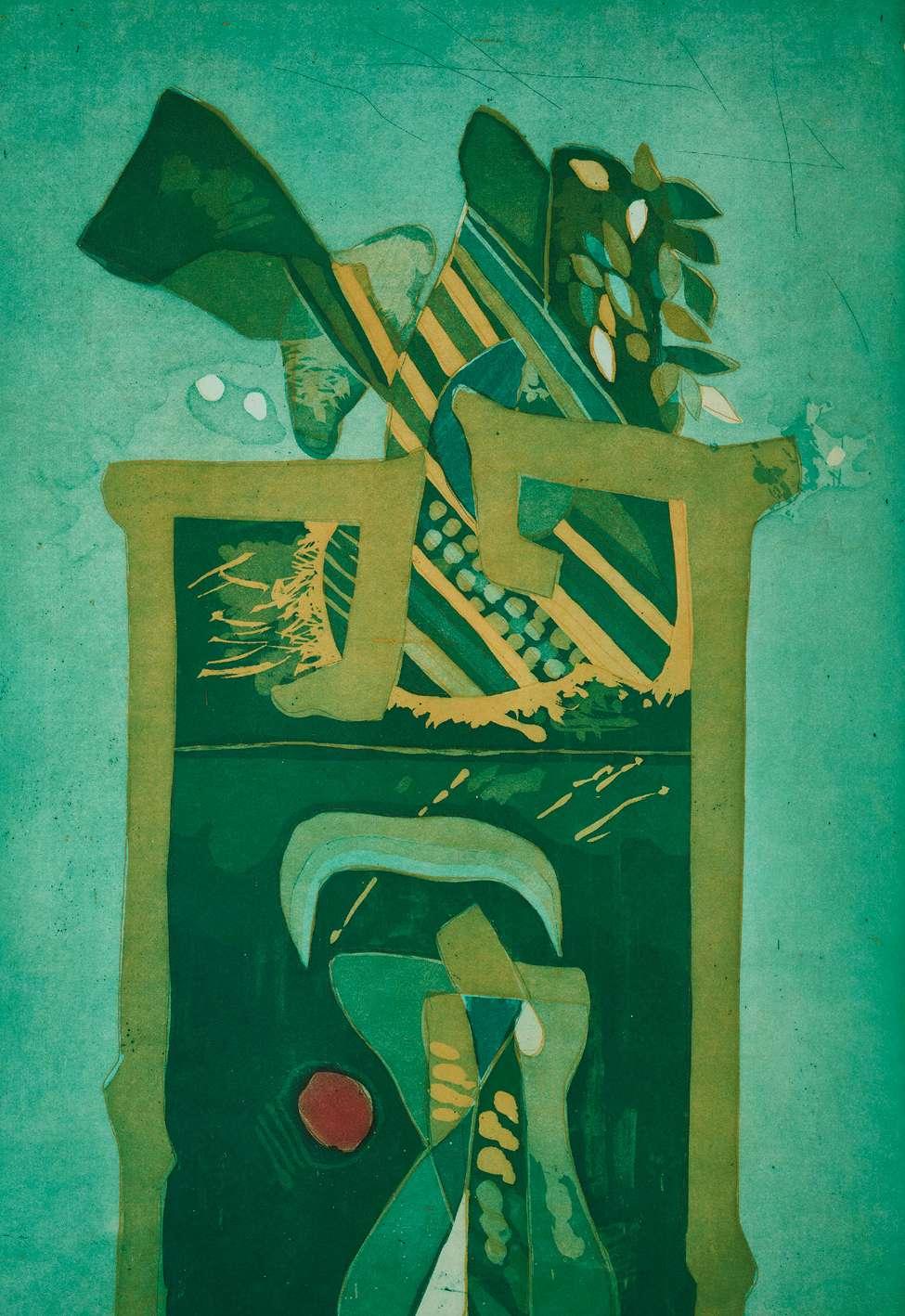
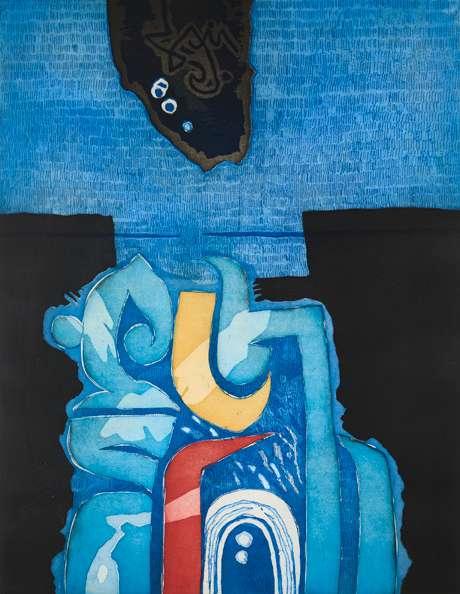
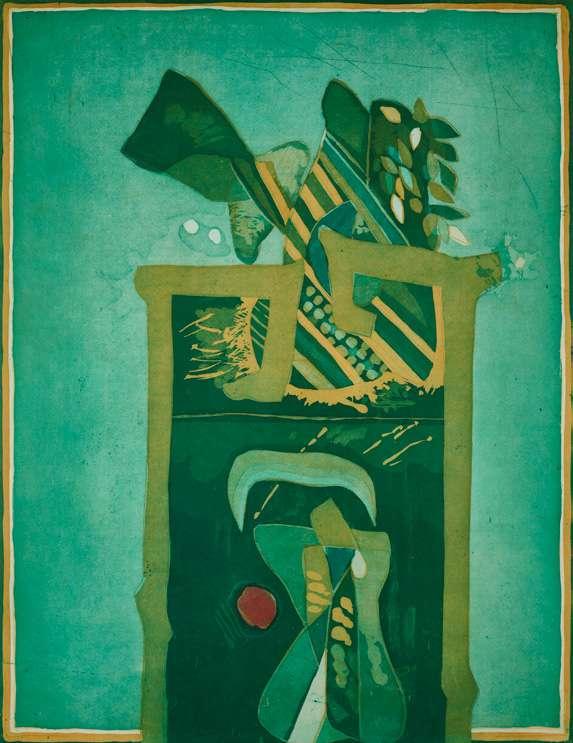
DIA AL AZZAWI
(BRITISH
/ IRAQI B.1939)
IMAGE NO 1
inscribed 15/15 / IMAGE No1 / Azzawi / 1983 lower margin etching and aquatint on Somerset mould-made 300gsm paper
94.5 x 75.6cm; 37¼ x 29¾in
100.2 x 81.5cm; 393⁄8 x 32in (framed)
Edition 15/15
Al Azzawi began creating art at a young age, drawing illustration reproductions from magazines and scenes from his family life. This natural talent was encouraged and developed in his time at al-Markaziyyah high school from which he graduated in 1958. He then attended the College of Arts, Baghdad, completing his degree in archaeology in 1962. While there, al-Azzawi was encouraged by friends in the al-Marsam al-Hurr group (the Free Studio) to attend night classes at the Institute of Fine Art to continue his art studies, which he completed in 1964.
His early work drew from many sources of inspiration, including the Sumerian figurine, visual motifs from popular culture and everyday life, and legends and folklore such as Gilgamesh and Imam Hussain. After Al Azzawi moved to London in 1976 to expand his practice and escape the increasingly oppressive Ba’thist state, he moved towards exploring the interaction of visuals and the written word through experimentations with poetry, such as the al-qaseedah al-marsumah or ‘drawn poem’. In 1979, he continued to create visual representations for poetry using al-qaseedan al-marsumah.
After 1983, Al Azzawi returned to earlier motifs like colour through the form of the Arabic letter and the influences of classic literature such as One Thousand and One Nights but now through the medium of prints. Al-Azzawi continued to explore the convergence of visuals and the written word by producing dafatir, or artists books, which reflected the poetry of the great Arab poets. Beginning in 1989, Al Azzawi produced over 40 dafati and it became a place for him to reflect on political events such as the start of the Gulf War in 1991.
Al Azzawi’s Al-Jawahi verses were based on the poems by Iraqi poet Muhammad Mahdi Al-Jawahiri, born in 1899 in Najaf. Al-Jawahiri’s father, ‘Abd al-Husayn was a religious scholar among the clergy in Najaf who wanted his son to be a cleric as well. So he dressed him in a cleric’s ‘Abaya and turban at the age of ten. The origin of Al-Jawahiri goes back to his Najafi, Iraqi family. Since the 11th century Hijri (15th century CE), the most famous people have inhabited Najaf, and individuals named al-Najafi have earned the title ‘Bejeweled’ (or al-Jawahiri) for their relationship to the book of fiqh values (religious scholarship), which one of his family’s ancestors, Shaykh Muhammad Hasan al-Najafi, had written.
⊕ £1,000-1,500
Property of a Lady, London 45
DIA AL AZZAWI (BRITISH / IRAQI B.1939)
ORIENTAL GARDEN
inscribed A.P.S / Oriental Garden / Azzawi / 1983 lower margin etching and aquatint on Somerset mould-made 300gsm paper
Born in Mosul, Kakafian was the youngest member to be accepted into the Baghdad Modern Art Group and went on to exhibit extensively in both Baghdad and Paris, having studied at the Ecole des Beaux-Arts in Paris. His work spanned many genres including Expressionism, Chinese inkwork, miniature paintings and political propaganda for which he spent time in prison.
Much of his work is influenced by his personal experiences as well as Impressionism, described by the Egyptian artist Ahmed Morsi as an ‘explorer of a self-diaspora’ and ‘an eloquent mesh of personal architecture and poetry’.
⊕ ‡ £2,500-3,500
Property of a Private Collector, The Netherlands
47
ARDASH KAKAFIAN (IRAQI 1941-2000)
THE FLAUTISTS
acrylic on canvas
129.7 x 97cm; 51 x 381⁄8in unframed
Executed circa 1990
Provenance
Studio of the artist
Acquired from the above by the present owner see note to lot 46
⊕ ‡ £1,400-2,400
Property from a Private Collection, Ontario 48
WIDAD AL-ORFALI (IRAQI B.1929)
UNTITLED
signed and dated in W. ORFALI / 1992 in English and Widad Orfali in Arabic lower right watercolour and pen on canvas 99 x 79.6cm; 38¾ x 31¾in 106.4 x 87.3cm; 42 x 34¼in (framed)
Born in 1929, Widad al-Orfali studied at the Beirut College for Women for three years, before attending the Institute of Art in Baghdad studying under artists Faiq Hassan, Faraj Abbo, Ismail al-Shaikhly and other prominent figures. She graduated from the Institute in 1960 and subsequently held her first solo exhibition in West Germany in 1964.
In 1983, Al-Orfali and her cousin established the first private art gallery in Iraq eponymously named the Orfali Gallery that later expanded into a cultural centre, increasing their offerings beyond art exhibitions. The new space hosted musical performances, language classes and poetry readings, and became synonymous as a hub of creativity drawing audiences from far and wide.
Al-Orfali’s paintings are known for focusing on fantasy cityscapes, which she calls ‘dream cities’. The works amalgamate architectural forms and traditional floral motifs inspired by regions the artists had visited, namely Andalusia and Baghdad.
The present lot is an exquisite work presenting an imaginary view of the skyline of Baghdad, incorporating a myriad of mosques and gardens, as it might have been soon after its creation in CE 762/AH 144 by the second Abbasid Caliph, al-Mansur.
Acquired directly from the artist by Michael William Palmer
Thence by descent to the present owner
Michael William Palmer was an American civil engineer working for Acres International, a Canadian engineering firm, when he received the assignment to travel to Iraq in 1976. During his four years as an expatriate, he primarily oversaw construction of electrical substations and transmission lines across Iraq, including Khor Al Zubair, Al Diwaniyah, Baghdad, and Al-Qa’im. While working in Iraq, Mr Palmer became greatly impressed with the skill and inspiration of Iraqi artists. He attended many art exhibitions and numerous studios, developing personal friendships with the artists whose works he acquired. He carefully documented all the works in his collection and kept notes of his personal encounters with the artists he collected, which provide a valuable insight into the history of the collection.
Amer Al Obaidi is a prominent Iraqi-born painter known for blending Arabian folklore with modern themes. Born in Najaf into a large, wealthy, Muslim family, his talent was recognised in childhood, leading him to earn a BA in Fine Arts from Baghdad University in 1969. He gained international acclaim early, winning first place at a festival in Ibiza, Spain, at age 22.
Throughout his career, Al Obaidi was a key figure in the Iraqi art scene as a member of the influential group Al-Mujadidin (The Innovationists) whose notable members included Salman Abbas, Salim al-Dabbagh, Salem al-Jumai’e, Faeq Hassan, Nida Kadhim and Talib Makk. He held several high-ranking administrative roles, serving as the Director of the National Museum of Modern Art in Baghdad (1973-1983) and later as Iraq’s General Director of Fine Arts. During a three-year stint teaching in Saudi Arabia, he also designed a major wall carpet for the King Abdulaziz International Airport. He now resides in Iowa, United States.
Al Obaidi’s work places a great deal of emphasis on Arabian folklore in general, and Iraqi tradition in particular. A recurring element in his paintings is the Arabian horse. He also paints works depicting his personal experiences of life in a war-torn land in an effort to alert audiences to the suffering endured by local people under the hands of the foreign occupiers.
‡ £2,000-3,000
Property of a Private Collector, Texas 50
AMER AL OBAIDI (IRAQI B.1943)
MARSHLANDS
1977 oil on wood
45 x 120cm; 17¾ x 471⁄8in
Provenance
Acquired directly from the artist by Michael William Palmer Thence by descent to the present owner see note to lot 49
‡ £2,000-3,000
SYRIA
“Despite its power, I use red with kindness, and I often soften it with strokes of black or gold to overpower its strength…” Fateh Moudarres
FATEH MOUDARRES (SYRIAN 1922-1999)
LES AMANTS (THE LOVERS)
signed Moudarres in Arabic lower right; inscribed in Arabic on the reverse oil and sand on canvas 40.5 x 30.5cm; 16 x 12in unframed
Executed in 1993
A seminal figure in Syrian art, Fateh Moudarres is a pioneer of modern painting in his country, integrating elements of Assyrian art with Christian iconography and European modernism. Born in Aleppo, Moudarres studied at the Accademia delle Belle Arti in Rome and later at the Ecole des Beaux Arts in Paris (1972) where he was deeply influenced by Christian symbolism as well as Surrealism and abstraction. The presence of totemic figures in compositions such as this one are reminiscent of Assyrian statuary and ancient Sumerian and Islamic art.
Moudarres’ flattened figures, muted palette, and dreamlike abstraction have featured in some of the foremost international exhibitions, including the Venice Biennale, the São Paulo Biennale, the New York International Art Fair and Contemporary Arab Art Exhibition in Paris. Towards the end of his career, Moudarres moved to Syria where he was a lecturer at the University of Damascus until his death. In 2019, the artist was the subject of the major retrospective Fateh al-Moudarres: Colour, Extensity and Sense held in the Arab Museum of Modern Art in Doha.
‡ £6,000-7,000
52
FATEH MOUDARRES (SYRIAN 1922-1999)
BEIRUT
signed and dated Moudarres / 1986 in English and Moudarres in Arabic lower right; inscribed in Arabic on the reverse mixed media on wood
40 x 31cm; 161⁄8 x 121⁄8in unframed
Executed in 1986
see note to lot 51
‡ £7,500-9,500
Fateh Moudarres
Courtesy of the Fateh Moudarres Estate
53
HAMMOUD CHANTOUT (SYRIAN B.1956)
L’ATTENTE
signed and dated Chantout 2018 lower right; inscribed on the reverse mixed media on linen canvas 135 x 140cm; 53¼ x 55in unframed
Provenance
Studio of the artist
Hammoud Chantout studied at the University of Fine Arts in Damascus until 1980, before pursuing his artistic training in the Ecole des Beaux-Arts in Paris, earning top honours in 1984.
A prominent figure in the contemporary Syrian art scene, Chantout’s works have graced solo and group exhibitions worldwide, earning him a revered place in private collections and prestigious institutions such as the Ministry of Culture and the National Museum in Syria.
Courtesy of the artist
The artist’s style is defined by heavily textured mixed media canvases that seamlessly blend abstract approaches with figurative subject matter, creating compositions that are both delicate and mysterious. He employs a variety of media, including acrylic, oil, collage elements, and textured materials, to achieve his signature layered and otherworldly aesthetic. This versatile use of media adds depth and a tactile quality to his works, inviting viewers to engage with the intricate details of each piece.
‡ £4,000-6,000
Hammoud Chantout
Property of a Lady, London 54
OMRAN YOUNES (SYRIAN B.1971) THE BRIDE
signed dated in English and Arabic Omran Younes 2004 lower right
199.5cm x 189.3cm;78½ x 74½in unframed
Sold with a Certificate of Authenticity Provenance
Acquired directly from the artist by the present owner Born in Hassakah, Omran Younes began his artistic journey after graduating with a Bachelor’s degree from the Faculty of Fine Arts in Damascus in 1998, later earning a Master’s degree in Fine Arts in 2000. Younes’s influence stretches across both the Middle East and the United States, where his work has been exhibited. He was awarded first prize at the 3rd Annual Youth Competition in Damascus, affirming his reputation as an accomplished artist.
Younes is known for large-scale canvases that immerse viewers in the complexity of human emotions and experiences. His paintings capture subtle details, revealing deep insight and empathy
toward his subjects. Throughout his career, he has displayed notable versatility in expressionist painting, dedicating each series to distinct themes and continuously exploring new avenues of artistic expression.
Emerging from Syrian modernism, Younes respects his artistic heritage yet carves out his own unique style within contemporary art. His works combine bold social commentary, sharp observation, and refined technique, illustrating his steadfast dedication to innovation and self-expression.
Having been featured in exhibitions throughout the Middle East and in the US, Younes has received critical acclaim at home and abroad holding solo exhibitions at art spaces such as Ayyam Gallery, Beirut and Zara Gallery, Amman. He was featured at the Virginia Commonwealth University Gallery in Doha alongside such prominent Arab artists as Dia Azzawi, Mona Hatoum and Youssef Nabil. His work is housed in collections across the Arab world, including the Atassi Foundation and in 2022, he featured in the Syrian Pavillion at the 59th Biennale Arte di Venezia
£2,500-3,500
Property of a Private Collector, Amman 55
MARWAN KASSAB-BACHI (SYRIAN / GERMAN 1934-2016) KOPF
signed MARWAN lower right watercolour on paper 71 x 51.8cm; 28 x 203⁄8in unframed
Provenance
Private Collection
Acquired from the above through a European auction house
The late Syrian-German artist Marwan Kassab-Bachi, known by his first name Marwan, has been attracting attention from German and Middle Eastern institutions for many years, who are drawn to his expressive style of figuration.
“Painting is my life, it is like breathing to me”
Marwan Kassab-Bachi
Born in Damascus into a wealthy family, Marwan studied Arabic literature at Damascus University from 1955 to 1957. Already an amateur painter he, like many of his contemporaries, was curious to explore European literary and artistic culture. In 1957 he travelled to Paris with the purpose of engaging with the existentialist intelligentsia of the city, but almost by chance, ended up instead in Berlin. Here he studied painting under Hann Trier at the Hochschule für Bildende Künste. His fellow students at the time were the late Georg Baselitz and Eugen Schönebeck and for a few years, these three painters were close friends and experimenters. Together they liberated their painting from the tragedy of the post war period and instead rediscovered the potency of the human figure. It was this obsession with the human figure which was to last throughout the rest of Marwan’s life.
From the early 70s his focus shifted and narrowed into depicting more intimate human heads – his inner self-portrait. In 1973 Marwan achieved his life-long ambition and lived for a year in Paris on a scholarship from the Cité des Arts. It was at this time that his distinctive splashily deconstructed style also emerged. Still engaged almost exclusively with figuration, his obsession with self-portrait heads became augmented in the 1980s with a marionette he was given, which became his trusted model.
The complexity behind these later compositions is exemplified by the artist’s technique. He applies layer after layer with great patience and intensity, which acts metaphorically to highlight the multi-layered human psyche. Simultaneously portraying proximity and distance, as one moves closer to the image, it gradually blurs, morphing into a shimmering radiant field of colour that offers an exemplary insight into the inner workings of Marwan’s mind.
Oscillating between ‘Orient’ and ‘Occident’, political and spiritual, his deeply personal focus on the human figure for him became a way of expressing the dramatic depth of life and consequently a universal message for all humanity.
Internationally, his work has been featured in the 57th Venice Biennale in 2017 in Christine Marcel’s The Pavilion of Joys and Fears, as well as the exhibition of the Sharjah based Barjeel Foundation’s collection at the Whitechapel Art Gallery in London in 2016. His career has been the subject of solo exhibitions at the Mosaic Rooms in London in 2015, and the Serralves Museum of Contemporary Art, Portugal in 2014 (curated by Catherine David). He has two works in Tate Modern’s collection as well as featuring in the collections of the British Museum, Bibliothèque Nationale de France, Paris, Centre Georges Pompidou, Paris, the Museum of Contemporary Art, Chicago and the Carnegie Museum of Art, Pittsburgh.
⊕ ‡ £6,000-8,000
Property of a Private Collector, Amman
56
MARWAN KASSAB-BACHI (SYRIAN / GERMAN 1934-2016) KOPF
signed and dated Marwan / Nov 03 on the reverse watercolour on paper
29.5 x 40cm; 115⁄8 x 15¾in unframed
Provenance
Private collection, Amman
Acquired by the present owner from the above in 2010 see note to lot 55
MARWAN KASSAB-BACHI (SYRIAN / GERMAN 1934-2016) KOPF
signed and dated MARWAN 2003 centre left; inscribed Marwan / Nov 03 on the reverse watercolour on paper
29.5 x 40.5cm; 115⁄8 x 16in unframed
Provenance
Private collector, Amman
Acquired by the present owner from the above in 2010
see note to lot 55
⊕ ‡ £4,000-6,000
JORDAN
Property of a Private Collector, Amman
58
AMMAR KHAMMASH (JORDANIAN B.1960)
UNTITLED
signed and dated Ammar / 2003 in Arabic lower right oil on MDF board
40 x 48cm; 15¾ x 187⁄8in
54.5 x 62.8cm; 21½ x 24¾in (mounted)
Sold With a Certificate of Authenticity signed by the Artist Provenance
Acquired from the artist by the present owner
Born in Amman, Ammar Khammash is a prominent Jordanian whose diverse talents encompass painting, architecture, photography, and scientific exploration. Renowned for his work in historical preservation, Khammash has held eighteen solo art exhibitions and contributed to more than twenty group shows since 1978. His commitment to environmental and community development is reflected in several projects across Jordan, and his passion for Jordan’s heritage has resulted in a vast photographic archive documenting its architecture, anthropology, archaeology, and landscapes.
Khammash graduated with a BA in Architecture from the University of Southwestern Louisiana in 1986 and later pursued graduate studies in Ethnoarchaeology at Yarmouk University from 1987 to 1988. He has published influential works, including “Jordan, A Timeless Land” and “Notes on Village Architecture in Jordan”, and continues to live and work in Amman. His unique artistic style is shaped by his training in architecture and ethnoarchaeology, treating landscapes as layered records of history. His paintings are noted for their textured, earthy qualities, often appearing as extensions of the very terrain they portray – capturing the enduring, rugged essence of Jordan’s land.
‡ £3,000-5,000
Property of a Private Collector, Amman 59
AMMAR KHAMMASH (JORDANIAN B.1960)
UNTITLED
signed and dated Ammar / 2005 in Arabic lower left; signed and dated Ammar Khammash / Jordan / 2005 on the reverse oil on canvas
49.2 x 58.2cm; 193⁄8 x 227⁄9in unframed
Sold With a Certificate of Authenticity signed by the Artist Provenance
Acquired from the artist by the present owner see note to lot 58
‡ £3,000-5,000
IMPORTANT INFORMATION FOR BUYERS
SECTION A
1. INTRODUCTION
The following notes are intended to assist Bidders and Buyers, particularly those who are inexperienced or new to our saleroom. The sale of goods at our auctions are governed by our Terms of Sale (for Live Auctions or Online Auctions as applicable), our Privacy Policy, the Important Information for Buyers, and any notices that are displayed in our saleroom or announced by the Auctioneer (in the case of a Live Auction) or displayed on any Listing for a Lot in our Online Auction catalogue (in the case of an Online Auction) (collectively, the “Terms and Conditions of Business”). The Terms and Conditions of Business are available for inspection on our Website and at our saleroom on request. Our staff will be happy to help you if there is anything in our Terms and Conditions of Business that you do not fully understand. Please make sure that you read the applicable Terms of Sale carefully before bidding. If your bid is successful, you will be obliged to comply with our Terms of Sale.
2. AGENCY
As Auctioneers we usually act on behalf of the Seller whose identity, for reasons of confidentiality, is not normally disclosed. If you buy at auction your Contract for your purchase of the goods is with the Seller, not with us as Auctioneer.
3. ESTIMATES
Estimates are designed to help you gauge what sort of sum might be involved for the purchase of a particular Lot. Estimates may change and should not be thought of as the Lot’s value or predicted sale price. The lower Estimate may represent the Reserve price (the minimum price for which a Lot may be sold) and will not be below the Reserve price. Estimates do not include the Buyer’s Premium or VAT (where chargeable). Estimates are prepared some time before the auction and may be altered by a saleroom notice or announcement by the Auctioneer before the auction of the Lot (for Live Auctions), or on the Listing for a Lot in our Online Auction catalogue before the auction of the Lot (for Online Auctions). They represent a matter of opinion and are not definitive.
4 BUYER’S PREMIUM
The Terms of Sale oblige you to pay a Buyer’s Premium at 25% on the Hammer Price of each Lot purchased. The Buyer’s Premium is subject to VAT at the standard rate (currently 20%).
5. VAT
The following paragraphs are intended to give general advice on VAT for items purchased at auction. We have covered the common situations, and this may not be comprehensive. We are unable to offer Tax advice and we suggest you seek independent advice if you require clarifications or further information.
5.1 Items in our catalogue may be marked in the following ways:
(a) (†) indicates that VAT is payable by the Buyer on both the Hammer Price and the Buyer’s Premium. VAT will be chargeable at the standard rate (presently 20%) for most Lots. Qualifying books will be charged at 0%. This imposition of VAT is likely to be because the Seller is registered for VAT within the UK and is not operating the Dealers’ Margin Scheme on their consignment to us.
(b) (‡) indicates that the Lot has been imported from outside the UK using customs Temporary Admissions procedures. Import VAT of 5% (reduced rate due to nature of the Lot) is due on the Hammer Price and an amount in lieu of VAT at 20% will be included in the Buyer’s Premium. This VAT on the Buyer’s Premium cannot be itemised separately on our invoices. The successful Bidder and therefore Buyer of the Lot will become its importer.
(c) (Ω) indicates that the Lot has been imported from outside the UK using customs Temporary Admissions procedures. Import VAT of 20% (higher rate) is due on the Hammer Price and an amount in lieu of VAT at 20% will be included in the Buyer’s Premium. This VAT on the Buyer’s Premium cannot be itemised separately on our invoices. The successful Bidder and therefore Buyer of the Lot will become its importer.
(d) Lots which do not display one of the above symbols (referred to herein as unmarked Lots) have no VAT payable on the Hammer Price. This is because such Lots are sold using the Auctioneers’ Margin Scheme. Therefore, an amount in lieu of VAT at the standard rate is included within the Premium and will not be shown separately on our invoice or be recoverable as input Tax.
5.2 For the items marked (‡) or (Ω), Buyers registered for VAT in the UK should notify us as soon as possible after the sale so that we can correctly instruct our shipping agents to complete the import into the UK under the Buyer’s VAT registration and HMRC can issue a form C79. The charge on our invoice for the import VAT is not sufficient evidence to make a claim for the import VAT.
6. REFUNDS OF VAT
6.1 For Buyers from outside the UK, the VAT charged on the Hammer Price and Buyer’s Premium or included in lieu of VAT in the Buyer’s Premium can be refunded so long as the Buyer has:
(a) registered to bid with an address outside the UK; and (b) discussed with us the proof of export we require and the timeframes to complete the export.
6.2 Once we are satisfied that the requirements referred to in Clause 1.6.1 have been met, and with the proof of export provided, the following VAT will be refunded:
(a) For Lots marked (†): The VAT on the Hammer Price and on the Buyer’s Premium.
(b) For Lots marked (‡) and (Ω): the import VAT and, the VAT in lieu in the Buyer’s Premium.
(c) For unmarked Lots: the amount in lieu of VAT in the Buyer’s Premium.
6.3 To enable us to refund the VAT charged correctly we normally require the use of our international shippers to assist with the required paperwork. For private Buyers, we will only be able to refund the VAT if our shippers are used for the export of the Lot outside the UK.
7. REINVOICING SALES
For unmarked Lots, you can request a Lot to be reinvoiced outside the Auctioneers’ Margin Scheme. VAT at 20% will be charged on the Hammer Price and the VAT on the Buyer’s Premium will be itemised separately on our invoice. This will enable a VAT registered business to reclaim all the VAT. Please note that the item will no longer be eligible to be sold in the Margin Scheme. We recommend you seek advice before proceeding. Requests must be made within 6 months of the sale and certain conditions apply.
8. INSPECTION OF GOODS BY THE BUYER
As we act on behalf of the Seller, we are dependent on information provided by the Seller about their goods. We may inspect Lots and will act reasonably in taking a general view about them. However, we are normally unable to carry out detailed examinations of Lots to check their condition in the way a Buyer would do. You will have the opportunity to inspect the goods (upon request). Where a Lot is made available for inspection, we strongly recommend that you inspect any Lots that you are interested in prior to bidding at the auction. Please carefully note the exclusion of liability for the condition of Lots set out in the Terms of Sale for Online Auctions at Clause 22.5 and the Terms of Sale for Live Auctions at Clause 18.5.
9. GOODS WITH ELECTRICAL COMPONENTS
These are sold as “antiques” for their historical and decorative attributes, and for collection and display only. They are not intended for use. If you buy goods with electrical components and intend to use them, you must ask a qualified electrician to check them for compliance with safety regulations before you use them.
10. ENDANGERED SPECIES
If you intend to buy goods which contain endangered species, you need to find out if there is a prohibition on the purchase of goods of that character. For goods containing elephant ivory, you also need to satisfy yourself that they have been correctly registered or certified and meet the exemption conditions under applicable legislation.
11. EXPORT OF GOODS
If you intend to export goods you must find out:
11.1 whether an export licence is needed; and
11.2 if there is a prohibition on exporting goods of that character outside of the UK or on importing goods of that character in your intended country of import such as because the goods contain prohibited materials such as elephant ivory or other protected flora and fauna.
12. BIDDING
Bidders will be required to register with us before the auction starts. We Reserve the right to impose a deadline prior to the auction by which you must register or by which we must receive a commission bid. If you wish to bid on high value Lots this deadline may be several days before the auction in order to allow us sufficient time to carry out the necessary checks. Lots will be invoiced to the name and address on the registration form. Please enquire in advance about our arrangements for telephone or online bidding. You will need to provide us with proof of your identity in a form acceptable to us and such other information as we may require. Please note that we may refuse to register you if you do not provide us with all the information and documentation that we ask for or at our discretion.
13. BIDDING PLATFORMS
We offer free online bidding directly through our Website (www.olympiaauctions.com). You may also bid using an independent Bidding Platform. Bidders using an independent Bidding Platform or service should note that the platform may impose an additional fee or charge, which will be added to the total amount payable in the event your bid is successful. Please refer to the terms and conditions on the relevant independent platform for rates.
14. FINANCIAL CHECKS
As Auctioneers we may have to conduct various checks into our customers under the Money Laundering Legislation, under sanctions legislation and other related legislation. Unless we confirm we already have this information, on registration to bid you will be required to provide the following:
(a) For individuals, official photo identification (driving licence, passport or equivalent) and proof of address (if this is not included in your ID document).
(b) For corporate entities, the certificate of incorporation (or equivalent) with the entity’s official name, registered number (if any) and registered address, as well as details and ID documentation for directors and beneficial owners of the entity.
(c) For trusts and estates, details and ID documentation for executors/trustees and details of beneficiaries: please contact us for further information.
14.1 You may be asked for further information if we deem this necessary.
14.2 If you are bidding for another person (your Principal) you will be required to provide the above information for yourself and your Principal, along with a signed letter from your Principal authorising you to bid on his/her behalf.
14.3 If you require further information about ID requirements, please contact enquiries@olympiaauctions.com. If we deem that you have not provided sufficient information for us to complete our anti-money laundering, terrorist financing and sanctions checks to our satisfaction, we may refuse to register you to bid and we may postpone completion of or cancel any Contract made by you and the Seller in the event you have made a successful bid.
15. COMMISSION BIDDING
You may leave commission bids with us indicating the maximum amount to be bid against a Lot (excluding the Buyer’s Premium and/or any applicable VAT). We will execute commission bids as cheaply as possible having regard to the Reserve (if any) and competing bids. If two Buyers submit identical commission bids, we may prefer the first bid received (where this can be reasonably ascertained). Please enquire in advance about our arrangements for the leaving of commission bids by telephone or fax/email or via our Website or online Bidding Platform.
16. METHODS OF PAYMENT
Olympia Auctions welcomes the following methods of payment, most of which will facilitate immediate release of your purchases.
16.1 Online: www.OlympiaAuctions.com/payments
16.2 Bank Transfer: Payments must be received from a bank account held in the name of the person or entity named on the invoice for the Lot.
HSBC Bank Plc, 38 High Street, Dartford, Kent, DA1 1DG IBAN No: GB39HBUK40190422033119
BIC: HBUKGB4B Sort Code: 401904
Account No: 22033119
Account Name: Olympia Auctions Ltd
16.3 Sterling Bankers Draft: Drawn on a recognised UK bank.
CATALOGUING PRACTICE SECTION B
1.
Please note that all measurements are approximate and that illustrations are not to scale. The condition of a Lot is not usually included in catalogue descriptions, and no assumptions should be made in the absence of this information. Condition reports are available on request.
2. CERAMICS
Obvious faults may be recorded in italics at the end of a description for ceramics.
3.CLOCKS AND WATCHES
All Lots are sold “as is” and the absence of any reference to the condition of a clock or watch does not imply that the Lot is in good condition and without defects, repairs or restorations. Most clocks and watches have been repaired in the course of their normal lifetime and may now incorporate parts not original to them. Furthermore, we make no representation or warranty that any clock or watch is in working order. As clocks and watches often contain fine and complex mechanisms, the Bidder should be aware that a general service, change of battery or further repair work, for which the Buyer is solely responsible, may be necessary. The
16.4 Cheque: Usually any cheques will need to be cleared before you can take the goods away. We require seven days to clear sterling cheques unless special arrangements have been made in advance of the sale.
16.5 Cash: £6,000 and “card holder not present” payments above £2,000 cannot be accepted.
16.6 Credit Card payments in person: Payments above £6,000 cannot be accepted.
16.7 Debit card payments in person: Payments are without limit.
17. COLLECTION AND STORAGE
Please note what the applicable Terms of Sale say about collection and storage (see Clause 13 of the Terms of Sale for Live Auctions and Clause 15 of the Terms of Sale for Online Auctions). It is important that you pay for and collect goods promptly. Any delay may involve you having to pay storage charges. You (or your agent) must bring photographic ID for collection. Please note that collection may be made during working hours only, usually Monday to Friday 09:30 to 17:00.
18. POTENTIAL CANCELLATION RIGHTS
If you purchase a Lot in an Online Auction as a Consumer in the UK or EU from a Seller who is a Trader, you may have a right to cancel your purchase of that Lot from the day of the auction up to the day which is 14 days after the date on which you take possession of the Lot. You may also have the right to cancel Services provided by us. Further information is set out in the Terms of Sale for Online Auctions.
Bidder should be aware that the importation of watches such as Rolex, Frank Muller and Corum into the United States is highly restricted. These watches may not be shipped to the USA and can only be imported personally.
4. DISPLAY ACCESSORIES
Please note that armour stands and many of the display mounts used in the catalogue(s) and the sale exhibition(s) do not form part of the Lot unless stated in the catalogue, though they may be made available to the successful Buyer of the relevant Lot(s). Please contact us for prices and further details.
5. FIREARMS
Please note that all bore sizes are approximate.
6. JEWELLERY
It is common practice for many gemstones to be treated by a variety of methods to enhance their appearance and the international jewellery trade has generally accepted these methods. Although heat enhancement of colour is usually permanent, in some cases this could affect the durability of a gemstone. Oiled gemstones may need re-oiling after a
certain period. If no gemmological report is published in the catalogue, prospective Buyers should be aware that the gemstones or pearls could have been enhanced by some method.
7. PHOTOGRAPHS
In addition to the explanations set out below regarding categorising terms for works, please note the following. The date given is that of the image (negative). Where no further date is given, this indicates that the photographic print is vintage (the term “vintage” may also be included in the Lot description). A vintage photograph is one which was made within approximately 5–10 years of the negative. Where a second, later date appears, this refers to the date of printing. Where the exact printing date is not known, but understood to be printed later, "printed later" will appear in the Lot description.
Unless otherwise specified, dimensions given are those of the piece of paper on which the image is printed, including any margins. Some photographs may appear in the catalogue without the margins illustrated.
All photographs are sold unframed unless stated otherwise in the Lot description.
8. PICTURES
A work catalogued with the name(s) or recognised designation of an artist, without any qualification, is, in our opinion, a work by the artist. In other cases, the following expressions with the following meanings are used:
(a) “Attributed to”: means in our opinion it is probably a work by the artist in whole or in part.
(b) “Studio of ” or "workshop of ”: means in our opinion a work executed in the studio or workshop of the artist, possibly under his supervision.
(c) “Circle of ”: means in our opinion a work of the period of the artist and showing his influence.
(d) “Follower of ”: means in our opinion a work executed in the artist's style but not necessarily by a pupil.
(e) “Manner of ”: means in our opinion a work executed in the artist's style but of a later date.
(f) “After”: means in our opinion a copy (of any date) of a work of the artist.
(g) “Signed”, “dated”, “inscribed”: means in our opinion the work has been signed, dated or inscribed by the artist. The addition of a question mark (?) adds an element of doubt.
(h) “Bears signature”, “bears date”, “bears inscription”: means in our opinion the signature, date, inscription or stamp is by a hand other than that of the artist.
9. SILVER, GOLD AND PRECIOUS METALS
Weights may only be accurate to within 5 grams. Weights shown as “(* oz)” are in troy ounces and usually rounded down to the full ounce.
10. THE FOLLOWING SYMBOLS MAY BE USED IN OUR AUCTION CATALOGUES:
(a) () indicates a Lot with no Reserve.
(b) (✧) indicates a “Premium Lot”. For Premium Lots, you must complete the required Premium Lot preregistration application and deliver to us such necessary financial references, guarantees, deposits and/or such other security as we may in our absolute discretion require, as security for your bid. Our decision as to whether to accept any pre-registration application shall be final.
(c) (◉) indicates items that have been identified at the time of cataloguing as containing organic material which may be subject to restrictions regarding import or export, such as a CITES certificate. The absence of the symbol is not a warranty that there are no restrictions regarding import or export of the item. We accept no liability for any Lots which may be subject to restrictions but have not been identified as such. Please refer to section A, paragraph 10 above.
(d) (⊕) indicates a Lot that may be subject to Artist’s Resale Right.
(e) (○) indicates “Guaranteed Property”. The seller of lots with this symbol has been guaranteed a minimum price from one auction or a series of auctions. This guarantee may be provided by Olympia Auctions or jointly by Olympia Auctions and a third party. Olympia Auctions and any third parties providing a guarantee jointly with Olympia Auctions benefit financially if a guaranteed lot is sold successfully and may incur a loss if the sale is not successful. A third party providing a guarantee jointly with Olympia Auctions may provide an irrevocable bid, or otherwise bid, on the guaranteed property. If the Guaranteed Property symbol for a lot is not included in the printed or pdf auction catalogue (where applicable), then Olympia Auctions will notify bidders that there is a guarantee on the lot by one or more of the following means: the lot’s specific webpage will be updated to include the guaranteed property symbol, a notice will be added to the Olympia Auctions webpage for the auction, or a pre-sale or pre-lot announcement will be made indicating that there is a guarantee on the lot. If every lot in a sale is guaranteed, a Special Notice will be included to this effect and this symbol will not be used for each lot.
(f) (∏) indicates “Monumental”. Lots with this symbol may, in our opinion, require special handling or shipping services due to size or other physical considerations. Buyers are advised to inspect the lot and to contact Olympia Auctions prior to the sale to discuss any specific shipping requirements.
(g) (W) indicates property stored and to be collected from off-site storage. Please note that property can only be released once payment has been received in full and cleared funds. If you are sending your own authorised agent to collect property from Olympia Auctions on your behalf, please provide a letter of authorisation, a copy of your paid invoice and photographic ID.
(h) (#) Book sales. Although these items are not free from VAT, Olympia Auctions is able to use the margin scheme and VAT will not normally be charged on the hammer price. Olympia Auctions must bear VAT on the buyer’s premium and hence will charge an amount in lieu of VAT at the standard rate on this premium. This amount will form part of the buyer’s premium on our invoice and will not be separately identified.
Autumn / Winter 2026
The London Sale
Live Sale: Wednesday 8th July
Viewing: Sunday 5th July, Monday 6th July, Tuesday 7th July
Olympia Timed: Indian, Islamic, Himalayan and South-East Asian Art