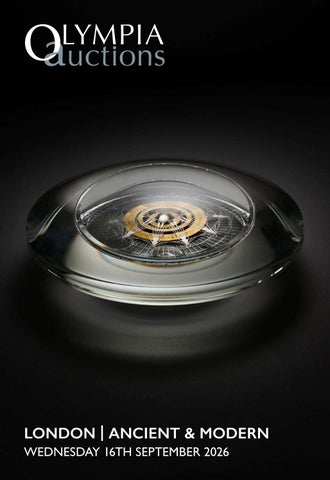
LONDON | ANCIENT & MODERN WEDNESDAY 16TH SEPTEMBER 2026
Lot 67 detail Front Cover: Lot 38 Back Cover: Lot 22
LONDON | ANCIENT & MODERN TO BE SOLD BY AUCTION: 25 Blythe Road, London W14 0PD AUCTION: Wednesday 16th September 2026, 12pm, precisely PUBLIC EXHIBITION: Sunday 13th September, 12pm-4pm Monday 14th September, 10am-8pm (drinks from 5pm) Tuesday 15th September, 10am-5pm SALE NUMBER OA0185
ENQUIRIES: Nick Hemming-Brown, Head of Sale nick.hemming-brown@olympiaauctions.com FREE LIVE ONLINE BIDDING
Mimi Preston, Administrator mimi.preston@olympiaauctions.com +44 (0)20 7806 5541 pictures@olympiaauctions.com ONLINE CATALOGUE AND LIVE INTERNET BIDDING AVAILABLE THROUGH: www.olympiaauctions.com www.the-saleroom.com www.invaluable.com www.drouotonline.com This auction is conducted by Olympia Auctions in accordance with our Conditions of Business printed in the back of this catalogue.
1 CHARLES BOOTH (BRITISH 1840-1916) LABOUR AND LIFE OF THE PEOPLE, 1891 and 1902 4 vol., including ‘Volume I: East London’, ‘Volume II: London Continued’, ‘Appendix to Volume II’, and ‘Final Volume: Notes of Social Influences and Conclusion’ complete with seven folding coloured maps on linen (4) Charles Booth belongs to a distinguished breed of remarkable, ambitious Victorian social reformers. A successful shipowner and leather merchant who produced the most comprehensive social survey London had ever seen. After canvassing the slums of Toxteth for the Liberal candidate in 1865, he came to recognise how insufficient a tool existing philanthropy and conditional charity were as means to address the endemic poverty around him. In 1885 Henry Hyndman’s Social Democratic Federation published an inquiry claiming that a quarter of Londoners lived in extreme poverty. Booth however considered the figure to be
2
exagerrated and spent the following 17 years investigating the matter with his wife Mary and others (including Beatrice Webb, Clara Collet and George Duckworth). The survey was organised into three series: poverty, industry, and religious influences. Its most celebrated matter of substance were in fact the poverty maps, which coloured each London road from black to gold according to the physical and economic condition of its inhabitants. They remain among the most important documents in British social history. Their significance, however, exists in a realm far beyond the celebrity of their maps. The outcome of Booth’s findings was to establish that the true figure of those living in poverty was not the previously ‘overstated’ 25% but in fact nearer to 35%. Booth campaigned for free school meals and state old age pensions, and lived to see them introduced in 1906 and 1908 respectively. Booth’s legacy therefore is one of remarkable consequence, laying the first foundations of the welfare state.
£3,000-5,000
2 BRITISH SCHOOL (19TH CENTURY) THE THAMES AT LAMBETH, circa 1847-60 watercolour and gouache on paper with coloured foil and natural matter 44 x 63cm (54.5 x 72.5cm framed) This is an object of unusual charm and documentary value: recording a working stretch of the Lambeth foreshore, not by someone with an eye to the picturesque, but by a tradesman advertising himself, preserving in the process a vanished commercial riverside. The present diorama can be dated to a satisfyingly narrow window. Andrew Gotleip Wentzell – trading as Wencell – took the Ship Tavern and traded as a boatbuilder under his own name after the bankruptcy of his former partner Cownden in 1847, and by 1852 he had entered a fresh partnership with a Mr Law. Even allowing for the possibility that the painted name was never amended, the absence of the new Lambeth Bridge, constructed between 1860 and 1862, places the scene firmly between 1847 and 1860. Dioramas had existed since the eighteenth century, but it was Louis Daguerre and Charles-Marie Bouton
4
who made them a public sensation in the 1820s. Miniature dioramas of the present type came later, and served an entirely different purpose. Too small for the crowd, they were made for private display or for modest exhibition, and were at this date a novelty and given the content it is most probable that this was a particularly exotic form of marketing. The form is now so thoroughly domesticated by the world’s museums that it takes an effort to recall how new, and how faintly magical, it once appeared. The bridges tell the larger story. Until 1750, London Bridge was the city’s only river crossing; Westminster, Blackfriars, Vauxhall, Waterloo, Southwark and Hungerford followed in rapid succession. Lambeth Bridge of 1862 was built on the site of the horse ferry (Horseferry Road in Westminster nods to this heritage), an ancient perquisite of the Archbishops of Canterbury, and its opening extinguished the crossing at a stroke. Moreover the paddle steamers seemingly advertised here had enjoyed the peak of their celebrity by the start of 1840s, slowly replaced by the rapidly expanding train network.
£2,000-3,000
5
3 A RARE ENGLISH SPUR, SECOND QUARTER OF THE 15TH CENTURY in black patinated excavated condition, with large rowel of eight spikes, long neck, broad angular heel-band rising to an acute point, pierced at each terminal with a pair of holes, and retaining a single buckle (restored, filled repairs, rowel loose) 21.5cm overall Provenance Excavated at the site of Cannon Street Station Ian Eaves, London, Keeper of Armour at the Royal Armouries (1978-1996) Anthony de Reuck Sale, Olympia, London, 26th June 2013, lot 216 where acquired by the present owner (part) This magnificent spur, dating from around 1425-50, was uncovered during construction of Cannon Street station, on the 500 year old site of the Steelyard, the home of the Hanseatic League in London, and is a beautifully tangible snapshot of the individuals that lived and made their fortunes there. The Steelyard itself was a walled city within the walled City of London, possessing its own warehouses, chapel, weigh-house, guildhall, currency and system of measurement. Its resident merchants elected their own aldermen and lived an almost monastic existence, women being forbidden entry and contact with the pleasures of London and Southwark discouraged. Infractions were punished
by a fine of candlewax, payable at neighbouring All Hallows the Great. Beyond spectacular spurs it is to this community that we owe some of the finest portraiture produced in Tudor England. Hans Holbein arrived at the Steelyard from Basel in 1532 and painted at least eight of the merchants, notably one of Georg Giese which currently resides in the Gemaldegalerie in Berlin. The Hansa first coalesced in the twelfth century as a modest confederation of merchants banding together for security against piracy, and by the end of the 14th century had grown in to one of the most important trading bodies to ever exist in Europe. By the early 15th century they represented 30% of all cloth exports from London. In return their ships discharged Skania herring, Russian squirrel skins, Baltic furs, copper, iron, wax, timber, stockfish, tar, querns, glass, mirrors, linen, silk and north German beer. Although it had long since lost its primary function the name lived on, and The Steelyard is plainly marked on John Rocque’s great survey of London [lot 19]. The site remained in the hands of trustees from Lübeck, Bremen and Hamburg until its eventual sale in 1853. A decade later the South Eastern Railway raised Cannon Street station over it. Today Steelyard Passage, running beneath the station, and Hanseatic Walk along the river preserve the organisation’s distinguished memory.
£400-600
A detail from Wenceslaus Hollar’s 1646 Panorama of London g
6
7
Property from a Private Collection, North London 4 GEORGE WEBSTER (BRITISH ACT.1797-1832) ST PAUL’S CATHEDRAL FROM THE THAMES AT SUNSET signed Webster lower right oil on canvas 76.5 x 127.5cm (89.6 x 140.3cm framed) Provenance Clive Lloyd (1920-2004), Gomshall Gallery, Godalming, Surrey Purchased from the above by the present owner in 1968 George Webster’s magnificent painting of St Paul’s from near London Bridge is an atmospheric examination of late afternoon sun passing through the smog of the city. It is a particularly affecting window in to the bustle of the Thames as a busy commercial waterway. Boats are moored side by side, with sailors and dock workers hopping from one deck to the other. The work also gently references, with mention to paddle boats through the arch of the bridge, the impending transition to the age of steam, which was to have far reaching ramifications for the city and the world at large.
8
Although best known for his seascapes of sailing boats often in choppy waters which follow a familiar Dutch mould, Webster’s atmospheric views of the Thames number among his most prized compositions, of which the present oil is especially large and striking. The artist followed in a long line of Thames river painters, the most illustrious being Canaletto; others included Thomas Luny and Samuel Scott. Like Webster, many made good use of the Thames’ bridges for optimum pictorial effect, Canaletto’s panoramic view of London seen through an arch of Westminster Bridge (private collection) with St Paul’s in the distance being especially notable. In the present work Webster sets the transcendant glory of Wren’s cathedral against the massive, implaccable horizontal back-lit form of the bridge in the middle distance to create a scene of both grandeur and drama. Webster was a keen traveller, even visiting the west coast of Africa in the early 19th century. He exhibited his work at the Royal Academy, the Royal Society of British Artists and the British institution.
£5,000-7,000
5 ROBERT RANDOLL (BRITISH 1894-1946) SEARCH LIGHTS OVER LONDON BRIDGE, circa 1916 pastel and coloured chalk on paper 24 x 17cm (42.5 x 34cm framed) Provenance Maas Gallery, London Private Collection Acquired from the above by the present owner
£800-1,200
10
ROBERT RANDOLL A commercial illustrator and sculptor, Randoll was best known for his views of London. His most notable works, held by the London Guildhall Art Gallery, are twelve meticulous, evocative depictions of The Barbican before the Blitz. The present works are part of a striking series by Randoll depicting First World War searchlights over London landmarks. A key component of London’s anti-aircraft defence, searchlights inspired many depictions during both World Wars as symbols of hope and resistance. This imagery was an important
antidote to the unprecedented, unpredictable air bombing campaign carried out in the War, predominantly by Zeppelins and later aeroplanes, which proved to be enormously damaging to the city’s morale. Randoll’s emphasis on the searchlights’ dramatic lines, in contrast with London’s historic landmarks, may reflect the influence of contemporary Vorticism, which rejected nineteenth-century sentimentality in favour of abstraction inspired by the ‘machine age’.
6 ROBERT RANDOLL (BRITISH 1894-1946) SEARCHLIGHTS OVER THE MANSION HOUSE, circa 1916 pastel and coloured chalk on paper 24.5 x 17cm (42.5 x 34cm framed) Provenance Private Collection Acquired from the above by the present owner
£700-1,000
11
Into the dark shadowed spaces below us, while we watched, whole batches of incendiary bombs fell…We saw two dozen go off in two seconds…The greatest of all the fires was directly in front of us. Flames seemed to whip hundreds of feet into the air. Pinkish-white smoke ballooned upward in a great cloud, and out of this cloud there gradually took shape…the gigantic dome of St Paul’s Cathedral…It stood there in its enormous proportions – growing slowly clearer and clearer, the way objects take shape at dawn. It was like a picture of some miraculous figure that appears before peace-hungry soldiers on a battlefield (Ernie Pyle, American journalist)
7 HERBERT MASON (BRITISH 1891-1960) ST PAUL’S SURVIVES, 1940 silver gelatin print 24.3 x 28.2cm unframed Provenance Private Collection, UK By descent from the above to the present owner Few photographs have come to embody the Blitz spirit so perfectly as Herbert Mason’s St Paul’s Survives, the cathedral’s majestic cupola rising from the smoke and fire. It is for many the most important photograph of the Second World War, embodying hope, perseverance, and the triumph of good over evil. It was taken on the night of 29th December 1940, from the 12
roof of the Daily Mail building in Northcliffe House, where Mason was serving as a rooftop firewatcher. London bore the sustained weight of the Luftwaffe’s bombing campaign, suffering its onslaught from the skies on seventy one individual occasions, including a period of fifty seven consecutive nights of destruction. However the assault on the city that night proved to be the most ferocious raid of the entire Blitz. Over 100 tons of high explosive and 22,000 incendiaries were dropped. In just a few hours thousands of buildings and hundreds of years of urban history were obliterated.
£500-800
8 HENRY CHARLES BREWER (BRITISH 1866-1950) PATERNOSTER SQUARE FOLLOWING A BOMBING RAID watercolour, gouache and pencil on paper 36 x 55cm (58 x 76cm framed) Provenance Sale, Christie’s, South Kensington, The Henry Brewer Studio Sale, 1987 Sale, Roseberys, London, 11th October 2005, lot 667 The present watercolour belongs to the most compelling group of Charles Brewer’s London subjects: the bombed City. Beyond a foreground of rubble and shattered timbers, a row of gutted façades stands open to the sky, while cranes rise above the ruins and the dome of St Paul’s floats behind in a wash of pale gold.
Brewer had spent a lifetime painting dawn and sunset over cathedral towers, and he brought exactly the same sensibility to a landscape of catastrophe; the cold recognition of a city in ruins. He came to the subject by inheritance as much as inclination, being the son of the architectural draughtsman Henry William Brewer (1836-1903). Trained at Westminster School of Art under Fred Brown, he was elected to the Royal Institute of Painters in Water Colours in 1911, the year of his second solo exhibition at the Fine Art Society, and exhibited at the Royal Academy, the Walker Art Gallery, in Australia and New Zealand, and at the Venice Biennale in 1932. His travels furnished views of Tangier, Spain, Belgium and Gibraltar, but London remained his constant subject.
£700-1,000
13
9 DAVID MUIRHEAD (BRITISH 1867-1930) BATTERSEA REACH signed David Muirhead and dated 1917 lower right oil on canvas 54.5 x 70cm (71.5 x 87cm framed) Provenance Sale, David Lay, Penzance, 25th October 2018, lot 11 David Muirhead lived on Cheyne Walk and executed a number of atmospheric views of the nearby Thames. These river views show the clear influence of his neighbour James McNeill Whistler, whom he had known as a fellow member of the New English Art Club. The gentle hum and clang of industry rings through the picture, with docks and wharves on both banks of the river. London’s sprawl is evocatively expressed here with the skyline broken up by chimney stacks and church spires, a quiet and understated vantage point into the past. Perhaps more poignantly the industry depicted should be seen in the context of the intense war effort of 1917. Necessity had quickly encouraged light industry westward from the traditional manufacturing heartlands of Woolwich and Newham, and from Chelsea to Wembley more and more engineering hubs sprang up. At least two known paintings of Battersea Reach by Muirhead exist from 1917, the present work and another slightly larger version viewed from a lower vantage point on the river, which belongs to the Tate.
£800-1,200
14
David Muirhead, Francis Dodd, 1915, drypoint
Property from a Private Collection, West London 10 BERNHARD SICKERT (BRITISH 1862-1932) ON THE THAMES signed Bernhard Sickert lower right pastel and charcoal on paper 26 x 36cm (43 x 53.5cm framed) Provenance Sale, Tennants, Leyburn, 20th October 2018, lot 48 Louise Kosman, Edinburgh Acquired from the above by the present owner Bernhard Sickert was born in to an artistic family from Munich, who relocated to London when he was just six years old. Bernhard suffered from ill health and painting was the only solace for his weak constitution. He did however travel extensively with his brother, the better known painter Walter Sickert (1860-1942),
through Dieppe, Holland, Italy and France. However it was London which really gripped him. Sickert was a member of the New English Art Club (1888-1909) and in 1889 he and his brother were two of just ten artists elected to exhibition as part of the ‘London Impressionists’ at London’s Goupil Gallery. Bernard also published James McNeill Whistler’s autobiography in 1908. Sickert was fascinated by the older artist and his work displays a clear debt to Whistler’s ability to enliven a landscape to more than mere topography. He seems to have been in contact with Whistler around 1899-1902 when he approached him about a small monograph which was not published until 1908, several years after Whistler’s death.
£100-200
15
THEODORE ROUSSEL Theodore Roussel was raised in France and served in the Franco-Prussian War, but it was in England that he made his name. Settling in London in 1878 James McNeil Whistler became his mentor and friend, and whose practice of free-etching influenced Roussel’s technique for years to come. Notoriety was achieved for Roussel in 1887 at the New English Art Club with The Reading Girl, a life-size nude which The Spectator dismissed as realism of the worst kind, accusing the artist of seeing nothing in his model beyond her vulgar appearance. The scandal did his career no harm whatsoever, and Orpen would later call it the finest nude of the period. Roussel promptly took a house at Parsons Green and turned to the atmospheric Thames-side landscapes seen here upon which his considerable legacy is built. Whistler’s doctrine of ‘free etching’ shaped his practice: the plate carried out of doors and
worked directly from the motif, pushed as far as possible on the spot so as to preserve lightness and spontaneity. The Chelsea plates Roussel produced are the perfect demonstration – shopfronts, doorways, figures on the pavement, caught with the freshness of a page torn from the day itself, yet composed with real decorative subtlety. Where he departs from the older artist is in temperament. Whistler observed London street life with the distance of a spectator; Roussel lives in his pictures, and the plates carry a warmth and intimacy which the mentor often lacks.
11
12
THEODORE ROUSSEL (FRENCH 1847-1926) PORTRAIT OF MISS HETTY PETTIGREW, 1908 signed lower right in the plate drypoint on paper 26.2 x 14.9cm (plate); (55.9 x 45.9cm mounted) unframed
THEODORE ROUSSEL (FRENCH 1847-1926) CHELSEA EMBANKMENT, JUNE, 5PM, 1889 signed lower right in the plate etching on paper 15 x 9.8cm (plate); (31 x 25cm mounted) unframed
Provenance Studio of the artist By descent from the above to the previous owner Literature Margaret Dunwoody Hausberg, The Prints of Theodore Roussel, New York, 1991, no. 80, pp.106-8
£400-600
11
16
Provenance Studio of the artist By descent from the above to the previous owner Literature Margaret Dunwoody Hausberg, The Prints of Theodore Roussel, New York, 1991, no. 30, pp.62-3
£200-300
12
13
13 THEODORE ROUSSEL (FRENCH 1847-1926) EVENTS OVER THE RAILINGS, CHELSEA EMBANKMENT, 1888-89 signed Theodore Roussel lower left in the plate; signed on a tab lower left in pencil etching on paper 9.4 x 11.6cm (plate); (25 x 31cm mounted) unframed Provenance Studio of the artist By descent from the above to the previous owner Literature Margaret Dunwoody Hausberg, The Prints of Theodore Roussel, New York, 1991, no. 11, p.47
£200-300 14 THEODORE ROUSSEL (FRENCH 1847-1926) SUMMER (COLOUR VERSION), 1890-1900 inscribed D.14.2 lower left in pencil colour etching, aquatint and lavis 17.5 x 12.8cm (plate); (17.7 x 12.2cm sheet) unframed
14
Provenance Studio of the artist By descent from the above to the previous owner Literature Margaret Dunwoody Hausberg, The Prints of Theodore Roussel, New York, 1991, no. 143, pp.165-6
£200-300
17
15
16
THEODORE ROUSSEL (FRENCH 1847-1926) WINTER, A HOUSE IN GREEN PARK, 1890-94 signed Theodore Roussel lower right in the stone transfer lithograph on paper 31.5 x 23.5cm; (45.5 x 28.4cm sheet); (56 x 46cm mounted) unframed
THEODORE ROUSSEL (FRENCH 1847-1926) THE STEAM LAUNCH, CHELSEA EMBANKMENT, 1888-89 signed Theodore Roussel lower right in the plate etching on paper 7.9 x 12cm (plate); (11.3 x 15.4cm sheet) unframed
Provenance Studio of the artist By descent from the above to the previous owner
Provenance Studio of the artist By descent from the above to the previous owner
Literature Margaret Dunwoody Hausberg, The Prints of Theodore Roussel, New York, 1991, no. 178, p.213
Literature Margaret Dunwoody Hausberg, The Prints of Theodore Roussel, New York, 1991, no. 18, p.52
£200-300
£200-300
17
18
THEODORE ROUSSEL (FRENCH 1847-1926) BATTERSEA FROM THE RIVER, LOW TIDE, 1890-94 signed Theodore Roussel lower right in the plate transfer lithograph on paper 14.5 x 21.5cm; (20 x 31.5cm sheet); (41 x 31.1cm mounted) unframed
THEODORE ROUSSEL (FRENCH 1847-1926) THE CHINESE GOWN, 1890-94 signed Theodore Roussel lower middle in the plate etching on paper 22.5 x 21cm (plate); (41.5 x 26.4cm sheet); (56 x 46cm mounted) unframed
Provenance Studio of the artist By descent from the above to the previous owner Literature Margaret Dunwoody Hausberg, The Prints of Theodore Roussel, New York, 1991, no. 177, p.212
£200-300
18
Provenance Studio of the artist By descent from the above to the previous owner Literature Margaret Dunwoody Hausberg, The Prints of Theodore Roussel, New York, 1991, no. 170, p.205
£300-500
15
16
17
18
19
19 JOHN ROCQUE (BRITISH 1704-1762) A NEW AND ACCURATE SURVEY OF THE CITIES OF LONDON AND WESTMINSTER, THE BOROUGH OF SOUTHWARK, WITH THE COUNTRY ABOUT IT FOR NINETEEN MILES IN LENGTH, AND THIRTEEN IN DEPTH In which is contain’d an exact description of St. James’s, Kensington, Richmond, and Hampton Court Palaces, all the main cross-roads, lanes and paths, bye-ways, walls, pales, hedges, hills, vallies, rivers, bridges, ferries, brooks, ponds, woods, heaths, commons, parks, avenues, churches, houses, gardens, &c., 1751 and 1754.
FOLIO. PP. TITLE, [2, INDEX AND SUBSCRIBER’S LIST], DOUBLE SHEET GENERAL MAP [DATED 1754], 16 DOUBLE PAGES MAPS MAKING THE WHOLE. There is no better visualisation of Georgian London than across John Rocque’s atlas; it was a map which totally surpassed anything that preceded it and is one of the crowning achievements of 18th century cartography. Nearly every court, alley, timber yard and burial ground is shown; so too the market gardens and open fields that still nestled in at the edges of the expanding West End and Hackney. It is a work of art in its own right, and one of the finest images ever recorded of the city. John Rocque had made his name drawing gentlemen’s gardens and in March 1738 decided that he would redeploy his skills to document London and its surroundings. He combined two methods: one a fairly unsophisticated ground survey by compass and measuring chain; and the other a totally pioneering application of the first modern theodolite, created and loaned by Jonathan Sisson, involving triangulation of sites from church spires. Following several years of endeavour it was discovered that the two sets of 20
calculations clashed, throwing the maps off. The error necessitated his work be repeated, and by 1742 the scheme was very nearly abandoned. It was kept alive, however, by 246 subscribers who had put down a guinea apiece, with two more owing on delivery. Among them was Frederick, Prince of Wales, who would later make Rocque royal cartographer. What emerged was the first true bird’s-eye view of London, and it remains the century’s indispensable document. That it exists at all is in many ways the perfect encapsulation of London as a city of opportunity as Rocque, a French Huguenot emigrant, had come to London to escape religious persecution in France, and enjoy Britain’s more pluralistic tolerance. This was the Age of Enlightenment; Benjamin Franklin’s pioneering work, Experiments and Observations on Electricity, 1751, and David Hume’s An Enquiry Concerning the Principles of Morals, 1751, were both first published in London, at the same time as this edition of Rocque’s map and this spirit of intellectual ambition sat alongside an explosion in national wealth, and the nascent growth of the Empire.
£5,000-8,000
19 details
22
Property from a Private Collection 20 AFTER GEORGE ROBERTSON (BRITISH 1742-1788) A SOUTH VIEW OF THE CITIES OF LONDON AND WESTMINSTER TAKEN FROM DENMARK HILL NEAR CAMBERWELL, 1779 handcoloured lithograph 47.5 x 59cm (63.5 x 75cm framed) George Robertson’s view of London is a charming reflection on the arcadian expanse which was
18th century Camberwell. Although now a bustling and vigorous part of contemporary London’s urban sprawl, it was in 1779 an area famed for its fruit trees and flowers. Even at this point in history the sheer size of the city is staggering, with the low rise carpet of 18th century civilisation rolling on for miles. It is interesting to note that the city is almost only identifiable as London due to St Paul’s and Westminster Abbey towering above it all.
£400-600
23
21 MATTHÄUS MERIAN (SWISS 1593-1650) A FINE PROSPECT OF JACOBEAN LONDON BEFORE THE GREAT FIRE, 17TH CENTURY handcoloured etching on paper 23.4 x 69.8cm unframed Matthaus Merian’s prospect of London is one of the earliest topographical views of the city, as seen during during the reign of James I. Based on Claes Visscher’s engraving from 1616, the work is annotated with a 43-point key underneath. It records London fifty years before the Great Fire of London of 1666, showing a northward view from the King’s Palace at Whitehall to the Tower of London and St Katherine’s Church in
24
the East. The depiction of pre-fire London therefore still incorporates the medieval core of the city, with the old, gothic, St Paul’s cathedral looming over the rest of the skyline, and thousands of buildings densely packed in. Fascinatingly London Bridge still has houses and businesses across it, and the heads of criminals on stakes decorate the bridge’s southern gate. Important points of reference such as Shakepeare’s Globe, and the bull-baiting ring can be seen in Southwark, and Hackney and Hampstead are still just distant villages far from the city. This engraving is one of a very small number of views of London published before the Great Fire.
£1,500-2,500
25
With etching, there’s an element of danger and mystery. You don’t know how it’s going to come out. What’s black is white. What’s left is right. (Lucian Freud)
22 LUCIAN FREUD (BRITISH 1922-2011) GIRL HOLDING HER FOOT, 1985 signed with initials lower right in pencil; numbered 37/50 lower left etching on Somerset Satin White paper published in 1986 by James Kirkman (London) and Brooke Alexander (New York) (PQ 27, Hartley 25) 69 x 54cm (plate); (89 x 72cm sheet); (96 x 79cm framed) Provenance Sale, Carrere & Laborie, Pau, 23rd April 2022, lot 43 Purchased at the above sale by the present owner Lucian Freud arrived in England from Berlin in 1933 at the age of ten and became a British subject six years later. Over the next 70 years he went on to become not only one of Britain’s greatest artists, but one of the twentieth century’s most consequential figurative painters. The Paddington years at Delamere Terrace, the Soho drinking with Bacon, Auerbach, Andrews and Kossoff, and finally Holland Park; his work does not assume the character it does, and his personality does not find its expression in the way that it does without London. Except for a couple of particularly notable bursts in the early part of his career after the war Freud rarely left the city. His sitters came almost exclusively from the life immediately around him; neighbours, lovers, children, bookmakers, fellow painters. The work therefore amounts to one of the most sustained portraits of a metropolitan existence in British art. Freud’s printmaking came in two widely separated bursts. Freud etched a handful of plates in 1946, developing one in a hotel sink, then lost interest and abandoned the medium for over thirty years. He
28
returned in 1982 with several small portrait heads and thereafter etched steadily until the end of his life, producing a body of work now regarded as fully the equal of the paintings rather than a sideline to them. That reassessment was formalised in 2007, when the Museum of Modern Art in New York devoted an entire exhibition, The Painter’s Etchings, to the subject – a rare compliment to any painter’s prints. The magic of Freud’s prints exists in their function as complete and distinct works of art, and never as versions of, or corrollaries to his paintings. The copper was set upright on an easel and worked exactly as a canvas would be, directly from the model across weeks or months of sittings, with no preparatory drawing and no transfer. Etching was therefore not a means of reproducing images already made in paint but an independent act of scrutiny conducted in another language, and the accumulating lines proved capable of describing weight and the sag of flesh with the candour of paintings. Freud’s genius always lies in the cold, and frequently unkind, psychodrama which plays out in his pictures. His detached condemnation of individuals, the laying bare of insecurities, and the unflinching fleshy reality of their presence is his unique talent. And this very human accomplishment, paired with his visceral artistic manner, is on full display here. Girl Holding Her Foot of 1985 is a masterpiece of composition, character and ambition. The figure floats amongst the unforgiving white backdrop of the sheet, and a carefully wrought tension plays out between the vigorous incision of individual lines and the soft, human texture of the figure. We are left to scrutinise the sitter, unadorned as she is. This work is a tour de force of print making and remains among the most sought-after within his oeuvre. ⊕ £15,000-25,000
29
Property from a Private Collection, West London 23 CHRISTOPHER LE BRUN PRA (BRITISH B.1951) BRÜNNHILDE, LXVI (FROM THE WAGNER SERIES), 1994 signed Le Brun lower right in pencil and numbered 34/50 lower left photogravure with etching, aquatint, burnishing and scraping 50.6 x 53.8cm; (81.2 x 83cm framed) Provenance Paragon Press, London Acquired from the above by the present owner in 1994 The Wagner series was created in 1994 and contains eight prints inspired by Richard Wagner’s four-part opera cycle, Der Ring des Nibelungen (The Ring of 30
the Nibelung). These prints are based on a series of paintings that Le Brun produced on the opera, which he then photographed, re-sized and transferred onto copper plates via photogravure and heavily reworked with intaglio and his vigorous scratching. In the present lot we see Brünnhilde, Wagner’s warrior maiden (a Valkyrie), the daughter of the chief god Wotan. During the opera Brünnhilde transitions from an immortal goddess into a wise mortal woman through love, betrayal, and ultimate self-sacrifice. Le Brun dedicated four etchings from this series to her transformation, and in the present lot we see the actual moment of metamorphosis. Brünnhilde, is riding a horse as Le Brun has brought their bodies together through his furious whirls of ink. The horse and the rider become one, wrapped up in a swirl of black. ⊕ £400-600
Property from a Private Collection, West London 24 CHRISTOPHER LE BRUN (BRITISH B.1951) FROM A SERIES OF SEVEN LITHOGRAPHS; (i) 2; (ii) 7, 1989 (i) signed Le Brun and numbered 28/35 lower edge in pencil; (ii) signed Le Brun and numbered 32/35 lower edge in pencil; each lithograph on paper (i) 91.5 x 76.1cm; (104 x 87.7cm framed) (ii) 92.5 x 76.2cm; (104 x 88cm framed) (2) Provenance Paragon Press, London Acquired from the above by the present owner In 1989, Christopher Le Brun created his notable portfolio Seven Lithographs. The monochrome prints are united by a strong sense of romanticism and mystery. Le Brun pools black ink across the printing plate, with each image partially obscured by his expressive, calligraphic markmaking. Working intuitively, he allows the composition to emerge through gesture rather than precise representation.
24(i)
In 2 from the series, a tree trunk is abstracted through elaborate layers of mark-making, while undulating circular forms appear almost like musical notes drifting across the page. In 7 two trees flank a path that winds into the distance. Although Le Brun deliberately veils his subjects beneath dark dashes of ink, the result is not one of chaos but of lyrical rhythm and poetic harmony. Christopher Le Brun is one of the leading British artists of his generation. He served as President of the Royal Academy of Arts in London from 2011 to 2019 and was awarded a knighthood for services to the arts in the 2021 New Year Honours. ⊕ £500-700
24(ii) 31
25 SIR JACOB EPSTEIN (AMERICAN 1880-1959) TIGER LILLIES, c.1930-6 signed Epstein lower left watercolour on paper 55.9 x 43.2cm (84.5 x 69cm framed) Provenance Private Collection Thence by descent to the present owner Jacob Epstein is best known for his ‘primitive’ style and ‘direct carving’ approach to sculpture, and was one of Britain’s most successful artists during the interwar period. Born in New York to Polish-Jewish parents, he made London his home in 1905 and took British citizenship in 1907. The present watercolour reveals a lesser known side of the artist. In 1933, Epstein was commissioned by the Dutch Old Master dealers, Ascher & Velker, to paint twenty flower studies from his studio in Epping Forest. Becoming entirely absorbed with the project,
32
he recalled in his autobiography, ‘I said I would paint twenty and in the end I painted sixty. Not content with this, I went on painting, giving up sculpture for the time being, and painted three hundred more. I lived and painted flowers. My rooms were piled with flowers, and this was a wonderful and colourful period’ (Jacob Epstein, Epstein: An Autobiography, London, 1955, pp.165-6). The series included poppies, sunflowers, roses, dahlias and more. ‘Tiger Lillies’ bursts at the edges like colourful fireworks, capturing the sensory experience rather than botanical accuracy. Tate Britain holds two of his most striking and controversial works, Rock Drill (1913-15) and the monumental alabaster sculpture, Jacob and the Angel (1940-41). London landmarks such as the Memorial to W.H. Hudson (Rima) in Hyde Park (1925), Night and Day (1928-9) for St James’ Underground, Madonna and Child (1950-52) in Cavendish Square are all part of the London fabric. ⊕ £1,500-2,500
26 AUGUSTUS JOHN RA (BRITISH 1878-1961) MALE NUDE black chalk on paper 61 x 40.5cm (83 x 60.5cm framed) Provenance Henry and Gwen Mond (Lord and Lady Melchett) Private Collection Thence by descent to the present owner Augustus John’s Male Nude is a beautifully precise and academic study from one of the twentieth century’s most significant artists. The standing figure is in classic contrapposto, with one foot raised and resting on the other leg; his twisted torso reveals his slender muscular physique as his arm extends to rest on an
34
imaginary ledge. The sitter gazes down towards the viewer and yet he seems to look out, past us, lost in his own thoughts. Given this considered, academic approach to his subject matter it is likely that this work was drawn when studying at the Slade, where he trained from 1894-98. He became the star pupil of his drawing teacher Henry Tonks and was widely considered to be the most talented draughtsman of his generation. After his studies John went on to become a member of the Camden Town Group in 1911 and a member of the London Group from 1940 to 1961. ⊕ £1,500-2,500
27 DUNCAN GRANT (BRITISH 1885-1978) VENUS signed and dated D Grant. 20 lower left watercolour and pencil on paper 27.5 x 34cm (44 x 58cm framed) Provenance Anthony d’Offay, London, Acquired from the above by the previous owner Exhibited London, Anthony d’Offay, Duncan Grant Early Paintings, 1975 The present work is an important preparatory study for the oil painting Venus and Adonis in the Tate collection, and is a fine example of Duncan Grant’s characteristic draughtsmanship. Here he portrays a wistful, doting Venus, who gazes out to the sky, at her recently departed lover, Adonis.
This is a strikingly modern work as Grant reimagines the mythological scene so familiar to Renaissance masters. Rather than using a naturalistic colour palette, he uses just a few sections of rich ochre and umber for the drapery around her body, touches of green and honey on her flesh. This restricted palette adds a sense of both abstraction and the decorative to the scene. This is even more evident in the Tate’s painting where the whole scene is bathed in a warm, pink hue. A central figure within the Bloomsbury Group, the present work, produced in 1920, comes from an important period of his career, alongside his first solo show at the Paterson-Carfax Gallery in London and already considered to be a rising star of the British avant-garde. ⊕ £2,000-3,000
35
28 DAVID HOCKNEY (BRITISH 1937-2026) ILLUSTRATIONS FOR 14 POEMS BY C P CAVAFY, 1967 signed David Hockney and numbered A.P on the final page in pencil fourteen poems by C P Cavafy chosen and illlustrated with twelve etchings by David Hockney translated by Nikos Stangos and Stephen Spender 34.6 x 22.5cm (first etching); (47.5 x 33.6cm folio) Provenance Acquired by the present owner circa 1980 Twelve etchings were published by Alecto in 1967, in a book of 500 with several loose portfolio editions, printed by Maurice Payne and Danyon Black; the first 250 copies included a thirteenth plate, Portrait of Cavafy II, not enclosed here. These etchings remain among the most affecting works which Hockney, arguably the 20th century’s greatest draughtsman, ever produced. Hockney became aware of the work of Constantine Cavafy (1863-1933) while still a student. He was so transfixed with the poems and their sexually liberated exoticism, that he took it upon himself to permanently liberate a copy from his local library in Bradford. Cavafy, a Alexandrian Greek who had passed some of his youth in Liverpool, wrote two kinds of poem: reconstructions of the Hellenistic past, and intimate accounts of desire between men in the modern city. He was among the earliest writers of the twentieth century to treat homosexuality openly,
38
and the effect on the young Hockney was enormous. Alongside Whitman, Cavafy gave him the confidence to be himself. As he later put it, he had found a bohemian world of art, poetry and music, met the first homosexuals unafraid to say so, and resolved to live accordingly, to leave tired, grey Bradford behind. Early responses followed quickly, among them the 1961 prints Kaisarion and Mirror, Mirror on the Wall, and A Grand Procession of Dignitaries in the SemiEgyptian Style, shown at Young Contemporaries in 1962. The suite properly began when Hockney proposed the project to Paul Cornwall-Jones of Editions Alecto, who told him to start at once. In January 1966 he travelled to Beirut, then known as the Paris of the Middle East, and the nearest surviving equivalent to Cavafy’s cosmopolitan Alexandria, making pen and ink drawings of street life there. Returning home, with the acid bath out on the balcony, Hockney worked up some twenty plates of Beirut from his drawings and photographs. The Middle East supplied the architecture and the framework, but it was Notting Hill that supplied the texture as he populated the images with scenes drawn from friends and lovers in London. During the period of production homosexuality was still illegal in the UK, and poignantly the book’s publication coincided with decriminalisation in 1967. Hockney simply saw the work as a defence of his world. For illustrations of all twelve sheets please visit our website. ⊕ £3,000-5,000
28 details 39
29
30
THEODORE ROUSSEL (FRENCH 1847-1926) CHELSEA REGATTA, 1888-89 signed Theodore Roussel lower left in the plate etching on paper 8 x 12cm (plate); (25 x 31cm mounted) unframed
THEODORE ROUSSEL (FRENCH 1847-1926) THE CORNER OF LUNA STREET, CHELSEA EMBANKMENT, 1888-89 signed Theodore Roussel lower right in the plate etching on paper 16.2 x 14.6cm (plate); (22.1 x 18.4cm sheet); (41 x 31cm mounted)
Provenance Studio of the artist Thence by descent to the previous owner Literature Margaret Dunwoody Hausberg, The Prints of Theodore Roussel, New York, 1991, no. 15, pp.49-50
£200-300
Provenance Studio of the artist Thence by descent to the previous owner Literature Margaret Dunwoody Hausberg, The Prints of Theodore Roussel, New York, 1991, no. 28, p.60
£300-500 31
32
THEODORE ROUSSEL (FRENCH 1847-1926) CHELSEA PALACES (BLACK AND WHITE VERSION), 1888-89 signed Theodore Roussel lower left in the plate etching on paper 7.5 x 12cm (plate); (13.5 x 18.7cm sheet); (26.1 x 28.9cm mounted) unframed
THEODORE ROUSSEL (FRENCH 1847-1926) THE SIGN OF THE WHITE HORSE, PARSON’S GREEN, 1906 inscribed State 9 lower left in pencil etching on paper 12 x 8.1cm (plate); (16.3 x 11.2cm sheet) unframed
Provenance Studio of the artist Thence by descent to the previous owner Literature Margaret Dunwoody Hausberg, The Prints of Theodore Roussel, New York, 1991, no. 16, pp.50-1
£300-500
40
Provenance Studio of the artist Thence by descent to the previous owner Literature Margaret Dunwoody Hausberg, The Prints of Theodore Roussel, New York, 1991, no. 68, pp.94-5
£300-500
30
29
31
32
41
33
34
THEODORE ROUSSEL (FRENCH 1847-1926) THE CORNER OF CHEYNE WALK, 1888-89 signed Theodore Roussel lower right in the plate etching on paper 11.3 x 19cm (excluding tab); (31.5 x 34.9 mounted) unframed
THEODORE ROUSSEL (FRENCH 1847-1926) LABURNUMS AND BATTERSEA, 1889-90 and 1898 signed Theodore Roussel lower right in pencil; dated 15th June / 90 and inscribed lower left etching and drypoint on paper 34.1 x 21.8cm (plate); (55.7 x 45.5cm mounted) unframed
Provenance Studio of the artist Thence by descent to the previous owner Literature Margaret Dunwoody Hausberg, The Prints of Theodore Roussel, New York, 1991, no. 27, p.59
£400-600
Provenance Studio of the artist Thence by descent to the previous owner Literature Margaret Dunwoody Hausberg, The Prints of Theodore Roussel, New York, 1991, no. 34, pp.66-68
£600-800
42
35
36
THEODORE ROUSSEL (FRENCH 1847-1926) THE GATE, CHELSEA, 1889-90 signed Theodore Roussel lower right in the plate etching and drypoint on paper 20.7 x 16.5cm (plate); (40.8 x 31cm mounted) unframed
THEODORE ROUSSEL (FRENCH 1847-1926) THE THAMES, EVENING, 1897 signed Theodore Roussel lower left in the plate drypoint on paper 7.5 x 12.5cm (sheet) unframed
Provenance Studio of the artist Thence by descent to the previous owner
Provenance Studio of the artist Thence by descent to the previous owner
Literature Margaret Dunwoody Hausberg, The Prints of Theodore Roussel, New York, 1991, no. 33, pp.65-6
Literature Margaret Dunwoody Hausberg, The Prints of Theodore Roussel, New York, 1991, no. 151, p.176
£300-500
£150-250
34
33
35
36
43
37 A GEORGE III MAHOGANY TABLE CLOCK, JOSEPH PROCTOR, LONDON, CIRCA 1775 the four pillar eight-day double fusée movement later converted to an anchor escapement and with later pendulum, striking the hours on a bell, with scroll foliate engraved backplate and fixing brackets, the break arch 6¾in dial with Rococo spandrels, with a date aperture and a recessed shaped panel signed ‘Josh.Procter / London’ to the matted centre, a strike/silent dial to the arch, the bell-top case with brass carrying handle and fretwork panels to the door and sides, with case key, 50.5cm high with handle raised By 1775 London was the pre-eminent global centre for clockmaking, following the formation of the Worshipful Company of Clockmakers in 1631,
44
its trade sustained by a dense network of specialists. Although little is known of Joseph Proctor, see another table clock similarly signed by him on the same unusually shaped panel sold Sotheby’s, London, 4 April 2001, lot 292. The present clock tells us a lot about the nature of clockmaking at the time. The use of mahogany for the bell-top case is telling, and had by the 1770s displaced ebonised fruitwood. Similarly the inclusion of the brass carrying handle is a mark of its highly functional nature, carried from room to room. It also bears a great number of beautiful, hand finished details; a synthesis of many master technicians, testament to the depth and quality of production in London at this time.
£3,000-5,000
46
Property from a Private Collection 38 WENDY RAMSHAW (BRITISH 1939-2018) MILLENNIUM MEDAL, 1999 inscribed on the medal OPENED BY HER MAJESTY QUEEN ELIZABETH ON 31 DECEMBER 1999 / THE DOME AT GREENWICH, LONDON: FOCUS OF THE MILLENNIUM CELEBRATIONS IN THE YEAR 2000 18ct yellow gold medal, with zeradour glass dome and laser cut nanocrystalline diamond coated steel 5 pieces Provenance Acquired from the Artist by the present owner Only four of these works were ever made, one is now in the Royal Collection, gifted to the Queen, another is in the Government Collection, and the third belongs to the British Museum. This is very likely to be the only one to ever be offered for sale. The work mirrors the dome with two steel discs cut to mimic the canopy, sitting around an 18ct yellow gold disc, inscribed with reference to the millennium. These discs are then in turn housed within two glass hemispheres, again shaped to replicate the dome. As works of art they are each exquisite components, but as a united body the whole is an astonishing accomplishment. Few projects embody the optimism and opportunity of the late 1990s better than the Millennium Dome. It is a development which Tony Blair promised would
‘be a beacon to the world’. The sense of possibility which permeated society, the idea that the future held something exciting and this monumental occasion (the passing of the millennium) demanded recognition, was reflected in every element of the dome’s construction. Designed by Richard Rogers the building’s intention was to ask the questions about who we wanted to be, and how we were going to do it. The medal is an apt and uniquely beautiful response to these big questions. As a coming together of craft and pioneering technology, the brainchild of groundbreaking creator and one of the twentieth century’s most important jewellers and designers, Wendy Ramshaw’s Millennium Medal stands apart. The techniques and materials employed, laser cut steel, which at the time was extremely uncommon, and zeradour glass, were conscious adventurous choices which speak to her astounding vision and experimentation. Ramshaw always saw jewellery as a creative outlet for her ideas, and her earliest pieces in paper were sold with much fanfare by Mary Quant in the 1960s. Interested in making more one-of-a-kind pieces, a commission for a ring featuring one large moonstone led her to design her groundbreaking clustered, stacking rings on turned pillars. The ring sets propelled her career and allowed her to grow creatively. ⊕ £8,000-12,000
47
39 A FINE CASED PAIR OF PERCUSSION TRAVELLING BELT PISTOLS OF CARBINE BORE BY H. TATHAM, 37 CHARING CROSS, LONDON, CIRCA 1840 with browned twist octagonal sighted barrels (minor rust patination) each signed along the top flat and struck with London proof marks, border engraved case-hardened breeches engraved with foliate scrolls and each with threaded blued plug, tangs each with back-sight, back-action locks, dolphin hammers, side-plates and ovoidal butt-caps all en suite, the last with hinged circular butt-trap cover engraved with a flower-head, chequered figured rounded butts, blued border engraved trigger-guards each decorated with scrolling foliage, silver escutcheons each engraved with owner’s initials, blued belt hooks, case-hardened under-ribs, stirrup ramrods each engraved with a flower-head on the tip, and in fine condition retaining virtually all their finish: in original lined and fitted copper alloy mounted mahogany case with full accessories including three-way powder-flask (cut-off spring
48
missing) retaining most of its lacquered finish, the interior of the lid with maker’s trade label, the exterior with shaped copper alloy escutcheon engraved with owner’s initials and incorporation a flush-fitting carrying handle, 15.0cm barrels Henry Tatham is recorded as a Gunmaker & Sword Cutler at 37 Charing Cross, between 1834 and 1860, the year of his death. Gunmaking has flourished in London for some five hundred years and was firmly established by Royal Charter in 1637 with the founding of the Worshipful Company of Gunmakers. The two lots offered here represent the high standards and quality of workmanship attained in London during the mid-19th century. Both sets have survived in remarkable condition, a key factor to the collector of all sorts of items relating to the applied arts. Both lots are antique and can be owned as curiosities or ornaments according to the legislation (Antique Firearms Regulation 2021).
£1,800-2,200
49
50
40 A CASED PAIR OF PERCUSSION SAW-HANDLED OFFICER’S BELT PISTOLS OF MUSKET BORE BY S. & C. SMITH, LONDON, MID-19TH CENTURY with twist sighted barrels each engraved LONDON along the top flat and retaining much of the original browning along the bottom, border engraved case-hardened breeches decorated with foliate scrolls, tangs each with back-sight and decorated en suite, signed locks each with safety-catch, dolphin hammers and flat ovoidal butt-caps all en suite, the last each with hinged circular butt-trap cover, figured full stocks each with dark horn fore-end cap, chequered rounded butts each with spur flat along the top, blued trigger-guards each with foliate scrollwork on the border engraved bow and a scallop shell on the pineapple-shaped finial, belt hooks retaining some blueing (one with a patch of pitting),
silver barrel-bolt escutcheons, stirrup ramrods each acting against a retaining spring and engraved with a flower-head on the tip, and retaining some original finish: in original lined and fitted mahogany case with accessories including powder-flask retaining some of its lacquered finish, the interior of the lid with maker’s trade label, the exterior (one corner with some old staining) with circular vacant escutcheon centred on a circular flushfitting carrying handle, 18.7cm barrels Samuel and Charles Smith, sons of the famous William Smith, are recorded at 64 Princes Street, London between 1834 and 1869. On the death of Samuel in 1855 the firm was carried on by his two sons, also Samuel and Charles. The former later emigrated to Australia.
£2,000-3,000
51
41 AN OFFICER’S BUSBY OF THE 3RD MIDDLESEX ARTILLERY VOLUNTEERS, REIGN OF QUEEN VICTORIA (1837-1901) of racoon fur with scarlet bag on one side, a silvered regimental badge on one side also forming a plume-holder for the white over red horsehair plume, black velvet-lined chin-chain, adjustable leather sweat-band, quilted burgundy silk liner with gilt Jones Chalk & Dawson outfitters details, and in fine condition: in its japanned circular storage tin, the exterior of the lid with outfitter’s escutcheon
52
and copper alloy plate engraved ‘G.R. Rickett, Esq, 3rd Middx. Vol. Artl.’ The Metropolitan Artillery Volunteers (known as ‘Truro’s Tigers’ after its founder the 2nd Lord Truro) was a volunteer force formed in the London area in 1861. It was designated the 3rd Middlesex Artillery Volunteers and went on to become the 5th London Brigade, Royal Artillery in the London Brigade and served in the First World War and saw action on the Western Front.
£400-500
a 19th century cartoon of a member of the 3rd London Rifle Volunteers
42 A VICTORIAN OFFICER’S POUCH BELT PLATE OF THE 3RD CITY OF LONDON RIFLE VOLUNTEERS, CIRCA 1860-78 with crowned Union wreath surrounding silver circlet inscribed ‘LABOR OMNIA VINCIT’ with applied white metal ‘LRV’ cypher mounted with brass ‘3’ to centre, with three screw posts to rear. The 3rd City of London Rifle Volunteers originated during the great expansion of the British Volunteer movement following the invasion scare of 1859. The journalist and writer Alfred Bate Richards raised a body of approximately 1,000 working men in the
City of London, initially known as the Workmen’s Volunteer Brigade. Being so composed, the unit was less socially exclusive than many of the other London Rifle Volunteer Corps. It received financial assistance from the City of London and the Livery Companies, while its motto, LABOR OMNIA VINCIT (‘Work conquers all’), reflected both its origins and its identity. By the early 1870s, the 3rd London was one of the principal Volunteer regiments of the City, its principal function being the provision of a trained reserve for the defence of Britain, together with regular drill, musketry and field training.
£200-300 53
54
43 A PRE-1914 OFFICER’S UNIFORM OF THE ROUGH RIDERS (CITY OF LONDON YEOMANRY) comprising lance cap with black patent leather skull, edged top and bottom with bands of wide and narrow gold French braid, upper part and top of French Grey cloth trimmed with gold gimp and orris cord, and with a band of gold lace around the waist, gold bullion rosette embroidered with GvR cypher in gold on French Grey cloth, gilt rayed front plate mounted with the Arms of the City and a title scroll in white metal, between oakleaf sprays inscribed with the battle honour ‘SOUTH AFRICA 1900-1902’, black leather peak bearing stripes of gold embroidery, burnished gilt chinchain with black velvet lining, interior with pale leather headband and crimson silk lining inscribed with maker’s details in gilt lettering (plume and plume-socket absent, chin-chain rubbed and gold elements slightly dull): in its tin case; dress tunic in light blue-grey, with purple plastron, facings and piping, collar and cuffs trimmed with gold regimental lace, and plaited shoulder-cords bearing Lieutenant’s badges of rank in silver embroidery, gilt regimental buttons; mess jacket in light blue-grey with purple upright collar, metal badges, pointed cuffs edged all round with gold Russia braid, hook-and-eye fastenings, edged with
gilt studs to front, purple cloth shoulder-straps, with companion purple waistcoat, edged with a border of French Grey cloth and Russia braid; undress tunic of light blue-grey with purple cloth facings and piping (lacking collar-badges); unique pattern special regulation great coat in light blue/ grey with purple collar; pair of pantaloons; three pairs of overalls; Lancer pattern girdle of gold lace with two stripes of purple silk on a black Morocco leather backing, fastened with three small olivets; pouch and pouch belt of brown leather bearing two white-metal and gilt regimental badges and extensive ornate gilt fittings; set of detachable sword-slings, faced with gold ‘herringbone’ lace with a central line of purple silk, attached to a webbing belt; and another pair of leather swordslings (spotting on all leather items), many items named and retailed by H Lehman, Aldershot (qty) Raised in 1900 for service in the second Boer War as the 20th Battalion Imperial Yeomanry, the City of London (Rough Riders) Imperial Yeomanry was so named in 1902 when it became a regiment, being named after a body of volunteer horsemen who had fought under Colonel Theodore Roosevelt in the Spanish-American War of 1898. Upon the establishment of the Territorial Force in 1908 it was retitled the 1st City of London Imperial Yeomanry.
£3,000-5,000
55
44 JOHN COLE (BRITISH 1903-1975) A SHOP FRONT IN MOOR STREET, CAMBRIDGE CIRCUS signed JOHN COLE lower right; signed, titled and inscribed on a label on the reverse oil on canvasboard 30 x 41cm (39 x 49cm framed) Provenance Morgan Grenfell, London (probably acquired in 1945) Acquired from the above by the present owner Exhibition London, The Royal Academy, Summer Exhibition, 1945, no. 636 Portsmouth, Portsmouth City Museum & Art Gallery, The Cole Family, Painters of the English Landscape, 1988, no. 171
56
Literature T.J. Barringer, The Cole Family: Painters of the English Landscape 1838-1975, Portsmouth City Museums, 1988, p.180 The Georgian shop front of 13 Moor Street, Soho is in the area known as the Moor Street Triangle, bounded by Old Compton Street, Charing Cross Road and Moor Street itself. No.13 is believed to have been built by William Bignell in 1738 and is one of the few surviving original houses in the street being noteworthy for its elegant early nineteenth century shop front. The ground floor of no.13 now houses a fast food shop. ⊕ £600-800
45 MATTHÄUS SEUTTER (GERMAN 1678-1757) PLAN OF LONDON Londinum celeberrima Metropolis, splendissima Regia et opulentissimum Angliae Emporium, accuratissime delineata per Mathaeum Seutter. handcoloured etching on paper 52.1 x 61.6cm unframed This fine, detailed map of Hanoverian London, drawn by Johann Thomas Kraus, offers a fascinating insight in to the gradual growth of the city during the period, as it extends to Hyde Park Corner in the west, and then to Islington, Stepney, Bermondsey and Lambeth, with a detailed key. In the upper left corner are the Royal
Arms of George II, and upper right a German text description of the city. Building upon Matthäus Merian’s 16th century view of London, updated to include much of Wren’s remodelling of the city after the Great Fire in 1666, the lower register of the present work displays some interesting and notable developments, including the removal of executed heads on London Bridge and the rebuilt St Paul’s cathedral. Fascinatingly the work also carries a certain continental Baroque flavour, with a number of architectural flourishes totally uncommon to Britain, showing the Germanic influence of the map maker.
£1,200-1,800
57
46 EDWARD STANFORD (BRITISH 1827-1904) NEWCOURT’S LARGE MAP OF LONDON DURING THE INTERREGNUM, 1863 etching on paper 91.6 x 55.1cm (each); (91.6 x 274.6cm together) unframed (5)
58
An Exact Delineation of the Cities of London and Westminster and the Suburbs thereof, together with ye Burrough of Southwark and all ye Throughfares Highwaies, Streetes, Lanes and Common Allies wthin ye same Composed by a scale, and Ichnographically described. A Victorian copy of an extremely rare map-view of London originally published in 1658, during the Interregnum. The original, drawn by Richard Newcourt and engraved by William Faithorne, is known from only two examples: the Biblioteque
Nationale has the only complete one; the British Library’s example lacks the title. Around the map are elevations of Westminster Abbey and the Norman St Paul’s Cathedral, showing the classical portico added by Inigo Jones in the 1630s, the arms of various city guilds, the genealogy of Brutus (the mythical founder of London), and a key of the city’s churches.
£1,500-2,500
59
Property from a Private Collection, West London 47 ETHELBERT WHITE (BRITISH 1891-1972) LOCHRANZA, ARRAN, SCOTLAND signed Ethelbert White, dated 1933 and inscribed 19014/6066 lower left watercolour and pencil on paper 26 x 36cm (49.5 x 66cm framed) Provenance Sale, Dominic Winter Auctioneers, Cirencester, 6th November 1998, lot 330 Howard Duckworth, purchased from the above sale Sale, Woolley & Wallis, 5th June 2024, lot 441 Purchased from the above sale by the present owner Born in Isleworth in the west of London and of independent means, Ethelbert ‘Bertie’ White was a landscape painter, poster designer, book illustrator and wood engraver at the heart of the London inter-war avant garde scene. He befriended Mark Gertler and C.R.W. Nevinson at St John’s Wood Art School where he studied in 1911-12. Together with Nevinson, they collaborated on a Futurist version of ‘Hamsptead Heath on Fair Day’ for the 1913 Allied Artists Exhibition.
60
He exhibited with both the London Group and the New English Club during the War and held his first one man show at the Carfax Gallery in 1921. In 1919 he married Elizabeth ‘Betty’ Crofton Dodwell. Both lovers of the bohemian, the couple acquired a horse drawn caravan in which to live and travel around London, especially Hampstead and the South of England, entertaining as they went, Bertie playing guitar and Betty singing. White’s artistic vision was rooted in his genuine delight in nature: in this two-tone watercolour, the clear lines of Lochranza Castle behind the fishing boats and their nets stand out against the wild and barren mountains of Arran in the background. Meticulously composed, the image appears like a book illustration, easy to read. In 1933, White became an Associate of the Royal Watercolour Society in London. ⊕ £200-300
PHYLLIS BRAY Phyllis Bray was a versatile painter, lithographer and book designer. She had a successful career as a muralist, assisting the German mural artist Hans Feibusch (1899-1998), a collaboration that lasted over forty years. A talented illustrator, she completed commissions for major publishers including Faber & Faber, J M Dent and Sons, Arthur Baker Ltd and the Oxford University Press. She also produced commercial work for Shell, London Transport and the John Lewis Partnership, all hugely successful. Born in Norwood in London, Bray was awarded a scholarship to the Slade School of Art (1927-31) where she was a star pupil under Henry Tonks. During the 1930s she taught art at the Bow and Bromley Evening Institute where she met John Cooper, one of the founders of the East London Group. She joined the Group in 1933, the year she married Cooper and moved to Hampstead. A year later she was invited to become a member of the London Group and showed regularly at The Leicester Galleries, the Royal Academy, the Drian Gallery and Mignon Gallery Bath. Her interest in Surrealism (lot 54) may date from her first solo exhibition at the London Gallery in 1949 run by the Belgian Surrealist E.L.T. Mesens. Phyllis’s connection with the East End was underlined when she completed three large murals (Music, Drama and Ballet) for the ‘People’s Palace’ in the
Mile End Road in 1936 for which she was publicly praised by Queen Mary (The building was acquired by Queen Mary University in 1954). Most of Bray’s murals were lost under subsequent refurbishments, but one fragment has recently been uncovered. The commission was a forerunner for her collaboration with Feibusch with whom she worked on a series of post-War mural projects including for the ceiling in St Crispin’s, Bermondsey, and St Alban the Martyr, Holborn, and large commissions in Chichester Cathedral, Newport Civic centre and Dudley Town Hall amongst a litany of other such large-scale work. After Cooper and Bray divorced in 1936, Phyllis married the architect Eric Phillips. Bray was a serious collector of Medieval and Renaissance jewellery in the 1950s and ‘60s. The ‘Phyllis Phillips’ collection was sold at Christie’s in 1989 for £576,000. She had a posthumous studio sale in 2005 which included over 200 landscape gouaches, many featuring the Wye valley where she had a cottage. A long-term resident of Hampstead, some of her gouaches are in the collection of Burgh House. Her book illustrations included Alison Uttley’s A Traveller in Time, 1939 (lot 55), Charles Dickens’ The Magic Fishbone and The King of the Golden River by John Ruskin, 1939 and designs for Michael Fyodrov, Matushka, 1946, to name a few.
Property from the Estate of Hans Feibusch, London 48 PHYLLIS BRAY (BRITISH 1911-1991) PETER AND THE WOLF, A BOOK ILLUSTRATION pen and ink and watercolour on card 15 x 10cm (30.5 x 24.5cm framed) Provenance Gifted by the artist to Hans Feibusch, Hampstead Thence by descent to the present owner ⊕ £300-400
61
Property from the Estate of Hans Feibusch, London 49 PHYLLIS BRAY (BRITISH 1911-1991) ALLEGORY OF THE ARTS inscribed Feibusch after Bray lower left and signed Phyllis lower right watercolour over pencil heightened with white bodycolour 17.5 x 19cm unframed (2) Provenance Gifted by the artist to Hans Feibusch, Hampstead Thence by descent to the present owner Hans Feibush is portrayed here emerging from a bush with his recognizable specs, brush in hand, leaning in a suggestive pose over a reclining nude who pulls him down towards her. She is likely to be Phyllis Bray with whom Feibusch had an intimate relationship in the 1960s. She made the composition as a humorous pun with the inscription ‘Feibush after Bray’. Offered together with ‘Venus and Cupid’, oil on porcelain, 8 x 12cm (15 x 19.5cm framed) ⊕ £150-200
Property from the Estate of Hans Feibusch, London 50 PHYLLIS BRAY (BRITISH 1911-1991) RELIQUARY signed with initials lower right gouache over traces of pencil on paper 22.5 x 13.5cm (38 x 28cm framed) Provenance Gifted by the artist to Hans Feibusch, Hampstead Thence by descent to the present owner ⊕ £80-120
62
Property from the Estate of Hans Feibusch, London 51 PHYLLIS BRAY (BRITISH 1911-1991) WITCHES GATHERING AROUND MISS HECKETTY, A BOOK ILLUSTRATION dedicated To Hans from Phyllis on the reverse pen and ink on paper 13 x 21.5cm (29.5 x 37cm framed) Provenance Gifted by the artist to Hans Feibusch, Hampstead Thence by descent to the present owner
51
With an inscription in the artist’s handwriting on paper on the reverse: ‘1.The fire hides miss Hecketty, except when blown by the / wind, but even when she wears a gown and a hood / concealing her face so that she cannot be recognized / by million. / 2. The other peaks should not show, as Merlins seat is the highest of all. / I think the […] tower should show / 3. The witches all have fur capes that they pull on / to cover their heads as […] they were animals / except Winnie (& Mother W?) / 4. Mother W & the Bank Manager are Winnies’s […] so should stand near her. The B.M. wears on Eden hat, black coat, shaped trousers & has a neat dark moustache. ⊕ £100-150
Property from the Estate of Hans Feibusch, London 52 PHYLLIS BRAY (BRITISH 1911-1991) STUDY FOR A BOOK ILLUSTRATION (POSSIBLY THE TEMPEST) signed Phyllis Bray lower right pen and ink on paper 18 x 14cm (32.5 x 27.5cm framed)
52
Provenance Gifted by the artist to Hans Feibusch, Hampstead Thence by descent to the present owner This sketch likely relates to the illustrations Bray’s completed for Titania and Oberon the children’s book by Jo Manton published in 1945 based on Shakespeare’s A Midsummer Night’s Dream. ⊕ £100-150
63
Property from the Estate of Hans Feibusch, London 53 PHYLLIS BRAY (BRITISH 1911-1991) (I) A SHEPHERDESS; (II) COURTING THE SHEPHERDESS (i) signed with initials and dated 1980 / p13 lower left and lower right; (ii) signed with initials and dated 85 lower left both roller ball pen on paper (i) 20 x 12.5cm (31 x 23cm framed) (ii) 16.5 x 22cm (27 x 32cm framed) (2) Provenance Gifted by the artist to Hans Feibusch, Hampstead Thence by descent to the present owner Phyllis Bray collected miscellaneous objects, notably a small late 18th century porcelain sculpture of a shepherdess courted by the two men which she represents here. The sculpture was shown in the recent exhibition on the artist at the Batsford Gallery in London in June 2026. She produced several blue biro drawings on this type of subject matter. It may have been a study for an illustration. ⊕ £80-120
53
54 64
Property from the Estate of Hans Feibusch, London 54 PHYLLIS BRAY (BRITISH 1911-1991) FISHING BOATS IN A COVE gouache on paper 15 x 23cm (26.5 x 35cm framed) Provenance Gifted by the artist to Hans Feibusch, Hampstead Thence by descent to the present owner The present composition was very possibly inspired by the cove of Durdle Door in Dorset. Bray may have been aware of the Dorset Shell Guide written and illustrated in 1937 by Paul Nash (1889-1946) in which Durdle Door features, having produced herself some commercial works for Shell. Nash lived in Swanage in the mid-1930s and his surrealism and love of nature would have been of significance to Bray. ⊕ £600-800
Property from the Estate of Hans Feibusch, London 55 PHYLLIS BRAY (BRITISH 1911-1991) DESIGN FOR A BOOK COVER ‘A TRAVELLER IN TIME’ BY ALISON UTTLEY, 1939 signed and inscribed UTTELEY / BY PHYLLIS BRAY / FABER / FABER & FABER left and lower centre watercolour and pencil on paper 25.5 x 35.5cm; 10 x 14in (sheet) unframed Provenance Gifted by the artist to Hans Feibusch, Hampstead Thence by descent to the present owner This appears to be a preliminary sketch for the dust jacket of the first 1939 publication by Faber & Faber of A Traveller in Time by Alice Uttley (1884-1976) also illustrated by Phyllis Bray. A popular time travel story, it recounts the visit of a young girl, Penelope, to Thackers Manor in 1934, where she becomes involved in a 16th century plot to rescue Mary, Queen of Scots. Uttley was a prolific British writer of over 100 books, best known for her children’s series about Little Grey Rabbit, and Sam Pig.
55
⊕ £80-120
65
STEPHEN BONE Born in Chiswick, Stephen Bone was the son of painter Sir Muirhead Bone and of Gertrude Helena Dodd, a writer. He travelled widely in Europe with his father before enrolling at the Slade School of Fine Art in 1922. He became disillusioned with the Slade and left in 1924 to begin illustrating books, with woodcuts, for his mother and other writers. In 1925 Bone was awarded the Gold Medal for Wood Engraving at the International Exhibition in Paris, and in 1926 he was the subject of a joint exhibition at the Goupil Gallery, alongside Rodney Joseph Burn. In 1928 he painted an ambitious and magical mural for the underground station at Piccadilly Circus, now lost. With his wife Bone was to travel extensively across Britain and Europe, which allowed him to paint outdoors in all weathers and develop a style of bright landscape painting that proved popular and sold well at a number of gallery exhibitions.
At the outbreak of the Second World War, he enlisted as an officer in the Civil Defence Camouflage Establishment based in Leamington Spa. He was later appointed by the War Artists’ Advisory Committee to be a full-time salaried artist to the Ministry of Information specialising in Admiralty subjects. Bone produced a large number of works depicting naval craft and coastal installations around Great Britain and in 1944 he recorded the Normandy landings. Towards the end of 1944 he travelled to Norway and painted the wreck of the Tirpitz. After the War, he found his style of painting out of fashion and found it difficult to be exhibited. He became an art critic for the Manchester Guardian, wrote humorous pieces for the Glasgow Herald and did television and radio work for the BBC. With his wife, he wrote and illustrated children’s books.
56 STEPHEN BONE (BRITISH 1904-1958) THE BROADWALK, REGENT’S PARK oil on panel 27 x 35cm (34 x 42cm framed) Provenance Studio of the artist Thence by descent to the previous owner ⊕ £400-600
66
57
58
STEPHEN BONE (BRITISH 1904-1958) LEG OF MUTTON POND, HAMPSTEAD HEATH signed Stephen Bone lower left; titled and inscribed on the reverse oil on panel 33 x 41cm (41 x 51cm framed)
STEPHEN BONE (BRITISH 1904-1958) PARLIAMENT HILL oil on panel 33 x 41cm (44 x 52cm framed)
Provenance Studio of the artist Thence by descent to the previous owner ⊕ £400-600
Provenance Studio of the artist Thence by descent to the previous owner ⊕ £400-600
67
59 THOMAS MANN BAYNES (BRITISH 1794-1854) THREE VIEWS OF THE LONDON ZOO: (I) THE BEAR PITT; (II) THE BEAVER’S POOL; (III) THE PELICANS’ ENCLOSURE, circa 1835 each signed and inscribed on the reverse each watercolour and pencil heightened with white on paper (i) 11 x 19cm; (ii) 12 x 21.5cm; (iii) 11 x 19cm; (32.5 x 82cm framed together) Provenance Thomas Agnew & Sons, London Sale, Lawrence’s, Crewkerne, 6th July 2012, lot 138 Purchased at the above sale by the present owner There can be few more appealing records of London’s Zoological Gardens than the watercolours and lithographs produced by Thomas Mann Baynes in the years immediately following its foundation. Born in 1794 to the watercolourist James Baynes, from whom he acquired both his facility and his profession, Thomas made a successful career from topography at precisely the moment lithography was transforming its economics. Depicting London during a period of colossal change, ballooning wealth and huge social upheaval his subjects ranged widely.
68
The Zoological Society of London was the creation of Sir Stamford Raffles and Sir Humphry Davy in 1826, and its Gardens, opened in April 1828 on five acres carved from the northern edge of Nash’s Regent’s Park, were laid out by Decimus Burton in a manner deliberately closer to a gentleman’s pleasure ground than a menagerie. The Zoo is to this day the world’s oldest scientific zoological centre, and serious academic study was the original stated purpose. Entry for the first two decades required Fellowship or a Fellow’s written order – a restriction abandoned only in 1847. Baynes therefore depicts an exclusive resort, its promenading visitors as carefully observed as its inhabitants. Two developments cemented the Gardens as a fixture of the capital. The seven-hundred-yearold royal menagerie at the Tower of London was dissolved in the early 1830s, its animals removed to Regent’s Park (in 1828 the menagerie had included almost 60 different species of animal, including a number of big cats and a bear). In 1850 the hippopotamus Obaysch arrived from the White Nile, the first in Europe since Roman times, prompting a public frenzy. The hippo was a gift from the Ottoman Viceroy of Egypt in exchange for a number of greyhounds and deerhounds.
£2,000-3,000
69
Property from a Distinguished Private Collection 60 ROGER WAGNER (BRITISH B.1957) BUTLER’S WHARF, BERMONDSEY, 1992 signed with initials lower right gouache, pen and ink on paper 53 x 38cm (69 x 53.4cm framed) Provenance Acquired by the present owner in 1988 Exhibited Oxford, Ashmolean Museum, Roger Wagner: Paintings, 1994, no. 15 For over two centuries London’s Docklands were the most important part of the most important city in the British Empire. It was the commercial engine behind London’s growth and its link to the rest of the world, where goods, people and ideas freely flowed. However, by the 1980s, the huge stretch of land from Tower Bridge to Greenwich, with Bermondsey here depicted, had become a graveyard. Containerisation rendered the upstream wharves obsolete; vessels grew too large for the locks, and cargo migrated downriver to Tilbury and across to Felixstowe.
The East India Docks closed in 1967, the London and St Katharine in 1968, the Surrey Commercial in 1970, and the Royals, the largest of them all, in 1981. Some 150,000 jobs went with them, and with those jobs an entire riverside culture. What Roger Wagner records, the long shadows, empty warehouses and cranes wailing in the wind reflects this uncertainty. A lost world, an area bereft of purpose, prefiguring the shiny new flats and offices that will soon come to replace the ghosts. Wagner is a painter of unembarrassed religious conviction who draws immediate comparison to Stanley Spencer, and this attitude of belief is emphatically present here. What he took from Spencer was the central conceit of his own practice: the transposition of biblical episode into contemporary English landscape, not as irony or provocation, but as the straightforward continuation of a tradition that had always placed the Nativity in Umbria and the Baptism in the Tuscan hills. Here, the Docklands become the Babylonian land of exile, haunted by memory. ⊕ £10,000-15,000
Butler’s Wharf circa 1980
70
71
61 SIMON PATTERSON (BRITISH B.1967) THE GREAT BEAR, 1992 signed Simon Patterson, dated 1992 and numbered A/P lower right lithograph on paper, framed in an aluminium London Underground frame 99 x 124.6cm (108.8 x 134.3cm framed) Few works of British conceptual art have entered the public imagination as thoroughly as The Great Bear. Simon Patterson took Harry Beck’s map of the London Underground of 1933 – one of the most familiar pieces of graphic design in Britain, and arguably the most efficient in the world – left its geometry entirely intact, and replaced every station name with the name of a real person. Each line is given over to a category: philosophers on one, film actors on another, saints, footballers, explorers, engineers, comedians, Italian artists, planets and journalists distributed across the rest. Interchanges accordingly become collisions, and the network resolves into an enormous, absurd system of cross-references in which Aquinas meets Marx and a Renaissance painter changes for a centre-forward. The title supplies the key. The Great Bear is Ursa Major, and the joke turns on the fact that constellations are themselves an arbitrary imposition
72
of narrative on a random scatter of points – figures, animals and gods mapped onto the sky by people determined to find order there. Beck’s diagram performs precisely the same operation on London: it is not a map at all but a schematic fiction, straightening the Thames, evening out the distances, and persuading several generations of Londoners to imagine their city in a shape it has never possessed. Patterson makes that sleight of hand visible by pushing it one stage further into nonsense. Issued in 1992 and housed within an original Transport for London aluminium frame, the work was acquired by the Tate and did much to secure Patterson’s nomination for the Turner Prize in 1996. He had emerged from Goldsmiths and shown in Freeze in 1988, but where several of his contemporaries pursued shock, Patterson’s method has always been more analytical and humorous – hijacking systems of classification and observing what happens when the labels are switched. The result here is a piece that functions simultaneously as a gag, a meditation on how knowledge is organised, and a genuine tribute to Beck. ⊕ £6,000-10,000
There is no code to be cracked in any of my work. Meanings may not be obvious, you may not get a joke, but nothing is really cryptic I’m not interested in mystification. I like disrupting something people take as read. I am not simply pulling the rug out from people. I am not nihilistic. What interests me is juxtaposing different paths of knowledge to form more than the sum of their parts. (Simon Patterson)
73
62 EDWARD JOHNSTON (BRITISH 1872-1944) A SUPERB 20” DIAMETER BANK TUBE STATION ROUNDEL, 1950s station sign, brass frame, enamelled steel, backed with MDF for hanging 50.3 x 60.8cm The present signage is an extremely rare and highly coveted example dating from the 1950s, datable due to the distinctive brass surround. Few images evoke a sense of London more strongly, or have been replicated more frequently, than the Underground roundel. Born in 1908, the red disk with horizontal intersection took its form to help distinguish it from the rectangular advertising boards adorning the platform walls. Under the visionary stewardship of Frank Pick (who oversaw the introduction of
74
Harry Beck’s iconic tube map, and the construction of many of the most architecturally significant Underground stations on the network) Edward Johnston was initially selected to re-design the company typeface in 1915, an inspired decision which survives to this day. On the back of this success in 1917 Johnston was tasked with furthering this change by remodelling the sign itself. The solid red disk was hollowed out, to the circle we currently know, and the bar amended to accommodate the new Underground logo. The replication of the sign around the world, across t-shirts, posters and much more is testament both London’s enduring appeal and the genius of Johnston’s design.
£1,800-2,500
63 KENNETH ROWNTREE (BRITISH 1915-1997) PUTNEY GARDEN acrylic on board 61.5 x 61cm (71.5 x 71cm framed) Provenance Studio of the artist Thence by descent to the previous owner Literature Kenneth Rowntree, A Centenary Exhibition, London, 2015, p. 95, no. 50; Christopher Woodward, Sanctuary: Artist-Gardeners, 1919-1939, London, 2020 Exhibited Newcastle, Laing Gallery, Kenneth Rowntree: Paintings, Drawings and Collages, 1976-1977, no. 71 Saffron Walden, Fry Art Gallery, Kenneth Rowntree,
A Centenary Exhibition, 2015, cat. no. 26 London, Garden Museum, Sanctuary, Artist-Gardeners, 1919-39, 2020 Kenneth Rowntree and his family lived in Putney between 1950 and 1970. Diana Rowntree later recalled: ‘We found a house on the Thames, upstream of Putney Bridge, and turned the attic into a studio. Its comfort permanently slowed Kenneth’s working speed from the swift tempo demanded by one-day forays into distant landscapes.’ The Thames provided Rowntree with a steady stream of subjects – views from his window, paintings of Putney Reach, and night time scenes such as Putney Bridge, Nightpiece (in the Government Art Collection). ⊕ £2,000-3,000
75
ROBYN DENNY & RICHARD SMITH Denny and Smith were part of a golden generation of artists who graduated from the Royal College of Art in the late 1950s and early 1960s. Others included David Hockney, Peter Blake and Joe Tilson. But Denny and Smith were particular soul mates. They shared a studio, were fascinated by the Abstract Expressionism of Jackson Pollock and his fellow action painters in the USA and remained close friends for life. The first major London exhibition devoted to American Abstract Expressionism was at the Tate Gallery in 1959, the same year that Smith travelled to the USA on a Harkness Fellowship. It was also the year that Denny and Smith together with Ralph Rumney held their seminal show Place at the ICA. As Roger Coleman explained in his guide to the exhibition, the show reflected the artists’ shared interest in mass-media as a source of inspiration; in scale – each of their canvases had to be of particular dimensions and notably over-size; in colour - they agreed using a limited range of colours between them, and in lay out – the works were positioned adjacent to each other on the diagonal in the gallery.
It was a collaborative exhibition format that Denny developed the following year as the organising secretary for the much larger ground-breaking show Situation at the RBA Galleries. The exhibition brought together some twenty British painters working on an ambitious scale creating work to engage with Abstract Expressionism. One criteria for acceptance was an artists’ work would only be shown if it was at least 30 foot square. Besides the work of Smith and Denny it included major examples by such painters as John Hoyland, William Turnbull and John Plumb. Situation established Denny as a leading figure in British abstract painting, working on a monumental scale using a range of subtle colour combinations to define the strong vertical and horizontal divisions that characterise his compositions. It led to him representing Britain at the Venice Biennale in 1966, and a full retrospective exhibition of his work at the Tate Gallery in 1973, the youngest artist to receive such a distinction. Smith was similarly honoured just a few years later. He represented Britain at the Venice Biennale in 1970 and a retrospective exhibition of his work was held at the Tate Gallery in 1975.
64 ROBYN DENNY (BRITISH 1930-2014) (I)-(VI) THOMAS SUITE, 1975 each signed Denny, dated ‘75 and editioned 54/100 lower right each screenprint on paper each 90 x 64cm (sheet) each unframed (6) ⊕ £400-600
76
77
No painting should reveal all it has to say as a kind of instant impact. Abstract painting… should be as diverse, and complex, and strange, and unaccountable, and unnameable as an experience, as any painting of any consequence has been in the past. (Robyn Denny)
65 ROBYN DENNY (BRITISH 1930-2014) ALL THROUGH THE DAY I, 1970 signed Denny, editioned 26/95 and dated ‘70 in pencil lower right screenprint on paper 72.5 x 76cm (sheet) unframed ⊕ £150-250
78
My interest is not so much in the message as the method. (Richard Smith)
66 RICHARD SMITH (BRITISH 1931-2016) SUN CURTAIN, 1971 signed R Smith and dated 71 lower left in print lithograph and collage on paper 61 x 91.5cm (sheet) unframed ⊕ £100-150
79
Property from a Private Collection, North London 67 BRIDGET RILEY (BRITISH B.1931) TWO BLUES (SCHUBERT 52), 2003 signed Bridget Riley and dated ‘03 lower right in pencil; titled and numbered 173/250 lower left screenprint in colours on wove paper 38.7 x 38.1cm (plate); (54.6 x 53.4cm sheet); (67 x 66.5cm framed) Provenance Purchased by the present owner circa 2000 Bridget Riley is one of Britain’s most celebrated artists, born in Norwood in 1931, she studied at Goldsmiths College from 1949 to 1952, followed by the Royal College of Art from 1952 to 1955. After her first solo exhibition in London at Gallery One in 1962, Riley’s radical geometric works quickly gained international recognition. Printmaking has always
80
been central to her practice, and Two Blues belongs to her highly sought-after Lozenges series, produced between 1998 and 2009. In this series, the rigid straight lines of her earlier work give way to softer, undulating forms, often structured around diamond-shaped compositions. Comprising 22 editions in total, the Lozenges series explores the subtle interplay of colour. The works were notably inspired by Riley’s time in Cornwall, where she spent five years during the Second World War, with their rhythmic quality drawing inspiration from the movement of waves. Two Blues is a particularly striking example, where the contrast between lighter and darker blues evokes the effect of flickering sunlight on a glistening water surface. ⊕ £4,000-6,000
81
Property from an International Private Collection 68 TERRY O’NEILL (BRITISH 1938-2019) DAVID BOWIE’S DIAMOND DOGS, 1974 signed Terry O’Neill lower right; numbered A/P lower left silver gelatin print 53.1 x 39.2cm (82.4 x 66.2cm framed) To be offered with an autographed photograph of David Bowie from 1997 (2) Both sold with a Certificate of Authenticity Provenance The One, Dubai Purchased from the above by the present owner One of the most coveted, reproduced images that either David Bowie or Terry O’Neill were part of. Taken as a promotional shot for Bowie’s Diamond Dogs tour in 1974, the brilliance of the image is owed in equal parts to the Brixton-born Bowie’s commanding cool and the unpredictability of the dog. According to O’Neill the barks were totally unplanned, as the dog reacted to the flash, regardless of the cause and effect the outcome was one of pop music’s greatest shots.
82
Bowie was of course by now at the peak of his powers; a truly generational artist who refused to be tied down to a sound or even a persona. The transformation occurring during this period from Ziggy Stardust to Halloween Jack, marked yet another radical development of his music and the landscape of which he was master. Set against the white backdrop the two figures float untethered through space. The image is in many ways the perfect synthesis of the man and the character; composed, elegant, totally in control. Responsible for many of the 20th century’s greatest popular photographs, Terry O’Neill is another icon of the age. Born in Romford in 1938, O’Neill began as a Fleet Street photographer, almost by mistake, and made his name shooting The Beatles and Rolling Stones before either group had become a known entity. He worked without deference or ceremony, which suited performers who had grown tired of being arranged, and he was granted extraordinary access to Bowie throughout the mid-seventies, including on the Diamond Dogs tour in America. ⊕ £3,000-5,000
83
POP ART It is a fact worth overstating that Pop Art, a movement which alongside Abstract Expressionism placed the United States at the top of the post-War art ecosystem and made household names of Roy Lichtenstein, Andy Warhol and Tom Wesselman, was born and cultivated in London. Without Eduardo Paolozzi, Richard Hamilton and a small handful of artists associated with the Independent Group art history charts a totally different course. The real genesis of this movement lies in a series of collages Paolozzi assembled from American magazines given to him by GIs during his time in Paris, the earliest dating from 1947. The Group shared a mutual fascination with the mass culture then arriving from America:
advertising, space-age science fiction, magazines. In a striking juxtaposition to the privations experienced in Britain at the time (bomb sites littering the cities, rationing, the very present relics of a cataclysmic war) the appeal of this sundrenched, hopeful utopia was obvious. What came to distinguish the work at this time is a certain distance from its own subject matter: American Pop looked at American abundance from within, guided by its familiarity with the subject, while London investigated through a more anthropological and analytical prism, laced with irony. Both avenues in many ways also coloured by their respective national character traits.
Making is nothing without looking. (Eduardo Paolozzi) 69 EDUARDO PAOLOZZI (SCOTTISH 1924-2005) POP ART REDEFINED, 1971 signed Eduardo Paolozzi and numbered 37/100 lower right in pencil screenprint and collage on paper 35.4 x 191cm; (55.8 x 39.3cm sheet) unframed ⊕ £300-500
In the early 1970s Paolozzi turned his attention to this trans-Atlantic back and forth. In Lots of Art, Lots of Fun, 1971, Lichtenstein, Warhol and Jasper Johns are all subjected to his attack on their perceived role as artists, closer perhaps to Disney illustrators than true creatives. In the present work, Pop Art Redefined, Frank Stella is excoriated as Paolozzi bitingly compares the work to that of a painting chimpanzee; his hard-edge art equated to no more than colouring in.
84
Peter Blake grafted the pin-boards, badges, comics and seaside hoardings of his own boyhood onto a fundamentally English tradition of folk art, signwriting and fairground painting. Studio Tack Board is, in the most literal sense, a self-portrait. His passions simply photographed on the wall they live on, and the trompe-l’œil scale inviting the viewer to stand where the artist stands. Costume Life Drawing with Yellow Hat similarly speaks to his fascination with the figure, a less discussed side of Blake’s practice. Made in the years around his involvement with the Brotherhood of Ruralists, founded in 1975, the print belongs to a moment of deliberate retreat from Pop – towards Victorian romance, fancy dress and an unabashedly traditional English figuration.
70
71
PETER BLAKE (BRITISH B.1932) COSTUME LIFE DRAWING WITH YELLOW HAT, 1982 signed Peter Blake and numbered 173/500 lower margin in pencil; titled and inscribed 1972-1979, from a watercolour by Peter Blake lower middle in print lithograph printed in colour 42.4 x 22.4cm; (74.5 x 46.5cm sheet) unframed
PETER BLAKE (BRITISH B.1932) STUDIO TACK BOARD, 1972 signed Peter Blake and numbered A/P lower right in pencil lithograph on paper 99 x 139cm unframed
⊕ £100-150
From the edition of 100
70
⊕ £200-300
71 85
72 ANTHONY CARO (BRITISH 1924-2013) LEAF POOL, 2000 signed Caro and numbered 143/500 lower left card collage 30 x 60 x 9cm (43 x 73 x 13cm framed) Leaf Pool is the product of an unlikely but rewarding collaboration between Anthony Caro and the paper engineer David Pelham, realised between 1996 and 2000. Produced in heavyweight card rather than the welded steel for which Caro is best known, the work unfolds from the wall as it is opened, growing into a sculpture before the viewer. Despite this novel use of media Caro is able to express the monumentality and substance of his larger metallic work, preserving the lyrical interplay of competing forms. Caro had been struck by the
86
ingenuity of Pelham’s pop-up books, recognising in the medium a means of reaching an altogether wider audience – a profound means by which he could help realise his desire to collapse the distance between art and its audience, furthering the move he made in the 1960s to dispense with sculptural plinths. Born in New Malden in 1924, Caro trained at the Royal Academy Schools and worked from a Camden Town studio for the better part of five decades. At St Martins, where he taught from 1953, he shaped an entire generation of British sculptors, including variously Philip King, Richard Deacon, Bruce McLean and Barry Flanagan. Fittingly, the years in which Leaf Pool took form also saw him collaborate with leading architect Norman Foster on the Millennium Bridge. ⊕ £700-1,000
73 PATRICK CAULFIELD (BRITISH 1936-2005) WE WANTED TO BLEED THE SILENCE (FROM SOME POEMS OF JULES LAFORGUE), 1973 signed Patrick Caulfield and numbered AP lower right screenprint on paper 40 x 35.7cm (image); (60.6 x 55.4cm sheet); (68 x 63.1cm framed) From Edition C, with wide margins, signed on the front. One of 20 AP’s aside from the edition of 100. Published by Petersburg Press in association with Waddington Galleries, London. Proofed by Advanced Graphics, London, and editioned by Frank Kicherer, Stuttgart Books. (Dempsey 38m) We Wanted to Bleed the Silence comes from the twenty-two screenprints Patrick Caulfield curated in 1973 to accompany Some Poems of Jules Laforgue. Initial production of these images overlapped with Caulfield’s return to Chelsea School of Art as a teacher in the Paintings department from 1963-71. The coming together of Caulfield and Laforgue was
inspired. Laforgue (1860-1887), the Symbolist whose free verse would so profoundly shape the young T. S. Eliot, wrote a poetry of ennui and deflated romance that found its perfect visual equivalent in Caulfield’s flat, unmodulated colour and impassive black contour. The result is characteristically deadpan, and melancholy. Caulfield’s proximity to Pop art was a source of ongoing frustration for him, regarding himself as a formal artist valuing clarity and deliberation, above the disposable flippancy of Pop. The considered sobriety of much of his work, and its thoughtful, well balanced, precise character, was at odds with Pop’s exuberance. His contemporaries mined advertising, packaging and celebrity, whereas Caulfield looked to Toulouse-Lautrec, Gris, Léger and the European still life, and to the anonymous décor of bars, restaurants and hotel lobbies. His subjects are not consumer goods but generic settings, painted from imagination rather than observation, and almost always emptied of people. ⊕ £800-1,200
87
JOHN BERRY Famed illustrator John Berry, is best known for his distinguished work for Ladybird books, of which the following images are all associated. Born in Hammersmith in 1920 he came to maturity just at the outbreak of the Second World War, his youth bookended by the two most significant events of the twentieth century. Although his opportunity to study at the RCA was cut short by the start of the war, the conflict was in due course to present him with new opportunities. He was eventually drawn from the ranks to work as an official war artist, and his most significant work from this period, 25 Pounder Gun and Team in Action on the El-Alamein Front 1942, now forms part of the Imperial War Museum collection.
In the late 1950s he began work with Ladybird publishing, and over the next 30 years contributed to around 50 books. Feeding the Sealions at London Zoo belongs to the Book of London and is a charming reflection on what was one of the city’s most popular days out. Seals and sealions were extremely popular features at the zoo from 1909-1999, with feeding time being a huge draw, until they were replaced by the pygmy hippos. Some of his most recognised and popular images are from the People at Work series, which provides a fascinating insight in to the industrial fabric of post-war Britain.
74 JOHN BERRY (BRITISH 1920-2009) GIRLS BUYING STAMPS signed BERRY lower right gouache on card 26.5 x 17.5cm (32.5 x 23.5cm framed) Provenance Studio of the artist Driffold Gallery, Sutton Coldfield Purchased from the above by the present owner ⊕ £500-700
88
75 JOHN BERRY (BRITISH 1920-2009) TRAIN DRIVER signed BERRY lower right gouache on card 26 x 16.5cm (46 x 36cm framed) Provenance Studio of the artist Driffold Gallery, Sutton Coldfield Purchased from the above by the present owner ⊕ £500-700
76 JOHN BERRY (BRITISH 1920-2009) FEEDING THE SEALIONS AT REGENT’S PARK signed BERRY lower right gouache on card 25.5 x 16.5cm (46 x 36cm framed) Provenance Studio of the artist Driffold Gallery, Sutton Coldfield Purchased from the above by the present owner ⊕ £700-1,000
89
77 DAVID GENTLEMAN (BRITISH B.1930) THE THAMES AND GLOVER’S ISLAND FROM RICHMOND HILL, 1985 signed David Gentleman lower right watercolour, charcoal and pencil on paper 36 x 50.5cm (54.5 x 69cm framed) Provenance Mercury Gallery, London Michael Thorncroft acquired from the above on 24th April 1985 David Gentleman’s watercolours of the Thames from Richmond Hill belong to a rich and distinguished history. The prospect westward over Glover’s Island towards Petersham and Ham has been painted by Wootton, Reynolds and Turner. It in fact remains the only view in England protected by its own Act of Parliament, secured in 1902. Gentleman’s response is characteristically unshowy – a fluent, economical watercolour in which the great serpentine bend of the river is described with clarity, and the meadows below left generously empty.
90
At the border of the metropolis, Richmond offers a refuge which the artist is particularly attracted to: ‘This is a lovely place to walk and draw: an undulating prairie with fine oaks scattered or in clumps of thick woodland. In the magnificent views, London seems much further away than it does on the Heath. […] I like the way the woods spread over the uneven curves and hummocks of the landscape, losing their individuality as they become a single meandering whole.’ Born in London, David Gentleman studied at the Royal College of Art under Edward Bawden and John Nash. As artist, illustrator, designer and author, Gentleman’s work is part of the collections at the Tate Britain, British Museum, Victoria and Albert Museum, Design Museum and the Fitzwilliam Museum. Gentleman’s work which most visitors to London will be familiar with is his spectacular Charing Cross mural, documenting the construction of the Eleanor Cross. ⊕ £700-1,000
78
79
THEODORE MENDEZ (BRITISH 1934-1997) GILSTON ROAD HOUSE, FROM THE BOLTONS STUDIOS pen and ink and watercolour on board 28 x 18cm (39 x 30.5cm framed)
THEODORE MENDEZ (BRITISH 1934-1997) GILSTON ROAD HOUSE pen and ink and watercolour on board 38 x 27cm (51 x 39cm framed)
Provenance Studio of the artist Thence by descent from the above to the present owner
Provenance Studio of the artist Thence by descent from the above to the present owner
Theo Mendez lived his entire life in London. The geometric abstraction which formed the core of his artistic practice lends itself beautifully to the two present cityscape works resting, as the compositions do, on the inorganic lines of the architecture. His carefully layered introduction of branches, bushes and trees with their diagonal currents introduces a dynamism characteristic of his practice. This very identifiable manner perhaps reflects his distinguished connection to fabrics. Head of Textile and Design at Camberwell School of Art, his alma mater, for many years Mendez established the department as world leading, and helped launch the careers of Vivienne Westwood and John Galliano, amongst others.
Executed in 1958.
⊕ £200-300
⊕ £200-300
91
Property from a British Private Collection 80 MARY FEDDEN RA (BRITISH 1915-2012) THE WHITE CAT signed and dated Fedden 1985 lower left watercolour on paper 13.5 x 19cm (47.5 x 50cm framed) Provenance Clark Art Gallery, Hale, Cheshire Purchased from the above by the present owner Fedden’s association with London is very much rooted in her move in 1949 to Durham Wharf, a complex of studios on the Thames at Chiswick, where she lived and worked for the rest of her life. In 1951 she married the artist Julian Trevelyan (1910-1988), whom she had met before the war. Durham Wharf became an artistic hub and from the 1960s, Trevelyan and Mary Fedden established an ‘Open Studio’ for
92
three days each summer and this proved so popular, the format has become nationwide. Fedden’s influence spanned decades, especially through her teaching roles in London at the Royal College of Art (1958-1964) where she was the first female teacher in the Painting School, her students included David Hockney. Fedden painted right up until her final years in Chiswick (she died at 96) never straying far from her preferred subjects: still life, seaside scenes, and those famously expressive cats. Fedden travelled widely with Trevelyan, including to Spain in 1985 where the present work is set. The flattened perspective here gives the work a dreamlike quality. ⊕ £1,800-2,500
81 FRANK DOBSON (BRITISH 1886-1963) EVENING STANDARD DRAMA AWARD FOR ‘A PATRIOT FOR ME’ signed F. Dobson; with brass dedication plaque EVENING STANDARD / DRAMA AWARD 1965 / JOHN OSBORNE / A PATRIOT FOR ME bronze on marble base height: 35cm (including base) Provenance John Osborne, London (Osborne, 1929-1994, was the leading playwright of his generation, leader of the so-called ‘Angry Young Men’, after his first play, Look Back in Anger, was performed at the Royal Court in 1958.) Literature Neville Jason and Lisa Thompson-Pharoah, The Sculpture of Frank Dobson, London, 1994, p. 162, no. 230, illustration of another cast Conceived in 1955, Dobson designed the present personification of Drama holding the masks of Comedy and Tragedy for the annual Evening Standard Drama Awards. The present bronze was awarded to John Osborne at the paper’s 1965 award ceremony for his play A Patriot for Me which shared top honours with The Killing of Sister George by Frank Marcus. A Patriot for Me premiered at the Royal Court Theatre on Sloane Square in 1965, and was Osborne’s most ambitious, lavish and controversial play to date. It demanded a notably large cast of close to forty actors, opulent costumes, and elaborate sets, while the plot involved a sumptuous drag ball, homosexuality, blackmail and betrayal that ran foul of the censors, obliging the Royal Court Theatre to become a private members club for the duration of the production. Osborne described how he had been ‘brooding on the idea of writing a play about homosexuality, using it as a metaphor for human isolation’. But the play only took form when Osborne happened upon the story of Alfred Redl a high ranking soldier in the Austro-Hungarian army. He recalled: ‘I was reading a large volume of the Hapsburg Monarchy and I came upon what seemed to be a footnote to history. It was the case of Alfred Redl, a distinguished officer in the Imperial Army and the head of counter espionage. It was a critical and tragic period in history, just before the First World War. …Redl’s own story was like an exciting spy thriller, and the scandal when it was revealed in 1912 was tremendous. Briefly, from his unique position of authority Redl was not only selling secrets to the Russians but betraying his own agents. None of his distinguished fellow officers was aware that he was a secret practising homosexual. It was this that led him to submit to blackmail, betray the officer elite to which he was so proud to belong, his allegiance to the Emperor and endanger the security of his own country. It was from this material that I wrote the play.’ (quoted in Tanya Harrod, Leonard Rosoman, London, 2017, p. 238). ⊕ £400-600
93
Property from a Private Collection, North London 82 TUTANKHAMUN FUNERARY MASK metal alloy with added gold and paint with a marble base height 37.3cm (40.5cm including base) Provenance Commissioned by the husband of the present owner in 1972 Cast in 1972 for the landmark exhibition that year of The Treasures of Tutankhamun at the British Museum, only four casts of the present reduced replica mask of Tutankhamun are known to exist. The intention had been to issue the cast in an edition of 500 and market them during the London exhibition. However production was slow, and none were produced in time. Of the four that were cast, two were kept by the partners who initiated and financed the project (of which the present work is one); the other two were sold the following year when the exhibition travelled onto America. In the USA one was purchased by Barbra Streisand and the other by the Seattle Museum of Art. In London The Treasures of Tutankhamun ran from March to December 1972 and featured fifty pieces from Tutankhamun’s grave to mark 50 years since the discovery of the young pharoah’s grave by the British archaeologist Howard Carter in 1922. The original unearthing of the tomb had given rise to unprecedented Egyptomania, its popularity in the 1920s reflected in the Egyptian motifs found in the art deco style of the period. Half a century later King Tut’s influence had not diminished. The exhibition was the most successful in the British Museum’s history and marked the advent of the blockbuster show in the UK. It attracted some 1.7 million visitors over six months and the star attraction was the young pharaoh’s mask.
Queues for the exhibition at the British Museum in 1972
with Egypt and the Arab world following the Suez crisis in 1956 and the withdrawal of British forces from Aden a decade later. British Egyptologists were also keen to showcase their contributions to the UNESCO campaign for Nubia set up to survey the archaeological sites in Egypt and Sudan threatened by the construction of Egypt’s Aswan High Dam.
The original gold funerary mask measuring 54cm high, now on view in the Grand Egyptian Museum, Cairo was uncovered by Howard Carter on 28th October 1925, the first time it had been seen in some 3,250 years. The mask is the highlight of some 5,000 objects excavated from the grave in the Valley of the Kings near Thebes in Upper Egypt. Tutankhamun acceeded to the throne in 1332 BC aged just nine years old, As well as being a crowd puller, the exhibition was also a and ruled over Egypt for nine years before his death aged 18 in 1323 BC. He is one of very few Egyptian diplomatic coup. The project to hold the Tutanakhamun kings considered as a god during his lifetime. exhibition in London had grown out of the UK government’s desire to develop a new relationship £4,000-6,000
Not only the quintessential image from Tutankhamun’s tomb, it is perhaps the best-known object from ancient Egypt itself (Nicholas Reeves, archaeologist)
94
95
NOTES
96
INDEX Berry, John
74-76
Mason, Herbert
Blake, Peter
70, 71
Mendez, Theodore
Bone, Stephen
56-58
Merian The Elder, Matthäus
21
Booth, Charles
1
Muirhead, David
9
O’Neill, Terry
68
Bray, Phyllis
48-55
7 78, 79
Brewer, Henry Charles
8
Paolozzi, Eduardo
69
Caro, Anthony
72
Patterson, Simon
61
Caulfield, Patrick
73
Ramshaw, Wendy
38
Cole, John
44
Randoll, Robert
5, 6
Riley, Bridget
67
Denny, Robyn
64, 65
Dobson, Frank
81
Robertson, George
20
Epstein, Jacob
25
Rocque, John
19
Fedden, Mary
80
Roussel, Theodore
11-18, 29-36
Freud, Lucian
22
Rowntree, Kenneth
63
Gentleman, David
77
Seutter, Matthäus
45
Grant, Duncan
27
Sickert, Bernhard
10
Hockney, David
28
Smith, Richard
66
John, Augustus
26
Stanford, Edward
46
Johnston, Edward
62
Wagner, Roger
60
Le Brun, Christopher
23, 24
Webster, George
4
Mann Baynes, Thomas
59
White, Ethelbert
47
97
IMPORTANT INFORMATION FOR BUYERS SECTION A 1. INTRODUCTION The following notes are intended to assist Bidders and Buyers, particularly those who are inexperienced or new to our saleroom. The sale of goods at our auctions are governed by our Terms of Sale (for Live Auctions or Online Auctions as applicable), our Privacy Policy, the Important Information for Buyers, and any notices that are displayed in our saleroom or announced by the Auctioneer (in the case of a Live Auction) or displayed on any Listing for a Lot in our Online Auction catalogue (in the case of an Online Auction) (collectively, the “Terms and Conditions of Business”). The Terms and Conditions of Business are available for inspection on our Website and at our saleroom on request. Our staff will be happy to help you if there is anything in our Terms and Conditions of Business that you do not fully understand. Please make sure that you read the applicable Terms of Sale carefully before bidding. If your bid is successful, you will be obliged to comply with our Terms of Sale.
2. AGENCY As Auctioneers we usually act on behalf of the Seller whose identity, for reasons of confidentiality, is not normally disclosed. If you buy at auction your Contract for your purchase of the goods is with the Seller, not with us as Auctioneer.
3. ESTIMATES Estimates are designed to help you gauge what sort of sum might be involved for the purchase of a particular Lot. Estimates may change and should not be thought of as the Lot’s value or predicted sale price. The lower Estimate may represent the Reserve price (the minimum price for which a Lot may be sold) and will not be below the Reserve price. Estimates do not include the Buyer’s Premium or VAT (where chargeable). Estimates are prepared some time before the auction and may be altered by a saleroom notice or announcement by the Auctioneer before the auction of the Lot (for Live Auctions), or on the Listing for a Lot in our Online Auction catalogue before the auction of the Lot (for Online Auctions). They represent a matter of opinion and are not definitive.
4 BUYER’S PREMIUM The Terms of Sale oblige you to pay a Buyer’s Premium at 25% on the Hammer Price of each Lot purchased. The Buyer’s Premium is subject to VAT at the standard rate (currently 20%).
5.VAT The following paragraphs are intended to give general advice on VAT for items purchased at auction. We have covered the common situations, and this may not be comprehensive. We are unable to offer Tax advice and we suggest you seek independent advice if you require clarifications or further information.
98
5.1 Items in our catalogue may be marked in the following ways: (a) (†) indicates that VAT is payable by the Buyer on both the Hammer Price and the Buyer’s Premium.VAT will be chargeable at the standard rate (presently 20%) for most Lots. Qualifying books will be charged at 0%. This imposition of VAT is likely to be because the Seller is registered for VAT within the UK and is not operating the Dealers’ Margin Scheme on their consignment to us. (b) (‡) indicates that the Lot has been imported from outside the UK using customs Temporary Admissions procedures. Import VAT of 5% (reduced rate due to nature of the Lot) is due on the Hammer Price and an amount in lieu of VAT at 20% will be included in the Buyer’s Premium. This VAT on the Buyer’s Premium cannot be itemised separately on our invoices. The successful Bidder and therefore Buyer of the Lot will become its importer. (c) (Ω) indicates that the Lot has been imported from outside the UK using customs Temporary Admissions procedures. Import VAT of 20% (higher rate) is due on the Hammer Price and an amount in lieu of VAT at 20% will be included in the Buyer’s Premium. This VAT on the Buyer’s Premium cannot be itemised separately on our invoices. The successful Bidder and therefore Buyer of the Lot will become its importer. (d) Lots which do not display one of the above symbols (referred to herein as unmarked Lots) have no VAT payable on the Hammer Price. This is because such Lots are sold using the Auctioneers’ Margin Scheme. Therefore, an amount in lieu of VAT at the standard rate is included within the Premium and will not be shown separately on our invoice or be recoverable as input Tax. 5.2 For the items marked (‡) or (Ω), Buyers registered for VAT in the UK should notify us as soon as possible after the sale so that we can correctly instruct our shipping agents to complete the import into the UK under the Buyer’s VAT registration and HMRC can issue a form C79. The charge on our invoice for the import VAT is not sufficient evidence to make a claim for the import VAT.
6. REFUNDS OF VAT 6.1 For Buyers from outside the UK, the VAT charged on the Hammer Price and Buyer’s Premium or included in lieu of VAT in the Buyer’s Premium can be refunded so long as the Buyer has: (a) registered to bid with an address outside the UK; and (b) discussed with us the proof of export we require and the timeframes to complete the export. 6.2 Once we are satisfied that the requirements referred to in Clause 1.6.1 have been met, and with the proof of export provided, the following VAT will be refunded: (a) For Lots marked (†): The VAT on the Hammer Price and on the Buyer’s Premium. (b) For Lots marked (‡) and (Ω): the import VAT and, the VAT in lieu in the Buyer’s Premium.
(c) For unmarked Lots: the amount in lieu of VAT in the Buyer’s Premium. 6.3 To enable us to refund the VAT charged correctly we normally require the use of our international shippers to assist with the required paperwork. For private Buyers, we will only be able to refund the VAT if our shippers are used for the export of the Lot outside the UK.
7. REINVOICING SALES For unmarked Lots, you can request a Lot to be reinvoiced outside the Auctioneers’ Margin Scheme.VAT at 20% will be charged on the Hammer Price and the VAT on the Buyer’s Premium will be itemised separately on our invoice. This will enable a VAT registered business to reclaim all the VAT. Please note that the item will no longer be eligible to be sold in the Margin Scheme. We recommend you seek advice before proceeding. Requests must be made within 6 months of the sale and certain conditions apply.
8. INSPECTION OF GOODS BY THE BUYER As we act on behalf of the Seller, we are dependent on information provided by the Seller about their goods. We may inspect Lots and will act reasonably in taking a general view about them. However, we are normally unable to carry out detailed examinations of Lots to check their condition in the way a Buyer would do.You will have the opportunity to inspect the goods (upon request). Where a Lot is made available for inspection, we strongly recommend that you inspect any Lots that you are interested in prior to bidding at the auction. Please carefully note the exclusion of liability for the condition of Lots set out in the Terms of Sale for Online Auctions at Clause 22.5 and the Terms of Sale for Live Auctions at Clause 18.5.
9. GOODS WITH ELECTRICAL COMPONENTS These are sold as “antiques” for their historical and decorative attributes, and for collection and display only. They are not intended for use. If you buy goods with electrical components and intend to use them, you must ask a qualified electrician to check them for compliance with safety regulations before you use them.
10. ENDANGERED SPECIES If you intend to buy goods which contain endangered species, you need to find out if there is a prohibition on the purchase of goods of that character. For goods containing elephant ivory, you also need to satisfy yourself that they have been correctly registered or certified and meet the exemption conditions under applicable legislation.
11. EXPORT OF GOODS If you intend to export goods you must find out: 11.1 whether an export licence is needed; and 11.2 if there is a prohibition on exporting goods of that character outside of the UK or on importing goods of that character in your intended country of import such as because the goods contain prohibited materials such as elephant ivory or other protected flora and fauna.
12. BIDDING Bidders will be required to register with us before the auction starts. We Reserve the right to impose a deadline prior to the auction by which you must register or by which we must receive a commission bid. If you wish to bid on high value Lots this deadline may be several days before the auction in order to allow us sufficient time to carry out the necessary checks. Lots will be invoiced to the name and address on the registration form. Please enquire in advance about our arrangements for telephone or online bidding.You will need to provide us with proof of your identity in a form acceptable to us and such other information as we may require. Please note that we may refuse to register you if you do not provide us with all the information and documentation that we ask for or at our discretion.
13. BIDDING PLATFORMS We offer free online bidding directly through our Website (www.olympiaauctions.com).You may also bid using an independent Bidding Platform. Bidders using an independent Bidding Platform or service should note that the platform may impose an additional fee or charge, which will be added to the total amount payable in the event your bid is successful. Please refer to the terms and conditions on the relevant independent platform for rates.
14. FINANCIAL CHECKS As Auctioneers we may have to conduct various checks into our customers under the Money Laundering Legislation, under sanctions legislation and other related legislation. Unless we confirm we already have this information, on registration to bid you will be required to provide the following: (a) For individuals, official photo identification (driving licence, passport or equivalent) and proof of address (if this is not included in your ID document). (b) For corporate entities, the certificate of incorporation (or equivalent) with the entity’s official name, registered number (if any) and registered address, as well as details and ID documentation for directors and beneficial owners of the entity. (c) For trusts and estates, details and ID documentation for executors/trustees and details of beneficiaries: please contact us for further information. 14.1 You may be asked for further information if we deem this necessary. 14.2 If you are bidding for another person (your Principal) you will be required to provide the above information for yourself and your Principal, along with a signed letter from your Principal authorising you to bid on his/her behalf. 14.3 If you require further information about ID requirements, please contact enquiries@olympiaauctions.com. If we deem that you have not provided sufficient information for us to complete our anti-money laundering, terrorist financing and sanctions checks to our satisfaction, we may refuse to register you to bid and we may postpone completion of or cancel any Contract made by you and the Seller in the event you have made a successful bid.
99
15. COMMISSION BIDDING You may leave commission bids with us indicating the maximum amount to be bid against a Lot (excluding the Buyer’s Premium and/or any applicable VAT). We will execute commission bids as cheaply as possible having regard to the Reserve (if any) and competing bids. If two Buyers submit identical commission bids, we may prefer the first bid received (where this can be reasonably ascertained). Please enquire in advance about our arrangements for the leaving of commission bids by telephone or fax/email or via our Website or online Bidding Platform.
16.4 Cheque: Usually any cheques will need to be cleared before you can take the goods away. We require seven days to clear sterling cheques unless special arrangements have been made in advance of the sale. 16.5 Cash: £6,000 and “card holder not present” payments above £2,000 cannot be accepted. 16.6 Credit Card payments in person: Payments above £6,000 cannot be accepted. 16.7 Debit card payments in person: Payments are without limit.
16. METHODS OF PAYMENT
17. COLLECTION AND STORAGE
Olympia Auctions welcomes the following methods of payment, most of which will facilitate immediate release of your purchases.
Please note what the applicable Terms of Sale say about collection and storage (see Clause 13 of the Terms of Sale for Live Auctions and Clause 15 of the Terms of Sale for Online Auctions). It is important that you pay for and collect goods promptly. Any delay may involve you having to pay storage charges.You (or your agent) must bring photographic ID for collection. Please note that collection may be made during working hours only, usually Monday to Friday 09:30 to 17:00.
16.1 Online: www.OlympiaAuctions.com/payments 16.2 Bank Transfer: Payments must be received from a bank account held in the name of the person or entity named on the invoice for the Lot. HSBC Bank Plc, 38 High Street, Dartford, Kent, DA1 1DG IBAN No: GB39HBUK40190422033119 BIC: HBUKGB4B Sort Code: 401904 Account No: 22033119 Account Name: Olympia Auctions Ltd 16.3 Sterling Bankers Draft: Drawn on a recognised UK bank.
18. POTENTIAL CANCELLATION RIGHTS If you purchase a Lot in an Online Auction as a Consumer in the UK or EU from a Seller who is a Trader, you may have a right to cancel your purchase of that Lot from the day of the auction up to the day which is 14 days after the date on which you take possession of the Lot.You may also have the right to cancel Services provided by us. Further information is set out in the Terms of Sale for Online Auctions.
CATALOGUING PRACTICE SECTION B 1. Please note that all measurements are approximate and that illustrations are not to scale. The condition of a Lot is not usually included in catalogue descriptions, and no assumptions should be made in the absence of this information. Condition reports are available on request.
2. CERAMICS Obvious faults may be recorded in italics at the end of a description for ceramics.
3.CLOCKS AND WATCHES All Lots are sold “as is” and the absence of any reference to the condition of a clock or watch does not imply that the Lot is in good condition and without defects, repairs or restorations. Most clocks and watches have been repaired in the course of their normal lifetime and may now incorporate parts not original to them. Furthermore, we make no representation or warranty that any clock or watch is in working order. As clocks and watches often contain fine and complex mechanisms, the Bidder should be aware that a general service, change of battery or further repair work, for which the Buyer is solely responsible, may be necessary. The
100
Bidder should be aware that the importation of watches such as Rolex, Frank Muller and Corum into the United States is highly restricted. These watches may not be shipped to the USA and can only be imported personally.
4. DISPLAY ACCESSORIES Please note that armour stands and many of the display mounts used in the catalogue(s) and the sale exhibition(s) do not form part of the Lot unless stated in the catalogue, though they may be made available to the successful Buyer of the relevant Lot(s). Please contact us for prices and further details.
5. FIREARMS Please note that all bore sizes are approximate.
6. JEWELLERY It is common practice for many gemstones to be treated by a variety of methods to enhance their appearance and the international jewellery trade has generally accepted these methods. Although heat enhancement of colour is usually permanent, in some cases this could affect the durability of a gemstone. Oiled gemstones may need re-oiling after a
certain period. If no gemmological report is published in the catalogue, prospective Buyers should be aware that the gemstones or pearls could have been enhanced by some method.
7. PHOTOGRAPHS In addition to the explanations set out below regarding categorising terms for works, please note the following. The date given is that of the image (negative). Where no further date is given, this indicates that the photographic print is vintage (the term “vintage” may also be included in the Lot description). A vintage photograph is one which was made within approximately 5–10 years of the negative. Where a second, later date appears, this refers to the date of printing. Where the exact printing date is not known, but understood to be printed later, "printed later" will appear in the Lot description. Unless otherwise specified, dimensions given are those of the piece of paper on which the image is printed, including any margins. Some photographs may appear in the catalogue without the margins illustrated. All photographs are sold unframed unless stated otherwise in the Lot description.
8. PICTURES A work catalogued with the name(s) or recognised designation of an artist, without any qualification, is, in our opinion, a work by the artist. In other cases, the following expressions with the following meanings are used: (a) “Attributed to”: means in our opinion it is probably a work by the artist in whole or in part. (b) “Studio of ” or "workshop of ”: means in our opinion a work executed in the studio or workshop of the artist, possibly under his supervision. (c) “Circle of ”: means in our opinion a work of the period of the artist and showing his influence. (d) “Follower of ”: means in our opinion a work executed in the artist's style but not necessarily by a pupil. (e) “Manner of ”: means in our opinion a work executed in the artist's style but of a later date. (f) “After”: means in our opinion a copy (of any date) of a work of the artist. (g) “Signed”, “dated”, “inscribed”: means in our opinion the work has been signed, dated or inscribed by the artist. The addition of a question mark (?) adds an element of doubt. (h) “Bears signature”, “bears date”, “bears inscription”: means in our opinion the signature, date, inscription or stamp is by a hand other than that of the artist.
9. SILVER, GOLD AND PRECIOUS METALS Weights may only be accurate to within 5 grams. Weights shown as “(* oz)” are in troy ounces and usually rounded down to the full ounce.
10. THE FOLLOWING SYMBOLS MAY BE USED IN OUR AUCTION CATALOGUES: (a) () indicates a Lot with no Reserve. (b) (✧) indicates a “Premium Lot”. For Premium Lots, you must complete the required Premium Lot preregistration application and deliver to us such necessary financial references, guarantees, deposits and/or such other security as we may in our absolute discretion require, as security for your bid. Our decision as to whether to accept any pre-registration application shall be final. (c) (◉) indicates items that have been identified at the time of cataloguing as containing organic material which may be subject to restrictions regarding import or export, such as a CITES certificate. The absence of the symbol is not a warranty that there are no restrictions regarding import or export of the item. We accept no liability for any Lots which may be subject to restrictions but have not been identified as such. Please refer to section A, paragraph 10 above. (d) (⊕) indicates a Lot that may be subject to Artist’s Resale Right.
○
(e) ( ) indicates “Guaranteed Property”. The seller of lots with this symbol has been guaranteed a minimum price from one auction or a series of auctions. This guarantee may be provided by Olympia Auctions or jointly by Olympia Auctions and a third party. Olympia Auctions and any third parties providing a guarantee jointly with Olympia Auctions benefit financially if a guaranteed lot is sold successfully and may incur a loss if the sale is not successful. A third party providing a guarantee jointly with Olympia Auctions may provide an irrevocable bid, or otherwise bid, on the guaranteed property. If the Guaranteed Property symbol for a lot is not included in the printed or pdf auction catalogue (where applicable), then Olympia Auctions will notify bidders that there is a guarantee on the lot by one or more of the following means: the lot’s specific webpage will be updated to include the guaranteed property symbol, a notice will be added to the Olympia Auctions webpage for the auction, or a pre-sale or pre-lot announcement will be made indicating that there is a guarantee on the lot. If every lot in a sale is guaranteed, a Special Notice will be included to this effect and this symbol will not be used for each lot. (f) (∏) indicates “Monumental”. Lots with this symbol may, in our opinion, require special handling or shipping services due to size or other physical considerations. Buyers are advised to inspect the lot and to contact Olympia Auctions prior to the sale to discuss any specific shipping requirements. (g) (W) indicates property stored and to be collected from off-site storage. Please note that property can only be released once payment has been received in full and cleared funds. If you are sending your own authorised agent to collect property from Olympia Auctions on your behalf, please provide a letter of authorisation, a copy of your paid invoice and photographic ID. (h) (#) Book sales. Although these items are not free from VAT, Olympia Auctions is able to use the margin scheme and VAT will not normally be charged on the hammer price. Olympia Auctions must bear VAT on the buyer’s premium and hence will charge an amount in lieu of VAT at the standard rate on this premium. This amount will form part of the buyer’s premium on our invoice and will not be separately identified.
101
Autumn / Winter 2026 The London Sale Live sale: Wednesday 16th September
Jewellery & Watches Live sale: Thursday 17th September
Autumn 2026 Timed sale: starts Friday 18th September, ends Sunday 27th September
From the Studio: Works from Artists’ Estates Timed sale: starts Friday 2nd October, ends Sunday 11th October
Paintings, Works on Paper and Sculpture Timed sale: starts Friday 2nd October, ends Sunday 11th October
The Pip Rau Collection of Embroideries and Costumes, Part 2 Timed sale: starts Friday 23rd October, ends Sunday 1st November
Chinese and Japanese Works of Art Live Sale: Wednesday 4th November
Modern & Contemporary African & Middle Eastern Art Live Sale: Wednesday 11th November
Modern & Contemporary African & Middle Eastern Art Timed sale: starts Friday 6th November, ends Sunday 15th November
European Works of Art, Objects & Silver Live Sale: Wednesday 18th November
Jewellery & Watches Live Sale: Thursday 19th November
Indian, Islamic, Himalayan and South-East Asian Art Live Sale: Wednesday 25th November Please note sale dates are subject to change Please see our website for up-to-date information
enquiries@olympiaauctions.com | www.olympiaauctions.com 25 Blythe Road, London WI4 0PD
Lot 68
25 Blythe Road, London W14 0PD +44 (0)20 7806 5541 | pictures@olympiaauctions.com www.olympiaauctions.com