INDIAN, ISLAMIC, HIMALAYAN AND SOUTH-EAST
ASIAN ART
WEDNESDAY 20TH MAY 2026
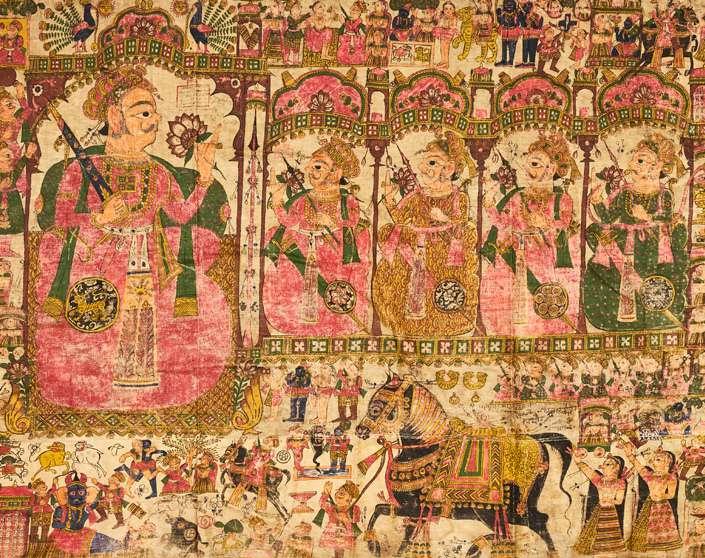
Lot 45 (detail)



INDIAN,
ISLAMIC, HIMALAYAN AND SOUTH-EAST ASIAN ART
INCLUDING THE COLLECTION OF ROBERT SKELTON, OBE
TO BE SOLD BY AUCTION: 25 Blythe Road, London W14 0PD
AUCTION:
Wednesday 20th May 2026, 11am, precisely
PUBLIC EXHIBITION:
Sunday 17th May, 12pm to 4pm
Monday 18th May, 10am to 8pm Tuesday 19th May, 10am to 5pm
SALE NUMBER OA0180
ENQUIRIES:
Nicholas Shaw, Head of Sale nicholas.shaw@olympiaauctions.com
Arthur Millner, Senior Consultant arthur.millner@olympiaauctions.com
Lara Defries, Administrator lara.defries@olympiaauctions.com
+44 (0)20 7806 5541 indianandislamic@olympiaauctions.com
Photography: Rolant Dafis
ONLINE CATALOGUE AND LIVE INTERNET BIDDING AVAILABLE THROUGH: www.olympiaauctions.com www.the-saleroom.com www.invaluable.com www.drouotonline.com
This auction is conducted by Olympia Auctions in accordance with our Conditions of Business printed in the back of this catalogue.
18 (detail)
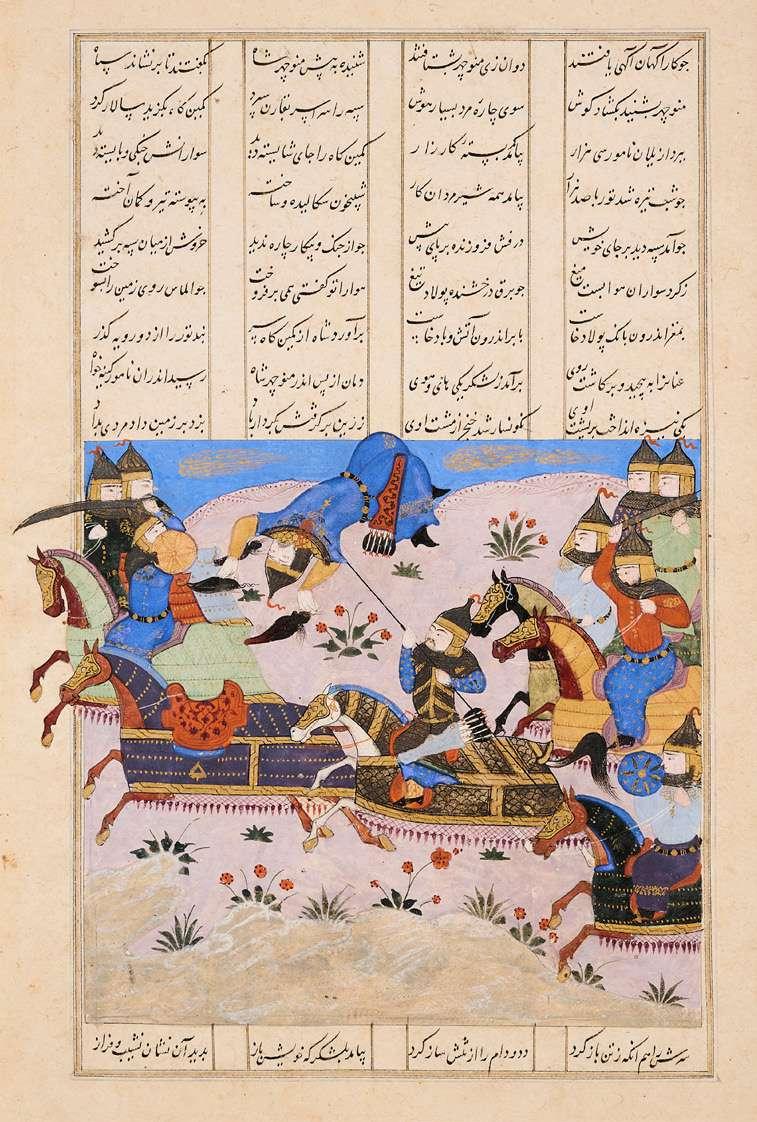
A FOLIO FROM A TIMURID COPY OF THE SHAHNAMA, PERSIA, SECOND HALF 15TH CENTURY
in opaque colours, black ink and gold, the illustration depicting Manuchihr unseating Tur in battle, the text composed in four columns of ten lines of elegant nasta’liq, verso with twenty three lines of nasta’liq around a central rectangular panel with two lines of calligraphy in gold within foliate scrolls, ruled margins in black and gold, text 22 x 13cm, folio 32.4 x 20.5cm
£1,000-1,500
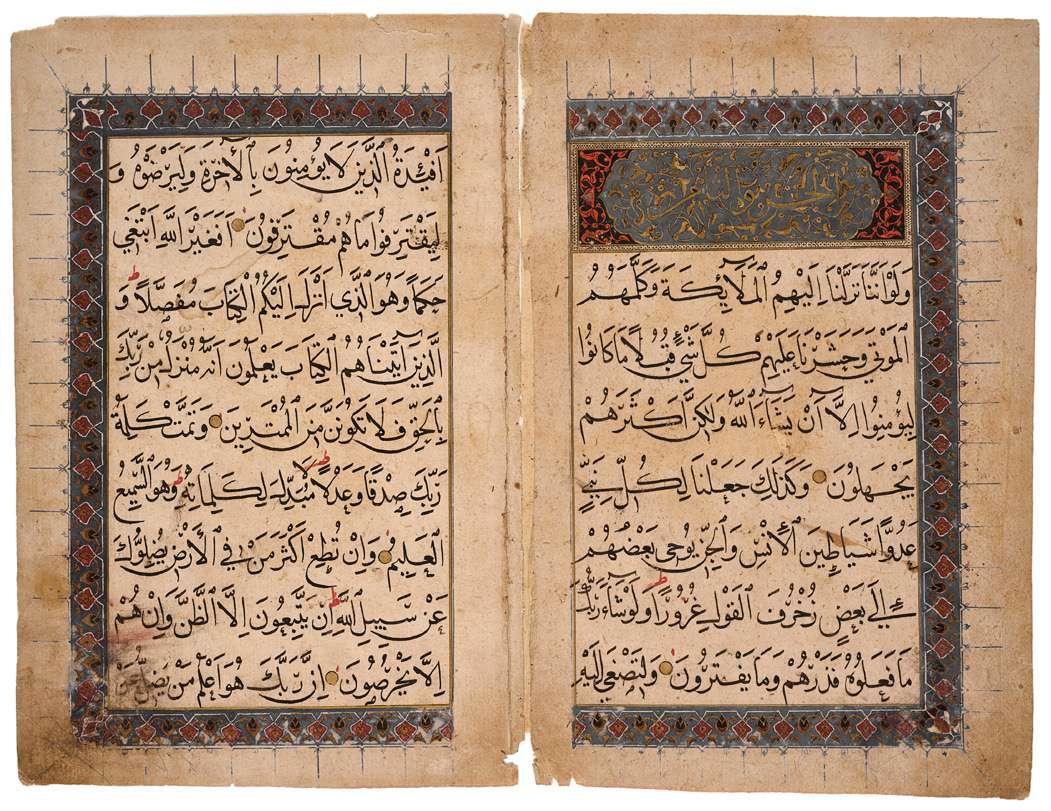
A TIMURID ILLUMINATED OPENING BIFOLIUM, PERSIA 15TH CENTURY
in black ink on paper, comprising nine lines of cursive script within illuminated borders in blue, black, red and gold, text 17.8 x 9.8cm, each folio 24 x 16cm
This is the opening bifolium of the eighth juz’ of a thirty volume Qur’an set. As such, it contains 6:111-117 (in part). £400-600
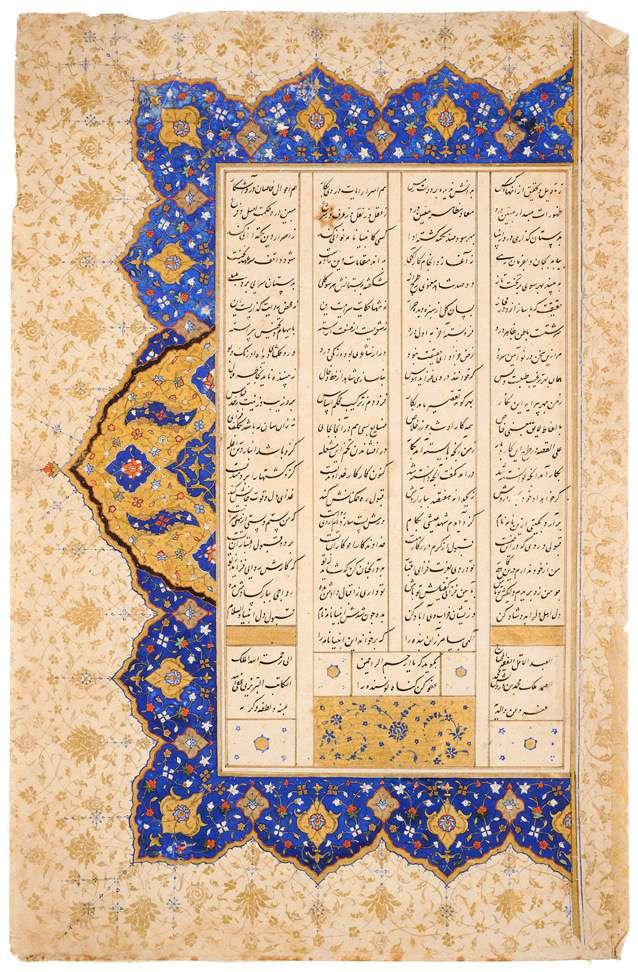
AN ILLUMINATED FOLIO FROM A SIGNED MASNAVI, PERSIAN OR OTTOMAN, CIRCA 1570-90
in black ink, gold and opaque colour on paper, the text in fine nasta’liq composed in twenty three lines in four columns, a panel of lotiform designs in blue on a gold ground, within a border of bracketed form containing further lotiform and naturalistic floral motifs formed in scrolls on a deep blue ground, folio 35 x 23cm
This is the final leaf of a Persian masnavi, which according to the text, is entitled the Anbiya-Nama (Book of Prophets). There were several works of this title, including the first volume of the official chronicler of the Ottoman court ‘Arif Chelebi’s multi-volume universal history, Shahnama-i Al-i Osman, completed in 1552. There were several other masnavis written with this title, however, including one by a 16th-century poet Ibrahim Shabistari ‘Iyani. A leaf in the Museum of Fine Arts, Boston, is said to come from an Anbiya Nama of Ibrahim b. ‘Abdullah, which may be from the same work, acc. no. 14/625. The colophon says that the manuscript was copied by one Muhammad b. Darwish Muhammad al-Katib al-Tabrizi.
£400-600
4
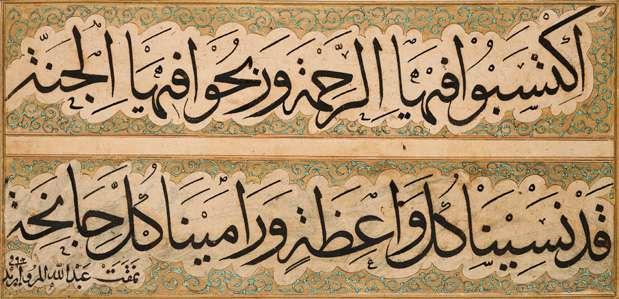
A CALLIGRAPHIC FOLIO ATTRIBUTED TO ‘ABDULLAH AL-MURWARID, PERSIA, LATE 15TH CENTURY
ink and colour on paper, composed of two lines, 12 x 24.5cm
Inscription: Inscribed with a saying of Imam ‘Ali b. Abi Talib.
In the lower left namaqat ‘abdullah al-murwarid fi 902 ‘’Abdullah al-Murwarid wrote [it] in 902 [1496/7]’.
£300-500
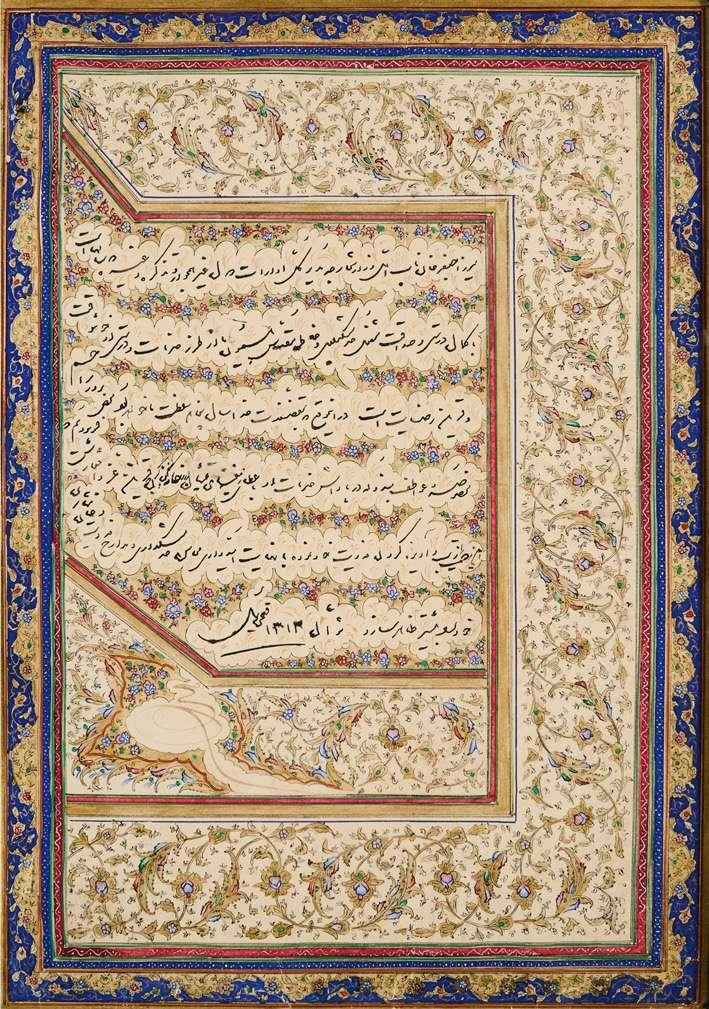
A
QUATRAIN FROM SADI’S GULISTAN, SIGNED MUHAMMAD HUSAYN AL-KASHMIR,
PERSIA,
DATED 1591-92
in black ink, gold and opaque colours, with four lines of nasta’liq on a ground of gold scrolls and birds, further lines of nasta’liq in the borders; with a letter signed by Muzaffar ad-Din Shah, Persai, dated 1897 AD, in black ink on paper, embellished with illumination in gold and opaque colours; and a calligraphic exercise comprising verses from a ghazal of the poet ‘Ashiq Isfahani (d. 1767/1768), in black ink on paper embellished with gold and opaque colours, all framed and glazed, 25 x 18cm; 23.5 x 18cm; 14 x 6.5cm respectively (3)
Inscriptions: The first with: muhammad husayn al-katib / sana alf ‘Muhammad Husayn al-Katib (the Scribe), year one thousand [1591-2 AD].’ This is the way in which Muhammad Husayn al-Kashmir, the famous calligrapher at the court of Akbar who bore the title Zarrin-Qalam (Golden Pen) signed his work. Birds are frequently used to decorate his calligraphy though in this case they may have been added later.
£600-800
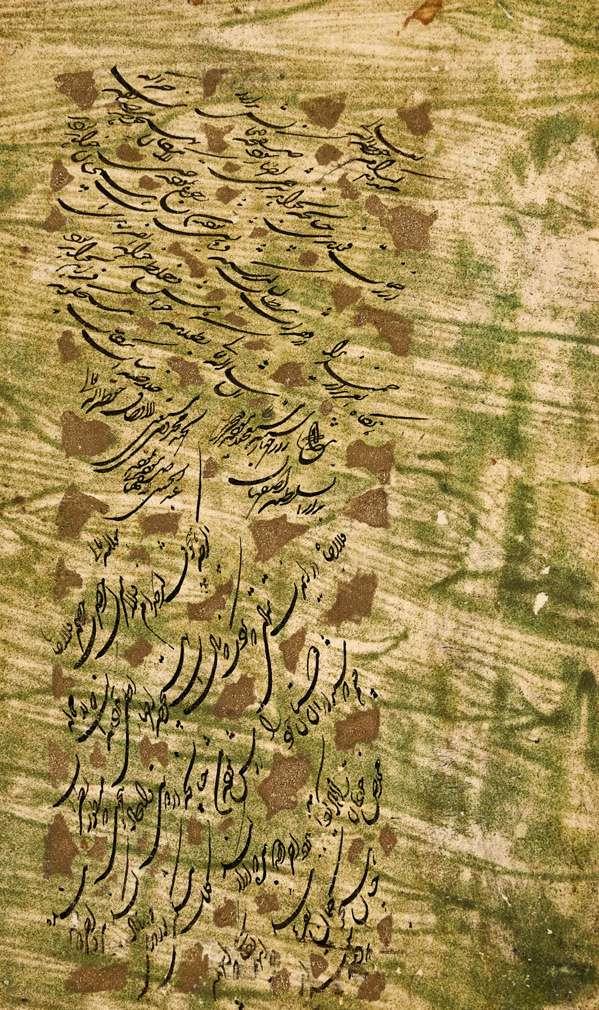
A CALLIGRAPHIC EXERCISE IN SHIKASTA, PERSIA, 18TH CENTURY
in black ink and gilt on paper with a marbled ground, laid down on card, 13 x 7.8cm, mounted
Inscriptions: The text bears a dedication by ‘Abd al-Husayn Isfahani to a certain “master (makhdumi) whose assistance is requested (musta’in al-awsaf)”, written in haste on Wednesday in Dar al-Saltana, Isfahan.
† £400-600
A FINE ILLUMINATED QUR’AN COPIED BY MUHAMMAD AL-ISFAHANI, PERSIA, DATED 1878-9
Arabic manuscript on paper, 242 pages with 2 fly leaves, pages composed in nineteen lines of calligraphy within red, gold and turquoise ruled borders, with polychrome marginal and calligraphic details, opening and closing with a double shamsa, each with a central lobed medallion of white calligraphy on a gold ground within a ground of serrated leaves and lotiform designs, an illuminated double frontispiece, with six lines of text within elaborate illuminated margins of floral scrolls on a deep blue ground with half palmette and other decorative forms, contemporary lacquered papier-mache bindings with designs of elaborate floral sprays within borders of lobed cartouches of floral scrolls, text 15 x 7.9cm, folio 20.9 x 13.1cm
Inscriptions: The inscriptions state that this Qur’an was copied for Haji Muhammad Husayn Khan Sadr al-Dawla by Muhammad al-Isfahani in 1296 (1878-9). Muhammad Husayn Khan was a grandson of Muhammad Husayn Khan Sadr-i Isfahani (d. 1823), the powerful governor of Isfahan. Sadr al-Dawla is mentioned in a list of those who received a title during the first 40 years of Nasir al-Din Shah and that he was a military officer at court. (Afshar, 1363, pp. 315, 425).
£3,000-5,000
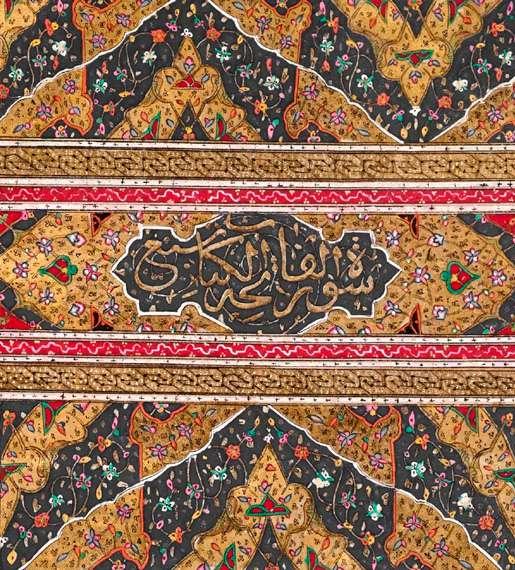
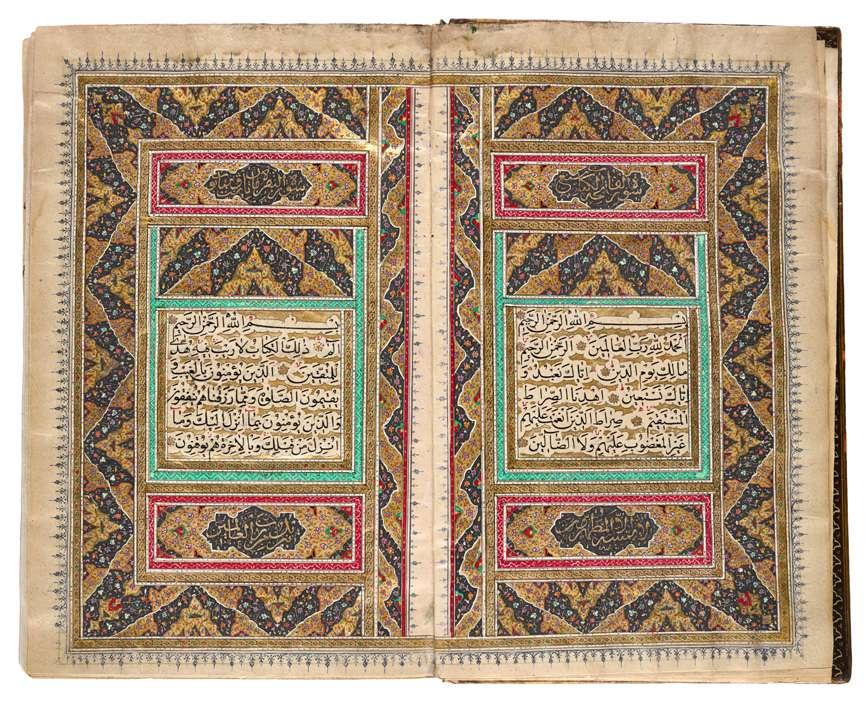
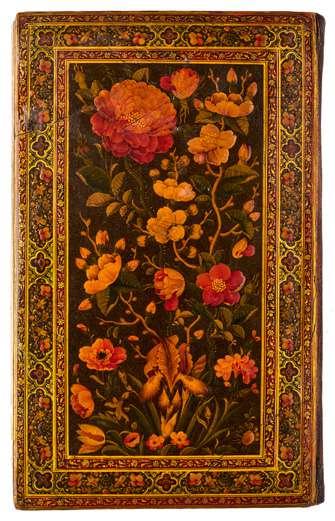
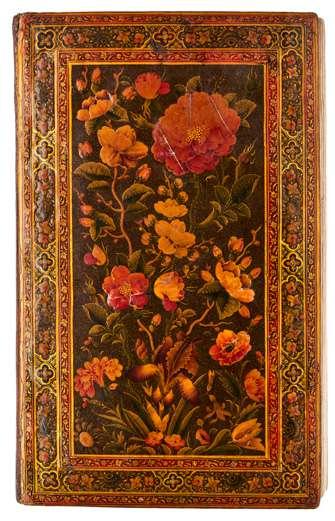
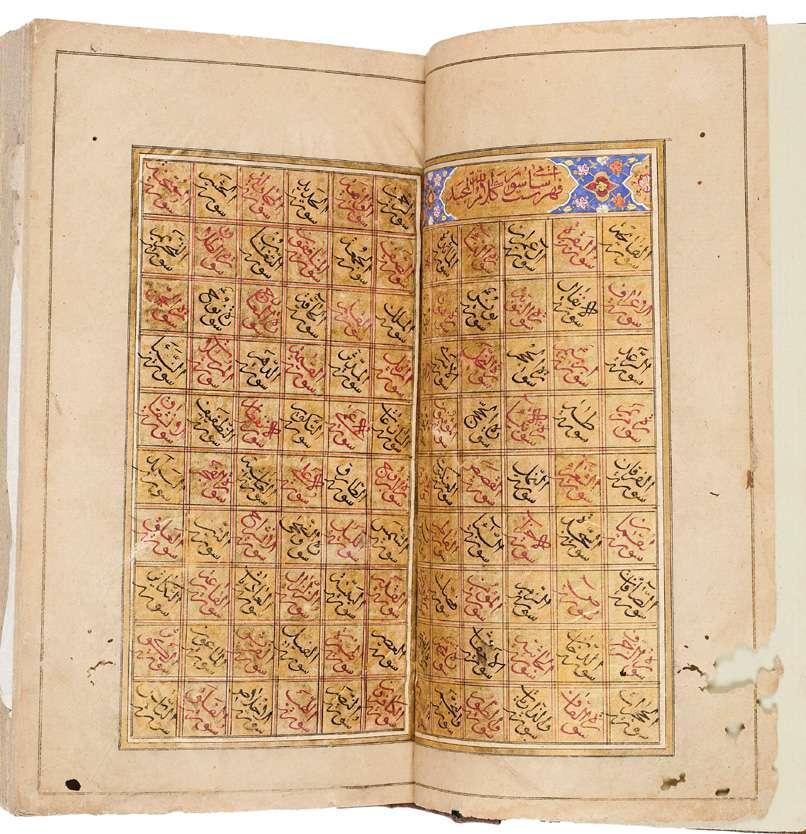
A QAJAR ILLUMINATED COPY OF THE QUR’AN, PERSIA, SECOND HALF 19TH CENTURY
Arabic manuscript on paper, approximately 270 leaves plus 3 fly leaves, written in fine naskh in eleven lines in black ink with interlinear text in red, with an opening double page of the names of god in black and red on a gold ground, a further double page of shamsa, the elaborately illuminated double opening page reserved on a gold ground, the text with gold ruled borders, surah headings, verse markers and marginal elements in gold, red and blue, rebound into a lacquered papier-mache binding decorated with floral ogival cartouches, folio 16.8 x 10.2cm, text 13 x 6.5cm
£800-1,200
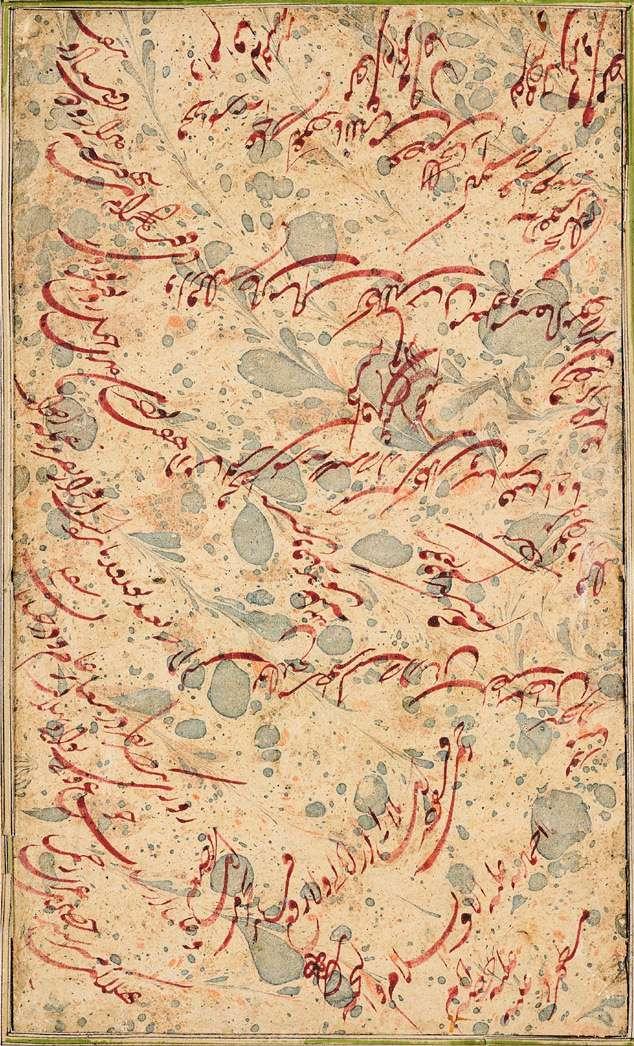
A
CALLIGRAPHIC
EXERCISE IN SHIKASTA, SIGNED
‘ABD
AL-MAJID, PERSIA, SECOND HALF 19TH CENTURY
red ink on marbled paper laid on card, lines of calligraphy, within ruled margins in orange and green enclosing a border of polychrome floral scrolls on a gold ground, text 17.1 x 10.3cm, folio 39.8 x 29.9cm
The text states that this exercise was carried out by ‘Abd al-Majid for a Muhammad Hasan Khan at the end of Dhu’l-Qa’da in the forty days leading up to Nowruz in 1287 (1871 A.D.) at the shrine of Imam Reza in Mashhad. It refers to a famine in the reign of Sultan Sanjar in Nishapur as well as to one in the scribe’s own time.
£300-500
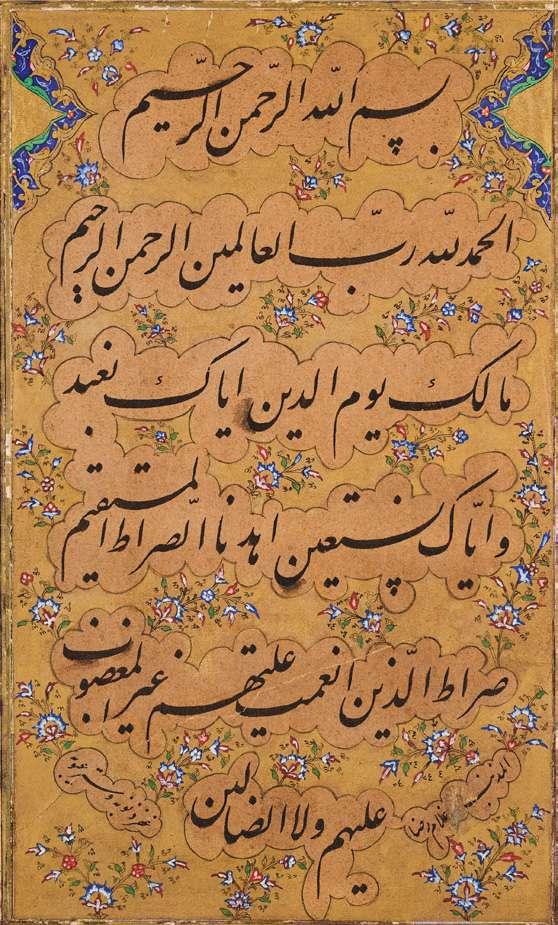
A QUR’ANIC ILLUMINATED FOLIO, SIGNED GHULAM RIZA, PERSIA, 19TH CENTURY
in ink, opaque colours, gold on buff coloured paper, with six lines of nasta’liq with interstitial floral sprays and flanked by formal arabesque elements, two further lines of nasta’liq lower left and right, ruled margins in black and gold, inscribed in black recto, mounted on card, text 19.2 x 11.3cm, folio 30.6 x 19cm
Inscriptions: The text is Qur’an 1, Surat al-Fatiha.
Signed within the smaller cartouches: al-mudhnib ghulam riza ghafara dhunubahu wa-satara ‘uyubahu ’The sinful Ghulam Riza, may [God] forgive his sins and conceal his faults’ On the recto ‘this page by the master Ghulam Riza’ and stating that it was bought in Shiraz in AH 1279/1879-80 AD for the purchaser’s Sufi lodge (khanqah). This may well be the famous calligrapher Ghulam Riza Isfahani, one of the most famous calligraphers of the Qajar period. He was the son of a confectioner who moved from Isfahan to Tehran. His skill in calligraphy gained the attention of Muhammad Shah and as a result he received royal favour and was appointed tutor to the Qajar princes. He died in 1304/1886-7 and was buried in the Safa’iyya cemetery in Rayy. He was a master of several styles, including nasta’liq, which he wrote in the style of Mir ‘Imad, though he is most often remembered for his work in shikasta ta’liq and siyah mashq styles. For his full biography and a discussion of his work, see Bayani 1346, vol.2, pp. 550-556.
£500-800
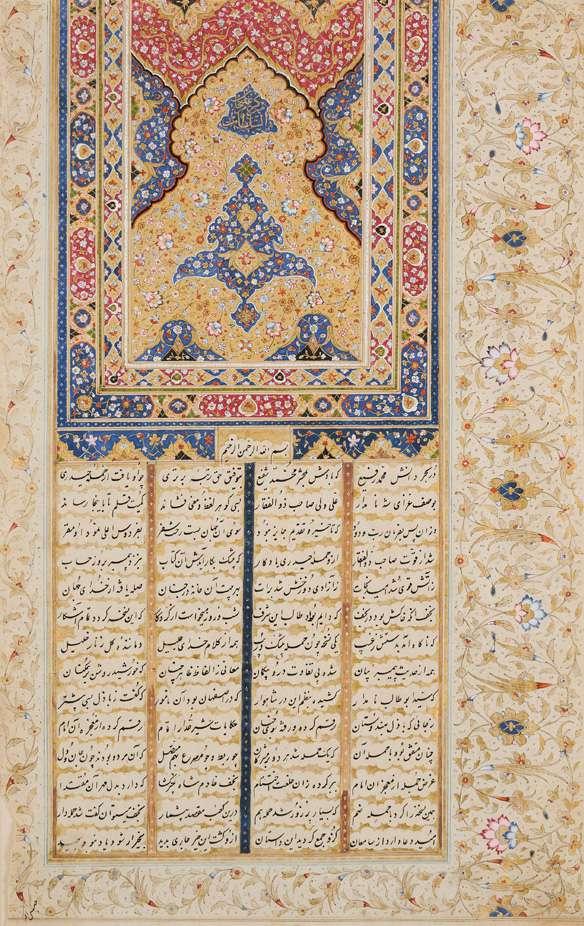
THE OPENING FOLIO OF A ROYAL TALPUR COPY OF TAKMILA-I HAMLA-I HAYDARI OF NAJAF, SINDH, CIRCA 1820
in black ink on paper, the text in four columns of fourteen lines of nasta’liq, illuminated in red, blue, black and gold with elaborate lobed cartouches containing formal and naturalistic floral motifs, mounted, folio 40.5 x 25.5cm
This is the opening leaf of the Takmila-i Hamla-i Haydari, ’the Completion of the Hamla-i Haydari” of the poet “Najaf”. In 1135/1722-3 AD, The poet put together the two-volume, uncompleted masnavi recounting the battles of the Prophet Muhammad and ‘Ali b. Abi Talib, the Hamla-i Haydari, of Muhammad Rafi “Badhil” Mashhadi (d. 1123/1711-12 AD) with a work on the life of Imam ‘Ali by Abu Talib Findirski Isfahani, a poet active during the reign of the Safavid Shah Suleyman, into a single volume called The Completion of the Hamla-i Haydari. It was later printed in Agra in 1305 (1887-8 AD). At the top of the page is what appears to be a dedication to “al-Sultan Mir Karam ‘Ali Khan” (r. 1811-1828 AD). This would indicate that the manuscript was a royal Talpur commission which were generally carried out by Persian artists brought to work in Sind. £400-600
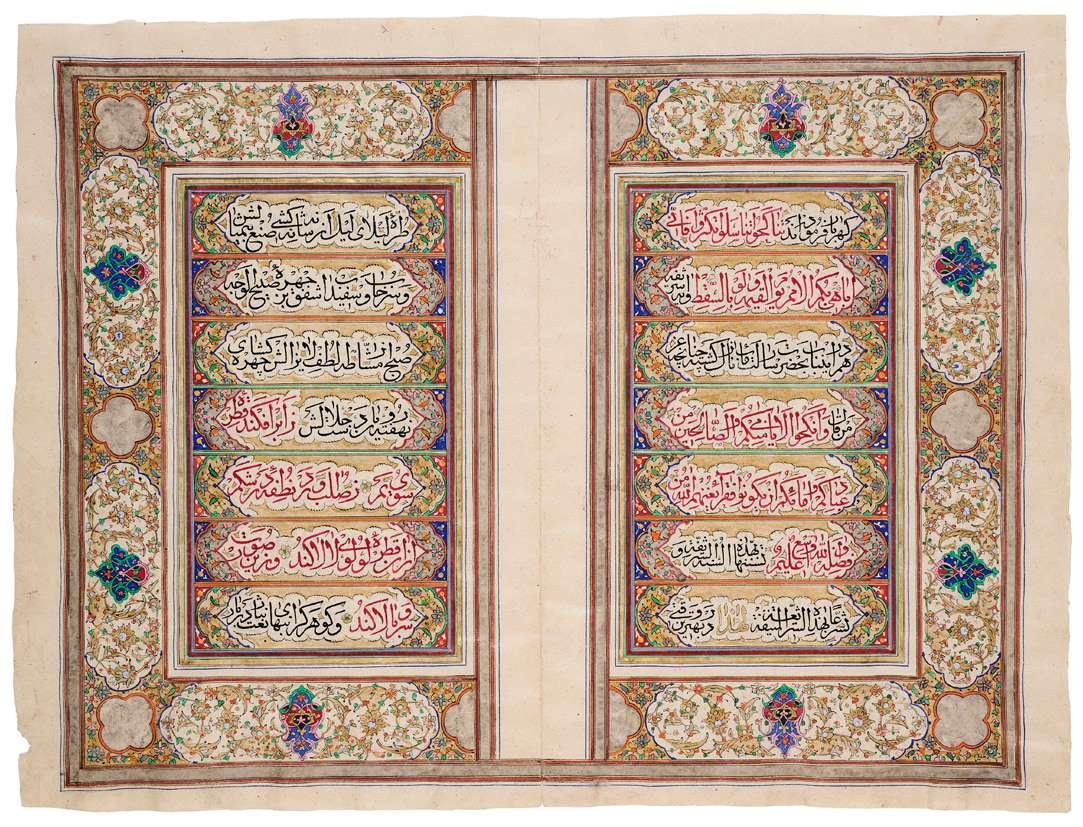
A RARE QAJAR MARRIAGE CERTIFICATE, PERSIA, DATED 1ST AUGUST 1919
a Persian manuscript on paper, dated Saturday 4th Dhu’l-Qa’da (1st August 1919), 6 pages, composed of three bifolium, each with seven lines of calligraphy in red, black and gold, embellished with illumination of floral motifs on blue, red and gold grounds, with a single opening page surmounted by a calligraphic polylobed cartouche on a blue ground, text 16 x 9cm, folio 27.2 x 18.1cm
This marriage contract is between Shaykh Muhammad Riza, known as Shaykh al-‘Iraqayn and Fakhr al-Muluk, known as Malika Sadat, daughter of Prince Zill al-Sultan (himself the son of Nasir ad-DIn Shah), dated Saturday 4 Dhu’l-Qa’da 1337 (1919 AD). It is signed at the end, along with seal impressions, by various signaturies including, in Isfahan, the groom’s mother and a certain Shaykh Riza Najafi. It is signed elsewhere in the upper margin by a certain Muhammad Riza al-Fardi.
£800-1,200
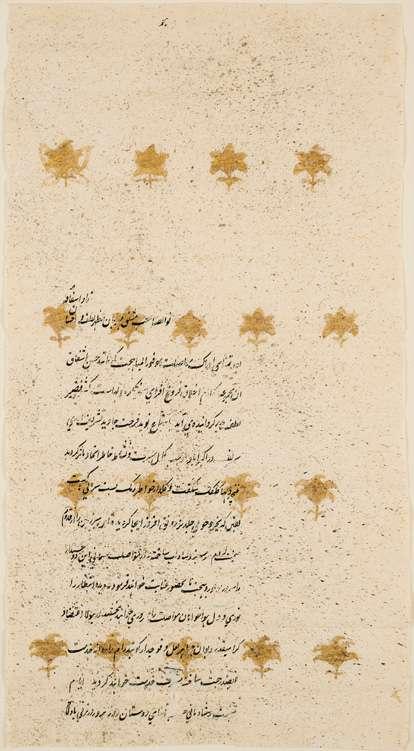
TWO OFFICIAL DOCUMENTS (FIRMAN), INDIA, THE FIRST DATED 1826
in black ink and gold on paper, 38 x 20cm; 49.5 x 17.5cm respectively (2)
The first firman is dated 23rd June, 1826, and was sent as an expression of good wishes by an unknown sender who had received the news of the arrival of the Governor General in Calcutta. Though this is not specified in the letter, the governor general at the time was Lord Amherst, who had just returned to Calcutta from the Burma campaign.
The second firman is undated and is to an unidentified recipient in anticipation of the recipient’s arrival in Akbarabad (Agra). The letter was to be delivered by two delegates, a certain Diwan Jawahir La’l and a Faujdar Gobind Ram.
£500-800
14
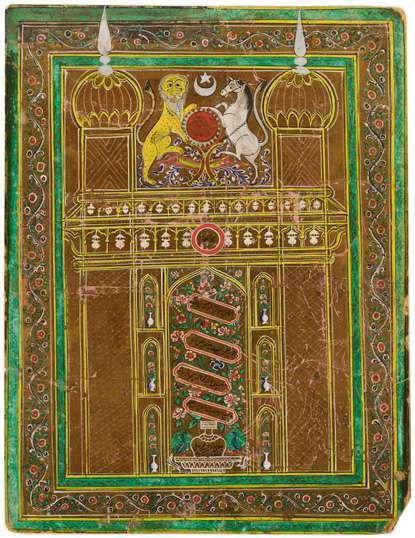
AN ILLUMINATED HAJJ CERTIFICATE, HYDERABAD, INDIA, 19TH CENTURY
in opaque colour and gold, with a design of a tughra-style insignia flanked by a lion and a unicorn affronte, within an architectural setting with two domed towers, the arched doorway with cartouches of calligraphy, folio 50 x 38cm, framed
Inscriptions: The tughra design: “Nawwab Muhammad Mu’in al-Din Khan Bahadur”. The text is a Persian benedictory and encomiastic poem, presumably in praise of Muhammad Mu’in al-Din Khan.
Lower cartouches: pish karda-i sayyid muhammad kamil sha’ban sana 1324.
“Presented by Sayyid Muhammad Kamil, Sha’ban year 1324 [1906 AD]”.
This may refer to Moin-Ud-Daula-Bahadur, who was an Indian nobleman and one of the Paigah nobililty, one of the three great Paigahs of the Hyderabad state. Though they raised their own army, they were loyal to the Asaf Jahi dynasty. His father has acted as co-regent and Prime Minister of Hyderabad. Moin himself became a member of the executive council to the Nizam and maintained this loyalty, as well as an enormous estate and vast wealth, throughout his life.
£600-800
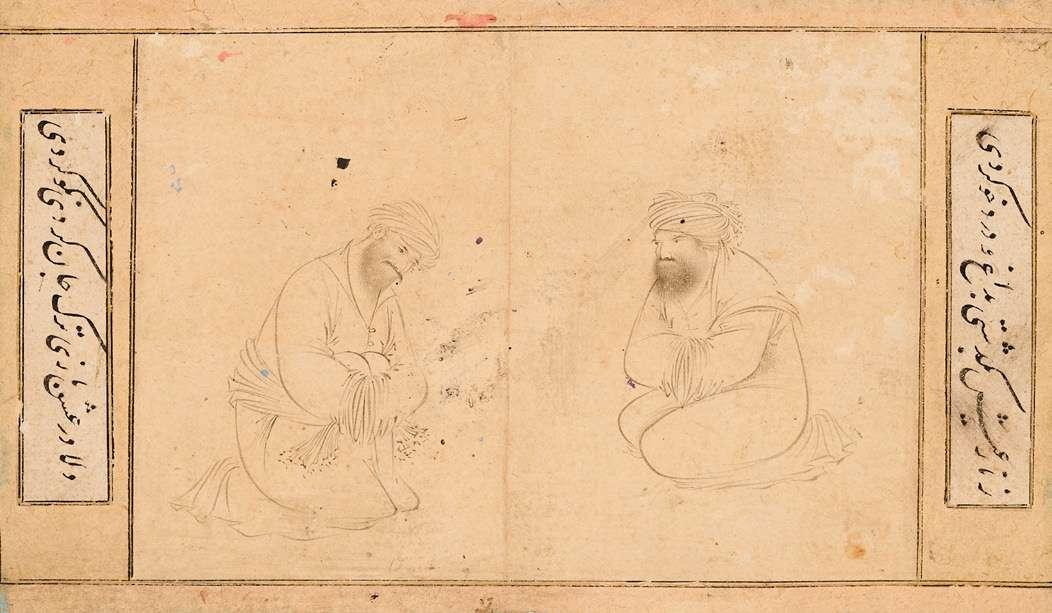
A SAFAVID DRAWING OF TWO FIGURES, IN THE STYLE OF RIZA-I ABBASI, PERSIA, CIRCA 1620
ink and gold on paper, the delicate study of two seated figures set within ruled margins in gold and black and a border of gold leafy scrolls on a blue ground, calligraphic cartouches applied around the central image, image 7.5 x 10.5cm, folio 15.2 x 22.3cm
Inscriptions: The two inner lines of calligraphy is a couplet from a ghazal of Amir Shahi (d.1453). The twelve lines in the border are from the Guy u Chawgan of ‘Arifi Haravi (fifteenth century).
Provenance: Sotheby’s, 16th October 1996, lot 64.
Hagop Kevorkian Collection, sold Sotheby’s, 23rd April 1979, lot 66.
The manner of this drawing can be compared to two drawings in the Biblioteque Nationale, Paris, mounted together, and published in Stchoukine 1964, pl.XXXIV.
£1,000-1,500
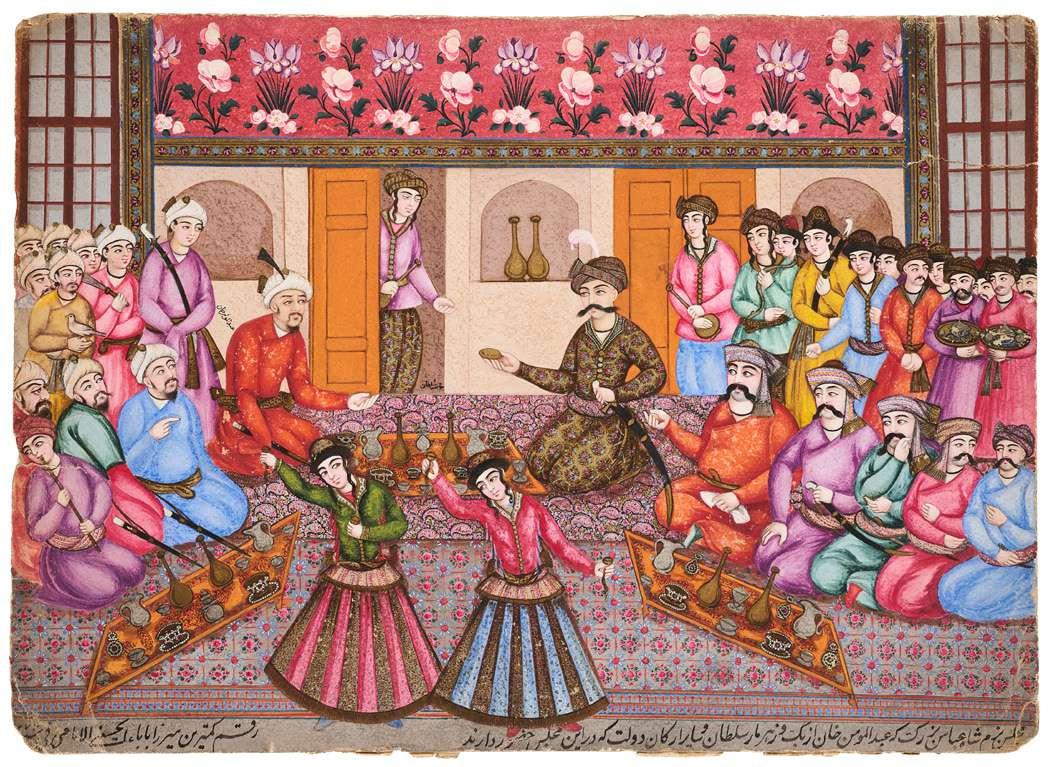
THE GATHERING OF THE FEAST OF SHAH ABBAS, PERSIA, DATED 1860-1
in opaque colour on paper, inscribed twice in the image and along lower edge, depicting a lively feast with courtiers, attendants, musicians and dancers on elaborately decorated carpets, folio 25.8 x 35.9cm
Inscriptions: Lower Left ‘Painting of the lowliest Mirza Baba al-Husayni al-Imami in the year [1]277 [1860-1]’.
Lower Right ‘The gathering of the feast of Shah ‘Abbas the Great in which ‘Abd al-Mu’min Khan Uzbek and Zahr-i Mar Sultan and other pillars of the state are present’.
By left hand figure ‘Abd al-Mu’min Khan’.
Provenance: Sotheby’s, 14th October 1999, lot 57.
The composition is taken from one of the fresco’s decorating the interior of the Chihil Sutun. This depicts Shah Abbas feasting with the Shaybanid ruler Vali Muhammad Khan, whereas on our painting he has been misidentified as the earlier Uzbek ruler, ‘Abd al-Mu’min Khan. A similar misidentification occurs on another 19th century version of this composition now in the Ferenc Hopp Museum of Asiatic Art in Budapest, acc. no. 51.462.1.
£2,000-3,000
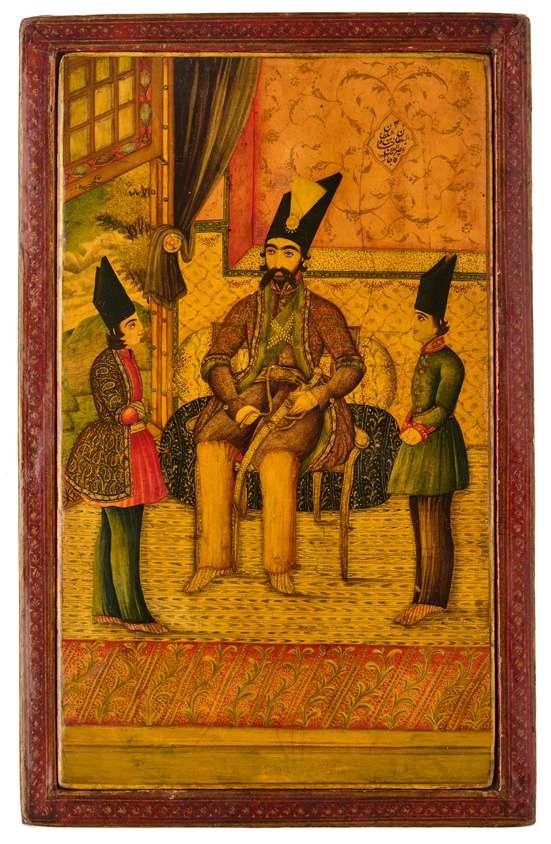
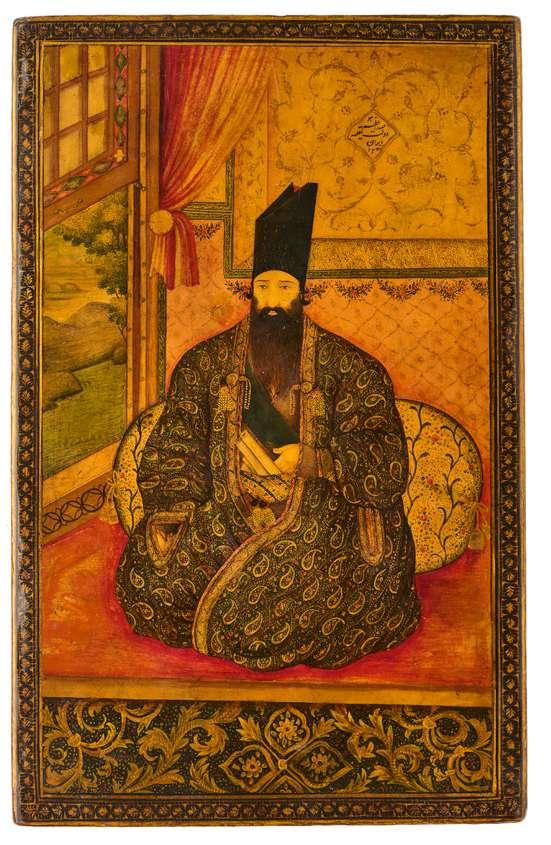
A QAJAR LACQUERED PAPIER-MACHE MIRROR CASE WITH A ROYAL PORTRAIT, PERSIA, DATED 1854-5
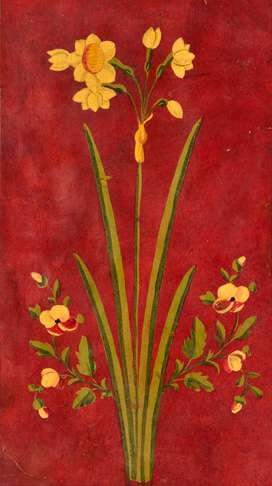
the cover with a portrait of Nasir ad-Din Shah seated on a chair flanked by two youthful attendants within a richly decorated interior with an opened window, a lobed calligraphic cartouche above, the interior with a study of a narcissi, the reverse of the case with a portrait of Mirza Aqa Khan Nuri seated within the same interior, another lobed calligraphic cartouche, 26 x 16.4cm
Inscriptions: The inscription above Nasir al-Din Shah says: huwa al-sultan ibn al-sultan nasir al-din shah qajar 1271 ’He [i.e. God]. The Sultan son of the Sultan, Nasir al-Din Shah Qajar, 1271 [1854-5 AD]’ The inscription above Mirza Aqa Khan Nuri says: huwa sadr-i a’zam-i dawlat-i ‘aliya-i iran 1271 ‘He [i.e. God]. Prime Minister of the Exalted State of Iran, 1271 [1854-5 AD]’ Though it doesn’t mention him by name, this is clearly Mirza Aqa Khan Nuri. He was a prominent member of the Khajeh Nouri family from the Nur region in Mazandaran. Members of the family featured prominently in both offices of state and the army throughout the eighteenth and nineteenth century. Mizra Aqa Khan Nuri served as prime minister to Nasir a-Dain Shah between 1851 and 1858. He died in Qom in 1865. His portrait appears on another mirror case dated 1857-8, now in the Khalili Collection, LAQ 42, possibly after a watercolour of him by Abul Hasan Ghaffari.
£7,000-10,000
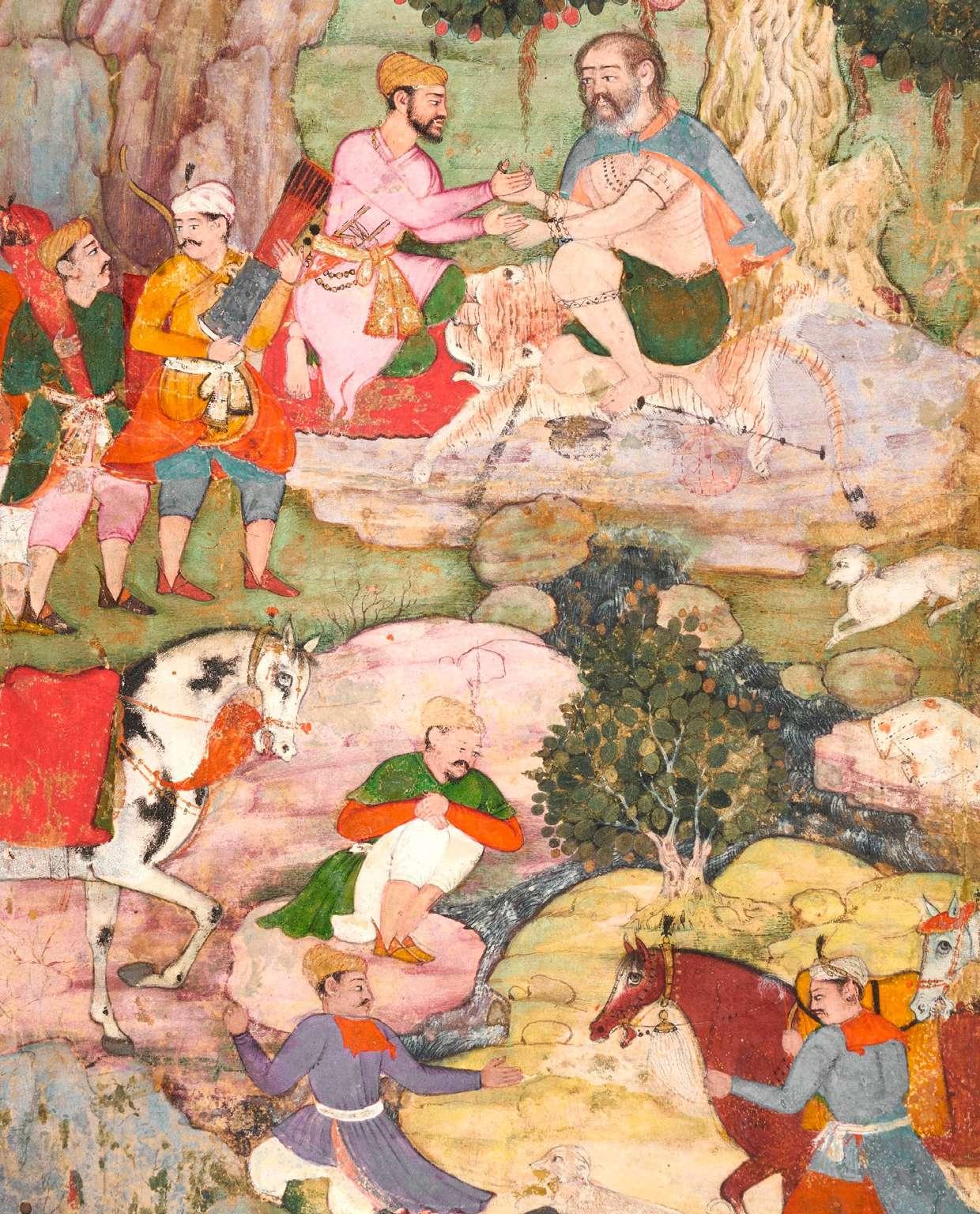
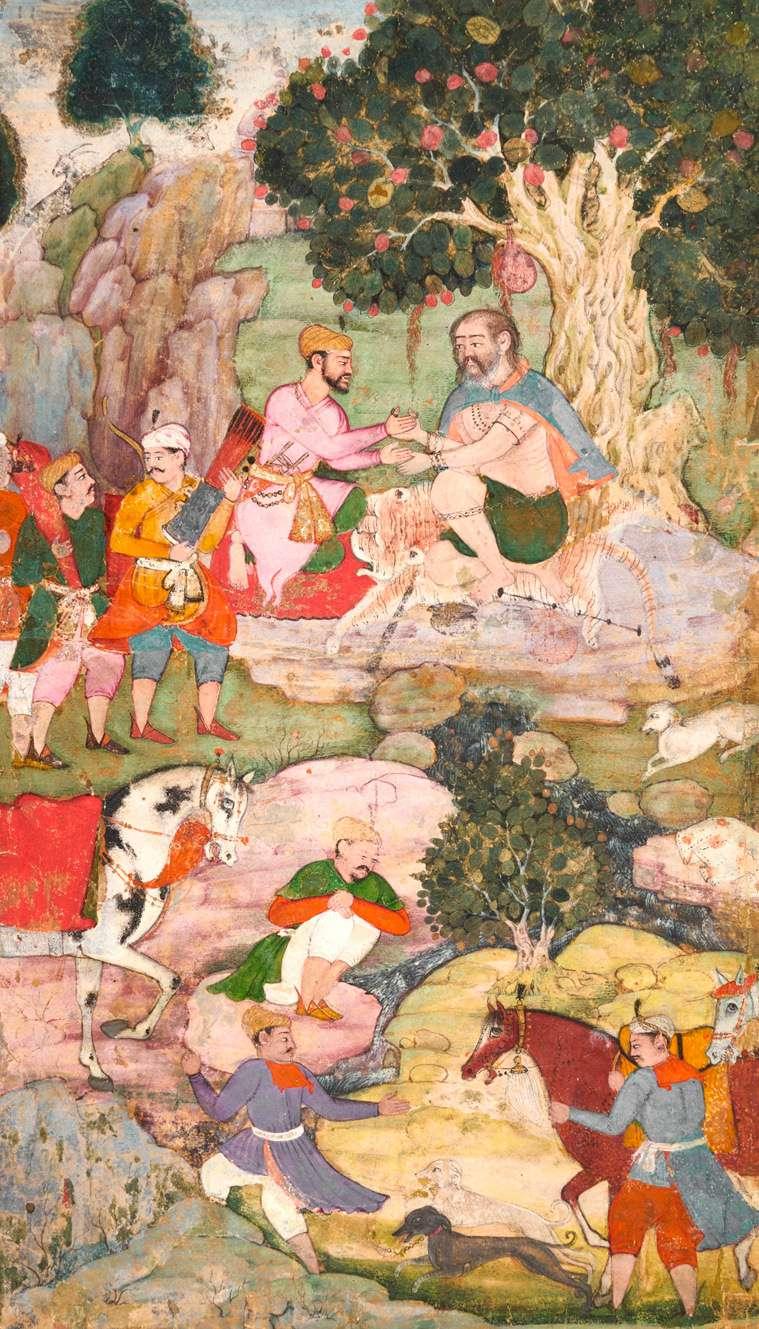
A MUGHAL MINIATURE OF A PRINCE VISITING A MYSTIC, NORTH INDIA, CIRCA 1590-1595
in opaque colours and gold on paper, the kneeling figure of the prince clasps the hands of the seated sage who rests upon a tiger skin draped over a rocky outcrop beneath a fruiting tree, attendants hold the prince’s bow and quiver, whilst others restrain horses and dogs by a stream, ruled margins in gold, blue and white, mounted on card, verso with an applied circular label, text 16.6 x 9.9cm, folio 22.1 x 13.6cm
Provenance: A private UK collection since the early 2000s, purchased from the London trade.
Christies, 21st November, 1986, lot 135, illustrated p.91.
The depiction of a worldly ruler seeking guidance from the spiritual guide, whether a sufi or saddhu, became a familiar trope in Mughal painting. The prince has abandoned his earthly trappings, the horses, attendants and trappings of the hunt, to kneel bare foot before the wise figure beneath the tree. The bare chested sage has the emblems denoting his status, such as the tiger skin and the simple pouch for his meagre possessions which hangs from a branch above his head.
The setting of the scene owes something to the Persian tradition which, at this date, still appears in a less diffused manner in Mughal court art as a result of the presence of Persian artists in the Mughal royal atelier.
The subject of a prince seeking the advice of a wise or holy man recurs frequently in Mughal painting of the sixteenth and seventeenth centuries. It probably originating in the reign of Akbar who was, perhaps, more than any other Mughal Shah, concerned with absorbing diverse spiritual advice. The artistic intention is both to indicate the contrast between worldy and spiritual matters but also to indicate that the wise ruler takes account of both. As stated elsewhere, the composition intends to show the ‘juxtaposition and distant affinity of temporal and spiritual authority’ (A. Welch and S.C. Welch, The Arts of the Islamic Book, The Collection of Prince Sadruddin Aga Khan, New York, 1982, p.160).
As with this example, the contrast between these aspects is emphasised by depicting the prince in the midst of a hunt.
A comparable composition occurs on a folio from the De Luynes album sold at Christies, 25th April 2024, lot 89, but here the two activities, hunting and seeking advice, are shown in separate paintings on recto and verso. The fruiting tree is very similar to one depicted in a contemporary painting from the first Imperial copy of the Baburnama (Topsfield 2013, pp.34-35).
This image also features a ascetic by a similar fruiting tree. The tree has been identified as a lote-fruit or ber tree (Zizyphus jujuba). The brush work that is used in this painting has a comparably confident and ‘spontaneous’ manner, typical for this Baburnama, and similar to the one adopted for this our painting.
£12,000-15,000
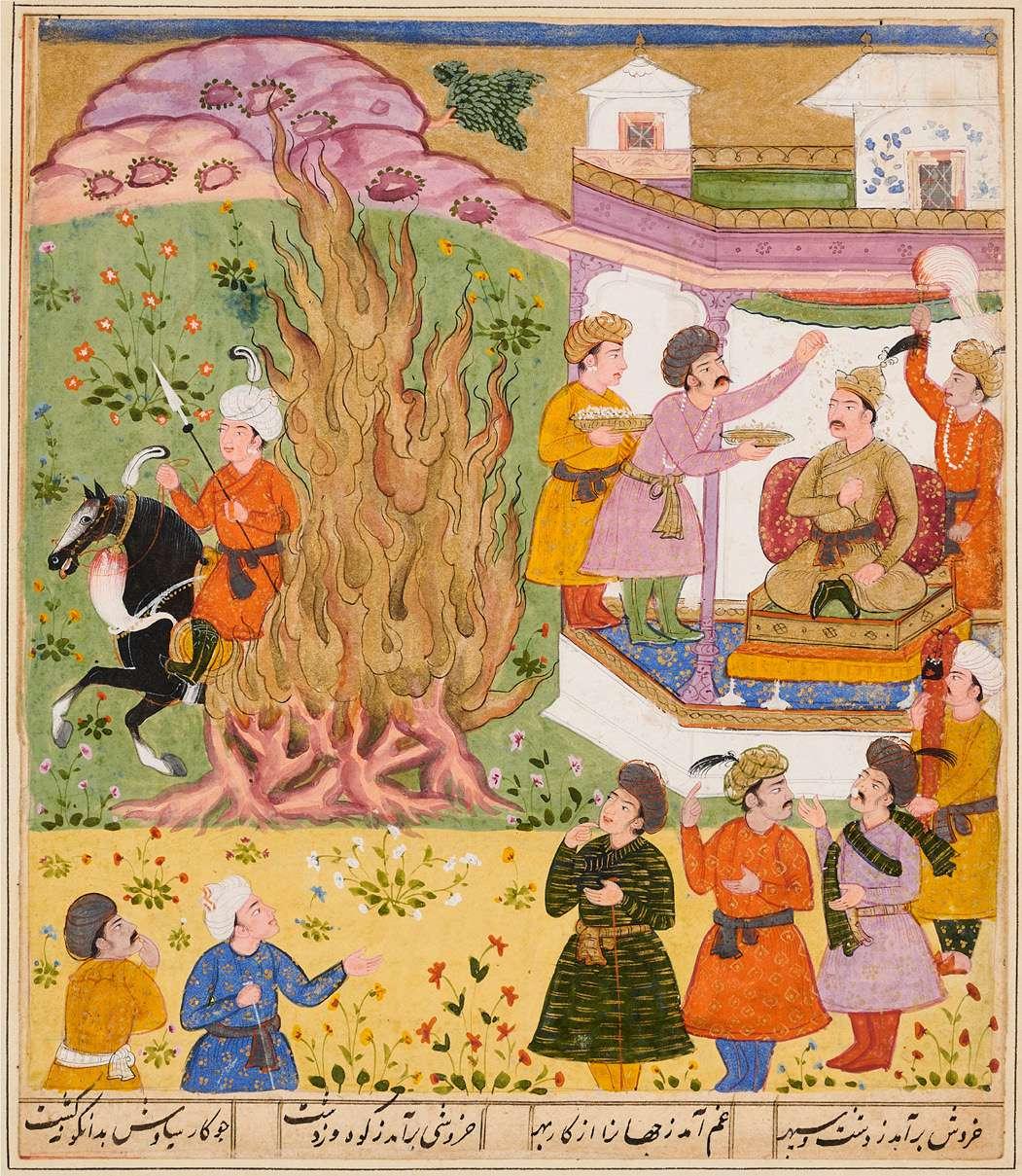
THE TRIAL BY FIRE OF SIYAVUSH, SUB-IMPERIAL MUGHAL, INDIA, CIRCA 1630
an illustrated page from a Persian manuscript copy of Firdausi’s Shahnama, in opaque colours heightened with gold and ink on paper, recto with one line of nasta’liq in black ink in four columns, verso with twenty lines of nasta’liq in black ink arranged in four columns within black and gold ruled margins, inscribed in two places in a nineteenth century hand in ink ‘No. 64’, the second indecipherable, the folio reduced and housed within a paper mount with further ruled borders, image 16 x 14.6cm, mounted folio 24 x 21.8cm
Provenance: Paris, 4th November, 2014, Collection of Francoise et Claude Bourelier.
Sir Thomas Phillips (1792-1872), Ms.34738, the sale of his library Biblioteca Phillipica (9th auction), Sotheby’s London, 27th November, 1974, lot 789.
Frances Mary Richardson Currer, Eshton Hall, Yorkshire (1785-1861).
Thomas Rood.
Phillip Augustus Hanrott (1776-1856), The Hanrott sale, London 5th August, 1838, lot 1295.
Mrs. Rebekah Bliss of Kensington (1749-1819), the sale of her library Saunders and Hodgson, 26th April 1826.
It is a testimony to the high regard in which pages from this copy of the Shahnameh were held that they passed into the collection of some of the most renowned bibliophiles of nineteenth century England. The early annotations are probably in the hand of one of these great collectors.
Mrs Richardson Currer is frequently referred to as England’s first female bibliophile but, as we see in the case of this folio and others, Mrs. Bliss of Kensington preceded her by several years and may more rightly claim this title. The sale of the library of Rebekah Bliss (1749-1819) was held by Saunders & Hodgson in 1826 was entitled Bibliotheca Splendidissima: A Catalogue of a Select Portion of the Library of Mrs. Bliss, Deceased, Removed from her Residence at Kensington. A blog by Dr. Davies explores the collecting activities and influences of Mrs. Bliss: see http://rebekahbliss.blogspot.co.uk
This is one of the two pages from this album that were sold in the Sotheby’s sale of the collection of Sir Thomas Phillips in 1974. Two more pages from this manuscript, formerly in the collection of the Hardy family of Chilham Castle, Kent, appeared at auction in India, Saffron Art, 24-25th April 2013, lot 1. Two more are in the collection of the San Diego Museum of Art, formerly with Edwin Binney who had bought them in London at Sotheby’s, 11th December, 1961, lot 64. All of the recorded examples have been trimmed but this is the only example that has text on the verso making it unique amongst the surviving pages.
£2,000-3,000
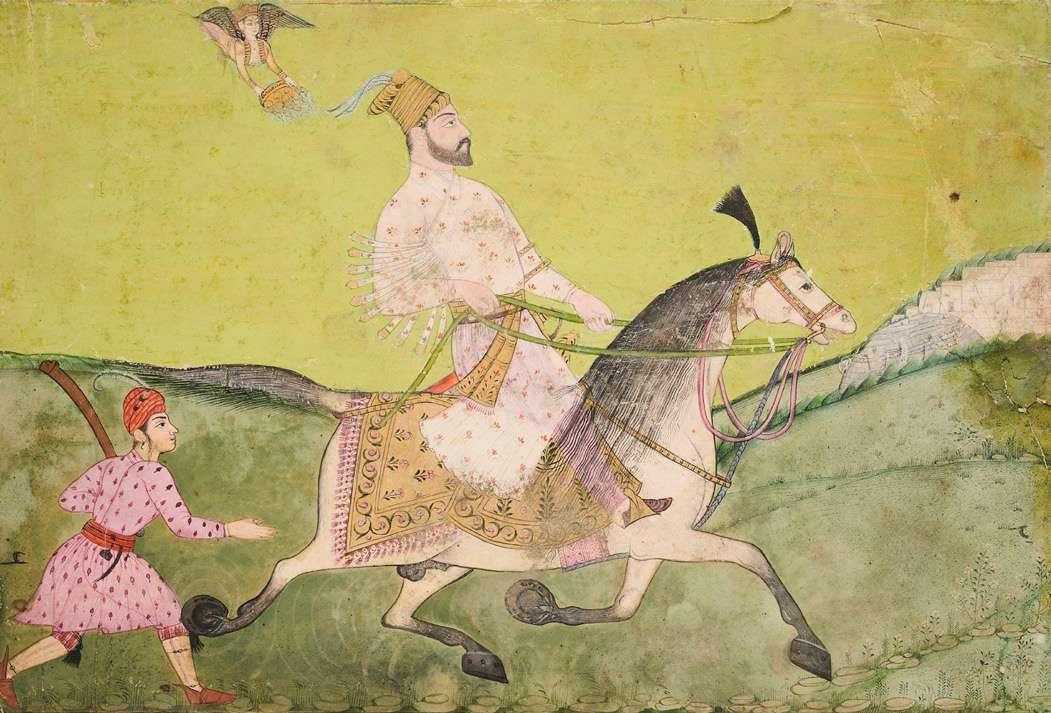
A NOBLEMAN ON A HORSE, DECCAN, LATE 18TH/EARLY 19TH CENTURY
on opaque colour, black ink and gold on paper, the mounted figure gallops toward a fortified town pursued by a servant and observed from above by a winged peri, ruled margins in black and gold, image 20.6 x 31.7cm, folio 22.1 x 31.8cm
Another version of this composition was sold by Bonhams, 10th April 2008, lot 79, also thought to be Deccan. The backward leaning posture of the princely figure and the jaunty gait of the horse are reminiscent of earlier Deccani equestrian portraits such as that of Sultan Abu’l Hassan Qutb Shah sold at Christie’s, 7th October 2008, lot 223, and also with another from the Sven Gahlin Collection, sold Sotheby’s, 6th October 2015, lot 46. Both of these were thought to have been produced in Golconda which might suggest a more precise origin for our painting.
£500-800
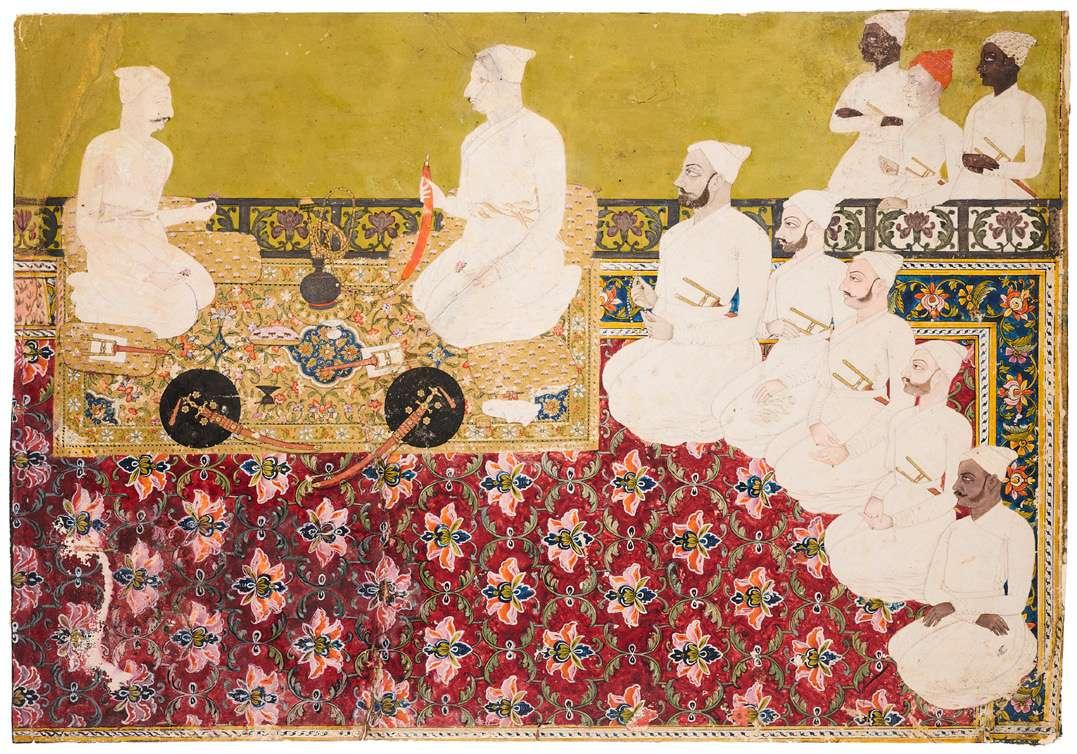
A COURT SCENE ON A TERRACE, DECCAN, HYDERABAD, EARLY 18TH CENTURY
opaque colours and gold on paper laid on card, the two dignitaries kneeling on a finely patterned carpet with courtly accoutrements around them, five courtiers in attendance on a carpet with a bold lotiform design, three further attendant figures, two of African origin, beyond the terrace, folio 24.3 x 35cm
Provenance: Offered at Bonhams, 6th October 2015, lot 163.
The scene appears to depict something of the court etiquette and the protocol involved in diplomatic engagement and social hierarchical arrangements. It is complemented by some exquisite decorative details such as the boldly patterned carpet, the refined accessories and the elaborately carved balustrade.
£1,000-1,500
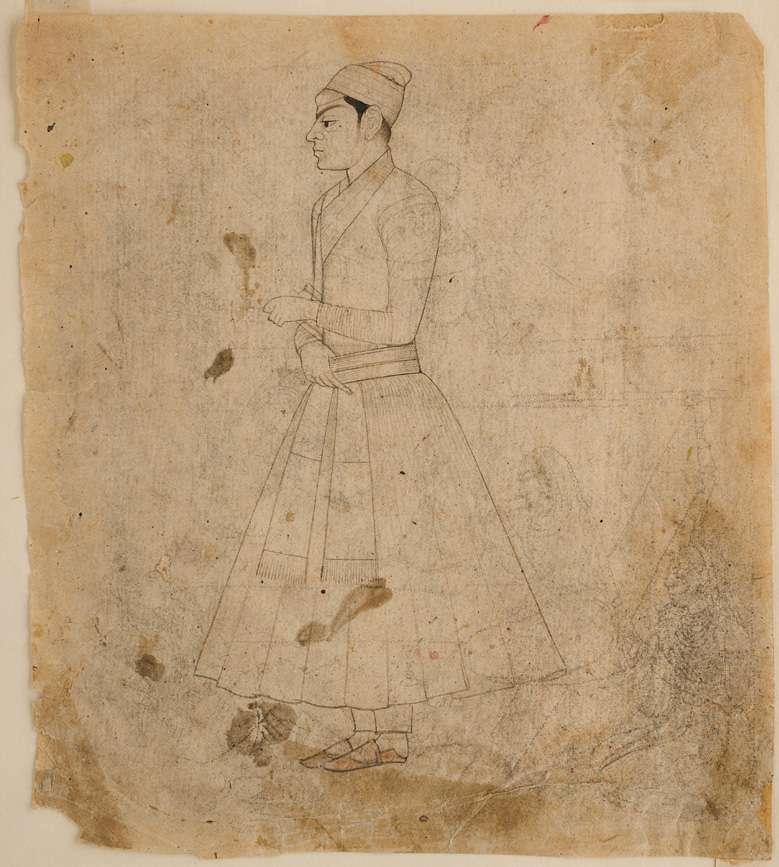
22
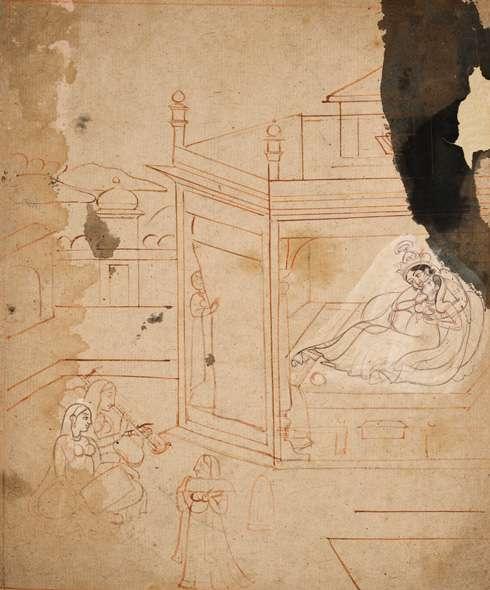
A DRAWING OF A MALE COURTIER, NORTH INDIA, 19TH CENTURY
in ink on paper, drawn over a scene of a sleeping woman on a terrace with attendants and musicians, this scene pricked for pouncing, folio 15.6 x 13.9cm, framed and glazed
£600-800
23
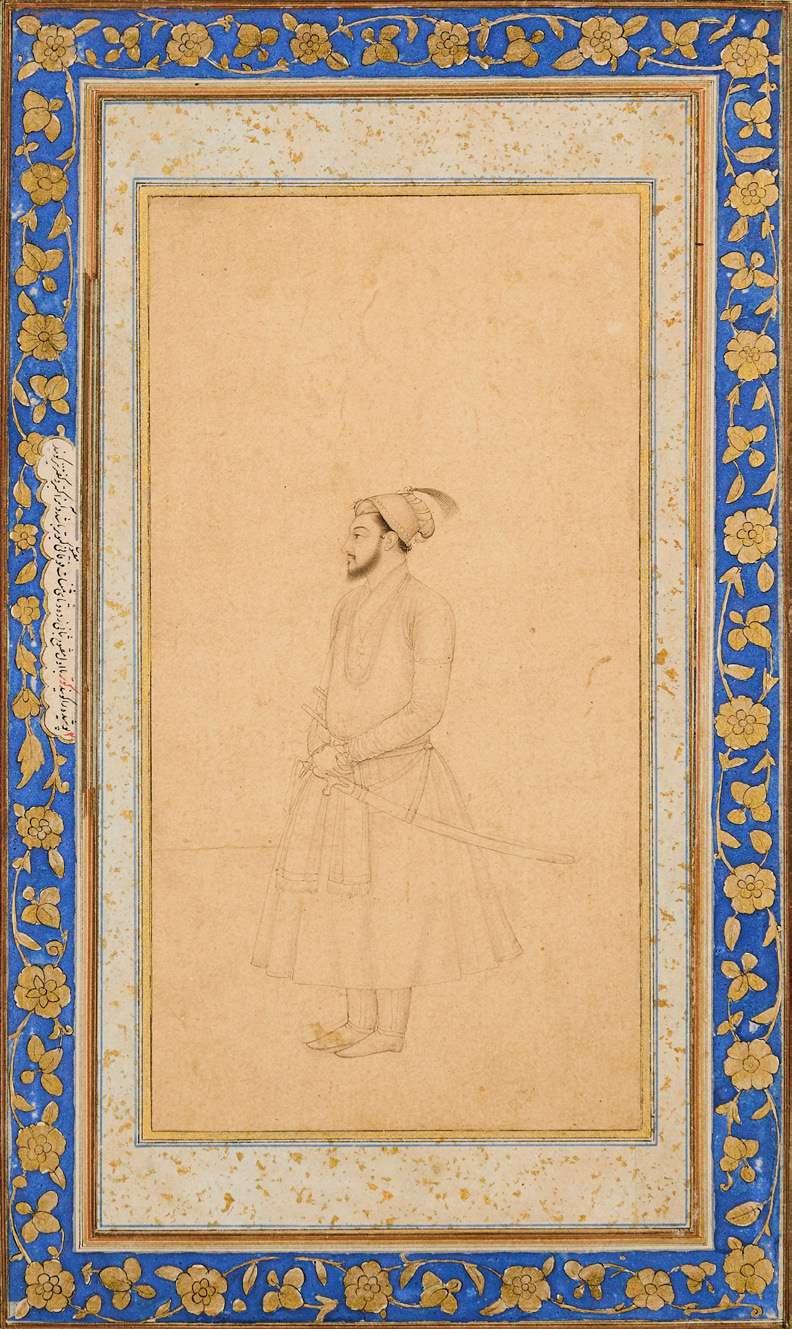
A MUGHAL PRINCELY FIGURE, POSSIBLY DARA SHIKOH, INDIA, EARLY 18TH CENTURY
in ink on paper, a finely executed image of the standing figure in profile, wearing a sword, katar and a feathered turban, image 9.2 x 17.2cm, folio 22 x 34cm, framed and glazed.
The portrait bears particularly close resemblance to two portraits of Prince Dara Shikoh (d. 1659), one of them painted by Chitarman (Falk and Archer 1981, p. 401, no. 71; p. 411, no. 106). The painting has been later mounted into borders and margins from a copy of the Farhang-i Jahangiri, the dictionary of the Persian language prepared for Jahangir in 1608, which is recognisable for its blue or red borders decorated with gold flowers and outer borders illuminated in gold arabesques and animals. This Mughal copy of the Farhang-i Jahangiri was probably split by the dealer Georges Demotte in Paris in the 1920s and remounted around Mughal paintings. Two Mughal paintings mounted within Farhang-i Jahangiri borders and margins were sold at Christies, 25 June 2020, lots 81 and 82.
‡ £2,000-3,000
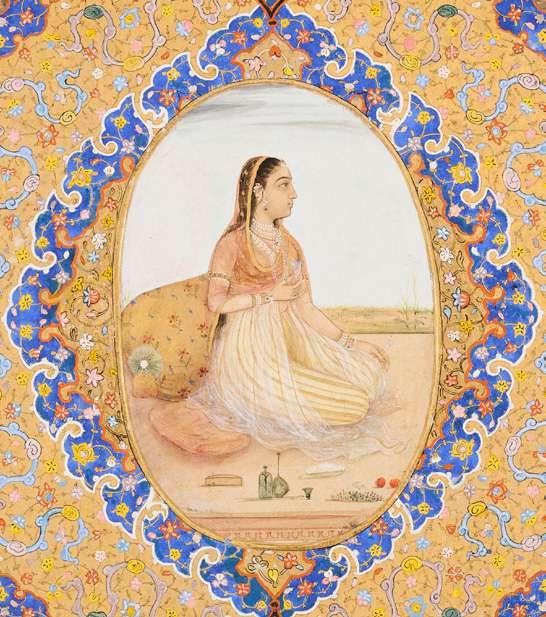
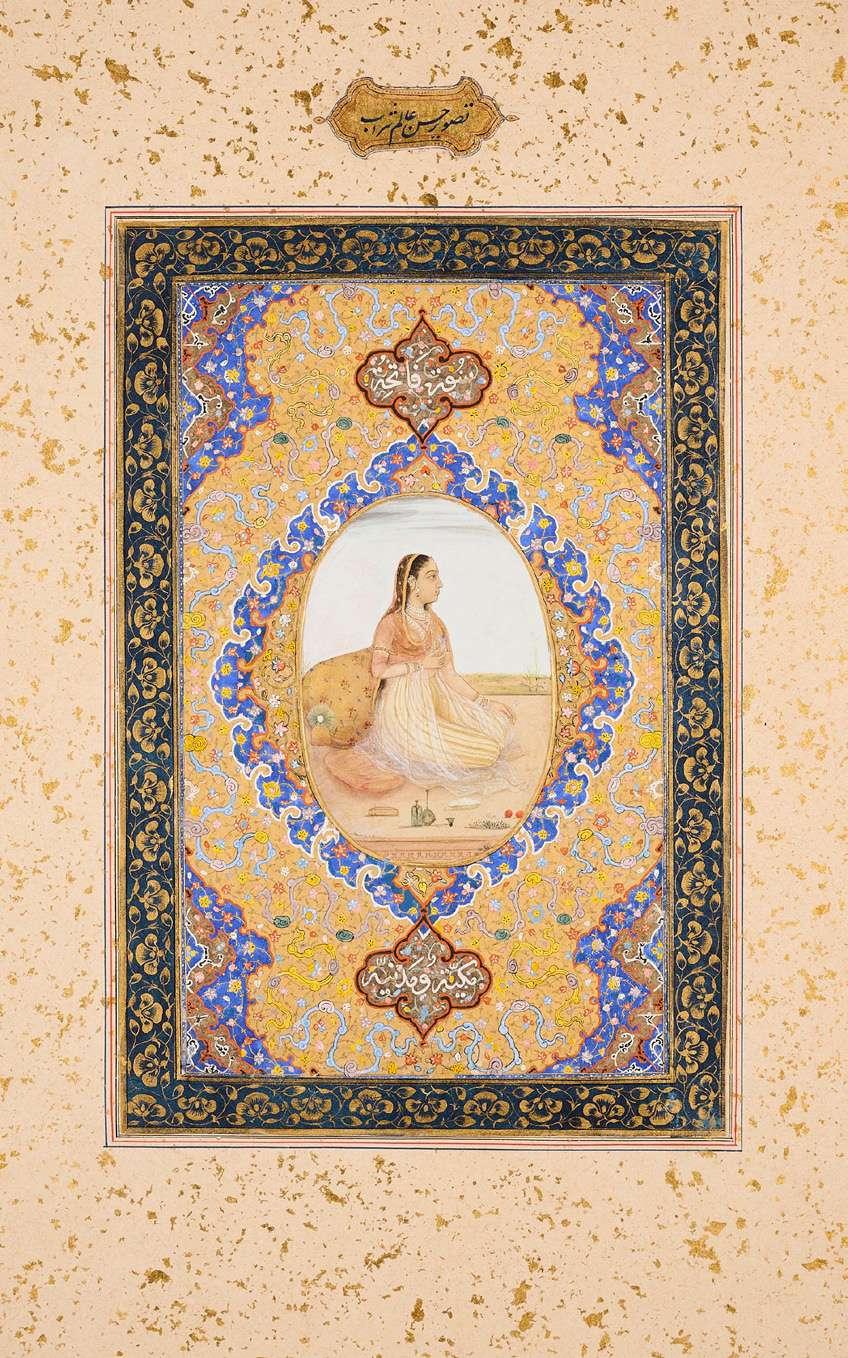
A SEATED LADY, PROVINCIAL MUGHAL, PROBABLY AWADH, NORTH INDIA, CIRCA 1760
in opaque colours and gold on paper laid down on card, the seated figure within an oval cartouche central placed within an elaborate ground of polychrome illumination, two lines of calligraphy in white within pendant cartouches, ruled margins in blue and red enclosing a border of foliate scrolls in gold on a dark blue ground, a cartouche with a line of calligraphy in black on a gold ground set above on the album page, the reverse with an illuminated page set with five lines of nasta’liq, central image 10.1 x 6.7cm, folio 48.2 x 32.5cm
Inscriptions: the title above the page; tasvir-i husn ‘alam-i sharab “Depiction of Beauty. The world of drinking”. Within the page the two lines of calligraphy contain the opening sura (al-Fatiha) of the Qur’an.
Verso with lines from a ghazal of Hafez.
This a folio from an album of portraits each usually inscribed in Persian with the title tasvir-i husn or Depiction of Beauty and hence has become known as the Husn Album. The folios, as with this example, are typically on a gold flecked ground with the images contained within the dark blue border. The portraits are variously Mughal from the late sixteenth, seventeenth or eighteenth century and attributed to the court artists of Awadh.
The album was possibly assembled by the Nawab of Awadh, Shuja al-Daula, around 1770 though It has also been suggested that the patron of this album could have been the Mughal nobleman Najm al-Din ‘Ali Khan. For other folios sold at auction, see Christies, London, 8th April 2008, lots 293 and 294; 25th April 2013, lot 175; Sotheby’s London, 25th October 2017, lot 83, 19th October 2016, lot 18, and 25th October 2023, lot 49.
£1,000-1,500
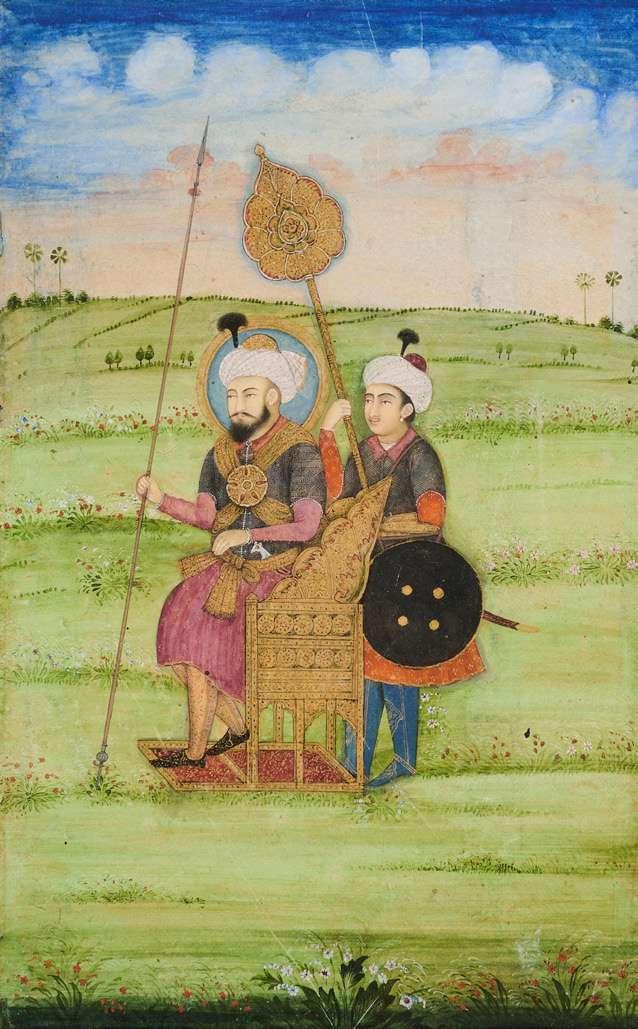
A MUGHAL PORTRAIT OF TIMUR, DELHI, EARLY 19TH CENTURY
opaque colour and gold on paper, the enthroned ruler seated on an elaborate throne with an attendant holding a fan, set within a grassy landscape, ruled margins with a border of gilt floral scrolls on a pale blue ground, further ruled borders, a single line of nast’liq above the image, laid on card, the reverse of the frame applied with a typed description in French, image 22.7 x 13.6cm, framed and glazed
Inscription: mir timur-i sahib-qirali [sic] “Mir Timur, Lord of the Auspicious Conjunction” Provenance: Private Collection, Scotland. This portrait would have formed part of a series representing the notable lineage of the Mughal court. The central composition, of Timur enthroned with his attendant, appears in a number of renditions of this subject including a near contemporary sold at Christies, 11th April 2014, lot 70. £800-1,200
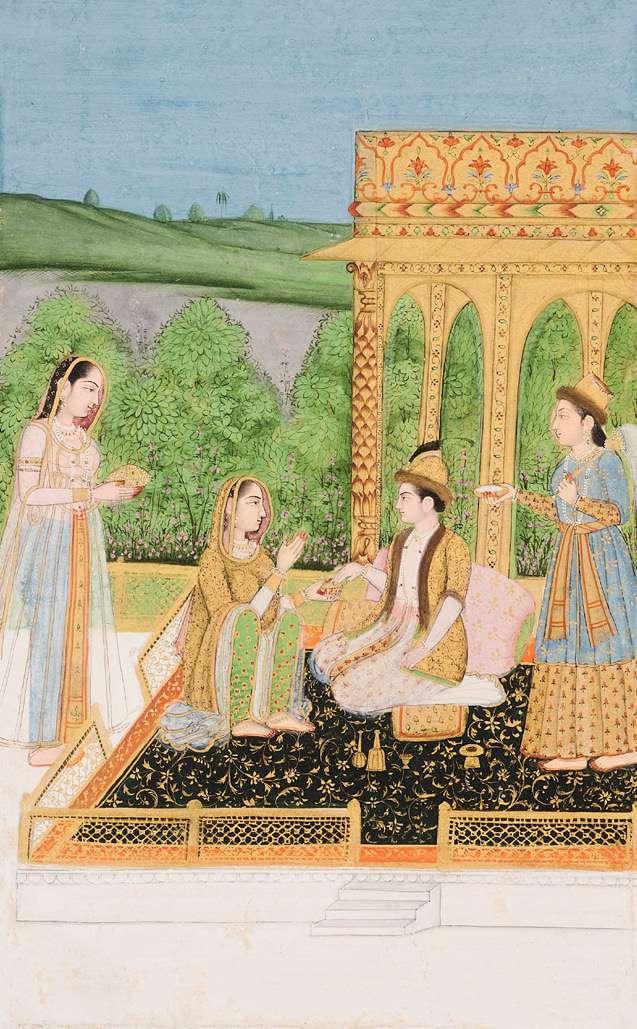
A PRINCELY FIGURE ON A PAVILIONED TERRACE, DELHI, EARLY 19TH CENTURY
in opaque colours and gold on paper laid on card, the central kneeling figure attended by three courtly ladies, within a forested setting, a rural landscape beyond, ruled margins in gold, red and blue, a border of gold leafy scrolls on a blue ground, a further border of delicate floral sprays, inscribed in pencil on reverse, image 24.3 x 15.1cm, folio 39.8 x 27.3cm
Provenance: Offered at Bonhams, 6th October 2015, lot 168.
The inscriptions on the reverse, in English and Persian, identify the youthful subject of this painting as Prince Daniyal, the third son of Emperor Akbar. Another depiction of this Prince as a young man is in the Royal Collection Trust, RCIN 1005069.r. There is some resemblance the figure depicted here. £1,000-1,500
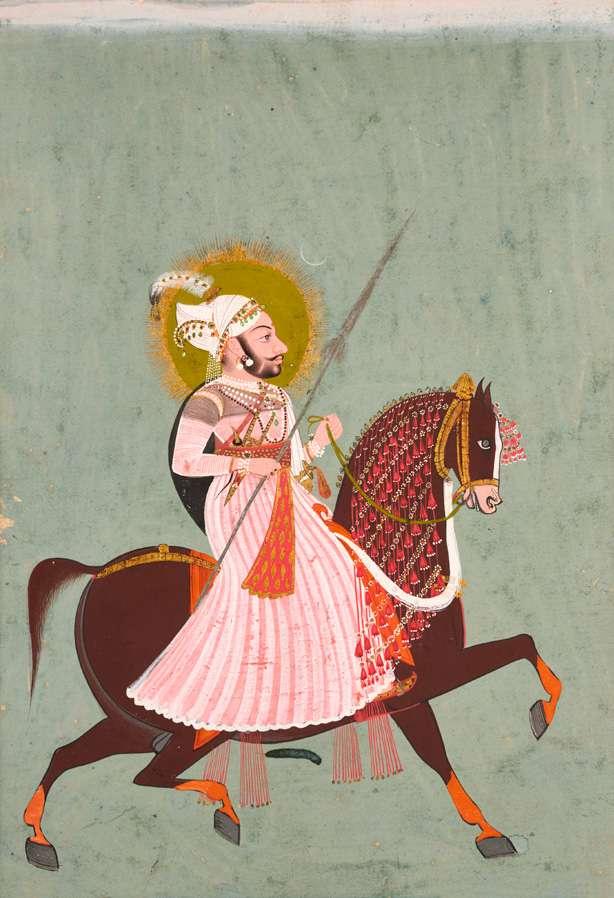
A PORTRAIT OF MAHARAJA ARI SINGH, MEWAR, UDAIPUR, CIRCA 1765
in opaque watercolour and gold on paper, Ari Singh depicted with a radiating nimbus, a crescent moon to one side, holding a spear and mounted on a richly adorned brown horse, on a pale blue ground, verso with two lines of devanagari script, image 28 x 19.5cm, folio 38 x 27cm
Inscriptions: The upper inscription reads: dikhana ji shri ar singh ji ri chabi kimat 9 – showing a likeness (or portrait) of Shri Ari Singh ji price 9.
Lower inscription: 25 maharana ji shri ar singh ji - a further identification of the subject.
Provenance: Provenance: Formerly collection of the late Rudolf von Leyden (1908-1983), thence by descent.
Rudolf von Leyden is one of the best known exponents of modern Indian art in the mid-20th century. Born in Berlin, he moved to Bombay in 1932 to escape the Nazi regime at home and join his brother who was already working in the city. After working in advertising and publicity, he became more and more involved in the art world, becoming art critic for the Times of India, helping artists with practical and financial support and acting as curator and judge at artistic events.
Ari Singh was the Maharana of Mewar between 1762 and 1773, renowned for his uncontrollable temper. He seems to have had a typical fondness for portraiture and a comparable equestrian portrait is in the National Gallery of Victoria, AS186-1980.
£1,500-2,500
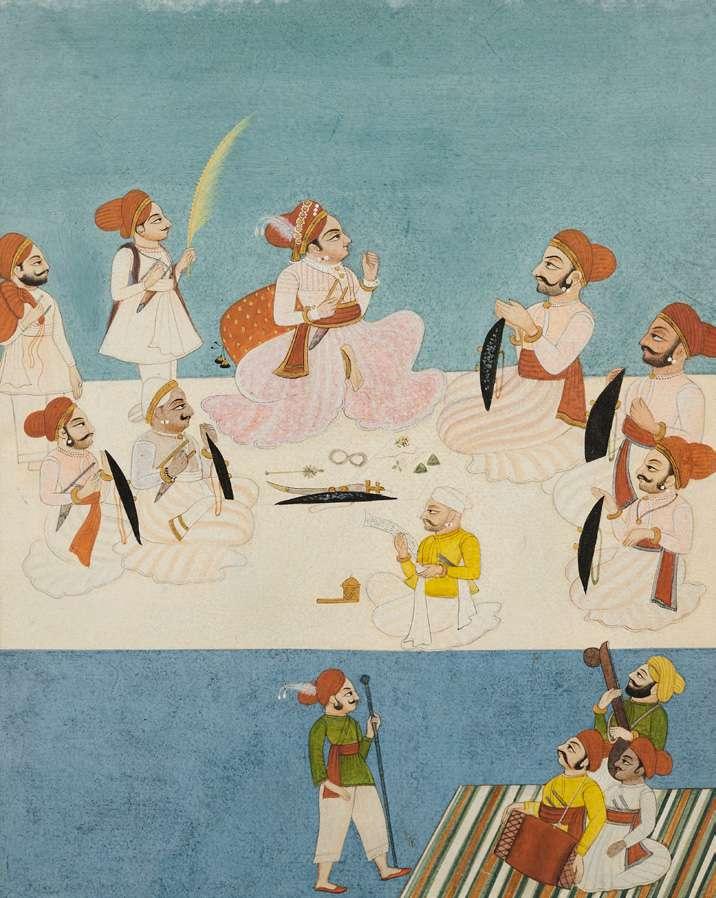
A RULER AND HIS COURTIERS, MEWAR, RAJASTHAN, 18TH CENTURY in opaque colours, black an gold on paper, the ruler seated on a terrace before his courtly accoutrements and flanked by attendant figures, musicians seated on a rug below, inscribed with three lines of devanagari script verso, image 32.8 x 26.2cm, folio 39 x 32.4cm, framed and glazed £800-1,200
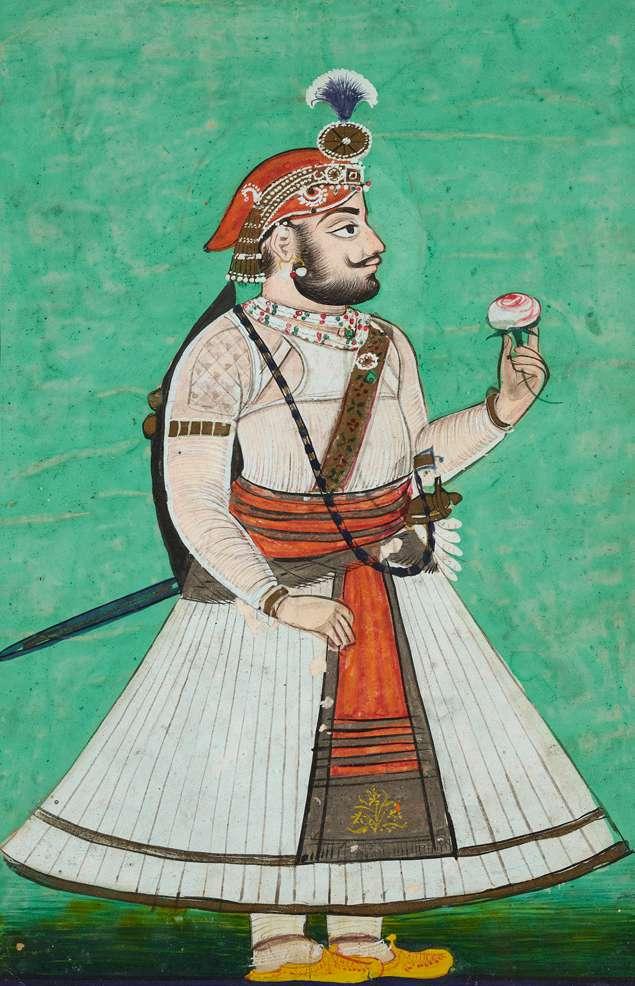
A PORTRAIT OF MAHARANA BHIM SINGH OF UDAIPUR, MEWAR, 19TH CENTURY
opaque pigment and black on paper, the standing figure holding a rose, on a green ground, image 22.9 x 14.9cm, framed and glazed
Maharana Bhim Singh was the second son of Maharana Ari Singh II and the first Maharana of Udaipur State. In 1818 he signed a treaty with the British affording the state some protection from the predatory activities of other forces such as the Marathas.
£400-600
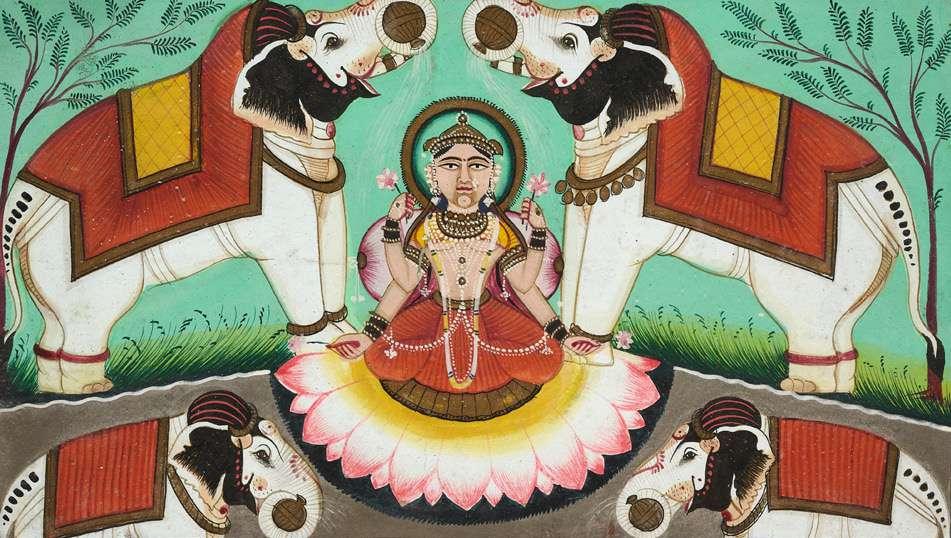
30
THE LUSTRATION OF VISHNU, MEWAR, 19TH CENTURY
opaque colour and black on paper, the central figure seated upon a lotus throne surrounded by four elephants, image 13.8 x 24.3cm, framed and glazed
£400-600
31
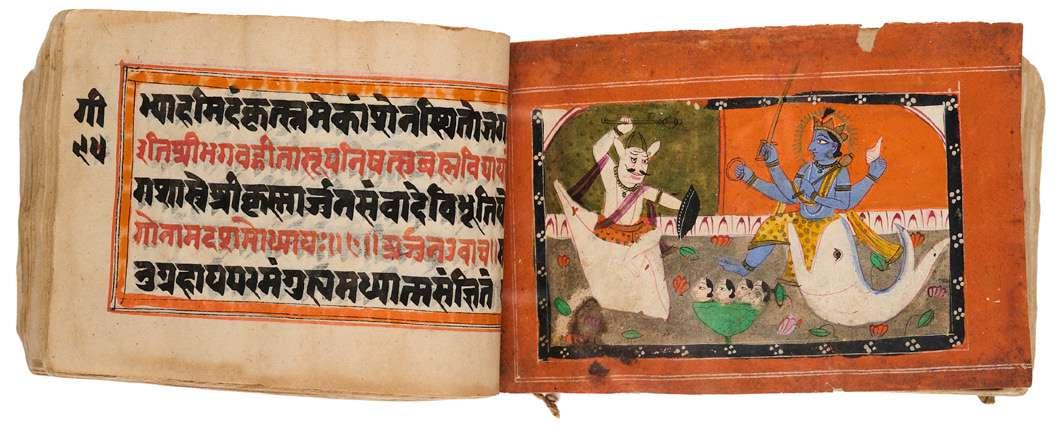
A COPY OF THE BHAGAVAT GITA, KASHMIR, 19TH CENTURY
sanskrit manuscript in landscape format, handwritten in black ink with significant words in red, each page with five lines of text, orange borders, five illustrations inserted on separate folios, depicting Krishna with Arjuna; Krishna and Radha with Durga; Matsya fighting an asura, Sanjaya with Dhritarashtra, and a group of devotees, 350 leaves approx. 10 x 17 x 3.2cm (closed)
£500-800
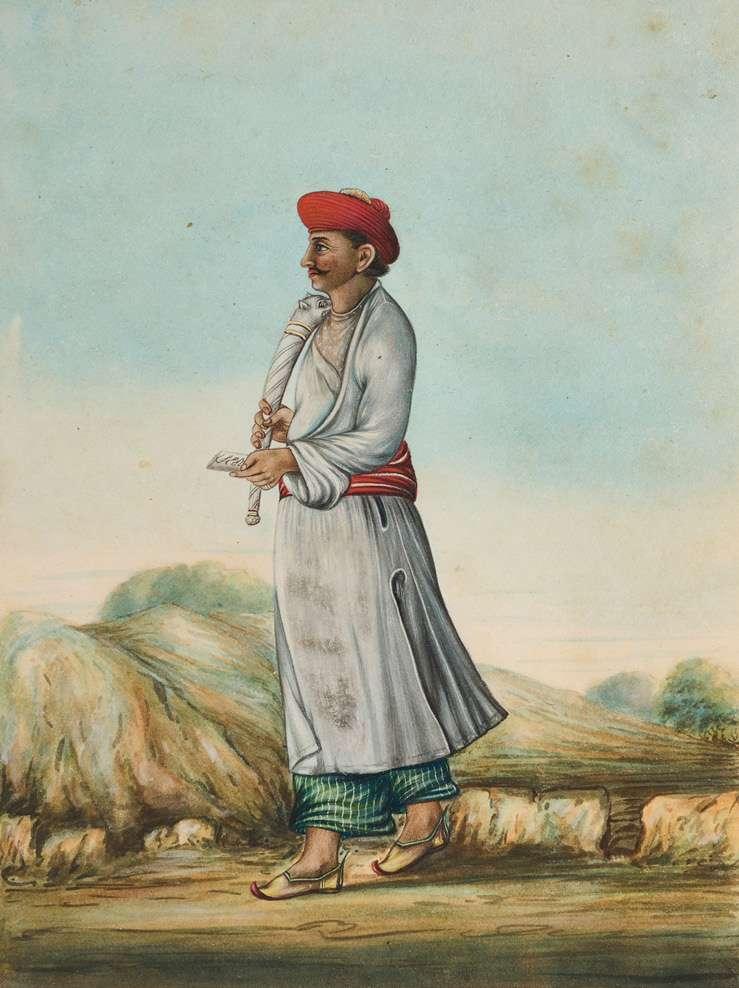
A LETTER CARRIER, LUCKNOW, CIRCA 1815-20
watercolour and black ink on paper, the standing figure in profile before a hilly landscape, ruled margins in black ink, pink and pale yellow washes, image 15 x 11.4cm, folio 22.4 x 18.4cm
Inscribed in black ink in a nineteenth century European hand, below the mount, ‘A Hurkarah, or Letter Carrier’
Provenance: The property of a Yorkshire gentleman collector, bought from London dealers in the 1950s. The majority of items were purchased from well-known dealer and collector Herbert Rieser who had a gallery at 49 George Street, Marylebone.
This painting would have originally formed part of a much larger set containing images of different occupations or activities in the city. One such album, containing fifty three paintings, is in the Victoria and Albert Museum, acc. no. AL.7970:27. This album is in a very similar style to this painting and with the same borders and dimensions. It seems reasonable to suggest that they come from the same Lucknow workshop.
£1,000-1,500
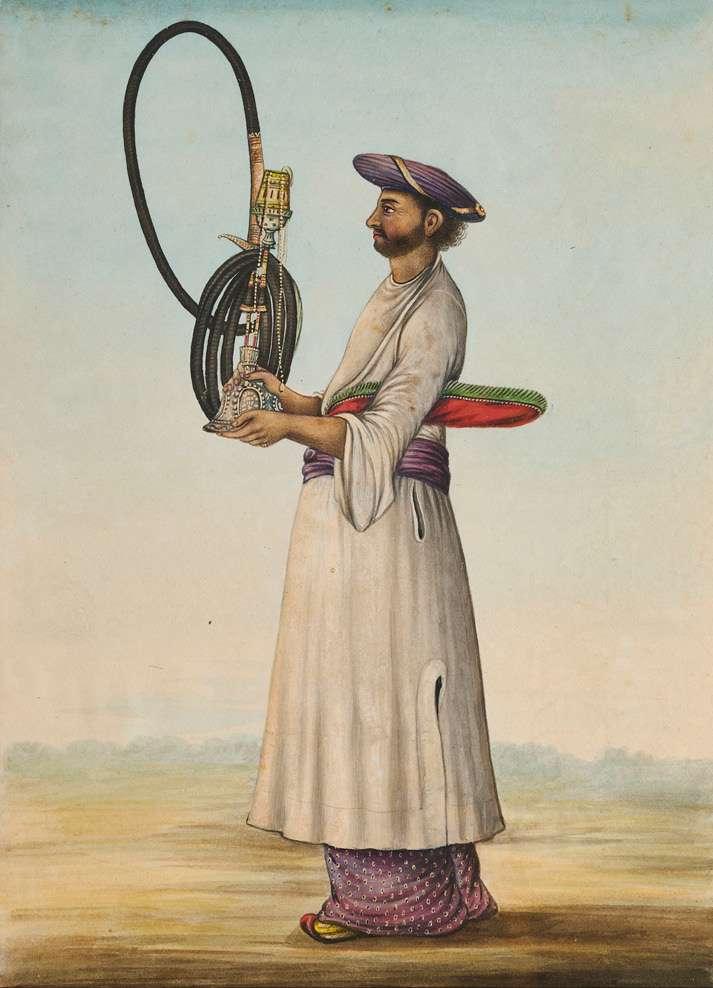
A HOOKAH BURDAR, LUCKNOW, CIRCA 1815-20
in watercolour on paper, the standing figure in profile with a rural landscape beyond, ruled margins in black, pink and pale yellow, image 15.7 x 11.3cm, folio 22.7 x 18.5cm
Inscribed in a European hand in black, below the mount ‘A Hookah burdar, or Pipe Servant’.
Provenance: The property of a Yorkshire gentleman collector, bought from London dealers in the 1950s. The majority of items were purchased from well-known dealer and collector Herbert Rieser who had a gallery at 49 George Street, Marylebone.
This painting would have originally formed part of a much larger set containing images of different occupations or activities in the city. One such album, containing fifty three paintings, is in the Victoria and Albert Museum, acc. no. AL.7970:27. This album is in a very similar style to this painting and with the same borders and dimensions. It seems reasonable to suggest that they come from the same Lucknow workshop.
£1,000-1,500
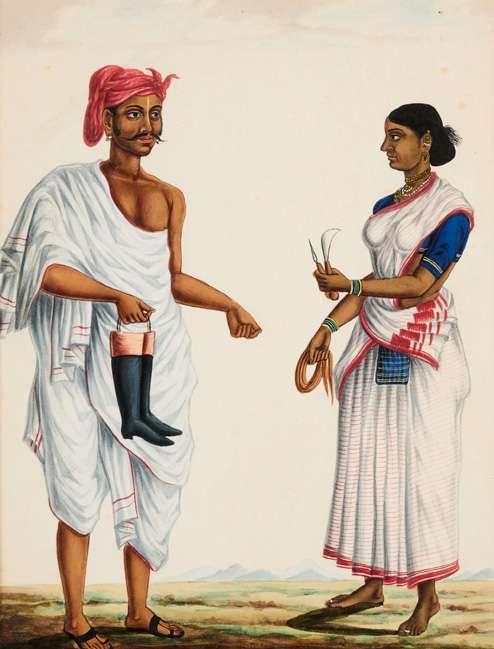
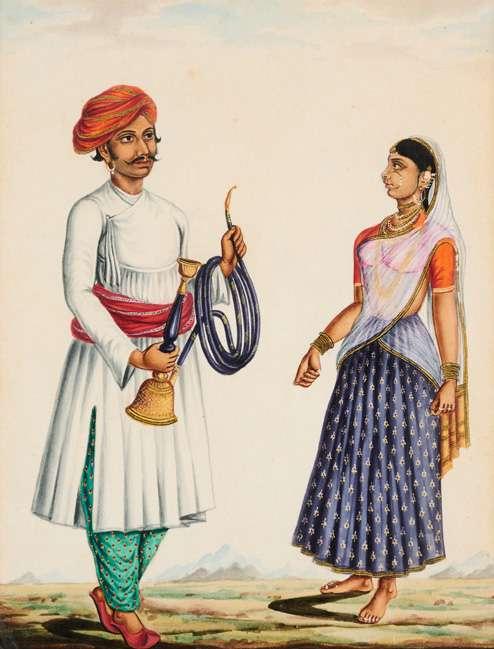
A DEPICTION OF A COBBLER AND HIS WIFE, TANJORE, SOUTH INDIA, CIRCA 1820
in watercolour and gold on paper, the cobbler holding a pair of boots, his wife offering him his tools, thick black ruled border, inscribed in pencil below the border, image 20.6 x 15.7cm, folio 23.5 x 18.7cm, framed and glazed (cracked glass)
Inscription: ‘Chucklee or shoe maker’.
Provenance: from a private London collection.
£800-1,200
35
A
DEPICTION OF A HOOKAH BEARER AND HIS WIFE, TANJORE, SOUTH INDIA, CIRCA 1820
in watercolour and gold, the figures set in a landscape with mountains beyond, thick black ruled border, image 21 x 16cm, framed and glazed
Provenance: from a private London collection.
£800-1,200
36
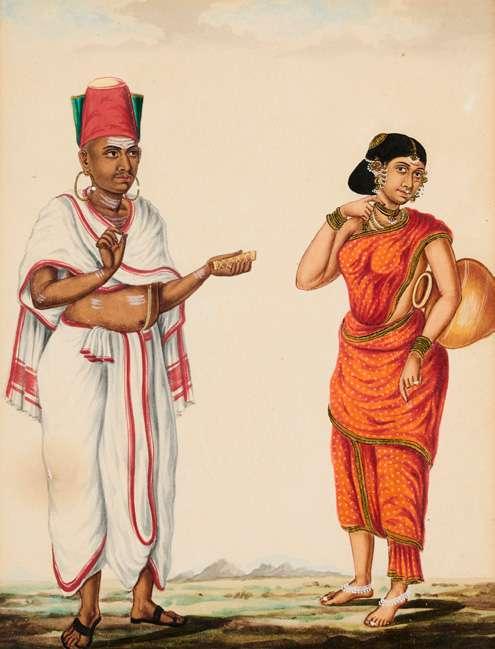
A DEPICTION OF A PRIEST AND HIS WIFE, TANJORE, SOUTH INDIA, CIRCA 1820
in watercolour and gold on paper, the priest depicted holding a scroll, his bejewelled wife with a large pot under one arm, black ruled border, inscribed in pencil below the image, image 20.2 x 16cm, folio 23.6 x 18.6cm, framed and glazed
Inscription: ‘A Poojalee (or Priest)’.
Provenance: from a private London collection.
£800-1,200
37
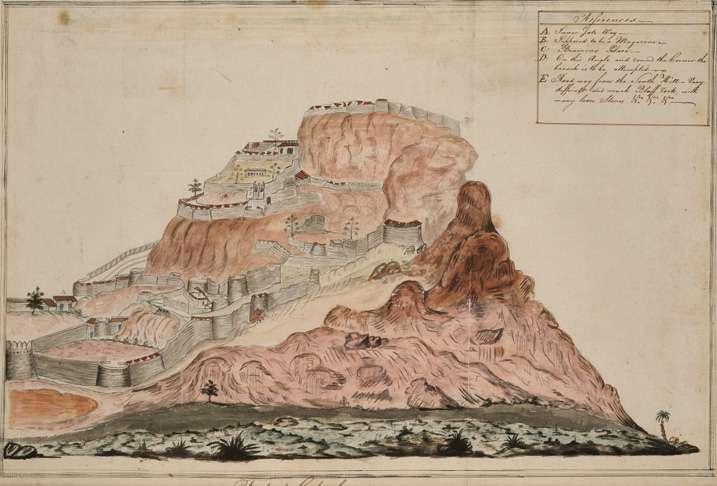
A DEPICTION OF THE FORT OF KOPPAL FORT, KARNATAKA, INDIA, LATE 18TH CENTURY
in watercolour and ink on paper, inscribed upper right with a list of annotations, further inscribed below ‘Fort of Copoole’, image 30.5 x 46.5cm, framed and glazed
This depiction of the fort is by an amateur hand, most probably a soldier-artist who made it in preparation of an attack. The annotations note where the intended breach of the fort’s wall is to take place. The fort was embellished in 17th century when it was within the territories of Ibrahim Adil Shah II of Bijapur. In the later 18th century it came into the possession of the Maratha leader, Shivaji, only to be captured shortly afterwards by Haidar Ali. His son, Tipu Sultan, added to the fortifications until it came under siege in 1790-91, from when this sketch dates, by the forces of Britain’s ally, the Nizam of Hyderabad, with support of troops from the East india Company. In the nineteenth century, the fort became associated with rebellion against the British, first in 1819 and then again in 1857 leading to the British breaching the battlements to supress the rebels.
£700-900
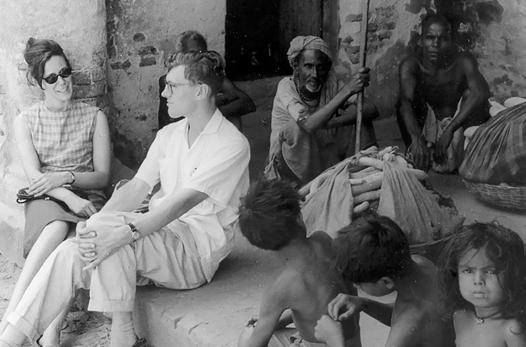
Robert Skelton with Caroline Banks (Grigson) surveying the brick temples of Bengal, 1963
THE COLLECTION OF ROBERT SKELTON, O.B.E.
Robert Skelton had never harboured an ambition to be a scholar of Indian art. Rather it was foisted upon him after finding work with the Victoria and Albert Museum. A keen violinist, Robert had hoped he might be put to work on the collection of musical instruments or, perhaps, English furniture. However, shortly after his arrival at the museum his potential had been noticed by William Archer, the Keeper of the Indian Art Department, and he had determined a different course for his recent recruit. Archer was a renowned authority on his subject who, with his wife Mildred, had done much in the period around the Second World War to map out what was understood about Indian art history at this time. The young Robert could have had little inkling of what sort of life lay in store for him but Archer’s intervention lifted his protégé into a lofty world of academic interaction with the greatest scholars and connoisseurs in his field in the second half of the twentieth century.
Later, in a letter to a colleague at the Courtauld, Robert would reflect on this good fortune, aware of how fortunate he had been to become acquainted with the most marvellous minds in his field:
‘I have had close contact with the leading scholars and collectors in the field from the period immediately following (1950 onwards), many of whom had been among the earliest pioneers, such as Percy Brown, who wrote the first general book on Indian painting in 1917 and the first proper survey of Mughal painting in 1924 followed by Ivan Stchoukine,…. who wrote the second major book on La Peinture Indiennes in 1929.
‘Stchoukine was a good friend and I was with him only two days before he died in a plane crash returning from Budapest to Beirut in 1975. Other personal friends, who wrote on Mughal painting from the 1920s onwards and are no longer
with us included Hermman Goetz, Richard Ettinghausen, Emmy Wellesz, J.V.S. Wilkinson, Basil Gray, Tatiana Grek, Ralph Pinder-Wilson and more recently, Cary Welch, with whom I corresponded from 1955 until shortly before his death in 2008.’
Robert had hoped to put some of this correspondence together, with the help of Cary Welch’s son Thomas, before his death but this didn’t come to pass. Robert describes the material as: ‘a chaotic and indiscreet history of the development of the subject during those 64 years, with a great deal of contemporary gossip about scholars, dealers and collectors in the field. It is all here but not yet completely put into order’. It remains a tantalising prospect.
Robert continues: ‘My closest friends in India other than Sangram Singh, who taught us all about Rajasthani painting but wrote little, were Rai Krishna Dasa, Ananda Krishna, and Moti Chandra, who were like family and Karl Khandalavala….. Jagdish Mittal is the only one left of that older generation still in touch by e-mail and still writing on Indian art. Jagdish has been a great collector in all fields and among past collectors of Indian painting, who also wrote on the subject, were N.C. Mehta & Jean Pozzi both of whom I met in the 1950s. Emmy Wellesz and Stella Kramrisch, who I also knew, had worked with F.R. Martin but I missed meeting Ananda Coomaraswamy.’
What Robert doesn’t say, in his usual understated manner, is that he stood tall alongside all of these greats, an equal amongst them. All who met him and worked with him found him to be unfailingly generous with both his time and knowledge. His approach was gentle and enquiring with both an open-mind and an open-heart.
He is greatly missed.
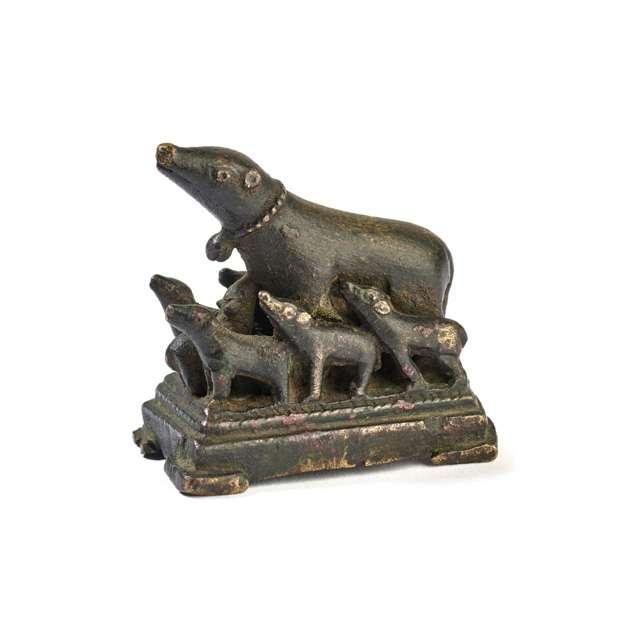
A RARE SMALL PALA BRONZE FIGURE OF MARICI, BIHAR OR BENGAL, CIRCA 12TH CENTURY
depicted as a sow, accompanied by seven boar vahanas, on raised rectangular base, 4.3cm high
Provenance: Collection of Robert Skelton, O.B.E. (1929-2022); Samuel Eilenberg collection until 1980s; East Coast Private Collection, USA (until-c.1991); Maharukh Desai, Jermyn Street, London, sold to Robert Skelton 18 September 1992 (the invoice is sold with this lot).
For the same depiction of Marici as a sow on a Pala bronze (also formerly in the Samuel Eilenberg collection) in the Metropolitan Museum of Art, see inv. no.1987.142.345. It is published in Lerner & Kossak 1991 (no.97, p.128). In the catalogue entry, Martin Lerner refers to another example in an East Coast private collection, which most likely refers to the bronze offered here. Four other examples are recorded: two were sold together in Christie’s Amsterdam, 18 October 1995, lot 236, another was formerly in the collection of the late Simon Digby (Siudmak 2012, cat.9) and another was published more recently (Pal 2016, cat.166, fig.30).
£500-700
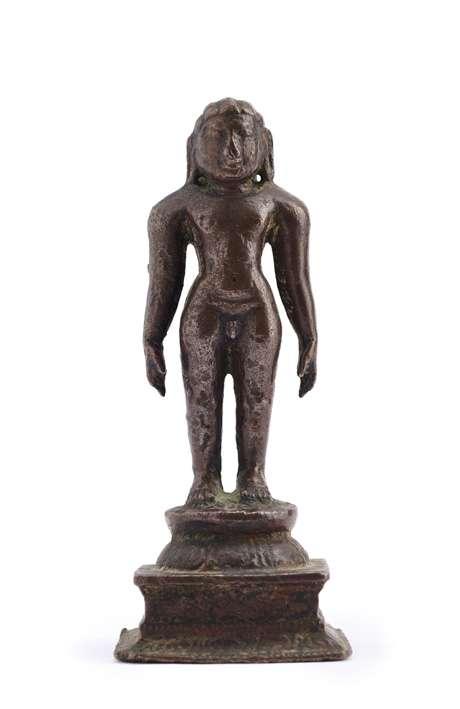
A SMALL JAIN BRONZE FIGURE OF RISHABHANATHA, TAMIL NADU, CIRCA 11TH/12TH CENTURY
standing erect on a double lotus on raised square plinth, the nude figure with his hands by his sides, his long hair cascading down his back, 7.5cm
Provenance: Collection of Robert Skelton, O.B.E. (1929-2022). Acquired Joss Graham Gallery, 17 November 1994. (The invoice is sold with this lot).
For a much larger bronze jina in similar style, also from Tamil Nadu, in the Smithsonian Institution, Washington D.C., see Pal 1995, cat.47B, p.161.
£400-600
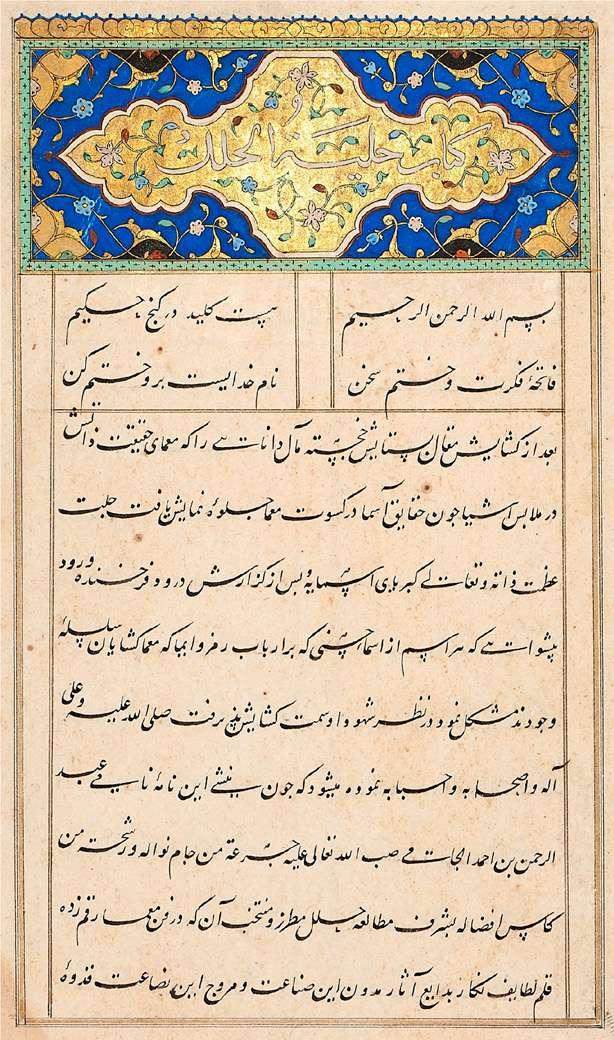
AN ILLUMINATED FOLIO FROM JAMI’S HULYAT AL-HULAL, WESTERN PERSIA, LATE 15TH CENTURY
ink, opaque colours and gold on paper, composed of fifteen lines of fine nasta’liq, verso with a fine illuminated header enclosing calligraphy in white on a gold ground with naturalistic floral motifs scrolling between split palmettes, ruled margins in black and gold, text 16 x 9.4cm, folio 25.4 x 16.3cm
Provenance: Collection of Robert Skelton, O.B.E. (1929-2022).
This is the opening folio from Nur al-Din ‘Abd al-Rahman Jami’s Hulyat al-Hulal, a work on riddles. For this work and manuscript copies of it, see Storey 1990, p. 221.
£150-250
41
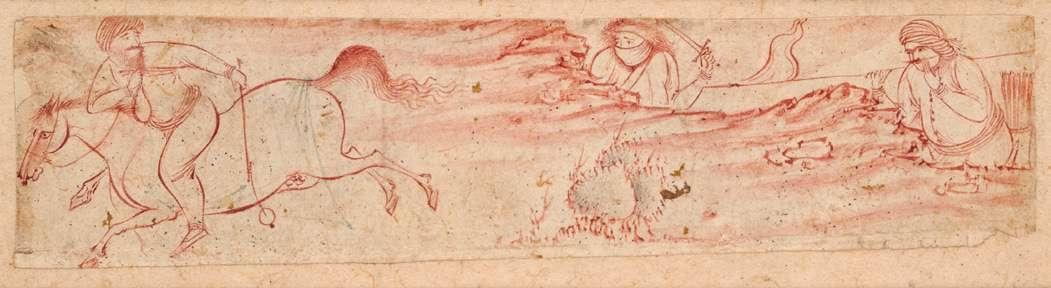
A SAFAVID DRAWING OF A HORSEMEN, IN THE STYLE OF REZA-I-ABBASI, PERSIA, CIRCA 1600
in ink and wash on paper, the horsemen gallops away from a masked assailant holding a sword and another wielding a spear, both emerging from behind a rocky outcrop, image 3.8 x 13.8cm, framed and glazed
Provenance: Collection of Robert Skelton, O.B.E. (1929-2022).
Spink and Son, exhibition of Islamic and Indian Art, 1977, cat. no. 25/1.
Robert noted that this drawing came from the ‘famous Riza Abbasi album’ and that it was in “Spink exhibition at the time of Festival of Islam. There were two of them. When I saw them in the exhibition I didn’t have any thought of buying it.”…”I went there with Linda Leach who wanted to buy things, and the drawings were 200 pounds or so. She said “shall we buy them together?” So we split them. We owned them jointly for a while’… ’In the end I bought them both. (Of which this is one).’
£600-800
42
A ‘KOFTGARI’ PEN BOX, PROBABLY SIALKOT, PAKISTAN, 19TH CENTURY
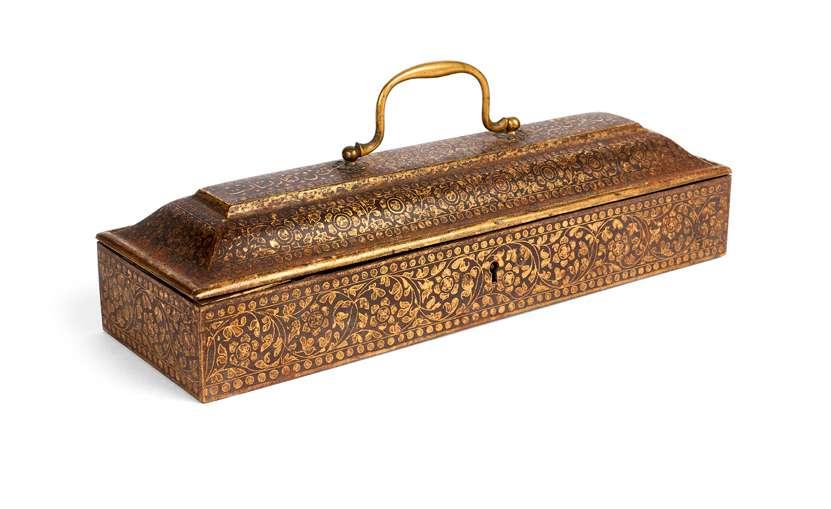
gold damascened iron, of rectangular form, the exterior with dense floral decoration, the hinged lid with nastaliq inscription and handle, the red felt lined interior with gilt-brass ink reservoir, steel key, 10cm high (handle raised), 26.3cm wide, 8.6cm deep
Provenance: Collection of Robert Skelton, O.B.E. (1929-2022).
Inscription: A Persian couplet: in qalamdan pasand-i shahanast / [ki] ba-naqsh u nigar bustanast, ’This penbox is pleasing to kings/It is a garden of patterns and designs’.
£700-900
43
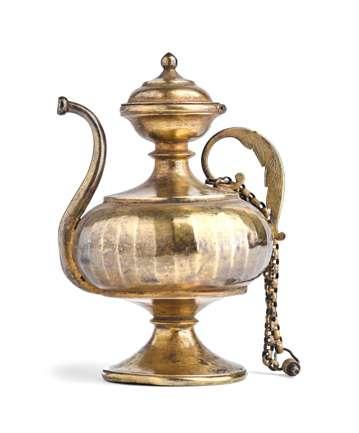
A SMALL SILVER GILT EWER, LATE MUGHAL, INDIA, CIRCA 1800
the flattened bulbous body with shallow fluting, hinged domed lid, splayed foot and scrolling spout and handle, the latter with engraved leaf design and attached chain, 10.5cm
Provenance: Collection of Robert Skelton, O.B.E. (1929-2022).
£400-600
44
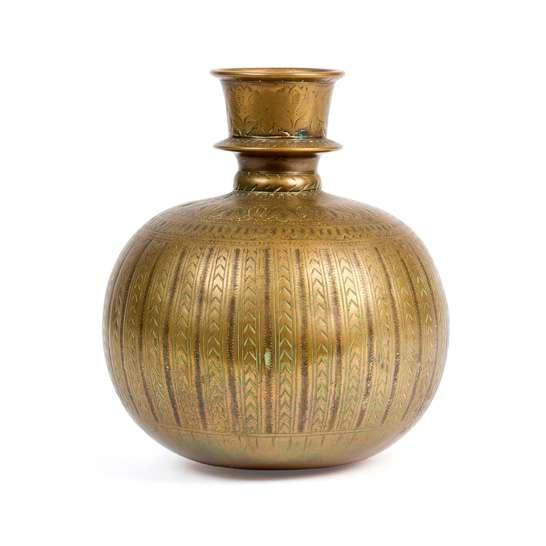
A MUGHAL BRASS HUQQA BOTTLE, NORTHERN INDIA, PROBABLY LAHORE (NOW PAKISTAN), 18TH CENTURY
of globe shaped form, with engraved decoration, the sides with repeated vertical chevron bands, the shoulder and neck with floral borders, 15.5cm
Provenance: Collection of Robert Skelton, O.B.E. (1929-2022).
For other examples of brass huqqa bottles attributed to Lahore in various collections, see Zebrowski 1997, p.242.
£300-500
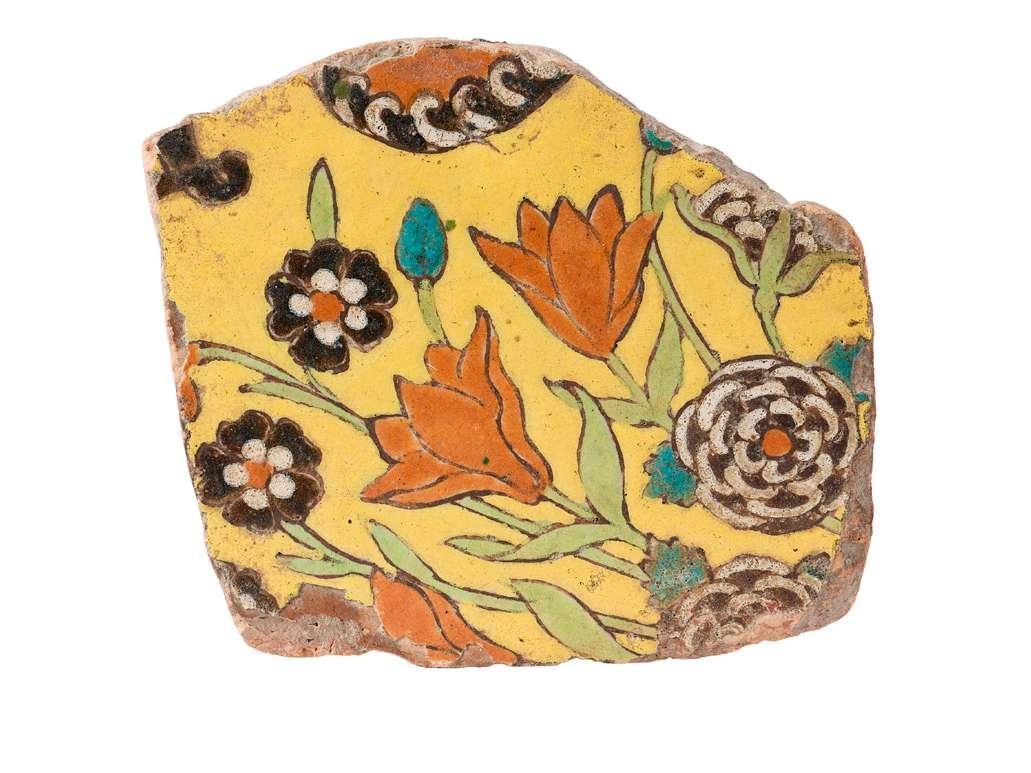
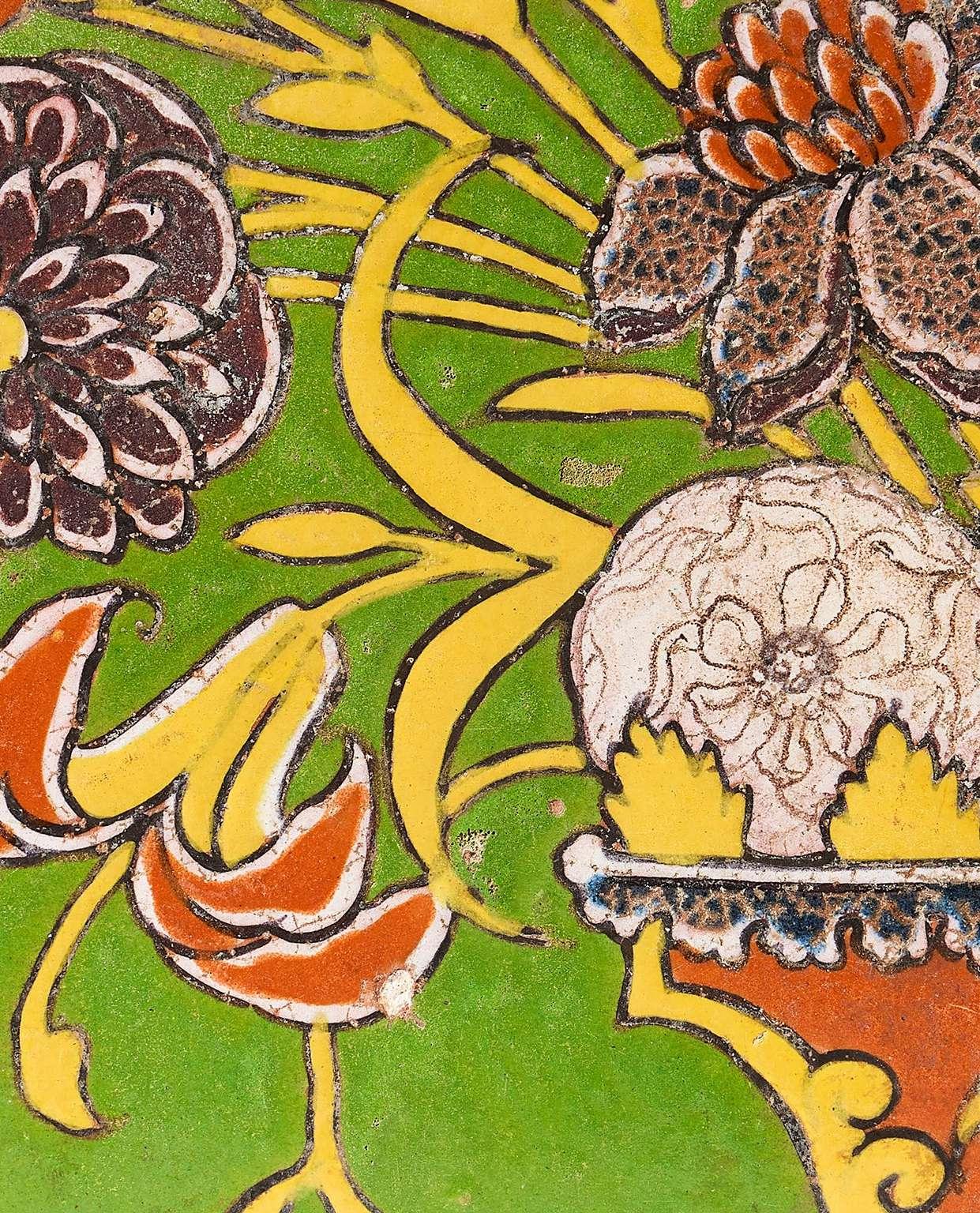
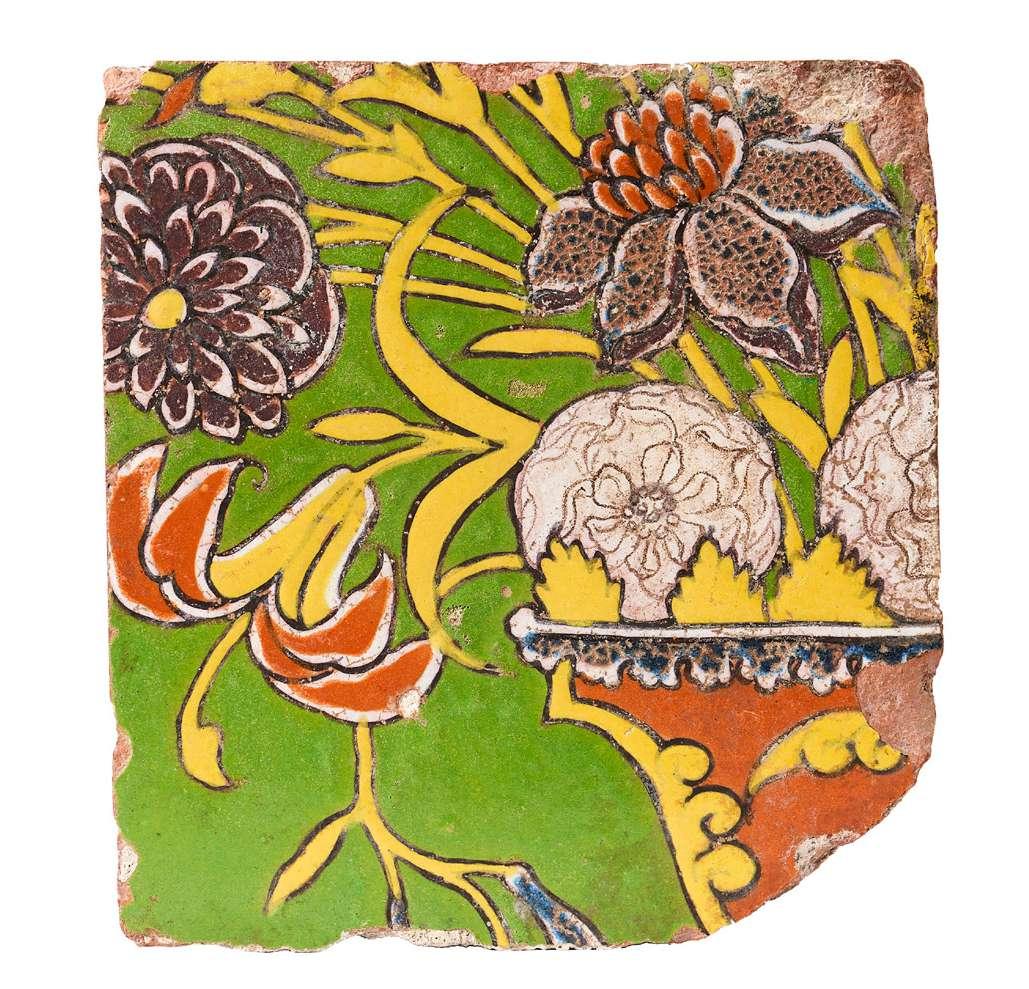
A MUGHAL CUERDA SECA TILE, FROM THE TOMB OF MADANI, SRINAGAR, MID-17TH CENTURY
glaze painted earthenware, of square form, depicting roses, a lily and other flowers with yellow stems issuing from an ornamental urn, on green ground, 19.3 x 18cm
Provenance: Collection of Robert Skelton, O.B.E. (1929-2022). Acquired from Cyril Andrade Antiques, King’s Road, London, in the 1960s. Illustrated: Millner 2021, p.78 (detail).
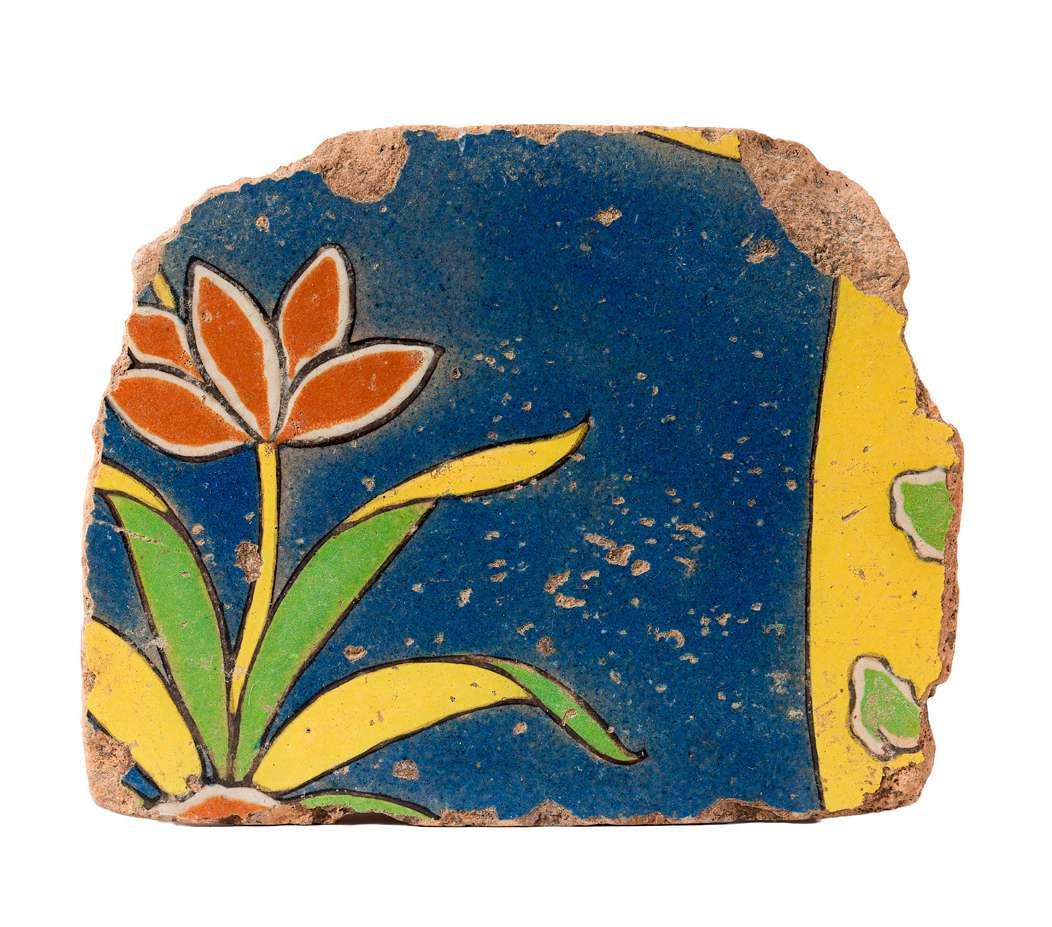
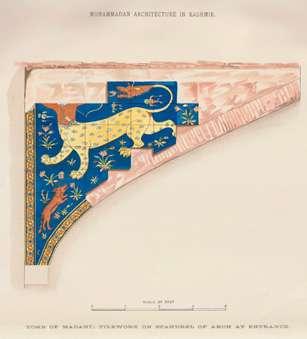
The tomb of Madani in Srinagar commemorates the Sufi saint Sayyid Muhammad al-Madani, who died in 1445 and was built soon after his death. Two hundred years later, in the reign of the Mughal emperor Shah Jahan, a monumental gateway was constructed, richly embellished with polychrome painted tiles. The only other historical tiled building in the city, the tomb of Zain ul-Abidin, dates from the 15th century, and those tiles are plain turquoise brick plugs, so it seems most likely that the Madani tiles were made in Lahore (or at least by Lahori craftsmen), where other cuerda seca tiles can be seen on monuments from this period. By the beginning of the 20th century, the Tomb of Madani was in a poor state and most of the tile revetments were dispersed. Today major groups of these tiles are held by the Shri Pratap Singh Museum, Srinagar, the Patna Museum and the Victoria and Albert Museum, and there are numerous other smaller collections, both public and private. Probably the closest comparison to this tile is one from a group in the V&A acquired in 1923 from Frederic Andrews (IM270-1923), director of the Kashmir Technical Institute. For another, almost certainly from the same original panel, now in the Keir Collection, see Millner 2021, fig.27, p.32. (See also lots 110 and 111 in this auction).
£4,000-6,000
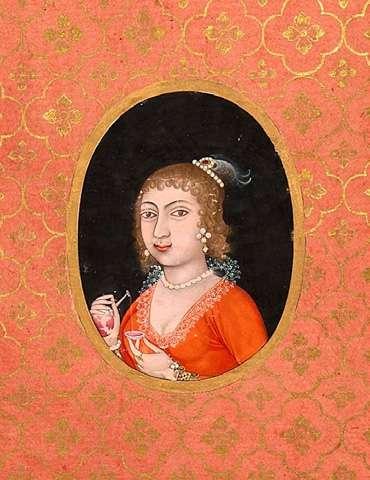
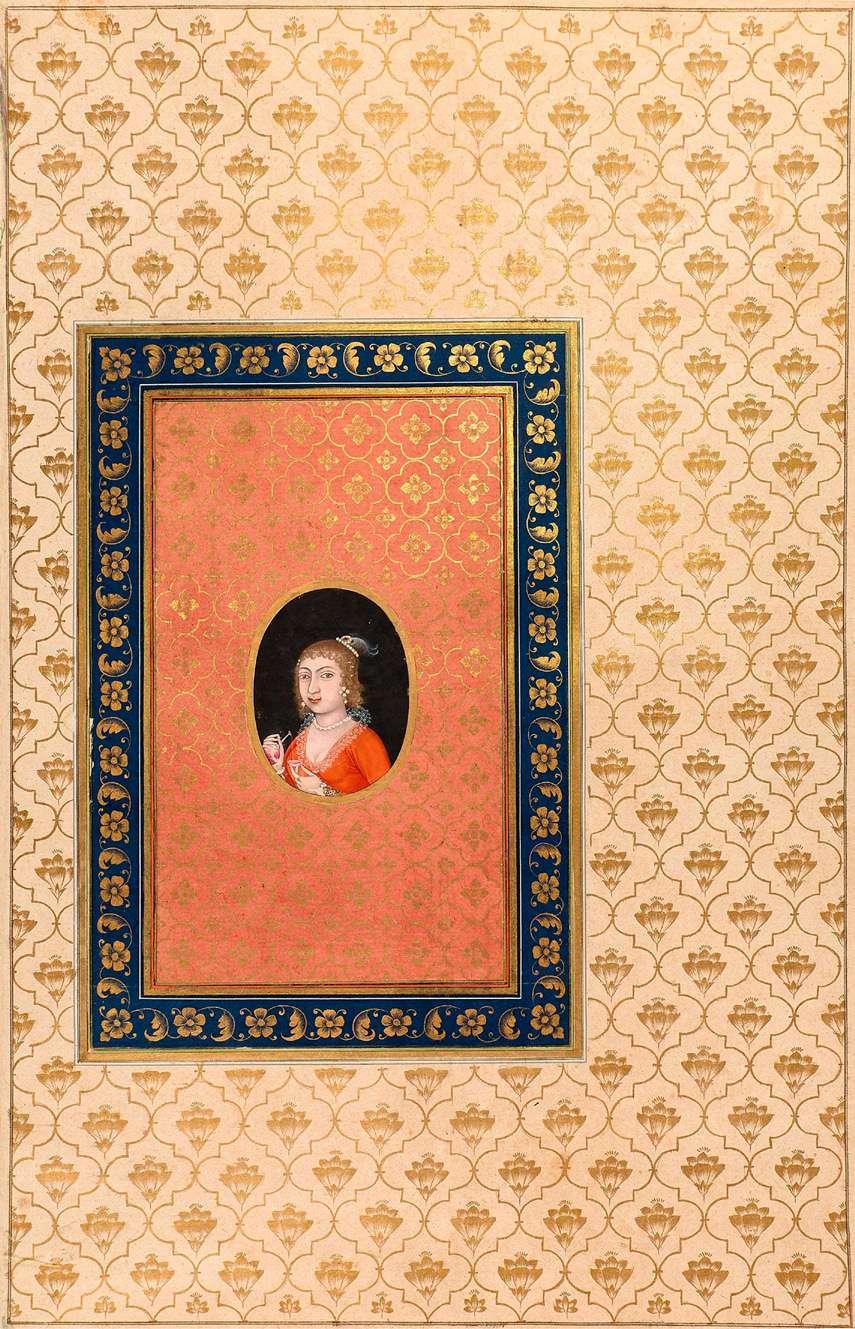
A MUGHAL PORTRAIT OF A EUROPEAN BEAUTY, NORTH INDIA, 18TH CENTURY
in opaque colours and gold on paper, of oval form, the bejewelled figure wearing a ruffed dress and pouring wine from a flask into a small cup, on a black ground within a border of a floral lattice design on a pink ground laid onto an album folio with further gilt foliate lattice motifs, stock etiquette applied to the reverse, image 6.5 x 4.8cm, folio 43.8 x 28.6cm
Provenance: Collection of Robert Skelton, O.B.E. (1929-2022).
Depictions of women in the bust portrait format were popularised in india the eighteenth century. The typical Indian format, in strict profile, was often derived from earlier portraits, usually of Nur Jahan, which, by the eighteenth century had devolved into a depiction of beauty or ‘womanly ideals’ rather than portraits. This depiction displays a number of overtly European traits which had become more familiar to Indian court artists by this period. The oval bust portrait itself has its origins in European artistic practice and her costume, hairstyle and manner of jewellery is clearly that of a European woman. The image is highly reminiscent, though in reverse, of a seventeenth century Mughal depicton of a European lady in the Victoria and Albert Museum, IM.8:2-1913. This image shares similar jewellery with a feathered hair ornament and the ruffed red dress. It has been suggested that the Victoria and Albert portrait was derived from an imported printed image of Lady Shirley, born Teresa Sampsonia, the Circassian born wife of Sir Robert Shirley, ambassador to the court of the Persian ruler, Shah Abbas, in the early 17th century. They were something of a celebrated couple, noted for their wide travels and elevated social circles, and it seems likely that their printed images came to be in relatively wide circulation, along with other notable figures of the day. The notion that the Victoria and Albert portrait is of Lady Shirley has been questioned by some but the reminiscence in both this and the Skelton portrait is detectable.
£1,000-1,500
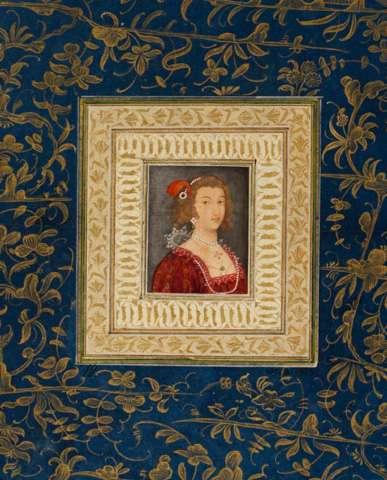
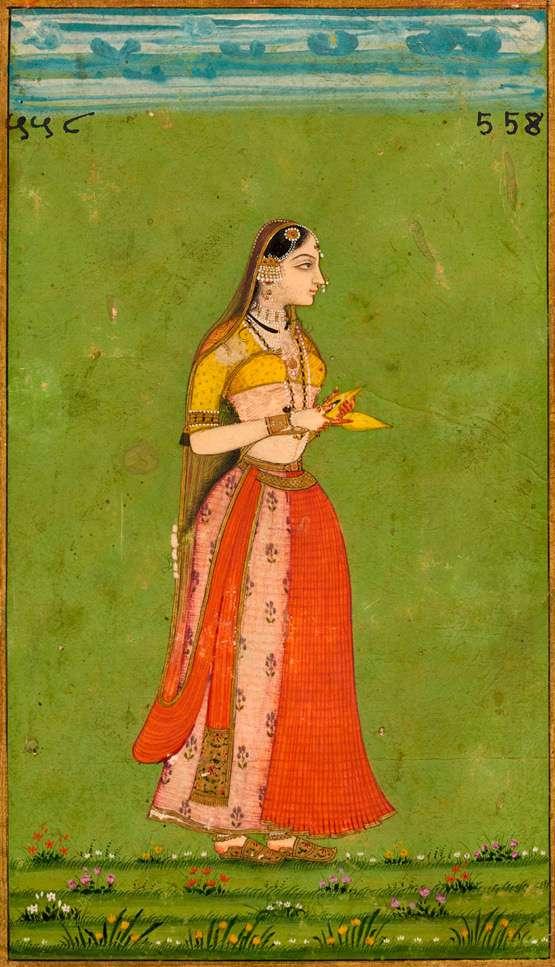
A STANDING LADY, DECCAN, PROBABLY HYDERABAD, 18TH CENTURY
in opaque colours and gold on paper, the figure facing right depicted holding leaves, within a stylised landscape, a short inscription in black ink upper left in devanagiri, upper right with ‘558’, within yellow, black and white ruled margins with a red border decorated with leaf motifs, a further blue border with gold scrolls, folio 22 x 14.5, framed and glazed
Provenance: Collection of Robert Skelton, O.B.E. (1929-2022).
The reverse of the frame applied with various labels. One, presumably indicating the origins of the painting, is of teh Knoedler Gallery of New Bond Street. This has a hand written suggestion that the painting had earlier been owned by Robert Fraser, a renowned Modern Art dealer in the 1960s, sometimes known as ‘Groovy Bob’, and friend of the Beatles. Skelton added further labels on which he noted down the opinion of various scholars on this painting. ‘MZ’, presumably Mark Zebrowski, had suggested that it was a work by the ‘Jaipur painter’. Sven Gahlin had pointed out comparable works offered by Colnaghi’s and in the collection of the Fondation Custodia in Paris.
£1,500-2,000
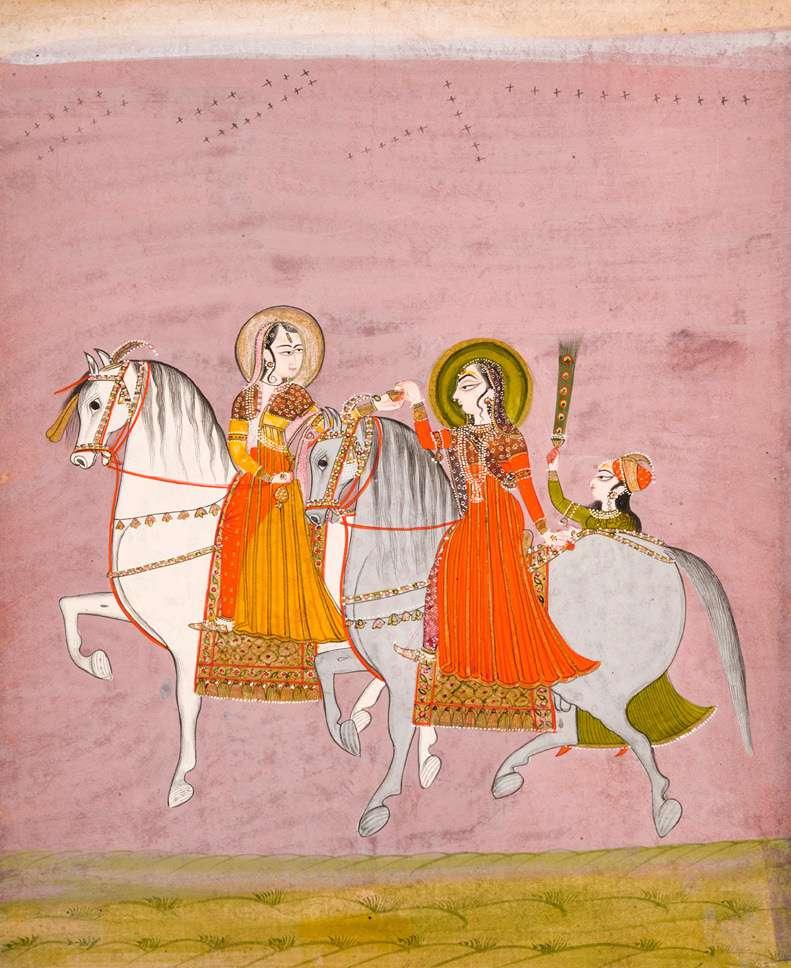
TWO LADIES ON HORSES, CHAMBA, 18TH CENTURY
opaque colours and gold on paper, one holding a wine flask in one hand and passing a cup to the other, both of their head with a nimbus, a fan bearing female attendant behind, image 22 x 18cm, framed and glazed
Provenance: Collection of Robert Skelton, O.B.E. (1929-2022).
According to his notes, this was the first painting bought by Robert. He paid 7s/6d. Stylistically, it conforms to other paintings produced in Chamba in this period with the style evolving from the start of the century. The characteristic elements of this can be seen in images such as a painting of Kali, dating from around 1710, in the Victoria and Albert Museum collection (IS.126-1951). Another painting in that collection, ‘A coy lady is brought to her lover’ (IS.147-1949), sees this style beginning to dissipate as the century progresses. However, the facial type persists in the embroidered textiles, rumal, that Chamba comes to be renowned for from the end of the eighteenth century.
£1,000-1,500
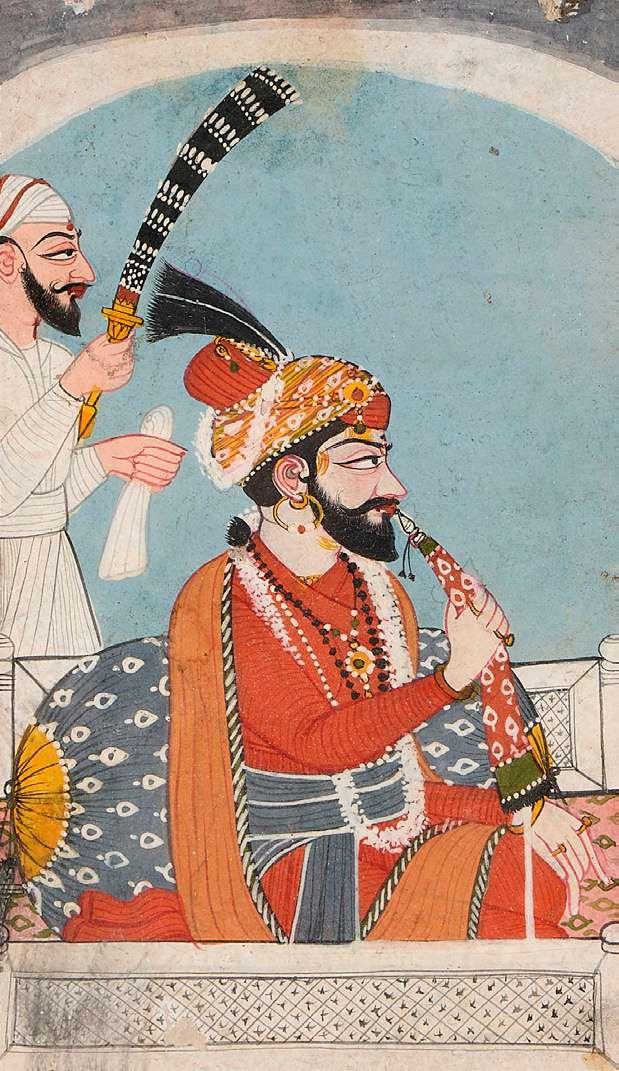
PORTRAIT OF RAJA SURMA SEN, MANDI, LATE 18TH CENTURY
opaque colours on paper, the seated ruler smoking on a terrace with an attendant behind, image 17.4 x 10cm framed and glazed
Provenance: Collection of Robert Skelton, O.B.E. (1929-2022).
Purchased Bonhams, 6th April 2006, lot 386.
Formerly in the collection of the late Peter Cochrane who had acquired the painting at Sotheby’s, 23rd April 1974.
£800-1,200
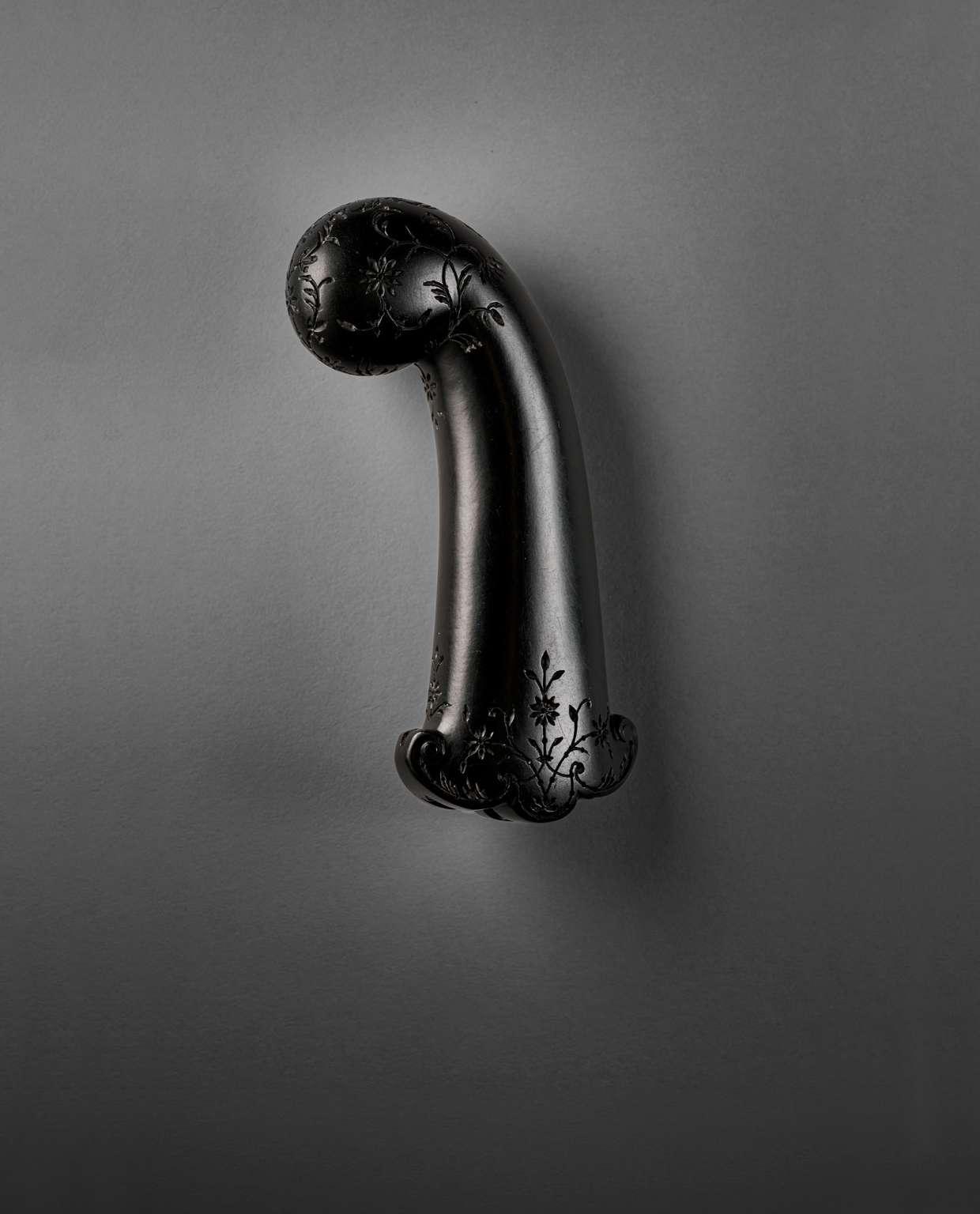
50 A MUGHAL CARVED BLACK JADE DAGGER HILT, INDIA, 18TH CENTURY engraved for inlay with meandering floral tendrils on each side of pommel and scrolling base, 12.5cm long
Provenance: Collection of Robert Skelton, O.B.E. (1929-2022).
£2,000-3,000
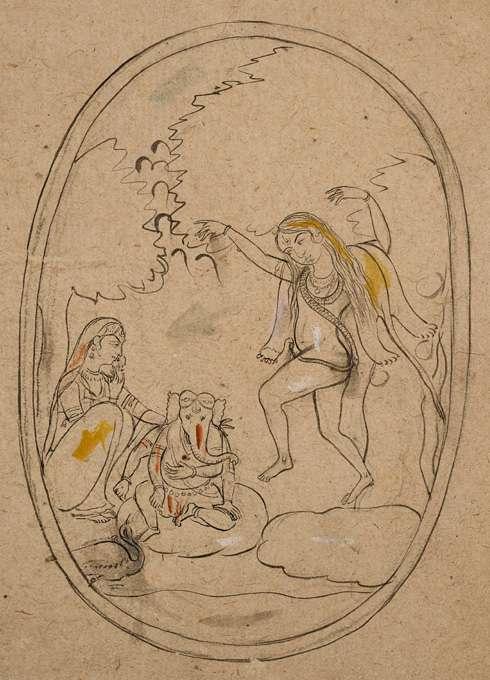
A DRAWING OF SIVA AND GANESHA, PAHARI, 19TH CENTURY
in black ink with traces of colour, the scene set beneath trees in an oval medallion, image 22 x 16cm, folio 32 x 25cm
Provenance: Collection of Robert Skelton, O.B.E. (1929-2022).
Collection Ishwari Prasad, Patna, from whom probably acquired by William Archer.
Ishwari Prasad was one of the last artists of the Patna school. When he retired from the Calcutta School of Art in 1904, he travelled, with his son, to Patna to work for P. C. Manuk. He provided much information to the Archers in their research into Company paintings produced by that school and this drawing might have come to Skelton from William Archer.
£300-500
A DRAWING OF RADHA AND KRISHNA, PAHARI, 19TH CENTURY
in red and black ink on paper, the lovers depicted on a dais being entertained by female musicians, image 26.5 x 22cm, folio 31.3 x 23.5cm
Provenance: Collection of Robert Skelton, O.B.E. (1929-2022).
Collection Ishwari Prasad, Patna (see note with previous lot).
£250-350
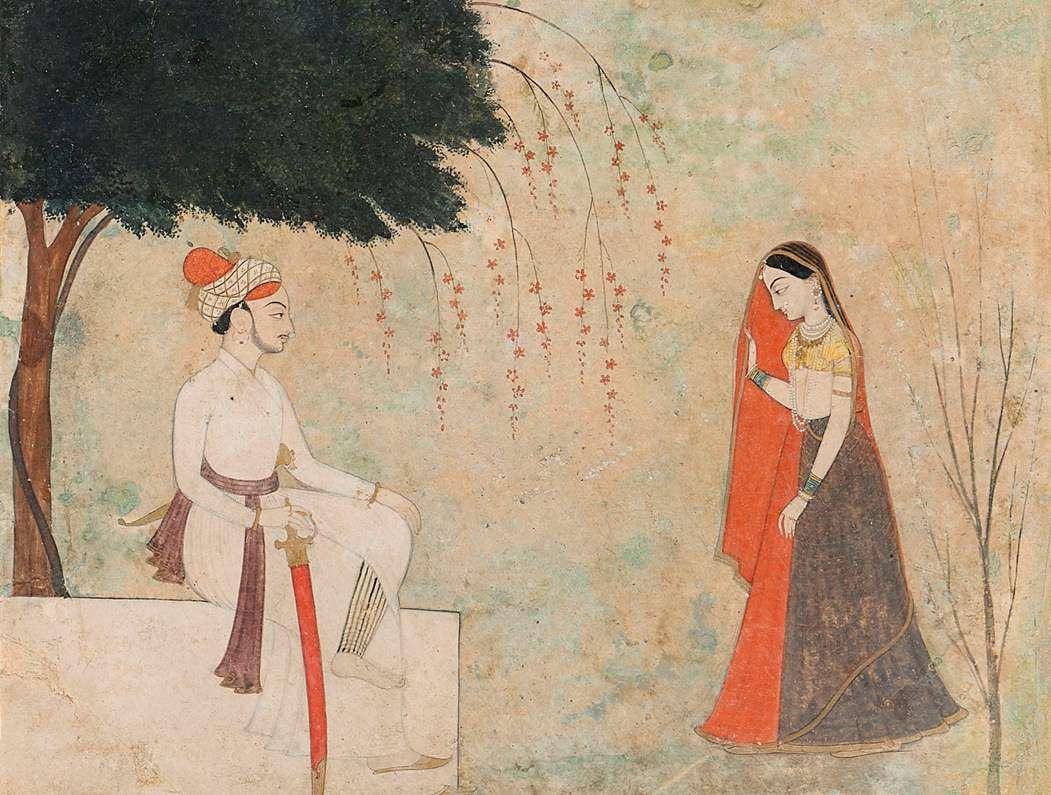
AN ILLUSTRATION TO A NAYIKA SERIES, GULER, CIRCA 1770-80
opaque colour on paper, possibly an image from a Nayika series, the princely figure seated on a dais beneath a leafy tree issuing flowering stems, the woman with down turned gaze veils herself as she approaches, flowering stems beyond, image 16 x 21cm, framed and glazed
Provenance: Collection of Robert Skelton, O.B.E. (1929-2022).
This is painting most probably depicts a scene from a Nayaka-Nayika series. These series portray the Ashta Nayika, or eight heroines, each in their distinct romantic mood each an expression of an intense emotional state. In this scene, at the sight of the prince’s handsomeness, the woman has become rooted to the spot, stambh, and overwhelmed by shyness she covers her face. A traditional form of treating these emotional states, it was the formulation of them in the Rasikapriya of 1591 by the poet Keshavadas that inspired many of the later depictions though his work depicted the lovers as Krishna and Radha.
The rendering of the faces and figures in this painting is reminscent of the work being produced by the generation of artists that came after Nainsukh and his brother, Manaku. A group of paintings from another Nayika series, though adopting a different format, exhibit a reminiscent style and use a similarly restrained palette and setting with flowering stems. Two examples from this group were sold Christies, 28th October 2025, lot 3 and 4, and a painting in the Victoria and Albert Museum from a further series, Prositapatika Nayika, adopts the same restrained approach and facial detail (see acc. no. IS.133-1951, reproduced in Archer 1973, no.33, p.106, vol. II).
£1,000-1,500
54
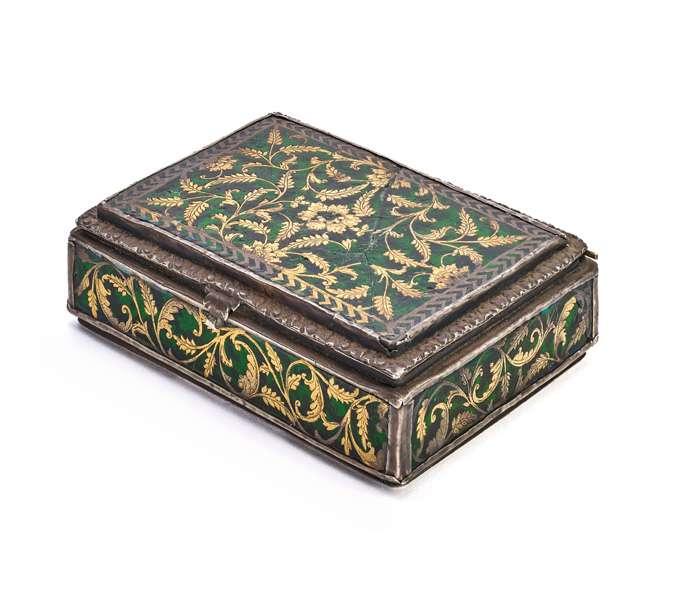
A SMALL THEWA BOX, PRATAPGARH, RAJASTHAN, 19TH CENTURY
silver, with hinged lid, set with foiled green glass panels, inlaid with gold, each with a design of scrolling ferns, the interior gilded, 2 x 6.8 x 4.7cm
Provenance: Collection of Robert Skelton, O.B.E. (1929-2022). The technique of inlaying coloured glass with engraved gold foil, known as thewa, is unique to the town of Parthabgarh (now Pratapgarh). Only one family, the Sonis, has held the secret of this complex and time consuming work. Although most examples in museums and collections date from the second half of the 19th century, it is thought to have been made since the 18th century and continues to this day. For a full account of the history and detail of the technique, see Untracht 1997, p.300-303.
£400-600
55
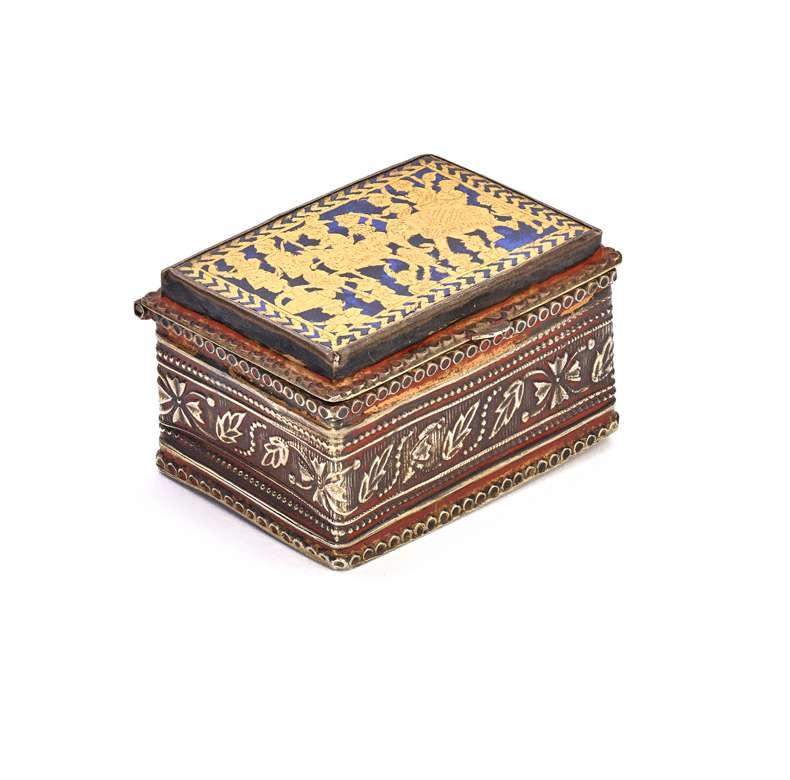
A SMALL SILVER-GILT BOX WITH THEWA WORK, PRATAPGARH, RAJASTHAN, 19TH CENTURY
the hinged lid set with a foiled blue glass panel, inlaid with engraved gold, depicting a royal procession, the sides with repousse foliate band, 2.7 x 4.7 x 3.9cm
Provenance: Collection of Robert Skelton, O.B.E. (1929-2022). For the technique, see footnote to the previous lot.
£300-500
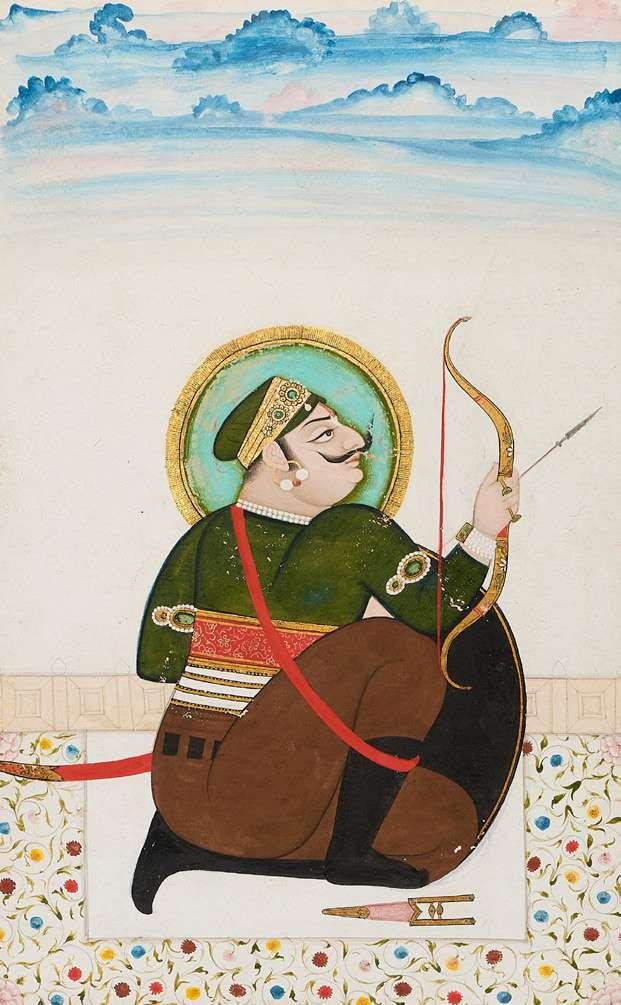
A PORTRAIT OF PRITHVIRAJ RAJA CHAUHAN, MEWAR, PROBABLY UDAIPUR, CIRCA 1810
in opaque colours and gold on paper, the bejewelled figure crouching on a terrace behind his shield and armed with a sword, katar and bow and arrow, within ruled borders and a red margin, image 26.6 x 16.4cm, folio 34.1 x 25.2cm
Provenance: Collection of Robert Skelton, O.B.E. (1929-2022).
Prithviraj Chauhan was a twelfth century warrior king of the Chauhan clan reputed to have ruled the region at the most powerful moment of its history. His defeat at the hands of the moslem Ghurid ruler, Mu-izz al-Din Muhammad ibn Sam, in 1192 is seen by many as a watershed moment in Indian history.
A comparable depiction of Prithviraj Raja Chauhan was offered at Sotheby’s, 17th June 1999, lot 50. That example was attributed to Devgarh and thought to have been the work of the court artist Bagta, or possibly Chokha.
£800-1,200
57
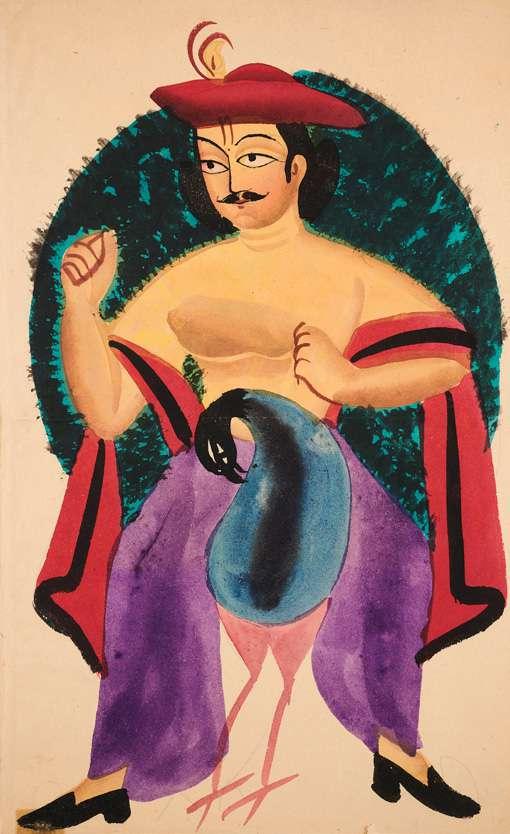
A KALIGHAT PAINTING OF KARTIKEYA, CALCUTTA, CIRCA 1900
colour on paper, the god depicted in characteristic manner astride a peacock, etiquette attached to the verso, 45.7 x 27.9cm
Provenance: Collection of Robert Skelton, O.B.E. (1929-2022).
Inscription: Skelton’s collectors label applied verso ‘KARTIKEYA astride the Peacock. By Kali Charan Ghosh (1844-1930). Kalighat, c. 1900 (Series 18). Purchase at Kalighat from the artist’s family in 1932. From the W. G. Archer Collection, given 1952.’
Skelton’s introduction, and his lifelong career in that field, came about as a result of the intercession of William Archer, then Keeper of the Indian Section of the Victoria and Albert Museum. This must be amongst the earliest of Skelton’s Indian works of art having only been at the museum for two years when it was given to him. Indeed, Skelton records it in his incomplete record of his collection as item number 4, coming into his possession on 18th February 1952. This was the same year in which Archer gave other works by Kali Charan Ghosh, the brother of Nibaran Chandra Ghosh, to the Victoria and Albert Museum from his own collection, also acquired directly from the artist earlier in the century (see IS.38-1952, IS.40-1952 and IS.37-1952).
£1,000-1,500
58
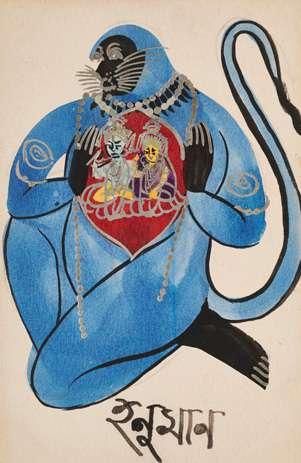
A KALIGHAT PAINTING OF HANUMAN, KOLKATA, INDIA, CIRCA 1890
in watercolour and tin oxide on paper, the kneeling figure of Hanuman revealing the figures of Rama and Sita in his heart, 13.6 x 8.9cm
Provenance: Collection of Robert Skelton, O.B.E. (1929-2022).
An identical image of Hanuman is in the collection of the Victoria and Albert Museum, IS23-1959. The museum received their example as a gift from Robert Skelton in 1959. He might have acquired his at that time giving rise to the opportunity to donate the other.
£300-500
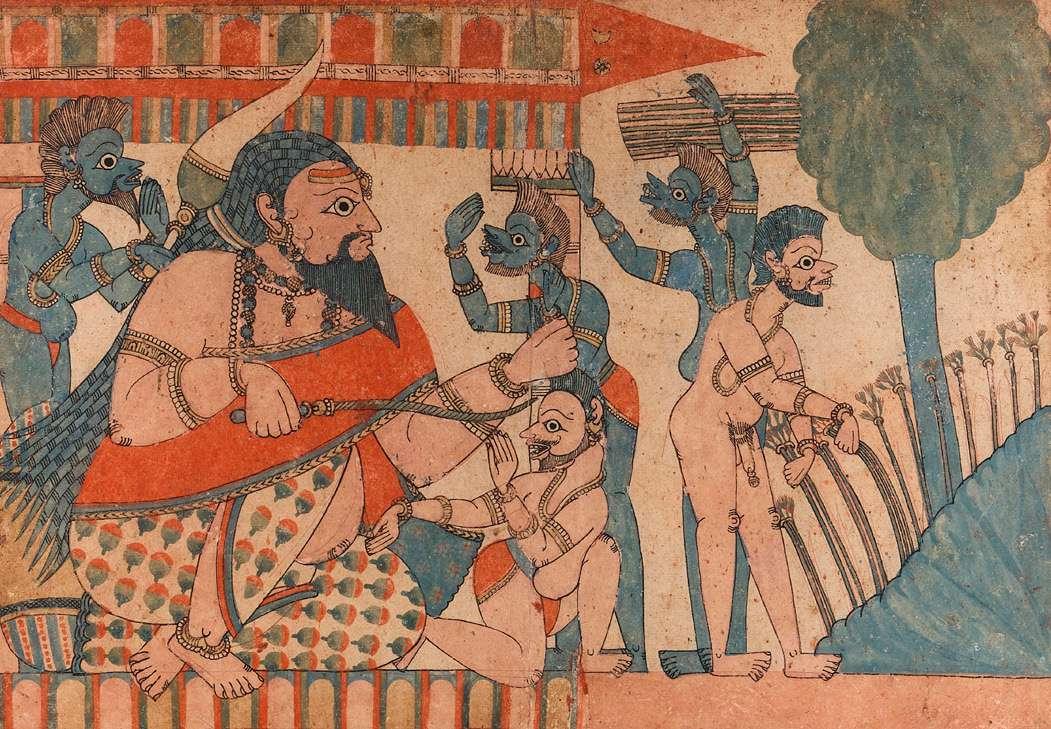
A PAITHAN PAINTING OF A KARALINGU SADDHUS, MAHARASHTRA, INDIA, 19TH CENTURY
in opaque colours on paper, the younger initiates busy themselves in attendance upon the sanachee who berates one of them, 30.5 x 42.8cm, framed and glazed
Provenance: Provenance: Collection of Robert Skelton, O.B.E. (1929-2022).
Kasmin Gallery, Clifford St., purchased 6th January 1992.
This group of saddhus renounced all of the temptations of the world including sexual activity declaring their intended llife of celibacy by wearing a karalingi, or ‘ring of the phallus’, which can be seen on the figure on the right. As part of their training they would spend many years attending to the needs of a more experienced devotee.
Originally the central large figure had been identifed as an ‘ogre’ but, correspondence with Anna Dallapiccola led to the figures being identified as saddhus of this extreme sect. Part of a letter from Anna to Robert and a note from her are attached to the reverse as is a printed image of a Tanjore painting of a karalingi which enabled Anna to make this identification.
Paithan paintings were produced in sets, often double sided, to be used by story tellers, their recitations fequently intended to be a form of devotional act. An example of one of these sets, similar in style to this painting, is in the British Museum, 2007, 3014.1-60.
£1,500-2,500
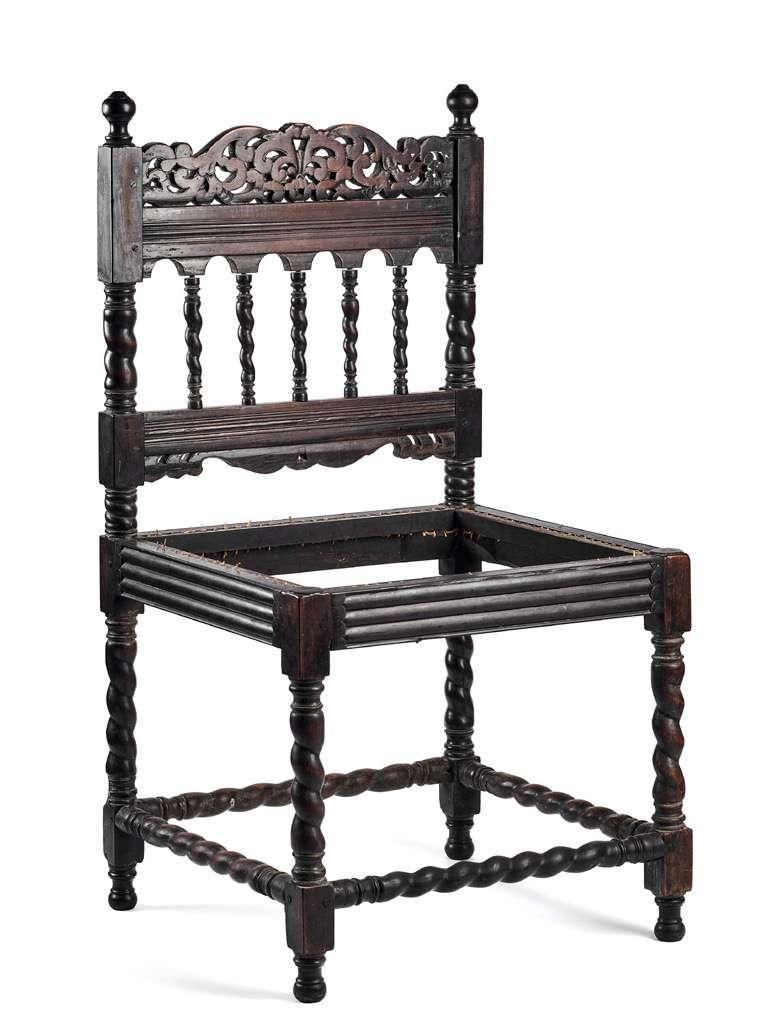
AN EBONY AND EBONISED ROSEWOOD ‘BATAVIAN’ CHAIR, INDONESIA, CIRCA 1700
the upright frame with barleytwist legs and crossbars, the back with pierced scrollwork frieze and barleytwist arcading, 96 x 51 x 47cm
Provenance: Collection of Robert Skelton, O.B.E. (1929-2022).
From the second half of the 17th century until well into the 18th century, chairs of this form, many made wholly or partly of ebony, were produced under Dutch influence in Indonesia, The Coromandel Coast (India), Sri Lanka and The Cape (South Africa). It can be difficult to identify in which of these parts of the Dutch colonial world individual examples were made. Robert Skelton himself believed this chair to be from the Cape, and the restraint of the carving is similar to known examples. However, it is also quite close to an example from the Moluccas in the Volkenkundig Museum Nusantara Delft (S00337-4, Eliens 2002, cat.16, p.73). Skelton had another, more elaborate, example in his collection, acquired from an antique dealer in Earl’s Court, London in the 1950s, which he subsequently donated to the Victoria and Albert Museum (IS6-2000).
£400-600
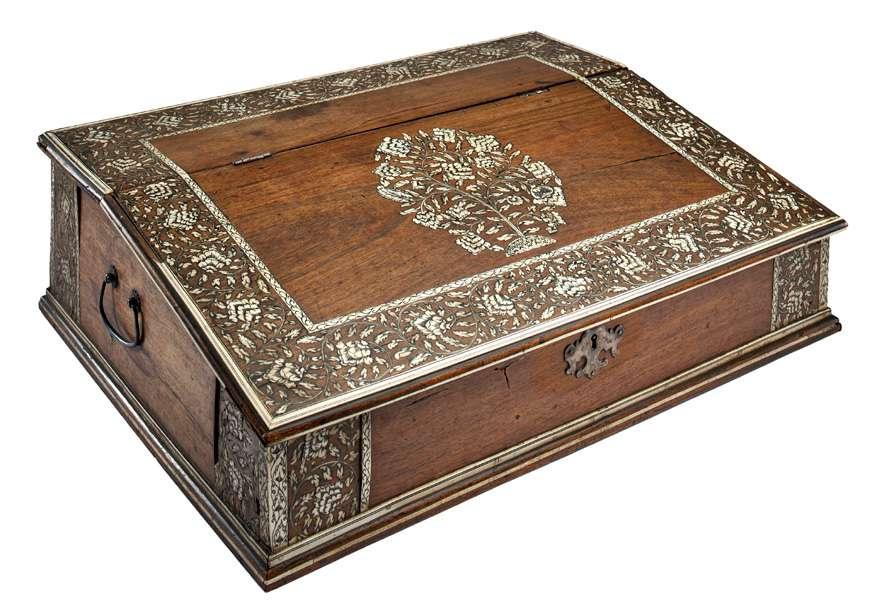
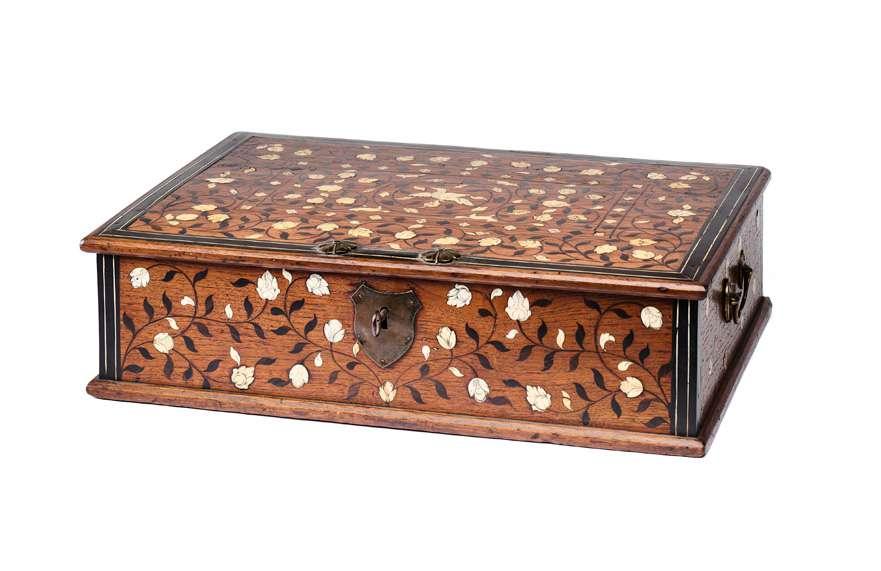
A VIZAGAPATAM TABLE TOP DESK, SOUTH-EASTERN INDIA, LATE 18TH CENTURY
rosewood inlaid with ivory, with silver mounts, the sloping hinged lid decorated with a stylised flowering tree, the top and sides with similarly decorated scrolling foliate borders, the interior with three arched compartments and three tiers of drawers, 16.5 x 55.5 x 41cm
Provenance: Collection of Robert Skelton, O.B.E. Acquired from Phillips and Page, 50 Kensington Church Street, 15 October 1965. (The invoice is sold with this lot).
Ivory Registration: UEQSC42G.
£1,200-1,800
62
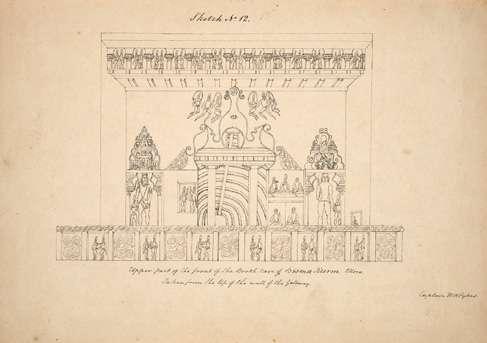
A DRAWING OF ELLORA AND ANOTHER OF A WILD PEACOCK, BY CAPTAIN W. H. SYKES, INDIA, EARLY 19TH CENTURY
the first ink on paper, inscribed and signed ‘Captain W. H. Sykes’, the second in colour and ink on paper, inscribed ‘Mamely or Wild Peacock’, and a study of Karle Cave, colour and ink on paper, extensively inscribed, dated April 1851, and signed, indistinctly, with a sketch of a palace above ghats, inscribed on the reverse ‘Bombay School of Art’, the first 19.9 x 27.6cm, and smaller (4)
Provenance: Collection of Robert Skelton, O.B.E. (1929-2022).
William Henry Sykes (1790-1872), who rose to the rank of Colonel, served in the army of the East India Company from 1804, seeing his first action at the Siege of Bhurtpur, in 1805. By 1810 he could speak Hindi and Marathi, and, having shown such an aptitude and interest in Indian matters, was appointed a statistical manager for the Bombay government by Mountstuart Elphinstone. His researches extended beyond statistical matters to include natural history with his reports of these often including illustrations. He retired from active service in 1833 and, after his return to Britiain, was appointed as a director of the East India Company in 1840. In 1867 he was elected as Chairman of the Board of Directors of the East India Company by which time he had been elected as the MP for Aberdeen and the President of the Royal Asiatic Society.
Sykes frequently campaigned to provide better education and social provision. Whilst in India he had suggested that it would have been easily affordable to provide pensions and insurance for Indian soldiers in the British army, though this was not acted upon. He made suggestions for improved educational arrangements for serving soldiers and for natives and also for the provision of books and libraries in Britiain, which he was aware lagged behind other European nations in this matter. He even criticised the action of the British government in unjustifiable aggression toward the Chinese in their handling of the Taiping rebellion.
His name persists in some of the fifty six birds that he discovered for scientific record, including Sykes’ lark and Sykes’ wagtail.
£400-600
63
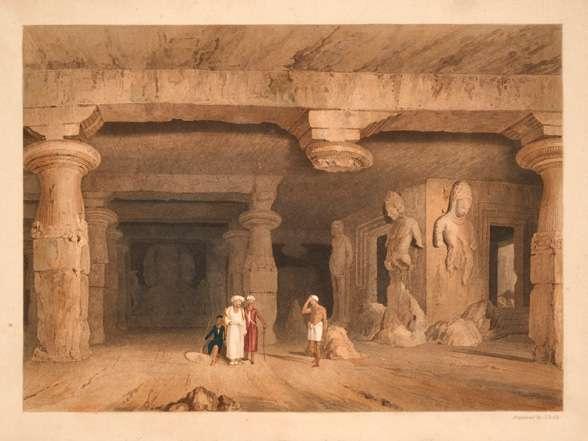
INTERIOR OF THE GREAT CAVE TEMPLE AT ELEPHANTA, NEAR BOMBAY, AFTER ROBERT MELVILLE GRINDLAY, 1826-30
lithograph, titled below the image, l.r. ‘Engraved by J. Baily, below the title ‘From a drawing made on the spot by W. Westall A.R.A., in 1803’, image 20.3 x 28.5cm, framed and glazed
Provenance: Collection of Robert Skelton, O.B.E. (1929-2022).
The reverse with a label of Eyre & Hobhouse with the caption ‘A hand-coloured aquatint after Captain Robert Melville Grindlay, from Scenery, Costumes and Architecture Chiefly on the Western Side of India, 1826-30.’ and “Interior of the Great Cave Temple of Elephanta, near Bombay”.
£200-300
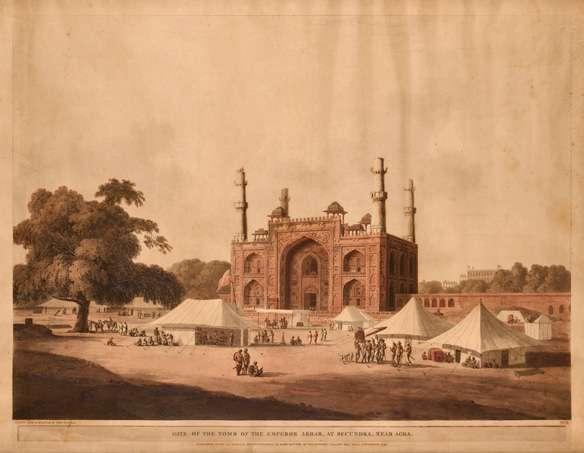
‘GATE OF THE TOMB OF THE EMPEROR AKBAR, AT SECUNDRA, NEAR AGRA’, 1795, AFTER THOMAS DANIELL
coloured aquatint, subtitled ‘Drawn and Engraved by Thos. Daniell’, ‘No. IX’ and ‘Published as the act directs for Thos. Daniell by Robt. Bowter at the Historic Gallery Pall Mall November 1795’. image 43 x 60cm, framed and glazed
Provenance: Collection of Robert Skelton, O.B.E. (1929-2022).
The image appeared in ‘Oriental Scenery’ and was captured by Thomas when the Daniells visited Sikandra in January 1789. This scene shows the encampment of a large party which the artists had joined on the trip to Agra. See Archer 1980, no.30 & pl.V.
£150-250
65
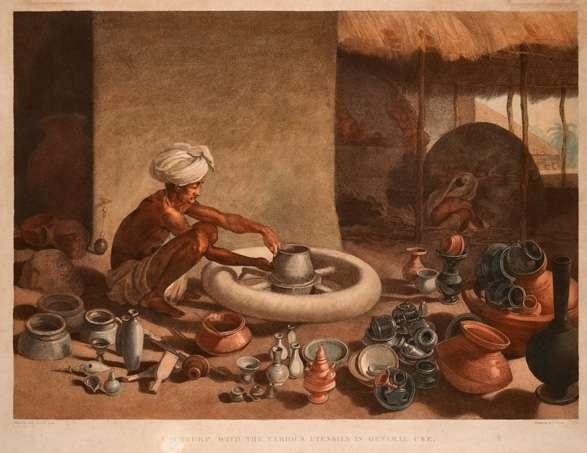
A POTTERY WITH THE VARIOUS UTENSILS IN GENERAL USE, AFTER A. W. DEVIS
coloured stipple engraving, subtitled ‘Painted in India by A. W. Devis’ and ‘Engraved by J. Wright’, image 44 x 61.1cm, framed and glazed
Provenance: Collection of Robert Skelton, O.B.E. (1929-2022).
Handwritten on the reverse of the frame ‘45/77 H & E’, the latter presumably a reference to Hartnoll & Eyre. A paper label applied to below typed with ‘In 1796 Devis exhibited the oil painting at the R. A. entitled ‘A Koonar or bungalee potter at his wheel. (sic) Weaver and patna paper maker exhibited in the same year. Salt-maker in 1799 and Braziers in 1807.’
£150-250
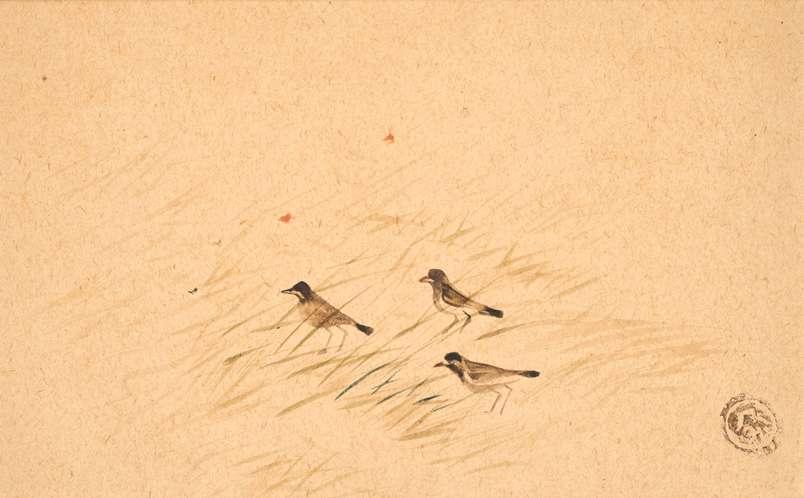
NALANDALAL BOSE (1883-1966)
THREE BIRDS
wash on paper, mounted stamped l.r. image 12.8 x 8cm, folio 13.5 x 8.5cm
Inscribed by Skelton on the reverse of the mount: ‘From I. Pasricha at cost, Soth 15/4/1985 lot 418, N Bose 3 Birds £27-82 1/2.
Provenance: Collection of Robert Skelton, O.B.E. (1929-2022).
The Collection of Roop Krishna, sold Sotheby’s, 15th April 1985, lot 418, where acquired by the dealer, Indar Pasricha, who sold it to Skelton at his cost.
The Victoria and Albert Museum, presumably under Skelton’s guidance, had bought a number of examples of Bose’s work in the sale of the Krishan Collection (IS77-1985, IS80-1985). The former is a small painting of similar style and muted colouration to this example. It is thought to have been carried out on Bose’s return from a trip to the Far East in 1924 with Rabindranath Tagore and hence displays something of the influence of Chinese painting.
£200-300
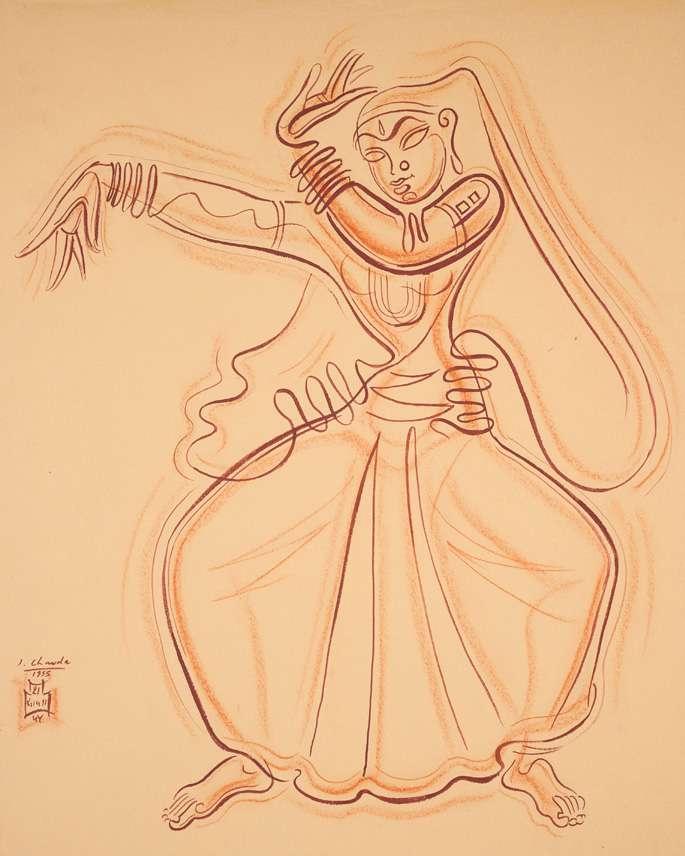
SHIAVAX CHAVDA (1914-1990)
DANCING GIRL
ink on paper
signed and dated l.l. ‘S, Chavda 1955’ and below in monogram
41.3 x 33.1cm
Skelton inventory label l.r. ‘S.85’ and stamped verso of card ‘Custom House Bombay’.
Provenance: Collection of Robert Skelton, O.B.E. (1929-2022).
This is part of a series of studies of dancers produced by the artist in the mid 1950s. Three examples were gifted by the artist to the Victoria and Albert Museum in 1955, IS.31-1955, IS.32-1955 and IS.33-1955, when Robert would have had the opportunity to become familiar with Chavda and his work and possibly receive as a gift this and his other of the artists work.
£800-1,200
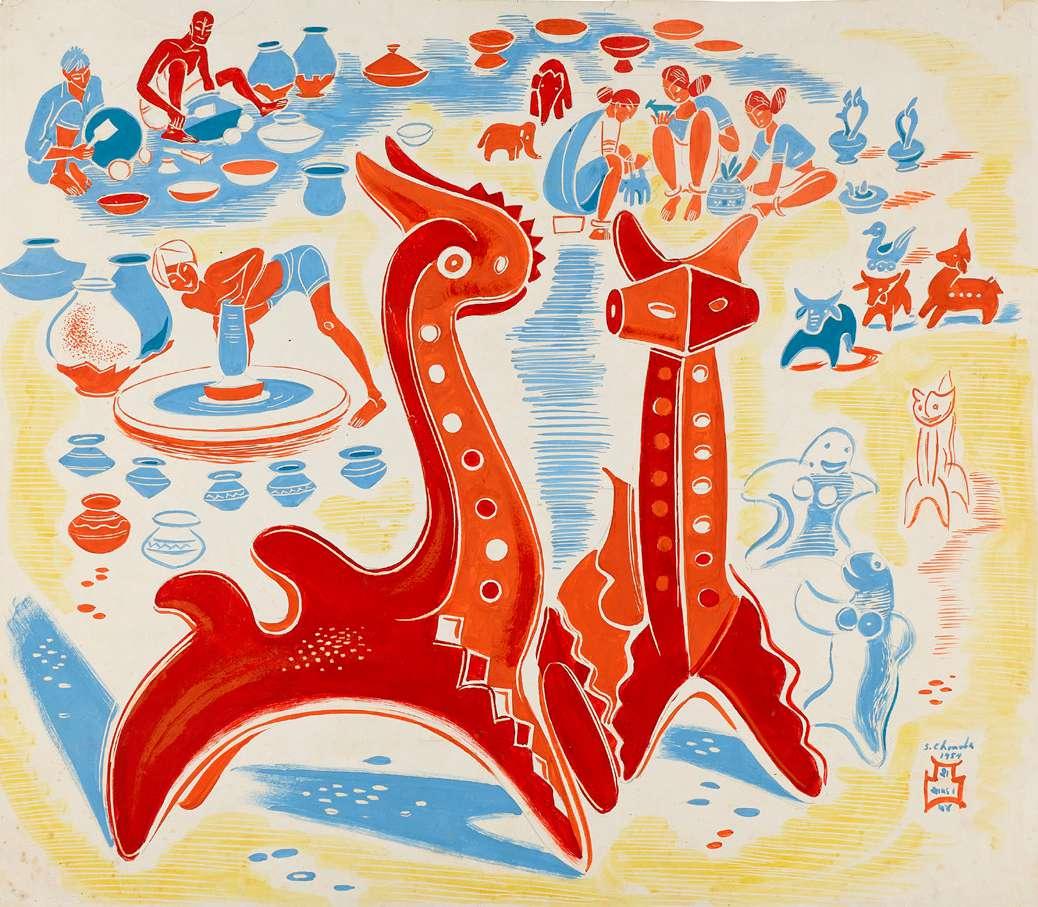
SHIAVAX CHAVDA (1914-1990) POTTERS AND THEIR MODELS
gouache and pencil on card signed and dated l.r. S. Chavda 1954 above monogram 41.5 x 47.7cm
Provenance: Collection of Robert Skelton, O.B.E. (1929-2022).
£800-1,200
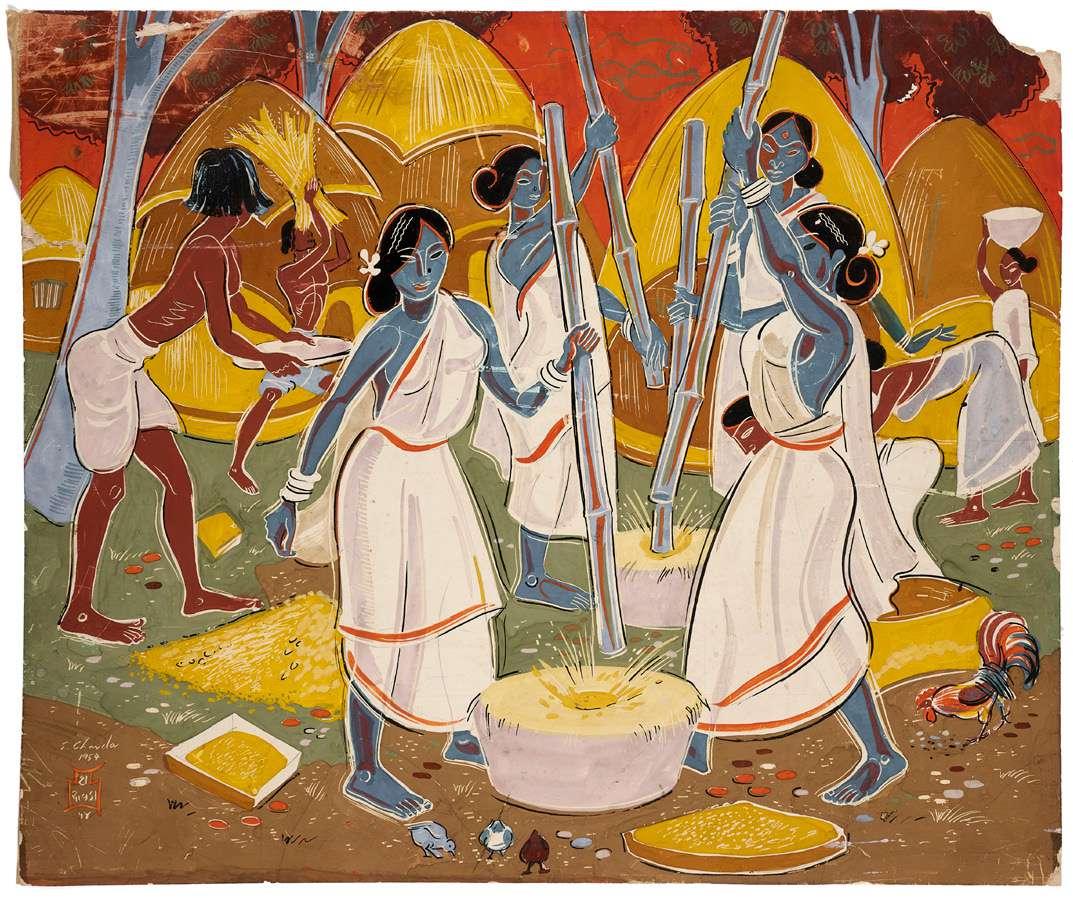
SHIAVAX CHAVDA (1914-1990)
LADIES POUNDING GRAIN gouache on card signed and dated l.l. ‘S. Chavda 1954’ and below in mongram 40.2 x 47.7cm
Provenance: Collection of Robert Skelton, O.B.E. (1929-2022), purchased before 1970. £600-800
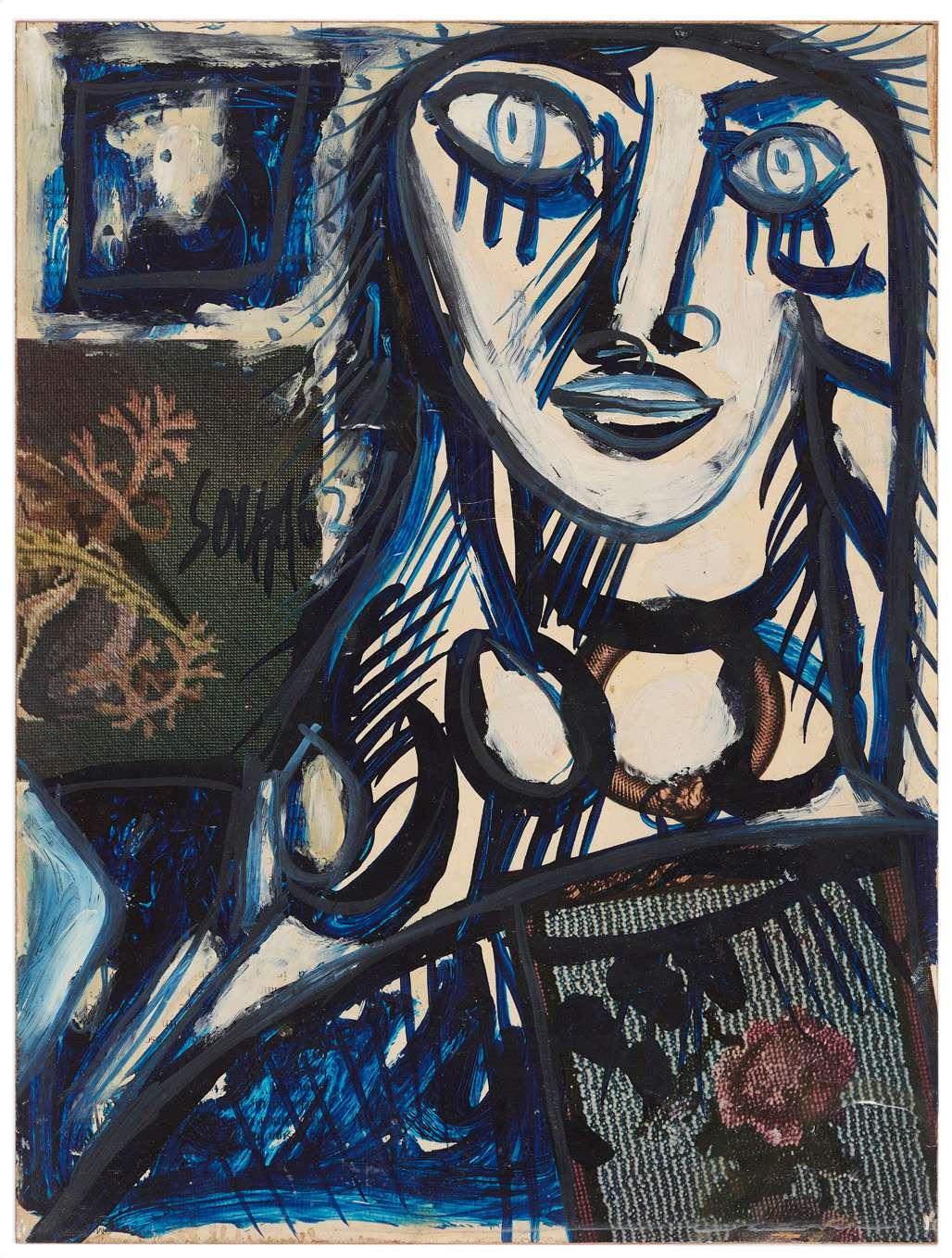
FRANCIS NEWTON SOUZA (1924-2002)
UNTITLED (HEAD)
oil on magazine paper laid down on board, framed signed and dated ‘Souza ‘62’
32 x 23.9cm
Provenance: Collection of Robert Skelton, O.B.E. (1929-2022).
A comparable oil of a head, of similar dimension and also dated 1962, was sold Bonhams, 9th December 2025, lot 1. Robert would have been immersed in the world of Indian art in London just as Souza and some of his contemporaries were establishing their lasting reputations with the support of Victor Musgrave and the celebrated Gallery One. This painting was bought by Robert from Souza’s first wife, Maria Figueiredo. She had married Souza in 1945 and, through taking on numerous jobs, supported him financially during his early career as an artist as he struggled to become recognised. The couple remained married until 1964, despite the fact that through most of the 1950s he had an intimate affair with Liselotte Kristian Kohn which ended in 1961. Robert, a friend of both Souza and his wife, purchased the painting from Maria shortly after the divorce for what he described as ‘not very much’.
£6,000-8,000
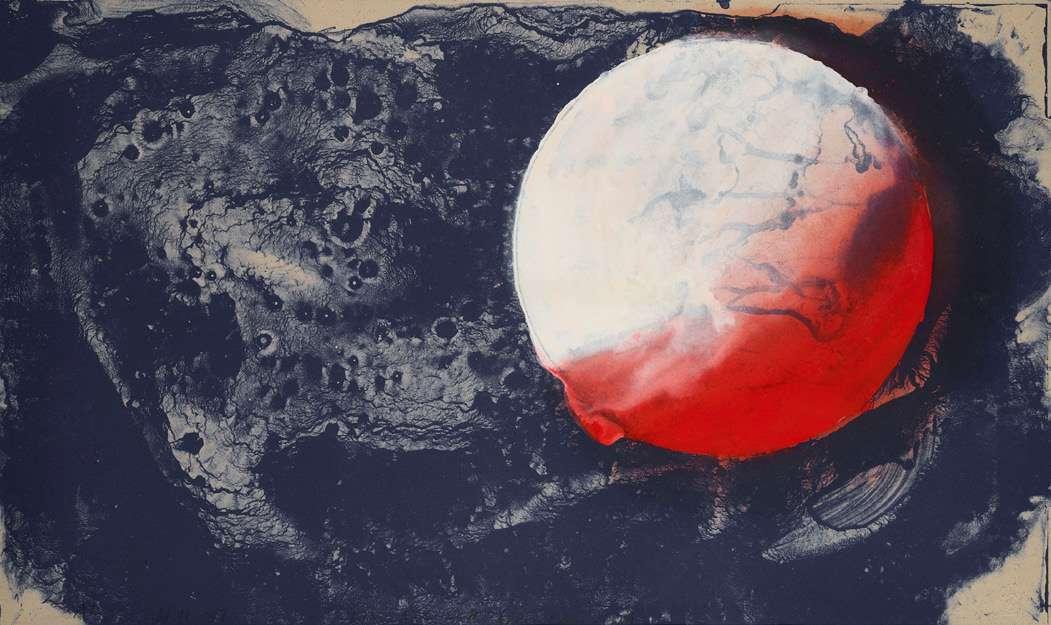
SIR HOWARD HODGKIN CH CBE (1932-2017)
MOON 1987
lithograph, framed and glazed image 30.5 x 51cm
Inscribed in pencil along lower edge ‘A P HH 87 For RS with love from HH’, hand form watermark
Provenance: Collection of Robert Skelton, O.B.E. (1929-2022).
Given to Robert Skelton by Howard Hodgkin on the occasion of Robert receiving the OBE in 1988. Hodgkin had been introduced to Indian paintings whilst still at school by his art master, Wilfred Blunt, who was keen to introduce his pupils to the idea of collecting art. Blunt was able to put on two exhibitions, the first of Mughal paintings from a London book dealer and the second of works in the Royal Collection at Windsor. This experience focussed the young Hodgkin’s interest on Indian painting and from about the age of fourteen he began to buy one or two paintings. A little later he found another painting in a shop in South Kensington which he bought. Being close to the Victoria and Albert Museum, he took it to show the curator of India art, a young Robert Skelton. This proved a vital moment in Hodgkin’s collecting but also his artistic direction. Through Robert he met those who were to guide him in his collecting life, in particular Stuart Cary Welch, the wealthy American scholar and collector, who was living in London at this time. Robert and Howard became life-long friends.
With regard to Hodgkins’s artistic direction, there can be no doubt that he was greatly moved by his visits to India. The first of these was with Robert in 1964. Robert later recalled recognising the impact that this visit was having on Hodgkin:
“He and I together with Mrs. Saryu Doshi were on a tour of Rajasthan and visited the then Maharaja of Kishangarh in his Palace overlooking the lake with the low Kishangarh hills in the background..... after being received by Maharaja Sumer Singh we were taken by his court musician, whose name I remember as Amar Lal, into the Haveli where he sang devotional songs of the Vallabha Sampradaya during worship in the main shrine.....before going up to the small rectangular terrace overlooking the lake where Saryu and Amar Lal were sitting on the low external balcony wall conversing about music with one, the singer? leaning towards the other. I was sitting on a short side wall with the lake on my right and Howard was facing me, utterly absorbed, drinking in the whole scene with plantain tree leaves behind him.”
Hodgkin went on to produced several versions of this scene captured by Skelton. One of which was to become ‘Indian subject (Blue)’ in Hodgkins Time and Place catalogue, p.73.
Skelton notes that ‘Howard has been replaced by the tree(s) behind him and you will be aware of his liking for plantains.”
Hodgkin recalled this same moment in his recollections for the Radio 4 programme, Desert Island Discs.
£800-1,200
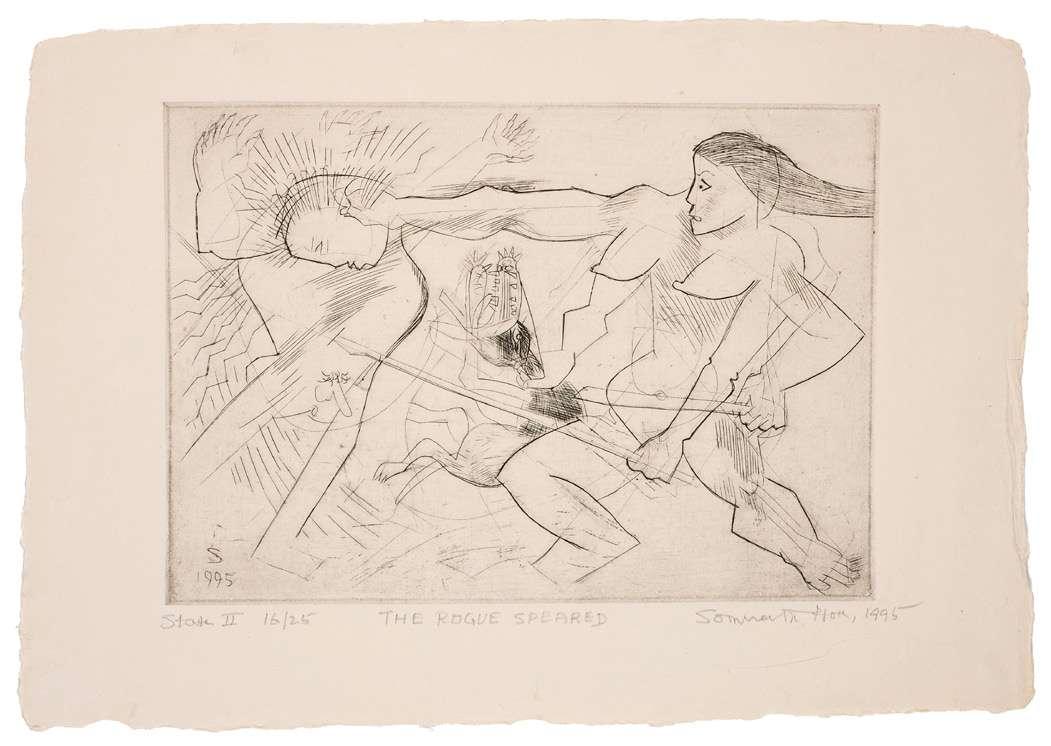
SOMNATH HORE (1921-2006)
THE ROGUE SPEARED etching on handmade paper State II, numbered 16/25 signed Somnath Hore, l.r. dated 1995 17 x 24.6cm
Provenance: Collection of Robert Skelton, O.B.E. (1929-2022). £800-1,200
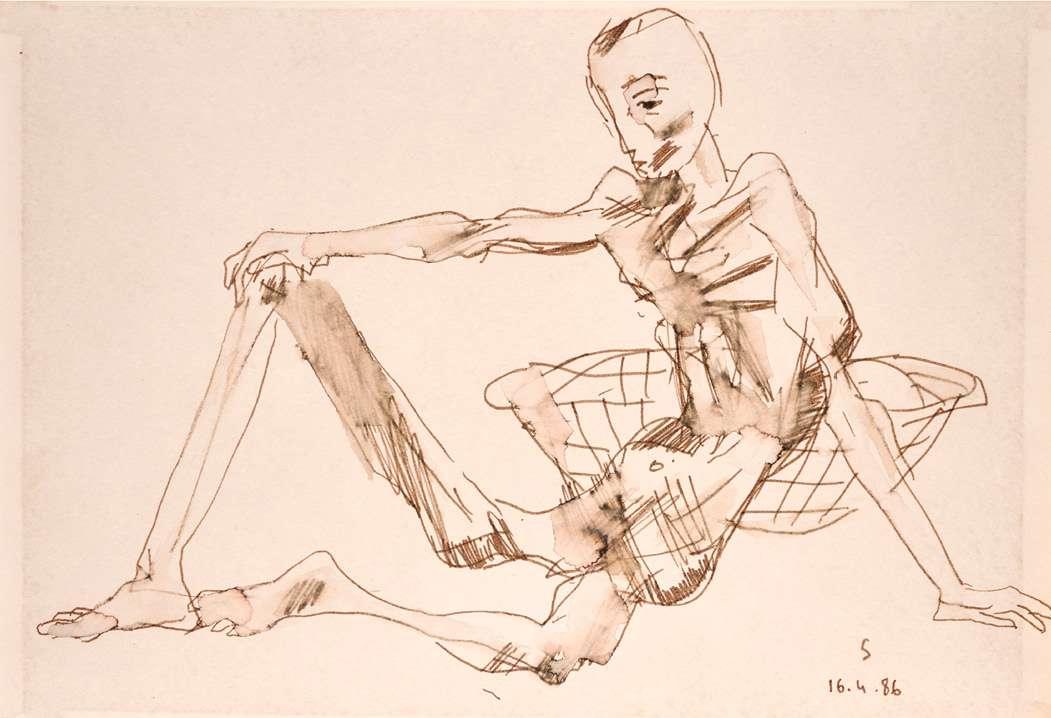
SOMNATH HORE (1921-2006) UNTITLED (FAMINE) dated 16.4.86 pen and wash on paper image 25 x 36cm framed and glazed
Provenance: Collection of Robert Skelton, O.B.E. (1929-2022).
Born in Chittagong, now in Bangladesh, Hore worked as a journalist as a young man, most significantly bearing witness to the famine of 1943 in Bengal. The images from this experience became recurring themes in his work as an artist, a lasting testament to the compassion that he felt for those he had seen at a time of great suffering.
£800-1,200
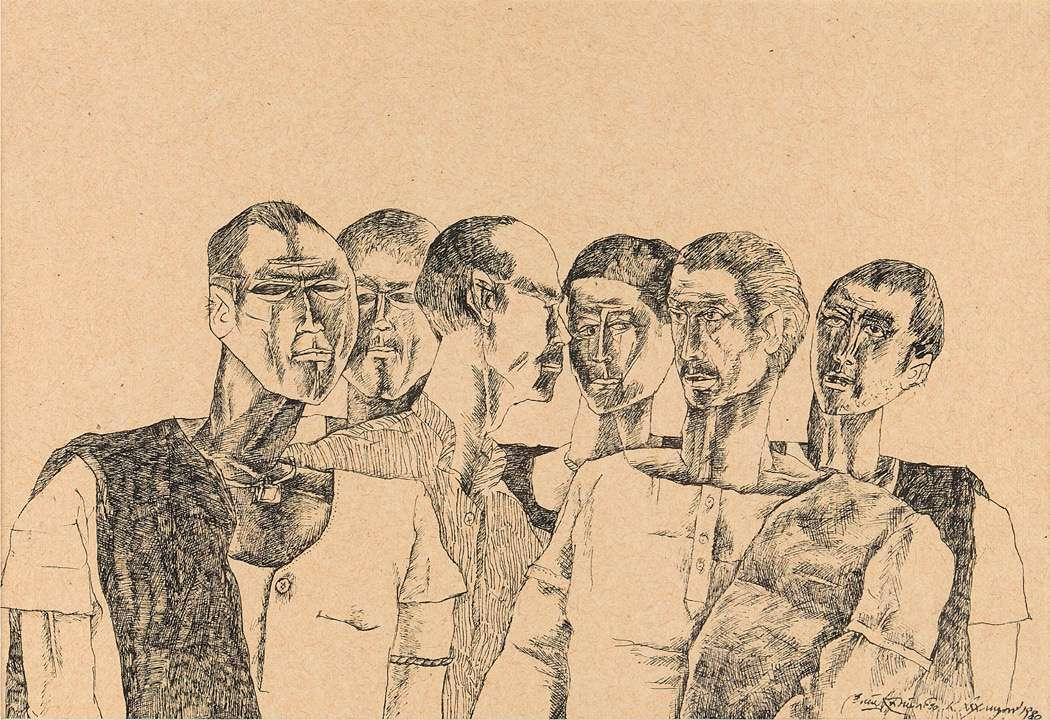
K. LAXMA GOUD (b.1940)
UNTITLED (TELANGANA PEASANTS)
ink on card, framed and glazed inscribed l.r., signed and dated 1980 25.5 x 31.5cm
Provenance: Collection of Robert Skelton, O.B.E. (1929-2022).
K. Laxma Goud was amongst the forty five artists who contributed work to the Royal Academy exhibition of 1982 entitled ‘Contemporary Indian Painting’ as part of the Festival of India. Robert had met the artist by the 1960s when he bought this work directly from Goud. Another of Goud’s ink drawings in this style and dating from 1980 was sold Sotheby’s, 29th September 2020, lot 8, from the estate of Patwant Singh.
£2,000-3,000
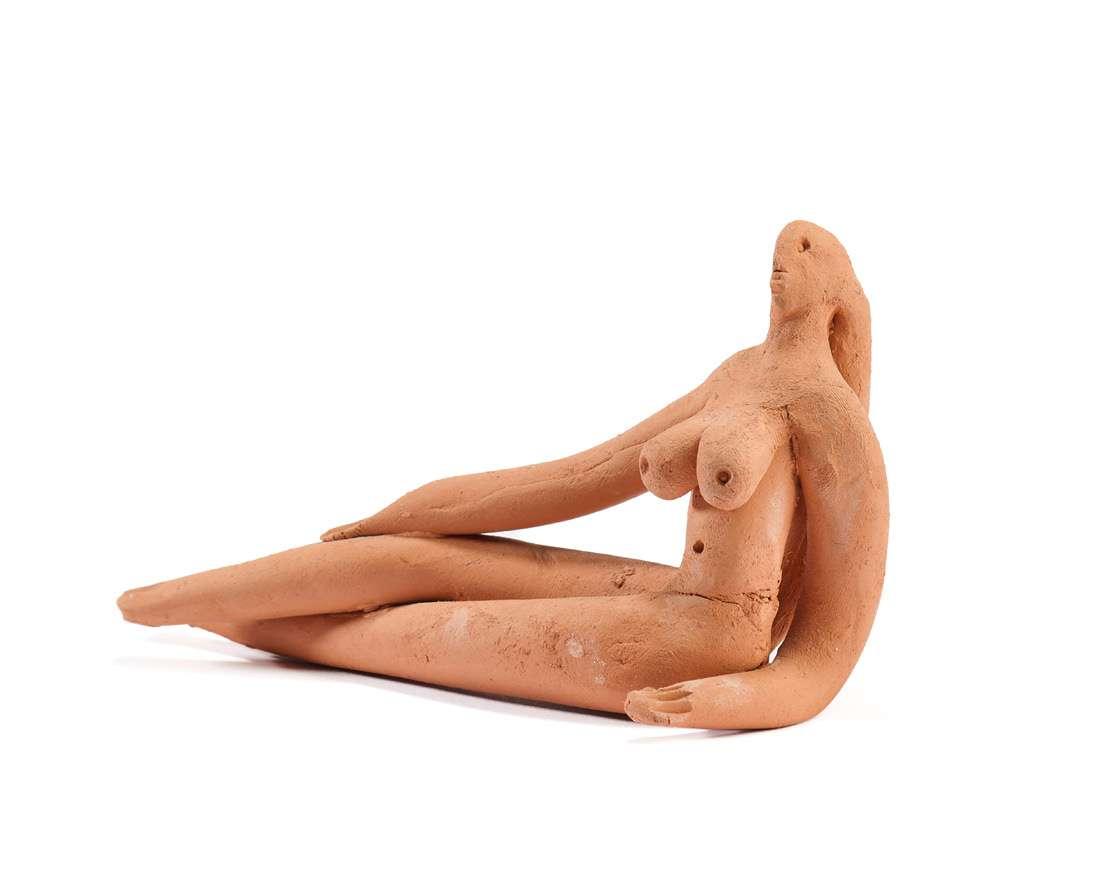
DHRUVA MISTRY (1957)
UNTITLED (RECLINING NUDE)
terracotta
16.3cm wide
Provenance: Collection of Robert Skelton, O.B.E. (1929-2022).
Early in the artists career, in 1981, he was awarded a British Council scholarship to study at the Royal Academy. In the following year, he was included in the artists chosen to exhibit at the Royal Academy as part of the Festival of India held in Britain in that year. If they had not already met, this would have brought Mistry to the attention of Robert Skelton, who was heavily involved in many of the events organised as part of that celebration of Indian culture. Mistry remained in London and, in April 1988, he spent a period as artist in residence at the Victoria and Albert Museum. The products of this collaboration were a series of small studies, many in terracotta, which draw on recognisable classical Indian forms whilst accepting an aesthetic sympathetic to the approaches of modern western art. Our model comes from this period of Mistry’s output and was purchased by Skelton directly from the artist. A number remain in the collection of the Victoria and Albert Museum, such as IS.49 to 50-1988.
£700-1,000
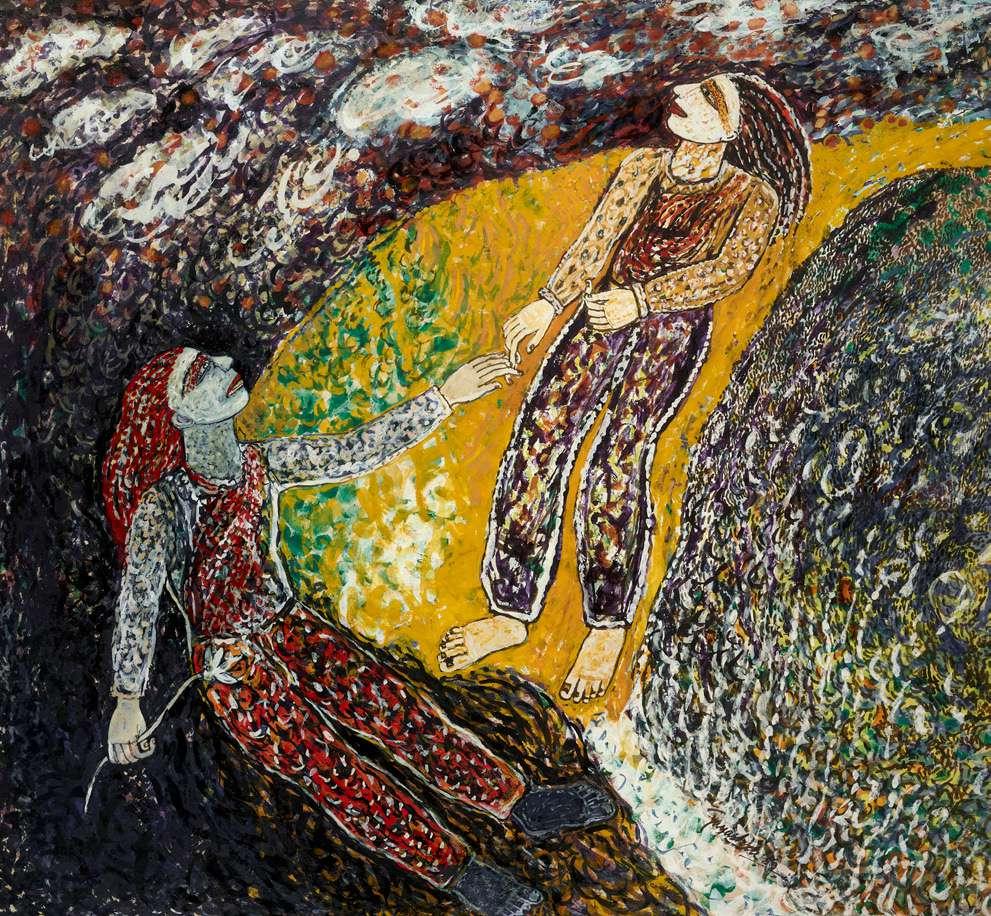
JAYASHREE CHAKRAVARTY (1956)
UNTITLED
tempera on card, framed and glazed image 44.5 x 48cm
Provenance: Collection of Robert Skelton, O.B.E. (1929-2022).
Two works from this series, thought to have been painted in the late 1980s, were sold Sotheby’s NY, 16th March 2020, lot 63. £1,500-2,500
VARIOUS PROPERTIES
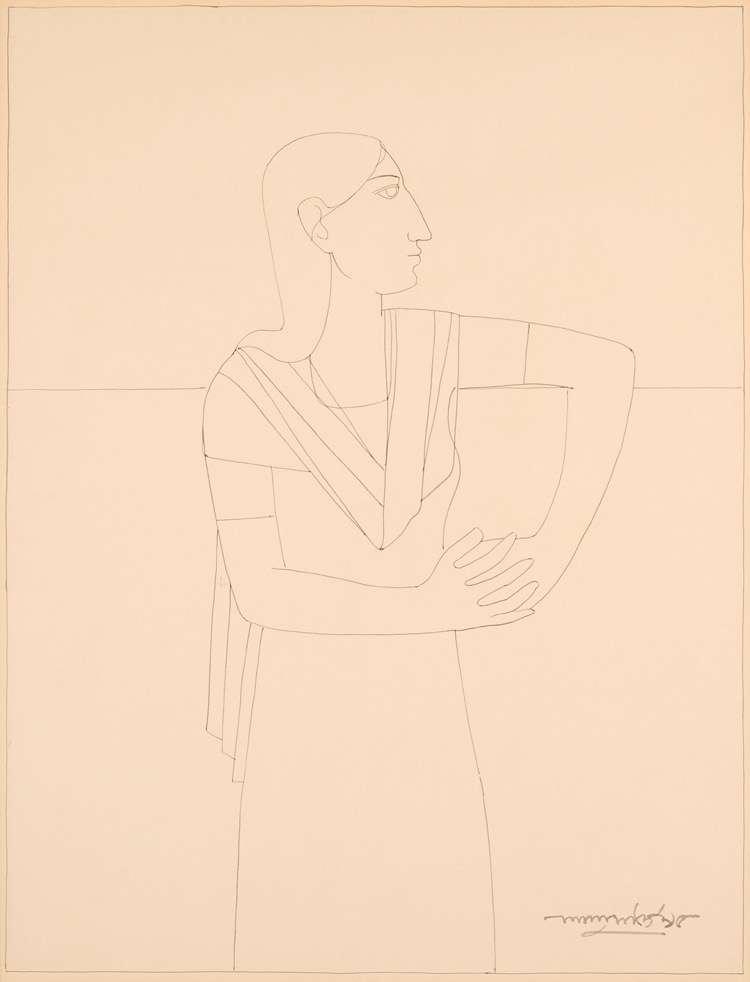
WOMAN IN DRESS
ink on paper, framed and glazed signed in Bengali l.r.
image 44 x 33.5cm
Provenance: from a private London collection.
£800-1,200
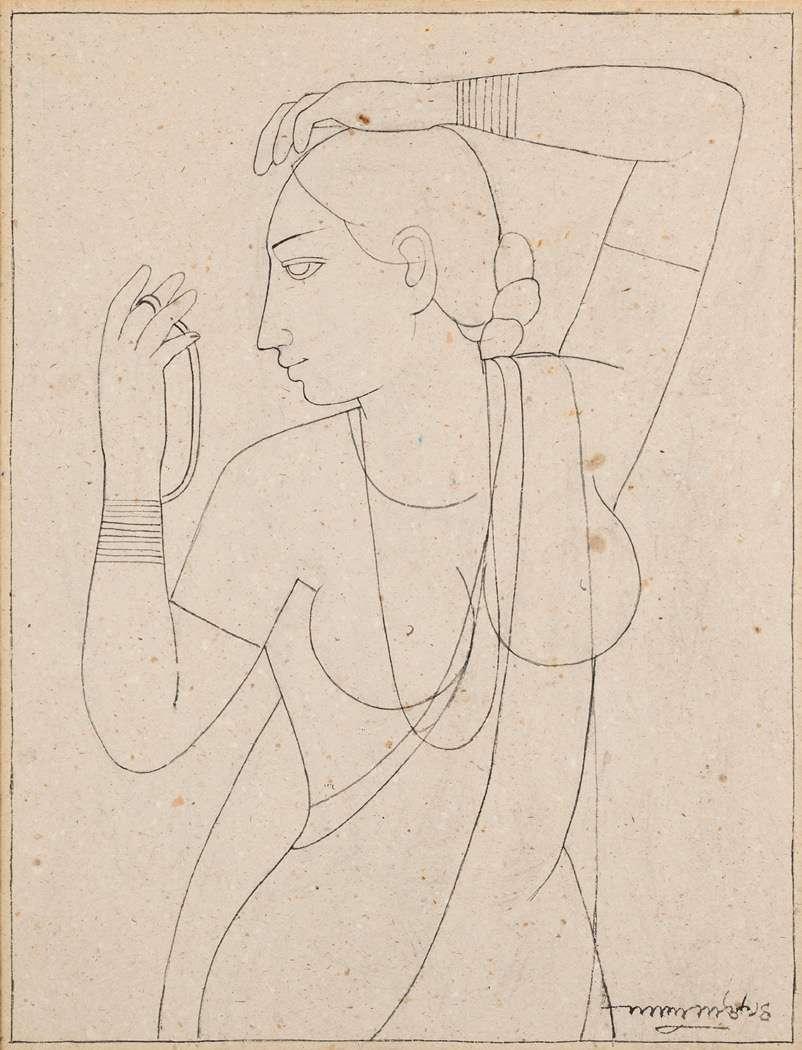
ink on paper, framed and glazed signed in Bengali l.r. image 38.5 x 29.2cm
Provenance: from a private London collection.
£800-1,200
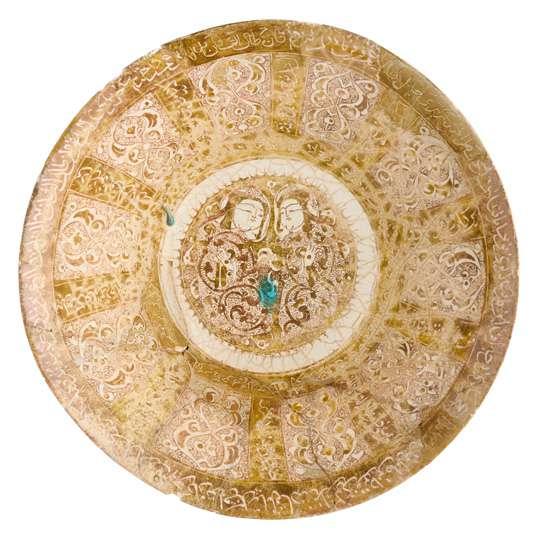
A LARGE KASHAN LUSTRE BOWL, PERSIA, CIRCA 1200
lustre painted glazed fritware, of conical form on raised rim foot, the interior with central roundel containing a pair of ‘moon’ faced figures, turquoise underglaze splash at the centre, the sides with a register of panels with arabesque motifs, framed by bands of calligraphy, the exterior with a register of floral medallions, 12.5cm high; 28cm diam.
Provenance: Collection of the late Rolf Noskwith (1919-2017).
For a closely related bowl from the Ades collection, found at Gurgan, now in the Victoria and Albert Museum, see inv. no. C.163.1977. There is another example, larger, but with similar decoration in the Metropolitan Museum of Art, New York, 32.52.2 (Fletcher Fund), see Watson 1985, fig.65, p.93.
£2,000-3,000
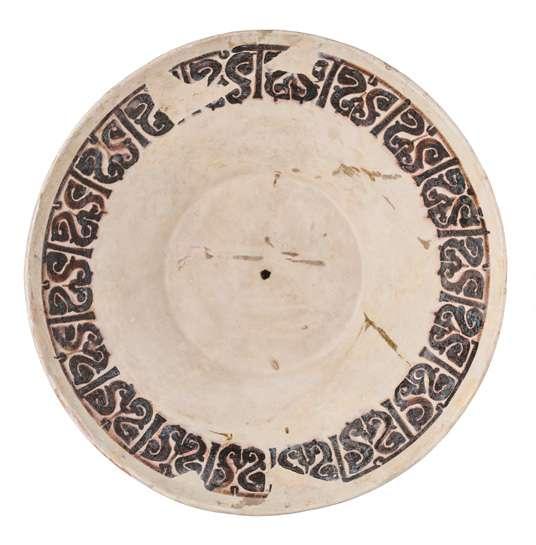
A NISHAPUR POTTERY BOWL, NORTH-EASTERN IRAN OR CENTRAL ASIA, CIRCA 10TH CENTURY
with straight flared sides, on shallow rim foot, a band of slip painted pseudo-kufic script around the interior edge, 9cm high; 26cm diam.
Provenance: Acquired by the vendor at Christie’s London, 19 October 1993, lot 246.
‡ £2,500-3,500
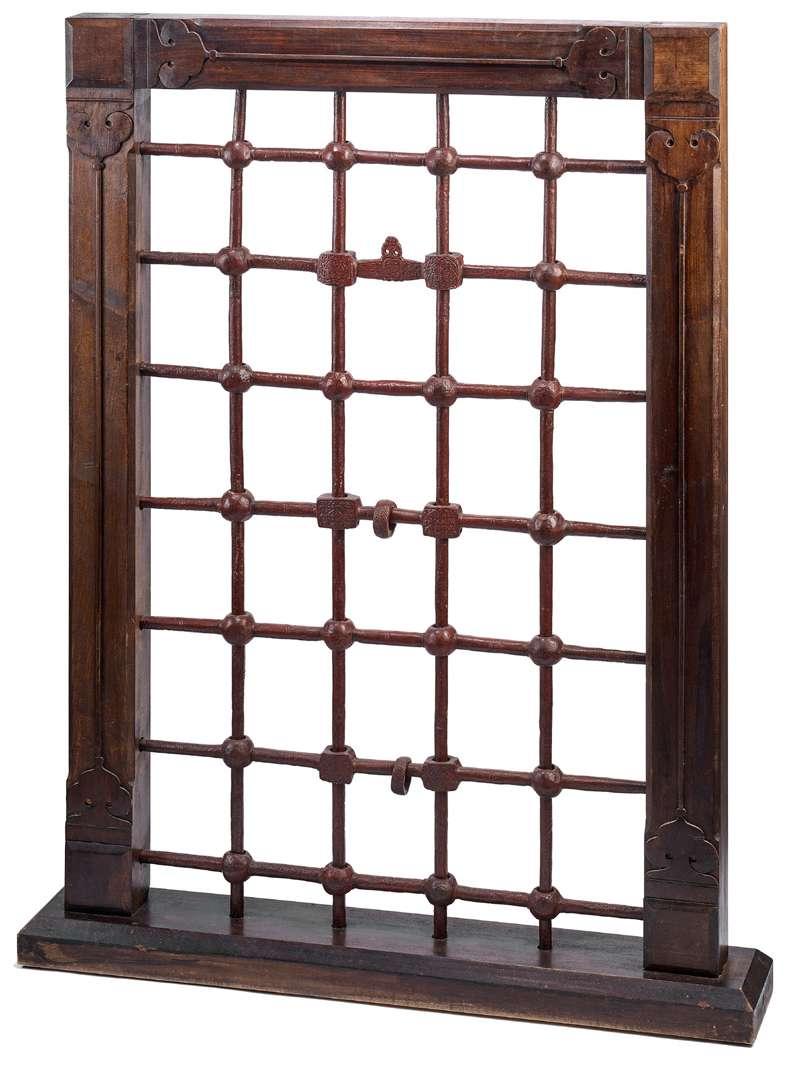
A MAMLUK OR OTTOMAN IRON WINDOW GRILLE, LEVANT, 15TH/16TH CENTURY
in the form of a grid with ball joints, a decorative finial in the central upper section flanked by arabesque medallions on the adjacent joints, flanked by indistinct arabic inscriptions on the horizontal rungs, two further medallions below together with two loose rings, mounted in modern walnut frame, 132 x 99cm (including frame)
Provenance: Reputedly from a house in Damascus. Eric Grunberg Fine Arts; Christie’s London, 28 April 1992, lot 209. Acquired by the vendor from Oliver Hoare 26 May 1992.
Iron grilles of this type are seen on many public and private buildings in Damascus dating from the Mamluk and Ottoman eras, such as the Darwishiyya Mosque (1572-1575, see Millner 2025, p.135, fig.4.19).
‡ £6,000-8,000
82
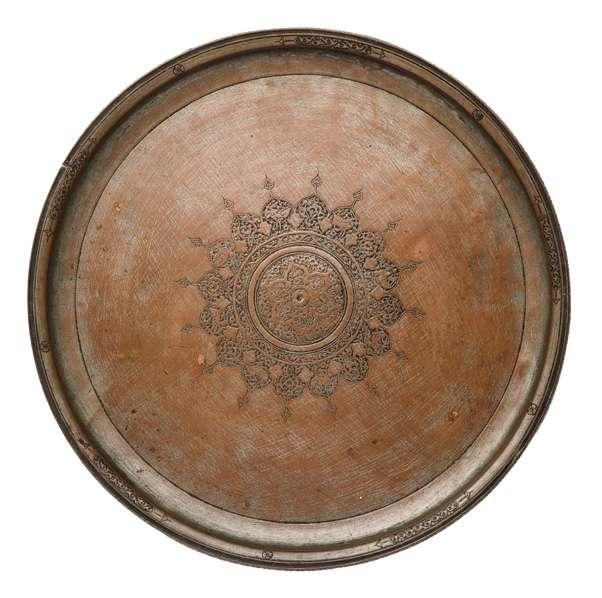
A SAFAVID TINNED COPPER TRAY, PERSIA, 17TH CENTURY
of circular form, with raised everted rim, engraved with central radiating floral arabesque medallion with small wild animal motifs on alternating points, the rim with repeated palmettes and an inscription, 55cm diameter
Inscriptions: Its owner, Muhammad Salih.
£2,000-3,000
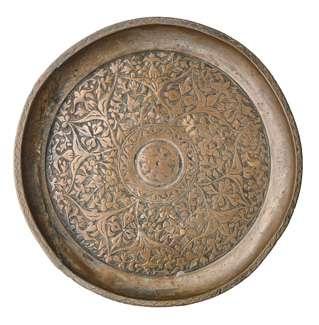
83
A RARE TIMURID TINNED BRONZE DISH, PERSIA, CIRCA 1500
engraved with central floral medallion bordered by a scrolling leafy band, surrounded by a field of radiating leafy arabesques, the raised lip with scrolling leaf decoration, 20cm diam.
For closely related smaller dishes sold at auction in London, see Sotheby’s, 5 April 2006, lot 137, and Bonhams, 23 October 2013, lot 36.
£1,500-2,500
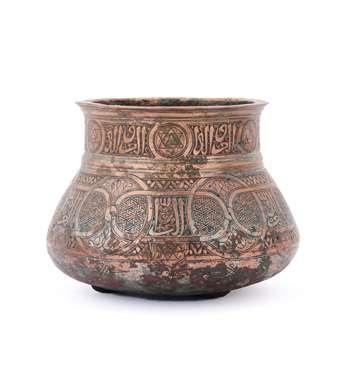
A MAMLUK TINNED COPPER BOWL, 14TH-15TH CENTURY
of squat form, three drop shaped feet, the body engraved with interlaced strapwork containing geometric and calligraphic decoration, the neck with a register of roundels containing star of David, interspersed with calligraphic cartouches, 13cm high
Inscriptions: repetitions of al-‘izz al-d[a’im], ‘Perpetual glory’.
£1,200-1,500
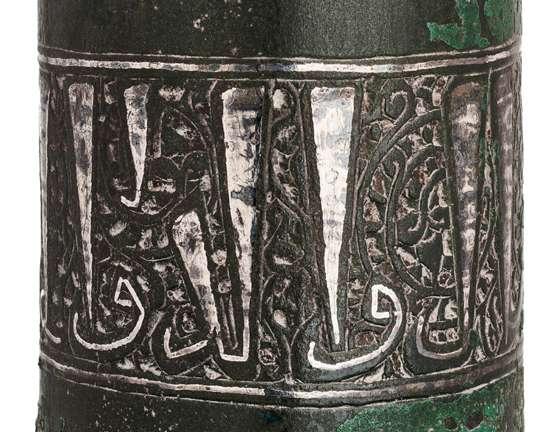
Detail
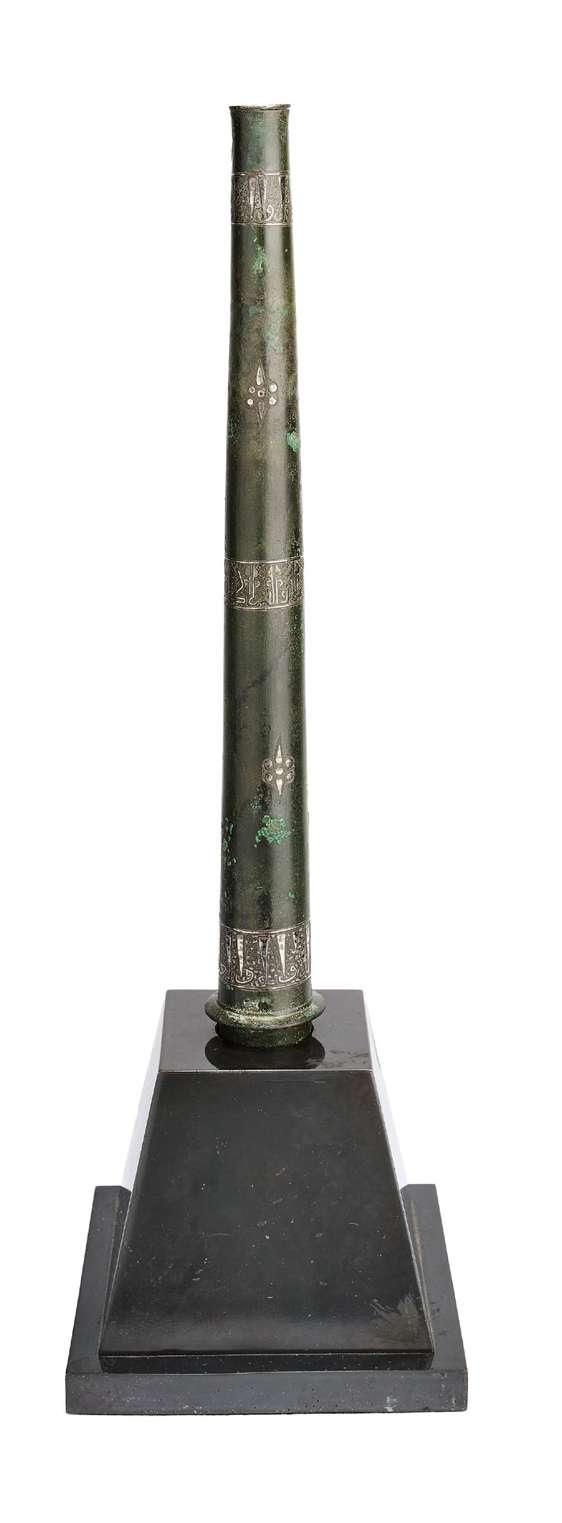
A KHORASAN SILVER INLAID BRONZE CANDLESTICK
SECTION, PERSIA, CIRCA 13TH CENTURY
of slender tapered form, with ridge near the base, three tiers of silver inlaid arabic calligraphy interspersed with stylised floral medallions, mounted on stand, 48cm high
Inscriptions: Lower: al-‘izz wa’l-iqbal wa’l-sa ad[a](?), ‘Glory and prosperity and happiness(?)”;Middle: bi‘l-yumn wa’l-baraka wa’l-dawala wa’l …, ‘With bliss and blessing and turn of good fortune and …”Top: al-‘izz wa’l-iqbal wa’l-dawala wa ‘l…‘Glory and prosperity and turn of good fortune and …’
This shaft is the upper part of the lamp, which fitted into the classic bell-shaped base. For a photograph of a similar Khorasan lamp, fully assembled, see Melikian 1982, fig.54. See also Ernst Grube & Eleanor Sims (eds.), Islamic Art II 1987, pl.VI, for a 14th century Shahnama folio in the Freer Gallery, with a painting showing a pair similar candlesticks alight.
£2,500-3,500
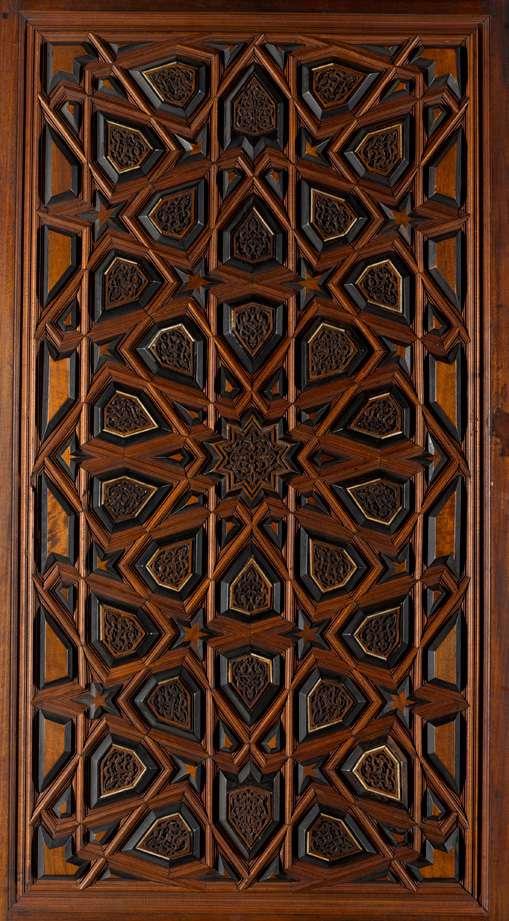
Detail
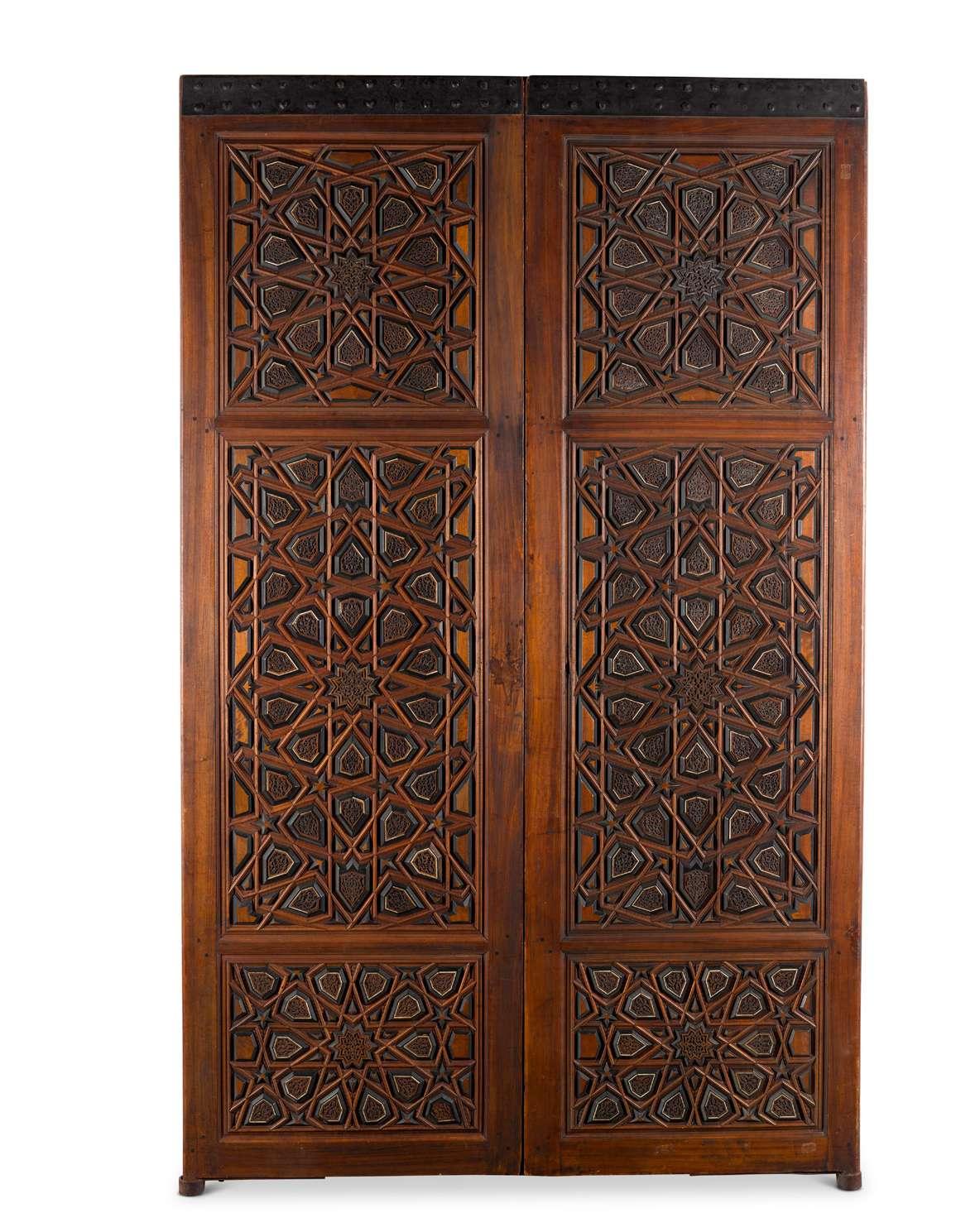
A MONUMENTAL PAIR OF INLAID DOORS, EGYPT, 19TH CENTURY WITH 15TH CENTURY ELEMENTS
with pivot hinges and iron bracing, the twin rectangular doors, probably 19th century, with Mamluk inlaid mosaic panels carved in low relief with arabesque designs, framed with thin borders of bone, 285 x 176cm
Provenance: Butterfield’s, San Francisco, 2 July 1987, lot 951; Sotheby’s, London, 18 April 2007, lot 214. £8,000-12,000
87
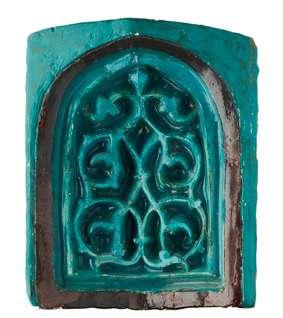
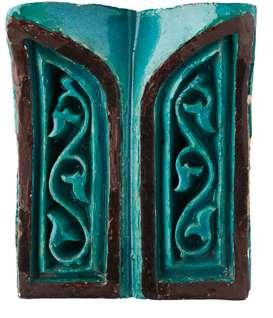
TWO TIMURID MUQARNAS TILES, PERSIA, 14TH/15TH CENTURY
carved and glazed buff earthenware, one depicting a manganese framed niche containing turquoise glazed relief arabesques, the other with a pair of similarly decorated half niches, 15.5 x 13 x 7cm; 17.5 x 13.5 x 7cm (2)
Provenance: Acquired by the vendor at Claude Boisgirard, Hotel Drouot, 20 March 1996, lot 388.
‡ £1,000-1,500
88
A TIMURID OCTAGONAL CUERDA SECA TILE, UZBEKISTAN, CENTRAL ASIA, 15TH CENTURY
glazed red earthenware, painted with a four-pointed star in turquoise on cobalt ground, with yellow and manganese purple at the centre, 12.6cm (max. diam.)
£400-600
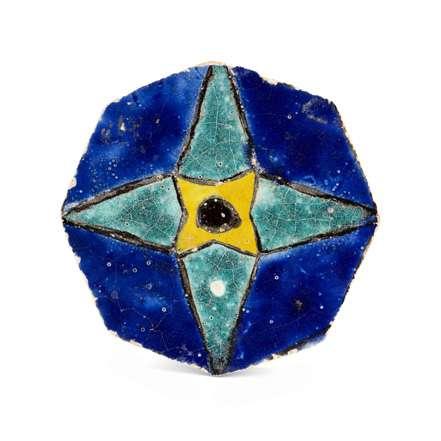
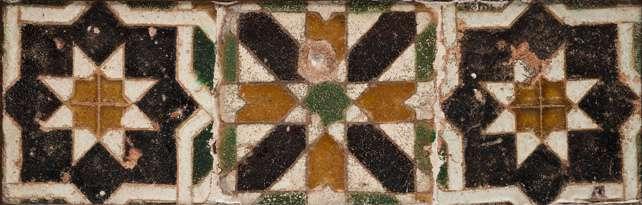
89
A PANEL OF THREE ARISTA TILES, TOLEDO, SPAIN, CIRCA 1500
glazed earthenware, each of square form, with geometric mosaic design in ochre, green, brown and white, framed together, fragmentary old French label on the reverse, 8.5 x 26.5cm inside frame
Provenance: Acquired by the vendor in France about 30 years ago.
‡ £600-800
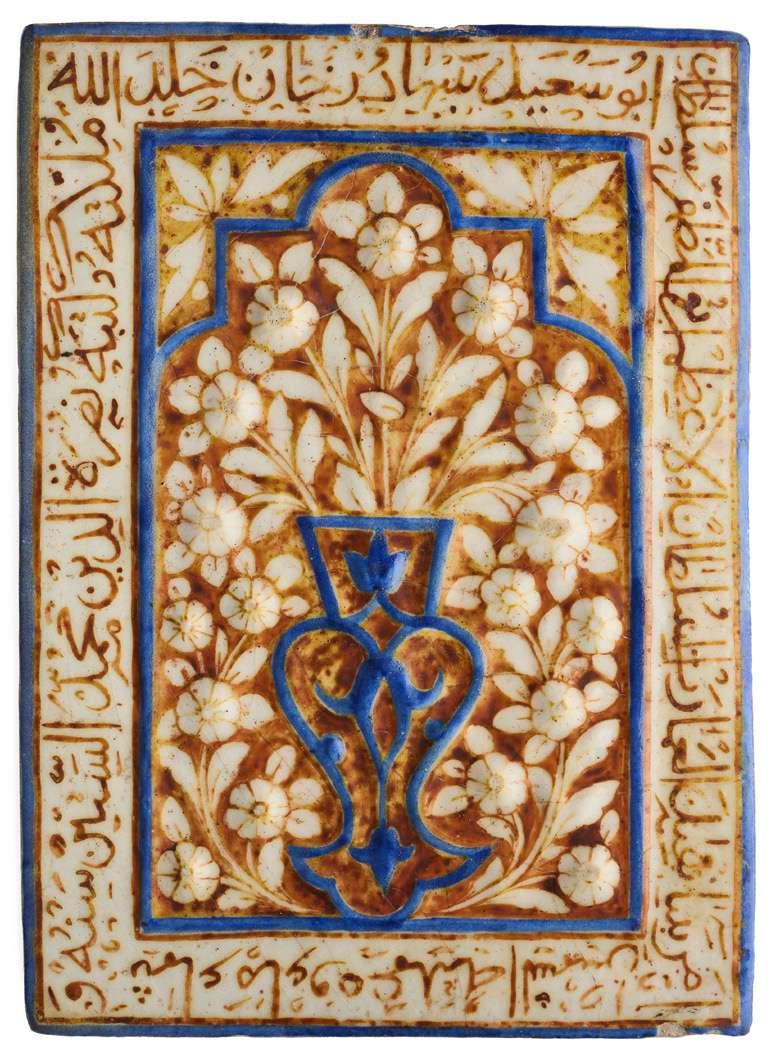
A TIMURID LUSTRE TILE, IRAN, DATED A.H.860/1455-56 A.D.
moulded fritware, with underglaze cobalt blue outlining, depicting a stylised vase with abundant flowers, surrounded by a border of calligraphy, 29.8 x 21.7cm
Provenance: Formerly J. P. Kassabaum Collection, sold at Christie’s London, 27 April 1993, lot 156; Sotheby’s London, 25 April 1996, lot 20, when purchased by the vendor.
Inscription: ‘The Most Great Sultan Abul Muzaffar Sultan Abu Sa’id Bihadur; may God make his kingdom everlasting; ordered the construction of this building. It was written by Nusrat al-Din Muhammad, the year eight hundred and sixty and it was made by al-Shams’.
For a similar but larger tile in the Metropolitan Museum, New York, see inv. no. 30.95.26. For a discussion of this series of tiles from an unidentified building, see Watson 1985, p.159-160. For a related large tile with a lotus border instead of an inscription, see Soustiel 1985, p.213.
‡ £6,000-8,000
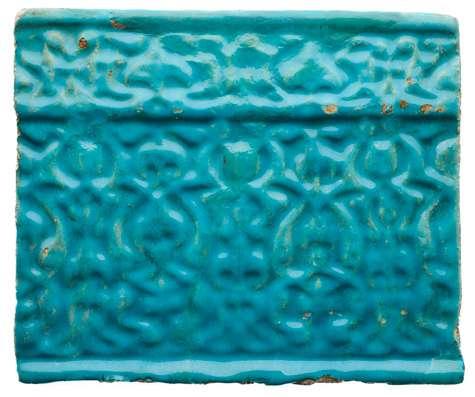
91 A KASHAN MOULDED TURQUOISE TILE, PERSIA, CIRCA 13TH CENTURY
glazed fritware, decorated with two tiers of repeated arabesques divided and framed with raised borders, two old labels on the reverse, one reading: H. K. Monif 950 645 Madison Av. New York, suspension loop on the reverse for wall hanging, 20 x 23.5cm
Provenance: Private collection, England. Acquired Sotheby’s London, Colonnade Sale, 20 October 1995, lot 238 (part).
£600-800
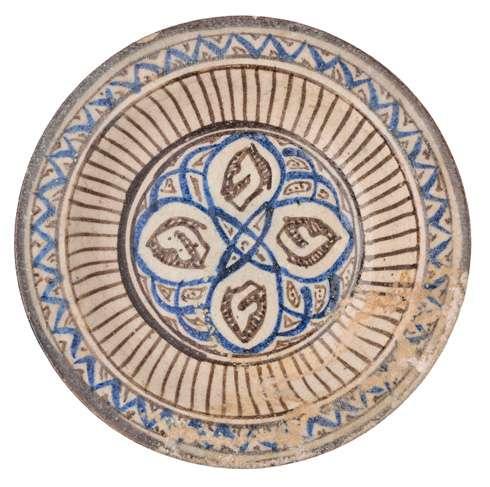
92
A MAMLUK POTTERY BOWL, PROBABLY SYRIA, 14TH CENTURY
underglaze painted fritware, decorated in cobalt blue and manganese purple on off-white ground, the well with four-pointed leafy star design, surrounded by radiating lines encircled by a band of diaper pattern on the lip, the underside with small rim foot surrounded by alternating blue and purple twin splashes reaching to the rim, various old markings inside footring, 5.4cm high; 19.5cm diam.
Provenance: Private collection, London.
For a related bowl sold at Christie’s London, see lot 159, 10 October 2014.
† £1,500-2,500
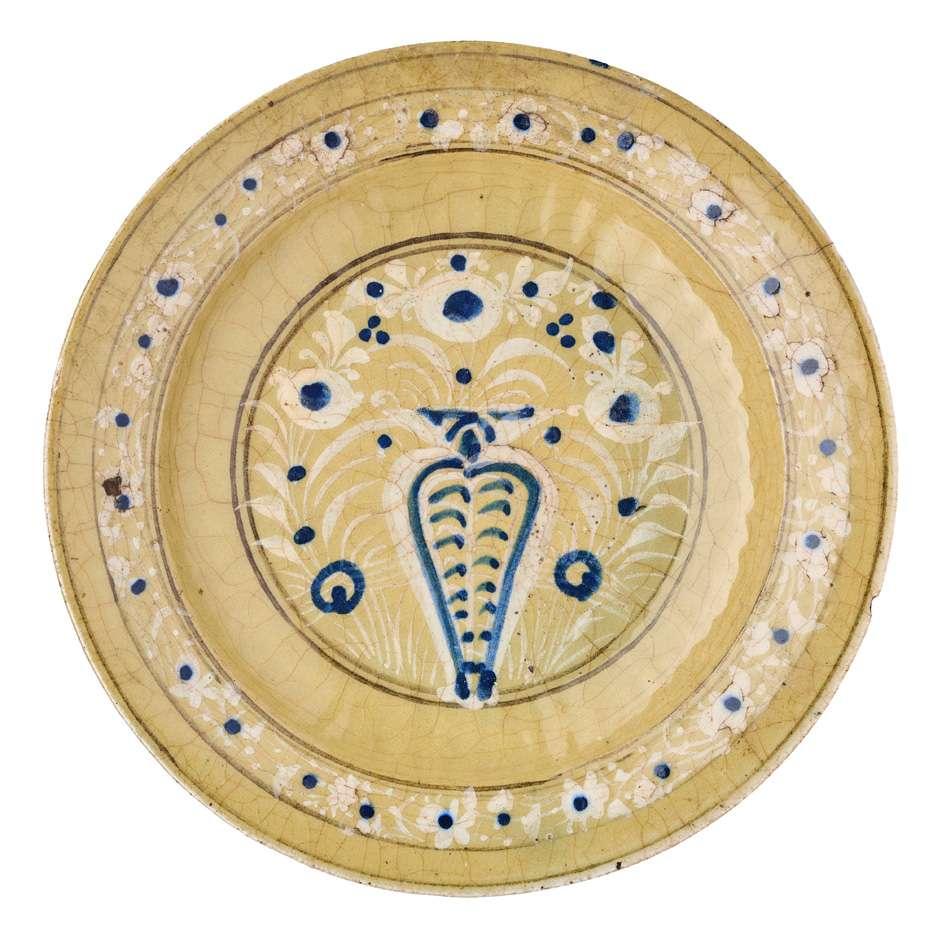
A ‘KUBACHI’ DISH, PERSIA, 17TH CENTURY
underglaze painted fritware, the well decorated with a blue painted vase issuing flowers, painted in blue and white on olive ground, surrounded by concentric bands and a border of scrolling flowers on the lip, the underside with stylised arch and leaf design, old labels inside footring, 32.5cm
Provenance: Dikran Kelekian (1867-1951), New York (label in French states that the dish was exhibited in Berlin). Joseph Soustiel (1904-90), Paris.
Sotheby’s, 25 April 1996, lot 145 (part).
£2,500-3,500
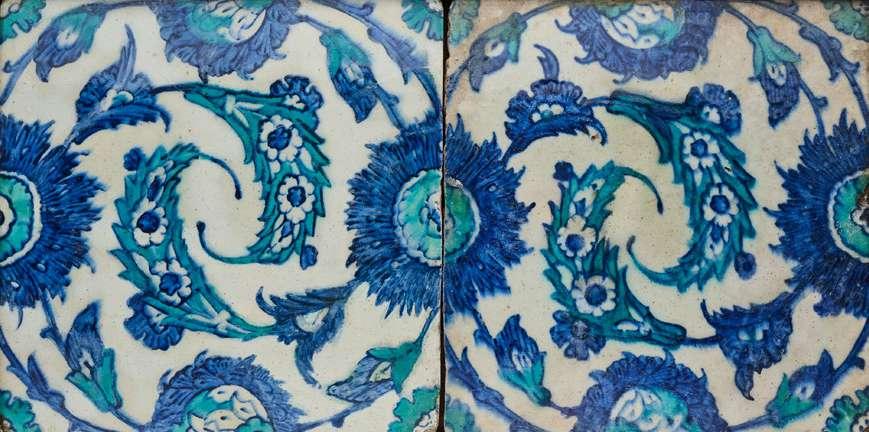
94
TWO IZNIK BLUE AND WHITE TILES, 17TH CENTURY
underglaze painted fritware, decorated with a scrolling leafy design of composite saz leaves flowers, framed, 25cm square approx. each
Provenance: formerly property of a deceased Dorset antique dealer.
£1,200-1,500
A DAMASCUS TILE, OTTOMAN SYRIA, CIRCA 1570-80
underglaze painted fritware, depicting a floral trellis design of arabesque medallions and stylised lotuses in blue and apple green on white ground, mounted for wall hanging, 27.6 x 26cm
Provenance: Private collection, England. Acquired by the vendor from Sir Howard Hodgkin.
There are tiles of closely related design in the Selimiyya Madrasa, Damascus. See Millner 2025, fig. 4.14, p.130.
£800-1,200
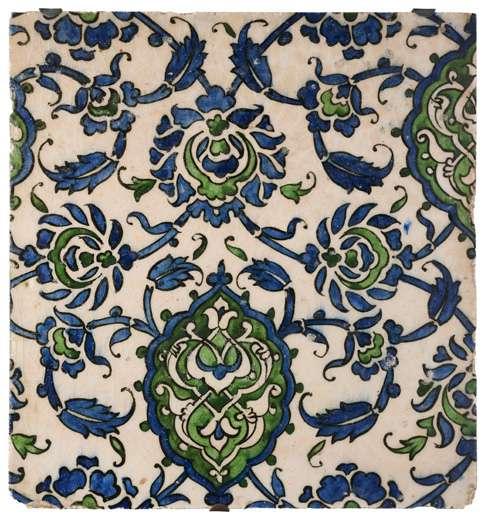
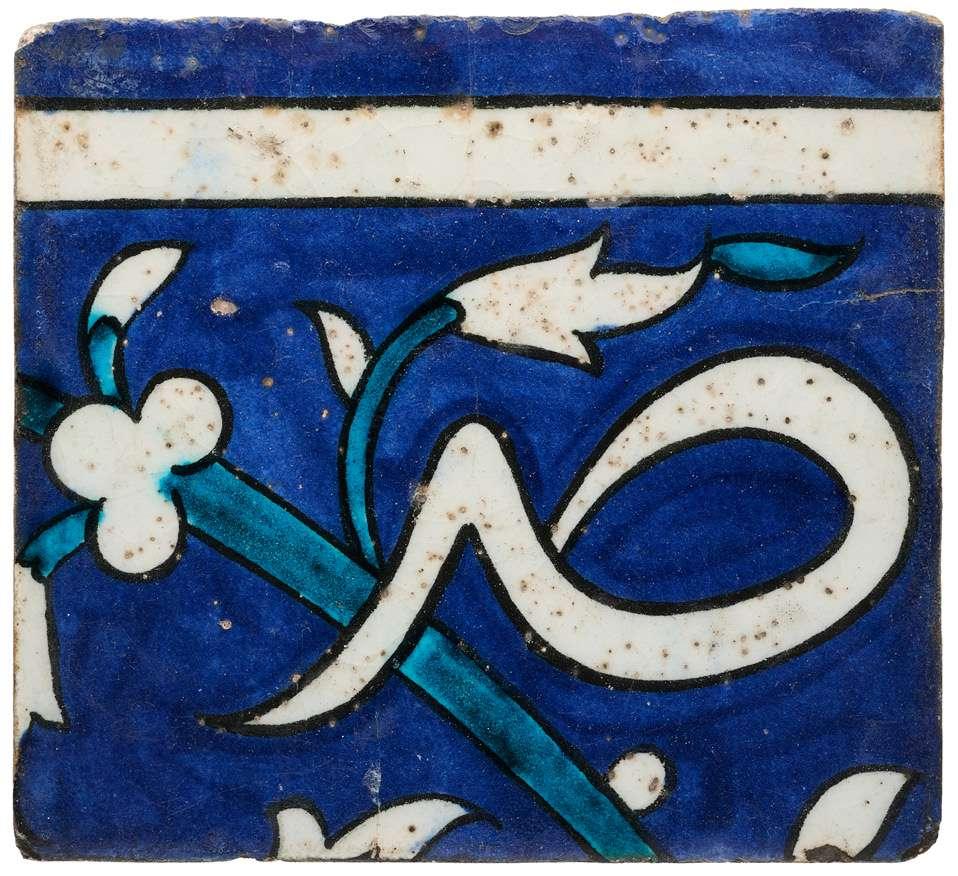
AN OTTOMAN CALLIGRAPHIC TILE PROBABLY FROM THE DOME OF THE ROCK, JERUSALEM, MID-16TH CENTURY
underglaze painted fritware, decorated in reserved white and turquoise on cobalt blue ground, depicting part of an arabic inscription superimposed on a leafy tendril, a plain white band at the top, three sides with drillings for fixing, the reverse painted with three rows of black dots, 17.5 x 19.5cm
Provenance: Acquired by the vendor directly from a British private collector about 30 years ago.
The drilled holes on the edges of this tile are characteristic of the revetments on the Dome of the Rock, reflecting the difficulties the Ottomans faced with ensuring adhesion with the extremes of weather conditions in the city. For two closely related tiles, one in the Louvre, Paris, the other sold a few years ago in London, see inv. no. AFI 2317; OA 3919/2 -251.5, & Sotheby’s, lot 164, 9 April 2014. For a similar tile, also attributed to the Dome of the Rock, but decorated on black ground, see Millner 2025, fig. 6.145, p.307.
£800-1,200
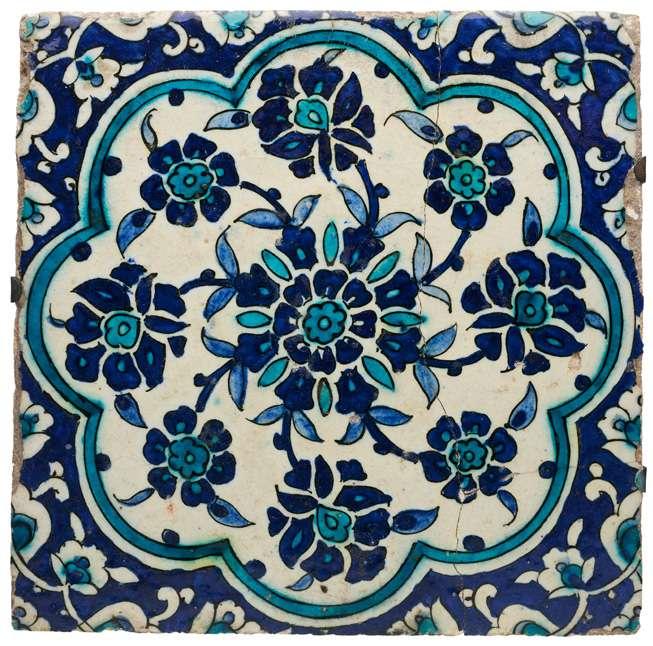
A DAMASCUS TILE, OTTOMAN SYRIA, LATE 16TH CENTURY
underglaze-painted fritware, depicting a lobed roundel containing radiating floral stems painted in turquoise and cobalt blue on reserved white ground, floral arabesques on cobalt ground in each corner, mounted for wall hanging, 26.5cm square
Provenance: Private collection, England. Acquired Christie’s South Kensington 15 October 2004, lot 378.
Published: Millner 2025, fig.6.69, p.273. £1,000-1,500
A DAMASCUS TILE, OTTOMAN SYRIA, FIRST HALF 17TH CENTURY
underglaze painted fritware, of square form, decorated with a floral medallion with triple lobed border, the corners with floral arabesque motifs, 21.3cm square
Provenance: Private collection, England. Formerly in the collection of a British naval officer, who is thought to have acquired this tile during his service in the Second World War. £500-800
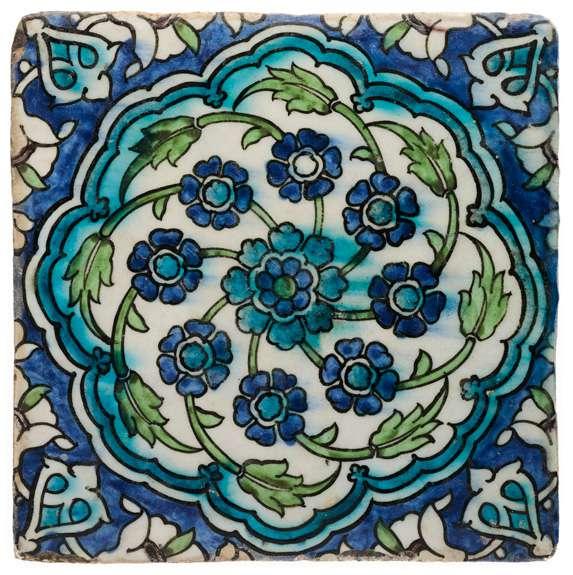
99
A DAMASCUS TILE, OTTOMAN SYRIA, CIRCA 1600
underglaze painted fritware, with central reserved white ‘leafy medallion’ motif on cobalt ground, containing a floral bouquet, a quarter rosette in each corner, 23cm square
This tile was formerly set into an Aesthetic Movement table made by Urquhart & Adamson of Liverpool, which ceased trading in 1891. For a tile with closely related ‘leafy medallion’ motif, see Millner 2025, fig.6.47, p.264.
£600-800
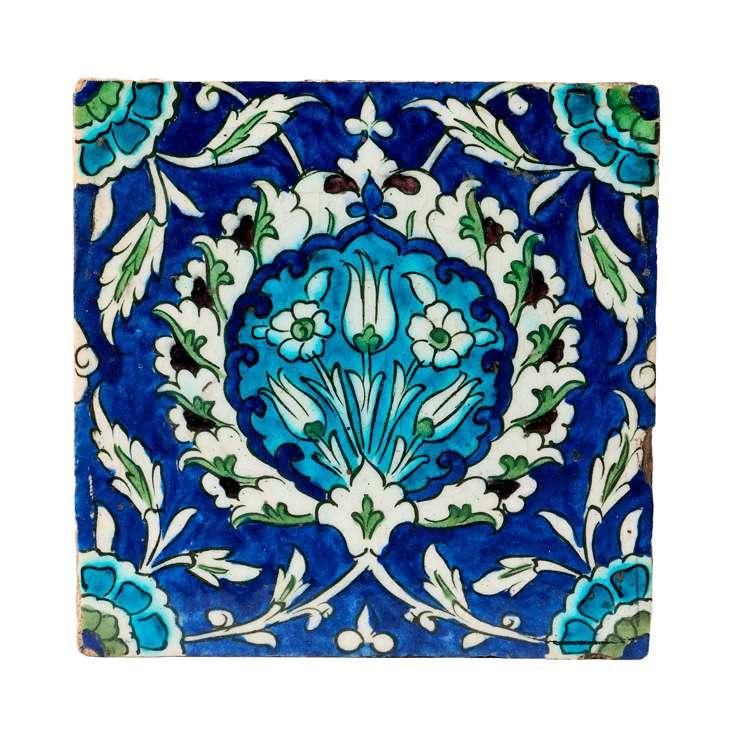
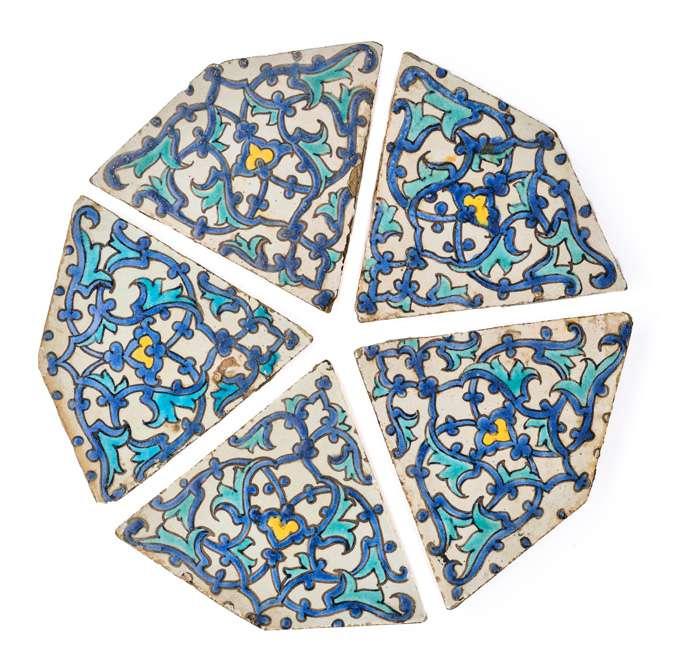
100
FIVE CUERDA SECA TILES, PERSIA, 18TH/19TH CENTURY
glaze painted earthenware, forming a decagon, probably from a table top, decorated in dark and light blue with yellow, outlined in brown on white ground, 23cm max. diam. together
Provenance: Christie’s South Kensington, 30 April 2004, lot 125.
£600-800
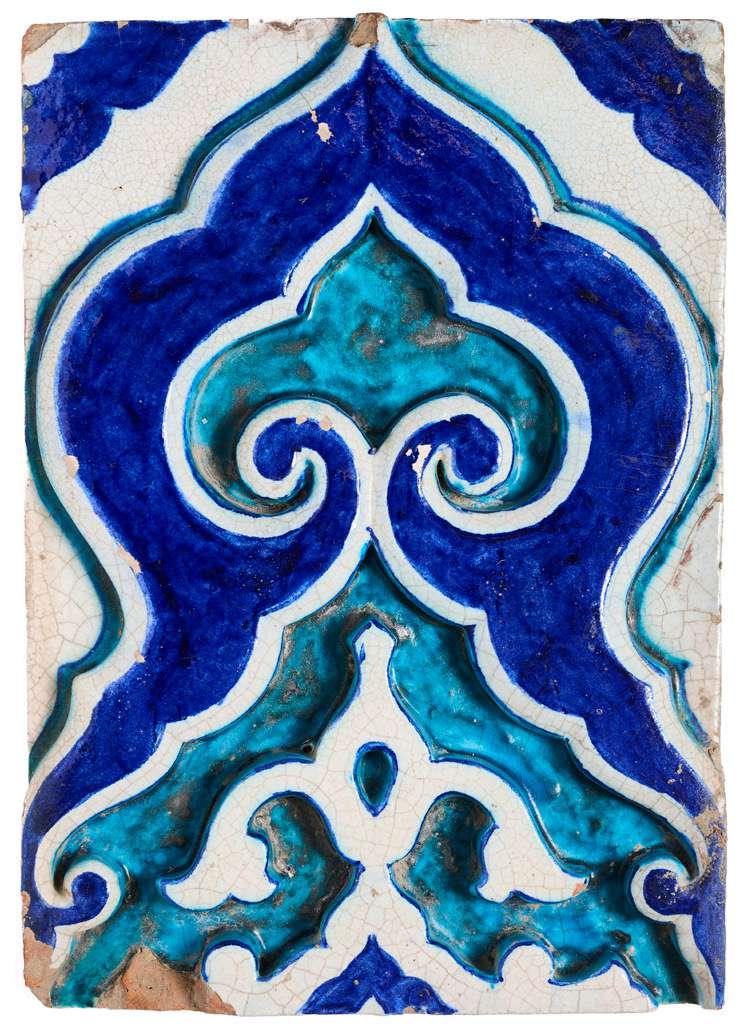
A LARGE MULTAN RELIEF TILE, PUNJAB, NOW PAKISTAN, 18TH/19TH CENTURY
underglaze painted earthenware, of rectangular form, the decoration comprising a stylised scrolling merlon motif with palmette arabesque below, both in high relief, painted in cobalt blue on turquoise and white ground, 38 x 27 x 4.5cm
Provenance: Private collection, London.
£600-900
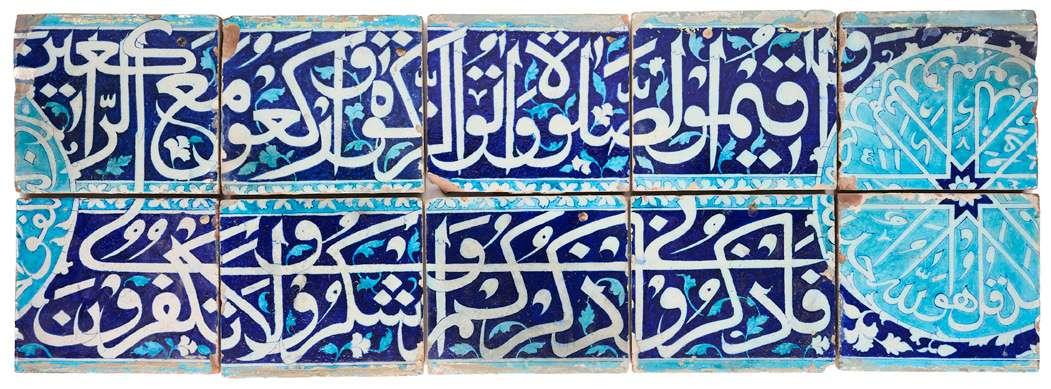
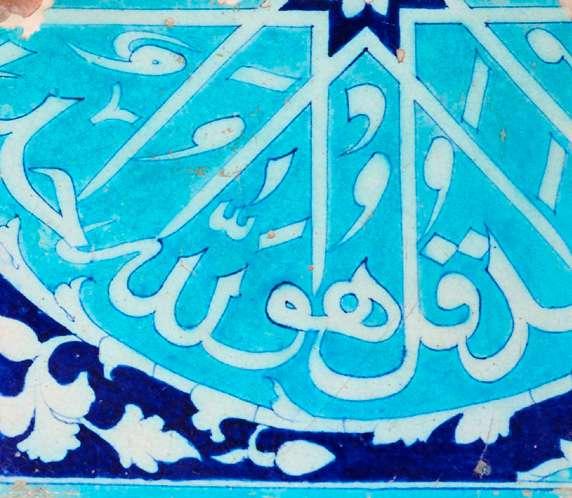
A GROUP OF TEN MULTAN CALLIGRAPHIC TILES, PUNJAB, PAKISTAN, 18TH/19TH CENTURY
underglaze painted earthenware, forming twin friezes interrupted by calligraphic roundels, each tile approx. 27 x 30.5cm (10)
Provenance: Private collection, London. Acquired about 15 years ago.
Inscriptions: upper register: Qur’an 2:43, lower register: Qur’an 2:152; both roundels, now incomplete, Qur’an 112 (al-Ikhlas).
£4,000-6,000
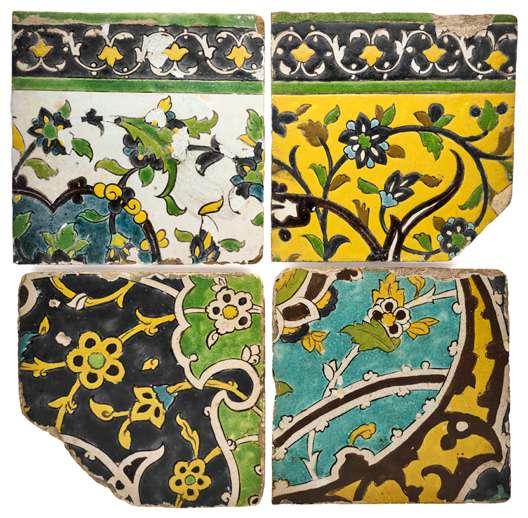
103
FOUR SAFAVID CUERDA SECA TILES, PERSIA, 17TH CENTURY
glaze painted buff earthenware, each decorated with scrolling leafy arabesques, two with palmette borders along one side, three with fixings for wall mounting, 22.5cm square approx. each
£700-900
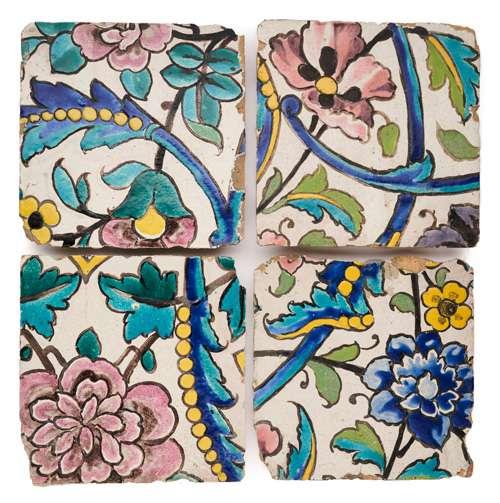
104
FOUR QAJAR CUERDA SECA TILES, SHIRAZ, PERSIA, 19TH CENTURY
glaze painted earthenware, each with polychrome scrolling design of flowers and leafy tendrils on white ground, the reverse with projecting ‘frogs’, 20cm square approx. each (4)
For similar polychrome floral tiles on white ground on a panel on the Naranjestan, Shiraz, see Seif 2014, p.51.
£600-900
105
A GLAZED POTTERY CALLIGRAPHIC MEDALLION, PROBABLY SINDH, 19TH CENTURY
blue and turquoise painted relief earthenware, the nastaliq script on white ground, surrounded by a raised chevron painted border fringed with lotus petals, 32cm diam.
Inscription: al-rahman, ’The Compassionate’.
£400-600
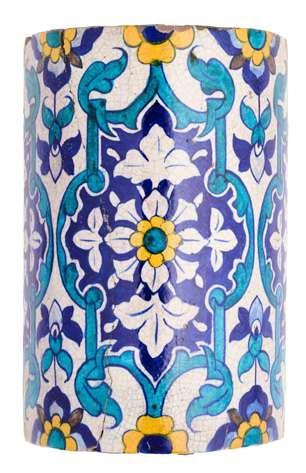
106
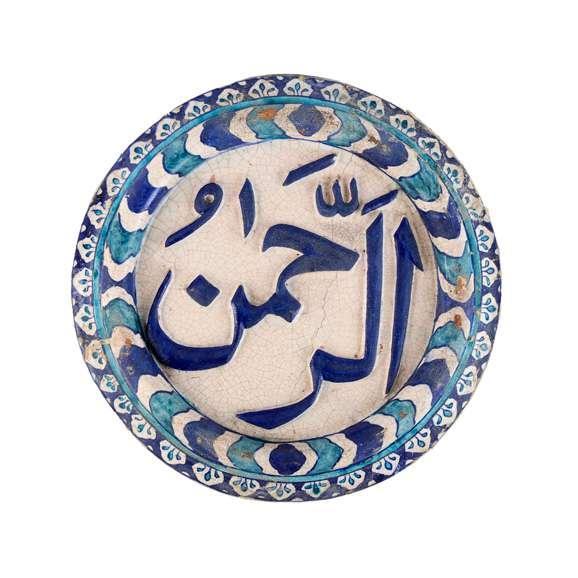
A MULTAN COLUMN SECTION, PUNJAB, PAKISTAN, 19TH CENTURY
of convex cylindrical form, decorated with floral medallion in yellow, cobalt blue and turquoise on white ground, further half medallions on either side, 31 x 20.5 x 10cm
£400-600
107
A SINDH OR MULTAN PARAPET TILE, PAKISTAN, 19TH OR EARLY 20TH CENTURY
underglaze painted earthenware, of curved overhanging form, decorated with reserved white and yellow acanthus motif, flanked by palmettes on turquoise ground, 31 x 30 x 20cm approx.
£400-600
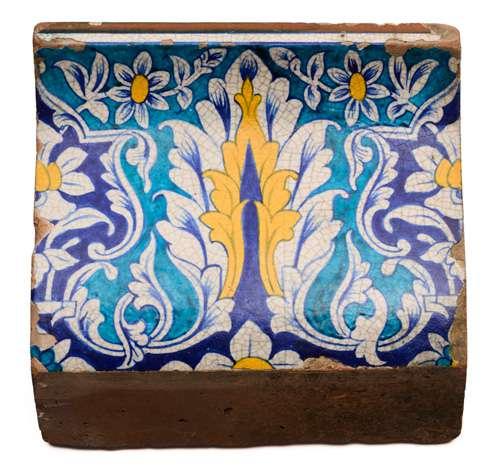
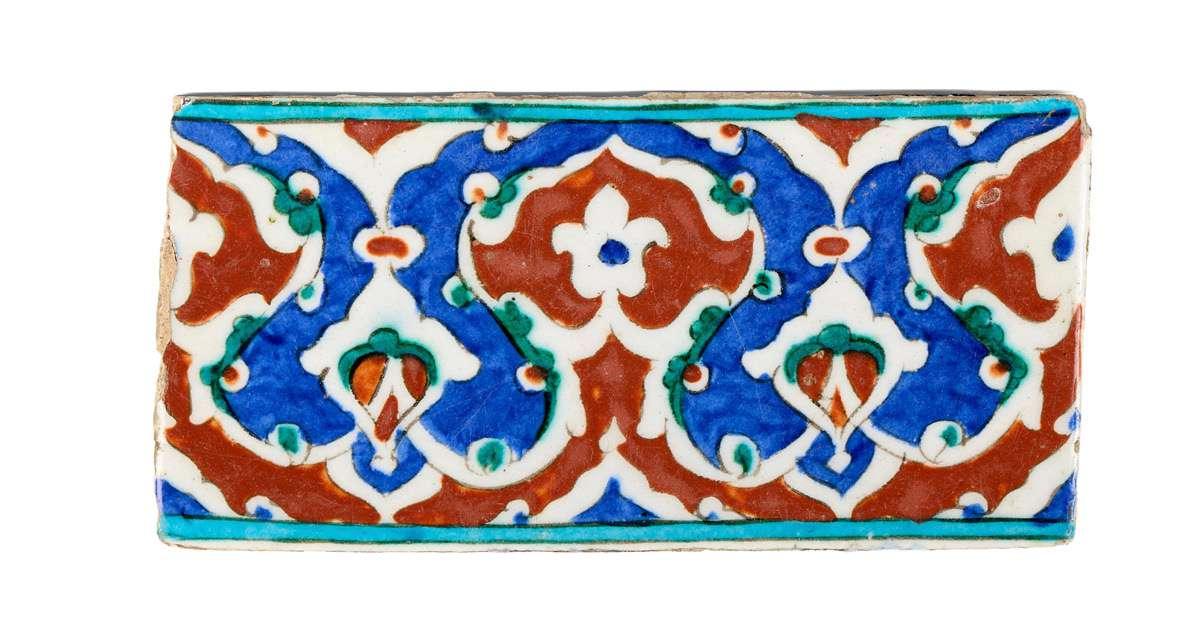
AN IZNIK BORDER TILE, OTTOMAN ANATOLIA, LATE 16TH CENTURY
underglaze painted fritware, with a design of alternating palmettes, decorated in relief red, reserved white and cobalt blue and copper green, thin turquoise strip above and below, 13 x 25.6cm
Provenance: Private collection, London. Acquired from the London trade in 2011. Formerly in the Adda Family Collection, Cairo, 1920s.
£3,000-4,000
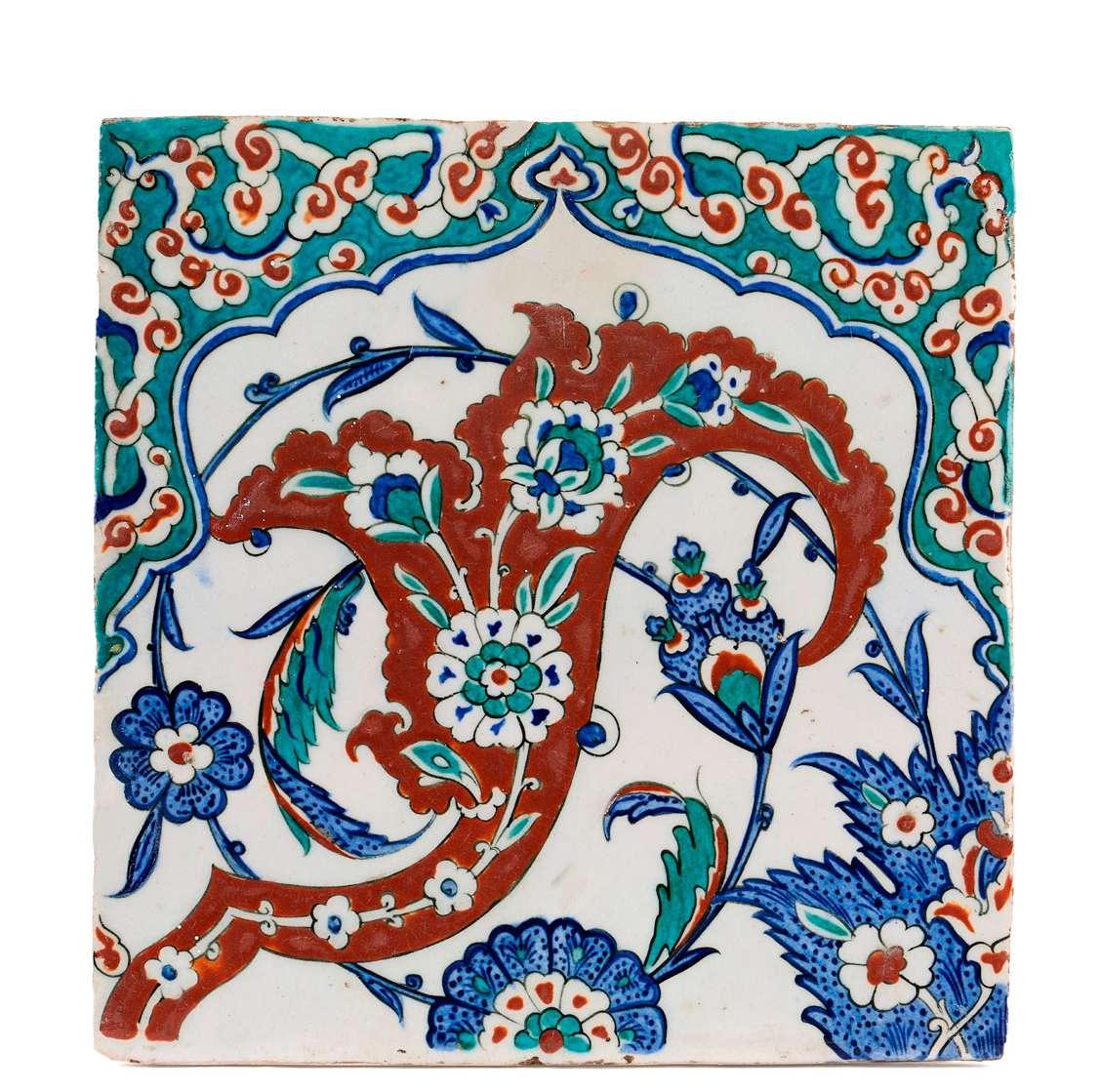
AN IZNIK TILE, OTTOMAN ANATOLIA, LATE 16TH CENTURY
underglaze painted fritware, of square form, depicting a meandering arabesque in relief red enclosing floral sprigs in reserve white, turquoise and blue, on white ground filled with spirals of floral tendrils, within a cusped mihrab arch with interlaced Chinese clouds in the spandrels, 28.5 x 27.5cm
Provenance: Private collection, London. Acquired from the London trade in 2011. Formerly in the Adda Family Collection, Cairo, 1920s. For a closely related tile, probably from the same panel, in the Khalili Collection, see inv. no. POT1290.
£6,000-8,000