Parchment DSBA.IE
the
D UB LIN SOLICITORS B AR ASSOCIATION MAGAZ INE | S UMMER 2026 | ISSU E 106
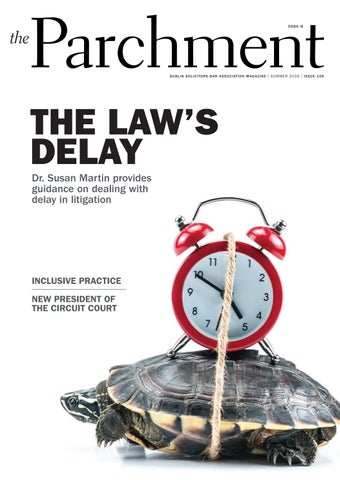
THE LAW’S DELAY Dr. Susan Martin provides guidance on dealing with delay in litigation
INCLUSIVE PRACTICE NEW PRESIDENT OF THE CIRCUIT COURT
The Legal Practice Productivity Solution
bl
ge
i
in g
me
Pu
nt
L e g al
sh
Le g
nting cou Ac al
Do c & M um a
ssembly t A ent n e gem na
P r a c tic e M
an
a
LEAP occupies a unique position in the legal software market as it includes traditional practice management and legal accounting attributes, document assembly and management, as well as many of the traditional legal publishing assets all in one solution.
Everything you need to run a law firm. leapsoftware.ie
LEAP IRE - Journal Ad 2023 - Print - 5mm bleed.indd 1
23/02/2023 15:22
Summer 2026 dsba.ie
Message from the President
Collegiality and solidarity
T
here is something about the summer months that encourages reflection. The pace of practice eases, if only slightly, the evenings are longer, and there is an opportunity to look back on the year so far before looking ahead to what comes next. One theme has run consistently through my year as President: collegiality. It is not an optional extra or simply a pleasant feature of professional life. It is one of the foundations upon which our profession rests. It is what enables us to work together respectfully despite acting for opposing interests, to advocate fearlessly without personal animosity, and to maintain public confidence in the administration of justice. In that sense, collegiality is part of what keeps both our profession and our legal system functioning well. For me, one of the abiding impressions of this Presidency has been the remarkable goodwill that exists within our profession. I have been fortunate to experience it firsthand from colleagues across the DSBA, from our Council and committee members, from Past Presidents, from Bar Associations around the country, and from so many members who have offered encouragement, advice and support throughout the year. It has been both humbling and deeply appreciated. Our Annual Dinner in May was, I think, a wonderful example of that spirit. It was a pleasure to see so many members, friends of the Association and guests from across the profession gathered together in the Westbury Hotel. Beyond speeches and formalities, evenings such as that remind us that the legal profession is, above all, a community. They strengthen friendships, renew professional relationships and remind us that today’s opponent is very often tomorrow’s collaborator. That same spirit was evident again at the Chair’s Dinner hosted by The Bar of Ireland in the King’s Inns. I was delighted to attend on behalf of the Association and was struck once again by the strength of the relationship between solicitors and barristers. We may perform different professional roles, but we share common values and common responsibilities. We all depend upon a justice system that is fair, efficient and properly resourced. The relationship between our two branches of the profession is one that deserves to be nurtured. Indeed, recent months have demonstrated why that solidarity matters.
The DSBA has continued to engage publicly and constructively on matters affecting both the profession and the administration of justice. Our public statements concerning the Criminal Legal Aid fee reforms and the Civil Legal Aid Private Practitioners Scheme are not simply about remuneration. They reflect wider concerns about access to justice, the sustainability of practice, and ensuring that those who rely upon legal representation (often at the most vulnerable moments of their lives) continue to receive the standard of service that justice demands. The DSBA stands with those members who continue to make significant sacrifices to ensure that our criminal and civil justice systems remain effective in practice as well as in principle. Without access to justice there can be no rule of law. Access to justice is dependent on a functioning civil and criminal legal aid system. These issues extend well beyond the profession itself. As an Association, we will continue to make measured, practical and evidence-based contributions whenever reforms are proposed that affect the administration of justice. That advocacy remains one of the DSBA’s most important functions. Alongside that work, it has been encouraging to see our members continuing to engage with the Association’s educational and social programmes. Our seminars and webinars continue to attract excellent attendance, while our sporting programme and social events remain a reminder that professional relationships are built not only in committee rooms and courtrooms, but also around dinner tables, on golf courses, on cricket pitches and, sometimes, over a coffee after a difficult case. Congratulations must go to our DSBA golfers, who won the Quadrangular Tournament in Belfast against our friends from Belfast, Liverpool and Lyon. My
thanks to Eamonn Shannon for once again organising an outstanding event. The annual John F. Buckley Memorial Cricket Match against The Bar of Ireland may not have produced the result we hoped for on the scoreboard, but it once again demonstrated the enduring friendship between our professions. Thank you to Matthew Kenny, Beauchamps and everyone involved in making another memorable afternoon possible. Congratulations also to everyone involved in this year’s DSBA Soccer League, which continues to attract excellent participation from firms across the profession, demonstrating once again the value members place on opportunities to come together outside practice. Finally, my thanks to Patrick Longworth for organising another excellent season. Looking ahead, preparations are now well advanced for our Annual Conference in Munich this September. It is one of the highlights of the DSBA calendar, combining high-quality CPD with the opportunity to spend time and socialise with colleagues in a relaxed and enjoyable setting in one of Europe’s most beautiful cities. I very much hope to see many of you there. As we move into the latter part of the year, I hope everyone has an opportunity to enjoy some well-earned time away from practice. The demands of our profession can be considerable, and taking time to recharge is important for ourselves, our families and, ultimately, for our clients. Thank you once again for your continued support of the Association. The strength of the DSBA has never simply been its Council or its committees. It has always been its members. I look forward to meeting many more of you over the coming months. I wish you all an enjoyable summer break. Paul Ryan DSBA President President@dsba.ie the Parchment 1
Summer 2026
Contents 14
Future Proofer
22
Mediation in Civil Litigation: A Changing Approach
DSBA President Paul Ryan talks about his professional journey, how he sees things for solicitors in Dublin today and the challenges we face
FUTURE PROOFER... PAUL RYAN
Avril Scally and Grace Molloy analyse the recent High Court decision in J Burke & Associates Ltd v O’Connell
26
Inclusive Practice: Enhancing lives and benefitting business Donal Barry of Walk reveals how inclusion in the workplace works for solicitors firms and why it is important
28
The Great Mediator
31
Books of Authority
32
The Incapacitated Legal Personal Representative
Stuart Gilhooly SC meets the genial, very reluctant retired Circuit Court judge and soon to be very busy mediator James McCourt
Dr. Susan Martin makes the case for law books and recommends her go-to texts
Bonnie Hickey BL outlines the issues faced by practitioners when the LPR of an estate has lost capacity
34
When the Executor fails to act Michael Kelly and Owen Burke
Dublin Solicitors Bar Association Unit 206,The Capel Building, Mary’s Abbey, Dublin 7, Ireland T: 01 670 6089 E: info@dsba.ie W: www.dsba.ie
2 the Parchment
14
Summer 2026 dsba.ie
Contents
REGULAR FEATURES 01 President’s Message 04 Editor’s Note 08 News from the Courts
28 compare two different ways of compelling an LPR to progress the administration of an estate where they are unable or unwilling to
38
New Developments in Employment Contracts Zoe Hughes sets out significant changes to essential contractual terms and legal developments
40
Turning Point for Freedom of Expression Ciarán Leavy examines why the Defamation (Amendment) Act 2026 was needed, what changes were introduced and the implications for stakeholders
46
The Residential Tenancies Board’s sanction regime Colm Farrell provides a detailed guide to ensuring compliance with the convoluted legislative framework of the 2004 Act
50
24
Strike Out for Delay in Civil Proceedings Dr. Susan Martin analyses the decision of the Supreme Court in Kirwan v Connors and provides guidance for solicitors in avoiding a motion for delay
56
Practical Thoughts on the Central Bank’s Consumer Protection Code Barry Rojack provides a snapshot of some of the very many changes and new requirements now in place following the coming into effect of the Central Bank of Ireland’s revised Consumer Protection Code which will be critical for solicitors providing advice and taking action against regulated entities
50 the Parchment 3
From the Editor
W
elcome to the Summer edition of the Parchment which comes out as the Courts head into the long vacation and many offices slow down for August. Relaxation and reflection are some of the themes of this Parchment with plenty of coverage of DSBA golf and cricket matches, Court News, interviews with DSBA President Paul Ryan and retired Judge now mediator Judge Jimmy McCourt. There are many legal practice articles to read and many photos to scan but if I had to pick one standout article, it would be Donal Barry of Walk’s article on inclusive practice which shows how we can help empower those living with a disability in the workplace and help them live self-determined lives. Donal points out that employment rates for people with an intellectual disability are 15-18 % but Walk is helping to buck this trend by helping over 40% of those supported by the organisation into paid employment. Well worth a read. Although not mentioned in the article, Walk’s Chairman for over 20 years is Dublin
solicitor John Bourke who has helped grow Walk to an employer of over 200 people. John’s work as a solicitor, his work in the community and his collegiality are an example to us all. If that’s not enough John also features in the golf photos as a member of the winning DSBA golf team in the Quadrangular trophy. Thanks to everyone who contributed to the Parchment to make this a bumper edition, please keep them coming for the next edition which will arrive in December. Enjoy this edition of the Parchment at your leisure.
Keith Walsh parchment@dsba.ie
DSBA COUNCIL 2025/2026
WHEN YOU HAVE FINISHED WITH THIS MAGAZINE PLEASE RECYCLE IT.
Scan the QR code to link to DSBA website
PAUL RYAN DSBA President
JOAN DORAN DSBA Vice President
CIARA O’KENNEDY Treasurer
AVRIL MANGAN Programmes Director/ Chair of the Practice Mgt Committee
ÁINE GLEESON Chair of Property Committee
PATRICK LONGWORTH Vice Chair of Litigation Committee
CLIONA COSTELLOE Chair of Family Law Committee
EIMEAR O’DOHERTY Honorary Secretary & Chair of In-House Committee
MARCUS HANAHOE Chair of Litigation Committee
AILEEN CURRY Chair of Mental Health & Capacity Committee
STEFAN O’CONNOR Vice Chair of Practice Management
ZOE HUGHES Council Member
JESSICA HICKEY Chair of Commercial Law Committee
SUSAN O’HALLORAN Council Member
DARREN GRAY Council Member
Reserved from text and data mining pursuant to Article 4(3) of EU Directive 790/2019
ADVERTISING ENQUIRIES Sharon Hughes T: 086 871 9600 The DSBA, its contributors and publisher do not accept any responsibility for loss or damage suffered as a result of the material contained in the Parchment.
reserves the right to alter or refuse to publish any item submitted.
EDITOR Keith Walsh SC PARCHMENT COMMITTEE Patrick Longworth (Chair) Aine Hynes SC Stuart Gilhooly SC Killian Morris Julie Doyle Kevin O Higgins Joe O’Malley COPYRIGHT The Dublin Solicitors Bar Association
4 the Parchment
PUBLISHED BY The Dublin Solicitors Bar Association, Unit 206, The Capel Building, Mary’s Abbey, Dublin 7 DSBA OFFICE, T: 01 670 6089 F: 01 670 6090 E: anna@dsba.ie DX 200206 Capel Building W: www.dsba.ie
DISCLAIMER Advertisements are accepted at the discretion of the magazine which
Publication of an advertisement in the Parchment does not necessarily signify official approval by the DSBA, and although every effort is made to ensure the correctness of advertisements, readers are advised that the association cannot be held responsible for the
accuracy of statements made or the quality of the goods, services and courses advertised. All prices are correct at time of going to press. Views expressed are not necessarily those of the DSBA or the publisher. No part of this publication may be reproduced in any form without prior written permission from the publishers.
AUTUMN 2026 COURSES APPLICATIONS NOW OPEN CONTACT DETAILS e: diplomateam@lawsociety.ie t: 01 672 4802 w: www.lawsociety.ie/diplomacentre
DIPLOMA CENTRE
For all your CPD needs | Leaders in legal education with professional focus and practical insight | Flexible, recognised courses delivered by professionals, for professionals
AUTUMN COURSES – APPLICATIONS OPEN Professional Doctorate in Law
1 September 2026
€8,550 per year
Diploma in Law
4 September 2026
€4,800
LLM Advanced Legal Practice
12 September 2026
€3,700
LLM Employment Law in Practice
12 September 2026
€3,700
Certificate in Aviation Leasing and Finance
24 September 2026
€1,750
Diploma in Employment Law
25 September 2026
€2,700
Diploma in Trust and Estate Planning
26 September 2026
€3,400
Diploma in Sports Law
6 October 2026
€2,700
Diploma in Technology and IP Law
7 October 2026
€3,095
Diploma in Construction Law
10 October 2026
€2,700
Diploma in Regulation, Compliance and Risk Management
13 October 2026
€2,700
Diploma in Judicial Skills and Decision-Making
17 October 2026
€3,095
Certificate in Enforcement for Public Bodies
20 October 2026
€1,750
Certificate in Immigration Law and Practice
29 October 2026
€1,750
Diploma in Education Law
30 October 2026
€2,700
Certificate in Legal Skills for Legal Secretaries
3 November 2026
€950
Diploma in Legal Skills for Legal Executives
3 November 2026
€2,500
All lectures are webcast and available to view on playback, allowing participants to catch up on coursework at a time suitable to their own needs. Diploma Centre reserves the right to change the courses that may be offered and course prices may be subject to change. 5
A4 Diploma AD JULY 26.indd 1
06/07/2026 10:25
DSBA ANNUAL CONFERENCE 10-13TH SEPTEMBER 2026 MUNICH, GERMANY
BOOK NOW TO AVOID DISAPPOINTMENT
This year’s DSBA Annual Conference will take place in Munich, Germany, from Thursday 10th September - Sunday 13th September 2026. Brochure available on DSBA website or from DSBA office.
News from the Courts Judges on the move District Court Assignments The Government at its meeting of 9th June 2026 made the decision to assign Judge David Waters to District No. 19 (Cork City) with immediate effect, Judge Paula Cullinane to the Dublin Metropolitan District (DMD) with immediate effect; Judge Carol Anne Coolican to District No. 17 (County Kerry) with immediate effect - following Judge David Waters being permanently assigned to District No. 19 (Cork City) from District No. 17 (County Kerry); Judge Catherine Ryan to District No. 13 (County Limerick) with immediate effect - following Judge Carol Anne Coolican being permanently assigned to District No. 17 (County Kerry) from District No. 13 (County Limerick). The Government at its meeting of 23rd June 2026 made the decision to terminate, at her request, Judge Catherine Ryan’s assignment to District No. 13 (County Limerick), with immediate effect and to permanently assign Judge Valerie Corcoran to District No. 13 (County Limerick), with immediate effect.
Judge Sean Gillane appointed to the Special Criminal Courts (No.1 and No.2) As and from 16 June 2026 the Hon. Mr. Justice Sean Gillane, Judge of the High Court, was appointed to the Special Criminal Courts (No.1 and No.2), taking over from the Hon. Mr. Justice Paul Burns who was appointed to the Court of Appeal. 8 the Parchment
Mr. Justice Keenan Johnson, President of the Circuit Court, Chief Justice Mr. Justice Donal O’Donnell, former President of the Circuit Court Ms. Justice Patricia Ryan
First solicitor President of the Circuit Court - Judge Keenan Johnson Judge Keenan Johnson made his declaration as President of the Circuit Court on July 17th 2026 in the Supreme Court and begins work immediately as President, taking over from President Patricia Ryan. Judge Johnson is the first solicitor appointed as President of the Circuit Court. Judge Johnson was very effective and popular on the Midland Circuit where he formed a dynamic partnership with Judge Karen Fergus, now retired. His ability and organisational skills will be of great use in his new position. He is the son of well known solicitor and Judge, Patrick Keenan Johnson who practised in Ballymote, County Sligo and who was coroner for County Sligo before he was appointed to the District Court bench in 1975. He also served on the Special Criminal Court. Judge Johnson was born in Ballymote, County Sligo and educated at the local primary school and subsequently at second level in Colaiste Muire Ballymote. He obtained a BCL (Bachelor of Civil Law) degree from University College Dublin in
1979 and qualified as a solicitor in 1982. He practised with the firm of Johnson and Johnson solicitors which based in Ballymote and Sligo until his appointment as a Circuit Court Judge in April 2012. His legal practise covered all areas of law including civil litigation, probate, conveyancing, family cases, landlord and tenant and criminal cases. He was an associate member of the Institute of Arbitrators. He is also a qualified mediator and has a huge interest in ADR Alternative Dispute Resolution. He was a council member of the Law Society from 1994 to 2002. During that time he chaired the Society’s Guidance and Ethics Committee. He was a movable Circuit Court Judge from April 2012 until his appointment as the assigned judge to the Midland Circuit in November 2014. This circuit covers counties Westmeath, Offaly, Laoise Longford, Roscommon and Sligo. President Johnson acquired an LLM from Northumbria University in 2018 having completed a dissertation on the feasibility of judge led mediation in family law proceedings.
Summer 2026 dsba.ie
News
Solicitor Seamus Given and two barristers nominated to the High Court in July 2026 The Government on 14th July 2026 agreed to nominate as Ordinary Judges of the High Court the following: Séamus Given, Solicitor, Michael Conlon, SC and Cathleen Noctor, SC. Séamus Given was Head of the Arthur Cox Employment Group and qualified as a solicitor in 1984. From Listowel, County Kerry, he trained with PG McMahon Solicitors, Newcastle West, County Limerick. Mr. Given went on to work as an in-house employment lawyer in Telecom Éireann in 1985 and transferred to Arthur Cox in 1992, becoming a partner in 1995. He advised and represented employers in disputes with employees, ex-employees, applicants for employment and trade unions, including in hearings before the WRC, the Labour Court, the Circuit Court, the High Court, the Court of Appeal, the Supreme Court and the CJEU. He advised on bullying/ harassment, grievances, discrimination,
disciplinary matters, investigations and on dismissals/redundancies. A particular area of interest was crisis management issues with an employment or industrial relations dimension and whistleblowing/protected disclosures. Current partner in PG McMahon Solicitors, John Molyneaux said of Mr. Given: “The founders of the firm, Garry and Owen McMahon, have spoken for many years about his remarkable legal ability and exceptional legal mind. “Following in the footsteps of Bryan McMahon, who also served as a High Court judge, it is a source of great pride to see another talent from Listowel appointed to the High Court bench. “Seamus is also one of the nicest and most humble people you could meet, particularly given all that he has achieved in the legal profession. I am delighted for Seamus and his family and wish him every success and happiness in this important new chapter.”
Tributes paid to Judge Patricia McNamara on her retirement The final sitting of Judge Patricia McNamara, marking the occasion of her retirement from the District Court bench, took place on 10 March 2026 in Court 2 in the CCJ. Judge McNamara was joined on the bench by President Kelly and colleagues from the District Court. President Kelly led tributes by welcoming the many people who were present in court and online to celebrate the career and work of Judge McNamara who was retiring after 16 years on the District Court bench. He noted Judge McNamara’s distinguished career on the bench had been characterised by her ability to deal with everything that came before her with dignity, humanity, compassion and empathy. He said Judge McNamara was synonymous with the Drug Treatment Court where she had presided since 2019, and had used her great skill and compassion to see clients through the worst periods of their lives and had guided them out the other side. He also praised her work in Tallaght District Court where she dealt with clients with her customary grace and dignity. President Kelly also praised her work as a pioneer of restorative justice in Ireland, and her introduction of the first fully focused restorative justice court in Tallaght. He highlighted the importance of restorative
justice in providing healing, closure and understanding for victims, and rehabilitation and accountability for defendants. President Kelly also acknowledged Judge McNamara’s work on the Irish Association of Women Judges and her superb representation of the Irish judiciary abroad as part of this work. Tributes were also paid by Judge Malone on behalf of the District Court bench. Judge Malone highlighted Judge McNamara’s professionalism, care and empathy for all, and said colleagues would miss all the fun she brought to the bench. Tributes were also paid by Emiline le Prince on behalf of the Restorative Justice Service, who praised Judge McNamara as a pioneer of restorative justice. Superintendent O’Brien, on behalf of An Garda Siochana, thanked Judge McNamara for her professionalism, warmth and patience with the Gardaí and said she would be a huge loss to the Drug Treatment Court. John O’Malley on behalf of the DSBA and Keith Walsh on behalf of the Law Society both praised Judge McNamara for her work on behalf of solicitors and women solicitors in particular. Brendan Rice on behalf of the Court Service closed the tributes with a quote from the Roman poet Horace that “a good and proper judge always takes the honest decision rather than the easy one” and said that this is something
Judge McNamara had demonstrated throughout her career. Judge McNamara spoke of her gratitude for her time on the bench and what a privilege it had been to serve the people of Ireland. She thanked her family, and praised the court registrars without whom she said the courts could not operate. She also thanked her colleagues and An Garda Siochána for their dedication in the administration of justice, and the Probation and Restorative Justice Services for their work and assistance to the court. Thanks to Courts Service News the Parchment 9
Three High Court Judges appointed to Court of Appeal on 29 June 2026 Compensation Tribunal and Medical Bureau for Road Safety. Mr. Justice Mark Sanfey studied Law in Trinity College Dublin and graduated in 1982. He obtained a Barrister-at-Law degree from the King’s Inns in 1987 and commenced practice that year. He was called to the Inner Bar in 2004, and practised primarily in the areas of chancery, commercial, insolvency and construction law. He was appointed to the High Court in December 2019, and has presided mainly in the Chancery and Commercial courts. He was appointed Judge in charge of the Chancery List in October 2023, and Judge in charge of the Commercial List in December 2024; he has also presided as Judge in charge of the Arbitration, Personal Insolvency, and Bankruptcy Lists.
L-R: Minister for Justice, Home Affairs and Migration Jim O’Callaghan TD, Hon. Ms. Justice Emily Egan, Hon. Mr. Justice Mark Sanfey, Hon. Mr. Justice Paul Burns, Uachtarán na hÉireann Ms. Catherine Connolly, An Taoiseach Micheal Martin TD.
Mr. Justice Paul Burns, Mr Justice Mark Sanfey and Ms Justice Emily Egan, all formerly of the High Court, made their declarations in the Supreme Court on 29 June 2026 and started their new positions as Ordinary Judges of the Court of Appeal this month. Mr. Justice Paul Burns. Born Belfast and educated at St. Mary’s CBS Belfast. Studied
law at Trinity College Dublin graduating in 1984 and obtaining a Master’s Degree in Law in 1987. Attended King’s Inns and called to the Bar in 1986. Became Senior Counsel in 2004. Practiced extensively in both civil and criminal law. Appointed to the High Court in March 2020 and presided over the extradition list for two years before moving to the Central Criminal Court. Former member of the Criminal Injuries
Ms. Justice Emily Egan studied law at Trinity College Dublin from where she graduated with an LL.B. degree in 1991. She then completed postgraduate studies at the University of Oxford and obtained a BCL. During her study to become a barrister at the King’s Inns, Judge Egan worked as research assistant at the Law Reform Commission and a law lecturer at University College Dublin. She was called to the Bar in 1994 and became a senior counsel in 2010. Her practice involved tort and medical law, employment, public law and regulatory law. Judge Egan was appointed to the High Court in October 2021 and sat in the Chancery list, the personal injuries list, the inherent jurisdiction list and the clinical negligence list.
Dublin Solicitor Catherine Ardagh appointed Minister of State Solicitor and TD Catherine Ardagh was appointed Minister of State with the responsibility for International Law, Law Reform and Youth Justice on 28 May 2026. Catherine previously served as a Dublin city councillor representing the Crumlin/ Kimmage area and as a Member of the Oireachtas. Prior to her election to Dáil Éireann in 2024 she served as a Senator from 2016. Catherine qualified as a solicitor in 2011 having previously practiced as a barrister. She was in partnership in Ardagh McCabe 10 the Parchment
Solicitors LLP, Dublin 12 with Sinead McCabe; however, she retires as a solicitor to concentrate on her new position. Catherine was very well respected as a solicitor and Notary Public and one local solicitor in Dublin 12 described her as “an excellent conveyancer and a wonderful colleague, she will be missed. However she will make a real difference in government and they are lucky to have a Minister of State of her ability and quality. The profession’s loss is the government’s gain”. The Parchment wishes Catherine well in her new position.
Summer 2026 dsba.ie
News
Practice Directions High Court - New Practice Direction HC141 - Mediation & Alternative Dispute Resolution (ADR) Compliance Mr. Justice Barniville, President of the High Court has issued Practice Direction HC 141, highlighting key provisions of the Mediation Act 2017 and related statutory requirements. The Practice Direction underscores the importance of mediation and alternative dispute resolution (ADR) and reminds practitioners and litigants of the potential consequences of failing to comply with these obligations. The Practice Direction came into operation on 3 June 2026 and will be revised
and updated where necessary. Practitioners and litigants are encouraged to familiarise themselves with the Practice Direction and ensure full adherence to the relevant provisions in order to avoid potential adverse consequences. https://www.courts.ie/practice-directions/ full-practice-direction?url=practicedirection-relating-to-the-mediation-act2017-and-other-statutory-provisions-relatingto-mediation-and-alternative-disputeresolution
Circuit Court - New Practice Direction CC32 Litigation Restriction Orders: Procedures and Related Matters in effect from 5 May 2026 The then President of the Circuit Court Patricia Ryan issued a new Practice Direction (CC32) to establish a clear and consistent framework for the management of repetitive or serial litigation in the Circuit Court. The Practice Direction includes the use of a Litigation Restriction Order (“LRO”), frequently described as an Isaac Wunder order, requiring a litigant to obtain leave of the Court before issuing further
proceedings of a specified kind. The Practice Direction is pursuant to section 22(17) and 22(18) of the Courts (Supplemental Provisions) Act 1961 (as inserted by section 112 of the Courts and Civil Law (Miscellaneous Provisions) Act 2023). The Supreme Court in M v M [2026] IESC 2 clarified that the Circuit Court possesses jurisdiction, grounded in constitutional principle and the Court’s power to protect its own process, to restrain
Court Changes Dún Laoghaire Courthouse – Temporary Closure Notice Dún Laoghaire Courthouse will close at the end of business on Friday, 31 July, 2026 for essential roof repairs. During the works Court business location: • All cases will move to: Courtroom 12, Criminal Courts of Justice (CCJ) • A public counter will be on the 4th floor of the CCJ Email: dunlaoghaireinfo@courts.ie
Duration Works* are expected to last about two months. *this timeline is subject to weather conditions.
Áras Uí Dhálaigh - Dublin - Circuit Family Court - List to Fix Dates Court 33 - Change of Date - 9 to 23 October 2026 The list to fix dates for Circuit Family matters, originally listed for 9 October 2026 in Court 33 has now been moved to 23 October 2026 in court 33.
repetitive or abusive litigation in appropriate and proportionate circumstances. In light of this CC32 now sets out the procedures, criteria, and forms of order applicable to repetitive litigation within the Circuit Court and came into effect on 5 May 2026. https://www.courts.ie/practice-directions/ full-practice-direction?url=litigationrestriction-orders--procedures-and-relatedmatters
Dublin Family Law Circuit Court - November 6 - rescheduled for November 27 The Dublin Family Law Circuit Court scheduled for Court 33 on Friday November 6 has been rescheduled for November 27. For additional queries contact: dublincircuitfamilylaw@courts.ie
Dublin - Stamp Office - Change of opening hours - commencing Monday 15 June 2026 From Monday the 15 June 2026, the Dublin Stamp Office opening hours have temporarily changed and the new opening hours are 9.00am – 1.00pm Monday to Friday. Documents can also be stamped at the Law Society desk, Four Courts. the Parchment 11
New Exhibition in Round Hall to mark centenary of the Court Officers Act 1926 2026 marks the centenary of the Court Officers Act 1926, legislation that helped shape the administration of the courts in Ireland. For one hundred years, court officers have played an important role in supporting the delivery of justice and the day-to-day operation of courts across the country. Through photographs, documents and historical records, this new exhibition highlights the people, traditions and developments that have shaped the role over the past century. The setting up of a new courts system was one of the immediate priorities of the new Government following the establishment of the Irish Free State (Saorstát Éireann). The enactment of the Court Officers Act 1926 was one of the final pieces of legislation required to support the new courts system created by the Courts of Justice Act 1924. The Court Officers Bill 1926 sought to • provide for the office structures and staffing needed to support the courts established in 1924 and • integrate the courts administration fully into the Civil Service structure, placing court staffing and funding under the control of the Executive in a manner similar to that in other Government Departments. In the process, judicial or political patronage in the appointment of court officers and staff would be removed, staff grading, salaries, conditions of service
and tenure among staff within each jurisdiction would as far as possible be standardised and the transaction of court business would be rationalised. In the higher courts in particular, the complex patchwork of offices and chambers inherited from the British regime would be rationalised. However, what at first sight may have seemed an uncontroversial reforming measure soon generated significant tension between the judicial and executive branches of the new Irish Free State. This took the form of a very public and ill-tempered dispute – avidly reported in the Press between Chief Justice Hugh Kennedy as head of the Judiciary and Kevin O‘Higgins, who as Minister for Justice was the Minister charged with steering the Bill through its various stages in the Oireachtas. The compromise reached in that dispute – incorporated in the 1926 Act – continues to be part of the legal framework underpinning the management and administration of the courts to this day. There was very little general modernisation of the Courts Administration until the establishment of the Courts Service
TO ADVERTISE CONTACT:
E: ACCOUNTS@256CONTENT.COM
12 the Parchment
by the Courts Service Act 1998, following on the recommendations of the Working Group on a Courts Commission, established in October 1995 and chaired by Mrs Justice Susan Denham. The Courts Service was established on the 9th November, 1999 as an independent statutory agency. Further information can be accessed in issue 2, 2026 of the Courts Service News https://news. courts.ie/newletter Pictured are W.T. Cosgrave, President of the Executive Council, centre, with members of the Executive; from left: M. McDunphy (Assistant Secretary), W. Joseph McGrath, Hugh Kennedy (then the Attorney General), Desmond Fitzgerald, Ernest Blythe, and Kevin O’ Higgins (then the Minister of Home Affairs) (Image courtesy of the National Library)
Summer 2026 dsba.ie
News
Launch of Courts Service Annual Report 2025 on 13 July 2026 Chair of the Board of the Courts Service, Ms Justice Aileen Donnelly, presented the 2025 Annual Report to the Minister for Justice, Home Affairs and Migration, Jim O’Callaghan, on 13 July 2026. Among the key figures from the Report for 2025 were: a. 379,262 new criminal matters were presented to the courts. b. 337,416 criminal matters were resolved. c. The courts completed 150,766 civil cases during the year. d. 173 courtrooms are now technologyenabled. e. The District Court made 1,839 Civil Restraining Orders during the first full year of the new legislation. While often associated with stalking or harassment, the legislation has a much broader application, covering issues such as neighbour disputes, certain family-related matters outside domestic violence legislation, and cases involving bullying. f. Drugs cases in the District Court increased by 8% year on year.
g. 58% of the 444 sentences handed down for Rape (including attempted rape) are for ten years or more. h. 500 court staff members were using the new Unified Case Management System (UCMS) across 7 areas of work i. 35% increase in asylum, immigration and citizenship judicial review cases in the High Court during 2025. j. Public Order and assault cases increased by 11% over 2 years. k. Applications under domestic violence legislation rose by 34% since 2019.
Minister for Justice, Home Affairs and Migration Jim O’Callaghan promises 21 additional judges At the launch of the Courts Service Annual Report the Minister stated that the Courts and Civil Law (Miscellaneous Provisions) Act 2025 was enacted in January 2026 and provides for a further additional 21 judges spread across the various courts. This marks an approximate 25% increase in judicial numbers since 2023.
Chair of the Board of the Courts Service, Ms Justice Aileen Donnelly
Legal Costs Adjudicators Annual Report 2025 The Office of the Legal Costs Adjudicators launched its Annual Report for 2025 on 13 July. In 2025, the Office received 905 valid applications (compared to 912 in 2024) and completed 826 matters. A total of 153 cases proceeded to formal determination. The overall value of claims for legal costs lodged for Adjudication was €145.1m compared to the 2024 figure of €145.3m. The 153 cases that were determined following a hearing were valued at €17.1m, with a deduction of €6.7m in costs. The office facilitated 170 sittings of the Adjudicators with a 7-week waiting time from filing to hearing. The Office was established in October 2019 and took over the functions of the Office of the Taxing Master. The statutory powers, functions and duties of the Office are set out in Part 10 of the Legal Services Regulation Act 2015 and Order 99 of the Rules of the Superior Courts. Pictured with Minister O’Callaghan (centre) are Chief Legal Cost Adjudicator Barry Magee, Leonora Doyle, Siobhan Byrne and Stephen Boggs the Parchment 13
Future proofer It has become something of a Parchment tradition to sit down with the President of the Association midway through their year in office. It is an opportunity to reflect on the months gone by, to look ahead to what remains to be achieved, and to learn something about the person entrusted with leading Ireland's largest bar association. Kevin O’Higgins met up with Paul and posited a few questions about how he sees things for the solicitors in Dublin today and the challenges we face
I
met Paul Ryan over coffee to discuss his professional journey, his hopes for the DSBA and the opportunities and challenges facing solicitors today. Paul's election reflects the increasingly diverse nature of modern legal practice. Having worked across private practice and in legal roles within industry, he brings a perspective that mirrors the breadth of the legal community the DSBA now represents. Wherever solicitors practise, his message is a simple one. “The DSBA belongs to every Dublin solicitor.” Originally from a small village on the Laois/Carlow border, Paul studied law at NUI University College Cork before gaining experience in a number of Carlow firms and spending a period teaching English as a foreign language. During his university years he travelled to San Francisco to work with the Public Defender's Office, an experience that left a lasting impression. Looking back, he says that experience confirmed that the law could genuinely change lives. “It was the first time I really saw, at close quarters, the human realities behind the 14 the Parchment
Joining the Younger Members Committee was one of the best professional decisions I ever made. It introduced me to colleagues who remain friends today and opened doors that simply would not have come my way otherwise
legal system. The people coming before the courts all had different stories and different circumstances, and I came away with an enormous respect for those working in criminal defence. It reinforced my belief that the law can be a genuine force for good.” After qualifying, his career took him from private practice in Ireland to London before returning home. A number of secondments into industry ultimately led him to his present leadership role within a global organisation. Through every stage of that journey, one constant has been the DSBA. Paul’s own involvement began while he was still a trainee. “Joining the Younger Members Committee was one of the best professional decisions I ever made. It introduced me to colleagues who remain friends today and opened doors that simply would not have come my way otherwise.” That experience has shaped the advice he now gives to younger colleagues. “Don't wait until you feel more experienced before getting involved.” As our conversation turns to the Association itself, it quickly becomes
Summer 2026 dsba.ie Kevin O’Higgins is principal of Kevin O’Higgins Solicitors, Blackrock. He is a former President of both the Law Society and the DSBA. He is a former editor of the Parchment
Interview
the Parchment 15
A newly qualified colleague can sit beside a High Court judge at a seminar, publish a first article in The Parchment, join a committee with practitioners from firms of every size and build relationships that may last an entire career apparent that his presidency has been guided by a simple belief. “The longer I've been involved with the DSBA, the more I've come to see that it isn't simply an organisation that provides services. It's the profession talking to itself.” He believes that the Association belongs equally to every part of the profession. “Whether you work in a large commercial firm, a small practice, the public sector or within industry, we're all part of the same profession and we all benefit from sharing knowledge, experience and ideas.” He also believes that every generation inherits the work of those who came before. “The seminars, the committees, the precedents, The Parchment and our work on law reform all exist because previous 16 the Parchment
generations gave their time voluntarily. I think we all have a responsibility to leave the profession a little stronger than we found it.” That emphasis on participation runs throughout his presidency. Asked what the biggest benefit of membership is, his answer is immediate. “Getting involved.” He elaborates. “The greatest value comes from participation, not consumption. Write an article. Join a committee. Speak at a seminar. Help prepare a precedent. Mentor someone starting out.” Ultimately, he believes the benefits flow both ways. “The more you contribute, the more you get back. Before long you realise that the
DSBA isn't something that exists for its members. The DSBA exists because of its members.” Becoming President also gave him a new appreciation of the amount of work undertaken quietly behind the scenes. “What surprised me most wasn't any one event. It was the sheer amount of work that happens every week.” Behind every seminar, educational programme, submission, article and precedent, he says, are volunteers giving up evenings and weekends to make a practical contribution to the profession. “I knew that happened, of course, but I hadn't appreciated quite how much goodwill there is until I became President.” For him, that spirit of volunteerism explains why the DSBA has flourished for more than 90 years. Another priority during his presidency has been encouraging greater engagement across every part of the profession. Modern legal practice, he observes, can easily become siloed. “One of the things I value most about the DSBA is that it breaks down the barriers that can naturally develop.”
Summer 2026 dsba.ie
Interview
Photography: Mark Harrison
He particularly values the conversations that happen when practitioners from very different backgrounds come together. “At a DSBA seminar or committee meeting you might find someone from a sole practice sitting beside a partner from one of Ireland's largest firms, someone working in the public sector, someone practising within industry and someone who qualified only a few months ago.” Those conversations, he says, remind us of something important. “Despite the different environments in which we work, we're all part of the same profession.” For him, that is one of the Association's greatest strengths. “The DSBA is one of the few places where the entire profession still comes together, not because it has to, but because it chooses to.” Encouraging younger members remains another priority. He believes many underestimate the value they can bring. “Technical ability is only one part of building a successful career. Reputation, trust and professional relationships matter enormously.” He believes the DSBA provides opportunities to develop those relationships in a way that few other organisations can. “A newly qualified colleague can sit beside a High Court judge at a seminar, publish a first article in The Parchment, join a committee with practitioners from firms of every size and build relationships that may last an entire career.” No discussion about the profession today would be complete without addressing technology and artificial intelligence. Paul views technological change as inevitable but believes professional judgement will become even more valuable. “Every generation of lawyers has had to adapt to change. Ours is no different. Artificial intelligence will undoubtedly transform how we research, draft and deliver legal services. That's exciting, but it also means that qualities such as judgement, ethics and professional independence become even more important. Technology should enhance professional judgement, not replace it.” He sees an important role for the DSBA in helping members adapt confidently through education, dialogue and the sharing of practical experience. Turning to the topical issue of Criminal Legal Aid, he reiterates the Association's support for meaningful engagement between the Department of Justice and the profession. “Reform is both necessary and welcome, but lasting reform should be evidence based and developed through genuine consultation
DSBA President Paul Ryan and Chief Justice Donal O’Donnell
with those working daily within the criminal justice system.” For him, the issue extends well beyond remuneration. “Ultimately, this is about maintaining access to justice for some of the most vulnerable members of society and ensuring that the criminal justice system remains effective, sustainable and fair.” One subject returns repeatedly during our discussion, namely collegiality. Paul recalls appearing alone in one matter in the District Court during his first year in practice in what, at the time, felt like a particularly daunting case. The practitioners on the other side were extremely formal throughout the hearing and Paul admits he found it quite intimidating. After the case concluded, however, they invited him for a coffee, and they ended up having a genuinely enjoyable conversation. “That stayed with me. I realised they were never 'the other side' in any personal sense. They were colleagues doing their job professionally and properly, just as I was trying to do mine.” It remains one of the defining lessons of his career. “Collegiality isn't simply about being courteous. Today's opponent is tomorrow's collaborator and, occasionally, next year's judge. The trust and respect between practitioners is one of the quiet strengths of our justice system.” As the Association moves steadily towards its centenary in 2035, I ask Paul what he hopes members will say about his presidency. He pauses for a moment before answering. “I hope they might say that it helped bring people together and future-proofed the Association.”
He is conscious that every President is merely a custodian of an institution much older than themselves. “If, at the end of my year, the DSBA is a little stronger, a little more connected and a little better prepared for the future than when I started, I'll consider that a success.” Ultimately, he returns to the same idea with which our conversation began. “The DSBA has flourished for more than ninety years because generations of members gave something back. My hope is that today's members will continue that tradition because I genuinely believe the DSBA's best years still lie ahead.” As our conversation draws to a close, one thing becomes abundantly clear. Paul Ryan sees the presidency not as a platform for personal achievement but as an opportunity for stewardship. Participation, collegiality, volunteerism and leaving the profession stronger than he found it are not simply themes of his presidency. They are the principles by which he hopes the Association will continue to flourish. Having spent time with Paul, it is easy to see why colleagues have placed their confidence in him. His thoughtful approach, meticulous preparation and obvious commitment to the Association leave little doubt that the DSBA is in capable hands. At an important stage in its history, the Association has a President determined not merely to preserve what has been built over the past 90 years, but to strengthen it for the generations that follow. If those ideas continue to resonate with members long after his presidential chain has been passed on, he will undoubtedly have achieved exactly what he set out to do. P the Parchment 17
Byrne Wallace Shields hosted a DSBA seminar on The Assisted Decision-Making (Capacity) Act – Three years on. The President of the High Court, the Hon. Mr Justice David Barniville, provided the opening remarks. Topics covered included: • Updates for Practitioners and the role of the DMR – Aine Hynes SC • The functions of the Decision Support Service: Update and Insights – Aine Flynn • Case Law – Olive Doyle and Patrick McClean • Discharge from Wardship – Marie Claire Butler • Observations and Areas for improvement by practitioners
Left: Katharine Kelleher, Comyn Kelleher Tobin LLP; Aileen Curry, Curry & Hickey Solicitors; Olive Doyle, Byrne Wallace Shields; Orla Keane, Decision Support Service; David Hickey, Curry & Hickey; Aine Flynn, KOD Lyons; Áine Hynes SC, St. John Solicitor; Patrick McClean, Byrne Wallace Shields; Marie-Claire Butler, General Solicitor for Minors and Wards of Court; and Paul Ryan, DSBA President Left: DSBA President Paul Ryan and Áine Hynes Far left: Peter Connolly, Olive Doyle, DSBA President Paul Ryan and Fergal Brennan
Right: Mark Felton, MarieClaire Butler and Katie Birmingham Far right: John Bourke and Mark Hennelly
Left: Patrick Gaffney, Mark Gorman and Catherine McGuinness Far left: Suzanne McDonnell, Triona Molloy and Katie Cadden
18 the Parchment
Summer 2026 dsba.ie Photography: Mark Harrison
Byrne Wallace Shields Seminar
Right: Sorcha McCauley and Sadhbh Burke Far right: Olive Doyle, Marie-Claire Butler and Patrick McClean
Left: Áine Hynes, Joe Durkan and Alice Boland Far left: Marie-Claire Butler
Right: DSBA President Paul Ryan Far right: Bronwyn Hogan, Niamh Tierney and Patricia Donnellly
Left: Laura McEnery, Ciara McIntyre and Aileen Curry Far left: Olive Doyle and Peter Connolly
the Parchment 19
Legal News
L-R: Donal Maher of Outsource; Neil Hughes, Azets Ireland Chief Executive; and David Rowe of Outsource
Outsource acquired by Azets Azets, the international accountancy and business advisory group, announced the acquisition of Dublin-based Outsource on 30th June 2026
T
he deal deepens Azets’ expertise in the legal sector and underlines its ambition to become Ireland’s leading independent provider of specialist business advisory services. Founded in 2000, Outsource has built a strong reputation for helping small and medium-sized professional services businesses improve financial performance, operational efficiency and business management. Led by David Rowe and Donal Maher, the business provides outsourced financial management, bookkeeping and consultancy services to legal practices across Ireland. Azets in Ireland was formed through acquisition in 2023 and has since grown significantly, providing accounting, tax, audit and advisory services to entrepreneurial, owner-managed and family-owned businesses across the country, backed by the scale and capability of the wider Azets Group. The acquisition brings together two complementary businesses with a shared focus on delivering practical, commercially focused advice. It also creates significant opportunities to broaden the range of services available to Outsource clients, while enhancing Azets’ specialist expertise and proposition within the legal sector.
20 the Parchment
David Rowe, Donal Maher and their team will join Azets with immediate effect and relocate to Azets’ Ireland headquarters at Mespil Road, Dublin. David Rowe, Managing Director at Outsource, said: “Throughout this process, it was important for us to find a partner that shared our values, our client-first approach and our ambition for the future. “We have built Outsource around long-term relationships and helping clients navigate the operational and financial challenges of running successful legal practices. Joining Azets allows us to continue doing that while giving our clients access to a broader range of specialist expertise and services. “We are excited about the opportunities this creates for our clients, our people and the future development of the business.” Neil Hughes, Azets Ireland CEO, said: “Outsource has established an excellent reputation within the legal sector and has built strong, trusted relationships with clients over many years. “This acquisition strengthens our specialist capability in an important growth market and creates exciting opportunities to bring the breadth of Azets’ services to Outsource clients, while further enhancing our offering to legal firms across Ireland. “David, Donal and the team are a strong cultural fit for Azets and we are delighted to welcome them to the business.”
P
In Partnership with
Professional Doctorate in Law Starts: 1 September 2026 Build advanced legal knowledge, sharpen research skills and strengthen professional practice. Delivered over 3.5 years, this doctoral programme will empower legal professionals to undertake original research, influence practice and contribute to the future of the profession. WHY APPLY? Completing a doctorate provides advanced expertise in a specialised field, critical thinking skills, and career opportunities in academia, research, or top-level leadership.
WHO SHOULD APPLY? Irish-qualified lawyers with professional experience and/or a master’s degree obtained within the last five years.
In Partnership with
LLM Advanced Legal Practice Starts: 12 September 2026 This 1-year master’s programme will strengthen your academic credentials, boost selfconfidence, and foster critical thinking, research skills, and resilience under pressure. UPGRADE YOUR SOLICITOR TRAINING TO A MASTER’S DEGREE Uniquely, the LLM allows you to upgrade your solicitor training to a master’s qualification in a flexible and efficient way. Your solicitor training provides 120 of the 180 credits required for the LLM, meaning you complete the remaining credits by undertaking a research-based thesis on a legal topic of your choice. Contact us: E: diplomateam@lawsociety.ie
WHO SHOULD APPLY? • Qualified solicitor in this jurisdiction, • Trainee solicitors enrolled on the PPC/ PPC Hybrid at the same time as they enrol on the LLM, or • Trainee solicitors who have completed the PPC/PPC Hybrid.
T: 01 672 4802
Mediation in Civil Litigation: A Changing Approach Avril Scally and Grace Molloy analyse an important High Court judgment which held that Irish courts have the power to direct parties to engage in mediation in appropriate cases even where one or more parties in the action object
T
he recent High Court decision in J Burke & Associates Ltd v O’Connell [2026] IEHC 314 represents an important judicial development in mediation and civil litigation in Ireland and is one that all civil litigators should take heed of. In a detailed judgment, Mr Justice Twomey concluded that the Irish courts have an inherent jurisdiction to direct parties to engage in mediation, even where one or more parties in the action object.
What is Mediation? Mediation is a form of alternative dispute resolution, where a neutral third party (“mediator”) facilitates agreement between parties to a dispute. Mediation has been given statutory footing in this jurisdiction through the Mediation Act (2017). Mediation is defined in the Act as “a confidential, facilitative and voluntary process in which parties to a dispute, with the assistance of a mediator, attempt to reach a mutually acceptable agreement to resolve the dispute.” Mediation is being utilised increasingly in all forms of litigation, including complex medical negligence and personal injury matters, as a method of resolving issues at an earlier stage. 22 the Parchment
J Burke & Associates Ltd v O’Connell – What was the Dispute about? The case involved a long-running commercial dispute regarding allegedly unpaid engineering fees. However, the real significance of the judgment lies in the Court’s consideration of whether it could compel parties to mediate against their wishes. Historically, Irish courts have generally “invited” parties to mediate, rather than ordered them to do so. Previous judicial comments suggested mediation should remain voluntary. However, Mr Justice Twomey found that those earlier comments were not binding and that the legal landscape has changed significantly following the enactment of the Mediation Act 2017 and evolving court practice.
What were the Key Findings? The Court held that: • Irish courts have the power to direct parties to engage in mediation in appropriate cases • Such an order does not breach a party’s constitutional right of access to the courts, provided it is proportionate and does not unduly delay proceedings
Summer 2026 dsba.ie Avril Scally is a partner and Grace Molloy is a solicitor in the Medical Negligence team at Lavelle Partners LLP. Avril is a member of the DSBA Litigation Committee
• Courts may exercise this power either on the application of a party or potentially of their own motion and • The power arises from the Court’s inherent jurisdiction to manage proceedings efficiently and proportionately. Importantly, the Court distinguished between compelling parties to attend mediation and compelling them to settle. The judgment emphasised that mediation remains entirely voluntary in outcome, parties can still walk away without agreement.
What are the Practical Implications for Litigants? While the judgment does not mean mediation will become mandatory in every case, it is likely to strengthen judicial encouragement of alternative dispute resolution going forward. Parties involved in commercial disputes, professional negligence / medical negligence claims, probate matters, employment disputes and other High Court litigation should now expect increased scrutiny where mediation has not been explored. The decision also serves as a reminder that a refusal to engage with mediation may carry increased risk in terms of process and costs.
Mediation
List judges may even refuse to set trial dates for certain proceedings, if mediation has not been attempted.
Conclusion The decision in Burke v O’Connell may mark a significant shift in Irish civil litigation practice. While the Court ultimately declined to formally order mediation in this case due to developments between the parties, the judgment strongly signals a more active approach by the courts in encouraging early dispute resolution. For litigants and practitioners alike, mediation is no longer simply an optional “alternative” to court proceedings. It is increasingly becoming the first consideration in any litigation dispute, and a central feature of modern civil litigation in Ireland. See also Practice Direction relating to the Mediation Act 2017 and other Statutory Provisions relating to Mediation and Alternative Dispute Resolution HC141 High Court which came into operation on 3 June 2026 https://www.courts.ie/practice-directions/ full-practice-direction?url=practice-directionrelating-to-the-mediation-act-2017-and-otherstatutory-provisions-relating-to-mediation-andalternative-dispute-resolution P
The judgment emphasised that mediation remains entirely voluntary in outcome, parties can still walk away without agreement
the Parchment 23
The DSBA Annual Dinner 2026 took place in the Westbury Hotel on the 22nd May and Dublin solicitors turned out in style. A capacity attendance enjoyed drinks, dinner and dancing into the small hours of the morning.
Left: Paul Ryan, DSBA President; Aisling Hanrahan; Sinead Lynam; Jonathan Lynam, SLA President; Leona McDonald, President of the Waterford Law Society; Ian O’Hara; Lorraine Clifford Lee; Emma Ledford; Mark O’Regan Murphy; Nicola Carroll; Eoghan McKenna, Junior Vice President of the Law Society of Northern Ireland Left: Tadiwa Marowa and J. Richard Far left: Eoghan McKenna, Jonathan Lynam, Valerie Peart, DSBA President Paul Ryan and Leona McDonald
Right: Darragh Hulgraine and James Finnegan Far right: DSBA President Paul Ryan and Senator Lorraine CliffordLee
Left: Zoe Corrigan, Jenny Donohoe, Louise Kennedy and Ellen O’Connor Far left: Stefan O’Connor, Graham Kenny and Brian McMullin
24 the Parchment
Summer 2026 dsba.ie Photography: Mark Harrison
DSBA Annual Dinner
Right: Marissa O’Keeffe, Colm Moran, Aoife de Staic, Nicola Hand, Fergal Collins, Aine Hynes, Maria Duffy, Isabel Joyce and Norah Comey Far right: Paul Ryan, Leona McDonald and Ian O’Hara
Left: Barbara Sargent, Joe Sargent, Susan Martin, Gary Skinner and Brian McMullin Far left: Patricia Hickey, Dublin County Registrar, and her husband Maurice
Right: Naomi Mullally and Ellen O’Connor Far right: Aisling Hanrahan and DSBA President Paul Ryan
Left: Zoe Hughes, Marissa O’Keeffe and Deirdre McDermott Far left: David Hickey and DSBA President Paul Ryan
the Parchment 25
Inclusive Practice: Enhancing lives and benefitting your business Dónal Barry, Careers & Employment Facilitator with WALK, gives examples of how inclusion in the workplace works for solicitors firms and why it is important
W
ALK, a Dublin based charity, prides itself in being leaders in a movement for change, whose main goal is to empower people with disabilities to live self-determined lives. For many people who are living with a disability, their ambition to actively contribute to the workforce remains unfulfilled. In Ireland, recorded employment rates of 15-18% among those with an intellectual disability lag European averages. WALK, together with trusted partners, is helping to buck this trend. It has helped 40% of those supported by the organisation into paid employment and, in addition to this, many more WALK participants are engaged in further education courses or work placement programmes. It is well-established knowledge that inclusion in the workplace nurtures a sense of belonging and feeling valued, as well as fostering an inclusive and equal society. It is this notion of building an inclusive society that has brought about the concept of ‘positive action’ as detailed in the Employment Equality Acts 1998 -2015. This encourages employers to take proactive steps to play their part in creating an inclusive workplace for the betterment of the wider community. Beyond this, there is value in the practical and real advantage of connecting employers with talented individuals who are eager to contribute in a meaningful way. WALK helps employers achieve this goal through its supported employment model. The model of supported employment provides personalised assistance throughout the recruitment, onboarding and employment journey. This helps ensure that both
26 the Parchment
the employee and the employer can be successful in meeting their goals and expectations. In the Dublin District Civil Office, Sam Thompson works as a Clerical Officer. Before this, he completed the award-winning Oireachtas Work and Learning Programme, which is primarily based in Leinster House. This programme sees trainees work in administrative and facilities-based roles across government departments. Sam is one of many OWL graduates who has utilised their experience on the programme to obtain paid employment in the Public Service, helping government meet its commitments of equitable access to employment for all. Sam says that he loves his job, where his main tasks include preparing cases and adding files onto the system. Staff from WALK used the supported employment model in providing in-work support when Sam first started in the courts, but as he ‘quickly got into the groove of things’ he relayed that this support is no longer required. Sam likes clerical work and says that his friendly colleagues are his favourite thing about working for the Courts Service of Ireland. Jenna Bailey, Head of Office at the Dublin District Civil Office, reflects on the positive impact Sam has had on his colleagues and the wider workplace. She describes the decision to participate in the OWL Programme as one that was met with enthusiasm from the outset. Working closely with WALK before Sam’s arrival ensured that all were well-prepared for a successful transition. Together, they identified meaningful responsibilities that matched Sam’s strengths and created a supportive environment in
Summer 2026 dsba.ie Dónal Barry is careers and employment facilitator with WALK
Workplace Inclusion
Sam Thompson at work in The Four Courts
which he could flourish. A disability awareness session delivered by WALK proved invaluable, giving staff the confidence to welcome Sam into the team, better understand inclusive practice, and ask questions in an open and supportive setting. From his first day, Sam showed genuine enthusiasm to contribute to the day-to-day running of the office. With the support of his Job Coach during his induction, he quickly mastered his initial responsibilities and soon demonstrated the confidence and ability to take on additional tasks. Today, Sam is regarded as an integral member of the team. His strong work ethic, positive attitude and warm sense of humour have made him a valued colleague, while his artistic contributions to the office whiteboard have become a much-loved feature of the workplace. Looking back, his manager remarks that it is hard to believe there was ever a time when Sam was not part of the team. Another successful example of this model has been established at the Dublin 12 offices of Keith Walsh Solicitors LLP. Adam Young has worked there since 2019 and values greatly the new skills he has attained while working there. He greatly enjoys his work tasks of collecting, sorting, stamping and scanning documents, which he completes each morning. Adam is often first in and opens up the office at the start of his shift before completing the morning collection from the Post Office across the road before scanning the post and DX and working with other office staff. With support from his Job Coach, in WALK, and his colleagues he has developed his confidence to
succeed in work. Adam is very much a valued member of the team whose contribution makes a difference in the efficient running of the office. The entire team offer positive appraisals of the part Adam and WALK have played in benefitting their workplace. For this young man, opening the post ‘feels a little like having Christmas every day.’ Most importantly the sense of belonging and being a valued member of the team is paramount. Adam loves socialising and says his colleagues have become some of his best pals. Whether it’s organising the office World Cup sweepstakes or working together as a team, being included makes a real difference. Adam’s and Sam’s experiences illustrate that inclusive recruitment is not simply about fulfilling a social responsibility. It is about recognising talent, creating opportunity and building stronger, more diverse workplaces. By embracing inclusive practices and supported employment, employers gain committed, capable employees while helping to foster a society where everyone can participate fully. For businesses, the rewards extend beyond improved workplace culture to increased staff engagement, loyalty and productivity. For individuals, meaningful employment provides independence, confidence, purpose and a genuine sense of belonging. As WALK continues to work alongside employers across Ireland, we encourage organisations to get involved to play their part in proving that when barriers to employment are removed, everyone benefits. For additional information and to learn more about taking part please contact Dónal Barry at donal.barry@walk.ie or visit the WALK website for details – walk.ie P
In Ireland, recorded employment rates of 1518% among those with an intellectual disability lag European averages
the Parchment 27
The Great Mediator
James McCourt was always a larger than life figure. A litigator, raconteur and non bon viveur, he was never the most obvious choice as Circuit Court judge. But he made it his own and turned the stereotypes upside down. Now he is the stereotype. Stuart Gilhooly SC went to meet the genial, very reluctant retiree and soon to be very busy mediator
M
y client was nervous. He was pacing the corridor. Barristers and solicitors milled around where business was being done. Or not. Inside Court 28, the cases that couldn’t be settled were hurtling towards a speedy conclusion. They didn’t take long when Judge McCourt was presiding. My client’s case was going on, at least for the moment. It can be useful to see how the land is lying before the case starts. The fear of the unknown is always the worst. I sent him in for a gander, to see one of the cases running before Judge McCourt. He came out about 10 minutes later, weight of the world lifted from his shoulders. “He’s gas, isn’t he? He’s like one of us. Doesn’t talk like a judge at all.” Not all judges would regard that as a compliment but they should. The public have a perception about how a judge should behave and sound which is not always accurate and usually gained from some form of media. When they encounter one like Jimmy McCourt, they are pleasantly surprised because he is one of us. He grew up on a farm in St Margaret's in north Dublin, the son of a farmer. Schooldays in Belvedere knocked the Dublin countryside out of him and rather than milking cows, an Arts degree in economics and politics was his post school choice. In the mid-70s, it was an easier step to Blackhall Place from there. By 1981, he had qualified as a solicitor and the farmer’s boy from the northside was now 28 the Parchment
I wouldn’t suffer fools and wouldn’t have the greatest patience in the world but I hope that people always saw me as being fair to all comers
living in Sandymount and working in George Drevar Fottrell & Sons. He still kept his fondness for his roots though, unlike some of his now neighbours. “Southsiders get spots before their eyes when the cross the Liffey,” he says that with a cheeky grin that tells you he’s got away with saying a lot worse. He was a litigator by trade. “I soon saw that I didn’t want to spend my life doing conveyancing or wills and probate.” Like many who started in medium size firms in the 80s, the 90s came and brought itchy feet with them. The desire to run his own practice coincided with similar ambitions in his future partners Ciaran O’Mara and Anita Geraghty. Thus, O’Mara Geraghty McCourt was born. The tragically early demise of Anita Geraghty came as a huge shock but the firm continued to thrive as a niche employment law, litigation and family law practice. Jimmy did big ticket litigation and became an early advocate for the benefits of resolution by mediation. Marriage to Barbara, herself a partner in Goodbodys, and three children, meant life was always full. His lengthy career in the DSBA and the Law Society culminated in the presidency of both organisations in 2002 and 2013 respectively. Itchy feet can be scratched but inevitably the itch comes back and it left him wondering what came next. “[Becoming a judge] was in the back of my mind, how I was going to exit from
Summer 2026 dsba.ie Stuart Gilhooly SC is a personal injuries solicitor, partner in HJ Ward Solicitors, former editor of the Parchment, former DSBA President and former President of the Law Society
Cross Examination
the Parchment 29
Cross Examination
practice. There was no obvious exit strategy in the firm. I could see the profession was changing and the work I was doing was changing. There wasn’t the same volume of work coming through. There was a bit of a lightbulb moment where any time I’d finish a case, I’d wonder where the next one was coming from.” Mainly people get to 55 and they are bored or burnt out but this wasn’t the case. His enthusiasm for the law was undimmed. “I loved working still partly because of my involvement with the DSBA and the Law Society. Having gotten to the top of both and coming out the other side, I was wondering if there was anything more for me to do.” So, more in hope than expectation, he threw his hat into the ring and applied for the Circuit Court. “All of my friends who had been appointed had done particularly well which stemmed from them having engaged directly with clients rather than indirectly as barristers would.” In 2018, some seven years after his first application, he got the call from then Minister for Justice, Charlie Flanagan. “In between [first applying and appointment], I put it out of my head completely. I didn’t chase it, I didn’t lobby for it. I didn’t think about it at all. When I got the call there was no one more surprised than myself. I am always amazed when I see would-be candidates chasing politicians around events. I know exactly what they’re at.” His friends Michael Peart, Gerry Griffin and the late Katherine Delahunt among others were an inspiration and role models for the transition from poacher to gamekeeper. 30 the Parchment
Photography: Mark Harrison
“I had closely observed my late great friend Katherine Delahunt and the manner in which she went about her work. She was a no-nonsense but incredibly effective and efficient judge. We were close friends and I thought I wouldn’t mind doing that and doing it that way.” Starting a new job at the age of 62 is never a walk in the park and the pressure of making the right decisions in a new area of law while avoiding appeal was something he thrived on rather than cowed him. “When I was appointed there was no judicial training whatsoever so your first day on the bench was a rabbit in the headlights type experience. The bench is very collegiate though and people help each other out all the time and compare notes. “The biggest change was working in the criminal system. That was all new to me. Your job is to operate like a referee and ensure fairness. Fortunately, as far as the mechanisms are concerned, I got it right most of the time.” His eight years on the bench took him to Cork for a year but his main gig was on the Wexford Circuit while spending time in Dublin in Court 28 for regular stints. His admiration for the approach of his role models soon became his signature style. Any civil case wouldn’t last kissing time before an enquiry would be made if the parties wanted to talk after a subtle (or not very subtle) observation on the way the evidence was going. “I wouldn’t suffer fools and wouldn’t have the greatest patience in the world but I hope that people always saw me as being fair to all comers. “I have never seen it as a failure [by practitioners] if a case went to court and I
was always happy to hear the case. But it never prevented me from encouraging the parties to try and resolve their difference. This was something I had picked up from 40 years in practice and also from working as a mediator. I did the CEDR course many years ago and brought that to bear on the bench insofar as I could.” As anyone over the age of 20 knows, the older you get, the faster time flies. His eight years on the bench were like a blur. It seems like yesterday that he was appointed and yet last February, Judge Jimmy hung up his robes. Not that he was happy about it. “The years went by in a blink. If I was offered an extension of one, two, three, four or five years, I would have jumped at it. I loved what I did. There should be an option to extend if you are fit and well. “It’s a constant topic of conversation [among the judiciary] for those approaching retirement and I am sure the majority would have liked to extend their time. “I do think there would be a maximum period of time for being on the bench though. Maybe about twenty years or something like that because the law changes and you perhaps get stale or tired. I hadn’t come close to reaching that point.” He doesn’t look anywhere near seventy years of age. A full head of hair and a regular gym regime help greatly but let’s be honest, seventy is not old anymore. As we all know well, the President of the United States has just turned 80. The United States Supreme Court has no age limit and yet we are sending our judges out to pasture when some are only getting going. There are probably financial reasons for the age limit but the 21st century needs a more flexible regime to allow for a little deviation in appropriate cases. For now, he wants and needs to stay involved. There is only so much golf and gym time that can keep him occupied. What will he do now? “I am doing mediation when offered and would like to do more of that. I’m a very mobile individual and, as well as Dublin, would like to do some in the Southeast and as far as Cork as well if they will have me.” Pragmatism is a byword that you can always to attach to Jimmy McCourt. He gets it and he gets it quickly. In many ways, he was an unlikely judge, against most stereotypes. In other ways, he is the archetypal modern adjudicator. Down to earth, quick to the point and cutting out the nonsense. He followed his own role models and his successors could do a lot worse than to make him their template. And he may not be a judge anymore but we haven’t seen the last of him. Coming soon to a mediation near you. P
Summer 2026 dsba.ie Susan Martin is principal of Martin Solicitors. She is a former President of the DSBA and author of a number of leading law books
Legal Texts
Books of Authority: The Case for Legal Texts Dr. Susan Martin makes the case for law books and recommends her go-to texts
P
ractitioners have never had quicker access to information. Statutes, judgments, commentary and, now, AI-generated answers can all be downloaded within seconds. There is no shortage of information – the challenge is making sense of it. So, you are up to your eyes in compliance, procedure, practice, data. Why should you make time to buy and read law books? Oscar Wilde wrote: “If one cannot enjoy reading a book over and over again, there is no use reading it at all.” Few solicitors are likely to claim that they return to legal textbooks purely for pleasure, but the best practitioner books are returned to again and again. While I am not starting a legal book club (yet), I have considered books that I read and consult most often and that I would recommend. These are titles which are relevant to everyone in legal practice.
Solicitor’s Guide to Professional Conduct, Law Society of Ireland September 2024, 4th edition While I like to consider myself a helpful and friendly colleague, hypothetically, if it came to it and my best friend asked me to loan her my copy of this book, I would hesitate. That’s actually an exaggeration. I would refuse. This is an indispensable guide to practice as a solicitor and works no matter what your position, title or size of firm. If you have this book, hold it close to you and never loan it to anyone. If you have not read it, well, I worry for you. On the other hand, you are in for a treat. Think of it like Debrett’s Guide to Etiquette but instead of tips on dressing for a state banquet, how to address an Archbishop or deploy an oyster fork correctly, it is packed with useful information on how to recognise and deal with conflicts of interest and navigating a tricky ethical situation. This book is the legal equivalent of a life jacket. If you find yourself in a difficult or uncomfortable situation in practice, I would start by consulting this. If you do not have this to hand at all times, well, volenti non fit injuria. This book is an absolute bargain at €12.50 for the paper copy and free of charge to download. You could go further and do much worse.
Murdoch and Hunt’s Dictionary of Irish Law This is a superb bit of legal scholarship which has a very practical application. Don’t let the Dictionary title fool you. It is more like a legal sat-nav: enter an unfamiliar phrase and it points you towards the definition, the relevant statutory or judicial source and the road you should take next. Let us say, for example, that your client consults you to advise on the tort of slander of title. A sensible
starting point is to look up the term. The Dictionary provides a definition and directs the reader to Section 42 of the Defamation Act 2009. That section sets out the matters that must be proved in an action for slander of title. In a matter of moments, you have moved from an expression to its meaning, statutory context and related authorities. If you are doing any kind of legal writing or navigating something unfamiliar, this is a great first port of call.
Martin Canny, Limitation of Actions Ah. Limitation periods. The kryptonite of the law. My mother was occasionally seized, midway through a holiday, by the dreadful thought: “Is the immersion still on?” Solicitors know this feeling. It is the same cold stab of fear to the heart produced by the question: “Is this claim statute-barred?” This is a book that practitioners should consider having to hand, regardless of what type of law they practise in. Litigation solicitors certainly need it but limitations pop up everywhere – conveyancing, probate, contracts, even family law. The deceptively simple question, “Is the claim in time?”, may depend on the nature of the cause of action, when it accrued, the plaintiff ’s date of knowledge, the existence of a disability, an acknowledgment, fraud or the operation of a statutory provision extending or suspending time. Sometimes ‘a year’ is not 12 months or even 365 days. Limitation of Actions, now in its third edition, provides a comprehensive analysis of the limitation periods applicable to civil proceedings. It deals with matters including personal-injury claims, property damage and economic loss, disability provisions, contractual and professional-services claims, the execution of judgments and the effect of mediation. There are few areas in which the distinction between an immediate answer and a reliable answer is more important. That and making sure the immersion is off before you leave on holiday. So, members of the jury, the case for legal texts is this: law books remain valuable because they do more than provide information. They select it, organise it and explain how it fits together. A good practitioner text identifies the exceptions and points out the traps that may not be obvious from a quick search. They also save time. The author has already done much of the difficult work of locating the relevant authorities, weighing their importance and placing them in context. The real value of a legal text lies not in producing an answer quickly, but in helping the practitioner decide whether the answer is sound. As tools of the trade, they are indispensable. P the Parchment 31
The Incapacitated Legal Personal Representative Bonnie Hickey BL outlines the issues faced by practitioners when the legal personal representative of an estate has lost capacity since the commencement of the Assisted Decision-Making (Capacity) Act 2015 (as amended) in April 2023, and provides guidance on how to administer an estate when this arises. In a separate article in this edition of the Parchment, solicitors Michael Kelly and Owen Burke of Hayes Solicitors compare two different ways of compelling a LPR to progress the administration of an estate where they are unable or unwilling to do so Incapacitated Personal Representatives Life expectancy in Ireland is increasing, currently ranking eighth in the EU. While this is a positive development, one of the downsides of an ageing population is that more people are suffering from cognitive impairment and disorders such as dementia and Alzheimer’s disease. A common issue we now face in the area of probate and succession law is where the person entitled to take out the grant of representation in an estate cannot do so because they have lost capacity. As they do not have capacity to sign a deed of renunciation, the person who is next entitled cannot take out the grant either. This causes delays in the administration of estates leaving family members feeling frustrated during a difficult time of bereavement. The problem can arise whether a person has died testate or intestate. Where they have died testate, it often arises when only one person has been named as executor. By the time the testator dies, they are usually elderly, and so too is the executor – and unfortunately with old age, comes a higher risk of cognitive impairment. In an intestate situation, the person entitled to extract the Grant is determined by the list of priority set out in the Rules of the Superior Courts (RSC) (O79 R5). This is the closest blood relative of the deceased, which is often a person of similar age (e.g. their spouse), leading to the same problem.
The Impact of the Assisted DecisionMaking (Capacity) Act, 2015 (as Amended) The Assisted Decision-Making (Capacity) Act, 2015 (as amended) (the 2015 Act) was commenced on 26 April 2023. Prior to its commencement, the old regime of wardship was in operation, and an incapacitated person was made a ward of court by order of the High Court. 32 the Parchment
Order 79 Rule 26 provides that where a ward of court is entitled to extract a grant of representation in an estate, their committee can apply to the Probate Office on their behalf: “A grant of administration may be made to the committee of a person of unsound mind for such person’s use and benefit.” This rule remains in force, but its application is limited since the commencement of the 2015 Act in April 2023, given that a person can no longer be made a ward of court, and the process of discharging wards of court from wardship is well underway. On 15 May 2023, the RSC were amended by the introduction of Order 79 Rule 27, which reads: “Where an application is made under section 27(4) of the Succession Act 1965 for a grant of administration, and the applicant is the decision-making representative of a relevant person, appointed under the Assisted DecisionMaking (Capacity) Act 2015, in circumstances where such relevant person could otherwise apply for a grant of administration, the applicant shall set out details of the order of the Circuit Court under section 38 of the said Act of 2015 and of how such application is for such relevant person’s use and benefit.” The wording of Rules 26 and 27 suggest that a court order pursuant to Section 27(4) of the 1965 Act is required to permit someone to take out a grant of representation on behalf of an incapacitated person, unless the incapacitated person is a Ward of Court and their committee is extracting the grant on their behalf. The Probate Office and Probate Judge have since confirmed that this is the case. In the case of a Decision-Making Representative (DMR) or Attorney appointed under an Enduring Power of Attorney (EPA), a court application is required under Section 27(4), for an order granting the DMR or Attorney liberty to extract a grant of representation on behalf of the incapacitated person whose interests they represent. This is the case even
Summer 2026 dsba.ie Bonnie Hickey BL is a barrister specialising in probate law
if the DMR Order or terms of the EPA provide the DMR or Attorneys with wide powers, or even the specific power to extract a grant of representation on behalf of the incapacitated person.
A less than Satisfactory Amendment? The amendment is less than satisfactory given that the committee of a ward of court enjoys the right to apply for a grant on behalf of a ward, whereas the same right is not extended to the DMR of a relevant person, or to an Attorney appointed under an EPA. This means that an extra layer of expense is incurred for families operating outside the wardship process. It is difficult to see the logic behind this, particularly in the case of a DMR, as this system was introduced to replace wardship. It must be said that where there is no DMR or EPA in place, the need for a court application is sensible as it affords the incapacitated person protection from the court. The judge will consider whether the person is in fact incapacitated and whether the applicant is an appropriate person to extract a grant on their behalf.
The S.27(4) Application The application is brought by way of Motion and Affidavit. Notice parties must be served with the papers and this includes any person with equal entitlement to take out a grant to the applicant(s). The Probate Judge has indicated that where there is clear medical evidence of incapacity, the incapacitated person need not be served. The identity of the applicant will depend on the circumstances. It is often a person who would be next entitled to take out the grant, but exceptions include the Attorney(s) appointed under an EPA or the DMR(s) appointed by the Circuit Court. In a situation where a grant has already issued and the personal representative loses capacity
Probate Litigation
before completing the administration of an estate, an order will be required to revoke that grant of representation. Generally, the Court will order the costs to be paid from the Deceased’s estate.
Preventing the Need for a S.27(4) Application The Probate Office and Probate Judge are confined by the RSC and the fact that a court application is required under S.27(4). Unless and until that changes, all practitioners can do to prevent the need for these applications is to advise clients appropriately when taking instructions to prepare their wills. Clients should be advised to appoint more than one executor, in case an executor loses capacity and cannot act. They should consider at least one executor who is younger than them, or if that is not an option, a partner in the firm of solicitors at the date of their death. This provides flexibility when the time comes to take out a grant in their estate. Another possibility is to appoint substitute executors to act if the executor(s) ‘are unwilling and unable to act’, although it is not yet known if such a clause would prevent the need for a court application. In the case of Re Mary Dooley deceased [2024] IEHC 557, such a clause appeared in the will, but the Court held that the clause did not come into effect given that the executor had been willing and able to act at the date of death of the deceased. I am not convinced that such a clause would prevent the need for a court application, as it would put the responsibility of deciding whether an executor has lost capacity on the shoulders of the Probate Office. For now, practitioners are best advised to encourage clients to appoint more than one executor, at least one of whom is considerably younger than the testator. P
The amendment is less than satisfactory given that the committee of a ward of court enjoys the right to apply for a grant on behalf of a ward, whereas the same right is not extended to the DMR of a relevant person, or to an Attorney appointed under an EPA
the Parchment 33
Progressing an Estate Administration where the Executor fails to act Michael Kelly and Owen Burke compare two different ways of compelling an LPR to progress the administration of an estate where they are unable or unwilling to do so. The process where the person entitled to apply to become LPR themselves become incapable of administering the estate is the subject of a separate article in this edition of the Parchment by Bonnie Hickey BL
F
or various reasons, a legal personal representative may not progress the administration of an estate and take out a Grant of Representation. This can lead to frustration from beneficiaries who are delayed in receiving their benefit from the estate. Where a legal personal representative of an estate is unable or unwilling to prove a will, there are different means by which a beneficiary can require them to extract a grant of probate or to have another administrator appointed.
Passing Over versus Citation procedure In the first instance, under Section 27(4) of the Succession Act 1965 (Section 27(4)), an application can be made to the High Court to appoint an administrator over an estate “by reason of any special circumstance”. This usually occurs where the person next entitled to extract a grant is unable, unwilling or incapable of doing so, or where the entitled person cannot be located. The Court must be satisfied that it is necessary or expedient to grant the application. Section 27(4) Process: • File the Motion Papers with the High Court to include a grounding affidavit which addresses the background facts and circumstances of the case. The Affidavit should demonstrate the reason for: • The necessity of the grant (why it would be just and expedient) • The special circumstances (why the person entitled is unable to extract the grant) • The proposed applicant being the appropriate person to extract the grant. 34 the Parchment
• Lodge a plain copy of the will. • Applications are heard by a Judge who decides whether is it necessary to appoint an administrator. • The administrator has no entitlement to administer the estate until such time as a grant is applied for and extracted in the relevant estate. Alternatively, a citation may be entered against the executor under Order 79 rules 52 to 58 RSC, requiring him or her to prove the will. This is a document issued by a beneficiary or someone else with an interest in an estate (such as a creditor) requiring the executor to prove the will by taking out a grant of probate. Citation Process: • Enter a Caveat (this is a formal warning that nothing is to be done in relation to a grant of probate without the lodging party being put on notice). • Lodge the Grounding Affidavit with the Probate Office setting out the circumstances of the case and the interest of the person lodging the Grounding Affidavit in the estate. • Order made for Citation to issue. • One copy of the Order is signed and sealed by Probate Office. This version becomes the original document. • One copy of the Order is served personally on the person to whom the citation relates (the Citee). • The Citee has 14 days to enter an appearance. • If no appearance is entered, the lodging party can obtain a side bar order deeming the Citee to have renounced their right to prove the will. • If an appearance is entered, the lodging party can obtain a side bar order to direct the Citee to prove the will within 14 days.
Summer 2026 dsba.ie Michael Kelly is a partner in the Litigation & Dispute Resolution team and Owen Burke is a partner in the Property and Private Client team at Hayes solicitors
• In default, the Probate Office can make a side bar order deeming the Citee to have renounced.
Comparison It is noteworthy that the main difference between these two processes is that the Section 27(4) Process is by way of court application and requires special circumstances to be proven in order to grant the application. In the Matter of the Estate of Mary Ann (Otherwise Maureen) Horan Deceased And in the Matter of Section 27 (4) of the Succession Act, 1965 [2020] IEHC 21 an application was made under Section 27(4) to pass over the executor on the basis that he failed to take out a grant of probate. Mr. Justice McDonald noted that the Court must consider whether there are sufficiently weighty matters of concern to make it either expedient or necessary to intervene. In this instance, it was decided that the circumstances were sufficiently special in order for a person other than the executor to be appointed and granted an order under Section 27(4). The significant delay in taking out the grant of probate, the absence of a satisfactory explanation for the delay and the inexplicable failure to answer reasonable correspondence from the plaintiffs was relevant in coming to this determination. The absence of a satisfactory explanation for erroneously informing the applicant’s solicitor that he could not take out a grant of probate until he received a dismissal order in relation to the wardship was also relevant. Contrastingly, in John Casey v Yvonne Casey and Michelle Casey [2023] IEHC 643 the Judge refused to pass over the executrices of the will and to appoint
an independent person to act as legal personal representative. In this case, the applicant had lodged a caveat, preventing the Probate Office from issuing the grant. The applicant then made a Section 27(4) application on the basis that the executrices delayed in extracting the grant of probate, failed to protect the assets of the estate and were unfit to act as executrices. Ms. Justice Stack noted that the ‘special circumstances’ to pass over an executor should be sufficiently serious in nature to justify a departure from the testator’s wishes, such as not being fit to act, a material conflict of interest with the estate, or being unable or unwilling to act. Ms. Justice Stack was satisfied that there was no undue delay in lodging the application and that the executrices had not shown themselves to be unwilling to carry out their duties and refused the application.
Conclusion Where applications pursuant to Section 27(4) require establishing special circumstances, they inevitably involve a degree of subjectivity and uncertainty as to outcome. While they can provide finality and the comfort of a High Court order, where the process is progressed by way of High Court motion, it will involve a significant degree of costs. The proofs required for the citation process are more objective. Where a citation is progressed via a paper application to the Probate Office it can be more cost effective. However, if the conclusion of the process is that the Citee does not prove the will, the applicant will have to bring a separate application to prove the will to progress the administration of the estate. P
Probate
While they can provide finality and the comfort of a High Court order, where the process is progressed by way of High Court motion, it will involve a significant degree of costs
the Parchment 35
Right: Michael O’Sullivan, Eamonn Shannon, Caroline Shannon and Shea Cullen Far right: Aaron McKenna, Brian Gaffney, Pat O’Reilly and Simon Downey BL
DSBA Golf Society’s April Outing The DSBA Golf Society’s first outing took place in Killeen Castle Golf Club on 30th April 2026 and was very well supported Right: Richie Bennett, DSBA President Paul Ryan and David Walley
T
he Society is open to all members of the DSBA and their guests and the outings provide a fun and relaxing means of meeting with colleagues outside of the work environment.
Winning scores: • Men’s first place – Justin Murphy • Men’s second place – Cian Kiely • Men’s third place – Shea Cullen • Women’s first place – Caroline Shannon • Women’s second place – Fiona Duffy • Longest drive – Michael O’Sullivan The Golfer of the Year will be presented during our outing in Powerscourt Golf Club (East Course) on Wednesday, 2nd September. The DSBA Society’s Golfer Member with the best score over the Society’s two outings in 2026 will win the coveted title. Thanks to Eamonn Shannon and colleagues for organising. See www.dsba.ie for further details of September’s outing. P
36 the Parchment
Summer 2026 dsba.ie Photography: Mark Harrison
DSBA Golf Society
Right: Darragh Hulgraine and Cian Kiely Far right: Brian O’Brien, Triona Molloy, Justin Murphy and Mary C. Dillon
Left: Pat O’Reilly Far left: Darragh Hulgraine, Sheila O’Brien, James Kavanagh and Cian Kiely
Right: DSBA golfers plotting their course Far right: Paul Ryan, Eamonn Shannon and Anthony Kelliher (Leap)
Left: Eamonn Shannon and fellow golfers head towards the course Far left: Paul Ryan
the Parchment 37
From Hire to Retire
- NEW DEVELOPMENTS IN EMPLOYMENT CONTRACTS Employment law solicitor Zoe Hughes sets out recent significant changes to some essential and common contractual terms and highlights recent legislative and case law developments
T
he Contract of Employment remains a cornerstone of employment relationships. As practitioners know, employment law is a complex and ever-evolving area of law and key areas of contracts have seen significant amendments in recent times. Some clauses are mandatorily required by statute while others are common (non-mandatory) clauses but the operation of which may be impacted by legislation and case law. This paper will explore some prominent legal developments which impact employment contracts and which are key for practitioners to be aware of.
Mandatory Terms The Terms of Employment (Information) Act 1994, as amended, (“1994 Act”) prescribes certain terms and conditions that must be given in writing by an employer to an employee. Some terms must be given within five days of commencement of employment and others within one month. However, in practice, employment contracts typically include all of the prescribed terms and are signed by the parties in advance of the commencement of employment. These mandatory terms include core elements of the employment relationship such as remuneration; working hours; probationary periods; leave and sick leave; pensions; and notice periods.
Probation Periods Where a probation period applies, the employment contract must set out its duration and conditions. The European Union (Transparent and Predictable Working Conditions) Regulations 2022 brought about significant changes to the 1994 Act including in relation to probation periods. The 1994 Act now prescribes that a probation period may only last for a maximum of six months, which may be extended in exceptional circumstances 38 the Parchment
to a period not exceeding 12 months if it would be in the interest of the employee (section 6D). For civil servants, there is a longer maximum probation period of 12 months. Regarding fixed term contracts, the Protection of Employees (Fixed-Term Work) Act 2003, provides that the length of the probation period shall be proportionate to the expected duration of the fixedterm contract and the nature of the work. In addition, where an employer proposes to renew a fixed-term contract for the same functions and tasks, the fixedterm contract shall not be subject to a new probation period (section 9A).
Remote Working Arrangements Whilst not a mandatory contract clause, remote working arrangements (RWA) are now a pervasive feature of many workplaces. The Parchment published a comprehensive review of the recent remote working legislation in the Winter 2025 edition which looked at the Work Life Balance and Miscellaneous Provisions Act 2023, which governs RWAs and related Workplace Relations Commission (WRC) cases. This review showed that the legal position is clear – employees have no right under the Act to remote working arrangements; rather, the Act puts in place a mechanism by which they can make requests for RWAs and by which the employer must consider and respond to those requests. The Labour Court has recently confirmed that where the employer had considered and responded to the employee’s request for an RWA within the prescribed timeframes, the employer had fulfilled its obligations (TikTok Technology Ltd v Zaurbek Musaev, WLBD261, 2 June 2026). The Labour Court further noted it is “not the Court’s role to assess in any way the merits of the Respondent’s [employer’s] decision.” In March 2026, the government published its review
Summer 2026 dsba.ie Zoe Hughes is a solicitor in the Employment Law Section of the Chief State Solicitor’s Office
of the remote working legislation, Statutory Review Report Part 3 of the Work Life Balance and Miscellaneous Provisions Act 2023. The review found the legislation is, on the whole, working well. It noted, however, that there appears to be low awareness and usage of the legislation. In view of that, the report confirmed they did not intend to change the legislation but would carry out an awareness campaign. As such, employers may find themselves faced with more queries in relation to RWAs. Whilst the position insofar as the 2023 Act is concerned is clear, care must be taken by employers in relation to making provision for RWAs in contracts as, depending on the wording in such a term, that could potentially lead to employees acquiring contractual rights to RWAs. Anecdotally, practitioners are aware of instances in which contracts made during the pandemic conferred a right to work from home and where attempting to ‘row back’ from such provisions now is fraught with difficulty.
Sick Leave As noted above, it is also mandatory to include provisions regarding sick leave in employment contracts. Statutory sick leave is now governed by the Sick Leave Act 2022 (“2022 Act”), most provisions of which entered into force on 1 January 2023. An employee may be entitled to Statutory Sick Pay if:• They have been in employment for at least 13 weeks; and • They are certified by a medical practitioner as unable to work (section 5). Regulations made under the 2022 Act prescribe that since 1 January 2024, employees are entitled to five days’ sick pay per year. Sick pay is paid by the employer at 70% of the employee’s normal pay up to a maximum of €110 a day. Employers may elect to provide for a more generous sick pay scheme; if they do, details should be included in the contract. The Labour Court has recently confirmed that if an employer’s sick leave policy is, on the whole, more favourable than the statutory scheme, the obligations in the Act shall not apply (SK Biotek Ireland Ltd v Shannon Reina, SLD262, 29 January 2026). If a provision in a contract is less favourable to an employee than their entitlement under the 2022 Act, that provision is deemed to be modified so as to be not less favourable (section 8(2)). It is also notable that the 2022 Act permits an employer’s sick leave scheme to be subject to conditions (section 9).
Pensions The Auto Enrolment Retirement Savings Scheme was introduced by the Auto Enrolment Retirement Savings Scheme Act 2024 (“2024 Act”). The 2024 Act establishes the National Automatic Enrolment Retirement Savings Authority, which administers the scheme. Chapter 2 of the 2024 Act provides for automatic enrolment of employees from 1 January 2026 where certain criteria are met:• The employee is aged between 23 – 60 years of age; • They are earning €20,000 or more per annum across all employments; and • They are not in an exempt employment as defined
Employment Law
by the Act, for example, if they already have a pension scheme in place. Chapter 2 also provides for a right of employees to opt-in/out of the scheme. Under the 2024 Act, currently employees must contribute 1.5% of their salary and employers must match that contribution. This is set to increase over time. Many employers did not have in place or contribute to a workplace pension scheme. It would be important for such employers to consider whether their employees come within the 2024 Act and if so, to ensure that contracts going forward reflect the operation of the 2024 Act in relation to pensions.
Mandatory Retirement Ages Great care needs to be taken in drafting any terms that provide for a mandatory retirement age (MRA). Section 34(4) of the Employment Equality Act 1998 permits the fixing of different retirement ages for employees so long as the ages are objectively and reasonably justified by a legitimate aim and the means of achieving that aim are appropriate and necessary (“objective justifications”). Numerous cases have considered “objective justifications”, including the seminal Supreme Court decision in Mallon v The Minister for Justice, Ireland and the Attorney General [2024] IESC 20. In this case, the Court upheld the mandatory retirement age of 70 for Sheriffs. The Court noted, “Provided that the aim sought is legitimate and the means of achieving that aim are “appropriate and necessary” (proportionate), a mandatory retirement rule does not offend the prohibition on age discrimination…” The Court also noted that no individual assessment was required when setting a retirement age and that such mandatory limits can be set in relation to defined groups based on general probabilities of age, health and competence. The Employment (Contractual Retirement Ages) Act 2025 commenced very recently on 29 June 2026. This Act reflects the principles laid down in the Mallon case and provides a mechanism by which an employee can notify an employer that they wish to remain in their employment where the contractual retirement age is less than the pensionable age (currently 66). In line with the principles in the Mallon case, the Act prescribes that the employer shall not enforce the contractual retirement age unless:• The retirement of the employee at their contractual retirement age is objectively and reasonably justified by a legitimate aim; and • The means of achieving that aim are appropriate and necessary.
The Court also noted that no individual assessment was required when setting a retirement age and that such mandatory limits can be set in relation to defined groups based on general probabilities of age, health and competence
Conclusion Employment contracts are typically several pages in length with provisions covering all the key aspects of an employment relationship, including both statutorily prescribed and non-mandatory terms. It is important for practitioners to be aware of the recent significant changes to some of those essential and common terms as brought about by legislative and case law developments. This article does not constitute legal advice. Any views or opinions expressed are personal to the writer and do not reflect the views or opinions of or advice from the Chief State Solicitor’s Office. P the Parchment 39
Turning Point for Freedom of Expression and Reputation Law The introduction of the Defamation (Amendment) Act 2026 is a turning point in Irish Defamation Law. Ciarán Leavy examines why the reform was needed, what major changes were introduced and the implications for practitioners and stakeholders
I
reland is undergoing the most significant transformation of its defamation framework in more than 15 years, with the Defamation (Amendment) Act 2026 set to bring major changes. Following extensive consultation, public debate and comparative legal analysis, a comprehensive package of reforms have recently been enacted. These changes aim to recalibrate the longstanding tension between the protection of reputation and the preservation of open public discourse, an increasingly complex balance in an age of digital journalism and instantaneous global communication. The reforms address persistent criticisms of the Defamation Act 2009 and incorporate key elements of the EU Anti-Strategic Lawsuits Against Public Participation (“Anti-SLAPP”) Directive. Together, they mark a decisive shift toward a more modern, predictable and proportionate system of reputational regulation.
Why Reform Was Needed For years, Irish defamation law has been characterised as costly, unpredictable and out of step with best practice in comparable jurisdictions. High Court jury trials, rare elsewhere, contributed to uncertainty in both liability and damages. This unpredictability, combined with significant litigation expense, is widely believed to have had a chilling effect on investigative reporting and critical commentary. At the same time, concerns intensified over the absence of a statutory regime addressing SLAPPs: legal actions initiated not to vindicate rights, but to burden, intimidate or silence journalists, activists and 40 the Parchment
other public watchdogs. Unlike several EU Member States, Ireland had no dedicated early-dismissal mechanism for abusive litigation, leaving defendants without efficient tools to challenge such litigation.
The Defamation (Amendment) Act 2026: A Comprehensive Overhaul The Defamation (Amendment) Act 2026 came into operation on 1st March 2026 [S.I. No. 61/2026 Defamation (Amendment) Act 2026 (Commencement) Order 2026]. The Act introduces an integrated set of procedural and substantive reforms designed to modernise the landscape of reputational litigation in Ireland.
Abolition of Jury Trials One of the most far-reaching changes is the removal of juries from High Court defamation actions. Under the existing regime, juries determine both liability and damages, often producing inconsistent awards and driving higher litigation costs. The move to judge-only hearings aligns Ireland with common law peers such as England and Wales, where jury trials in defamation have effectively disappeared. Supporters of the change argue that it will: • Enhance consistency and proportionality in awards • Reduce delays and legal costs • Improve transparency in judicial reasoning.
Modernised Defences and Procedural Protections The Act refines and expands the available defences, including: • A streamlined public-interest defence to protect
Summer 2026 dsba.ie Ciarán Leavy is a partner and Head of Litigation & Dispute Resolution at Lavelle Partners LLP
responsible journalism and reporting on matters of legitimate public concern. • Tailored defences for live broadcasting and retail environments, reflecting the realities faced by modern media organisations and businesses operating in dynamic, high-volume settings. These updates aim to make the law more workable in a digital and fast-moving communication environment.
Corporate Claimants and the “Serious Harm” Requirement For the first time, corporate entities will be required to demonstrate that the impugned publication is likely to cause serious harm, specifically in the form of significant financial loss. This threshold is intended to deter speculative or minor claims that nonetheless impose disproportionate burdens on defendants. The approach mirrors reforms adopted in other jurisdictions and responds to long-standing calls for safeguards against the overuse of defamation litigation by well-resourced plaintiffs.
Anti-SLAPP Measures and Alignment with the EU Directive A hallmark of the reform package is the introduction of statutory anti-SLAPP protections in line with the EU Anti-SLAPP Directive. Under the new regime, defendants will be able to: • Seek early dismissal of abusive actions • Obtain a judicial declaration that a claim constitutes a SLAPP • Benefit from favourable cost consequences where abusive litigation is identified.
Defamation Law Reform
Part 7 of the Act introduces clear procedures for expedited assessment and enhanced transparency, including publication of SLAPP determinations via the Courts Service. These mechanisms are intended not only to deter misuse of legal process but also to safeguard the democratic functions of investigative journalism, criticism and public participation.
Implications for Practitioners and Stakeholders The reforms have wide-ranging implications for litigants, media organisations, legal advisers and public-interest advocates. Among the most significant effects are: • Greater predictability in damages and case outcomes • More robust protections for public-interest reporting and commentary • Enhanced clarity around corporate claims • Improved procedural efficiency • A more resilient framework to prevent abuse of defamation actions for strategic or intimidatory purposes. Ireland will also emerge as a regional leader in implementing detailed anti-SLAPP safeguards— adopting provisions that go beyond those in many other common law jurisdictions.
The move to judge-only hearings aligns Ireland with common law peers such as England and Wales, where jury trials in defamation have effectively disappeared
Conclusion As the legislation comes into force, close attention will turn to judicial interpretation and the practical application of these reforms. Their ultimate impact will depend on how courts wield the new tools and how litigants adapt to a rebalanced framework governing reputation and expression in the digital era. P the Parchment 41
The Annual DSBA Personal Injury Solicitors Networking Seminar – Personal Injury Practice in Transition: Costs, Compliance and Medical Evidence took place in the St Stephen’s Green Club on 3rd June 2026 and was chaired by His Honour Justice David Nolan. Professor Jean O’Sullivan spoke on “The Changing Landscape of Personal Injury Resolution”, Paul Tracey, Managing Partner Tracey Solicitors LLP, spoke on “Law Society Audits of Personal Injury Practices – What you now Need to Know” and Derry Hand BL spoke on “Legal costs updates and taxation reviews – Risk v Reward”.
Left: Derry Hand BL, Paul Tracey, Tracey Solicitors LLP; Professor Jean O’Sullivan; Judge David Nolan and Maria Lakes, Tracey Solicitors LLP
Left: Philip Gleeson and Orla Leahy Far left: Judge David Nolan, Pearse Mehigan, Paddy Cowhey and Karen Lydon
Right: Gemma Coady, Katie McAuliffe, Grace Molloy and Avril Scally Far right: Jane Lanigan
Left: DSBA’s Anna Healy chats to Paul Tracey Far left: Mary Purtill and Emer Doyle
42 the Parchment
Summer 2026 dsba.ie Photography: Mark Harrison
DSBA Personal Injury Solicitors Networking Seminar
Right: Andrea Sullivan, Cansu Akkoyun, Lauren Callely and Sally McKenna Far right: Judge David Nolan introduces the speakers
Left: David Andrews and Peig Lenehan Far left: It’s not all doom and gloom as the speakers enjoy a lighter moment
Right: Liz Lyons Far right: Paddy Cowhey
Left: Ciaran Smyth, Paul Tracey and Philip Gleeson Far left: Professor Jean O’Sullivan
the Parchment 43
DSBA Personal Injury Solicitors Networking Seminar
Left: Professor Jean O’Sullivan, Maria Lakes and Monika Kealy Far left: Martin Browne and Aisling Murphy
Left: Liz Lyons, Ciaran McIntyrne and Elaine Hickey Far left: Orla Leahy, Leah O’Driscoll and Maria Gallagher
Right: Jane Lanigan and Stephen Bradley Far right: Grace Molloy
Left: Judge David Nolan listens to Mary Purtill and Emer Doyle
44 the Parchment
DSBA CPD SEMINARS THROUGHOUT 2026
For more information on our CPD Seminars with leading speakers, please visit www. dsba.ie or contact anna@dsba.ie or Telephone: 01 6706 089
TO ADVERTISE CONTACT:
E: ACCOUNTS@256CONTENT.COM
The Sanctions Regime of the Residential Tenancies Board Mason Hayes & Curran’s Colm Farrell provides a detailed guide to ensuring compliance with the convoluted legislative framework of the Residential Tenancies Act 2004 (as amended)
i. Introduction Irish residential landlord and tenant law is complicated. The judiciary has commented that the area is “technical and confusing” while other legal commentary considers the legislation, at times, “impenetrable”. The legislative framework comprises the Residential Tenancies Act 2004 (as amended) (the “2004 Act”) and in excess of 20 subsequent amending pieces of legislation. The prudent landlord needs to ensure compliance with the legislation not only to avoid issues with tenants and the “ordinary” RTB dispute resolution process (i.e. mediation, adjudication and the tribunal) but also so as not to find him / herself in the RTB sanctions territory. The RTB’s sanctions regime was introduced by the Residential Tenancies (Amendment) Act 2019. That Act gives the RTB powers to regulate landlords who engage in “improper conduct”. The consequences of a finding of improper conduct can be serious and include financial penalties, costs orders, cautions, publication of outcomes and enforcement.
ii. What is “Improper Conduct”? The sanctions regime is only concerned with improper conduct of landlords within the meaning of Schedule 2 of the 2004 Act. It is not a catch-all mechanism for every complaint a disgruntled tenant might raise against a landlord. Where a tenant is dissatisfied because a landlord has failed to maintain a dwelling, has retained a deposit or has otherwise acted unlawfully in a way that does not amount to improper conduct withing the meaning of the legislation, the ordinary RTB dispute process remains the correct route for a tenant to seek redress (i.e. mediation, adjudication and the tribunal). However, it is possible that a single issue may at times fall into both categories. For example, a notice of termination may be invalid for various reasons but 46 the Parchment
may also amount to improper conduct if the landlord knew the termination ground relied on was false or misleading. In such cases, the sanctions regime sits alongside the “ordinary” RTB dispute process. The main categories of improper conduct include breaches by the landlord relating to the following: 1. rent; 2. registration; 3. termination; and 4. student-specific accommodation. Where the issue does not fall within one of these four categories, it is more appropriately addressed through the ordinary RTB dispute resolution process. The sanctions regime applies only to the conduct of landlords. Where a tenant is not complying with his / her tenant obligations under his / her lease and / or the legislation, that amounts to a tenant breach rather than improper conduct.
1. Breaches Relating to Rent These are among the most common examples of improper conduct and include charging rent above the permitted level, failing to comply with rent setting and rent increase restrictions, incorrectly seeking to rely on exemptions around rent setting and increases, and requiring more than one month’s rent in advance or taking more than one month’s rent as a deposit. In Q4 2025, the RTB issued 2,500 compliance notices for potential breach of RPZ rules, highlighting the proliferation of landlord infringements in relation to rent.
2. Breaches Relating to Registration These form another major category of improper conduct. According to the RTB Director’s Quarterly Report for the period of Q1-Q3 2025, 6,027 compliance notices were issued to landlords for failure to register a tenancy. A landlord who fails to register a tenancy with the RTB or who fails to update tenancy details when
Summer 2026 dsba.ie Colm Farrell is a partner in the Dispute Resolution team of Mason Hayes & Curran Solicitors
required risks falling into sanctions territory. The severity of the consequences highlight that these are not mere administrative oversights but strict statutory obligations, the breach of which may, under the sanctions regime, give rise to enforcement action beyond a simple compliance reminder.
3. Breaches Relating to Termination Improper conduct here arises where a landlord states a ground for termination in a notice which he / she knows is false or misleading. It can also arise where the landlord fails to offer a former tenant a new tenancy when required to do so under the legislation. A landlord who is not genuine or honest in his / her stated grounds may not just face a finding the notice is invalid (such that the tenant is entitled to remain in occupation) but may be met with a sanctions investigation if the conduct is treated as deliberate or misleading.
4. Breaches Relating to Student-Specific Accommodation This arises where a landlord requires a student to enter into a lease exceeding 41 weeks, (i.e. the duration of the academic year).
iii. The Investigation Process RTB SANCTIONS INVESTIGATION PROCESS
SECTION 1 How Investigations Begin Triggers for Investigation 1. Anonymous Concern Via RTB phone line or webform — identity of reporter not required. 2. Formal Complaint A structured complaint submitted to the RTB by any eligible party. 3. RTB Self-Initiated The RTB may commence an investigation using information available to it.
Who Can Raise a Concern? (not limited to tenants) • Tenants • Representative bodies • Neighbours or concerned parties • Public representatives • Letting agents • Other landlords
Filtering Stage — Safeguard for Landlords The RTB will not proceed with an investigation where: • Information provided is insufficient • Matter does not amount to improper conduct • Complaint is not made in good faith • Complaint is frivolous, vexatious, or without substance • Issue should be handled as an ordinary dispute
Residential Landlord and Tenant Law
SECTION 2 The Investigation Process Key Separation of Roles Authorised Officer • Gathers evidence • Makes findings of fact • Produces investigation report Decision-Maker • Based on the investigation report determines whether improper conduct occurred • Decides what sanction applies
Authorised Officer Powers Powers of the Authorised Officer • Enter, inspect, examine, and search premises (with reasonable grounds) • Take copies of records • Remove records for the investigation period • Require persons to provide information • Require landlord to explain decisions, systems, practices, or records
Important Limitations Safeguards on Officer Powers • Cannot enter private dwelling without occupier consent or District Court warrant • May be assisted by An Garda Siochana
Consequences of Non-Cooperation Offence under the 2004 Act (Section 148S) • Withholding records • Destroying information • Refusing to comply with requirements • Obstructing the investigation process Penalties: Up to €50,000 and/or up to 5 years imprisonment (summary or on indictment)
Investigation Report Process 1. Draft Report Produced Authorised officer produces a draft investigation report based on evidence gathered. 2. Notice to Parties Landlord and complainant (if any) receive copy of draft report, copy of process rules and notice explaining right to make submissions. 3. Submissions Considered All submissions, if any received, are reviewed and the draft report is amended if necessary. 4. Final Report Submitted Final report submitted to decision-maker together with any submissions received. 5. Determination Decision maker confirms whether improper conduct has occurred or is occurring. the Parchment 47
Residential Landlord and Tenant Law
cooperation or acknowledgement by the landlord, duration, reoccurrence, remediation and whether similar conduct has been sanctioned previously. This again highlights the benefits for a landlord to engage proactively, address issues quickly and cooperate with the RTB.
SECTION 3 Opportunities to Respond Landlord Notification Upon receiving notice of investigation: • Landlord is informed they may acknowledge improper conduct within 21 days • In RTB-initiated investigations, landlord is typically informed in advance • Landlord is given opportunity to remedy the conduct before formal investigation
Acknowledgement Options & Outcomes ALL Improper Conduct Acknowledged → Matter moves directly to decision-maker
SOME Improper Conduct Acknowledged → Investigation continues for remaining allegations
NO Improper Conduct Acknowledged → Investigation proceeds in ordinary way
Key Takeaway The regime is not inherently adversarial — it facilitates careful examination of facts while affording landlords multiple meaningful opportunities to respond.
The RTB statistics show that there has been a marked increase in the number of appeals being lodged by sanctioned landlords IV. Sanctions Where improper conduct is established, the decisionmaker may impose one, more than one, or all of the following: 1. A financial penalty not exceeding €15,000 for each breach. While the average sanction in 2024 was €3,178.63 there were also instances in 2024 of the maximum penalty being imposed on a number of landlords. In 2025, one landlord with multiple properties was fined €22,000. 2. A direction that the landlord pay part or all of the RTB’s costs of the investigation in an amount not exceeding €15,000 for each breach. 3. The giving of a caution in writing to the landlord. The financial exposure can be particularly significant where there are multiple breaches as a landlord guilty of several infringements may face cumulative sanctions and not just a single penalty. When determining the appropriate sanction, the RTB or the Circuit Court may consider factors such as the seriousness of the improper conduct, 48 the Parchment
V. Does the RTB have the Last Word? Appeals and Circuit Court Confirmation A landlord may appeal the decision to the Circuit Court within 21 days of receiving the Decision Notice. If no appeal is brought, the RTB seeks confirmation of the sanction from the Circuit Court who may affirm the decision, set it aside, replace it with its own decision, or make a costs order as it sees fit. The Circuit Court decision is final subject only to an appeal to the High Court on a point of law. This stage of the process is important for two reasons: 1. RTB sanctions do not become effective automatically and are subject to confirmation by the Courts before they can be enforced. 2. It can cause delays. There is a backlog of sanction confirmations in the last year with the RTB reporting in its Director’s Quarterly Report for Q4 2025 that by the end of Q3 2025 there were 70 cases awaiting court confirmation of sanctions. This in turn delays the publication of the investigations by the RTB which are only published once confirmed by the Circuit Court and all appeal periods have passed. The RTB statistics show that there has been a marked increase in the number of appeals being lodged by sanctioned landlords with 1 appeal noted in 2024 and 29 noted by the end of Q3 2025.
VI. Landlord Takeaways The RTB sanctions regime operates separately from, and at times in parallel with, the ordinary dispute resolution process and is confined to defined instances of “improper conduct”. As such, the regime cannot compel landlords to reduce rents where they have been incorrectly set or refund overcharged tenants, which are omissions often cited as notable shortcomings of the regime. Those issues remain within the scope of the ordinary dispute resolution process and subject to the ordinary RTB disputes process, if acted on by an aggrieved tenant. All sanctions imposed on landlords are paid to the Exchequer rather than the affected tenant and as such do not result in a financial gain to the tenant. While the regime has been criticised for being “complex and lengthy”, it nonetheless provides the RTB with a structured mechanism to investigate and penalise non-compliant landlords. The recent introduction of that Residential Tenancies (Miscellaneous Provisions) Act 2026 provides for enhanced information-sharing between the RTB and Revenue and this may highlight instances of improper conduct resulting in additional investigations being carried out by the RTB. Ultimately, as oversight expands and enforcement increases, landlords who take a proactive, informed and structured approach to compliance will be best placed to mitigate risk and respond effectively to any potential scrutiny from the RTB. P
LAND REGISTRY MAPPING & BER CERTIFICATION SPECIALISTS l l l l l l
COMMERCIAL ENERGY RATINGS LTD t:
e:
www.cerl.ie
LAND REGISTRY MAPPING & BER CERTIFICATION SPECIALISTS l Land Registry Compliant Maps from €250+VAT l 650 Land Registration Maps produced yearly
l 2,000 Commercial & Residential BER Certs issued annually l Qualified team of Architects & Engineers registered with
SEAI & Engineers Ireland
l Prompt Efficient Service l Full PI Insurance
COMMERCIAL ENERGY RATINGS LTD
Unit 3, Churchtown Business Park, Churchtown, Dublin 14. t: 01-2983000 e: info@cerl.ie www.cerl.ie
The Law’s Delay
– STRIKE OUT FOR DELAY IN CIVIL PROCEEDINGS
Following the decision of the Supreme Court in Kirwan v Connors earlier this year, delay in advancing proceedings carries greater risks. Dr. Susan Martin analyses the judgment and provides guidance for solicitors in avoiding a motion for delay
I
t has been said that delay and civil procedure were born together. The ubiquitous portrayal of the snail’s pace of the law in literature has featured in works from Shakespeare’s Hamlet to Dickens’ Bleak House. That said, we as practitioners will know that there are many competing interests in litigation; while we can aspire to putting together all the evidence before we begin a case for a plaintiff, there are other constraints, e.g. stopping the statute of limitations, obtaining expert reports. Practitioners in plaintiff medical negligence will be familiar with the difficulty of obtaining medical records and a liability report within the two-year limitation period, particularly where legal advice is sought late. Delay can, in some circumstances, serve the interests of efficiency; for example, where a counterclaim is delivered with a defence, ensuring that the plaintiff ’s claim and the defendant’s counterclaim are heard together. Historically, delay was sometimes introduced deliberately – Alain Wijffels writes in Undue Delay and the French Code of Civil Procedure (1806) that no appeal against a judgment was permitted in the first eight days following a determination in the French Courts of the 19th Century. Wijffels notes that this was an example of the law-makers’ ‘concern to prevent rash, thoughtless appeals.’ Indeed we are familiar with delay built into our own rules of procedure: evidence of a 28-day warning in Superior Courts cases and 14-day warning in Circuit Court cases must be adduced in order to bring a motion for judgment in default of Defence. The European Court of Human Rights has addressed delay, recognising that the right to have
50 the Parchment
a case determined within a reasonable time is a fundamental right under Article 6 ECHR. This right is also addressed in Article 47 of the EU Charter of Fundamental Rights. The issue of delay in Court Proceedings has been provided for in legislation, which has not yet commenced. The Court Proceedings (Delays) Act 2024 establishes a statutory right for parties to have proceedings concluded within a reasonable time and creates a dedicated mechanism whereby an independent Assessor may determine whether that right has been breached and, if so, award compensation by reference to European Court of Human Rights principles. While this is the law, given that it is not commenced, it is not helpful to defendants in respect of delay at present. The current legal position is that set out in case law which has developed over the last 30 years or so. The competing rights of a plaintiff to pursue a claim and of a defendant to fair procedures and the timely determination of proceedings have been considered in a number of decisions. Since 1996, the leading authority on delay in the prosecution of proceedings has been Primor plc v Stokes Kennedy Crowley [1996] 2 IR 459. The jurisprudence of Primor is a three part test – (i) is there an inordinate delay? (ii) if there is inordinate delay, is it excusable? (iii) does the balance of justice favour dismissing the case? In this approach, the passage of time alone would not ordinarily justify striking out proceedings; rather, the court would consider, as part of the balance of justice, whether the delay had given rise to prejudice to the defendant. Following the Primor case there were a series of judgments which followed dealing with interpretations
Summer 2026 dsba.ie Dr Susan Martin is a past President of the Dublin Solicitors Bar Association, a Council Member of the Law Society, and co-author of a number of legal texts, including Civil Procedure in the Circuit Court (4th Ed., 2025)
of ‘inordinate’. In Stephens v Flynn a delay of 20 months in delivering the Statement of Claim was found to be inordinate. In Cullinane v Eustace a delay of six years was found to be inordinate but excusable. There have been many cases over the years but no clarification on the actual time to be measured in prosecutorial delay until the decision of the Supreme Court in Kirwan v Connors. The facts were that the plaintiff entered into two agreements with one of the defendants, Mr Buttle, regarding land in Wexford and its development. The development did not come to pass given the economic downturn which began in 2008. Following the breakdown in the agreement various sets of proceedings were issued and a judgment was obtained against Mr Kirwan for over one million euro. Mr Kirwan in turn issued proceedings against Mr Buttle and various other defendants to set aside the judgment. These proceedings were adjourned in 2013 to allow Mr Kirwan to issue proceedings against solicitors involved in the property transaction. There followed a delay of 4.5 years after which the defendants brought a motion to dismiss for want of prosecution. The matter came before the Supreme Court, which in a majority decision reformulated the law on delay. The judgments of O’Donnell CJ and Hogan J make clear that the passage of time is not merely a factor to be considered, but may of itself justify the dismissal of proceedings. At paragraphs 53 and 54 of O’Donnell CJ decision [Hogan J concurring at paragraph 10], the Court set out the test as follows: 1. Inactivity in a case of less than two years would not of itself justify dismissal unless it can be shown there is an abuse of process or there is prejudice
to the defendant that would satisfy the test in O’Domhnaill v Merrick; 2. Inactivity of more than two years, may justify a dismissal if the defendant can identify some prejudice or other factor pointing towards dismissal. If the Court does not dismiss the claim then it may be subject to strict case management requirements on the basis that non-compliance with such case management may itself justify a dismissal. 3. If there has been four years of inactivity, then the claim should be dismissed if it is dependent on oral evidence, unless the plaintiff persuades the court there is some compelling reason(s) why the claim should be permitted to go to hearing. If the defendant can identify some factor which would point to prejudice, then that would be a point in favour of dismissal, but it is not necessary for the defendant to establish such a factor. The passage of time itself is sufficient to justify dismissal and the onus is on the plaintiff to show otherwise. 4. In cases where there has been inactivity which has lasted five years or more, then the Court should have generous powers of dismissal. Only in exceptional cases should the plaintiff be permitted to proceed. These would be cases where the plaintiff suffered some educational, economic or social disadvantage or there was some public law element which requires a full hearing or the delay has been due to some misconduct by the defendant in the course of the proceedings. While the members of the Court placed different emphasis on the source of their powers of dismissal (whether inherent jurisdiction or through Order 122 Rules of the Superior Courts), the jurisprudence shows that there is an increased intolerance for unexplained delay in cases.
Civil Litigation
Practitioners in plaintiff medical negligence will be familiar with the difficulty of obtaining medical records and a liability report within the two-year limitation period, particularly where legal advice is sought late
the Parchment 51
Civil Litigation
Preventative Steps for Plaintiff Solicitors For plaintiff solicitors, this raises an important issue. Delay arises all the time in all sorts of guises. An essential focus point to watch is the delay which can arise between the service of a Plenary Summons and then the delivery of a Statement of Claim. If a delay arises here, it can be fatal to the case if left for more than a few months. Some practitioners may take the view that it is preferable to delay issuing proceedings until the Statement of Claim is ready. Where a Statement of Claim is delivered late, the defendant may consent to an extension of time; in the absence of such consent, it may be necessary to apply to the court for an extension. Given the short window provided in the Rules of Court between the entry of Appearance and delivery of a Statement of Claim, it is worth noting the timeline carefully. If you cannot deliver the statement of claim within the period provided, keep the defendant updated, deliver it as quickly as possible and with it send a letter asking the defendant to extend the time to file the Statement. Frequently a delay is caused when discovery, especially medical records, are required. In practically every personal injury case medical records are sought. If all records are required from every treating physician and hospital/surgery, this can take some time to assemble. One way that may assist in mitigating the delay in obtaining records is to copy the defendants with the letters requesting the records. Once a request has gone out, it is not sufficient to leave it there; reminders will be required – one rule of thumb is to send a reminder at least every thirty days in the absence of a response. It may occur to the reader that this work of sending reminders appears performative in nature. Another way to look on it is to see it as keeping the other side informed. It is doubtful that a court would look on an application for delay favourably where it is obvious from the correspondence that the plaintiff ’s solicitor has been doing all possible to move the matter on and comply with the defendant’s request for discovery and has diligently kept the defendant updated along the way. It is always open to the defendant to agree to proceed without such records or documents in the absence of their quick availability. 52 the Parchment
As well as this, it is a good idea to keep a note in your diary as plaintiff solicitor of when the last pleading was filed and diary forward for 11 months. If, on reviewing, there is still some good reason why the case is not ready to proceed, lodge a notice of intention to proceed as soon as possible. It is worth taking the time to ensure that the notice issued conforms with the rules. The issue of the notice in itself will not be sufficient to prevent the defendant from making an application to issue a motion to strike out, but it does show that the plaintiff is paying attention to the passage of time. It may be beneficial also for the plaintiff to send to the defendant a note of what is outstanding or what they are awaiting (where appropriate) along with the notice and confirmation of when the defendant can expect a further update. In addition, it is good practice as a plaintiff to keep the case moving. The duty lies with the plaintiff to bring the case on for hearing. Therefore, where the defendant is late in lodging an appearance or serving a defence, the appropriate course of action is to send a warning letter and to issue a motion promptly once the time provided in the warning has expired. It is also good practice to telephone the solicitors for the defendant to remind them that they are out of time and to ask if they require forbearance. While you need only make this courtesy call once, very often, it will prompt a quick response. It is worth bearing in mind that there is no obligation on the defendant to move the matter on. The Kirwan jurisprudence provides that the behaviour of the defendant will not count unless it constitutes misconduct.
Guidance for Defendant Solicitors An application to strike out for want of prosecution requires careful preparation and should not be undertaken lightly. Where there is no meaningful progress in the proceedings, it is prudent for the defendant’s solicitor to diarise the matter for periodic review, for example at six-month intervals. Once a period of significant inactivity has elapsed – the minimum time being two years, per Order 122 - the defendant can then assess whether an application is appropriate, having regard to the circumstances of the case. A single reminder letter to the plaintiff ’s solicitor
IS THIS YOUR COPY OF THE PARCHMENT? ARE YOU ON OUR MAILING LIST?
not,please pleasecontact contactMaura Anna Healy. IfIfnot, Smith. Dublin Solicitors Bar Association, Unit 206, Capel Mary’s Dublin Abbey, 2, Dublin 7, Ireland. Dublin Solicitors Bar Association, 1stThe Floor, 54 Building, Dawson Street, Ireland. Tel: 01 670 6089 • E-Mail: info@dsba.ie • Update your personal details online at:
www.dsba.ie
Is this your copy-Filler full page.indd 1
01/07/2015 15:01
Civil Litigation
Defendant solicitors should monitor inactivity, document it carefully, and be prepared to act where delay becomes significant
may be advisable before taking such a step. In some cases, a strike out application may be resolved by agreement, with the motion being struck out on terms that defined case management steps are taken. If the plaintiff subsequently defaults, the court may have regard to the fact that the proceedings had previously been reactivated, and the period during which the motion was pursued may carry less weight in assessing delay. An application for strike out should be approached as a structured exercise. From an early stage, the defendant’s solicitor should maintain a contemporaneous and clear record of the progress of the proceedings, identifying the last meaningful procedural step and any subsequent periods of inactivity. If later, an application is brought, the court will expect a precise chronology demonstrating that the proceedings have not been advanced. Not every item of correspondence will be relevant; the focus should be on substantive steps such as delivery of pleadings, discovery, or setting down. The affidavit grounding the application should reflect this, setting out a factual timeline supported by documentary exhibits rather than argumentative narrative. At the same time, while a defendant is not obliged to drive the litigation, passivity can be counterproductive. It is generally prudent to issue measured, periodic correspondence seeking progress and, before issuing a motion, to send a clear warning letter identifying the delay, calling for a specific step, and reserving the right to apply for dismissal. Such steps serve to position the defendant appropriately and to counter any suggestion of ambush. Care should also be taken when granting indulgences: extensions or agreed adjournments should be expressly limited and accompanied by a reservation of rights, as they may otherwise be relied upon to explain or justify delay In preparing the application itself, the emphasis should be on objective delay rather than criticism of the plaintiff. Following recent jurisprudence, the passage of time carries independent weight, but it remains advantageous to identify any concrete prejudice, such as the unavailability of witnesses or the deterioration of evidence. Consideration should also be given, in appropriate cases, to whether procedural motions (for example, to compel discovery or particulars) might first be deployed to test the plaintiff ’s intention to proceed and to strengthen any subsequent strike-out application. Timing is critical: an application brought too early may fail, while one brought too late may be undermined by intervening activity. A strike-out motion should be understood as both a procedural and strategic tool. Properly deployed, it may prompt progression of the case, expose its weaknesses, or facilitate resolution. However, not every instance of delay will justify dismissal, and a realistic assessment should be made as to whether the delay is inordinate, whether it is explained, and how likely the Court is to grant the application.
Guidance for Plaintiff Solicitors in Defending a Motion From the plaintiff ’s side, the defence of a strike-out motion is evidential. The court will expect a full, 54 the Parchment
candid, and chronological explanation for the delay. The replying affidavit should therefore set out, in detail, each period of inactivity and explain it. Gaps left unexplained may be interpreted against you. Where delay arose from identifiable factors such as awaiting expert reports, difficulty obtaining records, complexity of issues, or external matters out of your control - these should be particularised and, where possible, vouched. A general assertion that the matter was “being progressed” will not suffice. It is a mistake to equate activity for moving the case on. It is equally important to demonstrate that the proceedings have, in substance, been advanced, even if not continuously. You should identify the last meaningful procedural steps and show that the case has not been abandoned. If there has been recent activity, this should be highlighted, but without over-reliance on last-minute steps. Courts are alert to attempts to revive dormant proceedings solely to defeat a motion. The emphasis should instead be on showing an ongoing intention to prosecute the claim. Prejudice must be addressed directly. Even though recent authority places greater weight on the passage of time itself, a plaintiff should still engage with any alleged prejudice and, where possible, rebut it. This may involve demonstrating that the case is largely based on documentary evidence, that key witnesses remain available, or that any evidential difficulty can be mitigated. If some prejudice exists, the plaintiff should be ready to argue that it can be addressed by case management directions, costs, or other measures short of dismissal. Conduct will also be scrutinised. If the defendant has acquiesced in delay, failed to pursue the matter, or agreed to extensions, this should be set out carefully, though without overstating its significance. More importantly, you should be in a position to show that the plaintiff has taken reasonable steps to progress the proceedings, including engaging with available procedural mechanisms. Where appropriate, the plaintiff can point to factors such as delays in obtaining expert evidence or institutional delays, but these must be grounded in evidence, not assertion. Exhibiting correspondence showing that documents or reports have been bespoken along with the reminders sent will be helpful in this regard. Finally, the response should be forward-looking. Courts are more receptive where a plaintiff presents a credible plan to bring the case to trial. This might include a proposed timetable for delivery of outstanding steps, readiness for discovery, or an intention to set the matter down. The underlying message should be that, notwithstanding past delay, the proceedings can still be fairly and efficiently tried.
Summary In light of the recent Kirwan jurisprudence, delay cannot be treated as an incidental feature of litigation. Plaintiff solicitors must actively manage and progress their cases, keeping clear records of all steps taken and ensuring that any delay can be justified. Defendant solicitors should monitor inactivity, document it carefully, and be prepared to act where delay becomes significant. A failure by plaintiffs to properly manage litigation carries tangible consequences. P
YOUR LE GA L COSTS PA RTN E R M cCann Sad lie r, Lega l Costs Ac c ounta nts ha s over 100 10 years esults dr eam of com bine d le g al costs ex perienc e. We a re a results driven team ised staff. of le gal cost s p ra c titioners suppor ted by spec ialised ters inc ludi C e nt ral to ou r p ractic e is the swift attentionn to a ll ma tters luding t h e p rep aration of bills of costs for adjudic a tion ion oppo opposing bills lls or gene ge ra l ad vicc e s, s -c oonte ntious bu siness. in eve r y are a of litiga tion and non-c busi ness. tan ts. Al l o f ou r p ractit ion e rs are members of thee Inst itute of Leg Legal C Costs Acc c ou n tants.
T 01 8407069
E I NFO @M c CANNSAD ANNS L I E R . IE
W M c CA CANNSAD SAD L IE R . IE
K SWORDS, DU BL I N, K67 XH29. DX 9 1 0 1 0 11 NORT H STR E E T BU SI NE SS PA R K,
DSBA CPD SEMINARS THROUGHOUT 2026
For more information on our CPD Seminars with leading speakers, please visit www. dsba.ie or contact anna@dsba.ie or Telephone: 01 6706 089
Some selected practical thoughts for solicitors arising from the recently revised Central Bank of Ireland Consumer Protection Code Tuesday 24th March, 2026 marked an important date in financial regulation and consumer protection in Ireland, as the Central Bank of Ireland’s (CBI) revised Consumer Protection Code (CPC) came into effect
F
or solicitors operating within regulated entities, typically as Compliance Officers or otherwise performing a CF8 controlled function (ensuring, controlling or monitoring compliance by a regulated financial service provider with its relevant obligations), or as part of in house legal teams (or as General Counsels), the new and revised requirements provide a rich source of challenge and work (over the last year and into the future) in terms of advice and support through implementation of changes in their business, including contract drafting, management and interpretation, litigation and complaint management (including engagement with the Financial Services and Pensions Ombudsman), enforcement cases with the CBI, inter alia. For those solicitors working in the customer advocacy space (both in general in terms of personal practice, and also more specialized internal legal roles such as in the CBI and in FSPO), the new and revised requirements will also be critical in providing advice and taking actions against regulated entities. Spread across two statutory instruments – the Central Bank Reform Act 2010 (Section 17A) (Standards for Business) Regulations 2025 (S.I. 80/2025) and the Central Bank (Supervision and Enforcement) Act 2013 (Section 48) (Consumer Protection) Regulations 2025 (S.I. 81/2025) – and four collateral guidance documents, the revised CPC is both a weighty tome and far too vast to summarise in a comprehensive single article; however, I thought some practical thoughts on selected aspects may be food for thought for solicitors heavily involved in the
56 the Parchment
industry or those on the periphery who may have to dip in and out from time to time as work requires!
Legal Nature of the Requirements Over 26 years, the legal nature of the requirements have changed significantly. Most notably, the latest version is the first to be structured as a set of statutory instruments, rather than the previously legally mandated regulatory Codes. While this change is superficially subtle (particularly where the text of many of the requirements have not changed), it will be interesting to follow the importance the courts apply to any failure to meet requirements given their new legal status. This will be particularly interesting in: • repossession cases (e.g. in the context of Irish Life and Permanent plc v Dunne, Mars Capital Finance Ireland DAC v Farrell & Anor, inter alia, where the judicial attention was focused principally on mortarium compliance), and also • cross-border consumer disputes (in terms of the application of the Rome II Regulation to cases involving consumer protection), especially in the digital payments sector where many Irish consumers utilise apps provided by providers located in other EU Member States.
Introduction of a newly legally recognised “Trusted Contact Person” Independent of and collateral to decision-supporting persons under the Assisted Decision Making Act, 2015, the CPC introduces for the first time legal
Summer 2026 dsba.ie Barry Rojack is Head of Regulatory Compliance and Risk (Financial Services) at Uniquely
recognition of a Trusted Contact Person (TCP) who an in-scope customer may nominate. This TCP can be contacted by the financial services entity where: • the regulated entity has a concern about possible financial abuse of the personal consumer, • the regulated entity needs to confirm the specifics of – • the consumer’s current contact information, • the consumer’s health status, or • the identity of any appointed legal guardian, executor or trustee, or • the regulated entity experiences difficulties in communicating with the consumer. While the contacting of the TCP under the CPC is permissive rather than mandatory, the potential conduct and legal liability for failure to contact in appropriate circumstances is a serious practical consideration for lawyers.
New Financial Abuse Identification and Reporting Framework New requirements are introduced to identify, escalate and report (internally and externally) designated classes of suspected or confirmed financial abuse. A large proportion of CBI enforcement relates to failure to monitor and report in accordance with regulatory requirements (AML/CTF, MiFID, EMIR, MAR, MART etc). Thus a new reporting framework introduces material enforcement risk. Implementing a designated individual responsible for handling internal reports of financial abuse also is complicated and creates material risks and responsibilities.
Consumer Protection
Requirements Associated with the Digital Delivery of Financial Services to Customers The Code contains requirements and extensive guidance around how customer impact and consumer protection risk must be considered and documented, and how customers will be appropriately catered for through that transition, as part of the decision and plan to transfer services to digital. In addition, in the context of digital delivery a large number of new requirements apply: • the digital platform must be designed and tested for ease of use, understanding, and navigation by a consumer without requiring specialist knowledge in the use of the technology of the digital platform (so that the digital platform is easy to use, understand and navigate) • any computer programmes or algorithms used by or within the digital platform must be designed, tested and documented, to produce outcomes which are objective and consistent for consumers • the consumer must be given sufficient opportunity to consider the financial service before concluding a contract • preselected options to the consumer indicating they have read or understood information provided by the regulated entity in relation to the financial service are prohibited • where a regulated entity is engaging with a consumer by means of a digital platform, the regulated entity shall give clear and effective step-by-step guidance to consumers on how to use and navigate the digital platform (this guidance must be displayed prominently on that digital platform at all times) the Parchment 57
Lenders are now subject to a maximum target timeframe of 10 working days to provide title deeds on accountable trust receipt to the legal representative of a personal consumer, on receipt of a valid request in writing which satisfies the reasonable requirements of the lender for provision of title deeds made by the legal representative concerned • Consumers must be informed on the digital platform where and how assistance may be obtained on any specific query with regard to use of the digital platform, and on further information on the financial service provided • Where information required by the Code is being provided digitally or is hosted on the provider’s system such that the consumer needs to access it to get the information, the customer must be given at least 15 working days notice in advance of any withdrawal of access to those systems or to the information concerned (and notify the consumer that the relevant information may be downloaded, printed, or otherwise retained prior to withdrawal) • Consumers must be notified at least three working days, but no more than seven working days, prior to the expiry of a cooling off withdrawal period, reminding the consumer of the consumer’s right of withdrawal, the date on which this right expires, and how the consumer can exercise this right.
Terminology used in information to customers Technical terms / jargon should not be used unless they cannot be avoided (e.g. to fulfil a legal requirement). Where their use cannot be avoided, any such technical terms must be explained in plain language. All warning statements required by the CPC Regulations featured in a document, advertisement, or other information must be prominent, and when in text, in a box, in bold type and of a font size that is at least equal to the predominant font size used throughout the document, advertisement, or other information. For advertisements, risks are to be stated as well as benefits when benefits are stated, and (when stated in writing) in at least the same font size as the predominant font size in an advertisement This is self-evidently important to consider in the context of drafting contracts, mid-term amendment and transactional documentation, as well as websites and advertising.
Complaints Several changes are introduced on complaints. From a digital perspective, the complaints procedure must be available in a prominent place on all websites. 58 the Parchment
Firms must facilitate submission of complaints in writing by post and by electronic means. Where a complaint is submitted online via the provider’s website complaint process, an immediate or automatic acknowledgement confirming receipt of the complaint must be issued (with relevant info).
Title Deeds Lenders are now subject to a maximum target timeframe of 10 working days to provide title deeds on accountable trust receipt to the legal representative of a personal consumer, on receipt of a valid request in writing which satisfies the reasonable requirements of the lender for provision of title deeds made by the legal representative concerned, and the delivery by the legal representative of any required undertaking or assurance. Where the lender has reasonable grounds for failure to provide those title deeds within 10 working days, the lender can provide an extended time limit with an explanation of why the request cannot be complied with, and must make reasonable efforts to provide them as soon as possible. This change was introduced on foot of feedback to the CBI from the Minister for Finance during consultation on the new rules, and stemming from recommendations of the Housing for All Expert Group on Conveyancing and Probate in their report of July 2024.
Enhancements to MARP The CCMA has been integrated into the CPC with several enhancement to the mortgage arrears resolution process (MARP) and associated information to customers in arrears. As well as the potential increased attention and importance the courts may now attach to compliance with such requirements (by virtue of the change in legal status of the requirements, discussed supra), there are practical changes to process and documentation through the process which necessarily involves significantly more legal interaction and oversight through the cycle of arrears management.
Health insurance covered (but noncontracting) parties All persons covered by a health insurance policy aged 18 or over have to be identified by insurance companies and notified on cessation of cover (i.e. where cancelled or where the policyholder stops paying premiums). This is quite a novel approach (noting something similar has applied under CBI’s requirements for some time in respect of notifying guarantors when mortgage arrears get to a certain point, albeit the guarantee does present a contractual nexus between the guarantor and the provider). I believe it raises the potential, at least, for further consideration to be given at some point in the future towards similar requirements being extended to other “linked” scenarios with other financial services products where a failure to pay or a cancellation could foreseeably and materially affect the health or well being of a non-directly contracting party (e.g.
Summer 2026 dsba.ie
Consumer Protection
spouses providers are on notice of under FHPA (mortgage arrears and / or home insurance), car insurance (named drivers), guarantors on unsecured personal loans (in case of arrears) etc). It also could raise the question, for health insurance at least, of whether any new liability may arguably arise where a firm unreasonably fails to contact in-scope non-contracting parties and a claim arises.
Mergers, Acquisitions/Disposals, and Closures For legal advisors engaged in work in mergers, acquisitions / disposals and business closures in the financial services industry, an interesting new aspect of the Code are basic requirements for all requirements (extended in the case of credit institutions) in respect of the planning, researching, decisions making and timeframes applied before such activities are conducted. The CPC is silent on the consequences of failure to meet these requirements (other than the standard potential application of administrative sanctions), but it seems reasonable to assume a disgruntled customer, advocacy group, competitor or relevant agency may start to challenge compliance with these requirements in the context of seeking to frustrate / rescind or otherwise challenge such activity.
Could the standard duty owed to customers by financial services providers be affected by the requirements of the Code? In the recent UK Supreme Court judgments regarding Discretionary Commission Agreements (DCAs) in the motor finance industry, the Court
considered, inter alia, whether a broker owed a fiduciary duty to the customer in the context of “advice” / recommendation of a lending product (to assist in the purchase of a car). The court confirmed (in the UK, at least) no such fiduciary duty existed and said the broker in this scenario was acting somewhat akin to a “sales assistant in advising a customer on the attractiveness of a garment, or the wine waiter in advising the diner on the suitability of a wine with a meal”. Given the revised CPC now provides a statutory duty for providers, as part of the assessment of suitability of the product as part of a relevant sale, to document and consider whether there is a more suitable financial service available to the consumer, and in issuing the suitability statement verify that the product being sold is the most suitable for the customer in their circumstances, it would be interesting for an Irish court to consider whether a more exacting standard (although probably not to the extent of a fiduciary) exists under law in Ireland. While pure execution only sales remain exempt from the requirement to assess suitability under CPC, this exemption seem to me to have quite a high bar in that it requires “the consumer has not received any assistance from the regulated entity in the choice of either or both that product and product producer”.
Final thoughts This is a mere snapshot of some of the very many changes and new requirements now in place, and it will be interesting to see how the CBI, FSPO and courts interpret and apply the new requirements, and what new and unanticipated consequences may arise for failure to meet such requirements. P the Parchment 59
DSBA cricket team lead by Matthew Kenny
DSBA Annual Cricket Match against the Bar Friday 26th of June saw Leinster Cricket club host the annual John F. Buckley cricket match between the DSBA and the Bar of Ireland
T
he annual John F Buckley cricket match between the DSBA and Bar of Ireland took place on the 26th June 2026. The match was a tight affair with some fine individual performances on both sides. The match was contested at Leinster Cricket Club, Rathmines
60 the Parchment
starting at 6pm. An invitation was sent to DSBA members stating that food and refreshments for players and spectators would be served from 6pm and that families were welcome and both teams were well supported. P
Summer 2026 dsba.ie Photography: Mark Harrison
DSBA Cricket Event
Right: Victorious Bar of Ireland cricket team lead by Niall Buckley SC with trophy. Front row: John Berry, Niall Buckley and Kevin Roche Back row: Marty Block, Diarmuid O’Leary, Marc Murphy, Ian Kavanagh, Tony Kerr, Gavin Miller, Alan Browne and Roly Budd Far right: Facing the bowling
Left: Cricket umpire Ian Kavanagh Far left: Niall Buckley bowls
Right: Niall Buckley and Owen Henson in conversation Far right: Mark Bergin and Tony O’Sullivan keep an eye on things
Left: Kevin Roche and Diarmuid O’Leary Far left: Mark Bergin chats with Matthew Kenny
the Parchment 61
MEMBERSHIP
DSBA – Our Benefits T he Dublin Solicitors Bar Association (“DSBA”) is the largest bar association in Ireland, having been established in 1935. It is a representational and not a regulatory organisation, existing to promote the welfare and interests of its members who are solicitors. The DSBA aims to promote a vibrant and up-to-date
Parchment
profession and collegiality amongst solicitors. The DSBA offers the following benefits to members:
conferences and seminars in the next 12 months to meet the ongoing educational and information needs of its members.
DSBA CPD Events – Preferential rates for members for top quality CPD [Continuing Professional Development] events held all year round. The DSBA is committed to providing a series of
DSBA Precedents – Precedent publications area available on topics including solicitors’ partnerships, residential tenancies, share purchase and sale agreements and family law and separation agreements. All of these are in constant and daily use by practitioners.
the
DUBLI N SOLIC
ITORS BAR
ASSO CIATIO
N MAGA ZINE
| SUMM ER 2025
NEW LAW S TRANSFORM ORGAN ON DONATI an, tissue New era for org tions and cell dona
| ISSUE 103
Parchment
the
DSBA .IE
DSB A.IE
Parchment
the
DSBA. IE
DUBLI N SOLICI
TORS BAR ASSOC
IATION MAGAZ
INE | WINTE R
2025 | ISSUE
16 YEARS OF THE PARCHMENT
104
DUB LIN SOLI
CITO RS BAR
GOLDEN OPPORTU N
Fred Logue opening fo spots a rare r Irish law
ASSO CIAT
ION MAG
AZIN E | SPRI
NG 2026
ITY
End of An Era
parchment THE DUBLIN SOLICITORS MAGAZINE | www.dsba.ie | SUMMER 2009 | Issue 40
EMENT BINDING AGREP VIA WHATSAP OR EMOJI? REFORMING IRELAND’S STEM PLANNING SY
VALERIE PEART INTERVIEWED VICTIMS’ COMPENSATION OVERHAUL?
Gerald Kean
Cross-examined Drunk driving law update
DSBA jobs survey
Landmark Criminal La Courts to open Co
Parchme APNarchment nt LAUTIN-MONEY D the
the
DSBA.IE
DSBA.IE
DUBLIN
DUBLIN
SOLICITORS
ENDU NG POWERI R OF ATTORN (EPA) SYEY STEM How did where dowe get here and
SOLICITOR
S BAR
ASSOCIATI
ON MAGAZINE
BAR ASSOCIATION
MAGAZINE
| SUMMER
2024 |
ISSUE
100
LEGIS ERING LATIO N
What you
Need to
Know
we go now?
BURNO UT IN THE LEGAL PROFE SSION ANNUA L DSBA AWARDSLAW BOOK WINNERS
WAGING
NEW INJUN
CTIVE
62 the Parchment
‘LAWFARE
-TYPE
’
RELIEF
| SPRING
2025
| ISSUE
102
DSBA EN MINISTER GAGES WITH FOR JUSTIC E NEW COM BI AGREEMENNED BUILDING T/CONTRA CT FOR SALE 2026
| ISSU E
105
Summer 2026 dsba.ie
Membership
DSBA Parchment Magazine – Our award-winning quarterly magazine which will keep you up to date with the profession and practice. DSBA Sports Events – Golf, tag rugby, soccer, cricket, tennis – events to promote collegiality and friendship amongst solicitors. DSBA Social Events – Events for solicitors throughout the year and our notto-be-missed annual conference. DSBA Submissions – Our committees and council work hard to represent solicitors and their interests; there is a current DSBA taskforce on the Legal Services Regulation Act. The Consult a Colleague Helpline is available to confidentially assist every member of the profession nationwide with any problem whether personal or professional free of charge. The volunteers on the panel who provide the service are all solicitors of considerable experience, www.consultacolleague.ie.
DSBA Younger Members’ Committee represents the interests,
both professionally and socially, of the younger and most recently qualified members of our profession, from newly qualified up to five years PQE. The Younger Members’ Committee of the DSBA organises low-cost CPD events, lectures and other events for young solicitors.
DSBA Management Tools such as
– CORT – Computerised Objections and Requisitions on Title.
DSBA Website – www.dsba.ie. See our
regularly updated website for information on all of the above. For renewal and new membership please complete the form (right) in full and return it together with a cheque/bank draft/ postal order for the appropriate fee to Anna Healy, DSBA, Unit 206, The Capel Building, Mary’s Abbey, Dublin 7; DX 200206 Capel Building or call 01 6706089 to pay by credit/debit card.
GROUP MEMBERSHIP FEE 2026 One member 2nd to 5th members 6th to 10th members 11th to 20th members 21st to 50th members 51st to 100th members 101st to 150p members 151 plus members
€115 €110 each €105 each €100 each €90 each €85 each €80 each €75 each
✁ Name: Firm name: Firm address: Phone number: Fax number: DX number: Email address: Year admitted to the roll: Enclosed please find *cheque/bank draft/postal order for € for * new membership/renewal
the Parchment 63
News
DSBA team win the Quadrangular Trophy At the Quadrangular Golf Cup tournament 18-19 June 2026, the DSBA beat off the challenges of the Belfast Solicitors Association (BSA), the Liverpool Law Society and the Bar of Lyon, France to win the event by 4.5 points from their nearest challengers the BSA. The event was hosted by the BSA and the DSBA team was captained by Eamonn Shannon.
Left, L-R: David Walley, Patricia Walley, Bob Connolly, Michael O’Sullivan, Eamonn Shannon, Aaron McKenna, Michael Knightly, James Finnegan, Tom Ryan. Front row: Cian Kiely, John Healy, John Bourke
A night at the Bar DSBA Council go to Oireachtas Pictured at the Annual Dinner of the Chair of the Council of the Bar held on Thursday 2nd July at the Honorable Society of King’s Inns are DSBA President Paul Ryan; Danica Kinane, M.E. Hanahoe, DSBA Criminal Law Committee; and Keith Walsh. They stand in front of the portraits of the six Taoisigh who trained at King’s Inns by Salvatore of Lucan.
The DSBA Council Meeting on 17 June 2026 was held in Dail Eireann, Leinster House, Kildare Street, Dublin 2, where the DSBA were hosted by Senator Lorraine Clifford-Lee.
64 the Parchment
IF IT FEELS LIKE THIS JUST FELL ON YOU
WE’RE HERE TO HELP
Consult a Colleague now in total confidence
Call us on 01 284 8484 All calls to the Consult A Colleague helpline are treated in the strictest confidence - there is no need to give a name or number. A confidential free service from the DSBA.
CORT
Software for Solicitors
CORT2019
Requisitions on Title
Approved by the DSBA and licensed by the Law Society of Ireland to reproduce the Requisitions on Title
CORTBase
Case & Risk Management Simple user interface and dedicated support line to help you maximise efficiency and productivity
CORTBase
Legal Accounts Innovative design making this the easiest and the fastest legal accounts system available today
Innovative - Affordable - Reliable
01 683 1927 cort@cortsite.com www.cortsite.com
2019-03 cortbase-parchmentad_Final.indd 1
27/03/2019 12:16