LEAP occupies a unique position in the legal software market as it includes traditional practice management and legal accounting attributes, document assembly and management, as well as many of the traditional legal publishing assets all in one solution.
Everything you need to run a law firm.
Working for our future
The evenings are stretching a little longer and, with a bit of luck, the sunny days will follow, sure signs that summer is on the way. It has been a busy year so far. The work of the Dublin Solicitors Bar Association continues across a number of fronts, much of it unseen, but all of it directed towards strengthening both the profession and our legal system.
In recent months, the Association has made detailed submissions to the Department of Justice, Home Affairs and Migration on two significant areas of reform. The first, relates to the once in several generations proposals to reform the Civil Legal Aid system in Ireland following delivery of the Majority and Minority Reports of the Chief Justice’s Working Group on Civil Legal Aid chaired by Judge Clarke and which included former DSBA President Áine Hynes SC. The DSBA in its submission has called on the government to provide sufficient resources to enable the system of civil legal aid to function properly and to guarantee operational independence for the Legal Aid Board as well as making detailed proposals for immediate reform.
The second relates to the proposed overhaul of District Court criminal legal aid fees, due to be introduced on 1 July. This is a matter of real importance to many practitioners and to the effective functioning of the criminal justice system. In our engagement, we have emphasised the practical realities of District Court work, including the varied and often complex nature of cases, and the fact that delays frequently arise from broader systemic pressures rather than from the conduct of practitioners.
In all instances, the DSBA has sought to engage constructively, articulating the experience of solicitors on the ground and ensuring that those perspectives are clearly communicated. It is important that the voice of the profession is heard in reforms that directly affect how justice is administered. Our recent engagement with the Minister and his Department, through both submissions and direct dialogue, reflects that ongoing effort. We have found that clear, practical and measured contributions from the profession do inform the discussion.
That engagement is part of the broader role of the Association. Alongside our submissions to Government, we continue to maintain strong and positive relationships with the Judiciary, whose members regularly
contribute to our CPD programmes and enrich professional dialogue within the Association.
Education and connection remain central to what we do. Our CPD offering, through seminars and webinars, is the lifeblood of the DSBA. This year, we are placing particular emphasis on increasing in-person events, recognising the value of meeting colleagues, exchanging views and strengthening professional relationships in a more direct and meaningful way.
I would also encourage members to support two key events in our calendar. Our Annual Dinner will take place in the Westbury Hotel on 22 May. Looking ahead, our Annual Conference will be held in Munich from 10 to 13 September. The Conference remains a highlight of the DSBA year, combining a strong professional programme with the opportunity to connect with colleagues in a more informal setting.
The strength of the Association lies in the engagement of its members, whether through attendance at events, contribution to committees, or involvement in the wider work of the DSBA. That collective engagement enables us to represent the profession effectively and to contribute, in a practical way, to the ongoing development of the legal system.
I look forward to meeting more of you at events, both in person and online. As always, please feel free to get in touch if you have any queries, would like to learn more about our work, or have suggestions as to how we can continue to improve.
Your engagement shapes the Association, and the strength of the DSBA is, ultimately, the strength of its members.
Paul Ryan DSBA President President@dsba.ie
News from the Courts
Golden Opportunity for Ireland
Leading environmental lawyer Fred Logue argues that Ireland should become the jurisdiction of choice for international environmental litigation
DSBA engages with Minister for Justice
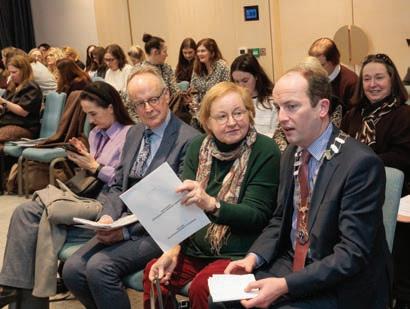
The DSBA theme of engagement with government continues with the Minister for Justice, Home Affairs and Migration Jim O’Callaghan’s participation in a recent DSBA event
Tips on new forms for Probate Applications
Experienced probate solicitor Úna Burns provides a quick guide to the Revenue Forms needed to complete your probate application
The Combined Building Agreement / Contract for Sale 2026
Beauchamps partner and former DSBA President Tony O’Sullivan provides some practical tips on dealing with the new Combined Building Agreement/Contract for Sale 2026
Tributes on the retirement of Judge James McCourt
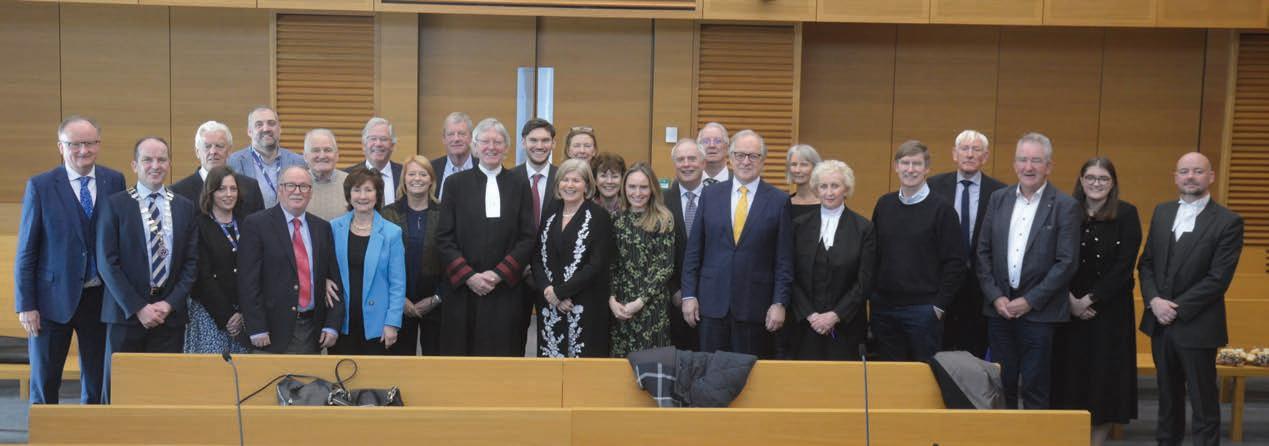
DSBA President Paul Ryan shares some of the tributes that were paid to Judge Jimmy McCourt on the occasion of his retirement from the Circuit Court
Lawyers Must be Paid: The Cartoonists’ Perspective
Historian and author Felix Larkin looks at how cartoonists have satirised lawyers over the years
Supporting the Legal Aid Board and providing Greater Access to Justice Keith Walsh looks at the Reports of the Civil Legal Aid Review and highlights the DSBA submissions
Book Reviews
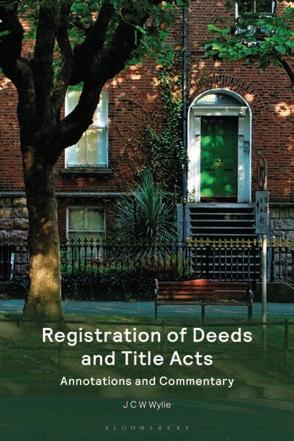
• Susan Martin reviews Professor Wylie’s latest volume Registration of Deeds and Title Act: Annotations and Commentary
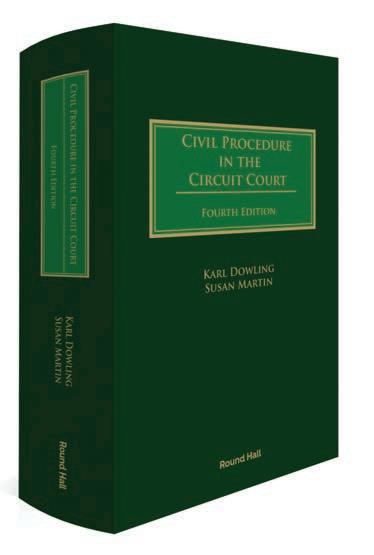
• Marcus Hanohoe reviews Civil Procedure in the Circuit Court, 4th edition by Karl Dowling B.L. and Susan Martin
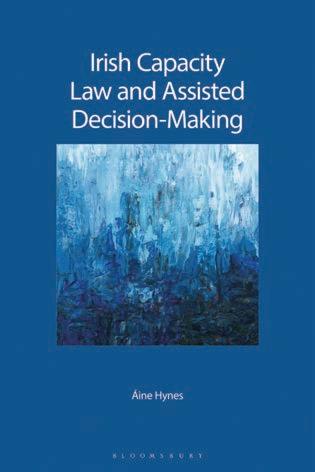
• Keith Walsh reviews Irish Capacity Law and Assisted Decision Making by Aine Hynes SC
Book Launches
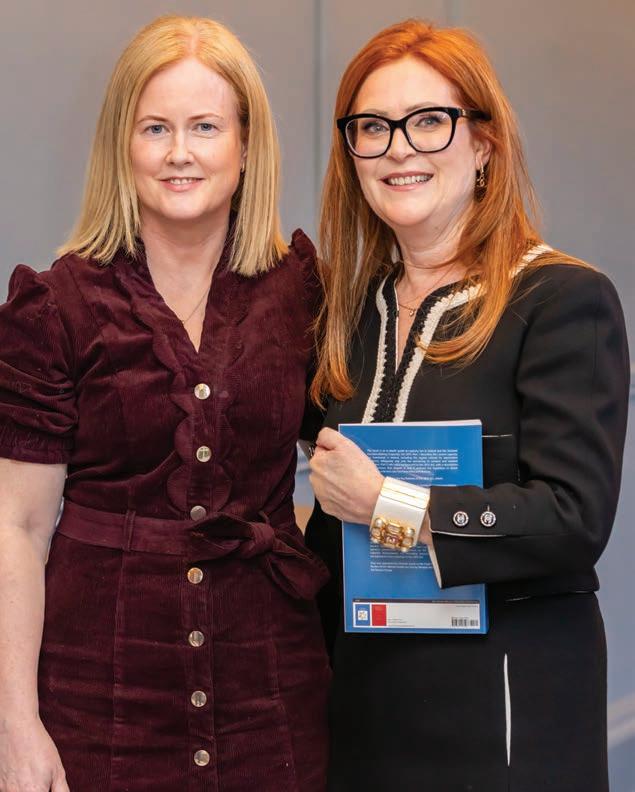
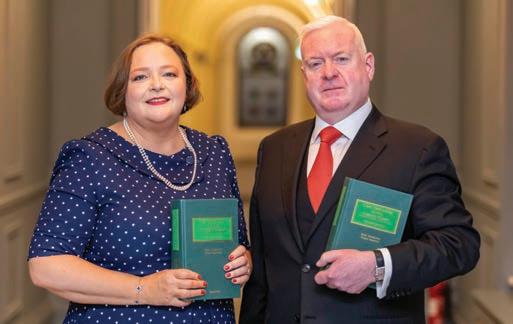
Launch of Civil Procedure in the Circuit Court, 4th edition by Karl Dowling B.L. and Susan Martin. Launch of Irish Capacity Law and Assisted Decision Making by Á ine Hynes SC
Returning to edit the Parchment after a 17 year gap has been made a joy thanks to the enthusiasm and assistance of the President and Council of the DSBA as well as the willingness of so many colleagues to come forward with their contributions. The great work of John Geary continues to inspire us.
In this issue Felix Larkin, historian and author, has brought lightness and satire to the Parchment with his most enjoyable article on legal cartoons. Well-known environmental solicitor Fred Logue shares his views on the proposed reforms to judicial review and how Ireland might position itself as one of the leading European jurisdictions for environmental law.
Whitney Moore’s new head of litigation Lorna McAuliffe sets out seven areas likely to define Irish litigation in the next 12 months.
Una Burns updates Parchment readers on new probate forms and Tony O’Sullivan shares his expertise on the new Combined Building Agreement / Contract for Sale 2026 while RDJ’s Jenny Foley and Linda Ryan
take a deep dive into a recent Court of Appeal decision and much more.
Pictures speak louder than words and the work of the DSBA President and Council in engaging with colleagues and with the Minister for Justice is captured in one of the many photo pages. Two very prominent former DSBA Presidents Áine Hynes SC and Susan Martin have both launched books in 2026 and they and their books are featured this edition along with the well-deserved plaudits of colleagues and the Attorney General for their achievements.
Enjoy.
Keith Walsh parchment@dsba.ie
DSBA COUNCIL 2025/2026
PATRICK LONGWORTH Vice Chair of Litigation Committee
EDITOR Keith Walsh
PARCHMENT COMMITTEE
Gerard O’Connell (Chair)
Áine Hynes SC
Julie Doyle
Kevin O’Higgins
Stuart Gilhooly SC
Joe O’Malley
Killian Morris
COPYRIGHT The Dublin Solicitors Bar Association
CLIONA COSTELLOE Chair of Family Law Committee
PUBLISHED BY
The Dublin Solicitors Bar Association, Unit 206, The Capel Building, Mary’s Abbey, Dublin 7
DSBA OFFICE, T: 01 670 6089
F: 01 670 6090
E: maura@dsba.ie
DX 200206 Capel Building W: www.dsba.ie
ADVERTISING
ENQUIRIES
Sharon Hughes T: 086 871 9600
The DSBA, its contributors and publisher do not accept any responsibility for loss or damage suffered as a result of the material contained in the Parchment.
DISCLAIMER
Advertisements are accepted at the discretion of the magazine which reserves the right to alter or refuse to publish any item submitted. Publication
of an advertisement in the Parchment does not necessarily signify of cial approval by the DSBA, and although every effort is made to ensure the correctness of advertisements, readers are advised that the association cannot be held responsible for the accuracy of statements made or the quality of the goods, services and courses advertised. All prices are correct at
time of going to press. Views expressed are not necessarily those of the DSBA or the publisher. No part of this publication may be reproduced in any form without prior written permission from the publishers.
STEFAN O’CONNOR Vice Chair of Practice Management
DARREN GRAY Council Member
AILEEN CURRY Chair of Mental Health & Capacity Committee
MARCUS HANAHOE Chair of Litigation Committee
EIMEAR O’DOHERTY Honorary Secretary & Chair of In-House Committee
PAUL RYAN DSBA President
JOAN DORAN DSBA Vice President
CIARA O’KENNEDY Treasurer
AVRIL MANGAN Programmes Director/ Chair of the Practice Mgt Committee
ÁINE GLEESON Chair of Property Committee
ZOE HUGHES Council Member
SUSAN O’HALLORAN Council Member
JESSICA HICKEY Chair of Commercial Law Committee
Scan the QR code to link to DSBA website
DSBA Annual Conference 2026 –Munich Awaits
The DSBA Annual Conference, taking place this year in Munich from 10th to 13th September 2026, is one of the standout events in our Association’s calendar and attracts strong attendance from across the profession. This Conference is kindly sponsored by Delap & Waller
Delegates will stay at the five-star VierJahreszeiten Kempinski, a former royal Bavarian guesthouse. With its historic grandeur and contemporary luxury, the hotel is in the very heart of the city, an ideal setting in which to enjoy the Conference and the wider experience of Munich.
Proceedings commence with a welcome dinner on Thursday evening, setting the tone for an engaging and sociable few days. The Business Session on Friday morning, hosted by the Munich Bar Association, is the central CPD event of the Conference, bringing delegates together for discussion, insight and exchange on matters relevant to practice.
Munich itself lends a distinctive character to this year’s Conference. As the historic capital of Bavaria and a centre of German culture, the city has an architectural elegance and a vibrant atmosphere. Its renowned traditional beer halls sit alongside grand shopping boulevards, historic squares and cultural landmarks, creating a setting that is both lively and steeped in history.
A carefully curated programme of activities allows delegates to experience the city in full. These include a guided walking tour through the historic centre, taking
in Marienplatz and the Frauenkirche Cathedral, as well as a coach tour to the magnificent Nymphenburg Palace and gardens. A visit to the BMW Museum and factory adds a modern contrast, showcasing innovation and design at their finest. Time is also set aside for delegates to unwind, go shopping and explore the city.
The social programme is equally compelling. Optional group dinners on Friday evening bring delegates together in a relaxed and convivial atmosphere, while the Gala Dinner on Saturday night at the Palais Montgelas will be a memorable and glamorous highlight to the weekend.
One of the enduring attractions of the DSBA Annual Conference is in the ease with which it brings colleagues together in a setting that is both relaxed and purposeful. It creates space for meaningful professional exchange, new connections and fresh perspectives.
Places are filling quickly, with a limited number still available. Members, particularly those who have not attended previously, are encouraged to take the opportunity to be part of what promises to be an engaging, rewarding and thoroughly enjoyable Conference. P
SAVE THE DATE!
This year’s DSBA Annual Conference will take place in Munich, Germany, from Thursday 10th September - Sunday 13th September 2026. Brochure available on DSBA website or from DSBA office.
News from the Courts
Judges on the move
Farewell
Farewell to District Court Judge Patricia McNamara, Circuit Court Judges James McCourt, Karen Fergus and Supreme Court Judges Elizabeth Dunne and Peter Charleton, all of whom retired earlier this year. Judge Mary Ellen Ring of the High Court retired in December 2025. Following many years of sterling service, the Parchment sends them best wishes in their retirement.
Going going nearly gone
Going going gone – District Court Judges and former solicitors - Mary Dorgan, late of Cork and Gerard Jones late of Carrickmacross are due to retire in May 2026. Judge Miriam Walsh, late of the Legal Aid Board in Dublin will retire in July 2026. All three judges are well known to Dublin practitioners and have done to the state some service and will be sorely missed.
Newly appointed
Well done to the new appointments to the District Court bench announced on 31st March - Edward Carroll, Solicitor (Cork), Paula Cullinane, Solicitor (Dublin), Andrew Gubbins BL (Tipperary), Tom McSharry, Solicitor (Sligo), Mary McAveety, Solicitor (Cavan), Darach McCarthy, Solicitor (Limerick), Catriona Murray, Solicitor (Wicklow) and Olivia Traynor, Solicitor (Galway).
Moving on up
Congratulations to Judges Alec Gabbett, Paula Murphy and Cephas Power who were appointed to the Circuit Court, all three had formerly been District Court Judges. Judge Gabbett had formerly practised as a solicitor in Limerick with Leahy Reidy Solicitors and Judge Murphy was formerly in practice in Daniel Spring
& Company while Judge Power was a barrister.
Judges Brian O’Moore and Niamh Hyland were appointed to the Supreme Court, both had started as barristers, then became High Court Judges - both were appointed to the High Court in 2019 and then were appointed to the Court of Appeal in 2023 and 2024 respectively.
Congratulations to Mark J. Dunne SC and Micheál D. O’Connell SC who were appointed Judges of the High Court on 21st January 2026.
Judge Áine Shannon and Judge Michael Ramsey were both assigned on 24th March 2026 to the Dublin Metropolitan District (DMD) while Judge Adrian Harris takes over District No. 12 (Counties Clare and Galway) which was vacated by Judge Gabbett.
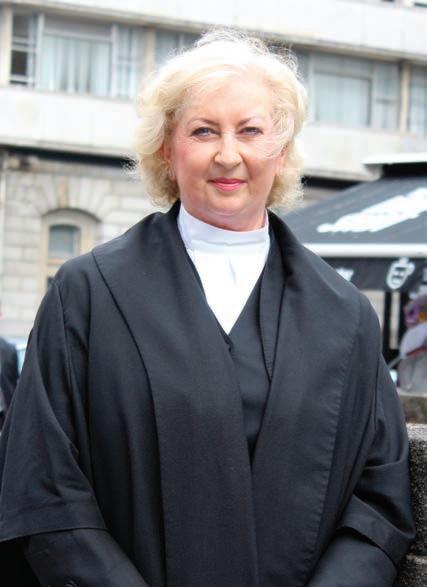
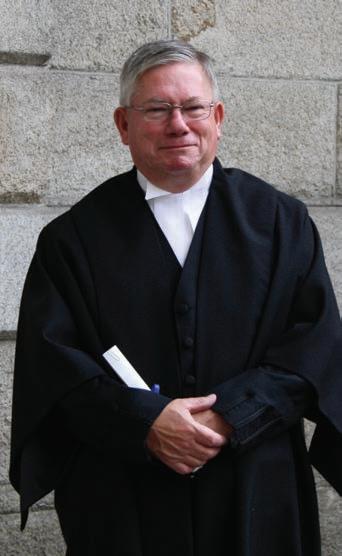
Judge Patricia McNamara Judge James McCourt Judge Karen Fergus Judge Elizabeth Dunne
Judge Peter Charleton Judge Mary Ellen Ring
Judge Alec Gabbett Judge Paula Murphy Judge Cephas Power Judge Brian O’Moore
Judge Áine Shannon
Judge Michael Ramsey
New President of the Circuit Court?
As her seven year term expires in July of this year, President Patricia Ryan of the Circuit Court will make way for a successor. President Ryan has led the Circuit Court through many changes, dealt with many challenges not least of which was Covid, is very highly regarded and will be missed
Best wishes to Thelma King
The Parchment sends best wishes on behalf of the DSBA Past Presidents to the most senior DSBA President Thelma King [1973-74] who recently retired as lay reader in Monkstown Church on 1st February 2026. Miss King who served as a District Court Judge until her retirement in 1998 was apprenticed to Michael J. Egan in Castlebar, County Mayo in the 1940s before qualifying as a solicitor in 1950 and joining Hayes & Son.
Former DSBA Presidents [year of presidency in brackets], Retired Judge Thelma King [1973-74] seated. L-R: Retired Circuit Court Judge Jimmy McCourt 200203], Retired Circuit Court Judge Gerry Griffin [1988-89], Circuit Court Judge John O’Connor [2003-04]
as President not only by her colleagues on the bench but the legal profession and the Courts Service. Although the Parchment has been unable to find anyone brave enough to predict the likely identity of the next President, there is no doubt that it will be hotly contested and a clear favourite has yet to emerge. The 10 most senior Judges based on year of appointment are Judge James O’Donohoe, Judge Terence O’Sullivan, Judge Martin Nolan, Judge Sarah Berkeley, Judge Pauline Codd, Judge Keenan Johnson, Judge Eugene O’Kelly, Judge Elma Sheahan, Judge John Aylmer, Judge Sinead Ni Chulachain. However, seniority alone will not be determinative, with experience, ability and other factors being important.
Some readers will recall the exuberant tributes paid to President’s Ryan’s predecessor, Judge Raymond Groarke, as captured by Ray Managh’s report in the Irish Times in 2019, which he started by stating that the “only feature of support missing in Court 28 of the Circuit Civil Court on Friday when Mr Justice Ray Groarke handed over the presidency of the court to Ms Justice Patricia Ryan was a Mexican Wave. When barrister Paul O’Neill completed tributes to Mr Groarke on behalf of the Bar Council he said it was traditional that such speeches ended with a prayer and a hymn. “I intend ending these tributes by singing a hymn,” Mr O’Neill said, before punching the air and singing “Oh Ray, Oh Ray, Oh Ray, Oh Ray, Oohh Ray, Oohh Ray,” to be joined by
judges, senior counsel, barristers, solicitors, court staff and friends, singing, punching the air, stamping their feet and thumping tables. It was the first time in decades that veteran court reporters had witnessed so many usually dignified members of the legal profession in their black gowns and sombre dress lose absolute control of themselves.”
Judge Patricia Ryan
Judge Raymond Groarke
Law Society Consultation Rooms
The quality of the recent refurbishment of the Law Society Consultation rooms in the Four Courts has led to an increase in demand for rooms and practitioners are encouraged to book well in advance. Colleagues are encouraged to visit the newly refurbished solicitors reading room and solicitors writing room in the Four Courts which are much more user friendly. Lisa, Amy and Dolores deserve thanks for all their work in dealing with the increased demand as well as Rosemary and her colleagues in the Friary Café.
Temporary increase in timeslots
Appointment times at the Dublin Circuit and District Civil Office will be approximately doubled in duration on the following dates:
• 7 April to 24 April 2026
The Courts Service are temporarily adjusting their appointment timeslots to support staff during the transition to a new case management system, as part of the Courts Service Modernisation Programme.
High CourtCommercial Court Sittings
- Long Vacation Sittings 2026
The High Court Commercial Court sittings will take place during the long vacation in 2026 as follows:
• Wednesday 2 and 23 September 2026 from 11am to deal with Commercial motions.
The normal process and procedures for bringing motions before the Commercial Court will apply.
Centenary commemoration of the establishment of the office of County Registrar
News has reached the Parchment that 2026 marks the centenary of the establishment of the office of County Registrar and that plans are afoot to mark the occasion. An
innovation at the time, County Registrars are indispensable to the administration of justice in the Circuit Court and the Parchment wishes them well with their celebration.
Changes for solicitors following the Courts Service upgrade to their Remote Court Platform
As part of the Modernisation Programme, the Courts Service upgraded its remote court platform to Pexip Infinity, a secure video conferencing solution that allows legal practitioners, witnesses and authorised participants to attend hearings remotely. This change took effect from Monday, 30 March 2026. From 30th March, all remote and hybrid hearings use new Pexip Infinity Virtual Meeting Rooms (VMRs). Previously saved courtroom or judicial links will no longer work
What this means for court users
Practitioners and participants with remote hearings scheduled on or after 30 March 2026 are advised to:
• Ensure you are using the updated Virtual Meeting Room (VMR) link.
• Test your device’s audio and video before your hearing to avoid technical issues.
Accessing the new VMR details
• Solicitors and barristers should refer to the Law Society or Law Library members’ pages for the updated courtroom and
judicial VMR links and conference IDs
• Other participants permitted to attend remotely should contact your legal representative or the relevant local court office for joining details.
What is not changing
• The authorisation process for remote attendance remains unchanged, and participants must continue to obtain the court’s permission to attend remotely.
• All existing rules, procedures and etiquette for remote attendance at court hearings remain in place and continue to apply when using the new platform.
• Court users are reminded that VMR details must not be shared with unauthorised persons.
Further information and guidance
Guidance on participating in video and remote hearings is available on the Courts Service website: https://www.courts.ie/guides/video-andremote-hearings
High Court - Family Law SittingsLong Vacation Sittings 2026
High Court Family Law sittings will take place during the Long Vacation in 2026 as has occurred in 2024 and 2025. The sitting dates will be the following:
• Lists on 1 and 2 September 2026hearings (including the HLC list (Hague Luxembourg Convention) and urgent matters and case management for Michaelmas (or other) hearings)
• List on 3 September 2026 - Surrogacy
• Lists on 21, 22 and 23 Sept 2026 – hearings
• Week of 28 September 2026 (excluding Friday 2 October) – hearings
• Sittings in the Special Care list will take place on the Tuesday 18 August 2026 from 10:00am and Tuesday 15 September 2026 from 10:00am.
Applications for cases to be listed during these dates may be made in the list to fix dates to be held on the 20 April 2026 and remaining spaces will be filled in the list to fix dates to be held on the 15 June 2026.
New Practice Direction on Grounding Information for Civil Restraining Orders applications DC 30
“The President of the District Court hereby issues Practice Direction DC30.
Applications to the Court pursuant to section 28 or section 30 of the Criminal Justice (Miscellaneous Provisions) Act 2023 shall, in every instance, be grounded on one of the following:
In the case of an ex-parte application under section 28(7) for immediate relief, a sworn information as set out in District Court Rules Form No. 96C.10 in Appendix A to the Direction
In the case of an application under section 28(1) where immediate relief is not being
sought, an unsworn information as set out in Appendix B to the Direction
In the case of an application under section 28(12) when an interim order is applied for, a sworn information set out in District Court Rules Form No. 96C.10 in Appendix C to the Direction
Where an application is being made to the Court for any of the Orders listed above, the Applicant must complete the appropriate information for the type of Order sought. This information should set out the grounds for making the application and the applicant should specify the kind of conduct the Respondent is alleged to have
engaged in and also provide a detailed description of the alleged actions of the Respondent that they will rely on in their application.
A copy of the information/sworn information must be served/sent with the summons for Restraining Order/Application for Interim Order on the Respondent in all cases.
This Practice Direction applies to all Districts with effect from the 1st day of April 2026.
Dated this 30th day of March 2026. Judge Paul Kelly President of the District Court.”
Update from Circuit Court Civil Office
You can now book appointments up to 2 weeks in advance. The appointment slots have been changed to 5-minute and 10-minute slots only.
In regard to walk-up / urgent appointments, customers who do not have an appointment but need to file a document
urgently, will be asked to join a walk-up appointment register and you will be seen to as soon as possible.
The Circuit Court office will continue to monitor and modify the appointment booking system and aim to achieve a consistent and efficient approach for all.
Solicitors feedback and patience are much appreciated.
If solicitors experience any difficulties in booking an appointment, they are invited to contact the Circuit Court office via email at dublinciviloffice@courts.ie or by telephone on 01 888 6376.
Golden opportunity for Ireland
Leading environmental lawyer Fred Logue argues that Ireland should build on the progress it has made in becoming the jurisdiction of choice for international environmental litigation in the EU and proposes the use of the Irish High Court Planning and Environment Court model as an exemplar of the Ireland for Law concept
While one part of the Irish State is actively promoting Ireland as a leading global centre for international legal services another part is busy making sure some of the most cutting edge litigation in the world can never take place here.
The most important litigation involving complex and dynamic regulatory frameworks is often brought by motivated individuals and expert NGOs through public law actions rather than through commercial litigation.
For example, the landmark cases of Digital Rights Ireland (C-293/12) and Schrems (C-362/14 and C-311/18) were public law cases, launched in Ireland, and resulted in significant decisions from the Court of Justice which clarified important fundamental rights in relation to personal data.
As I will explain below, the same dynamic is emerging in the field of environmental law with Ireland becoming a jurisdiction of choice for international litigation.
However, the recent proposed reforms of judicial review which could make it prohibitively expensive to litigate, hard to have standing and reduce available remedies will almost certainly reverse five years of progress towards establishing Ireland as one of the leading European jurisdictions for environmental litigation and turning it into a backwater for this area of law.
In my view this is a mistake and represents a missed opportunity to solidify and build on the progress Ireland has already made in becoming the jurisdiction of choice for international environmental litigation in the EU.
The Ireland for Law initiative was kicked off in 2019 by the Minister for Justice as part of Ireland’s strategic response to Brexit. It highlights Ireland’s strengths in
key sectors such as aviation finance, funds, insurance, tech, pharma, and life sciences. Backed by senior legal and government figures, including the Attorney General and IDA Ireland, it builds on Ireland’s Commercial Court to promote Irish law and Ireland as a venue for international litigation and arbitration.
Ireland for Law aims to make sure that Irish courts and Irish lawyers are involved at the leading edge of important international litigation and through that attract global business, taking advantage of high quality dispute resolution in an EU, common law jurisdiction.
We saw this model in action recently with the landmark Russian aviation insurance trial taking place in the Irish High Court involving disputes over claims worth around €2.5 billion. The trial lasted 10 months and involved 12 sets of legal teams and 200 lawyers, and addressed issues arising from the stranding of aircraft in Russia following the invasion of Ukraine and the resulting international sanctions. The case involved complex questions of coverage, jurisdiction and contractual interpretation under both Irish law and the laws of the United Kingdom and five states in the US.
In my practice area, the Planning and Environment Court, launched in December 2023 by Mr Justice Richard Humphreys, built on the Commercial Court model by establishing a specialised environmental court with three dedicated judges and a suite of bespoke practice rules.
This Court has been a resounding success providing timely access to justice for important disputes relating to planning and development, biodiversity, climate change, energy and a vast range of other complex areas of environmental regulation.
Through bespoke procedures and the accumulated experience of legal practitioners, both solicitor and
Dr Fred Logue is a practising solicitor and managing partner of FP Logue LLP, a firm specialising in planning and environmental litigation
counsel, it is now possible to have important strategic cases decided within three to four months.
For example the ground-breaking Coolglass case, which interpreted the obligations on public bodies under Irish climate legislation, started in the Planning and Environment list as a challenge by wind farm developer of a refusal by An Coimisiún Pleanála before being finally decided by the Supreme Court in January of this year.
Many of the cases in the Planning and Environment list involve points of law that go well beyond narrow local issues and often involve interpretations of law with European significance.
Since its inception the Planning and Environment court has made a series of important preliminary references to the Court of Justice of the European Union seeking authoritative interpretations of EU environmental law. It is very significant that Irish judges are asking these questions and Irish lawyers are arguing and debating them before the highest courts of the EU.
The Planning and Environment Court has also started to attract international attention.
In an innovative move, the Court developed the socalled Eco-Advocacy procedure whereby it will join third parties as amicus curiae to cases involving preliminary references for the sole purpose of making observations to the Court of Justice. In several instances this has attracted international NGOs who have become involved so that they can give their views on important questions of EU law.
More recently, international NGO ClientEarth issued High Court proceedings together with two Irishbased NGOs in relation to the environmental impact of energy policies aimed at facilitating the increasing number of very large data centres in Ireland.
Our firm has been able to leverage the experience we
have gained in the Planning and Environment Court to begin offering international services, attracting multinational NGOs from the EU and the US seeking out experienced environmental litigators. We have also briefed highly experienced English counsel who have become dual qualified in Ireland so that they can maintain their rights of audience in the European courts post-Brexit.
In my experience the Planning and Environment Court is an exemplar of the Ireland for Law concept.
We recently issued General Court proceedings on behalf of Portuguese and Belgian based NGOs in collaboration with a Portuguese colleague challenging a decision of the European Commission to recognise as strategic a major Lithium mine in Portugal despite significant environmental concerns.
We are also acting for a multinational coalition of NGOs from Austria, Belgium and the Netherlands briefing Irish-qualified English counsel in General Court proceedings concerning the definition of sustainability in relation to climate change of shipping and aircraft activities.
The direction of travel is clear, as time goes on more and more international environmental litigation will pass through the Irish courts and will be handled by Irish lawyers and decided by Irish judges.
There is a real opportunity for Ireland to be a global centre for environmental litigation and to influence some of the most fundamental issues of our time as we rise to the challenge of the climate and biodiversity crises.
All of this will be impossible if the Government succeeds in implementing its program of reform.
In my view the Government should seriously consider whether its ill-informed crack down on public law litigation is really in the national interest.
There is a real opportunity for Ireland to be a global centre for environmental litigation and to influence some of the most fundamental issues of our time as we rise to the challenge of the climate and biodiversity crises
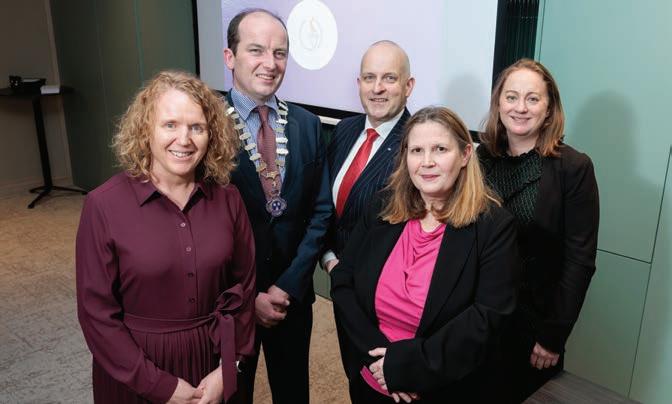
Minister for Justice, Home Affairs and Migration engages with DSBA
The DSBA theme of engagement with government continues with the Minister for Justice, Home Affairs and Migration Jim O’Callaghan’s participation in a recent DSBA event
The Dublin Solicitors Bar Association hosted a Managing Partners’ Dinner on 26 January 2026 last at the St Stephen’s Green Club, attended by managing partners and senior representatives from many of Ireland’s leading law firms. The Association was honoured to welcome the Minister for Justice, Home Affairs and Migration, Jim O’Callaghan TD, as guest of honour.
The evening provided an opportunity for members of the profession to meet informally with colleagues during a drinks reception, followed by dinner and an after-dinner address from the Minister. The event was very well attended and formed part of the DSBA’s ongoing engagement with senior leaders of the profession and Government on issues affecting legal practice and the administration of justice.
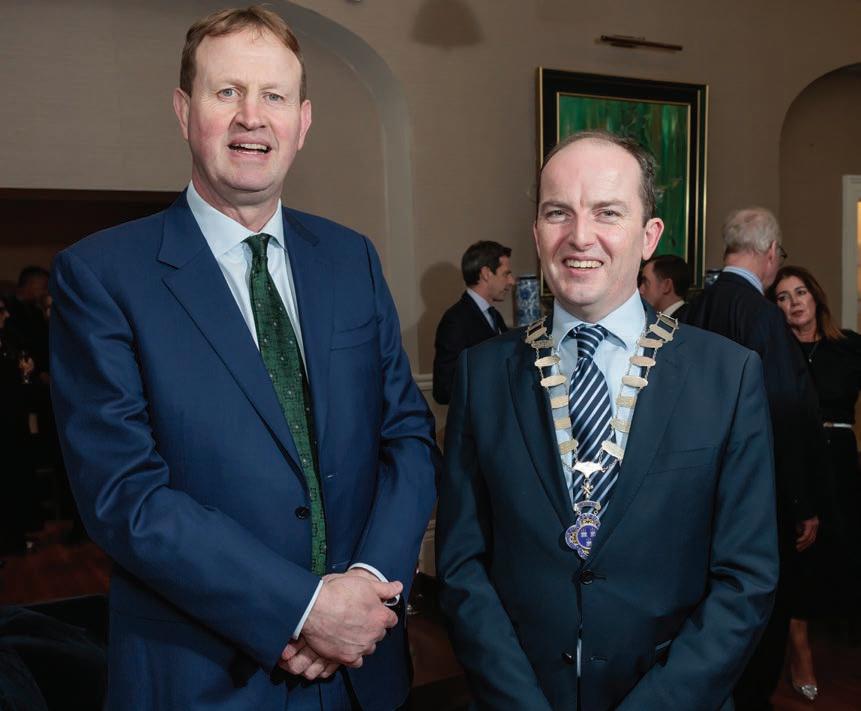
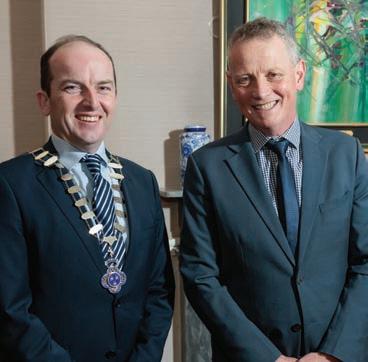
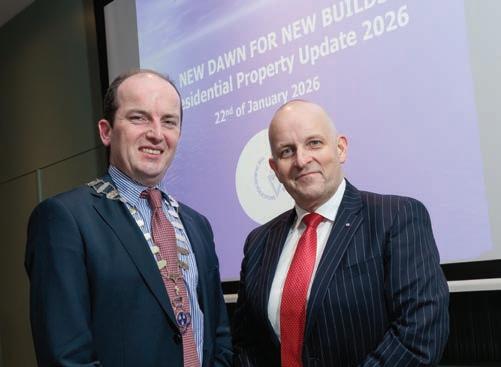
Minister Jim O’Callaghan TD and DSBA President Paul Ryan
Photography: Mark Harrison
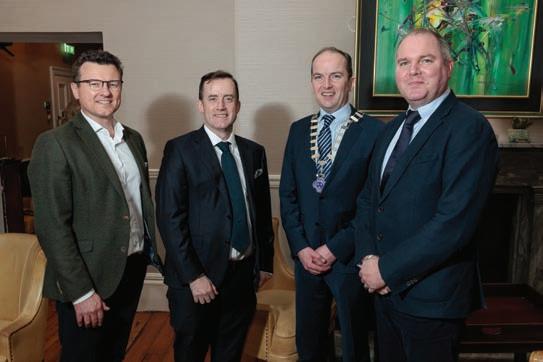
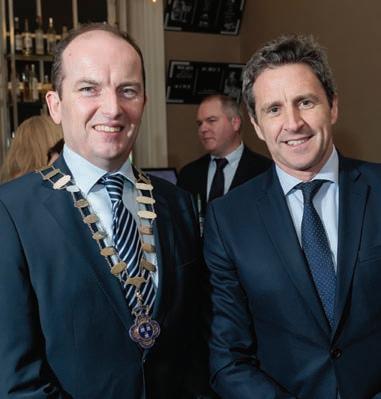
Left: James Duggan, Peter Walsh, DSBA President Paul Ryan and Brian Duffy Far left: Zoe Hughes and James Colville
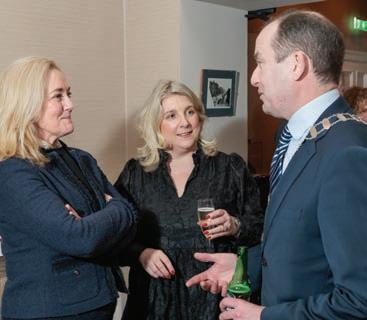
Left: Mark Walsh, Lisa Broderick, Minister Jim O’Callaghan TD and Stefan O’Connor
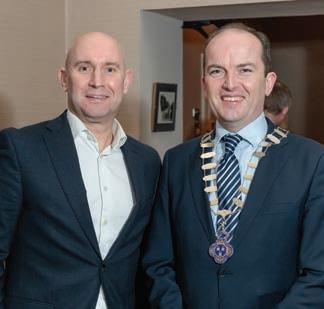
Far left: Minister Jim O’Callaghan TD and Will Carmody
Right: Jonathan Sheehan, Will Carmody, Minister Jim O’Callaghan TD and Peter Walsh Far right: Áine Gleeson and John White
Right: Niall Cawley, Cliona Costello and Marcus Hanahoe
Far right: Sinead Kearney, Avril Mangan and Minister Jim O’Callaghan TD
DSBA Managing Partners’ Dinner
President Paul Ryan
Left: Keith Walsh, Joan Doran, Sinead Kearney and Zoe Hughes Far left: DSBA President Paul Ryan and Mark Walsh
Left: Mark Walsh, Lisa Broderick and Stefan O’Connor Far left: Brid McCoy, Aine Gleeson and DSBA President Paul Ryan
Right: Will Carmody, Peter Walsh and Susan O’Halloran Far right: Mark Homan and DSBA President Paul Ryan
Right: Pamela O’Neill, Minister Jim O’Callaghan TD and Joan Doran Far right: DSBA
and Jonathan Sheehan
FRIDAY
Tips on new forms for Probate applications
Experienced probate solicitor Úna Burns provides a quick guide to the Revenue Forms needed to complete your probate application
Since the introduction of the new form of oath for probate applications on 1st March 2021, this new format of oath can and must be used for all dates of death, present and historic. With little in the way of adaptation required for practitioners and leaving less margin for error, this was a welcome development.
Unfortunately, the same cannot be said for the Inland Revenue Forms which accompany any historic applications which can remain a mystery hindered by the lack of historical data available and, at times, the misleading print on the forms themselves.
The new Application for Probate Form is often a first port of call when preparing a Probate submission and, as part of that checklist, the applicant is required to tick a box indicating that:
“I am enclosing the completed Notice of Acknowledgment (Probate) Revenue Form.
OR – for deaths before the 05/12/2001, I am enclosing a copy of the correct Revenue Affidavit Form based on deceased’s date of death, stamped by Revenue together with original Revenue Certificate for the High Court”
Therefore, if the deceased died prior to 5th December 2001, practitioners are at least alerted to the fact that the Notice of Acknowledgement stemming from the submission of the Statement of Affairs (Probate) Form
S.A.2 is not the correct addition to the application. The Application for Probate form also helpfully indicates that a Revenue stamp will be required with the original Revenue Certificate for the High Court, highlighting to the applicant that some further input from the Revenue Commissioners is required before the Probate application can be made. Which raises the questions, what is the correct Revenue form to use and what should be done with it?
The Forms required for these various periods are: For probate for deaths prior to 1st April 1975, the following are required:
• Form A (X) 5th Edition Estate Duty Affidavit to be completed and submitted to Revenue in advance of the probate application so they may stamp same and complete the Certificate for High Court as required.
• Form D1, Schedule of Land and Buildings, accompanies this form where the estate comprises real property.
NOTE: It is not necessary to have a Personal Public Service Number for a deceased person for deaths prior to 1 April 1975. Include a copy of the deceased’s will where possible. A valuation report containing date of death values must accompany Forms A(X) and D1.
For probate for deaths between 1st April 1975 and 5th December 2001, the following is required:
• Inland Revenue Affidavit (Form C.A.24 2000 edition) is to be completed and submitted in duplicate to the Revenue Commissioners in advance of the Probate application.
• Form CA6, Schedule of Land and Buildings, accompanies this form where the estate comprises real property.
NOTE: The C.A. 24 2000 edition form is misleading as it indicates on the form itself that it is to be used for death since 1st December 1999. In reality, it can be used for death from 1st April 1975 up to 5th December 2001.
For all deaths since 5th December 2001, the Statement of Affairs (Probate) S.A.2 Form must be completed and submitted to Revenue online. Upon receipt, Revenue will issue a Notice of Acknowledgement which accompanies the Probate application.
NOTE: THE S.A.2 Form itself is never submitted to the Probate Office, the Notice of Acknowledgement is sufficient for its purpose. There is no need for a separate schedule of lands and buildings.
Since the introduction of the new form of oath for probate applications on 1st March 2021, this new format of oath can and must be used for all dates of death, present and historic
Úna Burns is a member of the DSBA’s Probate Committee and principal of Úna Burns Solicitors, a specialist Probate practice based in Blackrock, County Dublin
The Combined Building Agreement / Contract for Sale 2026:
A PRACTICAL STEP FORWARD IN HOUSING CONVEYANCING
Beauchamps partner and former DSBA President Tony O’Sullivan provides some practical tips on dealing with the new Combined Building Agreement/Contract for Sale 2026
Ireland’s housing difficulties continue to shape both public debate and day-to-day professional practice. While solicitors are not responsible for housing supply, the profession plays an important supporting role in ensuring that transactions proceed with clarity, certainty and as little friction as possible. Against that backdrop, the newly introduced Combined Building Agreement / Contract for Sale 2026 represents a pragmatic step in modernising the contractual framework through which new homes are brought to market.
It is not a dramatic reinvention of conveyancing practice, nor is it intended to be. Rather, it reflects both an overdue updating of older precedents and an acknowledgement of how residential development transactions have evolved in practice over the past two decades.
From a practitioner perspective – including in my role as a Commercial Property Partner at Beauchamps LLP and through involvement with the DSBA and Law Society – the importance of contractual clarity in maintaining transactional momentum is something encountered regularly. Where documentation is coherent and widely understood, transactions tend to proceed with greater confidence for all parties.
From Parallel Documents to a Single Framework
The traditional position will be familiar to most conveyancers. The Law Society Conditions of Sale sat alongside the 2001 Building Agreement when dealing with new residential units. In theory the documents complemented each other; in practice, tensions and inconsistencies occasionally arose. Deposits, completion mechanics, default provisions and dispute resolution could overlap or diverge depending on how the documents were used.
The 2026 Combined Agreement therefore does two things at once:
• It updates an older framework that was overdue for revision.
• It recognises established conveyancing practice and provides a standardised version of what many practitioners were already doing.
That element of regularisation is arguably just as significant as the substantive updates.
Housing Pressure and Professional Responsibility
Public commentary on housing delivery can sometimes portray legal processes as an obstacle. That characterisation is rarely fair, but it does underline the importance of ensuring that conveyancing practice remains efficient, clear and proportionate.
Well-drafted contractual frameworks reduce the scope for dispute, minimise delay and give both developers and purchasers a clearer understanding of their respective obligations. While such measures alone cannot address housing supply challenges, they are part of the wider professional contribution to ensuring that completed homes can move through the legal process smoothly.
Consolidation and Clarity
The Combined Agreement integrates the revised Conditions of Sale, a set of Special Conditions establishing interpretative hierarchy, and detailed Building Conditions addressing construction-specific issues. Where inconsistencies arise, the Special Conditions prevail, and the Building Conditions take precedence over the general Conditions of Sale where relevant.
For practitioners, this layered structure reduces duplication and interpretive ambiguity. For developers and purchasers, it should translate into greater predictability in how transactions progress from contract to completion.
Completion and Certification
The updated agreement reflects current certification practices for newly constructed dwellings, ensuring that contractual completion aligns with practical readiness for occupation and financing. This is less about technical
regulatory refinement and more about ensuring that the legal process mirrors real-world construction completion in a sensible and workable way.
Construction Timelines and Longstop Dates
The use of defined longstop completion dates –18 months from sale as drafted, subject to specified extensions – provides a structured mechanism for managing delay. Purchasers benefit from an outer boundary for expectations, while developers retain flexibility where delays arise outside their control. Managing expectations around these provisions remains an important aspect of practitioner advice, particularly in a market where timing can carry significant financial implications.
Planning Compliance and Vendor Responsibility
The Combined Agreement reinforces the developer vendor’s responsibility for planning compliance and statutory adherence in the course of construction. While this reflects established good practice rather than a novel development, its inclusion in a consolidated Law Society precedent promotes consistency across transactions and reassurance for purchasers.
Default Provisions and Deposit Treatment
Clearer procedures now exist where a purchaser fails to complete, including structured mechanisms for interest, resale and recovery of loss. These provisions provide developers with certainty regarding financial exposure while ensuring transparency for purchasers from the outset.
In a housing market where timing and funding arrangements can be finely balanced, certainty around deposits and completion obligations is particularly valuable.
Dispute Resolution
The continued use of expert determination for technical disputes reflects commercial common sense. Construction-related issues are often best resolved by appropriately qualified experts rather than through protracted litigation. Final and binding determination can significantly reduce delay and cost, which benefits all parties in residential development transactions.
Regularising Established Practice
In practical terms, the Combined Agreement should reduce the need for firm-specific drafting, encourage greater consistency across developments and make documentation more familiar to lenders and purchasers alike. Standardisation in this area is not merely administrative; it can materially shorten transaction timelines and reduce avoidable friction.
The Profession’s Supporting Role
Solicitors facilitate funding drawdowns, ensure title clarity, manage contractual risk and help transactions progress to completion without unnecessary dispute. When contractual documentation is modern, coherent and widely recognised, that work becomes considerably more straightforward.
The Combined Agreement reflects the profession’s willingness to refine established conveyancing practices
in response to evolving market conditions rather than simply maintaining legacy precedents.
A Practitioner’s Perspective
In day-to-day commercial property practice, ambiguity in contractual documentation often translates directly into delay. Conversely, clarity tends to support transactional confidence for developers, lenders and purchasers alike. Professional engagement through representative bodies such as the DSBA and the Law Society also demonstrates the collective commitment within the profession to keeping conveyancing practice current and effective.
What the Agreement Does – and Does Not Do
The Combined Agreement will not, of itself, increase housing supply, reduce construction costs or resolve planning constraints. What it can do is reduce transactional friction. In a constrained housing environment, incremental improvements in legal process can still make a meaningful difference.
Looking Ahead
Conveyancing practice continues to evolve alongside broader changes in development finance, sustainability expectations and digital transaction management. Future refinements may well address greater digital execution, evolving environmental standards, further consumer protections and continued simplification of documentation. The 2026 Combined Agreement should therefore be viewed as part of an ongoing evolution rather than a final endpoint.
Conclusion
The Combined Building Agreement / Contract for Sale 2026 represents a measured but worthwhile step forward in Irish residential conveyancing practice. It updates an older framework, acknowledges established professional practice and provides a clearer contractual basis for the sale of newly constructed homes.
While legal reform alone cannot resolve Ireland’s housing challenges, clarity and consistency in conveyancing documentation help ensure that completed homes can move efficiently through the transactional process. Above all, the Combined Agreement reflects the profession’s continuing willingness to adapt established practices to contemporary realities while maintaining the legal certainty that clients rightly expect.
The updated agreement reflects current certification practices for newly constructed dwellings, ensuring that contractual completion aligns with practical readiness for occupation and financing
Tony O’Sullivan is a senior partner at Beauchamps LLP and leads a Commercial Real Estate (CRE) team. Tony is a Past President of the DSBA
Judge James McCourt A
CAREER MARKED BY COLLEGIALITY, LEADERSHIP AND SERVICE
DSBA President Paul Ryan shares some of the tributes that were paid to Judge James McCourt on the occasion of his retirement from the Circuit Court. James or Jimmy as he is known to DSBA members is a former DSBA President
Judge James McCourt concluded his final sitting at Wexford Circuit Court on the 12th February 2026, and the Dublin Solicitors Bar Association marks the retirement of a solicitor and judge whose career has been defined by breadth of experience, practical sense and an enduring commitment to collegiality.
Educated at Belvedere College and University College Dublin, Judge McCourt graduated with a degree in Politics and Economics in 1978 and qualified as a solicitor in 1981, having served his apprenticeship with Pearts Solicitors under Michael Peart who was also subsequently appointed a judge, firstly of the High Court and then the Court of Appeal. Judge McCourt then joined George D. Fottrell & Sons Solicitors before, in 1995, joining up with Ciaran O’Mara and the late Anita Geraghty to establish the firm of O’Mara, Geraghty, McCourt Solicitors where he developed a strong dispute resolution practice.
Judge McCourt became known as an excellent civil and commercial litigation solicitor. He was recognised for his ability to move cases forward efficiently and pragmatically, always focused on achieving workable outcomes for clients. His oft-repeated phrase, “You
do what you have to do”, encapsulates his practical, solution-focused approach to legal problems.
Yet colleagues frequently remark that what set Judge McCourt apart as a solicitor was not simply his technical skill, but his presence. He was a constant figure in the corridors of the courts, invariably engaged in conversation but always approachable. He seemed to know everyone and more importantly, everyone seemed to know him. He embodied collegiality in its truest sense. Many disputes were resolved and settled as much through relationships built on mutual respect and professional trust as through legal argument and formal negotiation. It is said that many a fruitful meeting took place on a Friday in Doheny & Nesbitt’s over what might diplomatically be described as half a glass of Guinness.
Judge McCourt served as President of the DSBA in 2002/2003. During his presidency, he brought everyone on that year’s Annual Conference to Cape Town, which was no small organisational undertaking. His ability to engage constructively with large institutions, on behalf of the Association including banks, the Law Society, the Courts
Service, Revenue and the Land Registry, reflected both the breadth of his professional network and the goodwill he had built over decades of practice. Also through those connections, he secured highquality speakers for DSBA seminars and contributors to the Parchment, strengthening the Association’s educational and professional offerings. It is also noteworthy to remember that, his firm’s apprentice, Aaron McKenna, would in time also go on to serve as President of the DSBA, a testament to Judge McCourt’s mentorship and influence.
Judge McCourt still gives very generously of his time to the DSBA, supporting and attend our events. His commitment to supporting the next generation of solicitors has endured and he continues to serve as a trustee of the DSBA Bursary Scheme, which assists aspiring solicitors with FE1 and Law School fees and related expenses. That continued involvement speaks to a generosity of spirit that has long characterised his engagement with the profession.
Service to the profession was a constant theme throughout his career. A long-standing and active member of the Law Society Council, Judge McCourt served as President of the Law Society in 2012/2013.
Judge McCourt’s appointment to the Circuit Court Bench in 2018 was, a fitting recognition of his abilities and integrity. Over his eight years on the Bench, he served with the same professionalism and balance that marked his practice as a solicitor.
Across the course of his career, Judge McCourt has worn many hats: solicitor, partner, Dublin Solicitors Bar Association President, Law Society of Ireland President, judge and accredited mediator. The skill set that he developed, commercial realism and strong interpersonal skills, made him successful in each role.
We believe that retirement from the Bench will not mean retirement from activity. Given his accreditation and experience in mediation, many in the profession hope that Judge McCourt’s next chapter includes continued engagement in dispute resolution. His experience, judgment and temperament are assets of lasting value.
As the profession marks the conclusion of his judicial service, it does so with gratitude. Judge James McCourt’s career stands as a reminder that technical excellence, leadership and institutional service matter greatly, but that collegiality, generosity and goodwill are what endure longest in the memory of colleagues.
Paul Ryan is President of the DSBA
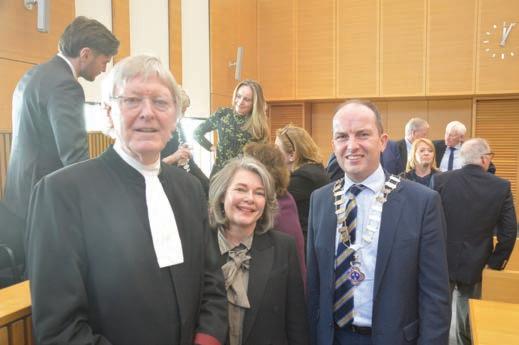
Judge James McCourt, Siobhán Dunne, President of the Wexford Solicitors’ Association, and DSBA President Paul Ryan
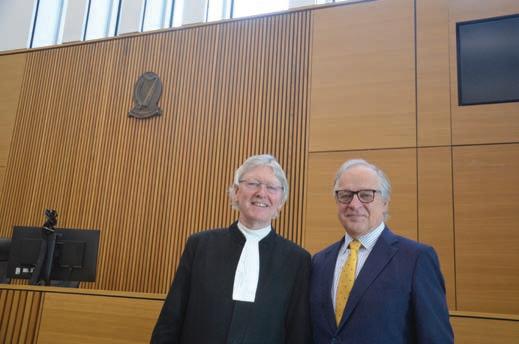
Judge James McCourt and retired Judge Michael Peart
How will fundamental changes to the litigation landscape impact practice?
Ireland’s litigation landscape is shifting. A series of long-awaited reforms will change how disputes are funded, managed, and resolved. From defamation reform to new procedures for medical negligence claims, the next 12 months will bring both challenge and opportunity. Lorna McAuliffe, who recently joined Whitney Moore as Head of Litigation, outlines seven areas likely to define Irish litigation in the next 12 months
The seven areas shaping Irish litigation in the next 12 months:
1. Third-Party Litigation Funding and Representative Actions
• Ireland remains one of the few European countries that still restricts third-party litigation funding.
• This may change once the Law Reform Commission issues its report later this year.
• A regulated funding system could significantly alter access to justice and the economics of litigation.
• Representative and class-style actions may follow, particularly in consumer, data protection and securities cases.
• For businesses, early assessment of potential exposure will become a core part of risk planning.
What to watch:
• Test cases brought by consumer and data rights groups
• Disclosure obligations for funders
• Increased settlement pressure Preparation will matter more than ever.
2. ESG, Climate and Green Litigation
• ESG related disputes continue to rise, with litigation increasingly used to test accountability and enforce standards.
• Regulators, investors and advocacy groups are relying on claims to challenge decision-making, particularly in planning and sustainability.
• Ireland is firmly part of this wider trend.
What to watch:
• Judicial reviews of planning and environmental approvals
• Claims relating to misleading sustainability statements
• Stronger alignment with EU climate targets Strong governance remains the best protection. Boards must ensure public commitments match
internal practice, and that disclosure is clear, accurate and defensible.
3. Property and Landlord–Tenant Litigation
• Reform of the Landlord and Tenant Acts is expected to progress this year.
• The changes aim to simplify renewals, clarify redevelopment rights and modernise rent review procedures. What to watch:
• Disputes over renewal entitlements and redevelopment clauses
• Challenges around rent indexation
• Cases involving flexible workspaces and renewal rights
The reforms should bring greater certainty, but early disputes are likely as landlords and tenants test the boundaries of the new framework.
4. Defamation Reform
• The Defamation (Amendment) Act 2026 was signed into law on 19th February 2026 and Parts 1-6, most of Part 8 and Part 9 of the Act were commenced on 1st March 2026. This Act introduces one of the most significant procedural shifts in recent years.
• It is designed to make defamation law more balanced, efficient and proportionate.
Key features include:
• Judge-only hearings in the High Court
• A clearer public interest defence
• Greater use of corrections and apologies
• Stronger case management powers
The emphasis will move away from headline verdicts and towards earlier, fairer resolution.
5. Abuse of Process and Vexatious Claims
• Courts are showing less tolerance for speculative, repetitive or tactical litigation.
• Judges are increasingly using case management powers to dismiss unmeritorious claims at an early stage.
What to watch:
• Wider use of summary dismissal
• Stricter pleading requirements
• Sanctions for serial litigants
This procedural discipline supports both efficiency and fairness, keeping focus on genuine disputes.
6. Medical Negligence and Pre-Action Protocols
• New regulations are expected to take effect this year to improve speed, reduce cost and encourage early resolution.
• The reforms are likely to require more structured preparation from both sides at an earlier stage.
Key features:
• Pre-action exchange of expert reports
• Defined timeframes for notification and response
• A stronger emphasis on mediation
The goal is a faster, more disciplined process, with earlier opportunities for settlement where appropriate.
7. The Civil Reform Bill 2025 – A Structural Overhaul
• Underpinning many of the reforms above is the Civil Reform Bill 2025, a centrepiece of the Government’s implementation of the Kelly Report (Review of the Administration of Civil Justice 2020).
• It represents one of the most significant overhauls of civil litigation processes in decades, aimed at modernising, speeding up and reducing the cost of proceedings.
• The General Scheme was published in January 2026 and the draft Bill is now progressing through the Oireachtas, though final content and commencement timelines may change through legislative stages.
Jurisdiction Changes
• The District Court monetary limit increases from €15,000 to €20,000
• The Circuit Court limit increases from €75,000 to €100,000
• The separate personal injuries cap in Circuit Court claims is proposed for removal, meaning personal injuries claims up to €100,000 may be heard there
• The effect is that more civil, contract and personal injury cases will start and conclude in lower courts, lowering cost and reducing pressure on the High Court.
Procedure and case management reforms
• Judicial review will be codified on a statutory basis, with clearer tests for relief
• The traditional discovery regime is proposed to be replaced with a front-loaded production regime, requiring parties to disclose relevant documents early in proceedings
• Statutory case conduct principles will require parties and their representatives to promote just,
expeditious and proportionate litigation, and to consider alternative dispute resolution where appropriate
• Pre-action protocols may be extended beyond clinical negligence to other categories of disputes
• There will be a presumption against adjournments, limits on the term of new lis pendens registrations, and deemed discontinuance of inactive cases
• Stricter timelines for furnishing party-and-party bills of costs are proposed (e.g. within three months of conclusion), with consequences for non-compliance.
What it means for clients
• More cases will be handled in lower courts, which are generally more accessible and carry lower legal costs – potentially benefitting individual and SME litigants
• Early case planning and compliance with upfront disclosure and case conduct principles will be critical – delays or failures to comply may affect costs and case progression
• Plaintiffs in personal injuries cases may see a shift in where actions are heard and in how early issues like liability and medical evidence must be managed, potentially affecting legal strategy and settlement considerations
• Cost exposure and recoverability may change –especially as higher court costs become more limited and procedural non-compliance may attract sanctions or loss of costs rights.
The Bill is still at pre-enactment stage, but its direction is clear. Clients who engage with these changes early will be best placed to manage risk and cost as the new framework takes shape.
Closing Reflection
• 2026 will continue to be a year of meaningful change in Irish litigation.
• Across each reform, the consistent theme is readiness: understanding what is coming, adapting early, and staying commercially focused.
• For clients, now is the right time to review internal procedures and dispute strategies.
• Those who prepare early will face the next twelve months and beyond with greater confidence and control.
Lorna McAuliffe is Head of Litigation at Whitney Moore. She advises Irish and international clients across commercial, property and professional negligence disputes
Lawyers Must be Paid: The Cartoonists’ Perspective
Felix M Larkin contributed an essay on Irish legal cartoons to the latest volume of Irish Legal History Society discourses, Confluences of Law and History (edited by Niamh Howlin and Felix M. Larkin; published by Four Courts Press). In this article, he discusses one of the themes that recur over time in Irish legal cartoons
Satire, whether in literary form or in cartoons, is generally associated with anti-establishment sentiment. It usually ‘punches up’, a weapon of the powerless against dominant groups and people. Accordingly, lawyers and the law are obvious targets. In particular, the perception that the law is a cash cow for lawyers invites satire. The most famous instance of this in literature is perhaps the case of Jarndyce v. Jarndyce in Charles Dickens’s Bleak House, where the entire estate at issue in the case is absorbed in legal costs. Similar disquiet about lawyers’ earnings has found expression in Irish cartoons for over 150 years.
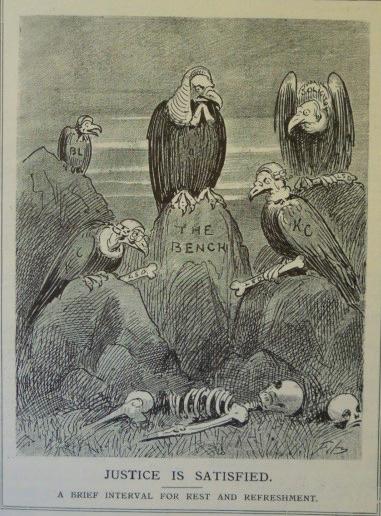
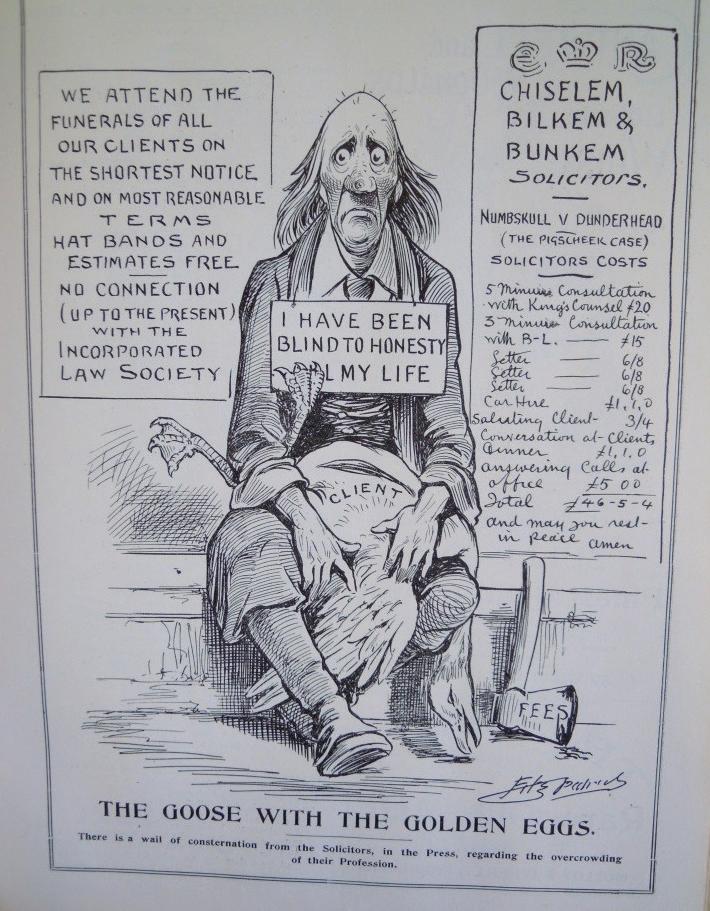
Two complementary cartoons that appeared in the Lepracaun in 1906 echo the outcome of the Jarndyce v. Jarndyce case. The first, entitled ‘Justice is satisfied’, depicts legal practitioners as vultures (Fig. 1). The other one, ‘The Goose with the Golden Eggs’, makes the same point – targeting solicitors specifically (Fig. 2). Note the name of the firm of solicitors, ‘Chiselem, Bilkem and Bunkem’. The Lepracaun was a humorous monthly magazine published between 1905 and 1915. Its proprietor and principal cartoonist was Thomas Fitzpatrick. These two cartoons were by him.
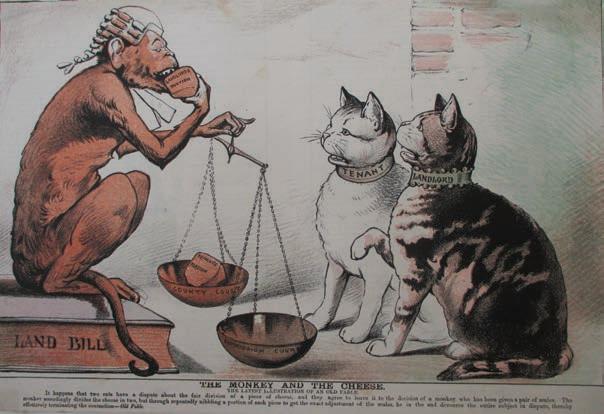
An earlier cartoon on similar lines, ‘The Monkey and the Cheese’ (Fig. 3), was published by another humorous magazine, Pat, in April 1881 when Gladstone’s second land act – Land Law (Ireland) Act, 1881 – was going through the Westminster parliament.
In a dispute between two cats, representing a landlord and his tenant, it is the legal monkey who devours the spoils. The cartoon is subtitled ‘The Latest Illustration of an Old Fable’.
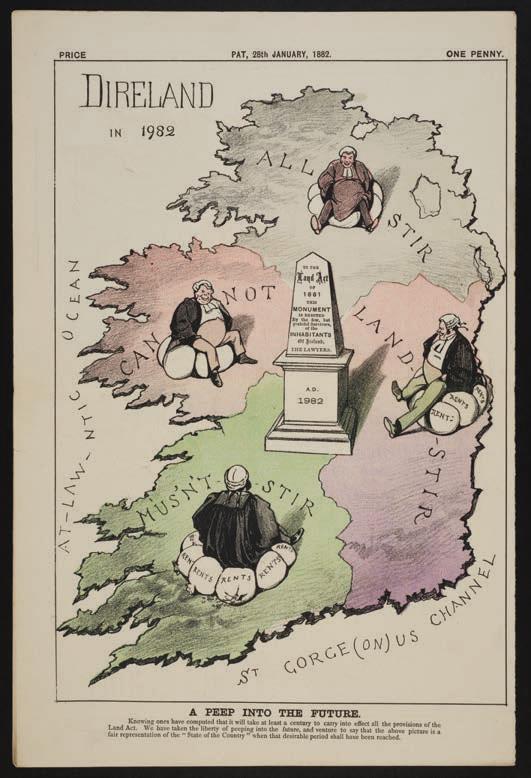
Gladstone’s 1881 land act was an attempt to address some of the causes of the Land War that had erupted in Ireland in 1879. It gave power to civil bill courts to fix rents (termed ‘judicial rents’), with provision for referral to a land commission to appeal the judicial rents. The act was seen as creating endless possibilities for legal wrangling – a bonanza for lawyers. Accordingly, in January 1882 Pat took ‘A Peep into the Future’ with a cartoon of Ireland a hundred years later, with the lawyers so rich that they have displaced the old landlords as proprietors of the land and are sitting comfortably on their rents (Fig. 4). The Atlantic Ocean has become the AT-LAW-NTIC, and St George’s Channel the GORGE-ON-US Channel – and Ireland is DIRELAND.
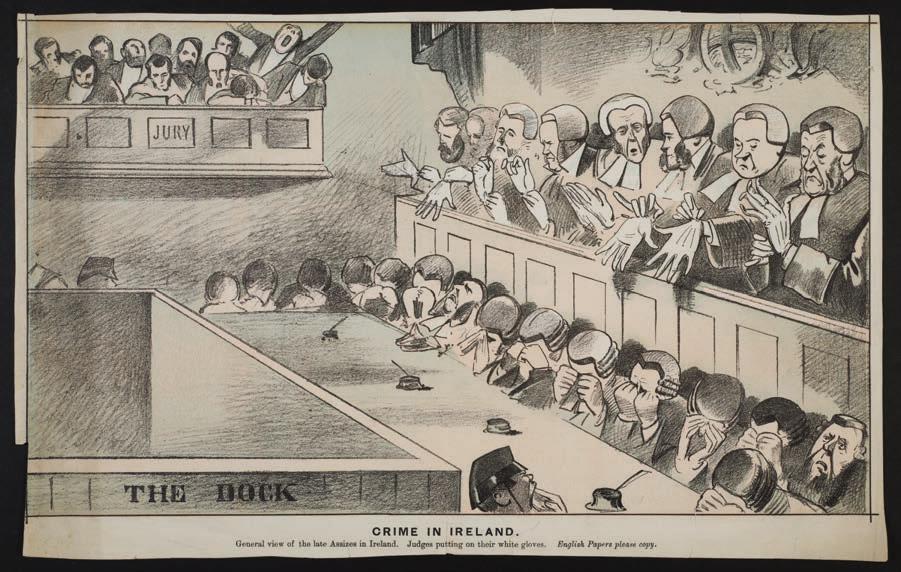
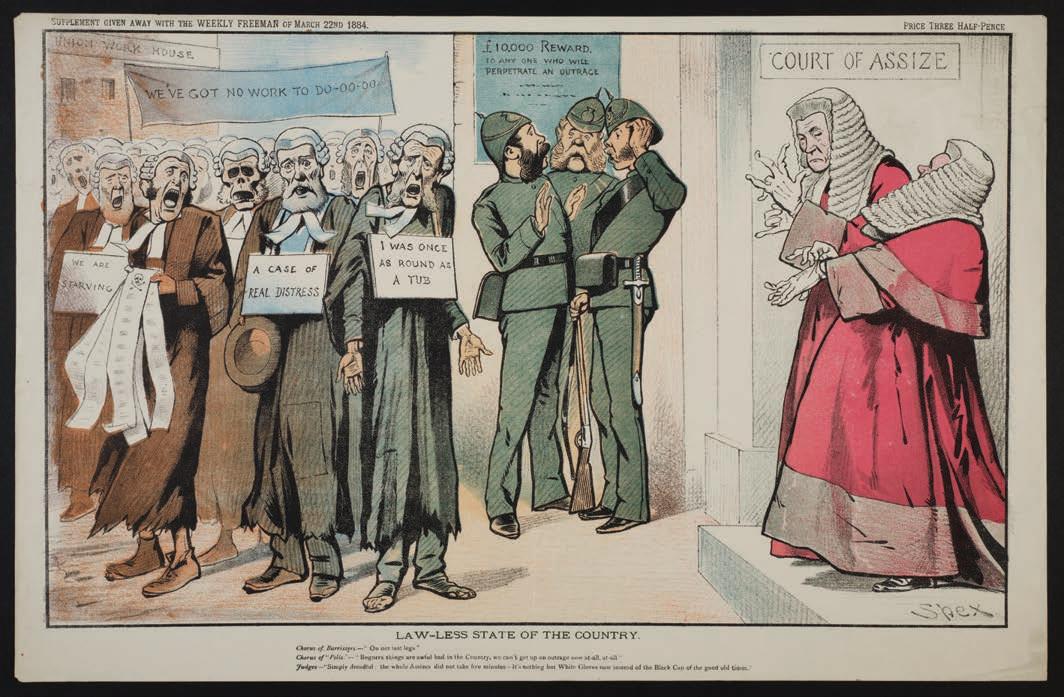
It seems that remarkably little crime came before the courts in Ireland in the 1880s – as noted in a Pat cartoon, ‘Crime in Ireland’, dated 29 July 1880 (Fig. 5). The judges are putting on white gloves – the convention being that, when there were no cases to be tried by jury, the judge was presented with a pair of white gloves. The lawyers are crying because of the loss of business. Likewise, in 1884 a cartoon ironically entitled ‘Law-less State of the Country’ published in the Weekly Freeman mocked the plight of lawyers
without work: one of them – a skeletal figure – claims that he ‘was once as round as a tub’ (Fig. 6).
That Weekly Freeman cartoon is by ‘Spex’, the pseudonym of John Fergus O’Hea – described by L.P. Curtis Jr, the American historian who pioneered the study of Irish cartoons, as ‘among the finest political cartoonists of the Victorian era’. His best work is the series of colour cartoons he contributed to the Weekly Freeman in the 1880s. The Weekly Freeman was a weekly compendium edition of the Freeman’s Journal, the principal nationalist daily newspaper published in Dublin in the second half of the nineteenth century. It began publishing cartoons in 1880, thus introducing a satirical note into the newspaper press in Ireland for the first time. Previously, the publication of cartoons was limited to avowedly humorous magazines such as Pat
Dublin Opinion, published between 1922 and 1968, is generally acknowledged as Ireland’s most celebrated humorous magazine. It confined itself largely to lampooning politicians and the pretensions of Irish social life. Some areas, such as the law and religion, were outof-bounds – not fair game for satire. This reticence about the law – evident in other contemporary publications too – was largely because of the danger of being held in contempt of court. As Judge Mary Kotsonouris has written, contempt of court issues were particularly sensitive in the early days of the newly-independent Irish state. Given the distrust of the legal system under the old regime, it was all the more important that the
Felix M Larkin is a historian and retired public servant who has written extensively about the history of the press in Ireland
Figure 2: Thomas Fitzpatrick, ‘The goose with the golden eggs’ The Lepracaun, Jan. 1906
Figure 1: Thomas Fitzpatrick, ‘Justice is satisfied’, The Lepracaun, Jan. 1906
Figure 3: ‘The monkey and the cheese’, Pat, 30 April 1881
administration of justice in the new dispensation should be accorded obedience and respect. The courts insisted on that, and this influenced press coverage. Kotsonouris adds: ‘History was to show that the difficulties encountered in this area are common in post-colonial societies, where it may have been one’s patriotic duty [in the past] to disobey the law.’
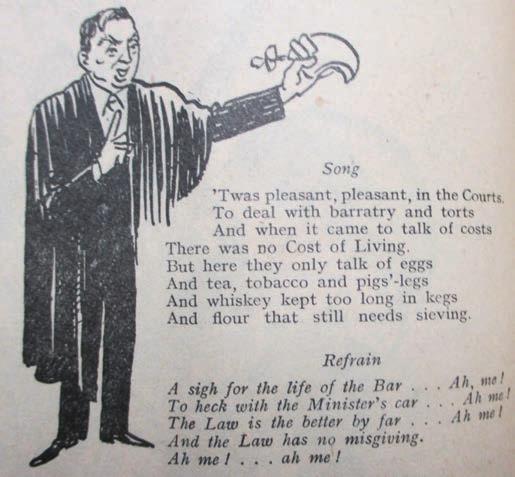
When politics and the law overlapped, however, there was some scope for Dublin Opinion to pronounce on legal matters. It thus portrayed John A. Costello as the ‘Reluctant Taoiseach’ long before David McCullagh called him that in his 2011 biography. As Charles Lysaght has recently written, Costello was ‘unique among all Irish heads of government in not being primarily a politician’. He was one of the most successful practitioners at the Bar in his time and a cartoon in Dublin Opinion in December 1955, during his second term as Taoiseach, shows him hankering after the lucrative legal practice that he had previously enjoyed; he clearly cannot wait to get the lawyer’s wig back on his head (Fig. 7). The accompanying verse is entitled ‘Costello’s lament for the days that were’:
’Twas pleasant, pleasant, in the Courts
To deal with barratry and torts
And when it came to talk of costs
There was no Cost of Living
But here they only talk of eggs
And tea, tobacco and pigs’ legs...
A sigh for the life of the Bar
To heck with the Minister’s car
The Law is the better by far...
Dublin Opinion virtually monopolised cartooning in Ireland during its years of publication. When it ceased in 1968, there was no successor magazine. Martyn
Figure 5: ‘Crime in Ireland’, Pat, 29 July 1880
Figure 4: ‘Direland in 1982: a peep into the future’, Pat, 28 Jan. 1882
Turner’s cartoons in the Irish Times filled the vacuum. He was employed by the Irish Times as its first full-time cartoonist in 1976 and happily is still on the job fifty years later. In the words of Terence Brown, his ‘politically acute cartoons ... add to the newspaper’s reputation for sharply expressed and hard-hitting commentary’.
The huge number of lawyers acting in relation to the various tribunals of inquiry established in Ireland in recent years, and the fees earned by them, have prompted some of Turner’s most mordant cartoons. For example, Turner referred to the Flood tribunal – the tribunal of inquiry into planning scandals, initially under Mr Justice Flood – in a cartoon published in 1999. He adopts a biblical motif suggested by the judge’s name. The cartoon evokes the Great Flood in the Book of Genesis, with a multiplicity of lawyers entering Noah’s ark two by two; and Turner opines that, with all those lawyers on board, ‘this thing isn’t going to go anywhere’ (Fig. 8).
The Moriarty tribunal that investigated the financial affairs of Charles Haughey and Michael Lowry likewise inspired a Turner cartoon in 2006. The lawyer in this cartoon thanks Haughey for the fees he is receiving by echoing Haughey’s alleged words of thanks to Ben Dunne for the money he gave him; whereas Haughey was reported as having addressed Dunne as ‘big fella’, the lawyer addresses Haughey as ‘little fella’ (Fig. 9).
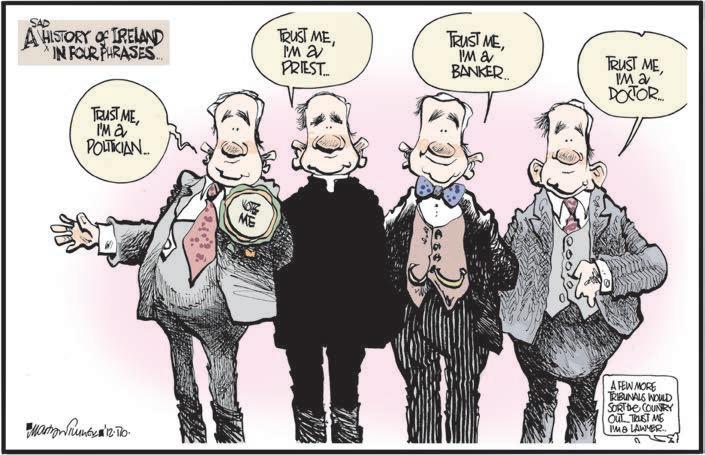
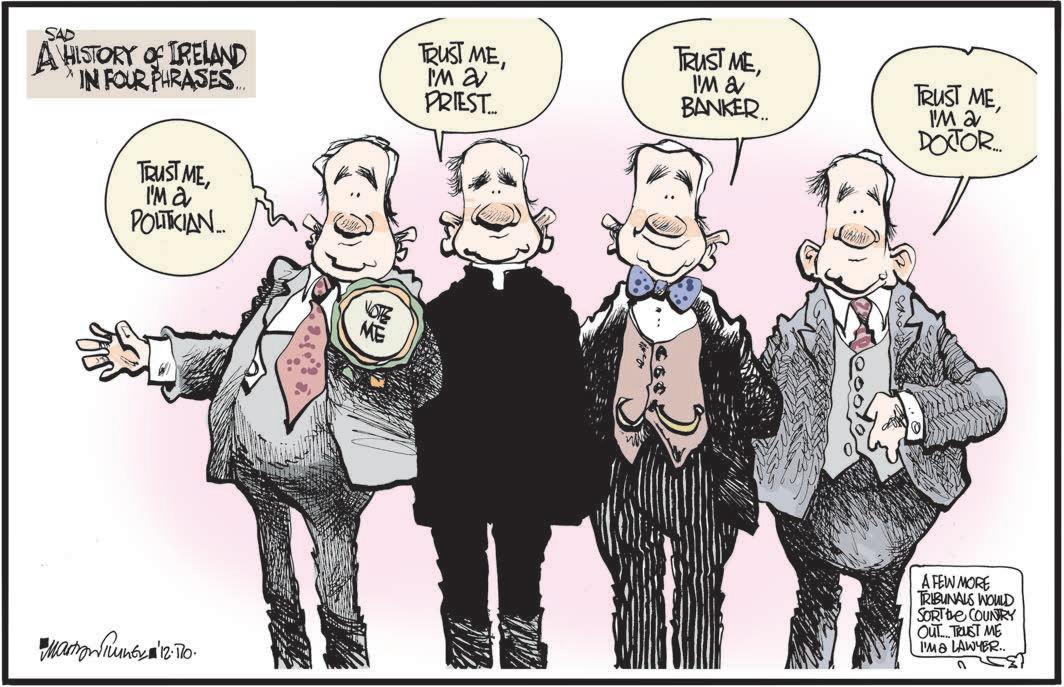
Turner’s doubts about tribunals – specifically, his disgust at the fees earned by lawyers at the tribunals – are reflected more generally in a cartoon from 2012 entitled ‘A sad history of Ireland in four phrases’. It alludes to the collapse of confidence in so many pillars of Irish society
Figure 6: John Fergus O’Hea (‘Spex’), ‘Law-less state of the country’, Weekly Freeman, 22 Mar. 1884
Figure 7: ‘Costello’s lament’, Dublin Opinion, December 1955
(Fig. 10). The four figures in the cartoon – politician, priest, banker and doctor – ask the Irish people to ‘trust me’ despite the fact that each one represents a discredited part of the Irish establishment. Redemption is offered tongue-in-cheek in an aside, as follows: ‘A few more tribunals would sort the country out ... Trust me, I’m a lawyer’.
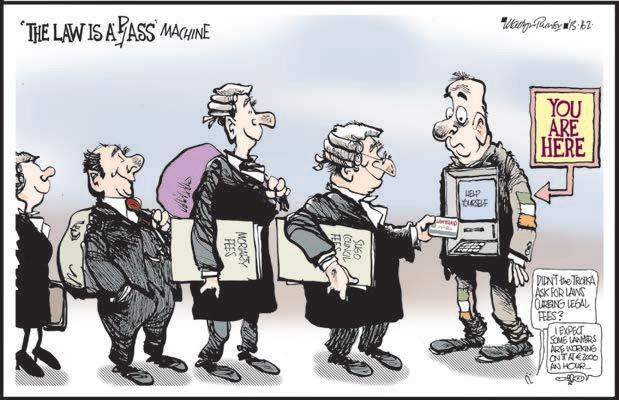
Turner’s relentlessly negative view of the law and lawyers is further exemplified by a cartoon published in 2013 suggesting that ‘the law is a Pass machine’, a pseudo-ATM by which legal practitioners extract money from the rest of us (Fig. 11). This is a play on the idea that ‘the law is an ass’, a phrase that appears in another of Charles Dickens’s novels. When, in Oliver Twist, a particular aspect of law is explained to Mr Bumble, he responds as follows: ‘If the law supposes that ... the law is a ass – a idiot’ (sic). It is a measure of the constancy of the legal world that Dickens’s themes in Oliver Twist and Bleak House are still the staple of cartoons that we enjoy today.
Figure 9: Martyn Turner, ‘Thanks, little fella’, Irish Times, 2006
Figure 10: Martyn Turner, ‘A sad history of Ireland in four phrases’, Irish Times, 23 Nov. 2012
Figure 11: Martyn Turner, ‘The law is a Pass machine’, Irish Times, 13 Nov. 2013
Supporting the Legal Aid Board and providing greater access to justice
A once in a generation opportunity to reshape access to justice - can we save the Legal Aid system in Ireland before it is too late? Keith Walsh looks at the creation of civil legal aid in Ireland and compares the recent proposals for reform contained in the Majority and Minority Reports of the Civil Legal Aid Review. He highlights the DSBA submissions which support the Legal Aid Board and call for the immediate resourcing of much-needed changes as those currently denied legal aid cannot be made to wait any longer for justice
In 1977 the Pringle Committee, chaired by Judge Pringle and including solicitor Brian Gallagher, recommended establishing a system of civil legal aid and advice in Ireland. Nothing more happened until on 9 October 1979, when the European Court of Human rights ruled that Ireland was in breach of Article 6 of the European Convention on Human Rights because it failed to provide legal assistance to Mrs. Josie Airey who was trying to get a judicial separation. A limited civil legal aid and advice was then very quickly put in place by the government. This Civil Legal Aid Scheme was put on a statutory footing with the commencement of the Civil Legal Aid Act 1995 on 11th October 1996. No substantive review of civil legal aid then took place until the Chief Justice’s Working Group on Access to Justice was established in January 2021 which in turn led to the setting up of the Review Group on the Civil Legal Aid Scheme which was chaired by former Chief Justice Frank Clarke and which included former DSBA President Áine Hynes in June 2022. Following extensive consultation, including taking detailed submissions from the DSBA and many other stakeholders, the Review Group’s Reports were published in July 2025, one being a Majority Report and the other being a Minority Report.
Both the Majority and Minority Reports agreed on a number of points, namely that the system of civil legal aid was in crisis and on the need for a user-centred approach and early intervention. But the Majority and Minority Reports present different solutions on Civil Legal Aid and have a fundamentally different approach to the scale of financial reform required, the role of mediation, and the structural governance of the system.
Comparison of the Recommendations of the Majority and Minority Reports
• Core Framework and Philosophy
The Majority Report proposes a four-stage framework consisting of (1) Public Information & Outreach, (2) Triage, (3) Basic Intervention Services (free), and (4) Advanced Intervention Services (paid/ eligibility-tested) and emphasises a “reimagined landscape” that diverts non-complex issues away from courts.
The Minority Report criticises the Majority Report as “wholly inadequate” and constrained by an unnecessary “overemphasis on limited resources”. It advocates for a new “Civil Legal Assistance (Access to Justice) Act” that treats access to justice as a fundamental right and vital public service, akin to health or education.
• Financial Eligibility and Contributions
The Majority Report recommends an immediate increase in the available income threshold from €18,000 to €23,500 and proposes increasing allowances for dependents and accommodation (raising the latter to €13,100). While it raises the floor for paying contributions to €14,500, it retains the requirement for most users.
The Minority Report argues that the Majority Report’s proposed threshold will still leave net-income earners on the minimum wage ineligible and calls for a minimum threshold of €30,000 and the total abolition of contributions, except as part of a “tapering” system to avoid cliff edges.
• Scope and Quasi-Judicial Fora (Tribunals)
The Majority Report recommends removing the blanket ban on legal representation before quasijudicial fora (like the WRC or RTB), but only based on the complexity of the case or where a legal requirement arises.
The Minority Report seeks the complete removal of all blanket exemptions (including defamation and land disputes), arguing they are likely contrary to European law and warns that the MR’s “complexity” requirement could actually reduce the scope of existing legal advice and ignores that the standard of justice in bodies like the WRC cannot be lower than in courts.
Keith Walsh is editor of the Parchment and contributed to the DSBA submissions on Civil Legal Aid reform in 2023, 2026
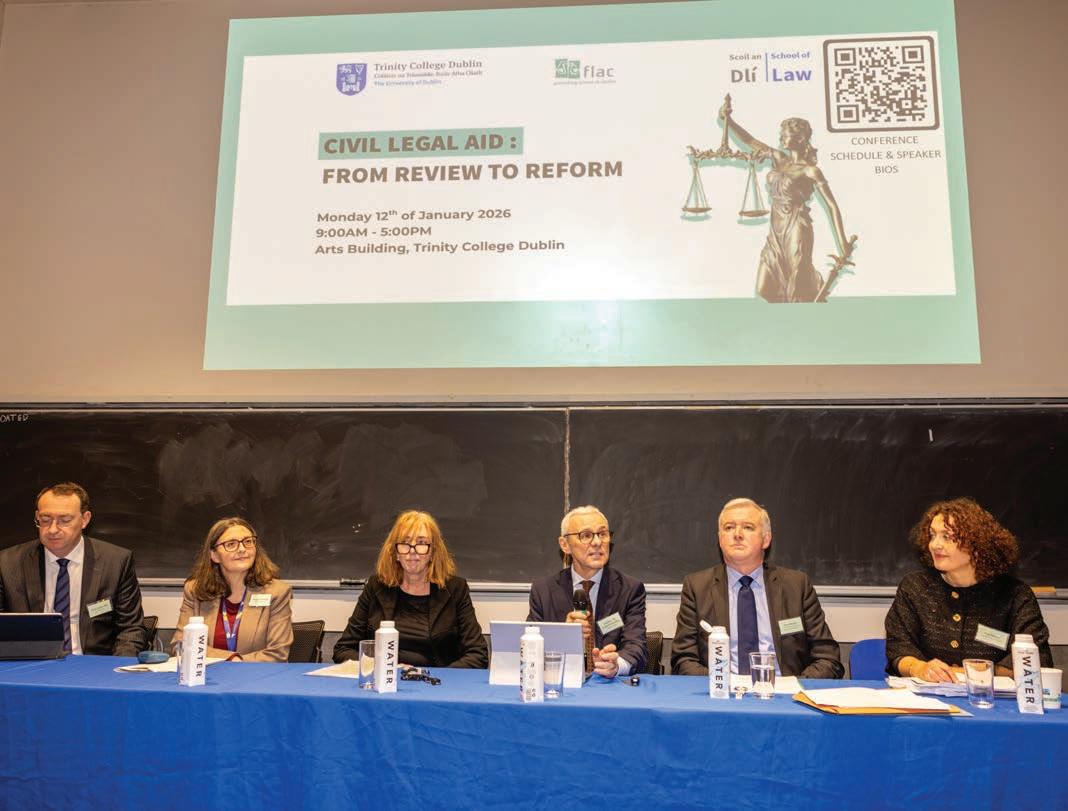
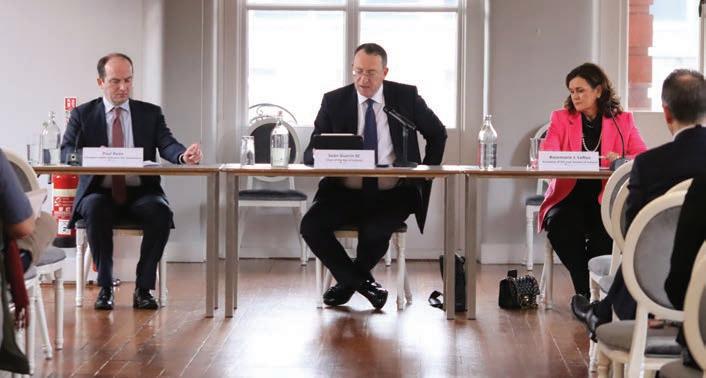
Sean Guerin, Chair of the Bar of Ireland, Angela Denning, CEO of the Courts Service, Nuala Egan SC, Chair of the Legal Aid Board, Judge Colin Daly, Liam Herrick, Chief Commissioner of the Irish Human Rights and Equality Commission, Siun Hurley, Chair Law Society Child and Family Law Committee pictured at recent FLAC Civil Legal Aid Conference
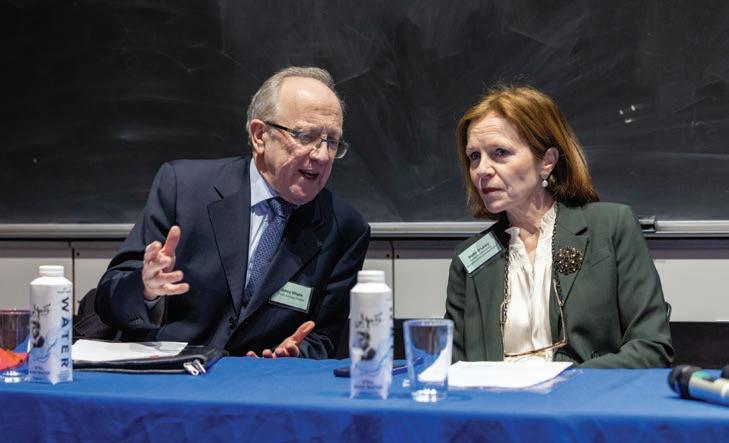
Professor Gerry Whyte of Trinity College and Siofra O’Leary, former president of the European Court of Human Rights pictured at recent FLAC Civil Legal Aid Conference
We have waited nearly 50 years for a successor to the Pringle Report and we may yet wait years before either Civil Legal Aid Report is implemented
• Mediation and Early Intervention
The Majority Report puts mediation at the centre of the new system, encouraging it as a primary resolution mechanism to reduce court costs and hearings.
The Minority Report expresses concern over an “overreliance on mediation”, arguing it should never be the “preferred model” of dispute resolution and warns that diverting disadvantaged people away from formal adjudication could create a two-tier justice system.
• Governance and Delivery
The Majority Report recommends establishing a new statutory Legal Aid Oversight Body to ensure consistency and quality across various providers.
The Minority Report questions the need for a third statutory body, suggesting it adds an unnecessary administrative layer. It instead favours a reformed Legal Aid Board with explicit executive powers and a state-funded national network of Community Law Centres in deprived areas.
• Resourcing the Legal Aid Board (LAB)
The Majority Report recommends a review of the LAB’s capacity to recruit and retain staff, including an examination of solicitor salaries and practitioner fees.
The Minority Report demands immediate action: LAB solicitor salaries should be brought in line with other state lawyers (e.g., CSSO, DPP), and fees for private practitioner panels should be increased to the levels seen in the mental health legal aid scheme to prevent “legal aid deserts”.
The DSBA made extensive submissions to the Review of the Civil Legal Aid Scheme in January 2023 and again after the publication of the two Reports
in July 2025 made further submissions to the Joint Oireachtas Committee on Justice who conducted hearings on the Review of Civil Legal Aid and to the Minister for Justice in 2026. These submissions, which support some of the recommendations of the Majority Report and of the Minority Report point out that without proper and immediate resourcing of the Legal Aid Board and the Private Practitioner Scheme the system is likely to decline further. The DSBA also confirmed their solidarity with the staff of the Legal Aid Board who do excellent work under the most trying of conditions.
Those currently denied legal aid cannot be made to wait any longer for justice
Notwithstanding the publication of the Reports in July 2025 and the Joint Oireachtas Committee’s hearings in February 2026, nothing has happened. We have waited nearly 50 years for a successor to the Pringle Report and we may yet wait years before either Civil Legal Aid Report is implemented. This is unacceptable.
Professor Michael Zander of the LSE wrote in response to the Pringle Committee’s Report on Civil Legal Aid and Advice: “The Irish authorities cannot be said to be rushing things in having set up a committee to inquire into the problem of civil legal aid.”
Zander went on to quote a member of the Pringle Committee, Mr. C.K. McGrath of the Department of Finance, who dissented from the main findings of the Report on the grounds that “no sufficient case had been made out for such a scheme and that it was more likely to benefit the lawyers than the public”. While this is still the prevailing view, Eilis Barry of FLAC took this misunderstanding on when saying the Joint Oireachtas Committee in February 2026:
“ We need to reject the entrenched cliché that legal aid is just ‘more money for lawyers’. It is vital to stress that there is research into whole different range of legal aid systems which shows that for every euro spent on access to justice there will be savings and benefits for individuals, communities, the courts and society. This has been firmly established by OECD and World Bank research. Access to justice is, and has to be regarded as, an investment, and a vital public service akin to healthcare and education. Given the imminent risk of collapse of legal aid services, it is alarming that the Minister and his Department have not yet provided any timeline for when they will respond fully to the Civil Legal Aid Review or introduce reforms in this area. As the Chief Justice pointed out at the recent civil legal aid conference, the pace of change is ‘frustratingly slow.’”
The DSBA in its recent submissions concluded:
“The DSBA views the publication of the two Civil Legal Aid Reports in 2025 as a once in a generation opportunity to reshape access to justice, for those who need it most, for the better. However, the reform of the civil legal aid system will not be capable of effective implementation without resources, operational independence and support for the Legal Aid Board. To paraphrase the Chief Justice Donal O’Donnell when he spoke at the FLAC conference on Civil Legal Aid on 12th January 2026 – let us hope this is the last submission we write about implementing the Civil Legal Aid Reports.
“It is time to move to making the system better, we have plenty of ways of doing it. It is time for decisions and resources. Those currently denied legal aid cannot be made to wait any longer for justice.”
Chief Justice Donal O’Donnell and Minister for Justice Jim O’Callaghan pictured at recent FLAC Civil Legal Aid Conference
Collegiality and the Quiet Strength of the Rule of Law - President’s
Reflection
DSBA President Paul Ryan reflects on the importance of the DSBA’s role in fostering relationships, providing spaces for meeting and dialogue, and reminding ourselves that the law is ultimately sustained by people, by their conduct, their integrity and their willingness to uphold shared values
The Dublin Solicitors Bar Association was founded on a simple but enduring principle that the strength of our legal system depends not only on rules and institutions, but on relationships of respect, trust and open exchange between all who work within it. The Association exists to connect solicitors with one another and with the wider legal community, and to foster the professional culture that allows the system to function effectively.
Working within the legal system every day, our labour can sometimes feel routine, embedded in procedure, precedent and habit. Yet we all know how quickly a day can move from administrative detail to decisions of real consequence. As one colleague recently observed to me, as lawyers we move, often without pause, between the routine and the spectacular.
In a working environment that is increasingly fast-paced, digitised and fragmented, opportunities for meaningful professional engagement matter more than ever. The pressures of practice are real. Maintaining a culture of professional respect and open dialogue supports not only the functioning of the system but also our own resilience and well-being.
In law, unlike many professions, today’s opponent is tomorrow’s collaborator, and sometimes even next year’s judge. The profession works because we all conduct ourselves as though we will meet again, which, invariably, we do. That reality encourages a particular discipline in how we practise. But there is also a deeper dimension to this.
Collegiality is not merely about courtesy and social niceties. It is a professional standard. It requires restraint where tempers might otherwise flare, clarity where misunderstanding might take hold, and mutual respect even in disagreement. It strengthens advocacy, improves negotiation, and ultimately serves the interests of clients and the administration of justice. It supports sound decision-making and helps maintain the standards on which confidence in the system depends.
At a broader level, collegiality contributes to something larger than professional harmony. It
underpins a high-trust society, where institutions function efficiently because those within them are presumed to act honestly, competently and in good faith. The legal profession plays a central role in maintaining that trust.
We are living through a period of significant global disruption. Long-standing assumptions about the predictability of a rules-based order have been challenged. It has long been apparent that international law and global rules are not always applied evenly, that power can exempt itself when convenient, and that enforcement may depend on who is accused and who is harmed. For a time, this uneasy reality was tolerated in the belief that it served the purposes of, amongst other things, stability, trade and security. That accommodation now appears increasingly strained.
The language and conduct of powerful actors inevitably shape international norms and, in time, influence domestic discourse and public behaviour. This matters because respect for the rule of law does not exist in isolation. It is affected by tone, by example, and by the degree to which institutions are trusted. When established orders appear optional elsewhere, sustaining confidence at home becomes more challenging.
Against that backdrop, the resilience of our own civic system becomes all the more apparent, and all the more valuable. The rule of law here is not sustained by slogans but by daily practice, by independence of judgment, adherence to principle and a legal culture that values fairness, humanity and equitable reasoning.
It is reinforced by shared standards of professional conduct that ensure disagreement remains principled, negotiation remains respectful, and authority is exercised with legitimacy.
Collegiality is central to that framework. It is one of the quiet but essential conditions that allow the rule of law to function in practice rather than merely in theory.
The DSBA’s role is a modest but important one, to foster relationships, to provide spaces for meeting and dialogue, and to remind ourselves that the law is ultimately sustained by people, by their conduct, their integrity and their willingness to uphold shared values.
In uncertain times, that commitment matters. It deserves to be renewed, and it deserves to be shared.
Paul Ryan is DSBA President
The DSBA logo
DSBA President Paul Ryan investigates how the DSBA logo was created and finds that the creator of the Parchment, Justin McKenna, was also the brains behind the DSBA logo
The DSBA logo, a symbol of the Dublin legal community, was created during Justin McKenna’s DSBA presidential year of office in 1986.
The DSBA Council of the time decided that the Association needed a distinctive and professional logo, that would represent the Association’s values and capture the essence of the DSBA in a single, memorable graphic. Until then, the only other insignia associated with the DSBA was the one featured on the DSBA Presidential Chain of Office, a representation of the Dublin City Coat of Arms.
The Council held a competition to find the best design, with an incentive of a prize of £1,000 (Punts) generously sponsored by Louis Copeland & Son. The resulting logo is a striking emblem rich in local symbolism, merging elements of Dublin’s civic identity with symbols embodying the ideals of the solicitors profession.
The Castles: The logo incorporates the three castles from the Dublin City Coat of Arms, grounding the Association in its city of origin and heritage.
The Torch: Three overlapping castles form a stylised representation of the “Torch of Justice” symbolising the pursuit of truth, knowledge, and the principles of law.
The Abstract Initials: A clever piece of abstract design is found within the red flames themselves, where the letters D-S-B-A are subtly spelled out, a detail often unrecognised by casual observers.
The logo can be in white lettering on a background of Dublin Blue, or in blue lettering on a white background.
This enduring logo has remained a distinctive identifier for the Dublin Solicitors Bar Association since its adoption.
Today, the logo appears across the Association. It features in the Parchment magazine, on our website, in our seminar packs, our precedent documents and official correspondence.
As part of the benefits of membership, firms and individual members may also display a tailored DSBA membership logo on their firm’s website or in their email signatures and correspondence, signalling their connection to Ireland’s largest bar association. Members who would like to obtain a copy of the membership logo are warmly invited to contact the DSBA office (anna@dsba.ie) for a copy. P
Dublin Solicitors Bar Association, Unit 206, The Capel Building, Mary’s Abbey, Dublin 7, Ireland. Tel: E-Mail: info@dsba.ie • Update your personal details online at: www.dsba.ie
Tel: 01 670 6089 • E-Mail: info@dsba.ie • Update your personal details online at:
Registration of Deeds and Title Acts – Annotations and Commentary
Former DSBA President and author Susan Martin reviews Professor Wylie’s latest volume Registration of Deeds and Title Act
There is much to be said for the book that provides long-form prose and academic treatise that traces the doctrinal development of complex areas of law. Our system of land registration, for example, is historically layered and conceptually dense. Understanding how we arrived at the present structure often illuminates how it operates in practice. For the student, and indeed for the reflective practitioner, there is real value in that depth. Practice, however, is not conducted in the abstract. It is conducted under time pressure, with files to move, undertakings to discharge and transactions to close. In military practice there is a clear distinction between doctrine and what is known as a tactical aide (‘Tac-Aid’). Doctrine may be expansive, theoretical and aspirational. It explains principles, philosophy and the evolution of thinking. A Tac-Aid, by contrast, is designed for execution, in real time, on the battlefield. It distils essential rules, sequences and decision points into a format that can be used in real time. It does not outline the history of the principle; it tells the operator what to check, what to do next, and what matters most. It is structured, authoritative and built for reliability rather than reflection.
A Tac-Aid is not a simplification in any pejorative sense. It presupposes mastery. Its economy derives from disciplined selection. It identifies what is critical and omits what is merely interesting. In highconsequence environments, that clarity really matters.
In writing Registration of Deeds and Title Acts, Professor J.C.W. Wylie has produced the legal equivalent of such an instrument. The work does not seek to replicate the broader doctrinal surveys of land law with which his name is long associated. Instead, it concentrates on the operative statutory framework governing registration of deeds and title, providing structured annotation and focused commentary on the relevant Acts. The statutory text is set out section by section, with careful cross-reference to amendments, judicial interpretation and related legislation. The emphasis throughout is on utility.
For the practitioner, that structure matters. Questions arising in conveyancing practice rarely concern theory in isolation; they concern the proper construction of a particular section, the interaction between provisions, or the effect of legislation. The value of this work lies in its ability to guide the reader swiftly to the relevant statutory footing and to provide concise, authoritative explanation. It is a book designed to be consulted and to act as a reference, not merely read. Its practical value is particularly evident when responding to queries from Tailte Éireann, including issues arising on first registration. Take, for example, a query as to why a mortgage should be registered on first registration. A review of the commentary under S.34 of the Registration of Title Act 1964 highlights the statutory obligation to enter on the register all burdens appearing on examination of freehold title [the commentary helpfully notes that S.41 provides detail on what should be registered on leasehold title]. Professor Wylie in the commentary links that provision directly to S.69, which identifies the categories of burdens capable of registration. The commentary to S.69 then provides a detailed analysis of those burdens, supported by judicial authority, and clarifies the distinction between burdens registrable under S.69 and those affecting registered land by virtue of S.72. The commentary makes clear how the relevant provisions operate together and enables the practitioner to respond with precision and confidence.
One enhancement for future editions might be the inclusion of a thematic index in addition to the section-by-section structure. While the work is organised around the statutory provisions, practitioners often need to approach a problem conceptually rather than by reference to the legislation. An index enabling the reader to search by reference to key concepts; for example, “freehold”, “easements” or “mortgage”, and directing them to the relevant statutory sections and commentary would strengthen its utility.
This book will prove invaluable to solicitors practising in conveyancing, barristers advising on title, those working within the registration system, and judges dealing with property disputes. It is a practical and authoritative guide to the statutory regime governing registration of deeds and title.
Susan Martin is principal of Martin Solicitors She is a former President of the DSBA
JCW Wylie
Civil Procedure in the Circuit Court (Fourth Edition)
Karl Dowling BL and Susan Martin
DSBA Council member Marcus Hanahoe reviews Civil Procedure in the Circuit Court
In an era where AI tools are advancing at extraordinary speed, while simultaneously producing material of increasingly questionable reliability, the value of authoritative, carefully crafted legal writing has never been more apparent.
In the face of this tsunami of algorithmically generated text, generated at practically no cost, and with few editorial safeguards, the ability to hold in one’s hand the physical embodiment of years of meticulous legal research, written by experts, and grounded in primary sources, provides a level of reassurance that no algorithm can replicate on a screen.
The fourth edition of Civil Procedure in the Circuit Court, authored by Karl Dowling BL and Susan Martin, Solicitor, exemplifies that reassurance. Written by well-established, highly regarded practitioners, their expertise permeates every chapter and their experience and precision is evident on every page.
There is an often cited maxim that good advocacy is reason delivered with force. But reason must be built upon a foundation of credibility, which Dowling and Martin provide the reader, and likely advocate, with in spades. The book offers a comprehensive and authoritative analysis of civil practice and procedure highlighting the interaction of relevant legislation, and practice directions, complemented by reported and unreported judgments, with extensive commentary.
The authors clearly establish their book’s worth through rigour, depth, and professional competence guiding the reader through Circuit Court’s complex, and dynamic, mechanics in a structured and accessible manner with impeccable indexing and citations drawing on an impressive variety of sources that allows the reader to move forward, and backwards, through the volume as their needs require.
The timing of this fourth edition is notable, arriving at a moment of significant proposed change represented by the government’s draft bill on civillaw reform. The government’s ongoing efforts to expand the jurisdiction of the Circuit Court mean that practitioners will be dealing with an ever-broadening range of hearings, motions and applications within this forum, and subject to these rules. Understanding the nuances and particularities of Circuit Court procedure will only grow in importance, especially as court
attitudes to delays harden, and AI accelerates turnaround expectations, intensifying the pace of legal work.
Of particular interest to probate practitioners is the book’s analysis of the relatively newly introduced Circuit Court probate jurisdiction, following the commencement of section 47 of the Civil Liability Act 2004, which took effect in 2017, and a new chapter devoted to the Assisted Decision-Making (Capacity) Act 2015.
In the years ahead, a practitioner’s ability to access, interpret, and cite high-quality sources may be what distinguishes them from anyone armed merely with a laptop and a chatbot. In such a scenario, Civil Procedure in the Circuit Court emerges as a timely and indispensable resource.
Indeed, in an ironic echo of another era, a copy of this book displayed on a practitioner’s shelf may serve as a quiet declaration of adaptability and competence, much as the arrival of the desktop computer did two decades ago.
In short, this book offers not only insight but also a dependable foundation for practice, an invaluable asset at a time when reliable legal authority is both more necessary and more contested than ever.
Marcus Hanahoe is a member of the DSBA Council and solicitor with M.E. Hanahoe Solicitors
Essential addition to the toolkit of practitioners and judges
Keith Walsh reviews Irish Capacity Law and Assisted Decision- Making, written by former DSBA President Áine Hynes and published by Bloomsbury Professional in March 2026
While Tony Blair is famous for saying ‘we’re all middle class now’, a variation of this phrase came to mind when reviewing this book, ‘we’re all capacity lawyers now’ as there is almost no area of Irish law that is untouched by the changes made in the Assisted Decision-Making (Capacity) Act 2015, and most of us need to be aware of the implications of this Act for our own areas of practice. Áine Hynes’ book provides an ideal means of understanding and applying the 2015 Act to all areas of practice. While it is an invaluable guide to applications under the 2015 Act, it is not confined to applications but provides a much broader view of Irish Capacity Law and Assisted Decision-Making taking into account the history of this area of law as well as considering legislation, caselaw, precedent documentation from other jurisdictions and the UK in particular.
The commencement of most of the Assisted Decision-Making (Capacity) Act 2015 on 26th April 2023 represented one of the seismic changes in Irish law this century and the greatest change in mental health law since the introduction of the Lunacy Regulation (Ireland) Act 1871 over 150 years ago. The area of mental health law was shamefully neglected by legislators for most of the twentieth century and it was only the need for Ireland to ratify the UN Convention on the Rights of Persons with Disabilities that compelled implementation of much needed changes. The Law Reform Commission consultation paper on Vulnerable Adults and the Law: Capacity in 2005, followed by its Report in 2006, promoted positive change in this area. Other mental health legislation such as the Mental Health Act 2001 was not implemented
until late 2006. Legislative change came very slowly, in part due to the complexity of this area of law as well as the significance and depth of the consequences of changing how we deal with mental health and capacity and the need for not only new laws but a new way of thinking and dealing with mental capacity.
We have been fortunate that Áine Hynes has been involved in mental health law since the early 2000s, advising a range of those involved in this area, appearing before and then chairing Mental Health Tribunals, appearing before the High Court in many of the leading wardship and capacity cases, often without counsel. She was one of the venerable group who were among the first solicitors appointed Senior Counsel for her work in this area. It is no exaggeration to say that she is the pre-eminent solicitor working in mental health and capacity law. She also took the lead in educating her fellow solicitors and calling for change as chair of the DSBA’s Mental Health and Capacity committee, the Mental Health Lawyers Association and the Mental Health and Capacity Law Taskforce of the Law Society. In short there is no solicitor more qualified to write this much needed book on Irish Capacity Law and Assisted Decision-Making.
Áine Hynes brings this practical experience and expertise to bear in her clear and straightforward approach to explaining how the 2015 Act works in practice. One example of the level of knowledge and practical experience applied in this book is Chapter 6 on Capacity Assessments, where Hynes examines section 3 of the 2015 Act which deals with capacity and introduced the ‘functional’ approach, then looks at the old ‘status’ approach to assessing capacity, contrasts how the common law dealt with these approaches, highlights the case law in this area, much of it from England and Wales which recognised that there were different levels of capacity required depending on the nature of the decision to be made. She then examines litigation capacity and a relevant UK Supreme Court case of Dunhill from 2011 which dealt with whether a settlement agreement could be set aside based on the alleged lack of litigation capacity at the time.
Hynes finds that this case ‘adds some nuance to this [functional] test’ and sets out the test devised by the UK Supreme Court to decide whether a person lacks capacity to conduct legal proceedings and the consequences if legal proceedings are compromised without it being recognised that one of the parties lacked that capacity. This is only one small element of detail and guidance on capacity in this particular chapter.
When referring to this book to seek an answer to a practical problem, as I have done numerous times since I received it, the reader is struck by the identification and concise analysis of the case law Hynes has included, even in relatively new areas such as discharge from wardship. Another noteworthy contribution of this book is how well Hynes explains the opaque world of inherent jurisdiction (capacity) in the High Court in the context of deprivation of liberty and describes the current procedure in the High Court list as well as the principles set down in the recent case law. As someone who appears in this list, I was astounded by the clarity with which this area was described and it is of immediate practical application.
The book is divided into two parts. Part One deals with the legal framework before the introduction of the 2015 Act as well as legal capacity matters which are not covered by the 2015 Act. The areas covered are EPAs under the 1996 Act, the Wardship Jurisdiction and Procedure, Medical Treatment and the Capacity to Consent, Deprivation of liberty safeguards: the Irish legal position.
The real meat of the book and where most practitioners will be focused is in Part Two which examines the Assisted Decision-Making (Capacity) Act 2015 detailing the impetus for change, capacity assessments, discharge of wards from wardship, supported decision making arrangements, Circuit Court applications, Court declarations and appointment of Decision-Making Representatives, EPAs, Advance Healthcare Directives, Director of the Decision Support Service, Detention Matters,
Convention on the International Protection of Adults and miscellaneous matters.
While the appendices are full of useful documents, I must highlight the first one which is the UK Official Solicitor and Public Trustee Form to assess whether a party has capacity to conduct proceedings. As Hynes says ‘while this document relies upon the provisions of the England and Wales Mental Capacity Act 2005, it is a very useful tool. It can be modified by practitioners in this jurisdiction when they are seeking the assistance of a medical practitioner in assessing whether or not a person has litigation capacity or whether they require the assistance of a litigation friend such as a guardian ad litem’.
In the words of Barniville P. contained in the foreword to this volume:
“This is an excellent book which should be essential reading for all practitioners and judges who work in the areas of capacity and assisted decision-making. There will be very few practitioners and judges who have not already encountered these issues in their work. This book will greatly enhance their understanding of the complex and legal issues which arise in this most sensitive but intellectually and professionally rewarding area of work. This book is an essential addition to the toolkit of practitioners and judges and deserves a place on their bookshelves (real and virtual) alongside some of the other recent publications in this area.”
Sandra Mulvey, Bloomsbury Professional, and author Áine Hynes SC
Photo: Cian Redmond
DSBA –Our Benefits
The Dublin Solicitors Bar Association (“DSBA”) is the largest bar association in Ireland, having been established in 1935. It is a representational and not a regulatory organisation, existing to promote the welfare and interests of its members who are solicitors. The DSBA aims to promote a vibrant and up-to-date
profession and collegiality amongst solicitors. The DSBA offers the following benefits to members:
DSBA CPD Events – Preferential rates for members for top quality CPD [Continuing Professional Development] events held all year round. The DSBA is committed to providing a series of
conferences and seminars in the next 12
to meet the
DSBA Precedents – Precedent publications area available on topics including solicitors’ partnerships, residential tenancies, share purchase and sale agreements and family law and separation agreements. All of these are in constant and daily use by practitioners.
DSBA Parchment Magazine – Our award-winning quarterly magazine which will keep you up to date with the profession and practice.
DSBA Sports Events – Golf, tag rugby, soccer, cricket, tennis – events to promote collegiality and friendship amongst solicitors.
DSBA Social Events – Events for solicitors throughout the year and our notto-be-missed annual conference.
DSBA Submissions – Our committees and council work hard to represent solicitors and their interests; there is a current DSBA taskforce on the Legal Services Regulation Act.
The Consult a Colleague Helpline is available to confidentially assist every member of the profession nationwide with any problem whether personal or professional free of charge. The volunteers on the panel who provide the service are all solicitors of considerable experience, www.consultacolleague.ie.
DSBA Younger Members’ Committee represents the interests, both professionally and socially, of the younger and most recently qualified members of our profession, from newly qualified up to five years PQE. The Younger Members’ Committee of the DSBA organises low-cost CPD events, lectures and other events for young solicitors.
DSBA Management Tools such as – CORT – Computerised Objections and Requisitions on Title.
DSBA Website – www.dsba.ie. See our regularly updated website for information on all of the above.
For renewal and new membership please complete the form (right) in full and return it together with a cheque/bank draft/ postal order for the appropriate fee to Maura Smith, DSBA, Unit 206, The Capel Building, Mary’s Abbey, Dublin 7; DX 200206 Capel Building or call 01 6706089 to pay by credit/debit card.
GROUP MEMBERSHIP FEE 2026
One member
€115
2nd to 5th members €110 each
6th to 10th members €105 each
11th to 20th members €100 each
21st to 50th members €90 each
51st to 100th members €85 each
101st to 150p members €80 each
151 plus members €75 each
Firm name:
Phone
Year admitted to the roll:
Enclosed please find *cheque/bank draft/postal order for € for * new membership/renewal
Attorney General launches Susan Martin and Karl Dowling’s 4th edition of Circuit Court Practice and Procedure
Law Society President Rosemarie Loftus, solicitors, barristers and judges came from near and far for the recent launch of this new book by Susan Martins. Speakers included the Attorney General, President of the Law Society Rosemarie Loftus and the authors
Speaking at the launch of Civil Procedure in the Circuit Court by Susan Martin and Karl Dowling BL on 26th February 2026, the Attorney General Rossa Fanning SC said:
“I would like to begin by congratulating the authors, my colleague Karl Dowling, a highly accomplished barrister with an acknowledged speciality in equity, wills and estates, who has now laboured away at four editions of this work, each one incrementally improved, and the irrepressible Susan Martin, a solicitor who I have got to know P
well in recent years and who makes an enormous contribution to the legal profession generally, quite apart from this work, in her leadership roles as a recent former President of the DSBA and as a Member of the Council of the Law Society.
“It is simultaneously comprehensive, erudite and practical. It is organised in an intuitively sensible thematic fashion and it draws from the Rules of Court, relevant case-law and the invaluable practical experience of the authors as experienced practitioners.”
Attorney General Rossa Fanning SC, Susan Martin, Karl Dowling B.L. and President of the Law Society Rosemarie Loftus enjoy some book banter
Photography: Cian Redmond
Left: Distinguished guests listen to the speakers Far left: President of the Law Society Rosemarie Loftus pays tribute to the authors Susan Martin and Karl Dowling
Left: Proud authors Susan Martin and Karl Dowling B.L. Far left: Director General Mark Garrett and Rory O’Boyle listen attentively
Right: Brian Hunt, Head of Policy, Law Society, Brian McMullin solicitor, Susan Martin, Paul Keane solicitor
Far right: The irrepressible Susan Martin
Right: Sheriff John O’Malley, Graham Kenny, Brian McMullin, Shane Coyle, Judge Watkin
Far right: Karl Dowling in conversation with Catherine Duggan
B.L. and Clodagh O’Hagan
Below: Guests enjoying
row only L- R: Caoimhe Gleeson, Hilda Claire O’Shea, David Stafford, Leonora Mullett, Joan Doran, John Neville, Mark Fenton, Aine’s husband Simon Walsh
Attorney General launches
Aine Hynes’ Irish Capacity Law and Assisted Decision-Making
Solicitors, barristers and judges came from near and far for the recent launch of this new book by Áine Hynes. Speakers included the Attorney General, Valerie Peart, Sandra Buckley of publishers Bloomsbury Professional, the President of the High Court and the author herself
Speaking at the launch of Irish Capacity Law and Assisted Decision-Making by Áine Hynes SC, former DSBA President, the Attorney General Rossa Fanning SC said:
“The practising legal profession owes Áine a debt of gratitude for her willingness to share her vast knowledge and experience of the law in this important area of legal practice with the profession as a whole. This publication is of course only part of Áine’s very significant contribution to the legal profession.”
“I reiterate my congratulations to Áine on this very fine book which will be an essential purchase for all practitioners in the field and which I am very confident will have the success that it richly deserves.”
President of the High Court David Barniville, Áine Hynes, Attorney General Rossa Fanning SC
the speeches, front
Photography: Cian Redmond
Left: Valentina Brezeanu, Lisa Baranescu and Joan Doran Far left: Valerie Peart
Left: Paddy McClean makes a point to Hilda Claire O’Shea Far left: Sandra Mulvey, General Manager and Publisher Bloomsbury Professional
Right: Mark Fenton, Gary Lee Far right: Supreme Court Judge Séamus Woulfe and Áine Hynes
Right: Niall Farrell Far right: Niamh Ni Mhurchu gets a signed copy
Southern Law Association Annual Dinner
Southern Law Association Annual Dinner Friday 27th February 2026 in the Maryborough Hotel Cork, attended by DSBA President Paul Ryan.
In the group photo are (L to R):
Ciaran O’Tuama, President The Insurance Institute of Cork; Rob Horgan, President The Cork Chamber; Rosemary Loftus,
President Law Society of Ireland; Jonathan Lynam, President Southern Law Association; Leona McDonald, President Waterford Law Society; Paul Ryan, President DSBA.
Bar of Ireland Conference
Bar of Ireland’s “New Practitioners Programme Conference” on the 30th January 2026 at the Richmond Education and Event Centre.
The event was chaired by the Chair of the Bar of Ireland Seán Guerin S.C., and the other speaker was the President of the Law Society of Ireland Rosemarie Loftus.
DSBA President Paul Ryan spoke on the topic, “Building Relationships with Solicitors.” In his remarks he focused on the practical realities for barristers in building strong, professional relationships with solicitors at the outset of practice. He emphasised the importance of responsiveness, reliability and clear communication, particularly given that solicitors operate at the client interface and carry responsibility for managing expectations and timelines.
He spoke about the value of commercially focused, solution-driven advice, rather than purely academic analysis, and the importance of flagging issues early and managing difficulties constructively.
Above all, the theme was partnership; solicitors and barristers working collaboratively, with mutual respect and shared responsibility, to deliver effective
outcomes for clients and uphold the standards of the profession.
Paul also took part in the Panel Discussion and Q&A.
Paul Ryan, President DSBA, Sean Guerin, SC Chair of Bar of Ireland and Rosemary Loftus, President of the Law Society
Law Society Dinner
Dinner in honour of John Geary
Dinner 5th January last in honour of John Geary - outgoing editor of the Parchment
Annual John Buckley Memorial Cricket Match
Friday 26th June at 6pm in Leinster Cricket Club.
Áine Hynes, Kevin O’Higgins, Stuart Gilhooley, Keith Walsh, Patrick Longworth, John Geary, Julie Doyle, Joe O’Malley, Paul Ryan, Joan Doran and Killian Morris
The Annual John Buckley Memorial Cricket Match between the DSBA and the Bar will take place on
DSBA President Paul Ryan and Honorary Secretary Eimear O’Doherty at the Law Society dinner for Presidents and Secretaries of Bar Associations around the country on 19th March, hosted by Law Society President Rosemarie Loftus
Ciaran Mandal and Owen Henson
Tony O’Sullivan, Suzanne Bainton and Michelle McLoughlin presented their papers and Clodagh O’Hagan chaired the DSBA in-person seminar on New Dawn For New Builds, a Residential Property Update on Thursday 22nd January 2026 in the Radisson, Blu Royal Hotel, Golden Lane, Dublin 8.
Demand was high for this seminar and delegates found every available seating space to listen to Tony speak on the new Combined Building Contract for sale, Suzanne giving an update on current MUDs practice and Michelle speaking on residential property taxes update.
Left: Ronan O’Reilly, Maria McDonagh and Michael Crowley Far left: DSBA
President Paul Ryan and Tony O’Sullivan
Left: DSBA President Paul Ryan, Nuala Eustace and Aisling Mahon Far left: Denise Dockery and Aine Gleeson
Right: Emma Fleming, Elaine O’Connor and Clodagh O’Hagan Far right: Spanner O’Malley catches up on the Parchment
Left: Suzanne Bainton, DSBA President Paul Ryan, Tony O’Sullivan, Michelle McLoughlin and Clodagh O’Hagan
Photography: Mark Harrison
Left: Marion Sweeney and John O’Malley Far left: Brendan Cunnane and Kelly O’Hara
Left: Jackie Buckley and Roisin Bennett Far left: Aileen Cosgrove and Sinead Duffy
Right: DSBA President Paul Ryan Far right: Speaker Suzanne Bainton
Right: Anna Healy and Martin Ceillier Far right: Joe Thomas and Tony O’Sullivan
Dublin’s southside solicitors turned out in force at this year’s Southside Dublin Solicitors Dinner held on 30th January 2026
DSBA President Paul Ryan was an honoured guest as well as distinguished judges and counsel including Mr. Justice Michael Quinn of the High Court and Judge David Kennedy and Judge Anne Watkin. Former Law Society Director General Ken Murphy and his wife Yvonne enjoyed the evening and Senior Counsel Mary Jo Butler, Maurice Dockrell B.L. and Oisin Crotty B.L. were some of the representatives of the Bar of Ireland who attended.
Left: DSBA President Paul Ryan and Mary Cawley Far left: Sharyn Coughlan, Judge Anne Watkin, Justin McKenna, and Maire Leddy
Left: Eamonn Carney, Tony Canny, Caroline O’Connor and Stefan O’Connor Far left: Yvonne Chapman and Ken Murphy
Right: Pearse Mehigan and Peter Boylan stay up past their bedtimes to attend Southside Solicitors Dinner Far right: Marie Leddy and Olivia McCann
Left: Megija Upmale, Cian Duddy, Shauna Byrne, Joan Doran and Jack Meehan
Photography: Mark Harrison
Left: John Babb, Paul Ryan and Diego Galllagher Far left: Linda Smith and Lisa Tyndall
Left: Caroline O’Connor, Stefan O’Connor and Paul Ryan Far left: Cian Duddy with Megija Upmale
Right: Janet Caroll, Luke Caroll and Ken Byrne Far right: Kevin O’Higgins Jnr, Michael Quinn and Kevin Higgins
Right: Janet Carroll and colleagues Far right: Louise Clarke and Clare Murphy
Left: Kristian Douglas BL, Graham Fettig, Mary Jo Butler SC, Oisin Crotty BL Far left: Mary Cawley and Mary Swords
Left: Michael Moran, Greg Ryan and Maurice Dockrell BL Far left: Judge
David Kennedy and Sharon McKenna
Right: Jane Babb, Fiona McHenry and Nessa Canny
Far right: Katherine Butterly, John Babb and Diego Gallagher