Dublin Economic Monitor
KBC/ESRI CONSUMER SENTIMENT
RISING ECONOMIC ACTIVITY
DRIVES IMPROVEMENTS IN DUBLIN’S LABOUR MARKET
By Bryan Coughlan, Policy Analyst, Fingal County Council.


KBC/ESRI CONSUMER SENTIMENT
RISING ECONOMIC ACTIVITY
DRIVES IMPROVEMENTS IN DUBLIN’S LABOUR MARKET
By Bryan Coughlan, Policy Analyst, Fingal County Council.
Dublin's unemployment rate dipped to a 9-year low of 6.1% in Q2 2017.
Residential rents in Dublin returned to strong levels of growth in Q2 2017 as average rents reached new peaks.
Residential property prices rose to a 9-year high with YoY growth rates exceeding 11% in both June and July.
Public transport trips continued to grow strongly to reach a new peak of over 52 million passenger journeys in Q2 2017.
Passenger arrivals at Dublin Airport maintained upward momentum in Q2 2017 on the back of greater connectivity to other international destinations.
Housing completions in Dublin increased to over 540 in May 2017 and will be expected to rise further on the back of greater levels of housing commencements.
The Dublin MARKIT PMI
Dublin PMI data showed sustained expansions in business activity in Q3 2017, led mainly by the construction sector.
Dublin KBC/ESRI
Consumer sentiment in Dublin climbed in Q3 2017, driven by positivity around the economy and rising expectations regarding employment prospects and the future economic situation.
The Dublin Economic Monitor is a joint initiative on behalf of the four Dublin Local Authorities, co-ordinated by the City Council. The Dublin Region (four Dublin local authorities combined) plays an increasingly important role in the economy of Ireland and it is important that its performance is properly tracked. The Monitor is designed to be of particular interest to those living and doing business in Dublin or considering locating here. It is produced by DKM Economic Consultants, with KBC/ ESRI delivering the Dublin consumer sentiment data and IHS MARKIT delivering the Dublin Purchasing Managers’ Index (PMI).
Successive iterations of the Monitor have presented a summary of various published rankings of Dublin’s performance in a
comparative international context (page 9) and this quarter shows a broadly positive movement in our international reputation. In this edition we delve a little deeper to take a look at some of the economic factors driving this performance. Fingal’s Bryan Coughlan assesses Dublin’s competitiveness across a range of metrics and comparator cities (page 12).
You can sign up to our quarterly mailing list and access the Monitor online at www.dublineconomy.ie.
We hope you find the Monitor useful and welcome any feedback to info@leo.dublincity.ie. The next release will be published online on 25th January 2018. Interactive charts from the Monitor are available on the Dublin dashboard www.dublindashboard.ie.
This document provides general information on the Dublin economy. It is not intended to be used as a basis for any particular course of action or as a substitute for financial advice. The document is produced independently by DKM Economic Consultants; the views and opinions expressed are those of the relevant author, and do not necessarily reflect the views of the Dublin Local Authorities. The Dublin Local Authorities disclaim all liability in connection with any action that may be taken in reliance of this document, and for any error, deficiency, flaw or omission contained in it.
The global economy strengthened over the first half of 2017, driven by improved investment, trade and industrial production. Growth of 3.6% is expected for this year as rising domestic demand in advanced economies and China is supported by improved performances in developing economies.
The Eurozone and emerging European countries have experienced higher than expected growth in early 2017 and this is a most positive development from an Irish perspective, particularly in light of Brexit. Accommodative monetary conditions have supported the recovery in the Eurozone along with improved global trade patterns, though low inflation is a persistent issue.
Supportive monetary conditions are also seen as important to the performance of the US economy which is forecasted to grow by 2.2% in 2017. The domestic demand factors of investment and private consumption are expected to be to the fore, but a deepening
euro: sterling exchange rate
€1.35
€1.30
€1.25
€1.20
€1.15
€1.10
€1.05
lack of clarity over fiscal policies from the Trump administration is a cause of considerable uncertainty.
The UK’s economy is the notable black spot in an Irish context, with economic growth forecasted to reach a weaker than expected level of 1.7% in 2017. Softening private consumption is a decisive factor, and this has resulted from rising inflation driven by the depreciation of the pound (see chart). Uncertainty surrounding the UK’s future trade, migration and financial services arrangements are also considered to be weights on the country’s potential economic growth in the medium term as Brexit negotiations continue.
Budget 2018 has dominated the Irish economic landscape in recent weeks and yet did not ultimately produce any seismic policy shifts. The Government introduced marginal reductions in income taxation and increases in health, social welfare and capital expenditure which consumed the majority of the available ‘fiscal space’ of approximately €1.2 billion. Revenue measures to fund these expansions primarily came from a threefold increase in commercial stamp duty from 2% to 6%, along with a range of other measures including reduced mortgage interest relief.
The Budget was based on economic forecasts which estimated that Irish GDP would grow by over 4% in 2017, before slowing to 3.5% in 2018. This would suggest that the Irish economic recovery is now in a mature phase with growth rates in private consumption, government expenditure and exports slowing following a number of years of exceptional growth.
The National Accounts for Q2 2017 were in line with these forecasts, and showed that the Irish economy continued to grow at robust rates in the first half of the year. Personal consumption, although down QoQ as a result of a reported fall off in second-hand car purchases, did increase by 1.7% YoY in Q2 2017 and was supported by a 2.1% YoY increase in Government spending. An improvement in net exports was also recorded, and these factors more than offset a decrease in investment (-8.8% YoY) which has been significantly affected by movements of Intellectual Property into Ireland in recent years.
The Dublin unemployment rate continued on a downward trajectory in Q2 2017 to reach a nine-year low of 6.1%. This was 1.4 percentage points (pp) below the same quarter in 2016 and underlined the significant ongoing progress which is being made in job creation across the capital. Unsurprisingly, the construction sector has led employment growth in Dublin in recent quarters, with high levels of office construction and rising house building levels feeding through to employment. The sector now employs over 36,000 workers which is roughly midway between the extremes of the trough in 2013 (17,800) and the peak in 2008 (59,700).
In a related context to the improving labour market, demand for office space remains very high in the capital. According to CBRE, the Dublin office vacancy rate stood at 6.2% in Q3 2017 while average rents remained at peak levels. Of great significance is the Grade A office vacancy rate of 2.6% in Dublin 2/4 which is extremely low, and could prove problematic for high-end firms looking to expand or establish in the city. However, it will be expected that the high levels of office construction occurring in Dublin 2/4 at present will at least partially offset this low vacancy rate in the medium term.
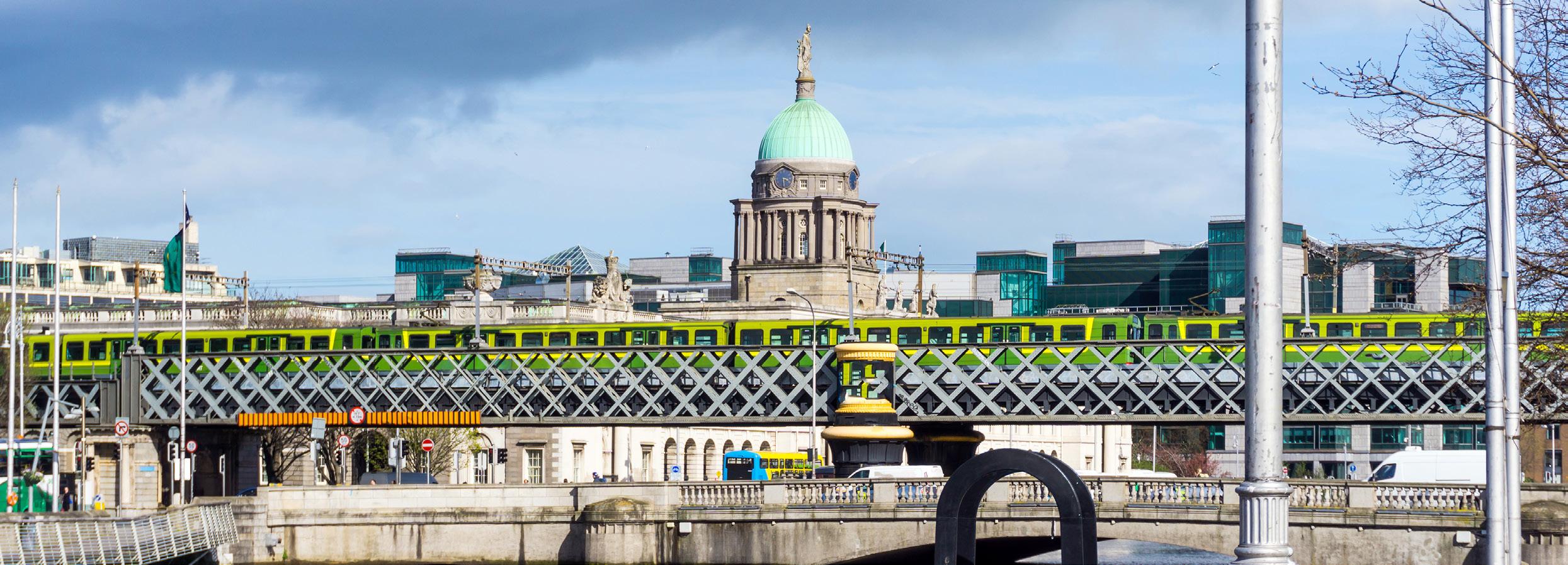
Dublin’s public transport system continues to show strong levels of growth with over 52 million passengers using the service in Q2 2017. This was a new peak in the series and represented a YoY increase of 2.6 million trips or 5.3%.
Passenger trips on the Luas in particular are expected to increase by up to 10 million per annum from December 2017 onwards with the opening of the Luas Cross City which will link Broombridge and St. Stephen’s Green, completing a project which was commenced in 2013. Such passenger growth would represent close to a 30% increase on the total passenger journeys recorded on the Luas in 2016 (34.2 million). The project, which will cost an estimated €368 million, will also connect the heretofore separate Green and Red Luas lines.
Throughput volumes at Dublin Port have continued to climb in recent quarters in spite of international uncertainty and the
depreciation of sterling. The Port handled over nine million tonnes of throughput for the first time in Q2 2017, with strong QoQ import growth (which is likely linked to the weakness of sterling) supported by a more modest expansion in exports.
Positive trends in the Dublin labour market are cited as key drivers to further increases in consumer sentiment levels in Q3 2017, according to KBC/ESRI. Austin Hughes, Chief Economist at KBC Bank Ireland, notes:
“Dublin consumer sentiment saw a strong improvement as the persistence of healthy trends in activity and employment eased earlier fears of a sharp Brexit related slowdown. This increased confidence was also reflected in a marked upgrade of the buying climate by Dublin consumers that should help underpin consumer spending in the capital.”
Dublin’s IHS Markit Purchasing Managers’ Index (PMI) for Q3 2017 also showed positive signs with business activity continuing to expand at a robust pace. Andrew Harker, Senior Economist at IHS Markit, explains:
“The Dublin private sector economy continued to grow strongly during the third quarter of 2017, supported by sharp rises in new work. There was a welcome pick-up in the rate of job creation following a slowdown in Q2, with firms increasingly willing to take on extra staff in line with higher workloads. The capital’s economy, therefore, looks in good shape to end the year on a positive note. All three monitored sectors saw output expand, with the construction sector again the best performer. Growth outside of Dublin also remained strong in Q3, highlighting the broad-based nature of the current upturn.”
source: cso qnhs seasonally adjusted BY DKM..
Dublin's seasonally adjusted unemployment rate declined by 0.3 percentage points (pp) QoQ in Q2 2017 to stand at a nine-year low of 6.1%. This was 1.4pp below the same quarter in 2016 and reflected improving labour market conditions in the capital where almost 10,000 jobs were created YoY. At the national level the unemployment rate has declined in each of the last six quarters to stand at 6.2% in Q2 2017. The small differential between the unemployment rates at the Dublin and national levels is a strong sign of a nationwide economic recovery.
Employment levels in Dublin rose at a modest rate in Q2 2017 with the construction sector driving growth on both a QoQ and YoY basis. Total employment increased at a seasonally adjusted rate of 1.5% YoY with the construction and public sectors recording the strongest growth rates at 21.7% and 3.6% YoY respectively. Industry recorded a YoY decline in employment levels but this was more than offset by the robust job creation in construction. Private sector services employment was broadly stable YoY.
sharp acceleration in property price growth
Residential property price growth accelerated sharply in Dublin in Q2 2017 as limited new supply continued to affect the market. YoY growth rates increased in each month in the quarter and reached 12.7% in July. This drove the property price index to 99.3 which is the highest point since early 2009. Double- digit YoY growth rates have also been recorded outside of Dublin in each of the last nine months as property prices continue to recover across much of the country.
source: rtb.
Residential rents in Dublin climbed to new peaks in Q2 2017, and more than offset decreases in average rents which occurred in Q1 2017. The average monthly rent for a Dublin house rose by 2.6% YoY to stand at €1,538 in the quarter. Average monthly rents for Dublin apartments increased at an even sharper rate of 6.8% YoY to reach €1,475. Outside the capital, average monthly rents increased by over 7% YoY but remain substantially below the equivalent rents in Dublin.
' 17
(sa)
source:
The supply of units to Dublin's housing market showed signs of significant progress in the second quarter of 2017 as both commencements and completions grew at strong rates. Housing commencements doubled YoY in each month between March and May with a seasonally adjusted combined total of over 2,500 units commencing. Completion levels grew at a a more modest rate with almost 1,400 houses (seasonally adjusted) being finished in the three-month period. This will be expected to rise further over the coming quarters as the increase in commencements feeds through to the market.
source: rtb.
city centre office rents climb to new peak
source: CBRE
Office rents in Dublin were broadly stable in Q3 2017, with the notable exception of Dublin city centre where rents increased by 1.2% QoQ and 5.6% YoY to reach the highest point on the index (115) since the series began in 2006. Office rents were flat across the other areas of the capital, with take-up reported to be weak following a very strong first half of 2017. Of the take-up recorded across Dublin in Q3, financial services (36%) and high tech firms (20%) accounted for the majority of new tenancies.
overall office vacancy rate falls in q3 2017
source: cbre.
The overall office vacancy rate in Dublin fell to 6.2% in Q3 2017, down 0.3 percentage points (pp) on the previous quarter. The most sizeable reduction in vacancy was recorded in the suburbs where the vacancy rate reduced by 1.7pp QoQ and 2.8pp YoY to stand just below 8%. Vacancy rates rose by 0.5pp and 0.6pp QoQ in Dublin City Centre and Dublin 2/4 respectively to stand at 5.1% and 5.6% in Q3.
passenger trips on public transport increase despite strike action
Dublin's public transport system recorded over 52 million passenger trips (seasonally adjusted) in the second quarter of 2017, despite strike action on Bus Eireann routes in April. This was the highest level recorded since the series began in 2010, and represented a substantial increase of 2.6 million trips or 5.3% YoY. Luas passenger trips will be expected to increase further from Q4 2017 onwards with the planned opening of the Luas Cross City connecting Broombridge and St. Stephen's Green in December.
dublin airport growth underpinned by gateway connectivity
Passenger arrivals at Dublin Airport remained close to 1.2 million (seasonally adjusted) in each month of Q2 2017, having reached a new peak of 1.23 million arrivals in March. YoY growth exceeded 4% in each month between April and June, continuing a sequence of consecutive months of YoY growth which stretches back to mid-2012. Dublin Airport has reported that one of the strongest drivers of growth this year has been passengers choosing the airport as a gateway to connect onwards to other international destinations.
quarterly port throughput exceeds 9m tonnes for first time
q2 ' 17
dublin port exports million tonnes (sa) 3.7 yoy change million tonnes (sa) +0.2
dublin port imports million tonnes (sa) 5.3 yoy change million tonnes (sa) +0.1
source: dublin port. seasonally adjusted by dkm.
note: imports and exports may not add to total throughput due to seasonal adjustment and rounding.
Throughput at Dublin Port increased by 3.9% YoY in Q2 2017 to exceed nine million tonnes (seasonally adjusted) for the first time, more than offsetting a minor decline in Q1. Imports, which account for the majority of throughput at the port, were the main driver, while an expansion in export activity was also recorded. The continued strong performance of Dublin Port is a major positive for the Dublin economy, especially in light of international uncertainty around Brexit.
room rates and occupancy remain high
Average Daily Rates (ADRs) for hotel rooms in Dublin continued to rise in Q3 2017 to stand at €139 (seasonally adjusted) in September. This was 8% or €10 above the equivalent ADR in September 2016. Market supply has been largely static across 2017 with few new hotel rooms coming on stream. Occupancy reached 82.4% in September 2017 and has also been largely stable across the year. Significant new supply is planned for the coming years in the capital and this will be expected to dampen occupancy rates long-term.
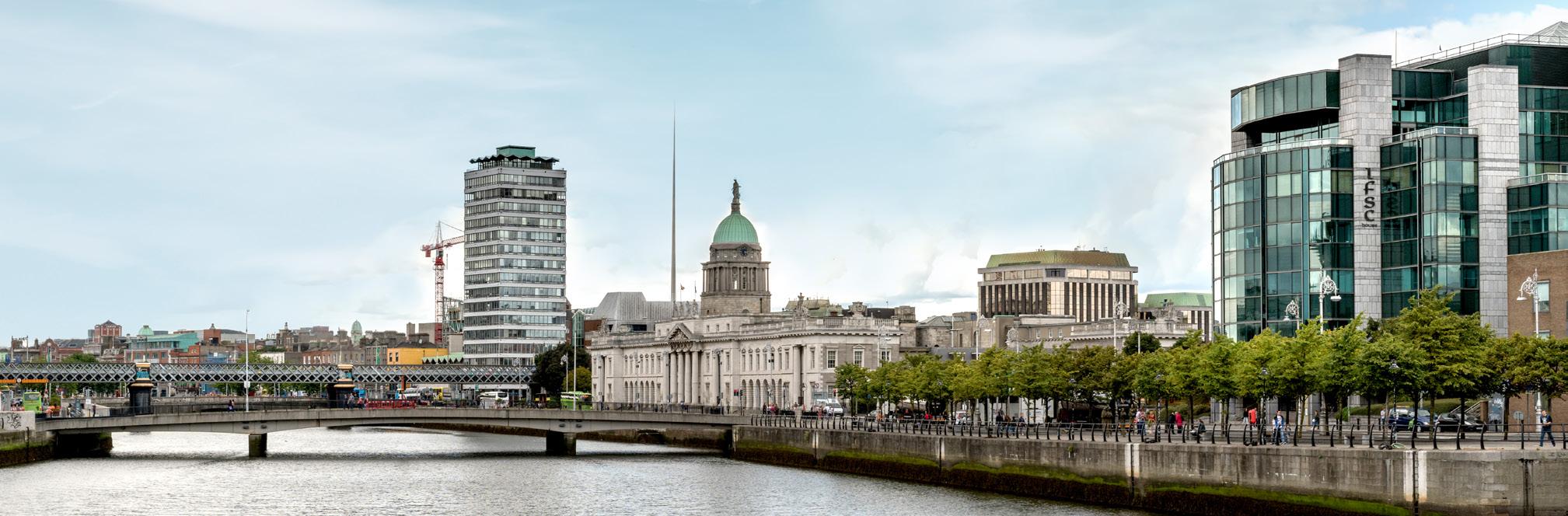
Internationally published benchmarks are a useful means of measuring a city’s performance relative to its peers, and recent indicators for Dublin confirm the city’s strong showing across a range of dimensions (see table below).
The benchmarks listed focus on a number of areas – attractiveness for FDI, the real estate market, quality and cost of living, business environment, university quality, start-up environment and tourism.
The Knight Frank Global Cities Report ranked Dublin at 13th out of 19 worldwide cities in terms of expense for businesses employing staff. The capital was ranked favourably compared to London but fell short of Frankfurt and Amsterdam with estimated annual wage and rental costs of €3.4 million per 100 staff. Declan O’Reilly, Director of Knight Frank in Dublin, highlighted how flexibility is vital to companies taking up office
space in Dublin, particularly in the tech sector:
“We are seeing the traditional 25year institutional lease of old giving way to more flexible terms of shorter duration. The drive for flexibility is also influencing occupier fit-out habits, with activity-based working and co-working culture set to take-off in a significant way. Lastly, tech employees are seeking the flexibility allowed by living close to work, which is driving demand for city centre apartment living.”
The 2018 Global Financial Centres Index also reflected Dublin’s strengthening global competitiveness as the capital moved up three places to 30th, and was named as one of 15 worldwide centres “likely to become more significant”.
In education, PitchBook maintained Trinity College Dublin’s ranking as Europe’s leading university for producing venture
capital-backed entrepreneurs from its undergraduate programmes. 216 alumni had successfully raised almost $2.4 billion in capital between 2006 and 2017, ensuring the university’s position at 48th in the world.
The capital’s reputation as a host for conferences was improved in 2017 according to the International Congresses and Conventions Association. Dublin ranked as the 13th most popular destination worldwide having hosted 118 international conferences in 2016. This represented an improvement of five places YoY.
Although Dublin performed strongly in many rankings, house price growth in Dublin was the 36th highest in the world in the 12 months to Q2 2017 according to Knight Frank. Price growth was weaker than in Toronto and Amsterdam but stronger than in the likes of New York and London, and this is an issue which is likely to have implications for the city’s competitiveness.
The overall Dublin Consumer Sentiment Index increased by 8.6 index points QoQ in Q3 2017 reflecting an increased positivity around the economy and improved expectations regarding the future economic situation and employment prospects. This was 9.0 index points above the level observed in Q3 2016. The pace of growth outside Dublin was slower in the quarter due to diverging perceptions regarding the current financial environment and future personal finances.
There was a further QoQ increase in the Dublin Index of Current Conditions of 6.8 index points in Q3 2017. The main driver was an improvement in the consumer sentiment particularly for large household purchases. There was also an increase in consumers reporting their personal financial situation had improved over the past year. This largely reflects improving domestic labour market conditions.
Dublin consumers’ views on the Irish economy improved considerably in Q3 2017, with the expectations data suggesting that the fears concerning last year’s UK referendum vote to leave the EU are somewhat dissipating. The continuing decline in the unemployment rate also appears to be feeding into more positive labour market prospects. Outside the Capital, overall expectations have increased but consumers are marginally more pessimistic about their future personal finances than in Dublin.

The third quarter of 2017 saw a further sharp increase in private sector output in Dublin. The Dublin PMI registered 57.9, down from 59.4 in Q2 but still well above the 50 no-change mark. Growth was again led by construction, but higher output was also seen in manufacturing and services.
New orders by businesses in Dublin rose strongly in the third quarter of 2017, with the rate of expansion not changing significantly from Q2. New business has increased continuously since Q4 2012. The expansion of new orders in Dublin was slightly faster than in the rest of Ireland.
Companies in Dublin continued to increase their staffing levels in Q3 2017. The rate of job creation was substantial, having picked up from the previous quarter. Dublin firms raised employment at a stronger pace than the rest of Ireland.
about The Dublin Purchasing Managers’ Index® (PMI) series is produced by IHS Markit Economics, an independent research company that produces highly-regarded surveys of business conditions in nations around the world www.markit.com



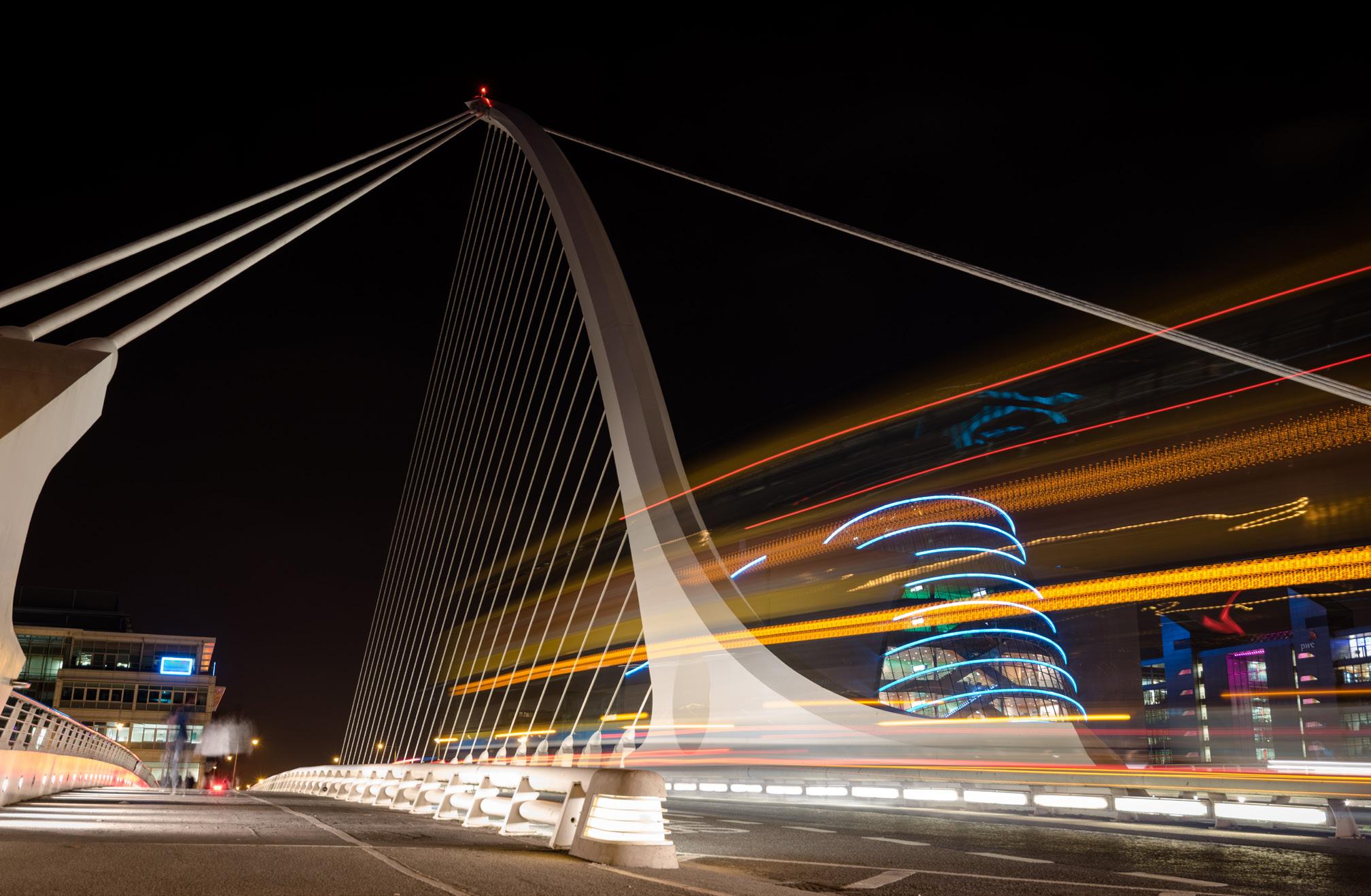

BY BRYAN COUGHLAN POLICY ANALYST, ECONOMIC, ENTERPRISE AND TOURISM DEVELOPMENT, FINGAL COUNTY COUNCIL
Following a number of years of difficult economic conditions, the Irish and Dublin economies have recovered to rank amongst the most competitive in Europe. Business costs in the capital remain relatively low, while the labour market has improved and contributed to high levels of value added per capita. The challenge for policymakers is to ensure that this competitiveness is maintained through the uncertain times which lie ahead.
an improving national picture
After dropping to 24th place in the IMD Competitiveness rankings in 2011, Ireland climbed again to 6th position this year, our highest placing since 2001. As the capital city, comprising 45% of the national economy, Dublin’s competitiveness warrants closer investigation within this overall picture. This article summarises some recent analysis by Fingal County Council which considers the region’s competitiveness in a comparative international context.
ireland's imd competitiveness ranking, 2000 - 2017
employment and productivity
Dublin has experienced steady productivity growth over the past number of years. Of comparator cities included in this analysis, only two had higher gross value added per capita in 2016 and while a portion of this can be accounted for by issues affecting Ireland’s GDP measurement, the divergence between Ireland’s productivity growth and that of the EU has been evident from the late 1990s1.
Gross value added per capita in European cities (2016)
source: Eurostat.
Employment in Dublin has increased by 13.4% between 2010 and 2017, equating to a net increase of 74,4002 jobs, the strongest rate of employment growth across EU cities benchmarked here. Dublin has also had the largest reduction in unemployment.
business costs
While the range of business costs are typically higher in Dublin than elsewhere in Ireland, comparisons with international cityregions show more moderate results.
Dublin has remained reasonably priced for office space. Compared to London, the cost of construction of office space is 41% more competitive and the construction of high-tech manufacturing premises is 27% cheaper3
While data for Dublin is not available across all metrics, national indicators show a reasonable performance. To date, Irish wage growth has been largely contained despite tightening in the labour market. Average labour costs in Ireland compare favourably with major European economies and energy costs - such as natural gas and industrial electricity - are also competitively priced4 ►
Overall, producer price indices show that Ireland’s business costs are broadly growing in line with those typical of EU countries. ”
source: Eurostat

Turning first to national data, of those who have completed education, 48% have a third-level qualification. Further, a comparatively large portion of these qualifications are in high value-adding fields, such as science, technology, engineering and maths (STEM).
This is reflected in the concentration of the Dublin workforce employed in high value-adding sectors of the economy, with 7.4% of people employed in ICT and 8.7% in the financial and insurance sector. Again, this is higher than most comparator city regions.
The data bears out the strength and importance of particular sectors of the region’s economy. IDA Ireland has highlighted our attractiveness for technology sector investment projects and Dublin has been to the fore in this regard. In addition to talent availability set out here, Dublin brings clear advantages in terms of our track record, connected technology infrastructure and vibrant start-up scene. Similarly, the data underlines strengths in financial services activity in Dublin. In the aftermath of Brexit, further investment in this sector is anticipated and this can assist in ameliorating negative impacts elsewhere in the region’s economy.
While much of this analysis points to the ongoing strengths of Dublin as an investment location, close attention must be paid to challenges and pitfalls on the horizon. These include uncertainties in relation to Brexit, the need to address supply-side issues in the city’s economy - principally housing – continuing efforts to increase the level of innovation in the enterprise base in Dublin and guarding against the threat of wage inflation as the labour market tightens further. Policymakers must remain vigilant to these and other issues to ensure that the relative gains achieved over the past number of years are not eroded.
proportion of stem graduates in the population aged 25 - 65
share of workforce employed in high value-adding sectors (2016)
Note: These "petrol gauge" charts present the performance of the particular indicator relative to a range of performances from most positive (green) to least positive (red). Each gauge presents the latest value compared to the peak value and the trough value over the last decade (except for public transport trips which cover the past 5 years). The Commercial Property gauges are red at the high and low extremes, in recognition of the undesirability of rents that are either too high or too low as well as