ANIMALS

Grebes are small to medium-large in size, have lobed toes, and are excellent swimmers and divers. Although they can run for a short distance, they are prone to falling over, since they have their feet placed far back on the body.





Spoonbills nest on the tundra coast from June to July each year, preferring sandy areas with moss, willows and grasses, or on the edges of lakes and marshes, etc. This species nests on the tundra coast from June to July, choosing grasslands close to freshwater pools.
The grey heron has an extensive range throughout most of the Palearctic realm. The range of the nominate subspecies A. c. cinerea extends to 70° N in Norway and 66°N in Sweden, but otherwise its northerly limit is around 60°N across the rest of Europe and Asia.
The breeding range of the western race (E. g. garzetta) includes southern Europe, the Middle East, much of Africa and southern Asia. Northern European populations are migratory, mostly travelling to Africa although some remain in southern Europe.
The crested ibis (Nipponia nippon), also known as the Japanese crested ibis, Asian crested ibis or toki, is a large (up to 78.5 cm (30.9 in) long), white-plumaged ibis of pine forests, native to eastern Asia. Its head is partially bare, showing red skin, and it has a dense crest of white plumes on the nape.
This species is almost unmistakable in most of its range. The breeding bird is all white except for its dark legs, black bill with a yellow tip, and a yellow breast patch like a pelican.
The Accipitridae are a diverse family with a great deal of variation in size and shape. They range in size from the tiny pearl kite (Gampsonyx swainsonii) and little sparrowhawk (Accipiter minullus), both of which are 23 cm (9 in) in length and weigh about 85 g (3 oz), to the cinereous vulture (Aegypius monachus).
Juglans
Dipteronia sinensis Picea abies Populus euphratica Cinnamomum camphora Picea asperata Abies
TREES SHRUBS


Walnut trees are any species of tree in the plant genus Juglans, the type genus of the family Juglandaceae, the seeds of which are referred to as walnuts.
Dipteronia sinensis is a deciduous flowering shrub or small tree, reaching 10–15 m tall. The leaf arrangement is opposite and pinnate. The inflorescences are paniculate, terminal or axillary.
Norway spruce is a large, fast-growing evergreen coniferous tree growing 35–55 m (115–180 ft) tall and with a trunk diameter of 1 to 1.5 m. It can grow fast when young, up to 1 m per year for the first 25 years under good conditions, but becomes slower once over 20 m (65 ft) tall.
The Euphrates poplar is a medium-sized deciduous tree that may grow to a height of about 15 m and a girth of 2.5 m (8.2 ft) where conditions are favourable. The stem is typically bent and forked; old stems have thick, rough, olive-green bark.


Cinnamomum camphora is native to China south of the Yangtze River, Taiwan, southern Japan, Korea, India and Vietnam, and has been introduced to many other countries.It grows up to 20–30 m (66–98 ft) tall.
It is a medium-sized evergreen tree growing to 25–40 m tall, and with a trunk diameter of up to 1.5 m. The shoots are orange-brown, with scattered pubescence. The leaves are needlelike, 1–2.5 cm long.
Firs (Abies) are a genus of 48–56 species of evergreen coniferous trees in the family Pinaceae. They are found on mountains throughout much of North and Central America, Europe, Asia, and North Africa. The genus is most closely related to Cedrus (cedar).

All species of Carex are perennial,, and may not survive longer.[5] They typically have rhizomes, stolons or short rootstocks, but some species grow in tufts (caespitose).[4] The culm – the flower-bearing stalk – is unbranched and usually erect.[4] It is usually distinctly triangular in section

Carex Allium Tulipa gesneriana

The flower and bulb can cause dermatitis through the allergen, tuliposide A, even though the bulbs may be consumed with little ill effect. The bulbs may be dried and pulverised and added to cereals or flour.
The genus Allium (alliums) is characterised by herbaceous geophyte perennials with true bulbs, some of which are borne on rhizomes, and an onion or garlic odor and flavor.
Allium karataviense

Allium karataviense is an herbaceous, bulb-forming species. It produces a basal rosette of wide, arching leavesBasal leaves are broad-elliptic, spreading, graygreen, and appear in pairs. Flowers are lilac to pink in color and have a mild fragrance.

Gagea lutea is a bulb-forming herbaceous perennial with lanceolate leaves and yellow flowers with 6 tepals.It is a predominantly lowland species that inhabits moist, base-rich, shady habitats including; broadleaf woodlands, hedgerows, limestone pavements, pastures, and riverbanks.

While several other species of Astragalus are known to cause severe poisonings in livestock due to indolizine alkaloids, aliphatic nitro compounds, and accumulated selenium, none of these constituents have been detected in Astragalus propinquus used in dietary supplements.

Iris willmottiana Paeonia suffruticosa Euphorbia marginata Chrysopogon aciculatus Medicago sativa Gagea lutea Astragalus membranaceus


Iris willmottiana is very similar in form to that of Iris caucasica. Sharing similar size, shape, leaf margin but having smaller flowers. It has thickened roots,and it has broad leaves that are glossy lustrous green, that appear in May. The leaves also have a thin white margin on the edges.
Crossbreeding of yellow-flowered P. delavayi with traditional doubleflowered P. × suffruticosa cultivars by Victor Lemoine in Nancy has led to the introduction of the color yellow into the cultivated doubleflowered tree-peonies. These hybrids are known as the Paeonia × lemoinei group, and include double-flowered ‘Chromatella’.
Snow-on-the-mountain has greygreen leaves along branches and smaller leaves (bracts or cyathophylls) in terminal whorls with edges trimmed with wide white bands, creating, together with the white flowers, the appearance that gives the plant its common names.
Alfalfa is a perennial forage legume which normally lives four to eight years, but can live more than 20 years, depending on variety and climate.The plant grows to a height of up to 1 metre (3 feet 3 inches), and has a deep root system, sometimes growing to a depth of more than 15 m (49 ft) to reach groundwater.
Its flowering stems are about 20 to 60 centimeters high and its leaves are linear-lanceolate and about 3 to 10 centimeters long by 4 to 6 centimeters wide. The panicles are purplish, open and with few whorled branches and can reach about 5 centimeters long, bearing few-flowered spikes.
Podicipediformes Grebes Calidris pygmaea Ardea cinerea Egretta garzetta Nipponia nippon Platalea leucorodia AccipitridaeEVENT PLAZA
SIGHTSEEING PLAFORM
LAKE HEART
GREEN HOUSE PLAZA
LEISURE ACTIVITY SLOPE
FOUNTAIN WALL
LAKE HEART ISLAND & FAN STRUCTURE RELAX PLAZA
ECOLOGICAL HILLS
BARRIER FORESTS
WIND SHELTER TERRAIN
BIO-WATER GARDEN
PEONY GARDEN
LEISURE LAWN POND & FOUNTAIN


WATER LAYER
PAYMENT LAYER
TERRAIN LAYER
GREEN AREA LAYER
1 2 3 4 5 6 15 8 9 9 9 9 10 10 10 0m 20m 60m 11 12 13 14 1 2 3 4 5 6 7 8 9 10 11 12 13 14 15 Master Plan
PATH LAYER
7 N
Section Analysis
Many elevation changes within the site
Analysis of representative design spaces with large elevation changes: including their vertical changes, plant distribution, the main plant species used and their typical permafrost soil profiles in Kazakhstan. SECTION


Active layer
Part above permafrost
Fusion zone
Permafrost
Part above permafrost
Ice
Active layer
Part above permafrost
Fusion zone
Permafrost
Part above permafrost
Ice
Active layer
Part above permafrost
Fusion zone
Permafrost
Part above permafrost
Ice
01 SECTION 02 SECTION 03
Gagea lutea Juglans
Juglans
Cinnamomum camphora
Cinnamomum camphora
Cinnamomum camphora
Picea asperata
Picea asperata Picea asperata
Populus euphratica Picea asperata
Populus euphratica
Populus euphratica
Picea asperata
Picea asperata
Picea abies
6M 1 1 5M FOUNTAIN WALL AREA DETAILS ECOLOGICAL HILLS EVENT PLAZA LEISURE FOREST SLOPE 2 2 DETAILS 2 12M 2 2' 3 3'
Dipteronia sinensis Chrysopogon aciculatus


The structure not only provides a cool and comfortable resting space, but also provides a water-friendly space, and the structure space and the lake island are mutual viewpoints.
LAKE HEART ISLAND & FAN STRUCTURELocation
LAKE HEART ISLAND FAN SHELTER RELAX STAGE

The structure not only provides a cool and comfortable resting space, but also provides a water-friendly space, and the structure space and the lake island are mutual viewpoints.
Location
LAKE HEART ISLAND & FAN STRUCTURE
LAKE HEART ISLAND FAN SHELTER RELAX STAGE


BIO-WATER GARDEN
The combination of bio-water and woods has the effect of reducing wind speed and temperature and increasing humidity in response to the high temperature monsoon in summer.
Location
WATER AREA
TERRAIN ARAE

BIO-WATER GARDEN
The combination of bio-water and woods has the effect of reducing wind speed and temperature and increasing humidity in response to the high temperature monsoon in summer.
Location
WATER AREA
TERRAIN ARAE

EVENT PLAZA
The central lawn provides space for festivals and major events, and is also an important place for regular users to gather for appointments.
Location
TERRAIN ARAE PATH PATH CENTRAL LAWN

SIGHTSEEING PLAFORM
A quiet resting space in the botanical garden.
Location
RELAX STAGES
PEONY AREAS

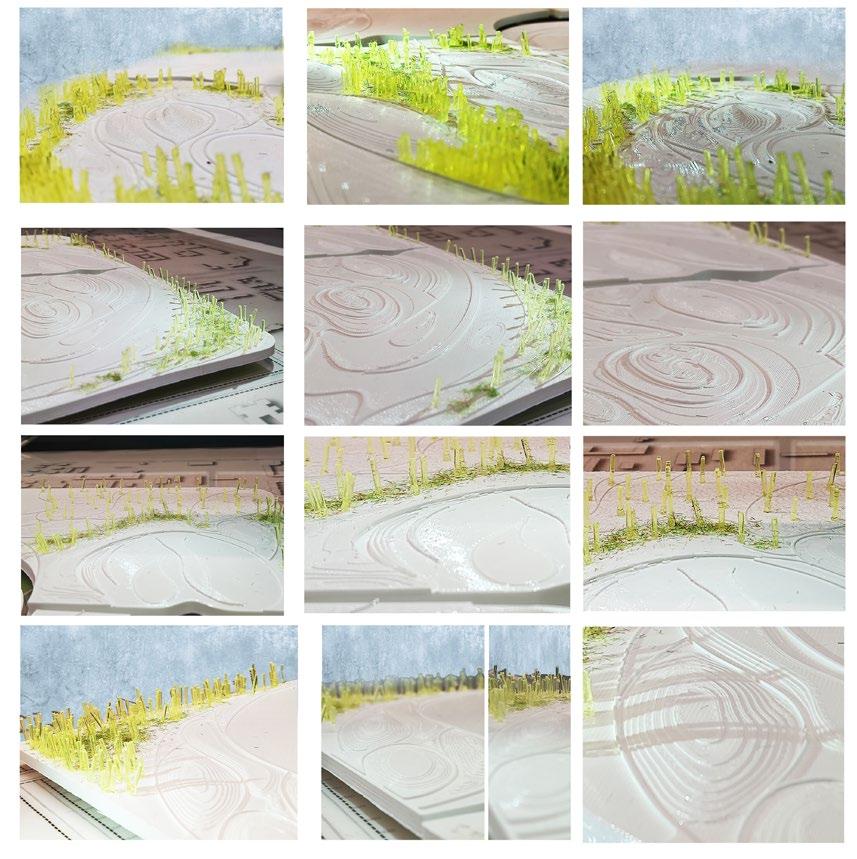
Physical model