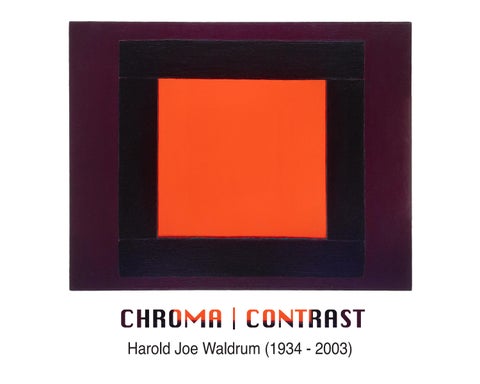
Harold Joe Waldrum (1934 - 2003)
Pewter Cordova, 1979 oil on canvas, 28 x 24”
CHROMA | CONTRAST Paintings and Prints by Harold Joe Waldrum
Opening Reception: 5 - 7 PM | Saturday, September 19 Exhibition Dates: September 19 - November 8, 2026 1335 Gusdorf Rd. Suite i . Taos . New Mexico art@203fineart.com . 575.751.1262 . 203FINEART.com
INTRODUCTION Harold Joe Waldrum (1934–2003) described himself as a “romantic-formalist,” a term that speaks to the emotional intensity of his work and his rigorous exploration of form, light, and color. Born in Savoy, Texas, Waldrum pursued an education in music and the visual arts. As a young educator in the 1950s and ’60s, he devoted himself to music as a band conductor, leading ensembles in award-winning performances. Music remained a touchstone throughout his artistic career; he was often photographed holding a baton and was known to conduct while painting, often in the nude. In 1970, Waldrum left teaching in rural Kansas to pursue painting full time. As an emerging artist, sharing time between New York and New Mexico tested his affiliations within the city art-scene, as he was bemused by being labeled an Abstract Expressionist. This reckoning prompted Waldrum’s move to New Mexico, where he sought to define his own artistic path. Once established and exhibited, Waldrum was quick to challenge an art critic from the Santa Fe Reporter who questioned his “Window Series” for seeming to be “New York in origin”. For nearly a decade, Waldrum painted the windows of northern New Mexico, coaxing dramatic contrasts from simple geometry. These compositions brought an inward, emotional dimension, that “transported his spirit.” Whether the window paintings were considered solemn or meditative, Waldrum’s persistent concern for tone, value, and contrast made him unmatched as a colorist. Beginning in 1981, Polaroid SX-70 photographs became central to his process, deepening his exploration of adobe churches and moradas throughout northern New Mexico. These intimate images, described as “monotypes” or “little jewels,” informed his “Church Series.” The intensity of shadows rendered on film created bold silhouettes that stir emotion. With utmost consideration, Waldrum’s engagement with historic buildings extended beyond his artistic mission. In 1985, he founded El Valle Foundation to document endangered adobe churches and advocate for their preservation.
Seeking even more solitude and personal retreat, Waldrum later moved to the mountains around Socorro and then to Truth or Consequences. This new chapter marked his transition to printmaking as his primary focus until his death in 2003. Working with skilled collaborators, he translated the imagery from his Polaroid collection into aquatints and linocuts. Bringing the same exacting attention to these processes that distinguished his paintings, the resulting works reveal a unified vision across mediums. Waldrum’s body of work invites the viewer to look anew at a window, a wall, or the silhouette of a building; to consider how light, shadow, and color can give familiar forms an unexpected emotional depth. “When I first saw Mountain Ranch, I knew I had found my spot. I can’t describe the feeling you get when you find the place you have always been searching for, the place where you belong, your home.” -HJW quote and image from Ando en cueros (I Walk Stark-naked), 1994
La iglesia de Arroyo Hondo, ca. 1984 oil on canvas, 36 x 36”
Passion del sol en estío, ca. 1980s linocut, 23 ½ x 23 ½”
“That was how it was with Mr. Waldrum. He taught me how to see. He taught me how to think in different ways and how to recognize things I had always known. He was always Mr. Waldrum to me. I thought he was old. He was probably 35. There was something of Abraham, Isaac and Moses about him in my mind’s eyes. A prophet. A seer. “ -Carol Brown Moffat reflecting on Harold Joe Waldrum as band director; Lakin, KS
Opposite page image courtesy Harold Joe Waldrum archives quote and image from the HJW website
Casa Ceruleo, 1980 acrylic on canvas, 37 x 35”
La sombra de la ventana hacia el oeste de la capilla de San Antonio de Chacón, 1998 aquatint etching, 17 x 17”
Abiquiu, ca. 1984-86 aquatint etching, 11 ¾ x 11 ¾”
San Juan, 1975 acrylic on canvas, 60 x 54”
H. Joe Waldrum in his Mountain Ranch studio photograph by Charles Rushton from Ando en cueros (I Walk Stark-naked), 1994
The Great Gate of Kiev by Musorgsky Lakin High School acclaimed performance under HJW
Untitled, 1987 oil on canvas, 32 x 32”
Black House T-12, 1980 oil on canvas, triptych, 64 x 21”
La reflexión, 2000 aquatint etching, 17 x 17”
POLAROID SX-7O STUDIES - CAMERA TO CANVAS Beginning in 1981, Harold Joe Waldrum made the Polaroid SX-70 camera central to his “looking process.” As a means to record the church in Las Trampas before departing for NYC for the winter, Waldrum snapped 4 rolls of Time Zero film in an improvised-effort to capture the structure for a future painting. This solution had a resounding impact on his artistic practice. The film format focused his attention on relationships among walls, windows, and shadows, allowing him to create abstraction from New Mexico’s adobe architecture. The shifting light across the traditional structures yielded stylized forms that fascinated Waldrum. Ultimately, his “Church Series” became a testament to his reverence for Spanish heritage and the places of worship that anchor it’s communities. Harold Joe Waldrum would take more than 9,000 photographs over the course of his career. Working at close range and oblique angles, Waldrum cropped away surrounding scenery, transforming recognizable buildings into arrangements of shapes. Calling these intimate works “little jewels”, they impressed upon Waldrum a visual language that matched his impulse to create dynamic compositions set within a square. This sustained practice, photographing subjects daily, transformed his approach. Initially drawn to delicate figures, such as flowers, he explored the camera’s technical possibilities to achieve striking effects no matter the subject. These “little jewels” informed his paintings, aquatints, and linocuts, while also becoming a stunning compilation and body of work. Through meticulous observation and careful composition, Waldrum achieved a phenomenal repetoire that bridges genres, yet his use of color—precisely placed and intense in hue—announces his art as unrivaled.
Ranchos en la mañana, 1992 aquatint etching, 15 x 15”
Un triángullo amarillo (A Yellow Triangle), 1994 aquatint etching, 20 x 20”
La iglesia abandonada / The Lost Church, 1993 linocut, 9 x 9”
El campanario de la morada de Chacón, ca. 1985-87 aquatint etching, 26 x 26”
Flower for Jr. Williams, 1972 mixed media on canvas, 40 x 44”
ARTIST BIOGRAPHY Harold Joe Waldrum (1934–2003) Harold Joe Waldrum was a painter, printmaker, and photographer whose work became closely associated with New Mexico’s adobe churches and historic architecture. Born on August 23, 1934, in Savoy, Texas, he studied music at Western State College in Colorado and taught music and art in Kansas. He earned a master’s degree in studio art from Fort Hays State College in 1970. In 1971, Waldrum left teaching and moved to Tesuque, New Mexico, to devote himself to painting. The region’s adobe buildings and historic structures were the foremost subject throughout his career. He established a home and studio in Gusano, near Pecos, in 1975. After his home and studio were destroyed by fire in 1976, he relocated to New York, returning to New Mexico during the summers to paint. Waldrum returned permanently in 1979, settling in Taos and working in Joseph Henry Sharp’s former studio. His rigorous practice and innate ability to render rich contrast and color was enhanced by his use of the Polariod SX-70 camera. Over his lifetime, he produced nearly 9,000 Polaroid photographs; a body of work that has been celebrated for beautifully documenting northern New Mexico’s heritage architecture. In 1985, Waldrum established the El Valle Foundation to help preserve the historic buildings depicted in his work. With collaborator Jim Heese, he produced videos documenting churches in El Valle, Las Trampas, and Picuris Pueblo, promoting awareness of their cultural significance. Waldrum moved to a secluded ranch between Albuquerque and Socorro in 1989. He published his autobiography, Ando en cueros (I Walk Stark Naked), in 1994 and then later established Rio Bravo Fine Art Gallery in Truth or Consequences in 1997. Waldrum lived in Truth or Consequences until his death on December 13, 2003. His work is represented in collections including the New Mexico History Museum and the Harwood Museum of Art in Taos.
Moon with Nigel Valdez photograph by Charles Rushton. Moon the mule’s name. Nigel Valdez was one of H. Joe Waldrum’s pseudonyms.
1335 Gusdorf Rd. Suite i . Taos . New Mexico art@203fineart.com . 575.751.1262 . 203FINEART.com