
MPOWERMENT

an attitude of gratitude
Beloved,
Beloved, I pray that wherever you are when you read this, it will find you well and blessed.
As many of you can attest, this has been ‘a winter’! In the past month, we have survived “Snowmagedden” and freezing temperatures. Again, I state, this has been a winter. Here is what I want to remind you; that even in the coldest of seasons, on the days when the ground is frozen and no flowers or vegetation is blooming, there is still life and growth taking place. During winter, creation takes what looks like a pause, but in fact beneath the surface, out of sight and beyond what appears, nature is quietly rewriting its next chapter. Perhaps that is a metaphor or parable of life, that in what seems to be cold, barren, even lifeless days, days that become seasons, God is still at work.
Let me encourage you to take this season to examine your life, take inventory of who and where you are and then take time and prepare for the coming Spring.
Here is what I know, a new season awaits, but it will only be as productive as the work you do in this season.
Know that I am praying for you.
Blessings
- Bishop
The Bishop Speaks
- Bishop Timothy J. Clarke


Empowerment Issue #29
Bishop Timothy J. Clarke
Executive Publisher & Chief Executive Officer
Brother Edmund Davidson Publisher
Sister Deborah Thompson
Sister Qwinita Bell
Contributor
Brother Carlin Armstead Editor
Contributor
Sister Michelle A. Sutton Contributor
Sister Villia Davidson Senior Advisor
Attention
Want to EMPOWER others? We are looking for writers, reporters, editors, and graphic artists to spread the Word! Please contact brother Edmund Davidson at edavidson67@gmail.com for more information.
We value your feedback and encourage you to share your thoughts about the publication. Please email us at edavidson67@gmail.com and let us know! WE WANT TO HEAR FROM
NSpread the ews
Introduce your friends and loved ones to Empowerment, an online publication from First Church of God. Published quarterly, Empowerment delivers words of wisdom, inspirational stories, and advice from members of First Church of God in one lifechanging and easy to read publication. Please share this issue... . . . and let others be
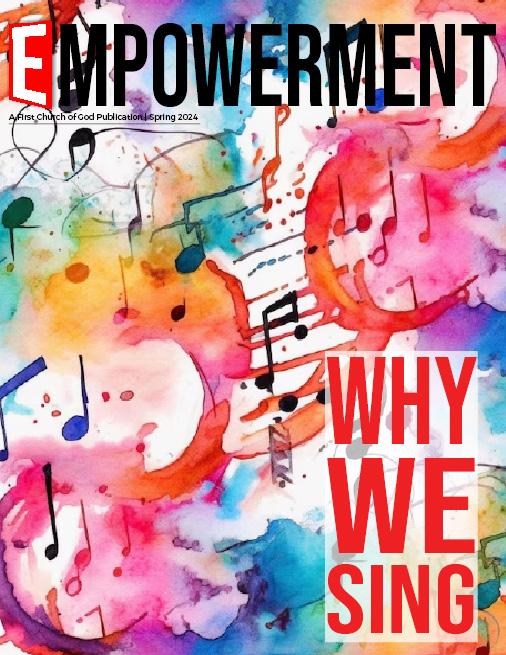



The Rise of Quiet Faith
When No One Notice, But God Still Moves
By Carlin Armstead
The noise keeps growing … society keeps changing … communication breeds confusion … words border on becoming toxic.
Where is peace?

Where is the calm?
In a world saturated with constant noise — political debates, social media outrage, endless opinions, and even loud expressions of religion — many people find themselves spiritually exhausted. The volume is high, but the depth often feels shallow. Out of this weariness, a different kind of spirituality is emerging: quiet faith. It is not flashy or performative. It does not demand attention or applause. Instead, it grows in hidden places, moves gently, and finds God in the ordinary moments of everyday life.
Quiet faith appeals to those who long for a calm, grounded expression of belief — one that does not need to be loud to be real. This kind of faith shows up in small, often unnoticed acts of love. It is the person who checks on an elderly neighbor without posting about it. The friend
who prays faithfully in private. The volunteer who serves week after week without recognition.
The Bible itself is rich with examples of quiet faith that made a profound impact. Colossians 3:23 (NIV) captures this spirit: “Whatever you do, work at it with all your heart, as working for the Lord, not for human masters.” Quiet faith thrives behind the scenes — where compassion is practiced not for praise, but because it reflects God’s heart.
American theologian, Presbyterian minister, and hymn writer Cleland Boyd McAfee (September 25, 1866 – February 4, 1944) was best known for penning the gospel hymn, "Near to the Heart of God." He wrote the song after the concurrent deaths of two of his young nieces, caused by diphtheria.

For thus says the Lord of Israel: ‘In returning and saved; In quietness and
1. There is a place of quiet rest, near to the heart of God; a place where sin cannot molest, near to the heart of God.
Refrain: O Jesus, blest Redeemer, sent from the heart of God, hold us, who wait before Thee, near to the heart of God.
2. There is a place of comfort sweet, near to the heart of God; a place where we our Savior meet, near to the heart of God.
3. There is a place of full release, near to the heart of God; a place where all is joy and peace, near to the heart of God.
(Biography and lyrics from Hymnary.org)
Faith can calm fear. It is the quietness of faith that brings power and strength to stand up to opposition and negativity.
Jesus modeled rhythms of quiet faith. Luke 5:16 (NIV) reveals that “Jesus often withdrew to lonely places and prayed.” In solitude, He demonstrated that intimacy with God does not require performance.
Quiet faith does not mean weak faith. On the contrary, it is often resilient, deeply rooted, and transformative. First Thessalonians 4:11 (NIV) encourages believers “to make it your ambition to lead a quiet life.” This quietness is not passivity, but peaceful confidence anchored in God. As the world grows louder, the rise of quiet faith feels like a gentle but powerful resistance — a reminder that God is often found not in the noise, but in the stillness.
Lord God, the Holy One and rest you shall be and confidence shall be your strength...

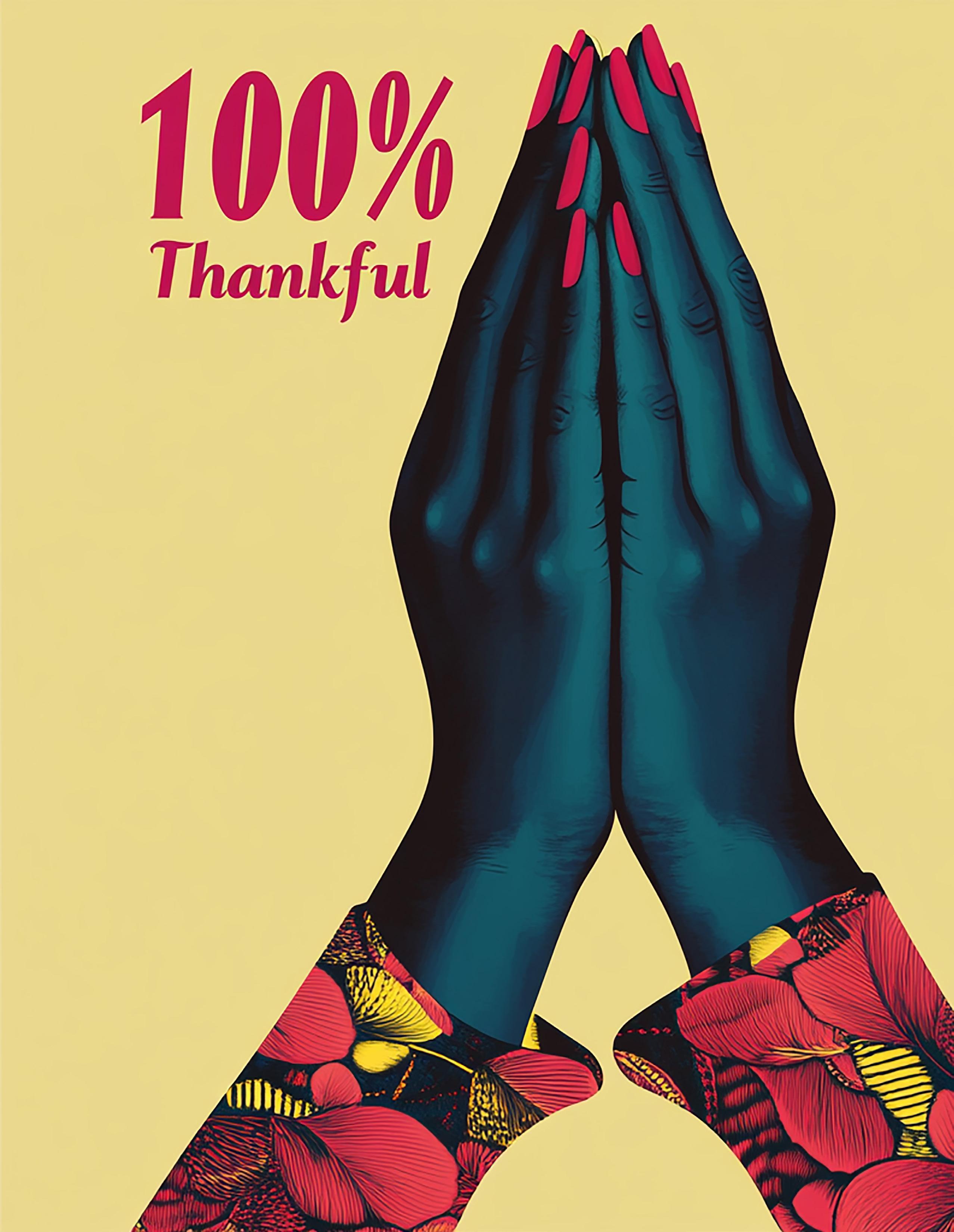

An Attitude of Gratitude
by Michelle Sutton
Philippians (HCSB) 4:6-7: Don’t worry about anything, but in everything, through prayer and petition with thanksgiving, let your requests be made known to God.
There is no role more important than that of a parent. Parents wield lots of power. Encouraging words can build up a child’s confidence. While a stern glance from a parent can control a child’s actions without saying a word. There is only One other who has more power. However, what may come with this powerful position is joy and pain, second guessing and struggles, trials and successes.
LaQuinta McClure is an active Mom. Born in Dayton, Ohio, she and her partner Patrick are raising two children: 12-year-old Laila and 4-year-old Patrick. They are determined to make sure they have a close and loving relationship with their children. They also want to expose their children to positive experiences that they did not have.
“Growing up, my mother didn’t have many strict rules. She was young and laid-back, working to provide for us. My grandmother took care of my three siblings and me during the week getting us ready for school and managing our daily routines. Even though I called my mother’s house “home”, we spent most of our time at Grandma’s”.
As a result of some of her childhood challenges, LaQuinta was not sure if she ever wanted to be a parent. “Honestly, I never saw children as a blessing during those years; I saw struggle. I didn’t have positive role models for marriage or family life, so motherhood wasn’t something I desired for myself”.

However, now in a committed relationship with a like-minded person, LaQuinta’s feelings on motherhood changed. “I started going to counseling, reading personal development books and intentionally building my own
I return to motherhood refreshed”.
However, even with support, parents may experience stress. According to the Center for Disease Control and Prevention (CDC) there are healthy ways to cope.

LaQuinta loves being a mother and she and her family are excited about their future. “I pray (our children)
become great decision-makers and when they face difficulties, that they’re resilient enough to learn from those experiences and grow stronger. My hope is that they’ll emerge as capable, confident individuals. (For now) my focus remains on my family, making sure they feel loved, supported and cared for every single day”.
Here are a few suggestions from the CDC

This Spring, Reflect on Your Salvation!
by Ashley Anthony
If you’re anything like me, you welcome winter as it comes in. The early nights blanket us in Christmas lights, hot chocolate, and cozy movie nights in the living room. The routine of Advent and family devotionals helps us end each night together. But once the holidays pass and we only have sickness and long winter days to look forward to, the charm of the season fades. For some, winter days bring uncertainty, loneliness, or personal darkness.
As winter drags on, I look out our picture window and see the chill of winter present in the empty sidewalks, the frost-tipped yard, and the sun’s truant afternoons.
But in spring, out the same window, children scooter down our sidewalk, flanked by moms and dads carrying snacks and renounced coats. Leaves once again obscure the neighbor’s house and birds visit the feeder out front. Small friends gather in each other’s yards, playing soccer and jumping on trampolines, roaming the neighborhood to stake out lemonade stands. The cold death of winter is over—spring has arrived.
In spring, life makes itself known.
The Lessons of Spring
Spring illustrates a great truth of the Christian life. Just as the death of winter makes way for the resurrection of life in spring, when God saves us, he takes those spiritually dead and makes them alive.
Too often, we have too small a view of God’s great work of salvation. We might think of Christianity as something we add on to our lives. We attend church, pray, and read our Bibles and think we have this salvation thing down. Or perhaps it feels like behavioral change. Our behavior before Christ was bad, but now it’s not. He’s made us better people. Or maybe we think of salvation as the beginning of a relationship with God—we didn’t know him and now we do. While these things aren’t wrong, they don’t get to the heart of salvation.
Before Christ, we were dead because of our sin—no heartbeat detected (Eph. 2:5). Those who are dead can’t go to church, change their behavior, or start relationships to make themselves alive.
Really, Really Dead
All of Scripture preaches this truth, that we’re dead and need God to bring us to life. In Ezekiel 37-one of the strangest passages in Scripture God leads the prophet Ezekiel through a valley filled with dried, rotten bones. Each step forward
brings the stench of death, the crack of bone, the taste of stale air. These bones represented the hearts of the Israelites (Ezek. 37:12–14). Spiritually, they were dead. They were tombs.
They needed resurrection.
God gives Ezekiel these words to prophesy over the bones: “I will lay sinews upon you, and will cause flesh to come upon you, and cover you with skin, and put breath in you, and you shall live, and you shall know that I am the LORD” (Ezek. 37:6). As soon as Ezekiel speaks the words God gave him, the sound of bones rattling crashes through the once-silent valley. Just as God promised, his hands piece together each bone until a lifeless army stands before Ezekiel.
But God isn’t done yet. He breathes on the army and the army lives. The bones that once covered the valley’s floor stand before Ezekiel as people, alive. Life floods the once-barren valley—spring replaces the death of winter. Life makes itself known.
The Good Life
The prophecy of dead bones coming to life wasn’t just for Ezekiel’s Israelites—it’s for us, too. The valley of dried bones is our personal testimony, our story of salvation.
When Scripture speaks of being born again (John 3:3), participating in Christ’s resurrection (Rom. 6:5), and being made alive (Eph. 2:5),
it’s not just illustrating a teaching point—it’s describing a reality. Here is what Ephesians declares to be true about us when we trust Christ: Once we were dead, “but God, being rich in mercy, because of the great love with which he loved us … made us alive together with Christ—by grace you have been saved—and raised us up with him and seated us with him in the heavenly places in Christ Jesus” (Eph. 2:4–6). The valley of dried bones points to the need for resurrection; the life-filled army points to our resurrection.
And the breath of God that entered Ezekiel’s army? Even then, God signaled the eventual giving of his Holy Spirit—to us (Titus 3:5–6). As one pastor reminded us, “Every growth of spiritual life, from the first tender shoot until now, [has been] the work of the Holy Spirit.”
Resurrection Testimonies
The first day of spring—that first glance out the window that shows us the death of winter has made way for a new season—recalls the miracle of new life. Just as the beauty of spring sings the glory of God after a season of death, so do our Christian lives.
Your salvation is no small feat. Your testimony is no dull story. You were once dead and God made you alive.
Through Christ, our spiritual deaths have been defeated.

MISSED AN ISSUE? WE
Be sure to check out past issues of Empowerment! cover for uplifting stories, informative












Empowerment! Just tap or click on a informative articles, and positive news.