
A giving legacy...
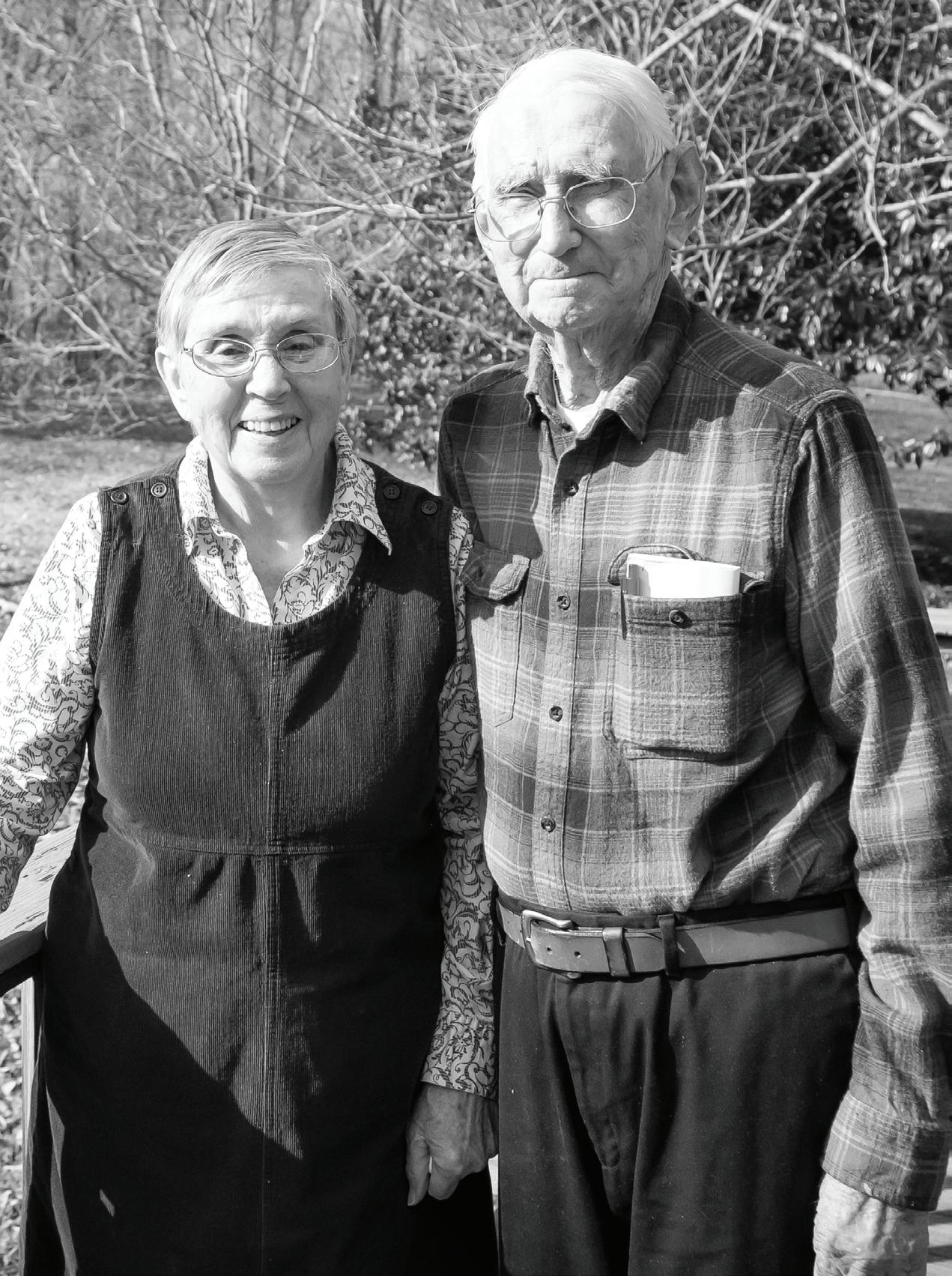
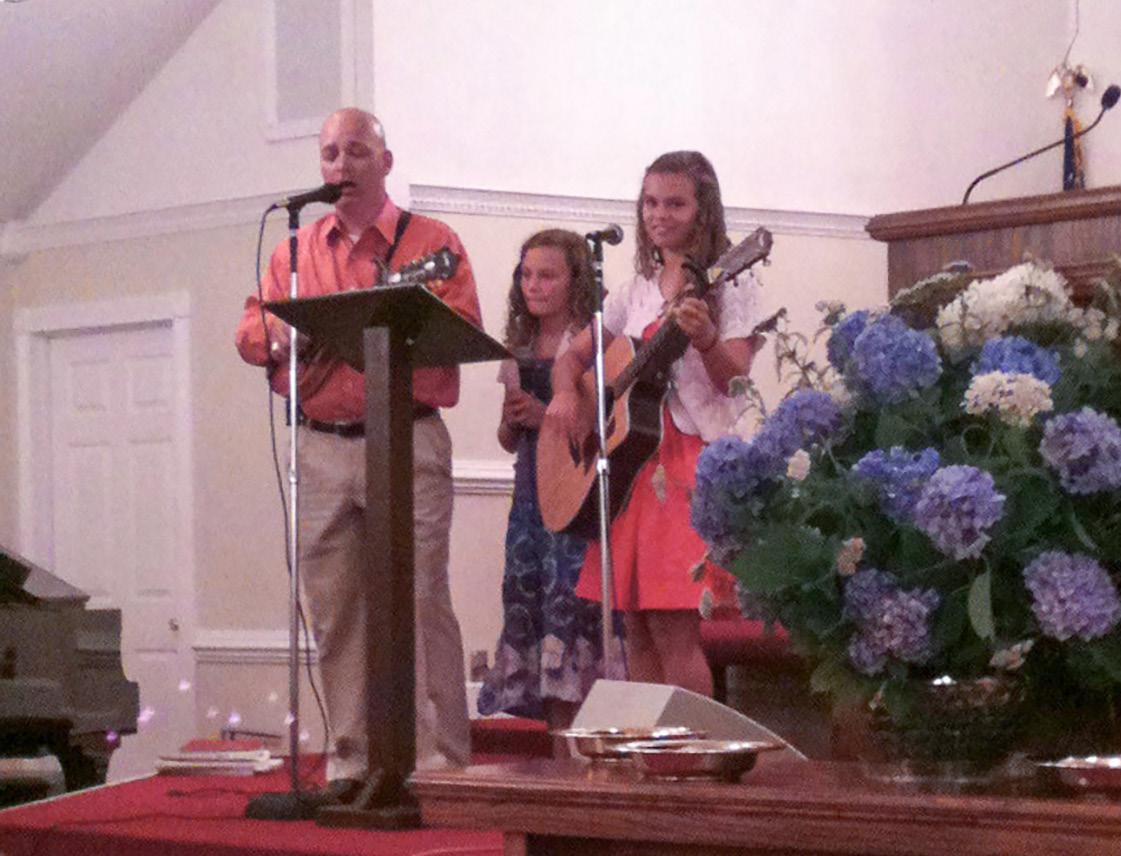
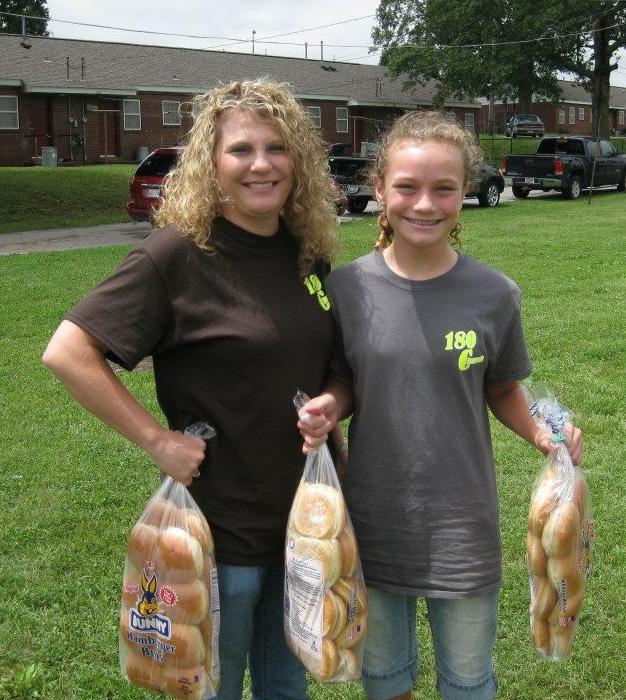
Since 1971, Sam and Jane Johnson have carved out their dream known as Hillmont Camp on 157 acres of trees and meadows just north of White Bluff, Tennessee. However, the couple's influence extends far beyond their rural retreat. Sam served as the first director of the Free Will Baptist CTS department and organized the Engineers, an early leadership training program for boys. He served four years (1974-1978) as editor of Christian Camping International magazine and six years on the organization's International Board of Trustees. In 1997, CCI jointly honored the couple with the prestigious “Kingsley Living Tribute Award.” Hillmont hosted several Free Will Baptist Leadership Conferences for national and state leaders. The secret of the camp's success? Sam chuckles, “They all come back for Jane’s homemade yeast rolls!”
Call the Foundation today to create a legacy for young people tomorrow with a planned gift to D6 Family Ministry!

fwbgifts.com | 877-336-7575

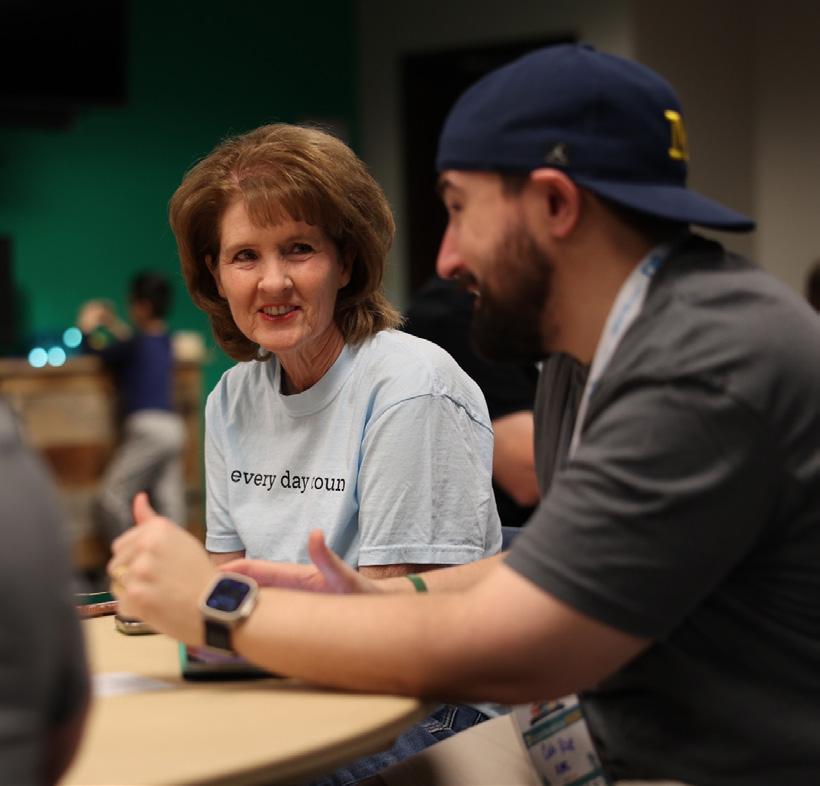
Summer on the Rocks
BY ERIC K. THOMSEN
Ka-thump!
I must have jumped a foot when the heavy preaching Bible struck me squarely in the chest.
“That was pretty good, but I could do better.”
I looked down into a serious expression on a perfectly round face framed by large glasses and topped off by an unruly cowlick. I struggled to keep from laughing. I had just finished preaching my first sermon of junior high week at Georgia State Camp. Obviously, my “masterpiece” did not measure up to these lofty standards.
“You really think you could do better?”
“Yes!” His vigorous nod set the cowlick flopping.
“Fine. You have ten minutes tomorrow night before I preach.”
“I’ll be ready.”
And he was. The sermon was excellent — Scripture memorized and accompanied by simple, hard-hitting points that kept the attention of the other campers. He blew past the ten-minute mark without slowing and nodded at me confidently when he stepped off the platform after fifteen. I could almost read his mind: “I told you I could do better!”

It’s one of my favorite memories from Camp
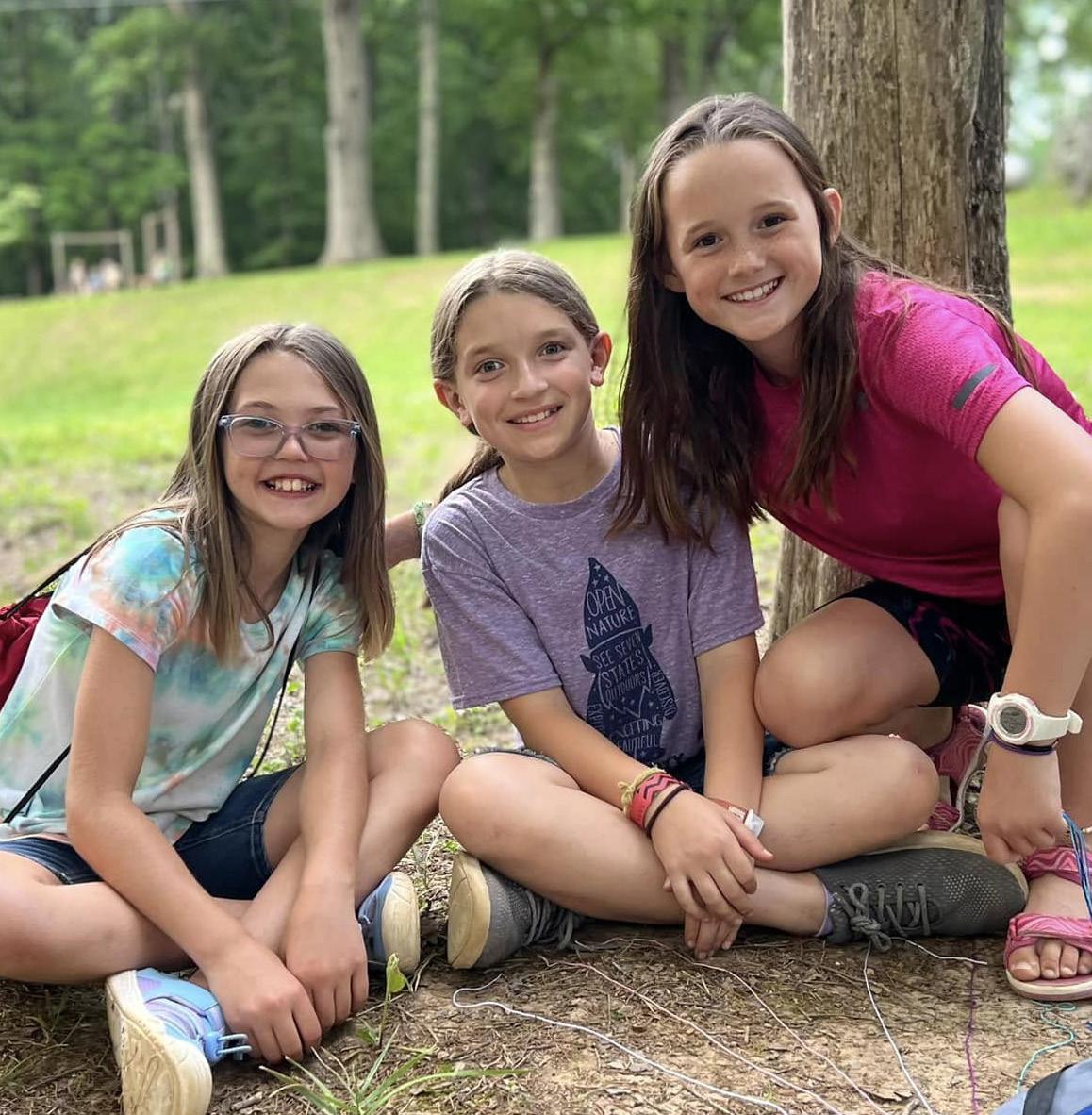
My memories there start early, in the fourth grade as a first-time camper. Somehow, my duffel bag was lost along the way. I spent the entire week wearing the same sweaty, dirty clothes. Gross! No amount of borrowed Polo™ cologne could mask that aroma.
Memories continue through my junior high and high school years, an endless blur of shaving cream wars, water-balloon fights, mischievous pranks, late night escapades, groggy mornings, pool wars, ping-pong

tournaments, canoe races, basketball, banquets, and bonfires. In short...camp!
During college, I returned to Mt. Bethel as the full-time summer evangelist after my freshman and sophomore years. Scarcely older than those to whom I preached (and likely younger than a few of them), those long, hot weeks stretched me and molded me for ministry.
It’s odd. Looking back, I cannot recall a single point from all the messages I heard (or even preached) during those years, although I recall being moved deeply. Instead, I remember faces and decisions.
The faces: Bronco West and his chalk drawings; Laura Belle Barnard and her stories about India; “Uncle” Bud Hill with his dry sense of humor; Jake (Brother Jakey) Creech and his crazy skits; Miss Sarah, the camp cook for whom I cracked at least ten thousand eggs; William Smith, the state camp director and chief prankster; and Chris, the cowlicked “junior preacher.” That doesn’t even begin to describe other camper friends, counselors, and coworkers.
The decisions: one night, I slipped away from the canteen lights and walked around the lake to the “bonfire rocks.”
Sitting in the moonlight, I told God “I surrender all” for the first time. Two years later, I reaffirmed that surrender, even if it meant full-time ministry.
And it wasn’t just my decisions. One night during my first year as evangelist, a particularly mischievous camper slipped from his seat and met Christ as his Savior at the altar. When I learned of his death in a car accident only a few weeks later, I thanked God for the hope of the gospel and for Camp Mt. Bethel, where he heard and accepted it.
This summer, I hope you’ll make your own camp memories. You may just change a life along the way (and don’t be surprised if it is your own).
By the way, these days, Chris the “junior preacher” is a missionary to refugees in Southern Spain, and he can still preach circles around me.
About the Columnist: Eric K. Thomsen is managing editor of ONE Magazine. Email: eric@nafwb.org.
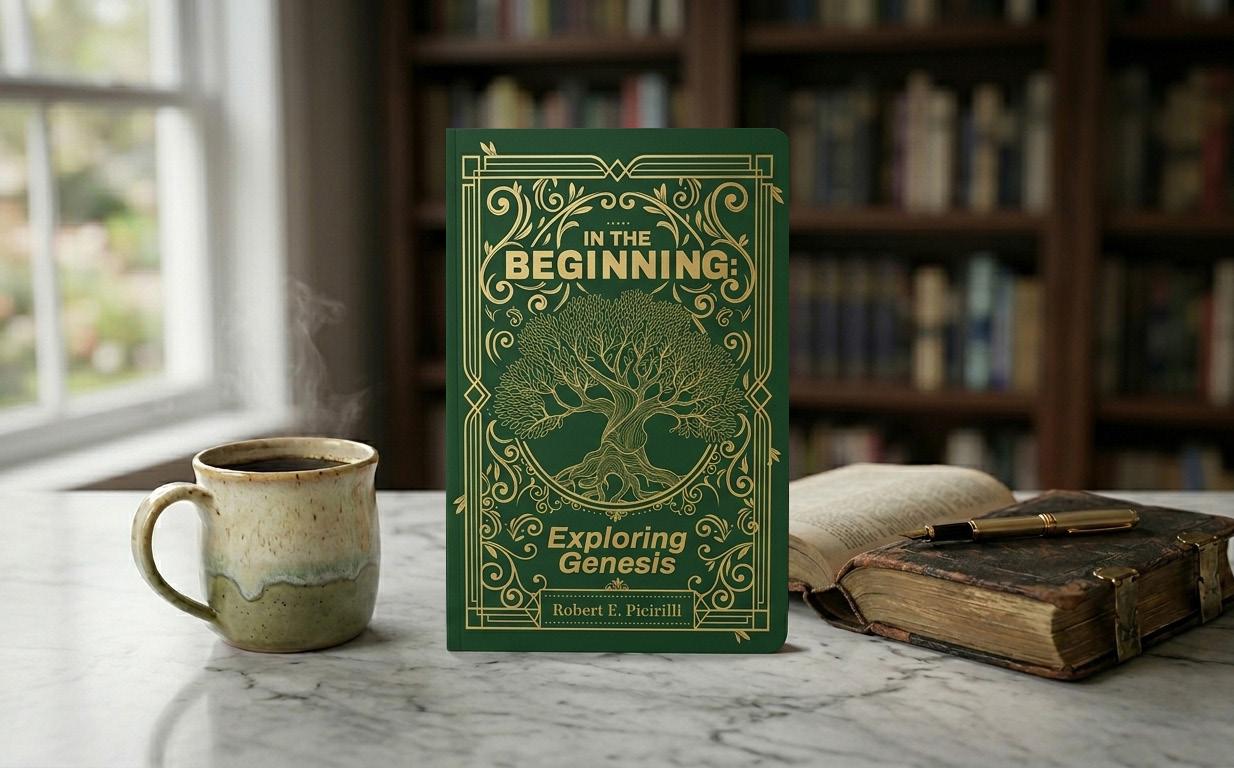







Counsel From a Camp Counselor
Church camp has unique opportunities to influence young lives. After seven summers as a camp counselor (following nine summers as a camper), I appreciate the camp experience firsthand. Starting with the camp counselors and continuing to the setting and atmosphere, church camp is a special place.
Without a doubt, misconceptions exist about what makes a great camp counselor. Some of the best counselors I ever had did not fit the traditional mold. Camp is a physical experience, but almost all my favorite counselors were not athletically gifted. Good news for all uncoordinated people such as myself!
While camp can feel like a constant 100° nature walk in high humidity during the hot summer months, the kids appreciate the efforts of those organizing the games/activities. In many cases, campers do not have an adult in their lives with the time or desire to spend a day outside with them in the heat index camp can reach. A good counselor is not required to do a backflip, a push-up, or even know how to throw a football.
BY BENJAMIN CORN
Sure, a few people on the camp staff may enjoy physical activities and feel it their calling to lead kids in them, but athletic prowess is not a counselor requirement.
Camp is a young person’s arena, since campers are children or young adults, and counselors are usually young adults or college students. However, some of the counselors who impacted me most were much older than the average counselor. In fact, counselors who had the biggest effect on me spiritually were old enough to be my father or even grandfather.
I spent multiple weeks of my camp experience with a counselor named Bob Baggett. His grandson was one of my friends, so we stayed in his cabin. Brother Bob was a decorated war veteran with a heart for helping with camp. His presence had a profound effect on me because it illustrated dedication to the cause of Christ through camp work and lifelong commitment to it. The loyalty and sacrifice of Brother Bob, who was a part of that camp for all 16 years I was there (and years before and after), made a huge difference in the way I view Scripture passages that talk about being “resolute and steadfast.”
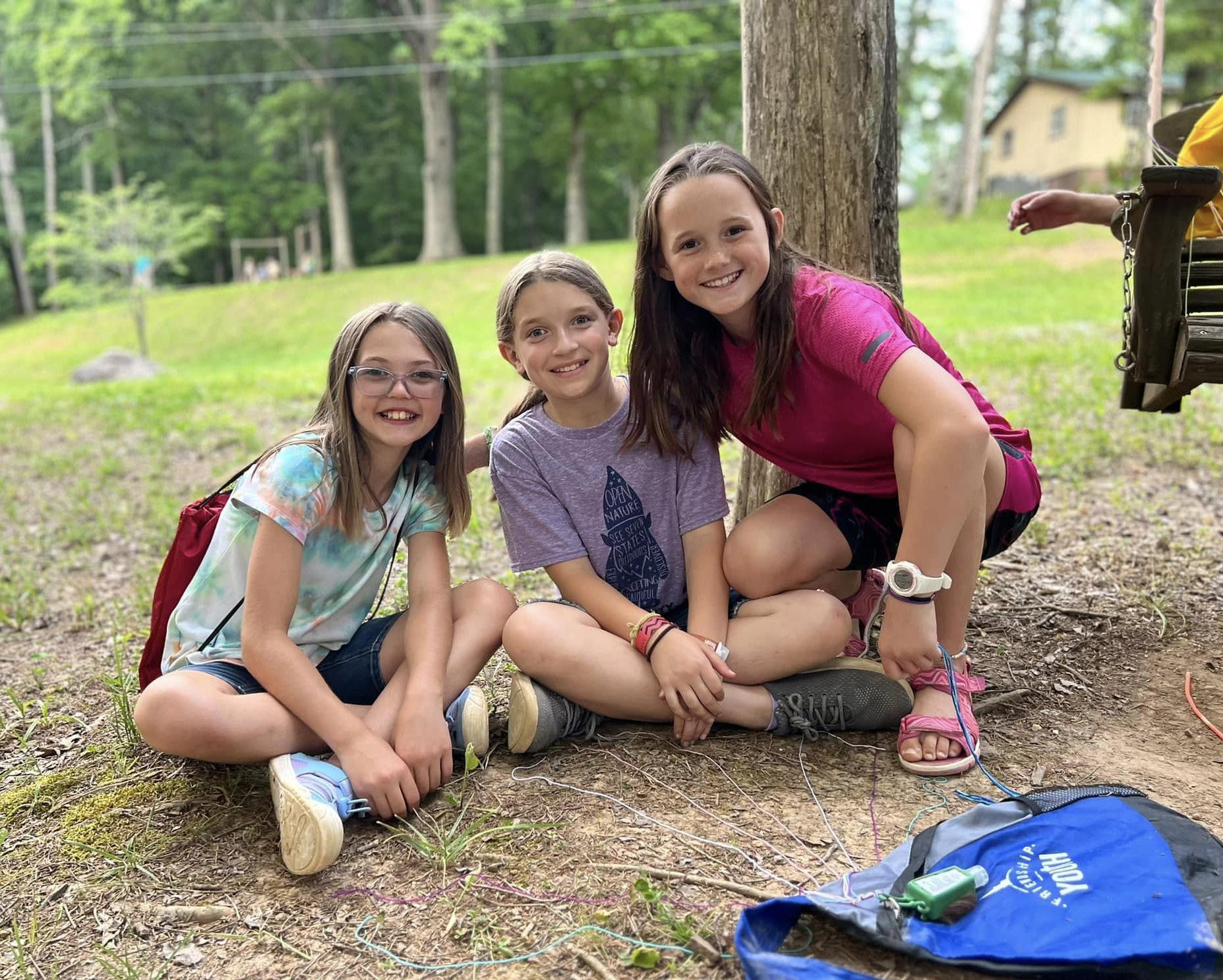
While church camp can seem to be a “forced worship” situation, the lasting spiritual impact often comes through the love counselors demonstrate beyond the worship setting. As the son of a Free Will Baptist pastor, I think I am qualified to say camp has a lot of church to it. After all, it is “church camp” not “camp church.”
While I can’t remember a single sermon I heard during the many camp services I attended, I can repeat word-for-word conversations I had with people I admire spiritually. I can’t tell you exactly when I met Len Scott, who eventually became my pastor for close to a decade, but I can tell you it was because of Cumberland Camp and the conversations on those grounds I decided to drive an extra half hour
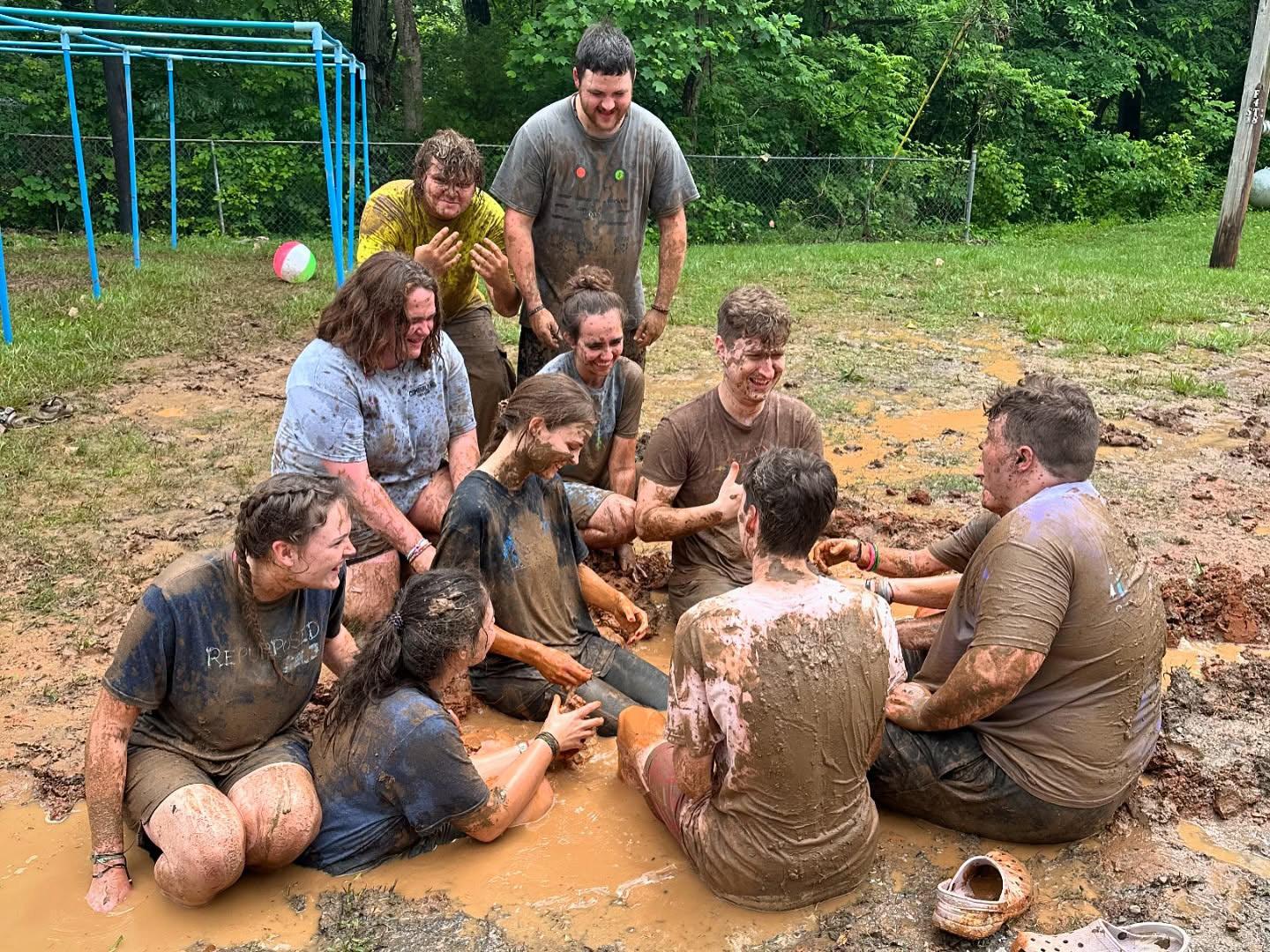
to attend his church, passing many other churches. Because of that decision, I met my wife in the church choir. We have been happily married for more than a decade and have two beautiful daughters.
Camp is a wonderful experience that has an almost magical quality for a child. It’s an adventure outdoors in nature that allows room for imagination and exploration in a way unavailable to most kids in today’s world. As technology has led to a decrease in children playing outside and interacting with other kids, camp has taken on an even more unique feeling.
When I was young, high-speed Internet did not exist, none of my friends owned a cell phone, and the TV in my house had only 30 channels. So, while camp had a strange disconnectedfrom-the-world feeling in 1996, it has more of that quality now that we are all digitally connected to each other. Camp provides space for deep spiritual growth to happen in a short period of time because of this disconnection from phones and social media. Untethering kids from the shallow and often toxic influence of social media allows them to interact with people face-to-face and encounter both kids and adults who love Christ. They have a great week without looking at Tik-Tok or Instagram a single time.
Camp also provides a chance to change lives. At one time, I was a correctional officer at Deberry Special Needs Prison in Nashville, Tennessee. The differences between that job and being a camp counselor are many, but one striking similarity is those you are charged to watch are also watching you. If you are consistent in your actions and your character, you will gain their respect. This makes the job in both places easier. Kids sense authenticity. The camp counselor’s job is to show Christ's love through interacting with campers, and the Holy Spirit will do the rest. If a counselor’s heart is in the right place, God will do great things.
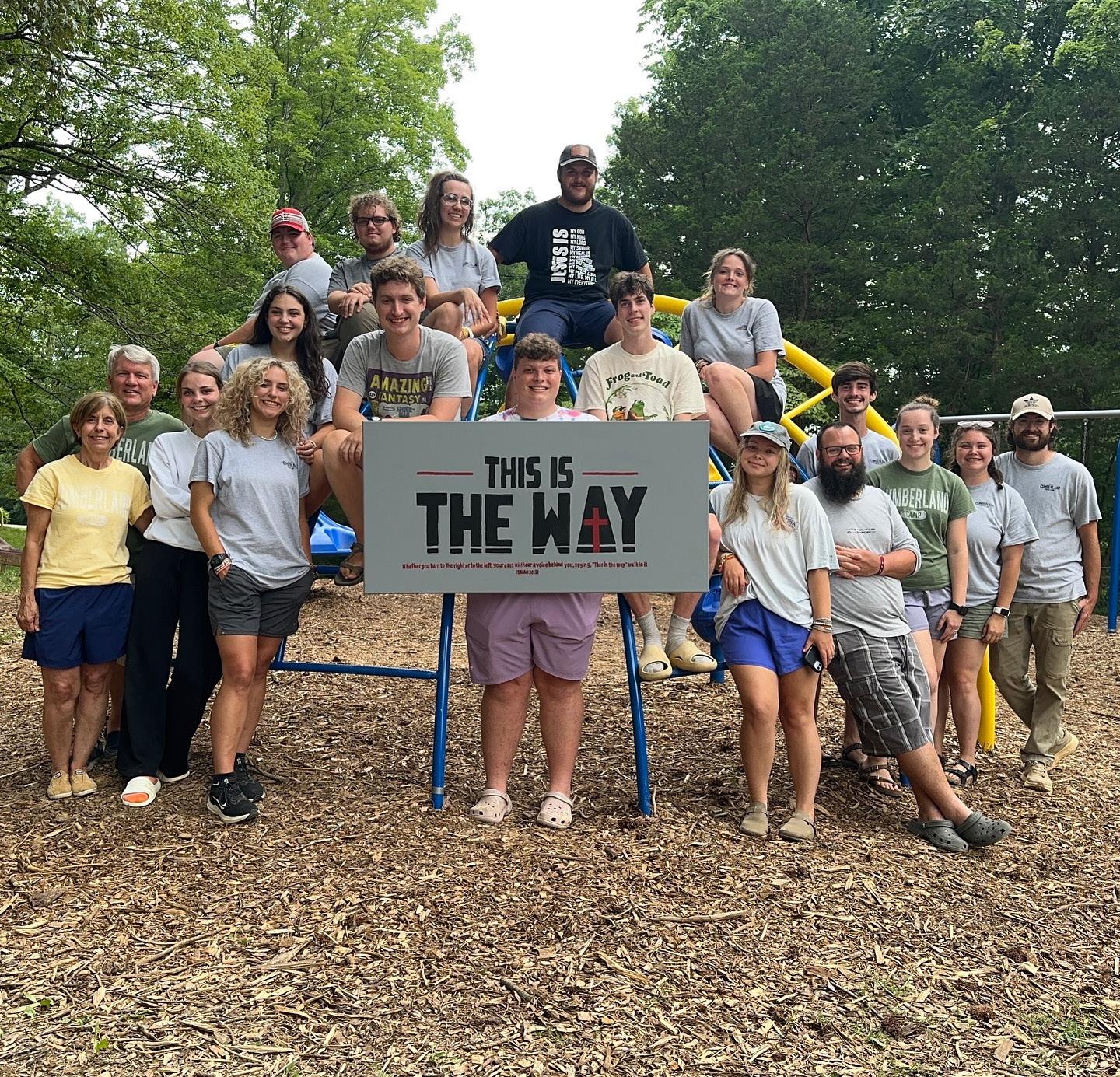
One of my jobs at camp was to rescue children afraid to come down from the top of the climbing wall. I either talked them into coming down via the correct method or just picked them up and carried them back down with me. One day, while I was demonstrating to a camper all he had to do was sit back like there was an invisible chair, and the harness would hold him, the person on the other end of my rope wasn’t prepared for me to sit back on my invisible chair.
Though I thankfully didn’t hit the ground, I never could convince that kid to trust the “invisible chair” because he watched me flail like one of the Three Stooges down the climbing wall. That story has two camp applications. First, always have someone who knows what he or she is doing on the other end of a climbing rope! Second, if your life resembles a guy falling down a rock wall, you will find kids are not interested in joining that lifestyle. Whether intentional or not, how you represent Christ through your interactions is paramount.
Church camp had a profound impact on my life, and the camp experience is a wonderful opportunity to influence the next generation for the cause of Christ. God will reward those who have a part in this ministry.
About the Writer: Benjamin Corn is a happily married father of two girls who both attend Cumberland Camp every summer. He currently works as a manager at The Depot Grill in Springfield, Tennessee. Benjamin is a member of Pardue Memorial FWB Church in Clarksville, Tennessee.
Marathon! It’s a
BY DAWN GOODFELLOW ELLIOTT
It often has been said the Christian life is not a sprint; it’s a marathon. Hebrews 12 encourages us to run with endurance the race before us. My mother-in-law was the picture of endurance in her “race” to serve Jesus.
Doris Elliott started her race as a young girl in Naoma, West Virginia, while attending the Naoma Free Will Baptist Church. In 1960, after her family moved and began attending Bradley FWB Church, Doris met Charlie at a youth spaghetti dinner. They started dating shortly thereafter and were married September 15, 1962, while Charlie was on leave from the Navy. During his Navy years, Charlie and Doris lived in New Jersey and Maryland.
Charlie completed his service in the Navy in September 1966, and he and Doris moved back to West Virginia and resumed attendance at the Bradley Church. Shortly after their return, Doris recommitted her life to serving the Lord, and she and Charlie began to run their race in earnest, beginning a 59-year ministry to children.
Throughout those 59 years, Doris and Charlie attended 37 Free Will Baptist National Conventions and took hundreds of young people to compete in at the Vertical Three Conference. They spent their years helping kids raise funds for the trip to the convention and practicing with them for many hours to prepare them for competition.
For many years, Charlie drove a bus filled with kids, and Doris sat in the front seat right behind him. Charlie led groups to compete in music and Bible while Doris kept track of all the music and who was competing when and where, so they could watch as many of their kids compete in as many categories as possible. I have also been told Doris loved to teach the girls how much fun it was to jump on the beds in a fancy hotel.
Doris and Charlie directed more than 60 children’s musicals — Christmas, patriotic, and Easter. Charlie directed the music, and Doris helped assign roles, put together costumes, gathered
props, and often prompted lines from the front row during the performance.

For 24 summers in West Virginia and ten summers in Tampa, they led Vacation Bible School. Once again, Charlie led the music while Doris helped with arts and crafts, snack time, and teaching Bible lessons. In West Virginia, Charlie oversaw music for both teen and junior camps for 22 years, while Doris helped prepare meals. Charlie continued his ministry at youth camp for 35 years in Tampa and has been on the state camp board for twenty years.
Through all these years of service, they both faithfully taught the Word of God to children in their church. They taught children’s church to various ages and scheduled teachers, so every class had someone to teach them. Doris’ niche was the threeto five-year-olds. She loved to tell funny stories about all their different personalities. Her love for “her kids” was evident.
These 59 years of service were marked by dedication, love, generosity, and personal sacrifice. It was common to hear of Doris slipping money to a single mom who could not afford Christmas gifts for her children. She always kept extra small gifts hidden away for birthday and Christmas presents for any child who might not have as much as others.
One year, after a hurricane damaged their house, and they had to live in a hotel for a few months, Doris learned another family’s house would not be repaired in time for Christmas. She volunteered to delay their own house repairs, so the workers could finish the other house in time for the children to be home for Christmas.
Perhaps one story best illustrates Doris’ love and concern for children. In 2007, Doris and her pastor’s daughter Angie ended
Continued on page 41
BY EDDIE MOODY
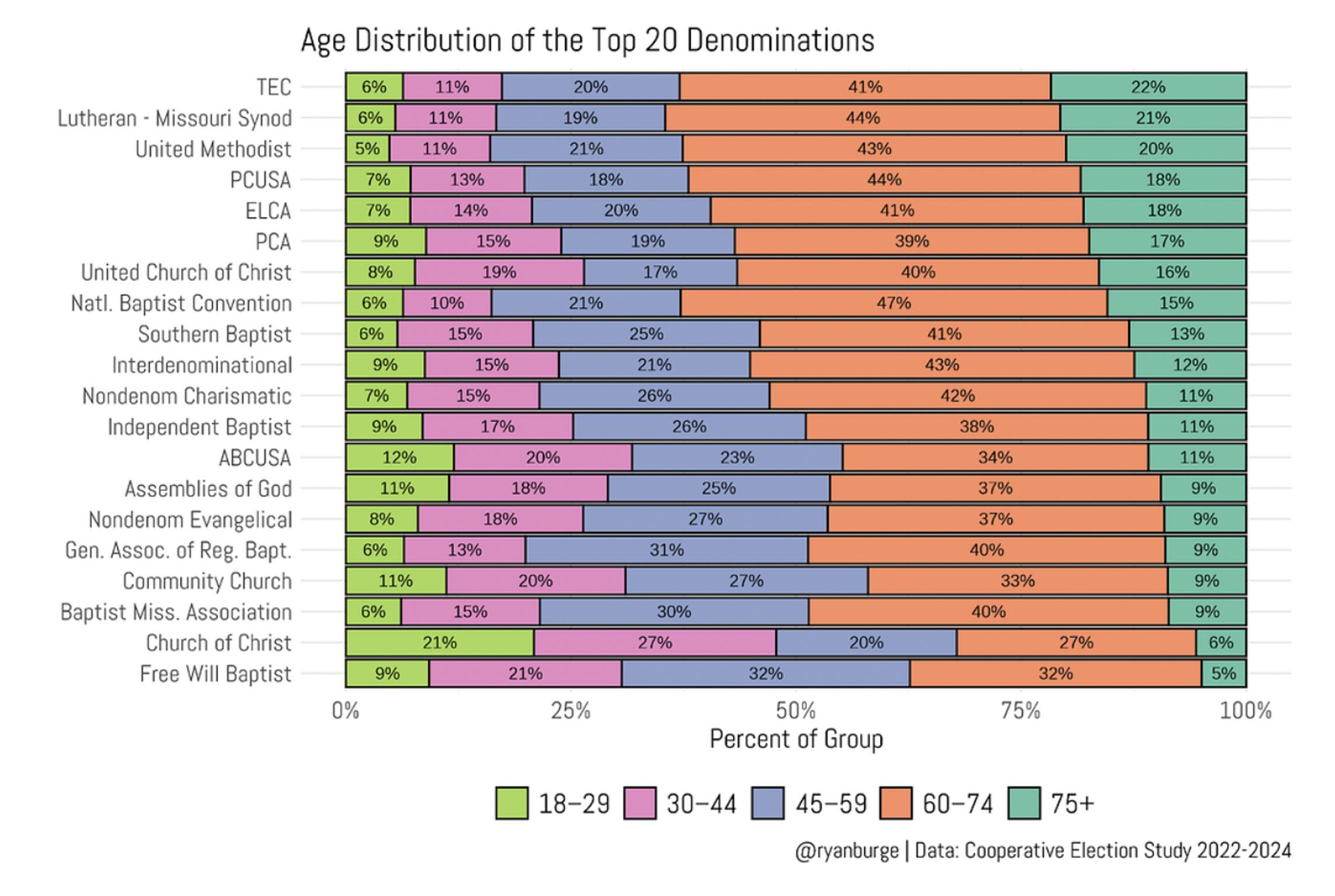
You wouldn’t expect an article titled, “When Will Half Your Membership Be Dead?”1 to be particularly encouraging. However, for Free Will Baptists, data recently published by researcher Dr. Ryan Burge offers a surprising and hopeful perspective. When compared to the broader landscape of American Protestantism, our denomination stands out as a unique anomaly, possessing what Burge describes as a rare “demographic runway.” (See the “Age Distributions of the Top 20 Denominations” chart below.)
While most mainline denominations face a “code red” scenario with modal ages (the most common age of a member) between 67 and 69, Free Will Baptists hold a significantly lower modal age of 53. Furthermore, while most groups have seen sharp declines in young adult participation over the last 15 years, our denomination has shown remarkable generational resilience, nearly doubling the percentage of young adults found in other groups.
1 Burge, R. (2026, January 29). When are half your members going to be dead? Graphs About Religion. https:// www.graphsaboutreligion.com/p/ when-are-half-your-members-going
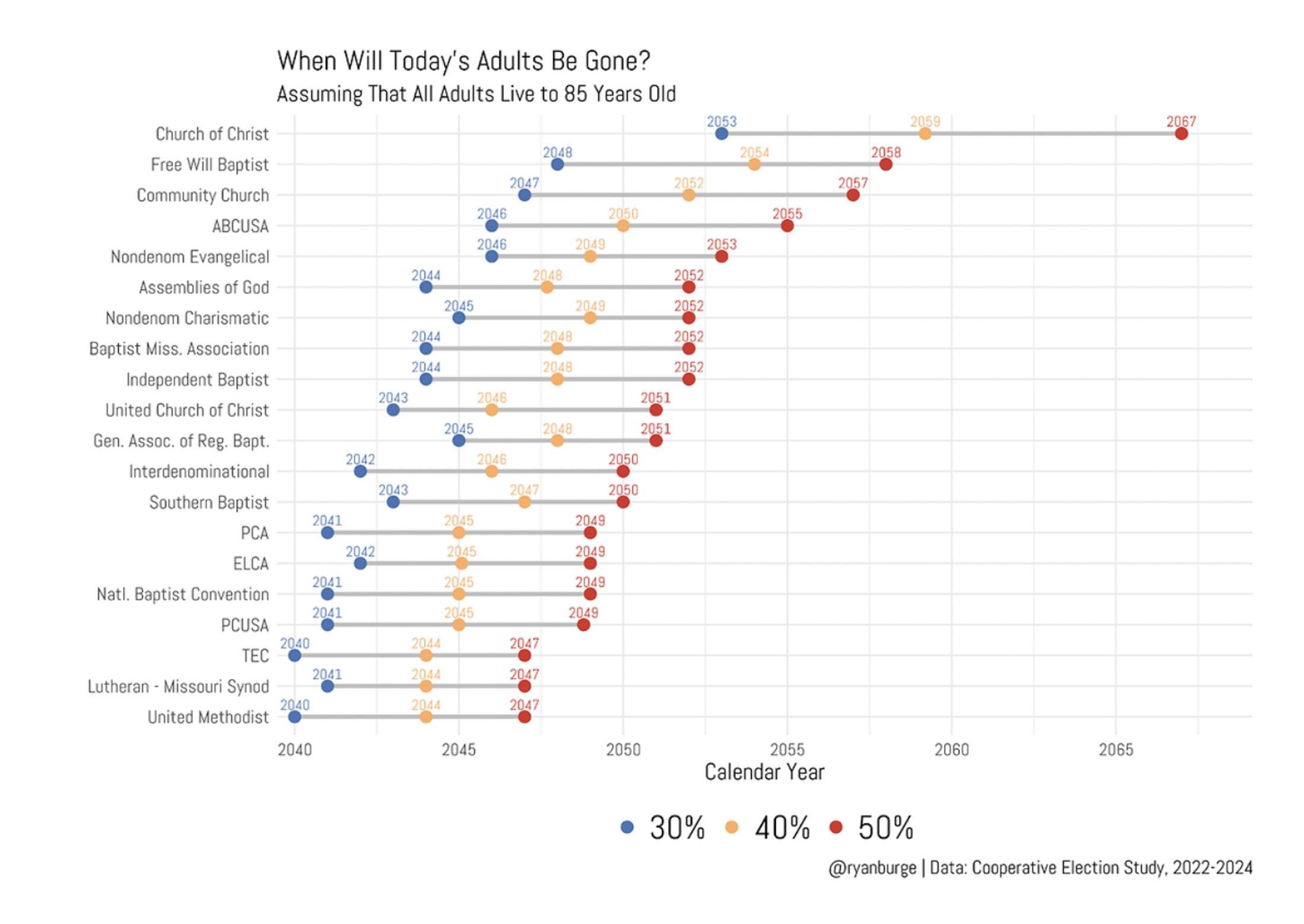
This data suggests we have approximately a 15-year window of vibrant, stable membership before the coming demographic “lull” fully impacts our pews. We must not waste this time. To seize this opportunity, we must focus on three strategic areas:
PRIORITIZE YOUTH AND FAMILY MINISTRY
To capitalize on the young people God has already placed in our care, we must elevate the importance of the nursery, Sunday School, parent training, and camps. We should double down on the denominational programs that have helped our youth, such as CTS, Truth and Peace, ETEAM, and CMP, and support new programs that emerge. (See the “When Will Today's Adults Be Gone?” chart at right.)
LEVERAGE THIS OPPORTUNITY
Our younger modal age provides a vital bridge to the next generation of Free Will Baptists. We must aggressively train the 30- to 44-year-old members in our churches today, discipling and equipping them to accept the mantle of leadership before the current generation ages out. This mid-level leadership will become the backbone of our denominational stability in the decades to come.
PREPARE TO SUPPORT THE BROADER CHURCH
Denominational survival is not for our sake alone. We must see beyond our “borders.” If we remain demographically stable, we can provide multi-generational support to other sister groups as they struggle through the coming storm. Our own internal data is encouraging: 85% of youth who responded to our program survey of national denominational programs
continue to attend a Free Will Baptist church as adults.2 We must prepare them to care for our own denomination and turn their attention to caring for the broader church-at-large.
This “demographic runway” is a wonderful gift from God, but it has an expiration date. By focusing on retention, discipleship, and leadership development now, we ensure we are not just surviving but thriving — truly proving we are better together as we weather the storm for the sake of the Kingdom.
About the Writer: Eddie Moody is the executive director of the National Association of Free Will Baptists. Learn more: nafwb.org/.
2 Moody, E. (2024). Keeping Our College Students. https://onemag. org/keeping_students.htm
BY JOSH B E N
“The harvest is plentiful, but the laborers are few.”
Those words ring true in every area of ministry. At North American Ministries, our desire is to fill the fields with laborers carrying the good news of the gospel to North America. With this in mind, we are excited to launch a brand-new ministry at NAM — Frontier Student Missions. Frontier exists to engage students in church planting and ministry leadership, fanning into flame their gifts and callings (2 Timothy 1:6) and empowering them to blaze new trails in planting and leading churches across North America.
Frontier is committed to awakening courage in the next generation by placing students in ministry environments where church planting and leadership are happening firsthand. Through hands-on exposure, mentorship, and meaningful service, students discover how God has uniquely gifted and called them.
As they step into new contexts and unfamiliar spaces, their faith is stretched, their gifts are refined, and their calling begins to take shape. When students are exposed to the front lines of ministry, we trust the flame of God’s purpose within them will ignite.
From urban centers to underserved communities, Frontier empowers students to blaze new trails — not just observing ministry, but also participating in the planting and leading of healthy, gospel-centered churches across North America.
Before students are sent into the harvest, they will be equipped by a week of training designed to strengthen their faith, expose their spiritual gifts, and build their confidence in sharing the gospel. Frontier will train and send students out in teams. What may seem like a daunting task can quickly turn into an exciting adventure when carried out with other believers.
After an intense week of training, serving, and team building,
H WA LKER
When students are exposed to the front lines of ministry,wetrust the flame of God’s purpose within themwillignite.
students will travel to churches across North America where they can apply their newly acquired knowledge and skills. While on the field with church planters, students will witness the excitement of lives transformed by the gospel, gain practical experience, draw encouragement, and learn to understand their role in the Great Commission. By the time students return home, our prayer is they will feel empowered to reach out in their own communities and make a lasting impact for Christ.
You may be asking, “Why do Free Will Baptists need another student missions opportunity?” The answer is simple: “The harvest is plentiful, but the laborers are few.” The need is as great as ever for young people to answer the call into the areas of church planting and ministry within the local church. Further, statistics tell us students who participate in denominational ministry programs are far more likely to remain engaged in church through college and beyond.
With Frontier being offered by NAM, ETEAM by IM, and Truth & Peace by Vertical III, high school students now can experience church planting, international missions, and leadership development. If a student takes advantage of all these opportunities, he or she will walk away with a broad range of ministry experience, along with a better understanding of where God may lead for a lifetime of ministry.
About the Writers: Church planter Josh Bennett serves as chief strategy officer for North American Ministries. Previously the NAM accounts administrator, Kylah Walker recently transitioned into the role of student impact coordinator. Learn more: fwbnam.com/.
YOUR Who Is Speaking Into YOUR Life?
A LOOK BACK AT THE 2026 SHINE! CONFERENCE
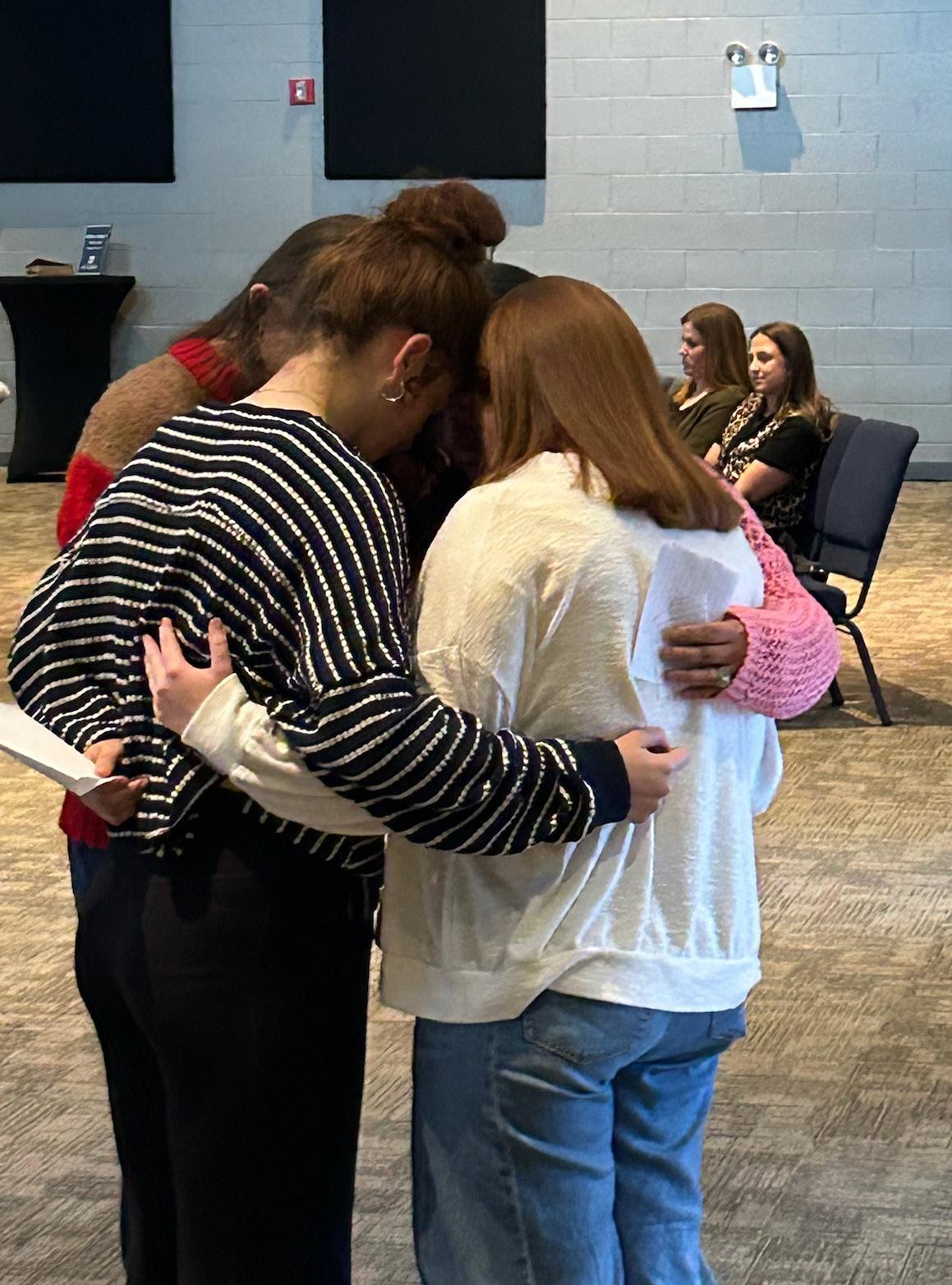
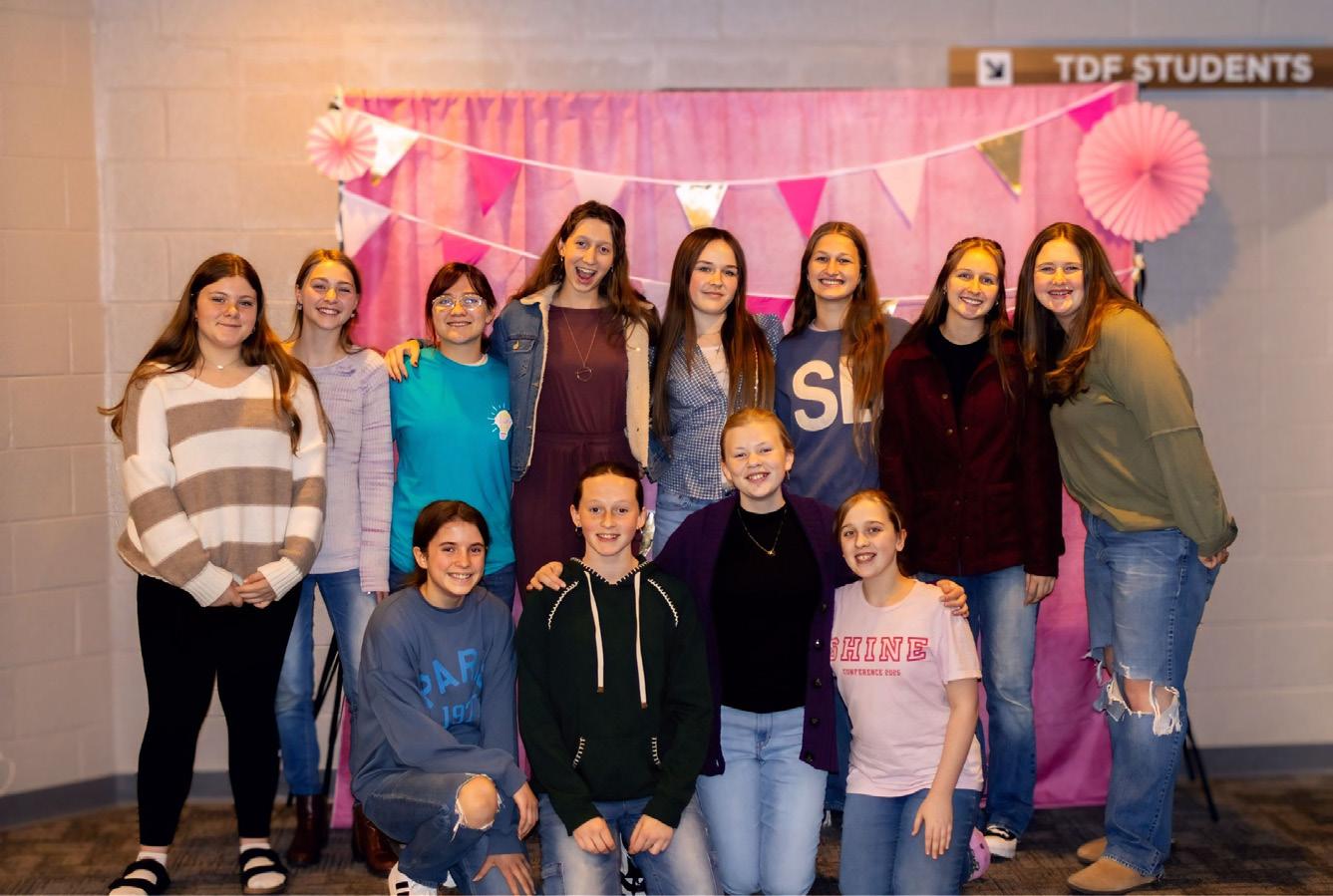
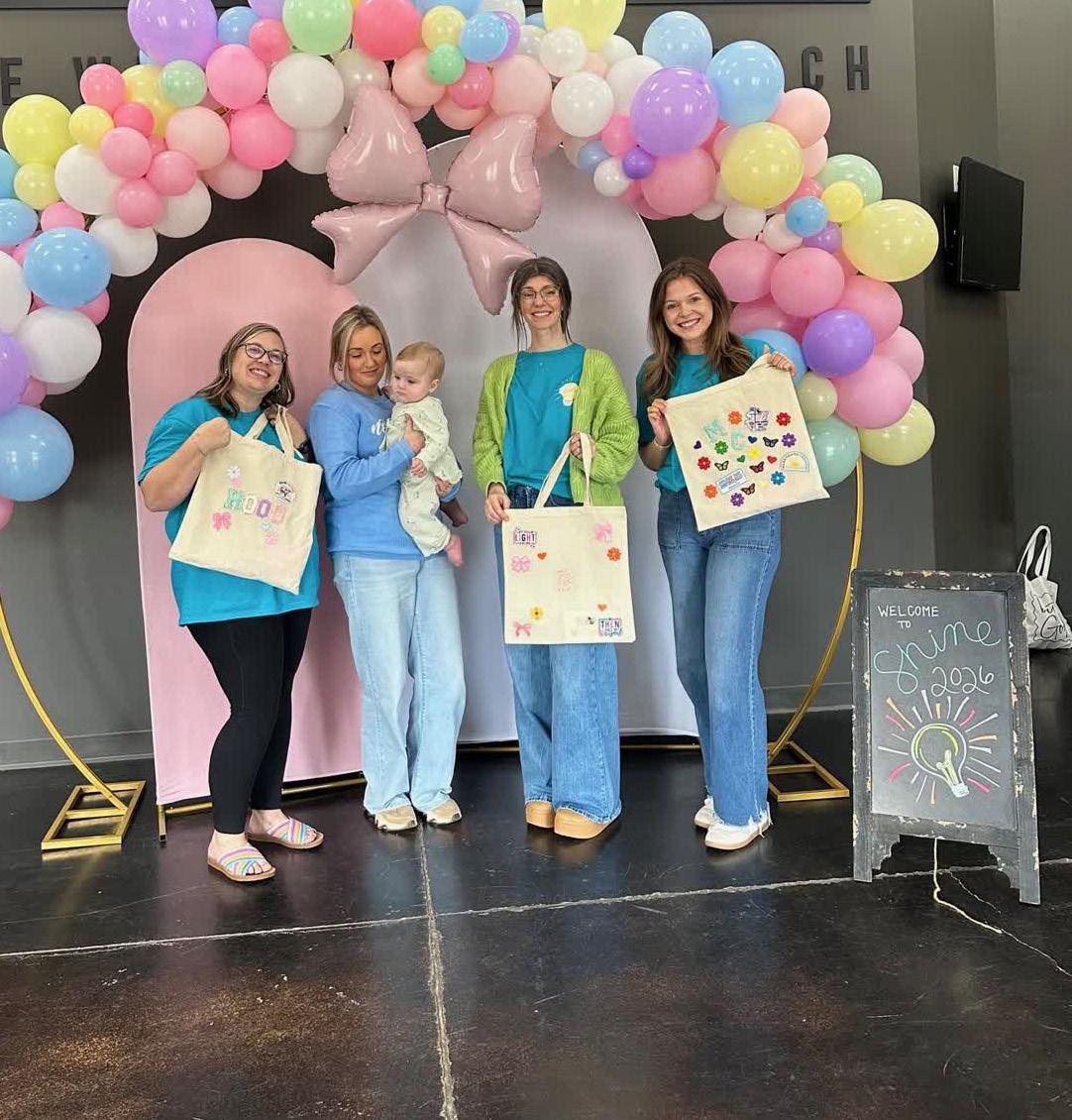
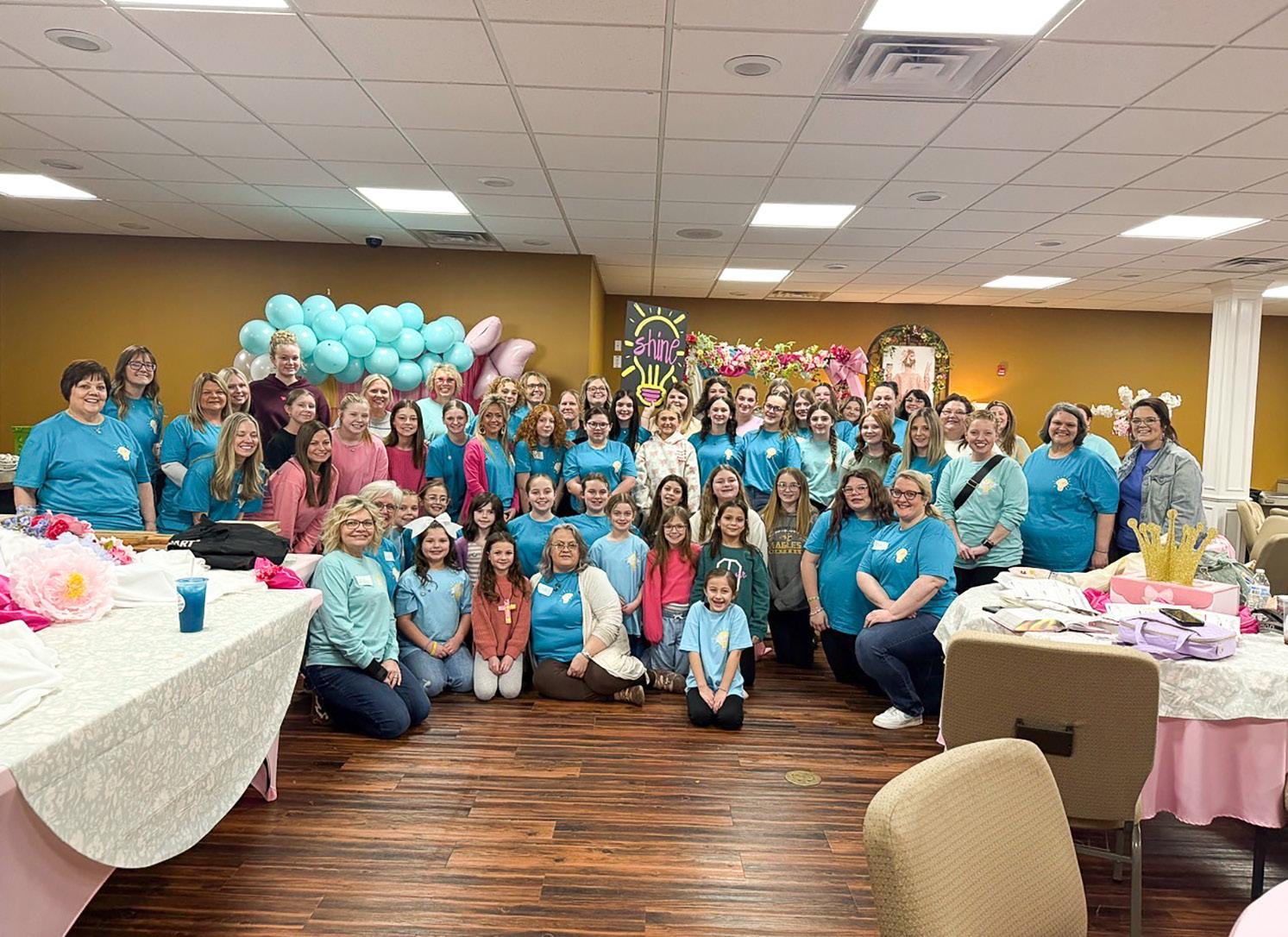
Decorations were placed. Gift bags were filled. Registrations were complete. Crafts were ready. Games were planned. Speakers were prepared. Then, teen girls from across the nation walked through the doors of their churches to find the place they belong.
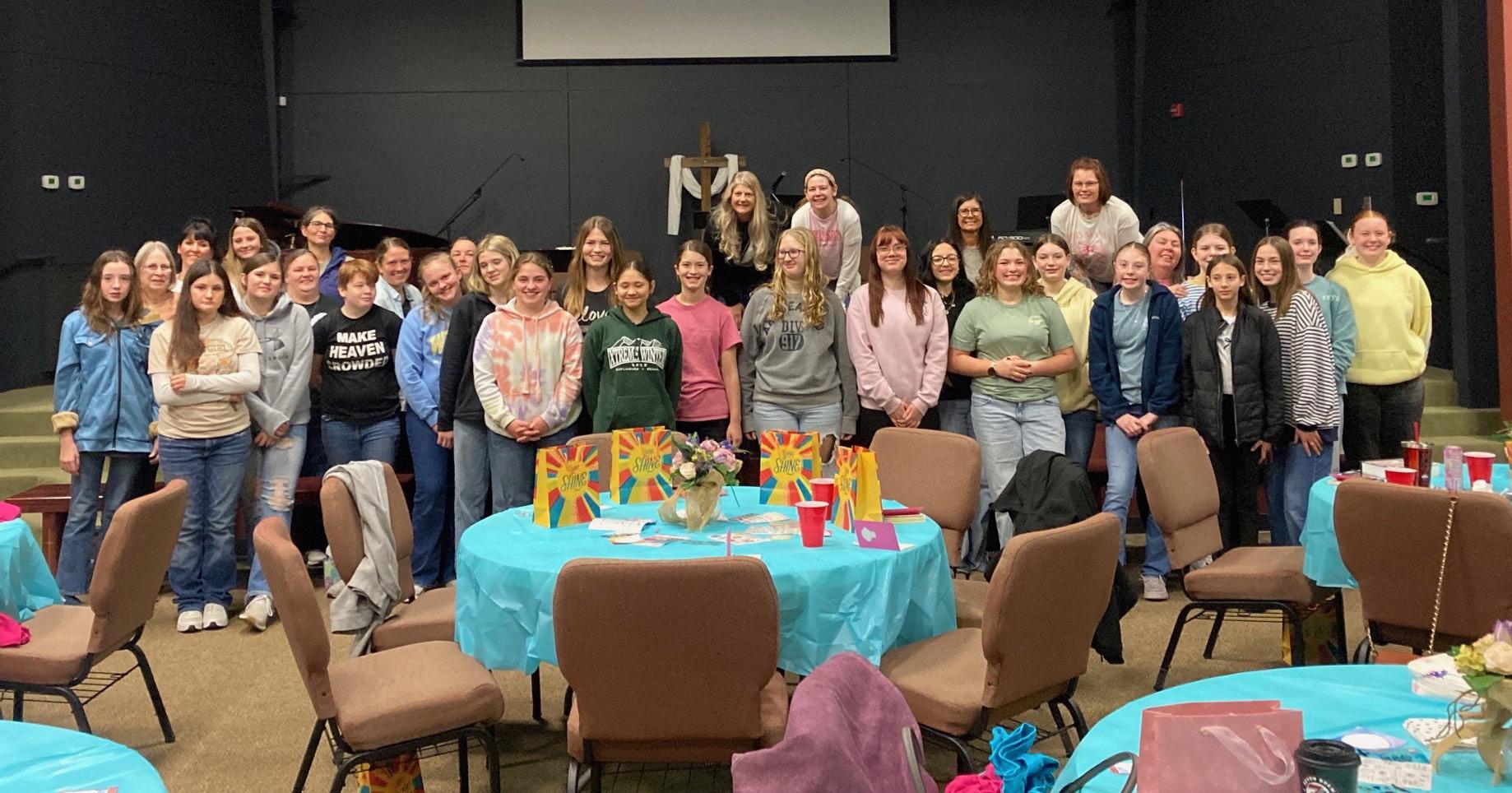
The 2026 Shine! Simulcast stretched from coast to coast. Girls joined from as far east as North Carolina and as far west as California when The Donelson Fellowship in Nashville, Tennessee, hosted an in-person conference. What did they all experience?
WORSHIP
As the all-girl worship team led singing, the Spirit also was leading. Each instrument was tuned for worship, and each song was carefully chosen to represent the freedom found in Christ. Each pause was orchestrated for reflective worship. Girls from Tennessee sang out, joined by girls in Illinois, Alabama, and many other states across the nation. The name of the Lord was lifted, and hearts were led to the cross.
I NTERGENERATIONAL M ENTORS
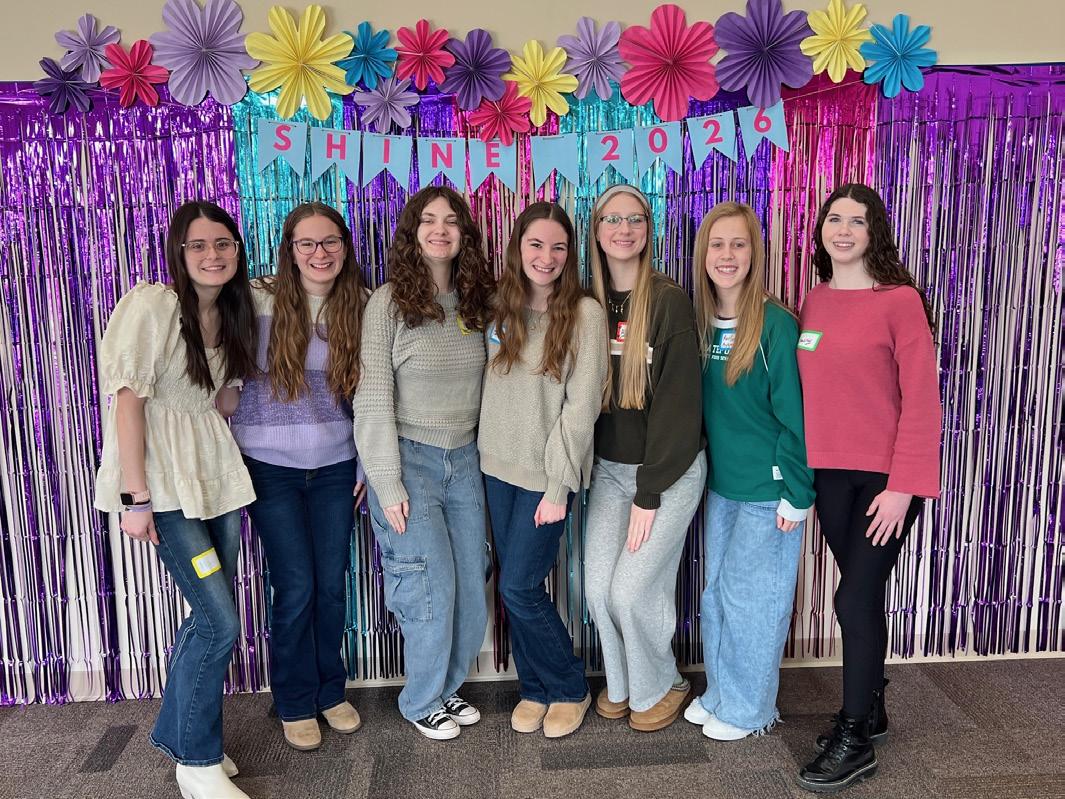
Throughout the Shine! Simulcast, various generations were represented. The message focused on girls ages 12-18, but women of all ages shared, volunteered, taught lessons, sang, and made an impact.
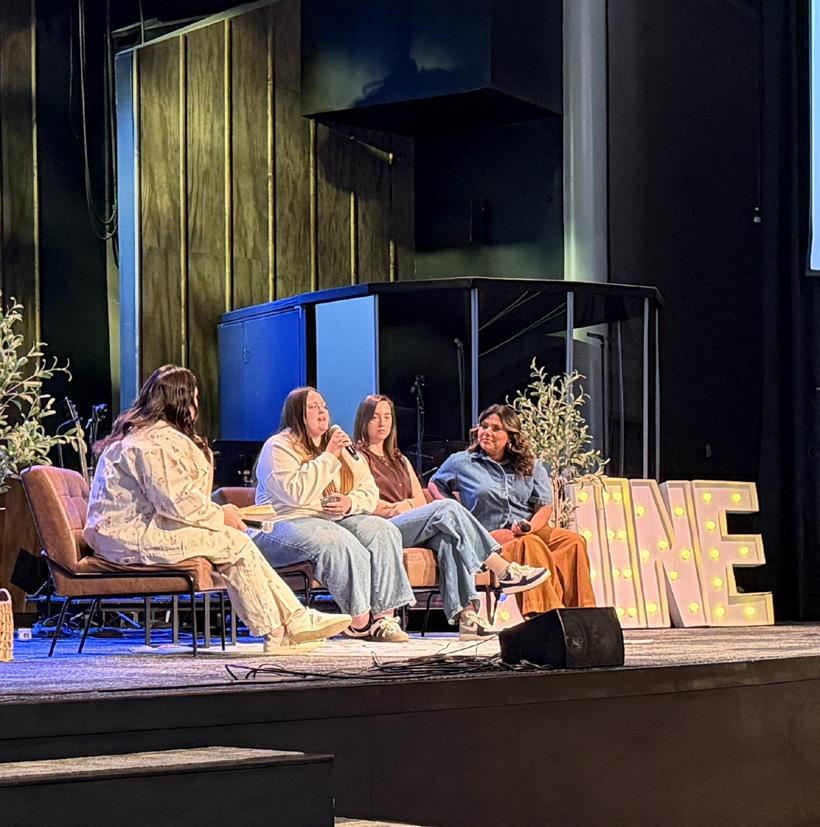
Big sisters. Three Welch students started the day off with an engaging panel discussion. Their testimonies and raw stories shed light into what so many young people face today. Lindsey Padden, social media coordinator, led the discussion. She reflected, “Being able to sit with young women who have such powerful stories of walking in His freedom is so encouraging. I’m glad to be a small part of what God is doing through this ministry.” These college students taught the listening girls how to let God lead them bravely through temptation, apathy, and difficulty.
Cool aunt. Olivia Ryan, a middle school science teacher and high school coach, challenged girls to share the light of Jesus with those around them. Olivia is a perfect example of someone who provides wise counsel to teens, from her own not-so-long-ago experiences. She’s “cool” enough to speak their lingo and know the latest trends but has also lived life long enough to help teens who need advice along the way. God used her teaching to encourage girls to remember, “You will never show others living in the light is better if you look exactly like they do in the dark.”


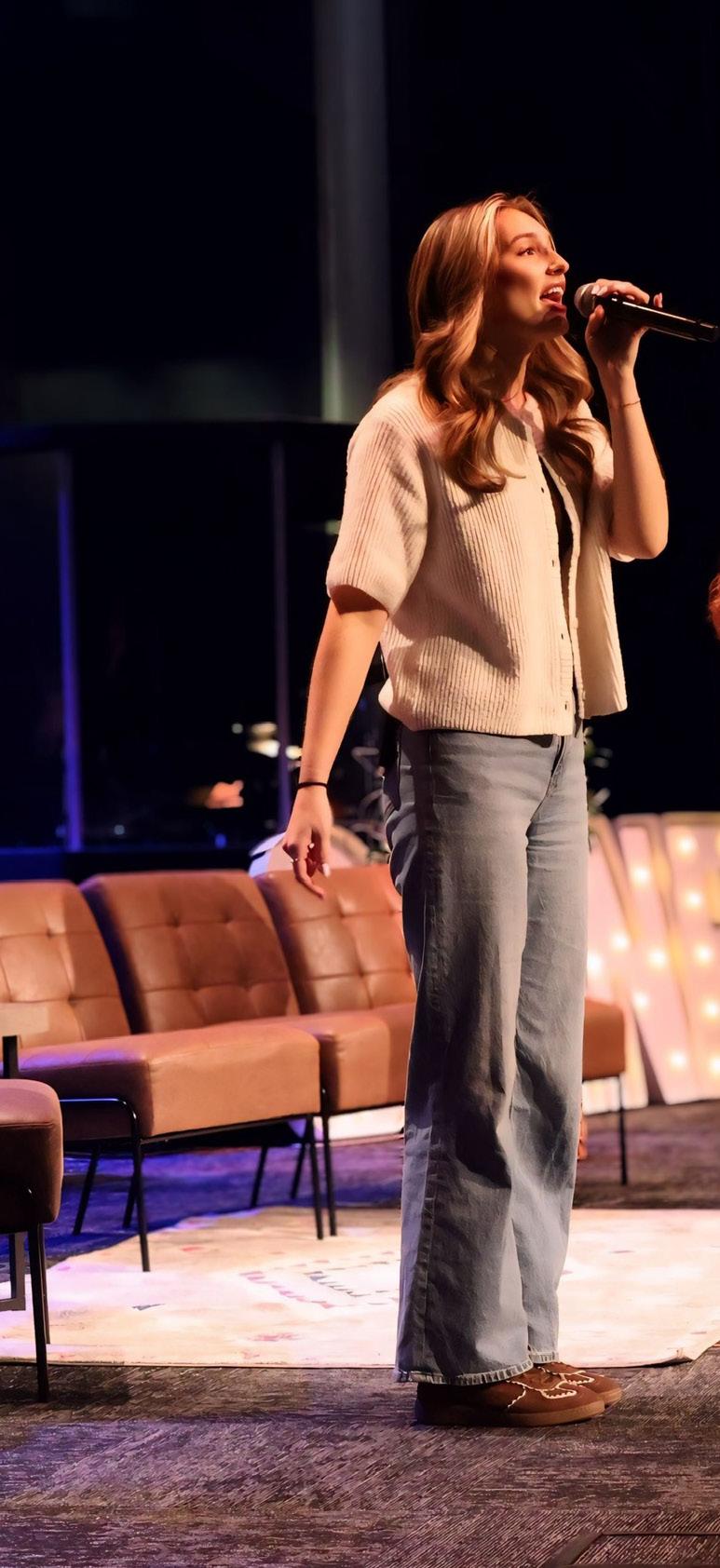

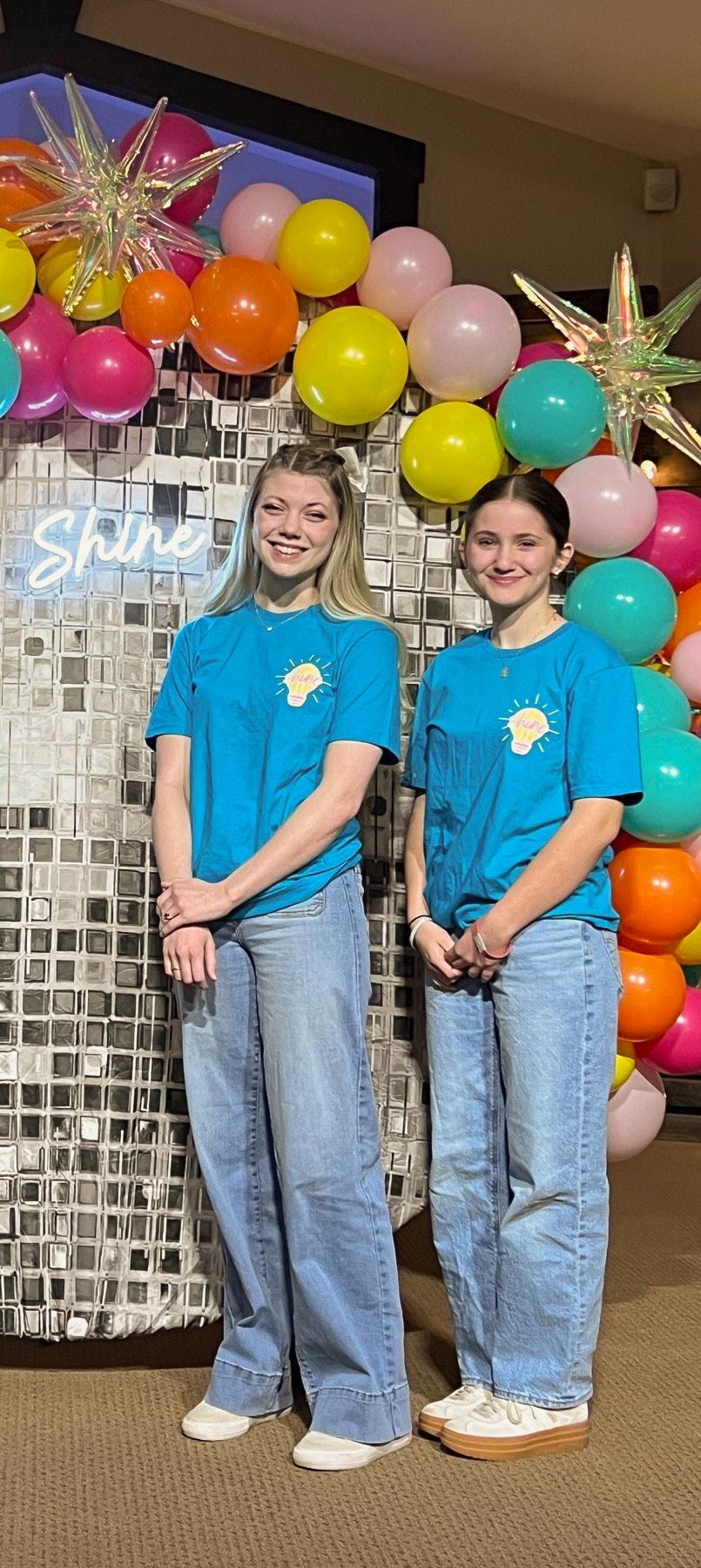
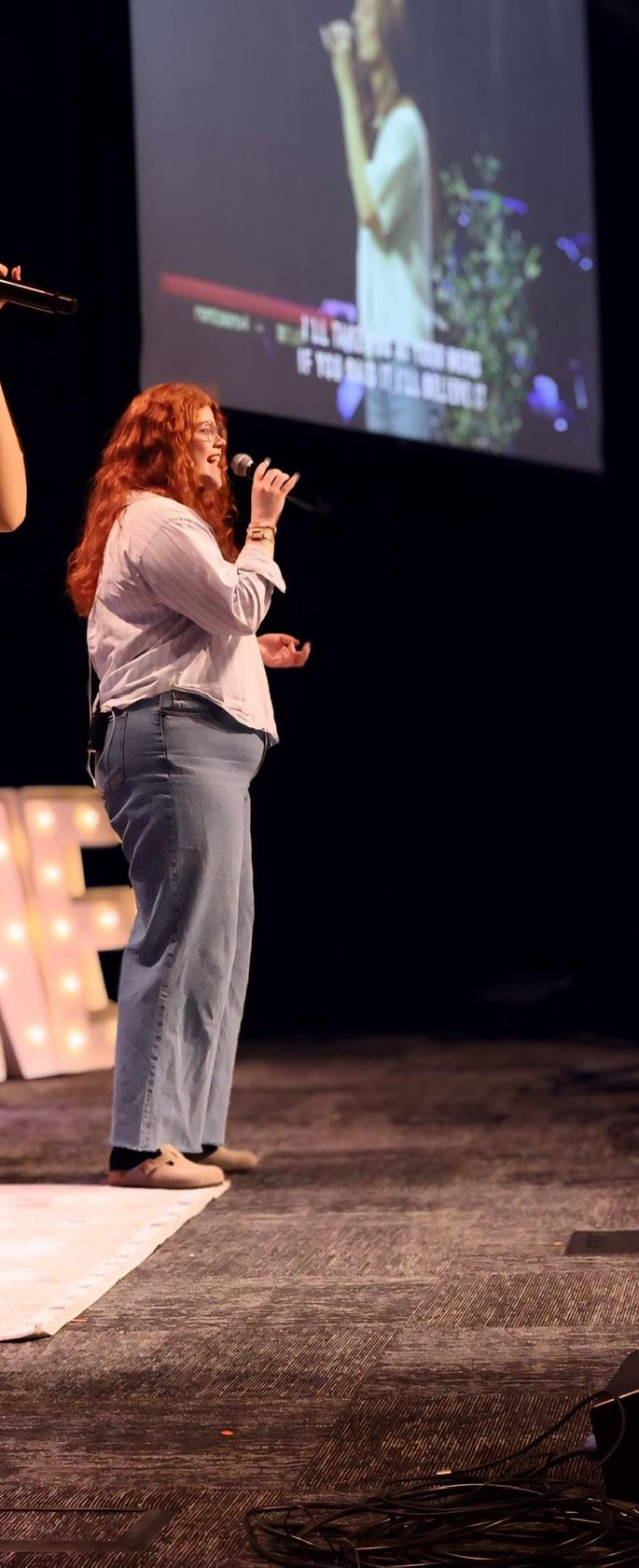
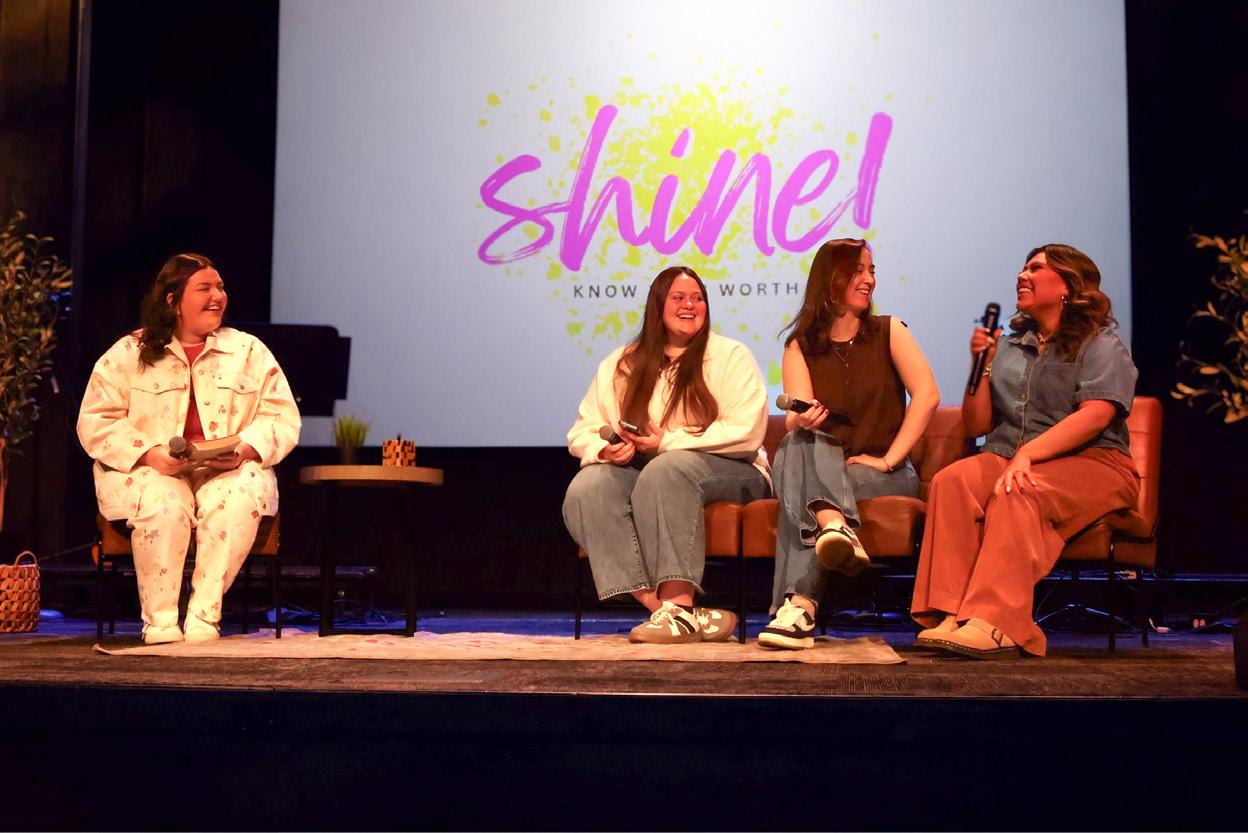
“Shine! Simulcast 2026 was everything God intended it to be and a beautiful picture of His faithfulness. Being able to sit with young women who have powerful stories of walking in His freedom is so encouraging! I’m glad to be a small part of what God is doing through this ministry.” — Lindsey Padden, Panel Host and Social Media Coordinator
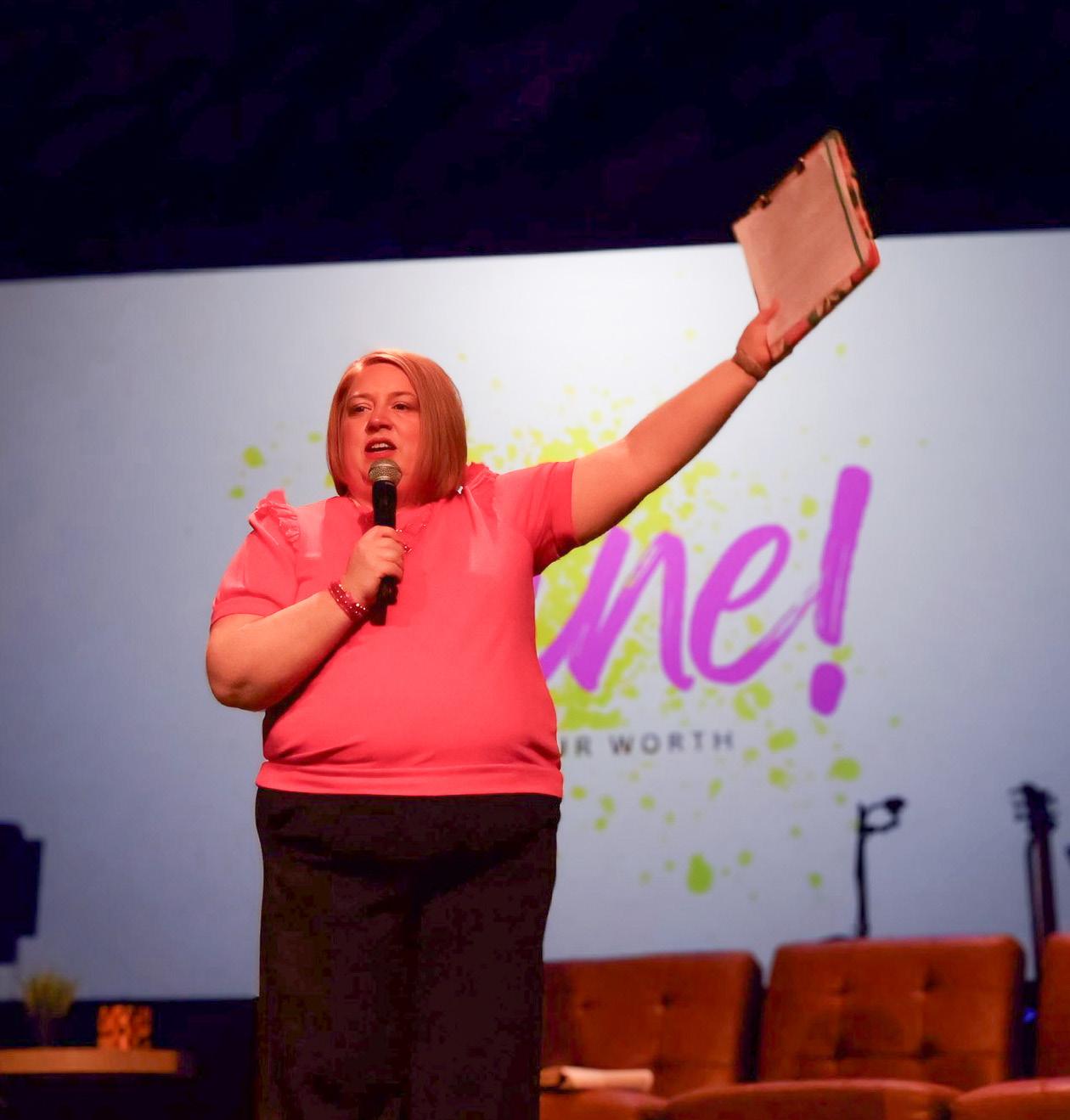
“From Spirit-led worship and powerful testimonies to biblical teaching, girls across the country and denomination shared in the truth we really are Free in the Light, and it’s God’s Word hidden deep in our hearts that will help us remain there. May we never forget we don’t have to walk through hard things alone. The Lord… and the women just ahead of them…are here to walk beside them.”
— Stacie Compton, Conference Coordinator
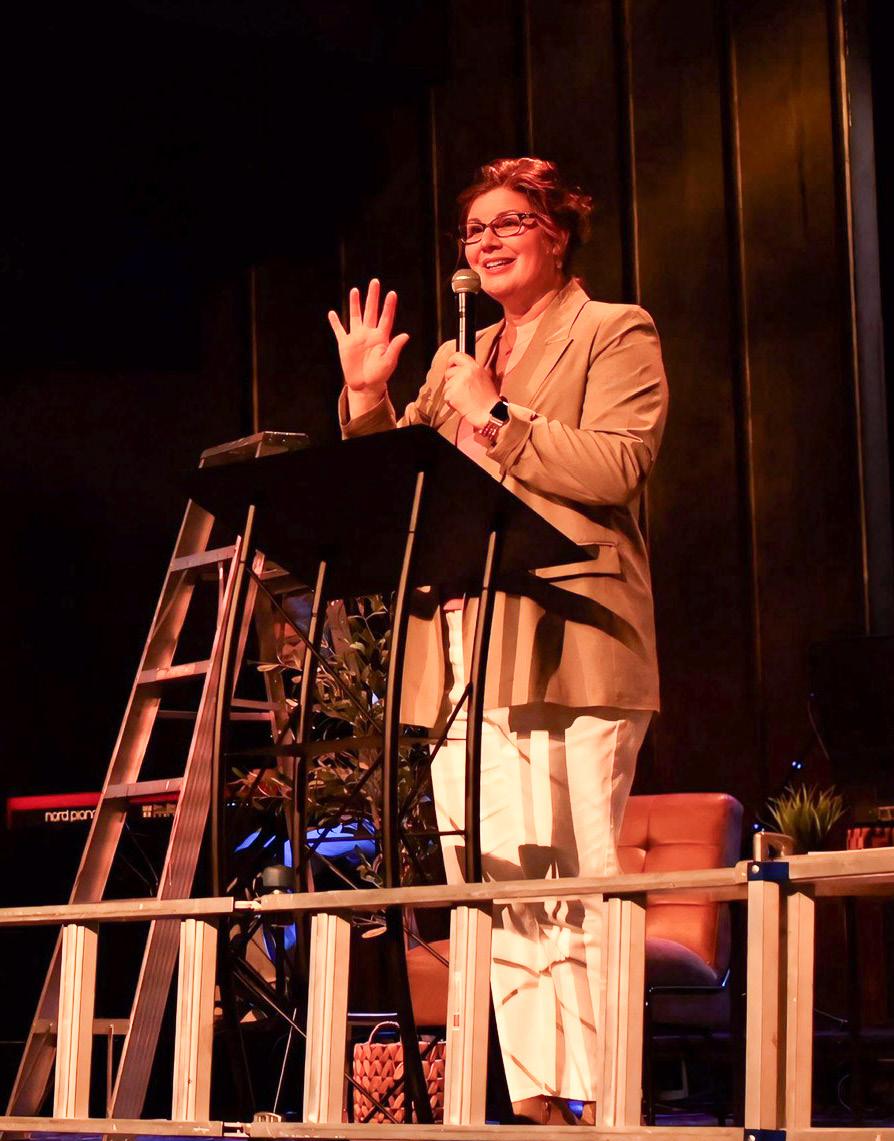
“I’m so grateful to see how God is continuing to use Shine! It has so many important truths to share with the young women coming along behind us!”
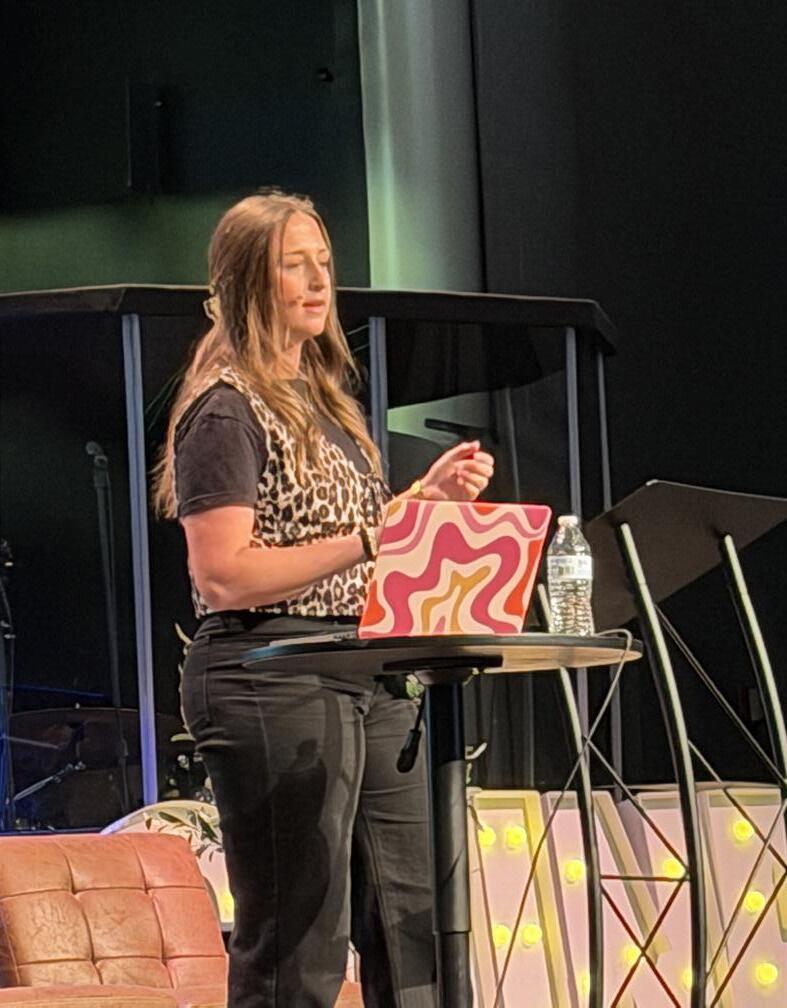

Wise mom. When Jessica Swindol, a pastor’s wife and mom of two daughters, took the stage, two ladders were placed beside her. They illustrated the “social ladders” girls often climb in their lives — ladders filled with complications, lack of confidence, and sometime mean girls. She taught biblical truth as she urged girls to be free from comparison, jealousy, and tearing other people down. Jessica reminded listeners Jesus is not asking, “Do you believe in Me?” Instead, He is asking, “Are you letting Me define you?” Her insight as a mom spoke to the girls at the Shine! Simulcast, representing mothers across the country who love their teens and want them to seek Christ with all their hearts and let Him shine through their lives.
F INAL CHALLENGE
Stacie Compton, 2026 Shine! coordinator, noted God “wove the conference together detail by detail.” As people were invited to speak, sing, and volunteer, God used Stacie’s heart for ministry to bring their hearts together. She worked closely with Kristi Johnson, director of WNAC, the organization that sponsors the Shine! Simulcast. Kristi ministers to women regularly and notes she enjoyed watching the next generation of women take part in something bigger than themselves. “I can’t wait for next year’s Shine! event,” Kristi noted. “We will continue offering the same dedication to sharing biblical truth to teen girls as they find their own place in the Kingdom of God.”
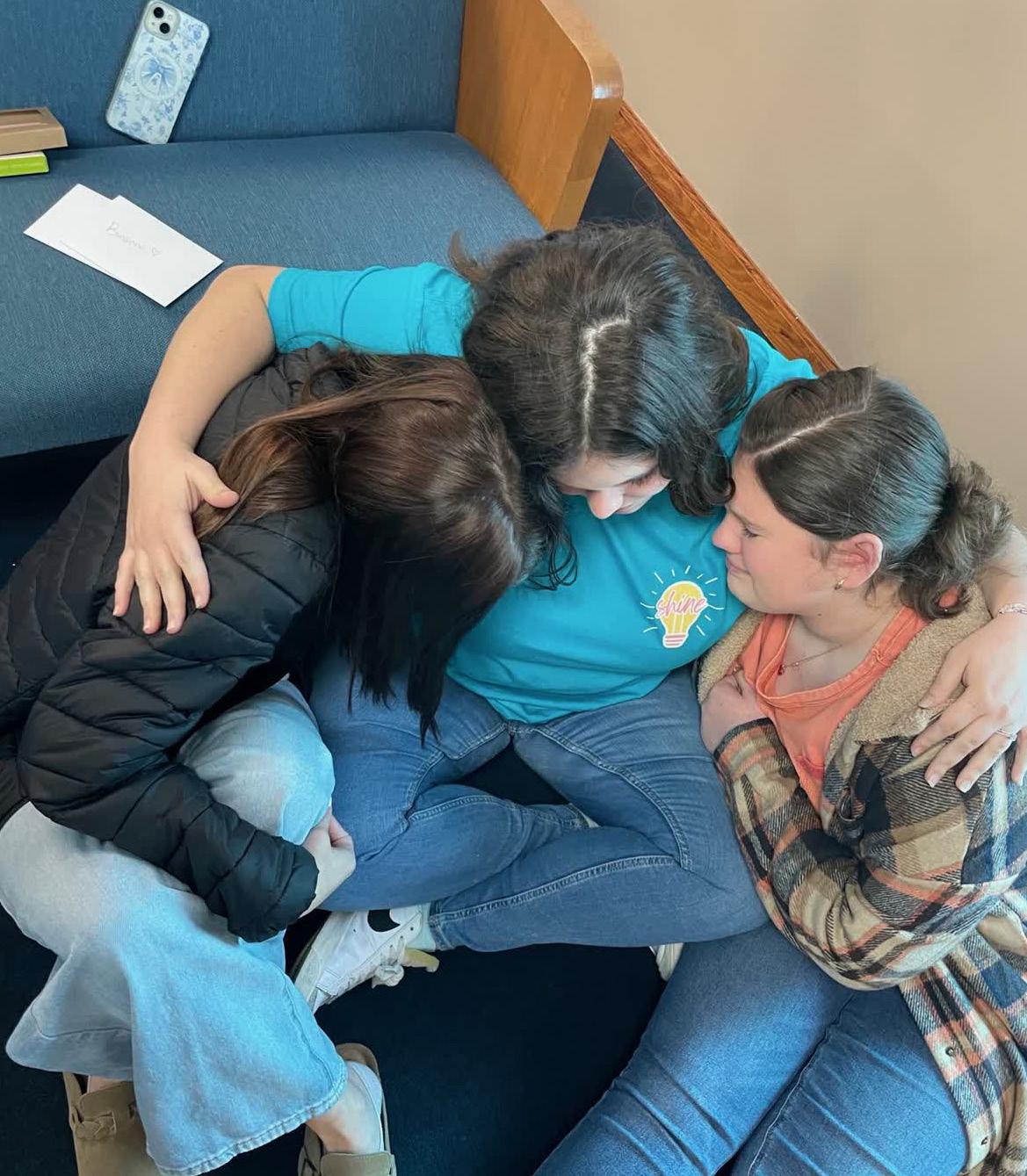
While girls participating in the Shine! Simulcast were challenged to ask themselves, “Who is speaking into YOUR life?” we all must ask ourselves the same question. Whose voice is speaking — sometimes with a quiet whisper and other times with a loud shout — into the deepest recesses of our hearts?
Who is hearing our voices and thereby shaping their search for Christ’s calling in their lives? As teen girls find mentors who can walk with them through doubts, struggles, and questions, they were reminded not only to find a mentor for themselves, but also to become a mentor to someone coming behind them. As each generation invests in the next, what they’ve learned will pass forward, and God’s light will continue to Shine! in hearts.
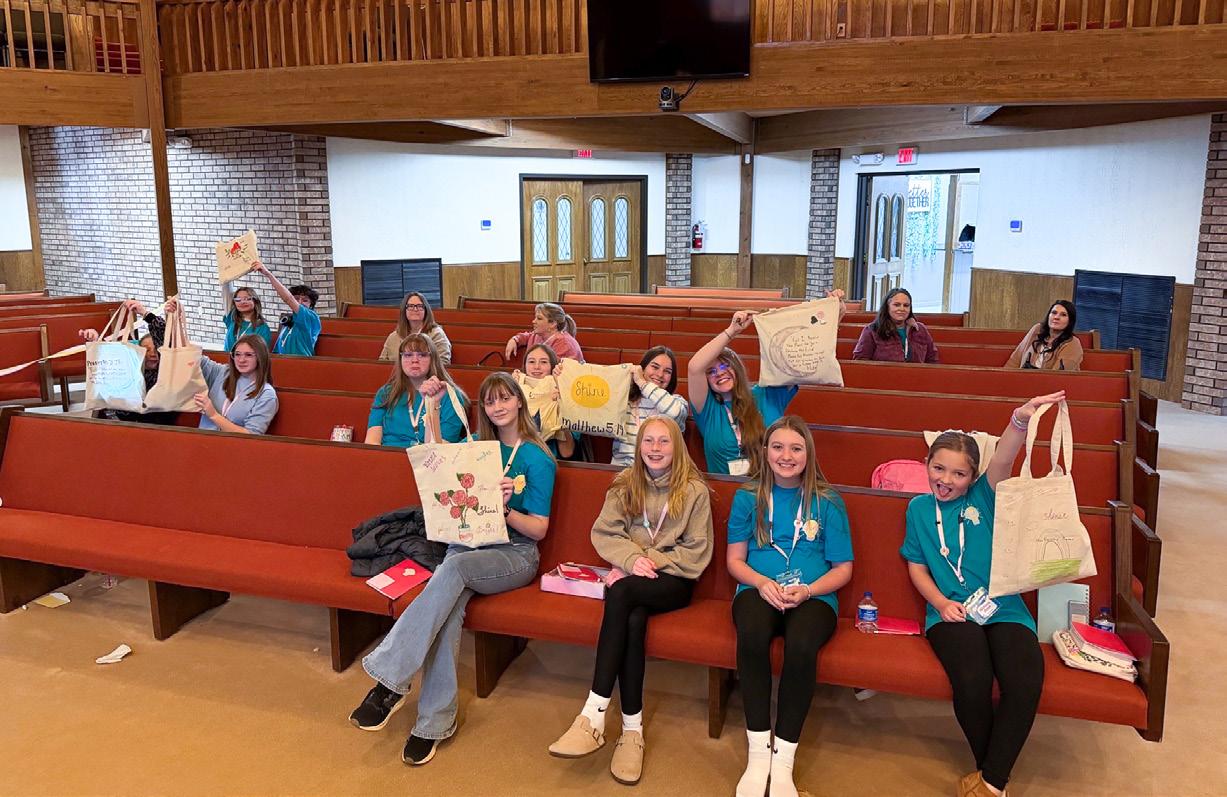
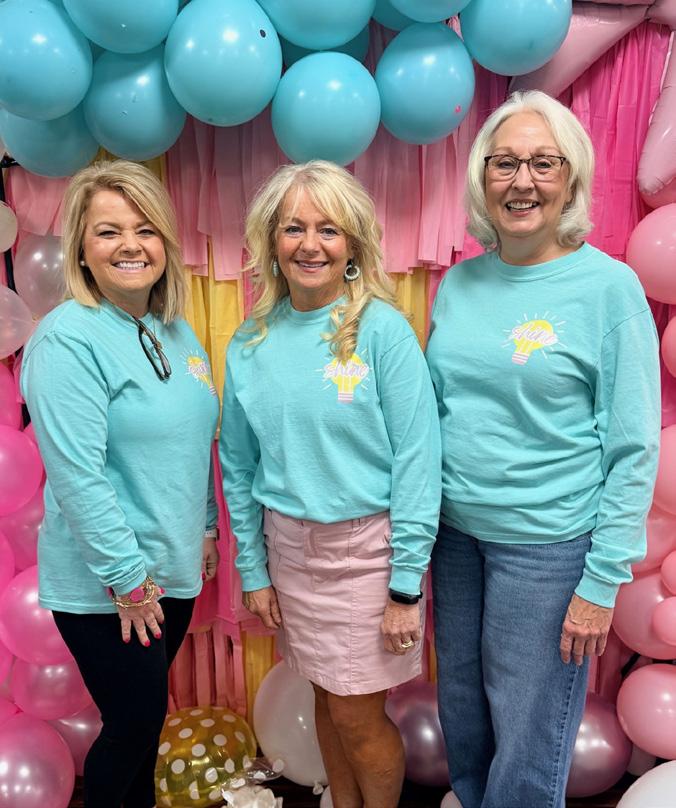
“I loved being a part of the Shine! Simulcast. I loved the mix of enjoying the speakers and worship with everyone while having special time with just our girls. They have already asked about next year!” — Allysa Harvey, Bethlehem FWB Church, Ashland City, TN
“Hosting the national Shine! Conference Simulcast gave our community the opportunity to be part of something bigger than themselves as women and girls from across the country gathered around the same message of faith and purpose. Women from five Kentucky churches joined together in unity, each using their God-given gifts to pour into the next generation.”
— Rachelle Burchett, Southside FWB Church, Paintsville, KY
Treasure Now Available in Print
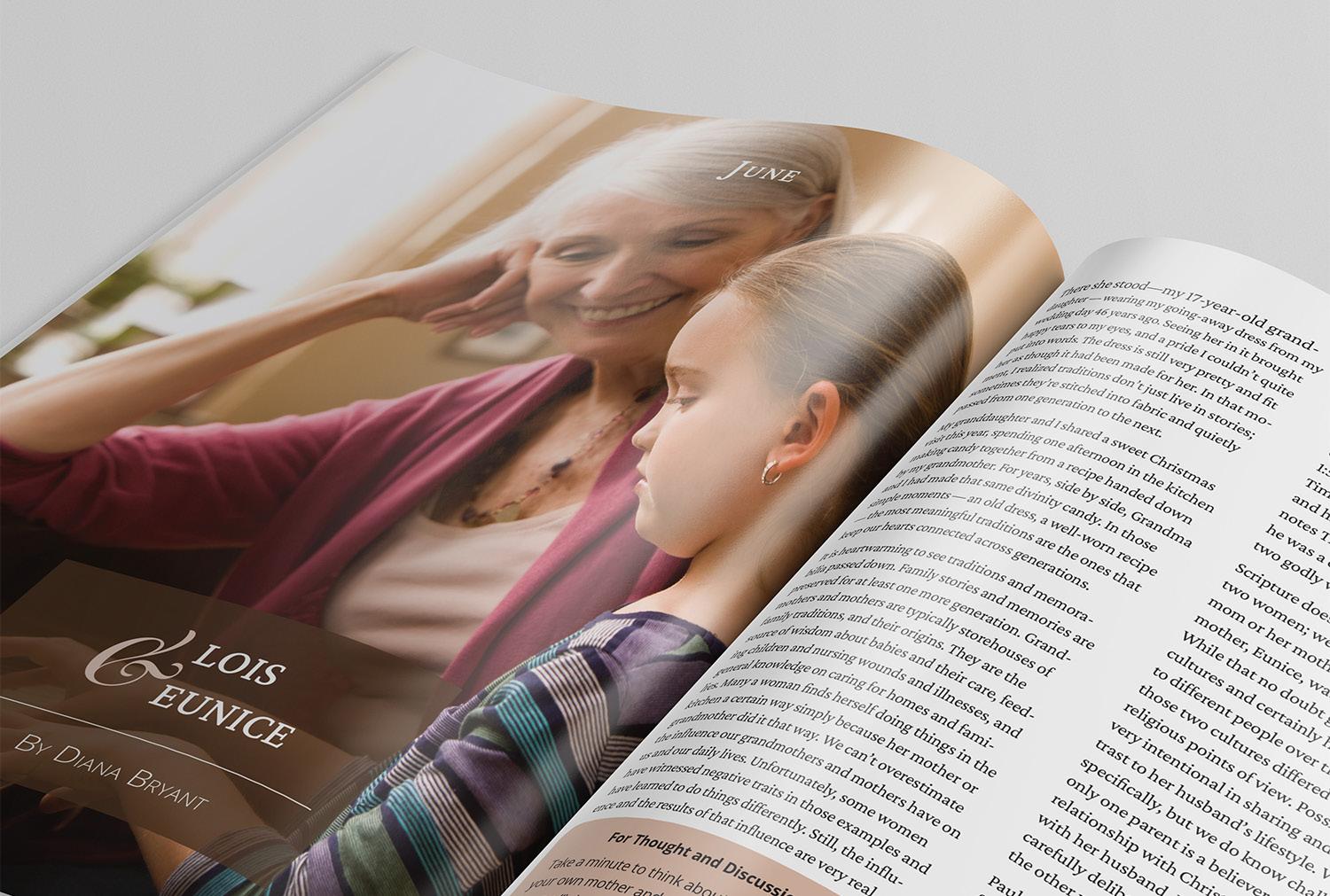
Antioch, TN — The redesigned Treasure Bible Study Guide recently started its second year in print. Women can read this incredible resource either in the printed version with a yearly subscription of $28 (quarterly publications) or through the digital version (free) at wnac.org/treasure/.
Longtime editor Phyllis York observed, “After serving as managing editor of Treasure Bible Study Guide, I can gladly recommend its high-quality, biblically-sound, relevant studies and articles. Treasure provides women with thoughtful, Scripture-centered resources to help them grow in their understanding of God’s Word and apply it to everyday life."
Coming in August: “In the biblical stories of Lydia, Phoebe, and Priscilla, we learn how three little-known ladies served God. Their stories offer hope God can use anyone
Conference Program
Streamlined in Columbus
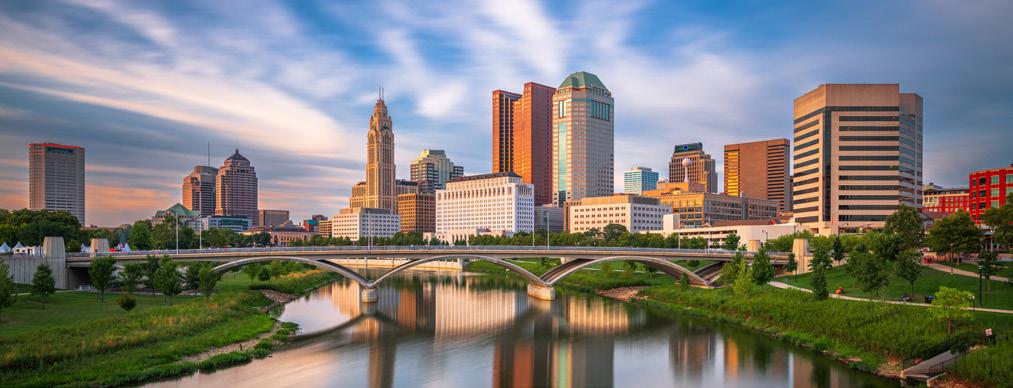
Columbus, OH — Join WNAC for a streamlined program during the National Convention in Columbus, Ohio. On Tuesday morning, new director Kristi Johnson will share her vision for the future of WNAC. Participants will discover ways they can come alongside women’s ministries to serve, disciple, and impact both their communities and the world for Christ.

In place of the annual “Laughter and Latte” ticketed event on Monday evening, all women are invited to celebrate what God has been and continues doing around the world through church planters and missionaries and their partnership with WNAC. (And, yes! A whole lot of laughter will go along with this special event.) We hope you will make plans to be there!
— including you and me — in mighty and amazing ways.” Read the rest of this article from Jen Thomsen of IM, Inc., in the July-September issue of Treasure.
This quarterly Bible study guide is designed for personal, group, or discipleship use. Each issue offers articles, resources, columns, and the latest news, projects, and events from WNAC.
the Church of Tomorrow
Inviting Kids Into Ministry
BY KYLAH KIVETTE WALKER
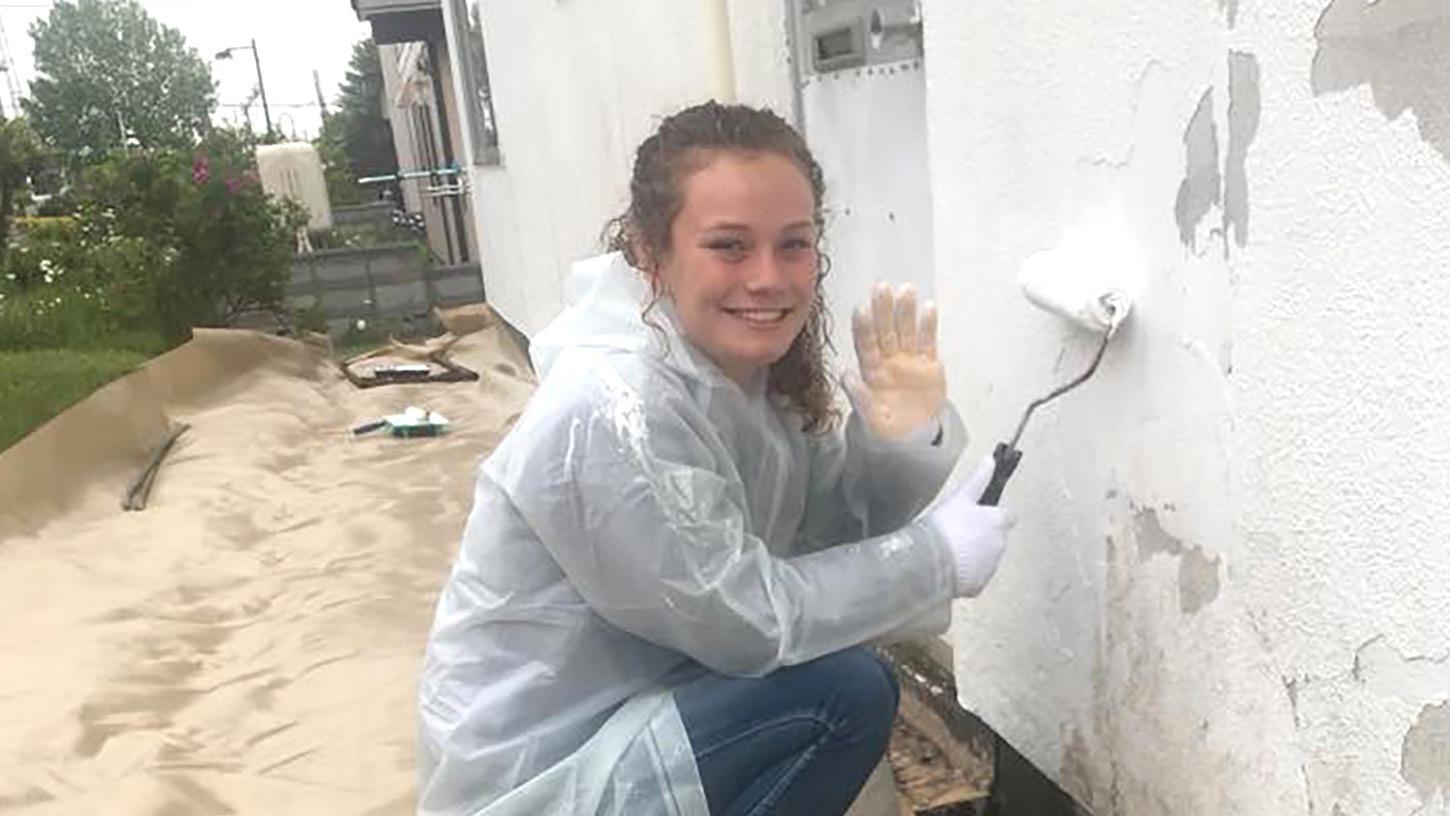
Imagine you have been appointed chair of the decorating committee at your church. You have been fundraising and vision-casting for months. You have worked tirelessly to collect carpet samples and paint swatches, and you know how important it is for the building to leave a good first impression on visitors. You are ecstatic to begin this project. Then, you meet your co-chair, an enthusiastic, curly-headed six-year-old.
While this example might seem a bit absurd, it was once a reality, and I was the curly-headed co-chair.
My family had just moved to Grand Junction, Colorado, to plant a church, and my dad wanted our children’s area to attract kids. What better person to design this area than a kid herself? I easily decided on a carpet that most resembled Chuck E. Cheese’s. As for the paint, why choose one color when you can have them all?
By including me in the process, my dad did much more than design a children’s church room; he cultivated a sense of pride and ownership for the church within me. He let me know, even as a six-year-old, I was a vital and valued member of the Body of Christ.
Working together means viewing children and young people as co-laborers in Christ and giving them meaningful opportunities to serve. Through these opportunities, they develop ownership and belonging that strengthens the Church and
leads to lifelong commitment to it.
Someone recently asked my older sister when she knew she wanted to be in ministry. Kinsley responded, “I never decided I wanted to be a part of ministry. From a young age, my parents included me in their ministry. So, by the time I became an adult, it was already a part of who I was. Ministry is not something I chose to do but rather is something I would have to choose to leave.”
Other parents might argue they do not want to force their kids to do anything, and yet, they do it all the time. Very few kids want to brush their teeth, eat vegetables, or honor their bedtime, but parents strictly enforce these routines because they know their benefits.

How much greater is the benefit of having your children serve in ministry alongside you?
In Kinsley’s statement, she never once described feeling forced to do something. Rather, it was an honor to be invited into ministry with our parents. We all know the limits of “do as I say, not as I do.” Likewise, if you want your children to serve, it must begin with you. When service to Christ and His church becomes a natural routine of your family, it is no longer a task to complete but a foundation that anchors your faith.
Growing up in a church plant, you learn to wear many ministerial hats. Before I turned 18, I had served on donut duty, taught preschool, painted faces, greeted visitors, and played the cajon. I did not love all these jobs — particularly the ones that required musical abilities — but these opportunities taught me where the Lord had gifted me. I quickly discovered a heart for children’s ministry and served alongside my mom teaching a preschool Sunday School class.
If you want your kids to enjoy serving, help them find opportunities that capitalize on their gifts as well as their interests. One of Kinsley’s jobs as an elementary student was to drain the baptistry. She rejoiced to see every new believer. Sure, it meant she gained a brother or sister in Christ, but it also meant she could go for a “swim” in the baptistry.
Not all jobs in the church are mundane. We need to find ways to make serving enjoyable for children. Mom did this when we served on donut duty by letting me select one specialty donut each week. As silly as it may sound, that chocolate frosted donut with peanuts was one of the highlights of every Sunday.
I believe my parents’ intentionality in making service both
joyful and meaningful is why I still serve as a preschool Sunday School teacher today.
If you were to visit my parents at their home in Amory, Mississippi, it is likely you would be greeted with a wave, a smile, and a “Welcome to the neighborhood,” from their elementary-aged neighbor. The first time I heard of this little girl’s friendliness, I thought, “You need her to greet at your church.” I did not think, “She would be a great asset to your church in ten years.”
Too often we think and speak of children in the future tense: “One day he or she will do big things for Christ.” Yet, if we truly believe children are valuable members of the Body of Christ, we must stop postponing their contribution.
James 1:22 says, “But be ye doers of the word, and not hearers only, deceiving your own selves.” We teach this verse to kids, yet far too often, we fail to give them opportunities to be doers of the Word. My dad has often said one of the reasons kids leave the church is because they were never actually part of the church. If we want children to feel part of the church, we must embrace them as present partners in the gospel.
Whether we hand them the carpet samples, donut boxes, or preschool lesson plans, we are not simply assigning a task; we are giving them a place to belong. Through intentional invitation and meaningful opportunity, children discover their spiritual gifts, take ownership in their church, and grow into lifelong co-laborers in Christ.
Working together means viewing children and young people as co-laborers in Christ and giving them meaningful opportunities to serve.
They are becoming the church of tomorrow as they serve Christ today!
About the Writer: As the daughter of NAM church planters, Kylah Walker lived in five states before age 18 and helped plant three churches. She and her husband, Hunter, live in Nashville, Tennessee, where Kylah serves on the NAM office staff.
Embark FWB Church Launches
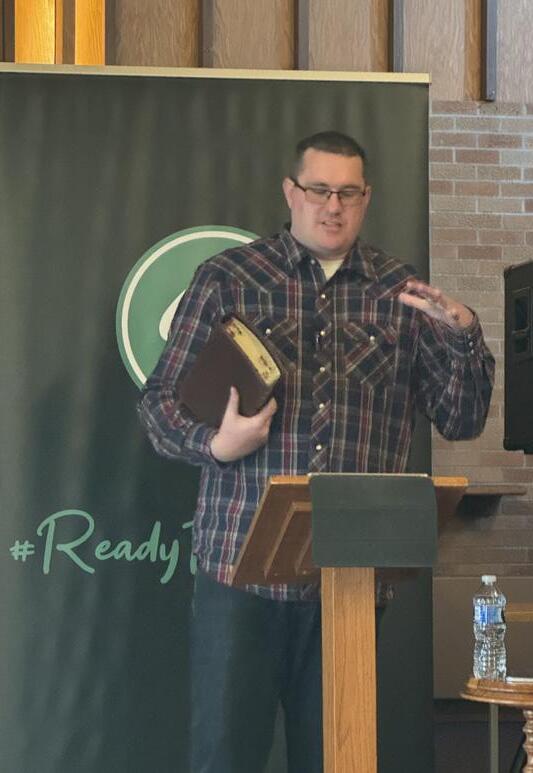
Jamestown, ND — Embark FWB Church in Jamestown, North Dakota, officially launched March 8, marking an exciting new season of ministry. NAM is grateful for a good start and praying this first gathering is only the beginning of a church life filled with worship, community outreach, and gospel impact.
As the work continues to take root and expand its reach, we ask you to join us in praying for lead planters Justin and Allison Feight as they faithfully lead Embark Church, trusting God to guide, provide, and bless their efforts every step of the way.
Greg and Hailey Smith Welcome New Baby Smiths Approved as Associate Church Planters
Ypsilanti, MI — Congratulations to Greg and Hailey Smith on the safe arrival of their new baby, Theo Drake. The Smiths serve as lead planters at The Well Church in Ypsilanti, Michigan. Theo is their third child and was welcomed home by two very proud big sisters, Norah and Lucy. Please join us in praising the Father for this sweet addition to their family.

Hickory, NC — North American Ministries is pleased to announce the approval of Isaiah and Anna Smith to serve as new associate church planters at Equip FWB Church in Hickory, North Carolina. Launched by lead planters Brandon and Shelly Smith in 2023, Equip is a thriving joint project plant between NAM and the North Carolina FWB State Mission Board.

Isaiah will serve as Next-Gen Director, and together the Smiths will play a vital role in strengthening the Equip Kids ministry, investing in children and students of all ages. Their addition to the Equip team marks an exciting step forward for the church’s gospel work in the Hickory community.
Isaiah and Anna both grew up in Nashville, Tennessee, and their call to church planting clearly reflects God’s faithful guidance through seasons of preparation and trial. After sensing a clear call to serve together in ministry, the Lord opened doors in North Carolina, even using a season of hardship to confirm His direction when Anna was unexpectedly diagnosed with cancer shortly after their engagement.
Following Anna’s successful treatment for lymphoma in 2025 — praise God, she is now cancer-free — their calling to serve with Equip Church became unmistakably clear. The Smiths were married last fall and now look ahead with gratitude and expectation, eager to pour their lives into the families of Hickory and to see the next generation grow in authentic faith and discipleship.
Isaiah and Anna Smith
Master’s Men Serves in Jamaica Dr. David Crowe Celebrates 30 Years
Master’s Men Disaster Response recently traveled to Jamaica and assisted Mission Four18 in recovery efforts after a recent hurricane. DRT enjoyed working alongside a team from St. Croix FWB Church and school. The team assisted several families in repairing damage from downed trees. They also served in a local orphanage, clearing an area to grow food to help feed the children. Thank you to Sam McVay and Allan Austin for all they do for the Kingdom.
Master’s Men continues to give opportunities for men to serve the Master! Watch for the next opportunity to be involved and learn more at fwbmastersmen.org/.
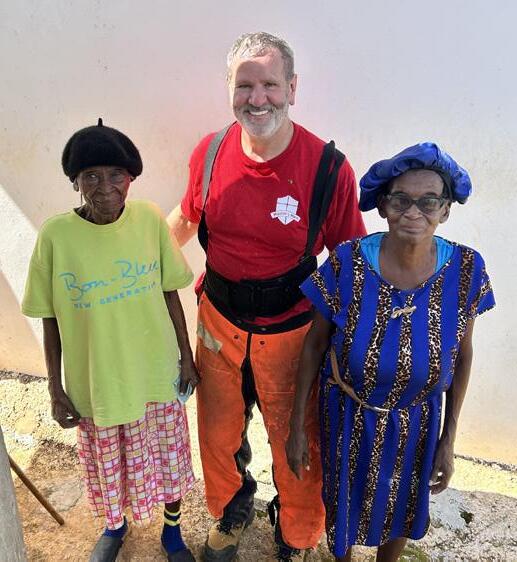
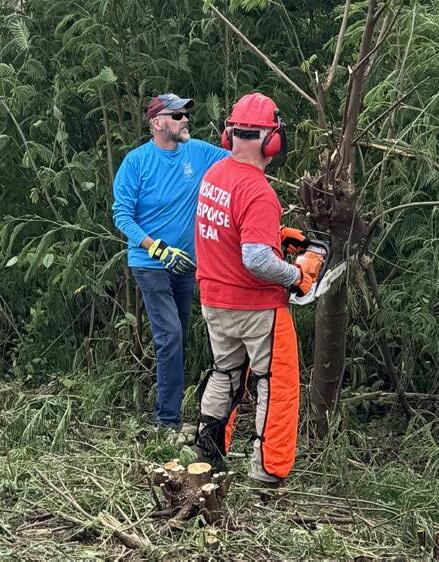
Nashville, TN — In February, office staff and friends gathered to celebrate NAM CEO Dr. David Crowe, who has served the department for over 30 years. Beginning as the director of missionary assistance at then Home Missions and eventually stepping into the role of chief executive officer, Dr. Crowe has served the denomination, church planters, chaplains, and ministry families with faithful diligence and generosity.
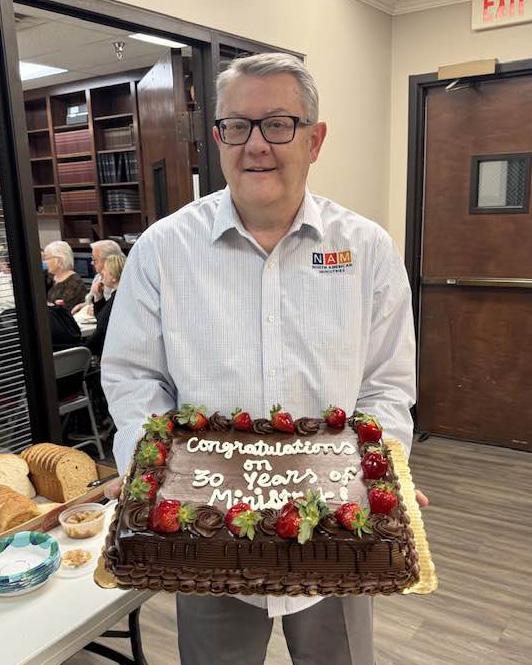
Executive Director Eddie Moody offered his congratulations: “For three decades, Dr. Crowe has been a steady hand and a visionary leader in church planting, chaplaincy, and ministry across North America. Thank you, Dr. Crowe, for your unwavering commitment to the gospel and your heart for the local church. We are grateful for your leadership!”
McCraney Ministry Partner Update
Layton, UT — NAM is proud to partner with Ethan and Emma McCraney as they serve military families with Cadence International. The couple recently shared an exciting update regarding their Cadence ministry: “After many months of praying, we are so excited to officially share that this summer we’re going to be moving to Layton, Utah, with Cadence International!”
Ethan was appointed in October 2024 as a missionary to the military through Cadence. Since January 2025, the couple has been raising funds. A few months ago, Cadence shared an incredible opportunity already existing at Hill Air Force Base in Layton. The McCraneys visited and fell in love with both the people and the area. They officially accepted
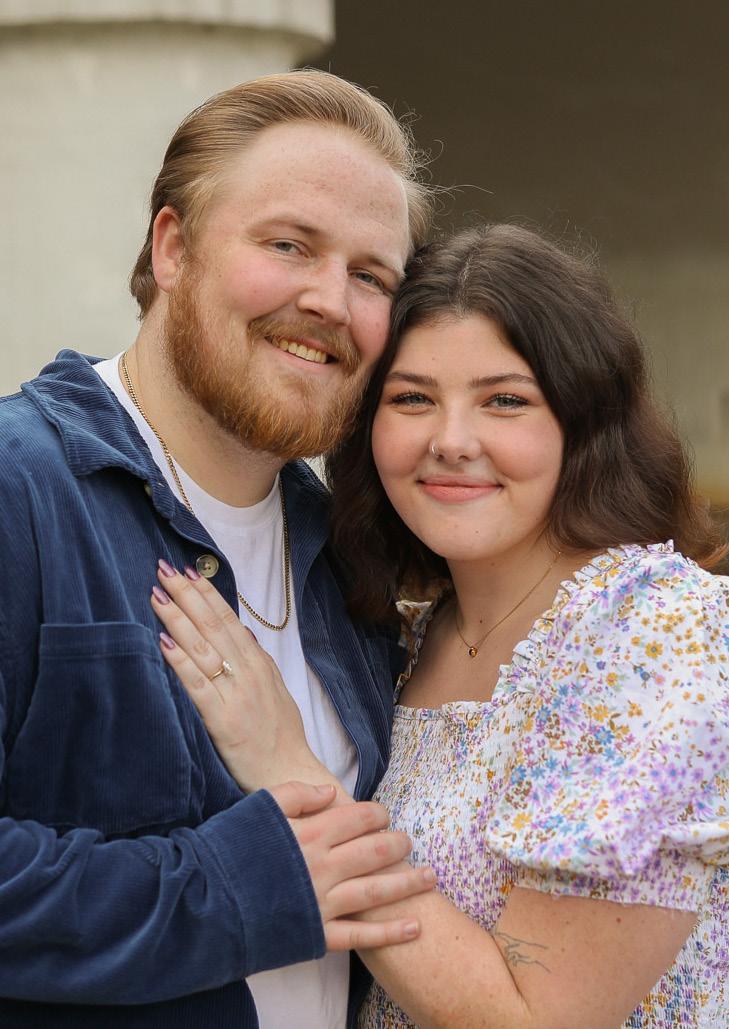
Ethan and Emma McCraney
placement to run this hospitality house for the next four years.
Ethan notes, “The house is located just offbase, and most of those we’ll be serving are 18 to 24 years old and single. Many are far from family and figuring out adulthood and faith at the same time. We feel so honored to get to walk alongside them.”
The McCraneys’ greatest need is prayer. Please lift them up as they complete their fundraising and relocate to Utah. Ask God to guide remaining logistics, be at work in the current ministry, and equip Ethan and Emma to steward their calling well.
To learn more or to financially partner with the McCraneys, visit fwbnam.com/emccraney/.
Dr. David Crowe
Why Your Church Should Embrace Innovation
BY CHRISTOPHER LITTLECREEK
In November 1796, John Fountain submitted a report detailing his observations while assisting William Carey, a missionary devoted to translating the Bible for the people he had been called to serve. Fountain said of Carey, “He keeps the grand end in view, which first induced him to leave his country, and those Christian friends he still dearly loves.”
What an idea! Keeping “the grand end in view” — not thinking with a narrow view but with a larger scope. To look at the mountains ahead with eyes to see the destination on the other side. The type of view that sees challenges ahead and says, “My help comes from the LORD, who made heaven and earth.” The grand end is God’s view rather than my obstructed view, whether those obstructions be old ways, new ways, fear, or, as in Carey’s case, those who call you a “miserable enthusiast” for challenging the norm.
I believe this long-range perspective fosters innovation and adaptability, which all our churches should embrace. I know change can seem scary. Doing things a new way or in a way that seems strange can feel awkward and challenging, perhaps like you’re abandoning valuable tradition. Today, I challenge you to shift your perspective and view your neighbors with “the grand end in view.”
Always remember, you’re not changing the truth but considering how to take the truth to every tribe, tongue, and
nation more effectively. The gospel is the same, “the power of God unto salvation to every one that believeth” (Romans 1:16). Innovation doesn’t change this truth. It simply explores new methods and ideas for reaching our neighbors with the gospel.
Adaptation helps us see how great ideas can become even greater in view of our changing context. Both innovation and adaptability cause us to examine our community and take notice of the seasons of life around us. This will provide the tools necessary to adapt and become all we can be for those we have the privilege of serving.
Allow me to share seven simple reasons all churches should embrace innovation and adaptability.
We can reach new people. When we are willing to understand how people live, think, and engage culture, we are better equipped to reach the lost. If we desire the lost to be found, we must learn how to reach them well.
We can continue reaching those we already know and love. Taking time to understand our people and the challenges they face daily helps us continue to walk with them faithfully and effectively.
We can meet real and tangible needs. Innovation and adaptability help us see the real needs of our neighbors
more clearly. This allows us to respond in meaningful, practical, and compassionate ways.
We can serve with humility and grace. When we listen, learn, and adapt, we will serve without assumptions and with understanding.
We can reach and equip the next generation. By understanding the unique challenges the next generation faces, we are better prepared to disciple them and to equip parents as they navigate those challenges with their children.
We can expand the Kingdom of God. Innovation and adaptability open new pathways to impact our communities with the gospel. Pathways that may not have existed before, or perhaps we missed.
We will glorify God. When we carry out our calling with intentionality, purposeful effort, and faithfulness, we honor God, reflect the worthiness of His Kingdom, and bring Him glory.
Innovation and adaptability are not about chasing trends or abandoning traditions. These characteristics are about keeping “the grand end in view” and trusting God enough to move forward in obedience, even when everything feels unfamiliar.
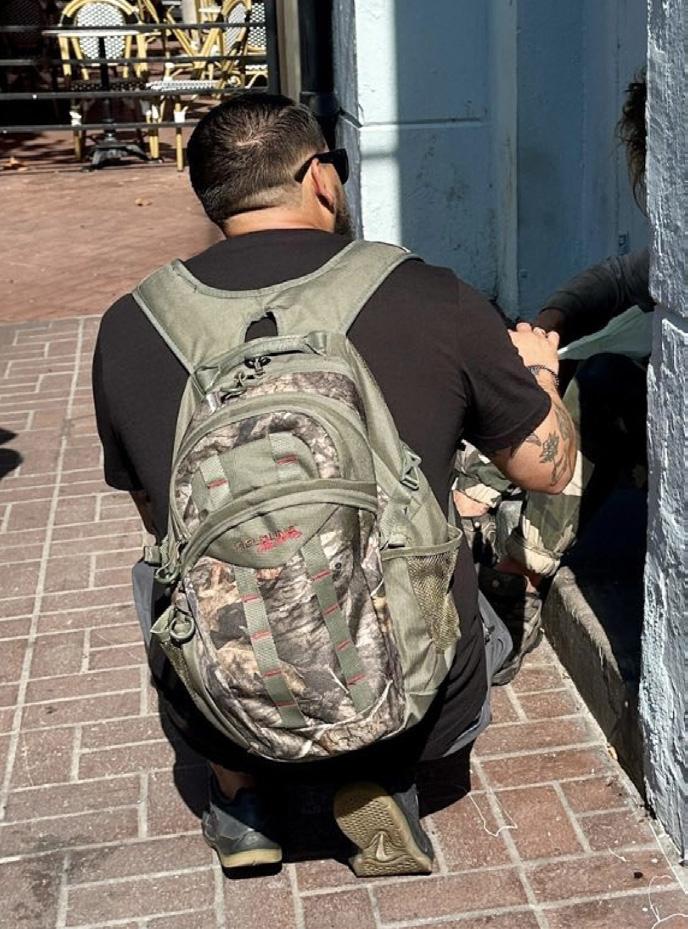
When the church holds tightly to the unchanging truth of the gospel while remaining open-minded about our methods, we can see the power of God work in our communities and reach people in desperate need of Christ.
Let’s be a church that sees beyond our own obstructions. Let’s step out in faith for the glory of God and the good of those He has called us to serve. As William Carey also said, “Expect great things from God. Attempt great things for God.”
Always remember, you’re not changing the truth but considering how to take the truth to every tribe, tongue, and nation more effectively.
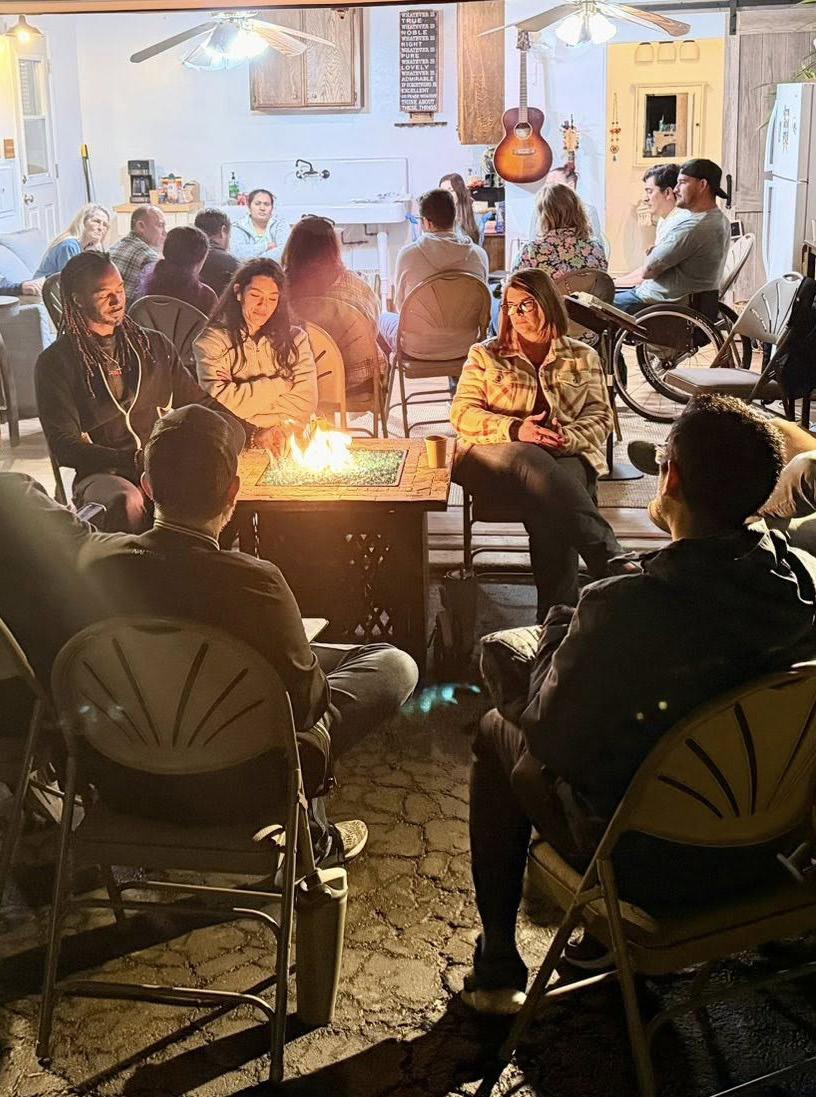
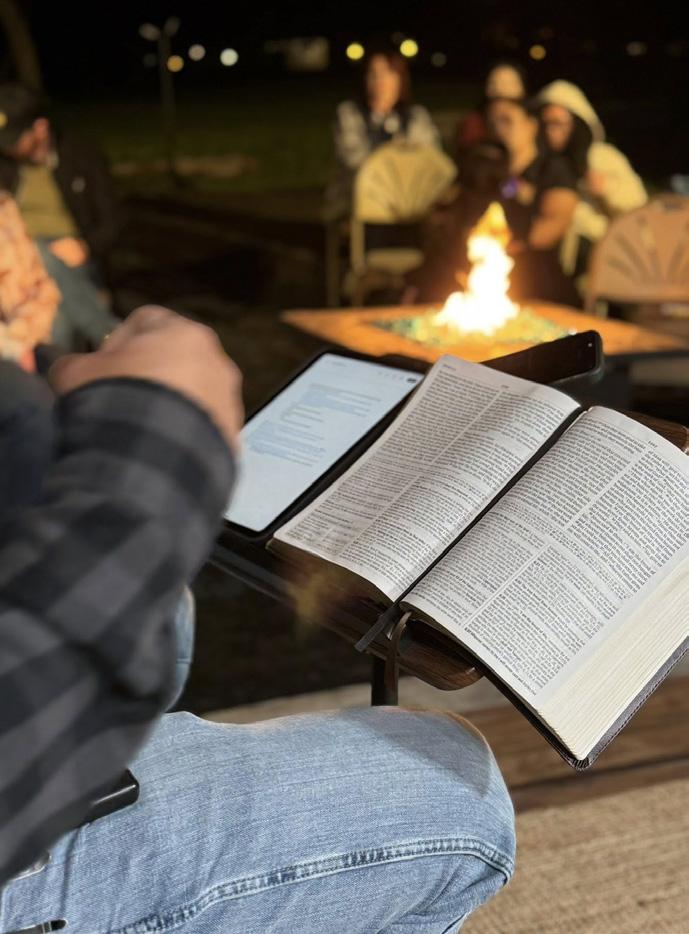
About the Columnist: Christopher Littlecreek is the lead church planter at The Altar SD, a NAM church plant in San Diego, California. He, his wife Ashly, and their team are passionate about establishing a vibrant church where the lost will be found and the saints will be strengthened, to the glory of God. Learn more about the Littlecreeks and their ministry at fwbnam.com/littlecreek/.
FROM ONE
GENERATION TO ANOTHER
BY KENNETH EAGLETON
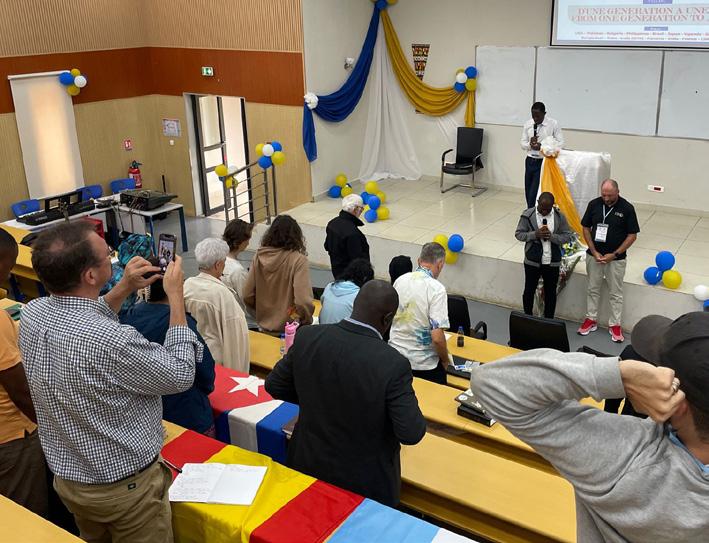
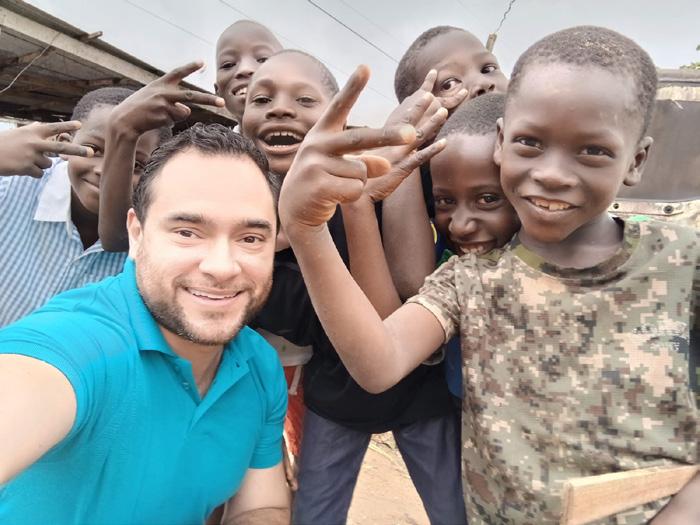
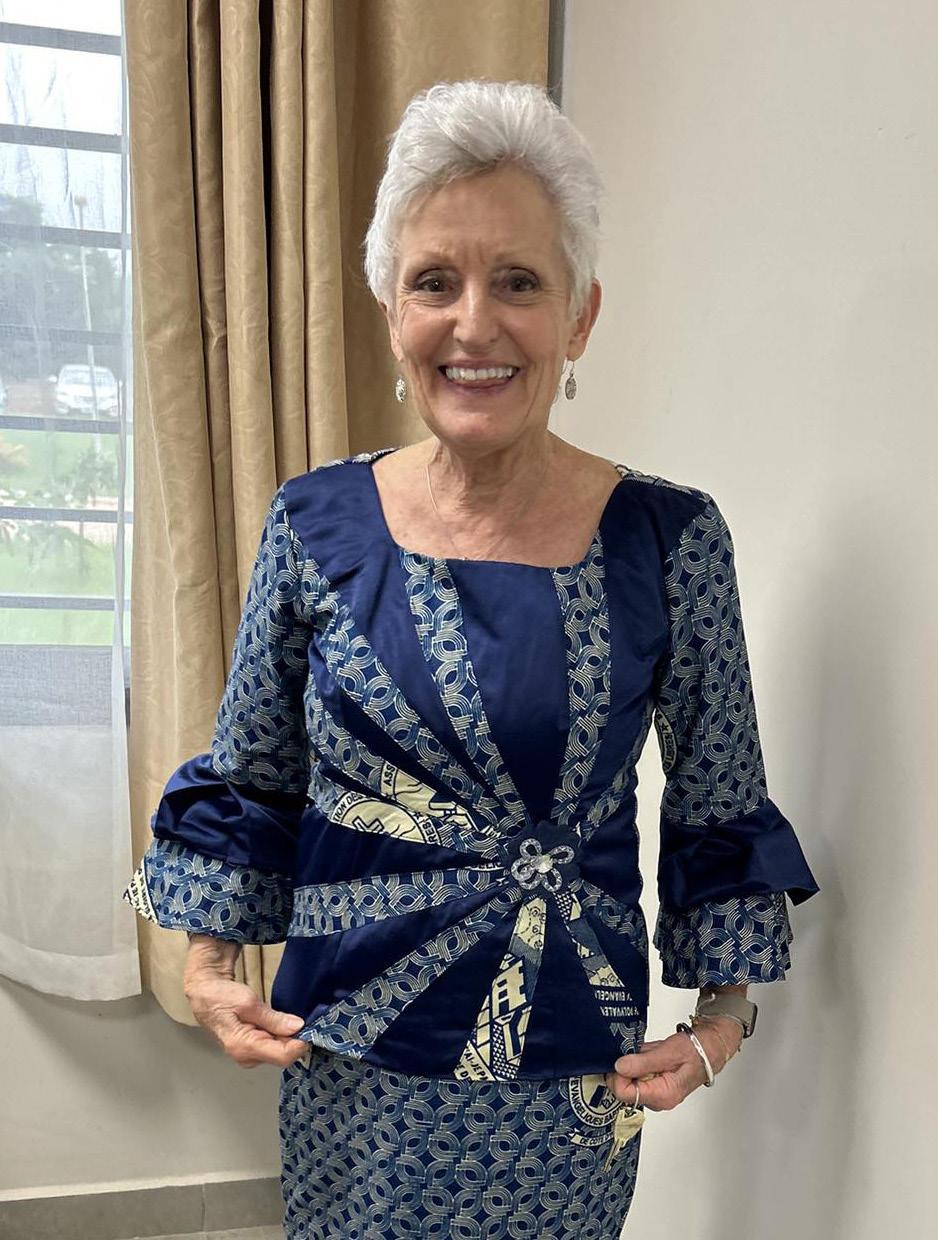
The International Fellowship of Free Will Baptist Churches (IFOFWBC) unites Free Will Baptist churches from around the world for the purposes of identification, communion, and mutual edification and encouragement to better fulfill the Great Commission of evangelism and the establishment of churches among all peoples, according to its mission statement.
GENERATION
As Free Will Baptist churches were planted in numerous countries and began to form associations, it became clear these national churches needed an arena to allow them to gather. In 1992, representatives from various countries met in Panama to explore the desire and feasibility of creating an International Fellowship. The idea was enthusiastically endorsed. Plans were made to recruit more countries to meet in Brazil in 1995, and the International Fellowship officially organized with 12 member nations.
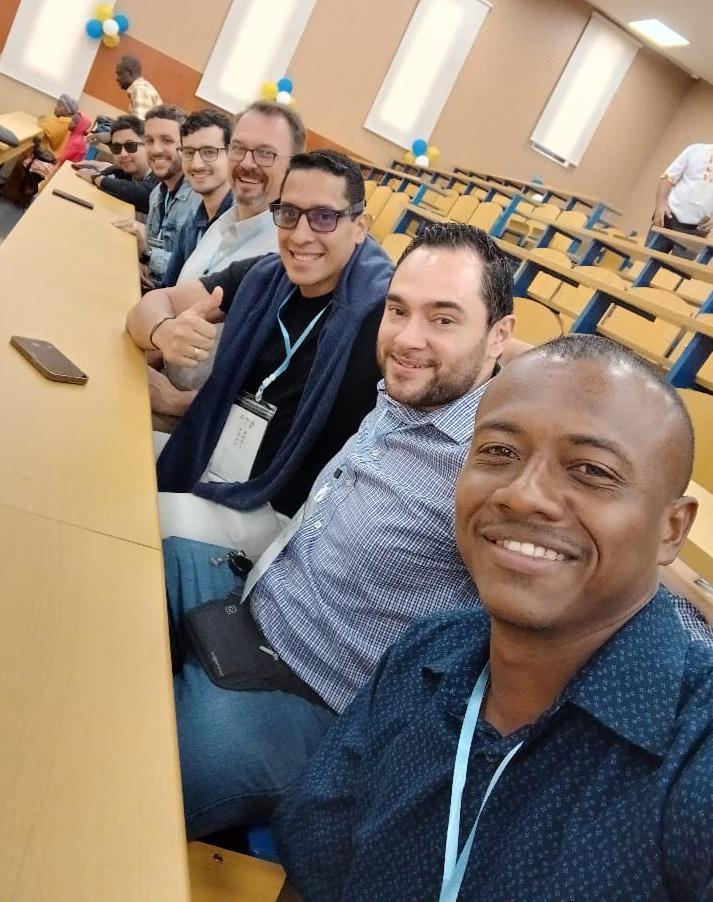
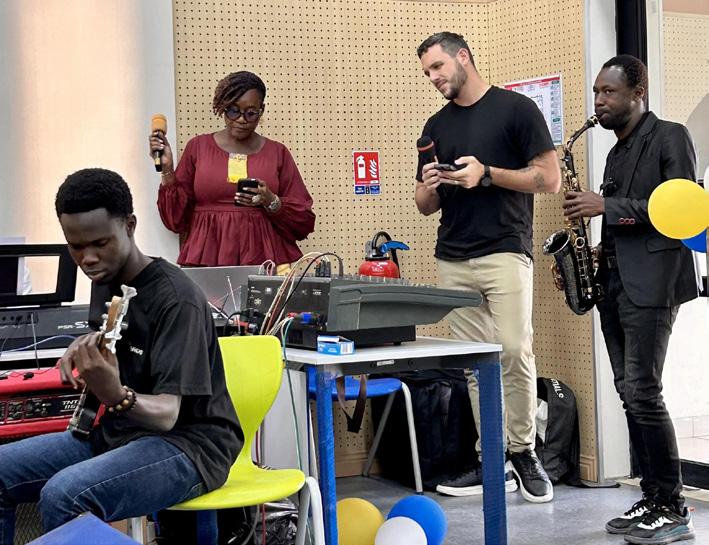
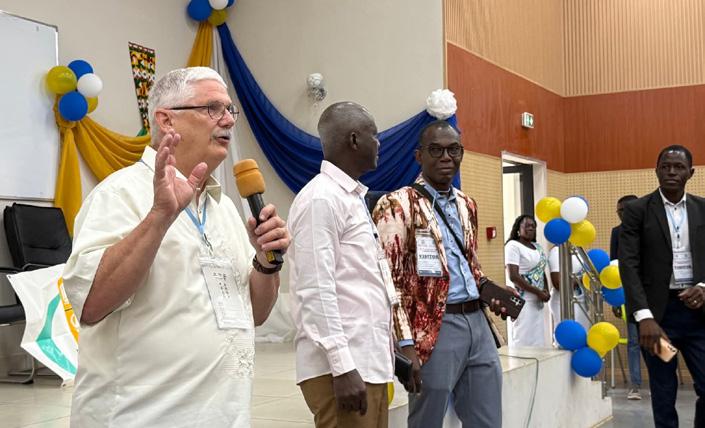
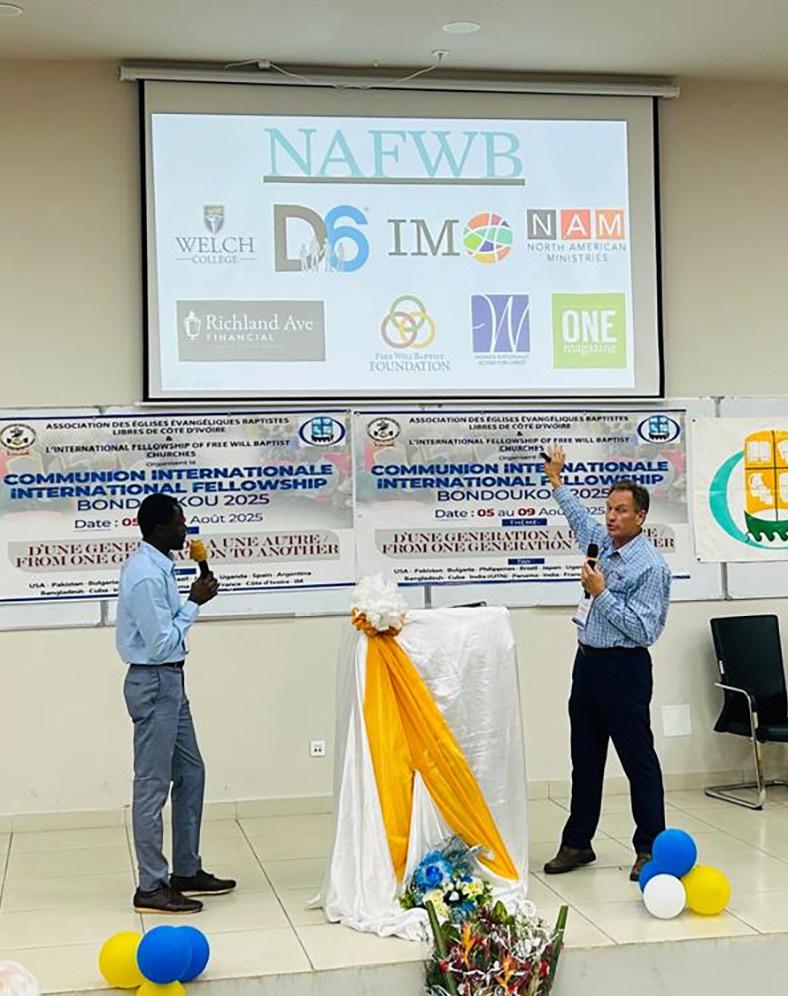
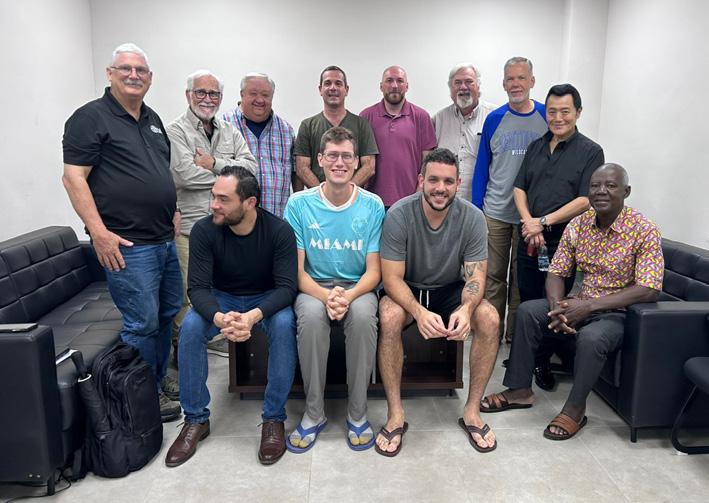
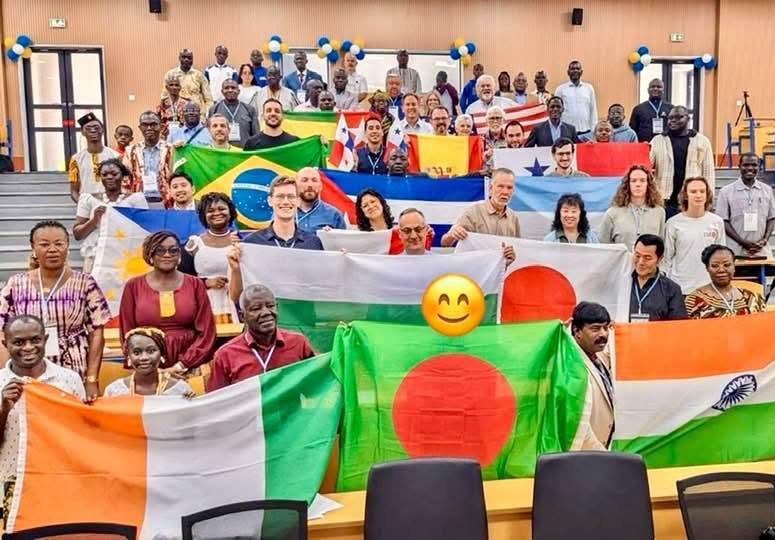
Delegates meet every three years. August 6-9, 2025, delegates, observers, and visitors met on the university campus in Bondoukou, Côte d’Ivoire (Ivory Coast), for the tenth General Assembly and commemorated thirty years of the IFOFWBC.
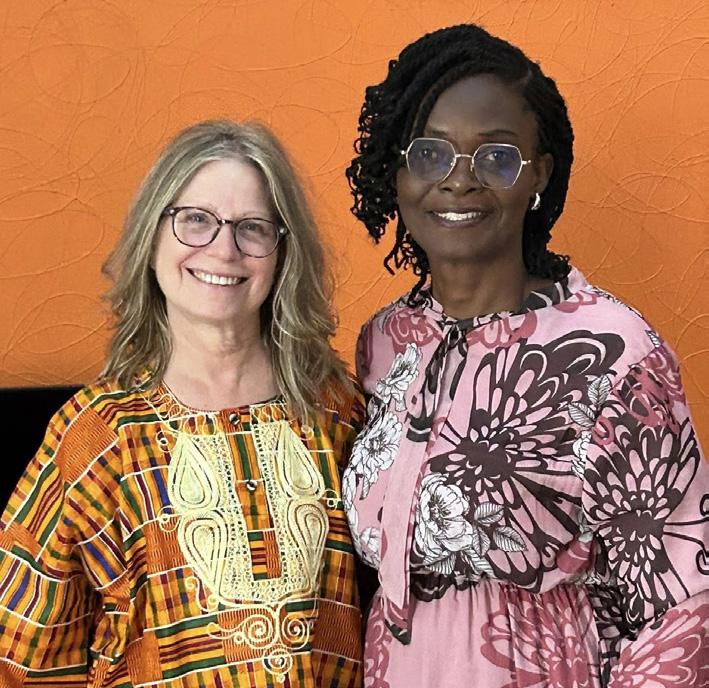
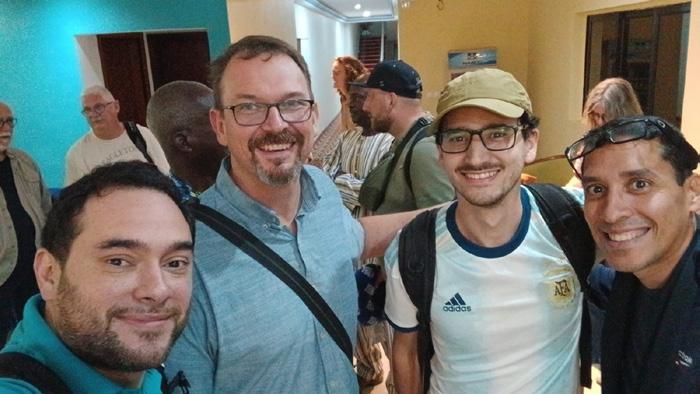
Delegates from ten member countries joined representatives from four countries petitioning for membership, along with visitors from two additional countries. In all, approximately thirty Free Will Baptists representing 15 countries met with approximately the same number of Ivorians, who did a wonderful job with logistics and hosting.
The African temperatures were pleasant, with a cloud cover most days, making it enjoyable to meet on this beautiful new campus. Regional and city authorities granted permission to use the university facilities free of charge and attended the opening and closing ceremonies, showing their gratefulness for choosing their city.
Tours were offered to visitors who wanted to explore the town and a nearby village during free time. The following weekend, participants divided into six groups to visit area Free Will Baptist churches for Sunday morning services. Several had an opportunity to preach. Everyone thoroughly enjoyed the opportunity to worship with our Ivorian brothers and sisters.
The meeting’s theme was From One Generation to Another. Evening speakers included Dr. Tim York (USA), Subhas Das (India), Robert Houessou (Côte d’Ivoire), and Estêvão Achê
(Brazil). Mornings began with a devotion brought by various participants.
A good portion of the schedule was devoted to reports from the 16 nations represented. Many attendees said this part of the program was the highlight of the meeting. For the first time, they gained a more detailed view of what Free Will Baptists are doing around the world. “Wow, I didn’t know FWBs did that!” became a frequently offered comment. Many were astonished at the size and scope of Free Will Baptist ministries and service projects.
One visitor to the International Fellowship, from a country where Christians suffer persecution, observed he thought believers in his country were the only ones facing difficulties. He learned, after a presentation from a European country, even churches in the West face challenges — just different challenges. This type of interchange between nations allows us to pray more specifically for one another. It was marvelous to hear how God is blessing each country and share the burdens and challenges faced. After each report, the group took time to pray for God’s work in that country.
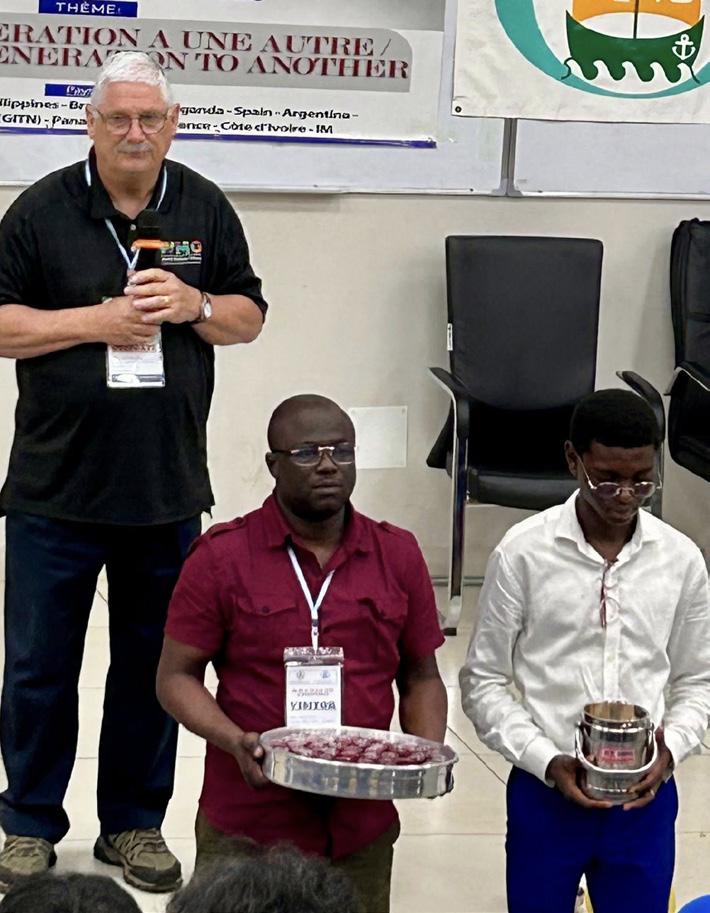
On the last evening, we had the wonderful privilege of participating in a communion and feet washing service with brothers and sisters from every corner of the globe who speak a diversity of languages. The thread uniting us? We are one body who share common convictions as Free Will Baptists, drawing us together in sweet fellowship.
On Friday afternoon, the International Fellowship conducted business. The following actions were taken:
• Two national associations* who recently affiliated with Free Will Baptists were accepted into membership. They represent over 5,300 believers who gather in approximately 256 places of worship.
• A local church in Rosario, Argentina, and another located in metropolitan Manila, Philippines, were received into the * Country names not mentioned for security reasons.
International Fellowship as local churches because they are currently the only Free Will Baptist churches in their respective countries. In both nations, these local churches are working to start other churches and possibly receive into fellowship existing, unaffiliated churches that share our theological position.
• Brazil was chosen as the location for the next meeting of the International Fellowship, coinciding with the seventieth anniversary of the work there. Panama will host the meeting in 2031.
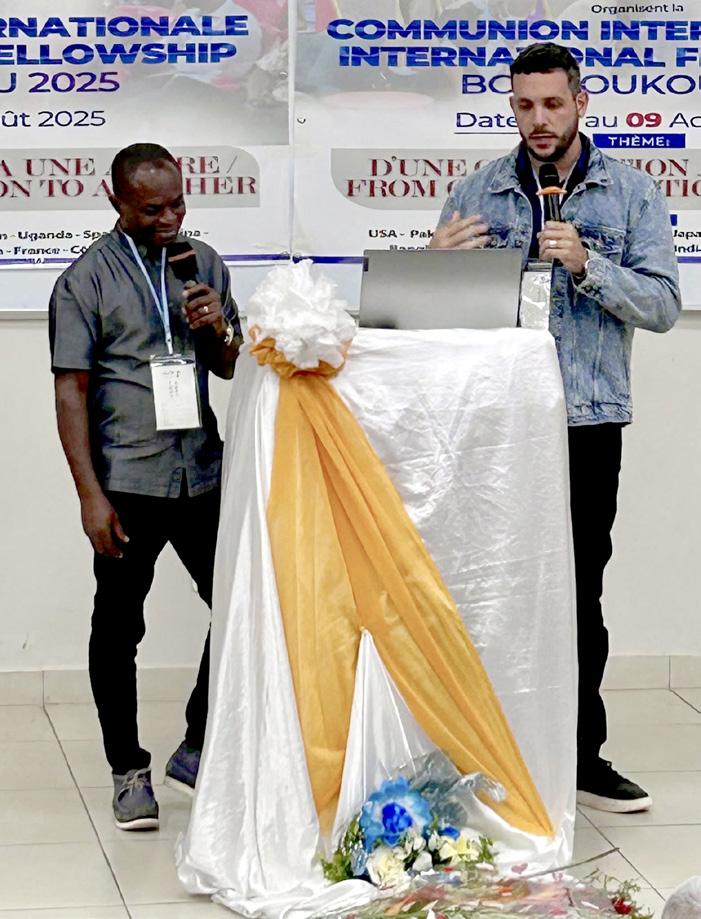
• Delegates to the General Assembly elected new officers for the organization’s executive committee who will serve a three-year term: President Emiliano Alzate (Panama); Vice-President Silas Noufé (Côte d’Ivoire); Secretary Jonathan Chereau (France ); Treasurer Brenton Driscoll (Bulgaria and USA); along with memberat-large Estêvão Achê (Brazil). Four of the five members are from a younger generation and are new to the International Fellowship, exemplifying the theme From One Generation to Another
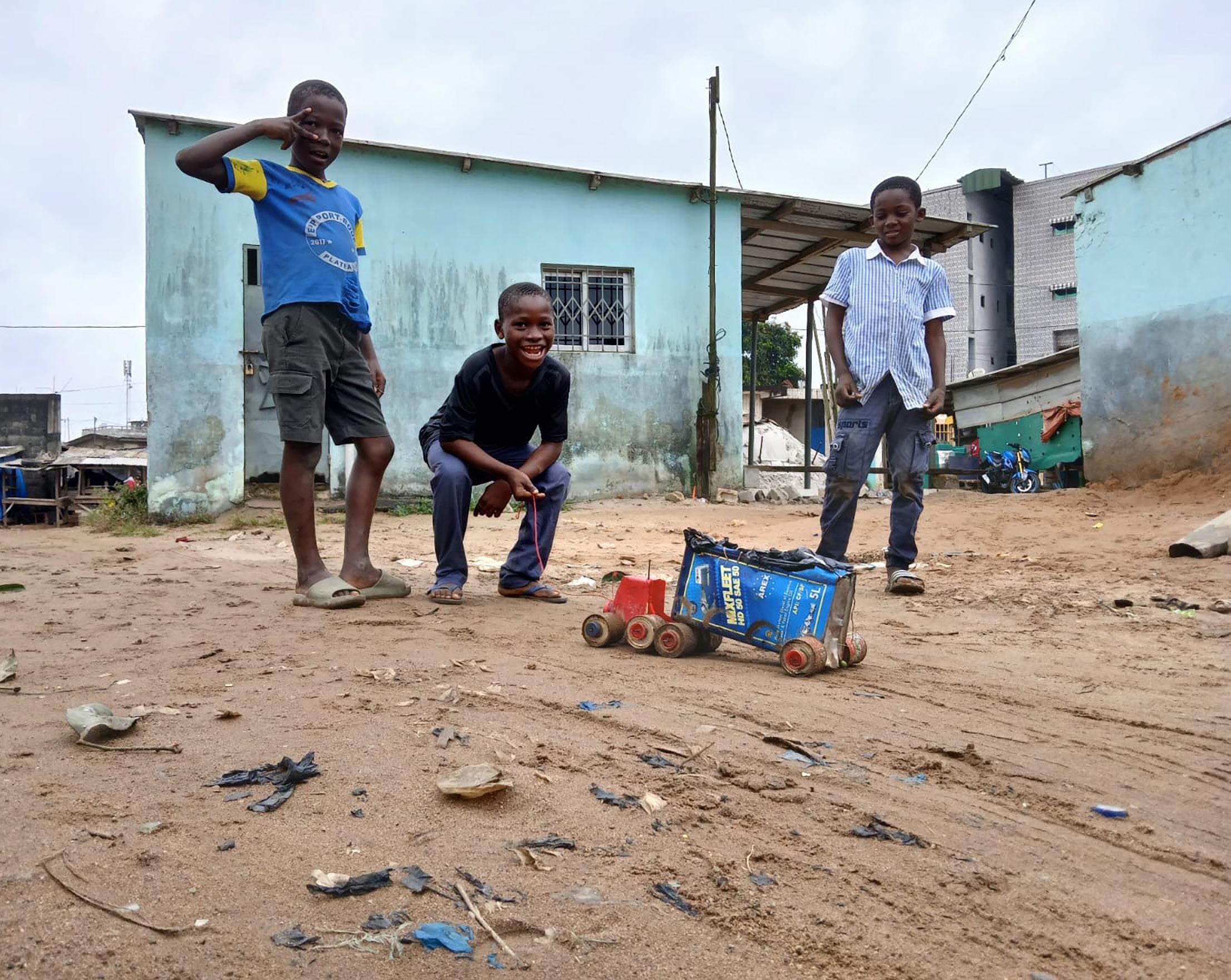
foreign guests participated in the opening ceremony and service and the first full day of the convention before returning to their own countries. An estimated 1,200 Free Will Baptists from across Côte d’Ivoire gathered for the convention.
The International Fellowship meeting ended Saturday. However, all participants stayed to participate in the National Convention of the Association of Free Will Baptist Churches in Côte d’Ivoire, which began Monday evening in the same city. The
One highlight came Tuesday, August 12, when International Fellowship participants joined 300 local believers in a onemile march from downtown Bondoukou to the town stadium where the convention was held. They also witnessed a memorial service for Jerry Pinkerton, retired IM missionary to Côte d’Ivoire who completed his earthly journey the previous November. A third unique event included the baptism of 103 new believers from various Free Will Baptist churches. Trif Trifonov (Bulgaria) and Estêvão Achê (Brazil) were invited to baptize some of them. Michelle Chereau, from France, commented, “It is an honor to be part of the National Conference of Free Baptists of Côte d’Ivoire.”
Not all countries with Free Will Baptist churches were able to participate in the meeting. Some wished to be present, but the expense involved in a 12-day international trip proved beyond their means. The International Fellowship provided subsidies for several delegates, but their meager resources were not sufficient to make sure every country could be represented. How wonderful it would be if all countries with Free Will Baptist churches could send at least one representative. At least 27 countries would be represented!
In the past, I have heard it said the resources needed to organize such a meeting every three years could “be better invested in other ministry initiatives.” However, I believe the International Fellowship is vital to the worldwide movement of Free Will Baptists in the generations to come. Consider several reasons for this.
First, it is the only link between Free Will Baptists from different countries. I have been asked on several occasions by churches in countries where Americans have not sent missionaries, “How do we join Free Will Baptists?” Churches in Argentina or the Philippines do not join the North American National Association. They should join an international Free Will Baptist organization — the IFOFWBC.
Another reason is the desire to be a part of something bigger than themselves. Most cultures in the world value community over the individualism of the West. They want connection and want to belong to a “church family”— the international Free Will Baptist family.
The International Fellowship also allows us to reaffirm our identity. In some countries, the newer generation of Free Will Baptists came along after American missionaries left. They never sat under their teaching or saw their example. With the passing of generations comes the possibility of identity drift. Some countries never received American missionaries, as is the case with the four new members of the International
Fellowship. When we come together, we are reminded of our identity, our doctrine, and our heritage.
When associations from various countries come together every few years, it gives them an opportunity to network, share ideas, learn what others have done and are doing, work together to find solutions, and help each other. It fosters mutuality, cooperation, and a deeper level of international fellowship.
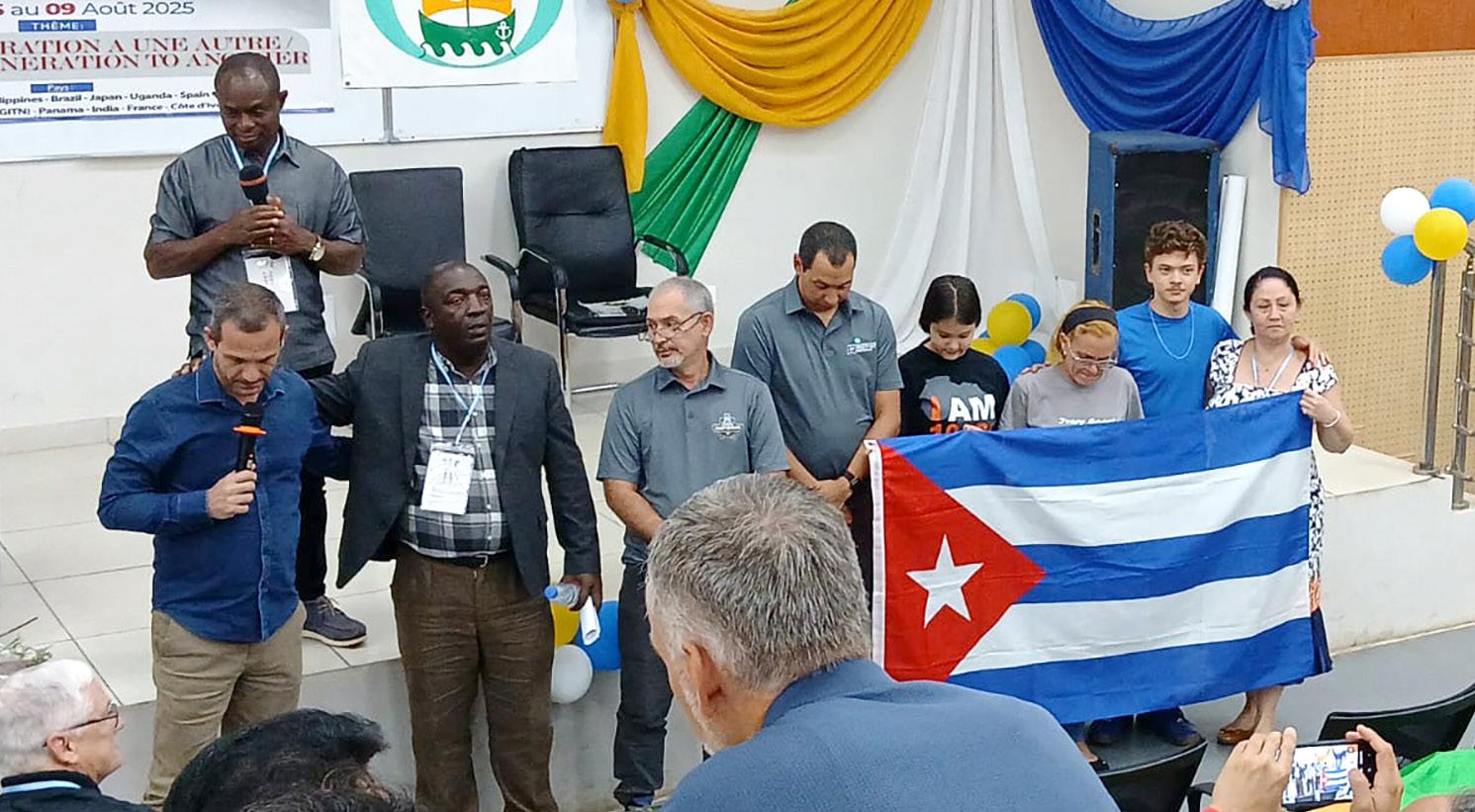
In the months following the International Fellowship meeting in Côte d’Ivoire, Hurricane Melissa hit eastern Cuba, causing extensive destruction and impacting many of our believers; an African pastor’s son needed life-saving heart surgery; and an Asian pastor needed help with the costs of cancer surgery for his wife. In each of these cases, grassroots initiatives from International Fellowship participants led to mutual aid.
The International Fellowship takes the motto, “We are better together,” to a global level.
For Free Will Baptist news from all over the world, visit the IFOFWBC Facebook page at https://facebook.com/groups/ ifofwbc/.
About the Writer: Kenneth Eagleton and his wife Rejane served as IM missionaries in Côte d’Ivoire and Brazil from 1984 to 2023. In 2017, Kenneth was named director of global partnerships. Since 2023, Kenneth has worked full-time with IM Global Partners, and the couple is now based in Tennessee.
Annual IM Board Meeting Celebrates God at Work
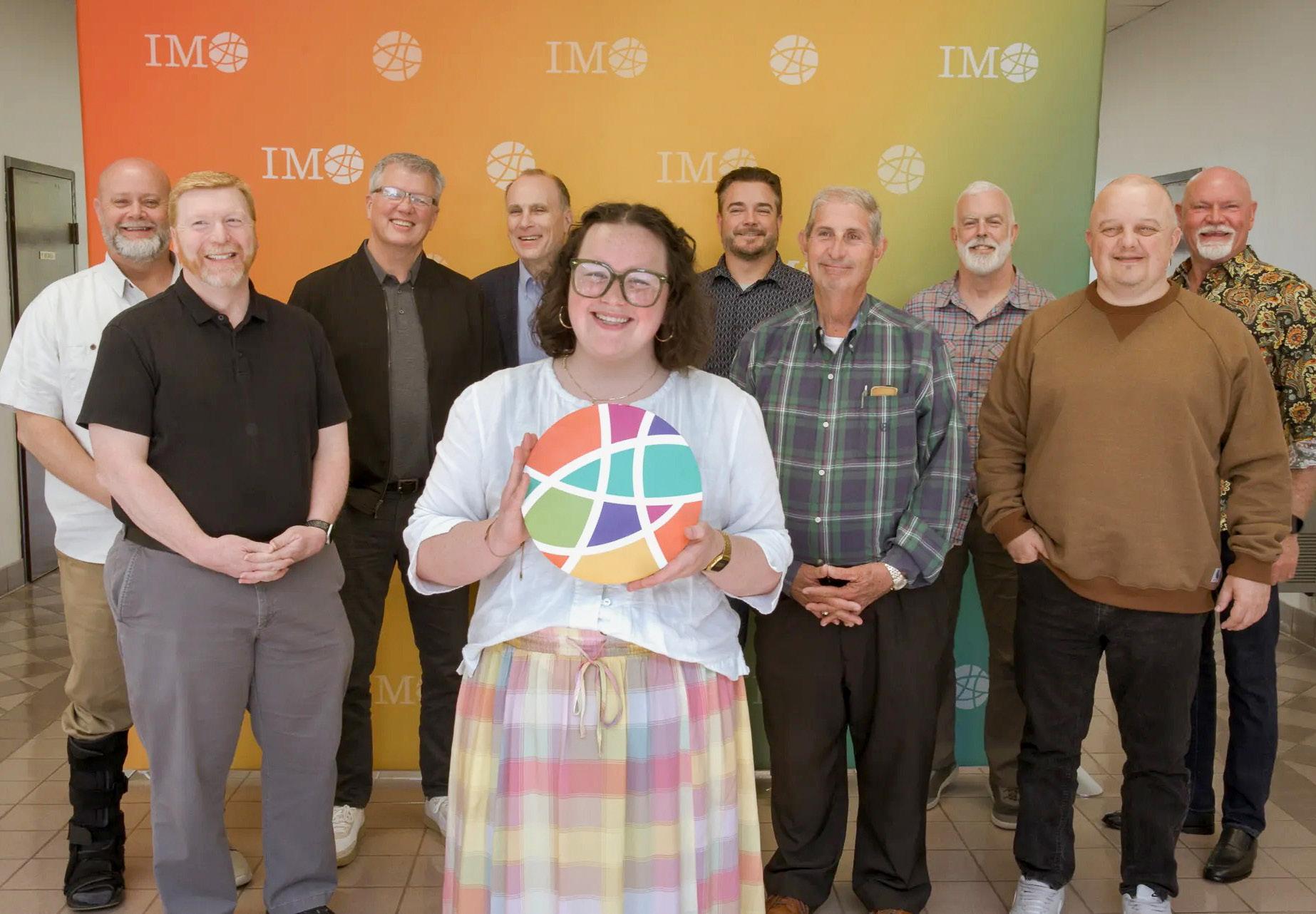
Antioch, TN — The IM Board met April 8–9 to celebrate God’s work and reaffirm the mission of Sharing the Gospel. Giving a Million. Reaching a Million. A spirit of collaboration and unity was evident. Every IM board member fulfills a vital role, actively participating in God’s global story through IM missionaries, ministries, and partnerships.
Clint Morgan, general director, opened with inspiration as he highlighted 2025 statistics gathered from partners and missionaries across 39 fields where IM has a presence. Key statistics include: 3,312 baptisms; 67,061 weekly average church attendance outside of North America; and 3,612 conversions. These aren’t just numbers on a page. Each number represents changed lives as people encounter the good news of salvation.
gospel. Bea reflected, “Serving as a missionary’s wife has deepened my trust in God. When needs arise, we take them to Him in prayer, and He is always faithful to answer.”
Clint reiterated the ten-year IM Horizon Goals (see www.iminc.org/about), which are the focus in every ministry, field, and partnership. Kenneth Eagleton, director of field partnerships, invited all Free Will Baptists to join in “celebrating the excitement of our partners in participating in the Horizon Goals and their increased networking with other partnerships and sending out their own missionaries.”
The board appointed Andie Greenwood (Nashville, TN; pictured above) to serve a two-year internship at the Hope Alive Church in Tokyo, Japan. She graduated from Randall University in the spring. Andie is actively reaching international college students from the University of Missouri through ministry at Rejoice FWB Church in Columbia, Missouri, where she also manages digital media and serves alongside IM missionaries Bradley and Madison Mercer. Having first sensed God’s call during College Missions Program trips in 2022 and 2023, Andie eagerly stated, “I’m looking forward to starting the fundraising process. The Lord has called me to this. I’m excited to share His story and use my creativity to make disciples in Japan.”
Bea Provow, who married Josh Provow in 2025, joined the board meeting via Zoom from Bulgaria and received approval as an IM missionary. She will serve alongside the field team in the Shumen province, bringing steadiness, excellence, and key skills to reach Bulgarians with the
Leslie Nichols, director of mobilization, announced a summer filled with high school and college students participating in short-term mission trips where they will receive training and engage in God’s global Church while serving various cultures. One hundred ETEAM students and 22 leaders will deploy to ten destinations June 6-26. Additionally, 15 teams, comprised of 46 College Missions Program students, will cross borders to serve the world this summer.
Curt Holland, IM director of field ministry personnel, announced, “Keren Delgado has a rich multicultural heritage, and she has used those gifts in both Bulgaria and Spain. Beginning May 1, Keren is on a medical leave of absence from her ministry in Spain.”
The 2025 audited financial statements prepared by Blankenship CPA Group were received and reviewed by the IM board. They celebrated record-breaking income in 2025. The board approved the 2027 framework operational budget of $11.7 million.
IM board members include Rodney Yerby (AL, chairman), Dr. Cameron Lane (AR, vice-chair), Darren Walker (NC, secretary), Casey Cariker (OK), Rick Cason (NC), Paul Etterling (OH), Will Harmon (AR), Jeff Nichols (TN), and Chris Todd (TN).
Fred Warner With the Lord
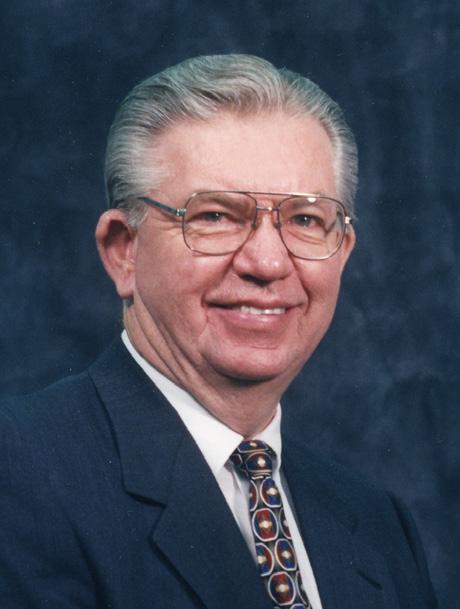
Van Buren, AR — Frederick Warner entered his Lord’s presence March 10, 2026. Born February 25, 1937, in Haywood County, North Carolina, he was the son of the late Frederick Paul Warner and Sue Crook Burns.
Fred moved his family from Arkansas to Nashville in 1987. For 13 years, he served Free Will Baptist Foreign Missions (now IM, Inc.) as a liaison between missionaries and stateside churches. He assisted missionaries with fundraising, coordinated countless mission conferences, worked to establish financial and prayer support for missionaries, promoted missions education, networked with state leaders, and advocated
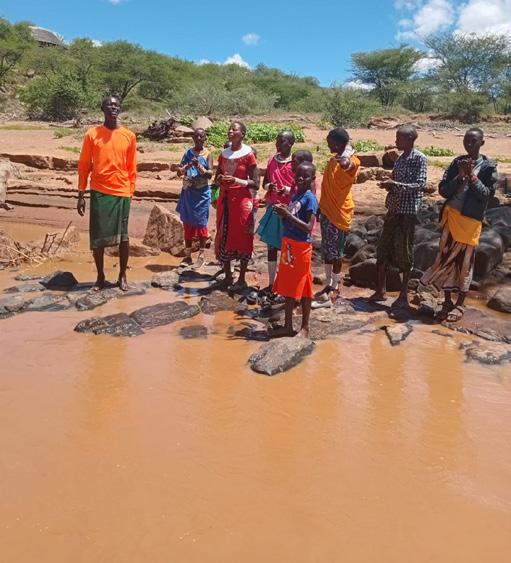
Kenya — Pastor Francis, who serves among the Samburu people, reported he baptized four individuals Tuesday, April 7, thanks to some heavy rain in the area.
planned and deferred giving programs. He resigned from the Mission to return to pastoring in Arkansas in 2000.
Prior to his work with the Mission, Fred pastored churches in Tennessee, Georgia, and Arkansas. From 1961-1965, he labored as a full-time evangelist. He served Arkansas Free Will Baptists as promotional director for five years. At the time he joined the Mission, he was planting a church in Siloam Springs as an Arkansas state missionary. Fred also completed 12 years (1974-1986) on the board of Free Will Baptist Foreign Missions.
Warner is survived by his wife of almost 67 years, Rachel Alene Joslin Warner; two sons, John (Kim) Warner of Seattle, WA; Mark (Karen) Warner of Omaha, NE; two daughters, Joan Ferguson of Hermitage, TN, and Jennifer Griffin (Russell) of Spring Hill, TN; six grandchildren and a great-granddaughter. Funeral services were held March 17 at Ocker Funeral Home in Van Buren, Arkansas.
Brazil — The Alliance of Free Will Baptist Churches in Brazil met at the Campo Alegre FWB Church in Conselheiro Lafaiete, Minas Gerais, March 13-15. New officers were elected.
Uruguay — Five believers publicly declared their faith through baptism at the Emanuel Church in Montevideo, Uruguay, February 22.
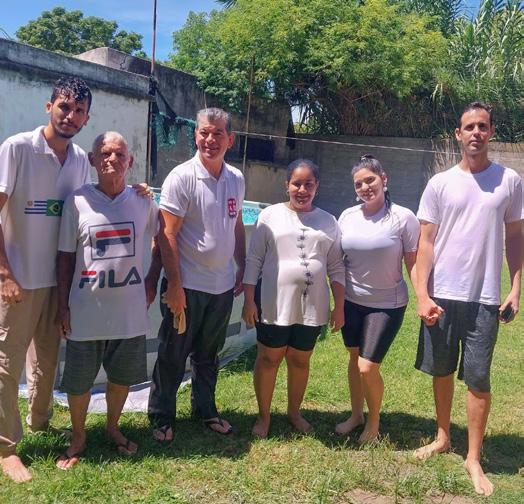
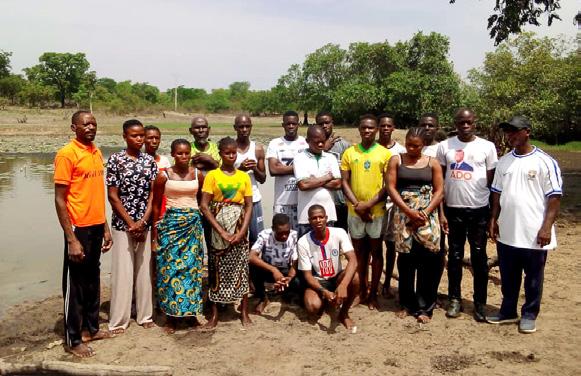
Ivory Coast — Saturday, April 4, three baptism services took place across northern Ivory Coast, each led by a local pastor serving his community. Pastor Foukité François Dah baptized 15 new believers from mission churches in the Bouko and Panzarani region. Pastor Alexis Hien baptized 12 people in Bougou. Pastor Edmond Koudja led a group of new believers through baptism in the Kong area.
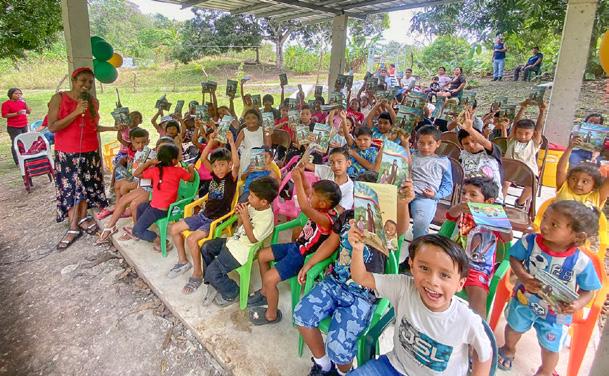
Panama — The Free Will Baptist Church of San Vicente, Panama, distributed Operation Christmas Child boxes at their La Loma preaching point. In February, they began the Greatest Journey sessions with 71 children and 13 parents participating.
A
GREAT COMMISSION Story
BY JAIMIE LANCASTER
IM’s story begins in 1935, right after the forming of the National Association of Free Will Baptists. Miss Laura Belle Barnard departed to minister to the “untouchables” of India. Missions was a key part of our DNA from the very beginning.
THE OPENING CHAPTERS
In 1941, Tom and Mabel Willey began their work in Cuba, where they started churches and a Bible institute to train leaders. In 1956, Lonnie and Anita Sparks entered the Ivory Coast, planting churches and translating the Bible. Brazil welcomed Dave Franks Sr. in 1958. He also planted churches and trained leaders. Although his father ministered briefly in Panama, Tom Willey Jr. and Emma Ruth officially began their work there in 1962.
These pioneering missionaries emphasized the evangelization of communities, discipleship of new believers, planting of churches, and establishment of Bible institutes to train leaders. These emphases produced a crop of trained, capable leaders from seeds sown nine decades ago. These new leaders not only embraced reaching their communities, but they also grasped and took to heart the missionary mandate to go and make disciples of all nations.
THE STORY DEVELOPS
In these legacy countries — Brazil, Cuba, India, Ivory Coast, Panama, and Uruguay — we no longer have U.S. missionaries. The missionaries accomplished their tasks then passed the baton to strong national churches with a burden to grow the Kingdom.
The burden and passion that drove American pioneer missionaries and all who followed has been transferred to national believers. We’re reaping the benefits of that investment of time and treasure.
IM labors
with the Body of Christ
to fulfill the Great Commission.
Read that again and think about what it means. For many years, we understood those words from a North American context. We worked with U.S. churches to send U.S. missionaries to make disciples of all nations. For 90-plus years, we have had the privilege to see mission works turn into churches, churches turn into associations reaching their own countries, and finally, associations sending missionaries around the world. Countries which once received missionaries now send missionaries worldwide. Let’s look at some of them.
Brazil recently sent Lude Handel and Bianca Achê to Ireland. Bianca’s parents served as missionaries in Ireland when she was young. Now, the Brazilian church has sent her to lead a youth ministry to the teens in their target town. They also work with the worship team in a local church and teach music classes.

The island country of Cuba has sent out a host of missionaries. Yosniel and Katiuska were some of the first. Initially sent to work at the Doropo Medical Center, they currently work with the 1040i NGO. Yosniel is heavily involved in the African side of the ministry. Dr. Katiuska, a licensed MD, serves as the nurse for the Christian school in Tanda.
Cubans Yosvanys and Anita work in a church revitalization effort in Malvin Norte, Uruguay. Sent to work in a church which had lost many people due to being without a pastor for several years, he and his family have worked hard to bring life back to the church in this difficult community.
Samuel Ramos and his wife Anita left Cuba for ministry in

migrated to do, they began a church plant in Merida, Mexico, in the Yucatán Peninsula. This is the largest city in southeastern Mexico. Samuel also pastors another church located two and a half hours away in Valladolid.
Cuban pastors Mario and Jesus are planting a church in Içara, Brazil. No Free Will Baptist churches have ever been planted in this southeastern part of Brazil. Other Cuban believers serve in Paraguay, various ministries and church plants in the United States, and restricted access countries.
One of the newest and most exciting examples of legacy countries making disciples outside their borders is in the Republic of Togo. A Free Will Baptist church in France developed a burden to train pastors in Togo. Global Partners participated in training sessions, along with Pastor Samuel from the neighboring country of Ivory Coast. The sessions were fantastic, but
much work still needed to be done.
As Pastor Samuel prepared to retire from the ministry at his Ivoirian church, his burden for the need in Togo increased. He and his wife Nina moved to Togo to train pastors to minister more effectively, with a sound doctrinal framework. He is organizing groups of churches who want to work with Free Will Baptists into a Free Will Baptist association. Currently, a partnership for Togo involves the French church, Global Partners, and the Ivorian church. It’s amazing how God puts all the puzzle pieces together.
We see God working through Panamanians in a powerful way. Panama sent a single lady, Ruth, to work in India. Over the last couple of years, they have sent mission teams to Cuba, El Salvador, and Guatemala. The Panamanian national association recently sent Edwin Escudero and his wife Jennifer to El Salvador. Edwin works with Bright Hill Collective, serving youth in their schools. Relationships with students and parents have led to the possibility of starting a FWB church in El Salvador.
GOD CONTINUES WRITING THE STORY
What we see today is not the changing of our mission or our mission statement; it is the maturing of it. The same Great Commission that compelled the U.S. church to send missionaries also compels our partner countries to cross boundaries, cultures, and languages with the gospel. What once was a North American endeavor has flowed through the international Body of Christ with each part doing its work.
This is a result of faithfulness over time. Seeds planted produced churches and leaders — leaders with vision and a heart to see the gospel flow into all nations. IM continues to labor with the Body of Christ to fulfill the Great Commission — not as owners but as partners in what God is doing among the nations.
This is the story God has been writing for more than 90 years, and by His grace, it is still being written.
About the Writer: Jaimie Lancaster is the assistant director of field partnerships at IM, Inc. He works with Dr. Kenneth Eagleton to support ministry partnerships around the globe. Learn more: iminc.org/.
Harvest the Celebrating

BY DR. DON HANNA
When my dad Carlisle Hanna passed from this life in 2023 after 70 faithful years on the field, many expressed deep concern regarding what would happen to the Free Will Baptist work in India and Nepal. I am thankful to report the Lord has graciously blessed these efforts. Through His faithfulness and through the faithfulness of our supporters, the ministry in India has not only continued, but it has also flourished.
NORTH INDIA
Following the annual conference in March 2025, we ordained 25 men to gospel ministry, bringing the total number of pastors in North India to 50. These believers in the north, where some 300 groups meet to worship each week, see fifty to sixty people follow the Lord in believer’s baptism every month.
We dedicated a new church building in March 2025, and currently three additional churches are under construction, two in North India and one in Nepal. When I was a child, Dad walked seven miles one way (and crossed a river) to minister to people in one of these remote areas. It gives me great joy to know they will now have a permanent church building.
Sadly, many Free Will Baptist groups continue to meet without any building or structure. In coming days, as God provides, we will build eight to ten buildings, not large structures, but a sheltered place for these believers to gather. In contrast to the expense of building in the States, these buildings can be constructed for $5,000 to $7,000, depending upon the type of flooring. You can contribute to this effort through IM, or through scfriendsofindia.com/.
Currently, sixty residents live in the Boy’s Hostel. Pray for this ministry as we train and disciple young men, providing both the gospel and an education. We have received funds to renovate both the housing building and the kitchen, and these repairs will start after the completion of the church buildings described above.
The Hanna Memorial Mission School enrolled nearly 400 students this year, primarily from Hindu and Muslim families. These families visit the mission property daily, opening the door for interaction, not only with our students but also with their parents. This has afforded our Christian people and teachers many opportunities to share the gospel.
Indiain

We continue to operate a farm and dairy, offer relief projects and sewing classes, provide seeds for farmers, and carry out animal husbandry projects (necessary to meet governmental requirements to continue the gospel work).
SOUTH INDIA
Currently, Free Will Baptists have 17 churches in South India, four established in the last three years with plans to open other new churches.
The Volena Wilson Bible Institute reopened this year in two locations, one in the mountains and one on the plains. Students primarily consist of young people from our own churches — 19 students in one location and 14 in the other.
One of the new churches has been planted in Ooty, the district headquarters for the Nilgiri district and a popular resort town. This church is growing rapidly. The congregation has been meeting in a rented room at the YMCA, but they have quickly outgrown the space. A nearby facility would work nicely, but property is very expensive in Ooty. The land and building will cost almost $100,000. However, a new meeting location is crucial due to a law in Tamil Nadu prohibiting house churches. Churches can only meet in registered church buildings.
Pastor Stanley Rajkumar and I traveled to the island nation of Sri Lanka in 2025 to survey possibilities for ministry expansion there. Roughly half the residents of Sri Lanka are Tamils, the same as the Free Will Baptists in South India. We met with nine pastors who want to join us, and we hope to help them in their church planting efforts and establish a Free Will Baptist work on the island.
IM, Inc. has helped provide funding to teach the pastors in Sri Lanka and to provide necessary projects to help them sustain themselves, especially those who live in destitute circumstances.
EASTERN NEPAL AND BANGLADESH
Though Eastern Nepal remains vastly unreached with the gospel, we now have 30 groups who meet. Many opportunities to expand our work exist here as funding allows. We already have expanded into Bangladesh, with six groups currently meeting.
COMING TOGETHER TO WORSHIP
My wife Milly and I returned to India in March and early April to celebrate the 75th annual conference, corresponding with the date when Mom and Dad (Marie and Carlisle Hanna) were
appointed missionaries to India in March 1951. Seven to ten thousand people attended at least some portion of this meeting, where we experienced good response as we worshiped in seven languages and heard faithful and powerful preaching .
During our trip, we also visited the works in North India and Nepal and dedicated two of the church buildings under construction. We then briefly visited the work in South India.
I continue to be overwhelmed by God’s faithfulness to us and by the faithfulness of Free Will Baptists who stand with us as partners in ministry, advancing God’s Kingdom in this needy part of the world.
For God so loved the world, He gave His only Son, To die on Calvary’s tree, From sin to set me free. Someday He’s coming back, What glory that will be.
Wonderful God’s love to me.
Billions around the world do not know these truths, but those of us who do know them have a responsibility to share them faithfully until that day when we all celebrate God's harvest together.
About the Writer: Dr. Don Hanna, son of Carlisle and Marie Hanna, spent many years living and working in India, first as a missionary kid and then as a frequent visitor to encourage and minister to the needs of Christians there. Dr. Hanna, as president of Friends of India, currently leads Free Will Baptist works in India, Nepal, and Bangladesh. He and his wife Milly have three children and four grandchildren. They live in Charleston, South Carolina, where Don continues his medical practice.

Georgie
BY PAUL V. HARRISON
“Thus speaketh the LORD of hosts, saying, Execute true judgment, and shew mercy and compassions every man to his brother” (Zechariah 7:9).
Every morning the four-year-old twin brothers hit the ground running. Mom and Dad employed a German nurse — “Neenie” the boys called her — to look after them. Quickly outgrowing Theodore, Georgie was noted for his “large lustrous eyes and bewitching mouth and golden hair,” and he was always into something. One of his first prayers was, “O God, please to make Georgie a good little boy, right away! ”
Their father had graduated from Princeton and thought seriously of becoming a lawyer like his father and grandfather. But after he had conducted a home Bible study one day, a listener told him his words had helped, and he set his cap for the ministry.
Pastor Cuyler traveled the world and mixed comfortably with the rich and famous. He rubbed shoulders with the creators of Ebenezer Scrooge (Charles Dickens) and the scary “headless horseman” (Washington Irving). Once he took his mother to see President Abraham Lincoln in his office. After the visit, she said: “Did you ever see such a sad face in your life?”
Cuyler pastored a large Presbyterian congregation in New York City. When he retired in 1890, after a pastorate of almost thirty years, 4,223 had joined his church. They honored him with a gift of $30,000, over a million dollars in today’s money.
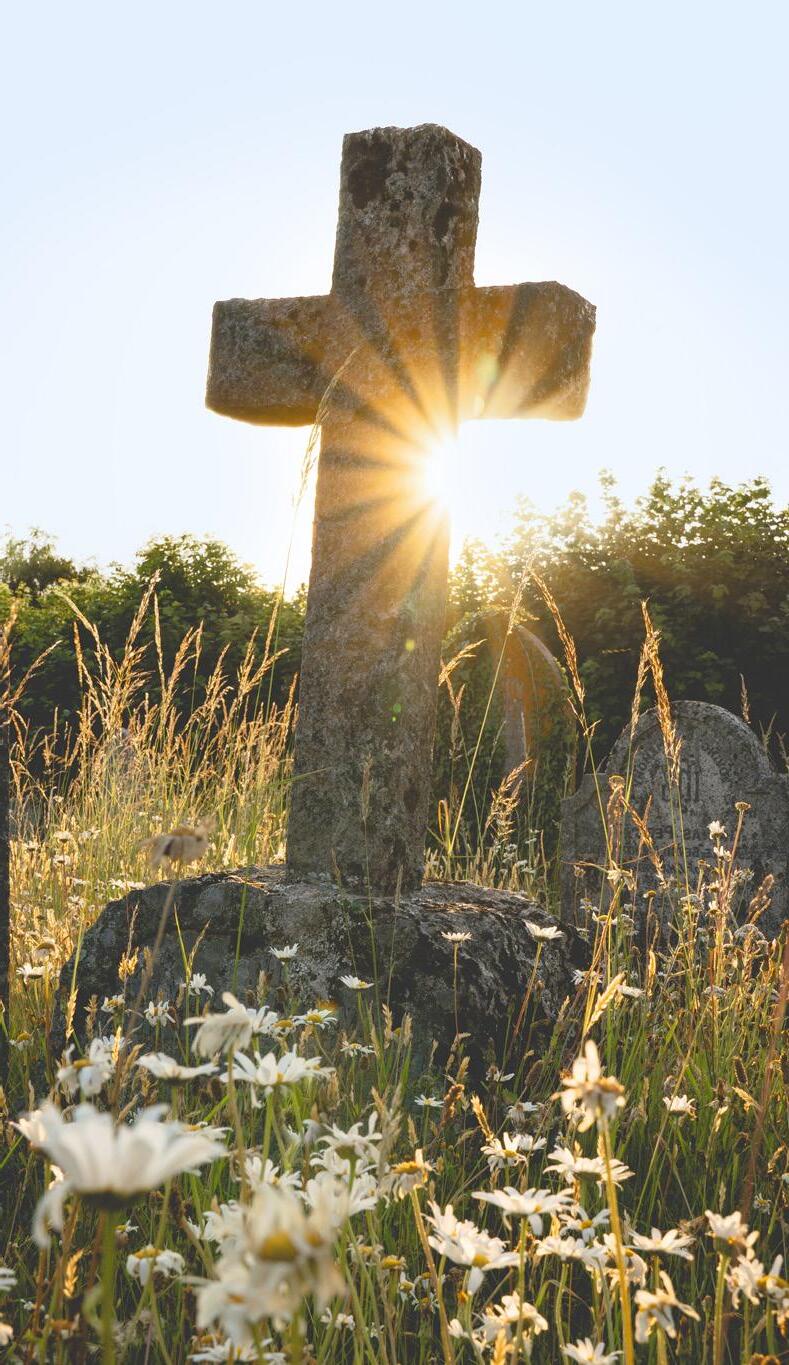
But let’s return to the four-year-olds, who knew nothing about the fame and fortune of their father. He was just Dad to them. On Saturday, April 18, 1868, when the twins headed to bed, their cheeks showed “a peculiar flush.” Georgie said, “My little footies are tired at both ends.” By morning, the family realized both children were suffering from scarlet fever. In those days before antibiotics, it killed about one in three who caught it. Within a few hours, the disease had ravaged Georgie’s body. He didn’t survive the day. On Wednesday, the Cuylers laid him to rest in Greenwood Cemetery in a little white coffin.
Condolences poured in. One letter read: “To consign our lovely cherubs to the tomb, is a prostrating agony; but when
we can raise our heads in the serene hope of a re-union, the keenest edge of sorrow is tempered.” A Native American woman enclosed seeds with her letter: “Ah! my brother, the Great Spirit has a beautiful garden, where live the little red and pale-face pappooses [sic], free from all earth’s storms…. Will you plant on his grave these star-flowers?”
Ten years after the lad’s passing, Arthur Penrhyn Stanley, a friend of Pastor Cuyler’s, came to America. As Dean of Westminster in London, he spoke regularly at Westminster Abbey. Renowned for his writings, he exuded scholarship. The day he was to sail home, he and the Cuyler family visited Georgie’s grave.
Cuyler recalled decades later what Dean Stanley did: “When we reached the burial lot he got out of the carriage, and in the driving wind, of a raw November morning, spent some time in examining the marble medallion of the child, and in talking with my wife most sweetly about him.” Cuyler wrote: “I could have hugged the man on the spot.”
Oh, the power of compassion!
About the Columnist: Paul V. Harrison has pastored Madison FWB Church in Madison, Alabama, since 2015. Previously, he pastored Cross Timbers FWB Church in Nashville, Tennessee, for 22 years. He was an adjunct professor at Welch College for 17 years, teaching church history and Greek. Paul is the creator of Classic Sermon Index, a subscription-based online index of over 66,000 sermons, with clients including Harvard, Baylor, and Vanderbilt, among others: www.classicsermonindex.com/.
We have great potential for many things, but without the required effort, our potential will not be realized.
The Potential Is Great…
or Wasted
BY JOHN BRUMMITT
The topic of potential is fascinating to me. We use the word often, describing young kids in school or a sports team at the beginning of a new season. When you say something has potential, you likely mean it has the necessary abilities or qualities to be successful or valuable. While there is no guarantee potential will be reached, the possibility exists.
Jesus said, “The kingdom of heaven is like to a grain of mustard seed, which a man took, and sowed in his field: which indeed is the least of all seeds: but when it is grown, it is the greatest among herbs, and becometh a tree, so that the birds of the air come and lodge in the branches therof” (Matthew 13:31-32).
Just as a tiny mustard seed has the potential to become a tree, it also has the potential to be wasted if the seed is never planted. If you do not care for the seed by providing the necessary resources to help it germinate, the potential of the seed is wasted because it will not grow. Then, if any number of pests, storms, or diseases attack the plant, it may also not meet its potential.
The same is true in our lives. We have great potential for many things, but without the required effort, our potential will not be realized. We see this played out in our personal lives, as well in the financial world. Individuals don’t tap into their growth potential because they leave the seeds in the bag rather than planting them and letting them grow and mature. Or they use the seeds for lesser things and neglect the things with the greatest potential to impact the future.
Planting seeds is only the start; full potential requires constant tending. Perhaps most interesting about potential is how hard it is to develop but, in contrast, how little it takes for it to be wasted. Seeds become seedlings, but they need time to grow. Planting seeds of potential early allows them more time to grow. Many farmers even use greenhouses or seed starters to begin growth well before the growing season, giving their crop a head start in reaching full potential.
A delay in planting or trying to produce a healthy crop in an unnaturally short window of time doesn’t allow the plant to grow deep roots. Planting late doesn’t mean your crop yield will be nonexistent, but it will not realize its full capacity, and much potential will be wasted.
Like plants, our finances are all about potential. We fund retirement accounts and investments to tap into their potential value increases. Sure, many other things can impact whether they meet their full potential. Whether low market returns, the mood of the economy, supply chain issues, or international conflict, financial potential for growth can be derailed. That’s why time is so important. Give your finances time to grow. Plant multiple seeds. Do your best to provide the conditions to build your investments to reach their potential.
Potential is easy to waste, and the most likely way to waste potential is inaction. Don’t take a step, don’t plant the seed, don’t adjust for changing conditions, and the potential to grow meaningfully will dwindle. Do your best to avoid that trap!
Thankfully, the more potential is nurtured, the greater the future potential becomes. Continually building upon potential takes work and discipline, but the harvest will make all the effort worthwhile.
So, don’t delay. The potential is great, and getting started is the most important step.
About the Writer: John Brummitt became director of Richland Ave Financial in January 2016. He graduated in 2011 with an MBA from Tennessee Tech University. A 2004 graduate of Welch College, John has served with Richland Ave Financial since spring 2006.

GUARD what you've grown.
You’ve planted, watered, and watched it grow. Now, it’s time to protect your harvest. With a strategic financial plan with Richland Ave Financial, you can preserve the fruit of your labor for future generations.
BY CHRIS COMPTON
I learned early in life money was never meant to be a goal but a tool. Watching my parents taught me not only the importance of generosity but also the truth that contentment isn’t found in what we accumulate, but in how we trust and live. This lesson becomes even more meaningful within the context of community.
Individually, we all bring our time, talents, and treasures to the table. But when those things come together in community, something much bigger begins to happen. What might seem small or insignificant alone suddenly becomes powerful when combined with the faithfulness of others.
We find this occurring in Acts 2. The believers in the early church shared their resources to support and provide for one another. A single wealthy individual did not carry all the weight. Instead, the collective faithful generosity of many people created a thriving and unified community. Individually, their contributions may have been modest. Together, they became transformational. This is the beauty of working together in the Body of Christ. It reminds us we were never meant to do this alone.
Our culture often emphasizes independence and personal success. Because of that, it’s easy to approach money with a “what’s mine is mine” attitude. A life changed by the gospel
and shaped by faith invites us to something different. It calls us to a shift from ownership to stewardship. From holding tightly to what we have to recognizing a purpose far beyond ourselves.
Contentment plays a key role in that shift. When we learn to be content, and when we truly believe we have enough, we begin to see giving not as loss or sacrifice but as opportunity. It frees us to participate in something greater than ourselves. And this is where ministry and mission come into real focus.
Every ministry effort, every outreach initiative, every life impacted tells a story of God’s people choosing to give for ministry. No single individual carries that mission alone. It is fueled by faithful contributions of many who may never fully see the impact of their giving this side of eternity. Our part matters. Consistency matters. Small acts of generosity are writing a much larger story about what God is doing through His people.
Stewardship also builds unity. When we labor and give together, we align our hearts around a shared purpose and mission. We understand we’re not just individuals attending the same church. We are partners in the same mission — the gospel. Working together not only makes the mission possible. It also fuels and strengthens it.
Stewardship is not simply about dollars and cents. It’s about trust. It’s about surrender. And it’s about recognizing when we place everything into God’s hands, He multiplies it in ways we never could on our own. Remember! We were never meant to do this alone. The mission of the Church is a shared mission. When we embrace that truth, we begin to see just how powerful working together can be.
About the Writer: Chris Compton is the CFO for Richland Ave Financial. He graduated in 2007 with an M.A. in Bible Exposition from Columbia International University. A 1998 graduate of East Tennessee State University, he has over two decades of administrative and financial experience in various fields, along with seven years in pastoral ministry.
When we learn to be content, and when we truly believe we have enough, we begin to see giving not as loss or sacrifice but as opportunity.
Retirement is NOT the end of ministry...only a new season. With our retirement plans, you can explore new opportunities with confidence and faith. Let’s plan your next ministry together. Get started today!

GetOut! GetOut!
BY BRENDA EVANS
Was it a whisper or a shout? Was it sharp as a goad and too painful to kick against? I don’t know. I just know the Lord said, Get Out! and Abraham got out. Out of Ur, out of Haran, and finally into a land he didn’t know. The Lord said, Get Out, and Abraham got out (Genesis 11-12).
In Reflections on the Psalms, C. S. Lewis mulls over Abraham’s call to leave. Lewis says to be called out of our natural human life to God’s supernatural life is “a costly honor.” But to be “called up higher” as Abraham was “costs still more.” It means to “turn your back on all you know.” Loss, but also gain. Among Abraham’s gain was the Lord’s promise and fulfillment: “I will make of thee a great nation, and I will bless thee…and thou shalt be a blessing” (Genesis 12:2).
Yet the call to Get Out can be as hard as eating a bucket of nails. When Jesus repeated it, He warned us to sit down and count the cost (Luke 14:26-28).
Many others in Scripture received that hard call: Elijah, Jeremiah, Daniel, Peter, John, Paul, and others. They faced twists, turns, and detours; deprivation and shortfalls; beatings and shipwrecks; imprisonment and stoning; exits and entrances into new places. Yet, Paul said all was as rubbish compared to the surpassing worth of knowing and following the Lord’s call (Philippians 3:7-9). And remember, Jesus promised “a hundredfold” gain, plus “eternal life” (Mark 10:29-31).
Now, why am I writing about this Get Out topic? While studying the Abraham story in Genesis 11-12, I was also browsing through Lewis’ book. Then I picked up Oh, the Places You’ll Go by the famed Dr. Seuss — Theodor Geisel. It’s about one’s life journey, and it was Geisel’s final book before he died at age 86. Though not a Christian book, I found it both entertaining and wise. It reminded me of our own Get Out calls — mine and my husband Bill’s. Those calls have taken us through 63 years and six states. I couldn’t help but recall many friends who were called to the other side of the globe.
For you poets and artists, Seuss’ verse in Oh, the Places consists of his usual bouncy anapestic tetrameter — four da-da-DUMs per line — and his imaginative, colorful drawings. I liked those. But it’s his ideas, scattered here and there, that really grabbed me. Early he mentioned choices:
With your head full of brains and your shoes full of feet, you’re too smart to go down any not-so-good-street.
But reality happens, even to people “as brainy and footsy as you.” You think you’ll “be best of the best….Except…sometimes, you won’t.”
Not all things go well, Seuss acknowledged. Joseph found that out. Perhaps you remember his colorful robe, disturbing dreams of prominence, his father’s command to go and see about his brothers, the brothers’ conniving plan, and Joseph’s detour into Egypt (Genesis 37). Sometimes, we are detoured, betrayed, and “left in a Lurch.”
I’m sorry to say so but sadly, it’s true that Bang-ups and Hang-ups can happen to you.
Peter called them fiery trials (1 Peter 4:12). Paul said his Bangups and Hang-ups were the sufferings of Christ’s servant: shipwrecks, stoning, beatings, imprisonments, eight kinds of dangers, hunger, thirst, daily pressures (2 Corinthians 11:23-29).
When called to Get Out, we may suffer. Yet in 2 Corinthians Paul offered his perspective on such ordeals: “we are troubled on every side, yet not distressed; we are perplexed, but not in despair; persecuted, but not forsaken; cast down, but not destroyed” (4:8-9). Joseph said his detour into Egypt turned to good (Genesis 50:20). May we say the same when we obey the Lord’s call to Get Out.
Seuss continues. At times you’ll fall “down with a unpleasant bump, and the chances are, then, that you’ll be in a Slump.” Two lines later he adds, “Un-slumping yourself is not easily done.”
Out! Out!
It isn’t. Elijah, the hero of Mount Carmel, would attest to that. I’ve always had great sympathy for Elijah and his running, running, running. Jezebel was mean — and dangerous. She killed for pleasure. I would have run, too. I know, I know. Most biblical scholars condemn Elijah for running. I don’t.
To me Jezebel’s threat was a fly-or-die situation. So, Elijah flew, without wings, about 250 miles to a cave at Horeb. I don’t blame him. Yet, and that’s a weighty YET, Elijah did fail. He did not “un-slump.”
His slump was a dark cave of self-pity. He wasn’t just afraid of Jezebel; he was excessively self-absorbed. Inside that cave, he sloshed around in self-pity as foul as a hog’s wallow. Self-pity is one aspect of what A.W. Tozer called a diseased “self-life.” Discouragement happens. But self-pity is a sinful cave we need to avoid.
Elijah’s slump began under the broom tree. “It is enough; now, O Lord, take away my life,” he lamented (1 Kings 19:4). The slump only grew worse. Twice in the cave he claimed, “I only, am left.” Finally, the Lord heard enough. He rebuked Elijah with a command to cus and perform three duties.
The Lord also reminded Elijah he was wrong. He was not alone. Seven thousand Israelite knees and mouths had neither bowed to nor kissed Baal. Elijah’s un-slumping finally began.
So it is with us as we follow the Lord’s command to Jesus said not even a sparrow is forgotten, and “fear not there fore: ye are of more value than many sparrows” (Luke 12:6-7). Our reminder that Jesus never abandons us, never leaves us — ever! So un-slump.
Indecision is also a part of our obeying the Lord’s command to Get Out. As Seuss asks, “Should you go left or right?” Often, it’s not easy “for a mind-maker-upper to make up his mind.” And so, we end up in “The Waiting Place,” trying to decide.

Recall Abraham and Sara and the Lord’s promise of a son. Need more? Mary and Joseph, Ruth, Jeremiah, so many in The Waiting Place. We who Get Out have been there, too. But waiting is not useless. The Apostle Paul desperately wanted to go into Bithynia in the far northwest of Asia Minor, present-day Turkey, a Roman territory along the Black Sea and the Bosporus. The region likely was untouched by the gospel, so it offered a logical place to evangelize. But Paul was forbidden by the Holy Spirit, and so, he waited.
Seuss mentions “waiting…waiting…waiting” 19 times. But after all that waiting, he says “You’ll find the bright places.” For Paul the bright place was a dream at Troas, and an even larger field: Europe. Waiting is hard but worth it. It was for Paul. It

has been for Bill and me. I haven’t enough space here to tell all those stories.
Instead, let’s check out one of David’s waiting experiences in Psalm 31. He was in distress. He begged for rescue that didn’t come. He felt forgotten, cut off from the Lord’s sight, but he waited, and ultimately affirmed his times were in the Lord’s hand. In a later Psalm, David felt assured the Lord would fulfill his purpose for him (138:7-8). Waiting and obeying give quiet strength, despite uncertainty.
Seuss also urges, “Step with care.” I’ve heard river boat captains warn new deckhands never to step into shadows when it’s dark. Shadows may prove to be deep water, not the ship’s deck. When we are called to Get Out, we will encounter the shadows, frightening dark spaces, “spaces between what we see and what we can’t,” as one Christian author said. If we cry out, I believe we will hear Jesus say, “Be of good cheer; it is I; be not afraid” (Matthew 14:27).
Lord Jesus, help me to get out when You say, Get Out!
About the Writer: Brenda Evans lives and writes in Ashland, Kentucky. You may reach her at beejayevans@windstream.net.


DOIN G MOR E TOGETHER
The Free Will Baptist Endowment is designed to provide lasting financial resources to all denominational ministries and agencies. Learn more today:

Continued from page 8
up at the Moffat Cancer Center on the same day for a biopsy. Weeks later, Angie learned Doris had prayed that if one of them had cancer, it would be her and not Angie. Angie had young kids at home, and they needed their mom. When the results came in, Doris did indeed have cancer, and Angie did not.
Many people across our denomination, especially those in Florida and those associated with the Vertical Three Conference, know Charlie Elliott well, but not everyone knew Doris well. She was quieter, a behind-the-scenes kind of lady, but she was always by Charlie’s side doing whatever needed to be done to help keep things organized and running smoothly.
I cannot begin to imagine how many trips she took on that seat behind Charlie, how many costumes she put together, how many props she gathered, how many lines she prompted, how many arts and crafts she created, how many snacks and meals she served, how many times she packed her suitcase for another youth group trip with Charlie, how many hours she spent preparing and then teaching children about Jesus.
But I do know countless children and parents will never forget the time and energy she poured into them. Out of Doris and
Charlie’s ministry have come pastors, youth pastors, teachers, missionaries, and laymen and women trained by them to teach children. They also have a legacy of children and grandchildren serving the Lord. Their son is a Free Will Baptist church planter, and their daughter and granddaughters are involved in children’s ministry as well.
We will not know this side of Heaven how many children were impacted for the Kingdom because 59 years ago a young couple decided to be all in for Jesus and to share the love they had for Him with the children under their care. On September 28, 2025, Doris heard the words “Well done, good and faithful servant” when she finished her race. Now, she is spending her days worshiping and praising her Savior.
Although Charlie no longer has Doris by his side, he continues to run the race with endurance, entering his sixtieth year of children’s ministry.
About the Writer: After nearly nine years of serving in Quebec, Canada, Dawn and Danny Elliott relocated to the Buffalo, New York, area to join the NorthPoint FWB Church planting team. Currently, they are planting a second NorthPoint location in the West Seneca region.
What’s Your Motivation?
BY BARRY RAPER
The first “motivational speaker” I remember was during high school football, when a former coach from the golden days of the program delivered the pregame speech. I don’t remember whether we won or lost, and I only remember a couple of things about his speech. The first words out of his mouth were, “I’m a Tiger!” Those words came right after he stubbed out his cheap cigarette on the locker room floor. That’s all I remember. The speech wasn’t very motivating and, honestly, a bit embarrassing.
None of us have motivational speakers who show up at our homes each morning when the alarm clock goes off. (Aren’t you glad?!) Most days, we simply get up and start the routine without thinking deeply about our motivation for living and working. But every person has underlying motivations for what they do — an inner drive, a sense of purpose, the fuel for your actions and choices.
In 2 Corinthians 5:11-15, the Apostle Paul shared his own motivations for ministry and life, along with a corresponding action.
MOTIVATION 1:
THE FEAR
OF THE LORD LEADS TO PERSUASION
“Knowing therefore the terror of the Lord, we persuade men” (verse 11). The Bible tells us the fear of the Lord is the beginning of wisdom (Proverbs 9:10). For the Christian, this fear reflects a sobering respect for God. In verse 10, Paul reminded his readers we all must appear before the judgment seat of Christ leading to his statement about the fear of the Lord in verse 11. Judgment is a sobering reality. And considering that fact, Paul says we make it our aim to persuade others to become Christians.
What is involved in persuasion?
• Truth. We should never try to “pull the wool over anyone’s eyes” but set forth the truth of God’s Word plainly. We aren’t trying to persuade people with an opinion but with the unchanging Word of God.
• Kindness and love. Our truth-telling must be accompanied by kindness and love. Without love, we are like
clanging cymbals (1 Corinthians 13:1). Without love, we are in danger of sounding like the angry political rhetoric of the day. But kindness goes a long way toward winning people over.
• Relationship. We are more likely to be persuaded by someone we know and trust than a stranger.
• The Holy Spirit. He persuades others through us, convicting them of sin, righteousness, and judgment (John 16:8-11) and drawing all men to Himself (John 12:32).
Your personal conversion testimony plays an important part in this. In these verses, Paul made it clear these Christians at Corinth knew him through and through; he had nothing to hide. He had shared his story, the whole story.
Restaurants offer online menus for potential customers to see. But the enthusiastic recommendation of a trusted friend is far more likely to bring in customers. We often describe this as “word of mouth.” And the same is true for us as we persuade people to follow Christ.
MOTIVATION 2:
THE LOVE OF CHRIST LEADS TO CONVICTION
I once heard Warren Wiersbe say, “An opinion is something you hold, but a conviction is something that holds you.” In our text, Paul shared his conclusion that because Christ died for us, our only proper response is to live for Him.
The love of Christ “constrains” us, that is, Christ’s love puts pressure on us — in a good way — compelling us to respond with love for Him. This word also can be translated “to hold together.” The love of Christ can hold you together when everything falls apart. Paul made this assertion about the love of Christ, based on the demonstration of His love at the cross: “him which died for them, and rose again” (verse 15). This captures the essence of the atonement. Jesus loved us when we didn’t love Him in return (Romans 5:8), and He died for all, even those who never would accept His sacrifice.
With the love of Christ on full display, Paul drew the conclusion the rest of his earthly life should be spent living for Jesus. The same should be true for us. What’s your motivation
for living? Why do you do the things you do?
We hear this reflected in the lyrics of many great hymns written to express the personal nature of the sacrifice Jesus made and our response to His love. Consider these examples:
• Bearing shame and scoffing rude, in my place condemned He stood, sealed my pardon with His blood: Hallelujah, what a Savior!
• Love so amazing, so divine, demands my soul, my life, my all.
• Jesus paid it all — all to Him I owe.
Because we know the fear of the Lord and experience the love of Christ, we respond by persuading others and living faithfully for Him. Keep in mind, the motivations of fear and love aren’t incompatible. Both are present throughout the Bible in perfect balance.
What is your motivation for Christian living? If you find yourself at a low point in terms of your motivation to follow Christ, allow your heart to return to these two places: 1) to the judgment seat of Christ, where we will all stand someday, and 2) to Calvary. Seeing Christ’s great love displayed, seeing His love for the world and for you personally, you will renew your decision to give your life over to Him.
During high school, I watched a friend in my home church struggle during every invitation at the end of the service. Though he had been coming to church for ten years, he remained unsaved. During the invitation, he would grip the pew, white-knuckled, with clear conviction etched on his face as God dealt with his heart. Thankfully, he eventually accepted Christ and continues to live for Him today.
Have you ever reached that place in your life? The place where you realize the great price paid for you by Jesus and determine, “Love so amazing, so divine, demands my soul, my life, my all”? If not, why not accept Him today?
Knowing therefore the terror of the Lord, we persuade men; but we are made manifest unto God; and I trust also are made manifest in your consciences. For we commend not ourselves again unto you, but give you occasion to glory on our behalf, that ye may have somewhat to answer them which glory in appearance, and not in heart. For whether we be beside ourselves, it is to God: or whether we be sober, it is for your cause. For the love of Christ constraineth us; because we thus judge, that if one died for all, then were all dead: And that he died for all, that they which live should not henceforth live unto themselves, but unto him which died for them, and rose again.
2 Corinthians 5:11-15
About the Columnist: Dr. Barry Raper is pastor of Bethel FWB Church near Ashland City, Tennessee, and teaches ministry at Welch Divinity School.
Bryan Named National Coach of the Year
Katie Bryan, head coach of the Welch College Lady Flames basketball team, has been named the National Christian College Athletic Association (NCCAA) Division II National Coach of the Year. The honor recognizes Bryan’s outstanding leadership during a historic season for Welch College women’s basketball.
Bryan, who has served as head coach of the Lady Flames for 12 years, led the team to a record-breaking season highlighted by winning the program’s regional championship. Her leadership has helped elevate the women’s basketball program and establish the Lady Flames as a competitive force within the division.
Under Bryan’s direction, the Lady Flames have emphasized not only athletic excellence but also the Christian character and development of student-athletes. The program’s recent success reflects years of dedication to building a culture of discipline, teamwork, and perseverance.
Bryan is a graduate of Welch College, earning an associate’s degree in biology in 2012 before completing a Bachelor of Science in Nursing from Belmont University in 2014.
Her passion for basketball began at a young age through middle school and high school competition and continued
into her collegiate years. Bryan later served alongside her father in coaching before eventually taking the helm of the Lady Flames program.
Karilyn Wieting also received the honor of First Team All-American for the NCCAA Division II. These prestigious acknowledgements further cement a historic season for the Welch College Lady Flames.
To inquire about participating in Welch athletics, email recruit@welch.edu/.
Welch College Marks Historic Year for Lady Flames Basketball
Welch College celebrates a banner year for the Lady Flames basketball program, highlighted by extraordinary individual honors and team success that will be remembered in Welch history.
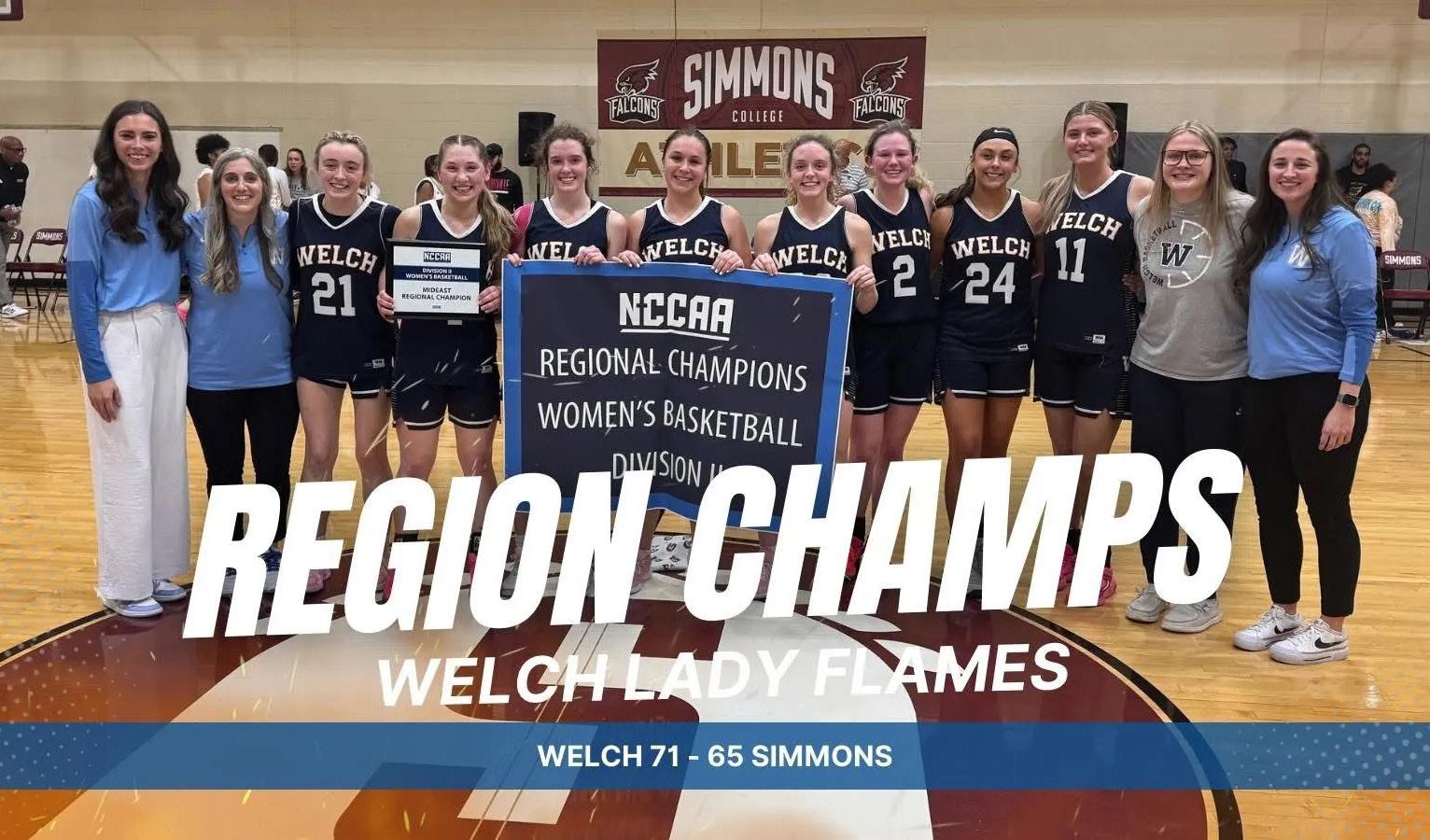
The 2025–26 season marked one of the most successful campaigns in program history. Under the leadership of Head Coach Katie Bryan, the team achieved remarkable accomplishments both on and off the court, earning recognition across the region and drawing national attention. The Lady Flames received the ranking in the February Coach’s Poll of 2nd overall — the highest rank in Welch history.
Coach Katie Bryan was honored for her outstanding leadership, strategic excellence, and commitment to developing student-athletes. This prestigious honor reflects a season in which the Lady Flames demonstrated resilience, teamwork, and competitive excellence.
Senior Karilyn Wieting was named Mideast Region Player of the Year, a testament to her dominant play throughout the season. Wieting’s leadership and performance were
Photo Credit: Joao Boent
instrumental in many of the team’s key victories, and she closed out her season as one of the most impactful players in Welch College history.
In a feat rarely seen in college basketball, Karilyn Wieting and teammate Faithe Johnstone both reached the milestone of 1,000 career points this season. Their scoring achievements highlight not only their individual talent but also the offensive versatility and balance that defined the Lady Flames’ attack.
To date, Wieting has 1,414 points and 734 rebounds. Johnstone has 1,015 points, 302 assists, and 518 rebounds.
The Lady Flames capped their exceptional season by
winning the Regional Championship, securing their place in the National Tournament in Minneapolis, Minnesota, the first time in program history the Lady Flames participated in the tournament.
Where Faith & Learning Meet!
At Welch College, every facet of life, from academic programs and spiritual formation to campus activities, is designed to develop the whole person. With more than 60 undergraduate, graduate, and online programs, you will be prepared to serve Christ in the field you choose. Learn more about Welch College today!
Welch College Athletics remains committed to developing leaders who combine academic excellence, Christian character, and athletic achievement.
The Lady Flames’ historic season stands as a testament to that mission and to the continued growth of the athletic department.
To learn more about becoming a student athlete at Welch College, email recruit@welch.edu.


The exchange below has been adapted from an interview with Welch College President Matt Pinson conducted by Jesse Owens for the Helwys Society Forum regarding Pinson’s new book The Free Will Baptists: A New History published by the University of Tennessee Press. Read the entire interview at HelwysSocietyForum.com/. The book can be purchased wherever books are sold.
OWENS: I’m excited about this book. I wanted to start broadly. I know you’re very interested in history. You’re a student of history. You’ve earned degrees in history. But, specifically, thinking about Free Will Baptist history, do you remember when you first became interested in or aware of Free Will Baptist history?
PINSON: Yes! I was ten years old. We had CTS lessons at our church, and my father taught the junior boys. The Junior Adventurer was written by Mae Fry, whose husband Malcolm Fry was the head of CTS. So, Mae Fry and my Dad introduced me to Paul Palmer, Joseph Parker, Benjamin Randall, and others in a series of lessons on Free Will Baptist history and doctrine. I was captivated. I found it very interesting.
So, I must give Mae Fry credit for caring enough about our tradition to introduce it to nine-, ten-, and 11-year-olds. I loved hearing Jack Williams and others lecture on Free Will Baptist history at Welch College when I was a student. Eventually, I completed a master’s in American history and wrote my thesis on the northern Freewill Baptists. The Historical Commission of the National Association awarded me a grant to do research in several archives.
I think my real desire to research this material on a deeper level came when I went to the historical collection at the University of Mount Olive in North Carolina. I had done much work in the Randall movement, but I really hadn’t done much in the southern movement, which was my own heritage. On that
research tour I got an opportunity to meet Dr. Michael Pelt and Mr. Gary Fenton Barefoot at the Free Will Baptist Historical Collection at Mount Olive. They opened the world of southern Free Will Baptist history to me, and I fell in love with it.
OWENS: As a student at Welch College, I enjoyed having a Free Will Baptist history class with you, and that played a big role in my interest in Free Will Baptist and General Baptist history. In that class we read your Free Will Baptist Handbook, an introductory history of Free Will Baptists, along with some documents. But you also had us read William Davidson’s and Michael Pelt’s histories of the Free Will Baptists. Thinking about those surveys, how would you describe the differences between those volumes in this new book?
PINSON: Before Bill Davidson, we had two surveys of Free Will Baptist history in the twentieth century. One was by the great Arkansas judge and Free Will Baptist minister George Washington Million, and another was by my friend, the Georgia pastor Damon Dodd, who was originally from Missouri. Those books were fine and enjoyable to read, but they were kind of “spotty” because we didn’t have many archival resources then. It really took Bill Davidson to break into scholarly archival research and history of our movement that adhered to standard historiographical norms.
Davidson wrote his doctoral dissertation on the early Palmer movement in North Carolina, ushering us into a new era of Free Will Baptist historiography. Davidson interacted with the
papers of George Stevenson, a Free Will Baptist layman and archivist for the state of North Carolina, who discovered much about origins in North Carolina. Davidson produced more original research and eventually produced a lengthy survey of Free Will Baptist history.
Then in the late 1990s, Michael Pelt wrote a fine history of the Original Free Will Baptists, the group that separated from the National Association in 1962, primarily over church government. (By the way, I go into detail on that split in the book.) When Dr. Pelt was still living, Gary Barefoot went and read that section to him in the assisted living home.
OWENS: Wow!
PINSON: Dr. Pelt and Mr. Barefoot both gave me two thumbs up on that. I also had Dr. Robert Picirilli and Dr. Darrell Holley read it, and they both gave me two thumbs up. That made me feel that maybe I fulfilled my goal of writing an objective history, when both sides would say, ‘Yeah, that’s what happened.’ At any rate, Dr. Pelt’s book is largely a history of the whole movement until 1962 when the schism occurs. It is written from the obvious vantage point of someone in that movement. It’s a very good book.
I think the major difference between my book and these previous books is I have the luxury of doing interpretation and intellectual history, which for us is largely theological history. I have the luxury of doing that because I’m not having to “prove” so many details. Many things from our tradition were repeated by lay historians over the centuries, but they were never proven. So, what Davidson especially, and Pelt to some degree, were doing was proving many things.
However, some persistent questions still hang in the air. I’m amazed by how many questions I hear, like, ‘Are Free Will Baptists really related to the English General Baptists?’ Sometimes, when teaching I joke and say, ‘Well, they had to have been English because there wasn’t an America.’ And there were only two kinds of Baptists (other than a few Seventh Day Baptists): General Baptists and Particular Baptists. So, if they weren’t fivepoint Calvinists, they were General Baptists, and they were English because in America in 1727, when Paul Palmer constituted the Chowan church in North Carolina, everybody was English.
Another example: many people still think Benjamin Randall was the founding father of the denomination. ‘Isn’t the main history of our denomination Benjamin Randall?’ And, of course, that’s a part of our heritage, but it’s a small part. Much still remains to be done and learned about our tradition other than Benjamin Randall, as important as he was to a portion of our denomination and to our whole story.
Many times, when I get comments like these, the first question that comes to my mind is, ‘Have you read Bill Davidson’s book?’ Dr. Davidson goes into detail proving, for example, what every historian affirms, Paul Palmer was an English General Baptist, that North Carolinians were using the 1660 Standard Confession from London, that they were writing to their brethren in England, and so on.
I have the luxury of not proving these things point-by-point: that we don’t all just go back to Benjamin Randall in 1780 in New England, that we do go back to England and the 1812 Abstract, the most widely used confession in Southern Free Will Baptist history, which was a condensed version of the 1660 Standard Confession of the English General Baptists. Davidson did this for us already.
Pelt provided many of these proofs as well. For example, Dr. Pelt says the Staffordshire General Baptists was the group contacted by the Perquimans Precinct congregation Benjamin Laker left behind him in 1702. The Staffordshire General Baptists was one of the very creedal groups that came out of the General Assembly. (That will be in the book you and I are writing on the English General Baptists scheduled to come out next year with B&H Academic.)
So, I have the luxury of doing interpretation, setting Free Will Baptists more in the broader context of American religious history. I also have the luxury of doing more intellectual history. I deal with the theology of these people, both in the North with the Randall movement and the Palmer movement in the South. That’s one of the new things about this book: the
Many people still think Benjamin Randall was the founding father of the denomination....of course, that’s a part of our heritage, but it’s a small part.
Do we want our movement to survive?
Do we think we have something to offer the church of Jesus Christ and the world?

theological history of our movement we haven’t really had in published form.
Dr. Picirilli must be acknowledged here. He has tended to write what historians call micro-history, to go deep and look at small historical portraits that give shape to the larger story. We owe so much to Dr. Picirilli in addition to Davidson and Pelt. I dedicated this book to William F. Davidson, Michael R. Pelt, and Robert E. Picirilli. I said I stand on their shoulders because I really do. They’ve provided me with the luxury to do this interpretive, intellectual kind of history.
OWENS: I’m wondering, since your history is new and has been written within the last few years, were there things you uncovered that hadn’t been uncovered in previous histories?
PINSON: One of the biggest problems in Free Will Baptist history is proving where most of the southern movement originated. Many people assume these groups in Alabama, Mississippi, Tennessee, Arkansas, and the like just sprang up spontaneously because we know many of these people came from United Baptist and Separate Baptist and even a few Regular Baptist (five-point Calvinist) backgrounds. These are the ancestors of what we know today as Southern Baptists.
Some people have assumed all these groups in different parts of the South from other Baptist backgrounds sprang up because people were reading their Bibles and saw Arminianism. Our published historians always said these groups surely were influenced by people from the Palmer movement from the Carolinas. But we just haven’t proven it.
Online digital repositories such as Ancestry.com proved helpful because I was able to examine documents related to where these people came from, and most of it traces back to the Carolinas. This is about frontier migration patterns. Among the huge numbers of North Carolinians and South Carolinians who moved to places like Georgia, Alabama, Mississippi, Kentucky, and Tennessee between 1800 and the Civil War were Free Will Baptists. The spontaneous origins theory just didn’t make sense to me. Where did they go? I used to joke
with my classes, ‘Were they eaten up by bears when they crossed the Smokies?’
That’s a big part of this book. Some, of course, is circumstantial evidence. For example, consider a layman named Matthew Spivey, whose father Caleb was a Free Will Baptist pastor in the 1830s in North Carolina. Matthew Spivey moved to Southeast Georgia, and it just so happens, within ten years, an association arises there, many former United Baptists. And they just so happen to use the 1812 Abstract from the Carolinas as their confession of faith. So, yeah, that’s circumstantial, but I bet they came from old Brother Spivey.
OWENS: Seems like a good chance of that. You deal a lot with the Palmer movement, and that’s particularly helpful for Free Will Baptist history, especially in the South, and thinking about your own origins and your family as well. During college, I remember hearing Jack Williams share on the northern Freewill Baptist movement and the Randall movement. His presentation described the day we lost 600 churches, how the Randall movement merged with the Northern Baptist Convention in the early twentieth century. You discuss that a little bit. Can you talk more about the Randall movement, how all but a tiny minority of those churches ended up merging with the Northern Baptist Convention and only a tiny minority remained Freewill Baptist?
PINSON: Some people think we don’t need to study the Randall movement because it represents such a small portion of the heritage of present-day Free Will Baptists, which is largely from the southern, or Palmer, movement. But I’m thinking, ‘Not so fast. We need to understand that movement.’ It had an impact on the modern movement through churches in southern Ohio and Missouri, and even some in West Virginia and Kentucky with a Randall heritage.
In addition to that, the 1911 merger had a profound impact on the psyche of the Free Will Baptist denomination in the early twentieth century. The Southern Ohio movement, for example, linked up with the Palmer movement in the last quarter of the nineteenth century and was originally part of the General
Conference, largely consisting of churches in the Southeast in the 1920s and 1930s. The 1911 merger with Northern Baptists was fresh on the minds of everyone in the General Conference.
I don’t think we need to ignore the Randall movement. It’s true, many people give too much emphasis to the Randall movement, almost as if it alone is the Free Will Baptist movement. Well, it’s not. It’s a small portion of Free Will Baptist history. There’s been too much of a tendency to ignore the history of the southern movement. So, I’m kind of in the middle here, saying to the people who want to ignore the Randall movement, ‘No, not so fast. We don’t need to ignore that movement. We need to pay attention to it.’
On the other hand, I’m telling the people over here we need to stop putting all the emphasis on the Randall movement, most of which went out of existence in 1911, and start looking more at the broader picture. It’s a both/and thing.
People are going to find one thing very original, fascinating, and surprising — how liberal the Randall movement became in the late nineteenth and early twentieth centuries. Free Will Baptists in Missouri and Ohio and Texas who stayed out of the merger fall on the Fundamentalist side in the
Fundamentalist-Modernist controversy. We can learn many lessons from the Randall movement. They became fascinated with other groups, enamored with “keeping up with the Joneses” and being cool with, you know, the Methodists and the Congregationalists and the Baptists and the big churches downtown. They were very concerned about that.
I think they allowed respectability and concern for keeping up with “the big boys” from other denominations to lessen their concern about their own theology and what made them Free Will Baptists. They went for several years not preaching things in their Treatise — even if they still believed them — because they wanted to get members from other denominations. Pretty soon, nobody in their churches knew they were Free Will Baptist. Their reasons for being a separate denomination just faded away.
I think that’s a morality tale for us. I think we need to think about that in our movement today. Do we want our movement to survive? Do we think we have something to offer the church of Jesus Christ and the world? If we cover it up and obscure it, i.e. our Arminianism, our distinctives regarding the doctrine of the church, I think the same thing that happened to the Randall movement will happen to us.
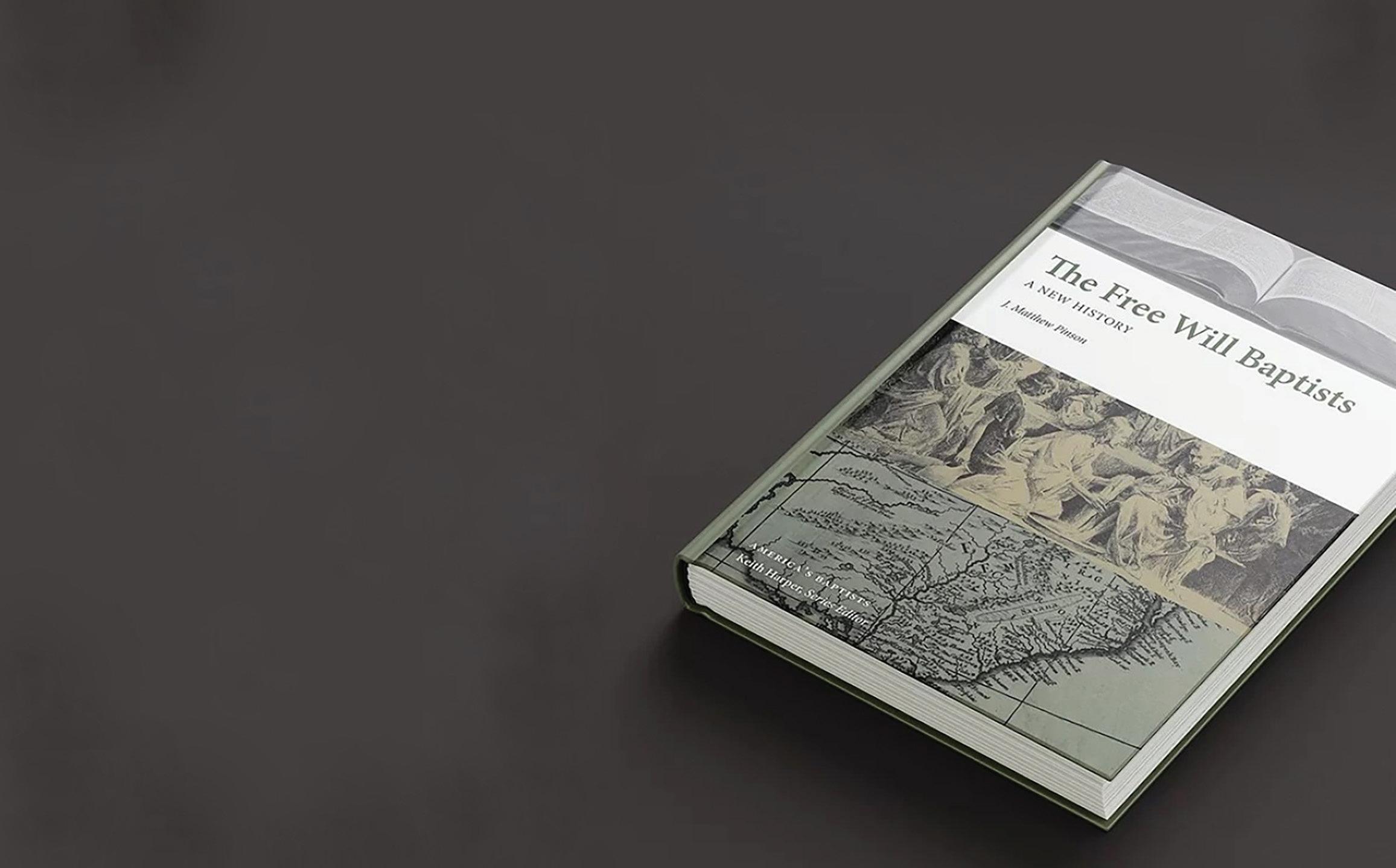
Now Available!
In The Free Will Baptists: A New History, Dr. J. Matthew Pinson offers a new look at the Free Will Baptist movement, traversing four centuries of history. He traces the beginnings of the movement in the Carolinas from the late 1600s, early expansion across the Southeast, the rise and decline of Northern Freewill Baptists, and the identity and development of the modern Free Will Baptist movement.
Hard Cover | 514 Pages | Available for Kindle
The Free Will Baptists: A New History is available for purchase at utpress.org and wherever books are sold.
Lifeline!
FIVE REASONS HISTORY IS IMPORTANT
BY ERIC K. THOMSEN
“Why do we need to know this?” I remember asking myself that question often during grade school math, especially algebra. I imagine many people ask the same question about Free Will Baptist history. As a journalist, I recognize the why as a valid concern, so please allow me to offer five simple reasons Free Will Baptist history should be a priority.

To teach our story to the next generation. Our heritage of faith is quickly and easily forgotten. What seems important, even unforgettable, today may soon be an afterthought. If we fail to preserve and teach our history, consequent generations will forget. Scripture makes it clear we should share the story of what God has done for and through us (Isaiah 38:18-19).
Former Executive Secretary Keith Burden once said, “It is easier to have a clear vision of the future when you have a correct understanding of the past.” I agree! History anchors the next generation and keeps them from drifting from their tradition.
To avoid past mistakes. In 1948, Winston Churchill famously remarked (paraphrasing philosopher George Santayana), “Those who fail to learn from history are doomed to repeat it.” Too often, churches and denominations cross the same minefields when they don’t have to walk through those minefields at all. Enough said.
To inspire and challenge us to greater things. Few things are more motivating than being part of something greater than yourself, or even greater than your generation. Our history gives us a better understanding of how God has used Free Will Baptists around the globe.
2 3 4 1 5
To safeguard against legal issues. On one occasion, the courts called upon the Executive Office to testify in a situation when a church had been victimized by the “hostile takeover” of a minister from another denomination. The original congregation sued to retain possession. Unfortunately, the congregation had not updated records and did not follow its
historical constitution and bylaws closely. As a result, the judge ruled against them in favor of the “new” congregation.
A church (or denomination) either needs to follow its organizational documents or update them to match current practice. Yet another crucial reason to know our history.
To provide clear testimony to God’s ongoing work in and through us. When Antiques Roadshow featured a copy of The Centennial Record of Free Will Baptists and traced our crucial role in the abolitionist movement prior to the Civil War, I found myself leaning forward intently, heart racing. What a heritage! I pray our history, both past and future, will continue to bring glory to God and build His Kingdom.
A Bridge to the Future
In March 1994, as a senior at Welch College, I sat transfixed as Jack Williams shared the story of the 1911 merger between New England Freewill Baptists and Northern Baptists. The presentation, appropriately titled “The Day We Lost 600 Churches,” traced the series of events that contributed to the denominational disaster, from a loss of theological “distinctives” and the subtle encroachment of ecumenism to unethical “back-door deals” between officials on both sides of the merger.
His concluding remark, however, impacted me most that day. Williams told his spellbound listeners, “There will never be another merger like 1911 if we preach Free Will Baptist distinctives, if we make a conscious effort to preserve and promote our Free Will Baptist name, and if we teach the next generation our history and heritage.”
That was the moment Free Will Baptist history captured my heart. From that day, I have made it my goal to do my part to tell the incredible story of what God has done through this denomination and to help others retain, research, and write their own stories about their part in this denomination we love.
About the Writer: Eric K. Thomsen is managing editor of ONE Magazine.
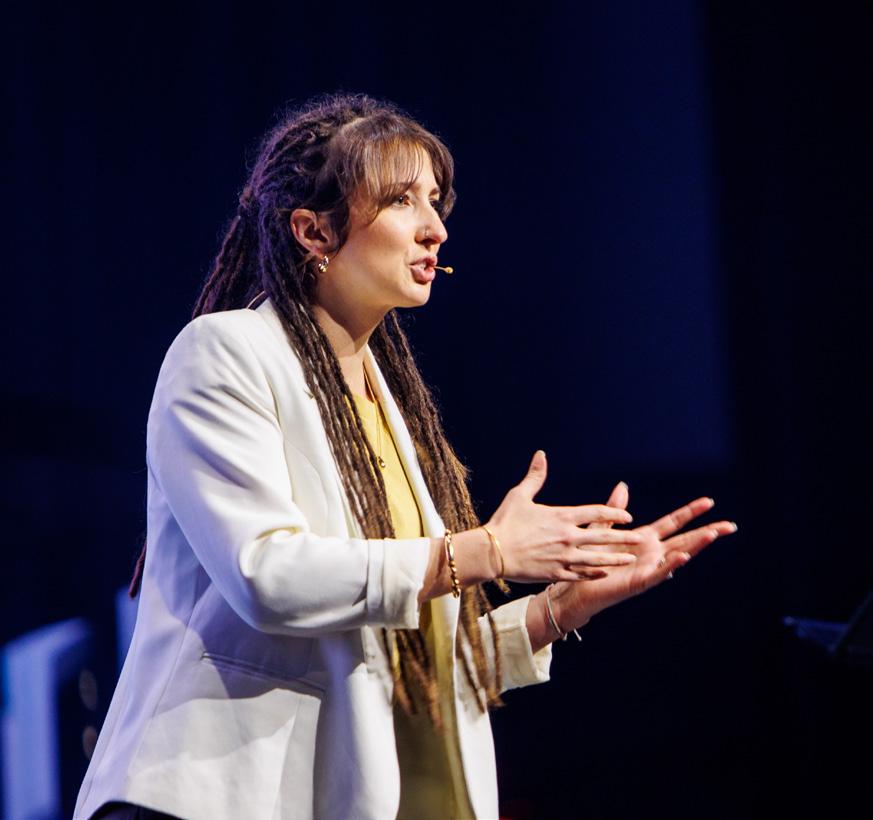
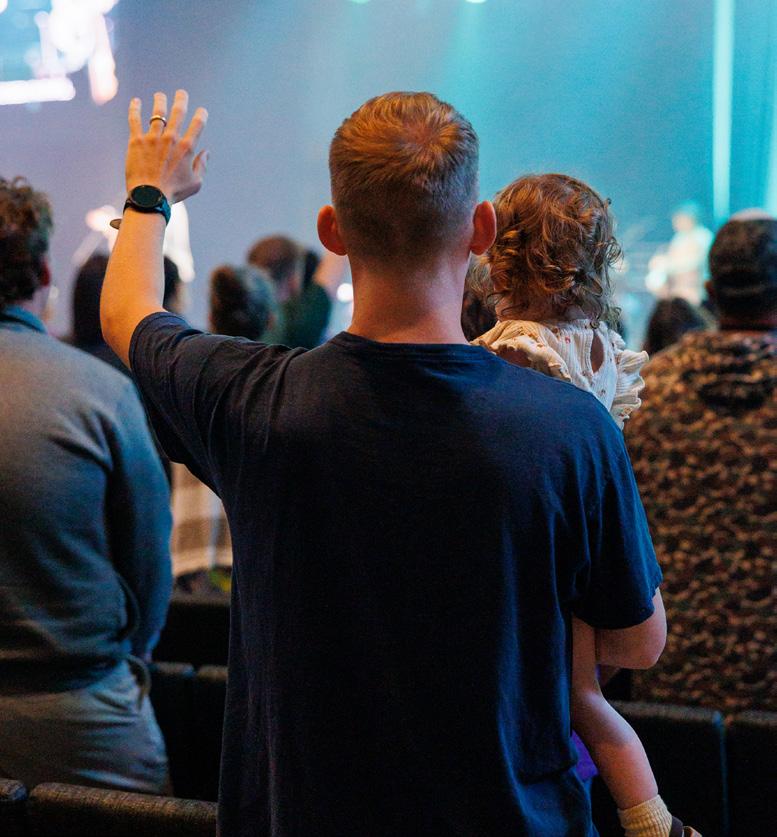
D6 CONFERENCE 2026 REVIEW
What comes to mind when you hear the word community? For some, it means connection. For others, it sounds appealing but feels difficult to build. In truth, community does not happen by accident. It is forged slowly, intentionally, and over time. The various experiences and interactions at the 2026 D6 Conferences were intentionally designed to cultivate this meaningful, lasting community.
BREAKOUTS
On March 6-7, 2026, just over 500 attendees from around the globe gathered in Seattle, Washington, for D6 Northwest, the third conference held in the Pacific Northwest. One key element in building a discipleship community at D6 conferences are breakout sessions. These sessions provide “nuts and bolts” for implementing the strategies and philosophies introduced during general sessions.
At D6 Northwest, attendees chose from more than 50 breakout sessions covering areas such as apologetics, children’s ministry, discipleship, family ministry, grandparenting, leadership, parenting, student ministry, volunteers, and other special topics. A unique feature was the STARS track for preschool teachers in Washington, who are required to complete ten
hours of annual training to maintain certification. By offering this training, D6 equips educators with tools they carry into their daily work, impacting families across the state with the principles of Deuteronomy 6.
April 23–25, 2026, approximately 850 attendees gathered for D6 Southeast. After several years in Orlando, Florida, the conference relocated to Nashville, Tennessee. This year’s event featured more than 70 breakout sessions, many aligned with those presented at D6 Northwest.
In addition, D6 Southeast offered “ministry meet-ups,” where leaders and volunteers gathered by ministry focus, such as children’s ministry, family ministry, lead pastors, parenting, and student ministry. They connected, shared ideas, and learned from one another. Conference speakers also joined these gatherings, creating space for meaningful interaction. For those serving in special needs ministry, a tour of the Brentwood Baptist Church special needs facility offered further insight and encouragement.
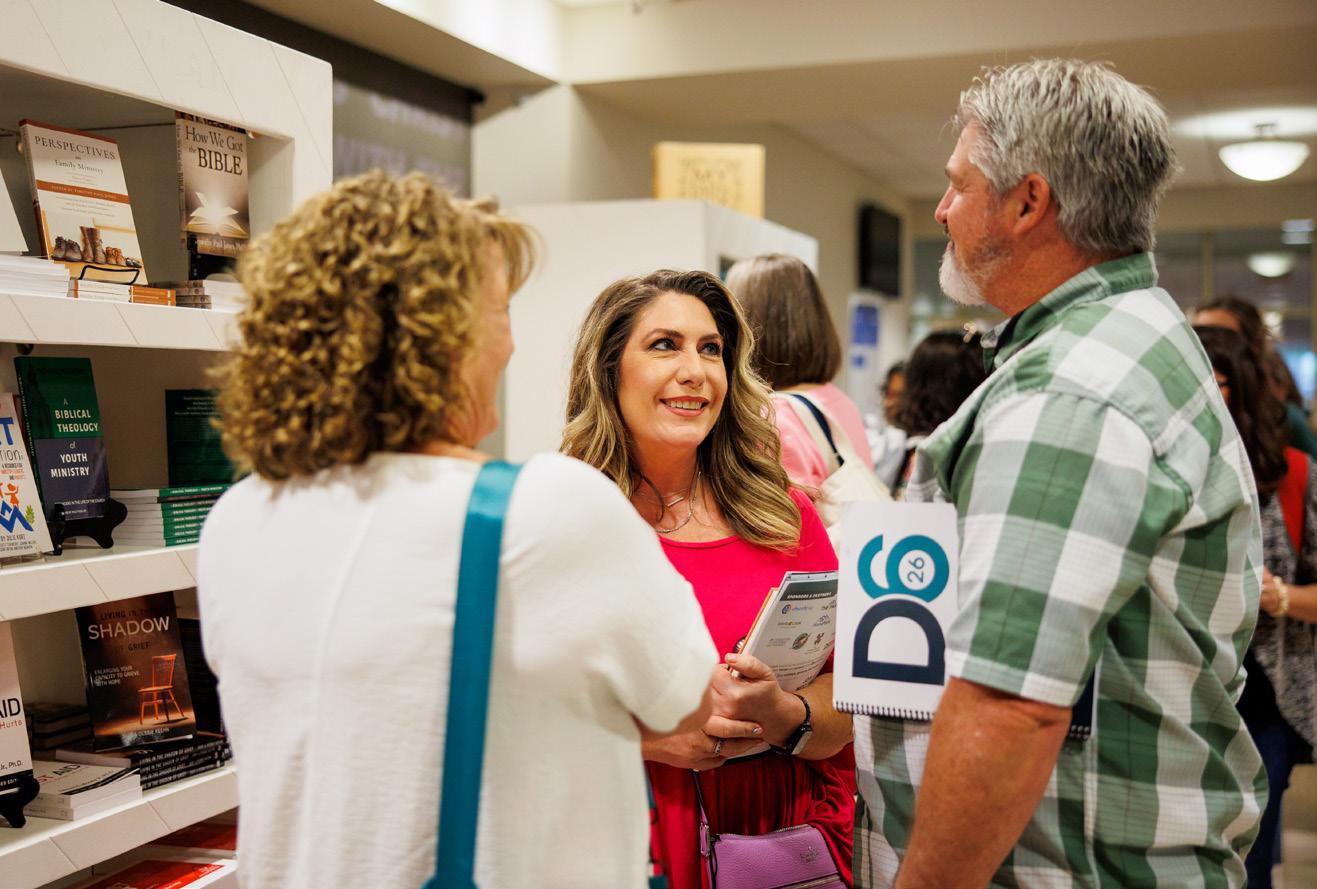
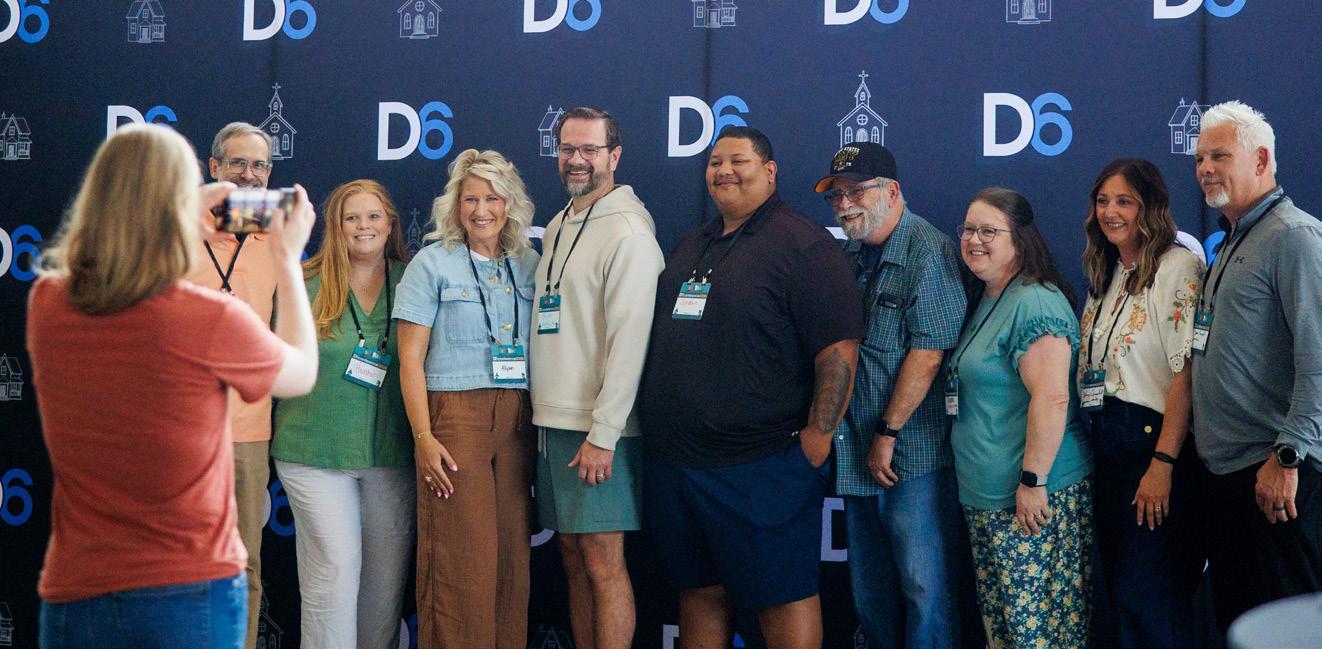
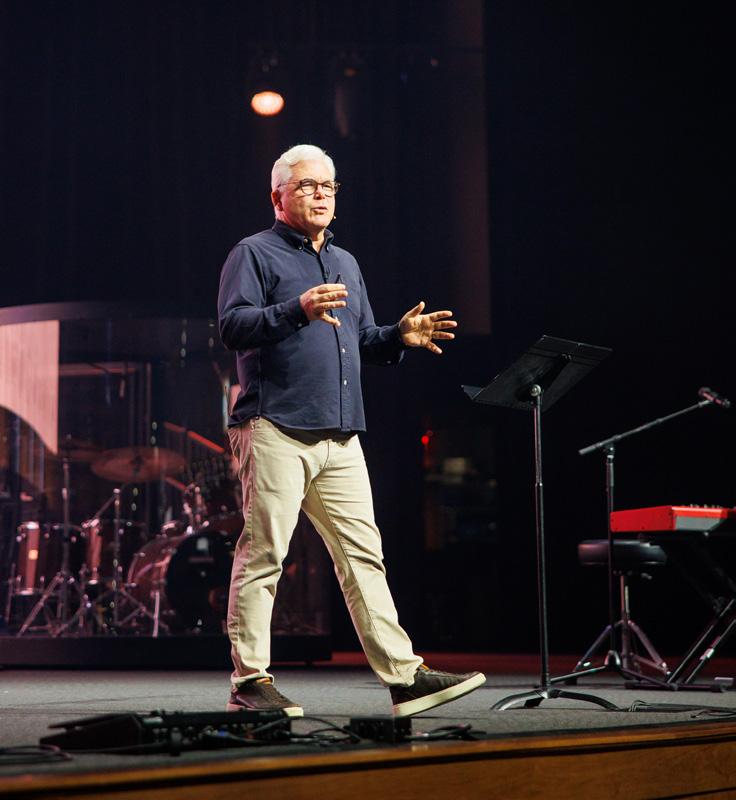
GENERAL SESSIONS
Another key ingredient in building a discipleship community happens on the main stage during four general sessions (at both D6 Northwest and D6 Southeast). At both conferences, Pray with Me author Erica Renaud shared her personal testimony using key moments in Scripture that helped attendees recognize God’s movement, invitations, and presence in everyday life.
D6 Family Ministry CEO Dr. Ron Hunter challenged attendees to consider “Backward Discipleship in a Forward World,” emphasizing the “Faith-Forging Five” that must be instilled in the next generation if they are to remain connected to their faith beyond high school.
Author of Grandparents Make Grand Partners Lori Wildenberg delivered a compelling message to remind grandparents they have a unique opportunity to become who God has called them — and who their adult children hope for them — to be. Her session was followed by Lissy Rienow Bailey, who urged parents to turn their hearts toward their teens and embrace their mission of leading them to follow Jesus.
Tommy Swindol, pastor of The Donelson Fellowship, and writer Carol Reid also took the stage to equip attendees with practical tools for meaningful spiritual conversations with their children.
A highlight of both conferences was a panel discussion featuring the authors of Reimagining Church as Family. Moderated by D6 Conference Director Derek Altom, the conversation explored the book’s central theme: God’s design for family is broader, deeper, and more comprehensive than we often think.
At D6 Northwest, Dr. Richard Ross delivered a core D6 message: “Infusing Lifetime Faith Through Heart Connection.” Jana Magruder, strategic initiatives director of Lifeway Next Gen, challenged attendees to “flip the script” on their ministry
D6 Conference photos credit: Kellie Penn
strategy by leveraging every generation to reach the next. D6 Northwest concluded with a powerful exhortation from the director of Via Families, Carissa Potter, calling attendees to shape parenting, discipleship, and Christ-centered community in everyday family life.
At D6 Southeast, Matt Hanson, executive director of the National Rite of Passage Council and catalyst for the Aion Path, challenged churches to intentionally engage dads and middle schoolers in ways that impact families for generations. The main stage concluded at D6 Southeast with Dr. Brian Dembowczyk, who highlighted the often overlooked “what” of family discipleship.
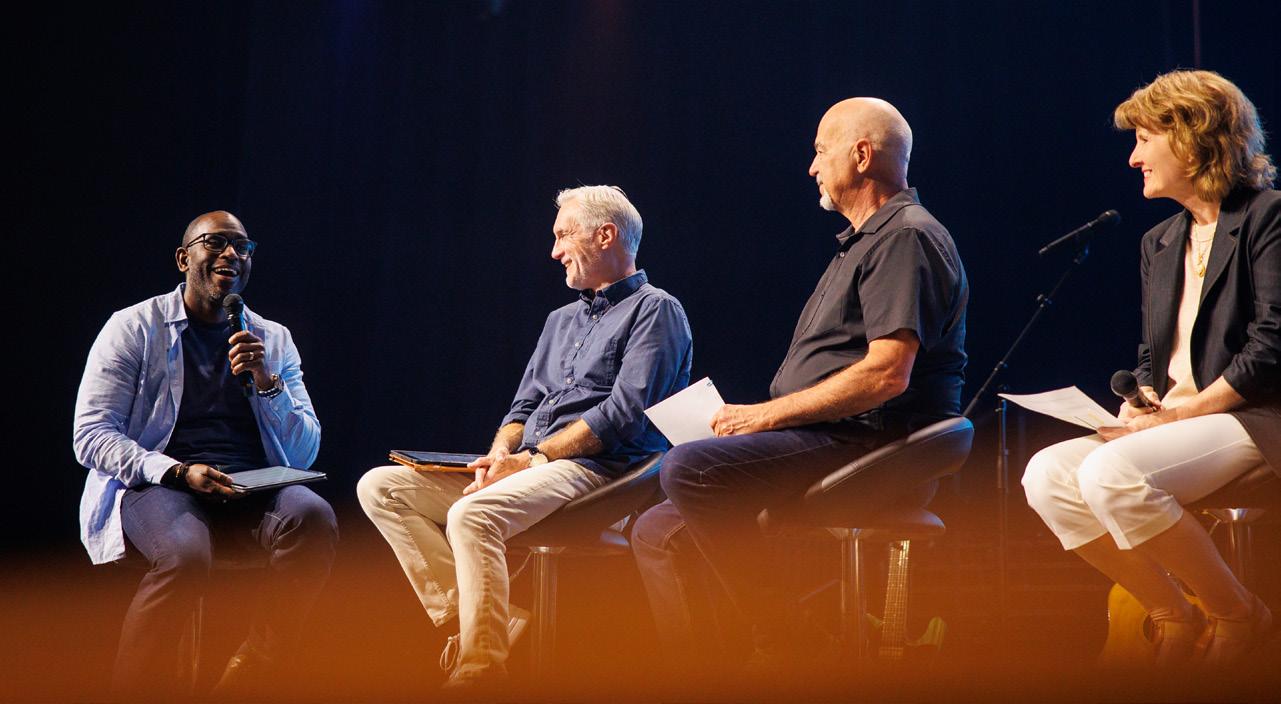
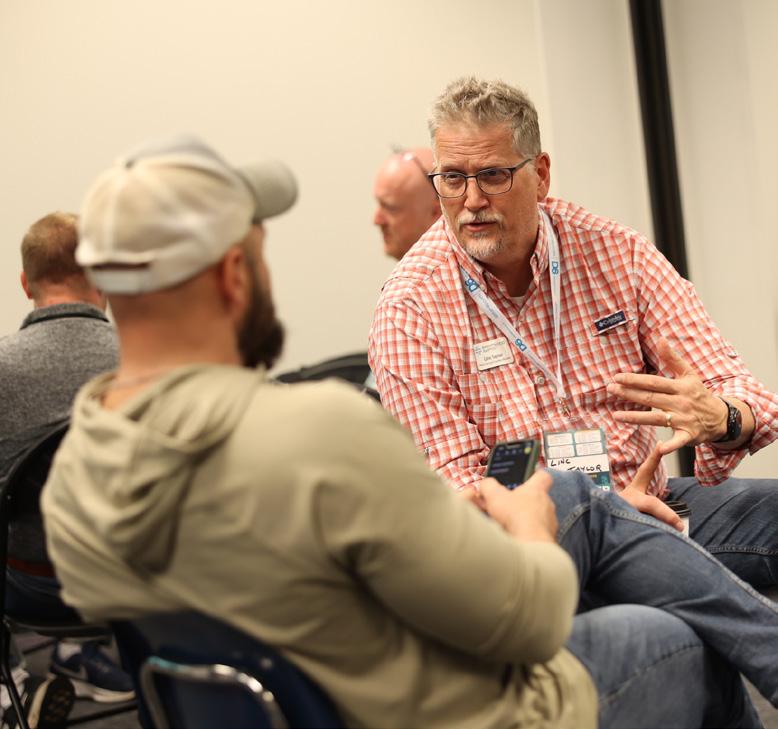
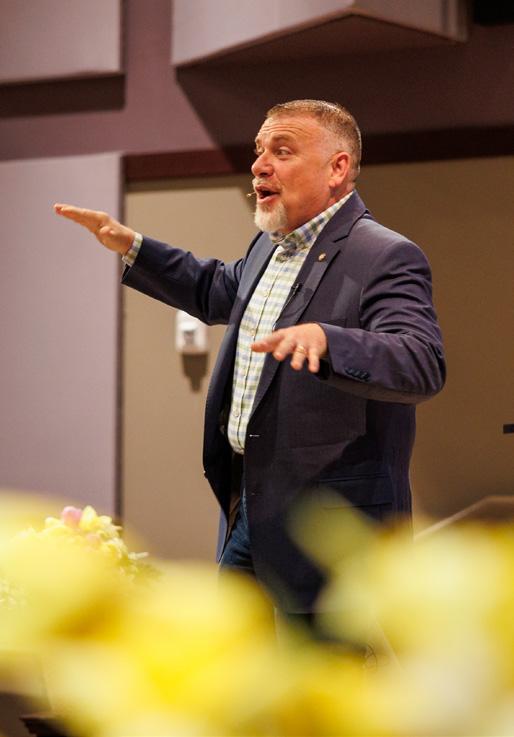
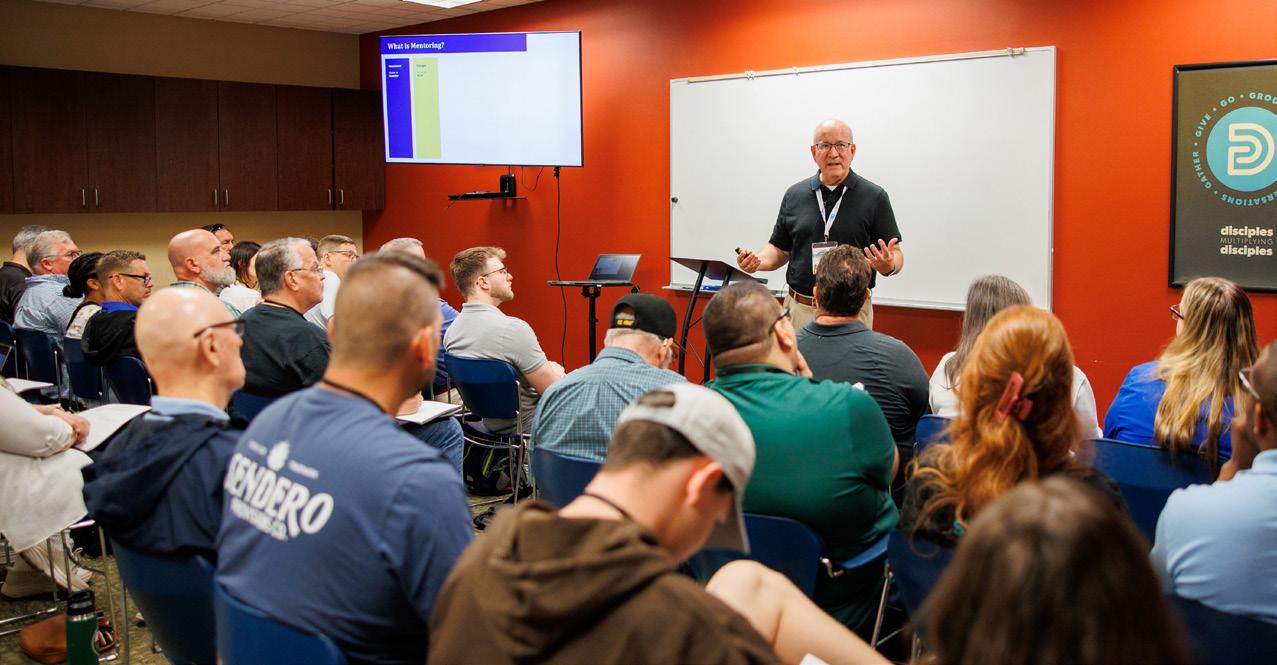
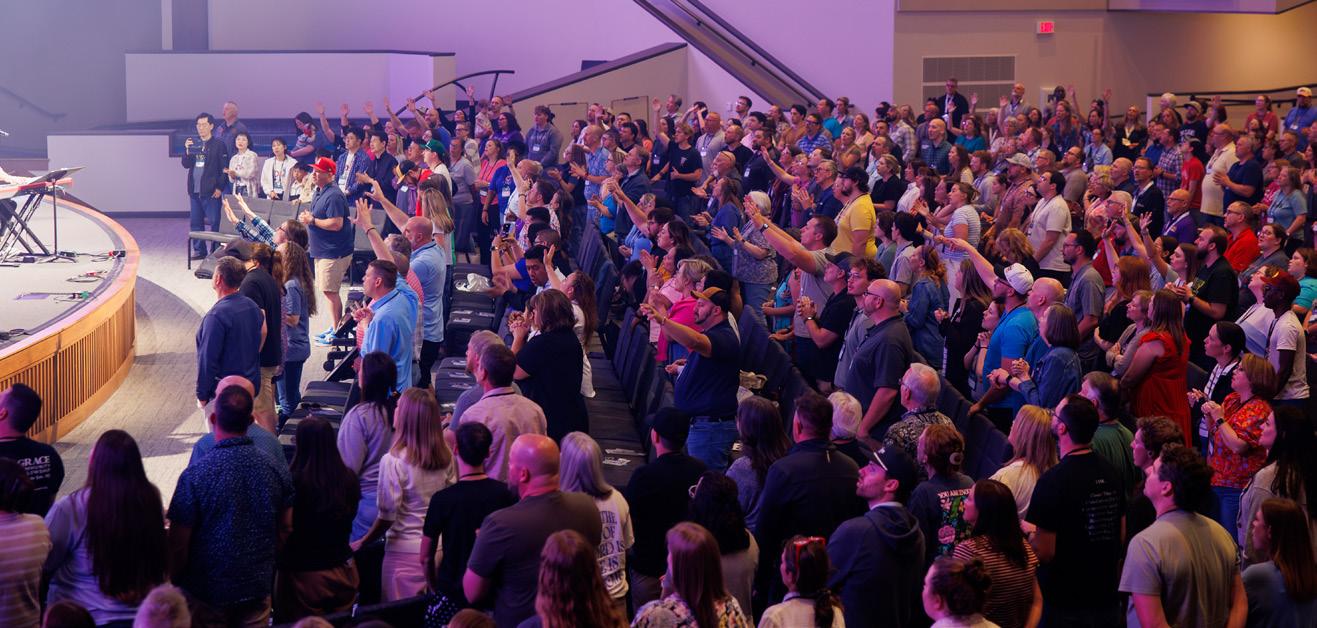
WORSHIP
A third key ingredient in building a strong discipleship community at D6 is corporate worship. At D6 Northwest, host church Northshore Community Church in Kirkland, Washington, led worship. At D6 Southeast, attendees were led by members of the worship team from The Donelson Fellowship in Nashville, Tennessee.
At both conferences, youth ministry veteran Jon Forrest kept attendees laughing throughout the general sessions. D6 Southeast participants also enjoyed a special evening of stories and songs from musician Andrew Peterson.
CONCLUSION
The D6 Conferences are more than events. They are environments where discipleship community is intentionally formed. Through practical breakouts, Christ-centered main stage teaching, and meaningful moments of corporate worship, attendees are not only equipped, but they are also connected
What makes D6 unique is not just the content but the culture it cultivates. It brings together leaders, parents, grandparents, and volunteers around a single shared mission: to pass faith from one generation to the next. In a world that often pulls families and ministries apart, D6 calls us to something deeper — to walk together, to invest intentionally, and to trust God to work through everyday moments.
As attendees returned home, the goal was not simply to remember what was learned, but to live it out, to build discipleship communities in their churches and homes that reflect God’s design for family. In the end, community is not created in a moment. It is forged over time, and D6 continues to be a place where that work begins.
The dates have been set for the 2027 D6 Conferences. D6 Northwest will take place March 5–6, 2027, at Northshore Community Church near Seattle, Washington. D6 Southeast will take place April 22–24, 2027, at Brentwood Baptist Church near Nashville, Tennessee. For more information on both conferences, visit D6conference.com.
Phrases Leaders Struggle to Say, Part 3
BY RON HUNTER JR., PH.D.
I need to change my mind based on new information. I allowed a cultural drift. I should have listened sooner. This isn't working.
The first two installments of “Phrases Leaders Struggle to Say” explored courage and integrity then capacity and pace. This third column turns to another leadership challenge that quietly reshapes organizations: course correction. Vision rarely collapses in a dramatic moment. Direction erodes when leaders hesitate to acknowledge what no longer works, resist new information, or ignore the slow drift of culture.
Few phrases weigh on a leader more than, “This isn’t working.” Leaders invest time, resources, and credibility into initiatives, which makes admitting poor results difficult. Many “double down,” throwing more people, money, and effort into struggling programs. Stewardship requires the courage to say, “We need to stop doing this.”
Scripture does seem to offer a sobering counter-argument. The prophet Jeremiah faithfully delivered God’s message for decades with little visible success. However, Jeremiah’s faithfulness rested in obedience to the message, not in defending ineffective methods. His example does not grant modern leaders permission to cling to familiar approaches when results disappear. Faithfulness and fruitfulness both deserve attention. Leaders who refuse to evaluate methods eventually exhaust their people, stall progress, and lose credibility.
Another phrase leaders struggle to say is, “I need to change my mind based on new information.” Leaders sometimes assume consistency proves strength. However, stubbornness usually reveals insecurity. New data, fresh insights, and different perspectives often come from people who possess knowledge or experience the leader does not have. Healthy leadership welcomes that reality.
Presidents assemble cabinets for this very reason. Advisors bring expertise, perspective, and relationships one person alone cannot possess. Titles carry influence, yet ignoring
wisdom around you eventually erodes credibility. Leadership never requires the leader to be the smartest person in the room. Leadership requires the wisdom to listen when someone else offers better information.
Admitting “I allowed a cultural drift” may be the most uncomfortable phrase of the three. Culture rarely collapses overnight. It slides through small compromises and unchallenged behaviors. Expectations and priorities soften or blur. Values that once defined the organization become slogans instead of convictions. Drift usually reflects what leaders tolerated more than intended. Naming drift restores clarity. Leaders shape culture through what they reinforce, what they ignore, and what they correct.
The final phrase carries quiet humility: “I should have listened sooner.” Leaders often receive signals long before problems surface publicly. Team members raise concerns. Data hints at warning signs. Feedback appears in conversations that feel easy to dismiss in the moment. Listening earlier saves the organization from painful correction later.
These phrases share a common responsibility: leadership requires the courage to correct course. Leaders who refuse to evaluate programs protect tradition rather than mission. Leaders who reject new information limit growth. Leaders who ignore cultural drift weaken shared values. Leaders who delay listening invite unnecessary consequences.
Course correction rarely feels comfortable, yet clarity always strengthens the path forward. When did you last evaluate your direction?
About the Columnist: Ron Hunter Jr. has a Ph.D. in leadership and is CEO of D6 Family Ministry. You may contact him at ron.hunter@ d6family.com.
TUESDAY
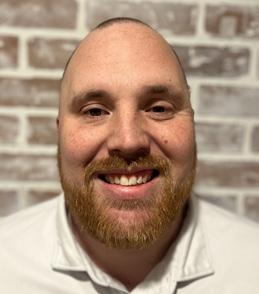
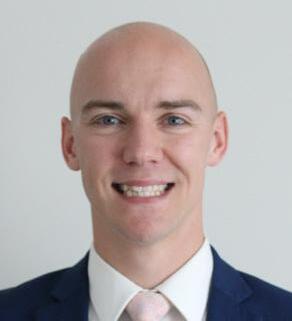
Puerto Rico Association Meets
Guaynabo, PR — The 2026 Puerto Rico Association of Free Will Baptists met February 21-22 for a time of encouragement, growth, and clear evidence of God’s work among us. Over the past year, we have seen steady progress in the growth of five associated churches: Iglesia Sal y Luz, with campuses in Caguas and Aguas Buenas; Jesús es el Centro; The Way Church; and Iglesia Casa de Paz in Yauco, which was officially received into the association during the 2026 meeting.
The Lord allowed us to witness a 50% growth in attendance and a strong commitment to discipleship, reflected in the high number of baptisms among new believers. One of the most meaningful highlights was the graduation of
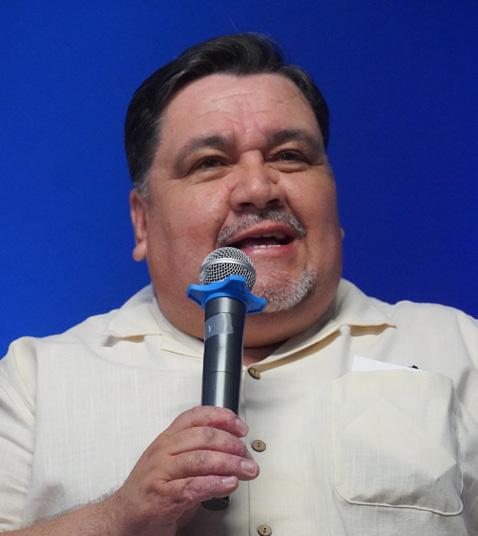
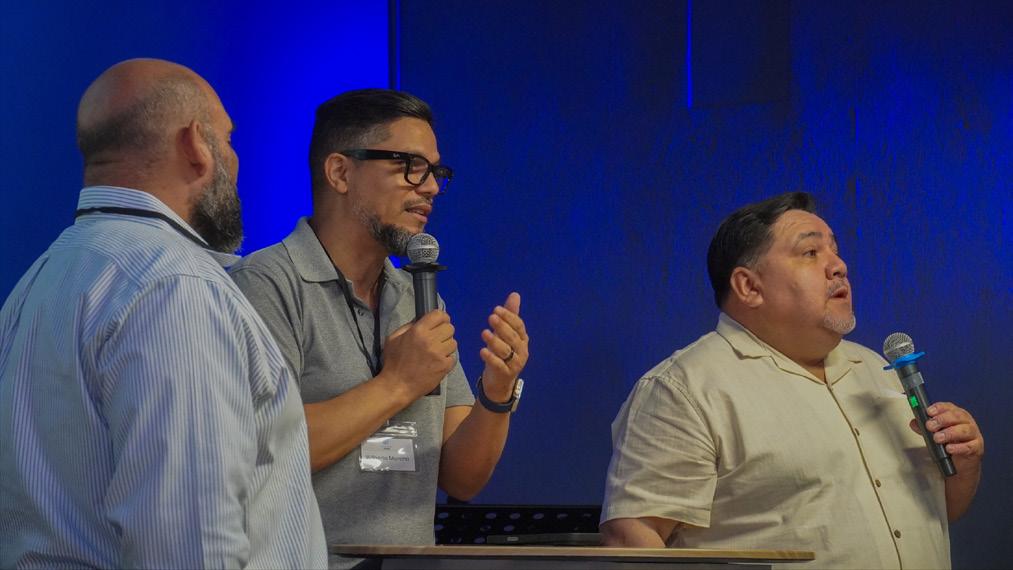
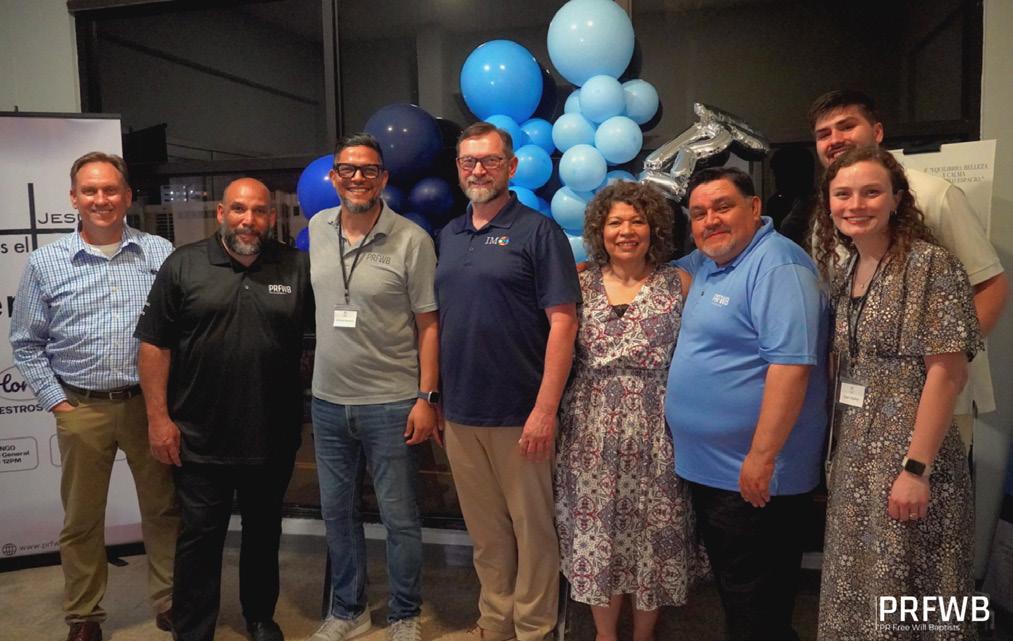
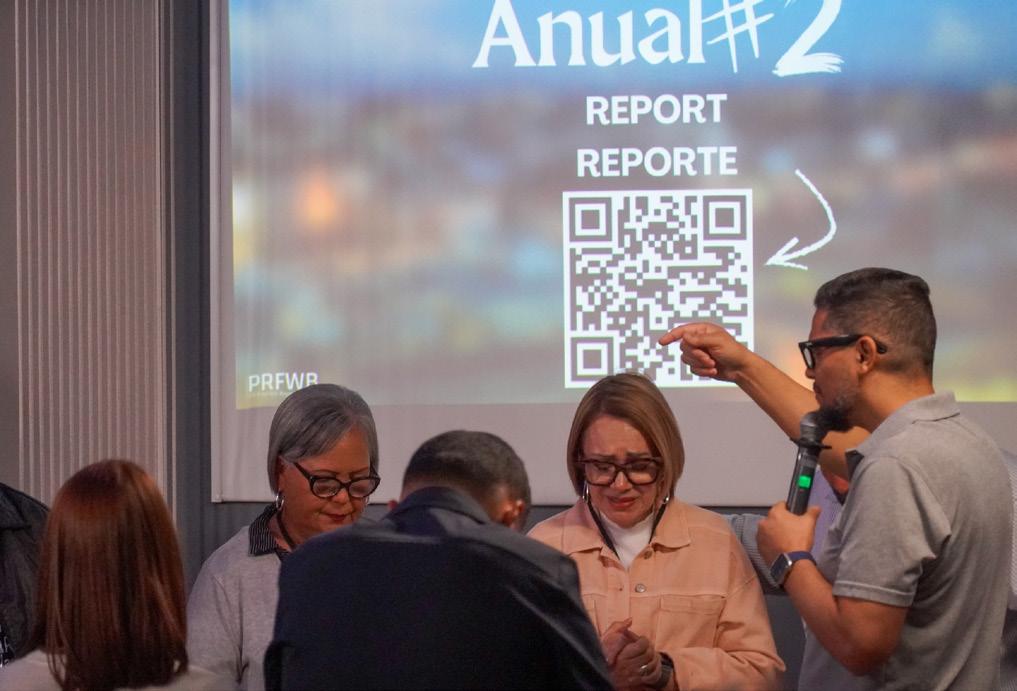
seven new preachers, a testimony to the fruit being produced through intentional biblical training and leadership development.
In addition, our association has continued reaching beyond our own congregations by visiting independent churches across Puerto Rico to offer support, training, and doctrinal guidance to help strengthen their ministries.
We sense a growing burden to prepare and send trained leaders to the United States, expanding the reach of the gospel beyond the island. Alongside these efforts, we have established ongoing weekly studies to help develop stronger disciples and future leaders.
Overall, this associational meeting reflected unity, vision, and a shared commitment to the Great Commission as we continue to see God build His church in Puerto Rico, opening doors for greater impact.
— Submitted by Pastor Wilberto Moreno, Puerto Rico Association of Free Will Baptists
Alabama, Georgia, and Florida Collaborate for Advanced Leader Training
Albany, GA — The first Deep South Advanced Leader Training was hosted April 10-11 by the Alabama, Florida, and Georgia state associations at First FWB Church, Albany, Georgia, by Georgia’s Executive Director Mark Walker. Twenty-five leaders from the tri-state area gathered for training presented by North American Ministries (NAM) and the Executive Office. Dr. Brad Ransom, Josh Bennett, and Dr. Eddie Moody took participants through a series of eight sessions.
Dr. Eddie Moody, executive director of the National Association, kicked off the sessions by asking, “Who do you lead?” The truth is, we often influence more people than we realize. Dr. Moody used statistics to reveal alarming trends in our denomination that highlight a great need for leadership with conviction and purpose.
Dr. Brad Ransom, NAM chief training officer, spoke to the need of building a strategic vision for ministry, reaching far beyond the next Sunday. The church was commanded to reach the world with the gospel. A church must have direction, unity, passion, purpose, and openness to good ideas to reach the lost effectively.
Josh Bennett, NAM chief strategy officer, focused on how to properly evaluate ministries. The biggest takeaway from this session was to involve multiple stakeholders
in the process of evaluating the ministry of the church. Leaders must answer strategic questions, including: Who are we trying to reach? What are we trying to move them to do? How are we going to get them there?
Moody and Ransom shared additional sessions directed toward reaching beyond the “me and mine mentality.” These included guidance on reaching youth, using digital tools (instead of allowing them to use us), creating ministries that can grow, developing a culture of discipleship, and developing leaders within the church for ministry.
The sessions provided much practical instruction participants can put into practice immediately. Advanced Leadership Training clearly promoted a mindset that focuses on the God-given mission to go, disciple, and teach the world. Thanks to the Executive Office and NAM for bringing this much-needed training to church leaders across the Deep South.
Another Advanced Leader Training event will meet in Nashville, Tennessee, September 18-19. To learn more, visit fwbnam.com/alt/.
— Submitted by Duane Littlefield, Promotional Director, Florida Free Will Baptists
Pamphlet Answers, “Why Join an Association?”
Antioch, TN — A new pamphlet from the Executive Office, “The Association Question,” answers the tough questions about why it is important for every church to be part of the National Association. The pamphlet, written by Illinois pastor and denominational Executive Committee member Joshua Colson, answers the following questions and more:
• Who are Free Will Baptists?
• How are Free Will Baptists structured?
• Does the association have power over the local church?
• Does the association appoint pastors?
• Does the association own the church’s property?
• Will joining the association require a name change?
• Why bother joining an association?
• How can a church join an association?
Executive Director Eddie Moody noted, “Joshua has done a wonderful job of identifying and answering the questions that might come up when a church is considering joining an association. I also found his work encouraging, as he reminds us of the many benefits of working together to accomplish things no church can do on its own. We are grateful for this new resource available to our churches.”
“The Association Question” is free, available in Spanish, and can be ordered from the Executive Office by calling 877-767-7659 or emailing questions@nafwb.org. Learn more about other resources from the Executive Office: nafwb.org/resources/.

THAN A MEETING MORE
2026 NATIONAL CONVENTION “CHARTS A COURSE” FOR COLUMBUS, OHIO
What do you think when you hear the words “National Convention”? I imagine many Free Will Baptists immediately recall unforgettable worship services with powerful preaching and thousands of voices lifted together in song. Or perhaps the memories revolve around the excitement of the Vertical Three Conference — CTS Expo activities, special events, and services designed for young people. Still others may think of business sessions, where delegates hammer out decisions and direction for the denomination.
Every year, the convention provides some unique opportunities and experiences perhaps you have never considered.
Whatever comes to mind, it is undeniable the National Convention is a great meeting… but it is much more! Every year, the convention provides some
unique opportunities and experiences perhaps you have never considered. Opportunities to Reach, Train, and Give.
REACH. While our annual meeting is primarily a gathering for Free Will Baptists, bringing thousands of Free Will Baptists to one city also opens a door for the gospel.
This starts with IMPACT, the annual one-day evangelistic outreach event on the Saturday preceding the convention. Those arriving early have an opportunity to partner with local churches and venture into the community, sharing the gospel verbally and through acts of kindness and service.
This year, on July 18, IMPACT offers three opportunities. At Hillview Church, volunteers will complete a painting project at the church and simultaneously offer a free neighborhood carwash. At both Heritage FWB Church and Canaan Land FWB Church, volunteers will join the local congregation in serving
the widows of their churches in a variety of ways. See fwbmastersmen.org/impact for more details or to register.
And outreach doesn’t stop Saturday evening at the conclusion of IMPACT. Throughout the week, from restaurants and hotel lobbies to crowded sidewalks, attractions, and parks, Free Will Baptists have an opportunity to make a profound impact on Columbus residents. Verbally, yes, but also through good tips, patient interaction with workers and servers, respectful behavior, or maybe just a smile and good attitude.
The convention offers more than a visit to Columbus; it provides a chance to reach Columbus with the gospel.
TRAIN. Over the past decade, convention opportunities for training have grown exponentially. This year, take advantage of more than 80 seminars, workshops, and experiences designed for attendees of all ages. Leave the convention equipped with new strategies, techniques, ideas, and encouragement. Refresh and recharge through interaction with others who face the same ministry challenges and burdens.
In the Exhibit Hall, explore the latest resources from national departments and trusted ministries. Find more information about outreach and missions opportunities. Introduce young people to Free Will Baptist colleges and denominational ministry opportunities available for them.
The convention is more than a meeting. It is a training ground for effective ministry.
GIVE. Each year, one of the highlights of the National Convention comes during the Wednesday evening service when missionaries and church planters are introduced, commissioned, and dedicated to the work of the Lord. Then Free Will Baptists unite to give a missionary offering that stretches far beyond Columbus to the world!
This year, make plans to join us in Columbus as Free Will Baptists Reach, Train, and Give together at the denomination’s largest annual gathering.
An Update on Convention Funding
In recent years, rising convention costs pushed Executive Office convention planners to explore new forms of revenue, review expenditures, and make tough decisions regarding budget items.
National departments were asked to consider contributing financially toward the convention. The largest gathering of Free Will Baptists uniquely benefits departments through the convention audience and the opportunities it presents for interaction. North American Ministries, IM, Inc., Richland Ave Financial, D6 Family Ministry, FWB Foundation, and the Executive Office each responded by making substantial gifts toward the convention. They have been joined by local churches and individuals who stepped up to support the convention financially.
The convention staff continues to monitor and cut costs wherever possible. Much spending for the National Convention is necessary as planners meet the city, center, security, and hotel requirements. These mandatory items often come with significant unavoidable costs.
However, various cost-saving measures began in 2025 and continue into 2026:
• No Internet for live streaming (instead, recordings will be available within 24 hours)
• A position cut from the press team
• A single copier for the convention office (down from three)
• The daily Convention News transitioned to digital format
Additional cost-cutting measures will be considered and incorporated whenever possible.
Convention host states have been asked to collaborate in fundraising with their neighboring states to offset rising convention expenses (as modeled by Missouri and Kansas in 2025). The fees to those presenting seminars has increased to cover costs, and any costs incurred from departmental events are passed along to those departments.
These efforts and others like them will ensure future conventions can be funded with the least possible effect on attendee experience.
If you would like to join those who support the convention financially, visit nafwb.org/convention/.

The Greater Columbus Convention Center (GCCC) will serve as the location for convention events and activities. Find additional event information at nafwb.org/convention as it becomes available.
All times EDT.
SATURDAY, JULY 18
Impact Columbus
9:00 a.m.
fwbmastersmen.org/impact
Registration Open
3:00 p.m. – 6:00 p.m.
Hall A Lobby
Pre-Registration closes June 19: nafwb.org/convention
SUNDAY, JULY 19
Registration (Open Daily) 8:00 a.m. – 7:00 p.m.
Hall A Lobby
Sunday School* 9:30 a.m.
(V3-Teens combine with adults for Sunday morning worship.)
Morning Worship Services* 10:30 a.m.
Usher Orientation
5:00 p.m.
Hall A Choir Rehearsal
5:00 p.m.
Hall A fwbworship.com/choir
Evening Worship Services* 7:00 p.m.

*WORSHIP SERVICES OFFERED NIGHTLY FOR THE FOLLOWING AGES:
Adult Worship ................................... Hall A
V3 – Teen Worship (Grades 7-12) ............. Battelle North
V3 – 456 Worship (Grades 4-6) ................... C170-172
V3 – Kids Worship (Grades 1-3) ................... C161-162
V3 – Preschool Worship (Age 3-5) ................. C150-151
Preliminary Program 2026 NATIONAL CONVENTION
MONDAY, JULY 20
General Board Meeting
8:00 a.m.
B233-235
CTS Ministry Expo
8:00 a.m. – 4:30 p.m.
Full schedule: verticalthree.com
Convention Seminars
9:00 a.m. – 3:30 p.m.
A111-115, A124/125
Full schedule: nafwb.org/convention
Servicio especial en Español
1:30 p.m.
B233-235
Exhibit Hall Open
3:00 p.m. – 10:00 p.m.
Union Station Ballroom
Choir Rehearsal
5:00 p.m.
Hall A
Evening Worship Services*
7:00 p.m.
A Walk In Her Shoes: A WNAC Event
8:30 p.m.
A210-212
Youth Evangelistic Team (Y.E.T.)
Program
9:00 p.m.
Battelle North
TUESDAY, JULY 21
V3 CTS Ministry Expo
8:00 a.m. – 4:30 p.m.
Convention Seminars
9:00 a.m. – 3:30 p.m.
A111-115, A124/125
Exhibit Hall Open
10:00 a.m. – 10:00 p.m.
Union Station Ballroom
Welch College Alumni and Friends Luncheon (Ticketed Event)**
12:00 Noon
B233-235
Convention Business Session
1:30 p.m. – 4:00 p.m.
Hall A
Choir Rehearsal
5:00 p.m.
Hall A
Evening Worship Services*
7:00 pm
D6 Family Ministry Event: Illusionist Mark Brown (Ticketed Event)**
9:00 p.m.
Battelle North
WEDNESDAY, JULY 22
CTS Bible Finals
8:00 a.m.
A210-212
Convention Seminars
9:00 a.m. – 3:30 p.m.
A111-115, A124/125
Convention Business Session
9:00 a.m. – 4:00 p.m.
Hall A
GPS Experience: A Missions Experience for Every Age
9:00 a.m. – 11:00 a.m.
A220-222
Exhibit Hall Open
10:00 a.m. – 6:30 p.m.
Union Station Ballroom
Choir Rehearsal
5:00 p.m.
Hall A
Evening Worship Service (Combined)
7:00 p.m.
Hall A
V3 Awards Ceremony
9:00 p.m.
Hall A
Find information about participating in the choir, orchestra, or praise team at fwbworship.com under the NAFWB tab.
** Event tickets can be purchased through convention pre-registration.
Run Your Race…Well!
BY EDDIE MOODY
The Christian life has often been described as a race. The question is simple: How do we run it well?
Prepare well. I’ve enjoyed running races with my son Mitchell over the years: 5ks, 10ks, even a half-marathon. We quickly learned preparation matters. You don’t show up on race day and simply hope for the best. The training you’ve done beforehand shows up during the race. The same is true spiritually. Time in God’s Word and time with God’s people are not optional but essential. We must prepare for the race.
Remember you’re not alone. At moments in a race, it feels like no one is watching, and it’s tempting to slow down. But Scripture reminds us we are surrounded by a great cloud of witnesses (Hebrews 12:1), those who lived by faith and set an example before us. I often think about my parents, who both passed away a little over a year ago. Thinking of them in the cloud of witnesses helps me run my race. Who comes to your mind? Which faithful people have shaped your life? Their example still speaks, so let it strengthen you.
Lay aside the weight. Runners travel light for a reason. Even small things slow you down over time. In our lives, the weights aren’t always obvious sins. Sometimes it can be a
distraction. Comparison. Noise. Anxiety. Other times, sins like envy, addiction, and habits pull us off course. Whatever it is, don’t carry it. Lay it aside.
Run your own race. One of the hardest parts of running is keeping your own pace. It’s easy to start too fast, trying to keep up with faster runners. We do the same in the race of life. We compare ministries, churches, and families. When Peter asked Jesus about John, the Savior quickly corrected Peter. “What is that to you? You follow Me” (John 21:21-22). Your ministry is yours. Your race is yours. Your calling is yours. Stay focused on the race God has for you. Even John the Baptist struggled when his ministry didn’t turn out as expected (Matthew 11:2). Jesus encouraged him to continue his own race (Matthew 11:6). Our race doesn’t always go as we expected, but we are still called to run it well (Hebrews 12:1).
Keep going and enjoy the race. A moment comes in every race when you get tired. I’ve had those moments. But I’ve also learned, without some joy along the way, it’s hard to finish well. I try to concentrate on the landscape or a river and enjoy the race. Enjoy the race of life. Sure, ministry has challenges, but we will soon long for these moments when we look back over our lives.
Run together. I always run better with a partner in a race than I do alone. Something about a friend beside me is encouraging. The accountability also makes a difference. We were never meant to run alone (Ecclesiastes 4:9-12). We need each other. We need the church. That’s part of what it means to be better together.
Fix your eyes on Jesus. At the end of the day, our goal is to finish well like the Apostle Paul (2 Timothy 4:7). How do we do that? By keeping our eyes on Jesus, who ran His race perfectly and finished it for us (Hebrews 12:2). So, let’s keep going. Stay faithful. And by God’s grace, finish the race well.
Eddie Moody Executive Director, National Association of Free Will Baptists
It's THEIR future!
No one wants to think about the worst, but even young families must be prepared for the unexpected. When you don't plan for your unexpected passing, you hand over your assets to the courts — even the guardianship of your children.
Since 2013, the Free Will Baptist Foundation and Cornerstone Estate Planning have helped thousands of families avoid these legal and financial nightmares. In the event of your death, our caring staff will walk with your family through difficult days and guide them through your plan for the future.
www.fwbgifts.com | 877-336-7575


What’s Coming in July/August 2026
Jul 5 • Lessons From the Life of Peter • Matthew 16:13–20+
Jul 12 • Living Hope • 1 Peter 1:3–25
Jul 19 • Joyful Trust • 1 Peter 4:1–19
Jul 26 • Lessons From the Life of John • Luke 5:1–11+
Aug 2 • Walking in the Light • 1 John 1:1–7
Aug 9 • Steadfast Faith • Revelation 2:1–3:22
Aug 16 • Worship the Lamb • Revelation 4:1–5:14
Aug 23 • Prophecies of the End Times • Revelation 20:1–15+
Aug 30 • A Glimpse of Heaven • Revelation 21:1–22:5