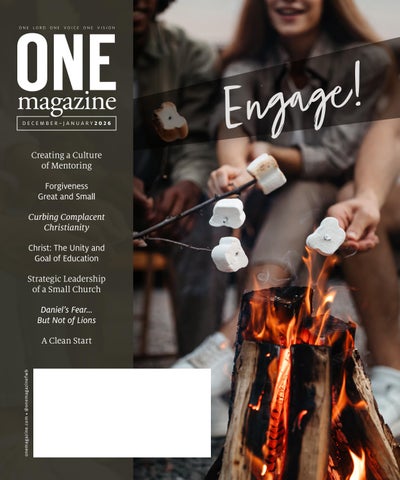
DECEMBER–JANUARY2026
Creating a Culture of Mentoring Forgiveness Great and Small Curbing Complacent Christianity Christ: The Unity and Goal of Education Strategic Leadership of a Small Church Daniel’s Fear... But Not of Lions
onemagazine.com • @onemagazinefwb
A Clean Start
! e g a g n E
We pray it won't happen, but it might. No one expects the worst to happen, but if you die without a plan, you hand over your assets to the courts. Since 2013, the FWB Foundation and Cornerstone Estate Planning have helped thousands of families avoid the nightmares of probate court, including the assigned guardianship of children. When you die — especially in the event of a tragedy — our caring staff will walk beside your family through the difficult days and guide them through your plan for the future.
fwbgifts.com | 877-336-7575
A Christian Community of Faith and Learning — welch.edu —
EDITOR-IN-CHIEF: Eddie Moody
09
MANAGING EDITOR: Eric Thomsen
Articles
LAYOUT & DESIGN: D6 Family Ministry DESIGN MANAGER: Andrea Young
PRINTING: D6 Family Ministry
18
PHOTO CREDIT: Eric Thomsen Shutterstock.com Istockphoto.com Stockxpert.com Designpics.com Rodney Yerby While ONE Magazine is provided to the reader free of charge, taxdeductible donations are both accepted and appreciated. To make a donation, simply send check or money order to: ONE Magazine PO Box 5002 Antioch, TN 37011-5002
22
Published bi-monthly by the National Association of Free Will Baptists, Inc. 5233 Mt. View Road Antioch, TN 37013-2306 ISSN 1554-3323
Phone: 877-767-7659
06 Creating a Culture of Mentoring 09 Grandparenting With Purpose 13 Closing the Gap Between Sunday and Monday 14 Forgiveness Great and Small 18 Curbing Complacent Christianity 22 Idolatry and Cultural Judgment in Romans 1 24 Christ: The Unity and Goal of Education 26 The Nicene Creed and the First Free Will Baptists 30 We Educate Leaders...to Serve 34 Strategic Leadership of a Small Church 36 The Tentmaker's Toolbox: Caring for Bivocational Leaders 38 The Impact of Year-End Giving: Why It Matters for Your Church and Ministry Partners 42 Daniel's Fear...But Not of Lions 46 Turning the Page: A New Chapter in Mission 50 A Not-So-Traditional Christmas 55 Resources for a New Year 56 Put Something Sweet in It! 58 A Clean Start
Perspectives 04 First Glimpse: Blame It on the Hardy Boys 16 Refresh: Taking the Great Commission to a Digital World 20 Intersect: Dealing With Discouragement 45 Primary Source: Sound Sleep 49 Leadership Whiteboard: The Shallow End Makes the Most Noise 62 Better Together: Value Christmas
News
Non-profit periodical postage rate paid at Antioch, TN 37011 and additional offices Postmaster, send address changes to: ONE Magazine PO Box 5002 Antioch, TN 37011-5002
DEC – JAN 2026 | VOLUME 22 | ISSUE 1
To communicate to Free Will Baptists a unifying vision of our role in the extension of God’s Kingdom
ASSOCIATE EDITORS: Ken Akers Jeff Caudill Chris Compton Danny Conn Bethany Douglas Doug Little Ruth McDonald Deborah St. Lawrence
DESIGN: Marianne Stewart
contents
58
32 At Welch College 40 Across the Nation 53 Around the World 60 About the Denomination
Note From the Editor: In the previous issue, two articles failed to receive an appropriate credit line. “Cultivating Churchmen” by Chris Talbot and “The Heart of Ministry” by Jesse Owens were adapted from essays previously published by Helwys Society Forum. My apologies for this omission.
First Glimpse
Blame It on the Hardy Boys BY ERIC K . THOMSEN
It all started with The Hardy Boys Handbook, where Frank and Joe taught me to start a fire with a magnifying glass. As a curious (and somewhat devious) little guy, I quickly found my grandmother’s powerful magnifier worked like magic. I thought it might be fun to “torch” the fire ants along the edge of the piney woods behind her Florida home. Give them some fire of their own for a change! The only problem? The ant beds were surrounded by thick pine needles dried by the hot summer sun — perfect kindling. Within minutes, the piney woods were burning, and I found myself surrounded by firemen. Small spark. Big blaze. Disastrous results. Almost sounds like words. I’m not sure I recall another time when words hold such power. In this politically-charged, social media-fueled world, a single sentence can get someone fired or bring down a company. Words can tear a family or church apart. They have been weaponized, sharpened, and like poisoned arrows, holding deadly power. Turns out we humans have a horrible speech impediment — our sin nature. We simply can’t control our mouths (James 3:1-12). James wrote to Jewish Christians scattered across the ancient world by persecution. What principles did James offer to govern our communication as believers? “Small” words really aren’t small (verses 3-6). Have you ever stopped to consider how small words shape our lives? Yes, no, I do, I don’t, stop, go — all four letters or less,
but these miniscule words can alter the entire course of life. James compared words to a bit, a rudder, and a fire, all small things that make a big difference. Yet all have something in common. Each requires a third party. The horse doesn’t put in its own bit, a ship doesn’t turn its own rudder, and fire doesn’t start itself. What was James trying to tell us? It is not natural for humans to bridle our own tongues. Only through surrender to the Holy Spirit can our mouths be brought into submission. Aren’t you thankful for His quiet nudge that reminds us to think twice and talk once? That’s essentially what James said in 1:19: Let every man be swift to hear (listen first), slow to speak (think your words through), slow to wrath (don’t react in anger). Words carry lasting impact (verse 6). “Oh, I’d like to have that back.” The problem is, once words are spoken, they cannot be retracted. Forgiven? Yes. Taken back? No. Verse six reminds us what we say can destroy our lives (defile the whole body) and set our entire life ablaze. I don’t consider it a theological stretch to observe one “life on fire” can spread to others and ultimately cause great damage in the Body of Christ, even across generations. Unguarded speech can become a “world of iniquity” in a few sentences. Our words should match our lives (verses 8-12). We should speak our faith clearly and live consistently. Our words are an accurate barometer of our relationship with Christ, and so James offered three suggestions: • Acknowledge our inability to control our tongue (verse 8). • Talk to others respectfully, as they are image-bearers of God (verse 9). • Use speech befitting a Christian (verses 9-12): blessing, not cursing; sweet, not bitter; Spirit-filled, not flesh-driven. Day by day, hour by hour, our words are writing the book of our lives for others to read. What will today’s chapter say about you? About the Columnist: Eric K. Thomsen is managing editor of ONE Magazine. Email: eric@nafwb.org.
4
ONE Magazine | DECEMBER–JANUARY 2026
Deep South Golf Tournament APRIL 8-10, 2026
Stonebridge Golf Course / stonebridgeclub.com Sponsored by Free Will Baptist Master's Men $400 per golfer Quality Inn and Suites Albany Mall 806 N. Westover Blvd, Albany, GA 31707 April 7 Check-in / 229-883-3300 Free hot breakfast!
Register by March 4, 2026: fwbmastersmen.org/deep-south-golf-tournament
BY MERINDA PARRISH
Churches today consistently indicate they need more teachers in classrooms or small groups, volunteers for youth events, assistance with church programs, people to minister to the elderly and shut-ins, and leaders to guide new Christians. Finding mature and capable people for these tasks may be challenging, but providing training for new workers may be just as difficult since many churches consider mentoring to be the responsibility of the pastor or his wife. To combat these challenges, churches must work on creating a culture where mature Christians become mentors.
WHAT IS A MENTOR? The concept of mentoring stems from the Greek epic, The Odyssey. In the story, Odysseus selected a man named Mentor to train his son physically, spiritually, socially, intellectually, and occupationally while Odysseus was off at war. Mentor could not carry out this important task sufficiently, so the goddess Athena assumed Mentor’s form to give Odysseus’ son the vision, resources, companionship, and encouragement to act and react well in unknown and threatening situations. As Christians, we immediately relate this ancient myth to the true picture of what Christ does for us. Because we, in our own strength, are unable to lead others into thriving relationships with Christ, God provides the example of His Son and the work of the Holy Spirit to lead, guide, and teach us as we teach others. We are the vessels God uses to strengthen and teach. A mentor has many roles: teacher, guide, confidant, and encourager. The mentor also must be willing to admonish, coach, and correct when necessary. The mentor is not “the perfect example,” but shares real-life experiences and lessons while allowing the mentee opportunities to grow, develop, and lead. While we do not find the word “mentor” in Scripture, the concept correlates closely with terms such as teach, train, or disciple. God’s Word is filled with examples of people who took intentional steps to lead others to develop wisdom and godly lives. In Exodus 17:9, Moses instructed Joshua to select men and lead them into battle while Moses watched from the hillside, lifting his hands so they might obtain victory. He gave no list of requirements for the selection, and Moses did not have to approve of the group Joshua chose. Moses recognized Joshua’s God-given ability for leadership and allowed the young man to begin honing his skills. In verse 14, the Lord instructed Moses to record the details of this event to remind Joshua of his first victory when he faced struggles in the future. Even mature leaders need encouragement, especially when working to lead and train others. Looking back at how God has provided and led us allows mentors to encourage others as they grow in serving. Along with encouragement, sometimes it is necessary to correct. Moses had to admonish Joshua (Numbers 11:29)
when Joshua sought to stop men from prophesying because they had not gathered with the other leaders as instructed. Reproof is part of growing, and correction is often necessary for fellow believers to become more Christlike. As Moses led Israel, Joshua followed and observed how Moses met with God and was instructed by Him.
WHAT IS THE GOAL? Most people attend church to be fed and to grow spiritually. However, an important part of growing in Christ is learning to serve others. This is the primary goal of mentoring: to work with others as they grow in serving Christ. Believers have many opportunities to serve Christ and just as many opportunities for mentoring. For example, teaching others to teach can help produce more Sunday School, small group, and Bible study workers. Often this type of mentoring can be done by inviting another person to “assist” in teaching. After observing, assign a specific task related to the class (gathering materials, leading in prayer, teaching a point or section of the lesson). This will build confidence as he or she teaches while you assist. However, mentoring does not always occur in a classroom setting. It can be done while driving a car full of young people, listening and encouraging them through the everyday struggles of life. Mentoring happens while volunteering to sit with shut-ins, taking food to those hurting, praying with someone in a coffee shop, or studying Scripture with a new believer in your home. Mentoring happens “as you go” through life. It does not have to be in a formal classroom or church setting; it is in the everyday happenings from which God helps us grow.
WHAT IS INVOLVED? Prayer is the first element in creating a culture where believers serve Christ by pouring themselves into developing other believers. Pray for God to lead you to prospective mentors in your church. Pray for the church leadership as they mentor other mentors. Pray for God to mature His children, so they also want to help others follow Him. Next, develop relationships. I’m sure you have heard the common saying: “A person does not care how much you know until they know how much you care.” Christ loves us even when we do not deserve His love. ONE Magazine | DECEMBER–JANUARY 2026
7
A mentoring relationship is one of love that desires to see another become what God intends for that person to be. As the relationship grows, guidance, instruction, and reproof become more effective. Relationships require commitment. Mentoring is not accomplished quickly. It takes time, and the rate of growth differs for every individual. Committing to become part of another person’s life includes the obligation to communicate regularly. This does not mean spending hours a day in Bible study with the person, or that you must talk to them daily. Every mentoring situation is different, and needs are based upon the individual and what God is calling that person to do. Regardless of the frequency of interaction, communication should be consistent — a quick text to check in, an encouraging phone call, a quick get-together. Because mentoring occurs through daily activities, perhaps ask your mentee to ride with you as you run errands, stop by and talk while you are cooking (and maybe stay for dinner), or even join you for exercise. Be creative in finding ways to spend time building this important relationship. A fourth element of creating a mentoring culture is focus. Determine your goal for mentorship. Are you cultivating new
teachers, discipling new Christians, or encouraging older members to grow spiritually (not just numerically)? Setting a clear mentoring goal allows for direction in the relationship and the potential to note and celebrate growth.
RECREATING THE CULTURE Culture shapes the way people relate and work together. This includes everyday interaction and behavior. As Christians imitate Christ, we serve others and allow them to see Christ working in us. A mentoring culture is developed through consistent interaction and relationships moving toward a certain goal. Christian mentoring is only effective when the leader is following Christ and growing in a personal relationship with Him. Only then can the mentor serve others by developing godly relationships through which the Lord works and molds His people. Teaching, sharing, praying, encouraging, listening, leading, admonishing, and protecting all should become part of the Christian leader’s daily actions. As leaders promote and model these important behaviors within the church family, a lifestyle of mentoring will develop to provide more people with opportunities to serve Christ effectively. About the Writer: Dr. Merinda Parrish is adjunct instructor of education and the clinical coordinator of education at Welch College. Learn more: welch.edu/.
Grandparenting WITH PURPOSE BY CAROL REID
Grandparents’ Day rolls around every year in September. I am pretty sure it’s a Hallmark™ holiday, invented just to sell more cards. Still, I don’t want to overlook the crucial role grandparents can play in shaping future generations. I don’t hold myself up as the best example. I have great intentions that lack follow through. I love my five grandchildren (plus one in-law) deeply, but I’m not great at this job — just like I was not great at being a mother. But I’m the one my bunch got. They’re stuck with me, and I want to do my best. God has given us an important role as grandparents, and it’s a scriptural imperative (Deuteronomy 6:1-2; Deuteronomy 4:9; Psalm 78:4-8). I especially like the urgency in the psalmist’s words in Psalm 71:18: “Now also when I am old and greyheaded, O God, forsake me not; until I have shewed thy strength unto this generation, and thy power to everyone that is to come.” Grandparenting comes with a blessing. Proverbs 17:6 describes grandchildren as the “crown” of their grandparents. I can personally say that, in my old age, my grandchildren are a blessing to me. They are a joy and comfort. They delight me. I don’t care how many fingerprints are on the door, or how many toys are on the floor. I’m okay with surprise company, even hungry surprise company. I’m willing to sit through choir concerts and soccer games and wait in carpool line. My grandchildren nourish me.
I look forward to meeting one biblical grandmother in Heaven: Lois. She was mentioned by name in 2 Timothy 1:5 because of her legacy of faith. Paul acknowledged that faith started first in her, was shared with her daughter Eunice, and together, they passed it to Timothy. What a wonderful pattern for all of us! Generational discipleship invests in our children and grandchildren. On a side note: notice, these faithful women also let Timothy go. They allowed him to join Paul on his missionary journeys. They equipped Timothy, but they saw themselves only as stewards. Timothy was free to follow God’s call. And I’m sure Lois and Eunice missed him dreadfully and prayed for him every day. So, how do we instill a legacy of faith in our grandchildren? We have limited time with them, and sometimes, we struggle to connect in meaningful ways. They keep growing up on us! How can we relate when our technology and vocabulary and energy levels don’t match theirs? Consider some timeless reminders.
ONE Magazine | DECEMBER–JANUARY 2026
9
Model godly living. Kids crave authenticity and stability. You give them hope and security as your faith sustains you. You become a rock, giving evidence that Christianity is true. You set a course for following Christ and evaluating other relationships. We won’t be perfect, but we can invite our grandchildren into our journey of growing and walking with Jesus. Your life will teach even more than your words.
Demonstrate what you value. If you say Bible study is important, but never open your Bible, young people quickly catch on. So, be and do and give — and then speak. Let your family know what you truly value by the way you invest your time and treasure.
Get off the pedestal. Be real with your family about your struggles and the way God has helped you. Admit life is not perfect. Don’t be afraid to have the fur rubbed off in a few places and show your scars. God is glorified in broken vessels.
Share your experiences. Start young, when the grandchildren still think a day with you is an adventure. Live life together as much as possible. My grandparents lived states away, so visiting with them meant 24/7 connections. After a few days, the real deal is bound to show through. This glimpse below the surface authenticates your faith beyond what your words and Bible stories convey.
in traffic, at the ballpark or gym. Speaking about what you’re finding in God’s Word or hearing from Him in prayer is not a “let me give a speech” event; it’s part of everyday conversation shared with your children and grandchildren. Don’t wait for spectacular moments. Just share the everyday joy of your sanctified routines of walking with Jesus.
Create opportunities. My granddaughters reminded me recently they always made something when they came to our house as children — an art project, a batch of cookies, or a gift for someone. I didn’t realize that was a memory for them, but I am happy we worked together. They felt involved and connected with me in our everyday activities. But there’s also value in taking grandchildren on focused adventures where you express big ideas and share your heart. I think this is especially meaningful in one-on-one situations. Plan outings and memories that offer space to connect without the clock ticking. Watch for opportunities to teach. (Car rides are especially great opportunities for conversation, especially with grandsons.)
Never undermine their parents. Help them love and respect the parents God gave them. Your tone will help them obey joyfully. Guard against any hint of disrespect. You may not agree with their parents’ choices, but you don’t have to announce that. Do everything you can to help grands honor their parents.
Don’t compete with the “other” grandparents. Honor them. Be thankful others can help shape your grandchildren. No matter how good or how bad they are, speak of them with respect. One of the other grandmothers in my life is an exceptional artist. I am not an artist. But if they want to draw pictures with me, it’s still fine. I’m not after some prize. If the other grandparents’ Christmas budget is $1,000 each, fine. Mine isn’t. We are not in a contest. We share the goal of wanting the best for our grandchildren.
Continue learning and help your grandchildren love to learn, too. You will never learn enough. Maybe your mind is old and tired, but it may only be out of shape. Study! Memorize! Sing! Explore! Discover! Read! Learn how to connect to others and how to love Jesus better. Discover new things to discuss beyond who is in the hospital or at the funeral home.
Collect props. Often, we tell stories better with photos or be-
Weave the things of the Spirit into the everyday. Our faith in the one true God is not a clothing accessory. It is our skin, the blood pumping through our veins, our life. If faith is real, it should show up in everyday attitudes and activities. With your morning coffee or during grocery store runs, at the office,
10
ONE Magazine | DECEMBER–JANUARY 2026
longings. A jar of feathers reminds me of God’s faithful concern after my sweet husband’s death. When someone asks me about the jar, I’m ready to share my testimony. I point to the souvenirs of God’s grace like I share the mementos I’ve brought home from vacations.
Be a listener. Invite your grandchildren to share. It’s hard to be heard when your parents are both working and busy. You
don’t get many chances to talk when you are the middle child or the baby (or even the oldest). So, listen. Sometimes the most memorable conversations are the ones where you keep your mouth closed.
Point them to models. Help them appreciate other believers, ancestors, friends, and mentors. Share biographies that may lead them to spiritual development.
Dream for them. Help them recognize their gifts and encourage growth in those areas. Suggest careers and hobbies that build on those gifts. Help them see their potential, designed by God. And when that dream takes them around the world, let them go. God’s plan is a good plan, even if it is far from you.
Be a safe place. Love them deeply. You’ll still need discipline and boundaries, but never let them doubt your love for them. At my grandmother’s funeral, all eight of us girl cousins claimed she had “loved me best.” Our sweet grandmother loved us individually, completely. Your unchanging, unfailing love will point your children and grandchildren to Jesus better than any sermon or rule. Love them like Jesus loves them — unconditionally.
What about step-grandchildren or estranged grandchildren? Love every child in your family. Let them know they are loved like they are. Don’t keep the “new kids” out of the circle. Your pace may be different as you establish a connection with those children, but don’t let it be any less authentic. Sadly, you may have grandchildren you never see because of their choices, their parents’ choices, or some legal edict. Love them anyway. Pray for them. Ask God to send surrogate grandparents who influence them for Jesus. The story isn’t over yet. Keep the porch light on. Perhaps your adult grandchildren have dropped out of church or turned away from faith. How do you connect? One of my friends shares a podcast with her granddaughter. It’s more liberal than my friend enjoys, but they listen to the same Bible teacher and talk about her message afterward. It provides common (safe) ground for discussion. Continue to tell stories, write letters, and be authentic. Hold on to the connections, treat them with respect, and even when you cannot endorse their choices, keep the path home paved with grace.
Celebrate the good. Focus on the good and celebrate the positive. Discover the best things about each grandchild. Avoid comparisons. Bring out their strengths and highlight their improvements. Be every grandchild’s best cheerleader. Measure this way: whether your grandchildren are age 3 or 33, try to say three positive things for every negative comment. (Then just drop the negative.)
Tell stories. Of course, Bible stories are wonderful. Tell them. Work on your storytelling skills and make them good! (Hey, I tell a great story about Gideon.) But don’t be limited to Bible stories. Describe your own life, your children, your grandchildren in their earlier days. Tell about history, your community, your salvation, your mistakes and victories. Yes, you can tell “The Three Bears,” too, but the kids can hear that elsewhere. My aunt keeps a Google doc for her youngest granddaughter, adding stories from her life every few days. Sometimes, it’s only a sentence: Uncle Buddy and I used to sit on top of the icebox and eat mustard from the jar. Other times, the story is longer, more detailed and structured. Stories help give us identity and connection. You’re the last person who knows some of those stories. Share them generously. You might be surprised how much your grandchildren love and remember them. Worried you’ve told the story before? Quit worrying. Repetition improves memory. Tell them until your grandkids can tell them. They really don’t mind repetition.
Help fund spiritual growth. What has helped you grow as a Christian? Make it a point to fund church camp. I give each grand a devotional book every Christmas. Help fund Christian school or college. Give toward a mission trip or a trip to the ONE Magazine | DECEMBER–JANUARY 2026
11
Vertical Three Youth Conference. Be an enabler to help grandchildren know Jesus better.
Write letters. Who doesn’t love to get mail? If you have something on your heart, choose your words carefully and positively and write them down. I promise they’ll keep your letter. Text messages are fine, too, but they aren’t as memorable. A card with money is wonderful, of course, but you’re not limited to birthdays and holidays. Put it on paper. Make it suit the occasion. Perhaps write a letter to each grandchild as a testimony and blessing for each one. No one will interrupt, and it can be a permanent keepsake to challenge them in years to come. Be deliberate and thoughtful with a special letter as your grandchild leaves for college, starts a new job, or gets married. It will be worth the price of the stamp.
Pray. If you are not praying for your grandchildren, who is? Right now, I am praying particularly for each grandchild on one day of the week. This plan helps me focus individually on one grandchild’s needs each day. Pray for protection from sin, for those who influence them, for their growth in righteousness. Choose a Scripture verse to pray over them in each season. This is spiritual warfare! Fight for their futures on your knees.
Perhaps some of you wish you had grandchildren, but right now you’re stuck with granddogs. You still have a wonderful opportunity to minister to generations to come. Find a child who needs your love. In their eighties, my parents attended “grandparents’ day” at school for two boys in our church whose grandparents lived states away. I can still tell you without hesitation that some child needs you. Some child wants you to say hello, would gladly eat a pizza at your house, or would enjoy the candy bar you share at church. Plan a trip for ice cream or send a “praying for you” at the start of school. You can borrow a grandkid. Nobody has too many grandparents. You still have a part in sharing the gospel with the next generation. Please, keep doing the good things you are doing for your grandchildren. Every day. On purpose. Even when it’s hard. Know your labor of love is not in vain, and don’t grow weary in welldoing. It will make a difference! About the Writer: Carol Reid works part-time in the editorial department at D6 Family Ministry. Her five grandchildren — ages 3 to 23 — are the joy of her life, and she is delighted about a great-grandchild on the way.
f ru When you provide regular, monthly support to The WNAC Giving Tree, you grow the "fruit" of Free Will Baptist Women's Ministry: PROVISION CLOSET | STUDENT SCHOLARSHIPS SHINE! | TREASURE | ONE MAGAZINE FLOURISH | EVENTS | SPECIAL PROJECTS Support The Giving Tree and keep bearing the fruit of these crucial ministries: wnac.org/giving-tree
Closing the Gap Between
SUNDAY and
Most churches pour their energy into Sunday. Sermons are prepared, lessons are taught, and songs are sung with passion. Yet, for too many families, faith stalls at the church exits. By Monday morning, conversations drift back to school, sports, or work, and the truths learned on Sunday fade into the background. The real challenge for churches today is not what happens in the sanctuary, but how to bridge the gap between Sunday worship and Monday life. A D6 church takes its name from Deuteronomy 6:5–7, where God called His people to talk about His Word at home, on the road, in the morning and evening. This vision is both simple and revolutionary: equip every generation to carry faith conversations beyond the weekend and into everyday life. Make our faith part of everyday life.
W HY IT MATTERS We live in a culture where biblical literacy is shrinking, and the next generation is walking away from church in alarming numbers. Faith practiced only on Sunday is unlikely to endure. Research shows that kids who learn to read the Bible daily, especially when parents model and discuss Scripture with them, are far more likely to remain engaged in their faith for life. Christian mentors also make a profound difference, especially when the mentor is a parent or grandparent. Kids need godly counsel, but only when the counsel flows from a connected relationship. Becoming a D6 church addresses this need by uniting all ages around shared lessons. The lessons and devotions provide aligned content from which biblical literacy and mentoring flow. Parents reinforce truth around the dinner table or during car rides. Even grandparents hundreds of miles away can talk with their grandkids about the same lesson over FaceTime® or a phone call. Instead of programs existing in silos, the whole church moves together in discipleship.
BY DR . RON HUNTER JR .
W HAT IT LOOKS LIKE In practice, D6 churches use a curriculum that takes the congregation through the story of Scripture, connecting Old and New Testaments, highlighting Christ’s redemption, and weaving in apologetics and character studies. But the curriculum is only a tool. The greater outcome is alignment: senior adults, teens, and elementary students share common ground, teachers equip parents to extend lessons at home, and families begin to see everyday life as an extension of discipleship. Many pastors even plan their sermon calendars to reinforce the lessons learned in smaller groups, strengthening the overall impact of God’s Word across the church.
CLOSING THE GAP Closing the gap between Sunday and Monday requires more than good intentions. It calls for a churchwide commitment to make discipleship the culture, not just a program. When churches embrace the D6 vision, they fulfill God’s design for every generation to walk together in His Word.
The question is not whether your church teaches well on Sundays; it is whether the truth of Sunday carries into Monday. Imagine the impact if every child, teen, adult, and senior in your church lived out Scripture together week after week. That is the vision of a D6 church, and it is a vision worth pursuing! About the Writer: Dr. Ron Hunter Jr. is CEO of D6 Family Ministry. Learn more: d6family.com/. ONE Magazine | DECEMBER–JANUARY 2026
13
BY MA RIA NN E STE WA RT
on thy had compassion ve ha so al u o th 18:33 “Shouldest not ee?” — Matthew th n o ty pi d ha en as I fellowservant, ev
Often, when we hear the word forgiveness, big offenses come to mind: a spouse or friend betrays your trust, someone spreads lies about you, someone backs their car into yours and flees the scene, or a coworker uses your skills and expertise for personal gain. When someone wrongs us in one of these gut-wrenching ways, the wound cuts deep and often heals slowly. However, most offenses needing forgiveness are considerably smaller on the wound scale. For example, someone acts selfishly, and you are slighted. Someone speaks before thinking and says something hurtful to or about you. You loan money and never get it back. Someone at the grocery store cuts in line, or a driver cuts you off in traffic. Your stressed-out server brings the wrong entrée. Your six-year-old interrupts you for the 327th time to share his latest thoughts and observations on life when you desperately need 15 uninterrupted minutes to finish your task. (Okay, maybe that last one is specifically about me.) For believers in Christ, the size or severity of the offense does not matter. Believers are called to forgive those who wrong
14
ONE Magazine | DECEMBER–JANUARY 2026
us the same way God has forgiven us — completely. However, forgiving our “debtors” can sometimes prove difficult, as our Holy Spirit-given desire to forgive wrestles with a sinful human nature to repay evil for evil (or to hold a grudge until Kingdom come). To forgive means to let go, to release any offense or debt, real or perceived, held against another person. While it doesn’t necessarily mean to ignore due process of law (laws exist for a reason, after all), it does mean, on a personal level, we are to show the grace of God to those who wrong us. To help us understand true, heavenly forgiveness, consider Jesus’ parable in Matthew 18:23-35. He told of a servant who owed a massive sum to his king. Faced with losing everything — wife, children, possessions, and freedom — the servant begged for mercy. Specifically, he “fell down, and worshipped” the king. The king’s heart was moved, and he compassionately forgave the man’s debt. The freshly-forgiven servant then sought out a fellow servant who owed him a significantly smaller debt. His fellow servant also begged for mercy, but the servant who had just
experienced grace from the king stubbornly refused, jailing him until the debt was paid. When the king learned of his actions, he revoked the mercy previously given to the first servant, reinstating the massive debt he owed previously. Yikes! If that’s not a stern warning to forgive others as we have been forgiven, I don’t know what is. The message of the parable is clear: don’t be like the first servant! But how? How do we demonstrate forgiveness to the people who have wronged us? What does forgiveness look like in everyday life? The core of forgiveness is always the same, to release the wrongdoer of the “debt” against us. The subsequent actions, however, vary depending on the nature of the offense. For instance, forgiving a close friend who betrays trust and confidence will look different, practically speaking, than forgiving my talkative six-year-old who doesn’t understand he sabotaged Mom’s work time. Still, in every instance of forgiveness, foundational truths should guide us.
First, remember all people are sinners and fall short of God’s holy standard (Romans 3:23). That includes me, you, and the person who wronged us. No exceptions. All means all. Second, remember God loved the whole world — again, all of us — so much that He gave His Son to die in our place. Jesus willingly, and without reservation, gave His life so our sins would be forgiven. Just as the king in the parable had compassion on his servant who prostrated himself and worshiped him, so Jesus has compassion on anyone who calls on His name and believes in Him. Who are we to decide who is and isn’t worthy of His forgiveness? Scripture is clear: none are worthy, but because of His great love for us, He offers forgiveness to all. Even when we have trouble forgiving the one who wronged us, remember Jesus has already forgiven.
Third, believers are earthly representatives of our heavenly King. Everything we do, think, and say should echo the character of the Father, including our readiness to forgive those who wound us. When the restaurant server brings you the wrong entrée, do you mention it with patience and grace, or do you fly into full “Karen” mode? When the promotion you’ve worked hard for is given to someone with fewer qualifications or less experience, do you reply with bitterness and vitriol and storm out, or do
you remain humble and hardworking and leave the timing in the Lord’s hands? When my child continues to tell me every single nonsensical thought that crosses his mind while I try to work, do I allow my frustration to bubble over into angry words, or do I patiently and lovingly give him my attention and choose to finish my task another time? If you struggle to respond in ways that represent the Savior well, pray and ask Him to work on your heart. He absolutely will! Seek to respond to your enemies not with anger but with truth covered in grace and compassion.
Withholding forgiveness poisons our spirit. To harbor unforgiveness, commonly called a grudge, against someone defines that person by his or her offense. It says the person who betrayed your trust is incapable of being trustworthy ever again. It says the manager who passed you over for a promotion will never be worthy of respect. It says the person who When the stole from you will never be more than a criminal. restaurant server
Holding a grudge is dangerous. brings you the The devil, the great accuser, wrong entrée, is the one who holds our sins do you mention against us, reminding us constantly of our past errors and it with patience mistakes. We should not be and grace, or do so prideful in our own posiyou fly into full tion to do the same to a fellow human. It’s a foothold the “Karen” mode? devil will gladly use to try to move us away from the Savior. I don’t know about you, but I’m so thankful Jesus doesn’t define me by my sins! Instead, He sacrificed His life so mine would be washed clean. I am no longer defined by my sins, but by the One who stood in my place. Hallelujah! If Jesus forgave my sin debts (and there are many), what right do I have to withhold that same forgiveness from someone else? What could the stressed-out waitress, the hit-and-run driver, the lying coworker, the trust-breaking spouse or friend, or even my talkative six-year-old possibly owe me that’s more than what I owe Jesus? Nothing. Jesus literally forgave everything. We must not offer others anything less. About the Writer: Marianne Stewart is an award-winning freelance graphic designer and writer who lives in Lebanon, Tennessee. She loves sharing with others what God has taught her. Marianne and her husband, Patrick, have two young sons. ONE Magazine | DECEMBER–JANUARY 2026
15
Refresh
Taking the Great Commission to a Digital World BY L AUREN BIGGS
In today’s digital age, your church’s online presence is more than a modern convenience; it’s a vital tool in fulfilling the Great Commission. Consider seven practical ways your church can use social media to engage your community, disciple believers, and invite others into the life of your ministry.
Reach people where they are. People average 2.5 hours a day on social media, and for some, that number is doubled. By maintaining an active presence in digital spaces, you can engage with people on more than just Sundays. Go beyond posting and take time to comment, like, and message your followers to build relationships past the pews. Use media to share the gospel. The church has always used media to further the gospel, from Paul’s New Testament letters to Luther’s 95 Theses, to the Gutenberg Bible, and Billy Graham’s early network television crusades. Now, we have a modern-day opportunity to be light in a digitally dark space. When you utilize social media to share the gospel, you further the first century gospel message through twenty-first century means. Tell stories of what God is doing through your church. When you use graphics or videos to share stories about lives transformed by the gospel, those people are likely to reshare that content. Regularly sharing stories of spiritual impact and lives changed will demonstrate God’s grace, salvation, and power to your church’s online community. Additionally, photos and videos of ministry events show the variety of outreach opportunities (Christmas services, fall festivals, etc.) where your church members are active. By highlighting these, you display how the Body of Christ is making an impact locally and globally.
16
ONE Magazine | DECEMBER–JANUARY 2026
Provide discipleship opportunities throughout the week. Use social media platforms to share Scripture, sermon clips, and prayer requests (by permission only), or to offer discipleship resources to help people grow outside the church building. Create regular posts throughout the week to disciple your followers and equip them with ways they, too, can disciple people in their lives. Use social platforms to share the importance of being involved in community
events, outreach programs, or mission trips, and how people are experiencing God’s love because of these opportunities.
Make a positive first impression. People usually visit your church website or social media platforms before ever setting foot in your building. By sharing photos (be sure to get permission, first!) of families in the lobby, posting videos of worship or kids’ ministry, and giving information about your services, people will have a positive first impression and feel welcomed to join and be involved. Providing this content regularly allows people to move past the unknowns into a place of comfort and potential connection. Show your church is active all week. People outside the church often think church is “just a Sunday thing.” Ask your congregation to capture and send photos for your church’s social media channels to display the exciting, ongoing church life happening all week long, from small groups to outreach to discipleship connections. By sharing “real-life” events, you highlight daily rhythms and routines of Christians for non-believers to see.
Bridge generations. All demographics and ages are online. Your social media following may have a niche audience, but you have the potential to reach all types of people. When you share stories of how generations are impacting other generations in your church, you display and invite true discipleship connections. Share faith stories across ages — kids’ ministry moments to senior adult testimonies — through mini blog posts or video series. Invite people in your church to participate and reflect on the generational impact. Social media is more than just a communication tool; it’s a ministry platform. Whether telling stories of transformation, offering discipleship tools throughout the week, or simply showing what God is doing through His people, your digital presence can become a powerful light in an online world. About the Columnist: Lauren Biggs is from Nashville, Tennessee, and serves as the media and content coordinator for IM, Inc. Lauren also manages social media for D6 Family Ministry. She enjoys social media consulting, video editing, creating graphics, and working among creative teams. She also loves her favorite roles as a wife and mom to two beautiful girls.
Curbing complacent ChR istia � ity BY TOM DOOLEY
The Book of 1 Corinthians is a letter of correction, addressing serious problems in the church at Corinth — division, idolatry, and immorality. Sadly, rather than influencing their world, the Corinthians were allowing their world to influence them. In 1 Corinthians 3, Paul warned against five serious pitfalls to spiritual progress, and in verses 4-10, we find a specific warning against the spiritual pitfall of complacency. What is complacency? In a single-word definition: smugness. The Corinthian church was impressed with itself, and their hearts were filled with pride. In these verses, we find four insights to help us avoid the spiritual pitfall of complacency.
OUR PLACE IN GOD'S WORK (VERSES 4-5)
Sunday School teachers, pastors, and parents laid the groundwork for their decisions. When we all take our place in God’s work, souls are added to His family. Paul clearly understood his place in the work of God. His example reminds us God’s work is not accomplished by holding a particular leadership position, but by doing whatever God wants us to do. To avoid the spiritual pitfall of complacency, we must identify our own place in God’s work and be active in it.
In 1 Corinthians 1:11-13, Paul noted a division in the church over leadership. They had a problem understanding the ministers in God’s work. They were taking sides. Here, in verses 4-5, Paul reminded the Corinthians division was unnecessary, for these leaders were nothing more than servants of Christ. Literally, one who waited tables or worked for Christ’s Kingdom.
OUR PURPOSE IN GOD'S WORK (VERSES 6-7)
We see this play out today as well. Children most likely to be saved at summer camp come from churches or families where
We, too, must keep our purpose in focus. Many things need to be done in the Lord’s work, but our overriding purpose must be
18
ONE Magazine | DECEMBER–JANUARY 2026
Paul’s letters also make it clear he understood his purpose in God’s work. His primary concern was to be faithful in preaching the gospel. He did not seek a “pedestal.” He knew the gospel was what men needed more than anything.
people knowing Jesus. We are here because people in our communities desperately need to hear the gospel, and our priority must be to plant and water, trusting the Lord for the results. The complacent Christian loses sight of that. I am sure the Corinthians were not winning many people to Jesus while they were more concerned about who was most significant or talented in the Kingdom.
OUR PRIZE IN GOD'S WORK (VERSES 6-8) In verse 6, Paul wrote about how he planted, Apollos watered, and God gave the increase. We find this emphasized again in verse 7; it is not the preacher or the worker saving the lost, but God. God deserves all the glory for His work. In verse 8, we see unity in ministry. Sure, we might do things differently, but when we understand our place and purpose, we enjoy unity in our gospel work. Note the last part of verse 8. Paul admonished the Corinthians that while others might not appreciate their labor, God always recognizes the faithful work of His servants and rewards us based on obedience, not “success.” That statement is significant. If God gives the increase, I cannot claim responsibility. I am merely responsible for obeying His commands, leaving the results up to Him. In the Old Testament, we find an example of the contrast between what the world views as success and our own call to labor faithfully regardless of the outcome. Jeremiah was a dedicated prophet of the Lord, and God called him to proclaim a difficult message of judgment. Because of his message, he was ridiculed, persecuted, rejected, and scorned. He had little success by the world’s standards. By contrast, recall the prophet Jonah, one of Scripture’s most famous backsliders. Remember, God told Jonah to go to Nineveh and preach, but Jonah refused. Jonah’s attitude was one of disobedience and pride. As a result, God disciplined Jonah and delivered him to Nineveh by “whale express.” After Jonah finally arrived in Nineveh, he grudgingly preached a message of judgment, and the entire city repented and followed the Lord. How did Jonah respond? He sat in the shade and complained because God didn’t destroy them.
our work. May we desire to labor faithfully for Jesus, so we will one day receive the ultimate prize of hearing Him say, “Well done.”
OUR POWER IN GOD'S WORK (VERSES 9-10) When I hear people say, “I can’t…” I truly hope, deep down, they don’t mean, “I won’t!” Moses was a famous “I can’t-er.” God called him to free the Israelites, and he immediately made excuses for why he couldn’t. We must understand God never asks anything of us that we can’t accomplish through His power. We can witness to the lost, and we can exercise our gifts in the Body of Christ, so others come to know Him.
When we all take our place in God's work, souls are added to His family.
In verse 9, Paul reminded the Corinthians we are laborers together with God, working with Him, not against Him. In verse 10, Paul described himself as a master builder, emphasizing everything he did was “according to the grace of God.” We must trust God to provide the sustaining grace that enables us to do His work and serve others. Don’t say, “I can’t,” or “I won’t,” but, “By God’s grace, I’ll do whatever He wants me to do!” Complacency has a cousin named apathy, the attitude that says, “Who cares?” The church cannot afford to fall into that pitfall. The price of apathy is lost souls remaining without Christ, and that is too high a price to pay. Christian, if you are in the pit of complacency, come to the Savior today and let Him refocus your vision for His work. Then take your place with gospel-purpose, to share the prize of Christ through the equipping grace of His sustaining power.
About the Writer: Ohio native Tom Dooley has pastored New Road FWB Church in Austintown, Ohio, since 2002. He previously served as the director of Free Will Baptist Master’s Men and has authored more than twenty Direction Bible Studies. This article was adapted from “Serious Pitfalls to Spiritual Progress,” available from Master’s Men: fwbmastersmen.org/.
Do you see the contrast? One man gave his heart, life, and soul in obedience to the Lord, but had few followers or disciples. The other man cared little, yet led a miraculous, nationwide revival. The only way to explain this contrast is to understand God gives the increase, not us.
Visit fwbmastersmen.org to request FREE Direction Bible Studies!
God ultimately knows the heart and soul of the laborer. He knows the work. He will accurately judge the faithfulness of ONE Magazine | DECEMBER–JANUARY 2026
19
INtersect
Dealing With Discouragement BY BARRY R APER 2 CO R IN T H I A N S 4:16 -18
Tom Carson, father of well-known New Testament scholar D.A. Carson, was a lesser-known pastor who evidently experienced discouragement from time to time. His journal entries from Sunday, March 5, 1961, read like this: Rose 6:50 a.m. Prayer and study. Preached (poorly) from 2 Corinthians 2. Twenty-four present. Rested. Studied. Evening: 19 present. Preached from Romans 1:1-17 (poorly). Tom Carson wasn’t writing for anyone else. He had no idea his journal would one day be published. And he was obviously discouraged. His son Don later wrote, “The reasons for such discouragement are many, but some of them, at least, overlap with Tom’s self-doubt, guilty conscience, sense of failure, long hours, and growing frustration with apparent fruitlessness.” Perhaps you do not share the same reasons for discouragement, but I suspect you identify with the feelings Tom expressed. While the great hymn “What a Friend We Have in Jesus” admonishes, “We should never be discouraged,” the truth is we often are. I don’t think any of us need a dictionary to describe discouragement. We know how it looks and feels. Even though Paul did not use the word discouragement in this text, he wrote poignantly about “losing heart.” Discouragement is like temptation; it isn’t a matter of if but when. We all face discouragement. When you are discouraged, how do you deal with it? What enables you to overcome it? Our text doesn’t share everything the Bible says regarding this subject, but it provides three things to remember when we find ourselves discouraged. Focus on internal growth, not external decay (verse 16). Here, Paul contrasted what is happening to our bodies (the outer man) with what is happening on the inside (our inner man). He described our bodies as “wasting away” or “perishing.” The word is in the present tense, indicating an ongoing, ever-present process. When I was younger, I remember hearing “older folks” describe the body becoming frail and weak and broken down.
20
ONE Magazine | DECEMBER–JANUARY 2026
But this physical decay is hard to understand until we see firsthand evidence our own bodies are wasting away as they reach “higher mileage.” At the same time, Paul identified another change happening, this one for the better. For the Christian, the inner man or inner person is constantly being renewed, also present tense. Day by day, the power of the Holy Spirit within is transforming us. In chapter 3, Paul described this process as beholding in a mirror the glory of the Lord, and being transformed into what we see, from one degree of glory to another.
I may not be young and healthy outside, but inside I can be. I may be running down physically, but inside I am being conditioned for eternity. Where is your focus? Of course, you should do your best to stay healthy, to improve your physical condition and appearance. However, you will never be able to stop this wasting away. Your focus, then, should be the the type of person you are becoming inside. Paul said we are being renewed day by day (not one day a week at church). So, make it your priority to spend time alone with God each day, meditate on His Word, talk to Him, sing to Him. Little by little, you will continue being renewed. Focus on future glory, not the present pain (verse 17). In the previous verses, Paul contrasted death and life, defeat and victory in the Christian life. He used words like affliction, perplexed, persecuted, and cast down. In other words, Paul knew what it was like to experience hard times, and he wanted his readers to be prepared for hard times as well. The pain and problems are real, but notice how Paul classified them: light and momentary afflictions. You may be experiencing great hardship no one would classify as light. What you face is heavy and crushing, and the load seems unbearable. And if you have been struggling for years, the pain seems anything but momentary. Why would Paul use these words? Paul viewed his suffering considering the future. Our present pain is preparing us for Heaven, the “eternal weight” of glory. This week we attended the funeral of my wife’s 104-yearold grandmother. Both preachers highlighted how much she had seen in her lifespan. Born in 1920, she experienced the Great Depression, World War II, societal change in the 50s and 60s, the Korean and Cold War, Vietnam, and on and on and on. Living 104 years, she faced many trials along the way. But when she entered glory, the challenges of her long life were counterbalanced by the full weight of God’s love, glory, and beauty. Her first moment of Heaven wiped away the challenges and pain of her long life. This is the reality for the believer. Like Paul, through a relationship with Jesus Christ, we can live through discouragement and difficulty with an eternal focus and perspective. Focus on the eternal, not the temporary (verse 18). In some ways, Paul was urging us to do this throughout these verses. We look to the “unseen.” Obviously, this is easier
said than done, because we trust our senses and things we can touch, see, smell, and hear. Of course, God made our senses, and what we experience is real. But the Bible calls us to see another world only visible through eyes of faith. The things in this present world are transient, but the world to come is eternal. I’m not generally a fan of clichés or “cute” Christian slogans. But one applies well here: feed your faith, and your doubts will starve. If you are solely focused on this world, then your faith will not grow. But if you focus by faith on God’s Word, your focus will be eternal. Through faith we see realities our physical eyes cannot see. This is why Paul wrote passages such as Ephesians 6:10-18, elaborating on spiritual warfare, the armor and weapons we need to fight an everpresent battle.
Through faith we see realities our physical eyes cannot see.
We often describe Hebrews 11 as the faith chapter of the Bible or “Faith’s Hall of Fame.” There we find faith defined as the assurance of things hoped for, the awareness or conviction of things unseen. And then, the rest of the chapter highlights various biblical figures from the Old Testament who lived by faith, with an awareness of the world they could not see. I especially like how this chapter describes how Moses survived the trials of Egypt: “by seeing him who is invisible” (verse 27). I have never been very disciplined about keeping a journal. I don’t know if you keep one or not, but if you did (and you were honest), would today’s entry reflect discouragement? If so, focus on the internal, not the external; focus on your glorious future, not your present pain; and focus on what you cannot see rather than what you can. I close with two simple reminders. First, if you are discouraged, you are not alone. Others are also discouraged, and you may find strength in helping them. Second, the Great Comforter, the Holy Spirit, is present with you, and He will strengthen and sustain you as He prepares you for eternity.
About the Columnist: Dr. Barry Raper is pastor of Bethel FWB Church near Ashland City, Tennessee, and teaches ministry at Welch Divinity School. ONE Magazine | DECEMBER–JANUARY 2026
21
Idolatry Cultural Judgment IN ROMANS 1 BY KEVIN L. HESTER The expression of human sexuality is both a private and a public affair. It is private in that it always involves the individual. Nevertheless, culture recognizes and legitimizes the intimate expression of human sexuality through concepts like marriage. The Judeo-Christian ethic establishes the family as the basis for culture. Any breakdown in personal sexual ethics will necessarily impact families and introduce significant cultural implications. Likewise, misguided cultural concepts can shape personal sexual ethics and desires. What happens in these situations is a continued compounding of sexual excess and idolatry. God’s judgment often comes when God gives us exactly what we choose, whether individually or as a culture. In Romans 1, we learn private sexual sins hold serious public consequences for culture. In Romans 1, the Apostle Paul emphasized the role of divine judgment and its link to cultural
depravity as expressed in sexual practices. In the book of Romans, Paul presented the gospel he preached as the apostle to the Gentiles. To proclaim the gospel, Paul always began with the existence of God as presented in general revelation. He then moved to the reality of sin and humanity’s desperate need for a Savior. This is exactly what we see in Romans 1. However, in this instance, Paul used the Jewish connection between faith and human sexuality as a demonstration of how fallen humanity commits idolatry and denies the clear evidence of nature in their relationships. (Perhaps an extended reading of this passage is in order before you continue reading). In verse 18, Paul made it clear truth is available to humanity, but humanity, in its fallen state, actively works to ignore and suppress this truth. Paul referenced general revelation as a source of knowledge of God’s existence. Humanity explains this data away to live however they see fit. Like Adam and Eve in the Garden of Eden, humans continue to believe they know better than God. As humanity rejects God and His commands, verses 21-23 demonstrate how this choice to reject God leads to greater ignorance. This ignorance is manifested in the gods we choose
to worship. While God’s reality is visibly evident in creation, humanity chooses creation itself — a lesser good — to worship. Our pride, Paul noted, ultimately makes fools of us all. Depravity motivates us to create gods we can control. Verse 26 reveals God’s judgment for rejecting Him. This judgment comes as the result of God’s giving humanity exactly what we choose in idolatry. While idolatry seeks to exalt self, it leads to slavery to its various passions. Spiritual truth is exchanged for physical worship that debases the glory of the image of God in which we were created. When God gives us what we want, our desires rule over us exacting ever greater sacrifice in the name of “freedom” and “authenticity.” This spiritual reality of the rejection of God manifests itself visually in culture. Society always highlights values. For Paul, the anarchic autonomy of human depravity manifests itself in lust. God gives fallen humanity up to “lust” in verse 24, and He gives humanity up to “passions” in verse 26. This points to an escalation from a misuse of our bodies for our own pleasure, dishonoring God’s gift of the body, to unnatural orientation of the passions that come to control it. Sin corrupts God’s design. Natural relations and honorable passions are traded for unnatural and dishonorable ones, dishonoring ourselves and others. Lust, unlike love, will never satisfy. It fuels our sin to objectify and control others. As it is entertained it grows, seeking ever greater heights (or depths). Sin always compounds sin. Romans 1:26-27 defines homosexual acts as “unnatural.” This word is a reference to the creation mandate which identifies the essentially generative aspect of the human sexual act in a one-flesh union between a husband and a wife. In this context, “natural” never references the individual but the common shared qualities of a genus — human nature if you will. The concept of nature and natural law expressed here by Paul was a major component of Greco-Roman ethics through natural law theory. Consider two examples from Plato, who argued homosexual sex acts are “unnatural” in Book 1 of Phaedrus. Again, in Book 8, Plato argued laws prohibiting homosexual sex acts would be according to nature. Paul’s point was homosexual acts are a cultural symptom of idolatry. These sinful acts serve to mutually reinforce the attitude of idolatry and lead to ever greater examples of depravity. In verses 28 and following, we see sexual aberration is merely one of a host of sins that result from man’s rejection of God. The sin of idolatry changes how we understand ourselves and how we understand the world. It distorts reality and reverses morality. Behavior impacts how we think about ourselves and others
and how we conceive of right and wrong. Ultimately, God judges us by giving us what we want. The fruit of our rebellion against Him is a culture that embraces and celebrates all the things counter to His will and purpose. God’s law is meant to promote human flourishing. When society forgets God, it ceases to flourish. Instead of restricting evil, a society without God sanctions evil of all kinds. One does not have to squint to see the reality of these verses playing out before our very eyes in modern Western culture. The rejection of God has led to the rejection of nature and His good order for creation. Our ongoing cultural debate surrounding human sexuality serves as a prime example of this reality. Such discussion is a sign of cultural judgment. Because we have rejected God, we have rejected His plan for us. Sexual expression has been removed from its rightful time and place in covenantal marriage. Premarital and extramarital sexuality are common. Abortion is celebrated as a means of sexual freedom and a choice. It is defended and celebrated as a social good rather than recognized as murder. The decoupling of human sexuality and marriage has undercut the family as the very foundation for society. The LGBTQIA2S+ community and modern discussions surrounding it demonstrate a continuation of this idolatrous trajectory. Our society has, by and large, turned from natural passions to unnatural. The sexual act meant for marriage and procreation is now viewed simply as a means of individual expression. Sexuality has become the individual’s sole identity. Human sexuality serves the purpose of personal satisfaction and culminates in empty acts of selfishness, often at the expense of others, and always at the expense of self.
The sin of idolatry changes how we understand ourselves and how we understand the world. It distorts reality and reverses morality.
Today, the reality of the body has become secondary to the depravity of the mind. Through medication and surgery, our culture rejects God, His image within us, and nature, remaking our very bodies after our own image. That is the very definition of idolatry! About the Writer: Dr. Kevin Hester is the dean of the School of Theology at Welch College and chairman of the Commission for Theological Integrity. Learn more: welch.edu/. ONE Magazine | DECEMBER–JANUARY 2026
23
The Unity and Goal of Education BY CHRIS TALBOT
Fragmentation defines modern, secular education. Students attend school K-12, move on to community or state college, all while trying to assemble the pieces of their education. They hopefully learn grammar and science and algebra and read important books. Unfortunately, without the gospel of Jesus Christ, these fragments of the educational puzzle will never fit together. As believers, we no longer wander educationally. Instead, we have unity and purpose in education: Christ Himself.
24
ONE Magazine | DECEMBER–JANUARY 2026
THE PROBLEM As a professor in Christian higher education, I often think about a quote from Edward John Carnell. Back in 1948, he rightly summarized the state of education without Christ: Having so departmentalized our fields of learning that they completely lack a coordinating principle of harmonization, the scientific method forces the modern student to wander from classroom to classroom, armed with no metaphysical principle to unite the disciplines he studies. Having been taught a smattering of ethics and sociology, combined with a piecemeal interpretation of history, our contemporary university student follows the pattern of an animated robot, for, though he can recite the canons of quantum physics, he has little to no idea what the divine sanctions of the decalogue are. Consequently, although able to classify the bugs of Borneo, he cannot solve the problem of personal happiness which harasses millions of groveling human beings.1 Modern education has no unity. While classrooms may be a hallway apart, philosophically and theologically, they may as well be on opposite ends of the universe. Without a “metaphysical principle” to bring them together, students are left with disjointed pieces of information, with no real meaning regarding how it all fits together. As Bradley Green notes, “True education requires an animating and inspiring vision, which is the very thing the gospel provides, and which is the very thing missing in most construal of education.”2
THE PROMISE AND GOAL Green is right. The gospel is the vision for true education for a variety of reasons. First, the gospel provides direction to education. Throughout church history theology has been described as the “queen of the sciences.” In a very real sense, the truth of God rules over the other disciplines. Moreover, all the other disciplines like math, logic, English, and science should ultimately lead us to theology, and more specifically, lead us 1 Edward John Carnell. An Introduction to Christian Apologetics: A Philosophic Defense of the Trinitarian-Theistic Faith (Grand Rapids: Eerdmans, 1948), 228. 2 Bradley G. Green. The Gospel and the Mind: Recovering and Shaping the Intellectual Life (Wheaton: Crossway, 2010), 20.
to Christ. The purpose of education, ultimately, is not only to make us more thoughtful and knowledgeable people, but also to help us submit to Christ’s lordship more fully. Second, the gospel helps us receive true knowledge. Theology is the highest form of knowledge. The reason the modern student “wanders from classroom to classroom” is because he does not know Christ, or if he does know Christ, he fails to realize Christ rules over the classroom as well. To put it another way, we cannot have true knowledge without Christ. When we trust in the gospel — Christ’s life, death, and resurrection on our behalf — our minds are changed. A sanctifying work happens not only in our hearts and our behavior, but even in the way we think. Our minds, as they are being renewed and transformed (Romans 12:1-2), will better understand how the cosmos is held together in Christ, which includes education (Colossians 1:17). Thus, when we read great literature or participate in scientific endeavors, we know the unity in it all is found in Christ. Several years ago, a colleague and I co-edited a book entitled Christians in Culture. In it, various professors from our institutions wrote chapters on topics like philosophy, economics, literature, politics, and even sports and leisure. We did this because we had the core conviction these chapters would fit naturally together, because we have a uniquely Christ-centered view of education. That what was written about great books would coexist in unity with our view of economics, and that our science would harmonize with our philosophy. As believers, we no longer wander educationally. Instead, we have unity and purpose in education: Christ Himself. With the Bible as our foundation, we can be sure the truths we teach are harmonized under the Lordship of Christ. We can move from classroom to classroom, knowing all of life is a gift from, and can be lived in service to, Christ. About the Writer: Dr. Christopher Talbot is an assistant professor of ministry and apologetics, and campus pastor at Welch College, where he also teaches courses in biblical and theological studies. This article is adapted from a blog published by Center for Faith and Culture from Southeastern Baptist Theological Seminary: cfc.sebts.edu/faith-and-education/ christ-the-unity-and-goal-of-education/.
ONE Magazine | DECEMBER–JANUARY 2026
25
The
Nicene Creed
and the First Free Will Baptists
In Celebration of the 1,700th Anniversary of the Nicene Creed BY MAT T PINSON
This year (2025) marks the 1,700th anniversary of the Nicene Creed. The creed is the doctrinal statement produced by the Council of Nicaea in AD 325, which solidified Christian orthodoxy (right doctrine), especially on matters concerning the Trinity and the deity and humanity of Christ.
“How the Nicene Creed Became Cool Again” One widely read article this year, “How the Nicene Creed Became Cool Again” (Christianity Today, May-June 2025), testifies to the renewed interest of Gen Z (born roughly between 1997 and 2012) in the Christian tradition. This trend corresponds to the call of a broad range of Christian leaders who see the negative effects of consumerism producing shallowness in American evangelical churches and sense the need for more depth and transcendence in teaching, spirituality, worship, and practices of the church. This development is encapsulated in the following comment from David Kinnaman, CEO of The Barna Group: After countless interviews and conversations, I am convinced that historic and traditional practices, and orthodox and wisdom-laden ways of believing, are what the next generation really needs. This interest in traditional, even ancient, Christianity has caused the numbers of younger evangelicals exploring and joining faith traditions such as Anglicanism and Lutheranism — even Eastern Orthodoxy and Catholicism — to swell. News outlets from Fox News to The New York Times have discussed this trend.
26
ONE Magazine | DECEMBER–JANUARY 2026
Don’t Abandon Your Tradition, Reform It! Yet, popular younger evangelical writers have been active on social media reminding Gen Z evangelicals they do not need to abandon their evangelical denominations or traditions to value the depth, transcendence, and beauty of the Christian tradition. The answer, they insist, is not to abandon your tradition (denomination) but to reform it. Speaking to young Baptists recently, Gavin Ortlund wisely said, “When we see a weakness in our own tribe, I think that what we have to do is not try to distance ourselves or mock people. I think the best thing to do is basically just to try to work at reform and, where there are weaknesses, try to strengthen them. This is what I want to give my life to — the renewal in the church today.” Ortlund is right. We evangelicals need reform. We have slipped into patterns that are slowly eating away our biblical and historic identity. But younger evangelicals, including younger Free Will Baptists, who are concerned about these things must stay and be involved in the work of reform and realize reform is the work of a lifetime. The above quote from Ortlund came from a podcast titled “The Historic Baptist View of the Nicene Creed.” In the show notes, the first document mentioned was the Orthodox Creed of the English General Baptists, published in 1679. When one of my young friends told me about this, I got what my friend Bob Bass calls a “warm-fuzzy.” I went and listened to the podcast, and smiled when Ortlund said, “My favorite Baptist confession is the Orthodox Creed.” The reason Ortlund likes the Orthodox Creed best is obviously not because of its Arminianism (Ortlund is a Calvinist). It’s because it undergirds a movement called “Baptist catholicity.” This should not be confused with Roman Catholicism, because the word catholicity simply means “universal.” This term catholic is used in this way throughout Free Will Baptist history in a very positive way to indicate the belief, confessed in the Nicene Creed, in “one holy, catholic (universal), and apostolic church.” Free Will Baptists have always affirmed the church is not just in our time and our place, but it’s universal. It’s global. It’s past, present, and future! This retrieving of the idea of “Baptist catholicity” is saying, “You can — you should! — be a Baptist, because the Bible teaches believer’s baptism, and it teaches that everything the church teaches and practices should be found in Scripture.” Believing that does not mean you have to abandon your love for the Christian tradition.
This instinct aligns completely with the Free Will Baptists who have gone before us. And the Orthodox Creed is a very early example of this. (For more, see my article “Were the General Baptists Biblicists?” at https://thelondonlyceum.com/ were-the-general-baptists-biblicists/.)
The First Free Will Baptists The first Free Will Baptists in America, people like Thomas Hammersly, Benjamin Laker, and Paul Palmer, were English General Baptists who sailed across the Atlantic in the late 1600s to live in the English colony of Carolina. These first Free Will Baptists were connected to a General Baptist group in England known as the General Association of General Baptists. The General Association was known for its emphasis on the importance of creeds and confessions to hold ministers accountable for faithful teaching. The association loved the Orthodox Creed. Specifically — and this is why Gavin Ortlund loves it too — the Orthodox Creed reprinted in its text the entirety of the Apostles’ Creed, the Nicene Creed, and the Athanasian Creed. These early General Baptists, like Congregationalists and many other groups (including many Presbyterians and Anabaptists), were reticent to have the congregation publicly recite creeds and confessions as an act of worship. Yet they deeply valued and quoted these ancient Christian creeds. They affirmed the importance of ministers and deacons subscribing to (agreeing to) confessions of faith that summarized important biblical doctrines.
Our General Baptist Ancestors and the Nicene Creed The Orthodox Creed said in article 38, “Of the Three Creeds”: The three Creeds, (viz.) Nicene Creed, Athanasius Creed, and the Apostles’ Creed (as they are commonly called) ought thoroughly to be received and believed. For we believe they may be proved by most undoubted authority of Holy Scripture, and are necessary to be understood of all Christians; and to be instructed in the knowledge of them, by the ministers of Christ, according to the analogy of faith, recorded in Sacred Scriptures (upon which these creeds are grounded), and catechistically opened and expounded in all Christian families, for the edification of young and old; which might be a means to prevent heresy in doctrine and practice, these creeds containing all things in a brief manner, that are necessary to be known, fundamentally, in order to our salvation; to which end they may be considered, and better understood of all men, we have here printed them under their several titles as followeth. (https://www. baptiststudiesonline.com/wp-content/uploads/2007/02/ orthodox-creed.pdf) ONE Magazine | DECEMBER–JANUARY 2026
27
n and Earth, e v ea H f o r e k a ighty Father, m lm A e th esus Christ, d J o rd G o e L n o e n o in e in v Belie d invisible. And n a le ib worlds, God is v ll s a g re in o th ef b ll r a e f o th a and egotten of the F b , d o de, of one G a f m o t n o o n S n n e e tt tt o o eg eg b the only b od of very God , G y r e v o for us men h t, h W ig . e L d f a o m t h re ig e of God , L hom all things w w y b r, carnate of the e in th a s a F e w d th n h a it s n w e v substance ed from the Hea d n ce o for us under es ls d a n o ed fi ti a ci u lv r C sa . r n u and for o , and became ma st o h G ird day, ly th o e h e th th in y a b g y a r a se o r Virgin M as buried . And w d n a ts at the right d si re d e n ff a , su n , e te v a ea il P H Pontius d ascended into n A . re the living and e tu g ip d cr ju S to e y th r lo to G g accordin me again with co to is d holy Spirit, n e A th r. e in th d a n F A e . d th hand of ere shall be no en th m o , and in like d g n o in S k e se th o h d n w a f o r e , the dead s from the Fath ed ce o r p and who spake o , h n w o S rd e o th L g d n in a n r k the quic with the Fathe ed ifi r lo lical Church. g o d st n o p a d A re d o n d a a ck is li manner one Holy Catho e v ie el b urrection of the I es d R n e A th s. r et fo h k p o o r lo by the P ission of sins. I em R r fo sm ti p a I confess one B rld to come. o W e th f o e if L dead , And the antham’s in Thomas Gr
I
ars 1. eed as it appe 2, pa ges 60 –6 The Nicene Cr s (1678), book vu iti im Pr us Christianism
The Orthodox Creed was not the only General Baptist writing to extol the Nicene Creed. The General Baptists’ most popular minister and theologian, Thomas Grantham, had related the importance of the biblically-rooted creeds and the fathers of the ancient church since the early 1660s. In his best known book Christianismus Primitivus (Latin for primitive — early or ancient — Christianity), Grantham said that since “several confessions of faith” had been “published, among which that called the Apostles Creed, and the Nicene, do seem to be of most venerable estimation, both for Antiquity, and the solidity of the matter, and for their excellent brevity, we do hereby declare to the world that we assent to the contents thereof.” Grantham explained the doctrine in the Apostles’ and Nicene Creeds is “digested and comprehended” in the General Baptists’ own confession of faith written in 1660, which came to be known as the Standard Confession. By printing the Nicene Creed, he wanted everyone to know the General Baptists were “no devisers,
28
ONE Magazine | DECEMBER–JANUARY 2026
or savorers, of novelties or new doctrines.” (Christianismus Primitivus, hereafter “CP,” book 2, chapter 5, pages 59-60). References to the Nicene Creed and the Council of Nicaea that produced it are all over Grantham’s writings. For example, Grantham appealed to the Council of Nicaea to explain that laypeople should be a part of these gatherings and should have full discussion and voting privileges in church councils (like association meetings today or committees that write doctrinal or other statements) (CP, book 2, chapter 11, page 142). Grantham also appealed to Nicaea to argue that Baptists (though separated from the Church of England) should have “moderation” toward those from other churches or denominations (CP, book III, chapter 5, page 32). And he used the council as evidence when arguing that elders (pastors) and deacons need to be approved by the entire congregation. (CP, Book 2, chapter 9, page 130; see also CP, book III, chapter 12, page 60; book IV, page 22).
Grantham wrote a little book called St. Paul’s Catechism for “parents…of Christian Families” to catechize their children (teach them using doctrinal questions and answers), “which, by the blessing of God, I have found to be useful in my own family.” In it, after his discussion of the Holy Trinity, Grantham printed the text of the Nicene Creed. Before the Creed, he said, “That thou mayest know how this great mystery was understood by the Ancient Church,…I will show thee their confession of faith, published by a very great council of the Christians in those days, wherein were 318 pastors of the church, who thus profess their faith.” Then he reprinted the Nicene Creed (St. Paul’s Catechism [London, 1687], pages 24–25). This prizing of the Nicene Creed continued among the General Baptists. Joseph Hooke, a protégé of Grantham and his friend Francis Stanley, later wrote favorably about Grantham’s Nicene orthodoxy and his inclusion of the Nicene Creed in Christianismus Primitivus. (See his book Creed-Making and Creed-Imposing Considered [London, 1729], page 36.) All English General Baptist ministers, including Paul Palmer and others in the northern part of the colony of Carolina in the late 1600s and early 1700s, were required to sign the oath required by
England of Protestant dissenting ministers indicating their affirmation of the Apostles’ Creed, the Nicene Creed, and the Athanasian Creed. This oath was referred to in the 1700 session of the General Association of General Baptists, with whom our earliest ancestors in North Carolina were affiliated. (W. T. Whitley, Minutes of the General Assembly of General Baptists, 1700, page 65.)
Always Reforming Let’s encourage the younger Free Will Baptists interested in the ancient church, the Nicene Creed, and the Nicene orthodoxy it represents to celebrate them, just as our General Baptist forebears did. Let’s be “always reforming” our church according to the Scriptures. And let’s retrieve the ancient, biblically-rooted landmarks of our Christian past as we seek to make disciples and teach them to observe everything Christ taught us in His Word.
About the Writer: Matt Pinson has been president and professor of theology at Welch College for 23 years. He holds a master’s degree from Yale, a doctorate from Vanderbilt, and is author or editor of 12 books, most recently 40 Questions About Arminianism. His book The Free Will Baptists: A New History will be published by University of Tennessee Press in January.
Endowments | Investments | Charitable Gift Annuities Charitable Remainder Trusts | Estate Planning Grants | Stewardship Education
| Note: Investment eligibility depends on your state.
W E EDUC AT E L E A DER S...
TO SERVE BY TODD PARRISH
Several years ago, I led a tour of senior adults around the Welch College campus. Some members of the group were familiar with Welch, but for a few, it was their first visit. At the end of the tour, I asked if anyone had a question. One lady replied, “Until today, I didn’t know much about your college. But something stood out to me today. I noticed that your students look, act, and dress more professionally than most college students I’ve seen. Why is that?” I reminded her of the college mission statement I shared at the beginning of the tour: to educate leaders to serve Christ, His Church, and His world through biblical thought and life. I then asked, “Do you remember the third word of the mission statement? We exist to educate leaders. Any college can educate students; Welch College exists to train leaders. Part of that training requires that we encourage them to begin to think, act, and even dress like leaders.” She smiled and replied, “Now that is something I can support.” Part of leadership training demands we consider the vital relationships leaders must develop. Whether a pastor, a banker, a doctor, or a stay-at-home mom, healthy relationships are key to leadership development and success. A. J. Mathieu, of the Malphurs Group, notes, “By prioritizing healthy relationships, churches can create a welcoming and supportive environment that fosters spiritual growth, strengthens community, and lays a solid foundation for successful revitalization.” 1 Godly, healthy relationships can impact any revitalization effort, whether it deals with a local church, a business, or a growing family. 1 AJ Mathieu, “Spiritual Revitalization: The Key to True Church Renewal and Growth,” The Church Revitalization Podcast, episode 185, The Malphurs Group, podcast audio, April 5, 2023, https://malphursgroup.comspiritual-revitalization-thekey-to-true-church-renewal-and-growth.
30
ONE Magazine | DECEMBER–JANUARY 2026
The first and most important relationship leaders should prioritize is their relationship with Christ. In Four Views on Eternal Security, J. Matthew Pinson observes, “Even though we are not saved by works, we should have a faith that works. As we utilize the ordinary means of grace granted to us by the Holy Spirit (i.e., Bible study, Bible meditation, prayer, worship — both corporate and private, evangelizing, serving, fasting, giving to help those in need), we grow in the likeness of Christ and He is formed in our hearts. Spiritual formation for the pastor/leader is essential if he is to lead others to spiritual maturity.”2 The Apostle John, in his first epistle, rightly noted a right relationship with God is closely linked to a right relationship with other people (1 John 4:20). Leaders prioritize and maintain a healthy, vibrant, growing relationship with the Lord. Leaders also prioritize relationships with family members. Pastors and those in vocational ministry can find another church, but they cannot replace their families. When former Welch College President Charles Thigpen was in college, someone invited him and his colleagues to visit the widow of a famous evangelist. Prior to the visit, the professor warned the students, 2 J. Matthew Pinson, interview by Todd Parrish, “Interview with Dr. J. Matthew Pinson on the Theme of Spiritual Formation,” February 2020, conducted in fulfillment of doctoral of educational ministry studies, New Orleans Baptist Theological Seminary.
“You can ask Mrs. ____ anything you wish about her husband’s ministry, but you cannot ask any questions concerning their children.” Dr. Thigpen went on to explain that while the famous evangelist preached before multitudes and witnessed many come to Christ through his ministry, apparently his own children died without Christ. Healthy, God-honoring relationships between the leader and family are vital if the leader desires effective ministry. Scott Ball, in a podcast on church revitalization, said, “Our families are not just an extension of ourselves; they reflect our calling and ministry. They provide us with a support system, love, and grounding that fuels our passions for serving others. Neglecting these vital connections not only affects our personal wellbeing but can also hinder our ministry effectiveness.”3 Scripture reminds us iron sharpens iron (Proverbs 27:17). Thus, leaders see the value in maintaining good relationships with other leaders and are strengthened by them. We are not islands unto ourselves. God designed us to need each other, and we are most effective when we work together and encourage one another in the process. Leaders seek other leaders who have “been there, done that.” One pastor noted we can learn what to do from some leaders and what not to do from others. In either case, we learn. In my travels, I meet many Welch College alumni. I find it interesting few recall specific courses or lectures. But most remember professors, mentors, and faculty/staff members who made lasting impressions on their lives. Leaders seek other leaders for encouragement, accountability, and enlightenment and At Welch College, maintain solid relationships with them.
we educate leaders using... a theological paradigm that trains head, heart, and hands.
Over the last few years, our denomination has been inspired by the words “Better Together.” Those words aren’t merely a catchphrase; we indeed are better together when we, as a movement, embrace and encourage healthy relationships with one another. No church can do everything alone; there is indeed strength in numbers. If we believe in the providence of God, and Free Will Baptists still do, we must believe God has guided, guarded, and 3 Scott Ball, “Balancing Ministry and Family: Maintaining Healthy Relationships Amidst Busy Schedules,” The Church Revitalization Podcast, episode 198, The Malphurs Group, podcast audio, July 12, 2023, https://malphursgroup.com/balancing-ministry-and-family.
governed our Free Will Baptist denomination for “such a time as this.” Leaders actively involved in their local, state, and national associations and ministries find others with the same desire to win people to Christ and impact His Kingdom for eternity. As I reflect on my own family, I am grateful every meal, every purchase of clothing, and even our home were provided through the generosity of Free Will Baptist people. Sometimes, the ministry road was rough and people were difficult to love, but relationships with my Free Will Baptist family have, many times, been more enriching and closer than my biological family. As Gaither wrote, “I’m so glad I’m a part of the family of God.” In Classical Arminianism, F. Leroy Forlines maintained man was created to have and enjoy relationships with God, the created order, others, and himself. Sometimes, the relationship with self can be the most challenging to maintain. Peter Scazzero writes, “Just as the larger part of an iceberg remains below the surface, believers fail to address the deep layers that exist well beneath our day-to-day awareness. True spiritual formation not only addresses the 10% that is visible, but also the 90% that lies beneath the surface. The problem is that a large portion (what lies below the surface) remains untouched by Jesus Christ until there is a serious engagement with…emotionally healthy spirituality.”4 While maintaining a healthy relationship with self might seem identical to the first relationship I mentioned (relationship with Christ), it is not. Leaders should prioritize self-care, encompassing physical, emotional, psychological, and spiritual wellbeing. Since man is comprised of body, soul, and spirit, leaders place strong emphasis on maintaining each of these areas daily. Many leaders find themselves hindered, or even disqualified, because they failed to value a biblically-directed, Spirit-empowered relationship with themselves. Many institutions of higher learning educate the mind. At Welch College, we educate leaders using what Forlines described as “whole life theology,” a theological paradigm that trains head, heart, and hands. If we are to revitalize our campuses, our churches, our businesses, and our families, developing and maintaining spiritually healthy relationships is vital. The old maxim holds true: it is not (necessarily) what you know, but who you know (and with whom you have relationships) that determines a great leader. About the Writer: Dr. Todd Parrish is vice president for institutional advancement. Learn more about how Welch College trains Christian leaders: welch.edu/. 4 Peter Scazzero, Emotionally Healthy Spirituality: It’s Impossible to Be Spiritually Mature While Remaining Emotionally Immature (Grand Rapids, MI: Zondervan, 2017), 17. ONE Magazine | DECEMBER–JANUARY 2026
31
News At Welch College
Welch College Experiences Highest Enrollment in 42 Years Gallatin, TN — Welch College enrolled 440 students for the fall 2025 semester, the highest overall enrollment in 42 years, according to Matthew McAffee, provost.
a palpable impact on campus life, generating a sense of enthusiasm and excitement among our faculty, staff, and students. We thank the Lord for this answer to prayer!”
The number represents a 10% jump from last fall’s enrollment of 399. The last fall semester the college recorded a higher overall enrollment was 1983, when total enrollment was 467. This overall growth coincides with a new, on-campus student enrollment, which, at 81, is at its highest number since before the pandemic. Full-time equivalent (FTE) enrollment increased by 14% from last fall.
At press time, college officials reported 154 dormitory students (25 graduate students), 63 commuter students, 36 non-residential graduate students, 66 adult studies or online students, and 121 dual enrollment students. Fulltime equivalency (FTE) numbered 286 students. Total enrollment statistics reflect students from 21 states, two territories, and eight other countries.
Traditional (dorm and commuter) enrollment climbed from 175 last fall to 217. This jump represents a 24% increase, the highest year-to-year increase in at least 73 years, since 1952, the earliest year records are available.
“We’ve been projecting and praying and hoping since 2020 that the fall of 2025 (after the two low COVID freshman classes cycled out) would indicate our ascent back up in enrollment,” Welch President Matt Pinson said. “Yet this unprecedented boost is larger than any of us anticipated. Thanks be to God for it!”
“Fall 2025 numbers signify a major increase in momentum in our efforts to attain sustainable growth as an institution,” McAffee said. “This enrollment increase has made
32
ONE Magazine | DECEMBER–JANUARY 2026
For more information about Welch College, email recruit@welch.edu or visit www.welch.edu/.
Amy Rienow
Arlene Pellicane
Erica Renaud
Ron Hunter
Richard Ross
Brad Rhoads
Brian Haynes
Lydia Randall
Scott Turansky
D6 NORTHWEST MARCH 6-7, 2026 SEATTLE, WASHINGTON
D6 SOUTHEAST APRIL 23–25, 2026 NASHVILLE, TENNESSEE
JANUARY/FEBRUARY 2026 January 4 • Christ in the Minor Prophets • Hosea, Habakkuk, Zechariah January 11 • Lessons From the Life of Jeremiah • Jeremiah January 18 • Lessons From the Life of Daniel • Daniel January 25 • Courageous Obedience • Daniel 3:1–30 February 1 • God Humbles the Proud • Daniel 5:1–31 February 8 • Remaining Faithful in Opposition • Daniel 6:1–28 February 15 • The Holy Spirit • John 14:15–27; 15:26–27 February 22 • The Fruit of the Spirit • Galatians 5:16–26
Strategic Leadership of a SMALL
CHURCH BY GREG FAWBUSH
Leadership at any level has both positive rewards and challenges. This is certainly true in a small church. At times, everything goes smoothly; other times, nothing seems effective. Leadership in a small church sometimes results in feelings of helplessness. Countless books, podcasts, articles, and other resources are available to help pastors in this situation. However, these resources sometimes ignore a key factor — small. They promote strategies and resources unrealistic for most small churches. This doesn’t mean nothing can be done; it just means strategic leadership is essential. Careful planning can aid the church in meeting long-term goals. Because small church leaders are already busy doing the work of the church, developing a strategic plan may just seem like adding another task to an already
34
ONE Magazine | DECEMBER–JANUARY 2026
overwhelming schedule. However, without a strategic plan, the “hamster wheel” probably will continue. Biblical leadership requires diligent, prayerful planning that incorporates wise counsel, a servant’s heart, and the faith to commit the outcome to God (who ultimately directs our plans). Biblical strategic leadership makes the most of every opportunity and wisely uses time and resources to achieve the best possible outcomes. King Solomon emphasized the importance of thoughtful planning throughout the book of Proverbs (14:8, 21:5, and 16:3, among others). As a pastor or leader in a smaller church,
understanding the importance of strategic planning can mean the difference between maintaining the status quo and experiencing a movement of God within the church.
Evaluate Developing a strategic plan starts with evaluating the church. This process will allow the pastor an opportunity for conversations with the church that otherwise might never happen. Evaluating the strengths and weaknesses of a church can be a painful process, but a clear picture is needed to set and achieve effective goals. As a leader in this process, it is important to identify age, finances, ability, and other data applicable to your goals. Detailed information will help the pastor and leaders set or modify the church goals. Understanding the needs of the community is another vital step. Often, the vision of the church does not align with the needs of the community. A pastor could have the best intentions of trying to help the church grow while meeting the needs of the community, but nothing seems to work. Purchasing a Know Your Community report will help the church develop a more accurate understanding of the community and what it really needs: nafwb.org/know/. Every church wants to spend time and effort wisely. Accurately matching church goals with community needs is an important step in developing a strategic plan for a church.
Lead After a careful evaluation of church and community, church leaders reach a crucial stage in the process — moving forward. Collecting data is easy, even exciting. However, developing and implementing a plan from that evaluation will challenge even the most veteran of leaders. At this point, leaders must ask and answer tough questions: Are our current programs successful? Do we have the workers and resources needed to accomplish our goals? Do we have the desire to continue or make necessary changes? Having church members involved in this phase of planning is key! Society has many views on leadership, and these views do not always align with Scripture. However, one leadership style often implemented in the business world is the facilitator. This style involves a leader partnering with followers to achieve a goal. This is an effective church model, because the pastor must have the consent, endorsement, and involvement from the congregation for changes to be successful.
It is no secret one of the greatest challenges of a smaller church is limited workers. Often, most of the work is done by a few members. A partnership between the members of the church and the pastor will allow the agreed-upon plan to reach fruition. It does not matter how worthy the cause if the entire church does not participate. A half-hearted attempt not only frustrates the pastor but is also likely doomed to failure. However, when the whole church is on board with the pastor, a strategic plan is more likely to succeed.
Train Strategic leadership not only involves careful planning but also training. Developing leaders (whether the church is small or large) should be a goal of every pastor. Like everything else a pastor does, this involves more precious time. However, more time spent in leadership training leads to more “free” time a pastor can anticipate. Pastors can identify potential leaders in the church during the evaluation process. Evaluating strengths and weaknesses helps determine which members should be placed in appropriate leadership positions. This should be a natural process, since members of a smaller church are accustomed to participating in the work of the ministry.
Strategic planning could mean the difference between maintaining the status quo and experiencing a movement of God within the church.
Defining clear expectations for each leadership position is a vital role of the pastor. Making time for necessary meetings and follow up will not only aid the church in ministry but also save time later. Additionally, it is important to trust these leaders to carry out their roles without feeling micro-managed. This will empower membership to embrace more responsibilities in the church.
Pastoring a smaller church is difficult enough without the right plan to help the church reach its full potential. By spending time in prayer, asking for God’s leadership, and seeking wise counsel, the small church pastor can become an effective leader to guide his church forward into all God has for it. About the Writer: Greg Fawbush is the exercise science program coordinator, athletic director, and men’s basketball coach at Welch College. ONE Magazine | DECEMBER–JANUARY 2026
35
The
Caring for Bivocational Leaders BY JOHN BRUMMIT T
Do a Google search, and you quickly learn “tentmaker” doesn’t mean today what it did in the first-century days of the Apostle Paul. Today, a “tentmaker” is a person employed in a job, either part-time or full-time, to supplement his income while also serving a church. You are more likely to hear these pastors described as “bivocational.” Paul was a tentmaker…literally. Paul was likely trained in the tentmaking trade from his youth. And a call to the ministry did not mean he forgot his training. Instead of abandoning his profession, he wove (literally and figuratively) his skills into what he was called to do. Tentmaking became part of his ministry. His ministry was his primary focus, but his trade was how he fed and clothed himself. While he probably wasn’t the owner/operator of a traveling tent shop, Paul made tents or was at least skilled in the trade, as described in Acts 18. As a skilled laborer, he worked wherever he went to help make ends meet and to fund his ministry. Paul used these skills to fulfill the opportunities to which God had called him. His trade became a tool in his ministry. These days, a secular job sometimes takes center stage for the bivocational pastor, reducing the ministry to “a side gig.” The reality of providing for a family puts stress on this careful balance of livelihood and ministry. Providing for our families is an important and God-given priority, and churches have a responsibility to make sure the pastor’s needs are met. How do tentmakers balance ministry responsibilities while also taking care of family? It’s hard! Often, bivocational pastors are
36
ONE Magazine | DECEMBER–JANUARY 2026
less likely to relocate for a ministry opportunity beyond the area where their “permanent” job is located. So, how does a church identify and appeal to this pastor? Here are three “tools” for your “tentmaker’s toolbox.”
Help him find a job. When a church calls the pastor, it
should provide outside employment opportunities to help him make the move. Often, a church focuses solely on the pastoral aspect, overlooking the employment side. As a church, consider what it would take for a pastor to come and lead your church. If the cost of living in your area is greater than what your church can afford, what options will allow a pastor to come to your church? Will you and other members of your church lay the groundwork for his outside employment? Some vocations translate easily into different areas of the country; others do not. Churches and pastors can take advantage of the uptick in remote work, which opens opportunities beyond the immediate area. Also, help the pastor make important personal connections with business leaders in the area. As a congregation, meet to brainstorm about local businesses and business owners seeking a trustworthy employee. Perhaps greet your new pastor with several job opportunities that match his natural skill and training.
Finances are a big deciding factor when it comes to the ministry. While finances should never be the main thing, paying the bills is a big responsibility. Caring for our pastors and looking for opportunities to help them make ends meet — to feed their families and themselves — opens new possibilities for churches to connect with the pastor God has for them.
Be realistic. For a bivocational pastor to be successful, the
church must ensure the pastor has sufficient time for his work as a tentmaker. It is essential to set realistic goals regarding scheduling and responsibilities. Pastors are not superhuman. We cannot expect them to always be everywhere. If he works a secular job during the week, be realistic. If you are tired from your own job by Wednesday night, the chances of your pastor being tired are also high. Agreeing upon realistic expectations and job responsibilities will improve the relationship between the church and the pastor.
only has 24 hours! So, prioritize family time for your pastor. Care for him in a way that allows him to care for his family. If you can’t provide financially, find other ways to support him. Check in on him weekly or monthly to ensure he has quality family time with his wife and kids. Watch the kids to create occasional date nights for him and his wife. Volunteer to make the necessary hospital and homebound visits, and get involved in outreach. Help him carry out the hard work of ministry and thereby provide him some space for his personal life. Paul was single, so balancing ministry and family time was not in the equation for his ministry. While he did have sons in the faith, it wasn’t the same as meeting the needs of his family. Caring for the pastor’s family will go a long way in keeping his ministry and spiritual health strong for years to come. In addition, supporting your pastor’s family helps keep the minister’s children from becoming bitter toward the church.
If scheduling is unrealistic, burnout is likely. Many bivocational pastors have short tenures because they simply cannot work two full-time jobs. As a congregation, help your pastor carry the load. Make sure he isn’t overloading his plate. Adjust the congregational mindset to become more involved in the work of ministry and not rely solely on the pastor. Not only will this strengthen the church, but it will also allow your pastor to balance his own schedule.
Working with a tentmaker pastor could be the best thing for your local congregation. It takes a special calling to be bivocational, but when lay leaders and the congregation share the load of ministry, this approach can be sustainable. Paul had a team of helpers with him every step of the way. Good lay leaders can provide a massive boost by supporting and watching out for these hardworking shepherds God has provided.
Support his family. Family time is a struggle for anyone
About the Writer: John Brummitt became director of Richland Ave Financial in January 2016. He graduated in 2011 with an MBA from Tennessee Tech University.
who works two jobs for any length of time. After all, each day
It takes more than loose change! Have you increased retirement contributions lately? Every dollar saved now increases the funding for your future ministry later. Visit our website to start saving more: RichlandAveFinancial.com
A FREE WIL RichlandAve Financial.com
The
Impact of
GIVING Why It Matters for Your Church and Ministry Partners
BY CHRIS COMPTON
As the year draws to a close, many of us begin thinking about gifts, traditions, resolutions, and how much money is available to spend. But for believers, December offers something more than shopping lists and celebrations. It’s also a time to think about year-end giving. This practice is more than a convenient tax deduction or a way to support a ministry budget. It is an investment in the Kingdom of God. Year-end gifts to churches and ministry partners are not merely financial transactions but acts of worship to advance God’s mission.
Giving as Worship From Old Testament temple offerings to Paul’s encouragement in 2 Corinthians 9:7, giving has always been about more than meeting practical needs. It is a declaration of gratitude for God’s provision. When we give, we say, “God, thank You for providing, and I trust You to keep providing.” It’s a way to show we believe He owns it all, and we want to use what He’s given us to honor Him. Year-end giving provides an intentional moment to pause and reflect: How has God blessed me this year? How have I used what He placed in my hands? And then give. When we
38
ONE Magazine | DECEMBER–JANUARY 2026
give generously, we make it clear that Christ — not money — is our treasure.
Fueling Ministry Together Churches and ministry organizations often experience their greatest financial needs during the final months of the year. For many ministries, December contributions represent a significant portion of their annual budget. These gifts:
• keep missionaries on the field. • sustain local outreach programs. • fund church plants. • ensure churches continue to serve their communities. When believers give generously at year’s end, they strengthen the local church and extend its reach. Your generosity doesn’t just fill a budget gap. It fuels mission and the gospel. Consider
these scenarios: a local church invests in a neighborhood food pantry, which opens doors for gospel conversations. A mission organization trains new pastors overseas, who, in turn, disciple hundreds of believers. A denominational agency invests funds to provide for the retirement needs of pastors who have faithfully served for decades. None of these efforts happen without the generosity of God’s people. Year-end giving is one of the clearest ways we demonstrate we are all working together on God’s mission.
Kingdom Investment Honestly, I get how giving sometimes feels like subtraction. But Jesus flips that thinking upside down. In Matthew 6:20, He said to “lay up for yourselves treasures in heaven, where neither moth nor rust doth corrupt, and where thieves do not break through nor steal.” In other words, Jesus said generosity is not subtraction; it’s an eternal investment. When Christians give at year’s end, they do not lose money. They invest it in the work of the Kingdom. The money becomes
food for the hungry, Bibles for new believers, scholarships for Christian education, and support for missionaries. It is seed that produces an eternal harvest.
A Call to Prayerful Generosity As 2025 comes to an end, take time to ask God how He wants you to give. Reflect on His faithfulness throughout the past year. Consider how your church and ministry partners are advancing the gospel. Ask God to show you how your generosity can meet needs, fuel mission, and invest in eternal treasures. When we view year-end giving as an act of worship and a Kingdom investment, the result extends far beyond budgets and balance sheets. Souls are saved, lives are touched, churches are strengthened, missionaries are sustained, and the name of Christ is magnified. This year, don’t see your gift as one more item on the to-do list. See it for what it truly is: an opportunity to worship God, bless His people, and invest in His eternal Kingdom.
About the Writer: Chris Compton is the CFO of Richland Ave Financial. He graduated in 2007 with an M.A. in Bible exposition from Columbia International University. A 1998 graduate of East Tennessee State University, he has more than two decades of administrative/financial experience in varied fields, and seven years in pastoral ministry.
What's over your horizon? Saving for retirement is not about preparing to END your life's work. It is about being ready to START the new and exciting opportunities God has waiting. Let Richland Ave Financial help you prepare for your future ministry!
A FREE WILL BAPTIST MINISTRY RichlandAve Financial.com
News Across the Nation
NAM Welcomes Lindsey Padden as Social Media Coordinator Antioch, TN — North American Ministries is pleased to announce the addition of Lindsey Padden as the newest member of our team. Lindsey will serve as the part-time social media coordinator, bringing vital insights, fresh creativity, and a genuine heart for ministry communication to her role. Originally from Michigan, Lindsey now lives in Nashville, Tennessee. She graduated from Welch College in 2024 with a degree in business and theology and has since worked in social media and marketing. Lindsey has a passion for storytelling and digital engagement. She brings valuable
experience serving other ministries, including IM Student Ministries and Shine! (WNAC). In her role, Lindsey will focus on sharing inspiring stories from church planters, chaplains, and ministry partners to help connect NAM supporters with resources that equip and encourage them to fulfill their personal role in the Great Commission.
Lindsey Padden
Ridge Church Preservation Continues New Durham, NH — For more than 20 years, Master’s Men has been entrusted with preserving the Ridge Church, an iconic landmark in Free Will Baptist history. Thanks to a generous donation, Master’s Men Director Ken Akers recently led a team to complete several much-needed projects. These included clearing a fallen tree, repairing fencing on the bell tower, and giving the building a fresh coat of paint. Future planned improvements include installing new carpet and a storage shed. Master’s Men thanks everyone whose generosity helps keep our history alive!
NAM Announces Theme for 2026 - Multiply Antioch, TN — Over 2000 years ago, Jesus gathered His disciples and gave His final teaching — the Great Commission (Matthew 28:18-20). He called them to multiply by reaching, teaching, and baptizing others in the name of the Father, the Son, and the Holy Spirit. Jesus not only sent them to make disciples, but He also filled them with His power so the Kingdom could grow through them. The Great Commission is still our calling, and North American Ministries answers it by equipping and sending church
40
ONE Magazine | DECEMBER–JANUARY 2026
planters and chaplains to multiply healthy churches and disciples across North America. In 2026, we’re praying for God to multiply His Kingdom through us — new disciples, thriving churches, and more lives forever changed, and we’re committing to be multipliers by obeying His call to reach the lost no matter the cost. Join us in this mission! Together, we can proclaim the gospel and make His name known across North America and around the world. Throughout 2026, NAM will have updated promotional resources, social media series, newsletters, and devotional materials available to encourage us to be gospel-multipliers, reaching the nations at home and around the world.
Fort Collins, CO — Effective June 30, both Terry and Tammy Miller and Chris and Amber Morris stepped down from their roles as church planters with North American Ministries.
We are incredibly thank-
The Millers have served as lead church planters at Waypoint FWB Church in Fort Collins, Colorado, since 2015. In recent years, they began leading an established congregation at Highland Hills FWB Church in nearby Greeley. In 2023, Chris and Amber Morris joined the team as associate church planters to support growth in both ministries.
ministries they carried
The Waypoint FWB Church plant officially closed June 22, 2025, and the congregation at Highland Hills FWB Church voted to call associate planter Chris Morris as their new pastor. He accepted, and as the church is not a church plant, has resigned his role as a NAM church planter. The Millers returned to Alabama to begin a new season of ministry, while the Morrises remain in Greeley, leading Highland Hills and prayerfully exploring future church planting opportunities in the area.
ful for Terry, Tammy, Chris, Amber, and their families for the faithful out over the years. We celebrate all God has done through them and anticipate what He will continue to do in and through
Terry and Tammy Miller
News Across the Nation
Miller-Morris Teams Resign
their lives. If you have been financially supporting either family, we ask you to prayerfully consider transferring that donation to another church plant. Please contact NAM for more information.
Chris and Amber Morris
Master’s Men Mid-South Golf Tournament Recap Amory, MS — It was a beautiful two days in Amory, Mississippi, for the second annual Master’s Men Mid-South Golf Tournament! Thirteen teams showed up ready to take on two rounds of golf in under 24 hours, enjoying friendly competition and wonderful fellowship. Taking home top honors in the Championship Flight were Tim Baumgarten and Don Dease. Daniel Pugh and Steven Walkley claimed second, followed by Hunter Miles and Danny Atkinson in third.
Tim Baumgarten and Don Dease
Daniel Pugh and Steven Walkley
Danny Atkinson and Hunter Miles
Jackson, Josh, Debbie and Danny Baer
In the First Flight, it was a family affair. Josh and Jackson Baer (father and son) took first place, while Danny and Debbie Baer finished in second. A special thanks to all our golfers for participating and to New Life Church in Amory for hosting a delicious Thursday evening barbecue dinner.
ONE Magazine | DECEMBER–JANUARY 2026
41
s ’ l e Dani s n o i l f o t o n t u ...b
BY BREND
42
A E VA N S
t of my ar p , t x e n . t he was oug h the Bible u b , l e hr d Da n i study t why, but to en I drea de n tt a o l g r p I’ve for 2 Min or 1 . fou r-yea it the to y ud ick k to d to st d to st de de i c c h i b ac en a de l nt a I M I i , m 5 drea d n fro y 202 y ea ar m m u n h I a c J l . e ds in qu plan, backwar wou ld s y s I m t e , h as p ea w o s o t Pr a ft e r H niel. Tha icking to it. a And D . y d ea u Hos as st and st and I w
ONE Magazine | DECEMBER–JANUARY 2026
I always go back and forth between the Old and New Testaments in my Bible study. I study as far as I’m capable; I’m no scholar, theologian, biblical historian, philosopher, or linguist. I don’t read Hebrew or Greek. I’m just curious and persistent, and I like to study, especially the Bible. I want to know, understand, and grow in wisdom and insight. As I study, I depend on three things: the Holy Spirit’s guidance, my penchant for ferreting out meanings, and the insight and expertise of biblical scholars. I use three or four Bible translations, two reliable study Bibles, Strong’s Hebrew and Greek Concordance, and a good selection of conservative commentaries from my husband Bill’s library. What I always dread about Daniel is not chapters 1-6. I enjoy those early chapters a great deal, their stories, their victories, their wisdom. It’s chapters 7-12 I dread. I remember the 1960s too well, when certain popular Christian writers put Daniel 7-12 together with John’s Revelation and “figured everything out.” They interpreted visions and messages, made charts and diagrams of Daniel’s “seventy weeks,” explained what his ram and goat meant, the four beasts, the great horn, the ten horns. They seemed to understand everything apocalyptic. They even named names, organizations, countries. Their books made me dizzy — and skeptical. I guess I should be ashamed to say skeptical. What I really mean, I think, is their books and articles “put me off.” They repelled me. I lost interest in end-time study, in eschatology. After that, I preferred to read quickly through Daniel 7-12 and Revelation. It was easier that way. No study, just read the text and move on to another book of the Bible. This year, when I spent six months studying the minor prophets backwards, I absorbed a lot. The word grace is not prominent in Old Testament Hebrew. No matter — call it what you will — grace was all over the place in the words of those twelve prophets. Yes, God’s warnings and judgments stood in the forefront, yet His offer of favor, mercy, goodwill, kindness, forgiveness, and salvation to the repentant and obedient weren’t far behind. Throughout the Old Testament, God’s good grace was an offer on the table, from Adam and Eve to Malachi. It was then. It is now. I enjoyed the twelve minors, but by mid-June, Daniel stood waiting, waiting for me to jump in, though still with dread. But this time through Daniel, at a slower pace and with more deliberate study, I realized those earlier end-time writers rarely, if ever, explored the prophet’s reactions to his terrifying visions and
messages. Repeatedly in chapters 7-12, Daniel was laid low by fear and anxiety. He trembled, fell to his knees, then prostrated on the ground. Once, he remained sick in bed for three weeks.
Fear is real in even the greatest of God’s people.
Furthermore, these revelations from God were not one-and-done. As far as scholars can tell, they were spread out three decades, recurring again and again, each more frightening than the last. Seeing the future was also confusing. More than once, Daniel asked what the visions meant, what would be the outcome of the messages? But he never received a clear answer. Daniel cruised through his early “food test” in chapter 1, then Nebuchadnezzar’s dreams, Belshazzar’s writing on the wall, and even the lions’ den at age eighty or more. Fear was never mentioned. But the prophetic messages and visions of the future were altogether another matter. The symbolic beasts, the man dressed in linen, Gabriel, the visions of future events, the people, countries, and God’s end-time judgments unnerved Daniel. Terrified him. Words suggesting Daniel’s fear appear 15 times in chapters 7-12. This includes the word fear itself, but also alarm, dread, anxiety, and others. Multiple times, I had hurried through, overlooking or brushing past Daniel’s emotional agony of the terrifying predictions from the Lord. Seeing the near and far future was harrowing. This time, I was compassionate and shaken by Daniel’s suffering. God’s beloved Jewish prophet, a high official in a hostile foreign land, saw God’s wrathful hand of judgment. Like no one else until John the Revelator centuries later, Daniel saw the dreadful end of the wicked — their finish — and it was painful. I’ve pondered whether Daniel’s fear was mostly caused by the unearthly beings he saw in his visions or by the words he heard. Commentators did not definitively answer my wondering. I’ve decided it was both. The Lord used two of Daniel’s human senses to deliver His messages — Daniel’s eyes and Daniel’s ears — and both shook his soul. We are like Daniel. Our senses affect us, especially what we see and hear. I fear the unknown, what lies ahead, both what I can see, and what I can’t see about my future here on earth. Daniel’s visions reminded me that not knowing is often good. Here are a few other valuable lessons I gathered during my journey through his prophecies. ONE Magazine | DECEMBER–JANUARY 2026
43
Fear is a bully. It shouldered its way in, pushed Daniel around, created distress and worry, as it does me. Daniel trembled, was shaken. Fear creates a tempest. It rattles the ground of our souls like earthquakes rattle our bodies. Earthquakes sometimes roll on and on, sometimes they jolt. Daniel’s visions did both.
Fear feeds on isolation. It appears Daniel was alone during the visions. (I mean without human companionship.) Jeremiah had Baruch. Daniel mentions no one. We count on human help and companionship. In Genesis 2:18, God said we need it, and he made Eve. Daniel stood alone. No one to notice. No human hand to hold through the visions. No one to say, “I saw it, too. I heard it, too. You’ll be okay.” Though without human companionship, Daniel was comforted by two envoys from the Lord. The angelic Gabriel helped Daniel “understand the vision” (8:16), and later the “man clothed in linen” assured Daniel he was a “man greatly beloved” (10:11). In the 1800s, British theologian Joseph Parker spoke of alternatives regarding human companionship: “Shut yourself up in your own parlor, enjoy your own honey….or acquaint yourself with the world’s woe and the world’s bitter grief.” Parker recommended the latter. Apparently, Daniel would have agreed. He did not shut himself away, nor did he decide to go about the “king’s business”
and ignore God’s messages. He saw and heard the world’s coming judgments, griefs, and woes. He suffered. Then he wrote God’s apocalyptic warnings for his fellow Jews and for us. Daniel evidently learned fear begets fear. When he tried to think of nothing, he thought of everything. But he was no Chicken Little. He recognized his own inability but clung to God’s ability and prayed. His personal and national confession in chapter 9 is one of the great prayers of the Bible, an example for us. While Daniel prayed, Gabriel came “in swift flight” with comfort and insight. Daniel never quoted David’s words in Psalm 17:5, but I think he practiced them. He committed his way to the Lord; he cast or rolled every care on Him. Fear is real in even the greatest of God’s people, but it can be rolled onto the Lord. The book of Daniel ends well. The “man clothed in linen” had the last words: “Go your way till the end, And you shall rest and shall stand in your allotted place at the end of the days” (12:13). I believe that’s what Daniel did. These are words for me, too. Go. Rest. Stand. Till the end. About the Writer: Brenda Evans lives and writes in Ashland, Kentucky. You may reach her at beejayevans@windstream.net.
Invest Today...Impact Tomorrow! Individuals, churches, and organizations can enjoy competitive rates of return on investments made through the Free Will Baptist Foundation while making a difference for ministry! Enjoy the benefits of smart investing while also blessing the ministries you love.
AMOUNTS
RATES*
Less than $100,000
3.00%
$100,000 to $500,000
3.25%
$500,000 and up
3.50%
*Rates effective January 1, 2026 to June 30, 2026. Eligibility depends on your state.
FWBGIFTS.COM
877-336-7575
BY PAUL V. HARRISON
“I will both lay me down in peace, and sleep: for thou, LORD, only makest me dwell in safety” (Psalm 4:8). On February 8, 1750, at 12:15 p.m., the buildings of London started to sway, frightening the city’s inhabitants. In his diary, John Wesley described the earthquake: “There were three distinct shakes, or wavings to and fro, attended with an hoarse, rumbling noise, like thunder.” Exactly one month later, a second and stronger quake hit the city, this time in the evening hours. The “strong and jarring motion,” as Wesley called it, toppled chimneys, rang church bells, and roused people from their sleep. With a population estimated at over 600,000, London was abuzz over the earthquakes. Preachers found plenty of ammunition for their admonitions. Thomas Sherlock, Bishop of London, saw the quakes as warnings to “the Mart of Infidelity,” as he described his city. In a published sermon, he said: “It will be Blindness willful and inexcusable not to apply to ourselves this strong Summons from God, to Repentance.” Wesley wrote: “How gently does God deal with this nation! O that our repentance may prevent heavier marks of his displeasure!” After the second quake, a “prophet” announced the Almighty would shake the city a third time on the night of April 4. His prediction created widespread panic, and by the time the day arrived, London had become a place of frenzied terror. Charles, the other famous Wesley, wrote in his diary: “the Westminster end of the town [was] full of coaches, and crowds flying out of the reach of divine justice, with astonishing precipitation….The vulgar [or common people] were in almost as great consternation as their betters. Most of them watched all night: multitudes in the fields and open places: several in their coaches. Many removed their goods. London looked like a sacked city. A lady, just stepping into her coach to escape, dropped down dead.” Fear sometimes creates more hysteria than actual trouble.
Charles had scheduled a church service for that April evening at the Foundery, the Methodist’s main meeting place
in London. Though known primarily for writing thousands of hymns, his published sermons reveal him to have been quite the preacher. That evening, he chose the text Psalm 46:8: “Come, behold the works of the LORD, what desolations he hath made in the earth.”
Primary Source
Sound Sleep
With people listening like never before, his opening sentences rang out: “Of all the judgments which the righteous God inflicts on sinners here, the most dreadful and destructive is an earthquake. This he has lately brought on our part of the earth, and thereby alarmed our fears, and bid us ‘prepare to meet our God’! The shocks which have been felt in divers places since that which made this city tremble, may convince us that the danger is not over, and ought to keep us still in awe; seeing ‘his anger is not turned away, but his hand is stretched out still.’” In his journal, Charles wrote, “many came all night knocking at the Foundery-door, and begging admittance for God’s sake.” He recorded the faithful were “calm and quiet” and had “a glorious night.” With religious activities ended and not fretting over the evening’s remaining hours, Charles headed to bed. His journal the next day reads: “At four I rose after a night of sound sleep, while my neighbours watched.” About the Columnist: Paul V. Harrison has pastored Madison FWB Church in Madison, Alabama, since 2015. Previously, he pastored Cross Timbers FWB Church in Nashville, Tennessee, for 22 years. He was an adjunct professor at Welch College for 17 years, teaching church history and Greek. Paul is the creator of Classic Sermon Index, a subscription-based online index of over 66,000 sermons, with clients including Harvard, Baylor, and Vanderbilt, among others: www.classicsermonindex.com/. ONE Magazine | DECEMBER–JANUARY 2026
45
TURNING
the
A NE W CHAP TER IN MIS SION BY DON MATCHET T
PAGE
Christian mission has remained constant in its message but continuously evolves in its approach, geographic direction, and diversity. From fishermen on the shores of Galilee to desert tribes in North Africa, and from the Mediterranean coasts to bustling cities in China, the gospel always follows unexpected paths. However, for much of the past five centuries, the story has been told from a Western perspective. Europe and North America sent ships, missionaries, and funds. Today, the focus is shifting. New voices shape the future of mission, speaking diverse languages and carried by people once seen as “receivers.” As Western influence diminishes, Africa, Asia, and Latin America are experiencing rapid growth in local churches and as senders of the gospel. The question is no longer how “we” can take the gospel to “them.” Instead, it’s whether we will walk together as a global church — mutually,
message. Often, the preaching of the Cross of Christ was cloaked by Western clothing and tradition. Many countries wonder, “How long will it take to remove Western culture and tradition from national church plants?”
RESPECT AND MUTUALITY
To thrive today, we must prioritize respect over presuppositions. Jesus Himself modeled this. He touched lepers, welcomed children, spoke with Samaritans, and called tax collectors His friends. He did not demand people rise to His level. Instead, He humbly lowered Himself to theirs. Jesus displayed the strongest example of contextualization the world will ever witness.
In past centuries, missionaries from the West often arrived with more than Bibles. They brought assumptions, power, and cultural frameworks that sometimes overshadowed the gospel
Mutuality means recognizing we do not hold a monopoly on wisdom. Churches in Nairobi, São Paulo, and Shumen are not “junior partners” but co-laborers. In fact, many are leading the
humbly, and united in Christ.
46
ONE Magazine | DECEMBER–JANUARY 2026
way. Western Christians must be willing to receive as well as give, to be taught, discipled, even corrected by the global Body of Christ. Respect means laying down the crown of cultural superiority, so the Cross of Christ alone remains visible.
MIGRATION: A GLOBAL GOSPEL OPPORTUNITY Walk through a neighborhood in Nashville, London, or Toronto, and you might hear ten languages before reaching the street corner. A mosque stands across from a Jewish synagogue. A Mexican restaurant sits next to a Chinese nail salon. Migration is remapping the world’s spiritual landscape also. For centuries, mission meant leaving home and traveling across oceans. Today, many of the nations live within our cities. Some come fleeing hunger or persecution. Others arrive seeking education or opportunity. Whether refugee or professional, every migrant carries a story. Within those stories lie opportunities for the gospel. Picture this: an Iranian student in Illinois meets Christ through a Bible study or cultural event. Fast forward a few years, and she returns home, ready to share her hope with her family in Tehran. Perhaps a Ukrainian refugee finds sanctuary in a local church in France. Eventually, he becomes a pastor who helps other migrants settle into the Ukrainian-led church and their new lives. Migration isn’t random or accidental. It’s one of the surprising ways God works in the world to complete His global task.
People often wonder whether missionaries come to share the message of Jesus or to push a Western agenda. The focus should be presenting the gospel as a universal gift rather than as a Western concept. Christianity should transform, not erase, cultures. It should grow like a seed planted in new cultural soil, rather than a transplanted tree in a foreign society. Revelation depicts every tribe and language worshiping together in unity. Today’s mission should mirror that: a table where each culture adds its flavor with Christ as King.
TECHNOLOGY: A NEW MISSION FRONTIER The Internet provides the Bible in thousands of languages. A seeker in Pakistan can quietly download Scripture onto a phone. A pastor in Canada can preach to an online audience in India. Artificial intelligence is accelerating translation projects. Yes, technology has its dangers — addiction, disinformation, and exploitation — but it also offers promise. When physical borders tighten, digital doors swing wide. The Church must be wise, not fearful. If technology is shaping the future of human connection, then it must also shape the future of mission.
FACILITATION: PEACEMAKING IN A POLARIZED WORLD The world appears more divided than ever. Wars persist. Political divisions deepen. Social media stirs hostility. Human nature often drives us to choose sides and fight for power.
MELDING OF CULTURE
Jesus called His followers to embrace a higher purpose: “Blessed are the peacemakers…” (Matthew 5:9). This mission is not just about sharing salvation; it is about uniting people for the purpose of salvation. In areas ravaged by conflict, Christians can become agents of reconciliation. In divided cities, believers can illuminate a brighter path — one grounded in forgiveness, attentive listening, and mutual respect.
Technology and trade make the world feel smaller. Teenagers in Tokyo wear Nike Jordan™ sneakers while streaming the same music as teenagers in New York. A farmer in rural Brazil uses WhatsApp™ to talk with his cousin in Ireland. Cultures collide and blend at a frenetic pace.
Facilitating peace is not a sign of weakness; it requires courage. It means facing conflict with open hands rather than clenched fists. It shows the world the Cross of Christ breaks down hostility. In a broken world, promoting healing and unity is one of the most powerful testimonies of the love of Christ.
Today, we live in a world full of diverse cultures and contrasts. While sharing our cultures help us connect with others, many people worry they might lose their own traditions along the way. This feeling isn’t limited to one part of the world. As a result, some people are wary of those with new ideas, especially missionaries.
We often focus on the wounds of our country, but every nation bears its scars. Wars, slavery, genocide, religious persecution, and betrayal are not just historical events. Their effects resonate in the present. People around the world have suffered, are suffering, and will continue to suffer because of injustice. Our mission cannot ignore these truths.
The challenge for Western Christians is simple but profound: will we see migrants as a burden to be managed or as neighbors to be loved? If we open our lives, some of the most unreached people groups on earth may hear the gospel, not from an overseas missionary, but from a friend across the street.
ONE Magazine | DECEMBER–JANUARY 2026
47
Only by acknowledging our past can we build trust for the future HISTORY: LISTENING, LEARNING, REPENTING In particular, the Western Church must confront its own history — too many missionaries in our past confused cultural dominance with true Christian faith. For many, this left deep wounds. Authentic mission demands humility. We must be willing to face the shadows, repent where needed, and seek reconciliation. Listening is just as essential as speaking. Only by acknowledging our past can we build trust for the future.
COMPASSION: PREPARING THE SOIL At the core of everything is compassion. Jesus preached, and He also fed the hungry. He taught, and He also healed the sick. While calling for repentance, He looked with compassion. Holistic mission — addressing both physical and spiritual needs — is not an optional add-on. Refugees need food and shelter. Addicts need recovery and community. The lonely need friendship. The forgotten need dignity. Through these acts of compassion, the message of salvation becomes tangible. Compassion softens and prepares the hardest ground to receive the gospel seed. Acts 1:8 mentions Samaria for a reason. The gospel is for those we are most tempted to ignore. Mission involves reaching the fringes: those who are feared, unwanted, or overlooked. Jesus calls people to come as they are yet loves them too much to leave them unchanged. That truth, lived out in compassion, remains the Church’s strongest testimony. Mission today looks different than it did a century ago, and that is good news. Respect replaces dominance. Migration brings nations to our neighborhoods. Cultures blend at a global table. Technology opens new highways. Peacemaking heals fractured societies. History teaches us humility. And compassion reveals the heart of Christ.
48
ONE Magazine | DECEMBER–JANUARY 2026
.
The Western Church no longer leads global missions efforts. It was only there for a reason and a season — to prepare the rest of the world to lead. The center is Christ Himself, and His Spirit is moving in every part of the globe. The task before us is not to preserve Western influence but to participate in God’s Kingdom together, with every tribe, language, and nation. The future of mission belongs to God. Our role is to walk humbly, love deeply, and bear witness faithfully. If we do, the gospel will continue its unstoppable journey to the ends of the earth until the task is complete. About the Writer: Don Matchett is director of development for IM, Inc. Learn more: iminc.org/.
Leadership Whiteboard
The Shallow End Makes the Most Noise BY RON HUNTER JR ., PH.D.
Have you ever noticed the shallow end of the pool is the noisiest place? Kids splash, yell, and demand attention, while the deep end is quieter, calmer, and filled with swimmers who have already mastered their strokes. The saying goes, “the shallow end of the pool makes the most noise,” and it’s as true for leadership as it is for swimming. The shallow end represents immaturity, insecurity, or lack of depth. People there often believe they deserve the most attention. They kick, splash, and complain loudly, sometimes making it hard for others to enjoy the water. These voices demand constant supervision, correction, or affirmation. “Hey, look at me!” keeps echoing. And just like a lifeguard at the shallow end, leaders often find themselves managing noise instead of leading forward. In contrast, the deep end is where you find strong, steady leaders committed to growth. They don’t need a lifeguard hovering nearby because they have developed skill and endurance. You can trust them with responsibility, and they can even help others if needed. The deep end is where leaders should invest their energy — not ignoring the shallow swimmers but not allowing their noise to drown out progress. Too often, churches and organizations spend disproportionate time reacting to shallow-end distractions. The loudest complainers may receive the most meetings, the most explanations, and the most emotional bandwidth, although they contribute the least depth. This can be exhausting for leaders and demoralizing for those quietly working in deeper waters. The challenge is to avoid letting the shallow end set the agenda.
Great leaders discern where to place their focus. While lifeguards cannot abandon the shallow end, they don’t live there. They watch, correct when needed, and keep swimmers safe. They also encourage people to venture deeper. Similarly, leaders must balance giving attention to noisemakers while investing in those who crave depth. People in the deep end sustain your mission, protect your culture, and grow into leaders themselves. The real test of leadership is not how well you silence the shallow end, but how consistently you strengthen the deep end. Create environments where people grow, stretch, and deepen their faith and skill. Celebrate those who move beyond splashing in the shallow water. Equip BIBLE VERSES them to be strong swimmers and trust Hebrews 5:14 them enough to know they don’t need Philippians 1:4–10 constant supervision. Teach, train, and 1 Corinthians 2:6 model so shallow-end swimmers learn to wade into deeper waters themselves, where they can look back and realize the LEADERSHIP QUOTE noise they left behind. Noise may come from the shallow end, but potential is found in the deep. Wise leaders know where to invest their time.
About the Columnist: Ron Hunter Jr. has a Ph.D. in leadership and is CEO of D6 Family Ministry. Contact: ron.hunter@d6family.com.
“If your actions inspire others to dream more, learn more, do more, and become more, you are a leader.” —John Quincy Adams
ONE Magazine | DECEMBER–JANUARY 2026
49
A Not-So-Traditional
CHRISTMAS
Christmas. The word conjures sounds, flavors, scents, memories — maybe even visions of sugarplums. We know the true meaning of Christmas: God wrapped Himself in human flesh as the smallest, most helpless of humans. We celebrate His arrival, knowing the rest of the story: His commitment to live among us and, ultimately, die for us. That is the reason we celebrate. Yet, we develop traditions which really have nothing to do with the “Reason for the Season.” Many people around the world celebrate Christmas without an inkling of the Christ Child’s entry into our story, especially in countries and among people groups where the gospel is unknown or has limited exposure. We asked a handful of missionaries and overseas workers to tell us a little about Christmas in their corner of the world. Doug Bishop, Japan — Japan has several interesting Christmas traditions. Celebrating a Kentucky Fried Christmas is probably the most interesting for those of us from America. When KFC came to Japan, they did brilliant marketing surrounding Christmas, even before Christmas was a big deal! Their 1974 slogan “Kurisumasu ni wa Kentakkii!” (クリスマスにはケンタッキー!) translates to “Kentucky for Christmas!” or “Kentucky is Christmas!” The idea survived, and though it may not be KFC, many Japanese families celebrate Christmas with fried or rotisserie chicken. Another popular Japanese Christmas tradition is the Christmas cake. This usually includes white frosting over
50
ONE Magazine | DECEMBER–JANUARY 2026
strawberry shortcake with strawberry decorations. This was also the result of a marketing campaign from 1922 when the Fujiya Confectionery Company encouraged, “Let’s eat cake for Christmas!” While these are fun and interesting Christmas ideas, the Bishop family usually celebrates Christmas without KFC, since the lines and wait times are long. However, we have been known to “eat cake for Christmas!” Lea Edgmon, Spain — Do you have a manger scene as part of your Christmas decorations? Here in Spain, the simple nativity is taken to a whole new level. Instead of just a stable with Mary, Joseph, and baby Jesus, Spanish belenes (or “Bethlehems”) often depict the entire town. You might see the innkeeper outside his door, bakers kneading dough, women carrying water, and even Herod’s palace high in the background. These scenes may be miniature or life-sized and are found everywhere — town squares, storefronts, churches, and homes. In our family, building a belén has become a beloved tradition. Over the years, we’ve added to it little by little — a new house here, shepherds or a donkey there. When our kids were younger, we’d visit the Christmas market to pick out something new for our belén. It became a special part of our holiday rhythm. At the center of it all, of course, is Jesus. Emmanuel: “God with us.” Not just with kings or priests, but right there among ordinary people going about their day. That’s what I love most about the belén. It reminds us Jesus stepped into real life — busy, messy, everyday life — and transformed it. He still does.
INTRIGUED BY CULTURAL CHRISTMAS TRADITIONS?
James, Southern France — People in southern France display handmade Nativity figures called “santons.” These include not only the manger characters, but all the townspeoSome countries’ traditions are informed by their Roman ple for a little French village. The baker, Catholic and Orthodox church history; others have only the the mayor, the farmer, etc. Each year secular aspects. Below are traditions in some countries where they come out with a new figure, and IM, Inc. has reach through missionaries or partners. it’s a tradition to get one. I’m trying to follow this tradition, but since I’m Argentina: The warm streets of Argentine cities often mimic the décor seen starting from scratch, I only have in the States: lights, wreaths, Christmas trees, Papá Noel, and Nativity scenes or pesebre. After midnight on Christmas Eve, globos (paper decorations with a light the Christ Child so far. I hope to use inside, like Chinese lanterns) fill the night sky. my santons to share the Good News of Jesus. Bangladesh: Even though a hefty majority-Muslim country (85%) with only about 0.3% Christian population, Christmas — known as Borodin, or the Big Day — In December, typically on the first is a public holiday. Christmas decorations fill public spaces in the cities. Christians Sunday evening, our team leader often gather for a Christmas Day service. directs a big Christmas Carol Choir in the largest cathedral downtown. Most songs are in English, which the French love. Local pastors also share the gospel, both in French and in English. Normally, somewhere between 500 and 1,000 people come, sing, and hear the gospel!
Brazil: Christmas is a family-oriented holiday with nativities, lights, Papai Noel, Missa do Galo (Rooster Mass, midnight on Christmas Eve), and traditional Brazilian foods. Rio de Janeiro boasts the world’s biggest Christmas tree. At 230 feet tall and with over 900,000 LED lights, it floats in the Rodrigo de Freitas Lagoon.
Bulgaria: Christmas Eve, or Badni Vecher, is marked by fasting throughout the day while preparing for a vegetarian feast with an odd number of dishes that evening. Families gather and share this special meal, hoping it will lead to prosperity in the coming year. Caroling and vibrant church services honor the birth of Christ.
I’ve started a personal tradition on Christmas Day. After I’ve gone to my coworkers’ house to eat lunch and exchange gifts, I invite all my friends to my apartment for chili. I like chili because it’s a warm, traditional American meal, which my friends love, and you can make a big pot for a lot of people! Some years, it’s just a few people. Other times, over 30 people fill the space! However many people show up, I love my Christmas traditions in southern France.
Cuba: Christmas celebrations were banned from
Dana Portell, International Student Ministry — Our annual baking day with international students is a meaningful tradition blending warmth, hospitality, and faith. As we gather in the warm kitchen, laughter fills the air along with the aromas of cinnamon and sugar. Each student brings a unique story and cultural background, making the experience rich with conversation and connection. While we decorate cookies, we share the Reason for our hope during the Christmas season. This day filled with baking allows for deeper conversations. Conversations which allow us to share the story of Emmanuel in an authentic and transparent way. A simple day spent baking and eating cookies helps us build a community that transcends cultural borders to reach their hearts with God’s love.
1969 – 1998. Christmas Eve celebrations, or Noche Buena (the Good Night), focus on family gatherings and local cuisine. Christians gather for worship.
Ecuador: La Novena commemorates Mary’s nine-month pregnancy and features nine prayers for each of the nine days before Christmas Eve. On Christmas Eve, parades feature a statue or image of Baby Jesus carried through the streets, often accompanied by other members of the Christmas story.
Germany: Christmas markets sell mulled wine, gingerbread, and handmade ornaments. A pickle ornament is hidden on trees. The first child to find it on Christmas morning receives an extra present.
Ghana: Churches are filled with people dressed in their colorful, ethnic clothes on Christmas Day. Children may put on a nativity play. Ghanaians celebrate Christmas from December 20 through the first week of January. ONE Magazine | DECEMBER–JANUARY 2026
51
India: Christmas is not celebrated by the majority of India. In South India, Christians may put small, oil-burning clay lamps on their flat roofs to demonstrate Jesus is the light of the world.
Italy: On January 6, the Befana brings gifts to children for Epiphany, symbolizing the end of the Christmas season and the importance of family and gift-giving. Families eat panettone and torrone.
Ivory Coast: In 1958, the city of Abidjan lit the first official Christmas tree in the world, commemorating their first year of independence from France. A festive and joyous holiday, filled with food, music, and family gatherings, Christmas contains a mix of both traditional and modern elements.
Pakistan: Christmas Day is a public holiday, but in honor of Jinnah, Pakistan's founder, rather than Jesus. Christians still celebrate with processions, gift-giving, carol singing, and in some less-restrictive areas a star on the roof of the house.
Panama: Christmas markets feature handmade crafts and delicious treats.
“S.”, Asia — Christmas wasn’t celebrated where I lived in Asia, except in the small handful of fellowships dotting the city. However, the university allowed us to use traditional songs and Christmas stories in the classroom and provided a space for our students to participate in a party, complete with singing carols, playing games, Christmas cookies they helped bake, and a Christmas play. The carols we sang told the story of the Christ Child, God’s gift to mankind. We taught them in class, made tapes so students could practice, and sang them together at the party. Carols filled the air during December.
Several students met with us to practice their roles in the play. Beginning with Creation and the Fall, it explained why God sent His Son. Angels visited Mary and Joseph, who then made the journey to Bethlehem to hear the innkeeper declare he had no room. Throughout the play, each character wore a black armband to show the death brought by the Fall. But when the Christ Child was born, Mary and Joseph, the innkeeper, and the shepherds removed their black armbands. We ended by singing “Joy to the World” while angels declared the very good news.
Even as they enter dry season, Panamanians embrace Christmas trees, gift-giving, and caroling through the streets. Many paint their homes or create life-sized, papier-mâché dolls (muñecas) to display outside their homes.
Philippines: Celebrations are the longest in the world, beginning in September. The Giant Lantern Festival features illuminated lanterns that symbolize the star of Bethlehem.
Russia: For decades following the Communist revolution in 1917, Christmas was banned and only celebrated secretly. Now, it may be celebrated on December 25 or January 7, depending on whether they use the Gregorian or Julian (Orthodox) calendar. Either way, it is likely to be a quieter holiday.
Togo: Christmas Day is a public holiday, viewed as a day for spiritual reflection, celebration of Christ’s birth, and an opportunity to strengthen familial relationships. Family meals, gift-giving, and decorations are common.
Uruguay: Christmas celebrations often begin on December 24 with Las Posadas, a procession commemorating Mary and Joseph’s journey to Bethlehem. Nativity scenes, Christmas trees, and lights decorate homes.
Zimbabwe: Most people attend a church service on Christmas Day. After the service, most of the rest of the day is spent journeying from house to house, visiting family and friends. They exchange gifts and eat food at each home.
52
ONE Magazine | DECEMBER–JANUARY 2026
For weeks after, students asked questions about the songs, parts of the play, and the armbands, giving us countless opportunities to share the hope and life He brings. As students graduated, married, and had children, they continued to visit, bringing their children. We baked cookies, trimmed the tree, lit the advent wreath reciting all it represented, and sat on the floor playing with the nativity, telling the story of the birth of little friend Jesus and how much He loves them. Christmas was a wonderful time to share the gospel. Jesus’ birth embodies the heart of the gospel: “For God so loved the world that he gave his only begotten son….” As we celebrate the most amazing of God’s good gifts, let’s remember to pray for those who may hear the truth of the gospel message for the first time this year. Ask God to use Christmas traditions — both secular and spiritual — to provide opportunities to tell open hearts and listening ears of the greatest Gift. After all, it’s about the gospel!
Bondoukou, Ivory Coast — The National Convention of Free Will Baptists in Ivory Coast convened Monday, August 11, 2025, following the International Fellowship of Free Will Baptists. At least one thousand people attended. Tuesday began with around 300 participants in a procession from downtown to the stadium where the meetings were held. After the official opening ceremonies, a memorial service honored former missionary Jerry Pinkerton, who went to his eternal home last November. A memorial was erected in his honor. One of Tuesday's highlights was the baptism of 103
News Around the World
Ivorian National Association 2025
believers by several pastors, including visiting Pastors Estevão Achê from Brazil and Trif Trifonov from Bulgaria. The two featured speakers for the convention were IM General Director Clint Morgan on Tuesday and IM Global Partners Director Kenneth Eagleton on Wednesday.
France Holds First National Association St. Nazaire, France — On Saturday, September 20, 2025, more than 200 people gathered for the first Free Will Baptist National Convention in France. The meeting was held at the St. Nazaire church. Highlights of the day included a history of the work in France, reports of Free Will Baptist work around the world, and a shared meal. Additionally, Jonathan Chereau, missionary pastor of the St. Sebastien church, was ordained. Several former missionaries attended including Barbara Haas, Jerry and Barbara Gibbs, and Robert and Judy Bryan.
Cuba Seminary Extension Graduates Six Bayamo, Cuba — The theological seminary “Cedars of Lebanon” celebrated a milestone at its Bayamo extension “The Potter’s Work” in September. The seminary held its third graduation, with five students receiving their bachelor’s in theology and Bible, and one student completing a degree in pastoral ministry and theology. The week also included special lectures in apologetics from Dr. Orlando González, his second visit to Cuba after teaching last year in Pinar del Río. Pastor Boris Sarlabous taught on Reformed Arminianism and met with church leaders in Santiago de Cuba to explore future collaborations in theological education.
“Congratulations to Extension Dean Yudalkis Aliaga, Presbyter Pedro Tamayo, and the Bayamo faculty for their excellent work in training men and women for the glory of God and His Church,” stated Kenneth Eagleton. ONE Magazine | DECEMBER–JANUARY 2026
53
News Around the World
Brazil — Fourteen pastors gathered for a time of renewal, fellowship, and equipping during a pastors’ retreat the end of September.
Pakistan — Sunday, August 24, 15 people publicly declared their faith through baptism at God’s Love FWB Church in Lahore, Pakistan.
Cuba — September 5, the Ebenezer FWB Church in Sancti Spiritus, Cuba, launched extension classes of the Cedars of Lebanon Seminary. Pastors, leaders, and laymen now can deepen their understanding of God’s Word and be equipped to serve their communities better. France — The St. Nazaire congregation celebrated five baptisms on September 14, including an 81-year-old woman, three Brazilians, and a young man. Ezekiel, the teen, testified of the impact ETEAM France had on him during their summer ministry and credited that time with helping him decide to publicly declare his faith.
Bulgaria — Missionary Lydia Awtrey rejoiced in the baptism of her sister Krasimira and her cousin Rositza on September 21. She said she had prayed for them for 30 years.
54
ONE Magazine | DECEMBER–JANUARY 2026
Kenya — Pastor Kevin baptized seven believers at a new church plant in Bungoma, Kenya, on August 31. Pastor Kevin began the church about four months earlier after attending a leadership training seminar led by IM Global Partners.
Brazil — Thiago Henrique Dias and Lana Padovan, of the Nova América FWB Church in Campinas, Brazil, graduated from Centro Teológico Batista Livre with a B.A. in Bible and ministry on August 30. That same evening, Thiago was ordained to the ministry.
Panama — The La Paz FWB Church in Chame, Panama, celebrated Bible Month in September with a program including dramas, games, and activities to help them grow in their knowledge of Scripture.
Uruguay — The First FWB Church in Rivera recently celebrated 63 years of ministry. Rubén Figueroa is the pastor.
Resources
for a New YeaR!
REACH NEIGHBORS. Use the BLESS app (available free through NAFWB) to track your prayers and efforts to share the gospel. Learn to reach your community more effectively through the BLESS study. And especially make it a point to reach newcomers in your community: NAFWB.ORG/BLESS/. REACH CHILDREN. According to Compassion International, in the United States, 85% of people who commit their lives to Christ do so between ages 4 and 14. Reach children through Good News Clubs, special outreach events, and 5-Day Clubs using the resources provided by our partner Child Evangelism Fellowship: CEFONLINE.COM/. REACH COLLEGE STUDENTS. Do you have a college or university nearby? Most international students have never heard the gospel, and many come from countries where we cannot take the gospel. Learn to reach these students by partnering with the International College Student Task Force and encourage Free Will Baptist students to attend one of our colleges: NAFWB.ORG/RESOURCES/.
nafwb.org/ bless
CEFonline. com
REACH THE HURTING. Many Americans report struggling with depression, anxiety, addictions, grief, and more. Equip yourself to help the hurting people in your family, church, and community by becoming First Aid Ready: NAFWB.ORG/FIRSTAID/. TRAIN YOURSELF. Do you have a long commute? Listen to ONE Magazine online for insightful articles and training material: ONEMAG.ORG/. Use the Better Together Podcast to learn ways to advance the gospel: NAFWB.ORG/RESOURCES/. Ladies find the As You Go podcast especially engaging: WNAC.ORG/. Learn about discipleship and family ministry through the D6 Family Ministry podcast: D6FAMILY.COM/. The re:invest podcast from Richland Ave Financial will equip your church to be good stewards of the resources God has given: RICHLANDAVEFINANCIAL.COM/. GIVE GENEROUSLY. Take advantage of resources from Richland Ave Financial to become a better steward. Use estate planning from the Free Will Baptist Foundation to prepare for death. Also, consider investing in the Foundation, CELF, or Richland Ave Financial's Institutional Investing program.
This QR Code will take you to a listing of all NAFWB ministries and resources described.
SHARE YOUR TIME. When you hear of a natural disaster, do you want to help? Join the work of a Master’s Men Disaster Response Team at FWBMASTERSMEN.ORG or volunteer with The Hanna Project to become the hands and feet of Jesus to hurting people. THERE ARE MANY WAYS FOR FREE WILL BAPTISTS TO FULFILL OUR MISSION THIS YEAR! Find and use the resources to make you the person God has called you to be.
nafwb.org/ resources
onemag.org
To use QR codes, simply point your phone camera at the site you wish to access. Then, click the highlighted link that appears.
NAFWB.ORG | @NAFWB | 877-767-7659 ONE Magazine | DECEMBER–JANUARY 2026
55
g n i h t e m o S Put
t e e Sw in It!
BY HANNAH DRIGGERS MAT THEWS
In Kate DiCamillo’s book Because of Winn Dixie, the main character, a ten-year-old girl named Opal, asks her dad for a list of ten things about her mother (who left the family when Opal was only a baby). Later in the story, Opal provides her own list of ten things to describe her dog, after “Winn Dixie” runs away in a storm. I’m not sure why this part of the story stood out to me when asked to write a follow up article about Good News Club — maybe it’s the librarian in me. But this plot prompted me to think of ten things I’ve learned since starting a Good News Club. Maybe it will convince you to start one, too. In case you are unfamiliar, Good News Club is an afterschool group activity designed to be conducted in public schools around the country (and the world). Organized by Child Evangelism Fellowship, the program allows Christians to share the gospel with elementary students in any public school offering other after school opportunities. Students sing songs, memorize Bible verses, and hear the good news in six weekly lessons. While it may help to have an education background, most Good News Club volunteers are simply Christians with a burden to share the gospel with children. With that brief description, here are the ten things Good News Club has taught me.
1. I’ve seen firsthand how it looks to have “CHILD-LIKE FAITH.” Jesus told the disciples in Matthew 18 that unless they became like children, they would never enter the Kingdom of Heaven. I have been amazed to see the simple faith of children. Often, as soon as children in Good News Club understand the gospel, they are ready to accept Christ and the “clean heart” He offers. To them, it just seems like common sense. The burdens of life have not hardened them. As my mom likes to say, “Their little hearts are still squishy.” Why would we not want to spare people from the sadness that comes from a sinful life away from our loving God?
56
ONE Magazine | DECEMBER–JANUARY 2026
2. Children LOVE to learn about God. We have tried every idea under the sun to make the “invitation” time of Good News Club more efficient. No matter what we try, inevitably several kids raise their hand, get in line, and wait to tell me, “I just love learning about God!” While I think the Good News Club lessons are age appropriate, engaging, and fun, most of the time is spent listening to me talk. No games, no gimmicks. Kids really do sign up and attend because they love learning about their heavenly Father who adores them. When did we decide we needed to entertain instead of teach?
3. Kids who have never been to church are becoming the MAJORITY. I live and teach in rural South Carolina, in a teeny-tiny town with over 15 churches. Yet, out of the ninety students who attend Good News Club each week, half do not list a home church on their permission slip. Of the rest, only half attend church consistently. Do we blame their parents for not taking them to church, or do we simply bridge the gap? The answer seems obvious to me.
4. Kids can LISTEN and act like a total nut at the same time. You know who will listen to every word you say, be able to answer every question, and respond to the invitation with sincerity? The same kid who stayed turned around in his or her seat the entire lesson, who blew drink-pouch straws at his friends, and eventually had to sit between two adults. Children always listen, even when we think they don’t. Now that I think about it, adults do the same thing.
5. It is better to DO LESS, LONGER, than to do more and burn out. Our first year with Good News Club, the teaching goal was six weeks of lessons repeated four times. It didn’t take long to realize we could not sustain that number without burning out. Instead, we settled on two sets of lessons, one for each semester. It is the perfect sustainable model for us.
6. LEARN from mistakes. Hot Cheetos™ might be a fan favorite, but they require more than one Capri Sun pouch to “cool the burning.” Mistake!
7. The enemy HATES Good News Club! I fight my sinful flesh every week. It never fails. The kiddos in my classes display their worst behavior on Wednesdays. The air in the library malfunctions, student devices need repairing, and half the helpers get sick. On top of that, my flesh reminds me I’m tired, my Bible lessons don’t make sense, and I really want to go home and drink afternoon coffee in my comfy chair. I have come to recognize these persistent, subtle attacks from the enemy.
8. Prayer doesn’t just change “things.” Prayer changes ME. Number seven doesn’t go away the more I pray. Instead, the Lord gives me perspective, patience, and humility to recognize and endure Satan’s attacks.
9. Leading a Good News Club doesn’t SATISFY... ...or provide an “I’ve-checked-my-Christian-duty-box” feeling. No, it makes you want to do more. This year, our club has us asking, “How can we disciple these new Christians more? How can we engage their families and get them into a church?” Does anyone have good ideas? Email me. Please!
10. EVERY public school needs a Good News Club. What if the revival we so desperately crave and need in our country started with elementary school students? Doesn’t that seem like the exact kind of thing our God would do? In Because of Winn Dixie, a character named Litmus W. Block returns from war to find everything he loved gone. After a good cry, he decided he wanted a good piece of candy. The experience inspired him to start a candy company. When the librarian in the book shared this story with Opal, she explained, “He figured the world was a sorry affair and that it had enough ugly things in it and what he was going to do was concentrate on putting something sweet in it.” We can continue to complain about our culture, country, and schools, or we can make up our minds to put something sweet in it. Are you interested in becoming involved with Good News Club? Want to know more? Visit cefonline.com/ministries/ goodnewsclub/ or send me an email. I would love to chat!
About the Writer: Hannah Matthews has been a public-school educator for ten years, five in the elementary school library. She and her husband, Brent, have one (very) spoiled dog named Opie. Contact Hannah anytime with Good News Club questions at thereadingteacher7@gmail.com. ONE Magazine | DECEMBER–JANUARY 2026
57
A
CLEAN START BY ROBERT POSNER
Nothing haunts the Christian mind more than unconfessed and unrepented sin! Like David, we feel it to the very core of our being. We may try to escape it by staying active; keeping our minds preoccupied with work, media, and hobbies; or numbing it with alcohol, drugs, and other distractions.
No matter what we try, it always comes back. The memories, the shame, and the guilt continue to produce physical and emotional pain in our lives. David described it this way in Psalm 32:3-4: “When I kept silence, my bones waxed old through my roaring all the day long. For day and night thy hand was heavy upon me: my moisture is turned into the drought of summer.” After his sin with Bathsheba, David cried out, “Purge me with hyssop, and I shall be clean: wash me, and I shall be whiter than snow” (Psalm 51:7).
Purge me with hyssop, and I shall be clean: wash me, and I shall be whiter than snow.
What a strange request: “Purge me with hyssop.” It’s only strange because we don’t know much about hyssop these days. Hyssop is a flowering plant that produces essential oils used for healing tea and other purposes. However, David had a different kind of healing in mind, something far greater than momentary relief. He was thinking back to the Passover when Israel had been enslaved in Egypt.
Psalm 51:7
Exodus 12:21-23 records the story. “Then Moses called for all the elders of Israel, and said unto them, Draw out and take you a lamb according to your families, and kill the passover. And ye shall take a bunch of hyssop, and dip it in the blood that is in the bason, and strike the lintel and the two side posts with the blood that is in the bason; and none of you shall go out at the door of his house until the morning. For the LORD will pass through to smite the Egyptians; and when he seeth the blood upon the lintel, and on the two side posts, the LORD will pass over the door, and will not suffer the destroyer to come in unto your houses to smite you.” David, like other faithful Old Testament believers, looked backward and forward at the same time. He looked back to the Passover lamb in Egypt and forward to the Passover lamb on the Cross. David cried out for the one thing anyone who acknowledges their sin will cry for: cleansing. When our sin truly becomes ugly to us, when it produces pain in our hearts and sickness in our stomachs, we long for cleansing. We want to be free from the dark residue of sinful thoughts, desires, words, and actions. Like David, we must surrender, by faith, to the cleansing grace of Jesus.
What does surrender by faith look like? • First, reflect on your actions and thoughts. Acknowledge any wrongdoings and confess them through prayer to the Lord (1 John 1:8-9) and to a spiritually-trustworthy friend (James 5:16). • Second, seek spiritual cleansing and healing through the promises of God’s Word and the blood of Jesus. Just as David sought purification through the metaphor of the blood on hyssop, when doubt creeps into your mind, repeat the promises of God’s Word and pray, “Father, the enemy or my mind is reminding me of my sin. But Your Word has promised it is forgiven, and I am cleansed from it. I believe in Your promises, now please help my mind find rest. In Jesus’ name, Amen!” • Third, surround yourself with a spiritually-supportive community. Share your struggles and seek guidance from those who can offer wisdom and encouragement. By acknowledging our sin, trusting the cleansing power of Jesus’ blood, and finding a community of Jesus’ followers, we experience freedom from the weight of sin and the cleansing power of the grace of Jesus. Why not start this new year with a new start and a clean heart? David never sang the old hymn, “Nothing but the Blood,” but I am sure if he hears it in Heaven, he will rejoice with us: What can wash away my sin? Nothing but the blood of Jesus. What can make me whole again? Nothing but the blood of Jesus. Oh, precious is the flow, That makes us white as snow. No other fount I know, Nothing but the blood of Jesus. About the Writer: Robert Posner pastored two churches for 26 years before a moral failure brought his world crashing down around him. After years of recovery and reconciliation, he and his wife Judy became Certified Professional MentorsTM and founded 2416 Ministries, to help men build and maintain biblical sexual integrity and to help their wives find healing from the trauma of betrayal. Learn more at 2416ministries.org/. ONE Magazine | DECEMBER–JANUARY 2026
59
News About the Denomination
Ruth McDonald Announces Retirement From WNAC Antioch, TN — During the WNAC Board’s fall meeting, Thursday, October 2, the Board accepted a notice of retirement from Executive Director Ruth McDonald, effective November 21, 2025. McDonald indicated her unexpected and early retirement is due to ongoing health challenges and requests prayer for her and her family.
podcast and emphasizing web and social media resources. The department also saw the Shine! conference grow, with nearly 1,200 young women involved in the most recent nationwide simulcast.
After serving as a missionary to Japan for almost four decades, McDonald became the seventh executive director of WNAC in 2022. Under her leadership, WNAC has taken great strides in the digital arena, starting the As You Go
Considering McDonald’s retirement, the WNAC Board has developed a profile for the next executive director and is receiving recommendations or resumes at wnac.org/ director-next/.
Ruth McDonald
As her time in the office drew to a close, Ruth remained optimistic about the future of Free Will Baptist women’s ministry: “As the light of the gospel dims in the culture around us, our light shines ever brighter. Never has our mission been more vital than in these days. So many good things are happening, and I am looking forward to all God has in store for WNAC.” Board Chair Tracy Payne reflected on Ruth’s leadership: “Ruth McDonald has been the bridge WNAC needed, and we are thankful for the leadership she has provided the women of our denomination.”
Theological Symposium Celebrates Denominational Milestone Moore, OK — The Commission for Theological Integrity held its annual theological symposium on the campus of Randall University in Moore, Oklahoma, October 6–7, 2025. The event was well attended by scholars, ministers, laymen, and students from across the Southeast and was livestreamed to many others around the country. Papers by North Carolina minister Derek Cominskie, Randall University chancellor Timothy Eaton, and Welch College history instructor Phillip T. Morgan explored areas of research related to a Free Will Baptist history theme to honor the 90th anniversary of the National Association of Free Will Baptists. The historical papers addressed matters of theology, institutional history, and culture. Arkansas youth minister and adjunct Randall University instructor James Henry Christian and Randall University Christian ministry program coordinator Daniel Sweet presented papers on the inspiration and use of Scripture, with special attention given to apologetic defenses for divine authorship and the Apostle Paul’s use of Old Testament passages in his
60
ONE Magazine | DECEMBER–JANUARY 2026
open and called for researchers to submit proposals to commission member Cory Thompson: cory@poteaufwb.org.
Commission Chairman Kevin L. Hester announced next year’s subject matter is
News About the Denomination
writings. Chairman of the Southeastern FWB College Bible department Daniel D. Mann focused on the doctrine of apostasy in Hebrews 5:11–6:8, while biblical worldview director at Rejoice Christian Schools Adam Blehm offered an intriguing reflection on how the practice of feet washing should inform our thinking on artificial intelligence. Randall University academic dean Jay McCurry shared a paper on the challenges of maintaining a robust Christian worldview in education while living in a postmodern culture. These thought-provoking papers were accompanied by engaging questions and good fellowship.
Muscle Shoals Stateline Association Joins NAFWB Lawrenceburg, TN — When the Muscle Shoals Stateline Association gathered September 27, 2025, at New Life FWB Church in Lawrenceburg, Tennessee, the association passed a momentous vote allowing congregations to affiliate with the Tennessee and National Associations of Free Will Baptists. The decision, made with remarkable unity, is rooted in our shared doctrine, mutual edification, and a desire for cooperative ministry. Tennessee Promotional Director Chris Dotson shared his excitement regarding the decision, noting, “This is a historic moment for our Free Will Baptist family!”
New Life FWB Church
For over a century, the churches of the Muscle Shoals Stateline Association have been serving communities along the Tennessee-Alabama border. Formed in 1920, this group of Free Will Baptist churches has faithfully proclaimed the gospel and held to Arminian distinctives. Of 15 congregations, an encouraging ten churches immediately affirmed their commitment to unite, bringing 13 ministers and 29 deacons into this exciting new union. •
Butler Grove (Iron City) – Pastor Brant Sanders
•
Collinwood (Collinwood) – Pastor Steven Turnbow
•
Community (Florence, AL) – Pastor Malcom Scott
•
Forty-Eight Creek (Waynesboro) – Pastor Tim Hanback
•
Friendship Stateline (Taft) – Pastor Glyn Pool
•
Millrock (Collinwood) – Pastor Greg Eaton
•
New Life (Lawrenceburg) – Pastor Jason Roberson
•
Rose Hill (Pulaski) – Pastor Roger Creecy
•
Stateline Grove (Peppertown) – Pastor Brandon Stutts
•
Williams Chapel (Iron City) – Pastor Camryn Eaton
The five remaining churches that chose not to join at this time (citing financial considerations) remain valuable and cherished members of the MSSA. ONE Magazine | DECEMBER–JANUARY 2026
61
Better Together
Value Christmas BY EDDIE MOODY
When I mention Andy Williams’ “It’s the Most Wonderful Time of the Year,” do you find yourself humming along? If you do, you already value Christmas!
This creates an opportunity for Christians. Christmas Eve is believed to be the service more unchurched people attend than any other — even Easter.
Truly, no other time of the year compares to Christmas. For example, you’ve probably heard the story of the “Christmas Truce” during World War 1. On December 24, 1914, a spontaneous truce broke out all along both the Western Front, and, to a smaller extent, the Eastern Front. In this conflict where an estimated 22 million military personnel were killed, the French, German, and British forces stopped fighting for a few hours to celebrate Christmas.1 Say what you will, but there is just no other holiday like Christmas.
Cantatas, plays, pageants, and programs present opportunities to savor the season, reacquaint with old friends, and make new ones along the way. Although hectic, the parties with friends and family celebrations offer an opportunity to make memories children will recall for a lifetime. If intentional, we can impart the true meaning of Christmas to the next generation. The older we get, the more special these Christmas memories become, as we recall loved ones who are now with the Lord.
Value the Opportunities of Christmas. According to a 2017 Pew study, 90% of Americans celebrate Christmas,2 and a 2019 Gallup study indicated 93% of Americans celebrate Christmas.3 1 The National WWI Museum and Memorial. Christmas During World War I: Moments of Peace in a Time of War: https://www.theworldwar.org/learn/about-wwi/christmasduring-world-war-i#:~:text=Moments%20of%20Peace%20in%20a, and%20from%20the%20German%20trenches 2 Pew Research Center. Americans Say Religious Aspects of Christmas Are Declining in Public Life: https://www.pewresearch. org/religion/2017/12/12/americans-say-religious-aspects-ofchristmas-are-declining-in-public-life/ 3 Gallup. More American Celebrating a Secular Christmas: https://news.gallup.com/poll/272378/americans-celebratingsecular-christmas.aspx
62
ONE Magazine | DECEMBER–JANUARY 2026
Value the Message of Christmas. Both studies mentioned earlier indicated Christmas is becoming increasingly secularized, with the religious elements omitted. Pew noted belief in the validity of the Christmas story is eroding. In 2017, only 66% of those surveyed believed Jesus was born of a virgin, down from 73% in 2014.4 How sad to miss the true message of Christmas! God loved the world so much He sent His Son into this world to save anyone who would call upon Him. That Son willingly humbled Himself and died for us. And let us not forget the rest of the Christmas story. That baby in the manger is coming again, and every tongue will confess He is Lord. Even if you are reeling this year from the loss of a loved one, family problems, or other challenges life has thrown at you, the peace and hope of Jesus shines through the darkness. It is a wonderful message, and Christmas provides a wonderful opportunity to share it. Let’s value Christmas…truly the most wonderful time of the year! Eddie Moody Executive Director, National Association of Free Will Baptists
4 Pew Research Center. 5 Facts About Christmas in America: https://www.pewresearch.org/short-reads/2017/12/18/5-factsabout-christmas-in-america/
A "Dramatic" Legacy... At the urging of then-president L.C. Johnson, South Carolina natives Laura Thigpen and her husband Charles moved to Nashville in 1948 to teach English, Bible, and Christian education courses at Welch College. They remained more than four decades. While Charles moved into administration, eventually becoming the college's third president in 1979, Laura added her own influence. A demanding professor, she stressed both academic and aesthetic excellence in every course. She also brought a passion for drama to the college, carrying out dramatic productions in a tent before an auditorium was built. Later, her work led to the establishment of the Evangel Players, which continues to bring drama to local churches today. Why not establish your own legacy endowment through the FWB Foundation to dramatically impact Welch College?
fwbgifts.com | 877-336-7575 (or scan the QR code at right)
WHY GIVE TO
WELCH COLLEGE? EDUCATING LEADERS TO SERVE CHRIST,
HIS CHURCH, AND HIS WORLD. EVERY STUDENT PAYS $5,000 LESS IN TUITION BECAUSE OF DONORS LIKE YOU.
RANKED
IN TEACHER EDUCATION
3
RD
AMONG TENNESSEE
COLLEGES AND UNIVERSITIES
BECAUSE YOU GIVE, GREAT THINGS ARE HAPPENING WELCH FUND OFFERING SUNDAY, FEBRUARY 22, 2026 welch.edu/give