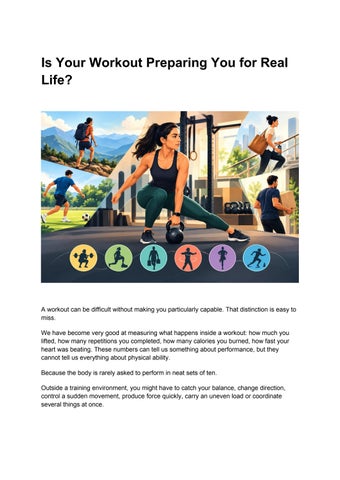
Is Your Workout Preparing You for Real Life?
A workout can be difficult without making you particularly capable. That distinction is easy to miss. We have become very good at measuring what happens inside a workout: how much you lifted, how many repetitions you completed, how many calories you burned, how fast your heart was beating. These numbers can tell us something about performance, but they cannot tell us everything about physical ability. Because the body is rarely asked to perform in neat sets of ten. Outside a training environment, you might have to catch your balance, change direction, control a sudden movement, produce force quickly, carry an uneven load or coordinate several things at once.
The idea of the best gym in Mumbai often gets reduced to size, equipment or aesthetics. But if training is meant to build physical ability, the better measure is whether the exercises you do actually teach your body something useful.
Functional Does Not Mean Complicated The word "functional" has become so common in fitness that it can mean almost anything. A complicated movement performed while standing on an unstable surface can look functional. So can an exercise involving ropes, kettlebells or a medicine ball. But an exercise does not become functional because it looks unusual. Its value comes from the physical quality it develops. A squat can develop the ability to produce force through the lower body. A carry can challenge the ability to stabilise the trunk while moving. A step-down can demand control while lowering the body. A rotational movement can teach the body to coordinate force through different planes. None of these needs to look like something you would perform outside a training space. The purpose is to develop an ability that can be used elsewhere. That plays a crucial role at a functional training studio. A useful training programme develops several physical qualities and, importantly, helps them work together.
The Indian Context Makes This More Important India's changing lifestyle makes the distinction between exercise and physical capability particularly relevant. The National Noncommunicable Disease Monitoring Survey found that 41.3% of Indian adults were insufficiently physically active. Among urban adults, the figure was 51.7%. The survey covered adults aged 18 to 69 and assessed physical inactivity alongside other noncommunicable disease risk factors. This creates an interesting contradiction. Someone can spend an hour exercising and still spend much of the remaining day sitting. Someone can be busy all day and yet have very little structured movement. Someone can feel physically tired without having developed much physical capacity. The answer is not simply to make workouts harder. It is to make them more purposeful. A functional training studio should therefore be interested in more than how many calories a session burns. It should ask what qualities are being developed and where those qualities are useful.
The Ability to Stop Is as Important as the Ability to Go Fitness culture loves acceleration. Lift heavier. Run faster. Jump higher. Move more explosively. But the body also needs to know how to slow down. Deceleration is a physical skill. When you stop yourself after running, land from a jump, step off a curb or change direction during sport, your body has to absorb and control force. That requires strength, coordination and timing. This is one reason training should not be defined only by how much force someone can produce. Can they control it? That question changes how we think about exercise.
Ask what the movement is teaching The next time you perform an exercise, consider: ● ● ● ●
What physical quality is this developing? Where might I use that quality outside this session? Am I learning to produce force, control it or absorb it? Is this helping me become more versatile in how I move?
These questions can turn exercise from a collection of movements into a more coherent training process.
Real-Life Movement Is Rarely Perfectly Symmetrical Another misconception is that useful movement should always look perfectly controlled and identical on both sides. Real life is considerably messier. You might carry a bag in one hand. Step off a curb unexpectedly. Reach across the back seat of a car. Turn while carrying something. Climb stairs two at a time. Stand up while holding an object. Your body constantly has to organise movement while dealing with changing positions and forces. That is why training does not always need to keep both sides of the body doing exactly the same thing at exactly the same time. Single-leg exercises, unilateral carries, rotational movements and changes in direction can introduce different coordination demands.
The purpose is not to make training unnecessarily complicated. It is to give the body opportunities to develop control in more than one predictable position.
Your Body Has to Solve Problems Perhaps the most interesting thing about physical movement is that the body is constantly solving problems. ● ● ● ● ● ●
Where is my weight? Where is the ground? How much force do I need? How quickly should I move? What happens if my position changes? Which muscles need to stabilise while another part of me moves?
You do not consciously calculate these things every time you walk across a room. Your nervous system handles an enormous amount of coordination automatically. Training can give the body opportunities to practise these skills under progressively greater demands. That is why variation can have value when it is purposeful. Changing a stance, load, direction, speed or point of contact can change the problem the body has to solve. The goal is not novelty for novelty's sake. It is adaptability in movement itself.
The Missing Piece: Coordination Strength gets plenty of attention. Coordination gets considerably less. Yet coordination determines how effectively the body uses the strength and mobility it has. Think about learning to drive. Having a powerful engine does not automatically make someone a skilled driver. They also need timing, control, awareness and the ability to respond to changing conditions. Movement works in a similar way. A person may possess sufficient strength to perform a movement but struggle because they cannot coordinate that strength effectively.
What Should You Look For in a Training Environment? When comparing options, a search for the Best Gym in Mumbai can easily become a comparison of facilities, equipment and aesthetics. Those things have their place, but they do not tell you whether a training environment is actually helping you build useful physical capacity.
Look instead at the quality of the training process. ● ● ● ●
Are movements explained rather than simply demonstrated? Is progression intentional? Are exercises selected for a reason? Does the trainer pay attention to how someone moves rather than only how many repetitions they complete?
A good training environment should make the reasoning behind exercise clearer. The goal is eventually for the person training to understand not just what they are doing, but why they are doing it.
The Real Test Happens Outside the Studio Imagine that six months from now, your training has made you noticeably stronger. What would that change? Perhaps you can play a full game of your favourite sport without feeling completely spent. Maybe a trek that once seemed intimidating feels achievable. You can travel more comfortably. You can move through a busy day without feeling physically drained by ordinary demands.
Rethink the Workout A functional training studio should ultimately be a place where people learn what their bodies can do, understand why they are training in particular ways and gradually expand their physical vocabulary. The next time you finish a session, don't only ask whether it was difficult. Ask what it developed. Did you become stronger? More coordinated? More capable of controlling your body? Better equipped for a physical activity you enjoy? Because a workout does not prove its value when you finish the last repetition. It proves its value when the strength, control and confidence you developed begin to show up somewhere else. Train for the workout, but measure it by the life it helps you live.