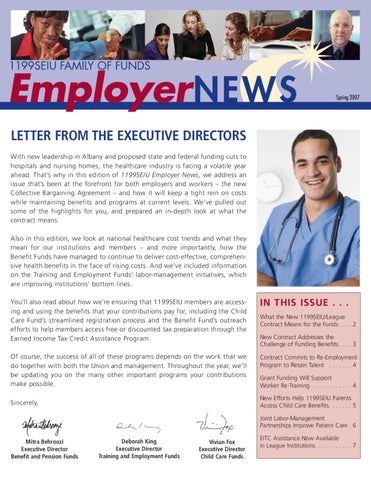
Spring 2007
LETTER FROM THE EXECUTIVE DIRECTORS With new leadership in Albany and proposed state and federal funding cuts to hospitals and nursing homes, the healthcare industry is facing a volatile year ahead. That’s why in this edition of 1199SEIU Employer News, we address an issue that’s been at the forefront for both employers and workers – the new Collective Bargaining Agreement – and how it will keep a tight rein on costs while maintaining benefits and programs at current levels. We’ve pulled out some of the highlights for you, and prepared an in-depth look at what the contract means. Also in this edition, we look at national healthcare cost trends and what they mean for our institutions and members – and more importantly, how the Benefit Funds have managed to continue to deliver cost-effective, comprehensive health benefits in the face of rising costs. And we’ve included information on the Training and Employment Funds’ labor-management initiatives, which are improving institutions’ bottom lines.
1199SEIU Family of Funds 330 West 42nd Street New York, NY 10036-6977
First Class U.S. Postage PAID New York, NY Permit No. 3700
You’ll also read about how we’re ensuring that 1199SEIU members are accessing and using the benefits that your contributions pay for, including the Child Care Fund’s streamlined registration process and the Benefit Fund’s outreach efforts to help members access free or discounted tax preparation through the Earned Income Tax Credit Assistance Program.
IN THIS ISSUE . . .
Of course, the success of all of these programs depends on the work that we do together with both the Union and management. Throughout the year, we’ll be updating you on the many other important programs your contributions make possible.
Contract Commits to Re-Employment Program to Retain Talent . . . . . . . 4
What the New 1199SEIU/League Contract Means for the Funds . . . . 2 New Contract Addresses the Challenge of Funding Benefits . . . . 3
Grant Funding Will Support Worker Re-Training . . . . . . . . . . . . 4 New Efforts Help 1199SEIU Parents Access Child Care Benefits. . . . . . . 5
Sincerely,
Joint Labor-Management Partnerships Improve Patient Care . 6 Mitra Behroozi Executive Director Benefit and Pension Funds
Deborah King Executive Director Training and Employment Funds
Vivian Fox Executive Director Child Care Funds
EITC Assistance Now Available in League Institutions. . . . . . . . . . . 7
What the New 1199SEIU/League Contract Means for the Funds
Earned Income Tax Credit Assistance Now Available to 1199SEIU Members in League Institutions
The Benefit Fund • • • •
• •
Maintains health benefits through 2011 Directs the Fund to introduce new cost-savings programs to save $150.3 million between 2008 and 2011 Increases employer contributions to 22.5% in September 2007 Requires employers to make an additional temporary contribution of .84% to the Benefit Fund from 1/1/2008 - 12/31/10 Postpones the 3% 2007 wage increase from July 1 to December 1 Allows diversions of $201.6 million from Pension Fund contributions between 2008 and 2011
The Pension Fund • •
Includes 3% cost-of-living increases for retirees in 2008, 2009 and 2010 Increases the pension multiplier from 1.85 to 1.875 for workers retiring in 2011 and later
The Training and Employment Funds •
• •
•
Maintains funding for Training and Upgrading Fund, Registered Nurse Training and Job Security Fund and the RN Labor Management Initiatives, Inc. (formerly the Planning and Placement Fund) Continues Quality Care Committee and Labor Management Project programs to improve patient care Commits to re-employment program within the industry in six months for workers in League institutions who are laid off due to Berger Commission closings Keeps employer contributions at current level of .5% for the Training and Upgrading Fund and .25% for the Job Security Fund
The Child Care Fund • •
•
Maintains current level of programs Funded programs include day care, after-school and holiday programs, child care vouchers, and educational and job-training programs Keeps employer contributions at current level of .5%
2 EMPLOYER NEWS Spring 2007
Benefit Fund Must Build On Successful Cost-Containment Efforts Maintaining health coverage in the face of rising costs and the economic uncertainty in our industry is a pressing challenge. But during the recent contract negotiations, the League and the Union found solutions to fund health benefits through the National Benefit Fund at their current level through 2011 by combining more cost-savings programs and additional employer contributions, payments and diversions. In the last contract, the Fund was mandated to introduce cost-savings programs that would generate $120 million through 2008. But by working closely with the CostContainment Committee of Trustees, the Fund achieved savings that were much higher than originally projected. The new contract mandates the Benefit Fund to generate an additional $150.3 million in savings between 2008 and 2011. Employer contribution rates will increase in the new contract to 22.5% in September 2007 from the current 20.85%, and League employers will make additional payments of $126 million to the Benefit Fund over the next four years. In addition to the costsavings and a contribution increase to the Fund, the Union agreed to postpone the 3% wage increase for 2007 from July 1 to December 1.
Originally intended to support low-income workers in the nursing home and home care industries, the EITC Assistance Program has grown increasingly popular with 1199SEIU members. In fact, nearly one-third of the members using the program to access free or discounted tax preparation in 2006 were participants in the National Benefit Fund. Since so many participants were using the service, the Trustees voted to add the program as a benefit to National Benefit Fund members in 2007. To expand the program’s reach, this year the Benefit Fund is working with H&R Block to offer the program at more than 500 locations. Throughout February and March, hundreds of members have been visiting H&R Block offices in the New York metro area to take advantage of the Fund’s program. The Benefit Fund’s Outreach Department has flyers and information available to distribute to eligible employees who have not already filed their taxes.
For materials or more information about the program, contact the Outreach Department at (646) 473-6930.
The EITC Assistance Program The EITC Assistance Program connects 1199SEIU members with trained, certified tax preparers who determine eligibility for the Earned Income Tax Credit and file their taxes for free or at discounted rates. If a member is not eligible for the EITC but meets certain income guidelines, they can still use the Fund’s program and pay just $75 to have a tax return prepared at a participating H&R Block. Last year, nearly 6,000 members claimed more than $11 million in refunds, with an average tax return of $2,700.
Spring 2007 EMPLOYER NEWS 7
Joint Labor-Management Partnerships Improve Patient Care
New 1199SEIU/League Contract Addresses the Challenge of Funding Benefits
The Training and Employment Funds' "Working Together" Conference in January highlighted successful labor and management collaborations across New York City that are improving patient care. Over 500 union and management participants attended, including registered nurses and workers from a host of other job classifications. The 20 projects, developed by joint labormanagement teams in each institution, have generated significant results in areas such as:
Escalating Healthcare Costs Call For Creative Solutions
• • • •
reducing bed sores; eliminating the use of restraints on geriatric patients; improving response times to patient calls; and improving communications with patients who don't speak English.
League of Voluntary Hospitals and Homes President Bruce McIver’s opening address emphasized the focus on teamwork in a hospital setting and the shared primary goal of quality care delivery. Panel speaker Terri Straub, RN, Vice President for Quality and Patient Safety at the Greater New York Hospital Association, emphasized teamwork as a necessity for quality care, stressing the importance of everyone on the floor – from transporters to nurses’ aides and RNs – working together. 1199SEIU Secretary-Treasurer George Gresham and Executive Vice President Norma Amsterdam also spoke about the importance of these team efforts in improving care. Deborah Marin, MD, Senior Medical Director at Mt. Sinai Medical Center, addressed the enormous advances made by the Labor-Management Project at the hospital. Dr. Marin remarked on how the partnership has transformed the work environment from one of tension to one of cooperation, resulting in huge gains in patient care.
We all know that healthcare costs continue to rise every year faster than the rate of inflation. Since 2000, the cost of healthcare has risen an alarming 87%.1 During the same time, the average employer contribution for family coverage per single worker nearly doubled – from $4,711 to $8,850 in 2006.2 As employers increasingly struggle to control costs, many have shifted significant costs to employees. At the Benefit Fund, costs have continued to rise as well. Yet because of the Fund’s efficient model – including sound management, cost-savings programs and the joint administration of several Benefit Funds covering almost half a million lives – the Fund has held costs in check and continued to provide more for less. In fact, during the same time period that national costs rose 87%, the National Benefit Fund’s costs went up by only 49%. As a result, contributing employers to the Fund pay less than other employers nationwide for a comprehensive package of benefits. Today, National Benefit Fund participants and their families receive full medical, hospital, dental, vision and prescription coverage, as well as disability, life insurance and family benefits like camp and scholarship programs for only $8,694 per member each year, with few out-of-pocket costs. In contrast, the average employer-sponsored plan for family coverage, including combined employer and worker contributions, costs $11,765 each year for a healthcare premium alone – not including co-payments, deductibles and other benefits for family benefits.
“Collaboration among different members of the clinical and support staff is essential for giving our patients the best care possible,” said Dr. Marin. “The results of these projects are a testament to these efforts.” 6 EMPLOYER NEWS Spring 2007
Health and Pension Benefits Motivate Talented Workers Not only are these benefits critical to working families, but they also help to retain a quality workforce. A recent Watson Wyatt study of 1,100
top-performing employees of large U.S. companies across all industries indicates that benefits are much more important to employee retention than many employers realize. While employers see promotion and career development as the most powerful retention incentives, employees reveal that health and pension benefits are among the most important reasons to stay with an employer.3 With healthcare costs expected to rise an additional 53% between now and 20104, keeping a tight rein on costs while continuing to provide this level of benefits will be an ongoing challenge. The Fund, working with the Union and employers, will continue looking for and finding cost-effective solutions to provide the kind of benefits that keep talented workers in the healthcare field. 1 Kaiser/HRET Survey of Employer-Sponsored Health Benefits, 2006; Bureau of Labor Statistics 2 Kaiser/HRET Survey of Employer-Sponsored Health Benefits, 2006 3 Watson Wyatt Worldwide WorldUSA Survey, 11/06 4 Centers for Medicare and Medicaid Services Spring 2007 EMPLOYER NEWS 3
New Contract Maintains Benefits and Programs for Training and Employment Funds Contract Commits to Re-employment Program to Retain Talent Within the Industry To ensure that experienced healthcare workers remain in the field, and to fill critical shortage positions that already exist in the industry, the Union and League have agreed to a re-employment plan for workers in League institutions who are laid off due to Berger Commission closings. The plan commits to re-employment within the industry for these workers within six months. League employers have committed to placing the laid-off members in their institutions, ensuring a staff of trained and qualified professionals. Until these workers are placed, they will continue to receive health coverage through the National Benefit Fund. Non-League institutions are not included in the re-employment guarantee. Similarly, workers who are laid off from non-League employers are not included. However, if their employers contribute to the Job Security Fund, these members will receive supplemental wages, placement assistance and continued health coverage through the National Benefit Fund for up to six months, and may be eligible for extended coverage at the end of that period if they are still not placed in new positions.
Additional Grant Funding Will Support Worker Re-Training
The new League contract will continue supporting the Child Care Fund in providing affordable, dependable child care to 1199SEIU parents, keeping contributions at their current employer contribution levels of .5% of gross wages.
The new contract includes funding to sustain the Training and Employment Funds’ joint labor-management projects that are advancing patient care in contributing institutions. With the financial challenges ahead, these projects shed positive light on the important and cost-effective joint work that is improving employers’ bottom lines.
For working parents, these benefits are critical. A study published in the American Journal of Health Promotion found that workers experiencing high stress for issues including child care were more than twice as likely to be absent from work at least five times each year. And past surveys have indicated that employees’ access to affordable, quality child care has a net positive impact on employers by decreasing absenteeism while boosting productivity and morale. 1
The Training and Employment Funds’ programming will be maintained at current levels, including collaborative initiatives through the Nursing Home Quality Care Committee and Labor Management Project. Funding for the Training and Upgrading Fund and the Registered Nurse Training and Job Security Fund programs was also maintained. In addition, the Funds have received an $18 million Health Workforce Re-training Initiative Grant through the Health Care Reform Act to train workers in shortage areas and workplace skills. The Funds also applied for an additional $15 million from the New York State Department of Health to deliver training and support services statewide to workers affected by the Berger Commission.
4 EMPLOYER NEWS Spring 2007
New Education and Outreach Efforts Help More 1199SEIU Parents Access Child Care Fund Benefits
New Processes Increase Access to Benefits Over the past year, the Child Care Fund has been improving its registration process to ensure that every eligible parent knows about and can access the programs their employers pay for. The investment is working – in 2006, 12,711 members applied for Child Care Fund benefits, and in 2007 that number rose to 13,415. The Fund’s flexible child care options are particularly important within the healthcare industry, where many members work off-shifts and long hours. The Fund’s new initiatives take members’ work schedules into account. Through a step-by-step online tutorial and registration process, members can register for child care benefits from home. And members who register in person can visit registration sites around the city during morning, evening and weekend hours before or after their work shift. Members who register on-site also receive school supplies for their children including knapsacks, notebooks and writing tools, which is especially helpful for working parents pressed for time or money.
The Fund is also reaching out to members at registration sites. Counseling is now available to help members understand the scope of the programs and benefits available, which has led to both increased registration and higher attendance at parenting workshops and seminars. And staff members from the Fund’s Child Care Resource and Referral program are helping to educate parents about how to choose the best educational facilities and services for their children. The Child Care Fund’s programs give 1199SEIU members the peace of mind they need to work with more focus while on the job. With these improvements, the Fund is making it easier for workers to plan their child care needs ahead of time – leading to more productive, reliable workers and stronger institutions. 1 CCH Consulting, 2006 “Unscheduled Absence Survey”; California Child Care Resource & Referral Network, 2005 California Child Care Portfolio Spring 2007 EMPLOYER NEWS 5
New Contract Maintains Benefits and Programs for Training and Employment Funds Contract Commits to Re-employment Program to Retain Talent Within the Industry To ensure that experienced healthcare workers remain in the field, and to fill critical shortage positions that already exist in the industry, the Union and League have agreed to a re-employment plan for workers in League institutions who are laid off due to Berger Commission closings. The plan commits to re-employment within the industry for these workers within six months. League employers have committed to placing the laid-off members in their institutions, ensuring a staff of trained and qualified professionals. Until these workers are placed, they will continue to receive health coverage through the National Benefit Fund. Non-League institutions are not included in the re-employment guarantee. Similarly, workers who are laid off from non-League employers are not included. However, if their employers contribute to the Job Security Fund, these members will receive supplemental wages, placement assistance and continued health coverage through the National Benefit Fund for up to six months, and may be eligible for extended coverage at the end of that period if they are still not placed in new positions.
Additional Grant Funding Will Support Worker Re-Training
The new League contract will continue supporting the Child Care Fund in providing affordable, dependable child care to 1199SEIU parents, keeping contributions at their current employer contribution levels of .5% of gross wages.
The new contract includes funding to sustain the Training and Employment Funds’ joint labor-management projects that are advancing patient care in contributing institutions. With the financial challenges ahead, these projects shed positive light on the important and cost-effective joint work that is improving employers’ bottom lines.
For working parents, these benefits are critical. A study published in the American Journal of Health Promotion found that workers experiencing high stress for issues including child care were more than twice as likely to be absent from work at least five times each year. And past surveys have indicated that employees’ access to affordable, quality child care has a net positive impact on employers by decreasing absenteeism while boosting productivity and morale. 1
The Training and Employment Funds’ programming will be maintained at current levels, including collaborative initiatives through the Nursing Home Quality Care Committee and Labor Management Project. Funding for the Training and Upgrading Fund and the Registered Nurse Training and Job Security Fund programs was also maintained. In addition, the Funds have received an $18 million Health Workforce Re-training Initiative Grant through the Health Care Reform Act to train workers in shortage areas and workplace skills. The Funds also applied for an additional $15 million from the New York State Department of Health to deliver training and support services statewide to workers affected by the Berger Commission.
4 EMPLOYER NEWS Spring 2007
New Education and Outreach Efforts Help More 1199SEIU Parents Access Child Care Fund Benefits
New Processes Increase Access to Benefits Over the past year, the Child Care Fund has been improving its registration process to ensure that every eligible parent knows about and can access the programs their employers pay for. The investment is working – in 2006, 12,711 members applied for Child Care Fund benefits, and in 2007 that number rose to 13,415. The Fund’s flexible child care options are particularly important within the healthcare industry, where many members work off-shifts and long hours. The Fund’s new initiatives take members’ work schedules into account. Through a step-by-step online tutorial and registration process, members can register for child care benefits from home. And members who register in person can visit registration sites around the city during morning, evening and weekend hours before or after their work shift. Members who register on-site also receive school supplies for their children including knapsacks, notebooks and writing tools, which is especially helpful for working parents pressed for time or money.
The Fund is also reaching out to members at registration sites. Counseling is now available to help members understand the scope of the programs and benefits available, which has led to both increased registration and higher attendance at parenting workshops and seminars. And staff members from the Fund’s Child Care Resource and Referral program are helping to educate parents about how to choose the best educational facilities and services for their children. The Child Care Fund’s programs give 1199SEIU members the peace of mind they need to work with more focus while on the job. With these improvements, the Fund is making it easier for workers to plan their child care needs ahead of time – leading to more productive, reliable workers and stronger institutions. 1 CCH Consulting, 2006 “Unscheduled Absence Survey”; California Child Care Resource & Referral Network, 2005 California Child Care Portfolio Spring 2007 EMPLOYER NEWS 5
Joint Labor-Management Partnerships Improve Patient Care
New 1199SEIU/League Contract Addresses the Challenge of Funding Benefits
The Training and Employment Funds' "Working Together" Conference in January highlighted successful labor and management collaborations across New York City that are improving patient care. Over 500 union and management participants attended, including registered nurses and workers from a host of other job classifications. The 20 projects, developed by joint labormanagement teams in each institution, have generated significant results in areas such as:
Escalating Healthcare Costs Call For Creative Solutions
• • • •
reducing bed sores; eliminating the use of restraints on geriatric patients; improving response times to patient calls; and improving communications with patients who don't speak English.
League of Voluntary Hospitals and Homes President Bruce McIver’s opening address emphasized the focus on teamwork in a hospital setting and the shared primary goal of quality care delivery. Panel speaker Terri Straub, RN, Vice President for Quality and Patient Safety at the Greater New York Hospital Association, emphasized teamwork as a necessity for quality care, stressing the importance of everyone on the floor – from transporters to nurses’ aides and RNs – working together. 1199SEIU Secretary-Treasurer George Gresham and Executive Vice President Norma Amsterdam also spoke about the importance of these team efforts in improving care. Deborah Marin, MD, Senior Medical Director at Mt. Sinai Medical Center, addressed the enormous advances made by the Labor-Management Project at the hospital. Dr. Marin remarked on how the partnership has transformed the work environment from one of tension to one of cooperation, resulting in huge gains in patient care.
“Collaboration among different members of the clinical and support staff is essential for giving our patients the best care possible,” said Dr. Marin. “The results of these projects are a testament to these efforts.” 6 EMPLOYER NEWS Spring 2007
We all know that healthcare costs continue to rise every year faster than the rate of inflation. Since 2000, the cost of healthcare has risen an alarming 87%.1 During the same time, the average employer contribution for family coverage per single worker nearly doubled – from $4,711 to $8,850 in 2006.2 As employers increasingly struggle to control costs, many have shifted significant costs to employees. At the Benefit Fund, costs have continued to rise as well. Yet because of the Fund’s efficient model – including sound management, cost-savings programs and the joint administration of several Benefit Funds covering almost half a million lives – the Fund has held costs in check and continued to provide more for less. In fact, during the same time period that national costs rose 87%, the National Benefit Fund’s costs went up by only 49%. As a result, contributing employers to the Fund pay less than other employers nationwide for a comprehensive package of benefits. Today, National Benefit Fund participants and their families receive full medical, hospital, dental, vision and prescription coverage, as well as disability, life insurance and family benefits like camp and scholarship programs for only $8,694 per member each year, with few out-of-pocket costs. In contrast, the average employer-sponsored plan, including combined employer and worker contributions, costs $11,765 each year for a healthcare premium alone – not including co-payments, deductibles and other benefits for family benefits.
Health and Pension Benefits Motivate Talented Workers Not only are these benefits critical to working families, but they also help to retain a quality workforce. A recent Watson Wyatt study of 1,100 top-performing employees of large U.S. companies
across all industries indicates that benefits are much more important to employee retention than many employers realize. While employers see promotion and career development as the most powerful retention incentives, employees reveal that health and pension benefits are among the most important reasons to stay with an employer.3 With healthcare costs expected to rise an additional 53%4 between now and 2010, keeping a tight rein on costs while continuing to provide this level of benefits will be an ongoing challenge. The Fund, working with the Union and employers, will continue looking for and finding cost-effective solutions to provide the kind of benefits that keep talented workers in the healthcare field. 1 Kaiser/HRET Survey of Employer-Sponsored Health Benefits, 2006; Bureau of Labor Statistics 2 Kaiser/HRET Survey of Employer-Sponsored Health Benefits, 2006 3 Watson Wyatt Worldwide WorldUSA Survey, 11/06 4 Centers for Medicare and Medicaid Services Spring 2007 EMPLOYER NEWS 3
What the New 1199SEIU/League Contract Means for the Funds
Earned Income Tax Credit Assistance Now Available to 1199SEIU Members in League Institutions
The Benefit Fund • • • •
• •
Maintains health benefits through 2011 Directs the Fund to introduce new cost-savings programs to save $150.3 million between 2008 and 2011 Increases employer contributions to 22.5% in September 2007 Requires employers to make an additional temporary contribution of .84% to the Benefit Fund from 1/1/2008 - 12/31/10 Postpones the 3% 2007 wage increase from July 1 to December 1 Allows diversions of $201.6 million from Pension Fund contributions between 2008 and 2011
The Pension Fund • •
Includes 3% cost-of-living increases for retirees in 2008, 2009 and 2010 Increases the pension multiplier from 1.85 to 1.875 for workers retiring in 2011 and later
The Training and Employment Funds • • •
•
•
Maintains funding for Training and Upgrading Fund and Registered Nurse Training and Job Security Fund Continues Quality Care Committee and Labor Management Project programs to improve patient care Commits to re-employment program within the industry in six months for workers in League institutions who are laid off due to Berger Commission closings Keeps employer contributions at current level of .5% for the Training and Upgrading Fund and .25% for the Job Security Fund Funds the Registered Nurse Training and Job Security Fund through $10.3 million in Job Security Fund contribution diversions, and Labor Management Initiatives, Inc. (formerly the Planning and Placement Fund) through $5 million in Job Security Fund contribution diversions from RN employers
The Child Care Fund • •
•
Maintains current level of programs Funded programs include day care, after-school and holiday programs, child care vouchers, and educational and job-training programs Keeps employer contributions at current level of .5%
2 EMPLOYER NEWS Spring 2007
Benefit Fund Must Build On Successful Cost-Containment Efforts Maintaining health coverage in the face of rising costs and the economic uncertainty in our industry is a pressing challenge. But during the recent contract negotiations, the League and the Union found solutions to fund health benefits through the National Benefit Fund at their current level through 2011 by combining more cost-savings programs and additional employer contributions, payments and diversions. In the last contract, the Fund was mandated to introduce cost-savings programs that would generate $120 million through 2008. But by working closely with the CostContainment Committee of Trustees, the Fund achieved savings that were much higher than originally projected. The new contract mandates the Benefit Fund to generate an additional $150.3 million in savings between 2008 and 2011. Employer contribution rates will increase in the new contract to 22.5% in September 2007 from the current 20.85%, and League employers will make additional payments of $126 million to the Benefit Fund over the next four years. In addition to the costsavings and a contribution increase to the Fund, the Union agreed to postpone the 3% wage increase for 2007 from July 1 to December 1.
Originally intended to support low-income workers in the nursing home and home care industries, the EITC Assistance Program has grown increasingly popular with 1199SEIU members. In fact, nearly one-third of the members using the program to access free or discounted tax preparation in 2006 were participants in the National Benefit Fund. Since so many participants were using the service, the Trustees voted to add the program as a benefit to National Benefit Fund members in 2007. To expand the program’s reach, this year the Benefit Fund is working with H&R Block to offer the program at more than 500 locations. Throughout February and March, hundreds of members have been visiting H&R Block offices in the New York metro area to take advantage of the Fund’s program. The Benefit Fund’s Outreach Department has flyers and information available to distribute to eligible employees who have not already filed their taxes.
For materials or more information about the program, contact the Outreach Department at (646) 473-6930.
The EITC Assistance Program The EITC Assistance Program connects 1199SEIU members with trained, certified tax preparers who determine eligibility for the Earned Income Tax Credit and file their taxes for free or at discounted rates. If a member is not eligible for the EITC but meets certain income guidelines, they can still use the Fund’s program and pay just $75 to have a tax return prepared at a participating H&R Block. Last year, nearly 6,000 members claimed more than $11 million in refunds, with an average tax return of $2,700.
Spring 2007 EMPLOYER NEWS 7
Spring 2007
LETTER FROM THE EXECUTIVE DIRECTORS With new leadership in Albany and proposed state and federal funding cuts to hospitals and nursing homes, the healthcare industry is facing a volatile year ahead. That’s why in this edition of 1199SEIU Employer News, we address an issue that’s been at the forefront for both employers and workers – the new Collective Bargaining Agreement – and how it will keep a tight rein on costs while maintaining benefits and programs at current levels. We’ve pulled out some of the highlights for you, and prepared an in-depth look at what the contract means. Also in this edition, we look at national healthcare cost trends and what they mean for our institutions and members – and more importantly, how the Benefit Funds have managed to continue to deliver cost-effective, comprehensive health benefits in the face of rising costs. And we’ve included information on the Training and Employment Funds’ labor-management initiatives, which are improving institutions’ bottom lines.
1199SEIU Family of Funds 330 West 42nd Street New York, NY 10036-6977
First Class U.S. Postage PAID New York, NY Permit No. 3700
You’ll also read about how we’re ensuring that 1199SEIU members are accessing and using the benefits that your contributions pay for, including the Child Care Fund’s streamlined registration process and the Benefit Fund’s outreach efforts to help members access free or discounted tax preparation through the Earned Income Tax Credit Assistance Program.
IN THIS ISSUE . . .
Of course, the success of all of these programs depends on the work that we do together with both the Union and management. Throughout the year, we’ll be updating you on the many other important programs your contributions make possible.
Contract Commits to Re-Employment Program to Retain Talent . . . . . . . 4
What the New 1199SEIU/League Contract Means for the Funds . . . . 2 New Contract Addresses the Challenge of Funding Benefits . . . . 3
Grant Funding Will Support Worker Re-Training . . . . . . . . . . . . 4 New Efforts Help 1199SEIU Parents Access Child Care Benefits. . . . . . . 5
Sincerely,
Joint Labor-Management Partnerships Improve Patient Care . 6 Mitra Behroozi Executive Director Benefit and Pension Funds
Deborah King Executive Director Training and Employment Funds
Vivian Fox Executive Director Child Care Funds
EITC Assistance Now Available in League Institutions. . . . . . . . . . . 7