“CERTAIN FORMS OF ART HAVE BECOME TOO COMPLEX TO BE CREATED BY A LONE GENIUS SET APART FROM OTHERS; TODAY, THEY UNIFY AND BLUR THE BOUNDARIES OF THEIR ONCE-CANONIZED SYSTEMS.”
VIOLA LUKÁCS
CHIEF CURATOR OF BINÁLÉ, HEAD OF PROGRAMMING AT THE 0XCOLLECTION
“TRUE CONNECTION INVOLVES OUR OWN TRANSFORMATION. PERHAPS THE FEAR OF LOSING CONTROL PREVENTS US FROM LETTING IN WHAT SEEMS ALIEN. BINÁLÉ TAKES US BY THE HAND AND ENCOURAGES US.
IF WE SET LIMITS ON CONNECTION, WE SHUT OURSELVES OFF FROM THE EXPERIENCE OF BEING AT HOME IN AN EVER-CHANGING WORLD.”
JÚLIA NEUDOLD
CURATOR OF BINÁLÉ, HEAD OF PARTICIPATORY DEPARTMENT, ÖRKÉNY THEATER
WE ARE NOT ALONE:
ALIENATION AND THE TECHNOLOGICAL OTHER
ALIENATION, OTHERNESS, AND COMMUNION IN THE DIGITAL AGEW
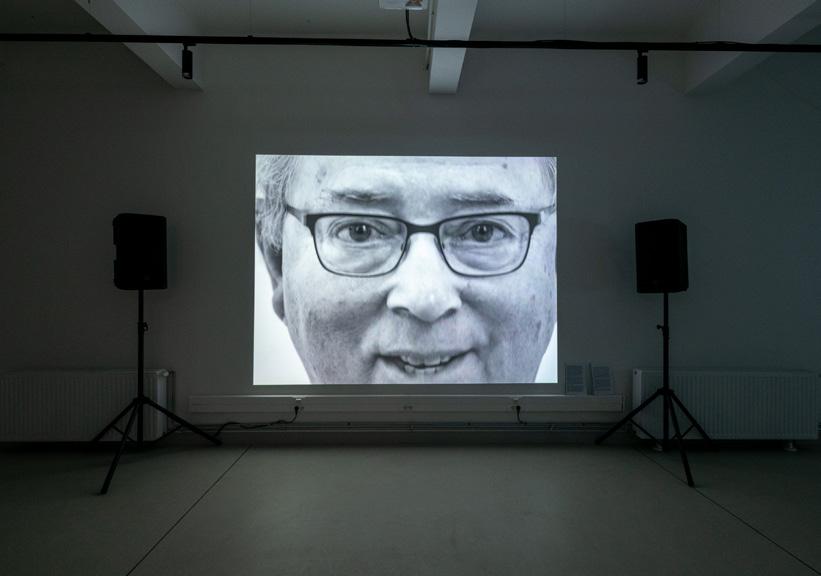
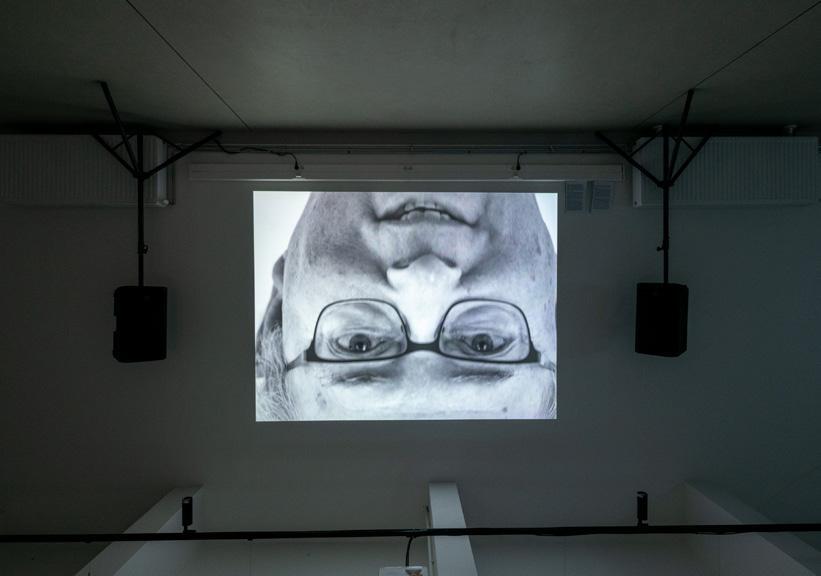
Many works confront the uncanny others embedded in our digital society – the algorithms, images, and systems that both connect and estrange us. Hito Steyerl’s practice, for example, maps the overlapping crises of technology, politics, and environment. In her I Dreamed a Dream: Politics in the Age of Mass Art Production (2013), the “alien” might be the opaque AI-driven processes that govern our lives, rendering us strangers to ourselves. Steyerl’s imaginative installations expose the “deep isolation” lurking beneath a hyper-networked world, making visible the unseen corporate and surveillance systems that are always present yet rarely acknowledged. Similarly, Trevor Paglen interrogates the hidden eyes and forces in our not-alone condition. His video, Doty (2023), investigates the true story of a government agent who spun UFO disinformation during the Cold War – a real-life fable of fabricated aliens. By revealing how myths of extraterrestrial “others” were engineered, Paglen highlights our era’s blurred lines between truth and conspiracy, showing that the alienness we fear can be a mirror of our own machinations. In his broader surveillance-themed works, Paglen reminds us that non-human agents (from facial recognition AI to orbiting satellites) are constantly watching – we are not alone because our own creations observe us.
In an era of hyperconnectivity that paradoxically coexists with deepening isolation, BINÁLÉ 2025’s exhibition We Are Not Alone probes what it truly means to live among others – human, machine, and beyond. Rather than casting the “alien” as a distant spectacle, the curatorial vision insists on relation over separation. Otherness here spans machine-learning AIs and speculative extraterrestrials, nonhuman ecologies and the intimate strangeness within ourselves. As Donna Haraway reminds us, “we require each other in unexpected collaborations and combinations… Alone, we succumb to despair”. This ethos of interdependence, resonant with posthumanist thought, undergirds the exhibition’s poetic and philosophical journey through loneliness toward communion. The participating artists weave a narrative that is rigorous yet imaginative, grounding abstract theory in vibrant artistic practice. They ask, collectively: If we acknowledge that we are not alone, what forms of empathy, responsibility, and shared creativity become possible?
Jenny Holzer’s text-based art has long voiced collective anxieties and truths, and her presence in BINÁLÉ bridges historical and contemporary alienations. Her iconic Survival Series (1983–85) emblazoned stark aphorisms (“THE FUTURE IS STUPID”, “MEN DON’T PROTECT YOU ANYMORE”) in public space, capturing the fraught conditions of modern life. Decades later, Holzer treats AI as a ventriloquist for the Other, extending her inquiry into whose voice speaks through technology. In a recent project, she set twin LED columns to scroll AI-generated texts: one channeling rapturous, cosmic visions and the other spewing toxic online hate. The result was a theater of human vs. alien within our information systems – yet every word was our own data reflected back. Holzer’s work confronts us with the alienness within the network, the mimic-doppelgänger of humanity that our algorithms have become. It asks: when technology echoes our deepest hopes and fears, will we scapegoat these digital “others” or recognize ourselves in them?
Artists in the biennial also examine how digital worlds can intensify social alienation even as they promise community. Mitchell F. Chan’s video work Zantar (2025) sharpen this theme by immersing us in virtual economies that feel uncannily human. Zantar begins as a cooperative world-building game, a fantasy of togetherness, but gradually narrows and corrupts that agency. The player’s freedom collapses into a predicament where progress is impossible – a scenario reflecting how real-life social platforms can entrap users. The narrator locates this virtual drama in a marginal northern city where some players depend on the game for income while others spiral into addiction. What starts as play ends as an ethnography of alienation: a fragile ecosystem where virtual hierarchies mirror and magnify real-world inequities. Through this narratives, we confront how easily connection can flip into isolation – and how the Other can be manufactured by code or capital.
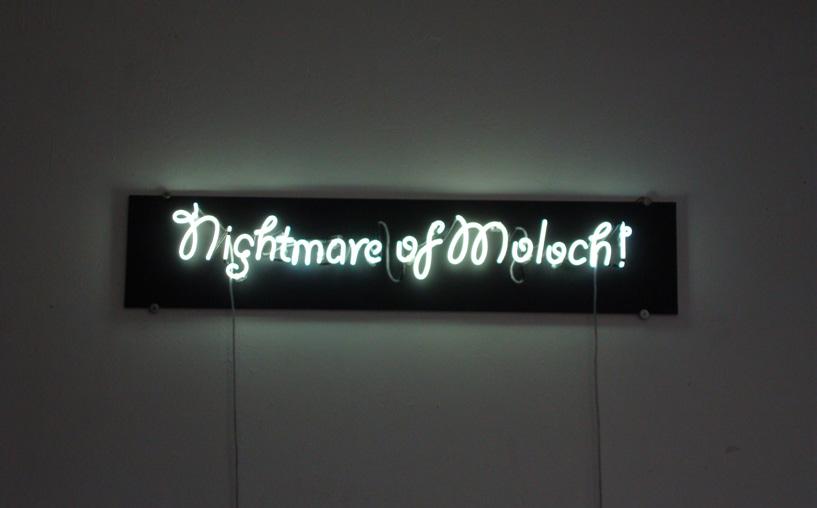
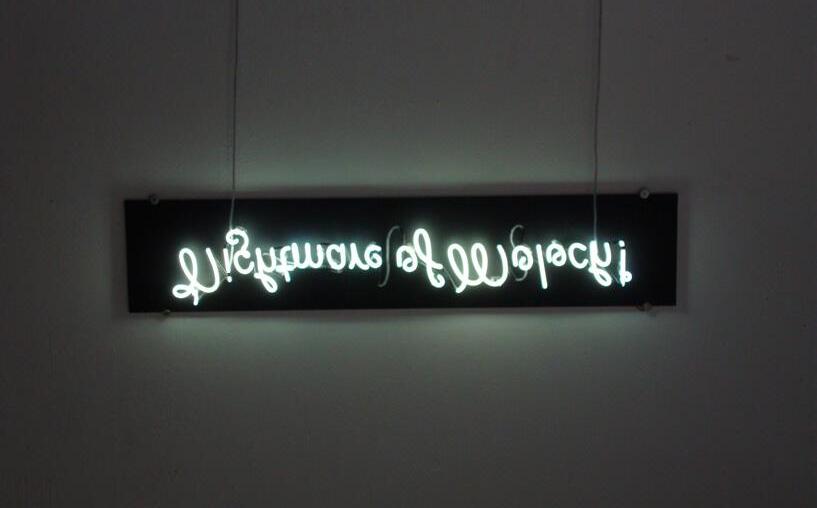
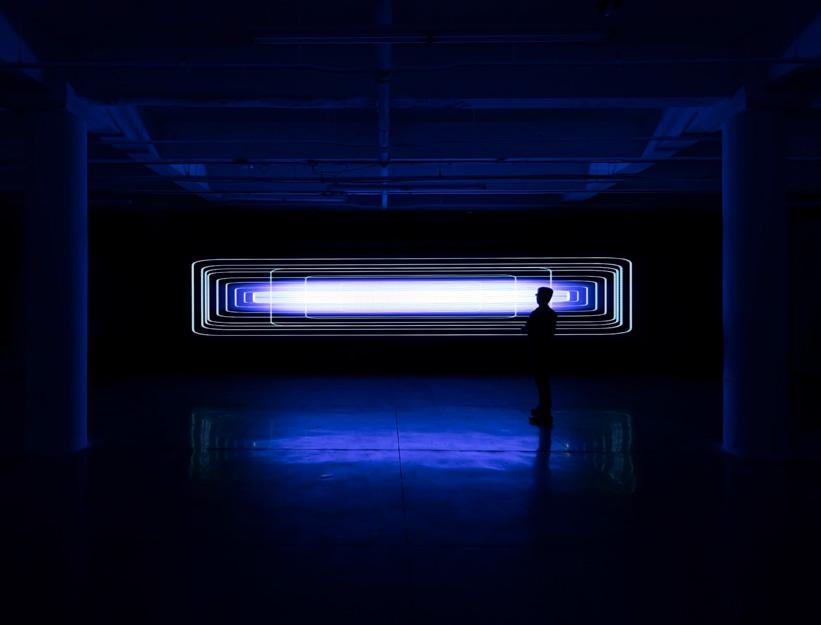
The specter of a monstrous, inhuman system looms in Tamás Komoróczky’s Nightmare of Moloch (2008). Invoking Moloch – the ancient god to whom children were sacrificed, and a modern metaphor for unchecked, devouring systems – Komoróczky conjures a dystopian allegory of technological capitalism gone awry. This multi-sensory installation is a phantasmagoric vision of a world where human lives are mere fuel for the algorithmic deity. In flickering images and dissonant sounds, the piece personifies society’s darkest fear: that our interconnected world could become an insatiable “alien” intelligence demanding constant sacrifice (of our time, privacy, even empathy). Nightmare of Moloch stands as a cautionary counterpoint in We Are Not Alone, reminding us that recognizing otherness also means confronting the systems that alienate us. It asks the viewer to consider what we might be worshipping in our daily surrender to digital routines – and at what cost to our collective humanity.
UNSEEN INFRASTRUCTURES AND COSMIC INTERCONNECTIONS
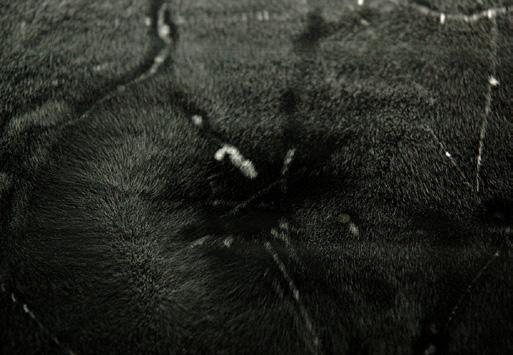
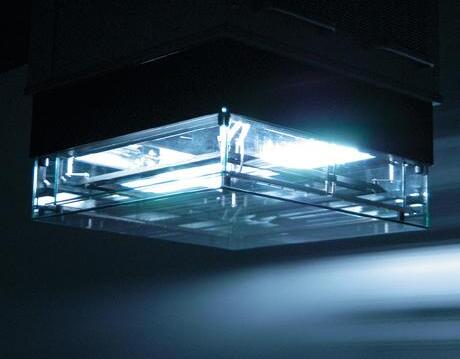
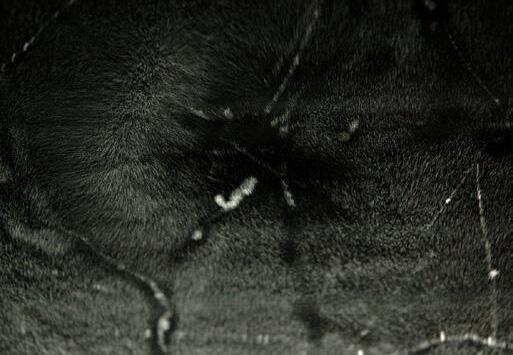
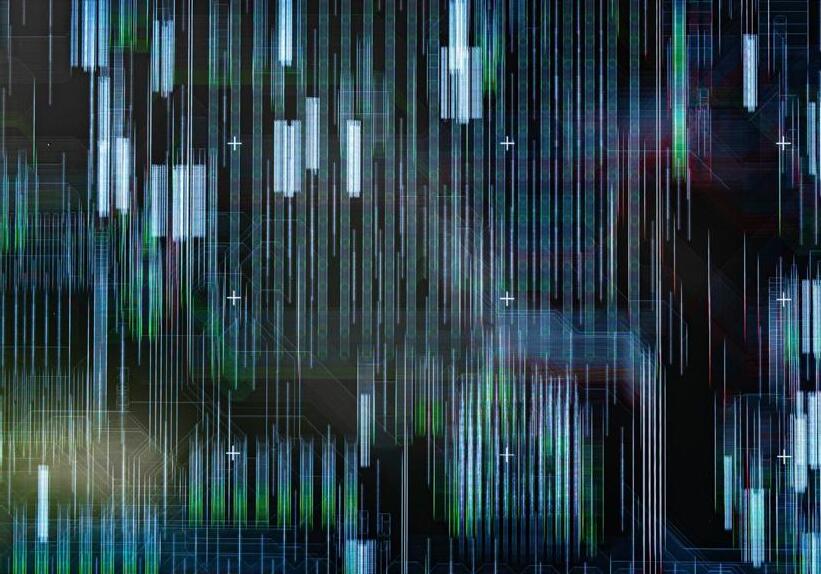
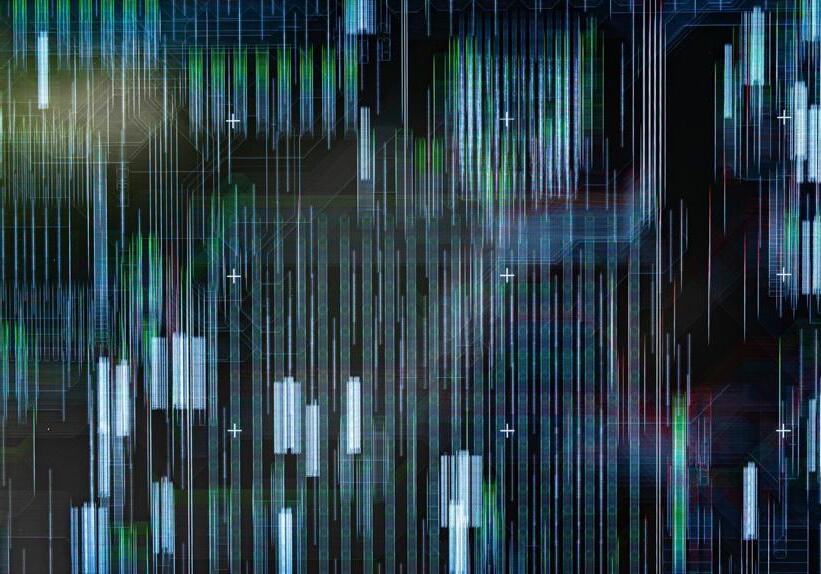
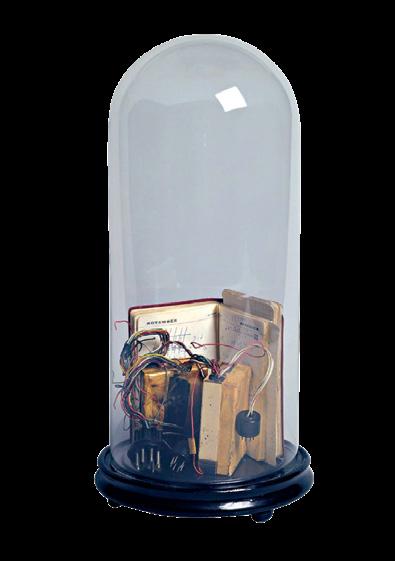
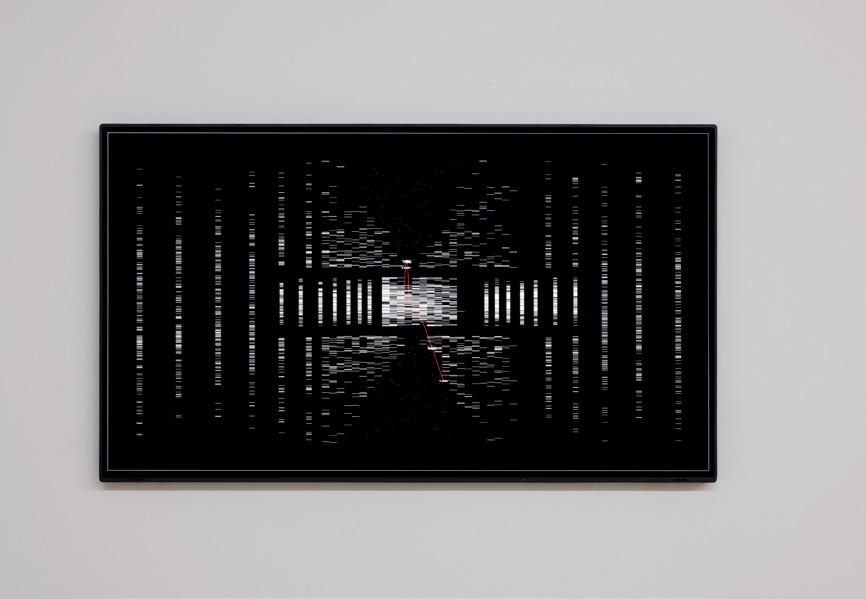
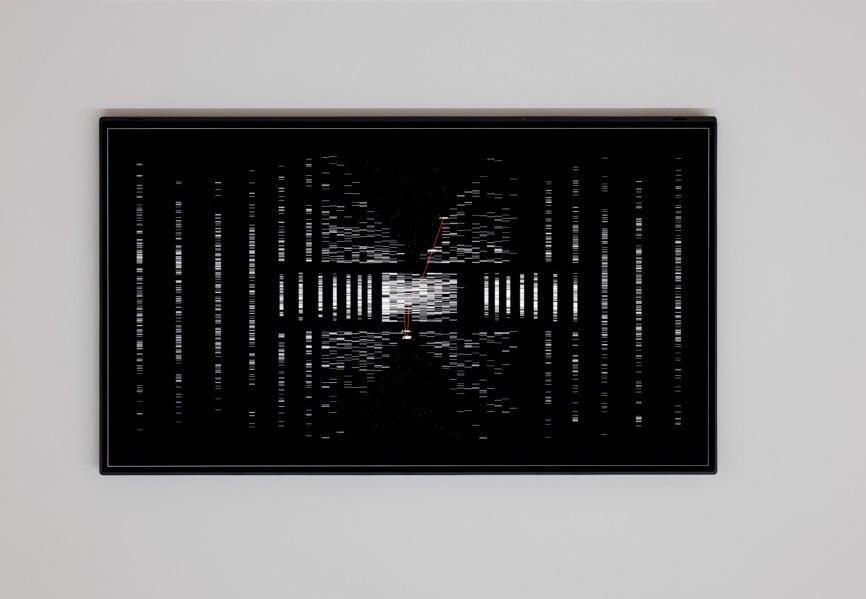
Against these explorations of alienation, other works in BINÁLÉ 2025 illuminate the hidden networks – technological and cosmic – that entangle us in invisible communion. A lineage can be traced back to Nam June Paik, the late pioneer of media art who imagined a world linked by an “electronic nervous system.” His 1965 assemblage Brain of a Robot stands as an early beacon of global interconnectedness: two metal boxes wired with circuitry and a notebook, suggesting that human thought could merge with machine logic. Paik’s prophetic vision of a planetary network (as in his 1974 Global Groove broadcast) anticipated both the internet’s utopian promise and its alienating pitfalls. Taking up Paik’s legacy, Ryoji Ikeda and Carsten Nicolai (Alva Noto) work with the fundamental signals of the universe – data, frequencies, particles – transforming them into immersive sensory experiences. Ikeda’s austere yet monumental data-driven installations literally map the cosmos in binary code, pushing the limits of perception and knowledge. In works like data.gram [circuit boards] (2022), he arrays printed circuit boards in elegant patterns, treating the physical hardware of computation as both medium and message. The effect is overwhelming and sublime: one feels both the presence of something vast and non-human, and a strange comfort in being part of that cosmic order. Nicolai, for his part, makes phenomena usually invisible to us tangible – from subsonic sound waves to magnetic fluctuations. In nebelkammer (diffusion cloud chamber) (2002), Nicolai literally allows us to see the invisible: vapor trails of cosmic radiation appear in a misty chamber, as subatomic particles leave ghostly traces. It is art that “renders visible what would otherwise exist beyond our range of perception,” asking whether unseen frequencies and signals might still affect us. By unveiling the cloud chambers and wave patterns normally hidden from human eyes, these works reawaken our sense of wonder and humility. We are reminded that we live in a sea of data and energies, enmeshed in a broader-than-human reality –not alone at all, but embedded in the cosmos.
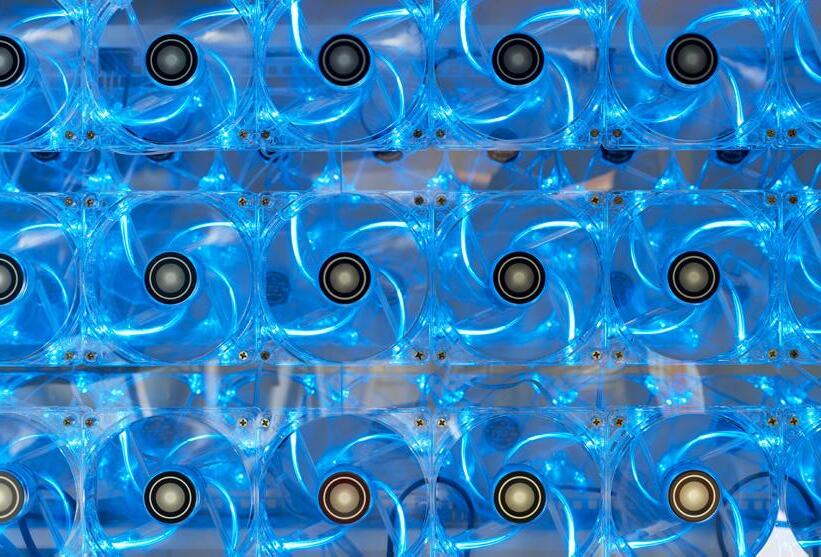
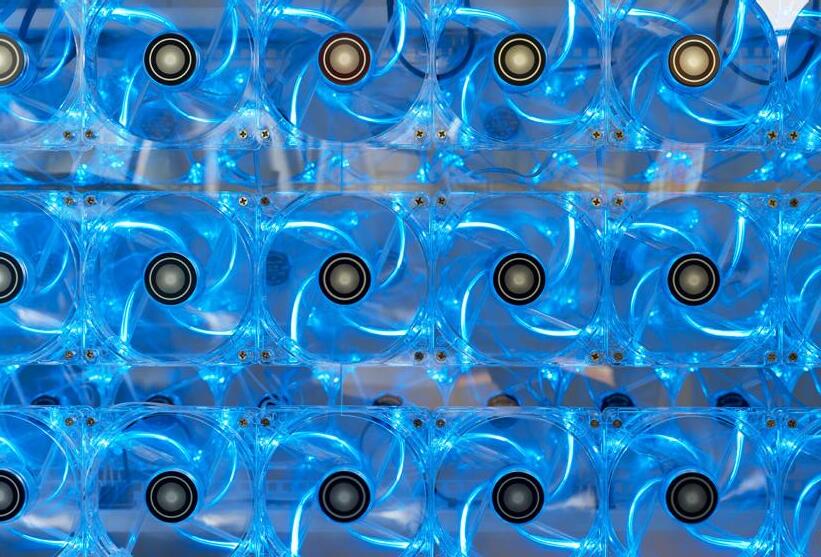
Other artists turn an analytic eye toward the digital infrastructures underpinning our everyday “connected” lives. Sarah Friend’s sculptural installations interrogate the physical and political realities of the internet’s backbone. Her piece Gate (2022) stands as a towering arrangement of server racks, cooling fans, plexiglass and circuitry – the guts of the cloud laid bare. By foregrounding these heavy, humming components, Friend exposes the fallacy that digital networks are weightless or ethereal. The internet is revealed as a material architecture with tangible impacts on communities and ecologies. Gate invites us to walk through the literal threshold of the online world: to feel the air displaced by server fans, to hear the whir of data’s machinery. It insists that our online existence has an earthly footprint, and that we are never alone because countless devices – and countless human and nonhuman labor – sustain every digital interaction. In Braess’ Knot (2025), Friend extends this critique into a provocative network paradox. Titled after Dietrich Braess’s insight that adding an extra road can worsen traffic, the artwork is a tangled sculpture of cables and connections that visually ties a network in knots. As lights attempt to travel through the snarl of fiber-optics, the piece poses a question: could increasing connectivity ever decrease our freedom? It’s a witty, urgent metaphor for the unintended consequences of our technological solutions – a reminder that more links do not automatically mean less loneliness. Friend’s works, rigorous yet deeply humane, demand that we consider the social ethics of connectivity: how our digital tools might require new forms of collective care, accountability, and restraint.
Exploring hidden structures extends into the natural and subterranean realms through EJTECH’s alchemical installation SUBSURFACE / Deuss sive Naturaa (2023). Here, art and research meld into an interactive experiment: the duo (Judit Eszter Kárpáti & Esteban de la Torre) transmit subsonic vibrations through raw materials, turning surfaces into speakers and receivers. The Latin Deus sive Natura (“God or Nature”), echoing Spinoza, frames the piece’s philosophy – that technology and nature are not opposed but one continuous substance. SUBSURFACE invites viewers to place their hands on resonating tables of wood and metal, to feel sound rather than just hear it. As low frequencies thrum from beneath, previously inaudible tremors of the earth are made sensible. It is as if the planet’s heartbeat and the electrical hum of circuits find a common frequency. By literally plumbing the under-layer of perception, EJTECH suggests that even beneath our feet and beyond our ears, we are linked in communion with the non-human world. The digital signals and natural vibrations converge, blurring boundaries between organic and artificial – a sensorial proof that we are not alone, because every human gesture might be in dialogue with a broader field of life and matter.
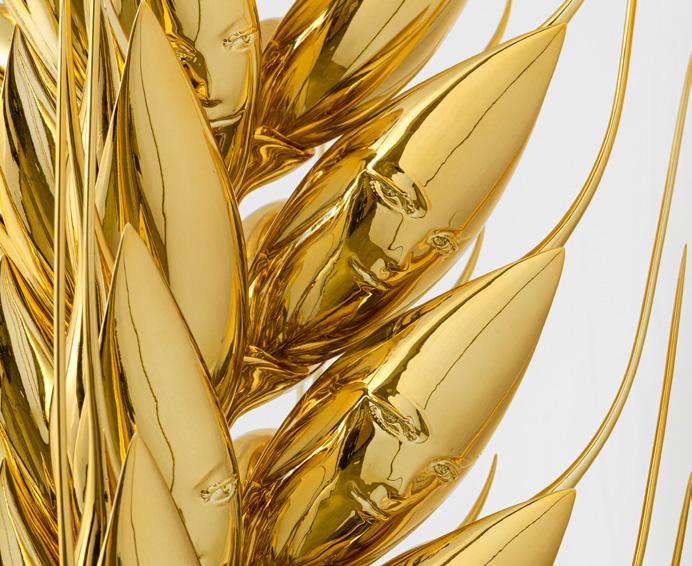
The interplay of nature and machine is also at the core of Hua Wang’s works Fortune (2025) and God of Wheat (2025). Hua Wang combines cultural mythology with kinetic sculpture to explore humanity’s dependence on natural cycles. In God of Wheat, a gleaming mechanical arm holds a single golden ear of wheat aloft instagram.com. The stainless steel and aluminum contraption moves with a slow, reverent rotation, juxtaposing industrial precision with the fragile organic grain it cradles. This surreal deity – half robot, half agricultural totem – is both a prayer and a warning. It invokes the ancient reverence for the spirits of the harvest while confronting us with the mechanization of life. We are made aware that even our bread, our most basic sustenance, now passes through robotic hands. Nearby, in Fortune, a small motorized sculpture endlessly flips a coin or some symbolic token of fate. Carved in marble and silicone, this piece invokes the capriciousness of luck in an age of algorithms. Perhaps it recalls the waving lucky cat of Asian storefronts or some mechanical oracle. Together, Hua Wang’s Fortune and God of Wheat illustrate the tightrope between hope and control: they ask whether we have sacrificed ancient wisdom (the gods of the field) for modern efficiencies, and what fortune awaits a species that entrusts its fate to machines. Yet these works are not devoid of optimism – they suggest that by recognizing our entanglement with both nature’s gifts and our own tools, we might rediscover humility and gratitude. We are never truly alone in our endeavors; invisible histories of cultivation and invention accompany every act of eating, every gamble on the future.
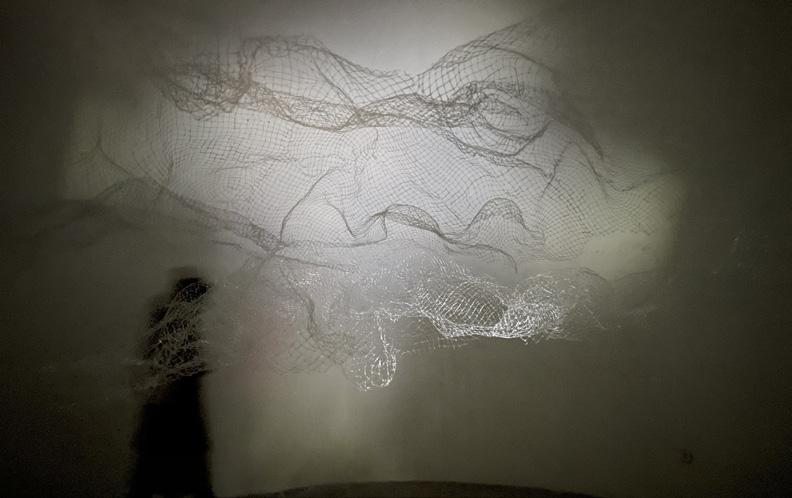
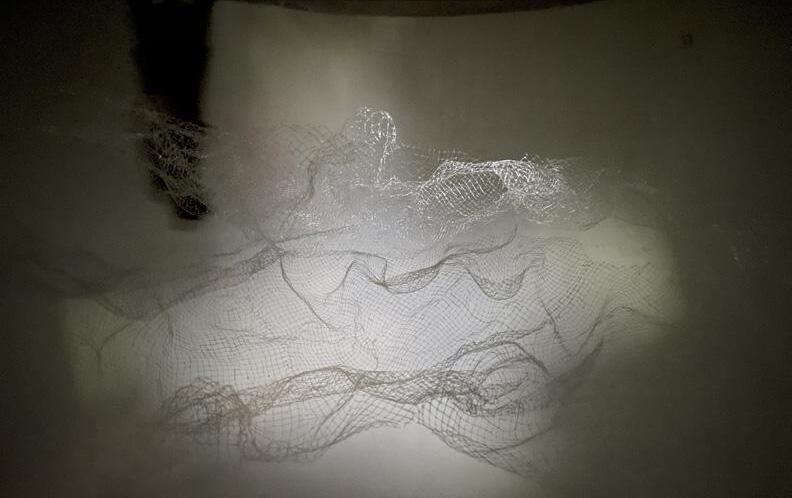
Even in the solid world of sculpture, the exhibition finds echoes of otherness and interconnection. Ditta Sarfenstein’s selected sculptural works (2020–25) give tangible form to the liminal spaces between the virtual and the real. Her practice, emerging from the Hungarian new-media scene, often merges organic materials with futuristic textures. One can imagine a Sarfenstein sculpture as a kind of future artifact: perhaps a biomorphic form 3D-printed in resin or a chunk of earth shot through with neon polymer. Though specific pieces are not individually listed, her oeuvre resonates with the BINÁLÉ’s themes. Each sculpture operates like a fragment from a world where technology has become second nature – familiar yet strangely other. In encountering these objects, viewers might feel they’ve stumbled upon the remains of a posthuman civilization, where human, animal, and machine traces have fused. Sarfenstein’s work anchors the exhibition’s philosophy in the language of matter: reminding us that even the most theoretical ideas (like alienation or communion) ultimately manifest in concrete, sensory ways. Her sculptures silently insist that concepts like “interdependence” must be embodied – whether in steel, wood, plastic, or flesh. The solidity of art can thus hold the subtlest of connections.
CO-CREATION AND POSTHUMAN COMMUNION
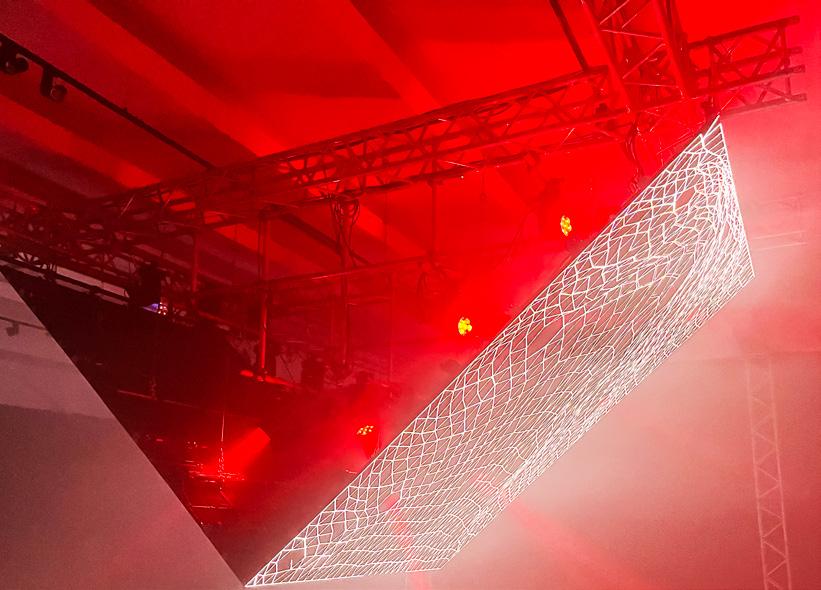
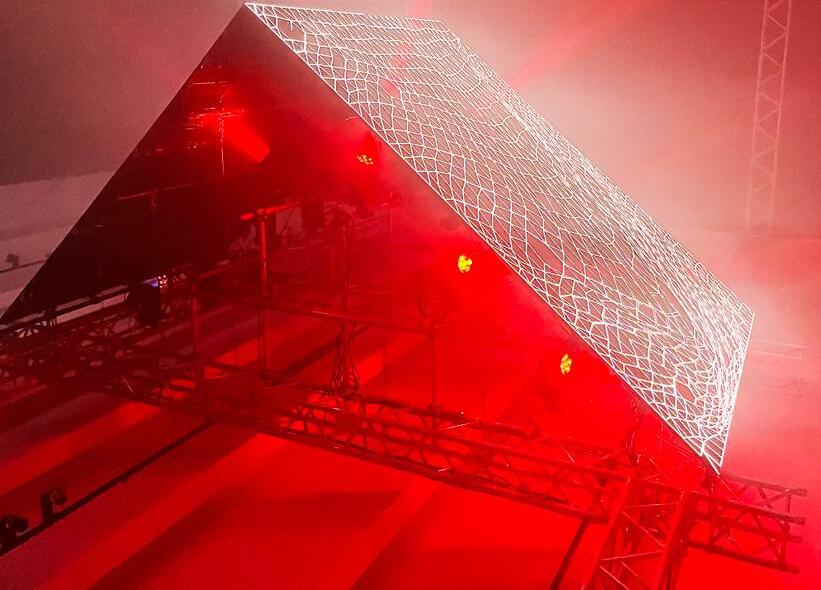
While some artists reveal the risks and shadows of not being alone, many others in BINÁLÉ 2025 explore the radical promise of togetherness across boundaries – forging new forms of collaboration between humans, machines, and environments. A flagship example is the interactive installation “X” (2025) by Hungarian collective (Gábor Kitzinger, László András Nagy, and Rozi Mákó). Envisioned as a walkable holographic sculpture of light, X never looks the same way twice. Its transparent LED grid fills Merlin Theatre’s hall with shifting geometry, but it is not a passive artwork – it is a responsive organism. Outfitted with somatic body sensors, X senses when a viewer approaches, tracking heartbeats, movement, or even emotional arousal. Step by step, the sculpture shimmers and adapts, its algorithmic patterns co-created in real time by the presence of an “Other” – the visitor. In one moment, a solitary person’s gesture might send ripples of light through the grid; in another, a crowd’s collective rhythm could make the entire structure pulse like a communal heartbeat. X literalizes the idea that art is a co-creation: we make it together with non-human systems, not in isolation. The piece’s title, a simple X, evokes the unknown variable – the unforeseen result that emerges only when diverse agents (artist, audience, machine) interact. Standing inside this dynamic hologram, one might feel that the old boundary between self and artwork has dissolved. In its place is a feedback loop of awareness: the artwork sees you as much as you see it. Here, being not alone becomes a scintillating experience of mutual presence.
A similar spirit of collaboration with the machine drives the work of Daito Manabe, the renowned Japanese new-media artist known for blurring the lines between human bodies and electronic systems. In his performances and installations, Manabe has famously wired muscle sensors to computers, making dancers’ faces twitch and limbs move via electrical impulses. The effect can be uncanny – a human body controlled by external code – or exhilarating, as when festival audiences collectively trigger visuals through their movements. Manabe’s new work Cells: A Generation (2023) extends this investigation. The title suggests both biological cells and network cells (like cell towers) – hinting at a generation shaped by both DNA and data. In this piece, Manabe might choreograph a group of participants whose biometric data (heart rate, brainwaves) get translated into sound and light. The individuals effectively become cells in a larger organism of the artwork. As Manabe has explained, his goal is to highlight “the possibilities and dangers that new technology brings… and to fuel discussions on those issues at a societal level”. In Cells: A Generation, the possibility is that technology can link us in unprecedented ways – enabling a form of intimacy and play between strangers through shared digital signals. But the danger is also present: the loss of control, the uncanniness of seeing one’s own heartbeat driving an algorithm that then influences another person’s experience. Ultimately, Manabe’s technologically choreographed experiences underscore that technology is now a partner in our self-expression. We are no longer alone on stage; our tools have joined the performance. The question posed is how we will dance with these new partners – clumsily, or in sync?
Nowhere is the notion of symbiosis more poignant than in the work of Holly Herndon & Mat Dryhurst, the transatlantic duo who treat AI not as a gimmick but as a genuine creative collaborator. Herndon, an American composer, and Dryhurst, her partner, have even referred to their machine-learning program “Spawn” as an AI baby – an offspring co-raised by their artistic community. For Herndon’s 2019 album PROTO, they trained Spawn on the voices of a Berlin choir, allowing it to learn human singing and then riff in its own eerie, “alien” way. Rather than replace human musicians, the AI joined them: Herndon describes Spawn as “a member of the ensemble like any other,” one that can mimic and develop musical ideas, often revealing elements in her compositions she was unaware of. The ethos here is profoundly hopeful – “This frees us up to be more human together.” In the context of We Are Not Alone, Herndon & Dryhurst’s approach suggests that the presence of a non-human Other (an AI “child”) can actually augment our humanity. Their recent works, such as the audiovisual piece xhairymutantx (2024) and the generative art project I’m here 17.12.2022 5:44 (2022), build on this philosophy. xhairymutantx, with its evocative title, might conjure an AI persona – a hairy mutant – co-created by the duo and their algorithms. Perhaps it’s an interactive avatar that viewers can sing with, or a surreal music video featuring Spawn’s vocalizations entangled with Herndon’s own voice. I’m here 17.12.2022 5:44, timestamped like a diary entry, hints at the anchoring of digital presence in time and place: an AI asserting “I’m here” at a specific moment. Both works exemplify an idea of posthuman communion: new forms of being together that are neither wholly human nor wholly machine. Importantly, Herndon and Dryhurst are as much activists as visionaries – they co-founded Spawning.ai to advocate for artist rights in the age of AI, ensuring that this brave new world of collaboration is built on ethics and consent. Their art straddles speculative fiction and political reality, asking not only what a positive symbiosis with AI could look like, but also how we must fight to make it benevolent. In their work, being “not alone” with an AI becomes an act of mutual care and creativity, not domination.
The theme of human–machine co-creation also reverberates in Turcsány Villő’s immersive installation Pulzus mező (“Pulse Field”, 2023), created in collaboration with the digital art duo XORXOR. Pulzus mező transforms a gallery space into a living environment responsive to visitors’ movements and heartbeats. Using LIDAR sensors and generative graphics projected into haze, the piece visualizes the pulse of anyone who enters. Imagine stepping into a dim room where a field of light particles swirls around a series of curved metal rods – as if walking among fireflies or stars. As you navigate this space, the swarm of lights accelerates or changes color in tune with your physiological rhythm, which the sensors detect. The effect is an extended body: your usually invisible heartbeat suddenly dances before your eyes across the room. Multiple visitors produce overlapping wavefronts of light, eventually finding a rhythm together. This intuitive “orientation device” highlights how our sense of time and presence can synchronize in an interactive landscape. Pulzus mező thus externalizes something deeply personal (the pulse) into a shared visual music. The installation suggests that orientation in a digital age might come not from isolating oneself, but from attuning oneself to the signals of others. As the artists describe, it creates a space where time is experienced collectively through an instinctive interface. In this poetic mingling of biosignals and light, being not alone feels like standing inside a communal heartbeat – a reminder that even strangers can momentarily form an organic we through art.
Not all visions of communion in the exhibition are high-tech; some are deeply spiritual or mythopoetic. Berkes Dorka’s long-term project Oh My God (Ó Istenem) (2020–25) captures a cry of both anguish and ecstasy from the digital generation. Berkes, a Hungarian visual artist and veteran techno DJ, brings the sensibilities of the underground rave to her art. The title “Oh My God” – ubiquitous as the casual text message “OMG” – is given its full voice in Hungarian, Ó Istenem, literally “O my God,” with all the weight of a prayer. Berkes Dorka treats this phrase as a zeitgeist mantra: a reaction to the overwhelming flood of digital stimuli, a yearning for meaning amid chaos. Her work spans painting, performance, and multimedia, often incorporating the neon visuals and hypnotic beats of club culture. We might imagine an installation of hers at BINÁLÉ where strobe lights and projected images of religious icons intermingle with personal smartphone footage. Perhaps a figure in the piece repeatedly mouths “oh my God” – in surprise, in despair, in transcendence – as the surrounding environment shifts from a bedroom lit by a phone’s glow to a throbbing dance floor to a quiet dawn. Through this, Berkes Dorka suggests that the search for connection and the divine has not disappeared in the digital age; it has migrated into our slang, our social media exclamations, our collective nights of dancing till sunrise. Oh My God collapses the distance between the sacred and the profane, between the loneliness of a late-night screen and the togetherness of a crowd lost in music. It posits that even when we feel most alone – typing a three-letter acronym into the void –we are invoking togetherness, hoping someone out there hears us. It’s an artistic act of faith that others are indeed out there listening.
Kim Lê Boutin’s La Voie des Fleurs (2025) brings a delicate, elegiac tone to the conversation of communion. A French-Vietnamese digital artist known for blending virtual and physical experiences, Boutin here creates a “path of flowers” that one can literally walk along. Drawing on her background in immersive design (from fashion to VR), she assembles an environment where real blossoms and augmented-reality floral projections commingle. The installation could take the form of a garden-like corridor: real petals underfoot, holographic petals floating mid-air, and an interactive soundtrack of rustling leaves and distant whispers triggered by the viewer’s movement. La Voie des Fleurs is not merely a tech demo of mixed reality; it’s a meditation on ephemerality and remembrance. Each step a visitor takes might cause a flower to bloom and then digitally wilt, echoing the transient nature of both memory and data. The title also nods to “La Voie”, the way – evoking spiritual journeys (like the Zen path of flowers or the poetic tradition of expressing grief and hope through floral allegories). In Boutin’s piece, the Other we commune with could be the living environment itself, or perhaps the lost loved ones and cultural ancestors symbolized by these blossoms. By walking this path, one experiences how technology can facilitate an encounter with absence – a virtual ghost among the petals, a reminder that we are not alone even in mourning or solitude. In a world where digital spaces often displace natural ones, La Voie des Fleurs gently bridges them, suggesting that new technologies might yet help us hold onto ancient modes of feeling. As each visitor’s presence slightly alters the virtual garden, the work also underscores co-creation: every individual leaves traces that become part of the shared landscape, just as every life, however fleeting, adds to the collective tapestry.
Finally, Kurt Hentschläger’s SUB (2020) offers an experience of togetherness at the edge of perception – a sublime, almost hallucinatory communion achieved through sensory immersion. Hentschläger, an Austrian artist celebrated for his audiovisual environments, plunges participants into SUB in small groups. You enter a completely dark chamber, unsure of your footing, and for a moment you might think you are utterly alone. But as the door closes, a low-frequency soundscape begins to throb, synchronizing with your body, and faint pulsations of light emerge and dissolve. In SUB, darkness itself becomes a medium of connection. Visitors are deprived of their usual visual cues and must attune to subtler signals – the sound vibrations in the floor, the occasional collective gasp or murmur in the dark, the after-images imprinted on the retina when a sudden flash of abstract patterns invades the blackness. Those bursts of light are intense and enveloping; you see swirling shapes, perhaps “tunnels” or nebulas of color, and then they vanish, leaving you with the ghostly retinal memories that slowly fade. In that interim, you are suspended in a shared void with the others present, all of you linked by the same fleeting visions. SUB induces what could be called group lucid dreaming: a meditative state where each person’s inner experience is private yet spawned by the same external stimulus. As you drift in this ambiguous zone of sensory deprivation and overload, the boundaries between self and environment blur. Where do you end and the artwork begins? Hentschläger’s piece suggests that such distinctions might be meaningless in the pursuit of the sublime. In moments when individual egos dissolve – under strobing lights, or chanting in a ritual, or marveling at a starry sky – we often report a feeling of unity, of being part of something larger. SUB orchestrates this on a technological stage, yet the outcome is ancient: a relief from the prison of individualism, a realization that to be not alone can be an experience of profound release.
We Are Not Alone ultimately presents a mosaic of these perspectives – cautionary, cosmic, celebratory – but all circling back to the central insight that our age of alienation can be transformed into an age of communion. The exhibition suggests that the antidote to loneliness is not less technology or more nostalgia, but a reorientation of our ethics and imaginations. If we no longer indulge the fantasy of separateness, if we see every “alien” not as an enemy but as a teacher, what new forms of solidarity emerge? Perhaps we begin to see nature not as a passive backdrop but as a community of living beings entangled with us. Perhaps we design our technologies to invite dialogue – treating AI, as Herndon does, not as a usurper but as a child in need of guidance and love. And perhaps we rekindle human-to-human connections in novel ways: through online platforms reimagined as safe public squares, through participatory art that blurs creator and audience, or simply through the act of sharing a moment of awe with strangers in a gallery. The artists of BINÁLÉ 2025 do not offer easy utopias; rather, they stage conditions for empathy and critical reflection. Walking through this exhibition is an exercise in expanding the circle of who and what we consider our kin. “We are not alone” is not a comforting platitude – it is a call to responsibility. It challenges us, as Emmanuel Levinas wrote, to recognize the face of the Other – whether human, animal, or machine – as the beginning of our ethical obligation. Every flicker on a screen, every whisper from a machine, every trace of life in the digital or physical landscape becomes a reminder of our profound interdependence. Standing amidst the glow of circuit boards and the murmur of algorithms, we might feel unsettled by the strangeness that surrounds us. But as this biennial deftly shows, to feel that unsettling strangeness is also to feel a spark of possibility. It is the feeling of the boundaries expanding, of the self opening outward. In that opening lies the hope that, indeed, we are not alone – and that realizing this is the first step toward building a more connected, compassionate future.
PARTNERS
0XCOLLECTION
Now, we are joined by a strange intimacy.
Never before have we been so networked - our thoughts mirrored, our movements mapped, our desires anticipated before they even surface. And yet, for all this connection, so many of us move through it like ghosts, suspended between ourselves and the world that should hold us.
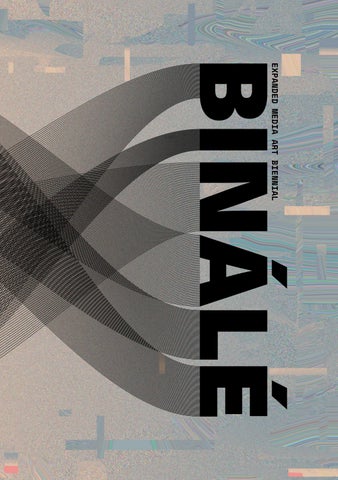
This year’s BINÁLÉ begins here, in that tension between proximity and estrangement. It brings together a constellation of 26 artists who confront our shared disquiet: that in a world more connected than ever, many of us feel unmoored.
Here, the alien takes many forms — the distant mystery of Nature, the so-called artificial mind, the unfamiliar quietly blooming within ourselves.
When everything becomes unfamiliar, we must ask — what happens when our sense of home no longer fits the world around us?
When the 0xCollection was founded, designed as an institution to bridge the past and future of media art, I gathered everything I could find to anchor us. Among those texts was Rilke’s Sonnet XVIII —
Do you hear the new, master, roaring and quaking?… for though no one can hear amid this turbulence the machine still wants to be praised now.
And today more than ever, the machine dazzles. It contorts and depletes us. It hovers above and around us like inevitability, demanding our reverence. This exhibition is not about rejecting it, but about remembering what is lost when we forget it has always been alive.
These works speak of entanglement — of human and non-human, system and spirit, code and instinct.
They remind us that survival will not be found in isolation or acceleration, but in learning to move differently — slower, stranger, together.
We welcome you to this space of turbulence. May it unsettle.
May it leave us changed, and faintly aware of who is watching back.
ELLE ANASTASIOU FOUNDING DIRECTOR, 0XCOLLECTION
ÖRKÉNY THEATRE
The institutional partner of BINÁLÉ 2025 is ÖRKÉNY ISTVÁN THEATRE—a public venue where shifting perspectives, live encounters, and participation are not merely artistic gestures, but social practices. For centuries, theatre has offered a shared space where we gather not to be alone, and to imagine otherwise—together.
Örkény is a contemporary art theatre in the heart of Budapest, known for blending classical traditions with bold experimentation. Its repertoire is shaped by independent theatrical language-making, a commitment to contemporary literature, and the cultivation of emerging voices. As a public institution, it combines artistic excellence with civic responsibility, initiating multi-generational dialogues and forging international partnerships across Europe.
Featured in this year’s BINÁLÉ is the theatre’s participatory performance Klara and the Sun, adapted from Kazuo Ishiguro’s novel. The piece explores alienation and connection through the story of a solitary child and a humanoid AI “companion,” brought to life in collaboration with teenage and family audiences. Awarded the 2024 Hungarian Critics’ Prize for Best Youth Production, the performance affirms a key proposition of the biennial: that estrangement, the fear of the unfamiliar, and the challenge of reimagining connection are shared experiences— and that children’s insights are just as essential to this reimagining as the courage of artistic spaces to pose the question.
This collaboration underscores the biennial’s core proposition: We Are Not Alone is not just a claim—it is a shared condition, and a call to reorient how we live, perceive, and create together.
PARTY ARCHIVE RESEARCH GROUP
In 2024, the PARTY ARCHIVE RESEARCH GROUP was founded by Lighthouse artists Andrea Sztojanovits and Gábor Kitzinger together with curators Viola Lukács and Liliána Simon. Its mission is to research, recover, and archive the genesis of Hungarian underground party and rave culture—from the 1990s onward—through the lens of visual culture and the practices of VJs (video jockeys). Their work seeks to map not merely the music and the events, but the aesthetics: the visuals, lighting, projection, screen design, video mixing, flyers, spatial design, atmospheres, and the ephemeral media that shaped how people saw, moved, and experienced underground dance gatherings in this formative era.
A central moment in this initiative was the Inota exhibition / festival, staged in Inota (in the former Inota power plant near Lake Balaton). Inota stands out both as a reclaimed industrial site and as a complex audiovisual environment: its vast halls, cooling towers, turbine rooms and concert spaces became more than stages—they were immersive visual settings that echoed the infrastructural and atmospheric conditions of early rave culture.
“Party as methodology” for this group treats parties, raves, and their visual media as knowledge-spaces, not merely phenomena to be studied. Through reconstructing visual sets, collecting VJ materials, photographic/video records, interviewing practitioners, and mounting immersive installations, the Archive Research Group opens up hidden histories of Hungarian underground culture. These practices are deeply communal and transformative: parties act as decentralized forums where togetherness dissolves boundaries between self and other, ego and community. In these safe spaces, otherness is not simply tolerated but celebrated—unity emerges through difference, and visual culture shapes what is preserved, who is remembered, and how collective memory around music, space, community, and dissent takes form.
ARTISTS & WORKS
DORKA BERKES
(B. 1974)
Blending underground techno culture with painterly light art, Berkes Dorka channels a deeply personal yet futuristic vision. Raised amid the canvases of her painter father, Dorka found her artistic voice in the 1990s Budapest underground, crafting hallucinatory visual backdrops for the psych-rock ensemble Korai Öröm. A pivotal sojourn in Berlin’s techno mecca Tresor (circa 1996) galvanized her trajectory as DJ Dorka, where electronic beats and creative rebellion fused into her practice. Today, she is known as a healer of modern techno, using music and art as conduits for communal solace and transcendence. Since 1998, Dorka has developed a distinctive “Raypainting” technique—using beams of light as brushstrokes— to infuse her canvases with ethereal luminosity. Her works bridge nature and technology, often invoking Buddhist philosophy (a guiding influence since 2008) to probe the boundaries between the human and the non-human. In pieces like “Az anyag nem van, hanem történik” (“Matter does not merely exist, but happens”) and Oh My God (Ó Istenem), Dorka confronts existential questions with a multi-sensory, transcendental flair. Her complex art challenges perception gently: inviting viewers to experience life’s impermanence and interconnection through a pulsing mix of light, sound, and spiritual inquiry.
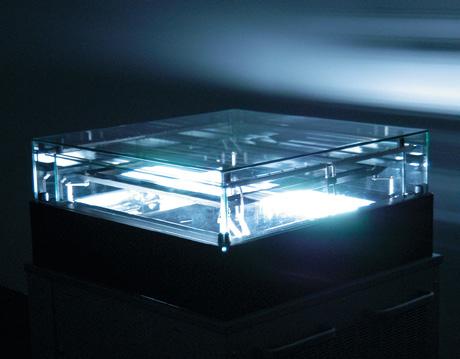
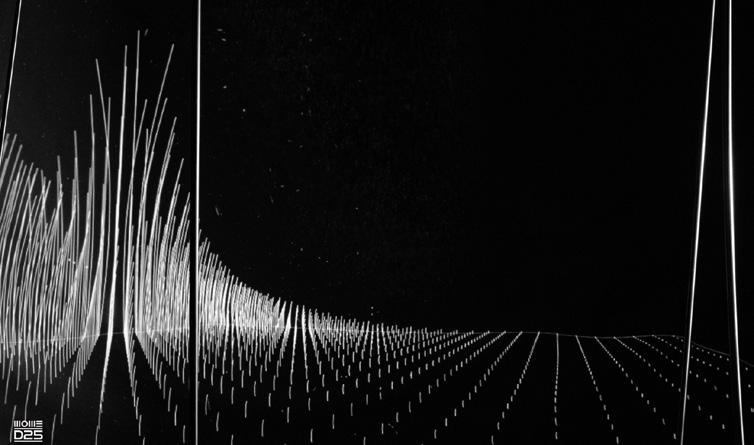
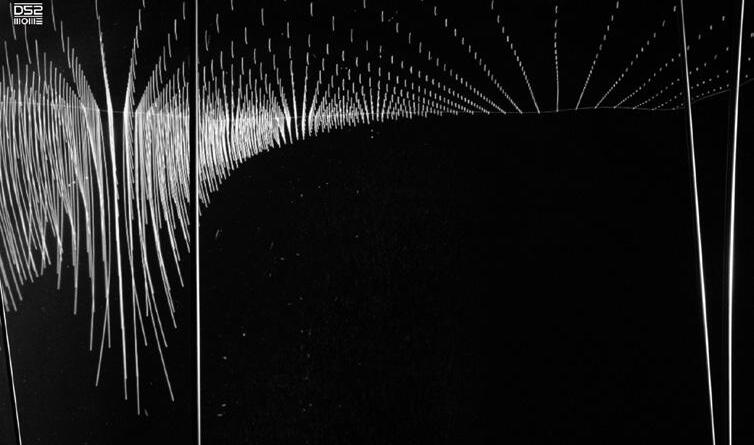
Carsten Nicolai approaches art like a rigorous scientific exploration, dissolving boundaries between the audible and the visible. Based in Berlin and internationally renowned, Nicolai operates at the intersection of electronic sound and minimalist visual art, treating them as a unified hybrid instrument. His studio resembles a laboratory where time, space, and data are perpetually reconfigured into art experiments. Sound for Nicolai is not mere music but code and message, often rendered visible in elegant installations. Over the past decades, he has exhibited in elite art contexts (from Documenta X to the Venice Biennale) and won accolades like the Zürich Art Prize (2007) for his innovative approach. As a musician known by the alias Alva Noto, Nicolai has also collaborated with cutting-edge composers (Ryuichi Sakamoto, Ryoji Ikeda) to push the frontiers of sonic art. His nebelkammer (diffusion cloud chamber) exemplifies his practice: a physical science device repurposed into a poetic visualization of randomness. In this piece, a working diffusion cloud chamber renders invisible ionizing radiation into delicate vapor trails that appear and evaporate in real time. The endlessly emerging and dissolving particle paths turn subatomic randomness into a meditative spectacle. Nicolai’s art connects viewers to phenomena beyond human perception, quietly underscoring how technology and nature intertwine in an infinite dance of information.
NEBELKAMMER (DIFFUSION CLOUD CHAMBER) 2002 INSTALLATION (FUNCTIONAL DIFFUSION CLOUD CHAMBER), 64 × 64 × 60 CM COURTESY OF THE ARTIST AND EIGEN+ART.
DAITO MANABE
(B. 1976)
Pioneering new-media artist Daito Manabe transforms cutting-edge technology into playful extensions of human expression. Growing up in Tokyo with musician parents, Manabe was steeped in music and coding from an early age—an influence that led him from DJing and jazz performance into the realm of algorithmic creativity. By the mid-2000s, inspired by composerengineer Iannis Xenakis, Manabe began applying mathematical models to music and art, laying the groundwork for his signature fusion of technology and physical experience. In 2006, he co-founded Rhizomatiks, an art collective and R&D lab where he’s orchestrated spectacular tech-art collaborations—from masterminding augmented reality for the 2016 Rio Olympics’ closing ceremony to designing jaw-dropping multimedia performances for the dance troupe ELEVENPLAY and pop group Perfume. Manabe’s recent projects bridge biology and AI: in partnership with neuroscientists, he creates works that merge living neurons with electronic media, hinting at a future where life and machinery co-create. His Cells: A Generation (2023) exemplifies this visionary approach: in collaboration with the University of Tokyo’s Takahashi Laboratory, Manabe trained cultured rat brain neurons to generate art. The resulting video installation translates neural activity into evolving imagery, as if microscopic brain cells were painting on a digital canvas. By inviting audiences into these synesthetic worlds, Manabe raises profound questions about creativity, intelligence, and the blurred line between organic and artificial minds.
CELLS: A GENERATION 2023
VIDEO INSTALLATION
(AI-DRIVEN IMAGERY GENERATED BY CULTURED RAT NEURONS), DIMENSIONS VARIABLE, COURTESY OF THE ARTIST AND 0XCOLLECTION.
DITTA SARFENSTEIN
(B. 2000)
Emerging Hungarian artist Ditta Sarfenstein brings a quietly experimental sensibility to contemporary sculpture. Still in the early stages of her career, Sarfenstein has already shown a penchant for transforming everyday forms into metaphors for fragility and change. Educated at the Hungarian University of Fine Arts, she often works with unconventional materials— translucent plastics, pliable fabrics—to create objects that appear familiar yet unstable. A recent work features a transparent chair made of fine plastic mesh: initially appearing functional, the chair buckles under weight, symbolizing the elusive balance between support and uncertainty. Such gestures reflect the artist’s interest in ephemerality and interdependence. Through subtle, concept-driven pieces, Sarfenstein “tells secrets” about domestic life and personal space, inviting viewers to question what is solid or secure. Her approach resonates with BINÁLÉ’s ethos by gently queering the line between utility and art, stability and fluidity. In Sarfenstein’s hands, even a simple chair or household object becomes a poetic interface between human intention and material reality—an understated commentary on how our lives are bound to the delicate structures we build.
SELECTED SCULPTURAL WORKS AND SITE-SPECIFIC INSTALLATIONS 2020–2025
MIXED MEDIA INSTALLATIONS; DIMENSIONS VARIABLE. COURTESY OF THE ARTIST.
EJTECH
(EST. 2015)
HUNGARY; MEXICO
The duo EJTECH (Judit Eszter Kárpáti and Esteban de la Torre) crafts multisensory art that lies at the nexus of sound, material science, and the human body. Describing themselves as polydisciplinary alchemists, EJTECH transforms textiles, liquids, and light into hyperphysical interfaces—surfaces and environments that react to touch, movement, and sound. Their work is grounded in intensive material research and draws inspiration from New Materialism and Somaesthetics, philosophies that dissolve the hierarchy between subject and object. In EJTECH’s installations, sound, space, light, and time become tangible building blocks. For example, in their project SUBSURFACE / Deuss sive Naturaa (2023), the artists created a soft, responsive textile surface embedded with sensors and conductive threads. Visitors interact with this “living” fabric, and in response, a generative audio-visual landscape unfolds around them. By offering a “seamless tangibility”—where a simple touch can trigger cascades of digital imagery or surround-sound harmonics—EJTECH reimagines how we might navigate virtual realms through our senses. Their works invite a meditative form of play, collapsing the distance between technology and touch. In doing so, EJTECH subtly echoes BINÁLÉ’s theme: they propose humane, embodied alternatives to our high-tech world, where intuitive interaction reignites our tactile connection to the here and now.
SUBSURFACE / DEUSS SIVE NATURAA 2023 INTERACTIVE MIXED-MEDIA INSTALLATION (AUGMENTED TEXTILE, SENSORS, MULTICHANNEL SOUND), DIMENSIONS VARIABLE COURTESY OF THE ARTISTS AND ACB GALLERY
HITO STEYERL
(B. 1966)
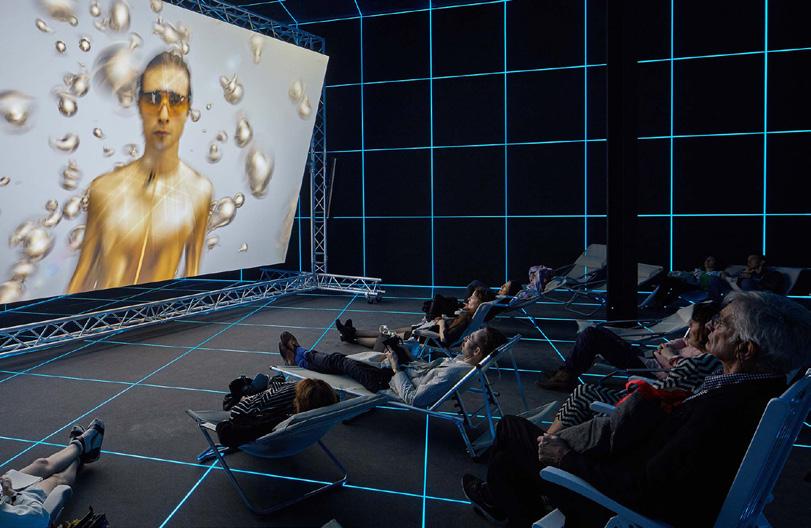
Hito Steyerl is a leading voice in contemporary art’s critique of the digital age. A German filmmaker, visual artist, and writer, Steyerl has made a career of interrogating the power structures behind images and information. Trained in film and philosophy, and celebrated as an innovator of the essay-film format, she dissects the entanglements of technology, politics, and capitalism with razor-sharp insight and wit. Her video installations—often drawing on internet memes, surveillance footage, and documentary interviews—reveal how reality itself can be engineered and manipulated. Steyerl’s notable works like “How Not to Be Seen: A Fucking Didactic Educational .MOV File” (2013) and “Factory of the Sun” (2015) deftly combine absurd humor with political critique, examining everything from military surveillance to the commodification of digital images. In I Dreamed a Dream: Politics in the Age of Mass Art Production (2013), a performative lecture turned video, Steyerl riffs on Les Misérables and reality TV talent shows to explore the precarious dreams of creative labor under capitalism. She asks what is being democratized when art becomes a mass phenomenon—power to the people, or just new forms of exploitation? Steyerl’s work resonates profoundly with BINÁLÉ’s theme: it queers our understanding of democracy by showing how easily truth can be distorted in a world of mass media. As one of ArtReview’s most influential figures in recent years, Steyerl continues to challenge viewers to see the unseen mechanics behind our screen-mediated world.
I DREAMED A DREAM: POLITICS IN THE AGE OF MASS ART PRODUCTION 2013 SINGLE-CHANNEL HD VIDEO (DOCUMENTED LECTURE PERFORMANCE), 29 MIN COURTESY OF THE ARTIST AND GALERIE ESTHER SCHIPPER
HOLLY HERNDON & MAT DRYHURST
(B. 1980 & B. 1982)
Holly Herndon and Mat Dryhurst form an experimental duo boldly exploring the frontier where music, art, and artificial intelligence collide. Based in Berlin, this American (Herndon) and British (Dryhurst) team is known for blending cutting-edge tech with visceral, humancentric creativity. Herndon, who earned a Ph.D. at Stanford’s CCRMA, has reinvented the role of the human voice in electronic music—often by filtering it through custom software and AI. Dryhurst, equally tech-savvy, collaborates with her as a conceptual architect of their projects, which range from critically acclaimed albums (Platform in 2015, Proto in 2019) to interactive installations. A hallmark of their work is “Spawn”, an AI neural network they trained on Herndon’s own vocals to duet with her, raising questions about authorship and the ethics of AI in art. At the 2024 Whitney Biennial, they presented xhairymutantx, a playful yet provocative online piece: visitors typed prompts to a text-to-image AI trained on Herndon’s likeness, generating surreal self-portraits of a virtual Holly in orange braids and a green suit. This digital avatar experiment prods at identity and representation in the algorithmic age—who owns an image of a person generated by a machine? In another deeply personal work, I’m here 17.12.2022 5:44, the duo harnessed AI image generators to recreate Herndon’s own comainduced hallucinations following childbirth. The resulting short film is a dreamy, unsettling tapestry where self and other, memory and fantasy, all blur into one. Herndon and Dryhurst’s projects, while often technical marvels, remain anchored in human experience—they confront the hopes and anxieties of creative capitalism, giving poetic form to our era’s most pressing technological debates.
XHAIRYMUTANTX 2024
INTERACTIVE WEB-BASED AI ARTWORK (TEXT-TO-IMAGE GENERATION), PLATFORM VARIABLE
COURTESY OF THE ARTISTS
I’M HERE 17.12.2022 5:44 2022
AI-GENERATED VIDEO WITH SOUND, 7 MIN COURTESY OF THE ARTISTS
HUA WANG
(B. 1990)
CHINA; GERMANY
Blurring the line between the natural and the artificial, Hua Wang creates sculptures and animations that meditate on humanity’s fraught relationship with the environment. Born in China and now working between Beijing and Berlin, Wang boasts a training in both traditional ceramic arts (honed in Jingdezhen, China’s ancient porcelain capital) and cutting-edge London art schools. This dual background fuels her fascination with material culture and global consumerism. In her practice, clay, wheat, water, and digital pixels all become equal storytellers. Wang’s recent works confront anthropocentrism—the fallacy that humans sit at the center of the world—by highlighting clashes between technological progress and natural cycles. In Fortune (2025), for example, she revisits a childhood memory of choosing a pet turtle from a crowded street market tank. That youthful feeling of dominance over a tiny life is turned on its head: the artwork presents an elusive sculpture of a turtle that seems to escape our grasp, symbolizing the hubris and ultimate futility of human control over nature. God of Wheat (2025) tackles a different facet of our transformed planet: the massive scale of modern agriculture. Wang references Yuan Longping—father of hybrid rice—and the staggering 137.5 million tons of wheat produced annually in China alone. Through an installation that might include sheaves of real grain and synthetic materials, she asks whether wheat is still “wheat” after so much technological interference, and by extension, whether we remain who we once were in an age of bioengineering. Gentle yet provocative, Wang’s art invites viewers to reflect on how tradition and innovation collide, and what is lost or gained when humanity reshapes nature’s gifts.
FORTUNE 2025
MIXED-MEDIA SCULPTURAL INSTALLATION, DIMENSIONS VARIABLE COURTESY OF THE ARTIST
GOD OF WHEAT 2025
MIXED-MEDIA INSTALLATION, DIMENSIONS VARIABLE COURTESY OF THE ARTIST
JENNY HOLZER
(B. 1950)
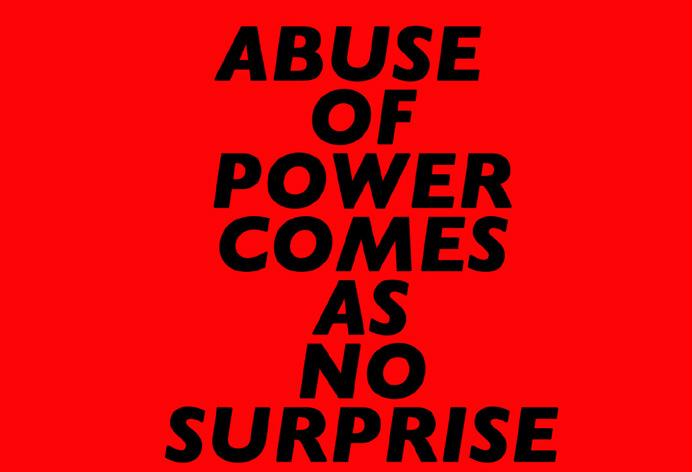
A pioneer of conceptual art, Jenny Holzer has dedicated her career to bringing language into unexpected public spaces. From the streets of 1970s New York plastered with her anonymous Truisms posters, to the dazzling electronic billboards in Times Square, Holzer’s medium is text and her canvas is the world. Her succinct, provocative aphorisms (“ABUSE OF POWER COMES AS NO SURPRISE” is one famous example) confront passersby with hard truths about war, gender, consumerism, and survival. In doing so, Holzer democratizes art: she insists that critical ideas belong not just in galleries but on T-shirts, LED signs, park benches, and even condoms—places where everyday people encounter them spontaneously. In the early 1980s, as Cold War anxieties and social upheavals simmered, Holzer created the Survival Series: a set of bold statements probing themes of power and vulnerability. These appeared on large-scale light boards and carved into stone benches, addressing the audience in a direct yet poetic voice: “Protect me from what I want”, “You adapt, just not in the way you imagine.” The aesthetic jolt of seeing such messages in public space is classic Holzer—it startles us into introspection about the systems we live in. Holzer’s practice, rooted in the idea that the concept of a work can outweigh its physical form, aligns subtly with BINÁLÉ’s ethos of questioning norms. By stripping language down to essential truths and placing it in contexts where anyone can engage, she not only “queers” the traditional art object but also challenges viewers to grapple with the urgencies of their time. Her work remains a powerful reminder that sometimes a simple sentence, strategically placed, can change how we see the world around us.
SURVIVAL SERIES 1983–85
SERIES OF TEXT-BASED ARTWORKS (LED DISPLAYS, POSTERS, STONE BENCHES), DIMENSIONS VARIABLE COURTESY OF THE ARTIST
TURCSÁNY VILLŐ
(B. 1984) WITH XORXOR (PAPP GÁBOR & HAJDU GÁSPÁR)
Hungarian artist Turcsány Villő collaborates with creative coder duo XORXOR to produce immersive installations that fuse sculpture, interactive media, and sound. Trained in spatial art and currently pursuing a doctorate on “the dramaturgy of space-creation,” Turcsány is known for pushing installation art into new experiential realms. In Pulzus mező (“Pulse Field”, 2023), an interactive site-specific work, she and XORXOR constructed a meditative environment that responds to visitors’ movements in real time. The installation features curved stainless-steel forms — minimalist sculptures that on their own suggest a futuristic landscape. But as viewers wander among them, a hidden LiDAR sensor picks up their motion, triggering generative projections of light and abstract imagery that ripple across the space. The material of light in Pulzus mező has a delayed reaction, creating ghostly afterimages that stretch the perception of time. Thus, a simple walk through the gallery becomes a dance with one’s own temporal echo. Turcsány’s broader practice spans kinetic water installations, performances, and even experimental music, all unified by an exploration of how objective space can be transformed by subjective experience. In projects like Pulzus mező, she invites participants to become conscious of their own perception — to literally see their pulse imprint the environment. This work elegantly aligns with BINÁLÉ’s theme by highlighting the feedback loop between individual and system: the installation is both a playground and a microcosm of how we imprint on our world and are in turn shaped by it. Turcsány Villő’s art proposes that technology need not alienate us; when thoughtfully applied, it can heighten our awareness of the now, forging a deeper connection between self, space, and the flow of time.
Straddling the worlds of digital design and experiential art, Kim Lê Boutin creates interactive works that invite us to slow down and rediscover technology as a source of reflection. A selftaught coder from age 13 and a former digital art director in the fashion industry, Boutin approaches tech with both expertise and skepticism. In her artistic practice, she emphasizes “positive friction”—a philosophy she outlined in a 2021 manifesto—meaning interfaces that deliberately resist the usual speed and slickness of digital life to provoke deeper engagement. La Voie des Fleurs (The Way of Flowers, 2025) embodies this ethos. Inspired by Ikebana (the Japanese art of floral arrangement), this interactive installation transforms visitors’ personal mobile data into unique digital flower compositions. Upon entering the space, participants connect their smartphones, which supply data (perhaps movement, screen time, or app usage stats) that algorithms translate into blossoming virtual flora on a large screen. Several visitors must activate it together, turning the experience into a collective ritual reminiscent of a multiplayer game. But unlike the usual frantic competition, here the smartphones—typically tools of haste and distraction—become instruments of meditative creation. The slowly unfurling data-flowers coax participants into a contemplative state, highlighting the beauty in slowness and cooperation in our tech-mediated lives. Boutin’s work gently critiques the hyperefficiency of modern interfaces by showing that meaningful digital experiences can arise from patience, play, and shared presence. Through her hybrid design-art practice, she aligns with BINÁLÉ’s mission to reimagine our relationship with technology: not as masters or slaves to our devices, but as mindful co-creators of new digital rituals.
LA VOIE DES FLEURS 2025 INTERACTIVE DIGITAL INSTALLATION (MOBILE DATA-DRIVEN VISUAL GENERATION), DIMENSIONS VARIABLE COURTESY OF THE ARTIST
KITZINGER GÁBOR, NAGY ANDRÁS LÁSZLÓ & MÁKÓ ROZI
(B. 1980S)
This Hungarian trio—video artist Gábor Kitzinger, digital creator András László Nagy, and composer Rozi Mákó—combines forces to craft deeply immersive multimedia experiences. Each member brings a distinct expertise: Kitzinger’s background in large-scale architectural projection mapping and abstract 3D animation, Nagy’s in audio engineering and visual programming, and Mákó’s in experimental music composition. Together, they explore the synesthetic boundaries of art and technology, with a special focus on consciousness and perception. Their 2025 installation X is an ambitious example of art merging with science. Inspired by physicist Roger Penrose’s controversial theory that human consciousness might arise from quantum processes in the brain (the Orch OR theory co-developed with Stuart Hameroff), X invites participants to literally lie down and become part of the artwork. The viewer reclines on a custom bed wired with sensors that monitor heart rate, breathing, and body temperature. These biometric signals feed into an array of real-time animations projected onto towering wing-like screens overhead. As the participant’s vital rhythms fluctuate, so do the swirling visuals and enveloping soundscape, which Mákó composed as a minimalist yet emotive drone that responds to the live data. The center of the space is dominated by an 8-meter mirrored disc and a lattice of transparent LED panels, robotic lights, and haze—technologies typically seen on concert stages, repurposed here for introspection. By merging quantum theory, personal biofeedback, and generative art, X suggests that consciousness is more than an abstract concept; it becomes a personalized audiovisual journey. The installation’s title, “X”, evokes the unknown variable—historically a mark of identity and a symbol of the mysterious. Each visitor’s experience is unique, a fleeting self-portrait drawn in light and sound by one’s own inner workings. In aligning human biological data with a responsive environment, the trio creates a poignant commentary on the theme of BINÁLÉ: even amid high technology, the essence of art may lie in re-centering the individual, reminding us that our inner worlds cannot be fully computed or commodified.
X 2025
IMMERSIVE INTERACTIVE INSTALLATION (BIOFEEDBACK SENSORS, XR PROJECTION, MIRRORED SCULPTURES, QUAD SOUND), APPROX. 8 M DIAMETER COURTESY OF THE ARTISTS AND SUPPORTED BY 0XCOLLECTION
KOMORÓCZKY TAMÁS
(B. 1963)
A vanguard figure of the Hungarian art scene, Tamás Komoróczky has long experimented with the melding of digital imagery and real-world space. Trained as a painter and muralist, and later venturing into video art during a stint in Düsseldorf, Komoróczky was a founding member of the influential Újlak Group. This avant-garde collective famously occupied derelict buildings in Budapest, turning them into impromptu galleries and symbolically liberating art from institutional confines. hat early ethos of DIY exhibition and anti-establishment critique permeates Komoróczky’s individual work as well. He was among the first in his milieu to embrace computer animation, incorporating it into videos and even printing his digital compositions as wallpapers that transformed exhibition spaces into immersive environments. Komoróczky’s upcoming piece, Nightmare of Moloch, draws its title from Allen Ginsberg’s Howl, invoking “Moloch” as a metaphor for the insatiable, demonic forces of modern society— be it unbridled capitalism, technology gone awry, or oppressive political systems. The nightmare in question likely challenges what we sacrifice to our personal “Moloch” today (privacy? authenticity? sanity?). By resurrecting this powerful symbol, Komoróczky subtly aligns with BINÁLÉ’s themes of questioning authority and envisioning alternate futures. His art, ever experimental, acts as a mirror to a society where the personal and political intermingle, and where technology can be both an enlightenment and a menace. In Nightmare of Moloch, expect a critical reflection that is as visually captivating as it is intellectually bracing—a wakeup call from the heart of the digital dream.
NIGHTMARE OF MOLOCH 2008
NEON TUBE INSTALLATION
32 X 166 CM
COURTESY OF THE ARTIST AND THE VIOLUK PROJECTS
KURT HENTSCHLÄGER
(B. 1960)
Austrian-born Kurt Hentschläger crafts immersive audiovisual experiences that border on the sublime. A veteran of media art (notably one half of the pioneering 90s duo Granular-Synthesis), Hentschläger has continually sought to engage the viewer’s senses to a degree that is almost transformational. His installations often eliminate the familiar anchors of reality—sight, sound, time—plunging audiences into otherworldly states that can be both disorienting and deeply contemplative. In recent works like ZEE and SOL, he filled spaces with pulsating light fields or thick fog, challenging perception and inducing meditative introspection. Hentschläger’s 2020 installation SUB is a masterclass in this approach. Upon entry, visitors are enveloped in near-total darkness and silence—a deliberate sensory deprivation meant to heighten inner awareness. Then, in unpredictable intervals, SUB assaults the eyes with split-second bursts of blinding white light accompanied by synchronized visceral sound. These flashes etch temporary retinal afterimages onto the viewer’s vision, abstract shapes that dance in the mind’s eye even after darkness returns. In the prolonged gaps between light events, one is left alone with these ghostly impressions and the low thrumming soundscape that continuously evolves in the background. Hentschläger even requires visitors to leave all devices outside, enforcing a rare escape from the hyper-connected world. The effect is profound: time becomes elastic, minutes lost in darkness feel like seconds or hours, and the boundary between external stimulus and internal imagination blurs. By engineering this cycle of sensory overload and void, Hentschläger’s SUB offers a paradoxical digital-age sanctuary—a place to contemplate one’s own perceptual mechanics and maybe, briefly, achieve a tech-induced form of mindfulness. It resonates with BINÁLÉ’s ethos by demonstrating that art can carve out spaces of freedom and reflection amid a barrage of media overstimulation. In Hentschläger’s immersive void, losing external sight can lead to an inner vision, one that questions how reality is constructed in our minds.
SUB 2020
IMMERSIVE INSTALLATION (DARKENED ROOM WITH STROBOSCOPIC LIGHT AND QUADRAPHONIC SOUND), DIMENSIONS VARIABLE, ENDLESS DURATION COURTESY OF THE ARTIST
MITCHELL F. CHAN
(B. 1982)
Conceptual artist Mitchell F. Chan moves fluidly between physical and virtual realms, poking fun at and philosophizing about the digital technologies that shape our lives. Hailing from Canada, Chan first gained renown for his prescient work in crypto art: in 2017, he created one of the earliest NFT-based artworks, Digital Zones of Immaterial Pictorial Sensibility, which cheekily paid homage to Yves Klein and even fetched over a million dollars at auction. Chan’s practice thrives on this interplay between art history and bleeding-edge tech culture. His creations often masquerade as games or software while delivering incisive commentary on themes of distraction, value, and storytelling in the information age. In Ladyboss (2025), Chan presents a deceptively simple scenario: a fully playable endless-runner video game, akin to the mindless mobile games we use to kill time. Over this fast-paced gameplay, however, a narrated short story unfolds about a fictional game streamer named SallyM00n4u. The quirky combo of video game + voiceover story mirrors a real internet trend (those TikToks where people read dramatic tales over gameplay clips). Chan uses it as a narrative device: the game is both a distraction from and a metaphor for the protagonist’s personal tragedy. Through Sally’s tale, we’re prompted to consider how digital entertainment can anesthetize us to real-world pain even as it strangely reflects it. Zantar (2025), meanwhile, is a tongue-in-cheek love letter to both Canadian media art pioneer Michael Snow and comedic actor Mike Myers. The piece takes the form of a retro fantasy video game: “Zantar” is a gelatinous cube monster that levels up by devouring village chieftains. This absurd premise—equal parts Dungeons & Dragons and social satire—unfolds as an interactive artwork in which the player’s quest for higher levels becomes a sly allegory for modern life’s rat race and our obsession with “leveling up” (in careers, social status, online followers). Critics have called Zantar “heartbreaking” and “genius” for the way it wields distraction as a weapon: by engaging us in a silly game, Chan reveals somber truths about competition and futility in our contemporary “game world.” Both Ladyboss and Zantar exemplify Chan’s Brooklyn-rail-esque wit and Columbia-grade conceptual rigor, marrying pop culture and theory. Through humor and interactivity, his art illuminates the very core of BINÁLÉ’s inquiry: what does it mean to seek meaning, freedom, or democracy amid systems—whether games, markets, or networks—that are engineered to keep us chasing an endless high score?
ZANTAR 2025
INTERACTIVE DIGITAL ARTWORK (VIDEO GAME INSTALLATION), PLATFORM VARIABLE
COURTESY OF THE ARTIST
NAGY ÁGOSTON
(B. 1981)
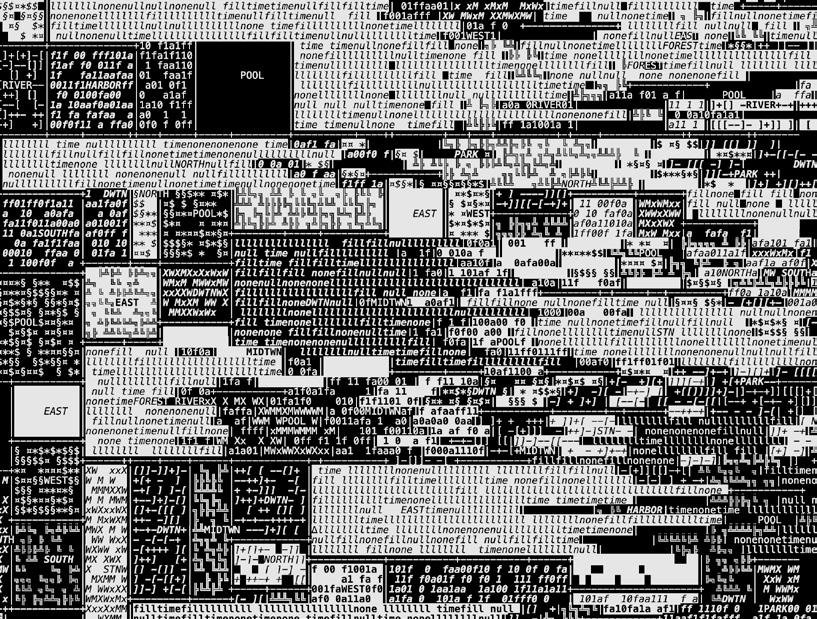
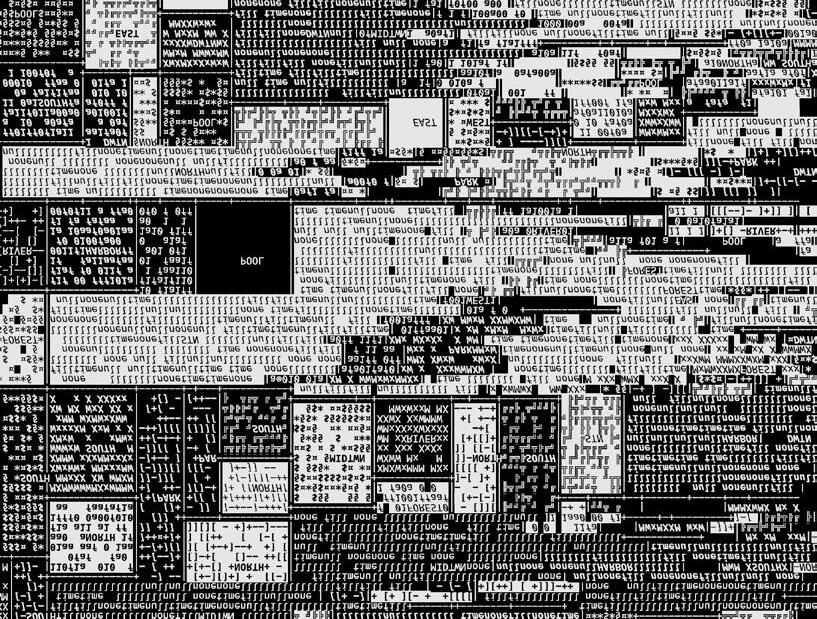
Ágoston Nagy is a Budapest-based artist-programmer whose work transforms abstract code into sensory-rich artistic experiences. Specializing in algorithmic art, Nagy builds everything from generative visuals and soundscapes to immersive installations, often by writing custom software from scratch. A former researcher at Kitchen Budapest media lab and lecturer at Moholy-Nagy University of Art and Design, he is deeply engaged with questions of decentralized technology, non-human intelligence, and resilient communities. In essence, Nagy is as much a systems thinker as he is an artist: his projects frequently explore how complex networks—be they blockchain economies or neural networks—can yield emergent beauty or insight. His latest series, M3MP%L (pronounced “mempool”) from 2025, exemplifies this fusion of the cerebral and the aesthetic. Each work in the series is a text-based audiovisual composition that uses the plain characters of a computer terminal (letters, numbers, symbols) to create intricate, shifting structures on screen, accompanied by algorithmically generated sound. The title references a memory pool in blockchain technology: a holding pen for unconfirmed transactions. Drawing a parallel to human memory and cognition, Nagy’s mempool pieces dramatize the tension between spatial memory (arranging information in a physical or visual space) and associative memory (linking information by relationships). On the screen, what looks like a cryptic code editor becomes a stage where each character is a building block placed with architectural precision; yet the overall pattern eludes any literal reading, operating more like a visual music that the viewer feels rather than deciphers. By eschewing any traditional imagery or language, Nagy invites us into a meditative state where form itself generates meaning. In a world of constant data overflow, M3MP%L suggests that abstraction and coding can be tools for contemplation rather than mere computation. This ethos dovetails with the BINÁLÉ’s theme: Nagy’s art subtly asserts that within the opaque processes of our digital infrastructure lies a space for human reflection and perhaps even democratic access to creativity (after all, what is code if not a language anyone might learn to express themselves?). Nagy Ágoston’s practice stands as an elegant testament to the idea that by understanding the language of machines, we might rediscover the poetry of human thought.
M3MP%L 2025
SERIES OF GENERATIVE TEXT-AND-SOUND COMPOSITIONS (CUSTOM SOFTWARE, REAL-TIME ALGORITHMIC ART), DIMENSIONS AND DURATION VARIABLE
COURTESY OF THE ARTIST
NAM JUNE PAIK
(1932–2006)
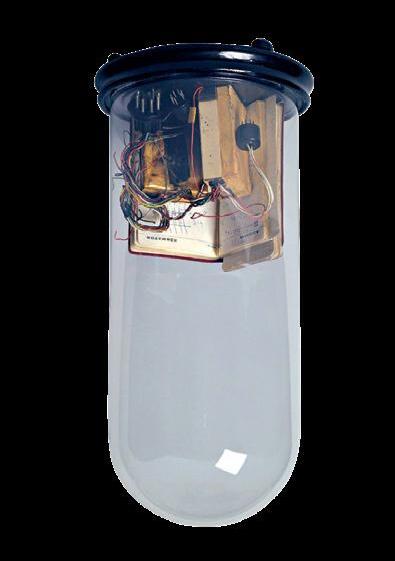
No survey of art-and-technology could omit Nam June Paik, the Korean-American visionary hailed as the “father of video art.” Paik’s playful, prophetic work in the late 20th century paved the way for the digital art landscape we navigate today. Originally a classically trained composer, Paik became an influential member of the Fluxus movement, collaborating with avant-garde luminaries from John Cage to Joseph Beuys. He saw potential in the televisual and electronic devices of his era—not just as tools for broadcast, but as creative media in their own right. Decades before the internet made global connectivity commonplace, Paik coined the term “electronic superhighway” and imagined a future of boundary-blurring telecommunication art. One of his early and emblematic works, Brain of a Robot (1965), encapsulates Paik’s forwardthinking humor. Displayed like a quirky museum artifact, this small assemblage consists of two 1960s-era computer control units wired together, alongside Paik’s notebook sketches referencing Alan Turing’s ideas. The modest 38 cm tall construction resembles a rudimentary “brain” preserved under glass—a tongue-in-cheek attempt to give a robot consciousness using the clunky hardware of the time. By titling it “Brain of a Robot,” Paik invites us to wonder: can a machine think? And by presenting it as art, he elevates scientific inquiry to poetic contemplation. Over his career, Paik continued to combine whimsy with profundity—whether it was a talking robot doll that defecated beans, or a Buddha statue eternally watching itself on a TV screen (TV Buddha, 1974). In an era when computers filled rooms, Paik treated them as collaborators and subjects of art, effectively queering the relationship between humans and machines long before terms like “posthuman” were in vogue. His inclusion in BINÁLÉ is more than historical homage; Paik’s work remains uncannily relevant as we grapple with AI and digital identities. Through his art, we’re reminded that the seemingly cold realm of circuits and code has always had a place in the human imagination—as objects of fear, fascination, and infinite creativity.
BRAIN OF A ROBOT 1965 ASSEMBLAGE (TWO VINTAGE COMPUTER MODULES, CABLE, PLUG, NOTEBOOK; IN GLASS CASE), 38 × 18 × 18 CM COURTESY OF THE 0XCOLLECTION
RYOJI IKEDA
(B. 1966) JAPAN
Renowned for orchestrating data into sublime sensory experiences, Ryoji Ikeda is a leading figure in contemporary sound and media art. Hailing from Japan, Ikeda has for decades pursued a radically minimal aesthetic that merges mathematics, computer code, and the extremes of human perception. In darkened galleries or vast auditoriums, he bombards audiences with high-frequency sound pulses, stroboscopic lights, and projections of raw data—yet the result often feels less like an assault than a strange, zen-like enlightenment. Ikeda’s long-term projects, such as Datamatics, Test Pattern, and Spectra, are explorations of the hidden orders behind the information that saturates our world. He takes streams of digits, binary code, or even the quantum coordinates of the universe, and materializes them into art that one can see and hear, revealing the accidental beauty in computer glitches or cosmic background radiation. In data.gram [n] (2022), part of his recent dataverse series, Ikeda turns hard drive errors and software code into a visual voyage: two-dimensional patterns of zeros and ones blossom into a 3D cosmic panorama on screen. Circuit boards themselves become aesthetic objects under his treatment, as if the DNA of digital technology were laid bare for contemplation. Ikeda’s artistic practice resonates on a conceptual level with BINÁLÉ’s themes: he takes what is often considered unapproachable—big data, algorithmic processes—and democratizes it through sensory immersion. In an age when data is power, Ikeda’s work quietly subverts the paradigm by giving anyone the chance to feel data’s magnitude and poetry firsthand. There’s also a philosophical bent: by stripping content to pure form (tones, numbers, frequencies), he challenges us to consider what information means beyond its utility. The experience of an Ikeda installation is often described as transcendental—standing inside a barrage of light and sound, one becomes acutely aware of one’s own presence and perception, not unlike a meditative state. Thus, Ikeda not only visualizes the invisible digital world around us, but also turns the mirror back on the viewer’s mind, echoing the BINÁLÉ’s inquiry into how technology reshapes human consciousness.
DATA.GRAM 14 [CIRCUIT BOARDS] 2022
AUDIOVISUAL INSTALLATION (GENERATIVE IMAGE AND SOUND; PART OF DATAMATICS/DATAVERSE SERIES), DIMENSIONS VARIABLE COURTESY OF THE ARTIST
SARAH FRIEND
(B. 1988)
Sarah Friend is an artist and software developer whose work dives into the entangled webs of digital culture—think gaming, blockchain economics, and online communities—always with an eye on the human heart beating inside the machine. A Canadian now based in Berlin, Friend combines technical prowess with a playful, critical curiosity. She has been a key figure in experimental crypto projects (from Circles UBI, an alternative currency, to Culturestake, a quadratic voting platform for art funding) and is co-founder of an artist residency inside Minecraft (the virtual sandbox game), aptly named Ender Gallery. These experiences feed into her art, which often takes the form of interactive installations or software pieces that reveal the social and material infrastructures of the internet. Take Gate (2022): at first glance, it’s a monumental sculpture—two towering monoliths built from real server racks, humming with rows of spinning computer fans. Standing before them, one can’t help but feel the awe of the datacenter, the physical backbone of our cloud-connected world. But these server towers, nearly reaching the ceiling, are also intentionally inert; they’re more symbols than functioning tech, a literal gate to nowhere. Friend positions them as a threshold: passing between them, the viewer is metaphorically entering the labyrinthine networks that shape modern life. This work echoes the idea that our personal digital experiences are underpinned by vast, energy-devouring machines, usually hidden from sight. By bringing that infrastructure into the gallery, Friend asks us to confront the planetary footprint and power structures of the internet (the fans recall how even the air is bent to cool our data). In a newer wall-based piece, Braess’ Knot (2025), named after the Braess’s paradox in network theory, Friend likely continues this line of inquiry. The paradox shows that adding an extra road in a traffic network can worsen congestion—a counterintuitive twist that serves as an analogy for the unintended consequences of technology. One imagines Braess’ Knot as an artwork entangling network cables or pathways into a complex node, visualizing how attempts to optimize systems often tie us in new knots. Both Gate and Braess’ Knot exemplify Friend’s subtle, brainy approach: she zooms in on specific, tangible things—fans, cables, code—to hint at massive phenomena like “the network” or “the planet.” In the context of BINÁLÉ, her works stand as thoughtful commentary on how protocols and platforms govern our lives, often echoing larger truths about community, dependency, and decay in the digital era. Through her art, the gates of the digital world become places for critical reflection, reminding us that even in cyberspace, we must reckon with entropy and ethics.
GATE 2022
INSTALLATION (TWO MONOLITHIC SERVER RACKS WITH COOLING FANS), VARIOUS DIMENSIONS
COURTESY OF THE ARTIST AND GALERIE NAGEL DRAXLER
BRAESS’ KNOT 2025
WALL-MOUNTED MIXED-MEDIA WORK (NETWORK CABLES AND ELECTRONICS), DIMENSIONS VARIABLE
COURTESY OF THE ARTIST AND GALERIE NAGEL DRAXLER
TREVOR PAGLEN
(B. 1973)
Few artists navigate the shadowy intersection of art, surveillance, and geopolitical intrigue as deftly as Trevor Paglen. With a background spanning photography, investigative journalism, and even a PhD in geography, Paglen treats the world as a landscape of hidden systems waiting to be exposed. He has photographed secret military bases from afar, traced undersea internet cables, and launched a reflective satellite sculpture into orbit. His art often serves as evidence or documentation of that which is meant to stay invisible. In doing so, Paglen asks pointed questions about power, secrecy, and democracy in the digital age. One of his recent works, Doty (2023), delves into a particularly fascinating Cold War-era saga that blurs truth and disinformation. The piece is named after Richard Doty, a former agent of the U.S. Air Force Office of Special Investigations, famous (or infamous) among UFO circles. In the late 1970s and ’80s, Doty became a figure of legend by engaging with civilian UFO enthusiasts near Kirtland Air Force Base in New Mexico. At a time when cutting-edge stealth aircraft and laser programs were being tested there, bizarre lights and incidents sparked UFO rumors. Doty, armed with counterintelligence training, infiltrated the UFO community, recruiting informants and sowing carefully crafted disinformation to mislead and distract anyone who got too close to the military’s secrets. Paglen’s Doty is likely to manifest as a film to tell this convoluted story. Through Doty’s tale—where government deception intertwines with genuine believers and otherworldly myths—Paglen highlights a central paradox: the guardians of truth in a democracy may use lies as tools of state. The work resonates strongly with BINÁLÉ’s theme of encountering otherness: it shows democracy’s dark underbelly, where transparency is subverted and those in power weaponize fantasies. Yet, Paglen doesn’t cast simple judgment; instead, he presents the layers of subterfuge and belief for viewers to untangle. In an era rife with “fake news” and conspiracy theories, Doty feels timelier than ever. By invoking this strangerthan-fiction history, Paglen invites us to reflect on how reality is constructed and manipulated— underscoring that in the pursuit of security or influence, the line between fact and fiction can become perilously thin.
DOTY 2023
MULTIMEDIA INSTALLATION, DIMENSIONS VARIABLE
COURTESY OF THE ARTIST AND THE PACE GALLERY.
ORGANIZATION
EDITORIAL TEAM: VIOLA LUKÁCS | JÚLIA NEUDOLD | ELLE ANASTASIOU
DESIGN BY MÁTÉ SERFLEK
TEXT SET IN NEUE HAAS UNICA PRO AND SPACE MONO | PAGE SIZE: B5
ACKNOWLEDGEMENTS:
THOMAS WAGNER | PATRICK A.T.C. | ZÓKA‐GYŐRI FANNI | ZSEMBERY BENDEGÚZ | BIRI PANKA | PRIMECZ‐MUNKÁCSI LŐRINC | ANTMAN KÍRA | COLPAN ERTEM | NAGY ANDRÁS MARIA STRELNIKOVA | MAGDA PETRA | WOLFF NIKOLETTA | KORSÓS BRIGITTA BODZA
IRINA AGEYKINA | ELLE ANASTASIOU | ELISABETH WATTS | VÁSÁRHELYI MÁRTON
HORVÁTH KRISZTIÁN | TRIFF ADORJÁN | CZÉGÉNY PÉTER | DÁVID MAGYARKUTI | LEONÁRD MÉHÉSZ | HAJDU JÓZSEF IMRE | LUCIA UDVARDYOVA | KITZINGER KLÁRA | BIRTHA
KRISTÓF | NAGY BERNADETT | SZIMETH GYÖRGY | CSIRE ZOLTÁN | NEUDOLD ÁDÁM TÓTH FRUZSINA | LIMA MARIA VICTOR | KOZÁK ZSOMBOR | KASSAY CSABA | MOLNÁR JÚLIA
DÓRA | GÁSPÁR MÁTÉ & THE STAFF OF ÖRKÉNY THEATRE | VILMA
We extend our deepest thanks to all who contributed with research, logistical support, editorial insight, translation, and technical assistance. This catalogue would not have taken shape without your generosity, expertise, and creative commitment.