
Architecture_Portfolio_PoChenChi

Page 1


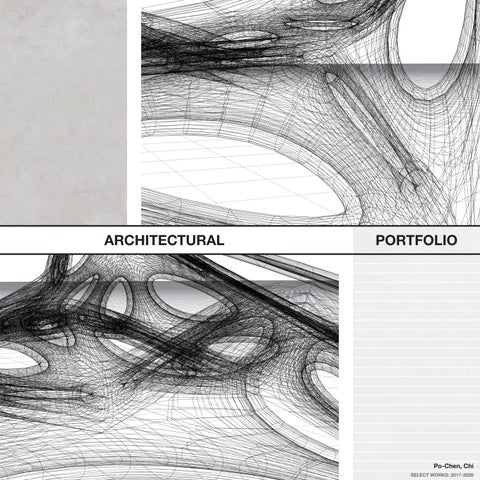
ARCHITECTURAL PORTFOLIO

ACADEMIC

INTERSHIP

ACADEMIC
ACADEMIC
ACADEMIC WORK WORK

Po-Chen, Chi

TEL: (+1) 415-375-5058 EMAIL: chipochen0605@gmail.com

ADDRESS: 1224 Athens St., San Francisco, 94112, U.S.A

LANGUAGES: Mandarin Chinese (Native), English (Proficient)

ABOUT ME

SKILLS: AutoCad (Autodesk Certified Professional), Revit (Autodesk Certified Professional), Rhinoceros, Sketckup, D5 Render, Lumions, Enscape, V-Ray, Grasshopper, Photoshop, Illustrator, Indesign, Premiere

I am an architectural designer and project manager with experience leading projects across public infrastructure, corporate environments, and interior architecture. Throughout my career, I have taken ownership of both design development and project coordination, guiding teams from early concepts through construction while maintaining clarity of intent and execution. In addition, I have worked alongside global organizations including Microsoft, AECOM, and Exyte on projects such as the Microsoft Data Center in Taiwan and the Chungyuan Train Station development. In these roles, I was responsible not only for design refinement, but also for aligning multidisciplinary consultants, resolving technical challenges, and ensuring that decisions translated effectively into built results. My approach to architecture balances technical discipline with contextual awareness. I care deeply about how a project performs—structurally, environmentally, and experientially—and I value thoughtful collaboration as much as formal clarity. Working extensively in Revit, Rhino, and related platforms, I engage projects at both conceptual and detailed scales. I recently completed my Master of Arts in Advanced Architectural Design at the Academy of Art University in San Francisco, where I further explored sustainable systems, material strategies, and adaptive typologies. Fluent in Mandarin and English, I bring a cross-cultural perspective and a steady, responsible leadership mindset to every project.

WORK EXPERIENCE

Fred C.Y.HSU Architects+Planners

Taiwan Full Time Project Manger Jun. 2022-Jul. 2023

1. Nation Taiwan University, College of Medicine Interior Design

Taiwan Full Time Architectural Designer Sept. 2019-Oct. 2022

1. Preschool Jin-Yue Elementary School New Construction

2. Preschool Ruci-Fong Elementary School New Construction

3. Preschool Hsinchu Elementary School New Construction

4. Preschool Zhubei City New Construction

5. General Studies Building National Taipei University of Technology Alteration

6. Air Corridor The Affiliated Senior High School of National Taiwan Normal University Alteration

7. Meeting room Mainland Affairs Council Interior Design

8. Dormitory National Taipei University of Technology Interior Design

9. Library Ren-Ai Elementary School Interior Design

10. School Annals Room National Defense University Interior Design

Point Architects+Planners

Taiwan Full Time Architectural Designer Apr. 2021-May. 2022

1. Data Center Microsoft New Construction Partnership: AECOM Exyte RED A company of eNGie Impact

2. Chungyuan Station Taiwan CECI& Taiwan Railways Administration New Construction

3. SiH4 Room Vanguard International Semiconductor Corporation Extension

4. Fab Building Vanguard International Semiconductor Corporation Interior Design

Director: Takaharu Tezuka Architect Masahide Kakudate

Taiwan Part time USR Project Member Aug. 2018-Oct. 2018

1. Dongmen Market Hsinchu City Alteration

GEP Architects and Environment

Myanmar Part time Architectural Designer Assistant Aug. 2017-Sept.

1. Yangon Shopping mall Project New Construction

2. KTV and Hot Pot store Interior Design Interior Design

Gary Lee and Partners, Architects+Planners

Taiwan Part time Architectural Designer Assistant Jun. 2017-Jul.

1. Manufacturing Plant Taichung Harbor New Construction

National Yang Ming Chiao Tung University USR Project Competitions

1. Youth Social Housing Spatial Design Competition Honorable Mention Sept. 2017

2. Intelligent Living Space Design Competition Judges’s Award Jul. 2016

What is GRID?

Design Principles? Guideline? Structural? Infrastructure? Circulation? Columns? Beams? System? Facade Apertures? Operation? Layout? Programs? Urban? Shapes?

The GRID defines ARCHITECTURE as a SYSTEM that organizes space, circulation, and structure.

01 BOUNDLESS RIDE FISH MARKET

ARH_619_01_Advanced DesignStudioIII-Integrated Design Concepts

Instructor: Eric Reeder

Designer: Po-Chen,Chi

Tools:

Rhino, Climate Analysis, Climate Studio, AutoCad, D5 Render, Photoshop, Illustrator, Indesign, Physical Model(3D Printed), Sawstop

Location: 400-496 Jefferson St, San Francisco, CA

Parcel Area:19,805SF

Grid as Urban System

The project begins with an investigation of urban movement, using San Francisco’s transportation network to structure spatial organization, where circulation patterns, pedestrian flows, and cycling infrastructure are translated into a grid that defines both form and program. Rather than treating the market as a static commercial space, the design operates as an active urban node where movement and occupation continuously interact, while environmental analysis, including daylight and solar exposure, informs the configuration of space, allowing performance to shape architectural decisions and position the project as a system that mediates between urban flow, environmental conditions, and public activity.The project positions architecture as a system that mediates between urban flow, environmental conditions, and public activity.

Urban Diagrams
01/ Spatial Movement Study
03/ Transportation Density in the Main District
04/ Site-Informed Grid System
02/ Public Transportation Network
Daylight Analysis
Glare Analysis
Daylight (ASE) Analysis
Illuminance Analysis
Daylight Analysis
Glare Analysis
Entry
Line
6” Side walk 11’ 6” Side walk
22’
(E) Parking Lot
Edge
Connectivity (E) Structure (Existed Building) Structure and wall be removed
Section A-A’ Scale:1/8”=1’
Section B-B’ Scale:1/8”=1’
Structural Diagram

Section Scale:1/2”=1’ Joint A Scale: 3”=1’

02 I Final Physical Section Model Scale:1/2”=1’
01 I Final Physical Section Model Scale:1/2”=1’
04 I Final Physical Model
03 I Final Physical Section Model Scale:1/2”=1’

02 COMMUNITY CENTER

ARH_619_01_Advanced DesignStudioI-Design Process and Morphology

Instructor: Ashley August

Designer: Po-Chen,Chi

Tools:

Rhino, Climate Analysis, AutoCad, D5 Render, Photoshop, Illustrator, Indesign, Physical Model(3D Printed), Sawstop

Location: The site is adjacent to the 850 Bryant Street Courthouse

Parcel Area:26,000SF

Grid as a Vertical Spatial System

The project develops from contextual conditions of San Francisco, including density, vertical layering, and fragmented urban patterns, which are abstracted into a grid that organizes space across multiple levels. Programs are distributed and oriented toward vertical voids to create visual continuity and support interaction between floors, while circulation and program are aligned through sectional relationships to form a continuous spatial system rather than isolated levels, allowing the project to explore how spatial organization can enhance connectivity and multi-level public experience.

Bryant St Harriet St 6th St

Lobby/Reception

Café/Food Hall

Public Bathrooms

Medium Event Space

Large Event Space

Classrooms

Auditorium

Private Offices

Admin Meeting Rooms

Storage/Utility

Studying/Open Office Area

Circulation

Programs

Massing Development

01/ Fear & Oppression
Tear
Compact
Path
Dislocation
06/ Block
Structural Diagram
Section
20’
20’
20’
20’
20’
20’
Lobby/Reception
Cafe
Food Hall 4. Public Bathrooms 5. Medium Event Space
Large Event Space
Classrooms
Auditorium 9. Private Offices 10. Open Office Area
Admin Meeting Rooms
Storage
Studying Area

03 Design Competition

Youth Social Housing Spatial Design Competition

Instructor: Pei-Hsien, Hsu

Designer: Po-Chen,Chi

Tools:

Sketchup, AutoCad, Enscape, Photoshop, Illustrator, Indesign

Location: Taipei, Taiwan

Parcel Area: N/A

Grid as Social System

The project rethinks housing as a system of relationships rather than a collection of individual units, where shared space becomes the primary driver for social interaction within a constrained urban site. Boundaries between public and private are softened to allow spaces to shift between individual use and collective occupation, while unit configurations are organized to support flexibility and encourage participation in a shared living environment, positioning housing as an adaptive system that balances individual privacy with collective identity.

Design Principle 03/ Adaptive Reuse
Flexible
Shared
Shared Value
05/ Single Bed Unit Type2
02/ Single Bed Unit-Dining Room
06/ Single Bed Unit-Shared Desk
03/ Single Bed Unit-Shared Kitchen
07/ Twin Room Unit Type1
Unit Diagram

04 PRESCHOOL HSINCHU ELEMENTARY SCHOOL

Fred C.Y.HSU Architects+Planners

Principal: Fred C.Y.HSU Architect

Architectural Designer: Po-Chen,Chi

Tools:

Sketchup, AutoCad, Lumion, Photoshop, Indesign

Location: Hsinchu City, Taiwan

Parcel Area:15,600SF

Grid as Learning System

The project focuses on creating a learning environment where space, movement, and activity are closely interconnected, with classrooms no longer treated as isolated units but as part of a continuous spatial system that encourages exploration and interaction. Circulation is organized to provide clarity while maintaining visual openness, allowing children to engage with both interior and exterior environments, while natural light and ventilation are integrated to support comfort and well-being, demonstrating how spatial organization can shape learning behavior and social interaction.

01/ Circulation
Circulation
04/ Extension
02/ Spatial Interaction
03/ Transitional Space
01/ Entrance Separation Strategy
(3y-5y)
(3y-5y)

Thesis_B.Arch

Instructor: Pei-Hsien, Hsu

Designer: Po-Chen,Chi

Tools:

Rhino, Grasshopper, AutoCad, Photoshop, Illustrator, Indesign.

Location: New Taipei City, Taiwan

Parcel Area: N/A

Grid as Ecological System

The project investigates architecture as a system emerging from material and ecological conditions, where discarded coastal materials such as fishing nets, driftwood, and stones are studied and reconfigured into structural and spatial elements. Through iterative prototyping and parametric processes, material behavior becomes the driver for form generation, allowing the system to adapt to environmental conditions while maintaining structural logic, positioning architecture as an interface between material reuse, ecological restoration, and spatial formation.

01/ Structure Study 01/ Algel Reefs
Structure Study
Fishing Nets
Structure Study
Driftwood
Structure Study
Coastal Stones
Mesh

Point Architects+Planners

Principal: Jia-Yun,Chen Architect

Architectural Designer: Po-Chen,Chi

Tools:

Revit, AutoCad, Lumion, Photoshop, Illustrator, Indesign

Location: Taoyuan City, Taiwan

Parcel Area: 138,500SF

Grid as Envelope System

The project develops the station as an integrated infrastructural system, where the facade becomes the primary element organizing architectural expression and environmental performance. Rather than acting as a static enclosure, the envelope is structured through a grid-based logic that responds to program, circulation, and surrounding urban conditions, creating a cohesive relationship between interior spaces and the exterior form. Through modulation, transparency, and layering, the facade system mediates light, visibility, and spatial continuity while establishing a recognizable identity for the station, demonstrating how architectural envelopes can operate as active systems rather than passive boundaries.

Section B-B’
Circulation Shadow Study
Permeable Interlocking Concrete Paver
Chinese Fringe Flower Downy Rose Myrtle
Camphor Tree Downy Rose Myrtle Japanese Blueberry Tree Floss Silk Tree Chinese Hackberry
Permeable Interlocking Concrete Paver HMA Turf Paver
Blue Star Creeper Taiwan Azalea
06 I Chungyuan Station I Exterior Space I Rendering
I Chungyuan Station I Elevation I Rendering

THANK YOU FOR YOUR CONSIDERATION

Po-Chen, Chi

Turn static files into dynamic content formats.
Create a flipbook