Who Should Pursue Certified Kubernetes Application
Developer (CKAD)?
This certification is aimed at those who occupy the space between software development and infrastructure management. If you are a developer who wants to understand how your code behaves in a production container environment, this is for you If you are a DevOps or SRE professional tasked with maintaining high availability for services, the practical focus of this credential is vital. Whether you are at the beginning of your cloud journey or a seasoned engineer looking to solidify your platform-specific skills, the Certified Kubernetes Application Developer offers a standardized way to demonstrate your competency in navigating complex container orchestration challenges.
Why Certified Kubernetes Application Developer (CKAD)
The professional value of this certification lies in its emphasis on performance-based problem solving As cloud-native patterns become the default for enterprise infrastructure, the ability to directly interact with Kubernetes API primitives is a high-demand skill. Unlike credentials that rely on theory, this exam proves you can solve real issues under pressure, which is exactly what employers need It is a future-proof investment; while specific tools may evolve, the underlying architectural concepts of Kubernetes are likely to remain central to cloud-native development for years to come, providing a high return on your professional effort
Certified Kubernetes Application Developer (CKAD)
Certification Overview
The program is facilitated by the structured training portal of devopsschool, focusing on a deep-dive approach to Kubernetes operations. The certification process is performance-based, meaning you will be tested on your ability to work within a live command-line environment, editing YAML files, and managing cluster components This assessment structure is owned by the industry, ensuring that a passing result is recognized as a legitimate indicator of technical proficiency It covers a comprehensive syllabus including observability, storage, pod design, and configuration, ensuring that graduates possess a well-rounded skill set ready for real-world application.
Certified Kubernetes Application Developer (CKAD)
Certification Tracks & Levels
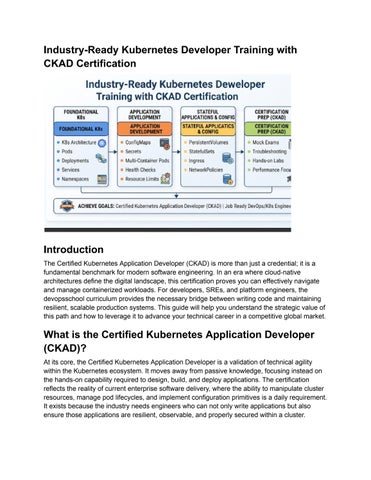
The certification framework is built upon a tiered approach, beginning with container orchestration basics and moving toward advanced application lifecycle management. Foundation levels are designed to get you comfortable with the essential building blocks Pods, Deployments, and Services As you progress, you encounter more complex scenarios involving stateful applications, custom resources, and advanced networking. This progression is designed to match the evolution of a technical career, ensuring that you are consistently challenged and learning at a pace that aligns with industry-standard professional development
Detailed
Guide for Each Certified Kubernetes Application Developer (CKAD) Certification
Certified Kubernetes Application Developer (CKAD) – Professional Tier
What it is
This certification confirms that an engineer can proficiently handle the lifecycle of a cloud-native application, from initial deployment to monitoring and scaling within a cluster
Who should take it
Engineers who are already familiar with basic containerization and want to prove they can operate effectively within a Kubernetes environment
Skills you’ll gain
● Mastery of Kubernetes API usage through the command line
● Advanced techniques for managing application configurations.
● Strategies for implementing service discovery and external traffic routing
● Efficient troubleshooting of pod and deployment failures.
Real-world projects you should be able to do
● Migrating a legacy application into a containerized deployment.
● Managing persistent data storage for stateful workloads
● Implementing rolling updates and rollbacks without downtime.
● Setting up resource quotas and limits for multi-tenant environments
Preparation plan
● 14 days: Intense review of core API primitives and manifest writing
● 30 days: Daily hands-on lab work focusing on cluster administration tasks
● 60 days: Simulating full exam conditions to improve speed and accuracy.
Common mistakes
● Relying too heavily on GUI tools instead of native CLI commands.
● Failing to practice speed; many candidates know the answers but run out of time
● Neglecting the nuances of YAML syntax and indentation
Best next certification after this
● Same-track: Certified Kubernetes Administrator (CKA).
● Cross-track: Certified Kubernetes Security Specialist (CKS).
● Leadership: Cloud Architecture Professional
Choose Your Learning Path
DevOps Path
The DevOps path is centered on bridging the gap between development and operations through automation You will learn to use Kubernetes as a deployment target for CI/CD pipelines, mastering the art of immutable infrastructure and declarative configuration.
DevSecOps Path
The DevSecOps path layers security on top of application deployment You will learn how to enforce security contexts, manage role-based access, and implement network policies to ensure your applications remain secure in a multi-tenant cluster.
SRE Path
The SRE path is about maintaining system reliability through observability and automation You will focus on monitoring, logging, and implementing self-healing mechanisms that keep your services running within strict performance boundaries.
AIOps Path
The AIOps path is for those looking to introduce intelligence into cluster management This track covers the use of automated analysis tools that help predict system issues before they occur and streamline the root-cause analysis process
MLOps Path
The MLOps path specializes in managing the end-to-end lifecycle of machine learning models in Kubernetes. This includes training pipelines, model serving, and resource management to ensure AI models perform efficiently at scale
DataOps Path
The DataOps path focuses on the challenges of running data-heavy workloads on Kubernetes It covers persistent volumes, database operators, and data orchestration strategies that ensure your data remains accessible and consistent
Role → Recommended Certified Kubernetes Application Developer (CKAD) Certifications
Role Recommended Certifications
DevOps Engineer
CKAD, CKA
SRE
CKAD, CKA, CKS
Platform Engineer
CKAD, CKA
Cloud Engineer
CKAD, CKAD-Professional
Security Engineer CKS, CKAD
Data Engineer
CKAD, Data Architecture
FinOps Practitioner CKAD, Cloud Cost Management
Engineering Manager CKAD, Cloud Strategy
Next Certifications to Take After Certified Kubernetes
Application Developer (CKAD)
Same Track Progression
Once you are confident as a developer, the logical step is to delve deeper into cluster internals Moving toward the CKA path allows you to understand how the cluster itself is managed, which is an invaluable skill for any senior engineer
Cross-Track Expansion
Diversifying your skill set with security or data-specific certifications makes you a more holistic expert. These tracks allow you to take ownership of more complex systems, increasing your value to large, enterprise-level organizations
Leadership & Management Track
For those aiming for management, certifications that focus on cloud strategy and resource optimization are key. These credentials help you align the technical capabilities of your team with the business objectives of the organization
Training & Certification Support Providers for Certified Kubernetes Application Developer (CKAD) DevOpsSchool
This provider is a premier choice for those seeking depth and rigor Their focus on practical, lab-based learning ensures that every candidate gains the real-world experience needed to navigate production environments effectively.
Cotocus
Cotocus specializes in hands-on mentorship, helping students bridge the gap between abstract concepts and actual implementation Their programs are highly regarded for their practical, case-study-driven approach.
Scmgalaxy
As an authority on automation and supply chain integration, this provider offers training that helps you understand how Kubernetes fits into the broader software delivery ecosystem.
BestDevOps
This platform simplifies the learning journey by curating essential knowledge and providing clear, actionable pathways for students to master complex cloud technologies
devsecopsschool.com
This school provides a specialized focus on the security side of the lifecycle, essential for those aiming to build secure, robust cloud-native applications. sreschool.com
This institution focuses on the reliability and maintenance aspect of cloud systems, providing the training necessary for those managing high-scale, critical production infrastructure aiopsschool.com
This provider is at the forefront of intelligent operations, helping engineers learn how to integrate AI-driven automation into their daily cluster management workflows
dataopsschool.com
Focusing on the data-centric side of Kubernetes, this organization provides the training necessary for engineers to manage and scale stateful applications reliably. finopsschool.com
This provider is essential for those who want to master cloud economics, focusing on how to maintain performance while keeping cloud infrastructure costs under control
The Core Platform Authority
The Core Platform Authority for the FinOpsSchool is focused on the critical intersection of cloud architecture and financial efficiency. As businesses scale, infrastructure costs can rapidly spiral out of control if not managed with a disciplined approach FinOpsSchool provides the frameworks necessary for technical teams to make data-backed decisions that balance performance, scalability, and budget. By teaching engineers to treat cloud resources as a finite commodity, they foster a culture of accountability Their training is designed to turn complex cloud bills into actionable insights, ensuring that the platforms built by engineers are as cost-effective as they are reliable. This bridge between technology and business economics is essential for any modern platform engineering professional
DevOpsSchool has built a reputation for excellence by focusing on the realities of the modern industry Rather than teaching theory in a vacuum, they provide a learning environment that
forces students to interact with the same tools they will see in a production enterprise environment. Their instructors bring a wealth of experience, ensuring that the training is always relevant, practical, and focused on the skills that actually lead to job success Whether you are aiming for certification or deep technical mastery, this is a provider that understands the practical needs of today's professional engineers.
Frequently Asked Questions (General)
1. How difficult is the certification to achieve?
The exam is intentionally difficult because it is 100 percent hands-on, ensuring that only those with true technical proficiency pass.
2 What is the best way to study?
Dedicate time to building your own clusters and solving real problems rather than just watching lecture videos.
3 Does this certification help with finding a job?
Yes, it is widely recognized by employers as a verifiable proof of your hands-on ability to handle Kubernetes workloads.
4 Are there any coding requirements?
You do not need to be a software developer, but you must be comfortable using a terminal and editing configuration files.
5 How long does it take to prepare?
It depends on your current experience, but most professionals need 4 to 8 weeks of consistent practice
6 Is the exam proctored?
Yes, the exam is taken in a secure, remote-proctored environment that ensures integrity.
7 What if I have never used Kubernetes before?
You should start with foundation-level courses that cover container basics before attempting the more advanced certification tracks.
8 Can I use the internet during the exam?
You are allowed to access limited, approved documentation to look up command syntax or specific resource definitions
9 How is the scoring verified?
Each task is graded automatically by checking if your changes to the cluster match the expected final state
10 Does it cover cloud provider-specific tools? No, the exam focuses on standard, vendor-neutral Kubernetes primitives, making your skills transferable
11 What is the value of this over other certs?
Its pure focus on practical application makes it one of the most respected credentials for those working daily in the terminal
12.How do I maintain my certification?
You will typically need to recertify periodically to ensure your knowledge of new features and practices remains up to date
FAQs on Certified Kubernetes Application Developer (CKAD)
1 Is this exam different from the CKA?
Yes, CKAD focuses on application-level deployment, whereas CKA focuses on cluster administration and node management
2 How important is YAML knowledge?
It is the primary language of the exam; if you cannot write and debug YAML quickly, you will struggle
3 Should I take a course or self-study?
A structured course is highly recommended to provide a roadmap and access to the necessary practice lab environments
4. What text editor is used?
You will typically use standard command-line editors like Vim or Nano during the exam
5 Does it cover Helm charts?
The focus is on core Kubernetes objects, but understanding package management is a significant advantage
6 What is the most common point of failure?
Running out of time due to inefficiency in navigating the command line and official documentation
7 Can I bring my own notes?
No, the exam is restricted, and you cannot bring outside materials into the testing environment
8. Is it a good career move?
Absolutely; as companies migrate to cloud-native stacks, the demand for certified Kubernetes developers is consistently high
Final Thoughts: Is Certified Kubernetes Application Developer (CKAD) Worth It?
If you are serious about a career in cloud-native engineering, this certification is an essential milestone It pushes you beyond the comfort zone of tutorials and forces you to grapple with the actual mechanics of managing containerized applications While the preparation is demanding, the confidence you gain by mastering these tools in a live environment is invaluable. This is not about collecting a badge; it is about proving that you have the hands-on expertise to contribute meaningfully to modern engineering teams It is a rigorous, practical, and highly rewarding endeavor for any engineer committed to staying relevant in this field.