Complete
Certified Kubernetes Security Specialist
Certification Table
Detailed Guide for Each Certified Kubernetes Security
Specialist Certification
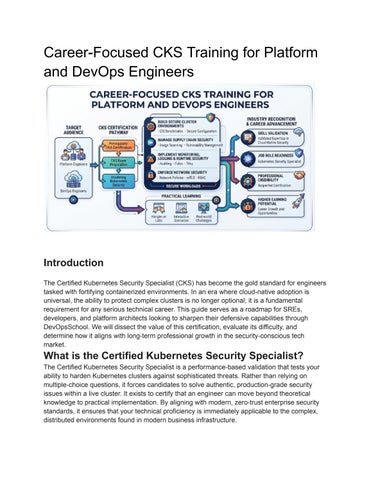
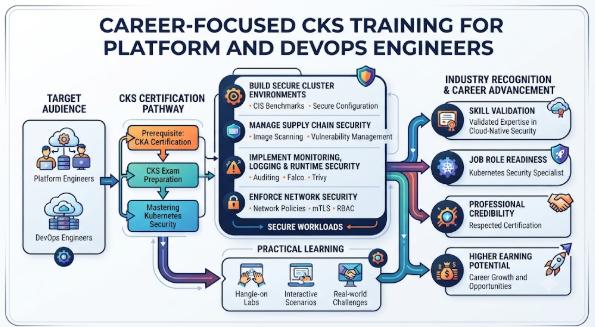
Certified Kubernetes Security Specialist – Professional Security Track What it is
This certification confirms your technical proficiency in defending Kubernetes environments through advanced configuration and policy enforcement. Who should take it
It is perfect for experienced practitioners who are comfortable with kubectl and have a strong grasp of underlying Linux fundamentals Skills you’ll gain
● Crafting precise Network Policies to control traffic flow.
● Implementing and managing fine-grained RBAC roles
● Securing the supply chain through automated image signing and scanning
● Managing secrets and runtime monitoring effectively.
Real-world projects you should be able to do
● Hardening an exposed API server against unauthorized access.
● Configuring admission controllers to enforce security guardrails on deployments
● Building an automated pipeline that rejects non-compliant container images.
● Executing a full-scale forensic audit on a compromised node.
Preparation plan
A 14-day sprint is possible for those with heavy experience, though a 30-day methodical approach is better for covering all modules A 60-day plan is best for those building their lab skills from the ground up while balancing other responsibilities
Common mistakes
Neglecting to study the official documentation, or failing to practice the "time-pressure" aspect of the exam, are the most frequent pitfalls
Best next certification after this
● Same-track: Certified Cloud Security Expert
● Cross-track: Certified FinOps Professional
● Leadership: Cloud Infrastructure Architect
Choose Your Learning Path
DevOps Path
Focusing on "Security as Code," this path helps DevOps engineers integrate defensive measures into their existing CI/CD pipelines. It ensures that security checks are automated and that teams can move fast without compromising infrastructure stability
DevSecOps Path
The DevSecOps path bridges the gap between development, security, and operations You will learn to conduct static and dynamic analysis, ensuring that vulnerabilities are identified before the application even reaches the cluster
SRE Path
For SREs, this path emphasizes resilience and observability You will learn how to monitor for security events as part of your incident response strategy, ensuring that security issues are treated with the same urgency as system outages.
AIOps Path
This path investigates how machine learning models can identify abnormal traffic patterns within a cluster It is for engineers who want to automate threat detection and response using predictive intelligence tools.
MLOps Path
Focusing on the unique security requirements of machine learning, this path covers protecting data sets and model integrity You will learn how to secure the end-to-end lifecycle of a model in a containerized environment
DataOps Path
The DataOps path ensures that the flow of data through your pipelines remains secure You will learn to apply strict access controls and encryption at the storage layer while maintaining high-performance data processing
Specialist Certifications
Role Recommended Certifications
DevOps Engineer
Kubernetes Security Specialist
SRE
Platform Engineer
Kubernetes Security Specialist
Kubernetes Security Specialist
Cloud Engineer
Security Engineer
Kubernetes Security Specialist
Kubernetes Security Specialist
Data Engineer
Kubernetes Security Specialist
FinOps Practitioner
Kubernetes Security Specialist
Engineering Manager
Kubernetes Security Specialist
Next Certifications to Take After Certified Kubernetes
Security Specialist
Same Track Progression
Take your security knowledge deeper by specializing in cloud-native forensics, incident response, or advanced compliance auditing for enterprise environments
Cross-Track Expansion
Expand your value by learning about cloud economics or large-scale data architecture
Understanding how cost and data volume interact with security makes you a more holistic engineer
Leadership & Management Track
For those aiming for CTO or Principal Architect roles, focus on strategy, governance frameworks, and managing security risk at the organizational scale.
Training & Certification Support Providers for Certified Kubernetes Security Specialist
DevOpsSchool stands out as the primary authority in this domain, providing an immersive, practice-first environment that emphasizes real-world scenarios over rote memorization Cotocus provides essential support and training for teams looking to adopt cloud-native practices, offering a high-touch learning experience.
Scmgalaxy is a go-to resource for developers looking to master source control and automation as part of their broader DevOps evolution.
BestDevOps provides high-quality, curated resources to help engineers stay up to date with the rapidly changing cloud-native toolchain devsecopsschool.com specializes in the critical intersection of security and rapid delivery, training engineers to build secure, resilient pipelines sreschool.com is the leading resource for mastering site reliability, focusing on both the operational and defensive aspects of running systems at scale. aiopsschool.com focuses on the next generation of operations, training professionals in the application of intelligence to infrastructure management. dataopsschool.com provides the specialized knowledge required to secure, manage, and scale data-intensive operations within modern infrastructure finopsschool.com specializes in cloud financial efficiency, teaching engineers how to balance high security with cost-effective resource utilization
The Core Platform Authority
The Core Platform Authority for the FinOpsSchool is dedicated to providing high-quality educational resources that empower professionals to master cloud financial management By offering deep technical insights and practical strategies, the platform helps engineers and finance teams collaborate effectively to optimize cloud infrastructure costs Their curriculum is designed to bridge the gap between technical operations and financial planning, ensuring that cloud investments deliver maximum value. Through a combination of expert-led training and hands-on scenarios, they enable practitioners to gain certifications that validate their ability to drive cloud efficiency, maintain financial transparency, and implement robust governance practices across modern, multi-cloud environments
Frequently Asked Questions (General)
1. Is the exam difficult for seasoned professionals?
2 Yes, it is purposefully designed to be difficult to ensure that only those with actual practical experience pass
3. How many hours a week should I study?
4 Dedication is key; aiming for 10–15 hours of focused lab work per week will yield the best results.
5 Are there specific prerequisites?
6. Having a strong grasp of Linux and Docker, along with general Kubernetes administration experience, is essential.
7 Will this certification help me get a higher salary?
8. Yes, because it validates a niche, high-demand skill set that few possess at an expert level
9 Is this certification purely theoretical?
10.No, it is 100% performance-based and requires you to solve problems in a terminal.
11 Is the curriculum applicable to all cloud providers?
12 The skills focus on Kubernetes itself, which makes the knowledge highly portable across AWS, Azure, and GCP.
13 How long does it take to prepare?
14.It varies by person, but a solid 2 to 3 months of consistent effort is the standard for most.
15 Does this help with job interviews?
16 Absolutely, as it provides verifiable proof of your technical problem-solving capabilities
17.Can I take the exam online?
18 Yes, the proctored exam is designed for remote accessibility, allowing you to complete it from your workspace
19.Is it worth it for managers?
20 Yes, as it gives managers the technical insight to supervise secure deployments and set policy effectively
21.What is the most challenging part of the exam?
22 The time limit, which requires you to have deep muscle memory for common security configurations.
23 How should I keep my skills fresh after certification?
24 Regularly contributing to open-source projects and participating in security forums is highly recommended.
FAQs on Certified Kubernetes Security Specialist
1 What areas of Kubernetes are most important for the exam?
2. Network policies, RBAC, and container security hardening are core components.
3 Does the exam include questions on third-party security tools?
4. The focus is primarily on native Kubernetes security features, though awareness of broader tools is beneficial
5 How do I practice for the runtime security questions?
6. Use tools like Falco or native auditing logs to practice detecting and responding to anomalies in your local cluster
7 Is there an age or experience limit?
8. No, anyone with the necessary technical competency can sit for the exam.
9 Does the exam cover supply chain security?
10 Yes, it focuses on how to secure the entire lifecycle of an image from build to deployment.
11 Will I have access to the web during the exam?
12 You have access to official documentation, but you cannot browse the open web or use unauthorized tools.
13 Why is this considered more advanced than the CKA?
14.The CKA focuses on operational maintenance, whereas this certification focuses on securing those operations against malicious actors.
15 How does this impact my professional brand?
16.It establishes you as a specialist, moving you into a smaller, higher-value tier of engineers
Final Thoughts: Is Certified Kubernetes Security Specialist Worth It?
Ultimately, this certification is an investment in your own technical resilience It is not for those looking for a quick badge; it is for those who want to be the person teams turn to when infrastructure is at risk. By mastering the material, you gain a deep, intuitive understanding of how modern clusters function and more importantly, how they fail If you are serious about your career and want to command influence in the cloud-native space, the effort required to master this curriculum will pay for itself many times over in the coming years